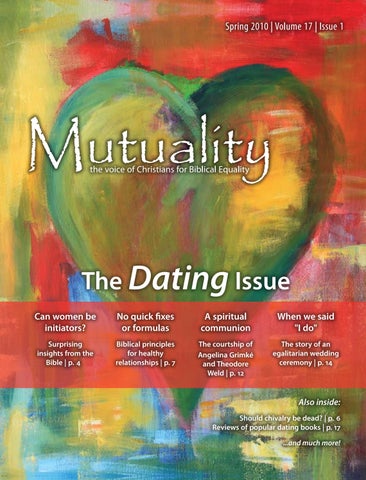
Spring 2010 | Volume 17 | Issue 1
Mutuality the voice of Christians for Biblical Equality
The Dating Issue Can women be initiators?
No quick fixes or formulas
A spiritual communion
When we said "I do"
Surprising insights from the Bible | p. 4
Biblical principles for healthy relationships | p. 7
The courtship of Angelina Grimké and Theodore Weld | p. 12
The story of an egalitarian wedding ceremony | p. 14
Also inside: Should chivalry be dead? | p. 6 Reviews of popular dating books | p. 17 ...and much more!
Mutuality 17.1, Spring 2010 “Let us then pursue what makes for peace and for mutual upbuilding” (Rom. 14:19, NRSV). Mutuality (issn: 1533-2470) seeks to provide inspiration, encouragement, and information about equality within the Christian church around the world. Editorial staff: Megan Greulich, editor; M. L. Castleberry, Adele Hebert, editorial assistants; Image Spigot, graphic designer; Mimi Haddad, president/publisher. Contact us at: Christians for Biblical Equality; 122 W Franklin Ave, Suite 218; Minneapolis, MN 55404-2451; phone: (612) 872-6898; fax: (612) 872-6891; email: mgreulich@cbeinternational.org; web: cbeinternational. org. We welcome your comments, article submissions, and advertisements. For writers' guidelines and upcoming themes and deadlines, visit CBE’s website and follow the link under the Resources tab. Advertising in Mutuality does not imply organizational endorsement. Please note that neither Christians for Biblical Equality, nor the editor, nor the editorial team is responsible or legally liable for any content or any statements made by any author, but the legal responsibility is solely that author’s once an article appears in Mutuality. All Scripture quotations, unless otherwise indicated, are taken from the Holy Bible, Today’s New International Version®. TNIV®. Copyright © 2002, 2004 by International Bible Society. Used by permission of Zondervan. All rights reserved. CBE grants permission for any original article (not a reprint) to be photocopied for local use provided no more than 1,000 copies are made, they are distributed free, the author is acknowledged, and CBE is recognized as the source. Mutuality is published quarterly by Christians for Biblical Equality and is sent free to members and supporters.
Contents F E AT U R E S 4
You Wanna Start Somethin'? What the Bible really teaches us about women initiators by Karen Shaw
6
Chivalry vs. Servanthood: A woman's reflections on male chivalry and Christian values by Amanda Beattie
7
X+Y=Happy Relationship? Biblical principles for successful dating and marriage relationships by Jason Eden
12 An Intellectual and Spiritual Communion: Dating insights from the courtship of Angelina Grimké and Theodore Weld by Bethany Nelson 14 When We Said "I Do": One couple shares the story of their egalitarian wedding by Anna and Ryan Snyder 17 Do They Make the Grade? Analyzing popular Christian dating books and their teachings on gender compiled by CBE staff 19 The Gospel of Ruth by Carolyn Custis James: A book review by Mary Ann Nguyen-Kwok
MINISTRY AND CHAPTER NEWS 20 The Report from Urbana 20 Praises, Prayers, and Reflections
D E PA R T M E N T S 3 From the Editor: Opening Doors and Spinning Our Wheels 18 Join the Discussion: Dating articles on The CBE Scroll 21 Giving Opportunities: CBE's 2009 Financial Report 22 President’s Message: Women's Calling as Ezer
2 M U T U A L I T Y | Spring 2010
websi te : cbeinternational.org
From the Editor by Megan Greulich
Opening Doors and Spinning Our Wheels My very first experience with a Christian dating book came just days after I gave my life to Christ. I was a freshman in high school and had joined a small group of young women who were studying Elisabeth Elliot’s Passion and Purity. I devoured the book. As a teenager, my new faith was bringing clarity, peace, and meaning to my confusing life, and the passion for Jesus that the young women around me modeled and Elisabeth Elliot described in her writing stirred me. Her relationship with Jim Elliot detailed in the book was marked by deep faith, sacrifice, self-restraint, and adventure—they were committed to living wholeheartedly for God, to be part of a plan bigger than their own individual desires. I craved a life like that too. So when she also wrote that women were to submit to men as their leaders, to wait for them to initiate, I believed her. I readily adopted her message that to love Jesus and put him first in my dating relationships meant to fully adhere to traditional gender roles. I was attracted to the order and simplicity of this new teaching, and I soon picked up every other Christian dating book I could find. In these books I discovered many more ideas about men and women, each claiming to be biblical. I read that women have a sinful desire to take command and manipulate. I read that men are controlled by their visual nature and their sex drive. And I read that women are created to be beautiful, on the inside and out, and that this beauty is meant for men. The problem was that with my limited experience as a young person and lack of wisdom as a baby Christian, I could not distinguish between biblical truths and cultural values. But this is a crucial exercise to engage in when we consider dating because, as our blogger Christensen Low rightly states (p. 18), dating is a completely cultural invention. We have no biblical mandates on which gender should hold doors open or pay for dinner. There are no biblical descriptions of every man’s supposed “visual nature” or every woman’s “need for emotional intimacy.” Dating looks entirely different around the world and, as it stands today, was nonexistent even 100 years ago. And yet, Christian dating books are often filled with oversimplified advice that draw on cultural stereotypes about gender and describe them as God’s only way and intention for romantic relationships. Does the Bible really teach that men and women are truly opposites, with differing needs, desires, roles, and communication styles, as so many of these books argue? Are these gender stereotypes (which are clearly modeled after medieval concepts of chivalry or princess fairy tales) biblical and essential for godly relationships? As a good friend recently asked me, “Why are Christians so obsessed with determining who opens a door? Why does it matter?” Her
booksto re : equalitydepot.com
frustration highlighted to me how much we have missed the point. It seems that we are too quick to “spin our wheels” over these small details when the Bible calls us to much greater challenges—to grow in our love for God and others and to participate wholly in the plans God has for us to grow his kingdom. I am inspired by Jason Eden’s excellent article (p. 7) that calls us to build our relationships on these important principles. As with all of life, I believe relationships are to be marked by grace, holiness, and the freedom that comes only through the redeeming blood of Christ. May God give us great wisdom and discernment as we work to discover what this looks like in our relationships, dating and otherwise. Megan Greulich is the editor of Mutuality magazine. She may be reached at mgreulich@cbeinternational.org. P.S. There is so much to discuss when it comes to gender issues and romantic relationships. So, please join us on our blog, The CBE Scroll (blog.cbeinternational.org), where we have compiled several posts for dialogue on dating (see p. 18 for an introduction). And, as always, we would love to receive your emails with comments, critiques, and suggestions for Mutuality. Blessings to you as you read and reflect!
M U T U A L I T Y | “Dating”
3
Taking Initiative
You Wanna Start Somethin’? by Karen Shaw
While many Christians insist that initiation is an exclusively masculine trait, the Bible tells a different story. “Eve could have avoided committing the first sin if she had only asked her husband before she ate the fruit. She usurped her husband’s role as the initiative-taker and led them both into sin.” So I was taught. For half a century in some church circles, men and women have been told that it is the man’s role to take the initiative, and the woman’s to follow. And the trend continues. For example, Josh Harris’ popular book Boy Meets Girl (Multnomah, 2000) pounds this message home no less than a dozen times, particularly in the chapter, “If Boys Would Be Men, Would Girls Be Ladies?” He contends, “If a man’s biggest temptation is to be passive, a woman’s biggest temptation is to take control. The man isn’t setting a course, so the woman grabs the steering wheel. It might fix things in the short run, but in the long run it only discourages men from playing their God-given role as initiators” (p. 114). So Harris urges men to be the leaders and spiritual pace-setters
4 M U T U A L I T Y | Spring 2010
in their relationships with women. He tells women that they should restrain themselves from expressing their romantic interests, from raising issues that concern them about the relationship, and from planning activities—all in order to make room for men to lead. He even assertively states that a woman who proposes marriage to a man “doesn’t know how to behave” (p. 104). Harris tries to support his case biblically by assuming that the creation of Adam before Eve means that all men of all time should be leaders (and thus initiators) in their relationships with their wives, that the complementary role of the male in the light of wifely submission (Eph. 5) is to lead (and thus initiate), and that 1 Timothy 5:2 somehow “teaches us that our gender roles are important throughout our lives” (p. 107, 108–109, respectively). That’s the best he can do, but Harris is clearly convinced, despite the lack of credible evidence, that male initiating is a foundational biblical norm.
websi te : cbeinternational.org
Josh Harris is not alone. In all areas of life, from work to ministry, from the first date to the intimacy of marital sex, Christian authors and teachers encourage men to lead on boldly and women to wait for men to make all the suggestions. As a young woman I assumed that, since my church taught it, this must be the biblical view. Frequently I heard sermons and Bible lessons which glorified risk-taking males like Joshua and David and exposed the evils of initiative-taking females like Eve, Potiphar’s wife, and Jezebel. It all seemed obvious. Yet then I studied the matter directly from Scripture. Here’s what I discovered: holy men and women are called both to take daring initiatives and to follow submissively. Divine wisdom and guidance determine which course is the appropriate one in any given situation, not stereotyped gender roles. The key is godly choice. And women in the Bible frequently took the lead in taking action. Ruth proposed marriage to Boaz (Ruth 3). She did so in an audacious manner, and she is praised in Scripture for doing so. She acted outside of traditional gender roles, but this is not the reason she is honored in Scripture. Rather, Ruth is acknowledged for her righteousness; her choice of a husband was based on kindness to her in-laws’ family, and not merely her own selfish interests. Ruth’s gender simply wasn’t an issue for the person God inspired to record the account: godliness was. Deborah, Israel’s judge, summoned the head of the army and instructed him to go to war ( Judg. 4). When Barak failed to respond positively and immediately to the instructions Deborah delivered in God’s name, God deprived him of the honor of finishing off the enemy commander and instead gave that honor to Deborah. This punishment may imply that Deborah’s gender had something to do with Barak’s initial reluctance to take orders. When God speaks, the gender of his messenger doesn’t matter. What matters is obedience. The five daughters of Zelophehad took the initiative in challenging the Law (given by God!) as inadequate in providing full justice for women in land inheritance (Num. 27:1–11). Moses took their initiative seriously, and the Almighty admitted that they were right. Divine law was amended and women were, for the first time in Israel’s history, given the right to inherit land, albeit in very limited circumstances. They were not heard by Moses nor vindicated by God for their gender, but because of their stand for justice. Abigail saved all the males of her household by her timely and decisive action against her husband’s wishes and behind his back (1 Sam. 25). There are often times when God calls upon women and men to wait patiently, and Abigail knew that this was not one of them. That she was a married woman with a contrary and dominating husband made no difference. She was more concerned with saving lives and doing what was right than fussing about gender propriety. Evidently, King David found her
booksto re : equalitydepot.com
courage and wisdom attractive, because when she was widowed, he took some initiative of his own and asked for her hand in marriage. Both the man and the woman in the Song of Songs take initiative in romantic love (Song 2:10, 3:1–4, 5:2, 8:5–6). There is no textual basis for the NIV’s character designations as “The Lover” for the male and “The Beloved” for the female throughout the book. The woman in no way compromises her femininity by her forwardness—she’s all woman! Nor does the man feel his masculinity threatened when he is pursued, embraced vigorously, and led to the bedroom. Both shamelessly express their love and relish the naked body of the other, as God originally intended for husband and wife. Love and passion are what matter in a marriage, not programmed “roles.” Women’s initiatives are not difficult to find in the Bible. Michal warned David to flee and orchestrated his escape (1 Sam. 19:11–17). The city of Abel Beth Maacah was saved because a wise woman said, “Listen!” and made the people and the commander of the army see reason (2 Sam. 20:14–22). The Shunammite woman’s decisive actions brought the power of God into her family’s life (2 Kings 4:8–10, 22–30). The mother of Lemuel portrayed the ideal wife as taking initiative in home management, land purchase and supervision, philanthropy, trade, and the instruction of others (Prov. 31:13–27). Esther instructed Mordecai to call a three-day fast for all Jews in the capital city (Est. 4:15–17), and he never regretted doing as he was told. Jesus’ first miracle was performed in response to Mary’s initiative, which was something between a request and a directive ( John 2:3–5). Our Lord was particularly affirming of women who took initiatives of faith and devotion, just as he affirmed risk-taking men. What made these biblical initiators outstanding was their faith and wisdom, not their gender. Some biblical men rightly cooperated with women’s wise initiatives, men such as Barak, Boaz, Naaman, David, Joab, and Jesus. Pilate made his biggest mistake when he failed to heed his wife’s unsolicited warning. Adam and Ahab, on the other hand, ruined themselves by acquiescing to their wives’ initiatives, not because the ideas had feminine origins, but because the ideas were evil. Initiatives by men and women together can be godly (Priscilla and Aquila) or otherwise (Ananias and Sapphira). There is abundant evidence that God delights in godly initiation and godly submission of all his people. God’s Word never says it’s normative that men be the initiators and women the responders. It’s simply not in the Bible. And next time someone claims it’s there, I am likely to start something! Dr. Karen Shaw is assistant professor of missiology at the Arab Baptist Theological Seminary in Beirut, Lebanon. She holds a DMin from Gordon-Conwell Theological Seminary.
M U T U A L I T Y | “Dating”
5
by Amanda Beattie
Chivalry vs. Servanthood Should chivalry be dead? I began considering the issue of chivalry some time ago, inspired by a very close friend of mine—more specifically, when he tried to give me his seat. On this evening, my Bible study group was meeting in my living room. Though there were a few open chairs, I decided to sit against the wall, since I’m one of those people who is often most comfortable on the floor. This attracted the attention of my friend, who practically leapt off the couch and told me to sit there instead. I appreciated his gesture, and told him so. I also assured him that I really, truly wanted to sit where I was. A lively dialogue ensued, with him practically begging me to take his seat, and me insisting that I was sure—yes, really sure—that I would much prefer the floor. After more verbal tug-of-war than I care to recount, my friend looked at me helplessly and finally protested, “But…you’re a woman!” Needless to say, I didn’t particularly appreciate that logic. When talking with him later, it became evident that this was something he had been raised to believe. Real men give up their seats for women. Real men open doors for women. Real men never
unique thoughts, needs, and desires, but to see a single member of a broad class who consequently requires certain treatment. Chivalry gives everyone a clear role to play, complete with prescribed duties and responses. It puts pressure on men to prove they are manly by fulfilling certain set duties. It puts pressure on women to prove they are feminine by gladly receiving men’s service, whether they want it or not, and whether it actually serves them or not. Chivalry hinges on entitlement and obligation. Scripture, on the other hand, gives us a much higher standard for our relationships. Rather than assume things about one another as we follow a script, we are to prefer others above ourselves and consider their best interests alongside our own (Phil. 2:3–4). Rather than ask how much is expected of us, we should lay down our entire lives for our brothers and sisters (1 John 3:16). Servanthood hinges on humility and gratitude. The issue can be confused sometimes, seeing as chivalry and biblical servanthood can outwardly look the same. But in my observation, the problem with chivalry lies not so much in its actions as its intentions. For instance, it is one thing to be asked, “I see that you have X need; may I do Y for you?” It is another
Like most social systems, chivalry is really bad at taking into account the full personhood of its members. let women pump their own gas, always scrape the windshield for them, always carry the groceries, and so on. As a man, my friend simply wanted to honor and serve me, a woman he cared about. I understood where he was coming from, yet something didn’t feel right. I was perplexed as to why. After all, I appreciate being offered a chair. I have no problem with guys opening a door for me. I actually think it’s great when men go out of their way to do small, thoughtful tasks for the women in their lives. But as I began to pay attention, the system of chivalry began to reveal its weakness to me—and its weakness is just that: it is a system. Like most social systems, it is really bad at taking into account the full personhood of its members. It gives us lots of instructions and assumptions about how to deal with one another, saving us the trouble of, say, actually knowing one another. We are trained not to see an individual human with
6 M U T U A L I T Y | Spring 2010
to be told, “I see that you are a woman. I have been well-trained in how to treat women. I shall therefore do Y for you.” The first makes me feel honored and blessed. The second makes me feel embarrassed and a bit put upon. I feel freedom to accept or decline the first offer without hurting anyone’s feelings. I feel nervous that refusing the second will be taken as an affront on someone’s manhood. Many people today mourn the death of chivalry. However, if we consent to let it go, choosing instead to embrace Christlike servanthood, I very much suspect we will never even miss it. Amanda Beattie is the author of the blog, “Meditations by Night” (amandabeattie.wordpress.com). She currently lives in Kansas City, Missouri, serving full-time at the International House of Prayer Kansas City as a prayer leader, musician, and head tutor of the IHOPU eSchool. websi te : cbeinternational.org
+? + = +? + = +? + = +? + = +? + = +? + = +? + = +? + = +? + = +? + = +? + = +? + = + +? + = +? + = +? + = +? + = +? + = +? + = +? + = +? + = +? + = +? + = +? + = +? + = + +? + = +? + = +? + = +? + = +? + = +? + = +? + = +? + = +? + = +? + = +? + = +? + = + +? + = +? + = +? + = +? + = +? + = +? + = +? + = +? + = +? + = +? + = +? + = +? + = + +? + = +? + = +? + = +? + = +? + = +? + = +? + = +? + = +? + = +? + = +? + = +? + = + +? + = +? + = +? + = +? + = +? + = +? + = +? + = +? + = +? + = +? + = +? + = +? + = + +? + = +? + = +? + = +? + = +? + = +? + = +? + = +? + = +? + = +? + = +? + = +? + = + +? + = +? + = +? + = +? + = +? + = +? + = +? + = +? + = +? + = +? + = +? + = +? + = + +? + = +? + = +? + = +? + = +? + = +? + = +? + = +? + = +? + = +? + = +? + = +? + = + +? + = +? + = +? + = +? + = +? + = +? + = +? + = +? + = +? + = +? + = +? + = +? + = + +? + = +? + = +? + = +? + = +? + = +? + = +? + = +? + = +? + = +? + = +? + = +? + = + +? + = +? + = +? + = +? + = +? + = +? + = +? + = +? + = +? + = +? + = +? + = +? + = + +? + = +? + = +? + = +? + = +? + = +? + = +? + = +? + = +? + = +? + = +? + = +? + = + +? + = +? + = +? + = +? + = +? + = +? + = +? + = +? + = +? + = +? + = +? + = +? + = +
X“ + Y
+? + = +? + = +? + = +? + = +? + = +? + = +? + = +? + = +? + = +? + = +? + = +? + = +? + = +? + = +? + = +? + = +? + = +? + = +? + = +? + = +? + = +? + = +? + = +? + = +? + = +? + = +? + = +? + = +? + = +? + = +? + = +? + = +? + = +? + = +? + = +? + = +? + = +? + = +? + = +? + = +? + =
by Jason Eden I believe that I have found the perfect “formula” for a successful dating relationship and marriage. Skeptical? You should be. Authors and speakers have been providing Christian readers with a plethora of relationship tips and advice, yet statistics indicate that romantic relationships among Christians are characterized by high rates of fornication, unfaithfulness, divorce, and even abuse. Why is this? Perhaps in our search for quick fixes, easy solutions, and catchy phrases, we have overlooked clear and basic truths. Relationships are, after all, extremely complex, and it is unreasonable to assume that we can break them down into a
booksto re : equalitydepot.com
=
Photo by Sydnee Bickett (www.sydneebickett.com). Used with permission.
= Happy Relationship? ”
Rather than conforming to simple formulas and roles, relationships must be built on clear but difficult biblical truths.
few simple, easy-to-follow steps. In spite of this, Christians seem fanatically open to any relational advice or strategies, so long as we can avoid the biblical mandates of self-sacrifice, persistence, and total dependence upon Jesus Christ. Instead of allowing our relationships to dynamically embrace individual differences and uniqueness, we try to plug ourselves into specific roles and scripts, especially when it comes to gender. We tell men to open doors
M U T U A L I T Y | “Dating”
7
for women and women to avoid pursuing men, believing that their partner. Self-control enables the desirous person to refrain this will “light the fire” and contribute to healthy relationships. from being demanding or, even worse, forceful in pursuit of We try to force our exterior behavior to fit into a given model, their selfish interests. Ideally, the less desirous spouse will grow hoping and expecting our feelings and personalities to fall in in generosity (see below) and the two will learn how to join line. Yet, Jesus was quite critical of this sort of an “outside-in” together in mutually agreed-upon and Spirit-led communion. approach to spiritual maturation, particularly one founded upon human rules and precepts (see Mark 7, Matt. 23:25–27, and Learning to give joyfully is important Luke 11:37–46). No matter how skillfully authors and speakers for those who desire relational health. This is true not only package it, such an alternative form of legalism is no less binding in regard to physical expressions of love but also in regardsto or less destructive to wholesome Christian living than the rules finances, chores, and a host of other areas. As roommates, and regulations presented by the Pharisees of Jesus’ time. friends, dating partners, and spouses grow in this area, arguments So, having questioned the formulaic approach of so many regarding supposed obligations or duties fade. The need for other relationship “experts,” what’s left for us to do? Perhaps keeping score (i.e., I did laundry last week, you never help out a return to the universal principles found in Scripture and with vacuuming) gives way to mutual assistance, acts of service, the conduct modeled by Jesus and joyful sharing of resources. is in order. These ideals are In the context of the dating not market-designed for a relationship, generosity can The whole counsel of the Bible suggests majority of couples or created involve both men and women to line up with cultural norms, that God cares more about the longoffering to pay for a meal or expectations, or gender roles. doing the work of planning a term growth of our hearts and souls Instead of offering glitzy date. Asking or expecting only clichés, a biblical and Christand less about following precise scripts men to do these things denies centered approach challenges or culturally defined roles. women the opportunity to all Christians, regardless of show love and denies men the marital status, to pursue longchance to receive it. Just as Jesus term objectives and forsake gave everything upon the cross, quick fixes or formulaic both men and women should strive to forsake selfish pleasures thinking. In essence, this alternative involves embracing a lifeand desires in favor of meeting the needs of others. long pursuit of incremental character growth. As Jesus taught, “Blessed are those who hunger and thirst for righteousness, for they shall be filled” (Matt. 5:6). Just as bodily hunger and thirst While it should never be used as require daily or nearly daily sustenance, our spiritual growth reason to tolerate abuse, being in close relationships requires mandates that we regularly consume God’s Word and pursue the a willingness to suffer. Think of all the disappointments Jesus Spirit’s presence. It is only through this patient, continual process endured in his relationships. Denial, betrayal, misunderstanding, that people, whether they are dating, married, or contentedly and false accusations all characterized Jesus’ experiences. Yet single, can learn how to truly relate with one another. he chose to remain in those relationships for the long haul. He There are several areas of character growth that are important deliberately sought out people of different backgrounds and for all Christians—both men and women—to pursue, but I feel opinions and loved them. He embraced the discomfort and that the ones listed below are particularly relevant for couples. awkwardness that surely existed within his diverse community of women, tax collectors, fishermen, and others, and helped This might seem surprising, given that everyone move beyond it to true intimacy and love. Learning to many people seek relationships partially because they “burn with accept and appreciate the uniqueness of others, weaknesses and passion.” Although their situations are different, married couples all, is essential if we are to become the gracious and loving people and single adults both must continue to cultivate the discipline God desires us to be.
Generosity.
=
Longsuffering.
Self-control.
of self-control. For one thing, self-control relates to more than just sexual temptation but involves all sorts of bodily appetites. In regards to the human desire for sex, for singles, seeking selfcontrol is a constant part of life. For married couples, during times of illness, separation, or other situations, one or both partners will need to abstain in order to remain faithful. It is also possible that one spouse will desire physical intimacy more often than the other (I would like to emphasize that both women and men are capable of being the more amorous partner). In this case, the desirous spouse, if he or she is primarily interested in the other person’s wishes, will practice self-control on behalf of
8 M U T U A L I T Y | Spring 2010
Gentleness.
It is inevitable that conflicts will develop within relationships. During these conflicts, it is likely that at least one person will want to voice their complaints and criticisms about someone else. This is not necessarily sinful. Indeed, it is better to confront a person directly about a conflict than to develop hidden bitterness or gossip about them (see Matt. 18:15–17). Gentleness does not equal conflict avoidance. Indeed, for those in dating relationships, practicing conflict resolution is essential preparation for married life. Too often, couples put off conflict resolution before marriage, only to find the same websi te : cbeinternational.org
+? + = +? + = +? + = +? + = +? + = +? + = +? + = +? + = +? + = +? + = +? + = +? + = +? + = +? + = +? + = +? + = +? + = +? + = +? + = +? + = +? + = +? + = +? + = +? + = +? + = +? + = +? + = +? + = +? + = +? + = +? + = +? + = +? + = +? + = +? + = +? + = +? + = +? + = +? + = +? + = +? + = issues cropping up again and again after vows are exchanged. Gentleness places helping the other person and loving them above our own need to express our own feelings and satisfy our own desires. We want the other person to change and grow for their sake, not for ours. It requires kindness toward those who are suffering and an attitude of grace toward struggling sinners and imperfect people.
Patience.
Waiting for something we want is difficult. Whereas longsuffering involves handling pain in a mature and gracious manner, patience is more about the capable endurance of deferred desires. As illustrated by the stories of Abraham, David, and Hannah, God often touches us in the deep and sensitive areas of life. It is often those realms where we drift closest to idolatry—wanting something so desperately that it competes for our affection with God—that God touches us most profoundly. In relational terms, patience enables a married couple to deal with a difficult and sensitive problem, such as infertility, without recrimination or bitterness. It allows couples who are dating to maintain high levels of purity without pushing against another person’s boundaries. It helps friends and spouses defer certain purchases in order to meet one another’s financial needs. It can even mean calmly waiting for tardy guests at a social event or gently correcting employees or co-workers who are late.
is that the universally applicable goals and concepts found in Scripture are more useful than clichés and “tips” targeted only for specific audiences. Pressuring ourselves to fit into certain roles or behaviors for which we are unsuited, in terms of personality or gifts, is nothing more than glitzy, repackaged legalism. The complex realities of life often preclude following simplistic scripts or gender-defined roles. Should a man with a broken arm feel obligated to open the door for his girlfriend all of the time? Should a woman who is normally assertive spend years waiting for an excessively shy but kind man to ask her out? I say no. Too often, we try to wriggle our way out of the difficult-tothe-flesh precepts of the Bible and instead invent complicated but supposedly easy-to-the-flesh rules to follow. Taking a single Scripture verse out of context and simplistically applying it verbatim too closely resembles the exegesis applied by the Pharisees. The whole counsel of the Bible suggests that God cares more about the long-term growth of our hearts and souls and less about following precise scripts or culturally defined roles. In essence, the same core values that enable us to relate effectively with strangers and friends enable us to relate effectively with our spouses or dating partners as well.
There are certainly many other areas in which character growth can empower our relational skills. The core principle
Dr. Jason Eden earned his PhD in history from the University of Minnesota. Currently, he is a history professor at Saint Cloud State University. His wife, Naomi, recently earned a graduate degree in gerontology. Together, they are currently studying how attitudes regarding the aging process shaped relationships among early American Christians.
Save 25% on CBE Church and Organizational Membership! Use discount code MUTCHMEM25 at CBE Bookstore before June 30, 2010.
booksto re : equalitydepot.com
M U T U A L I T Y | “Dating”
9
General Information Christians for Biblical Equality’s 2010 conference is hosted by the CBE Melbourne Chapter. The conference will present Christian perspectives on gender, ethnicity, biblical justice, and servant leadership. Conference Location: Jasper Hotel 489 Elizabeth Street Melbourne 3000 Australia cbeinternational.org/confmut171 612-872-6898
10 M U T U A L I T Y | Spring 2010
Registration Learn more about how to register for this conference at www.cbeinternational.org. Below are the 2010 conference registration fees in Australian dollars. Early Bird* Regular Full-time Student June 11 or 14 Only June 12 or 13 Only
$240 $260 $150 $30 $130
*Early Bird registration ends April 15, 2010. Scholarship applications are available online.
websi te : cbeinternational.org
Featured Workshop Sessions Visit cbeinternational.org/confmut171 to view a complete list of speakers and their workshop descriptions. Cheryl Catford National Director, Australian Evangelical Alliance Gift-based Ministry, Not Gender-based Ministry Shane Clifton Director of research, professor of theology, Alphacrucis College What is the Slogan “Equal but Different” All About? Denise Cooper-Clarke Professor of ethics, Ridley Melbourne and University of Melbourne Are Women More Prone to Error? Gender and Ethical Decision-making Barbara Deutschmann Manager of indigenous program, TEAR Australia Midwives and Concubines: Women’s Stories and God’s Voice in the Old Testament Peter Deutschmann Associate Director, Nossal Institute for Global Health Releasing the Full Potential of Women
Featured Panel Discussions Better Together in Church The rich potential of men and women ministering side by side in Christian leadership will be explored. Can the dominant mono-ministry pattern be transcended and improved to further the work of the Kingdom? Men in a Changed World In this panel discussion, the pressures on men wanting to be men in a world where women are now equal will be explored. Women Leaders in Business and Society In the light of evangelical arguments for the ongoing subordination of women in the created order, this seminar will explore the leadership potential of women and the contribution Christian women can make and have made to society. booksto re : equalitydepot.com
M U T U A L I T Y | “Dating”
11
An
Intellectual and Spiritual Communion Angelina Grimké and Theodore Weld forged a new kind of courtship, based on their deep love for God and respect for one another.
by Bethany Nelson If you’re looking for a beautiful model of an egalitarian relationship in the midst of a decidedly non-egalitarian culture, the love story of Angelina Emily Grimké (1805–1879) and Theodore Dwight Weld (1803–1895) is especially inspiring. A fearless pioneer for women’s rights and the abolition of slavery, Angelina Grimké had some initial misgivings about relationships and marriage—she wondered if it would be possible to find a partner who would view her as a spiritual and moral equal, rather than just a fulfillment of a culturally perpetuated stereotype of womanhood. A century and a half later, her fears may still resonate with many egalitarian singles. After growing up in a culture that told me I needed to be a “princess” in order to find my “warrior,” I know I can certainly understand her initial hesitations! Yet, Angelina overcame her fears of falling victim to social restrictions placed on women and, together with Theodore, went on to build a new kind of relationship that honored both individuals as equals. Angelina and her sister Sarah toured and lectured extensively as abolitionists at a time when such public activism was still quite
12 M U T U A L I T Y | Spring 2010
new for women. They faced much criticism because of their gender, but, holding to a high view of Scripture and a deep personal faith in Christ, both Sarah and Angelina defended their right as women to speak and advocate. They boldly insisted that forced gender roles in marriage created unhealthy personal relationships, and that such marriages left women as powerless and objectified as did the denial of a political voice. Angelina had faith that the oppressive state of marriage that she observed around her could be redeemed through changing the viewpoint of each spouse. In her Letters to Catherine Beecher, she asserted that “when human beings are regarded as moral beings, sex, instead of being enthroned upon the summit, administering upon rights and responsibilities, sinks into insignificance and nothingness.” When Angelina met Theodore Weld, a fellow abolitionist, their relationship was built on this very concept—not traditional ideas of male-female courtship roles, but on an intellectual and spiritual communion. They were attracted to each other physically, but they were even more attracted to each other’s spiritual and moral
websi te : cbeinternational.org
priorities. And regarding their spirituality as their foundation allowed their courtship to establish a strong egalitarian base from the beginning. By examining their relationship, we can attempt to answer the question: what are some components in a successful egalitarian relationship?
Having a foundation of mutual respect Many Christian relationship books today stress that, in order for relationships to flourish, men need respect and women need love. In Weld and Grimké’s case, however, their relationship developed through the enormous respect they had for each other. Theodore Weld shared the activist spirit of the Grimké sisters, and they met for the first time at an American Anti-Slavery Society (AASS) convention. The Grimké sisters were the only females in attendance, and Weld was leading the training for the workers. When the Grimké sisters began their speaking tour a year later, Weld was their main contact to the AASS, and they forged a great friendship with him as they exchanged letters. As Theodore and Angelina’s relationship progressed, the foundation of mutual respect and camaraderie continued to grow.
Loving the Lord “better” than you love each other Grimké and Weld consistently used spiritual language in their love letters to describe their courtship, reminding one another that God was the divine overseer of their relationship. When Weld first confessed his love to Angelina, he did so believing that it was his sacred duty. In his letter, he stated, “I have taken this step at His bidding whose I am, and whom I serve.” Weld sought to begin a relationship with Grimké not out of his own selfish desire for her or out of a sense of infatuation, but because he felt God calling him to love her. Even so, Weld recognized the dangerous nature of human love. Weld and Grimké were both aware that many individuals fall into the trap of finding one’s entire identity in another human being, instead of finding it in God. For this reason they strove to keep God first in their relationship. After declaring his affections in his first love letter to Grimké, Weld was sure to point out his devotion to God above all else, stating “I do love the Lord…better than I love you. And it is because I love him better that I love you as you do.”
Viewing one another as spiritual, eternal beings From the very start of their relationship, Weld emphasized that he viewed Grimké not “as a brother spirit or a sister spirit” but simply as a kindred spirit. Grimké echoed this idea more clearly when she stated “Yes, true love does not, cannot originate in differences of sex, and this idea is a disturbing force which the mind instinctively repels, for it is the seeking of the spirit after spiritual communion, the filling up of itself in love, the union of heart and mind and soul. This is marriage.” Weld and Grimké’s relationship focused on what they had in common rather than on their gender differences; what took preeminence was the intellectual and spiritual fellowship
booksto re : equalitydepot.com
between two equals that made a healthy marriage possible. Grimké believed that for two individuals to truly become one, as God intended, such a fellowship was necessary.
Basing your relationship on your calling in Christ Grimké and Weld approached their relationship the same way they approached other issues important to them—they asserted that Christian love and practice should result in equality and justice for everyone. Thus, building an egalitarian relationship was as important to them as their fight for suffrage or their abolitionist work. They sought to revolutionize marriage as it currently stood in their culture: a corrupted social institution. Weld proposed that the marriages he witnessed around him could be listed among “the most horrible perversions of all”, and he shared with Grimké the thought that God could have called them into such a relationship precisely to redeem marriage from these perversions, at least on a personal level. They believed that their relationship could function as a fulfillment of their Christian call to love and as another way of enacting justice in the world. In this way, they were brought together by a common purpose—a sense that they were called to be part of a larger, divine plan.
Realizing that each of you fulfills needs in the other Both Weld and Grimké were puzzled by their love, wondering how another individual could suddenly form “a constituent half of my own being somehow mysteriously surrendered from me.” It was especially disconcerting to Grimké because of her strict ascetic life. She feared that in finding such love she might fall into the sin of idolatry—of loving an individual more than God. Weld struggled with this as well, but asserted that it was because of their differences that they fulfilled each other—that “God had created them so in order that marriage would be a holy sacrament where they could minister to one another.” These differences were not necessarily male and female, although Weld asserted that marriage offered an answer to why friendships with “those of our own sex cannot fill the void in human hearts.” Grimké and Weld recognized that as male and female, together as equals, without restrictions or roles, they could truly become one as was intended from the beginning, each providing something that might be lacking in the other. At their wedding, Grimké and Weld read personal vows to one other, in lieu of a minister officiating. In his vows, according to the reports of Sarah Grimké, Weld “abjured all authority, all government, save the influence of which love would give to them over each other as moral and immortal beings.” What an inspiring example of mutuality in action! Bethany Nelson is the membership and development associate at CBE. She first worked at CBE as an intern in 2008, editing the online journal E-Quality. Bethany graduated from Bethel University in St. Paul, Minnesota, with a degree in English literature and writing, and is currently applying to doctoral programs in literature and gender studies.
M U T U A L I T Y | “Dating”
13
When We Said
I Do
“
”
The Story of An Egalitarian Wedding Ceremony
by Anna and Ryan Snyder
T
he day after our engagement people began bombarding us with advice and suggestions for how to plan our wedding. As the bride-to-be, it was assumed I would be in charge of planning everything. Ryan’s role was simply to show up when I told him to show up, wearing what I told him to wear. Countless men (and women) clapped Ryan on the back and insisted that he “just let her do whatever she wants…your job is to stay out of the way.” Many of these people, ironically, are the same ones who expected Ryan to suddenly take the role as the leader as soon as we were married, despite having spent the months before our wedding in complete submission to my wishes. We watched countless others take this route. But it was simply not an option for us. You see, a little less than a year before our wedding, we had become disenchanted with the church’s traditional view on gender roles. Instead of seeing marriage as a hierarchy, with a husband in authority over his submissive wife, we came to believe a wife and husband should be equals in marriage. For us, that meant making decisions together and both being wholeheartedly involved in the planning of our married
14 M U T U A L I T Y | Spring 2010
life. If we disagreed about something, the decision would be made by the person best qualified or most invested in it. And, we always waited to move forward until we both agreed. So, when we went to register for kitchen items, Ryan actually took the lead in making the decisions, much to the surprise of the store employees who whispered to me that they wished their fiancés (or husbands) cared enough to even look interested in such purchases. But it only made sense for Ryan to take the reins in that area, because between the two of us, he’s the chef; he’s the one who enjoys cooking for its own sake (and my role is to enjoy eating what he cooks!). So, Ryan chose the pots and pans, I chose the down comforter, and together we selected our china. This gift-based decision-making easily transferred to our wedding where Ryan chose the cake and the men’s attire, I chose my own dress and the processional music, and we together wrote our vows and designed the centerpieces for our reception. Despite the wellintentioned advice givers, we successfully worked together and jointly decided the details of our wedding, which helped us
websi te : cbeinternational.org
prepare for our days of joint decision-making as husband and wife. There was no hierarchy or unilateral obedience, but rather loving and mutual submission, which allowed us to place the needs of the other above our own as Christ calls all his followers to do.
At the beginning of our ceremony, we had both sets of parents light the tapers we would later use to light our unity candle. We broke from the tradition of having only the mothers light these candles because we felt our mothers and fathers were involved in giving us life and raising us, and we wanted to honor the role each of them had played in our lives. We also included both sets of our parents in the processional, instead of only the bride’s father. When I (Ryan) entered the In the months leading up to our wedding, I (Ryan) found myself church, both my mother and my father accompanied me. The feeling nervous. Not because I wanted to remain single; I didn’t. three of us walked down the center aisle to the front of the church And not because I was scared of marriage; I wasn’t. Quite the together, followed by the groomsmen and bridesmaids, who opposite, in fact. Unlike the oft-caricatured groom who must entered as a series of four couples. Finally, Anna, dressed in white and as beautiful as I had ever be forced to the altar, I could seen her, appeared at the back hardly wait to get married. of the church with her father Anna and I were completely We do not share on one arm and her mother on committed to sharing our lives the other. In what can only be the egalitarian aspects of together in marriage, and for described as the slowest minute both of us, it could not come our wedding to denigrate traditional in my life, the three of them soon enough. together proceeded to the front What, then, was the ceremonies, or shame people who hold to of the church where I waited. source of my nervousness? To old customs. Our hope, rather, is to offer When I (Anna) reached be honest, I feared what kind the front of the church, I was of story we might be telling alternatives to couples who might not “given away,” for I willingly with our wedding ceremony, want them, as we did when we chose to enter into marriage as what it might say about our an adult and an individual. We beliefs regarding men and planned our wedding. decided to replace this custom women. As our views on after discovering it originated marriage continued to progress during a time when daughters away from hierarchy toward were considered property of their fathers. The father’s giving mutuality, we increasingly began to notice the ways in which the away of the daughter, then, signified the passage of his ownership church subtly (and often not so subtly) proclaims the inferiority of women. And one of the most glaring expressions of inferiority? to her new husband, who assumed authority over her. Instead of giving me away, my parents simply hugged me and sat down Wedding ceremonies. I first noticed it at a wedding rehearsal when the officiating after reaching the front of the church. Our parents’ presence in pastor decided to explain the symbolic meaning behind some of this way signified their blessing over our marriage, while still the ceremony’s activities. For example, he explained that the groom making it clear we did not believe a transfer of ownership was and groomsmen walk in as a group to begin the processional to taking place. The language of the ceremony stressed the theme of equality demonstrate the man’s roles as the covenant-initiator and leader explicitly, just as we had stressed it symbolically. The pastors spoke of the relationship. The bride and bridesmaids, then, come in of how our wedding involved a submission of our individual afterwards to represent the woman’s role in submission to the authority, desires, and priorities to each other and to the Lord. man’s leadership. The irony of this symbolism notwithstanding They also emphasized the oneness into which we entered; a (a group of men standing around and waiting for the women to union of souls describable only as a divine mystery. Additionally, come to them hardly seems like the picture of “leadership”), I we each repeated identical vows, promising to love the other as found myself disturbed by the idea that the ceremony marking a person, respect the other as an equal, and to submit ourselves the beginning of our marriage might inadvertently contain the to the other as is fitting in the Lord. We spent more time writing very expressions of hierarchy we so desperately wanted to avoid. these vows than on any other aspect of the ceremony. They were an expression of the very foundation of our marriage and became the most personal and meaningful experience in our wedding. Finally, at the conclusion of our ceremony we requested to So we began to research the history and purpose of the traditions be introduced as “Ryan and Anna Snyder,” instead of the usual in wedding ceremonies, and started brainstorming how we “Mr. and Mrs. Ryan Snyder” to indicate that, although we were could tell a better story. For us, that meant replacing those old now one, we both retained our individual identity. We then traditions with new ones, with visible depictions of how we departed from our ceremony hand-in-hand, willingly, joyfully, planned on living out our marriage as a team of equals. and equally.
booksto re : equalitydepot.com
M U T U A L I T Y | “Dating”
15
We do not share the egalitarian aspects of our wedding to denigrate traditional ceremonies, or shame people who hold to old customs. We frequently followed such practices ourselves; I (Ryan) initiated the engagement by proposing to Anna, and Anna’s parents paid for most of the wedding expenses. Our hope, rather, is to offer alternatives to couples who might want them, as we did when we planned our wedding. Try though we did to find resources on how to make our wedding more egalitarian, we often struggled to break through the barrier that causes people to shrug their shoulders resignedly and say, “But it’s tradition!” For example, before the wedding, we gave little consideration to the question of whether Anna should take my name, largely because it didn’t really cross our minds to break from the tradition. But, a few months ago, we were talking with a friend who decided not to take her husband’s name. “We’re forming a new team,” she said. “I’m not joining his.” Had we
Servant leadership
heard such a view prior to the wedding , we may well have chosen to do things differently. It is true a wedding does not a marriage make, as the saying goes, but it was the first day of our marriage and we are glad we started it off right. Although our guests may not have noticed the differences between our wedding and others, the hours of work we put in trying to demonstrate the equality of women and men benefited us immensely. And, who knows? Perhaps someone did notice the way we told an egalitarian story with our wedding and it got them thinking. But even if not, we know our time was not wasted as we joyfully submitted to one another in sacrificial love, making it a part of our story for the years to come. Anna and Ryan Snyder met while attending Miami University and were married shortly after graduating in 2007. They enjoy cooking, spending time with friends, drinking coffee, sharing life together, and learning about/ advocating for social justice issues. Ryan is in his first year of law school at the University of Notre Dame and Anna currently works in a juvenile detention center providing mental health services and counseling.
What’s in a Name?
Exploring options for the “What do we do about our last name?” question.
Both spouses take one partner’s last name
Both spouses take the same new last name
Both spouses retain their own last name
Both spouses take the same last name and the same middle name
Both spouses hyphenate their last name
One spouse hyphenates their last name
The most typical option, at least among many evangelicals, in which the woman takes the man’s last name. However, some couples choose the woman’s name (see Ezra 2:61 and Neh. 7:63 for a biblical example). PROS: Often the most culturally accepted option CONS: Does not reflect mutual give and take; Is difficult to determine whose last name to retain
When both spouses keep their family names. PROS: Reflects the individual identity and value both spouses maintain, Helpful for those who are professionally established; Does not require one or both spouses to legally change their name CONS: Does not reflect mutual give and take; Presents a challenge in giving children last names
When both spouses adopt both last names, with or without a hyphen. PROS: Reflects mutual give and take; Reflects the individual identity and value both spouses maintain CONS: Can be lengthy; The length can create a particular challenge for children
16 M U T U A L I T Y | Spring 2010
When couples choose to create a combined last name, often using letters or syllables from both spouses’ family names. PROS: Reflects Gen. 2:24 in that both spouses leave their families to become one; Reflects mutual give and take CONS: Can be painful for both spouses’ families; Is difficult among families and cultures that greatly value family lineage
One spouse’s family name becomes both spouses’ last name, while the other spouse’s family name becomes both spouses’ middle name. PROS: Reflects mutual give and take; Many people find this logistically easier than dealing with two last names CONS: Is difficult to determine whose name to retain as the last (and therefore more visible) name
When one spouse, most often the woman, retains their last name while also adopting their spouse’s last name. PROS: Allows both spouses to still retain their individual identity and value; Requires only one spouse to legally change their name CONS: Does not reflect mutual give and take
websi te : cbeinternational.org
Making the Grade Popular Christian dating books
receive letter grades
based on their messages about gender compiled by CBE staff
Boundaries in Dating
For Women Only and For Men Only
by Henry Cloud and John Townsend Provides balanced advice for both women and men. Mutuality and equality are stressed as essential for wholesome relationships, and the authors refrain from offering “gendered” advice to only men or only women. Illustrations of healthy (and unhealthy) behavior are included from both men and women, in non-stereotypical ways. The book does not deal explicitly with the question of male headship, but its overall message is one of mutual love and respect between both genders.
Final Grade: A
Cupidity
by Hayley and Michael DiMarco Gender stereotypes are maintained throughout the book, and the authors include a section devoted to relationship mistakes that people make when they misunderstand the opposite gender. They assert that with the fall, God took away Eve’s ability to lead beside her husband, and that women should willingly accept correction from their husbands but not vice versa. They also include gender stereotypes such as men are “simple creatures,” and that they “love food” and “use their T-shirts as napkins.”
Final Grade: D
by Shaunti and Jeff Feldhahn The authors leave very little room for individual exceptions to specific gender stereotypes, which they assert are God’s design. These books promote the beliefs that men are visual, women are emotional, men need respect, women battle insecurity, and men are providers/protectors, among other stereotypes. For Women Only and its companion For Young Women Only include chapters on women’s physical beauty and weight (ch. 8 and ch. 6, respectively) in which they argue that because God designed men to be visual in nature, women must make an effort to be beautiful (defining beauty in such ways as being thin, putting on makeup, and “trying a little harder”).
Final Grade: D-
How to Get a Date Worth Keeping by Henry Cloud
In his chapter “Where is the Testosterone?” (ch. 22), Cloud defines masculinity as protection and initiation and femininity as responsiveness. Even so, the discussion is more balanced (yet also confusing ) as Cloud does encourage women to take some initiative. With chapter 22 as the exception, Cloud avoids gender-specific advice and offers helpful instruction for healing from past wounds and overcoming unhealthy patterns of behavior.
Final Grade: C+
booksto re : equalitydepot.com
M U T U A L I T Y | “Dating”
17
JOIN THE DISCUSSION Ready to dialogue on egalitarian dating? Visit our blog, The CBE Scroll, at blog.cbeinternational.org and select “Dating” from the drop-down menu of categories in the right-hand margin. Browse topics, preview a post here, and then log on to share your thoughts!
Also on The CBE Scroll: “All’s Not Fair in Love and War” by Anna and Ryan Snyder Discuss Love and War, John and Stasi Eldredge’s new book on marriage. “Chivalry vs. Servanthood” by Amanda Beattie Share your own ideas on Amanda’s article (see p. 6). “I Didn’t Change My Name” and “An Inclusive Name” by Mary Ann Nguyen-Kwok Explore how one married couple decided on their last name. “Dating Tips” by Liz Sykes Join a conversation on what the Bible says (or doesn’t say) about men as initiators and women as responders. “Letter to a Friend: Paul Washer Sermon” by Trevor Sykes Listen to a sermon on dating and read and reflect on one man’s response. “Reviewing Christian Dating Books” by Megan Greulich Brainstorm good review criteria for analyzing dating books and share your thoughts on the current literature in an irenic environment.
Dating: Biblical Principles for a Cultural Practice by Christensen Low
Throughout my dating experiences, I have asked many questions. What does it mean to be a godly boyfriend? What does the Bible truly say about dating, finding a mate, and other types of relationships before marriage? If I strip away my cultural background, both in the church and outside of it, what am I left with? What does the Bible really teach about the steps of pursuing someone that you are interested in—both for men and women? A few months ago I went through a class at my church on biblical dating. I had blushingly told friends about it, but I defended my choice by saying that, if I spent nine years preparing for my career as a teacher, then I think I should spend some time on this aspect of my life that is as important as knowing God’s will for my career. We studied the book How to Get a Date Worth Keeping by Dr. Henry Cloud that challenged our thinking on dating by first stating that the Bible does not clearly include a list or set of commandments on the subject of finding a mate. So, we need to approach the issue from what the Bible does say. In talking with my fellow classmates, I kept hearing things like, “Well, I couldn’t start talking to the man because that’s his job,” or “We need to wait on the guy to call us back.” Where did these expectations come from? I do not believe these ideas are based on the Bible. One of the fascinating articles on the CBE website is Brian Howell’s “Beyond Damsels and White Steeds.” Howell takes an anthropological look at gender roles and posits that dating is a very new invention, so even the rules of pursuing, calling, and such are also very new. He states in his article that “the actions of the boy to initiate a date are surely rooted in a cultural norm of men as the sexual aggressor.” If one looks closely at the “rules for dating,” they do seem to be rooted in the idea that men are superior to women or at least that they are the conquerors. In order to strip away ideas of hierarchy, we must view our ideas of dating and relationships as being culturally embedded. If we truly wish to pursue God and his will, then we need to consider carefully our “rules of dating,” recognizing that while they may appear to have come directly from the Bible, in actuality they may be more motivated by our cultural values. We must honestly put aside our ideas of roles and look very deeply at what God wants for us. So, what are the “principles” that we must live by in relation to the opposite gender? What does the Bible say on this important subject? And, since most of us come from an egalitarian perspective, let’s discuss practical suggestions for the following questions too: 1. Who initiates/how should a person initiate if it is not automatically assumed that the man will? 2. Who—the man or the woman—should plan and pay for dates? 3. Isn’t it simply a desire to be lazy and passive when men want women to initiate? 4. How can relationship conflicts be resolved when there is no designated head? 5. Doesn’t every man want to rescue a beauty and every woman want to be a beauty to be rescued? Share your thoughts on Christensen’s post at: blog.cbeinternational.org/category/dating.
18 M U T U A L I T Y | Spring 2010
websi te : cbeinternational.org
BOOK REVIEW
by Mary Ann Nguyen-Kwok
The Gospel of Ruth: Loving God Enough to Break the Rules
Save 25% ! on The Gospel of Ruth Use discount code MTR310 at CBE Bookstore by May 31, 2010.
In this well-researched, beautifully written exposition, Carolyn Custis James delivers an exceptionally moving commentary on the book of Ruth. James begins by giving her readers an in-depth look at what it means to be a widow and a barren woman in Old Testament times, a heartwrenching reality for both Naomi and Ruth. Her treatment on barrenness is particularly full of insight as she describes how God uses pain to engage his people on a deeper level, while also making it clear that the pain of loss can never be glossed over. She writes, “Even when we can pinpoint ‘something good’ that came out of tragedy, it never balances out what we have lost...No, the balance sheet always comes up short when we try to confine God in some delicate balancing act...We live in the realm of faith, and that means trusting God for who he is and not because things equal out or we have satisfying answers to our questions. Faith may want answers, but somehow it is able to survive without them” (p. 84). This is a poignant truth with which every believer can identify and with which every heart needs to be reconciled. James also helps us grasp the meaning of the Hebrew concept of hesed—God's loving kindness toward us and our need for this same kind of loving kindness toward one another. This, James writes, is the driving force of the book of Ruth. And we, as readers, have to constantly push back our tendency of thinking that Ruth is nothing more than a love story in which all the decisions and actions by the characters are motivated by ardor. This is not the case. James helps us to peel back the layers of presumption about this story to reveal the surprising, heart-stopping message that God desires to tell us: even in the midst of the depths of immobilizing despair, he is still there, and he has not taken away his hesed. In fact, through the eyes of Naomi, we are taught to understand that “he delivers a fresh supply of hesed every morning” (p. 121). In addition to this profound analysis, James' revelation of God's love toward women is a beautiful message, seamlessly interwoven into the description of God's heart laid out in the book of Ruth. A woman's significance and value is based on her high calling to be an ezer, which is a rescuer-warrior, and an image-bearer of the Creator,
booksto re : equalitydepot.com
and nothing can take that away from her. Widowed and childless, Ruth and Naomi might have been given up as lost, but God saw them differently. James reminds us that, quite the contrary, “God's purposes for humanity are riding on the shoulders of two women the world believes have lost their ability to contribute” (p. 79). He has a plan for them to be great change agents for him, and, amazingly, they are able to fulfill that call from the depths of their pain. Through this reading of Ruth, James demonstrates that even if women are barren or left behind as widows, “The significance of their contributions in advancing God's redemptive purposes goes well beyond the eventual reversal of their barrenness and birthing of important sons. In these deeply personal struggles, God was shaping souls, equipping his daughters for greater kingdom responsibilities, and revealing facets of his character that...were illumined by their barrenness. From the depths of their denied longings for a child, these women emerge as wise teachers for God's people” (p. 80). Truly, the most striking message from James’ book is that Ruth is not just a lonely woman, in the way of modern romance movies, seeking love and matrimony to complete her happiness. Marriage is not the ultimate goal. Instead, Ruth is a courageous woman, whose mission is to fulfill her vow to show hesed toward Naomi—even if it means breaking gender expectations. This is the great kindness that is spoken of in Ruth 3:10—a great kindness which is echoed in kind by Naomi and then Boaz, and culminates in a phenomenally world-changing, eternity-impacting royal family line. Talk about effective change agents! Indescribably, The Gospel of Ruth moved me on a deep heart level, and I highly recommend it to all Christian women and men. Mary Ann Nguyen-Kwok finds it most satisfying when she is able to perfectly articulate life into words. Her other passions include understanding God's heart through studying the Scriptures and revealing it through teaching. She also loves having her world expanded through reading. Currently pursuing her MDiv at Bethel University in San Diego, California, she and her husband are preparing to serve God wherever he leads.
M U T U A L I T Y | “Dating”
19
MINISTRY NEWS
The Report from Urbana by Missy McCarthy
So, what’s your organization all about? Time and again that question was our invitation to share the good news that the Good News is good news for everyone. My husband Tom and I recently spent five days at the Urbana ‘09 conference in St. Louis hosting the CBE booth. Urbana is organized by InterVarsity Christian Fellowship USA every three years and brings together college students and mission organizations and seminaries.
P R A I S E S A N D P R AY E R S praise god with us for… • Great interest and momentum building for the 2010 CBE conference in Australia, hosted by the CBE Melbourne chapter. • The arrival of our talented new intern, Caroline.
pray to god with us for… • Much-needed contributions, memberships, and book sales in this difficult economy. • Wise decisions, funds, and efficiency as we work to implement our new online shopping cart.
reflect with us…
by Susan McCoubrie (with special thanks to Jo Ellen Heil)
Tom is a veteran of business trade shows and knew just how to engage students who walked past the booth—he told them our promotional CD had their names on it! While some politely declined the CD and others took it with a smile and moved on, many more wanted to know what CBE was all about. We were able to share CBE’s vision for ministry through giftedness, as well as copies of Priscilla Papers, Mutuality, reprints of articles, and CDs from previous conferences. We ran out of several resources hours before the conference ended. Equally encouraging were the teachers, pastors, seminar presenters, and other exhibitors who stopped by. Members and friends came by to thank us for being there and encouraged CBE to keep working and speaking the truth of biblical equality. The message of Galatians 3:28 resonates throughout the world—we talked with folks from Latin America, Asia, and Africa who were all interested in our resources. We collected the names of over 100 people who asked for more information. Although we spent our time on the exhibition floor, we heard reports about the seminars and general sessions offered to the 16,000 students in attendance. The final speaker of the conference was Brenda Salter McNeil, an African-American pastor who is on CBE’s board of reference. One seminary student told me later she was the best speaker (preacher?) he had heard. Perhaps we sometimes simply need to experience someone using his or her gifts to envision God’s call to all his people. So, what’s CBE all about? Let me tell you… Missy and Tom McCarthy live in St. Louis and are long-time members of CBE. Tom is currently chair of the board of directors.
20 M U T U A L I T Y | Spring 2010
Money, sex, power. Whether they are rock stars or trophy wives, playmates or high-salaried athletes, the world often glamorizes women and men in very unrealistic ways. Ads, movies, and television tell us that we should “go for the gusto” or “follow our bliss” whether or not others get hurt. As Christians, we live by a different standard, by higher values. Instead of asking, “What’s going to make me happy?” we ask, “How can we work, worship, and play together to best serve God?” The Bible tells us of several couples who developed and maintained healthy relationships. We can take strength from their examples. • At the time of the Conquest: Othniel and Achsah. Caleb, one of God’s faithful spies under Moses, raised a clever daughter in Achsah. When Othniel, one of Israel’s first judges, wanted to marry Achsah, he had to capture a city in order to prove himself worthy of her. Achsah then went to Caleb on Othniel’s behalf on their wedding day to ask for additional land—land that included springs of live-giving water so they could build a stronger life together. • In the pre-Monarch years: Ruth and Boaz. Using Naomi’s advice, Ruth informed Boaz as her next-of-kin that she needed his economic protection and that he was responsible for her. In turn, Boaz praised her thinking and made a deal for land that included Ruth’s hand in marriage. By acting together, they were not only able to fulfill their love for each other, but also blessed family members (Naomi), their local community (the female neighbors who praised them), and the nation of Israel (their descendant King David). • During the church’s early years: Priscilla and Aquila. These political and religious refugees were dedicated followers of The Way. Working together, they operated a business, corrected Apollos’ theology, hosted a home church, and provided hospitality to Paul during his ministry to the larger Gentile world. Written in the eighth century, this Gregorian prayer still encourages all of us who work toward healthy relationships and marriages: Direct us, O Lord, in all our doings with your most gracious favor, and further us with your continual help; that in all our works begun, continued and ended in you, we may glorify your holy name and finally, by your mercy, obtain everlasting life through Jesus Christ our Lord. Amen.
websi te : cbeinternational.org
GIVING OPPORTUNITIES by Mimi Haddad
2009 Annual Report to CBE Members Though the recession continues to challenge the daily operations of nonprofits like CBE, and while The NonProfit Times feared more than 10,000 nonprofit organizations would close their doors as a result, tough times are also wonderful opportunities! For CBE, the past year was one of strategic thinking and successful outreach, thanks to good friends like you! To highlight our achievements, join me in celebrating the following accomplishments which we, as a CBE community thank God for:
Strategic Thinking: CBE’s community engaged in a year-long process of assessing our strengths, weaknesses, opportunities, and threats. The end result was an exhilarating decision to focus on basics—the biblical foundations for the shared authority and leadership of men and women. To this end, CBE revised the organization’s purpose statements including CBE’s Mission Statement, Core Purpose, Core Values, and Envisioned Future. Our vision is to build biblical momentum in churches, denominations, organizations and families that equip and empower men and women to use their God-given gifts at all levels of service. Stay tuned, as we’ll be sharing more about this! New Outreach: CBE’s staff was thrilled to launch our
new website in 2009. We’re also grateful for the affirmation we received at last year’s Evangelical Press Association convention, where our journals were honored with five awards! We give thanks, too, for the opportunities we had to participate in both
the conference hosted by the Evangelical Fellowship of India and Mission-Net, the largest student conference for evangelicals held in Europe. We are also thankful for CBE’s conference in St. Louis, where we held our first-ever student paper competition that drew many student papers and attendees. How encouraged we are that CBE’s online newsletter, Arise, reaches thousands each week and is often carried by other organizations like Sojourners. Most importantly, we thank Jesus for your fellowship, as many stood beside CBE despite financial challenges. You let us know that our ministry is important enough to support, even during years like 2009. The pie charts below spell out our income and expenses per category. If you would like more detailed information, please do not hesitate to ask. We wish to remain accessible and transparent regarding our financial affairs. As members of the Evangelical Council for Financial Accountability (ECFA), CBE’s most recent annual audited financials are available to the public, both by request to CBE and as public information on two websites: ECFA (ecfa.org) and Guidestar (guidestar.org). Both websites also provide additional information related to our outreach opportunities, operations, and internal management. Take a moment to learn more about CBE through these venues. Thank you again for standing with CBE! Join us for a robust year of ministry, reaching the world with the good news of Jesus, which is also good news for both men and women.
2009 Expenses ($503,621)
2009 Revenue ($489,289) 3% 1%
Contributions and Grants (78%) Memberships and Subscriptions (11%) Conference (7%) Bookstore (3%) Other (1%)
13%
7% 11%
22%
65% Program Services (65%) Management and General (22%) Fund Raising (13%)
booksto re : equalitydepot.com
78%
M U T U A L I T Y | “Dating”
21
President’s Message by Mimi Haddad
Women’s Calling as Ezer In Half the Sky, Pulitzer Prize-winning authors Kristoff and WuDuun document the global exploitation of women—an abuse to which we have become indifferent. According to WuDunn and Kristoff, the wholesale degradation of women is not often considered newsworthy. They write: When a prominent dissident was arrested in China, we would write a front-page article; when 100,000 girls were routinely kidnapped and trafficked into brothels, we didn’t even consider it news (Kristoff and WuDunn, xiv). When more than 100 million females vanished in 1990, Noble Prize researcher Amartya SenSen noticed a correlation between a culture’s devaluation of females with steep drops in their numbers (Kristoff and WuDunn, xv). By contrast, in those communities where gender equality is valued, the ratio of women to men resembles gender ratios in the United States. The message is clear. When culture values women and men equally, these very attitudes stem the abuse of women. What is more, when dollars are invested in women’s health, education, and businesses, we not only raise women’s standard of living, but that of their families and communities. Educating women reaps clear social benefits—these women elevate the health, economic, and educational standards within their social networks. Perhaps you are like me when you read this research. You cannot help but remember God’s purpose in creating woman as a strong helper. According to Genesis, the only cloud hanging over Eden was man without woman: “It is not good that the man should be alone; I will make him a helper as his partner” (Gen. 2:18, NRSV). What is the good or strong help women offer? According to R. David Freedman, the Hebrew word used to describe woman’s help (ezer) arises from two Hebrew roots that mean “to rescue, to save,” and “to be strong” (Archaeology Review (9 [1983]: 56–58). Ezer is found twenty-one times in the Old Testament. Of these references, fourteen are used for God and four for military rescue. Psalm 121:1–2 is an example of ezer used for God’s rescue of Israel: “I lift up my eyes to the mountains—where does my help come from? My help comes from the Lord, the Maker of heaven and earth.” The quality of Eve’s help is never that of an inferior or subordinate. Eve by definition was created to lend a vital form of power. When you remember “woman’s creational DNA” as ezer—as strong help, it explains two perplexing issues. First, it shows how women, as a whole, never perform according to the cultural devaluation made of them. Throughout history and within Scripture, we observe women’s successful leadership, which, I tell my students, is a fact not readily incorporated into curricula used in churches, colleges, or seminaries. Second, if ezer is woman’s “creational DNA,”
22 M U T U A L I T Y | Spring 2010
this also explains why women are so devastated and demoralized when churches fail to recognize their God-intended purposes. Treating females as inferior and subordinate violates an essential component of their calling as ezer. And, it also explains why the more we recognize women as powerful help, the more they in turn extend strong help to others. When churches and mission organizations recognized women’s capacity as ezer on mission fields and ministries throughout the 1800s, women’s empowerment and release led to quantum growth in Christian faith around the globe. Moreover, as these female missionaries began serving, they also elevated the education, commerce, and health in the very communities where they served. What if with every female who comes to faith, with every girl who enrolls in Vacation Bible School, with every book we write on dating, and with every youth curriculum we publish, we present women not in terms of their ability to captivate by their physical appearance, or their passivity so as not to offend men, but by their calling as ezer—a help likened to God’s rescue. I remember growing up in a Jewish neighborhood. If I wanted to play with my neighbor friends on Saturdays, I had to join them in Saturday school. It was there that I encountered the strong women of Scripture: Deborah, Miriam, Jael, Esther, Rahab, and Ruth. My Jewish teachers were careful to show that every girl in the room had the capacity for enormous leadership as an ezer, as God’s envoy in this world. It was one of the most empowering experiences I had as a child. Perhaps it was in Saturday School that I discovered my dignity and worth as a female, created like Eve, to bring a special version of rescue to our world. Our task as ezer is not to wait for permission from men to serve. My vocation comes from God, who from the beginning created me as a powerful agent of rescue. As evangelicals who hold a high view of Scripture, should we not also cast similar vision for our daughters today? Rather than suggesting that their leadership repels males, could we not celebrate our daughters as ezers, as powerful help to their communities, just as organizations and researchers are now discovering? Rather than limiting their access to positions of leadership or requiring their passivity in relationships with males, let’s equip our daughters with the truth about their creational DNA—to provide strong rescue. As my niece used to sing in her Christian school: I am a promise, I am a possibility I am promise with a capital P I am great big bundle of potentiality I am a promise to be, anything God wants me to be. This to me is the teaching of Scripture. websi te : cbeinternational.org
Christians for Biblical Equality Christians for Biblical Equality is an organization of Christian men and women who believe that the Bible, properly interpreted, teaches the fundamental equality of believers of all ethnic groups, all economic classes, and all age groups, based on the teachings of Scripture as reflected in Galatians 3:28. CBE recognizes that injustice is an abuse of power, taking from others what God has given them: their dignity, their freedom, their resources, and even their very lives. CBE also recognizes that prohibiting individuals from exercising their God-given gifts to further his kingdom constitutes injustice in a form that impoverishes the body of Christ and its ministry in the world at large. CBE accepts the call to be part of God’s mission in opposing injustice as required in Scriptures such as Micah 6:8.
� CBE Membership Application ________________________________________________ name
_____________________________________________________________ street address _____________________________________________________________ city _________________________________________ state / province / country
_ _________________ zip / postal code
Mission Statement
_____________________________ phone
CBE affirms and promotes the biblical truth that all believers — without regard to gender, ethnicity or class — must exercise their God-given gifts with equal authority and equal responsibility in church, home and world.
Membership Fees (all fees are in US dollars)
Core Values We believe the Bible teaches... • Believers are called to mutual submission, love and service. • God distributes spiritual gifts without regard to gender, ethnicity or class. • Believers must develop and exercise their God-given gifts in church, home and world. • Believers have equal authority and equal responsibility to exercise their gifts without regard to gender, ethnicity or class and without the limits of culturally-defined roles. • Restricting believers from exercising their gifts — on the basis of their gender, ethnicity or class —resists the work of the Spirit of God and is unjust. • Believers must promote righteousness and oppose injustice in all its forms.
Envisioned Future Christians for Biblical Equality envisions a future where all believers are freed to exercise their gifts for God’s glory and purposes, with the full support of their Christian communities.
Statement of Faith We believe the Bible is the inspired Word of God, is reliable, and is the final authority for faith and practice. We believe in the unity and trinity of God, eternally existing as three equal persons. We believe in the full deity and full humanity of Jesus Christ. We believe in the sinfulness of all persons. One result of sin is shattered relationships with God, others, and self. We believe that eternal salvation and restored relationships are possible through faith in Jesus Christ who died for us, rose from the dead, and is coming again. This salvation is offered to all people. We believe in the work of the Holy Spirit in salvation, and in the power and presence of the Holy Spirit in the life of believers. We believe in the equality and essential dignity of men and women of all ethnicities, ages, and classes. We recognize that all persons are made in the image of God and are to reflect that image in the community of believers, in the home, and in society. We believe that men and women are to diligently develop and use their God-given gifts for the good of the home, church, and society. We believe in the family, celibate singleness, and faithful heterosexual marriage as God’s design. We believe that, as mandated by the Bible, men and women are to oppose injustice.
CBE Membership CBE membership is available to those who support CBE’s Statement of Faith. Members receive CBE’s quarterly publications, Mutuality magazine and Priscilla Papers journal, as well as discounts to CBE Bookstore and CBE conferences. Learn more by following the “Membership” link on our homepage.
booksto re : equalitydepot.com
_ ____________________________ email address
United States Members Individual Household Low Income* Subscription Only**
1 Year � $49 � $69 � $27 � $40
3 Years � $129 � $184 � N/A � $115
International Members Individual Household Low Income* Subscription Only**
1 Year � $59 � $79 � $37 � $49
3 Years � $154 � $204 � N/A � $140
Churches and Organizations 1-100 people 101-500 people 501-1000 people 1001-2000 people 2001-5000 people 5001+ people
1 Year � $55 � $85 � 110 � $220 � $330 � $440
Additional Contribution $ _______ TOTAL $ _ ______ * Available to those with an annual household income of less than $23,000. ** Does not include membership benefits. CBE is an exempt organization as described in IRC Sec. 501(c)3 and as such donations may qualify as charitable contributions where allowed by law.
Payment Method � Check/Money Order (payable to Christians for Biblical Equality) � Visa � MasterCard � Discover � American Express ________________________________________ account number
_ _________________ expiration date
_________________ verification code (the four digits on the top right corner of American Express cards or final three digits found on the back of other cards) _____________________________________________________________ signature
Please mail or fax this form to:
Christians for Biblical Equality
122 W Franklin Ave, Suite 218, Minneapolis, MN 55404-2451 Phone: (612) 872-6898 | Fax: (612) 872-6891 Email: cbe@cbeinternational.org
M U T U A L I T Y | “Dating”
23
Christians for Biblical Equality 122 West Franklin Ave, Suite 218 Minneapolis, MN 55404-2451 UNITED STATES
Non-Profit Org. U.S. POSTAGE
PAID
Minneapolis, MN Permit No. 26907
Forwarding Service Requested
Marriage
CBE Members Save! 15% on CBE Bookstore resources and 50% on CBE recordings.
Resources from CBE
Liberating Tradition Women’s Identity and Vocation in Christian Perspective Kristina LaCelle-Peterson Demonstrating the liberating nature of Scripture for women, LaCelle-Peterson discusses biblical foundations for identity, body image, personal relationships, marriage, church life, and more. List: $24.00 Member: $20.40
Heirs Together Applying the Biblical Principle of Mutual Submission in Your Marriage Patricia Gundry
Order or become a member today! cbeinternational.org/bksm171 612.872.6898
Not Your Parents’ Marriage Bold Partnership for a New Generation Jerome and Kellie Daley
Combining thorough research with with practical advice, Heirs Together unfolds the biblical case for equality and mutuality in marriage.
Not Your Parents’ Marriage examines God’s dreams for marriage today, based on Scripture, and includes honest dialogue, fun questionnaires, and space for journaling.
List: $12.95 Member: $11.01
List: $13.99 Member: $11.89
24 M U T U A L I T Y | Spring 2010
Real Life Marriage It’s Not About Me Tim and Anne Evans With a real life couple serving as your guides, you will explore the miracle and mystery of two becoming one in spirit, soul, and body. List: $24.95 Member: $21.21
websi te : cbeinternational.org