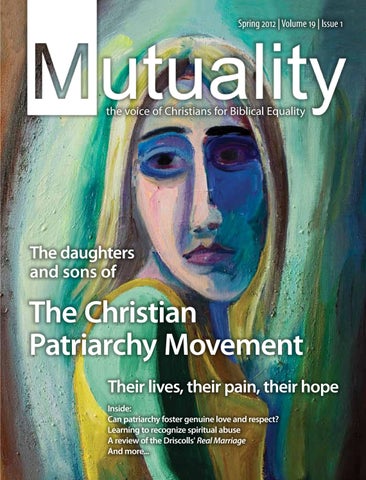
Spring 2012 | Volume 19 | Issue 1
the voice of Christians for Biblical Equality
The daughters and sons of
The Christian Patriarchy Movement Their lives, their pain, their hope Inside: Can patriarchy foster genuine love and respect? Learning to recognize spiritual abuse A review of the Driscolls' Real Marriage And more...
Mutuality 19.1, Spring 2012 “Let us then pursue what makes for peace and for mutual upbuilding” (Rom. 14:19, NRSV). Mutuality (ISSN: 1533-2470) seeks to provide inspiration, encouragement, and information about equality within the Christian church around the world. Editorial staff: Megan Greulich, editor; Image Spigot, graphic designer; Mimi Haddad, president/publisher. Contact us at: Christians for Biblical Equality; 122 W Franklin Ave, Suite 218; Minneapolis, MN 55404-2451; phone: (612) 872-6898; fax: (612) 872-6891; email: cbe@cbeinternational.org; web: cbeinternational.org. We welcome your comments, article submissions, and advertisements.
Contents 4
A Most Twisted Love | A woman's journey out of patriarchy and what it taught her about love and respect. by Vyckie Garrison
7
Moving Away from Subtle Extremity | Reflections on the subtle yet powerful nature of Christian patriarchy. by Jonathan Aigner and Kelsey Seifert
For writers' guidelines and upcoming themes and deadlines, visit CBE’s website and follow the link under the Resources tab. Advertising in Mutuality does not imply organizational endorsement. Please note that neither Christians for Biblical Equality, nor the editor, nor the editorial team is responsible or legally liable for any content or any statements made by any author, but the legal responsibility is solely that author’s once an article appears in Mutuality.
12 “She is More Than...” | Jesus' radical and life-giving treatment of women. by Lynn Bell
All Scripture quotations, unless otherwise indicated, are taken from the 2011 revision of the Holy Bible, New International Version®, NIV®. Copyright © 1973, 1978, 1984, 2011 by Biblica, Inc.™ Used by permission. All rights reserved worldwide.
19 Scot McKnight's Junia is Not Alone | A book review. by Liz Sykes
CBE grants permission for any original article (not a reprint) to be photocopied for local use provided no more than 1,000 copies are made, they are distributed free, the author is acknowledged, and CBE is recognized as the source. Mutuality is published quarterly by Christians for Biblical Equality and is sent free to members and supporters. On the cover: Painting by iEverest, from istockphoto.com.
15 Refusing Pretend Peace | Responding to spiritual abuse. by Gerald Ford 18 Mark and Grace Driscoll's Real Marriage | A book review. by Tim Krueger
MINISTRY NEWS
20 “New Creation, New Tradition” Intends to Change the Church Climate of Houston 20 Praises and Prayers 20 Reflect with Us: Little Words. Big Sins.
D E PA R T M E N T S 3
From the Editor | Bad Fruit? Maybe it's a Bad Tree.
21 Giving Opportunities | 2011 Annual Report to CBE Members and Donors
22 President’s Message | Ideas Have Consequences: Power, Gender, and Evangelicals
2 M U T U A L I T Y | Spring 2012
website : cbeinternational.org
F
r rom the Editor by Megan Greulich
Bad Fruit? Maybe it's a Bad Tree. “I’m inadequate.” “I can’t seem to shake this depression.” “I’m utterly and completely exhausted.” Their stories are strikingly similar. I was lying in bed one night reading Hillary McFarland’s Quivering Daughters, which artfully weaves together the stories of several women caught in a patriarchal branch of Christianity known as the Quiverfull movement. Even though it was very late at night, I couldn’t put the book down. I ached for these women. Under their patriarchal system, they could never be selfless enough, they could never submit enough, they could never be good enough. Abuse, shame, devastating guilt, and suicidal thoughts marked many of their experiences, some on a daily basis. Then I read stories on author Vyckie Garrison’s No Longer Quivering website, and then the research of Jon Zens in No Will of My Own. I talked to a friend whose family had adhered to the teachings of Bill Gothard. I read accounts of men and women who were part of isolated Reformed movements that insist complementarian relationships are an integral pillar of Christianity. Their stories are strikingly similar. Many report living with intense remorse, wrestling with the persistent belief that God is displeased and angry with them. Some say they have had to teach themselves how to have and express opinions. Others, beaten down by the misuse of Scripture and the abuse by fellow Christians, have abandoned their faith. Such pain and destruction should tell us something! Just as the sensation of pain alerts us when our physical bodies are in need of treatment and healing, so too should these “symptoms” of those living under patriarchy alert us that all may not be well in the body of Christ. Jesus said it so simply and directly: Is it bad fruit? Then it must be a bad tree (Matt. 7:15-20). Of course, we know that many well-intentioned Christians— our brothers and sisters—believe that patriarchy is biblical and the only way men and women will produce good fruit in their families, churches, and communities. As I researched for this issue of Mutuality, I read articles insisting that God established a hierarchical order between men and women beginning in the Garden of Eden, when God told Eve that she would desire her husband and he would rule over her (Gen. 3: 16). Giving the man final authority over a woman and their children brings order to chaos, the argument goes. It also provides greater stability and efficiency. Yet, are order and efficiency really God’s great priorities? I believe the good fruit we can expect as Christians
bookstore : cbebookstore.org
is outlined in the famous passage in Galatians 5: “But the fruit of the Spirit is love, joy, peace, patience, kindness, goodness, faithfulness, gentleness, and self-control” (v. 22-23). Producing this kind of fruit may be a slow and messy process. But it is one that results in holiness and freedom. I am convinced that the church is not, and should not be, ruled by males. It belongs to Christ. And under Christ’s rule, the first are last and the last are first. Under Christ’s rule, all men and women are intended to experience freedom, grace, and peace. In Christ’s kingdom, both women and men are called and equipped to serve and influence the world. A church ruled by men, just because they are men, has no biblical basis. And, simply put, it produces bad fruit.
In this issue Vyckie Garrison, highlighting her story of living under patriarchy, begins this issue of Mutuality with a perceptive look at love and respect. Then, Kelsey Seifert and Jonathan Aigner explore how they journeyed out of patriarchal beliefs, offering reflections on how to encourage others doing the same. Next, Lynn Bell provides fresh insights into the good news that Jesus fully and radically valued women. And, Gerald Ford offers tips for recognizing and responding to spiritual abuse. Finally, Tim Krueger reviews Mark and Grace Driscoll’s controversial Real Marriage, and Liz Sykes reflects on Scot McKnight’s short and powerful e-book, Junia is Not Alone. We hope this issue of Mutuality provides you with great encouragement, as well as insights into what is a confusing and difficult topic. We would love to hear from you—as always, we welcome any and all of your valuable feedback. Blessings to you! Megan Greulich is the editor of Mutuality magazine. She may be reached at mgreulich@cbeinternational.org.
What topics would you like to see us cover in future issues of Mutuality? Are you interested in writing for us? Email us at cbe@cbeinternational.org. We would love to hear from you!
M U T U A L I T Y | “Christian Patriarchy”
3
Mom and Dad are in love…but is a patriarchal relationship of entitlement-meets-martyrdom a healthy and beneficial expression of love?
A Most Twisted Love
In pondering While a life humans’ relationship devoted solely to with God, the ancient others might seem monk St. Bernard of admirable and even by Vyckie Garrison Clairvaux (1090-1153) Christ-like, St. Bernard describes four “degrees” of was careful to make love (which can apply to all the point that this level of other relationships as well): martyrdom is unsustainable; Level 1) I love me for my benefit. if you don’t mind ending up Here’s an infantile, self-involved person dead or wishing you were dead from with a severe personality disorder—excessive sheer exhaustion, self-loathing, and self-love and the inability to recognize or despondency, then go ahead and give it a try. acknowledge the distinct individuality of others. This Level 4) I love me for your benefit. Anyone is narcissism—pure ego—unaware of, or indifferent to, who has traveled by plane is familiar with the differing experiences, ideas, interests, concerns, etc. which potentially life-saving admonition, “In the event that the are the reality of friends, neighbors, and family. This relationship cabin loses pressure, oxygen masks will drop from the ceiling above proceeds from and results in the demoralization of all concerned— you. First, place the mask over your own nose and mouth; then, it is all about me; there is no you. assist others…” Such advice is sensible, and it is really the only option Level 2) I love you for my benefit. A person with this sense of capable of sustaining a mutually beneficial, healthy relationship entitlement and prerogative is at least a step up from the complete over the long haul. This relationship establishes reciprocity and egomaniac. This sort of self-love allows for the existence and mutuality—symbiosis, if you will. It is all about me for you and you personhood of others, if only as mere extensions of themselves, for me—it is a form of self-love, but it is not selfish. to be utilized and manipulated exclusively for their personal So, what does all of this have to do with the Quiverfull/ advancement and satisfaction. This relationship incorporates patriarchal philosophy and lifestyle? exploitation and privilege—it is all about you for me. The demanding Quiverfull life is a recipe for burnout, not Level 3) I love you for your benefit. Here we have the martyr only for Mom, but also for the older daughters. And though at mentality which gives little to no thought for oneself. It is self-denial, first glance the hierarchical family structure with husband as self-abnegation—living wholly for the other with no consideration authoritative head and wife as submissive helper may appear to be of personal needs and desires. It is a continual pouring out and an inviting setup for the men, the day-to-day reality and the longgiving up of self—literally laying down your life for others. This term effect of being indiscriminately catered to—the perpetual relationship is the epitome of self-deprivation—it is absolutely not indulgence of power and control—turns out to be not such a sweet about me—my needs do not even enter into the equation. deal for Daddy after all.
4 M U T U A L I T Y | Spring 2012
website : cbeinternational.org
I was intrigued recently to read about “Acquired Situational Narcissism” (ASN)—a personality disorder brought on by wealth, fame, and the other trappings of “celebrity.” ASN differs from conventional narcissism in that it develops after childhood and is triggered and supported by the celebrity-obsessed society: fans, assistants, and tabloid media all play into the idea that the person is vastly more important than everyone else, triggering a narcissistic problem that might have been only a tendency and helping it to become a full-blown personality disorder.
Naturally, I began making connections, because what is patriarchy if not the absolute enshrinement of the supreme importance of males? I would argue that the description of ASN could legitimately be read this way:
he will make you his closest adviser, his confidante, his press secretary, his head of state, his vice-president, his ambassador, his public relations expert, maybe even his speech writer—all at his discretion. As a fully convinced patriarch’s wife, Debi Pearl and similar champions of wifely submission inspired me to anticipate and meet my husband’s every need and desire, regardless of the cost to myself and the children.
I did this, not primarily for Warren’s benefit, but because, as Pearl explains: When you are a help meet to your husband, you are a helper to Christ for God commissioned man for a purpose and gave him a woman to assist in fulfilling that divine calling. When you honor your husband, you honor God. When you obey your husband, you obey God. The degree to which you reverence your husband is the degree to which you reverence your Creator. As we serve our husbands, we serve God. But in the same way, when you dishonor your husband, you dishonor God.
ASN differs from conventional narcissism in that it develops after childhood and is triggered and supported by the narrowly-defined, strict gender-role-obsessed fundamentalist sects (such as Quiverfull): church leaders, submissive wives, and interpretations of select Bible verses all play into the idea that the husband is vastly more important than his wife and children, triggering a narcissistic problem that My daily submission to might have been only a tendency and Warren’s every demand—no helping it to become a full-blown matter how petty or self-serving— personality disorder.
Looking back, I can plainly see that the “assistance” which I rendered to Warren as his “suitable helper” served only to reinforce in his mind the idea of his superior and divinelywas about as helpful as giving in sanctioned importance. My daily submission Consider the following advice from Debi Pearl, author of Created to Be His Help to a tantrum-throwing, breath- to his every demand—no matter how petty or holding toddler. It’s a very Meet: Discover How God Can Make Your self-serving—was about as helpful as giving in to Marriage Glorious: a tantrum-throwing, breath-holding toddler. It’s a effective way to create very effective way to create a tyrant. a tyrant. “For the man is not of the woman; but the That’s unfortunate because in many ways, Warren woman of the man. Neither was the man created is a nice enough guy. I believe that patriarchy legitimized his for the woman; but the woman for the man” (1 Cor. 11:8–9). weakest tendencies, and the strict gender roles that we followed Four thousand years after creation, Paul, Timothy, and arrested his ability to adapt and capitalize on his strengths. In the Peter wrote to us, telling us God’s original plan was still end, our pursuit of the perfect, godly family with Warren as “head” the same as it was in the beginning when Adam and Eve and me as “helper” resulted in the pairing of St. Bernard’s “level 2” were first learning how to be husband and wife.… entitlement with “level 3” martyrdom—an extremely unhealthy I know that as you read this it almost sounds like combination that set up some seriously twisted, crippling, and blasphemy, because it is so weird to think that your husband abusive expressions of our “love.” deserves you as his help meet. But who said anything about At the time that it was all unraveling for us, I wrote the what he deserves? You can only realize your womanhood following in a letter to my oldest daughter, Angel: when you are functioning according to your created nature.… Your female nature cannot be retrofitted to the male role Dad cares—he tries harder than anyone I know. The without permanent damage to the original design. problem is that he lacks the capacity to care effectively. ….God made you to be a help meet to your husband Dad is extremely insecure so he tries to compensate so you can bolster him, making him more productive by taking control of whatever he can, which happens to and efficient at whatever he chooses to do. You are not be the little things like what words we use, or how we on the board of directors with an equal vote. You have stack the dishes on the counter, or where we’re sitting no authority to set the agenda. But if he can trust you, when we talk to him. He has no competence to make the
bookstore : cbebookstore.org
M U T U A L I T Y | “Christian Patriarchy”
5
big decisions like where should we go to church, or where we should live, or how we ought to run the business, so instead he devotes way too much time and energy to minor decisions. The rest of us feel like he doesn’t trust us or that he doubts our abilities. We become defensive, which leads to him feeling disrespected, and he can’t stand that. So he tries all the harder. He feels (because this is what he’s been taught that the Bible teaches) that he needs to be a leader—he thinks he should provide direction and protection, and make decisions, and be the “head of the home.” Only he is not a leader, and as it is, he’s not terribly gifted or qualified to lead. So, rather than fulfilling what he believes is his legitimate role, he’s frustrated in it. And that only leads to further insecurity. When his family is willing to give the appearance that he’s in charge, he relaxes a bit and is easier to get along with. But that only works so long as no serious decisions have to be made and we can all maintain a level of superficiality in which we’re fooling him (and ourselves) into believing that he’s fulfilling his “God-given” role as head of the home. You have to sympathize with the position he’s in. He’s expected (and he expects of himself) to do and be what is contrary to his nature and his actual abilities. It puts us all in a situation in which appearances are everything and reality is the only impediment to our happiness…. I really like your dad and I love him—he’s attractive to me and I admire and appreciate that he has a lot of good qualities, not the least of which are his sincerity and his desire to do the will of God no matter the cost. But, while I do love him, it has been much more difficult to respect him. I have always tried to be respectful because I believe he is entitled to it, but I have never felt respect— it’s been pure will and determination. When Uncle Ron visited our place back in May, he told me it was obvious that I don’t genuinely respect Dad—and that Dad knows and feels it, and that it’s a big part of why he’s so insecure. I don’t think you will consider me conceited if I tell you that I feel like whatever there is to respect about Dad has been in large part because of me. I’m not saying that I’ve made him who he is today, but I do believe that he wouldn’t have accomplished nearly as much or made the progress and grown like he has if it hadn’t been for me walking him through it all....I feel like I can be his teacher or his mentor (and sometimes I feel like his babysitter), but I don’t feel like I can fully respect him. Respect that is based merely on entitlement rather than merit can never be genuine. When I think about it, there’s really nothing I can do for your dad in this regard because whatever I might do to help him gain some self-respect would not inspire me to respect him.
6 M U T U A L I T Y | Spring 2012
Do you recognize the pattern here? Following the “help meet” model advocated in the patriarchal worldview creates an artificial competence for the man. He never has to struggle through a difficulty and thus feel the sense of triumph once he’s conquered a problem because he is living in a self-protective bubble created and maintained by his well-meaning “Proverbs 31” wife. As Christians, we constantly heard that in a godly marriage it is essential that a man loves his wife and that the woman respects her husband. Here’s the rub: the patriarchal blueprint for the marriage relationship guarantees that a man will not truly love his wife and that a woman can never truly respect her husband. A man’s growth and maturity are stunted due to constantly being rescued from adversity. He has nothing of himself—only a dependency upon the woman to uphold that illusion of his headship and control. There is no love in patriarchy. There is no respect. There is only perpetual immaturity, dependency, and frustration for the man who is subjected to the most sophisticated manipulation as his wife gives over control and authority to him. Because in that move of giving away her authority, the woman takes control of God himself, for in response to her obedience, has the Lord not promised to bless her? When I finally recognized the insidious nature of the headship/ submission scheme, here’s how I described my connivance: The very first thing that I had to learn as a Christian wife was submission. I needed to honor and obey my husband. And I had to be such a devout, godly woman that my husband couldn’t find any fault in me—and in that way, I could “win him without a word.” Of course, [the Bible study ladies] reminded me that it was God’s job to get [my husband] saved, but they also assured me that I could do my part by following their advice and being a loving, respectful wife....What I took away from that meeting was this: all I had to do was be the perfect wife and the perfect Christian and God would honor me and save my marriage. From my perspective today, it’s easy to see that all I was doing was putting a Christian dressing on my old sorcery. I’d always been skilled at witchcraft—now I had my magic formula (Bible verses) and my incantations (prayers) and all my rituals (my perfect behavior), so how could I go wrong? I had little doubt that I could carry out all that those women told me I must do, and when I did it, God would have no choice but to come through for me. Everything I did in that respect during that time was my attempt to attach strings of obligation to God so that I could make him dance like Pinocchio at my bidding. I was the ultimate manipulator: I no longer needed to control [my husband] directly because I could influence God to do that work for me. Yes, that is a most twisted love. That is the reality of patriarchy. Undoubtedly, the women lose, but it’s certainly no bargain for the men either. Vyckie Garrison is a writer and public speaker who runs the popular blog No Longer Qivering: Because There is No “U” in Quiverfull (nolongerquivering.com) where she and others share their stories of leaving Christian patriarchy.
website : cbeinternational.org
Moving Away from Subtle Extremity
A journey out of the shame-filled world of Christian patriarchy.
by Jonathan Aigner and Kelsey Seifert
“Mr. Jones, would you lead us in prayer?” It was an innocent request. But why was Mrs. Jones or Ms. Smith never asked? Despite a perfectly capable array of women who could have prayed, the task always fell to any man in the crowd. This was a normal occurrence in our homeschooling existence. Decades later, we recognize this as subtle extremity: a way of communicating rigid gender roles without directly addressing them. While we didn’t encounter many blatantly extreme patriarchal views, we were taught that our gender clearly defined the true nature of our personhood. Who we were as people was not to be discovered, only embraced. The Christians around us said that boys should embrace their true nature as leaders, protectors, and providers. Girls were taught to embrace their supportive role in life, championing their husbands, keeping their homes in order, and raising children. It was supposed to be so simple. God would be pleased with our efforts to surrender our individuality into the molds that were clearly outlined in the Bible. And the Christians who disagreed with these standards, well, they were duped into wanting something besides “God’s best” for their lives. While this “subtle extremity” may not have included the overt abuse that would make reasonable people cringe, it was pervasive, and it colored our entire approach to life. It heaped
bookstore : cbebookstore.org
judgment and shame upon those, especially women, who deviated or disagreed. The subtlety made it acceptable. If anyone had directly identified the ramifications of this mindset, then it would have been swiftly and completely rejected. After all, many of the women who were in charge of us children were fully equipped to be leaders of all people, but they paid lip service to a subtly patriarchal view that they themselves didn’t fully embrace. Growing up female in this culture, you were expected to live a hyper-emotional, half-logical life in which a male figure was required to keep you grounded. Behavior that would have been considered emotionally disturbed coming from a male was at times accepted from females, because that was “just how God made you.” Any attempt to be logical was largely ignored. After all, thinking was for the men and feeling was for the women. Men were supposed to be the down-to-earth, matter-of-fact counterparts to women. They could drift over into the women’s domain occasionally and hold a baby or rustle up some dinner, but emotional reactions needed to be tempered and muted, lest they compromise their masculinity. Men were also to be preparing themselves for doing all kinds of “manly” tasks. In one of the groups in which I (Jonathan) was active, I was in charge of cleaning facilities. I remember many different men telling me
M U T U A L I T Y | “Christian Patriarchy”
7
that, unless heavy lifting was involved, I should leave that kind of thing to the women. There were far more important jobs, and more appropriate jobs, for me to do. Both of us were raised in families that tried to model the patriarchal system, but the real damage came from the larger homeschooling community. Because homeschoolers are a small minority and have at times been denigrated by some, they often perceive a sense of competition with outsiders. A collective group mentality can take over, and, since patriarchy was such a huge part of the culture, it became an overwhelming force. We heard it everywhere. Standard curriculum included volumes such as “Christian Manhood and Womanhood,” which set horrific patriarchal standards for males and females. Conference sessions often had themes like, “For Dads Only: How to Be Your Family’s Spiritual Leader.” Many wives served their husbands in blind obedience. Many husbands bossed their wives around as if they were one of their children. It was impossible to ignore. It was all around us, all the time. The details of these roles were rarely spoken of directly, making them more powerful. The power was in the abstractness of the assumptions; there was really no need for much in-depth explanation. We heard only passing statements like “Boys should treat girls this way,” or, “That’s not becoming of a young
When one person surrenders personal responsibility, mistreatment is close behind. lady.” They were usually enforced through passive-aggressive communication—nonverbal cues and a particular tone of voice that attempted to shape our behavior by shaming us. This whole system was fraught with double standards. Girls could routinely lead their male peers while growing up, but once they became women, this had to end. If taking care of home and family wasn’t enough for a woman, then she must be denying her true identity, the reasoning went. And, if she wanted more from life than family alone, then there was something very wrong with her spiritual life and marriage. Women were encouraged to pursue an education, but only as a form of insurance in case their husbands died, left, or were physically unable to provide. While you could discover your gifts and abilities, you were limited to using them in “feminized” roles. As a pianist, for example, you could teach children or play for your church, but you shouldn’t be a performer. If you were a good negotiator, then you should use those skills to get bargains on groceries and furniture, but not to broker business deals. The best jobs for women, you were told, were those you could do from home. Boys, likewise, could submit to the leadership of their female peers, but the expectation was clear that once you reached adulthood and took a wife, you would assume responsibility for your home.
8 M U T U A L I T Y | Spring 2012
After all, you were a man, and leadership was a trait born deep within your wild and adventurous male heart. You were supposed to look forward to the day you won the heart of a woman who, until you showed up, was firmly covered by her father’s protective umbrella. At the core of all this was the disturbing message that women couldn’t be responsible for themselves. If a woman didn’t have a husband, then responsibility fell to the parents. What this taught, so subtly but profoundly, was that women are incapable of living their own lives. This transference of responsibility is the heart of subtle extremity. When one person surrenders personal responsibility, mistreatment is close behind. No wonder some women turn to passive aggressiveness and manipulation— without a voice, it is often the only way left to influence. Strangely enough, though girls couldn’t be responsible for themselves, they bore responsibility for boys’ thoughts and actions. I (Kelsey) remember being a teenager and trying to ignore the persistent and enthusiastic flirtations Jonathan was sending my way. Such interactions were, to say the least, frowned upon by many in the greater homeschooling community, but I was the one reprimanded. “I’m not doing anything!” I would reply, but I was told on many different occasions that my behavior was “inappropriate” and “a bad example.” Romans 14:13—“Make up your mind not to put any stumbling block or obstacle in your brother’s way”—was a mantra. Girls were told, “Protect your brothers!” and, “Don’t cause them to stumble.” Yet the clear but underlying message was, “His thoughts and actions are your responsibility.” It can be disorienting to grow up with such strong messages about men, women, and “biblical” roles. At times it feels like an inescapable pressure. Because very little is overt, the pressure feels phantom. Becoming aware of the message behind the words, the meaning inside the tone in which it is given, and the intent of the shaming can be intensely painful. But looking at your past honestly and grappling with those phantom pressures is the first step toward freedom. For me (Kelsey), the first shifts came in adolescence. There was a deep awareness that I didn’t fit into a subservient lifestyle. It was a slow and sudden change, greatly stimulated by a few caring and gently confronting relationships. The homeschooling community had taught me I was incapable of responsibly questioning beliefs. However, it became increasingly evident that I had a good mind, and that God was honored when I used it. The final shifts away from patriarchy were achieved in academic discussion and finally accepting that I was as competent and capable as my male counterparts. My (Jonathan's) transition came about more slowly. In college, I attempted to impose patriarchal roles into my relationships and studies. I was very vocal, even vindictive, toward friends and classmates who I felt weren’t following God’s ordained will for their gender. During graduate school, I had the opportunity to study under some Christian egalitarians who helped me understand that the Bible supported mutual submission between women and men. It was not an easy transition, but being married to a loving woman who continually seeks to identify the consequences of ideas has helped me arrive at a viewpoint of equality.
website : cbeinternational.org
For those coming from subtly extreme patriarchy, we encourage you to seek out nonjudgmental people willing to embrace differences. For us, lasting change came from relational experiences with people prepared to dialog without shaming. Challenge anything that feels strict and heavy, consistently looking for the practical implications of the belief. If you find yourself engaging with those coming from subtly extreme patriarchy, first and foremost, keep engaging! For both of us, an essential part of our sojourn out of patriarchy was consistent and positive engagement with committed Christian egalitarians. Encourage them to find their areas of giftedness. Discuss difficult Scriptures with them, and interpret the Bible together in light of cultural context. Come alongside them as an equal, not a teacher. Be intentional in being collaborative; their past is likely filled with authority figures telling them how to believe. Be careful not to condemn. They are coming out of an authoritarian culture that has heaped toxic beliefs about themselves and the Creator into their hearts and minds. Be genuine and authentic with them on their journey out of patriarchy. Be excited about who they are, and don’t assume you already know what they should be. Second, understand that the passive-aggressive nature of subtle extremity breeds guilt and shame. To counteract this, we must bring the underlying issues out of the darkness and into the light. Gently address the injustices that are presupposed realities for them. Look for the emotional undercurrent that guides discussions about gender. Do your best to verbalize tone and
nonverbal communication. Be sensitive to yourself. If you pick up on any shaming and guilting, it’s probably there, even if the other person doesn’t realize they’re doing it. Make all communication on the subject clear, concrete, and verbal. Get practical and specific. Finally, once beliefs about gender have been verbally communicated, help the other person follow them to their conclusion. For instance, telling girls that they are naturally too emotional will eventually cause them to distrust their intellect. And, insisting to boys that they need to “suck it up” and deny their emotions will produce emotionally repressed men. Be gentle, but remember that finding the logical conclusion of their beliefs is essential if they are to see the toxicity of their views. All ideas have consequences. Help them find the consequences of theirs. Ask questions like, “If this is true, what does it mean about you? About me? About others?” Through humility, love, honest conversation, and prayer, we can point them away from oppressive ideas and toward the hope and healing of Christ. Kelsey Seifert holds undergraduate degrees in psychology and religious studies and a Master of Arts in counseling psychology from Trinity Western University in British Columbia, Canada. She is a national certified counselor and Licensed Professional Counselor and practices at Houston Center for Christian Counseling. Jonathan Aigner holds a music degree from Baylor University in Texas and a Master of Arts in theology from Wheaton College in Illinois. He is an elementary school music teacher and the traditional worship minister at a United Methodist church. Kelsey and Jonathan live in the Houston, Texas area with their beloved dog.
By JoAnn Streeter-Shade Sku# 0202008
How often have you felt like Hagar, rejected, forgotten or betrayed? How often have life’s disappointments left you searching for God’s empathy, justice, and redemption? JoAnn Shade enters Hagar’s painful journey to show that it is precisely in places of despair that we find God’s warmest embrace and new paths of redemption.
$8.50
Order from
The Salvation Army Supplies & Purchasing Dept. bookstore : cbebookstore.org USA East: 888.488.4882
All major credit cards accepted
—Mimi Haddad, president Christians for Biblical Equality
is an imprint of
The Salvation Army’s M U T U A L I T Y | “Christian Patriarchy” 9 USA Eastern Territory
Christians for Bibilcal Equality (CBE) and Ekklesia Community for Advocacy and Peace Inititiative (ECAPI) present:
Equal to Serve: Gender and Authentic Biblical Leadership At Saint Paul’s University in Limuru, Kenya July 20-22, 2012 Abraham George
Esther Mombo
“Imago Dei and Justice”
“Transforming Our World of Faith: Attitudes About Sexual Harrassment and Abuse”
International Justice Mission As a change agent in the community, the body of Christ must come to an understanding of the biblical concept of the image of God. An understanding of humanity as the bearer of that image—regardless of any classification society or culture might impose—is intrinsic to the church’s engagement in seeking justice.
Philip A. Owasi
Pentecostal Bible College “Historical and Cultural Contexts in the Women’s Ordination Debate” This session will examine how women have served the church in the past, explore how culture impacts our interpretation of Scripture, and show how the Bible affirms the ordination of women.
Saint Paul’s University
The church in Africa has not been able to name and shame sexual harassment and abuse. To remain credible, the church must name and challenge sexual harassment, and offer safe places for survivors of the same to find healing and wholeness.
Jenipha Wasonga Agape Counseling and Training Services
“Wading the Waters of Marriage with Hope in the Midst of Socio-Economic Challenges” This session will examine the attitudes that negate God’s purpose for marriage often in the form of religious restriction on women in the home, church, and society.
Samuel Githuku
Emily Onyango
Mimi Haddad
“Gender and Authentic Biblical Leadership in African Spirituality”
“HIV/AIDS Impact on Society and Family: Women’s Voices on Polygamy”
“Paul’s Concept of Biblical Equality: Leadership and Authority in Church and Society”
David Kodia
Lillian Kimani
Richard Howell
“Balancing a Gendered Worldview: Politics and Religion in Focus”
“Gender Justice as the Center of Christian Faith”
“The Trinitarian Concept of Mutuality”
Philip B. Payne
Carrie A. Miles
Johannes Otieno Angela
“The Biblical Concept of New Man, New Woman, New Life”
“Biblical Heroines: Lessons from Their Ministry and Challenges”
Saint Paul’s University
Bishop Okullu College
Fuller Theological Seminary “Examining the Twelve Pillars of Male Hierarchy”
Saint Paul’s University
Saint Paul’s University
Empower International Ministries
Christians for Biblical Equality
Asia Evangelical Alliance
Bishop, Anglican Diocese of Bondo
To register now: visit cbeinternational.org/ken12 or call 612-872-6898.
“She is More Than” by Lynn Bell
Consistently rejecting his culture’s patriarchal standards, Jesus deeply and radically valued women. The first-century Middle-Eastern world that Jesus experienced in the flesh was a patriarchal culture several millennia old. Although Jewish patriarchy had been shaped by the Law of Moses early on, its views about women had become distorted over time in its oral traditions, or midrashim, and were often influenced by neighboring cultures such as that of the Greeks. Women in early first-century Palestine were generally viewed as inherently inferior to men. They were denied a full education, relegated to a secluded life in the household, and ranked just above slaves. Jesus was certainly aware of these cultural values yet did not appear to share them. Unlike some other rabbis of his day, Jesus never mentioned stereotypical characteristics of women, either positive or negative, nor did he delineate gender roles for women in the home or synagogue. What the Gospels report is a broad variety of interactions between Jesus and women that were remarkably countercultural. Jesus engaged women in ways that transcended the patriarchal culture of his day.
12 M U T U A L I T Y | Spring 2012
She is More Than…Her Physical Appearance
Instead of ignoring or objectifying women, Jesus seemed to go out of his way to notice and call attention to them. He never commented on their appearance. As a matter of fact, the Gospels do not note the physical appearance of any woman, unless we count the description of a “bent over” woman whom Jesus healed (Luke 13:10–17). Propriety prohibited a first-century Jewish male from spending time or conversing with a woman who was not his wife, especially in public. Yet, Jesus never seemed to miss an opportunity to interact with or on behalf of women. Many times he made a point to stop, talk, and listen to women, communicating to them that their lives and needs mattered to him. In fact, one of the longest dialogs in the Gospels is the recorded conversation Jesus had with a lonely Samaritan woman at Jacob’s well (John 4:4–26). Four times in the Gospels, Jesus noticed and responded to women in tears: The widow of Nain as she followed her son’s funeral bier (Luke 7:11–15); Mary, as she mourned the death of her brother Lazarus (Jesus joined her in weeping, John 11:32–36), the women wailing as he climbed toward Golgotha (Luke 23:26–31), and Mary Magdalene outside his empty tomb (John 20:11–16). website : cbeinternational.org
“Woman at the Well,” painted by the Artists at Crossroads Community Church in Mansfield, Ohio. Used with permission
n”
Jesus also noticed a surreptitious touch on the hem of his robe, which prompted him to bring a chronically bleeding woman out of her obscurity, make note of her faith, and heal her (Matt. 9:20–22; Mark 5:25–34; Luke 8:43–48). And, he noticed a destitute widow dropping her last coins in the temple treasury and celebrated her extreme generosity (Luke 21:1–4; Mark 12:41–44). Another woman Jesus commended was a Gentile mother whose daughter was possessed by a demon. The disciples wanted her to go away, but Jesus knew what she risked by asking a Jew to heal her daughter. He let her demonstrate her fortitude and couldn't help but admire her quick-witted rejoinder about the dogs under the table eating the children’s crumbs. “Woman, you have great faith!” he responded (Matt. 15:21-28; Mark 7:24-30). This Gentile mother was not the only woman who found herself supported by Jesus when other males were dismissive, critical, or condemning. For example, when Mary the sister of Lazarus poured an entire bottle of perfume over Jesus’ head (or feet, depending on which Gospel you read), the disciples were outraged because it represented a year’s worth of wages. “Leave her alone.” Jesus told them. “She has done a beautiful thing for me” (John 12:1–8; Matt. 26:6–12; Mark 14:1–9). Jesus rewarded her faith and honored her great sacrifice.
She is More Than…
A Passive Beauty
compiled by Elizabeth Beyer
Eshet Chayil is a Hebrew expression used three times in the Old Testament: Ruth 3:11, Proverbs 12:4, and Proverbs 31:10. Eshet is the construct form of Isha, meaning woman. Eshet Chayil is most often translated in English Bibles as “excellent” or “virtuous.” Yet Chayil: > Denotes bravery (Psa. 76:6), capability (Prov. 12:4), physical strength (Ps.18:32, Job 20:21), an army (Ex. 14:4) and even wealth because of its association with power (2 Kings 15:20). > Strong’s Exhaustive Concordance calls it a force, whether of men, means, or other resources: army, wealth, valor, strength, bulwark. Ruth is called Eshet Chayil (by Boaz) because he and the entire village noted how she has applied herself to do good for Naomi.
Ruth has several strikes against her. She is…
✔
And yet, despite these cultural limitations, Ruth is…
✔
She is More Than…Her Sexual History
The Pharisees and teachers of the law certainly did not see it coming when Jesus shielded an adulterous woman from their condemnation (John 8:1–11). Nor did Simon the Pharisee expect Jesus to commend a prostitute who crashed his dinner party (Luke 7:36–50). In their legalistic view of the world, not only was sexual sin unforgiveable, but it was also always the fault of the morally inferior “seductress.” Imagine their dismay when Jesus told the Pharisees that prostitutes were entering the kingdom of God ahead of them (Matt. 21:31–32). Some readers may see male privilege in the fact that the Gospels reveal the sexual misconduct of three of the women Jesus encountered (the two mentioned above plus the Samaritan woman who was cohabitating) because nothing is said of the sexual history of the men he also met. I propose a broader perspective. It is the retelling of these histories that allows the writers of the Gospels to highlight Jesus’ countercultural priorities. Because women in first-century Palestine were considered property and because a high value was placed on their reproductive capabilities, they were expected to observe sexual restrictions that did not apply to males. Patriarchy inflated the value of celibacy for single women exclusively, and regarded women (but not men) who had sex outside of marriage as “fallen” or “damaged goods,” regardless of whether they had a choice in the matter.
bookstore : cbebookstore.org
✔ ✔ ✔
✔ ✔ ✔
The woman described in Proverbs 31 is also Eshet Chayil. She is…
✔ ✔
✔ ✔ ✔ ✔ ✔
A foreigner: Moabites were traditionally enemies of Israel A widow Childless Female Committed (even when there was no visible means of survival) Hardworking (she searches for food and works until sunset) Courageous (she is willing to carry out Naomi’s goals in spite of the risks to her reputation) Wise (she proposes marriage in such a way that she shames neither Boaz or herself) Strong (denotes fortitude, endurance, or physical strength) Shrewd (she is cunning and very intentional in the way she purchases materials and land and reinvests) Practical/has foresight Trustworthy Constant or diligent (she and her household are provided for) Determined Generous (she is committed to do good to her family and community)
In short, biblical women are not commended in Scripture for their passivity but for their agency, their initiative, and their action. All of the women who are held up as examples have been a “force” for good.
M U T U A L I T Y | “Christian Patriarchy”
13
The Gospels not only make a point of reporting the women’s sexual sins, but also of describing Jesus’s response. First, he did not permit the Pharisees to harm the woman caught in adultery or to be cruel to the prostitute weeping at his feet. Second, Jesus himself did not scold, shame, or rebuke any of the three, even though according to Jewish law they had sinned. Nor did he appear to equate their sin with diminished human worth. He never labeled them according to their sexual misconduct. Even the actual prostitute was referred to by Luke with the more general euphemism “a woman who lived a sinful life.” And, though Simon the Pharisee shuddered at the sight of the prostitute touching Jesus, Jesus welcomed her kisses on his feet and commended her love and faith. The Gospels describe the sexual histories of these women and show how Jesus responded, conveying a hugely important point about the full extent of the Good News for women—that their sexual histories and cultural status do not define them.
She is More Than…Her Home/Family Role
Perhaps most surprising is the way Jesus seemed to ignore his culture’s traditional roles of women as wives, mothers, and keepers of the home. The three Mary and Martha narratives in the Gospels provide insight into this. In the most familiar of the stories, Martha complained to Jesus that Mary wasn’t helping with the preparations. Jesus seemed not in the least concerned about Mary returning to her “place” of domestic service, which would have been the cultural expectation of the time. Jesus said that Mary had made a better choice and could stay right where she was (Luke 10:38–42). On the other hand, after Lazarus died, Jesus spoke at length with Martha, exploring her understandings of his identity. In the Gospel of John, it is Martha, not Peter, who bears the distinction of first confessing Jesus to be “the Messiah, the son of God” (John 11:20–27). Mary and Martha appear to have both been unmarried, at least during the years of Jesus’ ministry. The Gospels connect them with no man other than their brother. They also apparently were disciples of Jesus while remaining at home in Bethany. Other women did not stay at home but traveled with Jesus. They supported him from their own means and cared for his needs, applying their domestic skills to the ministry of Jesus (Luke 8:1–3; Mark 15:40–41; Matt. 27:55–56).
Some of these women were wives and mothers (Joanna the wife of Chuza, the wife of Zebedee, Mary the wife of Clopas, and Mary the mother of James and Joseph), while others appear unconnected with a man (Mary Magdalene, Susanna, and Salome). It was almost certainly considered scandalous for him to include them among his followers. Apparently, though, Jesus did not mind. He never told the husbandless women to get married, nor did he advise the married ones to go home and focus on their families. To the contrary, Jesus personally gave women the significant role of announcing his resurrection to the men who would later work to build his church (Matt. 28:1–10; Mark 16:1–8; John 20:1–18).
And She is Much More…
A primary concern of Jesus’ ministry was spiritual transformation. He provided for us an ample body of interactions exemplifying how redeemed people should treat women, regardless of the culture in which they find themselves. Women cried, sinned, and had bodily discharges. They asserted themselves on behalf of their children, and they displayed passion in their expressions of devotion. Jesus clearly challenged the patriarchal assumption that these characteristics made women weak or inferior. He did not see women as sources of temptation or defilement, as intellectually or morally stunted beings, or as fragile porcelain dolls. Nor did he advance patriarchy as divinely mandated. The Gospels reveal the Son of God as someone who valued women as much more than possessions; more than beauties to be ignored, avoided, or objectified; more than household servants; and more than mere vessels of reproduction. Jesus welcomed women to his ministry and treated women as capable disciples who had important observations to make and valuable ways to contribute to the advancement of his kingdom both inside the home and out. In any age and culture, if the church wants to claim that it follows Jesus, it must also adopt his view of women. Lynn Bell is a writer and speaker who lives in Charlottesville, Virginia. She volunteers in women’s ministry at her local church and blogs at thegentlesavior.com. She recently authored The Gentle Savior: Seeing Jesus through the Eyes of the Women Who Met Him.
She is More Than…[fill in the blank] Jesus consistently recognized the great value and dignity of women, despite the widespread cultural pressures to objectify, sexualize, demoralize, and degrade them. Now it’s our turn to do the same. What else is a woman “more than”? How do you want to respond to a culture and even a church that devalues women? Email or tweet us your thoughts. Use hashtag #sheismorethan.
We’ll compile them and publish them on our website! 14 M U T U A L I T Y | Spring 2012
website : cbeinternational.org
Refusing Pretend Peace Practical Tips for Recognizing and Responding to Spiritual Abuse by Gerald Ford In the counseling room, I often hear women say, “I never saw it coming….” Or, “I saw the signs but didn’t act on them.” When it comes to spiritual abuse, what are warning signs we can look for? How do we recognize spiritual abuse, and what should we do about it? Consider these examples. “He said that he would always be seeking my best interests. It sounded loving until I found out that the decision about what that ‘best’ was belonged to him.” “He said, ‘We should let the pastor decide which one of us is right.’ But the pastor always took his side and even threatened to take me before the board of deacons if I didn’t submit. “He said, ‘You are expecting me to give up my manhood!’ I began to wonder if I was asking too much of him. I’m supposed to protect his ego, am I not?” “He said, ‘The Bible says you should love me sacrificially— that means sacrificing your opinions, your career, and your previous friends’.” “He said, ‘I didn’t tell you about the money because I am the only one in charge of it’.” “He said, ‘The Bible says you are more easily deceived than I am’.” “He said, ‘Of course I didn’t tell you what to do when we were dating. But now, that is my right’.”
bookstore : cbebookstore.org
“He said, ‘My dad never trusted my mother to make a decision, and she didn’t complain. Why are you complaining?’” “He knows the Bible backward and forward, and he says…” “He said, ‘If you don’t want me to yell, do as I say’.” “He said, ‘Can’t you be like the other women at church?’” “He said, ‘Use the brain God gave you!’ But, in the same conversation, ’God isn’t going to speak to you, only through me.’ So I wondered why I should even bother reading the Bible.” Whether we are trying to heal from previous abuse, sorting out whether a particular situation is abusive, or working to ensure that our environments are healthy and safe places for spiritual growth, we must find some clarity for this discussion. Without quoting any particular client or church member, may I share some observations? In recognizing spiritual abuse, we must first allow ourselves to question the situations in which we find ourselves, as well as what we have been taught by leaders in the church. As Christians, we often receive messages about not being judgmental, and not questioning those who “know more” or are “in authority.” Women in particular, because of their gender, are sometimes told, “You must not question your husband or your pastor.” But, even when a person quotes a lot of Scripture to us, we must be free to analyze their teachings. Quoting Scripture should not be equated with good Bible interpretation.
M U T U A L I T Y | “Christian Patriarchy”
15
We know that Jesus warned us about false teachers, but actually saying, “I disagree,” may be frightening, particularly for those who have experienced or are experiencing abuse. People may say we are troublemakers, or our jobs or even our safety may be put in jeopardy. Yet, when clients ask me, “Am I asking too much?” I am usually certain that no, they are not. The truth is, it’s difficult to hurt the feelings of an innocent person. When someone is offended at honest dialog, we may have our first warning sign that unhealthy dynamics are present in the relationship. But once we find the freedom to examine the potentially abusive relationship, situation, or teaching, we can begin looking for some practical signs of abusiveness. Is this person spiritually abusing me? Ask yourself these questions:
Is this person using catch-phrases that either don’t appear in Scripture, or are misapplications of Scripture? Nowhere in Scripture is the man called the high priest of the home, or the spiritual leader of the family, or the covering of the wife, or the head of the house, or the authority over the wife. Is information handled in a one-way flow? Am I told things on a need-to-know basis while the other person wants full disclosure from me? Does this person warn me about what I read or with whom I talk, as though I can’t be trusted to think clearly?
These are some questions that will go a long way in helping a woman, or a man, avoid spiritual abuse. Perhaps the If terms like “servant” and “disciple” and best question to sum them up is, “How Is this person’s interaction with “follower” are not good enough for men is your spirit doing since being in me based on shame, intimidation, in our churches, then we, like the rich relationship with this person?” If your and/or fear? How do they try to young ruler, are turning away from Jesus. spirit is not as healthy as it was before, influence me? How do they try to or if you are exhausted, drained, and change my mind? Using shame, feeling far from God, then take a very intimidation, or fear to maneuver honest look at the relationship and seek help. a discussion is a tactic of abuse. The Subtle Power of Spiritual Abuse, by David Johnson and Jeff Is this person telling me what my motive is? Are they VanVonderen, is an excellent book on this topic. The authors point ascribing some “intent” to me, as though they could read my out that Jeremiah warned against “pretend peace.” False prophets mind? This is another warning sign. would cry out that all was well when it really wasn’t. Abusive people Is this person taking away my choices? Do they think they often warn others to “keep things quiet, under wraps.” The authors can make decisions for me? If a decision affects our spouse, it also point out that Jesus dealt with abusive people honestly. We do should include our spouse. men and women no favors if we try to reach men in our churches Does their discussion of the Bible start with their conclusion, by contriving a message that says, “Come worship with us, and you allowing for no background research; understanding of the can still be proud, you can still be the “big cheese,” and you can still original audience, grammar, and cultural context; or dialog boss someone around. Come to our church, and we will call you a about differing interpretations? Whenever a person, group, leader.” No, the truth is, if terms like “servant” and “disciple” and denomination, or religion says, “From this point on, there is “follower” are not good enough, then we, like the rich young ruler, are turning away from Jesus. no more discussion,” we find abuse. Does this person use my strengths against me? If they know you want your Christian walk to have quality and they say things to you like, “You say you are a Christian, don’t you…,” in order to compel you to do what they want, then you are being abused. Remember that Satan tempted Jesus with sayings like, “If you are the Son of God, throw yourself down from here…” (Luke 4:9). Manipulating someone by questioning their commitment to God is abuse. Is this issue really about power and control? The humility of following Christ and of mutual submission does not mix well with this proud world in which we live. Christ’s call to servanthood and discipleship is not nearly as appealing as the superficial call to being a strong leader with authority. But the Bible discusses the gifts of leadership as service and directly contradicts the idea that leadership is about controlling others. And, after all, “husband” and “wife” are relationship positions, not leadership positions.
16 M U T U A L I T Y | Spring 2012
Are you being abused? Do you know someone who is being abused? Seek safety and professional help now. CBE may have a counselor recommendation in your area. Visit cbeinternational.org/counselors. Are you, or do you know, a licensed egalitarian counselor or therapist? Help us grow our directory of counselors by contacting us at cbe@cbeinternational.org.
website : cbeinternational.org
Another development that has added to the problem of spiritual abuse, among those who are dating, is the glorification of the status of being “in a relationship.” Couples speak of being “in a relationship,” and this is seen as much more preferable to being “single.” I admit that the term “dating” wasn’t wonderful, either, but the modern idea of being in a relationship has gathered up the idea from “marriage philosophy” that people should not break up, but rather do all they can do to keep the relationship going, no matter the costs. The maintenance of one’s status as “in a relationship” can become more important than the health of the relationship itself, presenting opportunities for manipulation and abuse. Combine this with the fact that many of these couples have already begun a sexual relationship, and breaking up becomes even more complicated. The truth is, these days of learning about each other, doing life activities together, and not being prematurely entangled with each other are excellent opportunities for a vetting process in which couples can decide whether the relationship is a healthy match. Breaking up should not be seen automatically as a loss, or a source of embarrassment. It can be the result of a wise assessment. While often difficult, breaking up is infinitely preferable to entering into an unhealthy and potentially abusive marriage. To those in spiritually or otherwise abusive marriages, know that sometimes in marriage, a stand against abuse may mean divorce. It is important to remember that the stand against abuse is not the cause of the divorce. The abuse is the cause of the divorce. If your church doesn’t recognize that a divorce has occurred because of the hardness of a human heart (the heart of
bookstore : cbebookstore.org
the abuser), then you may have to insist that the truth be known. You may have to “find your voice” and stand up to the church, like you had to stand up to the abuser. Speak the truth in love, but speak it nonetheless. Remember that: You didn’t fail, you walked away from abuse. You don’t need to be embarrassed, you walked away from abuse. You aren’t a Jezebel, you walked away from abuse. You aren’t a poor witness, you walked away from abuse, and that is being a good witness. Whether or not you have experienced abuse firsthand, we all have an important job to recognize and respond to it. Just as Jesus honestly confronted abuse and offered hope and healing to the afflicted, may our churches and relationships foster honest dialog and provide a place for healthy spiritual growth. Gerald Ford has been a part of the Houston Center for Christian Counseling since 1989. He began pastoring in 1970 and pastored churches in Arkansas, Louisiana, and Texas. He is now involved in serving churches as a guest preacher, an interim pastor, a Bible teacher, or a counselor for churches in crisis. His preparation includes a Master of Divinity degree from Southwestern Baptist Theological Seminary, and a Master of Arts in psychology from Houston Baptist University. He is a Licensed Professional Counselor and a Licensed Marriage and Family Therapist. His wife, Billie, is also an ordained minister and an independent historian. Together, they often teach communication and relationship workshops and Bible studies.
M U T U A L I T Y | “Christian Patriarchy”
17
Book Review: Mark and Grace Driscoll’s Real Marriage by Tim Krueger Let me tell you about my car. It’s your typical sedan. It doesn’t have many special features, but I honestly appreciate what it offers (all-wheel drive). The trouble is, when the mercury drops below zero, which happens all too frequently in Minnesota, it probably won’t start. But it will toy with me, turning over just enough to inspire hope. Sadly, it rarely comes through for me. It’s the kind of car you don’t drive if you have a better option. But if you have to drive it, you’ll survive, as long as you can manage its many problems. Mark and Grace Driscoll’s new book, Real Marriage, is a bit like my car. It’s what we’ve come to expect from Christian dating and marriage books. It will lift your hopes and then disappoint you when it counts. The Driscolls are honest and vulnerable, and they clearly want the best for their readers. Still, I wouldn’t recommend their book if you have better options, which you do. When it comes to Christian relationship books, Real Marriage doesn’t stand out. Though I’ve seen reviews that say the contrary, I see little that’s unique in content. You’ll find many of the same good, sort of vague themes we find in many pop-Christian books—“your identity is in Christ, not other people,” “Make God the center of your relationship,” and so forth. Through an account of their own marriage and ministry, the Driscolls focus on two themes: 1. God-centered friendship is the central pillar of a successful marriage. 2. Sex is a good gift from God, not to be idolized or disdained. Neither of these ideas strikes me as new. Still, fresh or not, I agree with Pastor Mark and Grace that they are important messages. Their raw honesty is admirable, as is their commitment to making marriage work despite some very intense issues. They examine topics ranging from practical friendship advice to pornography to what the Bible allows in the bedroom. I’m optimistic that maturity, honesty, and good premarital counseling could spare many couples from repeating the Driscolls’ mistakes. However, I applaud their willingness to let us learn from their struggles. Unfortunately, like my car, Real Marriage fails to deliver in some key situations. The Driscolls’ use of Scripture misses the mark, some of their real-life examples of biblical concepts are hard to accept, and their skewed understanding of God’s design for relationships between men and women is disappointing, to say the least. Real Marriage features a combination of good biblical insights and alarmingly creative exegesis. Mark’s comments on the Song of Solomon are graphic (p. 171-175), and, while I appreciate his attempt to remove the veil of euphemism and portray the Bible as the scandalous story it is, his treatment of the
18 M U T U A L I T Y | Spring 2012
book as a sex manual goes too far. I’m also troubled by an allusion to God walking Eve down the aisle (p. 108) and perplexed by an interpretation of Genesis 2:24—that a man leaves his parents and cleaves to his wife—as a directive for a man to move into his own place and become financially secure before marriage (p. 108). This reflects neither the context of the passage, nor the Hebrew culture in which it was written. Through their real-life examples, the Driscolls teach a mistaken understanding of how God has designed us to live in relationship. For instance, while stressing the importance of intimacy, Mark recalls, “My pregnant wife came home from a hair appointment with her previously long hair (that I loved) chopped off and replaced with a short, mommish haircut. She asked what I thought, and could tell from the look on my face. She had put a mom’s need for convenience before being a wife” (p. 11). I like to give people the benefit of the doubt. Mark absolutely loved Grace’s long hair, and now it was gone. He felt like she hadn’t considered how much it meant to him. I’m grateful that my wife considers my wishes before making decisions that greatly affect her appearance. And she’s grateful when I consider her desires before I put on that comfy—“ratty and disgusting,” as she calls it—shirt I’ve had since middle school. Mark was probably wishing Grace had done the same, and I do credit them for emphasizing, later in the book, that both spouses should make an effort to remain attractive to each other (p. 170–71). Mark even shares two great pieces of advice he learned later on in their marriage: that a man’s standard of beauty should be defined by his wife (p. 109), and that a wife has the final word on whether her husband’s actions are loving (p. 63-4). Still, did Grace fail as a wife in chopping her hair? Did her desire to simplify her busy life really warrant repentance? It is alarming that this incident would, years later, still represent a significant breach of intimacy in Mark’s mind. This is one of several instances that illustrate the Driscolls’ misconstrued concept of a biblical woman and wife that overemphasizes physical appearance, submission, and respect toward a husband. As expected, Real Marriage is permeated with complementarian perspectives, arguing that men and women are equal in value but different in roles. And, as is typical of Mark Driscoll’s teachings, if you want to find a provocative quote, you won’t be disappointed. A favorite of mine illustrates Mark’s bewildering concept of biblical manhood. Mark lists five pillars of manhood which include: “1) leave your parents’ home; 2) finish your education or vocational training; 3) start a career-track job, not a dead-end-Joe job; 4) meet a woman, love her, honor her, court her, and marry her; 5) parent children with her” (p. 42). How Mark can claim these have been the five events that have signified manhood for “most of human history… [until] the fools’ parade hijacked the march to manhood” leaves me baffled. These trends that Mark uses to define manhood are thoroughly Western and modern. Even a cursory knowledge of history reveals that for most of history and across most of the world, people have website : cbeinternational.org
lived in multigenerational homes, had little or no education, and did not choose a career, but inherited one. Wives were chosen by one’s parents or bought for a price, and love was rarely involved. Jesus himself didn’t even meet all of Mark’s criteria for manhood, yet I think it is safe to assume Mark considers Jesus to be a man. These “pillars” are used by sociologists to describe modern, Western culture’s rites of passage, not by Scripture to define manhood. Despite a clear failure to grasp biblical manhood (if there is such a concept), the Driscolls, to their credit, do strongly emphasize the fact that male domination of the wife, pornography, and any kind of abuse are decidedly anti-Christian. Similarly, they teach that a wife who is silent when her husband violates Scripture is not living up to God’s standards. This to me is emblematic of the ways “biblical” patriarchy has been softened and reinvented over time to look more and more egalitarian in practice. In Real Marriage, this results in a definition of male headship that is illogical and difficult to discern. The Driscolls advocate for a form of male headship so focused on serving that its element of authority is virtually invisible in practice, while also arguing that male-only authority is indispensible to a healthy marriage or church. They insist that both a father and mother are crucial to the well-being of the family, but then assert that the man (somehow) bears more responsibility (p. 64). And, they cite a study showing that wives in egalitarian marriages are no happier than wives in complementarian ones (p. 61), but highlight several examples from their own marriage that demonstrate how replacing one-sided authority with mutual submission produces greater health and happiness.
In a cautious embrace of mutuality, Grace reflects on the current state of their marriage by writing, “I feel safe again, knowing we are both working on the friendship and building trust. It is easier for a woman to think of doing life with a friend than with a dictator or unemotional ruler” (p. 25). While she is quick to follow it up with the reassurance that the husband is still the head, she calls it “a ‘loving her as Christ loves the church’ head—a considerate friend.” In another instance, Mark (while reminding us that Grace should never pastor a church) writes of the time he realized his male tendency toward self-reliance would no longer do. He needed someone to keep him accountable— someone who knew him completely. Thus, he asked Grace to be his “functional pastor” at home (p. 34). It may not be apparent to those who have not read their story, but these examples mark significant progress from where their relationship began. It’s ironic that even the Driscolls have learned through experience that the more egalitarian they are, the better their relationship. But, like many Christian writers on marriage, they haven’t yet taken the step of fully embracing what Scripture, prayer, and experience confirm as true. Maybe one day that will change. But for now, we will safely leave Real Marriage on the shelves. Tim Krueger is on staff at CBE. He came to love Scripture and culture while growing up in the Philippines, where his parents served as missionaries. He graduated from Bethel University, and enjoys tropical weather, sports, studying history and geography, and spending time with his wife, Naomi.
Book Review: Scot McKnight’s Junia is Not Alone
by Liz Sykes
“Let me be clear once more. The editors of Greek New Testaments killed Junia. They killed her by silencing her into non-existence” (p. 14). Such strong words are echoed throughout this short e-book from Scot McKnight, illustrating how a historical person was systematically eliminated from Bible translations. The record of how this happened is detailed very clearly in Junia is Not Alone: Breaking Our Silence About Women in the Bible and the Church Today—Scot McKnight has definitely done his homework. The title of this e-book introduces the reader to the fact that Junia is not an isolated case of forgetfulness. Women throughout Bible narratives—such as Huldah, Phoebe, and Miriam—have been intentionally ignored and even willfully dismissed throughout the centuries, to the point that their voices are foreign to many today. In addition, McKnight relates the stories of three women from Christian history whose remarkable achievements for God have been deleted from our awareness. He withholds these women’s names until the end, cleverly drawing readers in and highlighting just how unfamiliar most of us are with their stories. McKnight’s passion for this subject may surprise some readers, but he perceives this silencing of women as a deep injustice which has been perpetuated up to the present time. Consider the response of a male reader, who questioned why Scot used only examples of
bookstore : cbebookstore.org
women in a particular chapter of his book Jesus Creed: “I don’t identify with women as much as I do with men,” the man complained. Scot replies by saying, “The man who thinks he doesn’t identify with women needs to see that this is what males have done to women for the better part of two millennia” (p. 26). We hope the very bold statements by this popular author will reach and inspire a large audience and have the impact he intends. This e-book is a quick read and will be of immense encouragement to women who want to serve God but have been hindered along the way. Leaders of churches and theological institutions should read this excellent resource, which has the potential to open eyes that have been unwilling or unable to recognize the unbiblical restrictions on the callings of women. “It is our calling to let freedom ring—to let the Spirit use people whom God chooses” (p. 26). Amen! Liz Sykes and her husband Trevor are the blog administrators of The CBE Scroll (blog.cbeinternational. org). They have been involved with Christian ministry in Perth, Western Australia, for more than thirty-five years.
M U T U A L I T Y | “Christian Patriarchy”
19
M
i inistry News by Quique Autrey
“New Creation, New Tradition" Intends to Change the Church Climate of Houston The CBE Houston Chapter is set to sponsor a conference titled “New Creation, New Tradition” on April 27-28, 2012. Houston is the fourth largest city in the United States, home to over four million people and thousands of churches, including several of the nation’s largest mega churches. However, few of Houston’s churches embrace an egalitarian understanding of leadership. The CBE Houston conference is geared toward changing the paradigm of a male-dominated hierarchy in church leadership to the ancient, yet always fresh tradition of “one in Christ, equal to serve.” It hopes to show that marginalizing women from church leadership is both unscriptural and unhealthy for any congregation.
R
eflect with us
Little Words. Big Sins.
by Jo Ellen Heil, with thanks to Susan McCoubrie Slavery. Domestic violence. Sexual harassment. Child-trafficking. Little words. Big sins. And especially cruel when they apply to you or your loved ones—a job denied, a frantic trip to the emergency room, a child lost forever. Our misuse of power and manipulation of others is one of the oldest patterns of human behavior on the planet. “There is nothing new under the sun” (Ecc. 1:9). It was certainly a truth with which Solomon, the potential author of Ecclesiastes, was familiar. His own father had summoned an innocent woman from the safety and privacy of her own home, impregnanted her, and then murdered her husband, a foreigner who had faithfully served in his army. Manipulation and abuse are often accompanied by sweet words. “Trust me.” “Don't worry.” “I know what's best.” But the process—the dehumanization of another human being— remains the same. And the result is always rotten. A social radical, Jesus ate with outcasts (tax collectors, prostitutes), spoke directly to the disabled and healed them, welcomed children, and included both women and men among his closest followers. In addition, he spoke “truth to power,” confronting religious leaders and politicians who placed burdens upon those who could not bear them. But he never patronized anyone. Can we not follow his example? “Dear friends, let us love one another, because love comes from God. Whoever loves is a child of God and knows God. If we love one another, God lives in us and God's love is made perfect in us” (1 John 4:7-8, 12).
20 M U T U A L I T Y | Spring 2012
The conference offers not only a lecture format, but also opportunities for active participation in conversations through a graffiti wall, writing and sharing personal stories, and engaging in reflection and responses with speakers. The conference aims to equip attendees with truly biblical paradigms on faith and gender that change the way they speak and think, the way they engage egalitarian information to form and join the conversation with others, and more. The conference boasts an exciting speaker line-up: Dr. Philip B. Payne (Linguist’s Software Inc.), Dr. Todd Still (Truett Theological Seminary), Dr. J.R. Daniel Kirk (Fuller Theological Seminary), and Dr. Katie Hays (Senior Pastor at Northwest Christian Church). Please be in prayer for the conference, that it would reach many people and activate change in the Houston and surrounding areas. To register or learn more: Visit cbeinternational.org/houstonconf.
P
ray with us
Praise God with us for... • Another incredible year of ministry, and of watching the Holy Spirit move through the CBE community and bring change to the church. Read more about what God accomplished in 2011 through the ministry of CBE on p. 21! • Many encouraging CBE chapter events and speaking engagements that are working to spread biblical equality at a grassroots level. (Check CBE's calendar on our website and Facebook page to find events in your area!)
Pray to God with us for... • CBE's Kenya conference, “Equal to Serve: Gender and Authentic Biblical Leadership," on July 20-22, 2012. Pray for Rev. Domnic Omolo Misolo as he organizes and prepares details. Pray that God would move mightily through the speakers. Pray for safety for those who are traveling. And pray that many people will experience freedom and healing through the scholarship and fellowship. • The CBE Houston Chapter conference, "New Creation, New Tradition," on April 27-28, 2012. Pray for many registrations, open hearts and minds, and help for chapter leaders as they manage last minute details. • More CBE interns, who always bring incredible dedication and passion to CBE's office and accomplish important, kingdom-building projects. website : cbeinternational.org
G
i iving Opportunities by Mimi Haddad 2011 Annual Report to CBE Members and Donors
To our beloved CBE community, You did so much last year to proclaim that God calls women and men into shared positions of authority and leadership. You provided scholarships to CBE’s conference in Seattle, you held CBE chapter events, you wrote articles, and so much more. I am humbled to be part of such a dedicated, generous group of people. With each conference we hold, each publication we print, and each book we carry, we hope and pray that you will be blessed, healed, and equipped to continue to share Jesus’ purpose for women and men all over the world. Let’s celebrate the ways God used your partnership with CBE last year. The highlights listed below were funded according to the pie charts provided. Promoting Egalitarian Scholarship • Subscriptions to CBE’s award-winning journals grew by 106% in the US and by 11% internationally. • Church and organization membership increased by 63%, and CBE celebrated as Fuller Theological Seminary upgraded its membership to include all campuses and programs. • Thanks to your generosity, CBE sent a second special edition journal to members of the Evangelical Theological Society. Men, Women, and the Triune God reached over 3,400 ETS members just before the ETS convention, during which CBE held a booth and a community meal, and many egalitarian papers were presented. • CBE published Partners in Marriage and Ministry: A Biblical Picture of Gender Equality by Ronald W. Pierce and
Egalitarians and the Bible: An Exposition and Defense of the Egalitarian View by Francis H. Geis II. • Through your giving, CBE hosted five interns and, for the first time, one International Fellow, from Kenya. Popularizing the Message • New attendees at CBE’s Seattle conference exceeded our last US conference by 170%. • Mimi was invited to appear on the “Red Letter Christian” TV show hosted by Tony Campolo and Shane Claiborne. This interview will be aired at the end of March. • Mimi also gave numerous lectures in California, Minnesota, New Brunswick, Washington, Illinois, and Colorado. • CBE’s “Statement on Men, Women, and Biblical Equality,” was translated into Khmer (spoken in Cambodia), and Oriya (spoken in the Orissa state of India). Producing Greater Market Penetration • Three new chapters began this year: the Puget Sound Chapter, in Washington; the Houston Chapter, in Texas; and the Sydney Chapter, in Australia. • Total average number of attendees for all chapters was up 56% from 2010. • 2011 was a successful year in building new partnerships particularly among international egalitarians, foundations, and evangelical institutions, through social media, justice venues, and strengthening existing relationships. Establishing a Financially Sound Organization • Total giving was up 21% from last year. • The number of foundations that donated to CBE increased 57%. These foundations gave 160% more in 2011 than in 2010. • CBE rejoiced because of a 57% increase in donations during Give to the Max Day! What’s more, CBE received an extra $5,000 grant for taking seventh place among small Minnesotan nonprofits that raised the most money on this day. • CBE hired a new part-time administrative associate. Articulating and Promoting a Theology of Gender and Justice • CBE continues to add new resources on the egalitarian challenge to injustice, from a biblical perspective. • CBE hosted a day of discussions with fifteen egalitarian leaders from Uganda, Kenya, Cambodia, India, Pakistan, Lebanon, China, and the US to talk about practical ways in which Christians can dissemble patriarchy through a proper interpretation of Scripture. We continue to nurture these partnerships. • CBE published first person accounts on the suffering caused by patriarchy and sold resources that make this issue visible. We praise God for all that God has done through you. It does really seem as if the time for CBE has arrived, despite the many losses we experienced this year through the death of our founder Cathie Kroeger, and key evangelical leaders such as Roger Nicole, who are so dear to us. Thank you for your commitment to sharing the truth of God’s Word, and for your generous financial partnership. We are honored to work alongside you.
bookstore : cbebookstore.org
M U T U A L I T Y | “Christian Patriarchy”
21
P
i resident's Message by Mimi Haddad
Ideas Have Consequences Power, Gender, and Evangelicals
Because attitudes and actions begin as an idea, Paul reminds us to “take instituted authority, such as the government, parents, bosses, pastors, every thought captive to Christ” (2 Cor. 10:5). What have been the and husbands. The teaching asserts that God uses a husband’s authority attitudes and actions that have resulted from the church’s teachings to sanctify his wife—imaged as a diamond in the rough. Therefore, on male-only authority? Few Christians today deny the equal value of submitting to one’s husband constitutes obedience to God. And, to females, yet when Scripture is used to justify the oppose a husband’s authority is to oppose God’s unilateral submission of females to males, it is hard work in a woman’s life. But what about marriages to avoid the conclusion (conscious or unconscious) that are abusive? Women have been discouraged that females are less valuable and are even inferior from divorce, even in the case of abuse, because to males. To require male authority throughout male authority is viewed as integral to a woman’s the whole of life not only devalues females, but it relationship with God. I have spoken with women also places them in positions of dependence and who were told as much by their pastors. vulnerability. To exclude women from positions Consider a conversation I had with a woman of decision-making in their lives and in the lives of whom we’ll call Zoey. She had been a proponent their children also places far too many at risk for of male authority and attended, at one time, a abuse. For this reason, abuse is often an unavoidable church well known for its hierarchical teachings. issue in churches and Christian communities But, she decided to leave the church and Christian because biblical ideas regarding authority and faith because her husband was abusive. She said: gender have daily consequences. From its incorporation, Christians for Biblical My husband could do or say whatever he Equality (CBE) has endeavored to understand wanted, with the understanding that I would be why so many Christian women have encountered submissive. Whether he treats me right or not abuse, and how the church might respond. Our was not the issue. The issue was I needed to obey first president, Catherine Clark Kroeger, vigorously Bill Gothard's illustration, “Human him, and to do so was to obey God…Even if he Authority in the Hands of a Skillful addressed abuse through CBE conferences and God,” taken from p. 24 of the Institute is not right, he is still in authority. To obey my publications. When she retired from CBE in 1995, in Basic Youth Conflict's Basic Seminar husband was synonymous with obeying God…I Catherine went on to become founder and president Handbook, copyright 1981. told my pastor [about the abuse] but he said if of Peace and Safety in the Christian Home, a you leave this man, you are denying Christ. nonprofit organization that provides resources to individuals, churches, and secular groups. Almost immediately after accepting the position of To require passivity or the abandonment of volition in becoming CBE’s second president, I too began hearing from abused women. These holy was referred to as Quietism, a perspective that was condemned women had been beaten, raped, molested, and verbally and emotionally by the Catholic Church in the seventeenth century and by the humiliated by their husbands, fathers, uncles, brothers, teachers, Protestants in the eighteenth century. Though Quietists believed colleagues, pastors, or other men who believed that Scripture gave them that holiness could be attained without effort, through passivity and authority over females. Abused women are drawn to CBE because we by abandoning one’s will, theologians insisted that human agency challenge the biblical assumptions held by their abusers who demand and volition are essential and God-given in promoting the physical, submission. The prevalence of abuse is unsurprising, particularly when moral, and spiritual well-being of all believers. it comes from the extreme patriarchal branch of the church (learn more Egalitarians today likewise challenge any notion that women about these accounts in No Will of My Own: How Patriarchy Smothers become holy through abandoning their wills to male authority. We Female Dignity and Personhood by Jon Zens and Quivering Daughters: offer the biblical basis for the shared leadership and authority of males Hope and Healing for the Daughters of Patriarchy by Hillary McFarland). and females because ideas have daily consequences. Abused women not Ideas have consequences, and patriarchal teachings have been only need organizations that support their safety and recovery, and that circulating within the evangelical movement for decades. Held in the of their children. They also need CBE’s unique ministry as it addresses largest auditoriums around the country, Christians spent weekends flawed theological assumptions about gender that lead to devastating in the 1970s, 1980s, and 1990s receiving training from leaders like Bill consequences in marriages, families, and communities. We need your Gothard on many topics, including gender relations. As the diagram help in this work. Please join in supporting CBE’s ministry so that suggests, these seminars taught that God often uses males to shape biblical teachings on gender may have redemptive outcomes around the the character of females. The hammer and chisel represent God’s world. Thank you, CBE members and donors, for working beside us!
22 M U T U A L I T Y | Spring 2012
website : cbeinternational.org
Christians for Biblical Equality Christians for Biblical Equality is an organization of Christian men and women who believe that the Bible, properly interpreted, teaches the fundamental equality of believers of all ethnic groups, all economic classes, and all age groups, based on the teachings of Scripture as reflected in Galatians 3:28.
Mission Statement CBE affirms and promotes the biblical truth that all believers — without regard to gender, ethnicity or class — must exercise their God-given gifts with equal authority and equal responsibility in church, home and world.
Core Values We believe the Bible teaches... • Believers are called to mutual submission, love and service. • God distributes spiritual gifts without regard to gender, ethnicity or class. • Believers must develop and exercise their God-given gifts in church, home and world. • Believers have equal authority and equal responsibility to exercise their gifts without regard to gender, ethnicity or class and without the limits of culturally-defined roles. • Restricting believers from exercising their gifts — on the basis of their gender, ethnicity or class — resists the work of the Spirit of God and is unjust. • Believers must promote righteousness and oppose injustice in all its forms.
Opposing Injustice CBE recognizes that injustice is an abuse of power, taking from others what God has given them: their dignity, their freedom, their resources, and even their very lives. CBE also recognizes that prohibiting individuals from exercising their God-given gifts to further his kingdom constitutes injustice in a form that impoverishes the body of Christ and its ministry in the world at large. CBE accepts the call to be part of God’s mission in opposing injustice as required in Scriptures such as Micah 6:8.
Envisioned Future Christians for Biblical Equality envisions a future where all believers are freed to exercise their gifts for God’s glory and purposes, with the full support of their Christian communities.
Statement of Faith • We believe the Bible is the inspired Word of God, is reliable, and is the final authority for faith and practice. • We believe in the unity and trinity of God, eternally existing as three equal persons. • We believe in the full deity and full humanity of Jesus Christ. • We believe in the sinfulness of all persons. One result of sin is shattered relationships with God, others, and self. • We believe that eternal salvation and restored relationships are possible through faith in Jesus Christ who died for us, rose from the dead, and is coming again. This salvation is offered to all people. • We believe in the work of the Holy Spirit in salvation, and in the power and presence of the Holy Spirit in the life of believers. • We believe in the equality and essential dignity of men and women of all ethnicities, ages, and classes. We recognize that all persons are made in the image of God and are to reflect that image in the community of believers, in the home, and in society. • We believe that men and women are to diligently develop and use their Godgiven gifts for the good of the home, church, and society. • We believe in the family, celibate singleness, and faithful heterosexual marriage as God’s design. • We believe that, as mandated by the Bible, men and women are to oppose injustice.
CBE Membership CBE membership is available to those who support CBE’s Statement of Faith. Members receive CBE’s quarterly publications, Mutuality magazine and Priscilla Papers journal, as well as discounts to CBE Bookstore and CBE conferences. Learn more by following the “Membership” link on our homepage.
bookstore : cbebookstore.org
� CBE Membership Application ________________________________________________ name
_____________________________________________________________ street address _____________________________________________________________ city _________________________________________ state / province / country _____________________________ phone
__________________ zip / postal code
_____________________________ email address
Membership Fees (all fees are in US dollars) United States Members Individual Household Low Income* Subscription Only**
1 Year � $49 � $69 � $27 � $40
3 Years � $129 � $184 � N/A � $115
International Members Individual Household Low Income* Subscription Only**
1 Year � $59 � $79 � $37 � $49
3 Years � $154 � $204 � N/A � $140
Churches and Organizations 1–100 people 101–500 people 501–1000 people 1001–2000 people 2001–5000 people 5001+ people
1 Year � $55 � $85 � $110 � $220 � $330 � $440
Additional Contribution $ _______ TOTAL $ _______ * Available to those with an annual household income of less than $23,000. ** Does not include membership benefits. CBE is an exempt organization as described in IRC Sec. 501(c)3 and as such donations qualify as charitable contributions where allowed by law.
Payment Method � Check/Money Order (payable to Christians for Biblical Equality) � Visa � MasterCard � Discover � American Express ________________________________________ __________________ account number expiration date _________________ verification code (the four digits on the top right corner of American Express cards or final three digits found on the back of other cards) _____________________________________________________________ signature
Please mail or fax this form to:
Christians for Biblical Equality
122 W Franklin Ave, Suite 218, Minneapolis, MN 55404-2451 Phone: (612) 872-6898 | Fax: (612) 872-6891 Email: cbe@cbeinternational.org Web: cbeinternational.org
M U T U A L I T Y | “Christian Patriarchy”
23
Christians for Biblical Equality 122 West Franklin Ave, Suite 218 Minneapolis, MN 55404-2451
Non-Profit Org. U.S. POSTAGE
Forwarding Service Requested
Twin Cities, MN Permit No. 26907
PAID
Recommended Reading from CBE
CBE Members Save! 15% on CBE Bookstore resources and 50% on CBE recordings. Order or become a member today! www.cbebookstore.org 612.872.6898
Visit us at cbeinternational.org/MUT191
The Resignation of Eve What if Adam’s Rib is No Longer Willing to Be the Church’s Backbone? Jim Henderson ”Some women have resigned from Christianity, some have resigned from God, but many have simply developed a more insidious form of resignation, the invisible resignation that people develop when they have given up hope. This kind of resignation leads a woman to appear to be present when she actually left the building years ago.” —Jim Hederson
Unladylike Resisting the Injustice of Inequality in the Church Pam Hogeweide Women are held back from positions of leadership simply because they are women. From the pulpit to the home front of marriage, women are taught that men lead and women assist. But is this biblical? Combining history, theology, and storytelling, Unladylike is a call to women and men of faith to resist the injustice of inequality in the church.
Junia is Not Alone Breaking Our Silence About Women in the Bible and the Church Today Scot McKnight
No Will of My Own How Patriarchy Smothers Female Dignity and Personhood Jon Zens
In this essay, McKnight tells the story of Junia—a female apostle honored by Paul in his letter to the Romans who was silenced and forgotten for most of church history. Junia is Not Alone is a valuable introduction for new readers, and a necessary call to awareness and action for the entire church.
”In almost every religion around the world, the hearts, souls, and bodies of women are sacrificed on the altar of fundamentalism. In No Will of My Own, Jon Zens takes a sobering look at abuse within patriarchal Christianity. An important book.” —Hillary McFarland, author of Quivering Daughters: Hope and Healing for the Daughters of Patriarchy