Mutuality The Voice of Christians for Biblical Equality
The Bible and Equality Inside: Women and men work together on THE SAINT JOHN’S BIBLE, the first handwritten illuminated Bible in 500 years A daughter’s questions help her father realize the importance of gender accurate Bible translations A professor of biblical studies shares her journey to equality
Summer 2005
www.cbeinternational.org
Contents
Features
5 Women Illuminating the Word Women and men work together on The Saint John’s Bible, the first hand-written illuminated manuscript in 500 years — By Joanne Nystrom Janssen
11 But Words Can Never Hurt Me
How a daughter’s questions helped her father realize the importance of gender accurate Bible translations — By John R. Kohlenberger III
13 The Junior Bible Quiz and Gender Accuracy
Why the Assemblies of God decided to make their innovative Scripture memorization tool for kids more gender accurate — By Deborah Gill
14 Transformed by a New Translation
How a TNIV Bible helped a mother and daughter cross cultures and connect spiritually
15 How to Teach Biblical Equality?
The story of a female Bible professor’s journey to equality — By Lidija Novakovic
18 Women in the Bible
Mutuality’s first crossword challenge — By Chelsea DeArmond
Ministry & Chapter News 22 Mutuality Receives Two EPA Awards: The Evangelical Press
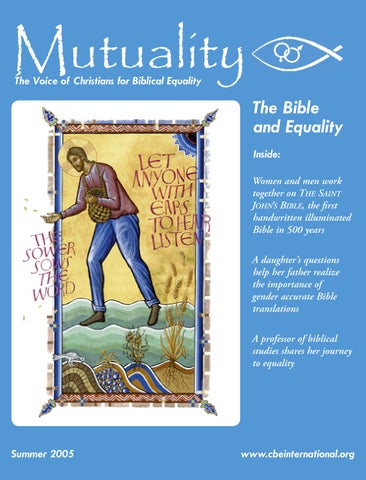
COVER IMAGE: Sower and Seed (Mark 3:1– 4:4). In this illumination, Jesus is wearing blue jeans, scattering the seeds into the text of the Gospel. A bird searches for seed on thorny ground, rocky soil, and fertile land. Aidan Hart with contributions from Donald Jackson (calligraphy) and Sally Mae Joseph (border decoration), natural hand-ground ink on calfskin vellum. Copyright © 2002 The Saint John’s Bible and the Hill Museum & Manuscript Library at Saint John’s University, United States of America.
Association honored Mutuality with two awards at its annual convention this Spring 23 Marked by the Spirit: CBE’s presence at Cornerstone Music Festival sparks conversations 25 CBE Chapter Listings 26 Egalitarian Counselor and Therapist Directory
Departments 3 FROM THE EDITOR: The Bible Tells Me So 4 IN OUR MAILBOX 19 BOOK REVIEW: True Identity: The Bible for Women & Strive: The Bible for Men — Reviewed by Joanne Nystrom Janssen & Arlyn Janssen
21 CBE RESOURCES & EQUALITY DEPOT 25 PRAISE REPORTS & PRAYER REQUESTS 28 CHURCH AND STUDY GROUP RESOURCES: Study Guide for Gilbert Bilezikian’s Beyond Sex Roles 29 GIVING OPPORTUNITIES 30 PRESIDENT’S MESSAGE: CBE is Helping College Students Discover their Gifts
2 | Mutuality Summer 2005
HOMEPAGE: www.cbeinternational.org
Mutuality The Voice of Christians for Biblical Equality
Let us then pursue what makes for peace and mutual upbuilding. — Romans 14:19 VOLUME 12, ISSUE 2 Mutuality seeks to provide inspiration, encouragement, and information about equality within the Christian church around the world. President/Publisher : Editor : Editorial Assistant : Graphic Designer :
Mimi Haddad Chelsea DeArmond Heather Scheiwe Stephanie Rogers
EDITORIAL AND ADVERTISING OFFICE Christians for Biblical Equality 122 W Franklin Ave, Suite 218 Minneapolis, MN 55404-2451 PHONE: (612) 872-6898 FAX: (612) 872-6891 E-MAIL: cdearmond@cbeinternational.org WEB: www.cbeinternational.org Advertising in Mutuality does not imply organizational endorsement.
SUBMISSIONS Mutuality welcomes submissions. E-mail cdear mond@cbeinternational.org, write to CBE for the writer’s guidelines, or visit CBE’s homepage and follow the Publications links.
PERMISSIONS Christians for Biblical Equality grants permission for any original article (not a reprint) to be photocopied for local use provided no more than 1,000 copies are made, they are distributed free, the author is acknowledged, and CBE is recognized as the source. Mutuality (ISSN: 1533-2470) is published quarterly by Christians for Biblical Equality and is sent free to members. For membership information, see page 31. To purchase back issues, contact our Editorial and Advertising Office, or order online at www.equalitydepot.com.
BOOKSTORE: www.equalitydepot.com
FROM THE EDITOR by Chelsea DeArmond
The Bible Tells Me So My mother’s Bible always looks like it’s about to burst at the seams. She circles, stars, and underlines verses with special meaning. Some passages have dates written in the margins, sometimes with notes about a particular occasion, or about what the verse meant to her at the time. My mother filed sermon notes, newspaper clippings, pages from devotionals, pictures, birth certificates, church bulletins, and wedding programs in between the pages of her Bible. Our family’s story was wrapped up in the stories of Noah’s Ark, Samson and Delilah, King David, Solomon’s Temple, Jonah and the whale, Queen Esther, John the Baptist, Jesus, the disciples, Paul, and even Revelation. Pages from the Bible also wove their way into our lives, sometimes in odd ways. We had a chart with the names of the 66 books of the Bible above the TV, so that while I was watching Little House on the Prairie or Gilligan’s Island, I could memorize the books of the Bible during commercial breaks. I loved reading the Bible and sharing it with others. I volunteered as a teacher at Vacation Bible School and as a counselor at Bible Camp as soon as I was old enough. I started Bible studies in high school and college. As a teenager, I even wrote my own commentary on the book of Hosea. Every once and a while, a boy in youth group would find a verse like 1 Timothy 2:15 and taunt the girls with it, saying: “You’ll only be saved through childbearing!” I knew better than to take their teasing too seriously, but it still bothered me. I was confused and grieved when adults I respected used the Bible to show me that women shouldn’t teach—they should be quiet and submissive instead. I didn’t know how to understand these verses, but my instinct told me to keep reading. The verses people quoted to limit women’s roles also limited God by putting restrictions on who God could use. I knew the Bible well enough to know that God doesn’t operate within those kinds of limits on who is worthy of the Lord’s service. As a child, I was encouraged to read the Bible. As I grew older and became more serious about studying and teaching the Bible, other Christians started discouraging me, and I began questioning myself. The old taunts were still there, and the authority of some of my Sunday school teachers still carried weight. I came to a crossroads in which I could either give up on the Bible, or get into it more deeply than ever. I chose to dig in, and God has been faithful to provide a community of Christian men and women who have helped me grow in my knowledge of Scripture. Now I understand passages that seem to silence women in the context of the challenges faced in the New Testament church, which may or may not have parallels in today’s contexts. In the New Testament churches, women who had not yet been discipled or who were leading others astray were sometimes singled out for special criticism or instruction. While women in these circumstances were silenced, women like Priscilla were called upon to speak with authority, and teach other church leaders. My mother’s Bible symbolizes to me the sense I’ve always had that God is at work in our lives, just as he was in biblical times. Examples like Priscilla are some of the passages that are starred and under- Chelsea DeArmond posed with her NIV Student Bible for her Senior Pictures. lined in my Bible.
Mutuality Summer 2005 | 3
In Our Box Mutuality Call for Papers
We’d love to hear from you! Send your comments, suggestions and critiques to:
Mutuality seeks to provide inspiration, encouragement, and information about equality within the Christian Church around the world. Mutuality is published quarterly, and sent to all CBE members and subscribers. Current and back issue are also available for purchase. We are currently seeking features, reports and reviews (books, films, and/ or music) from evangelical, egalitarian perspectives related to the following themes: • • • •
Jesus and Gender Widows and Orphans Prison and Release Family Values
Most of the articles we publish fall into the following categories: • Personal testimonies illustrating how biblical equality provides practical benefits to everyday lives. • Teaching on relevant Bible passages, explaining the meaning and showing how to apply it to daily life. • Reviews of books about biblical equality that would appeal to a wide audience. (Books must complete CBE’s book service review process before being reviewed in Mutuality.) • Feature stories about issues related to CBE’s mission and ministry. The length of features is generally 1,300-2,500 words. Writer’s Guidelines for Mutuality are available on our website (www.cbeinternational.org) or contact our office to request a copy. Questions and submissions can be directed to the attention of the editor, Chelsea DeArmond. Mutuality Christians for Biblical Equality 122 W Franklin Ave, Suite 218 Minneapolis, MN 55404 (612) 872-6898 cdearmond@cbeinternational.org 4 | Mutuality Summer 2005
MUTUALITY
122 W Franklin Ave, Suite 218 Minneapolis, MN 55404-2451 PHONE: (612) 872-6898 FAX: (612) 872-6891 E-MAIL: mutuality@cbeinternational.org WEB: www.cbeinternational.org Letters may be edited for clarity and brevity.
Church Planter Seeks Stories about the Importance of Equality I’m a guy who is going to start a new church. In the next few months I am going to determine the vision, the values, the target, the strategies, the constitution, the budget, and more! I have a lot to deal with. It would be safe to tow the old line of emphasizing “men only” in church leadership. If I go outside those safe boundaries, I am going to have to answer for it. The churches who support me and the people who come to check out the new church will ask about my position. If they hold a different position, I could go around and around with them using biblical support. Both sides of the issue make convincing cases; otherwise there wouldn’t be an issue. I want to know, what is the real story? What is the real injustice? Not some theoretical, high-brow banter (I am not assigning those labels to Mutuality, but rather to the general direction that many “spiritual” discussions take). Show me a person’s real experience. I want a story I can point to and say, “That injustice will have no place in God’s church under my watch.” It would be a story I could share with the people who would question my decision, and they would understand…no banter required. Do you have those kinds of stories in Mutuality? I would like to emphasize a final point for your organization to consider: it is much, much, much easier for a new church plant to incorporate equality from the get-go than for a big old church to make a change—any change. I live in the world of church planting, and I invite you to convince me of the importance of equality. Aaron Winowiski Ripon, Wis. Dear Aaron, Thank you for examining the important issue of women in church leadership as you prepare to plant a church of your own. The personal stories you’ve requested are very close to the mission and values of Mutuality. I hope you will discover the kind of testimonies you’re looking for, as well as the biblical support for women in the church’s leadership, as you continue reading our publication. And, as your ministry develops, I hope you will share stories of your own with us! Blessings on your journey, Chelsea DeArmond, Editor HOMEPAGE: www.cbeinternational.org
Women Illuminating the Word Women and men work together on The Saint John’s Bible, the first handwritten illuminated Bible in 500 years By Joanne Nystrom Janssen
When Minneapolis-based calligrapher and and University in Collegeville, Minnesota. include seven volumes that are each two feet graphic designer Diane von Arx Anderson It is headed by artistic director Donald tall and almost three feet wide when opened, was invited to work on The Saint John’s Bible, Jackson, one of the world’s best-known with a total of 1,150 pages. the first handwritten illuminated Bible in 500 calligraphers and the scribe to Her Majesty The Saint John’s Bible, which is schedyears, it did not ever cross uled to be finished in her mind to refuse. 2007, is called an “illumi“As a calligrapher in nated” manuscript, a term the 21st century, [it] was that draws attention to like being asked to work the dazzling gold leaf and on the Book of Kells,” brilliant colored inks used she said, referring to the in its creation. The phrase renowned handwritten may also originate from Bible created in Ireland the Middle Ages, when around A.D. 800. “I am candles provided the only an active participant in light in dark cathedrals. my church…so it was very When the candlelight meaningful for me. This reflected off the gold and is something that will live inks on the page, it looked for a long time…and to be like the light was coming invited to work on a proj- Diane von Arx (CENTER) stands with Jo White (LEFT) and Joan Borchers (RIGHT) next to the Loaves and Fishes illumination in The from within the text. ect that has that amount of Saint John’s Bible on display at the Minneapolis Institute of Art. The Saint John’s Bible is 15 ¾˝ wide × 23 ½˝ tall when closed, In this present-day Bible, significance is a very good and will contain seven volumes when it is completed in 2007. Photo courtesy of Carol A. Marrin. more than just the termifeeling. It’s something I nology is medieval. The couldn’t possibly have said ‘no’ to.” Queen Elizabeth’s Crown Office. materials and process borrow from ancient Von Arx is one of the team of calligraThe intention is that the Bible be “con- techniques: the scribes write using handphers and illuminators—those who adorn temporary, ecumenical, multicultural, and cured goose quill pens, ground pigment inks, the pages with images, ornamental designs, prophetic.” To that end, a group of eight and calfskin vellum pages. They also use gold or decorative lettering—who are working theologians, artists, and art historians called leaf in the images, applying it over gesso—a on the monumental task of transcribing the Committee on Illumination and Text mixture of plaster, fish glue, white lead, and and illustrating the entire Bible by hand. inform and shape the work by providing sugar. The existence of ancient manuscripts Estimated to take about nine years and to biblical, cultural, and historical information such as the Book of Kells suggests that by cost over four million dollars, the project about each passage represented in the Bible’s using these materials, the Bible will last over was commissioned by Saint John’s Abbey 160 illuminations. The completed Bible will 1,000 years.
Don’t miss the brilliant colors—this article is available in full color at www.cbeinternational.org. Illuminated manuscripts receive their name from candlelight flickering off the raised gold leaf adorning the illustrations. Like medieval manuscripts, the pigments for the illuminations in The Saint John’s Bible are hand ground from minerals such as lapis lazuli (blue), vermilion (red), and malachite (green) then mixed with egg yolks (for warm colors) or whites (for cool colors) to add luster and depth. Photos courtesy of Liturgical Press. BOOKSTORE: www.equalitydepot.com
Mutuality Summer 2005 | 5
“Trained in Beautiful Writing”
Women Scribes in History by Joanne Nystrom Janssen As commissioner of The Saint John’s Bible project, Saint John’s Abbey often emphasizes the link between the project and the monastic tradition of copying and preserving religious manuscripts—a history that would seem to make Diane von Arx, who is a contemporary woman illuminator of the Bible, an anomaly. But according to Kim Haines-Eitzen, Associate Professor of Early Christianity at Cornell University, the historical data suggests a more complex and diverse heritage. Her work has unearthed evidence suggesting that female scribes may have transcribed some of the earliest Christian manuscripts. Since Haines-Eitzen’s area of expertise is pre-fourth century Christianity, she acknowledges that scholars have little direct evidence from the period—for scribes of either gender. But, by focusing on the physical features of manuscripts of the New Testament and other early Christian texts, she has discovered some intriguing evidence for female scribes. One important finding is a passage from Eusebius, a church historian and theologian who lived circa A.D. 270–340, in which he lists the categories of copyists who worked for Origen, a Greek philosopher and theologian—a list that includes “girls trained in beautiful writing.” Haines-Eitzen points out that Eusebius mentioned these female calligraphers in passing, without drawing attention to them as unusual or unique. She also notes that other references and visual evidence from the period mention or depict female scribes doing work as bookkeepers, notaries, secretaries, and copyists of literature. From this data, little can be assumed statistically about proportions of women scribes to men, although Haines-Eitzen states, “Certainly female scribes were less common.” She also notes that the gender of a scribe cannot be determined on the basis of his or her handwriting. She jokes that female scribes did not “dot their i’s with hearts on top—women were trained in the same way that men were trained.” Before monasteries and convents became institutionalized in the fourth century, Christian texts were copied informally, according to Haines-Eitzen, which contributed to the diversity of scribes. “The image that we have in our heads of a room full of monks transcribing the New Testament or Old Testament texts…simply doesn’t exist in the second century,” she says. Haines-Eitzen adds that religious texts came about in a variety of ways—perhaps at the request of a congregation or a wealthy householder. They also were impacted by cultural and economic forces; Haines-Eitzen suggests that urban centers would likely have had more copies of manuscripts than rural communities, which probably had few texts or people who could read them. In the fourth century and following, Haines-Eitzen cites clearer and more explicit evidence for women copying texts, including the Bible. She links this change to the establishment of monasteries and convents in that period, which included scriptoria—rooms set aside for copying and illuminating religious texts. For example, a biography of Melania the Younger (circa A.D. 383–439) mentions her copying the Old and New Testaments in her monastery and providing them to others. A later account of Caesaria the Younger also mentions her teaching monastic women to copy the biblical texts. “Clearly you’ve got examples of female scribes in these monasteries,” says Haines-Eitzen. But why does it matter that women were scribes? In a 1998 article published in the Journal of Early Christian Studies, Haines-Eitzen explained the significance of the research: “Scribes and copyists…played an integral role in the (re)production and (re)creation of ancient texts. Attention to the ancient representation of women as scribes restores… an aspect of the history of women that has all too often been overlooked, and a facet to the identity and role of ancient scribes and copyists.” LEFT: Anthology (Luke 15), Donald Jackson, with Sally Mae Joseph and Aidan Hart, natural hand-ground ink on calfskin vellum. Copyright © 2002 The Saint John’s Bible and the Hill Museum & Manuscript Library at Saint John’s University, United States of America.
6 | Mutuality Summer 2005
HOMEPAGE: www.cbeinternational.org
At the same time, however, the Bible is remarkably contemporary, especially in the illuminations. While occasional images draw on the iconographic tradition, others include satellite images of earth from space, depictions of DNA strands, visual mapping of voices, and even a representation of New York City’s Twin Towers. In a 2002 article published in Scribe magazine, Donald Jackson also notes the Saint John’s team’s “obviously genuine wish to emphasize, where appropriate, the part played by women and the under-privileged in the Bible stories (not something we would have seen in the Middle Ages).” The Bible is modern in other ways, too. Unlike previous handwritten Bibles, which were written in Latin, this Bible is written in English using the New Revised Standard Version, a gender-accurate translation that is widely used by both Catholics and Protestants. Instead of working side-by-side in monastic communities, most of the contemporary scribes work out of their own studios in Wales, England, and the United States. And, perhaps most notably, since no previous models exist of an English handwritten Bible, the layout of each page is determined on a computer to allow several scribes, in different parts of the world, to work on different pages at the same time.
The Word in Proc Diane von Arx works on her pages of the Bible from her Minneapolis studio—a location she describes as fortunate, because she can see the pages of the Bible frequently. The Minneapolis Institute of Arts recently completed an exhibition of the Bible, and completed volumes are stored at the Hill Museum and Manuscript Library at Saint John’s Abbey and University just an hour away. Over the last year, von Arx has worked as an illuminator for the Wisdom Books volume of the Bible. She has been assigned four “special treatments”—illuminations that she describes in Jackson’s words as “turning up the volume on the quote.” Similar to pull-out quotes in a magazine, von Arx’s special treatments call attention to the text of particular biblical and apocryphal passages: Job 19:25, Ecclesiastes 11:1, Sirach 6:14–22, and Sirach 39:13–15. While von Arx’s career as a calligrapher and illuminator is now firmly established, she did not anticipate this possibility for herself after completing her formal education as a commercial artist. Looking back, however, she realizes that she “always gravitated toward letters.” She remembers getting her first taste of lettering when working on bulletin boards for the nuns at her Catholic high school, in which she copied script out of a Speedball calligraphy book. After starting in a career of commercial art and graphic design, she began to take classes in calligraphy, in which she and her instructor discovered she had a gift. This led to teaching opportunities and further classes and workshops with world-renowned type designers and calligraphers, including Donald Jackson, who became a colleague and friend. Because of her affiliation with Jackson and her personal ties to Saint John’s, von Arx was aware of The Saint John’s Bible project almost from its inception. This awareness influenced her first impressions. “My perspective was different…because I’m from Minnesota and I take that Bible personally,” said von Arx. “It’s mine, it’s Saint John’s. I know their commitment and I know their vision, so it wasn’t surprising. And because I knew Donald BOOKSTORE: www.equalitydepot.com
ABOVE: This illumination illustrates the story from John 7 of the woman
caught in adultery. In the first panel, one man reaches for a letter of the Hebrew word for adultery in order to throw it at the woman as if it were a stone. Another man looks out at the readers, offering us a stone of our own. The woman also looks out to the readers, holding up one hand and partly covering her face with the other. Jesus looks down at the ground, where he is writing with his finger. In the second panel, the woman’s accusers have left their stones of condemnation on the ground where Jesus was writing. The closed door in the background is now open. Jesus motions his forgiveness for the woman, who is now free to “go and sin no more.” Woman Taken in Adultery (John 7). Aidan Hart with contributions from Donald Jackson (lettering and background gilding) and Sally Mae Joseph (border), natural hand-ground ink on calfskin vellum. Copyright © 2002 The Saint John’s Bible and the Hill Museum & Manuscript Library at Saint John’s University, United States of America.
Mutuality Summer 2005 | 7
I thought, ‘Who else would do it?’ He’s extremely intelligent, he’s sensitive, and he’s so gifted. I can’t imagine that anyone else could handle the project.” Early in the project’s development, Jackson mentioned to von Arx the possibility of her working on the Bible, and then he officially invited her to join the team in June 2004. To von Arx, this invitation to be part of the elite team working on such a project represented a significant honor.
ABOVE: Butterflies are a symbol of resurrection, and this illustra-
tion of the Monarch butterfly in all the stages of its metamorphosis appears at the end of the Gospel of Mark. Illustrations of flora and fauna from the area around Saint John’s monastery are included throughout The Saint John’s Bible. Chris Tomlin, acrylic gouache and watercolor on calfskin vellum. Copyright © 2002 The Saint John’s Bible and the Hill Museum & Manuscript Library at Saint John’s University, United States of America.
8 | Mutuality Summer 2005
“It’s a most amazing project to be done in the 21st century,” said von Arx. “It was kind of dessert that [the job] was a Bible—something that I believe in and question at the same time.” The collaborative nature of the project posed particular challenges to von Arx, who worked in her Minneapolis studio while corresponding with Jackson in his Welsh scriptorium. She believes she was chosen for the project in part because of her ability to take direction and work as part of a team when many artists prefer to work on their own. However, she pointed out that the geographic distance made teamwork difficult at times: “When you’re working across the water,” she said, “You can’t ask your boss, ‘Am I going in the right direction?’” At the same time, von Arx found the collaboration extremely rewarding. After sketching out layouts of the pieces by herself, she would scan or digitally photograph her work and send it to Jackson for feedback. “He has his eye on the big forest and he knows how this little tree of mine will relate,” said Von Arx. “He would say, ‘You might try a different style on this letter,’ but he was very careful not to dictate what should happen. He was very encouraging and always had a good word to say.…It was an apprenticeship for me.” To complete the four special treatments, von Arx logged 200 hours—a length of time that may surprise those unfamiliar with the process. But she acknowledges that the entire project moves slowly, often due to the care the project members take to apply the medieval methods. As an example, she cites the vellum: before the calfskin can be used, it must be scraped, cleaned, sanded, dried, and then evaluated to see if its texture, color, and translucency make it suitable for The Saint John’s Bible. Von Arx hand-stretched the vellum pages herself before working on them and cured her own quill pens. The extra effort paid rich dividends. Von Arx cited as one of her joys “when the gouache falls off the quill and…it looks lovely.” She added, “I have such respect for the tools. Only a quill can do that. No matter how good you are, no matter how well you know those letters, the quill and vellum will make the best and finest letters.” In spite of her confidence in the materials, von Arx found herself immobilized with fear when the time came to actually put quill to vellum. “I was paralyzed, and I just had to get past that,” she said. “I had to think, ‘This is just a piece of vellum.…The worst that could
happen is that this whole leaf just has to be redone, and that will not be the end of the world.’…It was quite a struggle.” And von Arx did make mistakes. Partway through the process, she joked to friends, “‘I am getting really good at scraping [pigment off] vellum and sanding.’” She notes that one time she had to scrape her work off three times and start over again. “It’s very frustrating,” she said, “but you just do it because it’s a good cause and because God’s the client.”
The Word Made Public Longtime CBE member and volunteer Marilyn Cramolini has an intimate relationship with The Saint John’s Bible for another reason: she serves as a docent, or tour guide, at The Minneapolis Institute of Arts, where the Bible was first unveiled to the public in the exhibition “Illuminating the Word” from April 10 to July 3, 2005. When Cramolini first saw the 100 pages that were exhibited at the museum, she was overwhelmed. She thought, “If I weren’t a Christian, I would be from seeing these pages.” As part of her training for the exhibition, Cramolini experienced a lecture by a Saint John’s monk who discussed the monastic community’s motivation for commissioning such a project. The monk stated that they desired to reacquaint people with the Bible. To Cramolini, a Bible major in college, the monk’s stated intention was also dear to her heart. During tours, she said she “tried to stress what the monks thought was important—God’s word.” Cramolini also appreciated the opportunity to emphasize aspects of the Bible that affect women viewers. For example, she appreciated that they chose the New Revised Standard Version of the Bible, which is a gender-accurate translation. “That pleased me a whole lot,” said Cramolini. “I pointed that out constantly—that it was genderfriendly to women.” Cramolini also enjoyed drawing attention to illuminations that brought about an audience response, several of which involved biblical women. For example, in the illumination of Mary and Martha from Luke 15, Mary sits high on a stool, listening to Jesus, while Martha stands impatiently with her hands on her hips. Cramolini pointed out that women are often the workers, like Martha—a concept with which the women viewers identified strongly. HOMEPAGE: www.cbeinternational.org
Another image that brought about strong responses was that of the woman caught in adultery in John 8. In the illumination, one of the Pharisees grasps the Hebrew word “adultery” in order to hurl it at the woman, attempting to wound her with his accusations of her sin. Because the word crosses the boundary of the image’s frame, Cramolini points out that it communicates a message to the viewers as well: that we are all sinners, and that we all participate in judging others, which Cramolini said always caught the audience’s attention.
The Word Made Personal This deep audience connection with the Bible made the exhibition special for Cramolini. “There were some that just couldn’t learn enough,” she said. “They were just bringing it to their souls. They were so dedicated to learning, they just couldn’t stand it if they didn’t.”
The personal responses to the Bible also moved Diane von Arx. As she walked through the exhibit, she enjoyed silently listening to the comments of others who were unaware that they were standing next to one of the Bible’s illuminators. “I just find it amazing that everybody looks for something different,” said von Arx. “Everybody can relate to something in it. People should be putting themselves into this, because it’s a contemporary Bible.” The interpretive aspect of the Bible is also an interesting issue for Kim Haines-Eitzen, Associate Professor of Early Christianity at Cornell University. “As a historian of early Christianity, what I find most fascinating is the way in which these texts have been appropriated and read and interpreted in different contexts,” she said. “This is not an attempt to redo the medieval illuminations; it’s very much an interpretive approach that says something about the modern world and about their own context and their own interests. It speaks to the vitality of the religious tradition.…”
Von Arx hopes that in the case of The Saint John’s Bible the contemporary interpretations will speak to its viewers in a profound way. “When people see how these were interpreted—written so many years ago, but interpreted in a modern way—I would think and hope that it would inspire people to stop and think about what we really need and what we really want,” she said. “We’re smeared every day with things that are not important. I hope…that it is the impetus for people to go back to the written Word.” More information about The Saint John’s Bible is available at www.saintjohnsbible.org. Joanne Nystrom Janssen is a Ph.D. student in English literature at the University of Iowa. She is especially interested in nineteenth-century British fiction and its intersections with religion, social justice, and journalism. She is also a former Mutuality editor and book service coordinator at CBE.
To the Ends of the Earth, Donald Jackson, with Andrew Jamieson and Sally Mae Joseph, natural hand-ground ink on calfskin vellum. Copyright © 2002 The Saint John’s Bible and the Hill Museum & Manuscript Library at Saint John’s University, United States of America. BOOKSTORE: www.equalitydepot.com
Mutuality Summer 2005 | 9
Historical Profiles of
Bible Translators & Interpreters Paula (347–404)
Samuel Crowther (1809–92)
Devoted Disciple and Founder of Monasteries
From Freed Slave to First African Bishop
Paula and her daughter Eustochium devoted their lives to Christian service and study after the death of her husband, a Roman senator. They traveled with Jerome to Palestine and Egypt, and were tutored in the knowledge of Scripture and monastic living. Paula and Eustochium became fluent in Greek and Hebrew during these pilgrimages. They eventually settled in Bethlehem, where they founded four monasteries and assisted Jerome as he worked on the Latin Vulgate. The Vulgate was the first translation of the Bible from the original Greek and Hebrew, which were no longer spoken by many Christians, into the language of the common people.
Samuel Crowther was born in Nigeria in 1809. He was captured as a slave when he was only 13. Fortunately, the British intercepted the slave ship at Sierra Leone and Crowther was freed. There, he became a Christian and was educated by the Christian Missionary Society. Eventually Crowther went to London to study theology. Before returning to Africa he was ordained, and in 1864, Samuel Crowther became the first African Bishop of the Anglican Church. After becoming Bishop, he translated the New Testament into Yoruba, his native language.
Luther (1483–1546) Church Reformer Although Martin Luther had never read the Bible before age 20, by the time of his death at age 63 he had published many Bible commentaries and multiple editions of the first translation of the Bible in German. Luther insisted that to translate the Bible into clear and understandable language, “one must ask the mother at home, the children in the alley, and the common man in the market place about it, and translate accordingly.” He also believed that translating required “a truly devout, faithful, diligent, Christian, learned, experienced, and practiced heart.” The increased access to Scripture that resulted from Luther and other reformers’ translations paved the way for abolishing unbiblical beliefs and practices in the Church during the Reformation.
John Eliot (1604–1690)
Pandita Ramabai Saraswati (1858–1922) Sanskrit Scholar and Social Reformer Pandita Ramabai’s parents believed in education for women, which was very unusual for Indian families in the 1800s. Pandita excelled in her studies, and was especially renowned for her skills in Sanskrit. After converting to Christianity, Pandita learned Greek and Hebrew in order to translate the entire Bible into Marathi, her native language. In 1889, she founded a school called Shâradâ Sadan (“Home of Wisdom” in Marathi), where Indian girls received care and education, and her Bible was translated and published. Pandita Ramabai’s Bible is one of the only—if not the only—translations of the Bible done completely by a woman.
Puritan Missionary to the Massachusetts Bay Indians The first full Bible printed in the Western Hemisphere was in a dialect of the Algonquin Indians. Puritan missionary John Eliot translated the Bible from the original languages into the Massachusetts Bay Indians’ language, Massachuset. Massachuset had never been written before, so Eliot also created the first written form of the language. The Bible was finished in 1663 and a new edition was published in 1685.
10 | Mutuality Summer 2005
Katharine Bushnell (1856–1946) Biblical Scholar and Advocate for Equality Katharine C. Bushnell (1856-1946) was a passionate advocate for the oppressed. Her ministry included serving as a medical doctor in the United States and China, working for social reform with Francis Willard and the Woman’s Christian Temperance Union, and founding a mission for homeless women in Chicago. She ministered in places like brothels, opium dens, and lumber camps. Throughout her journeys, she was a diligent student of the Bible in its original languages and published ground-breaking Bible studies on the equality of men and women in the church, home, and world.
HOMEPAGE: www.cbeinternational.org
…But Words Can Never Hurt Me By John R. Kohlenberger III
Photo courtesy of the Kohlenberger family.
“Daddy, why does God only like boys?” My eight-year-old daughter surprised me with her theological question. We attended a conservative, evangelical church and she was in third grade in a Christian grade school—what were they teaching her? “What do you mean, honey? God loves girls just as much as he loves boys!” “That’s not what the Bible says,” she shot back. “We memorize verses about how God ‘wants all men to be saved’ and about ‘fishers of men’ and about ‘blessed be the man.’ We don’t learn any verses about girls being blessed or girls being saved.” Donning my professor’s hat, I started to explain, “Well, Sarah, you have to understand that in English, when we say ‘men’ we also mean.…” —but I couldn’t finish the sentence. Why should the reader have to decide when “men” means “boys” and when “men” means “people”? It had never occurred to me that this traditional practice of using masculine-gender nouns in gender-inclusive contexts could actually result in confusing and excluding readers. After all, these contexts always included me—an adult male. That was nearly twenty years ago. My daughter has become a more sophisticated reader (her first degree is in English), and I have become a more sensitive communicator. From that day on, whenever I read the Bible publicly in church or classroom, I make sure the language is gender accurate. I want to be sure that every reader—male or female, young or old, seeker or believer—knows whether or not the text applies to them. If we were in Psalm 1:1, I would read, “Blessed is anyone,” even though the NIV reads, “Blessed is the man.” In Matthew 4:19, I would make clear that believers were to fish for people, not just adult males. In 1 Timothy 2:4, I would emphasize that God wants “all people to be saved.” These translations are not for the sake of “political correctness”; these renderings are absolutely true to the original text—and are matters of life and death.
“Sticks and stones can break my bones, but words can never hurt me.” We teach this nursery rhyme to our children when they come crying into our arms, devastated by the mean words of playmates. Of course, we all know the rhyme is a lie; words can do incredible harm. If we are nicknamed by our weight or height or color or body odor, that can damage our self-image for years to come. Think about the word “dumb.” This Old English adjective means “having no power of speech; mute.” It is commonly used in our English Bibles BOOKSTORE: www.equalitydepot.com
“I want to be sure that every reader— male or female, young or old, seeker or believer—knows whether or not the text applies to them.” Mutuality Summer 2005 | 11
up to the 1980s to describe people who cannot speak (e.g., Matt. 9:32–33 KJV). But “dumb” can also mean “stupid.” Sometime in the last third of the twentieth century, at least in America, the concept of “stupid” became dominant, so that many Bible translations (like the NIV in 1973 and 1978) avoided the word altogether. It is clearly wrong to state that everyone who cannot speak is stupid, so it is clearly wrong to call them “dumb,” as this word can do harm. It is the same with masculine-gender words intended for inclusive meaning. Since the 1980s, Bible translations have begun to replace these easily misunderstood terms with gender-accurate words, such as: man, men father(s) sons(s) brother(s)
person, people parent(s), ancestor(s) child, children brothers and sisters, friends, Christians
be male or female. But following the more mechanically literalistic Revised Version of 1881–84, most versions of the twentieth century used “sons of God” in Matthew 5:9. While this may seem more accurate on a mechanical level, it is less accurate on a meaning level. It is an unnecessary departure from the earliest English versions and it can do great harm in contemporary settings. Bible translation is beginning to catch up with this shift in contemporary English usage. Since the 1980s, at least nineteen revisions and new translations of the Bible or New Testament have appeared in English. And, with the exception of the 1995 revision of the New American Standard Bible, all of these translations have used genderaccurate language to a greater degree than versions published between 1881 and 1980. Many of the most strident critics of the TNIV have been involved with or have endorsed translations that use genderaccurate language. In another decade, I believe the evangelical church will wonder what all this fuss was about.
Every Hebrew-Aramaic and Greek lexicon and word study resource published in English in the last 160 years acknowledges that these kinds of words can be both gender specific and gender inclusive. “The soothing tongue is a tree of life, Portrait of William Tyndale. Courtesy of Hertford College, Oxford. William TynGender-accurate translation ensures dale completed the first translation of the Bible into English. The text from the but a perverse tongue crushes the spirit. that gender-specific words are used in Beatitudes in Matt. 5 behind the title of this article and at the bottom of this (Proverbs 15:4, TNIV) gender-specific contexts and that genpage comes from the first printed English New Testament, translated by William Tyndale in 1525. der-inclusive words are used in genderSticks and stones can break bones and inclusive contexts. You can check this in words can do great harm. At Christians any translation of 1 Timothy 2: verses 1–6 are gender-inclusive, verse for Biblical Equality, we work to accept those who have been mar8 refers to men (males) and verses 9–15 to women. Though there has been a lot of controversy over this practice, ginalized and excluded, to empower those who have been powerless, especially involving Today’s New International Version (TNIV, 2002, and to bring healing to those who have been battered and hurt. I 2005), this is nothing new. In 1526, William Tyndale translated pray that in word and in deed our tree of life will continue to bear Matthew 5:9: “Blessed are the peacemakers: for they shal be called sweet and delicious fruit. the chyldren of God.” Every translation of the sixteenth century, culminating in the King James Version of 1611, followed Tyndale in John R. Kohlenberger III is the author/co-editor of more than three dozen using the phrase “children of God.” biblical reference books and study Bibles, including the NIV Interlinear Hebrew-English Old Testament and NRSV Concordance Unabridged. His Although the original Greek word uioi is masculine, the gendermost recent work has been with Today’s New International Version. inclusive translation “children” is more gender-accurate than the He has taught at Multnomah Bible College and Western Seminary in mechanical masculine translation, “sons,” since peacemakers can Portland, Ore., and currently serves as a CBE board member.
12 | Mutuality Summer 2005
HOMEPAGE: www.cbeinternational.org
The Junior Bible Quiz & Gender Accuracy
By Deborah Gill
Find out why the Assemblies of God decided to make their innovative Scripture memorization tool for kids more gender accurate The Junior Bible Quiz (JBQ) is a children’s discipleship ministry of the Assemblies of God that motivates kids to learn and love the Bible. We have taken the issue of gender accuracy and children’s faith development very seriously. The JBQ Bible Fact-Pak has been planting God’s truth in the hearts of thousands of boys and girls for years. Updated and revised, this innovative Scripture memorization tool features 576 diverse questions covering people, places, events, and teachings of the Bible. Over the years, many coaches had approached their district and regional JBQ representatives asking if the malegender terms in the Bible Fact-Pak could be addressed and possibly changed. These coaches were finding that not only their young girls but also their young boys were confused over statements like, “Does God want all men to be saved?” They wondered whether all girls or all boys could also be saved, or was it only men? Instead of having to explain this to the children year after year, the coaches requested that a change be made in the question cards, since the Scriptures cited in these questions often did not refer to any gender-specific term such as “men.” Coaches wondered: “Why must the cards be genderspecific where Scripture was not?” As a result, members of the National JBQ Advisory Committee did a thorough search of the wording used in both the NIV and the KJV, as well as the original Greek and Hebrew. The Advisory Committee discovered 18 cards in which they felt a change should be made to more accurately reflect the wording of Scripture. For example, Question #255 in The Bible Fact-Pak originally stated,
the NIV nor KJV versions of the verses cited for this question use the word “men.”
2 Chronicles 19:7 NIV: “…for with the Lord our God there is no injustice or partiality or bribery.” KJV: “…for there is no iniquity with thee Lord our God, nor respect of persons, nor taking of gifts.” The Hebrew word translated as “persons” (paneh) in the KJV literally means “faces.”
Romans 2:11 NIV: “For God does not show favoritism.” KJV: “For there is no respect of persons with God.” The Greek word translated as “respect of persons” (prosopolempsia) in the KJV and “favoritism” in the NIV literally means “respect of persons.” As you can see in these Scriptures, it would have been more accurate to write The Bible Fact-Pak question and answer without the
male gender reference. The changes were initiated and approved by the National JBQ Advisory Committee in order to make the Bible Fact-Pak more “Scripturally correct,” not “politically correct.” For more examples of changes see http://4kids.ag.org/jbq/biblefact-pak/gender-neutrality.cfm. These changes to Bible Fact-Pak questions also reflect changes in most Bible translations (including the New American Standard Bible), which are in the process of preparing genderaccurate editions if they haven’t already. For example, the NIVi (New International Version, Inclusive Language Edition, from Great Britain) or the TNIV (“Today’s” NIV) are gender accurate to the original text of the Bible. So also are the NIV Children’s Edition, New Revised Standard Version, New Living Translation, New Century Bible, The Message, etc. Unfortunately, a lot of well-meaning Christians are misinformed about these translations. They oppose these modern Bibles because they think the translators are tampering with biblical truths, watering
Q: Does God treat all men alike? A: Yes, all men are equal before God. (2 Chronicles 19:7; Romans 2:11) This question was changed to read, “Does God treat all people alike?” and “Yes, all people are equal before God,” because neither BOOKSTORE: www.equalitydepot.com
Mutuality Summer 2005 | 13
down doctrine, or compromising convictions to be politically correct. Such is not the case, however. The translations are much closer to the original biblical text, for many reasons—all the way from the antiquity of the manuscripts they are based upon, to the gender-accuracy of their translations. For example, in the original Greek (the language of the New Testament), most of the verses translated “any man,” “he who,” “the man that,” etc., in traditional English translations actually mean “any one,” “the person who,” “the one that,” etc. These modern versions (that are receiving so much criticism), whose translations are gender-inclusive, are not changing the Bible. On the contrary, though parting with some traditional English versions, they are correcting translations, resulting in gender-accurate translations that reflect the original language texts. Both Greek and Hebrew have two different words for man. One “man” should really be translated “human” or “person,” the other, less frequently used, means “male person” or “husband.” All the verses describing the incarnation, Jesus becoming flesh, for example, describe him with the first term, meaning human, not the second, meaning male person. Thus, the emphasis of the incarnation is not on his maleness, but the humanity of Christ. Since in Greek and Hebrew there is no generic, gender-inclusive pronoun, collective plural references such as “sons of God,” “sons of Israel,” “brothers,” etc., are grammatically masculine. In their historical and biblical contexts, these terms usually have the inclusive meaning of “sons and daughters of God,” “children of Israel,” “brothers and sisters,” etc. More information about the JBQ Bible FactPak is available at http://4kids.ag.org/jbq/ bible-fact-pak. Adapted with permission from Deborah M. Gill, “Gender-Accuracy, Scripture, and the Bible Fact-Pak,” Junior Bible Quiz (Copyright © 2001, 2004 General Council of the Assemblies of God).
Deborah M. Gill, Ph.D. is the director of the Division of Christian Education (which includes Junior Bible Quiz) and the commissioner of the Commission on Discipleship at the Assemblies of God national headquarters in Springfield, Missouri. Dr. Gill received her Ph.D. in Biblical Studies from Fuller Theological Seminary and has been a professor of New Testament, Greek, and Homiletics. She has co-authored a book entitled God’s Women—Then and Now (with Dr. Barbara Cavaness). 14 | Mutuality Summer 2005
Transformed by a New Translation How a TNIV Bible helped a mother and daughter cross cultures and connect spiritually I find most CBE members are passionate about the Bible. We are clearly a group of Bible-readers, and we want everyone we know to love and enjoy the Scriptures as much as we do. I suspect we are also people who, deep down, like to debate (in a redemptive way) the Scriptures, just like the rabbis of ancient Israel. And, if we are honest, some of us will admit that we are also a bit impatient with those who do not share our devotion to the study of Scripture. But God has a way of teaching us to be patient. The following story comes from my own life. It celebrates God’s faithfulness to a daughter who longed for her mother to know the joy of encountering God’s Spirit in Scripture. I offer this story not only to celebrate the TNIV, but to also to encourage those who feel their prayers are unanswered. An avid C. S. Lewis reader and Bible thumper from an early age, my zeal for God was a little too intense for most members of my family, particularly my parents. My biblical ponderings were far from seeker-sensitive, and did little to convince or persuade my closest relatives. Needless to say, my passion as a new Christian was viewed with suspicion, and even a little disdain. Moderation in all things was an unspoken expectation in my home, particularly when it came to religion. While faith in God was viewed as a positive cultural element, my parents considered it unhealthy when taken to zealous extremes. I was viewed as a zealot, not only because I loved to read and discuss the Bible, but also because I wanted to attend seminary. My hope for my parents’ sympathies and support proved mostly inopportune. In an effort to make spiritual inroads with my family, I gave Bibles and devotional literature as gifts. This effort created a few tense moments during holidays and birthdays. Even after years of prayers and evangelistic efforts on my part, my parents showed little interest in studying the Bible. Who would have expected the release of the TNIV would change all of this? When the full TNIV Bible was released earlier this year, I pondered the wisdom of sending a copy to every member in my family. Though it seemed the perfect opportunity, I had learned to be cautious, and perhaps I was also a bit discouraged. Yet, the more I did read the TNIV, the more it seemed an ideal translation for my parents. They were both born and raised outside the United States, so they spoke English as their second language. And, since they are mostly retired, perhaps they would now have the leisure to enjoy the Bible, if only for its literary pleasure. I couldn’t resist. I started with my mother. I chose the TNIV with the bright red cover, and sent it for Mother’s Day. Mother is an artist, and I knew the beautiful cover would inspire her to pick up the Bible. Yet, I was genuinely surprised that the translation really proved to be a portal to Bible study. There was something about the way the English reads in the TNIV that God used to draw her in. Though an avid reader and a teacher by profession, my mother had never read the Bible from cover to cover. Perhaps she never felt she had the time or interest to explore the Scriptures in great depth, in a personal way, or perhaps my over-the-top-zeal had inoculated her to it, who can say? But, the TNIV seemed to change that. This Bible was somehow different. Everyone was surprised to find my mother spending hours each day reading her red Bible. Not only did she begin to read the Bible daily, she also began sending me weekly updates on her progress. In nearly every phone call or e-mail, Mother would apprise me of what portion of Scripture had captured her attention, and what new discovery she had made as a result. I phoned one Saturday afternoon, and after a brief review of the week, Mother seemed eager to wrap up our conversation so that she could return to her TNIV. She was reading the Gospel according to Matthew, and had the goal of finishing the book that day. How do I explain her newfound passion for the Scriptures? Was it the translation that promised to bring to life English, for those with a different native language? Was it the Spirit meeting Mother in the text? Was it an answer to years of prayer? I suspect all of these factors came into play in my Mother’s new-found delight in the Bible. Like all prayers that come true, God is able to do more than we might ask or imagine. I praise God for the TNIV, the translation team, the publisher, and the International Bible Society; all of whom remained faithful to a translation that is changing lives.
HOMEPAGE: www.cbeinternational.org
How to Teach Biblical Equality? A Story of a Female Bible Professor By Lidija Novakovic Had somebody asked me in my early twenties whether I would like to go to a seminary and study theology, my answer would have certainly been “No.” Considering that this was when I was exceptionally active in my Baptist home church—I worked with Sunday school children, sang in choir, and served regularly as an organist in the church worship—such an answer may seem surprising. Why was I so disinterested in theological education, and ultimately active Christian ministry, at that time? There were three main reasons for this: the relationship between the church and society, the view of theological education, and the view of women in ministry. FORMER
Y U G O S L AV I A
“Women’s Work”: Caught between Christianity and Communism
BOOKSTORE: www.equalitydepot.com
Many Protestant churches had a long experience with the so-called “women’s work” that encouraged women to use their spiritual gifts, but only in the service of other women. Later, in high school, I lost my position as the editor-in-chief of a school newspaper when the school principal discovered that I was a Christian. In my senior year, I was not promoted to the position of the Director of the Student Economic Society for the same reason. Those of us who belonged to the small Protestant churches consciously separated ourselves from the secular society. In order to preserve the boundaries between “us” and
“them,” our churches created an alternative lifestyle, a sort of subculture, which enabled us to resist the communist mind control and the growing secularization of society. In practice, this subculture was frequently defined through “dos” and “don’ts.” For example, we Baptists did not smoke, did not drink, did not go to the cinema, did not listen to rock music, did not follow fashion, etc. Young men had to cut their hair short, which was not so easy in the Beatles’ era. Young women were not permitted to wear make-up or short skirts, even though this was quite fashionable in the 1970s. In a tradition that was suspicious toward intellectualism of any sort, theological education was not encouraged. Many of those who preached on Sundays did not know much about the Bible and theology. They simply read and interpreted the biblical text as they felt guided by the Holy Spirit, without any awareness that they were frequently reading their own ideas into it. Following another venerable Baptist tradition, we never talked politics. In our theology and Crkva Svetog Marka Cathedral in the former Yugoslavia. Photo courtesy of Carl Goss, crgoss@rice.edu.
I was born and grew up under the communist government in former Yugoslavia. Unlike many of my peers, I was raised in a Christian family. To be sure, in contrast to most countries of the Eastern block, Yugoslav government under Tito granted certain freedoms to believers. What was difficult, however, was to maintain a Christian point of view in an exceedingly secularized and atheistic society. Children learned from a very early age that in a communist society, it was not acceptable to believe in God. Those who broke off from religion had better status and more opportunities to get jobs or housing. Throughout my education, I was constantly reminded that my Christian faith was an obstacle to a successful career and comfortable life. I still remember the first public confession of my faith when I was in the third grade. For some strange reason, our teacher told us that we had to come to school one Sunday morning to complete a group art project. I didn’t come because I went to church with my family. I knew that I would be in trouble, but I didn’t care.
The next day, in front of the whole class, I was asked why I did not show up the previous day. I answered that I went to church. Everyone laughed at me and the teacher ridiculed me in front of the others by calling me a “narrow-minded fanatic.”
Mutuality Summer 2005 | 15
Christian practice, church and state were completely separate. Many Protestant churches had a long experience with the so-called “women’s work” that encouraged women to use their spiritual gifts, but only in the service of other women. For example, the women’s ministry in the Baptist churches of the former Yugoslavia was first organized in 1938 and was effective for many years. Unfortunately, it was frequently regarded as a sort of “kindergarten” for women—a place where they could “play leadership” and other roles otherwise reserved for men in a “real” church. As a result, I never seriously considered theological vocation while I still lived in former Yugoslavia. SWITZERLAND
Working out Spirituality and Social Practice at Seminary However, I still cannot find a good explanation for why I never challenged the status quo or undertook more active steps toward responding to God’s call to ministry, which I had felt for a long time. Like many women in similar circumstances and times, I accepted the tradition as a given, and the very idea of trying to change the things “as they always were” was deeply disquieting. I found enough comfort within the given limits and 16 | Mutuality Summer 2005
even enjoyed them to a certain extent. Why should I do more when everyone told me that I should do less? Yet, due to circumstances that I can ascribe only to God’s providence, my husband, who was interested in theology, suggested the idea of studying theology at the Baptist Seminary in Rüschlikon, Switzerland. After a lot of deliberation and prayer, we made a decision which was very uncommon in our context and surprised our family and friends. Even though we had already started a family (we had two small children), we decided to leave our professions (I was a financial manager in a local beer company and my husband was a teacher in the public school) and begin a second career. In the former Yugoslavia, you simply didn’t do that. You could not afford the luxury of starting something completely new after you had made so many sacrifices to get your university degree and, even more difficult, find a decent job.
Yet, something happened to me which I wished would happen to many of my students: I found myself in an environment that constantly encouraged me to use the spiritual gifts I had. At first, I had no idea what I should do after I graduated from the Seminary. I simply enjoyed learning about the Bible, exegetical methods, and theology without asking where this would lead me. Yet, something happened to me which I wished would happen to many of my students: I found myself in an environment that constantly encouraged me to use the spiritual gifts I had. I saw women preaching, performing weddings, participating in theological discussions, etc. They did not have to fight for this privilege—everybody assumed that this was the most natural thing to do. I was shocked when I was asked to preach at Seminary. I have never done such a thing in my life! It took me no less than three years to find enough courage to preach my first sermon. Through my studies, I came to realize that our view of women in ministry reflects our theology. This is not just a side issue that can be solved by the mastery of
prooftexting, but a complex question that reflects our understanding of God and God’s relationship to us, our understanding of Scripture, and our understanding of spirituality and social practice. At the end of my theological education in Rüschlikon, I was deeply convinced that the Bible affirms the fundamental equality of both genders because they both bear the image of God. I was also deeply convinced that the Spirit gifts us, and does not arbitrarily limit the use of these gifts according to gender. Finally, I was deeply convinced that our relationship to God must be reflected in our relationship to each other; our spirituality must be reflected in our social practice. Regarding gender, the affirmation of spiritual equality must be reflected in our repudiation of gender hierarchy. U N I T E D S TAT E S
Becoming a Female Bible Professor Around the same time as these changes happened in my theology and personal life, the political scene of my country changed dramatically. The disintegration of the former Yugoslavia in the early 1990s occurred almost overnight. The wars in Croatia and Bosnia and Herzegovina brought immense suffering, devastation, and insecurity. A newly-formed Croatian Baptist Union encouraged my husband and me to return home after we graduated from Seminary, but they offered a placement only to him. For me, this was a clear signal that I should pursue my deep desire to continue theological education in the United States. This dream became reality when we were both accepted to the Ph.D. program at Princeton Theological Seminary. By the end of my doctoral studies, I accepted the offer of a faculty position at Bethel University, where I have just completed my fourth year of teaching. With much excitement, I accepted this offer as a unique opportunity to integrate my academic work with Christian life and practice. I am still truly grateful for this opportunity to participate in nurturing young women and men toward Christian maturity in scholarship, HOMEPAGE: www.cbeinternational.org
leadership, and service. Moreover, following a decision of the Professional Committee of the American Baptist Churches in New Jersey to recognize my acceptance of a teaching position at Bethel as a response to God’s call to teaching ministry, I was ordained in my Princeton home church just two days after I defended my dissertation. What can I offer my students about the question of the Bible’s view of gender relationships and equality? First of all, I can offer them my story. Students (and certainly many adults) like stories. Yet, I don’t share my story for the purpose of entertaining them or showing them how difficult it was to be a Christian under a communist regime. Rather, I share my story for the purpose of sharing with them an experience that is very similar to theirs. I, like many of my students, grew up in a context that did not encourage women in ministry. I, like many of my students, rarely questioned the tradition to which I belonged. I, like many of my students, neglected my spiritual gifts because I believed they were of no use in the church, where everyone already knew what they were supposed to do. I, like many of my students, thought that a woman’s primary vocation was to be a mother and raise a family. I, like many of my students, did not think much about gender equality in the church, even though I cared about gender equality in society. And when I finally began to care about gender equality in the church, I, like many of my students, was reluctant to take an active role to initiate a change, preferring to passively wait for someone else to act. The next thing I wish to communicate to my students is that our experiences, the traditions that formed us, and our worldviews influence the way we read Scripture. My students are frequently puzzled by the fact that both sides of the debate over gender equality—the so-called egalitarians and the so-called complementarians—claim to have scriptural support. It appears that the question is not what we read but how we read it. In an attempt to simplify the problem, some interpreters have reduced it to the question of whether they should read the BOOKSTORE: www.equalitydepot.com
Bible literally or look for general principles that transcend a biblical text’s cultural and historical particularities. However, the problem is much more complex than that. Different people have different understandings of what the literal meaning of a given text is, even when they are familiar with the original language in which the text was written. They may still differ in their understanding of what the general principles of a given text are. How can this be? I keep repeating in all my classes that there is no end of the interpretative process on this side of the eternity. We are always interpreting, always belonging to the same world that is conditioned by its cultural and historical givens. What we see and how we see it are always affected by our context as interpreters, which results in a number of different possibilities of understanding. This, however, does not mean that all interpretations are equally valid. In each
By sharing my spiritual journey with them, I try to emphasize that the highest criterion for discerning one’s call to ministry is spiritual giftedness. Office is determined by gifting, not gender. case, the interpreter has to convince her audience of the validity of her textual understanding. I like to compare this process to the gift of prophecy and its evaluation in the early church. My primary purpose as a teacher is to teach students to evaluate different interpretations, with the ultimate goal of formulating their own position and understanding the basis for the beliefs they hold. Finally, I encourage my students to discover and recognize the gifts of the Spirit in themselves and others. I wish to show them that any idea that imposes a restriction in this area represents an implicit denial of the freedom of the Spirit to give all gifts to both genders. By sharing my spiritual journey with them, I try to emphasize that the highest criterion for discerning one’s call to ministry is spiritual giftedness. Office is determined by gifting, not gender. I also emphasize different types of leadership,
which include not only the forms typically associated with men, but also those typically associated with women, such as collaborative leadership, relational rather than competitive approaches, etc. Regarding marriage, I emphasize the idea of mutual submission which, I believe, can be realized in many different ways based on the personality, giftedness, and expectations of marital partners. Each partner should be affirmed by the other in order to develop his/her full potential, but the way this will happen cannot be prescribed in advance.
CONCLUSION I would like to say that the learning process always runs smoothly for my students and me. In reality, however, we encounter many difficulties on this journey. Some students are excited about gender equality, some are mildly interested, some are indifferent, while some strongly oppose it. However, I still believe that most of those who embrace the idea of equality see in it the liberating power of the gospel, which teaches us that our equal standing in God’s eyes should be shared in our mutual relationships. This equal standing does not erase our biological, experiential, emotional, and other differences, but rather fully affirms them by making them irrelevant per se for our roles in the church and family. It is my hope and prayer that all my students will leave the classroom with a better understanding of Scripture and a greater willingness to recognize and use the gifts bestowed by the Spirit, regardless of their gender. Born in the former Yugoslavia, Lidija Novakovic holds B.D. and Th.M. degrees, both summa cum laude, from the International Baptist Theological Seminary in Rüschlikon, Switzerland. After finishing her Ph.D. at Princeton Theological Seminary, she began teaching at Bethel University in St. Paul, Minn., where she is currently serving as Associate Professor of Biblical and Theological Studies. Lidija Novakovic is married and has two children.
Mutuality Summer 2005 | 17
Women in the Bible Mutuality’s first Crossword Challenge! 4
5
6 7 9
10
8
11
12 13 14
15
16
17
19
18 20
21 22 23
25
24
29
26
27
28
30
31 32
33
35
34 36 37
Across 2 She offered to bear the guilt for her son if her scheme to secure his blessing was discovered. 4 Concubine of Saul whose efforts to protect the corpses of her family from birds and animals prompted David to give them a proper burial. 6 She confessed her faith that Jesus was “the Messiah, the Son of God, who has come into the world.” 7 She was praised for both her faith and works. 9 The first daughter named in the Bible. 12 Egyptian mother of two of the twelve tribes of Israel. 13 Jewish Christian woman who lived at Rome, Corinth, and Ephesus. 14 Job’s oldest daughter. 17 She was beloved for helping the poor; also known as “Tabitha.” 19 This place is described as “the village of Mary and her sister Martha.”
20 The prophet Elijah fled for his life after this wicked queen threatened him. 21 Princess who rescued her royal nephew from a murderous queen. 23 The four daughters of this apostle were known as prophetesses. 26 Israel had 40 years of peace while she served as judge. 29 Paul commended this woman from the church in Rome for her hard work. 30 This woman and her husband were of priestly lineage and raised their son as a Nazarite. 31 She was the first European convert to Christianity. 32 Mother of Uz and Buz; grandmother of Rebekah. 33 She led the Hebrews in a victory song after they crossed the Red Sea. 34 The widow of a “fool” who became the wife of a king. 35 She gave God a name that means “You are the God who sees me.”
18 | Mutuality Summer 2005
36 Like her father-in-law, this woman had “weak eyes.” 37 She discovered the secret of Samson’s strength. Down 1 A queen from this nation tested Solomon and will judge the generations. 2 This servant girl answered the door for Peter after he miraculously escaped from jail. 3 This prophetess served in the temple and met Jesus when he was a baby. 4 The women of Bethlehem described her as “better than seven sons.” 5 His daughters were famous for their beauty and received an inheritance along with their brothers. 8 Wife of godly King Hezekiah and mother of wicked king Manasseh. 10 He was raised by an Egyptian princess and a Hebrew slave woman. 11 His daughters convinced Moses to change
ANSWER KEY Across A2 Gen. 27 A4 2 Sam. 21:1–14 A6 John 11:17–37 A7 Heb. 11:31; James 2:25 A9 Gen. 4:22 A12 Gen. 46:20 A13 Acts 18:1–2, 18–19, 24–26 A14 Job 42:14 A17 Acts 9:36–43 A19 John 11:1 A20 1 Kings 19:1–3 A21 2 Kings 11:1–3 A23 Acts 21:7–9 A26 Judges 5:1–12, 31 A29 Rom. 16:6 A30 Luke 1:5, 13–17 A31 Acts 16:11–15 A32 Gen. 22:20–22 A33 Exod. 15:19–21 A34 1 Sam. 25:2–42 A35 Gen. 16:1–15 A36 Gen. 27:1; 29:17 A37 Judges 16:4–22 Down D1 1 Kings 10:1–13; Matt. 12:42 D2 Acts 12:11–17 D3 Luke 2:36–38 D4 Ruth 4:13–15 D5 Job 42:15 D8 2 Kings 21:1 D10 Exodus 2:1–10 D11 Num. 27:1–11 D13 Rom. 16:1–2 D15 Esther 1:10–22 D16 Judges 4:14–24 D18 Matt. 8:14–15 D22 Gen. 22:17, 24:60 D24 Esther 2:7 D25 Ezra 2:61 D27 Gen. 4:20–21 D28 Gen. 25:1
3
2
1
the law so women could inherit their fathers’ property. 13 She was a deacon of the church in Cenchreae, and probably the carrier of Paul’s letter to the Romans. 15 This queen was banished for refusing to come when her husband summoned her. 16 She offered her enemy a drink of milk then drove a tent peg through his head. 18 Jesus healed this disciple’s mother-in-law of a fever. 22 Abraham and this woman are recipients of the same unusual blessing, “Your descendants will take possession of the cities of their enemies.” 24 Queen Esther’s Hebrew name. 25 This man took his wife’s family name when they married. 27 Mother of Jabal (ancestor of shepherds) and Jubal (ancestor of musicians). 28 Abraham married this woman after Hagar fled and Sarah died.
HOMEPAGE: www.cbeinternational.org
Book Review
TRUE IDENTITY: The Bible for Women STRIVE: The Bible for Men
&
Reviewed by Joanne Nystrom Janssen & Arlyn Janssen
Do the new TNIV Bibles for women and men really counter myths about gender? The new TNIV Bibles for women and men promise to help Christians gain an identity and maturity in Christ: the women’s Bible, entitled True Identity: The Bible for Women, includes the cover description, “becoming who you are in Christ,” and the men’s Bible, entitled Strive: The Bible for Men, says, “becoming the man Christ wants you to be.” While defining oneself in relationship to Christ is biblical and important, the extra features in these particular Bibles suggest that this happens in drastically different ways for men and women—which propagates restrictive ideas about who men and women are and who they might become, rather than encouraging them to develop their identity in Christ. These concerns about the men’s and women’s Bibles do not include the translation of the biblical text itself, which is valuable and noteworthy. The Today’s New International Version (TNIV) translation is a more accurate and readable revision of the New International Version. In addition to updating language in general, it also eliminates generic uses of masculine nouns and pronouns when referring to human beings. Using a gender-accurate translation seems especially appropriate for Bibles like these—aimed at men and women in their twenties and thirties—since people in this younger age group would be less apt to interpret gender-specific terms as inclusive. Designed for lay readers, the Bibles also have a noble purpose. The preface to the women’s Bible claims that it was created “to help women deal with life issues by defining their true identity in Christ through his Word.” The men’s Bible expresses a similar goal: to be “a resource especially for men BOOKSTORE: www.equalitydepot.com
who are weary of a ho-hum existence and who want to intentionally pursue God and the good life he offers.” To that end, the Bible includes 30 profiles of biblical women or men, responses to myths of the world, discussion questions about specific biblical passages, and notes connecting Scripture to life issues or God’s nature. The problem, then, exists in how the editors have decided to apply their goals. The title of the Bible for women— True Identity—suggests that the Bible and its features will affirm God’s view of women as unique, individual, and gifted for ministry. The Bible’s features, however, imply that women’s interests and activities center on dating, marriage, and having children. The men’s Bible does not focus as extensively on equivalent issues of relationships and parenting, but instead focuses on money, career, and sexual temptation. Especially when the Bibles are viewed together, the editors’ perspective becomes apparent: men and women not only face different issues in our world, but are fundamentally different. The Myths—which are the Bible’s most extensive feature—provide examples that illustrate the point. In the women’s Bible, over 30 of the myths relate to relationships and motherhood. Only a few address the possibility of women in the workplace, such as #6, which indicates that nothing “is inherently wrong with a woman who’s climbing the corporate ladder,” but
encourages women to “take a good hard look at the price of corporate success.” Myth #71 also acknowledges that some women will work rather than staying at home with their children, but it implies that only women who cannot afford to stay at home have a valid excuse. Few myths address women in church leadership, and those that do seem to walk the fence regarding women in these roles. For example, Myth #25, “I can never play a truly important role in church,” acknowledges the debate over gender roles, but offers vague advice for women desiring to serve in restrictive churches: celebrate and respect differences, think through the issue, be inspired by the stories of biblical women, and don’t become disillusioned. Myth #55, “I should never say no to a ministry opportunity,” is also ambiguous. The advice states, “God’s calling on your life is first to love him and then to love those he’s placed in your immediate circle of care (your husband, children, parents, siblings, grandparents, etc.). You should not serve outside that circle if you are neglecting time with God or those closest to you.” While the text acknowledges the first priority of loving God, the writer seems to indicate that taking care of one’s “circle of care” takes precedence over some opportunities to serve him. Other myths also seem to place the family ahead of other ministry opportunities, such as Myth #40, which advises women, “Put your children first.” While the men’s Bible also encourages men to become better husbands and fathers, the majority of the Myths (which are not numbered or indexed in the men’s Bible and therefore much more difficult to locate) instead focus on work, finances, and sexual
Mutuality Summer 2005 | 19
desires. None of the Myths communicates any messages overtly offensive to egalitarians, but they also rarely affirm mutuality; instead, because of vague language the Myths often fail to take a stand on many important issues. For example, the Myth entitled “Raising the kids is mostly my wife’s job” acknowledges the debate over traditional gender roles, but ambiguously states, “The Bible implies that both parents have something vital to contribute.” Later the text notes that fathers should discipline their children and instruct them about God and life. Myths in both Bibles portray sexuality as a potent and dangerous thing, but their approach is gendered: the men’s Bible addresses sexual temptation in the form of impure thoughts and images, whereas the women’s Bible addresses it within the context of relationships with other men. Both Bibles encourage same-sex friendships as important for stemming sexual desire and for creating accountability. For example, the women’s Bible states, “Men need other men; women
need other women” (Myth #58) and, “Close male-female friendships after marriage do not work” (Myth #66). While men and women certainly have a responsibility to guard their sexuality, these Bibles seem to indicate that all male-female relationships are a breeding ground for infidelity. They also ignore the beauty of the body of Christ—that all of God’s children are gifted in different ways and can therefore serve and encourage each other, regardless of gender. Interestingly, both Bibles include little commentary about difficult passages about women and men. The women’s Bible includes a note about Ephesians 5:21–33—the passage that states in part, “Wives, submit yourselves to your own husbands as you do to the Lord”—reminding the reader that “submission is God’s call to wives and husbands to yield to each other in love.” Later, however, the text states, “Your role differs from your husband’s, but it’s equally valuable.” Other difficult passages about women and the church, such as 1 Corinthians 11
and 1 Timothy 2, lack any commentary—a conspicuous absence, especially in a Bible for women. The men’s Bible is similarly silent about these passages, only including a discussion question about 1 Corinthians 11 that asks, “Are husbands supposed to submit to their wives? Why or why not?” The developers of True Identity: The Bible for Women and Strive: The Bible for Men lost a valuable opportunity. Instead of communicating to young men and women that they are gifted for service to God and joined as partners in that ministry, they reinforce stereotypes of women as focused on marriage and family and men as interested in career and financial security. The extra features also do not take advantage of the additional research invested in the TNIV, incorporating no information or commentary that couldn’t be included with any other translation. While the Bibles’ features do not necessarily contradict egalitarian views, they also do not contain enough that affirms them.
Little-Known Bible Facts World’s First Words
Song of Songs Fans
The first human words in the Bible are a love song, sung by the first man for the first woman: “This is now bone of my bones and flesh of my flesh…” (Gen. 2:23)
The Song of Songs (also known as the Song of Solomon) was a very popular book in medieval monasteries—some claim that it was read even more frequently than the four Gospels. For example, Bernard of Clairvaux (12th c.) wrote 86 sermons on the first two chapters and a little bit of the third. When’s the last time you heard a sermon on the Song of Songs?
Bibles for the Blind The New York Asylum for the Blind issued a New Testament with raised letters in 1836, almost 20 years before the development of the Braille system. SOURCE: The Bible: A History, by Stephen M. Miller & Robert V. Huber (Good Books 2004), pg. 190.
Master or Fool? A German Bible from 1580 included a suspicious error in Genesis 3:16, the passage where God describes how Eve’s relationship to her husband would change after the Fall. The text should have read: ‘Und er soll dein Herr sein,’ meaning ‘And he will be your master.’ However, the word ‘Herr’ was replaced by ‘Narr,’ making the revised phrase read: ‘And he will be your fool.’ Some historians suspect that the printer’s wife made the change. SOURCE: The Bible: A History, by Stephen M. Miller & Robert V. Huber (Good Books 2004), pg. 238.
Baby Bibles Bibles and other books printed before 1500 are known as incunabula. The term was coined in 1639 to describe volumes produced in the infancy of printing. It comes from the Latin word for ‘cradle’ and is an etymological ancestor of our modern word ‘incubator.’ SOURCE: The Bible: A History, by Stephen M. Miller & Robert V. Huber (Good Books 2004), pg. 163.
20 | Mutuality Summer 2005
God So Loved the Universe? The Bible has been translated into thousands of languages from all over the world—and even one that’s out of this world. Here’s John 3:16 in Klingon—the artificial language spoken by Klingons in the fictional universe from the Star Trek TV series: “toH qo’ muSHa’pu’qu’mo’ JoH’a’, wa’ puqloDDaj nobpu’ ghaH ‘ej ghaHbaq Harchugh vay’, vaj not Hegh ghaH, ‘ach yIn jub ghajbeH ghaH.” SOURCE: The Klingon Bible Translation Project (http://www.kli.org/wiki/index.php?Klingon%20Bible%20Transla
tion%20Project).
Shortest Chapter Says it All Not only is Psalm 117 the shortest chapter in the Bible, it’s also in the exact middle of the Bible’s 1,189 chapters: ¹Praise the LORD, all you nations; Extol him, all you peoples. ²For great is his love toward us, And the faithfulness of the LORD endures forever. Praise the LORD. (TNIV)
HOMEPAGE: www.cbeinternational.org
CBE Resources New Catalog
New Music by Julia Bloom
CBE will publish its annual catalog in the Fall of 2005. The catalog will feature over 30 new titles, all of which were first examined by CBE’s team of reviewers to ensure that they forward the message of biblical equality. In addition, it includes about 150 backlist titles, along with recordings, articles, music, and art.
For the first time, CBE’s bookstore includes a musical offering: A Human Called Woman: Reflections on Being Created Female. Singer/ songwriter Julia Bloom, who is also a former CBE staff member, has recorded seven original acoustic folk songs that weave stories of women from the Bible and elsewhere with reflections about being female and faithful in a fallen world. Accompanied by stripped-down acoustic guitar and percussion, Bloom’s vocals range from haunting to soaring. Her straightforward and thought-provoking lyrics wrestle with what it means to be a contemporary woman in the context of Scripture, chronicling an honest search for a loving God. In grappling with the negative messages she learned about women from the church, she discovers the truth about being created female in the image of God. Samples of Bloom’s songs can be heard at www. equalitydepot.com.
Christianity Today Book Award One of the new books in CBE’s catalog received a coveted Christianity Today Book Award in 2005. Edwin M. Yamauchi’s Africa and the Bible received the award in the Biblical Studies category. His book offers fresh research that integrates biblical exegesis, archeological evidence, and recent historical discussions. Africa and the Bible will be reviewed by Priscilla Papers editor, William David Spencer, in the Summer 2005 issue of Priscilla Papers, CBE’s scholarly journal. Yamauchi is professor of history at Miami University in Ohio, and is the president elect of the Evangelical Theological Society.
Africa and the Bible by Edwin M. Yamauchi
A Human Called Woman REFLECTIONS ON BEING CREATED FEMALE
Written & performed by Julia Bloom Recorded & produced in the Laundry Room List $10.00 • Member $8.50
Baker 2005 • 304 pages List $29.99 • Member $25.49
The Bible in Women’s Voices Another new addition to CBE’s bookstore is The Word Becomes Flesh, the first audio Bible read completely by women. Over 30 well-known Christian women, including authors, musicians, actors, and speakers, read the New Testament in the New Century Version of the Bible—a gender-accurate and easy-to-understand translation. These women also offer introductions to the 27 books of the New Testament and intimate testimonies of seeing the Word come alive. Underscored with original music, the 18-CD set comes packaged in a stylish and reusable case.
Website Updates Significant improvements are being made to equalitydepot.com, CBE’s online bookstore: • The site’s search engine has been updated so that resources can be quickly and accurately located by title, author, or catalog code. • Shipping is now calculated by weight rather than the order’s cost, so that the amount corresponds more accurately to the items ordered. (This will be especially helpful for international customers.)
The Word Becomes Flesh THE COMPLETE NEW TESTAMENT READ BY WOMEN
Nelson Bibles 2005 • 18 CDs List $49.99 • Member $42.49
Further improvements to resource descriptions and the site’s content are planned for the Fall.
BOOKSTORE: www.equalitydepot.com
Mutuality Summer 2005 | 21
Ministry and Chapter News
Mutuality Receives Two EPA Awards The Evangelical Press Association honored Mutuality with two awards at its annual convention this Spring Mutuality received two awards of excellence at the annual meeting of the Evangelical Press Association (EPA) held in Chicago, April 24–27, 2005. A first place award in the Critical Review category went to Jessica Gaylord for “Rules to Date By,” a critique of the books, Datable: Are You? Are They? and The Datable Rules by Hayley Morgan and Justin Lookadoo. Chelsea DeArmond won second place in the Cause of the Year category for her article on ethnicity and scripture, “The Bible in
Black and White.” Both are posted at CBE’s Web site, www.cbeinternational.org. In the past, Priscilla Papers, the academic journal of CBE, received acknowledgement from EPA for publishing excellence (first and fifth place awards, 2001; second and fifth place awards, 2002). This year, it was the news magazine Mutuality’s turn. With EPA publications such as Christianity Today and Sojourners’ distribution in the tens of thousands, Mutuality’s awards are momentous. CBE is among the smallest organizations in attendance, yet its
This year’s award-winning Mutuality articles by Jessica Gaylord (“Rules to Date By”) and Chelsea DeArmond (“The Bible in Black and White”) are available at www.cbeinternational.org.
TNIV Bible Sale—New Styles Coming Soon The TNIV is an updated version of the NIV Bible. The updates were made in accordance with the following goals: to accurately represent the meaning of the original Biblical writers, to make Scripture as clear as possible in contemporary English, to incorporate the most advanced Biblical scholarship, and to use gender accurate language where the Biblical writers clearly referred to both men and women. Visit CBE’s on-line bookstore, www.equalitydepot.com, to browse our current selection of European leather, Italian duo-tone, hardcover, paperback, and pocket TNIV Bibles—all for 40% off the list price! New styles such as the “TNIV XL” (large print edition) and “TNIV²” (wide margin edition) are due to arrive in October.
22 | Mutuality Summer 2005
writing and content garnered attention from the largest Christian press organization in the world. Chelsea DeArmond, editor of Mutuality, accepted the awards in CBE’s honor and expressed hope that Mutuality’s influence will continue to spread. Now with six awards to CBE’s name, editorial staff members plan to further promote subscriptions to its two print publications. For the first time, CBE will enter its on-line journal, E-Quality, into the 2006 EPA competition. Thanks to the skill and innovation of CBE’s theological interns who edit the journal, E-Quality offers a wealth of both scholarly and practical resources on gender and the Bible. Visit CBE’s homepage, www.cbeinternational.org and follow the Publications link to subscribe to this free, quarterly e-publication. Mimi Haddad, President of Christians for Biblical Equality, expressed the organization’s enthusiasm: “When we learned that Mutuality was honored with two EPA awards, I was reminded of something Sojourner Truth, the great abolitionist, suffragist, and Church reformer said: ‘Truth is powerful and will prevail!’ I am convinced that God delights in using small, but passionate groups like CBE to ignite reform in the Church.”
CBE Publications Represented at ATLA American Theological Library Association Austin, TX • June 16–17, 2005 Christians for Biblical Equality hosted an information and book table at the 2005 Association of Theological Library Association (ATLA) Annual Conference. The meeting, held in Austin, Texas, at the Southwest Area Theological Library Association, was ATLA’s 59th Annual Conference. CBE member and volunteer Cathie LeBlanc offered books, DVDs, and new Priscilla Papers indexes featuring every issue organized by topic. Through the conference, CBE received many more contacts with libraries across the country and will continue to promote the academic scholarship presented in Priscilla Papers.
HOMEPAGE: www.cbeinternational.org
MARKED
by the
Spirit
CBE’s presence at Cornerstone Festival sparks conversations by Heather Scheiwe Cornerstone Festival, hosted by Jesus People stone Festival is the opportunity it provides biblical equality for the first time. USA (JPUSA), boasts a high per-square-inch to take a deep, critical look at where we are Rogers, who also volunteered with CBE, ratio of tattoo to skin, and Christians for as a Christian community, celebrate that, and remarked that these discussions are “invaluBiblical Equality’s Gender Revolution Tent figure out how we as the body of Christ can able in expanding understanding of egalitariwas no exception. Speaker and JPUSA rep- move ahead to a deeper understanding and anism because they never stay in the Gender resentative Jon Trott sported his favorite Ki- fulfillment of the gospel.” Revolution Tent. From my own personal exerkegaard quote—“purity of heart is to will CBE’s Gender Revolution Tent work- perience, the tough questions raised in CBE one thing”—on his upper arm while CBE shops, live music, and bookstore faithfully sessions during the day are carried back to conference coordinator and speaker Jason carried this message throughout Corner- campsites by night.” Van Schooneveld showed off his calf, which stone. Topics ranging from the Song of Songs Evening community dinners featured has “nation, tribe, people, and tongue,” a ref- to male feminists encouraged attendees to re- a variety of live music, including acoustic erence to Christ’s kingdom, tattooed in Chi- examine what they believed about God, gen- singer-songwriters Julia and Nathan Bloom. nese characters. der, and the Bible. Staff members and vol- They were joined by Nathan’s brother, MiBut the over 30,000 people who at- unteers spoke with those who browsed the cah Bloom, whose award-winning artwork tended this year’s festival couldn’t be drawn bookstore, some of whom were discovering was on display in the Burning Brush tent. DJ to gather for four dustSteve Spencer’s spinning filled days at an old pig drew some dancers into farm in Illinois just for the tent who couldn’t rethe tattoos. Even the sist his beats. On the last scrumptious fair food, night, world musicians hundreds of merchanbusker kibbutznik weldise vendors, and live comed people into their music filtering in at all bardic circle for music, hours of the day weren’t poetry, and story-telling. enough to gather so CBE trusts that God many. Through all the will continue to work in lights and sounds and the hearts of people who images, everyone came came to listen, to see, and to celebrate the mesto experience the goodsage of the gospel. ness of a God who desires Three-year Cornerfor us to use all of the stone veteran Stephagifts given to us. Just as nie Rogers confessed Jon and Jason’s tattoos are that even though the TOP LEFT: Workshop leaders Jon Trott (left) and Tim Vanderpool (right). ABOVE: CBE President, Mimi Haddad (left), listens to members visible reminders of their musical offerings are of busker kibbutznik perform. Visit the Conferences section of CBE’s homepage (www.cbeinternational.org) for more snapshots from dedication to Christ, so excellent, “What still the Gender Revolution Tent co-sponsored by CBE and Jesus People USA (JPUSA) at Cornerstone Music Festival. Photos courtesy of also are our gifts visible draws me to Corner- Jason Van Schooneveld. reminders to the world
BOOKSTORE: www.equalitydepot.com
Mutuality Summer 2005 | 23
of the Holy Spirit’s activity in our lives. As you read the glimpses of how CBE impacted people at Cornerstone, let us examine how we, too, may use our gifts abundantly! • A husband and wife team—both physicians—attended our workshops. Though they were initially skeptical, their eyes began to brighten as we studied the Word of God. The last day, they asked us to recommend a Bible translation that would facilitate their ongoing study of the gender issue. • For some people, attending our workshops each year at Cornerstone is the only opportunity they have to explore Scripture from an egalitarian perspective. One woman in particular waits patiently all year to learn something new about what the Bible says concerning women. Each summer, she revels in the message of biblical equality, and CBE’s lectures and dialogue bring her strength for the coming year. • Perhaps the most profound experience we had this summer involved a woman who ministers to children, though she did not allow herself to be called a children’s pastor. After attending a CBE lecture and sharing her story with CBE staff, she returned the following day with tears in her eyes, saying that she can now call herself a pastor.
Upcoming Events Encouragement for Women in Leadership: To Live a Life Without Heavy Loads, To Start New Endeavors Prisca Conference • Germany • October 21–23, 2005 The German-based organization Prisca will host an outreach conference addressing issues of women in leadership, to be held October 21–23, 2005. Sponsored by CBE members Elke Werner and Traude Ditigsmann, the conference will feature keynote speaker Noor van Haaften, a well-known author from the Netherlands. Mimi Haddad, President of Christians for Biblical Equality, has also been invited to speak. Her lecture is entitled, “Women in the Church: Historical and Theological Considerations.” Following the conference, an additional egalitarian seminar will be held at ChristHaus in Marburg on October 24, 2005. For more information or to complete an application, please visit www.flensungerhof.de or www.rmj.de (both sites in German) or email Elke Werner at elke@jesus-gemeinschaft.de.
Christianity in the Early Centuries Evangelical Theological Society Annual Meeting • Valley Forge, Pa. • November 16–18, 2005 The 57th annual meeting of the Evangelical Theological Society (ETS) will be held November 16–18, 2005, at the Valley Forge Convention Center in Valley Forge, Pennsylvania. This year’s theme, Christianity in the Early Centuries, will garner papers from scholars around the world. Christians for Biblical Equality will send staff representatives to host a booth with literature explaining the theological and biblical faithfulness of egalitarian beliefs. CBE President Mimi Haddad will co-chair sessions of the Evangelicals and Gender Study Group together with New Testament Professor Mark Strauss. For more information about the convention, visit www.etsjets.org.
Building Biblical Partnerships International Symposium • Bangalore, India • October 2006 CBE and Pilgrim Partners in India are working together to plan our 2006 International Symposium on “Building Biblical Partnerships” in Bangalore, India. We are grateful to our Indian partners in ministry who have helped make us aware of the tremendous challenges Christian women and men face in India.
Discussion Topics at Cornerstone 3-part Series Freeing Slaves and Liberating Women, by Mimi Haddad Gender and Justice, by John Phelan Lesbianism: What’s a Woman to Do? by Linda Belleville Marriage Panel, moderated by Jon Trott Workshops A Male Feminist: Self-Hatred or Biblical Ideal? by Jason Van Schooneveld The Woman’s Voice in Song of Solomon, by Chelsea DeArmond Prophetic Narrative: Finding God’s Freedom through Our Own Voices, by Heather Scheiwe Are Men Really Human? by Jon Trott Why I’m an Egalitarian, by Tim Vanderpool Did Paul Really Say that about Women? by Mimi Haddad
24 | Mutuality Summer 2005
Don’t miss our report on CBE’s 2005 International Conference in St. Davids, PA, in the Fall 2005 issue of Mutuality! For a sneak preview, check the conference blog posted by conference participants: http://christianegalitarians.blogspot.com.
To help CBE to raise awareness, consider placing a public service announcement like this in a local paper or on a cable channel. Christians for Biblical Equality is a nonprofit organization of Christian men and women who believe that the Bible, properly interpreted, teaches the fundamental equality of men and women of all ethnicities, economic classes, and ages, based on the teachings of Scriptures such as Galatians 3:28. CBE promotes these ideas through annual conferences, a bookstore (www.equalitydepot.com), and three quarterly publications. CBE’s core purpose is to broadly communicate the biblical truth that men and women are equally responsible to use their God-given gifts to further Christ’s kingdom, and envisions a future where all believers will exercise their gifts for God’s glory, with the full support of the Christian community. For more information, visit CBE’s website www.cbeinternational.org or call the organization at 612-872-6898.
HOMEPAGE: www.cbeinternational.org
Praises & Prayer Requests Praise the Lord and pray in his name! Tell everyone at he has done. Sing prais to the Lord! Tell about his miracl. Celebrate and worship his holy name with all your heart. Psalm 105:1–3 CEV
Praise God with us! The Evangelical Press Association acknowledged the excellence of CBE’s publications with two awards this year, encouraging CBE to continue expanding the distribution of Mutuality and Priscilla Papers. CBE has been blessed with wonderful interns, additional staff, and additional office space this summer. Through interested groups like the Lilly Foundation, CBE has received invitations to speak at many colleges and universities this quarter. A new VHS/DVD converter allows us to reach more people with resources about biblical equality by offering our recordings in more formats. CBE’s recent board meeting and development of the strategic plan for the next five years was a great success. God generously provided funds to bring participants from around the world to our 2005 International Conference this summer.
Trust the Lord and his mighty power. Remember his miracl and all his wonders And his fair disions. Psalm 105:4–5 CEV
Pray to God with us for… God’s leading for the development of the next strategic plan. CBE would receive funds for a new database to help serve our growing number of members and contacts as effectively as possible. Continued guidance for a symposium with partners in India. New interns for the forthcoming academic year. CBE families, marriages, and singles may be kept strong in Christ. Health and safety for CBE staff and members who are experiencing illness this season.
Scriptur and meditations provided by Susan McCoubrie, one of the founders of CBE and rired staff member. Prayer items are rorded during daily staff prayer.
BOOKSTORE: www.equalitydepot.com
CBE Chapters Find out how to join a CBE chapter in your area— or start your own! Starting or joining a CBE chapter is a great way to get more involved and meet people who share your passion for mutuality in the church, home, and world. CBE chapters promote biblical equality in their communities by holding regular meetings, conducting Bible studies, hosting booths at local events, visiting colleges, and more. U.S. and International Chapters that are established, under construction, or developing are listed below. If you are interested in learning more about CBE chapters, visit www.cbeinternational.org and click on the “Local Chapters” link, or contact cbe@cbeinternational.org. Contact information for particular chapters is also available at www.cbeinternational.org
United States Chapters Alabama • Birmingham, Huntsville Arizona • Phoenix/Scottsdale/Tucson California • Chico, Greater Los Angeles, Santa Cruz County, South Bay/Peninsula, SanDiego Colorado • Denver, Pike’s Peak/Colorado Springs Connecticut • Hartford District of Columbia • National Capital Florida • Central Florida, Tampa Bay Georgia • New Community Church Illinois • Greater Chicago, Wheaton College, Greenville College, North Park Seminary Massachusetts • Greater Boston Michigan • Grand Rapids Minnesota • Twin Cities Missouri • Greater Kansas City New Mexico • Santa Fe, Albuquerque New York • New York/Smithtown/Long Island North Carolina • Triangle Area/Raleigh/Durham, Charlotte Ohio • Ashland Theological Seminary, North Central Oklahoma • Oklahoma City Oregon • Greater Portland Tennessee • Smoky Mountain/Knoxville Texas • Houston, North Texas
International Chapters Australia • Sydney Bolivia • Cochabamba Canada • Toronto, Vancouver England • London Finland Norway • Oslo South Africa • Port Elizabeth
Mutuality Summer 2005 | 25
Egalitarian Counselor and Therapist Directory In every Summer issue of Mutuality, we feature counselors and therapists who agree with our Statement of Faith and are active CBE members (though CBE does not necessarily endorse these Counselors/Therapists as professionals). If you are interested in working with a counselor or therapist listed below, all arrangements should be made directly with the individual. If you are a CBE member and a counselor or therapist and your name does not appear in this list, you can apply to have your name added to our directory at www. cbeinternational.org, or call CBE headquarters at 612-872-6898. ALABAMA
COLORADO
GEORGIA
KENTUCKY
Jane N. Geiger, MA Ernest Bates, JD Pastoral Care Ministry Grace Ministries, Inc. 2920 18th Street South Birmingham, AL 35205 JanePuppy@aol.com www.janegeiger.org 205-870-5515 (phone) 205-870-4114 (fax)
Dr. Karen Mason, PhD Licensed Psychologist 8771 Wolff Court, Bldg 14, Suite 115 Westminster, CO 80030 karen@mason.ch 303-452-2891
David W. Key 1381 Cedar Drive Madison, GA 30650 dkey@emory.edu 706-347-0480
Donald and Robbie Joy 600 North Lexington Ave Wilmore, KY 40390 rodojoy@juno.com 859-858-3817
F. Gayle Roberts, MED, LPC Master’s Counseling Center 259 Arrowhead Blvd, Suite B1 Jonesboro, GA 30236 770-471-0725 (phone) 770-477-6315 (fax)
Dr. John D. Scanish, PsyD Licensed Psychologist James Kassel, PsyD & Associates, PLLC 320 Whittington Pky, Suite 101 Louisville, KY 40222 john.scanish@ky.gov 502-339-4511
CALIFORNIA Judith K. Balswick, Ed D Private Practice (Senior Faculty at Fuller Seminary) 180 Oakland Pasadena, CA 91101 jbalswic@fuller.edu 626-584-5333
Dr. Brenda K. O’Reilly, PhD Licensed Clinical Psychologist 2629 Redwing Road, Suite 316 Fort Collins, CO 80526 info@drboreilly.com 970-229-9959
ILLINOIS Dr. Marilyn Simpson, PhD Licensed Psychologist 5031 South Ulster Street, Suite 370 Denver, CO 80237 simpson@4dv.net 303-688-8507
LOUISIANA Linda L. Alford Lakeside Center 41 E Main Street, Suite 104 Lake Zurich, IL 60047 t.l.alford@worldnet.att.net 847-540-9625
Mark D. Ifland, LPC, LMFT Visions Church P.O. Box 1022/705 Mahlon Street DeRidder, LA 70634 Ifland@wnonline.net
Jeff Bisaga, PhD Licensed Psychologist PSY 5229 1430 East Avenue 4-C Chico, CA 95926 Labrichico@earthlink.net 530-342-3377
Dr. Sara Van Anrooy, MD 599 Topeka Way, Suite 300 Castle Rock, CO 80109 www.drsara.medem.com 303-325-2252 (phone) 303-325-2222 (fax)
Linda M. Ikeda, RN, MFT Hope Counseling of Silicon Valley 1101 S Winchester Blvd, Building K, Suite 236 San Jose, CA 95128 www.hopecounselingsiliconvalley.com 408-247-1600
Dr. Joan B. Winfrey, PhD Licensed Clinical Psychologist New Life Clinics 7730 E Belleview Avenue, Suite 304 Englewood, CO 80111 303-740-8002
Connie M. Liden 920 Saratoga Avenue, Suite 212 San Jose, CA 95129 408-249-8047
Edith Woolard 6253 Chantilly Place Colorado Springs, CO 80922 D49_ewoolard@yahoo.com 719-638-4649
Dr. Betty A. Riley, PsyD Bethel Center for Psychotherapy 213 W Wesley Street, Suite 204 Wheaton, IL 60187 DocBARiley@aol.com or doc.b.a.riley@juno.com 630-681-1900
CONNECTICUT
KANSAS
Dr. Constance Lawrence, PhD Individual, Marriage and Family Therapy 48 Briar Oak Drive Weston, CT 06883 lawrence2@snet.net 203-226-6262
Marjorie Cox 5620 SW 22nd, Suite #502 Topeka, KS 66614 765-228-1795
Dr. Barbara L. McGraw Box 463 Mount Herman, CA 95041 blmcgraw@ix.netcom.com 831-335-4370 Patricia Reed New Hope Counseling 500 Calaveras Blvd, Suite 317 Milpitas, CA 95035 preed@hcophoenix.com 408-262-4871
26 | Mutuality Summer 2005
Beverly Burch, MA, LCPC Summit Clinical Services 1761 S Naperville Road, Suite 200 Wheaton, IL 60187 bjburch@juno.com 630-260-0606
MASSACHUSETTS Geraldine Elliott, LICSW ReVision Counseling and Consulting Liberty Square, Suite 212 Danvers, MA 01923 978-762-5435
Ms. Linda Haines, MA, LMFT 6607 N Newgard Avenue Chicago, IL 60626 773-743-7958
Dr. M. Gay Hubbard, PhD 745 County 388 Drive Osborne, KS 67473 hubcca@ruraltel.net 785-346-2171
MICHIGAN Dan Austin, MA, LPC, LLMFT Hope Marriage and Family Counseling 1050 N Liverhois Rochester Hills, MI 48306 dhaustin@comcast.net 810-752-4034 Jeff and Jodi Ensroth, MA Ensroth Counseling LLC Specialize in 2 on 2 relationship counseling 21637 E Nine Mile Road St. Clair, MI 48080 jeffensroth@yahoo.com 586-202-8308 Jamie Maynard-Nuzman, MSW, CSW 39829 Lynn Street Canton, MI 48187 248-345-2309
HOMEPAGE: www.cbeinternational.org
Mary Shuman, MS, NCC, LPC Licensed Professional Counselor 2663 44th Street SW, Suite 206 Wyoming, MI 49509 MINNESOTA Rebekah Brandvold, MA 3550 Lexington Ave, Suite 112 Roseville, MN 55116 brandvolDr.jkv@crosswalkmail.com 763-754-5159 Sheryl Freeman, MS, LMFT 14581 Grand Ave #204 Burnsville, MN 55337 freemancounseling@hotmail.com 952-435-5782 Brian Nystrom, LICSW, LMFT Nystrom & Associates, LTD Brighton Professional Building 1900 Silver Lake Road, Suite 110 New Brighton, MN 55112 bnystrom@nystromcounseling.com www.nystromcounseling.com 651-628-9566 (phone) 651-628-0411 (fax) Shannon Staiger, MA, LICSW Licensed Psychotherapist Macalester/Groveland Area Saint Paul, MN shannonlstaiger@aol.com 651-642-5073 MISSOURI Tammy Jackson, MS Healing Grace Counseling Center 688 SE Bayberry Lane, Suite 103C Lee’s Summit, MO 64063 816-246-4465 and 123 E Gay, Suite S-4 Warrenburg, MO 64093 660-747-9242 NORTH CAROLINA Dr. Maria L. Boccia, DMin, PhD Center for Psychological and Family Services 101 Cloister Ct, Suite E Chapel Hill, NC 27514 mboccia@email.unc.edu 919-408-3212 Ext. 28 OHIO Morven R. Baker, MA, LPCC Cornerstone Psychological Affiliates 259 Sandusky Street Ashland, OH 44805 419-289-1876
PENNSYLVANIA Dr. Mardee Alff, PsyD Clinical Psychologist 6321 Library Rd-Rt 88, Building One Library, PA 15129 412-831-9183 (phone) 412-831-9184 (fax) Susan Weaver Ellis, DMin Pastoral Counselor 3414 County Line Rd Quakertown, PA 18951 Swellis1229@rcn.com Katherine Kentel 1086 W King Road, Maple 316 Devon, PA 19355 610-995-2800 Ext 4 Diane Langberg, PhD 512 West Avenue Jenkintown, PA 19046 dlangberg@worldlynx.net 215-885-1835 Ext 17 S. Timothy Pretz, DMin, LMFT Kairos Counseling Services, LLP 237 Lancaster Avenue, Suite 215 Devon, PA 19333 stpretz@verizon.net 484-678-7573 Carol Young Schreck Kairos Counseling Services, LLP 237 Lancaster Avenue, Suite 215 Devon, PA 19333 610-995-2800 Ext 1 G. Peter Schreck Kairos Counseling Services, LLP 237 Lancaster Avenue, Suite 215 Devon, PA 19333 pschreck@eastern.edu 610-995-2800 Arbutus B. Sider 3714 Midvale Avenue Philadelphia, PA 19129 a.sider@verizon.net 215-843-7744 VIRGINIA William G. Bixler, PhD 9300 Forest Point Circle, Suite 168 Manassas, VA 20110 703-369-2362 WASHINGTON Marilyn Campbell, MS Counseling specializing in women’s midlife concerns, relationship issues, family dynamics.
BOOKSTORE: www.equalitydepot.com
INTERNATIONAL
Creekside Business Park 1520 140th Avenue NE, Suite 210 Bellevue, WA 98005 425-603-1949 Susan M. Hall, MA, LMHC 610 N 48th Street Seattle, WA 98103 susan@susanhall.com www.susanhall.com 206-660-5483 Dr. Sheila Goodwin, PhD, RN, CS, CMFT Pearl Counseling Associates 1919 N Pearl Street, Suite C-1 Tacoma, WA 98406 253-752-1860 Ext 26 WISCONSIN Mary E. Bonneson, MS, CPC, NCC Family Care Psychological Services 2500 Mayfair Road, Suite 500 Wauwatosa, WI 53226 414-771-5002 (phone) 414-771-2928 (fax) Jade Mueller, PhD Lighthouse Clinic SC 2577 N Downer Avenue Milwaukee, WI 53211 jewel_jade@msn.com 414-291-1669
CANADA Katharina Rempel 2024 Montrose Avenue Abbotsford V2S 3S9 British Columbia CANADA 604-942-1110 DOMINICAN REPUBLIC Patricia Ebersole Zwier, MS, MA Family Therapist GRIP-Grupo de Reflexion E Intervencion Psicoterapeutica San Juan Bautista de la Salle #115 Santo Domingo, DOMINICAN REPUBLIC grip@codetel.net.do 809-530-0072 (phone) 809-470-1187 (cell) 809-530-0467 (fax) PHILIPPINES Heather and Fred Gingrich Counseling Alliance Bible Seminary PO Box 1095 Manilla, PHILIPPINES frether@jmf.org.ph 632-371-3984
Suiteven B. Tyvoll, MA, CAZ 36 South Avenue East Clear Lake, WI 54005
Visit CBE’s homepage at www.cbeinternational.org for the latest… • FREE audio and print resources on biblical equality • Membership information for churches, libraries, families, and individuals • Subscription to CBE publications • CBE chapters in the U.S. and around the world • Directory of egalitarian churches in the U.S. and around the world • Giving opportunities • Listings for counselors, therapists, and spiritual directors who agree with CBE’s Statement of Faith • Ministry news and needs • Employment, internship, and volunteer opportunities
Visit CBE’s online bookstore at www.equalitydepot.com for resources like… • Books and articles • Audio and video tapes • CD, DVD, and MP3 recordings • Back issues of Mutuality and Priscilla Papers
Mutuality Summer 2005 | 27
Study Group Resources by Mary Gonsior
BeyondSex SexRoles Roles Beyond Welcome to the second installment of our Study Guide on Gilbert Bilezikian’s classic book on women’s place in the church and home. LESSON : Chapter 2—Sudden Death (Gen. 2)
Beyond Sex Roles By Gilbert Bilezikian Baker Books 1985, 2nd ed. • paperback • 331 pgs. Also available in Spanish and French
List Price: $18.95 CBE Church Membership Price: FREE! A leader in Willow Creek Community Church, Dr. Gilbert Bilezikian provides a detailed examination of what the Bible says about a woman’s place in the church and home. This book was motivated by the realization that many Christian women and men are interested in what the Bible says about women’s roles and are eager to become involved in a discussion that has remained too long the privileged domain of scholars and preachers. The study guide format deliberately avoids the use of scholarly jargon, foreign-language quotes, and references to Hebrew and Greek that often discourage lay people from interacting with biblical research. As Bilezikian reverently examines biblical passages on women’s roles, readers will be able to follow the discussion step by step, evaluate arguments, consider alternative views, and arrive at independent conclusions. He addresses divergent viewpoints and more technical matters by including 53 pages of scholarly end notes and an extensive bibliography. ALSO AVAILABLE:
Study Guide for Beyond Sex Roles By Kaye McMillan CBE 1992 • booklet • 47 pgs. Available in Leader and Student editions List Price: $5.00 • CBE Church Membership Price: $4.00
This study guide was designed with group participation in mind, as a means of clarifying and reinforcing the main points of each chapter of Beyond Sex Roles, by Gilbert Bilezikian. It has been organized into 11 lessons that could be used as weekly assignments.
28 | Mutuality Summer 2005
This chapter explores the Genesis account of the fall and examines the command of God in Genesis 2:16–17: “And the LORD God commanded the man, ‘You are free to eat from any tree in the garden; but you must not eat from the tree of the knowledge of good and evil, for when you eat of it you will certainly die.’” In the two opening chapters of Genesis, there are only two references to human relationships that involve authority. Describe the authority structure that existed before the fall between God, Adam and Eve, and nature. The tree is described as a source of knowledge. Describe the two possible paths pointed to by the tree. What was the most obvious reason for the tempter’s attack to be focused on Eve and not on Adam? Why did the tempter disguise himself as a familiar creature? What were Adam and Eve really choosing when they ate from the tree of knowledge? When God spoke to Adam and Eve about their sin, how did his question to Adam differ from his question to Eve? Because Adam and Eve rejected God’s authority, their relationship with one another fundamentally changed. Explain. Comment on the difference between the judgment upon the serpent (Gen. 3:14) and upon the man (Gen. 3:17) and God’s dealings with the woman (Gen. 3:16).
LESSON : Chapter 3—The Old Covenant Compromise (Gen. 3) This chapter describes the ambiguous situation resulting from the opposing paths of humanity’s bondage to decay and God’s covenant to redeem humanity. In Gen. 3:15, “And I will put enmity between you and the woman, and between your offspring and hers; he will crush your head, and you will strike his heel,” God gives hope to humanity. His covenant with Abraham creates a new community that points to restoration of the creation design. God’s original marriage ordinance had been for the pair to become “one flesh.” How did the entrance of sin in human life change this relationship? What practices evidenced by Old Testament legislation are examples of the perversion of God’s creation ideal for male/female relations? Two kinds of evidence from the Old Testament point to the time when male rulership would come to an end: (a) Women in positions of rulership in religious, civil and domestic life; (b) Recovery of the goodness of monogamous, egalitarian marriage. Give examples of each.
HOMEPAGE: www.cbeinternational.org
Giving Opportunities Why We G ive
Some Employers Will Match Your Contributions to CBE Does your employer offer a matching funds program? Over the years, CBE has been the grateful recipient of matching gifts from employers, the United Way, and the Mustard Seed Foundation. Please contact your human resources department to see if your employer or your local United Way will match your contribution to CBE. What a wonderful way to multiply your gift, making it possible for CBE to reach twice as many with the good news of Galatians 3:28.
to CBE “The mage of commitment CBE has galvanized our h to at the C ope and h u r c h c o u ld be.” The world has no lack of need . Th
ere are many good work. But committed Ch because we fe ristian organiza el th e message of tions doing human relation biblical equalit ships and shou y is fundamen ld be a strategi Biblical Equalit tal to all c element in ev y has become ery organizati the primary ob on, Christians Since discover ject of our plan for ing CBE and at ned giving. tending our fi received access rs t international to an abundanc conference in e of resources work of the H 1991, we have that have enla oly Spirit withi rg ed ou n r th ap e pr B ec od iation for the y of Christ arou to think, but ra nd the world. ther taught us CBE has not to how to think. of God’s Word ld us what Its excellent sc have greatly en holarship and riched our lives practical appl the form of kn an d continues to ication owledge, enco pay dividends uragement, an ev er The message y d ye te ar ac in hi ng. of CBE has galv anized our ho be. Through ou pe and comm r connection to itment to wha a local CBE ch t the Church co beyond the co ap te r, we have expe uld nflict within ou ri en r ce lo d cal church com healing and ho work of the H munity, enlarg pe oly Spirit whe ing our apprec n the whole bo iation for the As an organiza dy of Christ is set free to serv tion, CBE is co nscientious in e. efficiently tran its stewardshi slates the cont p. The leadersh ributions of su ip wisely and CBE is commit pp orters into pros ted to honoring perous ministr Christ. Planne y. knowing that In all things, d giving provid we will be part es us with the of CB E for as long as satisfaction of We approached God desires it our decision to to continue m include CBE in hope you will inistering. our estate plan , too. Spreadin with enthusia g the principles empower the sm, and we of biblical equa Church and m lity is the best inister to peop w ay we know of le anywhere no to w and in the fu ture.
Tom & Missy M May 2005, St.
Louis, MO
cCar thy
Share in God’s Work for the Future Consider including CBE in your will. Visit http://www.cbeinternational.org/new/help_cbe/will_to_cbe.shtml for more information. Your resources will ensure that the Church continues to grow in its understanding of the whole gospel and in the gifts of its members. “Prosperity will serve him; future generations will be told about the Lord, and proclaim his deliverance to a people yet unborn, saying that he has done it.” Psalm 22:30–31 BOOKSTORE: www.equalitydepot.com
Mutuality Summer 2005 | 29
President’s Message by Mimi Haddad CBE Helping College Students Discover their Gifts Support ranging from educational institutions to individual college students is helping CBE reach college campuses with the truth of biblical equality Our daughters and sons enter Christian colleges and universities with so many hopes and aspirations. They are eager to discover their calling from God and refine their skills. Yet, for many young women, a consideration of vocation can be limited by an inadequate and inconsistent teaching of the Bible. Too often, female students receive “double speak” from churches and Christian schools. They are told the Bible teaches that men and women are equal, but that they have “different roles.” The difference between men’s and women’s service has to do primarily with one issue—authority. Though gifted and called to serve in areas that demand leadership, women are often advised to pursue their calling only as long as they never hold a position of authority over a man. The question of whether or not women are ontologically—in their being or essence—capable of leadership is not an abstract discussion, but impacts, in a very real way, the future of our world—our sons and daughters. If women, by virtue of their gender, are not suitable to lead men in the realm of theology or ministry, many are left wondering if there is something intrinsically inferior in the female gender. Moreover, if women are told they may not lead or work as colleagues with men in Christian work, why should women be encouraged to do so in secular fields? Why should women pursue their best in business, law, education, medicine, or commerce? This message of “no authority over men” is taught as “biblical truth” in many churches and in some Christian colleges. No wonder some young women enter school with greater selfesteem than when they graduate. For many years, CBE has observed the critical junction between vocation and a thorough understanding of Scripture. We recognize how reading the Bible with one lens for women and another for men can mislead, confuse, and disempower our youth. Fortunately, we are not alone in our concern 30 | Mutuality Summer 2005
that college students receive consistent biblical teaching on gender and vocation. Because CBE is the largest clearing house of biblical resources for gift-based ministry, our materials and services are often in high demand by educators, parents, pastors, and students who work in partnership with CBE. Together we are bringing the teachings of biblical equality to campuses across the country. The plea for CBE resources has been on the rise, thanks in part to funding from the Lilly Foundation. Since 1998, Lilly has funded a theological exploration of vocation among twenty colleges and universities. Craig Dystra, vice president of religion at Lilly, writes: The quality of the life and faithfulness of the church depends in many ways on those who minister…so it is the business of all of us…to seek out, identify and encourage bright, promising young people and explore with them the possibility of a vocation to ministry. (“Good Ministers,” Initiatives in Religion 7, 2 [Spring 1998]: pg. 2) Dystra goes on to write that it is our duty to make “vivid the personal and spiritual rewards that ‘come with the territory’ of ministry, to encourage them to taste the joy of theological study.” Yet, in order to experience the satisfaction of theological study and Christian leadership, female students must learn that the Bible welcomes them as leaders, theological educators, and pastors. As always, God is doing “immeasurably more than all we ask or imagine, according to his power that is at work within us” (Eph. 3:20). Thanks to help from Lilly, and in partnership with egalitarian educators, CBE is providing a consistent and thorough message on gender and vocation. We are making clear that the Bible teaches that both men and women are gifted and called for leadership and ministry. The results have been astonishing. Here is one example.
I received a call from a young woman, let’s call her “Chanda.” Chanda is a senior at a Christian university in the southern United States. She is a born leader. Chanda and her friends are part of a women’s center on campus that is funded by Lilly. Their group has been very interested in CBE’s work. Through our publications, website (www. cbeinternational.org), and conferences, Chanda and her friends discovered that their passion for Christian ministry is nothing short of God’s call upon their lives. Being female in no way limits the levels to which they may reach in developing their skills in service to Christ. These bright and visionary students raised funds on their own in order to host multiple opportunities for me to address their campus. The fellowship and discussion was powerful. One month later, CBE received an application from one of these students who was interested in becoming a CBE intern. Stories like Chanda’s happen regularly at CBE. As a result, more college students are interested in CBE’s ministry than ever before. Students write for our journals, apply to serve as interns or as staff members, attend our conferences, and organize CBE seminars. Because of these partnerships with colleges, some students have heard the liberating message of biblical equality for the first time. For other students, our lectures represent the first time they have heard a woman preach in chapel or teach theology. We cannot underestimate the value of modeling our message. We are working with a number of educators to consider a more intentional and systematic approach to college campus outreach. We are eager to see many more students explore a biblical basis for gift-based, rather than gender-based, service. Will you join our efforts with your prayers and your regular financial support? Together we can offer a more thorough understanding of Scripture among college students, who look to Christian churches and institutions for guidance and support. HOMEPAGE: www.cbeinternational.org
Christians for Biblical Equality Christians for Biblical Equality is an organization of Christian men and women who believe that the Bible, properly interpreted, teaches the fundamental equality of believers of all racial and ethnic groups and all economic classes, and all age groups, based on the teachings of scripture as reflected in Galatians 3:28: There is neither Jew nor Greek, there is neither slave nor free, there is neither male nor female; for you are all one in Christ Jesus. Core Values • We believe the Bible teaches the equality of women and men. We believe God has given each person gifts to be used for the good of Christ’s kingdom. We believe Christians are to develop and exercise their God-given gifts in home, church, and society. Mission Statement • CBE equips believers by affirming the biblical truth of equality. Thus all believers, without regard to gender, race, and class are free and encouraged to use their God-given gifts in families, ministries, and communities. Core Purpose • CBE will broadly communicate the biblical truth that men and women are equally responsible to use their God-given gifts to further Christ’s kingdom. Envisioned Future • CBE envisions a future where all believers will exercise their gifts for God’s glory, with the full support of the Christian community.
Statement of Faith We believe the Bible is the inspired Word of God, is reliable, and is the final authority for faith and practice. We believe in the unity and trinity of God, eternally existing as three equal persons. We believe in the full deity and full humanity of Jesus Christ. We believe in the sinfulness of all persons. One result of sin is shattered relationships with God, others, and self. We believe that eternal salvation and restored relationships are possible through faith in Jesus Christ who died for us, rose from the dead, and is coming again. This salvation is offered to all people. We believe in the work of the Holy Spirit in salvation, and in the power and presence of the Holy Spirit in the life of believers. We believe in the equality and essential dignity of men and women of all races, ages, and classes. We recognize that all persons are made in the image of God and are to reflect that image in the community of believers, in the home, and in society. We believe that men and women are to diligently develop and use their God-given gifts for the good of the home, church and society. We believe in the family, celibate singleness, and faithful heterosexual marriage as God’s design.
CBE Membership CBE membership is available to those who support CBE’s Statement of Faith. Members receive quarterly issues of CBE’s newsmagazine, Mutuality, and CBE’s educational journal, PRISCILLA PAPERS. Members are eligible for discounts on items from CBE’s Book Service, including books, articles, tapes, and videos. Members are also offered discounts on all international CBE conferences. BOOKSTORE: www.equalitydepot.com
CBE Membership Application Contact Information ________________________________________________ FIRST AND LAST NAME ________________________________________________ STREET ADDRESS ________________________________________________ CITY ________________________________ STATE / PROVINCE / COUNTRY _______________________ PHONE
_____________ ZIP / POSTAL CODE
______________________ E-MAIL ADDRESS
________________________________________________ CHURCH DENOMINATION
Annual Membership Fee (all fees are in U.S. dollars) Please check one: United States Members Individual Household Low Income Subscriptions*
1 Year $35 $50 $25 $30
3 Years $95 $140 N/A $85
International Members Individual Household Low Income Subscriptions*
1 Year $44 $59 $34 $39
3 Years $122 $167 N/A $112
*Does not include membership benefits.
Additional Contribution $ _______ TOTAL $ _______ CBE is an exempt organization as described in IRC Sec. 501(c)3 and as such donations may qualify as a charitable contributions where allowed by law.
Payment Method Check/Money Order (payable to Christians for Biblical Equality) Visa MasterCard Discover American Express ________________________________ ACCOUNT NUMBER
_____________ EXPIRATION DATE
________________ VERIFICATION CODE (the four digits on the top right corner of American Express cards or final three digits found on the back of other cards) ________________________________________________ SIGNATURE Please mail or fax this form to:
Christians for Biblical Equality 22 W Franklin Ave., Suite 28 • Minneapolis, MN 55404-245 phone: (62) 872-6898 • fax: (62) 872-689 e-mail: cbe@cbeinternational.org
Mutuality Summer 2005 | 31
Save 25% on Biblical Resources
Reference
Bibles
Equality Depot, the Bookstore of Christians for Biblical Equality Today’s New International Version (TNIV) Bibles Available in Leather, Italian Duo-Tone, and Pocket versions Zondervan • 1144 pgs see advertisement on pg. 22
Study Bible for Women— New Testament (NRSV) edited by Mary Evans, Elaine Storkey, & Catherine Clark Kroeger Baker • paperback • 599 pgs List $12.00 • Member $10.20
NEW The Word Becomes Flesh (CEV)
The IVP Women’s Bible Commentary edited by Catherine Clark Kroeger & Mary J. Evans InterVarsity Press • hardcover • 874 pgs List $34.00 • Member $28.90
The IVP New Testament Bible Background Commentary by Craig S. Keener InterVarsity Press • hardcover • 831 pgs List $34.00 • Member $28.90
Understanding Scripture HOW TO READ AND STUDY THE BIBLE by Berkeley & Alvera Mickelsen Hendrickson • hardcover • 141 pgs List $14.95 • Member $12.70
NEW A User’s Guide to Bible
NEW Women of Bible Lands
Women in Scripture
Translations
A PILGRIMAGE TO COMPASSION AND WISDOM
A DICTIONARY OF NAMED AND UNNAMED
MAKING THE MOST OF DIFFERENT
by Martha Ann Kirk, C.C.V.I. Liturgical Press • paperback • 384 pgs List $16.95 • Member $14.41
WOMEN IN THE BIBLE
Coming Together THE BIBLE’S MESSAGE IN AN AGE OF DIVERSITY by Curtiss Paul DeYoung Judson Press • paperback • 217 pgs List $15.00 • Member $12.75
God’s Word to Women 100 BIBLE STUDIES ON WOMEN’S PLACE IN THE CHURCH & HOME by Katharine C. Bushnell CBE • paperback • 390 pgs List $14.99 • Member $12.74
Slaves, Women, and Homosexuals EXPLORING THE HERMENEUTICS OF
Women, Abuse, and the Bible HOW SCRIPTURE CAN BE USED TO HURT
CULTURAL ANALYSIS
OR HEAL
by William J. Webb InterVarsity Press • paperback • 320 pgs List $25.00 • Member $21.25
edited by Catherine Clark Kroeger & James R. Beck Baker Books • paperback • 255 pgs List $14.95 • Member $12.71
TRANSLATIONS
by David Dewey InterVarsity Press • paperback • 239 pgs List $13.00 • Member $11.05 NEW Africa and the Bible
Interpretation
by Edwin M. Yamauchi Baker Books • hardcover • 304 pgs List $29.99 • Member $25.49
Listening to the Spirit in the Text by Gordon Fee Eerdmans • paperback • 183 pages List $12.00 • Member $10.20
THE COMPLETE NEW TESTAMENT READ BY WOMEN
Nelson Bibles • 18-CD set List $49.99 • Member $42.49
edited by Carol Meyers, Toni Craven, and Ross Kraemer Eerdmans • paperback • 592 pgs List $30.00 • Member $25.50
Use coupon code "MBIBLE05" at check out to save 25% on the resources listed below. Place your order on-line at www.equalitydepot.com or by phone at 612-872-6898. Sale ends October 15, 2005. Member discounts do not apply to sale priced items. Christians for Biblical Equality 122 West Franklin Ave., Suite 218 Minneapolis, MN 55404-2451 Forwarding Service Requested
32 | Mutuality Summer 2005
Non-Profit Org. U.S. POSTAGE
PAID
Brainerd, MN 56401 Permit No. 440
HOMEPAGE: www.cbeinternational.org