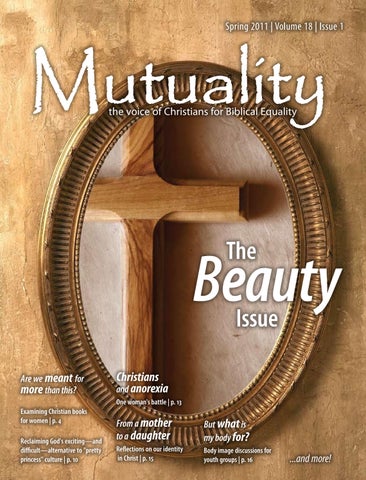
Spring 2011 | Volume 18 | Issue 1
Mutuality the voice of Christians for Biblical Equality
The
Beauty Issue
Are we meant for more than this?
Christians and anorexia One woman's battle | p. 13
Examining Christian books for women | p. 4 Reclaiming God's exciting—and difficult—alternative to "pretty princess" culture | p. 10
From a mother to a daughter
But what is my body for?
Reflections on our identity in Christ | p. 15
Body image discussions for youth groups | p. 16
...and more!
Mutuality 18.1, Spring 2011 “Let us then pursue what makes for peace and for mutual upbuilding” (Rom. 14:19, NRSV). Mutuality (issn: 1533-2470) seeks to provide inspiration, encouragement, and information about equality within the Christian church around the world. Editorial staff: Megan Greulich, editor; Image Spigot, graphic designer; Mimi Haddad, president/publisher. Contact us at: Christians for Biblical Equality; 122 W Franklin Ave, Suite 218; Minneapolis, MN 55404-2451; phone: (612) 872-6898; fax: (612) 872-6891; email: mgreulich@cbeinternational.org; web: cbeinternational. org. We welcome your comments, article submissions, and advertisements. For writers' guidelines and upcoming themes and deadlines, visit CBE’s website and follow the link under the Resources tab. Advertising in Mutuality does not imply organizational endorsement. Please note that neither Christians for Biblical Equality, nor the editor, nor the editorial team is responsible or legally liable for any content or any statements made by any author, but the legal responsibility is solely that author’s once an article appears in Mutuality. All Scripture quotations, unless otherwise indicated, are taken from the 2010 revision of the Holy Bible, New International Version®, NIV®. Copyright © 1973, 1978, 1984, 2010 by Biblica, Inc.™ Used by permission. All rights reserved worldwide.
Contents 4
Leaving Beauty Behind | Examining messages in Christian beauty books for women. by Bethany Nelson
10 A Crown of Thorns | Exchanging princess-ship for discipleship. by Laura Robinson 13 My Body, Given to You | One woman's struggle with anorexia. by Heather Scheiwe Kulp 15 A Letter to My Baby Girl | A mother shares insights into faith, identity, and gender. by MaryAnn Nguyen-Kwok 16 Fun Ways Youth Groups Can Begin to Think about Beauty and Body Image...Biblically | Insightful exercises to spur dialogue. by Margot Starbuck 18 Margot Starbuck's Unsqueezed: Springing Free from Skinny Jeans, Nose Jobs, Highlights and Stilettos | A book review. by Megan Greulich
MINISTRY NEWS CBE grants permission for any original article (not a reprint) to be photocopied for local use provided no more than 1,000 copies are made, they are distributed free, the author is acknowledged, and CBE is recognized as the source. Mutuality is published quarterly by Christians for Biblical Equality and is sent free to members and supporters.
19 CBE at the Justice Conference 2011 19 Praises and Prayers 19 Reflect with Us: Beauty, God's Decision to Love 20 Remembering Dr. Catherine Clark Kroeger
D E PA R T M E N T S 3 From the Editor: The Recognizable Body of Christ 21 Giving Opportunities: 2010 Annual Report to CBE Members 22 President’s Message: From the Malls of America to the Destitute of the World
2 M U T U A L I T Y | Spring 2011
websi te : cbeinternational.org
From the Editor by Megan Greulich The Recognizable Body of Christ A few years back, at a local Barnes and Noble, I picked up a copy of Shaunti Feldhahn and Lisa A. Rice’s bestselling Christian book for teen girls, For Young Women Only. I vividly remember sitting in the café with my mother and reading her excerpts; it was the only time I have actually wondered if my eyes were bugging out of my head. In a chapter about the importance of makeup, weight loss, and being physically attractive, I found this quote: While the general culture emphasizes physical appeal too much, somehow the church seems to have gone too far in the other direction. Among Christians it has become a bit taboo to speak frankly about the importance of physical attraction. "God looks not on the outward appearance, but on the heart," we say, and expect our guys to do the same. Or because we know that “it’s what’s on the inside that counts,” we can easily migrate to the idea that what’s on the outside doesn’t matter. But what’s on the outside does matter. And when we seem to be willfully ignoring that truth, guys assume that we are doing so because we just don’t think very highly of ourselves. And that is just not attractive to them (p. 128-9). I must have been reading to Mom a bit too loudly, because a table of women next to us—who were medical students and particularly interested in the development of eating disorders in teenage girls—piped in, and we all had a fascinating (and very lively) conversation on the role of beauty in the lives of Christian women. I wasn’t trying to be disrespectful, and I knew the authors of the book had good intentions. It was just the first time I had encountered such blatant statements from Christians about how important physical beauty is for women. I tried to wrap my brain around it. Does what’s on the outside of a woman really reflect what’s on the inside? (Similarly, Elizabeth Elliot, in her book Let Me Be a Woman, writes that a woman’s home environment reflects the condition of her soul, which, if true, means I am in very big trouble, or at least in need of a housekeeper.) Do we, as Christians, have any business caring about physical beauty? Is there a certain way that a Christian—man or woman—should look? I decided to investigate it. While Jesus had “nothing in his appearance” that would attract us to him (Isa. 53:2), author Margot Starbuck, in her book Unsqueezed (read the review on p. 18), points out that Jesus held a striking resemblance to his Father. “Anyone who has seen me has seen the Father,” Jesus taught (John 14:9). Just as children often hold a physical resemblance to their parents, as Christians we are to resemble our heavenly parent. But does this have anything to do with our outward appearance? booksto re : equalitydepot.com
The Bible tells us that the world will know we belong to Christ because of our love (John 13:35). Rather than focusing on how our bodies look, Christians are called to reflect Christ in what we do. To love means to use our bodies to serve—to use our mouths to preach and speak encouragement, to use our hands to anoint one another in prayer and administer communion, to use our feet to reach those who are marginalized and in need. These are the actions of people—both men and women—who are beautiful, because their hearts are turned to others, out of love for their God. In this way, what’s on our inside really does reflect what is on the outside. But it has nothing to do with our physical appearance. To confuse the intent of our hearts with outer beauty is debilitating to Christian women. A concern for something as fleeting and empty as beauty causes us to both obsess over and degrade ourselves. And, as our authors in this issue of Mutuality show, chasing after beauty prevents us from embracing our true calling to resemble our savior, by being his hands and feet in this world. “As our bodily life begins to reflect the life, death and resurrection of Jesus,” Margot Starbuck writes, “People who know our Father look at us, maybe sort of squinting, and agree, ‘Yup, they belong together’” (Unsqueezed, p. 162). May we—the men and women who profess Jesus as our savior—be the recognizable body of Christ, not for ourselves, but to the glory of God!
In this Issue I hope this issue of Mutuality begins (and continues) many good conversations, as our authors explore beauty, gender, and faith from various perspectives. In our first feature article, Bethany Nelson examines how a focus on outward appearance dehumanizes women. Next, Laura Robinson dissects the Christian “princess” culture and offers God’s powerful alternative. Heather Scheiwe Kulp, in an insightful personal story, highlights her struggle with anorexia as a young Christian. MaryAnn Nguyen-Kwok shares a letter to her daughter on the importance of finding her identity in Christ alone. And finally, Margot Starbuck details ten exercises for initiating conversations about beauty with youth groups. Be sure to also read Mimi Haddad’s column highlighting how historic Christian women embraced their call to love others rather than focusing on the vanities of physical appearance. Will you share your thoughts with us on this issue of Mutuality? Visit blog.cbeinternational.org to comment on MaryAnn Nguyen-Kwok’s article (p. 15), and start new discussions on beauty at our Facebook page (search “Christians for Biblical Equality” and click on the discussion tab). Megan Greulich is the editor of Mutuality magazine. She may be reached at mgreulich@cbeinternational.org.
M U T U A L I T Y | “Beauty”
3
Leaving Beauty Behind
Assigning value to ourselves and others based on physical appearance must have no place in the church.
If women are primarily “Beauties,” then they are no longer primarily huma by Bethany Nelson You’re not pretty enough. I’ve heard that voice in my head ever since I was a little girl. It didn’t matter if I got straight A’s, if my poem won a contest in school, if I succeeded in a spelling bee. As I grew older, the voice became more shrill when I realized that, according to culture, beauty was destined to define my relationships, as well as my inherent worth. It became easy to attribute both my failures and successes to my physical appearance. After all, the ability to be desired, respected, and included all seemed to hinge on beauty. Everything else that I planned for my life would naturally follow and fall into place, as long as I was beautiful enough.
4 M U T U A L I T Y | Spring 2011
Be Beautiful! the voice shouted. Be smart, be rich, be popular, be successful, but most of all, be beautiful. I suspect I’m not the only woman who has grown up with that insidious voice shouting inside. The fact that the National Eating Disorders Association estimates that approximately ten million women in the United States alone suffer from anorexia and bulimia seems to support my hypothesis. The beauty we are told we must have is unattainable, fragile, and ethereal. And yet women continue to listen to this voice, believing the lie that their only worth comes from an outside pair of eyes appraising them.
websi te : cbeinternational.org
In their recent book Half the Sky, Nicholas Kristof and Sheryl WuDunn assert that the reason women are often ignored, overlooked, or mistreated is because they are robbed of their human status. They are viewed as objects, as products, as items of commerce—but not as complex and important human beings. According to Kristof and WuDunn, in order to improve a community one has to begin by elevating the status of women. And it is impossible to elevate the status of women without first examining how they have been dehumanized. The objectification of women takes shape in many different ways within various cultures, but across cultural boundaries, one of the chief ways it occurs is through casting women in the lens of an abstract “Beauty.” If women are primarily “Beauties,” then they are no longer primarily human, and are defined strictly by outside forces that determine what beauty is.
The Business of Beauty
In Western culture, these outside forces not only define beauty within strict boundaries, but have also turned beauty into a multimillion dollar industry. Walk into any convenience or grocery store and you’ll see the evidence of our addiction to this. So many glossy magazine pages, all screaming one thing: You need to change yourself! We have entire stores dedicated to that purpose, in fact—stores full of nothing but creams, lotions, and powders, all of them fantastically overpriced and promising happiness. You could quite literally bankrupt yourself in the pursuit of beauty, and many women do, especially those addicted to plastic surgery who pay thousands of dollars in the process of altering themselves to achieve some elusive ideal. Stories of Asian women getting surgeries to alter their eye shape and African-American women spending a large amount of their income to straighten their hair and lighten their skin show the narrowness of this cultural definition of beauty, as well. As evangelicals, it may be simple to remove ourselves from this problem and pretend that, within the church, we are immune to this mindset. But, like other cultural influences, the emphasis on beauty refuses to remain in the secular arena and has seeped into the Christian world, too. Christian bookstores are immediate proof of this. The women’s sections of these stores are full of Christian-themed dieting books, dating
Beauty, Defined by God Compiled by Kristen Patrow Beauty [byoo-tee] —noun. 1. An attitude highly valued by God. Often inwardly cultivated, it fosters healthy, healing interactions with other people. For further examples see: forbearance, kindness, and humility. “Your beauty should not come from outward adornment, such as elaborate hairstyles and the wearing of gold jewelry or fine clothes. Rather, it should be that of your inner self, the unfading beauty of a gentle and quiet spirit, which is of great worth in God’s sight. For this is the way the holy women of the past who put their hope in God used to adorn themselves” (1 Pet. 1:3–5).
Also see Prov. 31:29–31; Matt. 23:27 Beauty [byoo-tee] —adjective. 1. A quality or collection of qualities that showcase a man or woman’s close relationship with God. Such qualities include—but are not limited to—purity, integrity, and righteousness. For further examples see: Jesus. “Finally, brothers and sisters, whatever is true, whatever is noble, whatever is right, whatever is pure, whatever is lovely, whatever is admirable—if anything is excellent or praiseworthy—think about such things. Whatever you have learned or received or heard from me, or seen in me—put it into practice. And the God of peace will be with you” (Phil. 4:8–9).
Also see Eccl. 3:9–12; Gal. 5:22–28
an, and are defined strictly by outside forces that determine what beauty is. books, and books on how to please your husband. They are awash in pink, flowers, and medieval imagery, quietly reinforcing the cultural standard of what it means to be a woman. When I last visited a popular Christian bookstore website, the top rated book for women on the site (a book which has been wildly popular in Christian circles for quite some time) was For Women Only, by Shaunti Feldhahn. Outward beauty is important enough to Feldhahn, even as a Christian author, to warrant an entire chapter—chapter eight of the book is entitled “The Truth About the Way You Look: Why What’s On the Outside Matters to Him on the Inside.” Scroll down the webpage and find that the reviews are overwhelmingly positive—this book seems to have as much effect on the way Christian women are viewing themselves as would a copy of Vogue magazine. Outward beauty may be presented as a necessary evil in this Christian context, but its value is not lessened—it is presented as integral to the worth of women.
booksto re : equalitydepot.com
Beauty [byoo-tee] —verb. 1. The act of pursuing God, seeking truth and justice, and advocating for the oppressed. For further examples see: strength, protection, and obedience. “One thing I ask from the Lord, this only do I seek: that I may dwell in the house of the Lord all the days of my life, to gaze on the beauty of the Lord and to seek him in his temple. For in the day of trouble he will keep me safe in his dwelling; he will hide me in the shelter of his sacred tent and set me high upon a rock” (Ps. 27:4–5).
Also see Ps. 50:1–3; Isa. 52:7–8
M U T U A L I T Y | “How I Changed My Mind”
5
This acceptance of the importance of outer beauty in evangelical culture isn’t just aimed toward mature Christian women, but toward teenage girls, as well. In fact, the emphasis seems to be even stronger for this age group, which is especially alarming considering the prevalence of eating disorders, cutting, and depression among teenage girls. Several of the most popular dating books mirror this focus on beauty, such as For Young Women Only, the teen version of the aforementioned popular Christian book for women. In it, authors Feldhahn and Rice assert in the chapter “Seeing the Inner and Outer Beauty” that “God designed men to be attracted to both inner and outer beauty” and that to expect them to ignore this is to expect them to deny their five senses (p. 128). This “outward beauty” translates into several very specific cultural definitions of beauty, including “dressing neatly” (p. 129), “keeping hair brushed” (p. 129), putting on makeup (p. 130), in general “just trying a little harder” (p. 130), and most importantly, not b ei n g “ f at” (p. 127). Feldhahn and Rice write: So many guys told us that they knew many girls— great, funny, terrific girls—who never seem to get a boyfriend, and don’t see a connection between that and the fact that they are twenty or thirty pounds over a healthy weight (p. 131).
foremost. But taking notice of our outward appearance was a huge piece of our training, illustrated most obviously by the diagrams in our Christian textbooks that demonstrated the correct haircut and clothes to wear for our face shape and body type: the roundfaced girl shouldn’t have short hair, the oval-faced girl shouldn’t have center-parted hair, the tall girl shouldn’t have long hair, and the list went on and on.
Beauty as Essence?
This training in my high school textbook does illustrate a certain tension inherent in many of these books between the supposed necessity of outward female beauty and the danger of provoking the “visual nature” of men. Although beauty is evidently a defining characteristic for women according to these authors, it is also their most dangerous attribute, and the one most likely to lead to sin. On one hand, it’s stated that you have to be pretty (or at least “take care of yourself ” according to cultural standards) to catch the interest of a boy, but you should be careful to not be so pretty that you cause him to sin. The emphasis on beauty is most blatant in books that champion gender essentialism such as John and Stasi Eldredge’s Captivating, where the essence of being born female is literally summarized by the word beauty. When I was in college, this book was the text of choice to use for female Bible study groups, even though actual Scripture references in the book are few and far between. Perhaps this was because this book made sense to the college girls—it fit within their cultural paradigm. They accepted the premise that beauty is a necessity; they had already been striving for it most of their lives. Outside culture had already established the premise that as young women, beauty was “our thing”—what we had to offer the rest of the world. Captivating not only reinforced this idea, it rubber-stamped it as God’s design, and asserted that it was our function and spiritual calling as women to provide beauty. Quotes like the one found on page 16—“For now, don’t you recognize that a woman yearns to be seen, and to be thought of as captivating? We desire to possess a beauty that is worth pursuing, worth fighting for, a beauty that is core to who we truly are. We want beauty that can be seen; beauty that can be felt; beauty that affects others, a beauty all our own to unveil”—of course resonated deeply with my generation; we had felt that yearning and desire to be seen. Unfortunately, this yearning had never been a healthy one. It was connected to the voice we had heard our whole lives, the voice that whispered we were never quite good enough, and
Far from being a passive beauty who waited for others to define and “rescue” her, Esther embodied the strength and inner beauty that is a model for any child of God, whether male or female.
And this trend continues across t he spectr u m of Christian teenage reading m a t e r i a l . T h e c e nt r a l underlying message? While men shouldn’t care primarily about external beauty, God wired them to care about it to some extent, so girls should expect rejection unless they provide some reason for “visual” men to take notice. In another popular book for teens, The Dateable Rules, the authors echo this sentiment, stating that men are the tough ones “who fight the wars, save the country, and rescue the beauties. It’s God’s plan so we can’t argue” (p. 16). My own experiences attending a Christian high school reinforced this strong emphasis on female appearance. We did have health class, although as girls we never learned anything about our bodies beyond the fact that they needed to be covered up completely to keep our brothers in Christ from sinning. There was a special section for girls on modesty, of course, first and
6 M U T U A L I T Y | Spring 2011
websi te : cbeinternational.org
that we needed to be proclaimed as beautiful for our lives to have purpose and meaning. The problem, of course, is that focusing on beauty as a woman’s function does not counteract culture’s emphasis on beauty, but in fact aggravates it. This philosophy results in pastors (as has happened, quite recently, with some high profile leaders) teaching that it is a woman’s responsibility to be beautiful and sexually available for their husbands at all times. If the husband strays, it is only because the woman is not fulfilling her role as a beautiful distraction. This philosophy limits women to one function, and distracts them from important work they could be doing for the kingdom of God. This perspective ensures that women continue to be passive and “Other”—defined by those outside of them instead of by themselves. The quote from Captivating above shows this dilemma—according to the authors, our yearning is for a beauty that “can be seen,” implying that this beauty is externally validated. To be seen, to be thought of as desirable, to be “worth pursuing and fighting for,” becomes our primary purpose.
The Bible and Beauty
How different this is from our calling in Christ as revealed in Scripture. Beauty is discussed in quite cautious terms in the Bible—there are no exhortations for women to pursue outer beauty, but there are many warnings about pride and vanity, and reminders that beauty is fleeting and meaningless. Instead of being a defining factor for femininity, or even a necessary evil, external beauty is often portrayed in Scripture as a distraction or a downfall. Even biblical figures such as Esther who were known for their physical beauty are not praised on that basis. Instead, Esther is remembered for her decisive action and strength under pressure, and her willingness to follow God’s leading, even into dangerous situations. Far from being a passive beauty who waited for others to define and “rescue” her, Esther embodied the strength and inner beauty that is a model for any child of God, whether male or female.
Proverbs 31 is another passage in Scripture that shows the trivial nature of outer beauty. This is a passage of Scripture that is often held up to be the archetype for what it means to be a godly woman. And yet there is no mention of beauty at all until the very end of the chapter, when the author warns that charm is deceptive, and beauty is fleeting, but a woman who fears the Lord is to be praised (v. 30). Women are to be praised not for their beauty, but for fearing the Lord, and for the characteristics of strength and wisdom discussed throughout the chapter. The competent and godly businesswoman of Proverbs 31 not only has little in common with the kind of woman that secular culture holds up for us, but also has little in common with the outline of femininity that many Christian books present. The woman celebrated in this last chapter of Proverbs offers an alternative and definite model that is active rather than passive, and that is based on developing godly character rather than temporary physical beauty. As women and men who have been created in the image of God, let’s embrace the beauty that we have already been given simply because we are a part of God’s creation. Silencing the voice inside that says we aren’t quite good enough will only come when we refuse to allow anyone other than God to define our value. As Christians, we need to assert that just as pornography and other exploitations of women have no legitimate place within the church, an emphasis on outer beauty has no place either. Can we remove beauty from the equation? Instead of telling somebody they’re beautiful today, why not tell them they are strong, or intelligent, or kind, or proactive, or inspiring? Only when we reject the importance placed on beauty and reclaim women’s full humanity in Christ will our behavior truly be counter-cultural and life-affirming. Bethany Nelson recently graduated from Bethel University with a degree in English literature and writing. She is currently working full time and applying to graduate programs in gender and religious studies. In her free time, she likes to read, write, explore Minneapolis, and bake entirely too many pans of brownies.
What if my church, organization, or institution joined CBE? Discover the many benefits of organizational membership today! Web: cbeinternational.org/institutions Email: cbe@cbeinternational.org
booksto re : equalitydepot.com
This emblem could be on your website! And, as a CBE member, we will place your logo on our site, for those looking for egalitarian organizations.
M U T U A L I T Y | “Beauty”
7
Christians for Biblical Equality Presents...
8 M U T U A L I T Y | Winter 2010
cbeinternational.org/seamu 612-872-6898 websi te : cbeinternational.org
booksto re : equalitydepot.com
M U T U A L I T Y | “Beauty”
9
A Crown of Thorns:
Why I’m Exchanging Princess-ship for Discipleship
by Laura Robinson I first started getting crowns at prayer retreats when I was far too old for them—that is, my freshman year of college. All of a sudden, it seemed that paper crowns were everywhere in the Christian community, distributed to women with a discussion about how we are all princesses. It was a candycoated, conviction-free reminder I got every time I walked into a women’s discipleship group, youth ministry, or Christian bookstore—you are a princess because your Father is a king. I hadn’t heard of Captivating yet or John and Stasi Eldredge’s Ransomed Heart Ministries, the undisputed flagship of what I call the “Christian princess movement.” So when I asked a friend about where all these crowns were coming from, she
10 M U T U A L I T Y | Spring 2011
directed me to that book. I borrowed a copy and read it in a crowded coffee shop in the middle of an Indiana winter. In it, I learned that, as a woman, I was designed by God to be a princess who longed to be romanced, reveal her beauty, and play a part in a grand adventure. I’ll be honest with you—it was a pleasant daydream. I think that an overwhelmed, tired college student would take any diversion from her coursework, and if the diversion showed up on a white horse with a sword, so much the better. It was, apparently, God’s will. I packed my bag, a little encouraged and a little deluded, and stood up. Then I caught a glimpse of myself in a mirror. websi te : cbeinternational.org
It was, I think, God’s firm but kind reminder of the reality I was living in. In that mirror I saw who I really was—a fallen image-bearer of God in a room full of other fallen image-bearers, no better or worse or more worthy of love than any of them. The world did not need my beauty—in that moment, it needed me to throw away my coffee cup so someone else could relax with a book and hot chocolate at my table for awhile. And in order to be a good steward of a college education, I was not going on any fantastic adventures but would have to complete the long, icy walk back to my dorm room, heat something up for dinner, and work hard. My life isn’t a fairy tale, but God never promised me one. He promised me a hope and a future. I’ll take it. I’m not a princess (though I suspect my dad will fight me on this point when he reads this). And I don’t think it’s cynical of me to say it. It’s not bad news. It’s great news, actually. God has called me—has called all of us—not to a life of childlike sentimentality, but to concrete hope and service in him through discipleship. In this way I encourage women, when they’re tempted to think of themselves as royal, to think of themselves as royal priests (1 Pet. 2:9). Here are the present pitfalls of being a princess—and God’s alternative, which is so much better.
A Princess is Proud There’s a reason why so many leaders of women’s retreats hand out plastic crowns and tell women they are princesses. It is exactly what everyone wants to hear. In our fallen state, we like to be flattered and coddled, to be let off the hook of responsibility, to feel entitled, and so forth. A princess is the heroine of the story—the perfect, untouchable character. We want to hear that “the whole, vast world is incomplete without me. Creation reached its zenith in me” (Captivating, p. 25). A daughter of God, on the other hand, is a beloved, hard-working, and self-sacrificing servant of her Father. She imitates Christ by loving and serving others without self-entitlement. You will never receive a plastic crown accompanied with a sermon about washing peoples’ feet (John 13:14), selling all your possessions (Mark 10:21), and taking up your cross to follow Jesus (14:27). We are urged as Christians not to revel in human titles but to “value others above [our]selves” (Phil. 2:3). Christian discipleship is a hard and humble position. Princesshood is not—and God calls us directly away from its narcissism. The “princess” satisfaction that comes from having a title of value, without substance to back it up, is pride. The “servant” satisfaction that comes from working alongside God and doing his will is confidence, thanksgiving, and courage. As Christians, we should remind one another to “take the very nature of a servant” in following the example of Jesus Christ (Phil. 2:7).
around glaring at women who wear makeup and cut their hair, and I don’t think women need to start wearing tentlike dresses that fit like potato sacks. But I’m also convinced—and there’s ample biblical evidence to support this—that beauty is not the defining or most important quality of a woman. Yet, if you get your cues about Christianity through princess culture, you’d never know it. I have seen, heard, and read more Cinderella renditions than I can possibly count, and every Cinderella character seems to have one trait in common: she’s pretty. Cinderellas can also be active or passive, bold or shy, rebellious or submissive, outspoken and strong or worn out and broken down. None of these qualities really matter because the only attribute she actually needs to get the prince is beauty. Christian princess culture has handily absorbed the “pretty princess” cultural phenomenon to the point that it’s the underlying thesis for the Eldredges’ Captivating. The Eldredges assert over and over again that the world longs to enjoy the beauty of a woman, and that every woman has it to offer. I don’t want to repeat the modern media’s message that only a tiny handful of women are beautiful and that we must work like crazy to be beautiful ourselves. But, as a very wise friend of mine once said, you can’t have a right answer to a wrong question. The answer to “Am I beautiful?” is not, “Yes, you are—all girls are beautiful.” The question is, “Should physical beauty matter so much?” and the answer is, “No.” It is unwise to get too interested in—or too enamored with—our own appearance. Satan, whose “heart became proud on account of [his] beauty” (Ezek. 28:17), is going to learn that the hard way in the end. On the other hand, Jesus wasn’t actually attractive on earth, except for the Transfiguration and his resurrected body: “He had no beauty or majesty to attract us to him, nothing in his appearance that we should desire him” (Isa. 53:2). If Jesus was an ordinary-looking man despite the fact that he was carrying in his body the unbelievable power of his incarnation, why do we think that our outward appearance is so important? Beauty is a cultural idol that has slipped into the church under the guise of “princess Christianity,” when it, in fact, was a tripping point for Satan and was of no use to Jesus. It’s a tremendous relief that Jesus has again lifted one more cultural pressure off us.
A Princess is Passive
Now, before I write anything else, I want to be up front about this one thing: I don’t think physical beauty is bad. I don’t go
Remember how Sleeping Beauty wins her prince? Hint: it’s right there in her name. She’s beautiful. And she sleeps. For years. Good fortune just comes to her after she’s been lying there for awhile. Snow White sleeps too, waiting for someone to show up and remove her curse. Cinderella actually goes to a ball to get her man, but only with the princess paraphernalia provided by her fairy godmother. Rapunzel waits in a tower and functions as her own ladder for someone to rescue her. And so on. Noticing a pattern here? Being a princess comes with the guarantee that you don’t have to venture out and take risks— that someone else will rescue you from servitude, or a tower, or
booksto re : equalitydepot.com
M U T U A L I T Y | “How I Changed My Mind”
A Princess is Pretty
11
well—the gift of work. The first couple was put in the Garden of Eden to “work it and take care of it” (Gen. 2:15). Solomon calls finding satisfaction in one’s work “the gift of God” (Ecc. 3:13). And Paul commands new Christians to “work, doing something useful with their hands, that they may have something to give to the poor” (Eph. 4:28). By no means is this to be seen as an urging for selfconscious girls to work themselves into a panic in search of worldly approval—a problem that I think the “princess culture” has well-meaningly attempted to reverse. But let’s have no more nonsense about women revealing their beauty by sitting still and being passive. Our Father has blessed us with a future far better than that. I am sure that when I worked as a camp counselor I was, at times, unpopular with the girls. Whenever there were unglamorous chores to be done—carrying water, setting up tents, and so forth—I insisted that they do the same work that their male peers were doing. I was not doing this to punish them or because I loved them any less than the boys. I wanted them to know that not only should they undertake difficult tasks, but that they could undertake difficult tasks. God has called all of us—men and women—to be co-laborers of Christ on the earth, and he wouldn’t call us to this if he didn’t equip us with the gifts we need. A girl’s confidence should not come from a label that denotes value in title only. She has value because she has been “created in Christ Jesus to do good works, which God prepared in advance for us to do” (Eph. 2:10). Works prepared in advance for us to do—what an indescribable gift! a coma. Christian princesshood mirrors this pattern of passivity, as well. When explaining why you rarely see paintings of naked men in art museums, John Eldridge writes: Men look ridiculous lying in a bed buck-naked, halfcovered with a sheet. It doesn’t fit the essence of masculinity. Something in you wants to say, ”Get up and get a job. Cut the grass. Get to work.” On the other hand…when artists have tried to capture the essence of Eve, they have painted her at rest (Captivating, p. 36–37). I would venture that there is not much a woman can do lying in a bed buck-naked half-covered with a sheet either—besides “be sexually available,” of course, but that’s another issue. Stuck in the bed, she can’t get up and go out unless someone brings her some clothes. She can’t bring herself something to eat or drink; she needs someone to provide for her. She can’t travel, study, mother her kids, get a job, contribute to society, or serve the church. She’s stuck, because her beauty is best revealed if she just doesn’t move. She appears perfectly beautiful when perfectly passive. Stationary princesses are rampant in the world of fairy tales. They are in a position of waiting to be rescued. That’s it. Thank God that he has a much higher calling for us! Certainly there is an element of rescue in the Christian story—God has saved us by the gift of his wonderful grace, with no assistance on our part (Eph. 2:5). But God has given us another gift as
12 M U T U A L I T Y | Spring 2011
A Royal Priesthood Now, if this doesn’t sit well, remember that if our Father is still king, then we are still royal—all of us, men and women alike. Women are not princesses but “a chosen people, a royal priesthood, a holy nation, God’s special possession“ in order that they “may declare the praises of him who called [them] out of darkness into his wonderful light” (1 Pet. 2:9). Being a priest is a hard, high-responsibility calling that has been extended to every member of the church regardless of his or her gender. God has given us a new identity, and the hard work that comes with it is incompatible with the self-absorbed Christian culture of fairy tales, crowns, and princesshood. When Paul speaks of love, he reminds us that when he grew up, he put childish ways behind him (1 Cor. 13:11). And when the elders worship at the throne of God, they take off their crowns and lay them before him (Rev. 4:10). Playing pretend is all right for little girls, but when we get to the throne of God, we too have to set aside our playthings and worship God, not ourselves. This is why I am choosing to be a priest and not a princess. Laura Robinson is graduating from Indiana University in May with majors in English and religious studies and a minor in history. She will begin a masters program in biblical exegesis at Wheaton College in the fall. She interned for Christian for Biblical Equality in the summer of 2010 and enthusiastically encourages other students to do the same!
websi te : cbeinternational.org
My Body, Given to You
A journey through anorexia by Heather Scheiwe Kulp “Do not be afraid” appears more than any other phrase in Scripture. Certainly it’s a helpful phrase if one were encountering a warrior-angel. But biblical writers use it more frequently in situations where people are being asked to step beyond who they think they are into greater realms of trust and leadership. When I was young, I took the stage during the children’s message, telling my pastor confidently that I wasn’t scared of anything—even the alligators in my basement— because God was my strength. Childhood fantasy aside, I was a bold, outspoken, strong child, eager to do whatever I could to help God and others. I led my youth group’s devotions. I was president of my high school’s Christian
booksto re : equalitydepot.com
fellowship. I even preached at an outdoor church service. When it came time to listen for a calling career-wise, I felt led toward ministry. My life was infused with God, and I wanted to share that with others. I was a good leader, a good speaker, and a good shepherd. I wanted so badly to serve God and others. And I longed to honor Scripture’s call to use my gifts. So I looked to the (all male) authority figures in my Christian community to chart out the path for how I could become a pastor. I strained to hear the Word from their mouths. I was eager, “Yes, Lord, send me!” So what did I hear from my spiritual leaders? What was their message for my life? That was the problem; it wasn’t one message but a contradictory collection of messages that didn’t make much
M U T U A L I T Y | “Beauty”
13
logical or spiritual sense. I was told that I could help teach young children, without training (something I wasn’t very excited about or good at), but I couldn’t teach adults (the very task I was often praised for accomplishing with skill) even with training. They advised that I should go to college, not to pursue a career in ministry, but to find a good Christian man to settle me down. “Good” Christians used their gifts to the fullest extent to further the kingdom of God. But “good” girls didn’t speak out in adult Sunday school, let alone try to teach. They also didn’t eat. “I’m being really good right now,” a girl sitting next to me in Bible study said, declining the gooey, dark chocolate brownie I offered her. Her holiness, her meekness, her gentility, her very womanhood was linked to what, and how much, she allowed herself to enjoy. I absorbed all these messages of what it meant to be a woman of God deep into my body. The voices of authority muddled with my own insecurities about who I was, what I looked like, and how God had gifted me. Sprinkled with the harsh pepper of the world’s messages—buy this beauty product, diet using this new fad, hide your pounds—these voices overtook me and became my identity. When I looked to Scripture—my only real authority—it seemed to echo what others said. I took many passages out of context. Instead of seeing biblical marriage as something only some are called to, something that doesn’t last through eternity, I heard only, “You are not a true woman of God unless you seek a husband.” Instead of seeing the great cloud of biblical women witnesses who rarely had a husband talking on their behalf, I read, “You are not a true woman unless your husband speaks for you.” “You are also not a true woman if you eat more than you deserve each day.” And what I “deserved,” as someone who wasn’t fitting neatly into the godly woman box, was not much. I wanted to conform myself more fully to what the voices said God wanted me to become: more submissive, more soft-spoken, more beautiful. Since I couldn’t seem to transform from the inside out, I began to transform from the outside in. I cut my calorie consumption to only 800 calories a day (and often fewer than that). I ran for miles, no matter the weather, to beat the insubordination out of my being. I read and re-read snippets of the Bible as “encouragement” for what I thought would make me the woman God wanted: “Man does not live on bread alone” (Luke 4:4) and “Do not set your heart on what you will eat or drink…” (Luke 12:29). I was so hungry, literally and figuratively, for God to tell me how to become worthwhile that I took Scripture out of context—and it nearly killed me. Only when a still, small voice called out from my deepest place, the place as yet untouched by anorexia’s spindly fingers, did I hear that my strength as a woman was not a weakness. “You are fearfully and wonderfully made…no longer male and female…all have been given gifts…to seek the kingdom of God.” I took in the whole of Scripture like it was a loaf of bread, not a crumb. Its entirety fed me, from the story of God providing manna in the wilderness to Jesus being fed by ravens in his own wilderness. Throughout Scripture, God was feeding people with love and with the assurance that God’s community welcomed men and women of all personalities and all gifts, without fear. What was hardest in my journey was not the anorexia; it was the recovery. I did not trust myself. What I thought was the voice of God was in actuality the voice of others, and the voice of
14 M U T U A L I T Y | Spring 2011
my own fear. I feared my personality. I feared that I would never become a godly woman. I feared that I would never be able to conform myself to the will of God. In recovering from anorexia, I had to relearn how to read Scripture, not as separate, disjointed messages colored by the voices of male “authority” around me, but as a whole, creative, redemptive narrative of God’s journey of trust with God’s people. Scripture’s authoritative voice was not one of confinement, but one of freedom. I had to relearn how to see myself, too, as a whole person, not as a prescribed list of attributes applied blindly to every Christian woman. My deeper hunger, far deeper than my hunger for any chocolate cake, stemmed from my desire to be useful to God as what he created, what he spoke into being. The Voice that called woman into being—just as she was—and called her good was my only voice of authority. Now food has a different meaning for me. It is hospitality. It gathers people with different gifts and personalities and callings to one table. It feeds the various hands that serve others. It is a significant means to connect to God. It is, as I am, the fearless, beautiful, nourishing body of Christ. Heather Scheiwe Kulp is an attorney and alternative dispute resolution program developer in Chicago, where she develops court mediation programs to meet pressing legal needs of low-income Illinois residents. After graduating from Northwestern University School of Law, Heather began a two-year Skadden Fellowship with the Center for Conflict Resolution/Resolution Systems Institute. Prior to law school, she was the founder and executive director of Alive Magazine—a nonprofit alternative magazine for teen girls based in Minneapolis, Minnesota—and an employee of CBE.
This ad space could be yours. Learn more: cbeinternational.org/ad
websi te : cbeinternational.org
A Letter to My Baby Girl by MaryAnn Nguyen-Kwok
My daughter,
As I'm writing this, I am watching you in the corner of my eye, eating blueberries. You look at me in between stuffing your mouth with a chubby handful and you laugh with great delight. I want you to stay this way forever—one and a half years old, toddling around, fearless, determined to discover everything you can about the world, confident that you are safe because of our love, and appreciative of all the sweet things God has created for us to enjoy. But I know that time will pass and things may change. Before you were born, your father and I chose not to learn your gender. We knew we'd love you and raise you with the same values and opportunities—boy or girl. When the doctor announced that you were a girl, we were overjoyed. In some countries, having a girl is not something to rejoice over. Boys are prized and girls are treated as less than second class citizens. This is something that we hope you will never experience. Some people will try to tell you that God created Adam first and that therefore men are more important. They will point to the judgments on Adam and Eve after the fall and declare that hierarchy was what God envisioned for humanity, rather than a negative consequence of sin. Others will tell you that God made the man the spiritual leader, and that the woman must follow, submit, and discount her own ideas. However, the Bible actually says that God created humanity in his image, both men and women. As an image-bearer, you have equal value, status, importance, significance, and authority with all other imagebearers. God’s will for your life is to follow God wherever he wants you to go and to do whatever he wants you to do. As a female, you may have to continually fight this battle of where your identity resides. One of the ways that your worth may be challenged has to do with physical beauty. As a young woman, I was haunted by this one question: "But what if I'm not beautiful?" Not only was it true that I did not turn heads or resemble the women in magazines or on television, but, deep down, I also feared that my dark secret of being born with a birth defect was the ultimate repellant to boys. I was convinced that I was not beautiful, and because of that, I would never be loved or accepted. Even when I searched the Scriptures, my insecurities seemed to be affirmed by the descriptions of the notable women: Abraham said to his wife Sarah, "I know what a beautiful woman you are" (Gen. 12:11). Of Rebekah, it was written, "The girl was very beautiful..." (Gen. 24:16). "Rachel was lovely in form, and beautiful. Jacob was in love with Rachel" (Gen. 29:17-18). It seemed to me that these women were noteworthy and loved because they were beautiful. But is that God's way? Further investigation led to this discovery: Of Ruth, Boaz declared, "You are a woman of noble character" (Ruth 3:11). Among the prominent females of the Bible, Ruth is a rare exception of a woman who was described with noble character. Nothing is mentioned about her beauty. But she is a woman to be emulated and admired. Her bold actions not only made a difference to those around her but also made an eternal impact for the entire world, for all of time. She is attractive to us and honored by us for her faith, courage, steadfast love, and boldness. This story gives hope.
booksto re : equalitydepot.com
MaryAnn with her daughter.
You and I may not necessarily fit the world’s standard of beauty, but we still have the opportunity to be an extraordinary influence, bless others around us, and make an impact on all of eternity. Look to Ruth's story to remind you that it is far better to have character than physical beauty. Notice that the other women who were known for their beauty are also remembered for their godless actions: Sarah had a hand in Abraham's doubting of God's promises with regard to Hagar, Rebekah encouraged Jacob to deceive, Rachel was spiteful and ungracious toward her unloved sister. We can admire certain aspects of these women, but we also must be discerning about what we emulate in them. Ultimately, I want you to remember from this story that it's not about how beautiful one may appear to be but how beautiful one is inside. When you have character, you have true beauty. We are never clued in to the beauty of the surface of Ruth's face, but we will always remember her as beautiful by her life full of grace. God used this story as one of many to affirm me in who I am in him. As you are bombarded with different messages from this world and even from those in the church, I want you to always search the Scriptures to discover what is true. Some in the church may tell you that your identity comes from being silent and passive. The world will tell you that your identity comes from physical beauty, money, power, and popularity. These standards will always be impossible to meet. However, God’s standards are different. When we measure with his ruler (the only ruler that matters), you, my daughter, come up beautiful. You are beautiful because you were designed by God, made in his image, and created to influence and bless the world around you. My child, you are a crown of beauty and a royal diadem in his hand (Isa. 62:3). I love you!
Mama MaryAnn Nguyen-Kwok is currently pursuing her Masters of Divinity at Bethel University. Her passion in life is to understand and reveal God's heart through studying and teaching the Scriptures. Her other great passion is in skillfully articulating God's truths in her writing.
Join the Conversation on The CBE Scroll What do you have to say to your children about gender and beauty? What do you wish you would have learned as a young person about faith and physical appearance? Visit blog.cbeinternational.org to comment on Mary Ann’s letter and share your own thoughts.
M U T U A L I T Y | “Beauty”
15
Ten F un
Ways Youth Groups Ca
o t n i n Be g
Thin y l l a c k Abou li b i B . . . t Beauty and Body Image by Margot Starbuck
Things are getting bananas, people. Toddlers are wearing tiaras. Parents are giving teenage girls breast enhancement procedures for their Sweet Sixteens. Darkskinned girls are lightening their skin with bleaching products. Chinese women are getting their legs broken—on purpose!—in leg-lengthening surgeries. It’s nutty, right? It’s also completely understandable. Today women and girls are bombarded with messages meant to persuade us that we’re not really acceptable the way we are. And even though we’ve been told, at church, that “God thinks you’re beautiful,” we’re not feeling the love. Because it’s much easier to believe what we receive from the media, we end up feeling stuck, ugly, and ashamed. There has to be a better way. Use these exercises together to start conversations that lead to life: Shame Game Shame says that there is something fundamentally unacceptable about who you are. So smart advertisers capitalize off of our fear of rejection to sell us products that they promise will, at last, make us acceptable. A wildly successful 1920s campaign for Listerine mouthwash warned, “They talk about you behind your back.” “Halitosis makes you unpopular.” “Always a bridesmaid, never a bride.” Peek through some magazines to find the ads today which subtly, and blatantly, suggest that we’re unacceptable the way
16 M U T U A L I T Y | Spring 2011
we are. Think about this theologically! (Rom. 15:7, “Accept one another, then, just as Christ accepted you…”) What does this say about how God views us? What does it say about how we treat others? Isn’t this exactly the kind of striving from which Jesus came to free us? Opening Our Eyes When God issued the second commandment (Ex. 20:3), to keep us from serving idolatrous and false images we’ve created with our own hands, he might have been thinking ahead to…Photoshop. When we compare ourselves to images in the media— Barbie dolls, supermodels, and Hollywood heroines—we’re not only trying to squeeze into a mold that doesn’t fit us, it doesn’t fit anybody! These images we’re seeing of women—who were already beautiful in the first place—have all been digitally altered. I promise you this is true. To peek at the tricks happening behind the scenes: a. In Google Images, type in “Ralph Lauren Contro versial Ad” to see the way very thin models are digitally squished to appear unhumanly thin. It’s a little scary. b. On YouTube, find the “Dove Evolution” video. Enjoy and discuss. Toy Story Take a field trip to your church nursery to check out the toys! (Fun, right?) Specifically, look for the ones related to gender. What are websi te : cbeinternational.org
little girls and boys learning from these “harmless” toys? Ideas to start your discussion: a. Look at how female dolls—Barbies, Bratz, etc.—are dressed and styled. In what types of activities are these individuals prepared to engage? Could a Barbie, dressed as she is, stand in a lab all day doing research, or just sit under a blow dryer? Would one of these female dolls be prepared to play ultimate Frisbee with her guy friends, or just be ogled by them? b. How are female and male dolls and action figures sexualized? (Examine clothing, makeup, body parts, exposed abs, etc.) c. What else do you notice? Ornamental or Instrumental? Pass out index cards and pens, inviting participants to answer this question: “If there was one thing you could change about your body, what would it be?” Gather these, anonymously, to be shared with the group. Let the group identify which ones are ornamental (pertaining to how we are viewed) and which ones are instrumental (pertaining to how the body functions). For example, thigh cellulite would be “ornamental,” and legs healed of cerebral palsy would be “instrumental.” As a wrap-up, list all female body parts, from head to toe, and name the way that each one is ornamental and/or instrumental. Ethnicity and Beauty Women of all ethnicities are trying to squeeze into the Barbie doll mold of beauty. Black women are chemically straightening their hair. Latino women are dying theirs blonde. Women with wide or long or bumpy noses are getting plastic surgery to change them. Check out some skin-lightening commercials on YouTube by typing in keywords “fair and lovely” (or visit margotstarbuck. com/Resources.html). What messages do these commercials communicate about ethnicity? What features are valued as worthy? Who is valuable? Now, consider this: With our own choices and dollars, how do we actively disagree with these messages? Wombs, Breasts, and What Really Matters Jesus is teaching when a woman calls out, “Blessed is the mother who gave you birth and nursed you!” Although Jesus’ culture esteemed women’s bodies that squeezed out lots of babies, Jesus isn’t willing to endorse his culture’s values by accepting the compliment. Instead, Jesus replies, “Blessed rather are those who hear the word of God and obey it” (Luke 11:27–28). This is huge! Jesus is saying that the bodies—the people— who are really blessed, are those who respond to God. What does this mean for us as Christians, in light of our own culture’s nutty values? Ability, Disability, and Love-ability God made bodies to do stuff, like loving and serving others. Specifically, we’re made for relationship with others. booksto re : equalitydepot.com
a. Grab a whiteboard marker and brainstorm 100 ways that we can use our bodies to serve others. (Starter ideas: push neighbor’s baby around the block in a stroller, shovel for mom, clean the basement, etc.) b. This may look a little different for folks with physical disabilities, but every body is still a vehicle for relationship. If you or a friend or a relative has a disability, how does your/their body still facilitate relationship with others? Can’t Get No Satisfaction The big goal here is to save all the energy and effort and money we spend trying to make ourselves look better and instead be satisfied with who we are. To catch a glimpse of this rarity, watch India.Aarie’s “I am Not My Hair” video and Sesame Street’s “I Love My Hair” clip on YouTube (or at margotstarbuck.com) to get a peek at freedom! Do you know anyone like this? How do you begin to live into that freedom? From “Me” to “You” In his book Mere Christianity, C.S. Lewis (who wrote before gender-inclusive language) writes, o not imagine that if you meet a really humble man D he will be what most people call ‘humble’ nowadays: he will not be a sort of greasy, smarmy person, who is always telling you that, of course, he is nobody. Probably all you will think about him is that he seemed a cheerful, intelligent chap who took a real interest in what you said to him (p. 128). Women who aren’t obsessing over their own navels are freed up to take a genuine interest in others. When we’re not consumed with ourselves, we can then be for others. Do you know anyone like this? Share about her with the group. Isn’t it just fabulous to be around people like this? What would it look like for you to be a person who takes a real interest in others? Fake It ’Til You Make It It may be that you never get to the point where you absolutely adore every inch of your body. Understood. To live into the reality that you’re completely acceptable as you are, one doctor recommends this strategy: fake it until you make it. Though I’m typically not a huge fan of faking, I think she’s on to something big. If you decided to behave as if you were already entirely acceptable, what would be different about your: a. Speech? b. Spending? c. Use of time and energy? Margot Starbuck is pretty convinced that these bodies are meant for loving God and loving people. A professional communicator, she wears comfy tie-dye jeans and daisypainted combat boots when speaking to audiences and stretchy pants while writing Unsqueezed: Springing Free From Skinny Jeans, Nose Jobs, Highlights and Stilettos (InterVarsity Press, 2010). Connect with Margot on Facebook or learn more at margotstarbuck.com.
M U T U A L I T Y | “Beauty”
17
BOOK REVIEW by Megan Greulich Margot Starbuck's
Unsqueezed
Springing Free from Skinny Jeans, Nose Jobs, Highlights and Stilettos
I will be honest about this. Margot Starbuck’s Unsqueezed: Springing Free from Skinny Jeans, Nose Jobs, Highlights and Stilettos (InterVarsity Press, 2010) is not a book I would typically pick up, let alone excitedly read. With its giant, bright red, high heeled shoe on the cover, and a different pair of shoes gracing the first page of each chapter, I worried that it would be a “fluffy” message about how all women are beautiful—a Christian “chick lit” book that would provide milk when I was longing for meat, to use the metaphor of Hebrews 5. But I will happily (and humbly) admit that I was very wrong. Starbuck writes conversationally, refreshingly and humorously relaying stories of her own insecurities, inner dialogue, and interactions with her family and friends. She utilizes lots of examples from pop culture. She is very funny. And yet, somehow, she accomplishes all of this with a profound sensitivity to those from cultures other than her own and to those who are marginalized—she does not shy away from issues of gender, ethnicity, poverty, and disability, both in secular and Christian cultures. She wrestles honestly with how to reflect the radical and transformative gospel of Christ in mind, spirit, body, and community. She asks good questions, and she tells the truth. Starbuck delves into topics from marketing, makeup, and polka dots, to others-centeredness, self-acceptance, and gluttony. She explores what it means to be made in the image of God, and how we can show others, through what we do with our bodies, that we belong to Christ. She also has an uncanny way of highlighting the hypocrisy and illogic deep within many of us. Take for instance: •
• •
The strange tragedy that the majority of the world wonders how they will get their next meal, while many Americans spend much of their time, energy, and money in an effort to not overeat. The fact that most US women are more concerned with how their bodies appear, rather than with what they can do. The truth that God made our bodies to be instrumental, rather than purely ornamental, and that we are made to use our bodies to be in relationship—serving and loving those around us.
18 M U T U A L I T Y | Spring 2011
Save 20% on Unsqueezed at CBE Bookstore! Use discount code MUT11 at checkout before May 18, 2011. Each of Unsqueezed’s twenty-seven chapters boasts a catchy subtitle like “How Women Agree with our Thingification,” “The Life-Changing Day I Actually Needed a Milkshake,” and “From Doritos to Discipleship.” They are short—several chapters take less than five minutes to read—and would work well for devotions. In fact, I recommend only reading a chapter at a time; each vignette provides a nugget that could, at least for someone like me, be something to really ponder for awhile. That, along with the thoughtful discussion questions provided at the end of the book, make Unsqueezed an excellent selection for small groups. For women who are ready to move from discussion into action, Starbuck also highlights practical steps and resources for putting these principles into use. The great benefit to Starbuck’s book is in its ability to pose deep questions in a friendly way, thereby encouraging Christian women of many ages, cultures, and points of view to dialogue. In a culture that bombards women with destructive ideas about their worth and identity, and in a church that has not adequately addressed its deep devaluing of females, Unsqueezed is a refreshing challenge that I highly recommend we take up. Megan Greulich holds a degree in psychology from Bethel University. She is the editor of Mutuality magazine and the membership coordinator for CBE. Megan lives in Saint Paul, Minnesota, where she spends her time decorating cakes and helping with the youth group at Lighthouse Christian Church. websi te : cbeinternational.org
MINISTRY NEWS CBE at the Justice Conference 2011 February 11-12, in Bend, Oregon by Daniel Fan and Emily Rice CBE hosted a booth at the Justice Conference in Bend, Oregon from February 11-12, 2011. The conference focused on the biblical nature of justice with a strong emphasis on various global issues. It was a valuable opportunity for us, along with four other CBE volunteers, to help raise awareness of CBE's mission of biblical equality. God was at work even before the materials for the CBE booth came out of the box! Although biblical equality was not a topic directly addressed at the conference, one preconference session addressing challenges for Christian women in development provided an opening for a CBE member in attendance to share about CBE and its mission. She encouraged attendees to visit the CBE booth, and as a result, dozens of people stopped by to learn more about the organization. A significant number of those who visited the booth were young women who had never heard of CBE, but for whom CBE's mission struck a chord. Many were encouraged and excited to find an organization that supported their desire to serve God according to their giftings. One young woman spoke of the frustrating gender-based limits she feels some churches place on women who are passionate to serve. She eagerly conversed with us about CBE's ministries and picked up several articles and resources to learn more. A few visitors were CBE members or were already familiar with CBE's work. They described how thankful they were for CBE and for its presence at the Justice Conference. One man told us about his daughter, a North Park Theological Seminary graduate and gifted preacher, and expressed his gratitude for CBE's efforts on behalf of women like her. A woman who worked for a para-church organization pointed out the need for ministries like hers to formally examine issues of gender justice in how they minister and advocate for other justice issues. As such, she felt that CBE's presence at the conference was beneficial. We were all blessed by the experiences we had hosting the CBE booth at the Justice Conference. What an opportunity to interact with people thirsty for the good news of biblical equality!
booksto re : equalitydepot.com
P R A I S E S A N D P R AY E R S praise god with us for… • New partnerships with Christians who are working all over the world to end sexual trafficking and the abuse of women. • Existing CBE chapters that are thriving, and many new chapters that are forming. • Interest and people participating in CBE’s Seattle conference on July 29-31, 2011.
pray to god with us for… • Cathie Kroeger’s family, friends, ministry partners, and the CBE community as we grieve the loss of this inspiring woman of God and look for ways to move her unfinished projects forward. • CBE’s conference in Seattle, Washington on July 29-31, 2011. Pray for preparations and that God would bring many people from the Seattle area and all over the world. Pray for much fruitful scholarship and fellowship, and that the event would empower activism for biblical equality in many communities. • God to bring student interns most needed in shaping projects at CBE.
reflect with us… Beauty: God's Invitation to Love by Jo Ellen Heil
Beauty is often God's way of getting our attention. Towering mountains blanketed with fragrant forests. A coral reef filled with schools of riotously-colored fish. The clarity of a quiet night sky scattered with stars. Such scenic wonders can take our breath away. They invite us to slow down, let go of our concerns, and turn toward the Creator. Beauty is God's practical way of saying, “I love you.” Who can resist God's invitation to love when a friend holds our hand in prayer? Or when a food pantry basket arrives just in time? Or when a text message jump starts our career? Our defenses come down and our hearts fill with Christ's own joy when we encounter such beautiful gifts. Beauty is an intangible expression of God's hope in the world. The gurgle of a new grandchild. Laughter between close friends. A loved one's tender embrace. The sanctity of the communion table. These connections remind us that the Holy Spirit's work of salvation and beauty, wholeness and community will prevail—now and forever. For as John reminds us in Revelation 21, God's eternity is filled with beauty: "The angel showed me Jerusalem, the Holy City, coming down from Heaven. The city shone like a precious stone; The walls were adorned with precious jewels. The glory of God shone on the city and all the peoples of the world walked in its light. The river of life, sparkling like crystal, flowed from the throne of God. And on each side of the water was the tree of life: It bore fruit and its leaves healed the nations. "And the One who sat on the throne said, 'I will make all things new!'"
M U T U A L I T Y | “Beauty”
19
Remembering
Dr. Catherine Clark Kroeger
To our great surprise and sorrow, our first president, beloved leader, and founder of Christians for Biblical Equality, Dr. Catherine Clark Kroeger, contracted pneumonia and died suddenly on Monday, February 14, 2011. Please join us as we celebrate this great woman of faith. My first few years of seminary were challenging. With only one full time woman on faculty, and little overt support for women’s theological leadership, you can imagine my delight to attend chapel one morning to hear the articulate, biblically astute, Dr. Catherine Kroeger speak in clear terms of the scriptural call to use one’s gifts, regardless of gender. Longing for more of Catherine, I walked out of chapel and sensed God was leading me to develop a plan that might make a difference for women like me. As a member of my seminary’s student council, I wondered, What if we collected resumés of scholars like Catherine and presented them as essential hires to the seminary? I tucked away this idea. Several months later, I ran into Catherine again, this time at Harvard. She was studying an ancient Egyptian dialect. We were both waiting for the library to open. My moment had come. I walked up to her and asked, “Are you Catherine Kroeger?” Turning quickly to acknowledge me, she bent forward and fixed her brilliant blue eyes on me and said, “Well yes I am. And, I have a sandwich. Will you share it with me?” With less than five seconds of knowing me, she was prepared to give me her time, lunch, and fullest attention. We talked for hours, and she agreed to send me her resumé. Months later, I was with family, across the country, celebrating Christmas Eve. The phone rang, and my mother said to me, “Someone named Catherine Kroeger is on the phone.” How exciting, I thought. But, how did she find my phone number? “Mimi!” she exclaimed. “I’ve been asked to lead a summer course. I thought you’d like to know.” I was the first to enroll in her class, along with the chair of Christian thought—that’s Bible and theology combined! You can imagine his surprise when, mid way through the course, a student eight months pregnant became faint during class. Cathie very calmly walked over to her and said, “I think you will feel better if you put your head down. I’ve had five children myself, and dizziness is very common.” With the grace of a dancer, Cathie lowered her to the ground and asked others to fetch pillows, a blanket, and her husband. Within a few minutes, the student was much recovered and on her way home, on her husband’s arm. Cathie then picked up her Greek Bible and resumed her lecture. Walking out of her class that morning, the chair of Christian thought pulled me aside and said, “Mimi, she needs to work here permanently!” And, within one year, she was hired as adjunct faculty. During her memorial service at Gordon Conwell Theological Seminary, student after student offered lasting testimony to the impact of Catherine’s life and scholarship in shaping their faith, vocation, and intellectual achievements. It was indeed one of the best hires they made! —Mimi Haddad
20 M U T U A L I T Y | Spring 2011
I knew Cathie for nearly 30 years…What a special friend!…[She was] always laughing, always “way ahead” in her thinking and planning. “O Lord, do hug Cathie in heaven for us, and may we be bold and joyous, even in our grief, to carry on her vision way beyond today. Hold her family tight, in Jesus' name. Amen.” —Lorraine Cleaves Anderson Cathie's books were a key instrument in confirming and defending my call to ordained ministry. Praise God for such a tireless pioneer for women and biblical equality. May her family be comforted and supported at this difficult time. —Rev. Carlene Appel “Cathie...[went] back to graduate school to wrestle with the language, content, and interpretation of the biblical teaching on women” (From Women Elders...Called by God? written by Richard and Catherine Kroeger). I can’t even begin to describe how important it was for me to read these words back when I had the seed of a dream to do exactly that. I’m thankful to CBE for first introducing me to Dr. Kroeger’s writings, which, along with her example, had a huge impact on my life. I’m now in a Master of Theological Studies program with plans to pursue my PhD. I’m deeply saddened by her loss and extend my sympathy and prayers to her family and loved ones. —Caroline Schleier Cutler I am so saddened to hear of Cathie's passing. I have her picture on my desk—copied from a CBE newletter—teaching away...as she always did. I keep it there to remind myself that although at times I feel “too old” to do much good, I can keep on as Catherine did. Her simple faithfulness is such an example to me. "Never give up" seemed to be her motto. There was always more to be done, more needs to meet, more people with whom to share the good news. I count it one of the greatest honors in my life to have known her from the founding days of CBE. She greatly encouraged me to continue in my work for women who are abused, and I hope as I continue to age (God-willing) that I will have her energy and joy. She will be greatly missed at my alma mater, Gordon Conwell Theological Seminary, and in the CBE world community. Rest in the arms of Jesus, dear friend. —Margaret Josephson Rinck I am so incredibly sad to hear about Catherine. Though I never met her in person, working with her over email (as a CBE intern and the Arise editor) was one of the most inspiring things about my job. Her persistence and powerful words encouraged me and strengthened me to stand on the ground she's paved for me and my future. I am ever grateful for her work here on earth. —Caroline Park
To share your own memories of Cathie, email us at cbe@cbeinternational.org. To donate to the Cathie Kroeger Leadership Fund, which invests in the lives of young leaders, visit cbeinternational.org/ck. websi te : cbeinternational.org
2010 ANNUAL REPORT TO CBE MEMBERS by Mimi Haddad Dear CBE members,
Producing Greater Market Penetration
You are the reason we come to work each day. With every journal we publish, conference we host, book we assemble, and item we add to our web, we have you and your needs and challenges in our minds and hearts. What is more, we have God’s commission to work beside you advancing the biblical basis for the shared leadership and authority of males and females as the focus of our outreach. God has truly blessed our partnership with you last year. Here are a few highlights from 2010, which were funded according to the pie charts provided.
• We raised funds to translate the concise summary of biblical equality, Still Side by Side, into Arabic. • Lectures from CBE’s Melbourne conference are available for free. Each attendee also received a free copy of the book Better Together, by Kevin Giles. • Two new CBE chapters organized in Washington and Colorado. • A prototype for CBE’s new e-commerce solution was developed. • CBE chapters continue to have an impact at grassroots level around the globe.
Promoting Egalitarian Scholarship
Establishing a Financially Sound Organization
• CBE’s academic journal, Priscilla Papers, was awarded first place in biblical exposition from the Evangelical Press Association, for John Jefferson Davis' article, “First Timothy 2:12, the Ordination of Women, and Paul’s Use of Creation Narratives.” • Subscriptions to CBE’s award-winning journals grew by 53% in the US and by 33% internationally. • Thanks to your generosity, members of the Evangelical Theological Society received their first CBE journal, The Deception of Eve and the Ontology of Women. Its impact inspired much conversation as well as book sales and new memberships. • Priscilla Papers is available in new academic databases through Galaxie and Logos—Bible software accessed by theologians and religious educators. • CBE enjoyed a 40% growth in student interns, including an MDiv student from Princeton Theological Seminary. • CBE Bookstore added many new titles that advance the biblical basis for the shared leadership of males and females.
• Needed software was purchased at a significant savings. • CBE members continue to place CBE in their wills—a great help particularly during the recession. • CBE enjoyed a 13% increase in donations during Give to the Max Day. • CBE donors were very responsive to appeals from CBE's board and staff.
Popularizing the Message • CBE membership rose 14% in 2010. • Attendance at CBE’s conference in Melbourne grew 131% over our last international conference. • New attendees at CBE’s Chicago conference exceeded our last US event by 510%. • 2010 was a year of outside booths, exceeding 2009 by 120%. • CBE’s ministry was featured in The New York Times, the Herald Tribune, Gifted for Leadership, and The Age (Melbourne). 2%
2010 Revenue
1%
Articulating and Promoting a Theology of Gender and Justice • CBE’s president participated in 4 Days for Justice, at North Park Theological Seminary, and her paper assessing the role of male preeminence in abuse at the Evangelical Theological Society inspired conversations among foundations on the relationship between patriarchy and sex trafficking in Asia. • CBE continues to add new resources on the egalitarian challenge to injustice, from a biblical perspective. • CBE published first person accounts on the suffering caused by patriarchy and sold resources that make this visible. • CBE continues to nurture partnerships with NGOs, foundations, and publishers who advance the biblical basis for the shared leadership of males and females as a means to to end gender injustice. We praise God for a fruitful year of ministry, made possible by your commitment to the mission of biblical equality and your generous financial partnership. Thank you for being the robust agents of Jesus in and through CBE’s staff. You’re an answer to our prayers!
1% 13%
8%
2010 Expenses 15%
88%
booksto re : equalitydepot.com
72%
M U T U A L I T Y | “Beauty”
21
President’s Message by Mimi Haddad
From the Malls of America to the Destitute of the World Do you find yourself reluctant to attend women’s retreats, Bible studies, or conferences because too often they focus on fashion, dieting, women’s emotions, and new forms of abdominal exercises? Are you confused by Christian blogs for women where, again, the discussions center on fashion and appearance? How many times have you perused Christian bookstores or event booths where resources for women fixate on beauty? A CBE staff member suggests that Jesus might turn these tables over, angry that the daughters of Abraham—destined as strong agents of gospel-service—are reduced to lesser pursuits. Perhaps it was for this reason that Catherine Booth (1829–1890) made a similar observation over 100 years ago. She said that it “will be a happy day in England when Christian women transfer their sympathies from poodles and terriers to destitute and starving children.” Co-founder of the Salvation Army, Catherine Booth was one of the most able evangelists, preachers, and activists of her day. She worked tirelessly to rescue young girls enslaved in brothels throughout London’s East End. Together with her husband William, she built a denomination that would become one of the great evangelistic and humanitarian organizations in the world. If Catherine Booth were alive today, she might express concern for how the church has again minimized women’s destiny, from strong agents of rescue (Gen. 2:18), to those made passive and in need of rescue themselves through aspiring to physical beauty. She might observe, as others have, that in becoming captivating to men, women have abandoned their place beside men in exercising a shared dominion over the earth (Gen. 1:27-31). This error has held them captive to a false and capricious identity that is not only fleeting and harmful, but is also at odds with Scripture. In the early chapters of Genesis God says, “It is not good that the man should be alone; I will make him a strong helper as his partner” (Gen. 2:18, NRSV). Woman was this strong helper, and, according to scholars, the Hebrew word used to describe women’s help (ezer) means to save and rescue, a term used most often for God’s deliverance (noted in passages like Ps. 121:1-2). Scripture makes it clear that women’s creational destiny is to provide a vital and powerful form of rescue. Thus, from the early church to the present, women have lived out this destiny, often in the face of prejudice and resistance, and with minimal mention in church history. That is one reason why it is important to cast biblical vision and historical recall for Christians today, challenging the shallow beauty cult that distracts and co-opts the energies and talents of women. Few in our day remember that the driving force behind Moody Bible Institute was Emma Dryer (1835-1925), whose vision to reach the world for Christ—through a Bible institute in Chicago—eventually garnered the support of D.L. Moody. Few remember that one of the most prominent US missionaries was the freed slave Amanda Berry Smith (1837-1915)—also one of the most capable Christian
22 M U T U A L I T Y | Spring 2011
leaders of her day. Few know that women preached in evangelical institutions like Moody Bible Institute and Prairie Bible Institute, as well as at evangelical revivals around the world. Few remember that Amy Lee Stockton and Rita Gould were two enormously prominent twentieth century evangelists, ministering to audiences of thousands. Though women’s preaching is viewed as liberal by some today, these women were the theological conservatives of their day. They preached the good news of Jesus because Scripture compelled them to “go into all the world and proclaim the good news to the whole creation” (Mark 16:15). They were obedient to God’s Word, and they used their talents—including their skills of preaching and teaching—not only for women and children, but also for the whole creation, as Scripture teaches. How did we lose our biblical focus for women? How did we trade our crowns for casting before the throne for the tiaras gained for women who captivate? The history of modern missions offers some insights. During the modern missionary movement (early 1800s), women outnumbered men on mission fields two to one. These women were mostly single, and, because of this, they were often denied a place of service in denominational mission organizations. So they founded their own mission organizations, funded their own work, and occupied all levels of service and leadership—efforts that led to the largest expanse of faith in all of history. However, by the 1930s, their own successful organizations were absorbed under traditional missionary societies, and therefore male control. As a result, we lost their extraordinary leadership and many of their histories. We also lost vision for what women might accomplish as strong and powerful help. Without their example, fewer women aspired to their greatness. What was left for women to pursue? Tragically, we exchanged our calling as strong and active gospel-agents for something anemic, self-absorbed, and passive—we endeavored to become beauties in need of rescue. Thankfully, the superficial and fleeting rewards of outer beauty have turned many back to Scripture. Perhaps, like Catherine Booth, we might restore a biblical vision of women’s purpose by declaring: “It will be better world when churches, blogs, and Christian conferences view women not as passive beauties to rescue, but as agents of God, empowered through the Holy Spirit, attending not to their appearances but to the lost, the abused, the friendless, and to those who do not know the saving and sanctifying power of Jesus.” From the women who proclaimed the risen Christ on Easter morning, to the great evangelists of the twentieth century, women’s newness of life centered not on their appearances, but on the power of the Holy Spirit. Let us consider the outcome of their extraordinary lives and imitate their faith, as the author of Hebrews directs (13:7). websi te : cbeinternational.org
Christians for Biblical Equality Christians for Biblical Equality is an organization of Christian men and women who believe that the Bible, properly interpreted, teaches the fundamental equality of believers of all ethnic groups, all economic classes, and all age groups, based on the teachings of Scripture as reflected in Galatians 3:28.
Mission Statement CBE affirms and promotes the biblical truth that all believers — without regard to gender, ethnicity or class — must exercise their God-given gifts with equal authority and equal responsibility in church, home and world.
Core Values We believe the Bible teaches... • Believers are called to mutual submission, love and service. • God distributes spiritual gifts without regard to gender, ethnicity or class. • Believers must develop and exercise their God-given gifts in church, home and world. • Believers have equal authority and equal responsibility to exercise their gifts without regard to gender, ethnicity or class and without the limits of culturally-defined roles. • Restricting believers from exercising their gifts — on the basis of their gender, ethnicity or class — resists the work of the Spirit of God and is unjust. • Believers must promote righteousness and oppose injustice in all its forms.
Opposing Injustice CBE recognizes that injustice is an abuse of power, taking from others what God has given them: their dignity, their freedom, their resources, and even their very lives. CBE also recognizes that prohibiting individuals from exercising their God-given gifts to further his kingdom constitutes injustice in a form that impoverishes the body of Christ and its ministry in the world at large. CBE accepts the call to be part of God’s mission in opposing injustice as required in Scriptures such as Micah 6:8.
Envisioned Future Christians for Biblical Equality envisions a future where all believers are freed to exercise their gifts for God’s glory and purposes, with the full support of their Christian communities.
Statement of Faith • We believe the Bible is the inspired Word of God, is reliable, and is the final authority for faith and practice. • We believe in the unity and trinity of God, eternally existing as three equal persons. • We believe in the full deity and full humanity of Jesus Christ. • We believe in the sinfulness of all persons. One result of sin is shattered relationships with God, others, and self. • We believe that eternal salvation and restored relationships are possible through faith in Jesus Christ who died for us, rose from the dead, and is coming again. This salvation is offered to all people. • We believe in the work of the Holy Spirit in salvation, and in the power and presence of the Holy Spirit in the life of believers. • We believe in the equality and essential dignity of men and women of all ethnicities, ages, and classes. We recognize that all persons are made in the image of God and are to reflect that image in the community of believers, in the home, and in society. • We believe that men and women are to diligently develop and use their Godgiven gifts for the good of the home, church, and society. • We believe in the family, celibate singleness, and faithful heterosexual marriage as God’s design. • We believe that, as mandated by the Bible, men and women are to oppose injustice.
CBE Membership CBE membership is available to those who support CBE’s Statement of Faith. Members receive CBE’s quarterly publications, Mutuality magazine and Priscilla Papers journal, as well as discounts to CBE Bookstore and CBE conferences. Learn more by following the “Membership” link on our homepage.
booksto re : equalitydepot.com
� CBE Membership Application ________________________________________________ name
_____________________________________________________________ street address _____________________________________________________________ city _________________________________________ state / province / country _____________________________ phone
_ _________________ zip / postal code
_ ____________________________ email address
Membership Fees (all fees are in US dollars) United States Members Individual Household Low Income* Subscription Only**
1 Year � $49 � $69 � $27 � $40
3 Years � $129 � $184 � N/A � $115
International Members Individual Household Low Income* Subscription Only**
1 Year � $59 � $79 � $37 � $49
3 Years � $154 � $204 � N/A � $140
Churches and Organizations 1–100 people 101–500 people 501–1000 people 1001–2000 people 2001–5000 people 5001+ people
1 Year � $55 � $85 � $110 � $220 � $330 � $440
Additional Contribution $ _______ TOTAL $ _ ______ * Available to those with an annual household income of less than $23,000. ** Does not include membership benefits. CBE is an exempt organization as described in IRC Sec. 501(c)3 and as such donations qualify as charitable contributions where allowed by law.
Payment Method � Check/Money Order (payable to Christians for Biblical Equality) � Visa � MasterCard � Discover � American Express ________________________________________ account number
_ _________________ expiration date
_________________ verification code (the four digits on the top right corner of American Express cards or final three digits found on the back of other cards) _____________________________________________________________ signature
Please mail or fax this form to:
Christians for Biblical Equality
122 W Franklin Ave, Suite 218, Minneapolis, MN 55404-2451 Phone: (612) 872-6898 | Fax: (612) 872-6891 Email: cbe@cbeinternational.org
M U T U A L I T Y | “Beauty”
23
Christians for Biblical Equality 122 West Franklin Ave, Suite 218 Minneapolis, MN 55404-2451 UNITED STATES
Non-Profit Org. U.S. POSTAGE
PAID
Minneapolis, MN Permit No. 26907
Forwarding Service Requested
New at CBE Bookstore!
Half the Church Recapturing God’s Global Vision for Women Carolyn Custis James
Save 20% on these resources when you use discount code MUT11 during checkout before May 18, 2011. Order or become a member today! equalitydepot.com 612.872.6898
24 M U T U A L I T Y | Spring 2011
10 Lies Men Believe The Truth About Women, Power, Sex, and God—and Why it Matters J. Lee Grady websi te : cbeinternational.org