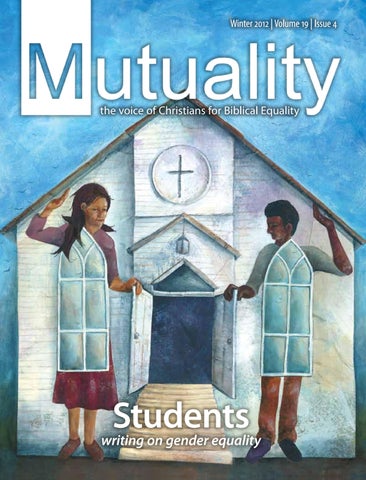
Winter 2012 | Volume 19 | Issue 4
the voice of Christians for Biblical Equality
Students
writing on gender equality
Mutuality 19.4, Winter 2012 “Let us then pursue what makes for peace and for mutual upbuilding” (Rom. 14:19, NRSV). Mutuality (ISSN: 1533-2470) seeks to provide inspiration, encouragement, and information about equality within the Christian church around the world. Editorial staff: Megan Greulich, editor; Image Spigot, graphic designer; Mimi Haddad, president/publisher. Contact us at: Christians for Biblical Equality; 122 W Franklin Ave, Suite 218; Minneapolis, MN 55404-2451; phone: (612) 872-6898; fax: (612) 872-6891; email: cbe@cbeinternational.org; web: cbeinternational.org. We welcome your comments, article submissions, and advertisements. For writers' guidelines and upcoming themes and deadlines, visit CBE’s website and follow the link under the Resources tab. Advertising in Mutuality does not imply organizational endorsement. Please note that neither Christians for Biblical Equality, nor the editor, nor the editorial team is responsible or legally liable for any content or any statements made by any author, but the legal responsibility is solely that author’s once an article appears in Mutuality. All Scripture quotations, unless otherwise indicated, are taken from the 2011 revision of the Holy Bible, New International Version®, NIV®. Copyright © 1973, 1978, 1984, 2011 by Biblica, Inc.™ Used by permission. All rights reserved worldwide. CBE grants permission for any original article (not a reprint) to be photocopied for local use provided no more than 1,000 copies are made, they are distributed free, the author is acknowledged, and CBE is recognized as the source. Mutuality is published quarterly by Christians for Biblical Equality and is sent free to members and supporters.
Contents 4
Beyond Aprons and Pickup Trucks | Understanding sexism in today's evangelical churches. by Heather Lundy
8
Have They Disappeared? | Examining the great women leaders of the Bible and why so few of us know about them. by Andy Motz
10 Who Was Abigail? | Insights into this bold Old Testament heroine. by Heather Celoria 11 Submission and Aggression | Observing cultural and religious messages that contribute to the problem of abuse in Moldova. by Adela Cristea 14 God Always Surprises Me | A personal story of transformation. by Rebekah C. DeVore 16 Rachel Held Evans' A Year of Biblical Womanhood | A book review. by Jennifer Kane
MINISTRY NEWS 18 A Group of Game Changers | Updates on CBE's Australian Chapters 19 Signs of Friendship | Reflections from the 2012 Annual Meeting of the Evangelical Theological Society
D E PA R T M E N T S 3
From the Editor | Look Out, World
20 Giving Opportunities | The Next Generation of CBE 21 President’s Message | The Life and Legacy of Dr. Virginia Catherine Patterson
On the cover: “Church Family,” by Ruth Meharg (ruthmeharg.com)
2 M U T U A L I T Y | Winter 2012
website : cbeinternational.org
F
rom the Editor by Megan Greulich
Look Out, World “Were not our hearts burning within us?” (Luke 24:32). Just the other day, I was chatting with a young student from I was a junior in college when I first discovered biblical equality. Mimi Haddad had come to lecture in one of my classes. Almost a local college. The prominent staircase in a new building on a decade later, I still remember it vividly—my perspective from their campus is see-through, she informed me, and is positioned the fourth row of tables where I was situated, the blue and green right above an area often heavily populated by students. The background colors of Mimi’s PowerPoint slides, the Bible I was students below can look up and see anyone using the staircase, using as she directed us to look up particular passages. Most of all, making the female students and faculty members in skirts I remember the rush of emotions—shock, which quickly turned extremely uncomfortable. Women must now either plan their to relief, and then to excitement, and finally to determination to clothing around the route they will take, avoid the staircase do something about all I had learned. I had spent the previous few entirely, or risk embarrassment and a lack of privacy. “I’m years wrestling with the idea that the God I loved preferred men meeting with school officials about it this week,” she announced. over all the gifted women I saw around me. It was like a terrible “It would take a simple, inexpensive change. I will paint the itch that just wouldn’t go away. But now Mimi was guiding me staircase myself if they will let me. I will even cover it in duct through biblical passages that affirm the dignity and worth of tape if I have to!” I stared, inspired, into her determined eyes. women, showing me Phoebe the deacon, Priscilla the teacher, even Look out, world, I thought. This woman is about to change you. It is just that kind of focused passion and resolve to stand Junia the apostle. The message was, as a CBE member described once to me, a healing balm for my soul. And how grateful I am to for justice—the “I’ll duct tape a stairwell if needed” kind of Jesus that it came when it did—as I was young and sorting out my energy and drive—that excites me about this issue of Mutuality featuring student writers. We hope their stories and insights gifts and calling and dreams. Fast-forward to present day, and I could rattle off a long encourage you. Look out, world! These students are on a mission. As always, we would love to receive your feedback. Email us list of students I have encountered through CBE who have had similar experiences to mine. I’ve seen the relief and the hope in at cbe@cbeinternational.org. their eyes. And I wonder if their stories are a bit like those of the disciples talking with Jesus after his resurrection, when “the In Jesus, Scriptures were opened” to them (Luke 24:32). “Were not our Megan Greulich hearts burning within us?” they asked each other. I picture these students with that same kind of deep fire within them. I love P.S. Our beautiful cover was conceptualized and created by a their commitment to truth and justice, and their determination talented student, too! Ruth Meharg gifted us with this original to make their campuses, families, churches, and communities piece, which, I must add, she created in the middle of her week of final exams. Thanks so much, Ruth! safe and empowering for both men and women.
What topics would you like to see us cover in future issues of Mutuality? Are you interested in writing for us? Email us at cbe@cbeinternational.org. We would love to hear from you! Calling all Students: Submit a paper for our student competition! If selected, you will receive free registration to present your paper at our 2013 conference! All entries are due May 1, 2013 and must focus on gender and faith. Learn more: cbeinternational.org/studentpapers
bookstore : cbebookstore.org
M U T U A L I T Y | “The Student Issue”
3
Beyond Aprons and Pickup Trucks
Sexism in the Evangelical Church Today
by Heather Lundy
Tradition helps us remember where we come from and who we are as a culture. We should uphold and honor tradition—as long as we don’t begin to mistake it for truth.
4 M U T U A L I T Y | Winter 2012
I
love aprons. I was shopping in my favorite store, Anthropologie, when I came across the apron. Exactly what I wanted. Little rose print, falls to my knees, rich olives, and bright reds. I love wearing it as I serve my friends dinner, especially while using the ceramic plates I made with my own hands. And, I’ll be honest, I appreciate how the rich flower print hides the red sauce I somehow spilled while cooking. My friends call it clumsy; I call it passionate. Semantics. Regardless, I look good in that apron, and I like feeling feminine. I don’t wear peep-toed red heels and a sundress like the ladies in those 1950s magazine ads; I prefer my Toms and torn jeans, instead. Tradition is great as long as it leaves room for my own personal flair. If aprons are stereotypically feminine, what could be more stereotypically masculine than a pickup truck? My grandfather has had a pickup truck for as long as I can remember—giving us grandkids a ride to the pool, bringing
website : cbeinternational.org
a load of firewood to our doorstep in the winter, and hauling core tenets of Christianity increased. However, this was not the anything and everything to the church. Like a born and raised case for women” (Maltby and colleagues, 2010). Texas boy, Bubba enjoys his pickup. To fully appreciate the implications for the evangelical Aprons and trucks have long associations with feminine and church, one must understand “protective paternalism.” Essentially, masculine roles because tradition says women wear aprons and protective paternalism is the motivation “to protect and provide” men knock around in pickups. That’s just the way it is. Generally for a specific group, a mindset expected of men toward women. speaking, tradition is good. It provides stability and comfort in This attitude, while seemingly noble, is a form of benevolent sexism uncertain times. Tradition helps and usually results in overt oppression. us remember where we come Research indicates a relationship between Sexism in the church will continue to from and who we are as a culture. men holding traditional evangelical beliefs We should uphold and honor be a problem as long as we remain and maintaining sexist attitudes, usually tradition—as long as we don’t tied to the paradigm that in the form of “protective paternalism” begin to mistake tradition for (Maltby and colleagues, 2010). truth. I become concerned when says power given to one More research is needed to determine we use tradition as a guiding gender necessarily why this correlation exists in men and principle—when we insist that not women. Does theology encourage reduces power all women should wear aprons men to hold sexist attitudes? That and all men should drive pickup to the other. hardly seems likely. Theology derived trucks. That’s when we first begin from Scripture would not encourage to lose sight of truth. When oppression. Therefore, something else we hold tradition in proper must be happening. Either sexist men perspective, there is flexibility. gravitate toward orthodoxy because they Bubba does most of the cooking, like tradition, or their theology is more and I first learned how to drive in traditional than biblical. If one clings to his pickup truck. traditional theology at the expense of Mistaking tradition for truly biblical theology, he can become truth occurs too naturally sexist, even with the best of intentions. when we start assigning gender All of this is not to suggest that roles. I love wearing my colorful only men can be sexist. The fact is, both apron, and Bubba enjoys his pickup truck, but we do not men and women perpetuate sexism. In the evangelical church, define our identities as woman and a man by these traditional a spectrum of sexist attitudes exists. On the far right end, we associations. Unfortunately, we risk making this mistake in find what could be called “dominant men and silenced women.” our churches. We can become so rigid in our views of gender This fuels an overt, hostile sexism in which women are not equal roles that tradition takes the place of truth, allowing sexism to men. Men rule church and home while women are treated to take root. like objects or property. Men vehemently pursue power at the According to psychologists Peter Glick and Susan Fiske expense of women’s worth, and they defend their power over (1996), sexism typically appears in two forms: “hostile sexism,” women at any cost—physical, emotional, mental, and spiritual and “benevolent sexism.” Hostile sexism is what we typically harm. Women are slaves to men. imagine when we think of sexism. It is overtly negative, involving oppressive actions, attitudes, and beliefs toward the opposite hen people think of sexism, they often think of this gender. Benevolent sexism, on the other hand, occurs when extreme. Thankfully, this worldview is declining in one gender restricts or oppresses another based upon positive its appeal in many parts of the world. Still, more attitudes such as a desire to protect. For example, some men subtle forms can be found in mainstream evangelical churches. perceive women as inferior and, therefore, in need of supervision A close friend of mine grew up in a church where they often and protection. Benevolent sexism may include more covert hosted potluck meals after Sunday services. It was considered negative oppressive actions, attitudes, and beliefs. honorable for the women to serve the men instead of eating. In As of this article, nearly no research has been conducted a very literal sense, the women were expected to put their most on the manifestation of sexism within evangelical churches. basic needs aside for men. However, one study conducted by Maltby, Hall, Anderson, On the far left end of the spectrum, we find the opposite and Edwards in 2010 shows an association between gender, extreme—“dominant women and silenced men.” Dominant religious belief, and sexism. The researchers administered both women fight so hard for their voice and worth that they plow the Ambivalent Sexism Inventory and the Christian Orthodoxy through whatever and whoever stands in their way. To end Scale to 337 evangelical Christian undergraduate students. oppression they become the oppressor. I have seen a woman They found that “gender moderated the relationship between literally hush her husband whenever he had an opinion about Christian orthodoxy and Protective Paternalism.” In other church issues. She had lived the first forty years of her life under words, “as men’s sexist views increased, their agreement with the oppression of paternalistic, male-dominated churches. This
W
bookstore : cbebookstore.org
M U T U A L I T Y | “The Student Issue”
5
woman became an elder at their new church and, in a tragic reversal, now perpetuates the same oppression she experienced for decades. Silencing men is not the answer to empowering women and ending sexism. The majority of evangelical Christians fall somewhere between these two extremes. Typically, these members act with the best of intentions by treating all people equally, yet they remain silent concerning sexism in their congregations. Consequently, they become guilty of “benevolent sexism.” When assigning gender roles in church and life, the silent middle implicitly and/or explicitly encourages men as the power-holders and women as the subordinates. All the while they fail to acknowledge how this kind of language and attitude encourages oppression of women. Their language, even when they hold the best of intentions, can make a woman feel secondary, disempowered, and silenced. I know this because I have experienced it. Sexism in the church will continue to be a problem as long as we remain tied to the spectrum I have described. Finding the right place on the spectrum is impossible because there is no right place. This paradigm views power as a limited commodity—that power given to one gender necessarily reduces power to the other. Consequently, wherever we land on the spectrum—anywhere between the extremes of “dominant men/silenced women” and “dominant women/silenced men”—demands we accept some level of oppression toward someone. We need a new paradigm that encourages each gender to empower the other without sacrificing one’s own dignity or worth. As the Balswicks’ affirm in their book The Family, “Increasing another person’s power does not decrease one’s own but, instead, multiplies one’s potential for further empowering.” How empowering for everyone if each person in my friend’s church were to serve one another lunch and “outdo one another in showing honor” (Rom. 12:10, NRSV). How much better for the woman who became an elder to say to her husband, “Let’s allow both of our voices to be heard in the church. I want oppression to end in our lives.” To get off the spectrum and find a new paradigm, the “silent middle” congregations must be willing to dialogue about the sexism infecting their churches. This might begin with a
simple acknowledgment that some people feel disempowered at times. What if a male pastor were to gain a woman’s perspective on how women in his congregation might respond to his message concerning a gender-related issue? He could then hone the language he uses to empower both the men and women in his church. We can eliminate sexism within the evangelical church with a subtle shift in our thinking, and shatter the old paradigm that has existed since the Fall. We must think of power as a limitless commodity instead of trying to gain power at the expense of others, or giving away power at the expense of self. If we can think in these terms, we are in a better place to respond to sexism rather than simply react to it. Unlike reaction, response to an issue looks intently at truth and then pursues it. Reaction looks at oppression and will do anything, even become the oppressor, to preserve oneself. Let’s begin a new paradigm of empowerment in our evangelical churches. I am empowered by my apron and Bubba by his pickup truck because the traditional gender roles they represent do not shackle us. I believe the church is up to the challenge of empowerment and can rise above sexism to enjoy freedom. Heather Lundy will complete her master's degree in counseling from Denver Seminary in January 2013 and is now a counselor at Southeast Christian Counseling Center in Parker, CO. She loves connecting the art of writing with her passion for seeing transformation in the church. In her free time, Heather enjoys exploring the treasures the Rockies afford as well as creating pottery at home in her studio.
References Balswick, Jack. O, and Judith K. Balswick. The Family: A Christian Perspective on the Contemporary Home. Grand Rapids: Baker Academic, 2007. Glick, Peter, and Susan T. Fiske. “The Ambivalent Sexism Inventory: Differentiating hostile and benevolent sexism.” Journal Of Personality And Social Psychology 70, no. 3 (March 1996): 491–512. Maltby, Lauren E., M. Elizabeth L. Hall, Tamara L. Anderson, and Keith Edwards. “Religion and sexism: The moderating role of participant gender.” Sex Roles 62, no. 9–10 (2010): 615–622.
What if your college, nonprofit, church, or seminary joined CBE?
Learn more at cbeinternational.org/institutions
6 M U T U A L I T Y | Winter 2012
website : cbeinternational.org
Christians for Biblical Equality Presents...
Join Christian leaders, scholars, and activists as we examine the impact of biblical worldview on gender, leadership, relationships, and justice at our 2013 conference. July 26-28, 2013 Crowne Plaza Pittsburgh South | 165 Fort Couch Road | Pittsburgh, Pennsylvania 15241
"We demolish arguments and every pretension that sets itself up against the knowledge of God, and we take captive every thought to make it obedient to Christ" (2 Cor. 10:5, NIV)
Confirmed speakers include : Kenneth E. Bailey, ThD Research scholar and lecturer in Middle Eastern New Testament studies
J. Lee Grady Author, award-winning journalist, and ordained minister. Director of The Mordecai Project
Mimi Haddad, PhD President of Christians for Biblical Equality. Author, editor, and speaker
Susan C. Howell, EdD Professor of psychology at Campbellsville University
Don Neufeld, MSW Clinical social worker, works with domestic violence offenders
Patricia Warford, PsyD Expert in domestic violence, works with victims and violators of domestic violence
Block out July 26-28, 2013 on your calendar bookstore : cbebookstore.org
visit cbeinternational.org to stay updated
M U T U A L I T Y | “The Student Issue”
7
Have They Disappeared?
Why do young evangelicals know so little about the great women of the Bible? by Andy Motz
It first came up in my theology class. My professor read leads back to the question of women’s role in the church. I stated, aloud 1 Timothy 2:11-12 (for some reason he failed to read the verses as calmly as I could, that women should not be prohibited from above or below) and claimed that there was no solid evidence that church leadership on the basis of their gender. The atmosphere this verse was intended only for a particular cultural context. intensified. Finally, a young woman responded. Instead, it was applicable to all churches at all times. A young woman said to me. “Well, there haven’t I then asked about women who feel that preaching is their spiritual gift, women who feel a deep desire to be been any good examples of women leaders pastors. He nodded his head at me and asserted, “Well, in the past, so maybe that is evidence they that is why it is important to understand spiritual gifts as really just roles in the church we participate in. With shouldn’t be in those kinds of positions.” this understanding, we can see that women simply have different roles in the church.” “Well, there haven’t been any good examples of women That was it. Case closed. No more discussion. Onto a leaders in the past, so maybe that is evidence they shouldn’t be different subject. Later, it was in one of my literature courses. I sat on the in those kinds of positions.” On another occasion, a group of friends and I were up edge of my seat during the very tense class discussion. The topic? Women’s role in society. At a Christian university, this often late one night talking about the kind of girl we each want to 8 M U T U A L I T Y | Winter 2012
website : cbeinternational.org
eventually marry. I mentioned it would be great to be married to a woman who wanted to be or was a pastor. This unsettled some of them, and they stared at me with shocked faces. “Andy, women can’t be pastors. That is unbiblical.” Then there were the students handing out “man cards” warning us not to be girly. The complaints circulating our campus about America feminizing the church. And my female friend who desired to be a pastor, but feared rejection. Deeply unsettled by these experiences, I wondered, Where does this intense devotion to complementarian theology stem from? What I have discovered is that the majority of young adult Christians are simply unaware of the leadership roles that women held in the Bible, especially women of the New Testament. Through either the intentional suppression or the unintentional omission of the Bible’s rich history of women leaders, authority figures (whether professors, theologians, or pastors) are able to oppress their sisters in Christ who are gifted and called to lead. For if a young theology student has no recognition of Junia or Phoebe or Priscilla or Tabitha, then it is easier to convince them that 1 Timothy 2:11–12 is applicable for all women in all times and circumstances. Most young adult Christians I have encountered, even those who support gender equality, have no idea that women in the Bible were leaders. When I have mentioned Mary Magdalene for example, they respond with a description of her as the redeemed prostitute (an idea never mentioned in the Gospels) instead of the one who shared the news of Christ’s resurrection—the “apostle to the apostles.” These bold women leaders have been forgotten, pushed to the side, and even stripped of their gender identity in years past. I myself, while always finding gender equality a core Christian principle, never knew about most of these women until I read Scot McKnight’s book Junia is Not Alone. Who exactly are these unknown women? In the sixteenth chapter of his letter to the Romans, Paul makes a point to encourage hospitality toward those who have aided in building God’s kingdom. Within this concluding chapter it is revealed that Paul’s ministry was marked by gender equality and inclusion, as he lists both men and women who partnered with him on his mission. The very first person he mentions is Phoebe, “a deacon in the church in Cenchreae,” who has “been a benefactor of many people, including me.” In the New Testament, deacons were not just people who helped with communion. They were teachers. Phoebe financially supported Paul, despite the fact that she was either single or a widow. She was also responsible for making sure Paul’s letters were received. Couriers were in charge of both receiving and reading the letters. As such, Phoebe was probably the first person to deliver, read aloud, and interpret the letter to the Romans! Another woman mentioned in Romans 16 is Junia. She and Andronicus are said by Paul in verse seven to be “outstanding among the apostles.” Not only was Junia an apostle, but she was
bookstore : cbebookstore.org
an outstanding apostle. She receives nothing but praise from Paul. Apostles in Paul’s time were those who spread the saving work of Jesus Christ. They taught, they preached, and they led the early church. Then there was Priscilla. Paul calls Priscilla and her husband Aquila his “co-workers in Christ Jesus.” They even “risked their lives” for Paul, according to Romans 16:3. Both Priscilla and Aquila were his equal partners in Jesus Christ. The couple is mentioned elsewhere in the book of Acts in which they both lead the soon-to-become-apostle Apollos to a more sound faith. “They invited him to their home and explained to him the way of God more adequately” (Acts 18:26, emphasis mine).
Romans 16 shows us that Paul himself was putting Galatians 3:28 into practice.
These are just some of the women in Paul’s ministry that he names in only one chapter! Think how many more there were. Romans 16 helps us to understand that when Paul writes, “There is no longer Jew nor Greek, no longer slave nor free, no longer male and female, for you are all one in Christ” (Gal. 3:28), he means it. Paul himself was putting Galatians 3:28 into practice. The Bible describes a rich history of great women leaders doing the work of God. I haven’t even mentioned any from the Old Testament, let alone those found throughout church history. I encourage you to look them up. Read about them. Interact with the stories of the fierce Deborah, the brave Huldah, and the strong Shulammite girl in Song of Songs. Throughout history women have been taught they are the lesser beings. They have been abused and disregarded. They have been oppressed, stereotyped, and objectified. The history of women suffering at the hands of men and society is horrifying. Yet Paul (and Jesus, for that matter) do not conform to these societal hierarchical norms. J.R Daniel Kirk writes that “if the kingdom of God is not based on socially constructed hierarchies, then bringing such hierarchies into the church is a denial of the gospel itself.”
M U T U A L I T Y | “The Student Issue”
9
Who was Abigail?
A surprising look at a righteous and brave Old Testament woman by Heather Celoria
Abigail, whom we read about in 1 Samuel 25, is one of my favorite women honored in the Old Testament. Often, the church peddles a romanticized and chivalrous ideal (which has no foundation in Scripture) to encourage women to be submissive, quiet, dependent, and careful not to make waves. Particularly within a marriage, many churches teach that women should submit to the decisions of their husbands, even if the husband is making very wrong decisions. Women are encouraged that if they will submit and pray, God will honor this and intervene on their behalf. God may intervene, of course, but often this type of response leads to more problems, including domestic violence and abuse. In contrast to what the world’s cultures may say—and in the world of the Old Testament where women had far less equality than they do today— Scripture honors women who were anything but quiet, fearful, submissive, or weak when it comes to discerning and obeying the will of God. God consistently honors their boldness, not in being aggressive toward men or others, but in their wisdom and obedience to God. In this particular story, Abigail is a wife of a man named Nabal who is foolish (his name actually means fool) and whose rash behavior has caused David to come with 400 men to destroy his household. When a servant tells Abigail what is happening, she immediately goes into action without consulting or telling Nabal, who we learn is most likely too drunk to think clearly. Her efforts save the household from destruction because she understands the ways of God more than Nabal does. God seems to honor her boldness with deliverance and promotion because her evil husband dies of illness, and David takes her as his wife. In fact, David praises her for her good judgment. Her actions not only honor God and save her own household, but David recognizes that her wisdom saved him from spilling blood in revenge. He realizes this would have led to negative consequences for him, as well. I encourage you to read this story, because it is a great message to women who may be suffering domestic violence or other abuse. Women need to understand that God can and does honor them for their courage in doing what is right for their households. But, what has really struck me lately is that Abigail is a type and shadow of Christ in the Old Testament story. As I read the passage recently, images that I had never noticed before jumped out at me:
The degradation of women has no place within Christianity, because God does not condone it. And an important way we can change the status of women within the church and culture is through gaining a broader education of all the faithful women leaders of the Bible. Let’s be leaders in this education. If the issue of women’s role in the church rears its head in conversation, do not be afraid to gracefully bring up biblical examples of women leading. If you have a friend or if you meet a woman who wants to be a pastor, encourage and lift her up as a woman participating in a long line of faithful and called women leaders. If you are a writer, write about them! Even just one mention on Facebook or Twitter could spark change. Through my own personal education of these incredible women, I gained a broader understanding of the kingdom of God and the inclusiveness of Christianity. I have learned that freedom, no matter what your gender, is found in Christ. Andy Motz grew up in the small of town of Atwater, CA. He currently resides in Los Angeles County and is a senior at Biola University. While film is his focus and major, he has grown more passionate about issues of gender both in the church and in society over the past four years. In the future he hopes to incorporate this newfound passion with his love of film studies.
• Abigail comes riding a donkey. • She presents an offering for Nabal’s trespass (sin sacrifice). • She asks David to let the blame for the offense fall on her alone (substitutionary guilt). • She prophecies about David’s reign (declaring the kingdom). • She is a peacemaker. • She washes the feet of David’s servants. I had never noticed this before and thought it was really interesting to see that God included a woman in Scripture as a type of Christ. I will be looking in other stories of women to see if there are more images like this. I was encouraged that, once again, God includes and honors women in his redemptive plans. Heather Celoria is pursuing her MDiv at Asbury Theological Seminary and is a licensed and ordained minister of The Covenant Center in Lakeland, Florida. She maintains a blog at letthemhavedominion.com. A single mother of two, when she’s not having fun with her children, she is writing songs, playing guitar and harmonica, worshiping, reading, writing, and enjoying everyday life. A version of this article appeared in CBE's e-newsletter, Arise., under the title “Abigail: Old Testament Type-of-Christ.”
10 M U T U A L I T Y | Winter 2012
website : cbeinternational.org
Submission
and
Aggression Observing cultural and religious factors that contribute to the problem of domestic abuse by Adela Cristea
A common saying in Moldova goes, “An unbeaten wife is like an unswept house.” The phone rings twice before she answers, after reaching for it in her purse, “Hello?” She was on the bench behind me in a moderately packed van used as public transportation in Moldova. Inevitably, I became witness to a conversation that made my heart go out to this woman. And I wanted to scream, “Ditch that man and never look back!” From my side of the conversation, I heard: “I picked it up right away.” (pause) “No, it didn’t ring ten times.” (pause) “I did pick it up right away.” (pause) “I said I’m on my way to university.” (pause) “I’m in a van, that’s all.” (pause) “Why do you talk to me like this?” (pause) “You don’t talk to me like this at home.” bookstore : cbebookstore.org
This ensued for about ten minutes. My abuse-detecting antennas picked up controlling and manipulative talk, mistrust, repeated accusations, and verbal abuse on the other end of the line. That is the kind of input that generates the kind of response I witnessed from that young woman. I know because I have seen it time and time again. It is commonplace in my culture. I managed to grab the woman by the hand as she was making her way out of the van, “Run from such a guy and never look back!” I said. She smiled, kind of sheepishly, taken by surprise. She managed a half-mouthed “thank you” and went on her way.
M U T U A L I T Y | “The Student Issue”
11
On another occasion, I witnessed a man walking down the street with his young girlfriend. All of a sudden he turned and slapped her. She continued walking with him, her head down. There was a time when I would see such an encounter and think, “She must have said something to deserve that,” or, “This is just how it goes for a couple.” Maybe I would have simply ignored the scene, seeing it but dismissing it as normal behavior. But now, my heart breaks. “What kind of behavior is that,” I wonder, “to hit your girlfriend, in the middle of the street? And what kind of response is this—to continue walking with him, as if you deserved it, conveying guilt with your body language?” It is the behavior of a desensitized nation—a nation where hierarchy deems some people more important than others. It is the behavior of a people who inherited inequality and abuse as a societal norm. It is the kind of behavior reinforced at home, tacitly affirmed by the church, and stemming from deeply ingrained low self-esteem. In my home country of Moldova, these messages are everywhere. They are not, for the most part, explicitly taught. They are simply the status quo that nobody questions.
Culture One reason a guy can afford to be abusive toward his girlfriend (or his wife) in public is because he knows he can get away with it. Not only that, he will also be looked upon as a man who knows how to be in charge and make his wife “straighten up.” No one seeing this abuse will object because the saying in Moldova goes, “An unbeaten wife is like an unswept house.” A police officer will overlook abuse because he is of the same mindset as the perpetrator. A priest will mind his own business because he believes that Scripture teaches a woman must submit and be quiet. Moreover, I know of many cases when policemen and clergy have not only remained silent about abuse but have actually cruelly beaten their wives. One reason a girl lowers her head and continues to walk beside her boyfriend who just hit her is because she believes she is “just a woman” who must have deserved it. She should have kept her mouth shut and not angered him. Didn’t her mom teach her just that? “Be quiet. Don’t aggravate him,” her mother insisted. If a girl is to be looked upon favorably and praised as a good candidate for marriage, which is a female's primary purpose in my culture, then she must be a good housewife. She must know how to cook well. She should not be “lazy” and should work hard at cleaning the house, washing the dishes,
For women, submission is the rule. A woman must “ know her place” and tolerate any kind of behavior from her husband.
12 M U T U A L I T Y | Winter 2012
doing laundry, feeding the animals, and taking care of the kids. And she must give up her freedom in order to meet the needs and desires of her husband and family.
The Church For the most part, Christianity is not helping the rampant problem of abuse in Moldova. Regardless of the numerous instances in the Bible that teach all people—both men and women—to “put each other before ourselves,” “submit to one another,” and “love one another as Christ loves us,” the message for men is one of superiority over women. A man is the “head” of the family, churches often teach. Rather than recognizing that the word “head” had a much different definition in the ancient world than what we might assume today, churches teach that it means the one in charge, who gives orders, and who “has a special place.” Everyone submits to his authority, and he has the right to do all that he chooses, because his wife and children are his possession. This sets up a system in which a man can behave as it best suits him or his personality, without accountability. If he prefers to be controlling, he will be controlling toward his family. If he tends to be irresponsible, passive, selfish, or uninvolved, he will be just that toward his family. The system, perpetuated by incorrect theological assumptions, provides no way for men to grow in their love and service to others. This is tragic in itself, but the most dangerous consequences are for the women and children. For women, submission is the rule. A woman must “know her place” and tolerate any kind of behavior from her husband. Take, for example, what one Christian survivor of abuse wrote: My former husband believed that a wife should submit to everything: [his] psychological abuse, [his] porn [use], the way he reared our son via poor role modeling, his willingness to commit adultery, etc. He didn’t believe that he should be held accountable at all, and any disagreement was a sign of disrespect.
Family It is commonplace in Moldova for a father to assert himself as superior to the rest of his family. He can, and must, be aggressive to teach everyone a lesson about who is in charge. He is there to be pleased. He must not trust a woman, so he will test her by asking probing questions and making accusatory remarks, denoting open distrust. At the dinner table, he receives the biggest and best piece of meat. His wife tiptoes around, trying to appease him if he is upset. The kids must keep quiet and out of his way. He is rarely accessible. If he is in a good mood and wants to play, the children must play by his rules—otherwise they may be dealt with harshly, called names, or made to feel stupid. website : cbeinternational.org
He will not be involved in cooking, cleaning, or washing dishes. Men who are involved in these household chores are shamed. A common saying goes, “She put her skirt over his head.” He is seen as weak and controlled by a woman. It is in this kind of culture girls learn at a very young age to accommodate a man, to play the game of making him feel most important. Her mother models this to her, even if she is only doing it for survival.
Self-image It is not surprising, then, that we witness that low self-esteem— the deep seated feeling of inadequacy, low value, of not being enough—is common among women in my country. A woman's low status, reinforced by the way she sees her mother and other women put down, mistreated, and called names, helps her to believe that she is inadequate. Yet I believe the system encourages low self-esteem in men, too. The pressure on men to be tough can be debilitating. And, because it is not culturally acceptable for men to cry or express emotion, a boy has few options but to hide his true feelings with toughness, arrogance, and aggressiveness.
These are deep-seated messages that play in the background of the lives of Moldovan men and women like a script, constantly powered by the environment around them.
bookstore : cbebookstore.org
So, when a man and woman meet, can you fathom the outcome? If we want to change this broken system, we must cut straight to the root of the problem: the persistent belief that women and men are unequal. We must find ways of educating each other about this, so that we can name unhealthy attitudes and behaviors for what they really are. Then, we each must make a resolute decision not to be treated or treat others as less than those made in the image of God.
Because it is not culturally acceptable for men to cry or express emotion, a boy has few options but to hide his true feelings with toughness, arrogance, and aggressiveness.
Adela Cristea is a counseling student at The College of Theology and Education in Chisinau, Moldova, and is a former CBE intern. She is passionate about working for gender equality in her home country of Moldova, through educating young people about abuse and helping survivors of sexual trafficking.
M U T U A L I T Y | “The Student Issue”
13
God always surprises me by Rebekah C. DeVore
S
ometimes ideas run deep down inside It had been right there should be overcome through the power of the us and we cannot even pinpoint where in the Bible all along, blood of Jesus instead of promoted as a kingdom they came from. For most of my life, I reality? Doesn’t a partnership between both but I had never seen it. thought I was biblically accurate in believing genders seem like a more accurate picture of that men and women were made completely living in the freedom that God desires for us? different and were meant by God to have different roles. This These questions encouraged more questions, and I found my views was especially true within relationships and families. The man on men and women completely transformed. was made to be the head of the household and always lead the It hasn’t simply been a transformation in my head, either—it woman. Cleaning, cooking, and raising children were primarily has big implications for how I think about my future. For the the woman’s job. It was what the Bible taught. And it made sense longest time I dreaded marriage. Don’t get me wrong—I wanted to me because I believed that men were designed and equipped to be in love, but I just didn’t want to be in a relationship in which to make decisions and manage others, while women were better I felt that I had no say. I struggled for much of my life to find my at household chores and nurturing children. Thankfully, my voice, and now that I felt I had found it, why would I want to ideas were challenged. give it away? This kind of thinking plagued me—I wanted to be During my junior year of college, I took a gender studies married, but I also wanted to have a voice. I believed that marriage course that caused me to stop and think deeply about what I meant that I must follow some guy around and do whatever he believed, why I believed it, and where those strange ideas came thought was best. I found myself thinking, “If I ever find a guy from. It gave me a passion to study and understand how God I actually want to follow, then I will finally get married.” I laugh created us as men and women. I came away from the class now thinking about this, because through studying God’s Word, transformed, with a new found freedom in Christ. reading articles, and discussing these issues in class, I can finally In class, we examined the evidence both for and against see how God created both women and men to be leaders and gender equality within God’s Word. I had always thought that, to have a say in marriage. God didn’t make me to follow a guy because of verses like 1 Corinthians 11:3 and Ephesians 5:23 around—he made me to be strong and confident, and to glorify where Paul says that husbands are the “head” of their wives, men Jesus! If and when I get married, I will work together with my were supposed to be the leaders. But my view was challenged husband as an equal, so that our marriage will glorify Christ and when our class studied the creation of Adam and Eve. Initially, express a unity that is supernatural. before the fall, the relationship between man and woman was a My paradigm has most certainly shifted in my ideas of a partnership in which each person worked together. God called healthy and biblical marriage, but it has also shifted in how I them both to be fruitful and multiply, and he charged them both understand the role of motherhood. I used to believe that if I with ruling over the earth and every living thing (Gen. 1:28). wanted to be married and have a family, then I would have to God created both women and men in his image (Gen. 1:27). And, forfeit a career because a woman’s job was solely to raise the the lordship of men over women began after the fall when God children. God had ordained it. But I now see that God calls told Eve that her desire would be for her husband and he would women to do great things besides birthing and raising children. rule over her (Gen. 3:16). It had been right there in the text all Consider Ruth and Naomi, Esther (my favorite!), the prophet along, but I had never seen it. My eyes were opening, and I began Anna who spent her life worshipping God, and Mary Magdalene. asking more questions. Consider too the woman at the well. Jesus showed her that her I knew that Jesus died and rose again to deliver us from sin, identity should no longer be wrapped up in a man, but that she from what separates us from God, and from the curse that we should spread the good news of Christ. Having a family and brought upon ourselves (Gal. 3:13). If Jesus died to free us from being a mother is valuable, but I now understand that, just like the curse, then is it possible that the lordship of men over women these biblical women, my identity rests solely in Christ. I also see
14 M U T U A L I T Y | Winter 2012
website : cbeinternational.org
Rebekah (from right) with her gender studies professor, Susan Howell; leading worship; and recording at the radio show.
how both the husband and the I've learned that God didn’t make me to around me. It has fueled me to wife must work together to raise follow a guy around—he made me to be learn more about gender equality and speak out more against sexist a family. Both men and women strong and confident, and to glorify Jesus! comments and biased views. Not have different strengths and only do I seek to learn more, I weaknesses, not because of our gender, but because we are all uniquely and wonderfully created. want to challenge others to do the same. God has transformed And families benefit when both mothers and fathers use their me from the inside out, and I feel so blessed to now understand his heart for women and men. This is one of the many things I gifts and invest in childrearing. In class, we learned about a term called “modern sexism.” love about God: he always surprises me. He has a way of opening Modern sexism is a view that denies the reality of gender my eyes to worlds I have never known and empowering me to a inequality and sees no need for men and women to stand against freedom I have never experienced. it. Modern sexism says that people working for women’s rights make a big deal out of nothing. Examples include denying that Rebekah DeVore is a senior at Campbellsville University studying psychology. is in the process of applying to graduate schools and desires to pursue a women are treated differently in the workplace or in marriage, She PhD in psychology. She is the president of the International Justice Mission or idealizing men and doing everything for them because of a Chapter at Campbellsville University and writes, edits, and voices research belief that they are stronger and more capable. I see this type shorts for the local radio broadcast “Psychology Breakdown.” She is also the of sexism all around me. As I think back on how my views have worship leader at her church in Louisville, KY, where she loves to worship and lead others in encountering him. She enjoys reading, learning, and shifted, I see how I thought like this, too. Calling this out as God helping others to discover the truth about God's love for them and their sexism has changed the way I understand myself and the people potential to do great things.
Professor's Corner
by Susan Howell
Dr. Susan Howell taught the gender studies class that Rebekah said changed her life. Here she reflects on observing her students grow.
I take such joy in seeing Rebekah use what she is learning to promote the message of gender equality. In fact, one of the perks of my job is watching students as they first hear that traditional interpretations of Scripture and the myths of our culture do not necessarily reflect truth. I love seeing the “light bulb” come on as they begin reinterpreting their own experiences, and finding ways to live out their new understanding. Of course, students come with a variety of life experiences and they vary in their willingness to consider alternative interpretations. I have to regularly remind myself that my success as a teacher lies not in changing my students’ minds in the course of one semester, but in giving them new ideas that they can mull over for the rest of their lives. In fact, education, in
bookstore : cbebookstore.org
the classroom or in the church, is often a slow process. Becoming informed and building a new perspective on anything takes time for the learner and patience for the teacher. One thing I am learning is that growth comes in different forms. For some of my students like Rebekah, growth emerges as full and passionate commitment to gender equality. For others, growth means a new openness to women taking an active part in decision-making in the home and in the church. For still others who retain more traditional views, growth comes in gaining more understanding and respect for those whose beliefs differ from their own. In each of these instances, I am learning to see God at work, and I feel honored to be part of the process.
M U T U A L I T Y | “The Student Issue”
15
Book Review:
Rachel Held Evans’ A Year of Biblical Womanhood by Jennifer Kane
The topic of “biblical womanhood” is what we could deem a “hot button” topic in certain circles of Christian culture. While many books, conferences, speakers, and pastors have spent a great deal of time and energy encouraging Christian women to pursue “biblical womanhood,” the concept itself has Purchase your copy of A Year of Biblical Womanhood at also generated a great debate and begs the cbebookstore.org. Receive 15% off when you use discount question: What does the Bible really say about code YBM12 by January 31, 2013. being a woman of faith? Rachel Held Evans, in the introduction to her new book A Year of Biblical Womanhood (Thomas Nelson, 2012), considers Subsequently, she also takes on a different virtue each how frequently the topic of “biblical womanhood” has month. She chooses virtues that she feels are key to come up in conversations with fellow Christian women living out “biblical womanhood,” some of which include and at church gatherings. Because of those experiences, she gentleness, domesticity, justice, and submission. While decided to set out on a mission to attempt to live out the the plan seems pretty straightforward from the book’s biblical mandates for women as literally as possible for one introduction, the results are anything but predictable. In year. In her introduction, she reflects on the questions that an attempt to cultivate the virtue of motherhood, Held were at the forefront of her mind as she first considered the Evans cares for a robot baby named Chip. In another part project: “Could an ancient collection of texts, spanning of the year, Held Evans attempts to follow the biblical laws multiple genres and assembled over thousands of years in concerning women and menstruation, which results in cultures very different from our own, really offer a single sleeping in a tent in the front yard. From headscarves in cohesive formula for how to be a woman? And do all the the spring, to apple pie at Thanksgiving, to Bolivia in the women of Scripture fit into the same mold? Must I?” (xvi). summer, Held Evans embarks on a journey that is anything Thus began Held Evans’ quest to live out the biblical but ordinary. The book reads like part memoir, part selfmandates for women, which she actually turns into a help book, part spiritual guide. While Held Evans spends formula-based plan. She sets out with ten commandments each chapter relaying her experiences for the particular that guide her daily living throughout the year. month and topic at hand, she also concludes each chapter
16 M U T U A L I T Y | Winter 2012
website : cbeinternational.org
highlighting a different woman of the Bible, retelling her with evangelical culture. For those of us who may have heard story and reflecting on her impact on the definition of the phrase “biblical womanhood” in youth group or church “biblical womanhood.” sermons for most of our lives, who have felt like we did not Held Evans notes at one point in the book that when understand what it means, or worse, who have had hurtful people heard the premise of her project, some thought experiences of feeling like we didn’t fit the mold, this book she was planning to merely condemn has the potential to be a real source complementarians, while others of healing and reconciliation. thought she was a religious radical One thing becomes clear From headscarves in the spring, taking the Bible too literally. To the in reading A Year of Biblical to apple pie at Thanksgiving, first point, Held Evans, while critical Womanhood: to be a woman of valor of some of the perspectives found does not require fitting a particular to Bolivia in the summer, Held within complementarian teaching, mold. Rather, it requires a heart Evans embarks on a journey to is in no way setting out to merely willing to seek God and cultivate discover “biblical womanhood” condemn complementarians. One of virtues found throughout Scripture. the great aspects of the book was Held A special gem that readers may that is anything but ordinary. Evans’ willingness to step outside her take from the book is that while own evangelical faith perspective. She Held Evans focuses on “biblical visits various Christian communities, womanhood,” her attempts to live including a Friends meeting and a monastery, and she out the virtues in Scripture could teach a great deal to men interviews a wide range of people—from a member of the and women alike. As one of my former professors used to say, Quiverfull movement to an Orthodox Jewish woman—all “The fruit of the Spirit do not come in pink and blue.” Held to wrestle with what “biblical womanhood” means. Held Evans’ book is filled with honesty, humor, and grace, and her Evans certainly does her homework, but the book does not book is a great tool to begin, or continue, conversing about read like a research paper. She begins the book relaying the what “biblical womanhood” means for us all. experience of telling her hairstylist about her year of biblical Jennifer Kane is a graduate student at Duquesne womanhood. For the reader, A Year of Biblical Womanhood University in Pittsburgh, PA, studying English and is like listening in on that conversation. Like stories we gender studies. A former CBE intern, Jennifer is deeply often tell about our lives, it is filled with moments of humor, committed to men and women being able to use their gifts to serve God completely and freely. frustration, joy, and sadness. I personally had trouble putting the book down. As to the charge of taking the Bible too seriously, Held Evans does take the Bible seriously. It is apparent that she is passionate about the Bible and how it relates to gender expectations. While A Year of Biblical Womanhood is not a thorough exegetical look at the biblical passages about women’s role in the church and home, Held Evans does dive into the context of complex passages, quoting biblical What do you think of A Year of Biblical Womanhood? Join scholars and commentaries in ways that flow seamlessly us online to discuss Jennifer’s review and read another with her conversational tone. In her unique style, she egalitarian’s perspective: demonstrates that the Bible has the potential to intensely impact our own personal faith journeys in unexpected, beautiful ways. While not wanting to give too much away, “Rachel Held Evans’ Year of ‘Biblical Womanhood’” Held Evans discovers that “biblical womanhood” is not a by Ashleigh Bailey one-size fits all scenario. Because Rachel Held Evans did not have a clear definition “While some Christians will dismiss the book without of “biblical womanhood” in mind when she began her project, I reading it or hold a prejudice against Evans for her would recommend her book to those new to notions of egalitarianism, there is a humble, invitational quality to “biblical womanhood,” or for those wondering about the the book for those willing to engage with its ideas. In this connection between gender and the Bible. Unlike most books way, A Year of Biblical Womanhood has a great deal to offer in this genre, A Year of Biblical Womanhood will have appeal Christians from all points on the spectrum…” (read more at to those who may not consider themselves Christians. But I cbeinternational.org/heldevans). also recommend the book to the many of us who are familiar
ALSO: On The CBE Scroll
bookstore : cbebookstore.org
M U T U A L I T Y | “The Student Issue”
17
M
inistry News by Mimi Haddad
An encouraging time with members of the recently formed CBE Sydney Chapter.
A Group of Game Changers Australian Chapters Embolden Their Communities
Seeking community and empowerment, egalitarians from across Australia, Tasmania, New Zealand and beyond filled lecture halls during CBE’s 2010 Melbourne conference! Sadly, because of their egalitarian views, many experience censorship and marginalization in their churches and ministries. Some have even lost friends. This explains the low tone used by a woman who approached me in Melbourne that year, to share her aspirations to organize a CBE chapter in Sydney. Courageously, one year later, CBE members in Sydney took bold steps in becoming a CBE chapter which, like the CBE Melbourne chapter, would hold events and incorporate as a charitable organization in Australia. They honored me with an invitation to lead lectures with them in September. And, to make the trip especially productive, our Melbourne chapter asked me to address their group, as well. The journey gave me an opportunity to visit friends at Crossway College in Brisbane where three lectures were organized, introducing students and faculty to the work of CBE. Arriving first in Sydney, I found myself speaking on Australian Public Radio’s The Spirit of Things, hosted by Rachael Kohn. As the Sydney diocese was promoting new marriage liturgy in which a woman agrees to submit to her husband, Rachael asked me to address the need for CBE’s ministry in Sydney and elsewhere in Australia. Australia National Radio gave egalitarians a voice denied them by their own churches and denominational leaders. God does work in mysterious and powerful ways! God’s discernible presence was also evident in the cohesive and visionary leadership of the CBE chapter in Sydney. You could not hope to find a more inspired, focused, or congenial team despite (or perhaps because) of their diversity. Led by Paul Perini—an Anglican priest and a man devoted to social action—CBE’s sessions opened by acknowledging the Aboriginal leaders of the region, past and present. Paul made visible marginalized leaders, who, like the women serving in churches throughout Sydney, had also been silenced and marginalized. Listening to him speak reminded me that wise leaders recognize that one cannot solve a problem with the mentality that created it, as Einstein observed. In leading by example, the Sydney chapter is a game changer! Shortly after these events, Paul Perini was invited to speak on biblical equality at a prominent seminary typically opposed to an egalitarian perspective. They too are drawn to Paul’s irenic and wholesome approach, as he welcomes others to join a gracious conversation on gender and faith. CBE lectures in Sydney considered the initiative and leadership women demonstrate throughout Scripture, so much so that one searches in vain for a truly passive woman honored by the text. We also explored the moral and social consequences that result when the biblical teachings regarding gender are ignored. Given the shortage of egalitarian resources in Sydney, it was no surprise that individuals lingered afterward to chat one on one and share
18 M U T U A L I T Y | Winter 2012
personal stories. It was essential to give this community a safe place to process their ideas and experiences. Several admitted to me that they had never heard an interpretation of Scripture that supports the shared leadership and authority of men and women in marriage and ministry. As a result, they had many questions. My next stop was Crossway College in Brisbane, an institution that trains men and women for varied ministries around the world. I spoke first to female students on the value of women’s gospel leadership, then to the whole community, where I was given an opportunity to discuss CBE’s ministry as part of an evangelical tradition in which activism and evangelism were inseparable biblical ideals. This led to practical examples of CBE’s work with our partners in Africa, which delighted this community because of their deep commitment to missions. Finally, I found myself presenting the egalitarian position, opposite a local pastor holding another view. A graduate student with Wycliffe approached me afterward to say how inspiring it was to meet someone with a high view of Scripture who also believes that the Bible teaches that gender is no barrier to service or leadership. Thanks to so many generous donors, I was able to stock Crossway’s library with CBE classics, knowing these students are hungry for biblical resources on gender. (If you’re looking for a good project to fund, consider making a donation to CBE’s Literature Fund to help us stock other libraries like this.) With lighter bags, I headed to Melbourne to work beside our dear friends leading the CBE chapter there. Our first project was a dinner lecture, which was filled to capacity. The next day was packed with theological and practical forums. Here I met several young Christians from a church opposed to CBE’s message. One woman said she was interested in CBE’s message ever since her professor gave her a copy of Half the Sky, by Kristoff and WuDunn, a book she said that changed her life. I chatted with other women who shared the challenges of pursuing theological studies in seminaries where faculty are fundamentally opposed to the ministry of women. One man, listening on, said that he could no longer financially support seminaries that enroll women but teach a distorted view of their service as pastors and teachers. By affirming the biblical foundations of gender equality and justice, CBE chapters in Australia offer an essential challenge to Christian communities. They work faithfully to show that our newness of life, inaugurated at Calvary, creates a new humanity where identify is not associated with gender, ethnicity, or class, but in our rebirth in Christ. I praise God for their liberating and healing ministry and ask you to join me in praying for their work. website : cbeinternational.org
M
inistry News by Tim Krueger
Signs of Friendship
The Report from the 2012 Meeting of the Evangelical Theological Society In mid-November, I joined two other CBE staff members and our distinguished Australian guests Kevin and Lynley Giles as we piled hundreds of books and journals into two vehicles and caravanned from Minneapolis to Milwaukee for this year’s annual meeting of the Evangelical Theological Society (ETS). As in past years, CBE had a visible presence at ETS not only by our booth in the exhibit hall, but also through the many sessions and discussions hosted by egalitarian scholars. Serving at our booth for the first time, I witnessed men and women who, while walking by in groups, eyed our booth and came back later by themselves. Some people hovered silently, and others took free articles. Some came to share their feedback on the special edition journal we mailed to ETS members this year, and others came by just to see if our prices were cheaper than the publishers’ booths. It was exciting to meet people who share CBE’s vision. And it was humbling to meet the many scholars and students who have worked tirelessly for biblical equality and stopped by to encourage us. I was surprised by the number of people— both attendees and other exhibitors—who stopped by primarily to share their stories and to speak openly to friends in a safe place. I was able to talk Australians Lynley and Kevin Giles multiple times with a accompanied CBE staff to the event, where Kevin spoke on the doctrine of representative from the Trinity. another organization. He is on the leadership team of his community church, where his wife is a pastor. The church leadership committee represents a variety of views, and will soon decide whether they will allow women to remain in positions of leadership. I also met a professor who stopped by our booth and shared that he is the only egalitarian faculty member at his school. I could see his relief and joy at being among friends. A single mother in the ordination process asked us, “Why are people so afraid?” She was dismayed by the pressure to conform to a strict set of views in order to fit in. Another woman spoke of the young men, sitting on either side of her during a session, who carried on a conversation around her without so much as acknowledging her presence. “Maybe they just lack awareness,” she said. “But I’ll always wonder if it was because I’m a woman.” Others stopped just long enough to encourage us to keep up the good work. As I packed up our supplies and closed down the booth at the end bookstore : cbebookstore.org
of the week, I realized that CBE was not just another booth in an exhibit hall. I arrived expecting primarily to be a vendor; I left realizing that perhaps CBE’s most significant ministry at ETS is that of simple friendship. It was in that spirit of friendship that scholars and students, along with some of CBE’s oldest and newest friends, gathered to share a meal. For me, this was a chance to meet new people and pick the brains of some of the best theologians in the world. I was struck ETS members stopped by CBE's most by the humility and booth to discuss the special friendliness of the scholars edition journal CBE published whose table I shared. Much and mailed to each member to my amazement, they prior to the conference. (Order seemed more interested your copy at cbebookstore.org!) in learning about me and hearing my thoughts than in talking about themselves and their research. It was truly a positive and encouraging time. CBE’s impact extended to the sessions as well, where CBE leaders were able to deliver several papers. CBE founder and first president Catherine Clark Kroeger was honored. In addition, Kevin Giles addressed the eternal subordination of the Son within the Trinity, a popular belief among many ETS members. His newest book, The Eternal Generation of the Son, was a hot item, and his sessions garnered a great deal of interest, translating into many new visitors to our booth. Lynley and Kevin’s loving conversations, sharp minds, and welcoming demeanor did a great deal to share and model biblical equality with friends and strangers alike. CBE is not the highest profile organization at ETS, and certainly not the most popular, but after my first experience there, I am convinced that our presence makes a bigger difference than we know. I saw this in many of my conversations, but perhaps nowhere was our impact more clear than in the eyes of a man who silently looked over our materials for a few minutes, then, as he started to walk away, paused, and said sincerely, “Thank you for being here.” Tim Krueger is the bookstore and publications associate for CBE.
M U T U A L I T Y | “The Student Issue”
19
G
iving Opportunities by Charity Kroeker
The Next Generation of CBE Ju l ia Si mpson comes from a rich heritage of women who have taught and led in the church. Her mother, Melanie Simpson, is a worship leader, music teacher, and publ ished author. Julia’s great grandmother was born to m i s siona r y parents in what is now Zimbabwe and spent her life traveling back and forth between the US and Africa. Julia herself is exploding with life, and, at the age of Ten-year-old Julia Simpson is a song ten, there’s nothing writer, anti-bullying advocate, poet, she can’t do. When clothing designer, and future [fill-inI spoke with her the-blank]. in June, she told me about her antibullying campaign—complete with a poster and an anti-bullying song—and the website she fills with original poems. “Actually, I design clothing for girls in my free time,” she added, as though hosting a website and an anti-bullying campaign weren’t enough, “and I’ve recorded an album—tropical themes—and hosted a VBS [Vacation Bible School] at my house. [For the VBS,] I made up some games, people donated stuff, I made t-shirts for the kids. I wrote the curriculum.” Julia is completely unhindered. I’ve seen so many girls of this age who are bursting with ideas and enthusiasm, free to do or be anything. And when I think back to myself as a ten year old, there was really nothing I wouldn’t try. Julia has the immense blessing to grow up surrounded by people who support and encourage her talents and interests—and who will continue to do so even after she crosses that elusive line from “girl” to “woman.” “It’s really cool that I’ve been raised in the belief that Jesus calls me to share my gifts and not to be restricted because of my gender,” she told me. Really cool indeed.
20 M U T U A L I T Y | Winter 2012
I wanted to know what Julia thinks about CBE’s work of bringing women into a position where they can use their gifts. I wanted to know her ideas for reaching girls her age with the message that Jesus has given them power and authority to freely serve him. But I realized that before I could ask this, I would need to explain the need for the message. I would need to tell her that, while at age ten she’s able to dream without limits, many females are not given the authority to freely serve their Savior. A few months before we talked, Julia had attended the CBE Houston Chapter’s conference “New Creation. New Tradition.” You might have seen her on stage reading Scripture during worship. At this conference, Julia realized for the first time that not all churches welcome women to lead or teach. And then she did something that I’ve often wanted to do. “When I heard about what happens in some places, I went to my mom and was like, ‘Are you serious? Please tell me you are kidding!’” From the perspective of this spitfire ten-year-old, it was unthinkable that churches would keep half of their congregants from using their full potential. Talking with Julia made me feel pretty confident in our future. Let’s put the church in the hands of such preadolescent powerhouses, complete with homemade t-shirts and tropical themed music albums. But I know the obstacles that are waiting for Julia as she grows up. Not everyone will usher her into becoming the pediatrician, veterinarian, writer, day care worker, or theologian she dreams of becoming. Many voices will begin to tell Julia that she can’t—because she is female. At CBE, we’re all about drowning out those voices. We’re here to cheer on females like Julia, to walk with them and say, “Yes, you can—because God calls females.” Not all females have encouraging forces in their lives, as Julia does. For some women, CBE is the only voice of support. If only for the sake of these females, CBE must keep on keeping on far into the future. That’s why I encourage you to donate to CBE’s endowment fund. A small gift to this fund grows through interest to pay for things like youth curriculum, intern stipends, student scholarships to our conferences, and biblical resources—all of which provide a voice of biblical truth for future generations. When you donate, you ensure that CBE will continue to be a biblical support for girls like Julia as they grow into women.
To invest in CBE’s outreach to future generations, visit us online at cbeinternational.org/CBEgift and select “Endowment Fund.” Charity Kroeker is the development associate and international chapter liaison for CBE.
website : cbeinternational.org
P
resident's Message by Mimi Haddad
The Life and Legacy of Dr. Virginia Catherine Patterson As we celebrate students and young egalitarian leaders in this issue of Mutuality, we also recognize the important work of mentors in their lives. Therefore, please join us in honoring one of CBE’s great mentors, who led CBE’s ministry with wisdom and boldness for many years.
Christians have always believed that virtue is not so the first and only woman to receive the Christian Management much taught as caught. Since we acquire qualities more Award (1996) by (what is now) the Christian Leadership by example than instruction, Alliance. In observing her Scripture advises us to select participation on evangelical our friends and mentors boards like SEND and ECFA, carefully (Prov. 13:20). For this one executive said, “Her reason, I could not be more commitment, her common grateful to have worked beside sense, and logical approach to Virginia Patterson for more things, and her willingness to than fifteen years. stand alone if necessary, are just We first met at Wheaton outstanding.” College, at the conference It was her willingness to of Christians for Biblical go alone that characterized Equality (CBE) in 1993. Of Patterson’s service to Christ course her reputation preceded early in her life. As a single her. While serving as adjunct woman, she sailed to Nigeria faculty at Wheaton College where, for ten years, she served and also Gordon Conwell with the Sudan Interior Mission Theological Seminary, Patterson (SIM), educating hundreds was nearing the end of a of missionary children. With distinguished career as president SIM, Virginia discovered her and CEO of Pioneer Clubs, a lifelong passion to empower position she held for twentyyouth. And, her “wonderful seven years. I was awed by her missionary kids,” as she called achievements as a leader and them, loved and admired her. author, yet realized she was a One of her students became a humble woman of few words. missionary teacher himself. To Her sharp mind fueled her A mentor to many: Dr. Virginia Catherine him, Virginia was “a wonderful capacity to listen and discern. Patterson (1931-2012) role model and a woman of No wonder there was always great faith.” Though she went admiration in the air whenever to Nigeria without a husband or Virginia’s named was evoked. It seemed everyone in CBE children, she returned a spiritual mother to hundreds. They turned to her for wisdom. And, in this we were not alone. were family to her the rest of her life. Her accomplishments in leadership theory and A willingness to go alone also distinguished Patterson management were recognized by distinguished awards from as an advocate of gender inclusivity, which was, for her, a various evangelical organizations. Significantly, Virginia was biblical mandate. As CEO and president of Pioneer Girls,
bookstore : cbebookstore.org
M U T U A L I T Y | “The Student Issue”
21
Honoring Dr. Virginia Catherine Patterson
Virginia decided to include boys throughout its mission and programs. Though controversial, her vision grew the organization to reach 160,000 children a year with clubs in over 4,000 churches worldwide. Pioneer Girls became Pioneer Clubs because, for Patterson, God’s mission on earth is accomplished by both males and females. The gifts of women and men together constitute the work of the church, and on this point she was uncompromising. Inasmuch as she included boys equally within the mission of Pioneer Clubs, she was also determined to see women included in all levels of Christian service and leadership. Beginning with her church, Virginia developed a strategy. She approached the elders of her church, asking them to consider an egalitarian interpretation of Scripture. Though the elders were world-renowned Bible scholars, Patterson was unintimidated. To make her case, she visited them each personally. She told me once how she waited patiently at one elder’s home while he mowed his lawn. As he Virginia Patterson pushed his lawn mower back and forth, Virginia made it clear, not stood smiling at him so much through from his living room window, eager to engage words but through him theologically. I am her actions, that not sure who was more courageous that day, leadership is Virginia or her elder. Her some of the most holy boldness helped move a community of demanding yet scholars from a malesanctifying work only model of leadership to one where women now God can give. serve as elders. Inevitably, Virginia was ordained as an elder in the Evangelical Presbyterian Church of Wheaton, IL. She also served on many denominational committees. As one of her missionary kids said, “Her influence was epic!” In 1995, Patterson joined the board of CBE as chair, perceiving the need to transition our board from managing tasks to identifying policies. She not only developed board policies with a focus on governance, she also established a process of strategic planning that helped create a more vibrant and sustainable organization. For more than fifteen years I watched this fearless Cherokee woman lead CBE, churches, organizations, and individuals, always motivated
22 M U T U A L I T Y | Winter 2012
by mission rather than human accolade. And, she was restless in her search for new and better ways to serve. Even while growing Pioneer Clubs, Patterson found time to become a licensed counselor and to complete her doctorate in education, believing that higher education equips women for strategic leadership. She pursued knowledge not for selfaggrandizement, but in order to serve others more skillfully. In all of this she stands alone in placing her ambition, time, and talents at the service of others; in never taking the easy path; and in always giving much more than 100 percent. Virginia made it clear, not so much through words but through her actions, that leadership is some of the most demanding yet sanctifying work God can give. Perhaps there is no better way to celebrate her life and legacy than with the words of Saint Francis of Assisi who, like Virginia, stood alone in challenging the powers and personalities that choked life out of the church. He, like Virginia, left the world not with great literary works but with a spirit of love and prodigious effort that had the good of others as their chief aim. Like Francis, Virginia’s passion to serve God and others is her legacy. She embodied the prayer of Saint Francis, who said: O Divine Master, grant that I may not so much seek to be consoled as to console; to be understood as to understand; to be loved as to love. For it is in giving that we receive; it is in pardoning that we are pardoned: and it is in dying that we are born to eternal life. —Saint Francis of Assisi Virginia identified two organizations where memorial gifts might be made in her name, Christians for Biblical Equality and Pioneer Clubs. As we honor Virginia’s legacy through a generous gift to CBE and Pioneer Clubs, consider also how we might prayerfully follow in Virginia’s footsteps through taking part in mentoring relationships, sharing our spiritual gifts and ministry experience in walking beside those who are called to lead.
A version of this article originally appeared at Her.meneutics, Christianity Today ’s website for women (ChristianityToday.com/women).
website : cbeinternational.org
Christians for Biblical Equality Christians for Biblical Equality is an organization of Christian men and women who believe that the Bible, properly interpreted, teaches the fundamental equality of believers of all ethnic groups, all economic classes, and all age groups, based on the teachings of Scripture as reflected in Galatians 3:28.
Mission Statement CBE affirms and promotes the biblical truth that all believers — without regard to gender, ethnicity or class — must exercise their God-given gifts with equal authority and equal responsibility in church, home and world.
Core Values We believe the Bible teaches... • Believers are called to mutual submission, love and service. • God distributes spiritual gifts without regard to gender, ethnicity or class. • Believers must develop and exercise their God-given gifts in church, home and world. • Believers have equal authority and equal responsibility to exercise their gifts without regard to gender, ethnicity or class and without the limits of culturally-defined roles. • Restricting believers from exercising their gifts — on the basis of their gender, ethnicity or class — resists the work of the Spirit of God and is unjust. • Believers must promote righteousness and oppose injustice in all its forms.
Opposing Injustice CBE recognizes that injustice is an abuse of power, taking from others what God has given them: their dignity, their freedom, their resources, and even their very lives. CBE also recognizes that prohibiting individuals from exercising their God-given gifts to further his kingdom constitutes injustice in a form that impoverishes the body of Christ and its ministry in the world at large. CBE accepts the call to be part of God’s mission in opposing injustice as required in Scriptures such as Micah 6:8.
Envisioned Future Christians for Biblical Equality envisions a future where all believers are freed to exercise their gifts for God’s glory and purposes, with the full support of their Christian communities.
Statement of Faith • We believe the Bible is the inspired Word of God, is reliable, and is the final authority for faith and practice. • We believe in the unity and trinity of God, eternally existing as three equal persons. • We believe in the full deity and full humanity of Jesus Christ. • We believe in the sinfulness of all persons. One result of sin is shattered relationships with God, others, and self. • We believe that eternal salvation and restored relationships are possible through faith in Jesus Christ who died for us, rose from the dead, and is coming again. This salvation is offered to all people. • We believe in the work of the Holy Spirit in salvation, and in the power and presence of the Holy Spirit in the life of believers. • We believe in the equality and essential dignity of men and women of all ethnicities, ages, and classes. We recognize that all persons are made in the image of God and are to reflect that image in the community of believers, in the home, and in society. • We believe that men and women are to diligently develop and use their Godgiven gifts for the good of the home, church, and society. • We believe in the family, celibate singleness, and faithful heterosexual marriage as God’s design. • We believe that, as mandated by the Bible, men and women are to oppose injustice.
CBE Membership CBE membership is available to those who support CBE’s Statement of Faith. Members receive CBE’s quarterly publications, Mutuality magazine and Priscilla Papers journal, as well as discounts to CBE Bookstore and CBE conferences. Learn more by following the “Membership” link on our homepage.
bookstore : cbebookstore.org
� CBE Membership Application ________________________________________________ name
_____________________________________________________________ street address _____________________________________________________________ city _________________________________________ state / province / country _____________________________ phone
__________________ zip / postal code
_____________________________ email address
Membership Fees (all fees are in US dollars) United States Members Individual Household Low Income* Subscription Only**
1 Year � $49 � $69 � $27 � $40
3 Years � $129 � $184 � N/A � $115
International Members Individual Household Low Income* Subscription Only**
1 Year � $59 � $79 � $37 � $49
3 Years � $154 � $204 � N/A � $140
Churches and Organizations 1–100 people 101–500 people 501–1000 people 1001–2000 people 2001–5000 people 5001+ people
1 Year � $55 � $85 � $110 � $220 � $330 � $440
Additional Contribution $ _______ TOTAL $ _______ * Available to those with an annual household income of less than $23,000. ** Does not include membership benefits. CBE is an exempt organization as described in IRC Sec. 501(c)3 and as such donations qualify as charitable contributions where allowed by law.
Payment Method � Check/Money Order (payable to Christians for Biblical Equality) � Visa � MasterCard � Discover � American Express ________________________________________ __________________ account number expiration date _________________ verification code (the four digits on the top right corner of American Express cards or final three digits found on the back of other cards) _____________________________________________________________ signature
Please mail or fax this form to:
Christians for Biblical Equality
122 W Franklin Ave, Suite 218, Minneapolis, MN 55404-2451 Phone: (612) 872-6898 | Fax: (612) 872-6891 Email: cbe@cbeinternational.org Web: cbeinternational.org
M U T U A L I T Y | “The Student Issue”
23
Christians for Biblical Equality 122 West Franklin Ave, Suite 218 Minneapolis, MN 55404-2451
Non-Profit Org. U.S. POSTAGE
Forwarding Service Requested
Twin Cities, MN Permit No. 26907
PAID
Recommended Reading from CBE
Ephesians New Covenant Commentary Series Lynn Cohick This is an easily accessible and non-technical commentary of Paul’s letter to the Ephesian community. Cohick’s knowledge of the ancient world allows her to bring historical and sociological information to bear on the text and its interpretation.
We Were the Least of These Reading the Bible with Survivors of Sexual Abuse Elaine A. Heath As a theologian and survivor of abuse herself, Elaine Heath handles this sensitive topic with compassion and grace. She offers a close reading of several biblical passages that have proven to be profoundly healing for her and for other survivors.
CBE Members Save! 15% on CBE Bookstore resources and 50% on CBE recordings. Order or become a member today! cbebookstore.org 612.872.6898
No Will of My Own How Patriarchy Smothers Female Dignity and Personhood Jon Zens Zens compares the patriarchy taught to families by the Roman Catholic and Dutch Reformed churches in Holland with an aggressive patriarchal wing of the home-schooling movement in America. He shows that the earmarks of patriarchy doctrine result in varying levels of abuse of young girls and wives.
Partners in Marriage and Ministry A Biblical Picture of Gender Equality Ronald W. Pierce Without the usual argument and rhetoric of the current debate, Partners in Marriage and Ministry presents the biblical tenets of gender equality. Journey through Scripture with Dr. Ron Pierce as he draws readers into topics he has encountered in thirty years of teaching classes on gender and the Bible.