Mutuality The Voice of Christians for Biblical Equality
Role Models Inside: Will somebody answer that? How role models can encourage more women to answer God’s call to ministry leadership by Brenda Tapley
Learning to be a better man Making sense out of the mixed signals men receive about what it means to be a man by Jon Trott
The story of a semireluctant role model The challenge of living out both evangelical and feminist convictions by JoAnn Streeter Shade
Role play Find out what happens when a man decides to take on the burden of being the servantleader in his relationship with his best friend by Patti Ricotta
Plus much more! Autumn 2007
www.cbeinternational.org
Contents Features 5
Will somebody answer that? Women responding to God’s call How role models can encourage more women to answer God’s call to ministry leadership — by Brenda Tapley
7
Learning to be a better man Making sense out of the mixed signals men receive about what it means to be a man — by Jon Trott
11 The story of a semi-reluctant role model The tension of being an example of what it means to be both evangelical and feminist — by JoAnn Streeter Shade
13 Where are the women leaders? An interview with Bonnie Wurzbacher of Coca-Cola — by Nancy Lovell
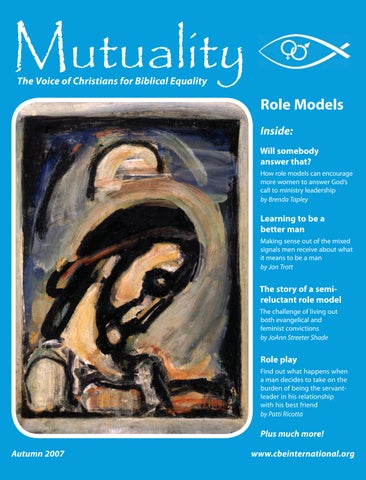
16 Role Play COVER IMAGE
Head of Christ, Georges Rouault, c. 1939, oil on paper pasted on canvas (65 × 50 cm). Used with permission of The State Hermitage Museum, St. Petersburg. Photograph © The State Hermitage Museum.
Find out what happens to a friendship when a man decides to take on the burden of being the servant-leader in his relationship with his best friend — by Patti Ricotta
18 Bread winners and bread makers: Modeling oneness in marriage Lessons that one couple learned from both positive and negative role models — by Monisha Srichand
21 How does she do it? How a missionary woman in Guatemala made a lasting impression on a young girl — by Lydia Ham
22 Changing lives from up close and from a distance How one woman’s experience shows that role models matter—whether they know it or not — by René Reed Mason
Ministry & Chapter News 25 Focus group participants express a desire to see CBE grow 26 CBE Chapters 27 Praise & Prayer
Departments 3 From the Editor: Modeling our equality in Christ 27 President’s Message: Sent to preach the Gospel: Women and men using their gifts for the Great Commission
29 Giving Opportunities: The view for 2008 from CBE headquarters
2 | Mutuality Autumn 2007
WEBSITE: www.cbeinternational.org
Mutuality The Voice of Christians for Biblical Equality
Let us then pursue what makes for peace and mutual upbuilding. — Romans 14:19 VOLUME 14, ISSUE 3 Mutuality seeks to provide inspiration, encouragement, and information about equality within the Christian church around the world. President/Publisher : Editor : Graphic Designer :
Mimi Haddad Chelsea DeArmond Image Spigot
EDITORIAL AND ADVERTISING OFFICE Christians for Biblical Equality 122 W Franklin Ave, Suite 218 Minneapolis, MN 55404-2451 phone: (612) 872-6898 fax: (612) 872-6891 e-mail: cdearmond@cbeinternational.org web: www.cbeinternational.org Advertising in Mutuality does not imply organizational endorsement.
SUBMISSIONS Mutuality welcomes submissions. E-mail cdearmond@cbeinternational.org, write to CBE for the writer’s guidelines, or visit CBE’s website and follow the Publications links.
PERMISSIONS Christians for Biblical Equality grants permission for any original article (not a reprint) to be photocopied for local use provided no more than 1,000 copies are made, they are distributed free, the author is acknowledged, and CBE is recognized as the source. Mutuality (issn: 1533-2470) is published quarterly by Christians for Biblical Equality and is sent free to members. For membership information, see page 31. To purchase back issues, contact our Editorial and Advertising Office, or order online at www.equalitydepot.com.
From the Editor by Chelsea DeArmond
Modeling our equality in Christ Some of the most popular Christian books right now seem to equate being a faithful Christian with being a certain kind of man or a certain kind of woman. Through countless sermons, TV and radio programs, devotionals, articles, best-sellers, podcasts, and blog posts, evangelical Christians are being told that the Bible requires them to conform to gender roles of male headship and female subordination. Many evangelicals have heard this teaching so many times and in so many ways, they’re shocked to learn that the words “role,” “headship,” and “subordination” do not even occur in the Bible. Is there any biblical basis for making gender roles a key component in Christian discipleship? In the passage known as the Great Commission, Jesus tells his followers to “go and make disciples of all nations.” Jesus explains that the process of discipleship involves two components: “baptizing them in the name of the Father and of the Son and of the Holy Spirit,” and “teaching them to obey everything I have commanded you” (Matt. 28:19–20). Key passages about baptism like Galatians 3:26–29 emphasize that believers receive a new identity in Christ. Rather than reinforcing genderbased hierarchy and division, this new identity frees men and women—in all our diversity—to live in unity with one another. Key passages about Jesus’ commands, such as his parables, sermons, and teachings, never mandate—or even mention—hierarchical gender roles. Instead, Jesus discourages his disciples from seeking higher rank and challenges them to follow his example of humble service. He challenged the views of cultural and religious leaders in his day by sending women to preach the good news that he is the Messiah ( John 4:28–30, 39–41) and that he has risen from the dead ( John 20:17–18). If there isn’t a biblical basis for hierarchical gender roles in Christian discipleship, then what should Christians look for in role models? The Bible encourages us to follow the examples of people whose character and actions are faithful to their identity in Christ. For example, Paul instructs the brothers and sisters in Corinth to “Follow my example, as I follow the example of Christ” (1 Cor. 11:1). And, after celebrating examples of heroes of faith—both men and women—in Hebrews chapter 11, believers are urged to “Remember your leaders, who spoke the word of God to you. Consider the outcome of their way of life and imitate their faith” (Heb. 13:7). Instead of seeking a certain kind of masculinity or femininity as evidence of faith, Paul urges all believers to “eagerly desire the greater gifts” (1 Cor. 12:31) such as prophecy and preaching, and to bear the fruit of the Spirit such as “love, joy, peace, patience, kindness, goodness, faithfulness, gentleness, and self-control” (Gal. 5:22–23). In this issue of Mutuality, authors explore how role models can help people transition from conforming to gender-based roles to living out the equality we all share in Christ. They offer concrete examples of how role models can make a difference, and challenge us to take on the responsibility of being good role models. They show that there’s more to being a faithful Christian than just being a certain kind of man or a certain kind of woman. Chelsea DeArmond is Editor of Mutuality and Bookstore Coordinator at Christians for Biblical Equality. She can be reached at cdearmond@cbeinternational.org
BOOKSTORE: www.equalitydepot.com
Mutuality Autumn 2007 | 3
In Our Box
Mutuality
Visit CBE’s website at
www.cbeinternational.org for the latest… ▶ FREE audio and print resources on biblical equality ▶ Membership information for churches, libraries, families, and individuals ▶ On-line discussions about gender and justice on The CBE Scroll, the blogging voice of CBE ▶ CBE chapters in the U.S. and around the world ▶ Directory of egalitarian churches in the U.S. and around the world ▶ Giving opportunities ▶ Listings for counselors, therapists, and spiritual directors who agree with CBE’s Statement of Faith ▶ Ministry news and needs ▶ Employment, internship, and volunteer opportunities
Call for Papers
Mutuality provides inspiration, encouragement, and information about equality within the Christian Church around the world. Mutuality is published quarterly and sent to all CBE members and subscribers. Current and back issue are also available for purchase. We are currently seeking features, reports, and reviews (books, films, and/or music) from evangelical, egalitarian perspectives related to the following topics: • • • •
Equality and our evangelical heritage Persecution and revival Raising children Home economics
Most of the articles we publish fall into the following categories: • Personal testimonies illustrating how biblical equality provides practical benefits to everyday lives. • Teaching on relevant Bible passages, explaining the meaning and showing how to apply it to daily life. • Reviews of books about biblical equality that would appeal to a wide audience. (Books must complete CBE’s book service review process before being reviewed in Mutuality.) • Feature stories about issues related to CBE’s mission and ministry. The length of features is generally 1,000–2,500 words. Send articles to the attention of the editor at the postal address below or e-mail to cdearmond@cbeinternational.org (if possible, as an attached Microsoft Word document). We are unable to consider or respond to authors who send us more than two pieces at the same time, whose pieces are substantially over 3,000 words, or whose submissions are not sent uniquely to Mutuality. Complete Writers Guidelines for Mutuality are available on our website (www.cbeinternational.org) or contact our office to request a copy. Questions and submissions can be directed to the attention of the editor, Chelsea DeArmond.
Visit CBE’s on-line bookstore at
www.equalitydepot.com for resources like… ▶ Books and articles ▶ Audio and video tapes ▶ CD, DVD, and MP3 recordings ▶ Sales and specials ▶ New resources, CBE exclusives, and best sellers ▶ Foreign language resources ▶ Become a CBE member or renew your membership and save 15% or more on every purchase ▶ Registration for CBE conferences ▶ Subscription to CBE publications or purchase back issues of Mutuality and Priscilla Papers
4 | Mutuality Autumn 2007
We’d love to hear from you! Send your comments and critiques to:
Mutuality 122 W Franklin Ave, Suite 218 Minneapolis, MN 55404-2451 PHONE: (612) 872-6898 FAX: (612) 872-6891 E -MAIL: mutuality@cbeinternational.org WEB: www.cbeinternational.org Letters may be edited for clarity and brevity.
WEBSITE: www.cbeinternational.org
Will somebody answer that? Women responding to God’s call When I was eight years old, I sat on a hot Sunday morning in a ramshackle little church on the edge of town, where the Arizona desert encroaches on the city limits, threatening to swallow it up. The only potential candidates for swallowing this day were the little Pentecostal church and a seedy bar next door. I’d spent many sweaty Sundays in this church, listening to Cora Watson preach, watching her steel-gray bun in her hair bounce every time she snapped her head for emphasis, wondering if the whole lot would come down on the next Hallelujah! On this particular Sunday, as I daydreamed through the sermon, however, a thought occurred to me: Grandma Watson (as all the children called her) was an oddity — a woman pastor — the only one I knew. I knew other women preachers and some who didn’t call themselves preachers, but preached nonetheless, but Cora Watson was the only woman I knew who actually pastored a church. My grandparents had begun attending this church after they retired from pastoring themselves; I couldn’t remember a time when she wasn’t their pastor. But I suddenly become aware of how unusual she was. In the holiness — Pentecostal denomination in which I grew up, there was a great deal of ambiguity about women in public ministry. In early Pentecostalism, women had played major leadership roles since formal ordination paled in significance against evidence of the anointing of the Holy Spirit on an individual — male or female. But as the charismatic moment waned and institutionalization set in, the freedom of women to preach and minister also waned. The number of women pastors has been declining steadily since the early 20th century. As a child, I knew women preachers and evangelists, but most were my grandparents’ generation. I heard many stories that included women in public ministry, but I saw mostly women in unofficial ministry (without titles and with limited authority). Unofficially, women were leaders in almost every level of the church. Women led worship, directed choirs, played instruments, taught Sunday School (adults as well as children), testified, preached, prophesied, healed the sick, sat on pastoral boards (since no ordination was required), made decisions about how to spend church funds, and served as missionaries. Women were licensed as ministers and allowed to pastor, but without full ministerial authority. Over the years, the rules became more restrictive about which specific pastoral functions (like baptism, marriage, the Lord’s supper). Finally in the 1990s the trend started to reverse and some exclusions have been eliminated. As a teenager, it seemed to me that women did most of the nitty-gritty work of the church, but as soon as a title or a paycheck was attached to the job, it was filled by a man. I came to the conclusion that God does call women to pastoral service, but the church (men and women) would not allow them to officially occupy positions of power and authority. Both women and men in this church culture joked about men being the head, but women being the BOOKSTORE: www.equalitydepot.com
by Brenda Tapley
neck that turns the head. I learned all about manipulation through submission. I decided my church was old-fashioned, conservative, and anti-woman. I determined to find a more enlightened church. I was surprised to discover that, other than a few “mainline” denominations, most evangelical denominations (in the U.S.) are even more conservative in their stance toward women in ministry than my own church tradition. Many of these churches don’t allow women to function even unofficially in leadership capacities. I developed a new appreciation for my heritage. At least I had seen women answering God’s call and using their gifts and talents in ministry — even if mostly unofficially.
About twelve years ago, while serving as a chief musician at an evangelical church, I began to sense God calling me into a pastoral type of service. A male elder at the church told me I must have “misheard” God — God doesn’t call women to leadership, he said (quoting a few choice Pauline verses). This did not resonate with my own experience of God or my heritage, but taken at face value these Biblical passages did seem to support his argument. I attempted to do some research on these passages, but I didn’t know how. Ultimately, this process landed me at Regent College, where I was exposed to the egalitarian teachings of respected evangelical scholars such as Gordon Fee, Stanley Grenz, and John Stackhouse. These men had nothing to gain (and much to lose) by holding open the doors for women to enter into the fullness of God’s calling. Finally, my own internal struggle could be laid to rest in firm theological ground. However, this immediately raised another question. There are many women students at Regent College and Mutuality Autumn 2007 | 5
most North American seminaries. Many of them are receiving training necessary for pastoral ministry. Surely, some are there because they feel a calling to lead God’s people. Why, then, do so few women respond to this call to pastoral ministry?
Why aren’t more women answering God’s call? Certainly there are many cases like my own where women are specifically told God doesn’t call women, that they have misunderstood God. Often, however, women from churches that don’t prohibit women in ministry are also hesitant to respond to God’s call. Why? The reasons are many; we’ll consider only a few. Our culture in general is one of male dominance. Although this is changing, the church has been slower to respond to these changes than the rest of society. This is especially ironic since it was evangelicalism that gave birth to the women’s rights movement in the 19th century. The Bible is male-dominated. Both Testaments were written against a background of male dominant/patriarchal societies and seem to assume male primacy. Any casual reading reveals that women are under-represented by today’s standards. It requires more effort for women to paint themselves into the picture as active participants than for men to do so. The ministry of women is not actively encouraged. Even churches that do not bar women from pastoral ministry do not often actively encourage it. In a position paper on “Women in Ministry,” the Rev. Dr. Janet Peifer of the Brethren in Christ Church suggests that even in churches that permit women in ministry leadership, people might not even realize it because few of them: a. have heard even one sermon which would condone and affirm it; b. have seen or read a book or an article condoning or affirming it; c. have known any female pastor to serve as an exemplary role model; d. have been exposed to responsible principles of biblical interpretation on the controversial passages about women… In an article entitled “Women in Ministry: Challenging Cultural Obstacles,” Dr. Lee M. Haines, General Superintendent Emeritus of the Wesleyan Church, challenges the leaders of his denomination to commit to even more active encouragement — to “practicing the Barnabas principal…championing the cause of one or more of these daughters of the church.” Quoting C.S. Cowles, Haines declares: All God-called and Spirit-filled potential ministers are “dead in the water” until someone in a position of authority recognizes their gifts, invites them to participate in increasingly responsible forms of ministry, supports them in times of challenge and encourages them along the way. Churches are afraid to hire women pastors. Even in denominations where women are ordained, many local churches aren’t comfortable hiring women pastors. Many congregations hold back from accepting women as pastors because they fear dissension in the church or loss of esteem in the community for being a woman’s church. Women are afraid they’ll be seen as trouble-making and pushy feminists. Many women find their self-worth in what others think of them and are reluctant to be considered strident or liberal. In the media and in some of the “mainline” churches, the issue of women’s ordination is closely linked with the ordination of practicing 6 | Mutuality Autumn 2007
homosexuals. Often Christians in the evangelical church react against what they consider the apostasy of liberalism, and as a result, the women’s ministry issue is tainted. Those calling for true equality of the sexes are found guilty by association. There is a shortage of readily available role models. We recognize the tremendous importance of role models in every aspect of our society. They are indispensable in influencing a woman’s understanding of and response to her call to ministry. I believe this is the primary reason women fail to answer God’s call to ministry — they often don’t even recognize it as a possibility. I recently heard from a member of our congregation, the mother of a very gifted young teenage girl. She thanked me for my leadership and for opening her eyes to new possibilities for her daughter. “We’ve never seen a woman lead the worship service before,” she said. “I told my daughter, ‘Look at her. God could use you in the same way.’” Women are not men and will not lead in the same way men do, but young women and young men need to see what feminine Christian leadership looks like.
The difficult road ahead Clearly there are complex reasons why women fail to answer or reluctantly answer God’s call to ministry. Those who do will very likely face a difficult road. They will encounter the same struggles as their sisters in the marketplace, but their wounds will often have salt rubbed into them: people questioning their hearts, their motives, their commitment to Christ — the very commitment that brought them to this road in the first place! So why answer this call? Because the Scriptures have a lot to say of the servant leadership of one who is “despised and rejected of men.” Because the church would be better for having more leaders who know what it is to lead from positions of weakness. Because in Western society, the perceived anti-woman attitude of the church brings shame to the gospel of Christ, and it was to avoid such shame that Paul wrote the very passages that are now so controversial. Because one day we will give an account concerning the use of our gifts — not to our church officials or family members or friends — but to God alone. Because we owe it to our younger sisters and daughters who are now just beginning to hear God whispering in their ear of things they can only imagine. But primarily because Jesus said, “Those who would be my disciples must deny themselves, take up their cross, and follow me.” The cross for women called to pastoral ministry may very well be indifference or even hostility from the religious community and isolation from peers; why should we expect to be different from our Lord? It may mean bearing labels we’re not comfortable with; he did. It may mean being misunderstood; he was. God is not calling us in spite of our being women; he is calling us because we are women. Let us answer his call, take up our cross, and follow him. Brenda Tapley is married to her best childhood friend, has two teenage sons, and has been leading worship for almost 25 years. She currently serves as Minister of Music & Worship Arts at Fallbrook Presbyterian Church in southern California and is pursuing a Masters Degree in Spiritual Theology at Regent College, in Vancouver, BC. WEBSITE: www.cbeinternational.org
Learning to be a BETTER MAN
by Jon Trott
I’m starting this article with the end. There is really only one thing I hope each of you — man or woman — gets out of this. Manhood is about the agonies and ecstasies of being human, and the hunger and hope of loving and being loved. But that is only part of it. Most of all, manhood is about the strangely active surrender of heart, body, and desires to Christ, a lifelong conforming of one’s own will to his will. Does that sound like a good definition of womanhood as well as manhood? Ah, you’re on to me. But now that I gave away my punch line, we still have to get there. We men get mixed signals about what being a man is all about. Consider theologian Emil Brunner’s words in his book, Man in Revolt: The man is the one who produces, he is the leader; the woman is receptive, and she preserves life; it is the man’s duty to shape the new… The man must be objective and universalize, the woman must be subjective and individualize; the man must build, the woman adorns, the man must conquer, the woman must tend… It is the duty of man to plan and to master, of the woman to understand and to unite.
Just as women have proven these pundits wrong on women’s roles, they’re proven wrong on men’s roles too. How, as a man, am I robbed by these old definitions of masculinity? Allow me a few personal notes: It so happens that my mother was deeply philosophical and helped introduce me to critical thinking, the great poets, classical music, and on and on. In fact, one of my more vivid
Wow. So, did you get that, guys? According to Brunner, then, men must lead, shape the new, think objectively and universalize, build, conquer, plan, and master. Needless to say, almost all the roles of women he lists are submissive roles. And where does Brunner get his gender role theory from? That’s entirely unclear. Phyllis Schlafly, long-time spokesperson for the patriarchalists, expresses similar convictions in her book, The Power of the Positive Woman: [W]omen are different from men in dealing with the fundamentals of life itself. Men are philosophers, women are practical, and ’twas ever thus. Men may philosophize about how life began and where we are heading; women are concerned about feeding the kids today… Women don’t take naturally to a search for the intangible and the abstract. I picked these quotes because they are, or at least were, both considered authorities. But by today’s standards, and what we all know about women’s capacities to achieve, they sound fairly ridiculous. We all know women are mentally, philosophically, and in every other way capable of leading, teaching, writing, inventing, imagining, and so on. Anyone who doesn’t know it hasn’t paid attention to human history. BOOKSTORE: www.equalitydepot.com
Photos of Lucile Trott and her 6 children that accompany this article are courtesy of Jon Trott.
Mutuality Autumn 2007 | 7
childhood memories is of pondering with my mother a vase she had in our china cabinet. I was only five or six and the vase was adorned with a hunter with drawn bow pursuing a deer. I pointed out to her that though his bow was drawn, he would never let the arrow fly. My mother smiled and told me how my thoughts echoed a very famous poet’s thoughts. She then quoted from memory the John Keats poem, “Ode on a Grecian Urn,” where the poet ponders the urn’s frozen in time depiction of a male lover pursuing his beloved. My mother and I entered a place of shared wonder I could not have entered by myself. She was my philosopher, and I her disciple. And as I grew up, the wisdom she instilled in me helped me become a man. Another story. As a young Christian, when I joined Jesus People USA in Chicago, I worked with Dawn, an older woman who edited our Cornerstone magazine. Today I can only say that Dawn discipled and mentored me, and in many ways she continues to do so. I often listen to her words or look to her actions for guidance as I stumble my way along Christ’s road. But through her teaching and life example I developed specifically Christian ways of thinking and living versus the old paradigms. She was the one, working with no agenda in mind except that of doing her best for God, who often confronted me with my own subtle — and sometimes not so subtle — anti-woman bias. Through Dawn I was stripped of so much male baggage in order to become more fully myself. I learned to be a better man.
8 | Mutuality Autumn 2007
One more story. As a father of two daughters, I can assure you I cared as much as any mother about feeding, bathing, properly dressing the kids today, tomorrow, and always. When my girls were very young, only three and four years old, my wife of eight years left me and the children behind to pursue a life of her own. Becoming a single parent brought out feelings in me which are usually ascribed to mothers. For example, I was shocked to discover a fear of airplanes when I left for a trip to Mexico as a journalist guest of Compassion International. I usually loved flying. But in this case I realized I was afraid not for myself but for my children. If I was to die, who would be there for Tamzen and Tabitha? Who would love them, nurture and cherish them? So it is wrong to say such feelings are strictly maternal. They are a father’s feelings as well. Through my daughters I learned things about nurturing love, the kind that gives more than it gets, the kind that our Heavenly Father gives to us. I learned to be a better man. God, as various egalitarian spokespersons have noted, does not give women different Spiritual gifting. In fact, when gender is mentioned at all in the biblical passages about spiritual gifts, there seems to be a special attempt by the biblical writers to make sure this equality to serve is evident. And where does the Holy Spirit dwell? Our bodies, male and female, are its temple. So God gifts each individual in an individual way, rooted not in one biological fact, her or his gender, but rather in a very complex set of realities which only God Himself can perceive with His Kingdom in mind.
WEBSITE: www.cbeinternational.org
There is no biblical basis for the kinds of claims Brunner and Schlafly made about manhood. Let’s take a closer look at some of the assumptions men deal with in our day and age. How about the idea that men — especially single men, though these days married men as well — are out for sex whenever they can safely have it without being caught. Is that really true? Yes, for some men. But also for some women. C’mon… many of us have personal knowledge of adultery’s destructive power to our marriages, our kids, our fellowships. Sometimes the adulterer is an unbeliever, other times a believer, other times even the pastor. But unfaithfulness is not limited by gender. And men are as lonely for companionship as women. We’ve been trained to get that loneliness met through the doorway of sex, for being so. Am I coming through? Likewise, John, one of my hunter and that holds true of Christian husbands who desire to be friends, is a fabulous nurturer of children, to the point I don’t think held by their wives. We often don’t know that is what we want, most moms could compete. He’s a he-man and a deeply nurturing because we were taught that the desire to be held is the desire to human being at the same time. While most of us aren’t going to end have sex. Often, sex and touch do go together, after all, and in up that balanced, we can at least be aware it is a possibility! More than what we like or don’t like as men within godly marriage loving sex is a great thing. But once in a while, it is nice boundaries, there’s the issue of whether or not we can include or even to discover that what a man really wants is simply to be held. Sure, want to include women fully. How many of us guys would really mind that is supposed to be a feminine attribute more than a masculine if our wives screamed at our favorite NFL teams along with us? I one. But here’s to making it a merely human one rather than gender-specific. Okay, let’s talk about guns instead of sex. My Through my daughters I learned things about nurturing pals John Herrin and love, the kind that gives more than it gets, the kind that our Glenn Kaiser are pretty good hunters. I don’t hunt, Heavenly Father gives to us. I learned to be a better man. because I read Bambi and Wind in the Willows and Watership Down as a kid, and because my father, whom I love very much, went as far as to post mean, how much better can it get than sitting next to one’s best friend our Montana farm with “No Hunting” signs. I just would find no when the Bears score? One kiss per point! In my own case, my wife looks at my screaming pals and me pleasure in spending hours sneaking up on a deer to plug it. Does that on football Sunday afternoons with a bewildered sort of pity. make me less a man? I don’t think so. It does make me a hypocrite, Th en she goes off to work on crafts. I’ve tried to make her an NFL though, because I sure love the venison my two pals share with me… convert, but the more I tell her about the game the more her eyes and they don’t even tease me for being a Bambi-lover. glaze over. Because other women she knows are football fanatics, I tell that tale because I worry some men, especially those who she sometimes gets insecure about not being one herself. But why might be traditionally male in their tastes and interests, might think should she be? She’s herself in Christ, and it turns out being her I am down on them for being — well, kind of cliché males. That is doesn’t include a great love of football. That’s okay, even if I do miss similar to the nonsense that stay-at-home moms are not really free out on those kisses. women but are all under male bondage. No, no. Creating equality Where the issue of inclusion versus exclusion gets dicey isn’t in the church and home for women means that women who want to just on Sunday afternoons or bowling night. I’m worried about a raise kids and who are gifted in nurture and hospitality, are simply memory from my own childhood which remains a reality even to able to choose that role rather than never consider any alternatives. this day. When the Trott family gathered together for one of those After all, it is a real calling worthy of the deepest, most grateful, big meals such as Thanksgiving or Christmas dinner, the women respect. Likewise, let me assure the guys that if you are the type who invariably went to the kitchen afterward and the men all ended up likes screaming for (or sometimes at) da Chicago Bears, secretly in the living room chatting, laughing, and philosophizing. Unspoken likes the smell of your own sweat, getting greasy tearing a car engine was the idea that women dealt with after-meal messes, and the men apart, or while in a state of arousal chasing your laughing wife around did not. Further, the wrong ideas we read earlier from Phyllis Schlafly the kitchen, no one is suggesting you are less of a man of God than and Emil Brunner seemed embodied in these family scenarios of someone with differing tastes and interests. gender exclusion. It is a situation where all concerned are in collusion Where I would worry about your ideas of manliness would be if to maintain something less than healthy, yet in accordance with you thought a woman who loves NFL football, maybe doesn’t like traditional social values. We don’t even know we do it. cooking, chases her husband around the table instead of the other We must expect resistance when we try to change these things, not way around, dreams of being (or maybe is already) a preacher, teacher, only from the men involved but also from the women. For instance, theologian / philosopher, or athletic coach, is somehow less womanly
BOOKSTORE: www.equalitydepot.com
Mutuality Autumn 2007 | 9
the last few times I went home I’ve insisted upon trying to break into So from here on out, let’s assume we’re all having to pick our way the all-female kitchen cleanup crew. My mother usually lets me help for through misconceptions, even lies, about what it means to be a man, about five minutes, and then begins the eviction process. I finally told a woman, or a human being. My words, too, should be viewed as her why, which didn’t impress her at all. She just wanted me out. And at suspect, compared to the Word and even your own individual journey that point, I had to respect her wishes over my own hopes and leave. But as a believer, or barring that, as a human being. I probably will keep trying. But also let us remember Those of us allied with that there is great joy and CBE are not interested in the freedom in celebrating our …let us remember that there is great project of liberating women gendered humanity. Neither joy and freedom in celebrating our from men. Human sinfulness, gender is sinless, and neither unfortunately, is the domain is without hope. Neither gendered humanity. of both genders, not just one. gender is boss, and neither Rather, pointing to Genesis, gender is independent of the we see the model for the first human community being made of other gender. We share our differences even as we share our sameness, one woman and one man under God, in whose Image both male our commonality in humanness which biblically is defined this way: and female are created. Yet it is not good for man (or woman) to be “So God created humankind in his image, in the image of God he alone. Each needs the other. And in this radically interdependent created them; male and female he created them” (Gen. 1:27). And model of Genesis, we see the first model of God’s community later just as in marriage, the two become one flesh, so (and Paul says this shown through Israel, and then the Church. Paul himself makes is a mystery) the many become one in Christ’s Body, the Church. We this clear in Ephesians 5, actually paralleling the union of wife and men need women to be our co-laborers, and they need us to be their husband with the Church and Christ. co-laborers, in doing God’s will and establishing his kingdom. An understanding of manhood resonating with that law of love Jon Trott served as Editor-in-Chief of Cornerstone magazine. agrees neither with secular feminism nor with the old patriarchal His writing includes poetry, cultural commentary, nonfiction, interpretations. Instead, I believe that understanding manhood and a novel which may or may not ever see the light of day. requires understanding what God has to say about it. I believe that, Jon has been a full-time member of the intentional community, as Christian philosopher Arthur Holmes has said, “All truth is God’s Jesus People USA, located in Chicago’s inner city, for the past 30 years. truth.” That is, we cannot ignore anything that is true without also ignoring — in a real sense — God’s Truth.
10 | Mutuality Autumn 2007
WEBSITE: www.cbeinternational.org
The story of a semi-reluctant role model by JoAnn Streeter Shade I believe strongly in biblical equality, but I’m tired of having to be an outspoken evangelical feminist. Instead of writing these words tonight, I want to burrow under the covers with the remote control and watch re-runs of Law and Order, my most recent escape. But I can’t. You see, I have been called. Deep within me is a passion for justice, a burning desire to see women freed and systems changed, to see the playing field leveled for all people, regardless of race, gender, economic status, ancestry, or ethnicity. It would be so much easier if I wasn’t one of “those” women. For not only am I a feminist, but I’m an evangelical feminist. Take that for a label. If I could just “let it go and go with the flow,” I wouldn’t have to count the number of female speakers at a conference, dash off a letter to the editor, or cringe when singing “Stand up, stand up for Jesus” — the line that says, “ye that are men now serve him” gets me every time. If I wasn’t an evangelical feminist, I could laugh at the e-mail jokes that bash men for their lack of prowess in locating the laundry basket, among other things. I wouldn’t have to weep over the skewed messages of shame and seduction our ten-year-old daughters are bombarded with daily, or over the horrors of human trafficking. And if I wasn’t an evangelical feminist, I could simply accept the counsel of Stone Cold Steve Austin of wrestling fame (or infamy): “Know your role and shut your mouth.” But I can’t. I’ve been called to speak out. I don’t know what’s worse, being a feminist or being an evangelical. In the rather conservative religious culture in which I minister, being labeled a feminist is seen by some as the kiss of death. And in contemporary, secular culture, the evangelical tag paints me with the wide brush of the right wing conspiracy people in many minds. I don’t quite fit in either of those camps, which is all right with me, as I have gotten used to the margins. In their book Living on the Boundaries: Evangelical Women, Feminism, and the Theological Academy, Nicola Hoggard Creegan and Christine Pohl describe the tension and the opportunity like this: “On the margins or boundaries between maps we can bring different questions and experiences to light and…these might, in the end, have a more significant role than the scripts that belong entirely in one place or another.” So when I wonder about what it means to be a role model in the area of biblical equality, I realize that I am reluctant to consider myself one. After all, my role models are the people I think of when I read BOOKSTORE: www.equalitydepot.com
Claudia Berg, Leandro Comrie, acrylic on paper, 19½ × 25 in.
Hebrews 13:7: “Remember your leaders, who spoke the word of God to you. Consider the outcome of their way of life and imitate their faith.” They are the ones I look up to, that I want to be like when I grow up. However, at age 52, I am no longer a child, and a light flashed as I realized that in the living out of my ministry, and of the convictions of an evangelical feminist, I too have become one of those Mutuality Autumn 2007 | 11
leaders, a role model in my church and in my denomination. There are women around the Salvation Army world who know me, who hear me speak or read what I write and look to me as an example. That is both frightening and humbling. I feel almost arrogant claiming that place, for I have seen myself primarily as a woman in local ministry, one who has a commitment to my community and to the people I minister to on a daily basis — and one who has made her share of mistakes along the way. Do I really want others watching me? Yet that’s how it happens. As Paul tells the Thessalonians, “you became imitators of us and of the Lord…and so you became a model to all the believers in Macedonia and Achaia” (1 Thess. 1:6–7). I have to be an evangelical, and I have to be a feminist, and as such, I will be a role model. I have no choice in the matter. My faith, as I must live it out, calls me to love Jesus, to depend on the Bible, to share my beliefs, and to trust in the power of the gospel and the Spirit to effect change. My convictions force me to seek after both mercy and justice, to lift up the oppressed (in whatever form that oppression comes), and to speak for those who have no voice. Like the suffragists who chained themselves to the White House fence to gain the vote for women, I must stand tall.
You see, regardless of whether we want to be or not, we are role models, for the children in our church, for our sons and daughters, and for other women (and men) struggling to live authentically as egalitarians in less-than-supportive environments. Even as our intention is simply to be imitators of the Lord, there are others watching, and we will become models in whatever our ‘Macedonia and Achaia’ turns out to be. While it is a tremendous responsibility, it is also an open door to share what matters to us in a way that is both powerful and respectful of others. So while I may find myself hesitant to take on the mantle of role model, and at times grow weary of the continued battle to raise awareness and speak to injustice, the Law and Order re-runs will have to wait — I’ve been called to articulate and to live out biblical equality, and it is time tonight to once again give voice to that calling. Major (Dr.) JoAnn Streeter Shade ministers in a dual clergy role with The Salvation Army in Ashland, Ohio. She is currently involved in the development of a Ray and Joan Kroc Corps Community Center in that location. Her doctoral work focused on vocational identity and direction for women clergy at midlife. Married to Larry, she is the mother of three sons.
Insights on role models from CBE’s blog team VIRTUAL INTERVIEW: Give an example of how a role model has made a difference in your
understanding of biblical equality. When I was a child in the late sixties and early seventies, my family attended a church pastored by a husband and wife team. She was usually a more dynamic preacher than he was.…Even though I waded through a lot of evangelical churches who taught that women should not be pastors, this image of a woman in the pulpit carried weight in my life. It produced enough inner conflict that I sought out biblical and theological answers around women in pastoral ministry. — fjs, September 20, 2007 @ 2:36 pm
As a kid, I understood the concept of a hammer driving nails. But it took watching my dad do it — including watching him smash his thumb once! — before I felt really good about trying it myself. And yes, I too had an encounter or two with hammer to thumb. But, I also became fairly decent at driving nails. I mention my father because he also, despite a few lapses into male-centric behavior (not unlike my own!), lived love towards my mother. And, that love was wisely, explicitly egalitarian. — Jon, September 29, 2007 @ 3:35 pm
My dad was a role model for me in that he didn’t ever talk about being the ‘head of the house’ or assume any authority over my mum or me. In hindsight, this is amazing, since he was born in 1900, when a husband’s role was much defined in society and church. He demonstrated servant care for my mum, who was an invalid for most of my childhood and lived a very humble life. — Liz, September 20, 2007 @ 10:59 pm
As for female role models, I had many when growing up. Mostly they were historical figures like Elizabeth Fry, fictional characters like Jo in Little Women (who was based on the real life story of the author), and Louisa May Alcott. Missionaries like Amy Carmichael featured heavily in my reading and admiration. However, once married I found no role models for women in ministry who were wives, and so the issue of equality was one which burned in my heart until the children were grown and my husband and I had time to explore theological implications and thankfully discovered CBE. — Liz, September 20, 2007 @ 10:59 pm 12 | Mutuality Autumn 2007
My father was a role model. He didn’t use any form of pornography. He didn’t look at other women. He always put his family first. I feel like his influence helped protect me from getting involved with men who would have hurt me. — JLP, September 30, 2007 @ 2:10 am
One of my role models was a former pastor of mine, when I served on staff at the church where he was ‘soloing’ as pastor. He was unashamedly egalitarian, in a part of the country where the Christian culture expects patriarchy as the model. He desperately needed an associate. He also recognized, before I did, that I had gifts suitable for pastoral ministry. He insisted that I use them and gave me many opportunities to do so. He saw his role as one of mentor and I will always be grateful to him for trusting me to serve the congregation he loved so deeply. — Mary, October 2, 2007 @ 9:36 am
WEBSITE: www.cbeinternational.org
Where are the women leaders? An interview with Bonnie Wurzbacher of Coca-Cola
by Nancy Lovell
Bonnie Pruett Wurzbacher may have come from a family of ministers but she studied teaching in college and found her calling in business. Rising to senior vice president at Coca-Cola she also found precious few peers or role models among women, much less among Christian women. Out of necessity, most of her mentors would turn out to be Christian men. From the often pioneering and sometimes bruised leading edge of a Christian woman in a high corporate seat, Bonnie Wurzbacher weighs in now on the importance of women leaders in business and church. Bonnie, how do you define a professional calling, and when did you know you had one? Growing up, I thought a calling meant full-time Christian service. I’ve since learned that any vocation can glorify God and that a calling is the intersection of your strengths and interests coupled with where God wants or need you most — a place that may change over the course of your life. Sounds like there’s a story behind that last part… Not really. Dr. Litfin, the president of Wheaton College, posed some interesting questions to me recently that helped me reflect on the idea that a calling may be about more than just a person’s strengths and weaknesses. For example, Moses didn’t want to do what God called him to do because he didn’t have speaking talent. Neither did Jonah. So while an element of your calling relates to your natural gifts and passions, there is also the component of where God most needs you at the time. When did you know your calling? As I realized I was good at business and drawn to it, I began to realize it was a calling. It took several more years to figure out how to serve God in it — how to glorify Him in it. Where once I thought a job should be “meaningful,” now I realize the worker brings meaning to the job. Was there a moment or point when business acquired sacred meaning for you? Not one particular moment, no. It was a series of things, from sermons on the theology of work to business experience over the years. Success in business usually starts out with performance. Then it expands to include managing relationships and, critically, the ability to lead others. I learned through difficult times and through interactions with other Christian business leaders. And in the process I developed a Christian worldview that included my professional life and my personal life. After all, work is where most of us spend most of our time.
BOOKSTORE: www.equalitydepot.com
As a woman and a high-placed exec at one of the globe’s largest companies, did you wake up one morning and say to yourself: I have no role models, I’m on uncharted ground? [Laughs] I don’t know that I ever did that. But I’ll say there have been fewer and fewer women in leadership roles or even as peers as I’ve advanced. The world of Christian women in those roles is even smaller — which I suppose isn’t all that surprising. I’m very passionate about two things in my professional life. First is the critical role and responsibility of business, how it advances the economic well-being of people around the world. How it allows every other institution to exist, including churches, schools, hospitals, and every not-for-profit organization by creating jobs, salaries, and taxes. It gives Christians an incredible place to honor God. When a business fails you see the impact on everything else and vice versa. My second passion is helping others, especially women, identify and use their gifts and talents in significant ways. Women are fully half of the professional workforce in Fortune 500 companies. Yet those percentages reflect in few leadership roles — not just in corporate America but in churches, in politics, and in many other fields, we are not fully benefiting from the talents of women. If 50 percent of the professional workforce is women, why aren’t 50 percent of the leaders women? That has a multifaceted answer; but in large part it is a talent development failure. I believe this failure is evident in many churches as well. The theologian N.T. Wright says the Bible’s account of Mary and Martha is not about “active” and “contemplative” styles of spirituality but the boundary-breaking call of Jesus. The real problem was not Mary’s absence in the kitchen; it was her behaving as a man — the public rooms were where men met. To sit at the feet of Jesus there was a decidedly male role. I have a wonderful book on this subject, Finally Feminist: A Pragmatic Christian Understanding of Gender, by a man named John G. Stackhouse. Very often in Christian circles when this topic comes up, the stance is either extremely conservative or extremely liberal. But those are not the only choices. I would call myself a Christian feminist, if what it means is that women are equal in every way to men; not the same in every way, but equal in every way. Mutuality Autumn 2007 | 13
The book points out that Jesus befriended and taught women which was scandalous to the patriarchal culture of the time. In Acts 2 the Holy Spirit was poured on both men and women. In Galatians 3, the church eliminates distinctions between Christians of any kind. In Romans and Corinthians and Ephesians, there is no distinguishing between spiritual gifts given to men and women. Paul writes of women in the early church in a wide range of roles as deacons, apostles, benefactors and teachers. On the other hand, the Bible has a pattern of patriarchy from Genesis 3 on. Christ and the Church are described in a patriarchal marriage analogy. Jesus’ twelve were clearly men, and Paul seems to teach that women shouldn’t teach in the church. John Stackhouse basically concludes that both God and Paul promote the temporary accommodation of Christianity to the patriarchy of the time because nothing is more important than advancing the gospel. And to do so in that time and place would likely have interfered with their purpose. Jesus radically changes the distinctions between Jew and Gentile, slave and free, rich and poor, and men and women. But He never sacrificed the equal relationship in Christ to the goal of advancing the gospel. New Testament writers expected the Lord’s return at any time and they taught a policy of social conservatism, though Paul talks over and over about our radical freedom in Christ. Stackhouse concludes that we now may face the opposite problem in nations that no longer espouse patriarchal cultures. In other words, by not embracing women in leadership roles, the Western Church may actually be impairing the advancement of the gospel. He makes a compelling and biblically-based argument, and I heartily recommend reading it. Which creates a bigger sense of pressure for you in the workplace — your faith or your gender? I try to be open about my Christian faith at work whenever I can, which definitely puts more pressure on both my behavior and my performance. I better be doing my best and living out my values and treating others in a God-honoring way. I’m far from perfect, but if I let others know I’m Christian, I’m putting God’s reputation on the line, not just mine. I also feel a responsibility to represent women well. A lot of men have never worked with a woman as a peer, much less for a woman. I feel under the microscope at times, I suppose, but it inspires me to be my best too. Do you think the Church addresses the issues you face? I’ve read that 50 percent of Christians have never heard a sermon on work and 70 percent have no theology of work. I believe many churches are irrelevant when it comes to work issues or how to integrate faith and work. My church, Peachtree Presbyterian in Atlanta, most definitely does — and I know there are others. It seems a lot of Christians view their work as a means of making a living rather than of honoring God in the world — and feel guilty for not being able to spend more time in church-related work. They need to learn to view work as a place to serve God as part of a holistic Christian worldview, and there’s definitely an opportunity for the Church to be more relevant to people’s day-to-day lives. Nancy Pearcy in her book Total Truth talks about how many people separate their worlds between their personal values and belief systems and their professional lives — the world of science, economics, and 14 | Mutuality Autumn 2007
facts. Christians tend to do that too. We’re not taught to view our vocations as a meaningful way to honor and serve God, or how to articulate a rational, compelling case for our faith, so we keep our faith private. I believe churches need to teach their congregations how to integrate faith and work — how to bring meaning to their work. Do you consider yourself ambitious? Yes. At least, I am driven to excel, so I view that as ambition. At times, I have to question my motives to make sure my priorities are not just my professional or personal goals but reflect God’s purpose on my life. That’s my favorite part of The Purpose-Driven Life: “life is not about you.” I try to use my work ambition to honor God. Of course, at times my ego gets in the way, so I ask for forgiveness and try to view my work from God’s perspective. If you don’t have many female role models in business, where do you find role models for support? I actually get a lot of support from the Christian men in my life, starting with my husband…but also my minister, some of my team members and associates at work, even some customers — especially those I know are Christians. Bill Pollard, currently chairman of the board at Wheaton, and retired chairman of Service Master, has been encouraging to me professionally. My Christian women friends mentor me in many ways. I find that the more I let others know of my faith, the more Christians I find in the workplace, or anyplace for that matter. My husband is my biggest cheerleader. And although he has his own career, he travels with me when he can, lifts me up when my spirits are down; I couldn’t have succeeded in my work as I have without him. I also try to mentor both men and women, and learn from them too. There’s an unbelievable amount of talented, energetic, ambitious, young Christian women and men out there in the business world when we begin to look for them. I do my best to encourage as many of them as I can. What do you tell the young women you mentor? I tell them they need to know who they are, their strengths, talents, and gifts, and not to confine themselves to traditional thinking. They can and should be leaders anywhere and everywhere. They should marry someone who sees them as their equal and encourages and inspires them to be the best they can be. I didn’t marry until I was 37, and boy did I marry the right person for me. God definitely knew what he was doing by having me wait for Steve. I encourage them to be more confident. Women, more than men, seem to have a tendency to self doubt. I try to help them recognize their talents…and to trust God and wait for God’s timing in life’s big decisions… and to learn to integrate their faith and work. I also try to listen and learn from them. A lot of them feel they have no role models in their fields. So I feel called to help mentor other women most certainly. Have you written a book? I do have a full time job. One day, maybe…of course, my favorite saying is if you want to make God laugh, just tell Him your plans. Nancy Lovell is a writer and principal of Lovell-Fairchild Communications, which specializes in marketing and public relations. © 2001–2007 H. E. Butt Foundation. All rights reserved. Reprinted with permission from Laity Lodge and TheHighCalling.org. WEBSITE: www.cbeinternational.org
MP3 recording compilations Equality Depot Bookstore introduces a new collection of compilation discs. Each disc features MP3 recordings by evangelical scholars and ministry leaders on topics related to equality in the Bible, church history, and theology. CBE members can access a discount code on the members only page of CBE’s website (cbeinternational. org) to automatically receive 50% off these new compilations and all other CBE-produced recordings. To order, visit equalitydepot.com or call 612-872-6898.
1. The Eternal Suborination of the Son & the Permanent Subordination of Women Kevin Giles 2. A Theology of Gender Identity as Distinct and Interdependent Richard Howell 3. Subordination in the Godhead: A Re-Emerging Heresy Gilbert Bilezikian Regular Price: $20.00 CBE Member Price: $10.00
1. Genesis 1–3: Creation Order and Equality Richard Hess
1. The Biblical Basis for Women’s Service in the Church N.T. Wright
1. The World of the Early Church Christopher Hall
2. Women in the Old Testament Havilah Dharamraj
2. Gender and Justice in the New Testament Alan Johnson
2. Wild-Hearted Women: A Survey of Women Leaders Mimi Haddad
3. The Feminine Voice of God Ron Pierce
3. Is There a Biblical Basis for Women Elders? Valerie & Michael Griffiths
3. Antebellum Evangelical Feminist Voices Kent Eaton
4. The Inheritance of Job’s Daughters Sara Wilhelm
4. The Scandal of Equality in 1stCentury Christian Teaching David Instone-Brewer
4. A History of Single Women and Men in the Church Jo Ellen Heil
5. Patriarchy Happens Del Birkey
5. What Translators Haven’t Told Us About 1 Tim. 2:11–15 Linda Belleville
5. Julia Kavanaugh’s Women of Christianity Jim Smith
6. Gender, Bible, Language, and Culture David Ball
6. Interpreting Paul’s Instructions in 1 Timothy Frank Ritchel Ames
6. C.S. Lewis’ Long Journey to Gender Equality Mary Stewart Van Leeuwen
Regular Price: $40.00 CBE Member Price: $20.00 BOOKSTORE: www.equalitydepot.com
Regular Price: $40.00 CBE Member Price: $20.00
Regular Price: $40.00 CBE Member Price: $20.00
Mutuality Autumn 2007 | 15
Role Play When I talk to complementarians about biblical equality, they all seem to believe that men and women are created equal in being, but that women are subordinate in role to men. They read the Scriptures and see hierarchy translating into family life where the husband is the primary leader, and has authority over his wife. It is the husband’s responsibility, they say, to make the final decisions for everything regarding the life of the family, and his wife is to graciously submit herself to his authority. Using the same passages they cite, I try to show them that mutual submission is God’s ideal translating into a constant and seamless flow of co-leadership and mutual agreement between husband and wife.
by Patti Ricotta
“But,” say the complementarians, “If you don’t have hierarchy, you will have its opposite.” And according to them, the opposite of hierarchy is power struggle, division, and disorder. The skit below can be used to help people see the absurdity of putting two intimate equals in a relationship of hierarchy when mutual submission is what creates closeness and harmony. It can give men (especially men, but women too) the chance to feel what it would be like to live in a world where someone they care about has ultimate authority over them in every aspect of their relationships.
A living room setting with TV, coffee table set up with a bowl of snacks and some cold drinks on ice. Sound of a ball game pre-show on the TV and one man (Sam) sitting on a couch or in one of two chairs. He hears the doorbell ring and jumps up to greet his friend, grabbing a cold drink for him as he meets him at the door.
Sam: Hey Joe!
Joe: (Joe interrupts with a correction) End of 7th grade when we both decided to roll the Thompson twins yard!
Joe: Wuz up, Sam? How come you wanted me to come this early before the game? Sam: (Sam very excited) Joe, Joe, I have the most brilliant idea I’ve ever had! Joe: (Joe starting to get excited) Yeah? What is it; lay it on me, man!
(Both men laugh and clank their soda cans together in triumph!) Sam: Yeah, and then in 11th grade you went out with Julie Thompson… Joe: And you went out with Sally Thompson. Sam: Then you ended up with Sally…
Sam: You know we’ve been friends — best buddies, since 8th grade…
Joe: And you ended up with Julie. Both men mutter together: That was pure wisdom…you were right about that one…you knew what you were talking about… she was right for me, not you! Yeah…yeah… Sam: (Coming back to the point) Man, we agonized together about which courses to study… Joe: Which colleges to go to… Sam: We got each other through the SATs Joe: The GREs Sam: (pointing at Joe) The MCATs
16 | Mutuality Autumn 2007
WEBSITE: www.cbeinternational.org
Joe: (pointing at Sam) The LSATs! (Very excited now) Yeah man, from A to Z, man! From A to Z! We’ve been there for each other through everything! So, what’s this brilliant idea you’ve got, huh? I’m feelin it, I’m feelin it! What’s it gonna be? Sam: So, here’s the thing. We’ve got a great thing going here (points back and forth between the two of them) right? Joe: (still excited) You know it man, you know it! Sam: (Sam animated and intense) And we don’t ever want anything to break this down, no divisions between us, right? Joe: No way man, whatever it takes, whatever it takes! Sam: Well that’s just the thing. I’ve figured out a way that we can be tight (gestures by making a fist with each hand and bringing them down hard next to his sides) for the rest of our lives and never have to worry about power struggles ruining our friendship! Joe, to keep us from ever having disorder or divisions — which you know would wreck our friendship — I’ve decided we need somebody to be the servant-leader between us! (Pause) …And that is going to be me! Joe: What? (Joe looks confused, but he is still listening intently.) Sam: Hey man, you know you mean the world to me, so I will always prayerfully consider your opinions and your wishes whenever I need to make decisions about what we’re gonna do after work or on weekends. I will even put your needs above my own! But, (grimaces a bit) after consulting God in prayer, there may be times when I can’t always agree with what you think your needs are, or the direction you think we should go. So, you can see that I may have to make a decision for you, or for us that seems contrary to your ideas or goals, and you will need to submit to my decision. But hey man, you know that my decisions will be for the good of our friendship.
Joe: (Still looking puzzled, but trying to comprehend) But Sam, we are equals, you know that. Sam: I know, I know we are equal adults… in being… but one of us has to take on the authoritative role and one the subordinate role if we are going to always have true closeness and harmony. So Joe… bro, I will humbly take on the burden and responsibility of making the final decisions about everything we do so there will never be any power struggles between us! Joe: (Still trying to get it.) Give me an example. Sam: OK, for example, if we want to get out of town for a weekend, and you want to go camping and I want to go skiing; man, I will prayerfully consider your request. Hey, I may even choose to defer to you, ol’ buddy, and we will go camping. But just so you understand that a decision like that doesn’t undermine my authority as your servant leader, ya gotta be clear that even the choice to defer to you will be mine. Got it? All right! (Says definitively) It’s settled then…Hey, I just made my first decision as your servant-leader… Cool! (Slaps Joe on the back, hands him the bowl of chips, and motions for him to sit down as he notices the game is about to start)
Joe stares off into space with an incredulous and puzzled look on his face, while Sam begins to get excited about the game, takes the remote and turns the TV up as he watched the TV screen intently. The football game sounds get louder as the lights fade on the scene.
This scenario reminds people that some of their closest relationships work just fine without hierarchy. It helps them see the mutual submission in Ephesians 5:21 in a new and more meaningful light. Here Paul describes how a marriage relationship can be lived out within the oneness Christ prays for in John 17:20–23 — a oneness that is based on equality and mutual submission.
I agree with the Complementarians that if you do not have hierarchy in marriage, you do have the possibility of its opposite. But, the opposite of hierarchy is not division. Hierarchy is designed to create and preserve divisions between people. The opposite of hierarchy, therefore, is oneness! Patti Ricotta is the co-founder and president of Empower International Ministries. The mother of 3 sons and a divinity student at Gordon-Conwell Seminary, she has been teaching Biblical equality in Africa since 2004.
BOOKSTORE: www.equalitydepot.com
Mutuality Autumn 2007 | 17
&
Bread Winners Bread Makers Modeling oneness in marriage
It was a warm Saturday morning and as usual Ennis, my husband, woke me up with a nice cup of chai (brewed tea in India). He had already served my grandparents who were staying with us for the first time after our marriage. “Good morning grandma,” I said when I saw her after leaving my bedroom. “Good morning?!” she questioned sarcastically, “come here, I need to talk to you!” I wondered what happened. “Did the mosquitoes bother her last night?” I thought to myself.
by Monisha Srichand
Grandma raised her eyebrows. Clearly, she was being exposed to a new model. The only model she was raised with all her life was that the wife is primarily responsible for taking care of the house, serving the husband, and raising the kids. And the husband is primarily responsible for earning the bread and probably replacing the light bulb — and certainly not “serving” his wife! Over the weekend, my grandma observed how we cooked together, discussed and made decisions together, and always worked as a team, even if we were doing different tasks. We could see she was impressed with how we ran the home together. Later, we overheard her giving my grandpa a lecture for not helping her enough at home!!
The meaning of oneness Ennis and I believe that God has clearly laid down a model for marriage, a model based on oneness and not authority. We find the principle of hierarchical authority contradicting the principle of oneness. How can two people be equal if one has authority over the other? The verse that Christ used to describe marriage is repeated four times in the Bible: “For this reason a man shall leave his father and mother, and be united to his wife, and the two will become one flesh” (Matt. 19:5, Gen. 2:24, Eph. 5:31, and Mark 10:7). It’s interesting to note how the man is asked to leave not just his father or mother, but father and mother, treating them as one unit. The same verse also commands the man to be united to his wife, so they can become one. The mystery of how two can become one is certainly beautiful. To us, oneness means those within the relationship agree to be interdependent. In oneness between husbands and wives, there is unity, mutuality, and equality. The two are: “How can you let your husband wake up before you?” she questioned in loud whispers. “And he made the morning tea while you were joyfully sleeping!? Don’t you know as a wife it is your responsibility to wake up early, make the tea, and serve your husband? He even washed your clothes and cleaned the kitchen!” I wasn’t surprised by her questions. After all, a lot a people in India are stunned by Ennis’ servanthood at home. I smiled and replied, “Grandma, Ennis and I share the housework and other responsibilities. It’s a decision we made together when we got married. Sometimes he makes the tea, sometimes I do. We share the household chores based on convenience of the situation.” She was obviously surprised and asked, “But isn’t he the bread winner and you are the bread maker?” I smiled again and replied, “Grandma, we enjoy sharing the responsibilities of both bread winning and bread making, working together as a unit rather than having stereotypical gender roles.” 18 | Mutuality Autumn 2007
• United in love, friendship, shared interests, raising children, Christian service, work-related issues, relating to others, money matters, and decision-making. • Mutual in submitting, sharing responsibilities, making decisions, and relating to each other. • Equal in being and worth. This oneness is the biblical model for marriage. Someone once asked us, “So, who is the boss in your marriage?” We found the question to be quite silly — how can there be a “boss” in an equal and mutual relationship? This is a home, not an army. We are best friends and lovers to each other, but we are also each others’ helpers, joint care-givers to our extended family, prayer partners, counselors, and intellectual equals.
WEBSITE: www.cbeinternational.org
Lessons from positive — and negative — role models
Serving side by side
Good role models for marriage are a real blessing. Ennis grew up with a wonderful role model couple — his parents. My mother-in-law is one of the most dynamic women I’ve ever met, breaking all stereotypes of how women ought to be. She is a gifted leader who organizes family functions, leads family devotions, questions men in authority if need be, maintains finances, and generally keeps everyone on their feet. My father-in-law is pleased with the fact that his wife totally complements him and he is never insecure about her leadership skills. He makes up for all the times she becomes tense with his stillness and wisdom. Together they form a great team. In a culture where women are expected to be quiet and submissive followers, and where men are expected to be charismatic and authoritative leaders, Ennis’ parents are a great example, proving that roles can be divided in the home based on personality and gifting; not gender. On the other hand, I grew up with poor role models for marriage. I come from a non-Christian community which is extremely patriarchal, where women are “given away” in marriage so that they may look after the husband and his family. There are many evils of this model — dowry, subordination of the wife, more opportunities for boys only, and male domination to name a few. In some extreme cases, female infanticide and bride burning are also practiced. So I grew up seeing frustrated wives who were bound to the system and too afraid to do anything about it. I also saw frustrated husbands who considered providing for their wives to be a burden. In almost all family get-togethers, the favorite pastime of the husbands was to joke about marriage and women, and the favorite pastime of the wives was to talk about their broken dreams of marriage and how flawed movie romance is. That’s why I wasn’t too excited about the institution of marriage per se. But I had mixed feelings about it, thanks to movies that romanticize marriage so much!
I was set free when I came to know Jesus Christ as my Savior. I became His follower and read about His life and teachings in the Bible. I also experienced freedom from my confusing views on marriage and the fears of being bound to the system I was brought up in. And I was liberated by the Lord’s view of marriage that always spoke of oneness, mutuality, and sacrificial love. But soon, the freedom I felt was cut short by Christians I met and by teachings in the church. I found that a lot of issues in my own community also existed in the church — subordination of women, dowry, male domination etc. I also found distinct gender roles in Christian marriages. I saw a lot of gifted Christian women never have an opportunity to minister in the church. And most of all, my confusion about marriage came back when I heard several sermons on hierarchy and authority in Christian marriage. What puzzled me the most was why the church couldn’t see that this interpretation didn’t fit with the Christian ideals of an egalitarian new community where hierarchies were turned upside-down, the first is last and the last, first. And most of the Christian husbands I saw were just as lazy, egotistical, and selfcentered as the men in my own community. Two years later, an amazing thing happened in my life. While I was away from home doing my graduate studies in a big city, a Christian couple opened their home to me. I was introduced to them through a student fellowship in India and soon I was at their home every weekend! The husband was a senior executive at a company and the wife was a psychiatrist. This was the first couple I had met in my entire life who displayed an astonishing amount of togetherness and oneness. They shared responsibilities equally instead of having distinct roles in the home, and they challenged our thinking about stereotypical views we had about men, women, and marriage. They were transparent with their lives, were extremely practical and wise, and had a deep understanding of Scripture.
“we enjoy sharing the responsibilities of both bread winning and bread making, working together as a unit rather than having stereotypical gender roles.” All photos accompanying this article are courtesy of Monisha Srichand
BOOKSTORE: www.equalitydepot.com
Mutuality Autumn 2007 | 19
In a culture where men would enjoy relaxing at home while the wives washed the dishes, he would wake up early in the morning to wash the dishes. In the same culture where women are not allowed to “drive” their husbands, she would drive him to his office (literally, of course!). So this couple really challenged our thinking by their lives. Everyone in the fellowship praised God for their marriage, for it was difficult not to notice the unity and oneness they shared. They would cook together, minister together, and bring up their kids together. They treated each other’s immediate family with equal respect and honor. Their unity with each other reflected their unity in their walk with the Lord. They always made a stand for mutual submission and biblical equality; either in Bible studies, discussions, or one-on-one talks. Most of all, their lives were a great example of whatever they preached. The Lord used this couple to teach me how beautiful marriage was created to be, and how my marriage dream can come true, if I followed the principles of the “entire” Bible. I also learned to interpret
Scripture for myself, and discovered that a lot of churches misinterpret verses, divorce them from their cultural context, and therefore teach hierarchy as a consequence. So Ennis and I have been blessed with great role model couples and we realize the importance and responsibility to have Christcentered lives so our marriage can reflect what God intended in the beginning: for both men and women, to work side by side, ruling and taking care of the earth (Gen. 1:28). The world needs families that are living out God-ordained models. May the Lord help each one of us to be responsible role models helping many make their marriage dreams come true! Monisha Srichand is a marketing manager for an IT company in Bangalore, India, and is also pursuing studies in counseling and psychology. Monisha and her husband Ennis enjoy investing in the lives of students together. They also share a passion for empowering Indian women facing discrimination, and they hope to someday found an organization for widows in India.
Insights on role models from egalitarian counselor Carolyn Kohlenberger
A VIRTUAL INTERVIEW
How can egalitarian role models help people transition from gender-based roles to biblical equality? Seeing equal marriages that function well gives us a vision for our future in the midst of a challenging process. Hierarchical roles are deeply engrained in our culture. Moving toward equality requires not just a philosophy, but also attention to detail. Claire Rabin in her book Equal Partners — Good Friends presents an intermediate step between a traditional marriage and an equal marriage. She calls it a “transitional marriage.” She observes that hierarchical marriages are influenced by cultural changes resulting in movement toward equality, and those in equal marriages are still affected by traditional models that pull them back toward hierarchy and so they, too, are in a transitional marriage. Realizing that others struggle and eventually change creates a hopeful, forgiving environment in the midst of transition. What should people look for in a role model? Regarding role models for egalitarian marriages… 1. Openness, honesty, and humility. 2. Evidence that their relationship works — their track record, not just their theology or philosophy. 3. How they play together and resolve their differences.
20 | Mutuality Autumn 2007
4. Hearing each of them saying supportive, caring, and respectful things about each other when their partner isn’t present. 5. Willingness to discuss what hasn’t worked for them and the assumptions that caused problems in their past. What are some signs that someone might be following a bad role model? I would be concerned about a couple trying to be just like their role model instead of learning from them and applying transferable principles to their own marriage. Parroting the role model, such as “X says this is what works” is usually a red flag when combined with feelings of shame or guilt about not meeting some rigid standard. How can we be role models for someone else? Role models keep their own marriage functioning well. We are role models when we acknowledge the value of community in the success of relationships. Listen to the challenges that other couples face and realize that our experience may have no applicability to their situations. Our greatest contribution may be to love and support other couples while they work out their difficulties with answers they find together. There is no one-size-fits-all marriage. Carolyn Kohlenberger is Executive Director of Sunnyside Counseling Center in Portland, Ore. Visit CBE’s website for a directory of Christian egalitarian counselors and therapists like Carolyn.
WEBSITE: www.cbeinternational.org
How does she do it? The bright, Guatemalan, morning sunshine heats the interior of the van we are riding in to stiflingly high temperatures as we pull away from the turquoise building where we ate and slept every day last week. I look back, out the window, past the heads of the people next to me, and try to put everything into my head, so I will remember it forever. I see the big door with the latticed metal window peeping out near the top. I see the tree casting a cool shadow from its pot near the door. I wave to the lady standing beneath the tree. “Adios, Mama Joanna!” I think to myself as she smiles and waves back. I remember the first time I met her, a year ago. It was a Saturday afternoon in February, and in the week that followed, she became “Mama Joanna” to me. It seems hard to remember when I didn’t know her; before that day in Monjas, just outside our hotel; before I stepped onto that tiny propeller plane in the Burlington Airport, the first of many airplane rides that brought me to Guatemala; before that early fall day when we decided to leave on the trip that would change my life. It seems hard to remember a time before Mama Joanna. A year ago, if someone had asked me about Guatemala, I might have known that it was somewhere between Chile and Mexico — maybe. I might not even have realized that it was in the Western Hemisphere. Now, when I think of Guatemala, I see the giant ceiba tree beside the white, recently painted gate of the Shadow of His Wings Orphanage, the orphanage for girls Mama Joanna founded. I see the girls who patiently try to teach me how to do handstands, always want me to jump on the trampoline, and have Mama Joanna as their role model, just like I do. I see Mama Joanna, still waving as we turn the corner, I wonder, “How does she do it?” As the van drives up, up, up and down, down, down, over the mountains, and all the way back to Guatemala City, where tomorrow morning we will board another airplane and begin our voyage home, I decide to find out, because when I grow up, I want to be like her. Lydia Ham is a twelve-year-old seventh grader who enjoys reading, writing, weaving, theater, dancing, and playing the flute. She has taken two mission trips to the Shadow of His Wings Orphanage in Monjas, Jalapa, Guatemala. Lydia lives in Sheffield, Vermont with her parents and three younger siblings. BOOKSTORE: www.equalitydepot.com
“Mama Joanna” is Joanne Simpson from Lyndonville, Vermont. Joanne is the president of the board of directors for the James Project, an organization founded by people in North America and Guatemala committed to fulfilling James 1:27. She also serves as executive director of the Shadow of His Wings Orphanage, which currently houses and educates forty-two girls. They’re also planning a “Grammy” house for widows, a medical clinic, and a site for boys next door on land God miraculously provided. Joanne’s husband, Gilbert (“Papa Gib”), serves alongside her. Together with other North American and Guatemalan ministry leaders, they make a great team of role models that parents would be thankful to God to have their child emulate. Lydia’s reflection on role models shows that people committed to serving God with the gifts He has given can also have an impact on the young people they allow to come to share in their work.
Mutuality Autumn 2007 | 21
Changing lives from up close and from a distance
by René Reed Mason
I had just sat down next to Alvera Mickelsen, one of my heroes, one of my role models, even though we had never before met. In the context of his instruction on the freedom of believers, Paul invited the sisters and brothers of Corinth to “Follow my example, as I follow the example of Christ” (1 Cor. 11:1). He knew these people needed a role model, someone to make God’s path clear, someone to light the way for them. The example of this invitation is profound. Follow me as I follow Christ. In other words, “I invite you to watch my life, to listen to my words, as I make it my one and only goal to be watching the life of Christ, listening to His words and following the path He has set before me with all my heart.” The value of his modeling the life in Christ was immeasurable. As I sat next to dear Alvera feeling quite foolish, I began to process what was occurring. From a very deep place in my soul, came this welling up of an understanding of the immeasurable value and impact that women like her have had on my life. I told her I am someone who has a tremendous appreciation and respect for those women who have gone before me, who have forged a path — and in many cases bushwhacked their way through difficult terrain to be a voice that affirms God’s call on the lives and hearts of women and men alike. You see, it has been the women of missionary movements, the women of the abolition and suffrage movements, and women like Alvera in the movement of biblical Alvera Mickelsen sits surrounded by a few of her books at the Authors’ Autograph Party during CBE’s 2007 equality and justice, that God has used to forge the International Conference in Denver, Co. foundation of my own life and ministry. Just as God placed Paul as an example to follow, Alvera is one in a long line of followers of Christ that I have been able to follow even Meeting my role model up close from a distance. I thanked her for being that for me. I recently experienced a surprise like this. While attending CBE’s 2007 International Conference this past August, I had an encounter Following role models from a distance with one of my role models that I never anticipated. Since the workshop options were so rich and plentiful, I prayed I attended a conservative, evangelical seminary in the late 1980s. each morning for God to direct my steps and lead me to the places I was simultaneously working on my M.Div. and working through that would be the most beneficial to the work He is doing in my life. my understanding of God’s call on my life toward ministry. It was I walked into a room that was completely full except for one empty a difficult journey, filled with internal struggle as well as external seat. As I sat down, I turned to greet the woman sitting next to me. It’s opposition. This seminary wasn’t an affirming place for women on safe to say that what happened next surprised both of us. many levels, but as I’ve seen throughout my life, God accomplishes As I glimpsed the name on the woman’s badge, my eyes instantly His purpose in, through, and despite the circumstances. welled up with tears. This reaction was such a surprise to me that During my time there I fervently searched for role models whose words I began to laugh at the same time. I do not know what was going and experiences could speak into my life and offer encouragement to keep through her mind, but this dear woman was gracious enough to going when so many voices told me that I didn’t belong in ministry. pat my arm and simply wait — wait for me to finish, wait for me to Rather than simply resigning myself to the short list of roles I explain, wait for me to understand. was told were acceptable for me, I prayed that God would bring Sometimes we don’t fully understand the power and impact of a role model, nor do we fully appreciate those who have gone before, cleared the path and then lit the way for us to follow. Sometimes. Yet for those of us whose journey toward understanding and embracing biblical equality has been a winding path full of pain and epiphanies, the immense value of our role models is deeply felt. Sometimes this value is felt so deeply that it may even take us by surprise — a surprise of joy, when through the window of God’s grace, we get a glimpse of just how powerful the impact of these role models has been.
22 | Mutuality Autumn 2007
WEBSITE: www.cbeinternational.org
people into my life who would affirm that His calling and gifting me served His purposes. I needed knowledgeable role models who would challenge me to see my gender was His idea, and being a woman could serve to enhance, not limit, His call on my life. Then I came across the writings and work of Alvera and her husband Berkeley Mickelsen, who taught at my denomination’s college and seminary. Within the context of that denomination, I had not heard the message of biblical equality. As I studied their message, I was encouraged, affirmed, and challenged. And the impact was deep. God used this woman’s skill, courage, and insights as a follower of Christ, along with many others like her, as role models for me, even though they may have been completely unaware. So too, when Paul first spoke the words “Follow my example, as I follow the example of Christ,” some people had the privilege and opportunity to walk with him side by side and to talk with him face to face. They had first-hand access to Paul as a model of following Christ. And then there are those of us over the generations who have been taught, challenged, and even transformed from a distance by reading about Paul’s life as a Christ-follower in God’s Word and learning from his example.
Becoming a responsible role model The power and significance of a role model can be felt from up close as well as from a distance. I believe most of us are aware of this reality. The truth is, like it or not, we are all role models in our communities, our churches, our workplaces, and our families. Being a role model is both an opportunity and a responsibility. How we live out our faith in Christ and express our passion and conviction for biblical equality and giftbased ministry will influence our effectiveness as role models for those up close as well as those watching and listening from a distance. Some have taken this responsibility seriously, and I have richly benefited from their examples. Others perhaps don’t take this opportunity seriously enough. Either way, there is much at stake. I wonder if the ongoing debate over men, women, and biblical equality
is one way the Evil One keeps the Church distracted from being the transformational and prophetic voice for the cause of Christ in our culture that it ought to be. I wonder. Since the stakes are so high, and the opportunity and responsibility of being a role model is so profound, we must be purposeful in how we choose to live. Personally, I start close to home, within my family. I have a daughter and a son for whom God has called me to model my faith in Christ, my love and devotion to the authority of His Word, and my conviction of their full equality in the body of Christ. I take that seriously. Together with my husband of nineteen years, we work hard at living out and modeling a Christ-centered partnership of mutuality, respect, and love to those who watch us from up close as well as from a distance. As pastors, we are purposeful about infusing the message of biblical equality into our ministry as a whole, and encouraging and challenging women and men in our church to serve according to their giftedness. As a woman, I have taken the opportunity to be a voice of encouragement and, I trust, a role model to other women in a local seminary who need someone to invest in their lives the way Alvera and others invested in mine.
Conclusion “Follow my example, as I follow the example of Christ.” I hope that the extraordinary nature of this invitation is not lost on any of us. For egalitarians to be role models now and in the future, we must allow God to infuse our lives with perseverance, grace, and patience as well as passion. As we faithfully follow the example of Christ, we can be used to clear the path and light the way for those who come after us, those who are watching from up close and from a distance. René Reed Mason (M.Div.) and her husband Joel are pastors of West Valley Community Church in Hillsboro, Oregon. They live with their two children, Alex and Nate 8, in Beaverton, Oregon.
Insights on role models from CBE’s blog team VIRTUAL INTERVIEW: How can you be a role model for someone else?
I want to be a role model for someone else by allowing the truth of biblical equality to play out in my life in ways that are tangible — and eye-opening to all those around me. — Mary Ann, September 20, 2007 @ 2:30 pm
My first thought is that I am a role model anyway (whether a good or poor one). To be a good role model for biblical equality, I need to be free from bitterness, blame, cynicism, and so many other negative attitudes which prevent people from seeing the light of God in my life. I want to hold out to people a far better way of living and relating to others which demonstrates God’s character. This takes persistence, long-term care for people who disagree, and strong statements about God’s goodness and my wanting to be biblical in my lifestyle and beliefs. Being a role
BOOKSTORE: www.equalitydepot.com
model doesn’t happen overnight — people watch and evaluate over years to see if it ‘works.’ One must be prepared to be misunderstood, misrepresented, and often ignored but still love, love, and then love some more! — Liz, September 20, 2007 @ 11:11 pm ‘Being there, doing what you do’ is the key, I think. Whether we realize it or not, we are role models of some kind to whoever is watching us, no matter what we’re doing. — Mary, October 2, 2007 @ 9:36 am
Live it. Preach it. Hand out lots of CBE materials and/or website references! — Jon, September 29, 2007 @ 3:35 pm
Mutuality Autumn 2007 | 23
Ministry & Chapter News
Focus group participants express desire to see CBE grow by Megan Greulich
Under the direction of market research expert and long-time CBE member, Carolyn Olson, CBE conducted focus group research at our 2007 international conference in Denver this summer. Over the course of the weekend, three groups of conference attendees met to discuss CBE services and offer suggestions about how they would like to see the organization grow. Here are a few highlights from the discussions.
On finding CBE Participants shared stories of discovering CBE on the internet, at their schools, at events, or from friends. One person shared that when she found our website, she stayed up most of the night reading free articles. On hearing this, many other participants nodded and agreed. Finding CBE was like experiencing a new hope, they said. Some felt that a personal connection with a CBE member was an important way CBE grows. People come to CBE “just like Peter did. By invitation.” For many participants, CBE provided a community when they felt alone.
Publications
Priscilla Papers, Mutuality, and E-Quality also received high ratings from participants. Priscilla Papers was especially appreciated for its high quality and because it is helping to develop a breadth of academic research on biblical equality. Others noted a good balance between academic and popular publications. One person shared, “I’m not as academic, I’m more practical, Market researcher Carolyn Olson received a Lifetime Achievement in ministry, so that’s what I like about Award at the conference in rec[Mutuality and E-Quality]. They’re ognition of her courage, sacrifice, just a little easier to read. And they and vision in advancing the bibremind me that this is important, lical basis for gift-based ministry. that this is worth doing. There are Carolyn worked with CBE staff stories of other people doing it.” member Megan Greulich and several CBE volunteers to conduct focus groups at CBE’s 2007 international conference in Denver, Co. The valuable information they gathered will help CBE reach people with the message of biblical equality.
Chapters
Participants expressed a desire for more chapters: “The closest chapter to me is 300 miles away!” Many felt strongly about the potential for chapters and wanted to see them grow. “They have their ups and downs, but when they are going, when they are working, it’s fantastic to meet people locally who…share my concerns.” Conferences
On CBE services Equality Depot Bookstore
Participants rated Equality Depot, CBE’s on-line book store, very highly. One person said, “Most book shops, even in the US I think, you’d be lucky to find one or two volumes [on gender], and usually on the negative side, but to have a resource with 400 books, probably, that you haven’t seen, and sometimes historical reprints. It’s a great resource…”
Travel to Italy in 2008! From Sept. 20–Oct. 2, trace the footsteps of visionary women & men of faith. Explore the life & time of the great apostles Peter & Paul, Catherine of Siena, Francis & Clare of Assisi, and Priscilla & Aquila of Rome. We’ll explore early Christian home churches as well as see evidence of female leadership & the involvement of Africans in the early church on this unique tour. We hope you’ll join us! For more info contact Diane Chynoweth at dianechy@juno.com or call 612-929-1876. 24 | Mutuality Autumn 2007
Participants were overall very satisfied with CBE conferences, and in particular the 2007 conference in Denver. “I’ve been really impressed [by the conference],” one person shared. “I’ve done a lot of work in theology and biblical studies, so the fact that I’ve been able to learn a lot at this conference has been great for me...” Others appreciated the academic focus but also hoped for more time at the conference for healing, sharing stories, and listening to session leaders who “speak to the heart.” One person pointed out, “If you think about how any influence happens in the pop culture, it’s not with academic lectures. It’s with stories, with music, it speaks to the heart.” Still others emphasized the importance of international conferences. “I was fascinated there would be a conference [on biblical equality] in India...to experience [a CBE conference] in that culture would have been just a great thing, I think.” Participants expressed a desire to continue to grow CBE’s presence worldwide.
On reaching new people Ethnic and racial diversity
While some participants recognized a great increase of diversity since CBE began, many hoped ethnic and racial diversity would continue to expand. “I would like to see CBE engaging more the concerns of WEBSITE: www.cbeinternational.org
Ministry & Chapter News minority populations in dealing with issues of patriarchy and women in ministry,” represented the comments of many. They desired to see more conference speakers and worship leaders of varying racial and ethnic backgrounds. Young people
A strong desire to see more young people engaged in CBE was brought up many times by participants. Some saw a direct need for teenagers to understand biblical equality. One person mentioned, “I think that there are so many messages going on in our churches today that are telling our kids that they have a certain role to play.” Similar thoughts were expressed in another group: “Young teens—16 or 17 years old could benefit from having information about gender equality or what the Bible has to say about the roles of men and women.” Beyond children and teenagers, participants highlighted a need for more young adults. As one participant noted, reaching younger people is “a real issue…not just with the teens, but with the 20-somethings and the 30-somethings.” Men
Overall, participants shared a hope for increased numbers of men in CBE. One participant explained, “There’s a church by my home that still [refers to this as] ‘women in ministry,’ which seems to be only part of the issue. Even though it does clearly more negatively affect women than men, it still needs to be viewed as an equality issue—a relationship issue between women and men, as opposed to just a women’s problem.” Another person added, “Well, just like being a slave-holder corrupted you, right? Being a patriarch corrupts you. If you always get your way, how do you mature in Christ?...To get that across to men, that it’s really not in their best interest to get their way all the time.” Some also suggested that it’s easier to reach men if they have daughters. “That’s how we see men kind of shift, turn,” one man explained. Those who are hurting
Participants shared a desire to reach out to and encourage those who are hurting because of gender inequality. “Many women come up to me and say ‘You don’t know how hurtful this has been in my church.’” CBE, they felt, could create a place for those who are in pain. Specifically, one woman mentioned a need to reach women in seminaries. “They’re the ones that need the support, because they’re being launched and shot down.” And for another participant, CBE could work to reach those who are hurting and not necessarily in Christian environments. “I work with a lot of women’s shelters, and…it would be wonderful for those women, who are in the trenches, to hear…that there are Christians advocating for this, because their impression is not that way.” CBE staff members were encouraged to see so many participants actively engaged in our ministry and passionate about spreading biblical equality to the ends of the earth! Thank you to all who participated—your honest feedback and creative suggestions were much appreciated!
BOOKSTORE: www.equalitydepot.com
CBE Chapters Find out how to join a CBE chapter in your area—or start your own! Starting or joining a CBE chapter is a great way to get more involved and meet people who share your passion for mutuality in the church, home, and world. CBE chapters promote biblical equality in their communities by holding regular meetings, conducting Bible studies, hosting booths at local events, visiting colleges, and more. If you are interested in learning more about CBE chapters, visit CBE’s website (cbeinternational.org) or contact cbe@cbeinternational.org. Chapters that are established and meeting regularly United States Chapters California • Chico, Greater Los Angeles, Santa Cruz, South Bay/ Peninsula Colorado • Denver, Pikes Peak/Colorado Springs Florida • Central Florida Illinois • Greater Chicago, Greenville College Massachusetts • Greater Boston Michigan • Grand Rapids Indiana • Taylor University Missouri • Greater Kansas New York • New York/Smithtown/Long Island Ohio • North Central Ohio Pennsylvania • Philadelphia International Chapters Canada • Toronto, Vancouver England • London Chapters that are forming or are in-process United States Chapters Alabama • Birmingham, Huntsville Arizona • Phoenix/Scottsdale California • San Diego Connecticut • Connecticut District of Columbia • D.C. Florida • Tampa Bay Georgia • LaGrange Illinois • North Park Seminary Minnesota • Twin Cities New Mexico • Santa Fe, Albuquerque North Carolina • Triangle Area/Raleigh/Durham Oklahoma • Oklahoma City Oregon • Greater Portland Tennessee • Smoky Mountain, Knoxville Texas • Houston, North Texas International Chapters Australia • Melbourne Bolivia • Cochabamba Finland • Finland Norway • Oslo South Africa • Port Elizabeth
Mutuality Autumn 2007 | 25
Join us in Toronto on July 18–20, 2008 for CBE’s International Symposium on Gender and Missions!
Women and Men Using their Gifts for the Great Commission Confirmed Speakers Esme Bowers, Southern Africa regional leader for the Pan African Christian Women’s Alliance Robyn Claydon, Lausanne Senior Associate for Women in World Evangelization
Ronald J. Sider, president of Evangelicals for Social Action
Arbutus Lichti Sider, Licensed Marriage and Family Therapist
David Claydon, Canon of St. Andrew’s Cathedral in Sydney, Australia, and of All Saints’ Cathedral in Cairo, Egypt
Howard A. Snyder, professor of Wesley Studies, Tyndale Seminary, Toronto
Ellen Duffield, co-founder of NextLEVEL Leadership
Henry Tam, lay preacher and workshop speaker, co-founder of CBE’s Toronto Chapter
Mimi Haddad, president of Christians for Biblical Equality
Lorry Lutz, former director of the International AD2000 Women’s Track
Mandolyn Nelson, avid enthusiast of biblical equality, freedom, truth, and the wild outdoors Jane Overstreet, president/CEO for Development Associates International
Sharon Tam, English ministry pastor at Mississauga Chinese Baptist Church, co-founder of CBE’s Toronto Chapter Ruth Tucker, teacher, author, and church historian
Mary Stewart Van Leeuwen, professor of psychology and philosophy, Eastern University (St. Davids, Pa.) William J. Webb, professor of New Testament at Heritage Theological Seminary (Cambridge, Ontario) Bonnie Wurzbacher, Senior Vice President, Global Accounts Coca-Cola North America
Visit cbeinternational.org for more information 26 | Mutuality Autumn 2007
WEBSITE: www.cbeinternational.org
President’s Message by Mimi Haddad
Sent to Preach the Gospel: Women and Men Using their Gifts for the Great Commission “How, then, can they call on the one they have not believed in? And how can they believe in the one of whom they have not heard? And how can they hear without someone preaching to them? And how can anyone preach unless they are sent. As it is written: ‘How beautiful are the feet of those who bring good news!’…Consequently, faith comes from hearing the message, and the message is heard through the word about Christ.” (Rom. 10:14–17 TNIV) It is with great excitement that Christians for Biblical Equality joins pastors, missionaries, and scholars in hosting an international symposium on gender and missions in Toronto, July 18–20, 2008. Our joy in convening this event is uncontainable as we consider the importance of gift-based ministry in advancing the Gospel. The history of missions is filled with story after story of God gifting people, not according to human expectations or prejudice, but according to the pleasure and purposes that belong solely to God. Even a shallow glance at church history shows that God pours his Spirit out on men and women alike, equipping them as missionaries, prophets, apostles, teachers, and evangelists. Clearly the gifts of the Spirit come in pink and blue, yellow, red, black and white. The gender and ethnic diversity of missions is most keenly observed during revival movements such as the largest expansion of Christian faith—during the Modern Missionary Movement. During this era Christians around the globe expected Christ’s rapid return. Because of this, gender and ethnicity became secondary to that high calling of the Great Commission. The vast number of women missionaries working in inner cities and in distant and dangerous locations captured the fascination of the secular press who eagerly documented their challenges and achievements. Even the Bible schools that trained these women proudly published their gospel service. The gift-based ministry of these women reveals God’s favor working through their faith and courage to follow God’s call, despite human prejudice and opposition. Consider the work of Gladys Aylward (1904–1970). During a revival meeting in London, she passionately devoted her life to Christ and committed her life to service in China. However, because her family was poor and her education was minimal, Gladys’ application was rejected by London China Inland Missions. But this small tenacious woman refused to give up. She saved enough funds for train travel to Yangchen, where she and another missionary opened an inn. After dinner each evening, they regaled travelers with stories about Jesus, and their gospel message entertained and attracted many visitors. Though considered unsuitable for missionary service, Gladys Aylward’s achievements in China are amazing. She orchestrated sweeping prison reform and she cared for one hundred abandoned children. For twelve days Gladys led these children over the mountains to safety when hostile forces invaded her region. In recognition of her service, the Chinese gave her the name Ai-weh-deh—艾偉德—which means virtuous one. There are thousands more like Aylward throughout history who obeyed God’s call even when others attempted to dissuade them. Like Gladys, they recognized that their passion and aptitude for preaching and teaching is not only God-given, it is also consistent with Scripture. Thus, our forthcoming conference in Toronto will not only celebrate the history of missions and the gospel-partnerships of men and women. We will also examine Scripture as it supports women’s preaching and teaching. We will hear from missionaries, scholars, and business people who have perBOOKSTORE: www.equalitydepot.com
Gladys Aylward Missionary to China (1904–1970) Though considered unsuitable for missionary service, Gladys Aylward’s achievements in China are amazing. She orchestrated sweeping prison reform and she cared for one hundred abandoned children. For twelve days Gladys led these children over the mountains to safety when hostile forces invaded her region. In recognition of her service, the Chinese gave her the name Ai-weh-deh—艾偉德—which means virtuous one.
Mutuality Autumn 2007 | 27
sonally encountered and overcome unscriptural opposition to their vocations. They will provide creative ways of answering God’s call when doors appear closed. We are honored to have historians such as Ruth Tucker as a speaker. Ruth’s careful assessment of the challenges and successes women evangelists have encountered will offer wisdom and inspiration. Our Toronto Symposium, “Sent to Preach the Gospel: Women and Men to Using their Gifts for the Great Commission” is based on Romans 10:14–17. If you have not read these verses with gender in mind, why not begin now? Paul asks the church in Rome “And how can they believe in the one of whom they have not heard? And how can they hear without someone preaching to them? And how can anyone preach unless they are sent. As it is written: ‘How beautiful are the feet of those who bring good news!’… Consequently, faith comes from hearing the message, and the message is heard through the word about Christ” (Rom. 10:14–17 TNIV). Clearly Paul was eager to see the diverse Church in Rome, whose leaders included a remarkable number of slaves and women (cited in Rom. 16), reach the world with the peace and good news that comes through Jesus. Indeed, how beautiful are the feet of those slaves, women, and men who bring the good news! Like the church in Rome, women and people of all ethnic groups and social classes have and continue to preach the Gospel throughout the world! What better place to convene a symposium on biblical equality and missions than Toronto, Ontario—one of the most ethnically diverse cities in the world! Join us as we celebrate the women and men who from every tribe and nation who have embraced the biblical call to go throughout the world with the good news of our risen Lord. Conference details are available on our Web site at www.cbeinternational.org. If you have an interest in presenting a workshop please contact Chrissy Stockton, at cstockton@cbeinternational.org. I hope to see you in Toronto this coming summer!
Receive a life-long income and tax savings while helping CBE!
Charitable Gift Annuities Do you realize that you can give a gift of cash, securities, or other assets in exchange for fixed lifetime payments, while also receiving a tax benefit and advancing an organization like CBE! After Jesus calls you home, the remaining value supports CBE. This giving opportunity ensures income for your future, tax-benefits both now and later, and support for your favorite non-profit organization. All of this is possible through a gift annuity! The benefits are spectacular.
For more information contact CBE by calling 612-872-6898 or emailing cbe@cbeinternational.org. 28 | Mutuality Autumn 2007
Praise & Prayer Praise God with us for… • Increasing opportunities to host booths at evangelical conferences for youth workers and other ministry leaders. • A truly inspiring meeting with CBE board members and staff as we worshiped, fellowshiped, and planned for the future together. • An excellent response to our call for workshop presenters at CBE’s 2008 International Symposium in Toronto. • Progress on several technology needs, such as a Membership Module for our database and a disc publisher for our recordings.
Pray to God with us for… • CBE’s presence at the November meeting of the Evangelical Theological Society (ETS). Pray that God would be honored by the scholarship and that God’s Spirit will move in powerful ways to open minds and hearts to the truth about biblical equality. • CBE’s voice in the ongoing debates and discussions regarding equality in the Trinity, especially at ETS. Pray for humility, graciousness, and love for all who are involved, and that God would lead egalitarian scholars as they defend the orthodox view of the Trinity. • Our 2008 conference in Toronto, as we determine the conference venue, choose worship leaders, and begin marketing. Pray for vision and creativity, and begin praying that God will heal, inspire, and equip all who will attend or support the conference. • Continued growth for CBE’s ministry and our members, and that many more women and men would experience the joy and freedom found in Christ.
Reflect with us… Role models are popular these days, especially the strong, successful ones. There is, however, something appealing about those that didn’t do so well at first but learned from their mistakes. Take, for instance, Martha who was gently chided by Jesus (Luke 10:40) for being distracted from the more important things. Martha continues her spiritual growth in depth by making a full confession of faith in Jesus as the Christ (although Peter gets all the attention on that point). Then we have John Mark who had the advantage of being raised in a believing family (Acts 12:12) and traveling with his uncle Barnabas and the renowned Saul (Paul) (Acts 12:25). Then John Mark “bailed out” (Acts 13:13), causing Paul to reject him (Acts 15:36–38). His uncle did not abandon John Mark and continued to work with him (Acts 15:39). In the end, John Mark’s spiritual progress is obvious as Paul expresses need of him (2 Tim. 4:11).
Scriptures and meditations are provided by Susan McCoubrie, one of the founders of CBE and retired staff member. Prayer items are recorded during daily staff prayer. WEBSITE: www.cbeinternational.org
Giving Opportunities
The view for 2008 from CBE headquarters If you’ve ever visited the CBE office in Minneapolis, you know that it is located on the second story of a six-story office building. Yet, we still find it humorous that those who visit the office for the first time think that CBE owns the whole building! Why do people assume this? It is because of the enormous amount of work done by the CBE staff each year. The inexhaustible activity of the CBE staff is the result of much prayer, the dedicated assistance of volunteers, and most importantly, God’s power and grace shown to us in the support of friends like you! Your support is needed every day at CBE, and the power and grace of God shown through you is something that we regularly pray for! With this in mind, as you consider making your year-end, taxdeductible donations, please consider making a generous donation to CBE, or directly support us at the office by assisting us with one of the following items (there’s one for every giving ability!). • We are in need of an e-commence solution—something that makes purchases from our website easier for CBE and for those who turn to us for resources, memberships, downloads, and who want to make a donation. Hiring people to update our website and develop this for us will cost approximately $6,400. • Web experts believe that our current website lacks the design and capabilities necessary to be considered an effective outreach tool. Our website is in need of a major overhaul. The cost of such an overhaul is $3,750. • We are plagued by spam and junk e-mail on a daily basis. Our servers are bombarded with all manner of degrading images and words, which is demoralizing to the CBE staff. Cost for a serverwide spam filter: $1,500. • The weekly administrative costs of CBE are its greatest expenses, and the care of its staff one of its most important duties. You could lend weekly administrative support to CBE. One week of administrative support costs around $500. • To make recordings of sessions available after each CBE event, we need quality audio/visual equipment, including a video camera, mixer, and microphones, to replace the aged and failing tape recorders, microphones, and camcorder we are using now. We are sad that we lost lectures at our last conference because of equipment failure. This is tragic when you think of all the effort that goes into preparing for a workshop and holding a three-day con-
The Minneapolis skyline as seen from the CBE office ference. We need to replace this older equipment. The cost of new audio/visual equipment: $5,000. • There are times when we’re out of the office attending or hosting an event and we need to access files on our computers back home. To do this over the internet requires a device that costs $250. Can you help us? • A whole host of equipment needs face us, as most of our computers have been salvaged and refurbished (often out of the dumpster) to suit our needs. We could really use monitors, computer mice, keyboards, flash drives, etc. The cost of this equipment is: $700. We know that you care about CBE and its message of biblical equality. If CBE has been of any help to you, please consider how you can let it be of help to others! Please prayerfully consider how you might be able to help support the CBE staff in Minneapolis. Thank you for your ongoing support of CBE. Without it, we would quite literally be unable to operate. P.S. As a way of showing you our appreciation yet further, for every new gift of $2,500 or more, CBE will be glad to send you a TNIV Bible of your choice from our inventory. To make a donation, use the membership form on pg. 30, visit CBE’s website (www.cbeinternational.org), or call 612-872-6898. CBE is a 501(c)(3) organization and your gifts may qualify as tax-deductible contributions.
Share in God’s work for the future—consider including CBE in your will Your resources will ensure that the Church continues to grow in its understanding of the whole gospel and in the gifts of its members. Call 612-872-6898 or visit CBE’s website (http://www.cbeinternational.org) for more information. Help make it possible for your great-grandchildren to hear about biblical equality.
BOOKSTORE: www.equalitydepot.com
Mutuality Autumn 2007 | 29
Christians for Biblical Equality CBE Membership Application
Contact Information ________________________________________________ first and last name ________________________________________________ street address ________________________________________________ city ________________________________ state / province / country _______________________ phone
______________ zip / postal code
______________________ email address
_________________________________________________ church denomination Annual Membership Fee (all fees are in U.S. dollars) Please check one: United States Members Individual Household Low Income Subscriptions*
1 Year $45 $65 $25 $40
3 Years $120 $170 N/A $115
International Members Individual Household Low Income Subscriptions*
1 Year $55 $75 $34 $49
3 Years $145 $190 N/A $140
*Does not include membership benefits.
Additional Contribution $ ______ TOTAL $ _______ CBE is an exempt organization as described in IRC Sec. 501(c)3 and as such donations may qualify as charitable contributions where allowed by law.
Payment Method Check/Money Order (payable to Christians for Biblical Equality) Visa MasterCard Discover American Express ________________________________ account number
______________ expiration date
________________ verification code (the four digits on the top right corner of American Express cards or final three digits found on the back of other cards) _________________________________________________ signature Please mail or fax this form to: Christians for Biblical Equality 122 W Franklin Ave, Suite 218 • Minneapolis, MN 55404-2451 phone: (612) 872-6898 • fax: (612) 872-6891 e-mail: cbe@cbeinternational.org 30 | Mutuality Autumn 2007
Christians for Biblical Equality is an organization of Christian men and women who believe that the Bible, properly interpreted, teaches the fundamental equality of believers of all racial and ethnic groups, all economic classes, and all age groups, based on the teachings of Scripture as reflected in Galatians 3:28. Injustice is an abuse of power, taking from others what God has given them: their dignity, their freedom, their resources, and even their very lives. CBE also recognizes that prohibiting individuals from exercising their God-given gifts to further his kingdom constitutes injustice in a form that impoverishes the body of Christ and its ministry in the world at large. CBE accepts the call to be part of God’s mission in opposing injustice as required in Scriptures such as Micah 6:8. Core Values ◆ We believe the Bible teaches the equality of women and men. We believe God has given each person gifts to be used for the good of Christ’s kingdom. We believe Christians are to develop and exercise their God-given gifts in home, church, and society. We believe the Bible teaches that Christians are to oppose injustice. Mission Statement ◆ CBE equips believers by affirming the biblical truth about equality and justice. Thus all believers, without regard to gender, ethnicity, and class, are free and encouraged to use their God-given gifts in families, ministries, and communities. Core Purpose ◆ To communicate broadly the biblical truth that men and women are equally responsible to act justly and use their God-given gifts to further Christ’s kingdom. Envisioned Future ◆ CBE envisions a future where all believers will be encouraged to use their gifts for God’s glory and missional purposes, with the full support of their Christian communities.
Statement of Faith We believe the Bible is the inspired Word of God, is reliable, and is the final authority for faith and practice. We believe in the unity and trinity of God, eternally existing as three equal persons. We believe in the full deity and full humanity of Jesus Christ. We believe in the sinfulness of all persons. One result of sin is shattered relationships with God, others, and self. We believe that eternal salvation and restored relationships are possible through faith in Jesus Christ who died for us, rose from the dead, and is coming again. This salvation is offered to all people. We believe in the work of the Holy Spirit in salvation, and in the power and presence of the Holy Spirit in the life of believers. We believe in the equality and essential dignity of men and women of all ethnicities, ages, and classes. We recognize that all persons are made in the image of God and are to reflect that image in the community of believers, in the home, and in society. We believe that men and women are to diligently develop and use their God-given gifts for the good of the home, church, and society. We believe in the family, celibate singleness, and faithful heterosexual marriage as God’s design. We believe that, as mandated by the Bible, men and women are to oppose injustice.
CBE Membership CBE membership is available to those who support CBE’s Statement of Faith. Members receive CBE’s quarterly publications, Mutuality magazine and Priscilla Papers journal. Members are eligible for discounts on items from Equality Depot Bookstore, including books, articles, tapes, and videos. Members are also offered discounts on all international CBE conferences. WEBSITE: www.cbeinternational.org
TOWARD A BIBLICAL AGENDA March 28-30, 2008 at Palmer Seminary of Eastern University (Philadelphia) How should I vote in 2008? What issues are most important to God? What does the Bible say about abortion, gay marriage, and immigration? What about foreign policy, including the conflict in Iraq? And overcoming poverty in the U.S. and around the world? Keynote addresses and workshops at this timely and important conference will explore these and other questions to help Christians apply biblical values in the sociopolitical realm, including the voting booth. It’s a conference that all who strive to be faithful to the gospel in the public square should not miss. For more information or to register, call 800-220-3287 or visit
www.esa-online.org.
sider
the Sponsored by Palmer Seminary’s Sider Center on Ministry and Public Policy and Evangelicals for Social Action.
center on ministry and public polic y
Speakers and workshop leaders include the following
Luis Cortés, Jr. Esperanza USA
Christine Pohl Asbury Seminary
John DiIulio University of Pennsylvania
BOOKSTORE: www.equalitydepot.com
William Shaw National Baptist Convention USA.
Ron Sider Evangelicals for Social Action
Jim Wallis Sojourners/ Call to Renewal
Shirley Mullen Houghton College
Timothy Tseng Asian-American Christian Association
Richard Cizik National Association of Evangelicals
Mutuality Autumn 2007 | 31
Christians for Biblical Equality 122 West Franklin Ave, Suite 218 Minneapolis, MN 55404-2451
Non-Profit Org. U.S. POSTAGE
Forwarding Service Requested
Minneapolis, MN Permit No. 26907
32 | Mutuality Autumn 2007
PAID
WEBSITE: www.cbeinternational.org