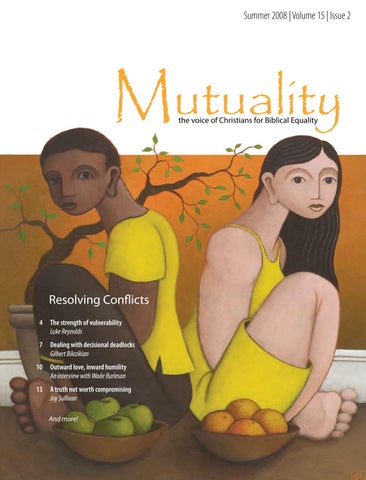
Summer 2008 | Volume 15 | Issue 2
Resolving Conflicts 4
The strength of vulnerability Luke Reynolds
7
Dealing with decisional deadlocks Gilbert Bilezikian
10
Outward love, inward humility An interview with Wade Burleson
13
A truth not worth compromising Joy Sullivan And more!
Contents Features 4
The strength of vulnerability (And why men learn dangerous lessons for conflict resolution) One man discovers what true masculinity means — by Luke Reynolds
7
Dealing with decisional deadlocks Resolving marriage conflicts when there is no appointed "head" — by Gilbert Bilezikian
10 Outward love, inward humility An interview with women's advocate and SBC pastor Wade Burleson — by Wade Burleson, compiled by CBE staff cover image
““Excellence” by Eric Nykamp © 2008 Eric Nykamp | Eyekons
13 A truth not worth compromising The devastating consequences when women are viewed as less than human — by Joy Sullivan
15 The power of even if A historian finds surprising evidence for biblical equality in traditional translations of Scripture — by Jason Eden
cover design by Shalanah Backus
18 Susan McLeod-Harrison’s Saving Women from the Church A book review — by Jane Spriggs
Ministry & Chapter News 19 Niagara Falls day trip 20 ARISE turns one year old 20 A report from the 2008 Jubilee conference 20 Praises, prayers, and reflections
Departments 3 From the Editor: Simple, but not easy 19 Answers to Tough Questions: "The gender issue is too divisive" 21 Giving Opportunities: A surprising story of God's faithfulness 22 President’s Message: Leading change through healthy friendships
2 | Mutuality Summer 2008
website: www.cbeinternational.org
From the Editor by Megan Greulich
Simple, but not easy In college, I first learned the difference between peacemaking and (what I thought was) peacekeeping. I read Michael Emerson and Christian Smith’s Divided by Faith, which highlights racial inequality and segregation in American churches. While it was easier to ignore the facts in front of me, the answer was simple: I knew racism and division in our churches should no longer be allowed to continue on, unrecognized and unnamed for what it truly was. And while earlier on in my faith walk I might have preferred to “keep the peace,” or “avoid stirring up trouble,” I finally understood then that what we were “keeping” was not the “peace” that God intended for us. Blessed are the peacemakers, Jesus told us. Peacemaking is messy, and far from easy — one day in a history class or at a marriage retreat reminds us that building long-term peace can be a process filled with conflict. Pursuing peace may lead us through difficult times, and the destination may not be what we expect. But it is an essential pathway for those of us who wish to seek justice, love mercy, and walk humbly with God. As we reflect on the church’s hotly debated issue of gender and leadership, few could call reconciliation between egalitarians and complementarians an easy task. It is a debate that has divided denominations, churches, families, and friends. It forces us to confront our beliefs about the very nature of God, and the nature of who we are as women and men in Christ. We may be convinced of the importance of this debate. But in the midst of what can be such a painful conflict, we still may find ourselves asking difficult questions. Do we compromise? Do we walk away? Do we honor God by stubbornly holding to a
view we believe is true? What if we are wrong? What happens if we are right and we give up our convictions? Conflict resolution is not easy. Yet we know we have a model of peacemaking in Jesus. In the midst of the most desperate conflict of all time, our separation from God, Jesus provided the ultimate solution. Love. It was a simple answer, but it was far from easy. Love. It was not a modifying of convictions or a resolution to keep quiet. It was passion, courage, sacrifice. It was agape. So what does love look like for us as egalitarians? Sometimes it is patience, a willingness to walk alongside a friend or family member as they search for answers. Sometimes love is compassion, a recognition of God in the eyes of someone who disagrees with us. Sometimes love is humility, a quiet moment of lowering our defenses and admitting that our tone or our assumptions were in error. Sometimes love is courage, a sacrifice of our own personal comfort to stand for what is true. And sometimes love is action, a resolution to speak for those who have not been allowed to use their own voices. Perhaps love is the most obvious solution for reconciliation, one that we might even call a “Sunday School answer.” Yet so often it is the solution we most easily overlook. We hope you will find love permeating throughout this issue as we explore what it means to resolve conflicts. May God bless you as you read and reflect! Megan Greulich is the editor of Mutuality. She may be reached at mgreulich@cbeinternational.org.
Do you have comments on this issue of Mutuality? We would love to hear from you!
Mutuality: the voice of Christians for Biblical Equality Let us then pursue what makes for peace and mutual upbuilding. — Romans 14:19 Mutuality (issn: 1533-2470) seeks to provide inspiration, encouragement, and information about equality within the Christian church around the world. Editorial staff: Megan Greulich, editor; M. L. Castleberry, Adele Hebert, editorial assistants; Image Spigot, graphic designer; Mimi Haddad, president/publisher. Contact us at: Christians for Biblical Equality; 122 W Franklin Ave, Suite 218; Minneapolis, MN 55404-2451; phone: (612) 872-6898; fax: (612) 872-6891; email: mgreulich@ cbeinternational.org; web: www.cbeinternational.org. We welcome your comments, article submissions, and advertisements. For writers guidelines, visit CBE’s website and follow the Publications links. Advertising in Mutuality does not imply organizational endorsement. Christians for Biblical Equality grants permission for any original article (not a reprint) to be photocopied for local use provided no more than 1,000 copies are made, they are distributed free, the author is acknowledged, and CBE is recognized as the source. Mutuality is published quarterly by Christians for Biblical Equality and is sent free to members. For membership information, see page 23. To purchase back issues or multiple copies, contact our office, or order online at www.equalitydepot.com.
bookstore: www.equalitydepot.com
Mutuality "Resolving Conflicts" | 3
The strength of vulnerability
(And why men learn dangerous lessons for conflict resolution) by Luke Reynolds
could see right through my façade, and he challenged My older brother, Christopher, and I stood me toChris let him in on how I was really feeling. Let him in! What!?
face to face on the top of a mountain in Edinburgh, Scotland. We had been traveling through Scotland for days together, weary and weak from extensive bike rides, long hikes, and the generally difficult time of finding adequate and cheap places to lay our heads for the night. In short: we were beginning to get angry and annoyed with one another. Our fight started when we were almost to the peak of the mountain, and Chris asked me as we walked, “So, how are you feeling — I mean, really feeling?” Chris had lost his hearing when he was two years old, due to a disease called meningitis. It wracked his small and fragile body, and left him with a complete absence of sound from that point on. Therefore, Chris taught me early on in our brotherhood that when we spoke, I needed always to look him straight in the eyes. When I didn’t he would grab my chin and re-center it so that he could see my lips and read my words as the air caught them. Possessing an incredible desire to understand the truth of things — never satisfied with easy answers or small talk — Chris was now at it again. He wanted to know how I really felt. The problem was: I didn’t want to share those feelings with him. The truth was: I was angry — enraged even. I was tired, cold, exhausted, and just wanted to lie down and sleep for three days straight. Deeper than that, I was at a point in my life when I felt crippled by an intense fear that I would never measure up, that I wasn’t a good enough man, that I was failing God in my Christian walk, and even that I was a hypocrite by sinning in secret and proclaiming God in public. 4 | Mutuality Summer 2008
That is way too vulnerable. No guys do that. Such were the immediate thoughts running within my mind. So I responded to Chris, “I’m fine, okay? Let’s just get to the top of this stupid mountain so we can come back down it and go to sleep.” I turned and began to walk away from him, moving faster now to get the whole hike over with. Chris simply remained still. After I sensed that he was no longer beside me on the trail, I stopped — growing ever more enraged now — and turned to him. “What!?” I yelled, and tried to show with a furrowing of my eyebrows and the gritting of my teeth how truly angry I was. Conflict had already descended on us like a bad case of food poisoning, and the last thing I wanted to do was have my stomach pumped. Indeed, as a male, I had been taught my whole life how not to deal with conflict. But then Chris did something that for me has become one of the models of authentic strength in my life — especially as a male, and because it was something I had never seen other male figures doing. Chris leveled with me, and demanded vulnerability, not bravado. “Luke, I love you so much as my brother, but I am going to challenge you right here, right now. You are afraid. You don’t let people in — like me — because you are afraid of what they will think. You have built up a persona that is false, and you’re trying to live through it rather than being honest with yourself and with others. You’re afraid, Luke, and that’s the truth.”
website: www.cbeinternational.org
“The mountains of Scotland extended to me the opportunity to catch a glimpse of what authentic strength is all about — vulnerability, not dominance; honesty, not fear.”
I wish I could say that I responded in rapturous gratitude to my brother’s honesty. Instead, I became furious. I attacked Chris with everything I could drag from the past about him: I attacked him ruthlessly, called him the one who was really afraid and threatened to take the first train out of Scotland, alone. But like an authentic figure of vulnerable strength, Chris listened and allowed me to finish my rant before he calmly said, again, “You’re afraid, Luke. It’s okay though. You can admit it. I won’t judge you — I only want to hear what you’re afraid of, and why.” All of my anger morphed into tears. To put it simply: I wept. I fell in my big brother’s arms, and I wept. Here was another male who had truly shown me what it is to love another from vulnerability rather than through a mask. Here was a male who challenged me from a place of love and authenticity. Our trip in Edinburgh — and our brotherhood ever since — has been totally transformed. In our society today, images of masculinity flood our eyes and ears. They shout to us: Real men don’t cry! Real men don’t talk! Real men aren’t vulnerable! But in fact, Jesus Christ modeled the exact opposite of what our culture tells us men should do. On numerous occasions, Jesus offered a soft word, forgiveness when others demanded wrath, and understanding when others demanded condemnation. Indeed, Jesus was incredibly adept at seeing to the heart of things — not settling for the surface of what people say and do. In John chapter 4, when the Samaritan woman went to the well to get water, she found Jesus there waiting. He modeled the
bookstore: www.equalitydepot.com
height of vulnerability when he asked her, “Will you give me a drink?” According to the time, the woman was shocked — as Samaritans and Jews did not associate. For the moment, forget about association, and think about what Christ did: he asked the woman for a drink of water. Christ admitted need, and he reached out to a woman in vulnerability to allow that need to be provided for. As the conversation in John chapter 4 continued, we see that Christ gets right to the root of the woman’s life — speaking softly and truthfully — and that the conversation ends with the woman’s belief that he is the Son of God. What a far cry from how men act and are viewed in our culture! Instead of putting on a show of false dominance or overt “Believe or perish!” terminology, Christ first became vulnerable with the woman, and then ministered to her. This is authentic strength, and authentic relationship, too. Recently, I watched a preview for the latest Rambo movie. I found the slogan used to attract a masculine audience severely troubling. It said: “Heroes don’t die; they just reload.” What!? The message such a slogan — and indeed, much of our mainstream media culture, and perhaps even many within our Christian family — sends is that real men are tough. To be masculine means that you are the leader, you are always right, and that if you are truly tough enough (a “hero”) you will have your way regardless of what others say or share. You don’t die, and you surely do not ever feel sad, afraid, or weak. You only need to reload your gun and then take care of business.
Mutuality "Resolving Conflicts" | 5
For men, the key step for conflict resolution is an inner change of belief about what it means to be strong.
This message is fatally dangerous when it comes to resolving conflicts. For men, the key step is an inner change of belief about what it means to be strong. We need to learn to see vulnerability and openness as strength. When we do, our conflicts suddenly become more manageable, because now we are dealing with the real truth of what is happening inside of us, rather than on the surface. In place of the Rambo ethos of masculinity, we can look to Harper Lee’s classic To Kill a Mockingbird for a very different proposition. At one point in the novel, Atticus Finch (a white lawyer who agrees to stand up and defend an innocent black man in a historic racist South), says to his children: “I wanted you to see what real courage is, instead of getting the idea that courage is a man with a gun in his hand.” Wow. Instead of advocating a masculinity that solves problems and conflicts by remaining silent (a common decision among men who say they don’t want to share their feelings) or worse, through violence or power, Atticus shares that real courage is delving beneath the layers and taking action on behalf of what is true. As Christians, the time for men to embody an authentic strength is now. We need to resist the easy temptation to remain incubated under the guise of toughness, invulnerability, fear, and anger. Instead, we need to throw off the power structures that so easily bind, and be more willing to talk openly about what is going on with us. It is okay to be afraid. It is okay to feel unworthy, or like a failure, or even like a hypocrite. Indeed, this is what Christ came to save us from, men and women alike. What is not okay is hiding these honest emotions within us, and creating conflict with those all around us.
6 | Mutuality Summer 2008
Jesus models what it means to see straight to the heart; it is high time we men take Christ at his word and model it for one another as well. I believe that when we do we will empower all of our brothers and sisters in this Christian faith to resolve conflicts with greater purpose and results, and ultimately to live in freedom. Luke Reynolds has taught three years of English at Farmington Public High School, in Conneticut. He recently completed his MA in English at Northern Arizona University, and will return to teaching in the public school system. He is the author of the book A New Man: Reclaiming Authentic Masculinity in a Culture of Pornography. His wife, Jennifer, is an advocate of women’s equality, and he loves her with all his heart.
A New Man Reclaiming Authentic Masculinity in a Culture of Pornography by Luke Reynolds
Visit www.equality depot.com today!
website: www.cbeinternational.org
Dealing with
Decisional
Deadlocks by Gilbert Bilezikian
The landscape of the debate between egalitarians and hierarchists (self-styled “complementarians”) has changed drastically owing to decisive gains that have been achieved by egalitarians on scriptural grounds. For example, egalitarians have shown that any hierarchical interpretation drawn from the creation account of man and woman was actually read back into it from post-fall situations. There is not even a hint of a hierarchical structure existing between man and woman in the story of God’s original design for male/female oneness. In particular, it has been pointed out that the word “helper,” so often used as a device for the subordination of women to men, actually has the strength of “rescuer.” God provided the man with the one who delivered him from the “no good” situation of being alone, so that they could bond together into the “one flesh” community that God had intended to create from the beginning.
bookstore: www.equalitydepot.com
The accurate understanding of the use of the head-andbody metaphor in the New Testament has provided another major advance for egalitarians. It has been decisively shown that Christ’s ministry as “head” to the body is consistently defined as sacrificial servant-provider of life, growth, salvation and unity. Never does it indicate or even imply authority or leadership. Similarly, the “headship” of husbands toward their wives is described in the New Testament, not as exercise of authority, not even as submission within the model of mutual servanthood, but as something infinitely more demanding than mere submission: as a mandate for husbands to love their wives to the point of sacrificing their will, their pride, and their lives for them. Another giant step toward the rehabilitation of women as full members in the community of oneness pertains to their participation in church ministries. No more can women be excluded from exercising their spiritual gifts, since similarly
Mutuality "Resolving Conflicts" | 7
stringent restrictions are also required of men aspiring to positions of leadership, of teaching, and of church management. Indeed, it has been observed that the same passage in 1Timothy that is used to restrict female ministries goes on to screen male candidates on the basis of their family status. According to a consistent reading of the text, not only are women excluded from such ministries, but also single men, childless married men, men with only one child, and men with disobedient or disrespectful children. Obviously, the application of such provisions would eliminate most leaders in churches today. As a result, biblical scholars are recognizing that the standards laid out in this epistle are exceptional rather than universal, and that they apply to churches that find themselves in similar situations of crisismanagement for survival. A remaining sticking-point in the dialogue concerns the process of decision-making within marriage. The hierarchical approach lays the burden of decision-making on the husband, thus victimizing him as the all-competent enforcer, and his wife as perpetual loser. Fortunately, the Scriptures address conflict resolution head-on by providing principles supported with a practical case-study.
8 | Mutuality Summer 2008
A Definitive Passage on Conflict Resolution This definitive teaching is found in the New Testament section where the Apostle Paul deals extensively with issues that concern gender relations among believers. In 1 Corinthians 7:3–5, he goes to the heart of the matter through the lens of a believing couple’s sex life. Instead of commenting on a relatively trivial matter such as the purchase of a home, the addition of a child, or a change of profession, he focuses on the “one flesh” relation that concretely symbolizes the couple’s union. The ancient Greek thinkers were dualistic, meaning that they separated relational life into two categories: the higher plane at the level of “pure” interaction of soul and mind; the lower area relegated to the supposedly vile physical part of human functions, including sexual activity which was considered to be an animalistic expression of human nature. Not so for the authors of the Bible! For them, the male/ female gender differentiation is essential to the “image of God.” Moreover, they freely describe the relation between the Creator
website: www.cbeinternational.org
and his people in terms of spousal relations. In the very context of our 1 Corinthians passage, the apostle ascribes the highest dignity to the body in the context of sexual interaction as the noblest expression of physical oneness: the believer’s body is meant for the Lord and the Lord for the body (6:13). Because our bodies are members of Christ (v. 15) and, by virtue of the creation design according to which: “The two shall become one,” (v. 16), a believer who is united to the Lord becomes one in spirit with him (v. 17). Therefore, our body is a temple of the Holy Spirit (v. 19) in which God is glorified (v. 20). In this paradigmatic text regarding decision-making (7:3–4), the apostle lays down the basic biblical requirement of spouses to respect each other’s rights within the context of shared authority. This passage happens to be the only place in the Bible where the word “authority” is used to describe the husband/wife relationship. The fact that it is used in verb form makes it even more compelling as a principle of mutual submission. There is absolutely no allowance in this relational model for one spouse to exercise unilateral authority over the other. The symmetry of privileges and obligations is flawless. In order to reinforce this teaching, the apostle adduces a real life situation that requires spouses to make a major decision involving their own intimate relation and their relationship to God (v. 5). According to the apostle, the decision may not be forced on one spouse by another as if one were the leader. It is reached by consensus between equal partners as appropriate within the relationship of oneness. It must be noted that, predictably, this passage makes proponents of female subordination uncomfortable. They either choose to ignore its existence or reduce its application exclusively to equality in sexual relations, thus falling into the same dualism as the ancient Greeks. Egalitarians owe it to the Christian community to proclaim that this template of mutual submission is the one that biblically governs all decision-making situations in the lives of Christian couples.
When Stumbling Blocks Emerge Despite the goodwill inherent in the mutual submission model, stumbling-blocks commonly emerge in situations where wellmeaning spouses may become honestly unable to reach a consensus and remain stuck in decisional impasses. In such cases, the most relationally destructive solution is for one spouse to claim the right to impose one’s will on the other. The purpose for this article is to present biblical alternatives for the resolution of such deadlocks that are consistent with the biblical call to mutual submission (Eph. 5:21). • Don’t insist on having your own way, but defer to the other person’s preferences. Seek to please the other, not yourself. Sacrifice your will to the common good. Be humble. • Seek a compromise. In the presence of two conflicting options, find a third way acceptable to both parties.
bookstore: www.equalitydepot.com
• Agree to predetermine areas of competency (spiritual gifts) where each of the partners is the one better qualified to render the final decision, and stick to the pre-arranged division of responsibilities. • Figure out which partner has the most to lose in the outcome of the decision, and allow him or her to make the final call. • Separately and together (if still possible…) consult the Holy Spirit for guidance. Prayer can open hearts and minds when nothing else works, to say nothing of providing supernatural solutions. • Take turns at having the last word. Be allowed to win one time. Accept to lose the next time. And so on. • When desperate enough for a resolution, involve an impartial, mutually acceptable third party to settle the differences after having promised to abide by his or her decision. • Submit the issue for advice to your small group and make yourselves accountable to them not to be selfish and stubborn. • Whenever possible, buy time. Of its own, the passing of time resolves a lot of problems. • Engage together in research projects on the issues involved, with both parties promising to be open to learning and changing. Whenever applicable, conduct together a wellinformed Bible study about the matter. Basic biblical principles are applicable to most situations in life. • Learn to suspend certainty. Be open-minded enough to try to argue for the other person’s position better than he or she does. • Do not react emotionally to differences of opinions. Do not interpret them as personal rejection. Allow each other the right to independent judgment. Don’t allow disagreements to poison relationships. • Take a course or read valid books on conflict resolution. A little common sense can spare a lot of grief. Finally, follow the teaching of biblical scholars who believe in the community of oneness. Availing yourselves of the resources of Christians for Biblical Equality is a good place to be! *Any resemblance between the contents of this article and parts of Beyond Sex Roles is purely incidental and due to the fact that they were both written independently of each other by the same author. Gilbert Bilezikian (Th.D., Boston University) is professor of biblical studies emeritus at Wheaton College. He is a charter member and elder at Willow Creek Community Church and the author of many books, including Beyond Sex Roles: What the Bible Says about a Woman's Place in Church and Family.
Interested in extra copies of Mutuality? Bulk quantities of Mutuality and Priscilla Papers are now available at great discounts for members! Contact us at cbe@cbeinternational.org.
Mutuality "Resolving Conflicts" | 9
Outward Love, Inward Humility An Interview With Women’s Advocate and SBC Pastor Wade Burleson by Wade Burleson, compiled by CBE staff
“Brave” is a word we might use to describe Wade Burleson. As a Southern Baptist Convention pastor, Wade blogged daily for over two years, advocating for the just treatment of women in his denomination.
CBE: You have faced harsh criticism for advocating for women in your denomination. What drives you to keep working for change?
WB: I am a relative newcomer to the gender debate within the evangelical church. Though I have been a lifelong Southern Baptist, it was not until the last couple of years that I discovered that the leadership of the Council on Biblical Manhood and Womanhood is composed of a number of Southern Baptists. I was also unaware of the work of Christians for Biblical Equality until about two years ago. Both these organizations are filled with evangelical, Bible-believing Christians, and I have profited from the writings of men and women in both camps. Honestly, I see the scriptural arguments on both sides, and am uninterested in separating from fellowship with any believers who find themselves to be egalitarian or complementarian through their individual study of Scripture. What drives me to work toward
10 | Mutuality Summer 2008
change is my personal knowledge of five Baptist women who have either been removed, terminated, or marginalized (in terms of their professional careers in Christian ministry) by men who hold to what I consider an extremely patriarchal viewpoint.
CBE: What has this gender debate taught you about God? WB: I have always felt that God was full of grace, mercy, and love. In working through an understanding of the New Covenant and what it means for all God’s covenant people to experience the full measure of his grace, I have grown to appreciate even more that the pleasure of God is upon all his children because he chooses it to be, and not because any of us deserve it more than another. The full import of this truth makes equal the ground under the feet of men and women, rich and poor, slave and free, Jew and Greek, etc.
website: www.cbeinternational.org
CBE: What has the debate taught you about justice, human
nature, and power?
WB: Unfortunately, I have seen glimpses of fulfillment of the phrase ‘power corrupts and absolute power corrupts absolutely.’ When men fill positions of power in Christian ministry, there is a tendency, by human nature, to seek to protect their positions from the encroachment of females. The most irritating aspect for me is the attempt by some to justify their subjugation of women by attempting to say the Bible prohibits women from positions of authority, when in reality, there are no such biblical prohibitions at all. I’m not talking about the office of pastor, (even though I understand the arguments on both sides of that issue), but rather, other positions that are frequently held by women such as Hebrew professors at seminaries, missionaries on the field, and administrators at Christian agencies. CBE: Do you think the church will come to a consensus on giving
women equal positions of service beside men?
another congregation who sees it differently, then there would be no need to come to a consensus. Personally, I think we all need to work a little bit on our outward love and inward humility.
CBE: What do you say to those who feel you are just stirring up unnecessary conflict?
WB: I am responding to the injustice I see around me. Had I never met the female Hebrew professor, had I never known the female vice-president of one of our denominational agencies, had I never spoken with several female missionaries, and had I never met the female church staff members who were marginalized, denigrated, and in some cases removed because of their gender, I would not be saying anything about this issue. It is not an ivory tower theological issue to me — it is a very practical issue with a human face. CBE: As you have spoken out for many different women, what has moved you the most?
WB: When the tenure track Hebrew professor at Southwestern WB: I believe just discussing the issue is helpful and healthy. Theological Seminary (a woman awarded a Bachelors degree by a
The one benefit of speaking out on this issue is to combat the silly accusation that any Christian who holds to egalitarianism is automatically a ‘liberal.’ It has been good for my denomination to see that conservative Christians can articulate their egalitarian views based upon a high view of Scripture. My sole goal personally has been to help us to see there ought not be any division of fellowship because of disagreement on this issue. I also predict that in thirty years the vast majority of Christians will be practical egalitarians if not theological egalitarians. In other words, I do believe the church will come to a consensus on women having equal positions of service beside men, and that consensus will eventually be an egalitarian one. I also believe when future Christian generations look back at ours, they will wonder why we even fussed over the issue.
baptist college, a Masters degree in Hebrew by a baptist seminary, and a Doctorate in Hebrew by Southwestern Theological Seminary) is hired by trustees at SWBTS to teach Hebrew, only to be terminated by a man who holds to an extremely patriarchal theology, and then finds herself having to sell her blood to meet family expenses — that changes you. When I realized that was happening, I said, “This is it — I cannot allow this to go on.”
CBE: You seem to have a great interest in history. What
insights have you gained from history as you consider this current gender debate?
WB: It seems to me that those concerned about gender discrimination should read the playbook of the radical Christian CBE: Do you think the church needs to come to a consensus on abolitionists of the 1850s and 1860s. In my mind, the gender debate the gender issue? and slavery have much in common. Both blacks and women have been suppressed because of physiological differences with white WB: If we were healthy and humble and demonstrated love for men. Unlike homosexuality, which is a matter of sinful behavior, one other in spite of our differences, then the church would not being a woman or being black is not a sin. Some might argue that need to come to a consensus on this issue. We could cooperate what a woman does is a sin, but not being a woman. Of course, with each other while disagreeing. A church might call a female it was said in the 1850s and 1860s that being ‘black’ was not pastor, while another church a sin — but for a black man like mine might believe that to want to do what a white decision to be unwise, or man did was. Thankfully, we even unbiblical. However, now have a culture where it if the complementarian is becoming easier for blacks “This has nothing to do with congregation could exhibit to do what whites do. One of the ‘feminist’ movement. a little humility, admit they these days our culture will feel could be wrong in their the same about women. And, It has everything to do interpretation, simply hold it has nothing to do with the with the gospel.” to what they see Scripture ‘feminist’ movement. It has to teach, and not condemn everything to do with the gospel.
bookstore: www.equalitydepot.com
Mutuality "Resolving Conflicts" | 11
CBE: In your recent post on the Battle of Shiloh, you wrote
“I am reminded that great struggles, which ultimately bring about significant change, often present the deepest ironies.” How have you seen this in your work for women?
WB: The biggest irony to me is the fact that our Southern Baptist Confession of Faith only prohibits women from the ‘office of pastor,’ yet some Southern Baptists wish to prohibit women from every position within the church or any other office outside the church that has any kind of authority over men. Further, when women serve on Southern Baptist church staffs, complementarian congregations call them ‘directors’ rather than ‘ministers,’ though these gifted women are ministering and serving just like a man would in the same position, a man the congregation would bestow the title ‘minister’ upon were he in it. It reminds me of the old fable ‘The Emperor Has No Clothes.” I sometimes wonder if Southern Baptists really think women aren’t ministering if they simply don’t call them a minister. Who are we fooling? God? CBE: Why do you think this is such an emotionally charged issue for Christians? Is there a way to discuss this, without such intense emotion? Or do you think that emotional connection is necessary? WB: My last year serving as President of the Baptist General Convention of Oklahoma (2004), I was presiding over a business session where a woman was elected as vice-president for the first time in the history of our state convention. During the vote for this position between the woman who eventually won and her male counterpart, male messengers turned their back on the platform when it came time to vote on the woman. I was asked to help plan a national conference that would debate the gender issue We were discussing the big names that we would invite on both sides. There are some wonderful egalitarian scholars that are conservative and evangelical, just as there are on the complementarian side. However, I proposed for us to really host an impartial conference, we would need to invite a female scholar to make presentations at the conference on behalf of the egalitarian side. I was told this would be impossible because the complementarian men would leave the auditorium.
I have seen the emotion to which you refer. Why is it there? Because some honestly believe the Bible’s commands about women’s roles in the church are being violated. The only way this kind of emotion can be removed in the discussion of this issue is for both sides to acknowledge the possibility of error in their interpretations. Notice, I am not saying someone must say “I am in error.” That would be foolish. We practice our Christianity according to our beliefs. So an egalitarian will practice egalitarianism, and a complementarian will practice practice complementarianism (although I see more and more complementarians who are functionally egalitarians). To admit the possibility of error is to allow others to be free to practice their Christian faith the way they interpret Scripture, without condemning or judging them, and without forcing them to practice it the way you see it. I just do not believe this is an issue over which Christians should divide.
CBE: Do you have days where you feel like giving up? What words
of encouragement do you have for the many individuals working for biblical equality in their churches and communities?
WB: To give up indicates that you are actually working at something. The only thing I desire is for love to increase among the people of Christ, and that is not what I would call “work” as much as I would “Christianity.” I will never give up on that. For those who are working towards equality I would simply encourage you to be humble. Read articles on both sides — particularly the side with which you may not agree. Stay informed of the issues, and write about them on your blog or contribute articles to magazines. Don’t be afraid to discuss the issues. Study Scripture and be ready to give an answer to the person who asks you for the reason for the hope within. And above all, be humble in your approach and love people who disagree. Wade Burleson has served as pastor of Emmanuel Baptist Church (Southern Baptist) in Enid, Oklahoma, for the past fifteen years. Wade and his wife have four children.
Not For the Faint of Heart “I have seen a woman employee of one of our agencies lose the job of her dreams, sell her blood to meet expenses, and face the humiliation of being called a tool of Satan — all because she was a ‘woman in a position reserved for men.’ I have met missionaries who lost their jobs overseas because they refused to bow to the political pressure of their superiors, and then sacrificed their children’s college education by spending those college funds in an attempt to fulfill their call and stay on the mission field. I have met a number of Southern Baptists who have been abused, lied about, mistreated, and terminated — and they are now fighting to right the ship of their lives. And yet we Southern Baptist pastors are doing nothing to correct the problem or help our wounded. We spend more time defending ‘ourselves’ against perceived attacks than we do helping those who have actually had their lives turned upside-down. We are arrogant, self-absorbed men who are more concerned about what people think of us than we are about helping our own people who have been abused and discarded like oily, dirty rags. And, frankly, I’m tired of it.” Quoted from Wade Burleson’s March 20, 2008 post “Warning: This post is not for the faint of heart” (kerussocharis.blogspot.com).
12 | Mutuality Summer 2008
website: www.cbeinternational.org
A Truth Not Worth Compromising by Joy Sullivan
A faulty metaphor gets in your head. You feel it birthing new thoughts, feeding on your fears, spreading through your body, pulsing in your veins. If you believe it long enough, it moves to your chest and becomes your heartbeat. I once heard a pastor compare women to teacups. He explained that husbands need to treat their wives like fine china, gingerly, with the tentative hesitation as one approaches a foreign thing, separate from themselves. Men need to revere them, to pamper them, to compliment them. He asserted that women are like teacups, emotional, soft, in need of protection. Embodied in their fragile frames is a delicate feminine essence incomprehensible to the masculine mind. “Women are confusing to men,” he joked. “It helps us to understand them as teacups.” I do not think that speaker was a bad man. But I do think his approach was evidence of a culture that has far too long allowed poor metaphors to tell the story of who women are — of a culture that has relied on improper language to describe relationship. Teacup language is everywhere, objectifying women to nameless, inanimate things depicted as rosebud china or dainty porcelain. We are told that this helps us understand our differences, but instead we see these metaphors break down as we fail to recognize personhood in the eyes of someone else. These flawed metaphors permeate our relationships, our homes, ourselves. The implications are heavy if they are internalized. Inevitably, they limit us.
bookstore: www.equalitydepot.com
A teacup has a thin handle, delicate interior, and a breakable surface. It will always splinter if dropped. A teacup must be frail. There are marks on her body. They aren’t big enough to get medical attention yet. Not yet, she thinks, not yet. She rolls to the end of the bed. She can still smell the scent of him, a smell she used to love, now mingling with alcohol and the scent of her own loneliness. One effort gets her a shirt, another movement, she has dressed herself. There is a phone ringing somewhere. And the faraway sound of her child shifting in his bed. The day has descended and the violent events of last night seem removed and distant. Surreal. She moves to the baby’s room, to watch him wake. She likes this part of the day. Her three-year-old stirs again. She can hold him when he is like this, hovering between the daylight and dreams. And she stares at the open window and her own hopes well up and threaten to spill out of her chest. She kisses the inside of her baby’s palms, his fretful eyes, his soft warm forehead. She envies him with his sleepy smile and those wide blue eyes eager to see the morning. But she can see nothing before her. Nothing but the fear and the rage and the love that still blinds her. While she once knew courage, she cannot leave now. She is too afraid she’ll shatter.
Mutuality "Resolving Conflicts" | 13
A teacup cannot move on its own. It is lifeless. They are marks on her insides — stains appearing from the lies that pulse through her body. Her words are all shredded now, plastered on the inside of herself like graffiti against pavement. When she tries to articulate her thoughts, her words come out in tangled gasps. She can remember a time when she was proud of what she had to say. She can remember a time when she dreamed of using her words to speak truth, to proclaim the message she loved, when she felt it burning inside so strongly she couldn’t help but speak. But she can also remember the first time she felt the sting of rejection. “The pulpit isn’t the place for you.” “You will be able to serve in other ways.” She can see the look in their eyes — she is somehow unqualified. Inadequate. Her purpose has been decided already for her. Gradually, she learned that her emotions are invalid, that her feelings are weakness. She doesn’t know what it is to have men’s respect, only their coddled sympathy, their well-meaning condescension. She placed herself safely up on a cupboard shelf, to hide from them, and from her own pain. There is a deep bitterness now; she cannot look a man in the face without it swarming over her like a cloud. She sits and waits in the darkness till her insides are raw and her words are smeared and ruined. And with the pain of injustice still rocking in her soul, she fears there is no way off the shelf.
A teacup can have no intrinsic value. It is empty apart from the beauty assigned to it from the observer. Its worth is gained from being looked at. Julia is making marks on the windowpane, breathing little foggy O’s on the glass and watching her reflection fade and appear again. She watches the frost clear away and she sees her own chocolate brown eyes peer back at her. The reflection unnerves her and she slides back on the seat and waits. The bus slows and she slips off it.
Her mother can see her traipsing up the driveways, backpack slung over one shoulder, carefully avoiding the cracks in the pavement. She worries as she watches her daughter’s body careering into womanhood, aware of the pressures she faces growing up in today’s society. The woman smiles and gives a little hello as her daughter enters. Julia is quiet, introspective, keeping mostly books as friends, drawn to tomboyish activities and spending the majority of her afternoons up a tree. Her mother likes this about her, taking pride in her daughter’s fierce independence, seeing something half-formed and beautiful about her unusual ways. The question of how the school day went is met with a sigh and then “Mom, I just…don’t think I’m pretty enough.” With a surge of maternal defensiveness, her mother suddenly feels protective of her daughter’s quirks, her girlish face, her inability to fit into stereotypes. She wants her to feel free to love whatever it is she naturally loves. She wants her to live in a world where she won’t be afraid to use her gifts. As she watches her daughter struggle against the labels others stick on her, she calls for a new metaphor.
A woman is human. A woman is not a construct of breakable glass, but shaped fully and powerfully in the image of Christ. Consider the impoverished woman in Luke 8:42b–48 who had been suffering from a condition that caused her to bleed continuously. But when she saw Christ, she knew her time for healing had come. In spite of her humiliation and in spite of her fear, she reached out, touched his robe, and immediately the bleeding ceased. Jesus responded by insisting on knowing who had touched him. He searched the crowd for this woman so he could find her, speak to her, and ultimately give her hope. Through the midst of confusing labels and broken metaphors, we must remember to search for the face of a God who has not forgotten us. We remember to no longer be constrained but to reach out in spite of the fear and shame that engulfs us. In our places of pain, we can touch Christ, and find healing. When we encounter Christ, we realize our true worth, our humanity, our strength in Christ. We remember that we are not china, and we do not easily break.
Joy Sullivan is a senior at Bethel University. This May, she is graduating with an English literature and writing degree. She is currently a writing intern for CBE and resides in St. Paul, Minnesota.
14 | Mutuality Summer 2008
website: www.cbeinternational.org
The Power of
Even If by Jason Eden
A historian finds surprising evidence for biblical equality in traditional translations of Scripture
As a history major in college, one of the first lessons I learned was the persuasive power of the phrase even if. This phrase relates to how historians use documents — such as diaries, court records, letters, and other texts — that hold clues regarding the past. Far from being neutral “fact-containers,” however, documents from previous eras, just like documents written today, contain and reflect the experiences and biases of their authors. The power of even if comes into play when historians use documents of a certain bent, that is, those with an inclination to tell one side of the story, as evidence in favor of the other side. Perhaps an example would illustrate this concept best. When studying the abuse of slaves in the United States during the 1800s, one would not expect to find much helpful evidence within the published writings of slave owners. One would expect that slave owners would hide or underplay instances of whipping, rape, or other brutalities in an attempt to portray slavery in a positive light. Yet, historians have discovered that even if they look at texts authored by plantation owners, they do, in fact, find evidence that masters abused their slaves.
bookstore: www.equalitydepot.com
An unusual journey So what does the power of even if have to do with egalitarianism and Scripture? Well, as a historian, my reading of the Bible and my experiences have brought me to an egalitarian position via a somewhat unique road. I grew up in a conservative church that emphasized male headship in the home, restricted pastoral positions to men, and cultivated a patriarchal culture. Early on, I was exposed to traditional interpretations of verses such as 1 Peter 3:1–7 and 1 Timothy 2:11–15. At the same time, my academic training in high school and at secular universities equipped me with critical thinking and analysis skills through which I might study documents and obtain answers to questions on my own. The way I have studied the Bible has differed somewhat from how theologians, linguists, and pastors examine Scripture. Lacking advanced training in Hebrew, Greek, or Latin, I have analyzed passages by looking at the text to see how various people behaved in the past. In particular, I have been keenly interested in clues regarding God’s character and how he has worked in
Mutuality "Resolving Conflicts" | 15
relationships between men and women. Because of this, my interest has been mostly directed towards the events and stories presented in the Bible with less emphasis upon the epistles or other doctrinal statements. It is primarily in the stories of the Bible that I first discovered answers to questions regarding God’s view of gender roles. What my intellectual journey shows is that even if a person examines traditional translations of the Bible, such as the King James, there is abundant evidence found within that God values gender equality and that he wants men and women to mutually submit to one another. That is, even if we set aside debates regarding language and the meaning of controversial passages (as valuable and important as those are), and even if we use versions of the Bible translated by men who lived in patriarchal societies, we still find evidence to support the egalitarian view of Scripture.
A case for mutual submission
dangers of male submission. Yet, this seemed to me to be only one side of the story. What I found as I examined various passages was surprising. In Joshua 2, Rahab provided instructions to the Israelite spies who explored Jericho. Passages in Joshua refer to her quite favorably, indicating that she respected God, discerned His will regarding the fate of Jericho, and eventually lived among the Israelites. Furthermore, there is the example of Ruth and Boaz, with each person responding and submitting to the other (see Ruth 3:9–11 for the moment when Boaz agreed to do as Ruth requested). In Judges, the story of Deborah and Barak further demonstrates that submission to women was not necessarily wrong for men — it depended upon the circumstances and spiritual discernment of everyone involved. Again, even if we read traditional translations of the Bible, it is clear through stories that God affirms the notion of godly men submitting to godly women.
The question of spiritual leaders
So what kind of evidence can a historian find for egalitarianism in traditional translations of the Bible? Perhaps my first discovery The last issue I investigated during my journey toward has been the most powerful. As already stated, I was familiar with egalitarianism was that of women as spiritual leaders. Was it traditional interpretations of 1 Peter 3, part of which (at least in the acceptable for a woman to be a pastor? Could women teach men KJV and NIV) suggests that women need to follow Sarah’s example in church settings? My analysis of the Bible indicated that God and submit to their husbands. At face value, such a passage seems is, in fact, quite open to the notion of women being spiritual hostile to the egalitarian view. However, my training as a historian leaders, both formally and informally. and my curiosity provoked me to explore further. The Bible is quite clear that women, in both the Old and What was the true nature of Abraham and Sarah’s relationship? New Testaments, held positions of spiritual leadership. Women such Was it characterized by female as Miriam, Huldah, and Anna served submission and male headship? I as prophets, songwriters, and musical turned to Genesis for answers and was leaders (see Ex. 15, 2 Kings 22, and quite surprised when I read chapter Luke 2). In Acts and the epistles, it is 21, verses 8–14. In this account, God clear that Priscilla, Claudia, and other God recognized specifically commanded Abraham to women taught men and held positions submit to his wife! He told Abraham of prominence in the early church. and recorded those in verse 12, “Listen to whatever Sarah Perhaps more interestingly, moments when tells you because it is through Isaac and less often recognized, are those that your offspring will be reckoned” instances in the Bible when men women demonstrated (NIV). Regardless of our opinions submitted or should have submitted greater discernment concerning the complex circumstances to ordinary women who, at key surrounding Hagar, Ishmael, Abraham, moments, possessed spiritual insight and spiritual maturity Isaac, and Sarah, it is compellingly and discernment. Reading about Judah than men. clear that, in this case, God expected a and Tamar (Gen. 38) and Hannah husband to submit to his wife. So if, as and Eli (1 Sam. 1) showed me that 1 Peter 3 suggests, Abraham and Sarah’s God recognized and recorded those relationship is a model for Christians to moments when women demonstrated follow, perhaps our marriages should greater discernment and spiritual maturity than men. Interestingly, in those cases, the men were involve a degree of mutual submission after all. As powerful as the above example seems, any good historian humble and honest enough to recognize their errors and change recognizes the need for more evidence. So, I continued my search their speech and behavior. In the New Testament, I read in through Scripture, looking for patterns and additional clues Luke 24 about the two disciples who doubted Christ’s resurrection. regarding God’s position on gender. One question I asked myself Immediately after telling Jesus about their doubts and about how as I perused the Bible was “Does Scripture positively portray two women witnessed the event, Jesus soundly rebuked them. It instances of men submitting to women?” I was very familiar requires little imagination to believe that an aspect of Jesus’ disgust with Samson and Delilah, Adam and Eve, and other stories related to their stubborn unwillingness to listen to women who, that seemed to focus on the seductive power of women and the unlike the two disciples, knew the truth.
16 | Mutuality Summer 2008
website: www.cbeinternational.org
A historian’s reflections My journey toward egalitarianism has been long and fruitful. The tools of a historian, properly employed, unlock clues regarding God’s character differently than the tools of a linguist or theologian. In addition, although I recognize the important work of theologians and linguists, my journey shows that egalitarianism does not depend solely upon the linguistic analysis of specific passages. One need not have advanced theological or linguistic training to study the Bible and find evidence for the egalitarian position. Indeed, this is true even if we use translations of the Bible that reflect the biases of patriarchal scribes.
bookstore: www.equalitydepot.com
Like the Bereans mentioned in Acts 17:11, we need to be people of open minds and noble character, who investigate Scripture for ourselves and discover, within it, truths that equip us for healthy and balanced relationships. Dr. Jason Eden earned his Ph.D. in history from the University of Minnesota. Currently, he is a history professor at Saint Cloud State University while his wife, Naomi, is pursuing a graduate degree in gerontology.Together, they are currently studying how attitudes regarding the aging process shaped relationships among early American Christians.
Mutuality "Resolving Conflicts" | 17
B oo k
R eview :
Susan McLeod-Harrison’s
Saving Women from the Church — How Jesus Mends a Divide by Jane Spriggs Visit www.equalitydepot.com today!
“God is a feminist. For egalitarians, it’s a cliché; for other women, they have never heard this…the gospel is good news to those who have never heard it.”
– Susan McLeod-Harrison
I had just finished teaching an adult Sunday School class on spiritual gifts when a friend ran up to me and asked, “Did you hear what pastor said today in his sermon — that women can’t teach men — and he used you as an example?” In processing my pain and confusion from that day, I found resources from Christians for Biblical Equality that helped me heal, and led me to Jesus. Now, there’s a new publication that offers similar hope and healing for women: Susan McLeod-Harrison’s Saving Women from the Church — How Jesus Mends a Divide. Because of the book’s small (8" x 5") size and readable format, Saving Women from the Church could be read devotionally or used as a group study. The book addresses a wide range of painful issues women have faced in the church — chapters titles include: “If you’ve ever felt alienated and judged in church,” “If the church has been an unsafe place to share your woundedness,” “If you’ve ever felt your kids aren’t welcome,” and “If the church has resisted your call to minister.” The book’s format draws the reader in. Each chapter tells two stories — the first vividly describing one woman’s struggle; the second illustrating Jesus’ response to a woman suffering a similar injustice in the Bible. McLeod-Harrison’s biblical expertise is evident in each chapter when she digs into the Bible’s cultural background and connects it to the countercultural nature of Jesus’ redemptive actions towards women. She also includes thoughtful reflection and discussion questions; meditative exercises at the end of each chapter lead readers to Jesus for personal healing. I had a chance to talk recently with the author about her own spiritual journey. McLeod-Harrison, a graduate student, wife, and mother, told me Saving Women from the Church came out of her
18 | Mutuality Summer 2008
healing after co-teaching a Sunday school class on Jesus and women in the mid-1990s. As she prepared and taught the class, she began to experience God’s deep love for her as a human and a woman — and she was determined to share this experience with others. This book is the result. McLeod-Harrison, who holds a Master of Divinity Degree from Regent College (Vancouver, BC), wrote Saving Women from the Church with a pastoral burden for women who have been “alienated by the church, who wanted to write the church off, and perhaps who haven’t set foot in a church in years.” In other words, the book is for women who “haven’t been loved by the love Jesus showed women.” McLeod-Harrison’s heart for healing (she is a doctoral candidate in clinical psychology at George Fox University) permeates her book — from the book’s introduction which addresses women’s foundational questions, such as “Can I be myself with God?”, and “Can I be myself in the church?”, to the book’s appendices which include keys for interpreting the Bible and looking at difficult passages through the law of love. In fact, Jesus’ “law of love” (Matt. 22:34–40) is a central theme in Saving Women from the Church, and the key biblical hermeneutic for McLeod-Harrison. She believes approaching the Bible in this way lends insight into the controversial passages, “leading people to love rather than to judge or alienate people.” McLeod-Harrison clearly has a heart for women from all ethnic backgrounds, as names and settings in Saving Women from the Church are multicultural. In addition, she shows sensitivity to justice issues; themes of abuse and domestic violence are included in the stories, and she refers readers to resources to help heal women’s wounds. Saving Women from the Church is a powerful book that will bring restoration and healing to women through the love of Jesus Christ. McLeod-Harrison told me of women who’ve cried their way through the book as they have, for the first time, understood their wounds, and realized they haven’t had a place to heal. This is one reason the book is ideal for groups — as women bring their experiences in church to Jesus and to each other, with the Bible as anchor, they can heal without leaving the church or their faith. Jane Spriggs (MDiv, MS) is a pastor. She also is a faculty associate at Bethel Seminary and Bethel University, St. Paul, Minnesota, where she teachers spiritual formation classes. She lives with her husband and two sons in Maplewood, Minnesota.
website: www.cbeinternational.org
Answers to Tough Questions by Alvera Mickelsen
Q: My church is unwilling to address the gender debate, feeling that it is too divisive. I have tried many times to advocate for women, but I am labeled as a trouble-maker and a radical. How do I, in a non-threatening way, encourage my church to examine the issue?
A: This is a familiar dilemma and there are no easy answers. Perhaps some of the following suggestions will be helpful: • Does your denomination have restrictions that eliminate women from all positions of leadership? If so, your local church cannot move toward equality. The only possibility may be to consult the editor of your denominational magazine and suggest a forum on the subject, in which both sides are presented. Many people have never heard an alternative biblical view. • If the denomination has no official restrictions, look at the constitution of your local church. Does it contain any restrictions that would prohibit women from serving in all offices? If not, you may be able to make small steps within your congregation, appealing to the constitution. • No progress is ever made until the pastor is willing to discuss the subject. So you need to start there. Perhaps you can give him a short book on the subject and ask if he would be willing to read it and discuss it with you. If he agrees and you meet to discuss, listen carefully and respectfully to all that he says. Carefully prepare questions that you can ask regarding the biblical text (if that is his basis) or about the history of the church. Don’t let it become a debate — just a sharing of ideas on the subject. Offer to get more material for him (see the CBE catalog!) if he seems open to further discussion. If possible, make a date for your next meeting and discussion. Always appeal on the grounds that you know he wants to be faithful to the Bible, and to work for the good of the church. Thank him for his willingness to talk with you about this.
• If the discussions with your pastor go well, you may eventually ask how he would feel about the subject being discussed in a women’s group, or in an adult Sunday school class. In whatever venue the subject arises, make plain that this is not for the benefit of women, but for the benefit of the church which is being denied the gifts that God has obviously given to some women. Not using women’s gifts limits the outreach of the church. • Make plain that you are not seeking to be a leader, but rather opening the door to the gifts God gives to women. If and when an opening becomes available for a woman, you need to have someone else in mind to suggest so that it is clear you are not seeking your own power or prestige. • Pray. If possible, let your discussions with the pastor or other leaders always begin with prayer. Pray that everyone will have an open mind and show respect and love to those with whom they differ. • Persevere. Remember that those bringing prophetic messages to God’s people were not often welcomed with open arms. • Find community with like-minded Christians. If your church is not egalitarian, consider starting or participating in an existing CBE chapter in your area. Alvera Mickelsen has been active in Christians for Biblical Equality since its beginning. She and her late husband, Dr. A. Berkeley Mickelsen, both taught for many years at Wheaton College and Graduate School and at Bethel College and Seminary. They team-taught in many churches in the Twin Cities regarding biblical equality in marriage, church, and society.
Ministry News Niagara Falls Day Trip! July 21, 2008 Come to CBE’s conference on gender and missions, “Sent to Preach the Gospel,” on July 18-20. Stay in Toronto one day more and join CBE on a day trip to beautiful Niagara Falls. A school bus will pick up the Niagara Falls group at the Toronto Airport Marriott at 10 am on Monday, July 21. On the way to Niagara, we will stop at the church Harriet Tubman attended! The bus will return to the hotel by 6 pm the same day. For more information, or to register for the Niagara Falls day trip, visit http://www.cbeinternational.org/new/events/torontoniagarafalls.shtml. Registration is open up to July 21, the day of the Niagara Falls trip.
bookstore: www.equalitydepot.com
Mutuality "Resolving Conflicts" | 19
Ministry News When members become friends CBE at Jubilee 2008 by Arbutus Sider There is no better way to get to know a CBE sister than behind a CBE display table. That’s where I first met Linda Lawler and Sue Diehl, two CBE members from the Pittsburgh area. For three days we were a trio, staffing the booth at Jubilee 2008 in the Westin Hotel close to the confluence of three large rivers in the heart of beautiful Pittsburgh. Jubilee is an annual three day conference in which thousands of students gather “to re-imagine how their Christian faith should inform the way they study, play, work, and live out every area of life.” They attend from various parts of the east coast and the Midwest. For the first time CBE was invited to participate. We were given a display booth area, and both Mimi Haddad and Ron Sider led workshops. Mimi’s superb presentation at a Sunday morning break out session on “Gender, Authority, and the Bible” was well received by a standing room only crowd. Hopefully she will be given a larger room and a plenary slot at Jubilee 2009! While we are not well known by the college crowd that attends Jubilee, we are a good fit. I sense it is a crowd concerned with justice issues both nationally and internationally, and a longing to serve in God’s kingdom. Jubilee provides us with a real opportunity to spread the message of biblical equality. Considering that we ran out of both Mutuality and Priscilla Papers, and gave away lots of other materials, the message did get out. We pray that the materials and conversations will encourage all whom we met in their giftedness, calling, and ministries.
Praises & Prayers Praise God with us for… •
God’s incredible mercies, which are new each morning. Praise God for sustaining and providing for our ministry.
•
Generous outpouring with our computer needs. CBE was able to purchase five new computers!
•
Partnerships with educational institutions, organizations, and churches.
Pray to God with us for… •
Our new interns arriving at our office this summer. Pray that God would provide them with new skills and experiences which also increase CBE’s outreach.
•
Our Toronto conference, that it will empower and equip many people.
•
CBE’s online resources and our new e-commerce solution. Pray for our staff, designers, and programmers as we prepare files and coordinate many details.
•
New ways of equipping churches and institutions. Pray that God will provide us with guidance and creativity as we work to expand this important aspect of our ministry.
Reflect with us… by Susan McCoubrie
There is an old saying that goes something like this, “sticks and stones can break my bones, but words will never hurt me.” Don’t you believe it! Words can create a lot of hurt (or good).
ARISE celebrates its first year anniversary! Dear Friends of ARISE, Will you join me in celebrating the one-year anniversary of CBE’s weekly newsletter — ARISE? Over the past twelve months, ARISE has become a valued means of communication as it shares the vision, impact, and needs of CBE with you — our dedicated and thoughtful friends. Thank you for sharing in the ministry of CBE. We thank God for ministry-partners like you. In Christ, Mimi Haddad, President To subscribe to ARISE, visit www.cbeinternational.org.
Biblical writers make some powerful points, such as: •
A kind answer soothes angry feelings but harsh words stir them up (Prov. 15:1).
•
Kind words are like honey — they cheer you up and make you feel strong (Prov. 16:24).
•
The right word at the right time is like precious gold set in silver (Prov. 25:11).
•
Don’t mistreat others or falsely accuse them or say something cruel (Isa. 58:9b).
James suggests a way to “mend our fences” when we have “messed things up” ( James 5:16a). “If you have sinned, you should tell each other what you have done. Then you can pray for one another and be healed.” (All quotes are taken from the CEV). Imagine what our lives — and the world — would be like if we all really did that!
20 | Mutuality Summer 2008
website: www.cbeinternational.org
Giving Opportunities by Mary Elizabeth and James Duncan We all have different stories of how we began our journeys to discover biblical equality. The one factor we have in common is that CBE has a part in each testimony. A brief history of why I became involved with CBE falls under the categories…broken…disillusioned…questioning God…hopeless. As a new Christian with little Bible knowledge, I hung on every word my pastor preached. Soon he forbid his musically gifted wife to lead our music and hired a male to take her place. It was his firm belief that she was asserting authority over men by telling them which hymns to turn to in the hymnal. While a young Christian, I realized I had a teaching gift from the Lord. However, I wasn’t welcome to teach in audiences where men were in attendance. I contemplated how the church could deny me the opportunity to teach people when God had used me (a woman) to lead them to Christ. I taught female Bible studies and tried to turn new male converts over to my husband or another man in the church. As our pastor’s teaching about women continued to be hurtful, I became disillusioned in my walk with God. CBE tossed me a lifeline in 1997! My heart has been grateful to God and to CBE ever since. As Christians, what are we to do with our grateful hearts? I don’t know about you, but God answered this question by leading me to Malachi 3:10 where it says, “Bring the whole tithe into the storehouse, that there may be food in my house. ‘Test me in this,’ says the LORD Almighty, ‘and see if I will not throw open the floodgates of heaven and pour out so much blessing that there will not be enough room to store it.’” Early in our Christian experience, my husband Jim and I learned a valuable lesson on giving. We were taught that the first ten percent of our income belonged to God and we were to operate on the 90 percent commission from His income. We were also to include gifts above the tithe to ministries serving the poor and spiritually deficient. We both had experienced deprived backgrounds, so the decision to trust God in this area was especially difficult for Jim. Although we didn’t have an egalitarian marriage at the time, it was my husband who reluctantly followed my lead in our giving program. Prior to our giving commitment, we had stretched our budget exceedingly to purchase a home. Jim was working two jobs at the time. I had decided to stay home with the kids primarily because the church led me to believe this was the godly thing to do. Because we had secured an adjustable rate mortgage that kept increasing every few months, we experienced a time when we were threatened by foreclosure. There were almost three months house payments due and no resources from which to draw. Yes, there was one rich relative! A non-Christian, from an impoverished background himself, who refused to help. We
bookstore: www.equalitydepot.com
had to exhaust all hope of human intervention and turn to God in fervent prayer! Without our permission or knowledge, a good friend disclosed our need to the pastor. At this time, our church had 300 members worshipping at the Sunday morning service, and a small gathering returned Sunday evenings. The pastor promised to take a Sunday morning love offering for us, and promptly forgot. Fortunately, he remembered at the Sunday evening service where only about 40 people, including us, were in attendance. The pastor gave an anonymous appeal for help to keep our family home, and pointedly added that we were committed givers. We were astounded by the results of this love offering. When the ushers counted the money, the exact amount owed…to the penny…had been collected. It was no small amount, and this did not happen in Beverly Hills, California! We cried, laughed, prayed, and thanked the Lord repeatedly. Thirty years later, God has blessed us abundantly according to the second part of Malachi 3:10. We are healthy. We are blessed with godly sons who are also successful by this world’s standards. Our grandchildren are well and happy. We are privileged to help our extended families with many needs. We are early retirees able to use our time to serve the Lord and people! We believe strongly in giving, and we believe that CBE’s mission can reach our world in becoming a lifeline to many, just as it has been for us. Because of the information, support, and courage we’ve received from CBE we have a cooperative, gift based marriage, and I’ve gained confidence to use my gifts as a teacher and leader in Christian and secular spheres of influence. We make CBE a top priority in our giving! We sincerely encourage you to test God by giving abundantly to His work through CBE. Taste and see that the Lord is good!
Mutuality "Resolving Conflicts" | 21
President’s Message by Mimi Haddad
Leading Change Through Healthy Friendships “Be properly scared, and go on doing what you have to do.” Flannery O’Conner American historians have noted how the vastness of our country — our immense physical space — contributes to our culture as Americans. One historian suggests that “space and race” are the two most prominent features that characterize America. We are a diverse people with lots of room to move. And, we possess the freedom to move through our vastness largely as we choose. Perhaps the same can be said about American church life. There is sufficient space in America for enormous diversity in church options. Having so many denominations and independent churches to select from may be the reason why Christians move from church to church throughout their lives. While there are several important reasons that lead individuals to consider healthier church options, quite often gender bias inspires their move. Sadly, the poor treatment of women has also led many people away from church altogether, a fact noted by Catherine Edwards Sanders in her important book Wicca’s Charm. Recently, however, I note a counter-trend among some CBE members. These individuals are making lifelong commitments to their churches and denominations, viewing their church family as they do their biological family. They are in it for the long haul. While their church is filled with people they might never select as friends, as is true with family members or work colleagues, they are determined to love people who are different from themselves. They are committed to serving people, recognizing that loving and understanding others may take a lifetime. A close friend of mine has made this sort of commitment to her church. My friend, let’s call her Sue, has been active in her church for many years, even though her church is part of a denomination that excludes women from leadership. Why does Sue remain in a church opposed to a standard she considers biblical? Like with family members or neighbors, Sue has come to love her church family and wishes to remain part of their lives. Though she at times feels alone as an egalitarian, God continues to use her in important ways. For example, when her pastor’s daughter was writing a paper on faith and gender, Sue was someone they consulted. Why? They have known Sue for a long time and they have come to admire and respect her intimacy with Christ. They also trust her intellectually. Just last month Sue’s pastor decided to preach a sermon series on Genesis. Of course, gender issues were unavoidable. After each sermon Sue provided feedback that challenged and helped shape his sermons. In healthy relationships we can receive challenges,
22 | Mutuality Summer 2008
recognizing that they come from a reliable friend; Scripture teaches that the wounds of a friend can be trusted (Prov. 27:5–6). While Sue’s church family may not agree with her, she has won their respect. Her commitment to God, her dedication to them as a sister in Christ, and her servant-leadership has, over the years, given her the right to speak into their lives. Though most of us might prefer attending a church that shares our views on gender, Sue is part of a church that is open to authentic and healthy dialogue on difficult issues. I’m not suggesting we remain in churches that beleaguer or abuse us. I am however, celebrating the influence Sue has had in a church committed to healthy dialogue, though it is challenging for everyone. While working with the gender issue group at the 2004 Lausanne Conference for World Evangelization I observed a similar challenge. Some were uncomfortable declaring their support for biblical equality for fear of creating tense working environments, while others feared hindering missions by remaining silent. Finally, one leader stood up and said, “Don’t silence the prophets! Let them speak. We have priests who will come along and bind us up.” We all discerned God’s voice to us in that moment! His words pressed us to act on our belief that biblical equality advances missions, creates greater intimacy in marriage, and greater health in the body of Christ. Like Sue, though scared, we went on doing what we had to do, trusting God to care for our relationships. In order to better understand the challenge of gender in churches today, CBE surveyed our community, discovering that like Sue’s church and like the leaders in Lausanne, Christians want to begin a discussion on biblical equality. Yet they fear conflict, and they also need resources — egalitarian curriculum. As for the resources, CBE carries books for group study and we’re developing more. As for the fear of conflict, perhaps God is establishing trusted leaders like Sue to begin healthy discussions on gender in churches and denominations. God may also be asking others to step out in courage, trusting that our prophetic voices will be supplemented with God’s priestly care for relationships. May we also take comfort in realizing that developing trust, articulating the message roundly, and building healthy relationships will take years. And, however frightened we might be to speak the truth in love, we draw upon the courage God gives us. Though properly scared, we go on doing what we know we must do.
website: www.cbeinternational.org
Christians for Biblical Equality Christians for Biblical Equality is an organization of Christian men and women who believe that the Bible, properly interpreted, teaches the fundamental equality of believers of all racial and ethnic groups, all economic classes, and all age groups, based on the teachings of Scripture as reflected in Galatians 3:28. Injustice is an abuse of power, taking from others what God has given them: their dignity, their freedom, their resources, and even their very lives. CBE also recognizes that prohibiting individuals from exercising their God-given gifts to further his kingdom constitutes injustice in a form that impoverishes the body of Christ and its ministry in the world at large. CBE accepts the call to be part of God’s mission in opposing injustice as required in Scriptures such as Micah 6:8. Core Values ◆ We believe the Bible teaches the equality of women and men. We believe God has given each person gifts to be used for the good of Christ’s kingdom. We believe Christians are to develop and exercise their God-given gifts in home, church, and society. We believe the Bible teaches that Christians are to oppose injustice. Mission Statement ◆ CBE equips believers by affirming the biblical truth about equality and justice. Thus all believers, without regard to gender, ethnicity, and class, are free and encouraged to use their God-given gifts in families, ministries, and communities. Core Purpose ◆ To communicate broadly the biblical truth that men and women are equally responsible to act justly and use their Godgiven gifts to further Christ’s kingdom. Envisioned Future ◆ CBE envisions a future where all believers will be encouraged to use their gifts for God’s glory and missional purposes, with the full support of their Christian communities.
Statement of Faith We believe the Bible is the inspired Word of God, is reliable, and is the final authority for faith and practice. We believe in the unity and trinity of God, eternally existing as three equal persons. We believe in the full deity and full humanity of Jesus Christ. We believe in the sinfulness of all persons. One result of sin is shattered relationships with God, others, and self. We believe that eternal salvation and restored relationships are possible through faith in Jesus Christ who died for us, rose from the dead, and is coming again. This salvation is offered to all people. We believe in the work of the Holy Spirit in salvation, and in the power and presence of the Holy Spirit in the life of believers. We believe in the equality and essential dignity of men and women of all ethnicities, ages, and classes. We recognize that all persons are made in the image of God and are to reflect that image in the community of believers, in the home, and in society. We believe that men and women are to diligently develop and use their God-given gifts for the good of the home, church, and society. We believe in the family, celibate singleness, and faithful heterosexual marriage as God’s design. We believe that, as mandated by the Bible, men and women are to oppose injustice.
CBE Membership CBE membership is available to those who support CBE’s Statement of Faith. Members receive CBE’s quarterly publications, Mutuality magazine and Priscilla Papers journal. Members are eligible for discounts on items from Equality Depot Bookstore, including books, articles, tapes, and videos. Members are also offered discounts on all international CBE conferences.
bookstore: www.equalitydepot.com
� CBE Membership Application Contact Information ________________________________________________ first and last name
_____________________________________________________________ street address _____________________________________________________________ city _________________________________________ state / province / country _____________________________ phone
_ _________________ zip / postal code
_ ____________________________ email address
_____________________________________________________________ church denomination
Annual Membership Fee (all fees are in U.S. dollars) Please check one: United States Members Individual Household Low Income Subscriptions*
1 Year � $45 � $65 � $25 � $40
3 Years � $120 � $170 � N/A � $115
International Members Individual Household Low Income Subscriptions*
1 Year � $55 � $75 � $34 � $49
3 Years � $145 � $190 � N/A � $140
*Does not include membership benefits.
Additional Contribution $ _______ TOTAL $________ CBE is an exempt organization as described in IRC Sec. 501(c)3 and as such donations may qualify as charitable contributions where allowed by law.
Payment Method � Check/Money Order (payable to Christians for Biblical Equality) � Visa � MasterCard � Discover � American Express ________________________________________ account number
_ _________________ expiration date
_________________ verification code (the four digits on the top right corner of American Express cards or final three digits found on the back of other cards) _____________________________________________________________ signature
Please mail or fax this form to: Christians for Biblical Equality
122 W Franklin Ave, Suite 218 • Minneapolis, MN 55404-2451 phone: (612) 872-6898 • fax: (612) 872-6891 email: cbe@cbeinternational.org
Mutuality "Resolving Conflicts" | 23
Featured Workshops When Gifting is Denied
David and Robyn Claydon When Fellows are Female
“Sent to Preach the Gospel” Christians for Biblical Equality’s conference on gender and missions
July 18-20, 2008
John Kohlenberger III Lessons in Leadership: A Biblical Study of Women in Ministry Lorry Lutz
Christians for Biblical Equality 122 West Franklin Ave, Suite 218 Minneapolis, MN 55404-2451
Non-Profit Org. U.S. POSTAGE
Forwarding Service Requested
Minneapolis, MN Permit No. 26907
24 | Mutuality Summer 2008
PAID
website: www.cbeinternational.org