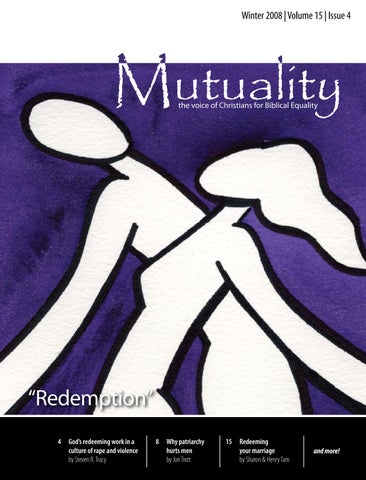
Winter 2008 | Volume 15 | Issue 4
“Redemption” 4
God’s redeeming work in a culture of rape and violence by Steven R. Tracy
8
Why patriarchy hurts men by Jon Trott
15
Redeeming your marriage by Sharon & Henry Tam
and more!
Contents F E AT U R E S 4
Patriarchy, rape, and heroism: Lessons from the Congo by Steven R. Tracy
8
Masculinity redeemed: Reflections on servanthood, the example of Jesus, and being a man by Jon Trott
11 Have you considered my servant Job? Understanding pain and finding ways forward by Mary Gonsior 13 Critical contrast: A poem by Julie Amos 15 Seven practical (but not easy) tips to transform your marriage: Egalitarian themes to live by by Henry and Sharon Tam 18 Austin Stouffer's 95 More for the Door: A book review by Ryan Snyder 19 Magdalena: Released from Shame: A movie review by Mindy Rice Withrow cover image Thank you to Gwen Meharg, a gifted artist and friend who created our cover image specifically for this issue of Mutuality. To view or purchase her work, visit www.drawneartogod.com.
MINISTRY AND CHAPTER NEWS 20 CBE at ETS 2008 20 Praises, Prayers, and Reflections
D E PA R T M E N T S 3 From the Editor: When God orchestrated the impossible 21 Giving Opportunities: The hands and feet of the CBE office 22 President’s Message: Different but equal? Giving words their real meaning
2 M U T U A L I T Y | Winter 2008
websi te : www.cbeinternational.org
From the Editor by Megan Greulich When God orchestrated the impossible “ But God has shown me that I should not call anyone impure or unclean” (Acts 10:28b).
In Acts 10 we find the incredible story of how God intervened in the life of Peter and that of a devout Gentile believer, Cornelius. An angel appeared to Cornelius, telling him to invite Peter into his home. When Cornelius’ messengers were sent out, Peter himself had a vision. An enormous sheet with “all kinds of four-footed animals, as well as reptiles and birds” appeared from heaven and a voice said “Get up, Peter. Kill and eat.” Peter was astonished and protested, saying he had never eaten anything unclean. But three times the voice said to him “Do not call anything impure that God has made clean.” The text tells us Peter was puzzled by this vision, but when Cornelius’ messengers arrived, God instructed him to go with them. It was against Jewish law for Peter to enter into the home of a Gentile, yet God orchestrated the unlikely meeting. And at Cornelius’ home, Peter preached the gospel and witnessed the entire household receive the Holy Spirit. I sometimes wonder what that moment felt like for Peter, when he realized God had literally obliterated the divisions of the past. (It was Peter’s conversion to biblical equality!) It was a moment when he understood that Christ’s sacrifice through the cross not only reached up to God but also out to all of humanity, making reconciliation with our creator and with each other possible. God had made the impossible…possible. For whatever reason, Peter lacked the courage to stand up for what he knew was true after Jesus had been arrested, and instead denied him three times. Yet we do know that something shifted radically in Peter after his vision and subsequent experience with Cornelius, something so profound that he persuasively testified to it at the Council of Jerusalem (Acts 15). While some
Christians insisted that Gentiles had to be circumcised to be saved and to participate in the new covenant of believers, Peter celebrated the power and beauty of what God had done: “God did not discriminate between us and them, for he purified [the Gentiles’] hearts by faith. Now then why do you try to test God by putting on the necks of Gentiles a yoke that neither we nor our ancestors have been able to bear?” (Acts 15:9–10). Peter had seen first-hand that God, because of the cross, shows no partiality and instead redeems and includes every heart that welcomes Christ through faith. Perhaps Peter was overwhelmed by the freedom and joy found in the breaking of old social boundaries and the bringing together of a new community. When we reflect on this story today, may we also be overwhelmed at this demonstration of greatness and goodness by our God! As egalitarians look to the future, we know our ultimate hope is in the power of Christ’s sacrifice, which inspired Peter to testify, Paul to write the words in Galatians 3:28, and the early church to place slaves, Gentiles, and women in positions of leadership. The power of the cross made what was impossible possible, and today it allows us to trust that God is redeeming us from patriarchy, racism, and from all systems that divide us. We pray this issue of Mutuality will be an encouragement to you, as we reflect on this idea of redemption. Please feel free to send us your comments! Megan Greulich is the editor of Mutuality. She may be reached at mgreulich@cbeinternational.org.
Mutuality 15.4, Winter 2008 Let us then pursue what makes for peace and mutual upbuilding. –Romans 14:19 Mutuality (issn: 1533-2470) seeks to provide inspiration, encouragement, and information about equality within the Christian church around the world. Editorial staff: Megan Greulich, editor; M. L. Castleberry, Adele Hebert, editorial assistants; Image Spigot, graphic designer; Mimi Haddad, president/publisher. Contact us at: Christians for Biblical Equality; 122 W Franklin Ave, Suite 218; Minneapolis, MN 55404-2451; phone: (612) 872-6898; fax: (612) 872-6891; email: mgreulich@cbeinternational.org; web: www.cbeinternational.org. We welcome your comments, article submissions, and advertisements. For writers guidelines, visit CBE’s website and follow the publications links. Advertising in Mutuality does not imply organizational endorsement. Please note that neither Christians for Biblical Equality, nor the editor, nor the editorial team is responsible or legally liable for any content or any statements made by any author, but the legal responsibility is solely that author’s once an article appears in Mutuality. All Scripture quotations, unless otherwise indicated, are taken from the Holy Bible, Today’s New International Version®. TNIV®. Copyright © 2002, 2004 by International Bible Society. Used by permission of Zondervan. All rights reserved. CBE grants permission for any original article (not a reprint) to be photocopied for local use provided no more than 1,000 copies are made, they are distributed free, the author is acknowledged, and CBE is recognized as the source. Mutuality is published quarterly by Christians for Biblical Equality and is sent free to members and supporters.
booksto re : www.equalitydepot.com
M U T U A L I T Y | “Redemption”
3
In a culture of rape and violence, is God still Healer and Redeemer?
"Naama" by James VanFossan. Used with permission.
4 M U T U A L I T Y | Winter 2008
websi te : www.cbeinternational.org
Patriarchy, Rape, and Heroism Lessons from the Congo by Steven R. Tracy
In 1899 Joseph Conrad wrote the classic novel Heart of Darkness, using the context of the Democratic Republic of the Congo to expose the malevolent darkness of the human heart. Now, over a century later, the Democratic Republic of Congo epitomizes the reality and potency of human depravity. In the past decade Congo has experienced a series of foreign invasions and civil wars that have led to the deaths of over five million people. One byproduct of these years of conflict, coupled with entrenched patriarchy, is epidemic levels of violence against women. According to a recent United Nations report, Congo has earned the dubious distinction of being the rape epicenter of the world. Last year in eastern Congo 50,000 women were reported raped in a single province, often by rebel soldiers. Many of these women were publicly gang-raped and mutilated. Tragically, raped women are blamed for bringing shame on their husbands and families and are subsequently abandoned and thrown out of their homes and churches. Incredibly, experts agree that sexual violence against Congolese women is continuing to increase.
Our first trip A group of colleagues and I first traveled to the Congo in 2007 to conduct conferences on abuse. We were shocked at the extent of patriarchy and resultant mistreatment of women. In the first conference a pastor led a devotional from Psalm 45:10–11 and taught that a husband is a woman’s lord and that she must literally bow down before him. Many of the pastor’s wives reported being raped and/or beaten by their husbands. At one conference several pastors adamantly insisted that Christian wives must forgive and sleep with unrepentant husbands who had abandoned them and had subsequently gotten AIDS from prostitutes. These pastors boldly declared that this was a Christian wife’s duty, so if in carrying out her duty she contracted AIDS herself and died, “she would die a good death.”
booksto re : www.equalitydepot.com
Yet at the end of our first conference we delightfully witnessed something none of us had ever seen. After much discussion and prayer, over fifty of the pastors stood in front of the congregation and publicly repented not only for abusing and failing to serve their wives, but also for dishonoring the women in their churches. They acknowledged their failure to minister to the abused and vowed to change. Most incredibly, they committed to printing a copy of their declaration for their wives to post in their homes and asked their wives to hold them accountable for each commitment.
A catatonic face One of the most painful and inspiring Congo experiences in 2007 came while visiting a Christian mental health clinic in a nearby town. For several years this area had experienced intense violence, including the public execution of over five hundred young men less than eighteen months earlier. This orgy of violence had caused many women and men to go insane. In the midst of this satanic cloud a brave Congolese woman named Abia stepped up to face the devastating evil. She recruited a small mental health staff and started a humble NGO (non-governmental organization) to treat the broken, in the name of Jesus. Abia’s husband, a pastor, rejected the patriarchal cultural norms that give women little place in this society other than caring for the physical needs of their husbands and children. He encouraged and assisted her in the work. They received no western funding, treating the most severe mental illnesses with their meager resources. Rebels threatened them and came to the clinic repeatedly to steal the few drugs they had for treating patients. Yet they braved the risks and continued to minister to victims of sexual violence.
M U T U A L I T Y | “Redemption”
5
During our visit, the staff took us into each tiny, dank room packed with shattered men and women, telling us each person’s story. We prayed with every patient after hearing the evil they had endured. Our hearts broke for each survivor, but one young woman stood out from the rest. Her face has haunted us for the past year. She had been raped and impregnated by a rebel soldier. Her family brought her to the clinic with her hands bound to keep her from harming herself and others. When she saw a man she would scream “all men are dogs!” She eventually quit speaking. The day we visited we took a picture of her catatonic face. I will never forget her hands reaching for the cross necklace my wife Celestia was wearing while Celestia held and prayed for her. Over this past year it has been excruciatingly painful to look at her picture; her traumatized and dead expression embodied the effects of violence against these women.
cared for his children when we married [his previous wife had died], he said I was smart and talented. He helped me get an education. I couldn’t do the work I do without his support. He is too old to go with me, but he prays for me every time I travel.” Our team was in tears; we were awestruck at these heroes willing to risk everything to share light and hope with wounded and abused women.
More than we imagined
Of the six conferences we conducted, the most unusual was the conference for prostituted women. Our hosts told us this had never been done, ever, yet they were willing to give it a try. In a country where the average annual income is less than a dollar a day and over 30% of the children are severely malnourished, economic desperation reigns, particularly for women who have been raped, abandoned by their husbands, or otherwise rejected by society. Many end up being prostituted to survive. We planned In July of 2008 twelve of us were privileged to go back into eastern this conference with great care, and asked God for a miracle. He Congo to conduct our second series of abuse seminars. We went graciously gave us many! representing a nonprofit abuse healing organization, Mending Eighty prostituted women came. Their faces were filled the Soul Ministries, in partnership with Congo Initiative, a with shame and pain. Some bore fresh facial wounds from being holistic Congolese Christian NGO. beaten by their pimps. One young woman, also named Abia, was This year we were eager to invite Director Abia and her staff particularly angry. She had “accidentally” climbed into the van to our conferences. They came, along with 75 pastors, 100+ abuse thinking it was going south toward Goma where she intended caregivers representing 30 NGOs, 50 army officers (including to visit a witch doctor to have a curse removed. Celestia sat with former rebel leaders), 80 prostituted women, 80 rape survivors, her during the first day, putting her arm around her shoulders. and 50 civic leaders. We again heard repeated stories of rape and Abia admitted her anger and frustration at being at this Christian other effects of extreme patriarchy. Yet happily, we also heard conference. Celestia assured her that God had brought her here so many pastors and churches testify to following through with last that he could lift the curse by the power of his love. At the end of year's commitments. Several pastors the day Abia squeezed Celestia’s hand were now serving as chaplains to these and said “don’t leave me.” She was NGOs. This year we met even more desperate to know more of Christ’s incredible Christian heroes bringing love and forgiveness. By the end of Raped women are healing into the devastation. the conference Abia and fifty other Elige and her husband are two prostituted women had placed their blamed for bringing of these heroes. After attending our faith in Christ. shame on their conferences in 2007 she approached Abia told us later that when she her church about starting an abuse had gone back to her camp a man husbands and families ministry. She received strong support offered her $10 to sleep with her. She and are subsequently and began traveling up to 150 refused, saying she was a new creation kilometers a week on foot going into in Christ and no longer a prostitute. abandoned and thrown small villages to minister to raped He then said he knew she needed out of their homes women. Every time she goes into the money for her sick daughter, so he bush she risks being raped or killed. offered her an additional $10. She again and churches. Several times armed rebels accosted refused and said she trusted God to her, but each time when they saw provide. We were able to help Abia and the cross necklace she wore they let the other women get job training and her go. After I heard her testimony I micro loans so they could have a new thanked her for her ministry and asked if her husband encouraged means of livelihood. It cost only $18 to buy a prostituted woman her work, since she faces grave risks that could affect her entire her freedom. We heard recently that roughly 45 of these formerly family. Elige beamed at my question and said “my husband is prostituted women are still attending literacy, job training, and a very good man and loves me greatly. After he saw how well I discipleship classes. God did even more than we imagined!
Returning
6 M U T U A L I T Y | Winter 2008
websi te : www.cbeinternational.org
Steve and Celestia (back left) in 2008 with three Congolese heroes including Abia (front left), the director of the mental health clinic, and Naama (front center) who, after her own recovery (see the portrait of Naama in 2007 on pg. 4) now helps other young women who have children born out of rape.
What God has redeemed The ultimate highlight of this year’s trip was seeing Director Abia and her staff from the mental health clinic. We were anxious to tell them we had been praying for them and to show them the Mending the Soul Healing Art Workbook we had prepared for the conference. We showed them the chapter on post-traumatic stress disorder that contains a picture of the face of the traumatized woman we had met in their clinic the previous year. We asked if they remembered the woman. In unison they cried “she is Naama!” which means “grace” in Swahili. They told of her miraculous healing. A few months after we visited the clinic Naama began to regain her senses as the staff continued to love and care for her. They began teaching her about the love of Christ and she responded, embracing Christ as her savior. They continued to care for her physical, spiritual, and psychological needs and eventually helped her reunite with her family. Abia surprised us a few days later by bringing Naama to meet us. We did not recognize her. The face that had embodied traumatic hopelessness now glowed with a youthful and bashful smile. She said she did not remember our visit a year earlier but when she began to regain her senses the staff told her about us. They assured
booksto re : www.equalitydepot.com
her that we were praying for her from America. Naama beamed as she recounted how God had answered our prayers. Celestia “just happened” to be wearing the cross necklace she had worn the previous year when we met Naama. Celestia was able to give it to her as a symbol of the power of the cross. Naama is raising her daughter by herself, trusting that God will give her a husband who, she says, “will be worthy of loving me.” Today Naama ministers to other women in her village, helping them accept and love their babies that have been born as a result of their rapes. Naama is another hero bringing light and hope into the gloom. Joseph Conrad correctly understood the sinfulness of the human heart. Patriarchy, misogyny, and rape are unspeakably evil. Unfortunately, Conrad did not understand the larger story of redemption. Our time in the Congo reminded us of Paul’s words in Romans 5:20, “where sin increased, grace abounded all the more.” In the midst of devastation the grace of God shines, heals, and produces remarkable heroes. Steven R. Tracy is professor of theology and ethics at Phoenix Seminary and co-founder of Mending the Soul Ministries (www.mendingthesoul.org). He is the author of Mending the Soul: Understanding and Healing Abuse (Zondervan) and coauthor (with his wife Celestia Tracy and Bill and Aída Spencer) of Marriage at the Crossroads (forthcoming, InterVarsity).
M U T U A L I T Y | “Redemption”
7
Masculinity Redeemed by Jon Trott
Servanthood, not power, reflects the example of Jesus
“Jon, this isn’t good,” said Harmony’s anxious voice on the other end of the phone. “Your wife just fell on the stairs over here. She’s cut her head open. You can see her skull.” “I’ll be right over,” I said, rescued from emotion by the need to move quickly. My wife, Carol, loves garage sales. And when our fellowship held one just across the street from where we live, she went to look for treasure. Carrying a large storage bin down some stairs, she missed the final step and fell forward into an oak door frame. Dazed and bleeding, her first confused words were about her “prizes” in the storage bin she “needed to sort.” Friends instead led her to a couch to wait for me. After I’d run a few blocks for a car and then taken her to our local hospital, I sat next to her in the emergency room as a doctor stitched her scalp. I could indeed see the white bone of her skull before he started. My mind played very unpleasant “but what if ” scenarios in my head. “What if she’d struck the door with her nose? Her glasses?” Splintering bone, glass fragments…ugh. By Grace, this had not happened. I held her hand, looking at her and chatting about election polls, anything just to distract her. She winced and squeezed my fingers. I thought about other times we’d faced hospitals together. Carol is a survivor of both breast and thyroid cancer, I the
8 M U T U A L I T Y | Winter 2008
frightened passenger as she, the courageous one, carried us through both of those ordeals. I don’t often consciously think about mutuality in our marriage, but this physical, mental, emotional, and spiritual bond between us — a bond that speaks of fragility and vulnerability as well as strength and endurance — is rooted in an understanding of love that necessitates mutuality. As a male, I am over and over again told that my role is to lead. This day, I did lead. I took my wounded mate to the doctor; I moved my chair to her bedside to hold her hand. Back at home later on I even told her, in a rather authoritarian-sounding voice, to please stop getting up from our couch to serve people coffee when she should be resting instead. But none of that leading was predicated on my “role” or “status” as a male and therefore leader by divine right. It was not a display of my power that Carol needed; she required my service while she rested and healed. One day I may be the one in the bed, the one perhaps even with cancer. Who will be fragile then? Who will need to be led gently to the bed, or even (in decades to come) to the bathroom? What if I suffer from dementia or Alzheimer’s and forget even her name, while she continues to love me? What sort of “roles” do human beings actually need to fill, other than to love one another websi te : www.cbeinternational.org
out of reverence for Christ? Does gender matter in the face of mortality, death, and decay? What meaningless babble we utter in the face of our ever-present frailty!
their adherence to my understanding of our shared reality. I need no “role” over or above Carol, or any woman. Nor do I want it. The idea sickens me.
Masculinity Then and Now
Scars
The chopping up of life into neat boxes, theological My wife is scarred not just from her fall a few days ago, but older compartments where everything can be filed in the proper scars from a caesarian, and scars not quite as old from two cancers. folder and nothing is mysterious or out of place…that is a She also carries invisible scars. When she was younger, a co-worker mean, small world I can no longer endure. My own heart attempted to rape her, tearing at her pants and ripping her blouse as cannot survive it. I find in this world such pain, such sorrow she fled from his car. The next day, with Carol present, he bragged of and dismay at what we do to one another (often while waving the incident to his fellow workers. Another man exposed himself to a self-constructed deity at our enemies), that I simply refuse to her in a public park, masturbating while his expression burned with continue thinking or living that way. I aspire to be a disciple hatred for her. She was terrified. And yet another man attempted of Jesus, which I often make a mess of. But I won’t stop trying, to date rape her, again her flight being the only thing to stop him. because Jesus in the end is not only Love, but the only answer As a young child, cornered by a grown male relative in her room, to the doubt-filled terrors of my heart. she was rescued by her own knife-wielding mother. Jesus Christ, the Living Word, God the Son in full Deity These men believed they had permission to do these yet also the Son of Man in all this human fragility, chose to things. The question is, who gave them that permission? I need pour himself out as a ransom for many. He chose not power, to know that Christianity is not a religion that encourages but suffering. And he chose the powerless to serve. He chose a violence against women, but historically the evidence woman to wash his feet with her tears and her perfume, and a sometimes seems to suggest the opposite. When I look into disreputable woman at that. He chose women to be first to see my dear one’s eyes and know the incredible tenderness of the miracle of resurrection. Yet I her personhood in that glance, I doubt very much that their gender cannot endure one second more mattered to him; what mattered of oppression dressed up as were their hearts, their love, and doctrinal correctness. their faithfulness. When I look into my Our emphasis on gender and gender roles today undermines the dear one’s eyes and example of Jesus and other figures know the incredible in the Bible. John, the beloved Christ leads, and we both follow. disciple, reclined on Jesus’ chest tenderness of her When my darling says to me, during the last supper. Was this personhood in that “I think God may want us to…” I am “Son of Thunder” effeminate? Dear all ears. I want to hear what God may God, that I would do so if given glance, I cannot endure have said to my wife! If it is of him, I the opportunity! What roles did one second more of pray I will hear it. And if it is not of him, John violate with such unseemly or I think it is not, I voice my doubts emotionally-based (and therefore oppression dressed up and we wait for further confirmation feminine?) responses to the as doctrinal correctness. before moving any direction. Waiting nearness of his Lord and Beloved? is a very important biblical concept. Must all affection for men be sexual “They that wait upon the Lord shall in nature, or can a man love another renew their strength…” (Isa. 40:31, man without sexual overtones? I KJV). And of course this also works dare hope my own feelings on this when I am the one who thinks he has a leading from God, and are also the feelings of millions of other men, Christian or not. offer that leading to my wife for her to think on and pray over. No Are we as men permitted to love? To be held in the arms of one holds an ace. “For where two or three come together in my Jesus Christ is as far as my imagination of heaven can take me. name, there am I with them” (Matt. 18:20). Yes. Our mutuality I feel the nearness of these boundaries, these societal in and because of Christ brings him into the midst of us. and — worse — church-defined roles working to prevent me My bride is that everyday woman who at times makes from becoming my true self in Christ. I feel the redemptive me laugh with how she typifies old school clichés about power of a love that transcends society’s gender-based (and women. She serves with her hands, she communicates with power-based) roles. I read my Bible with new eyes these cookies and coffee, she can’t wait to hold our granddaughter, days, eyes that see in Paul and other New Testament writers a radical belief in agape that reorders human relationships. Naya. But then come the numinous moments, and there are To lead is to put oneself at the mercy of others, not to expect many of them.
The True Head of Our Marriage
booksto re : www.equalitydepot.com
M U T U A L I T Y | “Redemption”
9
I touch her flesh next to me and as we rise together I am not at all sure whose body is whose. Am I the typical male, penetrating, or “merely” human, melting together with my beloved and in fact being engulfed by her and Agape simultaneously? Mutuality allows for both, yet the most memorable moments are those where we nearly become one another and blur the line between self and the other. This mystery is pure and deep and seems to me only available to one opened up to the mutuality of love. I see Carol framed in a doorway, leaving for work. She turns, smiling. As she does so, something turns in my soul like a key. The physical world stretches, deepens, pregnant with meaning. My eyes are able to see God. And I see God in her, dangerously close to being her. My heart is in my throat, I stop her to explain. But the moment fades, she calls me a poet, blows a kiss at me, and goes to work. Mutuality is work. And in the work love requires, I find a sense of redemption. I find joy in loving her, and because of
10 M U T U A L I T Y | Winter 2008
her love, being able to love others. As a man, her co-leadership frees me to become a man, yes…but even more foundationally, a human being. To my wife, my mother, my sister, and all the women who have pastured me and taught me how to walk as a man and as a human being…I apologize that in trying to thank you, my words run dry. Jon Trott, author and editor, has been writing for the past thirty years. Sometimes people even read what he writes. He wrote for and edited Cornerstone magazine for over twenty years, becoming Editor-in-Chief during that magazine's last years. Jon's own preference is to write poetry, lyrics, and work on a novel which may or may not ever see the light of day. Jon's wife Carol is his greatest earthly joy and teacher of the heart. Jon has been a full-time member of the intentional community, Jesus People USA, located in Chicago's inner city, for the past thirty years.
websi te : www.cbeinternational.org
Have you considered my servant Job?
Understanding pain and finding ways forward by Mary Gonsior
“Then the LORD said to Satan, "Have you considered my servant Job? There is no one on earth like him; he is blameless and upright, a man who fears God and shuns evil” ( Job 1:8). In the Book of Job, we read the ancient story of an upright and blameless man who is surrounded by God’s protection and blessing. Wealthy by everyone’s standards, Job had a large family, livestock numbering thousands, and many servants. But suddenly, Job’s situation is connected to the for no apparent reason, Job is sense of pain, loss, and confusion ruined. In a single, unimaginable many women in the church today day, disaster strikes and Job loses suffer as a result of patriarchy. everything. Enemies attack and steal his livestock and murder many of his servants. And as he is hearing this news, another servant reports that a storm has collapsed the home of his oldest son, killing all of Job’s Several years ago, a CBE member who was volunteering children. When Job’s three friends hear about his troubles and go out to meet him, they are moved to tears. There before them, the from her home shared how much she enjoys taking her greatest man among all the people of the East was struck down, grandchildren in turns into her home for several weeks each summer. She relishes this annual opportunity to share sitting in ashes, his body covered in painful sores. In the midst of great pain and suffering, Job searches for her faith and love for Jesus with these precious youngsters. answers. He knows that God is his creator and the source of his As we got to know each other over several phone calls, she life. God is the provider of every good thing that once was his to shared with me her frustration over her own church’s view enjoy. And even though Job did not sin by charging God with of women. In her church, her visiting grandson, not yet a wrongdoing, he does not understand his suffering and no longer teenager, could stand up and lead the church in worship, but she, a longtime committed member of the church, could not. sees any purpose for his life. I share Job’s story now because his situation is connected to Can you imagine how this loving grandmother must feel in the sense of pain, loss, and confusion that many women in the her church? She is viewed as having less authority, simply by virtue of her gender. church today suffer as a result of patriarchy.
booksto re : www.equalitydepot.com
M U T U A L I T Y | “Redemption”
11
We need to This is just one of the many stories strong emotions including apathy, grief, CBE hears on a weekly basis. Women and shame. Having been told that they understand, like Job, serving on leadership committees may aren’t endowed with the necessary that an important find the entire structure of their church gender to minister, teach, and preach, reorganized, effectively removing them and because they are not able to exercise step to healing from their positions. Their books may their gifts in service to the church, they and reconciliation be banned or removed from Christian feel invisible, useless, and, like Job, they bookstores. Even women serving at lose their sense of purpose in life. is acknowledging churches open to biblical equality may Women who have been God as the source of be asked to team teach with a man, demoralized or abused in homes or to avoid “stirring up trouble.” Too churches carry an overwhelming everything good. many women are told they “aren’t burden. Such women may struggle good enough” or they “aren’t right with emotions that should serve as for the job.” And without truth and motivation to move away from these encouragement to refute this message, discouraging situations. When some women will see this image of themselves, and not the people God women become stuck in fear or shame, they may find themselves created them to be. unable to move into new supportive opportunities. Women who When the church and its leaders actively minimize, become stuck in anger or bitterness, or become depressed, may be undermine, or deny women’s passions and opportunities to unable to express interest, enthusiasm, laughter, empathy, action, and follow their callings, everyone really does suffer. Women often other healthy emotions. take less public positions or leave their congregations in order to This pain is very real and can leave lifelong wounds. I strongly exercise their gifts. Or, even worse, they may ignore the call that urge pastors and churches to reach out to these women who are hurting they hear from God. today. As we work to promote gift-based church leadership we must In This is My Story: Testimonies and Sermons of Black Women be aware that we have a natural tendency to see our situation through in Ministry, thirteen women share their journeys to answer God’s distorted lenses. As a result, we must be willing to examine our attitudes call. Each story is unique, and gives us an insider’s view of the very toward conflict, suffering, pain, and loss, and learn to act in Christian real struggles women face in order to follow God and to exercise love even toward those who oppose us. their gifts and calling. Often, the road is lonely and daunting, with In The Peace Maker: A Biblical Guide to Resolving Personal only God showing the way through a wilderness in which there Conflict, author Ken Sande outlines five biblical principals that is little encouragement or companionship. Frequently, women Paul gave to the Philippians, giving us a practical model for moving are separated from friends, family, and their congregations as a forward from our own pain as well as fostering reconciliation with result of their obedience to God. Sometimes there is more hostile those who have hurt or disagreed with us: opposition, including active denial of a woman’s calling, as well as 1. Rejoice in the Lord always. an undermining of her opportunity for education and experience. 2. Let your gentleness be evident to all. She may even be treated as someone to be avoided, just as a leper 3. Replace anxiety with prayer. would be avoided in our Bible stories. 4. See things as they really are. Women often struggle to believe that God is calling them to 5. Practice what you’ve learned. service, or they may believe that there is something wrong with We need to understand, like Job, that an important step to them. Others struggle like Job, searching their hearts, trying to learn healing and reconciliation is acknowledging God as the source of where they have sinned or been deceived. everything good. Acknowledge God for who he is, and trust that he As a result, many women today have spent a large part of their hurts with us and goes before us in these difficult situations. Sande lives struggling to subdue their passion for ministry, hide or deny encourages us to grow in holiness; our motivation must not be to their gifts, or simply turn away from their heart-felt longings to satisfy our own needs to resolve a conflict or to correct someone answer a call to leadership in the church. As a result of believing else but to put God first in our hearts and minds. We must give our that their own gifts are a mistake, a misunderstanding, or even a worries to God, and pray immediately when we feel anxious. And sign of their own rebellion, many women struggle with incredibly we must pray for those who disagree with us, asking God to bless them, to help us understand their perspectives, and to increase our joy, humility, love, and mercy. While pain can be overwhelming, we can trust in God who desires to bring healing, restored relationships, and a holy love between all Christian brothers and sisters. This is My Story is available at www.equalitydepot.com!
12 M U T U A L I T Y | Winter 2008
Mary Gonsior is the operations manager at CBE. She is a member of Park Avenue United Methodist Church and is active in her neighborhood in Minneapolis. She and her husband Jim have three daughters and three grandchildren.
websi te : www.cbeinternational.org
Critical Contrast by Julie Amos A veil, invisible
A hand, invisible
Though deeply felt
Though wonderfully felt
Has been wrapped around me,
Has reached out and released me,
Covering me,
Blessing me,
Restricting me,
Increasing me,
Binding my hands and my feet,
Calling my feet beautiful,
Denying me freedom.
Granting me freedom.
It has been
It has been
Stretched across my face,
Placed over my heart,
Silencing me,
Rousing me,
Suffocating me,
Sending me,
Impeding my vision.
Being my vision.
And I am told
And I am told
This condition,
This condition,
This imprisonment,
This redemption,
Is because of my sex;
Is because of his blood;
For I was deliberately
For I was deliberately
Created less,
Created loved,
A servant to the master race,
A child of the creator God,
Half image,
Full image
Helper,
Equal,
One more beast of the field
The final good creation
For Adam to rule.
Who, with Adam rules.
Julie Amos is a novelist, author of children’s stories, poet, and full time homemaker. She and her husband, Mel, are youth leaders in their church in Lancashire, England. They have one son, Scott, aged 14.
booksto re : www.equalitydepot.com
M U T U A L I T Y | “Redemption”
13
14 M U T U A L I T Y | Winter 2008
websi te : www.cbeinternational.org
!
Seven practical (but n0t easy)
tips to transform your marriage by Henry and Sharon Tam
What are the foundations of an egalitarian marriage and how can you live them out? Henry and Sharon Tam have compiled these seven tips for making the most of your marriage.
1 Live Redemptively God, the Holy Trinity, created humanity in his image — in the context of mutual, loving, intimate relationships. In creation, God declared everything as good, except one thing — being alone (Gen. 2: 18), so God created the woman. The man and woman were equal and complementary (Gen. 2:23), completely vulnerable to one another and interdependent (Gen. 2:25). In the garden, then, marriage is characterized by cooperation, intimacy, mutual dependence, and mutual support. One of the consequences of the fall is that couples now fight for power, exhibited in a desire to rule or a desire to be “on top.” Tragically, instead of a love-based relationship which expresses mutual submission and equal regard, the marriage relationship has denigrated into a relationship based on power and control, role-clarity and order. Genesis 3:16 describes this tension: “your desire will be for your husband, and he will rule over you.” In redemption, Christ restores relationships to their original design of the garden. Couples are exhorted to mutually “submit to one another out of reverence for Christ” (Eph. 5:21). There are to be no more power-struggles to be “on top” in the marriage, rather, the only acceptable struggle is to be fighting for the opportunity to be “on the bottom” — serving one another in love. Relationships are reinstated as being equal and complementary (Gal. 3:28). Mutuality, familiarity, and interdependency are re-established as the norm in human relationships. If you want to transform your marriage, live redemptively by putting Christ as the head of your home. Honor him and
booksto re : www.equalitydepot.com
honor your spouse. Seek to serve and build up your partner, regardless of how you are treated in return. Compete with one another to outdo the other in service and defer to the other’s preferences. Read God’s word and pray together. Don’t expect your partner to initiate these times. If the Holy Spirit is prompting you to read God’s word or pray together, then take the initiative, regardless of whether you are male or female.
2 There is no “How-to” Manual Our workshop title at a recent CBE conference, “Egalitarian Marriage — Here’s How,” was an intentional misnomer. There are no “how-to” manuals, recipes, or easy steps to follow in marriage and, in a certain sense, if one could develop such a “how-to” manual for egalitarian marriages, it probably would not be too egalitarian. The reality is that hierarchical marriages, with welldefined gender roles, probably function better and are more efficient; however, functionality and efficiency are important qualities for organizations like the army or businesses — not relationships! When was the last time you used efficiency and functionality as metrics for rating your friendships? Egalitarian marriages, like all marriages, are simply a lot of work. There are no predefined blueprints, so both husbands and wives must figure out what works best — a process that takes time, perseverance, and the ability to learn from mistakes. Invest in your marriage and work at your relationship, never taking it for granted. Love works, if you work at it.
M U T U A L I T Y | “Redemption”
15
P ursue a Dynamic and 3 Maturing Relationship While there are no blueprints, Jack and Judith Balswick have provided for us a helpful framework for understanding maturing relationships. The spiral diagram at right is practical because it is not linear; instead there is non-sequential repetition with deepening and progression. The starting point of the marriage relationship is an initial covenant of unconditional love made unilaterally by both parties. Each marriage partner chooses to love the other in good times and bad, for better or for worse. In an atmosphere of security and love provided by this initial covenant, a degree of grace grows. As more and more grace is cultivated, couples are freed to empower one another. Empowering leads to intimacy, which then leads back to a deeper level of covenant commitment. This model suggests that marriages will either be dynamic and maturing or stagnant and dying. While the initial covenant is a unilateral commitment of unconditional love, a mature covenant is a bilateral commitment of unconditional love. In order for growth to take place there must be involvement by both persons. Growth can be blocked at any point when one spouse is unable or unwilling to reciprocate unconditional love. When this happens, the Balswicks argue, the marriage will become fixated on “contract rather than covenant, law rather than grace, possessive power rather than empowering, and distance rather than intimacy” (The Family, p. 21). The key to transforming your marriage is to always choose to build a relationship that is dynamic and maturing rather than to accept one that is stagnant and dying. We do that by increasingly offering to our partner covenant loyalty, grace, empowerment, and intimacy.
4 Love and be Loved Marriage begins with a covenant to love in good times and bad, in sickness and in health, for as long as you both shall live. A covenant is cut freely by one’s own choice to be committed to will what is best for the other, regardless of personal sacrifice or feelings. But, a covenant is more than a commitment— it is a spiritual act that is made before
16 M U T U A L I T Y | Winter 2008
God and the community. As a spiritual act, therefore, the consequences of breaking this commitment are grave and far-reaching. In ancient times, parties solemnized a covenant by walking down an aisle flanked by pieces of slaughtered animals. This practice signified an oath: “May it be so done to me if I do not keep my oath and pledge.” When God made a promissory covenant with Abram, he walked back and forth between the pieces (G en . 15 : 17 ) , i n d i c ati n g that he would take f ull responsibility for fulfilling both sides of the agreement— not just one side. Similarly, Christ demonstrated his own covenantal, unconditional love for each one of us by Taken from The dying for us, while we were Family, by Jack and yet sinners (Rom. 5:8). Judy Balswick. Used In the same way, an initial with permission. covenant in marriage is made unilaterally and unconditionally, regardless of your spouse’s response. Knowing and receiving Christ’s unconditional love gives each spouse grace to love their partner unconditionally as Christ has loved them. A mature covenant develops when your spouse willingly makes the same type of unconditional commitment to you. Therefore, if you want to transform your marriage, fear God and honor the covenant that you have made before him and his people. Think about the consequences of being split apart like a slaughtered animal, if you are ever disloyal to your spouse, for this is the emotional, spiritual, and psychological pain that you will experience. Prior to even being tempted, find an accountability partner to help you stay faithful to your spouse. Re-commit to loving your spouse and doing what is best for him or her each and every day, regardless of what you receive in return. You will experience the joy and peace that comes from honoring God, loving your partner, and staying faithful to him/her until the end.
5 Forgive and be Forgiven
In the traditional marriage, roles are rigidly defined and segregated with little flexibility. The husband usually assumes the role of working outside of the home while the wife generally takes up the role of homemaking and caring for children. Advocates of modern marriages tend to react against the segregation in the traditional system and insist that marital roles be undifferentiated. Unfortunately, this often results in confusion and frustration as roles are illdefined and unfulfilled.
websi te : www.cbeinternational.org
The balancing concept between law and chaos is grace. In the context of egalitarian marriage, grace is manifested as creative adaptability and flexibility. In this light, roles are differentiated but not segregated. They are also interchangeable. Role differentiation means that the husbands and wives agree to serve one another by taking on assigned tasks which contribute to the maintenance of the household. This can only happen in an atmosphere of acceptance. If you want to transform your marriage, accept your spouse completely, commit to being a grace-giver, and practice forgiveness. Only in this way will you nurture the type of family atmosphere that will enable your relationship to flourish.
6 Serve and be Served The issue of authority in marriage is a controversial one. In the traditional marriage, authority and power was automatically ascribed to the male head, with the wife in obedient submission. In contrast, the modern marriage, with its focus on self-fulfillment, often leads to power struggles as both partners vie for greater freedom and autonomy. In an egalitarian marriage, authority is empowerment. It involves submission to the headship of Jesus Christ and to one another. One of the great myths of power is a commodity with a limited supply: if you gain power, then I must lose power. Nothing can be farther from the truth. Would we argue that when God empowers us he loses power? With God as our guide, husbands and wives can be free from the fear of losing power and be liberated to empower each other to become all that they can be. It may be helpful to grasp the similarity behind the words “helper” and “head.” Both words connote the idea of “support” or “strengthen” in the original text. The Hebrew word, translated as “helper” in Genesis 2:20 is the same word that is used of Yahweh as an ever-present help in times of trouble (Psa. 46:1). The Greek word often translated as “head,” suggests source, like the fountain head of a stream, rather than referring to authority. Just as the man draws
booksto re : www.equalitydepot.com
strength, courage, and confidence from the wife’s support, the woman also draws strength, courage, and confidence from the husband’s support. Both words, “helper” and “head,” therefore, indicate that the Christian marriage is a paragon of mutual submission, mutual dependence, and mutual support — a place where both the man and the woman can serve and be served.
7 Know and be Known Communication is the essential means for establishing and maintaining intimacy in marriage. In a traditional marriage, unfortunately, verbal communication often takes the form of pronouncements, a one-way form of communication. The husband legislates without consulting his wife and conflicts are often “resolved” through unilateral decrees or avoidance. Communication in a modern marriage is only slightly better. Since no partner has veto power, communication often becomes a battleground for demands that spouses make of each other. Conflicts are dealt with through confrontation and the overall tone can be highly aggressive. In an egalitarian marriage, however, partners express themselves in a caring and concerned manner—always seeking the best for the other. Listening is the order of the day with an effort to understand the other’s point of view and to respond empathetically. Each spouse must have an attitude of submission and a willingness to give up one’s own needs and desires for the sake of the other and the relationship. If you want to transform your marriage keep dating your mate. Make time to develop that intimacy. Listen to your partner’s day, hear their hopes, their dreams, and their fears. Sharon and Henry Tam are founders of CBE-Toronto. Henry is the assistant curriculum leader of mathematics at Emery Colligiate and is active in the local church as a lay preacher, workshop speaker, and Christian educator. Sharon (D.Min. Fuller Theological Seminary) is the pastor of English ministries at Mississauga Chinese Baptist Church and is a preacher, educator, and leader. She has been a pastor for 14 years. They have been happily married for eight years.
M U T U A L I T Y | “Redemption”
17
B ook
R eview :
Austin Stouffer’s
95 More for the Door
by Ryan Snyder
The first time I heard someone suggest the Bible supported gender- making his power perfect in their weakness? These points provide equal leadership in the home and in the church, I’ll admit I was powerful support for Stouffer’s contention that in Christ, “there can skeptical. Sure some of the verses they pointed to seemed to support be no second category of God’s children.” their point of view, such as Galatians 3:28 or Genesis 1:27–28. But the Following in the footsteps of Martin Luther, Stouffer has created traditional male leadership/female submission position still appeared a book designed to help “ordinary people discuss, question, understand, to fit better with my understanding of the general theme of Scripture. interpret and practice what the Bible really means.” Instead of overloading My choice appeared to be between a few well-formulated arguments the book with Greek-word studies and lengthy discussions of theology, for equality, or the overwhelming majority of the Bible pointing to Stouffer opts for a more general overview of the issues and utilizes an male authority. easy-to-understand style. Likewise, the format is very reader-friendly. Since my conversion to egalitarianism, I have come to find my A small passage of Scripture and brief explanations follow each thesis, feelings were not at all uncommon among other Christians. Many creating 95 short, relatively independent chapters. Readers can begin times I have presented someone with an argument for equality only to anywhere in the book, read as much or as little as they wish, and still hear my old beliefs echoed back to me. And like me, few are willing to come away with a challenging and engaging experience. simply brush these concerns aside without a compelling rebuttal. While this format and style make the book useful for those But now — thanks to Austin relatively unfamiliar with the debate, Stouffer’s new book 95 More for it is not without shortcomings. the Door — egalitarians can turn The chronological format of the Austin Stouffer has written a the “general theme of Scripture” book often leads to repetitiveness, book that is accessible to the argument on its head and prove the which — though useful to reinforce Bible is actually overflowing with concepts for the new reader — may common reader, but still manages pleas for equality. Modeled after become tiring for those who are to demonstrate the breadth of Martin Luther’s famous “95 Theses,” more familiar with the issue. It also Stouffer takes the reader on a journey leads Stouffer to spend too much support bolstering his argument. through the Bible, stopping along time on some less persuasive points the way to point out 95 different (such as the devotion of two theses passages in support of his belief that to the fact that Jesus was born of a “God intended men and women to be equally affirmed and gifted, woman) and too little time on some extremely valuable points (such as whether to lead in society, to parent in the home or to minister in his grouping of Old Testament women leaders Deborah, Huldah, and church.” Filled with solid, logical arguments and written in a straight- Miriam together into a single thesis). Finally, Stouffer doesn’t pull his forward, relaxed style, 95 More for the Door is a strong tool egalitarians arguments together into any sort of strong conclusion, thereby missing can use to help reform the church’s teaching on gender. a good opportunity to persuade any still-undecided readers. Starting with Genesis and ending in Revelation, Stouffer touches Despite these limitations, 95 More for the Door is an excellent on dozens of different issues relating to gender equality. Yet despite this resource for anyone interested in the cause of equality. In a field where the diversity, there are several themes he returns to time and time again. He literature is usually aimed at biblical scholars and can quickly overwhelm uses Scripture to demonstrate that spiritual gifts — including the gift beginners, Austin Stouffer has written a book that is accessible to the of teaching — are distributed to believers without regard for gender common reader, but still manages to demonstrate the breadth of support and may be exercised by men and women. He calls attention to the bolstering his argument. When a friend of mine, who was relatively numerous passages referencing women leaders, including prophets, unfamiliar with the subject, picked the book up off my coffee table, it judges, teachers, deacons, elders, apostles, ambassadors, and priests. took her only moments to find ideas about equality she had never heard In perhaps his most effective argument, Stouffer repeatedly before, and it wasn’t long until a fruitful discussion about gender roles points out how leadership abilities are not innate to women or men, began. It seems 95 More for the Door is already helping to bring about the but come directly from God. We are not the message, he says; we “gender reformation” Austin Stouffer has long awaited. are the messengers, merely the instruments through which God Ryan Snyder lives in Cincinnati, Ohio with his wife, Anna. He speaks. So why would God — who takes pride in using unlikely graduated in 2007 from Miami University and works as a staff instruments to deliver his message — refuse to speak through assistant for Senator George V. Voinovich. women in the same way as men? Even if women are not designed for leadership, as traditionalists claim, couldn’t God use them anyway,
18 M U T U A L I T Y | Winter 2008
websi te : www.cbeinternational.org
F I L M
R eview :
Magdalena: Released from Shame A Woman Disciple Narrates the Ministry of Jesus by Mindy Rice Withrow Chances are, you’ve seen the Jesus film. Billions of people have viewed this film since its global release in 1979, with millions choosing to follow Jesus, according to Campus Crusade which has overseen the film’s distribution. But a few years ago, a group of women filmmakers wondered if they could reach even more women with the gospel if they retold this visual narrative from the perspective of one of the women who followed Jesus during his public ministry. Combining new scenes with digitally enhanced footage from the original film, they produced Magdalena: Released from Shame, a moving portrayal of Christ’s countercultural validation of women, narrated by Mary Magdalene.
“We no longer need to feel unseen or unheard,” Mary Magdalene tells them, because Jesus calls each of us “a cherished daughter, a daughter he wishes to bless.” The film opens in 40 ad with two friends returning home from the market. Rivka (Shira Lane) asks Mary Magdalene (Rebecca Ritz) why she followed the prophet Jesus (Brian Deacon). So Mary sits down with her and other friends to tell of her remarkable encounter with the man who, by casting out her demons, replaced her shame with dignity. In the telling of her own transformation, she also introduces the Samaritan woman, the woman caught in adultery, and the woman healed by touching Jesus’ hem — all social outcasts like herself redeemed by Jesus’ great compassion. Mary’s eyewitness account naturally includes the broad strokes of Jesus’ ministry: baptism, preaching, miracles. But what stands out in her telling is the fine detail, the small gestures that transformed her heart as she observed them: Jesus blessing a little girl; Jesus placing a brotherly hand on the shoulders of a widow and a prostitute; Jesus looking into women’s eyes as he called them “daughters of Abraham;” Jesus restoring the forgiven adulteress’ dignity by gently replacing her shawl over her hair as “respectable” women wore it. Mary’s proximity to Jesus’ example, as she and the other disciples travel with him, convicts her of her own devaluing of others, like her initial attitude toward the Samaritan woman whom she later embraces. At one point in her account, Mary asks her listeners whether it is Jesus’ power or his compassion that is most healing. “We no longer
booksto re : www.equalitydepot.com
need to feel unseen or unheard,” she tells them, because Jesus, with a compassion as startling as his miracles, calls each of us “a cherished daughter, a daughter he wishes to bless.” The acting is sensitive, and the blending of new scenes with those of the original film is admirably seamless, considering the thirty-year filming gap and disparate locations (the original was shot in Israel, the new scenes in Southern California). Mary’s overview of creation, fall, and Messianic prophecy leading up to Jesus’ death and resurrection is too neat and imposes a pop-evangelical perspective on the historic record. The film’s version of the “sinner’s prayer” and discipleship instructions that could have been lifted from a modern gospel tract are strikingly incongruous to the otherwise authentic telling of the ancient story. However, they do allow the film to stand on its own as an evangelistic tool. Written, produced, and directed by women, with a musical score featuring a woman’s plaintive voice, the film speaks directly and yet not exclusively to women, and appears to be reaching large numbers of men and women in cultures where shame and dignity are more meaningful paradigms than sin and forgiveness. For most American viewers — especially women marginalized by the church — the value of this film is the rare glimpse beyond Jesus’ impact on the masculine world of his day. It is a glimpse into his just-as-central compassionate validation of women as fellow bearers of his divine image and co-heirs to his Father’s kingdom. Magdalena: Released from Shame was produced in 2006 by Nardine Productions in association with Inspirational Films, Inc., and distributed in 20 languages by The JESUS Film Project. For more information, visit www.magdalenatoday.com. Mindy Rice Withrow is co-author with her husband of the History Lives series, a five-volume history of Christianity for ages 9–14. She runs a literary review blog at www.mindywithrow. com and is a frequent contributor to CBE’s blog, The CBE Scroll.
M U T U A L I T Y | “Redemption”
19
MINISTRY NEWS Giving Thanks: CBE at ETS 2008 by Mimi Haddad What deed of God will you remember this holiday season? If you could praise God for his most precious gifts to you this year, what would they be? I thought you would enjoy reading how God worked at the recent Evangelical Theological Society (ETS) meeting, inspiring praise and thanksgiving among CBE members and friends. For three days, evangelical scholars convened to read academic papers, browse an exhibit hall packed with excellent resources, and share meals and fellowship together. CBE joined in by hosting a book booth, a community meal, and by presenting original research on topics related to biblical equality. Here are just a few examples of the way God worked in this important event. • Walt Kaiser, former president of Gordon-Conwell Theological Seminary, dashed up to CBE’s booth. He had just learned that his article “Correcting Caricatures: The Biblical Teaching on Women,” published in CBE’s academic journal, Priscilla Papers, was read in a sermon. Afterwards, the church opened positions of leadership to women. He wanted to know if he might link to this article from his website so that many more may have access to this important scholarship. • A pastor stopped by CBE’s booth to tell me that his church studied the issue and, without division or heated discussion, moved to become egalitarian in all of its practices. This pastor was simply amazed as how eagerly his church embraced an egalitarian interpretation of Scripture. • A student preparing for the pastorate was in anguish over the lack of internships available for women in churches of her denomination. And yet, she cannot complete her training as pastor without this vital internship experience. She wants to remain affiliated with her denomination, but must find a church that will accept her as an intern. So, the CBE community spent a few moments praying for her, asking God to open doors. As I was riding the van back to the airport, a pastor of the student’s denomination sat next to me. I mentioned the student looking for a church where she might intern and he suggested one very strong possibility. We both realized that God had brought us together as a direct answer to prayer. As I headed home, I could only praise God for the excellent work of so many Christian scholars who share a high view of Scripture, a belief in God’s power to answer prayer, and a passion to lead the world to Christ. I also praised God for the ministry of Christians for Biblical Equality, which brings Christians together to share one another’s burdens through prayer, friendship, and academic work that draws deeply from God’s word, bringing a consistent reading of Scripture to many churches and individuals around the world.
20 M U T U A L I T Y | Winter 2008
P R A I S E S A N D P R AY E R S praise god with us for… • New partnership opportunities for CBE with groups like the Lausanne Theological Task Force, Charisma magazine, Sojourners blog, Mission-Net, and Leadership journal. • Several organizations like prison ministries, seminaries, nonprofits, and women’s groups that have taken the step to become members of CBE. (Learn more about organizational memberships by following the Membership link on our homepage!) • An encouraging exchange of ideas at the recent Evangelical Theological Society’s annual meeting. We praise God for the spirit of love and friendship present there this year, and for providing new paths of discussion and learning for scholars interested in gender-related research.
pray to god with us for… • Continued financial sustenance, especially in these difficult economic times. • Our July 24-26, 2009 conference in St. Louis, Missouri entitled “Are Men from Mars and Women from Venus: A Biblical Response to Gender Difference.” Pray that God will enable us to plan thoroughly and wisely. Pray that our speakers, volunteers, and staff would be anointed by the Holy Spirit, and that God would provide financially for many individuals and groups to attend. • Many more talented and passionate volunteers and interns for 2009.
reflect with us…
by Susan McCoubrie (with special thanks to Jo Ellen Heil) For those of us in worshiping communities who have communion frequently, it is often too easy to take the significance of communion for granted. We are tempted simply to go through the motions, giving its meaning little thought. There is one phrase from the Book of Common Prayer which always yanks me back to the reality of what I am doing. “We celebrate the memorial of our redemption…” That gets my attention. Further sharpening my focus is this prayer by Jeremy Taylor written in 1650, found in The Rule and Exercise of Holy Living: Lord Jesus, come quickly. My heart longs for your presence and would entertain you not as a guest but as an inhabitant, as Lord of all my faculties. Enter in and take possession. Dwell with me forever, that I also may dwell in the heart of my dearest Lord, which was opened for me with a spear and love.” To quote 1 Peter 1:18-19 (CEV): “You were rescued from the useless way of life that you learned from your ancestors. But you know that you were not rescued by such things as silver or gold that don’t last forever. You were rescued by the precious blood of Christ, that spotless and innocent lamb.”
websi te : www.cbeinternational.org
GIVING OPPORTUNITIES
The Hands and Feet of the CBE Headquarters Betty is a longtime volunteer in our office in Minneapolis. She sat down with us recently to discuss why she supports CBE.
What drew you into your current position as a CBE volunteer? In 2003, I attended the conference in Orlando. It turned out to be a balm for my soul. It was such encouragement to find an organization with this message as its purpose. I was hungry to know more about CBE and the people who work here. I came home from the conference determined not only to be financially supportive but also to give a helping hand in the office.
How often do you work at CBE and what sorts of projects are you involved with? I am here one day a week. Every now and then I come in an additional day or two and sometimes take projects home that are too time-consuming to complete in the office. I do a lot of the mailings. I’m involved in expressions of thanks to donors. I’m involved in filing, and a bit of editing.
What have you gained by your work as a CBE volunteer? What keeps you coming back each week? I am passionate about this message and the way it is communicated. I have found that serving in the office in whatever way I can has allowed me to see and experience the dedication of the CBE staff up close, especially during daily prayer time. I am able to see the heart of each person and the commitment they feel to expanding a
full understanding of truth. All the while they are very concerned that their work is not divisive. They are always working toward reconciliation while staying true to the CBE mission. It is a great privilege to be a small part in sharing and spreading the wonderful message of inclusiveness that Jesus expressed and demonstrated. He did this in word and deed. CBE has helped me so much in my spiritual growth and understanding of truth. There is always more work to be done than hands to accomplish it, and it is so encouraging to the staff to have others come alongside to share the load. It is my joy to keep coming back.
What are your dreams for the organization? That our reach be so wide and deep that someday there will be no need for the organization. Since I am now eighty years old, I’m not sure I will ever live that long, but I have great hopes that in another generation there will be very few people who cling to gender hierarchy. Change is happening, and CBE is on the front line.
Please also feel free to discuss your involvement as a CBE donor, if you feel comfortable. God has gifted each of his followers with certain gifts and responsibilities, including time and financial resources. Knowing we can’t be everywhere or giving to all the countless places we would love to support, it is our responsibility to be tuned into where God wants us to be involved, so that we use God’s good gifts well.
Thank you to Betty, for her kind years of service to CBE! We are encouraged each week through her prayers, support, and commitment to Jesus. We are incredibly grateful to all of our volunteers, and now need your help, too. Will you consider volunteering with us? We have a variety of projects, from quick computer research to long-term help in the office. And there’s no need to be in the Minneapolis area — many projects we can send to you by email or mail.
To volunteer for CBE, email us at cbe@cbeinternational.org or visit our website to download and complete a volunteer application. Thank you! booksto re : www.equalitydepot.com
M U T U A L I T Y | “Redemption”
21
President’s Message by Mimi Haddad
Different but Equal? Giving Words their Real Meaning “…you will know the truth and the truth will set you free” ( John 8:32). I met an extraordinary teenager who had come to faith in a small town in Latvia. He was passionate about Jesus and wanted to live his life fully for Christ. When I asked how he wished to serve Christ, he made a comment that continues to inspire me. He said, “I want to give words their true meaning.” As a gifted linguist, this young man recognized that words should always be used to clarify truth, rather than to obscure it. This is especially true when discussing the important questions concerning faith, gender, and authority. Consider the following example. Many of us have heard the claim that though women and men are equal, they are said to have “different roles.” How are men and women equal but different? Perhaps you imagine the most obvious issue, that women rather than men, conceive children, carry them to term, give birth, and breastfeed them. But if you press further, you discover that the claim “equal but different” turns on one matter alone— authority. The sole difference between men and women, some suggest, is that men hold authority over women. The confusing element here is the word “equal.” How can women be equal to men when men hold authority — an authority withheld from women? Women and men cannot share equality while men alone hold all authority. To do so renders the word “equal” meaningless! The argument “separate but equal” was used years ago in America to segregate schools, restaurants, restrooms, hotels, and even churches according to skin color. “Separate but equal” was pressed on the poorest in our nation and furthered educational and economic inequities. Ultimately a cry for justice went to the highest level — to the Supreme Court, where it was determined that separate was never equal. In a world of sin, power, greed, and domination, separate is inherently unequal. Does Scripture teach that women, because they are embodied as females, must always submit to the authority of men? No, because there are too many examples to the contrary in Scripture. In fact, Dr. Roger Nicole, a former president and founding member of the Evangelical Theological Society, once said that the main stream of the Scripture supports, rather than excludes, women in positions of leadership beside men. Nicole said:
I believe that most, if not all of the restrictions on women in society have no basis in Scripture; and that those maintained in the church are based on an inadequate interpretation of a few restrictive passages which put them in contradiction with the manifest special concern and love of God for women articulated from Genesis to Revelation. I do believe that in the eschaton all the redeemed will endorse biblical equality, since all of them will together constitute the bride of Christ. There are numerous scholars who share Dr. Nicole’s egalitarian perspective. Why? Scripture never suggests that gender is the basis upon which authority in marriage or access to Christian service is determined. Remember, Paul tells all Christians to submit to one another (Eph. 5:21). Wives have authority over their husbands’ bodies, just as husbands have authority over their wives’ bodies (1 Cor. 7:4). Paul celebrates the spiritual leadership of female apostles (Rom. 16:7); prophets (1 Cor. 11:3-5; 1 Cor. 14:31; Acts 2:17; 21:9); house church leaders (Rom. 16:13-15, 40; 1 Cor. 1:11; 1 Cor. 16:19; Philem. 1:2; and 2 John 1:1); deacons (Rom. 16:1); teachers of the gospel (Acts 18:26); evangelists (Phil. 4:3; Rom. 16:3); and those who do the very heaviest of gospel-labor (Rom. 16:12). Paul asks Christians in Corinth to submit to Stephanas’ entire household—a household that included women and slaves (1 Cor. 16:15-16). Slaves, free, Greeks, Jews, men, women, the educated, and the illiterate together shared spiritual authority — as they shared in the risen life of Christ (Gal. 3:2729). And their oneness in Christ would one day overturn slavery and the subjugation of women. Let’s give words back their true meaning. Being equal must always and everywhere include shared authority. If that is not what is intended, then a word other than “equal” will have to be found. If men and women are equal, then they will share authority as jointheirs of Christ’s kingdom. To be Christ’s heir is to share in Christ’s authority and power which, unlike the power of secular rulers, is the authority to serve, submit, and love one another as Christ loved us. Jesus said "You know that the rulers of the Gentiles lord it over them, and their great ones are tyrants over them. It will not be so among you; but whoever wishes to be great among you must be your servant, and whoever wishes to be first among you must be your slave; just as the Son of Man came not to be served but to serve, and to give his life a ransom for many" (Matt. 20:25–27).
In a world of sin, power, greed, and domination, separate is inherently unequal.
22 M U T U A L I T Y | Winter 2008
websi te : www.cbeinternational.org
Christians for Biblical Equality Christians for Biblical Equality is an organization of Christian men and women who believe that the Bible, properly interpreted, teaches the fundamental equality of believers of all racial and ethnic groups, all economic classes, and all age groups, based on the teachings of Scripture as reflected in Galatians 3:28. Injustice is an abuse of power, taking from others what God has given them: their dignity, their freedom, their resources, and even their very lives. CBE also recognizes that prohibiting individuals from exercising their God-given gifts to further his kingdom constitutes injustice in a form that impoverishes the body of Christ and its ministry in the world at large. CBE accepts the call to be part of God’s mission in opposing injustice as required in Scriptures such as Micah 6:8. Core Values ◆ We believe the Bible teaches the equality of women and men. We believe God has given each person gifts to be used for the good of Christ’s kingdom. We believe Christians are to develop and exercise their God-given gifts in home, church, and society. We believe the Bible teaches that Christians are to oppose injustice. Mission Statement ◆ CBE equips believers by affirming the biblical truth about equality and justice. Thus all believers, without regard to gender, ethnicity, and class, are free and encouraged to use their God-given gifts in families, ministries, and communities. Core Purpose ◆ To communicate broadly the biblical truth that men and women are equally responsible to act justly and use their Godgiven gifts to further Christ’s kingdom. Envisioned Future ◆ CBE envisions a future where all believers will be encouraged to use their gifts for God’s glory and missional purposes, with the full support of their Christian communities.
Statement of Faith We believe the Bible is the inspired Word of God, is reliable, and is the final authority for faith and practice. We believe in the unity and trinity of God, eternally existing as three equal persons. We believe in the full deity and full humanity of Jesus Christ. We believe in the sinfulness of all persons. One result of sin is shattered relationships with God, others, and self. We believe that eternal salvation and restored relationships are possible through faith in Jesus Christ who died for us, rose from the dead, and is coming again. This salvation is offered to all people. We believe in the work of the Holy Spirit in salvation, and in the power and presence of the Holy Spirit in the life of believers. We believe in the equality and essential dignity of men and women of all ethnicities, ages, and classes. We recognize that all persons are made in the image of God and are to reflect that image in the community of believers, in the home, and in society. We believe that men and women are to diligently develop and use their God-given gifts for the good of the home, church, and society. We believe in the family, celibate singleness, and faithful heterosexual marriage as God’s design. We believe that, as mandated by the Bible, men and women are to oppose injustice.
CBE Membership CBE membership is available to those who support CBE’s Statement of Faith. Members receive CBE’s quarterly publications, Mutuality magazine and Priscilla Papers journal. Members are eligible for discounts on items from Equality Depot Bookstore, including books, articles, tapes, and videos. Members are also offered discounts on all international CBE conferences. Learn more by following the Membership link on our homepage.
booksto re : www.equalitydepot.com
� CBE Membership Application Contact Information ________________________________________________ first and last name
_____________________________________________________________ street address _____________________________________________________________ city _________________________________________ state / province / country _____________________________ phone
_ _________________ zip / postal code
_ ____________________________ email address
_____________________________________________________________ church denomination
Annual Membership Fee (all fees are in U.S. dollars) Please check one: United States Members Individual Household Low Income Subscriptions*
1 Year � $45 � $65 � $25 � $40
3 Years � $120 � $170 � N/A � $115
International Members Individual Household Low Income Subscriptions*
1 Year � $55 � $75 � $34 � $49
3 Years � $145 � $190 � N/A � $140
*Does not include membership benefits.
Additional Contribution $ _______ TOTAL $________ CBE is an exempt organization as described in IRC Sec. 501(c)3 and as such donations may qualify as charitable contributions where allowed by law.
Payment Method � Check/Money Order (payable to Christians for Biblical Equality) � Visa � MasterCard � Discover � American Express ________________________________________ account number
_ _________________ expiration date
_________________ verification code (the four digits on the top right corner of American Express cards or final three digits found on the back of other cards) _____________________________________________________________ signature
Please mail or fax this form to: Christians for Biblical Equality
122 W Franklin Ave, Suite 218 • Minneapolis, MN 55404-2451 phone: (612) 872-6898 • fax: (612) 872-6891 email: cbe@cbeinternational.org
M U T U A L I T Y | “Redemption”
23
CBE Members Save! 15% on Equality Depot resources and 50% on CBE recordings. Order or become a member today! www.equalitydepot.com 612.872.6898
Recommended Resources from CBE
Gifted to Lead: The Art of Leading as a Woman in the Church Nancy Beach
All God’s People: An Exploration of the Call of Women to Pastoral Ministry John E. Phelan, Jr.
Rich in wisdom and humor, this practical and inspiring book offers guidance on such issues as earning respect, finding your unique voice for leadership and teaching, managing work and personal life, forming an intentional support network, and more.
Gain a fresh perspective on the subject of women in vocational ministry! John Phelan traces the trajectory of the themes of liberation and redemption and leads readers to the unequivocal conclusion that in the new kingdom that Jesus promised, all God’s people are priests, are holy, and have the Holy Spirit.
Called & Gifted Study Guide Sharon Cairns Mann A companion to the booklet entitled Called and Gifted, this study guide is created specifically to help facilitate group discussions through a systematic study of the various positions on this important subject. It takes an evenhanded approach while still being clearly egalitarian.
Are Women Human? Astute and Witty Essays on the Role of Women in Society Dorothy Sayers One of the first women to graduate from Oxford University, Dorothy Sayers pursued her goals whether or not they were commonly understood to be “feminine.” Central to Sayers’s reflections is the conviction that both men and women are first of all human beings and must be regarded as essentially much more alike than different.
Christians for Biblical Equality 122 West Franklin Ave, Suite 218 Minneapolis, MN 55404-2451
Non-Profit Org. U.S. POSTAGE
Forwarding Service Requested
Minneapolis, MN Permit No. 26907
24 M U T U A L I T Y | Winter 2008
PAID
websi te : www.cbeinternational.org