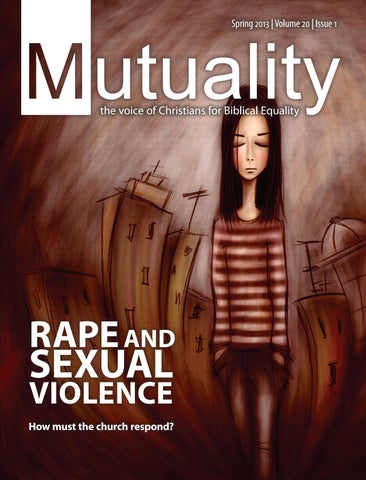
Spring 2013 | Volume 20 | Issue 1
the voice of Christians for Biblical Equality
RAPE AND
SEXUAL
VIOLENCE
How must the church respond?
Please be aware that this issue of Mutuality includes content that may be triggers for survivors of abuse. Mutuality 20.1, Spring 2013 “Let us then pursue what makes for peace and for mutual upbuilding” (Rom. 14:19, NRSV). Mutuality (ISSN: 1533-2470) seeks to provide inspiration, encouragement, and information about equality within the Christian church around the world. Editorial staff: Megan Greulich and Tim Krueger, editors; Image Spigot, graphic designer; Mimi Haddad, president/publisher. Contact us at: Christians for Biblical Equality; 122 W Franklin Ave, Suite 218; Minneapolis, MN 55404-2451; phone: (612) 872-6898; fax: (612) 872-6891; email: cbe@cbeinternational.org; web: cbeinternational.org. We welcome your comments, article submissions, and advertisements. For writers’ guidelines and upcoming themes and deadlines, visit CBE’s website and follow the link under the Resources tab. Advertising in Mutuality does not imply organizational endorsement. Please note that neither Christians for Biblical Equality, nor the editor, nor the editorial team is responsible or legally liable for any content or any statements made by any author, but the legal responsibility is solely that author’s once an article appears in Mutuality. All Scripture quotations, unless otherwise indicated, are taken from the 2011 revision of the Holy Bible, New International Version®, NIV®. Copyright © 1973, 1978, 1984, 2011 by Biblica, Inc.™ Used by permission. All rights reserved worldwide. CBE grants permission for any original article (not a reprint) to be photocopied for local use provided no more than 1,000 copies are made, they are distributed free, the author is acknowledged, and CBE is recognized as the source. Mutuality is published quarterly by Christians for Biblical Equality and is sent free to members and supporters.
Contents 4
Conduits of Extraordinary Compassion | An interview with pastor, author, and survivor of sexual assault, Elaine Heath. by Megan Greulich and Tim Krueger
7
Opprobrium | A poem. by Olga Soler
10 The World’s Oldest Oppression | A glimpse into the realities of prostitution. by Vednita Carter 12 Is the Church Safe for Survivors? | Bad signs from the Christian blogosphere and how we must do better. by Laura Robinson 15 Join the Conversation on The CBE Scroll On Modesty and Male Privilege | A man’s perspective on rape culture. by Luke Harms 16 50 Shades of Broken | Examining messages from pop culture that condition women for abuse. by Jenny Rae Armstronge 19 For Further Reading | Recommended resources on responding to sexual assault. compiled by Krista Wilson
MINISTRY NEWS 20 What Gospel Will You Offer the World? | The report from CBE’s booth at the 2012 Urbana Conference.
D E PA R T M E N T S 3
From the Editor | Susan’s Story
18 Praises and Prayers 18 Reflect with Us | Forgiveness—By Way of the Cross 21 Giving Opportunities | 2012 Annual Report to CBE Members and Donors
22 President’s Message | Give us Eyes to See and Ears that Hear On the cover: Image by PhenomArtlover, from istockphoto.com.
2 M U T U A L I T Y | Spring 2013
website : cbeinternational.org
F
rom the Editor by Megan Greulich
Susan’s Story Susan was a sophomore at a small Christian college. Working on campus during summer break, she was walking to her dorm alone one evening when a man suddenly appeared on the path. “It’s not safe to be out here by yourself,” he told her in a kind voice. He said he was going her way and would accompany her back home to ensure she would be protected. When she reached her door, he pushed it and her inside. “That was the first of nine evenings in which he broke into my room and choked, raped, beat, and otherwise sexually assaulted me,” Susan said. “The first thing I remember thinking was that it was my fault. I was the one who let a stranger walk me to my dorm. And then, as each night passed, I remember simply accepting that this would be the way I would die. I wasn’t afraid of dying. What scared me was living a life like this.” Susan didn’t report the assaults. “It sounds strange, but I didn’t realize that I didn’t deserve to be treated that way. I was young and naïve, and I had no voice. Each night I tried to barricade myself into my room, to keep him from breaking in. But it never occurred to me to call the police or do anything else about it. I didn’t even tell anyone about it until more than five years later. I just felt resigned to the idea that this was life for women. And I felt deep shame because I believed the abuse was my fault. In a way, it was actually easier to believe that something was wrong with me. It was easier to believe that than to comprehend how a man could take such delight in hurting a woman in that manner.” “I don’t hate him,” Susan continued. “What breaks my heart is when I consider what he must have been through, what he must have seen, to believe that this is how a woman is to be treated. It’s a tragedy for me. And it’s a tragedy for him.” Decades later, Susan still feels some effects of the abuse. “Every once and awhile I have a sensation that his hands are around my neck again, choking me.” But she also knows she is
healing. “Even though my body still bears the scars, I realize that I don’t need to carry scars in my spirit the rest of my life,” she explained. “I have found deep peace in understanding that Jesus didn’t desire for me to be hurt, that he was crying right along with me. I understand now how much I matter in the eyes of God, and because of that, I have found my voice.” I wept when I heard Susan’s story. I cried because her story is too common. And I cried because she is my mother. Survivors of sexual assault are our mothers, our sisters, our daughters, our neighbors. Patriarchy is not simply an obscure topic for academic discussion with no real day-to-day consequences. It is close to home. It is even in our homes. So, as women and men who belong to Jesus, how are we to respond? Over the last few years, CBE has been studying, discussing, and praying about the concept that “ideas have consequences.” When our world, our churches, our families believe that women are inferior, women suffer, in very tangible ways. Part of our job as Christians who care about justice and mercy is not only to work to end rape, or sex trafficking, or pornography, but to also fight the ideas that allow them to become reality. That is the focus of this issue of Mutuality. Rape and sexual violence are, of course, terribly difficult topics to discuss. But it is my prayer that you find hope in these pages. Blessings to you as you read and reflect on how, as Elaine Heath coins in her interview that follows (p. 4), we as the body of Christ can be “conduits of extraordinary compassion.” On another note: This will be my last issue as editor of Mutuality, as I am heading off to follow another dream of mine to open a bakery. It has been a complete joy and honor to serve the CBE community through my years as editor and will miss it greatly. But I am happy to continue my work at CBE part-time, as our web content strategist. And I am thrilled to introduce our new editor, Tim Krueger, who is an incredibly gifted writer, logical thinker, and inspiring Christian. I’m honored and humbled to be stepping Mutuality is in very good hands.
Meet Tim
into the role of Mutuality editor. I covet your prayers during this time of transition, and I pray that Mutuality will continue to support and encourage the egalitarian community to ever-increasing alignment with God’s desire for women and men. I am eager to hear your voices, see the face of biblical equality through your stories, join you in wrestling with difficult questions, and strive with you to articulate the good news of biblical equality in our families, churches, and communities.
bookstore : cbebookstore.org
In Jesus, Megan Greulich
M U T U A L I T Y | “Rape and Sexual Violence”
3
Conduits of Extraordinary Compassion by Megan Greulich and Tim Krueger
Pastor Elaine Heath discusses the Bible’s hope for those who have suffered through sexual assault and how the church can become a safe place for survivors.
Mutuality (MUT): In your book, We Were the Least of These, you discuss the biblical concept of Jesus making the unclean clean, and how this is a particularly powerful concept for survivors of sexual assault. As a survivor yourself, how has the church responded to you in ways that made you feel unclean?
Rev. Elaine Heath is the author of We Were the Least of These: Reading the Bible with Survivors of Sexual Assault. Photo courtesy of Chad Riley Photography (www.chadrileyphoto.com).
4 M U T U A L I T Y | Spring 2013
Elaine Heath (EH): First, teachings that support patriarchy, whether they are overt or subtle, reinforce the shame and the sense of uncleanness that comes because of sexual abuse. I cannot tell you how many thousands of times I’ve heard from the pulpit, read in Christian magazines and books, and heard in Sunday school classes that women need to submit to men. And for a woman who has been assaulted, whether as an adult or a child, that taps into her sense of being overridden, violated, and unworthy—the sense that you don’t get to have a voice and you’re supposed to sit down and take it. That’s how these teachings are heard and felt by survivors. Second, many messages from the church shame people who have been divorced, regardless of the reasons. There may be more compassion for divorced people today than in the past, but it’s still a problem. Often pastors will make blanket condemnations of divorce, without any kind of nuanced thinking. They’re not thinking at all about the many of us who are divorced
website : cbeinternational.org
because we were being battered or abused. For the survivor of that had happened. And it just undid me! That experience and violence, those kinds of statements make you feel like, “Wow, I prayer stayed with me for days and days. I could scarcely think of survived violence in my family or marriage, and now I’m going other things—it was just constantly in my awareness. It opened to get beat up for surviving that violence. My church is going to my heart and mind to a different way of thinking about Jesus. I reject me. I’m not going to be allowed to take communion, or to realized that Jesus is with us and in us when we experience sexual be a leader in some churches. Or, in some churches, I’m going to abuse, and those things are happening to him, through us. There’s hell no matter what. There’s nothing I can do about it.” I have a tight bonding with us in our suffering, and, as a consequence of experienced that personally, and I know many, many people who that, then, my eyes were opened to read the Bible in new ways with have experienced it too. a number of texts. A third problem is the church’s general obsession with In my chapter on Jesus’ death and resurrection in We Were sexual sin, and the failure to think of it with a nuanced and the Least of These, I explain how one aspect of Jesus’ crucifixion mature understanding. There’s a tendency to think of sexual sin was explicitly sexual assault. When Jesus was stripped naked and with the assumption that everybody who participated in the sin tortured, it was an act of sexual violence. It was meant to heap did so willingly. There is often a failure to think of sexual sin in complete shame upon him. I see clearly Jesus’ solidarity with those terms of violence done against another person. This lumps those of us who’ve been raped, stripped against our will, pinned down of us who’ve been raped or who were sexually abused as children and violated. together with someone who is out there cheating on a spouse. This I also remember reading the story of the Levite and the too taps right into the shame and the sense of uncleanness. concubine in Judges 19. I’d read it before, but by this time, I’d And fourth, the sexualization of women is a rampant problem done a lot healing and recovery work. All of a sudden, I saw in in the church. I remember being taught when I was in my twenties that story every woman who is a victim of battery and murder and thirties that women and men cannot work together or be at the hands of her religious husband. If you study the battering friends because it will always become sexual. And the problem cycle, then you see that all those pieces are in the story. That was was always the women—it was the women alone who would turn a turning point for me, too. I wrote an article that was taken and friendships into sexual relationships. Which, of course, is ridiculous! And it spills out into all kinds of other areas. When you’re a female survivor of sexual violence and When you’re a female survivor of sexual violence. . . you hear messages like that in the church, you’re hearing, you’re hearing, “It was your own fault that you were “It was your own fault that you were sexually violated. sexually violated. The men couldn’t help it. You’re just The men couldn’t help it. You’re just female, and that female, and that overwhelms men’s ability to control overwhelms men’s ability to control themselves.” When I was in one of my pastoral care classes in themselves.” seminary, my textbook was full of warnings for the male pastor who was going to counsel a female parishioner. It said that shared in a number of therapists’ offices. It opened up dialogue, women parishioners will often try to seduce the male pastor, so he allowing me to listen to other people’s stories and reach new levels must be very careful. He must make sure his secretary was in the of understanding. room anytime he counseled with a woman, and he had to leave his door open—all safeguards so the woman wouldn’t overwhelm MUT: As we read your book, we were struck by the story of the him. The book said nothing at all about predatory pastors, or what bleeding woman (Mark 5). How is this passage encouraging to you to do if you’re a female pastor. and to other survivors of sexual assault? This fits in with interpretations of the Bible that blame women for the fall and evil in the world, as if Eve seduced Adam. EH: There were such strict laws about ritual purity in Jewish Again, this is an incorrect, patriarchal interpretation of the fall. culture. If you touched a dead body, then you were unclean. If And those teachings tap right into that sense of uncleanness, the you were a woman and you were on your menstrual cycle, then belief that “there’s nothing I can do about this. I’m permanently you were unclean. If you had sex, then you were unclean. If you warped. I was born bad.” touched someone who was unclean, then you were unclean. There were a number of things like this, and in order to be clean again, MUT: What specific passages in Scripture really helped you heal you had to complete certain rituals. The bleeding woman had from the abuse and these harmful messages in the church? been bleeding for many years, and in her culture, that made her ritually unclean. She had not been able to touch anyone or go EH: I think the pivot point for me was a very intense prayer to public worship in years. But Jesus breaks all these rules. He experience in which I was reflecting on the passage that says, touches her, and she is made well. “Whatever you do to the least of these, you’ve done to me.” I Looking back at the Old Testament, we see that people realized, “Wait a minute! There was a time when I was young that took their gift to the altar to be sacrificed to the Lord, and that I was ‘the least of these’!” I had a profound experience of seeing the altar made the gift clean. The altar sanctified the gift. In the Jesus with me and in me, suffering with me through the things book of Hebrews, there’s this very elaborate theology of Jesus
bookstore : cbebookstore.org
M U T U A L I T Y | “Rape and Sexual Violence”
5
PASTOR ELAINE RESPONDS: What redemptive steps can churches take to support survivors of sexual assault?
being the altar, the priest, and the gift—all three at the same time. What we see in Jesus is that instead of the uncleanness rubbing off on him, Jesus’ virtue rubs off and makes the other person clean! Every time Jesus heals someone, he brings the virtue and sanctity of God and puts it on that person who is 1. Make sure that all of our pastors and lay leaders ill, who is struggling, who has been demonized. When the are informed. bleeding woman touches Jesus, he feels the virtue go out of him and into her. It’s sort of a reversal of uncleanness; the Ministry leaders should all learn the first steps to take to offer support to those making clean, the making well. That’s what the concept of who have suffered abuse and to recognize people who may be survivors. Almost no seminary that I know of requires this kind of a class for people who are going to shalom is all about—shalom is the making well, the making be pastors. Many seminaries don’t even offer a class like this. And this is something whole, the bringing of well-being. When Jesus touches with that congregations could change by insisting that graduates need to have this this intent to heal, what he brings is shalom. training in order to work in their churches. An important aspect of the bleeding woman’s story has to We all need to become much more informed about the ways in which childhood do with the theology of retribution, which blamed the victim sexual abuse can set people on these trajectories in life—which include more and was common in that time and culture. If you were sick and battering and more sabotaging of one’s life—so that we can help people you stayed sick, it was because you or someone in your family transition out of those cycles of behavior and relationships. We must also become had sinned. People saw this woman’s problem and blamed her much more compassionate and informed about divorce in the case of violence. for it—they were ashamed to be near her. But Jesus publicly Violence breaks the covenant just as surely as adultery does. praised her. He said, “Your faith has saved you.” And what a 2. Ensure our teachings promote justice and healing. shocking thing that was, because everyone else thought she was in that bind specifically because she had the wrong kind We must relentlessly work to deliver the church from patriarchy and all its manifestations. This has played an important role in my healing and recovery. of faith! They blamed her for her own illness, which is what I turned a corner when I found CBE and realized that I was not we often do in our culture alone in my hunch that the Bible was for women too. to rape victims when Every time Jesus heals someone, he we say, “If you’d dressed We could also develop more healing liturgies for people who are in recovery from assault of different kinds. When someone brings the virtue and sanctity of God differently, then that is receiving spiritual direction or going for pastoral care, they and puts it on that person who is ill, who wouldn’t have happened will typically reach threshholds in their recovery process when to you.” But Jesus restored is struggling, who has been demonized. shalom for this woman. they are ready to take the next step forward and let go of the past. Usually then, the spiritual director or pastor has to create He makes those deemed unclean clean. Now she could be part a liturgy or some kind of a healing ritual. It would be helpful to of the faith community have more liturgical resources for those kinds of situations, and again. And maybe she for pastors to know where to get them. could even challenge their bad theology by the fact that her 3. Learn about and avoid trigger phrases. faith made her well. There are definitely trigger phrases that can set off survivors of abuse. Here’s one: It is vital to remember that Jesus is not bound by our “If you don’t forgive those who sinned against you, God won’t forgive you.” Does cultural and religious taboos. He’s beyond them and he’s this mean that God is weaker than our capacity to forgive? And what do we mean determined to heal us, and to include and welcome those who by forgiveness? In reality, forgiveness is a process that one enters into with God’s have been marginalized in our world. He is not ashamed of help, and it might take a long, long time to forgive someone for a terrible evil. Any us. He is not ashamed of our dirt or our illness. He is full of kind of talk about women submitting to men can be another trigger, as well as any love and compassion, and he sees our good future and relates suggestions that Eve seduced Adam. to us through that lens. There is a way in which Jesus is proud 4. Provide congregants with resources and support. of us! It is amazing. Every church should form a partnership with at least one or two therapists who have It’s these kinds of revelations that have helped heal me, special training in recovery from sexual abuse and domestic violence, so that referrals and it is incredible to see the light bulbs of awareness come can easily be made. Do not assume that every therapist has training in this issue. on for other survivors, too. It is a precious and holy thing Work with local shelters to provide information to congregants about services to observe. And survivors of this kind of violence, who are available for persons to recover from sexual abuse, from rape, from domestic healing well and who put their faith in the Lord, become violence. Place a small pocket on the back of the stall doors in women’s bathrooms, conduits of extraordinary grace, prayer, compassion, and and fill it with cards providing help lines and places to go for assistance. Small cards restorative power in the world. are easy and discrete for someone to take and put in her purse.
And finally, host Sunday school classes, small groups, and even retreats addressing sexual violence. Consider inviting a therapist who works with survivors to lead a Sunday school class or small group for several weeks. Or offer healing retreats, such as the one I describe in the back of We Were Least of These where Christian leaders who work in the area of recovery from assault and who also hold advanced theological degrees can facilitate more nuanced discussions.
6 M U T U A L I T Y | Spring 2013
Tim Krueger is the new editor of Mutuality and the publications coordinator for CBE. He has a deep concern for global justice and is fascinated by history, language, and culture. He and and his wife Naomi live in Saint Paul, Minnesota. Megan Greulich is CBE’s web content strategist. She runs a bakery in Saint Paul and is active in an urban Mennonite intentional community.
website : cbeinternational.org
Survivors of trafficking, prostitution, and other kinds of sexual violence carry the public disgrace and shame—the “opprobrium”—of the crimes committed against them. Alluding to the story of the woman caught in adultery (John 8:1-11), this poem highlights how for victims today, healing includes allowing Jesus to remove their shame, granting them freedom from opprobrium.
Opprobrium Opprobrium (n.): The harsh criticism or public disgrace arising from shameful conduct. by Olga Soler
I have come to the courtyard alone for my stoning, He asks me, “Where are your accusers?” They are hiding, Suspiciously, my own hand holds a sizable rock, What can it mean? I creep like a thief who eschews the light, Only sane people question, Opprobrium…Only I hear the prattling of my absent but potent jury, A force casts me to the ground…it is the Primal prosecutor…memory, Opprobrium…Does anyone hold me in such great Contempt as I? Opprobrium…God himself has banished you from my Soul’s country, What cheek has brought you here again? Opprobrium…It was I who placed you on a silver plate, But for the questions it was I who would have feasted on This deadly sin, Yes, I now question, oh blessed thought… I will not choose opprobrium, Lord to whom all debts I owe, lovingly write shame’s Epitaph in the sand, that all blame be where blame Belongs, and opprobrium receive back the stone for The ill placed one in my hand. Olga Soler is director/writer and performer for Estuary Ministries, a Christ-centered multimedia performing arts ministry. She holds degrees in education and communications with equivalent studies in theology and psychology. She has authored, co-authored, and illustrated several books including Tough Inspirations from the Weeping Prophet and The Body.
bookstore : cbebookstore.org
M U T U A L I T Y | “Rape and Sexual Violence”
7
Christians for Biblical Equality presents...
We will consider how misinterpreting Scripture contributes to a worldview that devalues females and fosters injustice. Be part of sessions, workshops, and a cascading presentation that advocate justice for women through a truly biblical worldview. Come lend your voice, explore ideas, and fellowship with us!
Plenary Speakers: Mimi Haddad Christians for Biblical Equality “Take Every Thought Captive to Christ: Ideas Have Consequences”
Fatuma Hashi World Vision
Lee Grady The Mordecai Project “Jael’s Lethal Weapon: Why Women Cannot be Sidelined in This Critical Hour”
J.R. Daniel Kirk Fuller Seminary “Patriarchy and Worth: The Gospel’s Challenge to an Ancient System”
“Partnering Religious Leaders in Promoting Equal Worth, Dignity, and Entitlement for Women and Men, Boys, and Girls”
Lillian Kimani St. Paul University “The Role of the Church in Bringing Down the Strongholds of Fear and Negative Thoughts That Prevent People from Seeing Biblical Truths”
Join CBE’s Student Paper Competition : Three students will have an opportunity to read a research paper at Christians for Biblical Equality’s 2013 conference in Pittsburgh, PA. All papers may also be considered for publication in one of CBE’s journals. All submissions due: May 1, 2013.
“We demolish arguments and every pretension that sets itself up against the knowledge of God, and we take captive every thought to make it obedient to Christ” (2 Cor. 10:5, NIV).
Register online at cbeinternational.org/pitregistration or call us at 612-872-6898.
Workshop Speakers:
Susan Howell
Cynthia Long Westfall
Medad Berungi
Campbellsville University “Gendered Language: Differences and Consequences”
McMaster Divinity College “In Church or at Home? What is 1 Timothy 2:8-15 Really About?”
Diocese of Kampala Imago Dei Fund “A Lie Long Planted: Deep Roots Cascading Presenter of Gender Based Injustices in Sub-Saharan Africa”
Don Neufeld
Lily Lee
Daniel Fan
Jeffrey D. Miller
Clinical Social Worker “Coming Alongside”
Pleroma Home for Girls “No Woman or Girl Left Behind”
Independent Screenplay Writer and Activist Cascading Presenter
Milligan College “Words Have Consequences: Gender Language in the Church”
Domnic Misolo
Olga Soler
Rick McKinniss
Patricia Warford
EFOGE “Challenges Faced in Preaching Biblical Equality in Africa”
Estuary Ministries “Ellipses of Christian Egalitarian Marriage through the Vehicle of the Arts”
Wellspring Church Counselor and Therapist “Spiritual Warfare: Why Paul “Facing Nabal: Working with Benched the Women at Ephesus” Men Who Abuse”
Bettina Tate Pedersen
Charity Kroeker
Martha Giltinan
Jackie Vanderbrug
Point Loma Nazarene University “Reading the Bible, Reading Literature: Becoming a Feminist Christian Reader of the Bible”
Christians for Biblical Equality “Strategic Planning for Systematic Change in Church and Community”
Trinity School for Ministry “Women Leaders: A Primary Issue?”
Philanthropy Indaba “Gender Lens Investing”
Emily Nielsen Jones
“We demolish arguments and every pretension that sets itself up against the knowledge of God, and we take captive every thought to make it obedient to Christ” (2 Cor. 10:5, NIV).
cbeinternational.org
Pittsburgh, PA July 26-28, 2013
by Vednita Carter
A G L I M P SE I N TO T H E R E A L I T I E S O F PR OS T I T U T I O N
In the United States, the average age of entry into prostitution is between twelve and fourteen years old, and in some parts of the world, it can be as young as three to five years old.
“Freedom” by Gwen Meharg (www.drawneartogod.com). Used with permission.
10 M U T U A L I T Y | Spring 2013
website : cbeinternational.org
M
ost people live each day eating, drinking, going to work, making plans for every moment, and patiently anticipating that much-needed vacation. They’re never worrying about where they are going to lay their head each night. Yet this way of life is in stark contrast to the lives of sexually exploited women and girls. Trafficked women and girls can’t think about tomorrow or the day after tomorrow. The only certainty is the abuse and degradation that is guaranteed with every paid rape they endure. Tomorrow is the furthest thing from your mind when you know that you may not even survive through today. In order to survive in “the life” of prostitution you must live from minute to minute, think on your feet, always be alert, knowing that at the whim of your next “trick,” any moment could be the last beating, rape, or torturous assault—the one that finally takes your hopeless life forever. Many people don’t understand the world of trafficked women because they imagine prostitution is something other than what it really is—the purchase of a woman or girl’s body for sex. Some people move away from reality and tell themselves, “It’s okay because she’s getting paid,” or, “She wouldn’t do it if she didn’t want it, so it can’t be bad.” Many believe it is a free choice, and that perhaps it should even be legalized. After all, prostitution is the world’s oldest profession, right? I say that it is the world’s oldest oppression. These are all just delusional figments of the imagination used to make ourselves feel better about the heinous injustice of purchasing another human being’s body. The reality is, prostitution is a multi-billion dollar industry. The reality is that in the United States, the average age of entry into prostitution is between twelve and fourteen years old, and in some parts of the world, it can be as young as three to five years old. This is not a choice. The reality is that a man pays money to use her; she is no more to him than a toilet for his relief. This is the experience of an exploited woman. Many people are deluded into thinking that prostitution is harmful only when it entails physical violence, such as beatings, pushing, and hitting. But this is a lie. You must understand that even if there were not physical violence involved at all, the very act of prostitution is abusive and exploitative. A prostituted woman or girl must have sex with seven to ten men daily (as reported by domestic victims in the U.S. as their daily quota set by their pimp). She must comply with the demands of the buyer, and very rarely has the freedom to decline his requests, regardless of how twisted or sadistic they may be. Every act of prostitution is an inner invasion of her body, mind, and spirit that touches the core of a woman’s soul. Every day—every second—a prostituted woman or girl becomes less and less of who she was created to be and more and more incomplete. Prostituted women and girls state that there is an emptiness deep within them that they just can’t seem to replenish. Yes, you can begin to heal, but you will never forget the memory of every part of your body being penetrated in some
way by one man, then another, and still another, throughout the course of each day. The consequences are devastating, and many women and girls never fully recover from being sexually exploited. The mental, physical, and spiritual scars can last a lifetime. Prostitution wounds all of our souls by teaching us delusions about who we are. It tells us that women and girls can be bought, sold, or traded at any time. If not bought or sold, they can be raped. They can be beaten and even murdered as long as one “pays” to do so, because women and girls used in prostitution have surrendered their humanity. Being sexually subjugated to men is somehow part of a woman’s core worth and purpose.
bookstore : cbebookstore.org
M U T U A L I T Y | “Rape and Sexual Violence”
We need to understand that patriarchy has been allowed to flood the world with preconceived ideas about the role of women, our status, who we are, and our worth. It teaches us that it’s alright for men to be abusers, so long as they pay. It says that “boys will be boys”—that men are entirely controlled by their sexual temptations, no matter how twisted. That’s just the way it is. In my own recovery, the answer was spiritual. There is only one way to overcome the wounds of prostitution and the lies it spreads about who we are and what we are for. There is only one path to full recovery and redemption, and only one person who could make me whole and complete again. That person is Jesus. We need to open our eyes. We need to understand what has been happening to our sisters and daughters for too long. We need to understand that patriarchy has been allowed to flood the world with preconceived ideas about the role of women, our status, who we are, and our worth. It is because of patriarchal beliefs that women throughout the world have been and continue to be hurt in every imaginable way. God did not create men to force women to be subservient to them. He said that woman would be a helper to him, not a servant. A companion, not a slave. Not above him, not below him, but side by side with him. Until men and women are able to come together and see each other as equal, there will never be a time when women and girls are not sold, abused, and exploited as property. Vednita Carter is the founder and executive director of Breaking Free, a nonprofit dedicated to helping women and girls escape sex trafficking and exploitation (breakingfree.net). She is a sought-after speaker and writer and a trainer to the FBI. She has appeared in several documentaries and has been invited to speak to the UN about the impact of prostitution on women and girls.
11
Is the Church Safe for Survivors? Examining the Church’s Role in Opposing Rape Culture by Laura Robinson
Recently, I was pleasantly surprised to see an online sermon excerpt from a well-known complementarian pastor, challenging his audience to stand up for victims of assault and abuse. It was a powerful message. The pastor read from one female congregant’s heartbreaking letter recounting her rape, her abusive marriage, and the destructive, victim-blaming “counseling” she received from her former church afterwards. He challenged his church to rise above this example. He called particularly on the men of his congregation to follow Paul’s example and “treat younger women as sisters” (1 Tim. 5:2), never exploiting or taking advantage of another person. As an egalitarian watching at home on my laptop, I wanted to clap. Sure, this pastor was a long
12 M U T U A L I T Y | Spring 2013
way from espousing biblical equality, but it was still encouraging to hear this message from such a popular pulpit. What a relief to assault survivors in his church! Surely this message of love and support from such a prominent Christian would inspire his listeners to critically evaluate their assumptions on survivors and assault. Right? Wrong. Many people fought back. Blog posts and online comments responding to the sermon reported that the pastor, while correct in denouncing this woman’s assailants, did not hold the victim accountable as well. One commenter noted that if the woman “had not given [her rapist] the opportunity...she would have never been harmed.” Some wanted to know if the
website : cbeinternational.org
woman had been drinking before her rape, others questioned why she chose to be alone with a man on the night of her assault, and still others questioned her judgment for marrying a man who abused her. Sure, most listeners paid some sort of lip service to the idea that the abusers were primarily responsible, but most people wanted to know where her parents failed, where her pastor failed, where she failed. Essentially, listeners wanted to know where everyone went wrong, except for the rapist and abuser. Unfortunately, this is not an isolated incident. A post from a popular Christian women’s blog in the spring of 2012 encouraged modesty for teen girls on the grounds that it was “risk management” against sexual assault. The article compared dressing immodestly to parking a new car with the keys in the ignition and complained that: ...A girl can dress provocatively, go to a guy’s apartment, get drunk, get naked, pole dance, come on to him and then accuse him of rape when he doesn’t stop at the last minute. C’mon, girls. Use your brains. Yes, he may be culpable of rape, but you sure didn’t do any favors by throwing your car doors open. Instead of addressing the obvious perpetrator in the above hypothetical scenario (the man who didn’t stop when he was asked, whether it was at the “last minute” or not), the article perpetuated a number of myths about sexual
[
Rape is motivated by power and control. It is not about sex.
assault and shifted the responsibility from prospective assailants to prospective victims. If women would just be smart instead of dressing provocatively, drinking alcohol, flirting, or spending time alone with a guy, men wouldn’t make the mistake of raping them. Sadly, Christians are just as likely as the rest of society to buy into rape culture and perpetuate rape myths. In an age in which one in four women are assault survivors, this means that twenty-five percent of women may not find the support that they desperately need in our churches. If we are ever going to stand alongside our vulnerable sisters (and brothers) in the way that God has called us, Christians need to educate themselves about the realities of sexual assault and shape our rhetoric by facts, not myths. A great place to start is by looking at some of the more common myths about rape and sexual assault, and checking our language and attitudes to make sure we are not perpetuating these myths. Here are a few: Myth: Rape is motivated by sexual attraction and gratification. Fact: According to the University of Minnesota’s report on the sociology of rape, rape is motivated by power and control (John Hamlin, “List of Rape Myths”). It is not about sex. It is a violent crime perpetrated to dominate and humiliate another person. Most rapists actually have access to consenting sexual partners, and the desire to commit assault does not spring from frustrated sexual urges. Rape gratifies the urge to harm and debase other people. It does not gratify the normal, healthy desire to have consensual sex.
bookstore : cbebookstore.org
The Way Forward How Concerned Christians Can Help Make the Church Safe for Survivors Recognize that sexual assault affects people in your congregation. One in
four women and one in six men will be assaulted in their lifetimes. Whether speaking from the pulpit or in ordinary conversation, talk about rape or sexual assault with the assumption that someone listening is probably a survivor. Get informed. Unfortunately, most of what our culture calls “common sense” about sexual assault—the idea that modesty can prevent assault, etc.—is actually based on myth. Don’t assume you understand the issue based on depictions of assault that you’ve seen on the news or in popular culture. Read about sexual assault facts at womenshealth.gov, RAINN.org, or the Center for Disease Control (CDC) website on sexual violence.
Let survivors lead the conversation. Approach conversations about sexual assault from a position of compassion and humility. Ask questions. Don’t prescribe. Don’t ask why a survivor did or did not do something. Be willing to learn from the experiences of survivors. James 1:19, “Be quick to listen, slow to speak,” is always good advice for Christians, but it is especially important here. Treat assault like a serious sin and a crime. Call it for what it is. Don’t talk about “misunderstandings,” “unwanted sex,” or so forth. Don’t ask what survivors could have done differently or better in order to prevent their own victimization. Remember that responsibility for assault begins and ends with the criminal, just as it does with any other crime.
“Rape and Sexual Violence”
13
Myth: Women tempt men to commit assault by the way they dress and act. If women dressed conservatively and did not flirt, they would be less likely to be assaulted. Fact: Rapists do not choose their victims based on their appearance. According to an interview with a psychologist at the Utah State Prison, there is no single profile that rapists target, and they certainly do not target only young, traditionally attractive women (Ron Sanchez, interviewed by the Public Broadcasting Service, “No Safe Place: Violence Against Women”). Rapists tend to target women who are vulnerable, easy to assault, and unlikely to report. This might be a senior citizen in a nursing home, an eight-year-old at her parents’ house, or an inebriated student at a party. Dress and appearance are not nearly as important as accessibility and vulnerability. However, even if rapists did tend to target young women who were dressed provocatively or flirted, this still does not mean that flirtatious behavior is sending “mixed signals,” or that a woman who says “no” while wearing a short skirt is any less sincere than one who says “no” while wearing sweatpants. Condemning women for their own behavior before an assault shifts the responsibility from perpetrators to victims. When a person fails to respect others’ boundaries, fails to make sure that their partners are freely consenting to sex without pressure or coercion, and fails to take refusal, rejection, or reluctance seriously, the blame rests on them alone.
14 M U T U A L I T Y | Spring 2013
Myth: Women falsely accuse men of rape. Fact: According to the Harvard Journal of Law and Gender, false reports of sexual assault are no higher than for any other crime (Julie Taylor, “Rape and Women’s Credibility”). However, a culture of skepticism surrounding assault claims makes it harder for women to report, and makes it harder for cases to go to trial. Furthermore, there is often confusion about what it means to make a false accusation of assault in the first place. If a woman tells her boyfriend to stop, and he continues to have sex with her anyway, this is no less of an assault than if the woman had told the same thing to a stranger hiding in the bushes. No matter what a woman is doing, wearing, or who she is with, when she says “no” to sex and is ignored, the sex is non-consensual, and the act is assault. As Christians, let’s take our proper place in society as defenders of the vulnerable, the victims, and the innocent. And in the case of sexual assault, this begins by discussing rape in a way that leaves responsibility solely with the perpetrator, and by dispelling myths and falsehood while espousing the truth. I encourage Christians to do more research for themselves—to learn about rape statistics, myths, and facts—and to speak up when falsehoods appear in our own publications and churches. Laura Robinson is finishing her MA in biblical exegesis at Wheaton College. She received her BA in English and religious studies at Indiana Univeristy in 2011 and was an intern at CBE in the summer of 2010.
website : cbeinternational.org
Join the conversation on The CBE Scroll
On Modesty and Male Privilege The reason for rape is not V-necks and skinny jeans
by Luke Harms
Recently, a fellow blogger wrote a great piece about the problems It’s the same culture in which college orientations teach with modesty rules in Christian culture. She rightly pointed out freshmen women tips for not getting raped instead of teaching how these rules unfairly shame women into particular behavior freshmen men not to rape. patterns, often resulting in lasting emotional and psychological It’s the same culture that blames and shames victims of sexual damage. It was an honest, personal story of one woman’s struggle assault into silence, instead of bringing the perpetrators to justice. to reconcile her freedom in Christ with the rigid behavioral codes It’s the same culture that sees women’s bodies as objects to be often handed down to women from the pulpit or from Christian controlled as means to men’s ends. culture in general. In the end, it’s about control. It’s about maintaining male It was a fantastic piece. And then there were the comments. privilege and perpetuating patriarchy. As the mostly male The basic premise that many of the commenters were commenters approached this issue of modesty on my friend’s post, defending was that women have a responsibility to dress modestly little space was given for the man’s responsibility in this cycle, in order to keep men from sinning through lustful thinking. Most and when it was mentioned, it was an afterthought. “Oh, sure, commenters were pretty forceful in driving this point home. men should be modest too, and they’re responsible for their own But here’s the problem as I see it: If, as many of the actions, but women shouldn’t cause them to stumble.” commenters suggest, men (even, I may be wrong, but I think or perhaps especially, Christian this might be one of those speck/ men) are incapable of looking at plank scenarios that Jesus was a woman who isn’t covered from talking about (Matt. 7:4-5). Perhaps head to toe without wanting to instead of focusing on the culturally rape her (or at least mentally rape ambiguous standard of “modest her), then this is decidedly not a dress” for women, we should worry problem that women can or should more about our attitudes toward, feel obligated to solve. Perhaps that and our objectification of, women. bears repeating, and in simpler Maybe instead of trying to place terms: the blame on women for our own If men are perverse, then shortcomings, we should do the that’s decidedly an issue for men hard work of re-wiring our brains in to address. order to remove the influences that Maybe instead of trying to place the blame Shifting the responsibility continue to perpetuate our distorted on women for our own shortcomings, we men to women simply enables men to view of women. Maybe instead should do the hard work of re-wiring our brains think and act like sexual predators, of writing off rape culture in the in order to remove the influences that continue to perpetuate our distorted view of women. rather than demand that they do church as “living in a fallen world,” the hard work of being transformed we should recall that Christians live by the renewing of their minds in the fallen world, but are not of it. (Rom. 12:2). Men, we shouldn’t be saying, “Her skinny jeans and Christians, even those raised in a culture of rape, can be conformed V-neck are making me lust.” No, you’re lusting because your God- to the image of their creator (Col 3:10). We should focus on what given capacity for sexual attraction has morphed into a distorted it means for men to partner with God in bringing the kingdom view of women as objects that you need to control. on earth as it is in heaven. I suspect the kingdom of God doesn’t Now, before we go any further, I should say that yes, I believe include rape culture. that modesty is a quality that all Christians should strive for (and What do you think? How do you define modesty? How do yes men, that includes you), but Christians often reduce modesty we balance our freedom in Christ with our responsibility to our to a dress code for women. The fundamental question many brothers and sisters in a way that doesn’t embrace institutional Christians are not asking is, “Why is this notion of modesty, and inequality? Do you think that rape culture informs church the moral obligations derived from it, so lopsided?” And, “Why culture, or have I gone too far too fast with this argument? do we make countless proscriptions on the behavior on women, Join us at blog.cbeinternational.org to share your thoughts. but essentially ignore the behavior of men? To me, the answer Luke Harms is a Christ-follower, husband, dad, amateur is as simple as it is disturbing. Call it what you want: misogyny, philosopher, and aspiring writer. He tries to live out the patriarchy, institutionalized sexism. I call it rape culture. motto: Live Simply. Love Fiercely. Give Extravagantly. He often fails at it. Then he writes about it. Luke blogs at lukelivingthetension.blogspot.com.
bookstore : cbebookstore.org
M U T U A L I T Y | “Rape and Sexual Violence”
15
50
Shades of Broken
How romance novels condition women for abuse by Jenny Rae Armstrong
I
first noticed it when I bought my Nook. Erotica. Everywhere. Written by and for women. So much for letting my kids peruse the free e-books section! It seems that e-readers opened up a whole new world to women, a world they were too ashamed to admit interest in with a bookseller judging their literary choices through chunky hipster glasses. What the internet did for pornography, the Kindle does for erotica, providing unrestricted access to titillating titles no one else has to know about. While I was irritated that I couldn’t surf for e-books without wading through a sea of steamy Smashwords covers, I wasn’t incredibly surprised. After all, girls have been sneaking “bodicerippers” home in their backpacks for decades. I was surprised, however, when 50 Shades of Grey rode the e-reader revolution right to the top of the New York Times bestseller list. Haven’t heard of the 50 Shades trilogy? An ABC News article explains: “Anastasia Steele, 21, and a virginal college student, can’t say no to dashing 27-year-old Christian Grey, who insists she sign a contract that allows him to submit her to his every sadomasochistic whim. In their first sexual encounter, Grey unveils his silver tie and binds her wrists in knots, and Steele does as she is told. He is also fabulously rich, a telecommunications tycoon, and uses his wealth to take care of her like a pampered princess. ‘Ana,’ as he calls her, willingly and excitedly agrees to spanking, whipping and gagging, with props like ice, rope, tape—a repertoire right out of a BDSM (bondage, discipline, dominance and submission) manual. Grey instructs her to call him ‘sir,’ and sets rules on everything from her diet to her most intimate grooming routines” (1). If you think that sounds more like domestic abuse than sexual fetishism, you’re not alone. In an interview with The Atlantic,
16 M U T U A L I T Y | Spring 2013
Sophie Morgan, a British journalist and BDSM practitioner, says “The relationship between dominant Christian and submissive Ana, even allowing for the caveats of it being fictional and somewhat based on the Edward/Bella Twilight romance, is nothing like any relationship I’ve had with a dominant. The kind of high-handedness that Christian shows is actually more a sign of a potentially abusive relationship that most women would and should run for the hills to avoid than signs he’s her Prince Charming—helipad and penthouse apartment or not” (2). It’s easy for Christians to condemn books like the 50 Shades trilogy for their sexually explicit content. But a more insidious danger lurks beneath the surface-level depredations, one that is perhaps more apparent to secular British journalists than the typical evangelical reader, with their expectations of strong male “leaders” and needy, submissive heroines. The truth of the matter is that men like Christian Grey—domineering alpha-males with subtly abusive traits—are a staple in popular romance novels, Christian and otherwise. The Beauty and the Beast motif is, after all, a “tale as old as time.” A winsome maiden finds herself at the mercy of a powerful, intimidating man. She initially resents his arrogance, but, as her growing love “tames” the beast, she concludes that his controlling behaviors are just an expression of the intensity of his love for her. When she resists him, she is chastened to discover that his surly actions and unreasonable rules always had her best interests at heart, and that stepping outside his protective boundaries is a recipe for disaster, one that he will most likely have to rescue her from. Think Edward in Twilight. Think Rhett Butler in Gone with The Wind. When this is what society holds up as the paragon of romance, is it any wonder that many Belles enthusiastically
website : cbeinternational.org
Gone with the Wind’s Rhett Butler and Scarlett O’Hara
Beauty and the the Beast’s Belle and the Beast
EL James’ best-selling Fifty Shades of Grey
submit themselves to surly, controlling Beasts, only to discover that living happily ever after with him is about as likely to happen as a dinner party put on by singing, dancing flatware? Still, the question remains: Why are women attracted to these stories in the first place, especially when they include violence against the female? Shouldn’t novels where women are minimized, mistreated, slapped, tied down, held against their will, and even raped set stomachs, and not pages, turning? Proponents of patriarchy have an answer, and it is truly frightening. In his book Fidelity: How to be a One-Woman Man, Douglas Wilson writes “Because we have forgotten the biblical concepts of true authority and submission, or more accurately, have rebelled against them, we have created a climate in which caricatures of authority and submission intrude upon our lives with violence. This is what lies behind sexual ‘bondage and submission games,’ along with Shouldn’t novels where women are very common rape fantasies. Men dream of being rapists, minimized, mistreated, slapped, and women find themselves tied down, held against their will, wistfully reading novels in and even raped set stomachs, and which someone ravishes the not pages, turning? ‘soon to be made willing’ heroine” (3). While Wilson’s horrible assertion that men “dream of being rapists” should be dismissed out of hand, and his assumption that BDSM fetishes are about suppressed gender roles is weakened by the fact that many male participants prefer the submissive role, how are we to reply to Wilson’s dead-on portrayal of women swooning over bodice-rippers? Is there truly something in the feminine makeup that wants to be dominated by a man, that desires the curse described in Genesis 3:16? Since women don’t actually enjoy being controlled, raped, bullied, or abused, we can safely say that there is not. But somehow, women have been conditioned to fantasize about being taken in hand by a dangerous, domineering man, to consider it romantic. How? Perhaps we have underestimated the power of the stories themselves. There are cultural, psychological, and even physiological reasons why some women gravitate toward threatening “heroes” or violent sexual fantasies. Women’s bodies respond to perceived sexual threat by becoming physically aroused. It’s a defense mechanism to minimize injury if they are assaulted (4). Knowing this may help us understand how fiction that celebrates sexual violence could be an easy way for inexperienced teens or exhausted moms to experience a bit of a tingle. Yet, this age-old storytelling medium has played a crucial role in promoting an unhealthy view of sexuality and relationships, one that has been passed down from a dysfunctional, and often violent, patriarchal past. In a blog post titled “The Brain on Lust,” Sharon Hodde Miller, a PhD candidate at Trinity Evangelical Divinity School, explains that “whenever you learn something new, your brain changes, both physically and chemically. As that new information is stored, your brain creates new neural pathways and strengthens old ones...The more you use certain neural pathways, the stronger they become, whereas others weaken with lack of use” (5). In other words, our minds are, in the most literal sense, moldable. The more time we spend thinking about something (hours submersed in romance novels featuring domineering or abusive heroes), and the more our associations are reinforced (domineering men are sexy, and relationships with them will lead to happy endings), the stronger those neural pathways become. Just like
The Twilight Saga’s Edward and Bella bookstore : cbebookstore.org
M U T U A L I T Y | “Rape and Sexual Violence”
17
pornography, romance novels can rewire our brains, overwriting reality with unhealthy fantasies that we increasingly associate with pleasure. Not all romance novels are bad, of course. But it is important to use discretion and read critically, and encourage others to do the same. The narratives we accept as normative, and the stories we tell others, with our words and with our lives, wield incredible power. If what we fill our minds with literally changes the landscape of our brains, it’s crucial to ask: Whose blueprint are we going to follow, and who do we want to do the landscaping? REFERENCES Donaldson James, Susan. (4/3/2012) “50 Shades of Grey, Why Mommy Porn Is Hot.” ABC News. http://abcnews.go.com/Health/50-shades-grey-women-turnedsexual-submission/t/story?id=16059118 Doll, Jen. (9/4/2012) “An Actual Submissive on what ‘Fifty Shades of Grey’ Got Wrong.” The Atlantic Wire http://www.theatlanticwire.com/entertainment/2012/09/actualsubmissive-what-fifty-shades-grey-got-wrong/56463/
Reflect with us...
“Finally, brothers and sisters, whatever is true, whatever is noble, whatever is right, whatever is pure, whatever is lovely, whatever is admirable—if anything is excellent or praiseworthy—think about such things” (Phil. 4:8). Jenny Rae Armstrong is an award-winning freelance writer who is passionate about building up the body of Christ by building up women. She writes about women’s issues for a wide variety of Christian publications, and blogs at jennyraearmstrong.com.
Wilson, Douglas. (12/6/1999). Fidelity: How to Be A One-Woman Man. Moscow, ID: Canon Press. Lalumiére, Martin L. and Kelly D. Suschinsky, “Prepared for Anything? An Investigation of Female Genital Arousal in Response to Rape Cues,” Psychology Science, 22/2 (2011): 159-165. Miller, Sharon Hodde. (12/14/2012) “The Brain On Lust.” SheWorships.com. http://sheworships.com/2012/12/14/the-brain-on-lust/
Forgiveness is an easy word for Christians to toss around. We use it a lot. But what about real life? “I’m sorry.” “I forgive you.” A quick, often embarrassing act among friends or co-workers during the best of times. A seemingly impossible choice after tragic or violent acts have hurt us or those we love. How do we forgive others when their acts— drunk driving or domestic violence, rape or verbal abuse—have left us scarred, scared, or disabled? We can start with Christ’s ultimate example—the cross. Broken and bleeding, innocent and dying for the crimes of others, Christ asked for forgiveness for those who condemned and tortured him. With his last earthly breaths he gasped out, “Father, forgive them.” Such words invoke a powerful
generosity of spirit that we know we’re not capable of on our own. And therein lies the deeper miracle. Jesus did not say “I forgive you.” He did not come from a place of power, but from woundedness, grief, and loss. He did not begin in his own heart, but instead asked, “Father, forgive them.” He asked his loving Heavenly Father to be the one in charge, to provide the forgiveness he could not. Most of us will never undergo crucifixion. But we can suffer painful wounds which maim us physically or cripple our spirits in very deep places. Such injuries can be even worse when those who hurt us don’t care about their actions, or may even rejoice over our suffering. In such times the Holy Spirit can help us take even the tiniest steps on the long path to forgiveness so that our inner healing may begin. We do not need to start with “I forgive you.” Instead, we can let the hurt go, placing it all into the hands of our capable Heavenly Father: “Father, forgive them.” First crucifixion, then resurrection. It can be true for us today. For as Peter exclaimed, “Lord, where else shall we go? You have the words of eternal life.”
Praise God with us for...
Pray to God with us for...
A successful presence at The Justice Conference, where Mimi’s lecture was packed, CBE’s booth was among the most-visited of the conference, and attendees were hungry for the message of biblical equality.
CBE’s 2013 conference, “Take Every Thought Captive to Christ: Ideas Have Consequences,” on July 26–28 in Pittsburgh, PA. Pray for direction about speakers and session topics, and pray that God would be preparing the hearts and minds of all who will attend.
Forgiveness—By Way of the Cross
by Jo Ellen Heil, with thanks to Susan McCoubrie
A year of abundant blessings in 2012, including CBE’s first ever conference in Africa, new ministry partners, and tremendous international outreach. Read more on page 21. Our newest interns, Hannah and Krista, who will be writing and editing for Arise, Mutuality, and The CBE Scroll.
18 M U T U A L I T Y | Spring 2013
More churches to join our egalitarian church directory, and more organizations to partner with CBE through membership. Additional staff, interns, and volunteers to help CBE complete much-needed projects and to begin new ones. website : cbeinternational.org
Visit cbebookstore.org
Recommended Resources on Sexual Assault and Trafficking We Were the Least of These: Reading the Bible with Survivors of Sexual Abuse Elaine A. Heath Churches are often a difficult setting for survivors to shake off the shame of the abuse as victims feel like “the least of these.” Elaine A. Heath encourages survivors to understand that they are not alone; Jesus suffers right along with us. Through reflecting on her own experiences as well as the stories of others, Heath handles obstacles of healing from abuse by encouraging us to become a part of the “living” text of the Bible. Recommended for: Those who have been
sexually abused or know someone who has.
Favorite quote: “We were the least of these, all of us who suffered abuse, neglect, violence of every kind. Jesus was with us; Jesus was in us; Jesus is for us. The stunning fact of Jesus’s presence is the key to our healing and to understanding the biblical narrative of salvation. We were not alone. We are not alone” (9). Highlight: Comes with discussion and activity
guides for both abuse survivors and those walking with them.
God in a Brothel: An Undercover Journey into Sex Trafficking and Rescue Daniel Walker God in a Brothel delivers an honest look into the multibillion-dollar sex-traffic industry. Though personal and sometimes light-hearted, Daniel
bookstore : cbebookstore.org
Walker does not shy away from the gritty facts. Between dirty cities and desperate expressions, Walker forces the reader to sit uncomfortably on this issue. He emphasizes that it is not enough to simply read this book. People must join the cause and fight the injustice. Recommended for: Those who are interested in
the issue of sex trafficking across the globe.
Favorite quote: “Everyone has a role to play:
raising awareness, contributing financial resources, bringing pressure to bear on govern ments and those responsible for creating and properly enforcing the law, and helping to care for those rescued. This global call to arms is not limited to any country or to any individual, for slaves can be found in the most unlikely places” (193).
compiled by Krista Wilson
neighborhood—yes, your own backyard—to find modern-day slaves” (62). Highlight: Reveals the face of human trafficking in all forms within the United States and provides general study questions to discuss the difficult material.
10 Lies Men Believe
J. Lee Grady
Highlight: Gives real, heart-wrenching stories of victims of the sex trafficking industry alongside practical, informative facts.
In Our Backyard: A Christian Perspective on Human Trafficking in the United States Nita Belles Human trafficking is not an issue the United States is exempt from. Drawing from her own sudden confrontation with this problem, Nita Belles is determined to unveil the hidden injustices within America. From the sex industry to production labor, In Our Backyard portrays the harsh reality of trafficked victims and offers practical ways the reader can address human trafficking. Recommended for: Those who want to become
aware of the human trafficking close at hand.
Favorite quote: “Slavery is clearly woven into
each of our lives. It doesn’t just lie hidden on farms and in factories. In too many cases, you don’t have to look any further than your own
Shattering the perceptions culture places on men is J. Lee Grady’s main purpose in writing 10 Lies Men Believe. This book challenges men to hold to a “true manhood,” which is not based on male supremacy, money, or sex. Grady upholds equality between genders, encouraging men towards a more satisfactory life apart from the need for power. Recommended for: Men looking for a book
that will challenge cultural norms.
Favorite quote: “The journey to real manhood begins when we trade in our old nature— our past mistakes, shameful failures, pride, insecurities, fears, and the lies we have believed— and then allow Jesus to live through us. We need a personal relationship with Him” (5). Highlight: This accessibly-written book is a
resource respectful toward men and women. Each chapter provides “Let’s Talk About It” and “Let’s Pray About It” sections to go deeper into the subject.
Save 20% on these resources when you use discount code MSPRING13 during checkout. Offer expires May 15, 2013. cbebookstore.org 612-872-6898
M U T U A L I T Y | “Rape and Sexual Violence”
19
M
inistry News by Tom and Missy McCarthy
What Gospel Will You Offer the World? The Report from CBE’s Booth at the 2012 Urbana Conference
Every three years, over 20,000 people from around the world come together in Saint Louis, Missouri, to explore God’s call to crosscultural missions. The Urbana conference, which began in 1946 in Toronto with 575 attendees, has grown to one of the largest gatherings of young Christians in the world. The face of Urbana is the face of the world and church. Looking over the crowd you see elements of every nationality, all with the desire to reach out with the gospel to a needy and hurting world. As one of the few organizations at Urbana that is not a missionary sending agency, we are often asked why we’re there. In response, we ask, “What gospel will you offer the world? A gospel of limits and restrictions, or a gospel of love and freedom and potential? Whether you go on to missions or another career, you will encounter hierarchical structure which to one degree or another will try to limit, objectify, or exploit others. Those structures run the spectrum from mildly annoying to deadly.” The mission of CBE is to inform the discussion about gender and justice from the point of view of Galatians 3:28 and the whole of Scripture. Each generation of cross-cultural Christ followers needs to see that the oneness described in Galatians is truly a new creation in Christ which confronts hierarchy—all hierarchy—head on. Many expressed gratitude for finding out that an organization like CBE exists. Some stopped to say they were members and love the work. Others simply flashed a thumbs-up as they walked by. Teachers and pastors expressed appreciation for materials they use to supplement their curricula. Some women told of the rebuke they’d received for articulating God’s call on their lives to be leaders or pastors. Some young men expressed discomfort with the messages they’ve received about manhood and leadership. An older woman asked for resources to aid her pastor’s wife, who has suffered physical abuse in her marriage. A few visitors argued but, hopefully, left as friends with new questions. All the conversations were challenging. The desire for resources was demonstrated by the hundreds of back issues of journals and articles people took with them. Two male pastors from Nigeria stopped by and said, “We need all this stuff. Send us everything.” All of the CBE bookstore catalogs were distributed, and many people asked to be added to our mailing list. We were reminded how great the needs are, but also encouraged to see how well the work Missy and Tom McCarthy welcoming student of CBE was meeting the needs of so many different people. visitors to CBE’s booth at Urbana. It is tiring to work a booth for four straight days in the middle of the holidays. But, when you consider that these students are the leaders and missionaries of the coming decades, the value of CBE’s presence far outweighs our exhaustion. We saw the CBE message comfort and encourage many, and we are gratified to represent and support an organization that equips all people with the power of the whole gospel. Tom and Missy McCarthy have been CBE members since 1990, and have two adult children and a grandson. Tom is a CBE board member and owns a small business. The McCarthys always strive to incorporate egalitarian principles in their marriage, as parents, and as employers.
20 M U T U A L I T Y | Spring 2013
website : cbeinternational.org
G
iving Opportunities by Mimi Haddad
2012 Annual Report to CBE Members and Donors To our treasured CBE members and friends,
Popularizing the Message
2012 was a record-breaking year, thanks to your selfless investments of time, talent, and treasures. CBE exceeded budget in four of the five branches of its ministry and hosted its first ever conference in Africa, in partnership with Ekklesia Foundation for Gender Education. The conference, “Equal to Serve,” held in Kenya, drew more than 230 attendees. Each one was equipped with a collection of egalitarian books donated to CBE, Swahili translations of Still Side by Side and Studies on Biblical Equality, and CBE journals. Join me in celebrating God’s presence in reaching strategic goals last year, in five key areas, thanks to your prayers, partnership, and generous support.
• CBE held an exhibit booth, hosted a lecture, or distributed resources at over twenty locations, including: Fuller Theological Seminary, World Vision, Urbana, ETS national and regional events, the National Title IX conference, the National Conference for Christian Counselors, and The Justice Conference. • CBE was mentioned in nine media outlets in 2012, including Religion News Today’s “‘Fifty Shades of Grey’ Moves Evangelicals Beyond Black and White Sexuality,” the Her.meneutics blog’s “Remembering Virginia Patterson,” and a radio interview of Mimi conducted by the Australian Religious News Service. • CBE joined dialogue with egalitarians across geographic and cultural borders in Kenya and Australia, while publishing CBE books in four non-English languages.
Promoting Egalitarian Scholarship • CBE’s journals received five awards from the Evangelical Press Association. • All US and Canadian members of the Evangelical Theological Society (ETS) received CBE’s third special edition ETS journal, promoting biblical equality and justice. At the ETS convention, egalitarian scholars celebrated the life and legacy of Catherine Clark Kroeger, and CBE hosted a very active booth and a well-attended community meal. • A CBE special edition journal advancing CBE’s mission was sent to pastors of four different denominations.
Producing Greater Market Penetration • Churches, colleges, seminaries, and ministries continue to join CBE as members. New members in 2012 include: Link Therapy and Mediation, North Park University, North Seattle Friends Church, Real Life Ministries, Southeastern University’s College of Christian Ministries and Religion, Vineyard Christian Fellowship of Fort Myers, FL, and Women Living Well Ministries. • CBE hosted five interns, including a graduate student from Moldova, several undergraduates from Bethel University, and an MDiv student from Trinity Evangelical Divinity School, in Deerfield, IL. • Visits to CBE’s website in 2012 were up 29% compared to 2011. Establishing a Financially Sound Organization • Foundation giving rose 55% compared to 2011. • Donors, donations, and planning giving bequests each exceeded 2011 levels by 5% or more. • CBE added two full time staff members. Articulating and Promoting a Theology of Gender Justice • The number of local CBE chapter events tripled, and attendance at these events rose by nearly 20%. • CBE produced or added more than 25 resources advancing gender justice from a biblical perspective at events, in our bookstore, and on our free article page. Thanks to a generous grant, CBE produced a powerful video on gender justice. View it at cbeinternational.org/justicevideo. Thank you for the joy of serving Christ, through advancing the biblical truth of gender justice in church, home, and society.
bookstore : cbebookstore.org
M U T U A L I T Y | “Rape and Sexual Violence”
21
P
Honoring Dr. Virginia Catherine Patterson
resident’s Message by Mimi Haddad
Give us Eyes to See and Ears that Hear Hear this, you foolish and senseless people, who have eyes but do not see, who have ears but do not hear. —Jeremiah 5:21 Twenty-three years ago an economist from India, Amartya Sen, places females at risk for abuse and suffering. An imbalance of reported the largest human holocaust in all of history. His power explains the suffering so many females have encountered. research showed that over 100 million females were missing! From the moment I joined the staff of CBE, I began hearing Though Sen was awarded the Nobel Peace Prize for his work, few from women who had been beaten, raped, molested, and humiliated were mobilized by the horror he had uncovered. Even the Pulitzer- in every way by their husbands, fathers, uncles, brothers, pastors, or Prize winning journalists Kristoff and WuDunn said that “when other men who believed that God had given males authority over a prominent dissident was arrested in China, we would write a women. Clearly, the authority these men exercised had everything front-page article; when 100,000 girls were routinely kidnapped to with their gender and nothing to do with character. Is this the and trafficked into brothels, we didn’t even consider it news” teaching of Scripture, or a distortion of it? (Kristoff and WuDunn, Half the Sky, xiv). How could the world Injustice, abuse, and suffering are always the result of be so disinterested in the sufferings of females? a distorted worldview. Fortunately, scholars recognize the The philosopher Alvin Plantinga offers one explanation. He consequences of interpretative errors. The suffering of women was notes the blinding influence sin has on humankind. As fallen a key reason that eminent theologian, I. Howard Marshall, found people, we unconsciously place ourselves at the center of the universe. it necessary to reconsider the biblical validity of male-only rule (visit If asked, we “deny thinking any such thing,” but as Plantinga cbeinternational.org/Marshall to learn more). Thankfully, Marshall suggests, we greatly exaggerate the importance of what happens realized that a theology that too easily permits abuse and suffering to ourselves, compared to what happens to others (Plantinga, is not God’s ideal. Warranted Christian Belief, 213-214). Rather than facing our failures, Ideas have consequences. As we have explored in this issue of we rationalize them while ignoring their impact on others. Our Mutuality on rape and sexual violence, our views of male headship ability to fully empathize with others is impaired and distorted. This have daily consequences. It is a very short step from theory to practice is particularly true when it comes to gender, even for Christians. when it comes to power in a broken world. Join CBE this summer For centuries, male rule has been perpetuated among in Pittsburgh, July 26-28, as we consider how the misinterpretation Christians in two fundamental ways. First, Christians have of Scripture contributes to a worldview that devalues females and asserted the essential difference between males and females, from fosters injustice. Come grow, speak out, and fellowship with us! which males are routinely viewed as superior and therefore the more logical option Chrysostom (347–407): “The woman taught once, and ruined all. On this account for leadership and positions of authority. therefore he saith, let her not teach…for the sex is weak and fickle…” Because Eve sinned first, the argument goes, females are more gullible and should not, Augustine (354–430): “Nor can it be doubted, that it is more consonant with the order therefore, hold authority over males. It is of nature that men should bear rule over women, than women over men.” easy to see how this can quickly become John Calvin (1509–64): “Woman should not hold ‘authority over the man; for the very diabolical in viewing women as subhuman reason, why they are forbidden to teach, is, that it is not permitted by their condition.’” and in treating them as such. John Knox (1514-1572): “Nature, I say, does paint [women] forth to be weak, frail, The second way Christians have impatient, feeble, and foolish; and experience has declared them to be inconstant, successfully perpetuated male rule is by variable, cruel…[thus] a woman’s place is beneath man’s.” routinely advancing a consequence of sin— Mark Driscoll (2010): “When it comes to leading in the church, women are unfit because the “he will rule over you” of Genesis they are more gullible and easier to deceive than men. . . . [W]omen who fail to trust 3:16—as God’s ideal. Therefore, males [Paul’s] instruction . . . are much like their mother Eve. . . . Before you get all emotional have ruled over women not because of like a woman in hearing this, please consider the content of the women’s magazines at their character, moral choices, or intimacy your local grocery store that encourages liberated women in our day to watch porno with Christ, but solely because of their with their boyfriends, master oral sex for men who have no intention of marrying them . . . and ask yourself if it doesn’t look like the Serpent is still trolling the garden and that gender, which is a fixed and unchangeable the daughters of Eve aren’t gullible in pronouncing progress, liberation, and equality.” condition. This creates a power imbalance that is intrinsically unjust, and which
22 M U T U A L I T Y | Spring 2013
website : cbeinternational.org
Christians for Biblical Equality Christians for Biblical Equality is an organization of Christian men and women who believe that the Bible, properly interpreted, teaches the fundamental equality of believers of all ethnic groups, all economic classes, and all age groups, based on the teachings of Scripture as reflected in Galatians 3:28.
Mission Statement CBE affirms and promotes the biblical truth that all believers—without regard to gender, ethnicity or class—must exercise their God-given gifts with equal authority and equal responsibility in church, home and world.
Core Values We believe the Bible teaches... • Believers are called to mutual submission, love and service. • God distributes spiritual gifts without regard to gender, ethnicity or class. • Believers must develop and exercise their God-given gifts in church, home and world. • Believers have equal authority and equal responsibility to exercise their gifts without regard to gender, ethnicity or class and without the limits of culturally-defined roles. • Restricting believers from exercising their gifts—on the basis of their gender, ethnicity or class—resists the work of the Spirit of God and is unjust. • Believers must promote righteousness and oppose injustice in all its forms.
Opposing Injustice CBE recognizes that injustice is an abuse of power, taking from others what God has given them: their dignity, their freedom, their resources, and even their very lives. CBE also recognizes that prohibiting individuals from exercising their God-given gifts to further his kingdom constitutes injustice in a form that impoverishes the body of Christ and its ministry in the world at large. CBE accepts the call to be part of God’s mission in opposing injustice as required in Scriptures such as Micah 6:8.
Envisioned Future Christians for Biblical Equality envisions a future where all believers are freed to exercise their gifts for God’s glory and purposes, with the full support of their Christian communities.
Statement of Faith • We believe the Bible is the inspired Word of God, is reliable, and is the final authority for faith and practice. • We believe in the unity and trinity of God, eternally existing as three equal persons. • We believe in the full deity and full humanity of Jesus Christ. • We believe in the sinfulness of all persons. One result of sin is shattered relationships with God, others, and self. • We believe that eternal salvation and restored relationships are possible through faith in Jesus Christ who died for us, rose from the dead, and is coming again. This salvation is offered to all people. • We believe in the work of the Holy Spirit in salvation, and in the power and presence of the Holy Spirit in the life of believers. • We believe in the equality and essential dignity of men and women of all ethnicities, ages, and classes. We recognize that all persons are made in the image of God and are to reflect that image in the community of believers, in the home, and in society. • We believe that men and women are to diligently develop and use their Godgiven gifts for the good of the home, church, and society. • We believe in the family, celibate singleness, and faithful heterosexual marriage as God’s design. • We believe that, as mandated by the Bible, men and women are to oppose injustice.
CBE Membership CBE membership is available to those who support CBE’s Statement of Faith. Members receive CBE’s quarterly publications, Mutuality magazine and Priscilla Papers journal, as well as discounts to CBE Bookstore and CBE conferences. Learn more by following the “Membership” link on our homepage.
bookstore : cbebookstore.org
� CBE Membership Application ________________________________________________ name
_____________________________________________________________ street address _____________________________________________________________ city _________________________________________ state / province / country _____________________________ phone
__________________ zip / postal code
_____________________________ email address
Membership Fees (all fees are in US dollars) United States Members Individual Household Low Income* Subscription Only**
1 Year � $49 � $69 � $27 � $40
3 Years � $129 � $184 � N/A � $115
International Members Individual Household Low Income* Subscription Only**
1 Year � $59 � $79 � $37 � $49
3 Years � $154 � $204 � N/A � $140
Churches and Organizations 1–100 people 101–500 people 501–1000 people 1001–2000 people 2001–5000 people 5001+ people
1 Year � $55 � $85 � $110 � $220 � $330 � $440
Additional Contribution $ _______ TOTAL $ _______ * Available to those with an annual household income of less than $23,000. ** Does not include membership benefits. CBE is an exempt organization as described in IRC Sec. 501(c)3 and as such donations qualify as charitable contributions where allowed by law.
Payment Method � Check/Money Order (payable to Christians for Biblical Equality) � Visa � MasterCard � Discover � American Express ________________________________________ __________________ account number expiration date _________________ verification code (the four digits on the top right corner of American Express cards or final three digits found on the back of other cards) _____________________________________________________________ signature
Please mail or fax this form to:
Christians for Biblical Equality
122 W Franklin Ave, Suite 218, Minneapolis, MN 55404-2451 Phone: (612) 872-6898 | Fax: (612) 872-6891 Email: cbe@cbeinternational.org Web: cbeinternational.org
M U T U A L I T Y | “Rape and Sexual Violence”
23
Christians for Biblical Equality 122 West Franklin Ave, Suite 218 Minneapolis, MN 55404-2451
Non-Profit Org. U.S. POSTAGE
Forwarding Service Requested
Twin Cities, MN Permit No. 26907
PAID
Recommended Reading from CBE
Save 20% on these resources when you use discount code MSPRING13 during checkout. Offer expires May 15, 2013. cbebookstore.org 612-872-6898
Visit us at cbeinternational.org/MSPRING13
Are Women Human? Astute and Witty Essays on the Role of Women in Society Dorothy Sayers
Refuge from Abuse Healing and Hope for Abused Women Nancy Nason-Clark, Catherine Clark Kroeger
Refugio del Abuso Sanidad y Esperanza para Mujeres Abusadas Nancy Nason-Clark Catherine Clark Kroeger
My Brother’s Keeper What the Social Sciences Do (and Don’t) Tell Us about Masculinity Mary Stewart Van Leeuwen
Indian and Christian The Life and Legacy of Pandita Ramabai Roger E. Hedlund, Sebastian Kim, and Rajkumar Boaz Johnson, eds.
Domestic Violence What Every Pastor Needs to Know, Second Edition Al Miles
Unladylike Resisting the Injustice of Inequality in the Church Pam Hogeweide
Some Men are our Heroes Stories by Women About the Men Who Have Greatly Influenced Their Lives KeumJu Jewel Hyu, Cynthia Davis Lathrop, eds.