The academic journal of CBE International
Priscilla Papers Vol 40, No 3 | Summer 2026
The Nurturing Woman 03 Hildegard’s Green Grace Kay Bonikowsky
8
“Consider Others as More Important than Yourselves:” Is Philippians 2:3–11 for Everyone or Just for Women? Carly Pruch
12 Eva Stuart Watt (1891–1959): Irish Initiatives in Africa Ian Randall
16 Herodias, Her Daughter, and Herod in Mark 6 in Light of the Parable of the Soils: A Literary and Gender Analysis David E. Malick
21 Nola, Tony, and Merrilyn: A Trio of New Zealand Women Leaders Beulah Wood
26 Book Review: Called to Serve: Stories of Atlantic Baptist Women in Ministry Taylor Murray
Priscilla and Aquila instructed Apollos more perfectly in the way of the Lord. (Acts 18:26)
Editorial Of the poems in my middle school reader, one that I remember well is Joyce Kilmer’s “Trees” (1886–1918). Here it is— I think that I shall never see A poem lovely as a tree. A tree whose hungry mouth is prest Against the earth’s sweet flowing breast; A tree that looks at God all day, And lifts her leafy arms to pray; A tree that may in Summer wear A nest of robins in her hair; Upon whose bosom snow has lain; Who intimately lives with rain. Poems are made by fools like me, But only God can make a tree.1 This issue features women in the role of trees. Nurturing women. Kay Bonikowsky sets the tone with Hildegard of Bingen (1098– 1179) who, if she was cut, might well “bleed green.” Hildegard lays out the intricate and inseparable interconnection between “soul and soil,” articulating a powerful creation theology. She invites us to feast, like she did all her life, from “the earth’s sweet flowing breast.” Ian Randall records the largely untold story of an Irish missionary in Kenya: Eva Stuart Watt (1891–1959). The peoples who populated the slopes of Kilimanjaro who received her attention and care gave her the name Bibi Simba, the Lioness. Beulah Wood introduces us to three Baptist Kiwi women, each a nurturer. Braving jungle treks and precarious river crossings, Nola Ivory (1904–1988) served as a medical doctor among the tribal people groups of east India. Her modest hospital constructed out of forest bamboo welcomed never-ending streams of refugees from the turbulent period in 1947 when the Indian sub-continent was divided into three countries. Tony Wansbrough Priscilla Papers is indexed in the ATLA Religion Database® (ATLA RDB®), http://www.atla.com, in the Christian Periodical Index (CPI), in New Testament Abstracts (NTA), and in Religious and Theological Abstracts (R&TA), as well as by CBE itself. Priscilla Papers is licensed with EBSCO’s full-text informational library products. Full-text collections of Priscilla Papers are available through EBSCO Host’s Religion and Philosophy Collection, Galaxie Software’s Theological Journals collection, and Logos Bible Software. Priscilla Papers can also be found on Academia, Faithlife, and JSTOR. Priscilla Papers is a member publication of the American Association of Publishers. Advertising in Priscilla Papers does not imply organizational endorsement. Please note that neither CBE International, nor the editor, nor the editorial team is responsible or legally liable for any content or any statements made by any author, but the legal responsibility is solely that author’s once an article appears in Priscilla Papers.
(1941–present) found her mission with asylum-seekers in Auckland. Advocating on their behalf, finding them accommodation, attending to their medical needs, her work changed the lives of hundreds of asylumseekers and their families. Merrilyn Withers (1951–present) became a legend as a youth pastor, and for her remarkable work was awarded the King’s Service Medal in the King’s Birthday Honours List (2025). All these were women who “intimately live[d] with rain.” The sadness and sacrifice that drove their cause were daily companions. Yet, each, in their respective “summers,” hosted many a happy “nest of robins.” In contrast to these is Herodias, hardly a tree. Using the parable of the soils, David Malick shows her to be seed that the birds immediately gobble up. Her husband Herod is equivalent to the plants that grow among thorns, quickly choked. Carly Pruch helps us appreciate Paul’s upending of cultural desirables in his Christ hymn of Philippians 2. Rather than jostle for social standing and strain after public honour as any self-respecting Roman would, the church at Philippi was to desire and practice humility. As a tree “looks at God all day,” the Christ-follower is to turn their eyes towards the self-emptying Jesus. Pointedly, Pruch corrects the complementarian misconception that humility is particularly for women to adopt in their relationship with men. I pray that this issue of Priscilla Papers inspires us, both men and women, to nurture. To be as “lovely as a tree.” Together, side by side, in God’s world. Havilah Dharamraj Editor Notes 1.
Joyce Kilmer, “Trees” from Poetry 2/5 (August 1915): 153.
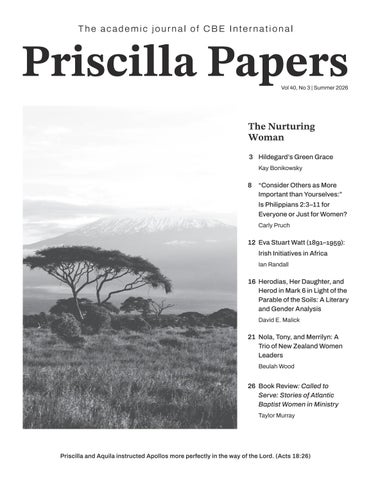
Editor: Havilah Dharamraj Assistant Editor: Jeff Miller Graphic Designer: Margaret Lawrence President / Publisher: Mimi Haddad Peer Review Team: Andrew Bartlett, Joshua Barron, Stephanie Black, Lynn H. Cohick, Seblewengel (Seble) Daniel, Mary Evans, Laura J. Hunt, Chongpongmeren (Meren) Jamir, Jung-Sook Lee, Jill McGilvray, Ian Payne, Finny Philip, Charles Pitts, Terran Williams On the Cover: Cover design: Cate Hong. Cover photo: Alessia Paggi, unsplash.com/@alepag.
CBE grants permission for any original article (not a reprint) to be photocopied for local use provided no more than 1,000 copies are made, they are distributed for free, the author is acknowledged, and CBE is recognized as the source. Priscilla Papers is the academic voice of CBE International, providing peer-reviewed, interdisciplinary scholarship on topics related to a biblical view of women and men in the home, church, and world.
Priscilla Papers (issn 0898–753x) is published quarterly by CBE International, 122 W Franklin Avenue, Suite 610, Minneapolis, MN 55404–2426 | cbeinternational.org | 612–872–6898 © CBE International, 2026.
DISCLAIMER: Final selection of all material published by CBE International in Priscilla Papers is entirely up to the discretion of the publisher, editor, and peer reviewers. Please note that each author is solely legally responsible for the content and the accuracy of facts, citations, references, and quotations rendered and properly attributed in the article appearing under her or his name. Neither CBE, nor the editor, nor the editorial team is responsible or legally liable for any content or any statements made by any author, but the legal responsibility is solely that author’s once an article appears in print in Priscilla Papers.
2
Priscilla Papers | 40/3 | Summer 2026
cbeinternational.org
Hildegard’s Green Grace Kay Bonikowsky
If Hildegard of Bingen (1098–1179) were cut, she might just bleed green, so deep was her love for the color and all it symbolized. As a Benedictine abbess known for her wide-ranging interests, Hildegard is original in countless ways. Perhaps nothing illustrates her inventiveness more than her use of the color green as a broad theological motif. Although Hildegard seldom employs established theological terminology, her systematic teaching about viriditas, or “greening,” represents her doctrine of divine grace. Hildegard’s viriditas is God’s energetic life-force, a figurative “green sap”1 bestowing fertile blessing in nature, divine life through Christ, and spiritual vitality in the believer. Viriditas pulses strongly through Hildegard’s theology; it is the green lifeblood of her theological universe. Since Hildegard’s novel use of viriditas springs from her life experiences, this article will provide a short biography of these experiences. Then, after defining the term viriditas, we will look at Hildegard’s specific teachings about viriditas to get the full scope of her theological thought. Finally, the purpose of this study is to inspire today’s church to view creation and humanity through Hildegard’s green lens.
Her three theological treatises reflect both original insight and careful scholarship centering on creation spirituality—a materialistic cosmology revealing how the triune God redeems his creation. Hildegard of Bingen It was a three-year-old Hildegard who received her first vision from God.2 From then on, she was constantly aware of a fiery light that remained in her consciousness.3 Facing ridicule as a child for sharing her vision, she fell silent about it at the age of fifteen, confiding only in her mentor, the abbess Jutta (1091–1136).4 In 1141, at the age of forty-three, Hildegard received a divine command. She heard a voice declare: “Write down what I tell you!” Initially, she resisted, but her refusal resulted in a long illness which only relented as she took up her pen. Describing herself as “a fragile and wretched creature,” Hildegard obeyed, writing what she saw and heard with a “trembling hand.”5 Hildegard’s visions are explained in her three theological works: Scivias (Know the Ways), Liber vitae meritorium (Book of Life’s Merits), and Liber divinorum operum (Book of Divine Works). The medieval scholar Peter Dronke (1934–2020) emphasizes that Hildegard herself attributes her theology to her visions, yet Dronke recognizes her mastery of Scripture and extensive reading as the foundation of her thought. Hildegard weaves truth with her cbeinternational.org
evocative insight to develop a unique theological style. Dronke also observes that, even though she had been informed by early Christian and medieval writings, “She took nothing ready-made.”6 Her three theological treatises reflect both original insight and careful scholarship centering on creation spirituality—a materialistic cosmology revealing how the triune God redeems his creation. Hildegard wrote and taught most often in the context of her Benedictine community of nuns. At the age of eight she was dedicated by her devout family as a postulant to the monastery in Disibodenburg, Germany. When she was thirty-eight, the nuns elected her as their magistra, which is similar to a Mother Superior.7 It was in this setting that Hildegard helped form the spiritual lives of these women. The monastery was surrounded by the lush, productive countryside of the Rhine Valley. Priest and theologian Matthew Fox describes this region’s rich soil, winding rivers, and fertile fruit orchards and vineyards, crediting them as a source for Hildegard’s vivid metaphor of viriditas.8 Later, while building her own monastic foundation at Rupertsberg near Bingen, Hildegard won the approval of mystic, abbot, and reformer Bernard of Clairvaux (1090–1153), and through Bernard’s influence, Pope Eugenius III (1088–1153) recognized the authenticity of her divine gifts. In 1147, the pope instructed her to record whatever she received from the Holy Spirit. With this sanction, she became an influential counselor, receiving requests for guidance from royalty, clergy, and politicians on matters ranging from theology to marriage.9 A true renaissance woman before her time, Hildegard’s gifts extended beyond theology. She was a music composer and a playwright. In 1158, she conducted four preaching tours sanctioned by the pope. She authored two encyclopedias on pharmacology. Her personal correspondence is a chronicle of the who’s who of the twelfth century. She died in 1179. In 2012, Pope Benedict XVI posthumously named her a Doctor of the Church. Defining Viriditas Hildegard uses her concept of viriditas extensively, although she never clearly defines it.10 Instead, she expounds on its location, characteristics, usefulness, source, abilities, and its scarcity. Hildegard transforms viriditas into a complex and flexible theological motif of God’s grace, applying it in multiple contexts and imbuing it with profound depth across the spectrum of nature, medicine, doctrine, and spiritual practices. Viriditas is translated from Latin into English as “greenness” or “viridity.” It is not a coincidence to Hildegard that the first color mentioned in Scripture is green (Gen 1:30), because this color reflects the character and creative energy of God. As Hosea 14:8 suggests, God is like a fir tree that is always green. Hence, the plain sense of viriditas encompasses both the literal color and the figurative idea of fertility. Priscilla Papers | 40/3 | Summer 2026 3
Hildegard adds an essential element to viriditas of not only greenness and growth, but moisture. That which lacks viriditas is dry (ariditas), whereas that which possesses viriditas is alive and fresh. Translators of her works, struggling to capture the meaning viriditas in one English word, render it variously as “freshness, vitality, fertility, fecundity, fruitfulness, verdure, [and] growth.”11 Interpreting Viriditas It is hard to pin down a one-word definition of viriditas because Hildegard does not build her system of thought with coherent, ordered structure and precise definitions. Instead, she gathers her diverse insights into a looser, more associative whole. Hildegard’s theology of viriditas is a living patchwork of insight into how God’s grace flows and enlivens his beloved creation. Millard Erickson, an evangelical systematic theologian, writes that grace “means that God supplies us with undeserved favors.”12 In Hildegard’s cosmology, this favor is green, wet, and alive.
Like Jesus who drew teaching inspiration from the landscapes around him, Hildegard employs the organic imagery of viriditas to express theological insight. Viriditas in Creation Hildegard saw God’s grace at work literally in the material world, describing this viriditas as “the exquisite greening of trees and grasses” and the “earth’s lush greening.”13 Unlike the Reformers centuries later, she does not delineate the differences between kinds of viriditas in terms of common grace and salvific grace. Rather, she presents God’s undeserved favor on humanity as flowing from the same source. Theologian Robert Shore-Goss describes her vision of viriditas as an “uninterrupted flow of God’s communicative love.”14 God’s verdant grace is of one kind, offered universally through creation, incarnate in Christ, and imparted by the Spirit. It transforms all who receive it from dead dryness to lush, vibrant, divine life. Hence, the essential element in the development of Hildegard’s theology of viriditas is its source. God shares his divine energy as viriditas. In her Book of Divine Works, she describes God as “the fiery life of divine essence” actively present in all creation—the sea, sun, moon, stars, wind, and flowers.15 This living energy is not only a fiery power, it is greening16—a life force from the triune God who is “always in motion and constantly in action.”17 Her concept of viriditas has been described as “God’s generative power that permeates and upholds the creation,”18 echoing Acts 17:25–28: God “himself gives everyone life and breath and everything else. . . . ‘For in him we live and move and have our being’” (NIV). Viriditas portrays God as living action that fills creation with constant greening power.19 It is only through God’s sharing of his own viriditas that the earth was formed and flourishes.20 Author Allison Elledge notes that Hildegard views viriditas as analogous to the soul in plants and animals. God’s essence enters the natural world and is shared with all creatures.21 In her work, Physica, Hildegard writes that 4
Priscilla Papers | 40/3 | Summer 2026
“the herbs vigorously imbibe [viriditas], as a lamb sucking milk.”22 Viriditas in natural substances varies by degree in species, climates, and functional application. Even stones and gemstones, especially emeralds, receive green growth from God. Viriditas in plants can be transmitted to humans or animals through consumption. Viriditas can also be transmitted through the Eucharist, which for Hildegard, imparts divine grace. Those who partake the bread and wine “become green and fruitful from him so that they too bring forth the fruits of virtues.”23 Hildegard expounds on God’s green grace as an energetic force bestowing fertile blessing and divine favor across creation in poetic language similar to Psalm 104.24 She speaks of the Holy Spirit bringing the waters that are the “source of the earth’s lush greening.”25 In a song to St. Disibode (619-700), she exclaims, “O life giving greenness of God!”26 When she describes God’s greenness falling on “the evil and the good,” “the righteous and the unrighteous,” she is quoting Jesus in Matthew 5:45, affirming that God rains his favor upon all. This rain is green and alive in Hildegard’s imaginative mind. Like Jesus who drew teaching inspiration from the landscapes around him, Hildegard employs the organic imagery of viriditas to express theological insight. Jesus used sparrows, lilies, seeds, fig trees, vines, branches, and sheep to illustrate how God’s favor on humanity is evident all around us, a sign that God is here in our midst (Luke 17:21). Hildegard also desires to portray God as immanently involved in both the physical and spiritual realms. Acts 17:27 affirms that, through creation, God is not remote, but nearby. This immanence is at the heart of Hildegardian theology. She rarely frames the spiritual and physical as opposites. Instead, God’s viriditas represents the continual outpouring of God’s vigor for both physical and spiritual health, emphasizing the unity of creation with humans and the physical body with the soul. Author Carmen Butcher observes that Hildegard’s strength lies in her refusal to accept neat dichotomies like earth versus spirit, body versus soul, and nature versus humanity. Instead, Hildegard presents a unified vision, a “whole,” as Butcher puts it, rich in metaphor and bright with imagery, interwoven and alive.27 In doing so, viriditas offers a vivid, organic lens through which we deepen our understanding of God’s favor not exclusively towards humanity, but towards all creation. Viriditas in Salvation Hildegard’s vision of God as the source of viriditas extends beyond the material to the spiritual realm. Viriditas is the life-giving breath of God that gave humankind a soul in Genesis 2:7. Commenting on John 1:1, Hildegard writes that viriditas was the work of the Word from the beginning.28 She writes: “The Word is . . . all verdant greening.”29 The Holy Spirit, whom Hildegard describes as a “sweet greening power, sent the Word into the womb of the virgin.”30 Referencing Genesis 3:15 where the woman’s seed is foretold as defeating the serpent, she describes Mary as producing the Spirit’s “glowing, most green, verdant sprout.”31 Jesus is viriditas incarnate, preexistent, and proceeding from the Father’s “burning viridity.”32 It is the incarnation that redeems us and the death of Jesus that awakens us. Hildegard writes, “Just as a mother gives milk to her children,” the Word pours his viriditas into humanity, bringing us new life.33 She imagines Christ shaking out his green mantle saturated from the bubbling fountain of God’s viriditas so cbeinternational.org
that we might be “drenched, watered, with thousands of drops of precious dew.”34 Hildegard’s theology diverges from that of her contemporaries in that she does not center her thought on Augustine’s framework of fall and redemption.35 While themes of sin and salvation appear in her work, they exist in the broader context of God’s activity throughout creation. Her cosmic Christ, though a redeemer in every sense, is primarily God’s self-sharing with all of creation, not only with humanity. In Jesus, God interacts perfectly with his creatures by becoming human. In her words, God says: “The human is the very garment with which my Son robed himself in royal splendor.”36 As the Franciscan priest Richard Rohr observes, the cosmic Christ Jesus is “God materialized.”37 This materialization of God in Jesus expands Hildegard’s use of viriditas. Hildegard ties the teaching in Romans 1:20—that God’s invisible qualities (viriditas) are revealed in the created world—with Hebrews 1:3—that the radiance of God’s glory (viriditas) is found in the Son. Viriditas in both creation and in Christ represents the part of God accessible to human experience and understanding. She writes, “There is no creation that does not have a radiance. Be it greenness or seed, blossom or beauty, it could not be creation without it.”38 Witnessing that radiance in creation and in the Son allows a glimpse of God. Hildegard’s theology is rooted not only in the natural world, but also in her existential visions. It is these real encounters with God, rather than abstract academic reasoning, that gives her teaching such passion. She experiences faith not as a set of propositions but as a dynamic interaction with Christ.39 Jesus, in her view, is “familiar and approachable,”40 not a creed to rationalize. Hildegard’s poetic use of viriditas in her theological works and in her music conveys emotion as well as intellect, celebrating the emotions of both God and humanity. The emphasis on passion contrasts with earlier Christian approaches, which often distrusted emotion. Thinkers like Gregory of Nyssa (ca. 335–ca. 394), influenced by a privileging of reason over passion, argued that corporeal affection must be suppressed to savor spiritual passion.41 Bernard of Clairvaux extended this, suggesting that spiritual love replaces carnal desire.42 Origen (ca. 185–ca. 254) emphasized the spiritual senses as superior to the five physical senses as ways to experience God. Hildegard departs from their lead by affirming that “God is delighted with humankind” and that he “allows himself to be disturbed by it.”43 God is impressed by human form, even kisses it.44 Unlike Origen, she teaches that it is the five senses that facilitate knowing God. “In seeing—we recognize all the world. In hearing— to understand. In smelling—to discern. In tasting—to nurture. In touching—to govern. In this way humankind comes to know God.”45 She urges celebration and service: “Be ablaze with enthusiasm!”46 Though her imagery can be elaborate, even fantastic, her allegory of viriditas serves a precise purpose. Because she grounded her teaching in “self-evident truths rather than textual authority,”47 she opens alternative pathways for theological reflection and expression. Her development of the concept of viriditas exemplifies this approach, presenting the doctrinal truth of Christ’s redemption through organic imagery and poetry, inviting deep contemplation on divine favor in order to draw us nearer to him. cbeinternational.org
Viriditas in Spiritual Growth For believers, viriditas produces virtue and spiritual fruit. A new Christian is like an unplowed field who receives the Word of God. God’s love is poured on them like rain, and the Spirit brings fruitfulness to the soil. However, a Christian can also cultivate growth by the “greening of the soul” in which “the soul honors God by the doing of just deeds.”48 This greening of the soul is more than doing good works. Hildegard affirms that “a person cannot be fruitful without the greening power of faith and an understanding of Scripture.”49 Hildegard’s fresh vision of God’s empowering grace in viriditas aligns with Ephesians 2:5–10. God made us alive in Christ, offering grace through faith that enables us to do the good works God created us to do. Hildegard writes that God says, “I am the life and verdancy of good works.”50 This verdancy, she teaches, enlivens believers with the Holy Spirit’s “green freshness of life,” enabling them to flourish and bear fruit.51 In her Book of Divine Works, Hildegard explains that a good life begins with the awe of God, alongside a disciplined mind that gives constant attention to the divine (Vision Two: 18). This is her description of faith. This faith “submerges” the believer in confidence, dispelling confusion, falsehood, and indecent desires. Hildegard describes this constancy, or “abiding” as Jesus calls it in John 15:5, as “green vitality.”52 She exhorts her correspondents to remain spiritually “juicy,” to strive for “spiritual greenness” by abiding as branches connected to the vine.53 Hildegard also contrasts the faithful, who possess “the sap of life,” producing good fruit, with those who are in a “drought of indolence.”54 If viriditas embodies God’s lush, life-giving energy, then the opposite, ariditas, represents death and sin. Fox notes that for Hildegard, ariditas is “the sin of sins . . . the sin of drying up.”55 The lack of viriditas “destroys our creative powers, marking the end of all good works, the beginning of laziness and carelessness.”56 Hildegard declares: “Envy drives out all greening power!”57 Significantly, Hildegard teaches that even the earth’s “greening power” is affected by spiritual forces, either nourished by God’s moisture or drained into a dry and dusty land.58 Those who refuse to grow in virtue, are “cut off from the waters of faith,”59 and fail to bloom. They wither and die. This spiritual ariditas affects the world around us, diminishing the overall greening of God’s grace. Hildegard challenges her readers: “How dare we live without the verdancy of God’s grace?”60
Understanding viriditas as the pulsing green vein of God’s grace results in an ecological awareness that marries spirituality with stewardship. Going Green When humans reject God’s viriditas, all creation suffers. This interdependence and reciprocity between humanity and creation naturally lead Hildegard to reflect on the deep impact that humans Priscilla Papers | 40/3 | Summer 2026 5
have on the earth. Unbelievers, “the people who were meant to be green,”61 spread filth and destruction. Just as God gave creation for our use, he also “permits creation to punish humanity.”62 She reminds us of God’s warning to Israel, linking human faithfulness with the health of the land.63 She vividly warns: “The winds are burdened by the utterly awful stink of evil. . . . The air belches out the filthy uncleanness of the peoples. . . . There pours forth an unnatural, a loathsome darkness that withers the green.”64 Sin affects the food we eat, the air quality, and brings about the extinction of species. The earth is rendered “incapable of sustaining humanity.”65 Hildegard pleads: “The earth should not be injured. The earth should not be destroyed!”66 Understanding viriditas as the pulsing green vein of God’s grace results in an ecological awareness that marries spirituality with stewardship.67 Mary DeJong, an eco-theologian, sums up Hildegard’s creation theology as “a way of knowing that involved integrating the soul and soil. Creation is not a scenic backdrop designed only so
humans can take the stage. Creation is in fact a full participant in human transformation.”68 Nature speaks to us of our Creator69 and eagerly anticipates our joint redemption.70 God tasked humans to care for his creation because creation care is reciprocal.71 Robert Shore-Goss, a pastor reflecting on the dedication of new solar panels for his church, asserts that it is impossible to separate “Christ from the social responsibility for the Earth.”72 Hildegard would concur; she believed that “Christ brings lush greenness to shriveled and wilted people” as part of his greening of the cosmos.73 Her theology of viriditas calls believers to pray for creation, to mourn its losses, to safeguard its survival, and to celebrate in song for the green earth.74 Hildegard’s final words bring her theology full circle. The woman who saw viriditas as the lifeblood of creation departed this world praying, “Let the rainfall be grace. Let this green earth take me.” If she bled green in life, in death she rested in green grace.75
Notes 1.
18.
Matthew Fox, “Hildegard on Greening Power, Spirit, Nature & Creativity,” Daily Meditations with Matthew Fox (Jan 11, 2024), https://dailymeditationswithmatthewfox.org/2024/01/11/ hildegard-on-greening-power-spirit-nature-humanitys-creativity/. Michael Embach, “The Life of Hildegard of Bingen (1098– 1179),” in The Cambridge Companion to Hildegard of Bingen, ed. Jennifer Bain (Cambridge University Press, 2021) 17. Hildegard of Bingen, Hildegard of Bingen’s Book of Divine Works with Letters and Songs, ed. Matthew Fox, trans. Robert Cunningham (Bear and Co., 1987), Foreword; James Ginther, “Hildegard of Bingen’s Theology,” in The Cambridge Companion to Hildegard of Bingen, ed. Jennifer Bain, 89. Constant J. Mews, “Religious Thinker,” in Voice of the Living Light: Hildegard of Bingen and Her World, ed. Barbara Newman (University of California Press, 1998) 53. Mews, “Religious Thinker,” 53. Mews, “Religious Thinker,” 201. Embach, “The Life of Hildegard,” 11. Matthew Fox, Illuminations of Hildegard of Bingen (Bear and Co., 2002) 45. Peter Dronke, Women Writers of the Middle Ages (Cambridge University Press, 1984) 148. Allison Jaines Elledge, “You Are What You Eat: Hildegard of Bingen’s Viriditas,” Conference paper, Mid-Atlantic Popular & American Culture Association meeting (Oct 2010) 7. Mews, “Religious Thinker,” 58. Millard J. Erickson, Christian Theology (Baker Academic, 2013) 265. Fox, Illuminations of Hildegard, 43. Robert E. Shore-Goss, “Grace is Green: Green Incarnational Inclusivities,” in Queering Christianity: Finding a Place at the Table for LGBTQI Christians, ed. Robert E. Shore-Goss, Thomas Bohache, Patrick S. Cheng, Mona West (Praeger, 2013) 70. Fox, Hildegard of Bingen’s Book of Divine Works with Letters and Songs, Vision One: 2. Fox, Hildegard of Bingen’s Book of Divine Works with Letters and Songs, Vision One: 2. “Hildegard von Bingen, Part 2: Her Big Idea,” Notable Women: Women in the Waldorf Community and Beyond (May 27, 2013), https://notablewomen.wordpress.com/2013/05/27/hildegardvon-bingen-part-2/. “Hildegard von Bingen, Part 2: Her Big Idea,” Notable Women, 16.
6
Priscilla Papers | 40/3 | Summer 2026
2. 3.
4. 5. 6. 7. 8. 9. 10. 11. 12. 13. 14.
15. 16. 17.
19. “Hildegard von Bingen, Part 3: Makeover your Mind,” Notable Women: Women in the Waldorf Community and Beyond (June 22, 2013)., https://notablewomen.wordpress.com/2013/06/22/ hildegard-von-bingen-part-3/. 20. Fox, Hildegard of Bingen’s Book of Divine Works with Letters and Songs, Vision Four: 11. 21. Elledge, “You Are What You Eat,” 3–4. 22. Priscilla Throop, trans., Hildegard von Bingen’s Physica: The Complete English Translation of her Classic Work on Health and Healing (Healing Arts Press, 1998). 23. Fox, Illuminations of Hildegard, 130. 24. Psalm 104:1-2 (NIV): “Bless the LORD, O my soul! O LORD my God, You are very great; You are clothed with splendor and majesty. He wraps Himself in light as with a garment; He stretches out the heavens like a tent . . .” 25. Gabriele Uhlein, Meditations with Hildegard of Bingen (Bear and Co., 1983) 18. 26. Fox, Hildegard of Bingen’s Book of Divine Works with Letters and Songs, Song #11: De Sancto Disibodo: In Honor of St. Disibode. 27. Carmen Acevedo Butcher, St. Hildegard of Bingen: Doctor of the Church (Paraclete, 2013) 160. 28. Elledge, “You Are What You Eat,” 3. 29. Uhlein, Meditations with Hildegard of Bingen, 19. 30. Fox, Hildegard of Bingen’s Book of Divine Works with Letters and Songs, Letter One: Hildegard to Bernard of Clairvaux. 31. Uhlein, Meditations with Hildegard of Bingen, 28. 32. Mews, “Religious Thinker,” 60. 33. Uhlein, Meditations with Hildegard of Bingen, 25. 34. Uhlein, Meditations with Hildegard of Bingen, 26. 35. Fox, Illuminations of Hildegard, 12. 36. Uhlein, Meditations with Hildegard of Bingen, 26. 37. Fr. Richard Rohr, OFM, “The Cosmic Christ,” Center for Action and Contemplation (Nov 5, 2015), https://cac.org/the-cosmicchrist-2015-11-05/. 38. Uhlein, Meditations with Hildegard of Bingen, 16. 39. Uhlein, Meditations with Hildegard of Bingen, 22–23. 40. Uhlein, Meditations with Hildegard of Bingen, 23. 41. Uhlein, Meditations with Hildegard of Bingen, 41. 42. Uhlein, Meditations with Hildegard of Bingen, 42. 43. Uhlein, Meditations with Hildegard of Bingen, 26. 44. Uhlein, Meditations with Hildegard of Bingen, 26. cbeinternational.org
45. Uhlein, Meditations with Hildegard of Bingen, 25. 46. Uhlein, Meditations with Hildegard of Bingen, 29. 47. Elizabeth A. Dreyer, Passionate Spirituality: Hildegard of Bingen and Hadewijch of Brabant (Paulist, 2005) 77. 48. Uhlein, Meditations with Hildegard of Bingen, 29. 49. Uhlein, Meditations with Hildegard of Bingen, 21. 50. Uhlein, Meditations with Hildegard of Bingen, 25. 51. Fox, Hildegard of Bingen’s Book of Divine Works with Letters and Songs, Vision Ten: 2. 52. Fox, Hildegard of Bingen’s Book of Divine Works with Letters and Songs, Vision Two: 18. 53. Dreyer, Passionate Spirituality, 82. 54. Fox, Hildegard of Bingen’s Book of Divine Works with Letters and Songs, Vision Two: 18. 55. Fox, Illuminations of Hildegard, 92. 56. Fox, Illuminations of Hildegard, 92. 57. Uhlein, Meditations with Hildegard of Bingen, 21. 58. Fox, Hildegard of Bingen’s Book of Divine Works with Letters and Songs, Vision Four: 1. 59. Fox, Hildegard of Bingen’s Book of Divine Works with Letters and Songs, 93. 60. Fox, Hildegard of Bingen’s Book of Divine Works with Letters and Songs, 23. 61. Fox, Hildegard of Bingen’s Book of Divine Works with Letters and Songs, 23. 62. Fox, Hildegard of Bingen’s Book of Divine Works with Letters and Songs, 23. 63. Exod 23:10–11; Lev 18:26–28, 25:2–5, 26:3–4; Num 35:33–34; Chr 7:13–14; Ps 107:33–34; Isa 24:4–6; 2 Jer 2:7, 3:2–3, 12:11. 64. Fox, Hildegard of Bingen’s Book of Divine Works with Letters and Songs, 23. 65. Uhlein, Meditations with Hildegard of Bingen, 23.
Back to Brazil Transformed Lives
66. Uhlein, Meditations with Hildegard of Bingen, 9. 67. Uhlein, Meditations with Hildegard of Bingen, 25. 68. Mary DeJong, “A Holy High: How Hildegard Found Her Inspiration Grounded in the Garden,” The Seattle School of Theology & Psychology (August 2021), https://theseattleschool. edu/blog/holy-high-hildegard-garden/. 69. Ps 19:1; Luke 19:40; Rom 1:20. 70. Rom 8:19–22. 71. Gen 2:15. 72. Shore-Goss, “Grace is Green,” 65. 73. Jean Evans, “Viriditas and Veritas: The Ecological Prophets Hildegard of Bingen and Miriam Therese MacGillis, OP” (Jan 28, 2009). 74. Ps 96:11–13, 148:1–10; Isa 55:12. 75. Hildegard of Bingen on her deathbed, Sept 1179. Stella Nesanovich, “Let this green earth,” First Things (April 1996), https://firstthings.com/article/1996/04/let-this-green-earth.
God tasked humans to care for his creation because creation care is reciprocal.
Kay Bonikowsky is is an ordained pastor, Bible teacher, and writer who holds an MDiv from Multnomah University. She promotes egalitarianism through teaching, speaking, pastoral leadership, and writing at KBonikowsky.com. Kay lives near Seattle with her family, where she loves books, gardening, and serving her cats.
Details coming soon!
Men and Women Walking Together in Biblical Unity 1 Corinthians 12:7
July 2027 Curitiba, Brazil
cbeinternational.org
Priscilla Papers | 40/3 | Summer 2026 7
“Consider Others as More Important than Yourselves”: Is Philippians 2:3–11 for Everyone or Just for Women? Carly Pruch
“By nature we yearn and hunger for honor, and once we have glimpsed it, as it were, some part of its radiance, there is nothing we are not prepared to bear and suffer in order to secure it.”1 Philippi was a distinctly Roman colony, its citizens bent on securing honor and public praise above all else. Cicero, a Roman politician and orator, summed up the reality for citizens in Philippi with the above quotation, referring to the unquenchable thirst for public honor prevalent throughout the Roman Empire. The Philippian Christians would have faced the same temptations to assert their own prominence over one another that the culture around them widely celebrated. However, Paul audaciously called the believers to live opposite that norm. In one of the most famous passages in Scripture, Philippians 2:3–11, Paul asks the Philippian Christians to “Do nothing out of selfish ambition or vain conceit, but in humility consider others as more important than yourselves” (Phil 2:3 NIV). He then exhorts them to have the same attitude as Christ Jesus, who profoundly upended all the norms of social status and hierarchy. Though fully God, he became fully human. Not only did he become one of us, but he also became the least of us. Becoming what Paul called a slave, Jesus willingly identified with a group whose symbolic identity itself was shameful.2 Tragically, this radical call to mutual humility for all Christians has been co-opted by complementarians to do the very thing Paul wrote boldly against—secure status and power for some over others. For the purposes of this article, despite the traditional break between vv. 3–4 and 5–11, we will examine the social context of Philippians 2:3–11. We shall see how the call to consider others as higher than yourself and to adopt the same attitude as Jesus was a call to all Christians to subvert the power plays and status structures in their cultural context. Then we can examine how this passage has been used in complementarian spaces to unequally call women to adopt the selfless attitude of Jesus while at the same time allowing men to adopt the attitude of Rome and grasp for the very power Paul wanted them to give up. Cultural Context of Philippi While we may be tempted to read our own cultural desire for wealth and comfort into our study of the Bible, the reality is that those in the Roman Empire desired status and public honor above all else. Public recognition of social standing was of utmost importance, and those who had acquired some honor went to great lengths to both maintain their status or to garner more.3 Believing that honor was a finite resource, this pervasive desire for it led to continual competition.4 Bruce Longenecker has aptly said, “the world of the first urban Jesus-followers was a world enmeshed in the quest for status. . . . The people of the Roman age saw status as the essential commodity of life.”5 If status was the essential commodity of life, how was status delineated among social groups? According to Joseph Hellerman, 8
Priscilla Papers | 40/3 | Summer 2026
the Romans devised several ways to readily recognize someone’s social standing. Clothing was specifically used and designed to distinguish their place in the social strata, with certain outfits or accessories indicating various levels of elite status. Another place where status and honor were publicly demarked was where one was seated at public and/or private events. Those with the most status received the places of honor at both public and private events, often inviting those with lower status to private events to make themselves appear more superior.6 And finally, the judicial system doled out consequences specifically according to one’s status in society, with those on the bottom receiving the harshest and most shameful punishments.7 While clothing, seating arrangements, and the judicial system all signaled social status, citizens on the upper end of society sought out certain political positions that would secure the most honor. In general, the social system of the Roman Empire divided into two groups: elite and non-elite. The elite competed with one another for status-enhancing political offices. The cursus honorum or “race for honors” created a pyramid of power that clearly delineated a pathway to prominence.8 At the bottom of this political pyramid was the office of quaestor (responsible for state finances and taxes). Then came aedile (responsible for building projects), then praetor (court judges), then finally consul (executive leadership). On top of the pyramid stood the emperor, considered only slightly less powerful than the gods themselves and worshipped as such.9 This idea of dividing elite society into levels of political power with ascending levels of honor became so prevalent that even non-elite organizations and communities replicated this stratification.10 The one constant in all social stratification was that slaves were always on the bottom, existing as a class by themselves. While the treatment of slaves varied greatly depending on the prominence and character of the owner, slaves were the property of someone else and this determined their lack of social standing.11 Given the desire for public honor and status that pervaded Philippian society as a distinctly Roman colony, let us turn our attention to Paul’s desire for the mindset of the Philippian Christians as evidenced in Philippians 2:3–11. In Philippians 2:3–4, Paul commends an opposite mindset for the Philippian Christians. In contrast to Roman society that prized competition for greater status, Paul commends a life that is empty of selfish ambition or conceit for all who follows Christ.12 “In humility, consider others more important than yourselves” (Phil 2:3) has sometimes been taken to mean total self-abnegation in favor of tending to the others’ needs completely. However, Michael Bird and Nijay Gupta argue that a better translation for this verse would keep in mind the social stratification and race for honors. “There is a typical Greek word for ‘better’ (kreitton) and he does not cbeinternational.org
employ it here. Rather, he uses hyperechō, which means superior, as in, higher in status.”13 They go on to explain, “If everyone treated the other as superior in status (and vice versa), then this subverts the entire system.”14 As an example to the Philippian Christians on how to internalize the countercultural mindset of humility, Paul writes what could be considered an ode to Jesus Christ. This ode was written in a “legendary manner for vividness and literary effect.”15 Paul portrays Christ inverting the cursus honorum by existing at the top of the pyramid of power, then voluntarily descending not just a few steps, but entirely to the bottom, taking on the form of a slave. The NIV translates morphē in verse 6 as “Who, being in very nature God,” but according to Hellerman, this misses the idea that morphē refers to one’s outward appearance. Since the outward appearance was one way social status was visible to others, Jesus’s outward appearance is important for this passage.16 In a move no one would make, Jesus exchanged his deified outward appearance with the outward appearance of a slave, the very bottom of the social hierarchy in the Greco-Roman world.17 Not only did Jesus take on the outward appearance of someone with no social status, he died a death that was reserved only for the lowest on the social strata. A cross was the Roman system of execution meant to torture and shame those with little to no social status or public honor. It was so commonly associated with death for slaves that it became known as servile supplicum (“slaves’ punishment”).18 Jesus was portrayed as moving from equal status with God to becoming a slave. “There is no position higher than being God and there is no position lower than being a slave.”19 And there was no more shameful death God could have died than execution on a cross. This was what Paul considered true humility. These actions have led many to equate Jesus’s incarnation and humble obedience with submission to the Father, even though the word “submission” does not appear in this text.20 Often, submission is associated only with obedience, which inherently implies hierarchy within relationships. However, Mi Young Sydney Park claims there is much more to Christ’s submission as portrayed in Philippians 2:5–11 than obedience from a subordinate to a superior. According to Park, Christ’s submission is portrayed in the following ways: refusal to claim equality with God or forsaking one’s rights; servanthood and obedience; humility and humiliation; suffering; and finally, volition—actively choosing submission. These elements together add up to the submission featured in Philippians 2:5–11. Paul wants the Philippians to have this same mindset of humility and service, as something they choose, just as Jesus chose submission and humiliation of his own accord. “Submission for Christ is, from beginning to end, the willingness to give primacy to the concerns of another over and above his own legitimate rights, even at the risk of humiliation, suffering, and death.”21 Park affirms that true submission is borne not out of or for oppression; rather it stems from a place of true equality; it cannot be thrust on one from someone else.22 It was an attitude Jesus chose for himself, and therefore all who follow him must also choose. It cannot be demanded of someone at the bottom of a hierarchical structure, or it is not true Christlike submission. cbeinternational.org
Unequal Submission What if only one side seeks to consider the other as higher than themselves? Would that truly embody Jesus’s example of submission in Philippians 2:5–11? What happens when you have two parties and one decides it is the other party’s permanent role to take on Christ’s self-emptying for the good of the other person? Despite Paul’s call to all Jesus followers to have the same mindset as Jesus, how did submission become “central to the identity of women as Children of God?”23 Tim Keller, noted pastor and theologian, along with his wife, Kathy, used Ephesians 5 as the basis for their widely popular book on marriage. They cite Philippians 2 at the outset when speaking to all Christians, stating, “That is how all believers should live with each other.”24 However, this train of thought leaves mutuality at the station when Kathy writes her chapter on wifely submission. The opening passage for Kathy Keller’s chapter on submission is Ephesians 5:22–23, 25. Here she shares how she came from a relatively gender-neutral upbringing, attended seminary with Tim, and felt on equal footing with her classmates. But when they got married, she had to reckon with what it meant to be a woman in a marriage in which distinct gender roles were important. In Kathy’s words, “Though Tim and I have been both clumsy and clueless at times, we have found that in submitting to our own divinely assigned gender roles that we discovered one of God’s great gifts for getting in touch with our deepest selves. . . .”25 How did Kathy come to such a conclusion on her divinely assigned gender role in their marriage? She had teachers and mentors who pointed her directly to Philippians 2:5–11. In Kathy’s understanding, as Jesus emptied himself of his glory and assumed the role of servant, submitting himself to God the Father, God showed her the example to follow as a subordinate wife. This gave her great hope as she played “out the ‘Jesus role’” in her marriage, which she referred to as the ‘ezer-subordinate.26 Despite beginning with claims that Jesus’s humility as exemplified in Philippians 2:3–11 is an example for all Christians to follow, Kathy repeatedly refers to the subordinate role Jesus played in this passage as an example for her to follow. She writes, In 1 Corinthians 11:3, Paul says directly what is implied in Philippians 2—namely, that the relationship of the Father and the Son is a pattern for the relationship of husband to wife. The Son submits to the Father’s headship. . . . The Father’s headship is acknowledged in reciprocal delight, respect, and love. . . . We are differently gendered to reflect this life within the Trinity. . . . The Son takes a subordinate role, and in that movement, he shows not his weakness but his greatness.27 When talking about the husband’s role, Kathy says the husband’s act of submission is to submit to his role as a servant-leader but fails to mention Philippians 2:3–11 as part of that role. The Jesus role that the husband plays is the one who has the authority (albeit sacrificial and servant authority, but authority nonetheless). Despite the dressed-up hierarchy and perilous views on the Trinity, the Kellers’ teachings are widespread in many evangelical spaces Priscilla Papers | 40/3 | Summer 2026 9
and denominations. An article published on The Gospel Coalition’s website titled “Leading and Submitting like Jesus,” by Erik Raymond, is one example. Raymond addresses husbands and says they are to lead sacrificially because “that reflects the humility of Jesus.”28 To the wife, he says, “The Christian wife should consider her Savior when she considers her calling to submit to her husband in the Lord. She is to think much upon the submission of the Lord Jesus himself as he left heaven’s throne to himself put on the apron of service in his submission to his Father’s will.”29 Raymond does not quote Philippians 2:5–11 directly, but the implication is there all the same. It is this joyful submission that a wife should think on so that she can, “with gospel gratitude, embrace [her] calling to submit to [her] (imperfect) husband because this is the path of Jesus.”30 Likewise, in her book, Disciplines of a Godly Woman,31 Barbara Hughes begins with the framework that all Christians should live their lives in submission to God’s will. However, a Christlike submission is unequally yoked onto a woman’s neck as part of her subservient identity in Christ. This subordination is tied directly to the Trinity for Hughes, and she boldly claims it has always been this way. “We know from the very first book of the Bible that ‘intimacy through subordination’ is not only possible, but it is God’s plan for us—modeled after the intimacy that exists in the Godhead.”32 Despite claims of equality and voluntary submission, what the Kellers, Hughes, and their many complementarian counterparts describe is merely hierarchy living under a façade. If the wife is always subordinate, and the husband is always in authority over her, equality is not, and never was, present. Since the subordination of the Son within the Trinity is often used to subordinate women, let us see what Millard Erickson has to say about subordination and ontological equality: If the Father’s authority over the Son and Spirit and the Son’s and Spirit’s subordination to the Father is a part of the very structure of the Trinity, so that it could not be otherwise, then this superiority and subordination are not contingent, but necessary, characteristics of each of the persons. That means that they are not accidental but essential qualities, and the essence of the Son is different from and inferior to that of the Father. In other words, invariable and inevitable differences in authority imply ontological, as well as functional, subordination.33 In other words, hierarchy and subordination cannot exist among true ontological equals. Therefore, one cannot say both men and
women are equals, but one needs to exist in a state of subordination, just like the equal but subordinate Son.34 Keeping the Philippians 2:3–11 passage in mind, we must see that Jesus voluntarily taking on the form or likeness of a human, being “obedient to death, even death on a cross” (Phil 2:8), is not speaking of his ontological subordination to the Father. As seen before, Paul uses the concept of submission to show the Philippians the way of Christ’s kingdom is the way of the cross. The King of the universe stooped down, reversing the cursus honorum. Jesus willingly became the lowest on the social strata to model the way for all believers to move about in the world, unconcerned with social hierarchy, and this was not only for wives to emulate in their hierarchical marriages. What the complementarian marriage advice fails to draw attention to is the latter half of the passage where Jesus was exalted above every name (Phil 2:9). He did not exist in an eternal state of subordination, and neither should women.35 As Beth Allison Barr says, “The greatest trick the devil ever pulled was convincing Christians that oppression is godly. That God ordained some people, simply because of their sex or skin color (or both), as belonging under the power of other people. That women’s subordination is central to the gospel of Christ.”36 Conclusion Most of the commands for women to submit to their husbands originate from the portion of Paul’s household code addressed to wives in Ephesians 5:22, yet the widespread use of Philippians 2:3– 11 in many of these arguments, either implicitly or explicitly reveals a lack of understanding of the context and purpose of Paul’s words to all Christian Philippians. In a Greco-Roman culture obsessed with public honor, Paul commanded everyone to consider others as higher than themselves. What would he say to those using his words today to elevate men and diminish women? We end how we began, with Cicero’s quotation: “By nature we yearn and hunger for honor. . . .”37 Today’s yearning for honor may not look like it did in ancient Rome, but when an entire theological system is created to give men places of honor (leadership) and keep women subordinate, the men who have glimpsed honor are still grasping for its radiance today. Unfortunately for them, the women they oppress are formed more into the likeness of Christ than the oppressors themselves since they, the men, claim the name of Christ but follow the rule of Rome.
Notes 1. 2. 3. 4. 5. 6.
10
Cicero, Tusculan Disputations 2.24.58, quoted in Bruce W. Longenecker, In Stone and Story: Early Christianity in the Roman World (Baker, 2020) 14. Joseph H. Hellerman, Embracing Shared Ministry: Power and Status in the Early Church and Why It Matters Today (Kregel, 2013) 147. Hellerman, Embracing Shared Ministry, 65. Craig S. Keener, The IVP Bible Background Commentary: New Testament (IVP, 2014) 560. Longenecker, In Stone and Story, 14. Richard Saller, “Status and Patronage,” in The Cambridge Ancient History, ed. Alan K. Bowman, Peter Garnsey, and Dominic Priscilla Papers | 40/3 | Summer 2026
Rathbone, vol. 11 (Cambridge University Press, 2000) 830. Hellerman, Embracing Shared Ministry, 34, 49. Hellerman, Embracing Shared Ministry, 66. Longenecker, In Stone and Story, 43. Hellerman, Embracing Shared Ministry, 72. Hellerman says, “The Philippians had been socialized from infancy to publicly promote and proclaim their own honors and titles, in order to position themselves as high as possible along the relational hierarchy, relative to others in their social networks.” Hellerman, Embracing Shared Ministry, 127. 11. Craig A. Evans and Stanley E. Porter, eds., Dictionary of New Testament Background (IVP, 2000) 1002. 7. 8. 9. 10.
cbeinternational.org
12. Lynn H. Cohick, Philippians, Story of God Commentary (Zondervan, 2013) 85. 13. Michael F. Bird and Nijay K. Gupta, Philippians, New Cambridge Bible Commentary (Cambridge University Press, 2020) 70. 14. Bird and Gupta, Philippians, 70. 15. Bird and Gupta, Philippians, 74. 16. Hellerman, Embracing Shared Ministry, 39–40. 17. Longenecker, In Stone and Story, 183. 18. Jeannine K. Brown, Philippians, TNTC (IVP, 2022) 114, 121. 19. Mi Young Sidney Park, “Submission within the Godhead and the Church in the Epistle to the Philippians” (dissertation, ProQuest LLC, 2004) 156. 20. Park, “Submission within the Godhead,” 151. 21. Park, “Submission within the Godhead,” 158. 22. Park, “Submission within the Godhead,” 158. 23. Barbara Hughes, Disciplines of a Godly Woman (Crossway, 2001) 34. 24. Timothy Keller and Kathy Keller, The Meaning of Marriage (Penguin, 2011) 51. 25. Keller and Keller, The Meaning of Marriage, 193. 26. Keller and Keller, The Meaning of Marriage, 196, 198. See R. David Freedman’s research on ezer kenegdo in Woman, a Power Equal to Man Translation of woman as a “fit helpmate” for man is questioned By R. David Freedman. 27. Keller and Keller, The Meaning of Marriage, 198. 28. Erik Raymond, “Leading and Submitting like Jesus,” The Gospel Coalition (Oct 22, 2014), https://thegospelcoalition.org/ blogs/erik-raymond/leading-and-submitting-like-jesus/. 29. Raymond, “Leading and Submitting Like Jesus.” 30. Raymond, “Leading and Submitting Like Jesus.” 31. Originally published in 2001 and updated in 2013, Disciplines of a Godly Woman has sold over 100,000 copies. Each chapter covers a different discipline for women to live godly lives. The overall theme for women in each discipline is submission to God’s will, with each chapter containing a subheading emphasizing submission. However, the partner book, Disciplines of a Godly Man, written by her husband, Kent Hughes, lacks an equal emphasis on submission for men wanting to live a godly life.
32. Hughes, Disciplines of a Godly Woman, 148. 33. Millard J. Erickson, Christian Theology, 3rd ed. (Baker, 2013) 308. 34. Eternal Subordination of the Son is the belief that Jesus exists in an eternal state of subordination in a hierarchical relationship with God the Father. This theology of the Trinity departs from orthodox Trinitarian beliefs expressed in the Nicene Creed in AD 381. The Council of Nicaea was held in part in response to Arius’s belief and teaching that God the Father and Son exist in a hierarchical relationship where the Son is always under the Father’s authority. This modern version, known as Eternal Functional Subordination of the Son stems from complementarian theologians Bruce Ware and Wayne Grudem who adopted such views in order to further their social agenda of placing women within a hierarchical system underneath men in both home and church. See Kevin Giles, “Simply Trinity: The Unmanipulated Father, Son, and Spirit,” CBE International (Apr 30, 2021), https://cbeinternational.org/resource/simplytrinity-unmanipulated-father-son-and-spirit-2/. See also Kevin Giles, The Trinity and Subordinationism; The doctrine of God & the Contemporary Gender Debate (IVP, 2002). 35. In 1 Cor 7:22, Paul notes that the status of being in Christ outranks any earthly social status and should be the primary identity marker for any Christian, slave or free. I would argue this applies to the social hierarchy of male and female as well. See further Elizabeth Mehlman and Laura J. Hunt, “Paul’s Rule in 1 Corinthians 7:17–24: Contemporary Limitations and Challenges for Existing Identities in Christ,” CanadianAmerican Theological Review 8/2 (2019) 103–18. 36. Beth Allison Barr, The Making of Biblical Womanhood (Brazos, 2021) 173. 37. Cicero, Tusculan Disputations 2.24.58, quoted in Longenecker, In Stone and Story, 14. Carly Pruch serves as Women's Ministry Director at First Free Church in Lincoln, Nebraska, and previously served on staff with Cru. She holds an M.A. in Women and Theology from Northern Seminary and was a recipient of CBE International's 2024–25 Alvera Mickelsen Memorial Scholarship. She is married and has four children.
Easiest and Most Tax-Advantageous Way to Give A donor advised fund (DAF) is like a charitable investment account for the purpose of supporting charitable organizations. • • •
Easier to manage because you donate cash, stocks, real estate, or appreciated assets into a single account as often as you like. Immediate tax deductions are received at the time you donate to your DAF. Avoid capital gain tax on contributions of long-term appreciated assets.
If you have a DAF, please consider including CBE in your distributions so we can spread the message that God calls women and men to share authority equally. Through CBE’s partnership with the Barnabas Foundation, you have access to free estate planning services and their DAF fund. Contact them directly at 888-448-3040 or email them at planning@BarnabasFoundation.com.
Eva Stuart Watt (1891–1959): Irish Initiatives in Africa Ian Randall
Eva Stuart Watt, from an Irish family, grew up in Kenya until age ten, before going to boarding school in England. This article looks at her family background and her connections with Africa over four decades. In her twenties and thirties, Eva was engaged in initiatives in Kenya, including climbing Kilimanjaro, one of the first women to do so. Subsequently she worked for the Sudan United Mission, based in Ireland, which involved travelling in Ireland and Africa. She became a sought-after writer. Among her writings were her outstanding Africa’s Dome of Mystery (1929), A flame for God, Floods on Dry Ground, and Dynamite in Europe. Each was either published or became widely known in 1940. In 1949, after the Second World War, she wrote God at the Cross-Roads of Europe. This had a Foreword by Pastor Niemöller of the Confessing Church, who had opposed the Nazi regime.1 Two years later, The Quest of Souls in Qua Iboe was published. She was also a painter, studying at the Dublin Metropolitan School of Art, and had displays of her paintings in the Hibernian Academy.2 Her last book, Ireland Awakening, was about an initiative she took in forming Young Ireland for Christ.3 Her life and work have not previously been the subject of study. What is presented here is the Africa section of her life and work.
Eva’s personality made an impact, and locals gave her the name Bibi Simba, the Lioness.
of a pioneering nature. In view of debilitating health issues which emerged, however, the medical verdict was that they should move to a healthier climate. In 1888 they left their CMS work, settling in Australia. Eva was born there in 1891.8 Recovery of health took place, and the family moved to Ireland, before returning to East Africa. An article by Christine Nicholls, in Old Africa: Stories from East Africa’s Past, described the arrival of this “eccentric missionary.”9 The return to Africa was as independent missionaries, no longer with CMS.10 On their arrival at Fort Smith, a British outpost near present-day Nairobi, Frank Hall, who was in charge, told Watt that his plan to continue inland was foolish and dangerous. In a letter to Watt in December 1893, Hall declined “to be in any way responsible for the safety of the lives and property of your party once out of rifle range of this fort.”11 Eric Smith (from whom the fort took its name) apparently described Watt in terms that were “anything but scripturally expressed.”12 Despite these personality tensions, the Watt family spent Christmas 1893 at Fort Smith. John Ainsworth (1864–1946), at another nearby fort, was in favour of missionary activity13 and allowed the Watts to go eight miles north into Wakamba country. They established a mission at Ngelani. Most of Eva’s life in these years was with Africans, although there were some visitors from Europe, such as Count and Countess Schiebler who came from Italy on a lion-hunting expedition.14 The Watt children (there were five) went for secondary education to England. But her early African experiences shaped Eva’s life. Pursuing a Calling
Family Background and Early Experiences Eva’s mother, Rachel Eva Harris was born in 1862 in the north of Ireland. She—like Eva later—was a writer. An account by Rachel of her experiences in Africa was seen in 1913 by a contributor to the Bulletin of the American Geographical Society as offering an outline by which progress in African countries could be assessed.4 It is a substantial book.5 The Harris family was Presbyterian, but Rachel’s experience lacked a personal spiritual life. When she was about sixteen, however, as she wrestled with spiritual issues, she met Stuart Watt (1861–1914), and through his testimony she came to know Christ as Saviour. Stuart had attended meetings in Belfast held by the American evangelist Dwight L. Moody (1837– 1899), and hearing some passages of Scripture, such as John 3:16, Stuart made a response. As he was leaving, Stuart met Moody, who immediately asked if he had “accepted Christ tonight.”6 He affirmed that he had done so. Rachel and Stuart married, and increasingly they discussed the possibility of service overseas. The Anglican Church Missionary Society (CMS) accepted an application from them to serve, and they were appointed to CMS work in East Africa.7 Their destination was German East Africa (Tanganyika). The work they undertook was 12
Priscilla Papers | 40/3 | Summer 2026
Eva and one of her sisters, Martha, were placed in a school for the daughters of missionaries at Walthamstow Hall, Sevenoaks, Kent.15 It was in this period that Eva came to personal faith in Christ. Change was to take place for the whole family. The farming had been successful and Stuart swept the board for prizes in the early twentieth century in Nairobi’s Agricultural Show, gaining firsts for apples, apricots, grapes and mangoes, and second for a native bull.16 In 1908, however, there was a press report that “owing to failing health and the necessity of providing a home for their family, most of whom are at school, Mr. and Mrs. Watt have been obliged to give up their work in Africa.” The Watts’ Ngelani Mission and farm were reportedly sold to the American part of the Africa Inland Mission.17 Finance from the farming initiatives was to prove crucial.18 After Eva’s Walthamstow Hall years, a time marked by spiritual advance and also creativity, for example in her drawing, Eva worked as a nursery governess in the Church of England rectory in Cullompton, Devon. The Watts as a family were meanwhile based in Branksome Park, Bournemouth, as shown in the 1911 British census. Clara, the sister who would be very close to Eva, was then thirteen. Increasingly, Eva was not content to be in England, and in 1913 she decided her calling was in Africa. This inspired Stuart and Rachel with fresh courage to return. The family now engaged in fresh mission, to the Kikuyu tribe. Over time, local men and women cbeinternational.org
made commitments to Christ. They evidenced such transformation that Rachel and Eva, who worked especially with women, felt they had met few women, even among well-established European Christians, who were more faithful followers of Jesus.19 When the weather was favourable, many outreach meetings were held in the open air. Often Eva was the main musician, leading the singing. Several Muslims, among others, joined in, since the Uganda railway had been constructed and many travelled to and from the area in their trading activities. Most travellers spoke the Swahili language of the Coast, with which the Watts were quite familiar. As Eva listened to the stories told by travellers, she was learning how to chronicle events. She also became expert at taking fine photographs. However, in the midst of all this activity, family tragedies struck. There were two heartbreaking bereavements, which Eva wrote about: the death through fever of her father, and her brother, aged twenty-five. To add to these great losses, a fire burned many of their belongings. Eva wrote a moving letter to Clara about the death of their father. “My Darling Clara,” she wrote: “On Friday mother took ill with fever, and the next Monday father was laid low with it too; they gradually got worse and worse, till I was absolutely worn out nursing them, for I could get very few hours’ sleep, and no time at all to sit down to meals.” There was some help: “During those critical days we had with us a lady missionary, Mrs. Rampley, who was a great help and very good to father.” But the end for Stuart was approaching: “We did not realize he was going until midday, Saturday, when Mr. Rampley came, and Mrs. Rampley went back to her station; so we prayed and prayed with Mr. Rampley that God might spare our dear father to us, and then while I was kneeling on the rough floor of our shed beside mother we were led to give him willingly to Jesus should the summons come . . . At seven o’clock that night, 25th April, 1914, father closed his eyes in sleep.”20 What had seemed a family calling to Africa was in question. Africa’s Dome of Mystery Rachel and Eva, with Clara who had now joined them, gradually came to the point where they decided to stay in Africa, and Eva found herself drawn to the populous slopes of Kilimanjaro. In 1924, the three women arrived at Nar Moshi, which had the largest population of the area. After only two months, they seemed to be part of Moshi, knowing Africans, Indian shopkeepers, and government officials. However, the vision was Kilimanjaro, and there was a property available, extending over seven acres, in Marangu. They had enough money from the earlier farming to purchase the land and a bungalow that had been occupied by Radcliffe Holmes (c. 1878–1962), who had been taking photographs of the region.21 Eva thought the property resembled a miniature Italian fort. It was in poor condition, but they were able to install furniture and managed to source a piano! For travel, the women had the loan of a car. Some income was received because people began to come to the Watts for medical help and made small payments. Eva’s personality made an impact, and locals gave her the name Bibi Simba, the Lioness. The Watts found, as they engaged in Christian witness, that the Wachagga appreciated what had been done by previous German Lutheran missions, who had left as a result of the First World War. Eva’s cbeinternational.org
book, Africa’s Dome of Mystery, although its focus is Kilimanjaro, is widely accepted as an early and important descriptive history of the Wachagga. A preface was written by Rear Admiral Sir A. H. Stileman, KBE (1860–1938).22 There had been a publication, Kilimanjaro and its People (1924) by Sir Charles Dundas (1884–1956), Senior Commissioner of the Tanganyika Territory (now Tanzania).23 Eva’s book on her experience of the mountain and knowledge of its people (of 214 pages and 36 pictures) was the first by a woman.24 Her book has vivid descriptions of her major Kilimanjaro expedition. The usual rations of maize, beef, and cornmeal were supplemented by homemade bread and Chagga butter, tea and coffee, dried bananas, and a little brandy. Her outfit consisted of “warm woollen clothing, fur gloves, alpine footwear, dark glasses, a helmet, and tam-o’shanter, a spiked walking stick and a couple of cameras.” The flannel cover of their piano, with some bamboo poles, served as a tent. A light camp mattress, “over which were sewn two camel-hair rugs and two eider-downs,” made a sleeping bag. The six porters were singing: one was a cantor and the others joined in a refrain: “Kilima! Kilima! The mountain! The mountain!”25 They had learned a Swahili version of a Belfast chorus, “Down in the dumps I’ll never go. That’s where the devil keeps me low!”26 Rachel, Eva’s mother, wanted to experience the mountain and was carried part way up on an improvised sedan chair. It was, however, a strain on Rachel’s heart to be at that altitude. She returned to Marangu, while Eva continued on. Some climbers—including Professor Charles Hedley (1852-1926), Scientific Assistant at the Australian Museum,27 with whom Eva had got as far as Peter’s Hut a year before in 1925—chose to ride mules partway up the mountain, but Eva resolved to go on foot, with a guide named Jonathan and porters. A mule could not be employed for the last and most strenuous part of the climb; and to ride for three successive days on a mule, and, then dismount with stiff limbs and a dizzy head for the final ascent, seemed to Eva a real disadvantage. As they pushed through the wet undergrowth on the first day, they heard wild boar, hornbills, orioles, monkeys, and tree frogs. They spotted a herd of eland just before arriving at Bismarck’s Hut, their stop for the night.28 On their second day, the scenery grew wilder. After five hours of hiking, they reached Peter’s Hut (11,500 feet); as the sun set, they got a clear view of “Kibo.” She stood “wonderful, dignified and pure in her freezing whiteness.” Chagga hearts echoed silently, “God Almighty!”29 Having reached the Hut, Eva was excited: “Only one more day— and then, should He permit us, we were to stand within the very gates of His lofty temple.” She rose before dawn, struggling to get the porters to move out of the camp. They complained, until Eva “dealt out to each a little brandy and water.”30 Later, as they crossed the Saddle, a high-altitude plateau, the porters felt the bitterness of the cold and threw down their loads in despair. Eva roused them by asking for a photograph and saying, “Now, men, smile like heroes of the mountain and we can show your comrades this picture.”31 At 2:00 p.m. they reached the caves at 15,000 feet and had tea and bread and butter around a campfire. The big cave was known in Swahili as Chumba cha Mungu, “God’s Room.” At 3:00 a.m. on 12 September 1926, Eva roused the porters, calling to them: “Haya watu, knoo! Chai tayari! Tufunge safari!” (“Come along men! Tea is ready! Let us be off on the march!”).32 They left Priscilla Papers | 40/3 | Summer 2026 13
items deemed unnecessary (field glasses, a sunshade, a second camera) and revived themselves by nibbling Cadbury chocolate. Near the top they spotted the leopard carcass, found and made famous earlier that year by Dr. Donald Latham, of the Government Agricultural Department of Tanganyika.33 At one o’clock the group gathered under a boiling sun on the eastern edge of the crater rim, at 19,000 feet. They had a magnificent view of the hollow from whose centre had issued smoke and molten lava, but which was cold and mute. One of the party suddenly said, “This is indeed the HOUSE OF GOD.” Eva was thrilled by these spontaneous words. She had, at last, reached the goal of the ancestors of the Chagga people, one of the first women to do so.34 After the Climb Writing up Africa’s Dome of Mystery took time. It was scholarly work.35 For her initiative in exploration, Eva was made a Fellow of the Royal Geographical Society (FRGS). In the book she thanked Denys Finch-Hatton for permission to reproduce a remarkable photo of a wild elephant. Books mentioned for their help were Hans Meyer’s Across East African Glaciers, Sir Harry Johnston’s Kilimanjaro Expedition, and Professor H. D. Drummond’s Tropical Africa. She thanked “my friend Nathaniel (Nahamind), a government clerk whose Swahili documents were placed at my disposal.”36 Eva had received information on historical events from Johannes Rebmann of the CMS (1820–1876) and from Johann Ludwig Krapf (1810–1881), whose valuable work, she said, received recognition only in Paris, through the silver medal of the Société de Géographie of Paris. Eva worked with international networks. As part of her local mission, she explored what local people thought of Europeans, and she questioned Africans about white men they had known. “Many wazungu [white men],” they said, “came to our land but we cannot remember their names.” They had guns and ammunition. One man they remembered who had no gun but, they said, “only a book and an umbrella,” was Anglican Bishop and martyr, James Hannington (1847–1885).37 Eva traced how German missionaries were forced to leave as a result of the War, and Chagga teachers carried out ministerial and educational duties, while also praying for their old missionaries to return. When the Germans came back, people flocked for baptism. Eva attended a baptism. The (large) church building could not accommodate the crowds. She was also present when the Marangu Teachers’ Training School and Seminary, which had functioned before the War, was re-opened.38 Germans, British, Russians, Americans, Poles, Swedes, and Czechoslovakians were present. The students were from different parts of Tanganyika and had teaching in Swahili. For many months Eva followed with great interest this “powerhouse of Kilimanjaro” as she called the school. The principal asked Eva to help with teaching. Late one evening, Eva was gathering wild botanical specimens on the hillside for the next day’s drawing lesson when a Pare (Bantu) student offered to carry them and accompanied Eva home. He explained the Pare word for every plant and their medical use. Eva realised that her companion was a “professor” in his own “art of the wild.” She asked him what had made him leave home for study and he explained that as a boy he had been coaxed one Sunday into a mission church. He heard the words “God is in this house,” was terrified, and vowed never to go to church 14
Priscilla Papers | 40/3 | Summer 2026
again. But later he was persuaded to return and he sat through the “mysterious” hymns and prayers. A preacher spoke about how God loved the world, from John 3:16, and he received the wonder of that message. He had since come to the school to “get wisdom.” His hope was to return to his home area to teach his own people, so that their hearts too might “throb” with the love of God. This inspired Eva.
Eva Stuart Watt was a faithful Christian servant with a wide range of gifts as is evident in this introduction to her African initiatives. Africa with the Sudan United Mission The prospects had looked favourable for continued work in Africa by Eva and Clara, but a doctor advised that they should take account of their mother’s health and return to Europe. This was not, however, the end of Eva’s connection with Africa. On her return to Ireland, Eva was appointed Deputation Secretary for Ireland for the interdenominational Sudan United Mission (SUM). Much of her way of approaching her work can be gleaned from SUM newsletters and from a book, Thirsting for God, which she was asked to write about the SUM in Nigeria. The newsletter was The Lightbearer, which came out bi-monthly. In 1928, SUM had twenty-one mission stations in Nigeria, two in Northern French Cameroon, one in French Equatorial Africa, and four in Anglo-Egyptian Sudan. The SUM news also covered work in Nigeria under the auspices of other missions—in total 560 missionary staff. These reports, therefore, had an ecumenical perspective.39 It was in the autumn 1931 issue of The Lightbearer that a report noted Eva Stuart Watt’s appointment to SUM in Ireland. The report explained that she had “seen missionary service in East Africa,” was the author of Africa’s Dome of Mystery, and her writings could be found in the evangelical weekly connected with the Keswick Convention, The Life of Faith. She fulfilled what was a new role within SUM, seeking to widen interest in work in Sudan and Nigeria among Christians in Ireland, where SUM had “already so many good friends.”40 It was clear that SUM wanted to utilise Eva’s gifts. The Lightbearer relayed a suggestion in 1933 that Eva “should visit the field in Northern Nigeria,” so that she would “get first-hand knowledge of the work” and write about it. SUM believed such an experience “would greatly help her in putting the claims and needs of the mission before the Christian public.”41 Accordingly, Eva set sail from Britain on 14 November 1934. There was coverage of each stage of her journey in issues of The Lightbearer in 1934–35. The committee members of SUM were fully behind what she was doing. One outcome of her visit, they were convinced, would be to help missionaries to renew their vision. Towards the end of her time, she wrote a long report, much of which was included in the book produced in 1936, Thirsting for God.42 This would go through several reprintings and be sold internationally. One reader proposed that anyone who had gained benefit from the book could order seven copies to send to friends as gifts. A letter was printed in The Lightbearer from Helen Murray, a sister of the late Andrew Murray (1828–1917), cbeinternational.org
an influential minister, writer, and Keswick Convention speaker from South Africa. Eva’s book was one of the most outstanding missionary books Helen Murray knew. She had already given away many copies and had read her own copy three times. It was, she stated, “a revelation.”43 The comments highlight Eva’s power as a writer. While the scope of her writing was extensive, Africa predominated. Conclusion Eva Stuart Watt was closely connected with Africa—through her early years before boarding school in England, her time in East Africa leading up to the 1920s, her noteworthy climbing of Kilimanjaro,
and her work with SUM. However, it seems likely that there were eventually too many demands on her, especially over the decade of the 1930s. Although she enjoyed her writing and was delighted to be able to contribute to stimulating Irish interest in Africa, she did not want organisational efforts to dominate her time and energy. The Lightbearer announced, with regret, the resignation of Eva in 1938, and wrote about a growing conviction she had felt for some time that there would be a change: “She has a call now for other forms of service.”44 This would mean more writing, and new ministry in Dublin, along with Clara. Eva Stuart Watt was a faithful Christian servant with a wide range of gifts as is evident in this introduction to her African initiatives.
Notes 1. 2. 3. 4. 5.
6. 7. 8. 9. 10. 11. 12. 13. 14.
15. 16. 17. 18. 19. 20. 21. 22.
Eva Stuart Watt, God at the Crossroads of Europe (Marshall Morgan and Scott, 1949). Royal Hibernian Academy of Arts, 15 Ely Place, Dublin. See https://artnet.com/artists/eva-stuart-watt/. Eva Stuart Watt, Ireland Awakening (Moody, 1952). I am grateful to a close friend, Peter Conlan, whose early life was in Ireland, for encouragement to write about Eva Stuart Watt. Robert M. Brown, Bulletin of the American Geographical Society 45/12 (1913) 936. For her story and the family see Rachel Watt, In the Heart of Savagedom (Pickering and Inglis, 1913). She wrote that although the terms “savage/native” were used in this book, to her and her husband there was no insulting meaning; they were friends. For this period, see Rachel Watt, In the Heart, 16-21. CMS correspondence is held in the Birmingham University archives. She was always known as Eva. She took Stuart into her name from her father. Christine Nicholls, Old Africa: Stories from East Africa’s Past, 17 April 2014 and 19 May 2014. Oldafricamagazine.com. Christine Nicholls, “Stuart Watt, Eccentric Missionary at Machakos,” Old Africa: Stories from East Africa’s Past 17 (Apr 2014 and 19 May 2014), https://OldAfricaMagazine.com. Nicholls, Old Africa, citing Frank Hall’s Diary, Rhodes House Library, University of Oxford. Hall’s Diary, 14 Jan 1994, held in Rhodes House, Oxford. See Robert L. Tignor, Colonial Transformation of Kenya: The Kamba, Kikuyu, and Maasai from 1900–1939 (Princeton University Press, 2015). The Countess was the second European lady, after Rachel, to enter the region. One visitor to the Watt family, Bishop A. R. Tucker, wrote about his East African experiences: Eighteen Years in Uganda and East Africa (Edward Arnold, 1911). See Watt, In the Heart, 292–93. I am grateful to the Walthamstow Hall Lead Librarian and School Archivist, Mrs. Sam Hickman, for her help in an email to me of 9 June 2025. See for example Kenya Gazette (1 Jan 1903). Advertiser of East Africa (24 Apr 1908). For more on the contribution of Stuart Watt: https:// openknowledge.fao.org/server/api/core/bitstreams/bc019796af6c-4a6f-bbbc-21e8b0bba72d/content/u8995e09.htm. For the wider background, see John Lonsdale, “Kikuyu Christianities,” Journal of Religion in Africa 29/2 (May 1999) 206–29. Eva Stuart Watt to Clara Watt, 3 May 1914. See his book: Radcliffe Holmes, Through Wildest Africa (G. Bles, 1925). Eva Stuart Watt, Africa’s Dome of Mystery (Marshall, Morgan & Scott, Ltd., 1929). This section of the article draws from the book.
cbeinternational.org
23. Charles Dundas, Kilimanjaro and Its People: A History of the Wachagga, their Laws, Customs, and Legends, Together with Some Account of the Highest Mountain in Africa (H. F. & G. Witherby). 24. For photos, see https://teamwilsun.com/2017/03/tanzaniatuesday-28-eva-stuart-watt.html. 25. For this section see Eva Stuart Watt, Africa’s Dome of Mystery, 173-174. 26. Eva Start Watt, Africa’s Dome of Mystery, 177. 27. “Charles Hedley (1862–1926),” Proceedings of the Linnean Society of New South Wales 61 (1936). 28. This continued to be a landmark for climbers. See this 1959 account: https://nigel-roberts.info/kilimanjaro-1959.htm. 29. For this see Eva Stuart Watt, Africa’s Dome of Mystery, 182-184. 30. Eva Stuart Watt, Africa’s Dome of Mystery, 184-185. 31. Eva Stuart Watt, Africa’s Dome of Mystery, 185. 32. Eva Stuart Watt, Africa’s Dome of Mystery, 185-186. 33. G. and M. Latham, Kilimanjaro Tales (Radcliffe, 1995), about Donald Latham as a young doctor in the 1920s and 1930s. 34. There is uncertainty; more than one woman is called the first to have climbed. See Sheila MacDonald: https://muchbetteradventures. com/magazine/history-books-first-woman-climbkilimanjaro-sheila-macdonald/. For Gertrude Benham: https://footslopestours.com/blog/first-woman-to-summitmount-kilimanjaro#:~:text=First%20Woman%20To%20 Summit%20Mount%20Kilimanjaro%3A%20Gertrude%20 Benham&text=Benham%20also%20drew%20as%20she,250%20 British%20pounds%20a%20year. Also German women, starting in 1934. https://germanologyunlocked.com/ancestor-firstgerman-woman-climb-mount-kilimanjaro/. 35. It was positively reviewed in, for example, the Scottish Geographical Magazine in 1931. 36. 36. Eva Stuart Watt, Africa’s Dome of Mystery, Foreword. 37. See later, Joyce Reason’s book, Bishop Jim: The story of James Hannington (James Clark, 1955). 38. This institution still operates. 39. The Lightbearer 26/4 (1930) 18, 67. 40. The Lightbearer 27/5 (1931) 99. 41. The Lightbearer 29/5 (1933) 99, 120–21. 42. Eva Stuart Wall, Thirsting for God (Marshall, Morgan and Scott). 43. The Lightbearer 33/2 (1937) 29; 33/4 (1937) 52; 33/5 (1937) 116. 44. The Lightbearer 34/1 (1938) 11. Ian Randall is a Baptist minister who has had local church pastorates, was a hospital chaplain, and for twenty years was a lecturer in church history and spirituality at Spurgeon’s College, London, and in Prague. He has written extensively in these areas. He is a Senior Research Associate of the Cambridge Centre for Christianity Worldwide.
Priscilla Papers | 40/3 | Summer 2026 15
Herodias, Her Daughter, and Herod in Mark 6 in Light of the Parable of the Soils: A Literary and Gender Analysis David E. Malick
Introduction1 Mark stages his account of Herodias and her daughter at a public birthday celebration for Herod Antipas. Most scholarly works on Mark discuss the correlations between Jesus and Herod, Jesus and John the Baptizer, and the disciples and John the Baptizer; the women are only tangentially mentioned.2 Other scholars correlate Herod and Herodias with the typological characterization of the “tyrant” king and his queen, as in Ahab and Jezebel, and Ahasuerus and Esther.3 While there is much insight from these canonical, intertextual readings, this study will limit its scope to reading the passage within the narrative boundaries of Mark. More specifically, we argue that the implied author deploys the typology of the parable of the four kinds of soil in Mark 4 to show his implied audience who or what these characters are with reference to the other characters.4 Herod is exposed as an unfit Roman ruler who, along with Herodias (who is hostile to the word of God) and her daughter,5 is responsible for John the Baptizer’s death. Pilate will also be shown to be an unfit Roman ruler who, along with the religious leaders and the crowd, is complicit in Jesus’s death.
upon his parabolic words in her response to Jesus (Mk 7:27–28). Jesus addresses the inability of the disciples to grasp his self-revelation by telling them that they are being influenced by the threats of Herod and the teaching of the Pharisees (Mk 8:14–21). The narrator focuses on one of those threats through characterizing Herod and those around him—Herodias and her daughter (Mk 6:21–29). An Initial Reading The narrator has provided the implied audience with a grid to understand the upcoming characters in ch. 4. The broad message of all the parables in Mark 4:1–34 is that although many will not respond to the word, some will; therefore, Jesus proclaims the word knowing that it will bring about the kingdom, which will start small but will expand under its own power for God to harvest. The first of the parables, which is subsequently interpreted by Jesus, concerns the four soils (Mk 4:3–9, 14–20). Jesus states that it is necessary to understand this parable to understand any parable (Mk 4:13). A broad diagram of the parable is as follows:7 sower
The broad message of all the parables in Mark 4:1–34 is that although many will not
unfruitful seed
respond to the word, some will; therefore,
fruitful seed
Jesus proclaims the word knowing that it will bring about the kingdom. Literary Setting
seed among rocks
seed on path
seed among thorns
seed on good earth
A Herod / feeding of five thousand (6:7–44) B Jesus on the sea / the disciples’ hard hearts (6:45–52) A’ Pharisees / feeding of four thousand (6:53—8:13) B’ Jesus on the sea / the disciples’ hard hearts (8:14–21).6
Commenting on this structure, Craig Blomberg states: “The parable itself describes in detail four kinds of soil. This detail is superfluous if each portion of the ground on which the seed falls does not stand for something fairly specific.”8 Mary Ann Tolbert has persuasively argued that the Parable of the Soils in Mark 4 provides a plot synopsis for the implied audience early in the Gospel that identifies the different, typological responses that people will have to the word.9 Each of the main groups in the parable is instructive for the recipient. There are not only fruitful and unfruitful responses, but different kinds of unfruitful responses. Tolbert also observes:
An example of the disciples being influenced by Herod is at the beginning of the central section of the Gospel where the disciples initially respond to Jesus’s question about his identity in a way that is parallel to those around Herod (8:28, cf. Mk 6:14–15). An example of the disciples being influenced by the Pharisees is their inability to understand Jesus’s teaching about what is clean or unclean (Mk 7:17) while the Syrophoenician woman, a Gentile, understands and builds
Jesus teaches from a boat on the sea and the massive crowd is by the sea on the earth (epi tēs gēs). It is typology, not geography or history, that stands behind this setting. In the parables that follow, those who hear the word that Jesus speaks may respond in one of the same four ways in which the four different types of earth (gē) respond to the seed sown in them. The huge crowds who listen to Jesus “on the land” are types of the parabolic “earths” about to be expounded.10
After Jesus chose his disciples (Mk 1:16–3:19), he then identified obedient disciples with his true family (Mk 3:20–6:6) and cautioned his disciples on the contamination of Herod Antipas and the Pharisees (Mk 6:7–8:21). Because of the parallel threats by Herod and the Pharisees, the unit can be broadly structured around a twofold interchange:
16
Priscilla Papers | 40/3 | Summer 2026
cbeinternational.org
Tolbert has summarized the responses as follows:
1
Parable of the Sower
Interpretation
Gospel Group
seed sown along the way; eaten by birds
these in whom the word is immediately removed by Satan
scribes, Pharisees, Jerusalem’s Jewish leaders
=
=
when trouble or persecution comes because of the word (Mk 4:17). Before Jesus is arrested, he announces that all the disciples will fall away (skandalizō) (Mk 14:27), and they do (Mk 14:50–52).
Being tricked into killing John the Baptizer shows the implied audience that Herod is not able to control the women in his household and is thus not fit to be a ruler over his Galilean tetrarchy.
2
seed sown in rocky ground; comes up quickly but has no root; withers with the sun
3
seed sown among thorns; thorns choke it and it produces no fruit
4
seed sown on the good earth; brings forth grain in triple abundance
=
these who accept the word immediately, endure for a time, but fall away when tribulation or persecution comes
=
disciples, especially Peter, James, and John
=
others in whom the word is choked by the cares of the world, delight in riches, and desire for other things
=
Herod, rich man of 10:17–22
=
those who hear the word, accept it, and bear fruit in triple abundance
=
ones healed (or saved) by their faith11
Each type of soil is identified as a group of people: • These (houtoi) in 4:15, • These (houtoi) in 4:16, • Others (alloi) in 4:18, and • Those (ekeinoi) in 4:20. As Tolbert observes: “The contrast should suggest to the audience that “these” are groups nearby, recently discussed; “others” and “those” are not yet fully explicated.”12 The group that has opposed Jesus up to this point in the narrative are the religious and political leaders (scribes, Pharisees, Herodians, and Jerusalem Jews) (cf. Mk 2:6–7, 16, 24, 3:2, 6, 22). They hear but do not heed what he says. The other nearby group in the narrative (“these”) is the disciples. Several textual links suggest the disciples are the rocky soil. The first link is that the name of the leader of the Twelve, Peter (Petros), is a play on the word for “rocky” soil (petrōdēs) (cf. Mk 3:16 and 4:5). The second link is that the rocky soil springs up quickly (euthus) (Mk 4:5, 16). Following the call of Peter and Andrew, and of James and John, the narrator reported that they “quickly” (euthus) followed Jesus (Mk 1:18-20). Finally, the rocky soil is said to fall away (skandalizō) cbeinternational.org
The other group not yet fully disclosed in the narrative (“others”) appears to be first encountered in the person of Herod in Mark 6. Herod is described as someone who feared John the Baptizer as a righteous man, even though John spoke against Herod for taking his brother’s wife (Mk 6:18). Herod was perplexed by what John said to him, but preserved John from his wife, Herodias, who had a grudge against him and wanted to kill him; despite pressure from Herodias, Herod gladly heard John (Mk 6:19–20). However, when Herodias’s daughter danced for Herod and he swore to give her whatever she asked, he found himself caught in a bind when she, in collusion with her mother, asked for the head of John the Baptizer. Like the seed sown among thorns, Herod was pressured by his oath before his dinner guests who were prominent men in his world—nobles, commanders of thousands, and prominent ones of Galilee (Mk 6:21). His desire to protect the righteous man, John, was choked out by the cares of his world sitting around him in the banquet hall. So, he acquiesced and had John beheaded (Mk 6:26–27).13 Jennifer Knust has written extensively on how Christians in the first century used virtues to praise or vices to expose “elite” Roman rulers.14 Although Knust’s focus is often on the deviant sexual behavior that vilified those who were culturally considered to be virtuous (which was different for men than for women), she emphasizes that virtues were broader than sexual behavior. For instance, elite Roman men included those who ruled well over themselves and others, and elite Roman women included those who remained loyal to their husbands and did not bring shame on themselves or their families.15 As Knust explains: “Generations of Greek and, later, Roman schoolboys were trained in the repertoire of categories appropriate for praise or blame.”16 Therefore, the implied audience of Mark would know that, “A man is virtuous when he is in control of himself and his household, when he is courageous in battle, and when he is wise in his dealings with his subordinates.”17 A man who renounced his prerogatives of masculinity was corrupt and worthy of blame. Similarly, if “a man cannot be trusted to keep his women in line, then he should not be trusted with the well-being of the state.”18 Accordingly, the lack of self-control by Herod when he offered up to half his kingdom to Herodias’s daughter in appreciation for her dance shows to the implied audience that Herod is not virtuous. Further, being tricked into killing John the Baptizer shows the implied audience that Herod is not able to control the women in his household and is thus not fit to be a ruler over his Galilean tetrarchy. Who does Herodias show herself to be in the typological characterization of the soils? The implied audience, primed by ch. 4, would recognize Priscilla Papers | 40/3 | Summer 2026 17
Herodias’s similarity to the first soil mirroring the rejection of Jesus by the religious leaders. When John the Baptizer speaks against the divorce of her first husband, Herod Philip, and her marriage to Herod Antipas, she cannot receive the prophet’s revelation. Like the religious leaders with Jesus, she has a grudge against John for his exposing words and wants to kill him. Through this typology, the narrator vilifies Herodias and her daughter as unstable, deceptive women. Significantly, this characterization is a subtle means of vilifying Herod whose lack of self-control and inability to control those under him, including the women in his house, exposes him to the implied audience as depraved and “unmanly.”
A Subsequent Reading
Moreover, by her strength and resolve, Herodias weakens Herod. As Catharine Edwards explains:
Moved by her mother, the girl Moved by the priests, the asks not for a trinket, but for people ask not for Jesus, but for Barabbas. John the Baptizer’s head.
Male members of the Roman elite . . . were expected to display the greatest degree of control over themselves, just as they exercised the greatest degree of power over other people: over the non-Romans they ruled, the poorer Romans to whom they were patrons, their female relatives, and of course their slaves.19 In the conflict between Herodias and Herod, it is Herodias who shows herself to have the greater self-control and Herod who cannot display self-control over his own feelings: “The king was greatly distressed . . . but because of his oaths and his dinner guests, he did not want to refuse her” (Mk 6:26). In an ironic twist, Herod shows himself as “feminine” by not exercising self-control over Herodias and her daughter. The strong, immoveable, self-controlled one was Herodias who wanted to kill John and then arranged to accomplish her will. The actions of the executioner further emphasized this reversal of roles. Herod orders the executioner to bring John’s head (Mk 6:27). After beheading John, the executioner brings back John’s head on a platter and does not present it to Herod, but to the girl who then gives it to Herodias (Mk 6:28). As Michelle Connolly observes: “In a sense, Herod is bypassed in the chain of command and the women have taken over.”20 Unlike the women previously portrayed in Mark, Herodias and her daughter come from a different and higher social class. As Connolly observes: “In a sense, their world represents the Roman Empire in Palestine.”21 Within the value system of the Romans, the account of Herodias provides a subtle critique of male Roman underlings. This is apparent when the Herodias narrative is compared with another featuring a similar hierarchy—the religious leaders, the crowd, and a Roman procurator named Pontius Pilate.
The subtle message for the implied audience is that these Roman representatives are not “manly” but are in fact more womanly than the women in Mark
Herod
Pilate
A feast (birthday party)
A feast (Passover)
Herod offers Herodias’ daughter anything she wishes.
Pilate offers the people the freedom of any prisoner they wish.
Pilate is lukewarm—would Herod is lukewarm—would spare spare the preacher (Jesus) if he the preacher (John) if he could. could. Pilate is subject to pressure Herod is subject to pressure (party (Jewish leaders) which he fails to guests) which he fails to resist. resist. Herod is trapped by his princely Pilate is trapped by his princely promise. promise. John is executed.
Jesus is executed.23
These parallels resonate with the Parable of the Soils in Mark 4. Like the seed sown among thorns, Pilate was pressured, just as Herod was, by his offer before the religious leaders and the crowd (Mk 15:6–15). His desire and attempts to protect Jesus (Mk 15:10) were choked out by the cares of his world as the priests and the crowd called for the release of Barabbas and the crucifixion of Jesus. Consequently, Pilate acquiesced (satisfied the crowd) and handed Jesus over to be flogged and crucified (Mk 15:15). This parallel with Pilate demonstrates how the associated character, Herod, also corresponds with another subtle, vilified character, Pilate. Not only are there parallels between Jesus and John and between Herod and Pilate, there are also parallels between Herodias and her daughter and between the religious leaders and the crowd. We have already seen that Herodias was like the religious leaders in that they both resisted divine revelation. What is enlightening when comparing Mark 6 and 15 are the parallels which arise between Herodias’s daughter and the crowd. Just as the chief priests stirred up the crowed to have Pilate release Barabbas to them instead of Jesus (Mk 15:11), so was it that Herodias stirred up her daughter to ask Herod for John’s head instead of anything else a young girl might desire (Mk 6:24–25). The daughter and the crowd are lethal instruments in the hands of the more powerful mother and religious leaders, respectively.24 Further, both the crowd and the daughter go beyond what they are encouraged to do. Not only does the crowd ask, as instructed, for the release of Barabbas, but it then calls for the crucifixion of Jesus (Mk 15:11–14). Likewise, Herodias’s daughter goes beyond the request of her mother. As Connolly observes:
pawns are weak.
She does not merely repeat what her mother said, but makes it her own, insisting, “I want you to give me at once.” She adds her own grotesque recognition of the birthday scene, asking that her request be presented “on a platter,” as though it is to be yet another course of the banquet.25
Priscilla Papers | 40/3 | Summer 2026
cbeinternational.org
6 because these male Roman
18
In Mark 15 we encounter another Roman ruler, the procurator/ governor in Judea, Pontius Pilate (AD 26–36).22 The narrator’s portrayal of Pilate has many similarities to his portrayal of Herod:
Conclusions Writing from a feminist perspective, Connolly concludes that Mark has portrayed women badly in the Herod narrative because they are shown to cooperate to disrupt male power and dominance:
sexes. They arise because of how people respond to the revelation they are given as foretold in the Parable of the Soils in Mark 4.
The misogynist message of this rich narrative is never to let women collaborate together on what is otherwise an entirely civilized relationship of agreement to differ, between two powerful men. Women, when they get power, are frighteningly violent and vindictive in a way that men cannot imagine. Female bonding, when women consult together, is particularly prone to grave disorder. Male bonding does not protect men but will be turned against them, to destroy them. The obvious solution is not to allow women to collect together.26
Herodias is shown to act like the religious leaders, and her daughter becomes a pawn like the crowd to force the hand of a Roman official. Yes, Herodias and her daughter are portrayed negatively— sly, seductive, deceitful, not to be trusted, not given to repentance, and characterized by uncontrolled revenge—but only because they do not respond well to the message of the prophet but instead use their power to bring about the prophet’s death. As women, they are powerful—even more powerful, strategically, than their male ruler. But they are not unique in this struggle. They are like the other characters, including male religious leaders and the crowd in the broader narrative who back the Roman governor into a corner to do their will and crucify Jesus.
While Connolly’s reading provocatively highlights gender dynamics if Mark 6 is considered in isolation, Connolly’s conclusion is not founded on the full narrative of the Gospel of Mark. The parallels between the proximate causes of John’s and Jesus’s deaths explicitly show that the collusion is not one of women against men since Mark 15 has men in a parallel role with Herodias and the crowd in a parallel role with Herodias’s daughter. These disruptive, disorderly, deadly consequences do not arise as the result of a clash between the
The subtle message for the implied audience is that these Roman representatives are not “manly” but are in fact more womanly than the women in Mark 6 because these male Roman pawns are weak, irresponsible, out of control, and without knowledge about how to rule. The point of the story is not to caution against the disruption that can arise from females who bond together, but to beware of those who will not receive the word of God, whether male, female, or even a crowd, because they can be treacherous—even deadly.27
Notes 1. 2.
3.
4.
5.
This paper was presented at Evangelical Theological Society, Annual Meeting, Nov 19, 2025. See Tom Shepherd, Markan Sandwich Stories: Narration, Definition, and Function (Andrews University Press, 1993) 172–209; Tom Shepherd, “The Narrative Function of Markan Intercalation,” NTS 41 (1995) 530–31; R. Alan Culpepper, “Mark 6:17–29 in Its Narrative Context: Kingdoms in Conflict,” in Mark as Story: Retrospect and Prospect, ed. Kelly R. Iverson and Christopher W. Skinner, SBLRBS 65 (SBL, 2011) 145–63; James R. Edwards, “Markan Sandwiches: The Significance of Interpolations in Markan Narratives,” NovT 31/3 (1989) 205–6. Abraham Smith, “Tyranny Exposed: Mark’s Typological Characterization of Herod Antipas (Mark 6:14–29),” BibInt 14/3 (2006) 259–93; Culpepper, “Mark 6:17–29 in Its Narrative Context,” 146–53. The actual author decides how to represent himself, whether negatively or positively, through expressions in the text and through common reservoirs of knowledge between him and the audience he has in mind to create an implied author for the implied audience. The implied audience is created by the actual author through selected means and material (including socially conventional and acceptable language, cultural codes, compositional levels of design, selection and arrangement or design of material) deemed suitable to enable the implied audience to interpret a text whether it is read, heard, or performed. See Wayne Booth, The Rhetoric of Fiction, 2nd ed. (Chicago: University of Chicago Press, 1983), 70–75, 137–38, 157, 422–31; James L. Resseguie, Narrative Criticism of the New Testament: An Introduction (Grand Rapids, Mich: Baker Academic, 2005), 39; Mieke Bal, Narratology: Introduction to the Theory of Narrative, 2 ed. (University of Toronto Press, 1997), 18; Seymour Chatman, Story and Discourse: Narrative Structure in Fiction and Film (Ithaca, N.Y.: Cornell University Press, 1980), 148–51. Because of variation among the manuscripts of Mark 6:22,
cbeinternational.org
6. 7. 8. 9. 10. 11. 12. 13. 14. 15. 16. 17.
18.
there is some question over the identity of the daughter who danced. Josephus identifies her as the daughter of Herodias and Herod Philip: “Their sister Herodias was married to Herod [Philip] the son of Herod the Great by Mariamme, daughter of Simon the high priest. They had a daughter Salome, after whose birth Herodias, taking it into her head to flout the way of our fathers, married Herod [Antipas], her husband’s brother by the same father, who was tetrarch of Galilee.” Flavius Josephus, Jewish Antiquities, trans. Ralph Marcus and Allen Wikgren, LCL VII, 93. For a more thorough discussion of the evidence in support of Salome being the daughter of Herodias by Herod Philip see Harold W. Hoehner, Herod Antipas: A Contemporary of Jesus Christ (Zondervan, 1980) 151–52. See also Robert Horton Gundry, Mark: A Commentary on His Apology for the Cross (Eerdmans, 2000) 320. See C. S. Mann, Mark: A New Translation with Introduction and Commentary, AB 27 (Doubleday, 1986) 182–83. Adapted from Craig L. Blomberg, Interpreting the Parables (IVP Academic, 2009) 226. Blomberg, Interpreting the Parables, 226. Mary Ann Tolbert, Sowing the Gospel: Mark’s World in LiteraryHistorical Perspective (Fortress, 1989) 148–64. Tolbert, Sowing the Gospel, 149. Table slightly edited from Tolbert, Sowing the Gospel, 171. Tolbert, Sowing the Gospel, 153. See Tolbert, Sowing the Gospel, 158. Jennifer Wright Knust, Abandoned to Lust: Sexual Slander and Ancient Christianity (Columbia University Press, 2005) 15–50. Knust, Abandoned to Lust, 47. Knust, Abandoned to Lust, 47. Knust, Abandoned to Lust, 48. See Plutarch, who states: “A man therefore ought to have his household well harmonized who is going to harmonize State, Forum, and friends.” Moralia: Advice to Bride and Groom, trans. Frank Cole Babbitt, LCL 2:222, 144c. Knust, Abandoned to Lust, 49; Plutarch, Moralia: Advice to Priscilla Papers | 40/3 | Summer 2026 19
Bride and Groom, 144c. 19. Catharine Edwards, “The Suffering Body: Philosophy and Pain in Seneca’s Letters,” in Constructions of the Classical Body, ed. James I. Porter (University of Michigan Press, 2002) 255. See also Knust, who states: “For elite men, virtue meant mastery of others (penetration, controlling the household, displaying military courage) but also self-mastery. The man who could not or did not control his passions was untrustworthy: if he could not master himself, how could he master others? He was depicted as enslaved to pleasure and unfit for his position.” Abandoned to Lust, 47. See Plutarch, Lives: Marcus Cato, trans. Bernadotte Perrin, LCL 3.6, 4.2. 20. Connolly, Disorderly Women and the Order of God: An Australian Feminist Reading of the Gospel of Mark (T&T Clark, 2018) 139–40. 21. Connolly, Disorderly Women, 134. 22. For a more detailed discussion of Pilate see Raymond E. Brown, The Death of the Messiah, From Gethsemane to the Grave, Volume 1: A Commentary on the Passion Narratives in the Four Gospels (Yale University Press, 1998) 693–705; Emil Schürer, The History of the Jewish People in the Age of Jesus Christ (T&T Clark, 1890) 2:81–89. 23. See Robert M. Fowler, Loaves and Fishes: The Function of the Feeding Stories in the Gospel of Mark (SBL, 1981) 123–24, quoting Austin Farrer, St Matthew and St Mark (Dace, 1954) 14. See also Elizabeth Struthers Malbon, “The Major Importance of the
24. 25. 26. 27.
Minor Characters in Mark,” pp. 58–86 in New Literary Criticism and the New Testament (Sheffield Academic, 1994) 70. Malbon, “The Major Importance of the Minor Characters in Mark,” 70. Connolly, Disorderly Women, 138. See also Malbon, “The Major Importance of the Minor Characters in Mark,” 70. Connolly, Disorderly Women, 140. The implied author’s discourses on women in Mark show that the determinative difference in every case has to do with how well they respond, or fail to respond, to what God is saying and doing. Mateus F. De Campos arrives at a similar conclusion for all characters in Mark affirming that knowledge of Jesus is determined by their response to his revelation. “Markan Epistemology and the Problem of Incomprehension,” JETS 64/4 (2021) 745–66.
David E. Malick (PhD, University of South Africa; ThM, Dallas Theological Seminary; JD, Capital University Law School) is author of Women in the Gospel of Mark (Pickwick, 2025). His research focuses on narrative criticism and gender studies. He practices law in Birmingham, Alabama, and previously taught at Dallas Theological Seminary.
Unlock the Power of Biblical Equality with CBE International! Get up to 15% off church and organization memberships! Visit cbe.today/orgsale or scan the QR code to claim your discount today!
Nola, Tony, and Merrilyn: A Trio of New Zealand Women Leaders Beulah Wood
Three nurturing women with remarkably different positions and talents feature in my latest book, They Carved a Wider Path for Women: 36 New Zealand Baptist Women Leaders. Nola Ivory, born in 1904, was a missionary in Bangladesh and India in times of war, famine, and the partition of India. Tony Wansbrough, born in 1941, became an activist pushing for a better deal for migrants. The third, Merrilyn Withers, loved youth into the kingdom of God as a regional and then national youth director. Interestingly, they were all Baptist. Nola Ivory (1904–1988) Nola Ivory was the first woman doctor in the New Zealand Baptist Missionary Society (NZBMS), serving from 1931 to 1961. She superintended two hospitals, initiated clinics and dispensaries, shared her faith in and love of Jesus the healer, and translated Scripture. Her time in East Bengal (later Bangladesh) and Tripura (northeast India) coincided with serious disruption for the region: The Burmaadjacent war zone of World War II, severe famine and related issues that ended the lives of two to three million people in 1943, and the violence in 1947 when Britain granted independence and partitioned the area to form the new state of East Pakistan, causing ten to twelve million people to be displaced, with much loss of life. Chandpur Nola left New Zealand by boat for Mumbai (west central India) in 1931, taking then a multiple-day train trip to Calcutta (east India), followed by another train, a river steamer, and a dinghy to reach the mission hospital in the river town of Chandpur, south of Dhaka (in present day Bangladesh). After two years of Bengali study, she became the superintendent of the mission hospital with a focus on women, as the government clinics and hospital served men only. The beginning was stressful. Her first task was to cut the hospital budget by one third, due to the fund decrease of the 1930s Depression. Under her leadership, the hospital grew despite having to keep in good order fourteen buildings—nurses’ quarters, main ward, separate wards, and a dispensary, plus the compound’s fences, all on NZ$60 a year. Nola trained Bengali women as nurses and upskilled village midwives. Her days were full. Hundreds of women and children had cause to thank God for Dr Ivory’s skill. She gave attention to each because she cared. On leave in New Zealand in 1935, Nola inspired with her talks. She returned for a second four-year term (1938–1942) in Chandpur, although limited by ill health and the unease of war in nearby Burma. These had made her stay in New Zealand for three years, during which she was medical superintendent at a small hospital near Wellington. But she dreamed of East Bengal and the Hindu princely state of Tripura. cbeinternational.org
The years 1949 to 1958 were busy but fruitful for Nola and her team with medical work, staff training, and bringing the good news of Christ. Agartala The return to Bengal signalled big changes when the Maharaja of Tripura permitted a land purchase by New Zealand missionaries for a mission station in Agartala, the capital. By 1946, Nola was seeing outpatients in a downstairs room of the building where she lived with another single woman, and she soon opened an inpatient bamboo ward with beds for six patients. She was so concerned for their needs. Many people in Agartala were Bengali, but Nola’s love and concern centred on the tribal groups of Reang, Jamatia, Tripuri (also called Kokborok, the largest group), Garo, and Halam. She knew there was no medical attention in remote villages and that women could not travel for medical attention. She longed to work in a more remote village but had to prioritise the need for a base in Agartala. For a while, Nola kept the small hospital going while also holding clinics fifty kilometres to the east at outpost Haoabari, beyond the first range of hills. She saw the great needs of people. Getting there was a mission in itself—thirty hours of circuitous driving through jungle, then a walk up a valley. This did not stop Nola. But there was political trouble. In 1947 came the partition and independence of India. East Bengal became East Pakistan with the long-standing mission stations Chandpur and Brahmanbaria, while nearby Tripura remained in India. Refugees flooded into Agartala. Nola and the team spent long hours, six days a week, for years, striving to serve these needy people. Nola, often to the desperation of her missionary colleagues, tried to squeeze in more inpatients, and a maze of bamboo huts (additional wards) sprang up overnight within the mission compound. “We must protect Nola from herself,” her colleagues kept saying, as they tried to keep the patients to a manageable number. But annual outpatients grew to 26,000 and inpatients to several hundred. The years 1949 to 1958 were busy but fruitful for Nola and her team with medical work, staff training, and bringing the good news of Christ. Hachupara When, in 1956, NZBMS sent another doctor to the hospital in Agartala, Nola felt free to fulfil her heart’s desire for a clinic in a still further outlying village to offer medicine and the gospel. Tripura Christians advised the village of Hachupara, 100 kilometres south Priscilla Papers | 40/3 | Summer 2026 21
of Agartala—a two-hour jungle journey by jeep, then a one-hour jungle walk. River crossings used two boats lashed together as a deck for the jeep, while two men with poles pushed the contraption across the river. The road almost disappeared in the tropical growth and a muddy rice field to reach Nola’s new home in a wilderness of rainforest trees and animals. Nola trekked the jungle tracks, crossed rivers and climbed jungle-clad hills. She coped with swarms of mosquitoes. Elephants, tigers, deer, boar, and black bears roamed among bright birds and flowers. Feeling deeply God’s presence, Nola and team learned the customs of the poorest and neediest in the Reang tribe. Assisted by an elementary pharmacist, Dhiren Marak and his wife who helped with medicines and patient care, Nola ministered to these poorest people. Her home, bed, and dispensary were bamboo rods. The floor was bamboo slats, and chickens under the house pecked at the kitchen scraps that fell through. In time, there were two staff houses, a dispensary and a twelve-bed hospital—all built of jungle bamboo. Nola loved the place, the medical work and the spiritual input. She especially loved the people. She treated burns, broken limbs, dysenteries, worms, and delivered babies. She learned the Reang language and translated some of the NT into Reang. She was delighted when seven young men and two women joyfully received baptism in the village pond. While the work was flourishing Nola was aging. Then, in 1961, she fell while chasing a rat in a kitchen and broke her leg in two places. Her jungle home was no place for someone her age now limited in her walking. The mission decided she should retire from such an isolated place. This greatly annoyed Nola. She was in the middle of teaching a series on the OT during the weekly prayer meeting, translating into Reang, and undertaking farming experiments. She did feel encouraged by a new schoolmaster who could continue Christian work. “It’s not the end for Hachupara,” she said. Assigned Home to New Zealand Back in New Zealand, Nola settled in New Plymouth and took a job for a while in “Accident and Emergency” in the local hospital. She loved it when she could speak of Jesus as healer. When she retired, she would go and help the hospital gardeners pull weeds and clear rubbish. Church friends advised her not to continue driving, but she bought a car anyway and treated it as a person. The friends wrote, rather amused, of Nola’s personality in their obituary following her death in 1988: Nola was a lady of singular intensity of purpose. (Some still speak in awed tones of her unusual relationship with her car, bought somewhat against advice.) She was a kind and gentle persuader, whose life witness more than equalled her words. Her knowledge of the Bible, her faith and her Master was that of an enthusiastic doer of the creed. Her faith was of the heart as well as the head. She cared little for her own needs, to the point of not accepting that she had any. Others’ needs were without question greater than her own. In ways practical as well as spiritual, she worked to build up the Church of God. She loved good books and read avidly and widely. She was a better-than-average painter in water colours and great at hand-crafts. In these and in all ways, she strove always to do better, to serve better, to live better. She felt she 22
Priscilla Papers | 40/3 | Summer 2026
owed so much to her Lord and Master and that there was always far to go to repay the debt. Nola must have been a “character,” but what a loving, self-sacrificing woman! Next, we have a doctor who cared enormously about a better deal for asylum seekers.
In her teenage years, Tony obtained a scholarship to train to become a doctor. She moved to Wellington, New Zealand, in 1969 to work as a registrar in ophthalmology. Tony Wansbrough (1941–present) Tony was born in 1941 in Adelaide, Australia, where her father Siegfried Albrecht worked in munitions for the war effort. The little girl faced large health problems, first with rheumatic fever at age three. Apparently, she did not like the people with white coats talking about her but not to her. She decided to be a doctor when she grew up, a good doctor who would talk to her patients. That indicates the battler Tony became. At three years old Tony went to Sunday School, although her parents had only a residual belief in God. She learned that Jesus loved little children and he loved her. The memory remains vivid today. “Don’t underestimate pre-schoolers,” she says. A second health crisis arrived in the form of polio. Tony was in hospital and convalescing at home from the age of nine to eleven. “I experienced genuine impartial love from the nurses,” she says, “and I felt its importance ever after.” But it was a lonely childhood, and she lagged behind physically. Home was often stressful, too, as her father was alcoholic and disruptive. He had reached Australia from Germany in 1928 at the age of eighteen and never saw his family again. During World War II he was ostracised for being German and felt conflicted and often distressed. Career and Marriage In her teenage years, Tony obtained a scholarship to train to become a doctor. She moved to Wellington, New Zealand, in 1969 to work as a registrar in ophthalmology, although later she gave up her job as registrar. She took work in New Zealand as a general practitioner doctor and married industrial chemist Norman Wansbrough. Tony and Norman were keen to find ways to help others. For some years, they volunteered with Birthright, a mentoring programme for struggling families. They also loved the outdoors and hiked extensively, despite Tony’s polio-reduced lung capacity. When they transferred to Auckland, they, in a pernickety way, attended four churches before choosing broadminded Ponsonby Baptist.
cbeinternational.org
Tony worked as a general practitioner briefly before her son Keith and daughter Heather were born in the 1970s. She returned to professional life by working in public health. She spent fifteen years as an official medical officer, mainly in child health, and later, for a further fifteen years, in the control of infectious diseases. For this work, Tony was often among new migrants and so developed a huge concern and advocacy for asylum seekers. As a doctor, she documented signs of torture to substantiate their claims to be accepted as refugees with political asylum. She often needed to give prescriptions for mental health. Asylum Seekers People who arrived as recognised refugees could become permanent residents in New Zealand, but asylum seekers were different. They had arrived in New Zealand claiming asylum and seeking refugee status. They had to wait for legal investigation of their claim. They could stay, but often with no work permit and therefore no income. At that stage there were up to 900 asylum seekers arriving in New Zealand each year. Deciding to help this group, Tony took a job working six half-days a week, so she had time for voluntary work. She became a remarkable advocate, thoroughly conversant with the legalities around residential status, benefits, and housing. She often collaborated with the International Red Cross to help bring other family members to New Zealand when refugee status had been approved. The Auckland Asylum Seekers’ Trust ran a hostel with twelve bedrooms and social support, but it was far too small. Some people could stay with their own community, whereas some were seriously deprived, as no government department took responsibility for them. One Somali woman whom Tony helped arrived obviously pregnant. Interviewed at the airport for seven hours, she was then then told, “You can go now.” “Where to?” she asked. Shrug. She was cared for by nuns for one night, slept rough for another, then had labour pains. The hostel was full. Someone sent for Dr. Tony. With Tony and Norman’s connections, they phoned a Somali community leader who found a Somali family to host her. Other women in similar circumstances had miscarriages. Existence was so stressful for many that if they finally received acceptance for New Zealand, they would break down and cry. Tony set up “Circles of Friends,” people she persuaded to pledge rent and food for asylum-seeking families. Their own family did too. Daughter Heather recalls coming home from university for an evening to find no cutlery in the drawers. It had gone to the latest person in need. Starting in 1998, Tony became for years an advocate/ activist with government departments pushing for better care of asylum seekers. “Shouldn’t they at least be allowed to take jobs and earn to stay alive?” she argued. She then saw another stress point. If a man had two or more wives and New Zealand law said he could bring only one, what was he supposed to do? Desert the other(s), leaving them no support? The efforts of Tony and others made a law change that helped religious minorities and people who had spoken against the regime in Iran, Burma, Sri Lanka, Syria, Somalia, etc. Tony’s next advocacy push aimed at health boards. Asylum seekers got no health care because they were not citizens and thus had to pay full fees, money they did not have. Tony stood at health cbeinternational.org
desks with asylum seekers to argue their legitimate need for care. General maternity care was also refused, but at least if a woman went into labour she was given a safe delivery. Tony’s advocacy made a huge difference. “What have you learned through all this advocacy, Tony?” “I have learned great respect for the resilience of people,” she says. “I am enriched through the culture of others. I experience the joy of being invited to sit at an African woman’s fireside.” Tony retired, but still she was a go-to person for many nonmedical needs among Auckland’s asylum seekers. They still gratefully invite her to weddings. That is so satisfying to Tony. “I’m most gratified when I see people whom I have helped settle well,” she says. Hospitality Norman and Tony always ran a hospitable home, taking in people who needed a place to stay for months or years—friends of her children, prisoners on parole, or out-of-town theological students. They kept in contact with a great many. Then there were the prisoners. A lifer advertised in a Christian newspaper for a picture Bible. Norman and Tony responded. He invited them to visit him in prison, and they visited him for years. In the 1990s, a woman in a computer class asked Norman to visit her husband who was in prison on drunk driving charges. Norman went. On conditional release, the man stayed seven months with Norman and Tony, studying plumbing and practising guitar to play in church! The couple helped him gain work and arranged for counselling while he still had the prison bracelet on his ankle. Then Tony heard about the deserted wife of a migrant to New Zealand, stranded in Zimbabwe. Tony gave her money, still in Zimbabwe, to buy a sewing machine so she could support herself and her children. Why did Tony work so hard helping people from other countries?” She replies, It was because of my own life experience. As a Christian, I met thoughtful lay and ministry thinkers who persuaded me to love my neighbour as deeply as I loved myself. It’s expressed beautifully in my all-time favourite Christian song, “Brother, sister, let me serve you, let me be as Christ to you. Pray that I might have the grace to let you be my servant, too.”1 I love that. Reciprocity is a beautiful thing. We are here to help each other. Even more than desiring to be leaders, we need to desire to be people who care for one another. Tony’s advocacy and activism nurtured and changed the lives of hundreds of asylum seekers and their family members. The third story in the trio follows a youth worker. Merrilyn Withers (1951–present) From early in her working life, Merrilyn Withers had to defend her actions. As a young high school teacher of English, French, and History in Victoria, Australia, she led the youth group in her Methodist church. However, she met trouble when she wanted to receive believer’s baptism facilitated by the minister of the nearby Baptist church. Wonderfully, many of the kids from school came Priscilla Papers | 40/3 | Summer 2026 23
for the service, but her church suspended her membership until she admitted she had done wrong. “You may as well cancel it now,” she retorted. They promptly cancelled her membership and dissociated her from the youth group. So, the youth went on strike, complete with placards. With nobody else available, the church reinstated Merrilyn as the youth leader—but not as a member! Merrilyn was born in 1951 in a happy, stable family in the town of Wangaratta, Victoria. The church they attended offered little for young people but did run camps at Christmas and Easter, and at one of these Merrilyn was converted at age fifteen. She comments. “It was a move of God. For the next eight years I served as a camp leader, wanting to give back something of what I’d received.” Bible College and a Hundred Dollars a Week As a graduate with a BA and DipEd from Melbourne University, and following three years of teaching, Merrilyn applied to the Bible College of New Zealand in Auckland, seeking a course of study that was both theological and practical. Suddenly, Merrilyn’s father died. She hesitated, but felt God gave her the words from Genesis 12, “Leave your country and go to the country I’m leading you to, and there I will bless you and make you a blessing.” She came to New Zealand for the course, and it felt easy to settle here. Graduated with honours in church history, Merrilyn’s first job was as pastoral assistant at Wellington South Baptist Church where she ran a youth drop-in centre. Opportunities for youth ministry exploded before her and she soon cared for many young people, including street kids. “Yes,” she realised, “youth work is my calling and passion!” Once she was invited to a marae, a Maori village. At 9:00 p.m., at the end of a dark road, her eighteen-year-old guide took her to a room lined with rows of machetes! “What am I at risk of?” she wondered. It turned out they were for cutting gorse—a thick shrub with sharp spiked leaves. Relief! This young man later visited her office saying, “I’m going to kill my stepdad.” She understood his hostility but tried to help him. She even offered unlimited McDonald’s takeaways as a diversion. He said, “It’s no use, Merr. Come and see me in borstal.”2 As he walked away, Merrilyn yelled his name and shouted, “Do you want to be wanted for murder?” He stood and hesitated a long time, eventually walking back saying, “I’d rather be wanted for murder than never wanted at all.” That conversation was pivotal. Merrilyn determined in her spirit that no young person would ever cross paths with her and leave without knowing somebody cared for them. She went the second mile and more, for the young people she encountered. Somebody asked, “What made young people like and trust Merrilyn?” It seems the answer was simply that she loved them. After two years at her first church posting, Merrilyn resigned to work for a year as a volunteer for the Baptist national youth centre. At a conference late in 1981, an acquaintance told Merrilyn that they needed a Baptist youth director for Christchurch city. “I’d do it for you,” she said lightly. “Give me a hundred dollars a week and an office.” It was a throwaway remark. Three weeks later the person rang her, saying, “We’ve got an office and two hundred dollars. Will you come?” She went, and after only three months was called as the full-time Canterbury/Westland Regional Youth Director, a position she relished for six years. 24
Priscilla Papers | 40/3 | Summer 2026
In 1987, Merrilyn visited USA for a youth conference and postgraduate study at Fuller Theological Seminary for six months, followed by backpacking around South America. She loved it. It was rejuvenating. Some years later, she took teenagers on mission trips to India, Bangladesh, and the Philippines, wanting young people to see something of the rest of world—to observe, ask questions, and see life in other places. Companionship and Youth Leadership Merrilyn embraced singleness, never feeling “incomplete.” She felt being unmarried enabled her to focus on ministry she could not otherwise have done. She noted that if she had been married, she would have wanted children, and the culture of that time and place did not enable both ministry and children. She prayed for spiritual children and companionship against loneliness—and received both. Her sister Dawn, seven years younger, became more than sister as a supportive friend and fellow worker. Dawn moved to New Zealand in 1985 as a youth worker for Avonhead Baptist Church in Christchurch. The sisters paired up in enormous support for each other from that time on and eventually bought a house together near Wellington where Dawn was a youth pastor and Merrilyn became Wellington regional and national youth leader. Merrilyn returned to Fuller for a time, then in 1989 the Wellington Baptist Association invited her to come as their regional youth director, a new role and shaped by her, facilitating and encouraging youth ministry in local churches. She trained leaders, ran regional Easter camps, school holiday May and August camps, and intermediate level camps. She offered consultations with church leaders, preached, led Bible studies, and provided ideas, materials, and services. Nationally, she was an advisor and spokesperson, with a team of youth advocates from around the country grappling with issues of modern youth ministry. It was an up-and-down task. One difficult aspect was to see the potential for youth ministry and then not be able to draw sufficient leaders with the vision to make it happen. At times, she felt heartbroken that churches had no youth leaders, or she saw youth suffer through division in a church or youth group with nobody to bring them to Jesus. At low moments Merrilyn said, “It’s like pushing mud uphill with a rake!” She tried to keep stress at bay by watching movies and knitting. But many positive things were happening too. Youth workers became excited about ministry, and new youth leaders made a difference. And Merr (as she was often called) loved the camps— they were hard work, but kids’ lives were touched and changed. They proved to her of the value of a nurturing attitude in youth work. One Good Friday at an Easter camp, Merrilyn’s team brought in a huge cross made from telegraph poles. They gave each young person a page with the verse from Isaiah 53, “He was pierced for our transgressions.” “Think about it,” she said. “If you know it’s true for you, sign the paper and nail it to the cross.” By Sunday night, when most of the kids had gone, Merrilyn knelt by the cross to take communion. She was near tears with exhaustion. “When you get lonely or tired or criticised for petty things,” she notes, “you can wonder if it’s all worth it.” She glanced up at the cross towering above and saw the names—kids she knew and loved and had seen her youth leaders work with. It felt as if God was saying, “Merrilyn, you’re doing this for me. You’re investing cbeinternational.org
yourself in these kids’ lives. In the end that’s all that counts.” She knew she could go on, even when shattered from fatigue.
Nola, Tony, and Merrilyn: These three women nurtured deeply, investing their life in the life of others. But often their task was not a traditional task for women, even though women are seen as nurturing. Merrilyn, the Youth Pastor? Asked what made her a good youth pastor, Merrilyn says, “In fact probably Dawn was better at local youth pastoring. She loved the kids and put herself out enormously for them. My task as regional leader was more about strategy, planning, training, and speaking. In the 1980s and 1990s we had some great synergy around supporting and encouraging youth pastors.” But it was still a time of opposition to women leading in Baptist ministry. While some people who would normally be hostile overlooked her leadership because she was not trying to be a senior pastor, some objected. It was hurtful at times. Hayden Allen, later a pastor at Upper Hutt Baptist, told of going as a teen to a Baptist Youth Movement event in 1994 or 1995, with the default view that women must not lead, preach, or teach. He heard Merrilyn speak and felt the effect of her words. As he sat there, he mused, “Okay, God’s clearly using her. I must examine my parents’ theology about women as leaders. You can’t deny experience. It was like Peter and Cornelius (Acts 10:25-48).” He felt young people could see the love that Merrilyn and Dawn had for young people. It was not a job—it was a passion fuelled by that genuine love. Hayden says, “Merr used to say, ‘People don’t care what you know till they know that you care.’ Her teaching changed me. I learned that youth work is a separate field and worthy of specific training. In the past youth leaders burnt out in youth work or grew up and did adult work. Merr made me see that youth work has its own calling.” Heather Ameye-Bevers, a later national youth advisor, said of Merrilyn’s style of ministry, “She had an amazing ability to relate to young people. She told stories of her own teenage years, hilarious or painful. She had a great sense of humour, fun in her voice, was often self-deprecating and highly relational. In the 1980s people prayed for youth but did not counsel. Merrilyn supplied both. She used cartoons, mirth and revelation. Merr was a gift to us. I hate to think where we’d be in youth work without her.” Later Times In the 2000s, Dawn contracted terminal cancer and died in 2012. This was the hardest time for Merrilyn. It felt like a walk through the dark as she nursed Dawn, and God did not always feel close. Exodus 20:21 was significant to her; God was found by Moses in the thick darkness. cbeinternational.org
Nowadays there are more hard times. Merrilyn faces a growing neurological disorder and holds on to God. “I will never leave you nor forsake you” (Deut 31:6) are words that keep her going, along with the love and support of others. Merrilyn is semi-retired in Lower Hutt but still involved in youth ministry—speaking, running a discipleship camp, and volunteering in her local youth group. “People come up to me in a supermarket and thank me for the help given 30 or 40 years ago. I mostly recognise them among the thousands of names I memorised. I look into the adult eyes of kids I knew. It’s hard concerning those who have not kept the faith, but I live with gratitude.” We suspect there are thousands who are deeply grateful for Merr’s life. In 2025, she received the King’s Service Medal in the King’s Birthday Honours List. Warm thoughts of her came from all around such as: “Whenever I am with Merrilyn, young people are constantly coming up to give her a hug, to thank her for a card, a text or a phone call when she had encouraged them. She is a legend.” “Some believe that to engage young people you had to be fashionable or cool—Merr wasn’t! Instead, she won young people over with authenticity and love.” “She was instrumental in helping to ground (my teenage children’s) faith in a God who wasn’t just there in the good times but also in the tough ones.” “Merr’s love for everyone and her selflessness to give and serve make her a beacon of light to people. . . .” Conclusion Nola, Tony, and Merrilyn: These three women nurtured deeply, investing their life in the life of others. But often their task was not a traditional task for women, even though women are seen as nurturing. They often had to shape a place to work and that needed a Christian virtue we often fail to speak of—courage. May we too live with the courage and compassion of Christ that we can see in these women. Notes 1. 2.
Richard Gillard, “The Servant Song” (Universal Music: Brentwood Benson Publishing, 1977). A borstal is a youth detention center.
Sources for Stories On Nola Ivory: M. J. Eade and S. L. Edgar, Toward the Sunrise (1985) 184–92; NZ Baptist (Feb 1960, July 1960, Nov 1960, June 1961, Dec 1961, Nov 1988); “Greendale News,” The Press (June 22, 1936); “Baptist Tabernacle,” Poverty Bay Herald (Sept 3, 1936); “Missionary Union,” The NZ Herald (Sept 19, 1936). On Tony Wansbrough: Interviewed by the author in November 2020. On Merrilyn Withers: NZ Baptist (Apr 1995); interview with the author (Jan 18, 2022); conversation with Heather AmeyeBevers (ca. August 2023). Beulah Wood (BA, BD, DMin) was widowed in 1980 while serving in Nepal. Later teaching Preaching and Theology of Family in India, Beulah encouraged and enabled leadership among Indian women. The mother of four and grandmother of ten, Beulah was President of the Baptist Churches of New Zealand in 2019.
Priscilla Papers | 40/3 | Summer 2026 25
Book Review: Called to Serve: Stories of Atlantic Baptist Women in Ministry Edited by Hannah Hunt, Joetta Fernando, and Melody Maxwell (Wipf and Stock, 2026) Taylor Murray Even though the Canadian Baptists of Atlantic Canada (CBAC) first ordained women to the ministry in 1954, the stories of women in ministry in the CBAC have not always received the attention they are due. The editors of Called to Serve have stepped in to begin to rectify that problem. This book is the product of an ongoing oral history project (also titled “Called to Serve”) directed by Melody Maxwell and assisted by Hannah Hunt and Joetta Fernando—the three editors of this volume. The purpose of the oral history project is to record the stories of women who have been ordained to ministry by the CBAC. To date, the oral history project has documented the stories of over one-hundred women, fourteen of which have been published in this book.
churches, I am pleased and encouraged to see this volume in print. At the same time, as a man who works in a ministryadjacent environment, I am again reminded of the barriers often imposed on women that are not even a question for their male counterparts. Regrettably, many of the women in this book faced systemic difficulties during their ministries. These ranged from problematic questions during the ordination examining council,1 to the unwanted attention of male parishioners, to simply being dismissed due to their sex. These conversations are much bigger than can be dealt with in a single book review, though they are certainly worth having. Hopefully this volume—and the other resources that have emerged from the “Called to Serve” project—will encourage others to break what various commentators have termed the “stained-glass ceiling.”
The fourteen stories appear chronologically based on the date of ordination, ranging from 1976 to The narratives contain 2021. They tell of varied ministry experiences; Criticisms of this book are minor. Most notably, some as pastors, others as missionaries or unique perspectives that the book would have benefitted from a more chaplains. After a brief introductory paragraph together illustrate the detailed orientation to the history of ordination at the beginning of each chapter, the subjects of women among Baptists in Atlantic Canada. discuss their experiences and beliefs in their range of experiences for There is a brief retelling in the introduction that own words. Several themes recur throughout women in ministry. whets the appetite, but a fuller account would the book. In particular, many subjects note an better ground the reader and set the stage for unmistakable sense of calling to ministry in spite what follows. (I admit this is more of a “like to of moments of opposition from contemporaries. have” than a “need to have” for this volume.) On a different matter, a In addition to these shared themes, many of the narratives contain more detailed comment from the editors on why they selected these unique perspectives that together illustrate the range of experiences particular women to tell the story of ordained women among Atlantic for women in ministry. These include raising children as a single Baptists would have been appropriate. However, as noted, these are parent while balancing pastoral responsibilities, and coming to terms minor grievances to what is otherwise a useful and important volume. with ministry as a second career. Each chapter concludes with a series of questions for further reflection. The editors of this volume (and the “Called to Serve” project as a whole) should be commended for helping us hear from those who The book also provides an opportunity to peer into the Atlantic Baptist have—traditionally—been overlooked in the church. It is a valuable world over the past half century. The careful observer will note subtle resource that is equally informative and enriching. theological differences between the various provinces (some of which have been the subject of discussion for historians for many years) and Notes the role of particular staples of Atlantic Baptist life, such as Acadia Divinity College, which features into nearly every chapter. 1. The CBAC operates with a centralized examining council in which a candidate for ministry must pass an oral examination before Called to Serve is valuable for several different reasons. First, it is a being recommended to the local congregation for ordination. helpful resource for the church. These are more than simple stories; they are spiritual testimonies and are worth telling and retelling as a witness for the benefit of Christians moving forward. Second, it is a much-needed historical resource. The records contained herein will serve as helpful primary sources for historians seeking to better understand not only the lived experiences of ordained women in Atlantic Baptist churches, but also overall denominational life during these years. As someone who grew up in Atlantic Baptist 26
Priscilla Papers | 40/3 | Summer 2026
Taylor Murray, PhD, teaches Christian History at Tyndale University in Toronto, where he also serves as Creative Producer of Distributed Learning. He is Vice President of the Canadian Baptist Historical Society and on the administrative committee of the Acadia Centre for Baptist and Anabaptist Studies. He has published widely on the history of Baptists in Canada.
cbeinternational.org
CBE INTERNATIONAL (Christians for Biblical Equality)
CBE International (CBE) is a nonprofit organization of Christian men and women who believe that the Bible, properly interpreted, teaches the fundamental equality of men and women of all ethnic groups, all ecomomic classes, and all age groups, based on the teachings of Scriptures as Galatians 3:28. Priscilla Papers is the academic voice of CBE International, providing peer reviewed, interdisciplinary, scholarship on topics related to a biblical view of women and men in the home, church, and world. “… when Priscilla and Aquila heard Apollos, they took him aside and explained the Way of God to him more accurately,” (Acts 18:26b, NRSV).
MISSION STATEMENT
CBE exists to promote the biblical message that God calls women and men of all cultures, races, and classes to share authority equally in service and leadership in the home, church, and world. CBE’s mission is to eliminate the power imbalance between men and women resulting from theological patriarchy.
STATEMENT OF FAITH
• We believe in one God, creator and sustainer of the universe, eternally existing as three persons equal in power and glory. • We believe in the full deity and the full humanity of Jesus Christ. • We believe that eternal salvation and restored relationships are only possible through faith in Jesus Christ who died for us, rose from the dead, and is coming again. This salvation is offered to all people. • We believe the Holy Spirit equips us for service and sanctifies us from sin. • We believe the Bible is the inspired word of God, is reliable, and is the final authority for faith and practice. • We believe that women and men are equally created in God’s image and given equal authority and stewardship of God’s creation. • We believe that women and men are equally responsible for and distorted by sin, resulting in shattered relationships with God, self, and others. • Therefore, we lament that the sins of sexism and racism have been used to historically oppress and silence women throughout the life of the church. • We resolve to value and listen to the voices and lived experiences of women throughout the world who have been impacted by the sins of sexism and racism.
CORE VALUES
• Scripture is our authoritative guide for faith, life, and practice. • Patriarchy (male dominance) is not a biblical ideal but a result of sin that manifests itself personally, relationally, and structurally. • Patriarchy is an abuse of power, taking from women and girls what God has given them: their dignity, freedom, and leadership, and often their very lives. • While the Bible reflects a patriarchal culture, the Bible does not teach patriarchy as God’s standard for human relationships. • Christ’s redemptive work frees all people from patriarchy, calling women and men to share authority equally in service and leadership. • God’s design for relationships includes faithful marriage between a woman and a man, celibate singleness, and mutual submission in Christian community. • The unrestricted use of women’s gifts is integral to the work of the Holy Spirit and essential for the advancement of the gospel worldwide. • Followers of Christ are to advance human flourishing by opposing injustice and patriarchal teachings and practices that demean, diminish, marginalize, dominate, abuse, enslave, or exploit women, or restrict women’s access to leadership in the home, church, and world.
ENVISIONED FUTURE
CBE envisions a future where all believers are freed to exercise their gifts for God’s glory and purposes, with the full support of their Christian communities.
CBE MEMBERSHIP
CBE is pleased to make available, for free, every Priscilla Papers article ever published. In addition, find the full archive of CBE’s magazine, Mutuality, and hundreds of book reviews and recordings of lectures given by world-renowned scholars like Linda Belleville, Lynn Cohick, Nijay Gupta, N.T. Wright, and more! Find it all at www.cbeinternational.org.
CBE BOARD OF REFERENCE
Miriam Adeney, Myron S. Augsburger, Raymond J. Bakke, Michael Bird, Esme Bowers, Paul Chilcote, Havilah Dharamraj, Lee Grady, Joel B. Green, David Joel Hamilton, Fatuma Hashi, Roberta Hestenes, Richard Howell, Craig S. Keener, Tara B. Leach, Gricel Medina, Joy Moore, LaDonna Osborn, Jane Overstreet, Philip B. Payne, John E. Phelan Jr., Ron Pierce, Kay F. Rader, Paul A. Rader, Ronald J. Sider, Aída Besançon Spencer, William David Spencer, John Stackhouse, Todd Still, Ruth A. Tucker, Cynthia Long Westfall, Cecilia Yau.
JOIN If your church, seminary, school, or nonprofit agrees with CBE’s Statement of Faith and Core Values, join CBE as an organizational member to receive publications, discounted conference registrations, and more. Visit cbe.today/orgmembers for more info.
SUBSCRIBE Receive a year of print copies of Priscilla Papers, CBE’s academic journal, and Mutuality, CBE’s popular magazine. Subscriptions are available for individuals, churches, and libraries. Learn more at cbe.today/subscriptions.
CONNECT WITH CBE CONNECT WITH CBE
Connect with CBE online to learn more about us, enjoy the resources we offer, and take part in our ministry Visit our website, cbeinternational.org, to find thousands of free resources—articles, book reviews, and video and audio recordings. Get news, updates, and free resources (cbe.today/news). Follow our blog (cbe.today/mutuality). Follow us on X @CBEInt (twitter.com/cbeint). Find us on Facebook (facebook.com/cbeint). Follow us on Instagram @cbeinternational (instagram.com/cbeinternational). Follow us on TikTok @cbeinternational (tiktok.com/@cbeinternational). Follow us on LinkedIn (linkedin.com/company/christians-for-biblical-equality). Find us on YouTube (youtube.com/@cbeinternational). Listen to us on Soundcloud (soundcloud.com/cbe-international).
CBE International 122 W Franklin Ave, Suite 610 Minneapolis, MN 55404-2426 | (612) 872-6898
Scan to subscribe to Priscilla Papers.
Non-Profit Org. U.S. POSTAGE PAID (St. Paul, MN) #26907
cbeBookstore providing quality resources on biblical gender equality
Featured in CBE Bookstore! Scan the QR code or visit cbe.today/bookstore and browse new resources. Artemis, Eve and the Image of God: A Case of Mistaken Identity in Paul’s Ephesian Marriage Joseph A. Brennan What has gone so terribly wrong in Ephesus that Paul feels compelled to write the longest marriage code in the New Testament? This is a book about the Ephesians 5 marriage code, the goddess Artemis, Eve, and the image of God in the believer. It explores the adverse influence of Artemis upon the Ephesian believers’ thought world, why Paul raises up Eve and Adam as the example of loving marriage (5:31), what Paul thought the image of God looked like in the believer, and why some Ephesian believers thought differently. Dr Brennan argues that the primary purpose behind Ephesians 5:21–33 was to evangelize non-believing Ephesian onlookers to an ideal of marriage in Christ’s new kingdom that far surpassed their personal experience in the first-century Roman world, and that Artemis was getting in the way.
Arise! God’s Elevation of Women Leaders in Every Biblical Era Grace Y. May Written for women discerning a call to leadership and for men who desire to be faithful partners in ministry, this book reveals a God who elevates women to lead. Rather than beginning with modern debates, this book follows the Bible's own storyline. From Genesis through the early church, Scripture reveals a consistent pattern. At critical moments in redemptive history, God calls women and men into leadership. By engaging the historical and cultural context of Scripture, readers are invited not to minimize God's word, but to hear it more clearly. Arise! calls women and men to rise up—not as competitors, but as collaborators—so that every gift may be welcomed and every calling elevated for the glory of God.