03 Witchcraft in the Middle Ages and Its Impact Today
Joe Early
7 Fertility, Futility, and Filth: Menstruation Imagery in Isaiah 6 4:6
Christy Hemphill and Marissa Franks Burt
11 The Complementarian Imagination: Race, Gender, Exclusion, and Dominion
Nick O’Brien
17 Her Story: Anne Boleyn the Reformer
Michelle Dawn Meyer
22 Was Christianity Good for Women? The Lives of Thecla, Perpetua, Felicitas, and Macrina Against Greco-Roman Expectations
Taylor Yoder Excluded, Executed.
Priscilla and Aquila instructed Apollos more perfectly in the way of the Lord. (Acts 18:26)
Editorial
From the long years of the Mughal Empire in India (1526–1857), a story is told about a courtesan. It’s not a historically verifiable story, even though the 17th century British traveller William Finch (died 1613) makes a reference to it in his records eleven years after the event. This was India’s Persia-inspired period of marble monuments and symmetric gardens, of poetry and music, of a detail-rich style of painting, and of a cuisine that comes down to the present day as “Mughlai.” The courtesan of this time was a unique amalgam of a cultural idol and an intellectual. She entertained and engaged the Mughal nobility with her mastery of the fine arts. She was trained in classical dance and music. She was an authority on court etiquette. She contributed to the literary traditions of the day.
Anarkali (died c. 1600) was one such. Her name meant “pomegranate blossom.” The crown prince Salim fell in love with her. When this came to the ears of his father Akbar the Great (1542–1605), the displeased Akbar put an end to the affair by having Anarkali executed by immurement. This meant being entombed while still living. Finch’s account of it reads: “[T]he king caused her to be inclosed quicke [alive] within a wall in his moholl [palace], where she died.” In her execution, she was literally excluded.
Across history and across cultures, it appears that women are not difficult to exclude or even to execute. Women are to stay within circles that men chalk out for them. Any transgression of the boundary can invite death. This issue illustrates this stark story, repeatedly played out within the history of Christianity.
Joe Early traces the trajectory of witch-hunting across the Middle Ages into the centuries beyond to arrive at what it might look like in the church today in terms of victimizing women by excluding them. Christy Hemphill and Marissa Burt look at the preconceptions that surround menstruation leading to associating a natural and neutral process of female physiology with sin.
Michelle Dawn Meyer and Taylor Yoder consider women who were not only excluded, but executed. Meyer presents Anne Boleyn of the proverbial “Thousand Days,” who, within that brief period, exerted a pro-Reformation influence in the court of Henry VIII and was schemed against, at least in part, for it. Yoder surveys women of the early centuries of the church—Thecla, Perpetua and Felicitas, and Macrina—who tenaciously stood their ground against the expectations of the culture of their time and paid for it with either exclusion or execution.
Nick O’Brien’s contribution to the theme is to lay out the chilling roots and possible ongoing liaison between genderized exclusion and racial exclusion in Western Christianity.
I pray that this issue of Priscilla Papers encourages us when we put our shoulder to the wheel of resisting unbiblical norms, traditions, and systems that exclude and, in some sense or the other, execute women who resist.
Havilah Dharamraj Editor
Priscilla Papers is indexed in the ATLA Religion Database® (ATLA RDB®), http://www.atla.com, in the Christian Periodical Index (CPI), in New Testament Abstracts (NTA), and in Religious and Theological Abstracts (R&TA), as well as by CBE itself. Priscilla Papers is licensed with EBSCO’s full-text informational library products. Full-text collections of Priscilla Papers are available through EBSCO Host’s Religion and Philosophy Collection, Galaxie Software’s Theological Journals collection, and Logos Bible Software. Priscilla Papers can also be found on Academia, Faithlife, and JSTOR. Priscilla Papers is a member publication of the American Association of Publishers.
Advertising in Priscilla Papers does not imply organizational endorsement. Please note that neither CBE International, nor the editor, nor the editorial team is responsible or legally liable for any content or any statements made by any author, but the legal responsibility is solely that author’s once an article appears in Priscilla Papers
CBE grants permission for any original article (not a reprint) to be photocopied for local use provided no more than 1,000 copies are made, they are distributed for free, the author is acknowledged, and CBE is recognized as the source.
Priscilla Papers is the academic voice of CBE International, providing peer-reviewed, interdisciplinary scholarship on topics related to a biblical view of women and men in the home, church, and world.
Editor: Havilah Dharamraj
Assistant Editor: Jeff Miller
Graphic Designer: Margaret Lawrence
President / Publisher: Mimi Haddad
Peer Review Team: Andrew Bartlett, Joshua Barron, Stephanie Black, Lynn H. Cohick, Seblewengel (Seble) Daniel, Mary Evans, Laura J. Hunt, Chongpongmeren (Meren) Jamir, Jung-Sook Lee, Jill McGilvray, Ian Payne, Finny Philip, Charles Pitts, Terran Williams
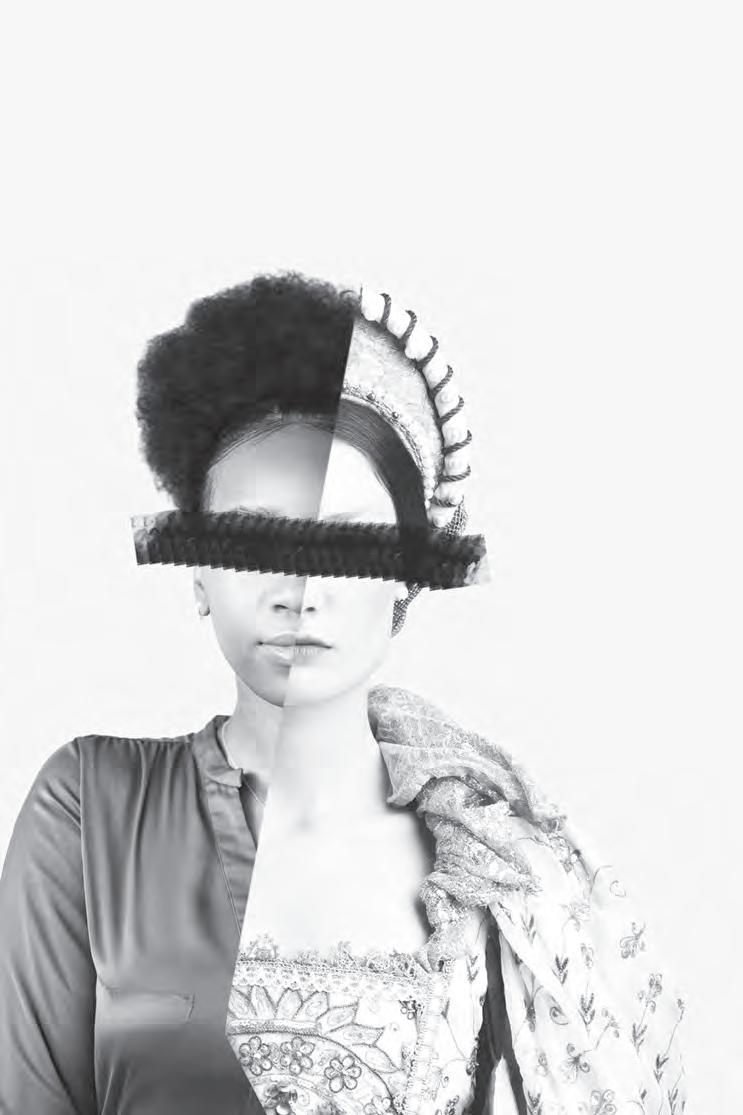
On the Cover: Digital composite image created by Margaret Lawrence. Stock photography licensed via Adobe Stock.
Priscilla Papers (issn 0898–753x) is published quarterly by CBE International, 122 W Franklin Avenue, Suite 610, Minneapolis, MN 55404–2426 | cbeinternational.org | 612–872–6898
DISCLAIMER: Final selection of all material published by CBE International in Priscilla Papers is entirely up to the discretion of the publisher, editor, and peer reviewers. Please note that each author is solely legally responsible for the content and the accuracy of facts, citations, references, and quotations rendered and properly attributed in the article appearing under her or his name. Neither CBE, nor the editor, nor the editorial team is responsible or legally liable for any content or any statements made by any author, but the legal responsibility is solely that author’s once an article appears in print in Priscilla Papers
Priscilla Papers | 40/2 | Spring 2026
Witchcraft in the Middle Ages and Its Impact Today
Joe Early
Christianity has a long history of humans attempting to use magic against God. Magic took the forms of divination, necromancy, the casting of spells or charms, and the interpretation of omens. The practitioner—called witch or sorcerer—was perceived to stand second only to demons.1 Indeed, as this article will show, unjustly labelling certain women as witches eventually became a tool for silencing women.
In the early centuries following the NT era, witchcraft was not understood as magic performed by a human agent. Rather, a demon was believed to take control of a person and use them to perform the act.
In the Old and New Testaments, witches were denounced as evil. Witches were condemned: “Do not allow a sorceress to live” (Exod 22:18 NIV); “Let no one be found among you who sacrifices their son or daughter in the fire, who practices divination or sorcery, interprets omens, engages in witchcraft” (Deut 18:10 NIV). The myth of Lilith in the medieval Alphabet of Ben Sira, based on the first account of creation in Genesis, portrays her as a sex demon or witch. The name “Lilith” is mentioned in Isaiah 34:14: “Wildcats shall meet with hyenas; goat-demons shall call to each other; there also Lilith shall repose and find a place to rest” (NRSVue).2 In the NT, Galatians 5:20 warns against witchcraft (pharmakeia).
Within the wider Greco-Roman world, with cultural nuances, a witch was perceived in the same way as in the biblical text. In the early centuries following the NT era, witchcraft was not understood as magic performed by a human agent. Rather, a demon was believed to take control of a person and use them to perform the act. Representative church fathers who held this interpretation include Hippolytus,3 Tertullian,4 Augustine,5 and John Chrysostom.6
Before the eleventh century, witchcraft was often confused with traditional pagan practices or with medicine (pharmakeia). The first “witches” were often women who possessed a deep understanding of nature and herbal medicine. These “wise women” provided natural cures which medical practitioners could not explain. As long as these healers were believed to be using their power for good, they were left alone. Emperor Charlemagne (800–814) even protected them and ordered the death penalty for anyone who killed a witch.7
In the first millennium, as the church sought to christianize Europe, nature worship was forbidden. The church viewed such practitioners as lunatics or as pagans.8 The worship of spirits that inhabited trees and streams was considered ignorant practice but not heretical. Further, according to the Canon Episcopi (ca. 900), witchcraft did not exist. So-called witches were either dreaming
or mad. However, if it was believed the devil was involved, these beliefs demanded immediate action: “Bishops and their officials must labor with all their strength to uproot thoroughly from their parishes the pernicious art of sorcery and malfeasance invented by the devil, and if they find a man or woman follower of this wickedness, to eject them foully disgraced from the parishes.”9
The church of the Late Middle Ages (1300–1492) was suspicious of lay involvement in religion. Lay movements, such as the Waldensians and the Cathars, were prominent targets. Because women were permitted to serve as ministers in these groups, their female members were often labeled witches and accused of having given their allegiance to the devil.10 In cases where the priest, sacraments, confession, and patriarchal hierarchy were challenged, such activity was ruled heretical. However, as late as 1258, Pope Alexander IV (1185–1261) forbade the Inquisition from persecuting witches unless they were charged with heresy.11
In the thirteenth century, witchcraft began to lose its connections with wise women and natural healers. By the fourteenth century, witches were considered the devil’s accomplices. The Franciscans and Dominicans argued that witchcraft was heresy because it involved making a pact with the devil. In 1398, the Inquisition was given jurisdiction over cases of witchcraft.12
During the High (1000–1300) and Late Middle Ages, women were accused of witchcraft four times more than men.13 Women were midwives at a time when infant mortality rates were high, and these deaths were often attributed to witchcraft.14 The extraordinarily high number of women being accused of witchcraft was the direct result of the church’s belief system that women were more susceptible to evil than men.15 All this led to the gendered definition of a witch as female.16
The Black Death of the fourteenth century killed up to two-thirds of Europe’s population. Atrocities marked the Hundred Years’ War between England and France. Islamic warriors were slowly closing in on the remnants of the Eastern Empire. The “Little Ice Age” led to crop failures, widespread starvation, and increased crime. With the rise of commercialization, trade, and the emergence of the middle class, women began to join guilds and enter the workforce. Their economic status improved. With commercialization came regional migration. These newcomers were often seen as outsiders. If the community suddenly suffered adversity, the newcomers were blamed. Moreover, the rise of the middle class disrupted the traditional economic structure. In a period of such turmoil, a scapegoat was needed and found: the witch.
In the late fifteenth century, a Dominican friar named Heinrich Kramer (1430–1505) petitioned Pope Innocent VIII (1484–1492) to allow the Inquisition to investigate rumors of witchcraft in Germany. In response, Innocent issued the Summis Desiderantes on December 5, 1484:
It has indeed lately come to Our ears, not without afflicting Us with bitter sorrow, that in some parts of Northern Germany, as well as in the provinces, townships, territories, districts, and dioceses of Mainz, Cologne, Tréves, Salzburg, and Bremen, many persons of both sexes, unmindful of their own salvation and straying from the Catholic Faith, have abandoned themselves to devils, incubi and succubi, and by their incantations, spells, conjurations, and other accursed charms and crafts, enormities and horrid offences, have slain infants yet in the mother’s womb, as also the offspring of cattle, have blasted the produce of the earth, the grapes of the vine, the fruits of the trees, nay, men and women, beasts of burthen, herd-beasts, as well as animals of other kinds, vineyards, orchards, meadows, pasture-land, corn, wheat, and all other cereals . . .17
Innocent proceeded to approve the Inquisition:
Wherefore We, as is Our duty, being wholly desirous of removing all hindrances and obstacles by which the good work of the Inquisitors may be let and tarded, as also of applying potent remedies to prevent the disease of heresy and other turpitudes diffusing their poison to the destruction of many innocent souls, since Our zeal for the Faith especially incites us, lest that the provinces, townships, dioceses, districts, and territories of Germany, which We had specified, be deprived of the benefits of the Holy Office thereto assigned, by the tenor of these presents in virtue of Our Apostolic authority We decree and enjoin that the aforesaid Inquisitors be empowered to proceed to the just correction, imprisonment, and punishment of any persons, without let or hindrance, in every way as if the provinces, townships, dioceses, districts, territories, yea, even the persons and their crimes in this kind were named and particularly designated in Our letters.18
Scholars estimate that as many as eighty-five percent of those accused of witchcraft were women.
Kramer and James Sprenger (ca. 1435–1495) wrote Malleus Maleficarum (“Hammer of Witches”) in 1486 and included Summis Desiderantes in the introduction. This was the most authoritative book on witchcraft produced by the church. No book did more to associate witchcraft with women and promote the witch hysteria of the sixteenth and seventeenth centuries. It cited the Church Fathers, the Old and New Testaments, Cato (95–46 BC), and Seneca (4 BC–AD 65). It also contained generalized attacks on women. The Malleus explained why women were more likely to practice witchcraft than men:
When a woman thinks alone, she thinks evil . . . I have found a woman more bitter than death, and a good woman subject to carnal lust. They are more impressionable than men and more ready to receive the influence of a disembodied spirit . . . They have slippery tongues . . . Since they are weak, they find an easy and secret manner of vindicating themselves in witchcraft. They are feebler both in mind and body. It is not surprising that they should come more under the spell of witchcraft. As regarding
intellect or the understanding of spiritual things, they seem to be of a different nature than men . . . Women are intellectually like children . . . And it should be noted that there was a defect in the formation of the first woman, since she was formed from a bent rib, the rib of the breast which is bent in the contrary direction to a man . . . And since through the first defect in their intelligence, they are always more prone to abjure the faith, so through their second defect of inordinate passions, they search for, brood over and inflict various vengeances, either by witchcraft or some other means. Wherefore it is no wonder that so great a number of witches exist in this sex . . . Women have weaker memories, and it is a natural vice in them not to be disciplined, but to follow their own impulses without any sense of what is due . . . She is a liar by nature . . . Let us consider her gait, posture and habit, in which she is vanity of vanities . . . Woman is a wheedling and secret enemy. For the sake of fulfilling their lusts they consort even with devils.19
Sprenger brought a millennium’s worth of religious misogyny to the Malleus. J. A. Phillips summarizes his arguments:
[Woman] is more carnal than a man, as is clear from her many carnal abominations. She is deceitful, with a “slippery tongue,” “a liar by nature.” She is naturally credulous and impressionable, therefore, “quicker to waver in her faith, and consequently quicker to abjure the faith, which is the root of all witchcraft.” Since women are “feebler both in mind and body,” they have weak memories, are undisciplined, impulsive, and particularly dangerous when given authority over anything. The authors’ conclusion is a testimony to the strength and tenacity of the blending of the stories of Eve and Pandora: “Beautiful to look upon, contaminating to the touch, and deadly to keep”; “a wheedling and secret enemy.”20
The Malleus linked women’s sexuality and witchcraft to devil worship. Witchcraft had its basis in carnal lust.21 The devil could take on a form that was sexually attractive to women,22 as evidenced by Eve’s capitulation to the serpent. What is more, women were so lustful by nature that they were not strong enough to allay Satan’s advances. They were susceptible to becoming Satan’s lovers and worshipping him. The Malleus then stated that these witches had power over men via sex. Men were largely immune to the temptations of witchcraft because Christ was incarnated as male.23 However, witches could make men potent, impotent, or even kill them through sex. Sometimes they physically stole their masculinity: “Witches who in this way sometimes collect male organs in great numbers, as many as twenty or thirty members together, and put them in a bird’s nest, or shut them up in a box, where they move themselves like living members, and eat oats and corn.”24 Another belief was that a demon—a succubus—would take on the form of a woman, have sex with a man, and collect his semen. The demon would then take the form of a man and impregnate the witch. The child of this illicit act was a demon.25
Scholars estimate that as many as eighty-five percent of those accused of witchcraft were women.26 The accused tended to be marginalized women such as widows, eccentrics, the poor, and those living on the outskirts of the community.27 Others were women of means who lived independent of male authority. They were blamed for spoiled food, bad harvests, and dead livestock.28 In
these times of high infant mortality, the Malleus accused midwives of using witchcraft to kill babies. If a child was born with a physical deformity, a midwife’s pact with the devil was often to blame.29
In regions where the Inquisition gathered strength, people accused of witchcraft were forced to confess under torture. Angela of Toulouse (1230–1275) was accused of having sex with an incubus and producing a baby that was part wolf and snake. After being tortured, she was burned at the stake.30
Few people in the twenty-first century believe in witchcraft as it was defined in the Middle Ages. However, the idea of heresy as a tool to enforce male superiority in matters of faith remains. How does one determine what or who is orthodox and who or what is heretical?
An accused witch would first be stripped and shaved so that her body could be examined. It was considered a sign of witchcraft if a woman had any birthmarks, moles, or blemishes. To eliminate any doubt, the alleged witch was asked to confess. Under physical duress, the accused would describe their participation in the witch’s sabbath, black Masses, in night flying, and in the casting of spells.31 If the accused refused to confess, it was believed the devil was behind her resistance. In Europe, she was often burned or drowned. In America, she was hanged.32
In Europe, witch persecution was at its height from the mid-sixteenth to the end of the seventeenth century. The most widespread witch hunts occurred in the Holy Roman Empire. The Spanish, Roman, and Portuguese Inquisitions rejected the Malleus. They were more concerned with heretics and with conversos, Jews and Muslims who had converted to Catholicism under duress. England and Scotland participated in witch hunts but did not permit torture. They used witch trials instead.33
Witch hunts were not limited to the Catholic Church. Martin Luther (1483–1546) and John Calvin (1509–1564) held that witches should be burned as heretics. While it is doubtful he believed it to be true, Henry VIII of England (1509–1547) accused Anne Boleyn (1501–1536) of witchcraft, or rather, of bewitching him.34 A firm believer in witchcraft, King James VI of Scotland (later King James I of England, 1603–1625) wrote Daemonologie (1597),35 which later empowered Matthew Hopkins (1620–1647), better known as the Witch Hunter General, to torture hundreds of women. The Salem Witch Trials of 1692 and the treatment of Anne Hutchinson (1591–1643) are defining events in the history of the Puritans who settled New England. The scientific revolution and the Enlightenment, with their emphasis on reason, contributed to the end of the era of witch hunts. The last known witch burning was in Switzerland in 1782. According to one estimate, between fifty thousand and one million accused witches were put to death between 1450 and 1750—the majority of whom were women.36
Few people in the twenty-first century believe in witchcraft as it was defined in the Middle Ages. However, the idea of heresy as a tool to enforce male superiority in matters of faith remains. How does one determine what or who is orthodox and who or what is heretical? Within Catholicism, the pope and the magisterium make the decision, based on church tradition. Though the terms “witch” or “sorceress” are not frequently used today, women still cannot be ordained, and their roles within the church remain highly constrained. There can be no doubt that the hundreds of years of church tradition that have labeled women as being lustful, weakminded, and conspiring with the devil remain in residue. Turning back centuries of teaching and indoctrination is not easy. In this regard, orthodoxy can lock women into their traditional subservient position. The equivalent of a heretic, therefore, might be a woman striving to do more in the church than years of decrees and canon law permit.
Within many Protestant denominations, such as Southern Baptists, women are viewed as orthodox if they do not attempt to take on leadership roles in the home and church. These compliant women are often known as “women of God” or as displaying “biblical womanhood.” If women do step out of these roles, their behaviour is viewed as unbiblical and described as “haughty,” “pretentious,” and even “heretical.” These descriptors, one could argue, are today’s equivalent of the descriptor, “witch.”
Secondly, Christianity, in its worst form as a religion, has been used to control people. Fear has been a primary tactic for keeping the faithful obedient. The witch-hunting era was a time when people were religious and had low life expectancy. Their hope for the future was in a heaven, the entry into which was mediated by the church. Witch-hunting was a demonstration of the power of the church to pronounce the verdict on one’s eternal destiny—heaven or hell. The church’s use of power to induce fear, and thereby to control, is not unfamiliar in the present day. Fear can also be good. We are told to work out our salvation “with fear and trembling” (Phil 2:12–13 NIV). This is a healthy fear of a God who loves us and saves us. These are two different kinds of fear. One is good and honors God, and the other is coercive and employs God as a tool to establish control.
Thirdly, men have always been the gatekeepers of the church in both Catholic and Protestant traditions. They have often baptized theology with superstition and misogyny and used it to keep women in line. The church in the Medieval era did not want the world to change. It was the most powerful institution in the world—it could call kings to kneel before it. When women showed extraordinary spiritual gifts, such as the mystics did, the church often rid itself of them by cloistering them. If not for the preserved writings of mystics such as Hildegard of Bingen (1098–1179), Catherine of Siena (1347–1380), and Julian of Norwich (1342–ca. 1416), their extraordinary experiences in spirituality may have been lost to history. If these women were not locked away from the world, the Catholic Church would well have tried them for witchcraft. In the modern era, talented women with gifts that can be given to God continue to be “cloistered.”
The age and the practices of witch-hunting, it would appear, are not entirely past.
1. A witch or sorcerer is identified as the same entity. They allegedly gained supernatural powers not granted by God or angels for their own motives. A demon is an alleged evil supernatural being most often portrayed as a follower or servant of Satan.
2. References to Lilith in this passage can also be found in NRSV, CEB, ISV, and many others.
3. Hippolytus, Refutation of All Heresies. Book VI, in The Ante-Nicene Fathers, vol. 5, ed. Alexander Roberts and James Donaldson (Christian Literature Publishing, 1886) 74. Hereafter cited as ANF.
4. Tertullian Apology, ANF: 3:23, 36.
5. Augustine, The City of God, in Nicene and Post-Nicene Fathers, first series, vol. 2, ed. Philip Schaff (Christian Literature Publishing, 1887) 374. Hereafter cited as NPF.
6. John Chrysostom, Homilies on First Timothy, NPF 13: Homily 12, 444.
7. Paul Edward Dutton, ed., Carolingian Civilization: A Reader, 2nd ed. (University of Toronto Press, 2004) 44–45.
8. Dutton, Carolingian Civilization, 44–45.
9. Gratian, Decretum, C. 26 q. 5 (Canon Episcopi), in Corpus Iuris Canonici, ed. Emil Friedberg, vol. 1 (Tauchnitz, 1879); https:// websiteofahistoricalpolymath.wordpress.com/2018/04/29/ canon-episcopi/.
10. Julia O’Faolain and Lauren Martines, eds., Not in God’s Image (Harper and Row, 1973) 207.
11. Pope Alexander IV, Quod super nonnullis, papal letter (Dec 13, 1258).
12. Joseph Hansen, ed., Quellen und Untersuchungen zur Geschichte des Hexenwahns und der Hexenverfolgung im Mittelalter (Carl Georgi, 1901) 2–3.
13. Barbara MacHaffie, Her Story: Women in the Christian Tradition, 2nd ed. (Fortress, 2006) 66.
14. Merry E. Wiesner-Hanks, Women and Gender in Early Modern Europe (Cambridge University Press, 2008) 260.
15. Kathleen M. Crowther, Adam and Eve in the Protestant Reformation (Cambridge University Press, 2010) 48.
16. Joanne Carlson Brown and Carole R. Bohn, eds., Christianity, Patriarchy, and Abuse: A Feminist Critique (Pilgrim, 1989) 36.
19. Henrich Kramer and James Sprenger, Malleus Maleficarum, trans. Montague Summers (Dover, 1971) 41–47.
20. J. A. Phillips, The History of an Idea: Eve (Harper and Row, 1984) 70. Kramer and Sprenger, Malleus Maleficarum, 41–47.
21. Kramer and Sprenger, Malleus Maleficarum, 47.
22. The belief that demons could have sex with humans is found in early Jewish thought and taken over by Christians.
23. Elizabeth Clark and Herbert Richardson, eds., Women and Religion: The Original Sourcebook of Women in Christian Thought (HarperCollins, 1977) 118.
24. Kramer and Sprenger, Malleus Maleficarum, 121.
25. Kramer and Sprenger, Malleus Maleficarum, 21–28.
26. Clark and Richardson, Women and Religion, 119.
27. Brown and Bohn, eds., Christianity, Patriarchy, and Abuse, 36.
28. Wiesner-Hanks, Women and Gender in Early Modern, 258.
29. Kramer and Sprenger, Malleus Maleficarum, 140.
30. Mary T. Malone, Women and Christianity: From 1000 to the Reformation (Orbis, 2001) 2:216.
31. Malone, Women and Christianity, 218.
32. Brown and Bohn, eds., Christianity, Patriarchy, and Abuse, 37.
33. Wiesner-Hanks, Women and Gender in Early Modern, 268–69.
34. G. W. Bernard, Anne Boleyn: Fatal Attractions (Yale University Press, 2010) 98.
35. James was the King of Scotland at the time. With his ascension to the English throne in 1603, England became more aggressive in persecuting accused witches.
36. Clark and Richardson, Women and Religion, 116.
Joe Early is Director of Research and Creative Scholarship and Professor of Church History at Campbellsville University. He has authored nine books, two manuals, and numerous journal articles. His latest book is Because of Eve: Historical and Theological Survey of the Subjugation of Women in the Christian Tradition.
Advocate for Mutuality
$125 or more per month
Builds global partnerships to advocate for biblical mutuality.
To be used where most needed to advance biblical mutuality.
Fertility, Futility, and Filth: Menstruation Imagery in Isaiah 64:6
Christy Hemphill and Marissa Franks Burt
“All of us have become like one who is unclean, and all our righteous acts are like filthy rags; we all shrivel up like a leaf, and like the wind our sins sweep us away” (Isa 64:6 NIV).
A quick internet search of “Isaiah 64:6 used tampon” reveals transcripts, sermons, and commentary excerpts that use menstruation imagery to discuss how impossible it is for human efforts at righteousness to please God. Anecdotally, we have heard from many people who remember uncomfortable sermons or Bible studies where teachers emphasized the disgusting nature of menstrual pads and tampons to prove this point. English translation choices such as “filthy,” “polluted,” and “rags” bolster the theological position that humans are totally depraved. Not every sermon or commentary on Isaiah 64 takes this approach, but those that do end up normalizing contempt for the God-designed bodily functions of women1 and displacing other meaningful aspects of the imagery of Isaiah 64:6.
We will explore the history of Christian attitudes toward menstruating women and how menstruation-related imagery was habitually used to talk about sin, righteousness, and judgment during the Protestant Reformation.
The English Translation of Isaiah 64:6
We will explore the history of Christian attitudes toward menstruating women and how menstruation-related imagery was habitually used to talk about sin, righteousness, and judgment during the Protestant Reformation. We will then consider how the Hebrew Scriptures use patterns of imagery to talk about sin, righteousness, and judgment, and will derive from this a reading of Isaiah 64:6.
Early Christian Perspectives on Menstruation
Despite Jesus’s gracious and exemplary treatment of a ritually unclean bleeding woman (Matt 9:20–22, Mark 5:25–34, Luke 8:43–48), male church leaders over the centuries have perpetuated menstrual taboos to distance themselves from their discomfort with women, their bodies, and blood.2 As early as AD 241, Dionysius, the Archbishop of Alexandria, taught that “menstruous women ought not to come to the Holy Table, or touch the Holy of Holies, nor to churches, but pray elsewhere.”3 By the fourth century, menstrual restrictions from the Hebrew Scriptures were adopted in the church, and Jerome, the prominent theologian and Bible translator, taught that “nothing is so unclean as a menstruant.”4 In the sixth century, Isodore, the archbishop of Seville, relied on the writings of the Roman physician Pliny the Elder to teach that menstruating women were dangerous and polluted the world.5 By the seventh century, Theodore, the Archbishop of Canterbury, prohibited menstruating women from entering churches or receiving communion.6 Some influential leaders, including Pope Gregory I in the sixth century, argued against preventing menstruating women from serving in liturgical roles or receiving the Eucharist, but the more dominant exclusionary views prevailed.7
The lived reality of these prohibitions meant that everyone from children to adults was regularly reminded that female bodies and sexuality were sinfully corrupted and dangerous. English translation decisions over time reinforced this perspective. In the fourteenth century, the Latin Vulgate’s pannus menstruatae of Isaiah 64:6 was translated into English as “menstruous clouts.” “Menstruous” connoted something defiled with menstrual blood, and “clouts” referred to rags used for wiping after defecating.8 “Menstruous” was replaced or modified in later English paraphrases of, and allusions to, Isaiah 64:6 with adjectives such as “vile,” “polluted,” “filthy,” “bloody,” and “foul.” Translations and paraphrases often added the word “woman,” shifting the focus of the imagery from the filthy blood-stained cloth to the filthy menstruating woman. A 1534 English primer published by the Catholic Church paraphrased Isaiah 64:6 as ‘‘and we are all wrapped in filthy uncleanness: yea, all our righteousness is spotted like the clouts of a menstruous woman,” and in 1582, Englishman Thomas Bentley wrote about ‘‘this our giltie and polluted nature, the fowle menstruous cloth of a woman.’’9
A crucial shift happened as these cultural and religious concepts combined with repeated references to Isaiah 64:6 in Reformation-era sermons and catechesis. The connotation of the word “menstruous” became synonymous in vernacular English with spiritual and moral corruption. By 1596, the popular lexicon The English Schoolmaster defined “menstruous” as ‘‘defiled,” and by 1623, Cockeram’s English Dictionary defined ‘‘filthy’’ as ‘‘menstruous, torrid, obscene.”10
In seventeenth-century Puritan poetry, menstrual blood stains became a conventional metaphor for original sin and total depravity, and terms such as “spot,” “stain,” and “blot” were euphemisms for menstrual blood. A 1618 devotional poem speaks of putting off “Sins rags impure/ Those Menstruous cloathes wherewith I am disguised/ Whereby thine Image in mee’s not agnized [recognized]:/ Whereby in thy pure sight I am but loathed.”11
Some clergy even began to object that the word “menstruous” was itself obscene to use in the pulpit. The Irish theologian Edward Nicholson complained in 1712 that its use was so unreasonably common among the Calvinists that their youngest boys knew this “monstrous reproachful name” by heart, and he entreated ministers to use the more modest word “filthy,” like the Geneva Bible did.12 A 1708 medical textbook for physicians, who certainly knew that menstruation had natural causes unrelated to sin, described the female womb as ‘‘a sink of filths [which] testifies to an unobliterable sin.”13 This progression reveals how the concept of
sin and corruption (in specific English-speaking Christian cultural contexts) became linked to menstruation and womanhood.
Future theological endeavors did not question the association, and it has affected English Bible translation, exegesis, and commentary to the present day. We asked one of the members of the original all-male translation team for the NIV why they chose “filthy rags.” He explained how the team was divided, with the older members unwilling to opt for a translation that would bring female reproductive terms into the pulpit. The men consulted their wives, some of whom suggested using “period” in some way. But ultimately the team “judged it best not to use any term that would offend some.” 14
Most contemporary English translations maintain imprecise language choices around the translation of “unclean” and “menstrual cloth/ garment.” Almost all of them obscure the connection to menstruation (only CEB and NET use the word “menstrual”), and instead of the more literal and neutral “cloth” or “garment,” overwhelmingly use the word “rag” (CEB, CEV, ISV, JUB, MEV, MSG, NCB, NET, NIV, NKJV, NLT, VOICE) and pejorative words like “polluted” (CSB, ESV, WEB) or “filthy” (CEV, GNT, ISV, JUB, LSB, MEV, NASB, NCB, NIV, NKJV, NCV, NLT, NRSVue).
Instead of the more neutral choice of “unclean” or “unfit to worship you” (CEV), which could refer to the ritual impurity that accompanied marital sexual activity and menstruation but did not necessarily entail sin, some translators went so far as to use phrases like “infected and impure with sin” (NLT), “sin-infected, sin-contaminated” (MSG), “dirty with sin” (NCV), “sinful” (GNT) and “compromised with impurity” (VOICE). These choices reveal the way translators blended and sometimes even equated the physiological activity of menstruation and the concept of sin. Not a single major English Bible15 translates the verse with a neutral and uninterpreted rendering that does not impose cultural assumptions on the intended meaning. This suggests that the English-speaking world still conceives of menstrual blood stains as somehow particularly loathsome and still associates the biological phenomenon of menstrual blood with the concepts of spiritual corruption, sin, and moral filth.
With this, we turn to explore how our interpretive inferences might be different from those of the ancient Israelite audience and what that might mean for interpreting biblical imagery in general and Isaiah 64:6 in particular.
The Patterns of Agriculture and Reproduction Imagery
The Hebrew Scriptures frequently deploy plant imagery to describe human conditions.16 Protected, secure people are compared to plants growing in walled gardens (e.g., Ps 80:8–15). God-as-gardener carefully transplants to fertile, well-irrigated soil and provides expert cultivation (e.g., Isa 5:1–7; Amos 9:15). Irrigation or rain in dry land is linked to God’s provision and blessing (e.g., Ps 1:3, 107:35). Judgment, exile, and death are linked to uprooting and withering (e.g., 1 Kgs 14:15; Job 15:32). The ephemerality and frailty of human life is linked to short-lived shallow-rooted plants like wildflowers and grass that are easily scorched by the sun and displaced by the wind (e.g., Ps 37:2, 103:15; Isa 40:6–8). Sinful lives and worthless legacies
are linked to dead or discarded plants like withered leaves, grass, chaff, straw, stubble, weeds (e.g., Ps 1:4, 37:1–2). Enduring legacies and righteous or prosperous lives are linked to sheltered, wellirrigated plants with deep or regenerative roots, and to plants that produce something valued such as oaks, cedars, palms, olive trees, grape vines, myrtle, and willows (e.g., Ps 92:13–15; Isa 61:3; Hos 14:6).
These prevalent conceptual links between plants and people created patterns of related meanings. Wombs and land can be barren or fertile; women without children and land without inhabitants are both desolate. Plants and men contribute seed to new life; wombs and certain plants bear fruit. Words associated with propagation (e.g., seed, shoot/branch, fruit) have senses related to both plants and family or ancestry.
Additionally, agriculture and reproduction are portrayed as processes that lead to predictable results which can be evaluated in terms of success or failure. Just as there is association between wombs and fields, there is a link between figuratively describing the beginning of a process either as a conception or pregnancy or as a plowing and planting (e.g., Isa 61:11; Hos 10:12–13a). Just as there is an association between family and ancestry terms and propagation terms, there is a link between describing successful processes as either births or harvests and unsuccessful processes as either infertility or failed harvests (e.g., Prov 22:8). Pregnancy and harvest imagery are often combined with sin/judgment and righteousness/reward imagery; for example, the godless “conceive trouble and give birth to evil, and their womb prepares deceit” (Job 15:34–35 ESV). The wicked man “conceives evil and is pregnant with mischief and gives birth to lies” (Ps 7:14 ESV). In contrast, the prophet exhorts the faithful to “sow for yourselves righteousness; reap steadfast love” (Hos 10:12a NRSVue).
Sometimes imagery of conception and birth (or the lack thereof) is blended with futility imagery from agriculture to communicate a message of judgment for the failure to be “fruitful” and produce the intended result of righteousness (e.g., Isa 33:11 NIV: “you conceive chaff, you give birth to straw”). The imagery of wind carrying off withered plants is used in passages about judgment for failure to produce righteousness (Isa 17:13, 37:27, 40:24). Sometimes images from agriculture are combined with images from reproduction, such as we see in Ps 58:7–8 where wasted water and withered grass blends with a stillbirth in imagery of futility. Furthermore, the book of Isaiah—alongside other Hebrew prophetic writings—figuratively presents Israel as God’s bride (e.g., Isa 49:19–21, 62:4–5; Hos 2:19–20) and God’s garden or vineyard (e.g., Isa 5:1–7, 60:21), and the figurative language used to describe the state of Israel’s relationship with God frequently draws from and blends implicit bride and garden pictures (Isa 1:29–30, 66:5–13; Jer 2:2–4).17
The Pattern of Cloth Imagery
Isaiah 64:6 evokes futility imagery from agriculture with its reference to a shriveled leaf blown in the wind. Should we read the paired imagery of a menstrual cloth as similar futility imagery from reproduction, or does soiled cloth communicate something else? People may rightly point out that in the Bible, the image of red dyed or permanently stained cloth is associated with sin: “though your sins are like scarlet they shall be as white as snow” (Isa 1:18 ESV).18
Language about removing sin’s stain or washing away the filth of sin expresses forgiveness and restoration (e.g., Ps 51:2, 7; Isa 1:15–16; Jer 2:22; Zech 13:1). In other texts, God replaces the rags of sin or shame with the new, clean clothing of righteousness or honor (e.g., Zech 3:3–5).
Ritual cleansing was foundational to the purity laws19 that governed who was welcomed into communal Israelite life and worship and who was separated out as “unclean.” These purity laws are referenced in Isaiah 64:6: “we have all become like one who is unclean.” It is understandable, then, that interpreters across the centuries connected “unclean” with “morally corrupted by sin” and perceived a link between blood-stained menstrual cloths and moral and spiritual impurity. But it is worth asking: did the original audience’s understanding of ritual impurity include a particular disgust for bodily processes or a perception that menstruation itself was an expression of moral corruption?
In ancient times, menstruating women were ritually unclean, but people could become ritually impure for many reasons, including things outside of their control like bleeding, nocturnal emissions, skin disease, mold, and exposure to dead things.20 Anthropologist Mary Douglas defines the concept of “dirt” as “matter out of place” and argues that “unclean” in ancient purity systems has nothing to do with our modern concept of hygiene.21 In order to understand what counts as “unclean” or “polluted” in a given society, we must first examine the patterns that govern what is considered an anomaly and therefore “unclean” and perhaps dangerous. Using this analysis, menstrual blood would be unclean, not because it was considered dirty in the sense of unhygienic or disgusting, but because it was an anomaly that disrupted the expected patterns for blood. Furthermore, like a nocturnal emission, a menstrual stain is an irregularity that showcases diminished life-giving capacity and brings impurity because of association with death.22
By law, a menstruating woman was required to separate herself from her husband and the rest of the ritually pure community (Lev 15:19–30). Women were required to undergo ritual cleansing to be restored to sexual intimacy and to participation in community worship.23 Historian Sara Read points out that ancient women did not use dedicated menstrual protection analogous to modern sanitary napkins or tampons that are thrown away after use. They likely washed their legs at the end of a day and laundered and reused the innermost garments they wore while menstruating24 since cloth was labor-intensive and costly to produce.25
As we work to decipher the imagery of stained menstrual cloths, it is important to remember that Isaiah 64 is not an oracle of judgment where God is expressing dismay over Israel’s sinfulness. It is a lament in which the prophet is pleading for God’s deliverance: “Look down from heaven and see” (Isa 63:15), “Turn back for the sake of your servants” (63:17), “Oh that you would tear open the heavens and come down” (Isa 64:1). It includes a collective remembrance of God’s power and loving faithfulness in the past “when you did awesome things that we did not expect” (Isa 64:3), and a claim to God’s promise to “meet those who gladly do right, those who remember you in your ways” (Isa 64:5 NRSVue).
Isaiah 64:5b–7 presents the issue that the poet is lamenting—Israel’s state of fruitlessness which is deserving of God’s judgment:
But you were angry, and we sinned; because you hid yourself we transgressed. We have all become like one who is unclean, and all our righteous deeds are like a [menstrual cloth/garment]. We all fade like a leaf, and our iniquities, like the wind, take us away. There is no one who calls on your name or attempts to take hold of you, for you have hidden your face from us and have delivered us into the hand of our iniquity. (NRSVue)
Forging the links between all the elements in the imagery provides a key to interpretation. A reference to ritual impurity and separation, a reference to menstruation, a reference to righteousness and sin, a reference to a fading leaf blown away in the wind—all should cohere. We review these in the light of the discussion so far:
One who is unclean: Ritually unclean individuals are separated from God. Ritually unclean married women are separated from marital intimacy. Ritual impurity requires ritual cleansing to end separation and resume sexual intimacy, through which new life could be conceived (fruitfulness).
Menstrual cloth/garment: Menstruation indicates ritual impurity. A woman’s fertility and ritual state are important to the marriage relationship. The appearance of blood indicates to her husband that she is “fruitless.” It is a sign of infertility, and wives deemed “barren” are often sent away “desolate.”
Righteousness: Righteousness is linked to successful (fruitful) processes like live births and good harvests. Restored righteousness and rewarded righteousness are often pictured as dew or irrigation that brings flourishing to a dry, desolate land.
Wither like a leaf: Withering or fading is associated with loss of vitality and strength as well as failing to flourish and be fruitful. Like a menstruating woman, a withered leaf is linked figuratively to physical weakness, fainting, illness, and being sapped of strength.26 Dried out leaves become separated from the rooted plant and are easily blown away by the wind, and are therefore linked with futility and worthlessness.
The images are linked and blended to lament the sterility of God’s people (64:6, 10), to concede the justice of God’s judgment (64:3–5, 7), and to plead with God for restoration (64:8–9, 12). Imagining how these images function together might lead to an intended meaning more like: “We are like a menstruating woman who is separated from intimacy with her husband. Like a husband hoping for a child, you came looking for righteousness in us. What you found was an indicator of our infertility. Like a menstruating woman, like a withering leaf, your bride shows signs of death rather than life.”
What a powerful lament to precede the poet’s plea for restoration! It fits so well with the eschatological visions of restored righteousness found elsewhere in the book of Isaiah expressed through the imagery of fertility and flourishing.
Conclusion
Unfortunately, pastors who choose to spotlight the “filthy rags” of Isaiah 64:6 rarely seem to have these patterns in mind. Instead,
they present the verse as if it is a simple metaphor, suggesting that the characteristic that righteousness and menstrual cloths have in common is that they are contemptible or worthless. This train of thought often leads to the inference that all of our best efforts will only ever be like the filthiest of rags in God’s sight, or that God is repulsed by us or our efforts. This conclusion directly contradicts numerous passages of Scripture that indicate God delights in righteousness and rewards people for their righteous lives (e.g., 2 Sam 22:21–25; Ps 84:11). Perhaps the fact that this skewed reading has endured goes to show the power of imagery. If people walk
Notes
1. Sara Read argues that commands to cast off sin like menstrual rags and sermons comparing human righteousness to defiled menstrual rags were so prevalent and influential in Protestant England in the early sixteenth through the mid-eighteenth centuries that it created a “culture of silence” around women’s health and menstrual hygiene that lasted for hundreds of years. Sara Read, “Thy Righteousness Is But a Menstrual Clout: Sanitary Practices and Prejudice in Early Modern England,” Early Modern Women 3 (Fall 2008) 15–17.
2. See William E. Phipps, “The Menstrual Taboo in the JudeoChristian Tradition,” Journal of Religion and Health 19/4 (1980) 298–303.
3. Dionysius, The Letter of the Blessed Dionysius, Canon II.
4. Jerome, Against Helvidius 20, Commentary on Zacharias 13).
5. Bethan Hindson, “Attitudes Towards Menstruation and Menstrual Blood in Elizabethan England,” Journal of Social History 43/1 (2009) 92.
6. Phipps, “The Menstrual Taboo,” 300.
7. Phipps, “The Menstrual Taboo,” 301.
8. Read, “Thy Righteousness Is But a Menstrual Clout,” 5.
9. See Ursula Potter, “Menstruation and Coming of Age,” in Gender: Time, MacMillan Interdisciplinary Handbooks, ed. Karin Sellberg (MacMillan Reference USA, 2018) 188.
10. Potter, “Menstruation and Coming of Age,” 186–90.
11. Read, “Thy Righteousness Is but a Menstrual Clout,”14.
12. Edward Nicholson, The Death-Bed Repentance fully consider’d proving that no mere death-bed repentance can be effectual to salvation (Dublin: Printed by A. Rhames for the Author, 1712) 126–27. Cited in Read, “Thy Righteousness is But a Menstrual Clout,” 16.
13. Potter, “Menstruation and Coming of Age,” 190.
14. Email with Dr. Bruce Waltke and Marissa Burt, Dec. 4, 2023.
16. Alec Blasson, “‘People are Plants’—A Conceptual Metaphor in the Hebrew Bible,” OTE 19/2 (2006) 573–83.
17. For further reading on the bridal imagery, see: Elizabeth Ann R. Willett, “Unveiling Old Testament Women with Accurate Translation,” Priscilla Papers 33/4 (2019) 13–14.
18. The color scarlet is probably intended to evoke imagery of Zion as an unfaithful bride or prostitute in Isa 1:18. See Scott B. Noegel, “Scarlet and Harlots: Seeing Red in the Hebrew Bible,” HUCA, 87 (2016) 27–32.
19. See Lev 12–14; Num 5:1–4, 19:11–12.
20. See Lev 11, 14, 15.
21. See Mary Douglas, Purity and Danger: An Analysis of Concepts of Pollution and Taboo (Routledge and Kegan Paul, 1966; repr. Routledge Classics, 2005) 48–50.
22. For further reading on the significance of death impurity and
away from a sermon hearing “your righteousness is like a used tampon,” the inferences they draw from that imagery will preach louder than any scholarly disclaimers.
The reading of Isaiah 64:6 that we have offered challenges interpretations that draw on misogynistic views of menstruation and the emphasis on human depravity that is seen in some streams of the Western Protestant Christian tradition. It seeks to reclaim the rich biblical imagery voiced in this passage—confession, lament, and the hope that the Lord will restore.
menstruation, see Havilah Dharamraj, “Jesus the High Priest: A South Asian Reading,” in Prophet, Priest, and King: Christology in Global Perspective, ed. Michael S. Horton, Elizabeth W. Mburu, and Justin S. Holcomb (Zondervan Academic, 2024) 134–37.
23. See Avraham Faust and Hayah Katz, “The Archaeology of Purity and Impurity: A Case-Study from Tel ‘Elom, Israel,” Cambridge Archaeological Journal 27/1 (2017) 1–27.
24. Read, “Thy Righteousness Is But a Menstrual Clout,” 4–5.
25. The term used for menstrual cloth or garment in Isa 64:6 is only used here in the Hebrew Scriptures. Another Hebrew word in Lev 20:18 and Isa 30:22 has a wider semantic range including being “sick,” “faint,” or “stunned.” That phrase was translated “seated apart” in the Septuagint, which makes the separateness entailed by ritual impurity the salient part and does not connote dirtiness or depravity. See Dorothea Erbele-Küster, “Archaeological and Textual Evidence for Menstruation as Gendered Taboo in the Second Temple Period?” in Gender and Social Norms in Ancient Israel, Early Judaism, and Early Christianity: Texts and Material Culture, ed. Michaela Bauks, Katharina Galor, and Judith Hartenstein (Vandenhoeck and Ruprecht, 2019) 169–84.
26. The Hebrew adjective used for menstruating women in Lev 20:18 and Isa 30:22 is also used figuratively in Lam 1:13 (to describe the personified city of Jerusalem who has been sapped of her strength by God’s judgment) and in Lam 5:17 (to describe the hearts of the people in the midst of hardship) and is usually translated, “sick,” “faint,” or “stunned.”
Marissa Franks Burt (MA in Theological Studies) is an author and At Home with the Lectionary podcast host.
Christy Hemphill is a linguist and educator who worked for thirteen years advising and training minority language translators. She holds master’s degrees in applied linguistics from Old Dominion University and Dallas International University.
The Complementarian Imagination: Race, Gender, Exclusion, and Dominion
Nick O’Brien
“All the world’s a stage, and all the men and women merely players.”1 Shakespeare illuminates our lived experience with this profound metaphor, inviting us to question the stages we stand upon, the stories we live within, and the characters we perform. While “the Bible is a script that is waiting to be performed,”2 the present social order has a script of its own, casting us onto a rival stage to perform a rival drama.
Jarena Lee offers a poignant example of this dynamic. In her 1836 autobiography, she defends her calling to preach the gospel, “as unseemly as it may appear now-a-days for a woman to preach.”3 While Lee is thoroughly convinced her character should preach within the biblical drama, she knows this act is unseemly on the world’s stage. Catherine Mumford Booth perceives the same in her 1859 Female Ministry: “The first and most common objection urged against the public exercises of women, is that they are unnatural and unfeminine.”4 The public ministry of a woman is assumed to be out-of-character—unseemly, unnatural, and unfeminine. On the world’s stage, an actress must not stand in the actor’s pulpit.
In 1988, white evangelicals in the United States coined the term “complementarian”5 to describe a contemporary ideology derivative of the ancient social performance of male authority and female submission. To understand the roles we perform, I will turn to Willie James Jennings and J. Kameron Carter, whose poignant works on race illuminate the unseen imagination energizing both racial and gendered social order and hierarchies.
Jennings, in The Christian Imagination, powerfully argues “that Christianity in the Western world lives and moves within a diseased social imagination,” and, therefore, “people’s social performances of the Christian life [are] collectively anemic.”6 Rather than accepting Christ’s invitation into a narrative of radical joining within the covenant family of God, Western Christianity often performs division and dominion, thereby perpetuating the present evil age. How else can we explain a Church that was instrumental in the trafficking and enslavement of millions of Africans made in the image of God? Jesus said, “a good tree cannot bear bad fruit” (Matt 7:18 NRSVue), and we can be sure that the toxic fruit of slavery and White supremacy throughout church history has been possible only because the tree has grown within the soil of toxic imagination.
What Jennings calls the “diseased social imagination,” Carter calls “modern racial reasoning.” Carter reminds us that a renewed mind rejects the logic of separation and domination to inhabit a new world: “To enter into Christ’s flesh through the Holy Spirit’s Pentecostal overshadowing is to exit the gendered economy and protocols of modern racial reasoning” (italics mine).7 The stage on which we play is thoroughly racialized: White players and Black players must perform the social dynamics of race in this drama, while modern racial reasoning upholds a “gendered economy.” The tendrils of division and domination touch both race and gender,
energizing both subtle and extremist expressions of racism and misogyny alike. Furthermore, I argue that racializing logic depends on an ancient gendered imagination sprouting from the post-fall garden of Genesis 3:16. Because men came to imagine separating from and taking authority over the gendered Other, they could also imagine the possibility of enslaving the racial Other.
I contend that complementarianism, which casts women and men into roles of submission and authority, is an ideology built upon the same diseased social imagination that allowed colonists to cast Europeans and Africans into the roles of White and Black. While complementarianism and White supremacy differ in scale and consequence, I believe they rest upon the same theological imagination and perform from the same social order of separation that promotes dominion. I do not claim that complementarianism derives from White supremacy. Rather, I contend that both ideologies perform on the same stage. They are fruit of the same tree, ideologies born of the same social imaginary.
Jarena Lee perceived a metanarrative, a social imagination, that made female preaching “unseemly.” Lee, however, was not bound by this assumption but was liberated by the call of God on her life. Lee “refuses to hand Christian theology over either to whiteness,8 to the blackness [that] whiteness created, or to the racialized gender conventions attending either of these. Instead, she receives herself anew from Christ, understanding her body as articulating his body and his body hers.”9 Through this, Lee stands on the new stage, liberated from division and dominion to perform radical Christian belonging.
Genesis 1 and Creating Race
The colonial moment reconstructed—ideologically speaking—the world and the people in it. Europeans re-narrated Genesis 1. The biblical narrative begins with a God who separated light from dark, naming the light “day” and the dark “night.” The Creator separated and named. This creative impulse was turned upside down in the colonial moment, as European colonists separated light skin from dark skin, naming Europeans “white” and Africans “black.” Genesis 1 narrates the creation of humankind in God’s image, highlighting the similarity and belonging between God and humans. Colonists, in their re-narration project, perversely re-imagined human beings as opposites
Europeans beheld a vast continent of diverse peoples and imagined them as one “black” African monolith, the degraded opposite of European Whiteness. While a biblical imagination aims at joining, a racialized imagination divides. In Jennings’s words, “the Christian imaginary that [emerged] out of colonialist power naturalized segregationalist mentalities and thereby denied one of its most basic and powerful imaginative possibilities, the deepest and most comprehensive joining of peoples.”10
White and Black were not neutral categories, but a dramatic range from Black savagery to White civility. Juliany González Nieves defines Whiteness as a sociological construct which preaches in word and deed the presumed (g)od-given superiority of Euro-American aesthetics, theologies, cultures, and ways of life and thinking, locating everything and everyone in a spectrum that grants degrees of privilege based on their proximity to the White man.11
As Europeans usurped God’s role as creator of worlds and ripped Africans from their lands, they displaced Jesus as well. Carter explains: “Christ was abstracted from Jesus, and thus from his Jewish body . . . In making Christ non-Jewish in this moment, he was made a figure of the Occident [West]. He became white.”12 White Christians no longer imagined Jesus of Nazareth as an embodied Judean belonging to the culture of the Middle East in the timeline of world history. Rather, they imagined an abstract, spiritual, malleable Christ conformed toward the “baptized idol of the White man.” Within this diseased theological imagination, non-White and Black flesh was deemed inherently opposite to Christ’s flesh, and as such, inherently inferior to White flesh.
The colonists did not only exit the biblical narrative. They chopped the Bible up into isolated texts and used these as building material for their new stage, one that served the interests of Whiteness. “[F]or the slave the Bible was offered only in conjunction with the interpreting word of the slave master.”13 In the hands of enslavers, the Bible was weaponized toward social control and economic prosperity. In the United States, in Carter’s words:
Scripture [has] been made to function as the “immaterial” or “spiritual” superstructure that sanctions the “material” structures of power in the American social order . . . Christian thought has tended to ventriloquize the American social order rather than witness to an alternative form of sociopolitical existence. Theology’s failure [leaves us] with no live alternative by which to (re)imagine the world.14
The Bible served as justification for division and dominion. Instead of asking what theology required of Christians, Christians were to ask what Whiteness required of theology. This is why, till today, there is a “tendency in many White Churches to assume that the Bible basically tells a story about White people and that the other races are simply added on as part of our gracious missionary enterprise.”15
The colonists usurped God’s Genesis 1 role to re-create human identities; they re-imagined humanity in opposition to one another, with White flesh in authority over all others; by displacing Jesus, they lost the capacity to imagine radical joining together of peoples; and instead of inhabiting the world of the Scriptures, they deployed the Bible in favour of the White.
Genesis 2 and Performing Gender
As “Christian formation [was] reconfigured around white bodies,”16 human identity was redefined to fit a narrative that exploited Christian language in service of Whiteness. Because Europeans understood themselves as civilized and as civilizers, as quintessential Christians and as Christianizers, they cast themselves in the role of judge over all others, according to their standards of White civility
and Christianity. Black and White are not biological categories, but storied identities, expected to fill certain roles on the world’s stage.
Within this diseased imagination, male and female also became social descriptions of “players” expected to perform certain roles. It is not enough to be male or female. A male must perform masculinity, and a female, femininity. Male and female were not mere biological categories, but a set of contrary character attributes as well. Carter highlights this process and its integration with the racialized imagination, noting that “woman or the feminine as acquiescent passivity effectively comes to represent what it means to be a slave . . . freedom, which entails the struggle for release from the condition of racial indignity, is . . . a struggle against the loss of masculinity.”17
Before Black could be created as a racial construct, femininity was already equated with passivity and masculinity with activity. The slave fills a “feminine,” passive role, while the master is active, authoritative, and quintessentially “masculine.” For an enslaved person to escape to freedom, he must leave behind feminine passivity and be conformed to the image of masculine agency and activity. This gendering of slavery was only possible within a logic that already imagined femininity as passive, as apparently opposite to masculine agency. Racialization—and the roles it created— was enabled by a social imagination already predisposed towards male separation from, and authority over, female. Racial logic was imagined as a possibility because men had already assumed the logic of division and dominion over women. In other words, because colonists had already conceived of “the opposite sex,” the colonial imagination was primed to think in terms of “the opposite race.” “Ultimately, this type of separation always restricts one group (e.g., blacks, women) while the other group has no such restrictions (e.g., whites, men).”18 Jennings writes that “we must think through to the utter limits of the racial calculus to expose its deepest fault lines. We must do this in order to tear open racial identity so as to reveal the original relation—exposing it afresh to our social imaginations.”19 If we are to be radically joined in Christ, we must uncover all that separates, categorizes, and ranks us—both the “racial calculus” and the gendered calculus.
Scripture contains the very story that helps us re-narrate the world. After the creation of ha’adam —the human formed from the dust and energized by God’s breath—God places him in the garden of Eden to work it and care for it. God, however, recognizes “it is not good that the man should be alone” (Gen 2:18). This is the first “not good” in a sacred text that features the repeated refrain, “and God saw that it was good” (Gen 1:4, 10, 12, 18, 21, 25, 31). God responds, “I will make him a helper as his partner” (Gen 2:18 NRSVue). The Creator of all that is good responds to the first “not good” with a resolution to create “a helper as his partner.”
Marg Mowczko explains that “the Hebrew word for ‘helper’ used in Genesis 2:18 and 20 is ‘ezer, and it is always and only used in the Hebrew Bible in the context of a necessary and powerful assistance.”20 Sixteen of the twenty-one occurrences of ‘ezer in the Hebrew Bible refer to God himself. While Raymond Ortlund argues that Eve “was not [Adam’s] equal in that she was his ‘helper,’”21 this argument is only tenable if we assume God may be subordinate to anyone he helps. Furthermore, Eve is not just ‘ezer, but ‘ezer kenegdo: “a helper as his partner.” Mowczko explains that kenegdo expresses
“similarity, correspondence, mutuality, equality.” Therefore, she concludes, ezer kenegdo expresses “nothing whatsoever . . . that implies a subordination of the first woman or an authority of the man over the woman.”22 There is no division or dominion between male and female in Genesis 2. Eve is neither man’s opposite, nor his inferior.
Furthermore, Genesis neither portrays Eve as uniquely passive, nor Adam as uniquely active.23 These gendered attributes do not derive from Genesis, but are later characterizations of Adam and Eve, as articulated by John Milton’s 1667 description of the Edenic couple:
For contemplation he and valor formed, For softness she and sweet attractive grace: He for God only, she for God in him.24
God created Adam; we imagined him heroic and intellectual. God created Eve; we imagined her soft, sweet, attractive, and gracious. God created the sexes; we perform gender
A diseased social imagination assumes the male is made “for God” while the female exists “for God in him.” Man is centered, fully human, while woman orbits him in submission. We have torn male and female asunder, creating opposites where God created “one flesh” (Gen 2:24). Man has seized authority over the ezer kenegdo created as his equal. How has this happened?
Genesis 3 and the Logic of Domination
Genesis 3 portrays the “fall” of humanity and the entrance of sin into the world. When God speaks with Adam in the wake of this downfall, Adam shifts the blame for his actions onto both his wife and God: “The woman whom you gave to be with me, she gave me fruit from the tree, and I ate” (Gen 3:12 NRSVue). In this moment, the man separates from God and woman, and the logic of “the opposite sex” enters the human imagination for the first time. God sees and forewarns the woman: “your desire shall be for your husband, and he shall rule over you” (Gen 3:16b).25 Because the man and the woman, bone of bone and flesh of flesh, have been torn asunder in the act of blame, he will soon claim authority to “rule over” her. The logic of division, God warns, always gives way to the logic of domination. He who perceives another human being as “opposite” will always subsequently seek to “rule over” them. Here, in Genesis 3:16, are the roots of the diseased social imagination behind misogyny and White supremacy alike.26
South Carolina statesman John C. Calhoun (1782–1850) described the center of the social order in the antebellum South: “Every plantation is a little community, with the master at its head.”27 Jennings explains: “In antebellum America, the household stood at the center of the social world of the new republic, and at the center of the household stood the male landowner.”28 In an 1857 sermon, Alabama Presbyterian minister, Frederick A. Ross, makes the White master’s universal authority explicit: “I make the rule of . . . master and servant, parent and child, husband and wife, the same rule; i.e. I make it the same right in the superior to control the obedience and the service of the inferior, bound to obey.”29 Wife, children, and enslaved persons were brought together in the racial, gendered flesh of the White master. This is a grotesque distortion of the biblical
narrative that draws all people together in Jesus, who came not for possession or domination, but in loving service.
Just as Adam separated himself from his wife to “rule over” her, so the White master assumed that his authority over wife and children also granted him divine authority over others. “Biblical justifications had embedded slavery in a set of orderly domestic hierarchies so that the power of slave owners over slaves paralleled the power of husbands over wives and of parents over children. Slavery was legitimate, so the arguments went, because it was like marriage.”30 Slavery was biblically justified because the separation and authority of one over another was imagined as the divine order.
A Southern slave-owner’s wife had little choice but to accept her husband’s dominion, as “the law gave husbands authority to ‘discipline’ their wives.”31 Domestic abuse was expected if anyone on the master’s stage failed to perform their role. Within this diseased, deadly imagination, subjugated women came to assume their oppression was natural and divinely ordained. They had never received permission to imagine an alternative. Catharine Beecher, representing the dominant views of antebellum Southern culture in her 1837 public letter, Essay on Slavery and Abolitionism, said:
It is the grand feature of the Divine economy, that there should be different stations of superiority and subordination . . . Heaven has appointed to one sex the superior, and to the other the subordinate station, and this without any reference to the character or conduct of either. 32
It is a tragic consequence of a diseased imagination when separation and domination come to be seen as “the Divine economy.” Historian Laura F. Edwards explains this dynamic:
Although Evangelical southern Protestants believed that everyone was spiritually equal in the eyes of the Lord, the same did not hold true for matters of this world . . . White women, like slaves, were supposed to realize their spiritual mission through cheerful obedience to the authority of white men . . . This social order, the South’s ministers assured their congregations, was not just natural but divinely ordained. Any change would bring down the wrath of God.33
A century and a half before the advent of modern complementarianism, the prevailing social order of the antebellum South claimed the spiritual equality of wives while explicitly calling them to slave-like submission due to their inferiority.
The Complementarian Imagination
The complementarian emphasis on “roles” signifies that men and women are expected to perform the drama of separation and authority. In 1988, the Council on Biblical Manhood & Womanhood (CBMW) published the Danvers Statement expressing the core beliefs of complementarianism. Danvers imagined and perpetuated division with their statement that “distinctions in masculine and feminine roles are ordained by God . . .”34 It enforced the logic of authority in saying “wives should forsake resistance to their husbands’ authority and grow in willing, joyful submission to their husbands’ leadership.”35 The development of complementarianism in the latter half of the
twentieth-century is unsurprising. Historian Paul Harvey writes:
A theology that sanctifies gendered hierarchy has become for the post-civil rights generation what whiteness was for earlier generations of believers. For religious conservatives generally, patriarchy has supplanted race as the defining first principle of God-ordained order.36
While complementarianism does not explicitly differentiate between races, it rests on the same imaginative foundation as colonial and antebellum racial reasoning. Separating female from male as “the opposite sex” and Black from White as “the opposite race,” the White master created order they imagined to be “God-ordained.”
Jennings highlights “the rule of the plantation father over the family and of the master as the organizing center of domestic and public life.”37 The plantation presents us with a social order wherein the White male rules over home and institution. Within plantation life, “people have a role, and if they resist that role then their existence is rendered unassimilable and useless.”38 The logic at work on the plantation was that of separating one man and authorizing him to rule over both familial and institutional domains. Has the White evangelical church perpetuated this racial and gendered logic?
The Southern Baptist Convention (SBC), the largest evangelical denomination in the United States,39 as predominantly White40 and a strong proponent of complementarianism, is a helpful case study. The SBC was founded by separating from the Triennial Convention in 1845 to authorize slave-owners to serve as missionaries.41 SBC roots are firmly planted in allegiance to a racialized social order and a corporate imagination given to the idea of division and dominion. In recent years, the SBC has disfellowshipped churches who ordain women42 while claiming that local church autonomy prevents them from holding churches accountable for employing male sex offenders.43 Thus, the SBC performs within a drama that perceives any female preacher as more unseemly than an abusive male preacher. This is nonsensical and ethically disastrous within the biblical imagination, but perfectly coherent within the idea of division and dominion. This behavior is only possible within a diseased social imagination.
Historian Beth Allison Barr notes that “the sex abuse scandals that are currently plaguing the SBC are not anomalous; rather, they are the product of a systemic culture teaching that women are worth less than men . . . To be a Christ follower, they argue, is to privilege male power.”44 Christa Brown, a survivor of childhood sexual abuse at the hands of her SBC minister, describes this theology as a theology of domination. It focuses not on human flourishing but on the controlling of human beings through hierarchies of power and oppression. It proclaims as divinely ordered that some should hold dominion over those deemed lesser, and it invokes religion to rationalize categorizations of who should exercise authority and who should submit.45
The idea of division and dominion evidently clouds moral and ethical judgment. Jennings explains that “the judgment of good and evil tied to black obedience and disobedience overrode considerations of the immorality of black murder and enslavement.”46 Black disobedience to White authority was seen as a greater offense than
the White evils of enslavement, family separation, physical assault, and murder. Toxic theological roots will always grow rotten ethical judgments, as evidenced by John Piper’s advice on domestic abuse. Piper, one of the cofounders of the CBMW, opined that as long as an abusive husband is “not requiring [his wife] to sin, but simply hurting her, then I think she endures verbal abuse for a season, she endures perhaps being smacked one night, and then she seeks help from the church.”47 We recall that husbands were legally permitted to discipline insubordinate wives in the antebellum South. When the world is imagined according to division and dominion, a wife’s refusal to submit to abuse is a greater immorality than a husband’s abusive violence.
The picture outlined here is admittedly bleak. “We inhabit a social world constricted through whiteness that has left us with limited options for imagining how we might be with each other.”48 Christianity, the imaginative engine that should make the world new in Christ, has been distorted and usurped and thus made both complicit and instrumental in advancing the diseased racial and gendered logics of division and dominion. How can we truly be with each other in Christ?
Old World Exegesis and New Creation Exegesis
Matthew’s Gospel narrates the story of Israel’s Messiah entering Gentile territory, where a Canaanite woman—an ethnic and gendered “other”—requests aid from Jesus for her beloved daughter. Jesus “did not answer her at all” (Matt 15:23 NRSVue). I imagine she felt this deeply, another reminder of the pervasive narrative that names her separate and subordinate. Her voice is unheard, her agency diminished. This woman, however, would not give in to the role her culture had pressed on her. Rather, “she came and knelt before [Jesus], saying, ‘Lord, help me’” (15:25 NRSVue).
This time, Jesus responds, pressing her with a question, which I paraphrase: “I am here to feed my children. Why should I give their food to dogs?” This question feels unseemly on the lips of Jesus. We must remember that Jesus took on human flesh, making himself vulnerable to death, precisely to shatter the power of death. Perhaps he now presents this woman with the logic of separation and domination precisely to shatter it. He reveals the supposed boundaries of the family of God. She bravely challenges the divisions.
“She said, ‘Yes, Lord, yet even the dogs eat the crumbs that fall from their masters’ table’” (15:27 NRSVue). Even though the dogs are separate from the children and subordinate to “their masters,” the children and dogs can eat together. This woman imagines a way out of the idea of division and dominion. In Christ, Canaanite women and Israelite men eat together.
The voice of this ethnic and gendered other, her empowered activity and agency, becomes the pivot between old and new narratives. “Then Jesus answered her, ‘Woman, great is your faith!’” (15:28 NRSVue). Great is the faith capable of imagining together and equal in Christ, even though surrounded by division and dominion in the world.
Following this encounter, Jesus, still in Gentile territory, “went up the mountain, where he sat down. Great crowds came to him, bringing with them the lame, the blind, the maimed, the mute,
and many others. They put them at his feet, and he cured them, so that the crowd was amazed when they saw the mute speaking, the maimed whole, the lame walking, and the blind seeing. And they praised the God of Israel” (15:29–31 NRSVue).
This is the heart of Christ’s re-narration project, fulfilling Isaiah’s prophecy regarding “the mountain of the Lord’s house,” that “the nations shall stream to” (Isa 2:2 NRSVue). Jesus, on the mountaintop, receives the nations who are joined together around Israel’s Messiah. Gentile multitudes stream up this mountain of the Lord, like the heavenly “multitude that no one could count, from every nation, from all tribes and peoples and languages, standing before the throne and before the Lamb” (Rev 7:9 NRSVue). The Canaanite woman re-narrated the diseased assertion that Israelites and Canaanites cannot eat together, so Jesus “took the seven loaves and the fish, and after giving thanks he broke them and gave
Notes
1. Shakespeare, As You Like It, 1623, ed. B. A. Mowat and P. Werstine (2019) 2.6.146–47
2. Walter Brueggemann on episode 301 of The Bible for Normal People podcast (Apr 10, 2017). https://thebiblefornormalpeople. com/episode-301-walter-brueggemann-resurrecting-the-bible-inthe-mainline-church-reissue/.
3. J. Kameron Carter, Race: A Theological Account (Oxford University Press, 2008) 339.
6. Willie James Jennings, The Christian Imagination: Theology and the Origins of Race (Yale University Press, 2010) 6.
7. Carter, Race: A Theological Account, 340.
8. Jennings describes Whiteness “not simply as a marker of the European but as the rarely spoken but always understood organizing conceptual frame” (The Christian Imagination, 25). Whiteness is not simply skin called “white,” but is the formation and performance of the diseased social and theological imagination.
9. Carter, Race: A Theological Account, 341.
10. Jennings, The Christian Imagination, 208.
11. Juliany González Nieves, “When We Were Not Women: Race and Discourses on Womanhood,” in Discovering Biblical Equality: Biblical, Theological, Cultural, and Practical Perspectives, ed. Ronald W. Pierce, Cynthia Long Westfall, and Christa L. McKirland (IVP Academic, 2021) 597–98 n. 1.
12. Carter, Race: A Theological Account, 6–7.
13. Jennings, The Christian Imagination, 239.
14. Carter, Race: A Theological Account, 305–7.
15. J. Daniel Hays, From Every People and Nation: A Biblical Theology of Race (IVP Academic, 2003) 202.
16. Jennings, The Christian Imagination, 35.
17. Carter, Race: A Theological Account, 296.
18. G. L. Bennett and A. J. Fletcher, “Separate but Equal: The Great Lie behind Jim Crow and Progressive Complementarianism,” Priscilla Papers 39/3 (2025) 17–20. https://www.cbeinternational. org/wp-content/uploads/2025/08/SeparateButEqual.pdf.
them to the disciples, and the disciples gave them to the crowds” (Matt 15:36 NRSVue). With the nations seated together around the Messiah’s table, Jesus gave bread to his Israelite disciples who offered it up to the nations of the world. The “children’s bread” becomes nourishment for the nations. In this new creation narrative, “crumbs” for “dogs” become abundance for the world.
This is a new imagination empowering a new narrative of radical joining, written by “the author and perfecter of faith” (Heb 12:2 NASB) who refuses to write us into roles of separation and domination. In Christ, we do not conform to this age, but we are transformed by the renewing of the imagination. Old narratives are crucified, along with the diseased imaginations that energize them, and a new performance is on display: The utter destruction of division and dominion in light of our radical togetherness in Christ.
23. Adam’s most significant “activity” in Genesis 2 occurs while he passively sleeps, as God creates Eve from his side.
24. John Milton, Paradise Lost, 1667, ed. M. Y. Hughes (2003) 3:296 –299.
25. John Calvin argues that “the woman, who had perversely exceeded her proper bounds, is forced back to her own position. She had, indeed, previously been subject to her husband, but that was a liberal and gentle subjection; now, however, she is cast into servitude.” Men, in Calvin’s estimation, were made to rule gently, but woman is now punished with “servitude.” Martin Luther disagrees, claiming that Eve “was wholly free and in no sense inferior to the man” until she sinned. As punishment for her sin, however, she “according to the command of God is bound to obey” her husband, because “the rule and government of all things remain in the power of the husband” (Everyone’s Luther: Genesis Chapter 3, trans. J. N. Lenker, 132). Luther sees the man’s rule as God’s command, although it is only God’s command after Eve’s sin. John Wesley makes a similar argument to Luther: “She is here put into a state of subjection: the whole sex, which by creation was equal with man, is for sin made inferior” (https://biblehub. com/commentaries/wes/genesis/3.htm). Woman, in Wesley’s commentary, is not just put in subjection, but is “made inferior.”
26. See the Autumn 2025 issue of Priscilla Papers on this difficult and influential verse, Gen 3:16.
27. John C. Calhoun, Speech on the Importance of Domestic Slavery (Jan 10, 1838). https://resources.saylor.org/wwwresources/archived/ site/wp-content/uploads/2011/02/John-Calhoun-Speeches.pdf.
40. 74% White according to Pew Research Center (https://pewresearch. org/religious-landscape-study/religious-denomination/southernbaptist-convention/).
41. https://www.ebsco.com/research-starters/religion-and-philosophy/ southern-baptist-convention-sbc also see https://sbcvoices.com/ the-southern-baptist-convention-whats-in-a-name/.
44. Beth Allison Barr, Becoming the Pastor’s Wife: How Marriage Replaced Ordination as a Woman’s Path to Ministry (Brazos, 2025) 270.
45. Christa Brown, Baptistland: A Memoir of Abuse, Betrayal, and Transformation (Lake Drive Books, 2024) 301.
46. Jennings, After Whiteness, 184.
47. https://www.youtube.com/watch?v=3OkUPc2NLrM.
48. Jennings, The Christian Imagination, 213.
Nick O’Brien is a graduate student in Trevecca Nazarene University's Theology and Biblical Studies Master’s program. He has served in worship ministry for the past fifteen years, and lives in Virginia with his wife and two sons. Nick writes on theology, spiritual formation, and social transformation at renewedmind.substack.com.
Made Whole: Healing the Body of Christ
August 6–9, 2026 | Chicago, IL | Crowne Plaza O’Hare Hotel & Conference Center
Join us in Chicago, August 6–9, 2026, as we gather to learn, heal, and grow as one body—women and men serving side by side as equal gospel partners. Through sessions on theology, pastoral care, church history, and more! We’ll explore women’s legacy of faithful leadership and seek healing from the wounds of theological patriarchy for both women and men. And, for the first time, we will offer introductory sessions on biblical equality for those who are new to the subject! Don’t miss this time of encouragement and renewal before the Lord.
In-Person Registration Includes:
• Access to keynotes, workshops, and devotions from Christian egalitarian leaders.
• Networking with scholars, speakers, students, and ministry professionals.
• Onsite CBE Bookstore featuring conference speakers and authors.
• An author reception where attendees will have the chance to meet renowned authors and scholars.
• Prayer room available for reflection and support.
• Conference workbook with schedule, maps, and speaker information.
• Two dinners for all attendees and breakfast for those staying onsite at the Crowne Plaza O’Hare Hotel.
• Free O’Hare airport shuttle for hotel guests staying onsite.
• Access to the mobile event app group—and more! Visit cbe.today/chicago2026 or scan the QR code to learn more.
Sarah Ago
Taffi Dollar
Joy J. Moore Andrew Bartlett
Roy Ciampa
Jo Anne Lyon
Kathy Myatt
Beth Felker Jones
Tara Korpi
Todd Korpi
Patrick J. Knapp Paige Cunningham
Heidi I. Knapp
Ingrid Faro
Mimi Haddad
Flavio Prestes III
Charles Read
Carina Prestes
Doug Groothuis
Israel Steinmetz
Amber Burgess Elizabeth Beyer
Her Story: Anne Boleyn the Reformer
Michelle Dawn Meyer
Anne Boleyn (ca. 1501–1536), the second wife of King Henry VIII of England (1491–1547), is often either demonized as a temptress, homewrecker, and adulteress, or is portrayed as an "Esther," full of virtue and charity.1 While some believe she played a vital role in Henry VIII’s establishment of the Church of England, others argue that her impact was exaggerated. Nevertheless, Anne’s defiance of gender norms and her advocacy for Protestantism were significant challenges to the existing social order. Whether one is a supporter or detractor, the often-overlooked evidence shows that Anne played an integral part in bringing the Reformation to England.
Anne is a complex and fascinating historical figure. She was known for her intelligence, wit, and charm, as well as for ambition and determination. Fiercely independent, Anne maintained a strong sense of self, which often clashed with the expectations of the patriarchal society of her time. This essay reflects on the reports of those who knew Anne, alongside sixteenth-century historians familiar with the Tudor court, including George Wyatt (ca. 1553–1624) the grandson of the poet Sir Thomas Wyatt and author of the earliest surviving biography of Anne Boleyn; Thomas Cranmer (1489–1556) Archbishop of Canterbury and one of the principal architects of the English Reformation; John Foxe (1516/1517–1587), the Protestant historian and author of Acts and Monuments; and Eustace Chapuys (ca. 1489–1556), the imperial ambassador of Charles V to the English court, who adamantly opposed Anne’s marriage to Henry VIII. Although Anne was legally convicted on charges of adultery and incest, her execution cannot be understood apart from the political and religious tensions surrounding her reformist sympathies and Henry’s growing frustration over the lack of a surviving male heir.
The Making of Anne Boleyn
Anne Boleyn does not fit in the traditional category of a sixteenthcentury woman. Her education and experience in Austria and France made her unique in the Tudor court. Anne’s father, Thomas Boleyn (ca. 1477–1539), played a crucial role in her education by securing her a highly sought placement at the court of Margaret of Austria (1480–1530) and later, at the court of Queen Claude of France (1499–1524). He was a royal diplomat in the service of Henry VIII and was an associate of Cardinal Wolsey (1473–1530).2 Thomas Boleyn’s decision to place Anne in such a prestigious position demonstrated his trust in her abilities, and confidence that she would bring honor to the family.3
Margaret of Austria, Duchess of Savoy, was the Governor of the Habsburg Netherlands (1507–1515, 1519–1530) and daughter of the Holy Roman Emperor Maximilian I (1459–1519). She was in charge of educating Charles V (1500–1558), the future King of Spain. Anne arrived at Margaret of Austria’s court around 1513, when she was approximately twelve or thirteen years old. Here, Anne received a sophisticated education as befitting a noblewoman. She spent her time studying and learning courtly etiquette under the watchful eye of an inspirational female leader.4
The combination of intellectual stimulation, exposure to reformist thought, and the emphasis on piety shaped her and set her apart from other women of her age and station.
Margaret’s court repeatedly exposed Anne to reformist ideas, enlightened intellectuals, and philosophers, including Erasmus of Rotterdam (1466–1536). Anne studied Aristotle, Boethius, Boccaccio, and the progressive work of Christine de Pizan (1364–ca. 1430). Pizan was known for challenging female stereotypes.5 The exposure to these progressive thinkers heavily influenced Anne’s philosophic and religious beliefs. Impressed by Anne’s intelligence, Margaret wrote to Thomas Boleyn, praising her as “bright and pleasant for her young age.”6 This environment likely fostered Anne’s intellectual curiosity and refined manners, and the reputation she gained earned her a prestigious placement at the French Court.
Anne Boleyn’s time in France significantly shaped her religious views and desire to stand for her beliefs, later influencing her role in the English Reformation. Her exposure to reformist ideas and religious literature during her service in Queen Claude’s pious household (1514–1521) was particularly impactful. Queen Claude’s court fostered an atmosphere of devout reform, emphasizing personal faith, internal spirituality, moral renewal, and criticism of superstition and clerical abuses, while encouraging scripturally informed devotion.7
Contrary to some perceptions, Anne’s time in France was not characterized by the debauchery that King Francis I’s court was known for. Instead, she was protected by Queen Claude’s piety, which kept her household separated from her husband’s. Anne’s education emphasized strict moral standards and proper conduct.8 The court was heavily influenced by Marguerite of Navarre (1492–1549), Claude’s sister-in-law, who was a patron of many reformers, including John Calvin (1509–1564).9 Marguerite, a renowned reformist, supported Jacques Lefèvre d’Étaples (ca. 1455–1536), a leader in French religious reform.10 This reform-minded court circle included influential figures like Guillaume Briçonnet (ca. 1472–1534), the Bishop of Meaux, whose diocese became an early center of evangelical reform. From 1517 onwards, members of this broader French evangelical network also showed increasing interest in the writings of Martin Luther (1483–1546).11
These experiences shaped Anne’s religious views, emphasizing personal faith and direct access to Scripture. She was “taught instead to fight back against the questionable authority of Rome by the very activists who kick-started the Reformation.”12 The combination of intellectual stimulation, exposure to reformist thought, and the emphasis on piety shaped her and set her apart from other women of her age and station.
The Formation of a Queen
Anne Boleyn’s education and experiences in European courts significantly molded her character and abilities. As part of Queen Claude’s court, she received an education that instilled selfconfidence by making her “literate, accomplished, intelligent.”13 This background prepared her to engage in theological debates with men, giving her opportunity to demonstrate her intellectual prowess. She was perceived as brash when compared to the demure women at the English court. Her education likely included the etiquette of courtly love. Nolan suggests it is “certainly not improbable that Anne played along in the etiquette of courtly love and flirted with the good-looking Wyatt.”14 Anne learned to navigate the complex social dynamics of the court.
There are conflicting accounts regarding Anne’s physical appearance. Catholic propagandist Nicholas Sander (1530–1581) described her with various physical flaws, including “jaundice, a projecting tooth, the obligatory sixth finger on her right hand and a large wen under her chin.” However, he also noted that she was “rather tall of stature” and, somewhat contradictorily, concluded that “she was handsome to look at.”15 This mixed description suggests that political and religious biases influenced perceptions of Anne’s appearance.
As a supporter of early evangelical reform, Anne traversed the evolving religious landscape of her time. She advocated for reform and renewal within the Church rather than the creation of an entirely new religious tradition. These views were in accord with many early reformers. Her efforts to visit and reform monasteries during her reign reflect this moderate perspective and nuanced approach to religious change.16
Anne’s influence later extended to the moral standards of her royal court. William Latymer (ca. 1485–1545) reported that she would “rebuke” or “sharply punish” those who did not uphold her high moral standards, even banishing some from court.17 She expected “virtuous demeanor, Godly conversation, sombre communication and integrity of life” from her courtiers.18 Anne also instructed minor members of her court to attend chapel daily and avoid “infamous places” such as brothels. Her approach to leadership emphasized the importance of leading by example. She reportedly told her chaplains: “I assure you, you shall profit more in one day with good examples than in a year with many lessons.”19 This statement reflects her belief in the power of actions over words in influencing behavior.
Anne was known for being outspoken and even overconfident when she was winning. When her beliefs were challenged, she would fight back with a fierceness that was not considered appropriate for a woman. She was known for being brazen in demeanor.20 She fought hard for reformers and for the general public. As we will see later, Anne spent considerable effort to save from prison or execution those incarcerated for spreading reformist ideals.
Although Anne was generally a strong patron of the clergy— particularly those committed to reform—she showed little sympathy toward ministers whom she believed had abused their office or exploited those entrusted to their care. In July 1532, her father asked her to petition for an imprisoned priest to be freed. The latter had been charged with shaving gold coins given to the
church and pocketing the shavings. In response, she “rounded on her father, tearing into him for trying to save the man, declaring there were already too many priests in England.”21 The priest was executed.22 During her relatively brief time at the Tudor court and later during her reign as queen—by which point she would come to be remembered as “Anne of the Thousand Days”—she helped to change the face of religion in England forever.23
Henry VIII’s Early Orthodoxy and the Origins of the English Crisis
Henry VIII enjoyed studying theology. From approximately 1518 through the mid-1520s he was adamantly opposed to the reformist theology of Martin Luther and was quick to publicly defend Catholic sacramental theology and papal authority. Cardinal Wolsey sent the king coded letters to update him on Europe’s quickly changing and volatile reformed situation.24 The reformers were fomenting an uprising regarding indulgences. The pope issued a judgment in June 1518: “Whoever says regarding indulgences that the Roman church cannot do what it de facto does is a heretic.”25
Martin Luther wrote The Babylonian Captivity of the Church in 1520. This bold publication exceeded Henry’s willingness to tolerate what he believed was blasphemous heresy.26 He responded with a theological argument, “The Assertion of the Seven Sacraments,” also known as the “Henrician Affirmation” (1521). The well-argued document drew the appreciation of Pope Leo X (1475–1521), who, on 11 October 1521, named Henry VIII “Defender of the Faith.”27
Henry VIII married Catherine of Aragon (1485–1536), daughter of Isabella I and Ferdinand II of Spain. Henry and Catherine were devoted Catholics. Several pregnancies ensued, but most ended in miscarriage. A son, Henry, Duke of Cornwall (1511), died in infancy. Only one daughter, Mary (1516–1558), survived to adulthood. When Catherine did not provide Henry with a male heir, he began to believe that God was judging him for marrying his brother Arthur’s widow. Henry set his advisors to finding a way to dissolve the marriage. He consulted his advisors in April 1527, and on May 17, he secretly began the formal process. Then, in August, Henry asked for dispensation to marry again. This letter could allude to Anne because it also asks for dispensation for having slept with a first-degree relative of the intended wife. Anne’s sister Mary had previously had an affair with the King.28
By the late 1520s the king’s marital crisis had become inseparable from the wider debates about ecclesiastical authority. As Wolsey’s diplomatic efforts failed and new advisers gained influence at court, reform-minded ideas—many circulating within Anne’s own circle—began to shape the intellectual framework through which Henry reconsidered papal authority.
Anne’s Influence on the King
Anne Boleyn’s active involvement in religious change began as early as 1522 when she arrived at the royal court. From an early stage, she encouraged the king to read controversial works that challenged traditional attitudes toward papal authority and aspects of late medieval Catholic orthopraxy. Anne played a significant role in the early phases of the Henrician Reformation, making considerable contributions to Protestant reform.29 Her relationship with Henry
VIII would eventually catalyze the English Reformation and contribute to the establishment of the Royal Supremacy.30
English law at the time banned the circulation of reformist manuscripts, with offenders facing varying degrees of punishment. Anne lent her copy of William Tyndale’s The Obedience of a Christian Man to Anne Gainsford (d. 1548). Richard Sampson, Dean of the Chapel, discovered Gainsford’s fiancé, George Zouche, reading it. He confiscated the book and sent it to Cardinal Wolsey. Upon learning of this, Anne went directly to Henry VIII and declared: “It shall be the dearest book that ever dean or cardinal took away.” She urged the king to read it, and Henry reportedly responded with enthusiasm, proclaiming, “This is for me and all kings to read.”31
During this same period, Henry pursued Anne, at one point asking her to become his sole mistress. Anne refused, making clear that she would not sacrifice her reputation and would give herself only to her lawful husband.32 She withdrew from court for about a year, but this absence did not dissuade the king. At the same time, Henry was increasingly seeking release from his marriage to Catherine of Aragon.
Realizing that she could not ultimately escape Henry’s pursuit, Anne came to believe that a lawful marriage to the king might serve both divine purposes and the advancement of reform. She understood that she could further the reformed cause through a powerful marriage, and she gradually interpreted their union as God’s will.33 Evidence of this conviction appears in Anne’s personal Book of Hours, where, beneath an image of the angel announcing Christ’s birth to Mary, she wrote to Henry, “By daily proof you shall me find to be unto you both loving and kind.”34
Henry himself possessed strong and evolving religious convictions. As Felicity Heal observes, “His ideas had evolved, or sometimes revolved, in response to debate among his clergy and discussion with key advisors like More, Anne Boleyn, and Cromwell.”35 Anne was especially active in religious discussions in the court. Latymer said of Anne: “She was very well learned in the Scriptures, and delighted much to confer with learned men of the same; and gladly would hear them reason upon the same matter in the presence of the King.”36 Such exchanges were said to encourage Henry toward “the rich treasures of love of piety, truth and learning.”37
In September 1532, Henry conferred upon Anne the title of Marquess of Pembroke, granting her independent status and lands. This was an unusual move as it made her the first woman to hold a hereditary peerage in her own right in England. This increase in status would fit her for marriage to the king.38 Henry VIII and Anne were formally married in January 1533.
Anne Boleyn the Reformer
Anne’s faith in the new reforms was one of the influences that led England from Catholicism to Protestantism. Heal wrote, “The Henrician court offered a critical focus for forms of religiosity that migrated between Erasmian pietism, biblical evangelicalism and outright rejection of Catholic belief.”39 She was given the authority to promote the Bible in English, to protect the distribution of banned Reformation materials, and to replace Latin prayer books with English versions. Anne became the patron of many theologians,
encouraged the promotion of like-minded bishops, gave to the poor, and fought religious abuses.40 She did not hesitate to use her husband’s authority to support the reformed cause.41
Patronage and the Poor
Anne knew she was uniquely positioned to support and educate the scholars and theologians who were sympathetic to reform. Anne’s patronage was extensive and it focused on education at Cambridge and Oxford. Among those associated with her circle were Thomas Cranmer, Archbishop of Canterbury; Hugh Latimer (ca. 1487–1555), future Bishop of Worcester, a prominent evangelical preacher later burned at the stake; Matthew Parker (1504–1757), who would become Archbishop of Canterbury under Anne’s daughter, Elizabeth I; and Nicholas Shaxton (ca. 1485–1556), future Bishop of Salisbury until his resignation in 1539 when he returned to Catholicism. Other figures connected with Anne’s household and patronage included William Bettes (d.1535), one of her chaplains; William Bill (ca. 1505–1561), later Dean of Westminster and future almoner to Elizabeth I; Edward Crome (d.1562), imprisoned for heresy during Mary I’s reign; William Latymer, Anne’s chaplain and later her biographer; Nicholas Heath (ca. 1501–1578), future archbishop of York, removed in 1559 after returning to Catholicism; John Skip (d. 1552), Anne’s almoner and later Bishop of Hereford; William Paget (1506–1563), future Baron Paget of Beaudesert; Thomas Thirlby (ca. 1500–1570), future archbishop of Norwich and Westminister.42 During this period a number of episcopal vacancies occurred—nine bishops died and two resigned within four years—and several of their successors were men associated with Anne’s reform-minded circle.43
Education
Anne placed a high priority on education. Sir John Cheke (1514–1557), English scholar and professor of Greek at Cambridge, wrote that she “hugely increased her already generous donations to Cambridge, and that she would fund any impoverished student, just so long as one of her chaplains could vouch for them being a good, smart person with an inclination to learn.”44 She paid for individual students and donated money to the universities of Oxford and Cambridge. She asked the king to exempt these institutions from clerical taxes. She also started grammar schools to educate those who could not afford tuition and created scholarships for further education. Anne appointed Matthew Parker to lead English Bible study four days a week, making the Bible accessible to the general populace, which did not speak or read Latin.45
Anne was passionate about reading and sharing important works with others. Many of the works were reformist and banned; most people caught with them would be arrested and charged with heresy. Upon her arrest, forty books and manuscripts were seized.46 The library included William Tyndale’s 1534 English translation of the New Testament, illuminated copies of “Epistle and Gospel for the 52 Sundays in the Year,” a commentary on Ecclesiastes, Clement Marot’s “The Gospel Shepherd,” Marot’s Huguenot Psalter and several elegies to Christ, and many more.47 Anne had asked her father to bring her French works, her favored language, for personal study.48
Anne worked hard to relieve poverty where she could. She worked to use the money from the dissolution of the monasteries to relieve the
destitute. This angered many who sought to get rich from the spoils.49 Wherever Anne went, she had money to donate.50 It was reported that she went beyond giving money. Anne bought canvas and flannel so that she and her ladies could sew clothing and sheets for the poor.51 Politically, Anne is believed to have worked with William Marshall on the 1535 study of poor relief. They hoped to implement it, but Thomas Cromwell has been credited with passing the Tudor Poor Law.52
Protection for the Reformers
Anne consistently defended anyone condemned for practicing or promoting Protestant ideals. While she could not save everyone, numerous accounts exist of people who were released from jail and of those who escaped persecution because of her intervention. One was Richard Herman, a merchant who distributed English New Testaments.53 Another was Clément Marot, accused of heresy for translating the Psalms.54 Yet another was Nicholas Bourbon, whom Anne employed to tutor children in the court after he had to flee France.55 Bourbon wrote to Anne, “Your pity lighted upon me from the ends of the earth, snatching me in my affliction, Anna, away from my troubles . . . How can I express my thanks, still less, Oh Queen, repay you?”56 Similar was the case of Thomas Patmore, who disagreed with the prohibition on priests to marry. In an act of defiance and following his conscience, he married one of his priests to a housemaid. He was in prison for two years before he petitioned Anne to help. She took it to King Henry VIII, and after an investigation, Patmore was released.57
Anne’s concern for the persecuted extended beyond England. A woman in France, Mrs. Marye, was in trouble for her faith. Anne stepped in and brought her to England. Anne met with her, and she stated the Queen had “entertained her so honorably as she confessed that her trouble had purchased her liberty and that she gained more by her banishment than she could have hoped for at home.”58
Unfortunately, not all of her requests were answered. Thomas Foreman, the Parson of Honey Lane, angered Cardinal Wolsey by selling Martin Luther’s banned works to Wolsey’s students at Cardinal College. Anne wrote to Wolsey, “I beseech your Grace with all my heart to remember the Parson of Honey Lane for my sake shortly.” Foreman died a few months later, cause unknown.59 William Tyndale was arrested in 1535. This was reported to Anne in the hope that she could save him. The timing worked against Tyndale, as Anne was arrested and beheaded a couple months before Tyndale’s execution.60
Until Anne was arrested, she zealously did everything in her power to forward the cause and act with charity. Her enemies were numerous, and Anne, like her predecessor Catherine, could only bear one living girlchild to Henry VIII. She had many miscarriages, and Henry began listening to those who wanted to destroy her. Cromwell engineered her demise, accusing her of incest and adultery.61
The Spanish Ambassador Chapuys also wanted her removed from court. He wrote to Charles V explaining that when she was gone, “the management of affairs may be left to those who know best how to act.”62 In another letter, he wrote that removing Anne was necessary “to remedy the heresies here, of which the concubine is the cause and principal nurse.” Their plan succeeded, and she was
beheaded in London on 19 May, 1536.63 Even Chapuys had to admit that she was “condemned upon presumption and certain indications without valid proof or confession.”64
Anne’s Reputation
Anne was a force of nature who elicited a reaction from those who knew her. She was called names, both good and bad, held up as a saint and as a devil, and accused of “artfully” manipulating the king into marrying her.65 After her death, in a letter to the king, Pole called her “the King’s domestic evil.” Cranmer held the opposing view: “I never had better opinion in woman that I had in her . . . I loved her not a little for the love I judged her to bear towards God and his Gospel.”66
People had strong opinions regarding her faith and her influence on the king. The Abbot of Whitby, John Hexham, hated her with a passion: “The King’s Grace is ruled by one common stewed whore, Anne Boleyn, who makes all the spirituality to be beggared, and the temporality also.”67 On the other hand, Chapuys said Anne was “more Lutheran than Luther himself.”68 More than twenty years later, John Aylmer believed that God gave Anne the wisdom to be the driving force behind the English Reformation. He explained her mission: “Was not queen Anne . . . the chief, first, and only cause of banishing the beast of Rome? Was there ever in England a greater feat wrought by any man than this by a woman?”69 John Foxe agreed and called her a martyr of the “new religion.”70
George Wyatt held that she “bore a most great part in the great and remarkable conversion in the state of religion . . . which living she so courageously stood to support.”71 Wyatt goes on to say that it was her push for reform “which moved so many to write and speak falsely and foully of her.”72 Others, including Latymer, Nicholas Shaxton, and the Scottish theologian Alexander Alesius, all affirm her work as a reformer.
Conclusion
Anne Boleyn did not singlehandedly cause the English Reformation, but the evidence favors her role as one of its most strategically placed and theologically engaged catalysts at the Henrician court. Shaped in reform-minded European circles and confident in Scripture, Anne used her proximity to Henry VIII to promote evangelical reading, patronize sympathetic scholars and bishops, and protect those targeted for reformist sympathies. Her influence is therefore best measured not by romanticized legend but by her sustained demonstrations in religious advocacy.
Within a period of English history made turbulent by dynastic anxiety, political intrigue, international pressures, and conflicting religious convictions, Anne’s distinctive contribution was to help shape the direction of reform by bringing evangelical ideas into the king’s daily orbit.
Anne’s execution ended her queenship but not her impact. The networks she supported, the educational priorities she advanced, and the scriptural piety she modeled continued to inform English Protestant memory. She is best understood neither as temptress nor as heroine, but as a historically situated reform-minded queen whose convictions helped redirect the religious future of England.
1. A. E. Deselms, “A ‘Princely Lady’: The Religion, Power and Identity of Anne Boleyn,” Ursidae: The Undergraduate Research Journal at the University of Northern Colorado 3/3 (2014) 5.
2. Lauren Mackay, Among the Wolves of Court: The Untold Story of Thomas and George Boleyn (Bloomsbury Academic, 2018) 25.
3. Hayley Nolan, Anne Boleyn: 500 Years of Lies (Little A, 2019) 13.
4. Nolan, Anne Boleyn: 500 Years of Lies, 14.
5. Nolan, Anne Boleyn: 500 Years of Lies, 14.
6. Mackay, Among the Wolves of Court, 26.
7. Kathleen Wilson-Chevalier, “Claude of France: In Her Mother’s Footsteps?,” in Women, Power, and Politics in the Renaissance, ed. Christine Meek (Ashgate, 2003) 61–68.
8. Elizabeth Norton, The Anne Boleyn Papers (Amberley, 2013) 9.
9. Deselms, “Princely Lady,” 4.
10. Nolan, Anne Boleyn: 500 Years of Lies, 19.
11. Diarmaid MacCulloch, Thomas Cromwell: A Life (Allen Lane, 2018) 193.
12. Nolan, Anne Boleyn: 500 Years of Lies, 12.
13. Tracy Borman, Thomas Cromwell: The Untold Story of Henry VIII’s Most Faithful Servant (Grove, 2014) 66.
14. Nolan, Anne Boleyn: 500 Years of Lies, 36.
15. R. F. D. N. Sander, The Rise and Growth of the Anglican Schism (TAN, 1988) 35.
16. Nolan, Anne Boleyn: 500 Years of Lies, 50–51.
17. Maria Dowling, “II William Latymer’s Chronickille of Anne Bulleyne,” Camden Fourth Series 39 (Royal Historical Society, 1990) 23–65.
18. Dowling, “Chronickille of Anne Bulleyne,” 62.
19. Dowling, “Chronickille of Anne Bulleyne,” 51.
20. Nolan, Anne Boleyn: 500 Years of Lies, 197.
21. Nolan, Anne Boleyn: 500 Years of Lies, 179.
22. Mackay, Among the Wolves of Court, 170.
23. Eric Ives, The Life and Death of Anne Boleyn (Blackwell, 2005) 260.
24. Peter Marshall, 1517: Martin Luther and the Invention of the Reformation (Oxford University Press, 2017) 38.
25. Marshall, 1517, 51.
26. Diarmaid MacCulloch, The Reformation: A History (Penguin, 2004) 129–30.
27. Diarmaid MacCulloch, Thomas Cromwell: A Life (Allen Lane, 2018) 135.
28. Ives, Life and Death of Anne Boleyn, 84.
29. Chloe Fairbanks and Samuel Lane, “Anne Boleyn: Traditionalist and Reformer,” in Tudor and Stuart Consorts: Power, Influence, and Dynasty, ed. Aidan Norrie, Carolyn Harris, J. L. Laynesmith, Danna R. Messer, and Elena Woodacre, Queenship and Power (Springer International Publishing, 2022) 60–65.
30. Rosemary O’Day, The Debate on the English Reformation (Routledge, 2003) 193–95.
31. George Cavendish, The Life of Cardinal Wolsey, ed. S. W. Singer, 2nd ed. (London: Thomas Davison for Harding and Lepard, 1827) 442, 439.
32. O’Day, The Debate on the English Reformation, 296.
33. Nolan, Anne Boleyn: 500 Years of Lies, 39.
34. Ives, Life and Death of Anne Boleyn, 7.
35. Felicity Heal, Reformation in Britain and Ireland (Oxford University Press, 2003) 150.
36. Dowling, “Chronickille of Anne Bulleyne,” 23–25.
37. Deselms, “Princely Lady,” 7.
38. Nolan, Anne Boleyn: 500 Years of Lies, 133.
39. Heal, Reformation in Britain and Ireland, 226.
40. Susan Wabuda, Caroline J. Litzenberger, and Patrick Collinson, eds., Belief and Practice in Reformation England: A Tribute to
Patrick Collinson from His Students (Ashgate, 1998) 54.
41. Paul F. Zahl, Five Women of the English Reformation (Eerdmans, 2001) 168–70.
42. Diarmaid MacCulloch, Thomas Cranmer: A Life (Yale University Press, 1996) 85. Thomas S. Freeman, “Research, Rumour, and Propaganda: Anne Boleyn in Foxe’s Book of Martyrs,” The Historical Journal 38/4 (1995) 797–819.
43. Kenneth Carleton, Bishops and Reform in the English Church 1520–1559 (Boydell, 2001) 63–65. Ives, Life and Death of Anne Boleyn, 286.
44. Freeman, “Research, Rumour, and Propaganda,” 802–3.
45. Ives, Life and Death of Anne Boleyn, 284.
46. Nolan, Anne Boleyn: 500 Years of Lies, 48.
47. Zahl, Five Women, 196–200.
48. Nolan, Anne Boleyn: 500 Years of Lies, 47–78.
49. Zahl, Five Women, 166–68.
50. Freeman, “Research, Rumour, and Propaganda,” 802–3.
51. Norton, Anne Boleyn Papers, 29.
52. G. R. Elton, Reform and Renewal: Thomas Cromwell and the Common Wealth (Cambridge University Press, 1973) 55.
53. Henry E. Jacobs, The Lutheran Movement in England: During the Reigns of Henry VIII and Edward VI (General Council Publication House, 1916) 75.
54. Nolan, Anne Boleyn: 500 Years of Lies, 20.
55. Heal, Reformation in Britain and Ireland, 228.
56. Ives, Life and Death of Anne Boleyn, 275.
57. Retha M. Warnicke, The Rise and Fall of Anne Boleyn: Family Politics at the Court of Henry VIII (Cambridge University Press, 1991) 111.
58. Dowling, “Chronickille of Anne Bulleyne,” 56.
59. David Starkey, Six Wives: The Queens of Henry VIII (Vintage, 2004) 372–75.
60. Ives, Life and Death of Anne Boleyn, 263.
61. MacCulloch, Reformation, 208.
62. A. F. Pollard and A. G. Dickens, Wolsey: Church and State in Sixteenth-Century England (Harper & Row, 1966) 288.
63. Ives, Life and Death of Anne Boleyn, 41.
64. Nolan, Anne Boleyn: 500 Years of Lies, 250.
65. O’Day, Debate on the English Reformation, 203.
66. Zahl, Five Women, 162–63.
67. Letters and Papers, Foreign and Domestic, of the Reign of Henry VIII, vol. 4, 1524–1530, ed. J. S. Brewer (London: Her Majesty’s Stationery Office, 1875) no. 1524.
68. Mackay, Among the Wolves of Court, 156.
69. Dowling, “Chronickille of Anne Bulleyne,” 42.
70. John Foxe, Acts and Monuments, vol. 5 (London: Seeley, Burnside, and Seeley, 1841) 175.
71. Nolan, Anne Boleyn: 500 Years of Lies, 50.
72. Norton, Anne Boleyn Papers, 19–20.
Michelle Dawn Meyer holds a BA in Apologetics from Liberty University and is a ThM/MDiv student in Biblical Studies at Asbury Theological Seminary, Kentucky. Her areas of academic interest are biblical theology, hermeneutics, and early Christian thought. She is researching Paul’s use of Roman military imagery.
Was Christianity Good for Women? The Lives of Thecla, Perpetua, Felicitas, and Macrina Against Greco-Roman Expectations
Taylor Yoder
Female Christians in the Greco-Roman world of the first through fourth centuries found themselves threatened from both inside and outside the community of faith. As the newly founded Christian community systematized theological beliefs, division ensued. The faithful, including women, were vulnerable to torture and martyrdom, and cultural norms both outside and inside the community valued male voices over female voices. It may seem ludicrous to claim that Christianity was good for the women of this era. However, assessing such a claim should include seeking out the voices and actions of the women themselves. This article explores how the ancient Christian women Thecla, Perpetua, Felicitas, and Macrina redefined the term “good” in relation to Greco-Roman standards. Through careful study of their lives, an unexpected answer emerges: these early Christian women did believe that Christianity was good for them.
Greco-Roman Expectations of Women
In the Greco-Roman world, both laws and social expectations reinforced the importance of familial commitment, marriage, and reproduction. Andrew Jacobs notes that Augustus Caesar’s desire to fill upper-class homes with married couples who had many children changed the model of marriage during the first to sixth centuries. Marriage was now a public good in addition to a private one, with a renewed sense of “conjugal cooperation and unity” as well as obligation to the Roman Empire.1 Meanwhile, society at large continued to operate within the framework of the paterfamilias, the legal and social institution that vested authority in the male head of the household. Not only was a man’s dignitas or social standing at stake if he did not participate in marriage, but he lost certain benefits given to him by Roman law.2
Many virtues in the Greco-Roman world were gendered, exhibiting a bifurcation of masculine and feminine.
In fact, both men and women benefited from participating in marriage and childbearing in the Greco-Roman world. Legal authority or potestas was solely a male right, and a man exercised rights over his children and slaves until he died. However, once a married man gained legal independence after his father’s death, he could practice that same authority over his own household as the paterfamilias. Additionally, by the first century, married women— though still considered the property of their husbands—gained rights over their own property once legally independent from their
fathers. Roman law also gave benefits to those who birthed “proper heirs” and, thus, more Roman citizens. To couples who had at least three legitimate children, the ius liberorum granted husbands more priority for civic positions, and wives gained the freedom to sell their property without consulting their guardians.3
Indeed, while the Roman Empire emphasized marriage and childbearing, society also expected men and women to embody certain virtues. Many virtues in the Greco-Roman world were gendered, exhibiting a bifurcation of masculine and feminine. While society emphasized that men displayed the Stoic virtue of apatheia or self-control, a “virtuous woman [was to be] modest, industrious, and loyal to her family.”4 Modesty, loyalty, and industriousness took many forms during this time, some of which seemed contrary to their very definition.5 For instance, Susan Hylen explains that wealthier women could be patrons in their communities, donating money for public goods. Through this, they gained status, leadership opportunities, and honor for their family. While this may appear to be immodest––as exercising authority in public is neither submissive nor quiet––seeking to benefit one’s family was highly valued. The emphasis on familial loyalty and industriousness created room for modesty to be expressed in seemingly immodest ways.6
Greco-Roman society identified something as good if it benefited the empire. Marriage and childbearing were good because they created heirs and increased the population, which would (in theory) foster the continuation of the empire. Embodying gendered virtues maintained social hierarchy and control of society, clearly defining roles that separated men from women and freedmen from slaves. Deviating from these norms would invoke shame on oneself as well as one’s community.7 Yet, many early Christian women did deviate from these norms and expectations despite social, economic, and political repercussions. Amid such defiance, they embodied a countercultural belief: obedience to Jesus Christ was true goodness.
Thecla the Protomartyr (1st Century CE)
This exploration of early Christian women begins with the story of Thecla, described by Lynn Cohick and Amy Brown Hughes as the “Christian Female Protomartyr and Virgin of the Church.”8 These descriptors are provocative given her second-century Roman context, as she was an unmarried, childless woman who dedicated her life to something other than the Roman Empire. Though Thecla was a first-century woman who lived during the time of the Apostle Paul, we know of her story from the second-century text The Acts of Paul and Thecla 9 Most scholars question the details of this text, finding them unreliable. However, Thecla is generally regarded as a historical figure, and The Acts of Paul and Thecla is a valuable source for understanding how many second-century Christians
viewed women and for understanding certain experiences of early Christian women.
From the start, the narrator points out Thecla’s indifference toward both her mother, Theocleia, and her husband-to-be, Thamyris. As Thecla becomes enamored by Paul’s teachings, she ignores Theocleia’s and Thamyris’s condescending pleas despite their weeping over losing her to her newfound Christian faith. Thecla’s conversion was a great familial loss according to ancient GrecoRoman standards. Thus, Thamyris protested to the governor against Paul, claiming that Paul taught marriage was unlawful. The authorities then imprisoned Paul, whom Thecla later visited. Upon learning about this visit, Thamyris’s and Thecla’s families relayed the information to the governor, who later questioned Thecla regarding her refusal to marry Thamyris. She responded with no words but rather directed her focus toward Paul. When her mother called for her to be burned, she looked out at the crowd and “saw the Lord sitting as Paul, and she said, ‘As if I am not enduring, Paul gazes upon me.’”10 In the face of death, she trusted Paul’s teachings about God. Though she was placed upon a pile of burning wood, she miraculously survived. She later sought out Paul, committing herself to following him wherever he went.
This led Thecla into a series of dangerous encounters. After refusing the forceful advances of a magistrate named Alexander, she was condemned to death once again. Yet she prioritized her singleness and requested that the governor let her stay with Tryphaena, a widow who became for Thecla a mother figure, protector of her virginity, and a financial supporter until Thecla was sentenced to execution. Upon the day of her intended death, Thecla miraculously survived a succession of attacks from various beasts that somehow managed to kill each other rather than Thecla. While in the arena, Thecla jumped into a pit of water filled with dangerous sea lions, taking it as an opportunity to be baptized. Later, upon her release, the governor questioned her about how she survived the various beasts. She responded that she believed in Jesus Christ, the son of the living God, whom she served.
After being freed, she once more sought out Paul who praised her for her baptism. Thecla then became a teacher herself and attempted, in vain, to persuade her mother into Christian belief. She then moved southeast to Seleucia. Several alternative endings exist which give details of her life in Seleucia. She taught women, cast out demons, healed many, and lived a monastic life. Jealous of her power, physicians in the area sent men to corrupt (rape) her. After recounting all that God had protected her from, she cried out to him for deliverance and for the protection of her chastity. In an astonishing turn of events, the side of her cave opened up and she walked through it, the door closing behind her. The narrator recounts that Thecla died as the first female martyr and, indeed, as an apostle.11
Scholars note several important facets to Thecla’s response to all that befell her. First, given the Greco-Roman context, Thecla knew how vulnerable she was by embracing a life of ascetism: she would have no husband to provide for her, no children to care for her in her old age, and she would embody numerous social stigmas of her time. Although virginity and modesty were expected of her, she was also required to marry and produce children. Instead, Thecla embraced
a new paradigm for Christian kinship. She found a spiritual mother in Tryphaena and welcomed into her life a new family that offered eternal community and spiritual guidance rather than economic security.12 Indeed, she “[defied] her mother” and “[refused] the promise of motherhood with her rejected marriage,” yet “[gained] a surrogate mother,”13 which embodied Christ’s words: “For whoever does the will of my Father in heaven is my brother and sister and mother” (Matt 12:50 NRSVue).
One might ask how Thecla could embrace a Christian faith that could not protect her from the economic and social perils she would face by living an ascetic lifestyle and not marrying. The answer lies within Thecla’s own words. After calling out to God to protect her chastity when she suffered at the hands of the evil men of Seleucia, she praised him for his faithfulness, professing her love to the Father, Son, and Holy Spirit. Thecla pursued ascetism for the sole purpose of worshiping God, and she trusted him amid the uncertainties that came with such a lifestyle.
Additionally, Thecla did not merely ignore the dangers she encountered––she welcomed them. Despite miraculously surviving two attempted executions, she still pursued the teachings of Paul. Certainly, she realized the danger she was inviting by following a man her ex-fiancé disdained, her mother disapproved of, and whom the governor himself imprisoned. Yet she continued to counter danger and suffering, regardless of the potential social and physical outcomes. She exemplified Paul’s words to the Roman church: “[W]e also boast in our afflictions, knowing that affliction produces endurance, and endurance produces character, and character produces hope, and hope does not put us to shame, because God’s love has been poured into our hearts through the Holy Spirit that has been given to us” (Rom 5:3–5 NRSVue). To Thecla, goodness meant embodying the resurrection: Denying oneself, embracing suffering, and offering worship to God in perilous situations, even if that meant defying the Roman empire.
Perpetua and Felicitas: The Martyred Mothers (2nd to 3rd Century CE)
At the turn of the third century, not long after the story of Thecla, Perpetua and Felicitas were martyred. Perpetua left us a diary, her direct words recording her and Felicitas’s experiences in prison. Like Thecla, Perpetua and Felicitas were given over to the beasts in the arena, but their sacred encounters came in forms different from Thecla’s multiple divine rescues. Before Perpetua and Felicitas were martyred in the arena, Perpetua received a series of four visions, two that focused on her sufferings and triumphs over what was to come, and two regarding her dead brother.14 Ultimately, these visions brought comfort to her: She knew that whatever happened in the arena, she would be victorious and her prayers over her brother would be heard. Felicitas did not have divine visions, but she did receive a miraculous answer to prayer. While pregnant and imprisoned, she longed to give birth before the date scheduled for the arena so that she would be allowed to die alongside her fellow Christians. To her surprise, she went into labor early and delivered her daughter when she was eight months pregnant.
Though imprisoned and awaiting their execution together, Perpetua’s and Felicitas’s experiences as mothers in prison differed vastly. Perpetua was visited several times by her father, who continually
Perpetua and Felicitas embodied a seemingly paradoxical theology: They lost their opportunity to raise children but embraced their identity as children of God.
attempted to convince her to abandon her faith and end his shame, which was due to her apparent immorality and lack of piety.15 Undeniably, the Greco-Roman standards of familial loyalty meant her father experienced immense shame at Perpetua’s decision to defy him.16 Cohick and Hughes note that the second-century Greek philosopher Celsus critiqued Christianity for promoting “disobedience to the father” which “drives a stake into the heart of the family structure of the Roman family.”17 In a world centered around the paterfamilias, Perpetua’s denial of her father’s will was more than problematic––it was destructive. Her father’s words represented this devastation when he pleaded with Perpetua on behalf of their family: “Do not destroy us all together.”18
In addition to being a defiant daughter, Perpetua nursed her son during her stay in prison. This created a unique tension within her. On one hand, her faith identity enabled her to proclaim, “So can I call myself naught other than that which I am, a Christian.”19 Her unwillingness to recant her faith ensured that she would not be released. On the other hand, she dealt with her maternal need to breastfeed her young son, which proved quite difficult given her circumstances. Regardless, Perpetua sought to balance the two identities: she remained in prison and refused her father’s pleas to recant her profession of faith, and yet she mothered her child.
Perpetua and Felicitas embodied a seemingly paradoxical theology: they lost their opportunity to raise children but embraced their identity as children of God. From the perspective of Greco-Roman society, Perpetua and Felicitas failed the expectations of familial loyalty. Perpetua continually denied the will of her father, and Felicitas birthed her child in prison, only to die and leave her child motherless. However, Perpetua and Felicitas did not altogether desert their responsibilities as mothers. Perpetua herself, when realizing that her son no longer needed to be breastfed, stated “As God willed, no longer did he need to be suckled, nor did I take fever; that I might not be tormented by care for the child and by the pain of my breasts.”20 These are the words of a mother who did not pass off her child to a wet nurse––a common practice at the time––but gave her own body to nourish her son.21 Furthermore, before entering the arena she gave her son to her father but also, later sent a deacon to retrieve him and integrate him into a Christian community. Though her father did not consent, her attempt to raise the child in a Christian community showed that she valued her son’s spiritual wellbeing. Similarly, Felicitas did not abandon her daughter in ways commonly practiced in Rome, such as abortion, exposure, or infanticide,22 but handed her daughter into the care of a Christian sister to raise as her own.
Given their circumstances, Perpetua and Felicitas embraced motherhood in unique ways. If they believed that commitment to
their faith was the ultimate good that they should pursue, how were they to raise their children if they were sentenced to death because of such faith? They did so in the ways available to them: Perpetua by breastfeeding while in prison and Felicitas by birthing her child early and entrusting her daughter to the care of a fellow Christian sister. One could say that Perpetua and Felicitas were selfish to leave behind their young children, shirking their maternal responsibility to ensure their children’s safety. However, these women believed God gave them a deeper calling to fulfill, for commitment to God meant entering an eternal community. This family was held together not by a paterfamilias, but by God himself. If entering this community meant entrusting their children to family—blood kin and Christian kin—then they must have believed that this sacrifice was necessary, and necessarily good.
In addition to embracing their motherhood in ways contrary to Greco-Roman expectations, Perpetua and Felicitas welcomed suffering. In a culture that made a virtue of self-control (apatheia), childbirth was seen as pain that led to loss of self-control.23 Felicitas not only embraced such labor, but she welcomed an even deeper suffering. In response to a prison guard who taunted her during her labor, Felicitas stated, “I myself now suffer that which I suffer, but there another shall be in me who shall suffer for me, because I am to suffer for him.”24 Perpetua and Felicitas took on the sufferings of childbirth, separation from their children, and death in the arena— in mystic engagement with Christ. Since the death of a martyr led to eternal community, death provided a way to imitate Christ’s passion and embody the resurrection.25 For mothers, birthing and nourishing children represented the new life they would be delivered into after death. Contrary to the Roman virtues of familial loyalty and apatheia, Perpetua and Felicitas held different standards of what was good: commitment to spiritual family through commitment to God and through death into his eternal community.
Macrina the Monastic (4th Century CE)
The fourth century brings us to Macrina, a sister of the theologian and bishop, Gregory of Nyssa. Gregory “pays [a] beautiful and moving tribute to his sister in Life of St. Macrina,” and this tribute, coupled with the “theological meanderings” of Gregory, allows readers to encounter Macrina.26 Gregory regarded Macrina highly, calling her “father, teacher, guide, mother, [and] counsellor of all good advice.”27
In his tribute, Gregory praises Macrina as he compares her to Thecla, the one “of great fame among the maidens.”28 Such a comparison sets the stage for the ways Macrina embodied ideals that were different from Greco-Roman expectations. She was modest— Gregory recounts her “standard of humility”—and deeply loyal to her family.29 At a young age, she was betrothed to a man who died early, and staying committed to her original engagement, she chose to never remarry. One might speculate the reasons for such a decision: Did she want to remain a virgin as a form of worship as Thecla did, or did she feel committed to a man she never married?
V. K. McCarty argues that the death of her fiancé and “her resolve to remain chaste is remembered as her entry-point into a life of asceticism for the sake of Christ; even to the point of considering herself a widow.”30 Regardless of Macrina’s motives, this death allowed her to pursue ascetism, which Gregory highly praised.
Within this life of ascetism, she enjoyed dynamic relationships that ran countercultural to those of the Greco-Roman norms. Macrina stepped up after the death of her brother Naucratius, helping to raise and teach her surviving brothers, and “[trained] her mother’s soul to be courageous” even as she grieved.31 Macrina’s leadership role impacted the relationship dynamics within their home. Eventually, in this role, she opened her home to those considered “the least of these” in Greco-Roman society. Gregory notes her humility: she “put herself on an equal footing with the community of maidens,” sharing the same life as if “difference of rank [was] eliminated from their lives.”32 Macrina taught her maids to embody a philosophy that valued things of an eternal nature over material things. Gregory observed that Macrina and her maidens showed “no anger, envy, hate, arrogance”—indeed, “self-control was their pleasure”33—as Macrina guided them into ascetism.
While Greco-Roman society strictly reinforced social, economic, and political norms, rewarding those who complied and punishing those who did not, early Christian women redefined those concepts.
Later in Life of St. Macrina, Gregory describes his experience with Macrina at her deathbed. Gregory told her his troubles. Macrina’s sharp response was: “Will you not put an end . . . to your failure to recognize the good things which come from God?”34 In response to such a rebuke, Gregory longed for more time with her, interpreting her words not as disrespectful but as words of kindness and encouragement. He recounts Macrina’s dying prayer to God:
God Eternal, Upon whom I have cast myself from my mother’s womb, Whom my soul has loved with all its strength, To whom I have consecrated flesh and soul from my infancy up to this moment, Put down beside me a shining angel to lead me by the hand to the place of refreshment where is the water of repose near the lap of the holy fathers.35
Cohick and Hughes posit that at this point Macrina had reached a somewhat juxtaposed state of humanness and otherness, transcending her body in her last moments. 36
Notes
1. Andrew S. Jacobs, “‘Her Own Proper Kinship’: Marriage, Class and Women in the Apocryphal Acts of the Apostles,” in A Feminist Companion to the New Testament Apocrypha, ed. AmyJill Levine and Maria Mayo Robbins (T&T Clark, 2006) 25.
2. Jacobs, “Her Own Proper Kinship,” 24, 27.
3. Susan E. Hylen, “Virtuous, Active Women in the Greco-Roman World,” in A Modest Apostle: Thecla and the History of Women in the Early Church (Oxford University Press, 2015) 20–21.
4. Hylen, “Virtuous, Active Women,” 23.
5. Exploring the complexity of these virtues and the various ways in which women embodied them is beyond the scope of this essay. For more, see Susan Hylen, Women in the New
In comparison to ancient Greco-Roman expectations, she flipped upside down the concepts of modesty, loyalty, and industriousness. Macrina lived modestly, embracing poverty and simplicity, but she did so to exemplify Christ’s resurrection rather to respect the Roman Empire. Macrina was loyal to her family, but in ways countercultural to the paterfamilias hierarchy: She never married, she guided her mother through bereavement, rebuked her brothers, treated her servants as her own sisters, and lived in a monastery with other women, effectively starting a new family. In these, she practiced the virtue of industriousness. Such countercultural living had nearly killed Thecla, and it martyred Perpetua and Felicitas. Arguably, Macrina knew of the social and economic repercussions that could have followed this lifestyle.
Yet, she sought a life that had greater eternal implications. Macrina embodied Celsus’s comment that “Christianity is a religion of women and slaves,”37 but, given how she lived, she would not have considered it an insult. Indeed, she honored those at the bottom of the Roman social hierarchy, following the words of Jesus: “Truly I tell you, just as you did it to one of the least of these brothers and sisters of mine, you did it to me” (Matt 25:40 NRSVue). Gregory reminds his readers that Macrina wanted nothing more than what God deemed as good. As she lay dying, she praised God, repented of her sins, and longed for the resurrection life. She embraced her suffering and lack of control—contrary to apatheia—and welcomed death, knowing that death would birth her into eternal life with God.
Conclusion
While Greco-Roman society strictly reinforced social, economic, and political norms, rewarding those who complied and punishing those who did not, early Christian women redefined those concepts. Thecla, Perpetua, Felicitas, and Macrina—in addition to countless women not named in this article—subverted GrecoRoman virtues like modesty, familial loyalty, and industriousness to align them with kingdom values. Even if doing so led to martyrdom or poverty, through their words and actions they declared that goodness did not lie in embracing Greco-Roman ideals. Rather, goodness was embodying Christ’s suffering, death, and subsequent resurrection. While they led countercultural lives that were provocative in this world (and still are), the stories of these women encouraged early Christians to live their lives in faithfulness to the Christian God, embracing his definition of goodness over the ideals of the world.
Testament World (Oxford University Press, 2019)
6. Susan Hylen, “Interpreting Evidence for Women’s Lives,” in Women in the New Testament World, 26–27.
7. Holly Beers, “Day of Sol/Helios,” in A Week in the Life of a Greco-Roman Woman (IVP Academic, 2019) 118.
8. Lynn H. Cohick and Amy Brown Hughes, “Thecla: Christian Female Protomartyr and Virgin of the Church,” in Christian Women in the Patristic World: Their Influence, Authority, and Legacy in the Second through Fifth Centuries (Baker Academic, 2017) 1.
9. The Acts of Paul and Thecla is not recognized as part of the Christian canon, and Thecla herself is not mentioned in the New Testament. The historical existence of Thecla is debated among
scholars, yet she remains venerated as a saint in some traditions. Whether she was a historical figure or a legendary one, her story encouraged countless Christians in the early church. She is also esteemed by several church fathers, including Gregory of Nyssa, Jerome, and Augustine. Many of these writers valued her virginity as a powerful witness to Christ, demonstrating Thecla’s influence as a Christian figure from whom both women and men could draw encouragement. Evidence of her impact is also seen in the art created to memorialize her. To learn more, visit the Visual Museum of Women in Christianity’s collection on Thecla: https://visualmuseum.gallery/thecla-collection/.
10. Jeremy W. Barrier, The Acts of Paul and Thecla: A Critical Commentary and Introduction (Mohr Siebeck, 2009) 121.
11. Cohick and Hughes, “Thecla,” 7.
12. Cohick and Hughes, “Thecla,” 19.
13. Cohick and Hughes, “Perpetua and Felicitas: Mothers and Martyrs” in Christian Women in the Patristic World, 28.
14. Cohick and Hughes, “Perpetua and Felicitas,” 43.
15. Cohick and Hughes, “Perpetua and Felicitas,” 47.
16. Cohick and Hughes, “Perpetua and Felicitas,” 46.
17. Origen Cels. 3.55, in Origen: Contra Celsum, ed. and trans. Henry Chadwick (1953), quoted in Cohick and Hughes, “Perpetua and Felicitas: Mothers and Martyrs,” , 47.
18. W. H. Shrewing, trans., The Passion of Perpetua and Felicity (London: 1931) 5. https://sourcebooks.fordham.edu/source/perpetua.asp.
19. Shrewing, trans., The Passion of Perpetua and Felicity, 2.
20. Shrewing, trans., The Passion of Perpetua and Felicity, 4.
21. Cohick, “Martyrdom and Motherhood” (class lecture in WT 311 at Northern Seminary, Lisle, IL, Aug 30, 2022).
22. Beers, “Prologue,” in A Week in the Life, 118.
23. Cohick, “Martyrdom and Motherhood.”
24. Shrewing, trans., The Passion of Perpetua and Felicity, 7.
25. Cohick, “Martyrdom and Motherhood.”
26. Cohick and Hughes, “Macrina the Ascetic Entrepreneur and the ‘Unlearned’ Wisdom of Monica,” in Christian Women in the Patristic World, 158, 160.
27. Gregory of Nyssa, Life of Saint Macrina, trans. Kevin Corrigan (Wipf and Stock, 2005) 31.
28. Gregory, Life of Saint Macrina, trans. Corrigan, 22.
29. Gregory, Life of Saint Macrina, trans. Corrigan, 29.
30. V. K. McCarty, “St. Macrina: Teaching Gregory of Nyssa on the Progress of the Soul,” in From Their Lips: Voices of Early Christian Women (Gorgias, 2021) 117.
31. Cohick and Hughes, “Macrina the Ascetic,” 166.
32. Gregory, Life of Saint Macrina, trans. Corrigan, 29.
33. Gregory, Life of Saint Macrina, trans. Corrigan, 32.
34. Gregory, Life of Saint Macrina, trans. Corrigan, 39.
35. Gregory, Life of Saint Macrina, trans. Corrigan, 42.
36. Cohick and Hughes, “Macrina the Ascetic,” 169.
37. Cohick, “Martyrdom and Motherhood.”
Taylor Yoder is a master’s student at Northern Seminary, near Chicago, Illinois, and an editor with the Center for Women in Leadership founded by Lynn Cohick.
Visit cbe.today/orgsale or scan the QR
CBE International (CBE) is a nonprofit organization of Christian men and women who believe that the Bible, properly interpreted, teaches the fundamental equality of men and women of all ethnic groups, all ecomomic classes, and all age groups, based on the teachings of Scriptures as Galatians 3:28.
Priscilla Papers is the academic voice of CBE International, providing peer reviewed, interdisciplinary, scholarship on topics related to a biblical view of women and men in the home, church, and world “… when Priscilla and Aquila heard Apollos, they took him aside and explained the Way of God to him more accurately,” (Acts 18:26b, NRSV).
MISSION STATEMENT
CBE exists to promote the biblical message that God calls women and men of all cultures, races, and classes to share authority equally in service and leadership in the home, church, and world. CBE’s mission is to eliminate the power imbalance between men and women resulting from theological patriarchy.
STATEMENT OF FAITH
• We believe in one God, creator and sustainer of the universe, eternally existing as three persons equal in power and glory.
• We believe in the full deity and the full humanity of Jesus Christ.
• We believe that eternal salvation and restored relationships are only possible through faith in Jesus Christ who died for us, rose from the dead, and is coming again. This salvation is offered to all people.
• We believe the Holy Spirit equips us for service and sanctifies us from sin.
• We believe the Bible is the inspired word of God, is reliable, and is the final authority for faith and practice.
• We believe that women and men are equally created in God’s image and given equal authority and stewardship of God’s creation.
• We believe that women and men are equally responsible for and distorted by sin, resulting in shattered relationships with God, self, and others.
• Therefore, we lament that the sins of sexism and racism have been used to historically oppress and silence women throughout the life of the church.
• We resolve to value and listen to the voices and lived experiences of women throughout the world who have been impacted by the sins of sexism and racism.
CORE VALUES
• Scripture is our authoritative guide for faith, life, and practice.
• Patriarchy (male dominance) is not a biblical ideal but a result of sin that manifests itself personally, relationally, and structurally.
• Patriarchy is an abuse of power, taking from women and girls what God has given them: their dignity, freedom, and leadership, and often their very lives.
• While the Bible reflects a patriarchal culture, the Bible does not teach patriarchy as God’s standard for human relationships
• Christ’s redemptive work frees all people from patriarchy, calling women and men to share authority equally in service and leadership.
• God’s design for relationships includes faithful marriage between a woman and a man, celibate singleness, and mutual submission in Christian community.
• The unrestricted use of women’s gifts is integral to the work of the Holy Spirit and essential for the advancement of the gospel worldwide
• Followers of Christ are to advance human flourishing by opposing injustice and patriarchal teachings and practices that demean, diminish, marginalize, dominate, abuse, enslave, or exploit women, or restrict women’s access to leadership in the home, church, and world.
ENVISIONED FUTURE
CBE envisions a futu re whe re all belie vers are freed to exercis e their gifts for God ’s glory and purposes, with the full support of their Christian communities.
CBE MEMBERSHIP
CBE is pleased to ma ke available, for free, every Pr iscill a Pap ers article ever published. In addition, f ind the full archi ve of CBE ’s ma gazine, Mutua l it y , and hund reds of book reviews an d reco rdings of lectu res gi ven by world- renowned scholars li ke Linda Belleville, Lynn Cohick, Nij ay Gupta, N.T. Wright, an d mo re! Find it a ll at ww w.cbei nter nat io n al.or g.
CBE BOARD OF REFERENCE
Miriam Adeney, Myron S. Augsburger, Raymond J. Bakke, Michael Bird, Esme Bowers, Paul Chilcote, Havilah Dharamraj, Lee Grady, Joel B. Green, David Joel Hamilton, Fatuma Hashi, Roberta Hestenes, Richard Howell, Craig S. Keener, Tara B. Leach, Gricel Medina, Joy Moore, LaDonna Osborn, Jane Overstreet, Philip B.Payne, John E. Phelan Jr., Ron Pierce, Kay F. Rader, Paul A. Rader, Ronald J. Sider, Aída Besançon Spencer, William David Spencer, John Stackhouse, Todd Still, Ruth A. Tucker, Cynthia Long Westfall, Cecilia Yau.
JOIN
If your church, seminary, school, or nonprofit agrees with CBE’s Statement of Faith and Core Values, join CBE as an organizational member to receive publications, discounted conference registrations, and more. Visit cbe.today/orgmembers for more info.
SUBSCRIBE
Receive a year of print copies of Priscilla Papers , CBE’s academic journal, and Mutuality , CBE’s popular magazine. Subscriptions are available for individuals, churches, and libraries. Learn more at cbe.today/subscriptions
CONNECT WITH CBE
Connect with CBE online to learn more about us, enjoy the resources we offer, and take part in our ministry
Visit our website, cbeinternational.org, to find thousands of free resources—articles, book reviews, and video and audio recordings.
Get news, updates, and free resources (cbe.today/news).
Follow our blog (cbe.today/mutuality).
Follow us on X @CBEInt (twitter.com/cbeint).
Find us on Facebook (facebook.com/cbeint).
Follow us on Instagram @cbeinternational (instagram.com/cbeinternational).
Follow us on LinkedIn (linkedin.com/company/christians-for-biblical-equality).
Find us on YouTube (youtube.com/@cbeinternational).
Listen to us on Soundcloud (soundcloud.com/cbe-international).
CBE International 122 W Franklin Ave, Suite 610 Minneapolis, MN 55404-2426 | (612) 872-6898
(St. Paul, MN) #26907
cbeBookstore
providing quality resources on biblical gender equality
Featured in CBE Bookstore! Scan the QR code or visit cbe.today/bookstore and browse new resources.
Redeeming Eden: How Women in the Bible Advance the Story of Salvation
Ingrid Faro
Redeeming Eden stands out by highlighting the often overlooked but significant role of women in shaping redemptive history. Far from being a mere collection of stories, this book presents a compelling argument for women in ministry by simply telling the interwoven stories of intrepid women in Scripture. It challenges common misconceptions and brings these women to life within their cultural and canonical contexts, using linguistic, literary, and archaeological evidence. Through careful analysis and a readable style, it aims to correct mistaken vilification and provide a fresh perspective that is accessible to non-academic, without excluding academic, readers.
Redeeming Eden not only sheds light on the inspiring stories of these women but also underscores God's attention to their courage and faithfulness. They are a testament to the preservation of life and the ultimate fulfillment of God's plan through the line of the Messiah.
Empowered Voices: Scandinavian Women in Early Pentecostalism
Nikolaj Christensen, Rakel Ystebø Alegre, Jan-Åke Alvarsson, Tommy H. Davidsson, eds.
The invisibility of women in historical research is a problem that requires dedicated attention and concrete efforts to overcome. This book aims to make a small contribution toward this goal by shedding light on the significant contributions of Scandinavian women in early Pentecostalism. The authors of this volume bring to light the stories of mostly unknown female Pentecostal pioneers and how they shaped their respective movements and Pentecostalism internationally. The stories range from key leaders, like Laura Barratt and Anna Larssen Bjørner in Norway and Denmark, to obscure “apostles” in the Arctic regions, like Alma Halse and Gerda Åström, to missionaries in Africa and Brazil, like Hilda Backlund, Linnea Halldorf, Ingrid Løkken Chawner, and Frida Vingren. The stories provide a window into the challenges and possibilities of Pentecostal women at the turn of the twentieth century. These “empowered voices” have finally received an audience that they so deeply deserve.