P
riscilla
The academic journal of
P
apers Vol 37, No 2 | Spring 2023
CBE International Old Testament Connections 4 Together in the New Humanity
Craig S. Keener
8 Absalom, David, and Tamar: God’s Heart Through Loss, Not Misogyny Kate Danahy
14 Rediscovering an
Evangelical Heritage
Joan G. Brown
18 Sermon
For Whom Will the Church Be Safe?
by Ruth Barron
22 Beyond Moses and Elijah:
The Regency-Coregency Continuum as a Model for Mentored Succession with Hatshepsut of Egypt and Vani Vilasa of India as Case Studies Havilah Dharamraj
28 Sheerah, the Unknown CityBuilding Woman of 1 Chronicles 7:24 Eric E. Richter
Priscilla and Aquila instructed Apollos more perfectly in the way of the Lord. (Acts 18:26)
I Tertius . . . The theme of this, the 146th issue of Priscilla Papers, is “Old Testament Connections.” You’ll encounter a sermon and four articles that explain OT texts and go on connect each to Christian life and ministry. Also included is another article, Joan Brown’s “Rediscovering an Evangelical Heritage,” which stands apart from the issue’s theme but, nevertheless, is indeed perceptive and timely. I, together with the authors and other members of the Priscilla Papers team, hope and trust you will benefit from the insights and challenges in the following pages. After nine years as editor of Priscilla Papers, I will no longer serve in that role after this spring 2023 issue. As a result, I’m taking more space than usual here in these opening pages, to reflect on my time as editor and to introduce the incoming editor.
Looking Back Much could be said, more than space allows, but I will limit myself to a few brief reflections: • What a blessing to have read every article, sermon, and book review published in Priscilla Papers since I began as editor in 2014—moreover, to have read each of them numerous times. I can testify that there is no shortage of scholarship in support of CBE’s mission and that it comes from a growing variety of professions and academic disciplines. As I have said many times, my biggest challenge as editor has been having too much material to publish, and that has remained true to the end. • What a blessing to have worked with such an array of authors. One of the stated purposes of Priscilla Papers is “to build a global team of egalitarian scholars.” I can testify that this is happening, and that it is happening quickly. The
authors of this issue, for example, are from four continents. Not represented are—you guessed it—Antarctica, as well as Europe and Australia/Oceania, though we have had many authors from these two continents. • What a blessing that CBE and Priscilla Papers enjoy balanced participation of women and men, without resorting to tokenism. I can testify that about sixty percent of the 224 authors during my nine years as editor are women. And this didn’t start with me. In the year leading up to my editorship, for example, the percentage of female authors was about the same. It didn’t start with my predecessor, Bill Spencer, either. Women have been prominent in Priscilla Papers from the beginning. All the articles in the first issue, back in 1987, were authored by women (Sherri Aeschliman, Patricia Gundry, Catherine Kroeger, Kari Malcolm, and Alvera Mickelsen). The editor of that issue was Elizabeth “Betty” Kroeger Elliott, and it announced a conference featuring Elaine Storkey as the speaker. • What a blessing to work in partnership with others. I can testify that a large team of people contribute to the work of Priscilla Papers. I have always had a main contact person at CBE’s Minneapolis office—Tim Krueger, then Katie McEachern, and most recently Sarabeth Ng. Each of them has been skilled and a pleasure to work with. I have also, of course, worked closely with CBE President Mimi Haddad. I am amazed at the amount of important work Mimi accomplishes, and I am consistently blessed by the gracious manner in which she does so. Please know that the journal’s layout and other aspects of its appearance depend, not primarily on me, but on the work of Amber Burgess and Margaret Lawrence in Minneapolis and, especially, of Theresa Garbe who lives
DISCLAIMER: Final selection of all material published by CBE International in Priscilla Papers is entirely up to the discretion of the publisher, editor, and peer reviewers. Please note that each author is solely legally responsible for the content and the accuracy of facts, citations, references, and quotations rendered and properly attributed in the article appearing under his or her name. Neither CBE, nor the editor, nor the editorial team is responsible or legally liable for any content or any statements made by any author, but the legal responsibility is solely that author’s once an article appears in print in Priscilla Papers.
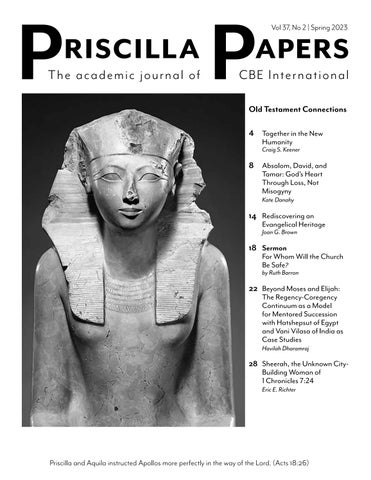
Editor: Jeff Miller Associate Editor / Graphic Designer: Theresa Garbe President / Publisher: Mimi Haddad Peer Review Team: Katrina Armas, Joshua Barron, Lynn H. Cohick, Havilah Dharamraj, Tim Foster, Nijay Gupta, Susan Howell, Loretta Hunnicutt, Kyong-Jin Lee, Esau McCaulley, Adam Omelianchuk, Chuck Pitts, Angela Ravin-Anderson, Marion Taylor, Karen Strand Winslow On the Cover: Seated Satue of Hapshetsut. Metropolitan Museum of Art, CC0, via Wikimedia Commons. Priscilla Papers is indexed in the ATLA Religion Database® (ATLA RDB®), http://www.atla.com, in the Christian Periodical Index (CPI), in New Testament Abstracts (NTA), and in Religious and Theological Abstracts (R&TA), as well as by CBE itself. Priscilla Papers is licensed with EBSCO’s full-text informational library products. Full-text collections of Priscilla Papers are available through EBSCO Host’s Religion and Philosophy Collection, Galaxie Software’s Theological Journals collection, and Logos Bible Software. Priscilla Papers can also be found on Academia, Faithlife, and JSTOR. Priscilla Papers is a member publication of the American Association of Publishers.
2 • Priscilla Papers | 37/2 | Spring 2023
Priscilla Papers is the academic voice of CBE International, providing peer reviewed, interdisciplinary, scholarship on topics related to a biblical view of women and men in the home, church, and world. Priscilla Papers (issn 0898–753x) is published quarterly by CBE International, 122 W Franklin Avenue, Suite 218, Minneapolis, MN 55404–2451 www.cbeinternational.org | 612–872–6898 © CBE International, 2023.
cbeinternational.org
near me in eastern Tennessee. I have told Theresa many times, and I am now telling our readership, that I could not have done this work without her. Over 250 times I have sent her work to do, this editorial being the final time, and she has always done it with excellence. With this teamwork aspect of Priscilla Papers in mind, permit me to explain why my editorials begin “I Tertius . . .” and end “. . . greet you in the Lord.” Near the end of Paul’s letter to the Christians of Rome, we gain a rare glimpse of a behind-the-scenes participant in Paul’s letter-writing ministry. Romans 16:22 says, “I, Tertius, who wrote down this letter, greet you in the Lord” (NIV). Tertius was Paul’s amanuensis, the person who penned the letter that Paul spoke aloud. His job was to prepare Paul’s words to be read and heard. Tertius uncharacteristically and momentarily stepped from behind the curtain because he knew some of the letter’s recipients and wanted to add his voice to Paul’s greetings. Theresa and I identify with him, for unlike the authors of the articles we publish, our work is largely behind the scenes. My appreciation for Tertius, though it is the reason I chose to use his name in my editorials, is not the end of the story. Over the years, I have also come to think of the many coworkers in Romans 16 as a metaphor for the large number of people involved with the journal as authors, proofreaders, graphic designers, photographers, and other roles as well. I think, for example, of Liz Beyer and Mary Gonsior, whose extensive work at CBE overlaps with Priscilla Papers.
Looking Forward One of my early experiences with CBE was about fifteen years ago when I attended CBE’s annual conference in Bangalore, India. It was hosted by the South Asia Institute of Advanced Christian Studies (SAIACS). I had many deeply meaningful experiences on that trip. Among them was a powerful lecture by Havilah Dharamraj, an OT instructor at SAIACS. Because of my memory of that lecture, Havilah was the first person I reached out to when I became editor about seven years later, in hopes that she would write for Priscilla Papers. Her charity toward me in that email exchange is still clear in my memory. Havilah remained at SAIACS through the intervening years, as a professor and administrator, and continues to work there in the Department of Biblical Studies today. Since meeting her in India, I have gradually come to know Havilah personally. She has published in Priscilla Papers, and as editor I partnered with her in that process. She gave a memorable keynote address at CBE’s 2019 international conference in Houston, Texas, during which I was reminded of her calm, confident, commanding presence as a lecturer. She and I are both currently at work on CBE’s Bible translation project, and through that process I have interacted with her extensively. I trust you can see where the above comments are leading: I am especially pleased to inform our readership that Dr. Havilah Dharamraj is the incoming editor of Priscilla Papers. She is already at work on the summer and autumn issues. For the reasons given above and more, I can testify that she is a committed egalitarian and a respected scholar. Like Phoebe of Romans 16, Havilah, our sister in Christ, has been a help to many, myself included. Like Priscilla in Acts 18, she teaches God’s Way with accuracy. The land called Havilah in Genesis 2 is associated with abundance; similarly, Priscilla Papers will flourish under her leadership.
cbeinternational.org
Several of Havilah’s credentials and accomplishments are listed below: • Her degrees include an MS in biochemistry, an MA in Christian Studies from SAIACS, and the PhD from the University of Durham, UK. • Havilah’s books ◊ A Prophet Like Moses?: A Narrative-Theological Reading of the Elijah Cycle (2011). ◊ South Asia Bible Commentary (2015), coeditor and contributor. ◊ Altogether Lovely: A Thematic and Intertextual Reading of the Song of Songs (2018). ◊ Challenging Tradition: Innovation in Advanced Theological Education (2018), coeditor and contributor. ◊ Ruth: A Pastoral and Contextual Commentary (2019). ◊ Five Views of Christ in the Old Testament (2022), coeditor and contributor. • Select examples of Havilah’s articles ◊ “The Idea of the Idyll: Why it May Not Work for the Song of Songs,” The Expository Times 124/9 (June 2013) 417–24. ◊ “How are Christians to Understand the Imagery of Israel as God’s Unfaithful Wife, and What is the Relevance of the Divine-human Marriage Metaphor in our Lives Today?,” Mutuality 20/2 (Summer 2013) 19. ◊ “We Reap What We Sow: Engaging Curriculum and Context in Theological Education,” Evangelical Review of Theology 38/4 (October 2014) 350–60. ◊ “Green-Eyed Lovers: A Study of Jealousy in Song of Songs 8:5–7,” Priscilla Papers 32/1 (Winter 2018) 3–8. ◊ “The Curious Case of Hagar: Biblical Studies and the Interdisciplinary Approach of Comparative Literature,” Journal of Asian Evangelical Theology 23/2 (September 2019) 49–71. • As mentioned above, Havilah is involved in CBE’s Bible translation project. She has also served on the Committee on Bible Translation for the New International Version of the Bible. • Havilah is president of the CBE India chapter. Havilah is married to Pandu Dharamraj; they have two married children and a grandson. Her email address is editor.priscillapapers@ gmail.com, and all Priscilla Papers correspondence should be sent to her.
Notes 1. See https://cbeinternational.org/primary_page/priscilla-paperswriters-guidelines/. 2. Genesis 2:11–12, CEB: “The name of the first river is the Pishon. It flows around the entire land of Havilah, where there is gold. That land’s gold is pure, and the land also has sweet-smelling resins and gemstones.” 3. For more about CBE chapters, see https://cbeinternational.org/ primary_page/find-or-start-local-chapter/.
. . . greet you in the Lord. Priscilla Papers | 37/2 | Spring 2023 • 3
Together in the New Humanity Craig S. Keener
If Galatians 3:28 declares that unity in Christ has obliterated ethnic and gender barriers, what should we make of the household codes in Eph 5:21–6:9 and elsewhere? If Gal 3:28 is the universal principle, how is that lived out in the tension between the already/not yet in a fallen world? This article elaborates the fundamental, transcultural message of Ephesians that puts its household code in context. Ephesians teaches about the one body of Christ, with explicit implications for ethnic and gender unity. But first, investigating the connections between Genesis and Gal 3:28 will provide a foundation for understanding Ephesians.
the effects of the fall, such as pain in childbirth or men sweating (Gen 3:19; or, still less controversially, sinning and dying). Genesis 3 shows humanity’s fall from God’s original plan in Gen 1–2, but the prophets tell of a day when God would restore his people. Joel 2:28–29 reveals the promised restoration of God’s original plan: God pours out his Spirit on male and female, young and old, slave and free, and ultimately all flesh, including Jew and Gentile. In fact, Paul in Gal 3:28 may echo Joel 2 (cf. the echo in Rom 5:5), just as Peter does in describing the new way of Christ in Acts 2:17–18, depicting the present, eschatological prophetic empowerment on both genders, all ages, and all flesh.
Galatians 3:28 and Its Genesis Allusion
Relevance of the Principle for Ephesians
When Gal 3:28 says there is neither Jew nor Gentile, it teaches equality without bulldozing cultural differences. This teaching has significant concrete implications. Peter, for example, should not have withdrawn from table fellowship with Gentiles in Gal 2. Eating together established a covenant relationship, and withdrawing from table fellowship was a declaration of enmity, treating Antioch’s Gentile believers as second-class citizens or worse. When Gal 3:28 declares there is neither slave nor free, it is not ignoring unjust power structures in society. It is announcing that in Christ, all believers are equal; thus, as in Gal 5:13, we are all called to serve one another in love. That recognition concretely affects how we treat each other in the church and has implications for what the church should work for in society, as the abolitionists understood. The same is true for the third pair in Gal 3:28, except here Paul appeals to a principle even more fundamental than in his first two examples. In the first two examples, Paul said, “neither . . . nor”: “neither Jew nor Greek” and “neither slave nor free.” But for the third pair, Paul says, “neither . . . and,” although some translations obscure this difference. “Neither and” is somewhat unusual grammar, so it gets our attention for its allusion to earlier Scripture. Here Paul not only changes “nor” to “and,” but he avoids his usual Greek terms for “male” and “female.” Instead, he borrows the phrase from Gen 1:27, where God created humanity in his image, “male and female.” The exact Greek phrase Paul uses appears in the Greek translation of the OT only in Genesis, and applies there to people only in Gen 1:27 and 5:2, which say that God created humans, male and female, in his image and likeness. The phrase appears only two other times in the NT— when Jesus quotes Gen 1:27 (Matt 19:4, Mark 10:6). In keeping with Jewish expectations of a restoration that echoes the beginning, Paul has in mind a sort of return to that original purpose for humanity, where man and woman together reflect God’s image and rule over creation. It is only later, in Gen 3:16, as a result of the fall, that husbands rule their wives; that passage predicts and describes the prevalence of patriarchy in the world. But representatives of God’s kingdom are not called to promote
Against the principle of Gal 3:28, however, many of our complementarian brothers and sisters cite the household codes of Ephesians and Colossians. They suggest that beyond fundamental principles, when it comes to what is concrete, Paul supports hierarchy. But while Paul adopts the conventional form of household codes, he adapts them in a Joel 2 sort of way. The philosopher Aristotle instructed a male householder how to rule his wife, children, and slaves, but Joel speaks of God empowering women, young people, and slaves. And rather than telling householders how to rule their households, Paul does something no other ancient household code I know of does: in Eph 5–6, he actually frames his household code with a call to mutual submission, beginning in 5:21 and concluding in 6:9. It should be emphasized that my references to Genesis are theological, not intended to enter current scientific debates. The point is that all of us are from a line of sinners, that all of us are from the same human line, and that all of us must come to God the same way. In the 1800s, Unitarian Harvard scientist Louis Agassiz insisted on special creation of different races. Often cited by contemporary slaveholders, Agassiz insisted that Blacks and Whites were separate species, making interracial marriage a travesty of nature. By contrast, Harvard biologist Asa Gray argued for common descent of all humanity. Gray’s evangelical faith encouraged abolitionism, because it taught him the worth of all humans made in God’s image. In Ephesians, Paul again draws on Gen 1 and 2. He has precedent for this from Jesus himself. When teaching against wrongful divorce, Jesus combined quotations from Gen 1:27 and 2:24 (Mark 10:6–8). Putting these two verses together, Jesus argued that God created humans as male and female in the beginning (Gen 1:27), and then in marriage he joins male and female back together (Gen 2:24)—one of each. Although exceptions are assumed for abuse, infidelity, and so on (cf. Matt 5:32, 19:9; 1 Cor 7:15), ideally, Jesus argues, people should not put asunder what God joined together. Paul quotes Gen 2:24 in Eph 5:31. Paul is using Jesus’s verse about God putting male and female back together in marriage: a
4 • Priscilla Papers | 37/2 | Spring 2023
cbeinternational.org
man shall leave his father and mother and be joined to his wife, and the two shall become one flesh. In Eph 5, Paul appeals to this principle for his underlying point about marriage: male and female can become one, as in the beginning. Paul also applies it not only to the one-flesh union of husband and wife, but to the one-body union of Christ and his church (Eph 5:32). And this same picture of one body in Christ stands behind Paul’s exhortation for ethnic unity in Ephesians (Eph 2:14–16). All people share a common humanity in Adam. That unity ripped apart as Genesis progressed (Gen 11:8–9), but in the new Adam, in Christ (Rom 5:12–21; 1 Cor 15:21–22, 45), we are restored to a common bond of unity.
The New Humanity in the New Adam Even in Genesis, God was working toward restoring humanity from the fall. Between Adam and Noah, Genesis lists ten generations ending in three sons (Gen 5:3–32). When Noah was born, his father named him “Noah,” meaning “rest” or “comfort,” because Noah was supposed to give rest from the ground cursed on account of the fall (5:29). After the flood, God repeats to Noah’s family what he said to the first couple: Be fruitful and multiply, fill the earth and subdue it (9:1, 7; cf. 1:28). The world was supposed to start over again with Noah’s family, but before Gen 9 ends, the fall repeats itself. Then, between Noah and Abraham, Genesis again lists ten generations ending in three sons (11:10–27). This list culminates in Abram and God’s next step to restore his plan. God blesses Abram (12:2) as he had blessed the first couple (1:28) and Noah’s family (9:1). It is another step toward a renewed creation. Jewish people in the time of Jesus and Paul spoke often about the coming new creation. They spoke of the eternal destiny of the righteous as the garden of Eden, a restored paradise. Revelation 22:1–3 also speaks of a new Eden, with a tree of life and no more curse. Paul’s letters emphasize that we have already begun to experience a foretaste of that new creation in Christ now, by the Spirit (e.g., Rom 8:23; 1 Cor 2:9–10; 2 Cor 5:5, 5:16–17; Gal 5:5, 6:15). Paul speaks explicitly of Christ as the new Adam in Rom 5:12– 21 and 1 Cor 15:21–22, 45. He also addresses the new creation in the new Adam in Ephesians and Colossians. Just as Genesis speaks of humanity created in God’s image, Col 3:10 speaks of believers as new persons created in God’s image. Likewise, Eph 4:24 speaks of this newly created self. In Greek, Eph 4:24 speaks of a “new person” or “new humanity” (ton kainon anthrōpon). This “new person” contrasts with the “old person” who we were in Adam, which Paul mentions in Rom 6:6 shortly after contrasting the old Adam and Christ (5:12–21).
One New Humanity and Ethnicity in Ephesians Paul applies this idea of a new humanity to ethnic division in Ephesians. In Eph 1:3–14, Paul applies eleven OT terms or phrases for Israel to the church, which includes both Jewish believers and Gentile believers grafted into Israel’s faith. In Eph 2:11–22, Paul speaks of Gentile believers becoming fellow citizens, and part of a new spiritual temple in Christ. The Dead
cbeinternational.org
Sea Scrolls also spoke of their community as a spiritual temple, but their end-time temple explicitly excluded Gentiles. Paul, by contrast, explicitly includes Gentiles in this new temple. In Eph 3:6–8 Paul emphasizes his mission to fulfill the OT prophetic promise of the end-time ingathering of Gentiles (e.g., Isa 11:10, 19:22–25, 66:18; Zech 2:11). In Eph 4 he emphasizes how we are all one body, whose many different members need to work together (Eph 4:4, 4:11–16). In Eph 3:1, Paul notes that he is a prisoner of Christ on behalf of the Gentiles. Congregations in and around Ephesus would understand how this happened. Paul was in Roman custody because adversaries from the region of Ephesus accused him of having brought an Ephesian Gentile past the barricade in the first century AD Jerusalem temple that kept Gentiles from going any farther (Acts 21:27–29). (There was also another wall inside that one that prevented Jewish women from going any farther.) Signs posted in the temple warned that any Gentile who went beyond the outer wall would be killed. Paul responded by preaching about Jesus, and Jerusalemites stopped and listened— until he spoke about God’s care for Gentiles, which precipitated the riot’s resumption and his arrest (22:1–24). Paul would not compromise the Gentile part of the message, because for Paul, if you really love Jesus, you must love your brothers and sisters whatever their ethnicity. You become part of one body with them in Christ. Christians in the area around Ephesus knew why Paul was in Roman custody. Paul’s accusers were from this area. The Gentile that Paul was wrongly accused of having taken into the temple was from Ephesus. For Paul, and for Christians near Ephesus, there could be no greater symbol of this division between Jew and Gentile than this dividing wall in the Temple. But in Eph 2:14, Paul declares that Christ shattered this dividing wall, and a few verses later goes on to speak of how the Spirit is building a new temple of both Jews and Gentiles (2:20–22). How did Christ break down this wall? Eph 2:14–16 explains that Jesus did it by nullifying in his own flesh the barrier of ethnic-exclusive rules. He reconciled both groups the same way by his one body on the cross, so making the two into one new person, one new humanity (2:15) in the body of Christ (2:16). If the cross smashed a barrier once established by God himself— the division between Israelites and Gentiles—how much more has he nullified every other ethnic barrier, established merely by human convention or, worse yet, human sin? In this one new humanity, in Christ’s body, we remain individuals, distinct from one another and from Christ, the body’s head (4:16). But we belong together just like the parts of an ideally whole body belong together (4:12, 16). Believers’ unity with Christ was probably something that Paul understood right from the beginning of his experience with Christ; when Jesus confronts Saul on the Damascus Road, he demands, “Saul, Saul, why do you persecute me?” (Acts 9:4). Jesus had already told his disciples that whatever their hearers did to them they do to Jesus (Matt 10:40; 25:40, 45; Luke 10:16). If we mistreat fellow believers or look down on them, we are doing the very same to Christ.
Priscilla Papers | 37/2 | Spring 2023 • 5
One New Humanity and Gender in Ephesians In Eph 5:21–6:9, Paul includes household codes. From the time of Aristotle, nearly four centuries earlier, these codes instructed a male householder how to rule his wife, children, and slaves. Paul has cultural reasons for using these codes, but they cannot negate his wider principles of our unity in the new humanity. Remember that Gal 3:28 addresses not just ethnicity but also slavery and gender. Remember that the promised restoration in Joel 2:28–29 crosses those barriers and the age barrier. In light of Paul’s faith, he modifies these culturally expected codes. As Paul is addressing marriage in Eph 5, he elaborates at special length on how husbands should love their wives (5:25–31), well over twice as long as he addresses wives. He instructs husbands to love their wives as their own bodies, just as Christ loves his own body, the church (5:25, 29). This is when he specifically quotes Gen 2:24, about a man becoming one flesh with his wife (Eph 5:31), and remarks that he speaks especially about Christ and the church (5:32). Connecting unity in marriage and our unity in Christ is not unique to Ephesians; elsewhere Paul applies the same Genesis passage to believers becoming one spirit with Christ (1 Cor 6:16–17) and to our bodies belonging to his body (1 Cor 6:15, 19). By applying Gen 2:24 to both marriage and to the body of Christ, Paul shows that he is still thinking of the one new humanity in Christ. He is still thinking of the restoration of the way God meant things to be in the beginning. His emphasis is not on what the culture emphasized: husbands, rule your wives. His emphasis, justified from Scripture, is on unity in Christ, in marriage as in the wider body of Christ.
Conclusion In Ephesians, Paul’s essential principle in Gal 3:28 holds. In the new creation, we are a new humanity, one body in Christ. Just as slaves are their slaveholders’ equals in the new creation, and just as Jewish and Gentile believers share the same Lord, so male and female are equal members in Christ’s body. Paul lacked the worldly status and power to transform all the social structures of his day, but the body of Christ is an alternative community, where slaves could become elders, Gentiles could become evangelists, and Junia could be an apostle. As a foretaste of the coming world, we must model for the world around us what the restoration of Eden looks like.
Notes This article is a revised version of a lecture presented at CBE’s 2022 International Conference in Atlanta, Georgia. The lecture was given jointly by Craig Keener and Médine Moussounga Keener and can be accessed at cbeinternational.org. 1. See fuller discussion in Craig S. Keener, Galatians, New Cambridge Bible Commentary (Cambridge University Press, 2018) 92; Craig S. Keener, Galatians: A Commentary (Baker Academic, 2019) 157–58. 2. “You were called to freedom, brothers and sisters; only don’t let this freedom be an opportunity to indulge your selfish impulses, but serve each other through love” (Gal 5:13 CEB).
6 • Priscilla Papers | 37/2 | Spring 2023
3. Some also applied the principle to gender equality; see Julia Foote in Lisa M. Bowens, African American Readings of Paul: Reception, Resistance, and Transformation (Eerdmans, 2020) 170, 172, 185. 4. With e.g., Richard N. Longenecker, Galatians, WBC 41 (Zondervan, 1990) 157; Frank J. Matera, Galatians, SP 9 (Liturgical, 1992) 142–43; J. Louis Martyn, Galatians: A New Translation with Introduction and Commentary, AB 33A (Doubleday, 1997) 376, 380; Douglas J. Moo, Galatians (Baker Academic, 2013) 254; Wayne Litke, “Beyond Creation: Galatians 3:28, Genesis and the Hermaphrodite Myth,” SR 24/2 (1995) 173–78. 5. See e.g., 4 Ezra 8:52–54; Sipra Behuq. 1.261.1.6; Mathias Rissi, Time and History: A Study on the Revelation, trans. Gordon C. Winsor (John Knox, 1966) 4; French L. Arrington, Paul’s Aeon Theology in 1 Corinthians (University Press of America, 1978) 77–81, 157; James L. Kugel and Rowan A. Greer, Early Biblical Interpretation, LEC 3 (Westminster, 1986) 46–47. 6. Joel 2:28–29 is 3:1–2 in the Hebrew text and the LXX. 7. See discussion in Keener, Galatians (2019) 306. 8. “This hope doesn’t put us to shame, because the love of God has been poured out in our hearts through the Holy Spirit, who has been given to us” (Rom 5:5 CEB). 9. I write this on the assumption of Pauline authorship of Ephesians (with e.g., Lynn H. Cohick, The Letter to the Ephesians, NICNT [Eerdmans, 2020]), but most scholars who attribute it only to a later disciple of Paul acknowledge that it often reflects Pauline thought. 10. See Arist. Pol. 1.2.1, 1253b; David L. Balch, “Household Codes,” in Greco-Roman Literature and the New Testament, ed. David Aune (Scholars, 1988) 27. 11. See discussion in Craig Keener, “Mutual Submission Frames the Household Codes,” Priscilla Papers 35/3 (Summer 2021) 10–14; earlier, cf. idem, Paul, Women & Wives: Marriage & Women’s Ministry in the Letters of Paul (Baker Academic, 2004), 184–88, 204–11. 12. David N. Livingstone, Darwin’s Forgotten Defenders: The Encounter Between Evangelical Theology and Evolutionary Thought (Grand Rapids: Eerdmans, 1987) 58–64; cf. Erskine Clarke, Wrestlin’ Jacob: A Portrait of Religion in the Old South (John Knox, 1979) 108. 13. Cf. the argument in Craig Keener, . . . And Marries Another: Divorce & Remarriage in the Teaching of the New Testament (Baker Academic, 1991). 14. See e.g., 1 En. 72:1; 91:16; Jub. 1:29; 4:26; Mark B. Stephens, Annihilation or Renewal? The Meaning and Function of New Creation in the Book of Revelation, WUNT 307 (Mohr Siebeck, 2011); Moyer V. Hubbard, New Creation in Paul’s Letters and Thought, SNTSMS 119 (Cambridge University Press, 2002) 11–53. 15. See e.g., 1QHa 14.17–19; 16.21; 4 Ezra 7:36; 8:52; 2 Bar. 4:3, 6; 51:11; 2 En. 8:1–3; 42:3; 71:28; T. Levi 18:10; T. Dan 5:12; m. Abot 5:20; Sifra Behuq. pq. 3.263.1.5; y. Sanh. 10:1, §2; y. Qid. 1:7, §6; Pesiq. Rab Kah. 9:1. 16. Cf. e.g., 1QS 8.5; 9.6; Bertril Gärtner, The Temple and the Community in Qumran and the New Testament: A Comparative Study in the Temple Symbolism of the Qumran Texts and the New Testament (Cambridge University Press, 1965) 16–46; E. P. Sanders, Judaism: Practice and Belief, 63 BCE–66 CE (SCM; Trinity Press International, 1992) 376–77; David Flusser, Judaism and the Origins of Christianity (Magnes, 1988) 37–39. 17. 4Q174 f1–2.1.3–4; Gerald J. Blidstein, “4QFlorilegium and Rabbinic Sources on Bastard and Proselyte,” RevQ 8/3 (1974) 431–35; Eckhard J. Schnabel, Early Christian Mission, 2 vols. (InterVarsity, 2004) 113. This was a minority approach (Lawrence H. Schiffman,
cbeinternational.org
“The Importance of the Temple for Ancient Jews,” 75–93 in Jesus and Temple: Textual and Archaeological Explorations, ed. James H. Charlesworth [Fortress, 2014] 93), but so was treating the community as a temple (despite Ps 114:2). 18. The textual variant at Eph 1:1 (“in Ephesus” is missing in the very early p46 *אB*) suggests that the letter functioned as an encyclical, but the presence of “Ephesus” in so many manuscripts suggests that Ephesus was early recognized as a primary destination, with the message perhaps circulated from there to Roman Asia and beyond. 19. In contrast to some scholars, I regard Acts as a useful historical source; see Craig S. Keener, Acts: An Exegetical Commentary, 4 vols. (Baker Academic, 2012–15); idem, Acts, New Cambridge Bible Commentary (Cambridge University Press, 2020). 20. See fuller discussion in Craig Keener, “Some New Testament Invitations to Ethnic Reconciliation,” EvQ 75/3 (July 2003) 195–213; Craig Keener, “One New Temple in Christ (Eph 2:11–22; Acts 21:27– 29; Mk 11:17; Jn 4:20–24),” Asian Journal of Pentecostal Studies 12/1 (Jan 2009) 75–92; Craig Keener and Médine Moussounga Keener, “One New Temple in Christ,” 95–112 in Moral Pedagogies for Africa: From Ethnic Enmity to Responsible Cohabitation, ed. Theodros A. Teklu (Routledge [Taylor and Francis Group], 2022); Craig Keener, “Some New Testament Invitations to Ethnic Reconciliation: John 4:42; Luke 10:29–37; Romans; Ephesians 2:11–22,” 207–30 in Forgiveness, Peacemaking, and Reconciliation, ed. David K. Ngaruiya and Rodney
L. Reed (Africa Society of Evangelical Theology, Langham Global Library, 2020). 21. For the impact of Paul’s experience on his theology, see Seyoon Kim, The Origin of Paul’s Gospel (J. C. B. Mohr, 1981). 22. See again Keener, “Mutual Submission Frames the Household Codes.”
CRAIG S. KEENER holds a PhD in NT and Christian Origins from Duke University as well as MA and MDiv degrees from Assemblies of God Theological Seminary. He teaches biblical studies at Asbury Theological Seminary near Lexington, Kentucky. Well over a million of his thirtyplus books are in circulation. His award-winning, popular-level IVP Bible Background Commentary: New Testament (now in its second edition and available in several languages) has sold over half a million copies. Craig is married to Médine Moussounga Keener, who holds a PhD from University of Paris 7. Craig and Médine work for ethnic reconciliation in the U.S. and Africa. Their story together is told in their book, Impossible Love: The True Story of an African Civil War, Miracles, and Hope Against All Odds (Chosen Books, 2016).
1/2 pg CONFERENCE AD
cbeinternational.org
Priscilla Papers | 37/2 | Spring 2023 • 7
Absalom, David, and Tamar: God’s Heart Through Loss, Not Misogyny Kate Danahy
Christian interpretations of David typically stem from and return to the idea that David is “a man after God’s own heart.” Scripture itself says so, in both testaments (1 Sam 13:14, Acts 13:22). What does that mean exactly? If you ask someone this question, they may tell you, “David trusted God enough to slay a giant. David trusted God to make him king. Yes, there are actions of David that were not godly, but through repentance he provides us with an inspirational example of forgiveness.” Seldom heard from pulpits, however, is David’s cry of “Oh Absalom, Absalom, my son!” as a chief example of his heart being aligned with God’s (2 Sam 19:4; cf. 2 Sam 18:33). When David’s lament is discussed, it is too often a brief addendum that David was being ungrateful and foolish in weeping for Absalom. Reading the stories of David with the assumption that his victories, as opposed to his grief, reveal God’s heart is a triumphalist view. It surely has its appeal, for it is easy to believe God wants us to defeat giants. It is less easy to accept that God wants us to spare our enemies even when their continued lives would be a threat to our own power, perhaps even our lives. The ultimate son of David, Jesus, subverted messianic expectations by not being a heroic revolutionary overthrowing Roman oppression. He was instead a non-violent teacher who spoke about leaving the flock to seek the one sheep who was lost (Luke 15:3–7). Jesus’s invitation to his followers was not to conquer, but to take up our crosses, to weep with those who weep, to welcome home the son who wished us dead (see Luke 15:12). The story of David and Absalom is as skilled in its use of tragic irony as any Shakespearean tragedy. Even when read in translation, every detail weaves into the rich tapestry of the chapters that convey the literary climax of David’s life as told in the books of 1–2 Samuel and 1 Kings. If readers understand this story as a climactic moment for David, portraying the refined message of what it means to be a person after God’s own heart, we find hope in a story that, at the outset, appears to be one of the ugliest and most tragic in Scripture.
Encountering the Story This article takes a literary approach to the story itself and ultimately prioritizes Christology, taking Christ’s life, death, and resurrection as the interpretive lens. Reading stories as literature presents a paradoxical mirror that is both timeless and also a window into its own time. It offers readers the chance to learn about themselves and about the values of the past. In appreciating the complexity of David, Absalom, and Joab, Christians can see themselves and draw closer to God. Father of Peace Absalom’s name means “father of peace” or “my father is peace(ful).” It is certainly an ironic name, for the story of his life is not peaceful. Furthermore, David himself was not a peaceful king. 8 • Priscilla Papers | 37/2 | Spring 2023
Prior to Amnon’s rape of Absalom’s sister Tamar (who was also Amnon’s half-sister), we have little insight into David as a parent besides that he loves his children deeply (evidenced, for example, by his fasting over the terminal illness of his first son by Bathsheba in 2 Sam 12:15–20). However, what the Amnon and Tamar story depicts is a father who cares enough to visit his son when the son feigns a grievous illness, but a father so distant he does not recognize Amnon’s pining for Tamar or even that Amnon’s request that she feed him by hand is absurd behavior for a sibling. Amnon uses David’s indulgence and authority to put Tamar in a position vulnerable to Amnon’s assault. Even so, afterwards, David takes no responsibility for his being deceived. He shows no willingness to punish his child. Why would he take responsibility? Learning from mistakes is key to emotional and spiritual growth. As if to reinforce to the reader that David learned nothing, David then repeats the same mistakes. Absalom follows Amnon’s example when plotting to kill Amnon: as Amnon used David to set up Tamar, Absalom uses David to set up Amnon. And Absalom came to the king and said, “Your servant has had shearers come. Will the king and his attendants please join me?” “No, my son,” the king replied. “All of us should not go; we would only be a burden to you.” Although Absalom urged him, he still refused to go but gave him his blessing. Then Absalom said, “If not, please let my brother Amnon go with us.” The king asked him, “Why should he go with you?” But Absalom urged him, so he sent with him Amnon and the rest of the king’s sons. (2 Sam 13:24–27 TNIV) This scheming could be indicative of Machiavellian cunning on Absalom’s part, or simply of messy, complex humanity. Was Absalom flattering David by inviting him when he could not come? Quite possibly. Given David and his absentee indulgent parenting, however, it is equally possible (and not necessarily contradictory) that Absalom’s first desire was truly to try to speak to his father alone, to spend time with him. After all, it is likely Absalom lobbied David for justice for years after Tamar’s assault, but David’s answer was always the same: it would be a burden for Amnon. After killing Amnon, Absalom flees to Geshur, where his mother’s father is king. Absalom, despite seeing his father’s indulgence toward Amnon raping their sister, did not count on David indulging him with the same leniency. Thus, we see a fracturing of trust in a father-son relationship. However, David does “long . . . to go out to Absalom” despite his grief for Amnon (2 Sam 13:39 TNIV). Yet, David does not go, even when Joab convinces David to bring Absalom back after three years. In fact, David does not actually meet with Absalom for two more years.
cbeinternational.org
Absalom attempts to see David numerous times during these two years and even expresses that he wishes he had died in Geshur rather than be kept from his father’s presence. Manipulation? Perhaps. There is also genuine pain in this: a son who deeply wants his father yet is denied again and again. Every time we have seen Absalom reaching out to David thus far, he has been rebuffed. This is the case even before Absalom kills his brother. Only when Absalom does something violent does his father acknowledge him. Absalom burns Joab’s fields, and David capitulates. If David had responded earlier, in a fatherly manner, could he have avoided the coming rebellion? David receives Absalom, but in public. Again, David puts kingship above fatherhood. He also prioritizes the image of kingship over enacting justice in his own household. It is precisely this attitude—prioritizing the image of a powerful, strong, masculine king who responds to violence—that endangers both his rule and his family. Son of War The narrative takes a downward turn: From this moment, Absalom starts gathering support to become king. People come to him with their complaints, and he arbitrates for them. Certainly, Absalom’s words are manipulative, but there is a deeper layer to them as well: “your claims are valid and proper, but there is no representative of the king to hear you” (2 Sam 15:3 TNIV). Absalom’s words are his own logical conclusion. Consider not only his father’s distance but David’s refusal to enact justice for Tamar. Of course, Absalom empathizes with people who do not feel heard by their king. For that matter, what reason is there for Absalom to believe David cares about justice? David failed not only to be a father to Absalom and Tamar; he failed to be a king for Tamar. If he does not act like a king, why should Absalom treat him like one? This desire for justice is expressly stated to be at the root of Absalom’s appeal to the public. Second Samuel 15–16 describes Absalom not treating the people of Israel as if they are beneath him, and it is precisely this that wins them to his side: Also, whenever anyone approached him to bow down before him, Absalom would reach out his hand, take hold of him and kiss him. Absalom behaved in this way toward all the Israelites who came to the king asking for justice, and so he stole the hearts of the people of Israel. (2 Sam 15:5–6 TNIV) Surely the writer of 2 Samuel intends the reader to see manipulation. However, most manipulators are not self-aware. Could it be that Absalom genuinely thinks he would be a better king? Could it be that Absalom genuinely seeks justice for those who cry out for it?2 While some interpreters assume Scripture says nothing about Absalom’s devotion to the Lord, implying he had none, this conclusion is uncertain. The context, in fact, suggests Absalom might have been deeply religious. The only time Absalom directly mentions the Lord is when he requests to go to Hebron to fulfill a vow to the Lord (2 Sam
cbeinternational.org
15:7–9). The narrator notes that Absalom goes through with this vow, including offering sacrifices (2 Sam 15:12). This could be merely a performance, a way of winning the religious to Absalom’s side. But considering the repeated tenet of Scripture that religion involves caring for the vulnerable, could it be that Absalom believed himself justified in the sight of the Lord, albeit deceiving himself? Further evidence that Absalom may have been devout is his long hair. The customs described in Absalom’s vow are akin to those of Nazirite vows. While 2 Samuel never directly calls Absalom a Nazirite, scholars throughout history, including Rabbi Judah ha-Nasi many centuries ago (AD 137–217) and Gregory Spinner in recent years, have concluded that he was.3 David and Bathsheba, Amnon and Tamar Let us examine the origin of Absalom’s grudge against Amnon and how it pertains to David. David’s misogyny is a recurrent sin that no one, not even the writers of 1 and 2 Samuel, would deny. In particular, David’s treatment of victims of sexual assault, including his own daughter and concubines, is abhorrent.4 Despite inaccurate condemnations of Bathsheba as a temptress bathing on the roof, Bathsheba was innocent in David’s taking of her. David sexually violated Bathsheba, first as a voyeur as she performed her post-menstruation ritual, and then by “taking” her. The word translated “take” or “get” in 2 Sam 11:4 (“David sent messengers to get her” TNIV) is the Hebrew verb laqakh, which God had used to warn the Israelites through Samuel of what will come should they have a king: “He will take your sons. . . . He will take your daughters. . . . Your male and female servants and the best of your cattle and donkeys he will take” (1 Sam 8:11–16 TNIV). Indeed, Scripture never once places any blame on Bathsheba.5 It is worth noting that, according to the Torah, a man who rapes a woman is expected to marry her. As morally repulsive as that seems today, Deut 22:28–29 states: If a man happens to meet a virgin who is not pledged to be married and rapes her and they are discovered, he shall pay her father fifty shekels of silver. He must marry the young woman, for he has violated her. He can never divorce her as long as he lives. (TNIV) This law serves the purpose of providing for a woman in a patriarchal society, as is argued by Jessica Stefick, Sara Milstein, and Robert Heibert.6 In such a society, an unmarried woman who has lost her virginity would likely remain unmarried. She would then become a burden to her parents and, upon their deaths, have great difficulty supporting herself. This law specifically pertains to unmarried women, and David fulfills it by marrying Bathsheba—who by the time he repents is, tragically and ironically, a widow. Furthermore, 2 Samuel shows us exactly what can happen to a woman whose rapist does not take responsibility and marry her. After Tamar’s attack, she insists Amnon marry her, their halfsibling relation notwithstanding. However, Amnon commands his servants to turn her out, an act Tamar herself claims is worse
Priscilla Papers | 37/2 | Spring 2023 • 9
than assault: “sending me away would be a greater wrong than what you have already done to me” (2 Sam 13:16 TNIV). David is furious, but he does not punish Amnon. Punishment is not the only action David should have performed, however. Another dereliction of duty is that David does not force Amnon to marry Tamar, according to the standards of the day. Despite how antithetical it seems to our moral code, this is expressly stated to be what Tamar wanted (2 Sam 13:16). In contrast to David’s concession to the culture’s apathy for women survivors of rape, Absalom’s words stand as somewhat countercultural: “Has that Amnon, your brother, been with you? Be quiet for now, my sister; he is your brother. Do not take this thing to heart” (2 Sam 13:20 TNIV). He assures his sister that the assault does not affect her value, a perspective his society, his father, and his half-brother clearly do not share. However, society is a powerful force. Tamar remains “desolate” in Absalom’s household (2 Sam 13:20 TNIV). No one marries her, presumably because she has been raped. David does not intervene, though he could—if not with Amnon, then he surely could use his power to marry her to someone. In response, Absalom again moves against the misogynistic culture. He names his own daughter after Tamar, thereby ensuring that even if Tamar has no children, her name will continue through his daughter (2 Sam 14:27).7 David’s responsibility is to enact justice. Quite possibly, as many speculate, David feels too guilty over his own similar sin to impose such a strict punishment on Amnon. But David at least had married Bathsheba and provided for her; Tamar is abandoned. After two years of waiting for justice, after two years of David not doing his job as king and father, Absalom kills Amnon. Much like when David killed Uriah, Absalom has others do the actual murder for him; however, Absalom tells his servants that he is responsible for the crime and that they will not be punished. This is murder, not justice. But that, perhaps, is the point: true justice cannot exist without mercy, and justice demands atoning for a crime as much as is humanly possible. While Absalom cannot be excused, what he did is, in our human hearts with our longing for justice in response to assault, more understandable than David’s murder of Uriah. David and Michal, Absalom and the Ten Concubines Absalom undergoes a tragic fall. Absalom will become like Amnon, but ten times over. He orchestrates a bloody civil war and rapes—in public—ten of his father’s concubines. To understand how Absalom has come to this point, let us look at other key players. David’s former advisor, Ahithophel, gives advice considered equivalent to the word of God in the eyes of both David and Absalom (2 Sam 16:23). Why, then, does Ahithophel turn on David? Second Samuel 11:3 states Bathsheba was the daughter of Eliam, whom 2 Sam 23:34 names as Ahithophel’s son. Even though David married Bathsheba and had more children with her, in her grandfather Ahithophel’s eyes, that did not erase what happened. There is no justice for murder, and there is no way to un-rape someone. The fact that Ahithophel joins with Absalom strongly 10 • Priscilla Papers | 37/2 | Spring 2023
indicates what was at the root of this rebellion: neither Ahithophel nor Absalom trusts David as king because of his mistreatment of women close to their hearts. Ahithophel’s motive in advising Absalom to rape ten women is to erase any possibility of reconciliation with David. Ahithophel states that it would make Absalom “a stench,” “odious,” or “abhorrent” to his father (2 Sam 16:21, ESV, KJV, NRSV, respectively). No doubt it is also revenge on Ahithophel’s part: As he had to endure his granddaughter being assaulted and married to her rapist, he would inflict David with the knowledge that his concubines were raped in public. What is done in private will be shouted from the rooftops, which is also an ironic indictment of David’s performatory reception of Absalom. However, this revenge is a blasphemous mockery of the concept of justice.8 It only harms more people, and it transforms Ahithophel and Absalom into exactly what they condemn. Additionally, this proves Ahithophel did not understand God’s heart or David’s: David does not find Absalom “odious” or “abhorrent,” even if his deeds were. There is another reason for Ahithophel’s abhorrent, odious advice: Claiming a previous king’s harem or daughters was a way to legitimize rule. Because a king’s chief wives and secondary wives [concubines] were such a symbol of his political connections and authority, a usurper could manifest his displacing of a reigning king by sleeping with members of the king’s harem. . . . To claim a king’s harem was tantamount to claiming his throne.9 In fact, David himself had used a woman to legitimize his claim to kingship: he demanded his first wife, Michal, be returned after he ascended the throne (2 Sam 3:13–14). David had several wives by this time. Did he bring Michal back because he loved her? More likely, David demanded Michal back because it was a matter of pride and of culture: pride, in that the woman who loved him had been married off, and culture, in that marrying the daughter of a former king legitimizes his claim to the throne. David and Michal had been apart for years. David’s lack of affection for Michal is clear, particularly when contrasted with David’s treatment of Ahinoam and Abigail: “The narrative . . . recounts how David’s second two wives were taken captive and how David risked a serious battle to recover them. Yet David appeared to do nothing when Michal was given to another man.”10 Saul giving Michal to Palti, her second husband, is intended to wrong David, and quite possibly Michal as well, but evidently Palti adores Michal and follows them weeping when Michal is returned to David. As Palti weeps, humiliating himself because he loves someone, so David will later weep in a manner deemed unseemly by Joab and be urged to “man up” for the sake of the kingdom. Some commentators are quick to condemn Michal’s scolding of David for dancing (2 Sam 6:20).11 While the scolding itself is surely not framed as righteous, three key points must also be considered. First, while the author is silent on Michal’s feelings towards Palti, Michal does not appear pleased with her forced return to David. Second, her father and brothers had been killed
cbeinternational.org
and grief leaves few in good humor. Third, she likely resents her return because she knows the implications for her future.12 What implications? While Michal may well have been barren physically (as her marriage to Palti is not noted to have produced children), the likely subtext of Michal’s lack of children with David (that it follows an argument with David) is not that of a divine punishment, but instead that David did not have intercourse with Michal ever again. He wanted her back in his harem as a political token. It is a sad fate that she had no descendants and no intimacy ahead of her.13 David’s dealing with the ten concubines after Absalom’s assault shows a lack of change in how he views women. The concubines’ fates are even worse than Michal’s: they were separated from the others in the harem and “kept in confinement” until the days of their death (2 Sam 20:3). While David provides for these women, he still views them as tainted for a sexual assault that was not their fault. We should also consider why David leaves ten concubines to care for the palace. What Absalom did was preventable. Wartime sexual violence has been around as long as war. Either David truly believed Absalom would not allow something like this to happen, meaning this was exceedingly out of character for Absalom, or David sacrificed these ten women.14 Nevertheless, Absalom’s rape of these women is his decision. He does not have to listen to Ahithophel. He does not have to take any bait David may have left. He makes this choice, and in doing so becomes, much like Ahithophel, a parody of the desire for the justice for which he started the rebellion. Somewhere in looking for justice and falling into revenge, Absalom forgets to look in the mirror and see that the eyes staring back at him are not just his father’s, but Amnon’s. This is possible because of the tragic flaws of pride and self-righteousness.15 What is the antidote to self-righteousness? Awareness and repentance. We do not see this from Absalom—not explicitly. Consider Ahithophel’s next piece of advice: I would choose twelve thousand men and set out tonight in pursuit of David. I would attack him while he is weary and weak. I would strike him with terror, and then all the people with him will flee. I would strike down only the king and bring all the people back to you. The death of the man you seek will mean the return of all; all people will be unharmed. (2 Sam 17:1–3 TNIV) Absalom is not sold on this plan. Instead, he takes the advice of Hushai (a spy of his father’s). David had prayed: “Lord, turn Ahithophel’s counsel into foolishness” (2 Sam 15:31 TNIV). David then took steps to subvert Ahithophel’s advice by sending Hushai. Rather than God simply putting blinders on Absalom’s eyes, it is more likely Absalom’s already-established character traits are responsible for him trusting Hushai. Absalom is likely persuaded by his own vanity to join the attack: “He counselled that which he knew would gratify Absalom’s proud vain-glorious humour.”16 However, keep in mind that 2 Sam 11:1 indicates David did not always go out to
cbeinternational.org
war with his men, so this may have been another way of Absalom asserting that he was not like his father. In reality, of course, Absalom has become just like his father in all the wrong ways, and not in the right ones.
Siding with Joab? It is curious that many interpreters side with Joab. Politically, Joab’s rebuke might be appropriate, but the gospel is often countercultural, resistant to falling in line with political narratives. Perhaps that is what God meant when he warned about what would happen should Israel receive a king, even the chosen king, a man after his own heart, would find it impossible to mix justice and mercy in a world so opposed to both. The books of Samuel and Kings never indicate piousness in Joab; indeed, there is more implicit evidence for Absalom’s piety than for Joab’s. The text rarely even indicates love or respect for David on Joab’s behalf; while commentators cite loyalty, Joab outright tells David he will leave David’s side and rebel if David keeps crying over his son. Joab’s actions and advice are not what Scripture challenges Christians to do in the light of Christ, the ultimate revelation of who God is. Christians are to love enemies, to turn the other cheek (Matt 5:38–45, Luke 6:27–29). Joab was never afraid to profane what was precious to God—not the king’s son, not the altar (1 Kgs 2:28).17 Power and Control Joab, in modern terms, is the embodiment of toxic masculinity. Toxic masculinity is cultural pressure on men to behave in certain ways, at the expense of how women are treated and at the expense of the toll that repressing emotions and glorifying violence takes on men. Joab is a good warrior, decisive, strong. Men often desire to be like powerful male characters in fantasy stories, who are ultimately in control of the narrative even when they make mistakes: they slay a giant, they rule as king, sometimes they even repent, which is their personal choice. When interpreters praise David, it is usually when he is in line with Joab or the military or political wisdom of the day, not when he is in line with Jesus. It tends to be when David is the male power fantasy, subservient to the cultural pressures of how a man behaves: sexually satisfied with multiple women, a warrior, even a man overcoming his own worst sins and maintaining his power throughout. Yet the moment where David’s control is thwarted, where Joab chooses to take control through violence, commentators from Matthew Henry in the eighteenth century to Paul Borgman in the twenty-first tend to side with Joab.18 The narrator, too, likely sides with Joab, as Borgman notes. However, the narrator would also represent this ancient Near Eastern culture that often viewed rape as a financial crime against a woman’s male relatives rather than a crime against a person created in the image of the Divine. We can acknowledge this framing and still wonder how this portrayal of what seems like classic, even stereotypical (“men don’t cry”) toxic masculinity fits with Jesus, a man who was not afraid to weep even when he knew he would raise Lazarus from the dead (see John 11).
Priscilla Papers | 37/2 | Spring 2023 • 11
The question of why the “after God’s own heart” epithet is applied to military success, but not to a father devastated precisely because of said military success, needs to be asked. Grief fundamentally involves a loss of control, a humbling reminder that we are all subject to the limits of mortality on this side of eternity. When David does not get what he wants, even the church turns on him and sides with Joab—a character who is never once framed positively. Again, we can acknowledge the political realism of Joab’s rebuke and also see the cruelty. Secular political and cultural wisdom do not always fit with God’s heart. Interestingly, David immediately decides to replace Joab—with Absalom’s men, such as Amasa. Yet Joab will go on to murder Amasa.
Death on a Tree: Absalom and Jesus David commands his men not to harm Absalom, and we see how much his men respect David in that Joab offers ten shekels of silver and a warrior’s belt to do so, yet they refuse. Joab murders Absalom and, much like David with Uriah via Joab and also Absalom with Amnon via his servants, Joab uses ten armorbearers to kill him after Joab makes the first move. Absalom dies hanging from a tree, which for Christian readers may bring Jesus’s crucifixion to mind. Absalom was a rapist and murderer who led a military rebellion; Jesus was none of these things and was a friend to women. But does this not remind us why Jesus died, to conquer sin and death, to take revolting crimes upon himself? David then weeps over his son. There was no political or military wisdom in leaving Absalom alive. Yet David’s heart yearns for his son. Perhaps David saw all he had done playing out in Absalom, saw that he could have prevented this tragedy, and knew justice would never come fully in this world. In David’s cry, “Oh Absalom, Absalom, my son,” can we not hear God’s cry for his own Son as he hung upon a cross, as he died a common criminal’s torturous death, as he was stripped and mocked and tortured? Instead of seeing David as weak here, this cry highlights a barrier between aligning God’s own heart and the intricate realities of ruling a fallen world this side of eternity. The death of Absalom recalls another link to Christ: through Jesus’s own recounting of a rebellious, prodigal son in Luke 15:11–32. Absalom also journeys to a far land and then returns, but David does not act like the father in this story until it is too late. David spends two years refusing to see his face; it is unlikely this is anger entirely, but more likely a result of exactly the mindset Joab espouses after Absalom’s death: politics and image above fatherly love. In David’s coldness towards his son, bitterness and rebellion grow. When it is too late, when he is unable to do anything himself, David realizes how wrong he was.
Beyond David and Absalom If Absalom had lived, had been imprisoned, would David have visited him? Would he have embraced him with tears? We will never know, because Joab killed him in a wise political move that was morally wrong and personally cruel. The limits of political and 12 • Priscilla Papers | 37/2 | Spring 2023
even personal wisdom are a theme more fully explored in the life of David’s successor, Solomon (along with continued misogyny). David never forgets Absalom. Even on his deathbed, he promises his kingdom to Solomon and, in the presence of Bathsheba, orders Solomon to beware of Joab. It is clear David does not forget Joab’s transgressions, including those against his son. Of course, this then ends with the death of David’s fourth son, Adonijah, for wanting to be king instead of Solomon and requesting his father’s concubine, Abishag (despite David never consummating this, 1 Kgs 1:4) as wife. Violence cannot stop a cycle of violence, and a new way, a subversive way of love for enemies, is needed. However, Adonijah’s death occurs after David passes away. In the story of David’s waning days, we can see that David has grown as a person and as a father. He is much more aligned with God’s heart at this time than on the battlefield: David listens to the plea of a woman whom he had wronged, and as a result finally steps up as a father by saying no to a son.19 He grants Bathsheba her request and stops Adonijah’s coup in favor of Solomon (1 Kgs 1). Absalom may have indeed not had a son to carry on his name (it is possible he erected the monument mentioned in 2 Sam 18 before the births of his three sons, or it is possible they died early). However, he has a daughter who bears the name of a sister he had loved, a sister violated but not forgotten. It is through Tamar, daughter of Absalom, that the ultimate Son of David came: This Tamar either had a second name, Maacah (the same name as Absalom’s mother) along with Absalom having a second name of Uriel, or, as Josephus reports, Tamar herself married a man named Uriel and had a daughter also named Maacah.20 This Maacah, the daughter or granddaughter of Absalom, is noted in 2 Chron 11:21 to be the favorite wife of King Rehoboam, Solomon’s son and successor, and the mother of King Abijah and grandmother of King Asa. According to Matthew, the ancestry of Jesus the Messiah, and thus the story of redemption, includes Abijah and Asa, and therefore Maacah and Tamar as well.
Notes 1. One stream of rabbinic interpretation records that Absalom’s mother, Maacah, was a captive whom David took during war in accordance with the practices laid out in Deut 21:10–14. David is criticized for marrying a foreign woman, and blame for Absalom’s subsequent rebellion is placed on his mother’s ethnicity more than on character flaws. It further says, “Whenever anyone marries a ‘woman of pretty form,’ there results from it a defiant and rebellious son. Thus we find it so in the case of David, because (as suggested by II Sam. 3:3) he had desired Maacah bat Talmai king of Geshur, while he had gone to war; so Absalom came out of him” (Midrash Tanchuma, Ki Teitzei 1, https://sefaria.org/Midrash_Tanchuma%2C_Ki_Teitzei.1.1?lang=bi). 2. Erin Fleming, “The Politics of Sexuality in the Story of King David” (PhD Diss., John Hopkins University, 2013) 218. 3. Gregory Spinner, “Absalom Gloried in His Hair: On the Midrashic Transvaluation of Nazirites” (paper presented at the SBL Annual Meeting, San Diego, Nov 2007). 4. It may not be fair to judge David by twenty-first century standards. However, the narrative itself criticizes David for his treatment of women.
cbeinternational.org
In addition, we can acknowledge that David is both acting in an expected way for his day and acting in a way that is rightly repulsive to our modern sensibilities. Comparing David to Christ’s treatment of women is also helpful for Christians, and critiquing David’s misogyny is not saying there is nothing godly or good about him. 5. The debate over whether David raped Bathsheba has exploded in recent years. See Richard M. Davidson, “Did David Rape Bathsheba?,” Journal of the Adventist Theological Society 17/2 (Autumn 2006) 81–95; Amanda Pence, “Vindicating Bathsheba,” Priscilla Papers 36/4 (Autumn 2022) 3–7, and the editorial in the same issue of Priscilla Papers (p. 2). According to most modern understandings, David was guilty of rape. Ancient understandings, however, are harder to assess. This is another example of how we can acknowledge the nuance in the previous note: our repulsion exists for good reason—Bathsheba was in no position to refuse, and has been unfairly maligned throughout history for bathing in accordance with Jewish customs—yet we recognize that the narrative may assess David’s and Amnon’s actions differently. For more on “take” connecting Samuel’s words in 1 Sam 8 with David’s actions in 2 Sam 11, see https://cbeinternational.org/resource/he-will-take-david-and-bathsheba/. 6. Jessica Stefick, “The Case of Virgin Rape: Deuteronomy 22,” Priscilla Papers 34/1 (Winter 2020) 3–6, reprint 37/1 (Winter 2023) 10–13; Sara J. Milstein, “Separating the Wheat from the Chaff: The Independent Logic of Deuteronomy 22:25–27,” JBL 137/3 (Fall 2018) 625–43; Robert J. V. Heibert, “Deuteronomy 22:28–29 and its Premishnaic Interpretations,” CBQ 56/2 (April 1994) 203–20. 7. The Israelite royal families seem to rarely, if ever, reuse names. It is possible this was a custom from Geshur. 8. Parts of the Torah are based on the “eye for an eye” version of retributive justice. However, Jesus called his followers to “turn the other cheek” (Matt 5:38–39; Luke 6:29), indicating a far more restorative justice. 9. Jo Ann Hackett, “1 and 2 Samuel,” in Women’s Bible Commentary, 3rd ed., ed. Carol Newsom, Sharon Ringe, and Jacqueline Lapsley (Westminster John Knox, 2012) 161. 10. Scott Monsma, “(Re)telling the Fragmented Story of Michal,” Journal for the Sociological Integration of Religion and Society 3/2 (Fall 2013) 22. 11. Matthew Henry, in 1706, said of Michal: “To have abused any man thus for his pious zeal would have been very profane, but to abuse her own husband thus, whom she ought to have reverenced, and one whose prudence and virtue were above the reach of malice itself to disparage, one who had shown such affection for her that he would not accept a crown unless he might have her restored to him (ch. 3:13), was a most base and wicked thing, and showed her to have more of Saul's daughter in her than of David’s wife or Jonathan’s sister.” 12. One need not think Michal was in the right to acknowledge pity for her situation. Even without their argument, it was likely David would never “go into” her again, given how women are treated in the narrative and the culture. She may have wanted a final verbal slap. Who among us cannot relate? 13. Monsma, “(Re)telling the Fragmented Story of Michal”; Cheryl Exum, Fragmented Women: Feminist (Sub)versions of Biblical Narratives, 2nd ed. (Bloomsbury, 2015). 14. See Andrew E. Hill, “On David’s ‘Taking’ and ‘Leaving’ Concubines (2 Samuel 5:13; 15:16),” JBL 125/1 (Spring 2006) 129–39. Hill’s reasoning for David leaving the concubines behind lies in the argument that these women were Jebusites, original inhabitants of Jerusalem, who were given to David for political reasons after he conquered Jerusalem. They would then be considered, to an extent, property of Jerusalem. Perhaps David thought they would be protected because of their families, or perhaps
cbeinternational.org
leaving these women behind would have been deliberate, a way of handing power over to Absalom. 15. In his Rhetoric, Aristotle discusses hubris, or pride, which is a tragic flaw that ensnares a tragic hero. Hubris involves an outrageous act that inflicts shame upon someone else. Itt was also a legal term for acts of desecration and sexual assault. According to these definitions, David, Absalom, and Joab are all guilty of hubris. Greek playwrights and poets such as Aeschylus and Sophocles often crafted tragic heroes with hubris as a spiritual offense, shaming a god by purporting to be above them. Recall the serpent’s words in the Garden of Eden: “you will be like God” (Gen 3:5). Hubris is believing the world should work how we want it to. It is believing you are the ultimate moral authority. It is judging others instead of cleaning planks out of our own eye. It is overconfidence in selfjustification. It can be rooted in a righteous desire for justice that can lose sight of actual justice 16. Matthew Henry, Samuel, Matthew Henry Commentary on the Whole Bible (1706). 17. Alastair Roberts notes parallels between Joab’s interactions with David and those of the snake with Adam and Eve in the Garden of Eden. Roberts describes Joab’s ploy to get David to welcome Absalom back, during which Joab lied to the king, as parallel to the fall in the garden: “Employing deception, the serpent Joab used a woman to get to David, the new Adam. The woman’s account of her two sons closely paralleled the story of Cain and Abel in Genesis 4 and the woman was implicitly aligning herself with Eve. Significantly, just as she springs the trap of the parable, she speaks of the discerning of good and evil, recalling the tree in the garden (14:17). David hearkened to the voice of the woman and to the voice of the snake behind her.” Roberts, “The Reopened Wounds of Jacob” (March 19, 2019), https://theopolisinstitute.com/the-reopenedwounds-of-jacob/. 18. Henry, Samuel; Paul Borgman, David, Saul, and God: Rediscovering an Ancient Story (Oxford University Press, 2008). 19. Borgman notes, “David has finally said no to a son, heeding the news from Nathan and Bathsheba of his son’s malfeasance. The great twist in the pattern tells the important tale. David the king rises above David the indulgent father. . . . David’s communally dispiriting cry on hearing news of son Absalom’s death is seen as a turning point, an immediate prelude to the king’s about-face with son Adonijah.” I agree with Borgman that David’s turning point is the death of Absalom, but I would argue that David the father is prevailing here as much as David the king. To separate the two creates a troubling dichotomy. Of further note: Borgman argues that the chiastic arrangement of David’s fatherly responses pivots on Absalom’s death: his helplessness in the face of his unnamed son with Bathsheba parallels the conclusion of this arc, which is Bathsheba’s son Solomon on the throne. His subsequent chosen helplessness with Amnon contrasts his intervention to stop Adonijah from killing Solomon, and his grief at Absalom is at the center of the chiasm and therefore what provokes change. 20. Josephus, Ant. 10.1.
KATE DANAHY is an independent scholar and educator. She has a degree in English Language and Literature from Gordon College, near Boston, Massachusetts, where she first encountered reading the Bible as literature. She has taught a variety of high school subjects, including literature, theology, philosophy, and history, for students in multiple North American and Asian countries.
Priscilla Papers | 37/2 | Spring 2023 • 13
Rediscovering an Evangelical Heritage Joan G. Brown
In 1976 Donald Dayton wrote a book entitled Discovering an woman, she fled Africa and then the Middle East to find asylum Evangelical Heritage, largely focusing on the leading role that in the Netherlands, where she went on to serve in the Dutch evangelicalism played in nineteenth-century reform movements. Parliament. Today Ali resides in the United States. This book is He covers a wide range of personalities and institutions a well-researched and shocking account of the crimes against (Protestant denominations, colleges, seminaries) that led the women that have accompanied the large influx into Europe of way in the abolition of slavery and the advancement of women’s asylum-seeking young men from Muslim countries in recent rights. Evangelicalism articulated the philosophical framework years. Although she acknowledges that harassment and abuse for these reforms—all people, women and men, Black and White, certainly existed in Europe prior to this influx, her book are created in the image of God and equally loved by a God who chronicles the significant increase in crimes against women redeems and empowers all believers to do kingdom work. This associated with these asylum-seeking young men. Harassment, message reached the masses through the revivals that spread rape, and even gang rape are driving European women away across the English-speaking world during the early nineteenth from some public spaces and may be slowly eroding the freedoms and legal protections that women in century. That vitality was then lost Jesus followers today, however, need to Europe have enjoyed. Ali accuses law in the twentieth century, largely due enforcement and the courts of being to what some scholars call “the great rediscover their evangelical heritage. complicit in this as they retreat from reversal.”1 Evangelical social reform was eclipsed by the devastation of the Civil War and World War prosecuting Muslim criminals, fearing accusations of bigotry. I, theological issues such as the fundamentalist/modernist split Not only are women’s rights being slowly eroded, but the rule of and the rise of pre-millennialism, as well as social developments law is also under fire, as some European countries are allowing such as the arrival of thousands of new immigrants from non- Muslim-dominated communities to operate under Sharia law, even when it is in conflict with Western legal traditions.3 Protestant backgrounds.2 As an example, Ali cites the now notorious Silvesternacht in In the mid-twentieth century, when evangelicalism in the United States re-emerged into the public square, it was Cologne, Germany on December 31, 2015. decidedly reactionary, especially on the issue of women’s roles Around fifteen hundred men, mostly newly arrived in the church and family. This was indeed a great reversal of the asylum seekers of Arab and North African backgrounds, trajectory established in the nineteenth century. Consequently, converged in the area between Cologne Central Station today, some people within the church and most nonbelievers and the city’s famed Gothic cathedral to see in the new are convinced that evangelicalism (and Christianity in general) year. . . . The men were drunk, unruly, and—as soon is and always has been essentially misogynistic. For many became clear—beyond the control of the city’s police. Americans today, the best way to deal with Christianity is either They mobbed together to entrap women in the square, to marginalize it or to remake it into a more socially progressive sexually harassing and assaulting any they could get their institution. Jesus followers today, however, need to rediscover hands on, often stealing their wallets and mobile phones their evangelical heritage. The historical record could actually in the process. In the following months, 661 women be a powerful apologetic for our faith. What if Christianity was/ reported being victims of sexual attacks that night.4 is the fundamental source of Western notions of equality under the law, social justice, and equity? What if Christianity is the As of spring, 2019, only three men had been found guilty of sex primary reason women in the West enjoy the freedoms and crimes in connection with this event.5 Ali builds a strong case opportunities we have today? As we work for biblical equality, for her central thesis, that European authorities are unwilling we need to know that we are carrying a torch that has a long, or unable to prevent Muslim men from attacking women in inspiring (and sometimes successful) history. We need to ask public places. However, despite copious amounts of research and attention whether it is egalitarians or hierarchists who are out of sync to detail, Ali falls short in one area. She falls short when trying to with early evangelicalism. Not only do we need to know our own history better, but explain the sources of the elevated status of women in the West. we also need to debunk contemporary mythologies about She acknowledges that “the very concept of women being equal the origin of woman’s elevated status in the West. Those to men is a relatively new one. It emerged only in the West and mythologies abound in every direction. They appear in books despite its advancements—from the right to vote to protection (especially textbooks and novels), articles, movies, and casual from discrimination in the workplace—has yet to achieve the conversations. As an example, I would like to consider the recent complete equality to which feminists aspire.”6 At no point does she identify Christianity as a source of book, Prey: Immigration, Islam, and the Erosion of Women’s Rights by Ayaan Hirsi Ali, a Somali-born feminist. As a young female emancipation in the West. In fact, at every turn she sees 14 • Priscilla Papers | 37/2 | Spring 2023
cbeinternational.org
Christianity as a negative. Like all other major world religions, it is/was a source of misogynistic oppression. The last chapter in her book is entitled “Conclusion: The Road to Gilead.” In that summary chapter, she draws together two misogynistic religious traditions as follows: “Margaret Atwood published The Handmaid’s Tale in 1985 to warn that American evangelical Christians might one day succeed in establishing a patriarchal regime in the United States—or at least part of it, as ‘Gilead’ is supposed to be in New England. Most of her readers appear to have missed the fact that something very like this had already happened in the Muslim world. . . .”7 Christianity, especially evangelical Christianity, will establish a “patriarchal regime” if given the opportunity. Fortunately, in Ali’s eyes, other countervailing forces have triumphed in the West. The rest of this article will be an examination of those countervailing forces because her historical position represents widely held beliefs in popular culture and, to some extent, in academia.
Monogamy
speaking world. The most noteworthy innovations in law and custom were probably those made by the New England Puritans. For instance, beginning in the mid-seventeenth century, women and men were treated equally under divorce law and court rulings in Colonial New England.11 This did not happen in England until the 1850s, two centuries later. Many historians identify the Puritans as the creators of the modern, companionate marriage.12 Ali, like many Americans, is clearly not versed in the history of marriage in the Western world.
Separation of Church and State A second pillar of western exceptionalism is the separation of church and state. Ali sees Islamic theocracy as the great source of misogyny in certain Islamic countries. If Christianity were allowed to rule, it too would be a great oppressor, but fortunately that has not happened in the West. “A number of conservative Jewish communities and Christian denominations have comparable views of the innate inferiority of women to men. But because Islam fuses instead of separates politics and religion, the inferiority of women is enshrined in holy law in the Muslim world.”13 There is no doubt that the West has benefitted from the fact that there have always been at least two voices (often more) in the marketplace of ideas. This two-kingdom idea dates back to Augustine—and Jesus. However, there were many kings who would be pope and popes who would be king. It was the sixteenth-century Radical Reformation (Anabaptists) and seventeenth-century puritanism (Baptists, Quakers) that first articulated a rationale for the religious toleration and complete separation of the two kingdoms that became widely accepted in the West.14 These ideas were rationalized and secularized by the eighteenth-century Enlightenment. So, in the West, the separation of church and state that Ali admires was originally a Christian innovation. And this brings us to Ali’s final pillar of western exceptionalism.
Her first pillar of Western exceptionalism is monogamous marriage. She rightly observes that polygamy gives rise to less prosperous and more violent societies. In polygamous societies, “women marry young and men marry old, fertility rates are high, women are sequestered like commodities. . . .”8 In the West, Ali credits the Greeks and the Romans with establishing monogamy as the norm. “Today, the vast majority of places where polygamy is legal are Muslim-majority countries situated in Africa and Asia. By contrast, ever since ancient Greece and Rome went down the very different route to monogamy, the West has prohibited both polygyny and polyandry.”9 The problem with this argument is that both Greece and Rome were monogamous in name only. In both societies, men took concubines (and used prostitutes like the Athenian hetaerae) with impunity. In ancient Athens, men usually married when they were about thirty The Enlightenment years old. They would choose a bride who was around sixteen, sometimes younger. Since they had almost nothing in common Although, in recent years, the Enlightenment has come under with their wives, they spent very little time with them. Married greater criticism, many still refer to it as the great emancipator women were kept like prisoners in their own homes. They could of women. Ali is in this camp. In commenting on John Stuart not leave their homes except for religious services, or maybe a Mill’s book, The Subjugation of Women (1869), she says, trip to the marketplace with a chaperone.10 Roman women had “beginning before Mill in the Enlightenment of the eighteenth a little more freedom but were still under the complete, life and century and continuing into our own time, liberalism produced death authority of their fathers or husbands for their entire the language, legal systems, and tools that would improve the position of women in the Western lives. Female infanticide was widely Over time, Christianity transformed countries.”15 She repeatedly lauds practiced in both societies. The marriage into an institution that Enlightenment liberalism as the double standard was rampant. foundation of Western traditions of It was Christianity that promoted equality between the sexes. the rule of law, individual rights and introduced the concept of faithful, equality. The problem is that historians who have looked closely lifelong monogamy. It was ensconced in canon law. During the medieval period, marriage was promoted primarily as a remedy at the eighteenth-century Enlightenment have found very little for lust and for purposes of procreation. After the Reformation, connection between the Enlightenment and the early women’s however, the emphasis shifted to companionship. Over time, rights movement. A recently published tome on the Enlightenment, entitled Christianity transformed marriage into an institution that promoted equality between the sexes, especially in the English- The Enlightenment, The Pursuit of Happiness, 1680–1790, by Ritchie Robertson, devotes an entire section to explaining how
cbeinternational.org
Priscilla Papers | 37/2 | Spring 2023 • 15
the Enlightenment had a negligible impact on the emancipation women into the public square. The Levellers were too radical of women. Robertson finds it remarkable how many prominent for their time and disappeared after the English Civil War. male Enlighteners enjoyed the company of intelligent women However, the spiritual equality of men and women was clearly yet declined to advocate for granting them a larger public expressed in the church polity of certain denominations that role. “Voltaire maintains that there have been learned women, emerged during this period, one of the most prominent being warrior women, but no female inventors. Diderot likewise the Religious Society of Friends (Quakers). Among the Quakers, thinks that biology is destiny: women’s possession of a womb women could be spiritual leaders—preachers, teachers. It is predisposes them to hysteria and explains Created in the image of God, no coincidence that Quakers produced a disproportionately large number of early the larger number of female visionaries.”16 empowered by Jesus Christ to women’s rights advocates—Lucretia Mott, There were some lively discussions that challenged the status quo, but in the be agents of his kingdom in the the Grimke sisters, Susan B. Anthony, end, Robertson concludes that those here and now—these were the Alice Paul. Evangelical revivalism also gave discussions produced little institutional powerful ideas that propelled a voice, sometimes reluctantly. change. During the French Revolution, women into the public square. women But examples of women in the pulpit in Olympe de Gouges attempted to extend the “Declaration of the Rights of Man” to include woman. Her the eighteenth and early nineteenth centuries would eventually plea was ignored. In the end, the revolutionaries sided with their empower other women to step out of the shadows and make an favorite philosophe, Rousseau: “The man should be strong and impact on the communities and nations in which they lived. For example, evangelist Harriet Livermore preached to large crowds active; the woman should be weak and passive.”17 American Enlightenment figures differed little from their in the U.S. Hall of Representatives four times, about one hundred European counterparts. The liberal and enlightened Benjamin years before women could serve there as congresswomen.20 Rush (signer of the Declaration of Independence) wrote to a Within evangelical revivalism, including Methodism, there young friend on the eve of her wedding: “You will be well received was something often referred to as “gospel liberty.” (The idea in all companies only in proportion as you are inoffensive, can also be found in Calvin’s Institutes and Luther’s writings.) polite, and agreeable to everybody. . . . Don’t be offended when This gospel liberty gave women the right to speak publicly in I add that from the day you marry you must have no will of church and religious gatherings as preachers and exhorters, a your own.”18 Although the eighteenth-century Enlightenment right they did not enjoy in the broader culture.21 In the Englishadopted many of the political and social principles which were speaking world, spiritual equality preceded social, civil, and unleashed during the religious turmoil of the seventeenth legal equality. The Enlightenment had nothing to do with it. century, they were grounded in reason and natural law, not What was unique about the nineteenth century was that revelation. Consequently, “biology is destiny” replaced “in souls women began to step out of religious meetings and spaces and there is no sex.” Moralism replaced a passionate, personal piety, speak to the public-at-large. In her book entitled Pioneer Women and that did not elevate the status of women. So, what did? Orators, Rhetoric in the Ante-Bellum Reform Movement, Lillian O’Connor identifies twenty-seven women as the first female An Evangelical Heritage public speakers in the United States. O’Connor describes them Two streams of Protestantism converged to give women a voice. as follows: they all spoke on behalf of the rights of other groups, The leftwing of puritanism combined with evangelical revivals their primary text was the Bible (especially among the earliest of the eighteenth and nineteenth centuries to lay the foundation public speakers), and most spoke in what O’Connor calls “pulpit for actual institutional change. These were the sources of style.”22 This was, of course, because the pulpit was where they the early women’s rights movement. One sect of radical first learned to speak. Because these women were advocates puritanism was the Levellers. They collapsed the spiritual and of reform, usually abolition or temperance, many perceived civil kingdoms into one (their version of theocracy), applying them as persons of high moral character in spite of addressing basic Protestant beliefs to the civil kingdom and consequently “promiscuous assemblies” (men and women together). These supporting projects like religious toleration, universal human women soon discovered, however, that to do the work God rights, constitutional reform, and democratic elections. In had called them into, they needed rights and opportunities not 1648/49 the Leveller women presented a petition to Parliament normally accorded to women. This is how first wave feminism pleading for an equal interest with men in the liberties protected was born, a deeply biblical movement. by the Petition of Right. (The original Leveller women’s petition The nineteenth century then exploded with challenges to the had ten thousand signatures.) Their petition begins, “Since we economic, social, educational, and political barriers faced by are assured of our creation in the image of God, of an interest women. Dayton catalogues evangelical involvement in many of in Christ equal to men, as also of a proportionate share in the the subsequent changes. For instance, Oberlin College, the first freedoms of the Commonwealth . . . .”19 Created in the image of coeducational college in the world, was founded to perpetuate God, empowered by Jesus Christ to be agents of his kingdom in the revivalism and social justice commitments of evangelist the here and now—these were the powerful ideas that propelled Charles G. Finney.23 Jonathan Blanchard, important in the 16 • Priscilla Papers | 37/2 | Spring 2023
cbeinternational.org
early history of Wheaton College, B. T. Roberts, founder of the Free Methodist Church, and A. J. Gordon, a major figure behind Gordon College and later, Gordon-Conwell Theological Seminary, all shared convictions that women should exercise greater leadership in the church. Individual women, like Catherine Booth (1829–1890) of the Salvation Army, Hannah Whitall Smith (1832–1911) of the British Keswick Conventions, Frances Willard (1839–1898) of the Women’s Christian Temperance Union, worldwide evangelist and temperance worker Amanda Berry Smith (1837–1915), Phoebe Palmer (1807–1874) of the Holiness movement, evangelist Jessie PennLewis (1861–1927), and abolitionists such as Sojourner Truth (ca. 1797–1883) and Harriet Tubman (1822–1913) made outstanding contributions to social reform (including women’s suffrage) and kingdom work in the nineteenth century.24 This is just to name a few.
Conclusion Ali describes the nineteenth century as a time when women had “a more circumscribed existence” largely because of the constraints of religion.25 This is at odds with the evangelical heritage that we have just rediscovered. It was quite the opposite. Christianity laid the foundations for the nineteenth-century women’s rights movement and is the true reason for the elevated status of women in the West.
18. Page Smith, quoting Benjamin Rush, Daughters of the Promised Land, Women in American History (Little, Brown and Co., 1970) 60. 19. http://wikireedia.net/wikireedia/index.php?title=Petition_of_ the_Leveller-Women. 20. Catherine A. Brekus, Strangers and Pilgrims, Female Preaching in America, 1740–1845 (University of North Carolina Press, 1998) 1, 12. 21. Brekus, Strangers, 49–50, 135. 22. Lillian O’Connor, Pioneer Women Orators, Rhetoric in the AnteBellum Reform Movement (Columbia University Press, 1954) 43–47, 55, 64, 115–16. 23. Dayton, Discovering, 88. 24. Dayton, Discovering, 92–96. 25. Ali, Prey, 273.
JOAN BROWN’s journey with biblical equality began years ago when she helped found the Albany, New York, chapter of the Evangelical Women’s Caucus and then later followed Catherine Kroeger into Christians for Biblical Equality. Professionally, Joan taught history on the high school and college levels until retiring in 2011. She now teaches English to refugees from all over the world who are making St. Louis, Missouri, their new home.
Notes 1. See David Moberg, The Great Reversal: Evangelicalism vs. Social Concern (J. B. Lippincott, 1972). 2. Donald W. Dayton, Discovering an Evangelical Heritage (Harper & Row, 1976) 121–26. 3. Ayaan Hirsi Ali, Prey: Immigration, Islam, and the Erosion of Women’s Rights (HarperCollins, 2021) 232–33. 4. Ali, Prey, 64–65. 5. Ali, Prey, 81. 6. Ali, Prey, 273. 7. Ali, Prey, 270. 8. Ali, Prey, 147–48. 9. Ali, Prey, 147. 10. C. John Sommerville, The Rise and Fall of Childhood (Vintage, 1990) 30–31. 11. Edmund S. Morgan, The Puritan Family, Religion and Domestic Relations in Seventeenth-Century New England (Harper & Row, 1966) 35–37. 12. James T. Johnson, “English Puritan Thought on the Ends of Marriage,” Church History 38 (December 1969) 429–35. 13. Ali, Prey, 146. 14. For a full treatment of this subject see Robert Louis Wilken, Liberty in the Things of God, The Christian Origins of Religious Freedom (Yale University Press, 2019) and James T. Kloppenberg, Toward Democracy, The Struggle for Self-Rule in European and American Thought (Oxford University Press, 2016). 15. Ali, Prey, 227–28. 16. Ritchie Robertson, The Enlightenment, The Pursuit of Happiness, 1680–1790 (HarperCollins, 2021) 381. 17. Robertson, quoting Rousseau, Enlightenment, 383–85.
cbeinternational.org
Priscilla Papers | 37/2 | Spring 2023 • 17
For Whom Will the Church Be Safe? a sermon preached on July 3, 2022 Ruth Barron The Lord is my light and my salvation— whom shall I fear? The Lord is the stronghold of my life— of whom shall I be afraid? 2 When the wicked advance against me to devour me, it is my enemies and my foes who will stumble and fall. 3 Though an army besiege me, my heart will not fear; though war break out against me, even then I will be confident. 4 One thing I ask from the Lord, this only do I seek: that I may dwell in the house of the Lord all the days of my life, to gaze on the beauty of the Lord and to seek him in his temple. 5 For in the day of trouble he will keep me safe in his dwelling; he will hide me in the shelter of his sacred tent and set me high upon a rock. Psalm 27:1–5 (NIV)
Fight or Flight Years ago, I sat in church in Nairobi, Kenya, listening to the pastor talk about our need to do more for Christ. I had given up my home in my own country. I had learned a new language. I had worked to serve God in every way from my teens to that very day, yet I was still drowning in a sense of disappointing God. In fact, I had recently prayed and confessed to God that I was not serving as a missionary because I loved God. I admitted that I was serving God because I was afraid of hell. Oh, I don’t mean that I didn’t have any other reasons for serving as a missionary. When I was a college student, freshmen were required to write a research paper on a career we were considering. I wrote my paper on missions because missions was the career which best fit my fascination with understanding cultures and languages and my heart for ministering to people. What I mean is that, as people, we all have complex motivations for everything we do, and of all my motivations, fear was still my strongest single motivation as a missionary. When I prayed and confessed that I feared God more than I loved God, I remembered that the greatest commandment was to love God with all my heart and all my mind and all my strength and all my soul. Something was not right. As I sat, quietly listening after my prayer, I felt God inviting me to learn to know God more deeply and to truly learn to love God. Not long after that invitation from God, however, I sat in church in Nairobi nauseous and longing to run away. I was being triggered. 18 • Priscilla Papers | 37/2 | Spring 2023
Asthma, for example, has its triggers. There is a certain week of the year when the most deaths from asthma occur; ragweed pollen fills the air and the fallen leaves begin to decompose and feed mold. Ragweed and mold are high asthma triggers. Other examples are celiac and Crohn’s disease; they have their triggers too. Celiacs cannot eat gluten. Those with Crohn’s often have multiple triggers. There is no sin in a person with asthma having a flare-up because they were exposed to pollen. There is no sin in a celiac or Crohn’s flare-up. By the same token, trauma has its triggers that produce consistent, specific flares of flashbacks, emotional flooding, fear, anxiety, and dissociation. Most of us are at least somewhat aware of PTSD (post-traumatic stress disorder) and its impact on those who experience a severe threat to their lives, such as combat veterans. There is a second type of PTSD known as complex PTSD or C-PTSD. Complex PTSD has another name which reveals its primary trigger: shame-based trauma. “Shame” here refers to the shame associated with the initial traumatic event(s). Acts of abuse are inherently shameful, but the shame which rightly belongs to the abusers becomes transferred to the victims of abuse. This shame becomes entangled with the victim’s sense of identity. Abusers and observers alike reinforce this through victim-blaming and various shame messages (e.g., “You’re not good enough.” “You deserve this.”). Those with C-PTSD are triggered—not by pollen or gluten— but by shame messages. I sat in church that morning and felt my anxiety rising. I felt nauseous and an overwhelming urge to run away. In short, my brain recognized a message which, throughout my childhood, was regularly followed by severe abuse, so it diverted energy from my digestive system and the logical portion of my brain and instead sent that energy to the God-designed flight or fight portion of my brain to help me escape abuse. Always before, I had forced myself to sit and override my body’s God-designed system of protection. PTSD is caused by that very override. A person’s body produces energy to rescue them from danger, and it sends that energy to the flight or fight system, but because that person is trapped and unable to use that energy for its purpose, that energy itself becomes trapped in their body, trying to complete the task of rescue it was sent to do. And so, the traumatized person continually relives the trauma as an ever-present event that their body feels they could still prevent if they could just find a different way. Researchers have noticed that trauma memories are unique, compared to other memories, in being present experiences rather than past remembrances. That Sunday, I could not override my body’s fight or flight system. Instead, I leaned over to my husband and said, “I need to leave.” He told me to go, and I fled to the courtyard. There I found a number of women sitting in the courtyard outside of church, and
cbeinternational.org
there was a common trait among us: we were all abuse victims. That was a pivotal experience for me. Why were so many of the most vulnerable members of our culture finding it safer to sit outside the church rather than inside the church? That question has only become stronger over time as I have seen that scenario play out repeatedly. Jesus said he came for the most vulnerable.
Awareness? This past Monday, June 27, was National PTSD Awareness Day in several nations. Three years ago on June 27, I posted on social media that, “One thing I would love to see is churches talking about this in sermons and Sunday schools, explaining the unseen injuries that are there in PTSD. We need to listen to those with PTSD to learn what is going on, rather than shaming them for the brain changes caused by PTSD. We need to learn how to ease their burdens rather than add to them.” I was already working on this sermon last Monday, as I read that three-year-old memory. I believe the need for sermons like this has grown more desperate in those three years. In May 2022, Guidepost released the Southern Baptist Convention task force’s “Report of the Independent Investigation.”1 The report reveals that, for years, the SBC had lists of reports of alleged sexual abuse, including the names of hundreds of pastors, and that these lists were not public and were known to very few people.2 Keeping the lists of alleged abusers confidential, however, was likely a factor in pastors being repeat offenders, sometimes in more than one congregation.3 Over and over in the past several years, church after church and ministry after ministry has been exposed for covering up abuse rather than addressing it. The rollcall of such situations is long and continues to grow. It includes well-known names and obscure names alike.
God of the Present Recently, my husband and I were asked what we think of America being called a post-Christian nation. My answer was that the Bible tells us we are to pay attention to the signs of the times. Too often we are looking for signs of the future: is Jesus coming soon? But our God is not only God of the Future. God’s name is not I WILL BE. Our God is God of the Present: I AM. That is not to say that God has nothing to do with the future, but it means that we are to seek and find God in the present: “the kingdom of God is in your midst” (Luke 17:21b NIV). I answered that, instead of looking for Christ’s future second coming, we must look for where God is at work right now, in our midst, and we must join that work. Christ told us, “when he, the Spirit of truth, comes, he will guide you into all the truth” (John 16:13a NIV). Where truth is being brought into the light, that is the Spirit of Truth at work among us. The signs of the times tell us that now is the time when God is at work in the midst of the church revealing truth regarding the church’s failure to address abuse. Jesus said in John 5:19, “Very truly I tell you, the Son can do nothing by himself; he can do only what he sees his Father doing, because whatever the Father does the Son also does” (NIV). Today, we see God at work addressing abuse within the church.
cbeinternational.org
We need to be doing what we see the Father doing. But how do we do the work the Father is doing? How do we minister to the abused so that they feel safe to come into our churches rather than gathering in church courtyards? Proverbs 18:10 says, “The name of the Lord is a fortified tower; the righteous [or “the just”] run to it and are safe” (NIV). How do we make our churches places where the abused can run and be safe, where they can say with Ps 27:10, “Though my father and mother forsake me, the Lord will receive me” (NIV). Where they can say, “the church will receive me.” No Space for Injustice There are many suggestions I could make, but I want to focus on three today. First, be sure the church is not a safe or comfortable space for the unjust, the unrighteous. When there are predators in the sheepfold, the sheep are not safe. I mentioned the Guidepost report on alleged clergy sexual abuse in the SBC. The SBC’s Executive Committee initially opposed doing an investigation. The report came, primarily, because the representatives of the individual churches who attended the 2021 Annual Meeting overrode the Executive Committee and voted for an investigation to be done. Men and women who sit in the pews every Sunday said, “We want our churches to be safe.” Unlike the SBC, not all congregations or groups of congregations have an Annual Meeting or General Assembly. Not all have a denominational hierarchy. What can independent and autonomous congregations do? Well, for years the SBC claimed it could not address abuse because their churches are technically autonomous,4 yet, during those years, they already were maintaining such a system. Throughout history, humanity has demonstrated the imago Dei, the image-of-God within us, by refusing to be limited to the already and instead pushing toward the not-yet. We can indeed move past the status quo, “the already,” and do new things in anticipation of “the not yet.” As an example, my own movement, the Restoration Movement or Stone-Campbell Movement, was only formed a little over 200 years ago. We were once a “new creation.” As a movement, we have two yearly conventions, the ICOM (International Conference on Missions) and the Spire Conference. In November 2021, ICOM focused on abuse. One of the lead speakers, who himself had been mentored by Ravi Zacharias, told attendees, “Those of us in leadership who are on the wrong path are depending on the fact that you don’t want to know about it. Any organization in this day and age that does not create systems of accountability will eventually come to ruin.” It is our responsibility to act in response to comments such as this, to push for systems of accountability, to stand for justice. Let us learn from others’ mistakes. At the 2021 ICOM, certain organizations offered themselves as mentors to other organizations facing allegations. Yet, as Christianity Today reported, the woman who helped Ravi Zacharias International Ministries as a conciliator during its 2017 investigation into the sexual abuse allegations against Zacharias had serious allegations
Priscilla Papers | 37/2 | Spring 2023 • 19
of abuse against herself, and she used her role to silence the victim and support the abuser.5 So we must push for any organization or individual who takes leadership regarding abuse to first submit to investigation of their own ministries. We must also work together—whether as a denomination, the Christians of a city, the congregations of a region—to hold our churches and organizations accountable. Let’s encourage each other to report allegations to the authorities. Let’s develop systems so that those who are hiring new pastors know whether there are allegations against the applicants. Let’s tell the stories of those who were not reported and who went on to assume other positions of authority. Let’s talk openly about abuse rather than remaining silent. The Maasai Community Christian Churches in Kenya and Tanzania, among whom I live and minister, are leading the way in this. Rather than maintaining strict individual autonomy, neighboring churches work together as communities to hold church leaders accountable. It can be difficult for a church with abusive leaders to hold those leaders accountable, but other community church leaders can intercede. Space for Lament Second, we must make space for lament in our churches. I remember a moment in 2019 when I sat in the worship service of our congregation in Kenya, sobbing while everyone around me danced and sang, “If God be for me, who can stand against?” All I could think was, “Does that mean God is not for me, because
my abusers have stood against me, and the church has protected them?” I wrote a poem, titled “Songs of Sorrow,” about that experience. It begins: I stand weeping alone ’Midst their rejoicing songs. Shouts of praise surround me, Calling “Come and worship.” But my heart will not lie, Will not give empty words. How can I sing of joy From a heart of sorrow? Those who are listening to the words of my poem may hear another poem echoing within it. Psalm 137 says: There on the poplars we hung our harps, for there our captors asked us for songs, our tormentors demanded songs of joy; they said, “Sing us one of the songs of Zion!” How can we sing the songs of the Lord while in a foreign land? (Ps 137:2–4 NIV) The songbook of the Bible is filled with lament and even anger, yet our Sunday morning worship services rarely include lament. Even in God’s throne room, in John’s vision known as Revelation, John saw souls under the altar crying out in lament, “How long,
1/2 pg Legacy Ad
20 • Priscilla Papers | 37/2 | Spring 2023
cbeinternational.org
Sovereign Lord, holy and true, until you judge the inhabitants of the earth and avenge our blood?” (Rev 6:10 NIV). Paul tells us in Rom 12:15, “Rejoice with those who rejoice; mourn with those who mourn” (NIV). If God has space in heaven itself for lament, then shouldn’t we make space in our own worship for lament? Space for Stories Third, we also need to make space to hear the stories of victims of abuse. As an example, an automobile mechanic relies heavily on the sounds cars make when determining where the problem is. I still remember my dad listening to “Car Talk” and hearing Click and Clack make car sounds. Similarly, doctors would find it difficult to make a correct diagnosis without hearing the complaints of their patients. We cannot minister well to the abused without truly listening to their voices. Yet when victims speak about abuse, too often we are silenced. Abuse victims are told we are gossiping, though if that is true, the Bible itself must be a gossip column, because the Bible does not cover-up the abuses of its heroes. We are told we are bitter and need to repent, and we are told God can’t be near us because of our bitterness. Yet the Bible tells us the story of a woman named Naomi. Naomi’s name meant “Pleasant,” yet in her grief after years of trouble, Naomi cried, “Don’t call me Naomi. . . . Call me Mara [Bitter] because the Almighty has made my life very bitter. I went away full, but the Lord has brought me back empty. Why call me Naomi? The Lord has afflicted me; the Almighty has brought misfortune upon me” (Ruth 1:20–21 NIV). Did God draw away from Mara for her bitterness? No! God drew closer and, through her wisdom, made her the great-greatgrandmother of David. In fact, the names Miriam and Mary also come from the Hebrew word for bitter. And it was to those bitter women that God sent Moses and Jesus. Throughout Scripture, God’s deliverance has been preceded by an acknowledgement of the bitter need for that deliverance. God always draws closer to those who acknowledged the bitterness of their lives to Him. Let us be people who say, “Let the bitter come to us.” Let us draw closer to them. Let us hear their stories.
and saying, “Choose for yourselves this day for whom you will be a safe space.” Will you be a place where abusers run to you and are safe, or will you be a place where the victims run to you and are safe? As for Christ, we know whom he has chosen. Christ has told us that when he returns he will divide us, not by our great deeds in his name, but by this choice we make, by whether we choose to care for the least of these.
Notes 1. https://sataskforce.net/updates/guidepost-solutions-report-ofthe-independent-investigation. 2. See, for example, pgs. 163–64 in the report cited in endnote 1. 3. See, for example, pg. 167 in the report cited in endnote 1. 4. See, for example, pgs. 161–62 in the report cited in endnote 1. 5. https://christianitytoday.com/news/2021/november/judy-dablercreative-conciliation-abuse-lapm-unfit-ministry.html.
RUTH BARRON is a #metoo / #churchtoo activist who has worked in full-time ministry since 2000 and as a missionary in Kenya since 2007. With degrees in English and psychology (BA from Milligan University) and Christian doctrine (MAR from Emmanuel Christian Seminary), her focus is on the intersection of trauma, theology, literature, and church polity. She has developed curriculum for Maasai and Turkana churches and writes essays, poems, and stories.
Prepare for your future and intern with CBE.
Apply Now!
Conclusion My poem, mentioned above, ends: What better place for grief Than in the warmth of love? What harder place to grieve Than in the cold outside? Let songs of sorrow rise Within the worship space. Let Christ enfleshed in Church With keening Mary weep. Millenia ago, biblical Joshua stood before the people of Israel and declared, “choose for yourselves this day whom you will serve, whether the gods your ancestors served beyond the Euphrates, or the gods of the Amorites, in whose land you are living. But as for me and my household, we will serve the Lord” (Josh 24:15 NIV). Today, I believe the Spirit is standing before the church
cbeinternational.org
Priscilla Papers | 37/2 | Spring 2023 • 21
Beyond Moses and Elijah: The Regency-Coregency Continuum as a Model for Mentored Succession with Hatshepsut of Egypt and Vani Vilasa of India as Case Studies Havilah Dharamraj
Moses and Joshua. Elijah and Elisha. These are the go-to OT examples of carefully mentored succession. Joshua fills Moses’s shoes to complete the arc of the exodus-wilderness wanderingconquest-settlement story. Elisha follows up Elijah’s onslaught against the Baal-patronizing dynasty of Ahab and Jezebel to bring it to a grisly end. These two narratives are certainly commendable picks for a conversation on preparing successors to leadership positions in Christian ministry—churches, seminaries, and Christian organizations. But perhaps one other type of biblical narrative is a better candidate: stories of regency and coregency. Alongside the biblical examples, I have picked two historical cases of mentored succession—one from ancient Egypt, and one from the recent history of the royal house of Mysore in southern India. Being a woman in leadership, and having myself practiced mentoring for succession, I should confess that I intentionally picked female regents for the two case studies. Furthermore, readers of Priscilla Papers are committed to women being both mentors and mentees in the church and in other Christian organizations, and the model for mentored succession presented below can help such relationships thrive.
Regency and Coregency Egypt Before we speak about regency, let us understand coregencies. Coregencies are situations in which the throne is held simultaneously by two monarchs, and each can legitimately count this period into their years of rule. As an important example, coregencies were common in ancient Egypt.1 An ageing Pharaoh would appoint for himself a coregent, typically one of his sons. Officially, the two had identical status—both were Pharaoh. The older Pharaoh was saved from abdication. The younger Pharaoh would take on responsibilities that required youthful vigour. He would lead the armies into war, quelling threats to national security or expanding the boundaries of the kingdom. He might involve himself in domestic affairs, in the governance of the realm. Which of the two royal partners was more powerful, and in what ways, varied with the dynamics of each coregency, but common to all were two pragmatic considerations: external threats that might cause the collapse of the empire, and internal dissension that might get in the way of an orderly succession. Coregency was the happy answer to both. It kept the borders safe and kept the dynasty going.2 A variation of coregency was regency, deployed in the case of an underage Pharaoh—a minor prince who came to the throne on 22 • Priscilla Papers | 37/2 | Spring 2023
the untimely death of his father. In such cases, his widowed mother (or his stepmother) would be Queen Regent, playing caretaker till he came of age. Regency was a temporary and entirely practical arrangement, similar to a vice-regency. Ancient Egypt saw more than half a dozen such cases of female regency, using the practice “to protect the patriarchy, to act as stopgaps, placeholders, until the next man could fill the top spot on the social pyramid.” Many of these regent queens made brilliant rulers, perhaps some even going on to rule as sole (female) Pharaohs. Israel Ancient Israel seems to have learned from its older neighbour Egypt about the value of coregencies—given that there is no evidence of the practice from Mesopotamia or Canaan. The first is a clear record of transfer of power in the united kingdom— the crowning of Solomon as king and coregent as David lay incapacitated by old age (1 Kgs 1). David participated in the building of the temple within the limits of gathering material (1 Chr 28–29:9), leaving to his son and coregent Solomon the seven-year arduous task of actual building (2 Chr 2–7). After this, as many as eleven coregencies are proposed for the period of the divided kingdom, covering the northern kingdom of Israel and the southern kingdom of Judah. These are less explicit and have to be inferred. Take for example the one-year coregency proposed for Jehoram of Judah and his son Ahaziah (2 Chr 21:16–20). About two years before Jehoram’s death, Judah was overwhelmed by Arab raiders who inflicted severe casualties. All his sons were killed except for Ahaziah. Shortly after this, Jehoram fell terminally ill with a bowel disease. On his death, he was not accorded the honour due a king—no funeral pyre, just a burial outside the tombs of the kings. It could be reasonably inferred that Jehoram was unpopular—his passing was “to no one’s regret”—and further, that his illness rendered him ceremonially unclean, for which reason his burial location was irregular. The disease probably disallowed him from carrying out his regular duties as well. All this makes a case for a coregent— his son Ahaz—to be in place at some point in the last two years of Jehoram’s reign, a probability which can be supported from Judah’s regnal chronology. As for regency, a case could be argued for Joash of Judah (2 Chr 22:10 – 24:16). As an infant, he is rescued from a bloodbath of royals by Jehoiada the priest and his uncle. While he lies hidden for seven years, his unofficial regent negotiates with the army’s commanders, and through them, with both the civil and religious leadership across the land to make possible the
cbeinternational.org
while Thutmose III is rendered in a smaller size and relegated to a secondary position either behind or below her. With inscriptions that described her with grammatical feminine gender, but statues that depicted her as no less a quintessential man than any male predecessor, Hatshepsut became the king herself. What is more, Hatshepsut proceeded to work on a checklist guaranteed to produce a super-Pharaoh. She launched military expeditions, as warrior-kings like her father did, into Syria and Nubia. She inaugurated building projects that well exceeded the architectural accomplishments of any of her predecessors and (except for Rameses II, 1279–1213 BCE) any who came after her. She sent a trade expedition overseas to Punt (present day Hatshepsut of Ancient Egypt’s Eighteenth Dynasty Somalia) that brought back an abundance of exotica never before (ca. 1479–1458 BCE) seen in Egypt—and part of the journey involved transporting She was a king.3 After she took the throne, she had herself the flat-packed ships across the desert! depicted in male clothing, and as the years went by, with a broad Meanwhile, when her coregent came of age, she allowed and bare male chest, standing with her feet planted firmly apart in him to take charge of the army. He occupied himself within the stride-pose of a male Pharaoh. She even strapped the typical these limits and perhaps survived her thirteen-year reign as Pharaonic cylindrical beard to her chin. There is evidence that “Pharaoh” by discreetly biding his time. Hatshepsut died in some earlier relief sculptures of her were re-carved to give her a her late 40s or early 50s, and Thutmose III finally claimed de male physique. There had been a few female Pharaohs before her, facto the throne that had been his for twenty-one years. On but none who insisted on being a “king.” acceding to the throne, he backdated his reign to the death Hatshepsut was born a princess, daughter to Thutmose I of his father Thutmose II, erasing his stepmother-aunt out of (ca. 1520–1492 BCE). At some point well before she turned Egyptian royal chronology. About twenty years into his reign, twenty, she was married to her half-brother, Thutmose II—the he systematically and violently set about destroying material traditional version of endogamy practiced by Egyptian royalty. evidence of her existence as “king”: her statues had their eyes Her first taste of power came at this gouged out or head hacked off; her time. Being older than her brother- The mentee caught up in such a images were chiselled off temples, husband, she became prominent relationship goes ignored and untutored, monuments, and obelisks; and in the court to the extent that she her engravings were overlaid with exceeded the status of a mere queen. is deprived of any opportunity to learn, stone. Either Thutmose’s attempts She was installed as God’s Wife, that remains in a state of inexperience, and to erase Hatshepsut’s legacy are God being none less than the chief becomes increasingly frustrated. evidence that, even two decades of the pantheon, the creator god after her death, he continued to Amun. The task required her to begin each day with entering reject her treatment of him and/or his attempts may have into the sanctum sanctorum of Amun’s temple in Karnak to been aimed at expunging the undesirable encouragement pleasure the statue of the creator deity so that his orgasm would she might be for future queens with an eye on kingship. At re-birth the world. Without her services, it was feared that the any rate, his enthusiasm for obliterating Hatshepsut is ironic cosmos would slip into chaos. considering she obsessed about etching herself indelibly into An opportunity to aggrandize her already considerable power history. She set into stone her grand titles, accounts of her presented itself when her sickly husband died, leaving behind lineage and accomplishments, stories of her history (both real as successor a two-year old Thutmose III, born to a lesser wife. and created). She even left engraved on an obelisk her anxiety Hatshepsut, as the Dowager Queen, was installed as Queen Regent. about her posterity: “Now my heart turns this way and that, as In the early years, statuary shows the child Thutmose III as I think what the people will say. Those who see my monuments an enthroned adult Pharaoh engaged in governance while his in years to come, and who shall speak of what I have done.”6 stepmother-aunt, the regent Hatshepsut, stands modestly to one As remarkable as her achievements were, the Hatshepsutside. De facto, however, as a tomb biography from this period Thutmose III pair make a less-than-ideal case of coregency. testifies, “the God’s Wife Hatshepsut managed the affairs of this If their relationship was to be translated into mentor-mentee land.”4 In about the seventh year of her regency, she shed any situations in churches and seminaries, here is a mentor who vestiges of vice-regency by having herself crowned, making sees their mentee as a bothersome obligation thrust upon her coregent. Nominally, she allowed that her stepson-nephew them; or as a threat that, since it cannot be eliminated, must Thutmose III was king, but made it clear to all that she was by be strategically and constantly managed; and, perhaps, as a far “the senior partner!”5 From now on, statuary depictions that potential obstacle to their personal aspirations. The mentee include both of them, foregrounding her in all her splendour, caught up in such a relationship goes ignored and untutored, coronation of the boy king—disregarding the life-threatening nature of his enterprise. In the process, he effects a political coup dethroning a powerful pretender to the Davidic throne, Athaliah. He proceeds to initiate religious reform, re-establishes the cultus of the temple, and ensures that the new king has full popular support. It appears that he continued informally in the role of advisor after the king began to rule in his own right, taking care even to pick out wives for him. We turn to consider in greater detail two regencies, one ancient and one modern, to see what we can learn from them on mentored succession, especially when the mentor is female.
cbeinternational.org
Priscilla Papers | 37/2 | Spring 2023 • 23
is deprived of any opportunity to learn, remains in a state of inexperience, and becomes increasingly frustrated. Quite different from Hatshepsut was a queen of the royal house of the erstwhile princely state of Mysore in South India.
country was always perceptible. I invariably retired from the interviews I had with a strong sentiment of devotion as well as admiration and respect for Her Highness’ high character and intellectual qualities.10
Kempa Nanjammani Vani Vilasa Sannidhana of Mysore (1866–1934)
The British government had honoured her with the Imperial Order of the Crown of India (1893), an award Empress Victoria had instituted for women of highest merit. All that said, perhaps her most admirable work was her careful fostering of her son, the underaged king. It is on record that “she has been able to make the most satisfactory arrangements for the education and training of His Highness during his minority,” and there was confidence “that the good seed sown in this respect will bear good fruit in course of time, i.e., by the time His Highness attains age and assumes charge of the reins of Government himself.”11 And so it was. When her son reached the legal age of eighteen in 1902, she graciously handed over the throne to him. Taking the throne as Krishnaraja Wadiyar IV, he ushered in what came to be known in retrospect as Mysore’s Golden Age—surely made possible by the foundation the Maharani Regent constructed through her wise rule, and equally, through the preparation of her son for independent kingship. The gratitude of the young king for what he had received is apparent. His mother passed away peacefully in 1934 at the age of seventy-five. In the year following, he named Bangalore’s grand newly built hospital after his mother who had been his regent for eight years. Here was a regent who well knew that all she had was eight years on the throne, and who carefully stewarded that limited time towards the greater good of her ward. Transposing this story of regency to mentoring within church and seminary environments, we have a mentor-mentee relationship in which the mentor is, at every point in the journey, aware of the temporary nature of their tenure; intentionally plans the education of the mentee; takes pains to build a stable and prosperous present from which the mentee can launch the future; and, undertakes the task of mentoring against the backdrop of the grand plan of generational succession. The mentee, meanwhile, receives an excellent preparation for their future role; steps into it at the right time; and is perhaps able to maximize the advantages received to move on to accomplishments even greater than those of their mentor.
When her husband, the twenty-third maharaja of Mysore suddenly succumbed to diphtheria in 1894, Kempa Nanjammani Vani Vilasa Sannidhana was twenty-six years old.7 For two days, she gave herself over to grief, and on the third day emerged ready to take on the responsibility the British government entrusted to her: to be the Maharani Regent, custodian of the kingdom of Mysore, till such time as her oldest son, aged ten, came of age to take the throne of the Wadiyar dynasty (1399– 1950), a dynasty that had been guardian of the realm for nearly half a millennium. She picked up the mantle of governance at a time when a grievous famine was crippling the economy (1894–1902). A few years into her regency, just as an outbreak of smallpox subsided, bubonic plague tore through the capital city of Mysore, reducing its population by half (1898–1900). In the eight years that she held the reins of state (1894–1902), the Maharani Regent not only restored the financial fortunes of the princely state of Mysore but took it into an era decades ahead of its time. Her contribution to the famine relief fund was noted for its generosity. She tripled the spending on healthcare, establishing hospitals such as Bangalore’s Victoria Hospital, and decongested Mysore and Bangalore through new well-planned and attractive suburbs. She built dams to preempt future droughts—it is said that she sold family jewellery to contribute to the building of the monumental Krishnaraja Sagar Dam. Hydroelectric projects, way ahead of their time, churned electricity out of falling water, bringing lighting to city roads. It was she who donated 372 acres of land to the now prestigious Indian Institute of Science in Bangalore. She established schools and colleges exclusively for girls, including widows, and instituted pre- and postnatal care for women. Her oval face with its heavy-lidded eyes and gentle smile only complemented her steel-strong courageous leadership. The British viceroy Lord Curzon “eulogized the wisdom of her . . . rule.”8 It was said that her “many virtues and noble qualities attract toward her all the love and duty of her subjects.”9 Most telling is the witness of her acting Dewan T. R. A. Thumboo Chetty, a Christian, who said this in praise of her: In my repeated official visits I was really struck with Her Highness the Maharani’s capacity for business, fair knowledge of things and amiable character. She listened to everything with exemplary patience. Her mind was bold and acute, and whatever be the subject of discussion, she came directly to the point and brought it to a happy completion. Sometimes her enlightened suggestions and direction most agreeably surprised me and afforded ready solution of many difficulties. Her anxiety to promote the highest and best interests of the 24 • Priscilla Papers | 37/2 | Spring 2023
Regency-Coregency as a Model for Mentoring There are—I think!—good reasons for picking the regencycoregency continuum as a mentoring paradigm over the usual prophetic succession models of Moses-Joshua and Elijah-Elisha. First, the regency model does start as a relationship between social unequals, but here is where it departs from the prophetic succession model. The very commencement of the relationship is founded on the mentor filling a time-limited space. The regent occupies the throne, but occupies it for their mentee. The regent’s function comes to an end, not upon retirement or death, but when the mentee comes of age. So, whether in terms of position or time span, the practice of regency favours the mentee, not the
cbeinternational.org
mentor. This is why we evaluate Hatshepsut as a failure. Rather than direct her energy at grooming her mentee into his role as king, like many queen mothers in the dynasties before her had done, she redirects her efforts into her aggrandizement from regency into a politically illegitimate coregency. “My divine mind is looking out for posterity, the king’s heart has thought of eternal continuity,”12 she says in one of her inscriptions, making it clear that everything she does is motivated by obsessive attachment to her position as monarch and to her hopes to be remembered forever as one. Vani Vilasa, on the other hand, seems constantly aware that she only holds stewardship over the throne of Mysore, and works towards a smooth handover. The spirit of the primacy of the underage monarch over the regent, the mentee over the mentor, is wonderfully captured in an inscription by Rameses II, the Pharaoh of movie fame. He describes how his father Seti I perceived him: “the All-Lord himself made me great, while I was a child, until I reigned. He gave to me the land while I was in the egg. . . . When my father appeared in public, I being a child in his arms, [he] sa[id] concerning me, ‘Crown him as king, that I may see his beauty while I live with him’. [Thereupon approached] the courtiers, to set the double diadem upon my head. . . .”13 The regent-mentor must have the mind of Seti I, the desire to rejoice in the “beauty” of the ward. The prophetic model does not make this explicit, and perhaps even lacks, this dimension. Secondly, the primacy of the mentee does not necessarily restrict the regent or the mentor from actualizing their own potential. Vani Vilasa’s achievements put her in an exclusive bracket. Historian Rao Bahadur Narasimhachar counts her as one among the “three jewels in Mysore’s history.”14 King Joash’s regent, the priest Jehoiada, receives unprecedented and unparalleled honour by being buried in the tombs of the kings “because of the good he had done in Israel for God and his temple” (2 Chr 24:16 NIV). These are accomplishments gained with an eye to the handover. The regent or the mentor works enthusiastically towards the future success of the mentee by establishing stability, by laying a foundation for prosperity, and by setting an example for best practice. Thirdly, we understand that in monarchies, regencies have a built-in sunset clause. They lead to coregencies only when the regent plays Hatshepsut and usurps a position that is not legitimately theirs. In contrast, in Christian ministry “regencies” should lead to “coregencies.” What we mean by this is that the mentor gradually eases their position of “regent” as the mentee grows in years and capabilities.
Jesus the Coregent We remind ourselves that all analogies come with limitations. This one even comes with undesirable associations with monarchy—power, pomp and presumption. However, coregency is a biblical metaphor, one which describes our place in the age to come: “We will also reign with him” (2 Tim 2:12 NIV; cf. Rev 5:10; 20:4, 6; 22:5). Our future hope is expressed in terms of coregency. What is more, the relationship between the Father
cbeinternational.org
and the Son uses the analogy of coregency. In Daniel 7, there is “one like a son of man,” a human, brought into the presence of the Ancient of Days, gloriously holding court. And the Ancient of Days authorizes this figure in the manner of an eastern coregent: “He was given authority, glory and sovereign power. . . . His dominion is an everlasting dominion that will not pass away, and his kingdom is one that will never be destroyed” (Dan 7:14 NIV). The Christ hymn of Phil 2 celebrates the actualization of this in Jesus: “God exalted him to the highest place and gave him the name that is above every name, that at the name of Jesus every knee should bow, in heaven and on earth and under the earth, and every tongue acknowledge that Jesus Christ is Lord, to the glory of God the Father” (Phil 2:9–11 NIV). Among the last pictures of Jesus in the Bible is him as coregent. The one “seated on the throne” in its closing chapters, declaring himself to be “the Alpha and Omega, the Beginning and the End,” is Jesus (Rev 21:6). We know because we have met him at the start of the book, the one who “was dead” but now is “alive forever,” describing himself as the “First and the Last” (Rev 1:17). Indeed, the throne in the new Jerusalem is “the throne of God and of the Lamb” (Rev 22:1). That is perhaps sufficient persuasion for building the practice of mentored succession on the analogical chassis of regency and coregency.
Conclusion Regencies and coregencies can go horribly wrong, and Thutmose III would agree. But they can also result in a “whole” that is “greater than the sum of its parts,” as Krishnaraja Wadiyar IV would affirm. While the perfect partnership between God and Jesus should inspire both men and women leaders, I find it telling that, across time and cultures, women were nearly always the immediate choice for the solemn and high office of regent. Perhaps that is an added endorsement for women in leadership to consider this model of mentored succession. And so, like a blue-blooded dynasty, we play our part in perpetuating the mission of God: Not through obelisks, but through a Kingdom version of king-making.
Notes An extended version of this article will soon be published in a festschrift for Graham Houghton by SAIACS Press, Bangalore, India, as a chapter titled “Beyond Moses and Elijah: The Regency-Coregency Continuum as a Model for Mentoring Faculty in Theological Institutions.” 1. For a compact overview see E. Ball, “The Co-Regency of David and Solomon (1 Kings 1),” VT 27/ 3 (1977) 268–79. For a monograph dedicated to the subject, see William J. Murnane, Ancient Egyptian Coregencies, SAOC 40 (The Oriental Institute, University of Chicago, 1977). 2. Murnane, Ancient Egyptian Coregencies, 263–65. 3. This account of Hatshepsut has been collated from the following sources: Murnane, Ancient Egyptian Coregencies, 32–44; Kara Cooney, The Woman Who Would be King: Hatshepsut’s Rise to Power in Ancient Egypt (Crown, 2014), cited in https://thenotsoinnocentsabroad.com/ blog/9-fascinating-facts-about-the-early-life-of-hatshepsut; Joshua J. Mark, “Hatshepsut,” World History Encyclopedia (19 Oct 2016), https://
Priscilla Papers | 37/2 | Spring 2023 • 25
worldhistory.org/hatshepsut/; Chip Brown, “The King Herself,” National Geographic (April 2009), https://web.archive.org/web/20210118013335/, https://nationalgeographic.com/magazine/2009/04/hatshepsut/; Elizabeth B. Wilson, “The Queen Who Would be King,” Smithsonian Magazine (Sept 2006), https://smithsonianmag.com/history/the-queenwho-would-be-king-130328511/. 4. Murnane, Ancient Egyptian Coregencies, 32. 5. Murnane, Ancient Egyptian Coregencies, 34. 6. James P. Allen, “The Speos Artemidos Inscription of Hatshepsut,” Bulletin of the Egyptological Seminar 16 (2002) 1–17, https:// ancientneareast.net/egypt/the-speos-artemidos-inscription-ofhatshepsut/. 7. The account of this Queen Regent has been taken from the following sources: T. Royaloo Chetti, A Brief Sketch of the Life of T R A Thamboo Chetty, C.I.E, formerly Chief Judge and Officiating Diwan of Mysore (Madras: Hoe & Co, 1909); Aditi Gurkar, Swarajya (26 Oct 2020), https://swarajyamag.com/culture/how-the-mysuru-queens-combatedpandemics; Amar Chitra Katha, “Legendary Personalities” (29 Aug 2020), https://amarchitrakatha.com/history_details/maharani-vanivilasa-1866-1934/; Arpita, “Vani Vilasa Sannidhana: The Queen who led Mysore’s Way to Prosperity” (17 Feb 2020), https://feminisminindia. com/2020/02/17/vani-vilasa-sannidhana-queen-mysores-wayprosperity/; Gopi Karelia, “This Mysuru Queen Scripted History by Selling Jewellery to Supply Water to Millions,” https://thebetterindia. com/245219/mysuru-bengaluru-history-queen-kempananjammanivani-vilasa-cauvery-water-electrcity-education-india-gop94/.
8. Chetti, A Brief Sketch, 211. 9. Chetti, A Brief Sketch, 232. 10. Chetti, A Brief Sketch, 249–50. 11. Chetti, A Brief Sketch, 167. 12. Allen, “The Speos Artemidos Inscription.” 13. Ball, “The Co-Regency of David and Solomon,” 276. 14. T. R. Sathish Kumar, “Women Behind Development of Mysuru State Pretermitted in History,” Deccan Herald (8 March 2018), https:// deccanherald.com/state/districts/women-behind-development-ofmysuru-state-pretermitted-in-history-643466.html.
HAVILAH DHARAMRAJ is Head of the Department of Biblical Studies at the South Asia Institute of Advanced Christian Studies in Bangalore, India. Her academic degrees include an MS in biochemistry, an MA in Christianity, and the PhD from the University of Durham, UK. She is a well-published and widely respected OT scholar. She promotes the use of the various Indian storytelling traditions for preaching and teaching. For more about Havilah and her transition to editor of Priscilla Papers, see the editorial at the front of this issue.
1/2 pg membership ad
26 • Priscilla Papers | 37/2 | Spring 2023
cbeinternational.org
cbeinternational.org
Priscilla Papers | 37/2 | Spring 2023 • 27
Sheerah, the Unknown City-Building Woman of 1 Chronicles 7:24 Eric E. Richter
The genealogies that make up the early chapters of the book technically could refer to either of these two men (such of 1 Chronicles have generated curiosity and intrigue among ambiguity is common in genealogies, since they are concisely Old Testament researchers due to the details, and sometimes expressed).5 However, since Beriah is the closest earlier the oddities, they contain. In them can be found not only a referent, we are confident that Sheerah is his daughter and thus thorough description of family lines but also military censuses, Ephraim’s granddaughter.6 This would make her the sister of geographical details, family anecdotes, and even a well-known Rephah (1 Chr 7:25), a man for whom, in contrast to Sheerah, no achievement is mentioned. In fact, no other descendant of prayer (1 Chr 4:9–10).1 This article’s objective is to study an obscure reference to Ephraim mentioned in this section is described as achieving a woman who is described as a builder of cities. Chapter 7 of anything. As interpreters, we should wonder whether the the book of Chronicles contains, among other things, a list of resulting emphasis on Sheerah is intentional. It is likely that Sheerah’s story was placed here to directly Ephraim’s descendants, where his granddaughter Sheerah is mentioned (v. 24). The description of this woman is striking. contrast her father’s and brother’s stories. Beriah’s birth Scripture credits her with having “built both Lower and Upper came after Ephraim lost his two youngest sons in a fight after Beth-horon, and Uzzen-sheerah.” Ralph Klein correctly points attempting to steal cattle from Canaanites (1 Chr 7:21–23). The out that “this is the only place in the Old Testament where a name chosen for this child is the union of the preposition be (“in” woman is named as the founder of a city.”2 or “with”) and the noun ra-ah (“calamity” or “misfortune”). Who was this pioneering woman that, in the midst of an ancient Both the circumstances of his birth and the name he received patriarchal culture, managed to build and rule three cities? Why point to a curse or divine punishment. In contrast, the fact that does the book of Chronicles include a description of her when so Sheerah has built cities in the promised land manifests divine many names in the genealogies are mentioned with no description blessing. Antje Labahn and Ehud Ben Zvi correctly point out that at all? In this article, we will summarize what is possible to know “building activities within Israel reflect divine blessing within about Sheerah and her architectural achievements. In addition, the ideology of the book of Chronicles and accordingly, the we will attempt to decipher the significance of her mention in the readers of the book are asked to understand Sheerah’s actions as both a blessing and a reflection of a divine book of Chronicles. In our first step we will see how her story The role played by the blessing.”7 is strategically placed among the genealogies cities built by Sheerah In the same way, the fact that she had a of 1 Chronicles 7 to highlight her outstanding in the history of Israel is brother shows that the construction of these achievements as a builder of cities. a clearer example of her cities was not a necessity due to a lack of male leadership. Rather, this achievement seems to The Genealogies of 1 Chronicles 7 remarkable talent and be mentioned to highlight her achievements The first nine chapters of 1 Chronicles consist leadership capacity. in the face of her brother’s lack of initiative or of a series of genealogies beginning with Adam success. As Ben Zvi succinctly expresses, “the and continuing through Jacob. In ch. 2, the description of the case of Sheerah is presented as even more remarkable, because descendants of Judah begins (ch. 2, 4:1–23), including the royal she is not the only child of the head of the household. Her father line of David (ch. 3). Then it continues with the genealogies has a son, and perhaps more than one, but she is the builder.”8 of Simeon (4:24–43), Reuben (5:1–10), Gad (5:11–17), Levi (ch. It is also striking that only two individuals in the genealogies 6), Issachar (7:1–5), Benjamin (7:6–12, ch. 8), Naphtali (7:13), that constitute the opening nine chapters of 1 Chronicles are Manasseh (7:14–19), Ephraim (7:20–28), and Asher (7:30–40). portrayed as builders of cities. Besides Sheerah, 1 Chronicles 8:12 Finally, in the ninth chapter, the Jews who returned from mentions a man named “Shemed, who built Ono and Lod with its Babylon after the exile to reoccupy their lands are mentioned. towns.” Shemed built two cities (plus their surrounding villages), The description of the descendants of Ephraim, including in contrast to the three cities built by Sheerah (which most Sheerah, is characterized by the lack of military censuses and the certainly would also include some small villages around them, inclusion of colorful family anecdotes. Interestingly, this section of cf. 1 Chr 6:68 [6:53 in the Hebrew text and its Greek translation]). the genealogy has no parallel in similar OT passages.3 In fact, most The close proximity of these references (7:24 and 8:12) also serves of the names in these verses are never used again in the Bible.4 to emphasize Sheerah’s outstanding architectural achievement. Sheerah is mentioned after a brief narrative about the In addition, perhaps the role played by the cities built by circumstances that led to the birth of Beriah, Ephraim’s last Sheerah in the history of Israel is a clearer example of her son. She is described as his daughter (1 Chr 7:24), which remarkable talent and leadership capacity. 28 • Priscilla Papers | 37/2 | Spring 2023
cbeinternational.org
The Cities Built by Sheerah
The city name probably means something like “corner” or “small land plot.” It is possible that the name is related to the Hebrew term akhuzzan which has a technical meaning in the book of Chronicles, for it “designates the territory to be held inalienably in perpetuity by a tribe as its share in God’s land.”13 So the name of this town could mean something like “Sheerah’s small estate.” It is unknown where this place was located, although it is speculated that it could be the modern village of Beit Sira.14 It is likely that Sheerah did not name her third city herself, but it instead came to be known that way over time.
Sheerah is credited with building three cities: Lower and Upper Beth-horon, and Uzzen-sheerah. The first two settlements were neighboring cities, now known as Bet Ur et-Takhta and Bet Ur el-Foka, respectively.9 They were on the western side of the mountains of the region of Ephraim. The lower city was at the foot of the mountain, while the upper city was at a mountainous elevation. They were separated by approximately 2.5 kilometers (1.5 miles) and joined by a road that passed through them. This road was “the most important of all the routes in the hill country from the coastal plain.”10 In fact, Conclusion numerous military confrontations have taken place in or near Although Sheerah is only mentioned once in the Bible, the brief these cities throughout history due to their strategic location. description reveals much. She was an intelligent, farsighted, and The famous battle between the forces of Israel led by Joshua capable woman. She perceived the strategic importance of these against five Canaanite kings, in cities and worked hard to rebuild which God stopped the sun, occurred Her work in this regard surely granted and fortify them. This woman soon near Beth-horon (Josh 8:10–11). her a high social status among the controlled one of the most important After the conquest of Canaan, the routes in the region, the location of cities of Beth-horon were given to leaders of her tribe and guaranteed her which was militarily, commercially, the tribe of Ephraim (Josh 16:3, 4; a privileged place in Ephraim’s, and thus and logistically vital to the people of 18:13–14). Due to their favorable Jacob’s and Rachel’s, genealogy. Israel. Her work in this regard surely geographic location for transit, they granted her a high social status were designated as cities of refuge (Josh 21:21–22). among the leaders of her tribe and guaranteed her a privileged It is clear that Sheerah was not the one who initially founded place in Ephraim’s, and thus Jacob’s and Rachel’s, genealogy. cities at these locations, since they had been previously inhabited Her description in 1 Chronicles 7:24 was carefully placed to by the Canaanites. However, after the conquest of Canaan, contrast with those of her father and brother. The divine blessing she took possession of these towns; she repaired, fortified, and manifested in her construction of cities in the promised land enhanced them for habitation. The verb used in 1 Chronicles contrasts with the tragic circumstances of the birth of her father, 7:24 to refer to the building of the three cities is banah, which as well as the lack of successes and initiatives of her brother. is frequently used in the OT to refer to repairing and fortifying There is also probably a contrast to the Shemed of 1 Chronicles 8, cities, even for building military fortresses (Judg 18:5; 1 Kgs who built two cities in the land of Benjamin. All this emphasizes 12:25, 15:17, 21, 22, 23, 16:24; 2 Kgs 14:22; 1 Chr 11:8; 2 Chr 11:5– the importance of her architectural achievements. 6, 14:6–7, etc.).11 Although little is known about Sheerah, the Bible portrays Controlling the cities of Beth-horon carried several her as a talented leader who achieved remarkable successes with substantial advantages. Being an important ancient route, it the help of divine blessing. As such, she should move from being allowed Sheerah to protect the tribe of Ephraim from possible an obscure figure in the OT to becoming a role model for women, attacks from the east (as happened later, in Saul’s time, 1 Sam and for men as well, today. 13:17–18). In addition, because this was an important trade route, Notes it guaranteed its ruler a constant source of income. It was also the 1. 1 Chr 4:9–10 increased in popularity with the publication of easiest route to access the thriving seaports of Lebanon from the Bruce Wilkinson’s The Prayer of Jabez: Breaking Through to the Blessed direction of Jerusalem and the prosperous Jordan Valley.12 The Life (Multnomah, 2000). The passage reads, “Jabez was honored more fact that Sheerah controlled this vital road undoubtedly secured than his brothers; and his mother named him Jabez, saying, ‘Because for her an important social position among the leaders of her I bore him in pain.’ Jabez called on the God of Israel, saying, ‘Oh that tribe. This may explain why she is mentioned so prominently in you would bless me and enlarge my border [NRSVue “territory”], and Ephraim’s genealogy. that your hand might be with me, and that you would keep me from Many years later, King Solomon also perceived the strategic hurt and harm!’ And God granted what he asked.” Unless otherwise importance of these sister cities and “built [banah] Upper Beth- indicated, all Bible quotations in this article have been taken from the horon and Lower Beth-horon, fortified cities, with walls, gates, 1989 New Revised Standard Version and remain essentially unchanged and bars” (2 Chr 8:5; cf. 1 Kgs 9:17). If the man touted as wisest in in the 2021 NRSVue. 2. Ralph W. Klein, 1 Chronicles: A Commentary, Hermeneia the world (see 1 Kgs 4:29–34) imitates your actions, it is evident (Fortress, 2006) 234, emphasis added. that you also are wise! 3. See John C. Endres, William R. Millar, and John Barclay Burns, The third city that Sheerah built is Uzzen-sheerah. This eds., Chronicles and Its Synoptic Parallels in Samuel, Kings, and Related designation is composed of the name of its founder and the Biblical Texts (Liturgical, 1998) 38. Hebrew term uzzen, which is related to the Hebrew word for “ear.”
cbeinternational.org
Priscilla Papers | 37/2 | Spring 2023 • 29
4. William Johnstone, 1 & 2 Chronicles, 2 vols., JSOTSup 253 (Sheffield Academic, 1997) 1:107. The source from which the Chronicler obtained the information he presents here is unknown; see Steven J. Schweitzer, “Judging a Book by Its Citations: Sources and Authority in Chronicles,” in What was Authoritative for Chronicles?, ed. Ehud Ben Zvi and Diana V. Edelman (Eisenbrauns, 2011) 48. The source is likely a now-lost historical account of the Ephraimitic clans; see Nadav Na’aman, “Sources and Redaction in the Chronicler’s Genealogies of Asher and Ephraim,” JSOT 16/49 (1991) 108. 5. James T. Sparks, The Chronicler’s Genealogies: Towards an Understanding of 1 Chronicles 1–9 (Society of Biblical Literature, 2008) 197–98. 6. The ambiguity can be seen by comparing translations. Some, such as the 2015 Amplified Bible, supply Beriah’s name at the beginning of 7:24, making explicit that he was Sheerah’s father. Other translations, such as the 1995 Contemporary English Version, instead supply Ephraim’s name. Most translations retain Hebrew text’s lack of a personal name and simply read, “His daughter was Sheerah. . . .” 7. Antje Labahn and Ehud Ben Zvi, “Observations on Women in the Genealogies of 1 Chronicles 1–9,” Bib 84/4 (2003) 475. 8. Ehud Ben Zvi, History, Literature and Theology in the Book of Chronicles (Equinox, 2006) 185. 9. John L. Petersen, “Beth-Horon,” ABD 1:688. 10. Petersen, “Beth-Horon,” 1:688.
30 • Priscilla Papers | 37/2 | Spring 2023
11. See S. Wagner, “bānāh [bānâ],” TDOT 2:169. 12. David A. Dorsey, The Roads and Highways of Ancient Israel (Johns Hopkins University Press, 1991) 183–84. 13. Johnstone, 1 & 2 Chronicles, 1:108–9. 14. Simon J. de Vries, 1 and 2 Chronicles, FOTL 11 (Eerdmans, 1989) 80.
ERIC E. RICHTER holds a bachelor’s degree in theology from Universidad Adventista del Plata (River Plate Adventist University) in Libertador San Martín, Entre Ríos, Argentina, and is currently pursuing a graduate degree in history. He serves as editor for Asociación Casa Editora Sudamericana (South American Publishing House) in Buenos Aires, Argentina. He specializes in Adventist history and New Testament studies. Eric has written more than a dozen academic articles.
cbeinternational.org
CBE INTERNATIONAL (Christians for Biblical Equality) CBE International (CBE) is a nonprofit organization of Christian men and women who believe that the Bible, properly interpreted, teaches the fundamental equality of men and women of all ethnic groups, all economic classes, and all age groups, based on the teachings of Scriptures such as Galatians 3:28.
Mission Statement CBE exists to promote the biblical message that God calls women and men of all cultures, races, and classes to share authority equally in service and leadership in the home, church, and world. CBE’s mission is to eliminate the power imbalance between men and women resulting from theological patriarchy.
Statement of Faith • We believe in one God, creator and sustainer of the universe, eternally existing as three persons equal in power and glory. • We believe in the full deity and the full humanity of Jesus Christ. • We believe that eternal salvation and restored relationships are only possible through faith in Jesus Christ who died for us, rose from the dead, and is coming again. This salvation is offered to all people. • We believe the Holy Spirit equips us for service and sanctifies us from sin. • We believe the Bible is the inspired word of God, is reliable, and is the final authority for faith and practice. • We believe that women and men are equally created in God’s image and given equal authority and stewardship of God’s creation. • We believe that men and women are equally responsible for and distorted by sin, resulting in shattered relationships with God, self, and others. • Therefore, we lament that the sins of sexism and racism have been used to historically oppress and silence women throughout the life of the church. • We resolve to value and listen to the voices and lived experiences of women throughout the world who have been impacted by the sins of sexism and racism.
• While the Bible reflects patriarchal culture, the Bible does not teach patriarchy as God’s standard for human relationships. • Christ’s redemptive work frees all people from patriarchy, calling women and men to share authority equally in service and leadership. • God’s design for relationships includes faithful marriage between a man and a woman, celibate singleness, and mutual submission in Christian community. • The unrestricted use of women’s gifts is integral to the work of the Holy Spirit and essential for the advancement of the gospel worldwide. • Followers of Christ are to advance human flourishing by opposing injustice and patriarchal teachings and practices that demean, diminish, marginalize, dominate, abuse, enslave, or exploit women, or restrict women’s access to leadership in the home, church, and world.
Envisioned Future CBE envisions a future where all believers are freed to exercise their gifts for God’s glory and purposes, with the full support of their Christian communities.
CBE Membership CBE is pleased to make available, for free, every Priscilla Papers article ever published. In addition, find the full archive of CBE’s magazine, Mutuality, and hundreds of book reviews and recordings of lectures given by world-renowned scholars like N.T. Wright, Gordon Fee, and more! Find it all at www.cbeinternational.org.
CBE Board of Reference
Miriam Adeney, Myron S. Augsburger, Raymond J. Bakke, Michael Bird, Esme Bowers, Paul Chilcote, Havilah Core Values Dharamraj, Gordon D. Fee, J. Lee Grady, Joel B. Green, David • Scripture is our authoritative guide for faith, life, and Joel Hamilton, Fatuma Hashi, Roberta Hestenes, Richard practice. Howell, Craig S. Keener, Tara B. Leach, Gricel Medina, Joy • Patriarchy (male dominance) is not a biblical ideal but a Moore, LaDonna Osborn, Jane Overstreet, Philip B. Payne, result of sin that manifests itself personally, relationally, and John E. Phelan Jr., Ron Pierce, Kay F. Rader, Paul A. Rader, structurally. Ronald J. Sider, Aída Besançon Spencer, William David • Patriarchy is an abuse of power, taking from women and Spencer, John Stackhouse, Todd Still, Ruth A. Tucker, Cynthia girls what God has given them: their dignity, freedom, and Long Westfall, Cecilia Yau. leadership, and often their very lives. cbeinternational.org
Priscilla Papers | 37/2 | Spring 2023 • 31
CBE International
Non-Profit Org. U.S. POSTAGE PAID Jefferson City, MO Permit No. 210
122 West Franklin Ave, Suite 218 Minneapolis, MN 55404-2451 Forwarding Service Requested
cbeBookstore providing quality resources on biblical gender equality
New in CBE Bookstore! Visit cbe.today/bookstore and browse new resources. PREORDER
Leading Well: A Black Woman’s Guide to Wholistic, Barrier-Breaking Leadership
Stained Glass Ceilings: How Evangelicals Do Gender and Practice Power
Women and the Gender of God
Galatians: A Commentary
Amy Peeler
Craig S. Keener
Jeanne Porter King
Lisa Weaver Swartz
While many Christians would
Leading New Testament
Black women in leadership positions often experience resistance, both from external forces and from within. Take heart and take a seat at the table with Jeanne Porter King. If you long to lead from a strong spiritual core rather than a set of expectations you had no part in setting, this book offers you the inspiration, encouragement, and practical tools to make leading well a reality in your life.
Stained Glass Ceilings speaks to the intersection of gender and power within American evangelicalism by examining the formation of evangelical leaders in two seminary communities: Southern Baptist Theological Seminary and Asbury Theological Seminary. Illustrating the liabilities of evangelical toolkits, it argues that evangelical culture upholds male-centered structures of power even as it facilitates meaning and identity.
readily affirm that God values women, the widely held assumption that the Bible depicts a male God persists. Through a deep reading of the incarnation narratives of the New Testament and other relevant scriptural texts, Amy Peeler shows how the Bible depicts a God beyond gender and a savior who, while embodied as a man, is the unification in one person of the image of God that resides in both male and female.
scholar Craig Keener is widely respected for his thorough research, sound judgments, and knowledge of ancient sources. This commentary on Paul’s Letter to the Galatians features Keener’s meticulous and comprehensive research and offers a wealth of fresh insights. It will benefit students, pastors, and church leaders alike.
32 • Priscilla Papers | 37/2 | Spring 2023
cbeinternational.org