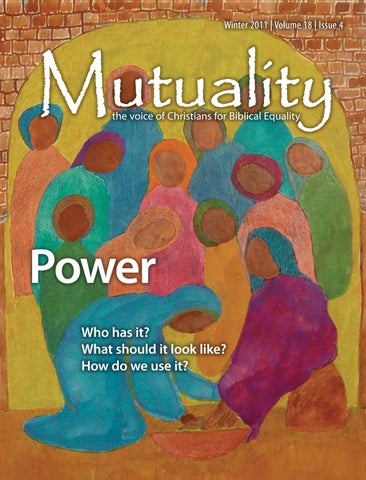
Winter 2011 | Volume 18 | Issue 4
Mutuality the voice of Christians for Biblical Equality
Power Who has it? What should it look like? How do we use it?
Mutuality 18.4, Winter 2011 “Let us then pursue what makes for peace and for mutual upbuilding” (Rom. 14:19, NRSV). Mutuality (issn: 1533-2470) seeks to provide inspiration, encouragement, and information about equality within the Christian church around the world. Editorial staff: Megan Greulich, editor; Image Spigot, graphic designer; Mimi Haddad, president/publisher. Contact us at: Christians for Biblical Equality; 122 W Franklin Ave, Suite 218; Minneapolis, MN 55404-2451; phone: (612) 872-6898; fax: (612) 872-6891; email: mgreulich@cbeinternational.org; web: cbeinternational. org. We welcome your comments, article submissions, and advertisements. For writers' guidelines and upcoming themes and deadlines, visit CBE’s website and follow the link under the Resources tab. Advertising in Mutuality does not imply organizational endorsement. Please note that neither Christians for Biblical Equality, nor the editor, nor the editorial team is responsible or legally liable for any content or any statements made by any author, but the legal responsibility is solely that author’s once an article appears in Mutuality. All Scripture quotations, unless otherwise indicated, are taken from the 2011 revision of the Holy Bible, New International Version®, NIV®. Copyright © 1973, 1978, 1984, 2011 by Biblica, Inc.™ Used by permission. All rights reserved worldwide.
Contents 4
Called “To Set the Captives Free” | A woman's experiences facing sexism in the church. by Desiree Guyton
7
Good News for the Poor in Spirit | Insights into the radical ways Jesus used and taught about power. by Susan McLeod-Harrison
10 The Whisper of Power | How cultural definitions of masculinity may be contributing to the growth of the pornography industry. by Kriste Patrow 10 Can Sex Be Egalitarian? | An examination of three biblical passages. by Cristina S. Richie 13 Breaking Free from Favoritism | Reflections on the cultural context of James 2 and what it means for us today. by Emily Rice 16 Patriarchy and Propaganda | Recognizing and avoiding the abuse of power. by G. David Korsen 18 Courageous the Movie | A review of Sherwood Baptist Church's recent film about fatherhood. by Jenny Rae Armstrong
CBE grants permission for any original article (not a reprint) to be photocopied for local use provided no more than 1,000 copies are made, they are distributed free, the author is acknowledged, and CBE is recognized as the source. Mutuality is published quarterly by Christians for Biblical Equality and is sent free to members and supporters.
MINISTRY NEWS
On the cover: Painting by Brother Sylvain of Taizé (c) Ateliers et Presses de Taizé, 71250 Taizé, France. Used by permission.
3
20 Viewpoints: A Friendly Exchange of Ideas 20 Praises and Prayers 20 Reflect with Us: Revelations, Sharing, and Love
D E PA R T M E N T S
From the Editor | Your Kingdom Come
21 Giving Opportunities | God at Work: Preparations for CBE's 2012 Conference in Kenya
22 President’s Message | The Paradox of Faith
2 M U T U A L I T Y | Winter 2011
website : cbeinternational.org
From the Editor by Megan Greulich
Your Kingdom Come “Why do you care so much about the women’s issue in the church?” The question came from a friend, as I was trying to express why a sermon on gender roles in marriage had deeply upset me. It wasn’t an accusatory or dismissive question; it was a curious one. But I knew that, as a pastor, my friend was weary of debates in the church, and that he was tired of self-righteous Christians arguing with one another over matters both small and significant. I had been busy highlighting to him all of the errors I saw in the sermon’s logic, so I paused before I answered his question, examining my motives. After years of studying biblical equality, was I simply enjoying having the knowledge to correct those who were misinformed? Was I just exerting my pride, and disguising it as passion? “Here’s what I think,” he offered, while I sat silently forming my response. “Jesus prayed for God’s kingdom to reign on earth. Your kingdom come, on earth as it is in heaven. When it comes to gender, the church has been settling for a lot less than God’s kingdom here on earth.” It was a good answer. It went straight to the heart of the issue, reflecting why so many of us work so diligently to advance biblical equality. We yearn for God’s kingdom on earth. In God’s kingdom, one person does not exert power over another. In God’s kingdom, leadership is given to those who lay down their authority, and even their lives, out of love for their neighbor. While the world awards power based on wealth, education, ethnicity, and yes, gender, God’s kingdom values all people and honors humble hearts turned to Christ. This “heart of the issue,” which my friend so beautifully articulated, is the focus of this “Power” issue of Mutuality. As Susan McLeod-Harrison highlights (p. 7), Jesus radically redefined power, teaching and modeling new ways for us to live as God’s children, in community with one another.
bookstore : cbebookstore.org
Be sure to also read Desiree Guyton’s story (p. 4) of encountering discrimination in the church because of her gender and calling. In a powerfully redemptive and graceful way, she explores the difficult realization that her African-American Christian community which supported her as a person of color was also rejecting her because she is a woman. She offers insights for all who have been marginalized by the church because of their ethnicity or gender. Kriste Patrow and Cristina Richie (p. 10) provide insights into an area in which power is often abused: sex. Patrow highlights power dynamics of pornography, while Richie outlines the biblical model for healthy, mutually-submissive sex in marital relationships. Emily Rice (p. 13) presents an insightful devotional on James 2 (p. 13), exploring how the patron-client relationship prevalent in the first century would have impacted James’ readers. Drawing on her experiences as a Filipino-American woman, she inspires both those who are in power and those who are not to break free from favoritism. David Korsen (p. 16) provides practical insights into recognizing when power is being abused within the gender debate. Explaining certain propaganda techniques, he calls us to reject methods of communicating that do not encourage respectful and fruitful dialogue. And, finally, Jenny Rae Armstrong (p. 18) reviews Courageous, the recent movie from Sherwood Baptist Church which considers fatherhood. Weighing the positives and the negatives of the movie’s message, she explores the concept of responsibility, a prevalent theme of the film. We pray this issue of Mutuality is encouraging to you! Please be sure to send us your feedback, and to share it with your friends on Facebook and Twitter. Blessings to you as you read and reflect! Megan Greulich is the editor of Mutuality magazine. She may be reached at mgreulich@cbeinternational.org.
M U T U A L I T Y | “Power”
3
“
Called
To Set the Captives Free
”
A Woman’s Experiences Facing Sexism in the Church
by Desiree Guyton
A
s I reflect on my call to ministry, my heart and mind take me back to the book of Exodus, when God calls Moses to deliver his people out of Egyptian slavery. I identify with the Exodus story because of the deep burden and calling that God has placed in my life to guide his people out of slavery and the trappings of this world’s philosophy into his guiding way of life that is grounded in God’s son,Rae JesusArmstrong Christ, and through the power of the Holy Spirit. by Jenny My call to ministry began with the universal call to all believers to accept that I was a sinner in need of a Savior. At the age of fourteen, I attended a youth event where I heard the gospel message of Jesus Christ’s love and salvation which I accepted in my life. My friends and I began meeting in the school cafeteria for Bible study and holding sleepovers to talk about God. During this time, my life took a painful turn with my parents getting a divorce, a major shoulder injury that was impacting my sports dreams, and my closest brother suffering and then dying of cancer. I started to slip into depression, and I contemplated suicide. God met me one night as I was walking home and spoke to my spirit saying, “I am with you and you are not alone. Trust me and I will guide you.” In the midst of so much pain, I felt a joy and a peace that words could not describe. My commitment to my faith became so real and strong.
4 M U T U A L I T Y | Winter 2011
In college, I remember very clearly sitting in my Bible class and listening to my peers answer basic Bible questions, quoting Spurgeon, Calvin, and Luther, none of whom were familiar to me. They discussed the various mission trips and areas around the world where they had served the poor. I wasn’t jealous. I was troubled because the African-American church experience did not have the Christian education development that offered African-American Christian youth the same exposure. God used this experience to begin to shape my call to ministry. I changed my major from computer science to Christian education. During the summers, I worked and lived with inner-city Christian teens to develop their spiritual and academic lives for Christian college. God used this program to open my eyes to urban culture and the different life circumstances of innercity teens. In the African-American culture there is a term called “slave mentality,” meaning that African-Americans are free from the slavery that our ancestors endured, but mentally and physically are still thinking and living like slaves. I became burdened for teens and young adults to experience the freeing love, grace, and guidance of God. After college, I served as a part-time youth director at a local church for several years. It was a progressive African-American community in an urban setting. It was a great experience, and I learned a great deal about urban youth ministry, church structure, and social justice. However, I felt the call to fulltime ministry. I did not have any mentors or pastors within my culture to give me guidance and found it difficult to find a full-time position within the African-American context. Urban churches did not want female youth ministers. So I worked in the computer field to support myself and volunteered as a youth director for about ten years.
website : cbeinternational.org
After working long hours for a large software company, making a lot of money, and quickly climbing the corporate ladder, God spoke to my spirit early one morning in Germany. God said, “Enough! It’s time to do what I called you to do.” It was a struggle. I was at the peak of my career. The temptation was strong to continue on the career path. I was flourishing financially and traveling the world. However, my peace and joy were shaken. My heart was burdened for the church I was attending, which was large and had the resources for effective ministry, yet lacked clear vision and leadership for its youth department. I wrote a fifty-page proposal on restructuring the church’s children’s and youth ministry. My pastor ignored the proposal for two years. They hired another youth pastor to oversee the youth ministry. During the same time, I wrote my resignation from the computer company. My pastor’s wife contacted me after cleaning her husband’s home office and finding my proposal for the youth ministry. She set up a meeting with her husband and me. My pastor offered me the full-time position as youth director—not youth minister or pastor, but director. All the males who held the position were called youth minister or pastor. Even so, I was overjoyed. And, after being hired, I enrolled in a local seminary. Because of God’s blessings and successful redesign of youth discipleship and programming, I started overseeing all Christian education for this church of 7,000 members. It was amazing! God used my corporate, college, and seminary experiences for his kingdom development. It was exciting to watch the Lord move. The ministries for children and teens grew in number and impact, through evangelism, discipleship, and a focus on student leadership. I loved taking youth on mission trips, watching them share their faith with their peers, and experiencing the radical changes in their lives. But, after several years of working at the church, the sexism was becoming very evident to me. My first serious incident happened when I was preparing for a youth service in the main sanctuary. I was walking on the pulpit and a deacon called to me and stated, “You should not be on the pulpit.” I laughed it off, but he made the statement again. I laughed again, thinking he was just old-fashioned. Later that week, I was joking with the pastor’s wife, who was an executive at a major corporation before taking a position at the church as chief administrator. She stated that it was true, “Women are not allowed on the pulpit.” She began to laugh with me. About a year later, the pastor’s wife and I were redesigning a discipleship program at the church based on our research and ideas I had implemented with the youth. In the third week of the program, I received a call that one of the teachers was stuck in the airport and, since I wrote his class material, I was needed to cover the class. I rushed to the church and entered the classroom of about thirty people. After opening in prayer, I was signaled to enter the hallway by one of the associate ministers. He proceeded to inform me that I couldn’t teach the class because I was a woman. I was stunned and did not believe him, so I went back into the classroom and thought no more of it. I had been teaching Bible study since I was a teenager and had never faced this type of comment.
bookstore : cbebookstore.org
At our next staff meeting, the pastor stated he had heard that the minister confronted me about teaching the class. I was certain he was going to make a joke about it or discuss this old fashioned belief, but to my amazement, the pastor stated it was true. Women could not teach men. I had worked for this church for three years and had never seen that women were not teaching men. The adult classes where women were teaching had only women or were co-taught with men. I was overseeing Christian education and did not know that was built into the structure. I could not believe what I was hearing. I taught the ministers
After the meeting, the pastor must have seen my expression. In trying to make me feel better, he said, “If you were not a woman, you would have been my assistant pastor.” to teach the curriculum that was designed by all women, but I could not teach the curriculum in the discipleship program because men were in the classroom. The pastor continued by saying it was all right in this case because he gave permission for me to teach the class since the male minister could not make it. He gave me permission. After the meeting, the pastor must have seen my expression. In trying to make me feel better, he stuck the knife further into my heart. He said, “You are awesome. You are the most talented and gifted person on this ministerial team. You are the only woman on this team. If you were not a woman, you would have been my assistant pastor.” Reality hit me. I had not recognized that I was the only woman in the ministerial position. The other women on staff held administrative titles. Before this church experience, I worked for the fourth largest software company in the world, which was 95% male in my department. I climbed the corporate structure with no problems. I never faced the sexism there that I was facing in my church. Because I was a woman, I was not allowed to be licensed in the church or to utilize my speaking gifts outside of youth and women’s ministry. I became angry and a fighter. I sinned in how I left the church. I was ruled by my anger. I moved onto a ministry at another church, and, once again, the Lord blessed us by growing the teen ministry in number and impact. During the end of my last year in seminary and the transition to this new church, God pressed on my spirit that he did not call me to youth ministry alone but to all God’s people, “to set the captives free.” God made it clear that I needed to utilize my speaking gifts of preaching and teaching; to stop being afraid. I had been regularly doing both without the official title or ordination. After several years, to my surprise, my pastor decided to license me as a minister, which allowed me to preach, teach, and serve communion. This was huge! My pastor took a lot of pressure from congregational members and other pastors for licensing me as a minister. But he refused to take the sexist approach that many churches in our association were doing by
M U T U A L I T Y | “Power”
5
Those who face marginalization in the church often describe their journeys as a kind of grieving process. Here, author Desiree Guyton shares how she journeyed through the Kubler-Ross stages of grief: Denial (this isn't happening to me!) I felt the injustice, but I couldn’t deal with the sexism. I couldn’t face the biases in my culture, church, family, and even myself.
Anger (why is this happening to me?) I have to admit that at times I got angry with God. Why did he create me as a woman?
Bargaining (I promise I’ll be a better person if...) I had to face the fact that I always work so hard to be better than my white male counterparts. My father taught me to fight racism by being better: “Work harder and smarter because, in the end, the white race cares more about the color of green (the dollar) than the color of your skin.” I was bargaining with God. I will work harder than my male counterparts, and then I will be equal.
Depression (I don’t care anymore!) I hate to admit that I was starting to feel like I just did not care. I didn’t care about ministry and the direction of the church. When we are angry at God about an injustice, our sinful response is to feel unappreciated and unimportant. The person feeling the injustice can begin to start thinking in a distorted and selfish manner.
Acceptance (I’m ready for whatever comes.) I learned to accept the journey but not the injustice. Racism and sexism may always be a part of our experiences, but, with God’s help, we learn how to confront them, to educate others, and to change policies. God gives us the strength to fight this fight, in his ways, with his grace, love, peace, and hope.
calling women “evangelists,” not “ministers,” and by allowing us to speak only on the floor instead of the pulpit. I was the church’s first woman minister. Ordination at the time did not cross my mind because, as I look back, I had no strong women models to guide me. During the licensing process, conflict arose in my family. I have three brothers who are pastors and a sister who is ordained. For years, I heard from my brothers and other church members to disregard my sister’s ordination since she was a woman and, in their opinion, her doctrine was inappropriate. Because my sister was very loud and angry, I distanced myself from the women’s ordination issue. I did not want to be like her. I did not want to be an outsider within my family circle. But now I was taking steps to be licensed and becoming the conversation piece. I felt the immediate pain of my decision. One of my brothers whom I talked to regularly was strongly against women as pastors. He did not come to my licensing service. But God reminded me to trust in him alone, and to love in the midst of all the hurt. I didn’t have to defend myself. God called me, and he is my lawyer.
6 M U T U A L I T Y | Winter 2011
Even though my congregation licensed women as ministers, the association and the church did not ordain women. The church leadership used women’s gifts to fullness but, because of our gender, did not treat us as equals. During the association’s last ordination service, one male minister who was licensed with me and another who was licensed a year after me were ordained. These men are great brothers who had limited ministerial experience and no higher Christian education. The other woman minister and I have master degrees from seminary and over fifteen years of ministerial experience each. I am convinced that if I were a man, I would have been treated differently. I would have been encouraged long ago to pursue ordination and seek full-time service. Instead, I was asked to wait, left to find mentors outside of my family, denomination, and cultural context. The pain was deep. A church and association that I had served for over six years was not going to ordain me. Even as I am writing this, tears fill my eyes with the reality that I was left out because I am a woman. How was I to respond? It would have been easy for me to confront conflict and get into the fight. Yet God wanted me to work through my anger. He wanted me to face the women’s issue, to feel the pain but to go through the struggle with his grace, love, and hope. As I reflected on my experiences, I found myself on a familiar journey. As an African-American, I experienced this struggle before, with racism. The feelings of dehumanization, of being second-class and not equal, were very real. Through my family and church community, I was trained to face racism. I was trained to respond correctly. I was taught how to articulate the hurt and the fight for justice. However, I was not prepared for sexism because I was not prepared to fight it within my own family, church, and culture. It hit me that I was grieving the loss of my safe places. What I have learned is that I must accept the journey but not the injustice. I learned to accept that racism exists and that it will always be a part of my life. But I learned how to communicate it to the offenders. I learned to sit on committees and to change policies and curriculum to address racism. Now, I have to learn to do the same with the issues of sexism. I have to learn to see the injustice, learn the language, and communicate it to the offenders to help them open their eyes, re-write policies, and become change agents. Through it all, I rest assured that God has a plan for me, and that part of this journey is to fight the injustice I have faced as an African-American woman because of my race and gender. Even though I fall to the ground many times, God’s strength through his son’s resurrection gives me the strength to stay in the fight. I am fighting God’s way, in God’s strength, for God’s future daughters and sons, and for God’s glory. Desiree Guyton is a family preservation therapist for the Center for Family Services and a therapist for DSA counseling and Family Care Connections. She earned both her MA in counseling and MDiv in contemporary leadership from Biblical Theological Seminary. She has twenty-four years of experience serving youth and young adults in church and parachurch ministries, along with six years in direct individual and family counseling. Desiree currently serves the youth and young adults of the Delaware Valley area as a dynamic counselor, and is an associate minister and a foster parent to area juvenile boys. Her newest endeavor includes president of Quest Movement Live, LLC and a nonprofit branch under the name Quest Movement.
website : cbeinternational.org
Good News for the Poor in Spirit:
The Ways of
Jesus and Power by Susan McLeod-Harrison In Jesus’ mountainside talk in Matthew 5, Jesus speaks to powerless people. He has just finished going through Galilee teaching and healing “every disease and sickness among the people” (Matt. 4:23), and so needy ones continue to pursue Jesus wherever he goes. What they get right now is his attention. When he sees them, Jesus sits down. He speaks to the listeners about their suffering and its relationship to the kingdom of God. He surprises them by saying that poverty of spirit, mourning, and meekness have given them blessings. He suggests that their suffering and powerlessness can create kingdom characteristics—a merciful heart, purity, and the desire to make peace. Jesus compares these powerless people to the revered prophets of the past, warning them that they may be persecuted as well (Matt. 5:3–12). Jesus praises the poor. He sees the blessings that have come, or will come, to them—blessings they could never have laid claim upon in their misery. He wants his new disciples, some of whom have left secure lives to follow Jesus, to understand the dignity, character, and compassion that can be forged from powerlessness, and to understand how the kingdom of God appears. It’s as though Jesus were saying to his disciples, “Really look at these people. See what I see, and be that.”
bookstore : equalitydepot.com
Jesus Uses His Power to Relieve Suffering, Including Death and Oppression Given my reading of the Sermon on the Mount, can I conclude that suffering and powerlessness are blessings? Are we to seek them out in order to obtain “the Beatitudes”? The results of suffering can yield kingdom character traits, but powerlessness, loss, agony, oppression, and death are not from God. How do I know? The gospels show that Jesus used his power to heal, save, restore, and resurrect from the dead. He empowered the least powerful, including women. For example, in Luke’s gospel (7:11–15), Jesus merely observes a woman crying in the middle of a funeral for her only son. She does not notice Jesus, and she does not know enough about him
M U T U A L I T Y | “Power”
7
to ask for anything. Yet, Jesus approaches her in her intense grief and says, “Don’t cry.” His heart goes out to her, as he may imagine his own mother’s grief at his death. He knows that this widow will be alone and destitute without her son. So, Jesus uses his power: he raises the man from the dead. Jesus wants to relieve the woman’s pain. He is not interested in her spiritual growth via suffering; he desires to bless her with the return of her beloved son. There is hardly a greater imaginable power than to resurrect the dead. Jesus uses it again with a twelve-year-old girl, who is the daughter of a synagogue leader. The man is so desperate that, embracing the shame of a servant, he falls to the ground and begs Jesus to come to his house to heal his daughter. Jesus responds to the ruler’s pain by pressing through the crowd to get to the dying daughter. While being “almost crushed” by so many people, Jesus mysteriously claims that someone has touched Jesus’ power moves him, and says he knows toward the suffering, this because “power” has to relieve it, wherever gone out from him. The he finds it, or whenever the woman who experienced hurting ones find him. healing only by touching Jesus’ cloak falls at his feet, ashamed and afraid. Jesus renames her as God’s own Daughter—and publicly lauds her faith. Then he moves on to the home of the now-grieving parents, as their daughter has died. Amidst weeping and the mocking laughter of unbelief, he resurrects the young girl. In this dual story of healing and resurrection (Luke 8:40–56), Jesus’ power seems to ooze out of him, it is so palpable, real, and effective. His power moves toward the suffering, to relieve it, wherever he finds it, or whenever the hurting ones find him. Jesus’ power to relieve oppression points to Jesus’ authority, a byproduct of power. The crowds often recognize the authority of Jesus’ words (e.g. Luke 4:32), but his authority is most evident when he confronts demons, because the demons know exactly who he is and must submit to his power. In the synagogue in Luke 4, a man possessed by an evil spirit cries out, “‘Go away! What do you want with us, Jesus of Nazareth? Have you come to destroy us? I know who you are—the Holy One of God!’” Jesus commands, “’Come out of him!’” And the demon immediately exits (Luke 4: 31–37). Jesus uses his power-asauthority to confront and dismantle that which inflicts pain, in order to restore and heal human beings.
Jesus Uses His Power to Advocate for Women Jesus not only speaks with authority to evil beings, he also uses his voice to speak powerfully for those to whom no one listens. On a Sabbath, while he is in the respected and powerful position of speaking in the synagogue, Jesus notices a bent-over woman who can barely return his gaze (Luke 13:10–17). He sees this woman as he saw the crowds that day on the mountain when he spoke of kingdom values with his disciples. He discerns her poverty of spirit, and the kingdom that is truly hers. Calling her forth, he blesses her with the
8 M U T U A L I T Y | Winter 2011
freedom, dignity, and beauty of a tall stature. Then, when the synagogue leader rebukes her implicitly for receiving healing on a Sabbath, Jesus defends her right to be healed as a “Daughter of Abraham.” The title “Son of Abraham” would normally describe male Jews, so Jesus radically includes the woman, and all women, in God’s kingdom. Luke records other occasions where Jesus advocates for women, such as when a woman came into Simon the Pharisee’s house, where Jesus dined, with a jar of expensive perfume for Jesus in her hands (7:36–50). Jesus hears Simon’s unspoken accusations against both himself and the woman. He takes the opportunity to preach a mini-Beatitudes sermon to Simon, telling him: be like this woman. Jesus begins his long boast of the woman as a superior hostess to Jesus, as one who has greater love for God than Simon does, and as one who is forgiven for her sins. When he is done, he turns to the woman herself: “Your sins are forgiven…your faith has saved you…go in peace.” He heals the woman with the assurance that all is well with her spiritually, causing the guests to acknowledge that her sins are indeed forgiven (“Who is this who even forgives sins?” Luke 7:49). In Luke 10:38–42, Jesus advocates for Mary to Martha— but also to his male disciples who may have been echoing Martha’s thoughts. Martha has a complaint about Mary taking the position of a disciple at the cost of leaving Martha alone to do the women’s work: “Tell her to help me!” she says. Jesus still cares for Martha and her feelings (“You are worried and upset about many things”—we call this reflective listening today), yet Jesus tells Martha, Mary, and the men that Mary has chosen the better path, that of a listening, learning disciple of Christ, no different from the men who also choose Christ. Jesus defends Mary and her assumption of discipleship, to all who are present. In Luke 21:1–4, Jesus also sees authentic discipleship in a woman, this time in a widow with clearly very little money. What could have been a moment of shame for a woman giving less than a penny to the temple treasury becomes a time of historical significance: Jesus commemorates her generous, faithfilled act not only to the male disciples but also, through Luke, to Bible-readers throughout time.
Jesus Rejects Aggressive Power Jesus obviously wields power in a way that most of us do not. (When was the last time you raised the dead?) In fact, many of us feel powerless without a metaphorical weapon—a deadly glance, thought, or word. Sometimes in our worst moments we have even gotten physical with our attempt at power—a grab of a child or push of a spouse, or other physical outbursts that we may recall with anguish. We cannot make people do what we would like them to do, which can be intensely frustrating. Jesus couldn’t always influence people to do what he wished either. He found that his power to compel people to believe in him, and to love him, was limited by the people themselves. But Jesus allowed it. He didn’t reach for the weapons of aggression to hammer the world into the kingdom. Instead, he spoke the
website : cbeinternational.org
truth, but when people had made up their minds to crucify him, he even quit speaking (Matt. 27:11–14). Despite Jesus’ non-violent approach to power, there is an example in the gospels of Jesus getting physical. Jesus drove out both buyers and sellers of doves and livestock, in the temple outer courts. Some have pointed this out as an example of Jesus’ approval of situational aggression or violence. Given that Mark places his account of “the cleansing of the temple” between the beginning and ending parts of the story about Jesus cursing the fig tree (Mark 11:12–26), Jesus seems to be cursing the false religion and injustice of the temple, with his actions. At the same time, he adjusts the focus of his followers from his own actions to their specific calling. When his object lesson about the fig tree had to do with faith, he was perhaps saying that God will take care of those who act unjustly. We do not have to actively curse our enemies, and we do in fact have to forgive them (Mark 11:25). Jesus, as God, can act authoritatively in judgment of those living out a false religion of hypocrisy and injustice. We, his followers, can have faith in God to “move the mountain” (versus obliterating it), while returning again and again to a spirit of forgiveness.
But Meanwhile, How Do We Do Justice? We live in the twenty-first century, in metaphorical temples where divisions continue. In Jesus’ time, Gentiles and women were subject to segregation in the temple, and, in many ways, these discriminatory practices of the temple continue through the modern church. But what is different in this time and place is that many women obtain power in the world, and even occasionally the church. I have often struggled with power—both my own and others’. How do I obtain it, yet still use it humbly for service? How do I use my gifts and see myself as a powerful human being
in the church? The words “women” and “power” have come to be seen as mutually exclusive in the church, if power is even accepted as positive. However, power is the stuff of God’s kingdom— “the kingdom of God is not a matter of talk, but of power” (1 Cor. 4:20). Power comes in a variety of forms to humans. Skill, knowledge, competence, articulateness, persuasiveness, status, degrees, privilege, authority—not to mention the charismatic gifts and the fruit of the Spirit—are all forms of power that God can use for the kingdom. The real challenge is staying aware of power differences and the potential for injustice that comes from that difference. We also must continue to see the blessedness that Jesus saw in the powerless crowds when he gave the Sermon on the Mount. And, just as Jesus admonished his disciples to use power to humbly serve rather than lord over others (Matt. 20:20–28), so we must do the same. Within the church, men and women have the challenge of being called to speak the truth about oppression and injustice against women and girls, and to act and advocate on their behalf, as Jesus did. As we follow Jesus in this way, we will often feel as Jesus may have when he spoke—rejected. Yet, Jesus told his disciples to leave a town if they were rejected, to shake the dust off their feet (Mark 6:7–11). If religious leaders don’t listen, we can freely leave, and seek out a church community where we are respected and heard. We aren’t called to make believers out of those committed to a false religion of injustice. We are called to have faith in God’s power, to forgive those who hurt us, and to use our power for healing, justice, and service to the powerless—just as Jesus did. Susan McLeod-Harrison is the author of Saving Women from the Church: How Jesus Mends a Divide (Barclay Press, 2008). She has earned an MDiv from Regent College and a Master’s of Clinical Psychology from George Fox University. She lives in Newberg, Oregon where she writes and cares for her family.
SEX AND POWER The Whisper of Power: Masculinity and Porn Culture by Kriste Patrow “You, my brothers and sisters, were called to be free. But do not use your freedom to indulge the flesh; rather, serve one another humbly in love” (Gal. 5:13). The struggle for power has always been part of the human story. Sometimes the quest of a person or group of people to dominate another is easy to see, such as in the rising and toppling of civilizations throughout history. But other times the struggle for power grows right under our noses, while we remain largely unaware of its serious consequences. Such is the case with misogyny, which is rapidly mutating and infecting society in the viral form of pornography. Pornography is growing more violent and abusive toward women. It is also becoming more culturally acceptable. And, alarmingly, most of us don’t even recognize how much it is seeping into our everyday lives. Pornography is so prevalent that often one does not ask if a man watches pornography but rather how much. In one recent study conducted on male sex buyers, researchers defined a “nonuser” as a man who had not used pornography more than one time in the last month (Prostitution Research and Education, July 2011).
Even mainstream magazine covers flaunt scantily clad women. Commercials for men’s body wash claim the product will give a man more sexual prowess (to the point of driving women into animalistic frenzies). And popular dolls sport overdone makeup, huge lips, and skimpy clothing. All of these examples receive their inspiration from pornography. Thankfully, many churches and ministries are now working to free culture from this growing and crippling addiction. However, the problem cannot thoroughly be addressed if we believe pornography use is motivated only by sexual desires or men’s “uncontrollable” sexual needs. Deeper issues fuel the pornography industry. In Getting Off: Pornography and the End of Masculinity, author Robert Jensen proposes that pornography is more about power than it is about sex. Jensen deals specifically with why men are so interested in pornography. He argues that men’s pornography use has to do with culture's modern view of masculinity: But in reality pornography speaks to men in a whisper. We pretend to listen to the barker shouting about women but that is not the draw….Pornography ends
Can Sex Be Egalitarian? by Cristina S. Richie Most people do not think of the Bible as a love manual, but, unsurprisingly, the Scriptures support the idea of egalitarian sex—both wife and husband exist for each other spiritually and physically when they make love. From Genesis where God creates one-flesh union and the couple is naked and unashamed; to Song of Songs where both the beloved and the lover speak to each other in rousing and tender words; to the letter of Paul to the Corinthians where he declares that the husband and the wife have a conjugal duty to each other, the Bible provides a model of what a healthy, biblical sexuality looks like. Taking a closer look at the Scriptures provides a framework for romantic love that is not based on one-sided control and power, but on the freedom of sexual love within Christian marriage. Genesis 2 describes the creation of the first humans. We notice that Adam is so overjoyed to see Eve that he sings to her! The couple are naked before each other, and united as one. From this passage we can understand nudity to be more than just physical nakedness—it is also an emotional and
10 M U T U A L I T Y | Winter 2011
spiritual vulnerability that allows physical intimacy to flourish. Indeed, this metaphorical nakedness comes before physical nudity, as the couple builds their sexual marital relationship on the foundation of a spiritual enmeshing. This emotional and spiritual union is developed in dating, and continues to unfurl throughout the relationship. From the metaphorical nudity established in dating, Song of Songs describes the longing of engagement. This book of the Bible is not often the subject of sermons, but it is important to bridge the spiritual and emotional aspects of a God-based relationship to the anticipation of a sexual relationship. From this book we can see that both the woman and the man speak to each other about their love. It is likely this longing comes because the couple is not yet married. Yet, in their time together, they share passionate words, romantic food and drink (7:13, cf Gen. 30:16; 7:9), and a desire for each other expressed in anticipation of physical intimacy. Portions of this book could be read at weddings in celebration of sensual love (eros) in addition to the more typical passages about transcendental (agape) love, such as 1 Corinthians 13.
website : cbeinternational.org
up being about men’s domination of women and about the ugly ways that men will take pleasure. But for most men, it starts with the soft voice that speaks to our deepest fear: we aren’t man enough. For Jensen, cultural definitions of masculinity ultimately glorify a quest for male dominance. Culture, he observes, teaches us that “real men” take charge and seize power rather than lay down their power to serve others, and they are usually willing to resort to violence to get what they want. Why is it that as pornography has become more misogynistic, it has also become more accepted by mainstream culture? The definition of masculinity offers an answer, Jensen writes. In a world where men are losing some of the absolute power which has historically been theirs, men are charmed by the whisper of pornography as a way to assert their culturally-defined masculinity. In porn, men are the ones in power for they are the ones obtaining sexual pleasure. This is especially true in the growing genre of misogynistic porn: men enjoy sexual pleasure from what makes the women uncomfortable or, worse, what puts them in great pain. The men are typically in control; the women are usually submissive. Women are reduced from human beings to objects: merely useful outlets for male sexual release. continUed on Page 12
If Song of Songs is a theme for engagement, then 1 Corinthians 7 is the theme for marriage, as it gives perhaps the strongest advice for married couples in their sex life. Paul says that neither spouse should withhold intimacy, unless both decide it is appropriate for something essential, like prayer (7:5). But even in this, Paul says both partners have a right to the other’s body, and a duty to give to each other sexually (7:34). This thinking was radical at a time when women were considered property and were used by their husbands without concern for their pleasure or feelings. Paul breaks down the gender lines of the first century and, considering the partners equal to each other, encourages both the wife and the husband to give to each other freely, and only have periods of celibacy if it is mutually agreeable (7:5). This passage is the basis for an equal say in marital relations. Moreover, it credits women with the same needs for intimacy as men.
bookstore : cbebookstore.org
In God’s perfect plan for romantic union, he has provided a wonderful guide in the Bible. We can take themes like metaphorical nudity, romantic words, and regular intimacy and say confidently that both men and women are responsible for being emotionally and spiritually available, initiating romance, and deciding the frequency and nature of their romantic endeavors. These components make a relationship glorifying to God, and are based on the power of love, not the love of power. Cristina Richie currently works as a minister in the Episcopal church and as an adjunct professor of religion at Marion Court College (Swampscott, MA). She holds an MDiv from Gordon-Conwell Theological Seminary, and will complete a TM in moral theology from Boston College in the spring of 2012. She writes and speaks to both Christian and secular groups about religion, bioethics, and women's equality.
M U T U A L I T Y | “Power”
11
SEX AND POWER The Whisper of Power: Masculinity and Porn Culture, continued… This is a particular concern for egalitarians because porn not only hinders men's ability to experience true intimacy, but it also changes the way their brains process interactions with women in general. Take for instance a study done in 2009 by Princeton University on how men view women. First, men were surveyed according to a misogyny scale. They were then asked to view pictures of women both fully dressed and scantily clad. Men who scored higher on the misogyny scale showed no activity in the part of the brain that considers another person's intentions. In fact, it was the area of the brain mainly responsible for tool use that showed much activity. According to the lead researcher in this study, that means these men didn’t see the women in bikinis as humans with thoughts and intentions. They were simply objects, attractive objects perhaps, but less-than-human all the same. This dehumanization of women through pornography can be seen on an organizational level as well as an interpersonal one. PETA (People for the Ethical Treatment of Animals), for example, is notorious for valuing the world’s furry and feathered friends much more than the women who work for their organization. This year, PETA announced its plan to launch an adult-only site. Drawing people to the site with pornography, PETA plans to provide visitors with images of animals being slaughtered, in an effort to gain support for their mission. Not only does this fit well with the cruel porn genre, mixing sex and violence, but it's also a prime example of what pornography does to women: commoditizing them and using them to market a message. They are faceless, nameless, and a means to an end. They are tools. This idea that women are tools runs rampant in an age of pornography. The “porning” of mainstream culture tells men and women that their power lies in their sexuality. When women’s bodies cease to be temples of the Holy Spirit and are
relegated to nothing more than “temptations,” women lose their personhood. They cease to be ezer, a powerful source of help, and society loses the imago Dei, the image of God, that is evident in partnership of men and women. As Christians, we must respond to this deep and prevalent quest for and abuse of power. We are called to recognize the imago Dei in each other, and to advocate for those whom society deems less valuable. In today’s world, sexual promiscuity has become the religion, and pornography and power are the priests. But, God has something radically different for the human family. True Christian masculinity and femininity need to be shaped by Scripture. While the culture calls for hierarchy and the domination of males over females, God calls for equality, freedom, and a shared authority between women and men, of all classes and ethnicities. While culture dictates that “real men” must exert power over females, God says real power exists when we submit to, love, and serve one another. While culture says objectifying people for sexual pleasure is okay, God says our freedom in Christ is to deny immoral impulses and to respect the bodies of people created in God’s image. Our freedom never gives us the right to hurt others for our fleshly gain. God created male and female for more than impersonal, power-usurping sex. Men and women were created to show the face of God in their interactions with each other and the world at large. Those who are truly free never suppress others but walk with them, side by side, fully acknowledging their humanity and worth as a part of the imago Dei. Kriste Patrow graduated with a BA in journalism from Bethel University. She currently works as the events coordinator and social media go-to for CBE. A resident of Minneapolis, she loves to explore the nooks and crannies around the Twin Cities, is passionate about gender, and is a creative writer and hot sauce enthusiast.
Looking for more resources addressing the problem of pornography?
Recommended resources from CBE Bookstore include: 10 Lies Men Believe The Truth about Women, Power, Sex, and God—and Why it Matters
“Pornography and the Church”
“Sex in the Clutches of Satan”
Mutuality Spring 2009 Vol. 16, Issue 1
recording by Kristyn Komarnicki and Lisa L. Thompson
by J. Lee Grady
“Reclaiming the Beauty of Our Sexual Selves”
A New Man by Luke Reynolds
recording by Kristyn Komarnicki and Lisa L. Thompson
Find these and other related resources at cbeinternational.org/pornography.
12 M U T U A L I T Y | Winter 2011
website : cbeinternational.org
F r e e g in k a e r B from Favoritism:
Understanding James 2 Through Its Cultural Context by Emily Rice
James 2:1–13 who are dragging you into court? Are they not the ones who are blaspheming the noble name of him to whom you belong? If you really keep the royal law found in Scripture, “Love your neighbor as yourself,” you are doing right. But if you show favoritism, you sin and are convicted by the law as lawbreakers. For whoever keeps the whole law and yet stumbles at just one point is guilty of breaking all of it. For he who said, “You shall not commit adultery,” also said, “You shall not murder.” If you do not commit adultery but do commit murder, you have become a lawbreaker. Speak and act as those who are going to be judged by the law that gives freedom, because judgment without mercy will be shown to anyone who has not been merciful. Mercy triumphs over judgment.
My brothers and sisters, believers in our glorious Lord Jesus Christ must not show favoritism. Suppose a man comes into your meeting wearing a gold ring and fine clothes, and a poor man in filthy old clothes also comes in. If you show special attention to the man wearing fine clothes and say, “Here’s a good seat for you,” but say to the poor man, “You stand there,” or “Sit on the floor by my feet,” have you not discriminated among yourselves and become judges with evil thoughts? Listen, my dear brothers and sisters: Has not God chosen those who are poor in the eyes of the world to be rich in faith and to inherit the kingdom he promised those who love him? But you have dishonored the poor. Is it not the rich who are exploiting you? Are they not the ones
"Streets That Are Golden" by Gwen Meharg (drawneartogod.com). Used with permission.
Often when I've heard James 2 addressed in a sermon or in a Bible study, the message was a simple admonishment to “not show favoritism” or perhaps “don't discriminate based on how well someone is dressed.” These lessons have their place in our image-conscious and outwardly-focused society. However, I believe there is a message within this passage that is more complex and more fundamental than the typical surface treatment we often hear. Far beyond the simple command to “not show favoritism,” James instructs believers on how they ought to live as a community that truly loves God and each other. Learning more about the cultural context and the people to whom the letter was addressed is critical to understanding James’ message. As I studied the first century setting, I learned that there were distinct social classes of haves and have-nots, and that society was structured by a rigid patron-client system of reciprocity. Bruce Malina and Richard Rohrbaugh give a good description of this in Social-Science Commentary on the Synoptic Gospels:
bookstore : cbebookstore.org
Patron-client systems are socially fixed relations of generalized reciprocity between social unequals in which a lower-status person in need (called a client) has his/her needs met by having recourse for favors to a higher-status, well-situated person (called a patron)....By entering a patron-client arrangement, the client relates to the patron as a superior and more powerful kinsman, while the patron sees to his clients as to his dependents (p. 388). The patrons and clients would formally align themselves with each other in order to better their own personal situations. Patrons depended on their clients to increase their societal power and honor. For example, the more dependent clients a patron had, the more votes that patron owned at election time. Clients depended on the favors their patrons could provide (whether financially or socially), though they were always expected to repay in whatever way their patron deemed necessary, and
M U T U A L I T Y | “Power”
13
James 2:8–10 illustrates that the poor had actually been breaking the scriptural commandment of loving your neighbor as yourself. whenever the patron determined. If the patron wasn't satisfied as yourself. The poor were mistreating their fellow sisters with what the client paid in return, the patron would squeeze and brothers by honoring patrons and not treating each everything they could from their dependent through exploitation other with the same honor. They were breaking the scriptural and dragging them into court, as referenced in James 2:6. commandment of loving your neighbor as yourself in how they When I first learned about the patron-client system, I viewed themselves and by how they chose to relate to others. was struck by its similarity to another societal dynamic from Instead of aligning themselves with God and recognizing the my Filipino culture. Utang na loob is a Philippine cultural high position and inheritance God had already given them as value of reciprocity within community. This value recognizes people who were poor in the eyes of the world but who loved the importance of honoring another person’s contribution God, they chose to align themselves with their patrons, who in and their impact in one’s life. However, when corrupted by many cases were not aligned with God. colonialism, utang na loob often became a principle that led to While I quickly recognized the parallel between the perpetual bondage because it was no longer done in the context patron/client dynamic as it played out within the first century of mutuality and equality. Many Philippine politicians have context and the similar dynamic in my homeland of the employed this principle to win elections. By granting favors to Philippines, it wasn’t until a few years ago that I began to Filipinos who are economically disadvantaged, some politicians recognize the patron/client patterns in my life here in an have been very successful in maintaining loyal voters and American Christian context. retaining their power, despite widespread human rights abuses. For those of us who have been marginalized in some way— Worldwide, the poor and marginalized often show favoritism whether it is due to our gender, race, or ethnic background— and great deference for the wealthy and powerful. there is often societal pressure to treat various groups of people The preeminent Filipino-American author Carlos Bulosan differently because we perceive it necessary for self-preservation. illustrated this dynamic in a story he tells of his mother, who We may find that we are accepted more by those with greater power was a poor bean trader in a rural market in the Philippines. and privilege if we become partial to their way of doing things While selling beans in the or constantly defer to others market one day, Carlos’ mother to the point that we believe we After years of socialization that our development, was enraptured with the sight ourselves do not matter. our perspectives, and our voices are not important, of an elegant and obviously When I was newly-married, wealthy young woman. When one of the women at my church we may start believing that we inherently do not have she approached his mother, gifted me with what she high worth or position in God's eyes like some others do. the young woman scoffed at believed was valuable “marriage the admiration she received. wisdom.” She told me that “What are you looking at, poor woman?” she asked, before when her husband had some plan for them as a couple which callously striking his mother’s basket of beans and dashing off. she considered wrong, it was her duty as a good wife to go along Carlos’ mother was left, on her knees, gathering her beans from with what her husband thought they should do. She believed it the ground, saying repeatedly “It is all right, it is all right.” was our role as wives to always defer to our husbands, thereby The patron-client system in the first century context, like ensuring a happy marriage. Our husbands would be our patrons, utang na loob to Filipinos, was such an integral part of society making decisions on our behalf. that someone wouldn’t simply wake up one day and decide A similar but more subtle message is one that we often see in the she/he didn’t want to be a part of it anymore. People like American church. In previous churches I attended, the emphasis on Carlos’ mother who had been clients in their contexts viewed men’s spiritual growth and leadership was always prominent. One dependence on and acts of honoring a patron as the only way to particular church offered numerous men’s Bible study courses and live and meet even the most basic of needs. They likely thought spiritual formation classes. But classes for women were a bit different. there was no other option for them to survive. There were fewer Bible classes available to women and hardly any With this context in mind, consider James’ message. James opportunities for women that focused on spiritual formation. gives a radical perspective to the people within this first century Instead, there were classes on being a good wife or mother. As women society—one that turned their world upside down! Clients, in this community, we were implicitly taught that our spiritual who were the poor and marginalized in society, were actually formation was not nearly as important as men’s spiritual formation. the ones chosen by God to occupy the high position (James 2:5). I’ve had experiences within Christian communities where And the rich patrons are told to take pride in their humiliation the cultural and ethnic identities of my friends and family were since their wealth and power will “pass away like a wild flower” devalued. There were numerous instances where their dignity (James 1:10). This message clearly was inconsistent with how was recognized only when they adopted someone else’s cultural society had been structured in that day. practices and abandoned their own. Their imago Dei or imageJames 2:8–10 illustrates that the poor had actually been bearer status was viewed as conditional upon their assimilation breaking the scriptural commandment of loving your neighbor into the dominant culture.
14 M U T U A L I T Y | Winter 2011
website : cbeinternational.org
So after years of socialization that our development, our perspectives, and our voices are not important, we may start believing that we inherently do not have high worth or position in God's eyes like some others do. We may start believing that we derive our worth or standing from those who are rich or powerful in the eyes of the world. I, myself, through a myriad of experiences related to my culture, ethnic background, and gender, had begun to internalize a lower sense of value and worth. I saw myself in a way that was probably similar to those of the “clients” or the poor recipients of James’ letter. Instead of recognizing and really believing in my “high position” and the high position of others who were marginalized, I often showed partiality to those who were in some way a patron for me. If I just received the approval of these people with power, then maybe, I thought, I would be able to survive without being trampled on too badly. To some, my willingness to constantly seek others’ approval and value others’ perspectives over my own seemed admirable. They thought I was “valuing others above myself ” (Phil. 2:3-4). But not recognizing the image of God in myself is not humility. We are each to recognize the position and value God has given us, relating with others from that position and not from a position of inferiority to others. So how can we work to mend broken relationships and address this dynamic within our communities? We need to recognize that how we live the good news in community is part of the good news itself. How we relate to each other and view ourselves is an illustration of our witness and the values we hold. The first step of addressing this is for us to recognize where we may have become part of a broken, patron/client-like community. James highlights some specific examples he saw happening in the community. One example is the preferential seating for the rich and unfavorable seating for the poor. In our churches and communities, to whom do we show honor?
bookstore : cbebookstore.org
To whom do we show disregard? Are we affirming the high position and dignity of all? Or are we marginalizing some? Once we recognize the problem, we need to actively seek mutuality and healthy interdependence in community. Showing partiality goes against Jesus’ commandment to love our neighbors as ourselves. For those of us who have been marginalized and found ourselves in “client”-like roles in our communities: • Claim the ascribed honor and high position that we receive directly from God; recognize that we are each made in God’s image. • Break free from viewing ourselves as subject to and inferior to those who hold the power (our “patrons”). They should not take God’s position in our minds or hearts. Recognize the personal agency with which God has empowered us. There is so much that God has given us the power to do! God created us to have an influential impact and voice on our community! For those of us who wield power and privilege in communities (“patrons”): • Claim the ascribed honor that we receive directly from God and not from our position in the community, our power or success, or from others’ recognition of our good work helping people. • Break free from viewing ourselves as the protectors and sole leaders in our communities. We must recognize that we are missing out on experiencing the wisdom and talent that others were created to share with us. Emily Rice (MBA) lives in Portland, OR, where she works as a technology project manager. She and her husband, Daniel Fan, share a passion for engaging the church and community in dialogue and action around ethnicity, culture, gender, and faith. Emily currently serves as a member of CBE's board of directors.
M U T U A L I T Y | “Power”
15
Patriarchy & Propaganda: Propaganda Recognizing & Avoiding the Abuse of Power by G. David Korsen
Apparently, some believe that I am a treacherous person. Some claim that I have undermined the authority of Scripture by giving in to the pressures of modern culture. Some fear I have taken a “dangerous first step” and started down the “slippery slope” of liberalism and am willing to take others along with me. I am an egalitarian. Seven years ago I accepted the call as senior pastor to a church seeking revitalization. During the first three years we were blessed with renewal and growth, so a search team was formed to hire an additional staff person. After considering many candidates, one clearly stood out—a young woman with her master of divinity and all the skills the position required. Yet, when the search team brought this candidate to the church board, she was rejected solely because she was a “she” and not a “he.” When I accepted the call to this church I was very candid about my convictions supporting women in leadership. Although a woman had never served in such a role, I was assured that “the time was coming.” This church belonged to the denomination I was ordained in, which had formally affirmed biblical equality in 1979. So assuming what was now needed was sound biblical teaching on women’s service and leadership, I initiated a dialogue within the church. I did not realize I had ignited a fuse. Almost immediately I became aware that a core group of influential leaders did not see this “dialogue” as an opportunity for discussion, but as a threat. They were convinced they had been protecting their church from a denomination that had compromised with the culture some twenty-five years ago. I was now viewed as advocating for their church to follow a “liberal” course. So, drawing on the recent writings from some influential patriarchal authors and websites, they set in motion a “propaganda machine.”
16 M U T U A L I T Y | Winter 2011
Recognizing Propaganda The word propaganda does not seem like an irenic word that would foster conciliation. So, let’s clarify the term. Propaganda is information designed to shape opinions and behavior. Propaganda seeks to achieve a particular end—persuading others to “buy into” something. There is no motivation for entering into an unbiased dialogue to foster mutual respect and understanding. Propaganda takes on a variety of forms, but in this brief article we will consider just three of these strategies.
Card-Stacking The term “card-stacking” comes from the world of gambling where accomplished players will stack the deck in their favor, even as they are shuffling the cards. In “card-stacking,” deliberate action is taken to bias an argument in one’s own favor by making the best case possible for one side and the worst case possible for the opposing perspective. By carefully citing evidence that only supports their preferred side, propagandists encourage listeners to accept their one-sided conclusions. Patriarchalists engage in “card-stacking” when they present only the findings of their scholarship and ignore or denigrate other research. For example, one of the ongoing debates regarding gender roles has centered on the Greek word kephale. Translated “head,” it is used in a number of key passages central to this discussion (especially Eph. 5:23). Many patriarchalists insist that kephale must always mean “authority over” and that there is no evidence anywhere to suggest otherwise. Yet, over the past three decades many studies have noted that kephale also means “source” or “origin.” Other recent scholarship has shown within the New Testament writings themselves that
website : cbeinternational.org
kephale most often means “servant-provider.” In Paul’s letters to the Ephesians and Colossians, kephale is used five times and, in each instance, this meaning is verified. Christ is the kephale (“head”) in being a “servant-provider.” This is why it is all the more unsettling that many patriarchalists continue to claim that no evidence exists to support reading kephale in any way other than “authority over”… unless a deck is being stacked somewhere.
Glittering Generalities These are words that “glitter and sparkle” and use valued ideals to attract approval. Words like “freedom,” “honor,” and “love” trigger positive reactions. For example, when someone is asked to do something in “defense of freedom,” they are likely to agree because freedom is a valued ideal. Patriarchalists often use phrases like “glorifying God,” “taking the Bible literally,” and “standing up for traditional values,” which are powerful motivators to accept their position. The implication is that if you want to be someone who affirms these values, then you must align yourself with patriarchy.
Name-Calling The opposite of glittering generalities, name-calling associates an idea or a person with negative connotations in order to create unfavorable opinions. Name-calling is also closely associated with labeling and stereotyping. Name-calling is most often used to discredit persons. Using negative words or references, it creates fear and arouses prejudice by labeling the opponents in derogatory and threatening ways. Two common labels used by patriarchalists concerning egalitarians are “feminist” and “liberal.” These provoke highly negative responses among most conservative evangelical Christians. Another name-calling tactic is called ad hominem—Latin for attacking one’s opponent as opposed to their arguments. Many leading advocates for patriarchy have resorted to this by maligning the character of those who support egalitarianism. Several recent books assert that egalitarian scholars are drifting from affirming the authority of Scripture and are deliberately leading others astray. These strategies work together to produce a climate of “fear and smear.” Fear is a powerful force in persuasion. It builds support for a particular position by creating distress or dread of the opposition. And it can be quite successful.
Responding to Propaganda
The main thread running through the strategy of propaganda is not a quest for truth but a struggle for power. Propaganda is not necessarily interested in proving or disproving something. The goal is to discredit something or someone so that the position of the propagandist emerges as the “winner.” An awareness of this fundamental reality is essential to responding effectively to it. The propaganda tactics of patriarchy must be confronted for what they are, and egalitarians must have the courage to speak out. Because of its “truth-telling” deficits, propaganda is very much an unethical phenomenon. Therefore, a response is required that confronts its unethical nature with an ethically driven resistance. Truth matters in a climate of half-truths, misinformation, and even deception. To effectively challenge the agenda of patriarchy, these “truth-twisting” realities must be faced and confronted openly. However, we should not engage in a “counter-propaganda campaign” or seek to denigrate or demonize others. Rather we need to discern how Jesus’ words to be “wise as serpents, yet harmless as doves” (Matt. 10:16) might be applicable. Patriarchy is increasingly being advanced in many evangelical churches as a doctrine essential to the Christian faith, especially among a new generation who sees themselves as crusaders in a battle that must be won by any and all means. Consider this quote from a leading patriarchal website: “This whole controversy is really about God and how His character is reflected in the beauty and excellence of manhood and womanhood as He created it. Will we glorify God through manhood and womanhood lived according to His Word? Or will we deny His Word and give in to the pressures of modern culture? That is the choice we have to make.” For patriarchalists, the phrase “manhood and womanhood as God created it” is strictly defined by hierarchy, and to believe otherwise is to deny God's Word. Impassioned by these convictions, many patriarchalists have unfortunately engaged in distortions of the truth. Egalitarians, on the other hand, have sometimes minimized the intimidating and detrimental nature of patriarchy. Too often it has only been mentioned in a passing manner, as an unfavorable or threatening influence, but little else. Our challenge is to recognize, understand, and respond to the propaganda of patriarchy with discernment and courage, believing that “in Christ, the new creation has come: The old is gone and the new is here.” (2 Cor. 5:17).
Cultivating an awareness of propaganda is the essential first step toward recognizing how it is being used, identifying what specific techniques are being employed, and responding to its potential power.
When does persuasion become propaganda? "Everyone should be quick to listen, slow to speak and slow to become angry" (Jam. 1:19). With all conviction comes the calling to speak and live in love. As passionate egalitarians, how can we be sure our efforts to persuade others are God-honoring? We must continually and prayerfully examine our attitudes and actions. bookstore : cbebookstore.org
Rev. G. David Korsen now serves in a new church plant unaffiliated with the denomination referenced in this article. He is also on the staff of PastorCare, a nonprofit support network for hurting pastors and their families, and serves on the board of trustees for the Ministering to Ministers Foundation, which helps pastors facing “forced terminations.”
PERSUASION
PROPAGANDA
Devoted to attitudes based in truth
Distorts truth or includes false information
Considers other perspectives
Criticizes other perspectives
Respects other opinions
Relies on biases or assumptions
Encourages dialogue
Exhibits control through monologue
Rooted in mutual trust
Rooted in fear
M U T U A L I T Y | “Power”
17
MOVIE REVIEW by Jenny Rae Armstrong Sherwood Baptist Church's
CourageouS
While it sounds virtuous, and is appealing to those who would like to believe that involved fathering is the answer to all society’s ills, the idea that any human being, apart from Christ himself, can take spiritual responsibility for another has no place in historic, biblically-based Christian doctrine. The Christian community was buzzing about Courageous, the fourth film released by Sherwood Baptist Church’s media ministry, long before it hit the big screen. Released as the number one new film in the nation, it boasted a box office total of nine million dollars in its opening weekend, with over one million people rushing to the theaters to see if it would live up to the hype. Many critics and viewers agree that the film exceeded their expectations. Courageous follows the story of five men—four law enforcement officers and an out-of-work immigrant—as they struggle to support their families, connect with their children, and live God-honoring lives. The law enforcement angle provides ample opportunity to illustrate, sometimes graphically, the film’s point: involved, intentional fathering is a crucial component of healthy families and societies, one that is too often missing nowadays. Galvanized by tragedy, the men agree to hold one another accountable, and sign a “resolution” committing themselves to serving God and their families. While the message of Courageous is overwhelmingly positive, there are a couple elements that bear discussion. The primary flaw was neatly contained in the first line of the resolution itself: “I do solemnly resolve before God to take full responsibility for myself, my
18 M U T U A L I T Y | Winter 2011
wife, and my children.” While it sounds virtuous, and is appealing to those who would like to believe that involved fathering is the answer to all society’s ills, the idea that any human being, apart from Christ himself, can take spiritual responsibility for another has no place in historic, biblically-based Christian doctrine. Unfortunately, that has not stopped this particular tenet of pop-patriarchy from spreading like wildfire. Consider the erroneous and wholly unbiblical notion that men are called to be the “prophet, priest, and king” of their families, popularized by leaders such as Dennis Rainey of Family Life Today (Building Strong Families, 2002). Though proponents would deny it, this view effectively makes men out to be mediators between their family and God, “standing in the gap,” if you will, for their wife and children. Yet, this contradicts 1 Timothy 2:5’s assurance that there is only one mediator between God and humankind—Jesus Christ—and subtly undermines women’s full personhood and equal standing before God. A husband has responsibilities to his wife, and will answer to God for how he fulfills them, but he cannot be responsible for his wife, or answer to God on her behalf. The difference is subtle, but crucial, and has serious implications for how we view a woman’s relationship to her husband and to God. Another troubling aspect of Courageous arises in a scene between Nathan Hayes and his teenage daughter, Jade. Hayes takes her out for an expensive candlelight dinner, expresses how much he loves her, then asks her to let him give his approval of anyone she considers dating or marrying. The pseudoromanticism of the scene greatly unsettled me, particularly when Hayes slipped a ring onto her wedding band finger. Jade’s tearful, affirmative response to her father’s attentions gave me the sense that her tender heart had been manipulated. My discomfort was exacerbated when Hayes began talking about how he would “give her away” to her husband someday. Combined with the benevolent but inequitable covenant between a vulnerable girl and her male authority figure, it gave the unfortunate impression that Jade somehow “belonged” to her father. While it would be easy to brush this off as a soapy bit of melodrama or a scriptwriting flaw, several small but increasingly influential Christian movements are asserting that women should remain under their father’s “headship” until they marry. This is spelled out in Vision Forum’s “Tenets of Biblical Patriarchy”: “Fathers release sons from their jurisdiction to undertake a vocation, prepare a home, and take a wife. Until she is given in marriage, a daughter continues under her father’s authority and protection…Since daughters are ‘given in marriage’ by their fathers, an obedient daughter will desire her father to guide the process of finding a husband, although the final approval of a husband belongs to her” (visionforumministries.org).
website : cbeinternational.org
Is Courageous promoting this patriarchal “vision” for daughters? At the very least, it isn’t contradicting it. This becomes especially apparent when Hayes’ conversation with Jade is contrasted with Adam Mitchell’s heart-to-heart with his teenage son, Dylan. Adam encourages Dylan to honor God with his choices; Jade is asked to cede her decision-making to her father. While Dylan’s future is left wide open, Jade’s future is focused exclusively on marriage. I couldn’t help but wonder: what if Jade didn’t want to get married? What if she chose to focus on a career path, or dedicate her life to missions? If Jade met a man when she was thirty or forty, would she still be expected to seek her father’s approval? Would she ever be considered competent to make her own decisions? I got the impression that she would not—that she would be passed like a baton from her father to her husband, always securely in the grip of a male decision-maker. The implications saddened me, despite her father’s benevolent intent.
Overall, Courageous was a nice movie with a positive message, one that I would happily recommend to anyone needing a fresh dose of inspiration for their fathering. The negatives I mentioned passed so quickly that they could easily escape notice—but then again, that is the danger in the way the Christian community has responded to Courageous. We should not embrace it uncritically because it was created by a church; instead, we should identify the messages it presents, examine them under the bright light of Scripture, keep what is good and discard the rest. On this point, I am sure, my brothers and sisters at Sherwood Baptist and I can agree. Jenny Rae Armstrong is a freelance writer who is passionate about encouraging people to follow their God-given dreams. She lives in Northern Wisconsin with her husband, Aaron, and their four boys. She is finishing up a degree in global studies from Northwestern College.
Join the conversation on The CBE Scroll
“An Egalitarian Examination of Courageous the Movie” by Megan Greulich “Courageous is far from a terrible movie. There are very funny scenes. The characters wrestle with real life struggles. It resists the hyper-sexualization of females that runs rampant in Hollywood movies. It touts important values like integrity, deep faith, sacrifice, and, yes, courage. So how could we have anything negative to say about this, a Christian movie? I’ve had people ask me. But, as a wise CBE member shared recently, the fact that it is a Christian movie is precisely why we must hold it to a higher standard. This movie is meant to reflect Christ, and to demonstrate how those in Christ’s kingdom are to live. So it begs our careful exploration of its subtle and not so subtle messages, weighing them against what we know to be true in the Bible…” (read more and share your comments at cbeinternational.org/courageous).
What if my institution, church, or organization joined CBE? Discover the many benefits of organizational membership today! Web: cbeinternational.org/institutions Email: cbe@cbeinternational.org
bookstore : cbebookstore.org
This emblem could be on your website! And, as a CBE member, we will place your logo on our site, for those looking for egalitarian organizations.
M U T U A L I T Y | “Power”
19
MINISTRY NEWS Viewpoints: A Friendly Exchange of Ideas by Dorothy Hines
“The gentle, honoring discussion was refreshing!” “The conversation gave me hope that evangelicals do not have be polarized but can respect one another's differences.” The Greater Phoenix Area Chapter of CBE sponsored a groundbreaking event on the evening of September 20. Respected Christian leaders from Phoenix Seminary, Fuller Seminary, and Arizona Christian University joined together as conversation partners to discuss women in leadership in the church. Areas of common ground were explored and differences in biblical interpretation were examined. Two specific goals undergirded the evening’s conversation: 1) to build up Christian community when different viewpoints are represented, and 2) to actively demonstrate another way to live together besides irreconcilable tension and polarization. Co-moderators framed the discussion with questions that included, “What does it mean for the image of God to be expressed as male and female?” “Are the gifts of the Spirit given differently to men than to women?” “Why did Jesus entrust women with the first message of his resurrection?” “What does it mean that Paul recognized both men and women in his lists of co-workers in the gospel?” “How does Jesus’ view of leadership inform this whole discussion?” and “Is it possible to respect another's differing viewpoint without offending our own conviction?” It was refreshing and hope-giving to see the room full with 130 attentive listeners! Written questions submitted by the attendees during the break demonstrated that they knew the different viewpoints. Their comments and questions reflected that many churches are still struggling through the differences in perspective. In one short evening, the most controversial elements were certainly not settled; nonetheless, those in attendance clearly were able to participate in an authentic and friendly exchange of ideas. As a local chapter, we are indebted to CBE’s headquarters. We were able to hand out excellent, topnotch support materials. We were encouraged each step of the way as we planned the event, and we especially appreciated the prayer support from Mimi and her staff. Feedback from one attendee captures the essence of why we held the event: “Thank you for the efforts you put into the Conversation on Women in Ministry...I hope you will continue to move forward with this kind of conversation in the months to come. Your ministry with CBE is vital, and I hope to make more connections going forward. Thank you for being a beacon of truth and light on the horizon here in Arizona.”
20 M U T U A L I T Y | Winter 2011
P R A I S E S A N D P R AY E R S praise god with us for… • Incredible financial provisions through the 2011 Give to the Max fundraising day! Thanks to all of you—our faithful, generous donors—CBE raised over $38,000, which placed us seventh among all small nonprofits in Minnesota and qualified us for an extra $5,000! • An encouraging and insightful time of scholarship at this year's meeting of the Evangelical Theological Society. • The exciting momentum building for our 2012 conference on July 20-22 in Limuru, Kenya (read about it on p. 21). • Institutions and Christian organizations that are recognizing the importance of standing for biblical equality as CBE members.
pray to god with us for… • Wise decisions and funding for CBE’s upcoming conference in Kenya. Pray too that God would use the conference to encourage and heal many people. • Help for CBE's staff as we implement technology updates. • More CBE interns, who always bring incredible dedication and passion to CBE's office and accomplish important, kingdom-building projects.
reflect with us… Revelations, Sharing, and Love
by Jo Ellen Heil, inspired by Susan McCoubrie From the public stampede of a football team ("We're number one!") to the secrecy of spousal abuse ("I'm the one in charge!"), human beings adore power. We privately yearn to be famous, rich, and in control. But with God, power is all about revelation, generosity and love. Revelation shines throughout Scripture. In the Old Testament, the all-powerful Creator provides a universe of fearsome beauty, freedom from slavery, and prophetic voices of hope in the midst of oppression and exile. In the New Testament, we meet the Word Made Flesh and marvel at how powerfully the Holy Spirit can heal our world, one hurting soul at a time. Sharing flows from a generous heart. If the source of our being—God in Three Persons—can share power, so can we. If the Son can leave the glories of his Father's presence to hang on a cross, then we, too, can put our own agendas aside to love ourselves and each other. And, despite having all authority over us, God in Three Persons never dominates or crushes us, but instead woos us into relationship. From ages past the Comforter still calls us to love with words like, "A bruised reed and a smoking wick God will not despise;" "Come, let us reason together;" and "For I know the future I have for you, a future filled with hope." Revelation, generosity and love. This is God's currency. These are the values of the kingdom of God. Power, indeed. May we all embrace what God has revealed and share what has been given.
website : cbeinternational.org
GIVING OPPORTUNITIES by Kriste Patrow God at Work: Preparations for CBE's 2012 Conference in Kenya Have you ever felt like a square in God’s Rubik’s Cube—watching Swahili phrases such as “Bwana Asifiwe,” which means “Praise as the six basic colors snap into place all around you? This is the Lord” and is a standard greeting among Kenyan Christians. certainly how we have felt this year at CBE, as we continue to He also taught us a song based on another key phrase: “Asante watch God prepare us for our journey to Kenya. In the past few Yesu,” which means “Thank You Jesus.” He joyfully sang it for months, God has miraculously shifted pieces around and locked us during staff prayer times and led us in praising God for God’s them into place, in surprising and exciting ways. great provisions to the ministry of CBE. Throughout 2011 we brainstormed and prayed about where Third, God gave us good dates for the conference. A major to hold the 2012 conference. Africa, and particularly Kenya, kept deterrent to hosting the conference in Kenya was the time of returning to the forefront of discussion. For a while we were sure year that elections usually take place. Elections in the past have this is where God wanted us to go, but then some problems arose been held in the summer—the same time that we hold CBE and we considered Uganda instead. conferences. But, recently, Kenya changed its constitution so A final location was uncertain weeks before the Seattle that elections take place in December, which makes holding a conference, and we had to put 2012 plans to rest while we began conference in July feasible and safe. final preparations for the 2011 conference. But, while we were And finally, God has already blessed us with seed money busy placing the siding on the current event, God was laying the from you, our donors, to realize our vision of bringing to Kenya foundation for 2012. 400 copies of our newly translated books. This number will allow First, God brought Christians working for gender justice in Africa to the Seattle conference. One was an Anglican priest named Domnic, who learned of biblical equality through Priscilla Papers, and is now a strong advocate for gender justice in Kenya (you may have read his testimony in our weekly e-newsletter, Arise). Domnic shared his new passion with his bishop, Johannes, who caught the vision and agreed to help Domnic in advancing biblical equality in Africa. Through generous donations and lots of prayer, Domnic and Bishop Johannes both attended CBE’s Seattle conference, and have become a vital part of our discussions about a conference in Africa. Second, though Reverend Philip Owasi of Kenya was unable to obtain a visa in time to attend the Seattle conference, he saw God providing another opportunity. He arranged to visit CBE’s headquarters in Minneapolis for a month to work Rev. Philip Owasi (third from the right) spent a month at CBE's headquarters as CBE’s first Research Fellow. Arriving in August, translating resources into Swahili, in preparation for CBE's 2012 conference in Kenya. on the heels of a very successful conference and just before the weather turned cold in Minnesota, To see more photos from Philip's visit and hear the song he taught CBE Philip diligently and joyfully worked to advance staff, "Asante Yesu," visit cbeinternational.org/philipssong. biblical equality in Africa. During his fellowship, he worked on translating two CBE books into Swahili. Now, Still Side us to give every conference attendee and participant at least one By Side, our concise and easy-to-read introduction to biblical equality, book to take home with them. We are off to a good start, but we and 12 Studies on Biblical Equality, a Bible study that provides an still need money to fund the rest of the conference and offset the extensive overview of egalitarian interpretation of biblical texts, will cost of publishing our book translations. Will you consider giving be able to reach over 100 million Africans who speak Swahili! Swahili to our efforts in Africa today? God is moving, which means that is the official language of four African countries: Tanzania, Kenya, from any seed you sow, no matter how tiny, we can expect to reap Uganda, and the Democratic Republic of the Congo. a bountiful harvest. Philip, a natural teacher, was helping CBE prepare for the 2012 conference in other ways, too. He taught us a few important To donate online, visit cbeinternational.org/kenya. bookstore : cbebookstore.org
M U T U A L I T Y | “Power”
21
President’s Message by Mimi Haddad The Paradox of Faith Have you ever wondered why the Bible remains a bestseller? After all, Scripture is filled with teachings that are downright unappealing and even offensive. This is never more the case than in the words and deeds of Jesus. The Gospels, for example, make it clear that each human being, regardless of upbringing, accomplishments, or fine intentions, is spiritually bankrupt and in need of salvation. Furthermore, despite our rebirth in Christ, the Bible teaches that becoming holy is arduous work and requires developing spiritual disciplines that are demanding. Throughout our lives, Scripture calls us to some very unpleasant work in our relationships like turning the other cheek (Matt. 5:39); forgiving the offenses of others (Col. 3:13); going an extra mile (Matt. 5:41); loving our neighbor as ourselves—whether or not they are lovable (Matt. 5:42-44); giving our cloaks away (Matt. 5:40); and more! Now I ask you, why is this book a bestseller? One reason I believe we love the Bible is because of the great paradox in its seemingly impossible commands. For example, we find that in casting our bread upon the water (Eccl. 11:1), when we give of ourselves and our resources, even though small, they actually return to us in some unexpected and manifold way. Every time we give to others, we find that something deep within us is refreshed and restored. As we store our riches in heaven rather than on earth, as Scripture asks of us (Matt. 6:20), we discover that the more we give away, strangely, the more we seem to have to give away again. And, in watering others, we find that, incredibly, we too are watered. This is the paradox of faith that runs so entirely counter to any culture in history. Christian faith consistently challenges us where humans are so consistently misguided—that the center of the universe is not self, but God working through a community of believers to live radically different lives.
In trusting the teachings of the Bible we experience the expansive joy that comes not from saving our lives, but paradoxically, from giving them away. As the creator and ruler of heaven and earth came not to be served but to serve, we too learn that leadership is not control, power, domination, or entitlement, as humans so often pursue. Rather, as Jesus said in Matthew 20:25, to be great is to be last, and to be first is to become the servant of all—as he was. As we join Christ in serving others we, ironically, encounter a release from the toxic and selfminimizing need to control others; to be first and to be served. The paradox of faith deals a death blow to our craving for power and control. The teachings of Scripture and the example of Christ make clear that leadership is service, and that every believer is called to serve. That is why the Scriptures speak of the spiritual gifts (in Romans, Corinthians, and Ephesians) as first and foremost a responsibility to serve. The spiritual gifts are not given along ethnic or gender lines because they are an equipping for service, and all believers are called to serve. Thus, Paul reminds Christians in Rome not to think more highly of themselves than they ought, but, with sober judgment, to count others as better than themselves, remembering that each person may have a spiritual gift, but the gifts are for serving (Rom. 12:3-8). Likewise, Paul tells the Christians at Corinth that they are mutually dependent upon one another. For, “The eye cannot say to the hand, ‘I don’t need you!’ And the head cannot say to the feet, ‘I don’t need you!’” (1 Cor. 12:21). The parts of the body are not divided from one another, but function best when they have equal regard for, and are mutually submitted to, one another. While it runs counter to every culture, throughout all of history, this indeed is the freeing, joyous, and glorious paradox of our faith.
Ask Mimi: “If leadership is service and all believers are called to serve, then why does Paul forbid women’s leadership in 1 Timothy 2:12?” Service is leadership, and leadership is inseparable from one’s character and moral choices. Here in 1 Timothy 2:12, Scripture deals decisively with any notion of privilege because of gender. Paul limits women at Ephesus from teaching, not as a consequence of gender, but because of the type of authority these women exercised. This is why Paul selects an unusual Greek word when addressing authority, in verse 12. Rather than using the most common Greek terms for healthy authority or oversight (exousia), Paul selects the term authentein—a word used in his day to imply a domineering, misappropriated, or usurped authority. Authentein can also mean to behave in violent ways or to murder! Appearing once in Scripture—in 1 Timothy 2:12—authentein is used by Paul to connote authority that
22 M U T U A L I T Y | Winter 2011
was destructive. For this reason, various translations of Scripture throughout history have translated the verb to mean: • • • •
The Vulgate (4th – 5th century): “domineer“ The Geneva Bible (1560 edition): “usurp authority” King James Version (1611): “ usurp authority” The New English Bible (1961): “domineer over”
This unusual Greek verb makes it clear that what Paul is objecting to in 1 Timothy 2:11-12 is an ungodly use of authority. Because leadership concerns character, selecting church leaders should depend not on gender, education, wealth, age, experience, or a person’s capacity to influence others, but on one’s ability to display the fruit of the Spirit (Gal 5:22-26).
For more information, see Linda L. Belleville's Women Leaders and the Church: Three Crucial Questions. website : cbeinternational.org
Christians for Biblical Equality Christians for Biblical Equality is an organization of Christian men and women who believe that the Bible, properly interpreted, teaches the fundamental equality of believers of all ethnic groups, all economic classes, and all age groups, based on the teachings of Scripture as reflected in Galatians 3:28.
Mission Statement CBE affirms and promotes the biblical truth that all believers — without regard to gender, ethnicity or class — must exercise their God-given gifts with equal authority and equal responsibility in church, home and world.
Core Values
� CBE Membership Application ________________________________________________ name
_____________________________________________________________ street address _____________________________________________________________ city _________________________________________ state / province / country
__________________ zip / postal code
We believe the Bible teaches... • Believers are called to mutual submission, love and service. • God distributes spiritual gifts without regard to gender, ethnicity or class. • Believers must develop and exercise their God-given gifts in church, home and world. • Believers have equal authority and equal responsibility to exercise their gifts without regard to gender, ethnicity or class and without the limits of culturally-defined roles. • Restricting believers from exercising their gifts — on the basis of their gender, ethnicity or class — resists the work of the Spirit of God and is unjust. • Believers must promote righteousness and oppose injustice in all its forms.
_____________________________ phone
United States Members Individual Household Low Income* Subscription Only**
1 Year � $49 � $69 � $27 � $40
3 Years � $129 � $184 � N/A � $115
Opposing Injustice
International Members Individual Household Low Income* Subscription Only**
1 Year � $59 � $79 � $37 � $49
3 Years � $154 � $204 � N/A � $140
Churches and Organizations 1–100 people 101–500 people 501–1000 people 1001–2000 people 2001–5000 people 5001+ people
1 Year � $55 � $85 � $110 � $220 � $330 � $440
CBE recognizes that injustice is an abuse of power, taking from others what God has given them: their dignity, their freedom, their resources, and even their very lives. CBE also recognizes that prohibiting individuals from exercising their God-given gifts to further his kingdom constitutes injustice in a form that impoverishes the body of Christ and its ministry in the world at large. CBE accepts the call to be part of God’s mission in opposing injustice as required in Scriptures such as Micah 6:8.
Envisioned Future Christians for Biblical Equality envisions a future where all believers are freed to exercise their gifts for God’s glory and purposes, with the full support of their Christian communities.
Statement of Faith • We believe the Bible is the inspired Word of God, is reliable, and is the final authority for faith and practice. • We believe in the unity and trinity of God, eternally existing as three equal persons. • We believe in the full deity and full humanity of Jesus Christ. • We believe in the sinfulness of all persons. One result of sin is shattered relationships with God, others, and self. • We believe that eternal salvation and restored relationships are possible through faith in Jesus Christ who died for us, rose from the dead, and is coming again. This salvation is offered to all people. • We believe in the work of the Holy Spirit in salvation, and in the power and presence of the Holy Spirit in the life of believers. • We believe in the equality and essential dignity of men and women of all ethnicities, ages, and classes. We recognize that all persons are made in the image of God and are to reflect that image in the community of believers, in the home, and in society. • We believe that men and women are to diligently develop and use their Godgiven gifts for the good of the home, church, and society. • We believe in the family, celibate singleness, and faithful heterosexual marriage as God’s design. • We believe that, as mandated by the Bible, men and women are to oppose injustice.
CBE Membership CBE membership is available to those who support CBE’s Statement of Faith. Members receive CBE’s quarterly publications, Mutuality magazine and Priscilla Papers journal, as well as discounts to CBE Bookstore and CBE conferences. Learn more by following the “Membership” link on our homepage.
bookstore : cbebookstore.org
_____________________________ email address
Membership Fees (all fees are in US dollars)
Additional Contribution $ _______ TOTAL $ _______ * Available to those with an annual household income of less than $23,000. ** Does not include membership benefits. CBE is an exempt organization as described in IRC Sec. 501(c)3 and as such donations qualify as charitable contributions where allowed by law.
Payment Method � Check/Money Order (payable to Christians for Biblical Equality) � Visa � MasterCard � Discover � American Express ________________________________________ __________________ account number expiration date _________________ verification code (the four digits on the top right corner of American Express cards or final three digits found on the back of other cards) _____________________________________________________________ signature
Please mail or fax this form to:
Christians for Biblical Equality
122 W Franklin Ave, Suite 218, Minneapolis, MN 55404-2451 Phone: (612) 872-6898 | Fax: (612) 872-6891 Email: cbe@cbeinternational.org
M U T U A L I T Y | “Power”
23
Christians for Biblical Equality 122 West Franklin Ave, Suite 218 Minneapolis, MN 55404-2451
Non-Profit Org. U.S. POSTAGE
Forwarding Service Requested
Twin Cities, MN Permit No. 26907
PAID
Save 20%!
CBE Members Save! 15%-20% on CBE Bookstore resources and 50% on CBE recordings.
Save 20% on these titles when you use discount code MUT184 at checkout.
Order or become a member today! cbebookstore.org 612.872.6898
Visit us at cbeinternational.org/MUT184.
As Christ Submits to the Church A Biblical Understanding of Leadership and Mutual Submission Alan G. Padgett Does Christ submit to the church? Should Christians submit to one another? What about husbands and wives? Padgett offers a fresh look at the ethics of submission, gender roles, and servant leadership from a biblical and historical perspective.
We Were the Least of These Reading the Bible with Survivors of Sexual Abuse Elaine A. Heath As a theologian and survivor of abuse herself, Elaine Heath handles this sensitive topic with compassion and grace. She offers a close reading of several biblical passages that have proven to be profoundly healing for her and for other survivors.
The People Paul Admired The House Church Leaders of the New Testament Beulah Wood In this thought-provoking work, Beulah Wood explores the role that hospitality in the homes of early Christians played in enabling the breakdown of old social divisions. It was this model, she suggests, that early Christians counted on to advance the gospel.
Paul Through Mediterranean Eyes Cultural Studies in 1 Corinthians Kenneth E. Bailey Bailey employs his expert knowledge of Near Eastern and Mediterranean culture to deliver to readers a new understanding of Paul and his world. Familiar passages take on a new hue as they are stripped of standard Western interpretations and rendered back into their ancient setting.