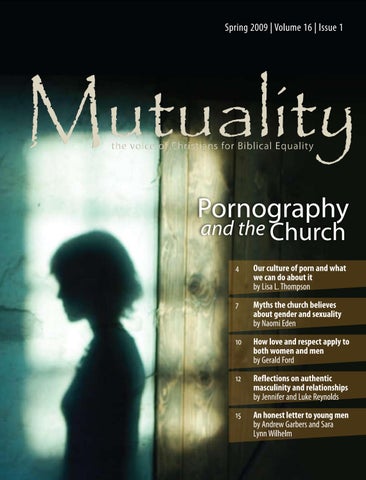
Spring 2009 | Volume 16 | Issue 1
Mutuality the voice of Christians for Biblical Equality
Pornography and the Church 4
Our culture of porn and what we can do about it by Lisa L. Thompson
7
Myths the church believes about gender and sexuality by Naomi Eden
10
How love and respect apply to both women and men by Gerald Ford
12
Reflections on authentic masculinity and relationships by Jennifer and Luke Reynolds
15
An honest letter to young men by Andrew Garbers and Sara Lynn Wilhelm
Mutuality 16.1, Spring 2009 “Let us then pursue what makes for peace and for mutual upbuilding” (Rom. 14:19, NRSV). Mutuality (issn: 1533-2470) seeks to provide inspiration, encouragement, and information about equality within the Christian church around the world. Editorial staff: Megan Greulich, editor; M. L. Castleberry, Adele Hebert, editorial assistants; Image Spigot, graphic designer; Mimi Haddad, president/publisher. Contact us at: Christians for Biblical Equality; 122 W Franklin Ave, Suite 218; Minneapolis, MN 554042451; phone: (612) 872-6898; fax: (612) 872-6891; email: mgreulich@cbeinternational.org; web: www. cbeinternational.org. We welcome your comments, article submissions, and advertisements. For writers guidelines, visit CBE’s website and follow the publications links. Advertising in Mutuality does not imply organizational endorsement. Please note that neither Christians for Biblical Equality, nor the editor, nor the editorial team is responsible or legally liable for any content or any statements made by any author, but the legal responsibility is solely that author’s once an article appears in Mutuality. All Scripture quotations, unless otherwise indicated, are taken from the Holy Bible, Today’s New International Version®. TNIV®. Copyright © 2002, 2004 by International Bible Society. Used by permission of Zondervan. All rights reserved. CBE grants permission for any original article (not a reprint) to be photocopied for local use provided no more than 1,000 copies are made, they are distributed free, the author is acknowledged, and CBE is recognized as the source. Mutuality is published quarterly by Christians for Biblical Equality and is sent free to members and supporters.
Contents F E AT U R E S 4
Beauty for Ashes: Men, women, and our raunch culture by Lisa L. Thompson
7
Sin Does Not Discriminate: Myths the church believes about gender and sexuality by Naomi Eden
10 Fully Human: A pastor and counselor responds to pornography by Gerald Ford 12 Authentic Masculinity; Authentic Relationships: Reflections for couples dealing with pornography by Jennifer and Luke Reynolds 15 Let’s Talk about Pornography: An honest letter to young men by Andrew Garbers and Sara Lynn Wilhelm 17 Luke Reynolds’ A New Man: A book review by Matthew Gemmill 18 The Fireman and His Princess: A film review of Fireproof by Luke Finsaas
MINISTRY AND CHAPTER NEWS 19 Students Engage with Biblical Equality 19 Praises, Prayers, and Reflections
D E PA R T M E N T S 3 From the Editor: Flesh of My Flesh 20 Giving Opportunities: Trash to Treasure 22 President’s Message: What Wounds One, Wounds All
cover design Shalanah Backus
2 M U T U A L I T Y | Spring 2009
websi te : www.cbeinternational.org
From the Editor by Megan Greulich
Flesh of My Flesh Why an issue on pornography?
These misguided and destructive ideas make it difficult to build empathy among believers, a vital characteristic of the In a startling study, researcher Ryan Burns found a direct correlation healthy and intimate community God desires for his children. between men’s porn use and their beliefs in traditional roles for Interestingly, Mimi Haddad recently pointed out to me that the women. As the amount of pornography a man views increases, so first thing Adam said when he saw Eve was “This is bone of my does the likelihood that he will “describe women in sexualized and bones; flesh of my flesh” (Gen. 2:23). In other words, he looked stereotypically feminine terms; approve of women in ‘traditionally at her and said “You are like me!” female’ occupations; and value Theology impacts the way we live. women who are more submissive and What we believe about the nature subordinate to men” (Ryan Burns, of women is reflected in how we 2002, as cited on againstpornography. treat them. What we believe about Pornography use has been linked org). While it is impossible to conclude ourselves — whether we are male to dissatisfaction with committed that pornography causes these beliefs, or female — is reflected in what relationships and their partner’s physical or vice versa, the correlation in itself we choose to participate in. This is is alarming, although not surprising appearance, an increase in extramarital the reason why we are publishing an to many egalitarians. Viewing issue of Mutuality on pornography affairs and sexual promiscuity, and a pornography, as Gerald Ford discusses and, specifically, why we are interested belief in “rape myths” (which include in his article that follows, makes it in the problem of pornography among such statements as “when women say no virtually impossible to see the full Christians. If the most recent research to sexual advances, they really mean yes” humanity of a woman. Instead she is correct, at least 50% of Christian becomes a shadow of herself, whose and “all women secretly or subconsciously men are addicted to pornography or main purpose is to fulfill the desires of view it regularly. (Increasingly, women want to be raped”). It has also been a man. She is not a partner or an equal. are also viewing pornography, a trend attributed to male impotence and is She is an object. author Ariel Levy attributes to our frequently listed as a reason for divorce. Social scientists have long linked culture’s concept of “sexual liberation” “essentialism,” or the over-emphasis of that in actuality encourages women to differences between men and women, ethnic groups, or classes, objectify themselves.) Clearly, pornography is a rampant problem in with a concept known as “the other.” It is a phenomenon in which the church. Yet we cannot hope to adequately address it without also we insist upon rigid distinctions between people groups and, in confronting the pervasive mistreatment of women both within our turn, find it easier to abuse and dehumanize those who are not like own walls and throughout the world. us. Slave owners in America justified their actions by convincing themselves that African Americans’ physical make-up was so unlike In this issue their own that they must be made for brutal labor. Those opposed to women’s suffrage justified their position by convincing themselves I recently heard a pastor preach that he never wants to move that women’s brains operated so differently from men’s that they people by pity or guilt, but by hope. I reflected upon this often as were incapable of making rational decisions about politics. And of we planned and put together this issue of Mutuality. We do not want to shame or reject those who struggle with pornography. But course there are many, many more examples. This concept of “the other” is prevalent in our churches today, we do want to suggest that God has a better way for us to live as particularly when considering gender. Some Christians promote men and women; that, through Christ, we can work to view and “gender essentialism,” and, rather than calling the church to a new, treat each other as God does. I pray this issue will be both a better way to live and relate to each other as the Bible does, we wake-up call and an encouragement to you, just as it has been use these mistaken beliefs to justify inequality. We “reason” that for me. Blessings to you as you read and reflect.
Did you know?
women are overly emotional and therefore should be excluded from leadership roles. And while we may not outwardly condone the use of pornography, we uphold our culture’s beliefs that lead to and perpetuate porn use — beliefs that insist women are meant to be beautiful and that men are, by nature, visual and more sexual.
booksto re : www.equalitydepot.com
Megan Greulich is the editor of Mutuality. She may be reached at mgreulich@cbeinternational.org. Note: Pornography, by nature, is difficult to discuss. Please be aware that the following content may be sensitive material.
M U T U A L I T Y | “Pornography and the Church”
3
Beauty for Ashes by Lisa L. Thompson
Television programming is also a “hotbed” of hyperIt’s all around us; we are surrounded. Sometimes it’s in our faces; other times it’s become such a normal part of everyday existence that we sexualization. An episode from season six of the popular series Two hardly even take note. On the television, on the radio, at the movies, and a Half Men provides an excellent illustration. In the episode at the local drug store or the checkout lane at the grocery store: it is entitled “A Jock Strap in Hell,” brothers Alan and Charlie are at a strip club when Charlie sees a former girlfriend-turned-stripper. “raunch culture,” and it is invading nearly every aspect of our lives. Examples abound. Let’s begin with just two examples from While Charlie talks to her as she dances, she mentions the loss of her television advertising. A 2005 ad by Carl’s Jr. hamburger chain teaching career following their breakup. In recompense for dumping her, Charlie actually negotiates featured Paris Hilton in a for the woman, Miss Pasternak, provocative swimsuit soaping “Because we have determined that all empowered women to become a tutor for his herself, as well as suggestively must be overtly and publicly sexual, and because the only nephew. In one notable quote sudsing and crawling on a sign of sexuality we seem to be able to recognize is a direct from the show, Miss Pasternak Bentley before taking a bite allusion to red-light entertainment, we have laced the sleazy accuses, “I gave you my heart, out of a “spicy BBQ burger.” energy and aesthetic of a topless club or a Penthouse shoot I gave you my soul, I gave you The ad immediately caused throughout our entire culture.” my body. And you just threw an uproar because of its clear ~ Ariel Levy, Female Chauvinist Pigs me aside like I was some piece pornographic overtones. Carl’s of garbage.” Charlie simply Jr. was unapologetic. More responds, “Yeah, my bad.” recently, television network Of course, other programs are also rich examples of the NBC rejected an ad intended for the 2009 Super Bowl. The ad created for PETA (People for the Ethical Treatment of Animals) hyper-sexualization of women, as well as the promotion of sexual was rejected for its excessive sexuality — in particular, sexuality violence against women. Take for instance the program America’s featuring vegetables. Yes, vegetables. The commercial depicted Next Top Model. The program features young women competing lingerie-clad models hot-tubbing with vegetables, provocatively for the opportunity to become models and is hosted by ex-model, licking pumpkins, steamily kissing broccoli, and sexily rubbing an turned TV talk-show host, Tyra Banks. One episode of the assortment of vegetables including asparagus all over their bodies. show featured a “crime scene” photo shoot. Accordingly, the
4 M U T U A L I T Y | Spring 2009
websi te : www.cbeinternational.org
models, some of whom were scantily clad, were posed in scenes featuring electrocution, gunshot wounds, strangulation, drowning, poisoning, and decapitation. In another scene, the model was a victim of a stabbing; it appeared her ovaries had been gouged out. A later episode of the program showed the women being photographed in a meat locker…dressed in meat. No discussion of television would be complete without mention of Oprah. While sometimes Oprah airs programs that discuss exploitation of women, at other times the show normalizes or trivializes it. For instance, one popular segment entitled, “Releasing Your Inner Sexpot,” taught women the “stripper walk” and featured “Pole Dancing 101.” This may have been an innocent attempt to help women in their sexual relationships, but any good intentions aside, such programming promotes and normalizes stripping as a so-called profession and argues that it is a healthy way for women to express sexuality. However, the lives of many women in the sex industry are a far cry from the glamorized version of stripping portrayed on Oprah. As Bernadette Barton (2006) reported in her book Stripped: Inside the Lives of Exotic Dancers, exposure to stripping exacts a high emotional and psychological toll on women: …a complex network of experiences tax the energy and self-respect of women the longer they work in the sex industry. The dancers’ comments demonstrate that stripping distorts their perceptions of money, sexuality, encourages them to blur their personal boundaries about previously unacceptable sexual acts, teaches them to develop contempt for men, reduces their sex drives, and causes problems in their intimate relationships. Several late-career dancers told me that stripping itself became literally toxic to them, that just the idea of going to work made them feel sick (p. 22). Women in the sex industry recognize the toll the industry takes on them. One woman involved in stripping quipped, “You age in dog years when you dance because it’s so hard” (Barton, 2006, p. 54). Another dancer explained, “It’s one of those things that either kills you or makes you stronger. If it doesn’t kill you, it makes you a stronger person. I mean kill you spiritually, emotionally” (Barton, p. 69). Radio is another place frequently imbued with overt sexuality, whether in advertising, music lyrics, or from the banter of disk jockeys and so-called shock jocks. Pop stars like Britney Spears produce an almost constant stream of highly sexualized songs. Consider just this brief excerpt of one of her songs: I gotta plan we can do it Just when you want it baby, baby, baby
booksto re : www.equalitydepot.com
As long as you want it Come with me we can do it baby, baby, baby Get naked, get naked, get naked, get naked Get naked, get naked, get naked, get naked Take it off, take it off, take it off, take it off Get naked, get naked, get naked, get naked As you may have guessed, the song is titled “Get Naked.” Or, how about Mariah Carey’s “Touch My Body”: Touch my body, put me on the floor Wrestle me around, play with me some more Touch my body, throw me on the bed I wanna make you feel like you never did Such songs leave little to the imagination, and are often expressions of dehumanized sexuality where the “other” is less a person to be known and loved, and more a mere instrument for a moment’s selfish gratification. Other songs like T-Pain’s “I’m in Luv Wit a Stripper” and Three 6 Mafia’s “It’s Hard out Here for a Pimp” further serve to popularize the notion that women are nothing more than material for the commercial sex industry. “It’s Hard out Here for a Pimp” was featured in the film Hustle and Flow and was actually awarded the 2005 Academy Award for Best Original Song. Despite the reality that as a criminal class, pimps are often notoriously violent and perpetrators of serial sexual offenses against those under their control, pimping is increasingly becoming normalized within American popular culture through such songs and films. And, too, radio personalities like Howard Stern make a living out of crude jokes, crass pranks, and routine degradations of women. His website on February 19, 2009, featured highlights from his interview with Shawna Lenee, a “Penthouse Pet” who gave the interview while topless. Shawna told Howard that she had been in pornography since she was 18 years and 5 days old. He pressed her about her reported suicide attempt and drug abuse, and tactlessly asked if she ever “blew guys” (performed oral sex on men) in return for meth. Shortly thereafter, their conversation becomes blatantly pornographic. In a brief interview with Stern where only snippets of her personal story begin to emerge, the veneer of a powerful woman on a sexual odyssey slips, and a picture appears of a troubled young woman frantically trying to gain approval by pleasing men through overt sexuality. Raunch culture has become a hegemonic force shaping how we see others, how we view ourselves, and even what we strive to be. “Ladies, are you sexy enough?” raunch culture asks us. “How big are your breasts? Not big enough? Get those implants! Are your lips full and plump? No worries, some silicone injections will take care of that. And what about those wrinkles? Time for Botox! Oh, and have you memorized those 101 sex tricks that Cosmopolitan
M U T U A L I T Y | “Pornography and the Church”
5
magazine tells you will please your man? What, no boyfriend? Don’t you want to be noticed? How about a pair of sweatpants with the word ‘juicy’ emblazoned on the behind, or wouldn’t that Playboy bunny T-shirt be cute? Of course, you could really let your hair down and be a ‘Girl Gone Wild’! Just flash your breasts and smile at the camera while a bunch of drunken men urge you on! That’s sure to get you noticed!” Perhaps this litany of problems created by raunch culture and its “solutions” seems unreal, but unfortunately, it’s not. This is the “pornified” world in which we live. Ours is a time and place continually telling females that to have meaning in life is to be sexy. “Not sexy?” it asks. “You have no meaning; you are invisible.” Of course, the deluge of advertising and media messaging that reminds us females of how imperfect we are does not equally influence all women. Still, I expect most any female in America today will admit to at least occasionally hearing that inner voice saying to herself that she is flawed, and that something must be changed about her body or her appearance for her to be truly beautiful. The bottom line is God did not create any woman to be a prostitute, a stripper, a porn star, or to feel like she must pursue an endless quest for physical perfection. As children of God, all females are endowed with worth and dignity for who they are… in all their infinite and beautiful varieties. For ourselves, for our mothers, sisters, daughters, nieces, granddaughters, and friends, it is time to reclaim our dignity and our beauty. Let’s exchange the ashes of raunch culture for the beautiful crowns of God’s love. Lisa L. Thompson is the liaison for the Abolition of Sexual Trafficking for The Salvation Army USA National Headquarters. In this role, she works on public policy issues and initiatives related to eradicating sexual trafficking and commercial sexual exploitation. She also assists in the development of strategies for The Salvation Army to create recovery services for survivors of sexual trafficking. Lisa previously served as Policy Representative for the National Association of Evangelicals’ Office for Governmental Affairs in Washington, DC.
Action Steps: Work to ensure internet filters are in use at public libraries and schools. (This could entail efforts to pass legislation requiring filters. For a good model for an American state law, see Utah's statute.) Learn more: www.safelibraries.org. Have your church or community join the annual “White Ribbon Campaign Against Pornography.” Learn more: www.moralityinmedia.org. Host a screening and discussion of the documentary film Somebody’s Daughter. Learn more: www.somebodysdaughter.org. Get help for sex addictions at www.candeocan.com or www.faithfulandtrueministries.com. Teach youth about the risks of commercial sexual exploitation with Wise as Serpents curriculum. Learn more: www.adultssavingkids.org. Work to establish or enforce zoning laws against sexually-oriented businesses. Learn more: www.reclaimourculture.org and www.ccv.org. Book your next hotel stay through www.cleanhotels.com. For the brave of heart, host a presentation of Who Wants to Be a Porn Star? (Contains sexually explicit and disturbing content, but is important knowledge for all concerned adults. Must be over 18 to attend.) To arrange a presentation, contact lisa_thompson@usn.salvationarmy.org. Host a book discussion on Pornified by Pamela Paul. Learn more: www.pamelapaul.com. Develop a ministry to persons involved in the adult entertainment industry like that of One Way Out (www.onewayout.org). Watch Indecency in the Check Out Lanes, a DVD of the American Decency Association, for advice on how to clean up magazine stands at your local stores. Email kimberly@americandecency.org.
Recommended Reading: “A Grassroots Guide to Protecting Your Community From Pornography,” available at www.citizenlink.org/pdfs/fosi/sextrafficking/grassrootsguide.pdf. “The National Plan to Prevent the Sexual Exploitation of Children,” available at www.missingkids.com/en_US/documents/NCPCSE_NationalPlan.pdf. “Report of the APA Task Force on the Sexualization of Girls,” available at www.apa.org/pi/wpo/sexualization.html. “Pornography’s Impact on Marriage and the Family,” by Jill Manning, available at www.heritage.org/research/family/tst111405a.cfm. Dads and Daughters: How to Inspire, Understand, and Support Your Daughter When She’s Growing Up So Fast, by Joe Kelly. So Sexy So Soon: The New Sexualized Childhood and What Parents Can Do to Protect Their Kids, by Diane Levin and Jean Kilbourne. Theology of the Body for Beginners: A Basic Introduction to Pope John Paul II's Sexual Revolution, by Christopher West.
6 M U T U A L I T Y | Spring 2009
websi te : www.cbeinternational.org
Sin Does Not Discriminate
by Naomi Eden Myths about sexuality are not just confined to our broader culture. They exist in our churches, as well.
Christian leaders often subscribe to stereotypes and myths about men and women and their sexuality. Most of the time, emphasis is placed on Christian women needing to dress modestly and for men to avoid the temptations of their “visual nature.” By proclaiming sexual myths, a “gendering” of sexual sin occurs which enables some and adds an extra level of shame for others. Basically, women are seen as less sexually motivated, and therefore issues such as female sexual addiction and pornography go unaddressed in many churches. There have been numerous times when I have felt the oppressive force of sexual myths within the church. When I first became a Christian as a teen, I was leaving a life of drugs and alcohol as well as sexual promiscuity. Pornography was something that many of my female friends and I viewed regularly and understood as acceptable. My testimony is one of God’s amazing grace and transformative power. However, more often than not, I have felt that my story is not one that is appropriate to tell to “church people.” Instead of embracing my newly freedom and purity in Christ, churches and church leaders have been adept at making sure I felt the full shame of my past sins. In youth groups, so much emphasis was placed on virginity that I felt like I needed to hide my story of God’s grace in order to be acceptable. I have long heard God’s call to tell my story, but have found that female sexuality is far too uncomfortable a subject for most Christians to deal with. At the same time, I have watched the reaction of the church to multiple testimonies of Christian men delivered from sexual sin. Instead of using these testimonies as opportunities to challenge men to higher levels of sexual purity, commentators and leaders instead imply that it is almost normal and expected for men to sin in this way. Another dangerous and sexist myth that often exists in the church is the idea that men and women are not sexual equals. Oftentimes, lust and pornography are seen primarily as men’s issues. I do not believe that there is biblical support for the
booksto re : www.equalitydepot.com
idea that the ability to act sinfully is related to one’s gender. There are instances of women living sexually immoral lifestyles in the Bible. Potiphar's wife, for example, was filled with lust for Joseph’s physique and was aggressive in her advances (Gen. 39:1-19). Today, it seems that popular Christianity would have us believe that these women did not struggle with lust and that the only reason women sin sexually is because of a misplaced desire to be loved. Yet men, on the other hand, supposedly struggle with lust simply because they are men. The church often touts myths about men being more visual or men liking sex more than women. These myths are sometimes puzzling when they contrast with individuals’ experiences. For instance, my husband is not a visual person; he thinks in words and not pictures, and text grabs his attention more than pictures do. But I am very visual, and God often communicates to me using pictures. When the church says men are one way and women are another way and an individual does not “fit” with the teaching, that “outlier” individual may feel isolated and odd. I would like to contend that many women both in and out of the church struggle with sexual immorality through both pornography and plain old lust. Somehow, the church has taught women that their sexuality is inferior to men’s. This teaching is fleshed out in many beliefs, such as women do not want sex as much as men do, women do not need sex as much as men do, or women who do are somehow perverted beyond reason! Sin Does Not Discriminate continued on page 16
M U T U A L I T Y | “Pornography and the Church”
7
8 M U T U A L I T Y | Spring 2009
websi te : www.cbeinternational.org
booksto re : www.equalitydepot.com
M U T U A L I T Y | “Pornography and the Church”
9
Fully Human
A Pastor and Counselor Responds to Pornography by Gerald Ford
Someone1 has said that one of the biggest problems with pornography is not that it shows too much of a woman, but that it doesn’t show enough. It doesn’t show that she is an individual with a soul, who has a right to be valued as such. It doesn’t show that she has the right to privacy and honor and respect. It doesn’t show that she is a person of worth, created in the image of God, fully human.
10 M U T U A L I T Y | Spring 2009
It is clear that pornography is a serious problem for both the church and the broader society. As a pastor and counselor, I am interested in the problems lurking beneath the problem. What is it about our culture that makes pornography normal, even acceptable? What is it about men that makes them think they have permission to look at women as objects? What is it about women that keeps them from believing they deserve better? In this article I propose that we will deal effectively with pornography only once we truly understand our sexuality, our value, and our relationships.
The Repression of Our Spirit: Understanding Sexuality While thinkers like Sigmund Freud have entertained the question of how repression of physical sexuality harms the individual, few people have dealt with the question of how repression of the human spirit has harmed our personality. We have been created to be in relationship with God, with one another, and with our own selves (all necessary if we are to live in full community), in a way that recognizes our spiritual, mental, and physical nature. God has expressed himself in all three of these ways, and bearing God’s image we also have the capability of these expressions.2 Denying that a person’s body is sacred, deserving to be respected and not exploited, is but a step away from assaulting the spirit and the mind in the same way. The mind and the body are never far apart. The spirit and the body are never far apart. The mind and the spirit are never far apart. What affects one will affect the others, and when one is in pain, it may well be sending a message to the others. Freud was also wrong about repression when he failed to recognize self-control as a healthy way to value sexuality. Selfcontrol, or we may call it self-discipline, is a healthy and necessary way to develop who we are, to grow in grace and in the knowledge of Christ (2 Pet. 2:18), to press toward the mark of the high call of God in Christ Jesus (Phil 3:14), and to be good stewards of who we are in mind, body, and spirit.
websi te : www.cbeinternational.org
In the Image of God: Understanding our Value
True love is stronger than most of us believe. It is not the fuzziness of a romance novel or the desperate fleeing of loneliness at all costs; true love is the “energy of our will that drives us toward What does show the whole truth about a woman, or a man? Not all the healing of what is broken about us.” 3 Love builds relationships. pictures are worth a thousand words. Let’s take a closer look at who we Love sacrifices. Love values the personhood of others. Respect happens when we see something we value. Respect will are as God’s children, created in his image, male and female (Gen. 1:27). As a pastor and as a marriage counselor, I hear of many good books, do well to preserve and nurture its object. Respect will seek to love. In the counseling room, when I hear men talking about support groups, and therapy approaches to help wrest a person away from the addictive snare of pornography. These efforts produce varying results, respect, the requests are often more about a demand for power but still something is lacking if we are only trying to change people’s minds without accountability. They don’t want questions about where about the nature of pornography. Nothing works as well as a genuine they are, what they do, whom they are with, or how they spend change of mind about the nature of women, the startling recognition that money and time. They want blind faith, and they don’t want to every woman is a person for whom Christ died. To let the gospel speak share decision-making. It gives respect a bad name. This love/respect issue is unhelpful. Statistically, there are to us about each other is to become amazed at the infinite value that God has given to us. When we truly understand our value, we are able some people who live this way, though certainly not all men and to look at each other and say “Here is someone who should not be made not all women do so. (And remember, statistics may only be a the victim of either shame or arrogance.” Internalizing this truth changes count of people’s mistakes rather than a count of their true human characteristics.) If we accept the ideas the way we “view” women, both behind the theory that some men may figuratively and literally. The value respect to the abandonment of world of pornography is a world Love is not the fuzziness of a love and some women value love to where respect is abandoned romance novel or the desperate the abandonment of respect, we must and lost, and it is a world where fleeing of loneliness at all costs; true also ask some hard questions. Why people become shallow viewers would men fail to see that they need of shallow expressions, in which love is the "energy of our will that Why would women fail to see neither the viewer nor the person drives us toward the healing of what love? that they need respect? Why would in the picture is respecting or is broken about us." we devalue either one of these great experiencing full humanity. graces? Do we believe that we can’t To see our value as Christ have both love and respect? Do we does requires us to deal with another fact: pornography not only fails to show all that is true of believe that either of these can really survive without the other? women, but it also fails to show all that is true of men. The tired and Love and respect are equally to be credited for influencing the worn-out clichés depicting men as animalistic cravers of yet another way we act toward each other, the way we speak to each other, sexual adventure, as well as the assumption that men just aren’t as and the purposes of our relationships. Pornography strikes out in both of these concepts; it sensitive as women when it comes to sexuality, have come not is neither respectful nor loving. God intends for us to give from the Bible, but rather from a fallen and shallow world. respect and love and to receive both in return, but the world of pornography is the world of selfishness and isolation. It is a world of manipulation. It is the world of a double life.
Love and Respect for Women and Men: Understanding Relationships
Fully Human
Recently, an old theory has resurged in the world of Christian counseling. I often hear people say that their well-meaning pastor or therapist has taught them that men want respect more than they want love and that women want love more than they want respect. The theory suggests that men will forsake love if they have to do so in order to get respect, and that women will forsake respect if they have to do so in order to gain love. On the face of it, this theory may seem valid but it is filled with problems and falsehoods. The truth about love is that true love is also respectful. The truth about respect is that it can and should be loving. If it is not connected to love, it is probably not respect. Furthermore, what many men view as respect is really something else. It may be nothing more than pride. If not pride, this “respect” may only be an attempt to avoid the openness and sharing that love requires. Or, sadly and strangely, it may be a cover-up of shame. Pride, avoidance, and shame do not recognize or value our humanity.
In Being Human…Becoming Human, noted theologian Helmut Thielicke writes of humanity in this way: it is our calling to be fully human, a quest that means that as we grow toward Christ, we become more human as well. This process continues throughout the believer’s life and never ends until we see Christ face to face. In heaven we will not be gods: we will finally be the complete humans God intended us to be. “The human self receives infinite reality from its awareness of existing for God, of being a human self for which God is the standard,” Thielicke writes. He points out that if we see ourselves only in relation to our jobs, or our possessions, or our parents’ standards, or our governmental construct, or our behaviors, then we will be a “lowly self.” Without a better standard than what we ourselves create, we have only our work to measure ourselves by. But, “…what an infinite emphasis it puts on the self to receive God as the standard.” Fully Human continued on page 14
booksto re : www.equalitydepot.com
M U T U A L I T Y | “Pornography and the Church”
11
Authentic Masculinity; Authentic Relationships
Reflections for Couples by Jennifer and Luke Reynolds
The Breaking Point: Jennifer’s Story Luke had just returned from a conference in California. Our only contact over the past week had been a brief fifteenminute phone conversation. The conference was going well, and he couldn’t wait to return and share the details. He was eager to see me again. The feeling was mutual. Even though at that time we were traveling through a difficult period in our relationship, I missed our daily conversations and his presence, his embrace. The series of events that followed his homecoming are now somewhat of a blur. I remember the inevitable discussion about the conference. We were in my car, parked. Luke was in the driver’s seat. “I have to read you a letter I wrote while at the conference. Please let me finish. After I’m done, I want you to be completely honest with me about anything that goes through your mind.” An indescribable sense came over me; my body clenched a bit, my heart started pounding just a tad faster, and my stomach squirmed. Something didn’t feel right and I had no idea what he was about to read.
12 M U T U A L I T Y | Spring 2009
As I sat there in the passenger seat, I listened as my fiancé confessed to using pornography on multiple occasions throughout our relationship as well as to acting in other ways that I will refer to as violations of trust. I literally felt as though someone had punched me in the stomach. I could not create sound; I could not speak. My world, which had been recently rocking, felt like it was collapsing. The attempt to fight off tears lasted until he finished reading, and then I could no longer hold back the pain of my fresh wounds. The next two weeks were filled with grieving. Several times I broke down and bawled until I couldn’t breathe, until I gagged. I didn’t know what to think, what to do, or where to go. Was I overreacting? According to culture, pornography is an acceptable component of a healthy sexual drive. And yet, the brokenness and pain we were both experiencing did not seem normal or healthy. Society’s acceptance of pornography, wrapped up in its definition of masculinity, is horribly skewed, and unfortunately the church has not been immune to such lies. But as Christians we need to find our standard for authentic masculinity in the Bible alone.
websi te : www.cbeinternational.org
Is your porn use destroying your relationship? Confront your addiction with these four biblical principles.
Defining Authentic Masculinity There is an amazing passage in the gospel of John in which Jesus’ behavior toward a hurting woman is contrasted with that of the Pharisees. These religious leaders and lawmakers often missed the point: they focused on objects rather than on people. In this way, they were as destructive and dehumanizing to those around them as those who use pornography today. They focused only on what built themselves up — what they needed — and therefore had no understanding or relationship with love. Enter Jesus ( John 8:2-9): At dawn [ Jesus] appeared again in the temple courts, where all the people gathered around him, and he sat down to teach them. The teachers of the law and the Pharisees brought in a woman caught in adultery. They made her stand before the group and said to Jesus, “Teacher, this woman was caught in the act of adultery. In the Law Moses commanded us to stone such women. Now what do you say?” They were using this question as a trap, in order to have a basis for accusing him. But Jesus bent down and started to write on the ground with his finger. When they kept on questioning him, he straightened up and said to them, “If any one of you is without sin, let him be the first to throw a stone at her.” Again he stooped down and wrote on the ground. At this, those who heard began to go away one at a time, the older ones first, until only Jesus was left, with the woman standing there.
Commitment (Col. 3:5; Phil. 4:8–9) Commit to stopping your harmful behavior. Commit to pray and daily depend on God. Commit to professional counseling. Commit to demonstrating to your spouse that she means more to you than your addiction. And commit to receiving the grace our Savior readily gives. Accountability (Rom. 12:1–2; James 5:16) Follow through on your commitments. Seek accountability from trusted friends. Sacrifice (Phil. 2:3–8; Eph. 5:21; Rom. 12:9–10; Gal. 5:13–14) Prove your love for your spouse through both words and actions. Allow healing to occur on her terms. Work daily to empathize with your spouse’s situation. Understand that forgiveness may not always include reconciliation, but seek after it anyway.
Jesus is focused not on what the woman is accused of, but on the attitudes of the Pharisees. The scene reveals a desire for dominance and power. These Pharisees acted in a way to make themselves feel stronger, which resulted in the shaming and abusing of the accused woman. Today, this cycle is replicated all too often. Men assert their “masculinity” as selfishness and dominance, and women are objectified and belittled. Pornography is not the only way this process occurs, but it is one of the most tragic. Culture tells us that pornography is normal — that sexual urges are needs, and that acting on those sexual urges is what real men do. Normal? The level of aggression and intensity displayed in pornography is unmatchable to intimate intercourse within a healthy marriage. Porn celebrates sex outside of committed relationships. In a tragically increasing manner, it also delights in
booksto re : www.equalitydepot.com
Honesty (1 John 1:9; 2 Cor. 4:2; Prov. 24:26) Wholeheartedly admit your problem to God and to your loved ones. Take full responsibility for your actions. Be prepared for and welcome your spouse’s honest reactions.
abusing and denigrating women. Two prominent researchers, Gail Dines and Robert Jensen, found that if pornographic films that contained offensive language against women were to be removed from the market, the entire industry would collapse. Men are aroused as women are verbally abused. But this isn’t the worst of it: in many porn films, and especially on internet sites, the increasing physical abuse is horrific. The big picture is this: men who watch women being abused are told by culture that they can easily switch back to the role of loving women with sensitivity and strength. This is a lie. Authentic masculinity arises from a place of egalitarian compassion, when respect and love replace domination and control. Yet, the Pharisees in this John 8 passage reveal their tired and accustomed trends: they exert what they consider strength by lording it over a woman who stands powerless before them. Their voices are all that matter, not hers.
M U T U A L I T Y | “Pornography and the Church”
13
A Woman’s Voice
Conclusion
A woman must understand that she cannot make her husband, boyfriend, or loved one stop using pornography. She can encourage growth, repentance, and transformation, but he must be the one who makes the choice. The only person we can change is ourselves. For many women this is a hard concept. Often culture portrays women as loving nurturers who desire to help those who are struggling. We need to change this perception. We are not saying that women need to stop nurturing or caring about those they love. However, the way this is often perverted into glorifying women’s desire to “fix” others, particularly men, is an unhealthy error that we must confront. We challenge women to center inwardly and work on strengthening themselves, to work on seeing themselves as Jesus does. If someone you love is struggling with pornography, it is important not to lose yourself in the process. Prayerfully consider your role, whether it is giving tough ultimatums or more gentle support. Each situation is different to a degree, but the commonality is that pornography is universally destructive. Do not settle for a relationship where you are one of many women. Do not settle for a relationship where you cannot trust the man you love. Choose a relationship where you will be treated the way Jesus wants you to be treated.
Ultimately, the norms of male domination — expressed through pornography — are the opposite of authentic masculinity. Pornography imprisons women in the grasp of insecure and dominant men. Each time men domineer over women, they throw the first stone. But Jesus does what is most powerful: he stands up for the woman with all the power he has. He frees her. Though John 8 doesn’t describe the woman’s face after her encounter with Jesus, we like to imagine it this way: After hearing Jesus’ words her head slowly rises. Instead of looking at the dirt she looks up for the first time. She sees the face of the one who loves her, recognizes her humanity. Her eyes tighten just a bit, and she stifles a tear or two. Her line of vision is clarified; gratitude is written on her face, a new strength is being written on her soul. Jennifer (MA, University of Hartford) and Luke (MA, Northern Arizona University) Reynolds live in Massachusetts with their son, Tyler, who was born in October of 2008. Jennifer edits the newsletter, Moms with Passion, and is finishing her first novel. Luke is a teacher and is working on his doctorate at Boston College. They are co-editors of the forthcoming anthology, Dedicated to the People of Darfur: Writings on Fear, Risk, and Hope.
Fully Human continued from page 11 The human self with God as the standard will see and treat other humans in a new and different way. It is only by grace that we grow toward the likeness of Christ, just as it is only by grace that we become the child of God by faith. We are God’s by creation, and we are his by redemption. By his grace, he who came among us as fully God and fully human seeks to perform the miracle of making us fully human as well. Notes: 1. John Paul II, from the lectures “Theology of the Body,” as discussed by Christopher West. 2. While this article cannot develop a full theological study of what it means to be created in the image of God, I have come to a comfortable belief that at least part of this expression refers to the mental, physical, and spiritual persons of God
14 M U T U A L I T Y | Spring 2009
(Father, Son, and Holy Spirit), which God has created in us, as mind, body, and spirit. Respectfully and thankfully stated, we too are “trinity." 3. Paul Tillich, Love, Power, and Justice. Oxford University Press: Oxford, 1954. Gerald Ford has been a part of the Houston Center for Christian Counseling since 1989 and has been a pastor since 1970. He now pastors the First Baptist Church of Beasley, Texas. His preparation includes a Master of Divinity degree from Southwestern Baptist Theological Seminary and a Master of Arts in psychology from Houston Baptist University. He is a Licensed Professional Counselor, a Licensed Marriage and Family Therapist, and an adjunct instructor of psychology at Wharton Junior College. His wife, Billie, is also an ordained minister and an independent historian. They teach communication and relationship workshops together and serve on the board of directors for “A Way In The Wilderness,” a ministry to the homeless and working poor of Galveston, Texas.
websi te : www.cbeinternational.org
a letter t o y o ung men
let’s
talk about
pornography by Andrew Garbers and Sara Lynn Wilhelm Sara and I wanted to write a letter to you about something we don’t often talk about: pornography. If you are anything like me, you were introduced to pornography at a fairly young age. You may view pornography as normal and just as something that men and boys look at (whether it’s videos or photographs). You may believe it exists because guys need it. I engaged in pornography and masturbation because it felt good and I then justified this behavior with the belief that guys need to release the hormonal/sexual tension that arises in them. Yet, like me, you may also see this as an embarrassing and addictive behavior. But what you probably don’t fully realize is the distorted view pornography gives you of women and how it hurts not only them, but you as well. When I would look at pornography I justified it by saying that it’s not hurting anyone; it’s only between me and the images I am looking at. Upon becoming a follower of Christ, those images, videos, and ideas stayed in my head. As I continued to date, I realized that I had unfair and unattainable expectations of the women in my life. Their inability to reach the expectations set by pornography repeatedly left me frustrated and feeling unsatisfied. Looking back, it is clear that my pornography use hurt me and my relationships with women. It also hurt my relationship with God. When we do not view others like God does, we are separating ourselves from him.
So I am glad that you are reading this letter. First of all, I want you to know that you don’t need to live in shame if you are struggling with pornography. God wants to do the work of restoration in all of our lives. Yet I also don’t want you to be ignorant of the devastating effects of pornography. Let me explain further. As a Christian woman, I have experienced the effects of pornography in my own life and have seen it affect the lives of those around me. Many wonderful women I have known live every day believing that they are inadequate and incapable because they cannot live up to the ideals they see around them. These images are something we cannot fulfill, not only because they consist of the most beautiful people in the world, but also because they portray an animalistic sexiness that no fully human woman embodies. I once worked with a youth group in which there was one student in particular who would never make eye contact with me or follow my directions. However, when our male pastor came alongside of him, he would listen. The reasons why this happened are many, but it is significant that he had grown up in a family with a father who was addicted to pornography and, at the age of thirteen, was also addicted himself. He was unable to show me respect because women were not people to engage with as leaders — they were images that existed for his gratification.
>>>>>>>>
>>>>>>>>
I agree with Andy that most people don’t realize the negative consequences of pornography. The problem is that you have grown up in a culture that has a “pornographic view” of women: the view that women are to serve as sexual toys or exist as nothing more than temptations for men. It is a view that makes it difficult to understand women as equals and partners and therefore makes it easy to treat women as less than human. The reality is that pornography robs and steals life, and separates us from each other.
Hearing stories like Sara’s is important because it is uncommon to hear about the problems caused by pornography. It is a topic most of us are afraid to talk about. How often have you heard about lust and pornography in your church? Possibly never. I sure hadn’t. I want to challenge you to begin talking about the problem — if you don’t become comfortable discussing this area of your life, then the healing and correction process can never begin.
booksto re : www.equalitydepot.com
M U T U A L I T Y | “Pornography and the Church”
15
Overcoming the addiction to pornography is not easy, nor is it something that can be done by yourself. I know I am where I am today because I have recognized my failures and now, through a lot of prayer and accountability relationships with some solid men, I have worked through this addiction. Now I have come to the point where I have accepted my forgiveness from Christ for my past lustful pornographic mistakes. I am not perfect, nor do I claim to be. Will there be mistakes in the future? There will be. I confess that I do not have all the answers nor do I think I have fully mastered a healthy sexuality. Every day is a constant struggle and battle with the temptation of lustful desires, but the difference now is that I recognize the temptations and know how to combat them with Christ’s help and the help of close friends. If you are battling against the temptation of pornography, I encourage you to be honest with yourself and to also open up and be real with some people you can trust. They are most likely struggling with the same temptations. You might want to check out a study that has been very helpful to me called “Lust Free Living.” >>>>>>>>
Being in relationship with Andy has been amazing. He is a man that I know sees me as a whole person. I can’t tell you how freeing and life-giving this is! I don’t feel the need to be anyone other than who I am, and I know that I provide the same support and love to him. I am passionate about seeing pornography come to an end because as we address this sin, we become united as the body of Christ, and men and women can live in a place of compassionate trust with one another. Andy and I could not enjoy a healthy relationship if
we allowed pornography to rob us of this unity and trust. You see, our humanity is only enhanced as the fullness of each other’s humanity is embraced. As you continue to view women as your sisters and as fully human, you will find your own humanity and life becomes so much richer. This is authentic relationship the way Christ intends. I hope that through our letter you understand more of how pornography devastates both men and women. We encourage you to take the step of courage and begin acknowledging this problem so that you can be free to experience God’s love more fully, and love your sisters in the vein of the promise of Colossians 3:9-11: “Do not lie to each other, since you have taken off your old self with its practices and have put on the new self, which is being renewed in knowledge in the image of its Creator. Here there is no Gentile or Jew, circumcised or uncircumcised, barbarian, Scythian, slave or free, but Christ is all, and is in all.” Know that we are praying for you as you walk this journey!
Sara and Andy are both M.Div. students at Bethel University (where they are also employed). They met at a meeting about planting a church in the city, and are now on the church’s core team. Once they got to know each other they ended up dating and are now getting married this summer. They are totally different, which is part of the reason why they love each other. Sara loves studying, and Andy really likes a good Wild hockey game.
Sin Does Not Discriminate continued from page 7 Sexual myths also impact men. There is a general awareness that men struggle with pornography, but there is also more tolerance for this behavior. I do not think that every man will necessarily have to “battle” extensively with pornography just because he happens to be a man. The Bible clearly does not condone sexual sin (Gal. 5:19–21), but it does not specify whether one sex will struggle more than the other. In fact, in a passage concerning married life, Paul clearly addresses the need for both husbands and wives to yield their bodies and to agree when to abstain from sexual intercourse. He goes on to say that both partners lack self-control in this area and that marriage is a viable option for those burning with passion (1 Cor. 7:1–9). I believe that God created both men and women to be equal sexual partners, that our sexuality is more similar than dissimilar, and that both genders are equally able to enjoy and also to be tempted by sex. We need to affirm our sexuality without making one gender feel inferior or less prone to sexual sin, for there is no evidence for this thought scripturally. We all
16 M U T U A L I T Y | Spring 2009
need to examine the lies our society tells us about sexuality, for it is difficult to maintain a godly perspective about sex in our culture. Promulgating sexist myths about sexuality does not help us to become more pure. As Colossians 2:16–23 tells us, rules and notions based solely upon “human commands and teachings” are not only useless but can also actively damage the spiritual health of individuals and communities. If women were treated as equals in the church, I believe it would be harder for damaging sexual myths to remain. Please do not act surprised if a woman is or has struggled with sexual sin in the form of pornography or extramarital affairs. This woman needs to hear that she can be renewed in Christ, forgiven by her fellow Christians, and go on to lead a pure life. Naomi Eden lives in Minnesota with her husband, Jason. She studied psychology and biblical studies at Evangel University and completed her master's degree in gerontology this past year. She recently celebrated her tenth year anniversary of being a Christian.
websi te : www.cbeinternational.org
B ook
R eview :
Luke Reynolds’
A New Man
by Matthew Gemmill Purchase it at equalitydepot.com!
Kings of smut Larry Flynt and Joe Francis made a lot of Americans uncomfortable in January when they requested $5 billion of stimulus cash from Congress. It is unclear whether the request was earnest or a cynical joke, but most commentators in the media expressed disgust that Flynt and Francis wanted taxpayers’ dollars to fund porn. What often went unsaid in these discussions was the awkward fact that taxpayers were pitching in plenty of their own cash for Flynt and Francis already. Government assistance wasn’t needed to keep the porn industry afloat; we were taking care of that ourselves. This is not hard to see: sex saturates our movies, television, magazines, books, and advertising. And it sells. It’s refreshing, then, to encounter someone as disgusted by the culture of pornography as Luke Reynolds. Drawing from his own experience of pornography addiction, Reynolds calls men, in his book A New Man, to reject any conception of masculinity that sees porn use as a natural — or, even worse, an essential — part of being a man. And he sees porn use as an inevitable part of the beer-swigging, truck-driving, “tough man” ideal exemplified during National Football League commercial breaks. For Reynolds, these images in popular culture are not ideals of manhood, but the opposite. Men addicted to pornography are not strong, but weak. They are not only slaves to their appetites, but also participate in and perpetuate violence against women. In Reynolds’ mind pornography is not a height of masculinity: it is its destruction. I think he is right. These are ideas that need to be shared. Opposition to pornography is often dismissed today as mere prudishness, as if it were only motivated by outmoded anxiety about sex. We’re told that if we could only lighten up and shed some of our inhibitions, we’d see that porn helps men let off steam and have a little fun. It’s a way men can harmlessly satisfy their sexual needs. It’s sometimes even necessary. Reynolds has no patience for these justifications of smut. They assume that men have little control over their appetites and that they should do little to try to control their behavior. They conflate masculinity with sexual aggression and, therefore, violence. No, Reynolds rightly says, these attitudes are as incorrect as they are destructive. The central plea in A New Man is for a different masculine ideal, what Reynolds calls “authentic masculinity” (or also “authentic strength”). This is the core of Reynolds’ book, and it is easiest to understand what he means by looking at his examples of it. The authentic man is Mr. Hooper, Reynolds’ middle school band instructor, who modeled joy and support
booksto re : www.equalitydepot.com
in the classroom and who, in a chance meeting years later, deflected Reynolds' gratitude and instead boasted of his wife's accomplishments. Or the authentic man is Reynolds’ grandfather, who, after nursing a tough man persona his entire life, learned gentleness and love when he had to nurse his wife through Alzheimer’s disease. Reynolds’ ideal of masculinity loves, gives, admits weakness, and is vulnerable. And he argues that a man loses these virtues when he looks at pornography: “Love can only be given from a place of vulnerable strength, and pornography is the opposite of vulnerable strength.” I respect how Reynolds wants to redefine masculinity, and I think his ideal is more or less the right one. But I am concerned about the language he uses to describe it, particularly his central phrase: “authentic strength.” It’s an odd choice, considering that Reynolds, each time he uses it, makes clear he’s not talking about strength as one would expect. So we find statements like: “Authentic strength is not independent and successful on its own.” Or: “The more vulnerable we become, the stronger we become.” I don’t doubt that Reynolds is describing here virtues that are important for men to cultivate. But I’m unsure that strength is the right word for it, rather than, say, humility or meekness or brotherly love. Unlike Reynolds, I don’t believe that strength is the defining element of masculinity. And it is telling that when he describes how only God’s power will release the porn-addicted man from his bondage, strength is never mentioned. Instead, dependence is. Still, A New Man gives us an admirable example of someone who rejected the lies of pornography. The most outstanding passages in the book are those in which Reynolds displays the vulnerability he commends by telling his own story: his first encounter with pornography as a boy, how it became an addiction, how an ultimatum from his future wife led him to therapy and eventual repentance, the pain of confessing to his parents and parents-in-law. I found Reynolds’ story stirring because he was narrating parts of my own shame-filled history of porn use. I found it stirring because it is a story, by God’s grace, of repentance and healing. I found it stirring because we need more men like him, willing to testify in public about what porn has destroyed in their lives. May we all find that courage to live transparently, honoring God and each other. Matthew Gemmill studied music at Wheaton College and the University of Michigan. He lives outside of Chicago, where he works as an accompanist, opera coach, and music teacher.
M U T U A L I T Y | “Pornography and the Church”
17
F I L M
R eview :
The Fireman and His Princess: A Review of Fireproof by Luke Finsaas
Nothing in Fireproof is what it seems to be. A salt and pepper shaker become an illustration of a strong marriage, roses stand in for women, an empty pizza box is a sign of spousal apathy. The film is replete with little metaphors, intelligible mints to help the audience understand and fix their marriages. Indeed, watching this movie is like attending an intensive marriage retreat where the hotel catches fire. But don’t worry. The men will put it out. Our main character is Caleb Holt (Kirk Cameron), a grumpy fireman with the maturity level of a high-school boy. He wants respect and a boat. His marriage hasn’t been going so well. Now that this wife, Katherine (Erin Bethea), is working, she’s too busy to buy groceries or do laundry. Caleb can’t communicate and trolls smutty pornographic websites; Katherine doesn’t respect or appreciate him. When she doesn’t leave him any pizza one evening, he blows up, fuming and shouting at her, until she whispers, “I want out.” Caleb stomps outside and beats up a garbage bin with a baseball bat. He is fussy but fine with the divorce. At first. Then his ministerial father sends him a journal with daily handwritten instructions. Thus begins Caleb’s adventure through ‘Love Dare,’ a 40-day program to woo back the love of your life by washing the dishes and sweeping the floor. Caleb starts doing little things every day for his wife: he tries not to insult her, he buys her flowers, he makes her dinner. These normal actions become infused with such profundity that one wonders if Caleb is scrubbing his heart, not the china. Yet, each of his achingly sincere actions is greeted with chilly apathy — his ice queen doesn’t love him anymore. In fact, Katherine has fallen for a charming doctor at her hospital (she’s the hospital’s public relations representative) and is now having lunch with him every day. Things escalate from here with brandished fists and actual house fires, conversions and chicken soup — all of which lead to the couple’s reconciliation. Nobody could fault the film for its themes. Keep your marriage together. Work hard, be kind, give your life to Christ. Pray and try some creativity. Love is not a feeling. The conversion subplot is admittedly cheesy, but sincere, and the treatment of pornography is delicate and truthful. Caleb’s addiction humiliates Katherine, and the film does a nice job underlining this without jackhammering the shameful point. On Day 23, Caleb carries the computer outside and bashes it in with a baseball bat, leaving a vase of roses and a note (“I love you more”) for Katherine on the computer table.
18 M U T U A L I T Y | Spring 2009
The film puts up a veil of egalitarianism. For instance, Caleb’s mother wrote (or first used) ‘Love Dare’; Katherine has a good job (though her work is treated like a social outing). But these little egalitarian mints are overpowered by more pervasive features in the film that reflect gender stereotypes and traditional roles. The men in this film are definitely wild at heart. Danger is a chuckle. Being a provider and defender is an assumption. Respect and appreciation are demanded. Almost every myth of masculinity is reinforced or recast. At the fire station, they lift weights, talk about ladies, and pull stupid pranks. Even after he becomes a Christian, we see Caleb in the yard bashing in the computer screen to rid himself of his pornography ‘parasite.’ According to the filmmakers, how does one deal with temptation? Violence. And what sort of marriage does Fireproof advocate? Certainly not one based on equality. One character puts it this way: “A woman’s like a rose. If you treat them right, they blossom. If you don’t, they wilt.” Obvious paternalism. Those in ‘authority’ (men) restrict the freedom or responsibilities of their ‘subordinates’ in their subordinates’ supposed best interest. Let’s take an example. What happens with Katherine’s flirty missteps with her doctor friend? She doesn’t apologize to Caleb. Without her big, strong fireman guiding her, she’s just a confused girl who can’t help but make mistakes; in short, she isn’t smart enough (or male enough) to be responsible for her own actions. In the end, Fireproof reinforces traditional gender roles. Katherine remains that helpless princess, confused and needing protection. Caleb is a knight serving his fragile lady. The entire film has that sickly sweet scent of roses, chocolates, and stuffed bears — immature, shoddy chivalry. In Fireproof, women are not portrayed as free equals with robust inner lives and personal strength. A woman is, the film says, a delicate rose in a vase that needs constant tending if it is to blossom. Be careful. Let her tend herself and she’ll wilt. And who knows? Veiled paternalism may be more dangerous than candid complementarianism. Luke Finsaas is a freelance writer and film critic from St. Paul, Minnesota. He graduated from Bethel University in 2008. His works have been published in The Clarion, Coeval, The Dublin Quarterly, and Rain Taxi Review of Books.
websi te : www.cbeinternational.org
MINISTRY NEWS
P R A I S E S A N D P R AY E R S
Students Engage with Biblical Equality
praise god with us for…
CBE continues to partner with academic institutions and faculty, bringing research on biblical equality to students around the world. Take for instance CBE member and Campbellsville University professor Susan Howell, who recently utilized articles from Mutuality and Priscilla Papers in her gender studies class. These students experienced such a profound encounter with CBE resources as they expanded upon gender and the Bible that they enthusiastically sent us their reflections:
• A gorgeous new web design and e-commerce solution, coming soon.
• CBE resources helped student Kegan Nail better understand Jesus. “I am certain that I have never taken the time to even realize Jesus' impact on the treatment of women,” Kegan wrote. “I always took note of his love and ability to relate to those shunned by society—tax collectors, prostitutes, etc. but I never considered his sincerity in his treatment and acceptance of women. Several stories in the Bible mention Jesus instructing others to demonstrate the characteristics of women and follow their example, which he encouraged even when women were still considered property.” • Other students experienced a paradigm shift in their understanding of gender. “If you would have asked me four months ago, ‘Do you believe it's ok for a woman to preach?’ I would have told you ‘Absolutely not.’ If you would have asked me four months ago, ‘Who should be the spiritual leader in a relationship?’ I would have told you ‘Men [should be],’” Lindsey Huff wrote. “After the articles we've read and the discussions we've had in class, my opinions have been completely altered...I believe God can use a woman just as much as He can use a man in His ministry.” • Still other students found new tools for studying the Bible. “I always felt that God created men and women equal. Then when I would read the Bible, I would interpret it...differently. After I read the articles, I understand that historical context can greatly influence biblical interpretation. I can now see that God indeed intended men and women to be equal partners,” Faith Medley shared. We are thankful to Susan and other friends like her who are sharing biblical equality across college campuses. Please pray for these students as they learn and wrestle with new ideas. And consider how your institution might partner with CBE or join as an institutional member. CBE institutional members receive many helpful resources. Visit www. cbeinternational.org and follow the Membership links to learn about organizational memberships.
booksto re : www.equalitydepot.com
• Many new books for CBE’s book service. • New CBE organizational members. • Interest in our student paper competition at our St. Louis conference, July 24-26, 2009. • Two student interns this year. • Many speaking opportunities for egalitarians.
pray to god with us for… • Contributions in this difficult economy. • Wisdom and insight into doing more with less. • Passionate and talented interns to work at CBE this year. • Great interest and attendance at our upcoming St. Louis conference. • Egalitarian papers and presence at the Evangelical Theological Conferences and Lausanne Theological Conference. • Positive responses and good connections with students and individuals at Cornerstone, Mission-Net, the Evangelical Theological Society, and other venues where CBE will have a presence.
reflect with us…
by Susan McCoubrie (with special thanks to Jo Ellen Heil) When we discuss the issue of pornography, we often think of magazines, movies, or the internet. But pornography first takes root in the heart and mind. When I need to corral my thoughts and center my emotions, I use a prayer from The Book of Common Prayer. In use since the 11th century, it has been a favorite for many believers through the ages. Almighty God, unto whom all hearts are open, all desires known, and from whom no secrets are hid: Cleanse the thoughts of my heart by the inspiration of your Holy Spirit, so that I may perfectly love thee and worthily magnify thy Holy Name, through Christ our Lord. Amen. Thus comforted and stilled, I can then echo the psalmist: “I will bless the Lord who gives me counsel…I keep the LORD always before me; because he is at my right hand, I shall not be moved” (Psalm 16:7-8, NRSV).
M U T U A L I T Y | “Pornography and the Church”
19
G iving
O pportunities :
Trash to Treasure: A P e r s o n a l S t o r y
by Kimberly Renee Gunvaldson
Late February 2008: “Someday you will write,” Mother said, “and your tears will be the ink you use.” A static cell phone connection, and 190 miles could not mask her deep emotions as she spoke to me. After hours of grief, my eyes were swollen. I was silent. She did not understand I was trying to breathe. “Honey, are you there?” “Yeah, Mom,” I grabbed my chest, I moaned. “I was just thinking about what you said, that’s all.” I choked back another wave of emotions; the painful despair of a broken heart. “I don’t know why...” I started to heave again. Utterly desolate I had no idea where God was and if he even cared anymore. “Why is this happening to me again?” My knees buckled under the grief and I slid to the floor of my bedroom. I pulled my legs up and wrapped my free arm around them. Barely holding the cell phone, I buried my face. “Honey,” she said more intensely than before, compelled by mother-love, restrained by physical distance, “Listen to me...are you listening?” I whimpered. “I don’t know why God has allowed these things in your life, but you remember what your name means? You will write with these tears, Kimberly,” she emphasized almost fiercely then, “and God will get all the glory...” Late January 2009: This conversation took place almost a year ago and was prophetic. It took place only a few days before I found my treasure. This treasure would inspire me to write with the tears that had so many times overwhelmed my soul. This treasure showed me those tears would be the ink that drives my pen to declare to the heartbroken, desperate, and forgotten that our God reigns, our God resurrects, and our God RESTORES! I grew up in a Christian home, and wanted what every “good” Christian girl wants: a Christian husband who would be the head of the home, my high priest. I would be the ultimate helpmate, supportive and stable...we would have a few babies and live in a comfortable home. It was my dream. I had been taught that women had supportive roles in family life. I had been taught the church family was no different. Equal in Christ, with different appointments, all important; there was no favoritism with my Creator. So to honor God I should seek diminutive ideals. And I accepted it with hardly a consideration. That was until our church family entered a crisis I barely remember (I was fifteen at the time). A woman had been elected to eldership. Many people left over this controversy. I could not understand why a woman elder caused so much division. What was so holy about an elder that made “maleness” requisite? The church crisis, long since evaporated from my conscious memory, still haunted me. But being in love with Christ, I ignored the taunts from within. Those musings whispered I was “built by Christ”;
20 M U T U A L I T Y | Spring 2009
I had Christ’s authority. I should preach and teach and prophesy, write stories that inspired hearts, stand in front of men and women and testify. But as a woman — that was not possible. Instead I went to Bible college to subdue the voices. Here was where I would learn my place in God’s community, and I would learn to love it. I took a “Christian Womanhood” class. I was sure this class would elucidate me. Fill in the gaps, fine tune my logic. All my suspicions would be scripturally repudiated, proving that I was loved equally and was as important as men; proving that different was equal…it was just different. In my Christian Womanhood class, I was shown how to set a table properly, the correct way to introduce people, how to dress for certain occasions, why it is important to have a husband’s prayer covering, what true wifely submission means, and which offices within the church are appropriate for female leadership. (It should be noted in my entire educational career, this was the only class I ever completely failed.) After college the voices in my heart were subdued. I was back in the “traditional theological fold" again. I had learned my place in God’s community, but I hadn’t learned to love it. What I had believed since childhood and found reiterated at college was two enigmatic truths: 1) Women were homemakers, and 2) Homemakers needed husbands. The next step was to marry. So I did. During marriage counseling, our Bible-based curriculum taught that men and women in Christ were equal. However, in the Christian home it was important to realize that “family” needed order, exactly like church family needed order. Therefore God ordained the “order” of the Christian family to follow the sequence of creation. Since Adam was created first, he was the “Head,” the “High Priest.” This particular curriculum included pictures of a house plan: The caption read something like, “God created the woman as man’s helpmate. Therefore the house is a home when the woman acts like the walls and the man acts like the roof. The roof keeps the walls together and the whole house protected.” It made sense, I supposed. I applied myself to this with all my heart. I had met a strong, confident, intelligent, talented, Christian man, and I was determined to be the kind of Christian wife God would be proud of. Yet nothing worked like it should have. I did all the submitting I could think of and more, but I could not do a thing about the abuse. My first heartbreak. I was told I was worthless, ugly, contentious, disgusting, and idiotic. The epithets he used to assault were numberless. His physical acts began to escalate. I had been told for so long that I was stupid. What was I becoming? I loved him. Why did he hate me so much? I was lost, broken, and so very alone. And yet, against my upbringing, I did the unthinkable; against all I believed, I filed for divorce. I was a divorced woman. How could God use me now? Where was my covering? What would I do? I had lost hope. Worse still
websi te : www.cbeinternational.org
were that those closest to me implored me to reconcile with my ex-husband, because it was what God wanted for me. I had not “sweat drops of blood, like our Savior had, [had I]?” “Things were not so bad that God could not heal. Where there is life there is hope.” “Marriage is hard, it is learning to give and take, to submit to Christ and love your husband.” For a time, family and friends withdrew. And one day, alone in my parents’ home, I fell to my face and groaned through my brokenness to God, “Am I imagining this, Lord? Have I made up the violence? Do you love me still? Am I crazy Lord? You know! Please help me!” I will not forget the thought that exploded through my mind: Malachi 2:14–16. In essence it said, “I am a witness between you and the wife of your youth…I see the violence…I hate divorce but I hate a man who covers himself with violence…” All I could do is cry, unhindered tears of release. God had seen me. I was not crazy, lazy, worthless, ugly, and useless. Everything I had been told. The curses over me were noted and rejected by the God I loved. He loved me and showed me that I was not forgotten. The culture of Christian tradition, however, is not easily swayed. I was not worthless, but I was still a woman. In the singleness that followed I should have learned to lean on Christ. But pressure mounted in the darkness of that in-between time, as I was told I needed to have a husband; my infant daughter needed a sibling; I needed to make a home. Taught that women in general, divorced women in particular, had remedial roles in the body of believers, I sat on edge of belief. How easy it would be to simply run away from the religious rules I couldn’t agree with and obviously couldn’t obey. So I ran. For several years I played church, but I made very destructive choices. If I couldn’t be a really good Christian woman, then at least I knew I could be a really bad one. June 2007: An old friend I hadn’t seen in years approached me at church. He explained that God had given him a vision of me. I was scrounging in a garbage heap. It looked to him like a dump or a huge mound of trash. There I was, digging through the filth. He went on: God said I believed with all my heart I was unwanted, useless, and as unnecessary as all the trash I was pilfering through. I was everything I had been told I was, worthless just like the garbage. But in his vision, I stopped and bent over; I uncovered a large priceless jewel. It was shining and beautiful and very precious. He said to me, “Kim, God wants you to know that you are that jewel!” I smiled and thanked him, saying all the niceties you say when a stranger tells you your darkest fears. But I wanted to run then — run from God and from all that I knew. With that I moved to Portland, prophecy forgotten. Portland was not what I expected. Things went from really bad to unbelievable heartache, and a trajectory of pain continued until late February 2008. booksto re : www.equalitydepot.com
Late February 2008: I did the only thing I could think of as I felt my spirit crumble. I called my mother. She told me about my tears. She reminded me about my name: Kimberly Renee, “Royal Fortress Reborn.” Only a few days later I decided to move back to my hometown. A weight was lifted from me. I was finally doing the right thing, going back to where God wanted me. And I could not get “home” soon enough. Early March 2008: It was a sunny day, and I needed to take the trash out. As I was dumping my load, I noticed in the dumpster a large box filled with books. I was intrigued. So I scrounged around, and retrieved several books which looked interesting enough. One especially caught my eye. I had not heard of the author, but his book’s title kept me riveted. Beyond Sex Roles, by Dr. Gilbert Bilezikian. I consumed it. The book declared that women in Christ are partners in the body and responsible to their God for the gifts he gives them. To spiritually descend to the consent of the subservient was an affront to what Christ had done on the cross. Women were joint heirs with their male counterparts, equal joint heirs with Christ Jesus. Paradise restored. Nothing was beyond our reach, in Christ. We were to submit to Christ and each other, uniformly, with no equivocations. I started to hope again, I started to breathe. Present day, 2009: One year later after having moved home, I found and read Dr. Bilezikian’s book again, its meaning even more fantastic than the first time I read it. I am a priceless creation to my Father. He has a glorious plan for my life, and I am not a first-class citizen of heaven with a second-rate purpose. I am gifted with talents he requires I share. It is a heavenly mandate religious tradition cannot steal. God views me as competent, intelligent, trustworthy, and priceless. The revelation that there is nothing I am prohibited from in his kingdom has set me free. Only a few weeks ago did the Holy Spirit remind me about the vision of the trash heap. I found God’s ideal for me in such a place, at the depths, beneath all the things the world discards. With tears of joy I write how I found out who I am in Christ, and I found out what I really mean to Jesus. I am that priceless jewel. And I am supposed to shine.
***
We praise God for restoring Kimberly, and thank him for you, our generous supporters, who provide funds to send egalitarian resources like Beyond Sex Roles all over the world. Will you make a contribution today so that we can reach many more women and men who long for God’s healing? Visit www.cbeinternational.org. Thank you!
M U T U A L I T Y | “Pornography and the Church”
21
President’s Message by Mimi Haddad
What Wounds One, Wounds All "Just as a body, though one, has many parts, but all its many parts form one body, so it is with Christ. For we were all baptized by one Spirit so as to form one body — whether Jews or Gentiles, slave or free — and we were all given the one Spirit to drink. Even so the body is not made up of one part but of many" (1 Cor. 12:12-14). Have you ever noticed how Scripture celebrates our interdependence, our mutuality, and our oneness as the church? To be members of Christ’s body gives new meaning, fellowship, and comfort to us in our weaknesses and suffering. It also means that our achievements and our joys are shared and celebrated by our brothers and sisters in Christ. Contrary to the isolation, competition, and ambition that often separates individuals, in the church our intimacy with Christ unites us as we humbly share in one another’s achievements and each other’s disappointments. In fact, in Jesus, we are to be so close to one another that what wounds one, wounds all, and when one rejoices, all rejoice (Rom. 12:15). Paul makes it clear that when one member suffers, all suffer. When one is honored, all are honored (1 Cor. 12:26, 1 Cor. 12:12–14). If this is true, then the church as a whole should suffer when women encounter gender bias. Yet, often women shoulder rejection that isolates them in their pain, distancing them from the comforts of authentic Christian community that God intended for the church. For example, one woman told me that her pastor holds staff meetings without inviting her, despite the fact that she teaches Bible and leads adult Bible study groups as a paid staff member. Other pastors even hold these meetings during times when the women cannot participate, or on the men's basketball court — sending an agonizing message to women. Just consider how this segregation might seem if ethnicity were the issue, rather than gender. The pain of these actions is real, and often women have few places to turn to for support. As a result, some women are confused, others are angry, and many simply leave the church altogether.
Friends, the time has come for all Christians to acknowledge the suffering women have endured. Though many of our brothers have not encountered gender prejudice, they can learn to share in the sufferings of their sisters in Christ. That is the road to reconciliation, healing, and authentic Christian community. That is the path of Christ, and also the responsibility of leadership. Former US president Dwight D. Eisenhower offered this type of leadership — sharing the sufferings of others — during some of the most difficult days of American history when our losses in World War II were great. Eisenhower made a promise that he would extend his fullest attention and empathy to our troops and to those who had lost loved ones, giving himself fully to the victims of the war. He was devoted to Americans through his empathy, choosing to understand rather than to be understood. President Eisenhower recognized, as Christ did, that leadership is a call to lay down your life for others. In this issue of Mutuality, we have explored the devastating impact of pornography as it fuels abuse and addiction. Though often indulged in secret, the impact is widely felt and impossible to escape as it shapes a devaluation of women. Yet in loving one another as Christ did, we recognize that what injures one member in Christ’s body hurts all. May Christ give us the awareness and power to live as self-sacrificing, empathetic people, ready to confront practices that lead to any practice that demeans women. Please join us in praying for the church to courageously and wisely bring to light that which hurts us all. Pray that God would build authentic reconciliation, community, and empathy, so that the process of healing for women and men may continue!
Announcing CBE Organizational Memberships
22 U T U A L I T Y | Spring 2009 and follow the Membership links. websi te : www.cbeinternational.org VisitMwww.cbeinternational.org
Christians for Biblical Equality Christians for Biblical Equality is an organization of Christian men and women who believe that the Bible, properly interpreted, teaches the fundamental equality of believers of all racial and ethnic groups, all economic classes, and all age groups, based on the teachings of Scripture as reflected in Galatians 3:28. Injustice is an abuse of power, taking from others what God has given them: their dignity, their freedom, their resources, and even their very lives. CBE also recognizes that prohibiting individuals from exercising their God-given gifts to further his kingdom constitutes injustice in a form that impoverishes the body of Christ and its ministry in the world at large. CBE accepts the call to be part of God’s mission in opposing injustice as required in Scriptures such as Micah 6:8. Core Values ◆ We believe the Bible teaches the equality of women and men. We believe God has given each person gifts to be used for the good of Christ’s kingdom. We believe Christians are to develop and exercise their God-given gifts in home, church, and society. We believe the Bible teaches that Christians are to oppose injustice. Mission Statement ◆ CBE equips believers by affirming the biblical truth about equality and justice. Thus all believers, without regard to gender, ethnicity, and class, are free and encouraged to use their God-given gifts in families, ministries, and communities. Core Purpose ◆ To communicate broadly the biblical truth that men and women are equally responsible to act justly and use their Godgiven gifts to further Christ’s kingdom. Envisioned Future ◆ CBE envisions a future where all believers will be encouraged to use their gifts for God’s glory and missional purposes, with the full support of their Christian communities.
Statement of Faith We believe the Bible is the inspired Word of God, is reliable, and is the final authority for faith and practice. We believe in the unity and trinity of God, eternally existing as three equal persons. We believe in the full deity and full humanity of Jesus Christ. We believe in the sinfulness of all persons. One result of sin is shattered relationships with God, others, and self. We believe that eternal salvation and restored relationships are possible through faith in Jesus Christ who died for us, rose from the dead, and is coming again. This salvation is offered to all people. We believe in the work of the Holy Spirit in salvation, and in the power and presence of the Holy Spirit in the life of believers. We believe in the equality and essential dignity of men and women of all ethnicities, ages, and classes. We recognize that all persons are made in the image of God and are to reflect that image in the community of believers, in the home, and in society. We believe that men and women are to diligently develop and use their God-given gifts for the good of the home, church, and society. We believe in the family, celibate singleness, and faithful heterosexual marriage as God’s design. We believe that, as mandated by the Bible, men and women are to oppose injustice.
CBE Membership
� CBE Membership Application Contact Information ________________________________________________ first and last name
_____________________________________________________________ street address _____________________________________________________________ city _________________________________________ state / province / country _____________________________ phone
_ _________________ zip / postal code
_ ____________________________ email address
_____________________________________________________________ church denomination
Annual Membership Fee (all fees are in U.S. dollars) Please check one: United States Members Individual Household Low Income Subscriptions*
1 Year � $45 � $65 � $25 � $40
3 Years � $120 � $170 � N/A � $115
International Members Individual Household Low Income Subscriptions*
1 Year � $55 � $75 � $34 � $49
3 Years � $145 � $190 � N/A � $140
*Does not include membership benefits.
Additional Contribution $ _______ TOTAL $________ CBE is an exempt organization as described in IRC Sec. 501(c)3 and as such donations may qualify as charitable contributions where allowed by law.
Payment Method � Check/Money Order (payable to Christians for Biblical Equality) � Visa � MasterCard � Discover � American Express ________________________________________ account number
_ _________________ expiration date
_________________ verification code (the four digits on the top right corner of American Express cards or final three digits found on the back of other cards)
CBE membership is available to those who support CBE’s Statement of Faith. Members receive CBE’s quarterly publications, Mutuality magazine and Priscilla Papers journal. Members are eligible for discounts on items from Equality Depot Bookstore, including books, articles, tapes, and videos. Members are also offered discounts on all international CBE conferences. Learn more by following the Membership link on our homepage.
_____________________________________________________________ signature
booksto re : www.equalitydepot.com
M U T U A L I T Y | “Pornography and the Church”
Please mail or fax this form to: Christians for Biblical Equality
122 W Franklin Ave, Suite 218 • Minneapolis, MN 55404-2451 phone: (612) 872-6898 • fax: (612) 872-6891 email: cbe@cbeinternational.org
23
CBE Members Save! 15% on Equality Depot resources and 50% on CBE recordings.* Order or become a member today! www.equalitydepot.com 612.872.6898
*discounts taken off the retail price.
Recommended Resources from CBE
Accepted in the Beloved: A Devotional Bible Study for Women on Finding Healing and Wholeness in God’s Love Leslie Ann McKinney
Joy Through the Night: Biblical Resources for Suffering People Aida Besancon Spencer & William David Spencer
My Brother’s Keeper: What the Social Sciences Do (and Don’t) Tell us About Masculinity Mary Stewart Van Leeuwen
This book is a Bible study that will help and encourage women who desire to know and experience God’s love and acceptance, and will help equip pastors or pastoral caregivers to support and assist survivors of abuse.
The authors draw from their own personal experience and what the Bible has to say about pain and suffering. This book reassures us that even in the midst of pain we can know joy as we learn to rely on God and the communal care of the church.
Building on the work she began in Gender and Grace, Van Leeuwen examines biological, psychological, biblical and cultural data in an effort to understand masculinity. Practical applications include raising sons, sexuality, and dealing with addiction.
A New Man Luke Reynolds Using the stories of real men, the author addresses the issue of pornography, its effects on both men and women. He uncovers the lies that keep people addicted and offers the hope of freedom to those who struggle with it.
Christians for Biblical Equality 122 West Franklin Ave, Suite 218 Minneapolis, MN 55404-2451
Non-Profit Org. U.S. POSTAGE
Forwarding Service Requested
Minneapolis, MN Permit No. 26907
24 M U T U A L I T Y | Spring 2009
PAID
websi te : www.cbeinternational.org