The academic journal of CBE International
Priscilla Papers Vol 40, No 4 | Autumn 2026
Overcomers 03 A Genealogy of Resilience: The Women in David’s Genetic Family Tree Sarah E. Fisher
7
Without a Place on the Walk of Fame: Jael Havilah Dharamraj
11 Ironies in Esther Misty Hedrick and Craig S. Keener
15 Tamar Is Righteous, But Judah Is Not: The Ancient Near Eastern Background Behind the Declaration in Genesis 38:26 Belinda Tan
20 Iconography and Female Church Leadership: Greco-Roman and Christian Art in the First to Fourth Centuries AD Heather Preston
26 Book Review: A Woman’s Place Is in the Story: Seeing Women in the Biblical Narrative Caylie Chatoney
Priscilla and Aquila instructed Apollos more perfectly in the way of the Lord. (Acts 18:26)
Editorial There is a song nearly every Indian remembers learning in school, translated from English into their mother tongue. It is the song that became the anthem of two resistance movements in the 60s and 70s—the fight for civil rights in America and the struggle against apartheid in South Africa: “We Shall Overcome.” Soulful yet stirring, it intercalates the grief of a lament with the defiance of a war cry. “We Shall Overcome” speaks to all those in this sorry world crushed under the weight of their despair—those in war zones, those who, for whatever reason, have migrated and are far from home, those terminally ill and lying in hospital beds, any and all of us readers. The song has a long and layered history before it was first sung in the form so familiar to us, which was during the labour strike against American Tobacco, in Charleston, South Carolina (1945– 1946). Significantly, and fitting the occasion, the lyrics underwent a small but key edit. The song “I Will Overcome” broke out from personal into public space in thunderous solidarity: “We Shall Overcome.” We. The Bible has applause-worthy examples of those who overcame, assuring me that I am not alone. This issue features examples of biblical women who overcame. Sarah Fisher works through David’s genealogy to show how women— David’s sisters, daughters, nieces, and granddaughters—seem to have borne the brunt of the trauma across generations of intra-family violence. Heather Preston lays out pictorial evidence to show how Christian iconography eventually and tragically fell in line with Greco-Roman representations in art of the woman as valued largely in her affiliation to a male. However, she also points to a model of female church leadership evidenced by pre-Constantine Christian art that we could work towards.
Priscilla Papers is indexed in the ATLA Religion Database® (ATLA RDB®), http://www.atla.com, in the Christian Periodical Index (CPI), in New Testament Abstracts (NTA), and in Religious and Theological Abstracts (R&TA), as well as by CBE itself. Priscilla Papers is licensed with EBSCO’s full-text informational library products. Full-text collections of Priscilla Papers are available through EBSCO Host’s Religion and Philosophy Collection, Galaxie Software’s Theological Journals collection, and Logos Bible Software. Priscilla Papers can also be found on Academia, Faithlife, and JSTOR. Priscilla Papers is a member publication of the American Association of Publishers. Advertising in Priscilla Papers does not imply organizational endorsement. Please note that neither CBE International, nor the editor, nor the editorial team is responsible or legally liable for any content or any statements made by any author, but the legal responsibility is solely that author’s once an article appears in Priscilla Papers.
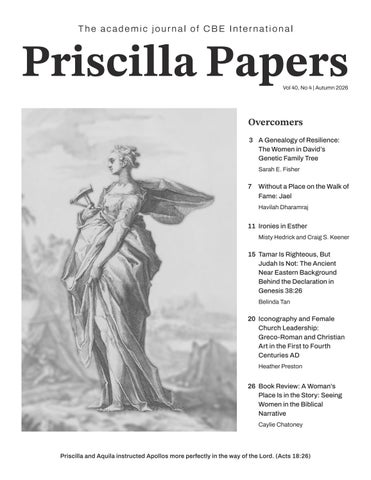
Belinda Tan revisits the story of Tamar, Judah’s daughter-in-law, to show the high-risk route she takes in order to secure her future. In doing so, she wins the approval of the ancestor of the tribe of Judah, but it takes an edge-of-the-seat dénouement. Havilah Dharamraj looks at the character Jael who gives Israel a definitive victory over a seemingly invincible oppressor by hammering a tent peg through the sleeping enemy commander’s head. She does it knowing full well that it could go horribly wrong for herself and her family. Martin Luther King Jr. used “We Shall Overcome” in a public address he made on 31 March 1968, just four days before his death. His confidence was this: “We shall overcome because the arc of the moral universe is long but it bends towards justice.”1 Misty Hedrick and Craig Keener open up the many ironies in the book of Esther that prove exactly that. Indeed, in Czechoslovakia’s non-violent Velvet Revolution of 1989, hundreds of thousands of protesters sang the song in English and Czech with a particular emphasis on the opening words of the last line: “I do believe (that we shall overcome some day).” I pray that the overcomers whom this issue features kindle hope. As I conclude my service with Priscilla Papers, I leave confident that this journal will continue to serve the cause of mutuality between women and men. Together, side by side, in God’s world. Havilah Dharamraj Editor Notes 1. https://wordsmusicandstories.wordpress.com/2019/11/25/weshall-overcome-by-martin-luther-king-jr/. Editor: Havilah Dharamraj Assistant Editor: Jeff Miller Graphic Designer: Margaret Lawrence President / Publisher: Mimi Haddad Peer Review Team: Andrew Bartlett, Joshua Barron, Stephanie Black, Lynn H. Cohick, Seblewengel (Seble) Daniel, Mary Evans, Laura J. Hunt, Chongpongmeren (Meren) Jamir, Jung-Sook Lee, Jill McGilvray, Ian Payne, Finny Philip, Charles Pitts, Terran Williams On the Cover: Jacob Matham after Hendrik Goltzius, Jael and Sisera, 1588, NGA 120934.jpg, https://commons.wikimedia.org/ wiki/File:Jacob_Matham_after_Hendrik_Goltzius,_Jael_and_ Sisera,_1588,_NGA_120934.jpg
CBE grants permission for any original article (not a reprint) to be photocopied for local use provided no more than 1,000 copies are made, they are distributed for free, the author is acknowledged, and CBE is recognized as the source. Priscilla Papers is the academic voice of CBE International, providing peer-reviewed, interdisciplinary scholarship on topics related to a biblical view of women and men in the home, church, and world.
Priscilla Papers (issn 0898–753x) is published quarterly by CBE International, 122 W Franklin Avenue, Suite 610, Minneapolis, MN 55404–2426 | cbeinternational.org | 612–872–6898 © CBE International, 2026.
DISCLAIMER: Final selection of all material published by CBE International in Priscilla Papers is entirely up to the discretion of the publisher, editor, and peer reviewers. Please note that each author is solely legally responsible for the content and the accuracy of facts, citations, references, and quotations rendered and properly attributed in the article appearing under her or his name. Neither CBE, nor the editor, nor the editorial team is responsible or legally liable for any content or any statements made by any author, but the legal responsibility is solely that author’s once an article appears in print in Priscilla Papers.
2
Priscilla Papers | 40/4 | Autumn 2026
cbeinternational.org
A Genealogy of Resilience: The Women in David’s Genetic Family Tree Sarah E. Fisher
Women have often been overlooked in history, but genealogy is a citizen-science that acknowledges male and female equality. A family tree is not complete without both. In the Bible, David’s genealogy listed the names of women but was rather quiet when it came to sharing their narratives. Thinking like a genealogist, asking empathetic questions, and using the exercises of well-thoughtout speculation can reveal bigger stories—stories of tragedy and resilience that lie below the surface. The women in David’s genetic circle (sisters, daughter, nieces, granddaughters) carried the DNA of the Davidic line which would bring forth the Messiah. Here are their stories. David’s Sisters: Zeruiah and Abigail Of all the influential women in the Bible, Zeruiah has been, perhaps, the most overlooked. In spite of being mentioned twentysix times, Zeruiah’s name was almost exclusively attached to her three ambitious sons. They were frequently described as the “sons of Zeruiah,” and never as the sons of their father. Nowhere in the biblical account is the name of Zeruiah’s husband mentioned.1 Zeruiah’s sons—Abishai, Joab, and Asahel—were David’s nephews, and they had a tremendous, and often devastating, impact on David’s life. Abishai was the chief of David’s “Mighty Men” (1 Chr 11:20– 21; 2 Sam 23:18). He was close to his uncle long before David was awarded the throne of Judah, fighting alongside David during the reign of Saul (1 Sam 26:5–12). Joab, Zeruiah’s middle son, eventually became David’s tenacious and formidable military leader. The youngest son, Asahel the swift of foot, was killed in battle by Abner, Saul’s cousin and military commander (2 Sam 2:23).
Zeruiah
Abishai
Unnamed Father To Her Children
Joab
Asahel
Eliab
Unnamed Wife
Jesse
Abinadab
Shimeah
Jerimoth
Abihail
(unnamed Mother)
Mahalath
Rehoboam
Jonadab
Asahel’s early death was a tragedy that undoubtedly devastated Zeruiah. No parent should bury their child. Did David console his sister? Did they grieve together? Was the reason Zeruiah’s two remaining sons plotted revenge against Abner a response to their mother’s grief? Abishai and Joab succeeded in their plot to kill Abner, and David’s response to their vigilante deed was to host a public funeral so as to distance himself from what they'd done. He tore his clothes in grief, wept, and sang a song of lament for Abner (2 Sam 3:31–39). Imagine Zeruiah’s feelings when her brother held a solemn funeral and publicly displayed his grief for the man who killed her child. Did David hold such a funeral when Asahel died? Did he tear his clothes and sing a song of lament for his nephew? The Bible does not say. More than once, David lamented that his sister’s sons were causing him grief.2 Joab not only killed Abner, but he also ordered the death of David’s son Absalom, as well as the death of his cousin Amasa. David concluded that Zeruiah’s sons, with their capacity for death and destruction, were an adversary (Hebrew, satan) to him.3 David recognized that the sons of Zeruiah (in particular, Joab) had too much political influence and a compulsion for violence which was damaging the kingdom.4 After Joab killed Abner, David cursed Joab, declaring that the blood of Abner should fall on “the head of Joab and on all his father’s house” (2 Sam 3:29 NRSVue). This was an interesting curse considering the Bible never divulged the name of Joab’s father. Of course, cursing Zeruiah’s house would have meant cursing David’s own house and so he cursed the unnamed father of his three nephews.5 In full recognition of Joab’s power, David suggested to his son and heir, Solomon, that Joab should be eliminated: “do not let his gray head go down to Sheol in peace” (1 Kgs 2:6 NRSVue). Solomon took
Nethaniel
Raddai
Ozem
Solomon
(s/o Bathsheba)
David
Absalom (s/o Maacah)
Abigail
Jether
Amasa
Maacah
Abijah / Abijam
David's Siblings, Nieces, and Nephews
Asa
cbeinternational.org
Priscilla Papers | 40/4 | Autumn 2026 3
David’s flip-flopping between his sister’s sons did not help the growing family tension. Joab, son of Zeruiah, did not take his demotion well and, being both jealous and suspicious of Amasa, he murdered Amasa with a kiss—which is noteworthy—and a sword (2 Sam 20:8–12). Joab left Amasa’s body in the road until a soldier removed him, placed him in the adjacent field, and covered his body.
Of all the named women in David’s genetic circle, Tamar was the only one who was never clearly identified as a mother or a wife. Did the rape exclude her from marriage? the advice and sent Benaiah to kill his cousin. Fearing for his life, Joab sought asylum in the temple but, with Solomon’s permission, Benaiah showed no mercy and killed him at the altar (1 Kgs 2:28–34). An empathetic genealogist will often imagine the circumstances of an ancestor’s life. If Zeruiah was still alive at the time, what would have been her actions when Joab sought refuge in the temple? Would she have gone to Solomon or Benaiah or her sister-in-law Bathsheba to beg for mercy? Did she pray for Joab’s deliverance? Zeruiah had already lost her youngest son Asahel, and the text never reveals what happened to Abishai. There is no indication that Zeruiah’s sons had any children or a lineage worth presenting. It seems that Zeruiah’s legacy ended with the death of her three sons. Abigail, David’s other named sister, had one son, Amasa. The Chronicler reports that the child’s father was Jether the Ishmaelite (1 Chr 2:17) whereas the book of Samuel (2 Sam 17:25) reported that Ithra the Israelite “went into” Abigail (KJV; most English translations say Ithra “married” Abigail) and fathered Amasa. This unique phrasing may indicate that this was a sexual encounter, not necessarily a marriage.6 David had an affinity for his sister’s son, calling Amasa “my bone and my flesh” (2 Sam 19:13 NRSVue), but the relationship had its ups and downs. When David’s son Absalom rebelled against him and tried to usurp the throne, Amasa, Absalom’s cousin, stepped in to lead the rebel army (2 Sam 17:25). When Absalom was killed and the insurgence was squashed by Joab, David forgave Amasa and welcomed him back into the family. In a surprising move of overt forgiveness David sacked Zeruiah’s son Joab—whose growing power had made David nervous—and placed Abigail’s son Amasa as commander of his army in Joab’s place (2 Sam 19:13).
David's Children and Grandchildren
Amnon
(s/ o Ahinoam)
Daniel
(s/ o Abigail)
Tamar
(d/ o Absalom)
4
Absalom (s/ o Maacah)
3 Unnamed Sons
Tamar
(d/ o Maacah)
Maacah
(d/ o OR gr-d/ o Absalom)
Priscilla Papers | 40/4 | Autumn 2026
Adonijah (s/ o Haggith)
Abigail lost her only son, and it appears his body was never returned to her. The grief was undoubtedly overwhelming and likely fractured the relationship with her sister, Zeruiah, mother of her son’s murderer. How would this tragedy impacted the relationships between Abigail, David, and Zeruiah? There’s no indication that David punished Joab for murdering Abigail’s son. The Bible lists no family for Amasa beyond his parents. If that is the case, Abigail’s family tree ended with the death of her son. Murder was a common occurrence in David’s family. Abigail lost her only son Amasa by the hand of Zeruiah’s son, Joab. David’s heir Amnon was killed by his younger son Absalom. Absalom died by the orders of Zeruiah’s son, Joab. Joab was killed by the orders of David's son, Solomon. Zeruiah and Abigail are part of a family given to an appalling degree of violence. David’s Daughter: Tamar Tamar was the daughter of David and his Geshurite (Aramean) wife, Maacah, daughter of Talmai, king of Geshur (2 Sam 3:3). This made Tamar (and Absalom) half-Israelite and half-Geshurite. The story of Tamar’s rape by her half-brother Amnon (son of David and Ahinoam) is a reminder that women have been victims of sexual violence across history. Amnon, with the encouragement of his cousin Jonadab, son of David’s third brother, Shimeah (1 Chr 2:13, 2 Sam 13:3), orchestrated a targeted attack against his half-sister and, regardless of her pleading, forced himself upon her. According to the text, Amnon raped Tamar, then he hated her, rejected her, and sent her away (2 Sam 13:1–19). In grief, Tamar put ashes on her head and tore her robe. It was a form of public protest, denouncing Amnon’s actions. Then she took refuge in her brother Absalom’s house. He consoled Tamar and told her to forget the rape (2 Sam 13:20), but he never forgot the offence and devised a long-term plan for vengeance.
7 Named Wives +
David
Shephatiah
Ithream
(s/ o Abital)
(s/ o Eglah)
Shimea
(s/ o Bathsheba)
Shobab
(s/ o Bathsheba)
Nathan
(s/ o Bathsheba)
Jerimoth (unamed mother)
Solomon
(s/ o Bathsheba)
Rehoboam (unamed mother)
Jerimoth (unamed mother)
9 More Named Sons
Basemath (unamed mother)
cbeinternational.org
From what we know, David did not stand up for his daughter after her rape. Nor did he console her, unless the narrative fails to record the event. David tore his clothes on many other occasions of grief or indignation,7 but there was no record of him rending his garments when he heard of Tamar’s rape, nor is there any record of Amnon receiving punishment for his crime. Amnon was David’s heir, his firstborn. Did David bury this shameful attack to protect his heir apparent? Did he hope that this problem would resolve itself and quietly go away? Did the event remind him of his own guilt regarding the sexual demand he placed on Bathsheba, which is recorded only two chapters earlier? Had the rapist been anybody else, David might perhaps have been more willing to demand justice for his daughter. The attacker, however, was his eldest son and the crown prince, and so (it appears) he turned a blind eye.8 The text says nothing about Tamar’s story after she was violated, other than that she went to live in Absalom’s house (2 Sam 13:20). Of all the named women in David’s genetic circle, Tamar was the only one who was never clearly identified as a mother or a wife. Did the rape exclude her from marriage? When Amnon rejected her, she feared she would be excluded and sent away without marital prospects. In her words, this rejection was worse than sexually assaulting her (2 Sam 13:16). Without a male protector, Tamar would be without a future. When Absalom murdered his half-brother Amnon and fled to the home of his (and Tamar’s) maternal grandfather Talmai, king of Geshur (2 Sam 13:28–37), it is reasonable to imagine that Tamar joined him as part of his household. Perhaps her grandfather Talmai was more sympathetic to her suffering than her father David was. According to the biblical account, Absalom stayed in Geshur for three years (2 Sam 13:38). Their cousin Joab, the son of David’s sister Zeruiah, attempted to reconcile the relationship between father and son, using the intercession of a wise woman (2 Sam 14:1–20). Even after Absalom returned to Jerusalem, David ignored him for another two years before granting him an audience (2 Sam 14:28). Assuming their mother, Maacah, was still alive, one wonders how this might have put a strain on the relationship between David and his Aramean wife. It is not hard to imagine that she would have been an advocate for her son Absalom, and her abused daughter, Tamar. David appeared to have developed the habit of avoiding family problems. Not speaking to Absalom for five years did nothing to mend their fragile relationship and, as a result, Absalom’s lack of allegiance to his father and eventual rebellion were not surprising. Tamar would have been caught in the relationship struggles between her father, David, and her brother, Absalom. Had she felt obliged to choose a side, one can imagine who she would have picked. David was her father and king, but he does not seem to have acted to seek justice for her, alleviate her grief, or support her healing. By his actions, Absalom showed more concern and compassion towards Tamar than David. It is reasonable to suspect that she may have supported Absalom when he rebelled against their father. David’s Niece and Grandniece: Abihail and Mahalath With seven brothers and two sisters, David undoubtedly had many nieces and nephews, but only one niece is named. Abihail was the daughter of David’s oldest brother, Eliab of Bethlehem (2 Chr cbeinternational.org
The women in David’s family tree had to live through, and overcome, significant trauma. 11:18). She married her cousin Jerimoth, David’s son through one of his unnamed wives. The only child of Abihail and Jerimoth that the reader is made aware of was their daughter Mahalath. She would become the wife of Rehoboam, king of Judah and grandson of David (2 Chr 11:18). This would make Mahalath David’s granddaughter (through his son Jerimoth), his great niece (through his niece Abihail), and his granddaughter-in-law (as wife to David’s grandson Rehoboam, son of Solomon). Her royal lineage was impeccable. Mahalath was the first wife of Rehoboam, but she was not the cherished wife. Rehoboam chose an heir from his wife, Maacah, the (grand) daughter of Absalom, and through this union the royal line of David was continued. Mahalath’s rejection as primary wife must have been upsetting for her and her mother, Abihail. Their connection to David was deep and their royal lineage was of the highest quality. Mahalath was overlooked because Rehoboam favoured a daughter of Absalom, the charismatic people’s prince who nearly succeeded in his coup against David. Absalom and Abihail were cousins, and both of their daughters were wives to king Rehoboam, son of their cousin Solomon. Rehoboam preferred Absalom’s daughter over Abihail’s daughter, because in this family power was everything. David’s Granddaughters: Taphath, Basemath, Mahalath, Tamar and Maacah The text gives us five named granddaughters of David: Taphath and Basemath (daughters of Solomon), Mahalath (daughter of Jerimoth, mentioned above), Tamar and Maacah (daughters of Absalom). Taphath and Basemath are mentioned only in relation to their husbands, who were two assigned deputies over land in Northern Israel (1 Kgs 4:11, 15). When their brother, Rehoboam, lost part of the kingdom to Jeroboam, their lives as royal princesses may have been in peril. Beyond this supposition, their story is unknown. Absalom’s daughter, Tamar, is only mentioned once in the book of Samuel: “There were born to Absalom three sons and one daughter whose name was Tamar” (2 Sam 14:27 NRSVue).9 Maacah is not mentioned. In the Chronicler’s account, Maacah is listed as the daughter of Absalom and the wife of Rehoboam, “whom he loved the most” (2 Chr 11:20–21). A study of the Hebrew word for children/ grandchildren10 suggests that a daughter or son can mean a child or a grandchild, so Maacah may have been a granddaughter of Absalom and great granddaughter of David.11 Later in the Chronicler’s account, Maacah was named as the daughter of Uriel (2 Chr 13:2). This could suggest that Maacah was the daughter of Uriel and Absalom’s daughter Tamar, making her a granddaughter (not daughter) of Absalom. The Bible drops these hints but offers no clarity. In genealogy speak, this is a “brick wall.” Until other textual evidence shows up, there can be no certainty.
Priscilla Papers | 40/4 | Autumn 2026 5
Biblical genealogy indicates that naming children after loved ones was not a common custom, so it is worth noting that these two “daughters” of Absalom (Tamar and Maacah) were named after Absalom’s mother Maacah, daughter of Talmai King of Geshur, and Tamar, Absalom’s sister. The latter women must have been well respected and loved to have garnered namesakes. Outside of being named after her aunt, little is known about Absalom’s daughter Tamar. Maacah, on the other hand, became the mother of Rehoboam’s heir Abijah/Abijam. Scripture identified Maacah as one who turned away from YHWH (2 Chr 15:16; 1 Kgs 15:13). She was removed from her role as Queen (grand) Mother to King Asa (Abijah’s son) because she created an idolatrous image.12
mother of Abijah/Abijam (see 2 Chron 13:1 Kgs 15:1–2), king of Judah, and grandmother to his heir, Asa. The kings of Judah had multiple wives but only one mother. The mothers were the true queens, for the five women in Matthew’s genealogical account are presented as mothers rather than wives. “Out of” women came the cherished Messianic lineage.15 Women of the Davidic Covenant
Mothers of the King
David’s family life was pretty much a disaster, but it was through such a tangled mess that the Messiah, of the Davidic covenant, was born. A study of anyone’s genealogies will show that every human comes from complicated stories of complicated people. Jesus, in this regard, was no different.
Even though women were necessary to deliver the lineage, ancient genealogies remained patrilineal. Only four women are named (Tamar, Rahab, Ruth, and Mary) in the genealogy of Jesus as recorded by Matthew (Matt 1:1–17). Also mentioned, though not by name, is the wife of Uriah (Bathsheba) who became the mother of Solomon. No women, not even Mary, are mentioned in Luke’s genealogy. Every generation had a mother, so it is unfortunate that Luke and Matthew failed to mention13 the other identified women in Jesus’s direct line, such as Maacah (mother of Absalom), Maacah (mother of Abijah), or other mothers of Judean kings, like Azubah, Zibiah, and Hephzibah.14
Jesus fulfilled the Davidic covenant by coming out of a line of women who bore great grief, whose sons died by the hands of their own family. Mary stood at the foot of the cross, knowing the same thing. Her son Jesus died by the hands of his own people. How fitting that he had to die like a son of David to be victorious. The women in David’s family tree had to live through, and overcome, significant trauma. There is enough in the biblical text to give us an idea of what it was like to be a mother, a daughter, a niece, or a sister in David’s complicated and tumultuous family. These resilient women suffered much grief, but they should be remembered because their DNA runs deep in the covenant which gave birth to the Messiah.
In the royal family of David, women were political pawns. Their power, if any, was based on their ability to be mothers. Zeruiah was the mother of Abishai, Joab, and Asahel; Abigail was the mother of Amasa; Abihail was the mother of Mahalath; Maacah was the
Their descendant Jesus also faced violent trauma. By falling into the depths of Sheol and rising out of it, he overcame trauma and death to save every branch of the human family tree: Jew and Gentile, slave and free, male and female (Gal 3:28).
Notes 1. 2. 3. 4. 5. 6.
7. 8.
9.
6
Josephus, Antiquities of the Jews, Book VII, 1.3. Josephus named Suri as Zeruiah’s husband and the father of her sons. See 2 Sam 3:39; 2 Sam 16:10; 2 Sam 19:22. Ryan E. Stokes, “Satan, Yhwh’s Executioner,” JBL 133/2 (2014): 253–54. Although Joab did much to fortify the kingdom and never sought to overtake the throne, David recognized the threat of Joab’s dominating influence on the kingdom. Was this curse a lashing out by David or a prophetic announcement? 2 Sam 16:10 hints that David expected curses to only have a consequential result if they represented God’s will. Paul S. Evans, “All in the Family of David: The Chronicler’s Change from the Ammonite (2 Sam 17:25) to the Davidic Zeruiah (1 Chr 2:16),” in Community: Biblical and Theological Reflections in Honor of August H. Konkel (Pickwick, 2022) 78–79. Sarah E. Fisher, “Qara: The Ancient Custom of Tearing your Clothes” (Feb 2, 2025) https://hebrewwordlessons.com. The rape of Jacob’s daughter Dinah resulted in a targeted attack against the city of Shechem. Dinah’s brothers, Simeon and Levi, exacted revenge (like Absalom), but her father Jacob (like David) offered her no consolation (Gen 34). Absalom’s three sons were never named in the Chronicler’s account. According to 2 Samuel, Absalom built a tower to be remembered because, he said, he had “no son to keep my name in remembrance” (2 Sam 18:18 NRSVue). Priscilla Papers | 40/4 | Autumn 2026
10. Sarah E. Fisher, “B’ney banim: Children of Children, Biblical Grandparents & Grandkids” (Sept 10, 2023), https:// hebrewwordlessons.com. 11. 2 Chr 13:2 lists Maacah with an alternative spelling: Michaiah. 12. Julie Kelso, “The Transgression of Maacah in 2 Chronicles 15–16: A Simple Case of Idolatry or the Threatening Poesis of Maternal Speech?,” Bible and Critical Theory 3/3 (2007) 1–2. 13. Marshall D. Johnson, The Purpose of the Biblical Genealogies, with Special Reference to the Setting of the Genealogies of Jesus (Cambridge University Press, 1988), 45. 14. Azubah was the consort of king Asa and mother to king Jehoshaphat (1 Kgs 22:42, 2 Chr 20:31); Zibiah was the consort of king Ahaziah and mother to king Jehoash (2 Kgs 12:1, 2 Chr 24:1); Hephzibah was the consort of king Hezekiah and mother to king Manasseh (2 Kgs 21:1). 15. Matthew used the Greek phrase, ἐκ τῆς, meaning “out of,” preceding the name. For example, Judah was the father of Perez and Zerah out of Tamar (Matt 1:3). Sarah E. Fisher is a Presbyterian lay pastor, a library technician at the University of Prince Edward Island, President of the PEI Genealogical Society, and a doctoral student in Biblical Studies. She has a Masters of Arts in Medieval Studies from the University of York and is the blog author of https://hebrewwordlessons.com/.
cbeinternational.org
Without a Place on the Walk of Fame: Jael Havilah Dharamraj
Given a choice between “Jael” and “Deborah” as a baby name, Christian parents are likely to choose the latter. Jael (Yael) stands a better chance in a Jewish family. There must be something Christian readers are missing in their assessment of this biblical woman. Jael appears in the third of the hero-stories in the book of Judges. As in each story, the people are cruelly oppressed by foreign powers; a “judge” steps in to overthrow the colonizer. The “judge” in Judges is a warrior. That is why, when the account puts up three protagonists— Deborah, Barak, and Jael, in that order of appearance—the reader might ask of the trio: Will the judge here please raise their hand? The narrator, anticipating our question, weaves together a plot whose twists have us hooked into a quest for the answer. Deborah and Barak Two decades have passed under the grim oppression of the Canaanites. Their instrument of domination is iron technology, still new to this part of the world. The pride of their army is a fleet of 900 chariots fitted out with iron reinforcements, under the command of a certain Sisera. Israel, a tribal federation of farmers and livestockkeepers with no standing army, dares not revolt. This is when the judge usually makes his entry. Instead, the narrative introduces us to a female: Deborah. We are taken aback, but Deborah is extraordinary by any standard. A woman held in esteem nationwide as an arbitrator of disputes. A female prophet. A fiery woman.1 Just as we adjust our expectations, Deborah sends for a male, Barak, and commissions him as leader of the resistance. Her task, it appears, was as a catalyst. The action, the “honor” of executing deliverance, is offered to Barak. Barak is a reluctant judge.2 He has his terms, and makes them doubly clear to Deborah: “If you go with me, I will go; but if you don’t go with me, I won’t go” (4:8 NIV). Deborah is willing to accompany the unenthusiastic Barak. However, she foretells that because of Barak’s reluctance, “the honor will not be yours, for the Lord will deliver Sisera into the hands of a woman” (4:9 NIV). Since there is no woman in the story other than Deborah, we fall back on our initial surmise that the “honor” of judgeship will fall to her. By default, she will be the one to slay Sisera. The armies are mustered and encamped. The Israelites choose a position of advantage at the top of Mount Tabor. This does not bother the Canaanites gathered in the valley of the Kishon at the foot of Tabor for they are confident that their iron-fitted chariots will win the day. In her role of female prophet, Deborah gives the signal for Barak to commence the attack: “Go! This is the day the Lord has given Sisera into your hands” (4:14 NIV). What do we make of this? Barak, it appears, has been offered a second chance at judgeship. Indeed, Barak charges down the slopes of Tabor in full cry, and as in holy war scenarios across the Old Testament, “David” routs “Goliath.” An unexpected downpour turns the dry wadi of the Kishon into a muddy torrent, turning the tables on the Canaanite chariotry. The wheels, cbeinternational.org
with their heavy iron reinforcements, are immobilized in the onrush of water, and the Canaanite warriors flee either with or without their chariots. The commander Sisera flees without. If we expect that this is the moment Sisera falls into the hands of Barak, our hopes are dashed almost immediately. Like watching two scenes simultaneously on a split screen, we see Sisera fleeing over the horizon incognito and unpursued, while Barak hares off after the fleeing chariots. We’ve been cheated of the good-guy-chases-bad-guy sequence. Barak has missed spotting Sisera perhaps because, like Israel at the start of the story (4:3), his eyes are fixed on the chariots. While we see Barak proceeding west in the direction of the enemy headquarters, all sound and fury, we see Sisera arriving at his eastward destination3—a safe-house by a landmark tree, the residence of a certain Heber. We find out later that he is Jael’s husband. The narrator had mentioned this earlier: “Now Heber the Kenite had left the other Kenites, . . . and pitched his tent by the great tree in Zaanannim near Kedesh” (4:11 NIV).4 As Sisera’s fleeing feet pound their panicked way towards this tent, the narrator provides further explanation: “there was an alliance between Jabin king of Hazor and the family of Heber the Kenite” (4:17 NIV). The Kenites were known to be metal smiths.5 It looks like Heber has worked out a lucrative business deal for his clan with the Canaanite overlord. Heber is a service provider for the iron-fitted chariots. This explains why Sisera is familiar with Heber, and why he seeks out Heber’s tent as his emergency hideout. We expect that for the plot to roll into its denouement, Barak has to realize he’s barking up the wrong tree and somehow needs to locate the right one. Jael in Story At this point, when it’s anyone’s guess how Sisera will be found and dealt with, Jael, wife of Heber, makes her entry. In a parody of the cultural practice of women going out to welcome victorious warriors (11:34), she goes out to greet Sisera, whom she seems to know well. The irony, of course, is that Sisera is no war hero, but rather a fugitive commander who has disgraced himself thoroughly by abandoning his army in order to save his own skin. Most curious is the encouragement she speaks—“Don’t be afraid” (4:18 NIV). It reminds us of Deborah’s repeated reassurance of Barak. As Deborah is to Barak, so Jael is to Sisera. The protagonists are nicely paired off against the antagonists, or so we are led to think. Before Sisera can speak a word Jael reads the situation and takes full control. She offers him an effusive welcome, brings him into her tent, and hides him under a covering, probably a thick sheepskin rug.6 Now Sisera speaks his first words in the story: “I’m thirsty” (4:19 NIV). As Barak’s words to Deborah expressed his reliance on her, so Sisera’s words to Jael express his dependence on her. The milk Jael offers instead of plain water could have been goat’s milk, known for its sleep-inducing effect. Does she dope him so as to dupe him? The effect of the milk on the battle-fatigued Sisera probably Priscilla Papers | 40/4 | Autumn 2026 7
shows in his second request: “Stand in the doorway of the tent,” he says, using (in the Hebrew) the masculine imperative for “stand” (4:20 NIV). Used to commanding men, he uses the same gender for Jael as he fades out into a sleep of exhaustion. Ironically, Jael is shortly going to perform as male. In contrast is Sisera, who, for the second time, Jael covers with the blanket, much like a mother would. Sisera is “turned into a little child, tucked into bed for the night and hiding from any monsters who might threaten him . . . his masculinity has been reduced to that of an infant.”7 As Deborah stood by Barak on Tabor, so Jael stands over Sisera in this tent. The men, commanders both, place their lives in a woman’s hand. Implicitly, the parallels elevate Jael. She, a non-Israelite and an ironsmith’s wife (located by a landmark tree), is the plot parallel of the fiery prophetess all Israel consults (at a landmark palm). What happens next is introduced with a Hebrew conjunction that can be rendered as an adversative: “But, . . .” (4:21). Jael makes a move we didn’t see coming: “But Jael, Heber’s wife, picked up a tent peg and a hammer and went quietly to him while he lay fast asleep, exhausted” (4:21 NIV). Jael is not Deborah’s counterpart. She is Deborah’s partner! If Deborah employed her prophetic profession to commission Barak, Jael deploys the implements of her clan’s profession to slay Sisera. Her arms know how to wield a heavy hammer on an iron peg. “She drove the peg through his temple into the ground, and he died” (4:21 NIV). We must infer it was a single blow. Anything short of that would have had Sisera awake and objecting. Rather, the force of the blow drives the metal spike clean through the flesh and bone into the ground. Jael gives the story a grisly R rating and, in doing so, has seized the glorious prize of war. Having wrapped up the job, Jael returns to waiting at the entrance to her tent. Just as she anticipated, Barak “came by in pursuit of Sisera.” “Come,” Jael said, “I will show you the man you are looking for” (4:22 NIV). As with Sisera, Jael speaks and Barak complies. She not only knows who Barak is looking for, she knows what Barak does not yet know—the man he seeks is dead by her hand. With every word Jael speaks in the narrative, she has the upper hand. Every action is executed with precision. At every point, she is a step ahead of the male protagonists.
If the trio of Deborah, Barak, and Jael together effect the deliverance of Israel in this story, Jael shines as the first among equals. other has treated him as a mother would—bringing him milk at his request for mere water, and apparently risking herself in order to safeguard him—but only to deceive him. One looks for his return, a fact made poignant by our knowledge that the other has murdered him. Both wait for him as women await the warrior returning from war—one at the doorway of her tent and the other at her palace window—each with a self-serving intent. One looks for the spoil of war, to the other he becomes the spoil of war. The mother expects Sisera is raping “a woman or two” (5:30), and meanwhile Jael has executed symbolic reverse rape on Sisera by violently penetrating his body. The “woman or two” that Sisera may have been engaged with turn out to be not his victims, but Deborah and Jael, the victors. The background scores for the two scenes are in contrast: The chatter of women idly waiting, and the deadly sounds of a tent peg that “struck . . . crushed . . . shattered and pierced” (5:26). Jael in Judges By Barak defaulting, the “honor” dropped into the hands of a woman. This woman is not Deborah but a rank outsider, the “dark horse” Jael. Why she risked her family’s economy and more drastically, its safety, by breaching the alliance between the Kenites and the Canaanites the narrator does not say. Perhaps she is another Rahab (Josh 2), who discerns the times and chooses her loyalties carefully. If the trio of Deborah, Barak, and Jael together effect the deliverance of Israel in this story, Jael shines as the first among equals. As if to emphasize her pre-eminence, the narrative neutralizes her femaleness: Jael usurps Heber’s prerogative of hospitality and subverts it; she steals Barak’s male right to honor in battle; she emasculates Sisera.
The narrative account is followed by a victory hymn that places side by side two complementary sections, each featuring a non-Israelite woman, Jael and Sisera’s mother (5:24–30).8
Within the cycles of judge stories, Jael is a second Ehud (3:16–25). Like him, she deceives her victim with an offering and then strikes at a vulnerable moment, in a private room. The result is discovered by latecomers and is much to their astonishment. Eglon’s guards “saw their lord fallen to the ground, dead” (3:25 NIV). In grisly parallel, Barak saw “Sisera with the tent peg through his temple—dead” (4:22). The same Hebrew verb describes the brutal action of both Ehud and Jael—they assassinate by “thrusting” or “driving” their weapon. As Ehud’s act came unexpectedly by his left hand, in Jael’s case the deed was by an unexpected foreign hand. Like Shamgar who delivered the people with an ox goad (3:31), or Gideon who used an assembly of trumpet, torch, and pitcher (7:19–20), or Samson who used a donkey’s jawbone or a pair of load-bearing pillars (15:15; 16:29–30), Jael’s weapon was remarkably unconventional.
Both women are portrayed in relation to the same man, Sisera. One has given birth to him, the other takes his life. One is his mother, the
These connectors at the story level and lexical level with the (male) judge stories previous and following are compelling leads in our (re)
In its ending, the story circles back to the metal that featured at its beginning: Iron. Jael needs no more than a metal nail to fell a man who is the commander of 900 iron chariots. If the story begins with Israel lamenting their lack of expertise in metallurgy, their deliverer comes from a family within their larger community that specializes in metalwork. In claiming the prize of “honor,” Jael becomes the next “judge” in the series, turning Deborah and Barak into Supporting Actors. Jael in Song
8
Priscilla Papers | 40/4 | Autumn 2026
cbeinternational.org
construction of the narratorial profiling of Jael. Neither Deborah nor Barak can contest this robust characterization of Jael as judge.
How different is Jael’s experience
Jael as Judith
outside the boundaries of home. She
In later Jewish tradition, Jael is profiled with all the graces and virtues of a Jewish heroine of the centuries around the turn of the millennium. Jael goes out to meet Sisera “arrayed in rich garments and jewels. She was unusually beautiful, and her voice was the most seductive ever a woman possessed.”9 In this description, she reflects Judith, the heroine of the deuterocanonical book of the same name, composed in the Greek period, possibly mid-second century BCE.
is not an object in male hands, totally
Judith, like Judges, is set in a time of national emergency, when Judah cowers under the threat of invasion. Sisera’s equivalent is Holofernes. Holofernes besieges the small but strategic town of Bethulia, gateway to Jerusalem and all Judea. As the people faint with hunger and the magistrates of Bethulia helplessly give themselves five more days to surrender, Judith takes over the story. A pious widow who lacks neither family wealth or physical beauty, she offers to find Bethulia a solution. By a clever ruse, she, accompanied only by a maid, works her way into the enemy encampment and beheads the drunk Holofernes with his own sword before making a getaway with the commander’s head in a bag. The next day, Bethulia mows down the leaderless and panicked enemy army. Similar to Deborah’s Song (Judg 5), the victory is commemorated in hymn, with a full section dedicated to Judith. The enemy boasted, sure of victory— But the Lord Almighty has foiled them by the hand of a woman . . . and the sword severed his neck! (Judith 16:6–9 NRSVue) Jewish legend recasts Jael as the national heroine Judith, adding detail borrowed from the later book: “When Sisera, on stepping into her tent, saw the bed strewn with roses which Jael had prepared for him, he resolved to take her home to his mother as his wife, as soon as his safety should be assured.” The Jael of legend is irresistibly beautiful, and what is more, cunningly deploys that beauty against Sisera. Present-day scholars also read the Judges account as “an ironic glance at the time-honoured martial custom of rape”10 suggestive in the phallic tent peg thrust into Sisera’s body, and his falling “at her feet,” between Jael’s legs (5:27)—just enough to cast Jael of Jewish legend as the femme fatale of film noir. Further, as Jael’s hammer drives the spike through Sisera’s temple, he cries out in shame: “O that I should lose my life by the hand of a woman!” Jael has the last word with a “mocking retort”: “Descend to hell and join thy fathers, and tell them that thou didst fall by the hand of a woman.” Jael’s (fictitious) exit speech is meant to elicit stomps and whistles from its ancient audience. Jael and Subversion The discouraging commonality across the hero stories of Jael and Judith are the two implicit qualifiers to female leadership. Women may rise to the status of national heroine, but only because male leadership is incapable of addressing the crisis at hand. Worse, in the recasting of Jael as the later Judith is the added qualifier that women may lead only because they have, and pitilessly use, the feminine cbeinternational.org
helpless as these other women are. If anything, the men she encounters when she twice “went out” she ruthlessly strips of agency. capacity for seduction. If the warriors Sisera and Holofernes both fall to “the hand of a woman,” it is to the shame of the male. That ultimate shame of a man of war seems to be the ladder by which Jael and Judith ascend to hero status. However, the confidence we 21st-century readers can have in the biblical text is the recognition that though Judges describes a culture skewed towards male advantage, it does not prescribe it. If anything, Judges subverts it. In its account of Jael (and Deborah), it does so by its tongue-in-cheek depiction of Barak. He makes a shaky start, and finishes off looking like a fool. While he exits the story sullied with shame, the “honor” that should have been his passes to Jael, (a) because “[h]er hand reached for the tent peg, her right hand for the workman’s hammer” (5:26 NIV); (b) because it was through the work of her hands that “[o]n that day God subdued Jabin king of Canaan before the Israelites” (4:23 NIV); (c) because it was only after her valorous deed that “the hand of the Israelites pressed harder and harder against Jabin king of Canaan until they destroyed him” (4:24 NIV). She is the agent who sets the dominoes falling: Sisera dies; Jabin is subdued; Jabin is destroyed. She acts; God acts; and finally, Israel joins in to act. Jael’s “hand” wrought the event of “that day” which God used to turn the fortunes of the nation. The story invites us to read it again, like one of those movies we go back to a second time, watching for all the clues we missed that pointed towards the flipped ending. Our inference that Jael is the one who should raise her hand when we ask the question who the judge in this story is, is reinforced by the contrast with stories of women that follow. Twice in the narrative, Jael goes out of her home (4:18, 22). As the book progresses, women who go out of the safety of their homes do so at great risk. The judge Jephthah’s daughter leaves her home to invite upon herself a horrific fate. She inadvertently becomes the burnt offering her father vowed to ensure his victory in war (Judg 11:30–40). The Levite’s concubine is thrust out of a house at night. She leaves it to be gang-raped by a male mob, and eventually is dismembered—we are never sure if she was dead when the process of butchering her begins (Judg 19). At the end of the book, maidens who go out to celebrate a festival at Shiloh are abducted and forcibly married off (Judg 21:16–23). How different is Jael’s experience outside the boundaries of home! She is not an object in male hands, totally helpless as these other women are. If anything, the men she encounters when she twice “went out” she ruthlessly strips of agency. Her words and actions throw into high relief their vulnerability to her. She gains the “honor” that Priscilla Papers | 40/4 | Autumn 2026 9
in a patriarchal society, and in a domain so exclusively male as the battlefield, belonged to Barak and Sisera. Judges isn’t one bit reluctant to cast her as the lead actor. The footage the victory song awards her is her Oscar.
The audaciously heroic Jael. We’ve missed nominating her to the Walk of Fame.
Notes 1. 2. 3. 4. 5. 6. 7. 8. 9.
The Hebrew can be rendered either as “the wife of Lappidoth,” where the common noun “lappidoth”/ “flames” is read as a proper noun, or as “a woman of flames,” an epithet. The other is Gideon, whose reluctance has to be dealt with at much greater length (Judg 6). Barry G. Webb, The Book of Judges, NICOT (Eerdmans, 2012) 193. This is likely to be in the area of the southern end of the Sea of Galilee. Webb, Judges, 192. Marshall D Armstrong, “The Kenites,” 9, https://academia. edu/8843950/Kenites_in_Judges. Daniel I. Block, Judges, Ruth, NAC 6 (Broadman & Holman, 1999) 206. Dennis T. Olson, “Judges,” in NIB 2 (Abingdon, 1998) 781. See Olson, “Judges,” 788–89. Louis Ginzberg, Legends of the Jews, trans. Henrietta Szold and Paul Radin, vol. 2 (Jewish Publication Society, 2003) 868– 69; See Rhonda Bumette-Bletsch, “At the Hands of a Woman,” JSP 9/17 (1998) 53–64.
10. Robert Alter, The Art of Biblical Poetry (Basic: 1985) 43–50, here, 49; Susan Niditch, “Eroticism and Death in the Tale of Jael,” in Gender and Difference in Ancient Israel, ed. Peggy Day (Fortress, 1989) 43–57.
Havilah Dharamraj (PhD, University of Durham, UK) is faculty in Old Testament at the South Asia Institute of Advanced Christian Studies (SAIACS) in Bangalore, India. Her academic interests are Old Testament narrative, reception-centred intertextuality that engages texts across the biblical canon, and comparative literature which converses biblical texts with the sacred texts of other faiths.
Unlock the Power of Biblical Equality with CBE International!
1/2 PG AD
Get up to 15% off church and organization memberships!
Visit cbe.today/orgsale or scan the QR code to claim your discount today!
10
Priscilla Papers | 40/4 | Autumn 2026
cbeinternational.org
Ironies in Esther
Misty Hedrick and Craig S. Keener
Although God is not named in the book of Esther, the book’s delicious ironies imply his sovereign activity. Unlike most of Israel’s prophethistorians, the author of this book communicates theology more subtly—though attentive eyes will see it woven throughout the narrative’s fabric.
Is Esther purely a heroine who wins a romantic “beauty contest,” or does she take the court literacy she learns from her traumatic, systemic exploitation, develop and use it to manipulate the
men—ironically highlighting his shocking wish to display her to his guests.5 Further, the male fragility of the court is exposed by the king’s fear that if the queen’s disobedience is permitted, other wives of nobles will also feel free to disobey their husbands (1:18)— presumably including in such dishonorable circumstances.6
The Esther scroll offers a master king, and then overcompensate her class in the art of peripeteia, a Yet Vashti acts more respectfully, need for future protection by becoming sudden reversal of fortune. The according to ancient custom, than pace of the text, with its interlocking Ahasuerus does. By refusing to complicit in a bloodbath often mistaken subtexts, side quests, and reversals come, she follows the Persian for a happy ending? around every corner refuses to give custom of feminine modesty, the reader’s mind time to settle a matter of honor, even of life before introducing the next jolt in and death, for the queen.7 King the unfolding plot. Indeed, the story resists almost every preconceived Ahasuerus, who wants to show her off, is drunk (1:10), and when binary of literary examination. For example, the genre is still widely he recovers from his anger, he has reason to regret the matter debated. Is this Megillat1 an ancient novella, burlesque, pure satire, or (2:1).8 That his advisors have him divorce her and suggest not something different?2 only a method but also new laws for choosing a new queen further illustrates the extent to which this powerful king is himself limited in this narrative (1:19–20).9 Ahasuerus dethrones Vashti lest her Its multidimensional characters also resist flattening tropes. Is Ahasuerus (NIV, Xerxes) all-powerful in his kingdom but personal disobedience subvert male rule over wives, including the completely impotent in domestic affairs? He certainly does not fit wives of his advisors (1:17–18). It is determined that her position will the mold of the “handsome hero.”3 Is Vashti rebellious or simply be given to someone “more deserving” (1:19) to show that men must be rulers (the Hebrew term sorer can mean chief, ruler, prince, and attempting to maintain her dignity before an undignified king? the like) of their homes (1:20, 22). Is Esther purely a heroine who wins a romantic “beauty contest,” or does she take the court literacy she learns from her traumatic, systemic exploitation, develop and use it to manipulate the Perhaps most offensive to modern readers, in order to find a king, and then overcompensate her need for future protection replacement for Vashti, the king’s attendants stock his harem with by becoming complicit in a bloodbath often mistaken for a virgins who will never be allowed to marry anyone else after the happy ending? Behind the scenes, is God at work providentially, king tries them out (2:2–4).10 The Hebrew words for “virgins” and moving Esther around like an unwitting political pawn, or is he “young women” matter here, because betula and na’ara , which are allowing her to choose her path through compromised agency? twice used together in 2:2–3, actually mean “maiden” or “young Is Mordecai a doting Jewish uncle forcing his ward to mask her girl.”11 Further, the Hebrew verb here, often rendered “taken,” is ethnicity as a survival tactic, or a fully assimilated Persian loyally better translated “seize, grasp, take away, take for oneself a wife.”12 protecting power? Essentially, young girls were systematically abducted from across the empire for the purpose of satisfying the lust of the king and building his dynasty, or, at minimum, enduring a lifetime of Pushing further, is God sanctifying the mechanisms of empire or is sequestered enslavement.13 he simply allowing his sovereignty to be mediated through imperfect human channels? Esther and Vashti Ahasuerus and Vashti Once conscripted, Esther was taken by eunuchs into el-bet In one of the most striking ironies of all, the narrative invites hannashim, which is often translated “to the harem,” but more us to laugh at the expense of the chauvinism of the empire’s literally reads “to the house of the women.”14 The young women ruling male elite. The king’s court is presented as excessively are subjected to a full year of “cosmetic treatments,” but this is androcentric. The king wants to show off his wife’s beauty to his no modern-day spa inviting them to destress and enhance their inebriated male guests (1:10–11); she defends her honor.4 That body confidence; the term translated “cosmetic treatments” is tamruq, meaning “purification.”15 Here, the eunuchs, led by the king dispatches eunuchs to bring her reminds us that the only men normally trusted near the royal harem are castrated Hegai, oversee the methodical erasure of self as the virgin girls are cbeinternational.org
Priscilla Papers | 40/4 | Autumn 2026 11
God also raises up key individuals in particular roles for the sake of his purposes; as Mordecai warned Esther, God may have raised her to her role to be an agent of his deliverance in this very crisis. groomed through a year-long aestheticization and acculturation process designed to establish court protocols and ensure their full assimilation into the kyriarchy—the social system of oppression meshed with submission—of the Persian court.16 Esther conceals her ethnicity as Mordecai instructs, to the extent that no one suspects her background until she chooses to reveal it (2:10; 7:3– 4). The “favor” she finds with Hegai is hesed, the word often used of God’s loyal love and kindness, while the “favor” she finds with everyone else is hen, meaning “grace, favor, goodwill” (2:9, 15).17 When she finally encounters the king, both words are used, along with a verb which means “to desire, to breathe after, love, flirt, endear” (2:17).18 Ahasuerus’s desire for Esther is so strong that he immediately exalts her to queen in Vashti’s place at another lavish banquet designed as much for propaganda as for coronation (2:18).19 Yet even this does not mean that her position is secured, as evidenced by the foreboding in the following verse, indicating a second “gathering of virgins” (2:19); the harem system is insatiable, and no woman is ever going to be “the one.”20 The reversal underlying the entire narrative often goes completely undetected. The process intended to refashion Esther into a compliant instrument of imperial desire also teaches her sexual politics and prepares her to occupy, and eventually exploit, the position vacated by the voided Vashti. The narrative places the two queens in deliberate counterpoint, although it must not be reduced to competition: Vashti’s misfortune underlines Esther’s favor.21 Queen Vashti loses her crown by refusing to come before King Ahasuerus despite his order (Esther 1:12, 19). Esther comes before the king, despite this action being prohibited, and receives royal favor (5:2). Vashti loses her position in the context of the king’s banquet (1:3, 12); Esther is crowned at a banquet (2:17–18) and receives extravagant favor at two more banquets (5:6; 7:2). Thus, Esther survives through her initial compliance, masking her identity, and the favor she learns to cultivate within the court. Haman and Mordechai Of all the peripeteia in the book of Esther, Haman’s is the most declivitous: Despite his status in Ahasuerus’s kingdom, the wicked Haman brings about his own destruction (cf. Prov 1:18). Haman seeks the death of Mordecai, who has refused to pay homage to him, and in so doing, discovers Mordecai’s Jewish ethnicity (2:22; 3:5–6a). This revelation exposes a personal vendetta for Haman 12
Priscilla Papers | 40/4 | Autumn 2026
the Agagite (3:1; cf. 1 Sam 15:20, 31–32), who then plots a pogrom against all the Jews (3:6b), unaware that the new queen is Jewish or that Mordecai once saved the king’s life (2:10, 20–23). Indeed, even as queen of Persia, Esther initially still obeys Mordecai, who raised her (Esther 2:20). It can be no coincidence that the king decides to honor Mordecai just as Haman is coming to request his execution (6:3–6), not long before Esther exposes Haman (6:14). The narrative shows how close the empire’s new Jewish vizier came to dying just before he was appointed; the call was too close for coincidence, implying divine favor behind the scenes. What Haman seeks for his own honor instead honors Mordecai (6:6–10); what Haman plots as Mordecai’s public execution becomes his own (7:10; 8:7); what Haman plots against the Jews comes on their enemies (9:1–5). Esther ends up with Haman’s property (8:7); Mordecai ends up with Haman’s position (8:2, 7, 15; 9:4). Esther and Mordecai Yet, here is the biggest irony of all: The very elements the empire uses to traumatize Esther—court literacy, beauty, mastery of sexual politics including tactical banquet planning to manipulate the king—become the tools she then embodies to effect deliverance for her people. Esther ends up influencing the empire’s public policy, even to the point of her cousin Mordecai becoming second in the kingdom (10:3), like Daniel before him and like Joseph in Egypt (Dan 6:3; Gen 41:40). Yet, like other biblical main characters, Esther also embodies her human right to exhibit flaws. Does she save her people? Yes. Does she go one step further and have Haman’s (already dead) sons impaled, and ask Ahasuerus to add another day to the edict allowing the Jews to slaughter even more of their enemies? Also, yes. Some would even say, as with so many other biblical texts that end in a moral or ethical morass, there is no happy ending, unless you count the characteristically raucous, carnivalesque celebration of Purim, which essentially celebrates the victory of the Persian Jews Ahasuerus-style. Conclusion The many ironies in the book highlight God’s sovereignty without ever mentioning him explicitly. Even when we do not see what God is doing, God is at work to protect his long-range purposes and his covenant people. Without sanctifying the process, he often subverts the intentions of human rulers (cf. Dan 2:21).22 God also raises up key individuals in particular roles for the sake of his purposes; as Mordecai warned Esther, God may have raised her to her role to be an agent of his deliverance in this very crisis. Had she refused to cooperate, God would have found a way to protect his people—even if she and other Jews in Susa died because of the delay (Esth 4:14). Despite her traumatic experience, God orchestrates events toward redemption, both of her pain and her people (cf. Rom 8:28, 31). That is what God does as the master reversal engineer. God’s wise plan is not always evident to us, but when times of choices come, may we, like Queen Esther, choose to embrace his plans. cbeinternational.org
Notes 1.
2.
3.
4.
5. 6.
7.
8.
9.
Jewish tradition has long grouped five short scrolls (megillōt) and associated them with notable days or seasons. Esther is integral to the annual celebration of Purim. The others are Ecclesiastes, Lamentations, Ruth, and Song of Songs. Adele Berlin, Esther (Jewish Publication Society, 2001) xli. Berlin suggests the text is a burlesque or farce pointing to the caricatured king and the extravagantly bawdy banqueting motif; however, satire might be more appropriate given the “funny not funny” situational dynamics including sexual exploitation/ trafficking of young girls, potential genocide, and the unhappyending slaughter. Lloyd Llewellyn-Jones, Ancient Persia and the Book of Esther: Achaemenid Court Culture in the Hebrew Bible (I.B. Tauris, 2024) 18; Sharifa Stevens, “Vashti: Dishonored for Having Honor,” in Vindicating the Vixens: Revisiting Sexualized, Vilified, and Marginalized Women of the Bible, ed. Sandra Glahn (Kregel Academic, 2017) 355. Stevens writes that “we miss the whole point of Esther if we see Ahasuerus as the handsome hero,” as he more accurately represents a megalomaniac. Llewellyn-Jones asserts that Xšaya-ṛša (Khšayārshan) was Xerxes’s Achaemenid Persian throne-name which translates to “hero among rulers.” His Aramaic name is rendered ׁשֹורֵוְׁשַחֲא (ʾăḥašwērôš) in Hebrew, while “Xerxes” is Greek. According to later rabbinic teaching, Vashti, who was the granddaughter of Nebuchadnezzar, refused to be paraded before Ahasuerus’s intoxicated guests wearing only the crown (b. Megillah 12b). Further, the rabbis equated Vashti with Amestris, the wife of Xerxes named by Herodotus (Hist. 7.61), also alleging she mistreated Jewish slave women by making them work naked on the Sabbath. Lloyd Llewellyn-Jones, “Eunuchs and the Royal Harem in Achaemenid Persia (559–331 BC),” in Eunuchs in Antiquity and Beyond, ed. Shaun Tougher (Classical Press of Wales, 2002) 25. Drora Oren, “Esther—The Jewish Queen of Persia,” Nashim: A Journal of Jewish Women’s Studies & Gender Issues 18 (2009) 146. Oren asserts, “Vashti is accused of violating Persian manhood.” Oren also points out that the king’s use of banquets and intoxicating drink offers his guests the illusion of equality with him, thereby serving as a form of social control. Yet even the great Xerxes finds he cannot control his own household. Maria Brosius, Women in Ancient Persia: 559–331 BC (Clarendon, 2002) 94–95. Although some Greek sources depict the Persians as raucous, drunken, licentious partiers, they delineate that the Persians partied publicly only with their concubines, rather than with their formal wives, and further depict violations of the queen’s honor when seen by other men (Plutarch, Bride 16 [Mor. 140B]; Herodotus Hist.1.8–12). Brosius, however, suggests this was a Greek misperception of Persian practices, and that the “Greek understanding of ‘concubine’ seems to differ considerably from the Persian one.” Further, she adds that “private dinners of the king included the presence of the king’s wife and the king’s mother.” Berlin, Esther, 22. Later Jewish interpreters wrestled with the king’s culpability and his change of heart (2:1). For example, Berlin quotes Midrash Abba Gorion, who alleges that Ahasuerus did not simply divorce Vashti, but had her executed for not appearing before him naked, and, upon sobering up and learning he was advised to do so by his seven ministers, he had them killed as well. Dorothy Bea Akoto, “Esther,” in The Africana Bible: Reading Israel’s Scriptures from Africa and the African Diaspora, ed. Hugh R. Page (Augsburg Fortress, 2010) 270.
cbeinternational.org
10. Ericka Shawndricka Dunbar, Trafficking Hadassah: Collective Trauma, Cultural Memory, and Identity in the Book of Esther and in the African Diaspora (Routledge, 2022) 22. 11. Rick Brannon, ed., Lexham Research Lexicon of the Hebrew Bible (Lexham, 2020); Wilhelm Gesenius and Samuel Prideaux Tregelles, Gesenius’ Hebrew and Chaldee Lexicon to the Old Testament Scriptures (Logos Bible Software, 2003) 556. Gesenius and Tregelles add “possibly around the time of adolescence” to their definition, while Lexham adds “young girl before marriageable age.” 12. Gesenius and Tregelles, Gesenius’ Hebrew and Chaldee Lexicon to the Old Testament Scriptures, 441. 13. Dunbar, Trafficking Hadassah, 20; Lloyd Llewellyn-Jones, Ancient Persia and the Book of Esther: Achaemenid Court Culture in the Hebrew Bible (I.B. Tauris, 2024) 129; Helena Zlotnick, Dinah’s Daughters: Gender and Judaism from the Hebrew Bible to Late Antiquity (University of Pennsylvania, 2002) 85. Dunbar notes a four-year time lapse over which these abductions occurred (1:3; 2:12). Zlotnick contends that Mordecai was supposed to be Esther’s guardian, but that “by planting Esther in the royal harem, he also bared her body to sexual contact with a gentile.” Llewellyn-Jones observes that the main purpose of the Persian “harem” system was dynastic, and that the system included a hierarchy topped by the queen mother, followed by royal consorts or wives, strata of concubines, entertainers, and domestic servant girls, as well as the eunuchs and children of the king. 14. Dominique Lenfant, “The Notion of Harem and Its Irrelevance to Women of the Persian Court,” Ancient Society 50 (2020) 13–27. Lenfant argues that the term “harem,” an Arabic word meaning “taboo” or “forbidden,” is actually anachronistic, as the concept is not applied to groups of royal wives and concubines, or their living quarters, until the Ottoman Empire of the Medieval period, and that use of “harem” risks orientalist or eroticized notions. 15. Gesenius and Tregelles, Gesenius’ Hebrew and Chaldee Lexicon to the Old Testament Scriptures, 868; Llewellyn-Jones, Ancient Persia and the Book of Esther, 126. From the Hebrew root קַרָמ, meaning “to rub, polish, scour.” Llewellyn-Jones emphasizes that the girls were scrutinized for an entire year to ensure there were no “signs of pregnancy” because the goal of the system was continuity of the dynasty. 16. Dunbar, Trafficking Hadassah, 20; Elisabeth Schüssler Fiorenza, “Religion, Gender, and Change: A Critical Feminist Exploration,” in Transforming Vision: Explorations in Feminist The*logy (Augsburg Fortress, 2011) 26; Oren, “Esther,” 145. Think high-end finishing school, designed to teach deference, court rules and manners, self-presentation and image, and how to please the monarch sexually. Fiorenza defines kyriarchy as “a pyramidal system of dominations that are inter-structured and multiplied through racism, heterosexism, classism, ethnocentrism, colonialism, ageism and other structures of exploitation.” Oren observes that the “cosmetic treatments” are “not about women’s cultural experience, or about cosmetology, but about men’s institutions.” 17. Gesenius and Tregelles, Gesenius’ Hebrew and Chaldee Lexicon to the Old Testament Scriptures, 293, 290. 18. Gesenius and Tregelles, Gesenius’ Hebrew and Chaldee Lexicon to the Old Testament Scriptures, 15. בֵהָאis also the “love” word describing the emotion of idolaters and further indicates the desire to possess or be in the presence of its object. 19. Llewellyn-Jones, Ancient Persia and the Book of Esther, 152. Priscilla Papers | 40/4 | Autumn 2026 13
Indeed, Llewellyn-Jones does not categorize the coronation banquet as a marriage celebration, but merely a social construct employed along with tax breaks and other benefits to the kingdom to promote or perhaps even restore the king’s image after deposing Vashti and losing wars. 20. Llewellyn-Jones, Ancient Persia and the Book of Esther, 150; Zlotnick, Dinah’s Daughters, 79. There was a “continual traffic in concubines and female slaves entering into the harem . . . depending on the fortunes of conquest, the payment of tribute, and the sexual inclinations of any Great King. The accumulation of females on an imperial scale spoke for the monarch’s virility as well as his wealth.” Further, Zlotnick asserts that “even when a woman attains what may appear as the height of female fantasy and becomes queen, all is not well . . . she gains neither peace nor security.” 21. Michael V. Fox, Character and Ideology in the Book of Esther, second ed. (Wipf & Stock, 2010) 153. Fox observes, “If Vashti’s story had not been placed before Esther’s, Esther’s obedience would be less distinctive and also less necessary; her courage too would be obscured.”
22. Akoto, “Esther,” 271. Akoto observes, “in existential issues, divine intervention (by the Supreme Being) and human agency collaborate to effect deliverance, as happens in Esther, where the Jews trust their “hidden” God and act in their predicaments.” Misty Hedrick is a PhD candidate at Liberty University and an instructor at The Opened Bible Academy in Houston, Texas. She holds two MA degrees from Dallas Theological Seminary. Her research interests include Esther within its Achaemenid Persian context, women in biblical and Christian history, spiritual formation, and the theology of art and literature. Craig S. Keener (PhD, Duke University) is F. M. and Ada Thompson Professor of Biblical Studies at Asbury Theological Seminary. He is author of roughly forty books, with some 1.4 million copies in circulation. The books have won fifteen national or international awards. His YouTube channel is: https://youtube.com/c/CraigKeenerPhD; his blog site is http:/craigkeener.com/.
A Movement is Growing Across the world, Christians are discovering the biblical truth that God calls women and men to serve and lead side by side. Through trusted resources, education, scholarships, and global partnerships, CBE is helping pastors reexamine long-held assumptions, preparing future women leaders, and equipping churches to embrace women’s biblical equality. Together, we are advancing women’s biblical equality by: • Opening Scripture to deeper understanding. CBE’s biblical resources help people look beyond patriarchal assumptions and discover the biblical truth of women’s gifts and calling. • Preparing future women leaders. Scholarships and educational opportunities equip women to answer God’s call to leadership and ministry. • Building global partnerships. Collaborations with churches and ministry leaders around the world advance women’s biblical equality and encourage women and men to serve and lead side by side. • Reaching a global audience. CBE’s website and podcasts bring trusted biblical resources to people in more than 200 countries and territories. These efforts are building a global movement rooted in Scripture and transformed by the biblical truth that God created women and men to serve side by side for the flourishing of the home, the church, and the world. But the work is far from finished. Too many Christians have yet to encounter a biblical case for women’s leadership, and harmful interpretations of Scripture continue to limit women’s gifts. Your year-end gift can help change that. Will you help build the global movement for women’s biblical equality? Together, we can equip leaders, strengthen churches, and proclaim God’s call for women and men to serve side by side for the flourishing of families, the church, and the world.
Give today at cbe.today/support or scan the QR code. Thank you for standing with CBE!
Tamar Is Righteous, But Judah Is Not: The Ancient Near Eastern Background Behind the Declaration in Genesis 38:26 Belinda Tan
The bare facts of the human drama of Judah and Tamar in Genesis 38 challenge the sensibilities of the reader, ancient or modern. A local woman marries the firstborn son of a rich foreign household, but he dies suddenly. The patriarch of the family then forces her to have sex with his second son, expecting a grandson from their union to carry on his dead firstborn’s legacy. The second son acquiesces but avoids getting her pregnant with a classic technique of birth control. He, too, suddenly dies. The youngest son, still underage, is left with the responsibility of carrying on the family line. The patriarch now assumes his daughter-in-law must be bringing bad luck, and the solution is to send her away to her natal home, ostensibly until his only surviving son comes of age, but with the actual intention of abandoning her to the fate of a destitute widow. When the woman realizes the deception, she devises a plan to lure the patriarch to impregnate her instead. She conceals her identity, he takes her to be a prostitute, she conceives, and at the risk of being executed for committing adultery, she steers him to recognize in public that he is the one responsible for her pregnancy. Yet she is only able to secure her future under the patriarch’s protection and provision when he willingly endures the public embarrassment of declaring, “She is righteous, not I, seeing that I did not give her to Shelah my son; then he did not ‘know’ her again” (Gen 38:26; translation mine).1 The aim of this article is to explain this declaration by the patriarch, Judah, in the face of seemingly transgressive actions by his daughter-in-law, Tamar. In what way is Tamar righteous, but Judah not? Why does this judgement relate to the “giving” of her to his son? Why does it matter whether he would “know,” that is, have sex with her, again? By examining the ancient Near Eastern (ANE) background of the biblical narrative it can be seen that the text honours the woman’s courage and cunning not in spite of, but because of, her apparently scandalous actions. What follows is a discussion of ANE concepts pertinent to Genesis 38:26: (1) what was considered normative, with respect to righteousness in the context of a community; (2) what was considered conventional, with respect to the patriarchal household structure; (3) what was considered troublesome to the community, with respect to widowhood, levirate marriage, and prostitution; and (4) what was considered taboo, with respect to adultery and incest. Righteousness in Community The ANE focus was on the community. Correct behaviour was that which recognized how a community’s members were mutually dependent and which demonstrated lovingkindness and compassion to those in need. Concrete acts of faithfulness to others formed the primary measure of a person.2 Righteousness (tsdqh) was, as John Goldingay puts it, a “relationship word” indicating “things are right” between people.3 Where there was an imbalance of power, it was expected that the weak would trust the strong, and the strong would do the right thing by the weak. Right relating was hence the cbeinternational.org
Judah declares Tamar to be righteous . . . saying that Tamar has done rightly by their community. glue that held together an ANE community; a member’s action or inaction produced network effects on the whole community, and vice versa. For instance, a group could affect an individual positively by protecting the poor and feeding the orphan, whereas an individual could harm the rest of the group by bearing false witness and stealing. In Carol Meyers’s succinct phrasing, “a person was not an autonomous entity.”4 Ancient Israel shared in the ANE belief that there was no higher social value than righteousness, with the hendiadys “justice and righteousness” fundamental to understanding YHWH and his creation.5 Moshe Weinfeld summarizes the concept as a supreme commitment to “social justice and equity, which is bound up with kindness and mercy.”6 Moreover, YHWH’s universality meant the ideal of justice and righteousness was for all peoples.7 YHWH himself could and would participate in enacting justice and righteousness within his creation, such as when he brings about sudden and premature death for unfaithfulness (e.g., Amos 7:9; Deut 28; Lev 26). Right relating was not only done within a human community, but with YHWH himself. It follows that when Judah declares Tamar to be righteous, the judgement is not based on a forensic evaluation of her and her actions being right or wrong, just or unjust. Rather, Judah is saying that Tamar has done rightly by their community. The assessment of both characters is based on how they fulfil their roles and responsibilities as the patriarch, in Judah’s case, and as a daughter-in-law, in Tamar’s case. What these roles and responsibilities entail within an ANE household will be examined next. The Patriarchal Household as an Organizing Structure The patriarchal household structure refers to the ANE family model in which the eldest male progenitor held the greatest power and authority over all other members.8 In this system, kinship ties were as binding as law, and behaviour would be motivated by the urgings of family duty. The peace and prosperity of an ANE household depended on the central figure of the patriarch. He had the responsibility of ensuring the well-being of everyone under his roof by meeting their basic needs, protecting each of them, instructing his sons, and judging rightly on family matters, including the allocation of inheritances and arrangement of marriages. An irresponsible and thus unrighteous patriarch behaved selfishly, abused his power, and sought his own benefits over that of the household.9 Priscilla Papers | 40/4 | Autumn 2026 15
The term “patriarchy” has come to take on the negative sense of “a system of pervasive male privilege and dominance in both the family and society.”10 Meyers suggests “heterarchy” better reflects the interdependence of the sexes in economic and family life, acknowledging the diverse roles women held in the community, be it judge, sage, politician, poet, performer, mourner, cult facilitator, or prophet.11 Male dominance in the ANE was mainly to do with male control of female sexuality.12 The patriarch had absolute authority over when and for whom the women in his household could bear children. Stepping outside the control of the patriarch was deemed unrighteousness toward him and the entire household. Promiscuous daughters and adulterous wives would be punished severely for their betrayal. The main marital obligation of wives and daughters-in-law was to bear children, preferably sons; this in turn gave the women security for their future,13 for children were expected to honour both parents (Exod 20:12). In Israel, the preference for sons was tied to a singular concern—keeping property rights within the same tribe, clan, and family through a male line of descent. This accounted for the practice of patrilineality, whereby ancestry was traced and inheritance was passed through males alone, and male descendants were key to continuing the existence of the family (Gen 24:60; Pss 127; 128).14 In this sense, the survival of the Israelite family came down to their ability to retain property rights.15 Entwined with the issue of inheritance was the notion of male primogeniture. The eldest son would inherit the greater part of his father’s property or title (the legal claim to that property)—either half of everything or an extra share of it. The remainder was shared by the other sons. The firstborn thus held a special place in the family, though he was also expected to shoulder higher expectations concerning the care of his elderly parents and other dependents.16 The ANE practice of patrilocality meant that women relocated from their fathers’ households to those of their husbands and were expected to take on their religion, customs, and loyalties. That is, they became full-fledged members of the husband’s household, with all the work and responsibilities that this entailed. Consequently, it was highly irregular for women to return to their natal families, even if they were widowed or divorced.17 Tamar would be out of place in her father’s household, aside from being shamed as an accursed black widow who had two husbands die and who did not have sons. She might also be treated as an unwelcome burden upon the patriarch of her natal family. However, women in the ANE and ancient Israel were not powerless. Some legal redress was available should the patriarch prove unfaithful to his duties.18 For example, the Code of Hammurabi (CH §155–156) specifies punishment for the father-in-law who commits incest with his son’s fiancée but not for the young woman, since she would have been powerless against his advances. Deuteronomy 25:7–10 provides a way for a widow denied levirate marriage (which we will discuss later) to humiliate an irresponsible levir (brother-in-law) in public, deterring such unfaithfulness to family duty. Nevertheless, a satisfactory outcome would be contingent on whether the community was committed to righteousness and willingness to punish behaviour that proved harmful to the vulnerable among them. In Genesis 38 Judah takes on the role of the ANE patriarch and should be judged based on his faithfulness to its expansive and vital duties. 16
Priscilla Papers | 40/4 | Autumn 2026
That his eldest son Er died by divine judgement for his wickedness (Gen 38:7) hints at Judah’s failure in instructing his firstborn. That his second son, Onan, refused to impregnate Tamar may have been out of his desire for the firstborn’s portion of the inheritance (38:9). Tamar herself is beholden to the expectations of women in a patriarchal household structure. Completely dependent on the men in her household, yet, having neither husband nor son to protect and provide for her in the long term, she should be evaluated according to her ability—not to dismantle the system, but—to fulfil her responsibilities, obtain justice, and ensure her security while operating within the rules. Still, that Tamar is a widow who requires levirate marriage and faces accusations of prostitution means that she is firmly in the margins of the system. How this is so will be discussed next. Troublesome Relations Within Community Widowhood The ANE widow (ʾalmanah) was a liminal figure vulnerable to injustice.19 Especially in the ancient Israelite context, she was not simply a woman whose husband had died, but more precisely “a once-married woman who has no means of financial support, and is therefore in need of special legal protection.”20 The widow might be sustained for a time by her marriage gift, which was given to the father of the bride by the bridegroom’s family and passed to the woman in the event of her father’s or husband’s death as “provision against penury” (see Gen 31:14–15).21 Israel did not appear to share the ANE practice of giving a dowry (money from the bride’s family to the groom’s family), so the Israelite widow had no access to one in addition to the marriage gift.22 Unlike other ANE widows, due to the concern over property rights leaving the family, she could also not depend on an inheritance from her father or husband. The Israelite widow was therefore marginalized in a kinship-bound society. She depended on the faithfulness of individuals and the community toward their obligation to protect her (e.g., Isa 1:17, 23; 10:2; Jer 7:6; 22:3; Ezek 22:7; Zech 7:10; Mal 3:5).23 Once the marriage gift was depleted, she had to rely on the charity of the household. If even this ran out, she could end up seeking refuge in temples, selling herself or her dependent children into debt slavery or turning to prostitution.24 The childless widow still young enough to bear children did not fit the comfortable image of the married woman with children or the virgin daughter awaiting marriage. Moreover, in early Israel, females who endured multiple pregnancies that inevitably damaged their health tended to have shorter lifespans of around thirty years, whereas the average male lifespan was forty years.25 The childless widow would likely outlive her father and older brothers, leaving her without a clear source of support. Which man in the household should be responsible for her then? Hence, younger widows were expected to remarry, though within the family, in order to retain property rights. Tamar, as a widow without sons who is completely dependent on the good graces of her father-in-law, fits the above description of the Israelite widow. When Judah sends her back to her father’s home, she is actually being condemned to destitution and despair after her father dies. The vulnerability of her situation explains why she is willing to skirt the edges of propriety to find a way out. cbeinternational.org
Levirate Marriage
Prostitution
Levirate marriage in varying forms was practised across the ANE, as evidenced in the Middle Assyrian Laws (MAL), Ugaritic literature, Hittite laws, and biblical references (Gen 38; Deut 25:5–10; Ruth 3–4). It concerned the obligation of a brother, father, or nearest male kin of a deceased man to impregnate his widow and produce a son to serve as his heir. (Daughters by the deceased husband did not qualify as heirs.) As such, the bereaved woman had to still be of childbearing age.
The sale of sexual services to any buyer was a social reality in the ANE.29 Unlike virginal daughters, dutiful wives, and fertile mothers, prostitutes were not under a patriarch’s protection nor restricted by the marriage bond, and so were not accountable to a family.30 They were tolerated but decidedly on the margins.31 In Israel, the social status of prostitutes was low and their customers were considered foolish (Prov 29:3). Positioning themselves by the roadside signalled that the women were sexually available (Prov 7:10–12). As mentioned earlier, a widow could be driven to prostitution if her deceased husband’s family did not do rightly by her.
The practice arose from the concern with property rights, that is, to ensure that the deceased man’s property was kept within the family.26 The deceased man’s “name” was said to be perpetuated— and not erased—in the land when his share of his father’s inheritance was passed on to his son. Having no male descendant meant that the property would be transferred out of the family to another kinsman (Deut 25:6; Num 27:1–11; 2 Sam 14:4–7; Ruth 4:10). There was also an economic benefit in the deceased’s brother obtaining a male heir by the widow instead of procuring a new bride for himself, since the marriage gift had already been paid by the deceased. Levirate marriage benefited the Israelite widow as well. Since she could not receive an inheritance, it was a way for her to gain indirectly from her husband’s estate by being given shelter in his household.27 Even if the levirate marriage did not produce children, she would continue to receive protection and provision from the levir. Still, the widow could not choose whether or not to engage in a levirate marriage; the choice of denial belonged to the levir. The burden of levirate marriage upon the levir was heavy—he would have to forgo an increased portion of the father’s inheritance (since the firstborn portion would no longer be redistributed but go to the heir of the deceased that he would sire) and shoulder the burden of more wives (if he was already married) and more children (if he already had his own).28 Moreover, he would have to accept the idea of sexual intimacy with a close family member, a relationship that would have been deemed incestuous if his brother was alive (CH §155; Lev 18:16; 20:21). Yet, it would be dishonouring to his family, unjust to the widow, and thus unrighteous of him not to accept this duty and set aside his self-interest. It is little wonder that those caught in the arrangement tended to resist (Gen 38:9; Ruth 4:6). Judah does rightly by Tamar in arranging a levirate marriage between her and his second son, Onan. However, Judah fails in this same duty when he dismisses Tamar out of fear that Shelah might die— Judah does not seem aware that Onan died by divine judgement for his duplicity concerning the levir’s duty (Gen 38:9–10). In not providing Tamar a second levir, Judah also fails to do rightly by his firstborn son Er. As for Tamar, she does not have a say in the choice of levir; she also would not have been able to voice out Onan’s unrighteous behaviour toward her in the bedroom, as it would have been his word against hers. In the end, it is YHWH, not the patriarch, who deals with the offender. Tamar’s causing Judah to perform the levir’s duty is ingenious in that it enforces the rule of the closest male kin taking up the responsibility; it fulfils her duty as a daughter-in-law to produce sons; and, it forces Judah to be accountable for her future as the mother of his sons. cbeinternational.org
An accusation of prostitution could be made in a case of fornication, that is, sexual promiscuity, or in the case of illicit sex, such as adultery. Someone who was not a prostitute (not a zonah) could be labelled as one, as happens with Tamar (Gen 38:24), or be said to prostitute themselves, as the Israelites are said to do with the Moabite women at Shittim (Num 25:1). The term qedeshah (literally, “consecrated woman”) might be used interchangeably or as a euphemism for zonah where the narrative context allows (e.g., Hos 4:14). But it is debatable whether qedeshah should be understood as “cult prostitute,” since ANE religious rites involving sexual activity did not directly involve the sale of sexual services.32 Rather, a qedeshah might have been akin to the Akkadian hierodule, a woman who was dedicated to the service of a deity and lived in their temple, performing cultic duties that did not necessarily include sex. Moreover, to be described as a qedeshah might simply mean being dressed like one—veiled if one looked like a married hierodule, or unveiled if one looked like an unmarried hierodule. Interestingly, ANE prostitutes and slave girls were not allowed to be veiled (MAL Tablet A §40).33 Judah’s mistaken assumption that Tamar is a prostitute is influenced by her obvious position by the roadside; having taken off the widow’s garments, the veil she puts on is meant to hide her identity from him (Gen 38:14–15), as it is not diaphanous material but a piece of cloth wrapped around her face.34 It does not occur or matter to Judah that a veiled woman should not be a prostitute and might in fact be married. Tamar does not correct his mistaken perception of her sexual availability. She has also chosen a timing and location for their encounter at which he would be more receptive—he is now a widower past the mourning period and likely in the mood for merrymaking during the sheep-shearing season (38:12–13). But only when Judah approaches her, initiates the transaction, and names a price—a kid goat that he does not have with him—does Tamar take the reins and steer the conversation toward him offering a pledge for the delayed payment. It turns out that what Tamar really wants are Judah’s signet, which is hung from a cord and would be used to authenticate sales, purchases, and official documents, and his staff, a symbol of his authority that would accompany him in travel and work.35 She has taken an immense risk, and it pays off. Judah is eager enough that he gives her these important identity markers. They proceed to have sex. Through what the ancient world counted as divine favour, she conceives through that single encounter, leaves him in the dark, as it were, about her true identity, and safely returns to a life of seclusion in her father’s household. Priscilla Papers | 40/4 | Autumn 2026 17
In light of the biblical narrative’s ANE cultural and legal background, the judgement in Genesis 38:26 rightly reflects how Tamar is righteous. Judah, to his credit, tries to honour the payment due to the woman,36 though it is ironic that he tries to do rightly by a prostitute, but not by his daughter-in-law. He sends his Adullamite friend, Hirah, to find her (Gen 38:20–23). Hirah calls her a qedeshah though Judah thinks of her as a zonah (38:15). This discrepancy might reflect either Hirah trying to make his friend look better in society by referring to the woman with a more elevated term, or Judah hiding his foolishness from his friend, especially the possibility that the qedeshah might have been a married hierodule, since she was veiled. Tamar avoids the charge of prostitution because she engages only with Judah in his function as the levir, and she takes the initiative to do so only when she realizes that he would not honour his promise to give Shelah to her to perform this duty (Gen 38:14). She remains in limbo because of her widowhood and need for levirate marriage. But beyond what is disadvantageous for the individual, there is also what is taboo. The next and final section will address explicit and implicit accusations of Tamar crossing the line into what is condemned by the community. Taboo Relations Adultery Adultery was condemned in the ANE as the “great sin,” as it caused the community to be uncertain about the paternity of a woman’s children.37 Adultery was also perceived as unfaithfulness (Prov 6:26), because the woman belonged to her husband in terms of her sexuality.38 It not only provoked a sense of betrayal but also raised the questions of who should be responsible for any resulting children and whether family property could be inherited by them.
But Tamar reveals who the co-adulterer is soon enough. She sends him his identity markers even as she is being dragged out to her burning. These items prove to the community that Judah is not only the adulterer but also the father. Tamar has set up the situation such that Judah only had two choices before him: bear the public reproach of refusing to admit to the truth and burning her and the child anyway, or accept the public embarrassment of acknowledging he is the reason for her desperation and her making him the levir that is owed to her for the continuation of his family’s legacy. Tamar avoids the charge of adultery because the danger of unknown parentage is resolved through the involvement of the patriarch. Moreover, Judah would perform the duty of the levir only once, as the text maintains they have no further relations thereafter (38:26). Incest Incest between immediate, blood-related kin was unacceptable in the ANE, though the taboo was broken in creation myths and earlier biblical narratives (e.g., Gen 19:33–36; 20:12).40 It is likely that incest was not tolerated because it destabilized the patriarchal household structure by disrupting the strict boundaries between the roles of its immediate, married, and dependent members. One would not do rightly by the family by crossing these boundaries (e.g., Gen 35:22; 49:4). Relations between in-laws, though unrelated by blood, were also forbidden under ANE incest laws. Again, the reason was likely to be the preservation of boundaries within the family. The only exemption was in the case of levirate marriage. The father-inlaw who had sex with his daughter-in-law was condemned (Lev 18:15–16; CH §155), but a levirate marriage with a father-in-law was permissible (CH §33). A man’s death and need to preserve his portion of property rights excused the dead man’s brother or father from the gross violation of crossing boundaries with their sister-in-law or daughter-in-law respectively. There was a tension, then, between the internal hurdle against such a sexual relationship, and the obligation on the levir to ensure the security of the widow.
An adulteress could be executed when proven guilty, along with her fellow adulterer (CH §129; MAL §6; Lev 20:10). Since betrothal had the covenantal force of marriage, adultery could be committed before an actual marriage, including a levirate marriage. But the betrayed husband or patriarch acting in his stead could choose not to condemn the wife to death. He could request a lighter punishment ranging from divorce money to public humiliation.39 The decision to exercise mercy despite the justice due depended on the husband’s attitude toward his cheating wife.
The legal provision of the levirate marriage exempts Judah and Tamar from the charge of incest. The seemingly scandalous nature of their union is explained by the extenuating circumstances faced by Tamar as a widow who is let down by Judah’s failure to do rightly by her and his firstborn son. This again explains why the text adds that Judah has no further sexual relations with his daughter-in-law (38:26).
Judah does not hesitate in commanding Tamar to be burnt to death for her prostitute-like behaviour, in spite of her being visibly pregnant (Gen 38:24). Presumably, it is because she is effectively betrothed to Shelah, despite Judah’s unwillingness for the levirate marriage to go through. Yet, he does not call for an investigation into whether Tamar might have been raped and thus require justice to be done for her. He also does not call for the co-adulterer to be found and executed with her. Perhaps Judah is taking the opportunity to be rid of the problem of Tamar, even if it means using, or abusing, the absolute authority of the patriarch.
In light of the biblical narrative’s ANE cultural and legal background, the judgement in Genesis 38:26 rightly reflects how Tamar is righteous, but Judah is not. Tamar did rightly by Judah’s household as she fulfilled her duty as a daughter-in-law against all odds. Judah, on the other hand, did not do rightly as the patriarch. He failed to provide for his widowed daughter-in-law by preventing the levirate marriage between her and Shelah. Since Judah did not “give” Tamar to Shelah as levir, Judah was “taken” by Tamar to be the levir. Thus, her courageous initiative in relating rightly to her community in a situation of crisis secures not only her own future but that of Judah’s family line.
18
Priscilla Papers | 40/4 | Autumn 2026
Conclusion
cbeinternational.org
Notes 1.
2. 3. 4. 5. 6.
7. 8. 9. 10. 11. 12. 13. 14.
15.
16.
17. 18. 19. 20. 21.
This translation of tsadeqah mimeni reflects the understanding that the preposition min when used with the stative verb tsadaq does not express a comparison but that between two parties, one party possesses the named quality, but the other does not. Judah is not comparing their relative righteousness, but declaring that Tamar has acted rightly, but he has not. See Friedrich Gesenius, E. Kautzsch, and A. E. Cowley, Gesenius’ Hebrew Grammar, 2nd ed. (Clarendon Press, 1910) §133b.4 and Bruce K. Waltke and M. O’Connor, An Introduction to Biblical Hebrew Syntax (Eisenbrauns, 1990) §14.4e. Gerhard von Rad, Old Testament Theology: Volume 1; the Theology of Israel’s Historical Traditions, trans. D. M. G. Stalker (Oliver and Boyd, 1962) 373–374. John Goldingay, Old Testament Theology: Israel’s Gospel, Old Testament Theology 1 (InterVarsity, 2003) 266. Carol Meyers, “The Family in Early Israel,” in Families in Ancient Israel, by Leo G. Perdue et al., The Family, Religion, and Culture (Westminster John Knox, 1997) 22.] Rolf P. Knierim, The Task of Old Testament Theology: Substance, Method, and Cases; Essays (Eerdmans, 1995) 15. Moshe Weinfeld, “’Justice and Righteousness’——הקדצו טפׁשמ the Expression and Its Meaning,” in Justice and Righteousness, ed. Henning Graf Reventlow and Yair Hoffman, JSOTSup 137 (JSOT Press, 1992) 238. Knierim, The Task of Old Testament Theology, 14. Meyers, “The Family in Early Israel,” 19. Daniel I. Block, “Marriage and Family in Ancient Israel,” in Marriage and Family in the Biblical World, ed. Ken M. Campbell (InterVarsity, 2003) 33, 41, 47, 53, 76. Meyers, “The Family in Early Israel,” 15. Meyers, “The Family in Early Israel,” 23, 27. Victor H. Matthews, “Marriage and Family in the Ancient Near East,” in Marriage and Family in the Biblical World, ed. Ken M. Campbell (InterVarsity, 2003) 1; Meyers, “The Family in Early Israel,” 26. Susan Niditch, “The Wronged Woman Righted: An Analysis of Genesis 38,” HTR 72/1–2 (1979) 145. G. I. Emmerson, “Women in Ancient Israel,” in The World of Ancient Israel: Sociological, Anthropological and Political Perspectives; Essays by Members of the Society for Old Testament Study, ed. R. E. Clements (Cambridge University Press, 1989) 384. Eryl W. Davies, “Inheritance Rights and the Hebrew Levirate Marriage: Part 1,” VT 31/2 (1981) 142; Raymond Westbrook, Property and the Family in Biblical Law, JSOTSup 113 (JSOT Press, 1991) 75. Gershon Brin, “The Laws of Inheritance of the First-Born,” in Studies in Biblical Law: From the Hebrew Bible to the Dead Sea Scrolls, trans. Jonathan Chipman, JSOTSup 176 (JSOT Press, 1994) 240–247; Frederick E. Greenspahn, ed., When Brothers Dwell Together: The Preeminence of Younger Siblings in the Hebrew Bible (Oxford University Press, 1994) 52; Block, “Marriage and Family in Ancient Israel,” 82. Dvora E. Weisberg, Levirate Marriage and the Family in Ancient Judaism (Brandeis University Press, 2009) 22. Davies, “Inheritance Rights and the Hebrew Levirate Marriage: Part 1,” 138. Paula S. Hiebert, “‘Whence Shall Help Come to Me?’: The Biblical Widow,” in Gender and Difference in Ancient Israel, ed. Peggy L. Day (Fortress, 1989) 127, 137. Chayim Cohen, “Widow: Biblical Period,” Encyclopaedia Judaica 21:40. Emmerson, “Women in Ancient Israel,” 383.
cbeinternational.org
22. Hiebert, “‘Whence Shall Help Come to Me?’: The Biblical Widow,” 136; Karel van der Toorn, “Torn between Vice and Virtue: Stereotypes of the Widow in Israel and Mesopotamia,” in Female Stereotypes in Religious Traditions, ed. Ria Kloppenborg and Wouter J. Hanegraaff, Studies in the History of Religions 66 (Brill, 1995) 1–13; Matthews, “Marriage and Family in the Ancient Near East,” 22–24. 23. Emmerson, “Women in Ancient Israel,” 381. 24. Toorn, “Torn between Vice and Virtue: Stereotypes of the Widow in Israel and Mesopotamia,” 4; Block, “Marriage and Family in Ancient Israel,” 72. 25. Meyers, “The Family in Early Israel,” 28. 26. Dvora E. Weisberg, “The Widow of Our Discontent: Levirate Marriage in the Bible and Ancient Israel,” JSOT 28/4 (2004) 428. 27. Davies, “Inheritance Rights and the Hebrew Levirate Marriage: Part 1,” 139; Greenspahn, When Brothers Dwell Together, 53. 28. Michael D. Matlock, “Obeying the First Part of the Tenth Commandment: Applications from the Levirate Marriage Law,” JSOT 31/3 (2007) 307; Westbrook, Property and the Family in Biblical Law, 82. 29. Esther Marie Menn, Judah and Tamar (Genesis 38) in Ancient Jewish Exegesis: Studies in Literary Form and Hermeneutics, Supplements to the Journal for the Study of Judaism 51 (Brill, 1997) 65. 30. Niditch, “The Wronged Woman Righted,” 147. 31. Phyllis A. Bird, “‘To Play the Harlot’: An Inquiry into an Old Testament Metaphor,” in Missing Persons and Mistaken Identities: Women and Gender in Ancient Israel (Fortress, 1997) 223. 32. Eugene J. Fisher, “Cultic Prostitution in the Ancient Near East? A Reassessment,” BTB 6/2–3 (1971) 225–36; Kristel Nyberg, “Sacred Prostitution in the Biblical World?,” in Sacred Marriages: The Divine-Human Sexual Metaphor from Sumer to Early Christianity, ed. Martti Nissinen and Risto Uro (Eisenbrauns, 2008) 305–20; Stephanie Lynn Budin, The Myth of Sacred Prostitution in Antiquity (Cambridge University Press, 2008). 33. Karel van der Toorn, “The Significance of the Veil in the Ancient Near East,” in Pomegranates and Golden Bells: Studies in Biblical, Jewish, and Near Eastern Ritual, Law, and Literature in Honor of Jacob Milgrom, ed. David P. Wright, David Noel Freedman, and Avi Hurvitz (Eisenbrauns, 1995) 328. 34. Toorn, “The Significance of the Veil in the Ancient Near East,” 328. 35. Elizabeth E. Platt, “Ancient Israelite Jewelry,” The Anchor Bible Dictionary 3:823–34. 36. Nancy Nam Hoon Tan, Resisting Rape Culture: The Hebrew Bible and Hong Kong Sex Workers, Rape Culture, Religion and the Bible (Routledge, 2022) 39. 37. Jacob J. Rabinowitz, “The ‘Great Sin’ in Ancient Egyptian Marriage Contracts,” JNES 18/1 (1959) 73. 38. Bird, “‘To Play the Harlot’: An Inquiry into an Old Testament Metaphor,” 222. 39. Samuel Greengus, “A Textbook Case of Adultery in Ancient Mesopotamia,” HUCA 40–41 (1969) 40–41; Raymond Westbrook, “Adultery in Ancient Near Eastern Law,” RB 97/4 (1990) 558–59. 40. Ilona N. Rashkow, Taboo or Not Taboo: Sexuality and Family in the Hebrew Bible (Fortress, 2000) 20. Belinda Tan (PhD, Cambridge) teaches the Old Testament at Singapore Bible College. She was an editor in educational publishing in Singapore and Hong Kong before her turn to theological studies. Her heart’s desire is to help everyone hear the whole Word of God through the voices of his diverse people.
Priscilla Papers | 40/4 | Autumn 2026 19
Iconography and Female Church Leadership: Greco-Roman and Christian Art in the First to Fourth Centuries AD Heather Preston
Studies in cognitive psychology consistently emphasize the power that external imagery and social representation have to influence individual behavior. As coauthors Piotr Winkielman and Yekaterina Gogolushko write, “Recent years have witnessed a growing consensus that affective and cognitive processes are tightly intertwined, in terms of both their psychological function and neural substrates. . . .”1 In short, artistic stimuli provoke more than a purely visceral reaction. They have the potential to influence how we think. Human beings naturally, regardless of their place in the power systems at work, seek to align their identity with what is deemed appropriate or acceptable. As psychologist David Marks states, “all conscious beings are constantly and quite routinely reconciling the discrepancies among their thoughts, behaviors, and feelings, and in the differences with those with whom they have social relationships.”2 Imagery and iconography work powerfully in defining one’s ipseity, that is, one’s perception of self and how that identity relates to the society around them. This in turn influences desires and reasoning. Thus, as much as artwork may reflect existing social structures and lifestyles, it also encourages conformity. This article focuses on attitudes toward women as evidenced in Greco-Roman iconography in the first to fourth centuries AD to show how these may have influenced the roles of women in church leadership in this period—a time uniquely affected by the “Constantinian turn,” when Christianity moved from being a persecuted sect to the favored religion of the Roman Empire. Artwork 1: Statue of Eirene and Ploutos, plaster cast. Museum of Classical Archaeology, University of Cambridge, inv. no. 220. (Original: Glyptothek, Munich, inv. no. 219.) CC BY-NC-ND 4.0.
Goddesses in Greco-Roman Iconography The representation of women in Greco-Roman art is not surprising considering the social dynamics and philosophical trends gaining traction as the Roman empire was Romanizing the lands it colonized. The empire expected women to be submissive in their allocated roles of virgin and mother, and to foster allegiance to the empire.3 Even mythological women were kept in their place, and care was taken to ensure that no goddess ever reached the status of a male deity. In fact, many goddesses were not birthed by a female—the role of generating life, in each instance, was usurped by a male god.4 Athena was said to have popped out of Zeus’s head.5 Aphrodite was born of Kronos’s castrated testicles.6 These motherless goddesses, though divinely powerful, were ultimately allegiant to, and indebted to, males.7 Thus, by revoking even fictional autonomy, a woman’s behavior reflected the social restrictions of Rome. Iconography depicts women in these roles of virgin and mother. Though celebrated for their virginal status, female goddesses are frequently depicted nude. Often their purity is depicted as an erotic temptation. Typical representations of women include a goddess being surprised coming out of a bath, such as Aphrodite (Roman Venus); a virgin goddess being attacked or raped because of her overwhelming beauty, such as Persephone or Europa; a virgin goddess being wooed by a lover, such as Zeus’s abduction and conquest of Aegina. If the female subject is clothed, she is typically a mother holding her child—a celebration of her fertility as in Artwork 1. Made of bronze, this statue is thought to be a copy of a much earlier work of art created for the cult of Eirene—a female goddess. The original was carved by Kephisodotus the Elder (fourth-century BC), who is known for his allegorical depictions of mythological characters. Eirene represents peace, and her child, Pluto, prosperity. Together they reinforce the responsibility of women for the harmony and prosperity of the empire. Exceptions are made for the warrior goddess Athena, perhaps because in Greek mythology she is considered immune to romantic love.8 Correspondingly, her features are distinctly more masculine with broad shoulders, strong arms, and a flat chest (Artwork 2), all of which starkly contrast with voluptuous figures such as Venus or Aphrodite (Artwork 3). The Athena sculpture is thought to be a small replica made in the third century AD of the original cult statue erected in the fifth century BC, and small replicas would have been sold to tourists visiting the Parthenon. Details of the original survive only in written records but describe a gold and ivory work by the master sculptor, Phidias (490–430 BC). Athena is armed with a shield depicting mythological battle scenes and is wearing a magical, snake-tasseled breastplate—an aegis—gifted to her by Zeus. Her sandals depict a battle between the Lapiths and the centaurs, which historically represents the victory of order over chaos. In contrast are the erotic depictions of goddesses such as Venus or Aphrodite who were uniquely posed to give the impression of
20
Priscilla Papers | 40/4 | Autumn 2026
cbeinternational.org
modesty, while simultaneously—and tantalizingly!—emphasizing their nudity. In Lely’s Venus, a second-century Roman copy of a much earlier depiction of Aphrodite by Praxiteles for her shrine at Knidos, Venus’s crouched position and gesticulations only draw more attention to the areas she attempts to cover. This is intentional, prompting the viewer to sexualize and objectify the goddess. Arguably, Greek mythology formed the intellectual and philosophical foundation of the Roman Empire, including the view and treatment of women. Women, according to Greek mythology, were descended from Pandora, the first woman created, who (albeit inadvertently) released into the world all its ills. Women were thus termed “a beautiful evil,” and by design were thought to be “unmanageable for men.”9 Small wonder, then, that as replete as Greek mythology is with instances of matricide, so too is Roman history. Orestes at the instigation of the god Apollo, murdered his mother Clytemnestra. In real life, Emperor Nero (37–68 AD) murdered his mother, Agrippina the Younger (59 AD) and both his first wife, Octavia (62 AD) and second wife, Poppaea (65 AD, though there is some debate surrounding Poppaea). These are but only one set of examples among many showing how historical circumstances align with philosophy.10 This ideology of women as inferior was not original to Rome, but as Tatiana Tsakiropoulou-Summers points out, Rome configured the “political ‘ideologization’ of female inferiority.”11 They went beyond demeaning the role of women in society to outright capitalizing on it. Prior to the advancement of the Roman Empire and the development of substantial cities, this formerly agrarian society relied heavily on birthing large families. However, in the Roman Empire, relegating women to domestic spheres was more than financially advantageous. It was deeply political, and marriages were often no more than the trading of a woman as one would with a commodity. Julius Caesar (100–44 BC), for example, traded his daughter in marriage to Pompey (106–48 BC) to ensure the latter’s military support.12 This was the mindset of a society that formed many early converts to Christianity. Women in Christian Art in the First Two Centuries Through the first and second centuries, before the councils drew up the non-negotiables and irreducibles of Christian doctrine that drew lines between Christianity and other religions practiced in the Roman Empire, the early Christians had a much less socially appropriated view of women. The iconography we have retrieved affirms this feature of early Christianity.
Artwork 2: The Varvakeion Athena, Roman copy of the Athena Parthenos by Phidias, ca. AD 200–250, after the original of 438 BC. Hellenic National Archaeological Museum, Athens, Archive. Photograph by Dr. Hans Rupprecht Goette. © Hellenic Ministry of Culture – Hellenic Organization of Cultural Resources Development (H.O.C.RE.D.).
Artwork 3: Lely’s Venus, 1st–2nd century AD, British Museum, London. Photo by Paul Hudson from United Kingdom, CC BY 2.0 <https://creativecommons.org/ licenses/by/2.0>, via Wikimedia Commons.
The argument has been made that the early church was highly structured, with specific and submissive roles that women were relegated in subjection to males. Yet, in these early depictions, Mary is seen in liturgical poses and women shown in the roles of teacher and priest.13 The ancient subterranean cemeteries outside the walls of Rome called the catacombs were tunneled out and used by Christians largely in the period of state persecution before the Constantinian turn (second to fifth centuries AD). This allowed believers to freely use Christian symbols and iconography. One section of these subterranean burial grounds is the Catacombs of Priscilla, named after a Roman noblewoman and church benefactor who donated the land in the second century AD. It features some of the earliest cbeinternational.org
Artwork 4: Mary in Orant Pose, 2nd–3rd century AD, Catacombs of Santa Priscilla, Photograph by Kristicak, CC BY-SA 4.0 <https://creativecommons.org/licenses/by-sa/4.0>, via Wikimedia Commons.
Priscilla Papers | 40/4 | Autumn 2026 21
Christian artwork. In Artwork 4, Mary’s hands are raised in the posture of an orant. This is a pose seen in ancient Mediterranean artwork in which the subject is standing with arms raised and palms facing upward, indicating prayer and priestly activity. She is centered and foregrounded and is significantly larger than the seated figures, all of whom are focused on her—indications of her authority as leader. Though the woman’s identity has not conclusively been established as Mary, most scholars reason that because Mary is consistently featured in other works inside the catacomb, including a depiction of Mary with the newborn Christ child, Mary is the most probable identification. Regardless, the figure is unquestionably female and is depicted in a leadership role. In Artwork 5, above an altar tomb within the Capella Greca (Greek Chapel) of the Catacombs of Priscilla, Mary and Priscilla are featured as leaders giving instruction and even breaking bread at a Eucharistic banquet.14 Interpreting this dinner scene has proved divisive, as some aspects of art are inherently subjective. However, all elements (table, bread, attire) are consistent with regional scenes of communion. The debate centers around whether the figures breaking bread and leading the Eucharist banquet are female, and whether the women featured are attending a funeral banquet. In support of considering the occasion a sacred ceremony is the attire of a woman dressed in dalmatic (a wide-sleeved outer garment) complete with alb (a foundational, full-length long-sleeved white robe), chasuble (an outer, sleeveless garment) and amice (a white linen rectangle worn on the shoulders under the ceremonial robes), while holding a gospel scroll. This type of formal dress is reserved for occasions like ordination ceremonies and sacred events, such as Eucharist. These garments are never worn by a layperson. The vestments themselves feature distinguishing marks much like the specific stoles or tassels worn by graduating classes and thus establish the figures as church leaders. Though some of the image has deteriorated or been damaged, most scholars agree that the figures are female.15 The fact that this imagery is on a catacomb wall gives evidence of the position of the early church on women in leadership.
continues to yield valuable archaeological discoveries.17 Built by one of Alexander’s successors, Seleucus Nicator (358–281 BC), it was strategically located between the two capital cities of the Seleucid empire. This, and its layered history of rule by the Greeks, Parthians, and Romans successively, accounts for its fascinating mix of religious structures. In addition to the oldest house church in the world, it has one of the earliest synagogues and Greco-Roman temples. The artwork of Dura is extensive and features many Old and New Testament scenes in distinctly Greco-Roman style. The house church dates to around AD 241 and is remarkably well preserved, thanks in large part to its location adjacent to the embankment built by the Roman soldiers prior to the seige. It appears that the Christian population in Dura was not large and perhaps was under persecution. This could account for them gathering in a house. One of the rooms served as a baptistery, with walls decorated by frescoes. Of these, one shows a procession of women carrying torches and bowls—perhaps ten, of which two survive. The procession on the wall could have corresponded with real-life initiates into the Christian faith moving towards the baptismal font. The women in the wall art appear to be moving towards a depiction of Christ’s empty tomb, as indicated by a pair of stars probably standing for the two angels at the sepulchre. The women are upright, dignified in dress, and veiled to indicate their honourable status. What is significant is that this house church uses these women as models for the new Christians about to be baptized.
Another significant depiction16 may be found on the walls of the world’s oldest house church, part of the treasure trove of buildings discovered in 1920 and excavated in 1922 (Artwork 6). The site of the ancient town of Dura-Europos, buried in the sands of eastern Syria since its destruction in 256 AD and subsequent abandonment,
These pieces of art reflect an early understanding of the gospel message that seems unconcerned with conforming to social constructs. This, however, changed in the post-Nicaea era. As the Christian community of Rome began to find new footing in the empire with the promise of peace, artistic representation became more politically palatable. As Norbert Zimmerman observes, “from the early third century onwards . . . members of the Christian community of Rome started to imitate the behavior of their surrounding society.”18 A vivid illustration in Christian artwork from this period is the casting of Christ as the god Orpheus. Much like the Romans did for the emperor in political propaganda, we see Christ painted unmistakably as a god. He is depicted holding a lyre and wearing a Phrygian cap, features associated with Orpheus, the bard and musician of legend (Artwork 7). One surviving example of this is featured in the Catacombs of Saint Peter and Marcellinus
Artwork 5: Fractio Panis, 2nd century AD, Catacombs of Santa Priscilla. Photographer/author unknown. Public Domain. Wikimedia Commons. https://commons.wikimedia.org/wiki/File:Agape_feast_05.jpg
Artwork 6: Baptistry wall painting: Procession of women, AD 240–245, Dura-Europos baptistry, Syria. Photo courtesy of Yale University Art Gallery, CC0, via Wikimedia Commons.
22
Priscilla Papers | 40/4 | Autumn 2026
cbeinternational.org
in Rome, discovered in the early 2000s. Dating between the thirdand fourth-century AD, the god Orpheus is symbolically chosen as, according to myth, he travels to Hades to rescue his beloved wife Eurydice, and is also commonly depicted as a good shepherd. Such depictions not only Romanize the Christian faith but also reinforce the narrative of Roman intellectual and philosophic superiority, as though their mythology anticipated the coming of Christ. Christian Art in Comparison In contrast to the iconography of Romanized Christianity are the depictions of the kandake, the ruling queens of the ancient empire of Nubia. Their realms covered modern-day Sudan and extended into southern Egypt. Though the artwork provided here is contemporaneous with the first-century artwork of the early church, these queens date back centuries earlier. The Romans viewed the kandake with deep disfavour, for they represented the opposite of Roman social expectations of women.19 What is more, they suffered defeat by the Kandake Amanirenas (60–50 BC–10 BC) when she forced Emperor Augustus (63 BC–AD 14) into a peace treaty in 21 BC.20
Artwork 7: Christ as Orpheus, 3rd–4th century AD, Catacombs of Saints Peter and Marcellin, Rome. Photographer/author unknown.Public domain, via Wikimedia Commons.
While Greek and Roman artwork showcased women as either virgins or mothers, depictions of the kandake celebrated their prowess in battle. Queens such as Amantitere (25–41 BC) and Amanitore (AD 1–25) are depicted valorously slaying their enemies. Praised for their conquests in narratives preserved on stele and pyramid walls, these are powerful women who protect their people. The relief of Amanitore on the Nubian Lion Temple in Sudan is a prime example (Artwork 8). Adequately taken into account by Western scholarship only in the nineteenth century, this temple is dated between AD 1 and 20, and its twin-sided monument stands thirty-six feet high. Prominent on this classic example of Kushite architecture, Queen Amanitore stands proudly over her enemy with spear drawn, associated in her victory with the war god, Apedemak. Although she is positioned opposite her husband, King Natakamani, no attempt is made to diminish her femininity or authority—even their heights are exactly parallel as they face each other. She is both distinctly woman, with wider hips and breasts, and equally as powerful as her male counterpart. Spencer comments: “These statues convey a royal air . . . rather than solely emphasizing their fertility.”21 In other words, these are not objectified or deified women, such as ancient Greece was known for (as in the example of Aphrodite/Venus in Artwork 3). Rather, these were figures of power. Indeed, their status was so elevated that they are frequently shown in company with venerated gods, wearing headdresses that prominently display cobras, signifying their supreme ruling authority as seen in other iconography in Sudan such as on the pylons of the Nubian Lion Temple, and on the Amanitore relief on the first-century pyramid at Meroe (Artwork 8, 9). In fact, unlike many Egyptian pharaohs depicted wearing a single cobra crown, the kandake are often depicted wearing a Kushite dual-cobra headdress, indicating the expanse of their kingdom as well as their independent ruling status. On the Stele of Amanishakheto from the first-century Temple of Amun, the queen is shown in a ceremonial version of the atef-type tall, feathered crown with a solar disc, such as would be attributed to the god Amun. In this stele the lunar goddess Amesemi, divine guardian of the royal house, touches the queen’s cbeinternational.org
Artwork 8: Pylon of the Nubian Lion Temple at Naga, AD 1–20, Sudan, Photo courtesty of Dr. Stuart Tyson Smith, "Pylon of the Nubian Lion Temple at Naga," in Smarthistory, February 8, 2023, accessed September 17, 2026, https://smarthistory.org/pylon-nubian-lion-temple-naga/. Artwork 9: Amanitore Relief, 1st century, Egyptian Museum, Berlin, Photo by SvenSteffen Arndt, CC BY-SA 2.0 <https://creativecommons.org/ licenses/ by-sa/2.0>, via Wikimedia Commons.
Priscilla Papers | 40/4 | Autumn 2026 23
crown, symbolizing the granting of divine authority23 (Artwork 10). Many Syrian24 and Egyptian25 depictions—like ancient Nubian artwork—avoid negatively subjugating women, but in the history of Christianity, such voices have been effectively marginalized. By the time the Holy Roman Empire emerged in the tenth century, it was rare to find depictions of women in dignified roles, other than the Virgin Mary.26 Most featured women kneeling in reverence, whether receiving healing or in a posture of subjugation. Unlike the apostles, they rarely stand when in the presence of Christ. Some images, such as that of the woman with the issue of blood, necessarily depict women in a diminished position (Artwork 11). The woman reaching for the hem or fringe of Jesus’s robe would have lowered herself in order to do so. However, women, other than the virgin mother, are most often depicted kneeling, as in the Trivulzio Panel now on display in the Museo d’Arte Antica in Milan. Carved into ivory sometime in the fourth-century AD, it is thought to depict the two Marys (the mother of Christ and Mary of Magdala) bowing before a risen Jesus. A further indicator of Mary’s unique and privileged status, one not shared by other women, is that after the Constantinian turn, Mary is never without a head-covering. This emphasizes her purity and virginity, especially in contrast to other vilified biblical figures such as Bathsheba or Eve. One notable example of the veil representing morality is a fourth-century depiction of the Samaritan woman in the Santa Restituta Cathedral, one of the oldest churches in Rome—a cathedral built by the emperor Constantine. She has no head covering and is being observed by suspicious onlookers. In contrast is the fourth-century depiction of the Virgin Mary, Mater Ecclesiae (“Mother of the Church”), painted on a marble support column in old St. Peter’s Basilica, which was also built by the emperor Constantine (Artwork 12). Mary is portrayed serenely, with her head tenderly tilted toward the Christ child she holds. Her head is generously covered not only by a veil, signifying marital fidelity, but
Artwork 10: Stele of Amanishakheto, 1st century AD, Khartoum National Museum, Sudan. Photo by Khruner, CC BY-SA 4.0 <https://creativecommons.org/licenses/bysa/4.0>, via Wikimedia Commons.
24
Priscilla Papers | 40/4 | Autumn 2026
also a vitta or headband. This secondary headband or coif was meant to keep the hair in place and was an added indication of modesty. This distinction is important as the veil emphasizes status and moral superiority, contrasting Mary’s reputation with that of the Woman at the Well. It does not, however, indicate any type of leadership role but rather conforms to the social expectation of Roman women.27 This pattern continually plays out as the Western church emerges. Mary is frequently showcased both for her purity and motherhood in contrast to morally inferior female characters in Scripture.28 Conclusion Surviving artwork from the first- and second-century church poses a unique challenge for us as modern readers, particularly as the female figures depicted appear to challenge, or in the very least complicate, social norms for women in the pre- and early Christian centuries. Their location in catacombs and house churches—spaces that are largely private rather than overtly public—suggests that they should not be too readily dismissed as opportunistic propaganda. It appears, however, that in the centuries following the Constantinian turn, Christian iconography in the empire served as the psychological priming for a Christian female’s social self-definition and also a Christian male’s social expectations. The effect of magnifying the narratives of temptation and lust—such as with Bathsheba or Delilah which are prominent subject matter in Christian imagery—coupled with the diminishing of women leaders such as Deborah, Priscilla, or Mary Magdalene, could have been that women subconsciously internalized the social expectation that their value was tied to their submission to men. The ideal Christian woman was characterized as nurturing wife and mother—not a leader—who was secondary, valued only in her affiliation to a man. This article contributes to a larger conversation on how these visual messages may have influenced Christian theology regarding the roles of women in ministry.
Artwork 11: The healing of a bleeding woman, Catacombs of Marcellino and Peter, 4th century AD, Rome. Photographer/ author unknown. Public domain, via Wikimedia Commons.
Artwork 12: Mater Ecclesiae, 4th century AD, St Peter’s Basilica, Vatican City Photo by Rojero Alegria, CC BY-SA 4.0 <https:// creativecommons.org/licenses/by-sa/4.0>, via Wikimedia Commons.
cbeinternational.org
Notes 1.
2. 3. 4. 5. 6. 7.
8. 9. 10. 11. 12. 13.
14.
15. 16.
17. 18. 19.
Piotr Winkielman and Yekaterina Gogolushko, “Influence of Suboptimally and Optimally Presented Affective Pictures and Words on Consumption-Related Behavior,” Frontiers in Psychology 8 (Jan 2018). David F. Marks, “I Am Conscious, Therefore, I Am: Imagery, Affect, Action, and a General Theory of Behavior,” Brain Sciences 9/5 (May 2019). Penelope M. Allison, “Mapping for Gender: Interpreting Artefact Distribution Inside 1st- and 2nd-Century A.D. Forts in Roman Germany,” Archaeological Dialogues 13/1 (June 2006) 1. John Peradotto and J. P. Sullivan, Women in the Ancient World: The Arethusa Papers, SUNY Series in Classical Studies (SUNY, 1984). Literally a figment of his imagination. Edith Hamilton, Mythology: Timeless Tales of Gods and Heroes (Grand Central, 1942) 24–25. Hesiod, The Poems of Hesiod: Theogony, Works and Days, and the Shield of Herakles (University of California Press, 2017) 45, lines 145–59. Aeschylus, “The Eumenides,” in The Oresteia, trans. Robert Fagles (Penguin, 1975) 264. Athena herself declares her allegiance to be “always for the man” and sides with Orestes, though he is clearly guilty of matricide. “Athena,” Encyclopedia Britannica (Dec 27, 2024), https:// britannica.com/topic/Athena-Greek-mythology. Kathryn McClymond, “Complex Goddesses: Athena, Aphrodite, Hera,” The Great Courses: Great Mythologies of the World. Elizabeth Kolbert, “Such a Stoic,” The New Yorker (Jan 26, 2015). Tatiana Tsakiropoulou-Summers and Katerina Kitsē-Mytakou, eds., Women and the Ideology of Political Exclusion: From Classical Antiquity to the Modern Era (Routledge, 2019). Suetonius, The Twelve Caesars, trans. J. C. Rolfe (Dover, 2018). Ally Kateusz, “Startling Discoveries of Ancient Christian Art Change Views of Women,” Early Christian Texts: The Bible and Beyond (June 20, 2019), https://earlychristiantexts.com/ ancient-christian-art-changes-views-of-women/. Perhaps most compelling is the work of Dorothy Irvin who almost 50 years ago published, “The Ministry of Women in the Early Church: the Archeological Evidence” in the Duke Divinity School Review (1980), but more recent work like that of Carolyn Osiek builds on this. See Osiek, “The Oral World of Early Christian Women,” BTB 32/1 (2002) 30–38. And her coauthored work with Kevin Madigan, Ordained Women in the Early Church: A Documentary History (Johns Hopkins University Press, 2011). Amanda Ruggeri, “The Secrets of the Santa Priscilla Catacombs,” BBC (Feb 24, 2015). Carly Silver, “Dura-Europos: Crossroad of Cultures,” Archaeology Archive (Aug 11 2010), https://archive.archaeology. org/online/features/dura_europos/; Yale University Art Gallery, https://artgallery.yale.edu/collections/objects/34496. UNESCO World Heritage Centre, “Mari & Europos-Dura Sites of Euphrates Valley,” UNESCO World Heritage Centre (June 23, 2011). Norbert Zimmerman, “Christian Sarcophagi from Rome,” in The Routledge Handbook of Early Christian Art, ed. Robin M. Jensen and Mark D. Ellison (Routledge, 2018). Ali Hakem, Ahmed M, Ivan Hrbek, and Jean Vercoutter, “The Matriarchs of Meroe,” The UNESCO Courier 32/8 (Aug 1, 1979). In terms of how matriarchal rulership influenced African theology, Steffan A. Spencer has written some fascinating work: Spencer, “Matrifocal Retentions in Ethiopian Orthodox Traditions: The Madonna as Ark and Queen Makeda as Prefiguration of Mary; with Egyptian Queen Tiye and Pharaoh Hatshepsut as Reference,” African Identities (2021) 1–22.
cbeinternational.org
20. Strabo, Geographica, Bk. XVII, Ch. 1, trans. Horace Leonard Jones, LCL 267 (Harvard University Press, 1932) 17.1.54. Strabo famously vulgarizes Amanirenas after her victory, calling her a “masculine sort of woman” and pointing out that she was “blind in one eye.” 21. Spencer, “Matrifocal Retentions,” 12. The author provides many notable examples of sculptures depicting dignified female rulers, now featured in museums worldwide, including the National Museum of Ethiopia and the The Neues Museum in Berlin, Germany. The statues themselves date as far back as 1470 BC. 22. Royal Collection Trust, “Aphrodite or ‘Crouching Venus,’ 199 AD,” Royal Collection Trust. 23. Alberto A. Vela-Rodrigo, “The Sacred Treasure of Queen Amanishakheto,” Ancient Egypt Magazine (2021) 21. 24. Fig. 5.1 Mary with priestly insignia hanging from her girdle. Unstamped silver chalice usually dated 500–650. Attarouthi Treasure, northern Syria. Metropolitan Museum of Art, New York City. Purchase, Rogers Fund and Henry J. and Drue E. Heinz Foundation, Norbert Schimmel, and Lila Acheson Wallace Gifts, 1986. Accession no. 1986.3.7. 25. Ally Kateusz, Mary and Early Christian Women: Hidden Leadership (Palgrave Macmillan, 2019) ch. 1, “Background and Perspective”; Kateusz, “Introduction to Mary as High Priest in Early Christian Narratives and Iconography” in Mary, the Apostles and the Last Judgment: Apocryphal Representations from Late Antiquity to the Middle Ages, eds. Stanislava Kuzmová and Andrea-Bianka Znorovszky (Trivent, 2020) 23–60. 26. Kateusz, Mary and Early Christian Women: Hidden Leadership (2019) 175-190. Kateusz makes clear that the transition was not without resistance, but also that it was a multifaceted approach, with figures such as Theodora moving from distinguished leadership position to becoming slandered as a prostitute. 27. Sally Waite and Emma Gooch, “Marginalising Maternity: Iconography as Evidence for Social Ideologies in Classical Athens,” Childhood in the Past 16/2 (2023) 84–109. 28. Paul Marcus, Psychoanalysis, Classic Social Psychology and Moral Living: Let the Conversation Begin (Routledge, 2019) 182.
Heather Preston is the founder and lead instructor of The Bible Research Library, New Orleans (https:// thebibleresearchlibrary.com/), an organization that promotes accessible biblical scholarship and academicministry collaboration. A professional writer and consultant, her research focuses on biblical interpretation and early church history. Her publications include Between the Lines (River Birch Press, 2023).
Priscilla Papers | 40/4 | Autumn 2026 25
Book Review: A Woman’s Place Is in the Story: Seeing Women in the Biblical Narrative By Sandra L. Glahn (IVP Academic, 2026) Caylie Chatoney
Who doesn’t love a good story? Narratives inspire us, touch our hearts, and teach us deep truths about the world. Jesus taught in parables, and the Bible is one grand narrative of God’s relationship with humanity. But too often, the women in that grand narrative are overlooked. A Woman's Place Is in the Story is Sandra L. Glahn’s response to this problem. As she writes, preachers often “skip over women when they do appear in the biblical text, and leave them out of applications (or apply the text only to motherhood or parenting)” (2). Even when we highlight the women of the Bible, she says, we miss how they fit into the wider narratives around them (4). A Woman’s Place, therefore, does not tell the stories of biblical women in isolation. Instead, Glahn takes an approach grounded in narrative theory, showing how each woman’s narrative functions within the surrounding context. This “big picture” view helps us see these stories in a whole new light. As Glahn writes, “knowing the building blocks of narrative and how stories work will help us avoid insufficient if not downright wrong interpretation of Scripture. Better interpretation will lead us to more faithful application. And the entire process will help us more accurately view God and the women he made in his image” (8). After the introduction, a chapter describes how stories function as well as how the Bible functions as a story. While this section can get slightly dense, she breaks narrative theory down into manageable definitions and categories, so the reader need not have prior knowledge of narrative theory to understand the book. Glahn focuses primarily on plot, characters, and setting as a framework to analyze the stories that follow. For seven chapters, Glahn takes her readers on a tour through the OT, looking at the stories of Tamar (Gen 38), Shiphrah and Puah (Exod 1), the unnamed women who save Moses (Exod 2), Abigail (1 Sam 25), the daughters of Zelophehad (Num 26–27, 36; Josh 17; 1 Chron 7), Job’s daughters (Job 42), and Jezebel (1 Kgs 16–21, 2 Kgs 9). She
then devotes a chapter to the Samaritan woman (Jn 4) before ending with a reflective chapter that once again looks at the big picture of the Bible and narrative theory. The end of the book includes discussion questions for groups studying it together. The vast majority of Glahn’s analysis of the biblical narratives is straightforward, insightful, and easy to follow. If there is a theme in which the reader may get lost, it is the discussions of why certain women of the Bible remain nameless. Glahn discusses naming and namelessness at length in several chapters, but she makes so many different points about why a character might remain nameless (ranging from strong indictment to reverent honor), it becomes difficult to understand which point applies to which story and why. Nevertheless, her discussion of names, though complex, is informative and even illuminating at times. This book can benefit anyone who reads it, not only women. As Glahn points out, “both males and females lose out when they hear and learn only parts of the Bible rather than the whole. The daughters of Zelophehad are models for us all, not for women only. Deborah is a model for us all. Jezebel, well, she’s a warning to us all” (200). The Bible brings everyone truth through these stories. Glahn shows how each story of women in the Bible works within the whole to illuminate a God who cares about all of us, male and female, and who can use all of us to further God’s story and God’s glory throughout history. Caylie Chatoney is a PhD candidate in rhetoric and composition at Texas Christian University, where her research and teaching focus on storytelling and writing pedagogy. Her family has been connected with CBE for three generations, and she's passionate about egalitarian/ mutualist theology, narrative theology, and Christian higher education. She lives with her husband, Kirk, in Fort Worth, Texas.
A Note on Transition from Dr Mimi Haddad, Publisher of Priscilla Papers Human words are far too inadequate in thanking our beloved, wise, holy, irenic, and brilliant academic editor, Dr. Havilah Dharamraj. Havilah and the team she led have produced more than fifteen issues of Priscilla Papers. During her tenure, Havilah’s leadership was recognized by the following publishing awards including (thus far): 1.
2026: 2nd place, Student Writer of the Year | Priscilla Papers vol. 39, no. 1 (Winter 2025) “The Upside-Down Queendom: Aimee Semple McPherson and Gendered Rhetoric in the 1930s Foursquare Crusader” by Caylie (Cox) Chatoney.
2.
2025: 1st place, Student Writer of the Year | Priscilla Papers vol. 38, no. 3 (Summer 2024) “Martha the Minister: A Sermon on Luke 10:38–11:42” by Alison Gerber.
3.
2024: 1st place, Student Writer of the Year | Priscilla Papers vol. 37, no. 3 (Summer 2023) “Authority to Cover Her Head: The Liberating Message of 1 Corinthians 11:3–16” by Juliann Bullock. Throughout Havilah’s editorship, Dr. Jeff Miller, Priscilla Papers editor emeritus, has graciously continued his editorial support. Dr. Mimi Haddad, CBE's president, will serve as interim editor during this transition.
Jeff Miller
26
Priscilla Papers | 40/4 | Autumn 2026
cbeinternational.org
CBE INTERNATIONAL (Christians for Biblical Equality)
CBE International (CBE) is a nonprofit organization of Christian men and women who believe that the Bible, properly interpreted, teaches the fundamental equality of men and women of all ethnic groups, all ecomomic classes, and all age groups, based on the teachings of Scriptures as Galatians 3:28. Priscilla Papers is the academic voice of CBE International, providing peer reviewed, interdisciplinary, scholarship on topics related to a biblical view of women and men in the home, church, and world. “… when Priscilla and Aquila heard Apollos, they took him aside and explained the Way of God to him more accurately,” (Acts 18:26b, NRSV).
MISSION STATEMENT
CBE exists to promote the biblical message that God calls women and men of all cultures, races, and classes to share authority equally in service and leadership in the home, church, and world. CBE’s mission is to eliminate the power imbalance between men and women resulting from theological patriarchy.
STATEMENT OF FAITH
• We believe in one God, creator and sustainer of the universe, eternally existing as three persons equal in power and glory. • We believe in the full deity and the full humanity of Jesus Christ. • We believe that eternal salvation and restored relationships are only possible through faith in Jesus Christ who died for us, rose from the dead, and is coming again. This salvation is offered to all people. • We believe the Holy Spirit equips us for service and sanctifies us from sin. • We believe the Bible is the inspired word of God, is reliable, and is the final authority for faith and practice. • We believe that women and men are equally created in God’s image and given equal authority and stewardship of God’s creation. • We believe that women and men are equally responsible for and distorted by sin, resulting in shattered relationships with God, self, and others. • Therefore, we lament that the sins of sexism and racism have been used to historically oppress and silence women throughout the life of the church. • We resolve to value and listen to the voices and lived experiences of women throughout the world who have been impacted by the sins of sexism and racism.
CORE VALUES
• Scripture is our authoritative guide for faith, life, and practice. • Patriarchy (male dominance) is not a biblical ideal but a result of sin that manifests itself personally, relationally, and structurally. • Patriarchy is an abuse of power, taking from women and girls what God has given them: their dignity, freedom, and leadership, and often their very lives. • While the Bible reflects a patriarchal culture, the Bible does not teach patriarchy as God’s standard for human relationships. • Christ’s redemptive work frees all people from patriarchy, calling women and men to share authority equally in service and leadership. • God’s design for relationships includes faithful marriage between a woman and a man, celibate singleness, and mutual submission in Christian community. • The unrestricted use of women’s gifts is integral to the work of the Holy Spirit and essential for the advancement of the gospel worldwide. • Followers of Christ are to advance human flourishing by opposing injustice and patriarchal teachings and practices that demean, diminish, marginalize, dominate, abuse, enslave, or exploit women, or restrict women’s access to leadership in the home, church, and world.
cbeinternational.org
ENVISIONED FUTURE
CBE envisions a future where all believers are freed to exercise their gifts for God’s glory and purposes, with the full support of their Christian communities.
CBE MEMBERSHIP
CBE is pleased to make available, for free, every Priscilla Papers article ever published. In addition, find the full archive of CBE’s magazine, Mutuality, and hundreds of book reviews and recordings of lectures given by world-renowned scholars like Linda Belleville, Lynn Cohick, Nijay Gupta, N.T. Wright, and more! Find it all at www.cbeinternational.org.
CBE BOARD OF REFERENCE
Miriam Adeney, Myron S. Augsburger, Raymond J. Bakke, Michael Bird, Esme Bowers, Paul Chilcote, Havilah Dharamraj, Lee Grady, Joel B. Green, David Joel Hamilton, Fatuma Hashi, Roberta Hestenes, Richard Howell, Craig S. Keener, Tara B. Leach, Gricel Medina, Joy Moore, LaDonna Osborn, Jane Overstreet, Philip B. Payne, John E. Phelan Jr., Ron Pierce, Kay F. Rader, Paul A. Rader, Ronald J. Sider, Aída Besançon Spencer, William David Spencer, John Stackhouse, Todd Still, Ruth A. Tucker, Cynthia Long Westfall, Cecilia Yau.
JOIN If your church, seminary, school, or nonprofit agrees with CBE’s Statement of Faith and Core Values, join CBE as an organizational member to receive publications, discounted conference registrations, and more. Visit cbe.today/orgmembers for more info.
SUBSCRIBE Receive a year of print copies of Priscilla Papers, CBE’s academic journal, and Mutuality, CBE’s popular magazine. Subscriptions are available for individuals, churches, and libraries. Learn more at cbe.today/subscriptions.
CONNECT WITH CBE
Connect with CBE online to learn more about us, enjoy the resources we offer, and take part in our ministry Visit our website, cbeinternational.org, to find thousands of free resources—articles, book reviews, and video and audio recordings. Get news, updates, and free resources (cbe.today/news). Follow our blog (cbe.today/mutuality). Follow us on X @CBEInt (twitter.com/cbeint). Find us on Facebook (facebook.com/cbeint). Follow us on TikTok (tiktok.com/@cbeinternational). Follow us on Instagram @cbeinternational (instagram.com/cbeinternational). Follow us on LinkedIn (linkedin.com/company/christians-for-biblical-equality). Find us on YouTube (youtube.com/@cbeinternational). Listen to us on Soundcloud (soundcloud.com/cbe-international). Scan to subscribe to Priscilla Papers. Priscilla Papers | 40/4 | Autumn 2026 27
Non-Profit Org. U.S. POSTAGE PAID (St. Paul, MN) #26907
cbeBookstore providing quality resources on biblical gender equality
Featured in CBE Bookstore! Scan the QR code or visit cbe.today/bookstore and browse new resources.
God Spoke Through Her: The Prophetic Voice of Women in Scripture
A Woman’s Place Is in the Story: Seeing Women in the Biblical Narrative
Nijay K. Gupta
Sandra L. Glahn
Pre-order! If God spoke through women then, what do women’s voices mean for us now? Gupta reintroduces readers to the women prophets who carried God’s revelation throughout biblical history. This accessible book highlights women who received authority and empowerment directly from God to speak on God’s behalf—without male commissioning or approval.
We misread the Bible when women are left out. In A Woman's Place Is in the Story, Glahn models how we can better read stories in their literary context and understand why the original authors included what they did. She reexamines both well-known and neglected passages. Even when they appear briefly, women in Scripture move the plot forward and reveal profound truths about who God is.
True Complementarity: The Way of Christ for Men and Women Andrew Bartlett Bartlett's debut theological work, Men and Women in Christ: Fresh Light from the Biblical Texts landed like a bomb in the evangelical debate on gender “roles.” This magisterial new book takes the discussion wider and deeper, engaging with more voices, both historical and contemporary. Seeking to be rigorously biblical, he argues that on crucial points “complementarian” teachings add to God's word. He challenges some cherished assumptions on both sides of the debate and sets out a mutualist position.
To Heal or Harm: Scripture’s Use as Poison or Medicine for Abuse Survivors Steven R. Tracy In over two decades of abuse ministry Steve Tracy has found that some of the most extensive trauma harm is experienced by survivors who had Scripture misused against them by abusers or the abusers' collaborators. Sometimes survivors have inherited harmful ways of reading Scripture from well-meaning family members, pastors, or religious communities. With compassion and deep insight, Tracy shows how key biblical texts have been typically misused, and explains what those texts do and do not mean.