Summer 2013 | Volume 20 | Issue 2
the voice of Christians for Biblical Equality
Old Testament Women Their faith, their leadership, their impact Inside: Women as righteous and brave troublemakers Wrestling with the patriarchal culture of the Old Testament Becoming a Proverbs 31... man ...and more!
Mutuality 20.2, Summer 2013 “Let us then pursue what makes for peace and for mutual upbuilding” (Rom. 14:19, NRSV). Mutuality (ISSN: 1533-2470) seeks to provide inspiration, encouragement, and information about equality within the Christian church around the world. Editorial staff: Tim Krueger, editor; Image Spigot, graphic designer; Mimi Haddad, president/publisher. Contact us at: Christians for Biblical Equality; 122 W Franklin Ave, Suite 218; Minneapolis, MN 55404-2451; phone: (612) 872-6898; fax: (612) 872-6891; email: cbe@cbeinternational.org; web: cbeinternational.org. We welcome your comments, article submissions, and advertisements. For writers’ guidelines and upcoming themes and deadlines, visit CBE’s website and follow the link under the Resources tab. Advertising in Mutuality does not imply organizational endorsement. Please note that neither Christians for Biblical Equality, nor the editor, nor the editorial team is responsible or legally liable for any content or any statements made by any author, but the legal responsibility is solely that author’s once an article appears in Mutuality. All Scripture quotations, unless otherwise indicated, are taken from the 2011 revision of the Holy Bible, New International Version®, NIV®. Copyright © 1973, 1978, 1984, 2011 by Biblica, Inc.™ Used by permission. All rights reserved worldwide. CBE grants permission for any original article (not a reprint) to be photocopied for local use provided no more than 1,000 copies are made, they are distributed free, the author is acknowledged, and CBE is recognized as the source. Mutuality is published quarterly by Christians for Biblical Equality and is sent free to members and supporters.
Contents 4
When a Woman’s Love is Fierce | God wants his daughters to be as bold as lions. So why does the church insist on taming them? by J. Lee Grady
7
The Shame of the Unnamed Women of the Old Testament | Honorable women in a patriarchal world. by Margaret Mowczko
10 Join the Conversation on The CBE Scroll Proverbs 31 Man | Walking in the footsteps of the Proverbs 31 woman… as a man. by Daniel Fan 12 In the Midst of the Mess: Hagar and the God Who Sees | A story of hope for the abused and the broken. by Amy Rasmussen Buckley 15 Womb Currency | A poem.
by Charity Kroeker
17 Skirts, Spatulas, and Surrender | How the story of Hannah helped one woman find her true calling. by Elizabeth Drummond 19 Short Answers to Tough Questions Israel, Wife of Yahweh | How should Christians today understand the metaphor of Israel as God’s unfaithful wife? by Havilah Dharamraj
MINISTRY NEWS 20 Encouraging and Equipping Female Leaders | Biblical equality empowers female leaders in Cambodia.
D E PA R T M E N T S 3
From the Editor | Well-Behaved Women Seldom Make History
18 Reflect with Us | You Can’t Put God—or Old Testament Women—in a Box
20 Praises and Prayers 21 Giving Opportunities | “The Ray of Hope I Needed” 22 President’s Message | Submissive, or Strong Rescue?
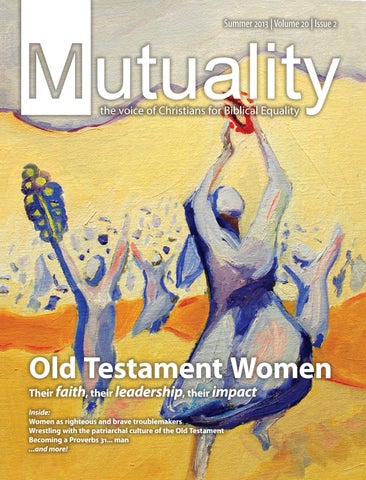
On the Cover: “The Dance of Miriam” (2013). Original oil painting created for Mutuality by Marc LeMaire. Marc LeMaire studied art at Houghton College (Houghton, New York) and is currently working as a potter and artist in Saint Paul, Minnesota. Visit his website at lemairepainting.weebly.com.
2 M U T U A L I T Y | Summer 2013
website : cbeinternational.org
F
rom the Editor by Tim Krueger
Well-Behaved Women Seldom Make History In 1976, Laurel Thatcher Ulrich set out to uncover the history of ordinary, virtuous women in the colonial United States. In her article “Vertuous [sic] Women Found: New England Ministerial Literature, 1668–1735,” she lamented the fact that history has deemed well-behaved women uninteresting or unimportant, and has largely ignored them: “Hoping for an eternal crown, they never asked to be remembered on earth. And they haven’t been. Well-behaved women seldom make history.” Her phrase “well-behaved women seldom make history” quickly gained popularity. You can now find it plastered across everything from T-shirts to my neighbor’s bumper sticker. No longer a call to remember the pious, forgotten women of history, it has acquired a new meaning. It now serves to inspire women to transcend cultural expectations in order to accomplish good in the world. It hints at a world in which women no longer face barriers that limit their contributions. As I reflect on this issue of Mutuality, I’m reminded of both the original and contemporary applications of this slogan. We should heed the call to remember the virtuous women of the Old Testament who served God faithfully with no ambitions for fame. We sometimes forget about women like Hannah, who is noted not only for her famous son, but also for her fervent prayers and faithfulness. And there are others we might not even notice, such as King Lemuel’s mother, whose wisdom is recorded in the book of Proverbs. God has recognized the faithfulness and wisdom of his daughters. We ought to do the same. On the other hand, the women of the Old Testament illustrate that obedience to God often requires us to break the rules imposed on us by our cultures. The Old Testament women we most easily recognize were not “well-behaved.” Deborah, Jael, Bathsheba, and Esther all violated standards for acceptable female behavior in one way or another. Rahab and Ruth were gentiles, and were therefore thought to be beyond the reach of God’s covenant love. Sarah, Hannah, Rebekah, Rachel, and others were barren—a condition believed to be a sign of God’s disfavor. Yet these are the women God handpicked to be instruments of mercy, agents of justice, and models of faith. The observation that well-behaved women seldom make history isn’t just a statement of fact, but a call to action. Likewise, the women of the Old Testament are included in the Bible for more than their amazing stories; they should motivate us to action. Through these women, God challenges the social order
bookstore : cbebookstore.org
and demonstrates his desire for women to serve alongside men. Their stories show us that God wants to see women changing the world in small and large ways. It’s our job to tear down the barriers that prevent them from fulfilling God’s calling. Women are instrumental to God’s redemptive work in the world. God seldom changes history without employing the agency and gifts of his daughters. This issue of Mutuality features some of the less prominent women of the Old Testament—women who might easily have been forgotten had God not preserved their stories in Scripture. You’ll be inspired by women like Jehosheba, Shiphrah, and Puah, whose courage saved countless lives, but who are often overlooked. You’ll gain insights into the lives of unnamed women who may be entirely unfamiliar to us, but whose faithfulness, courage, and obedience was noted by a society that placed little value on women. We’ll delve into the lives of women like Hagar and Hannah, whose names are more familiar, but whose stories are deeper and more inspiring than many of us realize. I hope you’ll join us in reflecting on marriage and gender stereotypes in light of Proverbs 31, and take time to appreciate the God who treasures women and who chooses the barren, the poor, and the outcasts to accomplish his purposes in the world. Like most of us, the women of the Old Testament had no ambitions for fame; they did what needed to be done to get through life while serving their Lord. But God chose them to play crucial roles in history, stirring up trouble when necessary. Women have been essential to God’s work from the beginning and remain so today. My prayer is that these women will motivate us to tear down barriers, combat abuse, and insist upon the mutual service of women and men in every area of our lives. In Christ, Tim Krueger
M U T U A L I T Y | “Old Testament Women”
3
When a Woman’s Love is
by J. Lee Grady
God wants his daughters to be as bold as lions. So why does the church insist on taming them?
Watch a few documentaries about wild animals, and you will see footage of a mother protecting her young. Do you know what happens when another animal bothers a lion cub? The lioness springs into action. Her claws come out, her fangs protrude, and she lets out a roar that can be heard miles away. God created
Those who violate and abuse the vulnerable should have to think twice, for fear of provoking God’s daughters.
4 M U T U A L I T Y | Summer 2013
female lions with an instinct to fiercely protect and fight when needed. When a lioness is provoked, watch out! God calls women to defend the vulnerable and fight injustice with a similar ferocity. Those who violate and abuse the vulnerable should have to think twice, for fear of provoking God’s daughters. Yet women in the church are often expected to hide their claws and fangs and act as domesticated as possible. They are taught to be quiet—even in the face of danger. Men, it is said, are meant to do all the protecting while women simply offer loving encouragement. But the women whose lives are honored in the pages of the Bible weren’t timid. They were bold and courageous, and they took
website : cbeinternational.org
initiative. They challenged the status quo, they pushed boundaries for God, and they risked their lives when others stood silent. One such woman is Jehosheba, who lived during a tumultuous time in Israel’s history when God’s people had abandoned him in favor of Baal. War and violence were commonplace. Jehosheba’s brother, King Ahaziah of Judah, had just died, leaving a power vacuum. Now, Jehosheba found her family embroiled in a ruthless struggle for the throne. Second Kings 11:1–3 says: When Athaliah the mother of Ahaziah saw that her son was dead, she proceeded to destroy the whole royal family. But Jehosheba, the daughter of King Jehoram and sister of Ahaziah, took Joash son of Ahaziah and stole him away from among the royal princes, who were about to be murdered. She put him and his nurse in a bedroom to hide him from Athaliah; so he was not killed. He remained hidden with his nurse at the temple of the Lord for six years while Athaliah ruled the land.
the midwives arrive.” So God was kind to the midwives and the people increased and became even more numerous. These women deliberately defied a royal edict, and could have been executed on the spot. They didn’t wait for men to step up and oppose Pharaoh, nor were they acting in obedience to any man’s instruction. They boldly risked their lives by using their unique position as midwives to spare the lives of untold numbers of Hebrew children, and then used their cunning to survive an encounter with Pharaoh. These women, acting as God’s agents, took the initiative and prevented genocide.
Women as Righteous Trouble-Makers
Why are the stories of these strong, tenacious women included in the Bible? They are evidence of God’s call on women to be It’s hard to imagine that a queen would slaughter her own fierce protectors, to use whatever means necessary to accomplish grandchildren, but that is exactly what Athaliah attempted to God’s work and to stand up to injustice. Is there room in your do. Her insatiable thirst for power led her to murder anyone worldview for spunky women like Jehosheba, Shiphrah, and whose claim to the throne was stronger than hers—even her Puah? What about the fearless women of our own time? own grandsons. Only when she had snuffed out the line of Many Christians today wouldn’t endorse the behavior David would her rule be secure. of these fearless biblical women. In many Despite the danger, Jehosheba of our churches, women who take the How many Jehoshebas, did not run away or stand aside, but initiative are viewed with suspicion. We Shiphrahs, and Puahs experienced supernatural courage. have promoted the idea that femininity is There was no time for submission or best exemplified by passivity, domesticity, have we sidelined passivity—or to wait for a man to step and a bland politeness. This attitude because we’ve taught in. Her nephew’s life was at stake, has squelched the callings and spiritual and the royal line was in danger. gifts of countless women. How many them from birth that God needed someone with courage Jehoshebas, Shiphrahs, and Puahs have bravery is a masculine to take action. And he needed her we sidelined because we’ve taught them quality and that in to act fast. Like a lioness protecting from birth that bravery is a masculine its cub from danger, Jehosheba leapt quality and that in order to please God order to please God into the fray, delivering Joash to they should always defer to men? they should always safety. In the end, Athaliah was What if these women were part of our overthrown in a coup, and the seven churches today? Would Jehosheba have been defer to men? year-old Joash was installed as the told, “If God wants to stop Athaliah, he new king. Israel’s royal family was will direct one of the priests to intervene”? saved, and the line of David—and of the coming Messiah— Perhaps Shiphrah and Puah would have been warned, “Women was preserved. All this happened because of a woman’s bravery aren’t supposed to make trouble.” in the face of terror. But God does indeed call his women to stir up trouble! And Jehosheba is not the only Old Testament woman whose He has given women mouths to challenge evil, hands to courageous actions altered the course of history. In Exodus, we rescue the babies that the devil meant to destroy, and minds read that Pharaoh ordered the slaughter of all Jewish boys at birth. to outwit and overthrow injustice. He even designed a He commanded the midwives to carry out his edict as they were mother’s body to aggressively protect her children when attending to pregnant Hebrew women. In response, two brave needed. According to a study by Jennifer Hahn-Holbrook midwives, Shiphrah and Puah, performed one of history’s first and published by Psychological Science in 2011, this wellrecorded acts of civil disobedience. Exodus 1:17–20 says: documented phenomenon, known as maternal aggression, is The midwives, however, feared God and did not do what the a hardwired response triggered naturally by breast feeding. king of Egypt had told them to do; they let the boys live. Then Certainly, God did not design a mother’s body this way in the king of Egypt summoned the midwives and asked them, order for her to always stand aside! Women, as much as men, “Why have you done this? Why have you let the boys live?” are created to obey God’s calling to protect the vulnerable The midwives answered Pharaoh, “Hebrew women are not and aggressively fight for justice, no matter the cost, or how like Egyptian women; they are vigorous and give birth before much trouble they may stir up. bookstore : cbebookstore.org
M U T U A L I T Y | “Old Testament Women”
5
Agents of the Holy Spirit Women have always been righteous trouble-makers and indomitable agents of the Holy Spirit, thwarting injustice at just the right time. Women have overcome every conceivable obstacle in order to save the weak, nurse the sick, and protect the underdogs of society. When children are in danger, when women are abused, when girls are exploited, when families are being destroyed by drugs or alcohol, or when society is in danger, women are often the first to help. Women are called to be just as fierce, powerful, and courageous as any man in carrying out God’s work. Many women have brought peace and healing to the world because of their love for God and neighbor. A devout Christian who grew up in the Netherlands, Corrie ten Boom, along with her family, bravely hid Jews from the Nazi regime during World War II. Corrie and several members of her family were arrested for their actions. She and her sister were sent to a concentration camp, where her sister later died. A week before all the women her age in the camp were killed, Corrie was released due to a clerical error. After the war, she traveled the world preaching God’s love and telling her story. In her book, The Hiding Place, this soft-spoken daughter of a watchmaker explained where she got her courage: “Do you know what hurts so very much? It’s love. Love is the strongest force in the world, and when it is blocked that means pain. There are two things we can do when this happens. We can kill
that love so that it stops hurting. But then of course part of us dies, too. Or we can ask God to open up another route for that love to travel” (The Hiding Place, 47). If you read the writings of other great Christian women activists—the Quaker women who opposed American slavery, the Methodist women who fought alcoholism during the Prohibition era in the United States, the Presbyterians of the 1800s who started hospitals in Africa, the many female missionaries who established homes to rescue Indian girls from prostitution, or the women who are working tirelessly today to stop the global sex trafficking industry—you will find that their lives have a common thread. All have been consumed by a holy love. Jehosheba, Shiphrah, and Puah were consumed by a love that compelled them to rescue the weak and the innocent and to defy their leaders. They saw injustice and didn’t stay quiet or submissive. They sprang into action, ready for battle. I believe that just as God called on many Old Testament women to be his powerful agents, he calls and equips today’s women to act boldly and love fiercely. When a woman’s love is fierce, no one, least of all the church, should stand in the way. J. Lee Grady is the director of the Mordecai Project, a ministry devoted to confronting the abuse of women in developing nations. He is the author of several books, including 10 Lies the Church Tells Women and Fearless Daughters of the Bible, from which this article is adapted. He is also an advisory board member of Christians for Biblical Equality.
“Thank you, Lee Grady, for reminding us that God’s fearless daughters line the pages of the Bible. Each of their stories serves as a courageous call to follow God with abandon.” —Margaret Feinberg, author of Scouting the Divine and The Sacred Echo
Also available in Spanish: Las Intrépidas Hijas de la Biblia
The Shame of the Unnamed Women of the Old Testament by Margaret Mowczko
Honorable Women
J
ephthah’s daughter, Manoah’s wife, King Lemuel’s mother—the Old Testament is full of women whose names are withheld. They are typically identified only by their relationship to a man. I’ve often found myself irritated when reading an Old Testament narrative that features an unnamed woman. Why did the Old Testament authors leave out the names of these women? Weren’t these women important enough to be named? Is the Bible minimizing the significance of its female characters? Does the Old Testament promote a society in which the service of women is diminished or ignored? To answer these questions, I needed to step out of my world and into the world of the Old Testament’s unnamed women. In my society, individua lism is prized, and our identities are represented by the names—usually three or four names—that uniquely identify us. We even carry around various cards that contain our unique identifying information. Our identity is as an individual, and our unique names represent each one of us. When we want to honor or credit
bookstore : cbebookstore.org
in a Patriarchal World
someone for an achievement, we display their name publicly on plaques, in headlines, or in bylines. By letting the world see their names, we give them praise—but I’ve often found myself irritated always as independent when reading an Old Testament individuals. But the culture of narrative that features an the Old Testament was unnamed woman. Why did the not individualistic. As Old Testament authors leave in many non-Western out the names of these women? societies today, identity Weren’t these women important was embedded in the enough to be named? extended family and clan. All people, but especially women, were dependent on their extended family for mutual support, protection, and often, their very survival. The family, which was represented by its patriarch, was the identity that mattered. Individuals did not strive for personal
M U T U A L I T Y | “Old Testament Women”
7
Unnamed, But Not Unknown. Several nameless Old Testament women were far from passive and are protagonists of Old Testament narratives. These women took initiative and acted independently and bravely. While they are nameless, they are not without an identity. Today we know them by their stories—stories that have a lasting significance more meaningful than a name: The prominent woman of Shunem (2 Kings 4:8) and the wise women of Abel Beth Maacah (2 Sam. 20:16) and Tekoa (2 Sam. 14:2) were influential and respected leaders in their communities. A “wise woman” probably functioned as a living repository of wisdom, knowledge, and oral lore. Manoah’s wife (Judges 13) was approached by God directly, not through her husband, with instructions about her son, Samson. The story of Jephthah’s daughter (Judges 11) reveals that young women could have admirable dignity, piety, and strength of character. The account of Micah’s mother (Judges 17) demonstrates that at least some women had control of their wealth in Old Testament times. And, while the worship of Micah and his mother was compromised, it is evident that women influenced worship within the home. From the mentions of an unnamed servant girl who was given a dangerous assignment in espionage (2 Sam. 17:17); an unnamed woman who dropped a millstone on and fatally wounded Abimelek, the evil king of Shechem (Judges 9:53–54; 2 Sam. 11:21); and the woman of Bahurim (2 Sam 17:19–20) we see that women could be brave and risk their lives for others. The words of King Lemuel’s mother (Prov. 31:1–9) are inspired Scripture. This woman taught God’s wisdom to her royal son, and her words have taught both men and women ever since.
8 M U T U A L I T Y | Summer 2013
recognition, but to bring honor to their families. Closely tied to the patriarchal, family-oriented culture was the all-important dynamic of honor and shame. In the world of the Old Testament, honor was the underlying force that motivated and informed social behavior. Everything that men or women did could bring honor or shame to the family name, but there were different standards based on gender. Men were regarded as having honor by default, and were also responsible for protecting By participating admirably in the honor of their families. By public discourse, engaging in participating admirably in public bold or courageous actions, discourse, engaging in bold or and having a well-behaved courageous actions, and having a well-behaved family, a man could family, a man could gain gain prestige, or honor, for his prestige, or honor, for his family. family. A woman, on the other A woman, on the other hand, hand, was viewed primarily as a was viewed primarily as a potential source of shame. She potential source of shame. brought honor by controlling her potential to bring shame upon her family. This was achieved through sexual chastity, fertility, submission, quietness, and staying out of the public eye. The idealized woman described in Proverbs 31 is an example of a woman who brought honor to her husband and therefore family. Her hard work and wise actions had a direct bearing on the honor and respect of her husband and her household (Prov. 31:11–12, 23, 28). In the Septuagint, it is not the woman, but her husband, who receives public praise at the city gates in Proverbs 31:31. This woman is praised for bringing honor to her household. Surprisingly, she does so not only by her chastity or submissiveness, but by her hard work and exemplary character. Her story is one of many that suggest the gender restrictions of a patriarchal, honor-shame culture may not be God’s ideal. Even though God’s people lived in a patriarchal, honorEven though God’s people lived in shame culture in which women a patriarchal, honor-shame culture had limited social freedoms, no in which women had limited Old Testament author asserts social freedoms, no Old Testament that such a society is God’s author asserts that such a society ideal. God ’s dealings with is God’s ideal. God’s dealings with women were not constrained women were not constrained by by the culture. The Genesis account shows the culture. that the rule of men over women is a direct result of sin entering the world (Gen. 3:16). Both men and women were made in the image of God (Gen. 1:27; 5:1–2). As God’s image bearers, men and women share the dignity that comes with reflecting divinity. The Bible also says that men and women were created to rule over God’s creation (Gen. 1:26–28). Moreover, there is no suggestion that humans were originally created to rule over other humans. Despite the standards of patriarchal society, God did not necessarily use fathers or husbands as mediators of his word to women. God sometimes spoke directly to—or sent angelic messengers to speak directly to—women. This was the case when God spoke to Manoah’s wife (Judges 13), Rebekah (Gen. 25), and Hagar (Gen. 16). God even used women such as Deborah
website : cbeinternational.org
(Judges 4), Huldah (2 Chron. 34:22–33), and the skilled wailing women (Jer. 9:17–24) to speak to men on his behalf. The Bible never affirms the cultural characterization of women as little more than sources of shame—unintelligent, gullible, sexually wanton, and inferior to men. Instead, many women are described as wise, intelligent, courageous, resourceful, and enterprising. Women functioned as prophets, teachers, advisors, leaders, deliverers, and even as heroines. Considering the culture The Old Testament authors of the Old Testament, it is realized that God engaged remarkable that so many some women as individuals, women are mentioned, and and that the actions and that many of these women words of these women were are named. More than a few noteworthy and important— women in the Bible—named important enough to be and unnamed—do not included in Holy Scripture. fit the culturally desirable stereotype of the private, passive, quiet woman. Several defied their culture and their authorities, yet there is no hint of censure in the text. God has always chosen women to play significant roles in his story, and he continues to do so today. Through my Western eyes, the nameless women once seemed unimportant—as if they were not valuable or had been overlooked. But the Old Testament authors realized that
bookstore : cbebookstore.org
God engaged some women as individuals, and that the actions and words of these women were noteworthy and important— important enough to be included in Holy Scripture. I am no longer frustrated that I don’t know their names, because I now realize that they are acknowledged, identified, and praised in ways that were appropriate to their own culture. Are we doing the same in our cultures today? God uses all sorts of people, the ordinary and the extraordinary, within their own variously f lawed cultures to create new narratives in which God can reveal his grace and mercy and bring about his justice and deliverance. Are we actively identifying the women whom God is using in our time in vital service? Just as we are encouraged by the faith, initiative, and courage of the women of the Old Testament, we should be identifying women in ministry today and telling their stories. Part of our story can be to positively influence cultures, including our own. We must demonstrate and promote the new covenant values of equality, mercy, and justice for all people regardless of race or gender. Margaret Mowczko is vice president of the CBE chapter in Sydney, Australia. She has a theology degree and is currently studying for a masters degree at Macquarie University, specializing in early Christian and Jewish studies. Margaret writes on the subject of biblical equality for her website newlife.id.au.
M U T U A L I T Y | “Old Testament Women”
9
Join the conversation on The CBE Scroll
31 Proverbs
by Daniel Fan
Man
Walking in the footsteps of the Proverbs 31 woman… as a man
M
aybe the biblical character you best My tale doesn’t begin in a happy place. In 2008, the wheels came off the American economy. All my aspirations (along with connect with is Daniel in the lion’s my employment) skidded to a halt, while what remained of the economy tumbled on without me. It was a very humbling place. den, or Mary when the stone was rolled away. Sometimes we connect with the Her husband is respected at the city gate. well-known figures we would have chosen I found no quick deliverance through professional leads, but for ourselves. But sometimes Creator Creator kept faith with me, if not my dreams. Just as the Proverbs woman’s husband gained respect at the city gate, so my wife has appoints us to walk in the company of 31become a respected community leader. She has received consistent promotions in her workplace at a local municipality, ensuring our stranger biblical fellows—companions we financial stability. would not have chosen, but who enrich our lives even so. She is like the merchant ships, bringing This is the story of how I found myself her food from afar. walking the path of the Proverbs 31 woman, identifying with her story, and becoming what I call a “Proverbs 31 man.” 10 M U T U A L I T Y | Summer 2013
With my wife at work all day, I necessarily took on more domestic duties, some of which I excelled at, and some of which required… discipline. While folding fitted sheets still escapes me, I have developed my natural gifts for improvisational cooking and for
website : cbeinternational.org
replicating dishes I’ve tasted, but don’t have recipes for. My current repertoire includes French, Italian, Chinese, Filipino, classic American, and fusion dishes. Using the ancient Chinese secret of pressure cooking, I can whip out a decent beef bourguignon in
During parties, I often find myself in the kitchen surrounded by women, but interestingly enough, no one has ever questioned my masculinity after sampling my food. about an hour and a half. During parties, I often find myself in the kitchen surrounded by women, but interestingly enough, no one has ever questioned my masculinity after sampling my food. Cooking is not only for women: life’s too short to eat bad food, and only children cannot feed themselves.
When it snows, she has no fear for her household; for all of them are clothed in scarlet. Many husbands dread the question “Does this dress make me look fat?” I don’t. My wife loves me. You can tell, because I can say to her “I’d suggest the other dress with the more flattering ruching at the waist.” My wife values my input on everything from dresses to professional suits to casual wedges. Even her friends have commented on my choices for her.
She gets up while it is still night; she provides food for her family.... She sees that her trading is profitable. In a strange twist of fate, I’ve had to turn what had been a hobby into an entrepreneurial exercise. I specialize in a specific line of sporting goods and accessories. My experience in this field allows me to quickly evaluate the origin, manufacturer, and condition of equipment, as well as estimate repair costs and market value of products. And because many of my sales contacts are on the East Coast and I live on the West Coast, it’s often an early-to-rise work schedule.
She speaks with wisdom, and faithful instruction is on her tongue. She watches over the affairs of her household and does not eat the bread of idleness. I have a calling to see the church do justice for women, minorities, and indigenous peoples. More than cooking, more than sales pitches, more than anything else, this is what Creator has tasked me to do. The twin skills of evaluation and articulation—knowing if the price tag matches the value and explaining that a certain piece doesn’t fit within a consistent mission—apply to the pursuit of justice. When the American church talks about justice for Africa, but ignores injustice on its own streets, that is more than a clash of colors. When the church markets a program of equality for all men, but forgets women, it is not
When the church markets a program of equality for all men, but forgets women, it is not offering a square deal.
offering a square deal. In the face of injustice, Creator commissions us not to break hearts, but to break silence. You might be surprised by what doors you can open with a well-placed letter or simply by appealing to the right person (and never quitting until you reach that person). There are some parts of Proverbs 31 that I can’t claim yet. I’ll admit that my sewing skills are limited to reattaching a button. And I don’t have kids or servants to provide for (though I do sometimes get up at zero-dark-thirty to feed the cat). But that’s okay, because Proverbs 31 isn’t meant to be read as a checklist. It is a compilation of individual virtues, each of which is worthy of celebration. We would do well to embody any one of them, regardless of our gender. It was not by choice, but by calling, that I found myself a Proverbs 31 man. And perhaps, if you look carefully, you will find yourself one as well. Daniel Fan is a writer and justice activist focused on gender equality, racial justice, and indigenous issues. He is an active member of Evangelicals 4 Justice. His writings include an award-winning screenplay entitled “Olohana” about the formation of the Hawaiian Kingdom. Daniel blogs, cooks, looks after the house, and pretty much tries to be a good Proverbs 31 guy. He lives in Portland, Oregon with his wife, Emily Rice, and their cat.
From The CBE Scroll
How have you found yourself crossing traditional gender boundaries, whether out of desire or out
of necessity? How have people responded? And how has this affected your understanding of God, yourself, or gender? Do you identify with any biblical characters not of your own gender, or figures who acted outside the prescribed behavior for their gender? What biblical women or men have inspired you to step across traditional gender boundaries in your society? Visit blog.cbeinternational.org to share your stories and join in the conversation on The CBE Scroll!
bookstore : cbebookstore.org
M U T U A L I T Y | “Old Testament Women”
11
In the Midst of the Mess: Hagar and the God Who Sees
a story of hope for the abused and the broken by Amy Rasmussen Buckley Along a desert road, beside a remote, unnamed well, the angel of the Lord approaches a pregnant, abused, runaway slave named Hagar. The young woman has reached a breaking point. Wrapped in doubts and their own agenda, her masters, Abram and Sarai, had given her no choice but to become a surrogate mother to their child. Once she conceived, conflict arose between Hagar and Sarai. With Abram’s blessing, Sarai attacked Hagar with disproportionate cruelty, reasserting her position of power over her. Hagar was abused and mistreated so severely that she fled into the wilderness. Hagar’s life has now been irreversibly altered, and her future looks bleak. No doubt it surprises her that anyone—especially the angel of the Lord—would notice her.
12 M U T U A L I T Y | Summer 2013
How differently he speaks than her human masters! “Hagar, slave of Sarai, where have you come from, and where are you going?” (Gen. 16:8). The Lord knows she is a slave, yet calls her by name. Surely it is strange to answer a persona l question when she is accustomed to simply obeying instructions. Responding to the Lord’s question, Hagar jumps straight to her situation: “I’m running from my mistress Sarai” (Gen. 16:8). A woman in her position has no social or economic clout. Consequently, Hagar faces two undesirable options: return and suffer Sarai’s abuse, or brave the long road through the wilderness to Shur. The desert spreads in every direction. Hagar only sees dead ends, but the angel of the Lord sees another way.
website : cbeinternational.org
The angel’s response sounds harsh, even cruel: “Go back to your mistress and submit to her.” One cannot help but question— is God sending her back to submit to abuse? It is unlikely that a young, pregnant, runaway slave woman will survive the journey through the wilds of Canaan to a foreign land. Knowing this, God does not abandon Hagar in the wilderness to succumb to the elements, wild animals, or worse at the hands of other travelers. He profoundly values her and the child she is carrying. In the midst of hopelessness and desperation, God sees Hagar— the runaway, the slave, the victim of abuse.
but an heir to God’s promise. There, beside the well, she proclaims, “You are the God who sees me... I have now seen the One who sees me” (Gen. 16:13). She names the Lord “the God Who Sees.” Hagar—the only person in Bible history to give a name to God— discovers that God sees and hears abused women.2 She spreads word of the God she has met beside the well. Her experience at the well becomes so widely known that, in time, the well comes to be called Beer Lahai Roi, meaning “spring of the living one who sees me.” Acting in faith, Hagar returns to Abram and Hagar—the only person in Bible history Sarai’s household with The Lord offers a promise with to give a name to God—discovers that a different perspective. the instruction to return to Their household God sees and hears abused women. Abram and Sarai’s household: “I offers peace and will increase your descendants provisions enough for so much that they will be too her to safely carry and numerous to count” (Gen. 16:9). The meaning is abundantly deliver her child, Ishmael. There is no serious conflict clear—Hagar will live to see the birth of her child and reap a between Sarai and Hagar for the next fourteen years. blessed future. Remarkably, God’s promise to the slave woman Abram, now known as Abraham, cares deeply for is similar to God’s promise to Abram: “a son who is your own Ishmael, to the point of asking the Lord to allow the flesh and blood will be your heir... boy to be his promised Look up at the sky and count the son. He circumcises Hagar’s story is more than the story Ishmael, ensuring stars... So shall your offspring be” of a slave and her son. It is a story of that the boy bears (Gen. 15:4–5). Hagar will become the mother of a mighty nation God’s care for those who have no the sign of God’s whose people will be as numerous covenant promise earthly hope. as the grains of sand in the desert. for generations to come. Abraham is The angel continues, revealing that Hagar will give birth to a son: “You shall name him Ishmael content for Ishmael to carry forward God’s promise, [meaning “God hears”], for the Lord has heard of your misery. but the birth of Isaac complicates matters. After fourteen years, polygamous family dynamics reach a He will be a wild donkey of a man; his hand will be against everyone and everyone’s hand against him, and he will live in breaking point, and things get messy once again. Sarah draws hostility toward all his brothers” (Gen. 16:11–12). No doubt, this a line when fourteen year-old Ishmael mocks the newly-weaned is a questionable title for an unborn baby, but in biblical times Isaac. “Get rid of that slave woman and her son,” she says, as in present-day Israel, the wild ass evades harnesses and human “for that woman’s son will never share in the inheritance domination. Ishmael will not be oppressed by slavery; he will be with my son Isaac” (Gen. 21:10). Wavering about what to do, freer than free, entirely untamed.1 And considering that the laws Abraham expels Hagar and Ishmael from the household, but of the day supported biological sons over surrogate sons, it is no only after God promises to make Ishmael’s descendants a nation. surprise that Ishmael will live at odds with half-brothers, who will In the midst of a dysfunctional family, would God still see Hagar displace him from sole inheritance rights to Abraham’s estate. and Ishmael? Ishmael’s life will not always be easy, but God will bless him. In the midst of a crisis pregnancy, God sees Hagar and her Cast out into the wilderness once again, Hagar feels abandoned by God. And this time there is no well; only dry sand. As the sun unborn child, and offers hope. burns high and the water runs out, she leaves her son by a bush. Hagar enters a relationship with God that reshapes her identity and She can’t bear to watch him die, so she walks a short distance her perspective of her circumstance. She is no longer just a slave, away to mourn. But once again, God sees and hears. The angel
1, 2 For more on Hagar, Ishmael, and abuse, see CBE founder Catherine Clark Kroeger’s thoughts in “And Hagar Went Back: Responding to Abuse” in Christian Ethics Today, (Spring 2008). Find it at cbeinternational.org/Hagar.
bookstore : cbebookstore.org
M U T U A L I T Y | “Old Testament Women”
13
The Victims in the Pews Abuse victims often go unnoticed and unsupported in the church. Author Amy Rasmussen Buckley offers five tips to combat abuse in your congregation the sin of abuse in our midst 1 Recognizing is the first step toward overcoming it.
At least a quarter of those sitting in our church communities, any Sunday morning, have experienced some form of abuse.
is imperative to proclaim God’s truth 2 Itabout abuse and to act on behalf of those suffering it. The Bible condemns abuse— whether physical, verbal, emotional or sexual—over one hundred times.
yourself to recognize signs 3 Educate of abuse, and urge victims to take
precautions to keep themselves and their children safe. Perpetrators of abuse may seem faithful, self-controlled, or even repentant, but they may be dangerous.
not hesitate to refer victims to 4 Do shelters, which normally have better
resources for responding to their immediate needs than churches. At the same time, urge victims to remain connected to the prayer support, loving fellowship, and spiritual guidance that so many churches have to offer.
victims to professional abuse 5 Refer counselors. Prayerfully wrestle with
the biblical, theological, and practical implications that apply to unique situations. While Christ’s love for the church should be the model for Christian marriage, an abusive marriage cannot reflect that plan (Malachi 2:16).
14 M U T U A L I T Y | Summer 2013
of the Lord finds her and comforts her, “Do not be afraid; God has heard the boy crying... Lift the boy up and take him by the hand, for I will make him into a great nation” (Gen. 21:17–18). It is time for God to fulfill his promise. God opens Hagar’s eyes, and she sees a well of water. She fills the skin with water and carries it to her son. Both mother and child survive, and in an act of splendid redemption, God makes their descendants a great nation. In the midst of profound despair, when all hope seems lost, God sees Hagar and keeps his promise. Ultimately, Hagar’s story is more than the story of a slave and her son. It is a story of God’s care for those who have no earthly hope. On the heels of miserable treatment, perhaps at the hands of pious and religious people, abuse victims may be amazed to realize that they are not alone after all. In their most trying hours, they may discover On the heels of miserable treatment, the Lord whispering to them by name, perhaps at the hands of pious and intimately concern religious people, abuse victims may ed for them. When be amazed to realize that they are not they suffer because alone after all. of events beyond their control, when they are cast out, and when they give up on life itself, they may be shocked that God hears their cries. When they experience setbacks, it may delight them to know that the Lord walks the winding path of recovery with them, and has promised new life in Christ. There is a God who sees us amidst the messiness of life—whether we are victims of abuse or pregnant teenagers with nowhere to turn, whether we’ve been disowned by our families or we’ve given up hope. No matter what our situation, let us never lose hope in the promise that “in all these things we are more than conquerors through him who loved us” (Rom. 8:37). And most of all, let us remember that our God is the same God who saw Hagar in her distress. Ours is a God who sees. Amy Rasmussen Buckley pursued graduate studies at Gordon-Conwell Theological Seminary and George Fox Evangelical Seminary where she graduated with an MDiv in 2010. She has contributed to conferences and publications sponsored by Peace and Safety in the Christian Home (PASCH), including Strengthening Families and Ending Abuse: Churches and Their Leaders Look to the Future (pending publication by Wipf and Stock this summer). Amy is a board member of Life Together International and lives in Palm Harbor, Florida, with her husband and two adopted daughters.
website : cbeinternational.org
womb currency
by Charity Kroeker
A womb, the currency of the day. Trade. Hagar’s womb: tilled soil. Gentile, slave, used and thrown away. Have you heard? God sees! From dry ground, a well. Flip the exchange tables. With an outcast womb, God makes a covenant. A womb, bank of God’s promise. Pray. Sarah’s womb: a dried gourd. The pain of childbearing, the cursed ground, unyielding. Have you heard? From the rattling gourd, a maraca! Laugh! From God’s storehouse, a Milky Way of generations. A new way. Currency becomes treasury. From virgin womb, Jubilee! Debts forgiven! Come, Gentile. Come, Slave. New birth! Follow Sarah, Rachel, Rebekah. Follow dead wombs to the empty tomb.
Charity Kroeker is in her fourth year as the development coordinator and chapter liaison at CBE. She studied English literature and writing at Bethel University, and currently lives in Minneapolis, Minnesota, where she enjoys riding her bicycle and attending poetry slams.
bookstore : cbebookstore.org
M U T U A L I T Y | “Old Testament Women”
15
16 M U T U A L I T Y | Summer 2013
website : cbeinternational.org
Skirts, Spatulas, & Surrender How the story of Hannah helped one woman find her true calling by Elizabeth Drummond
I was sixteen years old, confused, and tired. I had a thousand little journals with themes like “becoming a woman of God,” “finding your calling,” and “biblical femininity.” But I still hadn’t found the answers I needed. I was weary. Who had God made me to be? What was I to do with my life? What did the words of the Bible mean for me as a young woman? Years earlier, when I was only twelve, the girls’ Bible study I attended discussed marriage and homemaking. We learned that the Proverbs 31 woman was everything that a woman was supposed to be—submissive, married, nurturing, and at home. It seemed as though all the good women of the Bible—the Proverbs 31 woman, Hannah, Sarah, and many more—were wives and mothers. God called them to get married and have babies, so we should do the same. But I couldn’t see myself being only a wife and mother. I was different. The homeschooling community in which I was raised was rich in faith and family, but things in my home were unconventional. Other mothers stayed home, but mine worked outside of the home. Other families attended church together, but my father never joined us there. While my Bible studies told me I should get married and have kids, my parents encouraged me to go to college, and that was my desire. While all the other girls wore skirts that reached all the way to the floor, I wore jeans and a hoodie. Slowly, I began to resent both God and the Proverbs 31 woman for sentencing me to skirts and spatulas.
bookstore : cbebookstore.org
I was a confused and broken teenager, questioning God. “When will you show me what I am supposed to do with my life? Who am I supposed to be? I’ve heard so many versions of these Scriptures, I’ve been hurt, and I want to know what to do.” God answered me with Hannah. I had spent most of my young life knowing of Hannah as the barren woman who wanted a baby and was blessed with a child who later became Israel’s leader. But the portrayal of Hannah as a “glorified homemaker” only increased my fear and resentment of God. I value family and marriage greatly, but after years of hearing that marriage and family were my highest callings, I became hopeless; I felt like God had other things in mind for me. As I began to read the Bible for myself, trying to let go of the stereotypes and prejudices I learned growing up, I saw Hannah in a brand new way—one that gave me healing and hope.
“
We learned that the Proverbs 31 woman was everything that a woman was supposed to be—submissive, married, nurturing, and at home.
”
M U T U A L I T Y | “Old Testament Women”
17
“
Hannah was a young woman God. The second command is Hannah teaches both women and with deep desires and a love for God. to love others, and if we do the men how to fully surrender to God’s call, Like me, she was broken and weary. first, we will also do the second. even if it is different from what She cried out to God, deeply wounded Sometimes we forget that God loves our friends and neighbors expect. by the fact that she could not live us—perhaps Hannah even forgot this up to her community’s expectation at first. But that’s the beauty of her for women: motherhood. She was story—she was lost, broken, and different from the other women, and was the object of their scorn. weary from years of failing to meet the expectations placed upon The text says that her husband’s other wife provoked her for years, her. And then she devoted herself to prayer. She surrendered her so much that Hannah even stopped eating (1 Sam 1:6–7). No doubt dream of motherhood to God when she promised that if she had she was confused and asked God the same questions I asked. “Why a son, he would belong to the Lord, not to her. She followed the did you make me this way? What did you create me for, if not to call to pray, surrender, and give. Hannah’s story taught me that have children?” there is no one holy like the Lord, and no calling greater than In time, God gave Hannah a son, but motherhood was never surrender to God. her highest calling; motherhood was only part of her calling. My story is that of a broken person, often confused and weary, Hannah’s story has been remembered and retold for thousands of yet always loved completely by a mighty God. No matter how much years, not because she fulfilled a call to motherhood, or even because your story differs from mine, I believe that you are also broken yet her son became a great leader. She is remembered because God put loved. First Samuel 2:4 says, “the bows of the warriors are broken, her in a position to stand out from the other women, to show his but those who stumbled are armed with strength.” This describes people what true faithfulness and surrender are about. Hannah is Hannah, it describes me, and it probably describes you. But don’t be honored for her earnest prayers, her faithful commitment, and her ashamed or afraid, for the one who arms you with strength knows complete surrender to the Lord. you and your calling. I once thought that my life had to be a certain I no longer believe that Hannah’s story is in the Bible to teach way because of what other Christians told me—maybe you think girls that motherhood should be their ultimate goal. In fact, she that, too. Listen to God, follow the example of Hannah, and let didn’t even raise her own son, but gave him over to God and to God inform your life. Allow your highest calling to be complete service in the Temple. Hannah teaches both women and men how surrender to the one, true God. to fully surrender to God’s call, even if it is different from what our Elizabeth Drummond lives in British Columbia, Canada. friends and neighbors expect. Only in that place of surrender will She is a student at Trinity Western University where she we find true joy, comfort, and peace. is studying theater and Spanish. Elizabeth has always had We easily forget that the most important commandment a passion for words and loves to write in her spare time. is not to live up to expectations, but to love the Lord our
Reflect with us…
You Can’t Put God—or Old Testament Women—in a Box by Jo Ellen Heil, with thanks to Susan McCoubrie A good friend recently reminded me, “You can’t put God in a box.” Even as we laughed, we knew it was true. God is both generous and creative, ready to fill us with the Holy Spirit, eager to see heaven’s will lived out on earth. Such abundance and creativity is certainly evident in nature, whether it’s in the delicate translucence of a butterfly’s wing or the dusty coarseness of a rhino’s horn. It’s equally true about Old Testament women. What a variety of souls! Some were lauded by crowds, others praised for the children they bore, still others for the spiritual risks they undertook. Some of their stories were recorded forever on papyrus; the bones of others have been forgotten under the desert sands. Yet each one was gifted by God, given skills for the work placed before her hands and heart. Some, like Queen Esther, were entrusted with political power that led to life-and-death consequences. The Queen of Sheba embarked on a diplomatic mission to uncover God’s wisdom.
18 M M UU TT UU AA LL II TT YY || Summer Summer2013 2013
”
Others were endowed with judicial skills which summoned Israel into battle (Deborah) or changed inheritance laws (the daughters of Zelophehad). Still others were prophets who corrected the course of the nation’s worship (Huldah). Some were cross-cultural peacemakers: Joseph’s wife, Asenath, guided the former captive through the maze of Eygptian high society; the Shunamite woman provided Elijah, a Jewish prophet, with hospitality; Ruth the Moabite loved her mother-in-law so much that she emigrated to another country; and the servant girl of Naaman’s wife provided Naaman, an Aramean general, with the information he needed to be healed of leprosy. Still others exercised great physical courage. Rahab risked her life to conceal the Hebrew spies—and saved her family from destruction during Jericho’s capture. Young Miriam and her mother, Jochebed, risked their lives as slaves in Egypt to save Moses’ life. Abigail prevented bloodshed by intercepting David during his hot-headedness. And, in the midst of local skirmishes, the daughters of Shunem helped rebuild Jerusalem’s walls during Nehemiah’s rule. Queens, prophets, and slaves. Peacemakers, immigrants, and construction workers. All gifted by God. All willing to use their skills to answer God’s call. “And God saw that it was good.” website : cbeinternational.org
S
hort Answers to Tough Questions by Havilah Dharamraj
Q: An ever-present “woman” in the Old Testament is Israel, God’s metaphorical wife. How are Christians to understand the imagery of Israel as God’s unfaithful wife, and what is the relevance of the divine-human marriage metaphor in our lives today?
A:
“‘Is not Israel still my son, my darling child?’ says the Lord. ‘I often have to punish him, but I still love him. That is why I long for him…’” (Jer. 31:20, NLT). Texts like these feed our understanding of the God of the Old Testament as our father, an image that eloquently articulates our relationship with God. Just as pervasive in the Old Testament is the metaphor of God (Yahweh) as the husband of Israel. While we find God’s complaint against his rebellious son reasonable, his accusation that Israel “whores” in brazen unfaithfulness offends our twenty-first century sensibilities. Why does the Old Testament use this analogy? God loves his people above all else, and he asks that they love him in the same way. The husband-wife analogy is the best way to illustrate this reciprocal relationship of exclusive love. It is no surprise that the biblical text, written in a patriarchal culture, casts Yahweh as the husband and Israel as the wife. In this divine-human relationship, unfaithfulness could be attached only to the human party—the wife, who represented both the men and women of Israel. As Israel settled into Canaan and became familiar with the religious practices of the nations around it, it adopted these practices. In and around them, people worshipped a whole array of gods. Some of these gods appeared particularly attractive. Baal, the god of the thunderstorm, and his consort Asherah, the goddess of fertility, were deities whose favor seemed helpful— even critical—in Israel’s agricultural economy. Because worship of these deities included fertility rites involving male and female temple prostitutes, the image of Israel prostituting itself had both metaphorical and literal significance. In time, Israel’s unfaithfulness to its “marriage” covenant with Yahweh became the norm, and God’s prophets used the marriage metaphor with growing regularity. While it is mentioned only a few times from Genesis to Deuteronomy, it appears with increasing frequency throughout the prophetic books. It becomes the major theme of Hosea, and Ezekiel contains some of the most sexually charged language in the Bible, as Yahweh voices his disgust with Israel (Ezekiel 16 and 23). Thankfully, such passages are only one part of the story. We must not overlook Scripture’s other depictions of Yahweh’s wife. The Old Testament balances out the metaphor of unfaithful Israel with a depiction of Israel as the ideal lover. Though the Song of Songs does not name its characters as Yahweh and Israel, the book has long been interpreted as an
bookstore : cbebookstore.org
allegorical celebration of the intimate relationship between God and his people. If the prophetic texts dramatize the breakdown of the relationship, the Song enacts the satisfaction of it. If the prophets portray a jealous husband and a sullen, silent wife, the Song pictures a God who delights in his beloved, a woman whose voice is the first and last we hear. If the other texts represent the reality of Israel’s actions, the Song represents God’s ideal. When we apply the ideal of the Song to human marriage, we will experience God’s desire for every husband-wife relationship. Because of the long history and high dramatic potential of the marriage metaphor, New Testament authors We must not overlook Scripture’s c a r r y it i nto t hei r other depictions of Yahweh’s wife. w r it i n g s a s we l l . Christ becomes the The Old Testament balances out the husband of the church metaphor of unfaithful Israel with a (Eph. 5:23–32; 2 Cor. 11:2). When the writer of depiction of Israel as the ideal lover. Revelation anticipates the union of Christ and his church, he returns to the metaphor, saying, “the wedding of the Lamb has come and his bride has made herself ready.” The bride here is not the adulterous bride of Hosea and Ezekiel, but one arrayed in “fine linen, bright and clean” (Rev. 19:7–9; 21:2). In the New Testament, as in the Song of Songs, the marriage metaphor represents God’s desire—a relationship in which husband and wife delight in one another. We need to remember that the marriage metaphor plays both ways. While the texts about Israel as the unfaithful wife may seem insensitive today, this is only a part of the metaphor. Hosea and Ezekiel are balanced out by the Song of Songs and Revelation. The metaphor allows us to understand God in relation to ourselves. By applying the metaphor of a human marriage to our relationships with God, we can better perceive what self-inflicted devastation can come as a result of unfaithfulness to God. What is more, we can perceive the delight that is possible between God and us when we reciprocate Yahweh’s enduring and faithful love. Havilah Dharamraj is the academic dean and the head of the department of Old Testament at the South Asia Institute of Advanced Christian Studies (SAIACS) in Bangalore, India. Old Testament narrative is her area of special interest.
M U T U A L I T Y | “Old Testament Women”
19
M
inistry News by Mimi Haddad
Encouraging and Equipping Female Leaders Biblical equality empowers female leaders in Cambodia From 1975–1979, the communist regime known as the Khmer Rouge devastated Cambodia. Men, women, and children were marched at gunpoint to isolated farms known as the “killing fields,” while tens of thousands of others were executed. Some sources believe that nearly one in four Cambodians died. Completely destabilized, Cambodia became easy prey to sexual predators and their extensive, lucrative industries, which have enslaved thousands. While partnerships between leaders and Christian organizations have produced positive changes, often they address only the symptoms, such as sex slavery, but miss the underlying problem: the devaluation of females. The inferiority of women, which is often considered selfevident in the culture and the church, fuels male dominance and erodes the confidence of females gifted for leadership. Recognizing this problem, a Cambodian NGO invited CBE to provide biblical resources to challenge the devaluation of
Mimi illustrates hierarchy during a lecture.
women. In April, I traveled to Phnom Penh, Cambodia to present two lectures at a women’s leadership development conference. The conference addressed two key needs of female leaders in Cambodia: confidence in female leadership and practical skills to balance ministry and family. Thus, morning devotions reflected on the faith and courage of biblical women. Lectures offered biblical insights and practical skills, and small group discussions bolstered confidence among women by allowing space to process together and to deepen support networks. And, thanks to the generosity of CBE supporters, each attendee received a Khmer translation of Still Side by Side, by Janet George. The ministry went beyond the lecture hall as well. I joined ministry leaders during their regular outreach to prostitutes working in the local beer gardens. As we walked into the restaurant, the “dancers” rushed over, hugged their friends, and joined us for a meal. We listened to their stories of struggling to provide for their children, and we heard joyful accounts of their children’s adventures and achievements. The sadness that crossed their faces when they returned to the stage highlighted to me the importance of equality for Cambodian women. Over and over, women spoke of the need for confidence in a biblical worldview that upholds the value and leadership of females, accompanied by practical leadership skills. To address this need, CBE and our Cambodian partners agreed to create six conference scholarships to bring Cambodian leaders to CBE’s Pittsburgh conference on July 26–28. I hope those of you attending the conference will join me in welcoming our Cambodian colleagues with the same hospitality I received from my hosts, who, despite soaring summer temperatures, were energetic and engaged with the more than fifty male and female leaders who attended the conference. Pray for confident assurance in God’s call for women to lead in dangerous and challenging ministries. And thank God for the strategic gospel leadership of these courageous women.
Praise God with us for…
Pray to God with us for…
CBE’s first youth curriculum, Called Out: Kingdom Living for Missional Teens, by Jenny Rae and Aaron Armstrong, which is now available! Order it today from CBE Bookstore at cbeinternational.org/calledout.
CBE’s 2013 conference, “Take Every Thought Captive to Christ: Ideas Have Consequences,” on July 26–28 in Pittsburgh, PA. Pray for God’s blessing and presence throughout the event, safety for those traveling, and stamina for staff and speakers leading up to and during the conference.
CBE’s first ever presence at a men's conference, the Wildfire Men’s Impact Weekend, where volunteers made many new contacts and distributed CBE resources. Several new CBE chapters, including the new Biola University chapter and seven chapters being formed across Africa.
20 M U T U A L I T Y | Summer 2013
Continued parternships with foundations and NGOs, who enable CBE’s ministry to expand its reach around the globe. Additional staff, interns, and volunteers to help CBE complete much-needed projects and to begin new ones. website : cbeinternational.org
G
iving Opportunities by Charity Kroeker
“The Ray of Truth I Needed” CBE has already held booths at six conferences this year! At each of these booths, we’ve distributed hundreds of journals, articles, catalogs, books, and recordings. These resources and conversations bring new knowledge and hope to thousands of people each year. Our booth at The Justice Conference this February was especially exciting. During this conference, Mimi spoke on the relationship between gender justice and male-only authority, we distributed a journal created just for this event, and we showed a short video on the connection between gender justice and biblical interpretation. Our booth was flooded with visitors; the volunteers could barely keep up! Following the conference, we received this message from a young man who had stopped by our booth. Mimi’s conversation with him was just one interaction of thousands that take place between conference attendees and CBE members at exhibit booths each year.
that way. In all honesty those questions are the ones that have troubled my soul, and have been lingering stumbling blocks disallowing me from finding strong footing in either camp. My wife and I have one of the best married relationships a couple could ask for, but we’ve been troubled by the fact that we do not have a robust biblical perspective of what our marriage relationship or roles are supposed to look like. We’ve been in prayerful search for some guidance in this area ever since we were married four years ago. Just a few weeks ago two of my students became engaged, and have since approached me to do premarital counseling with them. I want to do this for them, but have felt ill-equipped seeing as my wife and I still lack— as you wrote in your August 2010 issue of Mutuality—a biblical worldview of gender. I wanted to thank you I share all this with for your patience, openness, you to say that your bold and responsiveness to all my and kind spirit, your questions. As I mentioned, I academic preparation, your come from a more egalitarian clear articulation of your background, and have always viewpoint, and God’s timing slightly leaned in that direction, all worked together this but at the same time I have never past weekend to answer our felt my personal positioning prayers. I don’t pretend that was firmly grounded in clear I am anywhere near fully biblical reasoning. This deeply grasping the theological scope troubled me, as I would rather of the biblical worldview of CBE booths allow the message of biblical equality be obedient to Christ than be gender you espouse, but it to be shared with thousands of people each year. led by personal emotions— was the ray of truth I needed and I knew that in this matter, to begin confidently walking on a path where I can clearly though my heart (possibly my soul?) had led me to see Christ’s footprints ahead of me. one conclusion, my mind had not yet received a biblical Thank you for your ministry and your persistence framework that could genuinely uphold that conclusion. in knowing and sharing God’s truth. To make matters more confusing, many of my friends and many leaders from whom I have gleaned great wisdom come from a complementarian background. As I mentioned when we met, the organization I work for partners with churches from both backgrounds, so obviously circumstances necessitate that I operate within a perspective that makes room for both. Regardless of my exposure to communities on both sides of the issue, I had never come across a cohesive biblical argument that made sense of all the troublesome passages… until this past weekend. The questions I posed to you were not meant to be combative, and I thank you for not taking them
bookstore : cbebookstore.org
God is using CBE to strengthen marriages, strengthen Christian faith, and answer prayers! We are thankful for the CBE volunteers who share the message of biblical equality at CBE booths nearly every month. Hosting a conference booth costs about $1,500, which includes exhibitor registration and postage to send booth materials to the conference site. We are planning to attend at least seven more conferences this year, with more opportunities coming up all the time! That’s a total of $10,500 needed for conference booths. Would you donate to our CBE on the Road fund and help us keep these conversations happening? Write “CBE on the Road” in the memo of your check, or donate online at cbeinternational.org/CBEgift.
M U T U A L I T Y | “Old Testament Women”
21
P
Honoring Dr. Virginia Catherine Patterson
resident’s Message by Mimi Haddad
Submissive, or Strong Rescue? Have you ever noticed how hard it is to find even one woman Other Old Testament women provided leadership to their in the whole of Scripture who did what was right but did families and even their husbands. Abraham obeys Sarah, and not also exercise leadership alongside or over males? From even God tells him to listen to her (Gen. 16:2, 21:12). Rebekah God’s introduction of Eve in Genesis, we see that women were orchestrates a blessing for Jacob rather than Esau, the older brother created to serve as rescuers and leaders. After God creates Adam, (Gen. 27). And though Jacob is called the father of Israel, his wife God declares that it is not good for Adam to be alone. God’s Rachel makes key decisions, as when she gives Bilhah (Gen. 30:3) remedy is Eve, whom he celebrates with the Hebrew word ezer, and Leah (Gen. 30:15–16) to him. Using what influence they had meaning a strong help or rescuer. The use of the word ezer within a patriarchal culture, these women were leaders in the home. in Psalm 121:1–2, which portrays God’s rescue of Israel, helps We are left wondering if there is a male leader in the Old Testament us understand Eve’s—and woman’s— whose wife, sister, or mother did not take created purpose. Throughout the Old charge at times. Testament, leadership appears inseparable Many Old Testament women are from woman’s creational destiny as God’s noted for outwitting or outperforming strong rescue. As Old Testament women men in various ways. Tamar, through her live out this destiny in obedience to God, cunning, deceives Judah, her patriarch, they consistently defy the patriarchy of in order to preserve the blood line. Judah their culture as ezers. admits that Tamar, despite her trickery, Consider the books of Esther and is more righteous than he is (Gen. 38:26). Ruth, named after women. While this Moses’ wife, Zipporah, saves his life by may seem unremarkable to us today, it was taking the initiative to circumcise their almost unthinkable in the culture in which son (Ex. 4:24–26), a rite that would these women lived. Like we saw earlier in later be performed exclusively by priests, this issue of Mutuality, women’s names all of whom were male. Later, Moses were rarely celebrated publically apart revises inheritance laws after five sisters from their family patriarch, and when demand the right to inherit property women accomplished great deeds, these (Num. 27:1–11). Jael rescues Israel and “The Dance of Miriam” (2013), by Marc LeMaire. were often attributed to their patriarch. becomes a war hero when she kills Sisera To disregard the strict gender norms of their honor-shame culture, (Judges 4:17–22), and Abigail engages in political maneuvering which required women to be silent and submissive, brought that saves her entire household (1 Sam. 25). shame on the patriarch and the tribe or family he represented. Yet And there are still more women who courageously rescue Scripture honors Esther, who publically approached her king and Israel. Shiphrah and Puah disobey Pharaoh by rescuing Hebrew husband uninvited. And the story of Ruth makes it clear that it babies (Ex. 1:15–22). Rahab the Amorite, who is celebrated in was she, not Boaz, who initiated marital overtures. Their actions the New Testament for her courage and initiative, sends Israel’s rescued Israel and the line of David, respectively. spies to safety by lying about their whereabouts. She leverages Consider Huldah, Miriam, and Deborah, who as prophets her kindness to the spies to strike a deal that ensures her family spoke on behalf of God, directing kings and priests. When the will be spared during the invasion. Through her initiative, Israel Book of the Law was discovered, King Josiah turned to Huldah is able to enter and inhabit the Promised Land, and Rahab and (2 Kings 22:14–20), rather than Zephaniah or Jeremiah, who were her family join God’s covenant people. both active prophets at the time. Huldah’s counsel facilitates the None of these women waited for men to take the initiative. most enduring renewal in Israel’s history. Like Huldah, Miriam Instead, they lived out their created purpose as strong rescuers. and Deborah were prophets and leaders. That Israel refused to Their examples of obedience, courage, and leadership make it travel without Miriam (Num. 12:15) and its armies refused to fight clear that what God honors is not authority based on gender, without Deborah (Judges 4:8–9), are facts which testify to Israel’s but courage and initiative motivated by faith in God. This is recognition of God’s blessing on these women and their leadership— the privilege and calling of all people—women and men—who leadership that rescued Israel spiritually and politically. know, love, and honor God, their creator and redeemer.
22 M U T U A L I T Y | Summer 2013
website : cbeinternational.org
Christians for Biblical Equality Christians for Biblical Equality is an organization of Christian men and women who believe that the Bible, properly interpreted, teaches the fundamental equality of believers of all ethnic groups, all economic classes, and all age groups, based on the teachings of Scripture as reflected in Galatians 3:28.
Mission Statement CBE affirms and promotes the biblical truth that all believers—without regard to gender, ethnicity or class—must exercise their God-given gifts with equal authority and equal responsibility in church, home and world.
Core Values We believe the Bible teaches… • Believers are called to mutual submission, love and service. • God distributes spiritual gifts without regard to gender, ethnicity or class. • Believers must develop and exercise their God-given gifts in church, home and world. • Believers have equal authority and equal responsibility to exercise their gifts without regard to gender, ethnicity or class and without the limits of culturally-defined roles. • Restricting believers from exercising their gifts—on the basis of their gender, ethnicity or class—resists the work of the Spirit of God and is unjust. • Believers must promote righteousness and oppose injustice in all its forms.
Opposing Injustice CBE recognizes that injustice is an abuse of power, taking from others what God has given them: their dignity, their freedom, their resources, and even their very lives. CBE also recognizes that prohibiting individuals from exercising their God-given gifts to further his kingdom constitutes injustice in a form that impoverishes the body of Christ and its ministry in the world at large. CBE accepts the call to be part of God’s mission in opposing injustice as required in Scriptures such as Micah 6:8.
Envisioned Future Christians for Biblical Equality envisions a future where all believers are freed to exercise their gifts for God’s glory and purposes, with the full support of their Christian communities.
Statement of Faith • We believe the Bible is the inspired Word of God, is reliable, and is the final authority for faith and practice. • We believe in the unity and trinity of God, eternally existing as three equal persons. • We believe in the full deity and full humanity of Jesus Christ. • We believe in the sinfulness of all persons. One result of sin is shattered relationships with God, others, and self. • We believe that eternal salvation and restored relationships are possible through faith in Jesus Christ who died for us, rose from the dead, and is coming again. This salvation is offered to all people. • We believe in the work of the Holy Spirit in salvation, and in the power and presence of the Holy Spirit in the life of believers. • We believe in the equality and essential dignity of men and women of all ethnicities, ages, and classes. We recognize that all persons are made in the image of God and are to reflect that image in the community of believers, in the home, and in society. • We believe that men and women are to diligently develop and use their Godgiven gifts for the good of the home, church, and society. • We believe in the family, celibate singleness, and faithful heterosexual marriage as God’s design. • We believe that, as mandated by the Bible, men and women are to oppose injustice.
CBE Membership CBE membership is available to those who support CBE’s Statement of Faith. Members receive CBE’s quarterly publications, Mutuality magazine and Priscilla Papers journal, as well as discounts to CBE Bookstore and CBE conferences. Learn more by following the “Membership” link on our homepage.
bookstore : cbebookstore.org
� CBE Membership Application ________________________________________________ name
_____________________________________________________________ street address _____________________________________________________________ city _________________________________________ state / province / country _____________________________ phone
__________________ zip / postal code
_____________________________ email address
Membership Fees (all fees are in US dollars) United States Members Individual Household Low Income* Subscription Only**
1 Year � $49 � $69 � $27 � $40
3 Years � $129 � $184 � N/A � $115
International Members Individual Household Low Income* Subscription Only**
1 Year � $59 � $79 � $37 � $49
3 Years � $154 � $204 � N/A � $140
Churches and Organizations 1–100 people 101–500 people 501–1000 people 1001–2000 people 2001–5000 people 5001+ people
1 Year � $55 � $85 � $110 � $220 � $330 � $440
Additional Contribution $ _______ TOTAL $ _______ * Available to those with an annual household income of less than $23,000. ** Does not include membership benefits. CBE is an exempt organization as described in IRC Sec. 501(c)3 and as such donations qualify as charitable contributions where allowed by law.
Payment Method � Check/Money Order (payable to Christians for Biblical Equality) � Visa � MasterCard � Discover � American Express ________________________________________ __________________ account number expiration date _________________ verification code (the four digits on the top right corner of American Express cards or final three digits found on the back of other cards) _____________________________________________________________ signature
Please mail or fax this form to:
Christians for Biblical Equality
122 W Franklin Ave, Suite 218, Minneapolis, MN 55404-2451 Phone: (612) 872-6898 | Fax: (612) 872-6891 Email: cbe@cbeinternational.org Web: cbeinternational.org
M U T U A L I T Y | “Old Testament Women”
23
Christians for Biblical Equality 122 West Franklin Ave, Suite 218 Minneapolis, MN 55404-2451
Non-Profit Org. U.S. POSTAGE
Forwarding Service Requested
Twin Cities, MN Permit No. 26907
PAID
Recommended Reading from CBE
FREE Shipping!
Use discount code MUT202 on orders of $30 or more to receive free US standard shipping! Offer expires July 31, 2013. cbebookstore.org 612-872-6898
Visit us at cbeinternational.org/MUT202
Biblical Women Submissive? Joe Lunceford
The Gospel of Ruth Loving God Enough to Break the Rules Carolyn Custis James
Women’s Study Bible New Insights for all God’s People Mary J. Evans and Catherine Clark Kroeger
Jeroboam’s Wife The Enduring Contributions of the Old Testament’s LeastKnown Women Robin Gallaher Branch
In Biblical Women Submissive?, Lunceford looks carefully at the stories of women in the Bible, both named and unnamed, who were not submissive to men and who refused to settle for the role which their society attempted to assign them.
This isn’t the Ruth, the Naomi, or the Boaz we thought we knew. Carolyn James has unearthed startling new insights from this well-worn story… insights that have lifechanging implications for you.
Written from a faith perspective by a wide range of both male and female scholars from around the world and from different denominational backgrounds, these study tools offer all readers a wealth of information and guidance.
Robin Gallaher Branch introduces us to seven obscure, yet notable biblical women. She examines their cultural and historical context to highlight their indelible contributions. In doing so, she presents biblical history in fresh and relevant ways.