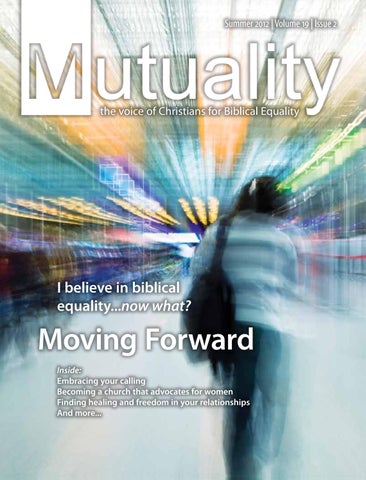
Summer 2012 | Volume 19 | Issue 2
the voice of Christians for Biblical Equality
I believe in biblical equality...now what?
Moving Forward Inside: Embracing your calling Becoming a church that advocates for women Finding healing and freedom in your relationships And more...
Mutuality 19.2, Summer 2012 “Let us then pursue what makes for peace and for mutual upbuilding” (Rom. 14:19, NRSV). Mutuality (ISSN: 1533-2470) seeks to provide inspiration, encouragement, and information about equality within the Christian church around the world. Editorial staff: Megan Greulich, editor; Image Spigot, graphic designer; Mimi Haddad, president/publisher. Contact us at: Christians for Biblical Equality; 122 W Franklin Ave, Suite 218; Minneapolis, MN 55404-2451; phone: (612) 872-6898; fax: (612) 872-6891; email: cbe@cbeinternational.org; web: cbeinternational.org. We welcome your comments, article submissions, and advertisements. For writers' guidelines and upcoming themes and deadlines, visit CBE’s website and follow the link under the Resources tab. Advertising in Mutuality does not imply organizational endorsement. Please note that neither Christians for Biblical Equality, nor the editor, nor the editorial team is responsible or legally liable for any content or any statements made by any author, but the legal responsibility is solely that author’s once an article appears in Mutuality. All Scripture quotations, unless otherwise indicated, are taken from the 2011 revision of the Holy Bible, New International Version®, NIV®. Copyright © 1973, 1978, 1984, 2011 by Biblica, Inc.™ Used by permission. All rights reserved worldwide.
Contents Moving Forward with Your Calling 4
Invest and Cultivate | Tools for empowering women to embrace their leadership calling. by Jo Saxton
Moving Forward with Your Church 9
Church Happens. | Dealing honestly with hurt and anger when the church dumps on you. by Gregory A. Boyd
14 The Next Step | Tips for examining your church's services, programs, website, and more in order to foster a welcoming environment for women. by Megan Greulich Moving Forward in Your Relationships 15 Join the Conversation on The CBE Scroll When Marriage Isn't Mutual | Two case studies exploring the challenges of being married to someone who does not embrace biblical equality. by Morven R. Baker
MINISTRY NEWS
CBE grants permission for any original article (not a reprint) to be photocopied for local use provided no more than 1,000 copies are made, they are distributed free, the author is acknowledged, and CBE is recognized as the source. Mutuality is published quarterly by Christians for Biblical Equality and is sent free to members and supporters.
19 Highlights from the CBE Houston Conference 20 CBE Journals Recognized with Five Awards from the Evangelical Press Association 20 Praises and Prayers 20 Reflect with Us: Letting Go, Being Still
On the cover: Photo by iEverest, from istockphoto.com.
D E PA R T M E N T S 3
From the Editor | “Do Not Look Back”
21 Giving Opportunities | “I’ll Share Yours”: How Charitable Gift Annuities Provide for Everyone
22 President’s Message | Moving Forward, Being Prepared, Giving Reasons
2 M U T U A L I T Y | Summer 2012
website : cbeinternational.org
F
r rom the Editor by Megan Greulich
“Do Not Look Back” Lot’s wife. Let’s be honest: the story seems pretty bizarre to us. And sad. Two angels tell Lot and his family that their city is doomed. Because they are the only righteous people around, Lot and his family will be spared. “Flee, and do not look back,” the angels say, but Lot’s wife turns around to look at her burning city and is transformed into a pillar of salt (see Gen. 19:1-29). I used to read that passage and, with a bit of discomfort, quickly turn to another chapter in the Bible that was easier to grasp. But a few years ago, I picked up Rev. Elaine Flake’s book of sermons, God in Her Midst: Preaching Healing to Wounded Women. Through her experiences as an African-American woman, Rev. Flake offers insights into Lot’s wife that have provided me with great encouragement and challenge. Because of her sermon, I first considered the idea of what it means to “move forward.” Life certainly could not have been easy for Lot’s wife. The fact that we do not even know her name highlights the kind of culture in which she lived, and her place in it. Yet, the passage tells us that the Lord was merciful to her family. The two angels sent to destroy the city grasp the hands of her and her family members and pull them to safety. God offers her a new life, a new start, and her only instruction is “do not look back.” But something in her cannot let go. Even though she knows that what remains of her old life is destruction, she lingers. Even though she knows that God is calling her on, she hesitates. Even
though she has the promise of God’s protection ahead of her, she turns around. Rev. Flake’s sermon encourages us to reflect on how we as people handle change. When God calls us, or reveals a truth to us, we will forever be changed. But this does not necessarily mean that we know the way forward, or that we have the confidence and bravery to trust God, let go of our past, and forge ahead as he desires. The story of Lot’s wife speaks to our need for healing, and to our need to be intentional, prayerful, and courageous in how we move forward. This is the idea behind our issue of Mutuality on “Moving Forward.” As egalitarians, God has revealed the truth of biblical equality to us, but now what? What does this mean for our relationships? How does this impact our calling? And, how do we forgive those in the church who have hurt us? In our first feature article, author Jo Saxton reflects on her journey to leadership while providing encouragement for women who may be struggling to fully embrace their call from God. Then, in his straight-forward and honest style, pastor Greg Boyd offers insights into how we can overcome our pain and anger when other Christians hurt us. I follow up his article with practical tips for egalitarian congregations to work further in building communities that are safe and welcoming to both men and women. And counselor Morven Baker explores the challenges of marriage when one spouse is committed to biblical equality and one spouse is not. Please be sure to join us on our blog for discussion on this confusing and often difficult situation. As always, we would love to hear from you! Send your feedback on this issue of Mutuality to cbe@cbeinternational.org. Blessings to you as you read and reflect!
What topics would you like to see us cover in future issues of Mutuality? Are you interested in writing for us? Email us at cbe@cbeinternational.org. We would love to hear from you!
bookstore : cbebookstore.org
M U T U A L I T Y | “Moving Forward”
3
My Calling
Invest and Cultivate: Tools for Empowering Women Leaders by Jo Saxton
When I look at the Bible, When I look at the global church throughout history and today, When I look at women and their ongoing contribution to society in such a wide range of ways, I have no doubt that God calls women to leadership and influence. ut it wasn’t always that way; doubt had a way of stalking my dreams and my call. It whispered fear into my heart and mind. Like so many of us, the ground I stand on was not found quickly or easily. Responding to God’s call to leadership has come with pain, scars, and sacrifice. In my college years, I once wept over my biblical
studies essays on women in leadership, examining the Greek text and shouting at God, “I can see all the women in here, why did you allow it to be so hard for us to be seen or heard?” There were the lonely days of insecurity, hoping that God didn’t doubt me as much as I doubted myself. There was anger and bitterness about how judged I felt on occasion for believing God called me to lead—as if I would willingly pursue the risk of rejection, I’d mutter to myself. Sometimes the internal wrestling overflowed into my Why have we spent so everyday life. Friendships drifted apart when it became clear that the only way we could much time defining women by Eve’s mistakes be at peace with one another about women in leadership was to simply refrain from rather than our potential discussing the issue. The silence widened the gap between us, until finally we were too in Christ? far apart to even see one another.
4 M U T U A L I T Y | Summer 2012
website : cbeinternational.org
B
Some of these experiences were purely the cost of a calling, true for any man or woman. Nonetheless, leadership evoked both passion and terror within me in equal measure. Regardless of the fruit I saw in my first tentative steps into leadership, and despite the encouragement from great leaders, I still wrestled in my heart. Just because I believed in women leaders didn’t automatically make me feel like one. Just because I sensed there was a calling from which I couldn’t escape (and believe me, I tried!) didn’t mean I knew what to do with it. So much time and emotional energy had been given to reaching the point where I could embrace women in leadership, that I wasn’t sure how to occupy the space when I arrived! Often I wish there was a fail-safe, “put-it in-a-box” list to empower every woman who is called to leadership. But since life refuses to work in such formulas, what I offer is something a bit more rustic: two simple concepts to help women dig deeper into that growing sense of call—invest and cultivate.
Invest
Invest time in exploring your God-given identity. There are multiple voices in our culture declaring what determines a woman’s worth, value, and potential. Invest time and energy in exploring how God made you. We as a church have spent much time dwelling on Eve, but I often wonder, Why have we spent so much time defining women by Eve’s mistakes rather than our potential in Christ? I thought our Redeemer lives!
Mary. Lois. Eunice. Lydia. Priscilla. Junia. Phoebe. Just a few of the women on the pages of the Bible who show us what being an influential woman can look like. We are empowered when we read their stories and when we hear them included in sermons alongside David and Moses and Paul. Their lives provide instruction for our own because their stories still speak to us. Throughout church history, we also find female martyrs and movement leaders, abbesses and mystics,
Women as Ezer (Rescuer) in the Old Testament Women served God in powerful ways throughout the history of Israel. Shiphrah and Puah (Exodus 1) Rahab (Joshua 2) Deborah and Jael (Judges 4 and 5) Abigail (1 Samuel 25) Huldah (2 Kings 22 and 23) Ruth Esther
Eve gives us insight into women’s potential in two key areas: 1) In Genesis 1:28–31, we see that God not only designed Adam and Eve to have close relationship with him, but also commissioned them both to take responsibility and represent him in the world he had made—with no comment about hierarchy. 2) In Genesis 2:18, God describes Eve as helper, ezer— a word meaning to rescue and to be strong, a word with military connotations, and a word largely used in Scripture to describe God rescuing his people from their enemies. These two insights are important for women leaders today because humanity struggles to live or lead beyond what we believe about ourselves. Our thoughts can either paralyze us or liberate us. When we understand that God has always had women in mind to represent him on earth, and that made in his image we share something of his strength, it attends to some of that nagging sense that we need permission from someone to even explore our calling. Why are women still seeking permission when we have been created with a commission? Another wise investment is to spend time recovering our spiritual heritage. Eve. Miriam. Deborah. Esther. Huldah.
bookstore : cbebookstore.org
preachers and reformers. And, around the world today in places like China, India, and across Africa, we see women leading movements and churches that are transforming entire communities. Encountering these women’s stories is
Humanity struggles to live or lead beyond what we believe about ourselves. Our thoughts can either paralyze us or liberate us. empowering because when we see their example, we realize we can be it too. We need to be awakened to our heritage and our family likeness. Invest time in discovering your gifts and passions. After attending to the big picture, it’s also important to get down to some details. Once you have reconnected with your identity, recovered your heritage, and caught a glimpse of your sisters around the world, what is next?
M U T U A L I T Y | “Moving Forward”
5
My Calling • Consider trying personality type assessments like Myers Briggs or Strength Finders as a means to explore the way you have been wired and the contribution you can make to the world. • Utilize tools and questionnaires to help explore your spiritual gifts and uncover your passions. • Talk to a trusted friend about the gifts and abilities they see in you. Sometimes people recognize qualities in us that we struggle to value in ourselves. Be sure to listen to what they say! • Reflect on topics that you are already passionate about or already invested in. What grabs your attention, makes you cry, gets you angry? • Reflect on your day-to-day life: your job, your role at church, your key relationships. What would you do differently if you sensed they were your calling? • Pray about your calling…and listen diligently for God’s response. Perhaps there will be no divine visitation or an immediate answer, but in the days, weeks, and months to follow , pay attention to what God may be speaking to you. • Stumble into something significant by serving. I wonder how many of our favorite Bible characters really knew the significance of what they were doing. We see God’s power redeeming Israel in the lives of Esther and Ruth even though God is not specifically mentioned in these books. Sometimes the call is to be faithful, to find a place to serve, and to commit to it. • Once you have discovered your gifts, unwrap them! Develop your skills and seek out training in order to be the best you can be. Because God is worth it! What other investments do you need to make to empower yourself for leadership? Theological study? Specific training courses?
Women Leaders in the New Testament Be inspired by the women who served as church leaders. Phoebe the deacon (Rom. 16:1–2) Junia the apostle (Rom. 16:7) House church leaders: Lydia, in Philippi (Acts 16:13–15, 40) Chloe (1 Cor. 1:11) Priscilla (1 Cor. 16:19) Euodia and Syntyche (Phil. 4:3) Nympha (Col. 4:15) Apphia, in Colosse (Philem. 1:2) The Elect Lady (2 John 1:1)
6 M U T U A L I T Y | Summer 2012
Invest in a healthy life. Remember your character is more important than your gifts. Remember you are a person, not just a role or a task. Don’t just invest in who you are on the outside. Healthy leaders are healthy inside and out. Some of us carry wounds from the past. Some of us feel disqualified from leadership because of our addictions and secrets. Some of us are workaholics, desperate for approval. Wherever you are, be honest with yourself. Then consider what you need. Do you need to seek a counselor, a support group, or someone to pray with regularly? Don’t be ashamed, be free.
Cultivate
Our God, who in his very being is relational, designed humans with relationship in mind. It is no surprise then that when it comes to leadership, there is only so much we can accomplish on our own. The community in which we are rooted can have a transformative effect on our leadership call. We need an environment that encourages women leaders, that wants to hear our voices and see our gifts at work, glorifying Jesus. That is the kind of place we can call home. And to stay connected to home, it is important that we take the time to cultivate some key relationships: Accountable friendships. Actually, everyone needs accountable friendships, leader or not. We need to cultivate the kind of friends who are secure enough to celebrate in our successes but are also able to ask us the difficult questions about who we are when no one is watching. Good accountability friends ask us about how we eat and drink, about how hard we are working and why, about our hurts and hopes, and about the stellar ideas we have but have felt too inadequate to share with anyone yet. We need the kind of friends who will be sisters, who will laugh at us, cry with us, and pray for us. Sometimes we look to mentors for all of these relationship needs, but we often talk differently to our friends than we do to our mentors. It’s one thing to look up to someone. It’s another thing entirely to look someone eyeball to eyeball. Don’t waste energies comparing or competing with your peers. Cultivate, and do so by being that kind of friend to others, too. Discipling relationships. That is not to say, however, that we should not find people to look up to. It is important to put ourselves into positions where we can learn and grow. I believe prayerfully seeking out mentors is one way to do this. We need the living examples of men and women who have gone ahead of us in leadership and in life, who can share their insights and life lessons. Often I’ve noticed women wait to be chosen to be mentored, as though being selected is a confirmation of their value. But we are already valuable, and that people cannot read our minds and cannot know our hearts’
website : cbeinternational.org
desires. Look for disciplers in your church, or seek out leadership coaches. One caveat: Do not be too prescriptive about your disciple’s background and personality. You may not know exactly what you need in a disciple, and God might just surprise you. When I met Sally Breen (who has discipled me for years), I was stepping out into worship leading and preaching, and she was at home raising a young family. We have very different backgrounds and are different ethnicities. But her input has been life changing and continues to shape the leader I am growing into. Consider too, who you are discipling. Who has access to your life to learn from you? Who is benefiting from the skills and life lessons you have had? We know we have all been commissioned to make disciples, but sometimes that call slips into the distance. Look around your community and church, and prayerfully consider who God is calling you to pour into. There is no doubt in my mind that God has called women to know him and represent him in today’s world, whether that is in church, in the workplace, in our communities, or at home. But we need to be ready. It’s time to pick up our tools. Take a deep breath and be courageous. Invest and cultivate. And then lead. Jo Saxton is a writer, speaker, and former pastor. She is currently a director of 3DM, a movement/organization helping church leaders make discipleship and mission the heartbeat of the local church. Her most recent book, More than Enchanting: Breaking Through Barriers to Influence Your World, invites women to discover (or rediscover) the gifts and talents God has vested in them. A Nigerian Londoner, Jo now lives in Southern California with her husband and their two daughters.
Moving Forward with Your Calling Recommended resources from cbebookstore.org Gifted to Lead by Nancy Beach More Than Enchanting by Jo Saxton Social Justice Handbook by Mae Elise Cannon Some Men Are Our Heroes, KeumJu Jewel Hyun and Cynthia Davis Lathrop, eds. Looking Forward to the Rest of Your Life? by Lorry Lutz “Vocational Identity and Direction” PDF article by JoAnn Streeter Shade “Theology of Work: No Separation of Gender in Calling ” recording by Gwendolyn Dewey and KeumJu Jewel Hyun “Developing your Leadership Giftedness” recording by Elizabeth Glanville “Empowering Christian Women to Use Their Leadership Gifts” recording compilation from ten women ministry leaders
In 15 Words or Less:
What would you say to empower a woman to step into leadership? “Don’t look to human beings to validate your ministry… keep your eyes focused on Jesus!”
“God asked you specifically to do the task. Listen! God knows better than us!”
“Be strong and courageous for the Lord will be with you wherever you go” (Josh. 1:9).
“Don't let anyone cage you. It was for freedom that Christ set us free!”
“Have you considered what Deborah did?”
“I'll support you.”
“Take the risk — God is with you every step of the way.” “Your gifts are precious. Being called is permission from God. That's all you need.” “Leadership is not about perfection, but God’s call. Cling to Jesus and be bold!”
bookstore : cbebookstore.org
Thanks to all who offered these comments and more on Facebook and Twitter! Join us online to keep the advice going. Find CBE on Facebook by searching “Christians for Biblical Equality.” Our Twitter handle is “CBEInt.”
M U T U A L I T Y | “Moving Forward”
7
On CBE’s Horizon in 2013...
“Take Every Thought Captive to Christ: Ideas Have Consequences” Pittsburgh, PA It’s official! Our 2013 conference “Take Every Thought Captive to Christ: Ideas Have Consequences” will be in Pittsburgh, PA. Join Christian leaders, scholars, and activists as we examine the impact of Christian worldview on gender, leadership, relationships, and justice. Block out July 26-28, 2013 on your calendar and then visit cbeinternational.org to stay updated on the latest conference information!
July 26-28, 2013 8 M U T U A L I T Y | Summer 2012
website : cbeinternational.org
My Church
Rejection. Manipulation. Oppression.
It happens. And sometimes it happens in the Church. How do we respond
when other Christians hurt us?
by Gregory A. Boyd
Church Happens.
In 1 Corinthians 12, Paul talks about the gifts of the Spirit. He says his disciples would be one, even as he and the Father are one. He that all spiritual gifts are the work of the same Spirit. The Spirit prayed that our love would mirror the love of the triune God and distributes these gifts as he determines. Everyone is given a gift. that, because of this, the world would come to know that Jesus We all have a role to play. And just as the body is one and has many is for real, that he was sent by God. Unfortunately, the Church parts, so it is with Christ. throughout history has done a pretty good job of keeping Jesus’ A body is functional to the degree that all of it is integrated. prayer from being answered. My fingers do what my head says. My arms are connected to my My dad was an atheist who assumed evangelicals were all torso, and my legs, and so on. This is how the body of Christ is. idiots. He was confused when I continued to be a Christian We are to be a people who manifest despite getting graduate degrees the will of God on earth as it is in from Yale and Princeton. He and I If we are to be the body of Christ here on heaven. We are to be Christ’s hands, began a conversation back in 1988, his feet, his eyes—all of him. So the earth and reflect his character, love, and will, through letter correspondence. I question is, if we are to be the body then why is it so often the case that we don’t? wrote to him, “Dad, I know you are puzzled that I am still a Christian, of Christ here on earth and reflect his character, love, and will, then and I’d like to tell you why. And I why is it so often the case that we don’t? The body of Christ was to want to give you a chance to tell me all the reasons you are not.” be the proof that Jesus Christ is real. In John 17, Jesus prayed that He wrote back and his very first question was, “If Christianity bookstore : cbebookstore.org
M U T U A L I T Y | “Moving Forward”
9
My Church is true, why has the Church done so much harm throughout we thought they were heretics or when they were our enemies. In history?” I think this is the single most powerful argument there the name of the One who made us in his image and valued each is against Christianity. of us enough to die for our sins, we began rejecting, oppressing, Actually for the first three centuries, the Church was pretty and abusing one another. And so the people whom Jesus prayed good. It wasn’t perfect. It has never been perfect, because it is made would be the greatest proof that Christianity is true became the up of people. But for the first three centuries, the Church was greatest reason for people to think it is not. known for its generosity, its kindness, its equality, its self-sacrificial Of course, today it is illegal to kill another human being in love. In his book The Rise of Christianity, Rodney Stark argues that the name of Jesus, but as we all know, Christians still find plenty the reason the Church grew so fast those first three hundred years, of other ways to hurt people. Many of you have experienced this despite being persecuted, was that Christians were outrageously first hand. The Church has dumped on you, leaving you with loving. When a plague would hit a town, everyone would flee— scars and maybe even fresh wounds. Some folks have come from including the doctors. They would run for their lives and leave churches that were hyper-controlling, where the pastor had to give behind those already afflicted. But Christians would frequently his approval before you could do just about anything. Others have stay behind and care for the sick, often giving their own lives in the come from churches where you were ostracized because you dared process. This was their testimony and proof that their message was to openly disagree with your pastor. And others have come from real. The early Christians welcomed slaves and women into their churches where, if you are a woman, you were not allowed to have communities, and everyone served each other regardless of their a say in anything. You were not allowed to serve on a board or even background or gender. The Christians advocated for the people vote as a member. You were not allowed to teach, at least not if an whom everyone else deemed as worthless. They were known as adult male was present in the audience. You were of course allowed folks who would hang out by the bridges at night and rescue infants to give your financial offering, but otherwise, there was not much who were thrown over, because it was legal in ancient Rome for a of a spot for you. The question we need to ask is: How should we father to have two weeks to decide whether their newborn babies respond when the Church or other Christians dump on us? How would live or die. The Christians’ willingness to sacrifice for these can we begin to make sense of this? Let me offer three points. unwanted babies was a testimony to others that Jesus was real. So the Church grew by leaps and bounds despite the fact that it was A Movement, Not a Religion illegal to be a Christian. For the first three centuries, the Church, First, it is vitally important to remember that Jesus did not come to a large degree, looked like the body of Christ. to start a religion. We do not need another religion. In fact, But then the worst possible thing happened to the Church: far from being the expression of God’s work on earth, I believe it was given power. In the fourth century, Constantine supposedly religion is the major obstacle to God’s will being done on earth as became a Christian and began to give the Church governmental it is in heaven. Jesus came to start a movement—an organic, Spiritauthority. We read in the Gospels that Jesus viewed the inspired movement—that he calls “the kingdom of God.” And opportunity to acquire the authority of the world’s kingdoms to you can always tell where that movement be a temptation of Satan. He didn’t want is being birthed and where it is growing any of it. But when Constantine offered because it always looks like Jesus. It always the fourth century Church this same I would suggest to you that asking has people who are learning to love and authority, Church leaders like Eusebius people what they believe or what serve like Jesus. It is free of arrogance and and Saint Augustine said, “Look, God they call themselves is pretty entitlement. It obeys the teachings of Jesus has given us all this authority! He must so that the people involved notice the irrelevant. Instead, simply look at want us to rule the world! And why not? log in their own eyes before looking for their lives. Do they live like Jesus? We are the righteous and the wise, so who specks in others’ eyes (Matt. 7:1-3). There is better to rule people than us?” Tragically, nothing mysterious about noticing where once the Church accepted Constantine’s the kingdom of God is present. You do offer, it began to do some rather nasty things, and it continued to not even need to ask a lot of theological questions. You just look. In do so for centuries. Yes, the Church also did a lot of good. I do not fact, I would suggest to you that asking people what they believe or mean to minimize that. But this is pretty typical of the world’s what they call themselves is pretty irrelevant. Instead, simply look religions and governments: they do some good, and they do some at their lives. John teaches us that whoever claims to abide in Jesus evil. The evil done by the Christian Church was unique, however, must live as he lived (1 John 2:6). So if you have folks who are living in that it was done in Jesus’ name, which makes it super evil. as he lived, to that degree the kingdom is present. Conversely, if The irony is this: in the name of the one who taught us to you find folks who are not loving their enemies, serving the poor, turn the other cheek, the Church started cutting off people’s caring about the outcasts, entering into solidarity with those who heads. In the name of the one who told us to spread the fire of are oppressed, and living with outrageous generosity, to that degree God’s love, we started setting people on fire. In the name of the the kingdom of God is not present. one who taught us to feed the hungry, we starved out cities when
10 M U T U A L I T Y | Summer 2012
website : cbeinternational.org
I used to try to defend the Church when critics would point an ethnicity, or a gender. It is a diabolical trap because it is very out all the nasty stuff Christians have done and continue to do. I no hard to ever be freed from it. When you embrace a prejudice, longer feel the need to do this because the only tribe I identify with is it colors the way you look at the world. You look for what will confirm your prejudice, and you the tribe that Jesus identified with — delete out whatever would count the tribe of those who aspire to submit against it. So you are always finding to God’s reign, who have his Spirit If you are mad at some of the things the running through their lives, and who Church has done, Jesus is probably madder. confirmations of your prejudice. The truth is that generalizations didn’t are therefore starting to manifest his hurt you. They are not even real! life. Everything else is religion! It can You cannot fight a generalization, do good, it can do bad, but it is not the kingdom of God. So, I encourage you to not blame Jesus for what forgive a generalization, or be forgiven by a generalization. When other people do, regardless of what they call themselves. In fact, if you we get mad at generalizations, we’re simply stuck with a diabolical are mad at some of the things the Church has done, Jesus is probably pollutant in our head. So when you’re mad, please don’t throw the baby out with madder. In Revelation 2-3, Jesus reams out the churches when they fail to live up to the Lord that they profess. Jesus did not come to birth the bath water. If you are mad, get clear on who you are mad at—a particular group of people, a particular pastor, maybe a particular a religion, he came to found a movement. church. Be mad at them, but do not generalize it to everybody. And always remember that the purpose of being mad, if you are a Avoid Generalizations follower of Jesus, is to get over it. Work to reach the point where Second, I want to encourage you: Don’t “throw the baby out with the you can let people go. Maybe you will never trust them again, and bath water,” as the phrase goes. Do not fall into this trap of buying that is fine, but to let them go is what forgiveness is all about. into generalizations. Maybe your pastor says something offensive, or someone in the congregation does something offensive, or maybe the whole congregation doesn’t do My church does not support biblical equality. something and it is offensive. It How do I decide whether to stay or find another place of worship? finally brings you to a breaking point and you say, “I’m done. I’m You have to ask whether God is calling you to change this body that you are done with the Church. I’m done involved in or if God is calling you to leave. If he is calling you to stay, then with those Christians. I’m done he is calling you to be an agent of change. So you need to ask the question, with organized religion.” At that “Do I have any authority, position, or influence to change?” If you are in a point I’d like you to ask yourself, religious system where all the power is located in one, two, or three people Who actually hurt you? Was it upfront and there is nothing you can do about it, then I find it very unlikely the Church? Or was it a bunch of that God is calling you to stay there if significant problems exist. individuals in the Church? What often happens is that we empower If you are not called to change your church, then you should seriously think a particular pastor, or a particular about leaving. The worst thing is to stay in a religious system where you do group of people, or a particular nothing but complain. I counseled a person several years ago who refused church to speak on behalf of all to tithe because he didn’t agree with what his church’s leadership was doing. the Church, or all Christians, or all My encouragement to him was to go out and find another ministry because organized religion. Nothing good it wasn’t good for him to be sitting in a system where he is under untrusted can come from this. It is simply leadership. So find a church you can trust. You will never find one that is a prejudice. It is like a person completely problem-free. But at least look for one with a core vision you saying that all Americans are rude agree on and with leaders whose character you trust. In the end, you just because the four Americans they have met have been rude. It is need to go to God and ask him for wisdom, and seek out feedback from simply unhelpful to draw sweeping others you share life with. generalizations. If you stay and try to change, remember 1 Corinthians 16:14: I believe the forces of evil “Do everything in love.” You have to work for change in a loving way, are always at work when we and if you can’t, then don’t do it. Coming in with arrogance, selfembrace prejudice, whether it is righteousness, and divisiveness is not of God. about a church, or a country, or
Q: A:
bookstore : cbebookstore.org
M U T U A L I T Y | “Moving Forward”
11
My Church Get Connected, Stay Connected Finally, I encourage you to not let your woundedness take you out of the game. I am so empathetic to those who have scars and have been dumped on by Christians or the Church. But here too forces of evil can be at work. Do not allow your pain to isolate you. Typically, the way this happens is that a pastor, or a group of Christians, or an entire congregation does something that hurts you, so you get mad and reject the Church or organized religion. And, if you are still a believer in Jesus, you have your little “me and Jesus” club. Or the “me and my family and Jesus” club. And once and awhile, you have your little worship time with your family, or maybe a Bible devotion time with your family, or maybe you go out and do some good deeds with your family. The convenient thing about this is that it involves no risk—no one is going to hurt you. You do not have to put up with all those terrible Christians in the Church. You do not have to drive to Church because it is right there whenever you want it. You do not have to give an offering. You can have whatever music you like, and if a sermon is a bit boring, then you can just turn it off. You can have everything exactly the way you like it!
Remember that the purpose of being mad, if you are a follower of Jesus, is to get over it. Unfortunately, if you are a follower of Jesus, and if you believe in the New Testament at all, then this isolation is simply not an option for you. There may be times when you will go solo, such as when you are between churches, or if you move to an area where there are no churches. But as a permanent solution, this “lone ranger” Christianity is not an option. In the New Testament, to be a Christian is to belong to the body. Just as the body is one but has many parts, but all of its many parts form one body, so it is with Christ. The analogy is saying that if you are isolated from the body, then you are dismembered. How long would my finger survive if I cut it off? Not long. So also if we are cut off from the body, the flow of life is not going to be coming into us.
Do not stay in a church where you do nothing but complain. Community is intrinsic to the kingdom: to believe in Jesus means you are part of the corporate bride of Christ. We are to come together to worship, to teach, to learn, to grow together, and to serve one another. In fact, there are fifty-seven “one another’s” in the New Testament, and every one of them presuppose that we belong to a believing community. The bottom line is that participation in the Church is not a recommendation in the Bible, it is a command. The author in Hebrews tells us to
12 M U T U A L I T Y | Summer 2012
Moving Forward with Your Church Recommended resources from cbebookstore.org Making Room for Leadership by MaryKate Morse How I Changed My Mind About Women in Leadership, Alan F. Johnson, ed. Reconsidering Gender Myk Habets and Beulah Wood, eds. “Reforming the Church,” Priscilla Papers vol. 17, issue 2 “Examining the Twelve Pillars of Male Hierarchy” recording by Philip B. Payne “What is Biblical Equality? Communicating the Vision Concisely and Coherently” recording by Ronald W. Pierce “Male/Female Shared Leadership: Casting a Vision for the Next Generation” recording by Dale Durie and Stephanie Williams “And the Church in Her House: Women as Leaders in Early Churches and the Recipients of 2 John” recording by John R. Kohlenberger III “Singleness and Community: Glorifying God in the Church Body” recording by Christine Colón and Bonnie E. Field “The Economics of Body and Space: Creating Safe Places and Relationships” recording by MaryKate Morse “Transformation of Relationships: The Biblical Subversion of the Nature and Exercise of Power” recording by Manfred T. Brauch “Biblical Foundation for Mutual Submission and Shared Authority Between Men and Women in Church and Marriage” recording by Philip B. Payne “Leaders Working Together Across the Gender Divide” recording by Jeanne Porter
website : cbeinternational.org
“consider how we ought to spur one another on toward love and good works.” The author then adds, “Do not give up meeting together as some are in the habit of doing” (Heb. 10:24-25). Even in the first century, people were skipping church! And they did not even have podcasts back then or television evangelism! But it's as true today as it was back then: participating in church is a non-negotiable command in Scripture. To belong to Christ is to belong to his body. Going solo is not an option. We need to be sharing life together, we need to be serving one another, we need to be caring for one another. I understand how challenging it can be to stay in community when you’ve
been hurt. But I encourage you—for your sake as well as for the Church—to release your offenders and connect once again with the body of Christ. Greg Boyd is a former atheist who surrendered his life to Christ in 1974. He graduated with honors from Yale Divinity School and Princeton Theological Seminary. Greg was a professor of theology for sixteen years at Bethel University and is the founder and senior pastor of Woodland Hills Church, an evangelical megachurch in Saint Paul, MN. This article is adapted from his April 17, 2011 sermon at Woodland Hills, “Church Happens.” It is used with permission.
What if your college, nonprofit, church, or seminary joined CBE?
“The simple fact that [our] seminary is an institutional member of CBE sends a signal to our students and the larger community about how we view women, in particular, in the life of our family. For a faculty person to be able to say, ‘This is where we stand together as a community,’ helps to establish a culture of equality and mutuality in our common life.” —Dr. Paul Chilcote, Ashland Seminary faculty member
Learn more at cbeinternational.org/institutions
bookstore : cbebookstore.org
M U T U A L I T Y | “Moving Forward”
13
My Church
The Next Step Practical Ideas for Egalitarian Churches by Megan Greulich
My church believes in biblical equality...now what? Is your church firmly committed to biblical equality? Hurray! If your congregation is looking to take the next step in affirming and valuing the gifts of both women and men, consider these tips: Examine Your Programs and Leadership • Analyze your Sunday services. Are women regularly serving communion? Are they praying and reading Scripture during your services? Are the lyrics of your music gender inclusive? Are guest preachers and teachers often women? Are your pew Bibles gender accurate translations, such as the NRSV, TNIV, and NIV 2011? • Examine your leadership. Are women serving as elders and deacons? Are they making financial decisions and represented on all church boards? Are women on ministry staff? Do these women have accurate job titles? If a woman on your staff is leading ministry, does her job title mirror
14 M U T U A L I T Y | Summer 2012
the titles of the men on your staff in similar positions? If she is a ministry leader or a pastor, call her that. And, if women are underrepresented in particular areas of leadership, be prayerful and intentional about making changes, and listen to the Holy Spirit’s leading. This isn’t simply a numbers game—the goal is not to appoint women just to have women leading, but to recognize that our biases may at times prevent us from seeing godly and gifted women in our midst whom the Lord is calling to leadership positions. • Review your sermons over the last few years. Have you preached on the biblical basis for women’s equality? Are godly women examples from the Bible and throughout the history of the church utilized often? Do your sermons website : cbeinternational.org
avoid jokes that play on gender stereotypes? Do you address domestic violence and abuse from the pulpit? • Evaluate your curriculum. Does your church library provide resources on gender equality, such as those available through CBE? And if so, does your congregation know they are available?
humanity? If your church belongs to a denomination that is egalitarian but does not use gender accurate language in its foundational documents, bring this to the attention of the denominational leaders.
• A nalyze your church website. If someone were to visit your website today, would they know your church believes in biblical equality? Does it provide resources on gender and • Does your premarital counseling curriculum address abuse a link to CBE? Does your mission and domestic violence? statement reflect your church’s desire • Listen to the women in your to recognize and utilize women’s full congregation. Do they feel Compile a group of women leadership abilities? heard? Do they feel respected? in your congregation. • Partner with CBE. Is your church Do they feel free and encouraged a part of CBE’s egalitarian church Meet with them and listen to use their gifts? Are their directory? Is it a member of CBE? ideas considered as seriously as to their feedback. Do they Providing the CBE church member men’s ideas? Compile a group feel respected? Are their ideas seal on your website sends a clear of women who are invested in message to visitors that both the church. Meet with them considered seriously? women and men are fully valued in regularly and listen to them. your congregation. Make sure they are free to speak openly and honestly. • Evaluate the outside ministries your church supports financially. Are they supportive of women? When representatives from these ministries or guest preachers come to your congregation, do they know that you expect them to use gender accurate Bible translations?
Examine Your Youth Group • Regularly review Bible studies and curriculum that you are using with your youth. Christian resources for teenagers are often steeped in gender stereotypes! • Be intentional and careful when separating guys and girls. There may be certain times when splitting the girls and guys will benefit the youth more than staying in mixed-gendered groups. However, monitor the messages implied when separating girls from guys. Are the boys taught about leadership while the girls are taught about relationships? Are the guys explicitly or implicitly taught more than the girls about discovering their leadership gifts? This is more common that we might realize, even in egalitarian churches. Make space for both girls and guys to practice leading and serving in a variety of ways. • Examine the overall messages boys and girls are receiving about gender. Are the guys, as well as the girls, encouraged to dress modestly? Is your youth group a safe place for girls, as well as guys, to admit struggles regarding lust, sex, and pornography? Teach your young people how to think critically about the gender messages they are receiving from culture— both from Christian culture and from popular media.
Examine Your Mission Statement and Website • Review your church documents, especially your statement of faith. Do they use gender accurate language to discuss bookstore : cbebookstore.org
Examine Your Culture
• Host a support group for those recovering from pornography addictions. Preach from the pulpit and teach in classes the dangers of pornography and how it dehumanizes women. • Provide materials on recognizing and responding to domestic abuse. Place resources that define abusive behavior and provide phone numbers for crisis intervention groups in women’s bathrooms. Compile lists of websites, hotlines, counselors and therapists, and women’s safe houses to use as referrals to those in your congregation. • Partner with groups in your area that are responding to issues of gender injustice, such as women’s shelters and ministries working to end sexual trafficking. Bring people from your congregation to volunteer at shelters and learn more about these problems. Host film nights at your church to view documentaries on injustices that women face.
Examine Your Hearts Working to make our churches open to the gifts and service of women is a process. Be graceful. Be open to listening and to changing. Be humble. Strive to make your church an environment where individuals are free from fear and able to ask questions and engage in respectful, honest dialogue. And above all, pray intentionally and regularly — both individually and corporately — as part of your staff’s weekly activities. Megan Greulich is the editor of Mutuality and the membership coordinator for CBE. A graduate of Bethel University, she currently lives in Saint Paul, MN where she is active in an urban Mennonite intentional community. Megan enjoys running, baking, and mentoring high school students.
M U T U A L I T Y | “Moving Forward”
15
My Relationships
When Marriage Isn’t Mutual Finding oneself married to a non-egalitarian spouse, whether male or female, can be a challenging road to navigate. Consider these case studies.
by Dr. Morven R. Baker
Norma and Charlie
Moving Forward in Your Marriage and Family Recommended resources from cbebookstore.org Partners in Marriage and Ministry by Ronald W. Pierce Note: The stories of Norma and Charlie, and Mary and Paul, are based on real examples from Morven’s counseling experiences. Their names and some of their situations have been changed to protect their anonymity.
Bound and Determined by Jeanene Reese
16 M U T U A L I T Y
Summer 2012
Christian Family in Changing Times by Robert M. Hicks Growing Strong Daughters by Lisa Graham McMinn Marriage Made in Eden by Alice P. Mathews and M. Gay Hubbard
It was love at first sight. Norma and Charlie’s eyes, in all actuality, met “across a crowded room” at their conservative denomination’s annual meeting. Life for the Browns began, as for most entering into marriage, with delight and optimism. The Browns’ church held strongly to the view that “women should be silent” (1 Cor. 14:34), and that all leadership in the church should be male. The congregation was taught that God was male, as Jesus called him “Father” ( John 10:30). And, for the first years of their marriage, Norma obediently adhered to the teachings of her church and to the lifestyle she had experienced in her patriarchal childhood home. She submitted to Charlie as he made all of the family decisions and controlled the finances, and she embraced her role as a stay-at-home mother. But then Norma’s neighbor invited her to attend a women’s Bible study, providing her with new friends whom she began to trust. For the first time in her life, Norma learned that the Bible demonstrates that God has feminine characteristics, likening God to a woman in labor (Isa. 42:14); a nursing mother (Isa. 49:15–16); a mother hen (Luke 14:34); and a mother who comforts her small child (Ps. 131:2). Norma and Charlie were taught that man, and not woman, was created in the image of God, implying that women were “less than,” and that their husbands’ “desires” must be obeyed. But now Norma was learning that women are also made in God’s image. She read that Jesus respected women, affirming their dignity at a time in history when women were considered property and virtually had no voice. It amazed her that Jesus gave a woman authority to speak his words to the disciples ( John 20:17). These fresh perspectives gave Norma a whole new view of God, and she began to love her Savior in a deeply personal way. She felt profound relief and rejuvenation and longed to share these feelings with Charlie. But how would he respond? How would Norma live out her new convictions about mutuality in marriage if her spouse disagrees?
website : cbeinternational.org
Paul and Mary “Bridal school” was the path Mary’s parents intended her to walk when they sent her to a one-year Bible school after high school to meet a young man with similar denominational roots. Instead, she met Paul, an egalitarian, and despite her family’s objections, Mary stood up to her parents and married him. Paul loves his wife and is attracted not only to her beauty, but also to her tender character. When they study Scripture together, he marvels at her insight and wisdom. Yet, he learns that the “gentle spirit” he first saw in Mary, who was raised as a complementarian, was actually her attempt to be the passive wife she believes is taught in the Bible and has seen modeled by her mother. Paul views her as an equal in their relationship, but Mary feels conflicted by his affirmation, having never witnessed this picture of partnership in her parental home. Paul sees potential in Mary that she cannot see in herself, and he longs for her to live boldly and share in the decisionmaking for their family. How might he respond to his wife’s longheld and deeply rooted passivity? As an egalitarian man, how can he encourage her to use her gifts when she believes God intends very different roles for men and women?
Principles for Moving Forward When Your Spouse is Not Egalitarian Safety
If you are in a marriage where your spouse has a problem with anger, controlling behavior, and/or abuse, seek help. The safety of you and your children must be the primary concern. This may include seeking housing in a local shelter; legal counsel in order to keep custody of, and obtain support for, the children; professional Christian counseling, and perhaps even the end of the marriage. This will be a difficult journey. Yet, God desires peace and safety for all his children.
Healthy Communication
Every marriage is different, as every individual brings with them into this new relationship a suitcase full of unique issues: past abuses, whether experienced personally or witnessed as happening to others; genetic tendencies; addictions; feelings of abandonment; or religious biases that have colored how their personality has developed, to name a few. But regardless of a couple’s unique struggles, the root of all good marriages is healthy and open communication. All people should have the freedom to gently and respectfully communicate their beliefs to their spouses, whether or not they agree. If you struggle in your marriage to communicate openly and with respect for one another, consider meeting with mutual friends, a pastor, or a counselor.
The Importance of a Support Network
Join the Discussion on The CBE Scroll What do you think? Join us at (blog.cbeinternational.org) to share your ideas for moving forward in a marriage to a non-egalitarian.
Dr. Morven R. Baker, DMin, PCC-S, NCC, has been in practice for over twenty years in both institutional and private practice settings. She is founding president of Ashland Women’s Counseling Center (healingforwoundedhearts. org), where she deals with the range of issues faced by women, but especially those arising from sexual abuse and domestic violence. A published author, Dr. Baker is a popular speaker and teacher, having delivered classes, lectures, and worskhops in the US and abroad. Find her blog at morvensblog.com.
bookstore : cbebookstore.org
Find a community of like-minded Christians to pray for you and provide godly advice as you navigate conflict in your marriage. Those married to a non-egalitarian may find it helpful to invite other couples to study Scripture in a group together, to foster a safe and friendly environment for you and your spouse to discuss and ask questions about gender.
Empowerment
Find practical and non-threatening ways to empower your spouse. Be creative and willing to sacrifice. Regularly communicate the gifts and potential you see in your spouse, and support them in their goals and dreams.
M U T U A L I T Y | “Moving Forward”
17
My Relationships Mutuality in Marriage is Biblical God tells Abraham to follow the wishes of his wife, Sarah (Gen. 21:12). In Song of Songs, both the man and woman initiate. Together, Priscilla and Aquila lead a church, work alongside Paul, and teach Apollos (Acts 18:26; Rom. 16:3-4). Paul teaches the Corinthians that husbands yield authority to their wives, and wives yield authority to their husbands (1 Cor. 7:3-4). Paul instructs believers to submit to one another (Eph. 5:21).
E
xclusive Articles for Members
How might we structure an egalitarian dating relationship? X + Y = Happy Relationship? by Jason Eden
“I believe that I have found the perfect ‘formula’ for a successful dating relationship and marriage. Skeptical? You should be. Authors and speakers have been providing Christian readers with a plethora of relationship tips and advice, yet statistics indicate that romantic relationships among Christians are characterized by high rates of fornication, unfaithfulness, divorce, and even abuse. Why is this? Perhaps in our search for quick fixes, easy solutions, and catchy phrases, we have overlooked clear and basic truths...” (read more online)
For a limited time, CBE members may download these articles from our archives for free! Simply visit cbeinternational.org, log in, and navigate to the Members Only Page.
How might my spouse and I make decisions in our marriage when one person no longer has the final say? Dealing with Decisional Deadlocks by Gilbert Bilezikian
"Despite the goodwill inherent in the mutual submission model, stumbling-blocks commonly emerge in situations where well-meaning spouses may become honestly unable to reach a consensus and remain stuck in decisional impasses. In such cases, the most relationally destructive solution is for one spouse to claim the right to impose one’s will on the other. The purpose for this article is to present biblical alternatives for the resolution of such deadlocks that are consistent with the biblical call to mutual submission (Eph. 5:21). • Don’t insist on having your own way, but defer to the other person’s preferences. Seek to please the other, not yourself. Sacrifice your will to the common good. Be humble. • Seek a compromise. In the presence of two conflicting options, find a third way acceptable to both parties. • Agree to predetermine areas of competency (spiritual gifts) where each of the partners is the one better qualified to render the final decision, and stick to the pre-arranged division of responsibilities...." (read more online)
18 M U T U A L I T Y | Summer 2012
website : cbeinternational.org
M
i inistry News compiled by Kriste Patrow
Highlights from the CBE Houston Conference A New Creation. A New Tradition. Reclaiming the Biblical Tradition of Man and Woman, One in Christ. April 27–28, 2012 | Houston, TX
Two days. 151 attendees. Insightful scholarship. Refreshing fellowship. And a bunch of men and women who refuse to be “silent in church” when it comes to biblical equality. The CBE Houston conference was a smashing success!
Recordings are available! Visit cbebookstore.org to purchase the Houston sessions in DVD, CD, or MP3 formats. CBE members save 50%!
NEW! Preview sessions
on YouTube! Visit cbeinternational.org/paynetx and cbeinternational.org/kirktx.
Attendees prayed for two women who were preparing to be installed as deacons. Their church has recently opened up positions of leadership to women.
Commit to 5 The CBE Houston Chapter presented attendees with a simple plan of action: commit to completing one or more of these five goals over the next five months. 1. Pray daily about what I have learned about gender equality. 2. Visit the CBE website to read one article and one recommended book on gender. 3. Attend or host a small group Bible study or book discussion group for further exploration of gender equality. 4. Make one change in the way I speak about and participate in congregational worship regarding gender equality. 5. Share my journey with at least one other person who I think will be blessed with the knowledge of gender equality. Attendees also received a refrigerator magnet outlining the five goals, and were encouraged to share their progress on the CBE Houston Chapter’s website. bookstore : cbebookstore.org
“I cannot think of a place/time that I have felt more confident and encouraged to be a woman. Thank you so much to all the speakers from the bottom of my heart. Thank you for being obedient to the Lord and for loving the female half of the church!” —Celina “The stories were particularly powerful—reminding me, in particular, that simply “being” What Attendees for women’s full inclusion in the church isn’t enough. We have to are Saying ACT on behalf this conviction. I’m renewing my commitment to agitate on behalf of women, and to get others to do so, too...” —Daniel “Thank you to everyone who put this event together! I didn’t really know what I was coming to…, but God used that time in ways I couldn’t imagine. CBE gave me the courage to challenge what I’ve believed my role should be and to dream bigger!” —Danielle
M U T U A L I T Y | “Moving Forward”
19
M
R
CBE Journals Recognized with Five Awards from the Evangelical Press Association
Letting Go, Being Still
i inistry News
by Liz Beyer
i eflect with us
by Jo Ellen Heil, with inspiration from Susan McCoubrie
Please join us in congratulating our editorial team— Bill and Aida Spencer, Deb Beatty Mel, and Megan Greulich—for their stellar leadership which was again acknowledged at this year's Evangelical Press Association (EPA) convention. Here's the scoop. CBE received five awards, in four different categories. In the Student Writer of the Year category, second place went to Mutuality for “A Crown of Thorns: Why I’m Exchanging Princess-ship for Discipleship” by Laura Robinson. Third place went to Priscilla Papers for “Biblical Interpretation and the Epistle to the Ephesians” by Lisa Baumert. In the Biblical Exposition category, first place went to Priscilla Papers for “What Can We Say about Phoebe?” by J. David Miller. In the Fiction category, second place went to Mutuality for “The Primary Colors of Our Moral Sense” by Elise Toedt. And, in the Critical Review category, fifth place went to Mutuality for “Movie Review: Sherwood Baptist Church’s Courageous” by Jenny Rae Armstrong. We are so grateful for each person who contributes to CBE's journals, whether it is through writing, editing, designing, or praying. Be sure to visit us online at cbeinternational.org/ awards to read these award-winning articles, as well as past years' winners.
In order to move forward, we have to let go of the past. If it has been a painful loss—such as a lay-off, a betrayal, or the death of a loved one—we will not completely heal until we ask for God's help to forgive those who have wounded us or until we stop blaming ourselves (whether it is our fault or not). God's grace can bring blessing out of the most negative of circumstances. If it is a positive change—like the graduation of a favorite student or a pastor's wellearned retirement—then we need God's strength to bless what was accomplished, release the person who moves on (despite our own loss), and request God's continued working in our lives. Both kinds of transitions can be difficult. We yearn for tidy answers and happy endings, not discomfort and uncertainty. Yet in such times the Good Shepherd continues to call us in intimate ways. “Be still, and know that I am God” (Psalm 46:10). The prophet Elijah heard God's whispered reassurances only after he removed himself from the expectations of others. Queen Esther had no idea how to save her In times of discomfort people from destruction—until she and and uncertainty, the the women of her court fasted and prayed. Good Shepherd calls to God always reveals himself to those us in intimate ways. who listen to his voice. Manoah's practical wife was eager to receive the angel's promise (far more than her fearful husband!) and parented Samson, who became a judge of Israel. Jesus' disciple Peter received a rooftop vision about unclean foods and then realized that God was talking about far more than cuisine. They couldn't see beyond the immediate horizon, but they realized that “without a vision the people perish” (Prov. 29:18, KJV) and chose to walk into God's future landscape with hope. As God's beloved children, may we also be able to let go, be still, and listen. When we dwell in life's sometimes untidy transitions, may we receive a fresh new vision of God's provision for our future. At times it will seem utterly impossible. But with God, “all things are possible” (Matt. 19:26).
Praise God with us for...
Pray to God with us for...
• The 1,800 books and nearly 600 journals that were mailed to Kenya, in time for our conference. Praise God for those who donated postage to make this possible!
• CBE's Kenya conference, “Equal to Serve: Gender and Authentic Biblical Leadership," which is just around the corner on July 20-22! Pray specifically for:
• Our summer intern, Adela, who arrived this month from Moldova. Praise God for bringing such a passionate and bright woman to our office, and for the donors who made it possible.
• Rev. Domnic Omolo Misolo and other workers and volunteers as they manage many details. • Safe travel for attendees and speakers. • Sensitive and effective cross-cultural communication. • The Holy Spirit to inspire the speakers and equip everyone involved to bring change to their communities.
• An incredible conference hosted by the CBE Houston Chapter. Be sure to read the highlights on p. 19!
20 M U T U A L I T Y | Summer 2012
website : cbeinternational.org
G
i iving Opportunities by Charity Kroeker
“I’ll Share Yours”: How Charitable Gift Annuities Provide for Everyone Have you ever watched a family share food? Children and parents eat from the same plate. Siblings munch popcorn from the same bowl. My mother seems to have the special gift for sharing food. She doesn’t drink much coffee. When she wants some during dinner, she pours a large cup and tells my dad, “I’ll share yours.” My mom sips all that she needs, and my dad drinks the rest. A charitable gift annuity (CGA) works in much the same way my parents share coffee. Perhaps you have a large amount of savings left from a lifetime of good stewardship. Think of those savings as my mom’s pot of coffee. When you give a donation to CBE as a CGA, it is like my mom pouring a cup for my dad. Your gift will be invested with Comerica Legacy Foundation, CBE’s gift annuity agent, and you will receive a fixed payment each month or quarter, based on your age and the amount of money you have put into the CGA. If you are over sixty, you will receive at least 4% and as much as 9% of your donation every year without fail, for the rest of your life. What’s more, you will receive an immediate tax deduction, and a portion of your annuity payments each year may also be tax-deductible. Think of this part as my mom sipping from my dad’s cup throughout dinner. Then, when the Lord calls you home, the remainder of your donation goes directly to CBE’s ministry, just as the rest of the coffee remains for my dad when my mom is finished. A CGA provides yearly benefits for you, and after you have passed, it provides for CBE’s ministry. But what does this investment mean? What does CBE do with its portion of the cup? Let me give you a small example of how CBE has used its donated resources over the past year. In July 2011, more than 200 Christians gathered from all over the world in Seattle, Washington for CBE’s conference “Building Biblical Community.” They learned and laughed and prayed together, and by the end of the conference, many of these individuals had become friends. In the months following, the impact of this event became apparent. A strong
bookstore : cbebookstore.org
new CBE chapter sprang up in the Seattle area, and within only a few meetings, this group attracted a crowd five times its original size. International attendees started a new website as a “portal” and “idea bank” for egalitarians working all over the world. Two Kenyan conference attendees returned home and immediately began planning to host a CBE conference in their country, which will happen this July in Limuru, Kenya. And two of CBE’s bestselling resources were translated into Swahili. You can see that a small investment in CBE goes a long way. Are you trying to practice good stewardship with your savings? While the stock market wavers daily and banks offer low interest rates, a CGA provides a steady income for you, and biblical truth to thousands around the world after you have passed. Would you “share your cup of coffee” with us? Creating a CGA is easy. Contact CBE today to find out how you can start making this worthwhile investment. Charity Kroeker is the development associate and international chapter liaison for CBE.
M U T U A L I T Y | “Moving Forward”
21
P
i resident's Message by Mimi Haddad
Moving Forward, Being Prepared, Giving Reasons “Always be prepared to give an answer to everyone who asks you to give the reason for the hope that you have. But do this with gentleness and respect” (1 Pet. 3:15). Have you ever noticed how often Scripture asks us to be prepared, to trim our lamps, to be ready to offer a reason for our hope? Being prepared with an answer for why we hope for a church where believers serve based on their character and giftedness, rather than their gender, is an important way we “move forward” as egalitarians. We must be ready to give reasons for our hope because Scripture calls us to not only believe in the good news of Christ but to also, in gentleness and respect, share our hope with others. Sometimes our egalitarian witness can include asking a question; nominating a gifted woman for a leadership position; recommending a book, topic, or speaker; or using stories and analogies that help us interpret biblical texts more accurately. Analogies can be powerful tools that bring clarity to complex issues. Educators suggest that metaphors and analogies enable individuals to grasp quickly the essential elements of logic in what are otherwise complicated discussions. Perhaps this is one reason Jesus used metaphors and analogies when explaining spiritual realities. Because the biblical interpretation is often complex, it can be helpful to use analogies to grasp the meaning of passages such as 1 Timothy 2:11-15. Consider the following example. When climbing a steep rock, or when reading a confusing passage in Scripture, the temptation is to hug the rock too closely—to rely upon the “clearest reading” of the English text. 1 Timothy 2:11-15 is a classic example. It is a very steep rock—it is a difficult text to interpret not only because Paul suggests that women are saved through childbearing (v. 15), but also because Paul uses a strange Greek word, found only once in the Bible—authentein (v. 12). The passage, by virtue of its complexity, demands more of us, just as a skilled climber recognizes that climbing a steep incline requires a counter intuitive measure: despite the laws of gravity, the safest path upward is not to hug the rock but to lean away from it. In order for us gain a universal application from a difficult text like 1 Timothy 2:11-15, we must lean away from the plain reading of the passage in order to gain perspective through a historical, cultural, and linguistic analysis, and by allowing what is clear in Scripture to shed meaning on what is unclear.
22 M U T U A L I T Y | Summer 2012
To gain balance and perspective in understanding 1 Timothy 2:11-15, we lean back and consider how other writers from the first century used authentein. The answer is very helpful. First century writers nearly always used authentein for “authority” that was domineering, misappropriated, or usurped. It can also mean to behave in violent ways or to kill. That is why the Vulgate, the Geneva Bible, the King James Version, and others translations of Scripture translate authentein as “domineering,” or “usurping authority.” It is also helpful to lean back and learn that Ephesus was a city known for its worship of the fertility goddess Artemis, who promised women safety in childbearing. Unlike most goddesses, Artemis did not have a male partner, and this background helps explain why women affiliated with Artemis might have usurped authority to promote myths and genealogies that are contrary to Scripture. Paul opposes their efforts by using the unusual Greek word authentein. As we continue to “lean back” and study the situation at Ephesus further, we observe that Priscilla and Aquila built a church in their home in Ephesus, where they instructed Apollos (1 Cor. 16:19). Significantly, Priscilla is referenced ahead of her husband in teaching one of the most gifted speakers mentioned in the New Testament—Apollos. She instructed him in the very place—Ephesus—where Paul asks women not to usurp authority over men. Clearly, the type of leadership Priscilla exercised is one that was godly and not domineering. Importantly, she did not promote myths and genealogies but explained the way of God more adequately! The universal principle of 1 Timothy 2:11-15 is not to exclude women (like Priscilla) from teaching, but to exclude false teachers who usurp authority. As we give answers for our hope, we may need to explain that to give Scripture its fullest authority in our lives means we resist the “clearest reading of the text” when doing so places Scripture at odds with itself, as when reading 1 Timothy 2:11-15 at face value. Hugging the rock and clinging to a plain reading of the passage may feel safe, but it places Paul in conflict with himself! It is the surest path not to the top of the mountain of biblical clarity, but to the bottom.
website : cbeinternational.org
Christians for Biblical Equality Christians for Biblical Equality is an organization of Christian men and women who believe that the Bible, properly interpreted, teaches the fundamental equality of believers of all ethnic groups, all economic classes, and all age groups, based on the teachings of Scripture as reflected in Galatians 3:28.
Mission Statement CBE affirms and promotes the biblical truth that all believers — without regard to gender, ethnicity or class — must exercise their God-given gifts with equal authority and equal responsibility in church, home and world.
Core Values We believe the Bible teaches... • Believers are called to mutual submission, love and service. • God distributes spiritual gifts without regard to gender, ethnicity or class. • Believers must develop and exercise their God-given gifts in church, home and world. • Believers have equal authority and equal responsibility to exercise their gifts without regard to gender, ethnicity or class and without the limits of culturally-defined roles. • Restricting believers from exercising their gifts — on the basis of their gender, ethnicity or class — resists the work of the Spirit of God and is unjust. • Believers must promote righteousness and oppose injustice in all its forms.
Opposing Injustice CBE recognizes that injustice is an abuse of power, taking from others what God has given them: their dignity, their freedom, their resources, and even their very lives. CBE also recognizes that prohibiting individuals from exercising their God-given gifts to further his kingdom constitutes injustice in a form that impoverishes the body of Christ and its ministry in the world at large. CBE accepts the call to be part of God’s mission in opposing injustice as required in Scriptures such as Micah 6:8.
Envisioned Future Christians for Biblical Equality envisions a future where all believers are freed to exercise their gifts for God’s glory and purposes, with the full support of their Christian communities.
Statement of Faith • We believe the Bible is the inspired Word of God, is reliable, and is the final authority for faith and practice. • We believe in the unity and trinity of God, eternally existing as three equal persons. • We believe in the full deity and full humanity of Jesus Christ. • We believe in the sinfulness of all persons. One result of sin is shattered relationships with God, others, and self. • We believe that eternal salvation and restored relationships are possible through faith in Jesus Christ who died for us, rose from the dead, and is coming again. This salvation is offered to all people. • We believe in the work of the Holy Spirit in salvation, and in the power and presence of the Holy Spirit in the life of believers. • We believe in the equality and essential dignity of men and women of all ethnicities, ages, and classes. We recognize that all persons are made in the image of God and are to reflect that image in the community of believers, in the home, and in society. • We believe that men and women are to diligently develop and use their Godgiven gifts for the good of the home, church, and society. • We believe in the family, celibate singleness, and faithful heterosexual marriage as God’s design. • We believe that, as mandated by the Bible, men and women are to oppose injustice.
CBE Membership CBE membership is available to those who support CBE’s Statement of Faith. Members receive CBE’s quarterly publications, Mutuality magazine and Priscilla Papers journal, as well as discounts to CBE Bookstore and CBE conferences. Learn more by following the “Membership” link on our homepage.
bookstore : cbebookstore.org
� CBE Membership Application ________________________________________________ name
_____________________________________________________________ street address _____________________________________________________________ city _________________________________________ state / province / country _____________________________ phone
__________________ zip / postal code
_____________________________ email address
Membership Fees (all fees are in US dollars) United States Members Individual Household Low Income* Subscription Only**
1 Year � $49 � $69 � $27 � $40
3 Years � $129 � $184 � N/A � $115
International Members Individual Household Low Income* Subscription Only**
1 Year � $59 � $79 � $37 � $49
3 Years � $154 � $204 � N/A � $140
Churches and Organizations 1–100 people 101–500 people 501–1000 people 1001–2000 people 2001–5000 people 5001+ people
1 Year � $55 � $85 � $110 � $220 � $330 � $440
Additional Contribution $ _______ TOTAL $ _______ * Available to those with an annual household income of less than $23,000. ** Does not include membership benefits. CBE is an exempt organization as described in IRC Sec. 501(c)3 and as such donations qualify as charitable contributions where allowed by law.
Payment Method � Check/Money Order (payable to Christians for Biblical Equality) � Visa � MasterCard � Discover � American Express ________________________________________ __________________ account number expiration date _________________ verification code (the four digits on the top right corner of American Express cards or final three digits found on the back of other cards) _____________________________________________________________ signature
Please mail or fax this form to:
Christians for Biblical Equality
122 W Franklin Ave, Suite 218, Minneapolis, MN 55404-2451 Phone: (612) 872-6898 | Fax: (612) 872-6891 Email: cbe@cbeinternational.org Web: cbeinternational.org
M U T U A L I T Y | “Moving Forward”
23
Christians for Biblical Equality 122 West Franklin Ave, Suite 218 Minneapolis, MN 55404-2451
Non-Profit Org. U.S. POSTAGE
Forwarding Service Requested
Twin Cities, MN Permit No. 26907
PAID
New at CBE Bookstore!
The Eternal Generation of the Son Maintaining Orthodoxy in Trinitarian Theology Kevin Giles
Save 20% on these resources when you use discount code MSUM12 during checkout. Order or become a member today! cbebookstore.org 612-872-6898
In Our Backyard A Christian Perspective on Human Trafficking in the United States Nita Belles