Mutuality The Voice of Christians for Biblical Equality
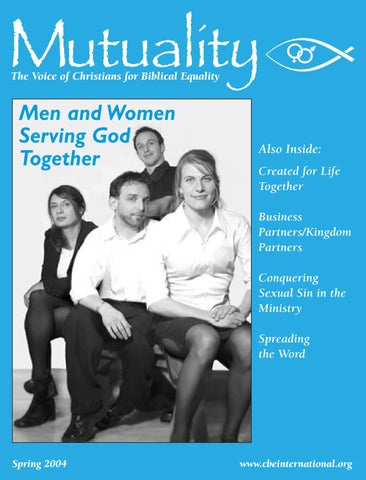
Men and Women Serving God Together
Also Inside: Created for Life Together Business Partners/Kingdom Partners Conquering Sexual Sin in the Ministry Spreading the Word
Spring 2004
www.cbeinternational.org
Contents FEATURES
4 IN OUR MAILBOX
5 CREATED FOR LIFE TOGETHER By Ruth Haley Barton Partnerships between men and women are part of God’s design. Learn how to make your partnerships work.
17 ARTS AND CULTURE By Nathan Bloom I Am No Man: A Review of ‘Return of the King’
10 BUSINESS PARTNERS, KINGDOM PARTNERS By Debbie Menaugh Business partners Jaime Nolan and Charles Arnold work together to further God’s kingdom. 12 CONQUERING SEXUAL SIN IN THE MINISTRY By Joyce Strong As more women work alongside men, mutual accountability is needed. 14 BECOMING BETTER SERVANTS By Nancy D. Becker Men and women may serve God in different ways, but our shared business is to encourage one another to become better servants of his will.
18 BOOK REVIEW By Elizabeth McGrew Mirror Mirror reflects God’s love for teens
19
19 NEW RESOURCES 20 MINISTRY NEWS 28 THE CHAPTERS CORNER By Ethel Schultz Pittaway The Waves are starting to roll in South Africa 30 PRESIDENT’S MESSAGE By Mimi Haddad Urbana ‘Walks the Talk’
12
26 SPREADING THE WORD By Jaime Hunt Thousands of believers have never heard the truth of God’s word as it relates to gender. How can the average member make a difference?
DEPARTMENTS 3 FROM THE EDITOR By Jaime Hunt Bringing forth the fruits of God’s kingdom
2 Mutuality Spring 2004
17 www.cbeinternational.org
Mutuality
From the Editor
Let us then pursue what makes for peace and mutual upbuilding. – Romans 14:19
BRINGING FORTH THE FRUITS OF GOD’S KINGDOM
Jaime Hunt
The Voice of Christians for Biblical Equality
By Jaime Hunt
VOLUME 11, ISSUE 1 MUTUALITY seeks to provide inspiration, encouragement and information about equality within the Christian church around the world. President/Publisher: Editor: Editorial Assistant: Staff Writers: Art Director:
Mimi Haddad Jaime Hunt Jessica Gaylord Mary Gonsior Elizabeth McGrew Cari Roettger
EDITORIAL AND ADVERTISING OFFICE Christians for Biblical Equality 122 W. Franklin Ave., Suite 218 Minneapolis, MN 55404-2451 Phone (612) 872-6898 Fax (612) 872-6891 E-mail: mutuality@cbeinternational.org Web site: www.cbeinternational.org Advertising in MUTUALITY does not imply organizational endorsement. SUBMISSIONS MUTUALITY welcomes submissions. E-mail mutuality@cbeinternational.org or write to CBE for writer’s guidelines. PERMISSIONS Christians for Biblical Equality grants permission for any original article (not a reprint) to be photocopied for local use provided no more than 1,000 copies are made, they are distributed free, the author is acknowledged and CBE is recognized as the source. MUTUALITY (ISSN: 1533-2470) is published quarterly by Christians for Biblical Equality and is sent free to members. For membership information, see page 31.
I have an interest in passion plays, so when my pastor asked me to serve on the Easter drama team with a small group of fellow believers, I eagerly agreed. As a team, we worked on the production with one goal — to express the incredible sacrifice Christ made on the cross. Our team was made up of three males and three females. Initially I wondered: would the males want a production that dealt with the facts of the Gospel message while the females sought a more emotional experience? If I stuck to my guns on a point, would I be seen as aggressive? However, as we dug ardently into our task, gender differences fell away. Looking back, I see a tiny snapshot of God’s plan for his people — a plan where believers work side-by-side with love, hope and purpose. Gender differences undoubtedly exist. Having worked in both maleand female-dominated workplaces, I have observed firsthand the many ways men and women communicate and relate differently. I have also witnessed the evils of gender discrimination, sexual sin and exclusion. The important thing to remember is that those evils are not caused by our differences, but by our fallen state. Our differences are not sinful. How we respond to those differences can be. The truth is, we all have strengths and weaknesses. While some may be gifted diplomats, others might be no-nonsense communicators. Some may be task-oriented while others are more relational. It is the blend of these strengths that creates fruits for God’s kingdom. Despite my experiences with the fallen state of humanity in the workplace and the church, I have also seen the amazing results of male-female partnerships — results that might not have been achieved if both men and women weren’t involved. Although they exist, our differences shouldn’t be central to our work. When we collaborate with others, God should never be far from our sight. With God as our focus, petty concerns fall way, leaving behind only legitimate issues. A quick search of the Bible reveals there are dozens of verses about working together. Collaborating is clearly something God has called us to do. Going about it biblically is the best way to do it. Paul writes in Philippians 2:2: “Then make me truly happy by agreeing wholeheartedly with each other, loving one another, and working together with one heart and purpose.” I believe that verse holds the key to effective relationships among Christians. Be of like mind. Care about each other. And work in unity. Do those things describe your collaborations?
EVANGELICAL
PRESS ASSOCIATION
www.cbeinternational.org
Jaime Hunt can be reached at jhunt@cbeinternational.org.
Mutuality Spring 2004
3
In Our Mailbox Happy to be attached to CBE I just wanted to tell you how much I appreciate all your hard work at CBE. I have had my membership for over a year, and it’s been fabulous. I read Jaime Hunt’s editorial [“Boldly and fearlessly proclaim the truth”] in the last issue of Mutuality with great interest. My story is somewhat similar. I went to a very conservative Bible college and always felt like a round peg trying to fit in a square hole. My journey toward this way of thinking was seriously launched from there. I always knew it did not sit right in my gut, this line of thinking that women were somehow lacking something. I have to admit I was a little bit angry and probably wasn’t the best person to talk to in a rational manner about the issue. I always felt as though I was the only person on earth who felt this way about women. Now that I am a member of CBE, I am so happy to be attached to something greater than myself! There are scores of people out there who believe what I believe and do so in a rational, scholarly manner with great respect for the Bible. I have much more peace about my beliefs now that I know I am not alone. I am still very passionate, but at least I feel as though I can get into a discussion, plant some seeds and walk away not feeling angry about it. I have CBE to thank for that. Thanks again, and I look forward to the next issue of Mutuality. Candice Quist Salt Lake City, Utah Grateful for book donations It has been a week of joy in the whole congregation of Grace Bible Church here in Cameroon with the receiving of the box of books from CBE. I don’t know how to start to thank you, but I know the Lord knows how to bless you. Being a CBE member makes me feel so happy and relieved. I have discovered there are so many ways I can help CBE prosper; I can help in promoting the Gospel being
preached by CBE. Please extend my greetings to all the members of CBE around you. May God continue to bless you in the great job you are doing. The Rev. Kenneth Kongnyu Ngwa Grace Bible Church, Cameroon Why should a guy ever sever the tie? At my church and on some radio programs, I keep hearing the idea that the husband is the “Royal Priest” of the family and the ultimate decision-maker. Whenever I can, I send a letter to indicate they are misrepresenting the great metaphor of the priesthood of all believers and making a mockery of mutual submission. I wrote this poem a while back. In spite of my egalitarian position, I think only a guy could write this poem. Why Should a Guy Ever Sever the Tie? I have written this poem for any husband who thinks His wife needs or wants his rule; I want to suggest husband, “Get off your little play throne! Become a servant not a hard-headed mule!” I have heard in a family, “God puts the man in charge, At a husband-wife impasse — He’s the ruler, that’s it!” I think instead the Bible teaches husbands to be like Christ, Learn how to love and serve and that means submit.
I’m a fan of the man who makes a goal for his life, To serve his equal, his partner, his body, his wife. “He shall rule over you” is the curse but what’s worse, Is to hear the unmistakable theme, That this factual ill is God's Holy will, “Christian men! Haven’t we all been redeemed?!” My son will not “Male Rule” be taught, My daughter’s call is to be equal in all, If your son thinks a husband’s decisions are in any way greater, Please don’t let him marry our daughter…or date her. A true “head” is a servant, a source of protection and life, In Greek, the term “headship” does not include ruling a wife. So don’t teach sons to rule and patriarchalism preserve, Instead, have them desire to be like Jesus, and serve. — Dennis Watson Fullerton, Calif.
We’d love to hear from you!
Some say mutual submission is an interesting theory, It works until disagreements are nigh, Then these same people will say, “With disagreements at home, The man should step in and sever the tie.”
Send your comments, suggestions and critiques to: MUTUALITY 122 West Franklin Ave., Suite 218 Minneapolis, MN 55404-2451
Why should the guy ever sever the tie, When a true servant would choose to lose!?
Fax: (612) 872-6891 Phone: (612) 872-6898 E-mail: mutuality@cbeinternational.org Web site: www.cbeinternational.org Letters may be edited for clarity and brevity.
4 Mutuality Spring 2004
www.cbeinternational.org
Created for life together Partnerships between men and women are part of God’s design By Ruth Haley Barton In the introduction to his book The Different Drum, M. Scott Peck recounts a mythic tale about a monastery that had fallen on hard times. What had once been a great order had, for several different reasons, deteriorated to the point that there were only five monks left in a decaying main house: the abbot and four others, all over 70 years old. However, in the deep woods surrounding the monastery there was a little hut that a rabbi from a neighboring town occasionally used for personal retreats. As the abbot agonized over the fact that his order would likely die with the five monks who were left, it occurred to him that maybe the rabbi could offer some insight that might lead to a revival of the order. The abbot decided to pay a visit to the rabbi. The rabbi welcomed his visitor but could only commiserate with him: “I know how it is. The spirit has gone out of the people. It is the same in my town. Almost no one comes to the synagogue anymore.” And so the two old men wept together and spoke quietly of spiritual things. When it came time for the abbot to leave, the two men embraced each other, and the abbot asked one last time, “Is there nothing you can tell me, no piece of advice you can give
www.cbeinternational.org
that would help me save my dying order?” With apologies the rabbi responded that he had no advice to give. “The only thing I can tell you,” he said, “is that the Messiah is one of you.” When the abbot returned to the monastery, the monks were eager to hear what the rabbi had had to say. “He couldn’t help,” the abbot answered. “We just wept and read the Torah together. The only thing he did say, just as I was leaving — it was something cryptic — was that the Messiah is one of us. I don’t know what he meant.” In the weeks and months that followed the old monks pondered the rabbi’s enigmatic words and wondered whether there was any significance to them. The Messiah is one of us? Could he possibly have meant one of us monks here at the monastery? If that’s the case, which one? Do you suppose he meant the abbot? Or perhaps Brother Thomas, who has always been a man of light? Certainly he could not have meant crotchety old Brother Elred or Brother Phillip. But come to think of it, Brother Elred does have a great deal of insight, and Brother Phillip does have a gift for always being there when you need him. Maybe one of them is the Messiah. Of course he couldn’t possibly have meant me.
I’m just an ordinary person. But what if I am the Messiah? Oh God, not me! I couldn’t be that much for you, could I? As they contemplated in this manner, the old monks began to treat each other with extraordinary respect on the off chance that one of them might be the Messiah. And on the off, off chance that each monk himself might be the Messiah, they began to treat themselves with extraordinary respect. And so it happened that, without even being conscious of it, the people who occasionally visited the monastery began to sense an atmosphere of extraordinary respect that now surrounded the five old monks and seemed to radiate from them. There was something strangely attractive, even compelling, about it. Hardly knowing why, they began to come back to the monastery more frequently to picnic, to play and to pray. They began to bring their friends to show them this special place. And their friends brought their friends. Then it happened that some of the younger men who came to visit the monastery started to talk more and more with the old monks. After a while one asked if he could join them. Then anothCreated for life together continued on page 6
Mutuality Spring 2004
5
Created for life together continued from page 5
er, and another. Within a few years the monastery had once again become a thriving order and, thanks to the rabbi’s gift, a vibrant center of life and spirituality in the realm. Allow yourself to enter this story and imagine a setting where respect for fellow human beings is so vibrant and so real that it feeds people’s souls. What would it be like to have others treat you with high regard? What kind of person would you be if you were to treat others as though they were sacred and precious? What difference would it make if women and men were to approach each other with wonder and care? Though it may sound simplistic, there is a real possibility that if women and men learned to respect each other deeply — to see each other as the ones through whom God is made present among us — little else would be needed. Much of the hurt that is present in male-female relationships has disrespect (or lack of understanding about how to communicate respect) at its core. When women lump all men together as powerhungry fools and view them with thinly veiled disdain or suspicion, we are disrespecting individual m e n
who are willing and able to share power and relate effectively. Furthermore, we close our hearts to the potential within each man to move into more effective partnership with us. When men exclude or overlook women in the process of filling leadership positions in the workplace or in the church, they are disrespecting women’s identity as those who are gifted and called of God to exercise responsible dominion. When we use sexuality as a means to limit, harass or manipulate, we are disrespecting the significance of this sacred gift. When we prejudge each other and jump to negative conclusions about each other’s words and behaviors without putting forth loving efforts to understand, we are not treating each other in the way that we ourselves wish to be treated. According to Scripture, each one of us is a priest charged with the responsibility of offering up spiritual sacrifices and proclaiming the excellencies of Christ (1 Peter 2:9). The tragedy in the Christian community is that our pattern of limiting up-front communication to men while women labor in relative silence and subordination behind the scenes has obscured the fact that together women and men are a community of priests. We cannot see it because we never have the opportunity to see it! However, when we hold ourselves in conscious awareness that we are all royal priests and when we live it out in actual partnering relationships, there will be a shift in attitudes that will begin to transform our relationships.
Communicating and community building The words community and communicate come from the same root word meaning “to come together.” Highlighting the relationship between these two words, Scott Peck points out that “the principles of good communication are the basic principles of community-building. Because people do not naturally know how to communicate, because humans have not yet learned how to talk with each other, they remain ignorant of the laws or rules of genuine community.” That is the bad news. The good news, Peck continues, is that “the rules of communications and community-building can be simply taught and learned with relative ease. … The vast majority of people are capable of learning the rules of communication and community building and are willing to follow them. In other words, if they know what they are doing, virtually any group of people can form themselves into a genuine community.” In this article we will consider principles of effective communication as the primary vehicles for helping us come together in unity, especially as men and women in relationship together. We want to understand how adherence to these principles can help us as we move more intentionally toward partnership. But we must be clear that skills are no substitute for love and true openheartedness.
Acceptance One key component of respect is acceptance, simply recognizing the other person as a worthy individual entitled to his or her own experiences or opinions. Men and women often have very different perceptions of and opinions about situations, ideas and experiences — even theology! When one or both assume their thoughts and feelings are more valid than the other’s, communication dies quickly. On the other hand, when we see diversity as valuable for our lives, we support others in their uniqueness. We understand that if we can resist the urge to squeeze others into our own image we will have much to learn from Over time, a trust develops between people who take the time to clarify; they communicate more freely because the knowledge and perspecthey know that if a misunderstanding occurs, there is a process in place in the relationship for making the nective they have to offer. essary adjustments.
6 Mutuality Spring 2004
www.cbeinternational.org
One way to gauge our ability to truly accept others is to observe our own responses, spoken and unspoken, as someone else shares a thought or an
municating about issues on which we do not agree — is that we feel we are giving up a point in the argument. We might feel that if we acknowledge that what
The tragedy in the Christian community is that
through our body language. We all communicate with our bodies and read other people’s body language without even knowing it. In his book Interpersonal
our pattern of limiting
up-front communication to men while women labor in relative silence and subordination behind the scenes has obscured the fact that together women and men are a community of priests. opinion. Is my first response to begin formulating an argument or a counterpoint to what they are saying? Am I distracted from listening to what they are saying because I am concerned about what I’m going to say next? Do I make judgments about the validity of what someone else is saying based on my own experience? When someone states an opinion that is different from my own or reflects poorly on something in which I have a vested interest (my family, the church where I serve on staff, the corporation where I am one of the executive officers, a committee I am chairing), is my first impulse to defend my opinion or my territory? Chances are, most of us can respond affirmatively to at least one of these questions. For some of us it takes a great deal of mental and emotional discipline to put aside our tendencies to argue, to judge and to be self-absorbed in our communication with others. One way to develop a more accepting attitude is to acknowledge that someone else’s ideas and opinions make sense to them in their context. If increased effectiveness in communication is our desire, we will seek to understand how the content of someone else’s communication makes sense to them rather than arguing, offering counterpoints or defending our position. If men and women are to progress toward community and partnership, we will need to accept each other and support each other in our communication efforts over and over again. When women talk about their experiences in the church, home or the workplace, men need to accept these admissions rather than offer arguments, counterpoints and reasons why they do not matter. One of the reasons it is hard for us to extend this kind of acceptance or understanding — especially when we are com-
www.cbeinternational.org
another person is saying makes sense on some level that will mean we have to give up our own perspective and agree with that person. This is not the case. Acceptance does not necessarily mean that two parties agree or that change is not needed. We can still hold our own experience of a situation or our own view while acknowledging the validity of someone else’s. Active listening With respect and acceptance comes a genuine desire to understand the people we encounter and support them as they try to make themselves known. We may be unsure, however, how to express this. Active listening provides us with several different avenues for communicating meaningfully with others. The first and most immediate way that we show our regard and openness is
Living, Gerard Egan outlines some of the basic ways our bodies can communicate our attention to others as they speak. • Face the other person squarely, as this is the basic posture of involvement. • Maintain an open posture. Crossed arms and legs are often a sign of defensiveness or minimal involvement. • Lean toward the other person as they speak. This is another sign of availability, presence or involvement. • Maintain good eye contact, not for the purpose of intruding or “staring them down” but to demonstrate your continued interest in what they are saying. • Be at home and relatively relaxed in this position but also in your own body. “Relative relaxation says to the other person ‘I’m at home with you.’ … An effective communicator is relatively comfortCreated for life together continued on page 8
Recommended Resources on Working Together Books:
Articles:
Equal to the Task: Men and Women in Partnership By Ruth Haley Barton $12.00
When Sparks Fly: Women and Men in Partnership By Ruth Haley Barton, Re:Generation Quarterly $0.75
Instruments for His Glory: Releasing Women to Minister in Harmony with God and Man By Joyce Strong $12.99 Community 101: Reclaiming the Local Church as Community of Oneness By Gilbert Bilezikian $14.99
Biblical Methods of Conflict Resolution By Gilbert Bilezikian, excerpt from Beyond Sex Roles $0.50 Integrating Mars and Venus: Gender-Based Ministries May Be Effective, But Are They Biblical? By Rebecca Merrill Groothuis and Douglas Groothuis, Christianity Today $0.50
Mutuality Spring 2004
7
Created for life together continued from page 7
able with involvement and intimacy, and therefore will be relatively relaxed even in this attending position.” Men and women alike sometimes experience a level of nervousness and discomfort when they are with members of the other sex. Since we are not that used to being together — as ministry peers, business colleagues or even friends — we are not “at home” with each other, and it shows. I remember many occasions in my early ministry years when I would notice that some men seemed unable to look me in the eye when they talked to me. They would look right over my head or try to work things out so that they could talk with my husband instead. It is not that bad today, but I still often sense nervousness from others, and I sometimes feel
are crossed tightly, or you are having a hard time maintaining eye contact, sometimes a shift in your body position can release some of the tension and provide renewed energy. Remembering to breathe deeply can also alleviate nervousness. An active listener also provides timely feedback. Generally, women and men are still uncertain about whether the other sex is with them and for them or just tolerating them. Directness Another piece of the active listening process is to speak up if you are not sure what the other person means or if you are picking up emotion or body language that you do not understand. This is the process described in Proverbs 20:5 by which a person of understanding draws out the true meaning of what is in some-
they really meant. The process of clarifying will include such questions as: Are you saying that? I heard you say _________. Did I understand you correctly? What do you mean when you use the word ___________? I’m not quite clear on that. Could you say it differently? When we clarify rather than assume that we understand, the speaker then knows that he or she has been heard accurately or has the opportunity to say, “Well, not exactly. What I really meant was ___________.” Over time, a trust develops between people who take the time to clarify; they communicate more freely because they know that if a misunderstanding occurs, there is a process in place in the relationship for making the necessary adjustments.
Empathy While the skills listed above are helpful, empathy is really the highest form of listening. The discipline of empathy requires us to move away from our own experience as the measure of all things and to learn about life and perhaps even ourselves from someone else’s vantage point. It takes a very secure person to set aside his or her own beliefs and feelings long enough to fully enter into someone else’s. Empathy is an especially important element in relationships between men and women because our experiences in our families, our churches, our society and even our bodies are so different. Our understanding of each other will be inadequate unless we know, to some degree, what it feels like to be in another’s situation. When a man enters into a woman’s experience by asking what it would be like to be barred — in subtle ways and not-so-subtle ways — from activities just because of one’s sex, he will be changed on some level. If, after Men and women are created for life together. With respect, acceptance, empathy and direct communilistening, he insists on holding to cation, working together can be made easy. a view that limits women based one else’s heart: “The purposes in the on their sex, hopefully he will at the very nervous myself. human mind are like deep water, but the least hold his views with greater sensitivIt can be helpful to be aware of any intelligent will draw them out.” Rather ity. He might even find that it becomes a nervousness, tension, defensiveness or than assuming we have understood the starting point for seeing certain issues in boredom you are feeling and how you person who is speaking, we check it out new ways. might be holding that in your body. If Likewise, when a woman imagines how your fists are clenched, your arms or legs to make sure that what we heard is what
8 Mutuality Spring 2004
www.cbeinternational.org
unsettling it would be to have all of her guidelines for relating with men turned upside down, she might sense God’s direction to discipline herself in taking a more compassionate approach as she communicates with the men in her life about the changes she seeks.
selves of opportunities to listen to each other is that we believe erroneously that change will happen if some respected person just gets up and pronounces it so. We fail to understand real change as a process that requires empathy and understanding before we move to dialogue, dis-
Questions to Ask:
?
• Describe a relationship in which you know you are deeply respected. How is this respect communicated? How does it affect the way you function in that relationship? • “Much of the hurt and disrespect that is present in male-female relationships has disrespect (or a lack of understanding about how to communicate respect) at its core.” Do you agree or disagree with that statement? What difference would respect make in the male-female relationships with which you are familiar? • What aspect of communication — acceptance, active listening, empathy, directness — is most challenging for you? What step would you like to take to improve in this area? • What would you most like to ask members of the other sex to work on in their communication with you?
It is a rare and beautiful thing when men and women are willing to listen empathically before moving to the other types of communication, problem solving and policymaking. It is hard to suspend our task orientation and our urge to problem-solve long enough to listen. Husbands and wives are probably more empathic with one another than men and women in most other settings because they have deep love and commitment; however, empathy can be a challenge even for them. In organizations and institutions the situation is often much worse. We are much more interested in unilateral communication or policymaking than we are in truly listening. In some cases, this stems from an unacknowledged fear of what might happen within us and what may be required of us if we are to put ourselves in someone else’s shoes. We do not necessarily want to change or be moved, and we certainly do not want to confront new issues for which we may or may not have the answers. At certain times we may feel that we already have all the insight we need, so listening is unnecessary. In some cases that may be true, but in the area of gender relations we are nowhere near the point where men and women understand each other so well that empathic listening is no longer necessary. Another reason we do not avail our-
www.cbeinternational.org
cussion, large group communication, problem solving and policymaking. Only in the context of empathic listening can we even begin to identify what the real problems are, let alone the solutions. As men and women begin to share more fully in each other’s worlds, it will be easier for them to empathize with each other’s life situations. But in the meantime, we must make the extra effort to weep with those who weep, rejoice with those who rejoice, feel frustration with those who are frustrated, pain with those who are excluded, and confusion with those who are trying to understand. Ruth Haley Barton is a spiritual director, teacher and retreat leader trained through the Shalem Institute for Spiritual Formation and The Pathways Center for Spiritual Leadership. Ruth is co-founder of The Transforming Center, a community of Christian men and women who shape and care for the souls of leaders. To contact Ruth, e-mail rhbarton@thetransformingcenter.org. This article was adapted from Ruth’s book, Equal to the Task: Men and Women in Partnership. The book is available through CBE’s bookstore.
Help CBE Build For the Future GOAL $100,000
$75,000
$55,000
$25,000 $10,000
$5,000
We love it when a glimpse of God’s vision for CBE comes through the gifts of our members. Due to the gifts of generous donors, CBE established an endowment fund of over $56,000. The board designated this money for investment, and the interest from the principal will be used for projects above those outlined in our annual budget. For example, the interest from the endowment fund was used to bring speaker Funmi Para-Mallam from Nigeria to our Orlando conference. Imagine what income from this fund can provide in time. We need your help to make these dreams reality. At CBE, we see the endowment fund as a sapling tree. It will grow over time, but we may not be the ones to see it to maturity. With faith, we ask for your help to invest in the future. Please help us care for this fund like a vulnerable tree that needs water, sun and fertilizer to grow. Your contributions will lead to the growth of a large tree that can provide shade for many under its branches.
Mutuality Spring 2004
9
Business partners,
Kingdom partners Working together to further God’s Kingdom By Debbie Menagh
As business partners, Charles Arnold and Jaime Nolan share the same goals as most business owners: serving their clients, making a profit, growing their business and maintaining a positive work environment for their employees. However, as Christians their top priority is to remain centered on God’s will. “From the very beginning Charles and I have prayed about every potential client, every potential employee and every potential direction the company can go,” Nolan says. The two met as coworkers at Synergy Resource Group Inc. (SRGI), an association management firm in Plymouth, Minn. They later bought the business from the owner when she retired in March of 2001. While the business is secular, Arnold and Nolan have found it provides many opportunities for ministry. And, knowing it is ultimately God they serve, they take seriously the admonition in Colossians 3:23: “Whatever you do, work at it with all your heart, as working for the Lord.” Putting God first means the rest of their priorities also look a little different from those of the average secular business. SRGI’s published management philosophy defines these priorities: 1. We strive to honor God in all that we do. 2. To provide an atmosphere that encourages the importance of family. 3. To serve and represent our clients with a superior effort in every action and opportunity. Managing Together Sharing authority as co-owners of SRGI works for Arnold and Nolan because they both look to God as the highest authority, avoiding the trap of self-importance that often tempts those in leadership. Says Arnold, “It is an extremely humbling experience to know that God has placed you in a position of managing even a small piece of his plan.”
10 Mutuality Spring 2004
From day-to-day responsibilities to important decisions that have a significant impact on the business, this shared faith and submission to God is the framework for their management decisions. If a situation arises and they disagree on how to handle it, they turn to Scripture to determine the best solution. They have a standing policy not to proceed on a course of action unless they both agree it is the right one. One passage that has helped them keep a Godhonoring perspective is Galatians 6:7-8: “Do not be deceived; God cannot be mocked. People reap what they sow. Those who sow to please their sinful nature, from that nature will reap destruction; those who sow to please the Spirit, from the Spirit will reap eternal life.” Nolan says, “This is the verse we remember when we are struggling with a decision that could benefit the company, or us personally, but isn’t necessarily pleasing to God.” The two begin each week with a time of prayer, which employees are welcome, but not obligated, to join. “When we pray on Mondays, we surrender ourselves to God’s will, his direction, commit the company to him, commit the week to him, ask for his guidance and wisdom, and pray for each one of our employees,” says Nolan. A Beneficial Partnership Arnold and Nolan see the fact that one of them is a man and one a woman as an advantage for their business. “Men and women see, hear and think differently, and in a world where decisions — good decisions — are the key to running a successful business, our gender difference is a great asset for SRGI,” says Arnold. However, Arnold avoids oversimplified stereotypes about how men and women differ. He points out that basic personality differences, irrespective of gender, are also a key area where he and Nolan complement each other. “Jaime’s more grounded, stability-minded personality perfectly counterbalances my outside-the-box, risk-taking personality, and vice versa,” he
www.cbeinternational.org
SRGI has adopted family-friendly policies to accommodate employees’ personal needs. A lot of companies will allow employees to work from home occasionally, or to take time off to care for a sick child. Nolan and Arnold do this and more. “If someone has a relative who is suffering with a trauma, emotion or issue and they need our employee, we encourage them to go,” Nolan explains. “If an employee’s spouse doesn’t want them working late or at a particular event, we support them and make other arrangements.” And recently an employee brought her daughter to work with her when the child had a day off from school. “We totally support that,” says Nolan.
Charles Arnold and Jaime Nolan find that their gender differences help them in the business world. explains. “Both attitudes are good for a growing business, but too much of one way of thinking can cripple a company.” He feels their partnership offers “the best of both worlds and is healthy for the company.” Nolan agrees that the two bring different viewpoints to all issues. In a business with a wide variety of clients, it helps to be able to analyze things from as many angles as possible. In addition to personality and gender, she identifies age as another difference that helps shape their perspectives. “Charles is 11 years older than me,” she says, “so we have different experiences we can relate as we are brainstorming on projects.” They also have a business advantage when it comes to interacting with someone who, for whatever reason, prefers to work with one gender rather than the other. For example, Nolan notes, “There are a lot of older men that still have not grown accustomed to doing business with women.” On the flip side, she is a member of the National Association of Women Business Owners, and many of her contacts there prefer to do business with other women. So the partnership provides a good balance for dealing with potential clients.
servants to their employees. They take inspiration from Philippians 2, which describes how Christ humbled himself to be a servant to humanity and instructs Christians to “look not only to your own interests, but also to the interests of others.” Ways they strive to serve their employees include making themselves available to
Service Goes Both Ways A lot of people have used the biblical passages on masters and servants as an analogy for modern-day employment, likening employees to the servants and employers to the masters. But Nolan and Arnold believe they are also called to be
The Importance of Family Another way Nolan and Arnold serve their employees is by fostering a work environment that nurtures the whole person. They encourage employees to keep a healthy balance between work and home life, and strive to do so themselves.
www.cbeinternational.org
Reaping the Rewards SRGI’s management philosophy, while a bit unconventional in the secular business world, has served the company well. In less than three years since taking the helm, Arnold and Nolan have increased their number of clients from 3 to 12 and added five more full-time employees. And the company has grown by more than 35 percent. Beyond the physical blessings of a successful business, Arnold and Nolan also treasure the spiritual opportunities and rewards that have resulted from owning SRGI. By being open and approachable about their faith without making it a source
see, hear and think differently, and in a world where decisions —
“Men and women
good decisions — are the key to running a successful
gender difference is a great asset.” business, our
– Charles Arnold help and to answer questions and making the effort to provide staff members with whatever support they need to do their jobs. This attention strengthens relationships with their employees and makes them more efficient and effective in working together.
of pressure for anyone, Arnold and Nolan have had the chance to share Christ on a number of occasions. One employee became a Christian about three months after joining the company. “She came in seeking, and asked a lot of questions,” says Nolan. “We were only a vessel God used to bring her to him.” Debbie Menagh is a corporate communications professional and freelance writer. She lives in the Chicago suburbs with her husband, David.
Mutuality Spring 2004 11
Conquering sexual sin in the ministry As more women serve alongside men, mutual accountability is needed By Joyce Strong
Jesus was very pointed when he spoke, however forgivingly, to the woman caught in adultery. He said that she must not continue sinning — that the seductive patterns of her life must be stopped. She too had to learn self-control and sexual responsibility if she were to follow him and avoid spiritual death. “Can you stay late again tonight to help me work out one last kink in the budget?” Pastor Keith gently urged Sarah from the doorway of her office. Sarah glanced at her watch, then back at Keith. His big blue eyes won again. “Sure, I’ll come to your office as soon as I
12 Mutuality Spring 2004
make a quick call home.” Her heart began to race a little. She had worked for other pastors before, but never had one of them appreciated her as much as Keith did. She really felt special around him. “Great!” he beamed as he gave her a wink and big smile.
By the time Sarah had cleared her desk, made the call and joined him, all the other staff members had gone home. As she entered his office, he jumped up and offered her a chair beside his desk. “You’re an incredible woman, Sarah. You’re the best administrator this church has
www.cbeinternational.org
ever had. Besides that, you bring me more joy than you can imagine!” Keith exclaimed. After that last comment, his face clouded and he added, just above a whisper, “I wish I could say that about my wife.” That she could mean so much to Keith touched Sarah deeply. How she longed to save him from the heartache he was experiencing in his marriage … As more and more women find themselves serving in the ministry alongside men — whether in the pulpit, on the conference circuit, in counseling, in business offices or on the mission field — maintaining sexual purity will be the greatest area of testing for many of us. Whose fault is sexual sin in the ministry? As I searched my own rearing in the church to find some answers to my questions, I remembered the book my mother gave me when I was a teenager. It explained the “facts of life” and set guidelines for propriety in dating. The overriding impression I was left with was that sexual purity was up to me; the man could not be held responsible because his sex drive was too strong. Therefore, I must be the one to draw the line. I must wear conservative clothing so as not to provoke him, and I must say “no” to his advances because he cannot. Even as a naïve 14-year-old, something about this didn’t seem right. Such a philosophy seemed to debase both of us. As the responsibility was put upon me and the man was excused, I felt defeated before I began. Jesus sets the record straight The Pharisees — our religious forefathers — did much to influence what the church unwittingly believes, as reflected in the book I read as a teenager. While the religious Jews accommodated men’s abdication of self-control by allowing multiple wives and the ability to divorce at will, women were reduced to the image of temptress — the man’s downfall. These men established a power base domestically and religiously upon the assertion that Eve was to blame for the fall — the same excuse Adam made to God for his own lack of self-control and disobedience in the garden. Therefore, religious Jews kept women in seclusion, uneducated and subservient on the premise that this would reduce sin among the men. Jesus hit the issue head on. He set Jewish men back on their heels by telling them that even to lust — to play games of sexual conquest in their minds — was as dangerous as committing the act and it must stop. Whether in their minds or through their actions, lust would destroy intimacy with God and violate the object of the lust. This
www.cbeinternational.org
was a call to self-control, sexual responsibility and commitment to God and women that the men had not had to deal with before. Jesus was also very pointed when he spoke, however forgivingly, to the woman caught in adultery. He said that she must not continue sinning — that the seductive patterns of her life must be stopped. She too had to learn self-control and sexual responsibility if she were to follow him and avoid spiritual death. Paul calls for accountability The apostle Paul also knew the patterns of the world and the enemy, and he had his hands full dealing with all kinds of Christians! He offered guidance to both men and women on this subject of shared responsibility for matters of the heart.
If we see others and ourselves as Jesus does — as precious children for whom He gave his life — we will make sure we are held accountable to protect and cherish each other. After centuries of being able to have several wives and divorce at will, men were given a new edict by Paul in 1 Timothy 3:15: If a man wanted to be an elder in the Christian church, he must be sexually responsible and have only one wife. Although polygamy had been generally outlawed in the Roman Empire by this time, Christian men were neither to have more than one wife at one time nor follow the cultural norm of getting around the law by having mistresses on the side. Regarding the women newly converted from the cult of Diana — a group of women accustomed to leading by seduction and prostitution — Paul gave warning not to allow them positions of authority. It was to prevent them from dominating or controlling men through the use of their femininity, as they had been used to doing. Paul also told the Ephesian women in 1 Timothy 2:9-10 to pay attention to the way they presented themselves in appearance. They were to understand that the good deeds that came out of their hearts were what made them truly beautiful, not all the finery they could wear. They were to be modest — not drawing attention to their
sexuality — and take responsibility to reflect the new life within them. The message from Jesus and from Paul was that men and women were responsible to get real and do something about their sinful pasts, weaknesses and selfish patterns of behavior toward each other. Then they could minister in his name. Hearts and minds must change There is no amount of governmental legislation that will restore women’s value, teach men to be responsible and bring sanity back to our culture inside and outside the church. Only the repentance of men for devaluing women rather than honoring them as equally made in God’s image, and women’s repentance for looking to men’s love to save them or give them viability, will get the healing process started. As more women are being called by God and qualified to minister in the body of Christ alongside men, both sexes must get their acts together. Their hearts — and minds — must be changed. Men, rather than dreading proximity because of having the world’s mindset of helplessness in the presence of an attractive women, need to surround themselves with simple accountability and sensible boundaries, while receiving counsel for any difficulties in their own marriages or personal lives. Women must forgive men for past wounds and repent of all judgments previously made against them, or they will defile those to whom they minister. If women are judgmental toward men, they will not only encourage the disdain of men in other women, but also prejudice against women will actually increase in the body of Christ. With God’s help and one another’s prayers, we can all learn how to minister together in mutual respect. If we see others and ourselves as Jesus does — as precious children for whom he gave his life — we will make sure we are held accountable to protect and cherish each other. Joyce Strong is Women’s Ministries Coordinator at New Life Church in Gahanna, Ohio, a suburb of Columbus. Strong also speaks at conferences and retreats and conducts leadership seminars in the United States and Russia. This article is based on chapter 11 of Strong’s book: Instruments for His Glory: Releasing Women to Minister in Harmony with God and Man. The book is available through CBE’s bookstore.
Mutuality Spring 2004 13
Some time ago, the movie Legal Eagles featured a scene in which two lawyers, a man and a woman, organized some shipping invoices. One of them put the invoices in piles according to the size of the shipment; the other organized the invoices according to the shipment’s destination. They kept redoing each other’s stacks to make the division more “logical.” In my experience, that’s too typical! What seems logical to women seems illogical to men. What seems to be a natural and effective way of organizing work to a man looks confused and haphazard to a woman. I’ve especially noticed that in the church, the differences between men and women often hinder us from fulfilling Christ’s work. Only when I began to recognize and appreciate these differences did I see how men and women could, instead, become effective partners in ministry. What follows are generalizations, I admit. Each of us possesses both masculine and feminine characteristics, and nothing is true for all men or all women. Yet in my ministry, I’ve noticed both masculine and feminine tendencies that can conflict or cooperate in Christ’s mission.
Keep a sense of humor! Treating the differences between men and women with lightness and fun helps us recognize and bridge the gaps.
Becoming better servants How men and women can work together By Nancy D. Becker
14 Mutuality Spring 2004
Meetings and motions Susan came to her first church board meeting knowing the main subject would be choosing Sunday school curriculum. She assumed the elders would look through each sample and discuss its strengths and weaknesses, finally conferring on which best suited their needs. Having taught Sunday school for many years, she felt qualified to contribute to the subject. Nonetheless, she made it a point to study the sample curricula before the meeting. Early in the meeting, Susan discovered many of the elders had already formed their opinions about the curriculum. One man, in fact, quickly moved that his choice be adopted. To Susan, however, the following discussion seemed more like a debate. She didn’t participate because the others seemed sure of their views and she wasn’t. She had expected to form her choice during a discussion, but felt out of place in a debate. When the elders finished sparring, they approved the curriculum proposed in the motion and moved on to another
www.cbeinternational.org
The men and women I work with
tend to use conversation differently. For men, conversation can become competitive, and that may confuse women. issue. Susan went home that evening feeling inept and unprepared. She questioned her ability to serve on the board. The problem, however, was simply that Susan was used to meetings run by women. In female settings, women usually attempt to achieve a consensus before voting. They often solve problems and develop opinions as open discussion proceeds. For many women there is truth in the quip, “Sometimes I don’t know what I think until I hear what I say.” In a structured debate, a woman may initially feel foolish and out of place. Similarly, in a free-flowing discussion in search of a decision, a man may feel he is standing on quicksand. Although the steps of each method differ, either can lead to a good, unified decision. Conversing and competing The men and women I work with tend to use conversation differently. For men, conversation can become competitive, and that may confuse women. Al (a professional landscaper), Jim (an electrician) and Janet (the church treasurer) met to discuss a proposed plan to light a church memorial garden. Immediately, Al and Jim began to make additions to the plan. Each time Al added a group of trees or bushes, Jim increased the lighting. When Al sketched in a flowerbed, Jim wanted to light it with state-of-the-art outdoor fix-
www.cbeinternational.org
tures. When Jim proposed underground wiring conduits, Al suggested an underground watering system. When they didn’t ask Janet’s opinion, she felt left out. Al and Jim earnestly wanted to use their particular gifts to serve the church. And both assumed if Janet had anything to say, she would speak her piece — just as they were doing. Janet, on the other hand, assumed they would at some point ask for her input. Among women, it’s usually considered important that everyone participate in a conversation. Women are apt to notice when someone isn’t talking, and they’ll often attempt to draw in a quiet person by adjusting their conversation. When a female member of a predominantly male group is not drawn in, she may feel intentionally excluded. Meanwhile, the men usually assume that if a person wants to speak, he or she will take the initiative to do so. Somehow many women have absorbed the idea that men are not to be interrupted. Many times I have chosen my words and, with sweaty palms, attempted to interrupt, only to have the conversation shift to another topic. Consequently, I now keep this sentence in my conversational arsenal: “I
Random or sequential In my experience, men and women organize their work differently, especially when they work in groups. Women are more likely to think of work as a jigsaw puzzle. They tend to divide the labor as they go, deciding what needs to be done at any stage of the process. I’ve watched, for example, a team of women put out a church mailing at the last minute. Several stages of the work were in process at the same time — envelopes were getting stamped, letters were being folded and envelopes were being stuffed. If the envelope stuffer ran out of folded letters, she went to help the folder. Soon someone else was stuffing. Eventually, this apparently random activity produced a church mailing. However, I know many men who would be driven crazy by working this way. That’s because men tend to see work as a stairway with a clearly defined set of steps, and each step should be completed before the next is begun. Progress can be measured at any given point. Remember the curriculum discussion? The men didn’t want to buzz around the issue, discussing it this way and that until a conclusion mysteriously
Men and women have been created
to work together to serve God’s will. We may do it in
different ways, but our business is to
encourage one another to become better servants of his will. wonder if I might say something here.” I’m not being aggressive or pushy. I’m simply trying to find an appropriate way to interject myself into a male-dominated conversation. At the same time, I encourage male leaders I work with to invite seemingly shy women into discussions. I’m not claiming that men and women can or should change the way they converse, but making each more sensitive to the other’s conversation habits helps them better work together.
emerged. Deciding curriculum was a job to get done, and done in an orderly way: motion, debate, vote. Diplomacy or disagreement Men and women in my setting tolerate conflict differently. Men can put up with continuing personality conflicts and disagreements seemingly indefinitely. Many women, on the other hand, become acutely uncomfortable when people are at odds. They often want to straighten Becoming better servants continued on page 16
Mutuality Spring 2004 15
Becoming better servants continued from page 15
SOME EMPLOYERS WILL MATCH YOUR CONTRIBUTIONS TO CBE Does your employer offer a matching funds program? Over the years CBE has been the grateful recipient of matching gifts from employers, United Way, and the Mustard Seed Foundation. Perhaps your employer or your local United Way will match your contribution to CBE. Please check with your human resources department. What a wonderful way to double the pleasure of giving, making it possible for CBE to reach twice as many with the good news of Galatians 3:28.
out everything without confronting anyone. Mary Lou and Mark were co-chairs of the adult education committee. Mary Lou generally led the committee meetings, and did so in a way that made everyone feel included and comfortable. When conflict threatened, she was usually able to turn the conversation and smooth the disagreement. One committee member, Carla, was a brusque, no-nonsense woman with a distinctly negative attitude. She had a habit of deflating new ideas with sarcastic remarks or reminders that similar programs had flopped in the past. Other members of the committee found her difficult to work with, and meetings often bogged down in silent irritation. Mary Lou tried several indirect ways to change Carla’s attitude and to curb her negative remarks. However, nothing seemed to work and committee members began to stop attending. Mary Lou dreaded direct confrontation, so she went to Mark to discuss what they should do. Although Mark didn’t consider Carla’s attitude a serious problem, he agreed to talk to her. He called her and politely but firmly asked her to stop “dousing the Spirit” with her negative attitude. From that time on, whenever Carla started denigrating an idea, Mark simply said, “That’s enough, Carla. Let’s be a lit-
Visit CBE’s Web site at www.cbeinternational.org For the latest: • Cutting-edge Biblical Resources • Ministry News • Free Articles
16 Mutuality Spring 2004
tle more positive.” After a while Mary Lou also began to gently but firmly veto Carla’s negative attitudes. Carla wasn’t miraculously transformed, but the meetings became less stressful and more productive. Both Mary Lou and Mark learned from the experience. Mark discovered from Mary Lou new ways to develop group cohesion, and Mary Lou learned from Mark how to deal directly with disagreement. Bridging the gender gap I wouldn’t want these generalizations, based on my limited experience, to be applied too strictly to any particular individual or situation. Yet I’ve found it helpful to identify a few gender-linked tendencies. As a consequence, as I work with men and women in my church, I continually remind myself of three things: • My way of thinking isn’t necessarily wrong, illogical or less intelligent. Then again, neither can I assume my way of reasoning is right, logical and more intelligent. It’s just different. Men and women have much to learn from each other, and to do so we have to accept each other. • Keep a sense of humor. I don’t take difficulties and confusion too seriously. Treating the differences between men and women with lightness and fun helps us recognize and bridge the gaps. • Be myself. Christ has called me to my place in his service and given me special gifts to fulfill that calling. Therefore I don’t need to be just like anyone else, especially not a man! Men and women have been created to work together to serve God’s will. We may do it in different ways, but our business is to encourage one another to become better servants of his will, not our idiosyncrasies. Reprinted from reNEWS, a publication of Presbyterians For Renewal. Copyright December 2000 by Nancy Becker. Adapted from Leadership Journal, Winter Quarter 1991, with permission.
www.cbeinternational.org
A &Culture rts
Welcome to Mutuality’s new “Arts and Culture” section! Included in this segment will be reviews of Christian and secular movies, music and other artistic forms of communication addressing gender. If you would like to submit a review, please e-mail Jaime Hunt at jhunt@cbeinternational.org or send a copy of your review to Christians for Biblical Equality, 122 W. Franklin Ave., Suite 218, Minneapolis, MN 55404.
I Am No Man: A Review of ‘Return of the King’ By Nathan Bloom Déjà vu. In sixth grade I did a book report on the third part of my then-favorite fantasy trilogy, Lord of the Rings, by J.R.R. Tolkien. On the cover of the report, beneath the title “Return of the King,” I rendered in my best artistic skill a colored pencil drawing of a golden-haired woman battling a great blackcloaked warrior on a dragon-like steed. Twenty years later, after watching Peter Jackson’s screen adaptation of “Return of the King,” I find myself reporting once again Awesome. Magnificent. Breathtaking. Epic. All these words come to mind when I think about the trilogy of movies. Set in Tolkien’s mythical world of Middle Earth, the story sweeps across a diverse and dynamic context of geography and cultures — both human and nonhuman — all of which Jackson and his colleagues strove to depict uniquely and faithfully to Tolkien’s imagination. In “Return of the King,” the evil spiritual force of Sauron has mustered the military might of all that is evil in the world and is poised to unleash this force in an attempt to eliminate all who resist his domination. The only realms yet unconquered are Gondor, with the fortified city of Minas Tirith, and the distant land of Rohan, with its
There are certainly great deeds wrought by mighty men, but in this tale the greatest In spite of the fact that most consider her sword of little consevictories are reserved for quence, Eowyn takes it up anyway and slips in among the warriors of Rohan, determined to add her strength, however small, to the hobbits, women and the defense of the free world. redeemed souls of the small army of horsemen. tured by the story of Eowyn. The niece of Together, they endeavor to Rohan’s King Théoden, Eowyn is a young oppose the armies of the evil woman who is brave and fiercely loyal to her unfaithful.
www.cbeinternational.org
one long enough for two hobbits to destroy a golden ring to which the life force of the wicked Lord Sauron is tied. As I think back on my first review of “Return of the King,” I find it curious that my choice for cover illustration actually had little to do with the “return of the king” in the story. My imagination had instead been cap-
king. When all the warriors of Rohan are summoned to ride out to aid the city of Minas Tirith, which is hopelessly besieged by the might of Sauron, Eowyn is left with the women and children. The categorically mighty ones are expected to fight, while those of lesser might are set aside. ‘Return of the King’ continued on page 25
Mutuality Spring 2004 17
Book Review By Elizabeth McGrew
Mirror Mirror reflects God’s love for teens When I heard about Mirror Mirror, I was immediately skeptical. Given the general genre, I was surprised and delighted by the thoughtful, creative, egalitarian content of the book. I quickly realized I was wrong to judge this book by its cover. Written by Kara Powell and Kendall Payne, Mirror Mirror provides a balanced, evenhanded approach to looking at a broad range of issues facing young women, including body image, dating, makeup, leadership, giftedness, health and friendship. Focusing on teaching girls to be content in their relationships with God rather than searching elsewhere for security and love, Payne and Powell do not label issues and topics such as dating or makeup as inherently evil. Instead, through their stories, articles and thoughtprovoking questions, they address the often destructive and harmful motivations and insecurities behind these things. Payne and Powell steer clear of setting up legalism for teens; rather they attempt to build the reader’s understanding of the love of God so that young women are in a better place to make healthy choices and live wholesome lifestyles. Reading almost like an issue of Seventeen (only with more positive themes and messages), Mirror Mirror is filled with quizzes, personal stories, quotes from teens, articles, reflection questions and short Bible studies. The quizzes are delightful. I will admit I happily filled in blanks, circled letters, placed checkmarks in boxes and added up my scores to see what the quizzes might reveal about me. The personal stories and quotes from teens add to the conversational style — enabling the reader to feel talked to rather than lectured. The language used is simple, honest, direct and personal. The heart of the book revolves around encouraging young women to be content with themselves in the light of whom God has created them to be. Young women don’t have to be artificial to have friends or to be
18 Mutuality Spring 2004
found attractive. Powell and Payne encourage teens to live out the fullness of their giftedness and interests without being overly concerned about the thoughts and opinions of others. Being smart and capable does not make a girl an outsider, nor should it be something to hide or camouflage. Furthermore, living in contentment and acceptance of one’s gifts and abilities should build community and relationships with others. Especially important, I think, is the bold emphasis on challenging young women to remain true to their giftedness when they interact with young men; they should not sacrifice their personhood or abilities in relationships. Powell and Payne dedicate a chapter to mixed messages that girls receive, and include in this chapter a short discussion on mixed messages women receive concerning leadership: “It’s OK to lead and be strong — but don’t be too strong since so many male leaders perceive strong women to be threatening.” In tackling this mixed message, they discourage a domineering leadership style in both men and women. Alternatively, they propose leadership based on gentle strength. “Gentle strength” leaders are not pushovers, nor are they eager to push over others. They are assertive without being aggressive or manipulative, say the authors. The margin in this section has comments from males that endorse the concept of women leading — cementing the idea that being a good leader does not make a girl or a woman less feminine or attractive. Rather, the opposite may be true. The questions in the reflection section of the article encourage girls to develop their own leadership abilities. Specifically, one question mentions that “God will call you to lead at times” and, therefore, “what do you need to change in your life to become more of a leader?” To be critical, the images in the book are not quite on par with its content. Most of the
Mirror Mirror: Reflections on Who You Are and Who You’ll Become By Kara Powell and Kendall Payne 143 pages, Zondervan, 2003 B322P Was $12.99/ Introductory Price $9.74
girls wear a lot of make-up and are slender and Caucasian. While the written message of Mirror Mirror is strong and affirming, the images feel a bit at odds with the words. I worry that some of the great content of the book may be deflected due to the imagery. However, overall the book contains a thoroughly positive and much-needed message for young women. Teaching teenage girls to be at home in their own skin and to allow their gifts to be used by God rather than feeling ashamed, embarrassed or awkward about them should be a bigger priority for Christians. Mirror Mirror provides a muchneeded voice in this area.
www.cbeinternational.org
New Resources Just Don’t Marry One: Interracial Dating, Marriage and Parenting Edited by George A. Yancey and Sherelyn Whittum Yancey This groundbreaking work weaves together the personal and professional perspectives of racially diverse Christian leaders as they confront this emotionally charged issue. This pioneering multidisciplinary Christian handbook serves a twofold purpose: (1) to affirm healthy interracial dating, mating and parenting for family members, and (2) to create a reference textbook to equip professionals with biblical insights and practical tools for ministering to multiracial families. 256 pages, Judson Press, 2003. B321P Was $18.00 Introductory Price $13.50 Mad Mary: A Bad Girl from Magdala, Transformed at His Appearing By Liz Curtis Higgs Meet the genuine Mary Magdalene of the Bible — not the scarletdraped legend — and follow her one-of-a-kind story of deliverance and dedication, despair and declaration. Offering meticulous biblical exegesis, Liz Curtis Higgs sheds light on the “real” Mary Magdalene as a woman of independent means who financially supported Jesus’ ministry. Higgs also uses Mary’s story to empower modernday Christian women and presents a prowomen God who has used his daughters to accomplish great things throughout history. 291 pages, WaterBrook Press, 2001. B323P Was $13.99 Introductory Price $10.49 Sacred Legacy: Ancient Writings from Nine Women of Strength and Honor By Myrna Grant Trumpets announce the achievements of Christian men through the ages, but a silence shrouds the lives of ancient and medieval women of faith. Surely they labored at more than raising children and cleaning house. What did they
www.cbeinternational.org
believe? How did they live? And what can we learn from their struggles? In Sacred Legacy, nine extraordinary women of faith come to life. From visions of Christ to the painful separation from a beloved child, experience the sorrow and triumph of these spirited women as they live out their faith in perilous times. 138 pages, Baker Books, 2003. B320P Was $12.99 Introductory Price $9.74
Honor a Loved One
Secret Power for Girls: Identity, Security and Self-Respect in Troubling Times By Susie Shellenberger In Secret Power for Girls, Susie Shellenberger hits the huge questions of selfesteem from a biblical perspective. Issues including rebellion, music, sex and drugs are addressed — as well as the notion that all people are gifted by God and that humans find the most fulfillment and happiness in life by using their gifts for God’s glory. 176 pages, Zondervan, 2003. B319P Was $9.99 Introductory Price $7.49 Southern Baptist Sisters: In Search of Status, 1845-2000 By David T. Morgan When in 1845 the Southern Baptist Convention became the largest Protestant “splinter group” in history — over the issue of slave ownership — women were expected to occupy a place subordinate to men. Since they were to be “silent in the church,” giving their money was the only way for Southern Baptist women to contribute. Over the years, Baptist women have gained some ground toward equality in the church, only to be driven back to their “place.” In Southern Baptist Sisters, David Morgan documents this yo-yoing status of women and shows that in the new millennium, Southern Baptist women are officially back where they started 150 years ago. 192 pages, Mercer University Press, 2003. B324P Was $22.00 Introductory Price $16.50
Sale ends April 30, 2004
Make a donation in a loved one’s name and CBE will send you a certificate to present to the recipient. Consider an honor gift for the following occasions:
• Anniversaries • Birthdays • Weddings • Sympathy • Ordinations • Baptisms • Graduations • Holidays Help CBE spread the message of equality with your gift today! To order, call 612-872-6898 or visit www.cbeinternational.org today! Mutuality Spring 2004 19
Urbana 2003 was a sketch of biblical equality Milestones include first woman to give biblical exposition By Jaime Hunt
InterVarsity Christian Fellowship’s student mission convention, Urbana, has been held every three years since 1946. However, the most recent December convention made 2003 a milestone year. This year’s delegation of InterVarsity students was the most ethnically diverse in the history of the convention. About 39 percent of the 19,000 students who attended the convention were of nonwhite descent, with Asian/Pacific heritage students comprising 30 percent of the delegation. In addition, this year’s 1,074 African American students was the largest number for that group in Urbana history. CBE President Mimi Haddad, who presented seven workshops at the convention, says she was amazed by the diversity. “Urbana builds strategic bridges to the next generation of leaders by engaging their vision, talent and passion to meet the global challenges of the Gospel,” says Haddad. “One of the most priceless resources the church has is the sold-out dedication of the next generation of leaders. I am thankful for the multi-ethnic and gender-inclusive approach of
Left to right, CBE President Mimi Haddad, volunteer Sarah Lapenta-H and CBE staff member Beth McGrew greet visitors to CBE’s booth at Urbana. tion was not the only milestone. For the first time in Urbana history, a woman delivered biblical exposition on Sunday from the main platform. Lisa Espineli Chinn, an International Student Minis-
When asked what was more important in a leader, giftedness or gender, only one student indicated gender. Urbana, reflecting the biblical truth that the Gospel is indeed for all people, and that God gifts all Christians regardless of race, class or gender.” But the ethnic diversity of the conven-
20 Mutuality Spring 2004
tries Director for InterVarsity, taught from Luke during the morning general sessions. Perhaps because of InterVarsity’s
strong support for biblical equality, Espineli Chinn’s presentations seemed completely natural to most attendees. “I don’t think there was a lot of attention paid to it and that’s the way it should be,” says Beth McGrew, a CBE staff member who managed a booth at the convention. The acceptance of women in ministry was mirrored at CBE’s booth, says McGrew. The space CBE inhabited was almost constantly filled with students, most of whom thanked staff for attending Urbana. Only a few people expressed a negative attitude toward CBE, says McGrew. Some of these people were taken aback by the strong biblical foundation of CBE’s message. “They would get really flustered when
www.cbeinternational.org
Urbana Survey Results Breakdown of survey participants: Males — 7 Females — 28 Not Indicated — 3 Do you think that men and women are treated equally in the church? Yes — 3 No — 33 Unsure — 2 Which gender issues are most important to you? What it means to be Male or Female — 14 Gender Stereotypes — 13 Women in Leadership in the Church — 30 Singleness — 12 Gender and AIDS — 3 The Bible and Gender — 27 Which gender resources would be most helpful to you? Web site — 23 Webzine — 5 Discussion Board — 7 College Events — 12 Articles — 24 Books — 20 Lectures —18 Artistic Venues — 6 Do you think the issue of gender is something that the church needs to address? Yes — 38 No — 0 When considering someone for a leadership position, do you see spiritual giftedness or gender as more important? Spiritual Giftedness — 30 Gender — 1 Both — 2 Unsure — 1 Not Indicated — 4 Do you think women can/should be pastors? Yes — 27 No — 4 Unsure — 6 Not Indicated — 1 – Jessica Gaylord
www.cbeinternational.org
they realized I knew what I was talking about,” laughs McGrew. “They saw that being egalitarian doesn’t mean throwing out Scripture. I don’t really think I changed their minds, but I got them to think about the issue.” During the six hours it was open, CBE’s booth was filled with students. Following Haddad’s workshops, students streamed into the booth looking for materials, says McGrew. Other speakers such as Jeanette Yep, a leader in InterVarsity and a CBE endorser, also directed students to CBE’s booth. Many female students approached McGrew hoping to talk about God’s call on their life. “It was helpful for women who feel called and want to make sure it’s biblical,” says McGrew. Gender is an issue for students During the convention, CBE asked students to fill out survey forms that asked them various questions about gender. Every one of the 38 students who filled out the survey said that gender is an issue that needs to be addressed in the church. “Many consider the debate about women in leadership to be over, decided in the 70s — but from what I hear and observe among my peers, the conflict is far from resolved,” wrote a student from Seattle. “The time has come again to affirm the leadership of women in the church.” When asked what was more important in a leader, giftedness or gender, only one student indicated gender. Another student wrote that before the conference she would have said gender, but after one of Haddad’s lectures, her mind had changed. “InterVarsity Christian Fellowship’s Urbana advances clarity both to the Scriptures as well as into the nature of God, who created a multi-cultural church to reach the diverse world with the Good News. It is an honor to be associated with such a vision,” says Haddad. “It is even more exciting to watch God empower the Church as we give ourselves to a thoughtful reading of the Scriptures.”
Remember CBE in your Will Choose your giving while you are living. Leave a legacy through CBE.
For more information visit CBE’s Web site: http://www.cbeinternational.org/ new/help_cbe/will_to_cbe.shtml
Send your friend a CBE informational packet! This packet includes brochures and intriguing articles from Mutuality and Priscilla Papers.
Name:
Address:
Please send to: Christians for Biblical Equality 122 W. Franklin Ave., Suite 218 Minneapolis, MN 55404-2451 Or e-mail to: cbe@cbeinternational.org
Mutuality Spring 2004 21
CBE has a presence at important ETS meeting Society approves a gender study group By Jessica Gaylord Generous donor assistance allowed CBE staff members Mimi Haddad, Julia Bloom and Beth McGrew to attend the Evangelical Theological Society’s annual meeting Nov. 19-21, 2003, in Atlanta, Ga. Haddad presented a paper entitled “Evidence for and Significance of Feminine God-Language from the Church Fathers to the Reformation.” Several other members and friends of CBE also presented papers or moderated discussions. “The egalitarian scholarship had far-reaching impact. Our members and friends presented their ideas with excellence and, although firm in their positions, they were willing to engage others in authentic dialogue,” said Haddad. Bloom and McGrew worked at CBE’s booth and had the opportunity to talk with many people, both egalitarians and comple-
Future Events Christian Ministries Convention Over 2,000 Christians in the Rocky Mountain region will attend the Christian Ministries Convention in Denver, Feb. 12-14. Many leaders from the area attend the conference to collect information to take back to their churches. CBE President Mimi Haddad will lead two workshops entitled, “Women in Ministry: A Second Reformation?” and “Spiritual Gifts in Pink and Blue.” The Colorado chapters will also represent CBE by hosting a booth.
National Association of Evangelicals 2004 Convention The National Association of Evangelicals, which has a reputation of excellence for networking and mobilizing current and future evangelical Christian leaders, will be holding its national convention March 11-12, in Colorado Springs. The Denver chapter will represent CBE by hosting a booth.
Evangelical Press Association CBE editors Jaime Hunt, Victoria Peterson-Hilleque and Jessica Gaylord will attend the 2004 Evangelical Press Association meeting May 2-5, in Minneapolis, Minn.
EVANGELICAL
PRESS ASSOCIATION
Cornerstone 2004
mentarians. Bloom said a number of people stopped by the booth to express how happy they were to see CBE at ETS. A highlight from the week was the society’s approval of a gender study group. The group will consist of both complementarians and egalitarians working together to advance dialogue about the gender issue. Haddad said that this year, more than years past, it seemed that “specific issues were less important than relationships with people.” There was a sense of reconciliation among individuals rather than just a clamoring of groups holding different theological opinions. Overall, Haddad said, there was a commitment to unity in Christ. “All of the issues, though still important, were seen through our oneness in Christ.”
22 Mutuality Spring 2004
From July 1-4, CBE will have a significant presence at the Cornerstone Music Festival, in Bushnell, Ill. Sponsored by Jesus People USA, Cornerstone is an annual gathering of Christians from all over the world. For the last two years, CBE has had a booth in the merchandise tent with other organizations, but this year CBE will sponsor its own tent, which will be called “The Gender Revolution!” Everything in the tent will deal with the issue of gender. Various speakers will give workshops and movies about gender will be shown.
Lausanne CBE President Mimi Haddad will serve as a Covenor of the Issue Groups focusing on gender at the upcoming 2004 Forum on World Evangelization, hosted by the Lausanne Movement in fellowship with the Great Commission Roundtable and members of the World Evangelical Alliance. It will be held in Pattaya, Thailand from Sept. 29-Oct. 5. For more information about the Forum and Lausanne, visit http://www.lausanne.org.
www.cbeinternational.org
Study Guide: Resources for Study Groups Welcome to Mutuality’s new study guide page! It is our hope that this page will serve as a resource for church study groups. This year Paul, Women, and Wives by Craig S. Keener will be featured, and each issue will offer a summary and discussion questions relating to subsequent chapters of the book. If you have comments or suggestions for ways this resource can better serve you, contact cbe@cbeinternational.org.
Paul, Women, and Wives Marriage and Women’s Ministry in the Letters of Paul By Craig S. Keener CHAPTER ONE: Head Coverings in 1 Corinthians 11:2-16 In chapter one, Keener examines the nature of head coverings and each of Paul’s arguments for why the Corinthian women should wear them. With few exceptions, modern scholars acknowledge that this passage addresses a specific cultural situation. Why then does Paul present four basic arguments for why women should wear head coverings in church worship services? Paul persuaded his readers with logic from their own culture: the order of the home, the order of creation, the order of nature itself and church custom. Keener concludes that Paul’s arguments in 11:2-16 are different from his reasons for writing the passage. Paul was addressing social division in the church at Corinth, probably caused by differences in customs and economic class. His purpose in addressing these cultural differences was to make Christianity available to more people. His arguments were designed to convince his readers of the important goal of unity among the various members of the Church of Christ. True unity would come when Christians sacrificed their individual rights for the sake of others’ chances to hear the good news. In keeping with the theme of the preceding passages regarding food sacrificed to idols, Paul in no way refutes a woman’s right to “have authority over” her own head. Instead, he urges women to sacrifice their own right to dress as they please, in order to keep others from stumbling or rejecting the Gospel.
Discussion Questions: 1. Corinth was a “melting pot” and its residents included Greeks, Romans, Christians, pagans, the wealthy and the very poor. What cultural traditions practiced among these Christians might have caused disagreement in the church in Corinth? What cultural traditions do you follow? What cultural traditions have you discarded? 2. Why would the Corinthian Christian women’s uncovered heads have caused offense? What could a head covering symbolize? What similar symbols exist today in the United States? (For example, the veil a bride wears on her wedding day, which symbolizes her virginity.) 3. In the classical era, the sight of a woman’s hair was enough to incite lust. Why is that significant in the discussion of head coverings? 4. Keener writes: “In our culture, saturated with the commercialization of the human body, we might have little sympathy for our ancient counterparts, who could be moved to lust at the sight of bare arms.” What comparisons can you make today? 5. How do economics and class figure into the discussion of head coverings? 6. Keener argues that Paul was writing specifically to the church in Corinth. How does he come to that conclusion? 7. Paul uses four arguments in his attempt to convince the Corinthians. What are they?
www.cbeinternational.org
Paul, Women, and Wives Marriage and Women’s Ministry in the Letters of Paul By Craig S. Keener “Paul’s letters stand at the center of the dispute over women, the church and the home, with each side championing passages from the apostle. Craig Keener delves deeply into the world of Paul and the apostles and mines the historical, lexical, cultural and exegetical details behind Paul’s words about women in the home and ministry.” For those struggling to understand Paul’s full purpose for women, both in his time and in ours, Paul, Women and Wives is probably the best evangelical treatment of the four biblical passages most commonly used to support female subordination: 1 Corinthians 11 and 14; 1 Timothy 2; and Ephesians 5. Discover the depth and brilliance of Paul’s writing and gain a deeper understanding of the issues Paul was addressing. 319 pages, Hendrickson Publishers, 1992.
Become a CBE church member and receive a free copy of this book for your church! Other resources: Women Leaders and the Church by Linda Belleville Equal to Serve: Women and Men in the Church and Home by Gretchen G. Hull Beyond Sex Roles: What the Bible Says About a Woman’s Place in Church and Family by Gilbert Bilezikian Speaking of Women: Interpreting Paul by Andrew Perriman Think Again about Women & Authority (1 Corinthians 11:2-16) by Rev. Bruce C.E. Fleming and Dr. Joy Elasky Fleming Women, Authority and the Bible edited by Alvera Mickelsen
Other books by Craig S. Keener: And Marries Another: Divorce and Remarriage in the Teaching of the New Testament by Craig S. Keener Black Man’s Religion by Craig Keener and Glenn Usry The IVP Bible Background Commentary: New Testament by Craig S. Keener Two Views on Women in Ministry (contributor) edited by James R. Beck and Craig L. Blomberg
Mutuality Spring 2004 23
Fresh Perspectives
Your Side of the Story
by Jessica Gaylord
Welcome to Mutuality’s brand new section for youth! We hope this page’s title gives away its purpose: we are in search of fresh perspectives from you. If you have ideas for topics you’d like to see discussed or extraordinary people you’d like to see featured, let us know! In future issues we hope to include essays written by you as well; see “Aspiring Authors.” We’d love to hear your thoughts; e-mail jgaylord@cbeinternational.org with comments or suggestions.
Incredible Individuals Mary Anning 1799-1847
Bottom Line: When you are working or spending time with anyone — a sister, a brother, or a male or female friend — try not to focus on what you want, but instead concentrate on the other person’s needs.
Verses: Colossians 3:12 Therefore, as God's chosen people, holy and dearly loved, clothe yourselves with compassion, kindness, humility, gentleness and patience. (NIVI)
Take a moment and conjure up a picture of a 12-year-old girl. What do you imagine she is doing? Talking on the phone with friends? Paging through the latest issue of a teen magazine? Well, think again, because that is certainly not what Mary Anning was doing when she was 12. This girl was removing the skeleton of a complete Ichthyosaurus (a dinosaur-like marine reptile) from the cliffs of Lyme Regis in the United Kingdom. That’s right; after Mary and her brother Joseph discovered this dinosaur fossil, 12-year-old Mary dug the huge skeleton from the confines of the rocky cliff all by herself. Mary’s father died when she was only 11, which not only caused grief for Mary’s family, but also financial difficulties. Her father had taught his children how to collect fossils, and Mary and her brother Joseph decided that they would keep on collecting and helping their mother sell fossils to support the family. Fossil collecting was dangerous, but Mary’s faith in God helped her take risks as she tackled treacherous cliffs in search of buried bones. Mary was said to draw on the Bible for comfort and strength in the midst of her perilous expeditions. After a few years, Mary’s brother moved on to other things, but Mary continued to discover new fossils. Later in life Mary discovered the bones of a plesiosaurus (another marine reptile), a Pterodactylus macronyx, (a flying reptile), and many more important fossils and bones. Mary didn’t let the fact that she was a young girl keep her from becoming, as some still call her, “the greatest fossilist the world ever knew.”
Application: Imagine Mary and Joseph Anning, brother and sister, walking together on dangerous cliffs in search of dinosaur bones. There wasn’t much time for selfishness or fighting. When digging through the dirt for dinosaur remains they had to work together or risk getting hurt. In order for them to work together successfully, they probably both had to make sacrifices. They had to agree on where to search and which way to go. If one of them felt sick or tired, they had to both stop and wait before proceeding with the hunt. Mary and Joseph had to listen to each other and trust each other’s instincts. The fossil expeditions were most likely as much about being sensitive and paying attention to each other as hunting for fossils.
24 Mutuality Spring 2004
Romans 12:10 Love each other as brothers and sisters and honor others more than you do yourself. (CEV)
Questions to Consider: ◆ When I am spending time with someone, am I more concerned with his or her needs or my own? ◆ Is it difficult for me to work/spend time with members of the opposite sex? What are the reasons this is difficult for me? How can I ask God to help me with this?
Aspiring Authors: Tell us about a time when you worked together with a member of the opposite sex. What were some of the hard things about it? How did you handle these issues? Tell us about a friend or friends you have of the opposite sex. Is your relationship with those friends different than your relationship with friends of the same sex? How do you handle these differences? Please respond to one of these questions in 250 words or less. Responses may be printed in an issue of Mutuality or posted on CBE’s Web site. Please include your name and age with submissions. Send questions or submissions via e-mail to jgaylord@cbeinternational.org Or mail them to: Christians for Biblical Equality, 122 West Franklin Ave., Suite 218 Minneapolis, MN 55404-2451
www.cbeinternational.org
‘Return of the King’ continued from page 17
Finding themselves together in the camp of the un-mighty, Eowyn and the hobbit Merry forge a unique partnership. Through the hardships they have endured in the previous chapters, both have become convinced that in desperate times it is not just the strongest that must stand against the forces of evil. And so, in spite of the fact that most consider their swords of little consequence, they take them up anyway, and slip in among the warriors of Rohan, determined to add their strength, however small, to the defense of the free world. When the riders of Rohan reach the battle, the scene is indeed grim.
kill me!” As the Nazgûl moves to finish Eowyn, Merry roused by her courage, raises his sword and strikes as deadly a stroke as he could manage — piercing the knee of the Nazgûl Lord. The unexpected sting causes the captain to stumble and drop Eowyn. Merry’s daring attack not only wounds the Nazgûl, but it also rekindles the courageous spirit within Eowyn, and she finds the strength to lift her sword once again and deliver a deathblow to her evil assailant. As the mighty Lord of the Nazgûl collapses in a dramatic implosion, he realizes his overconfidence too late. He
Despite her diminutive size, Eowyn challenges the Lord of the Nazgûl after he fells her uncle and king.
Prayers and Praises Tell everyone of every nation, “Praise the glorious power of the Lord.” 1 Chronicles 16:28, CEV Praise the Lord with us … • For CBE’s presence at the 2003 Urbana conference. CBE’s booth was visited by hundreds of missions-oriented students who asked questions, took materials and attended the seven workshops CBE presented at the conference. • For the successful year in CBE’s bookstore. The response to the first 48-hour sale was outstanding, and customers helped us surpass our non-conference budget by 6 percent! • For the continued generosity of our members, particularly in regard to the endowment fund. The fund’s total has risen to over $56,000. Please help us by praying for us. Then many people will give thanks for the blessings we receive in answer to all these prayers. 2 Corinthians 1:11, CEV Please pray with us…
One of Jackson’s most brilliant accomplishments in the trilogy is the terrifying portrayal of the Nazgûl — the Black Riders. These are the most powerful warriors of the evil forces, and their captain is personally overseeing the assault on Minas Tirith astride his dragon-like winged beast. The Lord of the Nazgûl descends upon the riders of Rohan, and both men and horses are seized with terror. King Théoden falls beneath his horse and the Black Rider closes in to seal his doom. It is in this dark moment that Eowyn stands up and challenges the Nazgûl Lord. Meanwhile Merry is on the ground frozen in fright. Beast and rider fall on Eowyn, but with a skillful stroke she severs the head of the beast. From the wreckage, the Captain of the Nazgûl rises, towering over Eowyn’s slight figure. He forcefully attacks her and ultimately destroys her shield, shattering it and her arm, leaving her defenseless. The Lord of the Nazgûl approaches the wounded Eowyn and twines his iron fingers around her neck, lifting her up from the ground. Arrogantly he echoes an ancient prophecy: “Fool! No man can
www.cbeinternational.org
had read the ancient prophecy in a gender-generic language translation. A gender-accurate translation would have revealed the true threat behind Eowyn’s defiant declaration, “I am no man!” One of the reasons I am so fond of Lord of the Rings is that Tolkien seems to reflect biblical storytelling in that the heroic role does not usually go to the likely candidate. The “Return of the King” is the part of the story that tells the tale of victories won. There are certainly great deeds wrought by mighty men, but in this tale the greatest victories are reserved for hobbits, women and the redeemed souls of the unfaithful. We live in a time when the forces of the evil one press hard in the battle to enslave all humanity. Like the riders of Rohan, many of our churches summon only the “mighty men” to stand up and fight. Yet the armor of God does not come only in L and XL. As Eowyn said in the “Two Towers,” “[T]hose who do not carry swords can still die on them.” So let all who have courage stand together and resist evil until the victorious day of the Lord when we shall see the “Return of the King.”
• For the preparation and planning of our 2004 symposium scheduled for Sept. 3-5, in Durham, England. We are praying specifically about attaining the necessary equipment to record and sell copies of lectures at the conference. We are also hoping for a large attendance. • For technical development. We have many goals for our Web site this year, including improving graphics and navigation, adding streaming audio and simplifying the process of searching, reading and linking to CBE’s Web site. Also, pray that we can continue to update our office technology as needed for maintaining servers and workstations, establishing a CBE employee intranet, and fulfilling a dream of distributing CBE resources on CD-ROM and DVD. • For adjustments to a larger staff. CBE continues to be blessed with new employees. However, staff growth necessitates more detailed policies and procedures. Please pray for us as we incorporate these new policies into daily life at CBE. Also, pray for us as we seek opportunities to expand our office space to accommodate our growing staff. – Jessica Gaylord
Mutuality Spring 2004 25
Spreading the word Bringing CBE’s vital message to the world By Jaime Hunt
The message of biblical equality is vital to the Christian Church, but thousands of believers have never heard the truth of God’s word as it relates to gender. While CBE’s mission is to promote biblical equality, the organization needs the efforts of individual members in order to be successful! How can an average member make a difference in this effort? Here are some suggestions: • Purchase gift memberships for family, friends, pastors and churches. By doing so, CBE’s materials will expand the organization’s reach as these new members receive, read and pass on CBE’s publications. Also consider giving gift memberships to high-profile Christians, which will help draw their attention to the issue. • Place public service announcements on local radio stations, on cable channels and in local newspapers. Doing so increases CBE’s name recognition and helps expand its reach. CBE has several predesigned advertisements that can be placed; contact cbe@cbeinternational.org or call 612-872-6898 for more information. • Host a CBE booth at colleges, seminaries, health fairs and local city events. Contact CBE headquarters for materials such as brochures, articles and back issues of Mutuality and Priscilla Papers, which can be distributed at the event. • Join a local CBE chapter and help support its work. By planning, advertising and attending events sponsored by chapters, you will gain encouragement, ideas and contacts to help spread the message. If there isn’t a chapter in your area, consider starting one! The process is relatively simple; contact Kari MacKellar, chapter coordinator, at kmackellar@ cbeinternational.org for more information. • Invite CBE President Mimi Haddad to speak to your denomination, church, college or seminary.
26 Mutuality Spring 2004
• Purchase a subscription to Priscilla Papers and Mutuality for a local library. To increase the impact, consider making a donation that will fund subscriptions to many seminaries and Christian libraries. • Send CBE the names of egalitarian churches so we can invite them to be listed on our Web site. • Donate frequent flyer miles to CBE so we can send staff members to outside conferences. Frequent flyer miles can also be used to bring international members to our conferences. • Infiltrate the mainstream Christian media by writing articles, commentaries, and letters to the editor about the role of women in ministry and in the home. • Send copies of articles featuring gender issues and the Bible to CBE’s office so staff members can send CBE press kits to the writers and make personal contact with them. • Pay for the airfare, hotel and confer-
ence registration for key student leaders to attend our conferences. • Add a link to CBE’s Web site from your personal Web site and encourage your church and other groups to do the same. • Donate books from CBE’s bookstore to your church library. With over 160 resources, the CBE bookstore has titles in every category. • Purchase airtime on local cable access shows and broadcast CBE’s videos. In some communities airtime is very inexpensive or free. • Volunteer time and resources to help CBE further the message (see sidebar). We can see the top of the mountain, but we need the help of members to reach the other side!
We can see the top of the mountain, but we need the help of our members to reach the other side!
www.cbeinternational.org
Volunteer opportunities There are many volunteer opportunities available that advance Christians for Biblical Equality. • Do you like to read? Volunteer to be a reviewer for CBE’s bookstore. Books under consideration for CBE’s catalogs are sent to reviewers. Under most circumstances, reviewers keep the review copies. By volunteering in this capacity, you are not only helping CBE add valuable resources to its bookstore, but you are also adding to your own knowledge and increasing your library! • CBE often has typing projects available. Many of our older articles have been photocopied and are losing their readability. Volunteer to help CBE update those resources by retyping articles. • You can help CBE reach the academic world by visiting the Web sites of Christian colleges and seminaries and collecting the names of professors. Send the names and contact information to CBE so we can promote our academic resources as well as our conferences. • Share your story! Submit articles and letters to CBE’s publications. The editors of Mutuality, Priscilla Papers and E-Quality are always looking for fresh writers. • Help CBE write scripts for public service announcements. We also need talented photographers to provide professional photography for CBE publications and the Web site. • Visit CBE’s office in Minneapolis and help with mailings, filing, inventory and other administrative tasks. Your help allows us to move forward to new projects! Many more volunteer opportunities are available. Call our office at 612-872-6898 or e-mail cbe@cbeinternational.org to find out how we can apply your gifts to the ministry.
www.cbeinternational.org
To help CBE to raise awareness, consider placing a public service announcement such as this in a local paper or on a cable channel. Christians for Biblical Equality is a nonprofit organization of Christian men and women who believe that the Bible, properly interpreted, teaches the fundamental equality of men and women of all racial and ethnic groups, all economic classes, and all age groups, based on the teachings of Scriptures such as Galatians 3:28. CBE promotes these ideas through annual conferences, a bookstore and three publications. CBE’s core purpose is to broadly communicate the biblical truth that men and women are equally responsible to use their God-given gifts to further Christ’s kingdom. CBE envisions a future where all believers will exercise their gifts for God’s glory, with the full support of the Christian community. For more information, visit CBE’s Web site www.cbeinternational.org or call the organization at 612-872-6898.
Serving by Giftedness, Not by Gender
Christians for Biblical Equality www.cbeinternational.org
Mutuality Spring 2004 27
Chapters’ Corner By Ethel Schultz Pitaway
The waves are starting to roll South Africa chapter is playing a part in ending sexism and racism When I first started speaking and teaching about biblical equality, not a day passed that I did not feel as though I were throwing a pebble at a time into a very wide ocean. However, each time I felt inadequate, inexperienced or unqualified to do the work, the Lord would send seemingly miraculous encouragement. I believe he is asking only for my faithfulness in the truth he has so graciously revealed to me. I have experienced this as I see what God is doing in the bigger picture in the context of the South Africa chapter of CBE. Mine is not the only pebble landing in the ocean, but it is joining other pebbles as well, and now the waves are starting to roll! Michael Cassidy, the founder of African Enterprise, has challenged Christians in South Africa to get involved through prayer initiatives and proactive involvement in fighting the “seven giants” he believes threaten our country and churches. In July 2003, about 4,000 leaders met in Pretoria to learn about these giants, which include racism and sexism. He challenged the church to unearth biases that separate our nation and to face the incorrect teachings of discrimination and intolerance. I was invited to chair the sexism and racism group in the Nelson Mandela Metropole. At these meetings I was introduced as a representative of Christians for Biblical Equality and I took the opportunity to explain the values of CBE. The working group on sexism and racism is planning a conference in conjunction with the University of Port Elizabeth’s Centre for Christian Studies in August 2004. In preparation for a planning appointment for the event, I have been meeting with women involved with ministry in Port Elizabeth to get feedback with regard to their experiences and to hear their thoughts on how we should get the message of equality out to the people of our city. Some suggested topics were: What messages are church
28 Mutuality Spring 2004
leaders giving their congregations regarding the status of women? How can the church support women in all aspects of their lives, from education to employment, from safety to security? What is the church’s responsibility in the face of the daily abuse suffered by women of our society? How can we pursue racial reconciliation? Do we understand the biblical steps to restitution? These women come from all walks of life. Working moms, single women, a retired woman and three women in fulltime ministry. I recently visited a woman who attends the same church I do. I intended to discuss women’s ministry in the church, tell her about the upcoming CBE conference in the United Kingdom and leave my CBE business card with her. Great was our excitement when we discovered that she had taken a course on equality in marriage 20 years ago and that it had become a subject very close to her heart. She gave me a book to read and some of the material from the course she had attended. The next day she phoned to ask what I thought. I was thrilled to tell her that we share similar beliefs about equality. The meetings with the three women in full-time ministry were equally exciting. It was inspiring to listen to their experiences and difficulties. One of the women shared how difficult it was to define the grounds of discrimination against her. Was she being discriminated against as a woman or as a black woman? The women that I have spoken to have unanimously agreed that a conference is necessary to bring awareness and equip Christians in the areas of sexism, racism and classism. I gave out copies of CBE’s Statement of Faith and details of the Christian leaders endorsing CBE. I was thrilled when many of them expressed interest in joining a chapter! Great things are underway in Africa and CBE’s South African chapter is in the midst of it all!
Chapters and Chapters-in-Process Contact List U.S. CHAPTERS ALABAMA Birmingham Chapter cbebham@janegeiger.org
CALIFORNIA
Chico Chapter bestillandknow@sbcglobal.net or chicocbe@hotmail.com
Greater Los Angeles Chapter glacccbe@yahoo.com
Santa Cruz County Chapter cvanloon@jps.net
South Bay/Peninsula Chapter rmichelsen@mail.arc.nasa.gov or becky@dogoodmusic.com
San Diego Chapter (In Process) jbpreato@san.rr.com
COLORADO Denver Chapter hanson139@attbi.com
Pike’s Peak Chapter, Colorado Springs pettitk@ccmi.org
CONNECTICUT
Connecticut Chapter (In Process) Claire_Brydon@hotmail.com or Equality3in1@aol.com
DISTRICT OF COLUMBIA National Capitol District carlsonthies@juno.com
www.cbeinternational.org
Chapters’ Corner FLORIDA
NEW YORK
Central Florida Chapter
New York, Smithtown, Long Island Chapter
paulinepedersen@hotmail.com
ILLINOIS Greater Chicago Chapter virginia@enteract.com
Students for Biblical Equality — Wheaton College (In Process)
fortunatos@juno.com
NORTH CAROLINA Triangle Area, Raleigh, Durham Chapter
VANCOUVER glenwhitmore@shaw.ca
ENGLAND Men, Women and God (CBE’s sister organization in London) www.menwomenandgod.com
FINLAND
mboccia@email.unc.edu
a_m_mik@yahoo.com
OHIO
NORWAY
HanluenK@aol.com
Ashland Theological Seminary bcolijn@ashland.edu
Oslo Chapter
Greenville College Chapter yeeseon.kwon@greenville.edu
OKLAHOMA
SOUTH AFRICA
North Park Seminary Chapter (In Process)
Oklahoma City Chapter (In Process)
conference@cbeinternational.org
twrunner@hotmail.com
Port Elizabeth Chapter (In Process)
MASSACHUSETTS
OREGON
Greater Boston Chapter
Greater Portland Chapter
krisjohn@usadatanet.net
CBEOregon@yahoo.com
MICHIGAN
TENNESSEE
Grand Rapids Chapter
Smoky Mountain Chapter, Knoxville
www.cbegrandrapids.org
MINNESOTA Minneapolis/St. Paul Chapter mgonsior@cbeinternational.org
MISSOURI Greater Kansas City Area Chapter Ppayne510@aol.com
NEW MEXICO
bprenshaw@yahoo.com
TEXAS Houston Chapter (In Process)
www.bibelsklikeverd.no
epittaway@telkomsa.net
CBE is Looking for Spiritual Directors Who Support Our Mission
randrreds@earthlink.net
North Texas Chapter cbe@cbeinternational.org
INTERNATIONAL CHAPTERS BOLIVIA
New Mexico Chapter (In Process)
cranefj@yahoo.com
cbe@cbeinternational.org
CANADA Toronto Chapter karen.jutzi@tel.tdsb.on.ca
If you are a spiritual director and would like your name added to our list of egalitarian spiritual directors, send your name and credentials to us at cbe@cbeinternational.org.
www.cbeinternational.org
Mutuality Spring 2004 29
President’s Message By Mimi Haddad
Urbana “Walks the Talk” When we talk about mutual submission, unconditional love or service through giftedness rather than gender, we are often conscious of the tension between these biblical ideals and the realities of a Church that is still “under construction.” While we pray for and envision a Church in which all Christians may serve through giftedness rather than gender, class or race, we are often sideswiped by the tenacious presence of sin that weakens our witness and drains our effectiveness. At times we are, as Soren Kierkegard suggests, “a glorious ruin.” We seem caught between what theologians call the “already and the not yet.” Church reformers such as Sojourner Truth, Frances Willard and William Wilberforce experienced this tension deeply as they pressed into God’s Spirit to build a society few had dreamed possible — a world without slavery. At times, advancing biblical equality is like swimming against a strong current of prejudice, faulty biblical interpretation, an unwillingness to think critically and humanity’s lust for power. Yet, just when we think our arms will give out, we suddenly hit a jet stream that carries us effortlessly to shore. That is what Urbana 2003 was like for many of us at CBE. Experiencing Urbana was like sailing into the harbor of the promised land, where, as Sojourner Truth used to say, “we left everything from Egypt behind us!” For four glorious days, we tracked visionary, biblical Christians who advanced the gospel and ushered in Christ’s kingdom where there is neither Jew nor Greek, slave nor free, male nor female. Oh, what a joy it was! Urbana, the largest missions conference in the world, was uncompromising in living out the ideals of biblical equality. Before our eyes, individuals from many ethnic backgrounds and walks of life engaged their spiritual gifts in building the Church. Nearly 20,000 watched gifted Christians such as Lisa Espineli Chinn, Geri Rodman,
30 Mutuality Spring 2004
David Zac Niringiye, Samuel Escobar and Alex Gee “administer God’s grace in its various forms,”1 manifesting God’s Spirit for the common good.2 For the first time, a woman spoke from the main platform on Sunday, offering biblical exposition few will forget. And, for the first time, CBE led eight workshops — addressing hundreds of students on many issues related to gender and the Bible. CBE also hosted an information booth, which was teaming with individuals who eagerly said, “Glad you’re here at Urbana!” or asked, “What was Paul saying in 1 Corinthians 14?” Moreover, after each of my workshops, students wanted to continue the discussion. We held impromptu meals together so that everyone might engage the issues burning within their hearts. Upon arriving home, I received the following e-mail from a young student I met. I just wanted to drop you a note to thank you for the time you spent speaking with me at Urbana. It is no understatement to tell you that the time we spent together was transformative for me… I know that God has already used you in a powerful way in my life. I feel like a completely new woman, more valuable to God than I had ever imagined. We are grateful for the influence of InterVarsity Christian Fellowship, which permitted Urbana to be a glorious burst of Pentecost, reviving us all. Together we pressed into the Holy Spirit, who remade us into the body of Christ. From many tribes and nations, we were all were free to respond to the supreme call of Christ, finding the courage to serve the Church without barriers of gender, class or race. May it ever be so!
1 2
1 Peter 4:10 1 Corinthians 12:7
Geri Rodman
Jim Tebbe
Joshua Wathanga
Krista Dawn
Lisa Espineli Chinn
Samuel Escobar
www.cbeinternational.org
CHRISTIANS FOR BIBLICAL EQUALITY Christians for Biblical Equality is an organization of Christian men and women who believe that the Bible, properly interpreted, teaches the fundamental equality of believers of all racial and ethnic groups and all economic classes, and all age groups, based on the teachings of scripture as reflected in Galatians 3:28: There is neither Jew nor Greek, there is neither slave nor free, there is neither male nor female; for you are all one in Christ Jesus.
CBE membership is available to those who support CBE’s Statement of Faith. Members receive quarterly issues of CBE’s newsmagazine, Mutuality, and CBE’s educational journal, PRISCILLA PAPERS. Members are eligible for discounts on items from CBE’s Book Service, including books, articles, tapes, and videos. Members are also offered discounts on all international CBE conferences.
CBE Membership Application
Core Values We believe the Bible teaches the equality of women and men. We believe God has given each person gifts to be used for the good of the Christ’s kingdom. We believe Christians are to develop and exercise their Godgiven gifts in home, church, and society.
Enclosed is my yearly CBE Membership fee. All fees are in U.S. dollars. Please check one: United States Members 1 Year 3 Years Individual $35 $95 Household $50 $140 Low Income/Student $25 N/A Subscriptions* $30 $85
Mission Statement CBE equips believers by affirming the biblical truth of equality. Thus all believers, without regard to gender, race, and class are free and encouraged to use their God-given gifts in families, ministries, and communities.
International Members Individual Household Low Income/Student Subscriptions*
1 Year $44 $59 $34 $39
3 Years $122 $167 N/A $112
*Does not include membership benefits.
Core Purpose CBE will broadly communicate the biblical truth that men and women are equally responsible to use their God-given gifts to further Christ’s kingdom. Envisioned Future CBE envisions a future where all believers will exercise their gifts for God’s glory, with the full support of the Christian community.
STATEMENT OF FAITH We believe the Bible is the inspired Word of God, is reliable, and is the final authority for faith and practice. We believe in the unity and trinity of God, eternally existing as three equal persons. We believe in the full deity and full humanity of Jesus Christ. We believe in the sinfulness of all persons. One result of sin is shattered relationships with God, others, and self. We believe that eternal salvation and restored relationships are possible through faith in Jesus Christ who died for us, rose from the dead, and is coming again. This salvation is offered to all people. We believe in the work of the Holy Spirit in salvation, and in the power and presence of the Holy Spirit in the life of believers. We believe in the equality and essential dignity of men and women of all races, ages, and classes. We recognize that all persons are made in the image of God and are to reflect that image in the community of believers, in the home, and in society. We believe that men and women are to diligently develop and use their God-given gifts for the good of the home, church and society. We believe in the family, celibate singleness, and faithful heterosexual marriage as God’s design.
www.cbeinternational.org
Additional Contribution $ ___________ TOTAL ENCLOSED $ _____________ CBE is an exempt organization as described in IRC Sec. 501 (c) 3 and as such donations in excess of the basic membership fee may qualify as a charitable contribution where allowed by law. Name Address City State/Province/Country
Zip/Postal Code
Phone
E-mail address
Church Denomination
Method of Payment Check/Money Order (payable to Christians for Biblical Equality) Visa
MasterCard
Discover
American Express
Account Number ___________________________________ (Please include your card’s verification code, the four digits on the top right corner of American Express or final three digits found on the back of other cards.) __________________
Exp. Date _______________________ Signature_______________________________________ Please mail or fax to: Christians for Biblical Equality 122 West Franklin Avenue, Suite 218 Minneapolis, MN 55404-2451 Phone: (612) 872-6898 Fax: (612) 872-6891 E-mail: cbe@cbeinternational.org http://www.cbeinternational.org
Mutuality Spring 2004 31
CBE is joining “Men, Women and God,” and WATCH in England for a symposium titled:
"Men, Women and the Church: A Biblical Approach to Relationships." September 3-5, 2004 in Durham, England at St. John’s College Plenary Speakers include:
N.T. Wright
Elaine Storkey
Esther Reed
Michele Guinness
David Instone-Brewer
Photo of Durham Cathedral by kind permission of the Chapter of Durham and Jarrold Publishing.
Workshop Speakers include:
Ellen Armstrong
Mimi Haddad
Alison Wilkinson
Charles Read
Christina Rees
Elisabeth Goddard
Valerie and Michael Griffiths
Check CBE’s Web site at www.cbeinternational.org for updates!
Christians for Biblical Equality 122 West Franklin Ave., Suite 218 Minneapolis, MN 55404-2451 Forwarding Service Requested
Non-Profit Org. U.S. POSTAGE
PAID Brainerd, MN 56401 Permit No. 440