Autumn 2026
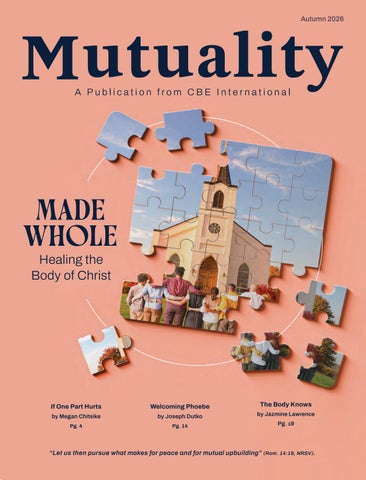
Made WhOLE Healing the Body of Christ
If One Part Hurts
Welcoming Phoebe
by Megan Chitsike
by Joseph Dutko
Pg. 4
Pg. 14
The Body Knows by Jazmine Lawrence Pg. 19
“Let us then pursue what makes for peace and for mutual upbuilding” (Rom. 14:19, NRSV).
IN THIS ISSUE Part Hurts: Healing, Hope, 4 IfandOneFlourishing
Sometimes healing looks like finding a group of supportive people on the same journey, learning and growing together even when change is slow to come. Megan Chitsike
10 Spirit-Inspired Diversity
Acts 6 reveals how the Spirit expanded early church leadership to reflect the body, ensuring no one gets overlooked or left behind. Joseph Dutko
14 19
Welcoming Phoebe: Hospitality Is Healing
Healing and wholeness are deeply connected to belonging and unity. Seeing equality through the lens of hospitality helps us understand our shared invitation at the Lord's table. Nick O’Brien
The Body Knows: A Theology of Forgiveness
Discussions of healing and the body are not only metaphorical. Both body and spirit can suffer together when impacted by bad theology. Jazmine Lawrence
Mutuality is published quarterly by CBE International, 122 W Franklin Ave, Suite 610, Minneapolis, MN 55404-2426. We welcome your comments, article submissions, and advertisements. Visit cbe.today/mutuality. All Scripture quotations, unless otherwise indicated, are taken from the 2011 revision of the Holy Bible, New International Version®, NIV®. Copyright © 1973, 1978, 1984, 2011 by Biblica, Inc.™ Used by permission. All rights reserved worldwide.
2
Mutuality | Autumn 2026
DEPARTMENT 3 From the Editor
What We Believe Matters
23 President's Message Feeling Pain in the Body of Christ
24 Ministry News 25 Giving Opportunites
EDITORIAL STAFF Editor: Carrie Silveira Graphic Designer: Margaret Lawrence Publisher/President: Mimi Haddad Mutuality vol.33 no 3, Autumn 2026 Cover design by Margaret Lawrence. Mutuality (ISSN: 1533-2470) offers articles from diverse writers who share egalitarian theology and explore its impact on everyday life.
Advertising in Mutuality does not imply organizational endorsement. Please note that neither CBE International, nor the editor, nor the editorial team is responsible or legally liable for any content or any statements made by any author, but the legal responsibility is solely that author’s once an article appears in Mutuality. CBE grants permission for any original article (not a reprint) to be photocopied for local use provided no more than 1,000 copies are made, they are distributed for free, the author is acknowledged, and CBE is recognized as the source.
Mutuality wouldn't be possible without gifts from our generous donors. Scan the QR code to support CBE publications.
website: cbeinternational.org
From the Editor by Carrie Silveira
What We Believe Matters Some question why CBE invests so much time and resources discussing biblical equality rather than other “more important” theological concerns. They may argue that the role of women is a “secondary issue”—one on which we can agree to disagree. “Afterall,” so the thinking goes, “the greatest impact is on women who want to lead; for men and for women who are not called to leadership, it’s an abstract theological discussion, right?” Wrong. Theology is not an abstract exercise with no connection to real life. Theology is a collection of our beliefs and understanding about God, and our beliefs inform our actions. Bad theology is harmful—not in an abstract way, but with real-life consequences. How many people have lost their entire life savings because they invested in a church that promised miracles corresponding to the amount they gave in offerings? How many wives suffer in abusive marriages because they have received bad teaching about marriage and submission? In an attempt to ensure the dignity of women within hierarchy, some complementarians began to espouse a belief that women are “equal in value but separate in roles.” Whatever the intentions, this argument sounds strikingly similar to another promoted in civic discussions about segregation, an argument that was thankfully debunked and dismantled. When women are prohibited from participating in leadership because of a foundational characteristic of their being—their femaleness—they cannot truly be said to be “equal” to men.1 And if our theology sustains that women are less than men in some way, in any way, our behavior will reflect that. If men are the final decision makers, women’s voices matter less. If men are the spiritual leaders over women regardless of spiritual maturity, interpreting Scripture and serving as mediators for them, they place themselves between women and God—a position only Jesus holds. If men are given the responsibility to discern truth while women are believed to be easily deceived, women are taught to trust men blindly, rendering them vulnerable to manipulation.2 Whatever the intentions of those involved, bad theology hurts people. It hurts our sisters and brothers. It hurts our children. And according to 1 Corinthians 12, when one part of the body of Christ is hurt, the whole body is hurt. In the news every day, we are
seeing just how much the bad theology of gender hierarchy hurts the body of Christ. How are we to bring healing and hope to a hurting world if we ourselves are bleeding out? We want to make room for that pain, to name and acknowledge it—but we don’t want to remain in it. We want to cast a vision of hope and healing, not through toxic positivity,3 but in recognizing the power of the Holy Spirit to work through even our heaviest moments.4 The articles in this issue, much like the sessions of this year’s CBE Conference in Chicago of the same theme, explore how we understand hurt and healing within the body of Christ. Healing can happen in a small group even in the face of discouragement; healing can happen when a church body is accurately represented by its leaders; healing can take the form of welcoming someone to a shared table; healing can even be physical as our bodies and spirits learn to rest through healthy theology and grace. Healing can begin by recognizing the value of each person operating out of their gifts and callings, addressing conflicts and misunderstanding with love, humility, and kindness. As we let go of bad theology, the whole church may be built up. Beliefs inform action: When women are recognized as truly equal to men, they will be able to work alongside them as partners, and women and men alike will benefit. And in this way, the church begins to function as the body of Christ and demonstrates the transforming power of the gospel, giving an example to the world and promoting healing and wholeness beyond its walls. Notes 1.
2. 3.
4.
A more technical formulation of the statement would be: “Ontologically equal but functionally different.” If the basis of her prohibition from leadership is ontological, she cannot be said to be ontologically equal. Many scholars have developed this argument in depth; for further reading, see: Greta L. Bennett and AJ Fletcher, “Separate but Equal: The Great Lie behind Jim Crow and Progressive Complementarianism,” Priscilla Papers 39, no. 3 (Summer 2025). https://www.cbeinternational.org/resource/women-leadershipand-ordination-in-the-anglican-church-in-nigeria-copy/. For specific examples of this, see Mutuality issues 32.2 Why Her?, 31.3 Bullying in the Body, 29.3 The Problem of Porn, and 26.1 Everyday Sexism. Toxic positivity is a form of emotional denial characterized by the belief that people should maintain a relentlessly positive mindset no matter how painful or difficult the situation, suppressing or invalidating negative emotions. Recognizing that the Lord can use terrible situations does not make them less terrible or painful, but it puts them in their place, no longer the end of the story.
Disclaimer: Final selection of all material published by CBE International in Mutuality is entirely up to the discretion of the publisher and editor. Please note that each author is solely and legally responsible for the content and the accuracy of facts, citations, references, and quotations rendered and properly attributed in the article appearing under his or her name. Neither CBE, nor the editor, nor the editorial team is responsible or legally liable for any statements made by any author, but the legal responsibility is solely that author's once an article appears in print in Mutuality.
bookstore: cbebookstore.org
Mutuality | Autumn 2026 Made Whole
3
If One Part Hurts
Healing, Hope, and Flourishing Megan Chitsike
This piece is dedicated to a group of brave, strong, gifted women who learned and grew alongside me as egalitarian women in a complementarian church. We gathered on my veranda one afternoon. I remember the warmth of the autumn sun, the smell of fresh bread, and the way we were easily able to dive straight in to sharing our stories with unguarded honesty and vulnerability. Through friendships, mutual connections, and chance conversations, this small group of women had discovered our shared journey from complementarianism to egalitarianism. It was the first of many meetings. Over several months we ate, laughed, cried, and prayed
4
Mutuality | Autumn 2026
together. We talked about books, podcasts, verses, Bible translations, commentaries, and more. These women became my safe place and my sanity through a painful but ultimately beautiful journey from hurt to healing and hope. After many individual letters and conversations with the all-male elders of our complementarian church, we realized it would be more effective to engage with them as a group. We arranged a meeting where we shared our theological convictions about women in leadership; one elder admitted that it did seem strange for women to be permitted to lead in the workplace but not the church, but that’s what he believed “because we website: cbeinternational.org
have the Bible.” We invited them to explore key Bible passages with us, and there seemed to be an openness to engage. The very next evening we attended a church meeting and those same elders publicly affirmed their complementarian position, arguing against the very ideas we had shared with them. While they believed women to be critical to the mission of God, they asserted that a pattern of male leadership and authority was established in Genesis, then affirmed by Jesus in his choice of twelve male apostles, and again by Paul in his mention of male elders. We were heartbroken and felt as if we had been used as a practice run the evening before. We reflected, prayed, and asked to continue the conversation. Only one elder accepted the invitation and, to his credit, met with us a number of times over a few months, engaging respectfully and kindly. The others chose not to participate, but we heard whispers of things said about us rather than to us. The conversation eventually came to an end. It was clear that while we had been given a chance to engage, the church position was not going to change. It was even gently suggested to some of us that it would be best for us to leave the church. In the months that followed, most of us slowly and silently left one by one. If One Part Hurts
ic wh
t
to
wa me
h
e s th
al
w lo
Through our journeys, we connected individually and as a group with other women with similar stories and journeys: •
Women who questioned the status quo in their churches and were seen as “bitter troublemakers” or as too easily influenced by “feminist” and “liberal” ideas.
•
A clearly gifted woman who was allowed to preach in her church, but each time she did, one of the male elders would walk out of the auditorium in protest.
•
A woman pastor whose church changed their position on women in leadership, saying that only “exceptional women” could lead. (It wasn’t clear who decides which women are exceptional enough to lead or if this meant “unexceptional” men could lead.)
Cognitive Dissonance What stood out to me through countless stories and conversations was the cognitive dissonance of “soft complementarianism” which allows women to lead in the workplace or even in politics, but not in the home or church. This hypocrisy is also seen in the many justifications made for only occasionally allowing women to preach, or for allowing women to “preach but not to teach” (if that’s even possible!), or allowing women to preach a stand-alone message but not as part of a sermon series. None of these ideas are found in Scripture, yet they appear in “soft complementarian” churches. Nice Complementarianism Austin Channing Brown’s description of “nice white people” resonates: “When you believe “niceness”
c o g n i t i v e di s s ona nc e of
m e n to l e a d i n s wo s om
"s of t
e are
c om
as b
pl e
ut n
men
ot o
ta r i
the
ani
s m"
rs.
Wh
at s
to
od
ou
While none of us felt particularly called at that time to lead churches or be elders, all of us were involved in many areas of church life and served faithfully for years. We had all examined Scripture in depth and shared the strong conviction that God’s design for the church is for women’s voices and gifts to be fully included, celebrated, and encouraged at all levels. We were compelled by the Spirit to speak up, not only for our sake, but for our sisters, friends, and daughters. We knew that “if one part of the body suffers, then all the other parts suffer with it” (1 Cor. 12:26, ERV). I particularly love the Message translation of this verse
(emphasis mine): If one part hurts, every other part is involved in the hurt and in the healing.
bookstore: cbebookstore.org
Mutuality | Autumn 2026 Made Whole
5
t No
all
ng w ow i l and
om e n t
st imit
o u s e o u r g if t s i s p
r ofo u n d
h e wor k of t h e Holy S pi
disproves the presence of racism, it's easy to start believing bigotry is rare.”1 Robin D’Angelo also writes about “nice” racism and the way progressive white people can perpetuate harm.2 The same applies to complementarianism: “nice” complementarians do not disprove the presence of sexism and the reality of its resulting deep harm. Gaslighting Women in complementarian churches are often told that we are valued and equal to men. We may even be encouraged to develop our gifts but then aren’t allowed to use them in specific contexts, solely based on our gender. This sends the message that women are gifted enough to do the hard work of serving in church spaces but not gifted enough to lead. This subtle psychological manipulation contradicts the theological claim that we are fully valued and equal. The condescension of being politely assured that we are valued and equal to men, yet at the same time restricted by our gender in how we use our gifts, is a painful and destructive form of gaslighting. Gender is an inherent part of our humanity; how can two genders truly be equal when one is arbitrarily restricted from the work, authority, and spiritual gifts meant for the whole body?
ly h u r t f u
l
r i t.
Paul’s metaphor about the body, culminating in verse 26, sits between two passages about spiritual gifts (verses 7–11 and verses 27–31), reminding us that gifts are not given for individuals but for the sake of the body. Gifts are not hierarchies. They are Spiritdetermined, not gender-specific. They are given to each one by the will of the Spirit for the good of the body. There are no gender-related conditions, restrictions, or requirements for receiving spiritual gifts, including the gifts of apostleship, prophecy, and teaching. The Spirit gives gifts freely, but the church must embody that reality by honouring all gifts and ensuring that no one is silenced or excluded. In Marg Mowczko’s piece on 1 Corinthians 12, she writes about the equality and mutuality which comes through strongly in the passage: “ … each of us should use what the Spirit has given to us and serve according to God’s calling. That’s the ideal. The reality, however, is that some people are prevented from ministering. Women especially are dissuaded and excluded from certain ministries in some churches. By differentiating men from women in regard to ministry we are creating a divide in the church. This is not what God intended.”3
The Work of the Spirit
Healing and Hope
Not allowing women to use our gifts is profoundly hurtful and limits the work of the Holy Spirit. If a woman has a gift of preaching or leadership but is restricted in the ways she can use this gift, that limits the Spirit’s effectiveness and hampers the spread of the gospel. Joel 2 speaks about the Holy Spirit being poured out on all flesh, a vision that finds its fulfilment in Paul’s teaching in 1 Corinthians 12. Just as Joel insists that “sons and daughters, young and old, servants and leaders alike will prophesy and dream dreams,” Paul tells us that “to each one the manifestation of the Spirit is given for the common good” (1 Cor. 12:7). The Spirit does not discriminate in the distribution of gifts but gives “just as he determines” (1 Cor. 12:11). To deny or restrict the exercise of those gifts based on human categories such as gender is to resist the Spirit’s sovereign work.
Let’s revisit the group of ladies on my veranda, a few years later. Some of us have since found churches where women lead freely alongside men in full and truly equal partnership. Some of us lead and preach in these spaces. Some of us are still holding on in complementarian churches, bravely following the example of Esther, who through her courage and humility brought change and freedom for her people. Some of us don’t feel safe in any church spaces but are finding healing in other ways. We have shared in each other’s hurt and in each other’s healing. We continue to hold hope for the church everywhere, the body of Christ, to embrace the Godgiven equality of men and women and the full inclusion of women’s gifts and voices. We continue to share our stories and journeys in the hope that those listening may be moved to speak and act.
6
Mutuality | Autumn 2026
website: cbeinternational.org
e
r pa
t
hu
rt
pa
v s, e
r
e ry
o
rt
ry o
rt r pa the
is
t
o lv e d i
n t h e h u r t, a n d i n t h e h e a l i n
g.
To those who have taken your complementarian church’s position as your own without reading or studying for yourself: Listen to the stories. Read the books. There are many excellent materials available. You have a responsibility to your wives, sisters, mothers, daughters, and to the Lord to thoroughly examine Scripture for yourself on this issue.
nt lv e d i i n vo
h e h u r t, a
n d i n t h e h e a l i ng .
To those who feel you have studied this topic and have landed on a view that restricts women: I acknowledge your genuine desire to follow Jesus and invite you to re-examine what the Bible says, recognizing the harm even well-meaning patriarchal theology causes. When half the church is at stake, keep an open and humble mind. Find someone to walk with in your journey.
If
on
If
e on
u th
ve s, e
p her
s inv art i
If o
ne p art
hurt
s, e ver
, and y other p a r t i s i n vo lv e d i n t h e h u r t
hea in the
l i ng
.
To the women who don’t feel strongly about this and are comfortable in your complementarian church communities: You may not feel affected by this issue, but for the well-being of the whole body, speak up. It may lead to discomfort, but please don’t stay silent.
if
on
e pa
r t h u r t s , e v e ry o t h
t is e r pa r
i n vo
lv
nt ed i
he
h
,a urt
nd
i
h nt
eh
l ea
i ng
.
To women who are holding on in complementarian spaces or who have left broken and crushed: Whether you have found healing in a new community, or whether you are still alone in your brokenness, may you find hope, healing, and a place of flourishing.
bookstore: cbebookstore.org
Mutuality | Autumn 2026 Made Whole
7
if
on
ep art
hurt
s , e v e ry o t
h e r pa r t i s i n v
o
n th lv e d i
e hu
r t,
in and
the
li hea
ng
.
To those who are convinced that women’s full participation in all forms of church ministry is God’s design and have spoken up in complementarian spaces, risking your status, reputation, friendships, and more: Thank you. Your courage has paved the way for healing, wholeness, and hope. Healing and flourishing looks like churches where women lead, teach, and serve alongside men in genuine and equal partnership. It looks like women free to operate in God-given spiritual authority and the men around them embracing and celebrating this. It looks like communities where no one walks out when a woman speaks but instead leans in to listen. It looks like spaces where daughters grow up knowing they are fully seen, heard, and valued. Flourishing looks like the whole body of Christ working together, each part contributing freely with joy and strength, so that the church exudes wholeness, unity, and the transforming power of the gospel.
We continue to share our stories and journeys in the hope that those listening may be moved to speak and act.
Notes 1. 2. 3.
Austin Channing Brown, "Nice White People," in I'm Still Here: Black Dignity in a World Made for Whiteness (New York: Convergent Books, 2018), 93. Robin DiAngelo, Nice Racism: How Progressive White People Perpetuate Racial Harm (Boston: Beacon Press, 2021). Marg Mowczko, “Equality and Unity in Ministry: 1 Corinthians 12,” Marg Mowczko (blog), March 30, 2013, https://margmowczko. com/equality-honour-and-unity-in-ministry-1-corinthians-12/.
Megan Chitsike works in mathematics teacher education in South Africa and believes that education is a powerful tool for equality. Her passion for equality has shaped her desire to see women flourish in all spheres of life, including the church, using their God-given gifts without restriction.
ITALY TOUR AD OR EXTEND ARTICLE TO END OF PAGE
SpiritInspired Diversity Acts 6:1–7 and the Story of Early Church Leadership Joseph Dutko
When the topic of diversity in church leadership is broached—including equal representation of women and men—one of the first questions I get is, “Aren’t we just being influenced by worldly teaching and cultural pressures rather than staying true to the Bible?” I appreciate people’s desire to stay faithful to the Scriptures, which is why it’s always a great opportunity to teach them that we need not abandon faithfulness to the Bible in order to pursue diversity in church leadership or a radical egalitarian position! Indeed, the biblical vision demands that we move toward more diversity in church leadership roles. Among other things, the book of Acts tells the story of the expansion of diversity in leadership within the church. Acts 6:1–7 highlights the Spirit-inspired diversity of leadership needed for the church to continue to grow and multiply. Acts teaches that when God’s Spirit moves, we should expect Spirit-inspired diversity in the leadership of the church.
Setting The Scene: Growth In Numbers A key development in the Spirit-inspired diversity of leadership in the early church happens in Acts 6:1–7, which starts in v. 1 with a description of a growing church: “In those days when the number of disciples was increasing . . .” In Acts 2:44–45 we learn how the early church shared all things in common and took care of those in need. As a result, they add to their number daily those being saved (Acts 2:47). But as the young church grew, it began to face challenges.
10
Mutuality | Autumn 2026
The Church’s First Problem: Growth In Diversity The church in Acts grew not just in number but also in diversity. It expanded beyond an initial and smaller homogenous group of Jews from a singular location (in Jerusalem) to more diverse groups of people from many different locations, including Hellenistic Jews.1 This presented a problem: “In those days when the number of disciples was increasing, the Hellenistic Jews among them complained against the Hebraic Jews because their widows were being overlooked in the daily distribution of food” (Acts 6:1).2 These two distinct groups, Hebraic Jews and Hellenistic Jews, together made up this early version of the church. The leaders would have been Hebrew or Aramaic-speaking Jewish men, making it easy to inadvertently overlook the Greek-speaking widows in the church who were not “one of them.” This oversight may not have been intentional, but that does not make it any less problematic. What is the church, led by and dependent on the Spirit, going to do as they face what was perhaps their first ever internal problem or dispute? Here is what unfolds in vv. 2–5: So the Twelve [Hebraic Jewish leaders] gathered all the disciples together and said, “It would not be right for us to neglect the ministry of the word of God in order to wait on tables. Brothers and sisters, choose seven men from among you who are known to be full of the Spirit and wisdom. We will turn this responsibility over to them and will give our attention to prayer and the ministry of the word.” website: cbeinternational.org
The Bible demands that we move toward more diversity in church leadership roles.
This proposal pleased the whole group. They chose Stephen, a man full of faith and of the Holy Spirit; also Philip, Procorus, Nicanor, Timon, Parmenas, and Nicolas from Antioch, a convert to Judaism. Notice: all seven of these men have Greek names. In other words, they were likely all Hellenistic Jewish Christians, with one even being a Gentile convert (Nicolas in v. 5). The Greek-speaking widows were overlooked by the Aramaic-speaking leaders, so what is the church’s solution as led by the Spirit? It is to appoint Greekspeaking Hellenists to their leadership team to accurately represent the makeup of this growing church! Before diversity and inclusion became modern buzzwords, Spiritinspired diversity in leadership was already a first-century church value. This was not just diversity for the sake of diversity. Like all Christian and Spirit-inspired values, it was diversity born out of love for and service to others. It was important to the Spirit that the people being ministered to were well-represented by those ministering to them. The diverse makeup of a church should be reflected in its leadership as much as possible, whether regarding gender, ethnicity, ability, language, socio-economic status, or so on. This then brings up an obvious question and glaring issue from this text: why is it all men that were chosen?
Growth In Revelation The nineteen leaders mentioned at this point in the early church, the twelve disciples and the seven appointed here, are all men. This is clearly not yet a picture of equal representation and diversity. This is very early in the unfolding story of God’s church, and the first followers of Jesus are progressively learning what it means to be in this new covenant of God’s people and what that newness should look like. They are coming out of a patriarchal culture dominated by men; that is all they know.3 Appointing men is likely the only option that even exists in their minds at this point.
The diverse makeup of a church should be reflected in its leadership as much as possible. bookstore: cbebookstore.org
Mutuality | Autumn 2026 Made Whole
11
They do not even fully realize that the gospel is also for the Gentiles! It’s not until Acts 10, the story of Peter and the Gentile Cornelius, that Peter realizes it’s okay to associate with and even visit a Gentile man in his home. We take the acceptance of Gentiles for granted now, and probably most of us reading this are of Gentile descent. But that took time and adjustment. Peter learned it through the revelation of the Spirit and concluded afterwards that “God does not show favoritism” (Acts 10:34) and “who was I to think that I could stand in God’s way?” (Acts 11:17). By chapter 16 in Acts, Paul is preaching to Gentile women (16:13), including Lydia. She responds to the message, is baptized, and invites the apostles into her home (16:14– 15). At the end of that chapter, Paul and Silas are released from prison and go straight to Lydia’s house where “they met with the brothers and sisters and encouraged them,” suggesting that she’s either leading or at least hosting this new church (16:40). Acts 18 then goes on to describe Priscilla, quite possibly a Gentile woman,4 teaching and discipling a Jewish man, Apollos (18:2, 18–19, 24–26). It is no wonder the early Christians were considered such troublemakers (Acts 17:6) as they turned upside down the typical hierarchies and social order! Paul’s letters name many early women leaders in the church, including Phoebe who is given the exact same title or description as the seven men in Acts 6 of a “deacon (diakonon, meaning overseer) of the church” (Rom. 16:1). In that same chapter, Paul also recognizes Junia as an “outstanding” preacher or leader in the church (Rom. 16:7).
The Spirit first expanded the leadership
Within the book of Acts, there is progressive revelation and understanding of what the Spirit was doing and how the Spirit was expanding God’s kingdom. The Spirit first expanded the leadership of the early church by moving from a select group of Aramaic speaking Jewish men in Jerusalem to Greek speaking Jewish men from other places. The Spirit then diversified leadership further to include Gentile men, then Gentile women, then finally to the point where a Gentile woman leads a Jewish man into deeper discipleship (18:26). It is an amazing development in the first century. This example of the progressive revelation of diversity in leadership is why the Bible must be read in the context
The Spirit then diversified leadership 12
Mutuality | Autumn 2026
The Spirit then deepeNED discipleship website: cbeinternational.org
of its larger unfolding story.5 We cannot take isolated passages and say, “Do exactly as they did here.” There is a progressive revelation to consider as context and culture are transformed under Spirit leadership.
and old, prayerfully and worshipfully responding to the preaching of a sixteen-year-old female intern or twentytwo-year-old woman pastor fresh out of Bible college. That is a sign of the Spirit at work in breaking down barriers!
A Spirit-inspired movement will lead to Spirit-inspired diversity of leadership that accurately represents the people being served. As renowned scholar Amos Yong puts it: “Effective leadership and ministry must represent and respect the perspectives and languages of the people who need to be served.”6
If we want our churches to grow, to bring healing and restoration, to draw people to Christ, then we must pray for Spirit-inspired diversity that reflects the makeup of our churches to become the norm.
What happens when this diversity occurs? What was the result in Acts, and how do we know this is such important teaching? Our story in Acts 6:1–7 shows us the outcome of Spirit-inspired diversity in the final verse: “the word of God spread. The number of disciples in Jerusalem increased rapidly” (Acts 6:7).
1.
Notes
2.
Wholeness: The Need For Diversity In Church Leadership One of the main take home questions to ask is, “Does the leadership of my church or Christian organization reflect the diversity of the people it serves?” If most congregations have an equal number of women as men, this should be reflected in the church’s leadership at every level, including the pastors. Just as in the early church, a limited leadership may miss out on the needs of the congregation; even a well-intentioned male pastor may not think as readily of the needs of his female congregants. Some congregants may have suffered abuse and may feel safest confiding in a pastor of their same gender. Having both women and men in church leadership helps protect and shepherd the entire flock. The body of Christ is made up of both women and men with different spiritual gifts. In spite of claims otherwise, church growth and revitalization throughout history (including in the New Testament) almost always includes the emergence or resurgence of women leaders.7 It is part and parcel of the outpouring of the Spirit which includes “sons and daughters . . . both men and women” (Acts 2:17–18). An Acts-type of Spirit-filled church will be moving in the direction of equal and fair representation in its leadership, not only for the sake of ministering to diverse groups or demographics, but also to learn from different voices and perspectives. The Holy Spirit flips the script, turning our hierarchies and social norms upside down, whether through a Gentile woman teaching a Jewish man, or a pastoral staff full of women and men from diverse backgrounds and experiences. I have recently witnessed men, young bookstore: cbebookstore.org
3.
4.
5.
6. 7.
Hellenistic Jews were Jews who assimilated Greek culture and language in the Ancient World; Hebraic Jews were in Jerusalem and spoke Hebrew or Aramaic and were more steeped in Jewish culture. This oversight by the Hebraic Jews probably involved more than just the distribution of food. The Greek noun used here, the daily diakonia, means “service” and probably refers to general ministry, not just the distribution of food. Diakonia gets translated “distribution of food” in v. 1 based on the reference to serving at a food table in v. 2 (where the verb form of diakonia is used). See Amos Yong, Who Is the Holy Spirit? A Walk with the Apostles (Brewster, MA: Paraclete, 2011), 70. The rest of Acts potentially confirms that the people being overlooked was about more than just material distribution of food, for it only highlights these seven men’s more vocational type of ministry, such as the preaching of Stephen and Philip. We learn that these seven were “full of the Spirit and wisdom” (v. 3) and Stephen was “full of faith and of the Holy Spirit” (v. 5) and “full of God’s grace and power” (v. 8). They were carefully chosen based on their ministry gifts. The argument that Christianity emerged from both a religious (Jewish) and cultural (Greco-Roman) patriarchal system is well supported by biblical and historical scholars. For a summary of how Christianity was (slowly) learning to be resocialized from widely accepted patriarchal boundaries into a new communal identity, see Lisa Sowle Cahill’s chapter “Sex, Gender, and Early Christianity,” in her Sex, Gender, and Christian Ethics (Cambridge: Cambridge University Press, 1996), 121–65 (esp. 141–54). As is argued by Mimi Haddad in “Priscilla, Author of the Epistle to the Hebrews?” Priscilla Papers: The Academic Journal of CBE International 7, no. 1 (Winter 1993), https://www.cbeinternational.org/resource/priscilla-author-epistle-hebrews/. This is my primary biblical argument in Joseph Lee Dutko, The Pentecostal Gender Paradox: Eschatology and the Search for Equality (London: Bloomsbury T&T Clark, 2024), where I identify an eschatological-egalitarian narrative thread in Scripture and develop a corresponding eschatological authorizing hermeneutic for reading biblical texts on gender. Simply put, I propose that reading the Bible with an eschatological lens leads to the full and unhindered participation of women in church leadership. Yong, Who Is the Holy Spirit?, 73. There are lots of revival stories throughout history that illustrate this truth, such as the Pentecostal revivals of the early twentieth century. For the story of how women rose to prominence in those revivals in the US and Canada, see my historical chapter in Dutko, Pentecostal Gender Paradox, 55–89.
Joseph Dutko is author of The Pentecostal Gender Paradox: Eschatology and the Search for Equality (Bloomsbury T&T Clark, 2024). Since 2015 he has served with his wife as the co-lead pastor of Oceanside Community Church on Vancouver Island, British Columbia. You can find his publications and blog at josephdutko.com.
Mutuality | Autumn 2026 Made Whole
13
14
Mutuality | Autumn 2026
website: cbeinternational.org
Phoebe arrived as a stranger in Rome, carrying a letter which included Paul’s instruction on her behalf: “Welcome her in the Lord” (Rom. 16:2).1 While the women’s rights movement since the 19th century has increased equality between women and men, a truly Christian vision of gender goes well beyond mere fairness. A Christian vision of gender seeks healing and wholeness through radical mutuality as presented in Scripture: women and men welcoming one another and belonging to each other within the body of Christ (cf. 1 Cor. 12:12–31). If that’s the case, our treatment of women in the church and in the home is a matter of Christian hospitality. When Phoebe knocks on our doors, sits in our pews, or stands in our pulpits, are we able to “welcome her in the Lord”? While the word “hospitality” may conjure up images of entertaining guests and serving coffee and donuts on Sunday mornings, Christian hospitality is far more robust. It is the Spirit’s power to create communities of radical, mutual belonging in Christ, until all people flourish in mutual wholeness. This hospitality has three defining features. God Is Host First, when Paul instructs the Romans to welcome Phoebe “in the Lord,” he makes an important theological point: They are not to receive Phoebe to their own table, but to God’s. The God who prepares a table before us (Ps. 23:6) seats us with Christ (Eph. 2:6), welcoming us and bringing us near when we were far off (Eph. 2:13). Male and female meet Christ together in the Eucharist now as we await our invitation to the marriage supper of the Lamb (Rev. 19:9). Because we are guests at God’s table, we don’t choose the place of honor and look down on others (cf. Luke 14:7–8). Men and women welcome one another because we have been welcomed first by God. “Welcome one another, therefore, just as Christ has welcomed you, for the glory of God” (Rom. 15:7). If the table belongs to God, we must not restrict it to men alone. God’s daughters are invited to God’s table, where we all find hospitality, healing, and wholeness together. Phoebe isn’t truly received at a complementarian table where she must submit to her male hosts. “In the church, especially, it is not our table to which we welcome people; it is God’s table to which we come as equals.”2 In the
Christian hospitality is the Spirit's power to create communities of radical, mutual belonging in Christ.
bookstore: cbebookstore.org
when Paul instructs the Romans to welcome Phoebe “in the Lord,” he makes an important theological point: They are not to receive Phoebe to their own table, but to God’s.
church, Phoebe sits down beside men, made whole as an equal at God’s table. To women told to serve and submit on the sidelines, Christian hospitality offers Christ’s healing welcome. Authority and Vulnerability Second, Phoebe demonstrates Andy Crouch’s helpful framework for human wholeness: the tension and intersection between authority as “capacity for meaningful action,”3 and vulnerability as “exposure to meaningful risk.”4 A full human life consists of authority and vulnerability. Paul shares that Phoebe “has been a benefactor of many and of myself as well” (Rom. 16:2). Paul knew Phoebe in her authority as a benefactor, empowered with capacity for meaningful action to benefit the vulnerable, including Paul himself. But now, entering Rome as a stranger, Phoebe has become the vulnerable one, exposed to the meaningful risk of dependence upon strangers far from home. Paul instructs the Romans: “Help her in whatever she may require from you” (Rom. 16:2). The helper needed help, the healer needed healing, and the host needed hospitality. When Phoebe arrives at God’s table in Rome, Paul expected the Romans to welcome her wholeness—her authority and her vulnerability. Anything less falls short of true Christian hospitality, where every person is free to reveal their weakness without fear, and embody their strength without domination. Seeing Jesus and Being Jesus Finally, Christian individuals and communities are responsible for seeing Jesus in everyone we encounter, and for being Jesus toward everyone we encounter. After Phoebe’s arrival in Rome, it would be fitting for them to self-assess using Esther de Waal’s question: “Did we see Christ in [her]? Did [she] see Christ in us?”5
Mutuality | Autumn 2026 Made Whole
15
Christian hospitality rests upon a simple phrase from the lips of Jesus: “I was a stranger and you welcomed me” (Matt. 25:35). When Paul instructs the Romans to welcome Phoebe as a stranger, he instructs them to welcome her as they would welcome Christ. They are to honor the fullness of her God-given dignity. Further, the Roman Christians were called to receive Phoebe as Jesus received those who were far off, to nurture her vulnerability as Christ had compassion on the weak, and to empower her agency and authority as Jesus did. They were to see Jesus in her and to be Jesus toward her. Paul instructed the Roman church to welcome Phoebe to God’s table, to value her authority and her vulnerability, and to see Jesus in her while being Jesus toward her. Christian community that offers this radical dignity provides the healing and wholeness consistent with Christlike hospitality. Does complementarianism empower Christians today to welcome women with this Christian hospitality? Leaving God’s Table Complementarianism affirms male and female equality before God. Insofar as men and women are both guests at God’s table, they are equals. However, in Recovering Biblical Manhood and Womanhood (RBMW), Raymond Ortlund writes: “The man was not created to help the woman, but the reverse . . . So, was Eve Adam’s equal? Yes and no. She was his spiritual equal and, unlike the animals, ‘suitable for him.’ But she was not his equal in that she was his ‘helper.’”6 While men and women are equal at God’s table, complementarians appear to have built a segregated table, where men sit to be served by female “helpers.” To sustain this theology, complementarian men must leave God’s table to sit at their own. Ortlund sees all women as “helpers,” but as we have seen, Phoebe scrambles these categories. While she may
appear to follow in Eve’s footsteps as a “helper of many” (Rom. 16:2, NASB), Paul flips the script by instructing the Romans to “help her in whatever she may require from you” (Rom. 16:2). Phoebe proves that “helper” is not a permanent gender role for all time. It is a temporary responsibility, belonging to those who are in a place of strength. As Paul says, “we who are strong ought to bear the weaknesses of those without strength” (Rom. 15:1, NASB). The strong provide healing hospitality to the weak until everyone is made whole in Christ. Male Authority and Female Vulnerability This brings us to our second consideration: does complementarianism accept men and women in their strength and their weakness? Does complementarianism value women in their wholeness at the intersection of authority and vulnerability? In RBMW, John Piper defines both masculinity and femininity: At the heart of mature masculinity is a sense of benevolent responsibility to lead, provide for and protect women in ways appropriate to a man’s differing relationships. At the heart of mature femininity is a freeing disposition to affirm, receive and nurture strength and leadership from worthy men in ways appropriate to a woman’s differing relationships.7 In this framework, men and women each lack the wholeness at the intersection of authority and vulnerability. Masculinity is construed as strength: responsibility, leadership, provision, and protection. Femininity is presented as vulnerability: affirmation, reception, and nurture for male strength. A man that shows weakness has stepped below “mature masculinity” toward femininity, and a woman that shows strength tries to usurp “mature masculinity.”
Christian individuals and communities are responsible for seeing Jesus in everyone we encounter, and for being Jesus toward everyone we encounter.
16
Mutuality | Autumn 2026
website: cbeinternational.org
When women sit down with men at God's table in both authority and vulnerability, the Spirit is at work. This is remarkably problematic for men and women, as neither can flourish without both authority and vulnerability. Piper’s narrow definitions constrain each of us to half of a human life—either authority or vulnerability. Women suffer as their authority is restricted, and men suffer as their vulnerability is restricted. Martha Nussbaum says, “The peculiar beauty of human excellence just is its vulnerability.”8 When men fear the appearance of femininity and restrict female authority, nobody finds the wholeness available to all at God’s table. Christ in Women This brings us to our final consideration: does complementarianism enable Christians to see Jesus in women and to be Jesus toward women? When complementarian men are blind to female authority, they fail to see Jesus in women. When they refuse to give women a seat at the table, they fail to sit with Jesus in women. When they fail to perceive Christ’s “human excellence” in the uniquely female vulnerability of pregnancy, childbirth, and breastfeeding, they fail to perceive Jesus in women. When they do not listen to women’s voices, they fail to hear Jesus in women. When they don’t embrace women’s gifts, given by the Spirit of God, they fail to recognize Jesus in women. When they refuse to care for women who have been wounded by abusive church leaders, they fail to love Jesus in women. When they fail to “welcome her in the Lord,” they fail to welcome Jesus in women. Furthermore, when men are intent on being served by women, rather than serving women, they fail to embody Jesus who “came not to be served but to serve” (Matt. 20:28). When they don’t give women a voice, they fail to have the mind of Christ who empowered the Samaritan woman to preach the Messiah to her village (cf. John 4:28–29) and sent Mary Magdalene back to the disciples with the good news of the resurrection (cf. John 20:17– 18). When they restrict female agency, they fail to be conformed to the Image of the Son who celebrated Mary’s choice to learn at His feet (cf. Luke 10:38–42). When bookstore: cbebookstore.org
they quench female authority, they fail to embody Christ who went to the Gentiles because of the Syrophoenician woman’s faith (cf. Mark 7:24–31). Hierarchy creates an ideological wall that stands between Christian men and God’s desire that they would see Jesus in women and be Jesus toward women. Because Christ is in women, the church will be an incomplete picture of Jesus as long as we fail to receive women in the Lord. Conclusion What does it mean to “welcome her in the Lord?” Rather than separating women into separate spheres with separate roles, the church is called to be Jesus toward women by welcoming Christ in women. When women sit down with men at God’s table in both authority and vulnerability, the Spirit is at work, healing God’s children and creating a community of wholeness and mutuality in Christ. This is God’s hospitality at work, bringing women and men together as many parts to form one body. Notes 1. 2. 3. 4. 5. 6. 7.
8.
All Scripture quotations are NRSVue unless otherwise noted. Pohl, Making Room: Recovering Hospitality as a Christian Tradition, p. 158. Crouch, Strong and Weak: Embracing a Life of Love, Risk, and True Flourishing, p. 35. Ibid., p. 40. Quoted in Pohl, Making Room, p. 173. Ortlund, Male-Female Equality and Male Headship: Genesis 1-3. In Recovering Biblical Manhood and Womanhood: A Response to Evangelical Feminism, p. 135. Piper, A Vision of Biblical Complementarity: Manhood and Womanhood Defined According to the Bible. In Recovering Biblical Manhood and Womanhood: A Response to Evangelical Feminism, p. 40-41. Quoted in Pohl, Making Room, p. 149.
Nick O’Brien is a graduate student in Trevecca Nazarene University’s Theology and Biblical Studies Master’s program. He has served in worship ministry for the past fifteen years, and lives in Virginia with his wife and two sons. Nick writes on theology, spiritual formation, and social transformation at renewedmind.substack.com.
Mutuality | Autumn 2026 Made Whole
17
CBE is returning to Brazil for our 2027 conference!
July 23–25, 2027 • Curitiba, Brazil
Scan the QR code or visit cbe.today/brazil2027 to learn more.
CONFERENCES
The Body Knows A Theology of Forgiveness Jazmine Lawrence Feeling Like a Failure As I stood to join the worship band at the end of the pastor’s sermon that Sunday, I was flooded with physical waves of anger, the sobs in my chest barely held back. The need for relief clashed with the responsibility to be present and engaged in playing the piano for everyone else’s sake, let alone engaging with God in worship. As soon as the set ended, I ran to the prayer room where, miraculously, no one else was waiting. The prayer team, two dear friends and mentors of mine, welcomed me in as I burst into tears and cried. Another worship team member knocked on the door to call me up with the band for the second service, but my friends waved them away. They protected the safety I needed to grieve what I’d just heard from the pulpit: that women are not to be welcomed as pastors or elders.
I needed to grieve what I’d just heard from the pulpit: that women are not to be welcomed as pastors or elders.
That Sunday message sparked years of conversations in the congregation, wound upon wound. The more we talked, the more I ached. The tension increased every time the topic of forgiveness came up. I desperately wanted to forgive the church, its leaders, friends, and family who agreed with what began to feel like a demeaning stance that women should submit unilaterally to men. I wanted to obey Jesus’s command to forgive; I repeatedly said that I forgave when
bookstore: cbebookstore.org
Mutuality | Autumn 2026 Made Whole
19
encouraged to do so. But I felt perpetually unsafe. The hurt worsened until my stubborn determination to “stick it out” broke. I secretly wondered: what if I left? Like the writer of Psalm 55: “Oh, that I had wings like a dove! I would fly away and be at rest” (verse 6). What a sense of guilt came with the thought! I felt like I’d have to admit failure in not being able to “forgive enough” to stay. Years later, with my health and heart in shreds, I finally did leave with a question nagging at my mind: What is forgiveness? Theology That Heals, Theology That Harms As Christians, our ideas about God and God’s creation— ideas shaped by the Bible, church tradition, personal experience, and reason1 —are our theology. Until recent years, I thought a church’s job was to teach me what to think. I submitted to my church’s theology and received approval and acceptance in return. Such submission initially made me feel safe, unified with fellow believers and protected from being accused of having bad theology. My intense craving for safety was a way of coping with my own childhood traumas, military service, and strained adult relationships. Becoming aware of and eventually disagreeing with complementarian theology unseated my sense of unity with those around me. I felt so vulnerable. Forgiving them was supposed to bring healing and peace, but instead every attempt to do so only worsened the feeling of danger. Unhealthy Theology, Unhealthy Body In the complementarian Christian environments I attended, forgiveness was defined as an act of the will to let go of a debt of justice owed. It was particularly emphasized for women as a form of submission to our male leaders. I felt expected to quickly let go of offense. To do otherwise was bad; any feelings of resistance were sinful and not to be trusted.
Years later, with my health and heart in shreds, I finally did leave with a question nagging at my mind: What is forgiveness? 20
Mutuality | Autumn 2026
website: cbeinternational.org
Injustice violates and steals non-material resources like a person's sense of safety, confidence, belovedness, dignity, physical strength, and agency. So I tried harder to choose forgiveness, then felt confused when, instead of restored peace, I experienced worsening physical pain, fatigue, insomnia, and digestive distress. The cognitive dissonance registered physically as I said all the “right” things until I was brought to my knees by symptoms. My body was shouting, “I can’t work with this!” I had to face the hard truth: forgiveness as an act of the will was not restoring peace. The theology of forgiveness I was taught turned out to lack empathy.2 Rather than receiving compassion, I felt chronically guilty of unforgiveness. This lack of empathy and love is a red flag indicating unhealthy theology and spiritual coercion that can be expressed with statements like, “Don’t you want to be freed of the bondage of unforgiveness?” or, “If you don’t forgive, God won’t forgive you.”3 By unempathetically expecting quick, almost automatic forgiveness, the complementarian environments I was in couldn’t restore safety for those not favoured in the hierarchy. Such environments are known to protect men who have done wrong.4 This resonates with those I watched get disenfranchised—usually women, children, and men who didn’t fit the “macho” stereotype—with a drained sense of agency and an unsettling sense of being stolen from, with no words, allies, or advocates to say so. Empathetic Theology and Love In the Lord’s prayer, we ask God to “forgive our debts as we have forgiven our debtors” (Matt. 6:12). When a person is wronged, they experience loss, so it feels like the wrongdoer owes a debt of what’s been lost. Injustice violates and steals non-material resources like a person’s sense of safety, confidence, belovedness, dignity, physical strength, hope, and vision for the future, liking and respecting the self (self-esteem), joie de vivre, and agency. To forgive such debts implies that the debt gets covered, and the forgiver regains those lost non-material resources, whether or not the wrongdoer helps. It can be hard to bookstore: cbebookstore.org
stop relying on the wrongdoer to restore losses. A healthy theology of forgiveness acknowledges and empathetically supports recovering those resources, healing the wounded and strengthening the community as a whole. In the Old Testament, God is the great forgiver. In Exodus 34:6–7, God proclaims that he is “merciful and gracious, slow to anger, and abounding in steadfast love . . . forgiving iniquity and transgression and sin . . . " God never lacks the resources to forgive. In the New Testament, Jesus startlingly instructs us dispirited, disenfranchised crowds to forgive like God. But Jesus doesn’t weaponize language against vulnerable people to accuse them of not having forgiven. He doesn’t say, “Just forgive and move on already." He brings physical and emotional healing to them, demonstrating that the Way to healing is through him to access God’s infinite resources. As I re-learn how to forgive, the journey has become a commitment to seeking God to recover lost resources. In hindsight, I now see the validity of being able to vulnerably confess “I’m not ready/able to forgive yet,” as a brave way of admitting drained resources and inviting safe people to participate in my commitment to learn how to forgive. Steps Toward Healing: Safety, Story, Feeling In order to face what had happened, not only in my complementarian church but also in other areas of my life, I needed to start with what trauma recovery expert, Judith Herman, recommends come first: self-care and safe interpersonal relationships.5 This is also known as the safety and stabilization stage of healing from trauma. Next, as another trauma expert, Bessel van der Kolk, puts it, recovery cannot start until I “become familiar with and befriend the sensations” in my body associated with remembering the trauma.6 I struggled to acknowledge those sensations because I had been trained to do something called spiritual bypassing, or spiritual deflection:7 using spiritual language like “forgiveness” to avoid acknowledging and addressing lingering hurt. My health problems proved to be the wake-up call that sent me plummeting through the veneer of inauthentic forgiveness into the real healing journey.
Jesus brings physical and emotional healing. Mutuality | Autumn 2026 Made Whole
21
Desmond Tutu and his daughter, Mpho Tutu, identify next healing activities: telling the story in safe spaces8 and in naming the hurt.9 I write this after several years learning to tell my story. Retelling in safe places never fails to open up new meaning, increase clarity, and advance the healing. And then, “giving the emotion a name,” Desmond and Mpho write, “is the way we come to understand how what happened affected us.”10 Naming emotions lessens their threatening nature and releases us to move through grief toward healing. A key emotion for me (and many women) to name has been anger. In keeping with spiritual bypassing, Judith Herman observes that Christians often “exhort victims to transcend their anger through forgiveness rather than taking action.” She goes on to point out that women, especially, have been exhorted to forgive when their “justified resentment might make those in power uncomfortable.”11 Reading this shook me: it’s a pattern known to psychology, not just my personal experience. These authors enlighten what an empathetic theology of forgiveness should look like, one that restores safety and agency and encourages forgiveness as a worthwhile journey. Healing the Body Healing from an unempathetic theology of forgiveness has, for me, meant first settling into safety. Stabilizing. Predictably not facing the former Christian environments that had caused hurt. I didn’t used to think leaving was an option. Now I recognize my agency to do so had been covered over with false guilt for unforgiveness, making me think I couldn’t leave and could never find safety. Safety, it turns out, is key to recovery. “Being able to feel safe with other people,” says van der Kolk, “is probably the single most important aspect of mental health.”12 And mental health is inextricable from physical health, a sense of enjoying being in one’s own body. My own healing enables me to contribute toward the healing and wholeness of the rest of the body. I’m deeply grateful for the environments, people, and conversations that nurture this safety. My body feels it. As my physical symptoms slowly lessen, I hear my body’s agreement with a healing theology of forgiveness. “This,” she says, “I can work with.” Notes 1.
22
As per the Wesleyan Quadrilateral, the term coined by Albert Outler to summarize John Wesley’s theological sources. “The Wesleyan Quadrilateral—In John Wesley” in Wesleyan Theological Journal
Mutuality | Autumn 2026
Vol 20, No 1, Spring 1985: 7–18. However, in referring to ‘experience,’ Wesley specifically meant the experience of God’s grace. In contrast, constructive Velli-Matti Kärkkäinen’s five-volume series Constructive Christian Theology for the Pluralistic World (2013–2017) represents a view that affirms theology be shaped by all human experience, including science’s observations, with special attention to hospitably listening to the ‘other’ whose views differ. 2. I am convinced most people in my environments did not consciously set out to control, coerce, abuse, or disenfranchise others. This highlights how subversive unempathetic theology can be. 3. For example, Matthew 6:14 and Colossians 3:13 can be cited to compel forgiveness. 4. Bethani Jantzi helpfully gathers several studies on how traditional gender roles and men’s conditioned entitlement to control elevates and normalizes abuse in her article: “The Wife as a Training Ground: Complementarian Theology and Coercive Control,” in Priscilla Papers 39/1 (Winter 2025), 25–29. 5. Judith Herman, Trauma and Recovery: The Aftermath of Violence—From Domestic Abuse to Political Terror (Hachette, New York: 2022), 318–319. For anyone well advanced in trauma recovery who is no longer easily triggered, or anyone ministering to traumatized individuals or groups, I highly recommend this resource for helping make meaning of trauma. Some points may conflict with your theology, but it’s worth wrestling with the realities she raises even if you disagree. 6. Bessel van der Kolk, The Body Keeps the Score: Brain, Mind, and Body in the Healing of Trauma (Penguin, 2014), 102. 7. “Spiritual bypass” as per Jesse Fox, Craig S. Cashwell, & Gabriela Picciotto, “The Opiate of the Masses: Measuring Spiritual Bypass and Its Relationship to Spirituality, Religion, Mindfulness, Psychological Distress, and Personality” in Spirituality in Clinical Practice 4, no. 4 (2017): 274–87. A succinct explanation is available on the Serenity Mountain Recovery Center blog (The Truth Behind Spiritual Bypass Culture in Treatment,” https:// serenitymountainrecoverycenter.com/the-truth-behind-spiritualbypass-culture-in-treatment). Long-time psychotherapist Michael Hart refers to this as “Spiritual deflection” in The Transformed Life: Freedom from Negative Generational Influences, Past hurts, and Sabotaging Thoughts (Khadesh, 2024), 174. 8. Desmond Tutu & Mpho Tutu, The Book of Forgiving: The Fourfold Path for Healing Ourselves and Our World (HarperOne, 2014), 78. 9. Tutu & Tutu, The Book of Forgiving, 95–97. 10. Tutu & Tutu, The Book of Forgiving, 95. 11. Judith Herman, Truth and Repair: How Trauma Survivors Envision Justice (Hachette, 2023), 105. Herman cautions against undiscerning forgiveness, though she may be conflating forgiveness with reconciliation. Certainly, her caution against forgoing justice without a genuine change of heart on the wrongdoer’s part is especially important. 12. Van der Kolk, The Body Keeps the Score, 81.
Being able to feel safe with other people is probably the single most important aspect of mental health. Jazmine Lawrence lives in Nova Scotia, Canada, with her husband and son and attends Acadia Divinity College as a second year MA (Theology) student. She hails from Vancouver, British Columbia, growing up as one of five girls before spending fourteen years in the Royal Canadian Air Force.
website: cbeinternational.org
President's Message by Mimi Haddad
Feeling Pain in the Body of Christ Imagine waking up one day without the ability to sense warnings from your body. You make a cup of hot tea and drink it too quickly without noticing it burning your hands, mouth, and throat. You sit in one position through long meetings but cannot feel numbness from the loss of circulation in your legs or feet. Dr. Paul Brand noted the devastating impact of leprosy—a crippling disease that robs its victims the ability to feel the pain that is needed to protect itself.1 A similar phenomenon can occur between groups of people. After interviewing Nazi war criminals, one historian noted that the most pervasive trait of the perpetrators was their inability to feel the pain inflicted on their fellow human beings, the Jews.2 Sadly, the same ethnic brutality and lack of empathy is now evident in the genocide of Palestinians. History repeatedly teaches that failure to empathize with those who suffer is equally and supremely harmful to perpetrators because, “If one member suffers, all members suffer together” (1 Cor. 12:26). Even more, research shows that in times of poverty, war, disease, and ethnic displacement, women and children suffer the most.3 Christians are too often slow to respond empathically to the results of male-dominance in marriages and churches, begging the question: where is our empathy—the ability to feel the pain of women in churches and marriages? As I ponder this dilemma, I notice two things. First, the oppression of women is systemic, crippling women in one way or another in every nation on the globe. For centuries the Bible has been misinterpreted and used to oppress women, keeping them dependent and vulnerable to male authority, abuse, and violence. Women’s dignity, agency, and gifts have been devalued, and their callings discounted and demeaned. Second, as Christians, we know that pride and dominance are two sinful root causes. While we may not be able to rescue every suffering woman, we can work hard to expose the theological failures perpetuating women’s harm worldwide. That is CBE’s mission: To show how Scripture “teaches the fundamental equality of women and men of all racial and ethnic groups, all economic classes, and all ages, based on the teachings of Scriptures such as Galatians 3:28.” At CBE we provide a biblical basis for the dignity, respect, and equal treatment of women in the home and church. We labor to bring accurate biblical resources that raise the value and status of women, distributing them to institutions of higher education, churches and missionaries worldwide. As CBE continues to confront abuse through our multimedia web resources, our award-winning journals, through bookstore: cbebookstore.org
our international events and conferences, and by vetting egalitarian counselors and therapists, CBE continues to be a lifeline and a point of healing for many women and men from every walk of life around the world. And those who have found God’s healing through CBE are often compelled to also become agents of reconciliation working beside CBE. Promoting the truth embodied in our cornerstone passage Galatians 3:28, “There is neither Jew nor Gentile, neither slave nor free, nor is there male and female, for you are all one in Christ Jesus.” This passage is considered the heartbeat of the Apostle Paul because his ministry and writings all originate from passages in service to others and also return to it for personal reflection and healing. Perhaps that is why so many Christians have become egalitarian activists, praying without ceasing, writing books and articles, speaking and leading initiatives, becoming generous donors. Others give of their time and talent on CBE committees, leading chapters, volunteering in our office and at conferences, in donating their expertise, and in building churches that honor and empower all people, without respect to gender, race, and class. For this we are grateful. We have seen the impact of this precious work with our own eyes. We see the sensation and color returning to the body of Christ as more and more people begin to gain the empathy needed to feel the injustice of flawed readings of Scripture that brings pain and harm to so many. Empathy then leads to action among the members of Christ’s body—the church. God’s biblical activists are bringing healing and working to end future pathways of harm to others, so that we can truly rejoice: “rejoice with those who rejoice, and to mourn with those who mourn” (Rom. 12:15). Because of the global efforts of egalitarians, every day we hear from someone who was near despair but now has found joy and encouragement in the understanding that “in Christ Jesus there is neither Jew nor Greek, slave or free, male or female; for you are all one in Christ Jesus.” We see healing. Notes 1. 2. 3.
Paul Brand, Philip Yancey. The Gift Nobody Wants: The Inspiring Story of a Surgeon Who Discovers Why We Hurt and What We Can Do About It (New York: Perennial, 1995). Manuel Camassa, On the Power and Limits of Empathy (Switzerland: Palgrave Macmillan, 2024), https://link.springer. com/chapter/10.1007/978-3-031-37522-4_15. Raul Duarte, “How Armed Conflict Devastates Women’s and Children’s Health Globally: CID Faculty Research Insights,” CID Voices Blog, Harvard Center for International Development, April 23, 2025, https://www.hks.harvard.edu/centers/cid/voices/how-armedconflict-devastates-womens-and-childrens-health-globally-cid-faculty.
Mutuality | Autumn 2026 Made Whole
23
Ministry News
Congratulations! to CBE’s 2026 Award Recipients
The 2026 Lifetime Achievement Award Winners
•
•
Andrew Bartlett •
Roy Ciampa
•
Ingrid Faro
•
Joy and Bruce Flemming
The 2026 Priscilla and Aquila Award Winner
The 2026 Student Paper Competition Winners
•
Jessica Czirko-Fleck •
Stefanie Hill
•
Lark Kelsey
Rebecca Merrill Groothuis (1954–2018)
Giving Opportunities
Giving Stock, Growing Impact
STRETCH
the Impact of Your Giving One of the most cost-effective ways to support CBE is through a gift of appreciated stock. You can avoid capital gains taxes and receive a full-value deduction by giving stock. Learn more at cbe.today/stocks. Contact us: Julene Holt, Development Director 612.842.1028 | jholt@cbeinternational.org
bookstore: cbebookstore.org
Change More Lives By donating stocks or mutual funds, you can make an even greater impact in advancing CBE's mission. Your gift helps promote the biblical truth that God calls women and men to share authority and lead together in the home, church, and world.
Mutuality | Autumn 2026 Made Whole
25
Praise and Prayer
Praise
Prayer
•
•
The vision and generosity of donors who
Wisdom, focus, and endurance as we manage a wide range of responsibilities across CBE
willingly and generously respond to God’s call,
outreach, publications, events, partnerships,
furthering CBE’s work around the world. •
The many individuals who serve behind the scenes offering encouragement, wisdom, and
operations, finances, HR, and technology. •
Our systems, processes, and resources to be managed faithfully, and that our work would
vision in times of challenge. •
effectively support, strengthen, and further CBE's
The impact of CBE Chapters as they work to advance Scripture’s message of mutuality and promote CBE’s resources in their local
ministry. •
New people and foundations to become financial supporters of CBE, and for God to open doors
communities. •
and show us how to introduce CBE to new
The forward momentum of crucial projects, such
donors and foundations that align with and are
as turning CBE’s eLearning courses into eBook study guides, and turning CBE’s published books into audio books for Spanish-speakers. •
passionate to advance CBE’s mission. The continued progress of CBE’s Bible
•
Translation Project, conversations with editors,
The growing reach of CBE's social media that
and forward momentum to publish a resource
our message of biblical equality will reach more
that corrects flawed translations of Scripture.
people every day. Would you be willing to pray regularly on behalf of CBE? Join our prayer team to receive a full list of prayer needs on a quarterly basis, plus occasional urgent prayer needs. Please email us at cbe@cbeinternational.org to sign up.
Don't miss an issue! Sign up or renew your Mutuality subscription here.
CBE Church and Organization Membership Receive up to 15% off. Become a member at cbe.today/orgsale today or scan the QR code!
CBE INTERNATIONAL (Christians for Biblical Equality) CBE International (CBE) is a nonprofit organization of Christian women and men who believe that the Bible, properly translated and interpreted, teaches the fundamental equality of women and men of all racial and ethnic groups, all economic classes, and all ages, based on the teachings of Scriptures such as Galatians 3:28: “There is neither Jew nor Gentile, neither slave nor free, nor is there male and female, for you are all one in Christ Jesus.” (NIV 2011).
MISSION STATEMENT CBE exists to promote the biblical message that God calls women and men of all cultures, races, and classes to share authority equally in service and leadership in the home, church, and world. CBE’s mission is to eliminate the power imbalance between men and women resulting from theological patriarchy. STATEMENT OF FAITH
• We believe in one God, creator and sustainer of the universe, eternally existing as three persons equal in power and glory. • We believe in the full deity and the full humanity of Jesus Christ. • We believe that eternal salvation and restored relationships are only possible through faith in Jesus Christ who died for us, rose from the dead, and is coming again. This salvation is offered to all people. • We believe the Holy Spirit equips us for service and sanctifies us from sin. • We believe the Bible is the inspired word of God, is reliable, and is the final authority for faith and practice. • We believe that women and men are equally created in God’s image and given equal authority and stewardship of God’s creation. • We believe that women and men are equally responsible for and distorted by sin, resulting in shattered relationships with God, self, and others. • Therefore, we lament that the sins of sexism and racism have been used to historically oppress and silence women throughout the life of the church. • We resolve to value and listen to the voices and lived experiences of women throughout the world who have been impacted by the sins of sexism and racism.
SUBSCRIBE Receive a year of print copies of Priscilla Papers, CBE’s academic journal, and Mutuality, CBE’s popular magazine. Subscriptions are available for individuals, churches, and libraries. Learn more at cbe.today/subscriptions.
CORE VALUES
• Scripture is our authoritative guide for faith, life, and practice. • Patriarchy (male dominance) is not a biblical ideal but a result of sin that manifests itself personally, relationally, and structurally. • Patriarchy is an abuse of power, taking from women and girls what God has given them: their dignity, freedom, and leadership, and often their very lives. • While the Bible reflects a patriarchal culture, the Bible does not teach patriarchy as God’s standard for human relationships. • Christ’s redemptive work frees all people from patriarchy, calling women and men to share authority equally in service and leadership. • God’s design for relationships includes faithful marriage between a woman and a man, celibate singleness, and mutual submission in Christian community. • The unrestricted use of women’s gifts is integral to the work of the Holy Spirit and essential for the advancement of the gospel worldwide. • Followers of Christ are to advance human flourishing by opposing injustice and patriarchal teachings and practices that demean, diminish, marginalize, dominate, abuse, enslave, or exploit women, or restrict women’s access to leadership in the home, church, and world.
CONNECT WITH CBE Connect with CBE online to learn more about us, enjoy the resources we offer, and take part in our ministry. Visit our website, cbeinternational.org, to find thousands of free resources—articles, book reviews, and video and audio recordings. Get news, updates, and free resources (cbe.today/news). Follow our blog (cbe.today/mutuality). Follow us on X @CBEInt (x.com/cbeint). Find us on Facebook (facebook.com/cbeint).
JOIN If your church, seminary, school, or nonprofit agrees with CBE’s Statement of Faith and Core Values, join CBE as an organizational member to receive publications, discounted conference registrations, and more. Visit cbe.today/orgmembers for more info.
Follow us on Instagram @cbeinternational (instagram.com/cbeinternational). Follow us on LinkedIn (linkedin.com/company/ christians-for-biblical-equality/). Find us on YouTube (youtube.com/@cbeinternational). Listen to us on Soundcloud (soundcloud.com/cbe-international).
CBE International | 122 W Franklin Ave, Suite 610, Minneapolis, MN 55404-2426 | (612) 872-6898
CBE International 122 West Franklin Ave, Suite 610 Minneapolis, MN 55404-2426
Non-Profit Org. U.S. POSTAGE PAID (St. Paul, MN) #26907
Forwarding Service Requested
Conference Speaker Titles
True Complementarity: The Way of Christ for Men and Women
Redeeming Eden: How Women in the Bible Advance the Story of Salvation
The First Letter to the Corinthains (The Pillar New Testament Commentary)
Andrew Bartlett
Ingrid Faro
Roy E. Ciampa, Brian S. Rosner
Bartlett's debut theological work, Men and Women in Christ: Fresh Light from the Biblical Texts landed like a bomb in the evangelical debate on gender “roles.” This magisterial new book takes the discussion wider and deeper, engaging with more voices, both historical and contemporary. Seeking to be rigorously biblical, he argues that on crucial points “complementarian” teachings add to God's word. He challenges some cherished assumptions on both sides of the debate and sets out a mutualist position.
Far from being a mere collection of stories, this book presents a compelling argument for women in ministry by simply telling the interwoven stories of intrepid women who courageously initiate and advance key movements in Scripture. Through careful analysis and a readable style, Faro challenges common misconceptions and brings these women to life within their cultural and canonical contexts, using linguistic, literary, and archaeological evidence.
This careful, innovative, midlevel commentary touches on an astonishingly wide swath of important, sensitive issues that are highly relevant in twentyfirst-century life. The authors reveal how 1 Corinthians directly addresses the claims of unity and truth, church discipline, sexual matters, the Lord’s supper, the nature of love, Christian leadership, and many other significant topics. Scholars and those who preach and teach will be challenged to see this letter with fresh eyes.
cbeBookstore
Your Daughters Shall Prophesy Todd Korpi Drawing from theology, leadership studies, practical experience, and the testimonies of women in ministry, Korpi charts the course for moving from passive support to passionate advocacy for Christian women. He discusses key issues facing egalitarian churches and organizations today such as, whether men really are the "spiritual head" of the home, how our best intentions to help can actually harm women in ministry, and how Christians need a better script for lust, power, and sexuality.
For more visit cbeb resources, ookstore .org
providing quality resources on biblical gender equality
Mutuality offers articles from diverse writers who explore egalitarian theology as it impacts everyday life.