In this issue...
A woman’s place is where? by Shawna R.B. Atteberry God’s radical welcome by Amy G. Oden The “facts” about women, or the truth about God? by Mimi Haddad Work less, live more by Cathy and Phil Van Loon
And more!
Home Economics | Spring 2008 Volume 15 | Issue 1
Mutuality the voice of Christians for Biblical Equality
Contents 5
Features A woman’s place is where? Biblical examples of women who stepped outside of traditional roles — by Shawna R.B. Atteberry
8
God’s radical welcome A path of hospitality marked by more than cookies — by Amy G. Oden
11 Escaping the mold and embracing giftedness One couple’s journey to equality in marriage — by Mary Ann Nguyen and Sam Kwok
14 “Home” economics and the fall Men’s and women’s work in a world of scarcity — by Carrie Miles
18 The “facts" about women or the truth about God? How women throughout history embraced God’s call with and without motherhood — by Mimi Haddad
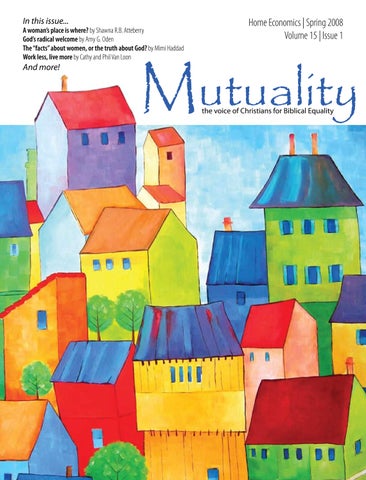
cover image
“A Town Like Alice,” (2007), by Rachelle Moes, acrylic. Rachelle is an artist based in Atlantic Beach, FL. Her email address is rachellemoes@hotmail.com.
20 Work less, live more Practical solutions for families committed to equality — by Cathy and Phil Van Loon
23 The Proverbs 31 woman A call to women to live as God desires — by Francine Erre
25 Epitaph (to a woman of noble character) A poem — by Julie Amos
Ministry & Chapter News 26 Upcoming CBE Events/Praises & Prayers 27 The CBE Scroll: Blog Voices from Christians for Biblical Equality
Departments 3 From the Editor: A joyful and persistent reminder 28 Short Answers to Tough Questions: Women as elders 29 Giving Opportunities: Charitable gift annuities 30 President’s Message: Christian faith in pink and blue
2 | Mutuality Spring 2008
website: www.cbeinternational.org
Mutuality the voice of Christians for Biblical Equality
Let us then pursue what makes for peace and mutual upbuilding. — Romans 14:19 VOLUME 15, ISSUE 1 Mutuality seeks to provide inspiration, encouragement, and information about equality within the Christian church around the world. Editor: Editorial Assistants : Graphic Designer: President/Publisher :
Megan Greulich Adele Hebert, M. L. Castleberry Image Spigot Mimi Haddad
EDITORIAL AND ADVERTISING OFFICE Christians for Biblical Equality 122 W Franklin Ave, Suite 218 Minneapolis, MN 55404-2451 phone: (612) 872-6898 fax: (612) 872-6891 email: mgreulich@cbeinternational.org web: www.cbeinternational.org Advertising in Mutuality does not imply organizational endorsement.
SUBMISSIONS Mutuality welcomes submissions. Email mgreulich@cbeinternational.org, write to CBE for the writer’s guidelines, or visit CBE’s website and follow the Publications links.
PERMISSIONS Christians for Biblical Equality grants permission for any original article (not a reprint) to be photocopied for local use provided no more than 1,000 copies are made, they are distributed free, the author is acknowledged, and CBE is recognized as the source. Mutuality (issn: 1533-2470) is published quarterly by Christians for Biblical Equality and is sent free to members. For membership information, see page 31. To purchase back issues, contact our Editorial and Advertising Office, or order online at www.equalitydepot.com.
From the Editor by Megan Greulich
A joyful and persistent reminder A few years back, I spent a week assisting third graders as they traveled through “The Great Adventure,” the theme of my local church’s Vacation Bible School. After beginning each morning singing the books of the Bible to the tune of “La Bamba,” we settled down for Bible story time. First it was the story of Peter, leaving his old life behind to follow Jesus. But when we asked the class to share names of the other disciples, the names of those whom Jesus called, one of the girls excitedly (and loudly) proclaimed, “Lydia, the maker of fine purple cloth!” I watched, amused, as she returned each day, singing VBS songs and proclaiming “Lydia, the maker of fine purple cloth!” as the answer to many of our questions. She was intent on reminding us that Lydia was a part of The Great Adventure. As I have reflected on the recent announcement of homemaking courses available to women at the college at Southwestern Baptist Theological Seminary, I have wondered about the idea of adventures. Egalitarians, who question the biblical basis of limiting these courses to women, have often been portrayed as “anti-family.” Yet I believe that both homemaking and careers outside of the home can be adventures, requiring bravery and strong faith. The difficulty is that these adventures, which often develop from cultural expectations and our own desires, should never trump our ability to hear and follow our call to The Great Adventure—to follow Jesus wherever he leads. To insist that a woman will find The Great Adventure only through pursuing homemaking is, as Mimi Haddad discusses in her article that follows, placing cultural expectations about her gender before God’s call. And following God’s call, whatever it happens to be, will require all of our bravery and faith. God’s plans are so often riskier and more rewarding than what we dream up ourselves or what others might expect of us. So as I think back to my VBS friend, I am encouraged in the work for biblical equality. I am encouraged because I feel privileged to be part of a movement that is a bit like that little girl—joyfully and persistently reminding the world to celebrate women (and men) who embraced their small adventures but understood that the point is The Great Adventure. Megan Greulich is the editor of Mutuality. She may be reached at mgreulich@cbeinternational.org.
bookstore: www.equalitydepot.com
Mutuality Spring 2008 | 3
Mutuality
Visit CBE’s website at
www.cbeinternational.org
Call for Papers
for the latest… ▶ FREE audio and print resources on biblical equality ▶ Membership information for churches, libraries, families, and individuals ▶ Online discussions about gender and justice on The CBE Scroll, the blogging voice of CBE ▶ CBE chapters in the U.S. and around the world ▶ Directory of egalitarian churches in the U.S. and around the world ▶ Giving opportunities ▶ Listings for counselors, therapists, and spiritual directors who agree with CBE’s Statement of Faith ▶ Ministry news and needs ▶ Employment, internship, and volunteer opportunities
Visit CBE’s online bookstore at
Mutuality provides inspiration, encouragement, and information about equality within the Christian church around the world. Mutuality is published quarterly and sent to all CBE members and subscribers. Current and back issue are also available for purchase. We are currently seeking features, reports, and reviews (books, films, and/or music) from evangelical, egalitarian perspectives related to the following topics: • • • •
Resolving Conflicts Children of God Walking in the Spirit Pornography and the Church
Most of the articles we publish fall into the following categories: • Personal testimonies illustrating how biblical equality provides practical benefits to everyday lives. • Teaching on relevant Bible passages, explaining the meaning and showing how to apply it to daily life. • Reviews of books about biblical equality that would appeal to a wide audience. (Books must complete CBE’s book service review process before being reviewed in Mutuality.) • Feature stories about issues related to CBE’s mission and ministry. The length of features is generally 1,000–1,750 words. Send articles to the attention of the editor at the postal address below or email to mgreulich@cbeinternational.org (if possible, as an attached Microsoft Word document). We are unable to consider or respond to authors who send us more than two pieces at the same time, whose pieces are substantially over 3,000 words, or whose submissions are not sent uniquely to Mutuality. Complete writers guidelines for Mutuality are available on our website (www.cbeinternational.org) or contact our office to request a copy. Questions and submissions can be directed to the attention of the editor, Megan Greulich.
www.equalitydepot.com for resources like… ▶ Books and articles ▶ Audio and video tapes ▶ CD, DVD, and MP3 recordings ▶ Sales and specials ▶ New resources, CBE exclusives, and best sellers ▶ Foreign language resources ▶ Become a CBE member or renew your membership and save 15% or more on every purchase ▶ Registration for CBE conferences ▶ Subscription to CBE publications or purchase back issues of Mutuality and Priscilla Papers
4 | Mutuality Spring 2008
We’d love to hear from you! Send your comments and critiques to:
Mutuality
122 W Franklin Ave, Suite 218 Minneapolis, MN 55404-2451 phone: (612) 872-6898 fax: (612) 872-6891 email: mgreulich@cbeinternational.org web: www.cbeinternational.org Letters may be edited for clarity and brevity.
website: www.cbeinternational.org
A woman’s place is where? by Shawna R. B. Atteberry
Detail of “Deborah,” from the Celebrating Their Legacies series (2008) by Susan Norris Greulich, acrylic, 8.5 x 11 in.
The woman was not created solely to be a wife and mother: She was created to work and rule with man, as well.
Last year one of the largest Southern Baptist seminaries, Southern Baptist Theological Seminary (SBTS), in Louisville, Kentucky began a new core of programs for women married to pastors, which includes: • The Seminary Wives Institute, “an innovative program designed to prepare the wives of seminary students for their role in their husbands’ ministries.” • And the Women’s Ministry Institute, which “offers women the opportunity to improve their skills and ministry through a variety of classes geared toward women’s ministries in the local church” (www.sbts.edu). Classes include housekeeping, budgeting, being your husband’s best friend, keeping an organized house, and sewing. There are “leadership” classes, but the brochure and class descriptions make it clear that this is leadership intended to be used exclusively in women’s and children’s ministry. The counseling classes make it clear that women are to counsel only other women — according to the Titus 2 model. My favorite class module was this one:
bookstore: www.equalitydepot.com
Redeeming the Time looks at setting goals and priorities but also tackles practical issues including day planners; handling paper, avoiding clutter; home management; housekeeping and kitchen organization. This course is aimed to challenge those who are already skilled in areas of organization as well as to motivate those who have room for vast improvement. There is also a core of courses on homemaking. Classes include sewing, taking care of children, and cooking. Basically SBTS’s courses of study for women are degrees in home economics. There is a disturbing trend in evangelicalism that takes the family from the 1950s television show Leave It to Beaver, and elevates it to the “biblical model” of family. This means that for a woman to live in a way that is viewed as “biblical,” she must marry and must stay at home, raising children and taking care of the household. But does the Bible really support this?
Mutuality Spring 2008 | 5
In Genesis 1:26–28 (NRSV) we read:
Then God said, “Let us make humankind in our image, according to our likeness; and let them have dominion over the fish of the sea, and over the birds of the air, and over the cattle, and over all the wild animals of the earth, and over every creeping thing that creeps upon the earth.” So God created humankind in his image, in the image of God he created them; male and female he created them. God blessed them, and God said to them, “Be fruitful and multiply, and fill the earth and subdue it; and have dominion over the fish of the sea and over the birds of the air and over every living thing that moves upon the earth.” Both man and woman are made in God’s image to rule and subdue the earth and to be fruitful and multiply. There are no spheres of influence. There is no “man’s work” and “woman’s work,” only our work. This continues to be true in G en e s i s 2 w h en God ma kes woman to be a “helper” or ezer to the man (Gen. 2:18). Outside of Genesis, ezer is used 20 times, most often in reference to God. In each of these instances, God is called on to be Israel’s “helper,” to help them overcome their enemies. God is called upon in this way because God has the power and the strength necessary to help the people. Three times ezer refers to human military aid that Judah or Israel calls upon to help them from another military power. Again we see that ezer refers to someone who has the power to help. Then why do some insist that woman’s being an ezer to man means that women should be subordinate to men, and women’s judgement restricted to issues involving housekeeping and child-rearing? If anything, the biblical evidence supports her full participation in partnership with men, to carry out God’s commands to humanity. Woman, being made not only in God’s image, but also an ezer made in God’s image, is to be a powerful ally and partner for the man. She is a powerful helper to stand by his side and help him obey God’s commands to multiply, rule, and tend God’s creation. The woman was not created solely to be a wife and mother: She was created to work and rule with man, as well. Let’s consider two women in the Bible—one in the Old Testament, and the other in the New Testament— both of whom worked and had families. In the Old Testament Deborah was a woman of power, and a leader. We are introduced to Deborah in Judges 4. She is a prophet and judge, and she leads Israel. The Israelite people come to her with their problems and disputes, and she mediates God’s will as Moses had
once done (Exod. 18:13). She is married, but she is a working woman. God has called her to be a prophet and judge, and she has answered. When God commands Israel to go to battle with their enemy Sisera and the Canaanites, Deborah summons the military commander Barak, and tells him what God says. But Barak will not go into battle without God’s representative, Deborah. Both Barak and Deborah lead Israel’s armies into battle. Here we see a man and a woman working together to fight the people’s enemies and to obey God’s words and will. And we can reason that Deborah’s husband, Lappidoth (Judges 4:4), is probably a soldier in the army that is following his wife. Deborah, Barak, and Lappidoth do not appear to be acting according to the societal constructs of their time or our time regarding what is masculine and feminine. They are obeying God and building God’s kingdom side by side. Leading men into a battle is not what many Christians today see as part of a woman’s role, but Deborah obeys God’s call to lead and protect her people. She is an ezer who images God in her every word and action. The other woman I want to look at is Priscilla (or Prisca). Priscilla ran a business with her husband, Aquila. They made tents together. They worked in Corinth with Paul where they heard the gospel and were saved (Acts 18:1–3). Later the couple met Apollos who had heard only of John’s baptism. He had not heard of Jesus’ death, resurrection, and ascension, or the baptism of the Holy Spirit. When Priscilla and Aquila heard him, they took him aside and explained the Way of God to him more accurately (v. 26). They also led a home church at the time of Paul’s letter to the Romans (Rom. 16:3–5). It was very odd during this time for a wife’s name to be mentioned before her husband’s, yet four times Priscilla appears before Aquila (Acts 18:18, 26; Rom. 16:3; 2 Tim. 4:19). Many scholars believe that she was the prominent one in ministry: the teacher and pastor of the churches that met in their home. She is mentioned first in leading Apollos’ theological education. (Acts 18:26). There are also scholars who believe she is the anonymous author of Hebrews. Again we see a man and woman working side by side making a living and building God’s kingdom. There is no mention of what is considered masculine work, or what is considered feminine work. Women and men work together as the team God created them to be. We see this over and over again throughout the Bible: Moses, Aaron, and Miriam (Mic. 6:4); Josiah and Huldah (2 Kings 22:14–20), Jesus and the women who followed him (Luke 8:1–3); and Paul, Priscilla, Lydia (Acts 16:13–15, 40), and Phoebe (Rom. 16:1–2). God’s intention from the beginning was for men and women to work together to build God’s Kingdom, be a family, and
“(They) do not appear to be acting according to the societal constructs of their time or our time regarding what is masculine and feminine. They are obeying God and building God’s kingdom side by side.”
6 | Mutuality Spring 2008
website: www.cbeinternational.org
“Priscilla,” from the Celebrating Their Legacies series (2008) by Susan Norris Greulich, acrylic, 8.5 x 11 in.
work together to love God and each other. Being made in the image of God, both male and female, has very little to do with modern notions of appropriate men’s and women’s roles. It has everything to do with faithfully imaging God to our world by obeying God’s callings on our lives and working together — both men and women — to build the kingdom of God on earth. As we encourage each other to use our God-given gifts and talents, and we work together to love all, feed the poor, show compassion and mercy to the marginalized,
bookstore: www.equalitydepot.com
fight for justice, and proclaim the love of God in Christ, we faithfully image to our world what it means to be made male and female in the image of God. Shawna R. B. Atteberry is an ordained minister in the Church of the Nazarene. She is the pastor of South Loop Grace Fellowship and a freelance writer. She and her husband Tracy make their home in Chicago with their cat Victoria. You can find out more about her pastoring and her writing at ShawnaAtteberry.com.
Mutuality Spring 2008 | 7
“Three Angels Leave Abraham and Sarah (The Promise),” by Will Carpenter, Assistant Professor of Art at Indiana Wesleyan University (Will.Carpenter@indwes.edu).
God’s radical welcome A path of hospitality marked by more than cookies by Amy G. Oden Hospitality conjures ideas of cookies and coffee or magazine covers of gracious living. We think of entertaining in the home, and of women making guests comfortable. In fact, the more hospitality has become associated with the home and women in the last century, the more it has been sentimentalized and trivialized. A Christian view of hospitality is so much more. It is God’s welcoming work through both men and women in the world. When we reduce hospitality to the domestic sphere only or assign it to “women’s work,” we lose the spiritual power of this countercultural and life-changing witness of our faith. I call this powerful witness “gospel hospitality,” or the radical welcome God offers to all people throughout Scripture. God’s welcome is the ground of all hospitality that we practice in Christian life. Scripture records all people of God — women and men — practicing hospitality. Many men offer welcome and find themselves touched by God’s power: Abraham under the oaks of Mamre (Gen. 18), Zacchaeus with Jesus (Luke 19), the disciples feeding the 5,000 (Matt. 14, Mark 6, Luke 9, John 6). Gospel hospitality is at the heart of our work for gender equality because 8 | Mutuality Spring 2008
it welcomes us into a new way of seeing others. It almost always entails some kind of risk, and leaves all parties changed.
Marks of gospel hospitality
Often we expect hospitality to be accompanied by warm feelings and positive outcomes. Yet our experiences welcoming the stranger tell a different story, and Scripture does, too. Welcoming the stranger in the same way God has welcomed us is marked more often by stops and starts, by risky steps, by the disruption of a stranger who will change us, by meeting Christ in the stranger. My husband is an avid hiker but I’m much more tentative on the path. He’s shown me how the blazes on the trail, bright patches of paint on tree trunks, provide markers to let us know we are on the right path. In the same way certain blazes of paint found in Scripture help us to know we are on the path of gospel hospitality.
website: www.cbeinternational.org
Abraham and Sarah’s welcome
Throughout the Christian tradition, the account of Abraham and Sarah in Genesis 18 has illustrated God’s powerful notion of hospitality. It is a familiar story: Abraham begs three strange travelers to stop at his home. Under the oaks of Mamre, Abraham washes their feet and serves the strangers himself, a surprising act for the man of the house. He stands by them, waiting while they eat. When they turn to ask Abraham about his wife, Sarah perks up her ears at the shocking idea that strange men should ask after her. One of the strangers says, unbelievably, that when he returns next year, Sarah will have a son. After God’s promise and decades of unfulfilled longing, the suggestion that aged Sarah would bear a child seems outrageous, even cruel. Yet as it turns out, these strangers — welcomed and refreshed — bring a surprising gift. They enter the picture as guests, the ones receiving welcome. Yet as the story unfolds, they become hosts, the ones offering welcome to Abraham and Sarah into a whole new life as parents.
Readiness: Expecting strangers
The first mark of hospitality that we find in Genesis 18 is readiness to welcome strangers. Abraham is watching, expectant. He doesn’t know who is coming or when, but he doesn’t want to miss it when they arrive. Abraham is ready — ready to welcome, ready to enter another’s world, ready to be vulnerable. The readiness of hospitality exudes trust — an understanding that strangers bring gifts, and that offering them welcome will draw us all closer to God. Abraham’s readiness doesn’t just appear one morning; it has taken root in his life. Readiness comes from practice walking with God. Before the story of the strangers at Mamre, Genesis chronicles Abraham’s radical openness to God’s call on his life, leaving all he had known and going to an alien land sight unseen. His readiness, a blaze of bright paint that marks his hospitality, is rooted in a lifetime of listening to God’s call. Without such readiness, our own hospitality is a house built on sand, swamped by the first wave of disappointment or rejection. Hospitality not marked by readiness can do damage because it is a welcome that cannot make good on its claims. The gospel is hurt by unready hospitality. For us to be ready to offer gospel hospitality, we may have some groundwork to lay first. Like Abraham, we will have to listen to God and open our hearts. The more we pay attention to our own experiences of God’s welcome in our lives, the more ready we are to participate in gospel hospitality.
Risk: Disruptive and dangerous
Because hospitality has become sentimentalized in recent centuries, we tend to associate it with warm and fuzzy feelings. We can easily miss the reality, understood so well by biblical accounts and early Christians, that hospitality is disruptive and dangerous. For both Abraham and Sarah, hospitality is marked by the bright blaze of risk. The first risk Abraham takes may be the hardest one for us — he risks rejection. What if the strangers say no? For Abraham and
bookstore: www.equalitydepot.com
Sarah, the next risk is the very concrete risk of physical danger — three grown men could easily overpower an aged Abraham and Sarah. Welcoming the stranger puts oneself and one’s community at risk. At best, the stranger is disruptive, bringing strange ideas and new, even wrong, ways of doing things. At worst, the stranger is dangerous, bringing disease, dishonor, or violence. Abraham and Sarah’s story teaches that when we welcome the stranger, everyone will be changed, host and guest alike. We can no longer maintain the status quo, keep things as they are, because the stranger brings a new frame of reference. Strangers bring the unexpected. Gospel hospitality is marked by risk-taking that trusts God is at work, both in the host and in the stranger. Risk can be scary, but when it accompanies welcoming, it’s likely we’re on the path of gospel hospitality. If we risk nothing, it is unlikely we are participating in God’s welcome. Finally, hospitality risks the possibility that it may not work. Risk of failure can paralyze us. What does success and failure look like when we offer God’s welcome? Abraham’s only goal seems to be for the strangers to allow him to offer hospitality. Neither Abraham nor Sarah claim success as getting the strangers to join their family or follow their God or pass on the word about their great hospitality. In fact, Abraham’s invitation includes the recognition that the strangers will have refreshment and then “be on your way.” We usually get stuck in measuring our hospitality by others’ response to it, or by our own desired outcome. Genesis 18 teaches us that hospitality, risks and all, is God’s doing. Our hearts risk God’s leading, regardless of outcome. Risk is a spiritual mark of hospitality.
Repentance: Not regret but turning
Scripture records all people — women and men — practicing hospitality. Abraham’s example of hospitality resulted in a promise of God’s faithfulness.
Gospel hospitalit y is marked by new life, by change and transformation, not by business as usual. Welcoming the stranger inevitably brings challenges to our life together. Scripture describes this new life with the word repentance, which means not so much to feel bad or feel sorry, but to change course. Abraham and Sarah experience a turning. They have been on the road of despair for decades, waiting for a promised child that never came. In Genesis 18, the strangers bring news that requires Sarah and Abraham to turn onto a new path, a path of hope. Of course, they are at first skeptical about whether such a path exists; indeed, Sarah finds it laughable. Still, they both turn from resignation to expectation, a repentance (turning) that will bear great fruit. In many biblical passages, as with Genesis 18, it’s not just the guest, but the hosts who are turned, who are changed.
Mutuality Spring 2008 | 9
could see: the teacher who could see our potential when we struggled in school; the supervisor who knew we could handle more responsibility; the mentor who took our dreams seriously, envisioning the people we could become; the youth leader who saw us as a preacher; the theology professor who recognized the budding scholar in us. That’s why it is so powerful to see ourselves or others through God’s eyes. When we see people in categories — young black man, tattooed teenager, soccer mom, older white guy — we too easily Sarah’s hospitality was about more than our miss the opportunity to see Christ in each modern notions of women entertaining. one. When we recognize strangers as Jesus, It was risky, even dangerous. we, too, see beyond appearances (Matt. 25:35). Gospel hospitality is marked by such recognition. Gospel hospitality calls us to look beyond stereotypes that box Recognition: Eyes to see Christ women and men in society’s roles and instead recognize the full Finally, we turn to the last marker on the path to gospel hospitality, equality of women and men that the Bible proclaims. When men one which is at the heart of what it means to be gender reconcilers. and women step out of those roles, they can easily become strangers, When Abraham sees the three strangers, he addresses them with even in their own communities. We welcome the stranger when we deference, claims to be their servant, and begs them to stop at his welcome the dad who wants to work in the church nursery or the tent for refreshment. Abraham recognized these strangers as more woman who wants to lead Bible study. When we welcome these, than simply strangers. He could have seen the three men and quickly we recognize the work of Jesus among us. No doubt the kind of deep concluded: these are merchants on their way to market, drifters seeing that hospitality invokes takes time and patience because it looking for a hand-out, or con men looking for an easy mark. challenges our assumptions about gender. To recognize the presence Instead, Abraham treats the strangers as honored guests. of Christ in another we may have to get to know them, listen to their How did Abraham know? How did he recognize them as testimony — their life story — to fully appreciate Christ’s presence perhaps more than they appeared to be? Later, explaining this episode, the author of Hebrews says, “Do not neglect to show within them. We may have to work together or pray together before hospitality to strangers, for by so doing some have shown hospitality we begin to recognize Christ in the stranger. We may also have to modify our idea of what Jesus looks like! to angels without knowing it” (Heb. 13:2, TNIV). When we can see Christ in another, we proclaim the good Recognition is more than just seeing. Recognition is seeing news of God’s welcome. We proclaim that God is already present deeply, seeing beyond what appears to be. Abraham is able to see and working, regardless of gender roles or social categories. past appearances to the holy presence within them, to know them. Abraham had eyes to see deeply and indeed the strangers were When God recognizes us as God’s children, rather than as strangers, considerably more than they appeared to be, bringing God’s God sees beyond our appearances. We have all had the experience of promise to fulfillment. The bright blaze of recognition marks the another person recognizing in us something greater than we ourselves path of hospitality. Gospel welcome sees the world in a new way — that sees through the eyes of the other. Considering our own experiences of welcoming others, we know that we have been changed by our encounters. We may think to the first time we welcomed a woman to a leadership position and in turn found encouragement and inspiration through her. This is what repentance is all about. We approach the edge of the unfamiliar and cross it, if only by a step. When we are received into God’s life and, in turn, receive others, we encounter something new, whether we are the host or the guest. Such turning is a bright blaze on the path of hospitality.
The welcome goes on
We welcome the stranger when we welcome the dad who wants to work in the church nursery or the woman who wants to lead Bible study.
10 | Mutuality Spring 2008
Gospel hospitality offers us a powerful experience of God’s welcome. Abraham and Sarah were both touched and changed. God has welcomed us, too, into new life, into life that is free from expectations based on cultural stereotypes and roles. As Christian men and women we extend this risky welcome and participate in God's welcoming work. Amy G. Oden is professor of history of Christianity at Wesley Theological Seminary in Washington, D.C. For the last 20 years, she has taught theology and history and pursued scholarship in service of the church. Her recent scholarship has focused on the radical practice of hospitality in early Christianity and its challenge for communities today. This article includes material from her book, God's Welcome: Hospitality for a Gospel-Hungry World (Pilgrim Press, May 2008).
website: www.cbeinternational.org
Escaping the mold & embracing giftedness
One couple’s journey to equality in marriage
by Mary Ann Nguyen & Sam Kwok
Free to be us by Mary Ann Nguyen
Equality in marriage — what does that mean?
Sam had a hard time with the concept at first. He grew up as a Southern Baptist, so the idea of a woman pastor seemed sort of heretical to him. He had always subconsciously imagined that his wife would do everything that his mom used to do for him (cook, clean, pick up after him). The first time we really talked about it was after a Bible study we attended together where Pastor Dora Wang led us to the truth that God doesn’t intend for women to be silent in the church. After that, we had heated debates and arguments and very productive conversations about its implications. We talked about it all the time — in emails during the day, while cooking in the evening, while brushing our teeth late at night. It was an ongoing conversation for days and weeks. We had so many questions — especially regarding the implications for marriage. We were seeking scriptural and theological answers, because we did not want to embrace something that had no biblical basis. Providentially, we found some articles on CBE’s website that ended up being key to opening our eyes to a new and better understanding of old passages of Scripture which we had previously presumed to understand. The articles inspired more biblical and theological conversations in the first few months of our marriage than we had ever had before.
bookstore: www.equalitydepot.com
The issue that we frequently went back and forth on was what biblical equality would look like practically in the home. What do egalitarians believe about men and women, husbands and wives, in terms of roles and responsibilities? Were there any? Is the egalitarian view of men/husbands and women/wives just androgyny? The idea of androgyny did not appeal to Sam. Eventually, we came to realize that being egalitarian doesn’t mean being androgynous. It just means that there are no stereotypes. We are free to be all that God has made and gifted us to be.
We tried to fit the mold
At the beginning of our relationship, Sam and I earnestly sought to follow the complementarian pattern for marriage. Sam took on the role as the leader, and I became the appointed follower. His responsibility was to decide how we would spend our time together, doing what and how. He was to plan our dates. He was to decide how we could grow spiritually. And I was to wait for his initiation and respectfully follow his lead.
Mutuality Spring 2008 | 11
However, before long we found ourselves very frustrated, because our giftings and natural inclinations don’t fit the complementarian mold. Sam’s strength lies in his ability to pay attention to the minute details, but he has blind spots when it comes to the big picture. My strength, on the other hand, is in being a visionary, in being able to easily assess where we are going, what we are doing, and what we need to do in order to better align ourselves to God’s greater plan for our lives. It’s easier for me to notice that we need to start praying again or have Bible study. Leading a Bible study comes naturally to me but not as naturally for him. But as complementarians, we both had to refrain from exercising our gifts and, instead, do what the other person was clearly better at. We struggled for awhile in these role assignments which were unnatural to us and eventually found ourselves sinking. And then we found ourselves thinking. If a couple were in a sinking ship and the wife knew how they could be saved, shouldn’t she say something? Should she stay silent — just because the man is supposed to be the captain and she shouldn’t usurp “his Godgiven authority?” Common sense says no.
God’s design for marriage
The Bible also says no. Patriarchy and hierarchy were never God’s design for marriage. We can see this in Genesis 1 as Adam and Eve were made in God’s own image. It doesn’t say that God made Eve in Adam’s image. They were made to be equals from the very beginning. So as Sam and I studied the Scriptures and found that God designed for husband and wife to be equal partners, it gave us a new freedom to exercise our own gifts and be all that God called us to be. It was a relief to me to be able to lead Bible study again. It was a relief to Sam not having to lead all the time. In an egalitarian marriage, it’s not that no one leads anymore, and it’s not that only the woman leads (as some would accuse). It’s that both lead. Both lead in whatever area they are gifted in and enjoy the most. If the husband loves cooking, then he should “lead” in the
cooking! If the wife loves home repair, then she should repair. If the husband is good with details, then he should do the taxes and pay the bills. If the wife is good with visions and ideas, then she should lead them in the direction that they should be headed. There is no one prescription for what every couple must do. Each should mutually submit to one another as they are both submitting to Christ (Eph. 5:21). Some who oppose the idea of an egalitarian marriage think that if the man doesn’t lead, then there would be anarchy, but this is fallacious reasoning. Two partners making decisions together will not result in anarchy. Complementarians query, “What if the two of you can’t make a decision? Who decides?” In that case, they say that the husband gets the final vote and veto power. But for us, if we can’t agree on something, Sam and I will talk and pray for as long as it takes for us to come to a decision that we both believe is from the Lord, and we’ve found that it’s not impossible to always come to a decision together. In our house, we have an equal share in the housework. Even now, as I am writing, Sam just finished washing the dishes and vacuuming, and now he is making me a smoothie! Some days, it’s the flipside, and I will do all the grocery shopping, cooking, and cleaning. But usually we do it all together. It’s so much faster to do things together as a team. Our way of doing things is simply to always be chipping in to do all that needs to be done in order that we might live and serve God better. There are no assigned roles and responsibilities, so there’s never complaining or blaming, “Well, that’s your job!” We are in a ship together, and we do all we can together and for each other to stay on the course God has set for us. Mary Ann Nguyen is passionate about capturing life through words, entering other worlds through reading, revealing God’s heart through teaching, and explaining and proclaiming God’s plan for biblical equality. Currently pursuing her Masters of Divinity at Bethel Seminary San Diego, she and her husband Sam Kwok are preparing to answer God’s call for them to serve in overseas missionary work.
A perfect partnership by Sam Kwok
The good thing is that in marriage, we are partners — not CEO and subordinate — and it works well in our marriage. God made Mary Ann nearly 100% “iNtuitive” (big-picture and visionary) and me nearly 100% “Sensing” (precise, detail-oriented), according to the Myers-Briggs Type Indicator. Together, we are a perfect complement for each other. Mary Ann casts the vision and I hammer out the details, putting the plan into action. Together, we can see the whole picture and are able to move in the direction God wants us to. Before we found biblical equality, when we were going along with what we thought was the biblical pattern for marriage, I felt like I had to always be alert to the big picture. I felt that I had to have all the good ideas and be on a permanent spiritual high so that I could
12 | Mutuality Spring 2008
website: www.cbeinternational.org
The way
we do things at our house - Marriage is not about giving 50-50, but 100-100. We must give 100% of ourselves. - Loving each other means never keeping a record of wrongs or of rights. - Once we’ve reconciled and forgiven, let’s not bring the issue back up again. - Even if I do X, Y, Z, it does not mean that you must do A, B, C in order to even the score or ‘make things fair.’ - Marriage is not about fairness but oneness. - Respecting each other means not slandering each other or pointing out our spouse’s weaknesses to others. It means refraining from passive-aggressive sarcasm and snide remarks. (Sarcasm is a joke at the expense of another.)
- A “suitable helper” means a companion equal to Adam, it does not mean “junior assistant” or a subordinate. God intended husband and wife to value each other and work together as equal partners. - A wife is a wife. She’s his wife, not his mother, not his cook, not his housekeeper.
Mary Ann and Sam keep these notes posted in their home, as daily reminders of their commitment to God and to each other.
- “Love your neighbor as yourself ” applies especially to your spouse. - This means thinking, “How much can I offer and how many ways can I serve the other?” rather than, “How much can I get away with not doing?” - If you see a need, then fill it. Rather than saying, “But that’s your job," say, “Let me do it for you, I volunteer, I choose to serve.”
- Housework is a shared responsibility. It’s not one person’s responsibility and the other is “helping her out”. We are helping ‘us’ out by doing whatever needs to be done.
- We must choose to appreciate and affirm one another as often as possible. Be each other’s number one fan, “I am with you, heart and soul.”
- Nobody likes housework, nobody. So let’s not complain but do it together with a cheerful heart and servant attitudes (Phil. 2:14–15).
- Headship means sacrificial servanthood. Submission means yielding to the heart of a servant. And the key to marriage is Eph. 5:21 — both submitting, both yielding to one another.
- We are leaving traditions behind and cleaving to each other, establishing our family and our way of doing things as the Lord leads.
be leading Mary Ann. I was supposed to do all the leading, and if she were to give me any input, that would mean that I was weak, and that she was rebellious for pointing out what I lacked. The problem with this whole theory is that no one is that perfect. No one can completely fill those shoes. To draw an analogy from how the church body should function: When we are down, our Christian brothers and sisters should not let us stay down. Instead, we need the body to lift us up, to encourage us, to spur us on. Why should I want or expect something different from my wife? How would that be “rebellious?” If I’m not on the right track, I would want someone to tell me. If I can accept constructive criticism from a brother or sister, then why not even more so from my wife? During our pre-egalitarian days, whenever Mary Ann saw the big picture and reminded us that we should be getting back to normal study of our Bible and prayer, I would get upset — not at her, but at
myself for not realizing it and not being the one to come up with the idea. But after we thought through what biblical marriage really looks like, I realized that I don’t have to have all the good ideas. God has gifted Mary Ann with a great mind and great ideas, and we would be at a loss if she didn’t share them. The truth is that God speaks to her as much as he speaks to me, and as much as he speaks to you. In a hierarchy, the “top dog” may feel threatened when there is input from a subordinate; he would feel undermined. However, Mary Ann’s giftedness in being a visionary and seeing the big picture of what God has planned is hardly dissension in my book.
bookstore: www.equalitydepot.com
Sam Kwok is pursuing a Master of Arts in Theological Studies at Bethel Seminary in San Diego, Ca. Along with his passion for biblical equality, Sam has a heart for the marginalized. He and Mary Ann, who have been joyfully married for a year and a half, are considering foster care and adoption in the near future.
Mutuality Spring 2008 | 13
Before the fall, there was no such thing as home economics, because the Bible tells us there was no scarcity.
“Home”economics and the fall
Men’s and women’s work in a world of scarcity by Carrie A. Miles
14 | Mutuality Spring 2008
website: www.cbeinternational.org
When I hear the words, “home economics,” I think of a class of high school girls from the 1950s, their hair in flips and wearing frilly aprons. When most people think of plain-old “economics,” they think of things like interest rates and stock market values. But home economics is far more serious than either of these ideas. It is fitting that Mutuality devote an issue to this subject, because the original economics of the home is the source of patriarchy — the ultimate lack of mutuality, not only between men and women, but also among men themselves. For as professor of Christian origins S. Scott Bartchy points out in his article, “Understanding Ancient Patriarchy,” patriarchy is not just the subordination of women to men, but the dominance of a few men over everyone else, male and female. Many people today reject Christianity because of their perception that the Bible promotes this system of hierarchy and inequality. Yet read in light of the ancient patriarchy that pervaded the first century world, it becomes clear that Jesus and the authors of the New Testament, most especially Paul, worked hard to overturn everything to do with inequality. When I began teaching biblical equality in Africa, I came to understand that this “ancient” patriarchy is still very much alive in the less economically developed parts of the world. In fact, I have come to the conclusion that the kind of patriarchal worldview Jesus and Paul condemn is simply the culture of the fall. This culture has never been limited to ancient Rome, but exists in pre-Industrial, pre-Christian, or historically non-Christian cultures everywhere and in all times.
world. With the fall, the ground was “cursed,” and God told both the man and the woman that they will suffer painful or sorrowful toil in their attempts to wrest a living from it: To Adam he [God] said… “Cursed is the ground because of you; through painful toil you will eat of it all the days of your life. It will produce thorns and thistles for you” (Gen. 3:17a–18, TNIV). As a result of humankind’s fall from grace, men and women became farmers in a thorny world of scarcity. When there were no supermarkets, hospitals, power companies, or schools, families were self-sufficient units that produced everything they needed for survival — not only food, clothing, and shelter, but services such as medical care, education, and care for each other in old age or disability (see Gary S. Becker’s A Treatise on the Family). Children are important sources of labor in such circumstances and the only source of “social security.” Faced with chronic scarcity and the need for a lot of help, those in less economically-developed countries often have more children than they can care for. Such children exist to serve their parents’ needs, not the other way around. Thus, in Genesis 3:16, God tells the woman that because of the fall she will “bring forth children in sorrow” — sorrow because they will not be valued in their own right, but only for what they can produce. While producing children became a woman’s most important economic contribution, childbearing does not free her from the endless demands for her labor. She still must engage in sorrowful toil. Too physically-demanding a labor results in miscarriage, however. In consequence, “home economics” dictated that work
A few definitions
Let’s first look at what this has to do with home economics. Patriarchy is the result of constraints experienced by families after humankind’s expulsion from the Garden of Eden. Economics is the study of the trade-offs that people make under conditions of scarcity. For example, your paycheck comes to a limited amount each month. The economist asks, how do you decide how to spend it? Can you buy those shoes you’ve had your eye on, or must you instead spend your pay on winter coats for the kids? For many Americans, the consequences of these trade-offs may be trivial. For citizens of less economically-developed countries, who face scarcity on a daily basis, the trade-offs are much more painful. An African mother might have to choose whether to feed her children the food she grows or sell it to pay school fees (with the whole family “sleeping hungry” as a result). She might have to choose which one of her many children to send to school. She might agree to marry her barely-pubescent daughter to an older man because the family desperately needs the money her marriage will bring into the family.
Turning to Genesis
The Bible tells us that in creation, human life could not be studied with the tools of economics — there were no trade-offs to be made in the Garden of Eden, as there was no scarcity! It is only after humankind demanded the right to make our own decisions (the first sin, or the fall, described in Gen. 3), that scarcity (and therefore economics) entered the bookstore: www.equalitydepot.com
Redemption of Love:
rescuing marriage and sexuality from the economics of a fallen world by Carrie A. Miles Visit www.equalitydepot.com for more information.
Mutuality Spring 2008 | 15
be divided up so that women could do that which could be done while pregnant, nursing, or caring for small children. “Men’s work,” as Karen Sacks points out in Sisters and Wives: The Past and Future of Sexual Equality, tends to be simply the work that pregnant women cannot readily do. Although who does what varies from circumstance to circumstance, every society makes distinctions between “men’s” and “women’s work”— and usually enforces them strongly.
The world of scarcity without redemption
As you read this, you may be thinking of your grandparents’ life, or of shows like “Little House on the Prairie.” Such a division of labor may seem reasonable and benign under those circumstances. Thinking back to the rural past in historically Christian countries to understand ancient patriarchy is misleading, however. Jesus and redemption radically changed the way men and women relate to each other (even if we fallible mortals still don’t get things exactly right.) For from this simple woman-in-the-household, man-outsidethe household model emerges a terrifying reality: Men now need power over their environment and over other people, and women are too burdened with domestic responsibilities to seek it themselves. In Genesis 3, God warned Adam of man’s burden as a result of his alienation from God’s abundant provision: “By the sweat of your brow you will eat your food.” The world of scarcity rewards male self-interest, aggression and dominance — and rewards the women connected with such men as well. Women cannot help but become subordinate to men in such circumstances. Thus God warns us, “Your desire shall be for your husband, but he will rule over you.” Without the thorough-going change brought about by redemption, the home economics of living in a fallen world involves a long list of suffering for all involved. Women and girls in countries still under the rule of patriarchy suffer from abuses that might include female infanticide; polygamy; forced marriage of prepubescent girls; isolation and veiling; genital mutilation; domestic violence; unilateral divorce and abandonment; sexual assault; lack of access to education; and male usurping of family resources for personal consumption in alcohol, tobacco, and womanizing. Girls might be sold or kidnapped into marriage, expected to bear large numbers of children, forced to turn to prostitution in order to survive or pay school fees, or suffer abandonment when their husbands lose interest in them sexually. Young widows may be “inherited” by their husband’s brothers, or older widows forced out of their homes. Children similarly, existing only to serve their fathers, may suffer from lack of food, safe water, health services, and education. They may be neglected, sexually-abused, abandoned, or orphaned, suffering life-long physical and emotional difficulties as a result. It is harder to get sympathy for the plight of men, as they often seem to be the perpetrators of the injustices against women. Often, however, men’s abusive or self-serving behaviors toward women and children (alcoholism, domestic violence, sexual abuse, and sexual infidelities) are expressions of their own frustrations in dealing with high rates of poverty, joblessness, violent and economic victimization, and pressures to conform to socially-prescribed norms of masculinity. Historically, the vast majority of men were not patriarchs, but servants, slaves, or dependent clients. Ethnic or tribal
16 | Mutuality Spring 2008
strife and violence are commonplace as families/lineage groups scramble for their own survival in the face of limited resources. Such circumstances were just as true in the first-century as they are today.
Men and women, redeemed
But Jesus, Paul, Peter, and others whose teachings are captured in the New Testament taught that Christians need not strive for things of the flesh, because God himself would take care of them if they lived by faith in him. These teachings had a profound effect over time, transforming ancient patriarchy. Christianity forbade infanticide, raised the age of marriage for girls, raised the status of women in general, disallowed promiscuity for men as well as women, outlawed polygamy, opposed and ultimately eliminated slavery, put slaves and women into leadership positions in the church, allowed marital separation in the interest of peace but discouraged divorce, and encouraged people to remain single if they so chose (that in itself a huge advantage in a world in which certain categories of people simply have to marry). Rodney Stark notes, in The Rise of Christianity, that a significant factor in the explosive growth of the early Christian movement was that it treated women so well. The amazing thing is that giving one’s heart to the Lord often causes a thorough-going change of that heart away from patriarchy. However, we are often so entrenched in our own cultures that a full understanding of the power of redemption requires some study. Anyone involved with Christians for Biblical Equality is probably well aware of this. The good news is that the message of biblical equality is being received with joy. My organization, Empower International Ministries, works with existing ministries in developing and/or historically non-Christian countries to enable them to teach and live out the biblical message of unity and equality among all believers in Christ, regardless of race, sex, age, level of education, social status, or ethnicity. As we spread this good news in Africa, we have been met with an eagerness and joy that amazes us. One of the most encouraging experiences for me came on a day when I taught this material on “the Curse” in the small town of Matana, Burundi. I pointed out that God put a curse on the ground — not on the man and the woman. This is meaningful because to be cursed in Africa — where witchcraft and devil worship are still very much a part of life — is a terrible thing. To be cursed means to be blighted and cast off, and Africans customarily think that women in particular are under that kind of curse. There was a lot of buzzing in the room when I said that God did not curse the woman. I didn’t appreciate the impact of this message until later that day when an unscheduled choir popped up and started singing a song in the local language. Ugandan pastor Frank Tweheyo started translating the words for me. The song was about when Balaam was sent out to curse the Israelites — but couldn’t do it, because “you can’t curse what God has blessed!” Carrie A. Miles is the author of The Redemption of Love: Rescuing Marriage and Sexuality from the Economics of a Fallen World (Brazos Press, 2006), co-author of Male and Female in Christ (now available for free download on www. EmpowerInternational.org), and the chairperson of Empower International Ministries. She is also a research fellow at George Mason and Baylor Universities.
website: www.cbeinternational.org
“How can they preach unless they are sent?… …‘How beautiful are the feet of those who bring the good news!’ ”
Confirmed Speakers Robyn and David Claydon
- Romans 10:14–15 TNIV
Sent to Preach the Gospel:
Women & Men Using their Gifts for the Great Commission
Gwen Dewey Ellen Duffield
“Anne Marie, Eliza, and Maude: Single Girls in the Good-Old Boy World of Missions”
Kevin Giles
Ruth Tucker, teacher, author, and church historian
Mimi Haddad David Hamilton Jewel Hyun John Kohlenberger Lorry Lutz
“My Journey as a Christian Woman Leader”
General Sessions
Ed Murray Jane Overstreet Leslie and Chad Segraves Ronald J. Sider Arbutus Lichti Sider Howard A. Snyder
Bonnie Wurzbacher, Senior Vice Presdent, Global Accounts Coca-Cola North America
“Moving Towards the Fullness of Christ: Living Out the Slavery Texts in Today’s World” William J. Webb, professor of New Testament at Heritage Theological Seminary (Cambridge, Ontario)
“The African Way: The Task is too Big” Esme Bowers, Southern Africa regional leader for the Pan African Christian Women’s Alliance
Austin Stouffer Henry and Sharon Tam Mary Stewart Van Leeuwen Jim and Rhonda Walton
Join us in Toronto on July 18-20, 2008 for CBE’s International Symposium on Gender and Missions!
Jeanette Yep
Visit cbeinternational.org for more information bookstore: www.equalitydepot.com
Mutuality Spring 2008 | 17
The “facts” About
Women
or the truth about God? by Mimi Haddad
And everyone who has left houses or brothers or sisters or father or mother or wife or children or fields for my sake will receive a hundred times as much and will inherit eternal life (Matt. 19:29).
I heard a preacher recently declare, “Don’t let the facts blind you to the truth.” Can facts overshadow truth? Consider the Cross. Imagine how the disciples must have felt as they watched Jesus die on that hill. Though the Romans nailed Jesus to the tree, though his corpse was bound and sealed in a cave, within a few days these facts were swallowed by the truth — that Jesus, the Lord of the universe was alive, as he had promised. In a similar way, the “facts” we receive regarding gender may not always represent God’s truth regarding men and women. Though a billion dollar industry works to persuade us otherwise, the truth is, sex is not the highest good in life. While the church often continues to describe ministry (and life) in pink and blue roles, the truth is that God’s purposes for human beings far exceed narrow gender stereotypes. Like Jesus’ resurrected life, men and women who are born of the Spirit are not limited by human gender-constructs. For this reason, many Christian women have, throughout history, fanned into flame God’s gifts within them (2 Tim. 1:6–7), rising above the limitations often placed on their gender. Embracing God’s truth regarding their value and worth, many women of faith were not bound by gender roles. Rather, as God equipped, impassioned, and enabled their service, these wild-hearted daughters pioneered many gospel inroads around the world. As we reflect upon their lives, let us consider “the outcome of their way of life and imitate their faith” (Heb. 13:7). Perhaps it was during the early church era that women’s rejection of gender roles was most keenly observed. And their difficult choices lent the gospel great momentum. As Christians came into bitter conflict with their culture during the third and fourth centuries, the decision to follow Christ was also a rejection of family, children, and even life itself.
18 | Mutuality Spring 2008
Consider the young mother Perpetua, who was martyred in North Africa in the third century. Imprisoned for her faith, Perpetua was separated from her young child, whom she was still nursing. Her father came to her trial holding her young son, begging Perpetua to remember her role as mother. Yet, Perpetua’s commitment to God reigned supreme. Like Christ, she would drink of the bitter cup. She endured cruel guards, an abusive mob, and a public martyrdom. All of these facts she faced bravely, with a bride’s glowing face. She was ready to embrace the truth of her life, that this world and all of its roles are temporary. What matters is a heart that responds faithfully to God’s call, regardless of our gender. “Will you, Perpetua, take up your cross and follow me?” Her reply was sure and her legacy filled the early church with courage. Remember the life of Paula, who, like Perpetua, left behind family and wealth to follow Christ. After coming to faith, Paula, also a young mother (and widow), gave away her massive wealth to build hospitals, churches, and monasteries. Perhaps most importantly, Paula purchased ancient manuscripts in order to give the western world a Bible in their own language — Latin. Trusting her youngest child, Toxodious, to God’s care, Paula traveled to Palestine, where she and Jerome completed their translation work. Because Paula faithfully took up her cross, Christians enjoy churches, Scripture, and a tradition of translation that continues to enrich the Body of Christ today. Like Perpetua, Paula embraced God’s truth that life is fleeting, and that our opportunities to serve Jesus are precious, personal, and never bound by gender.
website: www.cbeinternational.org
Reflect upon Syncletica, a wealthy fourth century woman from Alexandria. Though highly educated, rich, and strikingly beautiful, Syncletica hungered for holiness and longed for life utterly abandoned to God. After the death of her parents, Syncletica shaved her head, and with her blind sister, moved to the wilderness outside Alexandria. Here she devoted herself to prayer, reflection, and study. Her passion for God and intimacy with Christ attracted others who also craved God’s presence. Soon a band of women asked Syncletica to become their spiritual director. Reluctantly, she agreed to lead them in the lessons she had learned in the wilderness, and many Christians followed her example during the early centuries. Like Paula, Syncletica willingly became an exile, where, stripped of all comforts of class and the restrictions of gender, she acquired a dependency upon God that led to a mastery of self that came to characterize not “feminine Christian faith,” but the highest and best of Christian spirituality. Defying cultural expectations for women, Syncletica did not marry or bear children. She did not concern herself with lavish clothes or physical beauty — even though this offended the women of her class. She was not concerned to win their favor; she had a reckless desire to please only one lover — Jesus. Though she was not a mother in the traditional sense, she produced many healthy spiritual children, and her wisdom continues to nurture our spiritual vitality today. We could recount the lives of many Christian women and men, who rejected the limitations placed on them by their culture. Their legacy Though Syncletica was not a mother in the traditional sense, she produced many healthy offers important insights to the questions I am spiritual children, and her wisdom continues to nurture our spiritual vitality today. continually asked by college students when I’m "St. Syncletica" by Eileen McGuckin (www.sgtt.org). invited to campuses to speak on gender. Many of their questions have to do with life choices they feel pressed to make while in college. A surprising God may ask us to detach from places of prestige and prominence in number of young people have been reared not on Christian classics order to serve Jesus as a pilgrim, missionary, or martyr. like Pilgrim's Progress but on Christian pop literature — which colors Yes, human existence is lived as male and female, and that all of life in simplistic categories, pink and blue. we would never wish to change. However, the body is subject Sadly, the brightest and best are deeply concerned about getting to God’s Spirit, and the Spirit leads us to freedom, after first the gender “facts” correct, that they appear to overlook some truths leading us to the Cross. May the “facts” we hear about gender about their lives. Some women fear they may not be captivating never overshadow the truth about God. The truth is, our highest enough to find someone to “lead” them, or some men worry that purpose in life is following Jesus, rather than gender roles. they are not sufficiently dominant so that someone will want to follow them. Some even worry that their clothing inadequately Mimi Haddad (Ph.D., University of Durham) is president of Christians for Biblical Equality. She is a founding member of reflects their gender. What is truth about gender? The truth is, Jesus the Evangelicals and Gender Study Group at the Evangelical stands at the door and knocks on every human heart, asking, “Will Theological Society. Mimi served as the Convener of the you take up your cross?” For some of us, taking up our cross will mean Issue Group 24 for the 2002 Lausanne III Committee for leaving our beloved families and country, working as Paula did, in far World Evangelization. She has written numerous articles and contributed to five books. off land like Palestine in order to accomplish an important mission.
bookstore: www.equalitydepot.com
Mutuality Spring 2008 | 19
Work less, live more
by Cathy and Phil Van Loon
Sometimes the gap between egalitarian belief and egalitarian practice can be hard to bridge. Is it really possible to have an equal marriage? The how’s and why’s of equality
We have always liked the idea of an equal marriage, but there are vexing questions. Do we both need to earn the same income, or is it better for us to work an equal number of hours? How do we share all the responsibilities of maintaining our home? If we’re both going to work full time, who will raise our children? There are many options, but one solution is to spend less time at work. In fact, for most of our marriage, we have both worked part time. We didn’t come to this solution easily — one of us is a certified workaholic and the other was seemingly born retired. But we believe this is the best arrangement for our lives and our family. It has allowed us to fully share the responsibility for earning the family income while also equally sharing in running our home and parenting our kids. For us, it has been the best of both worlds. Both of us experience the satisfactions of working outside the home — feelings of competence, contribution, and recognition — as well as the frustrations of the workplace. In addition, we share the burdens and pleasures of parenting and household management. We have been equally responsible for cooking meals, maintaining the house, changing diapers, being home when our kids arrive from school — all the usual demands of family life. We both get in on all the joys and pleasures of parenting and homemaking. This arrangement also helps avoid the resentment, envy, and misunderstanding that can occur between partners when one works to earn all the income and the other is at home all the time. 20 | Mutuality Spring 2008
Can it really be done?
This might sound like a nice way to live, but is it really practical? You may be wondering how you can afford it, especially when you are already struggling to meet your expenses. Would your employer really let you work less? Will they be offended if you ask? Maybe you’re afraid you won’t be able to earn as much, have benefits, or get promotions. And if you’re not working right now, you may not feel confident that you can get a job. Besides, what would your friends and family think? Wouldn’t you just be slackers? These are legitimate anxieties. Some issues may be easier to solve than others, and everyone’s situation is unique. Here are some strategies that may inspire you to come up with your own ideas. And while we are primarily addressing couples in this article, singles can work less and live more, too. Often, the primary concern is how to survive on a lower income (although sometimes couples end up earning more when both work part time). We like to start by asking ourselves some questions about our priorities like: What do we really want? And what is most important for our lives and our family? Time spent thinking, talking, and praying can help us see through the consumerist fog of our society.
Affordable housing
Housing is often the single biggest expense, but there are many options. Living in a less costly area, choosing a smaller place, or sharing the costs with housemates can all reduce costs. We bought a small two-bedroom fixer-upper and have made many improvements (doing much of the work ourselves). Some jobs
website: www.cbeinternational.org
provide housing, often in exchange for care of a person or property. Consider living in an alternative structure, like a mobile home. (We have known people who lived in their boats or even a tree house!) Also, as we are being reminded to reduce energy consumption, keep in mind that smaller spaces can be friendlier to the environment as well as cut utility bills.
Transportation
Cars (or more likely SUVs) have become very popular and costly status symbols. Brainstorm alternatives to driving, such as walking, biking, telecommuting, carpooling, or taking public transportation. You may discover that you don’t need a car or at least not as many. Some jobs provide a vehicle. Consider sharing a car, or renting as needed. We have had great success buying used cars — researching the most reliable and economical options (www.consumerreports. org), and then buying a used car from a private party. Shop around for car insurance, and consider doing some of your own maintenance. Many basic repairs are not that complicated. Our 22-year-old daughter recently installed a rebuilt alternator for the first time, with a repair book as her only teacher.
Food
Fresh, unprocessed foods are nearly always cheaper and healthier than prepared and “convenience” foods. We save more money and choose healthier options when we plan our meals and then go shopping with a list. Preparing meals with other family members shares the burden and builds community. On the other hand, taking turns at meal prep like we do gives each person some time off. Allowing kids to plan and prepare meals, even at young ages, is a heady experience for the children (and an adventure for the parents). Our 14-year-old son frequently cooks elaborate after-school snacks for his friends. Brown-bagging your own lunches for work and school will save lots of money, and typically result in healthier meals. Plan ahead by making extra food for dinners, and using the leftovers for lunches. It will be far more appealing than peanut butter sandwiches again.
Cheap thrills
It doesn’t take a lot of money to have a lot of fun. We are always on the lookout for free community events like street fairs, parades, concerts, local history tours, author readings at bookstores, or art gallery openings (free hors d’oeuvres!). We recently had a fascinating tour of the new local high-tech recycling facility. Libraries often have story times for young kids, and colleges offer free lectures and other events. Local sports events are sometimes free, and it is always entertaining and educational to watch government in action — from school boards and city councils to court proceedings and state legislatures. We enjoy wandering through free public spaces like historic neighborhoods, quaint shopping districts, scenic walkways along waterfronts, or in parks of all sizes. Other outdoor activities include walking, biking, swimming, hiking, skating, fishing, cross country skiing, or flying a kite. Taking along pencils and sketch pads can make any outing into a drawing expedition. Factory tours are always fascinating and usually free (check AAA or www.factorytoursusa.com for ideas). We have seen people and
bookstore: www.equalitydepot.com
robots make everything from candy and cheese to cars and airplanes. Watching people at work is always interesting — construction sites are a great example. Enjoy a restful break by sitting in a beautiful cathedral or quiet park, or relaxing in a hotel lobby.
Eating out
Dinner at a nice restaurant is a treat, but atmosphere and menu are usually the same at lunch time, with lower prices and more reasonably sized portions. We often split an entrée and supplement with a salad or side dish. Other times, we go out for just dessert or coffee. But try to resist that daily (or hourly) espresso or other expensive, high-calorie “reward.” Places where you order at the counter are generally less expensive than full-service, sit-down restaurants. We love taquerias and deli sandwich-type places. Of course you can have a picnic or tailgate party almost anywhere!
Budget travel
The same approach can be used when traveling. Visit public sites related to your interests. We like state capitols, college campuses, historic areas, old churches, dramatic local architecture, and distinctive foods. Getting around on local transit can often be an inexpensive thrill. A hostel (www.hiusa.org) will never be confused with a four-star hotel, but staying in one is always an adventure. They are typically in distinctive buildings, and you meet travelers from all over the world. Or consider a home exchange with someone in another part of the world (try www.homeexchange.com, www.intervac.com, or www. homelink.org). Other options are to stay with family or friends, or in a campground. If you’re looking for a hotel, it’s worth researching AAA or www.tripadvisor.com and then reserving ahead to nail down the best deals. Better airfares and more options are available if you start looking months in advance. If you can be flexible with scheduling, look online at different days and times, as prices can vary dramatically. If you need to rent a car, start looking early and reserve the cheapest economy car. You’ll often get an upgrade at no extra cost, because rental companies do not really have many economy cars. Or pick a destination where you won’t need a car.
Working less
How can you work less? For starters, you may be able to make simple changes in your current job. Stop working overtime, delegate (or decline) extra assignments, work from home some days of the week, or just take all of your vacation time each year (many people don’t). It may be possible to negotiate a less than full-time position (60% or less), or to job-share a full time position with a colleague. Employers may assume that everyone wants to work more. So tell them what you want. And ask again a few months later, if necessary. Sometimes it sounds more legitimate to work less if you are facing a life change, like returning to school, having a child, caring for a family member, approaching retirement, or trying to launch your music career. Consider becoming self-employed. Cathy has an accounting business that started by working as an independent contractor for a former employer. Invaluable assistance is available from Small
Mutuality Spring 2008 | 21
Business Development Centers, which are funded by the U.S. Small Business Administration (www.sba.gov). Your own business can be large or small, and it can be combined with an employed position, something we both have done. It is just fine to have more than one job — in Europe it’s called a “portfolio career!” Many people are worried about losing benefits like health insurance or retirement plans if they work part time or for themselves. While we sometimes have had benefits through part time positions, this is not always possible. Our solution has been to maintain a high-deductible health insurance plan — independent of any employer — for our family. One advantage of this approach is that you have coverage even if you lose your job. The costs of the insurance and unreimbursed medical expenses can be partially offset by the use of flexible spending accounts (FSAs), health savings accounts (HSAs), or the tax break for self-employed status. Retirement planning has gotten tougher for everyone. What used to be the employer’s responsibility has largely been outsourced to the employee. Our solution has been to use a combination of IRAs and employer-subsidized plans in addition to Social Security. Also, we have invested in our home, have careers we can do part time well into retirement, and know how to live economically. For someone who is not currently employed, it is often easier to find or create part time work (whether working for someone else or self-employed) than a full time position. Look for people who are doing work you’d enjoy doing, and ask them what it’s like and how they got there. (It’s called “informational interviewing.”) If you’re not sure what sort of career you want, visit your local community college’s career center.
our children and each other, while still having time to walk, talk, read, take naps, volunteer, exercise, or take classes. We’ve been able to help in our children’s classrooms, be involved in ministry, and devote time to causes we believe in. Some people find that working less gives them more time for creative pursuits, like art, music, writing, or theater. Spending more time with the important people in our lives can only deepen those relationships. Working less also creates space for the physical and emotional reserves to deal with life’s inevitable crises. We’ve done this for many years without feeling deprived. We have been able to have kids, travel, own our home, and still afford occasional splurges. When people find out that we work part time, the usual reaction is admiration (or envy), not criticism. Of course, it does help that we live in a laid-back California beach town. Can you do it? Achieving any change or goal is dependent on many factors, some of which are out of our control. But it always starts with a desire for change, and a belief that it is possible. We have been inspired over the years by the lives and writings of others. Look around for people who can be role models or mentors for you. A book that can transform your relationship with money and work is Your Money or Your Life, by Joe Dominguez and Vicki Robin. Economist Juliet Schor (The Overworked American and The Overspent American) has pointed out how we are all working (and spending) more and suffering the consequences, individually and collectively. Any steps that can be taken to reverse that trend will yield benefits to our own lives and in our relationships. For us, working part time has enabled us to be equal partners in all aspects of our marriage, including earning an income, maintaining a home, and raising kids. So be bold — work less, so you can live more!
Living more
Cathy and Phil Van Loon live in Santa Cruz, CA, where they are active in Twin Lakes Church. They both teach part time at Cabrillo College — Phil in counseling and Cathy in accounting. Their son Schuyler is entering high school, and their daughter Cambria and her husband Jeremiah Spears live and work in Santa Cruz.
The point of all of this is to be able to spend more time living, and to have that extra time for both spouses, equally. For us, this means having satisfying careers and enjoying time with
Spending less: Questions to ask before you spend Why do we want it? Why do we think we need it? How does this fit our life priorities? What are we giving up to get it? Is it in the budget?
22 | Mutuality Spring 2008
Will this defer other important expenditures?
Can we do it ourselves?
Can we get the same benefit some other way?
Can we share it?
Can we wait? Can we get it free?
Can we borrow or rent it? What are the hidden costs? Will this help or hurt the planet?
website: www.cbeinternational.org
The
Proverbs 31 woman A call to women to live as God desires by Francine Erre
“Reconciled,” (2006) by Gwen Meharg, watercolor
How many times have you gone to a women’s Bible study on Proverbs 31? It seems that discussions on this passage usually turn to how to be a good wife, mother, and house cleaner. Yet isn’t a woman so much more than just that? Doesn’t God have other work for us to do, as well? Isn’t there room for women to be leaders in God’s economy? The Proverbs 31 woman is more complex than most of us imagine. She is intelligent, creative, and a complete, well-rounded woman that follows God’s leading. So, why do we rarely talk about those qualities in our Bible studies? About ten years ago, as these questions ran through my mind, I noticed the last verse of the passage: “Honor her for all that her hands have done, and let her works bring her praise at the city gate” (v. 31). This verse led me to begin studying the Proverbs 31 woman and other great women of the Bible. As I reflected on the verse, I was struck by the fact that it was not just her husband and children that praised her but the leaders of the town. Surely their praise was not for her ability to clean house.
bookstore: www.equalitydepot.com
The text reveals much more. Think about it—would the mayor and council of a town come up to just any woman to praise her for her cooking and cleaning? I doubt it. They would, however, praise and reward a person for important social and civil achievements. What did she do to receive such praise? I had to find out. As I read and studied, I began to see things I had never before noticed. We often assume she spent her time cleaning house. Yet I noticed she doesn’t dust, sweep, or do dishes because she has servants to clean house. What about cooking? In verse 20, we see that she gets up in the morning to provide food for her family. The Hebrew word that we often translate as “provide” means to give, deliver up, and yield produce. This word has little to do with cooking. It seems she provides the food for the family, probably from the morning market. We have no idea if she or, more likely, if one of the servants cooked. I have often been told that, as a woman, I am to keep the house clean because the passage mentions that this ideal woman works tirelessly to keep her house clean. This idea comes from verse 27:
Mutuality Spring 2008 | 23
The Proverbs 31 woman is indeed praised by God, her husband, children, and the elders at the city gates not for housework but because she is a mighty warrior for God.
24 | Mutuality Spring 2008
“She watches over the affairs of her household and does not eat the bread of idleness.” Yet this verse does not suggest she actually engages in the tasks of cleaning the house—only that she makes sure that the servants are doing their jobs properly. The Hebrew word for “watches” means to look out, spy, observe, or watch as a watchman in a city tower would do. Apparently she leads the household and makes sure it is up to her standards. Through these studies, I began to recognize her as a well organized woman that sets her priorities and sticks to them. What are her priorities? I am sure they are God, family, and work. What is her job? She is a businesswoman that deals in sashes and linen garments. Apparently, she is in wholesale business since she sells to other merchants (v. 18 and 24). In fact she has a business plan that people follow today: In verse 24, we see she decides on a product (“she makes linen garments and sells them”) and has a target group (“supplies the merchants with sashes”). She works hard at her business: “She sets about her work vigorously; her arms are strong for her tasks” (v. 17) and “in her hand she holds the distaff and grasps the spindle with her fingers” (v. 19). She is concerned about product quality control since “she sees that her trading is profitable, and her lamp does not go out at night”(v. 18). She knows the quality of the product and is making a profit, enough to buy land, plant a vineyard, and help the poor. That takes planning and intelligence. It was money from her business that enabled her to buy the land (v. 16). I realized that it doesn’t say that she considered the land and asked her husband to buy it. This woman was knowledgeable about land. Was it because she helped work the land first with her father, and then later with her husband? During planting and harvest the whole household, women and children would be working in the fields. So I saw that she is a businesswoman and a landowner. But is there even more to this Proverbs 31 woman? Yes! Verse 20 states that she “extends her hands to the needy.” We often translate this Hebrew word as “extends,” yet it can also mean to let loose, let go, or set free. Who is she setting free? The Hebrew word translated as “needy” refers to a person subject to oppression and abuse, needing help and deliverance from trouble. Is this woman doing more than just giving money to the poor? Could it be that she is an advocate for people, especially other women and orphans that are being abused or neglected? If we are to follow her lead then we must speak out and help the oppressed and abused of today. Luke 4:18 explains that Jesus came “…to release the oppressed.” Who were the oppressed in his days? It was the poor, the women, and the slaves. To me, this is a call to be bold and speak out to release women to follow the calling of God on their lives, even if this calling includes preaching and leading. Not only is the Proverbs 31 woman a businesswoman, a landowner, and an advocate for the needy, in verse 10, we see that she is called a woman of “noble character.” The King James’ version translates it as “virtuous woman.” Another version reads “excellence.” All these words are adjectives that are often associated with the notion of chastity. But is that what this Hebrew noun means? The word is used 242 times in the Bible and the majority of the time it is used for an army, or mighty fighting men, men of valor, or people of great wealth. If this word is often used for men of valor,
website: www.cbeinternational.org
why is it not used for the women of valor? The passage is indeed describing a woman who goes beyond the traditional duties of wife and mother. This woman is praised by God, her husband, children and the elders at the city gates not for housework but because she is a mighty warrior for God. It was here in my studies that my perspective on women in the Bible and women in general changed. What I found was that women are to be more than obedient wives, wonderful mothers, and superb housekeepers. We are to be more like the Proverbs 31 woman
and the other women in the Bible who were led by God to mighty deeds that perhaps went beyond traditional roles for women. And with that realization came my biggest question: Are we ready to model their examples? Francine Erre has a passion for understanding God’s plans for women and has studied women in the Bible for over ten years. She is a member of Grace Brethren Church in Lexington. Francine and her late husband Tom have two grown sons, Mike and Brad.
As we celebrate the strong and faithful examples of many women in the Bible, we also recognize that their stories have too often been left untold.
Epitaph
(to a woman of noble character) by Julie Amos
I saw
I saw
I saw
I saw
I saw
And I wept;
The head Of she whom I have clothed With dignity And strength Dishonored.
The praise Of she who endows Her husband With respect And wealth Withheld.
The hands Of she who bestows Value and Good on Her beloved Chained.
I saw
The works Of she who rises At dawn to Lead her household In love Diminished
bookstore: www.equalitydepot.com
The heart Of she who opens Her arms To the poor And needy Pierced.
The mouth Of she who speaks Words of Ancient wisdom And teaching Silenced.
For in that precious jewel, In that burning lamp, In that blessed image, I also saw Him.
Julie Amos is a novelist, author of children’s stories, poet, and full time homemaker. She and her husband, Mel, are youth leaders in their church in Lancashire, England. They have one son, Scott, aged 14.
Mutuality Spring 2008 | 25
Upcoming Events March 28-29 Women’s Study Center at Vanguard University Costa Mesa, CA Plenary by Mimi Haddad: "Recapturing Our Heritage: The Early Evangelical Commitment to Scripture, Evangelism, and Justice" Workshop by Mimi Haddad: "How Greek Dualism Shaped the Gender Debate in the Church Today" March 28-30 Evangelicals for Social Action conference at Palmer Theological Seminary Wynnewood, PA CBE booth March 31 Women in Ministry conference at Truett Seminary Waco, TX CBE booth April 6 Messiah Episcopal Church Saint Paul, MN Lecture by Mimi Haddad: "Did Paul Really Say That About Women: Paul and Ministry of Women Re-Examined" April 10-13 Wesleyan Holiness Women Clergy Conference (not yet confirmed) Nashville, TN CBE booth April 13 Messiah Episcopal Church Saint Paul, MN Lecture by Mimi Haddad: "How Greek Philosophy Influenced the Church’s Teaching on Women" April 30 Messiah Episcopal Church Saint Paul, MN Lecture by Mimi Haddad: "God’s Reforming Work in the Church: How the Church Finally Got It Right Regarding Women and Slaves" July 18-20 CBE conference: "Sent to Preach the Gospel" Toronto, ON Registrations are now open!
Are you interested in volunteering at these events? Do you have other event opportunities for CBE? Email or call us !
Praises & Prayers Praise God with us for… •
God's overwhelming provision and faithfulness to CBE through supportive members and friends.
•
Our three talented and energetic interns this semester—Angela, Jessi, and Joy. Praise God for their enthusiasm and dedication to spreading gender equality.
•
Encouraging interactions with students at the Jubilee Conference in February. Look for the report in the next issue of Mutuality!
•
Funding from Princeton Seminary for another summer intern.
Pray to God with us for… •
Our website and online bookstore upgrades as we continue to implement changes to better serve our members and friends.
•
Preparations for our 2008 conference in Toronto. Pray for vision and creativity, and pray that God will heal, inspire, and equip all who will attend or support the conference.
CBE Chapters Find out how to join a CBE chapter in your area — or start your own! Starting or joining a CBE chapter is a great way to get more involved and meet people who share your passion for mutuality in the church, home, and world. CBE chapters promote biblical equality in their communities by holding regular meetings, conducting Bible studies, hosting booths at local events, visiting colleges, and more. If you are interested in learning more about CBE chapters, visit CBE’s website (www.cbeinternational.org) or contact cbe@cbeinternational.org. Chapters that are established and meeting regularly United States Chapters California • Chico, Greater Los Angeles, Santa Cruz, South Bay/Peninsula Colorado • Denver, Pikes Peak/Colorado Springs Florida • Central Florida Illinois • Greater Chicago, Greenville College Massachusetts • Greater Boston Michigan • Grand Rapids Indiana • Taylor University Missouri • Greater Kansas New York • New York/Smithtown/Long Island Ohio • North Central Ohio Pennsylvania • Philadelphia International Chapters Canada • Toronto, Vancouver England • London
26 | Mutuality Spring 2008
website: www.cbeinternational.org
Ministry News
The CBE Scroll: Blog Voices from Christians for Biblical Equality by Will Rettig
What is a blog? A blog, or weblog, is a list of written entries stored on a website, usually used to report news, act as a sort of online diary, or open forums for discussion. Interactive by nature, blogs allow readers to make comments and respond to one another, crafting, in a sense, an online community and its written dialogue. Whether you knew it or not, CBE has just such an online community. Our blog, The CBE Scroll, utilizes the theme of biblical equality and gender issues to create space for an online community of people that come together to regularly and consistently post articles, memoirs, current events, and theological reflection and then comment upon them. Steadily growing, it now reflects a group of people from all over the world and every walk of life who write and read together around the clock on the subject of biblical equality! The CBE Scroll has also enlarged our online presence in ways we couldn’t have foreseen. The blog brings people from both sides of the biblical equality issue to a neutral, gracious, and safe environment to discuss issues. Non-threatening and offering a certain degree of anonymity, The CBE Scroll can provide a forum seldom seen elsewhere. Where else do both complementarians and egalitarians, or even Christians and bookstore: www.equalitydepot.com
non-Christians for that matter, come together and participate in civil discourse on gender issues? The blog has become a place offering hope and companionship to those in need, a forum for expressing frustrations, a place to share stories, and a destination for those wanting their views challenged and strengthened. We have learned to use our blog to report on events, such as our conference in Denver, in real time, and the blog has even been used to conduct research and collect pieces for publications. For all of these reasons, The CBE Scroll is swiftly becoming one of the most vital resources CBE has. We are working diligently to make The CBE Scroll more than simply an egalitarian forum, trying to make it an even safer place for those who oppose the message of biblical equality to find meaningful and engaging dialogue. Also, we are trying to reach out and make The CBE Scroll something that appeals to a much wider age and cultural demographic. Would you consider being a part of this expansion? Please consider joining the community at The CBE Scroll and participating by adding your voice to the ongoing conversation. Please pray for The CBE Scroll, its blogging team, and its ever-widening group of community participants who read, discuss, and make comments. Please pray that CBE would wisely use opportunities presented by blogging, and that we would continue to find new and exciting ways to proclaim the message of biblical equality online. To learn more, contact Liz and Trevor at onesykes@bigpond.com.
Meet our blog adminstrators!
Craighton
Liz
Rob
Trevor
Mutuality Spring 2008 | 27
Answers to Tough Questions by Catherine Clark Kroeger
Q: My church does not believe that women should be elders, based on the
phrase in 1 Timothy 3 that says elders must have one wife. Does this phrase really exclude women and single people from being elders? How should I approach this subject at my church?
A: Actually, the language in 1 Timothy 3:2 is “episkopos” — bishop or overseer, whereas in Titus 1:6 it is the “presbyteros” — elder — who is required to have no more than one wife. Strange as it sounds nowadays, ancient Jewish law permitted Israelite men to have more than one wife. In the New Testament era, it was a matter of some satisfaction that Hebrew males enjoyed this prerogative while Gentiles did not. Ancient literary records speak of two or more wives among the priestly class, and even Josephus appears to have been married to two women at the same time. A collection of documents discovered in the Judean wilderness preserve a legal brief of two women who had been married simultaneously to the same man and were now contesting against each other the right to his property. The practice of polygamy among Hebrew men continued until it was abolished by the code of Justinian in 565. The aforementioned biblical passages give us a composite list of characteristics that make a person unsuitable for the office of elder: not open to reproach, not given to drunkenness, not violent, not quarrelsome, not overbearing, not pursuing dishonest gain, not a lover a money, not a recent convert, not having trouble managing his own family. The direction that a male elder have only one wife appears to serve as a specific disqualification for those with multiple wives. It is not necessary, however, for an elder to be married at all. Indeed, the Apostle Paul maintained that his singleness gave him far greater freedom to further the cause of Christ (1 Cor. 7:32–35). One may consider the young Timothy, presumably still unmarried, upon whom the presbytery had laid hands (1 Tim. 4:14). A church is best served by heeding the call to quality of life that is required for an elder. A church that refuses to allow women to serve in the office of elder might well reflect on the list of both positives and negatives that should be considered in the selection of elders. In point of fact, the letter to Titus (2:3–5) also gives a list for those who hold the title of presbytis, the feminine word that corresponds to the masculine presbytes. In some versions presbytes is translated “elder” while the feminine term in the next verse is rendered “old woman.” Though often translated as “old woman,”
28 | Mutuality Spring 2008
presbytis was used in early Christian literature to denote female presbyters (Lampe, Patristic Greek Lexicon lc 2B). There is a qualification list for these women: reverent in life style, not slanderers, and not addicted to much wine. They must be hieroprepeis (worthy of the priesthood), again an indication of fitness for a special office. They were also to be “teachers of good things.” It might be helpful to point out to a church nominating committee the qualifications of a woman whose life and conduct best reflect these scriptural instructions for eldership. We will be more faithful to the Word of God as we seek such persons to serve the body of Christ. Catherine Clark Kroeger (Ph.D., University of Minnesota) is founder and president emerita of Christians for Biblical Equality. She has written and edited many books on women in the church and home, including the IVP Women’s Bible Commentary and Refuge from Abuse: Healing and Hope for Abused Women.
Do you have a tough question? Send it in to mgreulich@cbeinternational.org, and it may appear as the subject of this column in a future issue of Mutuality.
website: www.cbeinternational.org
What are Charitable Gift Annuities (CGAs)? The charitable gift annuity program generates an immediate charitable tax deduction with your gift of cash, securities, or other assets. In return, you receive a steady stream of regular payments. When God calls you home, the remaining value benefits CBE in your memory. This giving opportunity ensures income for your future and tax benefits now and later, while advancing the vital mission of CBE.
Advantages for You Security
Fixed payments provide a steady income regardless of changing interest rates.
High Rates of Return
Your annuity payments may be considerably more than you are presently receiving.
Tax Benefits
Enjoy tax benefits immediately and for years to come.
Flexibility
Choose immediate or deferred payments with payments quarterly, semi-annually or annually.
Provide for one another
Provide for a spouse, special needs child, or parent.
Legacy
In your memory, CBE will continue its vital ministry.
How Does a CGA Support CBE? CBE may receive both an immediate gift and the portion left at the maturity of the agreement.
bookstore: www.equalitydepot.com
Other Planned Giving Options Will Designation Provide for CBE with a certain percentage or a fixed amount of your estate. If you would like more information request a will brochure or visit us online at www.cbeinternational.org . Stocks and Bonds The transfer of appreciated assets may be as simple as a telephone call or an email! As a tip: It is generally more tax-wise to donate appreciated securities because you do not pay capital gains tax. If you have a loss, it is more taxwise to sell your depreciated assets and consider donating the proceeds to CBE. You can take a tax-deduction on your loss plus a deduction for your gift. Life Insurance Make CBE a beneficiary of your life insurance policy. This is a simple yet powerful way to leave a legacy for future generations to embrace biblical equality. Regular Gifts CBE welcomes regular gifts to its ministry. By making a monthly donation using convenient Electronic Funds Transfer, credit card, or check, CBE can respond to opportunities quickly and effectively.
Mutuality Spring 2008 | 29
President’s Message by Mimi Haddad
Christian faith in pink and blue: Cultural preference or biblical absolutes? Missionaries often speak of the invisibility of culture. By that they mean that most of us are not conscious of our own cultural idiosyncrasies. What is more, we are tempted to insist others adapt to our culture, because we view ours as normal and good! Missionaries have long recognized the dangers present when we tempt to impart our culture in addition to the gospel. The tendency to view our cultural values as biblical absolutes influences our discussions regarding gender and faith. Last month I was speaking to a group of college students who were all very bright, kind, and sincere! Yet some were convinced that the Bible outlines different roles for men and women. When pressed to defend their position, one student mentioned that most of the males he knows prefer the color blue, while nearly all of the females in his hometown like pink. His female friends dream of becoming mothers and housewives while his male friends long to pursue professions outside the home. He viewed his cultural preferences as if they were biblical absolutes. While Scripture teaches the responsibilities of marriage and parenthood, nowhere in the Bible do we learn that all women are called to marriage, motherhood, home making, or pink clothing. Because we all grow up in a culture with gender expectations, we may not be fully aware of how gender stereotypes impact our reading of Scripture. While some of us come from cultures where Christian women and men wear certain clothes and dream of careers that are directed by their gender, we may need help to clarify what is and what is not a biblical absolute. This is often the case when helping young Christians explore their gifts and calling! The idea that Christian faith must be lived only in “pink or blue” terms may dampen not only God’s call to ministry but also the passion that often accompanies our spiritual gifts. Rather than celebrate their spiritual gifts, their passions, and how these might be used to honor Christ, some are willing to allow perceived gender roles to direct their calling, even determine the color of their clothing. Surely, the greatest gift we can give young people is the ability to attend to God through Scripture rather than through culture, even Christian culture. While we celebrate the gift of gender, like any gift from God, it cannot become the primary lens through which we view our personhood, or our capacity for service. While secular culture may sexualize nearly all of human existence, and while Christian culture has a similar tendency to orchestrate life in terms of pink and blue, Scripture offers another message. That is why a home economics major that is open only to women cannot be supported biblically. Providing only women
30 | Mutuality Spring 2008
with courses in home decoration, meal prep, and clothing construction (textile design) finds no scriptural sanctuary. Consider the textile abilities of tent makers like Paul, Priscilla, and Aquila (Acts 18:3). Remember that Jesus cooked for the disciples ( John 21:9), 1he washed their feet ( John 13:8), and wept over Jerusalem (Luke 19:41). Paul’s description of the spiritual gifts are never described as male or female, nor does Paul state or imply that the spiritual gifts are given along gender lines (1 Cor. 12:7 ff, Rom. 12:6–8 and Eph. 4:11). In fact, the spiritual gifts equip both men and women as evangelists, prophets, pastors, teachers, and apostles. Scripture provides examples of women who served Christ as prophets (Ex. 15:20, Gen. 35:8, Acts 21:8–9, Luke 36 and ff, 1 Cor. 11:3–5), evangelists and teachers (Mark 7:26, John 4:39, John 20:17, Acts 16:13-14, 40, Acts 18:26, Rom. 16:12, Phil. 4:2–3), and as an apostle ( Junia, Rom. 16:7). History is filled with examples of Christians, both men and women, who fanned into flame the gift within (2 Tim 1:6–7), responding to God’s call, rather than to the gender expectations of their culture. Christians continue to discern the difference between the moral teachings in Scripture and cultural gender expectations. While egalitarians are not interested in obliterating gender distinctions, we believe that gender differences should not limit ministry. While we may be tempted to respond to an increasingly secular and sexualized culture with rigid gender roles, perhaps we should allow our current culture, which gives women many new opportunities, to help us think creatively about supporting godly women in places of significant influence, where their Christian values and holiness can be a light for Christ. Like Paul, let’s encourage those who are just discovering their spiritual gifts to fan these into flame with a holy boldness, allowing them to see the amazingly broad, high, and wide opportunities God may have for them. Let’s allow God voice in Scripture to redeem our cultural expectations of women and men, giving the gifts God has given the church to have their fullest impact in this world! 1 Martin Marty cites helpful references of women and men sharing domestic work in Christian Century, October 2, 2007, p. 55.
website: www.cbeinternational.org
Christians for Biblical Equality Christians for Biblical Equality is an organization of Christian men and women who believe that the Bible, properly interpreted, teaches the fundamental equality of believers of all racial and ethnic groups, all economic classes, and all age groups, based on the teachings of Scripture as reflected in Galatians 3:28. Injustice is an abuse of power, taking from others what God has given them: their dignity, their freedom, their resources, and even their very lives. CBE also recognizes that prohibiting individuals from exercising their God-given gifts to further his kingdom constitutes injustice in a form that impoverishes the body of Christ and its ministry in the world at large. CBE accepts the call to be part of God’s mission in opposing injustice as required in Scriptures such as Micah 6:8. Core Values ◆ We believe the Bible teaches the equality of women and men. We believe God has given each person gifts to be used for the good of Christ’s kingdom. We believe Christians are to develop and exercise their God-given gifts in home, church, and society. We believe the Bible teaches that Christians are to oppose injustice. Mission Statement ◆ CBE equips believers by affirming the biblical truth about equality and justice. Thus all believers, without regard to gender, ethnicity, and class, are free and encouraged to use their Godgiven gifts in families, ministries, and communities. Core Purpose ◆ To communicate broadly the biblical truth that men and women are equally responsible to act justly and use their Godgiven gifts to further Christ’s kingdom. Envisioned Future ◆ CBE envisions a future where all believers will be encouraged to use their gifts for God’s glory and missional purposes, with the full support of their Christian communities.
Statement of Faith We believe the Bible is the inspired Word of God, is reliable, and is the final authority for faith and practice. We believe in the unity and trinity of God, eternally existing as three equal persons. We believe in the full deity and full humanity of Jesus Christ. We believe in the sinfulness of all persons. One result of sin is shattered relationships with God, others, and self. We believe that eternal salvation and restored relationships are possible through faith in Jesus Christ who died for us, rose from the dead, and is coming again. This salvation is offered to all people. We believe in the work of the Holy Spirit in salvation, and in the power and presence of the Holy Spirit in the life of believers. We believe in the equality and essential dignity of men and women of all ethnicities, ages, and classes. We recognize that all persons are made in the image of God and are to reflect that image in the community of believers, in the home, and in society. We believe that men and women are to diligently develop and use their God-given gifts for the good of the home, church, and society. We believe in the family, celibate singleness, and faithful heterosexual marriage as God’s design. We believe that, as mandated by the Bible, men and women are to oppose injustice.
CBE Membership CBE membership is available to those who support CBE’s Statement of Faith. Members receive CBE’s quarterly publications, Mutuality magazine and Priscilla Papers journal. Members are eligible for discounts on items from Equality Depot Bookstore, including books, articles, tapes, and videos. Members are also offered discounts on all international CBE conferences.
bookstore: www.equalitydepot.com
� CBE Membership Application Contact Information ________________________________________________ first and last name
_____________________________________________________________ street address _____________________________________________________________ city _________________________________________ state / province / country _____________________________ phone
_ _________________ zip / postal code
_ ____________________________ email address
_____________________________________________________________ church denomination
Annual Membership Fee (all fees are in U.S. dollars) Please check one: United States Members Individual Household Low Income Subscriptions*
1 Year � $45 � $65 � $25 � $40
3 Years � $120 � $170 � N/A � $115
International Members Individual Household Low Income Subscriptions*
1 Year � $55 � $75 � $34 � $49
3 Years � $145 � $190 � N/A � $140
*Does not include membership benefits.
Additional Contribution $ _______ TOTAL $________ CBE is an exempt organization as described in IRC Sec. 501(c)3 and as such donations may qualify as charitable contributions where allowed by law.
Payment Method � Check/Money Order (payable to Christians for Biblical Equality) � Visa � MasterCard � Discover � American Express ________________________________________ account number
_ _________________ expiration date
_________________ verification code (the four digits on the top right corner of American Express cards or final three digits found on the back of other cards) _____________________________________________________________ signature
Please mail or fax this form to: Christians for Biblical Equality
122 W Franklin Ave, Suite 218 • Minneapolis, MN 55404-2451 phone: (612) 872-6898 • fax: (612) 872-6891 email: cbe@cbeinternational.org
Mutuality Spring 2008 | 31
Christians for Biblical Equality 122 West Franklin Ave, Suite 218 Minneapolis, MN 55404-2451
Non-Profit Org. U.S. POSTAGE
Forwarding Service Requested
Minneapolis, MN Permit No. 26907
32 | Mutuality Spring 2008
PAID
website: www.cbeinternational.org