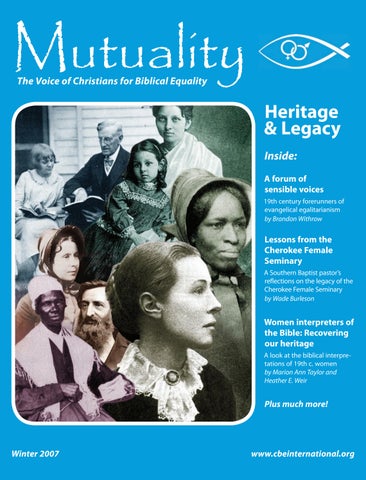
Mutuality The Voice of Christians for Biblical Equality
Heritage & Legacy Inside: A forum of sensible voices 19th century forerunners of evangelical egalitarianism by Brandon Withrow
Lessons from the Cherokee Female Seminary A Southern Baptist pastor’s reflections on the legacy of the Cherokee Female Seminary by Wade Burleson
Women interpreters of the Bible: Recovering our heritage A look at the biblical interpretations of 19th c. women by Marion Ann Taylor and Heather E. Weir
Plus much more!
Winter 2007
www.cbeinternational.org
Contents Features 5
A forum of sensible voices 19th century forerunners of evangelical egalitarianism — by Brandon G. Withrow
8
Lessons from the Female Cherokee Seminary A Southern Baptist pastor’s reflections on the legacy of the Cherokee Female Seminary — by Wade Burleson
COVER IMAGE
Designed by Shalanah Backus Left to Right: Uldine Utley (girl evangelist and Bible teacher) with John Roach Straton (champion of biblical inerrancy and women preachers), Pandita Ramabai (Bible translator and advocate for child widows in India) and her daughter Manoramabai, Amanda Berry Smith (evangelist and orphanage founder), Catherine and William Booth (founders of The Salvation Army), Sojourner Truth (leader in the abolitionist and suffragist movements), Lilias Trotter (missionary to North Africa)
10 An irrepressible legacy Women in ministry leadership — by Mimi Haddad
14 “I received my commission from him, brother” How women preachers built up the holiness movement — by Jennifer Lynn Woodruff Tait
18 Women interpreters of the Bible: Recovering our heritage A look at the biblical interpretations of 19th c. women — by Marion Ann Taylor and Heather E. Weir
21 Sarah Grimké: A useful member of society The legacy of abolitionist, suffragist, and author, Sarah Grimké — by Pamela R. Durso
24 A dirty word or good news? Evangelicals, justice, and the emerging generation — by Liz Mosbo VerHage
Ministry & Chapter News 26 CBE carries on international legacy of egalitarian pioneers at the 2007 ETS annual meeting
28 Praise & Prayer / CBE Chapters
Departments 3 From the Editor: We are Pioneers for Jesus 27 President’s Message: The lesser known story behind today’s Christian colleges
29 Giving Opportunities: I want to leave a legacy — by Ron Pierce
2 | Mutuality Winter 2007
WEBSITE: www.cbeinternational.org
Mutuality The Voice of Christians for Biblical Equality
Let us then pursue what makes for peace and mutual upbuilding. — Romans 14:19 VOLUME 14, ISSUE 4 Mutuality seeks to provide inspiration, encouragement, and information about equality within the Christian church around the world. President/Publisher : Editor : Editorial Assistants : Graphic Designer :
Mimi Haddad Chelsea DeArmond Adele Hebert, M. L. Castleberry Image Spigot
EDITORIAL AND ADVERTISING OFFICE Christians for Biblical Equality 122 W Franklin Ave, Suite 218 Minneapolis, MN 55404-2451 phone: (612) 872-6898 fax: (612) 872-6891 e-mail: cdearmond@cbeinternational.org web: www.cbeinternational.org Advertising in Mutuality does not imply organizational endorsement.
SUBMISSIONS Mutuality welcomes submissions. E-mail cdearmond@cbeinternational.org, write to CBE for the writer’s guidelines, or visit CBE’s website and follow the Publications links.
PERMISSIONS Christians for Biblical Equality grants permission for any original article (not a reprint) to be photocopied for local use provided no more than 1,000 copies are made, they are distributed free, the author is acknowledged, and CBE is recognized as the source. Mutuality (issn: 1533-2470) is published quarterly by Christians for Biblical Equality and is sent free to members. For membership information, see page 31. To purchase back issues, contact our Editorial and Advertising Office, or order online at www.equalitydepot.com.
BOOKSTORE: www.equalitydepot.com
From the Editor by Chelsea DeArmond
We are Pioneers for Jesus Surprises are usually associated with the future— with something unexpected just around the corner. But surprises can also sneak up on us from the past. Sometimes the biggest surprises are discovered in the history we know the best—our own. As I visited my family over Thanksgiving, I discovered a small, blue vest covered with brightly colored badges tucked away in a closet. A flood of memories washed over me as I realized it was the vest I wore to Pioneer Clubs at Good News Baptist Church when I was in grade school. As I held the vest in my hands I remembered the accomplishment I felt when my mother and I sewed on the badges together and the friendship I shared with other girls during the meetings. I even remembered a bit of the theme song we sang together. It began with “We are pioneers for Jesus…” The memory of my Pioneer Girl days came as a surprise to me because I realized that the egalitarian influences in my life went back further than I thought. Though I didn’t develop strong convictions about biblical equality until I was an adult, I now recognized that God had blessed me with many examples of women leaders in my life. These women never received credentials as pastors or professors, but they were certainly gifted ministers and teachers who led ministries in our church and reached out to our neighborhood with the love of Jesus. I felt a similar sense of surprise and discovery as I worked on this issue of Mutuality. Because there seems to be so little historical precedent for women in ministry leadership, some Christians wonder if advocates for gift-based ministry are sliding away from a commitment to biblical authority and toward liberal cultural influences. But authors in this issue of Mutuality provide many examples of amazing evangelical pioneers from the eighteenth and nineteenth centuries whose commitment to biblical authority and to fulfilling Jesus’ Great Commission convinced them that women needed to be free to use their ministry gifts and equipped to answer God’s call wherever it led. Unfortunately, as focus shifted away from the example of the power of the Holy Spirit poured out on all people in Acts 2 to increasingly literalistic interpretations of women’s silence and submission in 1 Timothy 2, women began to be excluded from Bible schools and ministry opportunities that initially welcomed their service. Whether or not they received the right credentials or were remembered in history for their accomplishments, God has been raising up gifted women leaders—pioneers for Jesus—for ministry throughout church history. It’s time to reclaim our evangelical heritage of equipping and commissioning all laborers—both men and women—for the harvest God has prepared. As I reflect on surprises in history and in my own past, I also look forward to surprises in the future. This issue on “heritage and legacy” will be my last as editor of Mutuality, as I return to graduate school to finish my studies in Old Testament. Working on this publication has been a tremendous honor, and I’m pleased that Megan Greulich will serve as Mutuality’s new editor. I thank God for the rich heritage of faithful examples I’ve been blessed with through CBE, and my prayer is that I could be a part of their legacy. Mutuality Winter 2007 | 3
In Our Box
Mutuality
Visit CBE’s website at
www.cbeinternational.org for the latest… ▶ FREE audio and print resources on biblical equality ▶ Membership information for churches, libraries, families, and individuals ▶ On-line discussions about gender and justice on The CBE Scroll, the blogging voice of CBE ▶ CBE chapters in the U.S. and around the world ▶ Directory of egalitarian churches in the U.S. and around the world ▶ Giving opportunities ▶ Listings for counselors, therapists, and spiritual directors who agree with CBE’s Statement of Faith ▶ Ministry news and needs ▶ Employment, internship, and volunteer opportunities
Call for Papers
Mutuality provides inspiration, encouragement, and information about equality within the Christian Church around the world. Mutuality is published quarterly and sent to all CBE members and subscribers. Current and back issue are also available for purchase. We are currently seeking features, reports, and reviews (books, films, and/or music) from evangelical, egalitarian perspectives related to the following topics: • • • •
Home economics Conflict Resolution Children of God Walking in the Spirit
Most of the articles we publish fall into the following categories: • Personal testimonies illustrating how biblical equality provides practical benefits to everyday lives. • Teaching on relevant Bible passages, explaining the meaning and showing how to apply it to daily life. • Reviews of books about biblical equality that would appeal to a wide audience. (Books must complete CBE’s book service review process before being reviewed in Mutuality.) • Feature stories about issues related to CBE’s mission and ministry. The length of features is generally 1,000–2,500 words. Send articles to the attention of the editor at the postal address below or e-mail to cdearmond@cbeinternational.org (if possible, as an attached Microsoft Word document). We are unable to consider or respond to authors who send us more than two pieces at the same time, whose pieces are substantially over 3,000 words, or whose submissions are not sent uniquely to Mutuality. Complete Writers Guidelines for Mutuality are available on our website (www.cbeinternational.org) or contact our office to request a copy. Questions and submissions can be directed to the attention of the editor, Chelsea DeArmond.
Visit CBE’s on-line bookstore at
www.equalitydepot.com for resources like… ▶ Books and articles ▶ Audio and video tapes ▶ CD, DVD, and MP3 recordings ▶ Sales and specials ▶ New resources, CBE exclusives, and best sellers ▶ Foreign language resources ▶ Become a CBE member or renew your membership and save 15% or more on every purchase ▶ Registration for CBE conferences ▶ Subscription to CBE publications or purchase back issues of Mutuality and Priscilla Papers
4 | Mutuality Winter 2007
We’d love to hear from you! Send your comments and critiques to:
Mutuality 122 W Franklin Ave, Suite 218 Minneapolis, MN 55404-2451 PHONE: (612) 872-6898 FAX: (612) 872-6891 E -MAIL: mutuality@cbeinternational.org WEB: www.cbeinternational.org Letters may be edited for clarity and brevity.
WEBSITE: www.cbeinternational.org
a forum of Sensible Voices 19th century forerunners of evangelical egalitarianism
by Brandon G. Withrow
Elizabeth Fry
Pandita Ramabai
C.S. Lewis once wrote that “the unhistorical are usually, without knowing it, enslaved to a fairly recent past.” The same might be said for the conclusion that evangelical egalitarianism is merely the child of the radical feminism of the 1960s and ’70s. Guilt by alleged association is, without a doubt, a powerful tool; but in this case, such a conclusion is a textbook example of reductionism, or the oversimplification of history. It misses the historical precedent, one we might accurately call the evangelical roots of modern egalitarianism. Ignorance of these roots is an educational issue, and celebrating those forerunners is a potential remedy.
Mary Lyon
Fidelia Fiske
Nineteenth Century Foundations The story of civil rights violations — as well as the story of humans fighting to preserve those rights — is as old as history. But the nineteenth century in particular saw several developments that paved the way for great change. Early in the century, for example, there was a move for the fair treatment of the mentally ill. Men and women began to take notice of the rights of those who, for lack of a better plan, were locked away out of sight. Calls to treat these people as created in God’s image brought radical change in England. In the area of gender, the suffrage movement called for the equal rights of women who were often treated as chattel. This new perspective on gender not only led to the right to vote, but also to more opportunities for itinerate female preachers and higher education for women. Evangelicals of the nineteenth century were by no means of one voice on these issues, but many were leading international voices for change.
Evangelical Forerunners
The late eighteenth century public exposé of the plans of a slave ship called The Brookes showed human beings packed like sardines and shackled to wooden planks. The stories of those slaves who escaped this death sentence helped stir calls for the abolition of slavery well into the nineteenth century. BOOKSTORE: www.equalitydepot.com
A few of these evangelical pioneers in human rights are almost household names. Thanks to the recent movie Amazing Grace, many people have heard of William Wilberforce, William Pitt, and Olaudah Equiano, who led the charge to end the slave trade in Britain. And one would have to be locked away in a closet to have never heard of Sojourner Truth, an American former slave who converted to Christianity under Methodism and a brief period with the Millerites. Truth, as both a black abolitionist and a woman, called for the equal treatment of all people regardless of race or gender with one fell swoop in her famous 1851 speech, “Ain’t I a woman?” Yet there are those champions who, while making waves (and history) in their day, remain unfamiliar to many today. Mutuality Winter 2007 | 5
Mrs. Fry visiting a female prisoner at Newgate. Newham Archives and Local Studies Library Collection
One such champion in England was Elizabeth Fry (1780–1845), an evangelical reformer with Quaker convictions. Inequality on the basis of gender, race, economics, and mental health were apparent in many ways in England, and Fry found this to be particularly true for women prisoners. She was moved to get involved, and in a different way, so was her husband. Joseph Fry was a wealthy but struggling businessman, and an egalitarian by the standards of the day. He supported his wife’s causes by hiring servants to free her from what were considered her domestic concerns, enabling Elizabeth to devote significant time and energy to pursuing reform in areas such as abolition, legislation for the humane treatment of the mentally ill, and ending the death penalty. Fry’s most famous work began with her visit to the women’s ward of Newgate Prison in London. Many women were imprisoned without trial or justification; England at the time had about 200 offenses that called for execution, including theft and forgery. Some prison guards used the women’s ward as their own private brothel. Female prisoners gave birth and raised children within their cells and many existed in relative nakedness and poverty. No prison is paradise, but the severity of the women’s wing at Newgate offered ample evidence of inequity based on gender. Fry brought them food, clothing, and medicine, and — in a move for which she was most derided initially — she gave them an education. She set up a schoolroom for the women inmates and their children, donated textbooks, and made business contacts outside the prison to help them produce and sell textiles. She preached to them and taught them to read Scripture. And she convinced the authorities to hire a matron to oversee the women’s ward to help protect them from exploitation by male guards. Fry’s efforts helped bring lasting legal change for these prisoners, and served as a model for the fair treatment of other human beings around the world. 6 | Mutuality Winter 2007
Likewise, in India, Pandita Ramabai (1858–1922) defied her culture with her egalitarian principles. She was born into a wealthy Brahmin family and her father, Anant, was a well-known and respected Sanskrit scholar and a teacher of sacred Hindu texts. Women were forbidden to study Sanskrit and the sacred texts, but Anant harbored different opinions and taught both to his wife and, later, his daughter. Anant eventually paid a price for his counter-cultural beliefs, losing his position and income and becoming ostracized from his community as a destroyer of the Indian family. After receiving a scholar’s education from her parents, Ramabai followed the path modeled by her father and continued to challenge the cultural norms, eventually marrying outside of her caste. Ramabai took special interest in the treatment of young widows. In an inhumane practice called sati, widows were burned on funeral pyres with their deceased husbands. Those who avoided sati had few options, considering that remarriage was forbidden and widows were treated as cursed (including being forced to shave their heads). Given the large number of young women married to old men, this miserable life became the worst nightmare for many. Ramabai sought to improve their lives and remove that stigma through care and education, a decision that led her to study medicine in England in 1883. There she met up with Anglican evangelicals who demonstrated their religion through acts of mercy as she had tried in India. Her dissatisfaction with her own religion and the promise of justice Christ offered drove her conversion to Christianity. From her perspective, Christ’s willingness to lower himself and heal sinners identified him as the only solution for the ills of India and its caste system. From India to England to the United States and back to India, Ramabai met likeminded individuals (Susan B. Anthony, Harriet Tubman, Emily Howland, etc.). She also met opposition, but left a lasting impression in her wake nevertheless. In Boston, she formed the Ramabai Association (1887); in India she formed the Sarada Sadan (1889), to serve as both a home and place of education for widowed women; and in 1900 she built the Mukti Mission. A prolific writer armed with an arsenal of languages, she put her knowledge of Greek and Hebrew to use by translating and publishing a new version of the Bible in the Marathi vernacular. For her work, she earned the reputation of being the “mother of modern India.” During her trip to America (1886–1889), Ramabai was impressed with the growing suffrage movement, but found America’s treatment of slaves and Native Americans in need of serious reform. She was both encouraged and influenced by America (she later wrote a book about her travels there), yet women in the United States still struggled for their own rights.
Pandita Ramabai’s father Anant defied custom in his Hindu context by teaching the women in his family. Pandita eventually mastered seven languages. WEBSITE: www.cbeinternational.org
left: Mount Holyoke Female Seminary (now Mount Holyoke College) in South Hadley, Massachusetts in 1837; above: Fiske Seminary, a female seminary established in Oroomiah, Persia (now Orumiyeh, Iran)
Post-Revolutionary America had become a hotbed of rights discussions as feminist ideals — as well as the reactions to them — fell across the spectrum. In light of their role in educating the nation’s future senators, the young country gave greater weight to the education of women. This idea, now dubbed “Republican Motherhood,” focused on the woman’s place in the home and echoed what is sometimes viewed as the “traditional” gender role. However, it also provided for a new perspective on what women were capable of doing on a larger scale and opened up educational opportunities. Evangelical schools for women began to appear across the Northeast. Indicative of this era was Mary Lyon (1797–1849), who founded Mount Holyoke Female Seminary (now Mount Holyoke College) in South Hadley, Massachusetts in 1837. Lyon, a school teacher by profession, taught at Sanderson Academy, Adams Female Seminary, and Ipswich Female Seminary. Gifted with a marvelous intellect and evangelical convictions, she opened her Mount Holyoke Seminary to the tune of eighty students, and by the next year had to turn away more than four hundred applicants. The evangelical tradition of revivalist Jonathan Edwards and his students, known as the “New Divinity,” laid the theological foundation for Lyon’s students. Ever since the 1989 work of David Bebbington on evangelical origins, historians have recognized that the key characteristics of the evangelical movement in its earliest years included an emphasis on conversion, a commitment to the Bible, a focus on the cross, and activism; in other words, evangelicals emphasize the need for salvation, the source of our knowledge about salvation, the way of salvation, and the progress of the gospel of salvation. From its earliest years, evangelical activism took many forms, most often in missions, and, as the nineteenth century progressed, in social reform — the very hands of the gospel itself. For anyone, man or woman, to be an effective minister of the gospel, a proper education was foundational. Through her school, Lyon was able to connect her students to the field of international missions. One Mount Holyoke student, Fidelia Fiske, remains a quintessential example of Lyon’s success. At the encouragement of a missionary, Reverend Justin Perkins — and contrary to what was then socially acceptable — Fiske went to modern day Iran as a single female missionary to build a school for girls. Appealing to fathers who saw no need for women to be educated, and who instead married off their daughters at very young ages or abandoned them on the streets when they could afford to feed only their sons, Fiske’s call was “Give me your daughters!” She housed them, fed them, nursed them, and educated them. The result BOOKSTORE: www.equalitydepot.com
was the transformation of the lives of numerous young Iranian girls, and an example for the society she had left back home in America. Evangelical activism in the United States was also spurred by the powerful theology of John Wesley and the Methodists. Men and women of this tradition carried their message across the U.S. and throughout the world. Among these women was evangelist and holiness movement leader Phoebe Palmer (1839–1874), who acted according to her belief in Spirit baptism by traveling the globe, preaching the news of the gospel and calling the church to egalitarianism. Likewise, Amanda Berry Smith (1837–1915), an evangelist and a freed slave from York, Pennsylvania, found resistance to her work as a preacher from some men in her denomination, but persisted in ministering to people in America, England, India, and West Africa, and established a school for girls in her last years.
Egalitarianism Today Whether rich or poor, black or white, male or female, free or slave, egalitarians of the nineteenth century called the world to answer for its oppression of those made in the image of God. These messengers of equality — coming from different theological backgrounds — demonstrate the rich history of evangelical egalitarianism, a history that crosses denominational lines and well pre-dates the American feminist movement of the 1960s and ’70s. Without an accurate understanding of this historical context, as Lewis wrote, the modern Christian church is “enslaved to a fairly recent past.” Today’s evangelical egalitarians follow the trajectory set by those in the nineteenth century. Like those leaders of previous eras, they seek to define equality in a world that is hostile to that biblical ideal and yet full of eager souls ready to follow their call. Social and polemical barriers persist. And no human being is exempt from the influence of his or her culture. But when we properly view the historical context of forerunners like these, we discover a forum of sensible voices leading the way toward greater change. Dr. Brandon G. Withrow is adjunct professor for Beeson Divinity School, Birmingham, Alabama. He holds a B.A. in theology, a M.A. in the History of Christian Thought, and a Ph.D. in Historical and Theological Studies. He and his wife, Mindy, are co-authors of the History Lives series, an engaging introduction to church history for ages 9–14. His biography of English queen and church reformer Katherine Parr will be released next year.
Mutuality Winter 2007 | 7
Lessons from the
Female Cherokee Seminary By Wade Burleson
The Trail of Tears (1838–1839) culminated in the relocation of over 20,000 Cherokee Indians from Georgia, Tennessee, Alabama, and North Carolina to northeastern Oklahoma. Estimates are that 4,000 Cherokee men, women, and children died during this journey. Upon settling in an area called Park Hill just outside of the present day city of Tahlequah, Oklahoma, the Cherokees began rebuilding their nation. Within a decade of their arrival, around the same time the Southern Baptist Convention was being formed, the Cherokee people began to establish a system of education for the Cherokee men — and women.
The Cherokee Female Seminary With the help of missionaries named Samuel Austin Worcester and Elizur Butler who had traveled The Trail of Tears with them, the Cherokees at Park Hill began a seminary for women in 1851. Samuel’s daughter Sarah taught at the seminary.
Its rigorous curriculum was patterned after Mount Holyoke Female Seminary in Massachusetts. Though the seminary offered no instruction in Cherokee language or culture, it was open only to fulland mixed-blood Cherokee women. These women and their educational experiences greatly influenced the lives of their descendants and the development of the Cherokee Nation. Students at the Cherokee Female Seminary took courses in Greek, Hebrew, Latin, political economy, literary criticism, theology, philosophy and other advanced courses. They staged dramatic productions, held music recitals, and published their own newsletter. Approximately 3,000 women attended the seminary until its closure in 1909. The seminary building was eventually destroyed by fire, but three original columns from the building mark the entrance into the modern Cherokee Heritage Center. The seminary educated Cherokee women so successfully that some of the more traditional Cherokee men began to complain that the women were no longer suited for domestic chores. The Cherokee Female Seminary was eventually folded into the Cherokee Men’s Seminary, which had been established in Tahlequah, Oklahoma. The
Rev. Samuel Austin Worcester was from the seventh generation of pastors in his family. After becoming close friends with Buck Oowatie, a Cherokee who took the name Elias Boudinot, Samuel committed his ministry to serving the Cherokee Nation. His involvement in defending Cherokee rights led to numerous court appearances and a jail sentence that included heavy labor. A gifted translator, Samuel was instrumental in publishing the first Cherokee newspaper, the Cherokee Phoenix. His Cherokee name was “The Messenger” (as-tes-nu-sti).
8 | Mutuality Winter 2007
WEBSITE: www.cbeinternational.org
combined schools became what we know today as Northeastern State University, one of oldest institutions of higher education west of the Mississippi, and still the university with the highest concentration of American Indian students in the United States. According to Wilma Mankiller, the first female chief of the Cherokee Nation, “the Cherokee Seminaries were among the first educational systems built west of the Mississippi — Indian or nonIndian. In fact, for a period of time during the mid-nineteenth century, the Cherokee population was more literate than the neighboring non-Indian population.”
Women in Today’s Southern Baptist Seminaries It is interesting to compare the current controversies over women students and professors in Southern Baptist seminaries with the academic rigors of Cherokee Indian women in the 1850s. In a day when some Southern Baptists believe it is wrong to educate women in the classics, languages, or biblical theology — not to mention to employ women in teaching these subjects — it might be well for us all to remember the examples of those evangelical, conservative Christian Indians who have gone before us. No doubt there will be opposition when an increasing number of theologically minded women serve in the Southern Baptist Convention or female Hebrew, Greek, and theology professors are given teaching positions at Southern Baptist seminaries. A few might even wish to destroy the ministerial reputation and careers of those Southern Baptists who affirm women in the highest of academic roles within the SBC. But the negative reaction of some should never negate the positive results of what is accomplished through faithful, intellectually gifted Southern Baptist women committed to higher education for everyone.
Conclusion Davy Crockett was severely persecuted for standing up for the Cherokee people before Congress in Washington, D.C. during the 1830s. Crockett’s own political career was destroyed because he supported the Cherokees when everyone else wanted them out of sight and out of mind. Davy Crockett eventually made his way west to Texas where he became a frontier hero and died at the Alamo. But before Crockett left the nation’s capital he made a statement regarding his strong stand for the oppressed Cherokee Indians — a statement that is as appropriate today regarding women in Southern Baptist academia as it was in Crockett’s day regarding the Cherokee people:
Rachel Caroline Eaten, 1888 graduate of the Cherokee Female Seminary, went on for a Ph.D. in History at the University of Chicago. The author of four books on Oklahoma, two on the Cherokees, Eaten taught at several colleges including Trinity University in San Antonio where she also chaired the history department. Photo courtesy Christina Berry
“I would sooner be honestly damned than hypocritically immortalized.” This Sooner couldn’t agree more. Wade Burleson has served as pastor of Emmanuel Baptist Church (Southern Baptist) in Enid, Ok., for the past fifteen years. Wade and his wife have four children.
BOOKSTORE: www.equalitydepot.com
Mutuality Winter 2007 | 9
An Irrepressible Legacy Women in Ministry Leadership As women ministers, evangelists, and preachers began flooding urban, rural, and global mission fields in the 19th century, Christians started to question assumptions about the inferiority of both women and slaves. They did so from a thorough examination of Scripture. These early evangelicals — many of whom were founders of Bible institutes — insisted that gospel values must triumph over cultural values, especially regarding the gifts God has given all people for Kingdom work. In his book, Let Her Be, Charles Knowles notes that many branches of the evangelical church published their biblical research in support of the shared leadership of women in more than forty-six biblical treatises between 1808 and 1930. These documents signify the emergence of the first wave of feminists — a deeply biblical movement. Evangelical support for women’s equality grew out of a commitment to biblical authority, evangelism, and social activism that came to characterize or identify the evangelical movement as a whole, beginning in the 1800s. And, it was these early evangelicals — both men and women — who were among the first to provide both a biblical and social voice for gender and ethnic equality.
Evangelical contributions to the biblical basis for equality:
Katharine Bushnell One of the most important contributors to the biblical basis for women’s ministry was Katharine Bushnell (1856–1946), who wrote perhaps the most extensive biblical treatment of gender ever published. Bushnell worked as a medical doctor, Bible scholar, evangelist, and activist. She was a prominent evangelical missionary and leader within the Women’s Christian Temperance Union (WCTU).
By Mimi Haddad
In the 1860s, Bushnell worked with English activist Josephine Butler to oppose The Contagious Disease Acts, which gave police officers the authority to detain women on suspicion of prostitution and subject them to genital examination for venereal disease. Butler realized that in order for the church to join the struggle to free women from injustice and abuse, Christians must see that God values women just as much as men. On her deathbed, Butler begged Bushnell to show the world that the Bible does not endorse women’s subordination. Bushnell spent many years learning Greek and Hebrew in order to study passages in Scripture that address gender. She published her findings in God’s Word to Women, completed in 1919. This impressive work remains in print, and is frequently cited by today’s egalitarians. Bushnell documents the biblical basis for gender equality in the whole of Scripture, particularly the early chapters of Genesis. She begins by comparing Adam and Eve, both of whom were equally created in God’s image and equally called to be fruitful and to exercise dominion in Eden. She refutes the common misunderstanding that Eve was the source of sin and that God curses women because of Eve. Rather, it was Satan, not God, who inspired the domination of men over women. God bestows leadership on those who do what is right in God’s sight, regardless of their gender, birth order, nationality, or class. In assessing the teachings of Paul, Bushnell determined that the apostle affirmed the authority and leadership of women, provided that their leadership was not domineering or abusive (1 Tim. 2:12); that those who teach must understand and advance the truth concerning the Gospel (1 Tim. 2:11–12, Acts 18:26, Rom. 16:1–5, 7, 12–13, 15), and that when women pray and prophesy in public they are not disruptive, either because of inappropriate clothing or excessive chatter (1 Cor. 11:5, 1 Cor. 14:34). Ultimately, Bushnell grounds her understanding of women’s status not in the Fall, but in Christ’s completed work on Calvary.
Supposing women only had translated the Bible, from age to age, is there a likelihood that men would have rested content with the outcome? Therefore, our brothers have no good reason to complain if, while conceding that men have done the best they could alone, we assert that they did not do the best that could have been done. The work would have been of a much higher order had they first helped women to learn the sacred languages (instead of putting obstacles in their way), and then, have given them a place by their side on translations committees. — Katharine Bushnell, God’s Word to Women
10 | Mutuality Winter 2007
WEBSITE: www.cbeinternational.org
Equality in evangelical institutions:
Moody, Gordon, & Northwestern At the turn of the twentieth century, evangelicals were committed to both evangelism and social activism. Bible Institutes like Moody, Gordon, and Northwestern trained both men and women for ministry in anticipation of Christ’s imminent return. These institutes became today’s Christian colleges and universities, which broadened their curriculum to prepare Christian men and women for professional service in many disciplines. In this transition, some evangelical institutions lost touch with their earlier convictions about the biblical basis for women’s ministry, and their commitment to preparing women as ministry leaders.
Moody Bible Institute In a famous sermon Moody preached in Chicago shortly before the founding of Moody Bible Institute, he said: “I believe we need ‘gap men,’ men who are trained to fill the gap between the common people and the ministers. We are to raise up women and men who will be willing to lay down their lives alongside the laboring.” D. L. Moody The Institute continued to train and educate both men and women, and in 1925, Moody Bible Institute opened a pastor’s program that included women. Female graduates of Moody’s pastor’s program organized Bible conferences and filled revival pulpits around the world. Together with the male graduates, they reached a quarter of a million people by 1928. These events are well documented in the Moody Bible Institute publication, The Christian Worker, which celebrated the achievements of graduates — both men and women — who preached the gospel to large audiences around the world. Not everyone realizes that women played key roles in the vision and founding of Moody Bible Institute. Two of these women were Emma Dryer and Frances Willard.
Emma Dryer In 1870, the evangelist D. L. Moody was introduced to a principal at Illinois State Normal University and secretary of the YWCA in Chicago named Emma Dryer. Emma was also involved in preaching and teaching Christian doctrine in inner-city Chicago. After a fire devastated Chicago in 1871, Emma worked tirelessly among fire-victims, many of whom were homeless women and children. Impressed by her commitment to ministering the gospel to the needy, Moody invited Dryer to offer her discipleship classes at his North Side Tabernacle. These classes were the beginnings of Northfield Seminary for Women. For the next sixteen years, Emma continued to train women ministers (called Bible Readers), while she also prayed for a Bible Institute, begging Moody to consider opening one. Her Bible Readers cared for the needy and distributed Bible tracts throughout inner-city Chicago. In 1883, Emma Dryer opened and ran the “May Bible Institute” that offered intensive Bible courses. Her May Institute merged with Moody’s Evangelistic Society to form the Moody Bible Institute for the purposes of training future revival leaders. BOOKSTORE: www.equalitydepot.com
Frances Williard’s tireless commitment to evangelism and social activism involved an average of 30,000 miles of travel a year, and an average of four hundred lectures a year for a ten year period. Her example as a Christian woman gifted for ministry leadership influenced the views of several founders of Christian Bible Institutes, including D. L. Moody, A. J. Gordon, and William B. Riley.
Frances Willard Moody was also close friends with Frances Willard, president of the Women’s Christian Temperance Union. Comprised of two million women, the WCTU was considered one of the largest and most successful women’s organizations in United States’ history. Its three core commitments were grounded in their Christian faith and their passion to spread the gospel through advancing suffrage (women’s right to vote), temperance (passing laws against alcohol abuse), and abolition (ending slavery). Willard was a brilliant administrator and visionary. She was also president of Evanston Ladies College, which later merged with the men’s college to form Northwestern University, one of the finest universities in the United States. Willard was a gifted speaker and a strong advocate of women’s public preaching. Because of her passion for the gospel, Moody invited her to speak at his revival meeting in Boston. Though her support for temperance and suffrage came under criticism, Moody stood by her and encouraged her to continue preaching.
Boston missionary Training Institute
A. J. Gordon
A. J. Gordon, the founder of the Boston Missionary Training Institute which later become Gordon College and also Gordon Conwell Theological Seminary — my alma mater, was one of the most noted preachers of his day. He was an articulate and scholarly advocate of missions, temperance, women’s ministry, and abolition. Gordon was pastor of Mutuality Winter 2007 | 11
Clarendon Street Baptist Church in Boston for 24 years, one of the most prestigious Baptist pulpits in the country. The Boston Missionary Training School was launched in 1887, following Moody’s Boston Revival which featured Frances Willard as a speaker. Like the journalists who followed the work of Salvation Army Women in London’s East end, Boston Globe writers delighted in reporting on the many evangelical missionaries who sailed from Boston’s harbor to dangerous places around the world to face their “certain death” in order to advance the Great Commission. Many of these women were inspired by A. J. Gordon and some were trained by his Bible Institute. The Boston Missionary Training Institute also prepared many outstanding women leaders. Susan Gray, a faculty member who taught courses on the Bible and Christian Evidences, was an example of one of these leaders. She later married the third president of Moody Bible Institute, James M. Gray, and a building on the Moody campus is named in her honor. Gordon published his support for women’s public ministry in a concise, but comprehensive essay entitled “Women in Ministry.” In this essay, Gordon based his convictions on Pentecost (Acts 2), which inaugurated the New Covenant where all ethnic groups and also women share equally in Christ’s new community. In the New Covenant, those who were once considered inferior by natural birth attain a new spiritual status through the power of the Holy Spirit. For God’s gifting no longer rests on a “favored few, but upon the many, without regard to race, or age, or sex.” Gordon’s wife, Maria T. Halle Gordon shared her husband’s support of women’s leadership in ministry and evangelism. She said: “…those men who constantly oppose women’s public speaking on the ground as we have heard a hundred times that she ‘lacks theological faculty’ might as well remember that it shows a great lack of logical faculty in them to put forth such an argument.”
I went from that house convinced that so long as saloons remained to embrute women’s husbands; blight women’s beautiful boys; blast women’s lives; and even blacken women’s souls, that every speech against it would be justified, no matter who made up their assemblies, and would be approved and applauded by that heavenly assembly of saints and angels when in defense of all that is true, a suffering woman feels compelled to break the silence and speak against sin. In 1902, Riley founded his Bible training school, which opened its doors to many women. Graduates served with important missionary organizations like the China Inland Mission. Newspapers were fond of documenting the evangelistic work of graduates like Irene Murray and Alma Reiber. In 1923, a Wisconsin journal called The Pilot reported that “Reiber and Murray carry with them the highest endorsement of the pastor and people…through these young women God has bestowed…the greatest spiritual blessing…” Missionaries like Reiber and Murray encountered many challenges such as continuous travel, crushing isolation, and financial woes among people who were unwelcoming, and at times hostile. In celebration of the courage of Northwestern graduates, William Bell Riley, said that “we have made it our business to undertake the hardest and most difficult of fields.” He was referring to many of the women graduates of Northwestern. Northwestern prepared women to pastor in churches throughout the Midwest. In a 1948 article, Northwestern graduate Minnie Nelson said how she “resurrected dead churches, united divided ones, repaired church property, paid off old church debt, and faced strenuous travel and many speaking engagements.” Because of the success of their graduates, leaders from Northwestern headed to Southern California to partner with evangelicals in Los Angeles in founding the Bible Institute of Los Angeles (BIOLA). Like the other Bible Institutes, women graduates from BIOLA were active in revivals and inner-city ministry. Given education and opportunities, women found fertile fields for their ministry gifts, leading many to a relationship with Christ.
Conclusion Northwestern Bible School Northwestern Bible School (today’s Northwestern College) was founded by William Bell Riley, pastor of Minneapolis’s First Baptist Church — the largest church in the Northern Baptist Convention, where Riley served for more than 40 years. Riley, was perhaps the country’s most outspoken fundamentalist, and as such he founded the W. B. Riley World’s Christian Fundamentals Association where he served as president. Like Moody, Riley also heard Frances Willard preach and was convinced that voices like hers needed to be heard, as this quote from a 1901 sermon on “Woman’s Rights and Political Righteousness” illustrates: I recall the first time I ever heard Frances Willard speak. She was in a small southern city, where it was regarded a shame for a woman to appear on the platform with men in the assembly. But I confess, that
12 | Mutuality Winter 2007
The passion for both evangelism and social action that characterized evangelicals in the 1800s drove women’s involvement in ministry leadership. Women missionaries probably had more opportunities to address the physical as well as the spiritual needs of women and their families. It is no surprise that women’s missionary efforts like those of the WCTU advanced a wholistic Christian ethic that reached body and soul for Christ. While Christians like Josephine Butler, Katharine Bushnell, and Frances Willard encountered powerful opposition, their lives were committed to an even more powerful God who changed the world through their faithful service and Christian leadership. We reflect upon their lives and their scholarship so that we might consider “the outcome of their way of life and imitate their faith” (Hebrews 13:7). Mimi Haddad (Ph.D., University of Durham) is president of Christians for Biblical Equality. She is a founding member of the Evangelicals and Gender Study Group at the Evangelical Theological Society, and she served as the Convener of the Gender Issue Group for the 2004 Lausanne III Conference for World Evangelization.
WEBSITE: www.cbeinternational.org
Learn more about the
irrepressible legacy of women ministry leaders at www.equalitydepot.com
God’s Word to Women by Katharine C. Bushnell One Hundred Bible Studies on Woman’s Place in the Church and Home
Let Her Be by Charles O. Knowles Right Relationships and the Southern Baptist Conundrum Over Woman’s Role
Knowles explores the reasons some church traditions have tragically sided with slavery and women’s subordination. American Women in Mission by Dana L. Robert A Social History of Their Thought and Practice
Roberts uses case studies to illustrate the evangelistic, medical, educational, and social justice accomplishments of women in mission fields around the world from 1872–1992. No Time for Silence by Janette Hassey Evangelical Women in Public Ministry Around the Turn of the Century
No Time for Silence documents evangelical women called to teach at Bible institutes, preach at Bible conferences, serve in local church pastorates, and evangelize and lead revivals.
From Genesis to Revelation, this is a thorough explaination of every Bible passage that touches on women. From Bushnell’s lifetime working for social reform, she observed correlations between the status of women and misunderstandings of Scripture. Scholars have leaned on her groundbreaking work since its first publication in 1921, deeming it one of the best whole-Bible approaches to the question of women’s place in the church and home.
Biblical Equality in Church History Historical Support for Biblical Equality and Justice between Men and Women
This collection of six mp3 recordings by leading evangelical scholars features insights on the historical basis for biblical equality and justice between men and women.
BOOKSTORE: www.equalitydepot.com
Mutuality Winter 2007 | 13
“I Received My Commission From Him, Brother” How women preachers built up the holiness movement By Jennifer Lynn Woodruff Tait
In 1771, John Wesley received a remarkable letter from devout Methodist convert Mary Bosanquet (1739–1815). With her friends Sarah Crosby (1729–1804) and Sarah Ryan (1724–1768), Bosanquet had been running an orphanage and leading the small-group Methodist gatherings for spiritual growth that Wesley termed “class meetings.” Crosby had in fact been speaking to groups sometimes numbering in the hundreds — though Wesley would not let her call her spiritual testimony “preaching.” Bosanquet too had been leading class meetings, and been criticized for doing it.
She met the criticism head-on in her letter to Wesley: “Several object to this in our own round and out of it, saying ‘A woman ought not to teach or take authority over a man.’” This might mean, Bosanquet allowed, that a woman should not take authority over her husband. But it emphatically did not mean that “she shall not entreat sinners to come to Jesus, nor say, come and I will tell you what God has done for my soul.” Not every woman was called to be a preacher, no more than every man; but “some have an extraordinary call to it, and woe be to them if they obey it not.” That very month, June 1771, Wesley explicitly endorsed Bosanquet’s friend Crosby as a lay preacher, using the phrase “extraordinary call.” He gave his stamp of approval to Bosanquet as well. Both women became tireless evangelists, and some forty-one women eventually became lay preachers in “Mr. Wesley’s Methodism.” In 1781 Bosanquet married Wesley’s intended successor John Fletcher. The happy marriage was cut short by Fletcher’s death from tuberculosis in 1785, after which Mary continued to hold preaching meetings and care for the flock in her late husband’s Anglican parish, even appointing one of his successors. Despite the fact that after Wesley’s own death, the Methodist Conference in 1803 passed a resolution that women would not be permitted to preach (and, if any women felt they had an “extraordinary call,” they should address only other women), Bosanquet/Fletcher continued to preach five sermons a week until she died in her late seventies.
Coming to America
Mary Bosanquet Fletcher 14 | Mutuality Winter 2007
These were among the first women to find in Methodism a liberating power to preach the gospel, but they were not the last. A qualified openness to women as spiritual leaders and preachers carried over into early American Methodism — brought to the colonies in the 1760s and a lay-led movement, until Wesley ordained preachers for the new nation at the founding of the Methodist Episcopal Church in 1784. Barbara Heck, an early Irish Methodist émigré who encouraged her cousin Philip Embury to continue in America the lay preaching he had begun in England, earned from one prominent Methodist historian the title “foundress” of American Methodism. As the story is sometimes told, Heck discovered a group of her fellow Irish immigrants playing cards. She swept the cards into the fire and WEBSITE: www.cbeinternational.org
marched swiftly to Philip’s house, where she urged him to take up preaching again lest their friends and relatives “all go to hell!” Philip protested that he had neither a congregation nor a preaching house. “Preach in your own house and to your own company,” said Barbara, and Methodism was born in New York. In the 1800s, white and African-American women — including United Brethren prison chaplain Lydia Sexton (1799–1894) and African Methodist Episcopal evangelist Jarena Lee (b. 1783) began to seek licensing to preach within the Methodist denominations. Not all women preachers found this sanction necessary. For example, Phoebe Palmer never sought a license, though her ministry received tacit approval from the Methodist bishop and other clergy who attended her Tuesday Meeting.
“Well, God allows it” Those who did obtain the church’s imprimatur often stated that they would have continued without it. Maggie Newton Van Cott (1830–1914), the first woman licensed to preach in the Methodist Episcopal Church, began by obtaining an exhorter’s license (exhorting differed from preaching in that the speaker did not “take a text” from the Bible to expound). When a critic protested that this license did not allow her to preach sermons, she replied, “Don’t it? Well, Maggie Newton Van Cott God allows it. I received my commission from Him, brother.” Van Cott also famously commented to the pastor of the Duane Street (NY) M. E. Church, “I believe my tongue is my own, John, and I will use it when I please, where I please, and as I please.” This she did as a traveling evangelist from 1866 to 1912. When she turned 50 in 1880, it was said that up to that point she had traveled 143,417 miles, held 9,933 revival meetings, and preached 4,294 sermons. In mainline Methodism, women did not win the right to full ordination to the priestly and pastoral role of elder until 1956. But as Methodism and the holiness movement began to part ways, many holiness groups practiced in their earliest years an openness to the ministry of women that the more theologically liberal mainline denomination frequently lacked. Most Wesleyan/Holiness denominations gave licenses to and ordained women and men alike, although the women often faced more opposition and were given more difficult pastoral assignments. Female traveling evangelists were also common, though not Amanda Berry Smith BOOKSTORE: www.equalitydepot.com
uncontroversial, in holiness circles. Among the most famous was the African Methodist Episcopal preacher, singer, missionary, and orphans’ home founder Amanda Berry Smith (1837–1915). Unlike her earlier A.M.E. preaching colleague Jarena Lee, Smith ministered largely in white contexts, and she later became instrumental in the work of Frances Willard’s Women’s Christian Temperance Union (WCTU). Smith had endured two unhappy marriages — the second one, ironically, to an A.M.E. preacher — and, though highly esteemed in holiness circles, still felt frequently the sting of racism. She wrote at one point in her autobiography, “I think some people would understand the quintessence of sanctifying grace if they could be black about twenty-four hours.”
Founding mothers Several prominent female evangelists — Catherine Booth (1829– 1890), Mary Lee Cagle (1864–1955), Alma White (1862–1946), and Lela McConnell (1884–1970) — were crucial in founding of wellknown holiness organizations in Britain and America. Booth, wife of a preacher in the reform-minded Methodist New Connexion in England, and a writer of spiritual tracts, published a short pamphlet titled Female Ministry in 1859 to defend Phoebe Palmer’s English preaching tour. “Who,” she wrote in her introduction, “would dare to challenge the sainted Madame Guyon, Lady Maxwell, the talented mother of the Wesleys, Mrs. Fletcher,” or a host of other famous spiritual women “with being unwomanly or ambitious?” Women in every age had been crucial agents in leading souls to Christ, and there was Biblical warrant for their actions. “My studies in ‘Bible Criticism’ etc.,” she maintained, “have not informed me that a woman must cease to speak before she can obey.” Booth began preaching in her own right in 1860. At the Annual Conference of the New Connexion in 1861, William Catherine Booth was assigned to a prosperous church, but protested that he was called to the work of evangelism. A compromise was suggested, but at that point Catherine’s voice could be heard speaking out from the gallery where women were seated: “Never!” The Booths decided to withdraw from the New Connexion and undertake an itinerant evangelistic ministry. They opened a mission in London in 1865 to preach holiness and minister to the poor — renamed the Salvation Army in 1878. Men and women held equal leadership ranks in the Army from its inception, and the Booths’ daughter Evangeline (1865–1950) later served as head or “General” of the entire organization. Catherine Booth designed the flag and uniform of the new organization, including the famous women’s headgear, known as the “hallelujah bonnet.” She wrote prolifically in support of the Army, temperance, housing for the poor, and the humane treatment of animals. Diagnosed with cancer in 1888, she preached almost until her death, and refused morphine at the end in order to keep her mind Mutuality Winter 2007 | 15
clear to assist her husband with the writing of his famous book In Darkest England and the Way Out (1890). Today approximately half of the officers (ministers) in the Salvation Army are female. Mary Cagle, who entered the preaching ministry after the death of her first husband, Methodist evangelist R. L. Harris, took up his work of planting churches and organizing them into a loose network that after a series Mary Cagle of mergers became part of the Church of the Nazarene. This group ordained her in 1899. Her second husband, originally a cowhand, was saved, sanctified, and called to preach under Cagle’s evangelistic ministry. Tellingly, though, it was eventually that husband, H. C. Cagle, who became a district superintendent while Mary Cagle served as a district evangelist in the new denomination — showing that women were more likely to be approved when exercising an extraordinary, rather than an ordinary, call.
The first woman bishop Alma White and her husband established a new holiness organization, the Pillar of Fire, specifically because of the opposition to women preachers in the Methodist Episcopal Church. An antifemale Methodist faction that controlled the Colorado Holiness Association refused to let White speak at their camp meeting s. White responded by founding a Alma White group originally known as the Pentecostal Union — later the Pillar of Fire — claiming that she was “ready to lay my life down in sacrifice on the altar of the Methodist Church” until that church “made no provision for me to preach the Gospel.” Although White’s husband Kent possessed Methodist ordination, it was Alma who took full control of the new group into her own hands. Kent’s opposition to his wife’s evangelistic career became more and more outspoken, and eventually they separated due to his acceptance of speaking in tongues, which she resisted. It was Alma, however, who kept charge of the Pillar of Fire, and she was consecrated bishop of the denomination in 1918 by an evangelist in the Methodist Episcopal Church, South, W. B. Godbey. This made her the first known woman bishop in any Christian denomination. White never stopped writing, preaching, and starting new things. She was an ardent advocate of woman’s rights and a supporter of the Equal Rights Amendment, which was first proposed in 1923. She also introduced vegetarianism to the Pillar of Fire, explaining her biblical and experiential justification in Why I Do Not Eat Meat (1939). At the age of fifty-five, “after much trepidation” as a Pillar of Fire news release reported, she learned to drive and obtained a New Jersey driver’s 16 | Mutuality Winter 2007
license. At about the same time she also learned to swim, “which, though perfectly consistent with her way of doing things,” claimed the same news release, “greatly surprised her friends.”
Kentucky mountain mother Lela McConnell, who did possess a form of ordination as a local deacon in the Methodist Episcopal Church, felt called to establish a holiness ministry in Kentucky while a student at Asbury College in the 1920s. McConnell undertook preaching tours through eastern Kentucky and, with the support of Asbury, organized a group of preaching stations that became known as the Lela McConnell Kentucky Mountain Holiness Association. Refusing offers from a Methodist bishop to place the KMHA under the mainline church’s (male) authority, McConnell supervised a network of pastors — of whom at times more than half were women. She also founded several boarding schools, a Bible training school (now Kentucky Mountain Bible College), and a radio station. Women such as these were the rule rather than the exception. Though not all holiness woman with an “extraordinary call” sought ordination or founded denominations, many preached, traveled, and wrote extensively, seeking conversions and sanctifications through their revival meetings and through writings that ranged from the devotional to the polemic — sometimes combining both. Many of these women leaders cited Bosanquet/Fletcher, Crosby, Hester Rogers (1756–1794), and Palmer as their influence and inspiration. (Rogers, a contemporary of Fletcher and Crosby and a follower of Wesley, was the author of an autobiography immensely popular among Methodists. Though she had not had a preaching ministry, Rogers had led classes and bands and dispensed spiritual counsel through correspondence.)
“…and daughters will prophesy” Susie Stanley’s book Holy Boldness: Women Preachers’ Autobiographies and the Sanctified Self (University of Tennessee, 2002) studies in detail the autobiographies of thirty-four prominent woman preachers who professed holiness sympathies. These autobiographies tell repeatedly the story of women sensing a call to public ministry, meeting opposition from within and without, overcoming both kinds of opposition through the grace of God and the empowerment of their sanctification experience, and reaping fruit in terms of the conversions, sanctifications, and social ministries that came out of their work. As Stanley shows, holiness women argued for their public ministry not only from results, but from affirmations of women’s ministry in the Bible. Examples abounded: Jesus worked with and affirmed women as disciples; Mary Magdalene was the first to testify to the resurrection; Phoebe was a deacon in the early church; and Paul listed women WEBSITE: www.cbeinternational.org
church leaders in Romans 16 and other letters, famously declaring in Galatians 3:28 that there was “neither male nor female, for ye are all one in Christ Jesus.” Mary Cagle, particularly impressed by the example of Philip’s four prophesying daughters (Acts 21:8–9), wrote in a sermon titled “Woman’s Right to Preach” that “according to the Bible, Webster, and Clarke, Philip had a family of four girl preachers, and there is no record given in the Bible Phoebe Palmer that any man had a family of four boy preachers. There is nearly always a black sheep among the boys.” The paradigmatic Bible event for women preachers was Pentecost. Then, women as well as men had been empowered with the Holy Spirit, as the Old Testament prophet Joel’s vision was fulfilled: that God would pour out his spirit on his sons and his daughters and that God’s “handmaidens” would be among those empowered to prophesy (Acts 2:16–18; Joel 2:28–29).
It was from Joel’s words that Palmer drew the titles of her two famous defenses of female ministry, The Promise of the Father (1859) and The Tongue of Fire on the Daughters of the Lord (1869). Paul’s comments that forbade women from speaking were interpreted as local injunctions only (since elsewhere, as in 1 Corinthians 11:5, Paul gave women directions on how to pray and prophesy in public). Submission to male authority was interpreted in the manner Bosanquet/Fletcher had pioneered — as referring to the marriage relationship only, not the exercise of prophetic calls to ministry. Since the influence of Fundamentalism in the 1920s, some modern holiness denominations — excepting the Salvation Army — have dealt ambiguously with their early commitment to the public ministry of women. Wesleyan groups remain challenged not only by Scripture but by the example of their own history, beginning when Wesley opened that letter from Mary Bosanquet. The question that framed Jarena Lee’s testimony in her 1836 autobiography still echoes: “If the man may preach, because the Saviour died for him, why not the woman? seeing he died for her also. Is he not a whole Saviour, instead of a half one?” Used by permission, Christian History & Biography, 2007 Jennifer L. Woodruff Tait is adjunct instructor of church history for Asbury Theological Seminary and holds a Ph.D. in American church history from Duke University. She lives in Huntington, Ind., with her husband and daughter.
For further reading…
Terms of Empowerment Strangers & Pilgrims
Turn the Pulpit Loose
Holy Boldness
Salvation Army Women in Ministry by Catherine Mumford Booth, Evangeline Cory Booth, and Kay F. Rader
Two Centuries of American Women Evangelists by Priscilla Pope-Levison
Women Preachers’ Autobiographies and the Sanctified Self by Susie C. Stanley
Female Preaching in America, 1740–1845 by Catherine A. Brekus
Browse more books about women in church history at
www.equalitydepot.com BOOKSTORE: www.equalitydepot.com
Mutuality Winter 2007 | 17
Women Interpreters of the Bible
recovering our heritage
By Marion Ann Taylor and Heather E. Weir
“Can I write a paper on a woman interpreter?” asked a student in Marion’s class in the history of the interpretation of the Old Testament. This question opened the door to the world of women interpreters of the Bible from the past. We have discovered thousands of unremembered published works on the Bible written by women, from the period of the early church to the present. Many writers in the last twenty years have noted that each generation of women interpreters of the Bible asked similar questions of the text. Because the memory of the previous generations of women interpreters was not retained, women did the same interpretive work again and again. Recovering our heritage from women interpreters of the past is an important part of breaking the cycle of forgetfulness. These women are our foremothers of faith: we need to listen to them, learn from them, and pass on their memory to future generations. Sarah Trimmer (1741–1810), Harriet Beecher Stowe (1811–1896), and Elizabeth Baxter (1837–1926) are three foremothers of faith who have left us an extensive legacy of published works. While Stowe’s name is well known for her novel Uncle Tom’s Cabin, Trimmer and Baxter are not widely known. Stowe is remembered for her novels, and the social impact of these works; she also wrote on the Bible and its interpretation. Trimmer is remembered by specialists in children’s literature for her
18 | Mutuality Winter 2007
educational works, but not for her Bible commentaries and teaching aids. Baxter is not remembered, though she published over forty books and preached to thousands of women during Moody and Sankey’s British crusades in the 1870s. These women’s writings on the Bible are part of their legacy to us. We have forgotten this legacy, and need to recover and remember it.
Sarah Trimmer (1741–1810) Sarah Trimmer, the daughter of artist and architect Joshua Kirby, was an English educator and author. She began her writing career when she was 39, after the birth of her twelfth child. Her books on teaching the Christian faith draw on the educational experience she gained while teaching her own children at home. Her works, which included a commentary on the whole Bible, were very popular in her own lifetime
WEBSITE: www.cbeinternational.org
and continued to be reprinted in the first half of the nineteenth century. Sarah Trimmer provides us with a model of a woman who took her call to educate the next generation seriously. Her program of Christian education for the home, outlined in An Essay on Christian Education (1812), began when children were born and continued until children were confirmed in their teens. Children were to read the Bible as soon as they were able. Trimmer published works such as Sacred History (1782–5) to assist children and their parents in understanding what they read. Trimmer was also involved in the early Sunday School movement. One of her published works, The Economy of Charity (1786), was written to encourage women to found and volunteer in Sunday Schools in their own congregations. Trimmer’s teachers’ aids, catechisms, and abridgements of the Bible were all written to assist teachers and students in Sunday School settings. Trimmer faithfully taught and wrote about the Bible. Despite her busy, devoted life of service, hidden in her journals is an indication that she longed to be able to work for God in a different way, as an ordained priest. Trimmer could not imagine ordination for women as a real possibility. Instead of being God’s minister, she noted that she was God’s handmaid. As God’s handmaid she served faithfully, proclaiming the gospel to her own family and in Sunday School classes. Through her published works she continues to speak today.
Harriet Beecher Stowe (1811–1896) Harriet Beecher Stowe was the daughter of Lyman Beecher, noted Congregational minister, theologian, and seminary president. All of Lyman Beecher’s sons became preachers. When Stowe was nineteen, she claimed that it was as much her vocation to preach on paper as it was her brothers’ vocation to preach from the pulpit. Harriet married Calvin Ellis Stowe (1820–86), an Old Testament scholar. Calvin Stowe encouraged his wife’s study, arguing that she should learn Greek to benefit both her own work and his. Although she refused to study Greek, she did take seriously the many suggestions and ideas offered by her husband, whom she affectionately called “Rabbi.” Calvin tended to be impulsive and procrastinate, so Harriet encouraged him to get his own work published. The Stowes certainly did not have a perfect marriage, but their mutual exchange of ideas and professional support of one another benefited them both. Stowe’s Woman of Sacred History (1873) begins with Sarah, the matriarch of the covenant family. Stowe noted that Sarah is cited in the New Testament as a model of submission to her husband (1 Pet. 3:6). Stowe immediately suggested that according to the Old Testament story, Sarah’s example implies no “alarming amount of subjection or submission.” Sarah the Princess, Stowe wrote, was in reality the sovereign over Abraham’s household, even if she called her husband “lord.” This reading of Sarah shows Stowe wrestling with the idea of a wife’s submission to her husband. In comparing the Old and New Testament, she found that submission might not be as oppressive as her nineteenth-century culture assumed. After Calvin Stowe made some foolish decisions, Harriet Stowe, like Sarah, ruled her household. Calvin Stowe was very involved in his wife’s writing projects. He drew his wife’s attention to the Rabbinic traditions surrounding Abraham and Sarah’s visit to Egypt (Gen. 12:10–20). Although Harriet Stowe did not give much weight to these ‘fantastic’
BOOKSTORE: www.equalitydepot.com
“The present generation of interpreters of the Bible, both women and men, need to continue the work of recovering the voices of women interpreters and integrating them into our understanding of the Bible and church history.” shown above: Harriet Beecher Stowe
traditional stories, she included them in her chapter on Sarah. Stowe noted that these traditions showed the influence of Bible characters through history. Stowe herself was influenced by the women of the Bible, as is evident from her treatment of them in Woman of Sacred History.
Elizabeth Baxter (1837–1926) Elizabeth Baxter is the most eccentric of these three women. She was the daughter of Thomas Nelson Foster, a Quaker manufacturer of agricultural fertilizers. She married the Reverend Michael Paget Baxter (1834–1910), an Anglican end-times preacher. The Baxters worked together as itinerant preachers, living in tents as they traveled through Great Britain for fifteen years. They became involved in the Moody-Sankey crusades. Michael Baxter acquired a publishing house, and the Baxters shifted to preaching through the printed word. Baxter’s publishing business gave her the opportunity to write and publish works on the Bible.
Mutuality Winter 2007 | 19
than men whenever they are pushed forward…into publicity.” She felt that a gifted woman could easily rely on her natural gifts, spiritual knowledge, and religious experience instead of God, and thus become a false prophetess.
Conclusion
Let Her Speak for Herself Nineteenth-Century Women Writing on Women in Genesis by Marion Ann Taylor and Heather E. Weir, eds. The women of Genesis — Eve, Sarah, Hagar, Rebekah, Leah, and Rachel — intrigued and informed the lives of nineteenth-century women. These women read the biblical stories for themselves and looked for ways to expand, reinforce, or challenge the traditional understanding of women’s lives. They communicated their readings of Genesis using diverse genres ranging from poetry to commentary. Baylor University Press, 2006 Like many female interpreters, Baxter had a particular interest in the Bible’s message for women. However, like a number of her contemporaries, she was a conflicted interpreter of Scripture. On the one hand, she came to the text with clear ideas of women’s place in the home and society as men’s “helpmates.” On the other hand, her own sense of call to prophetic ministry and her experiences in public ministry pushed her to empower women to use their spiritual gifts, especially the gift of prophecy, which she understood to include proclamation, evangelism, and preaching. Her treatment of the false prophetesses in Ezekiel shows Baxter’s understanding of women’s spiritual strengths and gifts alongside her traditional understanding of women’s weaknesses. The presence of false prophetesses in Ezekiel 13, Baxter argued, shows that true prophetesses also existed. She cited the examples of Miriam, Deborah, Hannah, Huldah, Mary the mother of Jesus, Anna, the daughters of Philip, and the women who worked with Paul as true prophetesses. While God honors the ministry of women, Baxter notes, women are often “in greater danger 20 | Mutuality Winter 2007
Trimmer, Stowe, and Baxter are only three of many women of faith who wrote on the Bible throughout history. They call us to study the Bible seriously, and to think about the way our culture influences the way we read the biblical text. They remind us that variety in the understandings of the roles of women and men in family, church, and society are not new. Women interpreters took the Bible seriously as a resource for their lives. They were concerned to read it accurately and understand it deeply. They used a variety of resources to help them do this. Their commitment to study challenges us to study; their faithful lives and service challenge our own lives and work. Their own writings are now a resource for us as we work to study, understand, interpret, and live the Scriptures. Reading Bible interpreters of the past makes us better interpreters. To us, living in the twenty-first century, it is obvious that culture influenced women interpreting in the past. As we see the culturally specific lenses through which past interpreters read the biblical text, we can become better interpreters by asking what cultural lenses of our own we use as we read scripture. Reading women interpreters of the past helps us break out of what C. S. Lewis called “chronological snobbery” — the idea that we understand the Bible better now than anyone has before. Women of the past wrote for a variety of audiences and purposes. Most of them commented somewhere in their works on the place of women in the family, church, and society. Some women interpreters upheld traditional understandings of difficult texts like Genesis 1–3, 1 Corinthians 14, or 1 Timothy 2. Other women challenged the traditional interpretation of these passages. Some of the ways women interpreted the hard texts seem remarkably contemporary. It is often tempting to focus recovery of women interpreters of the past on those who read the Bible in a feminist or proto-feminist way. However, to ignore the more traditional-sounding women interpreters is to continue to reject a diversity of voices. Women were often forgotten because they spoke with a different voice; in recovering women interpreters, we cannot include some and exclude others. All their voices should be heard as we seek a balanced understanding of the history of the church. A rich heritage of women’s biblical interpretation was once forgotten; we are beginning to recover it. This heritage gives us a foundation to build on for the future. The present generation of interpreters of the Bible, both women and men, need to continue the work of recovering the voices of women interpreters and integrating them into our understanding of the Bible and church history. This heritage must then become our legacy to future generations of Bible readers. Marion Ann Taylor (Ph.D., Yale) is professor of Old Testament at Wycliffe College in Toronto. Heather E. Weir (Th.D. candidate, Wycliffe College) is an instructor at the Toronto School of Theology at Wycliffe College. Marion and Heather are co-editors of Let Her Speak for Herself: Nineteenth-Century Women Writing on Women in Genesis. WEBSITE: www.cbeinternational.org
Sarah Grimké
A Useful Member of Society by Pamela R. Durso
During the early 1830s, many women were active in the abolition movement. They organized separate antislavery societies for women alongside men’s organizations, and they focused attention on the female victims of slavery. One woman instrumental in revolutionizing the role of women in the abolition movement was Sarah Moore Grimké. Sarah and her sister, Angelina, were the first women from a southern slaveowning family to attack slavery publicly, the first women to act as agents of the American Anti-Slavery Society, the first women in the antislavery movement to address audiences composed of both men and women, and the first women abolitionists to defend the right of women to move outside their traditional role. Together, the Grimké sisters helped change women’s activism in the United States. When the Grimké sisters were at the height of their popularity, Angelina received the majority of attention. She was the better speaker and was married to one of the most prominent abolitionists of the day, Theodore Dwight Weld. Yet a close look at the life of Sarah reveals that her theological insight and commanding style of writing are equally worthy of attention.
Early Life and Education Sarah was born on November 26, 1792, in Charleston, South Carolina, to a wealthy, slave-owning family. Sarah received a remarkable education. Her older brother, Thomas, recommended books and encouraged her as she studied with him. Their lessons included mathematics, geography, world history, natural science, botany, and Greek. Sarah also was allowed to participate when her father, a prominent judge, gave legal training to his sons. Judge Grimké engaged his children in debates and coached them in preparing legal arguments. Sarah thrived on these debates and apparently showed more skill than any of her brothers, but when Thomas began serious academic preparation, Sarah’s BOOKSTORE: www.equalitydepot.com
parents objected to her desire to continue studying with him. Even Thomas ridiculed Sarah’s desire, and without his approval or help, Sarah’s secret dream of becoming a lawyer ended. The denial of Sarah’s dream caused her great frustration. She began to question her purpose in life and mourned the needless waste of her talents. Her despair, however, was not the sole cause of her discontent. From early childhood on, she was deeply disturbed by the treatment of slaves on her father’s plantation. When Sarah was four years old, she stumbled upon a slave woman being whipped severely. Frightened by the scene, Sarah ran from her home down to the wharf. Half an hour later, her nurse found her there begging a sea captain to take her away to a place where such violence did not occur. As she grew, Sarah’s dissatisfaction with slavery resulted not only from her disgust over the abuse slaves received, but also from the opportunities that they were denied. She could not understand why slaves were not allowed to learn to read or write. Each Sunday afternoon during her teenage years, Sarah taught Bible classes to the slave children. Though the children were not permitted to read the Bible, they were allowed to hear it read and to have Bible lessons taught to them. Despite the fact that teaching a slave to read and write was illegal in South Carolina, Sarah secretly gave lessons to a slave girl. Sarah’s father eventually found out and threatened the slave girl with a whipping and sternly lectured his daughter on the dangers of her actions. This incident perhaps reminded Sarah that slaves were in the same position as she because they too were denied opportunities to learn.
Conversion to Quakerism As a young woman, Sarah turned to Quakerism hoping to find peace and security. Soon after she began attending Quaker meetings, she became convinced that she had experienced a divine call to be a minister. Mutuality Winter 2007 | 21
Sarah became increasingly uncomfortable living on a slave plantation and increasingly intent on exploring her call to ministry. At the age of twenty-nine, she left Charleston and moved to Philadelphia. There she faithfully attended the Fourth and Arch Street Quaker meeting and pursued her calling. Yet the thought of speaking before a congregation frightened her. Because Quakers emphasized that all utterances made at their meetings be spontaneous, Sarah could not prepare herself to speak at their meetings. Her uncertainty about her speaking ability and her lack of preparation proved to be disastrous. Sarah’s poor speaking performances at the meetings did not impress her fellow Quakers. Many of them criticized her attempts, and the leadership denounced the content and delivery of her speeches, hurting Sarah deeply. In 1829, Sarah’s younger sister, Angelina, moved to Philadelphia. Angelina also concluded that she had been called to be a Quaker minister. Yet, unlike Sarah, Angelina did not quietly accept the restrictions on her activities or her goals. She severed her ties with the Quakers and became involved in the abolition movement — a movement denounced by many Quaker leaders as being too political.
Involvement in the Abolition Movement In October 1836, the Grimké sisters traveled together to New York and consulted with the American Anti-Slavery Society. They formed a National Female Anti-Slavery Society in November and set out on a tour of New England, speaking to groups of women and distributing tracts. The Grimkés began meeting in private homes for the purpose of informing and involving women in the cause of abolition. They soon discovered, however, that no parlor in any city that they visited was large enough to hold all the women who wanted to attend. Their popularity most likely can be attributed to their status as former slaveholders, for their descriptions of slavery had an authenticity that could only be surpassed by those of former slaves. To accommodate the crowds, the Grimkés agreed to hold their meetings in churches despite the prejudices against women speaking in public places. Women speaking in public to other women was shocking enough in the 1830s, but Sarah and Angelina were soon speaking to men as well. On June 21, 1837, in Lynn, Massachusetts, the Grimkés encountered their first “mixed” audience of significant size, when more than one thousand men and women attended. Speaking before men became a routine occurrence for the sisters. In a letter to abolitionist Gerrit Smith, Sarah summed up the experience: “One brother wanted to come and another thought he had a right and now the door is wide open. Whosoever will come and hear our testimony may come.” The Grimkés’ speaking tour lasted approximately six months. They visited sixty-seven New England towns and addressed 40,500 people.
Letters on the Equality of the Sexes
After working together for the abolitionist cause, Theodore Dwight Weld and Angelina Grimké eventually married. Their correspondence reveals their firm desire to live as husband and wife according to their biblical convictions about the equality of men and women.
Initially, Sarah was reluctant to involve herself or to support her sister’s participation in an abolition society. Her opposition, however, was short lived. After living in Philadelphia for nine years and struggling to establish herself as a Quaker minister, Sarah was finally ready to concede that her goal was unattainable. Although this was a difficult decision, it turned out to be liberating for Sarah. It not only freed her from the continual criticism and rejection she had encountered; it freed her to look for other avenues to fulfill her call to ministry.
22 | Mutuality Winter 2007
Despite the Grimké sisters’ popularity and their contributions to the cause of abolition, their public speeches and the presence of men at these speeches stirred up much controversy. Clergymen, male abolitionists, and even women criticized them. Sarah responded by writing numerous articles, letters, and essays. In her first major writing, Letters on the Equality of Sexes and the Condition of Women (1838), Sarah offered a controversial yet innovative affirmation of the rights of women. Her convictions about the need for full female equality were reflected in what has become the most often quoted passage of her writings: I ask no favors for my sex. I surrender not our claim to equality. All I ask of our brethren is, that they will take their feet from our necks, and permit us to stand upright on that ground which God designed us to occupy. Sarah began Letters on the Equality of Women by declaring that she would demonstrate the scriptural basis of female equality. By employing the Bible to support her arguments, she recognized that she would challenge the traditional and accepted interpretation of biblical texts. Sarah formulated sophisticated exegetical principles to aid her in this task. For example, she held that an interpretation of Scripture must consider the historical context in which a specific passage was written. Sarah believed that the apostle Paul’s instructions in 1 Corinthians
WEBSITE: www.cbeinternational.org
and 1 Timothy must be interpreted in light of specific problems oppression women suffered was especially evident in the lives of being experienced within the first-century churches. Knowledge working women of the lower socioeconomic class. Many of these of the disruptions caused by newly converted women in Corinth women had no choice but to work outside the home, yet they received and Ephesus, according to Sarah, would enable nineteenth-century one-half to one-third of the pay given their male counterparts. As a readers of the Bible to understand that the command for women to result of continued economic oppression, Sarah argued, most women remain silent was not a universal command but one given to counter assumed that they deserved less pay than men. a specific problem. Sarah also held that the overarching principles of the Bible must inform the interpretation of particular texts. For Sarah, Sarah’s contributions as an abolitionist and one such principle was that both man and defender of women’s rights are remarkable woman are created in God’s own image. given her personal background. She Thus, both sexes equally bear the divine was reared on a slave plantation, denied image. A second principle, according to educational and vocational opportunities, Sarah, was perfect human equality. Based on and rejected by her church. Yet her writings her reading of Galatians 3:28, she concluded and reform work were greatly influential. that God willed no distinctions among During the Grimké sisters’ 1836–37 Christians because of gender, social, or racial tour of New England, Sarah spoke to differences. well over forty thousand people. Her A close reading of her biblical exegesis presence on a public platform alone reveals that Sarah’s thinking was far ahead caused many people to question their of most of her contemporaries. In fact, attitudes about women’s roles and rights. the hermeneutical principles set forth by Th e wide circulation of Letters on the Sarah in the early nineteenth century bear Equality of the Sexes influenced many a remarkable resemblance to those offered women and men of her day, including by twenty-first-century biblical scholars. Elizabeth Cady Stanton, Abby Kelly, Among Sarah’s other major assertions Lucy Stone, and Susan B. Anthony. were that women had a right to Because of her infl uence, Sarah was listed educational, vocational, and legal equality. as one of the eighteen women to whom The Life and Writings of Most young women in the early nineteenth Stanton, Anthony, and Matilda Gage Sarah Moore Grimke (1792–1873) century received little education beyond the dedicated their pioneering account of the by Pamela R. Durso basics of reading, writing, and arithmetic. woman suffrage movement, History of Girls from wealthy families, like Sarah’s, Woman Suff rage. Based on her interpretation of Scripture, Sarah often attended private schools, but these Sarah’s activities and her writings continue Moore Grimké advocated full equality for women schools focused on correct female behavior to have significance for twenty-firstin education, vocation, politics, and finances. She rather than on intellectual development. century Christians. Although her work was a role model for many women who later Young women received instruction in may not have directly influenced either became leaders in the suffrage movement, and is needlework, cross stitch, and perhaps feminist or evangelical interpretations of still a role model for many today. beadwork. They were introduced to Scripture, almost two hundred years ago French, art, and music, but did not receive she anticipated much of what is now being enough training to master any of them. thought and written. Sarah called for educational equality for The importance of Sarah’s writings, and especially her Letters on the girls and women. Equality oftheSexes,forpresentdaybiblical,sociological,andpoliticalstudies The attainment of equal educational opportunities for women, is confi rmed by the fact that the collection was reprinted twice in the late Sarah believed, would eventually lead to their vocational equality. Such twentieth century (1988 and 1989). Moreover, in 1998, many of Sarah’s letters equality meant that women could work alongside men in the occupation and several of her manuscripts were published for the first time in of their choice. Sarah emphatically expressed her convictions about Gerda Lerner’s book, The Feminist Thought of Sarah Grimké. the proper role of women by stating, “WHATSOEVER IT IS Th e lifelong goal of Sarah Grimké was to become a useful MORALLY RIGHT FOR A MAN TO DO, IT IS MORALLY member of society. She struggled continually to meet that goal and RIGHT FOR A WOMAN TO DO.” was oft en restricted and even denied in her attempts. Yet, through Sarah believed that the inability of women to gain educational her achievements both as an activist and a writer, Sarah fulfilled her and vocational equality was due to the bias of the legal system of goal. Th e continuing signifi cance of her life and her writings further her day. Most women were not allowed to own property or control establishes that she did indeed become a useful member of society. money. Only when such laws were annulled, Sarah wrote, would women occupy the exalted station that God intended them to hold. Pamela R. Durso is Associate Executive Director of the Baptist Sarah further concluded that without proper educational History and Heritage Society in Brentwood, Tennessee. opportunities, vocational choices, and legal protection, women could not possibility expect to gain financial independence. The economic
Conclusion
The Power of Woman
BOOKSTORE: www.equalitydepot.com
Mutuality Winter 2007 | 23
A dirty word or
good news? evangelicals, justice, and the emerging generation
by Liz Mosbo VerHage
I used to feel like I needed to apologize for being evangelical. “Christianity is changed from what it used to be” and “Christianity Before I understood enough to describe this nebulous label very well, in today’s society no longer looks like Jesus.” I would feel the need to begin by offering clarifying statements, like, Most young people report that their negative perceptions were “Don’t worry, not the kind of evangelicals you see on TV,” or “You know, based on more than just misinformation or generic feelings — they evangelical as in someone who believes in Jesus and cares about serving were the result of specific encounters or experiences with Christians others?” I often got confused looks in return and more than a few raised and/or the church. I wonder how many young people are confused by eyebrows. It seemed that for many, ‘evangelical’ was a dirty word. experiences in churches that don’t seem to value the leadership and gifts I later learned that common conceptions of ‘evangelical’ were of both women and men, or that don’t welcome and learn from diverse shaped by memories of fire and brimstone pre-millennial tent revivals, ethnicities, when these values seem to be solidly part of Jesus’ ministry. or perpetuated by negative caricatures of teleNotice that many of the critiques found evangelists or mega-church sales gimmicks in this study have prophetic overtones; the Something about the asking for money. I had indeed been exposed emerging generation is voicing their frustration to some of these influences (which I would call that in their experience, the church isn’t living embodied, unselfish, outlying forces), within my church tradition, but up to the standards that it teaches about Jesus. and sometimes messy assumed that I could easily explain, theologize, They’re disappointed with Christians who nature of serving and or re-frame the conversation enough to show are not practicing what they preach. If our advocating for poor and others that we aren’t really about those things. next wave of leaders and shapers of the church vulnerable people smacks Evangelical Christians are more than this — (and of the world), increase their exodus from of authenticity to many aren’t we? the church, who will narrate God’s story in young people; it backs Some scholars have suggested that the term tomorrow’s systems and structures, families and up what they think Jesus ‘evangelical’ is best used today as a descriptive societies? would do. term that points to an ethos, or spirit that unites Since the time of Acts, the church has been its diverse and shifting members across the given the task of recognizing and participating church spectrum. In his book Evangelicalism in the ways God is at work on this changing, and the Future of Christianity, prolific evangelical author Alister complex planet. Our ecclesial vocation is not to market, dumb down, McGrath defines the spirit of evangelicalism as an atmosphere that is or compromise the Gospel, but simply to live it — to be enflamed and highly devotional and may be heralded wherever people hold the basic animated by it, and let it be seen through our lives as the attractive, beliefs that individuals must experience the gospel personally, define though costly, good news that it is. How can those who hold to that gospel biblically, and want to communicate that relationship with commitments that are defined as evangelical help close this gap the others (see pgs. 55–59). But the general perception of ‘evangelical,’ and emerging generation sees between what some churches look like and of ‘Christian,’ is becoming increasingly negative among some very what Jesus taught? important people. Roughly 2000 years ago, a young (emerging?) Jewish man rose Researchers from The Barna Group recently published an article to read from the scrolls of the prophets in the temple. In his first on their website (barna.org) entitled, “A New Generation Expresses ‘sermon,’ Jesus of Nazareth proclaimed that the Spirit of the Lord had Its Skepticism and Frustration with Christianity.” They report that anointed him to “bring good news to the poor; to proclaim release to young people — both Christians and non-Christians — are “more the captives and recovery of sight to the blind, to let the oppressed go skeptical of and resistant to Christianity than were people of the free, to proclaim the year of the Lord’s favor” (Luke 4:18, 19 nrsv). same age just a decade ago.” The article shares findings that North With these and other fiery assertions, Jesus aligned himself with the America’s emerging generation, defined as 16–29 year olds, often see prophetic teachings that right worship equals right and just living. Christianity as judgmental, hypocritical, and old-fashioned. The most Justice, or being justified and righteous in the sight of the Lord, frequently cited phrases this generation uses to describe their views is an assumed part of the disciple’s task and the church’s witness. (roughly one fourth of respondents cited each of these phrases), are, This means that the body of Christ worships Sunday morning as a 24 | Mutuality Winter 2007
WEBSITE: www.cbeinternational.org
community, and we advocate for those without housing who sleep our Pietist history, supports and resources other just-minded efforts, outside our church doors. We send missionaries around the globe to and encourages action from within congregations. We also strive to preach good news, and we send doctors and teachers to the inner city intentionally lift up the voices of men and women from various ethnic to work with the suffering. We teach confirmation and hold choir backgrounds within our church family; anything less would negate practices, and we repent and stand up against the sinful evils of racism, our efforts to fully embody good news. sexism, and violence that pervade structures in our society. The church Sometimes we joke that it’s our church’s fault that we started this today must awaken to the foolishness of false dichotomies between little cohort; we grew up being shaped by a community that told us evangelism or justice, worship or activism, prayer or compassion. that our beliefs translate into faithful living, and that our individual Along with the Old Testament prophet Micah, we know that commitment to following Christ is part of a communal body’s journey. true worship involves true justice (Micah 6:6–8); echoing the New So we educate and challenge each other on issues like biblical justice, Testament apostle James, we affirm that true religion is not about showy the environment, worship, racial righteousness, the missional church, displays, but godly humility and looking after widows and orphans and evangelism. Our values of justice, authenticity, relationship, history, (James 1:27). We love God with all of who we are (heart, soul, mind, and hope unite many of us from wide-ranging backgrounds together. and strength) and we love our neighbor with a costly and true love. Robert Webber’s research seems to agree with what our ‘emerging As ethicist Stanley Hauerwas has famously said, the church does justice experiment’ has found. Webber’s book The Younger Evangelicals not have a social ethic, it is a social ethic. The points out characteristics of what he calls church is not a politically correct to-do list, or emerging evangelicals, the generation born a development proposal to increase program after 1975. Younger evangelicals recognize that Our ecclesial vocation is effectiveness, or a ‘social gospel-esque’ plan to the road to the future runs through the past; not to market, dumb down, save the world on our own; it is a living, Godare primarily committed to the plight of the or compromise the Gospel, breathed ethic. A lifestyle marked by biblical poor, especially in urban centers; communicate but simply to live it — to be justice, mercy, and advocacy, following the through stories and are part of communities; enflamed and animated by tradition of Isaiah and Micah, Amos and are highly committed to multicultural faith it, and let it be seen through Esther, Miriam and Moses, Luke and James, communities; demand authenticity; and our lives as the attractive, and Jesus himself. realize unity between thought and action though costly, good news Here we can be encouraged that it is not (see pg. 54). Webber’s good news for the that it is. all bad news when it comes to the church’s church is that many younger Christians are activity with emerging generations. The good already committed to living out the Gospel news (in this sense), is that many young in an authentic, just, communal, connectedpeople are often quick to understand biblical justice, even if they to-history way — answering the emerging generation’s critiques of are skeptical of Christianity or the church. Something about the hypocrisy and in-authenticity in the church. embodied, unselfish, and sometimes messy nature of serving and What if instead of leaving the church, or leaving labels like advocating for poor and vulnerable people smacks of authenticity to ‘evangelical’ that have grown dingy with misuse, we renew the church many young people; it backs up what they think Jesus would do. from within and reclaim the name that truly means good news? Many Christian non-profits are finding a swell of commitment in Our evangelical heritage includes many examples of Christians who the emerging generations. Justice groups like Sojourners, Bread for have worked within the churches they love, forming movements that the World, and Micah Challenge all have relatively new ‘emerging renew, re-center, and reclaim God’s call so that we can remember how leader’ specific events, training, and recruitment as a focused part of to be church. This is now our call, challenge, and exciting inheritance their conferences and advocacy work. Emerging leaders (like Shane as emerging, younger Christians. We may be the next ones in the Claiborne), are increasingly heading up justice-oriented ministries long history of faithful, servant-hearted disciples that do our part to and prophetically teaching the rest of the church about justice and remember the story, retell it in our context, and experience our own faithfulness. Some denominations are finding great reward in focusing need for good news and just living as we are with and for the poor. on emerging leaders within their church body. For example, in The I am convinced that a major dynamic of the future, spirit-filled, Christian Reformed Church (CRC) a growing number of people in the faithful church in North America will be defined by our commitment emerging generation have formed a movement called “Justice Seekers.” to biblical justice. I hear the cries from those hungry for an embodied, This group engages in advocacy, starts ministries, and connects faith holistic, just faith around me almost daily. I agree with the prophetic with social justice throughout their denomination. moans and calls for more movement presently being asked of the church. A few of us within my church tradition, The Evangelical Covenant I am intoxicated by the aroma of Christ emanating from individuals and Church, founded “The Young Pietists” three years ago. We’re committed communities that already faithfully witness good news to the poor and to renewing the church through biblical justice, encouraging holistic to the world. And I see God moving and redeeming creation in both discipleship, and motivating young leaders to stay within the church the small crevices and gaping holes of our world all the time. What good to do this work. Our church roots come from the Swedish Mission news — we are invited to be part of the journey! Amen. Friends, a group influenced by renewal movements in Europe. They Rev. Liz Mosbo VerHage is a Ph.D. student in Theology and Ethics were convinced that just as the Protestant Reformation had breathed at Garrett-Evangelical Theological Seminary/Northwestern new life into state churches, pietism was now needed to connect in Evanston, Ill., and a pastoral consultant with First Covenant belief to action, and internal devotion to social justice. Our “Young Church in Seattle, Wash. She’s also co-founder of The Young Pietists (www.youngpietists.com), a group of emerging Pietists” group talks about theology and ministry, shares sermons evangelicals within the Evangelical Covenant Church, and an and poetry, writes resolutions for the denomination and articles on adjunct professor at North Park University.
BOOKSTORE: www.equalitydepot.com
Mutuality Winter 2007 | 25
CBE Chapters Find out how to join a CBE chapter in your area—or start your own! Starting or joining a CBE chapter is a great way to get more involved and meet people who share your passion for mutuality in the church, home, and world. CBE chapters promote biblical equality in their communities by holding regular meetings, conducting Bible studies, hosting booths at local events, visiting colleges, and more. If you are interested in learning more about CBE chapters, visit CBE’s website (cbeinternational.org) or contact cbe@cbeinternational.org. Chapters that are established and meeting regularly United States Chapters California • Chico, Greater Los Angeles, Santa Cruz, South Bay/ Peninsula Colorado • Denver, Pikes Peak/Colorado Springs Florida • Central Florida Illinois • Greater Chicago, Greenville College Massachusetts • Greater Boston Michigan • Grand Rapids Indiana • Taylor University Missouri • Greater Kansas New York • New York/Smithtown/Long Island Ohio • North Central Ohio Pennsylvania • Philadelphia
Praise & Prayer Praise God with us for… • Fruitful dialogue and increased fellowship at the 2007 meeting of the Evangelical Theological Society. Praise God that we continue to see more support for biblical equality everywhere we go! • The invitation to hold a booth and speak at the Jubilee conference in 2008, hosted by the Coalition for Christian Outreach. • For generous and committed members and friends of CBE. In the last month we rejoiced as another member joined our gift annuity program, we received our third largest donation in our history, and contributions from individuals’ IRA accounts increased more than ever before.
Pray to God with us for… • Our website and online bookstore upgrades. Pray for wise and creative decisions and solutions as we prepare for this big shift to better serve our members and friends. • Our 2008 conference in Toronto, as we confirm speakers and musicians and spread the news about the conference all over the world. Pray for vision and creativity, and begin praying that God will heal, inspire, and equip all who will attend or support the conference.
International Chapters Canada • Toronto, Vancouver England • London
Receive a life-long income and tax savings while helping CBE!
Charitable Gift Annuities Do you realize that you can give a gift of cash, securities, or other assets in exchange for fixed lifetime payments, while also receiving a tax benefit and advancing an organization like CBE! After Jesus calls you home, the remaining value supports CBE. This giving opportunity ensures income for your future, tax-benefits both now and later, and support for your favorite non-profit organization. All of this is possible through a gift annuity! The benefits are spectacular.
For more information contact CBE by calling 612-872-6898 or emailing cbe@cbeinternational.org. 26 | Mutuality Autumn 2007
• Continued growth for CBE’s ministry and our members, and that many more women and men would experience the joy and freedom found in Christ.
Reflect with us… A reading of Hebrews 11 offers us a convincing summary of the legacy of faith we have received from those who have gone before. They are not superheroes, but they persevered (see vs. 33–40). “Such a large crowd of witnesses is all around us! So we must get rid of everything that slows us down, especially the sin that just won’t let go, and we must be determined to run the race that is ahead of us We must keep our eyes on Jesus, who leads us and makes our faith complete. He endured the shame of being nailed to a cross, because he knew that later on he would be glad he did. Now he is seated at the right side of God’s throne! So keep your mind on Jesus, who put up with many insults from sinners. Then you won’t get discouraged and give up” (Heb. 13:1–3 cev). Keep on keeping on!
Scriptures and meditations are provided by Susan McCoubrie, one of the founders of CBE and retired staff member. Prayer items are recorded during daily staff prayer. WEBSITE: www.cbeinternational.org
Ministry & Chapter News
CBE carries on international legacy of egalitarian pioneers at ETS annual meeting by Chelsea DeArmond
“We’re older than we look,” quipped CBE volunteer Jackie Anderson, as a passerby paused to consider the faces and names of nineteenth century egalitarian pioneers on a banner displayed in CBE’s booth at the 2007 Evangelical Theological Society (ETS) annual meeting in San Diego, Ca., on Nov. 14–16. Since egalitarians are often mistakenly linked to radical feminists of the 1970s, CBE emphasized the rich egalitarian roots in early evangelical preachers, ministry leaders, missionaries, Bible scholars, and founders of Bible institutes at this year’s ETS meeting. Besides the new banner, this message came across in a full-page ad in the ETS program, in hundreds of resources distributed at CBE’s booth, and in papers presented by Mimi Haddad and other participants in the Evangelicals and Gender Study Group. The many egalitarians who presented papers on topics related to gender and the Bible contributed to a growing body of distinguished scholarship that includes evangelical pioneers like A.J. Gordon, Catherine Booth, Frances Willard, B.T. Roberts, Frederick Franson, and Katharine Bushnell. There is reason to believe the message about the long egalitarian tradition of commitment to biblical authority and faithful Christian ministry is getting through. After ten years of participating in ETS, Mimi Haddad noted a “new appreciation for CBE’s message from scholars working in institutions where biblical equality is not supported.” The Evangelicals and Gender Study Group, moderated by Cindy Westfall (egalitarian) and Gerry Breshears (complementarian), has proven to be a fruitful forum for scholarly dialogue. According to Haddad, “this year’s papers were irenic and challenged both sides to note areas of common ground and also areas where scholarship might be improved.” The study group’s focus for this year was on gender and missions, and CBE was proud to invite Richard Howell, general secretary of the Evangelical Fellowship of India, and David Claydon, former International Chair of the Lausanne Committee for World Evangelization, to present papers. Howell and Claydon also spoke at an event hosted by the San Diego CBE Chapter at Bethel Seminary West. Members from the San Diego and Orange County chapters volunteered to work at CBE’s booth during the conference. The warm welcomes that booth visitors received from CBE volunteers resulted in many new ministry contacts and a great turnout for the community dinner CBE hosted during the convention. After performing in concerts, professional violinist Corrie Covell came straight to CBE’s booth each day of the convention to help out. People working in neighboring booths noticed the violin case she carried and requested a tune. So one evening as the exhibition hall closed, Corrie played a few hymns. Though people were
BOOKSTORE: www.equalitydepot.com
busy packing up for the day, they paused to listen and hum along to the beautiful music. Corrie’s music was a reminder that beyond the academic evidence presented at the convention, the greatest support for gift-based ministry is the irrefutable evidence provided by the many examples of women and men who use their gifts in faithful service to God’s call.
above left: The San Diego CBE chapter hosted an event with international ministry leaders David Claydon (left) and Richard Howell (right) above right: CBE president Mimi Haddad (left) with Vanguard University School of Religion Coordinator of Undergraduate Programs Markita Roberson and Center for Women’s Studies Coordinator Sandie Morgan below: CBE booth volunteers Jackie Anderson (left) and Karen Mazca (right) greet Luther Seminary theologian Alan Padgett (center)
Mutuality Autumn 2007 | 27
“How can they preach unless they are sent? …‘How beautiful are the feet of those who bring the good news!’”
- Romans 10:14–15 tniv
Sent to Preach the Gospel:
Confirmed Speakers
Women & Men Using their Gifts for the Great Commission
Robyn and David Claydon Ellen Duffield
“Anne Marie, Eliza, and Maude: Single Girls in the Good-Old Boy World of Missions”
Kevin Giles
Ruth Tucker, teacher, author, and church historian Mimi Haddad David Hamilton John Kohlenberger Lorry Lutz
“My Journey as a Christian Woman Leader”
General Sessions
Ed Murray Jane Overstreet Leslie and Chad Segraves
Bonnie Wurzbacher, Senior Vice President, Global Accounts Coca-Cola North America
“Moving Toward the Fullness of Christ: Living Out the Slavery Texts in Today’s World” William J. Webb, professor of New Testament at Heritage Theological Seminary (Cambridge, Ontario)
Ronald J. Sider
And a Session with…
Arbutus Lichti Sider
Esme Bowers, Southern Africa regional leader for the Pan African Christian Women’s Alliance
Howard A. Snyder Austin Stouffer Henry and Sharon Tam Mary Stewart Van Leeuwen
Join us in Toronto on July 18–20, 2008 for CBE’s International Symposium on Gender and Missions!
Jim and Rhonda Walton
Visit cbeinternational.org for more information 28 | Mutuality Autumn 2007
WEBSITE: www.cbeinternational.org
President’s Message by Mimi Haddad
The lesser known story behind today’s Christian colleges My interest in women and missions of the 1800s has been reinvigorated by several experiences I’ve had lecturing at Christian colleges and seminaries around the county. When I’m invited to speak for chapel services, I make an effort to learn something about the school—particularly the achievements of its founders and graduates. In doing so, I have discovered a vast number of 19th century women graduates of evangelical Bible schools who became leaders on the mission field in the United States and abroad. This pattern is well-documented by Jeanette Hassey in her book, No Time for Silence. I am often interested in the responses I receive when I include these discoveries during my lectures. Some of these Christian colleges seem surprised and sometimes a little embarrassed to learn of the number of women in significant leadership positions and who were trained in this capacity by their institutions.
Recovering the heritage of women leaders in Christian missions For example, I was recently invited to speak in chapel at a Christian university that began as a Bible institute in the early 1900s: Northwestern University in St. Paul, Minn. As I did my research on Northwestern founders and graduates, I came across a few interesting photographs. In a photograph of a student group known as the “Missions Band” (so called because of their interest in global evangelism), there are seven men and 46 women. A photograph of the graduating class of 1915 also shows far more women than men. This example is typical of other Bible schools around the same time period, which had many more women than men enrolled. Why? Because Christians in the 1800s, influenced by premillennialism, believed that Christ’s return was imminent—and therefore, they were far more concerned about obeying the Great Commission than they were about gender. As a result of this freedom to serve in ministry, women outnumbered men on the mission field, two to one. This led
to one of the largest expansions of Christian faith in history during what has been called the Golden Era of Missions, and women were a driving force behind this movement. In preparation for global missionary service, women enrolled in Bible institutes like Moody, Gordon, Northwestern, BIOLA, and others. These Christian institutions trained and authorized women to preach and teach Scripture to both men and women all over the world. These institutes carefully documented and celebrated their graduates’ achievements in archives filled with letters and journals from female missionaries whom they trained.
Biblical equality and the Great Commission Women not only served as missionaries, they also became founders and funders of missions organizations. This legacy has shaped groups like the Women’s Missionary Union, an auxiliary of the Southern Baptist Convention that equips Christians to become radically involved in the mission of God all over the world. Over time, however, some of these organizations began excluding women from positions of leadership, and men gained control over the missions organizations women established. Moreover, as the fundamentalist-modernist controversy raged in the United States, churches and institutions that did not adopt a literalistic interpretation of 1 Timothy 2:11–15 as the primary biblical passage governing women’s ministry were considered to be liberal—as denying the authority of Scripture. In response, many Bible institutes began excluding women from the very courses that once prepared women for leadership on mission fields around the world. What was the result? Missiologists and historians have much to say on the impact of a wooden reading of 1 Timothy on missions and evangelism. Come to our conference this summer in Toronto, where leaders in missions will explore the importance of biblical equality for fulfilling the Great Commission. We want to share this important conference with friends like you. Please join us.
Northwestern Bible and Missionary School was founded Oct. 2, 1902 with four women and three men. Anna Gooch, Northwestern’s first graduate, received her diploma in 1904 and sailed for Burma to serve with the Women’s American Baptist Missionary Society.
BOOKSTORE: www.equalitydepot.com
Mutuality Autumn 2007 | 29
Giving Opportunities
“I want to leave a legacy” by Ronald W. Pierce Perhaps it’s because I turned 60 this past year, or because many of our friends are retiring. Or, maybe it’s because my wife Pat and I are thinking about “downsizing” and moving out of the house we’ve enjoyed for the past three decades. But, the lyrics of Nichole Nordeman’s song “Legacy” have been running though my mind lately–or should I say, through my heart. She writes poignantly: “I want to leave a legacy. How will they remember me? Did I choose to love? Did I point to you [God] enough to make a mark on things?”
“Our pastor Bill Ankerberg thanked me for the work I’d done as a coeditor…on Discovering Biblical Equality. He said, ‘Ron, this [book] will be your legacy.’ I was taken back a bit at first. And then I was left pondering the question, ‘What does it really mean to leave a legacy?’”
My first serious thoughts on this issue arose in the spring of 2005. Our pastor Bill Ankerberg was thanking me for the work I’d done as a co-editor (with Rebecca Merrill Groothuis and Gordon D. Fee) on Discovering Biblical Equality (IVP, 2005). He said, “Ron, this [book] will be your legacy.” I was taken back a bit at first. And then I was left pondering the question, “What does it really mean to leave a legacy?”
About a year later our elder board received a challenge from Hal Lentz and Van Elliott (leaders in our Baptist General Conference) to consider “becoming a legacy church.” By this they meant building a “Community of Generosity” (and not just financial) in order to accomplish something significant, something that would last beyond our generation for the larger purposes of God’s Kingdom. The topic came up again in a conversation Pat and I had on a “weekend away” trip recently to San Diego to work on our “3–5 year plan.” I was still processing the question when Pat asked, “Does your legacy have to be your writing? Couldn’t it also be your teaching, service to the church, or your family?” She was right, of course. Our personal legacies can take on many shapes and sizes (synonyms include “heritage, inheritance, and endowment”). These are beneficial gifts that keep on giving to those who will soon follow us in the work to which God has called us. It is like passing on the gift of hope found in God’s words to Eve (Gen. 3:15) that her descendent would bring reconciliation to our world until it is fulfilled in Christ (Gal. 4:4–5). Or, we might liken it to the mentoring investment Jesus made in his disciples so they could “go and make disciples of all nations” (Matt. 28:19). These are legacies. CBE’s mission is to bring the message of biblical equality as it regards race, class, and gender to tomorrow’s church. This year at our Denver conference Alvera Mickelsen asked me, “Who are you mentoring today to take your place tomorrow in helping to accomplish the mission of biblical equality?” In reflection, her important question actually addresses two groups: mentors and those being mentored. With which group do you identify personally? Can you identify with either? If you are not involved in a mentoring process to prepare advocates for biblical equality in the next generation, consider taking the risk and getting involved now. Our mission touches the very heart of the gospel message: freedom in Christ (Gal. 5:1), and thus is worthy of your time, energy, and finances. Indeed, it’s worth a lifetime of dedicated commitment. To make a donation, use the membership form on pg. 31, visit CBE’s website (www.cbeinternational.org), or call 612-872-6898. CBE is a 501(c)(3) organization and your gifts may qualify as tax-deductible contributions.
Share in God’s work for the future—consider including CBE in your will Your resources will ensure that the Church continues to grow in its understanding of the whole gospel and in the gifts of its members. Call 612-872-6898 or visit CBE’s website (http://www.cbeinternational.org) for more information. Help make it possible for your great-grandchildren to hear about biblical equality. 30 | Mutuality Autumn 2007
WEBSITE: www.cbeinternational.org
Christians for Biblical Equality Christians for Biblical Equality is an organization of Christian men and women who believe that the Bible, properly interpreted, teaches the fundamental equality of believers of all racial and ethnic groups, all economic classes, and all age groups, based on the teachings of Scripture as reflected in Galatians 3:28. Injustice is an abuse of power, taking from others what God has given them: their dignity, their freedom, their resources, and even their very lives. CBE also recognizes that prohibiting individuals from exercising their God-given gifts to further his kingdom constitutes injustice in a form that impoverishes the body of Christ and its ministry in the world at large. CBE accepts the call to be part of God’s mission in opposing injustice as required in Scriptures such as Micah 6:8. Core Values ◆ We believe the Bible teaches the equality of women and men. We believe God has given each person gifts to be used for the good of Christ’s kingdom. We believe Christians are to develop and exercise their God-given gifts in home, church, and society. We believe the Bible teaches that Christians are to oppose injustice. Mission Statement ◆ CBE equips believers by affirming the biblical truth about equality and justice. Thus all believers, without regard to gender, ethnicity, and class, are free and encouraged to use their God-given gifts in families, ministries, and communities. Core Purpose ◆ To communicate broadly the biblical truth that men and women are equally responsible to act justly and use their God-given gifts to further Christ’s kingdom. Envisioned Future ◆ CBE envisions a future where all believers will be encouraged to use their gifts for God’s glory and missional purposes, with the full support of their Christian communities.
Statement of Faith We believe the Bible is the inspired Word of God, is reliable, and is the final authority for faith and practice. We believe in the unity and trinity of God, eternally existing as three equal persons. We believe in the full deity and full humanity of Jesus Christ. We believe in the sinfulness of all persons. One result of sin is shattered relationships with God, others, and self. We believe that eternal salvation and restored relationships are possible through faith in Jesus Christ who died for us, rose from the dead, and is coming again. This salvation is offered to all people. We believe in the work of the Holy Spirit in salvation, and in the power and presence of the Holy Spirit in the life of believers. We believe in the equality and essential dignity of men and women of all ethnicities, ages, and classes. We recognize that all persons are made in the image of God and are to reflect that image in the community of believers, in the home, and in society. We believe that men and women are to diligently develop and use their God-given gifts for the good of the home, church, and society. We believe in the family, celibate singleness, and faithful heterosexual marriage as God’s design. We believe that, as mandated by the Bible, men and women are to oppose injustice.
CBE Membership CBE membership is available to those who support CBE’s Statement of Faith. Members receive CBE’s quarterly publications, Mutuality magazine and Priscilla Papers journal. Members are eligible for discounts on items from Equality Depot Bookstore, including books, articles, tapes, and videos. Members are also offered discounts on all international CBE conferences. BOOKSTORE: www.equalitydepot.com
CBE Membership Application Contact Information ________________________________________________ first and last name ________________________________________________ street address ________________________________________________ city ________________________________ state / province / country _______________________ phone
______________ zip / postal code
______________________ email address
_________________________________________________ church denomination Annual Membership Fee (all fees are in U.S. dollars) Please check one: United States Members Individual Household Low Income Subscriptions*
1 Year $45 $65 $25 $40
3 Years $120 $170 N/A $115
International Members Individual Household Low Income Subscriptions*
1 Year $55 $75 $34 $49
3 Years $145 $190 N/A $140
*Does not include membership benefits.
Additional Contribution $ ______ TOTAL $ _______ CBE is an exempt organization as described in IRC Sec. 501(c)3 and as such donations may qualify as charitable contributions where allowed by law.
Payment Method Check/Money Order (payable to Christians for Biblical Equality) Visa MasterCard Discover American Express ________________________________ account number
______________ expiration date
________________ verification code (the four digits on the top right corner of American Express cards or final three digits found on the back of other cards) _________________________________________________ signature Please mail or fax this form to: Christians for Biblical Equality 122 W Franklin Ave, Suite 218 • Minneapolis, MN 55404-2451 phone: (612) 872-6898 • fax: (612) 872-6891 e-mail: cbe@cbeinternational.org Mutuality Autumn 2007 | 31
Coming soon…
2008 CBE catalog Featuring new, classic, and best-selling books and recordings about biblical equality
older…
younger…
single…
married… suffering… celebrating…
Serving Christ together
www.equalitydepot.com Christians for Biblical Equality 122 West Franklin Ave, Suite 218 Minneapolis, MN 55404-2451
Non-Profit Org. U.S. POSTAGE
Forwarding Service Requested
Minneapolis, MN Permit No. 26907
32 | Mutuality Autumn 2007
PAID
WEBSITE: www.cbeinternational.org