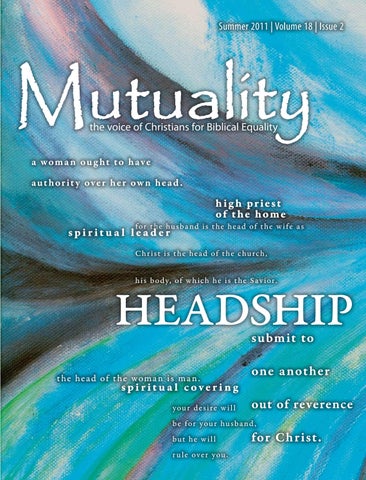
Summer 2011 | Volume 18 | Issue 2
Mutuality the voice of Christians for Biblical Equality
a wom a n ou g ht to h ave aut hor it y over her ow n he ad .
h i g h pr ie st of t he home for t he hu sba nd i s t he head of t he w i fe a s
spiritual leader
C h r i st i s t he head of t he c hu rc h , h i s body, of w h ic h he i s t he S av ior.
HEADSHIP subm it to
t he head of t he woma n i s ma n .
one a not her
spiritual covering you r d esi re w i l l
out of reverence
be for you r hu sba nd , but he w i l l r u le over you .
for Christ.
Mutuality 18.2, Summer 2011 “Let us then pursue what makes for peace and for mutual upbuilding” (Rom. 14:19, NRSV). Mutuality (issn: 1533-2470) seeks to provide inspiration, encouragement, and information about equality within the Christian church around the world. Editorial staff: Megan Greulich, editor; Image Spigot, graphic designer; Mimi Haddad, president/publisher. Contact us at: Christians for Biblical Equality; 122 W Franklin Ave, Suite 218; Minneapolis, MN 55404-2451; phone: (612) 872-6898; fax: (612) 872-6891; email: mgreulich@cbeinternational.org; web: cbeinternational. org. We welcome your comments, article submissions, and advertisements. For writers' guidelines and upcoming themes and deadlines, visit CBE’s website and follow the link under the Resources tab. Advertising in Mutuality does not imply organizational endorsement. Please note that neither Christians for Biblical Equality, nor the editor, nor the editorial team is responsible or legally liable for any content or any statements made by any author, but the legal responsibility is solely that author’s once an article appears in Mutuality. All Scripture quotations, unless otherwise indicated, are taken from the 2011 revision of the Holy Bible, New International Version®, NIV®. Copyright © 1973, 1978, 1984, 2011 by Biblica, Inc.™ Used by permission. All rights reserved worldwide. CBE grants permission for any original article (not a reprint) to be photocopied for local use provided no more than 1,000 copies are made, they are distributed free, the author is acknowledged, and CBE is recognized as the source. Mutuality is published quarterly by Christians for Biblical Equality and is sent free to members and supporters.
Contents 4
"Little Debbie" or Powerful Prophet? | Examining gender, authority, and the example of Deborah. by Jenny Rae Armstrong
7
Home Schooled: (Re-)Learning Mutual Submission | A man's struggle to embrace in his heart what he already knew in his head. by Michael Jordan
10 From "Frenemies" to Friends Indeed | One woman shares how her relationship with Ephesians 5:21-33 has transformed over many years. by Amy J. Chase 14 Refusing to Be Silent | An interview with pastor and women's advocate Dr. José Vinces. by Mary Gonsior and Megan Greulich, with Colleen Beebe Purisaca 18 Short Answers to Tough Questions | Interpreting 1 Corinthians 11:2-16. by Ronald W. Pierce
MINISTRY NEWS
20 Meet CBE's Summer Interns 20 CBE Journals Take Home Three Awards 20 Praises and Prayers 20 Reflect with Us: Mutual Submission and the Trinity
D E PA R T M E N T S 3 6
From the Editor | Courageous Men and Women Join the Conversation on The CBE Scroll | "Not So With You": Jesus' Teaching on Authority and the Kingdom of God 21 Giving Opportunities | Celebrating the Life and Legacy of Ann Irish 22 President’s Message | One Flesh, One Purpose, One Rank
2 M U T U A L I T Y | Summer 2011
websi te : cbeinternational.org
From the Editor by Megan Greulich Courageous Men and Women In the upcoming film Courageous (by the makers of Fireproof), I even read recently on a church website that the four men make a commitment to love, protect, serve, and “spiritual health and wellbeing”of the home lies “squarely on teach their wives and children, as “the spiritual leader” of the shoulders of men.” their homes. “The Bible actually has a lot to say about The problem is, as egalitarians have often emphasized, fatherhood,” the main character asserts. The conclusions he nowhere do we find a biblical mandate that men alone reaches throughout his study of Scripture prompt him to should have authority as spiritual leaders, initiators, financial write a resolution for fathers, which the men in the movie providers, spiritual coverings, or high priests. (And, actually, each sign, affirm publicly in a formal ceremony, and display passages like Rom. 12:3-8; 1 Cor. 7:3-4; 1 Cor. 12; and Gal. proudly in their homes. 3:26-28 instruct men and women to share authority). So why The resolution in Courageous encourages fathers to be do these ideas remain prevalent in the church? The resolution engaged in their marriages and in raising their children. It in Courageous is only the most recent example of the church’s challenges them to be people of prayer, to treat others with confusion over passages on “headship.” As the authors in this respect and kindness, and to live with integrity in every area issue of Mutuality highlight, rather than mandating a form of of their lives. Without a doubt, these are all worthy goals. male-only authority in the home and church, Scripture uses In fact, I find the vast majority of the manifesto to be an the concept of “headship” to emphasize unity, sacrificial love, inspiring and refreshing call to live purposely and entirely and mutual submission between men and women, as a means for Christ. of imitating Christ and advancing God’s kingdom. But, I wonder, if the Bible teaches that men are Therefore, may all believers—men and women alike— the spiritual leaders of their homes as the Courageous courageously take up the call to be engaged, prayerful, characters suggest, and if this resolution fleshes out what respectful, kind, and integrity-filled. May we all love, protect, that leadership looks like, then what is uniquely “male” serve, and teach one another, in unity and humility, because about these challenges? Is it not also the calling of Christian this is the example of our Savior. women to be engaged, prayerful, respectful, kind, and We are excited to present this issue of Mutuality on integrity-filled? Do we not also find biblical examples of “Headship,” in an effort to further explore together what godly women loving, protecting, serving, and teaching their the Bible teaches about men, women, and authority. Please families? (See Abigail’s powerful story of protection in 1 be sure to take note of the recommended resources in Sam. 25 and Sarah’s God-given authority over Abraham in sidebars throughout the issue; if you have questions, we have Gen. 21:8-14, to name a few.) resources! Please also join us on our blog, The CBE Scroll This idea that men are spiritual leaders solely based on (blog.cbeinternational.org ), to read and comment on Liz their gender develops from interpretations of certain biblical Beyer’s post exploring Jesus’ teaching on authority. Blessings texts like Ephesians 5:21-33 and 1 Corinthians 11:2-16—texts to you as you read and reflect! that discuss male “headship.” Christians have developed other ideas about these passages, too. Through my involvement Megan Greulich is the editor of Mutuality magazine. She may be with church congregations and a Christian college, I have reached at mgreulich@cbeinternational.org. personally heard believers, while citing texts like Ephesians 5, assert that: • • • • •
“Men are called by God to be the financial providers for their families.” “Men set the spiritual tone for their households.” “Husbands are to be their wives’ spiritual covering.” “As the head of their households, men should be the spiritual initiators.” “Husbands are the high priests of the home.”
booksto re : equalitydepot.com
What do you think of this issue of Mutuality? Email us at cbeinternational.org. And, help us spread the word by sharing links and your thoughts on Facebook and Twitter!
M U T U A L I T Y | “Headship”
3
Debbie” or Powerful
Prophet? What the example of Deborah reveals about gender and authority
by Jenny Rae Armstrong
T
he twenty-something man with spiky hair and trendy, too-tight jeans strummed his guitar as he spoke. “See, I’m the spiritual leader of our home, the sole provider for my wife and children…” I’ll admit, I was surprised to hear this message coming from stage during a Christian rock concert, an outreach event put on by a local church. I couldn’t help but wonder what the singer hoped his comment would accomplish, especially since he was speaking primarily to unmarried teens and the older, dual-income parents chaperoning them. I shifted in my seat and glanced at my friend, who had just wrapped up a sixty-hour week that allowed her husband to keep his youth pastor position
4 M U T U A L I T Y | Summer 2011
at the church hosting the event—a job that had great eternal benefits, but rather anemic financial ones. Seriously? This singer was going there? Mercifully, the moment passed, and he got back to banging out a U2-meets-Lincoln-Brewster-inspired mashup of southern gospel hymns. His out-of-place plug for male headship stuck with me, but no one else seemed fazed by his comment, probably because the worldview he promoted was so common—men are the spiritual leaders and financial providers, which makes women, by definition, financial and spiritual dependants. It is God’s ideal arrangement for the family and the church, according to many people, never mind that fewer and fewer websi te : cbeinternational.org
"Transparent Heart" by Gwen Meharg (drawneartogod.com). Used with permission.
“Little
Christian families fit within that mold. There are, however, no exceptions to God’s As women have gained increased perfect, unchanging principles. So, were there exceptions to the instructions influence in society, and as Bible scholars offer a consistent egalitarian interpretation of Paul gave to Timothy? Has it ever been okay for Scripture, gender traditionalists have had to women to be in authority over men, or to teach work harder and more creatively to justify the and proclaim God’s word to males? The answer, of course, is yes. subordination of women within the church The most obvious example of female and family—even to themselves. And work they have! One thousand years ago, theologians authority is Deborah, the famous prophet and conjectured that women were morally defective judge, who led God’s people through battle with (even more so than men), and needed to be their Canaanite oppressors and into forty years of controlled. More than one hundred years ago, peace. Not bad for a girl. Not bad for anyone. It seems that the prevailing whenever Deborah view was that comes up, comple women were the “Little Debbies” are sweet, mentarians try to weaker sex, and soft women whose words and brush her off as a needed guidance actions are easy to swallow and second-string leader and protection. God resorted to The current trend conform to predictable factory because he couldn’t is an attempt to specifications. But is this the find a man for the redefine woman job—never mind the hood itself, to Deborah of the Bible? fact that the Bible recast cultural doesn’t say that, and values regarding femininity as God’s perfect design for women. never mind that this idea takes a rather low It’s not that women are morally inferior to men, view of the sovereignty of God. But even if or that they are weak and need to be guided by the men of Israel were as woefully unworthy someone stronger and smarter; it’s that they’re as “Deborah-demoters” make them out to sweet, nurturing, beautiful creatures whose be, and even if God had no choice but to reason for existence is to make everything reluctantly fall back on Deborah (which is lovely for their husbands, their children, and preposterous!), the circumstances through everyone around them. It’s a perfect pitch which she assumed authority are irrelevant. If for women living in a materialistic, image- God was opposed to women being in positions focused society, who cut their whitened teeth of spiritual and civic authority over men, he on Seventeen Magazine and flip on HGTV would not have put Deborah in a position when they’re tired, depressed, lonely, or bored. of authority over men, period. God will not Better Homes and Gardens and the Bible— break his own laws, violate his own standards, or go against his own convictions, just because together at last! s unbiblical as those lines of reason some guys are being goof-offs. ing are, the question remains: How Others try to soften up the bold, do we understand verses like confident prophetess, to melt down her 1 Timothy 2:12, “I do not permit a woman strong personality and recast her in the to teach or assume authority over a man”? image of Donna Reed doing jury duty. For Christians who view the Bible as their Deborah is too potent for their tastes— sole and ultimate authority, the question they prefer “Little Debbies,” sweet, soft is not whether God inspired Paul to write women whose words and actions are easy those words, but whether they were specific to swallow and conform to predictable instructions for the original recipients factory specifications. Consider this about how to follow God in their cultural excerpt from Becoming: The Devotional context, or universal mandates that need Bible for Women, which pairs Judges 4 to be followed today. and 5 with a pretty aquamarine devotional To answer that question, we need to titled “Homemaker and Soldier?” pull out the wide-angle lens and look at a passage like this in the context of the rest The thing I love most about of Scripture. Human ethics change with Deborah is that she was married. the times, and are notoriously situational. Although she was judge of Israel,
A
booksto re : equalitydepot.com
Want more information on 1 Timothy 2? Check out these and other recommended resources at cbeinternational.org/1tim2.
Short and Sweet: Still Side by Side by Janet George What’s With Paul and Women? by Jon Zens “1 Timothy 2:11–15” by Allison Young
Bring on the Greek: Discovering Biblical Equality ed. Ronald W. Pierce and Rebecca Merrill Groothuis, see chapter 12 by Linda L. Belleville Man and Woman, One in Christ, see chapters 16–23, by Philip B. Payne
Good for Group Discussion: I Suffer Not a Woman by Catherine Clark Kroeger and Richard Clark Kroeger 1 & 2 Timothy and Titus by N.T. Wright
M U T U A L I T Y | “Headship”
5
she still had wifely duties to fulfill and a man that needed her as a companion and desired her as a lover. We can be strong and wise women with leadership skills that are powerful, yet submissive in spirit to the Lord and especially our husbands.
something immoral, such as signing fraudulent documents or not intervening when he abuses the children, the wife is biblically obligated to comply. A woman is assured that as long as she obeys God through submitting to her husband, she will not be held responsible before God for those actions (or lack thereof), since she is under her husband’s headship and “spiritual authority.” s outrageous as it sounds, this horrific misinterpretation of Huh? Scripture is surprisingly widespread and is often used by First of all, “homemaker” hardly seems like an honest way abusers to manipulate people they claim are under their to describe a woman responsible for leading a nation, unless you have an awfully broad definition of “home.” I’ve never heard “spiritual authority”: their wives, children, congregations, or anyone politicians Hillary Clinton or Condolezza Rice referred to as else below them on the world’s totem pole. Obviously, that is a gross homemakers. Besides, I seriously doubt that Deborah was going twisting of God’s Word and intent, and reveals a wrong-headed view home after a hard day of judging Israel to whip up a nice lamb stew of spiritual authority. The incredible thing about spiritual authority is that it really for her hubby, tidy up the kitchen, get the kids in the tub, and then has nothing to do with us at all—it’s God’s unwind with a few board games work in us and through us that provides us before collapsing, exhausted, with the spiritual authority we need to do the into bed. I could be wrong, but The incredible thing things God has called us to do—the spiritual hopefully the woman had a little about spiritual firepower, if you will. Read through the Bible, domestic support! authority is that and you’ll see that the spiritual authority God Second, while it’s nice lends people is very functional, for the purpose that Deborah had a sweetheart it really has nothing of equipping them to carry out their calling, to go home to, the thing I to do with us at all. for God’s glory, not their own. In fact, God really love about her is that took great pains to make it clear that it was his God used her to deliver the power working through people like Deborah, Israelites from Sisera’s cruelty. Her story was included in the Bible because of her role as a Moses, David, and Paul to accomplish his purposes in the world, leader and liberator, not because of her role as a wife. That may not any inherent powers that had been unconditionally ascribed to be hard to accept for those who believe that a woman’s ultimate them because of their gender, ethnicity, social status, or even their role is that of wife and mother, especially if they have made unique gifts and abilities. As the body of Christ, it is crucial that we pay close attention sacrificial, life-altering decisions to conform their lives to the homemaker track. But “submissive homemaker” is simply not a to the ways in which God is working in and through the people around us; that we are humble, gentle, and patient with our label we can apply to Deborah with any biblical integrity. And lastly, why would Deborah be “especially” submissive brothers and sisters in Christ, and respectful of the callings God to her husband, over and above her previously mentioned has placed on their lives—whether they are a competent female submission to God? It may have been a linguistic slip, but I judge with a nation to guide, a spiky-haired complementarian suspect that it reveals something about the worldview underlying with a golden voice and an incredible heart for youth, or a faithful, the devotional, a mindset derived from a not-so-subtle twisting hardworking mother taking overtime so her husband can stay of Ephesians 5:22: “Wives, submit yourself unto your own in his ministry position. That’s what Christian community is all about—building one another up in love, and submitting to one husband, as unto the Lord” (KJV). Now, this passage in Ephesians doesn’t mean that women another out of reverence for Christ, our one true Head. should consider the voice of her husband on par with the voice Jenny Rae Armstrong is a freelance writer who is passionate of God, but many people teach that it does—that the “spiritual about encouraging people to follow their God-given authority” a husband wields over his wife is absolute, even overriding dreams. She lives in Northern Wisconsin with her husband, God’s, since her husband is “as Christ” to her. Proponents of this Aaron, and their four boys. She is finishing up a degree in global studies from Northwestern College. extreme view claim that even if a husband asks his wife to do
A
Join the Conversation on The CBE Scroll “Not So With You”: Jesus' Teaching on Authority and the Kingdom of God, by Elizabeth Beyer I n our discussions about “male headship” and the Bible, too often we focus on passages like 1 Timothy 2 and Ephesians 5. But what are the overarching biblical principles and specific passages that show God’s ideal of mutual submission and equal authority between men and women? Visit blog.cbeinternational.org to read Elizabeth Beyer’s insights and then share your own! 6 M U T U A L I T Y | Summer 2011
websi te : cbeinternational.org
Home Schooled:
(Re-)Learning Mutual Submission It was the right decision for Jill to take the job. But who am I if I’m not providing for my family? Am I a man at all?
by Michael Jordan
The reality hit me that Jill got to go off to her office, while I got squabbling children, dishpan hands, and horrible diapers. As far as anyone knows, I was born an egalitarian. My grandmother was a college professor beloved by a generation of students, especially women. They remember her as an influential figure who encouraged them to explore and use all of their gifts. My parents shared booksto re : equalitydepot.com
leadership in the home. My church had strong female leaders and staff members. When I went to college, I chose the Wesleyan school where my grandparents taught, Houghton College, and learned about the Wesleyan Church’s historic dedication to women’s rights and women in ministry. After seminary, even though I wanted to do PhD work, I encouraged my wife Jill to pursue hers first and resumed my own studies two years later, part-time, while pastoring a church. From an early age, I understood—and preached—biblical equality. M U T U A L I T Y | “Headship”
7
So when Houghton needed a mathematician, I did not have Mutual submission can only be learned by laying down our own great difficulty choosing to resign my pastorate and follow Jill desires and actually submitting. back to our alma mater. Oh, it was hard in some ways; we were C.S. Lewis clarified this point for me. In one of his sermons blessed with a good congregation, which is more than many first- in The Weight of Glory, Lewis distinguishes between reason, time pastors can say, and we left the Philadelphia area where I was which can be changed through argument, and intuition, which born and raised. But I had absolutely no qualms about leaving cannot. In making a choice between right and wrong, we can paid employment and hoping for the best; I’d certainly be able always find new facts or data which may change our perspective to teach as an adjunct here and there, and maybe something on an issue; we may even find someone who artfully arranges full-time would open up somewhere. In the meantime, I would the facts differently than we’ve heard before and persuades be able to stay at home and be the primary caretaker for our kids, us to change our mind. But what cannot be reasoned away is Grace, then three, and Jack, then one. intuition, a basic, gut-level sense of what just It was a good situation for a progressive feels right and wrong. Our intuitions run evangelical gentleman eager to burnish deeper than our reason, and are often given to his egalitarian credentials. us very early in life from our parents and other Imagine my surprise, then, when important role models. The only way to change I found myself weeping one iron-gray an intuition is through practice and discipline, November morning when Jill left to which Lewis cheerfully calls “mortification.” teach. Not just a few silent tears stinging For instance, when we fast, we clearly see the the eyes, but full-throated sobs, like any ways we misuse food to relieve our boredom, stereotypical hysterical housewife. That anxiety, or loneliness. Abstaining from food morning, the reality of what I had done forces us to find healthier ways to cope with hit me full force: that day, Jill got to go these realities; so after fasting, we are less likely off to her office, to adult conversation, to misuse food in these ways. Through the to the validation that comes from discipline, our false desires are “mortified”— pursuing tenure. I, on the other hand, put to death—and we begin to know in our got squabbling children, dishpan hands, Submission uses our service hearts what we already know in our heads. and horrible diapers. I got the limbo that and concern for others to Lewis’s insight into intuitions helped comes from being new in town without a me to understand my inner conflict. My teach us that we are more “real” role to play, and the persistent worry upbringing had given me an intellectual matrix that I would never be a genuine part of than our achievements, to appreciate biblical equality. I learned about the community. Most agonizing, I felt a more than our powerful the pertinent Scripture passages and the female constant sense of being ignored and that leaders in the early and modern church. I also no one was grateful for the choices I had professions and positions. watched women serve in powerful leadership made. I knew in my head that my life was positions in our church. But at the same time, meaningful and that I was appreciated, but I was imbibing important messages about I simply could not feel it. myself, ideas that would shape my perception How could it have come to this? I of who I was. Early in my life, I felt a call to chuckle when I remember how, on one what my church called “full-time Christian of our first dates, I asked Jill how she service,” which pleased all the old people at felt about women serving in ministry. church, my parents included. So at a very She hadn’t really considered it and thought that it was an odd young age, I knew I had a special job to do that was affirmed by my question to ask a new girlfriend. Of course, it was an important community and important to the world. I went to school and there question to me because I knew that any person I was seriously learned self-esteem—that I could grow up to be anything I wanted, interested in would have to be an egalitarian. It was not and that I had to maximize my potential. This was buttressed by important to me that she actually asserted herself in any specific my youth group which encouraged us to use the gifts that God had leadership role; instead, it was important that she was a certain given us and to let nothing hold us back. I then went to college and type of person with a certain way of looking at the world. But heard grand tales of people who had found God’s will for their life, years later on that teary November morning, I realized that I had almost always defined by what sort of professional work they chose. embraced mutual submission only in theory. In reality, though, I went to seminary and learned the importance of boundaries in biblical equality is not a litmus test of progressive orthodoxy: ministry, of not letting people take advantage of you, of holding like so many other things about the Christian life, it is a practice, your own in business meetings and with pushy parishioners. and an issue of our hearts. That morning, I discovered that, deep All of these lessons are in some measure true and important. down, I actually knew nothing about biblical equality. It is not But they were also shaping my intuitions. Over time, these something one can inherit or even learn by simply cooperating lessons had taught me at an intuitive level that work—specifically with one’s spouse so that both partners get what they want. professional Christian work—was primarily where I followed
8 M U T U A L I T Y | Summer 2011
websi te : cbeinternational.org
The cold fact is that if I cannot wrestle with these questions and eventually move beyond them, I cannot be an egalitarian.
am. My upbringing, healthy as it was, never taught me that submission—in marriage or otherwise—is actually a normal, vital Christian activity that helps us see ourselves rightly. Submission rewires our brains and opens us up to real service, allowing us to fully enter into the life of another person without reservation, just as Christ submitted and thus fully entered into human existence. Paradoxically, submission uses our service and concern for others to teach us that we are more than our achievements, more than our powerful professions and positions. As such, it is a discipline desperately needed by both men and women, though I suspect that, in this culture, women expect submission as a normal part of life in a way I simply had not as a man. My false intuitions cannot be reasoned away. Only discipline—at times mortifying submission—can change my sense of who I am. So I get up and soothe Jack after a nightmare. I bake a cake, unsteadily at first, with Jill’s help, but I get the hang of it. I kiss Gracie’s booboos. I read and read and read. I wipe noses and bottoms. I kiss Jill and send her off to a life I’d like to live. I break up fights about the most absurd issues. I figure out how many bites of broccoli must be eaten in order to have a cookie. This is how I have to learn now. One day, I will know—really know—what it is to be a man.
I can be a theoretical egalitarian, one who embraces biblical equality as a kind of cultural marker that makes me feel superior to other Christians. But I cannot truly be egalitarian if I cannot submit to my wife and family. I cannot be the husband—or more generally, the person—God wants me to be if I am slave to false intuitions about who I really
Michael Jordan lives in Houghton, New York, where he and his wife, Jill, are raising Grace and Jack with another child expected this summer. With graduate degrees from Eastern (now Palmer) Seminary and Drew University, Mike teaches classes in theology and worship part-time at Houghton College. He is also deeply invested in the life and ministry of their local congregation, Houghton Wesleyan Church.
my calling, maximized my potential, and defined and exercised healthy boundaries. No doubt this sense was inextricably tied to my identity as a man. Like many men, I scarcely imagined an extended interruption in my professional life to care for my family. So much of my identity was having a job that fit me, and defending my right to follow my call as I thought appropriate. Consequently, my reason and my intuition were at odds. There were so many reasons why it was the right decision for Jill to take this new job: it was a great career opportunity for her; our kids would thrive in Houghton; it felt like home for both of us; I could find ways to be involved at the college, teaching part-time and interacting with students; and I felt I could be a more positive force for change in the local church by being a layperson than by being a paid staff member. All this I knew in my head; but still I found myself weeping that November morning, struggling in my heart about my identity. Who am I if I’m not actively using my pastoral gifts in a public way? Who am I without a defined professional position that lends public credibility to the ideas I have? Who am I if I am not providing for my family? Am I a pastor at all? Am I a scholar at all? Am I a man at all?
What if my church, organization, or institution joined CBE? Discover the many benefits of organizational membership today! Web: cbeinternational.org/institutions Email: cbe@cbeinternational.org
booksto re : equalitydepot.com
This emblem could be on your website! And, as a CBE member, we will place your logo on our site, for those looking for egalitarian organizations.
M U T U A L I T Y | “Headship”
9
From “Frenemies” to Friends Indeed My Transformed Relationship with Ephesians 5:21–33 by Amy J. Chase
As I grow older,
I relate to the Bible as I do my long term friends. Some friends I can remember in their teens, then twenties, and thirties. I remember the struggles we have faced over the years, the victories we have celebrated together, and how our values have grown and changed over time. That’s true of the Bible as well. I can remember what a passage meant to me in my twenties, then thirties; so different from its significance to me today.
10 M U T U A L I T Y | Summer 2011
websi te : cbeinternational.org
Ephesians 5:21–33 is one such passage. I once considered it highly suspect, not to be trusted. But over time, I came to see it as a loyal friend indeed. This, in recent years, has freed me to enjoy and partake of the passage as it points to the glory of God.
Friends or “Frenemies”? Upon first acquaintance with Ephesians 5:21–33, I was pretty turned off. The husband is the head of his wife? How could this be taken as anything other than an insult to women? My reaction: I already have a head, thank you very much. It may not be perfect, but it’s at least comparable to that of any male I know. It certainly didn’t help that I was reading the NIV 1984 translation at this time, which separates verse 21 from 22 by inserting a heading between them, “Wives and Husbands.” This of course divorces the concept in verse 21, “submit to one another,” from what follows, making verse 22 appear to introduce the guiding principle of the passage: “Wives, submit to your husbands.” In addressing husbands later on in the passage, Paul came across to me as one patronizing stuffed shirt pep-talking another: Come on, do your duty, men—you’re really doing yourself a favor! Once you “wash” your woman, you won’t have to put up with her stains or wrinkles or blemishes; you can present yourself with a beautiful, radiant, sparkling bride! Eew. What influenced my reaction? Was it the personality I was born with, or the way that I was raised? Was it simply a rebellious spirit that must be excised? I felt wary, like I had fallen prey to a bait-and-switch—I had been drawn to God because of his great love and faithfulness, only to find that the outcome is subservience to another human being. Some people I knew encountered Ephesians 5 and walked away from Christianity. Paul demeans women, they said, and that’s wrong. I could see the point, but I didn’t walk away from my faith. Instead, I did my best to reconcile this seemingly demeaning text with the God that I knew and believed in—the God who is kind, who doesn’t oppress, who made both men and women in the image of God, and who set them both in the garden and directed them to rule together. There was a lasting, unconscious impact, though. Deep inside, the knowledge registered that since Ephesians 5 demeaned women, then the Bible, and therefore God and even other Christians, may not truly be for me, a female. Ephesians 5 became my “frenemy”: seemingly supportive, as God’s inspired Word, but in reality profoundly undermining to my best interests, because its message competed with what I knew to be true of God.
A Loyal Friend Indeed In my twenties, as I interacted more deeply with the passage, I realized that first impressions can be deceiving. I read Beyond
booksto re : equalitydepot.com
Sex Roles, by Gilbert Bilezikian. Its convincing, biblically-based argument for equal partnership between men and women in church, home, and society seemed a vindication: “I knew it! Now this sounds like God.” Maybe Ephesians 5 and I could be true friends after all. From Beyond Sex Roles I learned that any portion of Scripture needs to be considered in relation to the whole. We must weigh a passage like Ephesians 5 that seems to deny equality or limit women’s leadership against other passages that affirm women in these areas (such as Judg. 4:4, Prov. 31, Luke 10:42, Acts 2:18, Rom. 16:3–7, Gal. 3:28, etc.). Beyond Sex Roles also introduced me to the challenge of translating a text not only from Greek to English, but also from the culture of the first century Roman Empire to our present cultural context. The Greek word kephale that we find in Ephesians 5, for example, means “head,” but its figurative use in ancient times differed from the associations that we attach to it today. We use this word to reference a boss, CEO, or some other authoritative leader, but Bilezikian demonstrates that in ancient times, the term signified something more akin to “life source” or “nourisher.” In large part, therefore, ideas of male authority and dominance that we derive from this term in Ephesians 5 are meanings that we impose upon the text, and are not, Bilezikian shows, intended by Paul.
Deep inside, the knowledge registered that since Ephesians 5 demeaned women, then the Bible, and therefore God and even other Christians, may not truly be for me, a female. Since reading Beyond Sex Roles, I have also learned of Roman household codes—the written rules that delineated the lines of authority within a Roman household. Roman society possessed strict class divisions, ascribing status, power, and privilege to the upper tiers and subservient dependence to the lower tiers. The paterfamilias, the male leader, possessed almost absolute authority over the members of his household, sometimes even determining whether they lived or died. Comparing copies of Roman household codes to biblical texts reveals that the authors of New Testament household codes, such as those found in Ephesians 5, borrowed the form of the Roman codes but dramatically changed their content (Introducing the New Testament, p. 387.) Such changes would have been obvious and significant to Paul’s audience, each member of whom knew well his or her station, role, and boundaries according to Roman society. So the phrases in Ephesians 5 that initially struck me as oppressive would have struck original readers as radically counter-cultural, freeing both women and men from hierarchy in their relations with each other because of their new status in Christ. In Ephesians 5:22, wives are instructed to submit to their husbands not as is fitting to their station, but “as is fitting in the Lord,” meaning, as already stated in verse 21, that all Christians are obligated to submit to one another. Husbands, then, are not
M U T U A L I T Y | “Headship”
11
Want more information on Ephesians 5? Check out these and other recommended resources at cbeinternational.org/eph5.
Short and Sweet: New Man, New Woman, New Life by Carrie A. Miles “What is Male Headship?” by Mimi Haddad “Ephesians 5:18–33” by Allison Young
Bring on the Greek: God's Word to Women by Katharine Bushnell Discovering Biblical Equality ed. Ronald W. Pierce and Rebecca Merrill Groothuis, see chapter 11 by I. Howard Marshall Man and Woman, One in Christ, see chapter 15, by Philip B. Payne
Good for Group Discussion: Ephesians by Lynn Cohick Studies on Biblical Equality: 12 Lesson Outlines for Personal or Group Study by A. Berkeley and Alvera Mickelsen
to rule their wives, as was the obligation of every Roman husband, but to love their wives (v. 25), and to do so in the manner that Christ loved the church, that is, in holding back no part of himself or his resources for the betterment of his bride, the church. So over time, this text and I grew into deep friends. No longer did I view it as demeaning to women. Rather, it actually elevates them, by presenting husbands and wives as equals, with the mutual obligation to serve.
This Friend Points Me to Christ I’ve been married for eighteen years now, and, no, not every moment has oozed unparalleled bliss. But, a fair number! Many believe a marriage of functional equals cannot work. Without a designated authority to make that “final decision” in times of conflict, they fear the family will devolve into chaos as husband and wife lock horns. It has not been like that for us. The simple willingness to mutually seek each other’s benefit prevents most conflict from arising and goes far in resolving those that do. We have also benefitted from invoking alternative methods of conflict resolution listed in Beyond Sex Roles, including, “wait to make a decision,” “give greater weight to the person most affected by a decision,” and “seek the counsel of mutually trusted friends” (p. 212–214, second edition). No, the challenges in our marriage have been more external than internal, related more to coping with quite typical disappointments and stresses of modern American life rather than clashes of power between us. I myself have failed in some relationships and goals. I’ve struggled to fulfill responsibilities. I’ve been wounded sometimes. In these times, Brian has loyally stood by me, stuck up for me, and sought to help me in any way that he knew how. So often this casts my mind back to my old friend Ephesians 5:21–33, with its image of washing—a household slave’s demeaning task and the shocking image Jesus also employed when he disrobed and knelt before those who called him “Lord.” Brian has smeared antifungal cream around my toes. He has braced my back in a birthing tub swirling with all sorts of delightful bodily goo. He has not only served me over the years, but also preserved me, and, at times, even restored me. Perhaps a complementarian could interject here, “But of course, that’s his role. He is your knight in shining armor.” But, I trust the rescue is reciprocal—and I will not allow the way others may interpret my story to prevent me from luxuriating in the glory of God as revealed in my marriage. When Brian empties himself in service to me, and I think, “That is so Christlike, so godly,” I am following the example of Paul. He, likewise, in Ephesians 5 could not remain focused on husbands and wives, but fell to waxing rhapsodic over the mystery of Christ and his church. So in these recent years I’ve come to appreciate new qualities in Ephesians 5:21–33. In it I now celebrate the same sentiment as that which I find in Philippians 2, where Paul also exhorts Christians—both male and female—to follow the example of Christ. His greatest glory was achieved, not by retaining his assigned exalted status, but by surrendering it. That the Creator should do this for his creatures, and that each of us can surrender our status for one another, these—you are right, Paul—are mysteries indeed.
“The Cultural Context of Ephesians 5:18–6:9” by Gordon D. Fee 12 M U T U A L I T Y | Summer 2011
In Ephesians 5:22, wives are instructed to submit to their husbands not as is fitting to their station, but “as is fitting in the Lord.”
Amy J. Chase graduated from Fuller Theological Seminary in 2010 and teaches the Bible part-time while researching PhD programs in Old Testament studies. She lives in Bellevue, Washington, with her husband, Brian, and two children, Ben and Jane.
websi te : cbeinternational.org
Christians for Biblical Equality Presents...
Transforming Sex, Power, and Prejudice Seattle, Washington July 29-31, 2011
cbeinternational.org/seamu 612-872-6898
booksto re : equalitydepot.com
M U T U A L I T Y | “Headship”
13
Refusing to Be Silent: An Interview with Pastor and Women’s Advocate Dr. José Vinces
We often ask, “Why does God let abuse happen?” But I think the Lord may be asking the church, “Why do you allow it?” Martin Luther King, Jr. said that if there is one thing this generation should repent of, it’s the chilling silence of those who call themselves righteous. –Dr. José Vinces by Mary Gonsior and Megan Greulich, with translation by Dr. Colleen Beebe Purisaca
Dr. José M. Vinces is a husband, father, pastor, and lawyer. He is co-founder and executive director of Paz y EsperanzaEcuador, a pioneering Christian organization located in Guayaquil that seeks justice on every level of society. Dr. Vinces has worked for over twenty years on pastoral and integral mission issues, which includes defending, from a Christian perspective, the rights of women and children victimized by sexual and domestic violence. His work focuses on educating and equipping evangelical pastors and lay leaders, so that they may be salt and light in the fight against sexual and domestic violence, both in and outside the church. He has also trained leaders in civil society as well as public officials such as judges, prosecutors, and police officers. CBE sat down recently with Dr. Vinces to discuss the role of theology in ending and preventing violence against women and children. Dr. Colleen Beebe Purisaca, co-international director of Paz y Esperanza’s sister organization in the U.S., Peace and Hope International, provided additional comments and simultaneous translation from Spanish to English.
Dr. José M. Vinces, pictured here at Park Avenue United Methodist Church in Minneapolis, Minnesota.
14 M U T U A L I T Y | Summer 2011
websi te : cbeinternational.org
CBE: How did you get involved with your ministry to end domestic violence? JV: The starting point for me was studying what we in the church call “holistic mission,” learning that men and women have the same dignity. I come from Peru, where I grew up in a situation of conflict. Many women at that time—many strong women—became the heads of their households because they were widowed. These women contributed greatly to the peace-building in our country. So it was from that very experience of growing up in a country of violence, and reinforced by a theological perspective that is grounded in equality, [that I began my work]. As a holistic mission organization in Peru, initially we started working with innocents who were unjustly put into prison. And then we started getting into other areas of work [such as] providing services for victims of sexual and domestic violence, and defending their rights. But also, in terms of education, we learned that it is important to have some programs directed to church leaders and pastors, both women and men. CBE: What kinds of programs do you offer?
So then we talk about their rights. There’s just a radical change when women learn about their rights. [As part of the program], we established formal networks between these women, and they started doing advocacy. They go and sit at police stations and monitor how police treat women there. Or they accompany women to the police station to help them make their complaint. So then the authorities have accountability and are forced to take action. In all of our work, we have a circular model of services to solve this problem of abuse, with four main components: psychological assistance, legal help, pastoral care, and material aid. But both prayer and public advocacy have to be in every step of that. We have to approach the problem from a holistic perspective. And in Latin America at least, working on issues of peace building and justice is much easier to work for in secular society than it is within the church. CBE: Why is that? JV: Sometimes when we have an inadequate knowledge of what the Scriptures say—such as when we think the “head” is the authority figure—then the Bible can be used to mistreat, rather than free, women. So the churches are not going to do anything about injustice. That’s the foundational problem. In our office, 80% of our cases of domestic violence come from within the church. This is why we are very concerned with educating the church, and especially pastors, on the theology of these issues. We have spoken with women who have been married twenty-five years, who break down and say, “I need help. What
JV: In my work in Ecuador, we have had two graduating classes from a training program which has been accredited by a seminary. Our purpose has been to incorporate our curriculum into seminaries. In Latin America we have very strong cultural traditions of patriarchy, and some theologies actually contribute to the problem. In Latin American seminaries, we are taught that women should submit. The Bible is used to justify much abuse. So we are experimenting with …we try to talk to churches about how they can get these training programs, to give another perspective to the traditional theological perspective. It’s the same involved. We think the church is co-responsible. And thing CBE works on. The content of the program we’re thankful and happy to see that there’s a kind of includes the context of how people have been in situations of violence, and the biblical perspective— awakening among our sisters in Christ. They are saying, we talk about Genesis, Ephesians, Galatians, etc.— “We have never heard this in church before.” and the inadequate patterns of behavior and the causes and consequences of violence. We also talk about legal information. In Ecuador, we have can I do? I talked to my pastor and he’s told me, ‘Keep praying, laws that protect women, but there’s a lot of misinformation keep praying. One day he will change’.” We say, “Do you think about those laws. So we train people to come alongside women that is right? What do you think?” And they respond with, “But who have been abused. We’ve trained leaders to lead public if I leave him or if I report him, wouldn’t I be going against campaigns and accompany victims. They know the law, how to God’s will?” So we know violence exists within the church. But identify victims, and how to work with [public officials]. We sadly, the church remains silent about it. also train prosecutors, judges, and police on how to work on these issues within the legal system because, unfortunately, CBE: What is that breaking point when women realize that they there’s a lot of blaming of victims. So our intention is to give tools don’t have to accept the abuse? about international laws and how to monitor the enforcement of the laws. Then we try to talk to churches about how they can JV: At least in Latin America, there’s an economic dependence get involved. We think the church is co-responsible. And we’re on husbands, in that they ask themselves, “If he leaves me, what thankful and happy to see that there’s a kind of awakening will I do? I have four children, I have to give them food.” We among our sisters in Christ. They are saying, “We have never have had very sad cases when women haven’t done anything about the abuse. They have preferred to defend their husbands who have heard this in church before.” In Peru, we have a program called Women without Violence, sexually abused their children rather than leaving and reporting Women in Development [in which we lead women’s workshops]. them because, “If your dad goes to prison, what are we going to do?” The first question we ask out of the gate is, “Who do you think has But we have seen cases where women have been educated that they more value—women or men?” And 99% of these women say, “Men.” are valuable as human beings and that it’s not God’s will that they booksto re : equalitydepot.com
M U T U A L I T Y | “Headship”
15
"But My Pastor Said..." Too often pastors and church leaders encourage women to remain in abusive situations. Women who come to Paz y Esperanza have reported hearing the following from their pastors: “ God has given you your husband, you should accept him the way he is.” “ This is a test from God. You should forgive him.” “ If you report him or divorce him, what kind of testimony will that be?” “ If you denounce him, he won’t come back to the Lord.” “ He’s your husband, you should forgive him.” “Even though he hit you, you’re not as bad off as you could be.” “ Children of God should not go to the worldly authorities, go to trial, or use the legal system.” “ Wait on God, pray, and God will change things. Keep praying.” “ You’re shaming the father of your children.” “ These are the consequences of getting pregnant and marrying a man who isn’t a believer.” “ The husband is the head of the household, you have to obey him.” “ God gives the man power over your body.” “ [As a pastor], if I report him, then my ministry will be ruined.”
be abused. And there’s a spark that goes off. We have a testimony where a woman realized [her worth and rights] and she said to her husband, “If you hit me again, [I will take action].” And her husband never touched her again. You know better than I do that abuse is a vicious cycle. We have seen cases where, as a consequence of the beatings, a sister from a church who had been married for maybe thirty years had to go to a psychiatric treatment center. There’s an extreme point when a woman doesn’t have her own will any more, when she doesn’t have We visit directors of seminaries a choice any more. Sometimes we think, “Why don’t you just leave and say, “Look. Every day, him? God’s will is to protect you. newspapers show killings, Leave him! And don’t wait until he harms you more or even kills you!” murders, rapes. Do we think this But there’s just a strong mentality is the kind of life God wants for that is so hard for them to break. Someone who has been beaten over his children? Don’t you think the span of twenty years is not going that if we’re called to promote life to change overnight. Our work is to be patient. And our spiritual/ then we should do something?" pastoral care is so important to help break down [those incorrect theologies]. Women have to be able to incarnate the truth that God doesn’t tolerate violence. Only then are they able to take the legal steps and report their husbands. This is why we have to talk about the biblical theology along with the legal aspects. [When these are taught together], we have seen an awakening in the church. CBE: What other factors contribute to the prevalence of abuse in Peru and Ecuador? [Comment from Colleen Beebe Purisaca] In Peru, there was a twenty-year civil war, and rape and sexual abuse were actually used as weapons of war. In fact, the World Health Organization says Peru is one of the most dangerous countries for women, and 40% of women in Peru say they have been raped. The effects of the decades of violence linger, and the result is heightened incidences of domestic and sexual violence. Also, in certain cultures, incest is more acceptable. People simply don’t talk about it, and victims are blamed. Corrupt or ineffective legal systems contribute to the problem, too. These are systems where the police don’t get paid enough, or don’t know how to do their job, or are bribed not to do their job. The same problem exists with the prosecutors, and the medical forensics people, and the judges. So you have these systems on top of a total disregard for people who are poor. It’s hard enough to get access to justice when you have money. If you don’t have any money at all, then it’s impossible. In Ecuador, for example, out of every 1,000 crimes reported, only five actually get convictions and sentencing. It’s outrageous. JV: Cultural jokes are also very common. A common phrase in Peru is, “The more he hits me, the more he loves me.” People celebrate that and laugh at it. And people in the church will say this, too. The church does nothing to stop it. In Ecuador, they say, “A husband who kills is a husband.” Femicide, or the murder of women by men, is a huge problem. For example, a neighbor of ours killed his wife. She had filed a complaint against him that morning, but before they could come pick her up, he strangled her. And he killed his five-year -old daughter with a hammer. He was a professional man—this happens in all classes. It is a very difficult issue. CBE: What triggers this type of tragedy? Are alcohol or drugs involved? Is it simply rage-induced? JV: These are not justifications. We believe that all violence, whether sexual, physical, etc., has to do with an abuse of power. And there is no justification for it, no matter the extenuating circumstances.
16 M U T U A L I T Y | Summer 2011
websi te : cbeinternational.org
Sometimes people criticize, “What are you doing with the husbands?” We acknowledge that we need to be working with husbands. However, we are working in the context of a system where even the government gives defense lawyers to the aggressors but the victims have no one to defend them. So we prefer to help those who have nothing, to help them understand their rights and achieve justice. And we want the church to be a part of this, to do its job.
CBE: What would this Christian network of good look like?
CBE: So the daughter was seen as less valuable than bags of potatoes?
JV: There’s a great blessing from the Lord for all of us who thirst and hunger for justice because justice is profoundly rooted in God’s heart. When God looks over the earth, he sees men and women and governments who do evil and injustice, and his heart becomes indignant. He detests the abuse of power and evil. But that’s not where it ends. He intervenes. And he uses us. It is a privilege. And I think our job as men and women is to imitate a God who loves justice. So when all types of evil come against you, it’s a paradox, because it is also a joyful and blessed thing to suffer for what is right. We must remember the Lord’s ministry. He freed the chains of the oppressed. He consoled and restored. He healed the pain of the people, of all the people. This is tiring work, and we may not always see change, but in the long run, the Lord responds. He has it all in his hands. He has our backs. And he consoles us in our tears of indignation, of impotence. They become tears of joy and of gratefulness to the Lord. Because he allows us to see that change is possible. It is possible. We need to show this to the world.
JV: In Ecuador, we have started an evangelical network with the prerequisite that whatever we do goes on beyond the church—it must also affect the community. The context of violence in which we live in Ecuador, is a holistic problem and the church has huge responsibility. As Christians we should be the ones people are looking at to work against corruption. But we’re not doing that. So what we try to do is visit leaders and directors of seminaries and we CBE: It sounds like perpetrators are more likely to have financial say, “Look. Every day, newspapers show killings, murders, rapes. Do power and other kinds of power over their victims. we think this is the kind of life God wants for his children? Don’t you think that if we’re called to promote life then we should do JV: Yes, that’s true. One kind of their power is economic. But they something? We don’t really know what we want to do, but we need also have cultural power, such as the widespread beliefs that the to be concerned together about what is going on around us.” These man is more valuable than the woman, that the man is dominant conversations have led to conferences on the role of seminaries in and macho, and that the woman has to subject herself to the man. working to end injustice and seminary curriculum that incorporates These ideas are rooted in Latin American culture. And they are issues that have to do with daily life. And students have started reinforced by this incorrect theology of male headship. writing theses on relevant topics. For example, there’s a seminary student who has been trained by us, and his thesis is on how the CBE: But what does a father do when his daughter is abused? church can help children who have been sexually abused. So the institutions that form a part of this network can JV: Well, 80% of the cases send their future pastors to our institutions to We must remember the Lord’s we see come from within be trained on how respond to these issues. What the family—the abusers are happens when someone comes to a church who ministry. He freed the chains of brothers, uncles, or fathers. has been abused, or who has HIV, for example? the oppressed. He consoled and Through the training and the network, we can But, I remember a case of a little girl from a rural area refer them to specialized services. restored. He healed the pain of who had been abused, and the the people, of all the people. perpetrator came to the family CBE: This is obviously exhausting and and wanted to negotiate. He sometimes discouraging work. Are there brought bags of potatoes to the father of the girl who had been certain Scripture verses that you hold onto, that encourage you? raped, to negotiate so that he wouldn’t report the crime. What kind of support do you have to keep working on this?
JV: Yes, that’s it. We’ve had cases that have caused us extreme indignation. Parents have come to report the rape [of their child] to us, but only because the negotiations with the aggressor failed. But there are very good parents too, who suffer a lot and do all they can do to make sure their children are defended. For example, there was a horrible case where an eight-year-old girl was raped and murdered by two men. Everyone knew who they were. The police investigated, and the evidence disappeared because the police were paid off. But the mom went to court, she held protests, she led an international campaign. She was the one really going to bat for her daughter, and she advocated on her behalf for years. I think the challenge we have as Christians is how to learn from the networks of evil. Satan and his minions organize. They plan. Why don’t we as Christians unite and organize and plan against evil? Why don’t we create our own network of good? Sometimes working on issues of justice is to be a stone in a shoe of someone. And we have had to face some perpetrators who have a lot of economic and physical power. They have been authorities and officials, and even owners of radio stations who have threatened us with death. But nonetheless, that’s where we see God’s hand at work. booksto re : equalitydepot.com
Mary Gonsior is operations manager for CBE. She lives in Minneapolis, Minnesota, where she is active in her local church and neighborhood. Megan Greulich is editor of Mutuality magazine. She lives in Saint Paul, Minnesota, where she runs a cake business out of her home and volunteers with her church's youth group.
M U T U A L I T Y | “Headship”
17
Short Answers to Tough Questions How Should We Interpret 1 Corinthians 11 : 2–16? by Ronald W. Pierce In 1 Corinthians 11:2-16, Paul calls the men and women who were praying and prophesying in the assembly at Corinth to respect culturally relevant gender markers like head coverings, hair lengths, and hairstyles as a way of honoring God and each other. In doing so, he uses the metaphor of “head” and emphasizes interdependence between men and women. He shapes this passage in such a way that the key points are set in parallel groups with the strongest emphasis appearing at the center. As he did in his letter to the church at Ephesus, Paul utilizes the metaphor “headship” in a creative way. In Ephesians 5, he started with the common cultural assumption of “male headship” including “male authority,” then dramatically turned the idea upside down emphasizing in its place mutual submission in terms of a radical and sacrificial love—yes, specifically from husbands. Paul makes a similar play on words here, though this time he nuances the other common idea of male “headship” in terms of “source” or “point of origin,” such as the “head” of a river. (Examples of this are found in both creation accounts, such as in Gen. 1:1, where the word usually translated “in the beginning” is literally “at the head.”) In 1 Corinthians 11, Paul employs this “point of origin” imagery to emphasize the essential unity between men and women. He starts by explaining that “the head of every man is Christ” (1 Cor. 11:3), most likely referring to Christ’s
Parallel Structure in 1 Corinthians 11:2-16 A (v. 2-3) Understanding good traditions: Christ the head of man, man the head of woman—God the head of Christ. B (v. 4-6) Men who pray/prophesy with head covered, and women who do so with head uncovered, both dishonor their heads. C (v. 7-9) Man the image/glory of God and woman the glory of man; woman created from and for man. D (v. 10) Therefore women should exercise authority over their heads because of the angels. C1 (v. 11-12) In Christ women and men are interdependent. Woman came from man who thereafter comes from woman—all come from God. B1 (v. 13-15) Women should pray with heads covered. Nature shows men’s long hair is disgraceful, while women’s long hair is a covering. A1 (v. 16) We have no other practice—nor do the churches of God.
18 M U T U A L I T Y | Summer 2011
role in creation (see John 1:1-3). Christ is the head of every man as the Creator because he is the “source” or “point of origin” of the first man Adam. Paul then extends his use of creation imagery in 1 Corinthians 11:3 with his second comparison, “the head of woman is man.” Just as Adam came from Christ the Creator of all things, so Eve was taken from Adam (Gen. 2:18–25). In his third comparison, Paul steps back to see the bigger picture by declaring, “the head of Christ is God.” Perhaps it seems surprising that Paul’s order was not “woman-man, man-Christ, Christ-God” (thus, implying a hierarchy with God the Father at the top). But, the apostle is not making that point here—in fact, nowhere does he make that point. Instead, his order is, “manChrist, woman-man, Christ-God.” This follows solid New Testament Christology by associating Jesus with the creation of man and woman “in the beginning” (John 1:1-3) and declaring without contradiction that Jesus “came from God” in the incarnation (John 13:3). Taken together, the three comparisons in 1 Corinthians 11:3 are representative of Paul’s recurring theme of mutuality. In other words, both women and men come from God (Gen. 1:26–27) even though the man was created first and the woman was taken from him (Gen. 2). Paul’s all-inclusive reading of the creation and procreation orders is reinforced in the center sections of this passage (1 Cor. 11:7–12). Yes, it’s true that woman was created second and for the sake of the man’s aloneness (Gen. 2:18; 1 Cor. 11:7–9). However, it’s also true that neither man nor woman is independent of the other, for as woman came from man so men are born of women and everything comes from God (Gen. 2:20; 1 Cor. 11–12). Paul’s interpretation of the Genesis creation accounts and the main point he is making from them are clear: the orders of creation and procreation speak of mutuality with diversity. The two “orders” are meant to be set side-by-side. Having laid the theological foundation of gender interdependency, Paul turns to a more pragmatic concern: head coverings. It was customary in Paul’s day for women in “the churches of God” (1 Cor. 11:2, 16) to cover their heads, and for men to keep their heads uncovered. Moreover, the apostle instructs them to follow this traditional practice when praying or prophesying in church gatherings of that time (11:4–7, 13–15). The issue for Paul at hand is that men and women should present themselves in a way that honors their gender uniqueness—especially when they are up front in church. Moreover, they should do this in a way that is respectful in the surrounding culture. Matters of general decency or even one’s simple cultural preferences should never be allowed to distract from the message being preached. Here we come to the central verse of this passage, 1 Corinthians 11:10. Quite literally, it comes at the center of the parallel structure of the apostle’s argument, a kind of structure that was common for websi te : cbeinternational.org
Jewish rabbis in Paul’s day, steeped in the Hebrew literature of the Old Testament. The climactic punch line is, “It is for this reason that a woman ought to have authority over her own head because of the angels.” Let’s unpack his cryptic yet powerful statement piece-by-piece. First, exactly what is Paul’s command to the women who were praying and prophesying in the assemblies at Corinth? Literally, the text reads, “a woman ought to have authority over her own head” (NIV)—not a “sign” or “symbol” of authority as some translations add. In the church at Corinth, Paul speaks specifically to the women who are “praying” (leading public worship) or “prophesying” (preaching the gospel) in front of the church assembly. These women leaders are to have or exercise “authority over their own heads.” This could mean one of three things. One, it may mean something as simple as letting women decide how they wanted to “cover” their literal heads—that is, which hairstyle or external covering they prefer. Or, two, perhaps Paul is reminding the women to exercise that authority and keep their heads covered. Or, three, since Paul specifically acknowledges that the husband is the “head” of the wife at the beginning of this discussion (1 Cor. 11:3), his advice to the women prophets may carry forward his recurring theme of mutuality. In this sense, the apostle would be reminding the privileged male leader of the Roman household that when his wife speaks as a prophet, she speaks with authority over her “head” meaning her husband. Whether Paul was endorsing the right of a woman prophet to choose her head covering, calling her to cover her head, or validating her authority as a spokesperson for God (like Deborah to Barak in Judg. 4–5, or Huldah to Josiah in 2 Kings 22; 2 Chron. 34), it is clear that women were serving as worship leaders and prophets in the New Testament church. Moreover, they were doing so with the apostle’s blessing and even with a divinely given sense of authority. Second, what is the reason for Paul’s command? In a centered structure such as this one we must look on both sides of the main section. In this case, 1 Corinthians 11:7–9 and 11–12 complete the larger thought. As we saw above, these verses speak of the mutual interdependence of men and women as illustrated in the creation-procreation orders. Thus, the apostle reasons, (a) it is because man came first in creation and (b) because women come first in procreation that (c) a woman worship leader or prophet ought to have authority over her head. In other words, his advice to the women is linked directly to the idea of rebalancing patriarchy into mutuality. Though the men generally ruled in the household in that day, men and women could equally share leadership in the church. The other reason given here is “because of the angels.” Even though there are almost as many interpretations of this little clause as there are interpreters, we dare not ignore the apostle’s words. To me, it seems most reasonable to connect “the angels” with the fact that many of these women were prophesying. In the Bible, as well as in much of the extra-biblical Jewish literature at this time, angels were the ones who mediated prophecy. In other words, they communicated God’s Word to the prophets who in turn communicated it to God’s people. We find this in several of the later books of the Old Testament (for example, Dan. 8–12; Zech. 1–6). Therefore, because women prophets were empowered by angels they ought to have authority over their own heads. In 1 Corinthians 11:2-16, Paul is concerned that both men and women should exercise their leadership gifts—with appropriate authority—while presenting themselves in a manner that celebrates the uniqueness of their respective genders. The cultural markers for this will vary widely from time-to-time and from place-to-place, but the principle endures. Although our appearance should not be dictated by the culture around us, we should be sensitive to how we appear within that context—especially regarding those to whom we minister. Ronald W. Pierce (PhD, Fuller Theological Seminary) has taught biblical studies and theology at Biola University since 1976. He is co-editor of Discovering Biblical Equality: Complementarity without Hierarchy with Rebecca Merrill Groothuis and Gordon Fee. Ron and his wife Pat live in Fullerton, California and have two adult children.
Want more information on 1 Corinthians 11? Check out these and other recommended resources at cbeinternational.org/1cor11.
Short and Sweet: Partners in Marriage and Ministry by Ronald W. Pierce “1 Corinthians 11:2–16” by Allison Young
Bring on the Greek: 1 Corinthians by Alan Johnson Discovering Biblical Equality ed. Ronald W. Pierce and Rebecca Merrill Groothuis, see chapter 8 by Gordon D. Fee Man and Woman, One in Christ, see chapters 6–12, by Philip B. Payne
Good for Group Discussion: 1 Corinthians by N.T. Wright “Beginning With the End: Understanding the Passage from the Bottom Up” by Alan G. Padgett
Portions of this article are taken from Ron Pierce's new book, Partners in Marriage and Ministry. Buy your copy, in print or e-book format, at equalitydepot.com. Save 25% when you use discount code MUT1COR. booksto re : equalitydepot.com
M U T U A L I T Y | “Headship”
19
P R A I S E S A N D P R AY E R S praise god with us for…
• Funds to bring many internationals to our Seattle conference (learn more about the conference on p. 13!) • Three passionate and dedicated interns at CBE this summer. • The translation of CBE’s statement into Farsi and Khmer. • Many book reviewers and faithful CBE volunteers. • The addition of several new CBE church and organizational members.
pray to god with us for…
• Seattle conference sessions to bring the impact God desires. • For international conference attendees who are obtaining visas and traveling. Pray that they would find favor with government officials. • For CBE staff as they switch into high gear for conference preparation. • Those who attend our conference, that they might find healing, reconciliation, intimacy with God, biblical resources, and new confidence in their calling. • Continued momentum with our new e-commerce solution. • God’s guidance with curriculum projects. • Our special edition journal for the ETS, and for our presence at this year’s convention.
reflect with us… Mutual Submission and the Trinity
by Jo Ellen Heil, inspired by Susan McCoubrie Male headship. Mutual submission. No matter what your stance, it's a hot topic these days. Many cite a hierarchical "Father, Son, and Holy Spirit" line to support male headship, particularly in marriage. Yet when we study the Trinity in Scripture, we see nothing but mutual submission and love. Sharing is at the heart of their relationship. Whether it was the creation of the universe, the current expansion of the kingdom of God in us, or the glories to come in the New Jerusalem, the Trinity has always worked together in love. We glimpse this mutual submission throughout the Bible, but see it most clearly in the Gospels. The Father repeatedly affirms the Son in public, and the Son gives complete credit to the Father. The Son then leaves his closest friends and family so that the Comforter can arrive; the Comforter continues and expands the Father's work in the church. By working together, the Creator's love is revealed, we are redeemed by the Son of Man's sacrifice, and sanctified by the One Who Comes Alongside to Assist. Salvation's work needs each Person of the Trinity to be completed. "Almighty God, we thank you for revealing to us your eternal being of perfect love as God in Three Persons. May your praise ever be upon our lips. Give us grace to continue in our faith and be constant in our worship of you. May all glory be yours, for you live and reign as one God, now and forever. Amen."
20 M U T U A L I T Y | Summer 2011
MINISTRY NEWS Meet CBE's Summer Interns!
Sarah
Jen
Mariel
Sarah will be coordinating volunteers for outside events, helping with details for our 2011 conference, and writing articles for a variety of CBE’s ministries. "I am very excited to be working with CBE because I will have the opportunity to refine and strengthen my voice for biblical equality. I hope to meet people who will challenge me, read books that will inspire me, write from my deepest convictions, and have a ton of fun doing so." Jen will be editing our 2011 special edition journal for the Evangelical Theological Society, helping with our online bookstore, and editing our weekly e-newsletter, Arise. “I am excited to work at CBE because the organization has been a constant source of encouragement to me as an advocate for gender equality, and I used CBE'S great resources in my campus ministry.” Mariel will be researching for Women’s History Month, finding ways to get our publications into libraries, and creating archives and indices of Priscilla Papers and Arise. “I am excited to be working at CBE for the summer because they were so important to me rediscovering and defining my faith.” Visit cbeinternational.org/internship to learn more about becoming a CBE intern.
CBE Journals Take Home Three Awards We are pleased to report that at the recent convention of the Evangelical Press Association, CBE publications received three Higher Goals awards. Priscilla Papers won second place in the Student Writer of the Year category for David M. Csinos' “Will Boys Be Boys and Girls be Girls?”. Mutuality received two third place awards: Critical Review went to Hollie Baker-Lutz's review of the Eldredges' Love & War, and Student Writer of the Year went to Nicholas Colby Watson Wolfe's "From Hatchet-Man to Women's Advocate." Read the award-winning articles at cbeinternational.org/epa.
websi te : cbeinternational.org
GIVING OPPORTUNITIES by Nicholas Colby Watson Wolfe
Celebrating the Life and Legacy of Ann Irish Ann Irish, committed Christian, gifted doctor, and beloved CBE member, passed away on August 10, 2009. Please join us as we honor her extraordinary life and generosity to CBE. Born Roberta Ann Irish on April 3, 1925, in Ohio, Ann was the second of three children. Ann accepted Christ when she was twelve years old, and, just a few months later, dedicated her life to missionary service overseas. As an intelligent and avid student, Ann attended medical school. While there, she was often disapproved of, looked down upon, and told that she was “taking the place of a man.” But Ann was disciplined, ambitious, and committed to her values and calling. Her tenacious personality and serving heart allowed her to confidently persevere. Ann had a bright mind and the spirit of a healer. She loved medicine, and she loved Christ, which showed through her selfless disposition and willingness to give up her own comfort for the benefit of others. Ann’s commitment to missionary service led her to practice medicine in countries like Democratic Republic of Congo (formerly Zaire), Belgium, the Dominican Republic, Liberia, Pakistan, and the United States. Ann officially retired in Oregon in 1991, but she never quit her life’s work or her active lifestyle. Ann consistently defied expectations regarding her gender and age. She challenged herself physically through mountain climbing, bicycling, tennis, swimming, and rowing. She demonstrated an athletic toughness in 1997 when, at the age of seventy-one, she walked a marathon. Never taking a break from serving the Lord, later that same year, Ann went to Pakistan on a three month medical trip. Then again, in 1998, she went to practice medicine in the Dominican Republic. Because of her sense of God’s calling and dedication to Christ, Ann felt it was important to support Christians for Biblical Equality. She knew that she was intended to be in ministry, and she understood that many churches would not support her calling or the callings of other women with the same desire to serve Christ. booksto re : equalitydepot.com
Ann Irish, pictured here doing what she loved: serving as a medical missionary, sharing the gospel, and tending her garden.
Ann felt that when women are held back from ministry, they suffer tremendously. She also believed that the church cannot reach its fullest potential without embracing the gifts God has given women. Because she wanted women to be always able to engage themselves in their callings, Ann partnered financially with CBE in a way that continues to advance the mission of biblical equality, even after she has gone to be with Jesus. Ann blessed CBE with a Charitable Will Bequest, which is an easily arranged and enormously meaningful way to leave a legacy of biblical equality to future generations. Ann’s Charitable Will Bequest arrived just as the recession began, and gave CBE much needed help. Her gift to CBE serves as an encouraging reminder of her life—a reminder of her tenacity, selflessness, and commitment to Christ. We praise God for Ann’s example of a life well-lived. We stand in gratefulness that her work to bring healing to people all over the world in the name of Jesus will continue through her generous gift to CBE.
What is a Charitable Will Bequest? A Charitable Will Bequest allows a person to donate to CBE through their will by outright donation of money or property, or by choosing a percentage of their estate to be donated to CBE. It can also be created to give first to friends, family, and other beneficiaries before providing CBE with the residual amount. To learn more about Charitable Will Bequests and other planned giving options, visit cbeinternational.org/planned-giving or call us at 612-872-6898.
M U T U A L I T Y | “Headship”
21
President’s Message by Mimi Haddad One Flesh, One Purpose, One Rank It is the season of weddings! Many of us will have the pleasure of apostles shy from citing the accomplishments of teachers like celebrating with family and friends as they join their lives as husband Priscilla, or house church leaders like Lydia, Chloe, Nympha, and and wife. Though we have all enjoyed countless weddings over Apphia. Slaves, Gentiles, and women serve equally with free people, the years, there always seems to be that one moment in a wedding Jews, and men in the purposes for which God has called and gifted ceremony where we are hit by the immensity of the occasion—when them, because they too are born of the same Spirit. two become one flesh. As bride and groom commit before God Likewise, in his teaching on marriage, Paul reminds husbands and their community to love and serve one another, despite what to love their wives as they love their own bodies. They share the same life may bring, their boundless joy splashes over us, their family and substance! Ten times Paul reminds husbands to love their wives, friends. We feel a knot in our throats and tears on our cheeks, and encouraging the tender empathy required in a one-flesh relationship. we reach for the hands next to us. Something within us remembers Again, authority, rank, and hierarchy are unnecessary to those who we have encountered the ecstasy of oneness before—in the early share the same body, the same substance. To emphasize the one-flesh chapters of Genesis. union between husband and wife, Paul quotes Genesis 2:24, “For this Standing amid the countless wonders of Eden, Adam’s aloneness reason a man will leave his father and mother and be united to his wife, is the only “not good” in a perfect world. The parade of lively creatures and they will become one flesh.” Just as all Christians submit to one marks his loneliness, his void. Among the many another (Eph. 5:21) because they are born of the animals, Adam cannot find a suitable partner. same Spirit and are joined together in the same The only authority What is missing? Adam needs a creature like body—the church, so too are husbands and wives Christians have over himself, made of his substance—a woman. Notice “one flesh.” Therefore, husbands and wives submit he recognizes her immediately: “At last! This is one another is to love to one another (Eph. 5:21) as one flesh, as husbands bone of my bones and flesh of my flesh” (Gen. nurture and love their wives as they do their own and serve each other, 2:23). Adam declares their shared origins with these flesh, because her body is his, and his body is hers just as the emphasis of (a point Paul also stresses in 1 Cor. 7:3-7). words, “I will call you woman because you came from my body.” He celebrates their oneness. They Ephesians 5 is not on the The only authority Christians have over one are of the same stuff! Scripture emphasizes not another is to love and serve each other, just as the authority of husbands, emphasis of Ephesians 5 is not on the authority the differences between Adam and Eve but their but on their obligation of husbands, but on their obligation to love unity of substance—their oneness of being. They share in a metaphysical substance because they their wives as they love themselves. Oneness of to love their wives as are both created in God’s image. They also share substance leads naturally to mutuality, love, and a they love themselves. a physical being, because Eve comes from Adam’s shared purpose, underscored in the early chapters body. Because of their shared origins, they also have of Genesis and in Paul’s teachings on redeemed a common destiny—a divine mandate to share authority in caring for relationships among Christians. While some wish to ascribe authority the earth, and being fruitful in it (Gen. 1:27-31). Theologians suggest and rule to male headship in marriage, to do so misses Paul’s point, that their shared ontology (their being) reveals a shared teleology beginning with Ephesians 5:21. Headship, for Paul, is an opportunity (their purpose). Rank, authority, and hierarchy are unnecessary and to imitate Christ, who, though Lord of heaven and earth, came not to inconsistent for those who share the same substance and purpose. rule but to serve and lay down his life to serve and love others. The apostle Paul makes the same point when describing What might husbands expect in Christ’s New Covenant ministry within the body of Christ. Those who share in a spiritual community? They can anticipate a cross—a place to lay down their rebirth are also inaugurated as equal members of Christ’s body—the cultural authority and to concern themselves with sacrificing their lives church. Rank, authority, and hierarchy are unnecessary among those for the needs of their wives; loving them as their own bodies, just as born of the same substance—the Spirit. Paul was certain that God Christ loved the church. In Christ, husbands now exalt with Adam, “At was building a New Covenant people, with Jesus as head, and you last! This is bone of my bones and flesh of my flesh! I love her as I love and me as joint members of Christ’s body. That is why Paul does myself. We are one flesh. We share the same substance and a common not hesitate to celebrate the woman Junia as an apostle. Nor is he purpose.” Authority, rank, and hierarchy are not only unnecessary among reluctant to require respect for Phoebe as a deacon and prostates, those who are born of the Spirit, they are also inconsistent with the very or “leader,” in the church of Cenchrea. Nor does Paul or the other nature of a one-flesh union. This is part of the good news of the gospel!
22 M U T U A L I T Y | Summer 2011
websi te : cbeinternational.org
Christians for Biblical Equality Christians for Biblical Equality is an organization of Christian men and women who believe that the Bible, properly interpreted, teaches the fundamental equality of believers of all ethnic groups, all economic classes, and all age groups, based on the teachings of Scripture as reflected in Galatians 3:28.
Mission Statement CBE affirms and promotes the biblical truth that all believers — without regard to gender, ethnicity or class — must exercise their God-given gifts with equal authority and equal responsibility in church, home and world.
Core Values We believe the Bible teaches... • Believers are called to mutual submission, love and service. • God distributes spiritual gifts without regard to gender, ethnicity or class. • Believers must develop and exercise their God-given gifts in church, home and world. • Believers have equal authority and equal responsibility to exercise their gifts without regard to gender, ethnicity or class and without the limits of culturally-defined roles. • Restricting believers from exercising their gifts — on the basis of their gender, ethnicity or class — resists the work of the Spirit of God and is unjust. • Believers must promote righteousness and oppose injustice in all its forms.
Opposing Injustice CBE recognizes that injustice is an abuse of power, taking from others what God has given them: their dignity, their freedom, their resources, and even their very lives. CBE also recognizes that prohibiting individuals from exercising their God-given gifts to further his kingdom constitutes injustice in a form that impoverishes the body of Christ and its ministry in the world at large. CBE accepts the call to be part of God’s mission in opposing injustice as required in Scriptures such as Micah 6:8.
Envisioned Future Christians for Biblical Equality envisions a future where all believers are freed to exercise their gifts for God’s glory and purposes, with the full support of their Christian communities.
Statement of Faith • We believe the Bible is the inspired Word of God, is reliable, and is the final authority for faith and practice. • We believe in the unity and trinity of God, eternally existing as three equal persons. • We believe in the full deity and full humanity of Jesus Christ. • We believe in the sinfulness of all persons. One result of sin is shattered relationships with God, others, and self. • We believe that eternal salvation and restored relationships are possible through faith in Jesus Christ who died for us, rose from the dead, and is coming again. This salvation is offered to all people. • We believe in the work of the Holy Spirit in salvation, and in the power and presence of the Holy Spirit in the life of believers. • We believe in the equality and essential dignity of men and women of all ethnicities, ages, and classes. We recognize that all persons are made in the image of God and are to reflect that image in the community of believers, in the home, and in society. • We believe that men and women are to diligently develop and use their Godgiven gifts for the good of the home, church, and society. • We believe in the family, celibate singleness, and faithful heterosexual marriage as God’s design. • We believe that, as mandated by the Bible, men and women are to oppose injustice.
CBE Membership CBE membership is available to those who support CBE’s Statement of Faith. Members receive CBE’s quarterly publications, Mutuality magazine and Priscilla Papers journal, as well as discounts to CBE Bookstore and CBE conferences. Learn more by following the “Membership” link on our homepage.
booksto re : equalitydepot.com
� CBE Membership Application ________________________________________________ name
_____________________________________________________________ street address _____________________________________________________________ city _________________________________________ state / province / country _____________________________ phone
_ _________________ zip / postal code
_ ____________________________ email address
Membership Fees (all fees are in US dollars) United States Members Individual Household Low Income* Subscription Only**
1 Year � $49 � $69 � $27 � $40
3 Years � $129 � $184 � N/A � $115
International Members Individual Household Low Income* Subscription Only**
1 Year � $59 � $79 � $37 � $49
3 Years � $154 � $204 � N/A � $140
Churches and Organizations 1–100 people 101–500 people 501–1000 people 1001–2000 people 2001–5000 people 5001+ people
1 Year � $55 � $85 � $110 � $220 � $330 � $440
Additional Contribution $ _______ TOTAL $ _ ______ * Available to those with an annual household income of less than $23,000. ** Does not include membership benefits. CBE is an exempt organization as described in IRC Sec. 501(c)3 and as such donations qualify as charitable contributions where allowed by law.
Payment Method � Check/Money Order (payable to Christians for Biblical Equality) � Visa � MasterCard � Discover � American Express ________________________________________ account number
_ _________________ expiration date
_________________ verification code (the four digits on the top right corner of American Express cards or final three digits found on the back of other cards) _____________________________________________________________ signature
Please mail or fax this form to:
Christians for Biblical Equality
122 W Franklin Ave, Suite 218, Minneapolis, MN 55404-2451 Phone: (612) 872-6898 | Fax: (612) 872-6891 Email: cbe@cbeinternational.org
M U T U A L I T Y | “Headship”
23
Christians for Biblical Equality 122 West Franklin Ave, Suite 218 Minneapolis, MN 55404-2451 UNITED STATES
Non-Profit Org. U.S. POSTAGE
PAID
Twin Cities, MN Permit No. 26907
Forwarding Service Requested
Recommended
Reading on Headship from CBE
Beyond Sex Roles What the Bible Says about a Woman’s Place in Church and Family Gilbert Bilezikian This biblical and theological study offers an accessible examination of the key texts of Scripture pertinent to understanding female roles, affirming full equality of the sexes in family and church.
Ephesians New Covenant Commentary Series Lynn Cohick This is an easily accessible and non-technical commentary of Paul’s letter to the Ephesian community. Cohick’s knowledge of the ancient world allows her to bring historical and sociological information to bear on the text and its interpretation.
24 M U T U A L I T Y | Summer 2011
CBE Members Save! 15% on CBE Bookstore resources and 50% on CBE recordings. Order or become a member today! equalitydepot.com 612-872-6898
Women, Authority, and the Bible Alvera Mickelsen, ed. This collection of essays from twenty-seven leading evangelical scholars addresses the biblical view of women’s roles in church and society. Writers deal in-depth with issues including biblical authority, headship, and Bible passages used to limit the roles of women. All major papers include a response from other scholars.
No Will of My Own How Patriarchy Smothers Female Dignity and Personhood Jon Zens Zens compares the patriarchy taught to families by the Roman Catholic and Dutch Reformed churches in Holland with an aggressive patriarchal wing of the home-schooling movement in America. He shows that the earmarks of the doctrine of patriarchy result in varying levels of abuse of young girls and wives.
websi te : cbeinternational.org