Mutuality The Voice of Christians for Biblical Equality
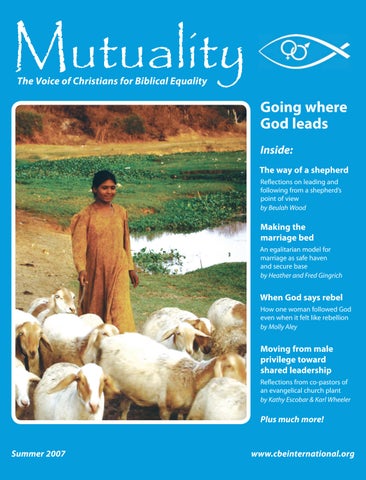
Going where God leads Inside: The way of a shepherd Reflections on leading and following from a shepherd’s point of view by Beulah Wood
Making the marriage bed An egalitarian model for marriage as safe haven and secure base by Heather and Fred Gingrich
When God says rebel How one woman followed God even when it felt like rebellion by Molly Aley
Moving from male privilege toward shared leadership Reflections from co-pastors of an evangelical church plant by Kathy Escobar & Karl Wheeler
Plus much more!
Summer 2007
www.cbeinternational.org
Contents Features 5
The way of a shepherd Reflections on leading and following from a shepherd’s point of view — by Beulah Wood
8
Making the Marriage Bed An egalitarian model for marriage as safe haven and secure base — by Fred and Heather Gingrich
11 When God says rebel How one woman followed God even when it felt like rebellion — by Molly Aley
13 Moving from Male Privilege toward shared leadership in the church cover image
The photographs of shepherds on the cover and on pgs. 5–7 were taken by Beulah Wood (Deccan Plateau) and her sonin-law, Jeph Mathias (Himalayan hill and mountain shots).
How co-pastors of an evangelical church plant work to overcome male privilege — by Kathy Escobar and Karl Wheeler
16 Unity of Creation A look at man and woman’s interdependence in Genesis chapters 1 and 2 — by Allison Young
18 To speak or not to speak? When and how to speak up about biblical equality and justice — by Liz Sykes
19 Why should men take a stand for gender equality? How men can stand up to sexist views of women in the culture and the church — by Trevor Sykes
20 John 3 and 4 A poetic comparison of Jesus’ encounters with a teacher in Israel and a woman at a well — by Julia Butcher
Ministry & Chapter News 21 Cornerstone ’07 participants welcome message of biblical equality — by Megan Greulich
22 “Seeking Justice and Loving Mercy”: CBE’s 2007 International Conference
24 2007 CBE Award Recipients 26 Ready to start a revolution — by Mary Ann Nguyen 27 Praise & Prayer; CBE Chapters
Departments 3 From the Editor: Following the Good Shepherd 28 President’s Message: Joy and Prayer at CBE’s 2007 International Conference
30 Giving Opportunities: Welcoming women leaders — by Elinore Arendt 2 | Mutuality Summer 2007
website: www.cbeinternational.org
Mutuality The Voice of Christians for Biblical Equality
Let us then pursue what makes for peace and mutual upbuilding. — Romans 14:19 VOLUME 14, ISSUE 2 Mutuality seeks to provide inspiration, encouragement, and information about equality within the Christian church around the world. President/Publisher : Editor : Graphic Designer :
Mimi Haddad Chelsea DeArmond Bridget O’Kane
EDITORIAL AND ADVERTISING OFFICE Christians for Biblical Equality 122 W Franklin Ave, Suite 218 Minneapolis, MN 55404-2451 phone: (612) 872-6898 fax: (612) 872-6891 e-mail: cdearmond@cbeinternational.org web: www.cbeinternational.org Advertising in Mutuality does not imply organizational endorsement.
SUBMISSIONS Mutuality welcomes submissions. E-mail cdearmond@cbeinternational.org, write to CBE for the writer’s guidelines, or visit CBE’s website and follow the Publications links.
PERMISSIONS Christians for Biblical Equality grants permission for any original article (not a reprint) to be photocopied for local use provided no more than 1,000 copies are made, they are distributed free, the author is acknowledged, and CBE is recognized as the source. Mutuality (issn: 1533-2470) is published quarterly by Christians for Biblical Equality and is sent free to members. For membership information, see page 31. To purchase back issues, contact our Editorial and Advertising Office, or order online at www.equalitydepot.com.
From the Editor by Chelsea DeArmond
Following the Good Shepherd
Women who are called to teach or preach face opposition to their ministries from people who believe that women’s role is to remain quiet in the church and submissive at home. This view of women’s role is so pervasive that women themselves may mistake God’s call for the devil’s temptation. They may resist preaching the gospel in order to fulfil expectations based on their gender. They may remain focused on staying within their own four walls instead of going out into the world to spread the good news. Jesus faced opposition to his ministry too, and many of the accusations used against him parallel the kinds of opposition women in ministry face today. When Jesus cast a demon out of a man who couldn’t see or speak, religious leaders claimed, “It is only by Beelzebul, the prince of demons, that this fellow drives out demons” (Matt. 12:24). Jesus pointed out the flaw in their thinking by reminding them that just as tree is recognized by its fruit, so also “good people bring good things out of the good stored up in them” (Matt. 12:33–35). If a ministry yields good results, then its source cannot be evil. The same Holy Spirit that empowered Jesus to cast out demons empowers preachers of the gospel whether they are men or women. If a woman’s ministry brings others salvation and healing, it must be the result of responding to God’s call, not giving in to the devil’s temptation. When Jesus healed a man with a shriveled hand (Matt. 12:9–14) and a woman who had been crippled for 18 years (Luke 13:10–17), religious leaders confronted him for breaking rules about the Sabbath, a day when Jewish people were not permitted to do any work. Jesus challenged them and asked them if their sheep fell into a pit on the Sabbath, wouldn’t they pull it out instead of leaving it there to die (Matt. 12:11–12)? Some religious leaders in our day have added rules that restrict ministry to men only. But if so many people need to hear the gospel, how can we silence women who are ready and willing to minister to them? Like the rules about keeping the Sabbath that led some people to oppose Jesus’ healing ministry, rules about gender roles that keep women out of ministry leadership “neglect the weightier matters of the law: justice and mercy and faith” (Matt. 23:23; Luke 11:42). Another way religious leaders tried to discredit Jesus’ ministry was by accusing him of associating with sinners. In response, Jesus compared himself to a shepherd who will leave 99 safe sheep behind to go search for one lost sheep (Luke 15:1–7). Women who step out in faith are often viewed with suspicion for neglecting their families. Caring for a family does not need to disqualify women from ministering beyond their own four walls any more than it would disqualify men. Jesus assures us that he is a good shepherd and his sheep will know his voice ( John 10:14). Spend time in prayer and worship and search the Scriptures so that you can recognize God’s call and follow where the Good Shepherd leads with confidence, even in the midst of opposition. Chelsea DeArmond is Editor of Mutuality and Bookstore Coordinator at Christians for Biblical Equality. She can be reached at cdearmond@cbeinternational.org
bookstore: www.equalitydepot.com
Mutuality Summer 2007 | 3
In Our Box
Mutuality
Visit CBE’s website at
www.cbeinternational.org for the latest… ▶ FREE audio and print resources on biblical equality ▶ Membership information for churches, libraries, families, and individuals ▶ On-line discussions about gender and justice on The CBE Scroll, the blogging voice of CBE ▶ CBE chapters in the U.S. and around the world ▶ Directory of egalitarian churches in the U.S. and around the world ▶ Giving opportunities ▶ Listings for counselors, therapists, and spiritual directors who agree with CBE’s Statement of Faith ▶ Ministry news and needs ▶ Employment, internship, and volunteer opportunities
Call for Papers
Mutuality provides inspiration, encouragement, and information about equality within the Christian Church around the world. Mutuality is published quarterly and sent to all CBE members and subscribers. Current and back issue are also available for purchase. We are currently seeking features, reports, and reviews (books, films, and/or music) from evangelical, egalitarian perspectives related to the following topics: • • • •
Equality and our evangelical heritage Persecution and revival Raising children Home economics
Most of the articles we publish fall into the following categories: • Personal testimonies illustrating how biblical equality provides practical benefits to everyday lives. • Teaching on relevant Bible passages, explaining the meaning and showing how to apply it to daily life. • Reviews of books about biblical equality that would appeal to a wide audience. (Books must complete CBE’s book service review process before being reviewed in Mutuality.) • Feature stories about issues related to CBE’s mission and ministry. The length of features is generally 1,000–2,500 words. Send articles to the attention of the editor at the postal address below or e-mail to cdearmond@cbeinternational.org (if possible, as an attached Microsoft Word document). We are unable to consider or respond to authors who send us more than two pieces at the same time, whose pieces are substantially over 3,000 words, or whose submissions are not sent uniquely to Mutuality. Complete Writers Guidelines for Mutuality are available on our website (www.cbeinternational.org) or contact our office to request a copy. Questions and submissions can be directed to the attention of the editor, Chelsea De Armond.
Visit CBE’s on-line bookstore at
www.equalitydepot.com for resources like… ▶ Books and articles ▶ Audio and video tapes ▶ CD, DVD, and MP3 recordings ▶ Sales and specials ▶ New resources, CBE exclusives, and best sellers ▶ Foreign language resources ▶ Become a CBE member or renew your membership and save 15% or more on every purchase ▶ Registration for CBE conferences ▶ Subscription to CBE publications or purchase back issues of Mutuality and Priscilla Papers
4 | Mutuality Summer 2007
We’d love to hear from you! Send your comments and critiques to:
Mutuality 122 W Franklin Ave, Suite 218 Minneapolis, MN 55404-2451 PHONE: (612) 872-6898 FAX: (612) 872-6891 E -MAIL: mutuality@cbeinternational.org WEB: www.cbeinternational.org Letters may be edited for clarity and brevity.
WEBSITE: www.cbeinternational.org
The way of a shepherd by Beulah Wood
In Bible times many women shepherded flocks. We first meet Rachel as a shepherd: “Rachel came with her father’s sheep for she was their shepherd” (Gen. 29:6, 9). We are also introduced to Zipporah as a shepherd: “Now a priest of Midian had seven daughters and they came to draw water and fill the troughs to water their father’s flock” (Exod. 2:16). These matriarchs of Israel both met their husbands at wells where they led their flocks to drink. During the course of their daily work, the contact occurred that led to their marriages and many more years of caring for flocks. Possibly half the shepherds in Jesus’ day were women, and probably half the shepherds of the world today, too, are women. I am one of them.
BOOKSTORE: www.equalitydepot.com
Looking after lambs By the time I was eight or nine years old, my family knew I was the one who looked after the lambs. In lambing season from late July through August (which is late winter in New Zealand), my father used to catch his tall brown hack and “ride around the sheep” as he called it. In each fenced paddock he checked the lambing ewes and helped some that were having difficulty. He found some “cast” upside down on the grass with their feet up, unable to right themselves because of the weight of their wet fleece and the unborn lamb. They only needed a push and they could run off.
Mutuality Summer 2007 | 5
He found lost lambs, neglected lambs, sick lambs, triplets that needed one taken away as they were too much for the mother, and sometimes a live lamb standing beside a dead ewe. Up into a gunny sack on the horse went the unfortunate waif. And that was where my task began when Dad arrived back at the house with two or three skinny, short-wooled, hungry, or sick little creatures. They required a clean gunny sack and a place on the hearth close to the heat of the iron stove in the kitchen—warmth and protection first, then food. I warmed some cow’s milk on the stove, poured it in a bottle, jammed on the rubber teat, and tried to make the little orphan drink. Some quickly learnt to suck. Some needed hourly coaxing. When they revived a little, they stayed in an upturned box in the kitchen and I fed them milk three times a day. By the time they were three or four weeks, they could start to nibble the grass in the nearest paddock. They raced to me when I called with yet another bottle of the milk they now bunted and shoved for twice a day. I guess I can still learn from those days on the family farm in my “shepherd-of-humans” tasks. Little ones need total care, starting with protection, warmth, drink, and then graded food. They start dependent, but it must never be my role to keep them dependent on me. My goal was to provide all the nurture they needed, while increasing their independence until they could feed and fend for themselves. Worth thinking about, that. Let us as parents teach our children wise decision-making as soon as they are ready. They can never flourish if they have to hear a voice outside them telling them what to do. They need the internal voice of their own wisdom to make good decisions. In addition to mistaken parents, I fear there are also shepherds of God’s flock who ignore this principle. Counsellors, cell group leaders, or pastors may keep people depending on their leadership by keeping the tasks for themselves. They gain their own sense of worth from being the shepherd and would feel lost without it. This is not right.
6 | Mutuality Summer 2007
Our job is to increase the freedom, effectiveness, self-worth, and selfmanagement of all with whom we come in contact. In every context, we are empowering others to grow and do the same task we had.
Secure in the Shepherd What about the shepherds I see in India? Some days they are an old woman and an old man, another day a couple of men, or a woman and a teen-age girl who wander up the road with a staff and battered, black umbrella for shelter from the sun or the rain. They may chivvy along a straggle of six black cows, 25 brown and white goats, and 30 droopyeared sheep. I saw something remarkable when I walked through Kailasana village one morning. The sun was well risen, crows circled, myna birds mewed, roosters crowed and dogs sought edible scraps. A man crouched by a cow and squirted milk into a saucepan, girls carried plastic pots of water, women bent over open fires, and boys learnt their schoolwork. All were up and about, starting the day’s chores—except the sheep. They sat asleep in their pens. “Why aren’t the sheep getting ready for the day?” I asked myself. I made a guess. The sheep knew their shepherd would come for them later in the morning. Until then, they need not worry or hurry. They could sit confidently. Their shepherd would care for them. I thought there was a lesson for us there, too. Do we wait secure in our Shepherd? I think about the mutuality of the shepherd task in rural villages just like those in Palestine when Jesus walked among sheep and their shepherds. Men, women, girls, and boys—whoever is best suited— does the task. That is appealing. Jesus, Peter, and the writer to the Hebrews gained their metaphors from that scene. “Be shepherds of God’s flock that is under your care, watching over them—not because you must, but because you are willing, as God wants you to be; not pursuing dishonest gain, but eager to serve; not lording it over those entrusted to you, but being an example to the flock” (1 Pet. 5:2, 3). If we aim to do this, we can receive all the necessary skills. “Now may the God of peace, who through the blood of the eternal covenant brought back from the dead our Lord Jesus, that great Shepherd of the sheep, equip you with everything good for doing his will” (Heb. 13:20, 21). WEBSITE: www.cbeinternational.org
Tending God’s flock I look back to my days as a young shepherd on our family farm in New Zealand and think of scenes where I live now in India, where I can walk morning or evening among the shepherds outside the bustling city of Bangalore. These images invite reflection on who we should be as shepherds of children and adults in our work for God. What messages do our “flocks” pick up from us? My own flock is varied as I am a mother and grandmother, writer, and lecturer in a theological college. Even though my daughters are grown, one never ceases to encourage, talk, write emails, make phone calls, pray. They nurture me as well. Their children too need to know I am there for them. Is a writer a shepherd? Other people’s writings have at times given me backbone and courage, helped me square my shoulders and face a needed theology, or led me to new nourishment in growing closer to God. I want my writing to do that too. As a lecturer, what may my students—future shepherds themselves— learn from me? I hope some learn honesty and clarity in academic writing, the importance of family life, and the value of stories in communication. Perhaps here in India when traditional men and women find themselves in my flock they will respond, “A woman teaching men and women! Hmmm! It can be done.” What messages do your “flocks” receive from you? Beulah Wood (BD, D.Min.) and her husband taught together in Ootacamund, India, and then in Nepal. Following early widowhood, Dr. Wood gained writing and editing experience in New Zealand, and has authored or co-authored more than 30 books. She lectures in homiletics and spiritual formation at the South Asia Institute of Advanced Christian Studies in Bangalore, India, and has served on the SAIACS Press editorial team. At the time of writing, Beulah was in the midst of teaching a course on gender and family to missionaries in the mountains between Bangladesh and Burma. Photos: Beulah Wood (Deccan Plateau shots) and Jeph Mathias (Himalayan hill and mountain shots)
BOOKSTORE: www.equalitydepot.com
Life realities for some shepherds Beulah Wood admits it was hard to get good photos of women shepherds. The faces of some older women bear the marks of a very hard life. Shepherds these days are sometimes the “bottom of the heap” in the class and caste stratification, and city people may think them dirty and smelly. Men may despise even more the women shepherds. Women and girls cannot bring their sheep outside the village lands on their own. They must stay with their husbands or other women, for they are at risk of becoming the object of sexual harassment or gossip, for a woman alone is often viewed as “up to no good.” If we think shepherds enjoy a healthy outdoor life, we may be naïve. The reality for many women disappears under the belief that men and boys eat first; girls and women get whatever may be left. There is little mutton biryani for them! Some shepherds cherish their sheep, as the photos show. However, a few of the shepherds may themselves never have experienced nurture and kindness. And who gets the shepherding task? Some middle-aged people, but often old people and teen-age girls. The boys, of course, are in school.
Mutuality Summer 2007 | 7
Making the Marriage Bed An egalitarian model for marriage as safe haven and secure base by Heather and Fred Gingrich
Have you ever wondered why the private space shared by a married couple is still referred to by the archaic phrase “the Master Bedroom”? Despite society’s progress toward the equality of men and women, continued use of such a term is one more indication that women, while equal under the law, are not always considered equal partners in marriage. In the past, wealthy families often had separate sleeping quarters for the master and mistress of the house. The master bed in this scenario would be a private space for the master of the house to which his wife might be invited on occasion. Marital intimacy as we understand it was not likely to be highly valued in this kind of arrangement. The opposite extreme is illustrated by the concept of the family bed, a common practice in some nonwestern cultures in which parents and children share a bed, often out of necessity. While this model offers potential advantages such as enhancing closeness and affectionate touch among family members, it also has potential dangers such as child sexual abuse, emotional enmeshment, and decreased opportunities for the couple to experience sexual intimacy. The master bed and family bed approaches to marital intimacy are summarized below. These extremes are contrasted with the more balanced approach of the marriage bed.
8 | Mutuality Summer 2007
The Master Bed • • • • •
individual privacy personal ownership primarily alone conjugal visits (or other kinds of visits) marital intimacy is not valued
The Family Bed • • • •
no privacy sharing, affection, touch positive benefits of high closeness among family members negative dangers of enmeshment, child abuse, and lack of sexual intimacy
The Marriage Bed • • • • •
couple privacy shared ownership sleeping together sexual intimacy emotional intimacy WEBSITE: www.cbeinternational.org
Contemporary versions of the master bed and family bed The master bed and family bed also represent two contradictory perspectives in contemporary society related to how healthy marriages should be understood. The differentiation camp claims that a sense of autonomy, selfdirection, and self-fulfillment by individual partners is a prerequisite to connection and healthy intimacy within marriage. This view emphasizes setting personal boundaries and avoiding co-dependency. Couples who live and work on opposite sides of the country, getting together when they can, are extreme examples of highly differentiated marriages. This kind of relationship was described by Jill Brooke in a New York Times article called “L.A.T. relationships—Living apart together” (May 4, 2006). This focus on differentiation within marriage, then, could be viewed as the new, egalitarian form of the master bedroom; each is their own master, and if connection and intimacy happens, that is a bonus. In contrast, a romanticized view of marriage suggests that true marital intimacy is found in complete togetherness. The story of Sheldon Vanauken’s marriage in A Severe Mercy (Harper & Row, 1977), while a beautiful love story, is also a description of a marriage that in today’s psychological lingo might be called co-dependent or enmeshed. This view of marriage is characterized by sharing the same life experiences, reading the same books, being together almost all the time, feeling what the other feels, and ultimately losing one’s sense of individual identity in the other. This perspective is understandably popular among engaged and newlywed couples who envision a life together that will be closer, deeper, and consequently healthier than many of the contemporary examples of marriage that they have seen. The contrast between these two views is illustrated well in the following poems. The first poem hints at the reality that separateness can lead to disconnected lives, while the second one suggests that too much closeness can lead to enmeshment: I do my thing, and you do your thing I am not in this world to live up to your expectations And you are not in this world to live up to mine You are you and I am I And if by chance we meet, it’s beautiful If not, it can’t be helped. (Fritz Perls, 1969, “Gestalt Prayer”) We do our thing together I am here to meet all your needs and expectations And you are here to meet mine We had to meet, and it was beautiful I can’t imagine it turning out any other way. ( Judy Altura, 1974, “Togetherness Prayer”) These poems are quoted in D.H. Olson & J. DeFrain, Marriage and the family: Diversity and strengths (1994), pg. 76.
The marriage bed as safe haven and secure base An increasingly popular developmental perspective known as attachment theory provides a way of understanding the tension between differentiation and enmeshment in intimate relationships. While standing firmly on the side of promoting strong affectional bonds (connection) rather than focusing on individual identity (disconnection), this theory suggests that healthy marriage encompasses these two contrasting views of intimacy and offers a balanced perspective of how to live out our marital lives. Rooted in the work of British psychoanalyst John Bowlby, this view suggests that the need for attachment is not only descriptive of children at an early developmental stage, but is also a felt need experienced throughout life, from “the cradle to the grave.” Children and adults seek close relationships that provide a “safe haven” to return to when life is stressful, and a “secure base” from which to explore the world. Safety (protection) and risk (autonomy) are not seen as opposite poles, but two sides of the same coin, in that the more connected partners are to their spouses, the more strength and confidence they then have to move out into the world. This way of understanding relationships explains the two dangers in contemporary marriage described above. Attachment theory considers both of the tendencies seen in the master bed and the family bed to be insecure relational styles. On the one hand is the cultural push to differentiate, to define oneself in contrast to others, to set boundaries in relationships, and to be assertive about one’s needs. While aspects of this approach may be healthy, it can easily lead to avoidant or dismissive attachment in which people appear to not really need others. On the other hand are those who anxiously and dependently cling to others expressing a low sense of self-efficacy and confidence paired with a high view of the other’s value and the other’s ability to meet their needs.
The images accompanying this article are etchings from a series entitled “Safe Haven” by Eng Tay. BOOKSTORE: www.equalitydepot.com
Mutuality Summer 2007 | 9
In contrast, the secure attachment style upholds both the legitimate relational needs of children and adults (safe haven) and the need to define oneself and be appropriately autonomous (secure base). Going back to our analogy in the chart above, this goal could be represented by the marriage bed. This is a place where couples have some shared, private space which allows for the possibility of greater emotional and sexual intimacy than does the master bed and more privacy than is allowed by the family bed. Ultimately, it seems to us that the goal of an egalitarian marriage, at least when it comes to intimacy, is for couples to work on developing appropriate differentiation from each other while simultaneously seeking a deeply committed, secure attachment with their partners. Such marriages allow for individuality and uniqueness within a covenantal commitment to oneness. Based on a relationship characterized by secure attachment, each partner is able to move out from the safety of their relationship to engage in the world in unique, creative ways. Attachment leads to autonomy, just as autonomy enriches attachment. Perhaps we could coin a new phrase to describe this relational paradox: differentially attached.
Biblical and theological support While the concept of differential attachment makes sense psychologically, it also fits with scriptural principles. The motto, “a safe haven and a secure base,” resonates with images that permeate Scripture concerning our relationship to God and to one another. In various passages, marriage relationships and individual relationships with God are used to reciprocally describe the nature of these intimate relationships. Some examples include the story of Hosea and Gomer, the Song of Songs, and Ephesians 5:25 (love each other as Christ loved the church). The first four of the Ten Commandments (Exod. 20:2–8) describe God’s passionate desire for relationship with us, with verse 5 describing God as a “jealous God.” The fifth to tenth commandments (Exod. 20:3–17) focus on how to have healthy relationships with each other (honor parents, do not murder, be faithful, do not steal, lie, or covet). Our faith is filled with a variety of theological and doctrinal paradoxes. For instance, Genesis 2:24 describes marriage as
both “leaving” (differentiating) and becoming united as “one flesh” (attachment). We are admonished to daily take up our own crosses (Luke 9:23), yet we are to also help each other with the burdens of life (Gal. 6:2–5). Theological reflection on the Trinity can also shed light on this relational paradox. Some of the early church councils struggled with the issue of how God can be both one and three. On the one hand, God is in himself one, a unity in essence (which is attachment to the extreme). Yet at the same time God is in himself three, an example of diversity, with each part of the Trinity having individual personhood, personality, and identity (an example of differentiation). God is simultaneously both transcendent (differentiated) and immanent (intimate).
Conclusion As Christian egalitarians, we believe that marriages should not resemble the master bed, but rather the marriage bed. Such marriages should value intimacy in its multiple facets, the sharing of life as equal partners, mutual submission, and “us” above “I.” Egalitarian marriages should be giftbased, affirming the unique giftedness of both partners, as well as skill-based, affirming the specific skills each partner has. The marriage should be flexible and continually growing, and model equality and respect to the children within the marriage, as well as to others outside of the family. Marriages within the marriage bed model should utilize creative, affirming, and biblical conflict resolution skills without resorting to the use and abuse of power. This parallels the biblical call to equality for all within Christian community (Gal. 2:28). Let us all work towards becoming differentially attached, with marriages honoring to each other and to God. Heather Gingrich is associate professor of counseling at Denver Seminary. Her interests include trauma and abuse, dissociative disorders, cross-cultural research, and international counseling. Fred Gingrich is associate professor and chair of the counseling division at Denver Seminary. His interests include marriage and family, integration of psychology and theology, clinical supervision, and international counseling. Originally from Canada, the Gingrichs spent 8 years teaching in the Philippines before moving to Denver. They have two adopted bi-racial sons to whom they are modeling an egalitarian marriage in the midst of many sexist junior high assumptions!
10 | Mutuality Summer 2007
WEBSITE: www.cbeinternational.org
When God Says
Rebel
by Molly Aley
Inotonce wholly believed in a patriarchal view— only believed it, but lived it. I didn’t care if it didn’t feel good, I cared about obeying God. So I took my leader-self and made it sit in the back seat. And I took my voice and silenced it. I took my enthusiasm and dulled it down. I believed that men were to be in the forefront, men were to be helped as they saw fit, men were to be leaders, men were to have the vision, men were to be up front speaking, men were to have words from God. I believed that women could do all those things, sure, but to a lesser degree and only with a submissive spirit (and certainly not instructing men in any form or fashion). Just as popular complementarian teachers proclaim, I believed that men were like the sun—shining the glory of God directly, while women were like the moon—shining a reflected glory. And though no one likes to admit it, views like this basically teach that women are inferior when it comes to shining God’s glory. Inferiority seemed to be the logical conclusion, and I was okay with it. If that’s how God made me as a woman, then that’s what I should accept. I wanted to obey God and to live for Him. So I obediently and even joyfully did what I thought He had commanded.
In time, I started dying. I didn’t realize it because it happened over a period of years as I ignored the deeper parts of me, for fear that they were trying to get me to rebel against God. I put my hands over my ears and continued to be a Hidden Woman, the woman God wanted me to be. One day, out of the blue, I couldn’t do it anymore. I was fixing myself a cup of tea when I began sobbing from somewhere deep down inside and sank to my kitchen floor. My legs literally stopped working as I crumbled, inside and out. It caught me horribly by surprise. I had pretended to be happy for so long that I’d even managed to fool myself. That morning, though, as my life collapsed along with me, I knew that I had to reckon with the words that had remained unspoken for so long. I knew that if I kept going the way I was—kept looking to my husband as my priestly mediator, kept shoving down the parts of me that were born to lead, to speak, to fight—that something very precious inside of me would die. No, that it was dying, that I had reached the critical point where I could possibly (maybe, hopefully) nurture it back to life, only painstakingly and carefully…but if I waited one more day, it would draw its last breath. BOOKSTORE: www.equalitydepot.com
One day, out of the blue, I couldn’t do it anymore. I was fixing myself a cup of tea when I began sobbing from somewhere deep down inside and sank to my kitchen floor.…I knew that I had to reckon with the words that had remained unspoken for so long. Mutuality Summer 2007 | 11
I don’t mean the kind of death that the cross demands—not a redemptive death, but the sort of death that comes from the destroyer—the destruction of a good and holy thing, much like a baby slowly starving to death in a famine, except in this case I was purposely withholding food and affection, thinking it was God’s will for me to do so, thinking it was God’s will for me to ignore the cries. Only one day I couldn’t do it anymore.
What if Mary had refused to rebel when God called her?
Think of it. God chose a young woman to carry His seed. He did not ask her male authorities, He asked her. He requested something that would completely derail her marriage plans with Joseph, make them spend their honeymoon running to Egypt, make them the talk of all the neighbors’ wagging tongues.… And Mary didn’t ask permission of her male “head” (“head” I can’t explain it, but somehow He met me when I was face down on the floor and meaning authority figure, according to the patriarchal definition). She just said “yes” to God. And God said her “yes” was all He needed. asked me what I would be like if I were a man. The question made me cry. I was shocked. I’d never considered a God didn’t even tell Mary’s “authorities” about what He just did to question like that before. It was the sort of rebellious, unsubmissive Mary until Joseph was planning to dump her! Mary was a rebellious woman on many fronts, one of them being thought that I never would have allowed myself to entertain. But, to my utter astonishment, everything in my heart leapt for joy. I considered, a rebellion against what patriarchy, then and now, says about the role for the first time, what kind of choices I would have made if I’d been of women. Today’s Christian patriarchy would not approve of what born a man. As a man, I would be able to be my true self—able to be Mary did any more than the patriarchal system would have in the New Testament time period. But God did, very much so. strong and bold and lead and speak and love with passion! My tears were a mixture of painful memories and astonished delight Molly Aley lives in the mountains of Alaska. as He whispered in my heart that I was not to silence parts of me in She married her high school sweetheart order to “be a woman,” that I was to serve Him as if I were a man, that and is now a homeschooling mother of five, I was to stop considering my personality rebellious simply because it undercover agent for the God who Cares. didn’t fit into a world of denim jumpers and passive acceptance. She is currently pursuing her bachelors degree in psychology, enjoys participating In thinking I was obeying God by obeying patriarchy, I was in community theatre and music, and— actually quenching the Spirit of God. I confused His leading for despite numerous inventive attempts—has sin and rebellion, all because He led me in directions that were yet to master the fine art of keeping up with not considered in line with “feminine attributes” according to the the laundry. patriarchal views I followed.
That day Jesus came to me.
$16.95 Heartwork of Hope: A Directed Journal, Major JoAnn Shade’s 2006 work published by Others Press, is designed to take the reader on a journey of discovery— through Scripture and quotations from a wide variety of authors, poetry and the experiences of the author herself—and into a deeper walk with the Lord. “This directed journal opens new possibilities for the soul to breathe the presence of God.” —Elaine Heath, Ph.D., Perkins School of Theology “A tool for discovering the ‘more’ that God has for you.” —Lucinda Secrest McDowell, author, Spa for the Soul “A treasure to mine and a trail to follow.” —Jerry R. Flora, Th.D., Ashland Theological Seminary
$8.95 Seasons: A Woman’s Calling to Ministry, published by Salvation Books, explores the life of women in leadership, drawing on the author’s own 30 years of experience as a Salvation Army officer in the USA. Unique in the Christian world is the team–ministry concept, in which both husband and wife are ordained. JoAnn currently ministers with her husband, Larry; they are preparing together to open a Ray & Joan Kroc Corps Community Center in Ashland, Ohio. JoAnn is a trained counselor who holds a D.Min. from Ashland Theological Seminary, where her doctoral thesis was on “Women in Prophetic Leadership.” Seasons explores the distinctive challenges faced by women in Christian leadership and provides theological and practical support through biblical character studies and wisdom gleaned from Shade’s experience.
Both books are available via E-mail: use.trade@use.salvationarmy.org, or call toll free (888) 488–4882. 12 | Mutuality Summer 2007
WEBSITE: www.cbeinternational.org
Moving from MALE PRIVILEGE toward SHARED LEADERSHIP in the church by Kathy Escobar and Karl Wheeler
White Privilege a. A right, advantage, or immunity granted to or enjoyed by white persons beyond the common advantage of all others; an exemption in many particular cases from certain burdens or liabilities. b. A special advantage or benefit of white persons; with reference to divine dispensations, natural advantages, gifts of fortune, genetic endowments, social relations, etc. c. A privileged position; the possession of an advantage white persons enjoy over non–white persons. (Source: WhitePrivilege.com)
Kathy: White Privilege is a term that gets tossed around in many advocacy circles. I remember getting in touch with the word very clearly, because I benefit from White Privilege. I am a white woman, blond-haired, blue-eyed. I am automatically granted certain privileges that an African American or Hispanic or Asian woman is not, even in the year 2007 in the United States of America. Add the fact that I have a college education and my privileges increase. Karl: I also benefit from White Privilege. I am caucasian and collegeeducated. Both Kathy and I have a natural advantage over many people just because of the color of our skin. We didn’t ask for it, we didn’t do anything to earn it, it’s not our fault, we just automatically have an advantage in this society because we are white. We both believe that part of our responsibility as Christians is to recognize and oppose worldly assumptions that are contrary to the Kingdom of God. Noticing White Privilege has made us more sensitive to the plight of the under-represented and culturally-oppressed, and we are deeply committed to breaking down prejudices that perpetuate injustice.
BOOKSTORE: www.equalitydepot.com
Kathy: While both Karl and I benefit from White Privilege, Karl also benefits from what I like to call “Male Privilege” in the church. Let’s take the definition of White Privilege above and substitute the word male instead of white to get an idea of what Male Privilege might look like: Male Privilege a. A right, advantage, or immunity granted to or enjoyed by men in the church beyond the common advantage of women; an exemption in many particular cases from certain burdens or liabilities. b. A special advantage or benefit of men; with reference to divine dispensations, natural advantages, gifts of fortune, genetic endowments, social relations, etc. c. A privileged position; the possession of an advantage men enjoy over women. As a female co-pastor of an evangelical church plant, I bump up against deeply held prejudices about women in the church every day. Every time I experience these prejudices I am reminded we are not in an easy battle—the church has embraced a model of male-only authority that most everyone (both inside and outside the church) has subtly or directly embraced. Take a look at any TV program that pictures a religious authority— they are almost always men. Think of how many weddings you have been to where the pastor was a woman. Walk into most any church across denominations and geographic areas and it is fairly clear that, while women have made inroads into ministry, we are still in the minority. I try to just live out my theology without focusing too much on all the obstacles against me in ministry. But sometimes it does feel like I’m swimming upstream, that the current for men flows so easily, effortlessly, while I am using every bit of my strength to keep my head above water. Mutuality Summer 2007 | 13
Karl: In the church, men automatically get certain privileges that have nothing to do with giftedness, ability, or even reality of their situation. Because I am a man in the church, here are some automatic privileges I tend to get: • • • • •
Even though Kathy and I co-pastor together, many people assume I’m the one in charge. People ask my advice about things I have no idea about but they assume I must know. Invitations to preach at other churches or attend senior pastor events are addressed to me. I am offered job opportunities that women would never be considered for. I can lead and facilitate any groups, programs, or events without second thought.
None of these privileges make sense, really, since they are based on assumptions that preclude giftedness. Our community at The Refuge recognizes that Kathy has the stronger leadership gift, yet outside of our church most people assume that Kathy must be there to “support” me somehow. I automatically get the power not because of anything I do or have earned, but only because I am a male pastor in the church. Kathy: Saying it out loud always leaves a bad taste in our mouths. As we remain committed to living out an egalitarian theology in our ministry, the prejudices against women in leadership are becoming less subtle. In fact, sometimes it is blatant. I recently co-authored a Bible study for women, but because I am a co-lead pastor, one of the largest Christian retailers in the nation refused to carry it. It was that simple—if I had any other job, they would be happy to sell the book, but because my title is “co-lead pastor” I am automatically disqualified. A therapist friend of mine recently offered to refer her client to me for pastoral care as she transitioned out of an abusive relationship. The client responded, “Oh, no, I could never listen to a woman pastor.” Although hearing these words hurt, this woman expressed a truth that is deeply ingrained in typical evangelical cultures—men are automatically the authorities even if they lack experience, training, or giftedness in certain areas. We could spend an inordinate amount of time analyzing and listing all of the ways Male Privilege in the church is lived out, but that doesn’t lead us to specific ways we can begin to shift this deeply engrained cultural bias and move toward equality. What is the solution?
We believe change starts with awareness The reason we learned about White Privilege in our advocacy training was so that we could become aware of our prejudices and then work to overcome them. Male Privilege is the same way. Karl: At first I didn’t really see Male Privilege; it was just the norm in the church culture around me. But years ago my sister and brother-inlaw started sharing their awareness and theological convictions about being egalitarian. I started to see more clearly all the subtle ways that I automatically received the power as a white male. 14 | Mutuality Summer 2007
Part of being aware is recognizing that if someone wins, that means someone else is losing. It is that simple. Men have been winning at this for a long time. Living out an egalitarian theology very practically at The Refuge we have a lot of data that supports how engrained Male Privilege is, but because we are keenly aware of it we can confront it instead of ignoring it.
We believe change requires those in power to lay some of it down The oppressed do not get power unless someone gives it up. It is that simple. White people had to make room for African Americans on the bus. This means men will have to let go of power, release their hands from holding on so tight, and open the doors for women to step into their giftedness. The ideal Christian way is not for the oppressed to make things right, but for those who are privileged to step aside. Kathy: I recognize what a big sacrifice Karl is making to co-pastor with me. He has to give up power and diffused status and authority. And so do I by sharing leadership with him instead of being the sole senior pastor. That’s why we believe so firmly in shared leadership, not even just women and men working alongside each other but also just sharing leadership instead of having all the power and authority invested into one “set apart” person. Also, unfortunately, we believe that in many churches success has become equated with numbers. This means that unless giving up power increases attendance, many ministry leaders won’t even consider it. We are fairly certain that initially a shift to egalitarian leadership will not equal greater numbers. In fact, it will cause some churches to shrink in the same way that some schools ended up losing students when integration was implemented during the Civil Rights Movement. Over time, however, we believe that justice will prevail and “thriving” may not be about success in our eyes, but rather about justice and freedom in the Kingdom of God. The safety that is created when men, women, and children across ages, skin colors, and socioeconomic backgrounds are empowered instead of oppressed is worth every bit of sacrifice. We will never know the spiritual implications that taking a step of faith today will create. We gain hope from Hebrews 11:11—now faith is being sure of what we hope for and certain of what we do not see.
We believe we must live it out more and try to convince less Our best shot is just doing it despite the controversy, like Rosa Parks who was willing to endure the consequences of refusing to give up her seat on the bus. Her simple, strong movement toward what was right paved the way for others. Convincing people about the theological and biblical basis for our convictions is of course so important, and we don’t want to dismiss that—there are many different forms of advocacy. But we believe the best way to advocate against Male Privilege is to work against it, resist its powerful tug, buck the status quo, and live out a model of equality with grace and love and humility as best we can. We believe that is most compelling. WEBSITE: www.cbeinternational.org
Our names are Kathy & Karl. We are educated, committed evangelicals. We’re both happily married (to other people!). We believe in the local church’s power to have an impact in the community. We are co-pastoring a new church plant together. People think we’re crazy—that it can’t be done, that it’s too complicated. We think it’s fun. This will require men and women who are committed to change to partner together, encourage one another to not give up, pray for each other, and offer support in tangible ways. We know from experience, it’s tempting to give up because we’re working against such a strongly engrained cultural bias in the typical evangelical church. That is why the work that CBE does encourages us greatly and reminds us we are not alone on this journey. Racism and sexism are always about power. And pride is the root of power. In the Beatitudes, Jesus turns our human views of what is important upside down. He offers us a solution—humility and sacrifice. Like White Privilege, the antidote to Male Privilege is humility. We take Paul’s words seriously in Philippians 2:1–7: Therefore if you have any encouragement from being united with Christ, if any comfort from his love, if any common sharing in the Spirit, if any tenderness and compassion, then make my joy complete by being like-minded, having the same love, being one in spirit and of one mind. Do nothing out of selfish ambition or vain conceit. Rather, in humility value others above yourselves, not looking to your own interests but each of you to the interests of the others In your relationships with one another, have the same attitude of mind Christ Jesus had: Who, being in very nature
BOOKSTORE: www.equalitydepot.com
God, did not consider equality with God something to be used to his own advantage; rather, he made himself nothing by taking the very nature of a servant, being made in human likeness. And being found in appearance as a human being, he humbled himself by becoming obedient to death—even death on a cross! (tniv) If we filtered all of our prejudices through this, followed Christ’s example of equality in the Kingdom, we believe the world—the church—would look vastly different. Karl Wheeler has twenty-four years experience as a speaker, full-time preaching pastor and youth worker. A Denver Seminary graduate, he is currently the co-pastor of a unique church plant, The Refuge (TheRefugeOnline.org), which seeks to make Jesus known in the Denver area. His passion is to communicate the extravagant love of God found in Jesus. Karl and April have been married 25 years (in a row!) and are proud parents of two children, one son-in-law, and two dogs. Kathy Escobar has been in ministry for the past twelve years as a speaker, author, pastor, and spiritual director. She has an M.A. in Management/Organizational Development and a certificate in Evangelical Spiritual Guidance from Denver Seminary. She is co-author of Come with Me: An Invitation to Break Through the Walls Between You and God. Her passion is standing alongside the hurting, the stuck. She is currently co-pastor of The Refuge, a church plant in North Denver. Kathy and her husband, Jose, have been married 15 years and have five children ranging in age from 14 all the way down to 6.
Mutuality Summer 2007 | 15
The Unity of Creation Man and Woman’s Interdependence by Allison Young I attended a women’s ministry retreat my freshman year of college excited to bond with Christian women and grow in faith. At one point in the evening, we sat down together as some of the women students shared their personal stories with the group. One moment stands out in my memory. A young woman who was in a relationship (I believe they were nearing engagement) shared with the group. She appeared confident and strong, but then she made the strangest comment, at least to my ears. She said that she wished her boyfriend would be more of a spiritual leader in the relationship. This was the first time I had heard the phrase “spiritual leader” and it caught me off guard. What did “spiritual leader” mean and where did this phrase come from? Why did people think this was a calling given to men? Weren’t women able to be responsible for their own spirituality? Did they really need a man to lead them in their spirituality? If this was the case, I felt I would be better off without a man. I did not want my spirituality to be dependent upon another person, a finite human being. Plus, what if God called the woman to be a leader? This young woman confessed that she was a natural leader and her boyfriend was naturally less outgoing and less likely to take leadership roles. If this was the case, I wondered why they were trying to change who they were in order to fit into this bizarre notion that the man was to be a “spiritual leader.” I began searching the Bible to find where the designation “spiritual leader” comes from. To this day, I still haven’t found it. But, I was surprised by what I did find. The Bible offers a wonderful message about the unity, equality, and interdependence between men and women. One of the passages in Scripture that most clearly demonstrates this unity and equality is the creation account in Genesis, where we find God’s original intent for relationships beautifully displayed. Proponents of male-only leadership and authority over women, also known as male “headship,” believe that the original creation in Genesis 1–2 demonstrates that male “headship” was a part of God’s original intent for creation and relationships between men and women. I am dismayed at the distortion of the Genesis text that has occurred due to this understanding being read into the creation account. What can we learn about God’s original intent for male-female relationships from the Genesis creation accounts? We learn not that men were intended to be authorities over women, but quite the contrary. We learn that man and woman were designed to share the same likeness of being and to be in a relationship of unity and interdependence with one another. Let’s take a closer look. 16 | Mutuality Summer 2007
Genesis chapter 1 Proponents of male headship often ignore Genesis 1 and turn straight to Genesis 2 to support their interpretation. We must pay attention to what we learn about God’s creation of humanity in this first chapter of the Bible. Then God said, “Let us make humankind in our image, according to our likeness; and let them have dominion over the fish of the sea, and over the birds of the air, and over the cattle, and over all the wild animals of the earth, and over every creeping thing that creeps upon the earth.” So God created humankind in his image, in the image of God he created them; male and female he created them. God blessed them, and God said to them, “Be fruitful and multiply, and fill the earth and subdue it; and have dominion over the fish of the sea and over the birds of the air and over every living thing that moves upon the earth.” (Gen. 1:26–8, nrsv) Instead of establishing a hierarchy based on gender differences, what is clear from the creation account in Genesis 1 is that man and woman were equally: • Created in the image of God (Gen. 1:26–27) • Charged to be fruitful and multiply (Gen. 1:28) • Given dominion over the world God created (1:26–31) Both man and woman shared the image of God, and both man and woman were given the same tasks of being fruitful and of caring for the earth.
Genesis chapter 2 Those who claim that male “headship” is a part of God’s original design for humanity turn to Genesis 2 for support. I am baffled by their claims, for this is one of the most beautiful passages in Scripture that describes the goodness of human community and the unity and equality of men and women. When reading this passage, it’s important to consider the main points the narrative is intended to communicate. WEBSITE: www.cbeinternational.org
The necessity of Eve The creation account in Genesis 2 describes the creation of humankind as male and female in more detail. In this account there is a time when Adam was alone before the creation of Eve. This temporal priority of Adam serves to demonstrate God’s beautiful design for humanity. In Genesis 2:18, God says that it was “not good” that Adam was alone. This is a remarkable statement. Up until this point, everything God had created was considered “good.” Only here, when seeing that Adam was alone, did God declare that it was “not good.” This conclusion shows that Adam lacked something that was not fulfilled until woman was created. Adam was in need of a partner, of a helper. Adam needed Eve. Before creating Eve, God wanted Adam to recognize his need for Eve. God first wanted Adam to be aware that he was in fact alone. How did God accomplish this? By bringing all the animals to Adam to name (2:19–20). Adam probably took time carefully considering each animal before naming it. In this way, he became familiar with all of the animals and recognized that he was different than them. None of them were fitting to be his helper. By bringing the animals to Adam to be named before creating Eve, God made it clear to Adam that he needed someone who was different from the animals and like Adam to partner with him in the task of caring for the earth.
The similarity of Adam and Eve After demonstrating Adam’s lack while he was alone and the necessity of Eve, God created Eve in a way that reveals the similarity and interdependence between Adam and Eve by forming Eve from Adam’s rib (Gen. 2:21–22). Woman was not made from the dust like man, but rather was made from the same flesh as the man. This is a beautiful and poetic way to describe the “one flesh” relationship of unity between man and woman. Adam rejoices in this similarity when he exclaims, “this is at last bone of my bones and flesh of my flesh; this one shall be called woman, for out of man this one was taken” (Gen. 2:23). Adam recognized the similarity he shared with Eve, a similarity he did not share with the animals. The names given to man and woman continue the theme of rejoicing in the likeness and unity of the two. Just as Adam and Eve were made from the same flesh, in marriage they become one flesh again as Genesis 2:24 states, “Therefore a man leaves his father and his mother and clings to his wife and they become one flesh.” This is the first time marriage appears in the Bible. There is nothing patriarchal about this text. In fact, contrary to the tradition of the woman being “given away” by her father to her husband, in the biblical account the man leaves his father and mother to unite with his wife. At no point in the Genesis account of creation does God give the man “headship” or a “spiritual leadership” role over the woman. If male-only leadership and authority over women was God’s intent, wouldn’t this have been the perfect time to make this clear, right at the beginning of creation? Instead, God gave man and woman shared dominion over the earth and its creatures. The first mention of a spouse ruling over another only comes after the Fall as a consequence of sin in Genesis 3:16. But here at the beginning, the focus of marriage is clear: the one flesh relationship of the two. BOOKSTORE: www.equalitydepot.com
La côte d’Adam (Adam’s rib), by Macha Chmakoff, acrylic, 130 × 97 cm (chmakoff.com)
Conclusion I still wonder how people can read the creation account in Genesis and come to the conclusion that man was intended to be an authority over the woman. The intent of the narrative is to show Adam’s lack before the creation of Eve, and to show the unity, likeness, and interdependence between man and woman. For this reason, I think reading male “headship” into this text is a complete distortion. If God’s design for male-female relationships was unity and interdependence, and if hierarchy in relationships came as a result of sin, perhaps we need to reevaluate teachings on male “headship” in marriage today. Rather than perpetuating the results of the Fall by modeling hierarchy in relationships, we should model our relationships after the unity of flesh and purpose so clearly displayed in Genesis 1–2. The young woman at my college who shared her frustrations with her relationship wanted her boyfriend to be her “spiritual leader.” Why should she try to be less of a leader and why should her boyfriend try to be more of a leader—especially if doing so would quench the gifts God had given them? Perhaps if this young woman had let go of this unbiblical notion, they could both be free to support one another in developing their gifts and to celebrate the mutuality they already enjoyed in their relationship. Allison Young served as a theological intern for CBE this summer. She is a graduate of Bethel University with a degree in biblical and theological studies and is pursuing her Masters of Divinity at Princeton Theological Seminary.
Mutuality Summer 2007 | 17
To Speak or Not to Speak?
by Liz Sykes
Maybe you can relate to some of these experiences:
in our theology or “worldly” in our practices keeps some of us from speaking out about equality. Friends are telling us about a prisoner they have been visiting On the other hand, if we are also committed to biblical accuracy and who has recently become a Christian. The latest news is that his to communicating God’s great plan of salvation for all people, then we wife has also accepted Christ and is just beginning her walk with should speak out boldly on issues that reflect the character and will of God. Our friends tell us how they have already encouraged this God. Rather than responding to negative comments about equality, we woman to submit to her husband now as “head of the house.” should take the initiative in conversations and positively state the full Should we speak up about this hierarchical view of marriage or redemption available to all people through Christ’s sacrifice. just let it pass? When women speak out about equality, they have to deal with the implied contradiction —————————————— of defending themselves rather than obeying There must be a time and place the biblical injunction to suffer quietly when We have just discovered that our new for speaking the truth where God’s mistreated. It is so much easier to speak in defense neighbors go to the local church. The men of someone else, which is why it’s crucial for men desire for people is neglected or from this church are beginning a study of to speak up for equality. As men who support Wild at Heart that will meet in our neighbors’ misconstrued. Sometimes our true equality begin to face criticisms for the stand house. This study is a sticky situation, because they take, they enter into solidarity with women silence communicates endorsement it’s a great opportunity to get to know our who have suffered these indignities for centuries. neighbors, but we do not support the claims of attitudes and actions with which Another way to encourage ourselves to about gender roles in this particular book. we strongly disagree and we speak up is to consider those who are watching and following our examples. Young people in —————————————— become guilty by association. particular will benefit from the stand we take for A man at church neglects to hang up the justice, which may come at a high price for us just welcome signs at the high school where the now. If we can make things easier and smoother church meets. After a woman politely asks him to post the signs, for others, we will have a sense of accomplishment even if we do not he responds, “I won’t be told to do anything by a woman.” Is this benefit directly. When we see women being belittled or mistreated just a petty response that is best ignored, or should the man be we can choose to speak up about a better way for men and women challenged about his view of women? to behave with each other. If we do become more outspoken on issues of gender and justice, When is the right time to speak out on issues of biblical equality then we need to do so in a tone free of bitterness. When we have and justice? The Bible instructs us to be careful with our words, allowed God to heal our own experiences of injustice and learned saying less rather than more. It may seem that it would be more to forgive, our words will be upbuilding and full of hope for a better honoring to God if we hold our tongues—particularly when our way of treating others. Finding other Christians who believe and words might hurt others or cause division. practice biblical equality in all areas of life will help us to grow in But then again, the Bible also instructs us to stand up for the poor our understanding of biblical truths as well as give new hope for our and oppressed and this cannot be done in silence. There must be a own relationships. time and place for speaking the truth where God’s desire for people Yes, we must speak and constantly be in touch with God to know is neglected or misconstrued. Sometimes our silence communicates how, where, when, and most importantly—why. endorsement of attitudes and actions with which we strongly disagree and we become guilty by association. Liz Sykes and her husband Trevor have been involved in Christian Proponents of gender-based hierarchy claim that their beliefs are ministry in Perth, Western Australia, for 35 years. Liz sees biblical equality as vital to an understanding of full redemption through truly biblical, which suggests that Christians who have other views Christ and with her husband would love more opportunities for are mistaken or even heretical. Maybe fear of being labeled “liberal” dialogue with confused or enquiring Christians—on a personal level or addressing congregations.
18 | Mutuality Summer 2007
WEBSITE: www.cbeinternational.org
Why should men take a stand for gender equality? by Trevor Sykes
Since I didn’t grow up in a Christian home, I never questioned all By the emotive use of the word “feminist” for example, even when the gender stereotypes that society generally accepted as normal it is coupled with “biblical” or “evangelical,” women are dismissed as in the 1950s and ’60s. For example, women were expected to stay either militants or heretics, or both. It’s so sad and frustrating when home instead of going out in the workplace. Men were the main women who express themselves clearly, or what may be deemed breadwinners. Women were not generally represented in professional as forcefully, are dismissed. Unfortunately, men who stand up for life and men were not expected to do chores like preparing meals, women who are treated this way may be accused of being “feminized,” house cleaning, laundry, ironing, or washing dishes. Women were and therefore also rendered voiceless. considered physically and emotionally frail and in constant need of Challenging the status quo must be done tactfully and graciously men’s care and protection. so that we don’t allow ourselves to get caught up in These were the values that I grew up with, name-calling. This applies to face-to-face defenses but I always considered them to be demeaning of or, if we are so gifted, written defenses in internet Women’s voices need to be heard. women. Even as an unbeliever I wrestled with this forums, articles, or books. and had difficulty accepting that it was right and Careless stereotypical comments are often made Without being patronizing, men fair. I tried to model something different in my in the course of conversations in both secular and must offer strong and supportive relationships with the young women that I dated, church contexts. They may be something as simple but tragically it was always easier to drift back to as, “You know how women (or men) are…” While voices alongside the gifted women the societal norm. Once I responded to the claims said in jest, these statements are still insulting and can God continues to raise up in our of Christ upon my life I believed that I had further reinforce demeaning attitudes if they’re not corrected. reason to challenge gender stereotypes of my nonWhen women take a stand against stereotypical day and age. Christian past. comments, they are often accused of being too When God brought the woman I would sensitive or emotional to be taken seriously. eventually marry into my life, I saw her as an equal in every respect. Showing emotion is not a bad thing, even for men. When boys are In fact, in the early years she had more Christian experience and hesitant or compassionate, they are often abused by their peers with maturity. We needed time to catch up and then it seemed important outbursts like, “Don’t be such a girl!”—as if being a girl is a bad thing. to me that we continue to grow together for the rest of our spiritual These kinds of stereotypical attitudes begin in the very young and journey. That commitment led us to seek training for Christian need to be addressed every time they occur. Mature and sensitive men ministry with Churches of Christ in Australia. can help stem this tide of unnecessary girl-bashing. During our training, my views on the status of women in the Having grown up in a secular environment where certain attitudes church and the home were challenged for the first time. I was neither about women were expected and accepted, I’m especially disappointed experienced enough nor theologically astute enough to handle my when they appear in the church. Even worse, though the world is critics and make the case for equality. I stored these things in my addressing these injustices, the church seems to be reverting to a heart. Years later, I discovered that my wife shared my convictions medieval theology toward women. about equality and purposed in her heart to examine and resolve Women’s voices need to be heard. Without being patronizing, these questions someday. For the moment, my wife and I were happy men must offer strong and supportive voices alongside the gifted to model equality in our home life and in the way that we servant- women God continues to raise up in our day and age. My reading led the church. It was not until we were introduced to the ministry of Scripture tells me that there was no sense in which the women of Christians for Biblical Equality that we felt both equipped and surrounding Jesus ever felt patronized. Our own attitudes and actions qualified to make a stand on the issue. should be the same as His as we champion the cause of women in our Speaking up for biblical equality has been difficult for me, but it own generation. has been far more difficult for my wife. Those who oppose equality Trevor Sykes and his wife Liz have been involved in Christian will not listen to a woman, no matter what her gifts and experience. ministry in Perth, Western Australia, for 35 years. He is retired from That doesn’t mean to say that they will listen to a man! But men need paid ministry and available to continue serving the Lord in any to stand up to the relentless pressure and demeaning diatribe that capacity that is open to them both. women face. BOOKSTORE: www.equalitydepot.com
Mutuality Summer 2007 | 19
John 3 and 4 by Julia L. Butcher The glow of the moon leaves cold circles of light on the rooftop of the Pharisee’s home. He has waited for the darkest part of the night to meet with his guest. He often goes to great lengths to avoid the prying eyes of self-righteous neighbors. Eagerly, he converses with the visiting Teacher. Noon sun beats upon the head of a woman of Samaria. She has waited for the hottest part of the day to travel to the well. She often goes to great lengths to avoid the prying eyes of self-righteous neighbors. Hesitantly, she converses with the visiting Teacher. “No one can see the kingdom of God without being born again.” “Everyone who drinks this water will be thirsty again, but those who drink the water I give them will never thirst.” “No one can enter the kingdom of God without being born of water and the Spirit. Flesh gives birth to flesh, but the Spirit gives birth to spirit.” “A time is coming and has now come when the true worshipers will worship the Father in Spirit and in truth. God is spirit, and his worshipers must worship in Spirit and in truth.” A warm night breeze rustles the leaves of a nearby olive tree. “The wind blows wherever it pleases. You hear its sound, but you cannot tell where it comes from or where it is going. Whoever believes shall not perish, but have eternal life.” Cool water laps out of full, earthen jugs onto the cracked, parched ground. “The water I give will become in them a spring of water welling up to eternal life.” Confusion lies on the brow of Israel’s teacher. “How can this be? How can anyone be born when they are old?” An abandoned water jug lies by the side of Jacob’s well. “Come, see a man who told me everything I ever did.” Could this be the Messiah? 20 | Mutuality Summer 2007
WEBSITE: www.cbeinternational.org
Ministry & Chapter News Cornerstone participants welcome message of biblical equality by Megan Greulich
JPUSA co-sponsor Jon Trott presents his session on “Mutuality and Masculinity”
The sessions held at CBE’s tent at Cornerstone were well-attended and well-received this year.
CBE staff recently returned from Cornerstone ’07, where we hosted a tent with JPUSA ( Jesus People USA) for the sixth year in a row. We traveled to the dusty fields of southern Illinois to distribute resources and facilitate lectures and dialogue—ready to serve any of the 10,000 Cornerstone attendees who decided to show up at our tent. Yet, the overwhelming response from CBE staff members was that we were the ones who were encouraged and refreshed! Mary Stewart Van Leeuwen, a speaker at our tent this year, noted that CBE’s message was a natural fit at the festival. “The combined emphasis on arts, contemporary music, and contemporary issues (including social justice) makes for a great venue to present CBE’s message.” CBE intern Allison Young described the setting as “uplifting, engaging, and one that enabled people (including CBE staff ) to think and process all that was shared.” Visitors to our tent came with open minds and questions about gender and the Bible, theology, relationships, history, and culture. Women came to find a “safe place” where they did not have to defend their calling to leadership. Parents brought their teenagers to be introduced to our ministry. Husbands came to learn how to better support their wives. Single women came to be affirmed in their call to ministry regardless of their marital status. Supportive colleagues from JPUSA came to join the discussion. New and old friends who visited were genuinely interested in learning about and engaging more in our ministry. Many of them shared their stories with us. One man told us that in his four years at Cornerstone, he had never encountered such helpful lectures. Being previously unaware of CBE, he returned over and over to the tent this year because of the “refreshing perspectives.” Another woman was encouraged to find fellowship with other attendees who “spoke with truth and love.” And yet another young woman tearfully expressed her gratefulness that CBE is working to free men, as well as women, from harmful and unbiblical stereotypes. She was thankful that after participating in a CBE lecture, she knew that she could love her boyfriend for who he is, rather than feel concerned that he does not fit the mold of what her church insists of men. BOOKSTORE: www.equalitydepot.com
A few of the CBE staff members (left to right) who led sessions and worked in the tent: Chrissy Stockton, Marissa Cwik, and Allison Young
Speakers addressed topics like equality and the Trinity, Wicca, justice, violence against women, eating disorders, dating, Celtic worship, marriage and sexuality, modesty, gender roles, the theology of Paul, the biblical basis for mutuality in marriage, and the history of women’s service in the church. We also held services each day with homilies that featured women in the Bible and ancient Celtic worship music. Attendees responded positively to all sessions, but especially to Mary Stewart Van Leeuwen’s lecture on gender roles, Wendy Kaiser’s lecture on equality in marriage, and Mimi Haddad’s lectures on church history. We were also encouraged by the interest in the books, articles, and recordings we brought to help spread the word about biblical equality. Within the first day, we had sold out of several titles and welcomed several new members. Through these interactions, we stood in awe of all that God is doing in the lives of these beautiful people. It was both a humbling and exciting experience to be a part of this work of encouragement and healing in their lives, and then in turn, to experience that ourselves. CBE friend and speaker, Jon Trott, had this story to share One of my JPUSA friends, Keith, walked up to me the day after this year’s festival ended. He said he needed to tell me about how powerful CBE’s speakers were this year. Many of us at JPUSA don’t really get to listen much to speakers, since as Cornerstone’s sponsor we are working to keep the festival running. But my friend Keith had carved out an hour or two a day between his stints as one of the site electricians, and invested all of that time into the CBE tent. “Before I came to JPUSA, I was part of a fellowship where the women were told they couldn’t teach, preach, or exercise their gifts outside the home,” he told me. “And the shame of it was that the women of that fellowship were far more spiritually oriented and grounded in the Word than were the men.” Keith eventually left that group over its increasingly sectarian teachings overall. But even though he disagreed with their stance on women, he couldn’t exactly articulate his anxiety. “I was so blessed by Mimi Haddad’s classes,” he explained. “How many people know about Junia the Apostle? Or all those other women who served so faithfully? It really helped me understand just how wrong my old fellowship’s ideas on women were, and really helped me regarding the Bible’s stance on equality for women and men.”
Mutuality Summer 2007 | 21
Seeking Justice and Loving Mercy Conference Bookstore CBE staff shipped more than 1500 books to Denver for the conference bookstore and sold out of nearly every title by the end of the conference! People enjoyed browsing the titles or connecting with other readers in the bookstore. Egalitarian Christians gathered for CBE’s 2007 international conference in Denver Co., on August 10–12. The conference was truly inspiring as participants from around the world shared their stories, struggles, and successes. The focus was not on present frustrations, but on the joy of finding fellowship with other believers and sharing stories of struggle and hope. We truly experienced the presence of the Holy Spirit through fellowship, through the content of the workshops and general sessions, as well as through the worship of hearing, singing, and seeing art being created before our eyes. Many thanks to Martine Extermann, Schuyler Van Loon, and Harman Clark for sharing these photographs from the conference. We hope you enjoy them as much as we have! Many people have said that they plan to make CBE conferences an annual part of their summer plans. As a reminder, our next conference will be held July 18–20, 2008 in Toronto, Ontario. We can hardly wait to see what God will do next year!
“I was so inspired to hear from and learn from and observe that there are so many women who have gone against all odds in order to be faithful to the Lord’s calling and gifting—and men who have made similar risks in order to be a voice against the injustice.” — Mary Ann
Authors’ Autograph Party More than twenty CBE authors participated in the Authors’ Autograph Party where they had a chance to meet each other and some of their readers. Conversations lasted late into the evening. CBE founder Alvera Mickelsen (top) was busy signing her many books on biblical equality at the party. Devotions leader Debbie Gill (above left) tells Mary Ann Nguyen (front right) about a book that revolutionized Mary Ann’s understanding of gender and the Bible. Find out which one on pg. 26.
Awards Ceremony
Lily Lee (2nd left), Cecilia Yau (center), and Dora Wang (2nd right) display their Lifetime Achievement Awards. Many participants felt that the awards ceremony was the most inspiring part of the conference. Read more about the 2007 award recipients on pgs. 24–25.
— Mimi Haddad, CBE President
Session Leaders
General sessions, workshops, and the panel discussion at the conference were led by evangelical ministry leaders and scholars from around the world. If you missed the conference, recordings of many of the sessions are available through Equality Depot Bookstore (equalitydepot.com).
22 | Mutuality Summer 2007
WEBSITE: www.cbeinternational.org
Prayer
Each general session opened with prayer in a different language. Bishop Simeon Nzishura (left) led us in prayer in English and Kirundi, the language of the African nation Burundi. CBE board member Martine Extermann (right), a native of Switzerland, led us in prayer in English and French. Languages at other sessions included Spanish, German, Korean, Mandarin, and Latin. CBE member Mandolyn Nelson hosted a prayer room during breaks, and Janis Balda led us in a time of communion and commissioning at the last session. Read more about the important role of prayer at the conference in Mimi’s message on pg. 28.
Worship through Music
Worship at the conference was led by gifted musicians and artists. Wendy Francisco (right) and her daughter Annie Brooks (left) accompanied worship with their voices and guitars. They also performed several original songs.
Worship through Art
Prophetic artist Gwen Meharg created vivid paintings during our worship time together. Her painting of the sun rising over the landscape was used to illustrate Psalm 37:6, the theme verse for this year’s conference. She was also among the many gifted artists who donated works for the silent auction.
The Button Man
Don Johnson handed out buttons made by his sister Diane. Some of the clever slogans included: Gender Hierarchy Free Zone Got 1st century context? How are we living out Gal. 3:28? Ask me about Eph. 5:21 Y’all are a royal priesthood. 1 Peter 2:9 Real men embrace gender equality
“My husband made an insightful comment: ‘When I looked around at the faces of the women there, it was obvious that they were not oppressed by anyone!’ What a testimony of what the Lord has done in setting us free!” — Patti
International Participants
Joanna Woo traveled to the conference from Israel, where she is studying astrophysics. Participants came from Australia, Burundi, Canada, England, Hong Kong, Hungary, India, Myanmar, New Zealand, plus all over the United States!
Long-time and First-time Participants CBE board co-chair Virginia
Youngest Participant
Schuyler Van Loon (left) was one of the youngest participants at the conference. He took hundreds of photographs and assisted Nathan St. Clair in recording the sessions. Schuyler’s mother Cathy (right) and Phil (not shown) led a workshop on marriage and an informational meeting for people interested in CBE chapters.
Patterson was one of the few people who had attended all ten of CBE’s international conferences since our first one in 1987. We were also blessed by many first-time participants. On CBE’s blog, one woman commented, “This was the first CBE conference that my husband and I have attended. We both were encouraged to be in the presence of so many believers who were both godly and intelligent. The entire weekend was a gift from God, and we thank the hard-working and friendly CBE staff for putting it on.”
Session Leaders and Jo Anne Lyon
(pg. 22, left to right) Kent Eaton, Jewel Hyun, Del Birkey, and justice panelists: Mimi Haddad (moderator), Janice Balda, Sally Harrison, Lily Lee, (pg. 23, left to right) Steve Tracy, Jim Smith, Jeanne Porter, John Kohlenberger
BOOKSTORE: www.equalitydepot.com
Mutuality Summer 2007 | 23
2007 CBE Award Recipients Recipients of CBE awards were announced at the 2007 international conference in an inspiring ceremony that many described as the highlight of the conference. This year CBE added the Micah Award to the Priscilla and Aquila Award and the Lifetime Achievement Award. For more information about award recipients, see the winter 2008 issue of E-Quality, CBE’s free on-line publication (e-quality.cbeinternational.org).
Lifetime Achievement Award
The Lifetime Achievement Award recognizes a lifetime of courage, sacrifice, and vision in advancing the biblical basis for gift-based ministry. Charles O. Knowles (Ph.D.) is an egalitarian Southern Baptist. He retired from the University of Missouri after 34 years of teaching and research. He advocated for women leaders in his workplace and his local church, where both Charles and his wife, Marie, serve as deacons. Lily Lee (Th.M., Westminster Theological Seminary) is founder and executive director of Garden of Hope in New York, a Christian organization that ministers to victims of domestic violence. Lily is also the founder of Sanming Gratia Children Village, an orphanage in the FuJian province of China. She is in the process of founding Children Villages in Beijing and GuangXi province. Jo Anne Lyon (Ph.D., Southern Wesleyan University) founded World Hope International in 1996 and has led the organization to develop successful relief and development projects in more than thirty countries. A licensed professional counselor, she had thirty years prior experience in administering urban and rural human service programs. Jo Anne is an ordained minister of The Wesleyan Church. She is the vice-chair of Evangelicals for Social Action. Roger R. Nicole (Ph.D., Harvard University) is visiting Professor of Theology at Reformed Theological Seminary in Orlando and professor emeritus of Gordon-Conwell Seminary. A native Swiss Reformed theologian and a Baptist, Dr. Nicole is a past president and founding member of the Evangelical Theological Society and a founding member of the International Council on Biblical Inerrancy. He is also a founding member of Christians for Biblical Equality who contributed to CBE’s “Statement on Men, Women and Biblical Equality,” now translated into 23 languages. Carolyn J. Olson After serving as president of Marketing Decisions, Inc., Carolyn founded CJ Olson Market Research in 1984. Carolyn belongs to several national business and professional organizations, including the National Association of Women Business Owners and she has taught and lectured at many colleges including Northwestern College in St Paul, Minn. She is also a long-time member of Christians for Biblical Equality, and has coordinated four international CBE conferences. Carolyn is a deacon at her church. Kay F. Rader & Paul A. Rader Kay F. Rader, former World President of Women’s Organizations, and Paul A. Rader, the 15th General of The Sal-
vation Army, served as international leaders of the Army from 1994–1999 after serving in Korea for 22 years. During their forty years of Salvation Army officership, Paul and Kay Rader worked for policy changes that affirmed women, including advocating for women with the rank of Commissioner to fully participate as members of the High Council, the international body that elects the General of The Salvation Army, for the first time in the Army’s more than 140-year history. Sara A. Robertson (Ph.D., Northern Illinois University) has a distinguished record of organizational leadership, including serving as vice president of development at Pioneer Clubs, as vice chair of the board for the Christian Stewardship Association, and as a deacon at First Baptist Church of Glenn Ellyn, Ill. She has served as a board member for the Evangelical Press Association, the Scripture Union, and Northwestern College in St. Paul, Minn. Sara has also served on CBE’s board for ten years, where she has served on the executive committee. David Scholer (Th.D., Harvard Divinity School) is professor of New Testament at Fuller Theological Seminary and Associate Dean of the Center for Advanced Theological Studies in the school of Theology. He was previously Dean of the Seminary and Julius R. Mantey Professor of New Testament at Northern Baptist Theological Seminary. He is also an ordained minister in the America Baptist Church. Dora Wang (D.Min, Claremont School of Theology) has served in several Chinese churches and seminaries over the past 30 years. She currently serves as Pastor of Christian Formation at the Chinese Bible Church of San Diego. She teaches and writes extensively about the biblical foundation for women in ministry. Dora is a founding member of the Fullness in Christ Fellowship and also the Bay Area CBE Chapter in San Jose, California. Cecilia Yau (MA, Wheaton Graduate School) has served with the Chinese Christian Mission in California since 1974, where she currently serves as Ministry Ambassador—a position that utilizes her teaching, preaching, writing, and counseling gifts. Cecilia has addressed audiences on gender and the church at international venues such as the 2004 Lausanne Conference for World Evangelization in Pattaya, Thailand, and the Baptist Theological Seminary in Hong Kong.
2007 Lifetime Achievement Award Recipients left to right: Paul and Kay Rader, Jo Anne Lyon, Charles Knowles, Carolyn Olson, Sara Robertson, Lily Lee, Dora Wang, Cecilia Yau not shown: Roger Nicole, David Scholer
24 | Mutuality Summer 2007
website: www.cbeinternational.org
Priscilla and Aquila Award The Priscilla and Aquila Award recognizes those who, in spite of risk to position or reputation, have stood for full freedom of women to use their God-given gifts in the service of Christ. Just as Priscilla and Aquila “risked their necks” (Rom. 16:2) for the sake of the Gospel, this award honors those who have “risked their necks” for the sake of biblical equality. Wade Burleson
Mary F. Lambert
Wade Burleson has served as pastor of Emmanuel Baptist Church (Southern Baptist) in Enid, Oklahoma for the past fifteen years. Wade’s blog, “Grace and Truth to You” (kerussocharis.blogspot.com) is one of the highest ranking evangelical blogs according to Google Blog Search. Earlier this year, Wade used his blog to raise awareness about the firing of Dr. Sheri Klouda, a professor of Hebrew at Southwestern Baptist Theological Seminary, for holding a “position reserved for a man” (as stated by the President of the Seminary). Wade has raised thousands of dollars from all across the nation to support Sheri and her family as she transitions to a new teaching position at Taylor University in Indiana.
Mary Lambert moved to Watertown, New York, shortly after getting married in 1943. Her first husband died six months after the birth of their third child. With three children to feed, Mary went to work at the Watertown Mental Health Association. She eventually become the executive director and served in this capacity for 26 years. Mary’s second husband used to say that if he wanted to talk with her, he needed to make an appointment. In addition to serving on several boards, Mary’s leadership was sought by her local American Baptist church. Mary joined First Baptist Church of Watertown in 1946, and was a member 61 years. She served as a Sunday School teacher on and off since 1947 and she started teaching adults 12 years ago. On August 11, 2006, Mary received national attention after a new pastor at the church sent her a letter terminating her work as a Sunday School teacher. Based on 1 Tim. 2:11, the letter stated that women should be silent in the church. One week prior, Mary received a similar letter stating that her leadership was no longer needed on the church board, where she had served for a total of 20 years, including three terms as moderator.
“I am honored to receive this CBE Priscilla and Aquila Award for ‘risking my neck’ for the sake of biblical equality. Even though I have been a conservative, evangelical Southern Baptist all my life, I had not been aware until recently that some people in my convention believe that women are not equal to men. My wife, who is smarter than I, has shown me the equality of women. I am a pastor and she is studying to be an anesthesiologist--we both put people to sleep. I made a vow to my wife two years ago that if I ever saw a women being mistreated in the Southern Baptist Convention because of her gender--I would not remain silent, but become a proactive agent for change. Dr. Klouda has been the most well known recipient of the fulfillment of that pledge--but sadly, there have been, and there will be others. I will do my part to be there for them.”
“Thank you all, individually and collectively, for this honor. May I share with all of you the verse from the Bible that has given me strength and inspiration in every circumstance: ‘We know that in everything God works for good for those who love Him, who are called according to his purpose’ (Rom. 8:28). God bless you each and every one. Keep up the good work of Christians for Biblical Equality.”
Micah Award
The Micah Award acknowledges Christians who exhibit extraordinary courage, vision, and tenacity in opposing abuse and advancing justice, equality, and fair access to essentials such as food, education, legal services, and medicine, for women and children in Christ’s name.
Kathy Hodge Dudley
Sally L. Harrison and C. Scott Harrison
Kathy is a tireless voice for the disadvantaged and marginalized throughout the United States and abroad. From the very beginning, Kathy’s advocacy has addressed racism, classicism, and sexism. A nationally recognized urban leader, Kathy founded Voice of Hope and the Dallas Leadership Foundation. Both organizations assist the citizens of Dallas in combating the crushing burden of poverty. Voice of Hope was honored by President George Bush as the 424th “Daily Point of Light” in his Thousand Points of Light program. Kathy was also selected as a delegate to President Clinton’s Summit on Volunteerism. Kathy is Founding Partner of Dudley and Associates, where she currently serves as Managing Partner and President of Imani Bridges—a community development and educational organization working with Christian leaders in Africa. Kathy also serves as professor of African Studies and Regional Director at the Bakke Graduate University of Ministry in Seattle.
Sally, a registered nurse, and Scott, an orthopedic surgeon, co-founded CURE International, a Christian nonprofit organization that is committed to transforming the lives of disabled children and their families in the developing world through medical and spiritual healing. The Harrisons started CURE after seeing first-hand the devastation experienced by disabled children and their families in Malawi. These children suffered physically and emotionally from disfiguring birth defects. Their communities saw them as cursed, but the Harrisons recognized that many of the childrens’ conditions could be treated and cured. Stepping out in faith that God would do something amazing, they started CURE International in 1986. Since then, four hundred and fifty thousand children in twelve countries have had their lives transformed by the touch of CURE, and their families have experienced equally miraculous transformations in their own lives.
BOOKSTORE: www.equalitydepot.com
2007 Micah Award Recipients left to right: Kathy Hodge Dudley, Sally and Scott (not shown) Harrison
Mutuality Summer 2007 | 25
Ministry & Chapter News
Ready to start a revolution At the end of CBE’s 2007 conference, a fellow participant asked my husband and me, “So what’s God showing you?” Without missing a beat, I quipped, “We’re gonna start a revolution.” No doubt, I surprised the inquirer, my husband...and myself ! But that word “revolution” describes perfectly the new sense of empowerment I felt from being at the conference. It was my first CBE conference—the climatic end to a long, lonely journey and a new beginning on a hopeful one. For several years now, I haven’t been able to teach. I had been silenced by older, respected men in my life so many times that I had become paralyzed. Prior to that, I believed that God wanted to use me to teach others what He had taught me (1 Cor. 12:7), but then I felt stifled by warnings and admonishments that my teaching was a sin. When I protested, “But God uses me to minister to others,” I was responded with, “Well, God does use sinners.”
Mary Ann (right) and her husband Sam (left) read a parable by Cecilia Yau that revolutionized their understanding of gender and the Bible. Empowering Women and Men to Use Their Gifts Together is available exclusively at Equality Depot Bookstore (equalitydepot.com).
26 | Mutuality Summer 2007
By Mary Ann Nguyen
In anguish, I asked, “Really, Lord? Am I sinning?” I had an earnest desire to do what was right, and everyone around me said that what was right is that only men should have authority in the church and in the home. “Men need to lead and be submitted to.” “Don’t you see—it’s right there in the Bible?” I looked, and sure enough, something to that effect was there. And though I felt a certain dissonance between what I read in the Bible and what I experienced with God, I allowed myself to be convinced by the majority voice and resigned myself to silence. Well, sort of. I became a practicing complementarian, though inwardly, I still felt like I was wading through a dark mire of angst. How could God give me gifts but not want me to use them? How could my gifting be valid for boys under the age of 18, but once they turn 18, my teaching becomes suddenly invalid? Why is it that missionary women are allowed to teach and lead churches overseas but when they return, such authority over men is deemed unbiblical?! It didn’t make sense to me and seemed inconsistent with the God I knew. For several years, I couldn’t find any satisfying answers to my questions. Last autumn, however, I was invited to a Bible study with a pastor, where for the first time, the controversial 1 Timothy 2 became clear. God didn’t want women to be silent after all! My suspicions were correct! I felt my heart in my lungs as I saw that I was at the beginning of something big. That was when the real journey began. I started studying, researching, talking to others and piecing together the snatches of truth I was seeing. Then at last, I stumbled onto the CBE website and found that the interpretations and conclusions I was making had been made before. With a thrill, I realized that if I had reached the same conclusions as these wise, spiritual academicians, then perhaps it was because the Spirit was revealing Truth to me. I thought I was alone in all this, but it turned out that I was not. There, I found resources for the questions I had regarding Bible passages, which helped to affirm repeatedly that God values, calls, and gifts His children equally. However, it wasn’t until I sat under the teaching of many intelligent and gifted egalitarians at the conference that everything came together. The conference was a culmination of everything I had explored in my journey toward biblical equality. As I saw with my own eyes and heard with my own ears the testimony of the many women who persevered through great opposition to remain faithful to the Lord’s calling and gifting to them, I began to be awakened. How long have I been immobilized by my wounds! The pivotal moment came at the autograph party when Deborah Gill showed me Cecilia Yau’s parable of the talents in Empowering Women & Men to Use Their Gifts Together in Advancing the Gospel. I was convicted, realizing I have been burying my “talent.” God has given me a voice; He’s given me a vision. I need to “take the whole gospel message to the whole world,” as Tom McCarthy challenged us before one of the general sessions. Christ’s resurrection means a new life of freedom for all. It’s a freedom from the bondages of sin and human discriminations of race, class, and gender. It means equality before God and receiving an inexplicable inheritance that is for all people. This gospel message is so powerful and radical, it will start a revolution. And I want to be on the frontlines of this revolution. WEBSITE: www.cbeinternational.org
Praise & Prayer Praise God with us for… • Answering our prayers for the Denver conference in big ways! Praise God that the participants experienced joy, peace, and freedom found in Christ. (Be sure to read the conference reports and reflections in this issue of Mutuality!) • The encouraging and refreshing spirit present at CBE’s tent at Cornerstone ’07 and for all the people from many walks of life who attended our lectures and worship. Thank God with us for our kind and intelligent friends at Jesus People USA ( JPUSA). (See more details in the Cornerstone report, also in this issue of Mutuality.) • Conferences on biblical equality that are springing up all over the world! Praise God for the recent conferences in Bangladesh and Australia and for the upcoming conferences in New York, Washington, and New Delhi. For this is what the Sovereign Lord says: I myself will search for my sheep and look after them…I will search for the lost and bring back the strays. I will bind up the injured and strengthen the weak…I will shepherd the flock with justice. — Ezek. 34:11–18
Pray to God with us for… • Our October board meeting, that God would inspire and direct our staff and board members to make wise decisions and meaningful plans for the future of our ministry. • CBE’s presence at the November meeting of the Evangelical Theological Society (ETS). Pray that God would be honored by the scholarship and that God’s Spirit will move in powerful ways to open minds and hearts to the truth about biblical equality. • CBE’s voice in the ongoing debates and discussions regarding equality in the Trinity, especially at ETS. Pray for humility, graciousness, and love for all who are involved, and that God would lead egalitarian scholars as they defend the orthodox view of the Trinity. • Our 2008 conference in Toronto, as we invite speakers, choose worship leaders, and begin marketing. Pray for vision and creativity, and begin praying that God will heal, inspire, and equip all who will attend or support the conference. • Continued growth for CBE’s ministry and our members, and that many more women and men would experience the joy and freedom found in Christ. For this is what the Sovereign Lord says: …As shepherds look after their scattered flocks when they are with them, so will I look after my sheep. I will rescue them from all the places where they were scattered on a day of clouds and darkness. — Ezek. 34:11–12
CBE Chapters Find out how to join a CBE chapter in your area—or start your own! Starting or joining a CBE chapter is a great way to get more involved and meet people who share your passion for mutuality in the church, home, and world. CBE chapters promote biblical equality in their communities by holding regular meetings, conducting Bible studies, hosting booths at local events, visiting colleges, and more. If you are interested in learning more about CBE chapters, visit CBE’s website (cbeinternational.org) or contact cbe@cbeinternational.org. Chapters that are established and meeting regularly United States Chapters California • Chico, Greater Los Angeles, Santa Cruz, South Bay/Peninsula Colorado • Denver, Pikes Peak/Colorado Springs Florida • Central Florida Illinois • Greater Chicago, Greenville College Massachusetts • Greater Boston Michigan • Grand Rapids Indiana • Taylor University Missouri • Greater Kansas New York • New York/Smithtown/Long Island Ohio • North Central Ohio Pennsylvania • Philadelphia International Chapters Canada • Toronto, Vancouver England • London Chapters that are forming or are in-process United States Chapters Alabama • Birmingham, Huntsville Arizona • Phoenix/Scottsdale California • San Diego Connecticut • Connecticut District of Columbia • D.C. Florida • Tampa Bay Georgia • LaGrange Illinois • North Park Seminary Minnesota • Twin Cities New Mexico • Santa Fe, Albuquerque North Carolina • Triangle Area/Raleigh/Durham Oklahoma • Oklahoma City Oregon • Greater Portland Tennessee • Smoky Mountain, Knoxville Texas • Houston, North Texas International Chapters Australia • Melbourne Bolivia • Cochabamba Finland • Finland Norway • Oslo South Africa • Port Elizabeth
Scriptures and meditations are provided by Susan McCoubrie, one of the founders of CBE and retired staff member. Prayer items are recorded during daily staff prayer. BOOKSTORE: www.equalitydepot.com
Mutuality Summer 2007 | 27
President’s Message by Mimi Haddad
Joy and prayer at CBE’s 2007 International Conference Do you long to make a difference for Christ? Are you passionate about Jesus and his work in this world? Do you long to see wrongs righted, injustices redressed, and the gospel lifted high? Do you believe that God’s Spirit works through Scripture to shape our lives and our work? These were the questions addressed at CBE’s recent conference in Denver—“Seeking Justice and Loving Mercy.” Christians from around the world gathered in Denver to explore not only the biblical foundations of gift-based ministry, but also the biblical and theological basis for gender justice and Christian service. As speakers shared from their years of study and ministry, as awardrecipients were honored for their lives of courage and leadership, as
Leaders at the CBE conference affirmed prayer as a fundamental principle in the ministry of biblical equality and in the work of reforming the church and the world. This is not a novel discovery. Mary Slessor (1848–1915), Scottish missionary to West Africa, is a good example of Christians throughout the centuries who have discovered the power of prayer. In her autobiography Our Faithful God, Mary characterized her entire life to be a testimony that God answers prayer. My life is one long daily, hourly, record of answered prayer. For physical health, for mental overstrain, for guidance given marvelously, for errors and dangers averted, for enmity to the Gospel subdued, for food provided at the exact hour needed, for everything that goes to make up life and my poor service, I can testify with a full and often wonder-stricken awe that I believe God answers prayer.…I am at perfect peace, far from my own countrymen and conditions, because I know God answers prayer. 28 | Mutuality Summer 2007
we joined together in worship and prayer, we felt God’s presence grow stronger. It came to us largely in the form of joy. We were delighted and surprised by so much joy! The “precepts of the Lord are right, giving joy to the heart” (Psalm 19:8). Why does joy accompany our gospel service in a fallen world? Why is redressing error, injustices, and gender inequities accompanied by God’s joyful Spirit? Scripture tells us that when justice prevails, the joy of the Lord is our strength (Neh. 8:10). In addition to joy, the importance of prayer emerged as a key emphasis during the conference. Speakers reminded us that prayer plays a strategic role in discerning and doing God’s will in the ministry of biblical equality. In drawing upon the wisdom of CBE’s gender and justice panelists, conference attendees asked how we should deal with denominations or churches that continue to resist the biblical foundations of gift-based rather than gender-based ministry. Panelists—seasoned by years of leadership and experience—agreed the answer lies in patient and persistent prayer. In waiting upon God, we renew our strength and discern God’s leading in our lives and ministries. At CBE, we have discovered that as we pray for individuals and denominations, God often graciously allows us to observe his hand working even as we pray. We are often blessed to grow closer to those whose lives are impacted by our prayers—even when we pray for people we’ve never met! Here is one small example from our conference this summer. Rob works on our blog team. Though we’ve never met him, we remember him in our prayers often since he is a vital member of CBE’s community. While at our conference in Denver, a good friend and CBE member Patti Valasek kept telling me she wanted me to meet her son-in-law Rob. Finally at the end of the conference she introduced me to him. You guessed it! This is the same Rob on our blog team. I wanted to cry for joy. Rob had become dear to us not only through prayer but also through his partnership in CBE’s ministry. Some of you also responded to our plea to make it possible for our attendees from foreign countries to take home with them $100 worth of books on biblical equality. You can imagine their joy when they received these gifts! Our 2007 conference shows that CBE is a global community of change-agents whose shared commitment to Scripture, evangelism, and justice are fueled by courage, prayer, and joy—all good and perfect gifts from our loving God! If you missed the conference in Denver, you can purchase conference recordings at CBE’s on-line bookstore (equalitydepot.com). Join us next summer, July 18–20, in Toronto, Canada where together we will explore how biblical equality impacts our commitment to evangelism and missions. website: www.cbeinternational.org
President’s Message by Mimi Haddad Denver, Australia, Bangladesh, and beyond: Egalitarian conferences span the globe
Receive a life-long income and tax savings while helping CBE!
by Mimi Haddad
CBE is partnering with the Christian Community Foundation (CCF)* to offer a giving opportunity that balances security and flexibility—without compromising generosity. This opportunity is the Charitable Gift Annuity. You can make a gift of cash, securities, or other assets in exchange for fixed lifetime payments. At your death, the remaining value benefits the mission of your recommended charity. This giving opportunity ensures income for your future, tax-benefits both now and later, and support for your favorite non-profit organization.
Have you ever noticed how God’s work multiplies? The deeds of God seem almost contagious! This has certainly been the case for egalitarian conferences this year, as each event spawns another great event elsewhere. Egalitarian conferences are bringing a message of truth, hope, and vitality around the world!
Australia Egalitarian Christians in Australia hosted a conference entitled “Better Together: Empowering all Christian Men and Women to Use Their Gifts Together to Advance the Gospel in Every Area of Life and Ministry.” Here is the report we received: “The hall was packed with over 200 people of all ages. Dr Graham Cole (from Trinity Evangelical Divinity School in Deerfield, Ill.) gave the two main talks, ‘God, Good Order, Men and Women’ (on Creation and the Trinity) and ‘Women Teaching Men the Bible: What’s the Problem?’” “We had workshops at Better Together on matters such as professions, the home, social justice issues, the arts, indigenous people, ethnic diversity, city and business, prayer, and shaping the future. There was a great spirit, and many of the younger ones present said it was the first time that they heard that there was another position and felt a great sense of relief.”
Bangladesh
Charitable Gift Annuities
Benefits • Security—Your fixed payments will not change, regardless of whether interest rates rise or fall. • High rates of return—Your annuity payments may be considerably more than you are presently receiving. • Tax benefits both now and later. • Flexibility—You choose immediate or deferred payments and frequency of payments…quarterly, semi-annually, or annually. • Provide for yourself and one other…your spouse, a special needs child, a parent. • Support your favorite charities—Your recommended charity may receive both an immediate gift and the portion left at the maturity of the agreement.
The sessions, fellowship, and presence of God attendees experienced at the Side by Side Symposium in Bangalore, India earlier this year inspired vision and energy to hold a conference in Bangladesh this summer! Sponsors described the Bangladesh conference with these words: “It was very well attended…and the feedback was very positive. The main objective…was to put a biblical view of gender on the agenda in Bangladesh, and I think this was accomplished. There were also many who could not come who expressed interest in having a similar conference in [their area].”
Your next step
Beyond
*The Christian Community Foundation (CCF) has a vision to glorify Jesus Christ by inspiring and enabling personal commitment of time, talent, and treasure to the expansion of the Kingdom of God. Both CBE and CCF are members in good standing with the Evangelical Council for Financial Accountability (ECFA), and have agreed to abide by the ECFA Standards of responsible stewardship, financial integrity, and Christian ethics.
These are just two examples of egalitarian events that are taking place around the world. To learn more about events like these, visit CBE’s website and sign up for our free weekly e-newsletter, Arise. God’s Word never returns void, but like bread cast upon the waters, it returns nourishing others downstream or across the world, bringing new life, justice, and healing to all who will partake. Praise be to the Lord! BOOKSTORE: www.equalitydepot.com
• Notify CBE of your interest in setting up a gift annuity and we will connect you with the Christian Community Foundation (CCF), who will walk you through the process. You can also contact CCF at www.thefoundations.org or (719) 447-4620 for a confidential gift annuity proposal. • Check with your attorney, accountant, or financial advisor about how a Charitable Gift Annuity might fit into your total financial and estate planning. CCF will work with them, and you to achieve your charitable objectives.
Mutuality Summer 2007 | 29
Giving Opportunities
Welcoming women leaders How CBE helped a successful woman leader know her gifts were not a mistake
For the first time in my life I felt like I was not a mistake. There was a place in God’s community for me. — Elinore Arendt
Christianity became real to me at Iowa State University. As a freshman, I participated in a small Bible study and made a personal commitment to Jesus. Shortly thereafter I got married, and my husband and I became very involved with The Navigators, and interdenominational discipleship ministry. I was busy going to college, raising three young daughters and supporting the campus ministry. I saw my role primarily as a helper to others. In 1968, we moved to Columbia, Mo., and became very involved with an Evangelical Free Church and its campus work. As my children grew up and left home, I began to search for a career. My personality evolved from being focused on a small family circle to the larger community. The church did not really welcome or encourage female leadership. In 1976, I started a real estate business and found that the business world not only welcomed but encouraged my leadership. I became the first woman to serve as the President of the Chamber of Commerce in 1985. After this, I continued to lead many groups. The dichotomy of the acceptance I encountered in the business community and rejection of female leadership within the organized Christian community weighed upon me. I assumed there must be something wrong with me, and that it must be my fault. In about the mid-1990s, I took a class about networking and revealing your spiritual gifts. Following this class, I went to another class that focused on “How the church has treated women,” led by Dr. Charles Knowles. It was a scholarly study and very enlightening to me. During these classes, Dr. Knowles mentioned Christians for Biblical Equality, their mission, and what they believed. I was over 50 years old then, and for the first time in my life I felt like I was not a mistake. There was a place in God’s community for me. Thank you, Mimi Haddad and all the wonderful people of Christians for Biblical Equality—my life is better because of you.
Working for equality in the church and world Dr. Charles O. Knowles, recipient of a CBE Lifetime Achievement Award, has worked faithfully for biblical equality in both his church and his workplace. Charles and his wife Marie joined Memorial Baptist Church, in Columbia, Mo., (an SBCaffiliated church) in 1965. After becoming chair of a deacon committee in 1977 that had the responsibility for recommending changes to their constitution, Charles worked to remove sexist language that prevented women from serving as deacons. The recommendation of his committee was accepted by majority vote by the deacons and by the congregation. Since then, at least 15 women deacons have been ordained and women have chaired the deacons several times. As a professor of entomology at the University of Missouri-Columbia, Charles was appointed to lead a search committee for a new faculty position in his department. He emphasized that the task was to critically evaluate all of the applicants and recommend the three most qualified persons, not the three most qualified men. The committee’s recommendation consisted of two women and one man, and his department hired the first female faculty member in its history. Charles took it upon himself to write a pivotal book on theological, biblical, and sociological reasons for the Southern Baptist Convention’s positions on slavery and the subordination of women, entitled Let Her Be: Right Relationships and the Southern Baptist Conundrum Over Woman’s Role. He shows that the perpetual subordination of any person due to ethnicity, gender, or class is inconsistent with right relationships with God and others modeled by Jesus and described in the Bible. 30 | Mutuality Summer 2007
Learn more about other 2007 recipients of CBE’s Lifetime Achievement Award in the winter issue of E-Quality, CBE’s free on-line publication (e-quality.cbeinternational.org). Charles Knowles’ book Let Her Be is available exclusively from Equality Depot Bookstore (equalitydepot.com).
WEBSITE: www.cbeinternational.org
Christians for Biblical Equality Christians for Biblical Equality is an organization of Christian men and women who believe that the Bible, properly interpreted, teaches the fundamental equality of believers of all racial and ethnic groups, all economic classes, and all age groups, based on the teachings of Scripture as reflected in Galatians 3:28. Injustice is an abuse of power, taking from others what God has given them: their dignity, their freedom, their resources, and even their very lives. CBE also recognizes that prohibiting individuals from exercising their God-given gifts to further his kingdom constitutes injustice in a form that impoverishes the body of Christ and its ministry in the world at large. CBE accepts the call to be part of God’s mission in opposing injustice as required in Scriptures such as Micah 6:8. Core Values ◆ We believe the Bible teaches the equality of women and men. We believe God has given each person gifts to be used for the good of Christ’s kingdom. We believe Christians are to develop and exercise their God-given gifts in home, church, and society. We believe the Bible teaches that Christians are to oppose injustice. Mission Statement ◆ CBE equips believers by affirming the biblical truth about equality and justice. Thus all believers, without regard to gender, ethnicity, and class, are free and encouraged to use their God-given gifts in families, ministries, and communities. Core Purpose ◆ To communicate broadly the biblical truth that men and women are equally responsible to act justly and use their God-given gifts to further Christ’s kingdom. Envisioned Future ◆ CBE envisions a future where all believers will be encouraged to use their gifts for God’s glory and missional purposes, with the full support of their Christian communities.
Statement of Faith We believe the Bible is the inspired Word of God, is reliable, and is the final authority for faith and practice. We believe in the unity and trinity of God, eternally existing as three equal persons. We believe in the full deity and full humanity of Jesus Christ. We believe in the sinfulness of all persons. One result of sin is shattered relationships with God, others, and self. We believe that eternal salvation and restored relationships are possible through faith in Jesus Christ who died for us, rose from the dead, and is coming again. This salvation is offered to all people. We believe in the work of the Holy Spirit in salvation, and in the power and presence of the Holy Spirit in the life of believers. We believe in the equality and essential dignity of men and women of all ethnicities, ages, and classes. We recognize that all persons are made in the image of God and are to reflect that image in the community of believers, in the home, and in society. We believe that men and women are to diligently develop and use their God-given gifts for the good of the home, church, and society. We believe in the family, celibate singleness, and faithful heterosexual marriage as God’s design. We believe that, as mandated by the Bible, men and women are to oppose injustice.
CBE Membership CBE membership is available to those who support CBE’s Statement of Faith. Members receive CBE’s quarterly publications, Mutuality magazine and Priscilla Papers journal. Members are eligible for discounts on items from Equality Depot Bookstore, including books, articles, tapes, and videos. Members are also offered discounts on all international CBE conferences. BOOKSTORE: www.equalitydepot.com
CBE Membership Application Contact Information ________________________________________________ first and last name ________________________________________________ street address ________________________________________________ city ________________________________ state / province / country _______________________ phone
______________ zip / postal code
______________________ email address
_________________________________________________ church denomination Annual Membership Fee (all fees are in U.S. dollars) Please check one: United States Members Individual Household Low Income Subscriptions*
1 Year $45 $65 $25 $40
3 Years $120 $170 N/A $115
International Members Individual Household Low Income Subscriptions*
1 Year $55 $75 $34 $49
3 Years $145 $190 N/A $140
*Does not include membership benefits.
Additional Contribution $ ______ TOTAL $ _______ CBE is an exempt organization as described in IRC Sec. 501(c)3 and as such donations may qualify as charitable contributions where allowed by law.
Payment Method Check/Money Order (payable to Christians for Biblical Equality) Visa MasterCard Discover American Express ________________________________ account number
______________ expiration date
________________ verification code (the four digits on the top right corner of American Express cards or final three digits found on the back of other cards) _________________________________________________ signature Please mail or fax this form to: Christians for Biblical Equality 122 W Franklin Ave, Suite 218 • Minneapolis, MN 55404-2451 phone: (612) 872-6898 • fax: (612) 872-6891 e-mail: cbe@cbeinternational.org Mutuality Summer 2007 | 31
Now available—Recordings from CBE’s 2007 International Conference
Seeking Justice and Loving Mercy Beyond Equality to Interdependence: Women and Men in Community Roger Olson
Bible Translation and Justice: Maintaining Accuracy While Eliminating Hurtful Gender Stereotypes John Kohlenberger
New Wineskins for New Wine: The Work for Gender Justice in the 21st Century Jeanne Porter
Equality and Justice in Marriage: Oxymoron or Biblical Ideal? Lidija Novakovic
There Is No Longer Male and Female: Gender Equality as a Question of Justice Lidija Novakovic
The Eternal Subordination of the Son and the Permanent Subordination of Women Kevin Giles
The World of the Early Church: Insights and Misconceptions Christopher Hall
A Forgotten Pioneer: Julia Kavanagh’s Women of Christianity Jim Smith
Panel Discussion: Seeking Justice and Loving Mercy Janis Balda, Sally Harrison, Lily Lee, Jo Anne Lyon, Mimi Haddad (moderator) Answering Those Who Ask: Moving from a Defense to a Breakthrough Cynthia Long Westfall
Gender and Justice in the New Testament Alan Johnson Genesis 1-3: Creation Order and Equality Richard Hess
CDs are $12.00 each and MP3s are $6.00 each. DVDs of the general sessions are coming soon. CBE members save 50% on all CBE conference recordings. To place an order, visit CBE's on-line bookstore, http://www.equalitydepot.com, or call (612) 872-6898.
The Great Commission and the Ministry of Women in the Church Jewel Hyun The Inheritance of Job’s Daughters & Its Implications for Modern Gender Relations Sara Wilhelm Interpreting Paul’s Instructions in 1 Timothy in Light of Ephesian Inscriptions, Artifacts, and Traditions Frank Ritchel Ames
Patriarchy Happens: An Exegetical Biblical Survey Del Birkey Recovering our History: Antebellum Evangelical Feminist Voices in Condemnation of Slavery Kent Eaton
Leaders Working Together Across the Gender Divide: Insights from Priscilla and Aquila on Partnering in Leadership Jeanne Porter
Shame and Abuse: Understanding and Healing a Deadly Legacy Steven Tracy
The Master Bedroom: Marital Equality in an Unequal World Fred and Heather Gingrich Ontology, Gender, and Women’s Authority in the Church: Noticing the Particulars Mimi Haddad
Christians for Biblical Equality 122 West Franklin Ave, Suite 218 Minneapolis, MN 55404-2451
Non-Profit Org. U.S. POSTAGE
Forwarding Service Requested
Minneapolis, MN Permit No. 26907
Mutuality Summer 2007
PAID
WEBSITE: www.cbeinternational.org