Mutuality The Voice of Christians for Biblical Equality
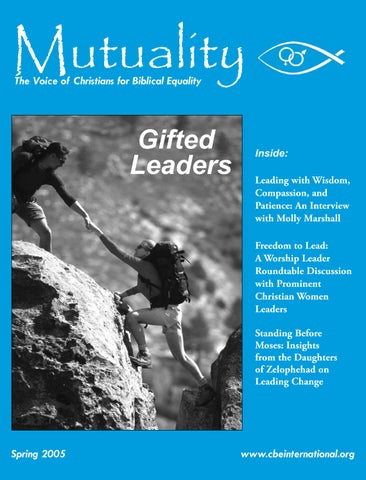
Gifted Leaders
Inside: Leading with Wisdom, Compassion, and Patience: An Interview with Molly Marshall Freedom to Lead: A Worship Leader Roundtable Discussion with Prominent Christian Women Leaders Standing Before Moses: Insights from the Daughters of Zelophehad on Leading Change
Spring 2005
www.cbeinternational.org
Features
Contents
5 Leading with Wisdom, Compassion, and Patience An interview with Molly Marshall, the first female president of an accredited Baptist Seminary — By Heather Scheiwe
7 Freedom to Lead A worship leader roundtable discussion with prominent Christian women leaders and thinkers — With Kim Hill, Rita Springer, Sally
Visit CBE’s homepage at www.cbeinternational.org for the latest… • FREE audio and print resources on biblical equality • Ministry news and needs • Employment, internship, and volunteer opportunities • Membership information for churches, libraries, families, and individuals • Subscription to CBE publications • CBE chapters in the U.S. and around the world • Listings for counselors, therapists, and spiritual directors who agree with CBE’s Statement of Faith • Directory of egalitarian churches in the U.S. and around the world • Giving opportunities
Visit CBE’s online bookstore at www.equalitydepot.com for resources like… • • • •
Books and articles Audio and video tapes CD, DVD, and MP3 recordings Back issues of Mutuality and Priscilla Papers
| Mutuality Spring 2005
Morganthaler, Roberta King, and Teri Furr
11 Standing Before Moses
Insight from the Daughters of Zelophehad on leading change — By Jeanne Porter
15 Who’s the Boss?
A dramatic reading of Ephesians 5:25–33 — By Kuruvilla Chandy
21 Searching for Ways to Bring Biblical Equality to Australian Bookstores
21 New Openness to Wild-Hearted
Women and Men at Christian Ministries Convention 21 Service of Spiritual Reconciliation Breaks Silence about Abuse, Assault, and Oppression 22 Violence, Peace Mark Christian Home Conference 22 CBE’s Theological Intern Awarded Princeton Scholarship 22 Legacy of CBE Leaders Paves the Way to the Future 23 CBE Chapter Listings
Departments 3 From the Editor: Beautiful Feet — By Chelsea DeArmond
4 In Our Mailbox 23 Praise Reports & Prayer Requests 24 Giving Opportunities: Cathie Kroeger Leadership Fund and Conference Scholarships 25 For the Family: Knock, Knock! Who’s There? (Acts 12:1–17) — By Chelsea DeArmond
26 Church and Study Group Resources: Study Guide for Gilbert Bilezikian’s Beyond Sex Roles — By Mary Gonsior
27 Book Review: Sylvia Rose’s Rise Up: 18 Mutuality in Early Methodist Evangelistic Leadership Early Methodist pioneers have something to teach evangelical Christians of all denominations about mutuality and leadership today — By Paul W. Chilcote
Ministry & Chapter News
A Call to Leadership for African American Women — Reviewed by M. Alexandra George
28 Arts & Culture: Chicken Run — Reviewed by Heather Scheiwe
29 CBE Resources & Equality Depot: Save 20% on new TNIV Bibles and CBE resources on leadership 30 President’s Message: Learning to Lead — By Mimi Haddad
21 Women, the Bible, and the Church Course Analyzes Historical and Textual Implications for Interpretation
home page: www.cbeinternational.org
Mutuality The Voice of Christians for Biblical Equality
Let us then pursue what makes for peace and mutual upbuilding. — Romans 14:19 VOLUME 12, ISSUE 1 Mutuality seeks to provide inspiration, encouragement and information about equality within the Christian church around the world. President/Publisher : Editor : Editorial Assistant : Graphic Designers :
Mimi Haddad Chelsea DeArmond Heather Scheiwe Christy Morris
EDITORIAL AND ADVERTISING OFFICE Christians for Biblical Equality 122 W. Franklin Ave., Suite 218 Minneapolis, MN 55404-2451 phone: (612) 872-6898 fax: (612) 872-6891 e-mail: cdearmond@cbeinternational.org web: www.cbeinternational.org Advertising in Mutuality does not imply organizational endorsement.
SUBMISSIONS Mutuality welcomes submissions. E-mail cdearmond@cbeinternational.org or write to CBE for the writer’s guidelines.
PERMISSIONS Christians for Biblical Equality grants permission for any original article (not a reprint) to be photocopied for local use provided no more than 1,000 copies are made, they are distributed free, the author is acknowledged and CBE is recognized as the source. Mutuality (issn: 1533-2470) is published quarterly by Christians for Biblical Equality and is sent free to members. For membership information, see page 31. To purchase back issues, contact our Editorial and Advertising Office, or order online at www.equalitydepot.com.
From the Editor by Chelsea DeArmond
Beautiful Feet
By Chelsea DeArmond | The Church is in great need of leaders who model Christ-like uses of authority that build people up into all God intends us to be. Many people are sensitive to the ways the gap between leaders and followers can be widened and exploited. This issue of Mutuality features ways Christians can rise up and counter these historical and current wrongs by using our gifts and talents as God intended. When the mother of James and John wondered what it would take for her sons to rank highest among the disciples, Jesus didn’t answer her with a yes or no. Instead, he asked if James and John were able to drink from his cup, a reference to the suffering Jesus endured. Even if they could, only the Father had the authority to assign these places of honor (Matt. 20:20–28). Human suffering and divine sovereignty are consistent themes related to biblical leaders. These leaders were called on to bear the burdens of their people (in Gal. 4:19, Paul uses the analogy of birth pains to describe how he felt about the Galatian Christians), and they turned to God as the source of their strength. During the time of the Judges, God would not raise up leaders until the people cried out to the Lord as their true helper. Though leaders like Deborah and Barak successfully drove back Israel’s enemies, the true source of their strength was the Lord (Judges 2:16; Heb. 11:32–34). Biblical leaders were commissioned in many different ways. No matter how they were eventually commissioned by the community of faith, it is clear that these leaders were first of all chosen by God. Over and over again we learn that the people God chooses as leaders do not always conform to people we would naturally be eager to commission. Cultural and personal biases against potential leaders based on gender, ethnicity, or class are illegitimate reasons to refuse to commission someone God has chosen to raise up. Even biblical leaders who seem to fit conventional notions of leadership often turned to unconventional sources for partnership and support. For example, Moses was saved from God’s wrath when his wife Zipporah circumcised his sons (Exod. 5:24–26). King Solomon was the wisest and wealthiest man in the world, and the only person he bowed down to was his mother, Bath Sheba (1 Kings 2:19). Good king Josiah, who instituted the most thorough religious reform in Judah’s history, turned to the prophet Huldah to help him discern God’s will and interpret Scripture (2 Kings 22). While we tend to think of leaders as independent individuals, these examples show that good leaders recognize the importance of strong partnerships. Historically, many Christian communities have refused to commission women as leaders. Yet God uses women to lead powerful ministries in spite of the opposition they have faced. The Church would do well to heed the rabbi Gamaliel’s advice to Jewish leaders who opposed the apostles: “if this plan or this undertaking is of human origin, it will fail; but if it is of God, you will not be able to overthrow them—in that case you may even be found fighting against God!” (Acts 5:38–39 tniv). Some have argued that the meaning of headship in the Bible can be used to establish a hierarchy among believers based on gender. Perhaps a better way to recognize godly leaders is not their claim to headship, but rather the condition of their feet. Leaders’ heels have bruises that keep them humble by reminding them of their vulnerability to sin (Gen. 3:15). But they are also strong and fleet because of God’s victory over sin, death, and the devil (Gen. 3:15; Rom. 16:20; Eph. 6:15). Most of all, they are beautiful because they have been washed by Jesus (John 13:2–16) and they bring good news (Nahum 1:15; Isa. 52:7; Rom. 10:15). Chelsea DeArmond is Editor of Mutuality and Bookstore Coordinator at Christians for Biblical Equality. She can be reached at cdearmond@cbeinternational.org
book store: www.equalitydepot.com
Mutuality Spring 2005 |
In Our Box Extending Christ’s Love to the Poorest of the Poor
We’d love to hear from you!
I’m so thankful to read in Mimi’s article that CBE is considering addressing issues of gender and poverty. It seems to me that that is a key issue in developing countries. Anything that we can do to support the health, education, and development of women will help the whole culture. I’m glad that CBE is seeing that Christ’s love extends to the poorest of the poor, helping them understand that God loves them so much that their lives count in what God is doing in the world. Also, I think that this emphasis will open doors with churches in new ways, especially churches like mine (the Presbyterian Church), which seek to address issues of gender and poverty in mission work. Blessings in Christ to you and all at CBE! — Lorraine Stuart Bend, Oregon
Praise for Cecilia Yau’s “Modern Parable” I just picked up my winter 2004 issue of Mutuality and in leafing through it found the modern parable. That is sooo on target!! — Jeanine S. Moss Rolla, Missouri
Leading Toward New and Exciting Territory I just wanted to let you know that I received the Mutuality in the mail last night, and I’ve read nearly every word. It’s wonderful ! The layout is beautiful, and the articles show CBE and the biblical equality movement leading into such new and exciting territory. — Joanne Nystrom Janssen Former Editor of Mutuality Muncie, Indiana
Hoping for More Dialogue on Women and Poverty Issues I’ve been a member of CBE for 10+ years. After serving in West Africa with the International Mission Board for 30 years, my husband and I have retired to Albuquerque. The Winter 2004 issue of Mutuality was most useful. Your report on the international confer-
| Mutuality Spring 2005
Send your comments, suggestions and critiques to: MUTUALITY
122 W Franklin Ave, Suite 218 Minneapolis, MN 55404-2451 phone: (612) 872-6898 fax: (612) 872-6891 e-mail: mutuality@cbeinternational.org web: www.cbeinternational.org Letters may be edited for clarity and brevity.
ence was great. I especially enjoyed the features on China, Nigeria, and India. The modern parable was great. I’m very excited about “Women, Poverty and the Micah Challenge.” The issues are different in each culture/country but I doubt there are any cultures/countries where this is not an issue. There are so many issues facing women around the world. Poverty, religious discrimination, genital mutilation, medical services, etc. Ironically, I found in West Africa that educated women seemed to have easier access to good jobs, cabinet posts, etc., than they do in the States. I’m really interested in the dialog that I hope comes out of your article. — Joanne Gray Albuquerque, New Mexico
Outcome of Lausanne Conference is Powerful and Significant The CBE magazine arrived today with your letter to IG24 [the Gender Forum at the 2004 Lausanne Conference for World Evangelism] participants and I read it with great interest. It was so exciting to see everyone’s pictures and read the stories again!! Thank you so much for all the coordination you have brought to this project! It is so powerful and significant.
Corrections Accessing Rebecca Merrill Groothuis’ Paper for ETS In our report on the 2004 ETS Annual Meeting in the Winter 2004 issue of Mutuality (pgs. 17–18), we mentioned that Rebecca Merrill Groothuis’ editorial response could be accessed at www. zondervan.com. Specific instructions for requesting a copy of the paper from Zondervan are actually listed at the ETS website: http://www.etsjets.org/meetings/2004/papers/2004-papers.html.
Corrected E-mail Address for Spiritual Directors Listings Lorraine Stuart’s e-mail address was incorrect in our “2004 Spiritual Directors Listings” on pg. 28 of the Winter 2004 issue. Her correct e-mail address is: ldstuart@bendnet.com.
— Ellen K. Duffield NextLEVEL Leadership and Georgian Bay Community Church
home page: www.cbeinternational.org
Leading with Wisdom, Compassion, & Patience An Interview with Molly Marshall
Molly Marshall was unanimously elected president of Central Baptist Theological Seminary on Nov. 12, 2004, becoming the first female president of an accredited Baptist seminary. Heather Scheiwe, Mutuality editorial assistant, recently interviewed Dr. Marshall about her journey as a Christian leader. Scheiwe: Congratulations on the board’s unanimous decision to elect you President of Central! How did you react to such a vote of confidence? Marshall: I feel very affirmed as well as challenged by the confidence extended, especially because it was a unanimous secret ballot vote. If there were reservations, it would be have been easy for anyone with differing opinions to express them. This is my tenth year at Central. I was a professor, then took a position last May as Acting Academic Dean. Thankfully, I have always had the support of faculty, administration, and students. You have served as a youth minister, pastor, and teacher before accepting this position. How do you see your leadership experiences in pastoral ministry complementing your leadership positions in an academic setting? Yes, I was both an interim pastor and rural pastor in Kentucky and served as a deacon and frequent teacher in the American Baptist Church. I’ve also taught theology for many years, so the academic setting is a comfortable place for me, too. In both these experiences, I’ve identified three things that are critical to responsible leadership, and these are pastoral dimensions: wisdom, compassion, and patience. How do those values play out in your own ministries, both as a pastor and now as President? As an academic or a pastor, you want to be a reliable guide. So that means being a student, listening, so that you might speak in a wise and helpful way. Compassion is essential because it is the empathic connection with others. You are able to “feel with” the lives of others. Patience is necessary because we are all at different places in our journeys of faith. It is important, then, to be patient with yourself when you feel you’re not measuring up and to be patient with others when they are not as strong so you can help them identify their gifts. In both of these roles, I’ve been well-received. There’s a real receptivity to the kind of collaborative and servant leadership I offer. I lead by example as well as by service. You speak of service as an essential quality of leadership. Does that mean that anyone who can serve can also lead? We are all called to serve, but I think God calls a person specifically to positions of leadership. There are varieties of gifts of leadership, too, like those with the capacity to lead in more expansive roles than others, which takes both gifting and effort. One of the things I’ve been trying to do is learn more, to ask the question, “What constitutes effective leadership?” I try not to rely on patterns of the past. I spent a sabbatical at St. John’s Abbey [Collegeville, Minn.], so I am shaped by the Benedictine tradition of spirituality. One of the ideas in the Rule [of St. Benedict, a 530 A.D. document outlining Christian monastic practice for laypeople] is that the leader should never do anything without counsel. This is something I regularly practice through consulting with board members, faculty, even students. I seek more than my own opinion, and seeking the counsel of God especially is essential to that. So, journaling and prayer are my regular morning practices. I read from the lectionary, then pray over it and lay before God the particular concerns of the day. Have you received any backlash as a woman in leadership, particularly from the SBC? Perhaps there are some persons in the area of American Baptist life not happy with my election, but they have not spoken to me personally. I have not experienced any direct backlash, and my appointment has been well-received in both ecumenical and Baptist circles. The controversy at Southern was quite a challenge. The film [Steven Lipscomb’s docucontinued on page 6
book store: www.equalitydepot.com
About Molly Marshall Students, faculty, and staff have celebrated Molly Marshall’s presidency of Central Baptist Theological Seminary in Kansas City, Missouri, but her leadership has not always been so welcome. After graduating from Oklahoma Baptist University, Marshall received her M.Div. and Ph.D. from Southern Baptist Theological Seminary in Louisville, Kentucky. Post-doctoral studies have taken her to Jerusalem, Cambridge, and Princeton. She served for many years as Associate Professor of Theology and Associate Dean in the School of Theology at Southern Baptist Theological Seminary. She also had many ministry opportunities along the way, including serving as a deacon and pastor. Only ten years ago, Marshall encountered sudden opposition at Southern. After receiving a teaching award in the spring of 1994, Marshall was stripped of her position when a new president, R. Albert Mohler, Jr., took office that same year. The ensuing controversy resulted in a documentary by Steven Lipscomb, “Battle For The Minds,” which was featured at the South by Southwest Film Festival in 1998. Despite the hostility, Marshall’s gifts were reinvigorated when she accepted the position of Professor of Theological and Spiritual Formation at Central Baptist Theological Seminary in Kansas City, Missouri, in 1997. After serving as Acting Academic Dean for six months, she was unanimously elected to the office of President on November 12, 2004, making her the first female president of a Baptist seminary. Molly Marshall and her husband, Dr. J. Douglas Green, are members of the American Baptist Church (ABC). Dr. Marshall has written several books, speaks regularly at churches and theological conferences, and even finds time to make world-class chili.
Mutuality Spring 2005 |
Leadership Resources from Joyce Strong
Checkup Questions to Ask Myself as a Leader source: Leading with Passion and Grace: Encouraging and Mentoring Women Leaders
in the Body of Christ, by Joyce Strong (Xulon 2003), pgs. 213–14.
1. Am I serving in my area of gifting? Does what I do make my heart “sing”? 2. Besides leading, do I demonstrate a lifestyle of love for those in my personal life and neighborhood as well as in the ministry?
3. Am I raising up the next generation of leaders by empowering others who are gifted to do what I am doing and more?
4. Do I think in terms of “team,” or am I a solo player? Am I willing to resource other leaders to enrich my leading?
Leading with Passion and Grace: Encouraging and Mentoring Women Leaders in the Body of Christ by Joyce Strong Xulon Press • paperback • 218 pgs.
With candor and sensitivity, Joyce Strong addresses the spirit of leadership and offers guidance. Principles such as humility, teamwork, community, and reliance on God are interwoven throughout the text. Check lists, bullet-points, and “Discussion Probes” help the reader explore personal leadership issues, and can be adapted for individual or group studies. This book leaves the reader feeling, “I can do it, with God’s grace.”
5. Do I show respect for my authorities, whether I agree with them or not? 6. Have any of my staff members become too dependent upon me as mentor or coun-
selor? Do I need help setting them free to think for themselves and use what I have taught them? Do I need help setting boundaries? 7. Am I possessive of what I do? Do I get my identity from it? Would I gladly give it to another leader for a season, or permanently, if asked to do so? 8. Are there any unresolved hurts in my heart from the past that sometimes steal my joy? To whom can I go for counseling? 9. Have I asked a wise person to watch my life and hold me accountable for personal growth? How do I feel about being corrected? 10. Is my devotional life strong and rewarding? Do I practice solitude in order to hear God? 11. Do I have committed intercessors to support me and to do spiritual warfare on behalf of those I influence? 12. Am I being mentored by (or seeking to learn from) someone more seasoned in leading than I am?
Scriptures: 2 Tim. 2:2; Eph. 4:11–13; Phil. 2:1–4; Col. 3:12–16; 1 Thess. 5:14.
Molly Marshall Interview, from page 5
mentary, “Battle For The Minds”] is a pretty accurate portrayal of what went on. The committee [of SBC representatives] accused me of demanding that students pray to Mother God. That is not true. I did introduce the study of feminist theology, but what was of most concern to our board of trustees was that I had been a pastor, that God could call women to pastoral leadership. How will your leadership at Central enhance young women’s opportunities in ministry there? Instruments for His Glory: Releasing Women to Minister in Harmony with God and Man by Joyce Strong
I believe appointing me as President of Central sends a very clear message about gender equity. We are known as a school that values the ministry of women in all roles. Currently, our enrollment reflects that, with a 48/52 ratio of women to men. I’ve always been a faculty participant in women in ministry groups, and will continue to be.
Creation House • paperback • 197 pgs.
How can we continue to see change?
Using the metaphor of a symphony, Strong shows how the body of Christ is made up of diverse instruments and notes, unified under the Maestro’s direction. The part we play in God’s symphony is determined by our gifts, not our gender. Strong shares her story of moving beyond traditional expectations and offers practical pointers learned along the way.
There’s still a challenge in placement of women in positions of leadership, something I must continually address. Women pastors are often called to smaller, less prestigious churches, or simply receive less pay than their male equivalents. We all can be advocates when we talk to churches and committees, continually emphasizing the equal value of women’s giftings.
| Mutuality Spring 2005
“I view myself as an equipper of ministers, a midwife of grace who helps deliver what I discern is struggling to be born in the lives of students. Theological education is a process of discovering and refining calling and gifts— learning, in the words of Frederick Buechner, where one’s ‘great gladness meets the world’s deep need.’” — Molly Marshall home page: www.cbeinternational.org
A Worship Leader Roundtable Discussion with Prominent Christian Women Leaders and Thinkers
Freedom to Lead A
s one of the most enduring controversies in Christian history, the role of women in church leadership has, in many ways, been superceded by the extraordinary contribution women around the world are making in contemporary worship. From songwriting to thriving musical ministries to their increasing presence as functioning worship leaders, women, and the singular talents and abilities they bring to bear, are an essential element in the style and substance of today’s praise and worship. Yet, despite their growing influence in the devotional arts, a woman’s place in worship, not to mention professional pastoral positions, is very much subject to prevailing practices—and prejudices—on the local level. While the power afforded to women within the church may vary according to denominational standards and the simple expedience of filling necessary ministry positions with the most qualified individuals regardless of gender, the proverbial glass ceiling often imposes its limitations despite the egalitarian aspirations of many modern and emerging churches.
Worship Breaks the Bias
Beneath the ongoing debate, fueled by a wide spectrum of scriptural interpretation, old conflicts and contradictions endure. Does the church, consciously or otherwise, accommodate a gender bias? Are there qualities of effective leadership that can best be exemplified by women? What is the true biblical perspective to this seemingly endless argument? While theological debate is certain to continue unabated, it is within the quickbook store: www.equalitydepot.com
ly evolving realm of worship that women have found an innovative and influential expression of their leadership gifts. Defined at its basis as the art of transformational communication, worship is a natural fit for the archetypal (some might even say stereotypical) feminine qualities of intimacy, emotional honesty, and a yielded spirit. Whether or not such traits are consistent with the demands of effective leadership, and whether the two-pronged job description of a “worshiping leader” is consistent with prevailing conceptions of Christian womanhood, all remain to be seen. Yet, what is abundantly evident is that many women within the international church community are not waiting for such questions to be resolved or for final permission to be granted. In a very real sense, worship has become both a force for liberation and a fundamental challenge to both Christian women and men as they increasingly find themselves working alongside one another.
Leading Women
“In churches where worship is understood to be really important, there can sometimes be a higher bar for women to get over.” So says Teri Furr, a well-known teacher and evangelist and cofounder of Fragrant Oil, a popular women’s movement. “If that emphasis isn’t there, if worship is just considered ‘filler,’ then it’s not so controversial for women to lead.” Kim Hill agrees, describing a recent experience leading worship at a conference, “I was scheduled to lead worship on the last morn-
ing; it was pretty early and there wasn’t a single person in the room aside from the sound guys. The program director came up and told me that I was going to start worship in two minutes whether there was anyone there or not. Period. ‘You’re the filler, you know, people straggle in while you’re singing.’ I’m certain that I was in a place where worship wasn’t of value. There are some times when attitudes like that are harder to overlook than others, but it has taken me years to reach a level of maturity where it doesn’t bother me as much. These days I don’t care. I’m singing to the Lord. I’ve come to realize, regardless of the number of people, whether it’s one person or two hundred, my job is to be obedient and lead worship.”
The Kneeling Positions
But, an emphasis on God’s anointing and the power that comes with it is central to the hard won wisdom of the veteran women in worship. “The Lord spoke to me and said, ‘I have a position for you and you don’t have to worry about it because it is the highest position you could possibly pick,’” reveals Rita Springer, a well-traveled worship leader, songwriter, and recording artist with
Mutuality Spring 2005 |
“ I’ve come to realize, regardless of the number of people, whether it’s one person or two hundred, my job is simply to be obedient and lead worship.” — Kim Hill
Significant Roles a rich history in the Vineyard movement. “In my humanity, I thought, this is going to be great! I’m going to have some grand title with a big desk and my name on the door and God is going to push through the promotion personally. But then he told me, ‘Your position is the kneeling position,’ and I really had to process that. Humility is the thing that brings us honor and, in the church, we’re still battling that issue, men and women. For me it comes down to one question: Who does God say I am?” To find the answer to that question many seekers turn to Scripture, yet the evidence for clear and unequivocal insight is historically scant. “I find that a lot of male leaders are challenged by the thought that Scripture may mean something different from the way it’s been interpreted for so long,” comments Dr. Roberta King, Associate Professor of Communication and Ethnomusicology at Fuller Seminary. “We probably have a lot of male pastors who are secretly supporters of women in leadership, but they’re afraid to stand up for women as equals.”
| Mutuality Spring 2005
“I know a young woman who lives in Texas and is looking for a job as a worship leader,” recounts Sally Morganthaler, teacher, author and frequent contributor to Worship Leader magazine. “She’s asked a number of churches and has gotten back a lot of nasty e-mails telling her she should read her Bible on the subject of women in ministry. That’s just one story, but I think generally women with leadership skills, while they may get some kind of title within the church, usually end up in assisting roles. They’re not guiding the ship; they’re not setting the vision, and they’re not so much managing a ministry as helping someone else manage it. They’re frustrated because they know their ideas aren’t going to go anywhere and they’re relegated to helping men.” An acknowledged expert on the emerging church movement, Morganthaler sees entrenched attitudes even in the most modern congregations. “Women are often caught off guard by systems that seem to be inherited from older churches. The jargon may be different, but the leadership functions are not. The ones I talk to often tell me that they went into these new churches thinking that they would be in partnership and now they’re wondering how can they push through all those barriers they thought were behind them.”
“ We are too often paralyzed by waiting for permission, it’s our freedom in Christ that gives us permission.”
— Rita Springer
Pushing Through
It is in the pushing through that women leaders, especially in worship roles, are forging a fresh and refreshingly non-confrontational strategy for assuming an active role in the life and work of the church. “We are too often paralyzed by waiting for permission,” asserts Springer. “It’s our freedom in Christ that gives us permission. I believe women are the intercessors of worship. It’s a much different quality from what a man can bring because of the emotions, because of the fact that we will run, not walk, to get to Jesus. Understanding that gives us freedom and, with that freedom, comes authority.” Another point of paralysis, according to Morganthaler, is that “a lot of women look at Jesus through our experiences with fathers, spouses, and brothers. We have all three layers of maleness that we need to strip away to see how countercultural Jesus really was. How can we get our motivation toward him straight when our father abused us, or even if we’ve been silenced so much we’ve lost touch with the freedom we have in Him? The reality is that Jesus had such a high view of women, we have no cause to look at him through the filter of our own past encounters with men.”
home page: www.cbeinternational.org
“ The reality is that Jesus had such a high view of women, we have no cause to look at Him through the filter of our own past encounters with men.”
— Sally Morganthaler
Servant Leadership
The entire concept of leadership is another central premise being closely examined by women in worship. “We so often try to say the words ‘servant’ and ‘leader’ in the same breath,” explains King. “We should just drop the leader part. If we simply thought of ourselves as servants, whether male or female, I think it would really change our perspective, because then we would genuinely be pursuing God in the midst of our worship, rather than being concerned about what our role is in the church. The question we need to ask ourselves is whether we’re serving God in what we’re doing. We need to get over seeking a platform and instead find our place in the family of God where our gifting can be used—and that means we need role models, especially as women. We don’t have enough women who can encourage us to stand up and say ‘I can do that!’” For Teri Furr, the concept of women’s gifting is very much in the mind of the beholder. “Too often the culture dictates what our role will be,” she says. “For instance, those passages in Scripture that talk about women not teaching men create the impression that instruction from a woman is forbidden and that usually translates as preaching. But wor-
book store: www.equalitydepot.com
“ If we simply thought of ourselves as servants, whether male or female, I think it would really change our perspective, because then we would genuinely be pursuing God in the midst of our worship, rather than being concerned about what our role is in the church.” — Roberta King
“ The ones who are being discriminated against are never going to be the ones who can best shine a light on the problem. God is going to have to do that.”
ship leading can actually be a much more direct form of instruction and a lot more immediate in its response of God’s truth.” Springer heartily concurs. “Sometimes I can say more behind the piano than can ever be said behind the pulpit. We have to get our emphasis off of position and prestige. Are we looking for an impressive title because we need it or because it describes what God has put on us? All too often things get out of balance and we end up breeding ill will toward men. It’s not a better-than issue. It’s an other-than issue.”
applying it. I think it’s also important for women to consciously develop an attitude of humility, because it’s very easy for us to react defensively in a hurtful situation. By this I don’t mean being so humble that you’re not doing what God has called you to. Sometimes we have to take risks, to confront others. But we have to do it with a loving attitude, seeking God in all things. I think the bottom line is, we women should be excited to be living in this day and age and not a hundred years ago.” “I think the message a lot of committed Christian women are trying to get across is very direct,” adds Morganthaler. “It’s that the Kingdom of God needs what we’ve been given. We’re not just in this for ourselves, to set up a little women’s club. During the women’s movement, it was all about getting recognition and equality and all of that, and while I’m not saying that isn’t important, what we understand is that what really matters is who we are and how we can help transform the world, for the glory of God.”
Humility Is the Key
“We can go in and start blasting everybody over what we see as bias,” continues Furr. “But that’s never going to be the solution. The ones who are being discriminated against are never going to be the ones who can best shine a light on the problem. God is going to have to do that.” To finally and fully comprehend the differences and similarities of men and women in ministry is, according to King, “going to take commitment on both sides to be willing to listen and to work together. It means spending time hearing each other and then taking what we’ve heard and
— Teri Furr
This article was originally published in Worship Leader Magazine’s Nov./Dec. 2004 issue. Reprinted with permisson. Copyright © 2004, Worship Leader Partnership.
Mutuality Spring 2005 |
10 | Mutuality Spring 2005
home page: www.cbeinternational.org
Standing before Moses Insights from the Daughters of Zelophehad on Leading Change
By Jeanne Porter | A few years ago, the leaders of a major denomination struggled with the issue of women in their executive leadership ranks. Women could be ordained as pastors but could not ascend to the next level of clergy leadership, District Elder. Through the years more women began to call for a shattering of the “stained-glass ceiling”1 that prevented them from assuming key decision-making roles. Finally, at the denomination’s annual convention of clergy, a series of policy resolutions were debated. Many of the current leaders advocated that women should be elevated to the next level of leadership but must be given a title other than District Elder. Two women delegates were given permission to address the Board of Directors. These two women boldly represented the sentiments of a vast number of women of this denomination. They passionately and clearly set forth their appeal. In essence, they argued: “This denomination has a grand history of supporting women in ministry, having ordained women into ministry from its inception nearly one hundred years ago. We have failed to continue our legacy. Women comprise over seventy-five percent of the membership of our churches, yet they are not represented adequately in the top leadership ranks. Limiting their executive leadership presence is a type of sacral apartheid and giving them a separate title is discriminatory.” In speaking up, these daughters of destiny embodied the courage and passion of five women in ancient Israel known as the Daughters of Zelophehad, who helped to shape the destiny of Israel. We do not often hear about the Daughters of Zelophehad, but they were important women in their community of faith. Their story provides a biblical book store: www.equalitydepot.com
framework for understanding how the women of one denomination helped to change their leadership system, and thus encourages more of us to work for gender equality in leadership.
A New Generation of Leaders We first read about Mahlah, Noah, Hoglah, Milcah, and Tirzah, the daughters of Zelophehad, in Numbers 26 where they are included in the genealogy of the Israelites. God had commanded Moses to take a census of the congregation because the first generation of Israelites who came out of Egypt died in the wilderness without reaching their destination, Canaan. God was preparing the new generation to enter into that Promised Land, and the Daughters of Zelophehad were part of this group. Their place in the genealogy indicates their connection and significance to this faith community. At the convention where the denomination struggled with the issue of gender and leadership, a great number of women knew it was time for women’s full inclusion. Traditional gendered understandings of the titles “elder,” “district elder,” and “bishop” prevented many of the male leaders of this denomination from granting women full leadership inclusion. The founders of this denomination cited the Apostle Paul’s guidelines “to ordain elders in every city…if any be blameless, the husband of one wife, having faithful children, not
accused of riot or unruly” (Titus 1:5–6 kjv) as their reason for excluding women the position of Elder. Paul’s qualifications seemed to indicate that Elders were to be men, yet these early church leaders also supported women’s call to ministry. They attempted to resolve this paradox by creating a type of “dual sex system”2 in which ordained men were given the title Elder, and women in ministry were given the title Evangelist or Pastor. Under this system, a woman could never officially rise to the leadership rank of District Elder or Bishop. As times and perspectives changed, more of the leaders began to argue that New Testament women who served the church as overseers of local congregations—such as Priscilla, who led along with her husband, Aquila (Acts 18:2, 18, 26; Rom. 18:18; 16:3, 2; 1 Cor. 16:19; 2 Tim. 4:19)—were the equivalent of Elders. They also argued above: Mahlah, one of Zelophehad’s five daughters, pre-
pares herself to go before Moses. Image © 2003 by Elspeth Young (www.alyoung.com). Used by permission.
Mutuality Spring 2005 | 11
“The daughters of Zelophehad…came forward and stood before Moses, Eleazar the priest, the leaders and the whole assembly at the entrance to the tent of meeting and said…, ‘Why should our father’s name disappear from his clan because he had no son? Give us property among our father’s relatives’” (Num. 27:1–4). Pen and pencil sketch by Charles Horne.
that Paul instructed that male Elders must be the husband of one wife because issues of divorce and marital fidelity were more prevalent among men in Greek cities such as Ephesus.3 Still others pointed out that in Romans 16:7, Paul referenced a woman named Junia as being outstanding or notable among the apostles,4 thus establishing the New Testament precedent for women’s leadership at the highest levels of the church. Not a few of the delegates felt the issue was also about resistance to change, people wanting to preserve the status quo, to keep things “as they have always been.”
Challenging the Status Quo People in any system who resist change by protecting their interests are known as the “old guard.” This title has nothing to do with the age of the leaders but with their mindset and their resolve to protect the old ways of doing things—in spite of mounting evidence for change. The women who challenged the status quo of this particular denomination wanted to empower more women to live out and follow their leadership call. As these contemporary Daughters of Zelophehad spoke out, the Board and the entire convention could not help but hear the underlying call for justice. The question became, how would they respond? When the ancient Daughters of Zelophehad raised their voices, the Israelite men listened. The Israelite culture in which
12 | Mutuality Spring 2005
they lived was embedded with rules that excluded women. Just one example was the rule about who was—and who was not— permitted to inherit property. The inheritance laws dictated that only men could own property and, upon a man’s death, his sons would inherit it. Inheritance was a critical, inalienable right that passed from father to sons. A man’s name was continued not just in the genealogy, but also through land and property ownership. The case of the Daughters of Zelophehad presented an interesting dilemma not quite covered by the existing laws and customs: What if a man died and left only daughters? Would his family name disappear from the rolls of land They remind us of ownership? These the importance of were the imporchallenging the tant issues raised status quo by workby the Daughters ing within the system of Zelophehad and appealing on behalf of their father’s name. Their to the values that father had died, and already exist in they were the only the community. survivors. The question was what would happen to their family name and property. The process they used to raise the issue of inheritance for daughters is enlightening. First, Mahlah, Noah, Hoglah, Milcah, and Tirzah joined together to approach the existing all-male leadership. They operated in unity and spoke with one voice. Next,
the Daughters of Zelophehad laid out the merits of their claim. They explained who their father was, reminding the leaders that Zelophehad had done nothing worthy of having his inheritance stripped. They argued that his name should not be removed from his clan simply because he gave birth to daughters. Their position was that their father’s property rightfully belonged to them. The Daughters of Zelophehad could have remained silent and let the tradition of passing property on to sons continue. Yet in the name of their father they decided to speak out about injustice and try to change the existing state of affairs. They remind us of the importance of challenging the status quo by working within the system and appealing to the values that already exist in the community. Consequently, women of the denomination which struggled with female leadership informally began rallying together following in the footsteps of Mahlah, Noah, Hoglah, Milcah, and Tirzah. They prayed. They discussed the issue among themselves. Some researched, while others continued to speak up at their conventions. A few organized and participated in a forum to educate other members of the denomination on the issues of gender equality. Others wrote articles on women and leadership. In different ways, these church women “stood before Moses”—men in leadership who had the power to change the rules.
The Theology of Gender Justice Moses was the leader of Zelophehad’s community at the time, and along with “the priest, the leaders, and the entire congregation” he stood at the “entrance of the tent of meeting” to hear the Daughters’ request (Num. 27:2 nrsv). Can you imagine the courage it took for these women to stand before this daunting group? Fortunately, after listening to the Daughters’ appeal, Moses “brought their case before the Lord” (Num. 27:5 nrsv). Womanist theologian Delores Williams states, “When Moses takes the matter to God, the sisters’ request becomes a theological issue.”5 Isn’t the issue of women’s leadership in today’s communities of faith more than a sociological or civil rights issue? Isn’t it also a theological issue? Claiming leadership is not clamoring after titles, as some have suggested, but rather a focused pursuit of a God-given calling that structural and organizational barriers must not limit. home page: www.cbeinternational.org
Wise is the leader who takes the issues to God in prayer. When autocratic leaders try to make decisions with no input from people, or no spiritual guidance, they in essence begin to play god. They reinforce a rigid system that protects their own interest and power as Isn’t the issue of leaders. Spiritually women’s leadership sensitive leaders are open to change. in today’s communiThe Daughters ties of faith more of Zelophehad than a sociological took a stance that or civil rights issue? flew in the face of Isn’t it also a theoall their tradition. logical issue? They were willing to confront something they saw as unjust. They found the courage to challenge the existing laws of inheritance in a culture ridden with complicated rules that recognized only men. They became catalysts for change not only for themselves, but also on behalf of all women. And God moved Moses to rule in favor of the women. The Lord said to Moses, “What Zelophehad’s daughters are saying is right. You must certainly give them property as an inheritance among their father’s relatives and turn their father’s inheritance over to them” (Num. 27:7 niv). God gave Moses a plan to take before the Israelites, a plan that was to change their inheritance laws and serve as a precedent in case law for generations to come, including our own. On that fateful day when the divided denomination voted, God moved the convention delegates to support the women. They voted to have the Board figure out a way for women to be elevated to the higher offices and be given the same title as men. What the women of this denomination were saying was right. The Board was to report back the next year with a plan to equitably elevate women to the next level of leadership and forever shatter the artificial barrier that had prevented them from pursuing their God-ordained leadership potential. And so it was, a year later, again after much debate, the voices of women prevailed. The delegates of the convention voted to grant to women the title District Elder, with all corresponding responsibilities, rights, and privileges, and to give Diocesan Bishops the right to elevate women to that office at their discretion.
The Ripple Effect of Change Any change in a system ripples through the system and creates the potential for more book store: www.equalitydepot.com
change. After Moses changed Israel’s inheritance laws, the tribal leaders of Manasseh foresaw a problem with the new ruling, and they proposed another change. They realized that if a woman received her inheritance and then married into another tribe, the inheritance would go with them to the new tribe. The tribal leaders wanted Moses to do something to prevent this economic loss to their own tribe. Just when the women were granted the rights of inheritance, marital custom in their patriarchal system created conflicts that might erode the very right for which the Daughters had advocated! Even with the Daughters of Zelophehad, one step forward seemed like two steps backward. Moses struggled with accommodating women’s rights and ensuring stability in the community. The compromise Moses made was to maintain that the daughters could own land, as long as they married within their tribe. This passage cannot be used to justify contemporary marital selection, but it does affirm the process and outcomes that ancient women ultimately took to secure their rights to inherit a piece of the Promised Land. In fact, their actions alert women today of the necessity of properly preparing for the challenges that may come, if the change for which they advocate is not properly implemented. Here are some things that we contemporary Daughters of Zelophehad need to consider as we continue to stand before Moses and work for change within our communities of faith.
Leadership Resources from Jeanne Porter
NEW! Leading Lessons: Insights on Leadership from Women of the Bible by Jeanne L. Porter Augsburg Press • paperback • 128 pgs.
This sequel to Jeanne Porter’s first book, Leading Ladies, offers insights about growing into leadership, leading through adversity, challenging the status quo, and discovering leadership potential in others. Nine scripturally-based studies examine lessons of leadership from specific women of the Bible. Each chapter includes a summary page of empowerment principles, as well as a series of questions for personal reflection or group discussion.
Build a network of change agents Just as the five Daughters of Zelophehad together approached the leadership of Israel, so must the women of churches, denominations, or religious institutions unite to raise a collective voice. Too often too many of us have tried to initiate change on our own. Instead, we need to build a network of change agents. Networks of like-minded women and men can provide spiritual and social support, resources, information, strategy, and access. Women auxiliary leaders, lay directors, pastors, and ministers need to come together in forums to keep the real issues on the table. We need to call upon more women scholars to continue explicating the issues. We need to include women writers to disseminate our stories in various publishing outlets. We need to bring the woman in the pew into the discussion so she can share the ways in which she is excluded in various venues. We need to network with our national,
Leading Ladies: Transformative Biblical Images for Women’s Leadership by Jeanne L. Porter Innisfree Press • paperback • 158 pgs.
Drawing on stories of biblical women, Leading Ladies presents four models of “transformational leadership” that recognize the leadership styles of women in all walks of life: Intercessor, Midwife, Choreographer, and Weaver. Includes reflective questions for journaling or group discussion.
Mutuality Spring 2005 | 13
state, and local women’s associations for meeting, talking, supporting, affirming, and sharing successes and failures.
Encourage the advocacy of Moses Another necessary step is to encourage more men to advocate on behalf of women’s full inclusion in the leadership of our churches and denominations. Just as Moses became an advocate for women among the other male leaders, most churches, denominations, and religious institutions have a number of powerful men who can serve as Moses for women. Some of these male leaders have been vociferously supportive of women in the debate, while others have stayed on the fence, refusing to speak one way or the
Mutuality: Call for Papers Mutuality seeks to provide inspiration, encouragement and information about equality within the Christian Church around the world. Mutuality is published quarterly, and sent to all CBE members and subscribers. Current and back issue are also available for purchase. We are currently seeking features, reports, and reviews (books, films, and/or music) from evangelical, egalitarian perspectives related to the following themes: • Biblical resources for egalitarians • Forgiveness and healing • Prison (literal & metaphorical) and release Most of the articles we publish fall into the following categories: • Personal testimonies illustrating how biblical equality provides practical benefits to everyday lives. • Teaching on relevant Bible passages, explaining the meaning and showing how to apply it to daily life. • Reviews of books about biblical equality that would appeal to a wide audience. (Books must complete CBE’s book service review process before being reviewed in Mutuality.) • Feature stories about issues related to CBE’s mission and ministry. The length of features is generally 1,300– 2,500 words. Writer’s Guidelines for Mutuality are available on our website (www. cbeinternational.org) or contact our office to request a copy. Questions and submissions can be directed to the attention of the editor, Chelsea DeArmond.
Mutuality
Christians for Biblical Equality 122 W Franklin Ave, Suite 218 Minneapolis, MN 55404 (612) 872-6898 cdearmond@cbeinternational.org
14 | Mutuality Spring 2005
other. Women need to stay in dialogue with these men and affirm their support. We also need these “Moseses” to talk to other men, in ways that only men can initiate difficult conversations with each other and explore their fears and concerns about change. These men can pave the way for women to hold more open dialogue with those who seem to resist change.
Develop systems of accountability for institutions Churches, denominations, and other religious institutions need to provide quantitative measures of the presence of female leadership within their ranks at all levels. Current leaders need to scrutinize their systems, policies, and practices to make sure they are creating an environment that allows women to respond to the call of God in the same way that men respond to the call of God. As more jurisdictional, diocesan, and regional leaders are required to provide reports that document the demographics of their leadership ranks, more leaders will come to see— through numbers—the staggering inequities that exist within the leadership ranks of our churches and denominations.
Develop formal systems of leadership formation and preparation Even though more women are being educated in our seminaries and Bible colleges, women continue to be passed over for pastoral placements, and they struggle to plant and maintain church start-ups. Women continue to be overlooked for denominational and administrative appointments. The customs and practices of most of our churches and denominations show us that the line of leadership accession is as much political as it is spiritual. For its entire history, top leadership in most of our denominations has been passed down from men to other men. No doubt, there is an informal system of relationships, such as mentoring and coaching, that undergird such a system. Women have not only been excluded from the formal leadership structure, but they have also been excluded from the informal system that grooms men for top leadership. One remedy would be to develop a system in which the leadership potential of women is cultivated by assigning them mentors who could train and coach them on the “insider” dimensions of denominational leadership. Mentoring systems are necessary for formalizing the informal rules and creating a culture of equal
access for women. Perhaps you see gender inequities in your church, denomination, or workplace. May the Daughters of Zelophehad’s story encourage you not to look the other way. May these courageous women’s voices resound within your heart and encourage you to step up and speak out. Only as more of us become agents of change and use our voices to call for the dismantling of unjust systems will transformation occur within the systems in which we worship and work.
Notes 1. According to Cheryl Sanders in her essay on “History of Women in the Pentecostal Movement” (Cyberjournal for Pentecostal-Charismatic Research [Oct. 1, 1996]), church historian Susie Stanley “uses the term ‘stained-glass ceiling’ to describe barriers to women’s leadership and advancement in Christian denominations with a long history of ordaining them.” See Cheryl Sanders, “History of Women in the Pentecostal Movement.” 2. Cheryl Townsend Gilkes, If It Wasn’t for the Women…: Black Women’s Experience and Womanist Culture in Church and Community (Maryknoll, N.Y.: Orbis, 2000), pg. 63. 3. Linda Belleville, Women Leaders and the Church (Grand Rapids: Baker, 2000), pgs. 142–143. 4. Much controversy has surrounded Junia. According to Peter Lampei in The Anchor Bible Dictionary, the earliest church leaders accepted that Junia was a woman and an apostle. It wasn’t until the Medieval church that copyists began writing the masculine form of the name in manuscripts, thus obscuring her gender. According to The New Interpreter’s Bible, “Junia is thus one of the female ‘apostles,’ the only one so called; though presumably others, such as Mary Magdalene, were known as such as well” (pg. 762). According to the New Spirit Filled Life Bible, “the most likely understanding, and that most common in earliest church exegesis, is…Junia [was] part of a husband-wife apostolic team” (Rom. 16:7 note, pg. 1575). 5. Delores Williams, “A Theology of Advocacy for Women” Church and Society (Nov./Dec. 2000): pg. 5. Jeanne Porter, Ph.D. is an ordained minister, popular retreat and conference speaker, and a leadership consultant. Dr. Porter is the author of the book Leading Ladies: Biblical Images for Women’s Transformative Leadership. This article is adapted from her newly released book, Leading Lessons: Insights on Leadership from the Women of the Bible. home page: www.cbeinternational.org
Who’s the the Boss? Boss? Who’s
A Dramatic Reading of Ephesians 5:25–33 By Kuruvilla Chandy
[A man and woman are seen on stage. The man has two envelopes in his hands. The words TO: HUSBANDS are written on one envelope, and TO: WIVES is written on the other. The man holds the envelopes so the audience can read the inscriptions. He takes the message from the envelope marked TO: WIVES and reads it quickly.] husband: Paul has written a letter saying that I should be your head. I wonder what I must do to be the head. wife: Let me see that. [Reads…] But this is not for you. It’s addressed to me. You’ve been reading my mail. husband: Okay, okay… So, I wonder what I have to do to be the head. I’m sure it means that I should make all the decisions. I have to be in control of everything in the family. I am sure that is what it means. wife: Paul doesn’t say anything like that. Anyway, why don’t you read what he has written to you? husband: [Takes the message from the envelope addressed TO: HUSBANDS and reads…] wife: Well? What does he say? husband: He says that I should love you. Since I am the head of the family, it means you have to obey me. wife: Let me see Paul’s letter to you. [Reads…] husband: I wonder if there’s anything more I must do to be the head. wife: This is ridiculous. husband: What do you mean? wife: Well, Paul has written what you must do and all you can do is read what he has written to me and talk about being head. Why don’t you concentrate on what he has written you? husband: But I told you—he just told me to be loving. wife: Tell me, how many lines did Paul write to me? husband: [Counts silently] Nine. wife: And how many lines did he write to you?
husband: [Counts silently] wife: Well? husband: Wait! I’m counting… Twenty-seven. wife: How many? husband: Twenty-seven. wife: How many? Can you speak up? I can’t hear you. husband: [Angrily and loudly]
If I regard you as head, and you play the part of a servant, then who’s the boss? Twenty-seven! wife: And all you can say is that you must love me, while you spend so much time trying to find out what you must do to be the head when he hasn’t said a single thing to you about being the head! husband: But Paul did say that I must be head. wife: No he didn’t. He said that I must voluntarily accept your headship. You can’t force me. It’s up to me. husband: Hmm! Never thought of it that way. wife: Shall we look at what you are supposed to do? husband: I’m telling you all I have to do is love you! wife: But how? husband: What do you mean? wife: Well, Paul didn’t just write “Husband love your wife, Husband love your wife, Husband love your wife” twenty-seven times did he? husband: No. wife: Then that means he said a little more. What did he say? husband: After he talked about loving the wife, Paul just drew a parallel between the mar-
book store: www.equalitydepot.com
riage relationship and Christ’s relationship with the Church. Then he simply repeated the point about loving the wife. That’s all. wife: So what does he say about Christ’s relationship with the Church? Why don’t you read it aloud so I can hear what Paul says. husband: [Reads aloud Eph. 5:25–33] wife: Don’t you think Paul is saying that you should do the things Christ did? husband: Paul says Christ made the Church pure by washing and that He died for the Church. That is something only the Savior can do. I can’t do anything for your salvation. wife: True. But he must have had a reason for talking about these things in the context of what husbands ought to do. husband: I suppose. wife: When did the Lord Jesus wash anyone? husband: [Pauses to think] When He washed the feet of
His disciples. wife: So He didn’t play the “I am the head” game with His disciples, did He? Instead He was their servant. husband: That’s true. He in fact said, “I am among you as a servant.” wife: Okay. What about the matter of Him dying for the Church? Does that apply? husband: I suppose it means that I must make sacrifices for the sake of our relationship. wife: So what is Paul saying to you? husband: Love, serve, and sacrifice. Ouch! That’s tough. wife: If I regard you as head, and you play the part of a servant, then who’s the boss? husband: Neither. Come to think of it, that must be why Paul began by saying, “Submit to one another out of reverence for Christ.” wife: [Picks up a Bible and reads and then says] I think the New Century Version brings continued on page 18
Rev. Chandy is the Pastor of Grace Bible Church in Lucknow, India. He and his wife, Roshini, performed this dramatic reading on the occasion of their 30th wedding anniversary.
Mutuality Spring 2005 | 15
One Body, Many Gifts CBE’s 9th International Conference • Eastern University • St. Davids, Penn., USA • July 29–31, 2005 Join us for a time of fellowship, worship, and growth! Conference sessions will feature ministry leaders from China, India, Congo, England, and the United States. Other highlights will include giving the prestigious “Priscilla & Aquila Award” and an Authors’ Autograph Party. Scholarships are available on a first come, first serve basis. For conference registration and more information, visit CBE’s website: www.cbeinternational.org or email conference@cbeinternational.org.
General Sessions
���
One Body, Many Gifts Craig Keener
Free to Love and Free to Serve Cecilia Yau
A Sword Between the Sexes: C. S. Lewis’ Long Journey to Gender Equality Mary Stewart Van Leeuwen
Plurality and Patterns of Equality in Paul Finny Philip
Choose from seventeen Workshop Sessions, including: missions, ministry and the world
biblical studies and theology
history
Developing Your Leadership Giftedness Betsy Glanville
There’s Something about Mary (The Mother of Jesus): From Magnificat to Model Disciple Joseph Modica
Paul and the Leadership of Women: Irreconcilable or Inextricable? The Historical Context of Ephesians and Corinthians Mimi Haddad
The African Women’s Struggle: A Personal Journey from the Congo to America Medine Moussounga Keener Woman in India: Her Choices, Struggles and Destinations Finny Philip Sexual Trafficking, Prostitution and the Global Sex Industry Lisa Thompson How to Write Academic Articles for Priscilla Papers The Priscilla Papers Editorial Team
“Eve” Becomes Mother: Childbirth as a Positive Spiritual Event Coralee Murray and Kathy Nesper The Doctrine of God and Inclusive Language Charles Read Biblical Equality and Radical Feminism: What is the Difference? Aída Besançon Spencer
Gift-based Marriage: Creative Use of Both Partners’ Strengths & Gifting Rand and Phyllis Michael gender and culture
The Personal is Still Political: An Agenda for Gender Reconciliation Mary Stewart Van Leeuwen
A History of Single Women and Men in the Church Jo Ellen Heil
Race and Gender as Seen from the Bible and Genetics Dave Unander
marriage and family
Marriage, a Biblical Model of Submission Craig Keener From Hierarchy to Mutual Submission: One Couple’s Journey John and Carolyn Kohlenberger
The Challenges Women Face in the North American Chinese Church Dora Wang, Serena Lin, Lily Lee and Grace May
Also featuring a special Panel Discussion: First Wave of CBE Leaders, including:
Gretchen Gaebelein Hull
James Beck
16 | Mutuality Spring 2005
Cathie Kroeger
Gilbert Bilezikian
Alvera Mickelsen
Ward Gasque
Nancy Graf Peters (Moderator)
home page: www.cbeinternational.org
The first 50 people to register will receive a FREE LEATHER TNIV BIBLE!
One Body, Many Gifts
Conference Registration & Payment
CBE’s 9th International Conference Eastern University, St. Davids, Penn., USA July 29–31, 2005
Contact Information
More Conference Features
Priscilla & Aquila Award The Priscilla and Aquila award was developed to honor people who, like Priscilla and Aquila “risked their necks” (Rom. 16:2) for the sake of the gospel. At each conference, we honor individuals who, in spite of the risk to position and reputation, have stood firm for the full freedom of women to use their God-given gifts in the service of Christ.
Authors’ Autograph Party Authors including Gilbert Bilezikian, Cathie Kroeger, Alvera Mickelsen, Craig Keener and many others will sign copies of their books at the Authors’ Autograph Party. Bring your own books to have the authors sign, or purchase them from CBE’s bookstore, which will have over 100 of our best-selling titles available.
Writing Workshop The Priscilla Papers Editorial Team will offer a workshop on writing academic articles for Priscilla Papers.
More Conference Information Conference Housing Conference attendees will stay at the North Campus Hall and Gough Hall on the Eastern University campus. Single participants will lodge with another conference attendee of the same gender. If you would like to specify a roommate or if you would like to lodge alone please e-mail conference@cbeinternational.org.
Cancellation and Refund Policy To cancel your registration, contact CBE by the dates listed below: • Refund of fees (minus $30 cancellation fee) by June 1, 2005. • Refund of fees (minus $50 cancellation fee) by July 1, 2005. • No refund after July 1, 2005.
Miscellaneous • Anyone under the age of 18 attending the conference must be accompanied by a parent/guardian. • Individuals needing special accommodation for disabilities should contact CBE no later than June 1. • Childcare will not be provided at the conference. Please contact CBE for a list of local childcare options. • Scholarships are available on a first come, first serve basis. There will be no retroactive scholarships. Contact CBE for more information. book store: www.equalitydepot.com
________________________________________________ first and last name ________________________________________________ street address ________________________________________________ city ________________________________ state / province / country _______________________ phone
_ _____________ zip / postal code
_______________________ e-mail address
________________________________________________ church denomination
Conference Registration All fees are in U.S. dollars, and include registration, meals and lodging, unless otherwise stated. Please check one: $279 $229 $179 $309 $209 $379 $409
CBE Member Student/International Member/Student Non-lodging Non-Member Non-Member, Non-Lodging CBE Member Registration & Booth* Non-Member Registration & Booth*
*Includes 6´ display table and two chairs. Electricity available upon request for additional $40 fee.
Tax-deductible gift $ _______ TOTAL $ _______ CBE is an exempt organization as described in IRC Sec. 501(c)3 and as such donations may qualify as a charitable contributions where allowed by law.
Payment Method Check/Money Order (payable to Christians for Biblical Equality) Visa MasterCard Discover American Express ________________________________ _ _____________ account number expiration date ________________ verification code (the four digits on the top right corner of American Express cards or final three digits found on the back of other cards) ________________________________________________ signature Please mail or fax this form to: Christians for Biblical Equality 122 W Franklin Ave., Suite 218 • Minneapolis, MN 55404-2451 phone: (612) 872-6898 • fax: (612) 872-6891 e-mail: cbe@cbeinternational.org
Mutuality Spring 2005 | 17
Mutuality By Paul W. Chilcote | Methodism began as a movement of renewal within the Church of England in the eighteenth century under the direction of John and Charles Wesley. The Wesleys rediscovered the biblical vision of the church as mission, and their revival elevated the status and role of women by embracing multiple forms of mutuality in ministry. Both men and women provided evangelistic leadership for this missionary movement. Working together, men and women, both laity and clergy, breathed new life into the church of their day. These early Methodist pioneers have something to teach evangelical Christians of all denominations about mutuality and leadership today.
Small Group Ministries Early Methodism was primarily a small group movement. The Methodist Societies, as they were called, were divided into smaller cells known as classes and bands. The classes were generally about twelve in number and mixed in terms of gender and marital status. They also included children and youth. These classes were the heartbeat of the movement. Smaller still were the bands, usually composed of between four and seven members. Unlike the classes, bands were divided into groups for single men, married men,
in Early Methodist Evangelistic Leadership
single women, and married women. The underlying motive for these divisions was the importance of trust and intimacy and the need to have spiritual fellowship with others who were encountering the same questions and issues in life. In all of these groups, men and women worked closely together to provide leadership for the growing revival. John Wesley appointed both men and women as leaders of these groups. Profoundly aware of the perils of numerical success, he was determined to maintain close contact with all his followers. The band and class leaders stood nearest to the rank and file of the movement. They occupied a strategic position within the local Societies. They exerted a powerful influence upon the development of the Methodist institution. Though many assume that the evangelistic preaching of the Wesleys and others brought converts to saving faith, the evidence leads in a different direction. It was in the intimacy of these small groups that the vast majority of men and women found faith in Christ. This was the primary context for evangelism. For women, who generally stood on the fringe of social structures and institutions in that day—if they had any place at all—class and band leadership provided opportunities to discover, practice, and develop leadership skills.
Who’s the Boss? from page 5
out the meaning better. “Be willing to obey each other. Do this because you respect Christ.” husband: Yes, that makes it very plain. Sometimes a husband has to obey his wife. wife: A husband? husband: I…I have to obey you. wife: So who’s the boss in our marriage? husband: You are. wife: No, you are. husband: Hey, this is like two persons holding a door open and repeatedly saying, “After you…No, after you…No, I insist, after you….” wife: No. I think neither of us is the boss. Jesus is the boss. He is Lord. husband: If Jesus is the boss, why call the husband head? wife: Isn’t there a passage that says that God is the head of Christ, as the man is the head of the woman? husband: That’s in 1 Corinthians chapter
18 | Mutuality Spring 2005
11 verse 3. wife: Looks like you know all the references for the passages that talk about male headship. husband: [grins sheepishly, opens the Bible, and reads] Paul said, “The head of every man is Christ, and the head of the woman is man, and the head of Christ is God.” But that passage affirms male headship doesn’t it? wife: Tell me, does the statement that God is the head of Christ make Christ lower? husband: No, it doesn’t. That just means that in the human order Jesus accords God the Father that honor. wife: Then that means that in human society a wife is to give the honor of head to the husband. But it doesn’t mean that the woman is somehow inferior, does it? husband: I get the point. So you’re just giving me an honor. But I can’t demand it or grab it.
These positions of trust, authority, and evangelistic leadership often led women into more visible and critical roles within the movement.
Reaching Out to the Lost Another role shared by men and women alike was related to visitation of the sick and imprisoned. This particularly important ministry traced its roots back to the time the Wesley brothers were students at Oxford. Instead of waiting for people in need to come to them, they went to the forgotten, the suffering, and the lonely with a message of hope. The prison ministries of Sarah Peters and Silas Told are excellent examples of mutuality in evangelistic leadership. Wesley saw that Sarah was especially gifted in caring for the lost and supporting the weak. While Silas pioneered the work at the notorious Newgate Prison in London, Sarah soon joined on an equal footing in the religious services organized for the inmates there. They both visited the cells of all the prisoners to pray for them and to provide for the needs of these outcasts.
Public Prayer and Evangelism Three particular roles, those involving public prayer, testimony, and exhortation, were especially important evangelistic activities in which women flourished as well as men. Each of these practices is grounded in the evangelical urge to “save souls,” but in Wesleyan theology and experience, these were closely linked to social action and service. While falling short of preaching in a technical sense, activity in these areas of leadership proved to be a training ground for a fuller exposition of the gospel. Moreover, all of these activities presuppose the enabling presence of the Holy Spirit, and the Methodist pioneers firmly believed that this presence was open to all Christian believers. For many women, such as Isabella Wilson, prayer was their first experience of public leadership. With regard to her evangelistic impulse to pray openly with others, Isabella simply confessed that she was more than willing to be accounted a fool if she might be a means of glorifying God and helping others. The early Methodists very quickly discovered that women had testimonies and exhortations that were just as moving as home page: www.cbeinternational.org
the men’s were. The Love-Feast, patterned after the agape meal of the early church, provided a unique opportunity for women to share the struggles and triumphs of their Christian experience in mixed company. On a visit to a Methodist Society on the eve of its first Love-Feast, Wesley made it clear to all that every man and woman was welcome to join in free and familiar conversation to the glory of God. Again, Wesley and other leaders were often astounded by the ability of the Holy Spirit to equip the faithful as the instruments of divine love.
From Prayer to Preaching Perhaps the most important examples of mutuality in evangelistic leadership were in the areas of preaching and social service. Despite the fact that both Wesley brothers—like the vast majority of church leaders in their times—initially opposed women preachers, they experienced an amazing metamorphosis that changed their perspec-
tive entirely. In fact, John Wesley became the strongest advocate of women’s ministry in the eighteenth century. Sarah Crosby was the first woman he authorized to preach the gospel. Others soon joined the ranks, including Mary Bosanquet, Ann Gilbert,
Instead of waiting for people in need to come to them, they went to the forgotten, the suffering, and the lonely with a message of hope. Elizabeth Hurrell, Margaret Davidson, Alice Cambridge, Sarah Mallet, and Mary Taft, one of the greatest evangelists of the early nineteenth century. During Wesley’s lifetime nearly fifty women were welcomed into the ranks of the Methodist preachers and shaped the egalitarian impulse of the Methodist movement. They were a tangible expression of the biblical prophet Joel’s vision of mutuality in ministry. Their tremendous gifts and the fruit
of their ministry forced contemporaries to reconsider biblical texts once thought to be prohibitive. The Pauline vision of unity and mutuality in Christ became the key to their understanding of the Christian community and its life.
Leadership in Mission Since the original vision of the Methodists was missional, it is not surprising that we find women and men working together in ministries of social justice and change. They understood social action to be as critical an evangelistic ministry as the proclamation of the gospel. It was, in fact, the incarnation of the gospel vision in their very lives. They offered Christ to others through the activity of their lives as well as the words of their mouths. The work of Mary Bosanquet, in this regard, was remarkable. Born into wealth and affluence, she abandoned her comforts and luxuries to establish an orphanage and
Methodist Women Who Spread the Word
Laura Smith Haviland (1808–1898)
Mary Artemesia Lathbury (1841–1913)
Jarena Lee (1783–1849)
Born in Canada and raised Quaker, Laura Smith Haviland and her husband, Charles, converted to Methodism and moved to Michigan, where they lived and worshipped for many years. In 1837, Laura Smith Haviland they co-founded the Frontispiece to her memoir, Raisin Institute, one A Woman’s Life-Work: of the first schools in Labors and Experiences of the country to admit Laura S. Haviland (1889). black boys and girls. Laura Haviland also worked as a nurse during the Civil War and organized one of the first stations on the Michigan underground railroad. As Superintendent and Stationmaster, she aided between forty and one hundred thousand slaves, earning a $3,000 reward from anti-abolitionists for her capture. Throughout her acts of resistance, she was outspoken about her Christian faith and proclaimed freedom for the captives in the name of Christ.
Mary Lathbury grew up in a Methodist minister’s home, learning early on the value of music in expressing faith. She studied and taught art in Massachusetts, Vermont, and New York before getting involved with the temperance and Chautauqua educational movements as an author and poet. Below is a hymn she penned specifically for a Chautauqua conference closing worship.
After her conversion to Christianity, Jarena Lee felt a strong call to preach. However, Bishop Allen, to whom she addressed her desire to receive authority to preach, denied her for eight years before experiencing one of her sermons and authorizing her Jarena Lee on the spot. Still, she Frontispiece to Religious struggled to pursue Experience and Journal her calling against of Mrs. Jarena Lee, Giving the Account of Her Call to strong opposition, Preach the Gospel (1849). first because she Courtesy of the American was a woman and Antiquarian Society. second, because she was black. As an itinerate preacher for the African Methodist Episcopal Church, she traveled from camp meeting to camp meeting, passing out pamphlets like her personal narrative, Religious Experience and Journal of Mrs. Jarena Lee.
source: Catherine A. Brekus, Strangers and Pilgrims:
Female Preaching in America, 1740–1845 (University of North Carolina Press, 1998).
book store: www.equalitydepot.com
source: Margaret & Daniel Partner, Women of Sacred
Song: Meditations on Hymns by Women (Fleming H. Revell, 1999).
Break Thou the Bread of Life Break thou the bread of life, dear Lord, to me, As thou didst break the loaves beside the sea; Beyond the sacred page I seek thee, Lord; My spirit pants for thee, O living Word. Thou art the bread of life, O Lord, to me, Thy holy Word the truth that saveth me; Give me to eat and live with thee above; Teach me to love thy truth, for thou art love. Oh, send thy Spirit, Lord now unto me, That he may touch my eyes, and make me see; Show me the truth concealed within thy word, And in thy book revealed I see the Lord. Bless thou the truth, dear Lord, to me, As thou didst bless the bread by Galilee; Then shall all bondage cease, all fetters fall, And I shall find my peace, my all in all.
source: Catherine A. Brekus, Strangers and Pilgrims:
Female Preaching in America, 1740–1845 (University of North Carolina Press, 1998).
Mutuality Spring 2005 | 19
Her Own Story: Autobiographical Portraits of Early Methodist Women Edited by Paul Wesley Chilcote Abingdon • paperback • 301 pgs.
Through journals, diaries, and letters, this anthology brings to life more than 20 Methodist women who lived from the early 1700s to the middle 1800s. Instead of adhering to typical stereotypes, these women helped to make the Wesleyan Revival of the 18th century one of the most dynamic Christian movements in the church’s history. FROM THE PREFACE: “Methodist women have a story to share that has not been heard or well remembered; they must be allowed to tell their story, and tell it in their own voice….[L]istening to the voices of the women and knowing their stories is not simply a matter of adding an addendum to the historical report. When we truly take their lives seriously it changes our whole understanding of who we are and what we are called to become.”
Paul Chilcote is Professor of Historical Theology and Wesleyan Studies at Asbury Theological Seminary in Florida. He is the author of Her Own Story: Autobiographical Portraits of Early Methodist Women (Kingswood Books 2001) as well as other works in Wesleyan/Methodist and women’s studies.
20 | Mutuality Spring 2005
school for the most desperate and aban- called to affirm the responsibility of all God’s doned of the London poor. Wesley kept family to pray, to share our stories of faith, to this model Christian community, which encourage the down-hearted and down-trodcombined vibrant personal piety and active den, and to be ambassadors of hope, grace, social service, under his and love. This is prepersonal surveillance. We are to be a missional community cisely what the early Over the course of five Methodists did. years, before moving that lives, not for itself, but for the There is a great sake of Christ and God’s world. need within the life of the community into the north of England, the church today for they sheltered and cared for thirty-five chil- all Christian people to reclaim this privilege dren and thirty-four adults. The orphanage and this task. Every Christian is called to be was a beacon of hope, a magnetic force for the an evangelist, to offer Christ in word and in gospel, as these Christian women sought to deed to all of God’s children. This rediscovlive out their lives in solidarity with the poor. ery will become a reality, I believe, by our In all of these ways, the early Methodist peo- affirmation and encouragement of all God’s ple lived out a vision of mutuality in service to people. Each of us has the amazing privilege Christ and those whom Christ loves. Men and of helping God to restore others, to bring women together offered the good news of the them back to life so that they will live abungospel through word and deed. Through these dantly. We need to help one another discover evangelistic/missional activities they reached our giftedness, to celebrate the presence of out, drew in, nurtured, and sent out disciples the Spirit of Christ in each believer, and to of Jesus Christ. How does this model of mutu- proclaim the good news of God’s uncondiality connect with us today? tional love through every imaginable way.
Mutuality in Small Group Ministries Before his death, Henri Nouwen once said that the most desperate cry of people in our world today is our need for intimacy. People yearn for meaningful relationships. They want to be close with other people, but often do not even know where to begin searching for loving, caring fellowship. At the same time, Christians are rediscovering the importance of intimacy in small group ministries. Early Methodism developed a network of “little churches within the church,” in which disciples of Christ were encouraged to share their lives and their stories with one another. Small groups are a natural place to explore and experience true mutuality as brothers and sisters in Christ. Intimate circles of Christian fellowship provide a place to nurture gifts, to affirm the value and worth of every human being, and to develop cells of renewal and vision for the larger Christian community.
The Ministry of the Baptized The early Methodist people believed that all Christians are called into ministry by virtue of their baptism. Baptism is our ordination into the service of Christ in which we all seek to use our gifts for the glory of God. The early church leader, Irenaeus, once said that “the greatest glory of God is the human creature fully alive.” As Christians we are
Called to Mission “Go to the people” is a divine imperative directed to men, women, and children alike. The early Methodists had to learn how to reach out to the least, the last, and the lost. It was not something that came naturally to them. They had to rely on the Spirit of God every step of the way. A very affluent young woman was converted under the ministry of John Wesley, but found it extremely humiliating to minister among the poor. But the Methodist founder believed in the transforming power of God. In a letter to her he challenged her to visit the poor and sick in their own hovels. He invited her to take up her cross and to remember the faith, for Jesus went before her and would go with her. “Put off the gentlewoman;” he told her, “you bear a higher character.” Today, as I write, war is destroying lives and stealing away hope, natural disasters have caused untold suffering and loss, the AIDS pandemic wreaks havoc on much of the world, and brothers and sisters in our human family lack the basic necessities of shelter, food, clean water, and education. God invites all—without any concern for gender whatsoever—to respond to the needs we see around us every day. God calls us to be a missional community that lives, not for itself, but for the sake of Christ and God’s world. home page: www.cbeinternational.org
Ministry and Chapter News Women, the Bible, and the Church Course Analyzes Historical, Textual Implications for Interpretation CBE President Mimi Haddad and New Testament scholar Linda Belleville team taught a 2005 January-Term course entitled, “Women, The Bible, and the Church” at North Park Theological Seminary in Chicago. The students were from a variety of backgrounds, including younger and older, women and men, those with well-formed views of gender and biblical interpretation and those who were less certain of their stances. The question, “How does the church’s understanding of the nature of women affect its interpretation of Scripture?” guided the students’ studies. Haddad discussed turning points in social understanding, highlighting how views of women have been shaped by Aristotelian philosophy, the French Revolution, and eighteenth-century women in missions. Belleville analyzed biblical texts in the original Hebrew and Greek, including many of Paul’s instructions for proper worship.
Searching for Ways to Bring Biblical Equality to Australian Bookstores Trevor and Liz Sykes have been searching for ways to encourage Christian booksellers in Australia to carry more egalitarian resources in their stores. So when they heard about the Christian Bookselling Association in Australia’s (CBAA) Regional Convention in Perth, Western Australia, Feb. 7–8, they decided to go. Not knowing quite what to expect, the Sykes reserved a display table and stocked it with CBE books from their own library, recordings of N. T. Wright’s session from CBE’s 2004 Symposium, and sample issues of Mutuality and Priscilla Papers. They also prepared a list of egalitarian books that are available through Australian distributors. Trevor and Liz reported that the people who stopped by the booth had interesting comments, including support for the work they were doing. Others offered helpful tips about how the system works. In conclusion, book store: www.equalitydepot.com
the Sykes are further along in their search for ways to spread the message of biblical equality in Australia. Not only was the experience “a good learning curve,” but it also “prompted great conversations with CBE about possibilities for the future.”
Liz Sykes (right) and her husband Trevor (not shown) learned more about spreading the message of biblical equality when they hosted a booth at a Christian booksellers’ convention in Western Australia.
New Openness to Wild-Hearted Women and Men at Christian Ministries Convention
Along with formal workshops, CBE members gathered for a reunion dinner. Egalitarian evangelicals often feel isolated because they both challenge hierarchical assumptions within Christian culture, and still intensely desire to follow Christ. The dinner, members explained, was a welcome (and laughterfilled) contact with others who share their convictions about gender and the Bible.
Mimi Haddad (front right) enjoyed dinner with members from the CBE chapter in Denver, Colorado during the Christian Ministries Convention.
Service of Spiritual Reconciliation Breaks Silence about Abuse, for Assault, and Oppression
Christians Biblical Equality’s third year at the Christian Ministry Convention in Denver, Colorado (February 10–12, 2005), proved to be a celebratory event! Mimi Haddad, President of CBE, presented two workshop sessions. “The Apostle Paul & Women: Partnership or Patriarchy?” argued that Galatians 3:28 should be the lens through which readers examine other passages. “Wild-Hearted Women: A History of Women’s Leadership in the Church,” outlined various women missionaries, martyrs, and Bible scholars. Playing off of the popular John Eldredge book, Wild at Heart, the workshop proposed that conditioning spiritual gifts by gender actually prevents “both men and women [from] participat[ing] in the greatest adventure of all—the building of Christ’s church.” While in the past CBE presentations at CMC have been marked with scowlers and hecklers, Haddad noted a new openness to ideas of biblical equality. Why the swift change? “People have this innate hunger.…The Holy Spirit is just dragging people heart, mind, and soul into the text to take another look,” Haddad commented.
Counselor and clergyperson Marion Duncan had once been on the other side of what she describes as the “inadvertent shaming” that can happen when faith communities don’t know how to handle domestic (or other forms of ) abuse. Now, she’s breaking the silence—from the pulpit. The second annual Service of Spiritual Reconciliation was held February 13, 2005, at Wolfville Baptist Church near Acadia University in Nova Scotia, Canada. It did not involve clergy giving advice, let alone solutions. Rather, the service was meant to apologize for less-than-pastoral approaches from the past, and offer a pledge of pure support from both pastors and fellow congregants. Intentionally maintaining a low level of emotionality, the service leaders wanted to both provide an atmosphere of reverence and also leave room for people’s responses to their grief. Still, participants who attended, including associates of a local women’s shelter, were obviously moved by the event. As Duncan describes, there was an “avalanche of emotions,” in response to such openness. “In this way, people are supported back to full personhood and if they desire, back into a safe faith community.”
Mutuality Spring 2005 | 21
Legacy of CBE leaders paves the way to the future! By Mimi Haddad | We are grieved by the loss of two beloved members of CBE’s community, Stan Grenz and Alma Westberg. We are grateful for the legacies they have left us, which will pave the way for generations to come.
Stanley J. Grenz 1950–2005
Stan Grenz passed away early in the morning on March 12, 2005, 24 hours after suffering a massive brain hemorrhage. A Memorial Service was held at First Baptist Church in Vancouver on Sunday, March 20, 2005 at 2:30 p.m. Streaming video of the memorial service is available on the Mars Hill Graduate School website (http://www. mhgs.edu/stan/service.asp). The gracious and generous spirit of Stan Grenz never ceased to amaze me. His intelligence, his undaunting faith in Christ, and his ability to cut to the core of any issue were all great blessings to the CBE community. His vision and irenic spirit will be greatly missed not only in CBE, but in the many communities of learning in which he served. While we do not understand why God takes those we seem to need the most, I know they leave behind a legacy of joy, truth, and purpose that bears lasting fruit. Stan was greatly loved within the CBE community and though we will miss him, we will continue the work he cared for so deeply. Join me in praying for his family and coworkers who grieve his loss.
Alma I. Westberg 1926–2005
Alma Westberg served CBE in many ways. She worked arduously for biblical equality at a chapter level and promoted our publications to libraries around the country. Alma hosted CBE speakers, chapter planters, and CBE meetings in her home with great joy. She freely gave out of her many gifts and talents, as her eyes and heart were fixed on her home far from this place of sorrow. She will be remembered for her intelligence, grace, generosity, and love. I know the CBE community in Colorado Springs is grieving her loss, as are family and friends around the world. May Christ bring us many more people like Alma to complete the work she has begun.
22 | Mutuality Spring 2005
Violence, Peace Mark Christian Home Conference By Catherine Clark Kroeger & Jacquie Skog | The second annual Beyond Abuse: Creating Peace and Safety in the Christian Home Conference was held February 24–26, 2005, at St. Andrew’s Presbyterian Church, Newport Beach, California. In partnership with Vanguard University, the newly formed organization Peace and Safety in the Christian Home (PASCH) presented a program of worship, reflection, challenge, and information. Over 200 survivors, therapists, psychologists, academics, pastors, writers, shelter and social workers, and health care providers attended. One in four couples, Christian and nonChristian alike, experience some form of domestic abuse. Beliefs about male dominance and female exploitation, including those held by some Christians, contribute to difficulties. Beyond Abuse examined the impact of violence in Christian families worldwide and invited discussion about strategies for restoring lives and creating peace and safety. The conference also affirmed the need to educate the Christian community about the prevalence of anger, abuse, and violence in homes across the country and develop treatment programs in schools, businesses, healthcare institutions, and particularly churches. Plenary speakers Henry Cloud, Dan Allender, Jackie Hudson, Al Miles, Nancy Nason-Clark, and Catherine Clark Kroeger also highlighted issues such as personal safety, preservation of relationships, and therapeutic responses to violence. The breakout sessions designed by Nancy Nason-Clark, Lanette Ruff, and Barb Fisher-Townsend, were truly remarkable offerings. Two features drew considerable comment: “Life without Parole,” an original drama presented by Vanguard University, and “Petals by the Sea,” a memorial service for victims of domestic violence, prepared and conducted by Martha Thorson. Under the leadership of Kathi Gilbert, a team of young musicians who had earned their own way to the conference led worship. Jackie Hudson and a dedicated team from Eugene, Oregon, planned and executed many arrangements. Through the months of preparation, these visionaries, many of whom are CBE members, formed a network of Christians committed to increas-
ing awareness, sharing ideas, and seeking solutions for those caught in the web of violence and abuse. With prayers for peace and safety, PASCH is strengthening the network of Christians committed to reclaiming God’s plan for living lives that love and honor his name. The next conference, targeting effective methods of faith-based batterer intervention, is scheduled to be held April 21–22, 2006, at Gordon-Conwell Seminary in Boston.
CBE’s Theological Intern Awarded Princeton Scholarship CBE has been blessed with gifted interns, and Alex Bearden is no exception. Alex is working as CBE’s theological intern this spring. He will graduate from Bethel University with a double major in Theology and Philosophy in May. Then in the fall, he will begin studying for his M.Div./M.A. at Princeton University, where he was offered a full tuition scholarship. Congratulations Alex! Alex is working on several exciting projects for CBE. For example, he is helping prepare an electronic index of Priscilla Papers, CBE’s academic journal, and contributing to the spring issue of E-Quality, CBE’s on-line journal. Alex learned about CBE from his mother, Jean Bearden, who is the Senior Director of Community at North Heights Lutheran Church in Arden Hills, Minnesota. In addition to his academic achievements, Alex founded the rugby team at Bethel University, and also enjoys playing foosball.
COMING SOON! Cornerstone Music Festival Jesus People USA • Bushnell, Illinois June 30–July 3, 2005 For the last three years, CBE has had a growing presence at the Cornerstone Music Festival sponsored by Jesus People USA. CBE will again sponsor a tent called, “The Gender Revolution!” which will feature speakers, workshops, movies, and resources related to gender issues in ministry and marriage. For more information about Cornerstone, visit www.cornerstonefestival.com. home page: www.cbeinternational.org
CBE Praises & Prayer Requests Praise God with us! � 2004 was an exciting and eventful year, and we look forward to continued growth in 2005. We’re especially thankful for the increase in library subscriptions to CBE publications. � The long-awaited TNIV (Today’s New International Version) Bible has arrived! We are so thrilled with the results, and we are grateful to all the CBE members and friends who were involved in all aspects of its production. Thanks for your hard work! � Our staff is growing! God has blessed us with talented and dedicated staff members and student interns.
Pray to God with us for… � the many people and details associated with our International Conference this summer in Pennsylvania; we long to host a conference that inspires and informs those who need our message most. � our partnership with egalitarians in India as they host the 2006 Symposium on biblical equality. � future publications based on the 2004 International Symposium in Durham, England, and the Gender Forum at the 2004 Lausanne Conference for World Evangelism. � CBE staff who face many challenges each day in accomplishing their work; pray that we can expand our office space to accommodate our growing staff. � members who have had financial setbacks, who have lost their jobs, or who face serious illness or relational hardships; may God’s healing and restorative presence bring them that peace which passes all understanding. � funding to purchase a new database (approximately $7,000) that meets our growing ministry needs.
Scriptures and meditations provided by Susan McCoubrie, one of the founders of CBE and retired staff member. Prayer items are recorded during daily staff prayer.
book store: www.equalitydepot.com
Not far beyond the sea, Nor high above the heavens, But very high your voice O God is heard. For each new step of faith we take You have more truth and light To break forth from your Holy Word. Rooted and grounded in your love With saints on earth and saints above We join in full accord: To know the breadth, length, depth, and height The crucified and risen might of Christ, The incarnate Word. Help us to press on toward the mark, And though our vision now is dark, To live by what we see. So when we see you face to face, Your truth and light our dwelling place For evermore shall be. ~ George B. Laird (b. 1917)
Show us your ways, O LORD, Teach us your paths; Guide us in your truth and teach us, For you are God our Savior, And our hope is in you all day long.
~ Psalm 25:4–5 cev
CBE Chapters Find out how to join a CBE chapter in your area—or start your own! Starting or joining a CBE chapter is a great way to get more involved and meet people who share your passion for mutuality in ministry and in the home. CBE chapters promote biblical equality in their communities by holding regular meetings, conducting Bible studies, hosting booths at local events, visiting colleges, and more. U.S. and International Chapters that are established, under construction or developing are listed below. If you are interested in learning more about CBE chapters, visit www.cbeinternational.org and click on the “Local Chapters” link, or contact cbe@cbeinternational.org. Contact information for particular chapters is also available on our Web site.
United States Chapters Alabama • Birmingham, Huntsville Arizona • Phoenix/Scottsdale, Tucson California • Greater Los Angeles, Santa Cruz County, South Bay/Peninsula, SanDiego Colorado • Denver, Pike’s Peak/Colorado Springs Florida • Tampa Bay Georgia • New Community Church Illinois • Greater Chicago, Wheaton College, Greenville College, North Park Seminary Massachusetts • Greater Boston Michigan • Grand Rapids Minnesota • Twin Cities Missouri • Greater Kansas City New Mexico • Santa Fe/Albuquerque New York • New York/Smithtown/Long Island North Carolina • Triangle Area/ Raleigh/ Durham, Charlotte Ohio • Ashland Theological Seminary Oklahoma • Oklahoma City Tennessee • Smoky Mountain/Knoxville Texas • Houston, North Texas
International Chapters Australia Bolivia Canada • Toronto England Finland Norway • Oslo South Africa • Port Elizabeth
Mutuality Spring 2005 | 23
Giving Opportunities
Scholarship Funds for Growing Leaders
CBE has many opportunities for members and friends to support our ministry. In this issue of Mutuality, we’re featuring ways your financial gifts can help students and internationals develop their leadership potential at CBE events. Gifts from generous donors like you were used to bring several gifted leaders to our 2004 International Symposium in Durham, England. We currently have a waiting list, including gifted ministers from India and Africa, of potential scholarship recipients for our next International Conference in St. Davids, Penn., coming up July 29–31. We are also looking ahead to the 2006 International Symposium in India. Your contribution will help make the difference between whether or not they are able join us at these important events. To find out about other giving opportunities and to make a contribution online, visit http:// www.cbeinternational.org/new/help_cbe/appeal_projects.shtml. Contributions can also be made by calling 612-872-6898, or by mailing a check or credit card information to 122 W Franklin Ave, Suite 218, Minneapolis.
The Cathie Kroeger Leadership Fund
The life, study, and ministry of Cathie Kroeger, CBE President Emerita, have inspired many women and men to pursue leadership in order to share the message of biblical equality with the world. CBE has established the Cathie Kroeger Leadership Fund to provide financial assistance to egalitarian leaders. Some of these funds will be used to help gifted leaders attend CBE events and learn from world-renowned egalitarian leaders like Cathie Kroeger.
Here is why CBE member Gwen Osborne decided to contribute to the Cathie Kroeger Leadership Fund: Dear Mimi, Cathy Kroeger is an encourager, an educator of the highest order, courageous, contagious, and kind. She has the ability to lead the very broken and the very brilliant. These are characteristics of Christ. My husband and I found CBE in its beginnings and attended the first conference. At CBE, no one was outraged about our egalitarian (we didn’t know the proper term before CBE) marriage and no one thought women were rebellious if they exhibited strong spiritual leadership abilities. Cathie modeled those. She explained my troubles clearly years ago as we sat on her porch at the Cape. “Gwen, you wouldn’t end up in those Church situations if you taught 2-year-olds and cleaned up after potlucks like the rest of the women. But that’s not who you are. You are a leader.” Her statement of the obvious refueled my intent to obey God in all that he showed me. I now hold an MA in education and a Ph.D. in organizational leadership that I gained as a direct influence of Cathie and CBE. It is with great joy that I participate in the Cathie Kroeger Leadership fund. Sincerely Yours, Gwen Osborne 24 | Mutuality Spring 2005
home page: www.cbeinternational.org
For the Family by Chelsea DeArmond
Knock, Knock! Who’s There? Rhoda is only mentioned in a few verses in the Bible, but her story is full of suspense, humor, and inspiration. Rhoda was the servant girl of a wealthy Christian woman named Mary (the mother of John Mark) during a time when Christian leaders were being captured and killed (see Acts 12:1–4). After Peter was arrested and imprisoned, Christians prayed for his release. Even though Peter was chained and guarded by soldiers, God answered their prayers and sent angels to help Peter escape (see Acts 12:5–11)! Peter went to Mary’s house after his miraculous escape. Since Rhoda was in charge of answering the door, she got to be the first person to tell everyone the amazing news about Peter. But the people in the house didn’t respond the way you might expect… 12When Peter understood what had happened, he went to Mary’s house. Mary
was the mother of John Mark. Many people had gathered in her home. They were praying there. 13Peter knocked at the outer entrance. A servant named Rhoda came to answer the door. 14She recognized Peter’s voice. She was so excited that she ran back without opening the door. “Peter is at the door!” she exclaimed. 15“You’re out of your mind,” they said to her. But she kept telling them it was true. So they said, “It must be his angel.” 16Peter kept on knocking. When they opened the door and saw him, they were amazed. 17Peter motioned with his hand for them to be quiet. He explained how the Lord had brought him out of prison. “Tell James and the others about this,” he said. Then he went to another place. (Acts 12:12–17 NIrV)
Discussion Questions
Conclusion
In this passage, Rhoda, Mary, and Peter learn important lessons about telling others about the amazing ways God is at work.
Rhoda is named after a sweet-smelling flower. Her name comes from the Greek word for rose. In the Bible, telling people about Jesus is compared to a sweet smell that spreads everywhere. Rhoda got to be the first person to tell about Peter’s miraculous escape from prison. Even though she forgot some important things in her excitement (like opening the door for Peter!), the story spread through the whole house, then to Christian leaders in Jerusalem, and all the way to us! When we tell people about Jesus, God uses our words even if we don’t get them quite right.
Put yourself in Rhoda’s shoes… This story takes place late at night. How do you think Rhoda felt when everyone else was inside praying for safety and deliverance, but she had to wait by the door? Why do you think Rhoda forgot to open the door for Peter when she realized it was him? How do you think she felt when she told everyone the amazing news and they thought she was crazy? Put yourself in Peter’s shoes… What would have happened to Peter if no one believed Rhoda and let him in? Maybe this experience reminded Peter of another servant girl who recognized his voice (see Luke 22:5–57), or other women who had news so amazing no one would believe them (see Luke 24:1–12). How do you think Peter’s perspective may have changed since these two experiences? Put yourself in Mary’s shoes… What might be some reasons Mary and the others would not believe Rhoda about Peter? How do you think they felt when they opened the door and saw him? How do you think they felt when Peter trusted them with the responsibility of spreading the news of his escape from prison? Mary’s son John Mark ministered with Peter and Paul. He spread the amazing news about Jesus when he traveled with the apostles, and he also wrote it down in the Gospel of Mark so we could hear it, too. What advice do you think Rhoda, Mary, and Peter might have for John Mark about telling other people about the amazing things God does for us? book store: www.equalitydepot.com
“Through us, God spreads the knowledge of Christ everywhere like perfume.… Because of Christ we speak honestly before God. We speak like people God has sent” (1 Cor. 2:14b, 17b).
Mutuality Spring 2005 | 25
Study Group Resources by Mary Gonsior
BeyondSex SexRoles Roles Beyond Welcome to the first installment of our Study Guide on Gilbert Bilezikian’s classic book on women’s place in the church and home. In 2004, we featured summaries and discussion questions for each chapter of Craig Keener’s book, Paul, Women and Wives. CBE church members received a free copy of this CBE classic for their church libraries. This year we’ll feature another CBE classic, Beyond Sex Roles: What the Bible says about a Woman’s Place in Church and Family, by Gilbert Bilezikian. Now is a great time to start a study group on this book, or sign your church up for CBE church membership to receive a free copy of Beyond Sex Roles for your church library (see pg. 31 for membership information).
Beyond Sex Roles By Gilbert Bilezikian
Baker Books 1985, 2nd ed. • paperback • 331 pgs. Also available in Spanish and French
List Price: $18.95 CBE Church Membership Price: FREE! A leader in Willow Creek Community Church, Dr. Gilbert Bilezikian provides a detailed examination of what the Bible says about a woman’s place in the church and home. This book was motivated by the realization that many Christian women and men are interested in what the Bible says about women’s roles and are eager to become involved in a discussion that has remained too long the privileged domain of scholars and preachers. The study guide format deliberately avoids the use of scholarly jargon, foreign-language quotes, and references to Hebrew and Greek that often discourage lay people from interacting with biblical research. As Bilezikian reverently examines biblical passages on women’s roles, readers will be able to follow the discussion step by step, evaluate arguments, consider alternative views, and arrive at independent conclusions. He addresses divergent viewpoints and more technical matters by including 53 pages of scholarly end notes and an extensive bibliography.
26 | Mutuality Spring 2005
LESSON : Introduction What is the basic premise of the interpretive method in this book? What is the method of Bible interpretation employed using the creation-fall-redemption model?
LESSON : Chapter One—God’s Creation Design (Genesis ch. 1) (a) The beginnings of human history are correlated to the beginnings of time itself, and human life is described as _____________. Each phase of creation was accomplished through verbal command; however, God’s approach to the creation of humans was different. How? Which verse supports your answer? (b) God determines to make “man” (singular), but refers to “man” as “them” (plural). This indicates that the designation “man” is a generic term for “human beings” and what about man and woman? The whole created universe is carefully organized in a hierarchy of order that is meticulously defined in Genesis One. Did such a hierarchy exist between Adam and Eve? If yes, give biblical text, or, if no, please comment. God’s procreation mandate (the command to reproduce and to populate the earth) offers an added explanation for the _____________. The purpose was not for one sex to dominate the other—on the contrary, through _____________, man and woman were to fulfill God’s command to establish human rule over creation. also available:
Study Guide for Beyond Sex Roles By Kaye McMillan
Available in Leader and Student editions CBE 1992 • booklet • 47 pgs.
List Price: $5.00 • CBE Church Membership Price: $4.00 This study guide was designed with group participation in mind, as a means of clarifying and reinforcing the main points of each chapter of Beyond Sex Roles, by Gilbert Bilezikian. It has been organized into 11 lessons that could be used as weekly assignments. The leader guide includes responses and further discussion for questions in the student guide. Both student and leader study guides may be purchased through CBE.
home page: www.cbeinternational.org
Book Review
Rise Up
A Call to Leadership for African American Women, by Sylvia Rose Reviewed By M. Alexandra George | I applaud Sylvia Rose for writing an impassioned plea for African American women to step forward, rise up, and take leadership in the world. One challenge I had in reading this book was identifying the intended audience. It seems most likely to appeal to African American women who are well-educated or in the church already. But I believe Rose’s message is valuable for readers with a broad range of education and church experiences. Rise Up is primarily about African American women discovering their capacity to lead, whether in large or small ways. In the introduction, Rose gives a wakeup call to African American women, claiming that there is a crisis in church leadership and African American women need to step up into those roles. Her case could have been strengthened by the addition of a few statistics, like the percentage of African American women today that are lawyers, doctors, teachers, heads of households, etc., so that readers would have a starting point for reflection. Still, she is right. Rose reminds us that African American women often undermine themselves by thinking they don’t have the ability or the authority to lead. She writes, “There will always be times when those who think you are not the one to be in the position of authority and leadership will challenge you. It is then that you must remind yourself of who you are and what you have done in the past to prepare you for the conflict and challenge that you presently endure” (pg. 48). Biblical images scattered throughout help the reader connect the concepts of preparation, challenge, and endurance with leadership. The questions at the end of each chapter will also generate discussion about African American women and leadership, both in the Church and in other contexts. If after reading this book, the question, “Why should African American women lead?” remains, then the answer is clearly stated toward the end: “The bottom line is that we must accept a greater responsibility for the leadership in our communities. And there are two basic reasons why we should: because we care and because we can” (pg. 134). We know our immediate familial and biblical roots and from that basis, we can lead. Because of the way this book is designed and the message it promotes, it is my hope that Rise Up will make its way into diverse communities of African American women. I would recommend this book to intergenerational church groups, such as Bible studies, that could more thoroughly explore the biblical images within each chapter. I would also recommend this book to groups of young African American women in high school or college settings, especially as they begin to take on leadership roles. Beyond these circles, this book sheds light on African American women’s experiences for all people to appreciate. Since the concepts and examples cross cultures, I would recommend this book to any group interested in exploring multicultural experiences and enhancing their study and appreciation of women in leadership from different ethnic experiences. As participants in our world community and in the Christian community, this book charges African American women with the responsibility to model Christ’s care for others. Now it is time to dig deeper into our roots and, with this book, to discover the leaders we have within us—because we care and we can.
Do you hear the call to lead? Rise Up: A Call to Leadership for African American Women By Silvia Rose
InterVarsity Press • paperback • 144 pgs.
“The world needs women to stand in leadership,” writes Sylvia Rose, “black women in particular.…This generation needs something that our lives contain, and we must answer their call.” God calls all of us to serve with our gifts. As we follow God into leadership, we will need new skills. Drawing on her own rich experience as well as the experience of others, Sylvia Rose shows us the way through some of the challenges, such as facing crisis, acting with courage, and listening to your conscience. Are you ready to follow God even into leadership? It will be the greatest challenge and the most thrilling opportunity of your life.
M. Alexandra George is pastor of Zion Lutheran Church and leader of ZOOM (Zion Originated Outreach Ministries), a multi-cultural mentorship, affordable housing, and after-school ministry in Minneapolis, Minnesota. book store: www.equalitydepot.com
Mutuality Spring 2005 | 27
Arts & Entertainment
There are no fences! Learning about Biblical Leadership in a Chicken Coop
p la n fo r ts o u t h e r ’s to o la te ! in o p t) h ig G in g e r (r e co o p — b e fo re it e s ca p in g th Sure, Jesus used farmers to teach the disciples, but chickens? Little did producer DreamWorks and directors Nick Park and Peter Lord know when they released Chicken Run (2000) that their movie would be a modern parable. Ginger (Julia Sawalha) is an intelligent, independent chicken with a heart that tells her there’s more beyond the chicken coop (and eventually, the chopping block). She has a history of trying to escape, much to the chagrin of her owners, a bumbling wifeand-husband team (Miranda Richardson, Tony Haygarth). The audience chuckles when they see the personalities that somehow must cooperate to achieve the escape. There’s a gruff old general (Benjamin Whitrow), a matter-offact scientist (Lynn Ferguson), and not a few flighty egg-layers. Yet, Ginger is able to share her vision with all of them, transforming a coop of doubting chickens into an animal house of hope. At first her repeated attempts to mobilize less-than-imaginative fellow chickens only result in even more restricted freedoms for herself and the others. She admits the mistakes of her approach, and even goes too far by chiding herself for thinking she could lead. At this point, she asks for heaven’s help. Rocky (Mel Gibson), a rooster with an ego bigger than his tail feathers, falls out of the sky. Chickens swoon. Rocky struts. And the vision blurs. Ginger immediately believes Rocky will provide the strength she is lacking, and he allows her to think he knows how to fly. She sees promise in teaching the chickens a new skill; he sees an opportunity to hide in a henhouse full of beautiful chicks. He agrees to lead without having a personal investment in their freedom. In his own words, he “tells them what they want to hear,” so he can get what he wants. One scene vividly depicts Rocky’s selfglorifying leadership style. He proposes an
28 | Mutuality Spring 2005
entire day of flight training and orders the chickens through grueling exercises. However, he doesn’t explain the process or the logic behind his training, which leaves the chickens literally spinning while he sits back and observes. While Rocky’s confidence as a leader stems from his belief that “I’m gifted, they’re not,” Ginger seeks the opinions and support of others to form a community-based plan. From her earlier failures, Ginger learns that she must take part in every step with the group, not as a director of affairs, but as a willing participant. Leadership does not mean refraining from any sort of individual action or confrontation, however. At times, leadership requires confrontation to express passion and purpose for the common good. We often envision a warm-fuzzy Jesus, like a politician kissing babies and patting puppies on the head. But remember the Jesus of the temple, vehemently opposing the wrong being done in God’s house and to God’s people (Mark 11:15–17)? Of course, he certainly would not be an effective leader if he were raging mad all the time, and in fact followed up his outburst with a time of healing for those in need (Matt. 21:14). Leadership involves discernment to know when to step forward and when to support from behind. Ginger reflects this same sensitivity. She is willing to try other’s plans, even asking Rocky, whom she does not get along with, to continue sharing his wisdom with the group. However, when she sees he is not following through with his commitment to the chickens, she confronts him. Like Jesus reclaiming the temple as a “house of prayer for all nations,” Ginger declares the world beyond the fence as the well-deserved home not just for roosters, but for all chickens. Her impassioned speech causes Rocky to rethink his approach and in turn, they work together to plan a real escape. This is biblical justice in action. While the two characters portrayed do not necessarily point to male versus female styles of leadership, the contrast does highlight a much-needed distinction
for Christians of both genders to practice. London Bible College professor Mary Evans used Chicken Run as an illustration in her workshop on “The Powerless Leader: Contradiction in Terms or Biblical Ideal?” at CBE’s 2004 International Symposium in Durham, England: Ginger has no power, no authority. But Ginger is a leader who enables people to reach their full potential. Leadership for Christians is never about the matter of claimed authority, status, or power. From the beginning, it was supposed to be a matter of servanthood…We take servant words and turn them into status words: minister, pastor, deacon. But the picture of Jesus and the disciples indicates strongly that the leader does not make decisions for the led, but enables those who are led to make decisions for themselves. Ginger embodies this biblical vision of leadership when she answers the concerns of the doubting chickens. Like the disciples, they vacillate between faith and fear, often preferring the predictable daily feedings inside the cage to the possibility of freedom outside it. “Who feeds us?” one nervous hen ventures. Ginger responds, “We feed ourselves! And there are no fences!” Even without seeing the “other side,” Ginger believes in the promise of a better life. In the end, hope (seasoned with humor) does indeed lead the chickens to freedom. Chicken Run is not only a quick-witted, entertaining movie for both children and adults (listen for reference from movies like Braveheart and Star Trek), but is also a representation of Christ-like character. True leadership looks past the fences to the forces that created the fences in the first place. It is motivated by common suffering, and therefore works for the common good. Servant leadership means admitting when you are wrong, recognizing the resources available, and being open to revision. Most of all, it involves empowering others to identify and use the gifts God has given them, through the chicken coop and beyond. home page: www.cbeinternational.org
CBE Resources
Save 20% on CBE leadership resources!
Visit www.equalitydepot.com to browse CBE’s selection of resources on women and men in ministry—a great place for egalitarian Christians to learn more about leadership. Use coupon code MSPR05 to save 20% on the recommended resources listed below. Limited time offer.
Save 20% on the new TNIV Bible!
Books � Gender or Giftedness: A Challenge to Rethink the Basis for Leadership Within the Christian Community, by Marilyn B. Smith (The World Evangelical Fellowship Commission on Women’s Concerns 2000). � Her Own Story: Autobiographical Portraits of Early Methodist Women, edited by Paul Wesley Chilcote (Kingswood 2001). Featured on pg. 20. � Instruments for His Glory: Releasing Women to Minister in Harmony with God and Man, by Joyce Strong (Creation House 1999). Featured on pg. 6. � Leading Ladies: Transformative Biblical Images for Women’s Leadership, by Jeanne Porter (Innisfree 2000). Featured on pg. 13. � new Leading Lessons: Insights on Leadership from Women in the Bible, by Jeanne Porter (Augsburg 2005). Featured on pg. 13. � Leading with Passion and Grace, by Joyce Strong (Xulon 2003). Featured on pg. 6. � new Rise Up: A Call to Leadership for African American Women, by Sylvia Rose (InterVarsity 2004). Reviewed on pg. 27. � Why Not Women? A Biblical Study of Women in Missions, Ministry, and Leadership, by Loren Cunningham and David Hamilton (YWAM 2000). � Women Leaders and the Church: Three Critical Questions, by Linda Belleville (Baker 2000).
Recordings � Authority, Scripture, and Women in the Church, by Esther Reed (CBE 2004; available in DVD, CD, and MP3 formats). � Wild-hearted Women: A Survey of Women Leaders in the Church, by Mimi Haddad (CBE 2004; available in CD and MP3 formats). � Empowering Women as Leaders, by Alison Wilkinson (CBE 2004; available in CD and MP3 formats). � The Powerless Leader: Contradiction in Terms or Biblical Ideal?, by Mary Evans (CBE 2004; available in CD and MP3 formats). Featured on pg. 28.
Congratulations to CBE members and friends involved in all aspects of the production of the TNIV! Thanks you for your hard work! Today’s New International Version (TNIV) is an uncompromisingly accurate Bible translation in today’s language from the translators of the most trusted modern English translation, the NIV. With advancements in biblical scholarship, clarity, and gender accuracy, the TNIV is a new translation that will engage today’s younger generations and English readers around the world with God’s word. Visit www.equalitydepot.com to browse our selection of hardcover, paperback, leather, pocket, and colorful thinline editions. Use coupon code MTNIV to receive 25% off when you order TNIV Bibles from www.equalitydepot.com. Limited time offer.
New and Coming Soon—CBE is constantly updating the FREE resources such as audio messages and articles offered on our homepage, www.cbeinternational.org. New resources are also frequently added to our online book service, www.equalitydepot. com. Visit regularly to take advantage of our sales and to check current prices and availability on CBE resources. � CBE’s Spring/Summer 2005 Catalog CBE will publish our first Spring/Summer Catalog in June. The catalog will include the most recent resources available at www.equalitydepot.com, as well as many CBE exclusives and classics.
book store: www.equalitydepot.com
� Authors’ autograph party CBE will have over 100 of our best-selling titles available at our International Conference coming up July 29–31. You won’t want to miss the great selection and discounts available at this event. Plus we’ll host an Authors’ Autograph Party so you can get your favorite CBE resources signed by the author!
� Browse our new books! Equality Depot is growing! Browse our selection of dozens of new titles at special introductory prices.
Mutuality Spring 2005 | 29
President’s Message by Mimi Haddad
Learning to LEAD As one of many leaders within the vibrant and growing egalitarian movement, I am delighted Mutuality will explore the issue of leadership from the perspective of many. There is wisdom with many counselors. When I first assumed leadership in CBE, I was surprised by the dearth of material on Christian leadership that addresses the challenges and complexities of egalitarian leadership. Many excellent resources explain the biblical support for women in leadership in churches and ministries. But to learn how women and men can develop egalitarian leadership skills, we often have to turn to secular sources. For this reason, I am thankful that Mutuality will explore this matter more fully. Secular sources can help, but they only go so far in nurturing Christian leaders. Leadership, it seems to me, is both a natural talent and a spiritual gift. Leaders effect change by serving and empowering others, crafting and articulating vision, and building consensus. Secular resources can help us develop our talents and skills, but what about God’s gifting and calling? What about those people God raises up “for such a time as this” (Esther 4:14)? When Esther realized the key position she was in as a leader of her people, she turned to prayer and fasting to help her make the right decisions. Prayer has been a precious gift in my experience as a leader. My prayer life doubled—and maybe even tripled—when I became president of CBE. Over the years I’ve found that regular intervals of rest and retreat are essential to my growth as a leader. Prayer helps give us the right perspective and clarifies our purpose. It reminds us that God is the source of our success, and we trust God for the results of our work. Even when we are overwhelmed with the tasks we face, prayer helps us rest in faith. Our staff prays together daily at CBE, and it has made such a difference in our ministry. Another reason prayer is so important is that leaders encounter many challenges and much criticism. When I became president of CBE, I was surprised by this. I’ve come to appreciate passages in the Bible that exhort Christians to support their leaders. This sup-
30 | Mutuality Spring 2005
port can certainly include critical feedback, but should also be balanced by encouragement. (I now am more careful of how I offer feedback to other leaders.) Leaders do well to receive criticism without taking it as a personal critique or allowing it to derail us from focusing on the goals to which God has called us. When we stay focused on the goal, we can receive and even welcome criticism as an opportunity to improve our strategy. In addition to prayer, my experience as a leader has been enriched by many key mentoring relationships. I just met with the CBE Board of Directors in March to discuss our goals for 2005. During our meeting, I was reminded again of how blessed our ministry is to have such an affirming and supportive Board. Their loving and wise guidance continues to be a source of strength for me and to our staff. I’ve also been nurtured by an informal “Presidential Advisory Council”—a group of professional people with varied gifts and experiences with whom I consult regularly. They have helped me see challenges and opportunities from many different perspectives. They have also been a rich source of prayer support. Mentors have helped me appreciate the many styles of leadership and the importance of recognizing others’ strengths and empowering them to use their gifts. I am thankful for the many individuals who have invested in my work at CBE, advising me out of their own wisdom and experience, and I recognize my responsibility to do the same for others. We do stand on the shoulders of so many. Learning about leadership is not only important for presidents of ministries, pastors of churches, or founders of movements. All Christians benefit from developing leadership skills, because in many ways we are all leaders. Why not develop your leadership skills so that God may place you in new positions of leadership, or ask you to support and advise a current leader, or to mentor a future leader. There is so much joy in serving, in watching others develop and use their gifts, in being part of God’s work. I encourage everyone to join in.
Turning from Fear to Faith: A Meditation on Psalm 37 A group of leaders met recently to pray, reflect, and develop strategies for advancing gift-based ministry around the world. To prepare, we read and meditated on Psalm 37 together. In this psalm, David was helping his people to focus not solely on the injustices they had experienced, but to concentrate instead on the goodness of God and His power to deliver. God used David to help a careworn people to turn from anxiety to faith in God, evidenced by good deeds. David reminded them of their responsibility to God: “Depart from evil, and do good; so shall you abide forever. For the Lord loves justice; he will not forsake his faithful ones….The mouths of the righteous utter wisdom and their tongues speak justice. The law of their God is in their hearts; and their steps do not slip” (Psalm 37:25, 27). When we experience long periods of injustice, we can often lose our vision of God and his goodness. In our longing for a community where good prospers and justice reigns, we can become exhausted and shortsighted. We may be tempted to respond with anxiety, retaliation, and faithlessness. In Psalm 37, David offers a window into his strength as a leader. He urges his people to commit their ways to God, to refrain from evil, to do good, and to wait for deliverance. This psalm reassures us that evil is temporary. “I have seen the wicked and ruthless; flourishing like a luxurious native tree, but they soon passed away and were no more; though I looked for them, they could not be found” (37:35). With one hand, David acknowledged the fears and despair of his people; with the other hand, he led them into the presence of God. He is both empathic and prophetic. He tells them what God will do: “The wicked plot against the righteous and gnash their teeth at them; but the Lord laughs at the wicked, for he knows their day is coming” (37:12, 13). By waiting on God, we regain our vision of God’s deliverance. In this way, David reminds us of our Lord Jesus who knows both our weaknesses and temptations, and yet raises us above them. In CBE, we have worked for years to articulate a biblical basis for gift-based ministry, yet many still wait for the full deliverance of God. Sometimes the wait seems long and we are exhausted, like the people of ancient Israel. Yet we see momentum building in so many places around the world, and God is asking us to delight in him, to rest in him, to trust in him, and to continue the work with renewed vigor. We will run and not be weary, because he will renew our strength. Join us in drawing closer to the Lord. Deliverance is nearer than when you first opened the pages of Mutuality.
home page: www.cbeinternational.org
Christians for Biblical Equality Christians for Biblical Equality is an organization of Christian men and women who believe that the Bible, properly interpreted, teaches the fundamental equality of believers of all racial and ethnic groups and all economic classes, and all age groups, based on the teachings of scripture as reflected in Galatians 3:28: There is neither Jew nor Greek, there is neither slave nor free, there is neither male nor female; for you are all one in Christ Jesus. Core Values • We believe the Bible teaches the equality of women and men. We believe God has given each person gifts to be used for the good of Christ’s kingdom. We believe Christians are to develop and exercise their God-given gifts in home, church, and society. Mission Statement • CBE equips believers by affirming the biblical truth of equality. Thus all believers, without regard to gender, race, and class are free and encouraged to use their God-given gifts in families, ministries, and communities. Core Purpose • CBE will broadly communicate the biblical truth that men and women are equally responsible to use their God-given gifts to further Christ’s kingdom. Envisioned Future • CBE envisions a future where all believers will exercise their gifts for God’s glory, with the full support of the Christian community.
Statement of Faith We believe the Bible is the inspired Word of God, is reliable, and is the final authority for faith and practice. We believe in the unity and trinity of God, eternally existing as three equal persons. We believe in the full deity and full humanity of Jesus Christ. We believe in the sinfulness of all persons. One result of sin is shattered relationships with God, others, and self. We believe that eternal salvation and restored relationships are possible through faith in Jesus Christ who died for us, rose from the dead, and is coming again. This salvation is offered to all people. We believe in the work of the Holy Spirit in salvation, and in the power and presence of the Holy Spirit in the life of believers. We believe in the equality and essential dignity of men and women of all races, ages, and classes. We recognize that all persons are made in the image of God and are to reflect that image in the community of believers, in the home, and in society. We believe that men and women are to diligently develop and use their God-given gifts for the good of the home, church and society. We believe in the family, celibate singleness, and faithful heterosexual marriage as God’s design.
CBE Membership CBE membership is available to those who support CBE’s Statement of Faith. Members receive quarterly issues of CBE’s newsmagazine, Mutuality, and CBE’s educational journal, Priscilla Papers. Members are eligible for discounts on items from CBE’s Book Service, including books, articles, tapes, and videos. Members are also offered discounts on all international CBE conferences. book store: www.equalitydepot.com
�
CBE Membership Application Contact Information ________________________________________________ first and last name ________________________________________________ street address ________________________________________________ city ________________________________ state / province / country _______________________ phone
_ _____________ zip / postal code
_______________________ e-mail address
________________________________________________ church denomination
Annual Membership Fee (all fees are in U.S. dollars) Please check one: United States Members Individual Household Low Income Subscriptions*
1 Year � $35 � $50 � $25 � $30
3 Years � $95 � $140 � N/A � $85
International Members Individual Household Low Income Subscriptions*
1 Year � $44 � $59 � $34 � $39
3 Years � $122 � $167 � N/A � $112
*Does not include membership benefits.
Additional Contribution $ _______ TOTAL $ _______ CBE is an exempt organization as described in IRC Sec. 501(c)3 and as such donations may qualify as a charitable contributions where allowed by law.
Payment Method � Check/Money Order (payable to Christians for Biblical Equality) � Visa � MasterCard � Discover � American Express ________________________________ _ _____________ account number expiration date ________________ verification code (the four digits on the top right corner of American Express cards or final three digits found on the back of other cards) ________________________________________________ signature Please mail or fax this form to:
Christians for Biblical Equality 122 W Franklin Ave., Suite 218 • Minneapolis, MN 55404-2451 phone: (612) 872-6898 • fax: (612) 872-6891 e-mail: cbe@cbeinternational.org
Mutuality Spring 2005 | 31
One Body, Many Gifts CBE’s 9th International Conference • July 29–31, 2005 • Eastern University • St. Davids, Penn., USA
General Session Speakers
One Body, Many Gifts Craig Keener
Free to Love and Free to Serve Cecilia Yau
A Sword Between the Sexes: C. S. Lewis’ Long Journey to Gender Equality Mary Stewart Van Leeuwen
Plurality and Patterns of Equality in Paul Finny Philip
Come hear Christian leaders from China, India, and Congo—plus a special panel led by some of CBE’s founders! More details and registration on pgs. 16 & 17. For more information, visit CBE’s website: www.cbeinternational.org or e-mail: conferences@cbeinternational.org
���
“For just as we have many members in one body and all the members do not have the same function, so we who are many are one body in Christ and individually members one of another and since we have gifts that differ according to the grace given to us, let each exercise them accordingly.” (Rom. 12:4–6a nasb)
Christians for Biblical Equality 122 West Franklin Ave., Suite 218 Minneapolis, MN 55404-2451 Forwarding Service Requested
32 | Mutuality Spring 2005
Non-Profit Org. U.S. POSTAGE
PAID
Brainerd, MN 56401 Permit No. 440
home page: www.cbeinternational.org