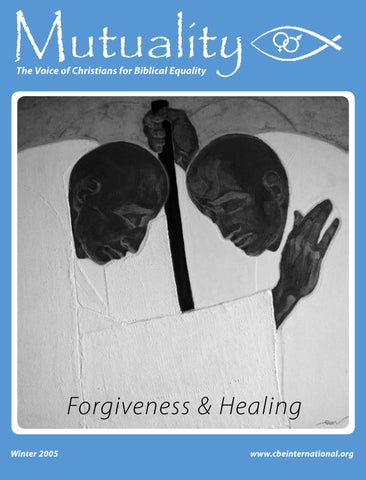
Mutuality The Voice of Christians for Biblical Equality
Forgiveness & Healing Winter 2005
www.cbeinternational.org
Contents
Features 5 7
Betrayed Finding the Path to Forgiveness — By JoAnn Shade
The Long Walk for South African Women Can forgiveness and healing overcome Apartheid and AIDS? — By Winnie V. Williams
10 Honey from the Rock
Healing from painful childhood religious experiences — By Janet O. Hagberg
13 Buckets of Love
Personal Reflections on Forgiveness — By Lois Malcolm
16 Letting Go of the Railing
Leaving behind an abusive home in search of healing and hope — By Sandra Dufield
17 What Can be Good about Reporting Bad News? The Christian responsibility to report abuse of power — By Martha Thorson COVER IMAGE: Forgiveness, by Bulgarian artist
Andrey Yanev (www.andreyyanev.com), oil on canvas. Used with permission.
Ministry & Chapter News 21 CBE’s “One Body, Many Gifts” International Conference 2005 Spiritual Director Listings 22 Message of Biblical Equality Reaches Cultures 23 Message of Biblical Equality Reaches Generations 24 Message of Biblical Equality Reaches Cyberspace 25 Priscilla & Aquila Award Recipients Lifetime Achievement Award Recipients 26 CBE Coming Events & Chapters
Departments 3 FROM THE EDITOR: The Greatest Work of All 4 IN OUR MAILBOX 19 MOVIE REVIEW: Let’s Get Things Straight: A Review of the Movie, “The Straight Story” — Reviewed by Barrett Fisher
27 PRAISE REPORTS & PRAYER REQUESTS 28 CHURCH AND STUDY GROUP RESOURCES: Study Guide for Gilbert Bilezikian’s Beyond Sex Roles
29 GIVING OPPORTUNITIES: Introducing the Charitable Gift Annuity
30 PRESIDENT’S MESSAGE: Egalitarian Prophets in the Church 31 CBE MEMBERSHIP INFORMATION 32 EQUALITY DEPOT BOOKSALE
2 | Mutuality Winter 2005
HOMEPAGE: www.cbeinternational.org
Mutuality The Voice of Christians for Biblical Equality
Let us then pursue what makes for peace and mutual upbuilding. — Romans 14:19 VOLUME 12, ISSUE 3 Mutuality seeks to provide inspiration, encouragement, and information about equality within the Christian church around the world. President/Publisher : Editor : Editorial Assistant : Graphic Designer :
Mimi Haddad Chelsea DeArmond Heather Scheiwe Image Spigot
EDITORIAL AND ADVERTISING OFFICE Christians for Biblical Equality 122 W Franklin Ave, Suite 218 Minneapolis, MN 55404-2451 PHONE: (612) 872-6898 FAX: (612) 872-6891 E-MAIL: cdearmond@cbeinternational.org WEB: www.cbeinternational.org Advertising in Mutuality does not imply organizational endorsement.
SUBMISSIONS Mutuality welcomes submissions. E-mail cdearm ond@cbeinternational.org, write to CBE for the writer’s guidelines, or visit CBE’s homepage and follow the Publications links.
PERMISSIONS Christians for Biblical Equality grants permission for any original article (not a reprint) to be photocopied for local use provided no more than 1,000 copies are made, they are distributed free, the author is acknowledged, and CBE is recognized as the source. Mutuality (ISSN: 1533-2470) is published quarterly by Christians for Biblical Equality and is sent free to members. For membership information, see page 31. To purchase back issues, contact our Editorial and Advertising Office, or order online at www. equalitydepot.com.
From the Editor by Chelsea DeArmond
The Greatest Work of All “Very truly, I tell you, the one who believes in me will also do the works that I do and, in fact, will do greater works than these, because I am going to the Father.” (John 4:2) This is one of the most amazing verses in the Bible. How could any of us do greater works than Jesus? If Jesus himself had not explicitly said we were capable of works greater than his, such a thought would probably never occur to us. But what was Jesus’ greatest work? Was it walking on water, feeding thousands with a few loaves and fishes, or raising Lazarus from the dead? These are truly amazing works, but there is one even greater: the forgiveness of sins. Many people were amazed by the miracles Jesus performed. But they were scandalized by Jesus’ claim to forgive sins, since this was something only God could do. Forgiveness is the only power great enough to overcome the cycle of violence that divides people into victims and perpetrators. Jesus demonstrated the power of forgiveness in his ministry by bringing together people that the world cast in the role of enemies. For example, the first disciples Jesus called were working class fishermen (Peter, James, and John) who were probably eager to see the Roman Empire overthrown, and a wealthy tax collector (Levi) who earned a living taxing his own people on behalf of the Roman government. When he was a guest at a Pharisee’s house, Jesus permitted a “sinful woman” to join the banquet with the religious leaders. And when Jesus was nailed to the cross, the thief crucified next to him and a centurion overseeing their execution both recognized Jesus as the Son of God. Jesus’ forgiveness was so powerful it extended from those in the most secure positions to those in the most insecure positions—even those whose hands and feet would never again be unbound, and who only had hours left to live—like the thief on the cross. Forgiveness frees people to live in love with God and others rather than fear. Jesus called forgiveness the “key to the kingdom,” and he passed this key along to his disciples (Matt. 6:9; Luke 6:37; John 20:23). Interceding for others’ sin and mediating forgiveness is a priestly responsibility, and whenever we forgive others, we are serving as priests whether our particular denomination recognizes our ordination to this role or not. Jesus has taken the heavy burden of all our sins upon himself, and offers us the light burden of forgiveness (Matt. :28–30). Once we take up this burden, it’s nearly impossible to keep it to ourselves. Every offense becomes a new opportunity to practice our priesthood and perform the work that only Jesus could make possible: forgiveness, the greatest work of all. Of course, the greatest work is also the most challenging. The articles in this issue of Mutuality offer insight on the nature of forgiveness and healing, as well as examples of how to practice it faithfully. The good sower casts seeds in the most unlikely places. Jesus’ cry on the cross, “Father, forgive…” fell from his lips to the crowd below like seeds cast in the mostly unlikely place of all. Faithful hearers of this word will nevertheless treasure it in their hearts, where it may take root and bear fruit of the Spirit. Chelsea DeArmond is Editor of Mutuality and Bookstore Coordinator at Christians for Biblical Equality. She can be reached at cdearmond@cbeinternational.org
BOOKSTORE: www.equalitydepot.com
Mutuality Winter 2005 | 3
In Our Box
Mutuality
Visit CBE’s website at
Call for Papers
www.cbeinternational.org for the latest… ▶ FREE audio and print resources on biblical equality ▶ Membership information for churches, libraries, families, and individuals ▶ CBE chapters in the U.S. and around the world ▶ Directory of egalitarian churches in the U.S. and around the world ▶ Giving opportunities ▶ Listings for counselors, therapists, and spiritual directors who agree with CBE’s Statement of Faith ▶ Ministry news and needs ▶ Employment, internship, and volunteer opportunities
Mutuality provides inspiration, encouragement, and information about equality within the Christian Church around the world. Mutuality is published quarterly and sent to all CBE members and subscribers. Current and back issue are also available for purchase. We are currently seeking features, reports, and reviews (books, films, and/or music) from evangelical, egalitarian perspectives related to the following topics: • • • •
Gender and Justice Widows and Orphans Advocacy vs. Apathy Mary Magdalene
• • •
Clarifying Manhood & Womanhood Worship and Preaching Men’s Issues in the Church and Home
Most of the articles we publish fall into the following categories: • Personal testimonies illustrating how biblical equality provides practical benefits to everyday lives. • Teaching on relevant Bible passages, explaining the meaning and showing how to apply it to daily life. • Reviews of books about biblical equality that would appeal to a wide audience. (Books must complete CBE’s book service review process before being reviewed in Mutuality.) • Feature stories about issues related to CBE’s mission and ministry. The length of features is generally ,000–2,2500 words.
Visit CBE’s online bookstore at
Send articles to the attention of the editor at the postal address below or e-mail to Mutuality@cbeinternational.org (if possible, as an attached Microsoft Word document). We are unable to consider or respond to authors who send us more than two pieces at the same time, whose pieces are substantially over 3,000 words, or whose submissions are not sent uniquely to Mutuality. Complete Writers Guidelines for Mutuality are available on our website (www.cbeinternational.org) or contact our office to request a copy. Questions and submissions can be directed to the attention of the editor, Chelsea DeArmond.
www.equalitydepot.com for resources like… ▶ Books and articles ▶ Audio and video tapes ▶ CD, DVD, and MP3 recordings ▶ Sales and specials ▶ New resources, CBE exclusives, and best sellers ▶ Foreign language resources ▶ Become a CBE member or renew your membership and save 15% on every purchase ▶ Registration for CBE conferences ▶ Subscription to CBE publications or purchase back issues of Mutuality and Priscilla Papers
4 | Mutuality Winter 2005
We’d love to hear from you! Send your comments and critiques to:
Mutuality
122 W Franklin Ave, Suite 218 Minneapolis, MN 55404-2451 PHONE: (612) 872-6898 FAX: (612) 872-6891 E -MAIL: mutuality@cbeinternational.org WEB: www.cbeinternational.org Letters may be edited for clarity and brevity.
HOMEPAGE: www.cbeinternational.org
Brayed: Finding the Path to Forgiven
Harri, a Modern-Day Hagar
Harriet had conscientiously served the ministry’s leaders, Rev. and Mrs. Smith, for twenty-five years. The Smiths were a godly couple, and their work for the Kingdom had flourished over the years. Theirs was a model of a faithful marriage, and they were seen as blessed by God. Working for the Smiths had not always been easy, but Harriet was deeply committed to the ministry. She had left once, but God made it clear that she was to return. God promised her that he understood, and that he would allow her to birth a project of her own that would be of value to the Kingdom. Not flashy or world-renowned, Harriet’s network of care to women in ministry offered both financial and spiritual support to isolated women around the world. Rev. Smith gave his blessing to her work, as long as it didn’t interfere with her job as his wife’s administrative assistant. Harriet found great joy in the hours she spent weaving her web of connection among these amazing women. Somehow, the local religion editor heard about Harriet’s ministry, and she did a sensitive feature for the Sunday paper about the ways Harriet’s work had impacted women. Harriet read the article with a hesitant pride, realizing how God had used her to bless others, just as he promised. She was so grateful that her small idea had reached so many, enriching her life as well. When Rev. and Mrs. Smith asked to see her Monday morning, Harriet entered the office basking in the reporter’s glowing words. Indeed, her ministry-child was flourishing, even if it paled in comparison to what God was doing in the Smiths’ international ministry. She was blind-sided by the attack. “How could you draw attention to yourself like that? You are a traitor to our ministry. You’ve compromised
BOOKSTORE: www.equalitydepot.com
by JoAnn Shade
what we’ve worked so hard for. We’ll ship your personal items to your apartment this afternoon. Go — now.” Mrs. Smith did the talking, while Rev. Smith sat stone-faced at her side. Harriet turned to him to save her. “You knew I was involved in this — you were the one who gave me the courage and inspiration to begin in the first place.” Sheepishly, he turned to Harriet and said, “I’m sorry — it just has to be this way. We will give you two weeks salary, but you must leave.”
Paralyzed by Pain Betrayal. The slang says it all: Harriet had been stabbed in the back, sold down the river because of someone else’s envy. Harriet’s story is more common than we’d like to admit. (See Hagar’s story in Genesis 2 for an ancient version of Harriet’s tale.) It takes many forms: A trusted assistant begins a new church in the next town, and takes half the congregation with her. The denomination announces the pastor’s next assignment, and everybody knows that it’s payback for standing up to the bishop. A pastor’s wife sacrifices for many years for her husband’s ministry, and then is abandoned for a woman who understands his needs better (and who is ten years younger). The pain from such a betrayal stings like a slap in the face. And it was supposedly done in the name of God. At first, you can’t believe that it has happened, and you know that God will surely have to step in and right the wrong that has been done in his name. Yet nothing happens. The betrayer gets away with the Judas kiss. You vacillate between an anger that seethes from your bones over the injustice that has been done, and an ache so raw that it can’t stand to be touched.
Mutuality Winter 2005 | 5
Failing to Forgive If you’ve been wronged like this, it helps to read the Psalms and realize that David experienced similar emotions.
You have heard that it was said, ‘An eye for an eye and a tooth for a tooth.’ — Yes, that’s the way it should be — she deserves to suffer just as I have. — But I say to you, Do not resist an evil-doer. But if anyone strikes you on the right cheek, turn the other cheek…
Vindicate me, O God, and defend my cause against an ungodly people; from those who are deceitful and unjust deliver me! For you are the God in whom I take refuge; why have you cast me off? Why must I walk about mournfully because of the oppression of the enemy? (Psalm 43:–2, NRSV)
You have heard that it was said, ‘You shall love your neighbor and hate your enemy.’ But I say to you, Love your enemies and pray for those who persecute you, so that you may be children of your Father in heaven…” (Matt. 5:38–39, 43–45)
You keep reading: “O send out your light and your truth; let them lead me, let them bring me to your holy hill and to your dwelling” (43:3). — Yes, God, this is what I want — your light and truth — bring me to a holy response to what has been done to me. — And then you turn to the pages of the gospels in your morning reading, and the words of Jesus leap off the page:
I can’t. I cannot do this. I cannot forgive this betrayal. And that is true. You can’t forgive this. Not yet. Not fully. Not on your own. But if we are to be serious about the instruction of Scripture, we must move in the direction of forgiveness. For forgiveness is much more a process than one specific action.
Then Peter came and said to him [Jesus], “Lord, if another member of the church sins against me, how often should I forgive? As many as seven times?” Jesus said to him, “Not seven times, but, I tell you, seventy-seven times.” (Matt. 8:2–22)
Finding the Path to Forgiven We stand at the place of the offense and we have a choice. We can move in the direction of mercy, or we can move in the direction of bitterness. Each step we take away from the place of offense leads us in one direction or the other. We can choose the way of Christ, or not. But his love is greater than all our hate, and he will not rest until Judas has turned to him, until Satan has turned to him, until the dark has turned to him; until we can all, all of us, without exception, freely return his look of love with love in our own eyes and hearts. And then, healed, whole, complete but not finished, we will know the joy of being co-creators with the one to whom we call. (Madeleine L’Engle, The Irrational Season, pg. 25) But how? Much has been written about forgiveness in recent years. In his book, Five Steps to Forgiveness: The Art and Science of Forgiving, Everett Worthington Jr. teaches that we can climb the pyramid of forgiveness by recalling the hurt, empathizing, offering the altruistic gift of forgiveness, committing to forgive, and holding on to forgiveness. Paul Coleman describes five phases of forgiveness: identifying the hurt, confronting the hurt, having the dialogue to understand, forgiving, and letting go. According to Coleman, “Forgiveness comes first as a decision to act lovingly, even though you are justified to withhold your love” (Exploring Forgiveness, ed. Enright and Frost, pg. 79). We must choose to move toward forgiveness, often on an hour-by-hour basis, and these models can help us determine the next step.
Hope for Hagar
ABOVE: Hagar and Ishmael, (1866), attributed to Frederick Goodall, R.A. (1822–1904), oil on panel.
Used by permission of Richard Goodall, representing the Goodall Family of Artists.
But there remains a sense in these deep, deep areas of betrayal that forgiveness is beyond our power. Jesus experienced this from the cross. He didn’t say, “I forgive you for betraying me and for killing me.” No, even Christ had to draw upon the forgiveness of the Father; “Father, forgive them; for they do not know what they are doing” (Luke 23:34). continued on page 12
6 | Mutuality Winter 2005
HOMEPAGE: www.cbeinternational.org
The
Long Walk for South African
Women
Can Forgiveness and Healing Overcome Apartheid and AIDS? by Winnie Williams Just a year ago a slender, 13-year-old South African girl was healthy and active, but now she lies on a straw pad, unable to walk or feed herself. She is HIV-positive. A woman living in rural South Africa, surrounded by her five children, becomes sick and goes for testing — she, too, is HIV-positive. She contracted this debilitating disease from her husband, who works far away in Soweto and is not able to return home very often. A young mother unknowingly infects her baby with HIV/AIDS and now they are both dying.
These women are among the 5.3 million people in South Africa who are caught in the web of HIV/AIDS. Life continues to be hard for black South African women. It was as bad as it gets back in the days of Apartheid — or so I thought, when I lived among them for six weeks. But I was wrong. In spite of the end of Apartheid, freedom still eludes many black South Africans. In addition to the ethnic, gender, and economic inequalities that have afflicted black South African women past the end of Apartheid in 994, the plague of HIV/AIDS has added a new dimension to their struggle. Though the struggle is far from over, many of these women have found that forgiveness is central to the process of healing. Forgiving does not equal forgetting. The injustices in South Africa should always be remembered, but stories of peace and forgiveness (and the extreme courage that accompanies them) should be shared and celebrated as well.
LEFT: A woman who welcomed many white families in South Africa. RIGHT: A South African woman cools
her food at the window of her home. Photos courtesy of Winnie V. Williams.
BOOKSTORE: www.equalitydepot.com
Mutuality Winter 2005 | 7
The Source of Hope and Healing Eighty-five percent of South Africans identify themselves as Christians (though some have not abandoned the age-old tribal traditions of ancestor worship). In my book, Women I Can’t Forget, I wrote about a visit to a tribal church with several missionary friends and colleagues that was a powerful example of how South Africans found hope in their Christian faith.
ABOVE: Forgiveness, by Bulgarian artist Andrey Yanev (www.andreyyanev.com), oil on canvas.
We drove more than two hours through the bush country over unbelievably rough roads of rocks and dirt, noticing cone-shaped huts along the way before we arrived at a small church on the highest peak of a mountain range. The little church, about 20 feet wide and 30 feet long, had been built from concrete blocks, which people lugged up the mountain on top of their heads. This church was evidence of their community spirit, driven by determination and sprinkled with love. The Zulu people had walked for miles to attend services. The sparsely-furnished church had backless benches and a small, handmade wooden table and chair in front. Near the end of the nearly three-hour service, barefooted and without warm clothing, most members knelt at the front of the church and gave thanks for God’s provisions, asked for God’s forgiveness, and forgave others. This was the source of their powerful hope — experiencing God’s grace and forgiveness for themselves, while forgiving those who have caused peril in their lives.
Women I Can’t Forget: A Global Traveler Reveals the Struggle and Courage of Women without Rights, by Winnie V. Williams List $16.95 Member $14.40
Through reconciliation with those who have been responsible for their plight, for husbands who have given them HIV/AIDS, for the political system that has failed to provide health care, for police who have failed to protect them from rape, for people who still consider black South African women to be inferior, they offer forgiveness. This does not suggest that black women will sit idly by and not continue to work for justice (such as prevention and treatment for HIV/ AIDS), but it does mean they will move forward in wholeness.
The Perils of Apartheid Living with Apartheid from 948–994 burdened black and mixed South Africans with injustices as the minority white South Africans enforced extreme segregation laws. Black people, representing about three-fourths of the population of South Africa, were prohibited from participating in government, and even from using the same buses, restrooms, or restaurants that were used by whites. The Apartheid laws affected black women’s rights regarding property, divorce, and family relationships. Regulations were established that favored men when women were raped. Some of the most unjust laws for women were the “pass” laws, which regulated where black women could live, travel, or work. Black people were displaced to townships and men were then transported to work in mines and wherever else the government saw fit, living in deplorable conditions. Since most women remained in the rural townships, they needed to eke out their living on small pieces of land and care for their families. At times, husbands would be away from their wives for an entire year. While they worked in the city, many would see prostitutes or even take second wives. Apartheid laws like these tore families apart and had horrible consequences, including the spread of HIV/AIDS to women and children as men brought the virus back to the townships.
Forgiven in Action: The Truth and Ronciliation Commiion Though clinging to the past is an unhealthy practice and cannot foster a spirit of forgiveness, confronting and reckoning with the past is an essential part of creating a future of peace and coexistence. The Truth and Reconciliation Commission (TRC) was one of the largest factors in working to restore post-apartheid South Africa and provided a widespread and systematic method to encourage forgiveness and healing.
“When people who had suffered grievously, whom you could have said had a divine right to being angry and filled with a lust for revenge, came and told their stories…you wanted to take off your shoes because you said, ‘I’m standing on holy ground.’” — Archbishop Desmond Tutu describing the proceedings of the Truth and Reconciliation Commission
Headed by Archbishop Desmond Tutu, the TRC allowed victims of violence to voice their grievances. Those who committed crimes had the 8 | Mutuality Winter 2005
HOMEPAGE: www.cbeinternational.org
opportunity to request amnesty if their crimes were found to be politically motivated and if they told the complete truth to the committee. Anyone could be charged with acts of violence under apartheid, including the South African police, citizens, and the African National Congress, which was the ruling party at the time of the Commission. Most consider the TRC to have been extremely effective. While the Commission was certainly driven by the need for justice, the committees within the TRC show that it was also motivated by the need for forgiveness and healing. For example, the Human Rights Violations Committee investigated abuses that occurred under Apartheid, the Reparation and Rehabilitation Committee worked toward re-establishing the dignity of victims, and the Amnesty Committee assessed victimizers who applied for amnesty. The TRC allowed for legal reparations but also encouraged the intimate work of forgiveness. Alongside of the Commission, people found creative ways to express their hurt and begin the healing process through such means as plays, workshops, support groups, and counseling. Themes of anger, hatred, and isolation surfaced in the process, but so did those of joy, hope, and perseverance. Archbishop Tutu described what it was like to participate in the TRC’s work in a speech at the National Press Club on October 6, 999: “When people who had suffered grievously, whom you could have said had a divine right to being angry and filled with a lust for revenge, came and told their stories…you wanted to take off your shoes because you said, ‘I’m standing on holy ground.’”
Why Forgive? Many of us wonder, How can we forgive someone who doesn’t ask to be forgiven? Are some atrocities beyond forgiveness? Will forgiveness make a difference? How does forgiveness apply to national policies that harm so many people? On the other hand, we may wonder, How can we not forgive? Didn’t Jesus teach us to pray “forgive us our debts as we forgive our debtors”? Didn’t Paul write, “Just as the Lord has forgiven you, so you also must forgive” (Col. 3:3)? To forgive means that we release others from the grasp they have held over us, but it also means that we release ourselves from the detestation, loathing, and abhorrence we may feel toward those who mandated Apartheid and even those who have infected others with HIV/AIDS. Failing to forgive hinders our relationship with people who have hurt us. It locks us into the past and makes it difficult to move BOOKSTORE: www.equalitydepot.com
ABOVE: Nobubele Mbyo (LEFT) and Ellen Koni (RIGHT), former South African teachers and church leaders.
Photo courtesy of Winnie V. Williams.
forward with love and justice, and may affect our relationship with God. According to Lewis Smedes, “To forgive is to set a prisoner free and discover that the prisoner was you” (Christianity Today, January 7, 983). The church has helped many black South African women begin the process of forgiveness. Ms. Nobubele Mbyo, a former teacher in South Africa, described forgiveness to me this way: “When I became mature in Christ, the reluctance to forgive was erased, I forgot the past grievances, the pettiness leading to bitterness was removed, and instead I experienced a sweetness which is the hallmark of true friendship. This maturity allowed Christ to develop my mind and nurture my spirit.”
“Jesus taught that we should forgive in order to have a healthy life…It is better to talk about hurts because in that way it relieves the pain. At the same time it is important to pray about it frequently.” — Ellen Koni, former South African school teacher
According to Ellen Koni, a former South African school teacher, forgiveness is important because “Jesus taught that we should forgive in order to have a healthy life…It is better to talk about hurts because in that way it relieves the pain. At the same time it is important to pray about it frequently.” Though black South African women have suffered extreme inequality for much of their lives, many of them are striving to forgive and move forward. Wounds can be so deep, but forgiveness can start with one step at a time in order to arrive at recovery and reconciliation. Some South Africans have taken the first step, others the second, and many have reached reconciliation and peace. ABOVE: Author Winnie Williams makes a new friend with a South African girl. Photo courtesy of Winnie V. Williams.
continued on page 12
Mutuality Winter 2005 | 9
Honey from the
Rock
Healing from painful childhood religious experiences As a spiritual director, I recommend to people who are trying to heal childhood religious experiences that they return to the scene of the crime and forgive people for what happened. Little did I know that I had another important step in my own process of forgiving people for my childhood religious experiences. It caught me completely by surprise. A religious women’s book group chose to read my book, The Critical Journey, and asked me to speak to them about the journey of faith. I arrived at the leader’s home eager to have a dialogue about faith with this group. The hostess greeted me and I met a few of the other women over coffee and cookies before we started. Then we all met in the large family room for our conversation. After introductions, the leader asked me to give my personal testimony, so I told my faith story, including the ups and downs of my faith, a few of the gifts and pains of my early religious experiences, my training as a spiritual director, and my role as a healer in the arena of domestic violence. When I finished my story, the leader asked me some pointed questions. Was I a born-again Christian and did I know
10 | Mutuality Winter 2005
the date and time I took Jesus as my Lord and Savior? I explained that I did not know the date and time because I made a confession of faith many times as a child and I wasn’t clear if one was more valid than another. I added that I honored the journeys of people who could name the date and time they were saved. She made a comment that went something like this: well, in your book you say that people can be on the faith journey as Christians even if they do not know the date and time they took Jesus as their Lord and Savior. I acknowledged that that was, indeed, the case since many people who profess Christianity grow into it as their understanding increases or, like me, make multiple commitment decisions. She asserted that people could not be Christians if they did not have this one-time, born again experience.
Stunned into compion I knew at that moment that I was in deep water. I remember quickly asking God what I was doing there. I could tell that she believed very strongly in what she was saying, and I was not there to defend my book or to argue with her. So I told her again that I respected her view of the conversion process and fielded a few other questions challenging both my work and me personally. I did not argue but answered their questions honestly and with respect. I realized that this was their sincere belief and honest faith statement. After about twenty minutes of questioning, I stopped and said to them, “It seems to me that the ideas in my book do not resonate with your faith
by Janet O. Hagberg
experience as a group, so perhaps I should leave now. I’m sorry that my visit did not turn out as you expected.” I felt tense, but relieved that I might be able to leave before the tension got worse. In truth, I was a bit afraid of them. For some reason, the leader invited me to stay and summarize the stages of faith described in my book. I knew I was on very shaky ground with this group by that time, but I went ahead with brief descriptions of the stages. Even though there had been some empathetic responses to my summary from a few of the women, there were no questions when I finished. I was quite eager to leave. As we dispersed, two women sought me out privately and thanked me. Both of them had experienced life-long rejection from their families because they did not share the same experience of faith — knowing the date and hour they were saved. I hugged each woman and told her that in all my personal experience of God and in the research I had done, I did not believe she was condemned. Each teared up and we hugged again before we parted. I was trembling as I left and I felt confusion and sadness welling up strongly within me. When I got to my car I couldn’t drive. After a few minutes I just drove slowly a few blocks away and stopped so I could process the evening. I knew something powerful had happened and I needed to sort it out. As I prayed for discernment, I had a strong sense that I had passed through a fire and had not been burned. As I rested in that truth, I regained enough serenity to drive home.
Healing that has taken years may rolve in an instant Over the next weeks, I prayed and processed the meaning of the evening. I knew it was a turning point in my faith. Then I had the flash of insight I needed; I had just relived one HOMEPAGE: www.cbeinternational.org
of my most frightening childhood religious experiences — that of being judged harshly if I did not conform to the prevailing rules and beliefs of the church. The difference was that this time, I was able to observe it without being so affected by it, and I could even honor this group’s point of view. It confirmed to me, in a very tangible way, that I had, indeed, healed from the pain of my negative childhood religious experience and that I could forgive those who were responsible for my pain. This forgiveness and healing did not just happen in that evening or in that moment of recognition. All the years of work I had done to heal and to forgive came together in that evening’s experience. This healing process enabled me to tell the truth about what happened to my spirit as a result of the fear, shame, and guilt that was used to control me and my friends as we grew up. We could not dance, play cards, go to movies or do any of the other things that so many teenagers do. Our God was wrathful. We had a large clock by the altar of our church with the hour hand on twelve and the minute hand on fifty-nine. It was one minute before midnight all the time. Midnight signified the end of the world and it served as a reminder of how sinful — and thus condemned to hell — we were if we did not confess and take Jesus as our Lord and Savior at that day and hour! It took me years to uncover these memories and then check them with friends to make sure I was not imagining things. Then I was able to name which negative teachings were most hurtful and even name the people who were involved. A minister friend of mine helped me write the names of people I needed to forgive, put these names in a old pill bottle, and toss the bottle into the river. Gone forever. After that, I could begin to have compassion on the people who had hurt me. I finally realized that they were people who were deeply hurt themselves.
Honey from the rock This process of healing my childhood religious pain is reminiscent of the struggles of the Israelites after leaving Egypt. In the wilderness, God gave them nourishment and hope, even when they were feeling abandoned, even in the hardest of times. Moses often reminded them that God would set them on high places, feed them with the fruit of the land, and nourish them with honey from the rock (Deut. 32:7, 0, 3). I know that my childhood was difficult, like wandering in a wilderness, but I also BOOKSTORE: www.equalitydepot.com
know that it was not all bad. There were many good times in which I was nurtured and loved. I was not abandoned. I was fed honey from the rock. This process of healing and forgiveness slowly led me to a deeper appreciation of the good parts of my childhood religious experience. As I talked with childhood friends I realized some of the gifts that I received from my childhood faith. First, we had many really good friends and we all remember laughing a lot. We were steeped in music, both choral and instrumental. We knew more scripture verses and more Bible stories than many seminarians (my claim to fame was that I could say the books of the Bible in thirty seconds!). I still depend on my childhood knowledge of scripture and appreciate its richness as it edifies my reading today. Girls were permitted to lead, in fact, were strongly encouraged to lead. I obtained much of my early public speaking experience as the mistress of ceremonies at church wedding showers when I was still in high school. At church we had many boys who were our friends, so we didn’t have to date to be popular. Giving to others was drilled into us at a young age. We were active in outreach to the poor, homeless, and sick. In fact, every month we served food and performed music at the local mission. I am sure that is where I first received my passion for reaching out and working, even now, on seemingly unsolvable social issues. Our families were close and we shared family activities together with dozens of other families. We hiked, camped, and participated in sports. I don’t ever remember being bored. So there was more goodness under the surface of my pain that I had not yet claimed as part of my heritage.
women’s Bible study group, I wanted to do the same. I had read a book by Sue Monk Kidd called The Dance of the Dissident Daughter, in which she forgave her church for her childhood experiences and then went back to her church and put a bouquet of flowers on the steps. I decided to do the same. I got a large bouquet of mixed garden flowers and wrote an anonymous note thanking the church and its people for all they had taught me. I put it inside the church door and left, feeling grateful and healed. The women’s book group experience helped me realize that the graces of forgiveness had worked in my soul, and in a significant way these women were part of marking this passage as a holy place. I am grateful to them for making the closure so clear to me. Honey from the rock.
Janet O. Hagberg, a nationally-recognized speaker and author of seven books, currently serves as a spiritual director. As founder and executive director of Silent Witness National Initiative, a program designed to reduce domestic violence murders, she has received numerous awards from religious and secular arenas. She loves driving fast cars, is passionate about baseball, takes every opportunity to ski, golf, or snowshoe and reads incessantly.
Marking the holy lace The Israelites often marked the holy places in which they experienced God, where they found nourishment and received honey from the rock. After my meeting with the
Mutuality Winter 2005 | 11
Long Walk, continued from page 9
Standing Up Togher Seth Naicker is a student at Bethel University (St. Paul, Minn.) who has worked for reconciliation in South Africa. He believes that women have been in the forefront of helping South Africa rise from the “ashes of Apartheid.” According to Seth, “Healing in South Africa takes place in the chaos of life. Women heal as they see their children developing and they heal as they access better working and educational opportunities.” Naicker considers his mother to be just one example of hope, wholeness, and restoration in the lives of many South African women. Eleanor Joyce Naicker founded the Amakhaya Children’s Project, a ministry for street children, more than fifteen years ago. She sought support from all sectors to provide a loving Christian home for children who have been abandoned, destitute, or run-aways.
“Healing in South Africa takes place in the chaos of life. Women heal as they see their children developing and they heal as they access better working and educational opportunities.” — Seth Naicker, Bethel University student (St. Paul, Minn.) who has worked for reconciliation in South Africa
Every group has a role in working toward reconciliation and resolving the injustices that have occurred. According to Carol, an American missionary who ministered with the black women of South Africa for eighteen years during Apartheid, “Reconciliation with black women will come as white people of South Africa demonstrate…their concerns for the black woman’s plight. It will take time. White people must earn their way now — before being white was their key to all advantages. Now white women must also be involved in reconciliation and demonstrate their acceptance and love of black women.” As Nelson Mandela would say, “it is a long walk to freedom.” However, new stories of hope, forgiveness, and wholeness are coming from South African women every day. As women work together for healing and wholeness, Nobubele Mbyo calls us all to, “Stand up! And let the name of Jesus shine far and wide, fight Satan with untold courage and believe that God’s love endures forever.” Winnie V. Williams is a retired associate professor of special education at Southern Wesleyan University in Central, South Carolina. She writes about missions and women’s issues, and she speaks to churches, women’s groups, and civic clubs throughout the Southern United States.
Betrayed, continued from page 6 In our absolute hopelessness of ever being able to forgive, we can learn from Hagar’s response, for she too found herself without hope (Gen. 2:5–9). It’s doubtful that she is thinking about forgiving Abraham and Sarah as she sits waiting for her son to die. She is desperate simply to survive. In her desperation, she comes to the realization that she can do absolutely nothing to change the situation. She has no food, no water, and her son will die (as will she). Yet in the midst of her extreme helplessness, waiting for the death of her child (a direct result of the betrayal she has suffered), God shows up. He hears. The narrative doesn’t indicate that Hagar called the Lord; in fact, the angel of God tells her, “God has heard the voice of the boy where he is.” It is as though God has heard the pain that resulted from the betrayal, and he responds to it. God then opened Hagar’s eyes. It is amazing how much an act of betrayal can blind us to what we know about God and his kingdom. When we are in the midst of it, we just cannot see. And so God must come and open our eyes to the path he has for us through the desert of betrayal. And when he opened Hagar’s eyes, she realized that he had provided the water she needed. Was the well there all along? Quite possibly. In the pain of our ThisGod’s is my provision Father’s world, betrayal, may be difficult to see, but it is there. His O let me presence, his word,ne’er andforget his people are ours when we can begin to look That wrong seems oftultimately so strong,his justice will prevail, around to though see and the receive them. And God is the ruler yet. (Maltbie Davenport Babcock) as the familiar hymn reminds us:
Keep Drinking from the Cup Yet it is still up to Hagar to move. She must get up, lift up the boy, and drink. And so it is for the Harriets of the church world. Grieve this loss. Name it for what it is. Do what you must do to keep this from happening to another. But don’t stop there. Get up, lift up what you have birthed, and drink. At first, it will be a cup of sustenance, but in time, it will also be the cup of forgiveness through the precious blood of Jesus. If you faithfully drink of the cup, a time will come when you will have forgiven. Coleman describes the experience like this: “When you forgive, you do not forget the season of cold completely, but neither do you shiver in its memory” (Exploring Forgiveness, ed. Enright and Frost, pg. 79). You are my servant. I have chosen you and not cast you off; do not fear, for I am with you do not be afraid, for I am your God I will strengthen you, I will help you, I will uphold you with my victorious right hand. (Isa. 4:9–0)
JoAnn Shade serves as a Salvation Army officer in Cleveland, Ohio. She is a D.Min. candidate at Ashland Theological Seminary, focusing on the vocational identity of women in ministry at midlife.
12 | Mutuality Winter 2005
HOMEPAGE: www.cbeinternational.org
Buckets of Love Personal Reflections on Forgiveness I’ve always been puzzled by forgiveness. With little experience of God’s power to renew and heal — but a lot of “shoulds” in my head about how I needed to be a loving person — I thought forgiveness was about silencing my intellect, shutting my mouth, squelching my anger at unjust situations, and then forcing a smile that was so automatic, even I believed it communicated how I felt. What does it mean to forgive someone who has hurt me? What does unconditional love entail? How is forgiveness related to my convictions about justice and truth? And how, if at all, is my loving and forgiving another related to God’s love and forgiveness for me?
Forgiven that ensar, and forgiven that fre Over the years, I’ve watched many preach and teach forgiveness as they themselves permitted no opposition to their own power over others — theological, spiritual, personal, or institutional. I’ve witnessed savvy people use the concept of ‘forgiveness’ to keep others in line, even as they explicitly modeled behavior that could hardly be described as forgiving. Of course, this is not new. Scripture is full of warnings about powerful people who misuse sacred teaching for their own ends (see Matt. 23 and the books of the prophets). I would discuss these observations with my parents, since they so stressed the importance of unconditional love and turning the other cheek. My mother had only one story she would tell us about her experience in a concentration camp in China. As a teenager, she realized that she had to stop attending a prayer group with other teenagers who were praying for release. True freedom, she had come to see, was not about being released from the camp, but about being released from the anger and hatred she felt for her Japanese captors. This experience of freedom was a definitive one for her. It gave her a sense of being rooted in God’s love and power, a sense that would be a bulwark throughout her life. Yet she still struggled with forgiving others. She flinched whenever she encountered a man BOOKSTORE: www.equalitydepot.com
in military uniform. Some of my earliest memories are of her praying in a whisper for “buckets of love, Lord” (Rom. 5:5) for those she found difficult to love — from Amelita, a young woman who lived with us and projected her anger at her abusive stepmother onto my mother, to the many, usually male, Christian leaders who were threatened by mother’s charisma and sheer force of personality. In some cases, the struggle clearly bore fruit. Strong and energetic, my parents were a match for each other’s drive, creativity, and conviction. For all their talk about being egalitarian, they played their roles with a romantic flair that I often thought could compete with Elizabeth Taylor and Richard Burton or the characters in an Ibsen play. They fought with high drama, my mother imploring, “But, Bob”— and my father responding with a stern, ‘father knows best’ tone, “Now, Kari.”
by Lois Malcolm
In all this, they modeled for me that anger and strong feelings are not to be avoided or run away from, that total honesty about what’s going on is the only way through an impasse, and that the commitment to hang in there until death — through sickness and in health, for richer or for poorer — is the bedrock for handling that wildly complex phenomenon called marriage.
Forgiven that flows from God’s fertile life Yet, even though they modeled a healthy way of handling conflict, forgiveness, and reconciliation, I still managed to pick up some faulty ideas along the way — whether from them or from others, I am not sure — about what sacrifice, forgiveness, and unconditional love are all about. As an adult, I’ve gradually come to see, and am still in the process of learning, that forgiveness is not
ABOVE: Kari and Bob Malcolm served for many years together in missions and ministry, and have two daughters, Lois and Kirsten.
Kari and Bob are founding members of CBE, and were given CBE’s Lifetime Achievement Award at the 2005 International Conference. Photo courtesy of Kirsten Malcolm Berry. See pg. 25 for more information about 2005 Lifetime Achievement Award recipients.
Mutuality Winter 2005 | 13
something I have to muster up within myself, but is already part and parcel of the new creation the Spirit has ushered in (as the Old Testament prophets and the apostle Paul have written about). This new creation is not something that contradicts my creaturely humanity — or its sense of truth and justice. Rather, Christ’s justifying grace is always also a creative righteousness, which never destroys, but rather generates new life. It heals people and situations, and frees them from the old patterns that got them into trouble in the first place. In other words, God’s life is truly a fertile life. As I am immersed in the way this fertile life permeates the universe, I realize that I can perceive the circumstances of my life differently, without my usual preconceptions about what “should” be happening. The unconditional character of God’s forgiveness — the inexhaustibility
of its life and power — is precisely what breaks us free from the conditioning of our past. It enables us to respond spontaneously to life without being burdened by resentment, disappointment, guilt, or hurt over what has happened to us. We can accept what is happening right now, not with false expectations or resignation, but rather with a clarity that enables us to take full responsibility — to freely choose how we might respond, with conscience as our guide. And the wisdom of conscience may, at times, simply tell us to avoid difficult people or circumstances — or it may tell us to tolerate them. It may inform us that we need not be reconciled with those we have forgiven — or it may tell us to be reconciled. It may even help us discern how best to use our resentments and hurts as clues for delving into the deeper issues that need to be resolved in our lives — those underlying stories about ourselves that keep us trapped in unhealthy and unjust patterns.
These wounds can be clues into our false self’s strategies for coping with the sheer anxiety of being human and not being able to predict or control what happens moment by moment. They can be powerful tools for self-discovery and liberation, for entering more fully into the death of our false self and the life in the Spirit that Paul describes in Romans 6.
Bathed in bucks of love I call up my father every day now that he cares for my mother, who has Alzheimer’s. We talk about many things: how he’s handling being my mom’s full-time caregiver, what adult daycare to send her to, why God allows suffering and evil. Sometimes he can be grim—and even downright mad — about this duty that’s come at the end of their more than fifty years of marriage. But usually his unique blend of Swedish Calvinism gives him the eyes to see the wonder that emerges each new day — in the delicious meals he’s learning to cook, the delightful people who have shown up to help him care for my mother, and the additional time he now has for things he didn’t quite have enough time for in the past (exercise, prayer, reading, writing in his journal, and sitting around having coffee with people). And he’s correcting a lot of my faulty theology, especially about forgiveness. Of course, you must stand up for yourself. Of course, you must confront bullies. Of course, you must be true to your conscience and inner sense of integrity. Of course, you must become all that you are as a unique individual. Even Jesus confronted bullies, walked away from people and situations who were harmful, was true to his conscience, and stood up for himself so that he could be true to the unique vocation God gave him to enact. And, in her blissful state of Alzheimer’s, my mother is probably teaching me more about unconditional love than she ever did with a clear mind. Or at least I’m finally receptive to it, as she looks at me — whom she still recognizes as her “baby O-i” — with an impish delight and an almost naughty giggle, her face completely unperturbed by anger or fear. It is true that she has flashes of anger throughout the day — when humiliated because she needs help in the bathroom or indignant when we won’t allow her to have another piece of toast (having forgotten that she’s already had two). But she forgets these flashes just as quickly and there you are facing someone looking at you with such purity and contentment — both with herself and with you — that you catch a glimpse of what it means to be a creature whom God sees as “very good” (Gen. 1:31).
Lois Malcolm, or “O-i” as she was called as a child, is Kari and Bob Malcolm’s youngest daughter. She is an associate professor of systematic theology at Luther Seminary and is currently co-writing a book with Janet Ramsey on forgiveness and healing. Their essay on “Teaching Forgiveness and Healing: A Multidimensional Approach” will appear in Teaching Theology and Religion next year. ABOVE: Kari Malcolm knits with her granddaughter, Sara. Photo courtesy of Kirsten Malcolm Berry.
14 | Mutuality Winter 2005
HOMEPAGE: www.cbeinternational.org
Woven Togher by the Word Kirsten Malcolm Berr y ’s Ar tist ’s Statement My focus as a liturgical artist is the New Testament. A Greek verse is integrated into each of my watercolors, linking viewers to its earliest form. The use of Greek reminds us that the Scriptures come to us through the vehicles of cultures and languages other than our own; the presence of the text in an unfamiliar script hints at the global nature of God’s grace to humankind. The configurations of repeated shapes in my work reflect the influence of several indigenous art forms. The daughter of Presbyterian missionaries, I grew up in the Philippines and was ABOVE: For all of you are one in Christ Jesus. Galatians 3:28
exposed to the decorative use of patterns on Filipino and other Southeast Asian fabrics, basketry,
(NRSV). Watercolor, 16˝ × 16˝ © 2005 by Kirsten Malcolm
and brass. Geometric woolen tapestries of my Scandinavian heritage have also affected my sense
Berry (berry027@umn.edu). Used with permission. Kirsten
of design, as have Native American weaving, traditional quilts, and Byzantine mosaics.
Malcolm Berry is a liturgical artist whose work is part of over 140 private and church collections. She is the daughter of Kari and Bob Malcolm.
BOOKSTORE: www.equalitydepot.com
The exercise of faith is sometimes difficult for those of us who long for perceptible signs of the presence of God. Painting the images of the Bible helps me translate the abstract into the tangible; I begin to grasp that the Word indeed became flesh.
Mutuality Winter 2005 | 15
Letting Go of the Railing Leaving behind an abusive home in search of healing and hope
Going down the stairs on that last day, I intentionally kept my hand on the rail, trying to burn the memory of its feel in my mind. This would be the last time I would ever go down these stairs — the last time I would touch this railing. Beginning the weeks and days before, the weight of what I would be losing grew and I wanted to hold on to whatever memory I could. After watching my seven-year-old son shake uncontrollably in his father’s casual presence, I knew there could be no more denial and no more fantasy about the necessary
16 | Mutuality Winter 2005
change. Spending years trying to navigate us through the chaotic relational minefield of an emotionally and psychologically abusive marriage, I now realized our health and peace of mind were far more important than the scripts imagined for our lives, and we had to leave. As I arranged and packed our things, my only other thought was of being somewhere safe, somewhere where we could heal. Everything from here on out was unknown. My excuse for staying this long was that at least the pain was familiar; I knew it and could predict it. But leaving involved change.
by Sandra Dufield
It meant being strong enough to face the unfamiliar, unpredictable pain of low income, inconsistent housing, the dilemma of time spent between working and parenting, and an incited, vengeful husband. Leaving meant planning. Planning meant thinking, which eventually meant acting. Both expended energy — energy that was scarce, rationed for the enormous self-comforting wattage needed to get through each day. The strength that it took to finally leave didn’t come continued on page 18
HOMEPAGE: www.cbeinternational.org
What Can be Good about Reporting Bad News? The Christian Responsibility to Resist and Report Abuse of Power by Martha Thorson
Forgiveness is at the heart of taught us to pray, “Forgive the good news of the gospel, us our debts as we forgive isn’t it? Last summer I took a our debtors.” Bible class called, “What’s Good With this in mind, I kept About This News?” because reading. Jesus goes on to tell I liked the positive emphasis. a parable about an unmerciful Our assignment during the servant (v. 23–35) and I realized two-week course was to prepare that at the end of this story, three messages on passages from the Lord is very UN-forgiving. the Gospels that expressed the Perhaps before discussion and good news of Jesus Christ. I forgiveness can happen, the role chose to write about a passage of the Christian community is to on forgiveness. Then I got a call report the abuse and to hold the from my mother with news that perpetrator accountable. devastated me. In this story, the Lord A good friend of mine from forgave his servant a large ABOVE: ‘Shouldest not thou also have had compassion on thy fellow servant?’ — Matt. xviii.33. high school had been murdered debt, but then that same 19th c. engraving of the parable of the unforgiving servant. by her husband. She was a servant came upon one of his pastor’s daughter who professed fellow slaves who owed him a Christ herself and had completed an in-depth small debt, and I am struck by the irony of her death discipleship program. She grew up to be a falling on Sunday, Independence Day, at a college professor and poet, a mother and police station. A Christian woman was killed seizing him by the throat, he said ‘Pay what grandmother — a beautiful woman who at a place of refuge by someone she had loved you owe.’ Then his fellow slave fell down didn’t look old enough to have grandchildren. for more than 32 years, on a day set aside for and pleaded with him, ‘Have patience with She was the sort of person who could be healing, rest, and worship. The gun shots were me and I will pay you. But he [the servant popular and still be friends with those who mistaken for fireworks. The cause of death was who had been forgiven much] refused, weren’t. then he went and threw him [the one who confused with the celebration of freedom to Yet on Sunday, July 4, 2004, her pursue life, liberty, and happiness. owed a small debt] into prison until he husband followed her car, rammed it with would pay the debt. When his fellow slaves She wasn’t perfect, but she had been faithful his truck, and shot out the rear window. to her marriage for decades and that feat in saw what had happened, they were greatly Glass shattered around the car seat in the itself speaks of patience and forgiveness. Over distressed, and they went and reported to back where their grandchild was riding. She the years she must have forgiven him 77 times their lord all that had taken place. managed to evade him and headed for the and probably 70 times 7 (Matt. 8:2, 22). police station. Yet somehow, he knew where What’s good about this news? Christian Abuse of power is present in our she would go for help. He caught up with community and Christian marriage are communities and we will begin to see it if we her in the station parking lot. She jumped based in choices to forgive others as Christ slow down, open our eyes, and listen for the out of the car to go for help and draw his forgave us. We choose to talk out issues, cries. Good news in Jesus’ story came when fire away from the baby. the community paid attention to what was to negotiate, to try again because Jesus BOOKSTORE: www.equalitydepot.com
Mutuality Winter 2005 | 17
continued from page 16
continued from page 17
from the usual sources, but rather from realizing I had a false, contrived assumption about marriage. As those around me became aware of our circumstances and saw the full ramifications of our situation, many backed away, scattering into the realms of sympathetic acquaintance or judge. My Christian friends lectured me on wifely submission and the leadership of husbands. They made a correlation between Christ’s longsuffering on the cross and the longsuffering of wives in “difficult” marriages and said it was against God’s will for me to leave. Years before, while worn down and desperate for a marriage make-over, I believed this view. Now I knew better. While thumbing through books at a local Christian bookstore, I came across an organization called Christians for Biblical Equality (CBE). With a phone call and a little research, I learned CBE addresses domestic abuse in the church as well as identifies and biblically challenges church teachings which enable and foster abuse. I learned when churches teach the husband is to be the leader and final decision maker and the wife is to submit to this leadership and decision making, too often this marriage pattern is accompanied by a sense of the husband’s advantage and entitlement. Too many times when this advantage and entitlement are threatened or challenged, abuse is the tool used to recover it. I also learned that incidents of physical abuse among church members are equal to those outside the church, but the most common accounts of abuse are emotional, verbal, and psychological. These include stories of controlling spouses who restrict access to money, transportation, social interaction, food, and medical treatment. They also involve spouses who are hyper-critical, demand perfection, and keep family members offbalance through constant chaos. From ignoring known emotional needs and giving the silent treatment, to a pattern of yelling, name-calling, and throwing things, emotional and psychological abuse can be just as debilitating and deadly as physical abuse. The hyper-vigilant stress created from living in abusive environments long term is often severe enough to alter hormone levels and brain chemistry, eventually leading to health problems from depression and anxiety to hypertension, asthma, and heart disease. The good news is that more and more churches are acknowledging and addressing domestic abuse. Along with organizations like CBE, Peace and Safety in the Christian Home (PASCH), and Willow Creek Association, a growing number of evangelicals see that just as the church was mistaken in its interpretations concerning slavery and segregation, many churches are mistaken in their interpretations concerning men and women. Bible scholars are increasingly concluding that when the Bible is properly interpreted it points to mutual submission, mutual responsibility, mutual dependence, and gift-based roles in marriage. Seven years later and hundreds of miles away from our last house, my son and I are healing. The unfamiliar, unpredictable pain did come rolling in and to a large extent, still churns around us. But the burden gender hierarchy once placed on us is released, and because of that we live. We have hope we never would have had while clinging to the familiar, predictable, and imagined security of the precious structure we once called “home.”
going on around them and responded boldly. The Lord did not permanently condemn or take the life of the ungrateful servant, but neither did he give him cheap grace. And it was not the role of the community to forgive this man. When in the church we are functioning as peers, people with equal power and status who care about each other, “brothers and sisters” in Christ, we are to keep trying to work out our problems. But when anyone is in a relationship of power over another, if the one in power is demanding and merciless, Jesus held up the community that was outraged and reported the abuse as a role model. The Lord heard the cries of the community that defended the weak. Christians rarely consider the power dynamics in forgiveness. Power can be emotional, social, relational, financial, or physical. Often, when a powerful brother grabs another by the throat, literally or figuratively, the church says to the one being strangled, “You’ll just have to forgive your attacker.” But that’s not what the Word of God says. In the parable of the unforgiving servant, we must look at who the Lord requires to forgive whom. A woman told me that one day she drove up into the driveway and her husband charged out of the house and grabbed her by the throat, right there in the front yard. It would not be good news to tell her she has to forgive her attacker. The good news for the wife would come when the community defended her by reporting her attacker to church and legal authorities, who can then hold him accountable for his actions. The good news comes when those representing the Lord tell the abuser that he must forgive whatever he has against his wife, as Christ has forgiven him, or he will suffer the consequences. If we fear the abuser and avoid reporting, we undermine justice and pave the way for further evil. Another woman told me how she had been assaulted in many ways by both her husband and her son, and when she told the church authorities they believed her, protected her, and expelled her husband from his position. She is being healed by God’s love as demonstrated by the community of faith. You know women like this, too. At least one-third of all women, regardless of ethnicity or economic status, have been physically or sexually assaulted by someone they know and trust. Many more endure verbal and financial abuse. Many children, male and female, are also being abused. These people need to hear the good news of the gospel as Jesus told it in this parable on forgiveness. Some may wonder, but doesn’t the victim need to forgive her abuser? Notice in Matthew 8, Jesus never deals with that. We never hear what happened to the servant with the small debt. We don’t know if he was released or if he had to repay his debt. Other places in Scripture describe forgiveness more as cleansing and healing for mental and spiritual health. Victims may find help there, but that is not the point of this story. If this passage really bothers you, ask yourself why. Why shift the attention off the abuser in a story where the Lord and the community demand that he pay his debt in full? When the community stands with the victim, the balance of power is restored and the community of Christ is one of equals, with mutual respect for one another. Therein lies the good news. God in Christ forgives our debts as we forgive our debtors.
Sandra Dufield participates in community education on domestic abuse in the church through freelance writing, speaking, and distributing resources on the subject. She is a single parent living and working in the Pittsburgh, Pa., area. 18 | Mutuality Winter 2005
Rev. Dr. Martha Thorson (M.Div., Duke University; D.Min., Columbia Theological Seminary) is a spiritual director for Peace and Safety in the Christian Home (PASCH), and has served as a PCUSA pastor for 20 years. Her husband, Dr. Larry Thorson, is pastor of First Presbyterian Church in Hemet, Ca. They have a daughter and a son. HOMEPAGE: www.cbeinternational.org
Movie Review
Let’s Get Things Straight A Review of the Movie, “The Straight Story”
by Barrett Fisher
In the first recorded crime in the Bible, also a suggestion of the spiritual death that medical warning—“If you don’t make some brother murders brother: Cain slays Abel Alvin is determined to escape. In his race changes quickly, there will be some serious out of jealousy. The pages of scripture that against time, his brother’s stroke and his own consequences”—into spiritual counsel. He follow are filled with stories of seeks to be reconciled with his difficult, often destructive rela- When my kids were real little, I used to play a game with brother. tionships between siblings: Isaac Because of his failing ’em. I’d give each one of ’em a stick and—one for each one and Ishmael, Esau and Jacob, eyesight, Alvin can no longer of ’em—then I’d say, “You break that.” ’Course they could, Rachel and Leah, Joseph and drive a car and will not take the his brothers. Certainly the most real easy. Then I’d say, “Tie them sticks in a bundle and bus. His journey by John Deere sanguinary and cold-blooded try to break that.” ’Course they couldn’t. Then I’d say, “That lawnmower from his house in display of fratricide occurs in the bundle—that’s family.” — Alvin Straight, The Straight Story Laurens, Iowa, to his brother’s book of Judges, when Abimelech home in the aptly-named Mount massacres his seventy brothers! Though one may be overpowered, two can defend them- Zion, Wisconsin, is based on From the beginning of human selves. A cord of three strands is not quickly broken. a true story. It is one of those history, one of the closest of fam- — Ecclesiastes 4:12 wonderful occasions when realily relationships is fraught with ity is just as strange as some of the dangers of alienation and violence. fragility emphasize the necessity of making the surreal movies for which David Lynch is At the same time, the Bible extols the reconciliation while it is still possible. “I just better known (e.g., Eraserhead, Blue Velvet, relationship between siblings as the epitome hope I’m not too late,” he says. Mulholland Dr.). But in films as different as of peace, most poignantly in Psalm 33: At the beginning of the film, Alvin’s doc- The Elephant Man and Lost Highway, Lynch “How very good and pleasant it is when kin- tor (Dan Flannery) addresses his physical is interested in characters who must confront dred live together in unity.…For there the condition: two bad hips, neglected diabetes, the unpleasant truth of their moral imperfecLORD ordained his blessing, life forevermore” and incipient emphysema. Alvin’s character- tions. Alvin Straight is just such a character. (NRSV). In the gospels, close spiritual connec- istic stubbornness emerges immediately; he By one of those felicitous conjunctions of art tions are described as familial in general and refuses to use a walker, rejects any further and life, the person who made fraternal in particular: “Whoever does God’s tests, and as for smoking—the next scene this mini-epic journey really will is my brother and sister and mother,” shows him enjoying a cigar. When was named “Straight,” Jesus tells his followers. As soon as Andrew he learns that his brother has sufmet Jesus, he found his brother, Peter, and fered a stroke, however, led him to the Messiah. For all their differ- Alvin transforms ences, sisters Mary and Martha were united the doctor’s in their devotion to Christ. This harmony between siblings thus becomes a key element in finding peace with God. Although David Lynch’s The Straight Story (999) is not an explicitly Christian film, Alvin Straight (Richard Farnsworth) clearly identifies the conflict between himself and his older brother, Lyle (Harry Dean Stanton), as biblical. When asked by a priest (John Lordan) what came between them, Alvin tells him that theirs is a “story as old as the Bible—Cain and Abel. Anger, vanity— you mix that together with liquor, you’ve got two brothers who haven’t spoken in ten ABOVE: Based on a true story, The Straight Story follows the colorful six-week journey of Alvin Straight (Richard Farnsworth) as he travels years.” This scene takes place in a cemetery, aboard his ’66 John Deere lawnmower from Laurens, Iowa to Mt. Zion, Wisconsin. After learning his estranged brother has suffered a a visual reminder of the physical death that stroke, Alvin is determined to reconcile with him before it’s too late. © 1999 The Straight Story, Inc. All rights reserved. neither Alvin nor his brother can avoid, but BOOKSTORE: www.equalitydepot.com
Mutuality Winter 2005 | 19
© 1999 The Straight Story, Inc. All rights reserved.
Movie Review
© 1999 The Straight Story, Inc. All rights reserved.
creating the pun of the title and emphasizing the path he is determined to take. “I wanna make peace,” he tells the priest. “I wanna sit with him, look up at the stars like we used to do so long ago.” To which the priest replies, “Amen to that.” Significantly, the stars are a recurring image in the film. The camera moves slowly forward into them at both the beginning and end; at two other key points in Alvin’s reflections he scans the evening sky. The stars are important because they remind Alvin of the childhood games of make-believe that he and his brother played while sleeping outdoors on summer nights in Moorhead, Minnesota. “Yeah, we pretty much talked each other through growin’ up,” he reminisces. Because of the perspective the stars provided, “they made our trials seem smaller.” In short, the stars represent the deep bond between the two brothers, so that every time Alvin looks at them he ponders what he has lost and what he still deeply needs.
The physical difficulty of the journey is, of course, a metaphor for the spiritual challenge of humility. “This trip is a hard swallow of my pride,” Alvin tells a set of contentious twin brothers (Kevin Farley and John Farley) who repair his lawnmower. Alvin’s pride perches him atop a lawnmower towing a trailer with no brakes, a hazardous means of transportation made all the more dangerous by his poor eyesight. But in a motif as old as Samson, Oedipus, and King Lear, the loss of physical sight is compensated by an increase of insight. “At my age,” he tells two young bicyclists (Matt Guidry and Bill McCallum), “I’ve seen about all that life has to dish out. I know to separate the wheat from the chaff and let the small stuff fall away.” Alvin presents a convincing picture of a man who has counted the cost of penance and set his face like flint to pay that cost to the last penny. He refuses a kind offer of help with the final leg of his journey, not simply because he is stubborn, but also
because he understands that full humbling means finishing the task as he began it. The stubbornness of sin has been transfigured into the commitment of repentance. For nearly thirty years David Lynch has helped to define avant-garde filmmaking, but The Straight Story also puts him in the company of the visionary Russian director, Andrei Tarkovsky. In his reflection on film in general and his own films in particular, Tarkovsky claimed that “Art is born and takes hold wherever there is a timeless and insatiable longing for the spiritual.” The Straight Story suggests that the desire to be at peace with our own flesh and blood is evidence of spiritual longing. While it is true that God is not explicitly present in this film, Alvin Straight’s words about his need for his brother powerfully express one of the divine intentions for family relationships: “There’s no one knows your life better than a brother that’s near your age. He knows who you are and what you are better than anyone on earth.…A brother’s a brother.” In spite of all their differences and years of separation, even Jacob and Esau finally reunited. After they embraced each other and wept together, Jacob told his brother, “truly to see your face is like seeing the face of God” (Gen. 33:0 NRSV). Barrett Fisher is Associate Dean of Arts and Humanities at Bethel University, where he teaches in the Film Studies minor. When he isn’t watching films, he watches birds, reads books, and loses Scrabble games to his wife of 23 years, Amy.
20 | Mutuality Winter 2005
HOMEPAGE: www.cbeinternational.org
Ministry and Chapter News
CBE’s “One Body, Many Gifts” International Conference CBE’s 9th International Conference in St. Davids, Penn., reached many with the message of biblical equality this summer The Spirit of God brought hungry souls the answers to long-held questions and gave them opportunities to celebrate and envision a Church truly transformed by the Gospel. All this occurred during CBE’s 9th international conference on “One Body, Many Gifts,” held on the campus of Eastern University in St. Davids, Penn., July 29–3, 2005. Speakers included leaders from India, China, England, and the Congo. Thanks to generous donations, CBE was able to offer more scholarships for conference attendees than ever before. Every international participant was also given a $00 scholarship to use in the conference bookstore. In the pages that follow, we’ve gathered reflections from conference participants on how the conference helped the message of biblical equality reach across cultures, between members of three generations, and even into cyberspace! These are just a few examples of the many ways the conference changed people’s lives. We’ve also included the recipients of CBE’s prestigious Priscilla & Aquila Award and the Lifetime Achievement Award (see pg. 25). CBE members were sensitive to those who had long suffered within churches and denominations that fail to perceive, value, or engage the gifts of women. They came to CBE’s conference to find healing and hope, and they found listening ears and sensitive hearts. Ani Chalemian expressed her struggle this way: “I’m an opera singer, and when I was a young woman discerning God’s call on my life, it wasn’t as if I said to myself; Shall I sing, or not sing? I knew I had to sing because my call, as a singer, was pursuing me!” As these gifted and dedicated Christians explored God’s calling upon their lives, each had to work through the Scriptures for themselves. CBE’s conference was another opportunity to explore the Scriptures through the sessions, the fellowship, and times of prayer. One woman remarked that while the early discussions of the conference were centered on pain, by “half time” conference goers seemed more peaceful, BOOKSTORE: www.equalitydepot.com
more hopeful, and ready to return to their families, workplaces, and communities of faith equipped and energized to move forward in the power of God’s Spirit. We returned home tired but fulfilled, knowing that we encountered the living
God in our pain, healing, and transformation. We believe that God will continue to use partnerships formed and strengthened at the conference to reap a harvest of power and reconciliation across the distance. May it ever be so!
2005 Spiritual Director Listings Spiritual Direction is an ancient Christian discipline in which a mature Christian helps another believer draw nearer to God in Christ and discern the Holy Spirit’s leading in his or her life. In every Winter issue of Mutuality, CBE features spiritual directors who agree with our Statement of Faith and are active CBE members (though CBE does not necessarily endorse them as professionals). If you are interested in working with a Spiritual Director listed below, all arrangements should be made directly with the individual. If you are trained as a spiritual director and are a CBE member, you can apply to have your name added to our directory at our website (http://www.cbeinternational.org/new/resources/SpiritualDirectorsList.shtml). ALABAMA Jane N. Geiger, MA, LPC President, Grace Ministries 2920 18th St S, 2nd Floor Homewood, AL 35209 205-870-5515 info@janegeiger.org www.janegeiger.org ARIZONA J. Martha Compleman-Blair 1509 Campbell Ave Prescott, AZ 86301-1507 928-776-1240 jm1ad4bus@myexcel.com CALIFORNIA Sharon Bisaga 1548 Hemlock St Chico, CA 95928 530-891-4425 bestillandknow@sbcglobal.net Beth Allen Slevcove Ministry of Spiritual Direction Youth Specialties 300 S Pierce St El Cajon (San Diego Area), CA 92020 619-440-2333 (phone) 619-440-8478 (fax) Beth@youthspecialties.com Russel M. Ikeda, DMin Emmaus Ministries of Silicon Valley 10420 Stokes Ave
Cupertino, CA 95014 408-366-1497 RmIkeda@aol.com
651-263-1384 sheila@sheilaford.com www.sheilaford.com
Martha Thorson Renewal Resources 515 E Kimball Ave Hemet, CA 92543 drmartha@renewal-resources.org martha@peaceandsafety.com
OREGON
COLORADO Ron Anderson 4800 N Creek Rd Beulah, CO 81023 719-485-1113 Ronald.Anderson@colorado.edu Lola Scobey PO Box 3009 Colorado Springs, CO 80934 audiotherp@aol.com ILLINOIS Ellen M. Kogstad 610 Glenshire Rd Glenview, IL 60025 847-486-1344 ektwind@aol.com MINNESOTA Sheila Ford Mission to Mobilization 1414 Larkspur Dr, Suite 100 Woodbury, MN 55129
Rev. Lorraine Robertson Stuart 2638 NW Nordic Ave Bend, OR 97701 541-318-0384 Idstuart@bendnet.com MaryKate Morse, PhD Director of the Spiritual Direction Certificate George Fox Evangelical Seminary 12753 SW 68th Ave Portland, OR 97223 503-554-6158 mkmorse@georgefox.edu TEXAS Jeanenne Nichols 1841 Pemelton Dr Abilene, TX 79601 325-672-1207 nicholsj@acu.edu WASHINGTON Kriss Erickson Windwalker Direction 109 W Intercity Ave Everett, WA 98204 425-265-9921 slverkriss@aol.com
For more information on the ancient Christian discipline of Spiritual Direction, see Ellen M. Kogstad’s article “Exploring Spiritual Direction: Directors Guide Believe in their Spiritual Journies” in the Winter 2003 issue of Mutuality.
Mutuality Winter 2005 | 21
Ministry and Chapter News
Message of Biblical Equality Reaches Cultures Conference reflections from a woman who began her journey to biblical equality as a young mother in New Zealand over 20 years ago by Beulah Wood At the beginning of 98, I became invisible. The occasion for this strange phenomenon was my return to New Zealand, with four young daughters, after the death of my husband when we were missionaries in Nepal. As I moved through grief, I wanted to contribute in church. Although my church was kind to us, I could not be seen when
there were tasks to do, even though at least three things should have made me visible: I was a high school teacher which was considered a welcome resource person for preaching in my church. Yet, I was invisible. A missionary would often preach within two weeks of returning. I was again invisible. A person with Bachelor of Divinity or Master
LEFT TO RIGHT: Beulah Wood, Stella Villjoen, Uma David, Ellen Alexander, and Mary Stewart Van Leeuwen
pose together at CBE’s 9th International Conference. Photo courtesy of Mary Stewart Van Leeuwen.
A Thank You to the Men
by Beulah Wood
One thing that stood out for me at CBE’s 2005 conference was the easy-going attitude of the men. By this I don’t mean they were careless about the cause of women’s equality. Far from it! They were as involved as anyone else. They were simply past any self-consciousness about their participation. At times, I have seen Christian men appear embarrassed that others may label them “hen-pecked” for supporting equality. I have seen other men visibly respond at gatherings like CBE’s conference in one of two ways: they have too much to say because they are “the experts in Bible exposition,” or they have nothing to say at all, as if they have turned off their own power of thought. Neither attitude seems natural or helpful. In contrast, the men at the Philadelphia conference were matter-of-fact and part of the team. The attitude seemed to be, “This gender discrimination is silly. I’m perfectly happy to work along with anybody else, men or women, to get rid of it.” I like that. Thank you, brothers in Christ. 22 | Mutuality Winter 2005
of Theology—that too meant nothing in this circumstance. I still was not seen. I knew well what was going on, since I had grown up in that church. Women should be seen and not heard (although it was only explicitly said about children). But now I was 37 and wanted to use my training. I puzzled over the church culture. Should I just give in and be quiet? Someone invited me to a study where they would discuss Genesis 3, but I was suspicious and did not go. I’d read the interpretation that Eve sinned because she did not ask her husband’s advice before making her decision. “So what hope is there for me a widow?” I asked. “I shall immediately fall into sin, and I shall have to raise my daughters knowing they urgently need some Prince Charming who will take over and run their lives to keep them out of sin. What rot!” This was my intuition, but I needed more than intuition. I came across books by Alvera Mickelson, Gretchen Gabelein Hull, and Catherine Clark Kroeger. Later, I read works by Mary Stewart Van Leeuwen. Yes, the books had reached all the way down to the South Pacific by 983, exactly when I needed them! Phew! I could look myself in the face as a Bible believer again. I could believe the Bible and believe God had a role for women to minister to anybody in the church. I had a few ups and downs after that, but I had lost the doubt. In a different church, I became visible again and learned to contribute up front. Years later, I was delighted to accept an invitation to preach in my previous church. Eventually, I raised my family, gained experience in writing, returned to mission work in India in 996, and later completed a degree in preaching. But it took until August 2005, in Philadelphia, for me to experience the surprise and pleasure of meeting those women who had saved my self-esteem, and my faith, 24 years earlier. Gretchen’s husband was there. Catherine and Alvera were all smiles and encouragement, and Mary welcomed me and my friends from India as her house guests. What a treat to be able to thank those pioneers of CBE for their significant roles in my life years ago. I thank them and I thank God. HOMEPAGE: www.cbeinternational.org
Ministry and Chapter News
Message of Biblical Equality Reaches Generations Three generations of the Van Loon family share their reflections on CBE’s 9th International Conference
Jodie Van Loon……………… It was special that three generations of our Van Loon family attended the 2005 CBE conference, strengthening our commitment to living biblical equality. Each member anticipated the daily sessions and workshops, with grandson Schuyler the first one out the door each day, riding to breakfast on his scooter with his computer bag on his shoulder. Since my deceased husband believed in equality, I have experienced freedom to use my God-given gifts at home, ministry, and in the community. I am grateful that the mission I now serve allows me the same freedom. As an active senior citizen still involved in leadership, I appreciated Alvera Mickelsen’s enthusiastic use of the gifts God has given her. I also enjoyed Betsy Glanville’s workshop on “Developing Leadership Giftedness” and Cecilia Yau’s message on “Free to Love and Free to Serve.” The communion service was a moving closure to the conference. The impact of the conference encouraged me to a renewed commitment to our glorious Lord and His calling on my life. My thanks for all the work invested in the conference. Jodie Van Loon is the Director of the Strategy Division and a Board Member at the U.S. Center for World Mission, Pasadena, Calif.
LEFT TO RIGHT: Jodie, Cathy, Phil, and Schuyler Van Loon attended CBE’s 9th International Conference
together. Photo courtesy of the Van Loon family.
Schuyler Van Loon……………………………………………… My parents took me along to this conference as part of a family vacation. I like the “equal” part of the conference. For one, I want to be treated as an equal. And two, it’s a good idea that really gets ignored. Sometimes I feel like people think I’m stupid just because I’m younger. I didn’t feel that way at the conference because I got to help with the sound systems and everything. At first, I just set up my own computer near the sound booth, but by the second day I worked up the courage to ask Nathan [CBE’s IT Specialist] if I could sit in the sound booth with him. Then, when the power went down to a minimum level, I loaned my USB-powered light to Joanne who was doing audio recording and suggested a way to record speeches with less power by using a wireless lapel mic. I hope the next conference will be just as much fun. Schuyler Van Loon lives in Santa Cruz, Calif. He is a student at Branciforte Middle School, and is involved in the Welcome and Recording Ministries at Twin Lakes Church.
Cathy and Phil Van Loon…………………………………………………………………………… CBE conferences have a profound effect on our family, freeing our voices and making us proud to be followers of Jesus. It hasn’t always been this way. In spite of attending an evangelical college and growing up in strong Christian homes, with parents who modeled mutual respect and were involved in ministry, we spent years estranged from God and distanced from the church. There were many reasons, but a major issue was the words and deeds of the church (and seemingly the Bible) that devalued and constrained women (and in the process also damaged men). During this time, we were given hope by people (including pastors) that taught and practiced equality. And eventually—through BOOKSTORE: www.equalitydepot.com
their influence, the prayers of family, and the welcome of an egalitarian church—we were drawn back to God. But we were still embarrassed to be identified with evangelical Christianity. We did not want to be stereotyped as ones who believed that women were less capable, less intelligent, less right, less courageous, even less blessed than men. We were angry when we heard sermons defining the roles of men and women in ways that denied God-given gifts and personalities. Since attending our first CBE conference six years ago, our thinking has changed. Through conference speakers, thought-provoking books, a careful reading of the Bible, and many late-night conversations, we realize
there is no authoritarian hierarchy in God’s scheme of relationships. The real message of the Bible is that those who are marginalized in any way, even in the established church, are of special concern to God. We are no longer ashamed to be followers of Jesus, and we relish sharing his very good message of love, grace, and peace. The message of mutuality that is implicit in the gospel has had a profound impact on our lives. To help us weave equality into the fabric of our marriage, we both work part time so that we can share in the joys (and pains) of careers, parenting, and nurturing our relationship. We strive to practice equality in all our relationships, from giving continued on page 26
Mutuality Winter 2005 | 23
Ministry and Chapter News
Message of Biblical Equality Reaches Cyberspace Craighton Hippenhammer led a team of bloggers at CBE’s 9th International Conference Many organizations have started blogging their conferences. The CBE conference had a blogging team present, too. A blog is simply an online diary that is made easier to accomplish with blogging software, which posts new entries at the top of the Web page, moves previously posted entries down, and archives older entries for easy access. I first heard about blogs in the course of my work as a librarian. It is my job to search out the latest and greatest technologies to see if any of them might prove practical to the Christian university context. In this case blogs turned out to be more suitable for my personal life than my professional life. My wife and I have long been puzzled by the way the Church treats women. Linda has been recognized for her leadership in the medical field and was the first woman to be elected Chief of Staff at the hospital where she works. She and I have led church small groups, majored in hospitality activities, and taken our philanthropy seriously. But her professional female colleagues ask her why she attends this particular church, because they know its misogynistic reputation. I’d been battling role rigidity in the Church for some time, but I didn’t really feel the issue from the inside until I heard the hierarchical position explained in detail in front of my
wife. It was downright embarrassing to me in a way that it wasn’t when she was not present. I felt the degradation. Linda recognized the moment as God acting in her life, guiding her toward the new directions she had been praying for. We’re now supporting CBE. There are signs of improvement at church. Baby steps, anyway. God is active in this church and it is wonderful to see the Holy Spirit working in the lives of many young new believers. I felt then, and still feel, that even though I have this new pain in my heart, it is not worth breaking a church in two over, no matter how strongly I feel about it. God works in his time, and I trust him to correct this inequity, as he will all other wrongdoing. But how could I speak out, let my opinion be known, and try to persuade others? I do have writing skills, so enter The Blog. Blog technology is perfect for spreading information quickly and encouraging feedback on that information. It’s easy and quick to post a thought, and the blogosphere, like elsewhere on the Internet, tolerates casual language. Some features can be tailored, such as how much you want to encourage comments. You can, for example, allow anonymous comments, comments only from those who register, or limit comments to known people on a list.
Who’s listening? You might be surprised. According to the Pew Internet & American Life Project, 32 million Americans read blogs: that’s one in six of all Americans and one in four of Internet users, evenly split between men and women. The most active bloggers are young people. Twice as many 8- to 29year-olds as those over fifty read blogs. Blog readers are about forty percent the size of the talk radio audience and about twenty percent the size of the newspaper-reading audience. So I started a blog called Christian Egalitarians that’s mounted at http://christianegalitarians.org. I write about what I read and what I experience, limited to the subject of the equality and the Bible, and how it affects the church and family. But doing this solo is a lot of work, besides being a lonely task, so I gathered up a team of enthusiastic conference-attending writers to “blog” the conference. Their limited task is now finished, but I’m still interested in forming a long-term team who might want to share the load. Anyone interested? Craighton Hippenhammer is a professor of information technology at Olivet Nazarene University and am an elder in the Reformed Church in America. Craighton and his wife Linda have two daughters.
Following Craighton’s success at the conference, CBE will be starting an official blog, called The Scroll. To find out more information or sign up as an occasional blogger, please email hscheiwe@cbeinternational.org. 24 | Mutuality Winter 2005
HOMEPAGE: www.cbeinternational.org
Ministry and Chapter News
Priscilla and Aquila Award Recipients
“Faith is a living, daring confidence in God’s grace, so sure and certain that a person could stake his life on it a thousand times.” — Martin Luther CBE’s Priscilla and Aquila Award is named after the biblical wife and husband team who taught and worked alongside the apostle Paul at great personal cost. This award was presented to the Baptist World Alliance (BWA) and the Women’s Missionary Union of Virginia (WMUV) at CBE’s 9th International Conference last summer.
Lifetime Achievement Award Recipients
In recognition of a lifetime of sacrifice, courage, and vision in advancing the biblical basis for equality, Christians for Biblical Equality presented the Lifetime Achievement Award at the 9th annual international conference to the following sisters and brothers: Gilbert Bilezikian • Dr. Gilbert Bilezikian is an internationally recognized voice for biblical equality. He has taught at seminaries in Paris, Lebanon, and Illinois, serving for 20 years as a professor of Bible at Wheaton College. Along with multiple articles and books, including Beyond Sex Roles, that have reached thousands with the message of biblical equality, “Dr. B” is a founding leader of Willow Creek Community Church in South Barrington, Ill., and regularly speaks about church as community built on the foundation of biblical equality. Nancy Graf Peters • Years ago, Nancy Graf Peters was named New York City’s Future Teacher of the Year, and she continues to live up to that honor. Nancy has been a positive influence for biblical equality through word and service in her denomination. Not only has she taught Sunday school for 38 years (Lord-willing, her goal is 50!), but her leadership gifts have also been evident for many years on the board of CBE. She teaches bilingual adult education classes and was recently appointed editor of the magazine for the women’s auxiliary of her church body. Bob and Kari Malcolm • As former missionaries, the Malcolms have lived a life of partnership that glorifies God and serves others as equal brothers and sisters in Christ. Kari, the daughter of missionaries in Northern China, learned quickly that women are as spiritually gifted as men in proclaiming the gospel. Together, Bob and Kari made mutual service a reality for many others as well. Kari has written prolifically, including books, Women at the Crossroads, We Signed Away Our Lives, and Building Your Family to Last, and many articles for CBE’s academic journal, Priscilla Papers. Bob and Kari are founding members of CBE.
BWA has remained dedicated to building global alliances and Christian unity, upholding human dignity, and challenging global oppression, despite being de-funded by the Southern Baptist Convention for partnering with the egalitarian Cooperative Baptist Fellowship.
In spite of financial and social pressure from the Southern Baptist Convention, WMUV has also remained dedicated to the biblical premise that God gives gifts to women and men, and God expects all people to use these gifts to advance Christ’s kingdom. Laura McDaniel, the assistant executive director for WMUV, wrote in response: “I am truly humbled that CBE would bestow its highest award in recognition of the Declaration of the Dignity of Women, and we remain committed to boldly proclaiming the Biblical leadership of women.” BWA and WMUV represent a growing number of Christian organizations and individuals who celebrate gift-based ministry and seek to reclaim the biblical, theological, and historical heritage of Jesus’ radical message of equality. BOOKSTORE: www.equalitydepot.com
Faith Martin • Raised in a denomination that clearly defined what her role was (and was not) as a woman, Faith Martin encountered many pastors, church leaders, and even other women who barricaded the Holy Spirit’s gentle pressing of ministry on her heart. It wasn’t until she was elected president of her denomination’s nursing/retirement home and saw the fruits of her Christ-centered leadership that she realized the cost of the denomination’s limitations on women. Since then, she has written a bold, biblical “Response to Recovering Biblical Manhood and Womanhood,” as well as the book Call Me Blessed: The Emerging Christian Woman. Virginia Patterson • Dr. Virginia Patterson served as President of Pioneer Clubs for 27 years. Prior to that, she taught and served as principal at Kent Academy in Nigeria with SIM International. She has been an adjunct professor at Gordon-Conwell Theological Seminary, Denver Seminary, Wheaton College, Columbia International University, Trinity Evangelical Divinity Seminary, and Northern Baptist Theological Seminary. In addition to serving on the boards of NAE (National Association of Evangelicals) and ECFA (Evangelical Council for Financial Accountability), Virginia blesses the CBE board with her experience and wisdom, serving faithfully for 11 years. Bill and Aída Spencer • Rev. Drs. Bill and Aída Spencer are founding pastors of Pilgrim Church in Beverly, Mass., and have written and taught extensively on the Bible and equality. Among her many books, Aída’s Beyond the Curse: Women Called to Ministry, made the 1986 Eternity Book of the Year list. The Goddess Revival, co-authored by Bill and Aída (among others) was a 1996 Christianity Today Book Award winner. Bill now serves as ranked adjunct associate professor of theology and the arts at Gordon-Conwell Theological Seminary’s Center for Urban Ministerial Education (CUME) in Boston. He also edits Priscilla Papers, CBE’s academic journal. Aída teaches New Testament at Gordon-Conwell Theological Seminary in South Hamilton, Mass., and is book review editor for Priscilla Papers. Mary Stewart Van Leeuwen • Born in Ontario, Canada, Mary Stewart Van Leeuwen has taught in the areas of psychology, sociology, cross-cultural understanding, and gender equality for many years. She has served as editor for multiple journals and magazines, including the Journal of Psychology and Theology, the Reformed Journal and Christianity Today. Her books, Gender and Grace and My Brother’s Keeper, along with many articles and papers, are popular resources for professors and students of sociology, psychology, theology, Bible, and gender studies. She is a Professor of Psychology and Philosophy at Eastern University in St. Davids, Pa., and Resident Scholar at Eastern’s Center for Christian Women in Leadership.
All photos of award recipients by Jocelyn Garner © CBE 2005
Mutuality Winter 2005 | 25
Ministry and Chapter News
Future Events
Please be in prayer over as CBE preparations for the following events. Visit www.cbeinternational.org for updates. ▶ CBE will host a booth at the International Forum on Christian Higher Education in Dallas, Tex., March 30–April 1, 2006. ▶ CBE editorial staff will attend the Annual Convention of the Evangelical Press Association in Orlando, Fla., May 7–10, 2006. ▶ CBE and Jesus People USA (JPUSA) will co-sponsor the “Gender Revolution” Tent Cornerstone Music Festival in Bushnell, Ill., July 5–8, 2006. ▶ CBE will host a booth at the Annual Meeting of the Evangelical Theological Society in Washington, D.C., Nov. 15–17, 2006. ▶ CBE will host workshop sessions at InterVarsity’s Urbana missions conference in St. Louis, Mo., Dec. 27–31, 2006. ▶ CBE will partner with South Asia Institute of Advanced Christian Studies for a conference on biblical equality in Bangalore, India, tentatively scheduled for Nov. 30–Dec. 2, 2006. ▶ CBE’s 10th international conference will be held in Denver, Co., August 10–12, 2007.
“He will make your righteousness shine like the dawn, the justice of your cause like the noon day sun” (Psalm 37:6) Join us for CBE’s 10th International Conference • Denver, Colorado • August 10–12, 2007
CBE Chapters Find out how to join a CBE chapter in your area—or start your own! Starting or joining a CBE chapter is a great way to get more involved and meet people who share your passion for mutuality in the church, home, and world. CBE chapters promote biblical equality in their communities by holding regular meetings, conducting Bible studies, hosting booths at local events, visiting colleges, and more. U.S. and International Chapters that are established, under construction, or developing are listed below. If you are interested in learning more about CBE chapters, visit www.cbeinternational.org or contact cbe@cbeinternational.org.
United States Chapters Alabama • Birmingham, Huntsville Arizona • Phoenix/Scottsdale/Tucson California • Chico, Greater Los Angeles, Santa Cruz County, South Bay/ Peninsula, SanDiego Colorado • Denver, Pike’s Peak/Colorado Springs Connecticut • Hartford District of Columbia • National Capital Florida • Central Florida, Tampa Bay Georgia • New Community Church Illinois • Greater Chicago, Wheaton College, Greenville College, North Park Seminary Massachusetts • Greater Boston Michigan • Grand Rapids Minnesota • Twin Cities Missouri • Greater Kansas City New Mexico • Santa Fe, Albuquerque New York • New York/Smithtown/ 26 | Mutuality Winter 2005
Long Island North Carolina • Triangle Area/Raleigh/ Durham Ohio • Ashland Theological Seminary/ North Central Oklahoma • Oklahoma City Oregon • Greater Portland Pennsylvania • Philadelphia Tennessee • Smoky Mountain/Knoxville Texas • Houston, North Texas Washington State
Reaching Generations, cont. from page 9
our children lots of choices to treating our students with respect. We are energized by the intensity that comes from spending a weekend at a CBE conference with like-minded Christians. While the speakers are quite varied in temperament, denominational affiliation, and teaching style, they always inspire, educate, encourage, and motivate us. And we feel like egalitarian groupies when we meet some of our CBE heroes! It was invigorating to be on a college campus, a place of inquiry and learning. And while the dorm rooms and cafeteria won’t be mistaken for a luxury hotel, Eastern University is beautiful, with lush grounds, old stone buildings, and serene lakes. It is also stimulating to network with the other attendees, encouraging each other with our shared beliefs and passions. We enjoy reconnecting with old friends and meeting new ones. Discovering new resources is another bonus, like browsing the gold mine of new publications in the bookstore, and learning about the wonderful web site at christianegalitarians.org from the creator Craighton Hippenhammer over the salad bar. CBE Conferences like this one provide the theological, intellectual, and emotional support for what God has impressed into our hearts. In the safety of that environment, we are more open to the Spirit. And we leave inspired to make the changes that God wants in our thoughts and actions. Cathy and Phil Van Loon live in Santa Cruz, California. They both are instructors at Cabrillo College, coordinate the Santa Cruz County CBE Chapter, and are involved in family ministry at Twin Lakes Church.
International Chapters Australia • Melbourne Bolivia • Cochabamba Canada • Toronto, Vancouver England • London Finland Norway • Oslo South Africa • Port Elizabeth
available at www.equalitydepot.com HOMEPAGE: www.cbeinternational.org
Praises & Prayer Requests Scriptures & Meditations On Forgiveness… “Forgive our sins as we forgive” you taught us, Lord, to pray: but you alone can grant us grace to live the words we say. How can your pardon reach and bless the unforgiving heart That broods on wrongs and will not let old bitterness depart? In blazing light your cross reveals the truth we simply know, How small the debts some owe to us, how great our debt to you. Lord, cleanse the depths within our souls, and bid resentment cease. Then, God and human reconciled, our lives will spread your peace. Rosamond E. Herklots (905–987); © Oxford University Press
“Be kind and compassionate to one another, forgiving each other, just as in Christ God forgave you.” Eph. 4:32 NIVI
On Healing… Good health gallops full speed, Like a pony colt of Connemara. Heavy burdens and illness Slow even the mighty Clydesdale. Sickness is the bride of halting. Jesus, rider of donkeys And tender of wounded sheep, Lead us to green pastures of healing.
Let Us Pray
CBE author and speaker JoEllen Heil compiled these prayers (based on the Book of Common Prayer) in the wake of Hurricane Katrina. Prayer helps turn our hearts toward God as we also remember the tsunami in Asia, the earthquake in Pakistan, and the personal disasters we have faced this past year. A prayer for us all: “Lord, you are in the midst of us and call us by name; Do not forsake us, O Lord our God” (Jer. 4:9, 22). Lord, hear our prayer. For the children: “Gentle Shepherd, gather these lambs in your arms. Relieve their pain, guard them from danger, restore their gift of gladness and raise them up to new life in you.” Lord, hear our prayer. For those in pain: “Suffering Servant, by your own example you hallowed earthly pain. Be near to those who suffer, sustain them by your grace and heal them according to your will.” Lord, hear our prayer. For those who have died: “Almighty God, receive our sisters and brothers into the courts of your heavenly dwelling place. Let their hearts and souls now ring out in joy to you.” Lord, hear our prayer. For those who wait for news: “Sustainer of Life, look with pity upon the sorrow of your servants. Nourish them with patience, comfort them with your goodness, lift up your countenance upon them and give them peace.” Lord, hear our prayer. For clergy, lay leaders, and volunteers: “Everlasting God, grant your strength and courage to all who minister in your name. May their lives be a beacon of hope and proclaim your love to those they serve.” Lord, hear our prayer. For media professionals: “Almighty God, your Presence proclaims the truth in every age. Direct those who communicate from the front lines of chaos. May they do their part in making the hearts of our people wise, our minds sound, and our wills righteous.” Lord, hear our prayer. For emergency and medical personnel: “O God our Protector, you are the one who comes alongside to assist. Grant to those who serve in the midst of uncertainty your Spirit of wisdom. In your light may they see light.” Lord, hear our prayer. From the Catechism: Q. What, then, is our assurance as Christians? A. Our assurance is that nothing, not even death, shall separate us from the love of God which is in Christ Jesus our Lord. Amen.
From A Contemporary Celtic Prayer Book compiled by William John Fitzgerald
“He heals the broken-hearted and binds up their wounds.” Psalms 47:3 NIVI Scriptures and meditations provided by Susan McCoubrie, one of the founders of CBE and retired staff member. Prayer items are recorded during daily staff prayer. If you have a request, send it to cbe@cbeinternational.org. BOOKSTORE: www.equalitydepot.com
Mutuality Winter 2005 | 27
Study Group Resources by Mary Gonsior
BeyondSex SexRoles Roles Beyond
Welcome to the third installment of our Study Guide on Gilbert Bilezikian’s classic book on women’s place in the church and home. LESSON : Chapter 4—The New Creation in Christ
Beyond Sex Roles By Gilbert Bilezikian Baker Books 1985, 2nd ed. • paperback • 331 pgs. Also available in Spanish and French
List Price: $18.95 CBE Church Membership Price: FREE! A leader in Willow Creek Community Church, Dr. Gilbert Bilezikian provides a detailed examination of what the Bible says about a woman’s place in the church and home. This book was motivated by the realization that many Christian women and men are interested in what the Bible says about women’s roles and are eager to become involved in a discussion that has remained too long the privileged domain of scholars and preachers. The study guide format deliberately avoids the use of scholarly jargon, foreign-language quotes, and references to Hebrew and Greek that often discourage lay people from interacting with biblical research. As Bilezikian reverently examines biblical passages on women’s roles, readers will be able to follow the discussion step by step, evaluate arguments, consider alternative views, and arrive at independent conclusions. He addresses divergent viewpoints and more technical matters by including 53 pages of scholarly end notes and an extensive bibliography.
At a time when institutional Judaism—based on the traditions of scribes and Pharisees—considered women to be responsible for the fall and segregated women from the social and religious life of the community, Jesus brought about a “new creation,” the community of reconciliation, God’s family, the Church. In Chapter 4, Gilbert Bilezikian examines the Gospels for evidence of Jesus’ special concern for the restoration of women to the position of human dignity that Eve occupied in creation before the fall. List five scriptural accounts of “unnoticeable women” in the Gospels as evidence of Jesus’ special concern for the restoration of women. In a culture where women were to be neither seen nor heard, Jesus presented them as models of faith to his listeners. Give some examples of these women. List four examples of abuse that Jesus redefined for the new community. Discuss some of the special opportunities Jesus gave women to play a primary role in the main events of his redemptive ministry, such as his birth, miracles, missions, death, and resurrection. Jesus showed the disciples that true kingdom greatness is not achieved through a chain of command. Comment on Jesus’ two lessons of Jesus the nature of leadership in Christian communities. Which biblical passage contains the clearest statement by Jesus on the exercise of authority among Christians? Which biblical passage describes idolatrous concepts of leadership?
ALSO AVAILABLE:
Study Guide for Beyond Sex Roles By Kaye McMillan CBE 1992 • booklet • 47 pgs. Available in Leader and Student editions List Price: $5.00 • CBE Church Membership Price: $4.00
This study guide was designed with group participation in mind, as a means of clarifying and reinforcing the main points of each chapter of Beyond Sex Roles, by Gilbert Bilezikian. It has been organized into 11 lessons that could be used as weekly assignments.
28 | Mutuality Winter 2005
As a result of his death and resurrection, Jesus has assumed supreme rulership. Comment on Jesus’ words in Matthew 28:16–20. Through his last dramatic action of washing his disciples’ feet, Jesus taught them the proper attitude of a servant-leader within the community of faith. Comment and give scriptural text.
In the next issue of Mutuality, we will conclude this study of Beyond Sex Roles and begin a new study guide for CBE church members. Now is a great time for your church to join! Learn more about the benefits of church membership at CBE’s website: www.cbeinternational.org.
HOMEPAGE: www.cbeinternational.org
Giving Opportunities
Charitable Gift Annuities CBE is partnering with the Christian Community Foundation (CCF)* to offer a giving opportunity that balances security and flexibility—without compromising generosity. This opportunity is the Charitable Gift Annuity. You can make a gift of cash, securities, or other assets in exchange for fixed lifetime payments. At your death, the remaining value benefits the mission of your recommended charity. This giving opportunity ensures income for your future, tax-benefits both now and later, and support for your favorite non-profit organization.
Benefits • Security—Your fixed payments will not change, regardless of whether interest rates rise or fall. • High rates of return—Your annuity payments may be considerably more than you are presently receiving. • Tax benefits both now and later. • Flexibility—You choose immediate or deferred payments and frequency of payments…quarterly, semi-annually, or annually. • Provide for yourself and one other…your spouse, a special needs child, a parent. • Support your favorite charities—Your recommended charity may receive both an immediate gift and the portion left at the maturity of the agreement.
Your Next Step • Notify CBE of your interest in setting up a gift annuity and we will connect you with the Christian Community Foundation (CCF), who will walk you through the process. You can also contact CCF at www.thefoundations.org or (79) 447-4620 for a confidential gift annuity proposal. • Check with your attorney, accountant, or financial advisor about how a Charitable Gift Annuity might fit into your total financial and estate planning. CCF will work with them, and you to achieve your charitable objectives. *The Christian Community Foundation (CCF) has a vision to glorify Jesus Christ by inspiring and enabling personal commitment of time, talent, and treasure to the expansion of the Kingdom of God. Both CBE and CCF are members in good standing with the Evangelical Council for Financial Accountability (ECFA), and have agreed to abide by the ECFA Standards of responsible stewardship, financial integrity, and Christian ethics. BOOKSTORE: www.equalitydepot.com
Why We Give to CBE “As many of us know, there are some painful parts of this journey. Thankfully, CBE is a wonderful source of support and encouragement during those painful times.” As a Southern Baptist from Texas, it’s safe to say that I grew up with a very hierarchical theology. But I’ve always been a “questioner,” and I loved to read the Bible. Consequently, I remember countless prayers for forgiveness for my “rebellious nature,” as I tried to understand what the Scriptures really say about women. Well, I grew up, got married, and went to medical school. I found myself practicing medicine very successfully in one world, while trying to negotiate that “role thing” in another. I was still praying those same old prayers for forgiveness for my rebellious nature. Then finally, a friend gave me a copy of Beyond Sex Roles, by Gilbert Bilezikian. Here, I found clear, cohesive interpretations of the same passages I had struggled with for many years. Though I had known and loved him for many years, I also found a new dimension and a deeper understanding of Jesus. This is such a great part of the journey! There is such tremendous joy in getting a glimpse of what the community of Christ is supposed to look like! Of course, I began to share this wonderful new truth with my brothers and sisters in Christ, only to find that some of them didn’t respond with the same enthusiasm that I had—not even close! As many of us know, there are some significantly painful parts of this journey. Thankfully, CBE is a wonderful source of support and encouragement during those painful times. God provides healing, and we move on down the road, perhaps to a place where we become less emotional but even more passionate about the message of Biblical equality. God reminds me of the importance of this message on a daily basis. As a pediatrician and a mom of four teenage boys, I have many interactions with adolescent girls. Many of these beautiful girls are “well-churched,” but are still making destructive decisions, because the church, in my opinion, has failed to teach them that their identity in Christ is sufficient. The message of biblical equality has implications well beyond the walls of a seminary classroom. We need to get this message out, however we can. A couple of years ago, I was given the opportunity to serve on CBE’s board. Of course, I was delighted, because I knew I would get to hang out with some really smart people! But I was also a bit guarded, because I’ve served on other non-profit boards and sometimes when you see the “nuts and bolts” of an organization, things aren’t always what they seemed. My experience with CBE, however, has been amazingly different. I have found that the leadership and staff are incredibly humble, selfless people who bathe every decision in prayer. They are also very cognizant of the fact that those of us who contribute financially take those decisions very seriously and we want to know that every dollar is used wisely and to God’s glory. I have also seen that the CBE leadership and staff sometimes have some pretty harsh arrows flung in their direction. I’ve consistently seen them respond with grace and maturity, never with anger and malice, always with the love that is to characterize the body of Christ. This is ultimately of primary importance. All this to say, that as my husband and I have become more involved with CBE and more familiar with its organization, we have felt God leading us to make our CBE contribution a greater percentage of our giving. We receive tremendous joy in doing so. I would ask then that each of you pray and consider if God might be leading you in the same way.
Rhonda & Jim Walton July 2005, St. Davids, Penn.
Mutuality Winter 2005 | 29
President’s Message by Mimi Haddad
Egalitarian Prophets in the Church History shows the importance of prophetic voices in our midst, and ongoing discussion is necessary for authentic unity. In his second inaugural address, Abraham cate—I will not excuse—I will not retreat a Lincoln noted the hostility and conflict single inch—AND I WILL BE HEARD.” between Christians across the Mason Dixon As Christian reformers participated in the line. As the American clash over slavery split great debates of their day, their efforts clarifamilies, churches, and the entire nation, fied the importance of issues, raising a Lincoln pondered why the lines of hostility righteous, though often dissenting voice. were drawn down the middle of the Church. That their words created tension or alarm is Lincoln said, “Both read the same Bible and precisely the point. They were sent by God pray to the same God, and each invokes His to wake us up! aid against the other…The prayers of both It seems to me that God inspires prophets could not be answered. That of neither has and reformers to make us uncomfortable. been answered fully. The Almighty has His Their moral and theological challenges lead own purposes.” to debate where diverging biblical ideas and While Lincoln’s address raises many theo- opinions are rigorously scrutinized within logical questions, I am intrigued by his obser- the Christian community. Ultimately, the vations that the struggle for justice—for good rightness of a cause emerges and reform is and evil—is most promade possible. While foundly waged within the exchange of theoCongratulations, Mimi! the body of Christ. logical perspectives Mimi Haddad completed her Ph.D. Theologians have likemay become heated, it in Historical Theology at the Univerwise noted that the is by listening to one sity of Durham, England, in Novembattles fought within another that we make ber of 2005. Her research concerned the Church have siggood decisions. The the theological contributions of Jesnificant spiritual and Christian community, sie Penn-Lewis, a Welsh revivalist and cultural consequences. like a large family, must contemporary of Katharine Bushnell. It makes sense when sort matters out, even you consider that though this is someChristians are to reflect the living God, and times accomplished with intense passion and that the actions of the Church speak volumes even hard feelings. In advancing biblical justo an unbelieving world. Christians, therefore, tice, some offense may prove inevitable. carry the greater moral burden. As Christians, we are part of a tradition Because of this, believers have earnestly in which we, as the body of Christ, discern considered the great moral issues of their day the will of God by listening to one another, with so much biblical debate that, at times, even to those with whom we disagree. We the conflict seemed to tear the Church apart. need not fear differences, nor pursue peace In retrospect, however, we can see how the at any price, since Church history teaches controversy over Scripture and interpretation that the dissenting voices are often sent by served to clarify positions in order to under- God. Consider the important creeds and stand God’s purposes. councils that arose from intense conflict and I am thankful that the abolitionists boldly debate. The rigorous biblical dialectic that opposed slavery, and they did so from a bib- shaped the creeds and councils sharpened lical perspective while embracing both con- logic and clarified God’s Word such that the flict and hardship. Deeply rooted sin does documents that arose from such meetings not yield without a struggle. Thankfully, continue to serve the Church today. abolitionists like William Lloyd Garrison Just as in the past, prophets are work(805–79) pressed forward, despite years of ing in nearly every corner of the world opposition. Garrison wrote, “I do not wish today, prompting us to consider important to think, or speak, or write, with mod- issues. Tirelessly, and at great personal expense, eration…I am in earnest—I will not equivo- they challenge theological imprecision, bibli30 | Mutuality Winter 2005
cal inconsistency, and injustice. Their words of biblical challenge may be viewed as a form of moral dissent, which is God-inspired and therefore necessary to lead the Church to greater health and unity. One would have hoped for more dissent by Christians in Nazi Germany, or in white South Africa, for example. While we are committed to reconciliation—to remaining in fellowship with one another—we cannot attain clarity or even authentic unity by shutting down the discussion. We all know pastors who oppose requests to study what the Scriptures say concerning gender. They are afraid of splitting the Church, of losing members, of offending people. Many want peace at any price, but I believe this weakens rather than strengthens the Church. C.S. Lewis observed that apart from courage, no other virtue exists. It requires courage to listen to a voice you may not wish to hear. It requires courage to carefully and respectfully listen to an opponent, and ask, as David did, whether God is speaking through them. We must listen, and we must also ask that others listen to us. My neighbor oversees a branch of the Lutheran Church in Ethiopia. He was the first to ordain women in his country. His actions were courageous, and were met with acrimony and hostility. He anticipated this response, and when I asked him why he pressed forward, he said that the women he ordained were dedicated Christians and skillful preachers. They were gifted and called by God to spread the gospel and serve the Church. Failing to advance their ministries was to oppose the very work of God. Let us encourage our brothers and sisters in Christ to remain in biblical dialogue with those with whom we disagree, even when there is tension, acknowledging that we, as limited human beings, discern God’s leading in this way. Allowing people to exchange ideas and learn from one another is very healthy and God-given. The challenge is to travel together, through the conflict, arriving at the other end renewed and sharper in mind and spirit. Iron sharpens iron, and we want to be sharp instruments in the hand of God. HOMEPAGE: www.cbeinternational.org
Christians for Biblical Equality Christians for Biblical Equality is an organization of Christian men and women who believe that the Bible, properly interpreted, teaches the fundamental equality of believers of all racial and ethnic groups, and all economic classes, and all age groups, based on the teachings of scripture as reflected in Galatians 3:28. Injustice is an abuse of power, taking from others what God has given them: their dignity, their freedom, and even their very lives. CBE also recognizes that prohibiting individuals from exercising their Godgiven gifts to further his kingdom constitutes injustice in a form that impoverishes the body of Christ and the world at large. CBE accepts the call to be part of God’s mission in opposing injustice as stated in Scriptures such as Micah 6:8. CORE VALUES ◆ We believe the Bible teaches the equality of women and men. We believe God has given each person gifts to be used for the good of Christ’s kingdom. We believe Christians are to develop and exercise their God-given gifts in home, church, and society. We believe the Bible teaches that Christians are to oppose injustice. MISSION STATEMENT ◆ CBE equips believers by affirming the biblical truth of equality and justice. Thus all believers, without regard to gender, ethnicity, and class are free and encouraged to use their Godgiven gifts in families, ministries, and communities. CORE PURPOSE ◆ To communicate broadly the biblical truth that men and women are equally responsible to act justly and use their God-given gifts to further Christ’s kingdom. ENVISIONED FUTURE ◆ CBE envisions a future where all believers will exercise their gifts for God’s glory and missional purposes, with the full support of the Christian community.
Statement of Faith We believe the Bible is the inspired Word of God, is reliable, and is the final authority for faith and practice. We believe in the unity and trinity of God, eternally existing as three equal persons. We believe in the full deity and full humanity of Jesus Christ. We believe in the sinfulness of all persons. One result of sin is shattered relationships with God, others, and self. We believe that eternal salvation and restored relationships are possible through faith in Jesus Christ who died for us, rose from the dead, and is coming again. This salvation is offered to all people. We believe in the work of the Holy Spirit in salvation, and in the power and presence of the Holy Spirit in the life of believers. We believe in the equality and essential dignity of men and women of all ethnicities, ages, and classes. We recognize that all persons are made in the image of God and are to reflect that image in the community of believers, in the home, and in society. We believe that men and women are to diligently develop and use their God-given gifts for the good of the home, church, and society. We believe in the family, celibate singleness, and faithful heterosexual marriage as God’s design. We believe that men and women are to oppose injustice as mandated by the Bible.
CBE Membership CBE membership is available to those who support CBE’s Statement of Faith. Members receive quarterly issues of CBE’s newsmagazine, Mutuality, and CBE’s educational journal, Priscilla Papers. Members are eligible for discounts on items from CBE’s Book Service, including books, articles, tapes, and videos. Members are also offered discounts on all international CBE conferences. BOOKSTORE: www.equalitydepot.com
CBE Membership Application Contact Information ________________________________________________ FIRST AND LAST NAME ________________________________________________ STREET ADDRESS ________________________________________________ CITY ________________________________ STATE / PROVINCE / COUNTRY _______________________ PHONE
_____________ ZIP / POSTAL CODE
______________________ E-MAIL ADDRESS
________________________________________________ CHURCH DENOMINATION Annual Membership Fee (all fees are in U.S. dollars) Please check one: United States Members Individual Household Low Income Subscriptions*
1 Year $35 $50 $25 $30
3 Years $95 $140 N/A $85
International Members Individual Household Low Income Subscriptions*
1 Year $44 $59 $34 $39
3 Years $122 $167 N/A $112
*Does not include membership benefits.
Additional Contribution $ _______ TOTAL $ _______ CBE is an exempt organization as described in IRC Sec. 501(c)3 and as such donations may qualify as a charitable contributions where allowed by law.
Payment Method Check/Money Order (payable to Christians for Biblical Equality) Visa MasterCard Discover American Express ________________________________ ACCOUNT NUMBER
_____________ EXPIRATION DATE
________________ VERIFICATION CODE (the four digits on the top right corner of American Express cards or final three digits found on the back of other cards) ________________________________________________ SIGNATURE Please mail or fax this form to: Christians for Biblical Equality 122 W Franklin Ave, Suite 218 • Minneapolis, MN 55404-2451 PHONE: (612) 872-6898 • FAX: (612) 872-6891 E-MAIL: cbe@cbeinternational.org
Mutuality Winter 2005 | 31
SAVE 25% on CBE resources related to this issue of Mutuality Place your order online at www.equalitydepot.com or by phone at 612-872-6898. Use coupon code “MTHEAL06” at check out to save 25% on the resources listed below. Limited time offer. Member discounts do not apply to sale priced items.
Women I Can’t Forget
NEW Cards and Prints
Joy Through the Night
A GLOBAL TRAVELER REVEALS THE STRUGGLE AND COURAGE OF WOMEN WITHOUT RIGHTS
WATERCOLORS FEATURING BIBLE VERSES INCLUDING GAL. 3:28
BIBLICAL RESOURCES FOR SUFFERING PEOPLE
by Kirsten Malcolm Berry Read the Artist’s Statement on pg. 15; visit www.equalitydepot.com for prices and color examples
by Aída Besançon Spencer & William David Spencer 2006 Lifetime Achievement Award winners (pg. 25) InterVarsity • 252 pgs List $12.00 • Member $10.20
Mending the Soul
NEW Uncommon Decency
As for Me and My House
Refuge from Abuse
UNDERSTANDING AND HEALING ABUSE
CHRISTIAN CIVILITY IN AN UNCIVIL WORLD
CRAFTING YOUR MARRIAGE TO LAST
HEALING AND HOPE FOR ABUSED WOMEN
by Steven R. Tracy Features a section on healing and a chapter on forgiveness Zondervan • 272 pgs List $19.99 • Member $16.99
by Richard J. Mouw Learn how to speak prophetically without being divisive (see pg. 30) InterVarsity • 173 pgs List $15.00 • Member $11.25
by Walter Wangerin Jr. Discusses how forgiveness is essential for lasting marriages Nelson • 274 pgs List $13.99 • Member $11.89
by Nancy Nason-Clark & Catherine Clark Kroeger Includes appendices on healing for abused husbands & worship that heals InterVarsity • 178 pgs List $12.00 • Member $10.20
by Winnie V. Williams Read an excerpt on pg. 8 Blue Dolphin • 228 pgs List $16.95 • Member $14.40
Christians for Biblical Equality 122 West Franklin Ave, Suite 218 Minneapolis, MN 55404-2451 Forwarding Service Requested
32 | Mutuality Summer 2005
2005 Conference Recordings CHOOSE FROM 4 GENERAL SESSIONS, 14 WORKSHOPS, AND FOUNDERS’ PANEL available on CD, MP3, DVD, and VHS See 2005 Conference coverage (pgs. 21–25); visit www.equalitydepot.com for current titles and availability
Non-Profit Org. U.S. POSTAGE
PAID Brainerd, MN 56401 Permit No. 440
HOMEPAGE: www.cbeinternational.org