Mutuality The Voice of Christians for Biblical Equality
Following Jesus Inside: Jesus’ inclusion of women in his circle of disciples A man for all people: How Jesus’ incarnation liberates men and women Freedom and good news for all: Jesus empowered women and children for ministry “Who is my mother and who are my brothers?” Jesus and family values “I have seen the Lord”: Mary Magdalene in the New Testament and early Christianity Called by name: A meditation on John 20:1–18 from Mary Magdalene’s perspective An interview with author Walt Wangerin
Spring 2006
www.cbeinternational.org
Features 5
6
Contents
Jesus wants us to live “Jesus said to her, ‘I am the resurrection and the life. Those who believe in me, even though they die, will live.’” — John 11:25 — By Rachel Gillespie Lee
“It will not be taken from her“
Jesus’ inclusion of women in his circle of disciples — By John C. DelHousaye
10 A man for all people
The importance of Jesus’ masculinity — By Brynn Comery-Hoggatt
13 Freedom and good news for all Jesus empowered women and children for ministry — By Efrem Smith
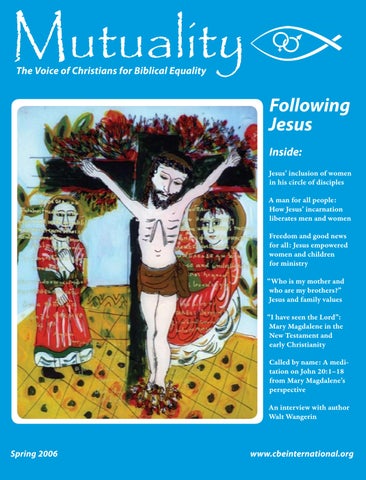
cover image
For Us, by Ioana Datcu, 1999, acrylic on Plexiglas, 20 × 16 in (50.8 × 40.64 cm), from the collection of Fr. Johann Rotten of The Marian Library/International Marian Research Institute, University of Dayton, Dayton, Ohio.
16 “Who is my mother and who are my brothers?” Jesus and family values — By Carrie A. Miles
20 The Stations of the Cross From Ludwar Cathedral in Turkana, Kenya
23 “I have seen the Lord”
Mary Magdalene in the New Testament and early Christianity — By Lidija Novakovic
26 Called by name
A meditation on John 20:1–18 from Mary Magdalene’s perspective — By Ann R. Palmerton
28 Becoming the Beloved of Christ
An interview with Walter Wangerin, author of Jesus—A Novel — By Heather Scheiwe
Ministry & Chapter News 31 Future Events; CBE to host tent at Cornerstone Music Festival in July 32 2007 Bangalore Conference report; Introducing “The Scroll,” CBE’s new blog
33 CBE Chapters List; Recent & Upcoming Chapter events
Departments 3 From the Editor: Most Excellent Theophilus 4 In Our Mailbox 30 Book Review: Christ the Lord, by Anne Rice — Reviewed by Chelsea DeArmond
34 Praise Reports & Prayer Requests 35 Church and Study Group Resources: Study Guide for Gilbert Bilezikian’s Beyond Sex Roles
36 Church and Study Group Resources: Study Guide for Lianne Roembke’s Building Credible Multicultural Teams 37 Giving Opportunities 38 President’s Message: Egalitarian Prophets in Pursuit of Respect and Civility | Mutuality Spring 2006
homepage: www.cbeinternational.org
Mutuality The Voice of Christians for Biblical Equality
Let us then pursue what makes for peace and mutual upbuilding. — Romans 14:19 VOLUME 13, ISSUE 1 Mutuality seeks to provide inspiration, encouragement, and information about equality within the Christian church around the world. President/Publisher : Editor : Editorial Assistant : Graphic Designer :
Mimi Haddad Chelsea DeArmond Heather Scheiwe Image Spigot
EDITORIAL AND ADVERTISING OFFICE Christians for Biblical Equality 122 W Franklin Ave, Suite 218 Minneapolis, MN 55404-2451 phone: (612) 872-6898 fax: (612) 872-6891 e-mail: cdearmond@cbeinternational.org web: www.cbeinternational.org Advertising in Mutuality does not imply organizational endorsement.
SUBMISSIONS Mutuality welcomes submissions. E-mail cdearmond@ cbeinternational.org, write to CBE for the writer’s guidelines, or visit CBE’s homepage and follow the Publications links.
PERMISSIONS Christians for Biblical Equality grants permission for any original article (not a reprint) to be photocopied for local use provided no more than 1,000 copies are made, they are distributed free, the author is acknowledged, and CBE is recognized as the source. Mutuality (issn: 1533-2470) is published quarterly by Christians for Biblical Equality and is sent free to members. For membership information, see page 31. To purchase back issues, contact our Editorial and Advertising Office, or order online at www.equalitydepot.com.
From the Editor by Chelsea DeArmond
Most Excellent
Theophilus Luke’s gospel is addressed to “most excellent Theophilus” (Luke 1:3). The name Theophilus means “lover of God.” Many theories have been proposed, but no one knows for sure who this person is. Some have suggested Theophilus isn’t a specific person, but rather that the name refers to anyone who loves God. In the Gospel of Luke, Jesus singled out several women who fit this description and who serve as as examples of what it means to follow Jesus. When Jesus was making his way through a crowd, a woman came up behind him (Luke 8:43–48). She wanted to touch Jesus because she believed he could heal her incurable disease. But anything she touched would be considered defiled because the illness made her ritually unclean. The woman tried to stay hidden, but Jesus felt her touch and sought her out in the crowd. Instead of rebuking her, he responded, “your faith has made you well; go in peace” (Luke 8:48). For twelve years, people recognized this woman as someone they needed to avoid. But Jesus was not afraid to be close to her, or to call her his “daughter” in front of everyone. When Jesus was teaching in the Temple, he singled out another woman as an example of devotion (Luke 21:1–4). In contrast to the rich who were depositing large sums in the treasury, this woman was only able to give two small copper coins. As a poor widow, people probably assumed she had nothing to offer. But Jesus recognized her as someone who gave more than anyone else. When Jesus was invited to dinner in the home of Simon the Pharisee, he was followed by a woman from the city who was known as a sinner (Luke 7:36–50). She must have caused quite a stir among the distinguished religious leaders reclining at the table when she started pouring out perfume, washing Jesus’ feet with her tears and hair, and kissing him over and over. Not only did Jesus allow her to continue, but he also singled her out as an example to the men. They only knew her as a sinner, but Jesus saw that she was full of love. We are never told her name, but her actions identify her as a most excellent Theophilus. How can we recognize disciples of Jesus? Is it by their gender? Their authority? Their training? According to John 13:35, Jesus’ disciples are distinguished by their love. This issue of Mutuality offers many insights into what it means to follow Jesus, and Mimi Haddad’s message at the end reminds us that love is a disciple’s most distinguishing characteristic. Chelsea DeArmond is Editor of Mutuality and Bookstore Coordinator at Christians for Biblical Equality. She can be reached at cdearmond@cbeinternational.org
bookstore: www.equalitydepot.com
Mutuality Spring 2006 |
In Our Box Visit CBE’s website at
www.cbeinternational.org for the latest… ▶ FREE audio and print resources on biblical equality ▶ Membership information for churches, libraries, families, and individuals ▶ CBE chapters in the U.S. and around the world ▶ Directory of egalitarian churches in the U.S. and around the world ▶ Giving opportunities ▶ Listings for counselors, therapists, and spiritual directors who agree with CBE’s Statement of Faith ▶ Ministry news and needs ▶ Employment, internship, and volunteer opportunities
Mutuality Call for Papers
Mutuality provides inspiration, encouragement, and information about equality within the Christian Church around the world. Mutuality is published quarterly and sent to all CBE members and subscribers. Current and back issue are also available for purchase. We are currently seeking features, reports, and reviews (books, films, and/or music) from evangelical, egalitarian perspectives related to the following topics: • Gender and Justice • Widows and Orphans • Advocacy vs. Apathy
• Clarifying Manhood & Womanhood • Worship and Preaching • Men’s Issues in the Church and Home
Most of the articles we publish fall into the following categories: • Personal testimonies illustrating how biblical equality provides practical benefits to everyday lives. • Teaching on relevant Bible passages, explaining the meaning and showing how to apply it to daily life. • Reviews of books about biblical equality that would appeal to a wide audience. (Books must complete CBE’s book service review process before being reviewed in Mutuality.) • Feature stories about issues related to CBE’s mission and ministry. The length of features is generally 1,000–2,500 words. Send articles to the attention of the editor at the postal address below or e-mail to mutuality@cbeinternational.org (if possible, as an attached Microsoft Word document). We are unable to consider or respond to authors who send us more than two pieces at the same time, whose pieces are substantially over 3,000 words, or whose submissions are not sent uniquely to Mutuality. Complete Writers Guidelines for Mutuality are available on our website (www.cbeinternational.org) or contact our office to request a copy. Questions and submissions can be directed to the attention of the editor, Chelsea DeArmond.
Visit CBE’s online bookstore at
www.equalitydepot.com for resources like… ▶ Books and articles ▶ Audio and video tapes ▶ CD, DVD, and MP3 recordings ▶ Sales and specials ▶ New resources, CBE exclusives, and best sellers ▶ Foreign language resources ▶ Become a CBE member or renew your membership and save 15% on every purchase ▶ Registration for CBE conferences ▶ Subscription to CBE publications or purchase back issues of Mutuality and Priscilla Papers
| Mutuality Spring 2006
We’d love to hear from you! Send your comments and critiques to:
Mutuality
122 W Franklin Ave, Suite 218 Minneapolis, MN 55404-2451 phone: (612) 872-6898 fax: (612) 872-6891 e -mail: mutuality@cbeinternational.org web: www.cbeinternational.org Letters may be edited for clarity and brevity.
homepage: www.cbeinternational.org
Jesus wants us to
Live
“Jesus said to her, ‘I am the resurrection and the life. Those who believe in me, even though they die, will live.’” — John 11:25 by Rachel Gillespie Lee
Jesus can give us life that death can’t erase. He has the power to do that no matter what the obstacles are that bind us. Jesus raised Lazarus from the dead to help us understand the power of God, to help us see that God has control over every kind of death. When Jesus stepped up to the tomb and cried out, “Lazarus, come forth!” Lazarus obeyed. The voice of Jesus echoes down through the centuries. He cries out again and again, to you and to me: “Come forth from the tombs that imprison you. Come forth to a new life, real life!” Jesus’ voice of authority demands that we come forth from the bondage that shackles us with its death hold. The emphasis is on life, not just the resurrection. Who wants to be resurrected to the same old meaningless existence? It’s life that people want! This miracle is a sign that Jesus can renew our dead lives. Sometimes we are bound by gender restrictions. For many years I was dead to the call to do certain types of ministry because I had grown up believing that women were not supposed to do those things. But one day I heard Jesus’ authoritative voice command me to come forth, to throw off the bindings that kept me as silent as the dead Lazarus. Jesus continues to call us out of our tombs—tombs of sin and doubt, tombs of materialism, sexism, and racism. Without regard to gender, he calls us to use our gifts as God and the Holy Spirit direct.
Prayer: Loving Creator, give us the ability to come forth from the tombs that imprison us, and help us to be all that you intend us to be. Amen. Take Away the Stone, by John August Swanson, 2005, serigraph, 30 × 20 inches (76.2 × 50.8 cm), © 2005 by John August Swanson (www.JohnAugustSwanson.com). Full-color posters and cards of Mr. Swanson’s work are available from the National Association for Hispanic Elderly (626-564-1988). Proceeds benefit its employment and housing programs for low-income seniors. bookstore: www.equalitydepot.com
From Songs of Miriam, ed. Mary L. Mild (Valley Forge, Pa.: Judson [1994]). Reprinted by permission of the publisher. 1-800-4-JUDSON. www.judson.com.
Mutuality Spring 2006 |
“It will not be taken from her”
Jesus’ inclusion of women in his circle of disciples By John C. DelHousaye One of the ways Jesus demonstrated the Kingdom of God was by calling unusual disciples. He called twelve Jewish men in order to show that God was reconciling himself to the sons of Jacob (Israel) by a New Covenant. Though these disciples may be the most familiar to us, they weren’t the only people Jesus called to be his disciples.
| Mutuality Spring 2006
Many tax collectors and other sinners also followed him (see Mark 2:15). By repenting and believing in the gospel, they represented Jesus’ divine mission to forgive sins and gather up the “lost sheep of Israel.” But not everyone recognized Jesus’ inclusive approach to discipleship as redemptive. Some of his contemporaries accused him of being a “friend of tax collectors and sinners” (Matt. 11:19).
homepage: www.cbeinternational.org
Jesus also called women to be his disciples. Based on Jesus’ other choices of disciples, what does the presence of these women in his circle of disciples teach us about the Kingdom? Before addressing this question, we must show that Jesus actually had women disciples, since not everyone would agree.
The women who followed Jesus Women were present in Jesus’ circle of disciples toward the beginning of his ministry: And his mother and his brothers come. And while standing outside [of the house] they sent to him, calling him. And a crowd was sitting around him, and they say to him: “Behold, your mother and your brothers and your sisters are seeking you outside.” And answering, he says to them: “Who is my mother and my brothers?” And looking around at those who are seated with him in a circle, he says: “Behold, my mother and my brothers! For whoever does the will of God, this is my brother and sister and mother.” (Mark 3:31–35; scripture citations are the author’s translation throughout) Jesus’ teaching on divorce shows that women were not merely spectators, but received instruction like the men: And in the house the disciples again were asking him about this. And he is saying to them: “Whoever divorces his wife and marries another is committing adultery against her. And if she, after divorcing her husband, marries another, she is committing adultery.” (Mark 10:10–12) Though Jewish women were not permitted to divorce their husbands, there is evidence that wealthy wives who were not dependent on their husbands could initiate divorce under Roman law. In firstcentury discipleship circles, the question of women divorcing their husbands would be irrelevant. But since Jesus’ circle included women, he applied this teaching to men and women equally. Some of the women disciples who traveled with Jesus and the Twelve during his ministry were wealthy enough to provide for his mission: And it came about afterward he also was traveling to city and town, preaching and proclaiming the goods news of the Kingdom of God. And the Twelve were with him, and women, some of whom were healed from evil spirits and illnesses: Mary, who is called Magdalene, from whom seven demons had gone out, and Joanna, the wife of Chuza, Herod’s steward, and Susanna and many others, who provided for them from their possessions. (Luke 8:1–3) Many of these women remained with Jesus to the end: Now there were also women looking from a distance, among whom also was Mary, the [woman] from Magdala, and Mary, the mother of James the younger and of Joses, and Salome, who, when he was in Galilee, were following him and were serving him. And also there were many other [women], who came up with him to Jerusalem. (Mark 15:40–41) bookstore: www.equalitydepot.com
Magdalen and the Disciples, by Constance Pierce, monotype, private collection, © 1994 by Constance Pierce • facing page: Healer of My Soul, by Constance Pierce, painting, private collection, © 1990 by Constance Pierce
Although Mark sometimes uses the verb “to follow” (akoloutheō) in a literal sense (6:1, 10:32, 14:13, 15:41), this word also describes the activity of discipleship. For example, after Jesus called Peter and Andrew, they immediately left their nets and “followed him” (1:18; see also Levi’s call in 2:14). The context and verb tense of “to follow” in Mark 15:40–41 suggest that the women at the crucifixion had left their homes and had been continually following Jesus on his mission. But not all of Jesus’ women disciples were called to leave their homes: Now while they were traveling, he entered into a certain village. Now a certain woman named Martha received him. And with her was a sister called Mary. She sat before the feet of the Lord, and she was hearing his word. But Martha was being distracted with much serving. Now having approached [them], she said: “Lord, is it of no concern to you that my sister left me to be serving [the meal] alone? So tell her to come help me!” But having answered, the Lord said to her: “Martha, Martha, you are anxious and troubled about many things. But one thing is necessary. For Mary has chosen the good part, which will not be taken from her.” (Luke 10:38–42) In this passage, Mary assumes the posture of a disciple (Acts 22:3; m. Avot 1:4) and is praised by Jesus. She does not let domestic duties distract her from learning about the “good part,” which in the narrative context (9:51–19:28) is Jesus’ teaching on the Kingdom. Mutuality Spring 2006 |
Based upon the Gospels, then, Jesus called women to be his disciples. Some left their homes, while others were challenged to think differently about their identity and roles in the home. By choosing to include women into his discipleship circle, Jesus clearly differentiated himself from other Jewish teachers, which undoubtedly made him vulnerable to criticism.
First-century restrictions on women disciples Women faced prejudice Pious Jewish women did have opportunities to learn about God and his will. They could attend the local synagogue on the Sabbath to hear the Law and Prophets as well as a sermon. But there is no evidence that first-century rabbis included women in their discipleship circles. Their exclusion may have been partly the result of sexism. For example, Josephus, a first-century Jewish historian, claimed that women were inferior to men (Against Apion 2.25). Philo, a first-century Jewish philosopher in Alexandria, believed women were weak and should stay at home (Op. Mund. 151– 52; Spec. Leg. 3.169–77). And in a notorious prayer from the later Rabbinic work, the Tosefta, a man thanks God for not making him a woman (Ber. 7.18). But it would be unfair to claim that all Jewish male rabbis, except for Jesus, were prejudiced against women. Two significant barriers, which were not necessarily related to the attitudes of the rabbi, prevented the inclusion of women in discipleship circles.
The Law also stipulated that her touch made Jesus unclean. But instead, a healing, cleansing power went out from him.
Women were considered morally impure First, it was considered culturally inappropriate for a man to spend time with or speak to a woman other than his wife. Such intimacy would lead to (at least the perception of ) sexual impropriety. With such a reputation, a male religious teacher would quickly lose honor in his community. This explains why Jesus’ own (male) disciples were so shocked when he spoke to the woman at the well ( John 4:27). The later Rabbinic work, Avot de Rabbi Nathan (ch. 2 A), probably expresses their cultural value: Let no man be alone with any woman in an inn, even with his sister or his daughter or his mother-in-law, because of public opinion. Let no man chat with a woman in the market place, | Mutuality Spring 2006
even if she is his wife, and, needless to say, with another woman because of public opinion. In other first-century works, we find the rather surprising—at least from a modern point of view—assumption that women were inherently adulterous and could not be trusted. It is therefore significant, as David Scholer observes, that Jesus places the blame for lust on men (Matt. 5:28). In any case, Jesus does not allow his disciples—whether male or female— to project their own lust upon others. But Jesus lost considerable honor among his contemporaries because of such equal associations. Women were considered ritually unclean A more significant barrier, however, was niddah or “menstrual impurity.” According to the Mosaic Law, if a man touched a menstruating woman or whatever she had touched, such as a bed, he would become ritually impure (or unclean) along with the woman (Lev. 15:19–33). Pre-menopausal women, then, were conduits of impurity approximately one quarter of the time. For this reason, women were often excluded from communal religious life. Josephus assumes menstruating women were forbidden to enter the Temple (Against Apion 2.103–104; War 5.227). It is likely that they were also excluded from the synagogue during their periods. Today, Christian women are hardly conscious of their menstrual cycles when attending church. But in Jesus’ social world such impurity was a major concern. In order to ensure that women’s ritual impurity remained contained, Rabbis apparently were called upon to inspect menstrual rags.
Jesus as the source of forgiveness and cleansing for everyone Not surprisingly, Jewish teachers at the time of Jesus pursued moral and ritual purity in their discipleship circles. Both were prerequisites for God’s presence. Jesus’ inclusion of women presumably offended their religious sensibilities. A group of women would have been perceived as conduits of ritual impurity. By coming into contact with these women or whatever they touched, Jesus would, from their perspective, be in a constant state of uncleanness! But Jesus never betrayed an awareness of being ritually unclean. Instead, he appears to have perceived himself as a conduit of both forgiveness and ritual purity. This divine power is poignantly expressed in Jesus’ healing of a hemorrhaging woman: A woman, who had had a flow of blood for twelve years—and had suffered much at the hands of many physicians and had spent all that she had and was not helped at all but had grown worse—after hearing about Jesus, came up in the crowd behind [him] and touched his outer garment. For she was saying that “If I just touch his outer garments, I will be saved.” And immediately the flow of her blood was dried up. And she felt in her body that she was healed of her affliction. (Mark 5:25–29) According to the Mosaic Law (Lev. 15:25–30), this woman would have been ritually unclean for over a decade, and therefore had been unable to participate in the religious life of her community. The Law homepage: www.cbeinternational.org
Jesus’ redefinition of purity makes this post-Pentecost reality possible. Jesus also attacked the fundamental barrier between God and his people— the evil heart. Women were not to be distracted from this problem by a preoccupation with their domestic roles or menstrual cycles. Men were not to be distracted by projecting their own lust upon women, as if the women they objectified were the problem. Instead, Jesus called women and men equally to repent from their former way of life, to believe in his gospel, and to join his family and mission. But this post-Pentecost reality must be protected today. Jesus was willing to suffer dishonor by his contemporaries in order to honor those who had been marginalized. Jesus took a risk for women, and invites us to do the same.
also stipulated that her touch made Jesus unclean. But instead, a healing, cleansing power went out from him. Jesus’ contagious purity was an expression of the cleansing work of God’s Spirit through the offering of the New Covenant (see Ezek. 36:26–27). Jesus fulfilled the Law’s demand for purity and therefore was free to redefine purity for his disciples as entirely a matter of the heart: What is coming out of a person—that [is able to make] the person impure. For out of the heart of people is coming evil thoughts: fornications, thefts, murders, adulteries, [thoughts of ] greed, [thoughts of ] immorality, deceit, lack of self-control, the evil eye, dishonor, pride, foolishness—all these things are coming from within and [make] a person impure. (Mark 7:20–23) While Jesus was not the first to emphasize moral purity, his claim was unprecedented in Jewish faith, and led to the setting aside of the Mosaic kosher laws (Mark 7:19). But this redefinition of purity, I would suggest, also had a profound impact upon Jesus’ women disciples. Their communal worship would no longer be contingent upon their ritual cleanness. Women could now be clean all of the time.
Conclusion So what is Jesus trying to teach his contemporaries—and us—about the Kingdom of God through his calling of women to be disciples? Consistent with his ministry to tax collectors and other sinners, it was important to Jesus that everyone—not just righteous men—experienced the forgiveness and blessings of the New Covenant. The community of men and women Jesus called was the same community who received the Holy Spirit at Pentecost and began to prophesy (Acts 1:14). At that time, Peter cited the fulfillment of the prophet Joel’s prophecy: And even upon my male servants and female servants in those days I will pour out my Spirit, and they will prophesy. (Acts 2:18)
Pentecost
John DelHousaye is assistant professor of New Testament at Phoenix Seminary, and serves as a volunteer pastor at Echo Mountain Church. He is married to Tiffany, a speech therapist, and has two daughters, Livia (age 4) and Joslyn (age 1). John did his doctoral work on the historical Jesus at Fuller Seminary.
Related resource from Equality Depot Bookstore
Most illustrations of Pentecost show only the 12 apostles with Mary, the mother of Jesus. Yet in scripture we read: With them were some women and also Mary, the mother of Jesus, and his brothers. When the day of Pentecost came, they were all together in one place. And suddenly out of the sky came a sound like a strong rushing wind and it filled the whole house where they were sitting. There appeared tongues of fire which parted and came to rest upon each of them. (Acts 1:14; 2:1–3)
This painting of “Pentecost” by Nora Kelly shows a group of men, women, and children in traditional Jewish dress gathered in the upper room in Jerusalem.
bookstore: www.equalitydepot.com
Jesus called women and men equally to repent from their former way of life, to believe in his gospel, and to join his family and mission.
Pentecost by Nora Kelly Medium print (14 × 19 in; 35.56 × 48.26 cm) List $10.00 CBE member $8.50 Large print (27 × 39 in; 68.58 × 99.06 cm) List $24.00 CBE member $20.40 20 blank notecards (3.5 × 5 in; 8.89 × 12.7 cm) List $10.00 CBE member $8.50 Available at www.equalitydepot.com or call 612-872-6898 to order quantity discounts available CBE members receive 15% off every regularly-priced item at Equality Depot Bookstore.
Mutuality Spring 2006 |
A Man for All People The Importance of Jesus’ Masculinity
By Brynn Camery-Hoggatt
Many, particularly women, have felt that the patriarchal overtones of Scripture exclude them from participating in God’s divine work: only men are to be the leaders, preachers, and teachers. They find the masculinity of Jesus limiting instead of liberating because they cannot relate to His male identity. If Jesus as a man was the perfect human, how can women ever hope to measure up? The Gnostic gospel of Thomas puts this approach into blaringly oppressive terms: Simon Peter said to him, “Let Mary leave us, for women are not worthy of life.” Jesus said, “I myself shall lead her in order to make her male, so that she too may become a living spirit resembling you males. For every woman who will make herself male will enter the kingdom of heaven.” (114) Thankfully, canonized Scripture disagrees with this attitude and says something entirely different. This was not the design of the Garden of Eden or of the new Kingdom of God. We should no longer be living under the old discord of hierarchical humanity. Instead, we must claim the new call to live to the fullest of our humanity, embrace the diversity of gifts in God’s kingdom, and liberate others to do the same. But this is a huge task. Where do we begin? Let’s look to Jesus.
The Particularity—and Universality— of Jesus’ Personhood
Study for Christ: Matthew, by Melissa Weinman, 1998, charcoal on prepared paper, 40 × 27.5 inches (101.60 × 69.85 cm), collection of Seattle University Law School. From the artist: “I chose my model based on what a 35-year-old man from today’s Mediterranean society looks like. However, his appearance is universal enough that he could be found in Tel Aviv, Los Angeles, Milan, Buenos Aires, or Calcutta” (www. melissaweinman.com).
10 | Mutuality Spring 2006
Who was this man? Jesus’ human identity as a Jewish man served an important purpose for women and men alike and for rectifying age-old wrongs between them. If Scripture is read against the backdrop of the patriarchal context in which it was written, the actions of the male Jesus actually elevate the marginalized and show us how to resist patriarchy and prejudice in our own lives. Our understanding of God is purely human and limited. The only way that we can know Him is through His action and revelation to the world which He generously demonstrates for us in ways that we can fathom. We would never have been able to conceive of homepage: www.cbeinternational.org
a healthy, genderless human and therefore, when God was incarnated, are found throughout Jesus’ teachings and later in Paul’s (Matt. 13:49, He had a gender. As a result, He also had a sense of individuality and 25:1–30; Luke 18:2–8; Acts 2:17–21; 1 Cor. 7; 2 Tim. 1:5). Here, He personality. It was possible for other people to know Him, relate with shows a new attitude of love for all people. Him, and talk with Him. For Jesus didn’t only acknowledge women; He loved them. We are reminded of Exodus: As a Hebrew, Moses would never He called them sisters, mothers, daughters, disciples, and friends. have been able to get an audience with the Egyptian Pharaoh had he Mary and Martha were intimate friends with Jesus who neglected not been raised as an Egyptian prince. Likewise, in order for Jesus to household duties to walk and talk with Him (Luke 10:38–42; John transform the old traditions and fulfill the laws of Israel, He had to 11:5, 17–37). The woman at Bethany was invited to anoint Him with become a part of those traditions. Jesus came with a specific voice that her hair and her tears (Matt. 26:6–13). Mary Magdalene was the first people would listen to in order to have the authority He would need to see the risen Lord (Matt. 28:1–10). Jesus respected femininity in that culture. As a Jewish man, Jesus became the role model for a and even described Himself as a mother hen who longed to gather new social code and for right relationships between genders, social Jerusalem under Her wings (Matt. 23:37). classes, and ethnic groups. Jesus’ maleness elevated women but speaks to men as well. Some If Jesus had come as a woman, a Gentile, a leper, or any other men do not feel that they fit the traditional male role; men along with group segregated from the Jews during that time, He would have women have experienced segregation, prejudice, and injustice based been quickly dismissed and the message would have been lost. Because the people of the Ancient Near East commonly assoChrist has no body now but yours, ciated women in particular with sexuality and temptation, God’s decision to send a no hands, no feet, on earth but yours. son instead of a daughter was a practical one. Simply put, Jesus challenged His Yours are the eyes culture and elevated the oppressed to new extremes that would have been less drastic through which he looks with compassion on this world. had He been born any other way. Yours are the feet But while He was a normal human being, His perfect obedience to God is the source with which he walks to do good. of all human righteousness. Romans 5:17 states that “just as through the disobediYours are the hands ence of the one man [Adam] the many were made sinners, so also through the obedience with which he blesses all the world. of the one man [Christ] the many will be made righteous.” For this purpose, it did not Yours are the hands, yours are the feet, yours are the eyes, matter that Jesus was a man; His gender had nothing to do with obedience or disobediyou are his body. ence to God, and a female Christ would have accomplished the same salvific purposes. Christ has no body now but yours. The importance here is that Jesus was a 100 percent normal human who was 100 percent • St. Teresa of Avila obedient to God.
Jesus Challenges the Cultural Status Quo for Women—and Men This male Rabbi treated women differently than they had ever been treated before. There were many who remain unnamed in Scripture, such as the woman with the hemorrhage and the Samaritan woman at the well. The fact that women were often identified merely by their ethnicity, husband’s name, or occupation (Matt. 9:18–26 John 4:1–26) suggests that they were marginalized. But Jesus sought them out, referred to them by name, allowed them to speak when they were silenced by others, and looked at them with compassion. For example, He called the widow the greatest contributor to the public offering (Mark 12:41–44). The parable of the woman with the single lost coin is paralleled by the parable of the man with the single lost sheep (Luke 15:3–7; Luke 15:8–10). Similar comparisons
bookstore: www.equalitydepot.com
on appearance, ethnicity, social class, and countless other categories humans use to separate and limit each other. However, Jesus did not always fall under the category of a typical Jewish male role model either: According to Scripture, He remained unmarried and childless, performed miracles on the Sabbath, rejoiced on fast days, forgave sins, cast out demons, commanded prayer for enemies, promoted love over law, illustrated servanthood as the highest form of leadership, and publicly spoke to adulteresses, prostitutes, and single, Gentile, and menstruating women (Matt. 5:38–48; 9:6, 14–15; 15:21–28; Mark 3:1–6, 20–29; Luke 7:48; John 8:3; 13:34). Truly, Jesus was a unique man in His day. He served instead of bullied. His power came through love instead of force. His actions as a man were catalysts for liberation. Through this, we see that if Jesus had not risked His reputation but had behaved as typical men in His culture did, He would not have been radical for them, or for us, at all.
Mutuality Spring 2006 | 11
Our Oneness in Christ Jesus To be consistent with the claim that Jesus’ particular biology contributed to His perfection, we must also conclude that only Middle Eastern Jews born of virgins can hope to meet the standard. And so far, there’s only been one of those. None of us are inherently worthy to represent Christ. Of course, scripturally, women do not have any right to preach the Gospel. But neither do men. Therefore, any service we offer to God was first a gift from Him who forgave our sins, broke the curse, and enabled our offering (2 Tim. 2:2; 3:16–17). Women and men are blessed to share an identity as forgiven human beings whose call is ultimately to do as Christ does: love boundlessly. Philippians 2:2 says, “Make my joy complete by being like-minded, having the same love, and being one in spirit and purpose.” We can rest assured that God does not skimp on gifts or limit capability according to human standards (1 Cor. 7:17–34; 12:8–10, 28–30; Eph. 4:7–11). Even in a world that categorizes and marginal-
izes according to gender, skin color, and body type, the Lord never does. He “does not look at the things human beings look at. People look at the outward appearance, but the Lord looks at the heart” (1 Sam. 16:7). Likewise, Galatians 3:28 reminds us that “there is no longer male or female for you are all one in Christ Jesus.” This verse makes it clear that in following Jesus, we too, are asked to abandon our biases. His death broke the division between men and women just as it united Jews and Gentiles. It provided the means for the prejudice and injustice of a fallen, broken, and sinful world to be rectified and forgiven. Under this forgiveness, we must seek to progress toward a balanced and diversity-loving Church of believers who are all equally free of the curse, and undeservedly offered God’s grace. Brynn Camery-Hoggatt grew up in Southern California. She is finishing her BA in English and Biblical Studies at Gordon College. In her spare time, Brynn enjoys reading, writing, and playing her harp for weddings and other special events.
New from Equality Depot Bookstore Order on-line at www.equalitydepot.com or call 612-872-6898
As seen in… The Bible and Equality Mutuality Summer 2005 vol. 12, issue 2
Gospels and Acts is the first in the full seven-volume set of full-color reproductions of The Saint John’s Bible. Some of its 25 beautiful illuminations were first published in “Women Illuminating the Word” by Joanne Nystrom Janssen in the Summer 2005 issue of Mutuality. The article also includes an interview with Diane von Arx Anderson, one of the The Saint John’s Bible scribes.
Donald Jackson, a world renowned calligrapher and illuminator, in collaboration with artists and theologians—including women—has woven together word and image in this once-in-a-millennium project. The Saint John’s Bible uses the gender-accurate New Revised Standard Version (nrsv). It was chosen because it is theologically sound, and has the distinction of being officially authorized for use by major Christian churches.
Gospels and Acts vol. 1 of The Saint John’s Bible Donald Jackson, Artistic Director and Illuminator LITURGICAL PRESS HARDCOVER
9.75 x 15 IN
List $64.95 CBE member $55.20
12 | Mutuality Spring 2006
136 PGS
The Saint John’s Bible is a major artistic, cultural, and spiritual endeavor. It is the first handwritten and illuminated Bible commissioned since the invention of the printing press. Commissioned by the monks of Saint John’s Abbey and University as a Bible for our time, The Saint Johns Bible is a unique blend of ancient methods, materials, and tools with modern themes, images, technology, and text. homepage: www.cbeinternational.org
Freedom and Good News for
ALL
“The Spirit of the Lord is upon Me, because He anointed Me to preach the Gospel to the poor. He has sent Me to proclaim release to the captives, and recovery of sight to the blind, to set free those who are downtrodden, to proclaim the favorable year of the Lord.” Luke 4:18–19 (nasb) By Efrem Smith When Jesus announces His public ministry in the fourth chapter of the Gospel of Luke, He presents a holistic call which brings about spiritual transformation through salvation. In his teachings and example, Jesus also models social transformation, especially in the case of children and women. Jesus’ earthly ministry had both spiritual and social implications, and to recognize this is to understand the whole Gospel message.
Yes, through Jesus Christ we are set free from the penalty of sin, but there is also a freedom that comes from taking on a new identity in Christ which challenges social classifications. Yet, even today we struggle to fully live out a oneness within humanity across gender, age, and ethnicity (or so-called race). Galatians 3:28–29 still lingers at the door of many churches, hoping to be invited in and fully embraced.
Jesus Welcoming Children, by Fr. Jim Hasse, S.J., painting on the door of Mother of Christ Church, Cincinnati, Ohio. The children from the Mother of Christ parish who were models for the painting are photographed standing in front of their images. bookstore: www.equalitydepot.com
Mutuality Spring 2006 | 13
Jesus Brings Reconciliation with God and One Another In Luke 4, Jesus proclaims that the Spirit is upon Him and that He has a call to preach release, recovery, freedom, and favor. We get a glimpse into the social implications of this calling by seeing in the Gospels how Jesus interacts with children, women, and second-class citizens, specifically Canaanites and Samaritans. Jesus is the open door to eternal heavenly citizenship, but He is also the radical one who challenges and dismantles second-class citizenship across gender, age, and the man-made racial construct. There is neither Jew nor Greek, there is neither slave nor free man, there is neither male nor female; for you are all one in Christ Jesus. And if you belong to Christ, then you are Abraham’s offspring, heirs according to promise. (Gal. 3:28–29 nasb) Jesus’ proclamation in Luke 4 can be connected to the writing of Paul in Galatians 3 to see Jesus as the One who comes to fulfill the promise. The fulfillment of this promise leads to reconciliation between God and humanity through faith as well as right relationship restored within humanity. The reconciliation power of Jesus gets us right with God, but also gets us right with one another. Consider these words of Paul in his second letter to the church at Corinth:
Now all these things are from God, who reconciled us to Himself through Christ and gave us the ministry of reconciliation, namely that God was in Christ reconciling the world to Himself, not counting their trespasses against them, and He has committed to us the word of reconciliation. (2 Cor. 5:18–19 nasb) After Jesus announces His public ministry in the synagogue, His words are so radical to those listening that some attempt to kill Him right then. But He escapes to continue fulfilling his mission, so we might see Him confront the culture’s social classification across boundaries of age, gender, and ethnicity.
Jesus Recognizes the Value of Children In the gospels, we see many examples of Jesus challenging how the culture viewed children, the poor, and women. In Matthew 19, children were brought to Jesus and rebuked by the disciples. Jesus responds by rebuking the disciples. His challenge brings a transforming value to children. This text is part of a biblical theme of God using children and youth to advance His Kingdom and bring about social change as well. Young David, Esther, Jeremiah, Josiah, and Timothy are all stories of God using children and youth to do incredible things on earth. By laying hands on the children that were brought to him, Jesus not only blesses them, but also ordains their value in the Kingdom. But Jesus said, Let the children alone, and do not hinder them from coming to Me; for the kingdom of heaven belongs to such as these. (Matt. 19:14 nasb)
Jesus Dismantles Second-Class Citizenship
My Brother, by Fr. Jim Hasse, S.J., painting
14 | Mutuality Spring 2006
In Matthew 15, a Canaanite woman approached Jesus and begged Him to heal her daughter. Once again, the disciples play into the social norms and roles of the day by asking Jesus to send this woman away. How dare she disrupt the community and work of the men! Yet, Jesus engages in conversation with her, and even speaks to her role in society as not only a woman, but also as a Canaanite, an ethnicity that was not considered part of the privileged people of the house of Israel. As a Canaanite, this woman would have been known as the descendent of a cursed people. Noah cursed his grandson Canaan, because Canaan’s father, Noah’s son, looked upon the drunkenness and nakedness of Noah. This mistake created a generational curse of slavery and second-class citizenship. Yet Jesus in His social interactions, death, and resurrection dismantled the curse that haunted this woman. Jesus was controversial to religious figures and others around him during His earthly ministry because He challenged the way in which women and those considered cursed should be treated. We must ask ourselves, who are the cursed today? I look at the community in which I minister today and I think about the young, single mothers struggling to make things better for their children, and I believe that the church must interact with them as Jesus did with the Canaanite woman. They might feel as if their situation is generational and they need to know that the church is here to be used by God to break generational curses. homepage: www.cbeinternational.org
We must also wrestle with what it is that enables generational curses to continue. We might first say that the person themselves must take responsibility and not consider the broader institutional issues that come into play. There are systems that must be addressed in order for curses to be broken. Some of those curses can’t be addressed outside the church, if they’re not addressed inside the church. The real question is, is the church dismantling or participating in the systems that continue to exploit and oppress the poor, people of color, and women? Jesus was bold enough to take the position of dismantling and this should point us to the heart of God on these issues.
Jesus Preaches the Whole Gospel With all this in mind, the question becomes this: what will the church do today about Jesus’ proclamation, life, death, and resurrection? Will the church limit the transformation that Jesus brings to eternal salvation, or will it also see Jesus bringing change to the social constructs within humanity? Who are the poor, captives, blind, and downtrodden of today? Yes, this text in Luke 4 speaks to those who live in sin, separated from God, but it also speaks to those in our society who are relegated to second-class citizenship. The proclamation of the public ministry of Jesus must live today as the public ministry of the church! The church must vocalize freedom and Good News within the contemporary context of today’s society.
The Good News indeed must bring about freedom for the poor and oppressed. To some this is a social Gospel, but what is wrong with that? The Gospel must be both spiritual and social in order to be the complete Gospel. As an African-American and Evangelical pastor, I must preach a Gospel that lives within today’s tension of being both evangelistic and socially just. This is what I call a holistic approach to ministry. If people are giving their lives to Christ, but we tolerate domestic abuse and the treatment of women as second class to men, what difference does the Gospel truly make? In turn, if we fight for equality and peace, but do not proclaim the necessity of new birth, we present an incomplete Gospel. At its best, the Church preaches new birth, has women in positions of pastoral leadership, believes children and youth can advance the Kingdom, is multicultural, and sees social justice as essential to true missions. This is a living community which represents the fullness of the public ministry of Jesus. Efrem Smith is senior pastor of The Sanctuary Covenant Church in Minneapolis, Minnesota. He has also served as executive director of The Park Avenue Foundation (Minneapolis) and urban ministry director of Minnesota Fellowship of Christian Athletes. Rev. Smith is a member of the CORE seminar training team of Youth Specialties and a speaker with Kingdom Building Ministries.
Ebony Cathedrals, by Fr. Jim Hasse, S.J., painting, 5 × 6 feet (1.52 × 1.82 m) bookstore: www.equalitydepot.com
Mutuality Spring 2006 | 15
“Who is my
mother
and who are my
brothers? ” Jesus and family values
By Carrie A. Miles On issues of the family and scripture, Christians are in a bit of a pickle. It is not always clear how our convictions about “family values” mesh with what the Bible teaches, especially the Gospels. Jesus, for example, did not assign the great spiritual and sentimental significance to family life that many Christians do today. How then do we reconcile the expectation that all good Christians should marry with his example of lifelong celibacy? Or our championship of family with Jesus’ warning that following him will set sibling against sibling and parent against child? Endorsing family values poses particularly interesting issues for biblical egalitarians, since many of our fellow Bible-believers hold that these values should include a hierarchical model of marriage. In order to understand Jesus’ attitude toward the family, we must understand that family practices in the first century were not based on emotion as they are today, but rather on material, economic interests. In my book, The Redemption of Love,1 I show that the family values prevalent in Jesus’ day were the economic consequences of the Fall. These family practices, now known as patriarchy, were corrupted by the human decision to have our own way and live outside of God’s abundance. I join New Testament historian S. Scott Bartchy in arguing that rather than support
patriarchy, Jesus and other New Testament writers (especially Paul) intended to overthrow it. Thus, Jesus’ teachings, which seem anti-family today, reflect his intent to dissolve the materialistic motives for family and replace them with relationships based on doing the will of God.2
Jesus’ Ideal for Marriage One of the most important examples of how Jesus reoriented family values is found in Matthew 19:1–12. In this passage, the Pharisees attempt to entangle Jesus in a dispute about grounds for divorce. He refused to be drawn in, however, and replied that they should be more concerned about the grounds for marriage instead of arguing about divorce. Referring his questioners back to God’s intent in creation, Jesus quoted Genesis 2:24, “For this reason a man will leave his father and mother and be united to his wife, and the two will become one flesh.” To ensure they didn’t miss the point, he added, “So they are no longer two, but one” (vv. 5, 6a). This ideal of husband and wife becoming “one,” however, surprised even Jesus’ own disciples, who responded, “If this is the situation between a husband and wife, it is better [more expedient or profitable] not to marry” (v. 10). In their context, men married in
order to meet their own material needs for children, sex, and household management. They did not expect to make the personal sacrifices that becoming “one flesh” entailed in the creation model of marriage. Jesus agreed that not everyone is capable of such a union, but since this was the point of God’s creation of humankind as sexual beings, “the one who is able to accept it should accept it” (vv. 11–12). In other words, people who decide to get married should base their union on God’s intentions, rather than materialistic needs.
Singleness In this passage Jesus challenged another ancient family value—the expectation that every respectable person should marry. He noted several reasons why people might choose not to marry, including the decision to devote themselves entirely to the kingdom of heaven (v. 12). Between this teaching and his own example of celibacy, Jesus made it clear that it was acceptable for godly people to remain single. This was a radical claim, since singleness had rarely been an option before. Historically, most marriages were arranged by families to further their own interests, often with little consideration for the preferences of the bride and groom. Given how far the relationship
above: Mother and Child, by Bro. Cletus Behlmann, acrylic on paper • facing page: Jesus and Joseph, by Bro. Cletus Behlmann, watercolor, 16 × 20 in (40.64 × 50.8 cm)
16 | Mutuality Spring 2006
homepage: www.cbeinternational.org
between husband and wife had fallen from God’s intent, allowing people to remain single was a great blessing. This was particularly true for women, who were valued mostly for their ability to contract a good marriage and bear children. In allowing believers to remain single and challenging married people to renounce the self-centered way in which they lived together, Jesus reminded us that God created human sexuality as a blessing: So God created human beings in his own image, in the image of God he created them; male and female he created them. God blessed them and said to them, “Be fruitful and increase in number…” (Gen. 1:27–28; my emphasis) The imperative in verse 28 is not a command. Rather, marriage, children, and sexuality itself are blessings, gifts of God to human beings. As such, human beings may partake of them or not. While Jesus’ teachings strongly affirm the rightness of marriage as a gift of God, at the same time there is no biblical support for the insistence that individuals marry or have children. Viewing marriage and family as godly gifts helps us appreciate the extent of Jesus’ own sacrifice for our sakes, forgoing the comforts of home and family in order to serve the kingdom of heaven. That Jesus was well aware of his sacrifice is apparent in his lament, “Foxes have holes and birds have nests, but the Son of Man has no place to lay his head” (Matt. 8:20).
world, they still considered adultery to be a sin committed against the adulteress’ husband, but not the adulterer’s wife. Jesus’ definition of marriage as a “one flesh” relationship implicitly recast adultery not as a property crime against men, but as a shattering of the essential union created by God. In his model, adultery is a concern not because it violates a man’s right to his wife’s sexuality, but rather because it introduces a third party into the “two become one” relationship. This view of marriage made a husband’s unfaithfulness a sin against his wife, and the fact that they had obtained a writ of divorce did not change things: “Whoever divorces his wife and marries another, commits adultery against her.…” (v. 9; Mark 10:11).3 This rejection of the “double standard” provided an important step in recognizing women as full partners in marriage and affirmed sexuality as central to the marital union rather than as simply a physical resource.
The Importance of Spiritual over Physical Kinship Jesus’ ministry consistently challenged limitations placed on women. His response to a woman who “raised her voice and said to [ Jesus], ‘Blessed is the womb that bore you and the breasts that nursed you!’” (Luke
11:27 nrsv) is a good example. In a context where women were judged by their sons’ accomplishments, this woman meant to pay Jesus a compliment: “Your mother was blessed to have a son like you!” But the woman framed his mother’s blessedness in terms of her biology—she was not much more than a fortunate womb and breasts. Jesus, however, replied, “Blessed rather are those who hear the word of God and obey it!” (v. 28 nrsv). Although the woman in the crowd could not have known it, Jesus’ statement applied especially strongly in the case of his own mother, a young girl who was told by an angel that she would bear a child by the Holy Spirit. Mary knew that according to Old Testament law, she could be stoned to death if she were found to be pregnant by someone other than her fiancé, but she accepted the risk in faith. Jesus said that what was truly admirable about his mother, or anyone, was that obedience and faith. What was important about individual women or men was not their ability to bear or father children, but rather that they heard the word of God, and obeyed it. This redefinition of blessedness opened the door to bonds that extend beyond physical kinship. Only one woman could be Jesus’ mother in the flesh, but by obeying the word of God, an infinite number of people, male or female, could enter into a
Divorce Jesus’ response to the Pharisees’ question about divorce also significantly broadened his culture’s assumptions about marriage. Jesus believed that marriage was the union of two into one, and that “what God had joined together,” men were not to put apart (v. 6; Mark 10:9). He acknowledged that the only valid excuse for a man’s rejection of his wife was infidelity on her part, but then he added a surprising twist. Ancient societies considered adultery to be a crime against men. Unless the female partner was married, a man’s relations outside of marriage were not considered adulterous. Although Jewish morality did not allow the sexual license granted men in the pagan bookstore: www.equalitydepot.com
Mutuality Spring 2006 | 17
familial relationship with him.4 Jesus even warned that doing God’s will would result in the rejection of believers by their non-believing families: Brother will betray brother to death, and a father his child. Children will rebel against their parents, and have them put to death. Everyone will hate you because of me, but those who stand firm to the end will be saved. (Mark 13:12–13 tniv) This statement may sound extreme to us, but it was even more shocking in Jesus’ context. Ancient patriarchy placed great value on family prestige, which could only be increased at the expense of other families. Because of this intense competition, only family members could be trusted.5 Elizabeth Johnson writes that, “The notion that family members, in particular siblings, should deal treacherously with each other is a watchword in antiquity for the very depths of domestic dishonor.”6 Jesus’ claim that “Anyone who loves their father or mother more than me is not worthy of me; anyone who loves a son or daughter more than me is not worthy of me” (Matt. 10:37) was equally challenging. Following Jesus required the renunciation of family ties based on self-centered concerns about prestige, power, and material accomplishments in order to embrace a new spiritual kinship
The Redemption of Love rescuing marriage and sexuality from the economics of a fallen world
group based on doing God’s will. By making the kingdom of heaven the source of their primary relationships, believers are redeemed from the materialism of the Fall.
Family Responsibility Jesus did not intend for his disciples to abandon their biological families altogether, but rather he challenged them to abandon the self-serving family structures—especially when these old allegiances interfered with their higher duty to serve God. The New Testament includes many examples of disciples who continued to honor and enjoy family ties: One of the first people Jesus healed was Peter’s mother-in-law (Mark 1:30), Paul taught that apostles were entitled to have their spouses travel with them (1 Cor. 9:5), Philip the evangelist ministered with his prophetic daughters (Acts 21:9), and Aquila and Priscilla were a husband and wife ministry team (Acts 18). Once we renounce our desire to cling to self-interest, reconciling duty to God with love of family is not difficult. We do it by making our family the first location for doing God’s work. Indeed, when read in light of Jesus’ teachings and first century family practices, Paul’s writings in Ephesians 5 and 6 emerge not as an endorsement of patriarchy, but as guidelines for structuring Christian marriage and family without it. For example, Paul writes that children should obey their parents, a notion consistent with patriarchy. Fathers, however, must not use that obedience for their own purposes, as they had in the past. Rather, they now use it to serve their children, bringing them up in the nurture and admonition of the Lord (Eph. 6:3, 4). Jesus said that he came to serve, not to be served (Mark 10:45; Matt. 20:28). So when Paul describes the husband as “head” of his wife as Christ is head of the church, he draws not on a metaphor of authority but on the metaphor of the head as the source of unity. The husband does this not by leading his wife, and certainly not by ruling over her, but rather by nurturing and serving her in such a way that they grow together, head and body, into one flesh.
by Carrie A. Miles List $24.99 CBE member $21.24 Available at Equality Depot Bookstore www.equalitydepot.com
18 | Mutuality Spring 2006
Jesus and Family Values Today In Jesus’ context, people married in order to have children to serve and care for them. In our context, people marry and/or have chil-
dren in order to have someone to love and to love us in return. This represents a major and positive shift in motives; nonetheless, the fallen impulse to use other people to fulfill self-centered needs remains. The imperative of Genesis 1:28 (“Be fruitful and increase in number”) is a blessing, not a commandment. I don’t believe that the Bible teaches a Christian obligation to marry or to have children. But if we do start our own families, Jesus taught that we have deep responsibilities to our spouse and children. In marriage, we must strive for a life-long, one flesh relationship. As parents, we have children not to meet our own needs for love, but to raise a godly generation who loves the Lord. The family values that Jesus taught are indeed not “expedient” or profitable by worldly standards. These are family values of the kingdom of heaven, and truly the only values worth living. Notes 1. The Redemption of Love: Rescuing Marriage and Sexuality from the Economics of a Fallen World (Grand Rapids, Mich.: Brazos, April 2006). 2. “Undermining Ancient Patriarchy: The Apostle Paul’s Vision of a Society of Siblings,” Biblical Theology Bulletin 29,2 (1999): 68–78. 3. Throughout this passage, Jesus upholds the caveat that divorce is permissible for the innocent party. In Paul’s writings we see that although early Christians wrestled with remarriage, separation in the interest of “peace” was acceptable (1 Cor. 7). A writ of divorce refers not to marital separation itself but to a document renouncing a husband’s claim to his wife, freeing her to remarry. 4. Gilbert Bilezikian, Beyond Sex Roles: What the Bible Says About a Woman’s Place in Church and Family (Grand Rapids, Mich.: Baker, 1985), 94. 5. Bartchy, p.68. 6. Elizabeth Johnson, “Who is My Mother? Family Values in the Gospel of Mark,” in Blessed One: Protestant Perspectives on Mary, ed. Beverly Roberts Gaventa and Cynthia L Rigley (WJK 2002), 38. Carrie A. Miles works as an organizational psychologist and consultant in Fairfax, Virginia. She is the executive officer for the Association for the Study of Religion, Economics, and Culture and senior research fellow of the Consortium for the Economic Study of Religion. homepage: www.cbeinternational.org
Christians for Biblical Equality 2007 International Conference Denver, Colorado Aug.10–12, 2007
“He will make your righteousness shine like the dawn, the justice of your cause like the noonday sun” (Psalm 37:6)
General Session Speakers Roger Olson Roger Olson (Ph.D., Rice University) is professor of theology at Truett Theological Seminary in Waco, Tex. He has also served as president of the American Theological Society (Midwest Division) and co-chair of the Evangelical Theology Group of the American Academy of Religion.
Jeanne Porter Jeanne Porter (Ph.D., Ohio University) has served as associate professor of communication arts at North Park University. She has also taught in the African American Leadership Partnership Program (AALP) at McCormick Theological Seminary in Chicago.
Christopher A. Hall Christopher A. Hall (Ph.D., Drew University) is dean of the Templeton Honors College at Eastern University in St. Davids, Pa., where he teaches in the biblical and theological studies program. He is also associate editor of the Ancient Christian Commentary on Scripture.
Lidija Novakovic Lidija Novakovic (Ph.D., Princeton Theological Seminary) is associate professor of biblical and theological studies at Bethel University in St. Paul, Minn. She is also a member of the Princeton Theological Seminary Dead Sea Project.
Workshop Sessions & Speakers Interpreting Paul’s Instructions in 1 Timothy in Light of Ephesian Inscriptions, Artifacts, and Traditions Frank Ritchel Ames
The Great Commission and the Ministry of Women in the Church Keum Ju (Jewel) Hyun
Patriarchy Happens Del Birkey
God or Mammon? Tracing the Origins of Patriarchy Carrie Miles
Recovering our History: Antebellum Evangelical Feminist Voices in Condemnation of Slavery Kent A. Eaton
Shame and Abuse: Understanding and Healing a Deadly Legacy Steven R. Tracy
The Eternal Subordination of the Son and the Permanent Subordination of Women Kevin Giles
Answering Those Who Ask about the Reason for our Hope Cynthia Long Westfall
Work, Church, Ministry, Children… Where’s the Couple?: Pressures on Christian Marriages Today Lynley Giles
Ontology, Gender, and Women’s Authority in the Church: Noticing the Particulars Mimi Haddad
The Spirit of Deborah: When the Prophetic Leader is a Woman Elaine A. Heath
Genesis 1–3: Creation, Order, and Equality Richard S. Hess
The Master Bedroom: Marital Equality in an Unequal World Fred and Heather Gingrich
Emotional Intimacy and Equality: Understanding Ourselves and Each Other Cathy & Phil Van Loon Devotional Leader: Reconciliation Meditation Deborah M. Gill
CBE members receive discounts on conference registration Join or renew your membership today at www.cbeinternational.org
bookstore: www.equalitydepot.com
Mutuality Spring 2006 | 19
The Stations of the Cross The Stations of the Cross are a form of devotion and meditation on Christ’s suffering and death for our sins. This ancient practice began when Christian pilgrims in the Holy Land retraced Christ’s last steps from Gethsemane to Golgotha. Saint Francis of Assisi and his followers are usually credited with beginning the practice, though some believe Jesus’ mother Mary was the first person to trace his steps to the cross. For Christians who could not make the pilgrimage to the actual sites, local churches began creating stations that marked each stage of the way. Today, there are usually fourteen Stations of the Cross, but their number and names have varied over time. Most come directly from Scripture, but some are based on tradition. Each station usually includes brief Scriptures and prayers for reflection. These Stations of the Cross are from Lodwar Cathedral in Turkana, Kenya. The members of the church worked with a team of young Kenyan artists trained by Sister Janet Mullin. The people in each station reflect Turkana features and clothing. Local Ludwar shops and houses can be seen in the background. Since the Turkana people face many hardships such as hunger and disease, Christ’s suffering on their behalf is central to their faith. Here’s how Fr. Seamus O’Neill described their response to the Ludwar Cathedral Stations of the Cross: “The Turkana are a people who suffer a lot, from diseases, sickness, insecurity, and hunger and have been left behind in Kenya’s struggle for development. So, when they saw a Jesus who looks like them suffering and being crucified in their own locality they were able to identify very closely with him.…” Paintings by artists from Turkana, Kenya. Photographs of the paintings taken by G. Howley first appeared in the April 2000 issue of Africa: St Patrick’s Missions magazine.
20 | Mutuality Spring 2006
1 Jesus is condemned to death
2 Jesus takes up the Cross
6 Veronica wipes the face of Jesus
7 Jesus falls a second time
11 Jesus is nailed to the Cross
12 Jesus dies on the Cross homepage: www.cbeinternational.org
3 Jesus falls for the first time
4 Jesus meets his mother
5 The Cross is laid on Simon of Cyrene
8 Jesus meets the women of Jerusalem
9 Jesus falls a third time
10 Jesus is stripped of his garments
13 The body of Jesus is placed in the arms of his mother
14 Jesus is laid in the Tomb
bookstore: www.equalitydepot.com
Mutuality Spring 2006 | 21
Further Reading from
Equality Depot Bookstore
Resources on Mary Magdalene
Resources on women in the Gospels
Magdalene Gospel
Gospel Women
meeting the women who followed jesus
studies of the named women in the gospels
by Mary Ellen Ashcroft
by Richard Bauckham
Jesus touched the lives of many women with compassion, love, and forgiveness. Imagine hearing of the life and teachings of Jesus told from a woman’s point of view. In this book you’ll hear the stories of Mary Magdalene, Mary the mother of Jesus, and others who devoted their lives to Jesus.
This scholarly study examines both the individual women who appear in the Gospels and the specific passages in which they appear. Bauckham successfully captures the particularity of each woman, revealing that there is much more to be known about such women than previous studies have assumed. Library Journal says his findings are at times “nothing less than astonishing.”
Augsburg Fortress, 112 pages List $12.99 CBE member $11.04
Eerdmans, 364 pages List $24.00 CBE member $20.40 Mad Mary
Preaching in Two Voices
a bad girl from magdala,
sermons on the women in jesus’ life
transformed at his appearing
by Suzan D. Johnson Cook & William D. Watley
by Liz Curtis Higgs Come meet the genuine Mary Magdalene of the Bible—not the scarlet-draped legend—and follow her one-of-a-kind story of deliverance and dedication, despair and declaration. Mad Mary begins with the fictional journey of Mary Margaret Delaney, then explores Mary of Magdala’s ancient biblical tale verse by verse.
Sixteen thought-provoking sermons highlight eight women who had a role in Jesus’ life. Each woman’s story is discussed from two perspectives. Suzan Johnson Cook sees her own struggle to follow God’s call in these biblical women, and William Watley shows how their faith journeys provide inspiration and encouragement for all Christians seeking to follow Jesus.
Waterbrook, 304 pages List $13.95 Clearance $6.97
Judson, 118 pages List $13.00 CBE member $11.05
Mad Mary Workbook a 6-week companion workbook
Spirited Women
for personal or group study
by Mary Ellen Ashcroft
by Liz Curtis Higgs Whether readers have already enjoyed Mad Mary or are about to dive in for the first time—individually or in a group setting—this 6-week companion workbook provides a practical, meaningful resource for spiritual growth and a deeper understanding of God’s Word. Waterbrook, 112 pages List $7.99 Clearance $3.99
encountering the first women believers
Combining historical research, biblical study, and imagination, Mary Ellen Ashcroft takes a new look at biblical women like Mary Magdalene, Mary the Mother of Jesus, Joanna, and the Samaritan woman. She explores what they might have thought and felt once they knew Jesus had risen from the dead, and how their actions helped build the early Church. Includes spiritual exercises for meditation, reflection, prayer, and discussion, as well as an extensive bibliography. Augsburg, 128 pages List $11.99 Clearance $5.99
Order on-line at www.equalitydepot.com or call 612-872-6898 22 | Mutuality Spring 2006
homepage: www.cbeinternational.org
“
I have
” the Lord seen
Mary Magdalene in the New Testament and Early Christianity By Lidija Novakovic
Introduction Few people mentioned in the New Testament have been more misrepresented than Mary Magdalene. In a 6th century sermon, Pope Gregory the Great confused her with the unnamed sinful woman, presumably a prostitute, from Luke 7:36–50. She is also often associated with the woman caught in adultery described in John 7:53–8:11, even though the text never mentions her name. Because of misunderstandings like these, Mary Magdalene is usually remembered as a woman of questionable reputation rather than as the first witness of the resurrection. As such, she has inflamed sexual fantasies of numerous artists who portrayed her naked or half-naked. The alabaster jar with ointment mentioned in Luke 7:37, which the anonymous sinful woman poured out on Jesus’ feet in an act of remorse, also appears as an identifying motif on the paintings of Mary Magdalene. This erroneous image has been frequently exploited on the big screen. For example, in Martin Scorsese’s adaptation of Nikos Kazantzakis’ novel The Last Temptation of Christ, she is presented as a reformed prostitute who embodies Jesus’ longing for marriage and normal family life. In Mel Gibson’s The Passion of the Christ, Mary Magdalene, who constantly accompanies Jesus’ mother during Jesus’ final hours, remembers Jesus’ kindness when she was brought to him under the accusation of adultery. Even when this faulty association of Mary Magdalene with prostitution/adultery is left out, her sexuality frequently remains her dominant characteristic. Thus in Dan Brown’s novel, The Da Vinci Code, Mary Magdalene is depicted as Jesus’ secret spouse with whom he had a child. Public fascination with such images, especially the way they affect our understanding of Jesus of history, is understandable. Yet, this thirst for sensationalism has no support in the New Testament or early Christian writings. In the following, I will offer a brief survey of the earliest evidence available to us, which demonstrates that Mary Magdalene was primarily remembered as the first witness of Jesus’ resurrection and, if we grant some merit to early Christian non-canonical writings, as the woman who had a leading position in the early church. At the same time, these writings reveal that in some Christian circles, her role in the events following Jesus’ resurrection and her possible leading role in the church were seriously disputed. bookstore: www.equalitydepot.com
In Mel Gibson’s movie The Passion of the Christ (2004), Mary Magdalene (played by Monica Belluci) reminisces about a time she was caught in adultery and brought before Jesus. Mary Magdalene is often associated with the adulterous woman in John 7:53–8:11, though the woman in this passage is not named.
Mary Magdalene, by Anthony Frederick Augustus Sandys, ca. 1860, oil on canvas. Mary Magdalene is often portrayed with an alabaster jar, a symbol that associates her with the anonymous sinful woman who anointed Jesus’ feet in Luke 7:37.
The Last Supper (detail), by Leonardo da Vinci, 1495–1498, tempera on gesso, pitch, and mastic, 15 × 28 feet (460 × 880 cm), Santa Maria delle Grazie, Milan. In his novel The Da Vinci Code, Dan Brown suggests that the figure on Jesus’ left in this famous painting is actually Mary Magdalene, not John the disciple. The novel offers clues that Leonardo Da Vinci was part of a secret society that preserved the truth about the relationship between Jesus and Mary Magdalene.
Mutuality Spring 2006 | 23
Mary Magdalene in the New Testament Mary Magdalene appears in all four gospels as a witness of Jesus’ death, burial, and resurrection. The second part of her name, Magdalene, distinguishes this Mary from all other Marys mentioned in the New Testament. It refers to her place of origin, the city of Magdala located on the western shore of the Sea of Galilee north of Tiberias. An identification of a person by his/her place of origin was quite rare in ancient Judaism. Designations based on family relations, such as a parent or a husband, were more common. The fact that we don’t find such a relational term for this Mary suggests that she was neither a young girl under her father’s guardianship nor a married woman accountable to her husband. Most interpreters therefore presuppose that she was a widow. A short remark found in all three synoptic gospels that she, like some other Galilean women, provided for Jesus and his followers indicates that she was a woman of means. In the gospels of Mark, Matthew, and John, Mary Magdalene appears for the first time in the crucifixion scene as one of several women who were present near the cross (Mark 15:40; Matt. 27:56; John 19:25). Mark and Matthew also add that she observed Jesus’ burial (Mark 15:47; Matt. 27:61). Even though there are variations regarding the names of other women, all three evangelists agree that Mary Magdalene was there. Both Mark and Matthew explain that these women followed Jesus and provided for him when he was in Galilee. A similar explanation is found in the Gospel of Luke, but at a much earlier point of the narrative and with some modifications: Luke 8:1–3 informs the reader that Mary, called Magdalene, was among the women who followed and provided for not only Jesus but also the twelve. Luke also explains that Mary Magdalene was a woman from whom seven demons have gone out. Given a common association between demons and infirmities prevalent in early Judaism, this remark is most likely a reference to former illnesses from which she has been cured, presumably by Jesus. Moreover, unlike the other three evangelists, Luke does not mention Mary Magdalene or anyone else by name when he refers to a group of Galilean women who witnessed Jesus’ crucifixion (Luke 23:49) and burial (Luke 23:55). Readers can conclude that Mary of Magdala was nevertheless part of this group on the basis of the next scene described in chapter 24, when the same women found the empty tomb and reported this to the eleven apostles (Luke 24:10). At this point, Luke singles out Mary Magdalene, Joanna, and Mary the mother of James. All four gospels agree that on Sunday morning, Mary Magdalene was among the women who came to the tomb where Jesus was buried and found it empty (Mark 16:1; Matt. 28:1; Luke 24:10; John 20:1–2). A Critique of The Da Vinci Code
?
recording available on audio tape and cd
by Alan Johnson and Joan McKenzie Dr. Alan Johnson and Dr. Joan McKenzie address the scriptural problems with The Da Vinci Code and provide a sound position for refuting its claims in this 80-minute presentation. List $7.00 CBE member $3.50
Order on-line at www.equalitydepot.com or call 612-872-6898 Members save 50% on all CBE-produced recordings
24 | Mutuality Spring 2006
Mark and Matthew also report that these women received the commission from an angel to proclaim the good news of Jesus’ resurrection to his disciples. Since Mark’s Gospel ends abruptly in 16:8, no appearance of Jesus is reported. Matthew’s Gospel, however, follows the empty tomb scene by describing Jesus’ appearance to the same group of women as they were leaving the scene of the burial. The Gospel of John singles out Mary Magdalene as the first witness of Jesus’ appearances and the recipient of his personal commission to proclaim the news of his resurrection and impending ascension to his disciples. John also reports that she fulfilled this commission by declaring to the disciples, “I have seen the Lord!” ( John 20:11–18). It is therefore not surprising that some early Christians, such as Hippolytus, bishop and martyr of Rome who died in c. 235, gave her the title “apostle of the apostles.” Luke’s Gospel again differs from the other three. After the scene in which Mary Magdalene, with several other women from Galilee, informs the disciples that the tomb was empty, she disappears from the narrative. Although Luke offers a lengthy account of Jesus’ appearance to two disciples who were going to Emmaus (Luke 24:13–32), he gives Peter credit as the first person who met the risen Jesus (Luke 24:34). Consequently, Luke’s description of the post-resurrection events elevates Peter to a position of prominence, which is reinforced in the sequel of his Gospel, the Acts of the Apostles. Mary’s role in these happenings has been reduced to a mere witness of the empty tomb. Luke’s Gospel thus suggests that already in the first century, some Christian circles not only considered Peter as the first witness of Jesus’ post-resurrection appearances, but also completely erased Mary’s name from the list of those who have seen the risen Jesus. A confirmation of this tendency can be found in 1 Corinthians 15:3–7, where Paul quotes a very early tradition handed over to him that Jesus first appeared to Peter, then to the twelve, then to five hundred brethren, then to James, and then to all the apostles. On this list of authoritative resurrection witnesses, there is no mention of Mary Magdalene. This omission is usually explained as an early Christian attempt to give credibility to Jesus’ resurrection by mentioning only male witnesses, because in the first century, so the argument goes, female testimony was not legally binding and could be easily dismissed in court. However, another explanation is also possible. If witnessing Jesus’ resurrection was one of the most important criteria for apostleship as Luke indicates in Acts 1:22, the omission of Mary’s name from the list of witnesses could be evidence of an initial struggle for authority between Peter and Mary. Early Christian non-canonical writings, even though they postdate the New Testament and frequently betray gnostic influences, can offer additional support to this reconstruction of early Christian history.
Mary Magdalene in Early Christian Writings In the 2nd century Gospel of Peter, Mary Magdalene is called a “female disciple of the Lord” who, being afraid of the Jews, did not weep at Jesus’ burial as was customary for women to do for “the dead beloved by them.” Having therefore decided to weep at the tomb of Jesus, she went there with her women friends. However, after discovering the empty tomb and hearing the message of the young man in shining robes, the women fled away in fear. The Gospel of Thomas, a 2nd century gnostic collection of Jesus’ sayings, depicts Mary as a person who has a special relationship with Jesus, which is expressed through her tendency to ask questions that homepage: www.cbeinternational.org
he answers. A brief episode at the very end suggests that there was competition between Mary Magdalene and Peter. In this account, Peter says to Jesus, “Make Mary leave us, for females don’t deserve life,” but Jesus refuses to fulfill his request. Both motifs, Mary’s curiosity and her rivalry with Peter, are also found in other writings from the same period. In the Dialogue of the Savior, for example, Mary Magdalene is portrayed as a woman who wants “to understand all things, just as they are.” She is one of three disciples chosen to receive special teaching, but she is more significant than the other two because she spoke “as a woman who had understood completely.” In the 3rd century Pistis Sophia, Mary appears as a persistent questioner of Jesus. Thirty-nine out of sixty-four questions addressed to Jesus are attributed to Mary, who admits her perseverance in questioning, “I will not tire of asking you. Be not angry with me for questioning everything.” She is also able to give insightful replies, so that even Jesus marvels at the answers she gives. She is described as blessed beyond all women, beautiful in speech, fulfilled in all knowledge, and superior to all the disciples. This writing also mentions the competition between Mary and Peter. The latter motif is even more developed in the apocryphal gospel attributed to Mary Magdalene called the Gospel of Mary, which survived in two 3rd century Greek fragments and a 5th century Coptic fragment. Here Mary greets and consoles the disciples who despair over the suffering that awaits them. Peter then points out that the Savior loved her more than any other woman and asks her to tell the other disciples Jesus’ words that she remembers. However, after she communicates to them the secret, and quite strange, revelation made to her by Jesus, this is met with unbelief by Andrew and ridicule by Peter. Interestingly enough, Peter does not object to the content of Mary’s revelation as Andrew does, but rather to her gender. He questions whether the Savior would have spoken “with a woman in private without our knowledge about it…Did he choose her over us?” Mary’s special relationship to Jesus is a prominent theme in the Gospel of Philip, a late 3rd century gnostic writing. This text has captured much public attention after the publication of The Da Vinci Code, because it contains two elements on which the theory of a marriage between Jesus and Mary Magdalene is based. First, Mary is called the companion of the Lord and described as a person who always walked with him, together with his mother and his sister. It should be noted, however, that the Coptic term used here does not mean a spouse, but a companion or an associate. Second, Mary Magdalene is portrayed as the woman whom Christ loved more than the other disciples “and used to kiss her [often] on her […].” The missing word indicated by the dots in the brackets, is frequently reconstructed as “mouth,” but this is far from being certain. Also, there is no reason to suppose that Jesus’ love for Mary was a different kind of love, such as romantic love. The disciples do not complain that Jesus loved Mary in a different way than them, but rather that he loved her more than them.
Conclusion Early Christian writings like those surveyed above, especially Pistis Sophia and the Gospel of Mary, offer literary representations and preserve historical memories of strong female figures who had leading roles in proclaiming the word of salvation. They affirm that in some Christian circles, men and women were able to exercise leadership on the basis of bookstore: www.equalitydepot.com
Penitent Magdalene, by El Greco, oil on canvas, 1585–1590, 42 7⁄8 × 37 3⁄4 inches (109 x 96 cm), private collection
their spiritual maturity and not on the basis of their gender. Furthermore, these writings contain traces of a conflict between Mary Magdalene and the leading male disciples, especially Peter. This conflict can be detected already in Luke’s resurrection account and the list of authoritative witnesses in 1 Corinthians 15:3–7. Major noncanonical writings that mention Mary Magdalene also offer a glimpse into the nature of the conflict concerning her, which seems focus on two themes: (a) her gender and (b) her remarkable understanding and appropriation of Jesus’ teaching. This controversy most likely reflects a developing tension between those who claimed authority based on the idea of succession and those who claimed authority based on spiritual gifts, especially prophetic experience. Greater awareness of Mary Magdalene’s exceptional role in the events surrounding Jesus’ death, burial, and resurrection and her leadership in the early church should not only help us do justice to her memory but also inspire us in our struggle for gender equality. Born in the former Yugoslavia, Lidija Novakovic received B.D. and Th.M. degrees from the International Baptist Theological Seminary in Rüschlikon, Switzerland. After finishing her Ph.D. at Princeton Theological Seminary, she began teaching at Bethel University in St. Paul, Minn., where she is currently serving as associate professor of biblical and theological studies. Lidija Novakovic is married and has two children.
Mutuality Spring 2006 | 25
Called by Name A meditation on John 20:1–18 from Mary Magdalene’s perspective by Ann R. Palmerton Early on the first day of the week, while it was still dark, I came to the tomb. I came alone in that time before dawn, when fear and doubt get the best of us, and when God seems farthest away. I came to make closure, like so many of us have had to do in our lives. I came to say goodbye and to let go. For me the empty tomb held only a sign of loss. After seeing that the stone had been rolled from the entrance to the cave, I feared that someone had stolen Jesus’ body and hidden it. Only one conclusion could make sense of my experience in that moment: grave robbers! The empty tomb didn’t mean hope or good news. It simply meant another disappointment. And hadn’t I already known enough of those?
—
I’m not sure what you know about me. I’m a woman from the region of Galilee, actually, from the prosperous shipping district called Magdala, which is where I get my name, Mary Magdalene. Over the years some misunderstandings have attached to me like barnacles on a boat, so I set the record straight whenever I can. I am not a prostitute. Never have been, never will be. I am not the woman from the city who washed Jesus’ feet with her tears and wiped them with her hair. And I’m not Martha’s sister, either. But you’d know that right away—I’m not one to sit quietly at the feet of others. I’m a woman of independent means with a very common name. Did you know there are seven Mary’s mentioned in the Gospels? Is it any wonder that the years would bring such confusion about us? The rock opera Jesus Christ Superstar didn’t do anything to 26 | Mutuality Spring 2006
help my cause. Remember that song, “I don’t know how to love him”? I wasn’t a particularly sinful woman, just a woman with my own struggles and heartaches. And then there’s Dan Brown’s novel, The Da Vinci Code. Of course he had it right that I wasn’t a prostitute, but then he made me Jesus’ wife! I don’t have anything against being Jesus’ wife! But I wasn’t. He never married. Don’t you think if he’d been married, people would have known? Jesus did change my life, but not through marriage. He changed my life by forgiving me, healing me, and saving me. Jesus healed me of seven demons. I’d been living under circumstances and in relationships that ignored my contributions and choked my dreams. Maybe you can relate to the demons that preyed on me: depression, fear, low self-esteem, doubts, procrastination, bitterness, and self-pity. Seven demons. Count them (as Renita Weems has pointed out in Just a Sister Away, p. 90). When I met Jesus, I experienced freedom from what had bound my very self. So I followed him. And I wasn’t the only one. Johanna and Susanna and other women came too, we all followed him. How we could annoy the twelve! It makes me smile just to think about it... Anyway, I followed him to the cross and then to the grave, thinking at least I could treat him with dignity in his death.
—
Now, at the empty tomb, I experienced another grief. My friend, Jesus, already lost to me in death, was now lost to me by theft. I had to tell someone, so I ran to Simon Peter and the beloved disciple. I saw the beloved disciple run and reach the tomb first. While
he paused to look inside, impetuous Simon Peter plunged ahead into the cave. He didn’t see Jesus, but he saw the evidence that Jesus had left death behind; the wrapping from his head neatly rolled up in a place by itself. No grave robber would have taken that kind of care with a corpse. He didn’t see Jesus, but the beloved disciple saw the empty tomb and believed, believed that God was up to something; although what, he didn’t yet fully know. And then, in what I can only describe and not even begin to explain, these men went home. Honestly, I still don’t get it! Two adult males, that’s what it took to make a legal witness in first century Palestine. Two credible witnesses, whose testimonies would have stood up in the courtroom, turned on their heels and went home. I couldn’t move. I stood weeping outside the tomb, then I bent over to look into the cave. I saw the angels and they saw me. Of course at the time I didn’t realize who they were or who they represented. They asked me the most ridiculous question. “Woman, why are you weeping?” I wish John would have written what I really said to them, with a mixture of tears and growing irritation, “Why am I weeping?! Isn’t it obvious you bozos?! Where have you been, anyway? They’ve taken away my Lord, and I don’t know where they have laid him.” They were no help whatsoever. I dismissed the angels and turned around, only to see the gardener—or so I thought. In the beauty of John’s writing you know all along who the gardener really is. Jesus asked me the same question the angels did, “Woman, why are you weeping?” And then another, “Who are you looking for?” I answered the gardener with a sense of reshomepage: www.cbeinternational.org
ignation, “If you have carried him away, tell me where you have laid him, and I will take him away. Why am I weeping? How can I even begin to tell you what fills my heart and what tugs at my soul? And who am I looking for? At this point I don’t even know. All I know is that my friend’s body has disappeared and if I just do this one thing, if I just take a little step, things might get better and I might make it through the day. Why am I weeping? If you only knew the sadness that engulfs my heart.”
—
And then it happened. Jesus called me by name. “Mary!” I didn’t see Jesus come forth from the tomb. I heard my name and then I came forth from my tomb. “Rabbouni!” Divinely wise teacher! The intimate and the cosmic mingled in my ears as I heard my name from the other side of death. Jesus was alive again and so was I! I was speechless. Eventually, he spoke again, “Do not hold on to me.” I think I know what he meant, that none of us could hold him now, or control him—that he could not be contained. That’s when I really started to understand the good news of the resurrection. He was saying, “Let me be free so I can ascend and finish what the incarnation began. Let me be free so I can give you the fullness of what I have to offer.” This way resurrection could get loose and spread out throughout all creation. Jesus is raised and forever after the Body of Christ is being raised. And I am part of that body! And so are you! And so are Christians around the world, from the Sudan to Yugoslavia, from Ireland to Honduras to Thailand, from Australia to Ohio to California. We are all part of the Body of Christ, and we are being raised to new life, each and every day! Then Jesus sent me home to break the silence about what God has done. I was the first one to tell the story of resurrection! I said, “I have seen the Lord!” and I told the others the truth about what had happened to me. May God help all of us to proclaim the truth of our experience of our Risen Lord, now and forever. Amen. Rev. Ann Palmerton lives in Columbus, Ohio, where she has served in the areas of pastoral care and local mission at the Broad Street Presbyterian Church for the last ten years. A graduate of Princeton Theological Seminary, Ann is pursuing a degree in preaching at Trinity Lutheran Seminary, where her husband, Brad, is on the faculty. They are the parents of Martin, Sarah, and Trevor. bookstore: www.equalitydepot.com
Noli Me Tangere (Do not hold on to me), by Maurice Denis, 1895–96, oil on board, Musée du Prieure, Saint Germain-en-Laye, France. From a scan by Carol Gerten-Jackson (http://cgfa.sunsite.dk/).
Jesus is raised and forever after the Body of Christ is being raised. And I am part of that body! And so are you! And so are Christians around the world, from the Sudan to Yugoslavia, from Ireland to Honduras to Thailand, from Australia to Ohio to California. We are all part of the Body of Christ, and we are being raised to new life, each and every day! Mutuality Spring 2006 | 27
Becoming the
Beloved of Christ
An Interview with Walter Wangerin, Jr. about his newest book, Jesus—A Novel by Heather Scheiwe
Walter Wangerin, Jr. is a storyteller by profession and character. Wangerin brings to life the stories and characters of the Bible with vivid imagination as the author of such works as The Book of the Dun Cow (which won a 1980 National Book Award), The Book of God, and Paul: A Novel. As a writer-in-residence and professor of English and Theology at Valparaiso University (where he holds the Jochum Chair), Wangerin shares the value of biblical imagination with students studying the foundations of Christianity. In his new book, Jesus—A Novel, he shares Christ’s message of discipleship, love, and equality. Heather Scheiwe: How would you describe your approach to writing novels? Walt Wangerin: The novel comes as close as any genre to the idea of exchange; it requires the full imagination. All the elements of the reader engage in a good novel: the mind and the intellect trying to solve problems, the emotions, the flash of imagination able to envision things the novelist only begins to describe, but the reader fills in. It’s the closest [form] of intense communication without the storyteller standing there.
names a John. It only speaks of the disciple whom Jesus loves. Tradition wants to say that the Beloved is John, but biblically, the John we meet in the synoptics [Matthew, Mark, Luke] is a hard-edged fellow. For example, in Mark, he and James tell Jesus, “We want you to give us whatever we ask….To sit one of us at your right and one of us at your left when you come into your kingdom.” The beloved disciple in the Gospel of John has a completely different character. I’ve made a point throughout the novel to say that this narrator gives no name, but says, “My only name is beloved of Christ.” I wanted to open a spot for the reader to sit down and become that one. Working through Mary’s point of view— understanding what that must have meant to be the mother of the child of God and in effect, therefore, to have God as your husband—I can believe her strength of purpose to call this husband to account for keeping his promises to their child. For me, watching it through a woman’s eyes offered persistent insight on how she felt rejected by Jesus and returned to him in care, and then what she felt like at the cross.
Like your earlier novel about Paul, your new novel about Jesus features a very weighty central character. Did his significance make it harder to tell his story?
The intimacy between the characters was interesting: Mary and Martha meeting and intermingling with the group at the end, Jesus Barabbas honoring Jesus Christ, etc. What was your inspiration for these connections?
It wasn’t harder or easier; it made for its own unique approach on my part. I know this story well from childhood. In order to feel the delight of discovery, I chose the two points of view [Mary the mother of Jesus and The Beloved] and bound myself to them. I have to be careful here. Everybody says the main point of view is from John, and I’m clear it’s not John. The Gospel of John never
I felt myself bound, as I always do when I work with biblical literature, first by the account itself. Second of all, bound by the Bible as a whole, that whatever I imagine or whatever theology I propound from the story has to fit the theology, the imaginations, the events of Scripture as a whole. I bind myself to the times; it takes a lot of archaeological scholarship. I bind myself to the ways people
28 | Mutuality Spring 2006
lived with one another. Finally, I bind myself to my recognition of human characteristics so that I would never propose something that wouldn’t work. Within these severe boundaries, I feel myself free to imagine. The Gospels themselves are not necessarily careful about when things happen. You can find certain parallels, but in Mark particularly, also in Luke and Matthew, when things happen are left somewhat loose. I find a certain freedom in deciding how to weave them together to create a more dramatic progression. But within those severe restrictions, I think I have the freedom to imagine, never assuming that what I’m writing is the Bible or a Gospel, but always placing myself among the ancient tradition of the Midrash, the way the Jews will take stories of the Bible and think them through from another point of view, which allows them to come up with insights and attitudes they otherwise would not have had. How did you flesh out Mary, since she’s not mentioned as much as Simon Peter or The Beloved? I took the characteristics that seemed to carry through the Gospels. The personalities of the people [are] only barely touched upon. Mary the mother of Jesus appears in John only twice. The first time, she’s an intrusion at the wedding of Cana, and you can see her strong spirit. The second is at the cross, where there is a reconciliation and Jesus says, “Woman, behold your son,” speaking of the beloved disciple. I think she was pushy in a good way. First of all, the angel [announcing her pregnancy] must have terrified her. [Angels are] always saying, “Do not be afraid.” Nevertheless, when the angel predicts she’s going to have a kid, she argues. That says an awful lot about her spunk! homepage: www.cbeinternational.org
I have the same feeling in Luke. She bears the baby, but [Luke] doesn’t offer anyone else’s presence but Joseph’s. I can only imagine she took control of that birth and commanded Joseph about what to do. She’s pretty sharp. When they were looking for the twelve-yearold Jesus, she scolds [ Jesus] in exactly the way I’ve heard that scolding, “Didn’t you know what you were doing to us?” In the wedding of Cana, not only does she tell him what to do, but when he seems to dismiss her, she nevertheless goes to the servants, saying, “Do what he tells you.” She’s still the mother who knows what’s best for her son. I get from that the strong-willed woman. But I began to work through this idea that when [ Jesus] returns and continues his work in Nazareth, she cannot continue in that same role, because of who he is and what he intends to do. So I suffered with her as she became more alert to the fact that she didn’t have the same sort of power to direct Jesus as she had before. There comes that moment when she retreats altogether from him, sorrowfully, and turns to him only because she has terrible news about John [the Baptist]; in that moment, she is transfigured. She wants to follow her son, but will have to do it now in a more limited relationship. When I write like this, it’s a genuine interweaving between the facts in the texts and my imagination about what those facts mean in the fabric of life. I see [Mary] there because we know she’s there at the end, following him in a completely new way. For me, the deepest insight was to think about how women respond to these acts of their children. The forces of those days seemed to take out of her hands much of a woman’s choice. But in my studies, I became aware that women were the ones who not only brought life into the world, but prepared the bodies to depart the world. That’s what we’ve lost—[women] had elemental moments of human existence in their hands. You describe Joanna, Susannah, and Maryam of Magdala participating in the same rituals and teachings as the male disciples. Was it natural for you to include these women in the narrative or was it a stretch? It was altogether natural. Luke introduces the women when he lists the disciples. He continues to return to them as present to the end. He is aware that they’re the ones willing to go to the tomb; there was not a man among them who did that. bookstore: www.equalitydepot.com
In my research on Paul, I became very aware of the radical equality that existed during that first generation after Jesus’ death in house church worship, praise, and praying, so I do think that Jesus’ presence and willingness to deal with women as fully as he did with men was radical in his day. I find it perfectly natural that for his own chosen association, he was doing something new. There are certain indications in the synoptics that there were only men at the Passover. John leaves it open that there were women as well. Passover meals always had women involved, so it becomes a question of why the Church has decided there were only twelve men there. I was touched when Mary climbed Mt. Tabor to tell Jesus about John the Baptist’s death. Jesus sings a beautiful song about Deborah, then says, “Mother, you are my Deborah.” A powerful connection between Old and New Testaments, but something I’ve never heard before. How did you envision this? It came about because of where they were. From Mt. Tabor, Deborah watched as the forces fought in the valley, so the geography was right. But the people of Jesus’ day were not teaching what we think of as the New Testament; they were teaching the Old. It was their staff and stay, the clearest definition of who they were. [Deborah] appears as one of the first women of significance, certainly of the judges. Matthew remembers the foreign women who were part of Jesus’ heritage: Tamar, Bathsheba, and others. At that time, these things [were] recognized. [ Jesus’ song] touches on the entire tradition of the acts of women. Where would you take this story next? I did the Book of God up to Pentecost, then Paul picked up from there. [Jesus] came sort of surprisingly. In this area, I may have finished for myself. Heather Scheiwe graduated from St. Olaf College (Northfield, Minn.) with a degree in an integrative studies major on the narrative understanding of religious identity. She currently works as editorial assistant and membership coordinator at Christians for Biblical Equality. Heather is a native of Fort Collins, Colo., and enjoys hiking, writing, and baking homemade bread.
Here, in vivid language and rich historical detail, is the most important story of the Christian faith—the life of Jesus, presented in the form of a literary novel. Consider this man who, by his power, his peace, his simple presence, and his fierce purity, quietly turned the whole world upside down. Surrounded by a circle of close relationships—his mother and her extended family, men and women drawn irresistibly by the light of his personality, the authority of his words, the power of his deeds, and above all, by the depth of his love—this carpenter from Nazareth moved toward a singular destiny. A destiny he would both fear and embrace. A destiny that would mark forever the lives of those who followed him. Zondervan 400 pages List $21.99 CBE member $18.69 Also available: Unabridged audiobook read by the author List $29.99 CBE member $25.49 Available at Equality Depot Bookstore Order on-line at equalitydepot.com or call 612-872-6898 Mutuality Spring 2006 | 29
Book Review
Coming to know Christ as Lord A review of Anne Rice’s novel, Christ the Lord: Out of Egypt by Chelsea DeArmond
Christ the Lord was Beliefnet’s pick for the best spiritual book of 2005
After recovering the Roman Catholic faith of her youth, best-selling novelist Anne Rice has committed to writing about and for Christ. grevy photography Her most ambitious and courageous book, a novel about the early years of Christ the Lord, is based on the Gospels and on the most respected New Testament scholarship. Rice’s historical research is evident throughout the book, including her portrayal of the women in Jesus’ life, such as his mother Mary, and his cousin and playmate Salome. She also faithfully portrays Jesus’ Jewish heritage in his family’s journey through Jerusalem on their return to Nazareth from out of Egypt. Rice includes an Afterword in which she describes her own faith journey and describes the sources she used in preparation for the book. Christ the Lord: Out of Egypt by Anne Rice Knopf Press, 336 pages List $25.95 CBE member $22.05 Unabridged audiobook on CD Read by Josh Heine Random House Audio List $39.95 CBE member $33.95 Available at Equality Depot Bookstore Order on-line at www.equalitydepot.com or call 612-872-6898
30 | Mutuality Spring 2006
Anne Rice’s writing is usually associated with vampires, witches, and devils. The twenty-six books she has written over the last 30 years included two cycles chronicling the lives of her characters. Paralleling her return to the faith of her youth, Rice’s new novel, Christ the Lord: Out of Egypt, marks the beginning of a profoundly new cycle in her authorship. Christ the Lord is written from the perspective of Jesus as a seven-year-old boy as his family leaves Alexandria in Egypt and settles in Nazareth. Rice successfully balances faithfulness to the biblical account, historical evidence, Roman Catholic tradition, and imagination—a very challenging combination for any author. This combination is most successful in her use of setting. Mary’s suspicious pregnancy and Herod’s brutal attempt to kill the infant rumored to be the Messiah forced Jesus’ family to flee to Egypt. Though Jesus is raised in a very traditional and pious Jewish home, his family is known as “the Egyptians” when they return to Nazareth years later. The family’s visits to Jerusalem are pivotal in Jesus’ growing awareness of his identity and purpose. Ironically, it is in Jerusalem—where he will one day be crucified—that Jesus finally learns about the mysterious events surrounding his birth in Bethlehem. In contrast to the Temple filled with crowds and chaos, another key setting for Jesus’ coming of age is the silence and solitude he discovers on the hills just outside the small town of Nazareth. Between the Temple and the hillside, Jesus comes to understand that he will have a unique role in redeeming the brokenness of human culture and of all creation. Rice’s portrayal of the women in Jesus’ family is also faithful to the Bible, history, and Catholic tradition, however, she imagined them in ways I found both surprising and interesting. Mary’s character was the most surprising to me. Rice’s portrayal of her gave me new insight into traditions I have not considered very much. For example,
most Protestants do not find the Catholic tradition of Mary’s perpetual virginity to be very compelling. However, Rice’s narrative illustrated how this could be plausible. Mary was recognized as special long before the annunciation. For example, as a young girl, she was consecrated to help embroider the curtain that covers the Holy of Holies in the Temple. While Jesus grows in his understanding of the way the world works, Mary’s childlike innocence remains unchanged throughout the novel. At this stage in Jesus’ life, Rice portrays his father Joseph as a much fuller character than Mary. I’m interested to see how Mary’s character develops further during the course of the Christ the Lord series. Elizabeth, the mother of John the Baptist, is also a very intriguing character. Jesus and his family are stunned by her decision to send John to study with the Essenes. Another strong female character is “Old Sarah.” At one point her quick thinking saves Jesus’ family from a potentially deadly clash with Roman soldiers. Finally, Jesus’ cousin and playmate, Salome, is his constant companion in the beginning of the book. After the family settles down in Nazareth, Jesus notices a change in Salome. She spends more time working with the women and less time playing with the children. She even stops attending classes at the synagogue. She drops out of the narrative until the very end, when she pauses from her busyness and stops to listen to Jesus. When Jesus has an epiphany about his purpose, he shares it with Salome. In a way, Salome’s story parallel’s the author’s experience of knowing Christ as a child, then turning away as an adult, only to return again and know him in a completely new way. Salome’s character is not drawn from the Bible, history, or tradition. She is the result of the author’s imagination, and her presence provides an opportunity for readers to identify with her and see themselves in the story—to laugh, cry, and journey with Jesus, and, most of all, to come to know him as Lord. homepage: www.cbeinternational.org
Ministry & Chapter News Future Events Please be in prayer over CBE preparations for the following events. Visit www.cbeinternational.org for updates.
CBE to host tent at Cornerstone Music Festival in July
▶ CBE editorial staff will attend
CBE is preparing to be a presence for the fifth year in a row at Cornerstone this summer, in partnership with Jesus People USA. The festival in Bushnell, Illinois, is a four-day gathering of over 30,000 people who come to hear music, watch film screenings, create art, and discuss issues relevant to followers of Christ. The Gender Revolution Tent, hosted by CBE, hopes to facilitate dialogue and promote awareness about many aspects of biblical equality. Workshops include:
▶ CBE and Jesus People USA
• analyses of the popular Christian books Wild at Heart, by John Eldredge and Captivating, by John and Stasi Eldredge • biblical and historical examples of mutuality • discussions about cultural violence against women and other global injustices • explorations into literature about oppression • theological conversations on the Trinity and God’s will for leadership in the Church • a fantastic panel addressing relationship topics such as dating, marriage, and sex
the Annual Convention of the Evangelical Press Association in Orlando, Fla., May 7–10, 2006. See report in Summer 2006 issue.
(JPUSA) will co-sponsor the Gender Revolution Tent at Cornerstone Music Festival in Bushnell, Ill., July 5–7, 2006. See report on this page.
▶ CBE will host a booth at
the Annual Meeting of the Evangelical Theological Society in Washington, D.C., Nov. 15–17, 2006. See report in Summer 2006 issue.
CBE will also host great preaching by women, Taize-style music, and drama for noon-time worship each day. We will be praying together in the morning about the topics of justice and relationships. We will also share a meal as a community each evening in order to process the issues raised during the day and express our thoughts and concerns. We look forward to engaging ancient worship practices while attending to pertinent matters of the Church. We hope that our temporary home will not only make an impact for Christ’s kingdom, but that we will also be encouraged and strengthened by those we encounter. So, please join us in preparation and celebration in whatever way you are able (be it in person, through your contributions, or in prayer) for what promises to be an exciting and powerful time!
▶ CBE will host workshop ses-
sions at InterVarsity’s Urbana missions conference in St. Louis, Mo., Dec. 27–31, 2006. See report in Winter 2006 issue.
▶ CBE will co-sponsor a sym-
posium on biblical equality in Bangalore, Feb. 15–18, 2007. See report on pg. 32 and advertisement on pg. 40.
▶ CBE’s 10th international
conference will be held in Denver, Co., August 10–12, 2007. See advertisement on pg. 19.
bookstore: www.equalitydepot.com
Mutuality Spring 2006 | 31
Ministry & Chapter News
Side by Side
Gender from a Christian Perspective: Men and Women Dependent on Each Other 1 Corinthians 11:11
2007 Bangalore Symposium Ecumenical Christian Centre in Bangalore, India Feb. 15–18, 2007 Christians for Biblical Equality will be cosponsoring an international symposium with South Asia Institute of Advanced Christian Studies, Pilgrim Partners, and the Union of Evangelical Students of India at the Ecumenical Christian Centre in Bangalore, India from February 15–18, 2007. The symposium is entitled Side by Side—Gender from a Christian Perspective: Men and Women Dependent on Each Other (1 Cor. 11:11). The purpose of this gathering is to understand gender from a Biblical perspective, so that God’s purpose for men, women and His kingdom are fulfilled. This will be a truly international gathering with speakers from Australia, Germany, India, Korea, the Philippines, and the United States. Some of the speakers include Richard Howell, the General Secretary of the Evangelical Fellowship of India; David and Robyn Claydon, missionaries and longtime leaders of the Lausanne Committee for World Evangelization; and Chae Ok Chun, Dean of the Graduate School of Theology at
Ewha University in Seoul Korea. The registration fee is $300 USD for CBE members, $375 USD for non-members, and $225 USD for full-time students. It covers admittance to all general and workshop sessions, meals during the conference, and lodging at the Ecumenical Christian Centre near Bangalore. A special tour of the ancient city of Mysore will be available to conference registrants. The tour begins on February 11 and ends February 14. It will include a visit to the former Maharajah’s palace, a tour of a silk factory, a safari to a famous wildlife sanctuary and an opportunity to shop at local markets. A fee of $350 USD covers comfortable accommodations for three nights in Mysore City. If you are planning to attend the Bangalore Symposium, you must have a current and valid Passport and Visa. Requirements to obtain an Indian Visa include possessing a valid Passport for a minimum of six months, so make sure your Passport is updated as soon as possible. For more information on Passports,
Introducing new savings for CBE members at Equality Depot Bookstore CBE members can now save 50% on all CBE-produced recordings! Members will also continue saving 15% on all regularly-priced resources Join or renew your CBE membership today and browse our selection of audio tapes, video tapes, CDs, DVDs, and MP3s at www.equalitydepot.com
32 | Mutuality Spring 2006
Indian Visas, and other travel requirements, please visit www.indianembassy.org or www. travel.state.gov. For more information about registering for this event, please contact CBE at 612-872-6898 or email cbe@cbeinternational.org. If you are registering in the Indian Subcontinent (India, Pakistan, Sri Lanka, Bangladesh, Nepal or Myanmar), contact Ellen Alexander, President of Pilgrim Partners, at ve.alexander@gmail.com. Watch for updated information on the Bangalore Symposium at http://www.cbeinternational. org/new/events/India_conf.shtml.
The Scroll
CBE’s first online blog: http://blog.cbeinternational.org
With new generations growing up around computers, video games, and personal music devices, CBE wants to reach people in fresh ways with the timeless message of biblical equality. CBE now offers The Scroll, a blogging voice of CBE. With a team of experienced bloggers and many relevant topics to address, CBE trusts that this online discussion of gender and the Bible will reach audiences who would not hear of biblical equality otherwise. Please visit http://blog. cbeinternational.org to see The Scroll in action! homepage: www.cbeinternational.org
Ministry & Chapter News CBE Chapters Find out how to join a CBE chapter in your area—or start your own! Starting or joining a CBE chapter is a great way to get more involved
and meet people who share your passion for mutuality in the church, home, and world. CBE chapters promote biblical equality in their communities by holding regular meetings, conducting Bible studies, hosting booths at local events, visiting colleges, and more. If you are interested in learning more about CBE chapters, visit www.cbeinternational.org or contact cbe@cbeinternational.org. Chapters that are established and meeting regularly United States Chapters California • Chico, Greater Los Angeles, Santa Cruz County, South Bay/Peninsula, San Diego Colorado • Denver, Pike’s Peak/Colorado Springs Connecticut • Hartford District of Columbia • National Capital Florida • Tampa Bay Illinois • Greater Chicago, Wheaton College, Greenville College Michigan • Grand Rapids Minnesota • Twin Cities New York • New York/Smithtown/Long Island Oregon • Greater Portland Pennsylvania • Philadelphia
above: CBE President Mimi Haddad visited the Boston CBE chapter when she was invited to present a lecture at Gordon Conwell Theological Seminary on March 31, 2006. below : Chapter members shared an authentic Korean dinner together at the gathering.
International Chapters Australia • Melbourne Canada • Toronto England • London Norway • Oslo South Africa • Port Elizabeth Chapters that are forming or are in-process United States Chapters Georgia • Atlanta/North Georgia Idaho • Lewiston/Moscow Massachusetts • Greater Boston Missouri • Kansas City Nevada • Reno Ohio • North Central Ohio Texas • North Texas Wisconsin • Milwaukee International Chapters Australia • Western Australia Canada • Vancouver Japan • Tokyo New Zealand • Christ Church Scotland • North Scotland Contact cbe@cbeinternational.org if you are interested in becoming involved. bookstore: www.equalitydepot.com
Recent & Upcoming Chapter Events ▶ Philadelphia • January 14, 2006 • Chapter Kick-off Meeting ▶ San Diego • February 3, 2006 • Lecture by Dr. Kent Eaton (Bethel
University, San Diego) “Recovering our History: Antebellum Evangelical Feminist Voices in Condemnation of Slavery” ▶ Boston • Visit from CBE President Mimi Haddad and authentic Korean Dinner • March 31, 2006 ▶ Greater Chicago • April 28, 2006 • Lecture by medical missionaries Drs. Jeanne and Rex Blumhagen “Women of Afghanistan: Then and Now” ▶ Twin Cities • April 29, 2006 • “Art in Bloom” Tour For more information on these events or to include your chapter’s upcoming events in Mutuality, contact cbe@cbeinternational.org.
Mutuality Spring 2006 | 33
Study Group Resources
BeyondSex SexRoles Roles Beyond
Welcome to the final installment of our Study Guide on Gilbert Bilezikian’s classic book on women’s place in the church and home. LESSON : Chapter 5—The New Community
Beyond Sex Roles By Gilbert Bilezikian Baker Books 1985, 2nd ed. • paperback • 331 pgs. Also available in Spanish and French
List Price: $18.95 CBE Church Membership Price: FREE! A leader in Willow Creek Community Church, Dr. Gilbert Bilezikian provides a detailed examination of what the Bible says about a woman’s place in the church and home. This book was motivated by the realization that many Christian women and men are interested in what the Bible says about women’s roles and are eager to become involved in a discussion that has remained too long the privileged domain of scholars and preachers. The study guide format deliberately avoids the use of scholarly jargon, foreign-language quotes, and references to Hebrew and Greek that often discourage lay people from interacting with biblical research. As Bilezikian reverently examines biblical passages on women’s roles, readers will be able to follow the discussion step by step, evaluate arguments, consider alternative views, and arrive at independent conclusions. He addresses divergent viewpoints and more technical matters by including 53 pages of scholarly end notes and an extensive bibliography.
also available
Study Guide for Beyond Sex Roles By Kaye McMillan CBE 1992 • booklet • 47 pgs. Available in Leader and Student editions
List Price: $5.00 CBE Church Membership Price: $4.00 This study guide was designed with group participation in mind, as a means of clarifying and reinforcing the main points of each chapter of Beyond Sex Roles, by Gilbert Bilezikian. It has been organized into 11 lessons that could be used as weekly assignments.
34 | Mutuality Spring 2006
Peter and Paul articulated the relationships within the church at the key moments of the church’s reception of the Holy Spirit (Pentecost) and the church’s reception of new believers (baptism). These inaugural statements define the distinctive nature of the new community as a body where equality and unity prevail. In Christ Jesus, those who were far off have been brought near, and “There is neither Jew nor Greek, there is neither slave nor free, there is neither male nor female; for you are all one in Christ Jesus” (Gal. 3:28). In the account of Pentecost (Acts 2:15–21,) about 120 men and women were gathered together, and all of them were recipients of the Holy Spirit. Discuss three lessons we learn about relationships and ministries in the new community from Peter’s restatement of the prophet Joel’s prophecy ( Joel 2:28–32). In Galatians 3:26–29, the apostle Paul shows that all who have faith, including Gentiles, receive new identities and are fused together into the unity of the body of Christ. Discuss three lessons we learn about an individual’s new identity upon entrance into the life of faith. In his letter to the Corinthians, Paul addresses specific female role issues in a culture hostile to the Christian principle of nondiscrimination. What is Paul’s teaching about marriage vs. celibacy? What does Paul teach about marital obligations? Describe the symbolic meaning of man’s physical head. Describe the symbolic meaning of woman’s physical head. Did Paul oppose or support women’s participation in the worship and leadership of the Corinthian church? List scriptures supporting your answer. The concept of headship within the contexts of 1 Corinthians, Ephesians, and Colossians refers to the function of Christ as the fountainhead of life and growth, and to His servant role of provider and sustainer. Describe how this concept then applies to a husband’s headship to his wife. Explain three spiritual contexts that are prerequisites for practicing mutual submission. The evidence available in the New Testament shows that women had access to the various levels of leadership present in early Christian communities. Give examples of women converts, apostles, prophets, teachers, helpers, and administrators who were involved in the early stages of Christian outreach. In his conclusion, Bilezikian gives married couples ten suggestions for honorably and peaceably settling split decisions. Which of these methods have you employed in decision-making within your marriage? Give examples. homepage: www.cbeinternational.org
Study Group Resources
B u ilding C redible
Multicultural Teams Welcome to the first installment of our Study Guide on Lianne Roembke’s book on developing valuable skills for cross-cultural team ministry.
Chapter 1—Theological and Anthropological Considerations Relating to Multicultural Teams In this chapter, Roembke establishes a theological framework for multicultural mission teams and provides helpful surveys and statistics, along with suggestions and guidelines in the following areas: cultural norms in team life, language learning, team concept and functions, communication, decision-making, authority, leadership styles, finances, lifestyle, trust factors, personal needs, women, and more. Culture is the context in which we share the gospel with others. Define culture and discuss some of the conflicts which may arise when cultures collide. What did the apostle Paul teach about imposing one’s own cultural practices on others in the context of sharing the gospel? Give three examples of Paul’s experience as part of a multicultural mission team.
Building Credible Multicultural Teams By Lianne Roembke William Cary Library • paperback • 287 pgs.
List Price: $17.95 CBE Church Membership Price: FREE! Writing from more than twenty-five years of experience with multicultural teams and training others for cross-cultural ministry, Lianne Roembke addresses the challenges of forming multicultural missions teams. Concentrating on both interaction between team members and the team’s interaction with the host culture, this book identifies and clarifies credibility factors as well as problem areas of multicultural mission teams.
How can culture and stereotypes alter the message we’re trying to communicate? What steps can multicultural teams take to overcome communication barriers? Discuss why the message of the gospel should come to people in their own language. Which four languages did Jesus probably speak? Team relationships are built on and maintained by trust. How can team members grow in trust with one another? Although conflicts are inevitable when cultures and people clash, the New Testament provides clear instructions for resolving disputes. What is the greatest commandment of all communication? Give examples from scripture that teach us how to resolve disputes in love. Cultural backgrounds of team members influence their perception of leadership. List qualities or resources that team leaders may have that make team members more willing to follow them. Jesus has shown that great leaders are servants first and foremost. What did Jesus say about power and leadership? Give examples from scripture. Discuss the seven marks of creative power that apply to team leaders and members alike.
bookstore: www.equalitydepot.com
also available
Empowering Women & Men to Use Their Gifts Together in Advancing the Gospel Lausanne Occasional Paper No. 53, Issue Group No. 24, Alvera Mickelsen, editor CBE 2005 • Available in print or CD-ROM
List Price: $11.99 CBE Church Membership Price: $10.19 In this Occasional Paper from the 2004 Lausanne Committee for World Evangelism’s Gender Forum, over 30 international participants address the foundations for men and women in ministrypartnerships around the world.
Mutuality Spring 2006 | 35
Praises & Prayer Requests Praise God with us for…
Pray to God with us for…
•
A new database, thanks to your generous support.
•
•
Many opportunities for Mimi Haddad, CBE President, to speak in chapels and classrooms across the country.
•
Interns from Bethel University (St. Paul, Minn.) joining the CBE staff for the semester and the summer.
A speedy and problem-free conversion of our contacts from the old database to the new one. There are many technical details involved in this process. We are praying for wisdom in formatting and transferring this important information, so we may better serve you and others!
•
Rich interest in attending Side by Side, the 2007 international symposium in Bangalore, India. This is an opportunity to work alongside sisters and brothers to better understand the issues facing Indian Christians today.
•
Outreach at Cornerstone Music Festival this summer, that CBE would share biblical equality with many and answer questions with wisdom and grace.
•
Energy and direction for new chapter leaders as they gather members from their areas.
•
The Scroll blog, CBE’s newest communication medium. It is sparking great conversations already in its first month. Visit The Scroll at http://blog.cbeinternational.org.
•
New chapters springing up all over the world—North Texas, Japan, Georgia, Nigeria—over 17 in the last three months!
•
Our first color issue of Mutuality.
“My soul glorifies the Lord and my spirit rejoices in God my Savior, for he has been mindful of the humble state of his servant” (Luke 1:46–47 nivi). Based largely upon Hannah’s prayer (1 Sam. 2:1–10), Mary’s song of praise to the Lord, in spite of her uncertain future, echoes down the ages and speaks to us today. Scriptures and meditations are provided by Susan McCoubrie, one of the founders of CBE and retired staff member. Prayer items are recorded during daily staff prayer.
“The Lord hears the needy…” (Psalm 69:33a nivi). According to levitical law, Jesus would be ritually unclean if he touched either a dead body or someone who was haemorrhaging. Ignoring both conditions, he healed the woman and restored Jairus’ daughter to life, also directing her parents to feed her. To Jewish society, these two were of absolutely no account…but not to Jesus.
Second Line, Bruce Brice, poster, 1974. Rescued from the Katrina flooded ruins of Ursulines Pediatric Clinic, CHMPC, New Orleans, La., and presented to Christians for Biblical Equality by Sheila M. Craft, Feb. 3, 2006.
36 | Mutuality Spring 2006
homepage: www.cbeinternational.org
Giving Opportunities
Charitable Gift Annuities CBE is partnering with the Christian Community Foundation (CCF)* to offer a giving opportunity that balances security and flexibility—without compromising generosity. This opportunity is the Charitable Gift Annuity. You can make a gift of cash, securities, or other assets in exchange for fixed lifetime payments. At your death, the remaining value benefits the mission of your recommended charity. This giving opportunity ensures income for your future, tax-benefits both now and later, and support for your favorite nonprofit organization.
Benefits
• Security—Your fixed payments will not change, regardless of whether interest rates rise or fall. • High rates of return—Your annuity payments may be considerably more than you are presently receiving. • Tax benefits both now and later. • Flexibility—You choose immediate or deferred payments and frequency of payments…quarterly, semi-annually, or annually. • Provide for yourself and one other…your spouse, a special needs child, a parent. • Support your favorite charities—Your recommended charity may receive both an immediate gift and the portion left at the maturity of the agreement.
Your Next Step
• Notify CBE of your interest in setting up a gift annuity and we will connect you with the Christian Community Foundation (CCF), who will walk you through the process. You can also contact CCF at www.thefoundations.org or (719) 447-4620 for a confidential gift annuity proposal. • Check with your attorney, accountant, or financial advisor about how a Charitable Gift Annuity might fit into your total financial and estate planning. CCF will work with them, and you to achieve your charitable objectives. *The Christian Community Foundation (CCF) has a vision to glorify Jesus Christ by inspiring and enabling personal commitment of time, talent, and treasure to the expansion of the Kingdom of God. Both CBE and CCF are members in good standing with the Evangelical Council for Financial Accountability (ECFA), and have agreed to abide by the ECFA Standards of responsible stewardship, financial integrity, and Christian ethics. bookstore: www.equalitydepot.com
Funding the Future How can young folks learn stewardship? If they are fortunate, they will see stewardship modeled by their parents. I was fortunate. After my mother’s death, I was clearing out her records and found a budget from when she and my father were first married. Since they were married in 1931, the total sum was rather minuscule. But the very first entry was for their tithe. Budgeting for God’s work was a priority she practiced throughout her life. Of the last 10 entries in her checkbook, nine were charitable gifts. She loved to give to the Lord. However, there was one kind of gift she would never consider. When I suggested the value of giving stock instead of cash, she turned me down flat. She had inherited her stock portfolio and simply said, “Those were Granny’s stocks.” Nevertheless, as long as she could do so with cash, she did appreciate the value of giving a Charitable Gift Annuity. Since the interest is calculated based on the donor’s age, this allowed her to receive a regular income along with the joy of knowing that the principal would go to the organization after her death. Essentially, she could fund the future and receive tax benefits in the present! I’ve continued her practice for many years. Each year, I’ve done a Gift Annuity through the Presbyterian Foundation with the principal portion going to the Church and to CBE when I die. In the meantime, the rate of return increases each year. This year’s annuity pays 7.2%. And my frequent retirement travels are all paid for with the interest from my annual gift annuities. Truly, I am blessed. Even more, I am blessed by knowing that I’m providing for the future ministry of CBE. I am so thrilled by all that God is accomplishing through CBE that I want to share in these opportunities. Have you considered giving the gift that gives back? Whether you fund the gift with appreciated stock or cash, you can know that your gift will live beyond your lifetime and will continue to make it possible to spread the message of equality and justice. CBE can now work with you directly to help you provide such a gift through the Christian Community Foundation. Why not give Mimi a call today at 612-872-6898? She’ll be glad to answer your questions.
Dr. Sara Anne Robertson CBE Board Member Mutuality Spring 2006 | 37
President’s Message by Mimi Haddad Egalitarian Prophets in Pursuit of Respect and Civility If I speak in human or angelic tongues, but have not love, I am only a resounding gong or a clanging cymbal. (1 Cor. 13:1)
Many of us have become embroiled in arguments when the discussion turns to women and the Church. One friend confessed that, to her own surprise, she found herself confronting a complete stranger who had espoused gender hierarchy in the Church. For nearly an hour they pressed their perspectives on each other. Afterwards my friend felt embarrassed by her candid remarks so she apologized. Her acquaintance thanked her for her apology and said, “No need to apologize. You really made me think.” How many of us have found ourselves in similar situations with less positive results? Even when our responses are discerning and judicious, and we listen attentively and even pray as we dialogue, we are often frustrated by the tenor and incivility that can surround the gender debate. I write this article to complement what I wrote in the last issue of Mutuality, where I suggested we remain vigilant in our prophetic challenge to the Church, even when our words of dissent create tension and conflict.
Uncommon Decency Christian Civility in an Uncivil World by Richard J. Mouw List $15.00 CBE Member $12.75 Available at Equality Depot Bookstore www.equalitydepot.com
To assist our members, CBE promotes the book Uncommon Decency: Christian Civility in an Uncivil World, by Richard Mouw. Mouw observes that those who exhibit civility in dialogue often lack moral conviction, and those who demonstrate moral passion can sometimes be disrespectful when expressing their views. What is needed, he proposes, are people with strong moral convictions who also exhibit humility and respect when expressing their ideals. But can we combine both passion and civility? Our zeal for biblical equality and justice may cause us to overlook the importance of respect, humility, and patience in our style of communicating, even though these qualities lend credibility to our service as egalitarian prophets. For some of us, raising a prophetic voice is not the challenge. The challenge is to be realistic about promoting our cause, and vigilant in respecting those who disagree with us. If we raise a prophetic voice that is not rooted in respect, civility, and love, we lose our prophetic witness, the very call many of us have received! Despite the elegance of egalitarian theology and the integrity of our biblical scholarship, if we fail to truly honor all people, we become clanging bells that cannot be heard or even tolerated for long. It is easy to fall into this sort of useless dialogue. We are often goaded by some who ascribe ill motives to our scholarship, and to our dedication to God and Scripture. In these circumstances, the better part of wisdom is probably silence (something I’m learning only too slowly!). In most cases, however, we encounter Christians who are simply illinformed. They do not support gift-based ministry because they have never heard the egalitarian message, a message that some have associated with radical feminism. Some are therefore nervous about associating with us. Part of our outreach clearly involves a lifestyle witness because folks are watching us
closely to see if we are the kind of people with whom they wish to associate. I am convinced that some people become egalitarians because they like what they see in our hearts. Thus the burden of proof is on us. People want to understand our message not only intellectually, but also personally. The cause is advanced not solely through logic, but also through our sincere commitment to respect and love those with whom we disagree. Easy to say, hard to do! Yet, CBE’s membership is filled with people who joined us not only because they identify with our theological and biblical convictions, but also because of the way we communicate our message. They may not agree with us 100% on all issues, but when our voice is respectful, they often join our ranks. As C.S. Lewis said, most people prefer civility to barbarism. Before I hop off my soap box, let me also suggest that turning the Church around so that it releases all people to use their gifts will probably take many more years. CBE founders remind us how much we have accomplished during the last two decades. Yet the road ahead of egalitarian reformers and prophets remains long, arduous, and fraught with disappointment. Though the journey will require vigilance, it is the only path for those who have seen the promised land from afar. Meanwhile, in our journey together, let’s remember we can only accomplish a little in each discussion. Even while we cannot convince people in one hour, or one day, or even one year, God is faithful and can accomplish more than we might dream or imagine possible. Let’s prophetically engage neighbors, pastors, family, friends, and strangers, in ways that honor them. The tenor of our speech enhances the content of our message. May our prophetic message be filled with God’s grace, and may we edify even while we challenge. Like St. Francis, let’s preach the Gospel, even using words when necessary.
By this everyone will know that you are my disciples, if you love one another. John 13:35 38 | Mutuality Spring 2006
homepage: www.cbeinternational.org
Christians for Biblical Equality Christians for Biblical Equality is an organization of Christian men and women who believe that the Bible, properly interpreted, teaches the fundamental equality of believers of all racial and ethnic groups, and all economic classes, and all age groups, based on the teachings of scripture as reflected in Galatians 3:28. Injustice is an abuse of power, taking from others what God has given them: their dignity, their freedom, their resources, and even their very lives. CBE also recognizes that prohibiting individuals from exercising their God-given gifts to further his kingdom constitutes injustice in a form that impoverishes the body of Christ and its ministry in the world at large. CBE accepts the call to be part of God’s mission in opposing injustice as required in Scriptures such as Micah 6:8. Core Values ◆ We believe the Bible teaches the equality of women and men. We believe God has given each person gifts to be used for the good of Christ’s kingdom. We believe Christians are to develop and exercise their God-given gifts in home, church, and society. We believe the Bible teaches that Christians are to oppose injustice. Mission Statement ◆ CBE equips believers by affirming the biblical truth about equality and justice. Thus all believers, without regard to gender, ethnicity, and class, are free and encouraged to use their God-given gifts in families, ministries, and communities. Core Purpose ◆ To communicate broadly the biblical truth that men and women are equally responsible to act justly and use their God-given gifts to further Christ’s kingdom. Envisioned Future ◆ CBE envisions a future where all believers will be encouraged to use their gifts for God’s glory and missional purposes, with the full support of their Christian communities.
Statement of Faith We believe the Bible is the inspired Word of God, is reliable, and is the final authority for faith and practice. We believe in the unity and trinity of God, eternally existing as three equal persons. We believe in the full deity and full humanity of Jesus Christ. We believe in the sinfulness of all persons. One result of sin is shattered relationships with God, others, and self. We believe that eternal salvation and restored relationships are possible through faith in Jesus Christ who died for us, rose from the dead, and is coming again. This salvation is offered to all people. We believe in the work of the Holy Spirit in salvation, and in the power and presence of the Holy Spirit in the life of believers. We believe in the equality and essential dignity of men and women of all ethnicities, ages, and classes. We recognize that all persons are made in the image of God and are to reflect that image in the community of believers, in the home, and in society. We believe that men and women are to diligently develop and use their God-given gifts for the good of the home, church, and society. We believe in the family, celibate singleness, and faithful heterosexual marriage as God’s design. We believe that, as mandated by the Bible, men and women are to oppose injustice.
CBE Membership CBE membership is available to those who support CBE’s Statement of Faith. Members receive CBE’s quarterly publications, Mutuality magazine and Priscilla Papers journal. Members are eligible for discounts on items from Equality Depot Bookstore, including books, articles, tapes, and videos. Members are also offered discounts on all international CBE conferences. bookstore: www.equalitydepot.com
� CBE Membership Application Contact Information ________________________________________________ first and last name ________________________________________________ street address ________________________________________________ city ________________________________ state / province / country _______________________ phone
_______________ zip / postal code
_______________________ email address
_________________________________________________ church denomination Annual Membership Fee (all fees are in U.S. dollars) Please check one: United States Members Individual Household Low Income Subscriptions*
1 Year � $45 � $65 � $25 � $40
3 Years � $120 � $170 � N/A � $115
International Members Individual Household Low Income Subscriptions*
1 Year � $55 � $75 � $34 � $49
3 Years � $145 � $190 � N/A � $140
*Does not include membership benefits.
Additional Contribution $ _______ TOTAL $________ CBE is an exempt organization as described in IRC Sec. 501(c)3 and as such donations may qualify as a charitable contributions where allowed by law.
Payment Method � Check/Money Order (payable to Christians for Biblical Equality) � Visa � MasterCard � Discover � American Express ________________________________ _______________ account number expiration date ________________ verification code (the four digits on the top right corner of American Express cards or final three digits found on the back of other cards) _________________________________________________ signature Please mail or fax this form to: Christians for Biblical Equality 122 W Franklin Ave, Suite 218 • Minneapolis, MN 55404-2451 phone: (612) 872-6898 • fax: (612) 872-6891 e-mail: cbe@cbeinternational.org Mutuality Spring 2006 | 39
Side by Side
Gender from a Christian Perspective: Men and Women Dependent on Each Other 1 Corinthians 11:11
2007 Bangalore Symposium Ecumenical Christian Centre in Bangalore, India Feb. 15–18, 2007
CBE is joining Pilgrim Partners, South Asia Institute of Advanced Christian Studies, and the Union of Evangelical Students of India for an international symposium on Christianity and gender. Enjoy eight general sessions, twelve workshops, and cross-cultural fellowship with attendees from around the world at the Ecumenical Christian Centre in beautiful Bangalore, India! See our report on pg. 32 for important travel and registration information.
Purpose: To understand gender from a biblical perspective, so that God’s purpose for men, women, and his kingdom are fulfilled.
Christians for Biblical Equality 122 West Franklin Ave, Suite 218 Minneapolis, MN 55404-2451 Forwarding Service Requested
40 | Mutuality Spring 2006
Non-Profit Org. U.S. POSTAGE
PAID
Brainerd, MN 56401 Permit No. 440
homepage: www.cbeinternational.org