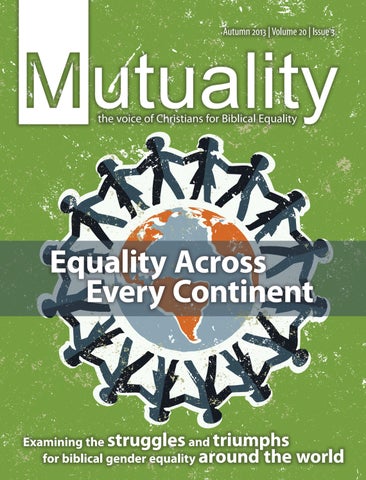
Autumn 2013 | Volume 20 | Issue 3
the voice of Christians for Biblical Equality
Equality Across Every Continent
Examining the struggles and triumphs for biblical gender equality around the world
Contents [ Ecuador ] 4 From Violence to Tenderness | Transforming Ecuador and the Andean region with the message of equality. by José Vinces Rodríguez [ Kenya ] 7 Truth Discovered | God’s truth confronts patriarchy in Kenya. by Domnic Misolo [ Australia ] 9 Instinctively Egalitarian | Signs of encouragement from Australia. by Denise Cooper-Clarke [ Lebanon ] 12 A Strategic Time and Place | A resource for hope and healing in Lebanon and its neighbors. by Karen L. H. Shaw
D E PA R T M E N T S 3
From the Editor | Profound Submission.
18 Praises and Prayers 20 Ministry News | You Are Dangerous: A report from CBE’s Pittsburgh conference.
by Megan K. Westra
21 Giving Opportunities | Equality Across Languages. 21 Reflect with Us | Be Not Afraid—Say Yes to God. 22 President’s Message | Diversity Works.
O N L I N E C O N T E N T | visit cbeinternational.org/m203
[ Cambodia ] 15 Washed Clean | The gospel undermines the devaluation of Cambodian women. by Muylen Orng
[ Canada ] Tertullian’s Ghost | How a Canadian Baptist became an egalitarian advocate. by Hugh McNally
[ Finland ] 17 In the Country of Freedom | Striving for mutuality in a nation famed for freedom and equality. by Maarit Pynnönen
[ United Kingdom ] Something is Shifting in the Heavenlies | Biblical equality takes root in the UK. by Stephen R. Holmes
19 Book Review | Kay Marshall Strom and Michele Rickett’s Forgotten Girls. by Kate Netzler Burch
Mutuality 20.3, Autumn 2013 “Let us then pursue what makes for peace and for mutual upbuilding” (Rom. 14:19, NRSV).
Contact us at: Christians for Biblical Equality; 122 W Franklin Ave, Suite 218; Minneapolis, MN 55404-2451; Mutuality (ISSN: 1533-2470) seeks to phone: (612) 872-6898; provide inspiration, encouragement, fax: (612) 872-6891; and information about equality within email: cbe@cbeinternational.org; the Christian church around the world. web: cbeinternational.org. We welcome your comments, Editorial staff: Tim Krueger, editor; article submissions, and Image Spigot, graphic designer; advertisements. Mimi Haddad, president/publisher.
2 M U T U A L I T Y | Autumn 2013
[ SPANISH VERSION ]
De la violencia a la ternura | Transformando Ecuador y la región andina con el mensaje de igualdad. por José Vinces Rodríguez For writers’ guidelines and upcoming themes and deadlines, visit CBE’s website and follow the link under the Resources tab. Advertising in Mutuality does not imply organizational endorsement. Please note that neither Christians for Biblical Equality, nor the editor, nor the editorial team is responsible or legally liable for any content or any statements made by any author, but the legal responsibility is solely that author’s once an article appears in Mutuality.
CBE grants permission for any original article (not a reprint) to be photocopied for local use provided no more than 1,000 copies are made, they are distributed free, the author is acknowledged, and CBE is recognized as the source. Mutuality is published quarterly by Christians for Biblical Equality and is sent free to members and supporters.
All Scripture quotations, unless otherwise indicated, are taken from the 2011 revision of the Holy Bible, New International Version®, NIV®. Copyright © 1973, 1978, 1984, 2011 by Biblica, Inc.™ Used by permission. All rights reserved worldwide.
On the cover: Adapted from image by MHJ, from istockphoto.com. Maps accompanying each article adapted from the CIA World Factbook, available at cia.gov/index.html.
website : cbeinternational.org
F
rom the Editor by Tim Krueger
Profound Submission Few things bring me more joy than seeing the gospel incarnated She could almost see the thoughts swirling around in in the different cultures of our world. Each one has the potential their heads. Were they really to love their wives that way? to reveal something of the nature of God and his love. I was Unconditionally? No matter what the wives did or didn’t do? reminded of this recently when I read two accounts about Bible Impossible. Unheard of. And yet, if the God of the Bible told translation in Cameroon, both distributed by Bob Creson, the them to... if He had set the example in Christ... (Find this full president of Wycliffe USA. story at cbeinternational.org/mbam.) The first story relays the experience of Lee and his wife I wanted to stand and cheer when I read these stories. Tammi, who are translators among the Hdi people of Cameroon. Westerners like me take it for granted that husbands would In the Hdi language, verbs generally end in i, a, or u. But the love their wives. So when we read Ephesians 5:21–33, we focus word for love only seemed to come in two forms, dvi and dva. on what strikes us as countercultural: the command for wives Why was there no dvu? to submit to their husbands. We often don’t recognize that this Lee asked the Hdi translation committee, which included passage is about mutual submission. But the Cameroonian men the most influential leaders in the community, “Could you recognized it, because it turned their world upside-down. You can bet it did the same for the Ephesians. ‘dvi’ your wife?” Western culture can blind us to what these Cameroonians “Yes,” they said. That would mean that the wife had (and the Ephesians) saw so clearly in Paul’s directive for husbands been loved but the love was gone. to love their wives: Christlike love is profound submission. It is so “Could you ‘dva’ your wife?” Lee asked. “Yes,” they said. That kind of love depended on the complete and so pure that it compels the privileged to relinquish wife’s actions. She would be loved as long as she remained their power in submission to those the world despises. This is what it means to love as Christ loved us. faithful and cared for her husband well. Watching God engage different cultures is not just a “Could you ‘dvu’ your wife?” Lee asked. Everyone laughed. “Of course not!” they said. “If you said that, you would trendy exercise in diversity; it reveals something about our God. have to keep loving your wife no matter what she did, even if The gospel challenges every culture in unique ways, and is she never got you water, never made you meals. Even if she incarnated uniquely in each one. This holds true when it comes committed adultery, you would be compelled to just keep on to God’s message of mutuality between genders, as well. We’re loving her. No, we would never say ‘dvu.’ It just doesn’t exist.” simultaneously moved by the gender injustices that exist in every Lee sat quietly for a while, thinking about John 3:16, culture and encouraged by the ways biblical equality unleashes God’s healing and reconciliation around the globe. and then he asked, “Could God ‘dvu’ people?” In this issue, authors from around the world share their There was complete silence for three or four minutes; then tears started to trickle down the weathered faces of stories and provide insights into biblical equality in their contexts. Their selfless devotion to Christ and their profound these elderly men. Finally they responded. “Do you know what this would mean?” they asked. awareness of the transformative potential of biblical equality “This would mean that God kept loving us over and over, remind me that it’s more than an abstract concept. Biblical millennia after millennia, while all that time we rejected equality is a movement of the Holy Spirit, and it makes a His great love. He is compelled to love us, even though we tangible difference in the lives of women, men, and children have sinned more than any people.” (Find the full story at around the world. Praise God! cbeinternational.org/hdi.) In Christ, The second story is that of another translator, Patricia, who Tim Krueger shared Tammi and Lee’s story with speakers of the neighboring Mbam cluster of languages. They responded to God’s love in much the same way as the Hdi men. She then asked if it was possible to P.S. You may notice this issue lacks the space for an article from unconditionally love your wife. Like the Hdi men, they laughed. every continent. North America’s representative, titled “Tertullian’s Ghost” can be found online. While there, check out an original So she quoted Ephesians 5:25. article from the UK, the Spanish version of “From Violence to “Husbands, ‘dvu’ your wives, just as Christ ‘dvu’-d the church.” Tenderness,” and more. Find out more on page 6! bookstore : cbebookstore.org
M U T U A L I T Y | “Equality Across Every Continent”
3
Violence to Tenderness
From
Transforming Ecuador and the Andean region with the message of equality by José Vinces Rodríguez translation by Anna Ruth Porter
[ Ecuador ] Population: 15. 2 million Official language: Spanish Capital: Quito Major Religions: Christian-Catholic (80%) Christian-Other (11%) None (8%)
Did you know... With habitats ranging from the Andes Mountains to the Galapagos Islands, Ecuador is one of 17 “megadiverse” countries that together contain over half the world’s biodiversity.
I will never forget that day in November said, “You cannot imagine how I feel at the 1999. I was serving as associate pastor in thought of losing my wife. How will I ever live a church in the urban slum area of Lima, without her?” Loida and I expected him to go on to Peru. My wife, Loida, and I decided to visit Juliet (not her real name), one of the describe the many qualities of this ailing most faithful and endearing women from woman with whom he had spent nearly sixty our congregation. She had been active in years of his life. Instead, we were surprised to the church since childhood and had most hear, “You know, there are certain things that a recently served fervently as a deaconess. As man likes. What am I going to do alone? Who she aged, she still delighted us with her voice. will prepare my favorite food for me? Who When she sang, it was as though a choir of will wash my clothes? Who will serve me?” angels had descended from heaven. Those of Juliet, an eighty-year-old daughter of God and model of faithful us who had the privilege service in the church, of hearing her were Juliet, an eighty-year-old would be remembered always spellbound and captivated by the beauty daughter of God and model of only for her work around the house. Her of her singing. faithful service in the church, That evening how- would be remembered only for husband couldn’t even treat her with dignity ever, her incredible her work around the house. on her deathbed. voice was broken and All around the silenced. The cancer was consuming her final days among us. We world, attitudes like that of Juliet’s husband shared a passage from Scripture and prayed devalue females and serve to justify violence with her, entrusting her into the Lord’s against women. Ban Ki-Moon, Secretary hands while she moaned in pain, hardly able General of the United Nations, has declared to hear what we said. Looking for comfort that “violence against women and girls is from us, her teary-eyed, distraught husband a heinous human rights violation, a global
4 M U T U A L I T Y | Autumn 2013
website : cbeinternational.org
menace, a public health threat and a moral outrage.” According to the UN, one in three women in the world is beaten, coerced into sexual relationships, or suffers some other type of mistreatment in her lifetime. Some are even killed simply for being female. As residents of this global village we are all responsible, whether by action or inaction, for perpetuating this disgraceful reality. Desmond Tutu’s statement, “if you are neutral in situations of injustice, you have chosen the side of the oppressor” rings true. Our ears have heard, our eyes have seen and read, and our minds can recall chilling stories of women being treated as sub-human. The world was horrified in 2009 by the story of Aesha Mohammadzai, a nineteen-year-old Afghan woman: “Every day I was abused by my husband and his family. Mentally and physically... then one day it became unbearable. So I ran away.” This courageous act cost her dearly; she was first sentenced to jail and then to return to her husband. In the middle of the night, he took her into the mountains, tied her hands and feet, and cut off her nose and ears as a lesson for any other women who might think about leaving their husbands. In December 2012, the world once again looked on in disgust as the case of Jyoti Singh Pandey unfolded in India. The twenty-three-year-old Hindu student, who was later renamed A manat (meaning “treasure”), was gangThe machista saying in Peru raped by six men, brutally is “the more you beat me, massacred, and thrown the more I love you.” out of the bus onto the asphalt. Her assailants had destroyed her intestines with the metal rod they used to rape her. She died several days later. Violence against women happens in all cultures, “civilized” or not. It happens on every continent and affects all social levels and religious groups. In the Andean region of Latin America, there is a strong culture of male chauvinism, or machista. Not surprisingly, these countries also have very high levels of gender violence. There is a saying in Ecuador that goes, “even if he hits, even if he kills, he’s still the husband.” The 2012 National Survey of Family Relations and Gender Violence reports that six out of every ten women in Ecuador are targets of gender violence, regardless of their ethnicity, level of education, or socioeconomic status. The machista saying in Peru is “the more you beat me, the more I love you.” According to the Peruvian Minister of Women and Vulnerable Groups, the Emergency Centers for Women saw 42,000 cases of family and sexual violence last year. And in Colombia, where the popular saying is “I beat you because I love you,” 2012 statistics from the National Institute of Forensic Medicine indicate that 47,000 thousand were affected by domestic violence. Finally, in Bolivia, the government has been strongly criticized for throwing around machista phrases in official circles. One such phrase is “Este presidente de buen corazón, a todas las ministras les quita el calzón,” or in English, “this kind-hearted president takes the panties off all the female government ministers” (a play on the Spanish words corazón, meaning “heart” and calzón, meaning “panties”). And the problem goes
bookstore : cbebookstore.org
beyond machista expressions; a recent report showed that ninety percent of Bolivian women are victims of some form of violence. What is our stance as Christians within this context? Should not the values of the kingdom of God—truth, compassion, mercy, peace, and justice—be part of our very DNA? How is it that even some churches are havens of authoritarian rule, impunity for abusers, misinterpreted masculinity, and the misuse of power? Has our capacity for indignation I believe the church fails to been softened by exposure to evil and injustice? Have oppose injustice when it the stories and statistics that bases its beliefs on incorrect, we’ve just heard become distorted, and convenient exactly that—merely stories interpretations of Scripture and statistics? that allow the devaluation and I believe the church fails to oppose injustice objectification of women. when it bases its beliefs on incorrect, distorted, and convenient interpretations of Scripture that allow the devaluation and objectification of women. As a result, practices of oppression and slavery are prominent in many of our Christian circles. Some men effectively hold property rights over family members. We have boycotted the responsibilities given by the Creator to the first human couple to manage everything together (Gen. 1:27–28). We have overmasculinized our language regarding God, celebrating him as the God of Abraham, Isaac and Jacob, but forgetting that he is also God of Sarah, Hagar, Rebecca, Rachel, and Leah. We have resisted the biblical mandate for mutual submission (Eph. 5:21–25), which urges husbands to follow the example of Jesus, who gave his life to serve others—a true model of masculinity. The culture of patriarchy is part of a historical legacy that has been with us since biblical times, when families were grouped under a patriarchal figure with absolute authority. This legacy makes it hard for us to accept and encourage relationships that are horizontal and equal, as commanded by the apostle Paul in Galatians 3:28. But despite the situation sometimes appearing somber and hopeless, there are glimmers of hope. I have seen lives, marriages, and ministries transformed by the rereading of God’s Word. Many friends have become living testimonies that bring to mind the words of Romans 10:15, “How beautiful are the feet of those who bring good news!” Cesar, a pastor friend of mine, opened his heart and evaluated his life after reencountering the Word. He tells me, Even though we were deeply in love when we got married, life caught up to us after a while because we each had different values. So I started to repeat examples that I had seen. That’s when the problems started, with infidelity on my part, as well as psychological and physical violence. Cesar and his wife, Alma, recognized their need for help and went to a friend who presented Jesus to them as an answer to the problems that they faced as a couple. Their choice to serve the Lord with mutuality in their marriage was a time of transformation for
M U T U A L I T Y | “Equality Across Every Continent”
5
them. Today, they serve as pastors in Guayaquil, Ecuador. Cesar affirms Alma’s call to leadership with conviction and sincerity. If she goes out to preach, I stay back to take care of the house and ministry; if I go out to preach, she stays back. We are a team. The Lord has entrusted us with the care of our grandchildren—Samuel is three and Valentina is one—and we share this wonderful task as well. Cesar is also the director of the National Prayer Network, and Alma directs the Women’s Solidarity Network, a group of female Christian leaders who work to empower other women by promoting their rights to physical, psychological, and sexual integrity. Another testimony of hope is that of David and Jessy. David shares, We were married twenty-five years ago on February 27. [Male-centeredness] in our country, Peru, is no different than in other countries. I remember when we first began our pastoral ministry in the city of Huánuco, one of the leaders came to our house and was shocked to find me washing our baby’s diapers! He commented to his wife that I should not be doing those household chores. Jessy explains that her upbringing was very machista, a culture modeled by her parents and by other Christian leaders. The culture was a major roadblock to personal development of a woman. My husband and I talked a lot about cultural differences and patriarchal influences, not only for our
relationship, but also about how we would deal with the issue in the church, where everyone should feel at home as part of an egalitarian community. We had to reread and relearn the Bible together. We thank God for having put people and organizations in our lives to help us to learn more about gender relationships. They are both convinced that, as believers in the new covenant, men and women have equal callings to a priesthood of all believers (1 Peter 2:9–10). Both serve in pastoral roles in the Mahanaim Church in Peru. David has been the president of the Huánuco chapter of the Interdenominational Pastors’ Fellowship, while Jessy serves as a pastoral mentor to the Tamar Group, a support group for parents of children who have been sexually abused. God’s purpose and desire, as described in Genesis 1 and 2, is that both men and women are created in his image and have equal potential to co-administrate his creation. They are co-heirs of his grace, and co-participants in building the kingdom. His justice is still active. Glory to God! There is neither Jew nor Gentile, neither slave nor free, nor is there male and female, for you are all one in Christ Jesus (Galatians 3:28). José Vinces Rodríguez is a lawyer and pastor. He was born in Lima, Peru and has master’s degrees in human rights and missiology. He leads the Ecuador office of Paz y Esparanza (Peace and Hope), a Christian human rights organization focused on defending vulnerable communities. One of its major goals is to mobilize evangelical churches to take an active role in the prevention of and response to gender-based violence.
¿Español es tu idioma natural? ¿O te gusta compartir lo que leíste con amigos quienes hablan español? ¡Visita a cbeinternational.org/m203 para leer y compartir “De la violencia a la ternura” en español!
Want more stories from around the world? Head to cbeinternational.org/m203 to find full articles exploring biblical equality in Canada and the United Kingdom, the Spanish version of “From Violence to Tenderness,” and related articles from our archives!
Tertullian’s Ghost How a Canadian Baptist became an egalitarian advocate.
Something is Shifting in the Heavenlies Biblical equality takes root in the UK.
“...I confess that for much of my ministry, I did not pay much attention to biblical equality issues. This changed one day, around 1980, when I picked up a magazine in a doctor’s office and read an article claiming that Christianity was the main cause of the oppression of women worldwide...”
“It was the final night of the biggest Christian festival in Europe; our main Bible teacher had been a woman, and every preacher on stage that night was a woman. And none of this was tokenism.... They were there because, through the gracious gifting of the Holy Spirit, they deserved to be there...”
Read the rest online at cbeinternational.org/m203
Read the rest online at cbeinternational.org/m203
6 M U T U A L I T Y | Autumn 2013
website : cbeinternational.org
Truth Discovered God’s truth confronts patriarchy in Kenya
by Domnic Misolo [ Kenya ] Population: 44 million Official languages: Kiswahili, English Capital: Nairobi Major Religions: C hristian (83%) Muslim (11%)
This year, my wife, Christine, and I celebrate four years since we discovered biblical equality. God used this simple discovery to teach us a radically different understanding about his will concerning the relationship between women and men. It has changed our lives and it is already confronting the patriarchy of the culture and church in Kenya. I was born in a traditional, male-dominated, polygamous family that held to common cultural convictions that depict men as superior to women. We have common sayings that compare men to pillars, great bulls and buffaloes, heroes, and lions. Meanwhile, women are referred to as mongooses, because the mongoose belongs not in the home, but in the wild. Likewise, a woman’s place of belonging is not in the home or family of her birth, but is determined by marriage. If she grows to marriageable age, dies unmarried, and is buried in the community of her birth, she brings bad luck to younger siblings and a curse on the community. Thus, every girl must be married. Once she is married, her husband is considered the protector and provider of the family and the giver of children. She is simply the bearer of children, and is a housewife who helps raise the children. Even women who are educated and act as bread winners are still expected to perform the traditional duties at home. Because of this cultural lens, I grew up viewing men as superior to women.
The Truth Concealed
This lens also causes misinterpretations of the Bible in our culture. Eve, it is said, was created from Adam as an afterthought. bookstore : cbebookstore.org
Did you know... Then, she was deceived Kenya is named for Mt. Kenya, a because she was the weaker corruption of its original name, sex and was not an original Kirinyaga, meaning “mountain of creation (because she was whiteness,” because of its snowcapped created from Adam). Even peak. Kenya is famous for its natural beauty and iconic wildlife. worse than her original sin is the fact that through Eve, sex is made available to Adam. This is blamed for bringing down humanity and causing the suffering of the world. In the New Testament, Paul’s commands for women to submit to their husbands and to be silent in church are taken out of context to justify the belief that inequality is God’s ideal. In addition to these interpretations, churches often misapply the Bible’s teachings about marriage in a way that enables domestic violence. Since the Bible teaches that marriage is God-ordained and valuable, many churches teach that no marriage should ever be nullified. Thus, even badly abused and battered women cannot walk away from a marriage. And because sex is a taboo subject in our culture, churches do not address sexual abuse. By teaching that the Bible upholds patriarchy and by failing to
M U T U A L I T Y | “Equality Across Every Continent”
7
address domestic abuse, the church has contributed to a culture that allows women to be violated and beaten, even to death. For many years, I did not recognize the problems and injustice of these teachings. By the time I began to attend university, I was already an ordained priest with four years of experience, and I had completed a diploma course in pastoral theology. Yet, I must confess that despite my training and experience, I held to these mistaken interpretations and theologies and believed very strongly in the supremacy of man over woman as natural and God-ordained. The idea of biblical equality was foreign and unknown to me.
The Truth Discovered In 2009, I was in my first year of studies at Saint Paul’s University in Kenya. I was searching the library for books and journals for a class assignment when I came across Priscilla Papers, the academic journal of Christians for Biblical Equality. As I read these journals, I became curious and interested to learn more. They critically challenged my traditional views with facts about Bible, faith, and society. I continued reading Priscilla Papers not only for academic adventure but as a theological document with great potential to change my life and ministry. Before long, I was convinced that the Bible demands equality of males and females. The news of biblical equality transformed my relationship with my wife and challenged us to engage in new kinds of ministry. I no longer see Christine as just a housewife; now she is a close partner with skills and the ability to chart her own destiny and to support our family. We now discuss important issues together maturely as equals. When I told Christine about my dream to spread biblical equality, she told me, “I feel the need to stand by you on this journey, and my call is to look into the practical, daily challenges faced by poor women in the community.” We concluded that to follow this vision, Christine should attend university and get a degree in education. God is already putting her gifts to work in the community. She has formed a group called the Gender Alliance for Community Health and Development. The group, made up of women from local churches, explores ways to empower women through farming, poultry-keeping, savings and loans, and basic education about human rights.
The news of biblical equality transformed my relationship with my wife and challenged us to engage in new kinds of ministry.
The Truth Brings Healing We are already seeing biblical equality confront patriarchy and its devastating consequences in our country. As we began preaching biblical equality in churches and community groups, we saw God releasing his people from oppression, abuses, and injustices. We decided to make this ministry official by
8 M U T U A L I T Y | Autumn 2013
registering a new non-profit organization called Ekklesia Foundation for Gender Education (EFOGE). EFOGE has become an African leader in championing gender justice and equality from a biblical perspective. When we first started speaking publicly, some priests and church leaders argued that our teachings were heretical. But others, such as Bishop Johannes Angela of the Anglican Diocese of Bondo, offered their full support. Thanks to support from partners and friends around the world, we are at work on many projects geared toward justice and equality. Through partnerships with seven schools in the Bondo and Rarieda districts of Kenya, we are training youth in biblical leadership, gender justice, and equality. We’ve helped pay the school fees of eighteen needy students, and we are providing feminine hygiene products to girls so that they can attend class during menstruation and thus receive the same education as their male counterparts. We are planning an annual panAfrican leadership conference to emphasize biblical equality among leaders, and we are helping to coordinate emerging egalitarian groups in Uganda, Tanzania, Rwanda, Burundi, Ghana, South Sudan, and Nigeria. We have seen churches ordaining women and raising them to influential positions. Recently, the Anglican Diocese of Bondo installed the Venerable Monica Owiti as archdeacon. She is the first woman in all of western Kenya to hold this office. Two female priests have been promoted to the office of rural deans, who have authority to oversee many churches and parishes. More and more female As we began preaching biblical priests are being considered for ordination, and equality in churches and our neighboring churches community groups, are opening up to women we saw God releasing his in leadership. Currently people from oppression, we have more than fifteen churches applying to partabuses, and injustices. ner with us. The church is one of the strongest social institutions in Kenya and in many parts of Africa. In the past, this has meant that it has been able to harm women by teaching patriarchy. But today, this means the church has great potential to change people’s attitudes on gender and shape cultural values to heal communities, families, and individuals. We are already seeing this take place when churches embrace God’s truth about gender. Women and men are being healed and released from oppression. Biblical equality is real and we are witnesses. It is through this ministry that we can show our love to one another and bring healing to humankind. The Reverend Domnic Misolo is an ordained Anglican priest in the Diocese of Bondo, Kenya. He is the founder and president of Ekklesia Foundation for Gender Education (efogeinternational.org). He studied theology at St. Paul’s University in Kenya and is currently pursuing a master’s in project planning and management at the University of Nairobi, Kenya.
website : cbeinternational.org
Indigenous students and principal Jude Long (center) at Nungalinya College in Darwin, Australia
Instinctively Egalitarian
by Denise Cooper-Clarke
Signs of encouragement from Australia
The people are immensely likable—cheerful, extrovert[ed], quick-witted, and unfailingly obliging. Their cities are safe and clean and nearly always built on water. They have a society that is prosperous, well ordered, and instinctively egalitarian. The food is excellent. The beer is cold. The sun nearly always shines. [ Australia ] There is coffee on every corner. Population: 23 million Life doesn’t get much better than this. Official language: English
This is Bill Bryson’s description of Australia in his book, In a Sunburned Country. Like all generalizations, there is some truth in it, but only some. Melbourne, where I live, does have the best coffee in the world, but I have to admit the sun shines more in Sydney, Perth, and Brisbane. And when it comes to being egalitarian, something many Australians take pride in, one can question whether this is more myth than reality. There is an increasing gap between the rich and the poor, and despite the words of our national anthem, “For those who’ve come across the seas, we’ve boundless plains to share,” our policies are far from welcoming to refugees and asylum-seekers who arrive here by boat. As to equality between men and women, it might look like we’re doing very well. Until recently, our prime minister and governor general were both women (our former prime minister, Julia Gillard, was deposed by her
bookstore : cbebookstore.org
party—most people believe her gender had a lot to do with it). But women are not equally represented in Parliament or on company boards. Nor is their path always smooth in public life. And when it comes to the church, it is even more difficult to claim we are egalitarian. Still, all across our sunburned country, I see signs of hope. Let me bring you three stories from three different cities in Australia—Melbourne, Sydney, and Darwin.
Melbourne
Capital: Canberra Major Religions: Christian-Protestant (27%) Christian-Catholic (26%) None (22%)
Did you know... Australia is well-known for its natural beauty and wildlife, from the Great Barrier Reef to the kangaroo, koala, and platypus. Fewer people realize that Australia was the second country in the world to grant women the right to vote.
I met Anthea for coffee at a cafe near Ridley Melbourne, an independent, evangelical Anglican theological training college. Ridley prepares both men and women for ordination in the Anglican Diocese of Melbourne, but also trains people from a wide variety of church affiliations for mission and ministry of many different kinds. Among students and staff, there are differing views about
M U T U A L I T Y | “Equality Across Every Continent”
9
women and ministry, but in recent years, Ridley has become increasingly welcoming to women. In 2007, Anthea, an ordained Anglican priest, joined the faculty as a lecturer in New Testament studies, and she has been warmly supported and encouraged by her fellow faculty members, including those who are complementarian. Her appointment has turned out to be very strategic and beneficial, especially for women. Anthea provides a model of confident, non-self-conscious ministry by a woman. “Female students frequently tell me how encouraging it is to have a woman on faculty teaching, leading services, and preaching in chapel,” she says. “Some students have never heard a woman preach or preside over a communion service.” In 2010, the college produced a policy statement on gender and ministry, which affirmed that Ridley trains both women and men for ordination in the Anglican church to whatever orders were open to them (in Melbourne Female students frequently tell me this means deacon, priest, or how encouraging it is to have a bishop). The statement also woman on faculty teaching, leading acknowledged the different services, and preaching in chapel... views among faculty and Some students have never heard students, saying, “We accept that a range of views can be a woman preach or preside over a held on such questions [as communion service. gender and ministry] without the integrity of a person as a biblically faithful evangelical Christian being called into question” and that “people are encouraged to read widely, question arguments, challenge exegesis and consider alternatives.” Three well-attended student meetings followed, creating, for the first time, space for open, respectful discussion about the issue. Lately, women have increasingly found the college to be a helpful and affirming place to study on a practical level, as well. The school has developed more flexibility in the modes of study, adding online, intensive, and extensive courses, in addition to the regular weekly class model. These have helped women fit their studies into their lives, even as they juggle family and other responsibilities. Anthea tells me that the Anglican Diocese of Melbourne, too, is becoming more aware of and flexible about the needs of women. “Recently,” she explains, “a young mother who attended a three day pre-ordination retreat brought along not only her breast-fed nine-month-old, but also her mother and grandmother to help look after the baby. That’s a first, I think!”
Sydney
A thousand kilometers [about 700 miles] further north, in Anthea’s home town of Sydney, things in the Anglican Church are a bit different. Michael Jensen, a self-described apologist for the Diocese, says, “If there is any single issue with which Sydney Anglicans have found themselves identified, it is surely the matter of the ordination of women to the priesthood.” To them, this issue is the dividing line between Christians who stand under the authority of Scripture and those who do not. Women are excluded from ordination because it is believed that Scripture teaches that God has given men the leadership “role” and women the subordinate “role.” For the most part, women are excluded from
10 M U T U A L I T Y | Autumn 2013
preaching to mixed congregations based on a hierarchical reading of 1 Timothy 2:11–15. Until recently, dissenting voices—like that of Sydney rector Paul Perini, who established a CBE chapter in Sydney in 2012—were effectively marginalized. It seems, however, that the prevailing view is now being questioned, just a little, by Sydney Diocese insiders. Early this year Zondervan released Hearing Her Voice: A Case for Women Giving Sermons, by well-known and respected scholar, author, and apologist John Dickson. Although he maintains the official Sydney line in relation to the subordination of women and opposition to women’s ordination, he offers an alternative interpretation of 1 Timothy 2:12. He argues that Paul is forbidding only a specific type of teaching, which is fundamentally different from modern sermons. Thus, women ought to be allowed to preach. There was, of course, a flurry of critique surrounding Dickson’s argument. But what I found most encouraging were the comments from Michael Jensen, blogging on the Sydney Anglicans website. He writes, I am certainly still thinking through the implications of his argument, but there is a great deal in his book that is convincing. What he helpfully notes is that there is an inexact match between the various New Testament practices of speaking in the church—exhorting, teaching, prophesying and preaching—and our contemporary notion of the sermon. Minding that gap is crucial, lest we misapply the text, and theologise our habits and traditions.... [T]he New Testament features women in speaking roles in front of mixed congregations to a far greater extent than is often now practiced in Sydney Anglican churches. Some of the implementation of complementarian thinking about ministry has been over-zealous, to the point that it ignores what is plainly the case in the Bible. (emphasis mine) Dickson and Jensen are far from egalitarian, but their honesty and openness to new ways of thinking about certain texts is a sign of hope for the future. Maybe others will also have the courage to rethink their views and question the official line. Perhaps women’s voices will indeed increasingly be heard in Some of the implementation of Sydney churches, even from complementarian thinking about ministry the pulpit.
Darwin
has been over-zealous, to the point that it ignores what is plainly the case in the Bible.
Our final stop is Darwin, on Australia’s northern coast. Home to a higher proportion of Aborigines than any other state or territorial capital in the country, Darwin is a good place to get a glimpse into the realities of gender and Christianity among Australia’s often-forgotten indigenous population. To learn more, I contacted Jude Long, the principal of Nungalinya College, a multi-denominational theological college in Darwin. Nungalinya College provides education for indigenous Christian adults from remote communities. The college works in partnership with the local indigenous churches to provide the training needed to empower and encourage those churches.
website : cbeinternational.org
Unlike most theological colleges, the student body has a female majority. These women are often key leaders in their communities, trying to encourage and support their young people. And the leadership of these women is crucial, as Aboriginal communities face well-documented challenges, such as violence, drug and alcohol abuse, welfare dependency, and sexual and domestic abuse. But according to Principal Long, this is not the full picture. “There is no doubt True transformation of troubled indigenous that God is at work in communities, she explains, will only these remote communioccur through the gospel. And as in many ties. Many people do not realize that the majority communities around the world, women deliver the gospel and serve as the agents of Aboriginal people in these communities have of change and healing. a strong faith in Jesus.” Long reports that many of Nungalinya’s students come because they want to read the Bible but have very low literacy. “Fundamental literacy can be life-changing for students,” Long says as she recalls a particularly moving chapel service. “A young woman stood up to read the Bible. She said shyly, ‘I have never read the Bible before.’ Then an older woman stood up to share her thoughts on the text and started with ‘I have never done this before.’” According to Long, this sort of thing happens all the time. Simple things like reading the Bible in public, praying out loud, or sharing a song or a story are new and empowering experiences. “It is wonderful to see the joy on their faces. It is also
wonderful to hear back from communities when these women (and men) return and become involved in more active ministry in their churches.” True transformation of troubled indigenous communities, she explains, will only occur through the gospel. And as in many communities around the world, women deliver the gospel and serve as the agents of change and healing. “Many women are seeking to share the gospel with their communities, and particularly with the young people. As one woman said recently, ‘Why is it always the women who have to be strong?’ What we need now” Long exclaims, “is more men!” Perhaps Bill Bryson’s description of our country as instinctively egalitarian is slightly optimistic. Whether in Darwin, Sydney, or Melbourne, there is work to be done when it comes to fully incorporating the gifts of women into the body of Christ. Life is not “as good as it gets” for women, but there are clear signs of hope. There is increasing openness, people are re-examining traditional ways of thinking, and female leaders are bringing the gospel to their communities. Let us thank God for the work being done here and around the world, and let us continue to share the message of the mutual service of Christian women and men. Denise Cooper-Clarke is a graduate of medicine and theology with a PhD in medical ethics. She teaches medical ethics to medical students, is an (occasional) adjunct lecturer in ethics at Ridley Melbourne, and is a past chair of the Melbourne chapter of Christians for Biblical Equality. Denise and her husband David have three adult children and four grandchildren (soon to be six!).
On July 7–9, join CBE in Medellin, Colombia for our 2014 conference! Together, we will explore the theme “Male and Female in Christ: Toward a Biblical View of Christian Identity, Ministry, and Marriage.”
Hosted in partnership with the Biblical Seminary of Colombia (FUSBC)
A Strategic Time and Place
by Karen L. H. Shaw
A resource for hope and healing in Lebanon and its neighbors
[ Lebanon ] Population: 4.8 million Official language: Arabic Capital: Beirut Major Religions: M uslim (65%) Christian (34%)
Did you know... Ancient Lebanon (Phoenicia) was famous for seafaring and trade. The Phoenicians built a vast trading network and colonized coastal regions around the Mediterranean and possibly as far away as the North Sea. Its most famous colony was Carthage, whose wealth and power rivalled that of Rome.
Hardly a day goes by in which the news neglects to mention the turmoil of the Middle East and North Africa (MENA) region. Advocating biblical equality at a time like this might sound to outsiders like an exercise in futility. However, contrary to many stereotypes held by Westerners, this part of the world is most assuredly not hopeless. Here in Lebanon and throughout the region, women face challenges, just like women around the world, but this is no reason for Westerners to adopt an attitude of superiority. I once heard a Lebanese women’s rights activist say, Don’t believe Westerners when they express concern for the women of the Middle East. They are only trying to make our culture and religion look bad so that theirs seem better by comparison. If they genuinely cared, they would be helping Arab women and their families who are poor or refugees. They would be listening to us and acting on our behalf rather than just talking about us. Biblical equality reflects God’s concern for all people, and the church’s stance toward biblical equality will impact the MENA region for generations to come. Here’s how.
One: Maximizing the Church’s Human Resources
A few years ago, I asked a room full of youth group leaders from Lebanese and Syrian churches how many of them would emigrate if they were able. Before I had finished asking the question, every hand in the room shot up. Christians in the MENA region comprise less than four percent of the population, and their numbers and percentage are shrinking rapidly because of emigration and a relatively low birthrate. The educated and the initiative-takers are usually the first to leave, creating a leadership crisis. Yet there are millions in the region who have not heard the gospel. And the conflict, instability, and violence in the region can only be resolved by the peace of Christ. How can a tiny church with a leadership crisis meet such an enormous challenge? In some churches and mission organizations, women are welcome to take on a wide variety of roles, short of full ordination. In others, women are being told directly and indirectly that their gifts are not needed, and that they had best leave ministry leadership to the men. For example, a denominational leader hosted an event for seminary students and asked each male student what ministry God had called him to. He skipped over all the female students as if they were of no significance. Biblical equality is strategic in making use of all of the spiritual gifts of the MENA church to meet the overwhelming challenge.
12 M U T U A L I T Y | Autumn 2013
website : cbeinternational.org
Two: Laying the Foundations of the Muslim-Background Church
Until recently, nearly all the Christians in the Middle East came from families that were Christian before the rise of Islam. Today, God is doing a new thing. An unprecedented number of Muslims are choosing to follow Jesus. If the current trends continue, it will not be long before the Muslim-background churches outnumber those from Christian backgrounds (this is already true of Algeria). As these new congregations are forming, their choices about faith and practice will determine the direction of the church in the region for years to come. Some are being influenced by patriarchal views imported from the West, and some are unthinkingly adopting the patterns of their cultures. I know of one group in which the men gather to worship, but their wives and daughters stay at home; the only connection the women have with the church is via their husbands. There is a great need for solid biblical teaching about equality, as the marginalization of women now could establish a pattern that lasts for centuries. Biblical equality is strategic for long-term practices and patterns in the MENA church of the future.
Three: Providing freedom in Christ as an alternative for women
Both headscarves (among Muslims) and breast implants are becoming more common in Lebanon. While some women and men are content with traditional roles and restrictions for women, others (both Muslim and Christian) reject what they perceive as the religious degradation and There is a great need for restriction of women. Yet the only alternative seems to be secularism with its shameless lack of moral solid biblical teaching basis. Muslim women wrestle with seemingly unfair about equality, as the principles of their religion, and some are seeking marginalization of women to reinterpret the Qur’an and Islamic traditions to now could establish a pattern make Islam compatible with gender equality. Biblical that lasts for centuries. equality is strategic in presenting Christ as a viable, godly model of freedom for women.
Four: Credibility of the religious courts
The Lebanese people do not have much confidence in the judicial process in their country. The state-run criminal courts have a reputation for corruption. The “status law” courts (for marriage, divorce, custody, and inheritance) are run by religious denominations, and are notoriously biased against women. Normally, “men of religion” determine the laws and judge the cases, and there are virtually no female judges in these courts. An increasing number of couples are traveling to Cyprus to get married or are advocating Lebanese civil marriage as an alternative. Among the reasons for this is an unwillingness to be judged in what couples see as an archaic and biased system. As the courts lose credibility in the eyes of the youth, so does religion. Biblical equality could be strategic in improving the reputation of the church courts and removing a blot from the reputation of the church’s faith.
Not All Bad News Lebanon doesn’t match the negative stereotypes one often hears about of Arab countries—in fact few MENA countries do. It might surprise some readers to know that in Lebanon... • More women attend university than do men. • The literacy rate for both men and women is over 90%. • Women are legally entitled to wear whatever they want, from burkas to bikinis. • Couples normally walk side by side. • Although Muslim men are legally entitled to take up to four wives at once, few marry more than one, and a bride can stipulate in her marriage contract that she has the right to divorce if her husband takes a second wife. • Druze and Christian men may only marry one woman. • At the time this article was written, over fifty women were running for parliament.
Five: Credibility in advocating justice in society
The Lebanese are waking up to a plethora of gender justice issues. Lebanese men can pass their citizenship on to their children, but women cannot. It is not a crime for a man to rape his wife, and most human rights organizations consider both the law and its enforcement utterly inadequate to provide real protection against domestic violence. Thousands of migrant domestic workers are being exploited, abused, and subjected to contract slavery. So-called “murders of honor,” in which a man kills a family member for a perceived act of dishonor, are rare in Lebanon, but the law still allows reduced sentences for those who commit them. bookstore : cbebookstore.org
Despite their frustrations, Lebanese women are proud of their country and of what they have accomplished.
M U T U A L I T Y | “Equality Across Every Continent”
13
Some Muslim, Christian, and secular organizations are battling these injustices. In 2012, as a result of pressure from human rights groups and women’s shelters, a series of billboards appeared featuring pictures of prominent male religious leaders, each with a quotation condemning domestic violence. This is an encouraging first, but it is uncommon. It’s difficult for denominations to speak for gender justice, because some of their own esteemed members are the culprits and discrimination is prescribed and practiced within many churches. Justice for women isn’t a priority for most churches. Biblical Equality is strategic for making the church aware of the issues, motivating it to take a stand, and giving it a credible voice for justice in society.
Six: Hearing the Word of God
A speaker at a Christian conference asked a mixed audience, “If you could be any woman in history, who would you choose to be?” An aspiring male leader in that audience later admitted to Men understand loud me that he was repulsed by the and clear that women question. He would not want to be have nothing to teach any woman—ever! Most pastors them and that women’s in the MENA region save Bible role in salvation history passages featuring women for women’s meetings and Mother’s is peripheral. Day sermons. As a result, men are not used to learning from the women of the Bible or seeing the story of God’s redemption from their perspective. Men understand loud and clear that women have nothing to teach them and that women’s role in salvation history is peripheral. Women and men in most churches learn to sex-stereotype their interpretation of the Bible. When, at the beginning of a course, I named female Bible characters and asked students to
describe the characteristics of each woman, the first answer for the godly women was always “submissive,” and for the ungodly women, “not submissive.” I enjoyed watching the students discover the three-dimensional character of the Bible’s women and the variety of ways God encounters, teaches, blesses, and uses women. It was exciting to see the male students realize that the women of the Bible had important lessons to teach them, and the female students realize that God could use them as they truly are. Biblical equality is strategic in enabling the church to encounter and be transformed by the Living God through his Word.
Gender Equality in a Spirit of Equality
This article has been doubly hard for me to write. In Arab society, one expresses love by ignoring or covering faults, and here I have exposed some faults of my beloved Lebanon to people of other nations. To make matters worse, I fear my words could be used to reinforce the widespread prejudices and negative stereotypes about Arabs promoted by the media, particularly regarding the status of women. I hope this article will inspire genuine empathy rather than an attitude of cultural superiority. When it comes to gender equality, no nation has a flawless record. We all need to be reminded of Jesus’ parable about the Pharisee praying in the temple (Luke 18:9–14). All nations need the healing power of Jesus and the purifying work of the Holy Spirit. Together we confess the failings of our countries to bring about the justice God requires. Together we hope for the day of Christ’s return, when, in the words of Amos 5:24, justice will “roll down like the waters, and righteousness like an ever-flowing stream.” Dr. Karen Shaw is assistant professor of cross-cultural ministry at the Arab Baptist Theological Seminary in Beirut, Lebanon. She has lived in the Middle East for twenty-three years.
Become a CBE member and take a stand for biblical equality with Christians around the world! Membership is available to any individual or organization who affirms CBE’s Statement of Faith. Already a member? You can purchase gift memberships for your friend, church, or organization.
Learn more at cbeinternational.org/members 14 M U T U A L I T Y | Autumn 2013
website : cbeinternational.org
Washed Clean
by Muylen Orng
The Gospel undermines the devaluation of Cambodian women
M
y name is Muylen Orng, and God has called me to serve the women of Cambodia by bringing them a message of biblical equality. My journey began when I was very young, when God placed in me the dream of going to college. I was born and raised in Kompong Thom Province, in central Cambodia, north of the capital, Phnom Penh. I am one of three siblings, and the second daughter in my family. Most Cambodian women do not attend college, but when I finished high school in 2002, I asked my parents for permission to continue studying at a university in Phnom Penh. (In my culture, it is important to have the approval of your family and relatives before making major decisions.) When my relatives found out what I wanted, the great majority did not approve. They felt that I would be putting myself at risk if I went Phnom Penh to study. Sex trafficking is a big problem there, and it can be a dangerous place for a young woman without a support network. Since we had no close relatives there, I would be on my own, and my relatives feared I might meet bad people who would take advantage of me. They told my parents not to allow me to continue my studies at college. This was very hard for me, because the opinion of your relatives cannot just be ignored. I felt hopeless. So I prayed. Every night, I asked God to help me through this difficult situation. One week later, God did a miracle: my parents changed their minds and promised me their support, no matter what my relatives might say. Because of God’s faithfulness, I am the first female among all my relatives—on both my father’s and mother’s sides of the family—to study at the university level. God helped me overcome one obstacle by clearing the path for my schooling. Today, he has put me in a position to challenge even greater obstacles that Cambodian women face. Since 2007, I have been working with the Chab Dai Coalition. Chab Dai is a Christian organization with members in Cambodia and partners in many other countries. Chab Dai’s vision is to see
bookstore : cbebookstore.org
Christians working together to end sexual abuse and traf- [ Cambodia ] ficking. I have never before experienced the joy and sat- Population: 15 million isfaction that I now have in Official language: Khmer my work. I am grateful that God has called me here, and Capital: Phnom Penh I have great confidence in Major Religions: B uddhist (96%) his plan for my life. I think Muslim (2%) that I have a golden chance to serve God by helping vul- Did you know... nerable women see that they Cambodia was once at the center of the have the same worth as men, Khmer Empire, which encompassed much and that God’s desire is for of Southeast Asia. The remains of the women and men to serve temple complex known as Angkor Wat testify to the magnificence of the empire. him together as equals. But, just as I needed God’s help to attend college, we need God’s help to overcome gender injustice. In Cambodian culture, women’s rights and freedoms are limited in almost all spheres. Social norms, traditional beliefs, and cultural values reinforce gender stereotypes and discrimination against women. Males are dominant leaders and decision-makers in society, while females are expected to conform to traditions. Traditional roles are especially prominent in the countryside, where men work in the fields and women care for the house and young children, and where women are also discouraged from getting an education. However, things are a bit different in the
M U T U A L I T Y | “Equality Across Every Continent”
15
cities. Cambodian city life has become much more like modern, Western culture. Women are much closer to holding equal status with men, education for women is valued, and old traditions are often not enforced. Still, many traditional attitudes about men and women remain strong and widespread. We have saying that girls These beliefs are often negative toward are like a white piece of women. We have a cotton or wool, and boys saying that girls are like a are like a diamond. Cotton white piece of cotton or wool, and boys are like or wool, when dropped in a diamond. Cotton or the mud, never regains its wool, when dropped in purity regardless of how the mud, never regains its purity regardless of much it is washed. how much it is washed. A diamond, on the other hand, can be picked up and washed, and will be as clean and sparkling as before. The diamond remains valuable after it is cleaned, but what good is a stained piece of cotton or wool? Since it cannot be made pure again, it is worthless. For this reason, even women who are freed from sex trafficking are still considered stained and are shunned by society and even the church. Cambodian women are also judged based on the traditional code of conduct for women, called the Chbab Srey, or “Women’s Code.” The Chbab Srey is a traditional, formal code of behavior, passed on to girls by their grandmothers or mothers. Until a few years ago, it was taught in public primary schools as a foundation for social and moral education. The code teaches women how to please their husbands and how to behave like proper women— quiet, shy, and submissive. Many Cambodian women firmly believe that the code is a good moral teaching and should be kept as a part of their cultural identity. But a number of the Chbab Srey’s teachings oppress the fundamental rights and basic freedoms of women. It discourages women from speaking out about marital problems, because the issue may erupt and impact whole village. It also teaches that no matter how a husband treats his wife, she must always respond calmly and respectfully. She must not tell others, because to do so would humiliate him. While I agree that women should not gossip about marital problems or make private matters public, many of the Chbab Srey’s rules teach women to submit to abuse and harassment, and they stunt a woman’s emotional and spiritual development. Because of many debates in recent years, there has been a relaxing of the rules, especially in urban areas. But in many rural areas, the code is practically law and must be followed strictly. I believe that for women in Cambodia to overcome oppression and experience God’s love, they need to hear the Bible’s message of equality. The message of biblical equality contains three main ideas that are helpful in the Cambodian context: human equality, equal responsibility, and mutual submission. Human equality. This is the idea that all people are equal before God in the church, home, and society. The idea of full
16 M U T U A L I T Y | Autumn 2013
equality of all people is becoming more widely accepted, but still faces challenges. Because women are considered to be less than men, there is little motivation to end abuse and oppression. Biblical equality motivates us to fight to end abuse and sex trafficking in Cambodia. Equal responsibility. Race, gender, and class are not barriers to Christ. Membership, ministry, and mission are open to his entire kingdom, based up on our personal qualification and the gifting of the Holy Spirit. Every Christian has the responsibility to use the gifts God has given, whether a man or a woman. When every part of the body is functioning properly, the church can more effectively serve people and spread God’s kingdom. Mutual submission. This is Christian love in action, with each person treating every other person with dignity. Equality is important to us because we love and believe in God. As a result, we should put God’s word into practice. Galatians 3:28 says, “There is neither Jew nor Gentile, neither slave nor free, nor is there male and female, for you are all one in Christ Jesus.” The Bible is the inspired revelation of God to humanity, and it is our job to obey. Obedience will result in a fairer society, where each person can participate and reach their full potential. And in my country, where the Chbab Srey is the foundation for many marriages, marriage needs the message of mutual submission. When husbands and wives submit to each other, the family will be empowered to serve God. And only when all Christians The Bible tells us that no exercise mutual submis- one is like a cotton rag that sion will the church be has fallen in the mud and is following Jesus’ example. Tradition and culture stained forever. All people teach society what to value were equally stained by sin and how to behave. They and are equally washed clean are unwritten laws that deeply influence people’s by the blood of Jesus. mindsets in every way. Unfortunately, tradition and culture are not always helpful in addressing the problems in a society. Even though Cambodians should be proud of many aspects of our culture and traditions, some ideas have been used to judge women and men and to cause harm to many people. The good news is that God is not limited by our cultures. God is using the message of biblical equality to challenge some dangerous traditions and teach a new cultural mindset for Christians. The Bible tells us that no one is like a cotton rag that has fallen in the mud and is stained forever. All people were equally stained by sin and are equally washed clean by the blood of Jesus. When we take this message to heart, healing will take place for the women and men of Cambodia. Muylen Orng is an operations director of Chab Dai Coalition, a Christian non-profit in Cambodia working to end sexual abuse and trafficking. She has her master’s degree in financial management from the National University of Management, and in 2013, she organized a women’s leadership development conference with CBE in Phnom Penh. Her dream is to see Cambodian women valued highly.
website : cbeinternational.org
In the Country of Freedom Striving for mutuality in a nation famed for freedom and equality by Maarit Pynnönen
When a colleague of mine in the mission field was preparing to move back home, she gave me a stack of old Mutuality magazines. I was interested enough to take time to read through them, and as I did, some of the personal stories touched me deeply. I found my own story in the writings of women who had been hurt in ministry, and I realized I had discovered a revolutionary message. I felt a sense of freedom and joy well up inside me. When I saw male-female relationships from an egalitarian perspective, I felt like I was encountering a complete gospel for the first time. Seven years have passed since CBE’s message first touched me, and I have been privileged to work with other egalitarians and share the vision of biblical equality with Christians in my home country, Finland. Leading the way in gender equality Egalitarian values are deeply rooted in Finnish society, and democracy and equal rights for everyone are taken for granted. In 1906, Finland became the first country in the world to adopt universal suffrage (the third to grant women’s suffrage). Our society has long respected hard work and has given women and mothers the opportunity to work outside the home alongside men—we have a strong tradition of “working great-grandmothers.” After World War II, both working men and women were needed to bring the nation back to its feet, and now this is considered normal. Teamwork has replaced authoritarianism as the preferred leadership model ...having female pastors in the workplace. Finland now or elders is still a sensitive works with other countries to introduce gender equality into issue. Many churches development work all around have older, influential the world. Our country is the leaders who are a strong last place you would expect to voice for traditional, find inequality. Sadly, gender equality is not a given in some patriarchal thinking. parts of Finnish society. Finland’s churches do not fully reflect society’s equality and freedom. Seventy-six percent of Finland’s 5.4 million residents belong to the Lutheran Church of Finland. The Lutheran Church, which is also the state church, has been ordaining women since the 1980’s, and most Finnish Christians are egalitarian. But some smaller denominations, such as Catholics, the Orthodox Church, Pentecostals, and Baptists are less open to the leadership and full equality of
bookstore : cbebookstore.org
women. Within these minority churches, many are passively open to equality, but only a few have organized to seek reform. This small group faces a number of challenges. Obstacles to biblical equality One challenge is division among Christians. Some evangelicals argue that the Lutheran ordination of female priests, which began in 1988, was the beginning of a movement away from orthodoxy. Meanwhile, denominations like the Pentecostals have a different history. Women have been active as evangelists and missionaries since beginning of the Pentecostal movement in the early nineteen hundreds, but having female pastors or elders is still a sensitive issue. Many churches have older, influential leaders who are a strong voice for traditional, patriarchal thinking. I believe that many Finnish Christians are conflicted—they are very egalitarian in their hearts and actions (many marriages are functionally [ Finland ] egalitarian), but they lack courage to speak out in Population: 5.4 million favor of their beliefs. The Official languages: Finnish, Swedish conflict between hierarchy and equality carries over Capital: Helsinki into church teachings about Major Religions: C hristian-Lutheran marriage as well. Church of Finland (76%) For the most part, None (21%) these churches still support a hierarchical or soft Did you know... hierarchical model of marWith one of the world’s best education riage, which can be dam- systems, a high quality of life, and aging. One pastor told me competitive economy, Finland was that the “old fashioned” named “the best country in the world” teaching causes concerns in 2010 by Newsweek magazine. in families, because parents are not operating according to their skills or call, but according to gender expectations. This pressures men to be the head of the home. Some men hide all their weakness or sensitivity in order to appear strong. Therefore, the vulnerabil-
M U T U A L I T Y | “Equality Across Every Continent”
17
ity, honesty, and emotional bonds they might offer their children are neglected. Meanwhile, women are frequently more active in the church and take initiative in the family’s spiritual life at home. The mother is often the one who bears the main responsibility of discipleship in the family. Hierarchical teachings lead to imbalance in marriage. Instead, men need to join their wives in the discipleship of their children and women need to join men in leading the household. Egalitarian pastors and leaders are working to stress the importance of mutual commitment for parenting and leading at home. But change can be very difficult. In some churches it can be risky to speak about biblical equality, and a female pastor who does so may lose her chance to work in pastoral ministry. Apathy is also a problem. Many people believe that Many people believe that since we have had female since we have had female pastors in the Lutheran Church for years and pastors in the Lutheran because even our school Church for years and books picture female because even our school priests, the issue is resolved. books picture female priests, But this is a delusion; the the issue is resolved. But this egalitarian message is not is a delusion; the egalitarian practiced in every denomination. There are churches message is not practiced in that allow women to do every denomination. everything except to hold a position of leadership over a whole congregation. And, even though women are educated in the Bible schools, finding their way into a ministry can prove very difficult. Finally, within the Lutheran Church, where the issue of women’s ordination is settled, homosexuality has become a major issue. Some evangelicals believe that ordaining women is a pathway to embracing homosexuality in the church. And, there is a risk that the egalitarian message will be drowned out by the loud, heated, national discussion on homosexuality. Articulating biblical equality clearly in this climate is an ongoing challenge for egalitarians. I believe with God’s help, we are equal to the task.
to increase awareness about biblical equality and to get church leaders to discuss issues openly. We believe increased awareness and renewed teaching about biblical equality will help it spread to every church. Finnish egalitarians are working toward this goal in different ways. We are in the process of translating books that present the issue and offer new insights to difficult Bible passages. These will help to address the questions of hermeneutics and biblical scholarship. But we can’t stop there; we need the courage to stand and make our voices heard. There are a few egalitarians that have been active in writing blogs and entering into public discussion, raising questions about equality and gender issues in the Bible. One of these writers is a former marriage counselor and teacher who has actively challenged the Finnish conception of a man as robust and headstrong—someone who doesn’t show his feelings. He has boldly articulated alternatives to the traditional concept of manhood and questioned the rigid expectations of masculinity that are still passed on from one generation of men to the next. Others of us have held seminars about gender and the Bible, and we hope to partner with churches to hold more extensive seminars in the future. Finnish society’s support for equality is an opportunity for egalitarians. Because both men and women are strongly represented in all levels of decision making in society, we can clearly see the benefits of this model in everyday life. It also provides a chance for egalitarians to learn from and network with other institutions where equality is flourishing. As Finnish egalitarians continue to speak out, articulate biblical equality, and partner with churches and secular organizations, I believe we will see our society and people around the world impacted for the better. In our society, where divorce is common, we can show the way to balanced relationships that are healthy for all. And as men and women lead the church together, it will more effectively advance God’s kingdom. Their unity will be a model to the world. Finland’s churches, like its government, can lead the world in empowering women. It is my firm belief that side by side, men and women in Finland and across the globe will fight injustice and abuse, and replace it with God’s love.
The truth shall set you free Jesus says that truth shall set us free (John 8:32). We need the truth that all people are redeemed and restored to reflect God’s image in this world and in the church. Our challenge is
Maarit Pynnönen is a native of Finland and serves as a missionary in Cambodia. She completed her MTh at the University of Wales in May 2013. Maarit and her husband have co-pastored Pentecostal churches in Finland and have two grown children. Aquila and Priscilla are role models for Maarit’s ministry.
Praise God with us for...
Pray to God with us for...
CBE’s 2013 conference, Take Every Thought Captive to Christ, which was held July 26–28 in Pittsburgh, PA. God was at work speaking to people and building momentum for the global movement for biblical equality. Read more on page 20.
CBE’s 2014 conference, which will be held in Medellin, Colombia on July 7–9, 2014 in partnership with the Biblical Seminary of Colombia. Pray for all those involved in planning and for God to prepare those who will attend.
CBE’s youth curriculum in Kenyan schools. In partnership with Ekklesia Foundation for Gender Education, Called Out! is being adapted for use in Kenyan schools. This project is expected to reach 15,000 Kenyan children!
CBE’s presence at the ETS convention. CBE will mail a special journal to members of the Evangelical Theological Society (ETS) and will host a booth at the annual ETS convention. Pray for openness to the message of biblical equality.
18 M U T U A L I T Y | Autumn 2013
website : cbeinternational.org
Book Review:
Kay Marshall Strom and Michele Rickett’s
F o r g ot t e n G i r l s
by Kate Netzler Burch A Tibeta n g i rl named Sonam used to spend her days col lecti ng dung for fuel and desperately trying to patch the worn sides of the tent she shared with her mother. That is, until something as simple as a basic cinder-block house freed her family from the elements and allowed her to attend school. Then there’s Meerim, an accomplished young Kyrgyz woman who was kidnapped and forced to reject her Christian faith for an unwanted Muslim marriage. And Mai Lin, a Chinese AIDS orphan. After years of rejection by her community, she was educated and cared for at a Christian school. Accounts like these populate the pages of Forgotten Girls, by Kay Marshall Strom and Michele Rickett. A follow-up to the 2003 book, Daughters of Hope, which describes the persecution of women worldwide, Forgotten Girls focuses on the need to stop the generational cycles of abuse and oppression where they begin—with little girls. Strom and Rickett use their extensive experience to help launch believers on the road to action with reliable information, achievable goals, and the passion to make a difference in the lives of forgotten girls. Forgotten Girls is a moving, encouraging, and practical resource for Christians concerned with advancing biblical equality and mutual community around the world. Strom and Rickett have a combined experience of over three decades working with aid organizations in the developing world and they bring an authentic, compassionate, and authoritative voice to a complicated and urgent problem. In an empathetic but not overly sentimental manner, they tell the stories of girls and young women around the world trapped in poverty, abuse, brothels, forced marriages, and other systems of oppression and inequality. Drawing on their experience, the authors provide a thoughtful and realistic perspective about the issues girls face and how to solve them. They recognize the need to simultaneously address immediate physical hardship (in the form of food, shelter, and clothing) and underlying systemic problems, like sex trafficking, education, and cultural devaluation of females. The book is organized around five issues essential to the well-being of girls and young women: physical needs, education, sexual protection, freedom, and spiritual life. Each section focuses on the stories of several girls from around the world and explores the complexities related to that particular issue. The authors acknowledge the interconnectedness of the issues, but challenge bookstore : cbebookstore.org
their readers to take a stand on whatever issue matters most to them, whether that is education, poverty, freedom, or faith. Strom and Rickett encourage their readers first and foremost to become informed about worldwide inequality and oppression, but they also provide ways for people to take action. Each section concludes with a list of ways readers can engage with that particular issue, and the authors provide an extensive list of helpful resources at the end of the book. In addition, they emphasize the critical importance of working with local aid organizations. They encourage their readers to come alongside these organizations, whose on-the-ground work is the best resource for change. The greatest strength of Forgotten Girls is its highly personal and relational nature. Strom and Rickett invite us into their lives, travels, and struggles and into the lives of the girls they meet. For those who live in Western society, especially, it is easy for the issues of sex trafficking, extreme poverty, and systemic abuse to seem removed from reality. Strom and Rickett do not spare the reader the harsh realities of these girls’ lives, and while at times it is difficult to hear, it is important for us to listen. The stories are in turn heart-breaking and heart-warming, humbling and inspiring. Forgotten Girls should be especially motivational for Christians interested in biblical equality. When we are committed to breaking down barriers between male and female, slave and free in our own country, our beliefs also demand action to help our sisters and brothers achieve equality around the world. As Strom and Rickett state so eloquently, What we in our country take for granted should move us with gratitude to intervene for our sisters around the world. No one should have to risk her life every time she drinks a cup of water. No one should be so shackled by illiteracy that marriage at the age of ten seems like a good option—or the only option. No one should ever live such an existence that selling their child to a sex trafficker looks like the right thing to do. (154) Neither injustice nor the values and environments that incubate it should remain unchallenged by the followers of Christ. This is what biblical equality requires and what the gospel of Jesus demands. Kate Netzler Burch is a PhD candidate in religious studies at Indiana University and loves to chat about evangelicalism, social justice, ultimate frisbee, and dogs.
M U T U A L I T Y | “Equality Across Every Continent”
19
M
inistry News by Megan K. Westra
You Are Dangerous
A report from CBE’s Pittsburgh conference CBE’s 2013 conference in Pittsburgh, Pennsylvania blew me away. More than 250 people from all walks of life, educational backgrounds, and Christian traditions gathered in one place for the purpose of promoting and pursuing the idea of biblical equality. Over forty conference guests hailed from outside the borders of the United States, some coming from as far away as Australia, Uganda, Kenya, and Cambodia. I was struck by the high caliber of scholarship in each presentation, and by the Holy Spirit’s thick presence throughout the event. The Spirit was on the lips of speakers, in the prayers of our sisters and brothers from around the world, and brimming from the hearts of each person as we wrestled with Scripture, culture, and power. Every plenary address and workshop session displayed a rare and powerful marriage of intellect and sensitivity to the Spirit. Mimi Haddad kicked off the conference with a strong call for a more robust Christian worldview as it relates to gender. “Ideas have consequences,” she reminded us, and we need biblical ideas of gender if we are to stand against consequences of patriarchy such as violence and abuse. “You are dangerous” was Lee Grady’s constant declaration over the women present at his plenary address. And indeed, he set forth a call to arms that shook the very foundations of darkness. Using Deborah and Jael as examples, he brought a powerful word of encouragement, calling women to fierce bravery and to be a profound voice in the world. As the conference went on, we bore witness to what God is doing all over the world to bring about a restored vision of men and women living, working, and serving as equals. “I have three passions,” Lily Lee shared demurely as she spoke about her efforts to end China’s one-child policy, combat sex trafficking in Cambodia, and end domestic violence in New York City’s China Town. Domnic Misolo shared about the work of Ekklesia Foundation for Gender Education, confronting
deeply rooted patriarchy and working to raise a generation of egalitarian men and women in Kenya. I left the conference encouraged and inspired in my work. I am a pastor living among and serving children and families in inner-city Milwaukee, and I see the evidences of broken relationships and abuse every time I walk out my door. I went to Pittsburgh with an open heart, ready to learn and discover. I left full of hope for the work God is doing in this world to restore sons and daughters, drawing us into right relationship with God and with each other. I left with some questions answered, and others rolling around to be grappled with in my soul. I am grateful for CBE and its work to educate, inspire, and raise up believers to bring God’s kingdom—with its radical message of restoration, justice, and equality—in every corner of this world. Megan Westra serves as a children’s pastor and worship leader at Transformation City Church in Milwaukee, WI; she also blogs regularly at crazylovemke.com. Megan lives with her husband, Ben, and her daughter, Cadence Grace, in inner-city Milwaukee as part of an intentional community. She loves to run, practice yoga, drink good coffee, and read old books whenever a free moment arises.
What people are saying...
Conference Recordings
“I found that I was not the only one suffering, and here was the pond of Bethsaida for me.”
Couldn’t make it to the conference, but want to experience the powerful lectures and seminars?
“I was encouraged and uplifted, as well as challenged by God’s Word.”
Plenary sessions are available on CD and DVD, or as audio or video downloads. Workshops are available on CD and as audio downloads.
“It is such a Christ-centered ministry focused on equipping the body of Christ and setting free the body of Christ.” “I received support and encouragement and found I was able to encourage others.”
20 M U T U A L I T Y | Autumn 2013
Members save 50% on CBE recordings! Visit cbeinternational.org/pittrecordings. website : cbeinternational.org
G
iving Opportunities by Charity Kroeker
Equality Across Languages Each year, I look forward to finding out just how far you have traveled to attend the CBE conference. This year, you came from Australia, Cambodia, Nigeria, Haiti, and thirteen other countries. What a wonderful blessing to have a truly international fellowship. One of our board members likes to say he’s waiting for the Antarctica chapter of CBE to begin; then CBE will literally have a presence on every continent! Translations are key to international outreach. You have recognized this and helped us translate books into Spanish, Arabic, Khmer, Creole, Nepali, and Swahili. But before we translate a book, we always translate our “Statement on Men, Women, and Biblical Equality.” This document is the first major project that CBE founders undertook after establishing the organization, and it’s the first thing that most people view when they learn about CBE. It serves as a unifying document, carefully explaining the biblical basis for shared leadership and authority for women and men. This statement is already available in thirty-one languages, representing the global unity of Christians from Malaysia to Estonia to Haiti, and offering hope and healing to millions. Often after CBE releases a new translation of the statement we see a jump in visits to our website from the places where that language is spoken! People are eager to learn what the Bible says about God’s purpose for women and men working together. Those who already
Reflect with us...
Be Not Afraid – Say Yes to God by Jo Ellen Heil, with thanks to Susan McCoubrie Biblical equality seems so simple. Human beings were created in God’s image. Invited to be in perfect relationship to God, their love was broken by sin. God then provided redemption in the form of Jesus and gave gifts to both women and men so that we, centuries later, could continue to love a hurting world. But how much has gotten lost in translation! Today many feel that women and men have different roles and gifts, and that these differences are absolute. Factor in cultural, economic, or language differences and it seems as if our human-made barriers are insurmountable. But Scripture gives us hope. The Bible is filled with people who chose to say “yes” to God despite gender, cultural, or economic differences. In the Old Testament, we find Moses, who was raised as an Egyptian prince, yet chose to lead Jewish slaves out of captivity. Ruth the Moabite chose to follow her immigrant mother-in-law’s God and became the ancestor of a king. Jonah, after some powerful encouragement bookstore : cbebookstore.org
believe this but are isolated in their beliefs are often thrilled to find out they are not alone. CBE’s goal for the next year is to translate this statement into ten new languages. We have carefully selected languages based on need and on relationships we currently have around the world. For instance, we plan to translate the statement into Afrikaans, spoken in South Africa. This will be immensely useful to those who spoke to me at the Which translation Pittsburgh conference about starting a will you sponsor? chapter in South Africa! The other nine translations will be similarly strategic for egalitarians in areas where CBE’s Turkish presence is limited. I am thrilled about Hebrew the new partnerships that will result Bengali from these translations! Javanese It costs about $500 to create one Afrikaans translation of CBE’s “Statement on Cantonese Men, Women, and Biblical Equality.” Kirundi Be a part of this project! Choose one Italian of the languages listed and sponsor Vietnamese its translation. Donate now at Thai cbeinternational.org/CBEgift. Let’s expand our global community!
by a tolerant leviathan, walked among the Ninevites and witnessed their repentance. Queen Esther and her kinsman Mordacai—like Daniel, Shadrach, Meshach, and Abednego—were beacons of God’s faithfulness in foreign courts. In the New Testament, Christ bridged the divide that separated the created from the Creator—the greatest divide of all. He conversed with foreign women, healed the sick, embraced children, and spared no time for the hypocrisy of the religious establishment. In fits and starts, early believers followed his example. Peter, a faithful Jew who had never eaten any nonkosher foods, went to the house of Cornelius and came back rejoicing. Lydia, a Greek businesswoman, listened to an itinerant Jewish teacher named Paul and became the first Christian in Europe. And Paul, a devout Pharisee, found himself championing Gentiles and their full membership in the body of Christ. It is never easy to travel beyond our sphere of comfort, to make a stranger feel welcome, or to see the world through another culture’s eyes. But Christ did. And he’ll always give us his strength if we ask. “Do not be afraid or discouraged... For the battle is not yours, but God’s” (2 Chron. 20:15).
M U T U A L I T Y | “Equality Across Every Continent”
21
P
Honoring Dr. Virginia Catherine Patterson
resident’s Message by Mimi Haddad
Diversity Works Celebrating Diversity in the Leadership of the Early Church Few of us will forget the great recession that began in 2007, when poor financial decisions in the US banking industry had a horrific impact on global markets. Six years later, analysts are concluding that better choices would have been made if more women had been involved in the decision-making. According to a TED talk by Jackie VanderBrug (cbeinternational.org/tedtalk):
Diversity was in the very DNA of the Philippian church, which grew out of three conversions: a Jewish business woman, Lydia (Acts 16:13–15); a slave girl from Macedonia (Acts 16:16–18); and a Roman jailer (Acts 16:19–34). They met in Lydia’s home, and Paul loved this church dearly; Philippians is the most compassionate of his letters. He supported their leadership, which • The more women on a leadership team, the better the included women, slaves, and Gentiles. In Romans 16, Paul also honors an astonishing number of team performs. diverse leaders who are female, slaves, or Greek. Among them are • Companies with three or more women on their boards Andronicus and Junia—a woman Paul calls prominent among outperform those without female board members by fiftythe apostles. And it was a woman, Phoebe, who carried Paul’s three percent. letter to Rome. As was customary for letter carriers, she would • Female-owned businesses outperform those owned by men. also have expounded on Paul’s ideas. Paul calls her a deacon and a • Women who manage hedge funds outperform their male prostatis—a leader. counterparts by fifty percent. Finally, consider the church While businesses and organizain Antioch, the first church estabtions are now realizing the importance lished for Gentile believers. It was of including women in the highest levhere that both Jew and Greek were els of organizational decision making, first called “Christians,” here that the first human community—Adam Paul began his outreach to Gentiles, and Eve—shared dominion together and also here that Paul confronted before the fall (Gen. 2:28). And, the Peter for imposing Jewish law upon earliest Christian churches were ahead Greek believers. Ultimately, this of their time when it came to diversity conflict would be resolved at the in leadership, including slave and free, council of Jerusalem. Mosaic from the Church of Saint Praxedis, Rome. Pictured are Peter and Saint Gentile and Jew, and female and male The council upheld baptism, Pudentiana, an early church leader. Photo courtesy of Dale Halladay. from around the ancient world. As we not circumcision, as the outer try to imitate their faith and vitality, we should confidently imitate expression of our newness of life in Christ. Unlike circumcision, their model of leadership, in which, gender, class, and ethnicity were baptism was open to males and females, and was welcoming to irrelevant. Let’s consider a few examples. Greeks and slaves. Not surprisingly, many baptismal fonts were Priscilla and Aquila are mentioned frequently by the apostle inscribed with Galatians 3:28 and were shaped like wombs, Paul. This couple was a living example of Galatians 3:28—Priscilla representing a new birth into a new family—the church—in was Roman and Aquila was a Jew and a freed slave. After meeting which gender, ethnicity, and class impart no value or authority. Paul in Corinth, they all relocated to Ephesus. Here the couple Gentiles, women, and slaves became leaders in the early church, gained prominence through the church they established in their and God used their leadership to build an unstoppable, global home (1 Cor. 16:19) and for risking their lives to save Paul. grassroots movement like the world had never seen. Priscilla is celebrated for correcting the gifted apologist, At CBE’s conference in July, we, too, witnessed the power of Apollos (Acts 18:26), who received her teaching without global Christian community. Individuals from many countries reservation in Ephesus—the very city where Paul prohibits joined hands to dismantle the notion that patriarchy is a biblical women from domineering over men (1 Tim. 2:11–12). Because ideal (find the sessions at cbeinternational.org/pittrecordings). of her godly authority and teaching, Paul refers to her as his As at the council of Jerusalem, God orchestrated a great cloud “co-worker” (Rom. 16:3), a term he uses to identify leaders like of witnesses who, along with the Holy Spirit, affirmed that Mark, Timothy, Titus, Philemon, Apollos, Luke, and Euodia gender, ethnicity, and class pose no barrier to full service and and Syntyche—two female leaders in the Philippian church. participation in the body of Christ.
22 M U T U A L I T Y | Autumn 2013
website : cbeinternational.org
Christians for Biblical Equality Christians for Biblical Equality is an organization of Christian men and women who believe that the Bible, properly interpreted, teaches the fundamental equality of believers of all ethnic groups, all economic classes, and all age groups, based on the teachings of Scripture as reflected in Galatians 3:28.
Mission Statement CBE affirms and promotes the biblical truth that all believers—without regard to gender, ethnicity or class—must exercise their God-given gifts with equal authority and equal responsibility in church, home and world.
Core Values We believe the Bible teaches... • Believers are called to mutual submission, love and service. • God distributes spiritual gifts without regard to gender, ethnicity or class. • Believers must develop and exercise their God-given gifts in church, home and world. • Believers have equal authority and equal responsibility to exercise their gifts without regard to gender, ethnicity or class and without the limits of culturally-defined roles. • Restricting believers from exercising their gifts – on the basis of their gender, ethnicity or class—resists the work of the Spirit of God and is unjust. • Believers must promote righteousness and oppose injustice in all its forms.
Opposing Injustice CBE recognizes that injustice is an abuse of power, taking from others what God has given them: their dignity, their freedom, their resources, and even their very lives. CBE also recognizes that prohibiting individuals from exercising their God-given gifts to further his kingdom constitutes injustice in a form that impoverishes the body of Christ and its ministry in the world at large. CBE accepts the call to be part of God’s mission in opposing injustice as required in Scriptures such as Micah 6:8.
Envisioned Future Christians for Biblical Equality envisions a future where all believers are freed to exercise their gifts for God’s glory and purposes, with the full support of their Christian communities.
Statement of Faith • We believe the Bible is the inspired Word of God, is reliable, and is the final authority for faith and practice. • We believe in the unity and trinity of God, eternally existing as three equal persons. • We believe in the full deity and full humanity of Jesus Christ. • We believe in the sinfulness of all persons. One result of sin is shattered relationships with God, others, and self. • We believe that eternal salvation and restored relationships are possible through faith in Jesus Christ who died for us, rose from the dead, and is coming again. This salvation is offered to all people. • We believe in the work of the Holy Spirit in salvation, and in the power and presence of the Holy Spirit in the life of believers. • We believe in the equality and essential dignity of men and women of all ethnicities, ages, and classes. We recognize that all persons are made in the image of God and are to reflect that image in the community of believers, in the home, and in society. • We believe that men and women are to diligently develop and use their Godgiven gifts for the good of the home, church, and society. • We believe in the family, celibate singleness, and faithful heterosexual marriage as God’s design. • We believe that, as mandated by the Bible, men and women are to oppose injustice.
CBE Membership CBE membership is available to those who support CBE’s Statement of Faith. Members receive CBE’s quarterly publications, Mutuality magazine and Priscilla Papers journal, as well as discounts to CBE Bookstore and CBE conferences. Learn more by following the “Membership” link on our homepage.
bookstore : cbebookstore.org
� CBE Membership Application ________________________________________________ name
_____________________________________________________________ street address _____________________________________________________________ city _________________________________________ state / province / country _____________________________ phone
__________________ zip / postal code
_____________________________ email address
Membership Fees (all fees are in US dollars) United States Members Individual Household Low Income* Subscription Only**
1 Year � $49 � $69 � $27 � $40
3 Years � $129 � $184 � N/A � $115
International Members Individual Household Low Income* Subscription Only**
1 Year � $59 � $79 � $37 � $49
3 Years � $154 � $204 � N/A � $140
Churches and Organizations 1–100 people 101–500 people 501–1000 people 1001–2000 people 2001–5000 people 5001+ people
1 Year � $55 � $85 � $110 � $220 � $330 � $440
Additional Contribution $ _______ TOTAL $ _______ * Available to those with an annual household income of less than $23,000. ** Does not include membership benefits. CBE is an exempt organization as described in IRC Sec. 501(c)3 and as such donations qualify as charitable contributions where allowed by law.
Payment Method � Check/Money Order (payable to Christians for Biblical Equality) � Visa � MasterCard � Discover � American Express ________________________________________ __________________ account number expiration date _________________ verification code (the four digits on the top right corner of American Express cards or final three digits found on the back of other cards) _____________________________________________________________ signature
Please mail or fax this form to:
Christians for Biblical Equality
122 W Franklin Ave, Suite 218, Minneapolis, MN 55404-2451 Phone: (612) 872-6898 | Fax: (612) 872-6891 Email: cbe@cbeinternational.org Web: cbeinternational.org
M U T U A L I T Y | “Equality Across Every Continent”
23
Christians for Biblical Equality 122 West Franklin Ave, Suite 218 Minneapolis, MN 55404-2451
Non-Profit Org. U.S. POSTAGE
Forwarding Service Requested
Twin Cities, MN Permit No. 26907
PAID
Recommended Reading at CBE Bookstore! Save 20% when you use discount code MFALL13 during checkout. Visit cbebookstore.org.
Forgotten Girls Kay Marshall Strom, Michele Rickett
Fearless Daughters of the Bible (Spanish) J. Lee Grady
Whatever Happened to Kathy Keay? Marion Osgood
Daughters of Hope Kay Marshall Strom, Michele Rickett
Latina Evangélicas Loida I. Martell-Otero, Zaida Maldonado Pérez and Elizabeth Conde-Frazier
Studies on Biblical Equality (Swahili) MaryKate Morse
A Passion for Fullness Cecilia Yau, Dora Wang, and Lily Lee
Beyond the Curse (Spanish) Aída Besançon Spencer
Global Voices on Biblical Equality Aída Besançon Spencer, William David Spencer, and Mimi Haddad, ed.
Men and Women, Partners or Rivals? Hugh McNally
Side by Side Beulah Wood, ed.
More Than Serving Tea Kathy Khang, Christie Heller de Leon, Asifa Dean; Nikki A. Toyama, Tracey Gee ed.; Jeanette Yep consulting ed.