Summer 2010 | Volume 17 | Issue 2
Mutuality the voice of Christians for Biblical Equality
In this issue: Is it "all Greek" to the church? The influence of Greek philosophy on the church's teachings about gender | p. 4
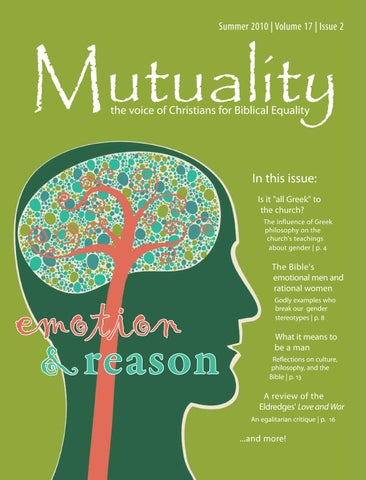
emotion
& reason
The Bible's emotional men and rational women Godly examples who break our gender stereotypes | p. 8
What it means to be a man Reflections on culture, philosophy, and the Bible | p. 13
A review of the Eldredges' Love and War An egalitarian critique | p. 16
...and more!
Mutuality 17.2, Summer 2010 “Let us then pursue what makes for peace and for mutual upbuilding” (Rom. 14:19, NRSV). Mutuality (issn: 1533-2470) seeks to provide inspiration, encouragement, and information about equality within the Christian church around the world. Editorial staff: Megan Greulich, editor; M. L. Castleberry, Adele Hebert, editorial assistants; Image Spigot, graphic designer; Mimi Haddad, president/publisher. Contact us at: Christians for Biblical Equality; 122 W Franklin Ave, Suite 218; Minneapolis, MN 55404-2451; phone: (612) 872-6898; fax: (612) 872-6891; email: mgreulich@cbeinternational.org; web: cbeinternational. org. We welcome your comments, article submissions, and advertisements. For writers' guidelines and upcoming themes and deadlines, visit CBE’s website and follow the link under the Resources tab. Advertising in Mutuality does not imply organizational endorsement. Please note that neither Christians for Biblical Equality, nor the editor, nor the editorial team is responsible or legally liable for any content or any statements made by any author, but the legal responsibility is solely that author’s once an article appears in Mutuality.
Contents F E AT U R E S 4
Is it "All Greek" to the Church? How ancient Greek philosophy has influenced the church's teaching on gender by Mimi Haddad
8
Are Men More Rational and Women More Emotional? Looking to the Bible without preconceived notions by Alvera Mickelsen
11 Judith, Heroine of the Israelites: The story of a rational, courageous, and godly woman by Cristina S. Richie 13 What Makes a Man Masculine in God's Eyes? Reflections on culture, philosophy, and the Bible by William David Spencer 16 Love & War by John and Stasi Eldredge: A book review by Hollie Baker-Lutz
All Scripture quotations, unless otherwise indicated, are taken from the Holy Bible, Today’s New International Version®. TNIV®. Copyright © 2002, 2004 by International Bible Society. Used by permission of Zondervan. All rights reserved.
MINISTRY AND CHAPTER NEWS
CBE grants permission for any original article (not a reprint) to be photocopied for local use provided no more than 1,000 copies are made, they are distributed free, the author is acknowledged, and CBE is recognized as the source. Mutuality is published quarterly by Christians for Biblical Equality and is sent free to members and supporters.
D E PA R T M E N T S
20 Priscilla Papers Honored by the EPA 20 CBE "Down Under" 20 Praises and Prayers
3 From the Editor: Rational and Emotional Faith 14 Join the Discussion on The CBE Scroll: Masculinity and the Fruit of the Spirit
21 Giving Opportunities: Weathering the Storm 22 President’s Message: Moving out of Captivity
2 M U T U A L I T Y | Summer 2010
websi te : cbeinternational.org
From the Editor by Megan Greulich
Rational and Emotional Faith
“The fear of the Lord leads to life…” (Prov. 19:23).
I love the biblical story of Shiphrah and Puah, the Hebrew midwives more easily deceived, and too emotional to be effective leaders. It we encounter in the beginning of the book of Exodus (Exod. 1:15-20). simply is untrue. God equips and calls us as God chooses, and we can Despite the fierce oppression the Israelites were facing under the be sure that as we grow in our faith in Christ, we will be called to act Egyptians, their numbers were increasing and the king of Egypt was in ways that demonstrate both emotion and reason. getting nervous. He summoned Shiphrah and Puah and ordered We hope this issue of Mutuality will be a blessing and them to murder all Hebrew boys they helped deliver. encouragement to you. Be sure to read Mimi Haddad’s exploration Verse 17, however, tells us that Shiphrah and Puah “feared of ancient Greek philosophy and how Greek dualism has God” and did not do as they were told. And when confronted, influenced the church in its view of men and women. Next, Alvera they lied to the king, risking their lives to protect their people. Mickelsen demonstrates how the Bible celebrates both emotional Note their powerful role as protectors here. These women, and and rational leaders, and how it does not discriminate because of several others throughout Scripture, demonstrate that God calls gender. Cristina Richie then highlights the story of Judith, who women to fulfill this role too, despite our modern belief that acted out of bravery and faith to deliver the Israelites from certain protection is the work of men only. Because of the midwives’ death. William Spencer takes a look at masculinity, comparing brave actions, lives were spared and Shiphrah and Puah were and contrasting cultural and philosophical theories with the Bible. blessed by God. Their story is a small, often ignored one, and And finally, Hollie Baker-Lutz shares a thoughtful egalitarian yet it is a beautiful example to us of bold faith in action. review of John and Stasi Eldredge’s new book, Love & War. Why do I highlight this story at the beginning of our issue on As always, we would love to receive your comments and “Emotion and Reason”? First, and perhaps obviously, Shiphrah and critiques on this issue of Mutuality. Blessings to you as you read Puah are two of the many, many biblical examples of women who and reflect! acted bravely and rationally, contrary to the popular stereotype that women are emotional beings (and men are not). Consider Megan Greulich is the editor of Mutuality magazine. She may be the fear they must have experienced at the idea of defying their reached at mgreulich@cbeinternational.org. oppressor, the king of Egypt. It would have been easy to succumb to the emotional desire to save themselves—to simply do as they were told. Yet, Shiphrah and Puah “feared God.” They recognized the power of God and trusted him to protect them and their people as they chose the righteous path. We often think of our emotional and rational capabilities as opposites, or at odds with one another. We think that we either act entirely out of emotion or entirely out of reason—not both at the same time. And, at least in the Western culture that I have grown up in, we would much prefer to act out of reason than emotion. Yet, these Hebrew women acted on a fear for God that was both emotional and rational. As their story shows us, our faith needs both reason and emotion. And we need leaders in the church who know and live this. We need pastors who are nurturing, empathetic, and sensitve to the needs of others. We also need pastors who are critical thinkers, who can make brave decisions based not on their emotions but on what is holy. Both men and women in the Bible demonstrated all of these qualities, as do both men and women today. This is why I find myself frustrated when I hear arguments like women are more gullible,
booksto re : equalitydepot.com
M U T U A L I T Y | “Emotion and Reason”
3
Is it “All Greek” to the Church?
by Mimi Haddad
How Ancient Greek Philosophy Has Influenced the Church’s Teaching on Gender
4 M U T U A L I T Y | Summer 2010
Raphael, “School of Athens,” 1511.
My interest in the philosophical and theological development of women’s service in the church began at a very personal level. I often watched talented, Christian women faithfully serve God only to encounter enormous prejudice in dealing with the church’s unbiblical response to gender. Here are two examples: One of my friends works in Christian ministry at a large university. She is passionate about Christ, and a gifted and dedicated teacher, preacher, and apologist. One day she took me aside to say, “Mimi, do you realize that my church family spends thousands of dollars so I can share the gospel with college students—both men and women—but they will not permit me to preach from the pulpit because I am a woman? This is utterly inconsistent. What is worse, they are telling me there is something wrong with being female!” Her logic was compelling, and her words have haunted me for years!
websi te : cbeinternational.org
After one of my lectures, an attorney doing graduate work in law at an Ivy League school asked if we might have a private conversation. I agreed, and over dinner she told me that she had no interest in getting married. When I asked her why, she said: “If the Bible really teaches that women must be in submission to men, and that men must always be the final arbiters of women, then Scripture is teaching that women are inferior to men. While I am not yet ready to reject Christian faith, I cannot be party to such an unjust system that places a woman under the permanent jurisdiction of a man not because of his character, intellect, or walk with God, but purely because he is male. This is simply unjust and unreasonable.” I can recall many more instances of Christians who have, in one way or another, asked similar questions. People want to know if women are inferior by God’s design. If so, then we should not be surprised if they conclude that Christian faith is unjust and therefore unappealing. Our conversation regarding gender and faith is not a useless piece of abstract theology! This issue has vital implications for Christian evangelism and apologetics as the world evaluates Christian faith and its treatment of women. The church’s engagement of gender and authority also impacts women’s view of self, marriage, their relationship to the church and, most importantly, women’s relationship with God. It is my belief that the Bible is consistent in its teaching on gender and that God does not devalue women. Rather, it is the church’s teaching on gender that is illogical. Sadly, many Christians have been quick to adopt a cultural devaluation of women, rooted in Greek philosophy, which they assume is biblical. Because this is often unintentional, it is helpful to examine our philosophical roots to better assess whether we are conforming to culture rather than to Christ. For this reason, this article will first highlight the ancient Greeks’ view of gender, and then assess the teachings of the church as it embraced the Greeks’ devaluation of women. In light of the Greeks’ argument that women are less morally pure and rational than men, we will then examine early church examples of women’s moral, rational, and spiritual leadership, which challenge the church’s current teaching on gender.
The Pythagorean Table of Opposites
limited
unlimited
odd
even
one
plurality
right
left
male
female
resting
moving
straight
curved
light
darkness
good
bad
square
oblong
booksto re : equalitydepot.com
Greek Philosophy and Culture Greek philosophy laid the foundation for the church’s cultural devaluation of women and the subordination that followed in its wake. Plato (427–347 BC), for example, taught that women were less than human and incapable of attaining fullness of life: “It is only males who are created directly by the gods and are given souls…obviously it is only men who are complete human beings and can hope for ultimate fulfillment; the best a woman can hope for is to become a man” (Plato, Timaeus 90e). His student Aristotle (384–322 BC) asserted an innate ordering of the sexes: “It is the best for all tame animals to be ruled by human beings. For this is how they are kept alive. In the same way, the relationship between the male and the female is by nature such that the male is higher, the female lower, that the male rules and the female is ruled” (Aristotle, Politica, ed. Loeb Classical Library, 1254 b 10–14). Greek dualism, a concept that dates back to the 6th century BC, contrasted form—that which is ideal—to formlessness—that which is derivative or imperfect. Dualism is most commonly noted in the Pythagorean table, which established and compared “opposites.” The left column of the table contained that which was thought to be “superior” and should therefore dominate or control that which was “inferior,” listed in the right column. Notably, the Pythagorean table contrasted male and female. In placing women in the same category as “evil” and “darkness,” the Pythagorean table established men as the norm or standard, and classified women as “the other”—abnormal and unworthy. These philosophical ideas about gender were prevalent in Greek culture. Men were the final arbiters of the home and in politics, and women’s primary function was bearing and raising children. Women were rarely included in men’s social gatherings—including meals—and were not expected to participate in intellectual discussions. And, girl babies were often exposed, representing the pre-eminence of males. Inequality between men and women was thus deeply embedded in Greek life. Consider, however, how the teachings and actions of the New Testament church contrasted greatly with Greek social structures: women participated in the agape meals, served as apostles and house church leaders, and worked as missionaries and teachers, thereby engaging with men in the world of theological ideas.
While women continued to exercise leadership as martyrs, missionaries, Bible translators, evangelists, teachers, and theologians, church leaders throughout history interpreted Scripture through a Greek perspective on gender.
M U T U A L I T Y | “Emotion and Reason”
5
Church Fathers Despite the teachings of Jesus and Paul, and also the examples of early church leaders such as Phoebe, Lydia, Priscilla, Junia and Chloe, a cultural devaluation of women, derived from Greek philosophy, persisted in the teachings of the early church fathers. Even while women continued to exercise leadership as martyrs, missionaries, Bible translators, evangelists, teachers, and theologians, church leaders throughout history interpreted Scripture through a Greek perspective on gender. For example, John Chrysostom (c. 347–407) used Genesis as a justification for his patriarchal convictions, upholding the ideas that women are weak and easily deceived. Chrysostom said that the “woman taught once, and ruined all. On this account therefore he said, let her not teach ... It certainly concerns them; for the sex is weak and fickle...” (Chrysostom, Nicene and PostNicene Fathers, Series I, Vol. XIII). Note how John Calvin (1509–1564), in his commentary on 1 Timothy, upheld the belief that women are the “other” and incapable of leadership. According to Calvin, women are “…by nature (that is, by the ordinary law of God)… formed to obey; for … (the government of women) has always been regarded by all wise persons as a monstrous thing; and, therefore, so to speak, it will be a mingling of heaven and earth, if women usurp the right to teach….” Finally, John Knox (1514–1572) exemplified how Greek dualism remained embedded in the philosophical framework of Christian teaching. “Since flesh is subordinate to spirit, a woman’s place is beneath man’s. ‘The order of God’s creation,’ and ‘the light of nature’ dictate against woman’s rule, for it subverts ‘good order.’ Women were given to ‘natural weakness’ and ‘inordinate appetites’” (First Blast of the Trumpet Against the Monstrous Regiment of Women). These examples illustrate how the church adopted the teachings of the Greeks in representing males as superior to women and holding women more responsible for sin.
What about the Church Today? A Greek devaluation of women continues to influence the church today. While often more subtly expressed than in the writings of the church fathers, beliefs in the innate inferiority of women persist in powerful ways:
“Femininity” is often used in a derogatory way, connoting traits that are undesirable. Consider the recent discussions of the “feminization” or “chick-afication” of the church, suggesting that a church which offers feminine characteristics is weak and/or unbiblical. Women are viewed as helpless and in need of the protection of men. Popular Christian books teach women that they need a man to rescue them. Doubt is often cast upon women’s abilities to act independently in taking risks, assuming leadership positions, and managing responsibilities within the church. Women’s access and worth before God is mediated through males. Pastors preach that men have spiritual authority over women and are responsible for the spiritual health of their wives and fami lies. Some women believe they need the “spiritual covering” of their fathers until they obtain husbands to fulfill that role. Women and men are viewed as opposites. Women's and men’s desires, needs, development, and spiritual worth are viewed as fundamentally different. Such beliefs encourage Christians to see themselves first as male or female, rather than as Christ-followers—an idea that divides all of life into the categories of "male" or "female." Women are deemed ill-equipped to occupy leadership positions in the church because they are viewed as too emotional, not sufficiently powerful, too nurturing, and more easily deceived. Consider what one popular pastor in our day offered in reference to the apostle Paul’s teaching in the New Testament: “Paul is simply stating that when it comes to leading in the church, women are unfit because they are more gullible and easier to deceive than men. While many irate women have disagreed with his assessment throughout the years, it does appear from this that such women who fail to trust his instruction and follow his teaching
…the church adopted the teachings of the Greeks in representing males as superior to women and holding women more responsible for sin.
6 M U T U A L I T Y | Summer 2010
websi te : cbeinternational.org
are much like their mother Eve and are well-intended but ill-informed.” The gifts which women possess for work and ministry are devalued and ignored within the church. Some seminaries offer women degrees in homemaking, teaching them their greatest calling and worth are realized at home and by raising children. In the examples above we observe a dualism between males and females similar to that developed by Greek philosophy, which remains a powerful foundation for the church’s devaluation of women today. The foundation of a truly Christian understanding of women and men, however, must originate from the transforming gospel of Jesus Christ—an idea we see embraced and modeled by the New Testament church.
A Model for Us: The New Testament Church Through its life and teaching, the early church subverted the patriarchal Greek world around it. The New Testament describes women occupying roles of leadership, and teaches an ethic of mutual submission and love. After his conversion, Paul became one of the greatest preachers and evangelists in the Bible. In his training and culture as a Pharisee, women were silenced and could not learn the Torah or occupy priestly roles. Paul’s faith in Jesus Christ, however, motivated him to embrace service within the church based upon the gifting of the Holy Spirit. In fact, women were building and leading house churches alongside Paul in cities like Ephesus and Philippi. Acts 16:13–14, 40 describes the first church in Europe (located in Philippi) and Paul’s earliest encounter with Lydia, a wealthy merchant of purple cloth and a woman of faith. Lydia’s
booksto re : equalitydepot.com
home became a house church, and the Scriptures suggest she was its leader. In Philippians, Paul mentions two women leaders— Euodia and Syntyche—women who “struggled beside” Paul in the work of the gospel (Phil. 4:3). Note that rather than silencing these women, Paul affirms them as co-laborers in building the church, a term Paul uses elsewhere to identify such leaders as Mark, Timothy, Titus, Philemon, Apollos, and Luke. Priscilla and her husband Aquila are mentioned in Paul’s writing more often than anyone else except for Timothy. While in Ephesus, Priscilla and Aquila gained prominence through the church they established in their home (1 Cor. 16:19). Luke recognizes Priscilla and Aquila as skilled teachers for instructing Apollos and providing him with theological insight. Far from condemning her for teaching men, both Luke and Paul extol Priscilla. Paul also calls her a “co-worker” (Rom. 16:3), highlighting her authority in the early church. In Romans 16:1, Paul speaks of Phoebe, calling her a deacon (diakonos) in the church in Cenchrea. Interestingly, when used of men, diakonos is translated “minister,” but when used of Phoebe is often translated as “servant.” Paul also refers to Phoebe as prostates, meaning one who is in authority or one who presides. In great contrast to ancient Greek culture and philosophy, the New Testament church recognized the leadership of women who served as evangelists, prophets, pastors, teachers, and apostles. Despite strong cultural messages about the inferiority and subordination of women, the early church affirmed and valued men and women alike, as made in the image of God and redeemed by Jesus. May the church today also embrace this radical, counter-cultural truth so that we may be a consistent witness of Christ to our world. Mimi Haddad (PhD) is president of Christians for Biblical Equality. She has contributed to eight books, has authored more than fifty articles, and speaks frequently on issues related to faith and gender. She is an adjunct assistant professor at Bethel University and an adjunct professor at North Park Theological Seminary.
M U T U A L I T Y | “Emotion and Reason”
7
Are Men More Rational and Women More Emotional? by Alvera Mickelsen
Sometimes our preconceived ideas about the nature of men and women prevent us from seeing what the Bible really teaches about gender and authority.
8 M U T U A L I T Y | Summer 2010
“It’s no accident that the Bible teaches that men should be the leaders. They are more rational, while women are more emotional.” How many times have you read or heard something like this? Trouble is, none of it is true. The Bible does not say that men should be leaders rather than women. And men are not more rational than women, nor are women more emotional than men. This is true of men and women in the Bible, and it is just as true today. God created men and women to work together, each using whatever gifts they were given by God. God gave many men genuine gifts of leadership and the sound thinking and emotions needed to be good leaders. And the Lord gave many women genuine gifts of leadership and the sound thinking and emotions necessary to be good leaders. Most importantly, he called all of his followers (men and women) to be servants to each other. Jesus never told any of his disciples to exercise authority over others. websi te : cbeinternational.org
Lessons from the Bible by Susan McCoubrie and Jo Ellen Heil
Neither Deborah nor Huldah were “too emotional” to be strong leaders who were used mightily by God in his work.
If we read the Bible without preconceived ideas about “roles” that men and women should play on this earth, we can begin to see its true teaching. Unfortunately, most of us have been brought up with predetermined concepts of what the Bible says that men and women should be like and in what ways they should serve the Lord. This is usually based on one or two verses in the New Testament (often taken out of context) and ignores other parts of the Old and New Testaments that teach and show both women and men as strong leaders, called of God to lead his people. I recently read an article that stated, “The gymnastics required to get from ’I do not allow a woman to teach or to exercise authority over a man,’ in the Bible to ’I do allow a woman to teach and to exercise authority over a man‘ are devastating to the authority of the Scripture…” But, we have many places in the Bible where women do have authority over men, with God’s approval and direction. Has the author of the above statement not read about Deborah who was chosen by God (see Judg. 2:16 and chapters 4-5,) to lead the nation of Israel out of many years of bondage to full freedom? Deborah was not only the top official in Israel, but also became the leader of the army when Barak, who was supposed to be commander, was afraid to take the army into battle without Deborah! Together with Deborah, they defeated the enemy and sang a song of victory! Didn’t God know he was not supposed to use women in such roles? Or have these “men only” leaders of our day not read about Huldah, the Old Testament prophet who was the person of great influence in the greatest revival of the Old Testament? Both the king of Israel (Josiah) and the high priest recognized her as a prophet of God and came to her for help and advice. Apparently neither Deborah nor Huldah were “too emotional” to be strong leaders who were used mightily by God in his work.
booksto re : equalitydepot.com
Do you make choices with your head or heart? In the kingdom of God, the fruit of the Spirit encompasses both emotion and reason, as people throughout the Bible learned when they followed God’s call.
LOVE: Joseph had every legal right to abandon Mary when she became pregnant, yet he wed her, providing Jesus with a loving earthly father and stable home. Mary, well aware of the consequences of an illegitimate pregnancy, agreed to give birth to Jesus and supported him beyond his death (Luke 1; Matt. 1).
JOY: Elizabeth’s barrenness was considered a sign of divine reproach by her neighbors. Can you imagine the joy she felt when she held John for the first time? Or Zechariah’s feelings of thankful triumph when he publicly prophesied at the boy’s dedication (Luke 1:57–65)? PEACE: The prophet Elisha prevented a massacre when he fed his enemies, thus paving the way for a Syrian-Israelite agreement (2 Kings 6:18–23). By diplomatically calming David, Abigail prevented a needless slaughter between his soldiers and her foolish husband Nabal (1 Sam. 25:23–31). PATIENCE: For decades Simeon and Anna had hoped for a sign of God’s love in the midst of political oppression. Their faithfulness was rewarded in the flesh when they encountered Jesus, Joseph, and Mary at the temple (Luke 2:22–38). KINDNESS: Despite great personal risk, Rahab of Jericho protected and counseled the two invading Hebrew spies (Josh. 2:1–21). Barnabus mentored John Mark after Paul had dismissed the young man from his missionary team (Acts 13:13, 15:36–39). GOODNESS: Generosity was important in the early church. Tabitha provided tailoring services and clothing to those in need (Acts 9:36–43). Cornelius, a Roman centurion who worshipped God, was a strong supporter of the Jewish poor (Acts 10:1–2). Both received life-changing miracles.
FAITHFULNESS: Year after year, Elkanah and Hannah traveled to Shiloh to sacrifice to the Lord of Hosts. Their dedications were rewarded with the birth of their six children, including Samuel (1 Sam. 1, 2:21). GENTLENESS: Ananias was told to meet Saul of Tarsus, a feared
persecutor of believers. Instead of anger or recrimination, he brought welcoming words and a healing touch (Acts 9:10–19). Breaking royal decree and risking her father’s anger, Pharaoh’s daughter rescued the infant Moses and raised him as her own (Exod. 2:1–10).
SELF-CONTROL: God entrusted Jeremiah to prophesy during great social upheaval, but also asked him to remain single and celibate when his friends and neighbors were marrying and raising families (Jer. 16:1–2). When God commanded that the wall around Jerusalem be rebuilt after exile, Shallum’s daughters worked on one section, enduring dire threats and persevering in spite of physical danger (Neh. 3:12, 4:10, 4:15). M U T U A L I T Y | “Emotion and Reason”
9
The same writer quoted above also used 1 Corinthians 14:34, died. The women were the ones who went to the tomb on 35 to indicate that women were not meant to be leaders in God’s Easter morning and met Jesus there. Jesus told them to take the work: “Women should remain silent in the churches. They are not greatest message of history (his resurrection) to the disciples allowed to speak, but must be in submission, as the law says. If who had gone into hiding. The women did as they were told, they want to inquire about something, they should ask their own but the disciples did not believe them until they ran to the husbands at home; for it is disgraceful for a woman to speak in tomb to see for themselves. the church.” If this is to be taken literally, then women should not In the early church, women and men both played key teach anyone in church—including other women and children. In roles. Romans 16 mentions ten specific women who were fact, they should not even sing apparently well known with the congregation because and/or leaders in the they are to keep silent! I’m churches in Rome. Paul While the male disciples followed their sure even the writer does not describes these women take that verse literally! What with the same roles or fear and fled for their lives, many of the church would he go to? functions as men. The women followers stayed at the foot of the Actually, there is no verse terms include deacon, in the Old Testament Law (the protector, fellow worker, cross until Jesus died. “Bible” of the early church) hard worker, and apostle that says women are to keep ( Junia). In fact, Junia is silent in church. Neither called “prominent among does it ever say in the Old the apostles.” Testament that women are to The Genesis 1:27 obey their husbands — but it account says that God does say once that Abraham created human beings was to obey Sarah, his wife! in his own image; in the (Gen. 21:12). image of God he created Proverbs 31 describes the them; male and female “ideal wife” as one who has he created them. God a business, takes care of the gave the same command poor, sees that her family is to both the man and the well cared for, and is praised woman: “Be fruitful and by her husband and children increase in number; fill the (v. 12–24). This does not sound earth and subdue it. Rule like the women referred to in over the fish of the sea and 1 Corinthians 14:34, 35. the birds of the air and The Apostle Paul, who wrote those verses in 1 Timothy 2:12 over every living creature that moves on the ground.” The and Ephesians 5:22–24 that are so often quoted against women, command to “rule” or “subdue”’ was given to the man and also wrote 1 Corinthians 7, which is rarely quoted by the people woman together. Verse 2:24 says “a man will leave his father who insist that only men should be leaders in the home and and mother and be united to his wife, and they will become have authority. 1 Corinthians 7 is the only place where Paul one flesh.” wrote exclusively about marriage (not using it as an example To be true to the Bible means that we consider all passages of something else). In this chapter Paul gives exactly the same in their cultural, historical, and literary context. Anything instructions and commands to husbands and wives. less means that we are not using the rational abilities given to The Bible is full of examples of men who were highly us. And our emotional capacities (of both men and women) emotional. The biblical stories about Saul, the king of Israel, are must be directed to our love for God and our neighbors—as one long tale of an emotionally disturbed man who finally took Christ commanded. his own life. David had his emotional problems, too, as did King Alvera Mickelsen has been active in Christians for Biblical Josiah and many other kings of Israel. Equality since its beginning. She and her late husband, The women who are mentioned in the Bible are largely Dr. A. Berkeley Mickelsen, both taught for many years those who were strong emotionally. Sarah, the wife of Abraham, at Wheaton College and Graduate School and at Bethel College and Seminary. They team-taught in many churches as well as Hagar, the slave of Sarah and the second “wife” of in the Twin Cities regarding biblical equality in marriage, Abraham, demonstrated great emotional strength in the midst church, and society. of painful circumstances. In the New Testament, we find many strong men (most of the apostles) and many strong women. At the crucifixion of Christ, the twelve disciples all fled for their lives, but many of the women followers stayed at the foot of the cross until Jesus
10 M U T U A L I T Y | Summer 2010
websi te : cbeinternational.org
Wondering if women should be timid and docile? Meet Judith.
Judith: Heroine of the Israelites by Cristina S. Richie
As Protestants we rarely dive into the extra-biblical literature that our Orthodox and Catholic sisters and brothers read as Scripture. However, when we read these deuterocanonical books as literature we can gain more than just fascinating insight into Judaism. We enrich our own faith through the stories of Jewish women and men of faith, which help us to experience Jesus as the promised Messiah of the Jews. The book of Judith depicts one such woman of faith, who is as chaste and shrewd as she is beautiful. Judith uses her superficial charms as a gateway to her gallant actions, which save her people and exemplify her trust in Yahweh. Judith opens with a “historical” setting: King Nebuchadnezzar seeks to punish the states within his political control for failing to assist him in his battle against Media (2:3). Cristofano Allori, "Judith with the Head of Holofernes," 1580. The Jews are among those who refuse to fight, so Nebuchadnezzar orders Holofernes, his commander-in-chief, to besiege the Jews. blows, severing his head and killing the enemy. She wraps his Holofernes cuts off the Israelites’ water supply, leaving the people head in a net, and goes out of the city with her female slave who weak and ready to surrender (7:12–13). was waiting outside. In the time of crisis, though, Judith’s character, cunning, and When they return to the Israelites, the women reveal strength are revealed. After thirty-four days without water, Uzziah, Holofernes’ head, inspiring the warriors for battle. Judith has a town official, declares to the Jews that they will surrender in five remained chaste in her ploy (13:16) and is praised for her victory days unless the Lord comes to their aid (7:30). Meanwhile, the and virtue (13:17, 15:9). The women adorn their heads with people beg Judith to intercede for them because they know she is olive wreaths—the symbol of victory—and the men sing songs a pious woman. of praise to the women, while the women process in front of Judith, who trusts in God to rescue her people, has a them (15:13). Judith’s valor now ranks plot of her own. She leaves the town among the biblical stories of David, who with her female slave and goes into the decapitated Goliath (1 Sam. 17:51), and enemy camp. Traveling alone was an Jael, who drove a tent peg through the In the time of crisis, audacious task for women, but Judith temple of Sisera ( Judg. 4:21). goes under the guise that she plans Judith’s character, cunning, The book makes clear, on several to betray her people because their occasions, that Judith never has relations and strength are revealed. destruction is imminent (10:12–13). As with the malevolent ruler. She is praised as a beautiful woman, she captures the a heroine, a God-sent warrior, and a chaste lust of Holofernes, and as an intelligent woman with great restraint. Judith was a woman, she wins Holofernes’ trust. The woman who challenges the stereotype that females are timid and enemies set up a tent for her and her servant, and she spends docile. By looking to heroes like Judith who trusted God with their three days at the camp (12:8–9). On the fourth night, Holofernes lives, we can see how God calls and uses both women and men to act invites her to dine with him. Her plan, under the direction of courageously and boldly in the face of overwhelming obstacles. God, comes to fruition. The vile commander-in-chief wants to seduce Judith, yet he Cristina Richie is a writer, speaker, and theologian. Ms. Richie currently works as a minister in the Episcopal church and becomes inebriated and passes out. His guards, assuming that as a professor of religion and ethics at Newbury College the prowess of their lord has tempted the widow Judith, leave (Brookline, MA). She holds an MDiv from Gordon Conwell him unguarded. Judith prays to God for strength (12:7), takes Theological Seminary. Holofernes’ sword from the bedpost, and gives his neck two hard
booksto re : equalitydepot.com
M U T U A L I T Y | “Emotion and Reason”
11
Women and Building
cbeinternational.org/M173C
Christian History on a Legacy A unique one-day conference exploring the legacy of women in ministry since the beginning of the church.
Lindner Conference Center 610 East Butterfield Road Lombard, IL 60148
Theodora, Bishop of the Church of Saint Praxedis, Rome, 820 A.D.
Photo Joan Morris†
Featuring
Alan F. Johnson
Mimi Haddad
Dorothy Irvin
Presented by the CBE Greater Chicago Chapter and Christians for Biblical Equality
Lynn Cohick
Gilbert Bilezikian
Saturday, Sept. 25, 2010 Lombard, IL
About the photo: This wall mosaic in the church of Saint Praxedis shows Mary the mother of Jesus in her traditional blue mantle, between Saint Pudentiana, of the Roman family of Pudens (2 Tim. 4:21), and Saint Praxedis. Praxedis and Pudentiana appear to have been overseers (in Greek, epi-skopos; in English, bishop) of very early house churches, on whose foundations the present-day churches of Saint Praxedis and the nearby Saint Pudentiana were built. Some early women named as being in sole or shared charge of local house churches were Lydia (Acts 15;16), Apphia (Philem. 2), Priscilla (1 Cor. 16:19), and Nympha (Col. 4:15). The woman at the left end of this mosaic, Theodora, is named as episcopa, bishop. In contrast to the gold halos of the saintly departed, her rectangular nimbus shows that she was alive when her mosaic portrait was made and installed in the church of which she was bishop. Early pictures of earlier women (and men) church office holders sometimes include the picture of a same gender person from 12 the apostolic in apostolic succession. M U period T U to A indicate L I T Yoffices| held Summer 2010 websi te : cbeinternational.org
What Makes a Man
Masculine in God’s Eyes?
by William David Spencer
Recently, I have been noting various sets of “rules for guys” on the Internet, so when my favorite newspaper published a set, I was intrigued. But, its “rules” contended that we men only want to dialogue during commercials, can only see in limited colors, and have one topic of conversation: sports. Several pages later, I learned wives know all about our children, but we husbands are only vaguely aware of small bodies underfoot in the house. Now, I thought, that’s strange.
booksto re : equalitydepot.com
It reminds me of the same perplexity I experienced when I was reading Men Are from Mars, Women Are from Venus. Parts of it resonated with me, like the theory that men like to work things out in our own heads before we talk them out. I can relate to that, though, I wondered, is that only true of men? Do all women process verbally as a rule? And don’t some men like to process out loud from the start? Apparently, I’m not the only one who’s wondered, since the author tells us right at the outset on pages six and seven that in his seminars some men do relate to his descriptions of women and vice versa. He says not to worry—it’s just “role reversal” because “many men have denied some of their masculine attributes in order to become more loving and
M U T U A L I T Y | “Emotion and Reason”
13
nurturing. Likewise, many women have denied some of their feminine attributes in order to earn a living in a work force that rewards masculine attributes.” Hmmm, I thought, so let me get this all straight: if I am loving and nurturing, I am not being masculine, and, if women are successful in business, they are not being feminine? To remedy this, my wife should stay out of business, while I should watch more television, forget what color “mauve” is, learn some sports stats, and ignore our son? This will make me more of a guy and get me out of “role reversal”? What’s up with all this? What we are hearing seems to me to reflect a popular philosophy about what men are like in values, in motivation, and in modes of expression. But is it a philosophy we can trust? We live in an age that believes that, in order to be scientific and technological, we must gather data as though we existed in a closed universe, where all knowledge we obtain is done empirically through sense perception. In this way, we are Aristotelian in our approach, meaning we look at particular behaviors, genetic factors, and similar data and draw conclusions about people. Nothing is wrong with this, as long as our conclusions match the actual reach of our data. When they go beyond that, then we are in trouble. For example, we conduct surveys among men and tabulate the answers, deciding these are the behavioral patterns men tend to have, and then we make an extrapolation that these, then, show us the way
men are and, indeed, how they should be. We expect our social and behavioral scientists to quantify all the data for us and give us a profile of the model man. That’s how popular society operates. What it doesn’t always take into account, however, is what the wise Christian social and behavioral scientist knows: Such data tells us what fallen men are like, but not necessarily what God’s ideal man should be. In fact, though we live in a fallen world, our universe is not closed. We may be comprised of chemicals, but our lives are determined by a Creator who is not working on Aristotle’s model. Plato’s perspective is probably closer in understanding the way the Christian worldview actually works —which is why Christianity has been so vulnerable to all the hierarchy, oppression of women, and the other bad stuff in his system. Where Plato was right was recognizing that God has an ideal—a right way God wants men and women to be and to live. However, sin has disrupted logic and obscured that right way, and 1 Corinthians 1 tells us that God’s ideals look like foolishness to a world whose values are all skewed. The world has its limited view of how things are and should be, predicated on what it sees within itself. It will discover truth at certain points because of common grace, but it won’t capture truth completely: for that, we need revelation. Therefore, despite what we read in so many popular (even Christian) books, just because we can make and tabulate observations about the way fallen men and women are does not necessarily mean that what we observe is the way God intended us to be. And, further, these observations don’t dictate who we should be. Observed behavioral patterns don’t make a mandate. They just might be tabulating how sinful we are and how far we have fallen from God’s ideal. Therefore, since all good theology goes back to creation, we need to go back beyond the curse (as my wife entitled her classic book) and see what God’s prefall idea was for healthy manhood, since the Bible refers to it, amplifies it, and applies it, while often using the Genesis passages for illustrations.
1 Corinthians 1 tells us that God’s
ideals look
like foolishness to a world
whose values are all skewed.
Join the Discussion on The CBE Scroll
Masculinity and the Fruit of the Spirit by Donald Guffey
“As a male preschool teacher who loves to sing, knit, and hug people, I am a bit disturbed at the concept that God created me with a wild heart and warrior instinct. For if this is the case, then as a sensitive, emotional, nurturing man I am obviously defective. As a young teen in junior high I learned quickly that my personality didn’t fit the mold….”
Read more at blog.cbeinternational.org.
14 M U T U A L I T Y | Summer 2010
God’s Ideal for Healthy Manhood Right from the outset, God intended men to be in community. Genesis 1:26–27 tells us men were not created to be loners; the command to steward the earth in Genesis 1:28 was given to men and women together, equally. So both sexes working communally and equally together as God’s regents is God’s pre-fall ideal, which dispels the popular myth that men are supposed to be incommunicable loners. Estrangement comes with the fall when the consequences of sin are explained in Genesis 3:16, where hierarchy is established between men and women. That’s the bad news. The good news
websi te : cbeinternational.org
is that being redeemed by Christ means Jesus ripped up the whole set of compromises that the fall set for our lives, giving us a restored set of blueprints with which to rebuild the community God intended from the beginning. One of those blueprints can be seen in Genesis 2:24, which challenges those theories that claim men are by nature promiscuous (and women monogamous), that we men aren’t naturally nurturing, that we’d rather go out of the house than take delight in our children, etc. Redeemed man is empowered to actualize God’s ideal—that’s one of Jesus’ renovations! This past year my wife and I were encouraged to do a book on marriage, since we are happily married (ever after), in our thirty-eighth year. Since plenty of books on Christian marriage exist, we decided to get adventurous and invite another happily married Christian couple with a different point of view—Steve and Celestia Tracy of Mending the Soul Ministries, a soft complementarian couple—to dialogue with us and see both what we hold in common and where we differ in our understanding of Christian marriage. We also invited responses from African-American, Korean, and Hispanic couples we know well who have beautiful marriages. The resulting book, Marriage at the Crossroads: Couples in Conversation about Discipleship, Gender Roles, Decision Making and Intimacy, revealed unanimity across theological lines and cultures that men are by nature intended by God to be loving and nurturing, communal and communicative, and that women are also intended by God to be industrious and responsible workers in society and also God’s stewards on earth. Of course, this is the logical outcome for all Christians exploring biblical manhood because this is how the Bible’s greatest men followed God’s ideal.
their “masculine” side? Obviously not, because Joseph's example explains the key to these men's behaviors: they are “righteous.” A righteous man is loving and nurturing. There is nothing “feminine” about a man’s love and nurture. It is what God, our Creator, intended masculinity to be. If we men have forced women to supply all the love and nurturing in our societies, it’s because we’ve abdicated our responsibility. Men who aren’t loving and nurturing by nature are the product of a fallen world and need to get in contact with their “loving and nurturing” masculine side. And, likewise, is that idea that women are giving up their feminine attributes if they succeed in business accurate? Proverbs 31 provides one picture of a godly woman. What do we see? She is a thriving businesswoman. (Anyone who would like to explore that fact should see my article “Diamond or Diamond Mine?” in Priscilla Papers, vol. 16, no. 2.) More likely, if a working woman or man imitates the fallen nature of their coworkers and their shady practices, becoming callous,
Despite what we read in so many
popular (even Christian) books, just because we can make and tabulate
observations about the way fallen men and women are does not necessarily
The Bible’s Redeemed Men in Action
mean that what we observe is the way
Could anyone be more nurturing and loving with his children than Jacob? Genesis 37:34–35 shows us a man so child-oriented that, even when all his sons and daughters came to comfort him, he refused to be comforted at Joseph’s loss. “No,” he said, “in mourning will I go down to the grave to my son.” Who could be more tender with his grieving wife than Elkanah, Hannah’s husband? Look at his solicitation toward her in 1 Samuel 1:7: “Hannah, why are you weeping? Why don’t you eat? Why are you downhearted? Don’t I mean more to you than ten sons?” Look at Joseph’s response when he discovers Mary is pregnant with a baby he knows isn’t his. According to popular wisdom, he should have been looking for the biggest rock around to start the stoning—but instead we’re told, “Because Joseph her husband was a righteous man and did not want to expose her to public disgrace, he had in mind to divorce her quietly.” This is Matthew 1:19, before the angel enlightens him that the child is the Son of God. Are all these men exceptions to the rule? Are they men who have experienced “role reversal” and need to rediscover
booksto re : equalitydepot.com
God intended us to be.
cut-throat, and cruel, ceasing to be “righteous,” then they have stopped behaving in a manner appropriate for God’s ideal man or woman. God’s ideal men and women take their faith seriously, seek out the Bible’s righteous models, and know how to employ authority and to submit to authority according to gifts and tasks. They are loving and nurturing, mutually respectful and supportive, not threatened by each other’s success, but actually seeking it as joint stewards, helping each other reach God’s ideal to please the One who made us. William David Spencer is editor of CBE’s Priscilla Papers, ranked adjunct full professor of theology and the arts at GordonConwell Theological Seminary, and volunteer founding pastor of encouragement at Pilgrim Church (Beverly, MA). He is the author or co-editor of eleven books, including Global Voices on Biblical Equality. This article is drawn from his workshop at CBE’s 2009 Saint Louis conference.
M U T U A L I T Y | “Emotion and Reason”
15
John and Stasi Eldredge's
Love & War:
a B ook Review by Hollie Baker-Lutz
W
hile enjoying Valentine’s Day dinner this year, my husband and I talked about the joys of being married. When he asked me what has been the most pleasant surprise of the past three years, I thought for a moment, slowly smiled, and said, “Marriage has been a lot easier than I thought it would be.” Perhaps my younger generation is just much more open about taboos and perils, but the horror stories and warnings I received as I approached my wedding led me to believe I could sooner navigate my way through J.R.R. Tolkien’s Mordor than through a successful marriage. We received pre-marital counseling, prayed often, and dove in anyway. I can honestly say that—praise God!—at no time during my 1,000-day marriage have I questioned the decision to enter into it. Marrying Nate didn’t reveal annoying habits, we didn’t start casually dropping “please” or “I love you” from our vocabulary, and I still can’t wait to see only him every day. My relationship with my husband is not perfect, and I still anticipate rougher times ahead,
16 M U T U A L I T Y | Summer 2010
but marriage during the “roughest” first years was shockingly simpler than I had prepared myself for. If your experience is like mine, you too will feel a bit on the outs with John and Stasi Eldredge. At nearly three years into their now twenty-five years of marriage, they stared across the kitchen table at one another lost, wounded, and contemplating divorce. They begin their new book, Love & War, with descriptions of the sheer impossibility of marriage. Yet, as they reveal the trials and tragedies from their past, it is little wonder that the commitment and intimacy of marriage seems insurmountable. Between the two, they admit to wounds from drug abuse, eating disorders, childhood sexual abuse, alcoholic parents, rape, pornography, premarital sex, and abortions. I join them as they praise God for healing so much of this pain, but John and Stasi err when they project their “royal mess” upon every other person who is ever to be married.
websi te : cbeinternational.org
In Love & War, the Eldredges attribute the “absurdity of marriage” to innate gender discrepancies. Men and women are so fundamentally different, they assert, that it is no wonder that few can make it work. “Marriage is a submarine with Cinderella and Huck Finn shut inside,” they write (p. 155). Here we find the principle flaw in the book—the assumption that all men and all women are the same. John and Stasi write:
When a man believes he has a God-given inclination to battle and right to prevail, it comes as no surprise that he becomes affronted and dejected when victory is denied. “A man gets tired of fighting after a while,” John writes, “especially when he doesn’t always win. It can feel so emasculating” (p. 184). Since when is the disappointment of failure unique to men? Losing is a disappointment for all of us because we are selfish people who would rather have our own way, The heart of a man longs just as we did when we were for a battle to fight, an children. Paul writes, “When adventure to live, and a was a child, I talked like a Perhaps some of the “war” in Love & War Ichild, beauty to rescue. Just look I thought like a child, could be eradicated if the male component I reasoned like a child. When at the movies men love and the games little boys I became a man, I put the was not so fixated on a warrior identity. play. The heart of a woman ways of childhood behind me” longs for someone to fight (1 Cor. 13:11). Rather than resist for her, to play an irreplaceable role in a great adventure, selfishness, John Eldredge encourages men—and men only—to and to offer beauty. Just look at the movies women love indulge it. John veils this as the marital directive for a man: to and the games little girls play (p. 30). “realize his strength.” Yet, I sense that what he really means when he uses the word “emasculating” in this book is that something This assertion explains much of what John and Stasi take has hurt his pride. Protecting a fragile male ego, then, becomes for granted about men and women. Hunting and sports are the central function for the wife in marriage. innately attractive to a warrior; shopping and bubble baths John asserts that at the core of a man lies the desire to must enchant a beauty. As in their previous books, John and succeed and win, even in his spiritual life. He admonishes men, Stasi consult movies, fairy tales, and song lyrics to arrive at their “And guys, I think it will really help us as men to engage in prayer conclusions. The Eldredges do sprinkle Scripture quotations when we see it not as something soft and feminine, but as battle” and biblical references throughout, but many connections they (p. 129). Even in prayer, men—and men only—are called to win. make are dubious. For example, John explains how we know that But here is where the Eldredges contradict themselves: while God wants to communicate with us regularly through prayer: they believe that only men have this God-given warrior spirit, “Eve is made in the image of God, right? Then we should not be Stasi Eldredge, too, is a prayer warrior. She fights for answers, surprised that God loves to talk!” (p. 134). blessings, and wisdom, for the glory of God and health of her When it comes to marriage, the Eldredges’ definition of marriage. She does not exist simply to add beauty to prayer! gender also informs their view of conflict. Perhaps some of the To his credit, John fully respects her in this role. He needs “war” in Love & War could be eradicated if the male component her there and knows it. Critics of Wild at Heart might expect was not so fixated on a warrior identity! For John, much of life Love & War to subjugate the wife to junior partner, but this is must be a battle—people, road trips, and pet peeves must be won not so. John and Stasi share the spiritual strength in their home over. Fixing a leaky sink is a triumph only a man can understand. and marriage. When it comes to decision making, they defer (He writes, “I tried to help Stasi relate, ‘Imagine you just lost five not to gender but to each other’s wisdom, strength of opinion, pounds today’” (p. 65).) John also rejects what he calls a “meek listening prayer, or friends and pastors. They also rightly note and mild” or soft Jesus, calling men instead to view their lives that the word ezer in Genesis 3 refers to Eve as Adam’s helper in as a battle to be won. Yet, this seems out of step with the fruit the same powerful way that God is helper to his people. In these of the Spirit in Galatians 5 or this blessing from Psalm 37: “the instances, their view of marriage does begin to resemble mutual meek will inherit the earth and live in peace and prosperity.” The submission. It is not overt complementarian theology or power of Jesus is not brute strength but self-control, love, peace, practice that will frustrate egalitarians who read Love & War, and justice. but rather the inconsistent and unfair gender stereotypes.
Love & War’s interpretation of beauty only fuels the shame and confusion that women feel as they struggle to meet the desires of male sexual fantasy and Christian modesty at the same time.
booksto re : equalitydepot.com
M U T U A L I T Y | “Emotion and Reason”
17
Take for instance the Eldredges’ assumptions that a woman’s needs are to be rescued, loved, heard, and most of all to feel beautiful. I hoped Love & War might distinguish the tricky concept of beauty from the way our pornography-saturated culture defines it. I waited for the authors to articulate a biblical understanding of beauty, but it never came. While Stasi repeatedly references “inner beauty,” the meaning of this expression is neither defined nor explored, and the discussion of beauty is limited to negligees and weight fluctuations, with only one fleeting mention of beauty as kindness. The enormous pressure on women to be beautiful juxtaposed next to Stasi’s decades-long struggle with eating disorders is alarming. To be beautiful is to be sexually attractive to her husband. The greatest harm here is not only that women face societal demands to be thin and sexy, but also that the Eldredges suggest this order comes from On High. Satan’s accusations of ugliness and worthlessness are repackaged as God’s design. Think of this warning from 1 John 2:16: “For everything in the world—the cravings of sinful people, the lust of their eyes and their boasting about what they have and do—comes not from the Father but from the world.” Love & War’s interpretation of beauty only fuels the shame and confusion that women feel as they struggle to meet the desires of male sexual fantasy and Christian modesty at the same time. John provides a case in point when he suggests that a woman wear clothes tight enough to show she is a woman but loose enough to prove she is a lady. In spite of all these gross miscalculations, John and Stasi do hit a few notes right. They urge couples to pray together for a shared calling. They affirm transparency and forgiveness. They acknowledge that everyone wants to love and be loved, and that the marital relationship often mirrors our relationships with God. They warn us about our enemy named Satan. They encourage
couples to pursue both like and unlike interests and reserve time for their own same-sex friendships. However, when Love & War is not promoting masculine and feminine stereotypes as marital objective, its positives are so painfully elementary and cliché that I wonder if many couples can glean revelation from it. While Love & War manages to identify some relational and spiritual truths, it builds upon a foundation of Western cultural myths. Their account of what it means to be masculine or feminine proves not descriptive but harmfully prescriptive for generations to come. Maybe my early marriage ensued more easily partly because my husband and I freely communicate our needs without filtering them through whether or not we’re “supposed” to have them as male or female. John believes that marriage frees men to discover their strength. Instead, I believe we must let marriage reveal strength and courage for women and men alike. Stasi believes that marriage helps women illuminate their inner beauty. Rather, let’s give men space to be heard and delighted in, too. Stasi believes that only women were created with an innate need to be a delight for her mate, but my husband needs to know I find him attractive all the time. John believes that only husbands need to hear a spouse affirm “you have what it takes,” but I need to hear those words with every endeavor. When it comes to gender, I don’t hold to the stereotypes John and Stasi Eldredge promote and yet somehow God has seen fit to bless my young marriage and continue to grow theirs. May all of us find delight in the pleasant surprises of marriage, even if our journeys are much different than the one charted out in Love & War. Hollie Baker-Lutz lives in Illinois with her husband Nate and a pug named Amelia. Follow her on Twitter @holliebakerlutz.
Looking for more responses to books by John and Stasi Eldredge? Visit us on the web for these articles, recordings, and blog posts: Wild at Heart: Essential Reading or “Junk Food for the Soul?” John Eldredge’s Wild at Heart
A Critical Look at Wild at Heart and Captivating: Unveiling the Mystique of Gender Essentialism
Wild-hearted Women: A Survey of Women Leaders in the Church
article by Brynn CameryHoggatt and Nealson Munn
recording by Julia Butcher
available for purchase at equalitydepot.com
available at cbeinternational.org on the “Free Articles” page under the “Resources” tab
available for purchase at equalitydepot.com
18 M U T U A L I T Y | Summer 2010
recording by Mimi Haddad
All’s Not Fair in Love & War blog post by Anna and Ryan Snyder available at blog.cbeinternational.org under the “Marriage” category
websi te : cbeinternational.org
Should My Institution Join CBE? Discover Organizational Memberships!
Institutions who join CBE receive free subscriptions to CBE journals, 20%-50% off CBE Bookstore resources, and 50% off CBE conference registrations for up to six people. Stock your library with award-winning publications, quality books, and Bible studies. Empower your students to discover and follow their giftings. Partner with CBE today!
Learn more about membership: Web: cbeinternational.org/institutions Email: cbe@cbeinternational.org This emblem could be on your website! And, as a CBE member, we will place your logo on our site, for those looking for an egalitarian school.
booksto re : equalitydepot.com
M U T U A L I T Y | “Emotion and Reason”
19
MINISTRY NEWS Priscilla Papers Honored by Evangelical Press Association by David Kim Christians for Biblical Equality was honored once again by the Evangelical Press Association (EPA) for two pieces from its quarterly academic journal, Priscilla Papers, edited by William David Spencer. EPA is a prominent Christian periodical publishing organization; popular publishers Christianity Today International, Focus on the Family, and Sojourners are members. Though competing as a significantly smaller publication, Priscilla Papers earned first and second place honors. Praised for its “excellent documentation” and “strong linguistic and biblical support,” “First Timothy 2:12, the Ordination of Women, and Paul’s Use of Creation Narratives” earned first place for biblical exposition, as the judge could “not find fault with it.” The article was written by John Jefferson Davis, PhD, a professor of systematic theology and Christian ethics at Gordon-Conwell Theological Seminary. “I Have Known Enough Saints,” by Hubert Edgar Hix, earned second place in poetry; the judge called it a “fine paradox.” Hix is an established poet and blogs on The CBE Scroll. Read these and other award-winning articles by visiting cbeinternational. org and clicking on “Free Articles” under the “Resources” tab.
P R A I S E S A N D P R AY E R S praise god with us for… • A profound time of scholarship and fellowship during the recent CBE conference in Melbourne, Australia. Praise God for the hard work of the CBE Melbourne Chapter, and for the new CBE chapters in Tasmania and New Zealand that are forming because of the conference! • The arrival of six talented, passionate, and dedicated summer interns!
pray to god with us for… • Great attendance at our Chicago one-day conference, on September 25th. Pray that the sessions would be a healing balm for all who attend and that the conference would spur much fruit for biblical equality in the Chicago area. • The planning of CBE's 2011 conference in Seattle. Pray that our presence there would bring glory to God and further the mission of biblical equality. • Wise decisions, funds, and efficiency as we work to implement our new online shopping cart. • Much-needed contributions, memberships, and book sales in this difficult economy.
M I N I S T R Y N E W S : CBE "Down Under"
by David Kim
From June 11 to 14, 250 people attended CBE’s 19th annual international conference in Melbourne, Australia. Hosted by the CBE Melbourne Chapter and themed “Better Together,” the conference exceeded expectations and brought encouragement to a region that has suffered harsh blows in the struggle for biblical equality in the church. The conference addressed many popular theological arguments that are used to repress women. Speakers included Rev. Dr. Graham Cole, professor of biblical and systematic theology at Trinity Evangelical Divinity School in Chicago; Dr. Cheryl Catford, national director of Australian Evangelical Alliance; Dr. Funmi Para-Mallam, senior research fellow at the National Institute for Policy and Strategic Studies in Kuru, Nigeria; and Rev. Dr. Kevin Giles, a well-known advocate for gender equality. Cole opened the conference with his keynote examining the biblical foundation of the central theme of the conference—that men and women are better together. Para-Mallam spoke to an overflowing audience in a seminar called “Women and Girls in Africa: Issues, Challenges, and Ministry Strategies.” CBE president Mimi Haddad was thrilled about the results of the conference. “The conference was a wonderful success, possibly the most moving and memorable of the many I have attended,” she said. Lynley Giles, chair of the conference committee, said, “I am overcome by the number of people who told me the conference was a milestone in their journey, something that really empowered them in their life and to work for a better and more equal world.” Melbourne first allowed the ordination of women in 1992, a move that many hoped would eventually stifle the church’s devaluation of women. However, the recent influence of the American church has sparked a resistance to the egalitarian movement in Melbourne. Thus, the CBE conference entered stormy waters when it chose Australia, but God provided for a smooth and impactful event. Read more reflections from the conference, view conference photos, and browse recordings of the sessions on our website: cbeinternational.org/melbourne. And watch for the full report in the next issue of Mutuality!
20 M U T U A L I T Y | Summer 2010
websi te : cbeinternational.org
GIVING OPPORTUNITIES by Cynthia Mitchell
Weathering the
Storm
Several years ago, I began to have gnawing questions about the Ultimately, I came to an awareness that sometimes God asks us biblical accuracy of the doctrine of female submission. The to weather out the storm rather than cut anchor. questions simply would not abate until I studied the issue How exactly does one weather a storm? As our Lord for myself. I began by reading pertinent biblical passages, reminded his disciples, “Why are you afraid, O you of little studies, positions, and analysis on both sides of the topic. I faith?” (Matt. 8:26) Thus I was reminded that it is God that does also questioned my pastors and church leaders about their the work, and that we are to abide in him. With his grace, I have understanding of leadership roles as well as the perspective been able to have some discussions within my church and wait of our denomination. It was surprising to find that while our for God to lead. As I was reminded by a friend, significant change denomination maintains a firm position that women are not to is not easy or quick, but when it is God’s work it will transpire. be included in leadership, it cites no documentation (original or While most of my “work” for biblical equality must be historical) to support this standard. Even more disconcerting to judicious, I have also found ways to support biblical equality in a me was the fact that whenever questions arise they are quelled tangible way. Since CBE is an instrumental resource for research with passivity or vehemence at a denominational level (though (many of my books and literature came from their store) as well most of my pastors and church leaders as being a leading organization are open to dialogue). While the topic of in the promotion of biblical I wrestled with God and my desire women in leadership can be considered equality, naturally I wanted to debatable, it seems that to categorically support their efforts by more to leave my church and find a body exclude a segment of the church from than simply being a member and with which I am a better “fit.” service should at least have been studied giving occasional monetary gifts. Ultimately, I came to an awareness that and debated from Scripture. Given the As I was trying to figure out an sometimes God asks us to weather out caution of our Lord that “the harvest is appropriate amount to give, it the storm rather than cut anchor. plentiful but the laborers are few,” I was occurred to me that part of the surprised my denomination was not open tithe to our church goes to the to studying the issue. denomination. After finding out I have been a member of my current church for nearly what percentage of our church budget goes to the denomination, twenty years—long enough to be intimately involved with the I decided that would be the amount I would also give to CBE. lives of those in my community. Bottom line: I love my church. For me, this is the best way to support my local church while I love the brothers and sisters God has blessed me with in my simultaneously countering the discrimination faced by women church family, and I love the ministries God has given me within in our denomination and helping to promote biblical equality my church. Thus, I do not confront this issue as one who has been in general. mistreated, abused, or wronged. As a matter of fact, I am blessed Jesus was the embodiment of love, grace, mercy, and with a wonderful marriage and have always enjoyed leaders who charity—what a dying world needs most. I pray that one day all strive to be the epitome of Christlikeness. Yet, after coming to an Christians will embrace the unprejudiced command of Christ awareness that the Bible speaks to gender inclusiveness, I found and “pray earnestly to the Lord of the harvest to send out laborers myself in a place of cognitive dissonance. Given the glaring into his harvest.” difference between myself and my denomination with regard to leadership requirements, I began to question whether or not I should remain at my current church. I wrestled with God and my desire to leave my church and find a body with which I am a better “fit.” During my time of questioning, God made it CBE relies on the donations of generous people like Cynthia and very clear to me that I was called to my church, that the work you to further the mission of biblical equality. Will you make we are doing as a body is God-honoring, and that I am part of a contribution today? Visit cbeinternational.org and follow the a community that is encouraging and edifying of one another. “Give to CBE” link under the “Take Action” tab. Thank you!
*****
booksto re : equalitydepot.com
M U T U A L I T Y | “Emotion and Reason”
21
President’s Message by Mimi Haddad
Moving out of Captivity If you’re looking for a powerful film to watch this summer, consider Iron Jawed Angels, a dramatization of the American suffragist Alice Paul (1885–1977). Her legacy is one-of-a-kind, and few leaders exhibit more genius in responding to the rhetoric and strategies of their opponents. For egalitarians today, her struggles and ours have significant parallels. We learn much from observing the masterful way Paul challenged the illogic that portrayed women as wholly different from men and unfit for decision making responsibilities. At a crucial moment in the film, while imprisoned for picketing the White House, Paul is examined by a psychiatrist for mental instability. She establishes both her sanity and also woman’s shared humanity with men in a penetrating declaration. She tells the physician that her life is aimed at gaining for women what men desire and have always enjoyed—professional opportunities for their aspirations and talents. In other words, women want what men want—an opportunity to subdue the world and rule over creation (Genesis 1: 28) with the unique talents they possess, not according to their gender, but because of their uniqueness as human beings. Writing at the same time as Alice Paul, British author and theologian Dorothy Sayers (1893–1957) also found it irritating and illogical to “assume that all one’s tastes and preferences have to be conditioned by the class to which one belongs” (Are Women Human?, p. 20). According to Sayers, there is “very little mystery about either sex, except the exasperating mysteriousness of human beings in general” (ibid., 35). To insist that women want something wholly different from men because of their gender is a sentimentalist notion that not only diminishes our uniqueness as human beings, but also is at odds with Scripture. The divine mandate in Genesis 1:27–28 shows how men and women both bear God’s image equally and therefore rule over creation together: So God created human beings in his own image, in the image of God he created them; male and female he created them. God blessed them and said to them, “Be fruitful and increase in number; fill the earth and subdue it. Rule over the fish in the sea and the birds in the sky and over every living creature that moves on the ground.” Any argument that excludes human beings—because of skin color, gender, or socioeconomic status—from their God-given place in subduing the earth and ruling over creation opposes God’s ultimate purposes for humankind. The shared authority men and women enjoyed in subduing the earth and ruling over creation
22 M U T U A L I T Y | Summer 2010
was severely disrupted through sin and the fall. Because of sin, men began to rule over women, as noted clearly in the “he will rule over you” description in Genesis 3:16. Thankfully in Christ, the gift of grace is not like the trespass (Rom. 5:15). Our redemption in Jesus opposes the consequences of sin and man’s domination over women traced throughout history. In Jesus we experience reconciliation, mutuality, and harmony where “there is neither Jew nor Greek, slave nor free, male nor female, for you are all one in Christ Jesus” (Gal. 3:28). Through Jesus, and as joint heirs of God’s kingdom, the divine mandate (of Genesis 1:27–28) is re-established. Men and women share authority in subduing the earth! Despite our liberation in Christ however, we, like the Israelites, sometimes prefer slavery to entering the promised land. If you need convincing, just stroll through any Christian bookstore. Notice a publishing industry that promotes (especially through youth curriculum) not the shared stewardship of men and women in Christ, but an obsession with gender that leads to separate spheres of stewardship. Rather than asking, what are your gifts and how might you use these for Christ? The question becomes, what is your gender, and how does that shape your life in Christ? This is tragic because it departs from the teachings of Scripture and fails to embrace the benefits of Calvary. Such literature holds us captive to the consequences of sin and is steeped in an unthinking sentimentalism that suggests, again, that women want something different than men. These authors argue that women want love while men want respect. (If you love someone, don’t you also respect them?) Or again, women are said to be ruled by emotion and men by logic. Or again, women marry for love and men for sex. (Read the Song of Solomon for a biblical perspective on this!) These authors claim females long to twirl in skirts whereas men seek beauties to rescue. Do the teachings of Scripture tell us to focus on external beauty, or to take up our cross and follow Jesus in service to a broken world? To fall prey to this sentimentality is to squander Christ’s accomplishments and our purposes in subduing the earth and ruling over creation for Jesus’ sake. To repeat the wisdom of Dorothy Sayers, there is very little mystery to gender, apart from the “exasperating mysteriousness of human beings in general.” If you want insights into gender, look to Scripture rather than romance movies, art museums, novels, or pop Christian literature. Scripture is our best guide, and it teaches us what ultimately the human heart must finally grasp. We must educate women and men that they are human and Christian before they are male or female, rich or poor, black or white, and so forth. This is the teaching of Scripture, and we are stronger in our service when we embrace our renewal in Christ above all else.
websi te : cbeinternational.org
Christians for Biblical Equality Christians for Biblical Equality is an organization of Christian men and women who believe that the Bible, properly interpreted, teaches the fundamental equality of believers of all ethnic groups, all economic classes, and all age groups, based on the teachings of Scripture as reflected in Galatians 3:28. CBE recognizes that injustice is an abuse of power, taking from others what God has given them: their dignity, their freedom, their resources, and even their very lives. CBE also recognizes that prohibiting individuals from exercising their God-given gifts to further his kingdom constitutes injustice in a form that impoverishes the body of Christ and its ministry in the world at large. CBE accepts the call to be part of God’s mission in opposing injustice as required in Scriptures such as Micah 6:8.
� CBE Membership Application ________________________________________________ name
_____________________________________________________________ street address _____________________________________________________________ city _________________________________________ state / province / country
_ _________________ zip / postal code
Mission Statement
_____________________________ phone
CBE affirms and promotes the biblical truth that all believers — without regard to gender, ethnicity or class — must exercise their God-given gifts with equal authority and equal responsibility in church, home and world.
Membership Fees (all fees are in US dollars)
Core Values We believe the Bible teaches... • Believers are called to mutual submission, love and service. • God distributes spiritual gifts without regard to gender, ethnicity or class. • Believers must develop and exercise their God-given gifts in church, home and world. • Believers have equal authority and equal responsibility to exercise their gifts without regard to gender, ethnicity or class and without the limits of culturally-defined roles. • Restricting believers from exercising their gifts — on the basis of their gender, ethnicity or class — resists the work of the Spirit of God and is unjust. • Believers must promote righteousness and oppose injustice in all its forms.
Envisioned Future Christians for Biblical Equality envisions a future where all believers are freed to exercise their gifts for God’s glory and purposes, with the full support of their Christian communities.
Statement of Faith We believe the Bible is the inspired Word of God, is reliable, and is the final authority for faith and practice. We believe in the unity and trinity of God, eternally existing as three equal persons. We believe in the full deity and full humanity of Jesus Christ. We believe in the sinfulness of all persons. One result of sin is shattered relationships with God, others, and self. We believe that eternal salvation and restored relationships are possible through faith in Jesus Christ who died for us, rose from the dead, and is coming again. This salvation is offered to all people. We believe in the work of the Holy Spirit in salvation, and in the power and presence of the Holy Spirit in the life of believers. We believe in the equality and essential dignity of men and women of all ethnicities, ages, and classes. We recognize that all persons are made in the image of God and are to reflect that image in the community of believers, in the home, and in society. We believe that men and women are to diligently develop and use their God-given gifts for the good of the home, church, and society. We believe in the family, celibate singleness, and faithful heterosexual marriage as God’s design. We believe that, as mandated by the Bible, men and women are to oppose injustice.
CBE Membership CBE membership is available to those who support CBE’s Statement of Faith. Members receive CBE’s quarterly publications, Mutuality magazine and Priscilla Papers journal, as well as discounts to CBE Bookstore and CBE conferences. Learn more by following the “Membership” link on our homepage.
booksto re : equalitydepot.com
_ ____________________________ email address
United States Members Individual Household Low Income* Subscription Only**
1 Year � $49 � $69 � $27 � $40
3 Years � $129 � $184 � N/A � $115
International Members Individual Household Low Income* Subscription Only**
1 Year � $59 � $79 � $37 � $49
3 Years � $154 � $204 � N/A � $140
Churches and Organizations 1-100 people 101-500 people 501-1000 people 1001-2000 people 2001-5000 people 5001+ people
1 Year � $55 � $85 � 110 � $220 � $330 � $440
Additional Contribution $ _______ TOTAL $ _ ______ * Available to those with an annual household income of less than $23,000. ** Does not include membership benefits. CBE is an exempt organization as described in IRC Sec. 501(c)3 and as such donations may qualify as charitable contributions where allowed by law.
Payment Method � Check/Money Order (payable to Christians for Biblical Equality) � Visa � MasterCard � Discover � American Express ________________________________________ account number
_ _________________ expiration date
_________________ verification code (the four digits on the top right corner of American Express cards or final three digits found on the back of other cards) _____________________________________________________________ signature
Please mail or fax this form to:
Christians for Biblical Equality
122 W Franklin Ave, Suite 218, Minneapolis, MN 55404-2451 Phone: (612) 872-6898 | Fax: (612) 872-6891 Email: cbe@cbeinternational.org
M U T U A L I T Y | “Emotion and Reason”
23
Christians for Biblical Equality 122 West Franklin Ave, Suite 218 Minneapolis, MN 55404-2451 UNITED STATES
Non-Profit Org. U.S. POSTAGE
PAID
Minneapolis, MN Permit No. 26907
Forwarding Service Requested
CBE Members Save! 15% on CBE Bookstore resources and 50% on CBE recordings.
Recommended Resources from CBE Bookstore
Marriage at the Crossroads Couples in Conversation About Discipleship, Gender Roles, Decision Making and Intimacy Aída Besançon Spencer, William D. Spencer, Celestia Tracy, and Steven R. Tracy Two couples from the differing perspectives of egalitarianism and soft complementarianism share a constructive dialogue, covering a variety of topics about marriage in practice.
The Women’s Study Bible New Insights for all God’s People Mary J. Evans and Catherine Clark Kroeger Written by a wide range of both male and female scholars from around the world and from different denominational backgrounds, The Women’s Study Bible looks at all of Scripture from a woman’s perspective, exploring questions that have special relevance for women.
24 M U T U A L I T Y | Summer 2010
Order or become a member today! equalitydepot.com 612-872-6898
Marriage Building Real Intimacy Bill Hybels Want to strengthen your marriage but unsure how to start? Marriage will help you and your spouse draw insight from one another and from the other couples in your group to build the kind of close relationship you’ve always wanted.
My Brother’s Keeper What the Social Sciences Do (and Don’t) Tell Us about Masculinity Mary Stewart Van Leeuwen Building on the work she began in Gender and Grace, Van Leeuwen examines biological, psychological, biblical, and cultural data in an effort to understand masculinity. Practical applications include raising sons, sexuality, and dealing with addiction.
websi te : cbeinternational.org