Mutuality The Voice of Christians for Biblical Equality
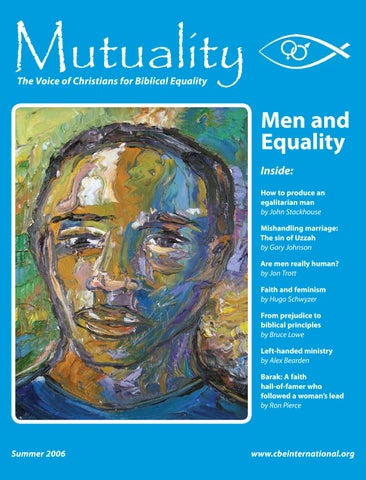
Men and Equality Inside: How to produce an egalitarian man by John Stackhouse Mishandling marriage: The sin of Uzzah by Gary Johnson Are men really human? by Jon Trott Faith and feminism by Hugo Schwyzer From prejudice to biblical principles by Bruce Lowe Left-handed ministry by Alex Bearden Barak: A faith hall-of-famer who followed a woman’s lead by Ron Pierce
Summer 2006
www.cbeinternational.org
Features 5
9
Contents
How to produce an egalitarian man The author of Finally Feminist describes how the work of the Holy Spirit and the examples of men and women resulted in a paradigm shift to egalitarian convictions — by John G. Stackhouse, Jr.
Mishandling marriage and the sin of Uzzah
How well-intentioned messages can actually oppose God because their teachings about family order are unbiblical — by Gary Johnson
11 Are men really human?
cover image
Man with a purpose, by Arthur Robins, 1999, oil on canvas, 18 × 24 in (45.72 × 60.96 cm), Gallery Diamante, Carmel, Calif. On-line at www. arthurrobins.com and www. poolpaintings.com.
A melancholy but not without hope personal reflection on male sexuality — by Jon Trott
14 Faith and feminism: A man’s perspective
How feminist convictions helped a man of faith become a more effective pastor and professor to young men and women — by Hugo Schwyzer
18 From prejudice to biblical principles
A 91-year-old CBE member offers insight based on his life-long convictions about biblical equality — by Bruce Lowe
21 Left-handed ministry
A light-hearted look at determining who is qualified to serve in the church—yes, even left-handed people can be called by God to lead — by Alex Bearden
23 Barak: A faith hall-of-famer who followed a woman’s lead What men can learn about following women leaders from an Old Testament military general who is praised for his faith in the New Testament — by Ronald W. Pierce
Ministry & Chapter News 25 Music, Monks, and Women in Ministry: CBE’s growing outreach at Cornerstone Music Festival
26 Priscilla Papers wins three new awards; Evangelical study group will discuss gender, justice, and the Trinity at ETS annual meeting; Future Events
Departments 3 From the Editor: Start Seeing Human Beings 4 In Our Mailbox 27 Church and Study Group Resources: Study Guide for Lianne Roembke’s Building Credible Multicultural Teams
28 CBE Chapters; Praise Reports & Prayer Requests 29 Giving Opportunities 30 President’s Message: Our true identity in Christ | Mutuality Summer 2006
homepage: www.cbeinternational.org
Mutuality The Voice of Christians for Biblical Equality
Let us then pursue what makes for peace and mutual upbuilding. — Romans 14:19 VOLUME 13, ISSUE 2 Mutuality seeks to provide inspiration, encouragement, and information about equality within the Christian church around the world. President/Publisher : Editor : Graphic Designer :
Mimi Haddad Chelsea DeArmond Image Spigot
EDITORIAL AND ADVERTISING OFFICE Christians for Biblical Equality 122 W Franklin Ave, Suite 218 Minneapolis, MN 55404-2451 phone: (612) 872-6898 fax: (612) 872-6891 e-mail: cdearmond@cbeinternational.org web: www.cbeinternational.org Advertising in Mutuality does not imply organizational endorsement.
SUBMISSIONS Mutuality welcomes submissions. E-mail cdearmond@cbeinternational.org, write to CBE for the writer’s guidelines, or visit CBE’s homepage and follow the Publications links.
PERMISSIONS Christians for Biblical Equality grants permission for any original article (not a reprint) to be photocopied for local use provided no more than 1,000 copies are made, they are distributed free, the author is acknowledged, and CBE is recognized as the source. Mutuality (issn: 1533-2470) is published quarterly by Christians for Biblical Equality and is sent free to members. For membership information, see page 31. To purchase back issues, contact our Editorial and Advertising Office, or order online at www.equalitydepot.com.
From the Editor by Chelsea DeArmond
Start seeing human beings
Who gets to be a human being in our day and age? This may seem like a silly question because the answer is so obvious—everyone! But we don’t have to go back too far in history to see that perfectly rational people have considered others less than fully human on the basis of their gender, ethnicity, or social status. In a 1938 address given to a Woman’s Society, Christian apologist and author Dorothy Sayers famously asked, “Are Women Human?” Her question was motivated by the constant tendency in matters of taste, culture, and occupation for women to be regarded as a member of a class rather than as individual human beings. She believed that work should be done by the person who does it best, regardless of what class of human being that person happens to belong to. Men are not immune to being classified and ranked as something less than human. In the 1960s, black sanitation workers in Memphis, Tenn., were known as “walking buzzards.” Their average pay was $1.80/hour without benefits, vacation leave, or pensions. One rainy afternoon, two black sanitation workers, Echol Cole and Robert Walker, ducked in the back of a garbage truck to stay dry. An electrical short in the poorly maintained truck caused the compressor to start running and the two were crushed to death. Anyone could tell by looking at these workers that they were male human beings. But the treatment they received revealed the truth that they were not regarded as fully human. In 1968 the workers organized a strike to improve their atrocious wages and working conditions. The striking workers wore placards that read simply, “I AM A MAN.” The articles in this issue of Mutuality address the issue of recognizing and honoring others as full human beings on several levels. Bruce Lowe describes his experience of discovering that the equality of all people is more than just his personal conviction—it is a pervasive biblical principle. As Christians, we know that the Bible describes human beings as bearers of God’s own image, as redeemed from our depravity by Christ, and as called and gifted by the Holy Spirit for our work in the Kingdom of God. Any qualification or classification of human worth is against God’s will. Familiarity with these biblical truths is not enough. We need to treat every person we encounter as if these truths from God’s word are wrapped around them reminding us of their worth at every moment. Wrestling with the guilt of male violence against women, Jon Trott questions his humanity as a man, and challenges other men to recognize and respect the full humanity of women. Instead of condemning boys for natural feelings of physical attraction toward girls, Hugo Schwyzer challenges boys to affirm girls’ essential dignity and worth as human beings rather than reducing them to their physical traits. Whether we are looking in the mirror or through a window, the articles in this issue of Mutuality remind us to recognize the value of each human being we see as creatures God has called “very good.” Chelsea DeArmond is Editor of Mutuality and Bookstore Coordinator at Christians for Biblical Equality. She can be reached at cdearmond@cbeinternational.org
bookstore: www.equalitydepot.com
Mutuality Summer 2006 |
In Our Box Visit CBE’s website at
www.cbeinternational.org for the latest… ▶ FREE audio and print resources on biblical equality ▶ Membership information for churches, libraries, families, and individuals ▶ CBE chapters in the U.S. and around the world ▶ Directory of egalitarian churches in the U.S. and around the world ▶ Giving opportunities ▶ Listings for counselors, therapists, and spiritual directors who agree with CBE’s Statement of Faith ▶ Ministry news and needs ▶ Employment, internship, and volunteer opportunities
Mutuality Call for Papers
Mutuality provides inspiration, encouragement, and information about equality within the Christian Church around the world. Mutuality is published quarterly and sent to all CBE members and subscribers. Current and back issue are also available for purchase. We are currently seeking features, reports, and reviews (books, films, and/or music) from evangelical, egalitarian perspectives related to the following topics: • Advocacy vs. Apathy • Worship and Equality • Revival and Equality Most of the articles we publish fall into the following categories: • Personal testimonies illustrating how biblical equality provides practical benefits to everyday lives. • Teaching on relevant Bible passages, explaining the meaning and showing how to apply it to daily life. • Reviews of books about biblical equality that would appeal to a wide audience. (Books must complete CBE’s book service review process before being reviewed in Mutuality.) • Feature stories about issues related to CBE’s mission and ministry. The length of features is generally 1,000–2,500 words. Send articles to the attention of the editor at the postal address below or e-mail to mutuality@cbeinternational.org (if possible, as an attached Microsoft Word document). We are unable to consider or respond to authors who send us more than two pieces at the same time, whose pieces are substantially over 3,000 words, or whose submissions are not sent uniquely to Mutuality. Complete Writers Guidelines for Mutuality are available on our website (www.cbeinternational.org) or contact our office to request a copy. Questions and submissions can be directed to the attention of the editor, Chelsea DeArmond.
Visit CBE’s online bookstore at
www.equalitydepot.com for resources like… ▶ Books and articles ▶ Audio and video tapes ▶ CD, DVD, and MP3 recordings ▶ Sales and specials ▶ New resources, CBE exclusives, and best sellers ▶ Foreign language resources ▶ Become a CBE member or renew your membership and save 15% on every purchase ▶ Registration for CBE conferences ▶ Subscription to CBE publications or purchase back issues of Mutuality and Priscilla Papers
| Mutuality Summer 2006
We’d love to hear from you! Send your comments and critiques to:
Mutuality
122 W Franklin Ave, Suite 218 Minneapolis, MN 55404-2451 phone: (612) 872-6898 fax: (612) 872-6891 e -mail: mutuality@cbeinternational.org web: www.cbeinternational.org Letters may be edited for clarity and brevity.
homepage: www.cbeinternational.org
HOW TO PRODUCE AN
Egalitarian MAN by John G. Stackhouse, Jr. Let’s get a couple of things straight right away. First, I’m a man. I have a hairy chest. I used to be on the football team. I like Bruce Willis movies — at least, the ones in which something blows up, which is most of them. And barbecue is among my favorite cuisines. (Although, please don’t tell the guys on the football team that I used a word like “cuisines.”) Second, I was not always an egalitarian. I was raised in an environment to produce quite the opposite. My dad was a surgeon and a jock and an elder in our Christian Brethren assembly. My mom was a schoolteacher and a homemaker and a — well, we didn’t have titles for what women were in the church: she was just one of the “ladies,” as in “Ladies Coffee Hour” meetings, and “Ladies Missionary Society,” and the like, most of which my mother helped to run. And I was raised in northern Ontario in the sixties and early seventies, a cultural backwater where the waves of feminism were reduced to tiny ripples by the time they lapped up there. So how did I become an egalitarian? Indeed, how did I become an egalitarian who writes a book encouraging other people to become egalitarians? This conversion experience, like all other important and benign conversion experiences, was a work of God. We do not have the ability to convert other people in such deep ways. We can’t even convert ourselves to the goodness we would like to attain. So let’s recognize immediately that any change to egalitarianism of a lasting and proper sort results only from the transformative power of the Holy Spirit of God. I make this point because sometimes we egalitarians act as if we think as follows: “If we can just present the right evidence and the right arguments in the right way, then all will be well.” When the audiences don’t all immediately convert, we redouble our efforts. And when that doesn’t bring in the Kingdom of Peace, we incline to despair. We need to remember that any lasting change of people’s values to those of the Kingdom of God — among which values I do number egalitarianism — is a part of authentic conversion, and conversion is the province of the Holy Spirit, not us. “How to produce an egalitarian man”? Pray that God will do it. This isn’t all there is to be said, however. Indeed, let us invoke the monastic motto, ora et labora: “pray — and work.” God calls us to bookstore: www.equalitydepot.com
work with him in the spread of the Kingdom. So what work shall we do to cooperate with God in his great work of conversion? In my case (and I have been asked to write autobiographically), four kinds of influences made the difference. Two of them had to do with men; two of them had to do with women.
F. F. Bruce was one of the founders of the modern evangelical understanding of the Bible and a dedicated member of the Plymouth Brethren. His essay on “Women in the Church: A Biblical Survey” is available for free at www.cbeinternational.org.
“
If, as evangelical Christians generally believe, Christian priesthood is a privilege in which all believers share, there can be no reason that a Christian woman should not exercise her priesthood on the same terms as a Christian man.
”
“Saint Paul, Apostle of Freedom for Women and Men: An Interview with F. F. Bruce,” by Laurel and W. Ward Gasque, Priscilla Papers 3,2 (Spring 1989): 3.
Mutuality Summer 2006 |
First, I encountered good arguments. I read articles and books that showed me other ways of understanding the Bible’s teaching on gender. Those articles and books were written by men: I remember particularly being helped by Robert Johnston, Ward Gasque, David Scholer, and Berkeley Mickelsen. I was also helped, secondly, by the fact that these men were both scholars and evangelicals. They provided, that is, not just arguments, but examples to follow. Their egalitarianism gave me a kind of permission to consider egalitarianism for myself. Indeed, while he wrote very little on the matter, when I found out (I think through a transcription of an interview) that eminent Brethren scholar F. F. Bruce — than whom no intellectual star shone brighter in our little denominational firmament — supported women in public ministry, it deeply impressed me. “If F. F. Bruce thinks so, well, then: I’d better think about this some more.” This second point, about male role models (for such they were), explains my silly reference earlier to being a man. Men need other men to show them that it’s okay to be egalitarian. We need to know that we’re not giving up anything truly masculine in changing our attitudes
toward women. When so much of our culture (and, I believe, of every culture heretofore and elsewhere) intertwines genuine masculinity with patriarchy — indeed, with the domination of women, so that a “true man” condescends to women, mocks women, enjoys making use of women, and refuses to be importantly influenced by women — then we men can fear egalitarianism as, in fact, emasculation. So the examples of hairy-chested, football-playing, barbecue-chomping men can be important in the conversion experience. (I surmise that this is likely the first time you have ever read a sentence like that.) And, while it’s not clear to me that, say, F. F. Bruce fit that particular description, the key here is that he was, for me, an admirable Christian man, and thus served powerfully as a role model as I stumbled my way toward egalitarianism. Women also, of course, have been providing excellent arguments along the way. Patricia Gundry, Letha Scanzoni, Nancy Hardesty, Alvera Mickelsen, Gretchen Gaebelein Hull, Catherine Clark Kroeger, Mary Stewart Van Leeuwen, Ruth Tucker, Janette Hassey, Elaine Storkey — the list goes on of capable women providing excellent arguments that have confirmed and improved my egalitarianism. Beyond these contributions, however, women have played two other important roles in my move from patriarchy to feminism. In fact, this account is really out of order. Long before I sought out egalitarian arguments against patriarchy, I was being prompted to do so by extended experience that unsettled my reflexive patriarchy. Long before I needed male Christian role models, I was being prepared to entertain and even embrace a different view of gender as I encountered female Christians who were the spiritual equal of men. Indeed, they seemed the equal of men in every way pertinent to leadership in church and society, and to partnership at home. My mother was (and is) herself such a woman: articulate, ambitious, tireless, creative, assertive, self-possessed, inspiring, critical — easily a match for any man I knew on any scale of leadership qualities. As everyone in our family will attest, she has certainly been a match for my dad! And I saw her lead outside the home, in our church, in summer camp programs, on university and civic boards, and more. My mother’s sisters and sister-in-law also provided me with examples of women who simply were not inferior to men, who seemed to me in their respective ways to possess all that was necessary for full partnership in every social sphere. They were certainly feminine in classic ways — warm, nurturing, encouraging, patient, and gentle — but also rational, discerning, insightful, and pragmatic. So why were they supposed to submit to men? I benefited, furthermore, from the work and companionship of capable Christian women in the InterVarsity Christian Fellowship. Staff leaders impressed me as Bible teachers and spiritual directors. Even more impressive to me were my fellow students in high school and university Christian clubs who were at least as godly, intelligent, and capable as any of us young men. And dazzling among these impressive young women was one particular person who became my wife, Kari — a petite, curly-haired cutie whom my family once feared would be dominated by her effusive and overbearing fiancé. They don’t think that anymore! Kari has been a daily reminder to me, for almost thirty years now, that egalitarianism makes sense and patriarchy doesn’t. Women thus provided me with good reasons to become egalitarian in the two ways parallel to what I received from men: in literal
Men need other men to show them that it’s okay to be egalitarian.
“
CBE is doing a wonderful job in promoting biblical balance. I grew
up in a culture that believed that the Bible taught racial segregation. I came to see that the texts that were used to support this view were being grossly misinterpreted. Similarly, I was nurtured as a new believer in a fellowship that believed that women were excluded from certain ministries and that the husband was the ‘boss’ in the home. As I continued to study the Bible, I soon came to realize that these opinions were based more on custom than on Scripture. I enthusiastically endorse the work that CBE is doing in the interest of accurate biblical interpretation. God’s Word is a liberating word!
”
W. Ward Gasque is co-founder of Regent College in Vancouver, Canada. He currently serves as President of the Pacific Association for Theological Studies
| Mutuality Summer 2006
homepage: www.cbeinternational.org
evidence and argument that helped change my mind, yes, but also in personal examples that contradicted patriarchy. The philosopher of science Thomas Kuhn is often cited to help us understand how people undergo significant changes in their thinking — what we call paradigm shifts. Kuhn suggests that we give up our ways of thinking, our paradigms, only under duress. Typically we do so only when we can no longer ignore or accommodate within our paradigms those evidences and arguments that don’t fit — what Kuhn called “anomalies.” Well, the arguments and examples provided by these men and women constituted a pretty big, and ever-growing, pile of anomalies. The collective force of these egalitarian evidences helped collapse my inherited patriarchy and put me in search of a new way of thinking (which I have set out in Finally Feminist: A Pragmatic Christian Understanding of Gender). So far, however, I have spoken about my change of mind as if it was just that: an alteration of intellection, a transfer of rational allegiance from one concept to another. It was that, but it was more than that. It was, as most important conversions are, also a change of heart. Aristotle suggests that the speaker intent on persuasion must employ three modes of speech: logos (appeal to reason), ethos (appeal to a way of being), and pathos (appeal to the affections). From the male scholars I mentioned earlier, I received both logos (good arguments) and ethos (examples of how to be Christian, feminist, and male). From women, I received more logos (indeed, some of the best — both their verbal arguments and also the arguments from their impressive lives), but I also needed to receive, and did receive, the crucial gift of pathos. I needed to feel something of the pain of patriarchy: of being interrupted or ignored in conversation; of being passed over for recognition and promotion; of receiving condescension or suspicion instead of welcome partnership. And I needed to be confronted with their anger, with their refusal to be treated this way anymore. Women have entrusted me with great gifts: their stories and their feelings about what they have been through and continue to encounter. We men will not change until we want to change, and one of the most powerful motives we will have for changing our minds is to alleviate the suffering of the women we admire and love — suffering that is obvious to women but often unseen by us men. I know it seems incredible to women that men can be so obtuse, but people of color will testify that we white North Americans are similarly obtuse about racism. Poor people will testify that we wealthy people are obtuse about financial differences. And tradespeople will testify what we professionals are obtuse about class distinctions. We men just don’t see how we dominate conversations, for instance. We figure that anyone who has something to say will just say it, so those silent women must not have anything to say — and, we conclude, must not be all that bright or all that motivated. We don’t see how our feelings for women can divert and even pervert interactions that are supposed to be constructive and mutually beneficial into erotic games that no one should have to play, and especially not in a work- or church-related context. We don’t see how we unconsciously disregard women’s abilities and interests, and because those decisions are unconscious, the women themselves will never know what happened: They just somehow (again) won’t get the opportunity, or the honor, or the reward they actually deserve.
Brian McLaren was raised in the Brethren Church and is currently Pastor of Cedar Ridge Community Church
“
Increasing numbers of us feel a call to model reconciliation in Christ across old boundaries of discrimination. We believe that the
Bible sets us on this journey, and that quoting select verses to maintain those boundaries is a well-intentioned mistake. CBE has been an encouragement to us all, and I am grateful for their important, needed work.
”
We men need to hear from women about what it’s like to be marginalized, demeaned, disrespected, dismissed. We can be told by other men to shape up, and that can help. Men certainly have responsibility here to speak on behalf of their sisters, on behalf of justice, and on behalf of the greater good that accrues to everyone as women are treated properly. But we will respond more readily to exhortations from both sexes if we feel it, and feel how important it is. We need this powerful impetus to compel us to undergo the strain of actually changing our minds and hearts. Otherwise, we naturally will stay where we are, in the convenient and comfortable paradigms we have inherited. Furthermore, I have needed these testimonies, not just when I was transiting from patriarchy to egalitarianism, but continually, to this very day. My wife has reminded me from time to time, “You’re not as feminist as you think you are.” I used to bristle when she would say that, for I had congratulated myself on being a fully enlightened man, totally emancipated from sexism, and (let’s be honest) a pretty admirable guy. But I have come to see, a little more clearly over the years, just how deeply entrenched are the “gender scripts” that I have tended to follow. I have not “arrived” at entire sanctification and I do not dwell in the New Jerusalem. I continue to mistreat women despite my intention not to do so, and I have concluded that only women can help the situation by notifying me that, yes, you’re doing it again and, no, you failed to do what was appropriate.
We men need to hear from women about what it’s like to be marginalized, demeaned, disrespected, dismissed.
bookstore: www.equalitydepot.com
Mutuality Summer 2006 |
I recognize, of course, that not all men want to be so reminded. All sensible people need to pick their battles and their moments. Many women do not have men in their lives who want to hear what they have to say. So they will have to do what women have always done: press on, regardless, to make the best of their situation, to provide good examples to those women and men under their influence, and to hope for something better, if only for their daughters. Feminist psychologist Virginia Vanian, however, urges women not just to wait for a brighter day, but to speak up now, and particularly about the small things that women tend just to swallow and endure. She points out that repeated small slights constitute large-scale social patterns of repression — that mountains can, in fact, arise out of the accumulation of molehills. So women can and must do something to keep the pattern from being reinforced. Add your anomalies to the paradigm to help collapse it, or it will remain your prison — and, indeed, the prison that disadvantages all of us. Yes, we are to patiently endure each other’s shortcomings and not overreact to the social clumsiness of day-to-day life. But I, as a man, join with Dr. Vanian to plead with women to speak up more, to acquaint us men better with what’s going on and how it pains you. I know it’s discomfiting and I know it’s unfair (“Why, after all we’ve been through, do we have to teach you men such elementary
things?”), but here’s the sober and inescapable truth: If you keep letting patterns persist, then they will persist. We men, of course, have our corresponding imperatives. We must help to create safe places and occasions in which we welcome women to say the hard things, the painful things, the confrontational things that tell the truth about how things really are. We need to brace ourselves for words that will dislodge us from our comfortable seats of automatic privilege. And we must prepare ourselves to act on what we hear, not merely to let women vent and then congratulate ourselves on our magnanimity. For if we listen to women and then do not change, we victimize them twice. And we render ourselves doubly guilty. All of us need both to see and to feel in order to change, and we men need the help of you women. Only then will we, in return, give you the help of our asymmetric social power that is so long overdue. Most of us men really do love you: We just don’t know how to love you as well as we can! We are responsible to sort ourselves out, of course. But may I ask you women to help us, please, become the egalitarian men we want to be. John G. Stackhouse, Jr., is Sangwoo Youtong Chee Professor of Theology and Culture at Regent College in Vancouver, Canada. He is the author of Finally Feminist: A Pragmatic Christian Understanding of Gender (Baker Academic).
“Changing one’s mind about the gender question often requires a dramatic paradigm shift, a new model for thinking about things. Unveiling key moments within his own change of mind, Stackhouse calls the Christian community to think about and rethink the way we understand biblical texts about gender.…This is a powerful and personal book, well worth the reading.” — William J. Webb, author of Slaves, Women, and Homosexuals Discussions about gender continue in many Christian denominations. With good people and solid arguments on each side of the divide, there seems to be little hope for a synthesis or even constructive dialogue.
Finally Feminist: A Pragmatic Christian Understanding of Gender by John G. Stackhouse, Jr. Baker Academic, 138 pages List $14.99 CBE member $12.74 Available at Equality Depot Bookstore Order on-line at www.equalitydepot.com or call 612-872-6898
| Mutuality Summer 2006
In Finally Feminist, John Stackhouse provides biblical, theological, and practical arguments for his own understanding: Equality is the biblical ideal, but patriarchy is allowed and regulated by a God who has larger kingdom purposes in mind. Stackhouse then tests his understanding by exposing it to the objections of other theories and concludes with two appendixes that tease out some practical implications. Thought provoking and distinctive in its clarity and honesty, Finally Feminist will be a useful text for college and seminary courses, for pastors and church leaders, and for anyone interested in deepening their understanding of the role of women in the church and in society.
homepage: www.cbeinternational.org
Mishandling Marriage and the sin of Uzzah
By Gary Johnson
Divorce, domestic violence, school shootings, And just like Uzzah, many of these well- plainly that before the Fall, both husband living together, gay lifestyle, affairs, sexually intentioned messages have ended up opposing and wife were made in the image of God transmitted diseases, unwanted pregnancies, God because their teachings about family and both were given dominion (Gen. and the list goes on… order are unscriptural, forcing husbands to 1:26–28). In fact, this first man and wife The family is definitely under attack. become 24-hour “Supermen” and completely were so completely “one flesh” (Matt. As a result, the last decade and a half has seen benching the wives. 19:6) they even shared the same name! the rise of the pro-family Christian “He created them male and message. Pastors, churches, books, and He blessed them …just like Uzzah, many well-intentioned female, Bible studies, and even whole and named them Adam in the messages have ended up opposing God day when they were created” movements are, with the purest of intentions, working feverishly to (Gen. 5:2; my emphasis). because their teachings about family strengthen the family. Seeking to Without a doubt, the fact that order are unscriptural… motivate apathetic husbands and you and I have never known indifferent dads, some Christian anything but a fallen world makes ministries have anointed men “Prophet, The heart of God has always been the it difficult for us to grasp the depths to Priest, and King,” “Point Man,” and “High “restoration of all things” (Acts 3:21), and which our species has fallen. What was Priest of the Home.” The only problem is, Jesus has restored Christian marriage to perfect and incorrupt in the Garden of these labels aren’t scriptural. its former glorious state of equality and Eden became twisted and marred as fallen This reaction reminds me of Uzzah. mutual submission. As Christians it is men and women struggled to walk out The infamous fall of this well-intentioned vital that we understand this, accept it, their days on this earth. Levite is described in 2 Samuel 6. The Ark and operate accordingly. The Bible tells us Even good men, righteous men, treated of the Covenant, which represented the very presence of God, was being taken back to Jerusalem. David led the way with shouting, singing, and dancing as all of Israel celebrated. But when the oxen pulling the Ark reached the flat threshing floor of Nachon, what should have been smooth sailing turned very ugly very fast. The oxen stumbled, nearly overturned the Ark, and — only wanting to help — Uzzah reached out to lend a hand. But before anyone could say, “Don’t do it!” this man lay dead on the ground. What did Uzzah do that was so bad? How could this man of good intentions — who was merely reacting naturally — have met with such punishment and wrath? What exactly was the sin of Uzzah? To understand, we first have to acknowledge that God and His Word are irretrievably entwined. In other words, when we disobey the Word we are opposing God, regardless of our good intentions. And this is what Uzzah did — while seeking to help God and steady His presence — he actually opposed God and disobeyed His commands by touching the Ark of the Covenant (Num. 4:15). bookstore: www.equalitydepot.com
Mutuality Summer 2006 |
Growing up in the Arkansas Delta, principle the devil abides by. He launches as women like they weren’t much better than cattle. Just look at “righteous” Lot (2 Pet. 2:8). hunting, fishing, football, and fighting many vicious attacks against our daughters, When God sent two angels to visit Sodom were as natural to me as breathing. And our wives, and our sisters as he does against us. before destroying it, Lot thought they were if Christianity were a natural fight—and And if we’ve insisted they live out some fairy ordinary men and insisted they stay the night whippin’ the devil as easy as chasing down tale existence — forever in the tower awaiting at his house. The men of Sodom, filled with some little fella with a pitchfork and pointy their knight in shining armor — they’re perverse lust, cried out for Lot to throw tail who likes dressing in red suits — well gonna get slaughtered. These women of God the two angels out to them. And what did then, you could just stick me and my buddies have to arm themselves with the breastplate Lot do? Demonstrate the self-sacrificing on the frontline and we’d take care of it all. of righteousness, the helmet of salvation, the character of Christ and say, shield of faith, and take up the “Leave them alone. Take me in this battle the baddest warrior on the line often sword of the Spirit as they fight instead!”? No, he says, “Here, the battle beside us. weighs no more 100 pounds, dresses in high heels Yes, the family is under take my daughters!” and gets her hair done every Thursday! Two girls that had kept attack. And yes, restoration is their virginity in the midst of a critical. But the desire of some depraved and wicked city were being offered But this is not a natural fight. Ours is so-called “pro-family” advocates to turn back to a bunch of sexual perverts by their father. a spiritual battle, a to-the-death struggle the clock 60 years to Father Knows Best “Let me bring them out to you and do to “against principalities, against powers, against and Ozzy and Harriet is not the answer, them whatever you like,” Lot shouted (Gen. the rulers of the darkness of this world, because it is not biblical. We need to go back 19:8). What?! It was okay with Lot if this against spiritual wickedness in high places” alright…but we have to go back much further crowd raped and sodomized his daughters, (Eph. 6:2). And in this battle the baddest than just 60 years! Back to the Garden of just so long as they didn’t touch his guests?! warrior on the line often weighs no more 100 Eden, back before the Fall — it is here There was definitely nothing righteous pounds, dresses in high heels and gets her that we discover the perfect will of God for about this treatment of women — a fallen hair done every Thursday! Christian marriage: equality, respect, and mindset which had taken deep root in the The testosterone-driven Gospel of today is mutual submission. cursed ground of Earth. But in the “fullness very appealing to the carnal, fleshly nature. But it Gary Johnson and his wife, Leslie, have been in Christian ministry for of time” (Gal. 4:4) God sent forth His Son, is an unscriptural Gospel in many ways, and one two decades and are the authors born under the Law to redeem us from the that would have benched legendary Christian of Does God Really Prefer Men? Gary curse of the Law. And, in Christ, the curse of soldiers such as Corrie Ten Boom and Mother invites you to visit them on the web Genesis 3:16 is now broken and women are Theresa simply because they were women. at www.doesgodreallyprefermen. once again restored to their rightful position We men may have been taught growing com where you can access his testimony, published of equality with men. up, “you never hit girls,” but this is not a articles, and other great resources.
Introducing new savings for CBE members at Equality Depot Bookstore CBE members can now save 50% on all CBE-produced recordings Members will also continue saving 15% on all regularly-priced resources Join or renew your CBE membership today and browse our selection of audio tapes, video tapes, CDs, DVDs, and MP3s at www.equalitydepot.com
10 | Mutuality Summer 2006
The CBE Scroll http://blog.cbeinternational.org
With new generations growing up around computers, video games, and personal music devices, CBE wants to reach people in fresh ways with the timeless message of biblical equality. CBE now offers The CBE Scroll, a blogging voice of CBE. With a team of experienced bloggers and many relevant topics to address, CBE trusts that this online discussion of gender and the Bible will reach audiences who would not hear of biblical equality otherwise. Please visit http://blog.cbeinternational.org to see The CBE Scroll in action! homepage: www.cbeinternational.org
Are Men Really Human? A melancholy but not without hope personal reflection on male sexuality By Jon Trott
Only the Wind Lives Here, photograph © 2005 Jon Trott
I was born into privilege thrice over. I am white; I am male; I am insecure and overwhelmed by some of my siblings’ maleness. They American. And all that privilege provides me with the shortcut, the were so intense in their teenage hormone-driven toughness; I felt front row seat, the illusion of my own sufficiency. Yet, I need help, and vulnerable and afraid. I need it terribly. How terribly? Let me tell you a little about it. I still remember hearing the little ditty, “Girls are made of sugar I was born the year President Eisenhower pushed through the and spice and everything nice, boys are made of snips and snails first civil rights act since and puppy dog tails.” I hated the civil war. The New York that lyric! I didn’t want to be Times called the 1957 Civil made of snips and snails…I Rights Act “incomparably wanted to be made of honey the most significant domesand cinnamon and all things tic action of any Congress most admirable in a human this century.” But 1957 was being…if that was femininity, also the year that nine black and the other masculinity, high school students went then I opted for the first. through hellish abuse in I did draw a line when my their attempt to integrate a mother enrolled me in ballet Little Rock, Arkansas, high class — imagine that if you school. I knew nothing of can! — I came home after such things; my childhood Growing up in Montana, I got a double-dose of the image of practice, threw my dance was filled with an innocent slippers on the floor, and men as cowboys who hated fences and rode alone. light. said “I’m not doing that any I lived on a farm in the more!” When she asked why, summertime, but in the school year we had a home in the small, I recall having said something like, “That’s for GIRLS!” Two grade almost completely white town of Fort Benton, Montana. school classmates had mocked me, and made me suddenly conscious What I remember about that time was how safe everything felt, how of my “proper” gender role. And so ended my brief career in ballet. solid and reassuring. My parents knew everything that was important As I entered puberty, and began “noticing” girls in that new way, and I happily relied on them. God approved of us, supported us, was I liked very much being male. I liked my body; we were friends. on our side, and had the good sense to appear only when asked for. Thankfully, perhaps due to my parents’ very close love for each other, Women were loyal wives or wives in training, good homemakers, I couldn’t think of sexuality except as relationship. Even my most moms, and supporters of their man’s work outside the home. Men erotic fantasies usually centered on lovemaking as part of a larger were strong, self-reliant, and self-contained. Growing up in Montana, relationship rather than the impersonal sex portrayed by porn. I got a double-dose of the image of men as cowboys who hated fences I had a friend whose pile of Playboys was stashed behind the grill and rode alone. of an air duct in his house. Strangely, I was more affected by how No wonder, then, I identified closely with my mother when cool it was to have an air vent like that — which seemed right out I was young. I liked her attributes. Tenderness. Nurture. Togetherness. of some movie — than I was with the magazines. Their impersonal As one of five boys in our family, the second to the youngest, I felt bosoms sticking out at me, legs arranged to almost but not quite A longer version of this essay was presented July 1, 2005 at the “Gender Revolution” Tent co-sponsored by CBE and JPUSA at Cornerstone Festival in Bushnell, Ill. The full version is available on-line at www.cornerstonemag.com. See pg. 25 for a report on this year’s Festival. bookstore: www.equalitydepot.com
Mutuality Summer 2006 | 11
photograph courtesy of Jon Trott
Bed of Thorns, photograph © 2005 Jon Trott
reveal everything, failed to deeply thrill. Yet the seeds were sown; Maybe somewhere a man has had such an experience, almost being I objectified women, since no other options seemed available. raped by his female date. I don’t know any such men. What I do know, During my thirteenth and fourteenth year I read Eldridge Cleaver both from statistics and from many stories over the years, is that rape and Dee Brown and Claude Brown and Franz Kafka and Anne is overwhelmingly perpetrated by men. Frank — ah! A woman’s voice at last — and in the midst of all those With the teenage sexual awakening came the realization that all I’d oppressed voices I experienced my sexual awakening. There was been told was untrue; or, if any of it was true, I had no idea how to find that something amazingly sexy truth again. Though I stopped about the nobility of the believing what I’d known as a oppressed…and I imagined child, I still struggled with God. myself as the rescuer of many Was he there? Did he love me? women. This patronizing, Or was the world I encountered liberal fantasyland of mine with my senses the only world was not one easily left, and there was? for many years I didn’t even I met him, the Jesus who know it as a fantasy. Nietzsche contemptuously When I was barely called the God of women seventeen years old, I and slaves. I encountered met a dark-haired girl the Father of Love who is from a small Montana both ultimate masculine and town. She was cute, and ultimate feminine, in whose she apparently found me But there is a sense in which I, too, carry a sort of pain image male and female are intriguing. I took her to my created. He was, in what regarding rape.… school prom and we had a some might think a heretical good time at the dance. analogy, a bit like a seductress. Afterward we went back to my parents’ house, where she planned God has more so-called feminine wiles than any woman! to sleep in my sister’s room since my prom date lived too far away But my struggle with maleness wasn’t solved once and for all by to travel home that night. I followed her into the bedroom and loving God. After eight years of marriage, I became a single father attempted some awkward kissing. She allowed it, but discouraged of two girls after my wife left. I discovered that the passive male role me from moving toward second base. I politely disengaged, said I’d adopted during that time was a fake form of mutuality. I had to goodnight, and went to my own room. The next day we parted on become active, especially near the marriage’s end when my children what I thought were friendly terms. seemed to me endangered. Was I being macho? No. I was being The next week I had piano lessons with a music teacher who was a parental in the most elementary sense. mutual acquaintance of the girl and mine. The older woman confronted After that marriage ended, I met a woman who had also been me for attempting to overpower my prom date. I was left with the abandoned by her spouse and we began the difficult process of distinct feeling that the girl believed I had attempted to rape her. I was learning how to mutually submit to one another. At first I was so horrified, I could barely speak to the teacher, but I managed to grate very macho, mostly out of fear of what had happened in that first out a denial. What to me had seemed marriage. I had to realize that my voice like a mutual exchange — and one that wasn’t right just because it was louder. As she had forbidden to go further than it I learned to hear Carol’s voice, I found should have — to the girl had seemed a incredible healing in our mutual love and frightening one-way street where a boy respect. Nearly twenty years have passed she hardly knew cornered her in his since we married. sister’s bedroom to do as he pleased. My marriage to Carol Elaine has been Gradually, despite my initial anger, a place of both healing and challenge to I began to rethink what had happened. my male misconceptions. Carol works That was one of the first times that with homeless women and children in I saw myself as someone physically the Leland House second stage housing My marriage to Carol Elaine has been a project. She comes home in tears over the powerful, who could frighten someone else just with my size and gender. And horrors committed against these women place of both healing and challenge… I hated that. I had no plans or desire by the men they love. to overpower her, yet how could she Being raped was one of Carol’s greatest have known that? Only slowly did I understand the fact that fears as a single woman. She once jumped out of a car, her clothes walking into that bedroom was indeed a major error of judgment torn, in order to run away from a co-worker who offered her a ride on my part. More than bad manners, it was a threatening move home and then tried to rape her. He later bragged and laughed about whether or not I intended it to be. it in front of her with male co-workers. In another incident, a man 12 | Mutuality Summer 2006
homepage: www.cbeinternational.org
Along About Sunset, photograph © 2005 Jon Trott
photograph courtesy of Jon Trott
exposed himself to Carol while she was sitting in a park. After that, a how gently that moment comes and goes — every time we hear the gray streak appeared in her hair practically overnight. newscaster announce another rape in our neighborhood, every time In all of this, I fear I’ve not yet really hit the right combination of a pornographer’s unsolicited email invites us to view women, even words to convey how unutterably sad I feel when confronted with rape. children, being degraded…we, too, become victims. My wife looks at me with such tenderness, even as I’m left feeling she can’t help but blame me a little. She’s never said ——— Epilogue ——— it, but I dimly sense the thought floating there. “All men are potential rapists…even One summer afternoon I pulled into our you.” No, she’s never said it. She would Jesus People USA headquarters, talking deny it if asked. But when I hold her, quietly to God. Our Uptown Chicago I wonder what she feels. Could there be the neighborhood was full of people, an faintest tenseness in her? Could the male urban landscape of rich, poor, black, body — even my body — have become a brown, and white. I felt happy, carefree. symbol of hurt, of fear, of oppression? I pulled onto a side street to park, but But there is a sense in which I, too, just as I turn the ignition off, I heard a carry a sort of pain regarding rape. In a voice. A woman leaned into my passengerterrible way, this assault upon a woman I’m told by Scripture to cherish my wife side window and suggested that for five by a man armed with rage and an erection as I cherish my own body, and so cher- dollars she will do this and that and thus leaves me feeling violated. I want to shout and such. Except what she says is far, far ishing my body is no sin. to every attacker, “That isn’t what a man’s more descriptive. Her words fall on me, body is designed for!” and on my sex, like a truckload of filth. I believe feminists have helped me become a more mature There was no temptation in this for me, no momentary flicker Christian man. This may not be what some would like me to say, but of desire. The woman is old beyond her years, emaciated, and quite I’m not going to lie. One thing they don’t often offer is grace — but possibly ill with AIDS or some other disease. Her words were like since I can get that elsewhere, I have found their unflinching dissection death to me. of my maleness to be terribly painful but not unendurable. Of course It was painfully obvious that what she wanted was drugs, and her I don’t accept everything they say. Andrea Dworkin’s horror of the offer to me was driven by the logic of sex and money. Only moments male body, for instance, would have meant that I had to hate my own before, I had been thinking of what a beautiful day it was, and now I physical being. Why not hate instead the misuse of that body, rather felt as though I had been vomited on. I thought to myself, “Why me? than the body itself ? Why did you say all that to You see, I like my body, me? What is there about me not because it is male, that would make you think I but because it is mine. I would respond to you? Is there think this is a profoundly something wrong with me, do I Christian thing, by the put off some kind of vibe?” way. I’m told by Scripture And then it hit me. to cherish my wife as I This is how women feel. cherish my own body, and This is how it feels to be a so cherishing my body is woman in a man’s world — no sin. Yet each time I the cool male eyes running up hear of a man using his and down your body like they body to violate another own it — the casual comment, human being, I feel my the wolf-whistle, the wink. Yes Lord, I will try to remember. Truly. own body shrivel. This is Men, open yourselves not maleness, this is not to this feeling. Remember it human. At least that’s what I want to believe — but I can’t. Rape is a when you look at your sisters, both the ones in Christ and the ones who male thing, and violating others is a human thing. do not yet know him. Remember this feeling when you look at your As a Christian, I am not stupid enough to think a world can exist, sisters, when you talk to your sisters, when you talk about your sisters here, where my own daughters and sons are safe from these perverse with other men. ideas of maleness and femaleness. True sex is the outcome of mutual This is how women feel. Yes Lord, I will try to remember. Truly. love. Violence is rage, and when the male sex becomes the tool of rage, Jon Trott served as Editor-in-Chief of Cornerstone magazine. His not only are women raped — men who love are victimized as well. writing includes poetry, cultural commentary, nonfiction, and a novel which may or may not ever see the light of day. Jon has been a Every time we look into our beloved’s eyes and see that splitfull-time member of the intentional community, Jesus People USA, second flicker, at that moment we become victims — no matter located in Chicago’s inner city, for the past 30 years.
bookstore: www.equalitydepot.com
Mutuality Summer 2006 | 13
& Feminism
Faith
“You’re what?” “Are you kidding?” “Is that some sort of a joke?” “How do you make that work?” “Aren’t you a walking contradiction?”
These are the typical responses I get when folks find out that I’m an evangelical male college professor who teaches feminist studies. I’ve been teaching courses on history and gender for over a dozen years now; I’ve also spent most of that time as a volunteer leader with my church’s senior high youth group. Both in my career and ministry, I am committed to reconciling what many think can’t be reconciled: feminist principles and Christian faith. I was raised by a single mother who was a devout atheist and an ardent feminist. When she was a freshman in college, my mother read Bertrand Russell’s Why I am Not a Christian. She has rarely questioned her non-belief in the five decades since then. I first came to Christ as a college student in what my family considered an odd act of rebellion. Even though I rejected my mother’s atheism, I still held on to the basic feminist convictions I learned from her. I have remained convinced throughout my academic career and spiritual journey that on the most important issues, I can still call myself a “feminist” even as I define myself as a Christian believer first and foremost.
My feminist background has made me a more effective pastor to the young men and women with whom I work.
14 | Mutuality Summer 2006
A Man’s Reflection By Hugo Schwyzer
When you’re an evangelical man doing gender studies work, of course you’re a real curiosity to both feminists and Christians. Many feminist women, often with good reason, are suspicious of the motives of men who work for the cause. (Men in the feminist movement are usually called “pro-feminist,” because calling themselves “feminists” strikes many as presumptuous.) Many evangelicals are simply bewildered; why would a Christian man devote his career to a cause that seems so opposed to biblical principles? One of the most important ways pro-feminism and Christian faith are indeed compatible is in their shared commitment to helping men become more radically-loving human beings. Both feminism and Christianity oppose current cultural messages that objectify women. In my work as a professor and as a youth group volunteer, I’ve seen this compatibility in practice. My feminist background has made me a more effective pastor to the young men and women with whom I work. Here’s an example: It was May. The weather was getting hot. “Janae” (name changed, of course) wore short shorts, flip flops, and a tiny top to youth group. When we split up into single-sex groups for discussion, some of the boys started talking about what the hottest girl in the youth group was wearing. One of the boys said “Dang, when I look at those shorts all I think is how much I want to ‘hit that’!” (The meaning of “hit that” ought to be clear even for those of you who don’t hang out with the younger set these days.) The other boys all laughed and concurred, and then turned toward me with sheepish grins. Yes, their youth minister was with them, but he was also a man. They assumed that it was okay to objectify women and girls as long as only other men were around — even in church. A younger me would have rebuked them sharply. I could so easily have given them the “Janae is your sister in Christ, boys!” lecture, and tried to shame them. An even less mature me might have validated what they were saying by agreeing about Janae’s attractiveness, if for no other reason than to affirm my own manliness by showing them that I too was, after all, “just another guy” who enjoyed looking at pretty girls. But since the discussion topic for that evening was supposed to be sex anyway, I figured I’d use Janae’s shorts as a teaching moment. So I asked the boys: “What’s it like when a girl like Janae is showing a lot of skin? How does it make you feel?” The replies came fast and furious: “Dude, it’s so awesome!” “I love it when you can see so much!” And, of course “I can’t stop looking!” I let the boys share and laugh and get squirrely, and then I quieted them again. I asked: “When you say you can’t stop looking, what does that mean? Do you really have no choice?” Silence. One boy, “Aaron,” blurted out “No way, dude. No choice. Girl that fine, can’t control my mind.” Other boys laughed and agreed. I waited and then followed up: “Do all of you feel like Aaron feels? homepage: www.cbeinternational.org
None of you think you can control where your eyes go and where your mind goes?” More silence. Then “Roger” spoke up: “I guess it kind of is a choice. I mean, when you first see a pretty girl, you can’t help looking. But you can choose whether or not you keep staring at her legs or her chest. You don’t have to make the girl feel uncomfortable.” Several other boys quickly agreed, and Aaron found himself on the defensive: “I don’t know dude, I don’t know how you can say you really like girls and not be totally distracted by something so fine.” Aaron, bless his heart, was trying to bully the other boys by threatening their masculinity if they didn’t take his side. To my delight, what followed was a serious discussion lasting fifteen minutes. (That may sound short, but getting eight to ten boys in mid-adolescence to have a serious discussion for even that long is, I assure you, a significant achievement!) With a little prodding, the boys discussed their responsibility to control themselves. In the end, even Aaron grudgingly admitted that he too could choose where his eyes went. Roger, his foil, high-fived him and said “Hey, Aaron, welcome to reality!” I said something like this to the boys: “I don’t think there’s anything wrong with noticing girls. I do think there’s something very wrong when your focus on their bodies makes it impossible for you to also see them as people, as friends, as human beings. When you find yourself noticing a girl’s body and staring at her skin, I don’t want you to beat yourself up. But I don’t want you to make her uncomfortable either.” “Next time you’re looking at Janae’s legs, Aaron,” I said, “I want you to remind yourself that she may be ‘hot,’ you are strong enough and good enough to never forget that she is a human being worthy of your respect. You’ve got it in you to always remember that.” Aaron nodded solemnly. I don’t know if he really heard me or not, but other boys did. A couple of them thanked me for what I said and wanted to talk more about the topic. Here’s where Christians and feminists can stand in at least partial solidarity with one another: boys in our culture are rarely told that they have choices about where they ultimately direct their eyes and their thoughts. Both faith and pro-feminism speak prophetically against the myth of inevitable male weakness and the myth of the uncontrollable adolescent male libido. Christians and feminists aren’t in denial about the fact that young men can have very strong sex drives; we do deny that that drive is so overwhelming that it makes it impossible for adolescent boys to see the awesome, priceless humanity of even their most scantily-clad female peers. My goal is to reach young men “where they are” with a message about their sexuality that is realistic, loving, and both authentically pro-feminist and Christian. Whether Janae is wearing sweats or in short shorts, how the boys treat her is ultimately their responsibility. Of course they’ll be more easily aroused by her in short shorts! Yet even if she were to wear a burka, plenty of her male peers would find themselves stimulated by a mere flash of ankle. The teenage libido is a powerful thing, after all. Ultimately, I don’t want anyone, male or female, to feel acutely ashamed of their desires. I don’t expect them never to experience a moment’s lust for one another. But what pro-feminism and Christianity both insist on, even for young men, is that sexual desire, no matter how powerful, cannot be used as an excuse to rob our brothers and sisters of their humanity. bookstore: www.equalitydepot.com
We do well, I think, when we don’t fear all of that raging sexual energy. We do even better to acknowledge it, celebrate it, and then ask that it always be tempered with a recognition of the other’s essential humanity and a deeper understanding of God’s great plan for our sexuality. That’s a far more effective strategy than either demeaning boys for lusting or asking girls to cover up in order to prevent the boys from doing so. Secular feminism and Christian faith view many key issues of morality and identity very differently. But those differences do not preclude the possibility of finding significant areas of common
My goal is to reach young men “where they are” with a message about their sexuality that is realistic, loving, and both authentically pro-feminist and Christian.
ground, particularly around issues of male accountability, sexuality, and the shared conviction that our mothers and daughters, our sisters and wives, are entitled to be seen as fully and completely human. I don’t hide my feminism from my fellow Christians; I don’t hide my faith from the feminists I work with in the academic world. Sure, there are folks in both camps who continue to be bewildered by my apparently contradictory spiritual and sociological commitments. But the teens in my youth group don’t seem to have nearly as much trouble reconciling the two. Hugo Schwyzer is professor of history and gender studies at Pasadena City College. He's a popular speaker and workshop leader on issues ranging from sexual harassment to the role of men in the feminist movement. Hugo also serves as a volunteer youth minister and confirmation class instructor at his church.
Mutuality Summer 2006 | 15
SIDE by SIDE
KEYNOTE ADDRESS richard howell
GENERAL SESSIONS
Gender from a Christian Perspective: Men and Women Dependent on Each Other (1 Cor. 11:11)
Man and Woman He Created Them
CBE Bangalore Symposium Feb. 15–18, 2007
Women in the Old Testament
CBE is joining Pilgrim Partners, South Asia Institute of Advanced Christian Studies, and the Union of Evangelical Students of India for an International Symposium on Christianity and gender.
Dieter Kemmler
Chae Ok Chun
Together: Taking the Gospel to the World David & Robyn Claydon Havilah Dharamraj
Gender, Bible Language, and Culture Examining Changing Trends in the Attitudes of Men and Women Melba Maggay
CONFERENCE SPEAKERS Tehmina Arora is secretary for the
Christian Legal Association of India, an initiative of the Evangelical Fellowship of India. Kuruvilla Chandy is the
Pastor of Grace Bible Church in Lucknow, India. Chae Ok Chun is Dean of the
Graduate School of Theology at Ewha Women’s University in Seoul, Korea. David Claydon is Canon of St.
Andrew’s Cathedral in Sydney, Australia, and of All Saints’ Cathedral in Cairo, Egypt. Robyn Claydon is the Lausanne Movement’s Senior Associate for Women in World Evangelization. Havilah Dharamraj is completing
her Ph.D. in Old Testament at the University of Durham.
evangeline dutta works with the
Christian Medical Association of India; gender in health and development programs is one of her passions.
shantanu dutta has been a devel-
opment practitioner for fifteen years and formerly served as a doctor with the Indian Air Force. christine edwards works with the
Lutheran Aid to Medicine in Bangladesh (LAMB) Health and Development Project.
kevin giles is vicar of St. Michael’s
Chuch (Anglican) in North Carlton, Australia.
16 | Mutuality Summer 2006
Hermeneutics and Gender Mimi Haddad is president of Christians for Biblical Equality (CBE).
Finny Philip
Christian Men and Women: Some Pauline Perspectives Brian Wintle
Richard Howell is the General Secretary of the Evangelical Fellowship of India and the vice-chairperson of the International Council of the World Evangelical Alliance. Dieter Kemmler is a visiting
scholar at Fuller Theological Seminary (USA) and the South Asia Institute of Advanced Christian Studies (India). Melba Maggay is a social scientist at the Institute for Studies in Asian Church and Culture (isacc) in Quezon City, Philippines. leela manasseh is Vice-Chairper-
WORKSHOP SESSIONS Religious Liberty and Gender Tehmina Arora
No Male Gods
Kuruvilla Chandy
Women for God’s Missions Chae Ok Chun
Men & Women Ministering Together David & Robyn Claydon
Gender and Health Development evangeline & shantanu dutta
son of Global Council of Women Leaders of World Evangelical Alliance.
“Heaven at Her Husband’s Feet” …and the Health Consequences
Finny Philip is the Academic Dean
Trinity and Subordination
for the Filadelfia Bible College in Udaipur, India. david selvaraj is the Founder
Director of Visthar, an Institute for Development and Peace Studies.
jamila thomas is a psychiatrist.
christine edwards kevin giles
Social History as a Window into Paul and Women Mimi Haddad
Transforming Societal Views of Gender Melba Maggay
Violence and Women leela manasseh
satish thomas is a senior finance
professional
Brian Wintle is General Secretary
of Asia Theological Association India.
Gender and Bringing Hope to Devadasi (Temple Prostitute) Children david selvaraj
Does Gender Define Roles and Functions? jamila & satish thomas
homepage: www.cbeinternational.org
Conference Registration & Payment Payment Options ► indian subcontinent (India, Pakistan, Sri Lanka, Bangladesh, Nepal, Myanmar): contact the Conference Coordinator at sidebyside. india@gmail.com ► anywhere else: pay by check or credit card in US dollars. Mail form to: CBE • 122 W Franklin Ave, Suite 218 • Minneapolis, MN 55404 ► To register on-line, visit www.cbeinternational.org.
Registration Fee The registration fee includes:
Pre-Conference Tour to Mysore, India
► lodging: Three nights at the Ecumenical Christian Centre from Thursday, Feb. 15 to Sunday, Feb. 18, 2007. View the conference facilities at www.eccbangalore.org. ► meals: Breakfast, lunch, tea, and dinner, beginning with tea on Thursday, Feb. 15 through breakfast on Sunday, Feb. 18. ► All workshops and general sessions. refund policy: Full refunds minus a $50 administrative fee will be granted until Nov. 15, 2006.
Are you planning to attend the CBE conference in February? There is so much to see while you’re in India!
Contact Information
A special tour of the ancient city of Mysore will be available to conference registrants. The tour begins on Sunday, Feb. 11 at 1:30 p.m. and ends on Wednesday, Feb. 14.
___________________________________________________
Day trips will include visits to the former Maharajah’s palace, the Summer Palace of Tippu Sultan, Chaumandi Hill, Srirangipatna historic fort, and typical south Indian villages. The tour will also include a jungle safari to a famous wildlife sanctuary and opportunities to shop at local markets including a silk factory.
___________________________________________________
A $350 pre-conference tour fee covers comfortable accommodations for three nights in Mysore City. Full refunds for tour, minus a $35 administrative fee, will be granted until Nov. 15, 2006. Space is limited so sign up now!
Conference Registration
Important Travel Information If you are planning on attending the 2007 Bangalore Conference and do not have a current and valid Passport, please begin the Passport application process as soon as possible. Requirements to obtain an Indian Visa include possessing a valid Passport for a minimum of six months.
The first 50 people to register will receive a FREE LEATHER TNIV BIBLE! bookstore: www.equalitydepot.com
first and last name
___________________________________________________ street address city
__________________________________ state / province / country _________________________ phone
_______________ zip / postal code
_______________________ e-mail address
___________________________________________________ church denomination
All fees are in U.S. dollars. Please check one: CBE Member (Use the form on pg. 31 to join) Non-Member Full-time Student I would like to join the pre-conference Mysore Tour
□ $300 □ $375 □ $350 □ add $350
TOTAL $ ____________
Payment Method
□ Check/Money Order (payable to Christians for Biblical Equality) □ Visa □ MasterCard □ Discover □ American Express ________________________________________ account number
__________________ expiration date
__________________ verification code (the four digits on the top right corner of American Express cards or final three digits found on the back of other cards) ____________________________________________________________ signature
Mutuality Summer 2006 | 17
From Prejudice
to Biblical
Principles
by Bruce Lowe
A 91-year-old CBE member offers insight based on his life-long conviction about biblical equality Early memories of equality I can’t remember a time when I did not think women were equal to men. My parents’ upbringing must have indoctrinated me before I was old enough to know that some people disagreed with them. What did my parents tell me? My guess is, it was never mentioned. But I clearly remember being impressed when I was very young with my father’s utter devotion to my mother and my thinking that girls and women were about as close to angels as you could get on earth. (My understanding has since expanded, but I still think some of them are.) My father’s sister influenced me. For forty years she was a missionary to Korea. When she came home with us on furlough, I remember her beautiful spirit, her dedication to the Lord and to the Koreans, and my thinking she must be the most wonderful Christian in the world. By definition, anyone Without doubt, women could who has judged without never be inferior to men. Some of my early concepts of enlightenment is prejuequality may have come from my diced. Prejudice is so parent’s frequent reminders that prejudice is wrong. They were ugly. Then I realized… thinking of black people at the that definition fit me! time. One Sunday when I was about ten years old, I remember Mother was downcast after teaching her Sunday School class. Her class of seven-year-old girls sang “Jesus loves the little children…red or yellow, black or white.…” When she asked the girls if it would be wonderful if they could have a little Indian girl, or a little Chinese girl in the class, they were all smiles and answered “yes.” But when she asked about having a little black girl in their class — no smiles, heads down, silence. Through tears Mother said to us, “They are only seven years old!” I feel certain my parents’ abhorrence of prejudice also applied to sexism.
The problem with never questioning equality Forty years ago we joined a church with a woman associate pastor. In those forty years, the church has ordained ten women to the ministry, and I have been blessed to be on several of the ordaining councils. 18 | Mutuality Summer 2006
Thank God, I’ve never had much of a chance to be sexist. But always believing in equality had a negative side. I had never reasoned my way to that belief. I had no clear concept of why I believed it. One day I learned about a group that reached the conclusion that their church should be egalitarian after studying the issue. I realized that sexists were sexist because they had never studied the matter. They had pre-judged it; by definition, anyone who has judged without enlightenment is prejudiced. Prejudice is so ugly. Then I realized…that definition fit me! My judgment, however positive, was made without study. I had pre-judged it, too, even if it was in the other direction. Could I defend being egalitarian? I needed to study. So I did and was greatly rewarded. I am so glad something awakened me.
The transcultural principle of biblical equality As I studied, the sun suddenly burst through the clouds as I came to realize something so simple yet so profoundly true: the equality of women and men is one of God’s great, eternal, unchangeable principles on which all generations are to shape their lives. A Bible principle! Scholars make a distinction between the Bible’s temporary, cultural rules and its eternal, transcultural principles. Many of the Bible’s cultural rules were for the time and circumstances when they were given. As the culture changed, these rules no longer applied. This distinction settled all questions for me. If the equality of men and women is a biblical principle, nothing can contradict it. Nothing. Any verse that seems to contradict a transcultural principle is necessarily a rule that only applied in a particular time and culture. If the scripture says the husband is the head of his wife, whatever it means, it can’t mean that they are not equal. The argument about whether the Greek New Testament word kephale should be translated “head” or “source” becomes irrelevant: if it meant CEO, it would violate the eternal principle; so it has to mean “source”—the husband is to be the source of his wife’s strength and joy. And likewise with every other verse sexists use to keep women from doing anything, just because they are women, that men are permitted to do. The sexists’ interpretations violate the principle of biblical equality and must be discarded. homepage: www.cbeinternational.org
Biblical evidence for the equality of men and women Readers of this magazine already know the biblical evidence that supports the truth of this principle, but I’ll repeat a little of it because we love to read it again.
foretelling the future; it is proclaiming the gospel. Women preached in the New Testament church. If women are to preach, do we not defy God by not permitting them to do so? And if women’s status keeps them from preaching, doesn’t that mean there are two classes of members in the church? Would Christ have a superior class and an inferior class in his church?
Old Testament Genesis 1 and 2 introduce the principle of biblical equality, beginning with the Historical evidence for the equalcreation of Adam and Eve in God’s image. ity of men and women If they were unequal, one of them would not be in God’s image. Elsewhere in the There is much more evidence for the Old Testament, women serve in positions principle of biblical equality, not only of leadership and responsibility with comfrom the New Testament but also from plete acceptance by the people. For examfirst and second century history. Evidence ple: Deborah, the judge-prophet stood in from the early church includes references authority over the entire nation of Israel to women serving as ministers and being ( Judges 4); Esther, in courage and wisdom ordained by the laying on of hands. The ordered the Jews to fast and issued decrees catacombs have pictures of women preBruce Lowe (right) is a graduate of Southwestern Baptist for Israel to obey (Esther 9:32). siding at the Lord’s Supper. Theological Seminary in Fort Worth, Texas (1946), where Women were visited by heavenly beings But the equality sustained in the his wife, Anna Marie (left), also attended. His ministry inand spoken to by God just as men were first and early second centuries was cluded chaplaincy during World War II, pastorates in Loui(Gen. 16:7–14; 21:14–19; Judges 13:3–5, 9). gradually lost. Elisabeth Meier Tetlow siana, and teaching Bible at Louisiana College, Pineville. Women were judges ( Judges 4:4), prophexplains that: etesses (Exod. 15:20; Judges 4:4; 2 Kings 22:14; 2 Chron. 34:22; Neh. 6:14; Isa. 8:3) and counselors to a king As long as servant remained the primary model for Christian and to an army general (1 Sam. 25:32,33; 2 Sam. 14:1–21; 20:14–22). ministry, women were able to minister on the same basis as men. Genesis 21:8–14 tells of Sarah overruling Abraham. The ideal woman When, at the close of the New Testament period, the Christian of Proverbs 31 is an astute business woman who manages the housemodel of servant was replaced by Jewish models of presbyter and hold and is honored for her wisdom and teaching skills. bishop, and in the second century the Old Testament model of Levitical priesthood was applied New Testament to ecclesiastical office, women In the New Testament, the principle of biblical equality continues came to be excluded from the When will all good in the life of Jesus who, to the amazement of his disciples and fury of official ministry of the Church. the scribes and Pharisees, treated women as equals in every recorded Christian people recog(Women and Ministry in the encounter with them. nize the inexpressible New Testament, p. 78f ) Paul’s writing also supports the principle of biblical equality evil of this widespread, in Galatians 3:28, “There is neither…male nor female, for you are Women have proven themselves all one in Christ Jesus,” in his extended statements of equality in 1 pervasive prejudice over and over to be capable of doing Corinthians 7:2–34, 11:4–12, and in his often-repeated principle of anything that men can do of the that is robbing the reciprocity among believers—their submitting to, or being subject mind, heart, and spirit. Did some to, one another (see Rom. 12:10, 14:7, 15:1; 1 Cor. 7:3–6, 11:11–12, Kingdom of capable of you hear Jimmy Carter telling 13:5b, 16:15,16; Gal. 6:2, Eph. 4:16, 521; Phil. 2:3–4; 1 Pet. 5:5; cf. Matt. workers that are so a Cooperative Baptist Fellowship 20:25–28). Assembly about the little Methodist greatly needed? Other scriptures imply it as well. Christians are to yield personal church near his home? It had conrights, as 1 Corinthians 8, 9, and 10 teach (see also 2 Cor. 8:9, 9:4–6, tinued a decline even though a suc10:24, and 12:18). No wonder it has been said that “aside from Jesus, cession of (male) pastors were sent to revive it. So finally a (mere) women have never had a more ardent advocate for full equality in home woman was sent with instructions to close the church as gently as and church than [Paul]” (C. S. Cowles, A Woman’s Place, p. 98). possible. She went. A year later the church was thriving, and she was There is also evidence in the New Testament that women held the preaching to a full sanctuary every Sunday. same leadership positions as men. For example, women prayed and prophesied (1 Cor. 11:4, 5). The New Testament defines prophesying as preaching: in 1 Corinthians 14, Paul teaches that prophesying is Conclusion for “upbuilding, encouragement and consolation” and “edifies the church” (vs. 3, 5); and that “you can all prophesy one by one, so that all When will all good Christian people recognize the inexpressible evil may learn and all be encouraged” (v. 31); and that an unsaved person of this widespread, pervasive prejudice that is robbing the Kingdom may become a believer by hearing prophecy (vs. 24, 25). This is not continued on page 22 bookstore: www.equalitydepot.com
Mutuality Summer 2006 | 19
Christians for Biblical Equality 2007 International Conference Denver, Colorado n August 10–12, 2007
“He will make your righteousness shine like the dawn, the justice of your cause like the noonday sun” (Psalm 37:6)
General Session Speakers Roger Olson Roger Olson is professor of theology at Truett Theological Seminary in Waco, Tex. He has also served as president of the American Theological Society (Midwest Division) and co-chair of the Evangelical Theology Group of the American Academy of Religion.
Jeanne Porter Jeanne Porter has served as associate professor of communication arts at North Park University. She has also taught in the African American Leadership Partnership Program (AALP) at McCormick Theological Seminary in Chicago.
Christopher A. Hall Christopher A. Hall is dean of the Templeton Honors College at Eastern University in St. Davids, Pa., where he teaches in the biblical and theological studies program. He is also associate editor of the Ancient Christian Commentary on Scripture.
Lidija Novakovic Lidija Novakovic is associate professor of biblical and theological studies at Bethel University in St. Paul, Minn. She is also a member of the Princeton Theological Seminary Dead Sea Project.
Workshop Sessions & Speakers Interpreting Paul’s Instructions in 1 Timothy in Light of Ephesian Inscriptions, Artifacts, and Traditions Frank Ritchel Ames
Genesis 1–3: Creation, Order, and Equality Richard S. Hess
Patriarchy Happens Del Birkey
The Great Commission and the Ministry of Women in the Church Keum Ju (Jewel) Hyun
Recovering our History: Antebellum Evangelical Feminist Voices in Condemnation of Slavery Kent A. Eaton
God or Mammon? Tracing the Origins of Patriarchy Carrie Miles
The Eternal Subordination of the Son and the Permanent Subordination of Women Kevin Giles
Women Unedited: The Power of the Authentic Voice Sally Morgenthaler
Work, Church, Ministry, Children… Where’s the Couple?: Pressures on Christian Marriages Today Lynley Giles
Shame and Abuse: Understanding and Healing a Deadly Legacy Steven R. Tracy
The Master Bedroom: Marital Equality in an Unequal World Fred & Heather Gingrich
Emotional Intimacy and Equality: Understanding Ourselves & Each Other Cathy & Phil Van Loon
Ontology, Gender, and Women’s Authority in the Church: Noticing the Particulars Mimi Haddad
Answering Those Who Ask About the Reason for our Hope Cynthia Long Westfall
The Spirit of Deborah: When the Prophetic Leader Is a Woman Elaine A. Heath
Devotional Leader: Reconciliation Meditation Deborah M. Gill
CBE members receive discounts on conference registration Join or renew your membership today at www.cbeinternational.org
20 | Mutuality Summer 2006
homepage: www.cbeinternational.org
Left-Handed
Ministry
by Alex Bearden
I believe that left-handed people are fully capable and called by God for ministry. I believe left-handed people can serve in ordained ministry or any other capacity, just as right-handed people can. However, some oppose left-handers. They believe that God made left- and right-handers equal in essence only, while denying them access to certain vocations. Ordained ministry is for the right-handers only, as the claim goes. Believe it or not, the Bible does portray left-handers in ministry. Take Judges 3:15: “Again the Israelites cried out to the Lord, and he gave them a deliverer — Ehud, a left-handed man…” I’m guessing you have never heard of Ehud, I know I hadn’t until I met a few left-handers trying to respond to their calling.… I grew up in a Lutheran church of the ELCA. My mother was involved in the local church ministry and in other city-wide ministries. I was raised to believe in the full equality of men and women in every aspect of ministry. Why would I question the role of women when many capable, called, and gifted women (including my mother) were doing God’s work all around me? Returning to Ehud, our token left-hander, I should tell you that he helped bring freedom to the Israelites. They had been under the authority of Moab for 18 years. Sure, they were disobedient in the sight of the Lord, but they were fed up with being punished. They had learned their lesson this time, and they wanted God to know! So they cried out for deliverance. God answered their call by sending Ehud, the promised deliverer. But how could a left-hander get rid of that oppressive Moab and their pesky king Eglon? When I started attending Bethel University, I met Christians who thought, lived, and acted like me in many ways. It was refreshing to be in a community of people who cared about serving Christ and pursuing an education at an institution that integrated faith and learning. But I also found disagreement on the issues of women in ministry from some of my fellow students. Some young men were against women in ministry, claiming the Bible limited women’s roles. Some young women believed this too—even some of the women studying in the biblical and theological studies department told themselves bookstore: www.equalitydepot.com
that they could never be pastors despite their gifts in theological thinking and leadership. Suddenly, I needed a defense for what I took for granted. How does the Bible support women in ministry? Ehud decided to present a tribute to the Moabite king, who was of course happy to receive a gift. However, the narrator reveals something to readers that King Eglon didn’t know. Ehud made a double-edged dagger and fastened it to his right thigh under his clothing. After presenting the king with the tribute, and thereby earning his favor, Ehud told him that he had a secret message. Now, if there’s anything kings like more than tributes, it’s probably secret messages. And Ehud had a surprising one.… I devoted my time to studying refutations of complementarian arguments. I even enrolled in an class that explored gender and the Bible, where I was first exposed to the ministry of CBE. My professor offered the exegetical arguments that supported both the egalitarian and the complementarian view. Unfortunately, many dismissed her interpretation as “biased.” But I appreciated the logic of her points based on the biblical text. I read more books, found resources online, and even memorized responses to complementarian claims. I became very good at shooting down arguments that opposed women in ministry. But I forgot something along the way.… Ehud requested privacy so he could share his secret message with the king. The king, eager to receive this revelation, dismissed all the servants and guards. “I have a message from God for you,” declared Ehud, making it all the more juicy. Craving the disclosure, the king stood up. Just then, Ehud reached with his left-hand across to his right thigh and unsheathed the message. He quickly plunged the sword into the king, so deeply in fact, that the handle even got lost in the mass of flesh. (The Bible is a little more explicit, but the curious can read it for themselves in Judges 3:20ff.) Since the servants were waiting outside, Ehud needed to slip out carefully. The Israelites had to respond, and quickly, before the Moabites consolidated power.… What I forgot was my experience. I had forgotten that to me — and many others in the global church — the issue of Mutuality Summer 2006 | 21
women in ministry, and even leadership, was not contested biblically. My experience had led me to the knowledge that women can be fully called by God to serve in any capacity. I focused on responding through argument. This approach is important, but it’s not exhaustive. I failed to invite my complementarian friends to experience the powerful way God was using women’s leadership in the church. Maybe they would have written off such experiences the same way they dismissed the so-called “bias” of a brilliant — and female — professor.… After Ehud off-ed King Eglon, he snuck away without the servants noticing. When they finally decided to enter, they found their king slain. Ehud returned to Israel and blew his trumpet to prepare the army. “Could Ehud have been a “deliverer” for Israel if he were right-handed?” many wonder. Most of the left-handed supporters argue that the Bible clearly shows the full potential and calling of those born left-handed. The guards would have frisked the left leg, where right-handers would have hidden weapons. So only a left-hander could have fulfilled God’s will. Right-handed supporters are quick to respond that God only used a left-hander in that particular situation because no right-hander was available. “The left-handers are always God’s second choice,” they claim. Doesn’t such a debate forget that God used Ehud, regardless of whether he was the first or second choice? Entering seminary at Princeton, I encountered less resistance to women in ministry. Considering that just under half of my peers are women, I would hope that everyone can see the potential of these women. They are called and capable, and perhaps even over-qualified for many ministry positions. However, even if many seminaries, like Princeton, educate nearly equal numbers of men and women, the struggle in the church remains. Due to the theological restrictions of women in many denominations, people are not given the opportunity to experience the leadership of these seminary-educated women. Israel experienced 80 years of peace after their victory over Moab (v. 30). But as most biblical stories demonstrate, the Israelites soon forgot their deliverance. Canaan became the new oppressors after the death of Ehud; Israel cried out again to God and God brought a deliverer: the prophet Deborah. She commanded Barak to assemble ten thousand men and led them continued from page 19 of capable workers that are so greatly needed, not to mention robbing women of their call from God? Does Satan laugh, knowing he doesn’t have to do a thing to bring this about; he can let God’s people do it for him? Prejudice means judging without study, without facts, without enlightenment. Pre-judging. Obviously the cure is enlightening the unenlightened. But this is disheartening; the prejudiced see no need for study. What can we do besides pray and weep? Could denominations do more to teach the truth about biblical equality? Could pastors preach more about the evils of prejudice and sexism? Could church leaders have the same expectation that young women will be called to preach, just as they expect young men to be? Would a series of small 22 | Mutuality Summer 2006
into battle against Sisera, the commander of the army of Canaan. He replied that he would only go if Deborah would go also. Upon consenting, Deborah also prophesied something else: “But because of the course you are taking, the honor will not be yours, for the Lord will deliver Sisera into the hands of a woman.” In many ways, Israel’s experience with women leaders is similar to my own. The narrative does not find Barak questioning Deborah on grounds of gender. Rather, he knows she is one who brings the Word of God. His obedience does not make him weak or submissive to women, but to God. It is God who provided the orders and the deliverance. The glory being given to a woman serves to teach both Barak and Deborah that the glory of victory is not their own, but God’s. Whether it is women or men in leadership, all are servants of God. A leader is only capable in the ministry of the church as long as they are willing to submit themselves to God’s Word. And as the Bible teaches us, both women and men have shared in that very capacity.
God uses people who are right-handed and left-handed. God uses men and women. God doesn’t use women as a second choice any more than God doesn’t use left-handers as a second choice. Admittedly, there are no such groups as the left-handers and the right-handers, because it is a little silly to think that being lefthanded could ever discredit someone’s ministry. Being left-handed is circumstantial, like being a woman, and that alone will not dictate the extent to which God is able to work in and through someone. What our academic arguments might lose sight of is the simple and empirical evidence: we have women pastors, and women serving in all other areas of ministry. While we can argue back and forth about what is biblical, we could also allow ourselves to experience the powerful ways in which God is already using women in the church today. Alex Bearden is an M. Div. candidate at Princeton Theological Seminary in Princeton, N.J. This summer he is researching, writing, and speaking on behalf of CBE in conjunction with the Department of Field Education at Princeton. Alex enjoys reading philosophy, writing, traveling, and rugby.
group Bible studies on prejudice and sexism help some people and churches? Could church libraries add books about biblical equality to encourage people to study the subject? If a discussion board were added to the church’s website, could members participate in on-line discussions about biblical equality, perhaps with a resource person or panel to moderate? Do women need to be added to deacon and elder boards? Is a special effort needed to add a woman to the church staff—and don’t most churches need one anyway to minister to the church’s women since men sometimes can’t? I wish all of you could have a church like the one where I am a member. On a recent Sunday, ten deacons served the Lord’s Supper and half of them were women. I fear my church is one in a thousand Baptist churches. Ten thousand? Dear God, how long? How long? homepage: www.cbeinternational.org
BARAK
A Faith Hall-of-Famer who Followed a Woman’s Lead
by Ronald W. Pierce
What does it take to be included in the Hebrews “Hall of Faith” (Heb. 11:1– 40)? How could anyone hope to stand shoulder-to-shoulder with such notables as Abel the righteous (Gen. 4:1–10; Matt. 23:35); Enoch who walked faithfully with God (Gen. 5:22–24); saintly Noah who was graced with the Lord’s favor (Gen. 6:8); Abraham and Sarah who believed against all odds that God’s promise was certain (Gen. 15:6; 21:1; 22:12); Moses the friend with whom God spoke faceto-face (Num. 12:6–8); Samuel who was respected for his integrity from Dan to Beersheba (1 Sam. 3:20); and King David, a man after God’s heart (1 Sam. 16:7; Acts 13:22). The inspired list goes on to name a total of sixteen men and women, including Deborah’s military general, Barak ( Judg. 4–5). All of these are commended for their faith, true heroes of whom “the world was not worthy” (Heb. 11:38). In contrast to many of the others in the Hebrews list, we are not told exactly what Barak did to demonstrate his extraordinary faith. But, thankfully, the account of his work under Deborah, the respected prophet and judge, in Judges 4–5 provides helpful clues to answer this question from the Scripture.
Deborah: God’s prophet and judge Understanding Deborah’s position as prophet and judge in ancient Israel is critical to evaluating Barak’s response to her leadership. As a prophet, Deborah received the inspired Word directly from God; then, bookstore: www.equalitydepot.com
© 2006 The Providence Collection
Mutuality Summer 2006 | 23
in turn, she delivered it to the people of God. In other words, she spoke with divine authority — not her own. She addressed her audiences having been anointed with spiritual power as an ambassador for the one true God of Israel. People were expected to listen — and they did! Moreover, Deborah had an established base of operation at Israel’s central crossroads (between Ramah and Bethel in the territory of Ephraim), where people from across Israel sought her out to decide on domestic disputes too difficult for local tribal judges. Deborah’s successor Samuel chose this same place for his headquarters not too many years later. Both were highly respected as regional judges. As with their prophetic ministries (Deborah and Samuel), their position as judges carried a great degree of authority. When they passed judgment on a case, their ruling was binding. But, as a wise and discerning leader, Deborah also knew when to seek a ministry associate to complement her own exceptional giftedness. On this occasion she sent for Barak from the northern Galilee territory of Naphtali (over 100 miles north of where she ministered). Barak was chosen to lead Israel’s troops into battle against the Canaanite coalition that seriously threatened his region. So, why choose Barak? Maybe it was because his local reputation enabled him to muster an army of 10,000 warriors on short notice. Or, it may have been because he knew the Galilee region well, where the battle would take place, and could plan the specific military strategy from the local vantage point high atop Mt. Tabor. Deborah ministered in the central hill country and most likely would not have been familiar with the terrain in Galilee. Certainly, Barak’s physical strength as a man would have made him a better fit for the vicious hand-to-hand combat required against the Canaanite general Sisera and his 900 iron chariots. Yet, beyond these reasonable speculations, the biblical text points to other inner qualities in this man, ones that show him to be the “man of faith” for which he is remembered by the New Testament author of Hebrews. Let’s look closely at what it says!
Barak: The general who served God’s chosen leader When Barak hears Deborah’s prophetic voice ordering him to battle, he responds, “I’ll will go, but only if you go with me” ( Judg. 4:8, nlt). Why does this man of faith insist on having Deborah along on his mission? The text gives us the clue: she is a prophet of God who can provide divinely-inspired military advice if a field decision is needed in the heat of battle (compare with King Jehoshaphat and the prophet Micaiah in 1 Kings 22:1–28; 2 Chron. 18:4–27). These are not the words of a coward merely wanting a woman to hold his hand! On the contrary, they reveal the heart of a courageous man of God, ready to obey, as soon as he’s sure that God will guide him. Thus, Barak demonstrates his heart of faith by submitting to God’s chosen leader — yes, even a woman! But, the general’s chosen path will not be easy to travel; nor will it bring him personal honor. In fact, our brave prophet responds, “I will surely go with you [at great personal risk]; nevertheless the road on which you are going will not lead to your glory, for the Lord will sell Sisera into the hand of a woman” ( Judg. 4:9; nrsv). Barak’s willingness to submit to the voice of God — especially when it has a feminine tone — is nothing short of amazing. By doing so, he shows respect to Deborah’s prophetic ministry by obeying God’s authoritative Word delivered through her. Moreover, he is willing to risk his life 24 | Mutuality Summer 2006
against a significant military force knowing in advance that credit for the promised victory will go to yet another woman! (You can read the story of Jael, another capable woman of valor in this text, for yourself in Judg. 4:17–22.) The willingness of Barak and Deborah to forego personal glory speaks to their humility. Certainly she had initiated the plan; and, he carried the weight of responsibility in the mission. But, both are quite willing to give Jael the honor — and, by doing so, give God the honor. In the end, they sing a song of victory (Judg. 5:1–31), in which Deborah is remembered as a “mother in Israel” who arises and commands the people (Judg. 5:7–8). And, the land experienced peace for forty years.
Walking in Barak’s footsteps Several enduring lessons present themselves to those of us who have the privilege of serving under the leadership of godly Christian women in the church. My wife and I have personally welcomed this opportunity in the Whittier Area Community Church here in California where four of our full-time pastoral staff are women. Warmly embrace the leadership that godly and gifted women provide. There is no hint of hesitation discernible in the story of Deborah and Barak on the part of the people who sought Deborah’s council or on the part of General Barak who obeyed her orders. All recognized her gifts and calling and responded appropriately. It’s time our evangelical churches move past the mere acceptance of women in ministry and begin to genuinely encourage them. Be willing to serve in a secondary role when God has called a woman to the primary role. God chose these leaders to serve at a critical time in Israel’s history. Israel was paralyzed with fear until Deborah inspired the nation with her courage and faith (Judg. 5:7). As a godly man of faith, Barak was happy to be part of her leadership team. In fact, his insistence on her presence in the battle shows just how much he valued and honored her leadership. Move past the worldly stigmas and stereotypes related to gender. Certainly Barak felt the social embarrassment in his patriarchal world of both serving under a woman and allowing the credit for victory to go to a woman. But, a man of faith does not let these pressures deter his commitment to obey God’s will as it is delivered through God’s ambassador. In short, when God speaks with a feminine voice, listen! During my time in ministry (over 40 years now), I have heard a number of Mother’s Day sermons on Deborah. But, I cannot recall one Father’s Day sermon on Barak. In fact, when he is mentioned, he is usually stereotyped as weak and cowardly because of his response to Deborah. But this is not the view of Scripture! The Old Testament text presents him as a great military leader who honored Deborah’s leadership, and the New Testament remembers him as a hero of faith! As a man, I strongly encourage other men (and women) reading this essay to take Barak’s example more seriously and honor the women leaders in your life. Ronald W. Pierce specializes in biblical theology with an emphasis on the Old Testament and Gender Studies. He teaches in the Talbot School of Theology at Biola University and has co-edited Discovering Biblical Equality (IVP 2005). Ron and his wife Pat live in Fullerton, California and have two adult children. homepage: www.cbeinternational.org
Ministry & Chapter News
Music, Monks, and Women in Ministry CBE’s growing outreach at Cornerstone Music Festival by Leah Welch The Gender Revolution Tent at Conerstone Music Festival had higher attendance this year than ever before. Several workshops were filled to capacity and hundreds of free articles and other resources on biblical equality were distributed. This is the fifth year Christians for Biblical Equality and Jesus People USA ( JPUSA) have co-hosted the Gender Revolution Tent at Cornerstone Music Festival. More than 30,000 people of all ages travel to this fourday summer festival held in rural Illinois in the middle of 500 acres of cornfields. After setting up camp, attendees can listen to their favorite Christian bands, participate in lively discussions at the seminars, drive golf carts through the dust, and maybe even leave with new dreadlocks. A ministry of JPUSA, Cornerstone is a gathering of diverse Christian groups and a celebration of the beauty, creativity, and community present in Christ’s body. CBE co-hosts the Gender Revolution Tent at Cornerstone in order to share the important message of biblical equality with Christians who might otherwise be overlooked by the Church. There are many opportunities to encourage people who have been hurt by hierarchy in their lives and to offer resources to people who are wrestling with the question of equality in their churches and homes. The Gender Revolution Tent offered workshops, panel discussions, a series of sermons preached by women, and resources from Equality Depot Bookstore. CBE staff members and volunteers were also available to discuss issues and answer questions. Workshops covered a broad range of topics related to biblical equality including church history, trinitarian theology, Christian literature, and biblical interpretation, as well as evangelical responses to issues of gender injustice, such as rape and sexual trafficking. CBE staff member Julia Butcher offered a personal reflection and critical analysis of the books Wild at Heart by John Eldredge and Captivating by John and Stasi Eldredge. Tim Vanderpool addressed pervasive misconceptions about the Godhead and presented the orthodox view of a non-hierarchical Trinity. bookstore: www.equalitydepot.com
Cornerstone attendees fill the Gender Revolution Tent and read along in their Bibles during a workshop led by Bill and Aída Spencer. Marriage panelist and JPUSA member Jon Trott commented, “Aída Spencer’s incredibly in-depth biblical study on women in leadership roles made this year worthwhile all by itself.” Visit www.cbeinternational.org for audio clips, photos, and more information about Gender Revolution workshops.
In line with CBE’s addition of a gender justice component in our ministry, JPUSA member Sarah Sullivan shared her experience as a survivor of violent rape who further endured a devastating struggle to find justice through the legal system. Powerful workshop topics were not the only thing that drew curious festival attendees to the Gender Revolution Tent. Each day at noon, CBE staff donned “monk” robes (made by CBE’s own Phyllis Schindeldecker) and processed through the crowded lunch area singing, “Come, Holy Spirit” in Latin and carrying a cross and a Bible. The procession included the woman preacher of the day, hands bound and mouth gagged. The group returned to the tent to release the preacher from her restraints and hear her message. On the last day of the festival, CBE friends and
tent visitors shared communion. While much of the response to CBE’s presence at Cornerstone was positive, the Gender Revolution Tent did encounter some dissention. Overall the conversations were edifying. CBE staff member and Cornerstone speaker Alex Bearden said, “We appreciated the honest questions and willingness to dialogue of some who did not fully accept our message.” I am personally thankful for the many stories I heard and lessons I learned while participating with CBE at Cornerstone this year. The encouragement and grace that so many people gave to one another was outstanding, and I will gladly echo JPUSA member and CBE friend Glenn Kaiser, who said, “To all the CBE staff, speakers, and volunteers, thanks again for another excellent year at Cornerstone Festival!” Mutuality Summer 2006 | 25
Ministry & Chapter News
CBE’s journal Priscilla Papers wins three new awards For the fourth year in a row, CBE publications received Higher Goals Awards from the Evangelical Press Association (EPA). Priscilla Papers journal received an unprecedented three awards at this year’s EPA convention in Orlando, Fla., May 7–10. Award-winning articles for 2005 include:
▶ Biblical Exposition, 2nd place: “Correcting
Caricatures: The Biblical Teaching on Women” by Walter C. Kaiser, Jr., former Professor of Old Testament and President of Gordon-Conwell Theological Seminary ▶ Critical Review, 5th place: A review of John Eldredge’s best-selling book, Wild at Heart (Nelson Books 2001), by Gordon College students Brynn Camery-Hoggatt and Nealson Munn ▶ Poetry, 5th place: “The Color of Light,”
Future Events Please be in prayer over CBE preparations for the following events. Visit www.cbeinternational.org for updates.
▶ CBE will host a booth at the Annual
Meeting of the Evangelical Theological Society in Washington, D.C., Nov. 15–17, 2006.
▶ CBE will host a booth at "The Gathering:
Women with Ministry in Focus," the Assemblies of God Women in Ministry Conference in Minneapolis, Minn., Sept. 21–22, 2006.
▶ CBE board meeting in Minneapolis, Minn., Oct. 19–22.
▶ CBE will host a booth at the National
Church Libraries Association Conference in Bloomington, Minn., Nov. 2–4, 2006.
▶ CBE will host workshop sessions at InterVarsity’s Urbana missions conference in St. Louis, Mo., Dec. 27–31, 2006.
▶ CBE will co-sponsor a symposium on
biblical equality in Bangalore, Feb. 15–18, 2007. See information and registration on pgs. 16–17.
▶ CBE’s 10th international conference will be held in Denver, Co., Aug. 10–12, 2007. See advertisement on pg. 20.
26 | Mutuality Summer 2006
by Victoria Peterson-Hilleque, former acting editor of Priscilla Papers In addition to these, Priscilla Papers has also won four other EPA High Goals Awards from previous years. The twentieth anniversary issue of Priscilla Papers will be published autumn 2006. Mutuality won its first two EPA Higher Goals Awards in 2005. These honors commend the high quality of CBE publications and highlight both the popular and academic appeal of CBE’s ministry. All award-winning articles are available for free at CBE’s website, www.cbeinternational. org. Priscilla Papers and Mutuality are each published quarterly and are free for CBE members. See pg. 31 or visit CBE’s website for membership and non-member subscription options. CBE is the largest clearing house in the
world for resources related to gender and the Bible. It also publishes E-Quality, a free online journal, and The CBE Scroll, an online blog (blog.cbeinternational.org). Equality Depot (www.equalitydepot.com), CBE’s online bookstore, provides books, articles, recordings, and other resources related to biblical equality.
Celebrating 20 Years The 20th annivesary issue of Priscilla Papers will be published this autumn
Evangelical study group will discuss gender, justice, and the Trinity at ETS annual meeting Egalitarian and complementarian scholars will discuss evangelical perspectives on gender and justice, the doctrine of the Trinity, and other topics at the 2006 Evangelical Theological Society annual meeting in Washington, D.C., Nov. 15–17. The sessions will be hosted by the Evangelicals and Gender Study Group, which provides a scholarly forum for exploring gender in the church, home, and world from theological, biblical, historical, and pastoral perspectives. The Study Group is co-moderated by an egalitarian, CBE president Mimi Haddad, and a complementarian, Phoenix Seminary vice president of academic affairs Steve Tracy. In October of 2005, CBE revised its mission statement to include its commitment to the biblical call to justice (see pg. 31). The Evangelicals and Gender Study Group provides a venue for further articulating this conviction in dialogue with leading egalitarian and complementarian scholars. In addition to the inerrancy of Scripture in its original autographs, the following belief is identified as a core doctrine of the ETS: “God is a Trinity, Father, Son, and
Holy Spirit, each an uncreated person, one in essence, equal in power and glory.” The Evangelicals and Gender Study Group will explore what, if any, implications our understanding of intra-trinitarian relationships has for interpersonal relationships between men and women. Some complementarian scholars have proposed that a subordinationist understanding of the Trinity, in which God the Son is eternally subordinate to God the Father, provides theological precedent for a hierarchical understanding of relationships between men and women. Egalitarian scholars question both the orthodoxy of this view of the Trinity, and the logic and/or ethics of its application to human relationships. Author Kevin Giles will present a paper for the Evangelicals and Gender Study Group on the Trinitarian doctrine of God and its relationship to the current gender debate as part of an autumn lecture series hosted by CBE. Giles (Th.D., Australian College of Theology) is vicar of St. Michael’s Church (Anglican) in North Carlton, Australia. He has also served as a minister and consulting theologian for World Vision Australia. homepage: www.cbeinternational.org
Study Group Resources
B uilding C redible
Multicultural Teams Welcome to the second installment of our Study Guide on Lianne Roembke’s book on developing valuable skills for cross-cultural team ministry. Building Credible Multicultural Teams
Chapter 2—Credibility Factors in Communicating the Gospel
By Lianne Roembke William Cary Library • paperback • 287 pgs.
Jesus’ example of the attitude and adaptation needed to ensure the correct understanding of his message gave him credibility with the people to whom he was sent. Give examples of Jesus’ empathy and participation in people’s lives. Jesus’ incarnational “sending” came with a cost. In what ways do self-control and self-denial contribute to the missionary’s credibility? What is the true motivation for ministry or serving? Compare Jesus’ ministry with missions today. Discuss how cultural habits and personal preferences may impede communication of the Gospel. How do multicultural teams help filter out “cultural baggage?” Discuss the problem of transferring the culture along with the gospel—how can multicultural teams help or hinder? How important is learning the local language? In what ways does this contribute to the missionary’s credibility?
List Price: $17.95 CBE Church Membership Price: FREE! Writing from more than twenty-five years of experience with multicultural teams and training others for cross-cultural ministry, Lianne Roembke addresses the challenges of forming multicultural missions teams. Concentrating on both interaction between team members and the team’s interaction with the host culture, this book identifies and clarifies credibility factors as well as problem areas of multicultural mission teams.
Chapter 3—Adjustment of the Missionaries to the Host Culture The adjustment process during the initial entry into a new culture brings with it many stress factors. List positive and negative effects of stress. Discuss appropriate ways of coping with culture shock. What reactions to stress impede mastering the host culture’s language? What actions contribute to adaptation? The essence of cultural adjustment is removing cultural obstacles that hinder communication of the Gospel. Discuss four phases of adjusting to a foreign culture. Missionaries must identify with Jesus in his incarnation and suffering on the cross, and also with the people they serve. What biblical principles apply to Christians living together? Cite scriptures. Missionaries must become enough of an insider to be considered credible, and to become a valuable person in the host culture. Discuss challenges missionaries face in accomplishing this goal. What did the apostle Paul say about his “credentials” for preaching the Gospel? Some change is necessary for credibility. How far can missionaries go to adapt without hurting their identities? Give examples from Scripture ( Jesus, Paul, others). How is knowing Christ worth the pain of this adjustment? What are some ways missionaries can evaluate which changes are necessary for credibility, which are neutral, and which would discredit the message of the Gospel? bookstore: www.equalitydepot.com
also available
Empowering Women & Men to Use Their Gifts Together in Advancing the Gospel Lausanne Occasional Paper No. 53, Issue Group No. 24, Alvera Mickelsen, editor CBE 2005 • Available in print or CD-ROM
List Price: $11.99 CBE Church Membership Price: $10.19 In this Occasional Paper from the 2004 Lausanne Committee for World Evangelism’s Gender Forum, over 30 international participants address the foundations for men and women in ministrypartnerships around the world.
Mutuality Summer 2006 | 27
Praises & Prayer Requests CBE Chapters Find out how to join a CBE chapter in your area—or start your own! Starting or joining a CBE chapter is a great way to get more
involved and meet people who share your passion for mutuality in the church, home, and world. CBE chapters promote biblical equality in their communities by holding regular meetings, conducting Bible studies, hosting booths at local events, visiting colleges, and more. If you are interested in learning more about CBE chapters, visit www.cbeinternational.org or contact cbe@cbeinternational.org. Chapters that are established and meeting regularly United States Chapters California • Greater Los Angeles, Santa Cruz County, South Bay/Peninsula, San Diego Colorado • Pike’s Peak/Colorado Springs Connecticut • Hartford District of Columbia • National Capital Florida • Tampa Bay Illinois • Greater Chicago, Wheaton College, Greenville College Michigan • Grand Rapids Minnesota • Twin Cities New York • New York/Smithtown/Long Island Oregon • Greater Portland Pennsylvania • Philadelphia International Chapters Australia • Melbourne Canada • Toronto England • London Norway • Oslo South Africa • Port Elizabeth Chapters that are forming or are in-process United States Chapters Colorado • Denver Georgia • Atlanta/North Georgia Idaho • Lewiston/Moscow Massachusetts • Greater Boston Missouri • Kansas City Nevada • Reno Ohio • North Central Ohio Texas • North Texas Wisconsin • Milwaukee International Chapters Australia • Western Australia Canada • Vancouver Japan • Tokyo New Zealand • Christ Church Scotland • North Scotland Uganda Contact cbe@cbeinternational.org if you are interested in becoming involved.
28 | Mutuality Summer 2006
Praise God with us for… •
Safe travels and successful outreach at the Gender Revolution Tent at this year’s Cornerstone Music Festival.
•
The speakers, authors, and artists who help spread the word about biblical equality through their contributions to CBE conferences and publications.
•
CBE’s quarterly journal, Priscilla Papers, which is celebrating its 20th year of publication and which received three new Evangelical Press Association awards this year.
•
The CBE Scroll blog (http://blog.cbeinternational.org), our newest communication medium, is continuing to spark more insights and interest in biblical equality.
“So God created humans to be like himself; he made men and women.…God looked at what he had done. All of it was very good!” (Gen. 1:27, 31 cev). God sets the standard for human equality—and it is very good.
Pray to God with us for… •
The ongoing transition to a new database which involves extensive planning and training. We are praying for wisdom and skill as we transfer important data so we may better serve you and others!
•
Attendees at Cornerstone Music Festival who participated in workshops at the Gender Revolution Tent and received free articles and other resources on biblical equality through CBE’s outreach.
•
Outreach at the Evangelical Theological Society annual meeting this November, that we would facilitate fruitful dialogue and provide helpful resources on biblical equality to the evangelical leaders who attend.
•
Conference registrations for Side by Side, the 2007 international symposium in Bangalore, India.
•
Summer interns who are writing grants to help fund CBE publications and other outreach ministries so we can spread the important message of biblical equality.
“Treat others as you want them to treat you.” (Matt. 7:12a cev). If everyone, especially Christians, truly did this in every aspect of life, would there be a need for Christians for Biblical Equality? Scriptures and meditations are provided by Susan McCoubrie, one of the founders of CBE and retired staff member. Prayer items are recorded during daily staff prayer.
homepage: www.cbeinternational.org
Giving Opportunities Receive a life-long income and tax savings while helping CBE!
Charitable Gift Annuities CBE is partnering with the Christian Community Foundation (CCF)* to offer a giving opportunity that balances security and flexibility—without compromising generosity. This opportunity is the Charitable Gift Annuity. You can make a gift of cash, securities, or other assets in exchange for fixed lifetime payments. At your death, the remaining value benefits the mission of your recommended charity. This giving opportunity ensures income for your future, tax-benefits both now and later, and support for your favorite non-profit organization.
Benefits
• Security—Your fixed payments will not change, regardless of whether interest rates rise or fall. • High rates of return—Your annuity payments may be considerably more than you are presently receiving. • Tax benefits both now and later. • Flexibility—You choose immediate or deferred payments and frequency of payments…quarterly, semi-annually, or annually. • Provide for yourself and one other…your spouse, a special needs child, a parent. • Support your favorite charities—Your recommended charity may receive both an immediate gift and the portion left at the maturity of the agreement.
Your Next Step
• Notify CBE of your interest in setting up a gift annuity and we will connect you with the Christian Community Foundation (CCF), who will walk you through the process. You can also contact CCF at www.thefoundations.org or (719) 447-4620 for a confidential gift annuity proposal. • Check with your attorney, accountant, or financial advisor about how a Charitable Gift Annuity might fit into your total financial and estate planning. CCF will work with them, and you to achieve your charitable objectives. *The Christian Community Foundation (CCF) has a vision to glorify Jesus Christ by inspiring and enabling personal commitment of time, talent, and treasure to the expansion of the Kingdom of God. Both CBE and CCF are members in good standing with the Evangelical Council for Financial Accountability (ECFA), and have agreed to abide by the ECFA Standards of responsible stewardship, financial integrity, and Christian ethics. bookstore: www.equalitydepot.com
Supporting CBE’s vision of restoration and redemption I am a second-year student at Bethel Seminary. I am a member of CBE because I believe in its vision. I love Jesus Christ and in him have found life. Since I was a small girl, I was encouraged to love God and know him more fully. It never occurred to me that God's love or calling on my life differed because I was female. John 3:16 was my reality—a reality I called others to adopt as well; that God, who loved us so much he sent his only son so that, through him, we might know life. Yet too often in the body of Christ we do not recognize that both men and women are created in the image of the Almighty with gifts as individual and creative as God is himself. Both men and women need to realize that full, abundant life is attained only through life in Christ—where each person is set free to be who they have been created to be. Men will never be released to be fully human if they pursue abundant life at the expense of women, by excluding their gifts. Women will never be free to be fully human if they do not follow their calling to serve Christ according to their gifting. I want to serve in whatever way I can, and to be a part of this exciting vision. So, I am a member and contributor of CBE. Even though my monthly gift is small, I know that I am supporting a vision of a restored and redeemed community in which we are set free in Christ, a community in which, as happened in Acts, the Spirit falls on both our men and our women and they prophesy. This is a vision of restoration that cherishes each member— men and women alike.
Sara Lynn CBE Member & Supporter Mutuality Summer 2006 | 29
President’s Message by Mimi Haddad
Our true identity in Christ When I was a graduate student in give him that power. I turned around, picked Massachusetts, a friend made a contribution up some speed, and walked right past him. I to the Museum of Fine Art in Boston. She was determined to live out of my authentic and several others made it possible for this identity, and it was exhilarating. I also believe museum to build a wing for religious art. it was pleasing to God. When the new wing was ready, the museum I’ve often reflected on this experience and hosted a private viewing to thank the donors wondered how many times I have made false for their gifts. My friend invited me to join assumptions about others, believing that I her because she knew I loved Church history. knew their potential based on a brief encounWe planned to meet at the museum to enjoy ter. How often do we allow appearances dinner together and to guide our assumptions view the most impresof others? History shows sive works of art. that presuming to know I was so excited another person based on about the evening their looks alone is a great that I arrived at the error. There are countmuseum rather early. less examples throughout I encountered a gatehistory of people who keeper whose job was refused to allow others to to let patrons enter underestimate their value, and send the kitchen dignity, and potential crew to the back door. service to Christ. Now this man was conConsider Rosa vinced I was part of the Parks, who helped launch kitchen crew. While I the civil rights movewould gladly cook dinment! She had the courner to pay my way into age to insist upon her true the halls of history, I identity as an American was afraid that kitchen Former American slave Amanda Berry citizen by refusing to staff would realize I Smith’s world-renowned leadership in leave her seat at the front was a fraud. Based on Christian missions earned her the repu- of the bus! Ms. Parks was tation of “God’s image carved in ebony.” my appearance alone tired of prejudice and (since he did not speak refused to give in to it much English), this man was certain that he anymore. She lived her authentic identity as knew my real identity. There was nothing I an American, with all the rights and privicould do or say to convince him otherwise, leges. Her courage to insist upon her real so I gave up trying to make my real iden- identity changed the world forever. tity known. I submitted to his prejudice and Consider Amanda Smith, the freed started to walk home. American slave, who became one of the most I got about 100 feet from the museum successful missionaries of her day. While when suddenly a powerful force gripped me speaking at a revival in England in 1882, and I decided to take a stand. I felt I had Smith located her identity in her relationship to oppose his prejudice. I was a legitimate to God. She said: “You may not know it, but guest of a patron, and I refused to allow his I am a princess in disguise. I am a child of the ignorance and bias to determine my identity King” (Sloan, pg. 91). Smith realized that “if or my destiny that evening. I decided not to she was God’s child, she was an heir of God!” 30 | Mutuality Summer 2006
(ibid.). An heir, regardless of gender, ethnicity, or class, is entitled to the privileges of all of God’s children, including the privilege of using her gifts as a leader and missionary. Smith embraced her full inheritance and used her gifts to lead thousands to Christ. Many on the mission field also recognized her as a leader. One man wrote to her saying that he had learned more about Christian leadership from watching her than from any other example in his life. Smith confidently pushed past gatekeepers as she battled ethnic prejudice and gender bias. She recognized that her identity rested not in her gender or ethnicity, but in her relationship with God. Like Amanda, we must locate our identity in a consistent reading of the Bible, where we discover that all Christian men and women are equally created in God’s image, redeemed by Christ, and gifted by the Holy Spirit. Scripture also teaches that we are responsible for developing our God-given gifts so that we might reach our full potential in Christ. And, we are also responsible for empowering our sisters and brothers in Christ, so that they too may become who God intends them to be. As the body of Christ, we work together, allowing God and not our human prejudice to define the scope of our service. In doing so we may need to push past a few gatekeepers. CBE is dedicated to helping others locate their true identity and potential for ministry in Scripture’s teaching that in Christ there is neither Jew nor Greek, slave nor free, male nor female (Gal. 3:28). Each week we reach new Christians around the world with the biblical truth of gift-based ministry. We often hear of the impact our ministry has in empowering individuals just like Amanda Smith. Will you join us? Consider attending our next conference in India this coming February, where we will learn from our Indian sisters and brothers how gift-based service is impacting life for Christians in India! For more information on this important project, visit our website at www.cbeinternational.org. homepage: www.cbeinternational.org
Christians for Biblical Equality Christians for Biblical Equality is an organization of Christian men and women who believe that the Bible, properly interpreted, teaches the fundamental equality of believers of all racial and ethnic groups, all economic classes, and all age groups, based on the teachings of Scripture as reflected in Galatians 3:28. Injustice is an abuse of power, taking from others what God has given them: their dignity, their freedom, their resources, and even their very lives. CBE also recognizes that prohibiting individuals from exercising their God-given gifts to further his kingdom constitutes injustice in a form that impoverishes the body of Christ and its ministry in the world at large. CBE accepts the call to be part of God’s mission in opposing injustice as required in Scriptures such as Micah 6:8. Core Values ◆ We believe the Bible teaches the equality of women and men. We believe God has given each person gifts to be used for the good of Christ’s kingdom. We believe Christians are to develop and exercise their God-given gifts in home, church, and society. We believe the Bible teaches that Christians are to oppose injustice. Mission Statement ◆ CBE equips believers by affirming the biblical truth about equality and justice. Thus all believers, without regard to gender, ethnicity, and class, are free and encouraged to use their God-given gifts in families, ministries, and communities. Core Purpose ◆ To communicate broadly the biblical truth that men and women are equally responsible to act justly and use their God-given gifts to further Christ’s kingdom. Envisioned Future ◆ CBE envisions a future where all believers will be encouraged to use their gifts for God’s glory and missional purposes, with the full support of their Christian communities.
Statement of Faith We believe the Bible is the inspired Word of God, is reliable, and is the final authority for faith and practice. We believe in the unity and trinity of God, eternally existing as three equal persons. We believe in the full deity and full humanity of Jesus Christ. We believe in the sinfulness of all persons. One result of sin is shattered relationships with God, others, and self. We believe that eternal salvation and restored relationships are possible through faith in Jesus Christ who died for us, rose from the dead, and is coming again. This salvation is offered to all people. We believe in the work of the Holy Spirit in salvation, and in the power and presence of the Holy Spirit in the life of believers. We believe in the equality and essential dignity of men and women of all ethnicities, ages, and classes. We recognize that all persons are made in the image of God and are to reflect that image in the community of believers, in the home, and in society. We believe that men and women are to diligently develop and use their God-given gifts for the good of the home, church, and society. We believe in the family, celibate singleness, and faithful heterosexual marriage as God’s design. We believe that, as mandated by the Bible, men and women are to oppose injustice.
CBE Membership CBE membership is available to those who support CBE’s Statement of Faith. Members receive CBE’s quarterly publications, Mutuality magazine and Priscilla Papers journal. Members are eligible for discounts on items from Equality Depot Bookstore, including books, articles, tapes, and videos. Members are also offered discounts on all international CBE conferences. bookstore: www.equalitydepot.com
� CBE Membership Application Contact Information ________________________________________________ first and last name ________________________________________________ street address ________________________________________________ city ________________________________ state / province / country _______________________ phone
_______________ zip / postal code
_______________________ email address
_________________________________________________ church denomination Annual Membership Fee (all fees are in U.S. dollars) Please check one: United States Members Individual Household Low Income Subscriptions*
1 Year � $45 � $65 � $25 � $40
3 Years � $120 � $170 � N/A � $115
International Members Individual Household Low Income Subscriptions*
1 Year � $55 � $75 � $34 � $49
3 Years � $145 � $190 � N/A � $140
*Does not include membership benefits.
Additional Contribution $ _______ TOTAL $________ CBE is an exempt organization as described in IRC Sec. 501(c)3 and as such donations may qualify as charitable contributions where allowed by law.
Payment Method � Check/Money Order (payable to Christians for Biblical Equality) � Visa � MasterCard � Discover � American Express ________________________________ _______________ account number expiration date ________________ verification code (the four digits on the top right corner of American Express cards or final three digits found on the back of other cards) _________________________________________________ signature Please mail or fax this form to: Christians for Biblical Equality 122 W Franklin Ave, Suite 218 • Minneapolis, MN 55404-2451 phone: (612) 872-6898 • fax: (612) 872-6891 e-mail: cbe@cbeinternational.org Mutuality Summer 2006 | 31
Further Reading from
Equality Depot Bookstore
Learn more about men and biblical equality from resources available at CBE’s on-line bookstore (www.equalitydepot. com). All Equality Depot resources are screened by a team of reviewers to ensure that they promote the biblical basis for equality in the church, home, and world. CBE members save 15% on all regularly-priced resources and 50% on all CBE-produced recordings. Visit www.cbeinternational.org to join or renew your membership. My Brother’s Keeper
Finally Feminist
what the social sciences do (and don’t)
a pragmatic christian understanding
tell us about masculinity
of gender
by Mary Stewart Van Leeuwen
by John G. Stackhouse, Jr.
Van Leeuwen examines biological, psychological, biblical, and cultural data in an effort to understand masculinity. Practical applications include raising sons, sexuality, and dealing with addiction. The book also casts a vision for a Christian worldview that encourages men and women to honor God’s creation of humankind by blessing one another.
In Finally Feminist, John Stackhouse provides biblical, theological, and practical arguments for his own understanding: Equality is the biblical ideal, but patriarchy is allowed and regulated by a God who has larger kingdom purposes in mind. Stackhouse then tests his understanding by exposing it to the objections of other theories and concludes with two appendixes that tease out some practical implications.
InterVarsity Press, 255 pages List $17.00 CBE member $14.45
As for Me and My House crafting your marriage to last
by Walter Wangerin, Jr. Wangerin offers an intimate portrait of his own courtship and marriage — and a pastoral view of married life that inspires readers to view their own marriages with new honesty and hope. By demonstrating the importance of God's grace and forgiveness in marriage, he gives couples tools to nurture and maintain a strong relationship. Thomas Nelson, 275 pages List $13.99 CBE member $11.89
Baker Academic, 138 pages List $14.99 CBE member $12.74 Men’s Work in Preventing Violence Against Women by James Newton Poling and Christie Cozad Neuger, eds. Motivating and educating men to share the everyday work of domestic violence shelters, rape crisis counseling, and abuse prevention is essential. Each essay presents practical and theoretical ideas, guidelines for partnerships, and insightful information on sexual and domestic violence. Haworth Pastoral Press, 126 pages List $19.95 CBE member $16.95
Order on-line at www.equalitydepot.com or call 612-872-6898 Christians for Biblical Equality 122 West Franklin Ave, Suite 218 Minneapolis, MN 55404-2451 Forwarding Service Requested
32 | Mutuality Summer 2006
Non-Profit Org. U.S. POSTAGE
PAID
Brainerd, MN 56401 Permit No. 440
homepage: www.cbeinternational.org