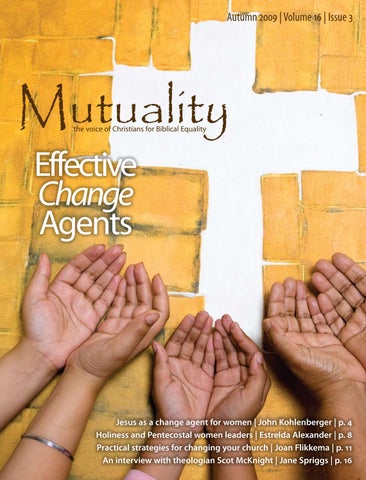
Autumn 2009 | Volume 16 | Issue 3
Mutuality the voice of Christians for Biblical Equality
Effective Change Agents
Jesus as a change agent for women | John Kohlenberger | p. 4 Holiness and Pentecostal women leaders | Estrelda Alexander | p. 8 Practical strategies for changing your church | Joan Flikkema | p. 11 An interview with theologian Scot McKnight | Jane Spriggs | p. 16
Mutuality 16.3, Autumn 2009 “Let us then pursue what makes for peace and for mutual upbuilding” (Rom. 14:19, NRSV). Mutuality (issn: 1533-2470) seeks to provide inspiration, encouragement, and information about equality within the Christian church around the world. Editorial staff: Megan Greulich, editor; M. L. Castleberry, Adele Hebert, editorial assistants; Image Spigot, graphic designer; Mimi Haddad, president/publisher. Contact us at: Christians for Biblical Equality; 122 W Franklin Ave, Suite 218; Minneapolis, MN 554042451; phone: (612) 872-6898; fax: (612) 872-6891; email: mgreulich@cbeinternational.org; web: www. cbeinternational.org. We welcome your comments, article submissions, and advertisements. For writers guidelines, visit CBE’s website and follow the publications links. Advertising in Mutuality does not imply organizational endorsement. Please note that neither Christians for Biblical Equality, nor the editor, nor the editorial team is responsible or legally liable for any content or any statements made by any author, but the legal responsibility is solely that author’s once an article appears in Mutuality. All Scripture quotations, unless otherwise indicated, are taken from the Holy Bible, Today’s New International Version®. TNIV®. Copyright © 2002, 2004 by International Bible Society. Used by permission of Zondervan. All rights reserved. CBE grants permission for any original article (not a reprint) to be photocopied for local use provided no more than 1,000 copies are made, they are distributed free, the author is acknowledged, and CBE is recognized as the source. Mutuality is published quarterly by Christians for Biblical Equality and is sent free to members and supporters.
Contents F E AT U R E S 4
Destined to Cause the Falling and Rising of Many: Jesus’ radical treatment of women by John Kohlenberger, III
8
In the Name of the Gospel: Holiness and Pentecostal women who transformed the world for Christ by Estrelda Alexander
11 Promoting the Partnership of Women in Your Church: Practical strategies for change by Joan Flikkema 16 Changing the World Through Gentleness and Scholarship: An interview with Scot McKnight by Jane Spriggs 18 Are Men from Mars and Women from Venus? Reports and reflections from CBE's 2009 conference
MINISTRY AND CHAPTER NEWS 20 Praises, Prayers, and Reflections
D E PA R T M E N T S 3 From the Editor: But How Can We Be Effective? 21 Giving Opportunities: Sowing Financial Seeds 22 President’s Message: Reforming the Church: Lessons from the Mystics
2 M U T U A L I T Y | Autumn 2009
websi te : www.cbeinternational.org
From the Editor by Megan Greulich
But How Can We Be Effective? "Therefore, since we have such a hope, we are very bold" (2 Cor. 3:12). “The worship pastor there is full of the Holy Spirit. She is so being known as the person who always has something to gifted at what she is doing.” A group of young adults from my say on the matter, the person who is never quite satisfied new church sat in a local Chinese restaurant, listening to our with how things are. I don’t want to be (or be seen as) the friend and pastor describe his recent visit to a nearby worship angry one, the “feminist,” the radical, or the person who service. Another friend expressed out loud what I was thinking: will relentlessly push this issue even when it threatens the “Wait, what denomination did you say the church belongs to? perceived unity and health of the church. And they have a woman pastor?” From my conversations with CBE members regarding Not exactly, he explained. The woman does not actually their experiences in their churches, I think that many can hold the title “pastor” and is instead referred to as a “ministry relate to my feelings. We desire for change to occur, and associate.” For all functional purposes, though, she is the church’s something deep within us stirs when we witness the church worship pastor. Then, seeming a bit uncertain, he turned to me, missing opportunities to utilize the gifts of women. We the egalitarian. “What do you think about that, Megan?” He asked may be certain that our passion for biblical equality is it with kind curiosity and with a genuine interest in my thoughts. God-given, and therefore, that we have an obligation to But as the entire table of people stared at me, I felt my cheeks work for what we know to be true. Yet, being a change burning while I quickly determined how to phrase my answer. agent is certainly not a comfortable calling, nor is it one “Well, I understand that we are all on a journey when it that we should step into lightly or without much prayer comes to this issue, so I guess I am encouraged that at least and reflection. And even if we are assured that God desires she is allowed to use the gifts God has given her.” I was being us to work for change and we are able to overcome our careful, perhaps too tentative. So then I blurted, “But often own insecurities and desires for comfort, the big question when this happens, the woman is compensated differently remains: “But how can we be effective?” than if a man held the position. And that is, quite simply, As experienced change agent Joan Flikkema shares in her unjust!” I heard my voice ringing out a bit too loudly as I article that follows, there are no simple blueprints for what finished with a few more passionate comments and studied will work to bring change in every church. Yet it is helpful my new friends’ faces for their reactions. to examine the practical models that have worked for others, My pastor nodded kindly and respectfully, and the and to celebrate those individuals who were used by God to group moved on to another topic. Another friend at the bring about great changes on behalf of Christ’s kingdom. This table gave me a small, knowing smile. But I needed a is why I am so enthusiastic about this issue of Mutuality on moment to catch my breath, or at least a moment for my “Effective Change Agents.” cheeks to recover from their near purple shade at being We pray that the practical insights and the examples of singled out so suddenly. change agents that are highlighted in this issue will be of Thanks to my “big mouth” (or perhaps thanks to the encouragement to you in your important work for biblical prompting of the Holy Spirit), within the first few weeks of equality. Be sure to read John Kohlenberger’s article on Jesus, attending my church, I had established myself as someone the ultimate change agent, as well as Estrelda Alexander’s with strong—very strong—convictions about gender and article on Holiness and Pentecostal women leaders who ministry. This particular situation in the restaurant was just used their gifts to transform the world for Christ. Finally, one of many opportunities to share my beliefs. I am grateful be sure to read Jane Spriggs’ refreshing interview with for those opportunities and am humbled that my new church theologian Scot McKnight. family listens to and values my opinions. And there are times As always, we would love to hear your comments and when I want and feel the need to speak up, times when I know suggestions. Many blessings to you as you read and reflect! that God is using me, challenging me to not be silent. But at the same time, I am hesitant to accept the call Megan Greulich is the editor of Mutuality. She may be reached at wholeheartedly. I’m not sure that I like being so conspicuous, mgreulich@cbeinternational.org.
booksto re : www.equalitydepot.com
M U T U A L I T Y | “Effective Change Agents”
3
Every woman that Jesus encountered in the Gospels — no matter her ethnicity or socioeconomic class — was raised in her spiritual and physical state as well as in her social status.
“Jesus with Samaritan Woman at the Well” by Jim Hasse S.J. Used with permission.
Destined to Cause the
falli ng
g n i ris
&
of Many
Jesus’ Radical Treatment of Women
by John Kohlenberger III
4 M U T U A L I T Y | Autumn 2009
The birth of Jesus was surrounded by many unique and miraculous events, accompanied by wondrous words from angels and humans, both male and female. Simeon’s statement to Mary at Jesus’ circumcision, “This child is destined to cause the falling and rising of many in Israel” (Luke 2:34), is a lens through which we can view Jesus’ encounters with people. Jesus humbled the proud, the rich, and the powerful. websi te : www.cbeinternational.org
He also raised the weak, the poor, and the powerless. Throughout his ministry, Jesus acted in ways that were shocking to those steeped in their culture of hierarchy. And when his disciples began squabbling over their relative greatness, Jesus taught them to follow his own example: “ You know that the rulers of the Gentiles lord it over them, and their high officials exercise authority over them. Not so with you. Instead, whoever wants to become great among you must be your servant, and whoever wants to be first must be your slave — just as the Son of Man did not come to be served, but to serve, and to give his life as a ransom for many” (Matt. 20:25–28; also Mark 10:42–45). In a culture characterized by social status and power, Jesus ushered in a brand new definition of authority, and his acceptance of women was nothing short of radical. Therefore, in our search for insights into being change agents for biblical equality, we cannot begin anywhere but with our Lord and Savior. Interestingly, every woman that Jesus encountered in the Gospels — no matter her ethnicity or socioeconomic class — was raised in her spiritual and physical state as well as in her social status. Paul’s famous words written to the Galatians — that in Christ there is neither Jew nor Gentile, slave nor free, male nor female (Gal. 3:28) — echo what Jesus demonstrated through his ministry. Let’s examine some of the evidence.
Farther north, in the region of Tyre and Sidon, Jesus encountered a Canaanite woman who pleaded for her daughter, who was possessed by an unclean spirit. Addressing him as “Lord, Son of David” (Matt. 15:22), she acknowledged his social status and ethnicity, which were viewed as superior. At first he appears to dismiss her on the grounds of ethnicity (Matt. 15:24), but her persistence and wise interaction lead him to commend her great faith and grant her request (Matt. 15:28). In Matthew’s narrative, Jesus had just rebuked the Jewish leadership for their blindness, for having hearts far from God, for not understanding clean versus unclean (Matt. 15:1–20). But this Gentile woman saw Jesus for who he was and, with a word, Jesus made her and her daughter clean and brought them near.
Neither Slave nor Free With a touch and a word, Jesus brought back to life the daughter of Jairus, the leader of a synagogue (Matt. 9:18–19, 23–25; Mark 5:22–24, 35–43; Luke 8:41–42, 49–56). But Jesus did not limit his contact to the upper classes of free people. On the way to Jairus’ house, he allowed himself to be touched by a woman who had been unclean for twelve years because of an unceasing flow of blood (Matt. 9:20–22; Mark 5:25–34; Luke 8:43–48). Though cut off from normal society and public worship for more than a decade, this woman still had faith. The power that went out from Jesus healed her physically and restored her spiritual and social status.
Neither Jew nor Gentile Though Jesus’ primary mission was to “the lost sheep of Israel” (Matt. 15:24), his love and redemption were not limited to one ethnic group. On the road from Judea to Galilee, Jesus encountered a Samaritan woman from the town of Sychar. She was amazed that a Jewish man would talk with a Samaritan woman ( John 4:9); his disciples at that point were amazed that he would talk with a woman at all ( John 4:27). Although Jesus pointed out her sins of adultery and promiscuity ( John 4:17–18) and the ignorance of her religious beliefs ( John 4:22), he accepted her as she was: a woman, a Samaritan, and a sinner. He spoke to her with words of Spirit and truth, and revealed to her — before anyone else in John’s Gospel — that he was the Messiah, the great “I am” ( John 4:23–26). In that encounter she was raised from sinner to saint, and her social status skyrocketed as many in her village believed in Jesus through her testimony ( John 4:29).
booksto re : www.equalitydepot.com
“Woman Touches the Hem of His Garment” by Jim Hasse S.J. Used with permission.
M U T U A L I T Y | “Effective Change Agents”
5
While dining with a Pharisee, Jesus accepted the touch of a sinful woman, who washed his feet with her tears and wiped them with her hair (Luke 7:36–38). In the Pharisee’s eyes, this shocking display proved that Jesus was not a prophet (Luke 7:39). Jesus contrasted the actions of the Pharisee and the woman to reveal the man’s lack of love and social graces, causing his status to fall (Luke 7:40–47). But the woman, who demonstrated love and faith, was raised spiritually and socially and went away forgiven and restored (“in peace,” Luke 7:48, 50). In the patriarchal world of ancient Israel, women of the lower classes could not easily be self-sufficient. Widows were a needy group, especially widows with no other family. In Nain, Jesus encountered a widow who had just lost her only son: her only family and only means of support, as far as we know (Luke 7:11–12). Moved with deep compassion, Jesus raised her son from the dead, lifting her spirits and restoring her family (Luke 7:13–15).
Neither Male nor Female Everything Jesus did with men, according to the Gospels, he did with women as well. While it is true that the twelve apostles were all male (Matt. 10:2–4; Mark 3:14–19; Luke 6:13–16), this group was assembled to constitute the New Israel, reflecting the twelve patriarchs of the historic Israel. Many women were counted among Jesus’ disciples (Matt. 27:55–56; Mark 15:40–41; Luke 8:1–3). In fact, the first witnesses of the resurrection were women, who were sent by angels and by Jesus as the first messengers of this good news (Matt. 28:5–10; Mark 16:1–7; Luke 24:1–11; John 20:11–18) — though the men did not accept their divine commission at first (Luke 24:11, 22). Unlike the rabbis, Jesus regularly used women as positive examples in his teaching. He described the kingdom as being like yeast a woman mixed into dough (Matt. 13:33). He explained that prostitutes can enter the kingdom as believers ahead of the priests and elders (Matt. 21:31–32). He also pointed out that Elijah was sent to a Gentile widow (Luke 4:24–26). When speaking of his mission to save
even one lost sinner, he used the example of a shepherd finding a lost sheep and a woman finding a lost coin (Luke 15:1–10). Further, Jesus used women as negative examples only two times, both in his teachings about watchfulness: the parable of the foolish virgins (Matt. 25:1–13) and the historical example of Lot’s wife (Luke 17:32). Finally, Jesus taught both men and women, whether in large public settings (Matt. 14:13–21; 15:29–39) or in a more intimate setting (Luke 10:38–39). Jesus came not to be served, but to serve (Matt. 20:28). In the Gospels, no men ever offered service to Jesus, but angels (Matt. 4:11) and women did. In fact, Jesus’ major support group was made up of the women who followed him from Galilee and cared for his needs (Matt. 27:55; Mark 15:41), from Joanna the aristocrat to Mary Magdalene from the lower classes (Luke 8:1–3). Jesus accepted and even depended upon their service, though the closest he came to rebuking a woman was when he told Martha that it was better to sit at his feet and learn than to fret over the culturally expected service of hospitality (Luke 10:38–45). How wonderful it would be if the church sat at Jesus’ feet and learned from his example! Perhaps we too would develop the great faith and persistence of a Gentile woman, demonstrate the profound love of a sinful woman, and devote our lives to proclaiming the good news of our risen Lord like the courageous women who witnessed the crucifixion, burial, and resurrection. Perhaps we would learn to agree with Paul that we must consider others as better than ourselves (Phil. 2:3), submit instead of demand submission (Eph. 5:21), and reject the class system and hierarchy of the fallen world in favor of celebrating our oneness in Christ (Gal. 3:28). John Kohlenberger III is the author or co-editor of more than four dozen biblical reference books and study Bibles, including the award-winning NIV Exhaustive Concordance and The NIV Bible Commentary. John currently divides his time between writing, Bible design, and typesetting.
Announcing CBE Organizational and Institutional Memberships
and follow under the "Membership" tab. 6VisitMwww.cbeinternational.org U T U A L I T Y | Summer 2009 the "Churches and Organizations" link websi te : www.cbeinternational.org
better TOGETHER
www.cbeinternational.org 612-872-6898
CBE’s 2010 conference, “Better Together,” is hosted by the CBE Melbourne Chapter. The conference will present Christian perspectives on gender, ethnicity, justice, and servant leadership. Conference Location: Jasper Hotel 489 Elizabeth Street Melbourne 3000 Australia
General Sessions
Cheryl Catford Biblical Equality in the Twenty-First Century
Graham Cole The Biblical Ideal
booksto re : www.equalitydepot.com
Kevin Giles The Jesus Model
Funmi ParaMallam Issues and Challenges on Gender Justice in an African Context
M U T U A L I T Y | “Effective Change Agents”
7
In the Name of the Gospel by Estrelda Alexander
Holiness and Pentecostal women who transformed the world for Christ
Aimee Semple McPherson
8 M U T U A L I T Y | Autumn 2009
websi te : www.cbeinternational.org
The Holiness and Pentecostal movements that erupted after the Civil War gave women new opportunities to preach the gospel with a freedom that was unprecedented in American religious history. Two experiences well-known to the Holiness and Pentecostal movements — sanctification and Holy Spirit baptism — were understood to empower women, as well as men, without regard to ethnicity or class; to gift them as the Spirit willed; and to release them to be fully engaged in the work of the Lord. These movements generally provided gifted women more freedom to minister than their sisters in other denominations, giving them places as equal partners in preaching the gospel on the camp meeting and revival circuits, and as founders of flourishing congregations and denominations of every ilk and size. Lay preacher Amanda Berry Smith addressed white camp meeting congregations as often as those within her own black community. In the late 1800s, Smith traveled to England where she befriended Hannah Whitehall Smith and Mary Broadman, which led to invitations to preach throughout the United Kingdom as the first black woman international evangelist. Following this, she spent two years in India, working with churches and holding meetings in large cities and small villages. She then spent almost eight years (1881– 1889) helping with churches, establishing temperance societies, and working to improve the status of women and education for children in Liberia and Sierra Leone. Smith’s ministry in those countries was so prolific that, at its end, famed Methodist missionary William Taylor insisted that she “had done more for the cause of missions and temperance in Africa Amanda Berry Smith than the combined efforts of all missionaries before her.” Faith healer Maria Woodworth Etter began preaching in 1880 and was among the most famous Holiness camp meeting revivalists of her time. When she was nearly seventy years old, she held her largest revivals, drawing over twenty-five thousand people on multiple occasions. Her worship services were noted for supernatural manifestations like healings, exorcisms, miracles, glossolalia (speaking in tongues), trances, visions, and people being “slain in the Spirit.” Etter was also a prolific church planter who, throughout her ministry, founded numerous new congregations by preaching a series of meetings to a community, organizing the converts, and placing someone in charge. By the end of a single one and one-half-year period, she had preached nine revivals and organized two congregations — one with more than seventy members.
In 1918, while still traveling and evangelizing, Etter founded the only church she would pastor, the WoodworthEtter Tabernacle in Indianapolis. The biblical feminist regularly defended women’s right to preach and encouraged them to go into the ministry. She called on women to, “let their lights shine, to bring out their talents that have been hidden away rusting, and use them for the glory of God.” Another woman who emerged during this period was Carrie Judd Montgomery, whose more than sixty years of ministry — from 1880 to 1946 — bridged both the Holiness and the Pentecostal movements. After being miraculously healed from a debilitating spinal illness, her testimony caught the attention of a community Kathryn Kuhlman in Buffalo, New York, where she then developed a ministry of writing and speaking on divine healing. Around 1880, at age twenty-two, she wrote The Prayer of Faith, which was translated into four languages. A year later, she began publishing Triumphs of Faith: A Monthly Journal for the Promotion of Healing and Holiness, which she continued to publish for sixty-six years, until her death. After moving to California and marrying well-to-do businessman George Montgomery, who supported her ministry financially, she established the House of Peace to provide respite for missionaries from more than one hundred mission boards. Within the house, she served as pastor for the weekly worship services of Beulah Chapel. She also founded Shalom Training School for Missionaries, a children’s home for orphans, and an annual camp meeting at Cazadera, California. Montgomery associated with many prominent Holiness leaders, including hymnist William Broadman; A. B. Simpson of the Christian and Missionary Alliance (of which she was an active member); and William and Catherine Booth, founders of the Salvation Army. Once she received the baptism of the Holy Spirit, she never broke fellowship with her colleagues, but continued her steady preaching schedule — now adding the Pentecostal theology to her message. In 1909, she and her husband embarked on a missionary trip around the world, conducting revival meetings in Japan, China, India, and England. Montgomery was also a charter member of the General Council of the Assemblies of God.
Famous preacher Maria Woodworth Etter called on women to, “let their lights shine, to bring out their talents that have been hidden away rusting, and use them for the glory of God.” booksto re : www.equalitydepot.com
M U T U A L I T Y | “Effective Change Agents”
9
During the 1920s, Canadian-born Aimee Semple McPherson was widely recognized as one of the most gifted evangelists in the United States. McPherson’s dramatic flair and ability to attract people from all walks of life assured that she made the front page of the nation’s most prominent newspapers at least three times a week on average. Her legacy includes building the 5,300 seat Angelus Temple, one of the first megachurches in the nation; founding the International Church of Florence Crawford the Foursquare Gospel (which today, with more than one million members, is perhaps the largest and most influential Protestant denomination established by a woman); becoming the first woman to broadcast a sermon on the radio and receive a license from the Federal Communications Commission to operate a radio station; and establishing LIFE Bible College, one of the earliest Pentecostal institutions of higher education. Faith healer Kathryn Kuhlman began her ministry by working in the tent revivals of her sister and brother-in-law before beginning itinerant preaching throughout Idaho. Once she was given the opportunity to preach, her ministry quickly exploded on the scene of American popular religion. Kuhlman founded the Denver Revival Tabernacle in 1935. Her radio broadcast, “Smiling Through,” was carried on the CBS network and was heard on more than fifty stations across the country in the 1940s and 1950s. In the 1960s and 1970s, her weekly television program, “I Believe in Miracles,” aired nationally, reaching millions — decades before the term televangelist became commonplace. Though she had come to faith in the United Methodist Church, Kuhlman’s ministry was non-denominational and attracted Pandita Ramabai people from a variety of Christian traditions. During the thirty years of her prominence, she was as controversial as she was popular, incurring criticism from both the medical and church communities. Yet she continued filling auditoriums throughout the country with devoted followers who repeatedly confirmed the authenticity of the healings they experienced in her services. Other lesser-known but still extraordinary women arose from every sector of society to aggressively assert their God-given call to preach the gospel and challenge existing understandings of women’s place in the church. Florence Crawford worked closely with Pentecostal leader William Seymour at the famous Azusa Street Revival and was appointed by him to oversee and direct the many new Pentecostal mission churches that were forming along the West Coast. Later, she left Los Angeles to form the Apostolic Faith Mission, a denomination which today has more foreign than domestic congregations. Ida Robinson founded the Mt. Sinai Holy Church specifically as a place for women to be free to serve at all levels of institutional leadership. For the first seventy-five years of its existence, the denomination was led by women presiding as bishops. In the early twentieth century, Pandita Ramabai led an explosive revival in Mukti Mission in Puni, India,
10 M U T U A L I T Y | Autumn 2009
which rivaled what was unfolding at Azusa Street. Ramabai, a poet and scholar as well as religious leader, championed reforms for women and children among India’s poor and used her position as a high caste woman to leverage reform for women within her society. The impact of her work on behalf of women was so great that in 1989, the Indian government issued a commemorative postage stamp in her honor. Each of these women left an indelible imprint on the shape of evangelical Christianity and a legacy that cannot be overlooked by those with a serious interest in the history of the Holiness or Pentecostal movements. Unfortunately, as these movements— which were once denigrated as a haven for the poor and disinherited— have attempted to gain more respect and move into the mainstream, they have compromised or sacrificed their openness to the ministry and leadership of women. Yet the undeniable impact of women’s labor in the name of the gospel is attested to, in part, by the fact that many of the men who would later go on to be the leaders of Holiness and Pentecostal congregations and denominations came to faith through these women’s ministries, or through the ministries of many others like them. In some cases, these very men would later deny other women a viable place in ministry. Though limitations on women in institutional leadership continue, Holiness and Pentecostal women continue to carry out evangelistic ministries using the venues of revival and camp meetings as well as women’s conferences and conventions. In these arenas they are able both to speak the gospel of empowerment into the lives of their Christian sisters and provide a pattern for other women to engage in viable ministry all while challenging stereotypes regarding a women’s place in the church. May we learn from and model their boldness, persistence, and strong faith. Estrelda Alexander, an ordained minister in the Church of God, is professor of theology at Regent University in Virginia Beach, Virginia. She also served as associate dean at Wesley Theological Seminary and adjunct professor of theology at Trinity College, both in Washington D.C.
websi te : www.cbeinternational.org
Promoting the Partnership
of Women in Your Church
Understanding
your vision and developing strategies for change
by Joan Flikkema
The process of change
can be compared to a river. We are part of a flow of ong oing and changing conditions. If the river flows too slowly it can become sluggish and filled with silt. If the river flows too rapidly, it can tear away important structures along its way and be difficult to navigate. If the river has too much water it floods and loses its definite shape. If the river has too little water, it slows down and dries up. The ideal river is a work of art in nature. It has a steady source; it is fed by other streams. It flows cleanly and purposefully between well-defined banks. It contains organic life abundant in quality and quantity. It adds to the quality of life along its path. It adapts to the changing environment. And it contributes to a larger body of water at its end.
Of course, when we sail on such a river, we need to have the We learned a great deal through that advocacy work. We right vessel and the right pilot. And so the effective leader, in terms learned that to point out problems creates real difficulties not of strategies for change, knows how to go with the flow of the river only for us, but also for the people who create and maintain the or shape the flow of the river. I believe that this is what we all desire problems. We also learned that many people do not like change, to understand: What goes on in this river of change and how can even when there is a great deal of injustice and a lack of mercy we better pilot our vessels down it? in the status quo. Both men and women often My own journey as a change agent for women resist changes that lead to more mercy and Many people do not in the church began in the very early 1970s when more justice on behalf of those people who are like change, even when experiencing discrimination. I was a young teacher in a public school system. there is a great deal of At this time, my husband and I were I attended a conference for women to learn attending a church that discussed, to some length, more about patterns of discrimination in public injustice and a lack of and finally supported the ordination of women. I education. I came back from the conference and mercy in the status quo. didn’t think this decision was all that special, but shared this with some of my good friends in the then I learned that very few other churches had school system, and together we worked for some major changes in curriculum and textbooks. We also worked to reached the some conclusion. So I soon became known as someone change some of the athletic policies and employment practices as who had strong feelings and thoughts concerning the matter of men they related to females in the school district. and women as partners in the church.
booksto re : www.equalitydepot.com
M U T U A L I T Y | “Effective Change Agents”
11
My family and I then moved to a different area of the city and joined another local church in our denomination. A friend and I began attending council meetings as observers. The men who were the elders and the deacons seemed to be very uncomfortable having women attend as observers. At first, they made jokes about it. This then progressed to a period of time when they were somewhat distressed. They even considered a vote that would prohibit observers at their meetings. I had researched this, though, and pointed out that there were no rules in our church about having observers at business meetings and that, by tradition, these meetings were open to anyone. This ended the discussion. It seemed to take about a year for them to become God’s great desire is for unity. really comfortable with us, and there were If there are any walls that certain times when divide us as Christians, they actually turned to us as observers and God is not pleased. requested our opinions, recognizing we brought a perspective that might be helpful. And so even though we were not ordained, our input was considered valuable. Finally, my husband and I made the decision that our money would talk. We agreed that we would pay only half of the amount that we pledged, because only he was a full member of the church. My half of the money was given then to things like benevolence, Christian education, or special projects. That was our way of telling the church that things were not right with us — that we were concerned that women were not equally represented in the work of the church. Then our denomination made the decision that women could be ordained as deacons, and, after that denominational decision, our local church council voted unanimously to support it. When the council brought that decision to the congregation for an affirmation, a vote of support, it lost. Sixty people at the meeting voted no, while forty voted yes. To me this signaled that even though women could not yet be ordained as deacons in our local church, we were very close. If eleven or twelve people changed their minds, women indeed could be ordained as deacons. In our denomination at this time, many churches
12 M U T U A L I T Y | Autumn 2009
ordained women as deacons and some churches began to go ahead and sort of defy church laws; they ordained women as elders and some churches also said women could be pastors and that they could lead worship. These churches invited women who were ordained in other denominations to serve as guest pastors and conduct entire services on special occasions. And so our denomination was going through a great deal of what I call creative chaos and is on this journey of change still today. Over these years of my advocacy work within my denomination, I have come to understand three important concepts for our work as change agents. Let’s turn to these now: imagery for the journey, vision for the journey, and finally, strategies for the journey.
Imagery for the Journey There is no secret recipe that I can give you that says, “Here is what you do to guarantee good changes in your church.” The concept of women as partners in the gospel is something to be cultivated. And so I would like to help you understand where your church is in order to find some appropriate and positive ways to influence it. Otherwise, when we work for change, what we hope will be good influences can become bad influences. The imagery that I find most helpful is the concept of gardening, which I like to conceptualize in four stages. The first stage is breaking the soil and sowing the seeds. We must prepare the soil for seeds by supplying water and the right kind of nutrients needed for those particular plants. My own church would fall into this category; we see a great deal of support for the ordination of women, but not yet enough to make it happen. The soil is being prepared; some seeds are being sowed. We do not have any small plants yet. The second phase of gardening imagery is tending the new shoots. Such a church may have ordained one or two women as deacons. They may be having a difficult time getting more women to accept the nomination for the office or getting the congregation to vote for them because it is not yet a completely accepted idea in the church. The goal here is to find ways to encourage those shoots to grow and to cultivate many more shoots. Third, we must tend the growing plants. In this stage, immature fruit is appearing. I like to imagine tomato plants with rather large green tomatoes. A church in this stage would have ordained women as deacons several times. They would have no problem finding women to accept nominations or electing them, and are interested in seeing women ordained as elders or pastors. They may even start thinking along the lines of what we would call “ecclesiastical disobedience”; they may consider how to move ahead to affirm women as partners in the gospel even though their denomination may not be entirely supportive. Finally, the fourth phase of our gardening imagery is preparing for the harvest. In these kinds of churches women have been ordained as elders, have spoken as guest pastors, and are serving in creative positions such as pastoral assistants or directors of congregational life or Christian education. These churches may be very close to the ultimate harvest on this journey, when their members run their ministries according to their gifts and regardless of their gender.
websi te : www.cbeinternational.org
Vision for the Journey Now let us explore the vision for the journey, or why we are committed to this difficult work of gardening. Our vision is to break down the walls that divide. Restricting the use of women’s gifts in the church divides the church. It puts up a wall that separates people from each other. The church is to be united under Christ. Understanding this vision is crucial in our work for change; we must understand the ultimate goal and our role in it. As we carry out our vision, and as we go on our journey, there are three important points that I would like us to remember. The first is that God’s great desire is for unity. Ephesians 1:8b–10 tells us, “With all wisdom and understanding, he made known to us the mystery of his will according to his good pleasure, which he purposed in Christ, to be put into effect when the times reach their fulfillment — to bring unity to all things in heaven and on earth under Christ.” If there are any walls that divide us as Christians or as people in this world, God is not pleased. What God wants ultimately is a sense of unity. He is not asking here for uniformity, but rather for the unity that comes from being centered in Christ. The second important point as we carry out our vision is the concept of one body with many members. In 1 Corinthians 12, as in many of Paul’s writings on spiritual gifts and the work of people in the church, notice that there are no references to men or women having certain spiritual gifts. Paul provides no gender restrictions here. The third important point as we carry out our vision is that of hospitality, a very important scriptural concept. In the Old Testament, the Israelites were commanded to offer hospitality to strangers and to each other. In his book, Sharing the Search: A Theology of Christian Hospitality, Methodist minister Thomas Hawkins explores the church as a lifestyle enclave. He writes that often our churches are based on something other than being connected by Christ. Relationships in the church are developed and enhanced on the basis of shared human characteristics, which then leads to exclusion. In my denomination, for example, many of our families have roots in the Dutch immigration, so there is a distinct ethnic flavor to our congregations. What we don’t often realize is that when we carry on in our ethnic ways we are excluding people who want to come to us in Christ. What is more, we have somehow connected our ethnic patterns to the way we worship and go about doing the work of our church. Instead, Hawkins challenges us to see the church as a community of believers as the body of Christ, where relationships are developed and enhanced on the basis of respecting one another as made in the image of God. We must understand that we are all created, redeemed, and gifted by the Spirit, and that who we are in Christ must be the foundation of our relationships. Hawkins also makes it clear that the priesthood of all believers means that we are priests for one another. We advocate for one another. We encourage one another. And we help one another along our spiritual journeys. Again, there are no gender restrictions in the priesthood of all believers.
booksto re : www.equalitydepot.com
Hawkins says that our stress upon fellowship, which encompasses Often our our social connections in the church, comes at churches are the expense of genuine partnerships in the gospel. based on He sees that we have something other fractured partnerships in the gospel in order to than being maintain a sense of social unity based on our own connected definitions of what that social unity is; many by Christ. churches therefore are not Relationships really true members of the body of Christ because in the church they are most concerned with keeping the peace are developed and maintaining the social way of life. and enhanced Another helpful on the basis of reference as we consider the vision for our journey shared human is Hiding, Hurting, and Healing by Mary Franzen characteristics, Clark. In a section entitled which then leads “De-view from De-pew,” she maintains that women to exclusion. in the church are hiding and hurting because of the way that they experience exclusivity in the church. She writes that the harm caused by separation, division, and oppression is not taken clearly or seriously enough. Then she says that we must attend to those who are suffering because our cultural ideas of roles only muddies God’s plan. The Holy Spirit gives gifts to all believers, not on the basis of sex. And since we are all created in the image of God, there is no basis for division. Clark argues that it is wrong for a few designated church leaders to tell the rest of the people where they belong and how they should or should not minister. Instead, the direction of ministry is the prerogative of the Holy Spirit. The church leadership should help confirm each member’s gifts and facilitate their functioning rather than setting up barriers. And then she has this wonderful question: “What is so threatening about trusting the Holy Spirit to direct people?” She asks the question innocently, and yet it is very threatening to some in the church since too often we work to maintain the walls that divide. If one is concerned about being part of the body of Christ, then, of course, there is nothing to fear in allowing the partnership of women in the gospel.
M U T U A L I T Y | “Effective Change Agents”
13
10 Strategies
for Changing Your Church
First, let’s consider the concept of risk — the chance of injury, damage, or loss. For gardeners like us, it is the degree to which human relationships are questioned and conflict is aroused, because the proposed activity disturbs the harmony. In other words, the activity may upset the customary ways in which people relate with each other. There will be some pain and suffering as we work to change the church, to create a better harmony. Therefore, before we work for change, each of us needs to thoughtfully ask ourselves, “How much disharmony can we tolerate? What’s it worth to us?” Based on our answers, we can then consider these low-, medium-, and high-risk strategies for change:
Low-Risk
Medium-Risk
Pray regularly for God’s assistance and guidance in the process of change. Study Scripture to learn as much as possible about God’s will for men and women. Study your church’s creeds and doctrines, as well as statements such as CBE’s “Men, Women, and Biblical Equality.” Read materials that can help you stay informed about women’s issues in the church, like Priscilla Papers and Mutuality. Share ideas and feelings privately with trusted friends at your church. Avoid remarks that belittle women and men. Encourage more lay participation of both women and men in worship services. Perhaps in your church only men may be ordained and give sermons. But women can certainly read Scripture, lead intercessory prayers, prepare special music, lead worship, and make announcements. The important goal here is that women become visible in your worship services. Encourage the church council to make full use of all members’ gifts. Encourage other women who are serving in leadership positions. Seek them out. Affirm them. Vote at congregational meetings and encourage other women to vote. Contribute money to causes that help women in your community.
14 M U T U A L I T Y | Autumn 2009
Share concerns with elders or members of your church board at a time when they come to visit your family. Share ideas and feelings openly with many others in church. Attend conferences and meetings that explore expanding women’s roles in the church and report back to your congregation on what you learned. Speak at congregational meetings on issues pertaining to women. Request that your pastor prepare sermons on topics relevant to biblical equality. Raise questions at appropriate times and places so that other church members can hear, consider new perspectives, and have the opportunity to learn from you (you can always point them to resources that have been useful for you). Donate relevant books to your church library and write book reviews for your church newsletter. Suggest specific topics to the adult education coordinator for church study groups. Recommend specific gifted women for church leadership positions. Request that your church arrange to have speakers on women as partners in the gospel.
High-Risk Give appropriate materials to officers and leaders in the local church. Notice sexist remarks and indicate that they are inappropriate. Notice sexist language and imagery in church services and church educational materials and indicate why they are inappropriate. Request pastoral care and advice from elders and ministers to deal with problems and matters of conscience. For example, if a male elder in the church ignores your gifts, then it may be time to approach the pastor and say, “You know, I need some pastoral advice in dealing with this situation.” Organize a forum, discussion group, retreat, or conference to address the topic of women and the church. Request (by proposal, appeal, protest, etc.) that your local church and your denomination study the unresolved questions regarding women’s use of their gifts in the church. Request that your local church respond to your denomination’s decisions regarding women, especially if the decisions are restrictive. Assist in forming and maintaining speakers’ bureaus concerning women’s issues. Use consciousness-raising techniques to help others understand areas of injustice. Decide whether or not to give full financial support to all aspects of your church.
websi te : www.cbeinternational.org
had to both adapt to change and create it. Take for example the story of Esther. She was a powerful change agent. Examine her story carefully to see how she went about her work. If we need a model for organizational change in the church, we can turn to Acts 10 and 15. Peter received a vision about eating unclean food and was then directed to the household of Cornelius, a Gentile. The entire household received Christ and was baptized, and Peter was amazed by this because he and the other apostles had no idea that the gospel would also be for Gentiles. When this Strategies for the Journey was reported back to the council at Jerusalem, the leaders were My final section here on the journey is strategies — how to do the somewhat confused by it. Yet, they finally agreed that it seemed gardening. Let’s look at the creative problem-solving process: right — and that they did not have any indication that it was the process for us to lay out our plans for change so that we use not right — and made a few suggestions about doing things our energy and our abilities well. There are seven steps to the decently and in good order. And from that point on it was very creative problem-solving process. The first step is developing and clear that the apostles would take the gospel to the whole world. clinging to your vision. This is a sense of mission we have already When we take action, we are creating disharmony and examined at length. We must operate from a clear sense of vision disequilibrium. As individuals and organizations, we do not that what we are working for is right and godly. change unless the harmony is upset. For example, I can go along The second step is holding to your belief. When we have a in my own home and not pay attention to the dust and the belief, we have a sense of commitment. Sharpen your beliefs in laundry that is piling up until we get a phone call that someone biblical equality. Know what you believe, and why you believe it. is coming to visit us. Then I notice the house is not in good The third step in the creative problem-solving process shape! And suddenly to restore my sense of harmony with what is setting a goal. This is what we want to work for; it is the is going to happen, I need to get busy and clean things up. There formal change that we desire. It involves preparing the soil are many more examples about how we all act when there is and sowing the right seeds. After all, if we some kind of pressure on us to shape up. If want to grow a crop of tomatoes, we had we can create a sense of disharmony in the Sometimes people better plant tomato seeds. church, then people will pay attention and The fourth step is gathering resources. ask me, “How can you work to create harmony again. And then they What gardening talents do we have? Who we will discover that the only way to create real take action like this can rely upon? Who are the experts? Experts harmony is to indeed break down all the walls when there are no clear are a resource; we need people whom we can that divide, which means including women call upon in our community to say, “We’re models for doing so?” as partners in the gospel. The discomfort that facing this problem. What advice can you give we must go through is vital, and worth it. It is Yet, I believe we have us?” Be sure also to gather books and other almost like an active intercessory prayer; we are models in Scripture. resources from CBE. interceding for those who come after us. We The fifth step is asking the “IWW” question, want to leave the church a better place for the which stands for “In What Ways?” In what ways men and women of the future — to help ensure that they will not can we reach our specific goal? For me it would be, “In what ways need to struggle over this particular issue. can we encourage the ordination of women as elders and ministers?” The last step — step seven — in the creative problem-solving That would be at a denominational level. In my own church it would process is evaluation. We ask ourselves: How did things go? be, “In what ways can we encourage the ordination of women as What seemed to work? What didn’t work so well? What didn’t deacons?” This is your brainstorming step in the process. List as work at all? Why did it work? Or why did it not work? And then many ideas as possible, and do not be afraid to suggest things that we say: Do we stick with our sense of vision? Do we keep our seem off the wall. belief ? Do we keep working on our goal? Do we need some new Step number six in the creative problem-solving process is resources? Do we need to take a different focus on the action? taking action. With each action step, ask yourself the six questions Do we need to take action in a different way? Then we reconsider that journalists often use: Who is going to do this? What are we again, as an ongoing process, as many times as needed. going to do? When are we going to do it? Where are we going to do it? Why are we going to do it? And then how shall we do it? Joan Flikkema has been a change agent for the ordination of women in This also means that a back-up plan is available. Sometimes the Christian Reformed Church (CRC) for almost forty years. In that time, all when I get involved in taking action, I discover that things are ordained offices in the CRC were opened to women and several women completed seminary training. Joan is currently the representative for both the not going as well as I hoped and so I say, “Let’s switch gears here Committee for Women in the CRC and the Women in Ministry Scholarship and see if we can adjust and go about this in a slightly different Foundation. This article is taken from a transcript of a lecture she presented at way.” Sometimes people ask me, “How can you take action like a CBE conference. this when there are no clear models for doing so?” Yet, I believe we have models in Scripture. God’s people throughout Scripture I once listened to a pastor preach that, “We are most humane when we are most God-like.” To be humane means to have what are considered the best human qualities: kindness, tenderness, mercy, and sympathy. I remember thinking to myself, is the church a humane place for women? Do the women experience belonging completely in the church? And I remember thinking too that genuine hospitality would indeed make the church a humane place for women.
booksto re : www.equalitydepot.com
M U T U A L I T Y | “Walking in the Spirit”
15
Changing the
w rld
through Gentleness and Scholarship: An Interview with Scot McKnight
by Jane Spriggs
Scot McKnight
is a prolific author and speaker on the New Testament and is the Karl A. Olsson Professor in Religious Studies at North Park University (Chicago, Illinois). He is the author of an award-winning blog, Jesus Creed (blog. beliefnet.com/jesuscreed), and is a highly respected figure in both academic and pastoral circles. He is also a quiet and consistent advocate for biblical mutuality, which he defines as giving women “the freedom to discern what God has called them to do — whatever it might be, including preaching, teaching, and leading in the church” (The Blue Parakeet, p. 161). I recently sat down with McKnight to discuss his new book, The Blue Parakeet: Rethinking How You Read the Bible, and to discover how he came to understand biblical mutuality. McKnight was relaxed, patiently answering my questions even though he was about to teach a sold-out, day-long seminar on his book when we finished. McKnight shared with me that he wrote The Blue Parakeet because he wanted to outline a “third approach to the doctrine of Scripture,” which he defines in the book as a way of reading the Bible “with tradition” — applying God’s Word in our day by going back to the Bible and moving forward through the church (p. 34). McKnight contrasts this approach to other commonlyused methods of Bible interpretation: 1) applying all first-century biblical ideas and practices directly to our lives today, and 2) translating our Christian beliefs into unchangeable traditions which govern our behavior. In the book, McKnight especially
16 M U T U A L I T Y | Autumn 2009
highlights the “blue parakeets” (named after the parakeet that he discovered flying freely with wild birds outside) — those biblical passages that challenge our thinking and make us ask how to live out the Bible today. Women in ministry, McKnight said, was the extended example he chose to explain his approach, challenging his readers to set the “blue parakeets” free.
A Gradual and Humble Transition McKnight’s discussion of women in ministry becomes personal as he recounts his own journey to biblical mutuality in The Blue Parakeet. McKnight is transparent as he describes his regret over not entering into the public debate on women in ministry when he, while employed at an evangelical seminary, was gradually moving from a “traditionalist” position to believing in mutuality between men and women in the church. McKnight credits this realization to discovering that the New Testament “emerged from and therefore was shaped by first century Jewish and Greco-Roman culture, including what it said about women” (p. 149), though he also acknowledges the influence of female biblical scholars like Morna Hooker as well as his own gifted female students. The power of confession is strong, and, in The Blue Parakeet, McKnight not only confesses that he (and other faculty members at his former seminary) failed their female students by not engaging this issue, but he also confesses to his former female students that he (and they) were wrong to limit women in
websi te : www.cbeinternational.org
exercising their gifts in ministry. He then asks for their forgiveness. This aspect of McKnight’s book astonished me, and I thanked him for his humility in openly acknowledging his mistake. With typical modesty, McKnight had no response to my comments about his confession, but did reiterate his belief that “God in Christ has raised women to the level of men — to work together, respecting each other’s distinctives and differences, seeking for harmony and unity.” In other words, McKnight is calling men and women to reconcile with one another.
God’s Story At its core, The Blue Parakeet is a book about biblical interpretation. McKnight upholds the authority of Scripture, seeing the Bible as God’s story — a story which God tells us so “we can enter into a relationship with him, listen to him, and live out his Word in our day and in our ways” (p. 103). He reminds us that the Bible is a relational story from: God’s Trinitarian oneness, to The Adam, who was one and alone, to Adam and Eve, who were one and together, to Adam and Eve and others, who through sin become others, to Jesus Christ, who was the one God incarnate, to Becoming one (as in Eden) all over again in Christ, to The consummation, when we will be one with God and others (p. 160). It is in knowing this story, listening to God, and being open to the Spirit, that we discern how to live out the gospel and speak that gospel into each cultural setting. We do this by being mastered by the story — by “reading the Bible so deeply that its story becomes our story” (p. 211). “Together as God’s people,” McKnight writes, “we are to so inhabit the Story that we can discern how to live in this world" (p. 212).
Restoring Creation Conditions In the book, McKnight discusses the views of hard and soft patriarchy — positions which he believes read the Bible through tradition (rather than with it), and, to one degree or another, are rooted in the fall. With even stronger words, he says, “The church has perpetuated the fall as a permanent condition…by failing to restore creation conditions when it comes to male and female relationships” (p. 165). The church may restore healthy, mutual relationships between women and men, McKnight shared with me, “by serving one another, loving and bringing out the best in each other, [and] denying ourselves for the best of others.” This can occur by “allowing women to preach in public, by males intentionally including women in the significant functions of the church, and by holding up biblical examples of strong females like Huldah, Priscilla, and Junia.” Churches, McKnight concluded, “need to have a series
booksto re : www.equalitydepot.com
of sermons on great women of the Bible and ask, for example, ‘What kind of image is cast by the book of Esther, which features a woman of significant power’?” McKnight also stresses that we should be asking WDWD (What Did Women Do?) in the Bible and allow that they be able to do at least as much today. This would include leading, prophesying, teaching, being apostles, and being mentors of local churches (p. 164). He gives many examples of women leading in the Old Testament, but my favorite example is Deborah, whom McKnight called, “the president, the pope, and Rambo all bundled up in one female body!” In other words, he sees Deborah in Judges 4–5 leading the nation of Israel “spiritually, musically, legally, politically, and militarily…a woman leader of the entire people of God” (p. 168–9). McKnight and I also discussed Phoebe, one of the New Testament examples he highlights in The Blue Parakeet, as a minister and the first commentator on the letter to Romans (p. 184). McKnight said it is important for us to understand today that first century women “became the executive leaders of the churches that met in their homes — and there were no signs they asked their husbands for the power to do this.” He believes this evidence is in 1 Peter; that even if their husbands did not believe, “the women opened their homes to become churches [and] converted a normal space into a sacred space; they took what they had and redeemed it for the sake of the gospel.” Concerning women ser ving in church ministries today, McKnight believes that we can support whatever God’s Spirit grants women the gifts to do. Through his gentle demeanor and impeccable scholarship, I believe God is using Scot McKnight as a change agent to set women and men free to serve Jesus together in the kingdom of God. Jane Spriggs (MDiv, MS) is a pastor. She is also a faculty associate at Bethel University and Seminary in St. Paul, Minnesota where she teaches spiritual formation classes. Jane and her family are currently helping to plant The Gallery Covenant Church in St. Paul.
The Blue Parakeet: Rethinking How You Read the Bible By Scot McKnight Zondervan, 2008 List Price: $18.99 CBE Member Price: $16.14! Visit CBE Bookstore today!
M U T U A L I T Y | “Effective Change Agents”
17
St. Louis, Missouri July 24-26, 2009
Christians gathered from multiple continents, prayer in seven languages, and lots (and lots!) of books. What could it be but a CBE conference?
Authors' Autograph Party
Echoes of Eden. This was a statement made by Tom McCarthy who very ably introduced the sessions each day for the recent CBE conference in St. Louis, Missouri. The sense of acceptance, affirmation, and true fellowship was tangible as people from all walks of life and different church affiliations enjoyed one another’s company in the Hilton Frontenac hotel and grounds. When my husband, Trevor, and I arrived a day early, the rooms were bare and very few people walked the corridors. Yet, as people began arriving the place was transformed into a buzz of activity and anticipation. The various rooms took shape; tables were draped and books were laid out, signs were erected, displays were unpacked, and sound equipment was set up in the various rooms. Attendees shared meals and coffee together, and some even tried out the pool.
Attendees mingled and dialogued with twenty authors. From top left, Aída Besançon Spencer, William David Spencer, Catherine Clark Kroeger, Miriam Adeney, and Mabel Yin.
All main sessions began with music, either by guitar or grand piano, and really set the tone for listening to what God would say through his people. As always at CBE conferences, the prayers in different languages with subsequent interpretation in English were a special touch, as we felt the sentiment even though we couldn’t always understand the words. Each speaker brought a different emphasis regarding biblical equality and how that plays out in different cultures and settings. The inaugural reading of papers by students was also a highlight for me, as the three selected topics were so
Speakers
From left, Brian Howell, Cheryl Sanders, Jeff Miller, Jennifer Wiseman, Megan DeFranza, and Samuel Zalanga
18 M U T U A L I T Y | Autumn 2009
websi website te: www.cbeinternational.org
What Attendees are Saying
well presented. Many countries and states were represented throughout the weekend with Galatians 3:28 obvious; there was no distinction between color, class, gender, or status.
"The warmth of the attendees was a balm for me. There was always an invitation to lunch, or a welcome to a nearly full table of strangers at breakfast."
The workshop choices were diverse, and it was hard to choose one of four topics each time. So often there seemed so much more to be learned, and the sessions just opened the door for more questions and the thought of “not enough time.” Time wise, everything ran like clockwork and even though there was not much space between sessions, there was still time to meet new people and browse the bookstore, paintings for sale, and silent auction items.
“Never have I been around such encouraging, joyful Christians! Every time I turned around, I found a new person eager to chat and share stories. The workshops and other scheduled events were wonderful, but connecting with the conference attendees and CBE staff was worth the cost of the conference in itself.” "There was friendliness and [a] hospitable atmosphere in which to cultivate great worship and deliver meaningful teaching." “Even though I have studied this issue and been involved with CBE for many years, each session I attended brought new insights and a fresh perspective. The speakers were knowledgeable, approachable, and gracious. I learned a great deal.”
All too soon, it was the last meeting together. We shared in communion, again demonstrating our oneness in Christ, and were reminded of the wonderful task we have all been given—that of the ministry of reconciliation—of proclaiming the good news that all people can be reconciled to God and therefore to each other through the love of Christ. Before long there were lots of hugs and handshakes as bags were trundled off to the hotel lobby and cries of “See you in Australia!” echoed around the rooms. —Liz Sykes, co-Administrator, The CBE Scroll
Student Paper Competition
“The conference was a great encouragement to me. God used it to help many of us, myself included, find deeply needed renewal and healing.” “The worst thing about the conference was that it had to end!” The three winners of our first ever Student Paper Competition. From left, Carey McGrath, Christianna Barnard, and David Cramer presented papers on gender and culture through the lenses of premarital counseling, domestic abuse, and philosophy.
Missed the Conference?
In just one short month, St. Louis conference recordings have become some of the bestselling resources in our entire bookstore! Visit us online to order your copies. CBE members save 50%! • Culture Matters: Why Culture Affects Our Understanding of Gender in Life and Scripture, by Brian Howell (CD, DVD, MP3)
• New Eden Identity: Helping Teens Find a Biblical Response to Gender Expectations, by Pamela Erwin (CD, MP3)
• Does God Have Gender? by Aída Besançon Spencer (CD, DVD, MP3)
• Reading the Bible for its Original and Contemporary Meaning, by Alan Johnson (CD, DVD, MP3)
• Gender in Christian Media and Advertising, by Jenell Williams Paris (DVD, MP3) • Gifted for Leadership: Men and Women Sharing Equally in Leadership, by Darin Poullard (CD, DVD, MP3)
booksto re : www.equalitydepot.com
• The Bible as a Guide and Roadmap for the Liberation of African American Women, by Cheryl Sander (CD, DVD, MP3) • What Makes a Marriage Work? by Aída Besançon Spencer and William David Spencer (CD, DVD, MP3)
M U T U A L I T Y | “Effective Change Agents”
19
P R A I S E S A N D P R AY E R S praise god with us for…
pray to god with us for…
• The great interest in CBE’s conference in St. Louis that drew many new individuals to consider the impact of culture on faith and gender. (Read all about it on p. 18-19!)
• CBE’s presence at the All India Congress on Church in Mission, in Hyderabad, India, October 13-16.
• The great interest in CBE’s summer conference recordings. • Providing the funds needed to purchase and implement Queue, the next step in our new e-commerce solution. • Providing the funds for CBE to hold a booth at this year’s meeting of the Evangelical Theological Society. • The arrival of our new and talented writing and development intern, Naomi. • Great interest and momentum building for the 2010 CBE conference in Australia, hosted by the CBE Melbourne chapter.
• Much-needed contributions, memberships, and book sales in this difficult economy. • Wise decisions and efficiency as we work to implement our new online shopping cart. • More individuals who are willing to volunteer time in helping CBE with many diverse projects. • More students to serve as CBE interns. • Wisdom as CBE develops a third strategic plan.
reflect with us…
by Susan McCoubrie (with special thanks to Jo Ellen Heil) Many of us yearn to make the world a better place. But how do we do that? Our wise and loving Father suggests we begin with ourselves: “You were taught, with regard to your former way of life, to put off your old self, which is being corrupted by its deceitful desires; to be made new in the attitude of your minds; and to put on the new self, created to be like God in true righteousness and holiness” (Eph. 4:22-24). We can echo the psalmist’s words, “Create in me a pure heart, O God, and renew a steadfast spirit within me” (Ps. 51:10). The Bible is filled with people who allowed God to change them so they could then share God’s love and correction with others. The prophet Huldah, a contemporary of Jeremiah, studied the Scriptures in the Temple, boldly proclaimed the truth to those in political authority, and saw the Passover reinstated. Initially disobedient, Jonah survived physical trauma to see thousands in the city of Ninevah saved by God’s inclusive love. Queen Esther, thrust into a cross-cultural religious landmine of royal proportions, put her own fears aside, sought God’s face in prayer, and saved her people from extinction. Have there been agents of change in our own time? In twentieth century America, activist Dorothy Day fed and housed poor people and founded “The Catholic Worker.” Despite being shot at, called a communist, and investigated by the FBI, she proved that God’s call to “love one another” could indeed be lived out. Like those before her, she served her God with prayer and personal sacrifice and opened up paths of justice and peace for others. Jesus instructs us, “Go and do likewise” (Luke 10:37). With God’s deep love and this cloud of witnesses encouraging us, how can we not be agents of change?
20 M U T U A L I T Y | Autumn 2009
websi te : www.cbeinternational.org
GIVING OPPORTUNITIES
Sowing Financial Seeds by Tim + Anne Evans
Dear brothers and sisters, We joyfully support Christians for Biblical Equality because we believe in CBE’s calling to proclaim the good news that men and women can live, love, and serve together in equality and mutual authority. As CBE supporters, it is humbling and inspiring for us to see God empowering CBE’s faithful team of Christfollowers as they disciple, mentor, and biblically impact so many. In a season of history with much confusion surrounding gender, CBE’s ability to provide biblical wisdom and much-needed resources to people, churches, and nations is unmatched. We believe praying for and financially supporting CBE is a privilege and a very wise investment. Every month, in addition to our local church tithe, we sow financial seed into CBE. The passion, humility, and remarkable ability CBE’s small leadership team exhibits is truly amazing. The biblical, relevant, and real-life tools that are available through CBE enable people to gather reliable information and network with like-minded men and women from all over the world. We cheer the CBE leadership team on as they pursue their mission of affirming biblical truths about equality and justice and encouraging all believers — without regard to gender, ethnicity, or class — to use their God-given gifts in families, ministries, and communities. We believe in CBE’s vision of a future where all believers will be encouraged to exercise their gifts for God’s glory and missional purposes, with the full support of the Christian community. We thank God for CBE — for its servant leaders, intercessors, and supporters. As prayer and financial partners, we celebrate the many ways God is leading Christians for Biblical Equality to advance Christ’s kingdom.
Tim + Anne Evans are the founders of REAL LIFE Ministries (www.reallife.us.com) and the authors of REAL LIFE Marriage. They live in Colorado Springs, Colorado.
Very sincerely, Tim + Anne Evans
We praise God for Tim and Anne, who are faithful supporters of CBE. The financial seeds they sow into our ministry each month have a lasting impact, as together we share the good news that men and women can indeed live, love, and serve together in equality and mutual authority. Will you join the Evans by making monthly donations to CBE? Monthly gifts help us to better plan for the future, allowing us to be the best possible stewards of God’s resources. Visit www.cbeinternational.org and click on the “Donate” button in the upper right corner. Or mail your monthly gifts to CBE at 122 W Franklin Ave, Suite 218, Minneapolis, MN 55404. Thank you! CBE is a member of the Evangelical Council for Financial Accountability and the National Association of Evangelicals. CBE is an exempt organization as described in IRC Sec. 501(c)3 and as such, donations may qualify as charitable contributions where allowed by law.
booksto re : www.equalitydepot.com
M U T U A L I T Y | “Effective Change Agents”
21
President’s Message by Mimi Haddad
Reforming the Church Lessons from the Mystics
Since, then, you have been raised with Christ, set your hearts on things that are above, where Christ is seated at the right hand of God. Set your minds on things above, not on earthly things (Col. 3:1–2). C.S. Lewis once said that those who are the most heavenly minded Catherine that God had created both man and woman and pours often accomplish the most good on earth. It may seem paradoxical out favor according to God’s purposes. If God gives us a mission, that those men and women whose lives are shaped by solitude, regardless of our gender, it is God who gives us the ability and power prayer, and contemplation are those who are often the most effective for action. Because God promised to never leave her and to equip agents of reform. Yet this is precisely what we see when we study the her for service at the right moment, Catherine had the confidence Christian mystics. This group of committed believers drew away to serve courageously. from the world in order that they might bring From that moment onward, Catherine God’s renewal to the world. For this reason, found herself condemning the greed, abuse we cannot overlook them in our search for of authority, and spiritual poverty of local mentors and models in our ministries today. church leaders. Ultimately, though, her call The Christian mystics realized that to for holiness went to the top — to the pope. remain in Christ is to bear much fruit, and To Gregory XI, Catherine demanded that apart from Christ there is no lasting fruit (John leaders in the church live holy lives. She said, 15: 5). The focus and intensity of their spiritual “Since God had given him authority and he discipline brought renewal first to their own had assumed it, he should use his virtue and lives, which ultimately prepared and thrust powers; and if he were not willing to use them, them into social engagement on behalf of God’s it would be better for him to resign what he purposes for their world. Christian mystics had assumed; more honor to God and health were powerful agents of renewal because they to his soul it would be.” She offered the same themselves had been so deeply renewed by moral challenge to Pope Urban VI who then Christ. Their very permeation in God was the turned to his cardinals and said, “Behold my means through which they became detached brethren, how contemptible we are before and freed from the grip of lesser gods, that they God…This poor woman puts us to shame…It might offer a prophetic and authentic voice is she who now encourages us.” for Christ in the world. Their holiness gave As God had promised, Catherine’s them a moral authority others immediately reforming work was successful. Her moral recognized, respected, and followed. authority was shaped by her life of prayer and Painting of Catherine of Sienna One such Christian mystic whose by Domenico Beccafumi, 1515. intimacy with Christ. Soon, a devoted circle nearness to Christ changed the world was of disciples — comprised not only of other Catherine of Siena (1347–1380). Like many mystics, Catherine women, but also of priests, friars, and young nobles — followed emerged at a very bleak moment in history, when God’s reforming Catherine, referring to her as their “holy mother.” power was desperately needed. The world into which Catherine Just as the church was challenged by the holiness and prophetic was born was one of unparalleled corruption, and, as a result, voice of Catherine, the church today is renewed by the prophetic life was miserable! Violence, disease, and political wickedness of voices of those whose lives are shaped by prayer and close communion extraordinary proportions were rampant. Catherine’s world was with Christ. Because the work of God is nearly always embodied by not unlike ours today. Leaders, even those in the church, misused you and me, we represent Christ best in action when we feed on their authority and “lorded it over others.” him often in prayer and solitude, immersing ourselves in Jesus. Few imagined they might make a difference in a world as And, by resisting lesser things, we become effective vessels for God’s corrupt as Catherine’s. And though Catherine preferred a life of reforming work in the world. Infused with Christ’s joy, vision, and prayer and solitude to public service, it was during prayer that she strength we are more credible and compelling witnesses of God’s understood God was calling her to publicly confront abusive leaders. reforming work in our world. This is the path great reformers like While she feared her gender might be an impediment, God assured Catherine walked. It seems a wise path for us today.
22 M U T U A L I T Y | Autumn 2009
websi te : www.cbeinternational.org
Christians for Biblical Equality Christians for Biblical Equality is an organization of Christian men and women who believe that the Bible, properly interpreted, teaches the fundamental equality of believers of all racial and ethnic groups, all economic classes, and all age groups, based on the teachings of Scripture as reflected in Galatians 3:28. Injustice is an abuse of power, taking from others what God has given them: their dignity, their freedom, their resources, and even their very lives. CBE also recognizes that prohibiting individuals from exercising their God-given gifts to further his kingdom constitutes injustice in a form that impoverishes the body of Christ and its ministry in the world at large. CBE accepts the call to be part of God’s mission in opposing injustice as required in Scriptures such as Micah 6:8. Core Values ◆ We believe the Bible teaches the equality of women and men. We believe God has given each person gifts to be used for the good of Christ’s kingdom. We believe Christians are to develop and exercise their God-given gifts in home, church, and society. We believe the Bible teaches that Christians are to oppose injustice. Mission Statement ◆ CBE equips believers by affirming the biblical truth about equality and justice. Thus all believers, without regard to gender, ethnicity, and class, are free and encouraged to use their God-given gifts in families, ministries, and communities. Core Purpose ◆ To communicate broadly the biblical truth that men and women are equally responsible to act justly and use their Godgiven gifts to further Christ’s kingdom. Envisioned Future ◆ CBE envisions a future where all believers will be encouraged to use their gifts for God’s glory and missional purposes, with the full support of their Christian communities.
Statement of Faith We believe the Bible is the inspired Word of God, is reliable, and is the final authority for faith and practice. We believe in the unity and trinity of God, eternally existing as three equal persons. We believe in the full deity and full humanity of Jesus Christ. We believe in the sinfulness of all persons. One result of sin is shattered relationships with God, others, and self. We believe that eternal salvation and restored relationships are possible through faith in Jesus Christ who died for us, rose from the dead, and is coming again. This salvation is offered to all people. We believe in the work of the Holy Spirit in salvation, and in the power and presence of the Holy Spirit in the life of believers. We believe in the equality and essential dignity of men and women of all ethnicities, ages, and classes. We recognize that all persons are made in the image of God and are to reflect that image in the community of believers, in the home, and in society. We believe that men and women are to diligently develop and use their God-given gifts for the good of the home, church, and society. We believe in the family, celibate singleness, and faithful heterosexual marriage as God’s design. We believe that, as mandated by the Bible, men and women are to oppose injustice.
CBE Membership CBE membership is available to those who support CBE’s Statement of Faith. Members receive CBE’s quarterly publications, Mutuality magazine and Priscilla Papers journal. Members are eligible for discounts on items from CBE Bookstore, including books, articles, tapes, and videos. Members are also offered discounts on all international CBE conferences. Learn more by following the Membership link on our homepage.
booksto re : www.equalitydepot.com
� CBE Membership Application Contact Information ________________________________________________ first and last name
_____________________________________________________________ street address _____________________________________________________________ city _________________________________________ state / province / country _____________________________ phone
_ _________________ zip / postal code
_ ____________________________ email address
_____________________________________________________________ church denomination
Annual Membership Fee (all fees are in U.S. dollars) Please check one: United States Members Individual Household Low Income Subscription Only*
1 Year � $45 � $65 � $25 � $40
3 Years � $120 � $170 � N/A � $115
International Members Individual Household Low Income Subscription Only*
1 Year � $55 � $75 � $34 � $49
3 Years � $145 � $190 � N/A � $140
*Does not include membership benefits.
Additional Contribution $ _______ TOTAL $________ CBE is an exempt organization as described in IRC Sec. 501(c)3 and as such donations may qualify as charitable contributions where allowed by law.
Payment Method � Check/Money Order (payable to Christians for Biblical Equality) � Visa � MasterCard � Discover � American Express ________________________________________ account number
_ _________________ expiration date
_________________ verification code (the four digits on the top right corner of American Express cards or final three digits found on the back of other cards) _____________________________________________________________ signature
Please mail or fax this form to: Christians for Biblical Equality
122 W Franklin Ave, Suite 218 • Minneapolis, MN 55404-2451 phone: (612) 872-6898 • fax: (612) 872-6891 email: cbe@cbeinternational.org
M U T U A L I T Y | “Effective Change Agents”
23
Christians for Biblical Equality 122 West Franklin Ave, Suite 218 Minneapolis, MN 55404-2451
Non-Profit Org. U.S. POSTAGE
Forwarding Service Requested
Minneapolis, MN Permit No. 26907
PAID
New Resources from CBE
Marriage at the Crossroads Couples in Conversation About Discipleship, Gender Roles, Decision Making and Intimacy Aída Besançon Spencer, William D. Spencer, Celestia Tracy, and Steven R. Tracy Two couples from the differing perspectives of egalitarianism and soft complementarianism, share a constructive dialogue, covering a variety of topics, about marriage in practice.
Women, Ministry and the Gospel Exploring New Paradigms Mark Husbands and Timothy Larsen, ed. An outstanding collection of essays from the 2005 Wheaton Theology Conference. Exploring the current debate on women in ministry from biblical, theological, and ecclesiological perspectives, these essays bring ministerial and sociological insight to bear on the issue.
24 M U T U A L I T Y | Autumn 2009
CBE Members Save! 15% on CBE Bookstore resources and 50% on CBE recordings. Order or become a member today! www.equalitydepot.com 612.872.6898
Woman of Influence Ten Traits of Those Who Want to Make a Difference Pam Farrel
The Gospel of Ruth Loving God Enough to Break the Rules Carolyn Custis James
In Woman of Influence Farrel shows how you can be a faithful servant of God in all of your relationships and circumstances. Here’s a book that women everywhere will welcome — full of encouraging counsel for finding God’s leading in your life and following him.
Custis James drills deep into the story or Ruth where she uncovers the same passionate, countercultural, rule-breaking gospel that Jesus modeled and taught his followers to pursue. Within this story is a map to radical levels of love and sacrifice, combined with the message that God is counting on his daughters to build his kingdom.
websi te : www.cbeinternational.org