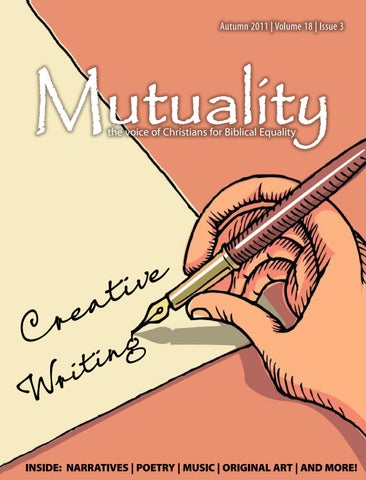
Autumn 2011 | Volume 18 | Issue 3
Mutuality the voice of Christians for Biblical Equality
e v i t a
e r C ing t i r W
Inside: NARRATIVES | Poetry | MUSIC | Original Art | and more!
Mutuality 18.3, Autumn 2011 “Let us then pursue what makes for peace and for mutual upbuilding” (Rom. 14:19, NRSV). Mutuality (issn: 1533-2470) seeks to provide inspiration, encouragement, and information about equality within the Christian church around the world. Editorial staff: Megan Greulich, editor; Image Spigot, graphic designer; Mimi Haddad, president/publisher. Contact us at: Christians for Biblical Equality; 122 W Franklin Ave, Suite 218; Minneapolis, MN 55404-2451; phone: (612) 872-6898; fax: (612) 872-6891; email: mgreulich@cbeinternational.org; web: cbeinternational. org. We welcome your comments, article submissions, and advertisements. For writers' guidelines and upcoming themes and deadlines, visit CBE’s website and follow the link under the Resources tab. Advertising in Mutuality does not imply organizational endorsement. Please note that neither Christians for Biblical Equality, nor the editor, nor the editorial team is responsible or legally liable for any content or any statements made by any author, but the legal responsibility is solely that author’s once an article appears in Mutuality. All Scripture quotations, unless otherwise indicated, are taken from the 2011 revision of the Holy Bible, New International Version®, NIV®. Copyright © 1973, 1978, 1984, 2011 by Biblica, Inc.™ Used by permission. All rights reserved worldwide. CBE grants permission for any original article (not a reprint) to be photocopied for local use provided no more than 1,000 copies are made, they are distributed free, the author is acknowledged, and CBE is recognized as the source. Mutuality is published quarterly by Christians for Biblical Equality and is sent free to members and supporters.
Contents 4
Lynni and the Life-Changing Lotion | A light-heared parable exploring roles, service, and giftedness. by Charity Kroeker, illustrated by Alice E. (Lisa) Guinther
8
Words that Still Burn | A slam poem from the perspective of Sarah and Angelina Grimké. by Sarah Klatt
9
To the Church Leaders About Women | A poem calling the church to welcome the leadership of women. by H. Edgar Hix
10 We Come in Adoration | A hymn exploring our oneness in Christ. by Jeffrey D. Miller 12 The Primary Colors of Our Moral Sense | A narrative on both the explicit and implicit teachings of the church about gender, from the perspective of a young girl. by Elise Toedt 15 Between | A poem highlighting a male pastor's predicament when his daughter is gifted for leadership but his church says no. by Charity Kroeker 16 A Poisoned Mind | A narrative offering a glimpse into the beliefs and thoughts of a hypothetical abusive man. by Nicholas Colby Watson Wolfe 18 Oceans Breaking Over Rocks | A poem celebrating a strong Christian woman. by Jennifer Kane
MINISTRY NEWS
19 Highlights from “Building Biblical Community,” CBE's 2011 Conference 20 Praises and Prayers 20 Reflect with Us: Creativity
D E PA R T M E N T S 3
From the Editor | Creative Writing: A Prophetic and Empathetic Voice
21 Giving Opportunities | Institutional Membership: Mutuality at Its Best 22 President’s Message | Crying With Those Who Cry
2 M U T U A L I T Y | Autumn 2011
websi te : cbeinternational.org
From the Editor by Megan Greulich Creative Writing: A Prophetic and Empathetic Voice Welcome to the “Creative Writing” issue of Mutuality! This is a new adventure for us, as we have never before published an issue entirely filled with creative writing. Much prayer has gone into this issue— which has been in the works for nearly three years—and we hope that you find it to be refreshing, encouraging, and challenging. As the popular magazine of Christians for Biblical Equality, Mutuality works to make accessible the intellectual ideas about gender, authority, and the kingdom of God. Whereas our sister publication, Priscilla Papers, engages in the important task of scholarly research, Mutuality seeks to bring that research “to the masses.” We often work to this goal through publishing personal stories of our members, or devotionals on relevant Bible passages. But art, and more specifically creative writing, plays a significant role in Mutuality’s mission, as well. How? First, art can serve as a prophetic voice. It can challenge us to clearly see problems that we otherwise would not recognize. Twentieth century Catholic novelist Walker Percy believed that art serves this purpose. Referencing the practice of miners who carried canaries deep into mines in order to warn them of toxic gasses like carbon monoxide, he compares canaries to artists. “When the canary gets unhappy, utters plaintive cries, and collapses,” he writes, “It may be time for the miners to surface and think things over.” Art is often used by God to alert us of toxic environments filled with sin and injustice. Similarly, creative writing on the experiences and treatment of women can awaken the body of Christ to the sin and injustices of gender inequality in the church.
Second, whereas so much communication from egalitarians tells us about biblical equality, art has the ability to show us. As Anne Lamott suggests in Bird by Bird, the point of creative writing is to make human experience sensible to others. By engaging our senses and our emotions, creative writing can help us to understand the perspectives and experiences of others in a way that exchanging intellectual ideas may not. It appeals to the common humanity in all of us. “Writing and reading decrease our sense of isolation,” Anne Lamott writes. “They deepen and widen and expand our sense of life: they feed the soul.” In this way, creative writing helps to foster solidarity and empathy, which, as Mimi Haddad demonstrates in her article on page 22, are crucial characteristics of reform movements because they compel us to act against injustice. Creative writing, therefore, serves an important and unique role in our work to advance biblical equality.
In this issue To this goal of being a prophetic and empathetic voice in the church, we are pleased to include a variety of creative pieces in this issue of Mutuality, including a parable, original illustrations, music, narratives, and many types of poetry. Please take note of the questions for reflection included at the close of the longer pieces. May they help us to engage more deeply in our call as Christians to “pursue what makes for peace and for mutual upbuilding” (Rom. 14:19, NRSV). Blessings to you as you read and reflect! Megan Greulich is the editor of Mutuality magazine. She may be reached at mgreulich@cbeinternational.org.
What do you think of this issue of Mutuality? Email us at cbe@cbeinternational.org. And, help us spread the word by sharing links and your thoughts on Facebook and Twitter!
This ad space could be yours. Learn more: cbeinternational.org/ad
booksto re : equalitydepot.com
M U T U A L I T Y | “Creative Writing”
3
by Charity Kroeker, illustrated by Alice E. (Lisa) Guinther
O
Lynni and the Life-Changing Lotion
n the corner of Sidney Street and 7th Avenue, just past Sean’s Shoe Shine Chateau and Betty’s Bakery, is a building at least a hundred stories high with windows all the way up. Just above the green awning is
4 M U T U A L I T Y | Autumn 2011
a three-foot sign which reads, “Mr. Allister’s Advertisement Factory.” If you go inside this building, you will see that it is divided into thousands of rectangular rooms, each dedicated to advertising a certain product. This story starts on the thirty-fourth floor in room 3400 with a woman named Lynni. Lynni's job for the longest time was to remind others that buying lavender scented Arid to Astonishing hand lotion will “Restore Life to Your Skin, Creating a Whole New You.” This is a story of how she learned to step outside of her room to use her astonishing lotion to do something that was indeed astonishing. Just across Lynni in room 3401 was Ruffles, a shiny dog who was always eating piles of extra-healthy dog food and, as a result, was growing quite fat. Every so often Lynni would look across at him and wish she could advertise something like “Nutri-Kibble: Keeping the Ones You Love Alive and Well.” But instead she was stuck with her Arid to Astonishing. “Ruffles!” she would call, “You’re so very good at eating Nutri-Kibble—just like all goldenlabradoodle terriers are created to do. How does it taste? Are you alive and well?” And Ruffles would recite, “Alive and well. Energetic and vivacious. Healthy as a brand new puppy—I do love watching you lotion your hands. It’s exactly what you were made to do, Lynni. How is the Arid to Astonishing? Is it changing your life?”
websi te : cbeinternational.org
To which Lynni would reply, “Every coat of luscious lotion restores life to your skin, creating a whole new you.” This is how the days passed, with Lynni gracefully lotioning her hands and Ruffles cleaning his dish, until one day something happened that changed Mr. Allister’s Advertisement Factory forever.
It’ll change your life.” “Ruffles, I’m serious. They need our help. Come on.” And with that, Lynni snatched up her half-finished bottle and headed out the door. “What are you going to do?” barked Ruffles.
It was Wednesday at ten o’clock and Lynni had just opened another bottle of Astonishing when she happened to glance out the window. From her place on the thirty-fourth floor, she could see all up and down Sidney Street and even to the fields beyond. Lynni had never thought much about what lay outside of the advertisement factory because she almost never left the building. She did glance up from time to time and, when she did, she generally enjoyed the vibrantly green grass below and the way the wind rustled the corn and beans. But on this day, the grass in the park was not green at all and the crops seemed to be dry and brittle. “That’s odd,” she thought. “I’ve always heard that corn and beans are supposed to be green. Perhaps I was misinformed.” And she went back to lotioning her hands. Several days went by before Lynni thought anything about the grass and the corn again. In fact, it wasn’t until the next Monday when Ruffles barked across to
her, “I heard they ran out of cornbread in the cafeteria today. Not that it makes any difference to me, since all I eat is Nutri-Kibble.” Ruffles sighed. “Alive and well, alive and well,” he muttered. “You mean Calming, Comforting Cornbread?” Lynni gasped. “But the cafeteria serves Calming, Comforting Cornbread every Monday until everyone feels contented in their souls and right at home.” It was then that Lynni remembered the stretches of brown fields outside of her window. She looked up again and, this time, the grass had all dried up and blown away, and the fields spread toward the horizon in shriveled sticks. A crowd was gathered outside Betty’s Bakery. Lynni watched people come out of the shop, but instead of carrying bread and cakes, their arms were empty and the crowd was growing angry. Eventually, Betty herself came out holding one small loaf of bread above her head. A boy in the crowd snatched it and ran away while the crowd pushed after him. “Ruffles!” she said, “Look!” “Funny,” said Ruffles, “I’d always been told that corn and beans were supposed to be green. Guess I was misinformed. By the way, how’s the Arid to Astonishing?” “Arid…arid! Ruffles, the ground’s all dried up out there! That’s why the crops are brown and why Betty left the bakery!” “No, no,” said Ruffles, “I’m talking about the Arid in here. Arid to Astonishing! You need more lavender-scented lotion.
booksto re : equalitydepot.com
“We’ve got to find a way to help those people. They’re starving!” “Lynni, sit down. You’re doing your part from up here on floor thirty-four. Your real talent is advertising lotion. You were made for advertising lotion. You’re perfectly suited for lotioning and for nothing else, just as I, being a goldenlabradoodle terrier, am perfectly suited for eating Nutri-Kibble. Now, we all adore you and think you’re absolutely the best hand-lotioner we’ve ever seen.” “You really think I was made for hand lotioning?” “You’re a hand lotion commercial! What else could you possibly be made for? Now sit down and continue doing what you’re good at.” But as Lynni turned back to her table, she glanced at the scene outside of her window. By now, Sidney Street was in complete disarray. Broken glass surrounded Betty’s Bakery and several people were pushing at the door of Sean’s Shoe Shine Chateau. “No, Ruffles. You’re wrong,” Lynni stood up again. “I may be the best hand lotioner around, but sometimes hand lotion won’t save your life.” Lynni left room 3400. She entered the elevator and paused. Which button should she push? She had only ever been on the first and the thirty-fourth floors, but now she had to get help.
M U T U A L I T Y | “Creative Writing”
5
Lynni jabbed at number twenty-seven. She knew there must be food advertisements somewhere. On floor twenty-seven, Lynni found Charlotte Chocolate, a woman with long fingernails who was slowly dipping strawberries into a bowl of chocolate and eating them while she read a book. “I’m sorry to bother you,” said Lynni, “But there’s a tragedy happening outside! People are starving!” The woman raised her eyes ever so slowly. “You have gorgeous hands. So soft and smooth. Oh! Are you Lotion Lynni? I’ve heard you’re so very good at lotioning your hands. Why ever have you stopped?” Lynni blushed a little. “Ma’am, please. You have more strawberries than you need
thing she was best at, the thing she was created to do. After what felt like hours, Lynni had found only a ten-year-old girl who went by the name of Cheese Puff Pennie, a stringy teenage boy named Maple Max from Stick to Your Guts Maple Syrup, and a serious-looking horse named Norm who pulled a cart of old-fashioned oatmeal behind him. The mismatched crew crowded into the elevator and Lynni pressed a button she had never pushed before: G—ground floor. “Well,” Lynni said to herself, “I don’t know what a cart of oatmeal, a gallon of maple syrup, and some cheese puffs will do, but we’ve gathered what we have, and now we're here to help.” And help they did, in the most unexpected ways. The moment Lynni, Penny, Max, and Norm stepped The grass had all dried up and blown away, and the out of Mr. Allister’s Advertisement Factory, the crowd surrounded them. Lynni passed out fields spread toward the horizon in shriveled sticks. cheese puffs, and spooned oatmeal into waiting bowls. Since there was no water, they boiled the oats in Stick to Your Guts Maple Syrup (which turned out to have a consistency very similar to water). W hile Lynni traipse d up and down the streets passing out food, Penny, Max, and Norm returned to Mr. Allister's to
and the people out there are starving. Couldn’t I take some berries down to them?” The woman clicked her tongue. “Now Lynni, we all know you are meant for advertising lotion. If you go outside, you’ll ruin your hands. And then what good will you be? No, you’d better go back to room 3400.” Room after room was like this. Lynni would ask for food only to be told to return to her room and continue doing the
6 M U T U A L I T Y | Autumn 2011
restock their supplies. Every time they went back up to their old f loors, neighbors would chide and ridicule them. “Max! What are you doing with your life?” Charlotte Chocolate would say, “You were growing up to be such a model syrup display. It’s that Lynni, isn’t it? I don’t know why she wasn’t content as a lotioner. Now look at her. What does she know about food? And I bet her hands are all covered in calluses and sunspots.” Truth be told, Charlotte Chocolate knew much more than Lynni did about food, and many times Lynni wondered whether she was helping at all. But every day she would say to herself, “Well, I don’t have much, but this is where I’m supposed to be,” and every day hungry people were made full. As days turned into weeks, Lynni’s hands did become callused. Her skin grew hard and dry. Every now and then, she would think of room 3400 and the pleasant days of demonstrating Arid to Astonishing. She would remember Ruffles, nose buried in Nutri-Kibble, and think that it was indeed a good thing that Ruffles could show other dogs and dogowners a healthy food to eat.
websi te : cbeinternational.org
It was morning on the Tuesday of Lynni’s third week outside of the Advertisment Factory, and she was completing her daily round of serving oatmeal and syrup. She entered a tiny house to find Betty from Betty’s Bakery sitting on a rocking chair, with four or five children surrounding her. “Betty,” said Lynni, “Good morning. How is your pantry? May I give you any oatmeal today?” “No, no,” said Betty, “We have stored up enough to last us until the rain comes. We are full, but there is one thing we do need.” Betty held up the hands of the youngest child. They were chaffed and bleeding. “The air is so dry, the children’s skin is breaking apart. I know it sounds silly since you came to deliver food, but what we really need right now is lotion.” “Well,” said Lynni, “It just so happens that lotion is one thing I do have.” Shyly she pulled out her bottle of Arid to Astonishing and gently began to rub the child’s hands. “Is that lavender scent?” Betty asked. “Yes, it is.” “Ah. All of our lavender crops died and it’s been so long since I smelled that. Thank you, Lynni,” she said, “I don’t know if anyone’s ever told you this, but you really are very good at lotioning hands.” And that, my friends, is the story of how Lynni Lotion left her tiny room in Mr. Allister’s Advertisement factory to do something she knew she needed to do, even though everyone else told her that she couldn’t do it. What’s more, she has now found a use for her lotion that is truly astonishing.
“Well, I don’t have much, but this is where I’m supposed to be,” Lynni would say to herself, and every day hungry people were made full.
Charity Kroeker is development and bookstore associate at CBE. She enjoys cooking unique meals, riding her bicycle to work, and attending poetry slams. She is a recent graduate of Bethel University, where she studied English literature and writing. You can find more of her writing at charitystayedawhile.blogspot.com. Alice E. (Lisa) Guinther is an assembly line worker for a medical device manufaturer in Boulder, CO and a senior at Colorado Christian University. When she is not working or painting, she is studing philosophy and Christian apologetics. She also blogs and posts new artwork at “Insights from the Furnace” (insightsfromthefurnace. blogspot.com).
booksto re : equalitydepot.com
Questions for Reflection: 1. Have you ever felt “boxed in” like Lynni and the other characters in the advertisement factory, particularly because of your gender? How has the church contributed to or lessened those feelings? 2. Charlotte Chocolate had strong opinions about the way Maple Max should act and the way Lynni should look. At first, such opinions kept Lynni passive. How can the church provide people with healthy expectations for their lives, based not on cultural assumptions or physical beauty but on God’s will? 3. What does Lynni ultimately learn about roles, gifting, and service? How does this translate to the body of Christ as a whole and to you personally?
M U T U A L I T Y | “Creative Writing”
7
Words that still burn by Sarah Klatt A slam poem from the perspective of Sarah and Angelina Grimké The Grimké sisters were 19th-century American Quakers, educators, writers, and early advocates of abolitionism and women's rights.
history know breathblood woman whip speak humanity Angelina Emily Grimké (1805-1879)
Crack the book that Re-rewrites history And grow new eyes to Legal injustice As a girl I watched Color decide The lines between human and not Hit me Like the whip he used on your back Your blood flowed and your screams Choked my sense Of humanity Like a millstone Around my neck Growing heavier With each black face Pushed to the dirt They said you weren’t Allowed to know What letters meant On a page
8 M U T U A L I T Y | Autumn 2011
Sarah Moore Grimké (1792-1873)
But when sleep Took every head and Their rules to bed In the flicker of candlelight Guarded I taught you Worlds to be discovered Without warning your Breath left Your tiny body And became a flame inside me Burning until your People are equal To mine As a woman they Said my actions were Unnatural when I Spoke up for Those forgotten I do not fight For special treatment Of those deemed Less-than websi te : cbeinternational.org
But I ask for opportunity To be equal To look eye to eye And not be condemned Because I have A woman’s body
To take your feet Off our shoulders And give us a Chance to breathe To occupy the space That God intended
I know something of Your suffering When oppression becomes Comfortable And our names no Longer matter Stand with me Hear the words that I Pen to you In defense of Something better
The rules that ignored Injustice Broke when I refused To follow Every box you shut Me in I throw away Because the oppression I witnessed and Endured Haunts me until Justice is proclaimed Truth is realized And we’re all called Humanity again
With conviction piercing Our souls and a Message of love We ask you kindly Brothers
To the Church Leaders About Women by H. Edgar Hix
H. Edgar Hix is a poet who lives in Minneapolis, MN. He works with the Legal Aid Society of Minneapolis. He blogs on The CBE Scroll as Hubert Edgar.
booksto re : equalitydepot.com
Visit us at
cbeinternational.org/words-that-still-burn to watch a video of poet Sarah Klatt performing "Words that Still Burn." Sarah Klatt is an MDiv student at George Fox Evangelical Seminary. She has found art to be one of the best forms of communication, the language of the soul.
Just open a door. Even a small door. They will breach the surface like whales. They will walk with you on the waters. They will believe in the storm and the Storm Master. They will share His faith and yours. Just open a door. Any small door. They will storm the castles of Hell with you. They will wear the heavy armor you wear. They will breach gates you cannot reach. They will share in your victory with Him. Together we will open many doors. We will prove that breaking is making. We will walk the worn road together. We will revel in His storm and His peace. We will share togetherness with you, in Him. Just open a door.
M U T U A L I T Y | “Creative Writing”
9
We Come in Adoration Text by Jeffrey D. Miller; Music by Samuel S. Wesley
This hymn begins with a call to worship, the central purpose of congregational singing. The first stanza then provides a transition to the self-giving work of Christians, which should be in harmony with the work of Christ. Stanzas two and three concern major themes of Christian ministry: mission, evangelism, unit y, and proclamation. These verses include several scriptural allusions. Matthew 28:19–20 records “our Master’s parting mandate.” This Great Commission includes mention of “all nations,” hence the phrase “Jew and Greek” and the reference to Galatians 3:28 at the close of verse two. Stanza three begins by borrowing from the well known Psalm 133:1 and then moves to the lesser-known Psalm 68:11. This latter text includes a Hebrew feminine participle which most English translations overlook. The recently revised NIV is an exception: “The Lord announces the word, and the women who proclaim it are a mighty throng” (see also the NLT and ESV). Stanza three concludes with references to Joel 2:28, Acts 2:17, and 1 Corinthians 14:26. The final stanza is especially appropriate for use with the Lord’s Supper. The hymn is best sung to the tune Aurelia, which is provided here. It could also, however, be sung to Lancashire (commonly paired with “Lead On, O King Eternal”) or St. Theodulph (commonly paired with “All Glory, Laud, and Honor”). These
10 M U T U A L I T Y | Autumn 2011
two optional tunes have a more majestic feel than Aurelia, and the “humble worship” of stanza one could accordingly be changed to “joyous praises.” Jeffrey D. Miller teaches at Milligan College, a Christian liberal arts college in the mountains of eastern Tennessee. His service to the church involves both Bible teaching and worship leadership. His wife Dana is a children's minister.
websi te : cbeinternational.org
booksto re : equalitydepot.com
M U T U A L I T Y | “Creative Writing”
11
The Primary Colors of Our by Elise Toedt “Harm, fairness, community (or group loyalty), authority and purity…these are the primary colors of our moral sense. Not only do they keep reappearing in cross-cultural surveys, but each one tugs on the moral intuitions of people in our own culture.”* Preface Children do not always know the theological underpinnings that direct how churches function. They only know what they see and hear, and, from that, they discern the church’s perspective on protecting or harming others, on fairness, on loyalty, on authority, on purity. They learn these things from what they experience among us; it is this experience that they internalize. This story therefore, from the point of view of a young girl, is about the collective responsibility of the church—male and female alike—to examine the type of environment we create not only through our theological stances, but also through our daily actions and interactions, so that we may make the church a safe and healthy place for girls and women. *Quoted from “The Moral Instinct” by Peter Singer, New York Times, 2006.
12 M U T U A L I T Y | Autumn 2011
Harm Suzi rolled up her sleeves today. I noticed because it’s the first time I’ve seen her bare arms. I knew she cut her arms, but I did not know what it would look like. Her wrists, covered in pink scars, remind me of a painting of Jesus, of his back after he was whipped. Red lines thin as pencils criss-cross across his tight back. It is kind of pretty, like a bird’s nest of crimson twigs. I cannot say that Suzi’s wrists are exactly pretty, but they are not shredded like I had imagined. “I just got out of the hospital,” she said to me in the hallway. They had just begun singing the first hymn in the sanctuary. She looked at me with her dull eyes. I looked at all the coats hanging in the closet behind her and said, “Oh.” She rolled up her sleeves. I tried not to stare at her arms. “Why were you in the hospital?” I asked. “Because I wanted to die.” The Scripture reading started in the sanctuary then. “I have to go,” I said. I was afraid to be late for service. Suzi shrugged and walked away. She’ll hide in the bathroom until service ends. I already knew why she was in the hospital. Her mom is in my mom’s Bible study and they prayed for her the night the ambulance came; the night she took a whole bottle of Ibuprofen. They had to pump her stomach.
websi te : cbeinternational.org
Moral Sense My mom told me about what Suzi did. “Committing suicide is the most selfish thing you could do.” She scrunched her face like she does when we say the word “throw-up” during dinner. “What is wrong with that girl?” she said. The service is very long so I count the bricks in the side wall when I start to get tired. Or I make up stories about whoever sits in front of me. I try to imagine what it’s like to be Bradley and what he would do on the weekend. I imagine he is at the drive-in theater with another girl and then I pretend that girl is me but some things are not good to imagine especially in church. So I try to think of what I would say if I was pastor. I picture myself as a man with brown starched pants and a maroon tie. Pastor Tim reads 1 Timothy 2 where Paul says women should be silent in the church. “It is a loving act of submission” he says. “It is not like he is enslaving you; it is not like men are saying, “Hey women, you can’t even think. All you can do is have babies.” Everyone laughs, especially the women. Then I see people scribble notes on their bulletin; I start to draw little boxes starting in the corner of the page. Pastor Tim explains that being silent in the church doesn’t mean we can’t talk or something like that. It just means that men should be the head of the church, just like dads are the heads of a family and just like Christ is the head of the church. I hope I can fill the whole bulletin with
booksto re : equalitydepot.com
squares before the service ends so I start to make them faster and faster and my mom nudges my hand because she can hear the pencil swish on the paper. Pastor Tim starts to pray. Jen Janzen who is four years younger than me is in the pew two rows back and I hear her say, “All-men” instead of “Amen.” She thinks that is what we are supposed to say. After our church service we have a spaghetti lunch in the church gym. When we kids finish eating we walk quickly out of the gym; once we get to the door we start to run and run through the church hallways and out the front doors of the church so we can play hide and seek. As I run I am careful because I am in a skirt. We—my mom and I—wear skirts to church because we need to look our best for Jesus. “You have to be modest” the ladies at church say. “You do not want to cause the boys to lust.” They are looking out for us girls because if we cause the boys to stumble it would be better to have a millstone tied around our necks and be thrown into the water. Or it would be better for the boys to pluck their own eyes out rather than lust after us. I shiver when we read these Bible verses aloud. Luckily no one would really tie anything around our necks. It’s just to show it’s very bad. Suzi counts first because she doesn’t like to hide. I go to hide behind a van in the parking lot and the rain spits down as I run and speckles my grey shirt like dark little polka dots. When I get to the cars I am surprised because there are white flyers fluttering
M U T U A L I T Y | “Creative Writing”
13
from the windshields. I think, It is too early in the year for the car washers to advertise because usually they only do that in the summer. So I read the flyer and I can’t believe what it says. It says “Suzi is mental” and has a picture of her on the bottom. She doesn’t even look mental on the picture; it is just a school photo. I am so surprised reading this I crinkle it up and slink down like a slinky folding to the wet pavement so that my skirt gets a big wet spot on the behind. Of course I wasn’t the only kid to hide by the cars, and they are all finding the flyers too. Brandon Richards walks up and I unwrinkle the flyer and say, “Look at this,” and he takes it from me. His eyebrows go together like a clothespin: open, pinch closed. I say, “We have to take these all down before the adults see them and before Karri is done counting,” but he says while he hands the flyer to Bobby his brother like it doesn’t even matter, “Maybe God is punishing her.” I can’t believe he is saying this. I feel anger rise like I could break his shin, and it would crack! like a mirror if I did. “Obviously God didn’t make those flyers,” I say. “Someone from the church did.” He shrugs and looks at me like he is so cool in his track jacket with his hair slicked back and in those Adidas shoes. He walks away confidently like that is the right thing to do. Bobby follows him like he can’t think for himself. Suzi is coming out of the church doors now and says really loud, “Ready or not here I come,” but then she sees us all standing there; almost no one is hiding. Some kids are looking at the flyers or talking in circles and they don’t look at Suzi. As if they aren’t talking about her. Brandon even walks right by her and I bet he is going inside to tell the parents. Because he wants to be the first one. I think to myself, He is just like his mother. She is the contact person for the prayer chain. Suzi has gone up to a car now and is looking at the flyer. Her face looks like—well, not shocked exactly, but very sad. The way it looked when we read about the Egyptian plagues in Sunday school. I stand next to Suzi and look at my feet. What should I do? I wonder and then I take the flyer which Suzi is gripping with both hands and say, “We’ve got to take all these down, Suzi.” She looks at me like she is looking at the blank wall in Sunday school so I say again, “We’ve got to take these down,” and I start to run from car to car and take them from underneath the windshield wipers. I lift up the wiper and grab a wet flyer that flops like a soggy pancake. “Quick!” I say to everyone else because they are all just watching. Sarah Olsen looks at her brother like she is trying to decide whether or not to buy something and then she decides to help and her brother Tim does too. No one else does. They watch and we run from car to car quick, like it is some kind of game—grab-the-flyers-before-the-parents-come. Everybody else just stands there. We get them all off and we run fast with the flyers in our hands and we—Suzi and Tim and Sarah and me—rip up all the flyers behind the church building. We rip them up and I lift up the trash bags and we put them underneath and close it. Sarah and Tim are just standing there now and look at us like they don’t know what to do.
14 M U T U A L I T Y | Autumn 2011
I say, “Tell everyone we threw the flyers in the bathroom garbage if they ask,” and I look at Suzi and we run inside through the back door and through the church halls. We run and I grab paper towels from the bathroom and we go to the choir closet where no one ever goes. The closet is long and narrow like a train car. We sit under the long white choir robes along the wall and dry off our skin which is wet from the rain. Suzi cries now and I hand her another paper towel. I don’t say anything. Let her cry, I think. I also think, At least we are in the closet because that is the best place to cry and not have anyone see. All the parents did find out about the flyers. I knew they would. At least they didn’t find them on their cars because now they have to be quiet when they talk about it; they know it is gossip. Some people are probably wishing they were there to see the flyers with their own eyes; then they could talk about them all they wanted. If you are there, it’s a story and you can tell whoever you want afterward. Mom says, “I bet Suzi made the flyers herself. For attention.” She stands at the stove and stirs her cabbage soup while she says it. She slurps some up and sucks in air through her teeth because it is so hot. She adds more salt. “Girls like her just want to be noticed. First she tries to commit suicide, because she wants us all to feel bad for her. Now she puts flyers on all the cars so she can be the victim—the one who nobody loves.” I think she is wrong about Suzi but I can’t tell her that. So I just don’t say anything. I walk away from the kitchen and into the hallway and even when she says, “What are you being huffy about?” I don’t say anything and only keep walking. Because I want to I close the door to my room and close the door to my closet and now it is just me. Elise Toedt teaches IB English literature at an International School outside Jakarta, Indonesia. She has found that reading, writing, and discussing stories has often been a healing way to address gender issues within her classroom.
Questions for Reflection: 1. Take a moment to reflect on what your church communicates about harm, fairness, community (or group loyalty), authority, and purity, particularly as they relate to gender. Compare and contrast this to the teachings of Scripture. 2. This narrative highlights how sometimes women perpetuate the subordination of females (i.e. when the church women laugh at Pastor Tim’s joke about 1 Timothy 2 and when the narrator’s mother dismisses Suzi’s struggle). Have you seen this in your church? What are practical ways your church can respond to this? 3. Both Suzi and the narrator experience great emotional isolation from their church body. Have you or have women in your church experienced this same isolation? How can we work to foster safe environments for women?
websi te : cbeinternational.org
Between by Charity Kroeker
To Pastor Greg, From Lakedale Community Elder Board To Pastor Greg (Dad), From your daughter Shepherd, Instructor, Director. Father, lead in righteousness. Read, teach, command. We have gone astray. Father, take the hand of the people. Guide, Mentor, Example. Dad, show me how to follow. Listen, encourage, demonstrate. I am God’s workmanship. Dad, give me a hand. Father, this is the path of righteousness: We do not permit a woman to speak—ever. Dad, these are my goals. You’re my model. Father, herd your daughter. He holds the hand of the family, he holds the hand of the flock, and walks tenuously between. When his daughter says, “Please.” and his church says, “No” Where will he go? Charity Kroeker is development and bookstore associate at CBE. She enjoys cooking unique meals, riding her bicycle to work, and attending poetry slams. She is a recent graduate of Bethel University, where she studied English literature and writing. You can find more of her writing at charitystayedawhile. blogspot.com.
booksto re : equalitydepot.com
M U T U A L I T Y | “Creative Writing”
15
A Poisoned Mind A Story
by Nicholas Colby Watson Wolfe
Being married to her is the greatest happiness a man could feel. I could never love anyone more. My only desire is to love her and provide for her. I have made sacrifices for her, but she is worth every single one. I always want to be there for her. I want to save and protect her. I want to shield her from worldly dangers. She is my woman, and I want to be her man. I want to take the burdens away from her. I want to handle all the stresses of life for her. I will make the tough decisions. I don’t want her to have to worry about anything outside our home. I want to give her the perfect family and a life where she can just be a wife and a mother to our two boys. I want to give her everything. We are a Christian family, and we live in the Word. I want people to see us and know that we have everything right. I want to be the leader that the Bible has called me to be, and to fulfill my role of biblical manhood. I want to give her the life that God has intended for us. I will make the perfect life for her, where I am a man and she is a woman. But she doesn’t always seem to understand that this is how we are meant to live. I need her to be a woman so that I can be a man. She doesn’t always follow her role like she should.
16 M U T U A L I T Y | Autumn 2011
websi te : cbeinternational.org
She questions me sometimes, and she undermines my authority. People look at me like I’m not a man. Why does she do that to me? Doesn’t she have any regard for my authority or the Bible? She knows the clarity of God’s commands in the Bible just as well as I do. She challenges the Bible when she challenges me. As the head of the house, I’m the one who is accountable for her faith and her actions; just as I am accountable for my own. I am her spiritual leader. I take that burden for her because I love her. I am the one taking the bullet. I am the one who faces the danger. All she needs to do is submit and be safe with me. I will take care of all her needs. I will fight her battles. She only needs to be my helper. But she acts like she doesn’t need me. She doesn’t think about how her words reflect on me. She just blurts out her opinions when they come to her mind. She needs me. I put a roof over her head and food on the table. That is how I show my love for her. That is my role as a husband, a father, and a man. She doesn’t have to do any of that to show me that she loves me. All she needs to do is clean, cook, and take care of our children. That’s how a wife shows her love, and I need to see it. She sits watching television, filling her mind with nonsense. Why does she need to see such things? She doesn’t need those opinions. I am her husband. I am the only one she needs to listen to. Why doesn’t she act like a woman? Why doesn’t she do housework and show her love for me? Doesn’t she love me? Sometimes she makes me crazy and I lose my mind. I can’t take it. I shut the television off. She doesn’t need it. I don’t want her to worry about the world outside. I will take those burdens. But she challenges me. She complains; she talks back. She needs to follow her role. She needs to submit. It’s what the Bible says. What about our children? God, what about our children? What will they think if they see their mother second-guessing their father? They will be twisted and confused. I can’t take it. I am accountable for their actions as well. I need to show them how to be men. She doesn’t understand what she is doing to them. She is upset. I don’t want to make her unhappy. I don’t ever want to do anything to make her leave. I couldn’t live without her. Just the thought of her leaving is more than I can bear. It is
booksto re : equalitydepot.com
the greatest pain a man could feel. I feel like I’ve been shot in the chest. I couldn’t ever be happy without her. I ache for her. My mind can’t take it when she acts like she doesn’t need me. Doesn’t she know how much I love her? Doesn’t she know what this does to me? I grab her. I don’t mean to hurt her; I just need her to be with me. She starts to cry. I don’t want to lose her. I don’t want her to cry. I hold her against the wall. “Stop!” I yell. But she doesn’t listen to me. I know I shouldn’t put my hands on her like this. But when I do, I know she is thinking about me and her mind isn’t with anyone else. I know she feels how strongly I care about her. I shouldn’t do this to her. I should just let go and apologize. But this is the only way I can stop the panic.
My heart is pounding. I think I’m going to go crazy, or even die. Everything is collapsing on me. I’m overcome by a surge of adrenaline. My ears start ringing, and my mind races. My grip on her arm tightens. It makes me feel better to know that she is in my grip. She is still crying, complaining. “Stop it, I said!” I scream. “Shut up!” But her mouth doesn’t stop; she sobs now. Why does she still not listen to me? Why doesn’t she take me seriously? Why does she continue to treat me like I’m not a man? She can’t do this to me. I am a man, and she is my woman. She has no right to disrespect me. My open hand meets the precious skin of her cheek. My palm stings. She is finally silent. She doubles over onto her knees. I had to, that was all. It was the only way to make her stop. “I’m sorry,” she chokes out through chopped breaths. And I believe her. She tells me she loves me. That’s all I ever want to hear. I just need to know. I tell her I love her too. “I didn’t mean to,” I say. “But you wouldn’t stop.” I put my arms around her. After a moment, she leans her head on me as I sit holding her. This is all I want. I am a man with a wife, a house, and a family. It is the greatest happiness a man could ever feel. Nicholas Colby Watson Wolfe is a former writing intern at Christians for Biblical Equality and a current student at Bethel University in St. Paul, Minnesota. Nicholas is finishing his undergraduate degree with a major in reconciliation studies and a minor in political science. He is now looking at law schools focusing on social justice, alternative dispute resolution, and international law.
Questions for Reflection: 1. How is this man confused about the definition of masculinity? What does the Bible teach about being a man? 2. Note how the narrator’s desire to protect and cherish his wife has become dangerous and possessive. How does the biblical concept of mutual submission in marriage counteract this? What, if any, role does theology play in ending or perpetuating abuse? 3. How can your church address the complexities of domestic violence within Christian marriages and families? What are practical steps you can take to foster healing for both those who are abused and those who abuse?
M U T U A L I T Y | “Creative Writing”
17
Oceans Breaking Over Rocks by Jennifer Kane From the ends of the earth I call to you, I call as my heart grows faint; lead me to the rock that is higher than I (Ps. 61:2). Have I known a prophet? Yes. I have heard her speak the wisdom of ages And of a love that promises to heal this broken world. Her eyes are oceans— Blue, clear, Filled with strength and power, Crashing into the rocky depths of souls. She stands With the intensity Of mighty warriors. But the true strength lies in her heart, One that carries the stories of a harder journey than most. She has pushed forth as a wave, over jagged rocks. It is a journey few ever truly know. But she tells her story, If you listen closely, Through the words of love she speaks. She says she knows a rock that rises high And calls out to the Rock of Ages. Her refuge.
She is a woman of courage, Loving others deeply, With true abandon. I have a sister whose eyes see the art The beauty The healing The redemption That can come Yes, my soul finds rest in God; my hope comes from him (Ps. 62:5) From him. Abba May she dive to the depths of the oceans, Feeling the currents of love and power Far beyond what she can imagine. Rush over her. Be her vision, The words of honey flowing from her lips. Selah. My soul finds rest in God alone; my salvation comes from him. He alone is my rock and my salvation; he is my fortress, I will never be shaken (Ps. 62:1).
For you have been my refuge, a strong tower against my foe (Ps. 61:3).
Jennifer Kane is a graduate student at Duquesne University in Pittsburgh, PA, studying English and women/gender studies. A former CBE intern, Jennifer is deeply committed to men and women being able to serve God and use their gifts completely and freely. She is grateful to her dear friend Kim, who served as the inspiration for this poem.
18 M U T U A L I T Y | Autumn 2011
Photo by Denika Anderson.
websi te : cbeinternational.org
Conference Highlights
What Attendees are Saying: “Reflecting on my time spent at the CBE conference, I can confidently say that it was one of the most satisfying and fulfilling experiences I had ever had among believers in Christ! The unity and oneness for the biblical cause of justice was unique, transcending all differences in denominations and ethnicity, something I have never seen before. I was blessed with the presence of brothers and sisters from all around the world representing their countries and affirming God's principals of both men and women being equal co heirs together in Christ.”
“Building Biblical Community: Transforming Sex, Power, and Prejudice” was held on July 29-31, 2011 in Seattle, Washington. With 227 attendees—representing countries like Burundi, Cambodia, Canada, India, Kenya, New Zealand, Pakistan, Romania, the United Kingdom, and the United States—it was truly a powerful time of dialogue, scholarship, and healing.
Prayers in Many Languages Conference sessions and meals opened in prayer, in languages that reflected the diversity of attendees— Cantonese, French, Khmer, Kinyarwanda, Kiswahili, Konyak Naga, Luo, Urdu, and Spanish.
God at Work Domnic was a speaker at a conference breakfast for a small group of attendees. He described how he discovered finding Priscilla Papers in the library at St. Paul’s University in Kenya. Reading CBE’s academic journal challenged his thinking about women in ministry, from a biblical perspective, and impassioned him to make a difference. Through reading Priscilla Papers, Domnic decided to create Ekklesia Community for Advocacy and Domnic Jewel Peace Initiative—an effort to bring biblical equality to Kenya and to improve the status of women. Although Domnic is an ordained priest in the Anglican Church, he has chosen not to take a parish, but has stepped out in faith to work full time with Ekklesia to advance biblical equality in Kenya.
booksto re : equalitydepot.com
“I really appreciated the high intellectual caliber of the sessions. At the same time, it was also very humble, prayerful, and worshipful. I don’t know if I’ve ever experienced it like this before. Thank you.” “Love the genuineness of the participants, the warm fellowship, and meeting new friends. All the sessions were excellent.” “This was a wonderful experience for me, full of emotions at time, full of joy hearing more like minded friends and hearing others’ stories! I loved…when sessions gave us time to discuss and share ideas! There is so much to still process!” “The content/the stories/the connections/the conversations were life-giving. The insights are/were (as expected) a wonderful meal which will nourish me for years to come.” “From the very first night, I knew I was in a safe place. Before the first session even started, I sat down by a woman…and surprised myself by crying midway through a brief story of why I was there. She gently touched my back and said something like, ‘This is a place of healing.’ Those words stuck with me all week….Every time I saw a [conference] name tag on a person at the hotel, my spirits lifted!” “I enjoyed the prayers offered in so many languages from around the world. This demonstrated a willingness to bring others in and a valuing of differences. Yet even more than that, all the variety in language, dress, worship style, and culture, although evident, were insignificant in light of the oneness of purpose, humility, and worship of the one true God.” “For years, I had studied and prayed about this issue, and, for the most part, have felt alone. At the conference, I was not muted or repressed, but free to engage with men and women who treated me as an equal sister in Christ. There were several times during the sessions when I was brought to tears just thinking about where I was and what I was listening to. Could I really have heard those words: mutuality, freedom, Spirit-led? I was never so proud of my spiritual brothers and sisters. I felt safe, free, and significant. I cried tears of joy and lifted prayers of thanksgiving for what God had done in so many lives. The speakers were inspiring and committed to God's call upon their lives, and I was moved by the sacrifices they had made for gender and racial equality.” “The conference has been life-changing—I am sure of it! I needed the affirmation and support to continue following God’s call to grow and exercise my spiritual gifts. Thank you!!”
M U T U A L I T Y | “Creative Writing”
19
After Domnic shared his journey, each of the CBE members in attendance offered a few words about themselves and their experience with CBE. When it was Jewel’s turn to speak, she expressed her surprise and amazement at God’s work. She told the group gathered that she often travels to Kenya and delivers Priscilla Papers to various institutions, including St. Paul’s University. The copies of Priscilla Papers that directed Domnic vision to start Ekklesia were placed in his university by Jewel! God brought Domnic and Jewel together in Seattle. Their encounter that morning brought tears to nearly every eye. It was evidence of how God uses our seemingly small steps of faithfulness to inspire others and to advance Christ’s kingdom.
Visit CBE’s Facebook page to see more photos and to share your thoughts on the conference.
Eager to Hear All Conference Sessions? Conference speakers addressed a wide range of topics including the biblical basis for shared authority between men and women, pornography, incest, abuse, patrilineal culture, gender language in Bible translations, singleness, the Trinity, passing biblical equality onto the next generation, and much more. Unable to attend the conference or missed an important session? Recordings are available through equalitydepot.com.
P R A I S E S , P R A Y E R S , A N D R eflections Praise God with us for... • An inspiring time with like-minded believers from all over the world at our conference in Seattle. Praise God for the insightful scholarship and encouraging fellowship, and for the ways the Holy Spirit is moving in Seattle and beyond as a result of the conference. • Several translation projects in the works, and the completion of the translation of our statement, "Men, Women, and Biblical Equality," into Oriya! • Our incredible interns who provided invaluable support and new ideas to our staff this summer.
Pray to God with us for... • God's leading and great wisdom as we plan our 2012 and 2013 conferences. • More interns and volunteers to aid staff in publishing projects, events, outreach and marketing, and administrative tasks. • God's help as we work to fund and implement important technology improvements. • God's help as we organize CBE’s office to provide more usable space for staff and interns.
Reflect with us...
by Jo Ellen Heil and Susan McCoubrie At first glance, creativity is easy to spot. The soaring strains of Handel's “Messiah.” The escapism of a John Grisham bestseller. Works of art that can be as famous as “Mona Lisa” or as intimate as a hand-knitted sweater.
20 M U T U A L I T Y | Autumn 2011
We can easily point to art, music, or books and say that we enjoy them, but then what? Doesn't creativity involve more than the finished product? And where does God fit in? In the Bible, God is the original Creator (“In the beginning God created...”) and human creativity is a direct reflection of God's own nature. The Old Testament abounds with storytelling, music, poetry, and dance. Palaces and places of worship are filled with beautifully handcrafted tapestries, bowls, tables, and candlesticks. In the New Testament, God reveals the most imaginative living work of art ever produced—Jesus—and bestows a wide variety of spiritual gifts upon the men and women of the early church. Whether believers made garments for the poor, waited on tables, spoke before kings, or healed the sick, all was to be done in love. Today, the dictionary defines creativity as “original, productive, expressive, and imaginative.” Through this lens, any act which expresses God's love can be labeled creative. Whether we negotiate a work contract which benefits everyone involved, invent a recipe that's a hit at a family reunion, or assist a caregiver so that time and energy are saved, creativity becomes the very “stuff of life.” In the kingdom of God, we are all invited to become productive and expressive "creators," no matter our gender or our area of giftedness. It can be a joyful, difficult, satisfying, and exhausting process. We may have no idea what the end result will look like. Yet Scripture continues to encourage us: “Dear friends, we are now God's children. It is not yet clear what we shall become, but we know that when Christ appears, we shall be like him, because we shall see him as he really is” (1 John 3:3). websi te : cbeinternational.org
GIVING OPPORTUNITIES by Paul W. Chilcote
Institutional Membership: Mutuality at Its Best When I joined the faculty of Ashland Theological Seminary in 2008, I was extremely pleased to discover that a number of my new colleagues were members of CBE and had avid interest in promoting its biblical, egalitarian vision. A number of us began to speculate about the possibility of a more unified and institutional witness to this common vision. Over a number of months that included fervent prayer on the part of many, and lively conversation in both formal and informal settings, the faculty arrived at a clear consensus. We embraced the idea of becoming an institutional member of CBE and took formal action to become the first seminary to do so, in 2009. This relationship has meant a lot to many people here at Ashland. Four aspects stand out in my mind. Support. On a very basic level, we simply felt it was important to support CBE. The work in which CBE has been engaged now for many years continues to shape Jesus’ followers around the world. We believe that this work is important, and it makes us happy to be able to support CBE with both our financial and personal resources. In these uncertain times, with economic pressures on individuals, churches, and institutions, we know that CBE needs our help. I was overwhelmed by the willingness of my colleagues to commit financial resources to this noble cause; even, if need be, to dig into their own pockets to do so. Connection. One of the things I have appreciated most about CBE is the sense of connection with kindred spirits that it provides. Institutional membership, I believe, enhances this spirit of koinonia. Jesus calls us to justice as much as he calls us to salvation, and both require a vital connection with communities committed to Jesus’ way. To connect with others in an effort to live in and for God’s reign in the world builds community and binds us all the more closely to Christ. Witness. Ashland Theological Seminary has had a longstanding commitment to women in ministry. Despite this
Ashland Seminary became the first seminary to join CBE, in 2009. Here faculty member Dr. Paul W. Chilcote describes what this partnership has meant to their institution. historic commitment, however, all of us continue to encounter stereotypes and attitudes that mitigate the empowerment of all God’s children. The simple fact that the seminary is an institutional member of CBE sends a signal to our students and the larger community about how we view women, in particular, in the life of our family. For a faculty person to be able to say, “This is where we stand together as a community,” helps to establish a culture of equality and mutuality in our common life. Partnership. Our membership in CBE as an institution has greatly enhanced our partnership. In order to celebrate our new relationship with CBE, we made the decision to focus our attention on the ministry of women throughout the year 2010. We devoted our Fall Lecture Series to the theme, “Breaking the Stained Glass Ceiling: Women in Ministry in the Church,” inviting high profile church leaders and scholars to address this topic. CBE president, Dr. Mimi Haddad, preached in our chapel and provided a workshop for participants. The partnership with CBE enhanced this event beyond our wildest imaginations. Support, connection, witness, and partnership are just four aspects of this relationship that we value and continue to nurture. We appreciate our partnership with CBE. A slight alteration of St. Paul’s words of affection for the church at Philippi expresses our feeling quite well concerning CBE: “We thank our God every time we remember you, constantly praying with joy in every one of our prayers for all of you, because of your sharing in the gospel from the first day until now. We are confident of this, that the one who began a good work among you will bring it to completion by the day of Jesus Christ” (Phil. 1:3-6). Perhaps our institutional membership gets us one step closer!
What if my institution, church, or organization joined CBE? Discover the many benefits of organizational membership today! Web: cbeinternational.org/institutions Email: cbe@cbeinternational.org
booksto re : equalitydepot.com
This emblem could be on your website! And, as a CBE member, we will place your logo on our site, for those looking for egalitarian organizations.
M U T U A L I T Y | “Creative Writing”
21
President’s Message by Mimi Haddad Crying With Those Who Cry: Creating Empathy Through Art Several years ago, I was speaking with undergraduates at a well works such as Uncle Tom’s Cabin, The Adventures of Huckleberry known Christian college. As we discussed the biblical material Finn, and the Narrative of Sojourner Truth. Each biography or related to gender equality and service, a male student raised literary work popularized abolition and helped those in positions his hand and said, “Look, I have no aspirations of becoming of privilege feel the oppression of slavery. Art exposed the a preacher. I know I will never be like Billy Graham. But that anguish of slaves, creating widespread awareness of our profound does not bother me. I don’t see why women should be upset theological error. Ultimately those in positions of privilege began either.” With eyes flashing and cheeks flushed a woman in the to “cry with those who cry,” and to empathize, perhaps for the class immediately responded with, “Limiting service because of first time, with the slaves. gender does not impact your life. But imagine how I and other But what about gender and the church? How can we women might feel!” build empathy among those who have never experienced Too often our discussions on biblical equality can remain marginalization because of gender? Just last year, CBE sent a theoretical exercise. While biblical exposition is critical, we a special edition journal to every member of the Evangelical too often fail to expose the suffering that Theological Society (ETS), to some 3,500 results from poor theology. Because ideas academics. In addition to providing cutting have consequences, it is critical to find ways edge biblical scholarship, we also included of creating empathy among those who have Great literary works autobiographies from women who suffered not experienced marginalization because of shaming and painful treatment by those such as Uncle Tom's who oppose their leadership. The journal, gender. We need to help them cry with those who cry. For this reason, reformers Cabin helped those in The Deception of Eve and the Ontology of throughout history recognized that the Women, (available through equalitydepot. positions of privilege com) arrived one week before the annual unique abilities of poets, artists, and writers could help everyday people feel the injustices begin to empathize, ETS convention. The journal brought new of theological error. The empathy gained interest in CBE’s mission, not only because perhaps for the first of the outstanding scholarship, but the stories through this means is often powerful, and it also propels many into action. of women’s humiliation and marginalization time, with slaves. Consider the impact of art during the also made the consequences of poor theology Protestant Reformation. Reformers realized visceral. The journal created empathy among they had to move both minds and hearts. the privileged. One man approached CBE’s Once the case has been made among scholars, they rallied the booth holding our journal with tears in his beautiful eyes. In artists and musicians who popularized theological ideas, taking a southern accent I will never forget he said, “I am ashamed of the message to the streets. To generate awareness and sympathy, the way we have treated these godly and gifted women. I want the Protestant reformers harnessed the printing press and also to apologize on behalf of men for their terrible treatment of popular folk songs, which, historians tell us, generated rapid women.” The personal accounts of suffering gave our biblical support for their movement. The hymn, “A Mighty Fortress is scholarship teeth. It put flesh and bones on a theological Our God” is one example. While the tune was familiar to the issue that, for some, too easily remains an abstract and even masses, the Protestants created their own lyrics. In this way, impersonal matter. Yet, ideas have consequences. The suffering everyday people were introduced to Protestant thought through of women can and must be told in ways that build empathy, and an accessible venue. momentum, and lend greater understanding as to why a gender In the same way, abolitionists realized that biblical treatises reform is underway. opposing slavery were necessary but not sufficient. They too had We are very eager to hear from you. If you have a personal to find ways to mobilize people who had not experienced slavery journey as a female leader or a creative piece to encourage personally. For this reason, the abolitionists began publishing empathy for female leaders, do consider sending them to CBE. slave narratives; songs and African spirituals; and great literary Contact us at cbe@cbeinternational.org.
22 M U T U A L I T Y | Autumn 2011
websi te : cbeinternational.org
Christians for Biblical Equality Christians for Biblical Equality is an organization of Christian men and women who believe that the Bible, properly interpreted, teaches the fundamental equality of believers of all ethnic groups, all economic classes, and all age groups, based on the teachings of Scripture as reflected in Galatians 3:28.
Mission Statement CBE affirms and promotes the biblical truth that all believers — without regard to gender, ethnicity or class — must exercise their God-given gifts with equal authority and equal responsibility in church, home and world.
Core Values We believe the Bible teaches... • Believers are called to mutual submission, love and service. • God distributes spiritual gifts without regard to gender, ethnicity or class. • Believers must develop and exercise their God-given gifts in church, home and world. • Believers have equal authority and equal responsibility to exercise their gifts without regard to gender, ethnicity or class and without the limits of culturally-defined roles. • Restricting believers from exercising their gifts — on the basis of their gender, ethnicity or class — resists the work of the Spirit of God and is unjust. • Believers must promote righteousness and oppose injustice in all its forms.
Opposing Injustice CBE recognizes that injustice is an abuse of power, taking from others what God has given them: their dignity, their freedom, their resources, and even their very lives. CBE also recognizes that prohibiting individuals from exercising their God-given gifts to further his kingdom constitutes injustice in a form that impoverishes the body of Christ and its ministry in the world at large. CBE accepts the call to be part of God’s mission in opposing injustice as required in Scriptures such as Micah 6:8.
Envisioned Future Christians for Biblical Equality envisions a future where all believers are freed to exercise their gifts for God’s glory and purposes, with the full support of their Christian communities.
Statement of Faith • We believe the Bible is the inspired Word of God, is reliable, and is the final authority for faith and practice. • We believe in the unity and trinity of God, eternally existing as three equal persons. • We believe in the full deity and full humanity of Jesus Christ. • We believe in the sinfulness of all persons. One result of sin is shattered relationships with God, others, and self. • We believe that eternal salvation and restored relationships are possible through faith in Jesus Christ who died for us, rose from the dead, and is coming again. This salvation is offered to all people. • We believe in the work of the Holy Spirit in salvation, and in the power and presence of the Holy Spirit in the life of believers. • We believe in the equality and essential dignity of men and women of all ethnicities, ages, and classes. We recognize that all persons are made in the image of God and are to reflect that image in the community of believers, in the home, and in society. • We believe that men and women are to diligently develop and use their Godgiven gifts for the good of the home, church, and society. • We believe in the family, celibate singleness, and faithful heterosexual marriage as God’s design. • We believe that, as mandated by the Bible, men and women are to oppose injustice.
CBE Membership CBE membership is available to those who support CBE’s Statement of Faith. Members receive CBE’s quarterly publications, Mutuality magazine and Priscilla Papers journal, as well as discounts to CBE Bookstore and CBE conferences. Learn more by following the “Membership” link on our homepage.
booksto re : equalitydepot.com
� CBE Membership Application ________________________________________________ name
_____________________________________________________________ street address _____________________________________________________________ city _________________________________________ state / province / country _____________________________ phone
_ _________________ zip / postal code
_ ____________________________ email address
Membership Fees (all fees are in US dollars) United States Members Individual Household Low Income* Subscription Only**
1 Year � $49 � $69 � $27 � $40
3 Years � $129 � $184 � N/A � $115
International Members Individual Household Low Income* Subscription Only**
1 Year � $59 � $79 � $37 � $49
3 Years � $154 � $204 � N/A � $140
Churches and Organizations 1–100 people 101–500 people 501–1000 people 1001–2000 people 2001–5000 people 5001+ people
1 Year � $55 � $85 � $110 � $220 � $330 � $440
Additional Contribution $ _______ TOTAL $ _ ______ * Available to those with an annual household income of less than $23,000. ** Does not include membership benefits. CBE is an exempt organization as described in IRC Sec. 501(c)3 and as such donations qualify as charitable contributions where allowed by law.
Payment Method � Check/Money Order (payable to Christians for Biblical Equality) � Visa � MasterCard � Discover � American Express ________________________________________ account number
_ _________________ expiration date
_________________ verification code (the four digits on the top right corner of American Express cards or final three digits found on the back of other cards) _____________________________________________________________ signature
Please mail or fax this form to:
Christians for Biblical Equality
122 W Franklin Ave, Suite 218, Minneapolis, MN 55404-2451 Phone: (612) 872-6898 | Fax: (612) 872-6891 Email: cbe@cbeinternational.org
M U T U A L I T Y | “Creative Writing”
23
Christians for Biblical Equality 122 West Franklin Ave, Suite 218 Minneapolis, MN 55404-2451
Non-Profit Org. U.S. POSTAGE
Forwarding Service Requested
Twin Cities, MN Permit No. 26907
PAID
Now at CBE Bookstore! Do you have a favorite workshop from the 2011 conference in Seattle? Why not read the speaker’s latest book? To order or become a member, visit cbeinternational.org/mut11fall or call 612-872-6898.
Man and Woman, One in Christ Philip B. Payne
Abusing Scripture Manfred T. Brauch
The People Paul Admired Beulah Wood
Partners in Marriage and Ministry Ronald W. Pierce
Singled Out Christine A. Colón and Bonnie E. Field
Making Room for Leadership MaryKate Morse
Being Feminist, Being Christian Allyson Jule, Bettina Tate Pedersen
Reconsidering Gender Myk Habets and Beulah Wood, ed.
Global Voices on Biblical Equality Aída Besançon Spencer, William David Spencer, and Mimi Haddad, ed.
Daughters of Islam Miriam Adeney
Coming Together in the 21st Century Curtiss Paul DeYoung
Discovering Biblical Equality Ronald W. Pierce, Rebecca Merrill Groothuis, and Gordon Fee, ed.