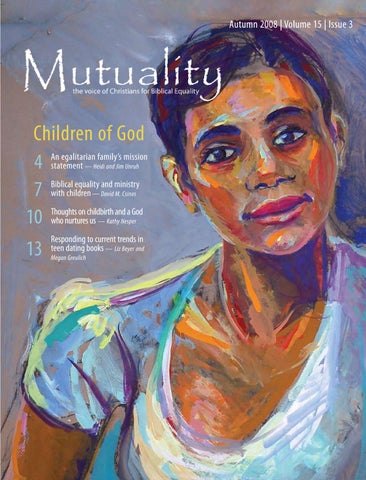
Autumn 2008 | Volume 15 | Issue 3
Children of God An egalitarian family’s mission 4 statement Biblical equality and ministry 7 with children on childbirth and a God 10 Thoughts who nurtures us Responding to current trends in 13 teen dating books — Heidi and Jim Unruh
— David M. Csinos
— Kathy Nesper
— Liz Beyer and
Megan Greulich
cover image Dale Johnson © 2008 Dale Johnson, www.dalejohnsonart.com.
about the artist Dale Johnson is an established artist and professor of art at Bethel University, Saint Paul, Minnesota. He is also the founder of Dia Vivo (or, “Bright Day”) School of Arts, a nonprofit arts organization serving low-income children of La Romana, Dominican Republic. Dia Vivo is dedicated to fostering creativity and critical thinking in children to build confidence, self-esteem, hope, and self-sufficiency, and works to develop faith, transform communities, and further arts education. Dia Vivo offers art classes at no cost to children living in the Bancola barrio of La Romana. Many residents of the Bancola barrio live in substandard conditions and have taken desperate actions resulting in theft or prostitution to satisfy family needs. Dia Vivo desires to help children reach their full potential by encouraging education and entrepreneurship within the arts. Dia Vivo’s art classes teach principles of painting and design and introduce the art heritage of the Dominican Republic and other historical art sources. The students learn how to create marketable products using recycled materials and are trained to build and maintain a portfolio to seek employment or for submission to a university. Staff members work with local institutions to ensure that Dia Vivo students may further their art education upon acceptance, through scholarships. Dale himself paints the children of the Bancola barrio in an effort to raise awareness and garner support for the children. He writes, “As a North American artist, I cannot ignore the huge social inequities as I am encircled by the Dominican children. What can art reveal about this massive chasm?...Maybe working hard to paint the inner hopeful spirit with no façades: just painting observations and invention inspired by the warm hues and deep cool shadows in the faces of the Caribbean children and their beautiful land will make a difference.” To support Dia Vivo by buying art or making a donation, visit www.diavivo.com.
Contents F E AT U R E S 4
Oaks of Righteousness: An egalitarian family’s mission statement Heidi and Jim Unruh
7
Building a Firm Foundation: Biblical equality and ministry with children David M. Csinos
10 Taste and See: A childbirth professional reflects on a God who cherishes and nurtures us Kathy Nesper 13 Girls, Guys, and God: Responding to current themes in dating books for teenagers Liz Beyer and Megan Greulich 16 The Girl Whose Hand Jesus Touched: A devotional for families Mary Stromer Hanson 17 Kristina LaCelle-Peterson’s Liberating Tradition: A book review Melanie Springer Mock
MINISTRY AND CHAPTER NEWS 18 Reflections from Toronto: 2008 Conference Report 20 From a Dusty Field in Illinois: CBE at Cornerstone 2008 20 Praises, Prayers, and Reflections
D E PA R T M E N T S 3 From the Editor: A cello and a Subaru 21 President’s Message: Christ comes to bring his blessings, far as the curse is found
22 Giving Opportunities: A balm for my soul
cover design Shalanah Backus
2 M U T U A L I T Y | Autumn 2008
websi te : www.cbeinternational.org
From the Editor by Megan Greulich
A Cello and a Subaru I sat in a worn, squeaky auditorium chair at my elementary school, One of the questions we asked while preparing this issue feeling goose bumps as I was suddenly consumed by a vision of of Mutuality was “How do we mentor and parent children to my future. I was in fourth grade, and I had just witnessed my understand biblical equality?” This task for us as egalitarians music teacher demonstrate every instrument in the string family. may feel a bit like how my mother felt, trying to fit my cello into Each instrument was impressive, but none of them compared to that Subaru each morning. It takes time, energy, perseverance, the cello. Later that night, still caught up in my new dream career and a willingness to look slightly ridiculous. Youth workers and of “world-famous cellist,” I announced my plans to start cello parents have to counteract negative messages about gender from lessons to my parents at the dinner table. their children’s schools, the mainstream media, and even their Dad’s eyebrows reached halfway up his forehead, and Mom churches’ youth groups. We often hear from these concerned let out a bit of a giggle. No doubt they were thinking about the egalitarians that this task feels like an exhausting uphill battle. high costs — at least $1,200 — and…our Subaru. Yet it is also a task that brings incredible joy. Our family of three rode around the streets of our Iowa My mother was willing to sacrifice for me, because she town in a two-door 1988 red Subaru Justy, which still to this day believed that I should be free to follow the passions God had is the smallest car I have ever been inside. When I started cello given me. That same belief drives egalitarians to be joyful, and to lessons and the children’s all-city orchestra a short time later, we keep hoping and working for change, despite how inconvenient learned how truly small the car was. and awkward that work might be. What a privilege it is to help It was nothing short of a 15-minute process to get that cello in children see they are all made in God’s image, to witness their our Subaru. Mom and I had to release the back seats so that they enthusiasm and say, yes, God will call you based on your gifts. We would fold down, and then scoot the front driver’s and passenger’s still have much work to do, but our joy comes in the hope that bucket seats up so much that when we eventually climbed back the next generations will know Jesus’ love and freedom for them into the car, our knees were scrunched against the dashboard. The regardless of their ethnicity, class, age, or gender. cello was longer than the car was wide or long. So it was carefully While this "Children of God" theme of Mutuality could jockeyed back and forth through the hatchback opening until it have developed in many different directions, we decided to was safely wedged at a 45-degree angle into the car. focus on reflections and practical tips to help parents and Twice a week during the school year, and every day mentors encourage egalitarian values in the next generations of during the next summer, Mom helped me load my cello into Christians. In this issue you will find reflections on building your that Subaru. It was inconvenient, and we must have looked family's purpose, how to teach children about biblical equality, ridiculous, driving with our knees crammed up against the reflections on breastfeeding and God as our nurturer, and tips dashboard, inching our way through turns to protect the on equipping teenagers to be world-changers. We pray you will cello’s delicate neck. But my parents saw a passion in me, and be strengthened, challenged, and encouraged. Blessings to you as they did whatever it took to encourage it. you read and reflect!
Let us then pursue what makes for peace and mutual upbuilding. –Romans 14:19 Mutuality (issn: 1533-2470) seeks to provide inspiration, encouragement, and information about equality within the Christian church around the world. Editorial staff: Megan Greulich, editor; M. L. Castleberry, Adele Hebert, editorial assistants; Image Spigot, graphic designer; Mimi Haddad, president/publisher. Contact us at: Christians for Biblical Equality; 122 W Franklin Ave, Suite 218; Minneapolis, MN 55404-2451; phone: (612) 872-6898; fax: (612) 872-6891; email: mgreulich@cbeinternational.org; web: www.cbeinternational.org. We welcome your comments, article submissions, and advertisements. For writers guidelines, visit CBE’s website and follow the publications links. Advertising in Mutuality does not imply organizational endorsement. Please note that neither Christians for Biblical Equality, nor the editor, nor the editorial team is responsible or legally liable for any content or any statements made by any author, but the legal responsibility is solely that author’s once an article appears in Mutuality. All Scripture quotations, unless otherwise indicated, are taken from the Holy Bible, Today’s New International Version®. TNIV®. Copyright © 2002, 2004 by International Bible Society. Used by permission of Zondervan. All rights reserved. CBE grants permission for any original article (not a reprint) to be photocopied for local use provided no more than 1,000 copies are made, they are distributed free, the author is acknowledged, and CBE is recognized as the source. Mutuality is published quarterly by Christians for Biblical Equality and is sent free to members. For membership information, see page 23. To purchase back issues or multiple copies, contact our office or order online.
booksto re : www.equalitydepot.com
M U T U A L I T Y | “Children of God”
3
Oaks of Righteousness A n E g a l i t a r i a n Fa m i l y ’s M i s s i o n S t a t e m e n t by Heidi and Jim Unruh
Many churches have mission statements. Families can have mission statements, too. Our family’s sense of mission derives from Isaiah 61:1–3. Jesus cited this text as the foundation for his earthly ministry (Luke 4:18–19), and we have adopted this as a cornerstone passage that drives and guides the decisions we make as a family.
4 M U T U A L I T Y | Autumn 2008
websi te : www.cbeinternational.org
The spirit of the Lord GOD is upon me, because the LORD has anointed me; he has sent me to bring good news to the oppressed, to bind up the brokenhearted, to proclaim liberty to the captives, and release to the prisoners; to proclaim the year of the LORD’s favor, and the day of vengeance of our God; to comfort all who mourn; to provide for those who mourn in Zion — to give them a garland instead of ashes, the oil of gladness instead of mourning, the mantle of praise instead of a faint spirit. They will be called oaks of righteousness, the planting of the LORD, to display his glory (NRSV). — Isaiah 61:1–3
In particular, we have been drawn to Isaiah 61:3: “They will be called oaks of righteousness…to display God’s glory.” “Oaks of righteousness” is a metaphor for living in a way that pleases God by loving God, others, and ourselves. The image of a tree helps to make the abstract concept of righteousness more concrete to our young children, three-year-old Elise and five-year-old Jacob. We show our children how we use this Scripture as a lens to focus our priorities and our choices. For example, we tell them, “Mom and Dad are going to work, which is part of how we are oaks of righteousness. You can help us to do our work by going to day care and learning and having fun.” We use this passage as a framework to correct our children when they are not treating one another or their friends the right way: “Is teasing being an oak of righteousness?” We also cite the passage as a way of showing appreciation to our children: “Thank you for being an oak of righteousness when you shared with your brother.” Or we affirm that they are being an oak of righteousness when they draw a picture to cheer up a neighbor in the hospital. We also use this passage in reflecting on our day during our nightly prayer time. We sometimes ask one another, “How were you an oak of righteousness today? What do you think you can do to be an oak of righteousness tomorrow?” In this way, this metaphor for how we are to live and serve God and one another becomes encoded in our family’s DNA. Several key values or principles are particularly important to our family. These principles flesh out what we mean by being “oaks of righteousness”: God’s kingdom — Isaiah 61 is linked with another favorite passage, “Seek first God’s kingdom and God’s righteousness” (Matt. 6:33). We aim to put God at the center of our family, and to live according to God’s kingdom. We trust Jesus, our King, to bring us salvation — to make us “the planting of the LORD,” to display God’s glory. Community — We seek to consider what is good for one another and the family as a whole, not just our individual interests. The value of community leads us to share, because we want others to enjoy what we enjoy. We encourage our children to share with one another but also with others beyond our family. When Heidi took our two young children to a rally for SCHIP (state-funded insurance for low-income children), she explained that they were going because we believe people should share so that all parents can afford to take their kids to the doctor.
booksto re : www.equalitydepot.com
Equality — Ultimately, our community includes all humanity. We are all called to be oaks of righteousness, regardless of age, ethnicity, social status, or gender. We all have equal standing before God. My children learned the common mealtime prayer, “God is great, God is good, let us thank him for our food…” at their church-based pre-school. At home, we revised it slightly: “God is great, God is good, let us thank God for our food…” Jacob and Elise protested because we weren’t “saying it right.” We explained that we wanted to say it that way because God is not a him or a her. Then Jacob matter-of-factly informed us, “But God is a boy.” We try to help our children understand that God is not made in our image, but we in God’s. This means that we must treat everyone as a precious child of God. And we must not limit God by assigning God a single gender in our language, or a single skin color in our Bible illustrations. Kindness and peacemaking — Elise asked the other day why some older children in the playground were acting like bullies. We explained, “They have meanness in their hearts, and it comes out in being mean to other people.” We tell our children that everyone has some meanness in their hearts at times, and our job from God is to make the meanness in the world smaller. This means that Jesus wants us to be kind to others even when they are mean to us. When one of our children gets mad and hits the other, we ask, “Did that make the meanness smaller or bigger?” Then we encourage them to find ways of dealing with the problem to make love grow like an oak tree. Reconciliation — God’s “good news” (Isa. 61:1) emphasizes restoring relationships and making things right. We tell our children that we don’t expect them to be perfect (and we acknowledge our imperfection as parents). But we do expect that when they make a mistake or hurt one another they need to acknowledge it by saying sorry, and then asking, “What can I do to make things right?” Usually the other person asks for a hug and an assurance that the offender will try not to do it again. We try to model this by seeking our children’s forgiveness and being reconciled when we lose our temper with them. We also remind them (and ourselves) that we can ask God to give us new hearts. When we realize that our meanness is coming from inside our hearts, the only way to really change and make things right is to ask God to share Jesus’ good heart with us.
M U T U A L I T Y | “Children of God”
5
Purpose — We tell our children (and ourselves) that God created us for a reason — to fufill the Great Commandment: Love God and love one another. We want to encourage lives of God-honoring virtue and respect for parents, not rote compliance with rules. We want to experience joy, rather than mindless, selfish pleasure. We try to keep growing and expanding our minds and cultural horizons, so that we can be all that God created us to be, and love God with all our being. We want to use our gifts and resources intentionally to make the world a better place. Isaiah 61:3 helps provide the framework for defining this purpose: bringing good news to the poor and healing for those in darkness, binding up the brokenhearted, proclaiming God’s deliverance from injustice, comforting those who mourn with new hope. Some aspects of this mission are beyond what our children are ready for. For example, Jacob took an instinctive dislike to a woman struggling with homelessness and addiction whom we had befriended. He was too young at the time to understand her situation; we could only explain that she had a sad life, and that God wanted us to show her love even if she made us uncomfortable. For both their sakes, we limited his exposure to her. As they get older, our children will discover more about the world’s injustice and the power of Christ’s salvation. We pray that our children will be sent by God to “bring good news to the oppressed.” Yet our children already have a unique contribution to this purpose. Elise’s ministry began as an infant: she softened the rough-edged teenagers who would sometimes attend our church and visit our home. In church, whichever youth was holding her
6 M U T U A L I T Y | Autumn 2008
invariably was less of a disruption during the service. She is our “Princess Sweetie” whom we affirm for showing kindness and bringing “the oil of gladness” to all people. Jacob is gifted in the realms of music and sports, but he is also caring and sensitive to others’ spiritual condition. When we told him about a Compassion child we were sponsoring who is about his age, he offered half his savings to buy him a toy. Nearly every night for weeks he prayed for a neighboring child to come to church. Then she started coming to church, so now we are praying that God gives her a new heart. Our eldest son Maurice has also been used to bring good news to others. He is an extrovert who enthusiastically draws others in and makes them feel welcome. When Jim was interviewing for his pastoral position he told the church that our son would invite his friends, so the congregation needed to be prepared to receive ethnically diverse, special needs youth. And that’s exactly what happened. From our (Jim and Heidi’s) very first serious conversation, sixteen years ago, we sensed that we shared the same life mission and values. Over the years these ideals have unfolded in clarity and have been tested and refined in practice. And they are still evolving, as our children teach us new ways of looking at old ideals. We are all learning together how to be oaks of righteousness. Heidi and Jim Unruh live in Hutchinson, Kansas. They have three children, ages 3, 5, and 21. Jim is pastor of Faith Mennonite Church. As director of the Congregations, Community Outreach, and Leadership Development Project, Heidi offers consulting and develops ministry resources for churches. Both are graduates of Palmer Seminary, near Philadelphia.
websi te : www.cbeinternational.org
Building a Strong
Foundation
Biblical Equality and Ministry with Children by David M. Csinos
A few months ago, my wife and I were working at a weekend family camp as directors of the children’s ministries. On the first day of camp, we asked the children to gather around a long table and draw or paint pictures of what they think God might look like. They each quickly found their place around our common table and began to create their images of God. The attitude of this creative activity remained quite peaceful until one young boy — perhaps four or five years of age — expressed a desire to stand and draw beside his older sister. As he sidled up beside his sibling, the other young girls around him became upset because they had decided that end of the long table would be the “girls’ side.” My wife and I were both quite surprised with this comment, because we had not encouraged the girls and boys to separate from one another at any point during our time with them. The children were the ones who created an environment of gender segregation.
Two Stories
booksto re : www.equalitydepot.com
This kind of episode was not new to me, but I was somewhat alarmed by what it demonstrates. Evidently, these children were being fed the message that females and males are fundamentally different (more than just biologically) and need to remain and interact solely with those of the same gender. It seems as though the gender inequality of the wider culture had seeped into their world views and lifestyles and affected how they interact with one another on a daily basis. Even within churches, children and young people continue to learn about gender inequality through both obvious and subtle messages. While some churches overtly teach them that God created one gender of the human race to be in a position of power, while the other is to be subordinated, other congregations pass on this message in more covert ways, such as designing programs and activities for children based on gender, rather than on the interests, talents, abilities, or gifts of the children. Let me illustrate this through another story.
M U T U A L I T Y | “Children of God”
7
Early this summer, my wife volunteered at a five-day overnight camp for children between the ages of five and twelve. During their week away from home, these children were able to hear messages of God’s love for them, and the importance of using the unique gifts, talents, and abilities that God has bestowed on each of them. Although the camp volunteers were intentional in stressing these ideas during times of devotion, worship, and teaching, they planned an activity that would unintentionally challenge their message of equality. Toward the end of the week, the leadership of the camp decided to offer some optional activities that children could participate in during their afternoon free time. During their morning staff meeting, the director told the counselors about the two optional activities: decorating the dining hall for their themed dinner or playing a game of soccer on the camp’s athletic field. The only problem with these activities was that they were not going to be open for all children — the girls would be invited to help decorate, while the boys would be allowed to join the soccer game.
Some of the most significant messages that children receive from their Christian faith communities are unspoken, covert, and implicit. Evidently, this Christian camp was going to implicitly teach their children that males and females are to perform different roles based on their God-given gender; while boys could run and play outside, girls were to remain in the kitchen and engage in interior decorating. Rather than promoting these optional activities based on interests, talents, or skills, they were to be offered to the children solely based on their gender. Thankfully, my wife recognized the implicit messages that these gender-exclusive activities could teach the children and convinced the camp director to open up both options to all children. In the end, many young girls enjoyed a great game of soccer, while some of the boys were able to help decorate the dining hall in preparation for dinner. This story speaks to the need for Christian faith communities to examine their “implicit curriculum,” or the covert or unspoken messages that they convey to their congregants, including children. Even though this camp spoke of the significance of all the campers’ gifts, they were at risk of implicitly teaching the children that their gender should define what they are capable of doing. In
8 M U T U A L I T Y | Autumn 2008
The Educational Imagination (Macmillon, 1985), Elliot Eisner defines implicit curriculum as, “what [a school] teaches because of the kind of place it is…And because [features of the implicit curriculum] are salient and pervasive features of schooling, what they teach may be among the most important lessons a child learns” (p. 97). The same is true for churches, Christian camps, and parachurch organizations; some of the most significant messages that children receive from their Christian faith communities are unspoken, covert, and implicit. These are the lessons and messages that have a significant impact on how children think and act and who children become. The two stories that I have just offered demonstrate that children continue to be taught that men and women should have different roles in church and society. They also learn that boys and girls should not socialize with members of the other sex. They are implicitly taught that one’s activities and interests should be defined by one’s gender. Such false messages of inequality and gender segregation are still quite pervasive, both in churches and in the wider western culture. Churches and ministry leaders that are committed to creating wholeness and peace through equality among the sexes must recognize the pervasiveness of these false messages and actively work to teach children that all human beings are created equal. The messages that children receive when they are young can form a foundation that can impact the way they think and act for the rest of their lives. Therefore, it is extremely important that we provide our children with implicit and explicit messages that demonstrate gender equality and the giftedness of all people. Let me briefly discuss how Christian faith communities can intentionally create environments that promote biblical equality.
How Shall We Teach Biblical Equality?
websi te : www.cbeinternational.org
First, Christian faith communities must intentionally teach children about the inherent worth, dignity, and value of human beings, regardless of ethnicity, age, or gender. The creation narrative in Genesis makes it clear that all humans are made in the image of God (Gen. 1:27). Being made in God’s image, the lives of both women and men are infinitely precious and have inherent value and worth. In addition to being made in God’s image, all human beings are given different talents and gifts from God to be used to further God’s kingdom. In 1 Corinthians, Paul writes, “There are different kinds of gifts, but the same Spirit distributes them. There are different kinds of service, but the same Lord. There are different kinds of working, but in all of them and in everyone it is the same God at work” (1 Cor. 12:4-6). This is a message that needs to be imparted to children as a core part of the biblical meta-narrative. Perhaps when teaching the creation story, pastors and teachers can pause to discuss how all humans beings have value because we are made in God’s image. They can further teach that God has created each person with unique gifts and talents that are to help us determine our calling in the kingdom. Perhaps when this happens, children and young people can come to see that their roles in the church and the world are not to be determined by their biological gender, but by their God-given gifts and passions. Another important approach to teaching children about biblical equality is to subvert the explicit and implicit messages of hierarchical complementarianism. Churches must work to counter the pervasiveness of gender inequality by putting a halt to practices that separate and differentiate boys and girls. One simple way of doing this is to avoid games and activities that are set up as “boys versus girls.” But we must do more than simply oppose such practices; we must also initiate practices that intentionally subvert gender inequality and teach children biblical equality. Dori Baker and Joyce Mercer, in their recent book, Lives to Offer (Pilgrim, 2007), state that one way churches can subvert “the constructs of gender [that] still operate to shape us” (p. 91) is to use movies in which boys and girls assume roles that are traditionally reserved for people of the opposite gender. Such films, which include Napoleon Dynamite, Holes, and Bend it Like Beckham, allow children and youth to witness boys and men who let their relational, sensitive side shine through and girls and women pursue their passions and develop their gifts despite prescribed gender roles. Karen-Marie Yust, in her excellent book, Real Kids, Real Faith (Jossey-Bass, 2004), makes it clear that children learn and develop by seeing and following the examples of the adults they encounter on a regular basis. If young people are to be taught the values of biblical equality, the parents, grandparents, pastors, and church leaders in their lives must do more than simply teach egalitarianism — they must model it in their daily lives. Adults within our Christian faith communities should demonstrate biblical equality through their words and deeds, by treating all individuals with dignity and worth, and by modeling the egalitarian way of Jesus. Through their ministries, the church should show children that they practice the words of Paul, who wrote, “There is neither Jew nor Gentile, neither slave nor free, neither male nor female, for you
booksto re : www.equalitydepot.com
Creating an Egalitarian Environment • When playing team games, create teams with both boys and girls. • Teach Bible stories in which women are the heroines. • Have men and women as part of your children’s ministry leadership team. • Use words like “humankind” and “people” instead of “mankind” and “man.” • Offer activities that are not gender-specific. • When an issue involving inequality arises (like a joke or a situation in a movie), don’t avoid it; use it as a teaching tool.
are all one in Christ Jesus” (Gal. 3:28). This means that Christian faith communities should critically examine the life of their congregation to bring to light ways in which gender hierarchy is implicitly and explicitly imparted to children and young people. Perhaps segregated men’s and women’s ministries could to be re-imagined and developed in a way that promotes equality and interdependence among the sexes. Perhaps men should give up some of their traditional power and roles in order to allow room for women to use the gifts that God has bestowed on them. In these ways, churches can come to demonstrate biblical equality through their corporate and individual lives and let the light of egalitarianism shine for all to see. Thanks to the work of egalitarians and organizations like Christians for Biblical Equality, more and more Christians are recognizing that all people — regardless of gender — are equal in God’s eyes. Yet through my involvement with various ministries with children, I have come to see that many children are still receiving messages of gender inequality and hierarchical complementarianism. If we are to continue to work towards biblical justice and equality between men and women, then we would do well to continually explore ways in which we can pass on these biblical values to children and youth. By explicitly teaching young people about biblical equality and by modeling it through the ways in which we live, children may no longer segregate themselves from the other gender, and Christian faith communities may no longer unintentionally spread the message of gender specific roles through their ministries with children. In this way, the younger generation can grow to understand, accept, and live out God’s ideal design for women and men, a design of biblical equality. David M. Csinos is a doctoral student at Union Theological Seminary and Presbyterian School of Christian Education in Richmond, Virginia, where he specializes in the field of children’s spirituality. He received an MTS in Christian Ministry from McMaster Divinity College and a BA in Religion and Culture from Wilfrid Laurier University. David has also worked for a number of churches in southern Ontario in various children’s ministry positions. He lives in Richmond with his wife, Jenny, who is also a graduate student at Union-PSCE.
M U T U A L I T Y | “Children of God”
9
Taste & See
by Kathy Nesper
The Bible provides us with many metaphors of God as our mother. When explored, they help us draw nearer to a God who cherishes and nurtures us.
“Taste and see that the Lord is good…” (Psalm 34:8). The baby is fresh from his mother’s womb, naked, blinking in the unaccustomed light. He lies peacefully cushioned on the warm, bare skin of her now flaccid abdomen, just below and between her breasts. Her hand rests gently on his bottom as she speaks softly to him. He lifts his head and nods it like a bobble-head doll against her breastbone. He draws up one leg and pushes against her, gaining traction in the soft folds of her belly. He pushes again with the other leg, and repeating the crawling motion he inches upward until his head rests atop one of her breasts. He begins again to bounce his head over her skin, his mouth open. He finds her nipple, bobs until it is centered in his mouth, and begins to suckle, contented. 1 Nearly unbelievable, isn’t it? Yet a healthy newborn with senses not dulled by pain medication from labor and left undisturbed on her mother’s abdomen will make this journey less than an hour after birth. In God’s design, she bobs, nuzzles, licks, and then tastes…and begins to learn the warm, comforting goodness of the one from whom the milk flows.
10 M U T U A L I T Y | Autumn 2008
websi te : www.cbeinternational.org
As a breastfeeding advisor, childbirth educator, and doula (or trained labor support person) for three decades, I have been privileged to witness many scenes of women in labor and of newborns with their parents. They leave me in awe for many reasons, but I especially appreciate the way they help plumb the depths of Scripture. While we are all familiar with the biblical metaphors of God as our father, many people are surprised to learn that the Bible also uses metaphors for God as our mother. Sadly, we rarely hear sermons or read articles on this topic. Yet the Bible is rich with birth, breastfeeding, and parenting metaphors, many placing God in the role of mother to us, the children. When explored, these metaphors help us understand and draw nearer to a God who cherishes and nurtures us.
her body provides for his needs and her embrace at the breast comforts him with her soothing heartbeat in his ear, he “longs for the milk.” Often! He expresses his longing loudly and insistently if she overlooks his early hunger cues of restlessness. The apostle tells us that once we are aware of God’s goodness, we should long for the milk — the nurture and nourishment — of God’s presence with all the intensity of a newborn infant who senses hunger. How might we grow as believers if we were as insistent, as often, in seeking out God’s own embrace? How much more would the words of Scripture mean if we took time to listen for God’s heartbeat in them as we read? How meaningful our prayers if we paused to sense the loving arms around us and to rest our weary heads against God’s own breast?
“Like newborn infants, crave pure spiritual milk, so that by it you may grow up in your salvation, now that you have tasted that the Lord is good" (1 Peter 2:2–3).
“…crave pure spiritual milk, so that by it you may grow up in your salvation…” (1 Peter 2:2–3).
The infant is restless, and she begins to wave her arms and kick her legs. One tiny fist grazes her cheek, and she instinctively turns toward it, mouth open. Her mother is distracted and doesn’t notice, so the little one begins to cry.
Here in the second chapter of his first letter, Peter expands on Psalm 34:8 using a rich feminine metaphor to explain both God’s goodness and our need for God’s sustenance. Once the infant has “tasted” and seen that his mother is good because
booksto re : www.equalitydepot.com
He drinks with long, drawing sucks, punctuated with swallows. He is blissfully unaware of the biological gifts within the milk; he only knows that it satisfies him. He may not recognize its benefits, but an infant at the breast is intent on obtaining the life-giving, biologically “living” fluid that will sustain his life. Components in a mother’s milk keep it pure from germs and ready to feed. It is exactly the right temperature at all times. It never “runs out” but is made constantly, even as the baby suckles. The milk of a mother who has been exposed to an illness even provides biologically specific antibodies to her baby. Human milk is completely unique to each individual motherbaby pair. The milk of a premature baby’s mother has higher levels of protein and immune factors than if the birth had been full term. Even an individual mother’s milk varies over time, with increased enzymes to protect against diarrhea when the baby begins to crawl on the floor, and with reduced protein levels when she is a year old and eating solid foods. It is ideally suited at each stage to help the child grow appropriately.
M U T U A L I T Y | “Children of God”
11
Peter’s metaphor illustrates our own depth of need for God’s nurture and protection against the disease of sin, enabling us to “grow into salvation.” We need to multiply the healthy cells of our faith and to grow into maturity through intimacy with God. Like the baby’s physical needs, our spiritual needs change as we move through life stages and challenges — and God is always available with the response appropriate to each individual’s unique need.
The insights go in both directions. Spiritual awareness has informed my choices as a birth professional — and as a parent and grandparent myself. It is dangerous to turn the Bible into a “how-to manual” it was never intended to be, so we need to take care not to misapply it. But it can, at the least, stimulate valuable questions. For example, what did Peter know that caused him to say so casually that a new baby “tastes” her mother’s goodness even before craving a first feeding? The sight of a newborn infant instinctively “swimming” up the mother’s bare abdomen to her breast may have been familiar to parents in some cultures throughout history, as well as in some cultures today. Unfortunately, it is not often observed in Western hospitals where medication can dull the baby’s responses; the “efficient” procedures of weighing, bathing, diapering, and bundling are applied soon after birth; and the clock is then watched until the baby successfully “latches on” to the breast for the first time. We have (re)discovered only in the past two decades that some practices can interfere with instinctive behaviors that benefit both mother and baby. Perhaps we might have recognized it sooner if we had pondered Peter’s observation. In our parenting decisions, we might also consider the biblical implication that a baby can be aware of goodness, even love, in the way parents respond from the earliest moments. What practices will communicate this best? We know that the mother’s and father’s behavior sets the tone for the growing child’s understanding of God as parent. One of the best questions we can ask of ourselves is this: “What traits of God do I want to teach my baby? How can I respond to her in ways that will communicate those traits in me?” This is anything but easy, especially when the infant awakes for the third time in the night! Yet we can draw strength from remembering that God’s goodness and patience should be evident in our response.
12 M U T U A L I T Y | Autumn 2008
Again and again, though it is not a step-by-step parenting guide, Scripture can bring practical insights through the ways God models parenting for us. The mirror image is also true: the very earthy experiences of bringing life into the world and nurturing it at the breast offer new understanding of spiritual things. Pope John Paul II captured this truth: “The [human] body, in fact…is capable of making visible what is invisible: the spiritual and divine.”2 He spoke of human sexual relations, but his words are no less true about the acts of motherhood. I am thankful in new ways every time I have an opportunity to observe these tender moments — and to know my God better as a result.
Her nursing has slowed, and her mouth relaxes, releasing the suction. She immediately draws the breast back into her mouth, desiring its comfort even in her sleep. Eventually she is overcome, her eyelids close, her limbs relax, and her mouth goes slack. She is content. A substance in the mother’s milk induces drowsiness in the infant, so that she often falls asleep at the breast by God’s own design. Her hunger satiated, her heart stilled by her mother’s embrace, she can relax and rest. We stand over her and wish we could once again know that depth of peace. But when we see through new eyes that the intimacy she has just experienced at her mother’s breast is still intended for us through God’s own presence, even as adults, we can learn from her example: “In peace I will lie down and sleep, for you alone, Lord, make me dwell in safety” (Psalm 4:8). 1. This is my account of an actual scene in the wonderful short DVD Delivery SelfAttachment by Lennart Righard, MD, available at www.geddesproduction.com. 2. Cited in West, Christopher. A Crash Course in the Theology of the Body. Carpentersville, Illinois: The Gift Foundation, 2002. Kathy Nesper, CCE, CD(DONA) is co-founder and president of Apple Tree Family Ministries, www.appletreefamily.org, which encourages drawing closer to God through the experiences of childbirth, breastfeeding, and parenting.
websi te : www.cbeinternational.org
Girls, Guys, and God Responding to current trends in dating books for teenagers by Liz Beyer and Megan Greulich
“I don’t understand what you’re saying. God created women as helpers. Our most important purpose is to affirm the guys in our lives — to let them know that we respect them, and that we trust them as our leaders.” So went another conversation with a young Christian woman on gender. While in general we are observing great forward leaps on behalf of biblical equality among college students, in this conversation I (Megan) hit a wall. Where had I heard that “women are created to help men” reaction before? I wondered, and then my eyes wandered to my shelf of books written to Christian teenagers. A rush of compassion for my young friend hit me: she might well have been quoting directly from one of those books. I thought back to my high school days, remembering similar books that I had eagerly devoured. Was it any surprise that I went to college opposed to full equality between women and men?
booksto re : www.equalitydepot.com
From Justin Lookadoo and Hayley DiMarco’s Dateable, to Shaunti Feldhahn and Lisa Rice’s For Young Women Only, to Joshua Harris’ books like I Kissed Dating Goodbye, today’s Christian books for teens on dating seem overwhelmingly steeped in unhealthy and unbiblical ideas about gender. As believers in biblical equality, we are responsible to teach teenagers what it means to be God-honoring women and men. Parents and youth leaders need practical ways to identify and respond to these unhealthy and unbiblical stereotypes in creative and redemptive ways.
M U T U A L I T Y | “Children of God”
13
The Problem: Is it really all about dating and gender stereotypes? Christian dating books for teens are not difficult to find. Even a short list includes books such as: Boy Meets Girl by Joshua Harris, I Gave Dating a Chance by Jeremy Clark, When Dreams Come True and When God Writes Your Love Story by Eric and Leslie Ludy, Every Teenager’s Little Black Book on Sex and Dating by Blaine Bartel, 10 Commandments of Dating by Ben Young and Samuel Adams, Dating with Pure Passion by Rob Eagar, Courtship or Dating: So What’s the Difference by Dennis Gundersen, and Before You Meet Prince Charming by Sarah Mally. While their themes and advice on dating “rules” are all over the map, they represent a Christian culture obsessed with romantic love and marriage. This brings a skewed focus on romance that often comes neatly packaged with gender hierarchy. These books play a powerful role in the self-image of teens, particularly teenage girls. They often fuel an already growing desire for romance, sometimes suggesting that this is God’s sole design and purpose for women. Books like Lies Young Women Believe by Nancy Leigh DeMoss and Dannah Gresh teach teenagers that there is no higher calling for a woman than that of wife and mother. Even Alex and Brett Harris’ inspiring Do Hard Things, though not focused on dating, still hosts a website with resources on hierarchical marriage and gender roles. While the Harris brothers are clearly open to the idea of women following God’s call to “do hard things,” when it comes to dating and marriage, gender hierarchy is interwoven, unquestioned, and is, especially for girls, strongly emphasized. This is not surprising. If teen books and other aspects of Christian culture imply that femininity is best expressed when in response and submission to a man, then it follows that our teenage girls would be so consumed with the idea of dating and marriage. What purpose does God then have for a young woman who is not in a relationship with a man? Thus, teenage girls
14 M U T U A L I T Y | Autumn 2008
who desire to be “women of God" are left wondering if they can be useful to the kingdom if they are not in the context of wife and mother, with godly men to “cover” them. They have few choices but to wait for God to present that special man (which may explain the large collection of books for young women on learning patience and contentment as they wait to get married.) No wonder that many of these teen books encourage tired stereotypes of males and females. Shaunti Feldhahn and Lisa Rice’s For Young Women Only shares practical tips on how a teenage girl might modify herself to find a boyfriend and includes tips on losing weight, playing on the assumptions that guys are “visual” and girls are meant to be beautiful. They also assert that girls should learn to respect guys “unconditionally,” fueling the popular theory in Christian circles about men’s and women’s supposed different needs. And Justin Lookadoo and Hayley DiMarco’s Dateable provides tips to both sexes, arguing that guys should be assertive leaders and girls should “shut up and be mysterious.” Are we teaching teenage girls that their success as a child of God depends solely on their ability to be in a relationship with a man, who requires absolute authority and unquestioning respect? Is Dateable’s portrayal of guys as manipulative and sexcrazed a truthful and redemptive understanding of masculinity?
A Response: Emphasize vocation We all know that teenagers (and most people of other ages) love to talk about dating and romance. It is a normal aspect of life, particularly in teens’ stage of development. As teenagers are growing and learning how to relate to one another, it is healthy for them to have questions about, and interest in, dating. Yet overemphasizing and overly romanticizing dating and marriage, especially when it comes packaged with gender hierarchy, can easily distract teens from discovering God’s call on their lives. When I (Megan) was in high school, I was passionate about giving my life entirely to Jesus through ministry, and found myself wondering what that would look like. Immediately, I dreamed of my future role as “pastor’s wife.” My faith was marked not only by a love and passion for Christ, but also was intimately connected with finding a spouse. Somehow I had picked up the idea that as a woman of God, my calling was dependent on a man. Today’s teenage girls (and guys) need to be taught and re-taught that their worth and ability to serve Christ are not dependent on their marital status. We must never let teenage girls believe that they will only live out their Christian “adventure” through marriage. While no youth groups would come right out and teach this, the message seems to be part of many churches’ implicit curriculum (see Dave Csinos’ article on page 7). This is why parents and youth workers must emphasize that our vocation — doing and being what God has called of us — is more important and more fulfilling than romantic relationships. How can we be intentional in emphasizing spiritual
websi te : www.cbeinternational.org
vocation in our families and youth programs? We recommend asking the following: 1. Are we intentionally or unintentionally promoting and romanticizing dating? How can we work to encourage a more balanced perspective on life as a Christian? 2. Is our youth group highlighting examples of single men and women who are content and living their lives for Jesus in powerful ways? 3. Do we have a “self-focus” or a “God-and-others-focus?” Are our teenagers more interested in learning how to date, be happy, and be successful rather than learning how to work for justice and share their faith? As mentors and parents, are we modeling a “God-and-others-focus?" 4. Are we intentionally seeking to help both teenage girls and guys identify their spiritual gifts and utilize them? 5. Are we hosting Bible studies and events where we discuss the fundamental equality of males and females in marriage and ministry?
A Response: Teach critical thinking Besides celebrating vocation, another important way to respond to these teen books is to encourage critical thinking. As Kevin Giles recently pointed out (Priscilla Papers 22.3), good Bible scholars distinguish between the authority of Scripture (which we strongly uphold) and a particular interpretation of Scripture. Too often we fail to help teens see that Christians have and will continue to disagree on important issues, and that our responsibility is to think hard, pray hard, and listen to God. We need to encourage teens to think critically — a skill that will serve them the rest of their lives. As parents and mentors, we can teach teens to recognize faulty arguments. And we can encourage them to have great trust in God, but also to question our human interpretations of the Bible without fear. We can work to inspire faith, not fear, because they should never be afraid to ask hard questions of God, as Jacob did. We ourselves can welcome and be ready for difficult questions. How do we encourage critical thinking in teenagers? One important step is to help teens understand that as much as we may like easy answers and formulas for dating and relating to each other, God has created a complex and intricate world. We also recommend equipping teens with these types of questions, allowing them to wrestle with the answers themselves: 1. Just because we observe guys and girls acting in a certain way, is this the way it should be? Is this honoring to God? 2. If something is “natural,” does that automatically make it “good?" 3. What does our culture value about men and women? How is what I am reading in these books influenced by culture? How is it influenced by Scripture?
booksto re : www.equalitydepot.com
More action steps for parents and youth leaders
1 Have the same expectations for both guys and girls. If
girls are expected to volunteer in the nursery, expect this of guys as well.
2 Emphasize high expectations for both guys and girls,
which will increase respect between the sexes. For instance, instead of only teaching girls about modest dress, hold high expectations for guys, too. It is demeaning to guys to teach that they “cannot help but look at beautiful girls who are dressed immodestly.” If the Harris brothers’ Do Hard Things is representative of how our teens are feeling, they will welcome the call to high standards.
3 Teach discernment and wisdom. Help teens sort
out questions like “Does having a physical reaction automatically mean that I am sinning? Or does it become a sin when I continue in thoughts and behaviors that use others for my own ends?"
4 Create an environment of love, respect, and honest inquiry. Do not shy away from difficult questions, and teach students to welcome those questions from each other.
5 Encourage students to study the Bible. Many of these
dating books assertively state that the Bible supports their ideas. Yet how can our students critically evaluate anything if they don’t have the Bible "written on their hearts" (Jer. 31:33)?
4. How do these books encourage or discourage our call to the Great Commandment (Mark 12:29-31), and the Golden Rule (Matt. 7:12)? Does it increase or decrease the Fruit of the Spirit (Gal. 5:22-26)?
Conclusion As we all work to equip the next generation for leadership, we ask that you join with CBE in prayer, that those who believe in biblical equality will take up the challenge to write books which present to teenagers the complexities of living in this world. May our teenagers sharpen and develop their God-given talents like William Carey, William Wilberforce, Sojourner Truth, and Catherine Booth, whose brave hearts and great minds led a broken world to Christ. Liz Beyer is bookstore coordinator and editor of Arise newsletter for CBE. She has been married to Bruce for 32 years. They have five children. Megan Greulich is editor of Mutuality magazine and membership coordinator for Christians for Biblical Equality. She lives in Saint Paul, Minnesota.
M U T U A L I T Y | “Children of God”
15
A Devotional for Families Luke 8:40–56 by Mary Stromer Hanson
The Girl Whose Hand Jesus Touched A man raced through the streets of Capernaum searching for the one person who could help him. He glimpsed an animated figure preaching, pushed through the crowd, and fell exhausted at Jesus’ feet. “My daughter is dying; come heal her,” begged the father with his last breath. Jesus followed the man back to his residence. Jairus dared to calm his pounding heart. Then a woman threw herself at Jesus’ feet, sobbing. Her faith was so strong that she believed if she touched his robe she would be healed. A miracle occurred! Joyfully she wished to slip back into the crowd. That was not to be! Jesus had indeed noticed and now he demanded, “Who touched me?” She trembled with fear. “Daughter, your faith has made you well.” Now Jairus knew that Jesus could indeed heal his daughter if only she could hang on to life! Then he was met by his own grimfaced servants who mouthed the words he dreaded to hear. “Your daughter is dead. Why trouble the teacher any more?” Jesus’ answer was curiously calm, “Only believe and she will be made well.” “How can I believe?” Then he prayed, “Help my unbelief!” At the house they were greeted by mourners wailing loudly. Jesus said, “Why make this commotion? The child is sleeping.” Jairus’ eyes welled up with tears when he viewed the motionless body of his daughter. Jesus’ words echoed in his ears, “Just sleeping, only believe.” Jesus approached the girl’s bed with love in his eyes. He took her hand and commanded gently, “Talitha, koum.” Suddenly her legs twitched, she inhaled and struggled to her feet. Jairus’ heart leaped with amazement. “Give her something to eat,” Jesus commanded.
16 M U T U A L I T Y | Autumn 2008
Discussion The story ends at this point but no doubt this girl will tell her amazing story for the rest of her life. How does she feel to awaken from the dead with her hand in the hand of Jesus? Now she celebrates two birthdays; the day she was born and the day she was born again! All believers are born twice: the day of birth and the day that person feels the saving hand of Jesus. On this busy day Jesus also healed a woman who had bled much of her adult life. These two miracles have important meaning to women and men. Since then, any restraints placed solely upon women are man-made and not the will of Jesus. Jesus loved women and girls as true friends and treated them with respect. He answered their questions and he taught them so they could use their gifts to spread the Good News. Study Questions 1. Who did Jesus raise from the dead? Were they important people? Men or women? Young or old? 2. Who are other young people and women in the Bible who experienced love and healing from God? 3. Does Jesus still heal people today? Why aren’t all people healed and saved from death? 4. What does this story tell us about the importance of faith? Do prayer and faith make a difference? Mary Stromer Hanson is a former public school teacher, now working on her MA in biblical studies at Denver Seminary. Mary is the wife of one husband, mother of two grown children, and owner of a Siamese cat. Her passion is empowering women and girls to pursue all their God-given gifts.
websi te : www.cbeinternational.org
Kristina LaCelle-Peterson's Liberating Tradition: Women’s Identity and Vocation in Christian Perspective reviewed by Melanie Springer Mock I am but a dabbler in egalitarian theory and thought. While I believe strongly in biblical equality, my convictions have always been vaguely defined, informed more by emotional sensibility and experience than by intellect and formal study. After all, I did not need religious scholars to tell me the Christian tradition has often treated women badly, nor that some evangelical interpretations of Scripture have squelched women’s voices: I experienced as much every time I sat silently in my church’s pews. Without a schooled basis for my thinking, it was hard for me to intelligently discuss exactly why I believed men and women were created equally, why I assumed some people read the Bible incorrectly, and why I thought some church tradition had it wrong. Somehow, saying “this is truth because I feel it is” was not good enough, especially when debating with religious studies scholars at the conservative Christian university where I teach. What I needed was a primer in biblical egalitarianism: a book that could lead me, step by step, through Scripture, showing me how women fit into the narrative of God’s people, how Jesus valued women as part of his ministry, and how women served as leaders in both the Old and New Testament. Such a text might also include a re-reading of church tradition, one which considers the role of women in the early church, and the ways those roles were undermined — even eradicated — by patriarchal systems. An ideal book might even suggest ways egalitarianism works well in contemporary evangelical homes and churches, helping me to navigate the real world in which I live and work. Kristina LaCelle-Peterson’s Liberating Tradition: Women’s Identity and Vocation in Christian Perspective provides such a primer in biblical egalitarianism. LaCellePeterson, an associate professor of religion at Houghton College, does a credible job of outlining the important arguments for why Christianity has traditionally excluded women from equality with men and for why women need to be released from the narrow roles in religious institutions where they have for too long been held. LaCelle-Peterson begins her text with the Bible, premising her exploration on the important question of what Scripture “actually says about women, about gender, and about how we conduct our lives together.” Her careful reading of Genesis is compelling, though perhaps familiar to most, as is her discussion of the significant women characters in the Old and New Testaments. Nonetheless, LaCelle-Peterson’s command of Scripture is impressive, and she provides ample evidence that the Bible establishes women’s equal place in the story of God’s people. booksto re : www.equalitydepot.com
A subsequent chapter on marriage in the Bible covers interesting ground, and should be required reading for young women and men entering marriage trying to determine whether a hierarchical relationship is in fact biblicallybased and God-blessed. Indeed, LaCelle-Peterson seems most animated in this and in other chapters that confront the contemporary dilemmas raised and sustained by patriarchal church traditions, such as the harmful influence of church tradition on women’s body image and the ways language makes women invisible. For those wearied of hearing that “all men are created in God’s image,” LaCelle-Peterson convincingly shows that even a seemingly benign phrase carries numerous barbs, as she argues such language undermines the very ideas women hold of their selves, leading to unhealthy — and unholy — body images. Other chapters address the role of women in church traditions, tracing the history of women’s place in Christianity through the early church, into the medieval period and later reformation, and up through twentieth century evangelicalism. While interesting, this section on church history seems uncomfortably situated between chapters on egalitarian marriage and inclusive language. Certainly, there is a connection between church tradition and contemporary evangelical practices, and LaCelle-Peterson makes those relationships clear. Yet, at times, it seems Liberating Tradition cast its nets too widely, and a sense of a cogent narrative is challenged in trying to consider so much. Still, LaCelle-Peterson’s wide-ranging effort is especially useful for those desiring a basic understanding of biblical equality, of its thought and application. Though those well schooled in egalitarian theology will find LaCelle-Peterson’s too fundamental, this should not be seen as a limitation in LaCelle-Peterson’s work, only a suggestion of audience. Readers who need a basic course in biblical equality will find this an important, accessible, and encouraging text — one that will liberate Christian women and men to “join hands to serve God fully in our homes, our churches, and our world.” Melanie Springer Mock is as an associate professor of writing and literature at George Fox University, in Newberg, Oregon. She is also the mother of two six-year-old boys. Her essays have appeared in Christian Feminism Today, Literary Mama, The Chronicle of Higher Education, and Brain, Child, among other places. Her book, Writing Peace: The Unheard Voices of Great War Mennonite Objectors, was published by Cascadia in 2003.
M U T U A L I T Y | “Children of God”
17
Sent to Preach the Gospel July 18–20, 2008 Toronto, Ontario
“ This was my first conference experience, and it was a really positive time. The overall tone of unity and love and working together was so evident, and so biblical.” — conference attendee
The Toronto conference was a huge success! Thanks to all who attended, spoke, volunteered, supported, and prayed. As usual, we stood in awe of the ways God is moving in the lives of our old and new friends. Read a few highlights from Mimi below. One of the greatest pleasures I have as president of CBE is acknowledging the important achievements of brave and tenacious Christians each year, during our Awards Banquet. This year, however, was exceptional. We honored 20 individuals in two categories of awards: the Micah Award — which acknowledges extraordinary courage, vision, and tenacity in opposing abuse and advancing justice, equality, and equitable access to human essentials such as food, education, legal services, and medicine, for women and children, and the Life Time Achievement Award — which recognizes a lifetime of courage, sacrifice, and vision in advancing the biblical
basis for gift-based, rather than gender-based ministry. During our awards ceremony, I read a brief summary of the significant accomplishments of each award recipient. As I did, tears swelled in our eyes , thankful and astonished at all God has accomplished through these courageous and faithful Christians. One award recipient established human resource services, policies, and an organizational statement affirming the equal partnership of women in a large nonprofit. She worked for years, and God blessed her efforts. Hours before CBE’s awards ceremony, the president of her organization sent her a bouquet of flowers in gratitude for her leadership. The very same day the men who report directly to her sent her a gift basket, with a note expressing their appreciation and respect for her leadership. Oh, that all women leaders might receive such support from their colleagues.
Several students attended the conference including Ashley and Jessy, currently at two Christian colleges across the US.
Attendees met for fellowship at the social hour, the authors’ autograph party, and the CBE dinners each night.
18 M U T U A L I T Y | Autumn 2008
websi te : www.cbeinternational.org
Life Time Achievement Award Recipients: Janet Balajathy Esme Bowers David Claydon Robyn Claydon Gwen Dewey Kevin Giles Lynley Giles Elisabeth Goddard David Joel Hamilton Maureen Menard Lorry Lutz Jane Overstreet Robert Rakestraw Elaine Storkey Austin Stouffer Ruth A. Tucker William J. Webb Jeanette Yep Micah Award Recipients: Arbutus Lichti Sider Ronald J. Sider
Mandy and Linda prayed at the conference in Spanish, their native tongue. Other volunteers led prayer in Cantonese, French, German, and Korean.
“ I often feel looked down upon as a Hispanic Woman in ministry. But, here I really feel I’ve found a place to serve and a community to join!” — conference attendee
“ I came a skeptic and am leaving a convert. I’m encouraged to study the Scripture more on this subject and to mentor young women and all youth to use their gifts together to advance God’s kingdom.” — conference attendee
After hearing of the sacrifice and suffering of women around the world, one prominent evangelical leader, attending CBE’s conference for the first time, took me aside promising to renew his support of women’s gifts. Our stories of pain and exclusion are just as impacting as are the many books published by egalitarians, which we celebrated during our Author’s Reception, also a highlight of CBE conferences. Lives were empowered during conference devotions, led by CBE staff member Mary Gonsior. Mary focused on the story of Job, showing how women, like Job, trust in God’s faithful love and redemption. (Be sure to visit CBE’s blog to read Faith Friend’s reflections on Mary’s devotional and the rest of the conference!) As is often the case, the majority of participants had never been to a CBE conference before. We were thankful to be able to hold CBE conferences in different parts of the world, giving us an opportunity to encourage new individuals with the glorious message of Scripture. If you were unable to attend, please visit our bookstore, where recordings of many of the conference sessions are available for purchase. I hope you will also join us in St. Louis next summer ( July 24–26) for “Are Men from Mars and Women from Venus? A Biblical Response to Gender Constructs.” Please do join us!
Bill Webb, who gave a workshop and plenary session which attendees called “mind-blowing,” is shown here with Tom McCarthy, our dedicated emcee.
booksto re : www.equalitydepot.com
M U T U A L I T Y | “Children of God”
19
MINISTRY NEWS From a dusty field in Illinois: CBE at Cornerstone 2008 by Mimi Haddad When I first became president of CBE, a well-known evangelical wrote to encourage me as a trusted friend. He reminded me that though the commitment to oversee CBE might seem daunting, all God expects of me is my daily faithfulness. His words have been a source of comfort over the years, for when our daily faithfulness is met with God’s power in an issue whose time has come, amazing results follow. Here is one example. I was invited to lead three workshops at the Cornerstone Fest this year, or so I thought. After arriving at the three-day, 20,000 person arts and theology fest, the interest of those who attended my lectures was pronounced and their spirit was irenic. As a result, our sessions on the biblical passages were lengthy and rich. We discussed Paul’s female coworkers, his teachings on the spiritual gifts, and the impact of Gal. 3:28 on Paul’s ecclesiology — how Christians functioned as the church. We were so engaged in the functional examples of Gal. 3:28 in Scripture (such as Pentecost, Priscilla and Aquila’s ministry, and Lydia’s church in Philippi), we ran out of time to consider how Paul limited certain women from speaking and teaching when doing so proved distracting (1 Cor. 14:34) or unhelpful (1 Tim. 2:11–12). Conscious that we needed more time to discuss these passages, I offered to arrive early the next morning to lead an additional workshop. Everyone seemed enthused, so I reappeared early the next morning surprised by the number of people who wanted to study Paul. Then, it happened again! We dug so deeply into 1 Tim. 2:11–15, and 1 Cor. 14:34, we had no time left to discuss the oneness and mutuality of men and women noted in Eph. 5:21–28, and 1 Cor. 7:3–5. You can imagine my delight when the scheduled speaker of the day failed to show and I continued teaching on Paul and women. Drinking in biblical equality, as parched land drinks in rain, those who wanted an extra workshop got two! Perhaps best of all, we became friends as we shared the experiences that drew us to the gender issue. One man said he came to my Cornerstone workshops because his wife, though entrusted with leadership responsibilities in their church, had been denied a voice in their church government. He is confused by the gender prejudice rooted in a shallow reading of Scripture. We ended our sessions with prayer asking God to work in our circumstances and to show us ways of reading and proclaiming Scriptures faithfully and consistently. Yes, amazing things happen when we are simply faithful. Please continue to pray for our outreach at Cornerstone, and that those who attended the lectures this year would be inspired and equipped for all that God has in store for their lives. May God make us faithful, wherever we serve, trusting that God is able to do more than we might imagine is possible.
20 M U T U A L I T Y | Autumn 2008
P R A I S E S A N D P R AY E R S praise god with us for… • A joyful and encouraging conference gathering in Toronto! (Make sure to see pages 17 and18 to read all about it.) • Two incredible interns who brought their energy and enthusiasm to our office this summer. (Thank you, Ashley and Bethany!) • God’s incredible mercies, which are new each morning. Praise God for sustaining and providing for our ministry.
pray to god with us for… • Our 2009 conference in St. Louis, July 24–26. Pray that it will be a pivotal point in the history of the church! Pray that God will use all who will be involved to end gender inequality once and for all. • CBE’s online resources and our new e-commerce solution. Pray for our staff, designers, and programmers as we make important decisions, prepare files, and coordinate many details. • New ways of equipping churches and institutions. Pray that God will provide us with guidance and creativity and we work to expand this important aspect of our ministry. • New books and curriculum to spread biblical equality to a wider audience.
reflect with us…
by Susan McCoubrie (with special thanks to Jo Ellen Heil) We know that children learn from example. Consider the child Jesus. From the Gospels, we find that Mary was well versed in the Hebrew Scriptures, and that Joseph was fair and honorable. Together they were courageous enough to create a loving home for the Son of God. Just as Jesus was loved by his earthly parents, he urges us to demonstrate the attitude and actions described in Isaiah 40:11 “The Lord cares for his nation just as shepherds care for their flocks. He carries the lambs in his arms, while gently leading the mother sheep.” He promises a reward for kindness as shown in Matthew 10:42: “And if anyone gives even a cup of cold water to one of these little ones who is my disciple, I tell you the truth, that person will certainly be rewarded.” Jesus’ interactions with children are examples of how our attitudes should be (modest and without guile). He warned against cruelty to children (Matt. 16:2–4, 10). While on earth, Jesus showed the importance of loving children; he even welcomed them with hugs (Mark 9:36). Just as he invited Peter to “feed my lambs” ( John 21:15c), he continues to encourage us to nurture children today.
websi te : www.cbeinternational.org
President’s Message by Mimi Haddad
Christ Comes to Make His Blessings Known, Far as the Curse is Found “See what great love the Father has lavished on us, that we should be called children of God! And that is what we are! The reason the world does not know us is that it did not know him. Dear friends, now we are children of God, and what we will be has not yet been made known. But we know that when Christ appears, we shall be like him, for we shall see him as he is” (1 John 3:1–2). Have you ever read a bumper sticker and wished you had written it? Shortly after Focus on the Family relocated their ministry to Colorado Springs, cars began touting sentiments for this organization. I was particularly intrigued by one that read something like, “Focus on the Whole Church as God’s Family!” What was their point? An overemphasis on the nuclear family lacks biblical perspective. While marriage is sacred and parenting highly revered in Scripture, the family that the Bible deals with most often is God’s family — God’s New Covenant community. If, as it appears, Scripture is most concerned with the “family of God” rather than the nuclear family, does inauguration into God’s New Covenant family alter the way we function as men and women? If Christ redeems all of life, does our rebirth in Christ redeem gender-hierarchy in human families as well as in the family of God? As egalitarians, we answer yes to these questions! But, in doing so we are often misunderstood. For example, a recent article in Christianity Today ( June 2008) suggests that egalitarians appeal more to liberal political thought than to Scripture. Yet, it is our appeal to Scripture which has led to a burgeoning of books, articles, conferences, and discussion on gender and faith. Our appeal to Scripture also separates secular feminists (who locate their feminist ideals apart from Scripture) from egalitarians (who find their feminist ideals within the Bible). With the success of women and freed slaves on the mission field during the 1800–1900s, Christians like A.J. Gordon, Catherine Booth, John Wesley, Fredrik Franson, Sojourner Truth, and Katharine Bushnell challenged gender and ethnic prejudice with a robust biblicism — an ideal that has come to characterize evangelicals. Like those of the 1800–1900s, egalitarians today believe Galatians 3:27–29 speaks not only of salvation but also of life in the community of believers. Our soteriolog y (what we understand about salvation) shapes
our ecclesiolog y (what we understand about the church), as F.F. Bruce and Gordon Fee note. In the Old Covenant, circumcision was the outer expression of a covenantal relationship with God, and only men were circumcised. In the New Covenant, baptism becomes the public expression of one’s inclusion in God’s family, and baptism is open to any person, male or female, Jew or Greek, slave or free. According to Paul, to be baptized with Christ is to be clothed in Christ, so that God no longer views our sins but sees that we are clothed in Christ, as Paul notes in Galatians 3:27–29: “for all of you who were baptized into Christ have clothed yourselves with Christ. There is neither Jew nor Greek, neither slave nor free, neither male nor female, for all of you are one in Christ Jesus. If you belong to Christ, then you are Abraham’s seed, and heirs according to the promise.” To be clothed in Christ not only realigns our identity and status with respect to God. Our union with Christ also redefines our status with respect to one another. As Christ established peace between sinners and God, so Christ also works peace and mutuality between the members of his body — the church. Our redemption directly influences our relationships to one another because Christ gives us power to oppose sins that create inequities and divisions in the body of Christ. Paul boldly suggests in Galatians 3:28 that Jews and Greeks, slaves and free, males and females are all one in Christ. He offered these words to a world in which slavery and the subordination of women were normative. To such a world, Paul declared that we are no longer defined by what we inherit from our earthly parents (class, ethnicity, and gender). Though we are heirs of our human family, as Christians what we inherit from God matters more! If our ultimate birthright comes from God, then our sisters and brothers in Christ receive the same inheritance. Together we inherit salvation — the forgiveness of sins. We also receive sanctification — God’s
In the New Covenant, baptism becomes the public expression of one’s inclusion in God’s family, and baptism is open to any person, male or female, Jew or Greek, slave or free.
Continued on page 22 booksto re : www.equalitydepot.com
M U T U A L I T Y | “Children of God”
21
GIVING OPPORTUNITIES
by Jeannette Cochran
A soothing balm for my soul I support Christians for Biblical Equality because it changed my life! I was taught the Scriptures from an early age and learned the value of living in obedience to God’s Word. At that time, my understanding had been that obedience to the Word of God meant that women were not able to lead or teach in the church. Twelve years ago, I got involved in leading a ministry at my church and discovered, through bearing fruit and the affirmation of others, that God had gifted me for leadership. Over time, God began to reveal more of his purpose and calling on my life, as I developed a deep passion for the church and for equipping Christians to live out their faith. I sensed God’s call into pastoral ministry, but I was confused and uncomfortable, because this was a very different picture than what I had envisioned my life would be. I still was not sure how this calling fit with Paul’s New Testament teachings about church leadership. One day, as I was searching the internet for resources on biblical teachings about women and church leadership, I found CBE! I purchased several articles and books from their online store and began a journey of personal study to understand God’s design for men and women. It was through this period of personal study, with the help of CBE resources, that the pieces began to come together for me. I examined the issue in light of the whole Bible, not just a few texts taken out of context. I came to see that God’s original purpose for us as men and women was to live and serve in partnerships and relationships that express honor and respect for one another.
Remembering the words of a Christian brother who had previously told me that I must be under the authority of a man in order to pastor, I now heard the words of Christ speaking clearly and tenderly, “Jeannette, you are fully redeemed by the cross and may go forth and pastor under the authority and power of My name, the name that is above all names.” Although I always believed that God loved me, for the first time in my 22 years as a Christian, I felt God’s full acceptance resonate deep in my being. It was like a soothing balm for my soul. Today, I am just about ready to graduate from seminary and I am serving as executive pastor at my church. A few weeks ago, I preached my fifth sermon. Afterwards, a Jewish brother came up to me and said with excitement in his voice, “I want you to know you did an important thing for me in your message today. You connected Jesus to my Judaism and now I get it!” What a rewarding moment that was for me, to be used by God to help another see the glory and grandeur of Christ. That brother’s life was changed that day. My life has also been changed as I have stepped into my divine calling. And all of this took place because of God’s working through the ministry of CBE! Please make a generous gift to help CBE reach others like me! You can donate by visiting our website at www.cbeinternational. org; calling 612-872-6898; or by mailing your donation to 122 W. Franklin Ave., Suite 218, Minneapolis, MN 55404.
Continued from page 21
power working in us to oppose and resist sin. And, we receive spiritual gifts, which equip us for ministry, regardless of gender, ethnicity, or class. While Paul did not overturn slavery or the cultural bondage of women during his lifetime, he planted the seeds of liberation both in his writings, and in his work with Onesimus and Philemon and the women who worked beside him in the gospel! Though we live in a fallen world where sin oppresses people because of ethnicity, gender, and class, Paul daringly suggests that through the Cross, these are irrelevant and ultimately impotent. That is why Paul asks masters and slaves to live as brothers and sisters (Col. 3:22–4:1 and Eph. 6:5–9). Paul tells Philemon that Onesimus is better than a slave because he is his brother in Christ (Philem. 15–16). Galatians 3:28 (a verse inscribed on numerous ancient baptismal fonts) reveals our fullest redemptive opportunities, including not only salvation, but also sanctification and reconciliation. In Galatians, Paul does not propose that gender, ethnicity, or class is eliminated in Christ. Rather, through Christ these distinctions now bring strength and vitality to Christ’s New Covenant Community. Paul lived out this vitality in his evangelistic work beside Gentiles, slaves, and women coworkers such as Priscilla, Eunice, and Lois; house church leaders like Chloe, Nympha, the elect lady, and Apphia; deacons like Phoebe; and also Junia the apostle. Our redemption directly influences our relationship to one another as Galatians 3:28 and many other passages teach (Matt. 20:25–28, Phil. 2:1–15, etc). This is part of the new wine Jesus celebrates in Mark 2:22. Indeed, the blessings of Christ reach as far as the curse is found. Joy to the world, the Savior has come; let everyone rejoice that the old has been made new!
22 M U T U A L I T Y | Autumn 2008
websi te : www.cbeinternational.org
Christians for Biblical Equality Christians for Biblical Equality is an organization of Christian men and women who believe that the Bible, properly interpreted, teaches the fundamental equality of believers of all racial and ethnic groups, all economic classes, and all age groups, based on the teachings of Scripture as reflected in Galatians 3:28. Injustice is an abuse of power, taking from others what God has given them: their dignity, their freedom, their resources, and even their very lives. CBE also recognizes that prohibiting individuals from exercising their God-given gifts to further his kingdom constitutes injustice in a form that impoverishes the body of Christ and its ministry in the world at large. CBE accepts the call to be part of God’s mission in opposing injustice as required in Scriptures such as Micah 6:8. Core Values ◆ We believe the Bible teaches the equality of women and men. We believe God has given each person gifts to be used for the good of Christ’s kingdom. We believe Christians are to develop and exercise their God-given gifts in home, church, and society. We believe the Bible teaches that Christians are to oppose injustice. Mission Statement ◆ CBE equips believers by affirming the biblical truth about equality and justice. Thus all believers, without regard to gender, ethnicity, and class, are free and encouraged to use their God-given gifts in families, ministries, and communities. Core Purpose ◆ To communicate broadly the biblical truth that men and women are equally responsible to act justly and use their Godgiven gifts to further Christ’s kingdom. Envisioned Future ◆ CBE envisions a future where all believers will be encouraged to use their gifts for God’s glory and missional purposes, with the full support of their Christian communities.
Statement of Faith We believe the Bible is the inspired Word of God, is reliable, and is the final authority for faith and practice. We believe in the unity and trinity of God, eternally existing as three equal persons. We believe in the full deity and full humanity of Jesus Christ. We believe in the sinfulness of all persons. One result of sin is shattered relationships with God, others, and self. We believe that eternal salvation and restored relationships are possible through faith in Jesus Christ who died for us, rose from the dead, and is coming again. This salvation is offered to all people. We believe in the work of the Holy Spirit in salvation, and in the power and presence of the Holy Spirit in the life of believers. We believe in the equality and essential dignity of men and women of all ethnicities, ages, and classes. We recognize that all persons are made in the image of God and are to reflect that image in the community of believers, in the home, and in society. We believe that men and women are to diligently develop and use their God-given gifts for the good of the home, church, and society. We believe in the family, celibate singleness, and faithful heterosexual marriage as God’s design. We believe that, as mandated by the Bible, men and women are to oppose injustice.
CBE Membership CBE membership is available to those who support CBE’s Statement of Faith. Members receive CBE’s quarterly publications, Mutuality magazine and Priscilla Papers journal. Members are eligible for discounts on items from Equality Depot Bookstore, including books, articles, tapes, and videos. Members are also offered discounts on all international CBE conferences.
booksto re : www.equalitydepot.com
� CBE Membership Application Contact Information ________________________________________________ first and last name
_____________________________________________________________ street address _____________________________________________________________ city _________________________________________ state / province / country _____________________________ phone
_ _________________ zip / postal code
_ ____________________________ email address
_____________________________________________________________ church denomination
Annual Membership Fee (all fees are in U.S. dollars) Please check one: United States Members Individual Household Low Income Subscriptions*
1 Year � $45 � $65 � $25 � $40
3 Years � $120 � $170 � N/A � $115
International Members Individual Household Low Income Subscriptions*
1 Year � $55 � $75 � $34 � $49
3 Years � $145 � $190 � N/A � $140
*Does not include membership benefits.
Additional Contribution $ _______ TOTAL $________ CBE is an exempt organization as described in IRC Sec. 501(c)3 and as such donations may qualify as charitable contributions where allowed by law.
Payment Method � Check/Money Order (payable to Christians for Biblical Equality) � Visa � MasterCard � Discover � American Express ________________________________________ account number
_ _________________ expiration date
_________________ verification code (the four digits on the top right corner of American Express cards or final three digits found on the back of other cards) _____________________________________________________________ signature
Please mail or fax this form to: Christians for Biblical Equality
122 W Franklin Ave, Suite 218 • Minneapolis, MN 55404-2451 phone: (612) 872-6898 • fax: (612) 872-6891 email: cbe@cbeinternational.org
M U T U A L I T Y | “Children of God”
23
CBE Members Save! 15% on Equality Depot resources and 50% on CBE recordings. Order or become a member today! visit www.equalitydepot.com, call 612.872.6898, or see pg. 23
New Resources from CBE
A Credible Witness: Reflections on Power, Evangelism, and Race Brenda Salter McNeil “I wholeheartedly commend this book to anyone who wants to build bridges of reconciliation like Jesus did.” — Dr. David Anderson, pastor, Bridgeway Community Church, and author of Gracism
Girl Soldier: A Story of Hope For Northern Uganda’s Children Faith J.H. McDonnell and Grace Akallo Grace was fifteen when rebels raided her school, kidnapped her, and forced her to serve as one of northern Uganda’s child soldiers. In Girl Soldier, Grace’s personal account and Faith’s historical and spiritual insights are woven together to tell the story of Uganda’s forgotten children.
Just Generosity A New Vision for Overcoming Poverty in America Ronald J. Sider In this new edition, Ron Sider calls believers to care as much about the poor as Jesus did. “[An] honest assessment of… racism and the structural inequities which lock African Americans, Latino Americans, and minorities out of the ‘system.’ ”
Modeling Mary John Burns The disciple with whom Burns identifies most is Mary, the mother of Jesus. In this book he shows how her experiences illustrate the seasons of discipleship through which each of us passes on our way to spiritual maturity.
— Jeremiah A. Wright Jr., senior pastor, Trinity United Church of Christ, Chicago
Christians for Biblical Equality 122 West Franklin Ave, Suite 218 Minneapolis, MN 55404-2451
Non-Profit Org. U.S. POSTAGE
Forwarding Service Requested
Minneapolis, MN Permit No. 26907
24 M U T U A L I T Y | Autumn 2008
PAID
websi te : www.cbeinternational.org