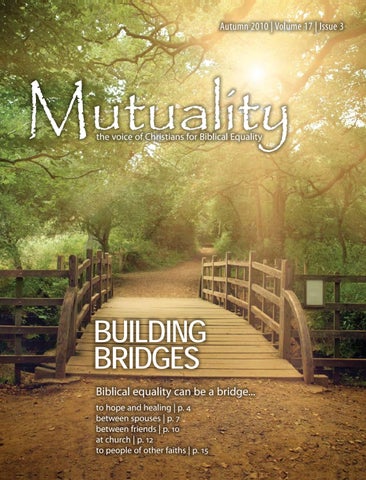
Autumn 2010 | Volume 17 | Issue 3
Mutuality the voice of Christians for Biblical Equality
BUILDING BRIDGES Biblical equality can be a bridge... to hope and healing | p. 4 between spouses | p. 7 between friends | p. 10 at church | p. 12 to people of other faiths | p. 15
Mutuality 17.3, Autumn 2010 “Let us then pursue what makes for peace and for mutual upbuilding” (Rom. 14:19, NRSV). Mutuality (issn: 1533-2470) seeks to provide inspiration, encouragement, and information about equality within the Christian church around the world. Editorial staff: Megan Greulich, editor; Image Spigot, graphic designer; Mimi Haddad, president/publisher. Contact us at: Christians for Biblical Equality; 122 W Franklin Ave, Suite 218; Minneapolis, MN 55404-2451; phone: (612) 872-6898; fax: (612) 872-6891; email: mgreulich@cbeinternational.org; web: cbeinternational. org. We welcome your comments, article submissions, and advertisements. For writers' guidelines and upcoming themes and deadlines, visit CBE’s website and follow the link under the Resources tab. Advertising in Mutuality does not imply organizational endorsement. Please note that neither Christians for Biblical Equality, nor the editor, nor the editorial team is responsible or legally liable for any content or any statements made by any author, but the legal responsibility is solely that author’s once an article appears in Mutuality. All Scripture quotations, unless otherwise indicated, are taken from the Holy Bible, Today’s New International Version®. TNIV®. Copyright © 2002, 2004 by International Bible Society. Used by permission of Zondervan. All rights reserved. CBE grants permission for any original article (not a reprint) to be photocopied for local use provided no more than 1,000 copies are made, they are distributed free, the author is acknowledged, and CBE is recognized as the source. Mutuality is published quarterly by Christians for Biblical Equality and is sent free to members and supporters.
Contents F E AT U R E S 4
A Bridge to Meaning and Ministry | How finding biblical equality brought healing and purpose to one woman's life by Kate A. Johnson
7
My Marriage Bond: From Stratified to Unified | Embracing mutual submission and discovering greater marital intimacy by Yvette Menking
10 Full of Grace, Seasoned with Salt | Fostering relationships and dialogue with complementarian friends by Megan Greulich 12 A Conservative Evangelical Church Encounters Change | A church's journey of studying the biblical texts on gender by L. Sue Hulett 15 How Wide the Divide, and Can Biblical Equality Bridge It? | Sharing biblical equality with Mormons by Bridget Jack Jeffries
MINISTRY AND CHAPTER NEWS 19 CBE “Down Under”: The Melbourne Conference Report 20 Reflections on CBE's Chicago Conference 20 Praises, Prayers, and Reflections
D E PA R T M E N T S 3 From the Editor: Sheared Sheep 21 Giving Opportunities: Volunteering at a CBE Booth 22 President’s Message: Is Women’s Leadership in the Church a “Primary Issue”?
2 M U T U A L I T Y | Autumn 2010
websi te : cbeinternational.org
From the Editor by Megan Greulich BUILDING A BRIDGE | to hope and healing
Sheared Sheep
“The Lord is my shepherd…he refreshes my soul” (Ps. 23:1a, 3a). Kimberly’s story left me speechless. She had believed that, as a Christian woman, she was to play a secondary role in ministry and in her marriage. “I was determined to be the kind of Christian wife God would be proud of. Yet nothing worked like it should have. I did all the submitting I could think of and more, but I could not do a thing about the abuse,” she wrote. After enduring terrible emotional and physical abuse from her husband and feeling certain that she was worthless to God and everyone else, Kimberly found herself at a breaking point. Then, in a seemingly meaningless chore—taking out the garbage — she discovered a book that would change her life: Gilbert Bilezikian’s Beyond Sex Roles. Kimberly had believed she was garbage, and yet, in the dumpster, she found a book that told her otherwise. As I read Kimberly’s story (which you can find in the Spring 2009 issue of Mutuality), I felt her misery, her despair, and her questioning of God. And when she found Dr. Bilezikian’s book, I felt her liberation. “I started to hope again, I started to breathe,” she wrote. Her profound sense of relief — her ability to breathe again — reminded me of an analogy a pastor once used to illustrate how deceit is suffocating. Highlighting Scripture passages that depicts God as our shepherd, the pastor went into lengthy detail describing sheep. Without regular shearing from the shepherd, he explained, a sheep’s wool grows over its eyes, blinding it from the herd, from food and shelter, and from the shepherd. The wool becomes suffocating and can cause terrible health problems for the sheep — even death. The application was clear: what kind of “wool” grows in our own lives, blinds us from God, and separates us from an abundant life in Christ? As I think of this illustration in light of Kimberly’s testimony, I wonder if we the church are being called to allow our Shepherd to gently shear away the wool that is suffocating us, that is blinding us from seeing God, and ourselves, as we really are. Perhaps if we allowed Jesus to shear away mistaken beliefs about the inferiority of women, then we could see him, and ourselves, more clearly. We could hope again, we could breathe. When biblical equality comes up in conversations, I often come across an attitude among Christians that it is simply a gender “debate,” and therefore is not crucial or important for the church to agree on. “It’s not a gospel issue,” they might say. Yet, I cannot help but feel that this is a vital message for the church, because the healing, freeing shears of Jesus that Kimberly — and many like her — experienced in finding biblical equality saved her faith, and even her life. It was her bridge to the gospel.
booksto re : equalitydepot.com
As the articles in this issue of Mutuality demonstrate, the bridge that biblical equality can build between groups of people, in marriages, and between individuals and God is vitally important. Kate Johnson’s story of overcoming abuse, while difficult to read, is a beautiful example of how God affirmed her as a woman and gave her a ministry and calling. Yvette Menking then shares how biblical equality became a bridge to greater intimacy in her marriage. Next, I offer some thoughts on dialoguing with complementarian friends, and Sue Hulett explains the process of her church opening doors for women’s leadership. Finally, Bridget Jack Jeffries provides an insightful article on biblical equality, evangelism, and Mormonism. Be sure to also check out the report from the Melbourne conference, and Mimi Haddad’s excellent column on biblical equality as a primary issue for the church. We hope this issue of Mutuality, themed “Building Bridges,” is an encouragement to you. May God use these articles to gently shear away all that can blind us. Blessings to you as you read and reflect! Megan Greulich is the editor of Mutuality magazine. She may be reached at mgreulich@cbeinternational.org.
M U T U A L I T Y | “Building Bridges”
3
BUILDING A BRIDGE | to hope and healing
A Bridge to Meaning and Ministry by Kate A. Johnson
“I was born. Whether or not that is of consequence is yet to be determined.” I still remember writing those words for a high school creative writing assignment. I had not yet determined if my life was relevant or even necessary. Those thoughts were not new to me; they had haunted me for as long as I could remember. Why? My mother was eighteen years old when I was born. I was the second child of three girls. When I was eighteen months old, she left us for good, leaving me with a deep emptiness since my mommy didn’t love me or want to see me. Even though my father had custody, he worked full time, and so we were sent to live with an aunt and uncle. It was then that the sexual abuse by my uncle began.
4 M U T U A L I T Y | Autumn 2010
websi te : cbeinternational.org
I already felt unimportant being abandoned, and the message I received from the abuse was that a girl’s worth was tied to what she could do for men; girls were objects to be used. That belief continued as my father remarried, divorced, and remarried again, with sexual abuse not only continuing by my uncle, but also later on by other male relatives. At age seven, my sisters and I were living with my father and second stepmother full time. The lessons of the subjugation of females were reinforced daily in our home. Only the male voice counted — specifically my father’s voice — and when my brother was born, his voice counted, too. Mine did not; I was told I was a stupid girl and that girls were “less than” boys. My father’s abusive treatment grew worse, and I lived in a constant fear that ruled my life. “Yours is not to reason why, yours is not to give reply, yours is but to do… or die” was his adaptation of Alfred, Lord Tennyson’s “The Charge of the Light Brigade.” It was a mantra that ruminated so often that after a while he really didn’t need to repeat it. My role in life was to serve and fulfill the needs of the male species and keep my opinions to myself. Since I equated my view of God with my father, I concluded that God didn’t care about me (or females). I didn’t matter to anyone and had nothing worthwhile to say. I believed that I was too stupid to go to college, and, with so little self-worth and a desperate desire to matter to someone, at age seventeen I married a man who seemed different. He was not, and his views and treatment turned out to be even more demeaning and abusive than those of my father and male relatives. I resigned myself to a life of suffering and abuse under male domination and headship. Hierarchical views are a part of our culture; one doesn’t have to go to church to learn them. However, when I did start going to church as an adult, the message was repeated. Men are the head of the house; they are the final authority in all matters. There was no option but to stay in an abusive marriage because I had been taught that Christians don’t divorce. Trying to be a “good Christian wife” and be submissive in all things didn’t stop the emotional and physical beatings, degradation, and rapes. I knew I would eventually die psychologically under that oppression, but what choice did I have?
"Can a mother forget the baby at her breast and have no compassion on the child she has borne? Though she may forget, I will not forget you!” (Isa. 49:15) A mother can forget the baby at her breast. I know that first hand. And it leaves the baby with a sense of wrongness about who he or she is. But I also lived with another gnawing sense in my soul that knew that the way I was treated was wrong. It may have felt “normal” because it was the only thing I knew, but it never felt “right.” Buried under the layers of shame, worthlessness, and guilt, a Still Small Voice was trying to tell me that there was more to life, and that there was a meaning to my existence. Life had taught me not to trust anyone, including myself, so I didn’t know whether I could trust the Voice or my interpretation of what he was saying. So I stayed silent and remained in my marital prison for almost twenty years. I had my first son, then my second, and then my third. They were my rays of hope in a life of despair. I loved them and held them dear and cared so deeply about them. I worked hard to make their lives worthwhile and full of meaning. Yet, while I held my precious boys, inside my little girl wounds were crying out, “Where was someone to hold me close? Why couldn’t someone care about me?” One day, I learned the truth — Someone did care. God showed me his love in a most amazing way. At the time, I didn’t think it was so amazing. Oh, how I hated him that day. As I sat watching a video on abused children, God brought me face to face with my past. I began to wrestle with God. I dared him to face me! We didn’t just wrestle overnight as Jacob did; we spent three days and nights wrestling. I screamed, raged, yelled, “Why didn’t you do anything? Why was this my life?” As I sobbed with pains too deep for words, he waited patiently for me to tire out. When it ended, I was so exhausted that I could do nothing but tearfully wait and listen. God spoke to me and told my heart that he loved me. I began to understand that he cared about me and all who suffer. I realized he didn’t hate females. Imagine that! In fact, he made me a female on purpose. I started a journey that day, one in which I began to believe that Voice from long ago — the One that would not be silenced. The One that told me I had just as much worth as anyone else. The One who told me I had meaning. The One who showed me I didn’t have to live the way I was living. And he told me something else that day. He told me he would not waste a single tear I shed over the years and that he would use all that I went through to help others. I believed him, and still do.
Buried under the layers of shame, worthlessness, and guilt, a Still Small Voice was trying to tell me that there was more to life, and that there was a meaning to my existence.
booksto re : equalitydepot.com
M U T U A L I T Y | “Building Bridges”
5
It was a long journey to believe in my own value, but as I did, changes occurred. As I learned the truth about God’s tender mercy, a truth that included full equality for women, it became the bridge that rescued my faith. More than that, it redeemed my life. The Lord showed me that all the things I had been told by so many were wrong. Through prayer and study, God showed me that he wanted more for my life because my life mattered — I mattered. A hierarchical credence kept me from knowing the Lord’s true design for men and women and perpetuated the over forty years of abuse I endured as a child and adult. Believing in biblical equality gave me the courage to seek freedom for myself and my three sons. I had found the bridge to meaning and still stand on its crest. God’s redemption became my source of strength. But he was not finished. My bridge to freedom and meaning included gaining the courage to, as a single mother with three children, go to college and graduate school. I found out the most amazing thing — I am not stupid! In fact, I graduated Summa Cum Laude with both degrees! It still astounds me sometimes — not that I could do it, but that for all those years I believed I couldn’t. I became a licensed counselor, specializing in helping those who suffer abuse, and I could see God’s redemptive plan working in my life. God also restored my relationship with my dad, and for that I am richly blessed. But the words God placed on my heart years ago still echoed. I knew God would use the wounds from my past for good purposes, however I wasn’t yet sure how. He was using me to help others, but the Still Small Voice was again whispering, Was there more?
God brought a wonderful godly man into my life, and in 2003 we were married. George is also a counselor and has helped men with relational issues for over twenty years. I primarily work with women and children and he primarily works with men, and both of us believe in biblical equality. Perfect match! He shares my heart when it comes to helping those who suffer. Together, we co-founded the Christian Coalition Against Domestic Abuse, a nonprofit ministry committed to changing the lives of women and children. Our mission is to educate, equip, and empower the Christian community to be God’s hands to rescue the oppressed, correct the oppressors, and promote respectful treatment of all. We offer help, hope, and healing through seminars, resources, support, and counseling, and we assist churches in beginning their own domestic abuse ministries. This is the ministry God placed on my heart many years ago. The task is great and the battle against patriarchy is fierce, especially because I, a woman, am the main presenter. Yet the ministry is making a difference in the lives of the women and girls in our Christian community and the community at large. We do, and we will continue to, build bridges to freedom. However, all-encompassing change in our world will only be brought through the bridge of biblical equality. God’s truth about women was my bridge to finding meaning in a life filled with abuse. This led my life experiences, pain, and healing journey to become my bridge to ministry. Embracing equality changed things — it changed me. Hierarchical views kept me a prisoner with no purpose. Biblical equality not only gave me freedom, meaning, and a vital ministry, it also saved my faith…and my life. Now, I know the answer to the statement I made so many years ago. I was born…and that is of consequence.
My bridge to freedom and meaning included gaining the courage to, as a single mother with three children, go to college and graduate school. I found out the most amazing thing — I am not stupid!
Kate A. Johnson (MA, LMHC) is co-founder and president of the Christian Coalition Against Domestic Abuse. She is also a licensed mental health counselor in private practice and an adjunct professor at Trinity International University. Kate lives in Florida with her husband, George. Her three grown sons live nearby.
6 M U T U A L I T Y | Autumn 2010
websi te : cbeinternational.org
BUILDING A BRIDGE | between spouses
My Marriage Bond:
From Stratified to Unified
by Yvette Menking
Three tightly intertwining strands create a strong cord. The well-known words in Ecclesiastes — “a cord of three strands is not quickly broken” (Eccles. 4:12b) — are often used to create a visual icon in our minds of the marriage bond. If “a picture is worth a thousand words,” then this simple graphic can transmit a lot of information about unity and oneness. But what if someone completely redesigned this icon and placed the three strands end to end and connected them with small knots? I wish this were merely a hypothetical question. Back when I was a new believer, my Christian education imprinted my mind with this altered image. I was repeatedly taught that at the wedding altar, when a man and a woman “tie the knot,” the following stratification goes into effect:
God = top strand Husband = middle strand Wife = bottom strand booksto re : equalitydepot.com
Somehow, I didn’t realize that this chain of command had essentially replaced the intertwined image. Instead, I was told that both systems could co-exist in harmony. Oneness and stratification. I didn’t comprehend that the layered version hindered the closeness and connection inherent in the triple-stranded cord. My elders claimed that real unity could not be achieved without hierarchy.
My Stratified Marriage At a small, picturesque church nestled in the Rocky Mountains, my husband and I exchanged our wedding vows. I couldn’t wait to spend the rest of our lives together! Yet it didn’t take long before marriage problems arose as we were learning how to relate as husband and wife. To find solutions to our struggles, I gathered advice from popular Christian marriage books. I viewed the authors as older and wiser teachers, and I believed that they could help us better understand the Scriptures relating to marriage. All of these writers helped to reinforce the hierarchical arrangement. Based upon this perspective, the two sexes appeared to be vastly different from one another beyond the obvious physical differences.
M U T U A L I T Y | “Building Bridges”
7
Their material devised gender analogies: Assertive is to godly men/ husbands, as passive is to godly women/wives. So a distinguishing difference between the sexes is that men are supposed to be bold. Strong. Assertive. These qualities defined masculinity, according to these authors. Rather than encouraging wives to also view ourselves as strong iron — “as iron sharpens iron, so one person sharpens another” (Prov. 27:17) — their advice taught me, as the wife, to view myself as soft. Weak. Passive. This, they said, defines femininity. Like fragile flowers and delicate vases. But these so-called feminine traits are unable to “sharpen iron.” Another part of my conditioning taught me to view my husband as the leader of our relationship. If I wanted to enjoy a happy and successful marriage, these teachers explained, then deference or submission was a critically important attitude and behavior from me, the wife. My husband’s leadership role bestowed upon him certain “divine” rights. Like a king. During my childhood, I had also learned from chess, card games, and history that kings have more value than queens. All of this indoctrination made my rank as a wife abundantly clear to me. My lower functional role — the bottom strand — required me to give a special form of homage and reverence toward my husband. I didn’t realize that by adopting this belief I was placing someone else between me and God and therefore committing idolatry. Instead, I actually thought that I was following God’s will. So anytime we had a decisional deadlock, I needed to allow my husband to overrule. Why? Because I had been taught that men have been “divinely” granted special tie-breaking authority. The chain of command placed my husband directly between God and me for important decision-making. My preconditioning led me to believe that a virtuous Christian wife chooses to defer to her husband’s decisions — unless he is leading her into sin. Since we didn’t stand on equal footing in this area — as in equally intertwined — proper communication became confusing for me. When it was obvious that we disagreed on something, how quickly should I submit and defer to him? Proverbs 25:24 loomed in my mind: “Better to live on a corner of the roof than share a house with a quarrelsome wife.” At what point does discussing opinions turn into quarreling? I thought it better to err on the cautious side than to cross over that subjective line. Factoring into this decision was another deeply ingrained opinion; husbands should initiate because men were designed to lead. Wives, on the other hand, should willingly follow
and comply. Therefore, I saw it as part of my husband’s role to make sure that he had fairly weighed my position and concerns alongside his own before arriving at his final decision. I thought that he, as the designated initiator — and also because he was called to love me sacrificially as part of his own body (Eph. 5:25-33) — should make sure that I was okay with the end decision. Yet too often he ended up thinking that I was in complete agreement with him when I was actually just deferring and submitting to him. He didn’t realize that I was trying not to be stubborn and quarrelsome about my point of view. Sadly, this type of communication in which I neglected to share my opinions left me feeling more and more unloved by my spouse. I thought that he knew I was submitting (complying) and had not changed my mind. As a result, I couldn’t understand why he appeared to be dismissing my viewpoint. He, however, thought I was fine with the decision and had become completely swayed over to his viewpoint. Obviously, neither one of us were good mind readers. Carefully following prescribed gender roles interfered with our problem solving abilities. My submissiveness prevented us from reaching solutions that were mutually satisfying. Our marriage, and our unity, suffered. While the marriage knot was holding us together, it simultaneously was building a barricade between our souls and was hindering our emotional intimacy. As our hearts felt less intertwined, I mourned the state of our bond and union. The “fruit” of following my prescribed gender role led to bitterness and resentment instead of love, sorrow instead of joy, internal discord instead of peace, frustration instead of patience, and isolation rather than unity. Repressing my anger did not produce good fruit in my life or in our marriage. Instead of clearly communicating with my husband when he had sinned against me, I stif led my disappointments. After all, I thought that passiveness — not speaking up — defined my role as a wife. When he noticed a greater distance developing between us, he had to pry out how he had wounded me. Since he was taking the lead and initiating, I felt that it was finally okay for me to voice the offense. But by that point, he had trouble remembering clearly the original details and situation. Following our assigned gender roles was creating a dysfunctional relationship. How does passivity allow iron to sharpen iron?
While the marriage knot was holding us together, it simultaneously was building a barricade between our souls and was hindering our emotional intimacy.
8 M U T U A L I T Y | Autumn 2010
websi te : cbeinternational.org
My Unified Marriage Several years later, I finally heard about biblical equality. Jeff VanVonderen’s book Families Where Grace Is in Place was radically unlike any other Christian marriage/family book I had read before. The difference? It was written from an egalitarian perspective. VanVonderen’s words opened my eyes to an entirely new way of seeing Scripture. In exploring Genesis 1:26-28 VanVonderen shows that:
The golden rule is straightforward and self-explanatory: “So in everything, do to others what you would have them do to you, for this sums up the Law and the Prophets” (Matt. 7:12). But how do you apply the golden rule to your spouse when you believe that the other gender is too different and even opposite from you? I believed my husband and I needed to treat each other differently. Yet following legalistic gender rules led to confusion, distance, and anger …the man to whom in my marriage. Following the responsibility was given — golden rule, on the other hand, is to be fruitful, fill the earth, building bridges between us. subdue it, and rule over every Egalitarianism has shown As I worked through Families Where Grace Is in living thing — was both me that to truly become united Place, the Holy Spirit gently convicted me of male and female. So this and one with my husband idolatry toward my husband. How blind is the first aspect of God’s (Gen. 2:24; Matt. 19:5-6), I had original plan for marriage: to see myself as his spiritual equal. I had been before! No human should stand for males and females to No hierarchy. Stratification between God and me. God alone is my leader be co-rulers, co-subduers separates marriage partners, but My protector. My good shepherd. (p. 18-19, emphasis added). pursuing the egalitarian model of marriage — where the three His [God’s] intent was that strands are closely intertwined — we rule together, dependent upon Him, mirroring has been producing much healthier “fruit” in my life. His triune image in the way we relate in love to each Communication within my marriage has been improving. other (p. 21). Both of us can now freely act as iron to help each other grow in spiritual maturity. No more holding this marriage together with For many years I had read the Bible through the eyes of knotted threads. I want my marriage to be a strong cord. gender hierarchy that taught me to see a permanent, creational Yvette Menking lives in Loveland, Colorado with her hierarchy between husbands and wives. As I worked through husband and three children. She graduated from Texas Families Where Grace Is in Place, the Holy Spirit gently convicted A&M University with a teaching degree. Yvette blogs on me of idolatry toward my husband. How blind I had been before! The CBE Scroll as Sonnet and is a member of the Northern Colorado Chapter of Christians for Biblical Equality. No human should stand between God and me. God alone is my leader. My protector. My good shepherd.
Should My Institution Join CBE? Discover the many benefits of organizational membership today! Web: cbeinternational.org/institutions Email: cbe@cbeinternational.org
This emblem could be on your website! And, as a CBE member, we will place your logo on our site, for those looking for an egalitarian school.
booksto re : equalitydepot.com
M U T U A L I T Y | “Building Bridges”
9
BUILDING A BRIDGE | between friends
Full of Grace, Seasoned with Salt Fostering relationships and dialogue with complementarian friends
by Megan Greulich
M
y friend confided in me because she was “tired — no, exhausted — of being single.” She had prayed for a spouse, but worried that because God had not answered her prayer yet, maybe she was not meant to be married — an idea that deeply saddened her. Or worse, she feared that because of sins she had committed in past relationships, maybe she was not worthy or capable of being in a strong Christian marriage. As I listened, I prayed that God would give me encouraging words to offer. I wanted to affirm her in her singleness, in her value as a person, and in the powerful forgiveness Jesus had offered her for her past mistakes. But before I said much of anything, she sighed and shared, “I just want to serve God with a husband — a husband who will be my spiritual covering.” And then, in an effort to rally herself, she said, “But at least I know that until this happens, I have my father to fulfill that leadership role in my life.”
Warning bells went off immediately in my head, as they do each time I am chatting with a friend and it turns to the subject of gender and authority. I wanted to interrupt her and passionately proclaim that what she was saying had no biblical basis, rattling off all I had learned about Greek terms, first century Greco-Roman culture, and Bible interpretation. But instead, as I watched my friend in her brokenness, I found myself without words. I realized that this wasn’t simply about winning a Bible debate, or “setting her straight,” or finding the right argument to finally convince her to embrace egalitarian convictions. What my friend needed in that moment was comfort and hope — reassurance that Jesus was near and that he cared. Yet at the same time, I truly believed that as long as she continued to view herself and understand her situation through this complementarian lens, the deeper her wound would grow. Because I knew her well and
As I watched my friend in her brokenness, I found myself without words.
10 M U T U A L I T Y | Autumn 2010
websi te : cbeinternational.org
loved her dearly, I desperately wanted her to understand that she didn’t need a male intercessor in her life in order to serve God. I wanted this not so she would join my particular “theological camp,” but so she might be able to fully embrace the freedom and purpose we find in Jesus alone. I think of this conversation often. At the time, I didn’t know how, or even if I should try, to separate my egalitarian convictions from the words of encouragement I wanted to offer her. But I knew her history. I knew her struggles and her pain, and I knew how much she loved God and wanted to live honestly and completely for him. I also knew, from previous conversations, that we disagreed on how to interpret the biblical texts on gender. So I felt uncertain. Should I push the subject? Should I stay silent? It was a situation I believe many egalitarians have found themselves in, because sharing our beliefs — especially with those who are closest to us — can be daunting. How can we best share our egalitarian beliefs with our friends? As I continue to explore this challenge, I have found these biblical principles to be particularly helpful:
Let your conversation be always full of grace, seasoned with salt, so that you may know how to answer everyone (Col. 4:6). Study the Bible and read all you can about biblical equality, so that you can respond to your friend’s questions as they arise. At the same time, however, do not shy away from discussing if you do not feel you have the “answers.” Be humble in your responses, and freely admit when you are unsure. Recommend and give egalitarian resources to your friend, such as Janet George’s Still Side by Side: A Concise Explanation of Biblical Equality (available at equalitydepot.com). And if your friend is willing, read relevant books and listen to recordings together. Be eager to read complementarian literature and engage it thoughtfully and graciously. Be open to learning from one another, and from others. Show great respect for your friend and for all authors you engage, as brothers and sisters in Christ and made in God’s image.
Devote yourselves to prayer, being watchful and thankful (Col. 4:2).
Speak truthfully to your neighbor (Eph. 4:25).
Pray before you speak. Pray with your friend. And pray for them much more than you debate with them. Ask that God would give you insight into how and when to introduce biblical equality. Ask for the Holy Spirit to use you, and then listen closely for the Spirit’s prompting. Trust in the power of the Holy Spirit and rely on the power of prayer more than on your own words.
Cultivate an authentic relationship with your friend — be vulnerable and honest. Share your struggles and pain. The more your friend understands where you are coming from, the more they can empathize with why you hold your egalitarian convictions. Explain how biblical equality has made a positive impact in your life, and why you believe it is crucial for the body of Christ. Resist any temptations to allow fear to be the reason you do not share your passion and your struggles.
Be quick to listen, slow to speak and slow to become angry (Jam. 1:19). Carefully assess the situation and “emotional climate” before sharing your beliefs. Be aware of your motivation before speaking up; ask yourself, “Who will benefit from this conversation?” If you cannot honestly say that your friend’s wellbeing is at stake more than your own pride, then choose another time for the discussion. Recognize that conversations about gender and authority often reach to the core of what we believe about ourselves and God, and, as such, can be emotionally charged. Be gracious and patient with your friend, and resist the temptation to speak out of anger or frustration.
Make every effort to keep the unity of the Spirit through the bond of Christ (Eph. 4:3). When two people are particularly passionate about an issue and disagree, it is easy to succumb to the belief that there can be no common ground. But do not lose perspective. Remember that all Christians have the goal to be closer to, and more like, Jesus. We are on “the same team.” If a discussion turns too heated, step back and focus on what you hold in common. Take a deliberate break from debating, if needed. Stop and pray together often, asking God to foster unity amidst your differing viewpoints.
booksto re : equalitydepot.com
Live a life worthy of the calling you have received (Eph. 4:1). Be “above reproach.” Live what you say. Through your actions, show your friends that it is possible, and preferable, to live as an egalitarian. Do not shy away from sharing your confidence in the truth of biblical equality — just ensure you are demonstrating your passion with actions as well as words. Model mutual submission in your friendship; find ways to serve your friend and put their needs above your own. ***** What other principles are crucial for discussing biblical equality with your friends? Visit blog.cbeinternational.org to share your thoughts and learn from others. Megan Greulich is the editor of Mutuality and the membership coordinator for CBE. She graduated from Bethel University (Saint Paul, MN) in 2006 with a degree in psychology.
M U T U A L I T Y | “Building Bridges”
11
BUILDING A BRIDGE | at church
A Conservative Evangelical Church Encounters Change by L. Sue Hulett
I ATTEND A SPIRIT-FILLED, conservative Baptist church in the Midwest where, until 2010, women could not teach mixed gender adult Sunday School classes or serve as elders or pastors. However in recent years, more and more voices in the congregation raised questions about the accuracy of interpretations of the Bible that excluded women’s leadership. In 2008, two male pastors and the all male elder board responded to calls to honor the New Testament proclamation that the Holy Spirit falls on men and women (Acts 2), who are both called to exercise their spiritual gifts to edify and build up the body of Christ (Rom. 12, 1 Cor. 12-14, Eph. 4:1-16). After a slow start, the elders appointed a small group — consisting of two pastors, an elder, and nine other women and men who represented complementarian/ hierarchical and egalitarian perspectives — to examine Scripture and report its findings on the question of women in ministry.
This “Gender Committee” undertook a thirteen-month study of what Scripture teaches about women’s roles and how to interpret the relevant (and sometimes difficult) passages from Genesis to Timothy. We encountered tension as some wanted to review only Genesis 3:16, 1 Corinthians 14:34-35, and 1 Timothy 2:12-15, resisting attempts to examine theological or lexical research and commentary other than that found in the notes of their copies of the NIV. However, after months of weekly meetings and behind the scenes research, we came to a consensus and gave
12 M U T U A L I T Y | Autumn 2010
websi te : cbeinternational.org
a 28-page single-spaced report to the elder board in November 2009. The congregation, at the January 2010 business meeting, voted unanimously to “receive” the “Elder Board Position Statement” based on our report and is currently wrestling with the ramifications of allowing women to teach Sunday School to men and serve as “pastors” — but not elders or head pastors. I will teach the first class led by a woman this fall. I hope that by sharing the history of how my church’s decision-making process developed, other evangelical churches might benefit from our experiences. MY STORY In 1987, while teaching political science at a secular liberal arts college, I became a born-again Christian and joined an evangelical church. I questioned the “understood” church policy that women could not teach men. While the elder board soon invited me to address them regarding this policy, they took no steps toward change. That was twenty years ago, and since then, I have remained a church member without the freedom to exercise my spiritual gift of teaching. I volunteered in 2008 to serve on the “Gender Committee” and, in the process, became a diligent student in biblical research and found myself embracing egalitarian precepts. My primary challenge on the Gender Committee was to persuade, in love and in submission to the Holy Spirit, some of my fellows that we all needed to study: 1) the nature of translation and interpretation from the original Greek, 2) the impact of culture at the time of Paul, and 3) contrasting theological views. I struggled, sometimes impatiently, to persuade traditionalists that understanding the meaning of Greek words, cultural norms, early church practices, and the nature of epistle writing itself would help guide us to better interpretation of God’s ever true Word. Thankfully, most of us understood that one of our key challenges was to discern when various passages or prescriptions were “universal” (referring to principles of God’s Word that are to be observed by all people, throughout all time) or “occasional” (pertaining to the cultural, physical, or organizational needs of the original recipients of Paul’s letters). Despite intense disagreements at times, we wrote a document that moved our church to God-honoring change regarding men and women working together in ministry. We did not move as far as I thought we should (but too far, according to others). I offer our conclusions below, followed by advice on how to encourage Biblebased change in conservative or complementarian churches. OUR STUDY GROUP APPROACH For us, the Bible is the inspired Word of God and the only rule for our beliefs and behavior. The Bible teaches that we are created equally in God’s image as male and female, and that God gives the Holy Spirit to everyone who believes. He gifts every Christian to serve him, without respect to gender. These beliefs were our starting point.
booksto re : equalitydepot.com
We studied how women in the Old and New Testament served God and worked together with men to serve God’s people. Despite our differing views about how women might serve (and lead) the church and how to interpret biblical texts with consistency, we discovered only a few passages over which we disagreed. Our goal was to foster a church environment where all are encouraged to exercise their spiritual gifts. STUDY GROUP DIVISIONS The group differed over whether women could serve as elders. A majority of us believed this is a gender-specific (male only) office, rather than a spiritual gift. The minority noted that Scripture does not preclude women from leadership. Another division concerned whether women should be allowed to teach men. Although we did not fully agree on the exact meaning of 1 Corinthians 11 and 14 and 1 Timothy, we agreed unanimously that as long as a woman was gifted to teach and ministered under the authority of the elders, she should be allowed to teach — even from the pulpit. The most contentious issue was over the title of “pastor” or shepherd (poimenas in Greek). Most agreed that poimenas designated a person exercising the gift of shepherding; thus the functional title of shepherd or “pastor” is appropriate regardless of gender. We recognized that “pastor” could refer to a “senior pastor” (an elder at our church and therefore male). It could also refer to a church worker who ministers under authority of the elders or to someone whose spiritual gift is shepherding (e.g., leading small groups). Therefore the use of the word “pastor” (for women or men) depends on how one defines it. (Elders at our church determine staff titles and responsibilities.) STUDY GROUP (AND ELDER) CONCLUSIONS At the close of our studies, we came to several conclusions: God decides who receives spiritual gifts, and he does not discriminate on the basis of gender. Thus both men and women are to be encouraged to use all their spiritual gifts, including “pastoring/shepherding” and teaching — even from the pulpit — when under the authority of the elders. The group maintained, however, that the local church ought to choose only men to fill the office of elder. LESSONS AND STRATEGIES FOR TRADITIONAL CHURCHES While my church failed to open the position of elder to women — despite the precedents in Deborah (prophet/leader), in the twelve to fifteen women Paul praised as coworkers, and in early church deployment of women deacons — I remember that my goal is not egalitarianism per se. The goal is biblical faithfulness and building and sustaining unity in the body of Christ. As women and men exercise their gifts, obey and spread God’s Word, and serve in ministry together, God will grow us until we see that all gifts, including leadership, should be encouraged in a church mature in the Word. Through the Gender Committee, we certainly grew in our understanding of biblical texts. I also learned, through trial and error and by seeking input from churches engaged in a similar study of women in ministry, some practical ways to be a positive influence on the group and elders.
M U T U A L I T Y | “Building Bridges”
13
Lessons
Lesson 1. Look only at Bible-based arguments and examples. Do not trump God’s Word with cultural arguments about how things “ought to be these days.” Lesson 2. Model submission to the Holy Spirit. Starting and ending meetings with prayer was, shall we say, a Godsend for souls sometimes divided. Lesson 3. Nourish respect and love for each other as you consider all sides of issues. Lesson 4. Avoid vocabulary that is provocative or elicits strong emotional responses. While even the phrase, “Scholars say…” was incendiary for those few who studied only “note-lite” Bibles, it is vital in a complementarian church to refrain from using words like “feminist” and “hierarchicalist.” Other assertions such as “It is unfair to have only male elders” or “What will society think if we have only male pastors?” should also be avoided. Strategies
Strategy 1. Take small, but deliberate, steps to expose folks to the importance of understanding the challenges of translation, interpretation, and incorporating theological commentary from a diverse set of biblical scholars. As we studied and shared on these challenges, including long discourses on Greek words like kephale (head) and authentein (exercising authority in a domineering way), I found myself and even some of my opponents welcoming Greek “word-study” and scholarly input. Strategy 2. Remind the group that, as we learn more about what God’s Word says to us, we ought to act on our discoveries. In love and humility, anticipate and defuse as much as you can the fears of traditionalists. Be prepared to lose battles, but remember that as long as we all focus on the possibility of learning and growing, fear will be replaced with the joy of probing further into the meaning of God’s Word. Strategy 3. Maintain solidarity among allies and gently recruit new allies from the “undecideds.” I had two key allies: a woman with a staunch, and not always well-received, egalitarian reputation and the complementarian senior pastor. Having the senior pastor on board was invaluable. As he became convinced, after twenty years at our church, that the practice of restricting women’s gifts was hurting people and the church, he embraced the need to pay whatever personal price was required to foster Bible-based change.
Strategy 4. Ease your way into discussions about differences between what in Scripture is “universal” and what is “occasional” (practices limited to first-century culture.) Judicious caution is also required when discussing the sometimes difficult to digest idea that one reads and interprets an epistle differently than one reads the Gospels. Strategy 5. Use commentary by male scholars early and often in your discussions. I was most effective when I referred to complementarian scholars to make egalitarian points. (See Doug Moo’s work on Romans, for example, for insightful references to women in ministry, including Phoebe the deacon/ church-builder and Junia the female apostle/messenger.) Strategy 6. Keep hammering away to show that throughout the New Testament we see the impact of Jesus’ calling and empowering of women in the development of the church. I found that one could not reiterate too many times that the New Testament includes many examples of women being filled with the Holy Spirit, prophesying, evangelizing, building home churches, co-laboring with Paul, and serving in teaching and ministry roles. Review a summary of these findings before and after introducing discussions on challenging passages. Strategy 7. Plan how to proceed if your church decides to alter its traditional practices — whether in part or in whole. So far, my church has changed more in theory than practice, as the pastors and elders are now dealing with some hostile reactions from complementarians and also disappointment from those who see too little change. Do what you can to make the process of change as painless as possible. Volunteer for service and work to foster unity and healing in your congregation. L. Sue Hulett is the Henke Distinguished Professor of Political Science and chair of the political science department at Knox College. She teaches international relations, the Gospels, and religion and politics. Recent publications are found in International Encyclopedia of Political Science, Chronicle of Higher Education, Religion and Education; and a forthcoming follow-up for Religion and Education (2011). She has served as faculty adviser to InterVarsity Christian Fellowship since 1987.
14 M U T U A L I T Y | Autumn 2010
websi te : cbeinternational.org
BUILDING A BRIDGE | to people of other faiths
How Wide the Divide, and Can Biblical Equality Bridge It? Sharing Biblical Equality with Mormons by Bridget Jack Jeffries
“So, how many female pastors have you had at the evangelical churches you’ve attended?” The question was asked by a good Mormon friend, himself a former evangelical. I had been complaining about his church and its policy of not ordaining women, but my friend's question caught me off guard. I had been a passive believer in the ordination of women for years, and yet, thinking back over the churches I had attended all that time, I could not deny that every single senior pastor, associate pastor, worship pastor, and youth pastor I had worked with was male. This was true at churches that were part of denominations that allowed the ordination of women, and it was even true at churches that cycled through multiple pastors in a short period of time. Not long after that conversation, I joined Christians for Biblical Equality and eventually sought out a church with a female pastor for the very first time.
booksto re : equalitydepot.com
M U T U A L I T Y | “Building Bridges”
15
I was a teenager when I began my study of The Church of Jesus complementarian church structures, most of the callings available Christ of Latter-day Saints (LDS), popularly known as the Mormon to women revolve around leadership of other women and children. Church. My journey took me through a bachelor's degree at Brigham Church disciplinary councils are entirely handled by men, and men Young University, the church's largest official university, which hosts oversee almost all of the clerical work and management of church a student body population that is over 98% LDS. To this day, I finances. Males perform virtually all of the ritual ordinances including continue to have close friendships with Mormons and dialogue with baptisms, blessings of healing, and administration of the LDS version them regularly. One area that has always been of interest to me is the of the Eucharist. The only ordinance women are permitted to perform problematic status of women in the LDS church, and I believe this is a washing and anointing ritual on other women as part of temple topic represents a potential point of outreach that traditional Christian worship, and even that is restricted to women who have no minor ministries to Mormons typically overlook. While the nineteenth children living at home. Finally, missions work is considered a primarily century LDS practice of polygamy (wherein husbands were permitted male responsibility, with all capable men being expected to serve a and sometimes commanded to take multiple wives) has received large two-year mission, typically at the age of nineteen. Women are allowed amounts of attention from both counter-cult ministries and the general to serve an optional eighteen-month mission, but the minimum age public, few Christians bother to take an in-depth look at the theology required is twenty-one. In 1997, the president of the Mormon church and church policies governing life for LDS women today. This is plainly stated that the age limit is held higher for women for the unfortunate, as I believe Latter-day Saints and evangelical Christians purpose of decreasing the number of women who serve3. This pattern of androcentrism surfaces again in the church's have much to gain when exploring this issue together. Furthermore, official Sunday School a significant number of my manuals, where female ex-Mormon acquaintances counted speakers and leaders are feminist issues among their reasons rarely cited, even when for leaving their faith. The message of the topics concern biblical equality has the potential to women specifically. serve as a tool for evangelism among The problematic status of women in the Twice a year, Mormon such disaffected Mormons because LDS church represents a potential point of leaders gather to it can fulfill a yearning in their outreach that traditional Christian ministries broadcast a series of souls that current LDS teachings to Mormons typically overlook. messages meant as on gender and complementarian counsel for the entire evangelicalism cannot. church, but out of the Latter-day Saints share twenty-nine to thirty many themes and practices with talks that are usually complementarians when it comes to their teachings on gender. The church has always upheld the given, only two of the speakers are women. Likewise, women are traditional notion of the husband and father as the authority, or head not invited to give the opening or closing prayer for these sessions. of the family, with one official proclamation declaring that “[by] In the LDS church, women clearly have far fewer opportunities divine design, fathers are to preside over their families in love and than men to offer spiritual guidance and admonishment to adults righteousness and are responsible to provide the necessities of life of both genders at the church-wide level. There are some ways that Latter-day Saints have done well in their and protection for their families.” Likewise, women are “primarily responsible for the nurture of their children”1 with official church treatment of women for which they deserve full credit. They have no teaching materials encouraging women to choose child rearing and qualms with women serving as adult coed Sunday School teachers, an homemaking over having a career2. During the temple ordinances issue that has been controversial in some complementarian churches, that Mormons typically receive between the ages of nineteen and and, because local preaching is considered the responsibility of the twenty-five, wives covenant to “hearken” to the counsel of their laity, women deliver the Sunday sermons in Mormon congregations husbands, but there is no reciprocal promise from husbands to their almost as often as men do. In fact, one is far more likely to encounter a wives. Mormons often interject that their leaders simultaneously woman speaking on Sunday in the average Mormon church than the teach that husbands and wives are fully equal partners, but an analysis average evangelical church. Mormons also showed some progressive of the temple liturgy demonstrates that the gender roles taught in sparks early in their history, with Utah becoming the second territory Mormonism are clearly hierarchical. in the nation to give women the right to vote and the first state to On the ecclesiastical level, where Mormons practice a lay have a female state senator. However, in spite of these promising early ministry and church responsibilities are shared among all members, trends, LDS feminists have arguably demonstrated that the church the male headship pattern continues. LDS men are ordained to the gradually became more restrictive in its attitude towards women lower priesthood starting at age twelve and the higher priesthood at over the course of the twentieth century — a phenomenon that age eighteen, but women are restricted from ordination altogether. evangelicals are no strangers to4. For example, in the 1800s, Mormon Because of their non-ordained status, women cannot serve in a large women were encouraged to anoint people with oil and administer variety of leadership callings including: apostles, prophets, bishops, blessings of healing, but today's Mormon woman is restricted from stake presidents, and adult Sunday School directors. Similarly to doing likewise5.
16 M U T U A L I T Y | Autumn 2010
websi te : cbeinternational.org
I believe that egalitarians have much to offer and much to gain by entering into constructive dialogue with Latter-day Saints on gender. To any evangelicals looking to build bridges with their LDS friends on this issue, I offer the following guidelines: Know that there are Mormons who want to talk about this. One of the most common responses from Latter-day Saints when they are challenged on this matter is that the women of the church do not mind their current situation and are not complaining about it, so there is little point in agonizing over it. I have found this to be untrue. There are many LDS women and men who believe the church's gender policies could use improvement to some extent or another; however, because the church discourages dissent and openly speaking out against its leaders, they tend to be uncomfortable and reserved about their feelings on the subject.
Come ready to learn. I said in the last paragraph that Latter-day Saints do not often know very much about evangelicals, but the converse is true as well. Always give your LDS friends the courtesy of defining for themselves what they believe, then build from there. Leave room to be surprised and challenged by what you hear.
My own interactions with Latter-day Saints on this matter have been very gratifying. I've commiserated with my LDS companions on the lack of female voice in their modern-day scriptures and teaching manuals, and I've recommended genderinclusive translations to LDS and ex-LDS friends who have asked. A few of my friends have made the decision to attend evangelical churches, at least partially out of a desire to be part of an egalitarian congregation, while others have simply come to a deeper understanding of and appreciation for the work of egalitarian evangelicals while opting to stay Mormon. I've also formed lasting Be ready to acknowledge our own shortcomings. I'm grateful friendships with people who are able to analyze my work and for the work of advocacy give me refining feedback organizations like Christians from the perspective of for Biblical Equality; for a completely different the existence of churches religious tradition. Most and denominations that of all, my interactions with ordain women as pastors, Latter-day Saints have made It is no secret that if we want to find a elders, and deacons; and me bolder and more secure religious tradition that is guilty of oppressing for the wealth of biblical in my own egalitarian women and denying them the exercise of their and historical scholarship convictions and in the spiritual gifts, we can start with ours. in recent decades that has power of our gospel message, explored this issue. These are leading me to the realization things that the Latter-day that biblical equality can Saint movement either lacks be an evangelism bridge entirely or has only begun between Mormonism and to develop. However, it is no secret that if we want to find the Christian faith. I encourage other Christians to get involved a religious tradition that is guilty of oppressing women and in this bridge-building work. The workers are currently few, but denying them the exercise of their spiritual gifts, we can start the harvest is plenty. with ours. Many evangelical churches have policies towards women that are equal to or even worse than those of the LDS 1. The Church of Jesus Christ of Latter-day Saints, “The church, and you can expect your LDS friends to point this Family: A Proclamation to the World,” 23 September, 1995. out. We must always remember that we ourselves are a work in 2. See, for example, the section on “Mothers' Employment progress on this subject, being continually transformed by God's outside the Home” in the 2003 Eternal Marriage Student Manual. Spirit and the renewal of our minds (Rom. 12:2). 3. Gordon B. Hinckley, “Some Thoughts on Temples, Retention of Converts, and Missionary Service,” Ensign, Be ready to explain what egalitarians have done or are doing well. November 1997, 52. As a general rule, Latter-day Saints do not know very much 4. For a number of essays exploring this topic, see Maxine about Christian traditions, and they certainly will not know very Hanks, ed., Women and Authority: Re-emerging Mormon much about a subset of the movement such as egalitarianism. Be Feminism (Salt Lake City, Ut.: Signature Books, 1992). prepared to delve into subjects such as interpretations of relevant 5. See Linda King Newell, “A Gift Given, A Gift Taken: biblical passages, ontology, women in Christian history and in Washing, Anointing, and Blessing the Sick Among Mormon the Bible, gender-inclusive translations, denominations that Women,” Sunstone 6 (Sept.-Oct. 1981): 16-25. ordain women, and other issues that egalitarians have made Bridget Jack Jeffries is an archivist who writes about Mormonstrong progress on since the movement grew legs in the 1970s. Evangelical interfaith topics. She completed her bachelor's If you have advocated for women in ministry with your local degree at Brigham Young University and is currently church, be ready to talk about your own struggles and any pursuing an MA in American religious history at Trinity Evangelical Divinity School. Bridget has been interviewed by accomplishments you have achieved. The Washington Post and Religion & Ethics Newsweekly.
booksto re : equalitydepot.com
M U T U A L I T Y | “Building Bridges”
17
th ex
Christians for Biblical Equality Presents
Featured Plenary Session Philip Payne, author of Man and Woman: One in Christ Mutuality: the Biblical Foundation for Leadership and Authority Shared by Men and Women and for Mutual Submission in Relationships and Marriage
18 M U T U A L I T Y | Autumn 2010
websi te : cbeinternational.org
Conference Report:
On June 11-14, 2010, 255 people gathered for CBE’s nineteenth annual international conference in Melbourne, Australia. Hosted by the CBE Melbourne Chapter and themed “Better Together,” the conference brought great encouragement to a region that has suffered harsh blows in the struggle for biblical equality in the church.
Cheryl Catford’s plenary session “life-changing ,” with one person writing , “I could have continued to listen for another hour!”
The Context of the Melbourne Conference
A Place for Healing
Conference planner Lynley Giles described Melbourne as a place “where many church people are either disinterested or hostile to the issues CBE promotes.” While Melbourne first allowed the ordination of women in 1992, the recent influence of some American complementarian leaders has sparked resistance to the egalitarian movement there. “[W]e feel really concerned with the pressure that is being applied to folk—that if you do not accept male authority and headship you do not accept the Bible,” Giles wrote. Thus, the 2010 conference came at an important time, and proved to greatly exceed expectations by all who planned and worked on it.
Perhaps most significantly, the conference served as a place of healing and affirmation for many women in ministry. One Melbourne chapter leader said, “A female Anglican vicar said to me after the conference that she felt like a child whose father had presented her with her birth certificate to show that she really was part of the family, after believing all her life that she was adopted and thus did not really belong! This person is about to retire after years of successful ministry in Melbourne. It is amazing to think it took this conference to really affirm her ministry.” Yet another leader reported, “Several women said they had not intended to come to the conference and reopen the hurts they had experienced in the past about women being ordained. They came hesitantly and found healing, acceptance, and a sense of moving forward. They were excited about the future.”
Conference Sessions Conference lectures addressed many popular theological arguments that are used to repress women. Attendees called the sessions “intelligent,” and “meaty,” with thoughtful teaching. One attendee wrote that workshop speaker “Tim Foster of Ridley College did an excellent job of surveying the standard material about 1 Timothy 2 and offering some new insights, as well. Furthermore, the humble, positive, and respectful spirit in which he offered his views was an example of how to approach discussions about difficult and controversial texts.” Many appreciated the global perspective speaker Funmi Para-Mallam provided in her plenary session on gender justice in an African context, calling it “very moving” and “challenging.” Kevin Giles’ lecture was reported as “thoroughly informative,” and “strongly argued and faithful to Scripture.” And attendees called
Visit cbeinternational.org/melbourne to view more photos, read conference articles, and purchase recordings!
Ripple Effects As CBE looks to the future, we anticipate much more exciting fruit from the Melbourne conference, agreeing with one attendee who said the conference “should have ripple effects throughout Melbourne and beyond.” As bloggers Liz and Trevor Sykes wrote, “With so much information and interaction, surely the cause for biblical equality will benefit enormously and each participant will take away a lot of literature and new information to encourage them to ‘not grow weary in well-doing’.”
Speakers, from left: Fumni Para-Mallam, Graham Cole, Eva Burrows, Tim Foster, Cheryl Catford, Kevin Giles, and Denise Cooper-Clark booksto re : equalitydepot.com
M U T U A L I T Y | “Building Bridges”
19
MINISTRY NEWS Reflections from “Women and Christian History” CBE's Recent One-Day Conference by Sara Robertson
I didn’t want to go. Early in the summer it had seemed like a good idea. Of course I wanted to hear the speakers. They were among the best CBE had ever had on one program. The location was practically in my backyard. But after a summer away from home, faced with the prospects of leaving on another trip for which I hadn’t packed, the idea of giving up a Saturday dismayed me. But, I rallied myself and walked out the door. Of course I was wrong on all counts. At the end of the day I went home with a smile on my face, a bag full of resources, a long list of books to read “some day,” and a cookie left over from my tasty lunch. One book on my list is Justice: Rights and Wrongs, by Nicholas Woltersdorf, which speaker Alan Johnson referenced in his discussion on gender and justice in the Old Testament. He pointed out that: Woltersdorf ’s recent study proposes that justice is best understood as the claim that I have on another that they see me and treat me according to the inherent worth that I truly have as a human being created in the image of God….Women are wronged when they are seen and treated with less worth than they really have….God is also wronged….This brings discredit upon the teaching and gospel of our Lord, and limits the mission of the evangelization of the world. Lynn Cohick followed that with a fresh analysis of the Samaritan woman at the well. Drawing upon her deep study of first century marriage in the Roman world to expand our thinking, Cohick discussed why the woman was at the well at noon, why she had five husbands, and why the people of the town so readily responded to her invitation. Rather than castigate her, we can readily see her as “a model of a seeking heart who finds the Truth.” Mimi Haddad made us all want to rush out and visit Francis Willard’s home in Evanston, IL. She also pointed out the number of Christian schools that encouraged women in ministry in their early history which today frown on women’s service. These schools need to hear Gilbert Bilezikian speak on “The ‘Servant Leadership’ Hoax.” They would learn that “the language of ‘servant leadership’ was adopted by Christian [complementarians] and widely applied to male dominance in church and family to disguise the scandal of gender discrimination under a cloak of respectable-sounding terminology.” And to think I almost missed it. Will I sign up for the next CBE conference? Most definitely! Missed the Chicago conference? Visit us on the web to read more reflections and purchase conference recordings!
20 M U T U A L I T Y | Autumn 2010
P R A I S E S A N D P R AY E R S praise god with us for… • An inspiring one-day conference in Chicago, which exceeded expectations. Praise God for the hard work of the CBE Chicago Chapter and the many dedicated volunteers! • The arrival of our talented interns, Nick and David.
pray to god with us for… • The planning of CBE's 2011 conference in Seattle, WA, on July 29-31. Pray that our presence there would bring glory to God, provide healing to all who need it, and further the mission of biblical equality. • Our presence at this year's meeting of the Evangelical Theological Society, on November 17-19. Pray for good scholarship and irenic discussion among all who attend. • Much-needed contributions, memberships, and book sales in this difficult economy.
reflect with us… by Susan McCoubrie and Jo Ellen Heil
Building a bridge requires vision, skill, energy, and a determination to see the job done. It's hard work! Building bridges between people requires all that and more—it calls for qualities like love, patience, joy, kindness, and self-control, or what Christians call the fruit of the Holy Spirit. Jesus was the greatest bridge builder. In his earthly ministry, he continuously reached out to others despite cultural taboos and ultimately became The Bridge between a broken, hurting humanity and our loving Creator when he hung on the cross, sacrificing himself for our sake. Jesus' first bridge-building was among his closest followers. His immediate disciples included women and men; those who toiled with their hands and those who were wealthy; those who longed for a politically free Israel and those who assisted in Rome's occupation; those with spouses and those who were single, as he was.* Despite their differences, their love for Jesus made them family. But Jesus unsettled his Jewish followers when he built bridges to the larger community. He joyously healed the daughter of a SyriaPhoenician mother, made friends with a Samaritan, and praised the faith of a Roman Centurion. He also brought wholeness to those whom everyone else ignored. He cleansed lepers, saved prostitutes, honored widows, and healed the mentally ill. He even welcomed children and restored one girl child to life! Those around Jesus were constantly amazed at the bridges he built. May our world be as amazed at the bridges we build in his name. *Mary of Magdala had been healed of demon possession (and would be the first disciple to announce the resurrection); Susanna was one of several women who financially supported Jesus. James and John fished for their father Zebedee while Joanna's husband was an officer in Herod's court. Simon was nicknamed The Patriot; Matthew had collected taxes for the Romans. Simon Peter was married and lived with his mother-in-law but Mary, Martha and Lazarus of Bethany were all single.
websi te : cbeinternational.org
GIVING OPPORTUNITIES Friends, we thought you would like to read the report of Madeline Johnston, who volunteered at a recent CBE booth. Our ministry depends on dedicated, passionate volunteers like Madeline. If you would like to give your time to promote CBE's mission at an outside event, please contact us. Thank you!
CBE "On the Road" at the NACC by Madeline S. Johnston
The annual North American Christian Convention (NACC) was held this year in the Indianapolis Convention Center on July 6-8. Some months before, I was one of several CBE members who received an email from Mimi Haddad asking for volunteers to staff the CBE booth there. I thought this would be a good opportunity both to meet some other CBE members and to help the egalitarian cause, so I offered to go. Four other CBE members also volunteered at the booth. We each took a few minutes off to browse past the many other booths from all kinds of Christian organizations and many Christian colleges, and we felt we learned a bit about the best approaches. Our booth’s location seemed strategic, on a corner formed by the intersection of two aisles in the exhibition hall. We just needed to welcome visitors, give them literature, tell them about CBE, and answer questions they might ask. A few people were browsing in the exhibition hall at any given time; more, of course, would stream in during the breaks between lecture sessions. We met many interesting people. Some would walk by and glance, but avoid eye contact with us and move on. Some of these would also protectively guide their wives onward after a quick glance. Others would stop and read our big poster, but move on quickly if we began to approach them. Some would politely refuse whatever we offered. Many would happily receive our free bookmarks. Of these, some would then move on; but as they did so, we had a moment to urge them to look up the website listed there. Others would take the bookmarks and then be led gradually over to the booth to look at more and maybe take a few articles which we hoped they would read later. Some seminary students expressed interest, though they had not heard of CBE. We gave them articles and membership forms. A few people came in enthusiastically and said they knew of us, or even had previously
been members, and were glad to see us there. We gave them application forms to rejoin us. We experienced a number of conversations similar to the following, usually with middle-aged men, often pastors: We: Have you heard of CBE? They: No, what do you stand for? We: We believe in gender equality in the church, the idea that people should serve according to the gifts of the Holy Spirit rather than gender. They: Well, I believe in gender equality too. [Pause.] But women certainly shouldn’t be preaching. You don’t promote that, do you? That’s not biblical! We: We also believe in being biblically sound. You might enjoy reading some of our articles here, all biblically based. I think you’d find some interesting resources also on our website, which is listed there on the bottom of your bookmark. Then we would pique their interest in some of the articles and send them off with a handful. We looked for commonalities while trying to promote growth in understanding; we steered away from argumentation. I enjoyed being there, and I think that our presence was valuable. We gave out lots of articles, often to people at first reluctant to step up to the booth. If even one pastor or other influential person changes to a more egalitarian position, it was worthwhile. In my day-and-a-half there, we found at least three former CBE members; if they rejoin us, there is value in that. The few seminary students who agreed with our beliefs but didn’t know of us may also join us and will themselves have an ever-growing influence in ministry. And many others who may read some of those articles on the difficult Pauline passages, or others, may grow in their understanding enough to moderate the resistance to women in ministry.
Your Gift Can Have an Even Greater Impact! November 16th: The Return of Give to the Max Day!
Does Your Employer Offer a Matching Funds Program?
Nonprofits working in Minnesota, like Christians for Biblical Equality (CBE), are eligible for matching funds, based on the number of individuals who contribute to CBE on November 16th, at GiveMn.org. Make your gift to CBE on November 16th at GiveMn.org, knowing that every gift counts for more! CBE is a nonprofit organization and donations are tax deductible.
Over the years, CBE has been the grateful recipient of matching gifts from employers, the United Way, and the Mustard Seed Foundation. Please contact your human resources department to see if your employer will match your contribution to CBE. What a wonderful way to multiply your gift, making it possible for CBE to reach twice as many with the good news of Galatians 3:28.
booksto re : equalitydepot.com
M U T U A L I T Y | “Building Bridges”
21
President’s Message by Mimi Haddad BUILDING A BRIDGE | to people of other faiths
Is Women’s Leadership in the Church a “Primary Issue”? If you’ve been a passionate egalitarian for any length of time, you’ve probably heard someone say, “Yes, the egalitarian position is biblically sound, but it is not a “primary issue!” What is at the heart of such a comment? Primary issues are generally understood to mean those issues that focus on the gospel, evangelism, and the leading of the lost to Christ. Is women’s shared leadership and authority a primary issue? One’s perspective on gender and authority most certainly advances or diminishes the good news of the gospel. Here is one example from Emily, a woman who contacted CBE recently. She writes: I had heard the word of God, and I felt moved by much of it…However, I was held back from this because of what I had been told….Eve [was] really responsible for all sin in the world, and not Adam, even though she didn't force him to eat the forbidden fruit….[As a woman] I was to be silent in church, and that women could not hold a position of responsibility there...it was as if God had already decided that because I am female there was nothing He cared to hear me say. And worst of all was what was to happen if I were to marry. I would become a slave to my husband, obeying his word as if it were the word of God…I left church behind and my faith in the Lord with it. I couldn't reconcile being part of a religion that had labeled me as inferior from birth. Emily may not be trained theologically, but like most human beings, she understands when God is presented in a way that is illogical and unjust. It is because of individuals like Emily that churches, denominations, and Christian organizations are having a second look at Scripture’s teaching on gender. As they do, many are discovering that egalitarians and complementarians (those who hold to a male only model of leadership) hold different worldviews. It runs deeper than simply a difference in interpretation or a matter of personal preference, and this is why so many believers challenge gender hierarchy as God’s ideal. Much of our time at CBE is spent showing individuals like Emily—who have left the church, or who refuse to marry, or who have joined other religions—that Scripture does not extend authority to men just because they are male. Rather, God calls and gifts both men and women to share authority, service, and leadership. In many ways our work as egalitarians today resembles that of several prominent evangelicals in history, who challenged a defective worldview that perceived Africans as destined by God to permanent servitude. Such a mistaken perspective distorts the key elements that shape one’s worldview. These include: • Knowledge: How we understand truth and God’s revelation • Ontolog y : The nature and value of being, both God’s and humankind’s
22 M U T U A L I T Y | Autumn 2010
• Justice or Ethics: The action we take because of knowledge and ontology • Our Ultimate Purpose and Destiny: As individuals and the church What is interesting about worldviews is that a corruption in one element creates a disruption in the other elements. As slavery proponents insisted that the divine destiny of Africans was servitude (purpose); they also advanced a biblical basis for slavery (knowledge). Individuals of African descent were therefore said to possess an inferior nature (ontology), which is why they must be ruled by others (ethics). To redress the flawed worldview, abolitionists had to “put right” all four elements. That is why some early evangelicals challenged slavery with a robust biblicism (knowledge); that showed how each person is made new in Christ (ontology), and through God’s Spirit, all believers are gifted for service regardless of ethnicity (purpose). This view, in turn, leveled a serious theological blow to the institution of slavery (ethics). As a more biblical worldview prevailed, slaves were freed and some flooded to the mission field, where their calling and giftedness were evident. Ultimately it became clear that slavery wasn’t a matter of preference or difference in biblical interpretation, it was a worldview with eternal consequences. In a similar manner, Christian women are often told that their divine destiny is the permanent submission to male authority (purpose), a view that, some say, is promoted throughout Scripture (knowledge); based not on a women’s character, giftedness, or intimacy with Christ, but based solely on gender (ontology). Therefore, women are to obey men, and men are to hold ultimate authority over females, in the church and home (ethics). Thankfully, like abolitionists, egalitarians have made their case biblically (knowledge), that women are created as strong partners for men (Gen. 2:20) (ontology), and as such are to exercise a shared dominion with men (Gen. 1:28) (purpose). As women exercised leadership and authority on mission fields around the world, it led to one of the largest expanses in all of Christian history—the Golden Era of Missions. And, as women are given equal authority to make decisions in marriages, this not only leads to happier marriages, but also a lower incidence of abuse (ethics), according to the research of Life Innovations, Inc., the creators of the popular premarital inventory Prepare-Enrich. As believers embrace a more biblical worldview on gender, we offer a clear image of God to those who have left the church because of prejudice against females. Does the shared leadership and authority of women and men advance a more biblical worldview? Does it promote the gospel and our capacity to reflect Jesus to the world? Katharine Bushnell said, in the early 1900s, that Christians must learn to assess women’s capacity for service in the same way we assess men’s—not based on the fall, but on our atonement in Christ. To do otherwise is to do violence to the gospel, to which all of Scripture and history point. websi te : cbeinternational.org
Christians for Biblical Equality Christians for Biblical Equality is an organization of Christian men and women who believe that the Bible, properly interpreted, teaches the fundamental equality of believers of all ethnic groups, all economic classes, and all age groups, based on the teachings of Scripture as reflected in Galatians 3:28. CBE recognizes that injustice is an abuse of power, taking from others what God has given them: their dignity, their freedom, their resources, and even their very lives. CBE also recognizes that prohibiting individuals from exercising their God-given gifts to further his kingdom constitutes injustice in a form that impoverishes the body of Christ and its ministry in the world at large. CBE accepts the call to be part of God’s mission in opposing injustice as required in Scriptures such as Micah 6:8.
� CBE Membership Application ________________________________________________ name
_____________________________________________________________ street address _____________________________________________________________ city _________________________________________ state / province / country
_ _________________ zip / postal code
Mission Statement
_____________________________ phone
CBE affirms and promotes the biblical truth that all believers — without regard to gender, ethnicity or class — must exercise their God-given gifts with equal authority and equal responsibility in church, home and world.
Membership Fees (all fees are in US dollars)
Core Values We believe the Bible teaches... • Believers are called to mutual submission, love and service. • God distributes spiritual gifts without regard to gender, ethnicity or class. • Believers must develop and exercise their God-given gifts in church, home and world. • Believers have equal authority and equal responsibility to exercise their gifts without regard to gender, ethnicity or class and without the limits of culturally-defined roles. • Restricting believers from exercising their gifts — on the basis of their gender, ethnicity or class — resists the work of the Spirit of God and is unjust. • Believers must promote righteousness and oppose injustice in all its forms.
Envisioned Future Christians for Biblical Equality envisions a future where all believers are freed to exercise their gifts for God’s glory and purposes, with the full support of their Christian communities.
Statement of Faith We believe the Bible is the inspired Word of God, is reliable, and is the final authority for faith and practice. We believe in the unity and trinity of God, eternally existing as three equal persons. We believe in the full deity and full humanity of Jesus Christ. We believe in the sinfulness of all persons. One result of sin is shattered relationships with God, others, and self. We believe that eternal salvation and restored relationships are possible through faith in Jesus Christ who died for us, rose from the dead, and is coming again. This salvation is offered to all people. We believe in the work of the Holy Spirit in salvation, and in the power and presence of the Holy Spirit in the life of believers. We believe in the equality and essential dignity of men and women of all ethnicities, ages, and classes. We recognize that all persons are made in the image of God and are to reflect that image in the community of believers, in the home, and in society. We believe that men and women are to diligently develop and use their God-given gifts for the good of the home, church, and society. We believe in the family, celibate singleness, and faithful heterosexual marriage as God’s design. We believe that, as mandated by the Bible, men and women are to oppose injustice.
CBE Membership CBE membership is available to those who support CBE’s Statement of Faith. Members receive CBE’s quarterly publications, Mutuality magazine and Priscilla Papers journal, as well as discounts to CBE Bookstore and CBE conferences. Learn more by following the “Membership” link on our homepage.
booksto re : equalitydepot.com
_ ____________________________ email address
United States Members Individual Household Low Income* Subscription Only**
1 Year � $49 � $69 � $27 � $40
3 Years � $129 � $184 � N/A � $115
International Members Individual Household Low Income* Subscription Only**
1 Year � $59 � $79 � $37 � $49
3 Years � $154 � $204 � N/A � $140
Churches and Organizations 1-100 people 101-500 people 501-1000 people 1001-2000 people 2001-5000 people 5001+ people
1 Year � $55 � $85 � 110 � $220 � $330 � $440
Additional Contribution $ _______ TOTAL $ _ ______ * Available to those with an annual household income of less than $23,000. ** Does not include membership benefits. CBE is an exempt organization as described in IRC Sec. 501(c)3 and as such donations may qualify as charitable contributions where allowed by law.
Payment Method � Check/Money Order (payable to Christians for Biblical Equality) � Visa � MasterCard � Discover � American Express ________________________________________ account number
_ _________________ expiration date
_________________ verification code (the four digits on the top right corner of American Express cards or final three digits found on the back of other cards) _____________________________________________________________ signature
Please mail or fax this form to:
Christians for Biblical Equality
122 W Franklin Ave, Suite 218, Minneapolis, MN 55404-2451 Phone: (612) 872-6898 | Fax: (612) 872-6891 Email: cbe@cbeinternational.org
M U T U A L I T Y | “Building Bridges”
23
Christians for Biblical Equality 122 West Franklin Ave, Suite 218 Minneapolis, MN 55404-2451 UNITED STATES
Non-Profit Org. U.S. POSTAGE
PAID
Minneapolis, MN Permit No. 26907
Forwarding Service Requested
Recommended Reading from CBE
Saving Women from the Church How Jesus Mends a Divide Susan McLeod-Harrison
Biblical Women Submissive? Joe E. Lunceford
Straightforward, unapologetic, and engaging, Saving Women from the Church shows how Jesus offers hope and healing to women who have been alienated, wounded, controlled, or troubled by the church. This book will improve your vision of the full image of God in women.
“Lunceford makes clear that the women of the Bible were never submissive. Like men, their deeds were both good and bad, and like men, they were given free will to serve God with their gifts, which many did as free agents and thus full human beings created in God’s image." —Alvera Mickelsen, founding member of CBE, author, editor, and teacher
24 M U T U A L I T Y | Autumn 2010
Save 20% on these resources when you use discount code SAVE20 during checkout. Order or become a member today! equalitydepot.com 612.872.6898
What’s With Paul and Women? Unlocking the Cultural Background to 1 Timothy 2 Jon Zens
Gifted to Lead The Art of Leading as a Woman in the Church Nancy Beach
”What’s With Paul and Women? allows the reader to see, maybe for the first first time, how Paul’s instructions in 1 Timothy 2 are consistent with Jesus’ belief in the full, functional equality of women within the assembly.” —Wade Burleson, pastor of Emmanuel Baptist Church, Enid, OK
Beach offers guidance on such issues as earning respect, finding your unique voice for leadership and teaching, managing work and personal life, forming an intentional support network, and more. Rich in wisdom and humor, Nancy’s message offers heartfelt encouragement that you are not alone, your gifts are not a mistake, and that God has important work for you to do.
websi te : cbeinternational.org