Mutuality The Voice of Christians for Biblical Equality
Advocacy vs. Apathy Inside: Let your happiness be haunted
Responding to suffering with hope rather than despair by Lynne Hybels
Unstoppable An interview with newsboys’ lead singer Peter Furler by Megan Greulich
Women’s care in relation
How Sojourner Truth, Lucretia Mott, and Dorothy Day fulfilled the promise of Christianity by Helen LaKelly Hunt
Simply doing justice
Learning about justice from Jesus’ example by Rich Gathro
Plus much more!
Spring 2007
www.cbeinternational.org
Contents Features 5
Let your happiness be haunted Responding to suffering with hope rather than despair — by Lynne Hybels
cover image
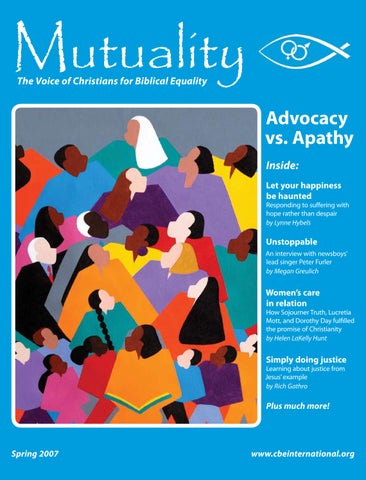
Brilliance by Synthia SAINT JAMES, 2006, acrylic on canvas Synthia SAINT JAMES is the international award winning fine artist, author, illustrator and designer who created the first Kwanzaa stamp for the United States Postal Service. She has authored and/or illustrated 21 books and her artwork graces the covers of over 60 books. She is an architectural designer of ceramic tile, stained glass, and metal, and also a popular keynote speaker and presenter. artist ’s statement
“In creating art I get to share my pure physical and visual impressions in various forms. I am simultaneously rejuvenated both spiritually and emotionally. Art, for me, is a very precious gift from above and within, that I humbly receive and gratefully nurture…” “Brilliance” is available as a limited edition giclee on canvas. For more information on Ms. SAINT JAMES please visit her website www.synthiasaintjames.com.
9
Unstoppable An interview with newsboys’ lead singer Peter Furler — by Megan Greulich
11 Women’s care in relation Fulfilling the promise of Christianity — by Helen LaKelly Hunt
15 Simply doing justice Even in Christian higher education, we still have a lot to learn about justice — by Rich Gathro
17 Equality 101 A professor’s perspective on teaching a gender studies course in a Christian college — by Susan Howell
19 From conviction to action A seminary student’s journey to becoming an advocate for gender equality — by Doug Weimerskirch
Ministry & Chapter News 21 Reaching future ministry leaders at Urbana ’06 — by Tom McCarthy 23 Side by Side Symposium 24 Side by Side with Joshua Raja — by Arbutus Sider 25 Side by Side with Sister Lena — by Mary Duncan 26 CBE wins new EPA awards; CBE Chapters 27 Praise & Prayer; Tribute to Lianne Roembke
Departments 3 From the Editor: Equality is for everyone 28 President’s Message: Ordinary people—Extraordinary advocates 30 Giving Opportunities: More than male privilege and female passivity
| Mutuality Spring 2007
website: www.cbeinternational.org
Mutuality The Voice of Christians for Biblical Equality
From the Editor by Chelsea DeArmond
Equality is for everyone
Let us then pursue what makes for peace and mutual upbuilding. — Romans 14:19
What does the word “advocate” mean to you? No one wants to be thought of as apathetic, but is advocacy the best alternative? Before exploring the examples of advocacy in this issue of Mutuality, I would like to take a look at some common misconceptions about what it means to be an advocate.
VOLUME 14, ISSUE 1
Are advocates just for special interest groups?
Mutuality seeks to provide inspiration, encouragement, and information about equality within the Christian church around the world.
One reason the term advocacy can make people uncomfortable is that it is associated with special interest groups, instead of regular people. Are women a “special interest group”? Are people of color? Are the poor? Martin Luther King Jr. said that “injustice anywhere is a threat to justice everywhere.” Biblical equality is for everyone. It is grounded in the most fundamental Christian beliefs: our creation in the image of God, our identity in Christ, and our gifting by the Holy Spirit. Advocates for equality are serving human interest.
President/Publisher : Editor : Graphic Designer :
Mimi Haddad Chelsea DeArmond Image Spigot
EDITORIAL AND ADVERTISING OFFICE Christians for Biblical Equality 122 W Franklin Ave, Suite 218 Minneapolis, MN 55404-2451 phone: (612) 872-6898 fax: (612) 872-6891 e-mail: cdearmond@cbeinternational.org web: www.cbeinternational.org Advertising in Mutuality does not imply organizational endorsement.
SUBMISSIONS Mutuality welcomes submissions. E-mail cdearmond@cbeinternational.org, write to CBE for the writer’s guidelines, or visit CBE’s website and follow the Publications links.
PERMISSIONS Christians for Biblical Equality grants permission for any original article (not a reprint) to be photocopied for local use provided no more than 1,000 copies are made, they are distributed free, the author is acknowledged, and CBE is recognized as the source. Mutuality (issn: 1533-2470) is published quarterly by Christians for Biblical Equality and is sent free to members. For membership information, see page 31. To purchase back issues, contact our Editorial and Advertising Office, or order online at www.equalitydepot.com.
Are advocates morally, politically, and/or theologically liberal? At the turn of the twentieth century, fundamentalist leader John Roach Straton zealously defended biblical inerrancy, creationism, the virgin birth, and Christ’s divinity. He also defended women’s right to vote and scandalized his supporters by allowing a young girl named Uldine Utley to preach in his pulpit. Though he was harshly criticized for taking a stand for women in the pulpit, Straton considered his support of Uldine Utley’s evangelism and teaching ministry to be perfectly consistent with a rigorously inerrant view of Scripture. In response to his critics, he wrote a pamphlet called “Does the Bible Forbid Women to Preach and Pray in Public?” and refused to back down. There is nothing inherently “liberal” about advocacy. In fact, because of our commitment to living our beliefs, evangelical Christians should make the best advocates of all. Do advocates have to be famous in order to make a difference? Sojourner Truth gained publicity when Harriet Beecher Stowe, the famous author of Uncle Tom’s Cabin, published an article about her in the Atlantic Monthly. This publicity was helpful for Sojourner and her mission, but the article’s tone was condescending and it contained many inaccuracies. Sojourner sent a letter to the editor reminding readers that they could find an accurate portrayal of her remarkable life in her autobiography, The Narrative of Sojourner Truth. This book would not have been possible if it hadn’t been for a much lesser known woman named Olive Gilbert. As a former slave, Sojourner was never taught to read and write, so Olive Gilbert agreed to help her tell her story in The Narrative. Sojourner used sales from this little book to support herself as she traveled the country preaching and teaching. Helping people find their own voices and use them is more valuable than being a spokesperson for them. Advocacy is more about being faithful to God’s call to love our neighbors than it is about fame. Jesus described the kingdom of God as a tiny mustard seed. Though it starts small, its unstoppable growth spreads far and wide. Chelsea DeArmond is Editor of Mutuality and Bookstore Coordinator at Christians for Biblical Equality. She can be reached at cdearmond@cbeinternational.org
bookstore: www.equalitydepot.com
Mutuality Spring 2007 |
In Our Box
Mutuality
Visit CBE’s website at
www.cbeinternational.org for the latest… ▶ FREE audio and print resources on biblical equality ▶ Membership information for churches, libraries, families, and individuals ▶ On-line discussions about gender and justice on The CBE Scroll, the blogging voice of CBE ▶ CBE chapters in the U.S. and around the world ▶ Directory of egalitarian churches in the U.S. and around the world ▶ Giving opportunities ▶ Listings for counselors, therapists, and spiritual directors who agree with CBE’s Statement of Faith ▶ Ministry news and needs ▶ Employment, internship, and volunteer opportunities
Call for Papers
Mutuality provides inspiration, encouragement, and information about equality within the Christian Church around the world. Mutuality is published quarterly and sent to all CBE members and subscribers. Current and back issue are also available for purchase. We are currently seeking features, reports, and reviews (books, films, and/or music) from evangelical, egalitarian perspectives related to the following topics: • • • •
Equality and our evangelical heritage Persecution and revival Raising children Home economics
Most of the articles we publish fall into the following categories: • Personal testimonies illustrating how biblical equality provides practical benefits to everyday lives. • Teaching on relevant Bible passages, explaining the meaning and showing how to apply it to daily life. • Reviews of books about biblical equality that would appeal to a wide audience. (Books must complete CBE’s book service review process before being reviewed in Mutuality.) • Feature stories about issues related to CBE’s mission and ministry. The length of features is generally 1,000–2,500 words. Send articles to the attention of the editor at the postal address below or e-mail to cdearmond@cbeinternational.org (if possible, as an attached Microsoft Word document). We are unable to consider or respond to authors who send us more than two pieces at the same time, whose pieces are substantially over 3,000 words, or whose submissions are not sent uniquely to Mutuality. Complete Writers Guidelines for Mutuality are available on our website (www.cbeinternational.org) or contact our office to request a copy. Questions and submissions can be directed to the attention of the editor, Chelsea De Armond.
Visit CBE’s on-line bookstore at
www.equalitydepot.com for resources like… ▶ Books and articles ▶ Audio and video tapes ▶ CD, DVD, and MP3 recordings ▶ Sales and specials ▶ New resources, CBE exclusives, and best sellers ▶ Foreign language resources ▶ Become a CBE member or renew your membership and save 15% or more on every purchase ▶ Registration for CBE conferences ▶ Subscription to CBE publications or purchase back issues of Mutuality and Priscilla Papers
| Mutuality Spring 2007
We’d love to hear from you! Send your comments and critiques to:
Mutuality
122 W Franklin Ave, Suite 218 Minneapolis, MN 55404-2451 phone: (612) 872-6898 fax: (612) 872-6891 e -mail: mutuality@cbeinternational.org web: www.cbeinternational.org Letters may be edited for clarity and brevity.
website: www.cbeinternational.org
Let your happiness be
haunted
bookstore: www.equalitydepot.com
My fairytale life as a grandmother is haunted by memories of the grannies I’ve met in Africa.
Photo courtesy of Lynne Hybels
It’s Thursday and I am four hours from home at my daughter, Shauna’s, house. I sit at my computer with my four-month-old grandson, Henry, on my lap. While he grabs at the keypad I search the web for the most recent updates on the situation in Darfur. I find only bad news: escalated violence has led to another major withdrawal of international aid workers and supplies, leaving hundreds of thousands of refugees without food, water, blankets. Online I sign a letter to our President, asking for increased pressure on the Sudanese government and greater support for peacekeepers trying to quell the violence and protect civilians. I also send a check to an aid organization still trying to get supplies to the desperate refugees. Then I play with Henry. I don’t have words to describe the pleasure of being a grandmother. I contort my face, stick out my tongue, gurgle and chirp and giggle and grunt, all in the name of entertaining Henry. Today I prop him up in a corner of the sofa and surround him with all his soft, squishy animal toys. He’s tired and hungry, needing his mom to come home soon. To distract him from his hunger, I make his animals talk and sing and dance and bounce up and down in front of him. He looks adorable surrounded by his critter toys, so I grab my camera. Click, click. Henry, look at Grandma. Click, click. The photo becomes the screen saver on my computer, so even now as I write, Henry’s head peeks above my Word document. I smile. It’s a disease called grandma madness. Grandmothers in Africa face a different disease. A disease that drags their sons and daughters down into an ugly, painful death. The “wasting away disease” they used to call it. Now they call it AIDS. These grandmothers don’t have time to entertain their hungry grandchildren with silly faces and chirps and giggles while they wait for the mothers to come home. The mothers aren’t coming home. Thirteen million kids in sub-Saharan Africa have been orphaned by AIDS; approximately half live in grandmother-headed households. The grannies, as they’re called, may take in two kids, they may take in twenty. The children may actually belong to their sons or daughters, or they may just be kids in need. Either way, the noble grannies don’t have time to play with the children they’re raising. They’re too busy collecting firewood to trade for food or crushing stones in a quarry in order to pay for school uniforms.
Photo courtesy of Lynne Hybels
by Lynne Hybels
Mutuality Spring 2007 |
We who hold and read this magazine are blessed. It’s our job — and our privilege — to pass the blessing on to others. Here are a few suggestions that can help us all to do that: Ë Ground yourself in scripture. A friend once challenged me to read Isaiah 58 every day for a month. I did and it changed me. I ground my action in a clear mandate from scripture, because when I begin to feel overwhelmed or hopeless, I need something more authoritative than my feelings to keep me going. I need to be reminded that the fight for justice is not optional for a Christian. (I also turn to Micah 6:8 and Matthew 25 when I need to have the call to action affirmed.) Ë Refuse to believe that you don’t have anything to offer. Above my desk I keep this quote from former U.S. Senate Chaplain, Edward Everett Hale: “I am only one, but I am one. I cannot do everything, but I can do something. And I will not let what I cannot do interfere with what I can do.” Ë Open your mind. Learn. Watch documentaries. Read books and websites. Here are a few sites that inform and challenge me: brighthope.org, compassion.com, cureinternational.org, ijm.org, mskeeper.org, opportunity.org, worldrelief.org, worldvision.org, sistersinservice.org, womenforwomen.org. Ë Start with a small step. If you have fifteen minutes, check out one informational website. If you have half an hour, call one friend and tell him or her what you learned. Ë Pay attention to the people, countries, causes, needs that begin to haunt you. Step up your learning in that area. Begin to pray for guidance about how you should respond. Ë Be generous with your money, even if you don’t have much. Go to aidsbracelets.org to see how $20 can empower women and children in the developing world. Ë Pray for people who are suffering. I started this article by mentioning Darfur. I described two actions I’ve taken: signing on to a petition to the President and writing a check. But I also sensed God’s call to pray daily for Darfur — for the protection of refugees and aid workers, for tough action from international leaders, for the transformation of perpetrators of violence. Karl Barth said, “To clasp the hands in prayer is the beginning of an uprising against the disorder of the world.” Ë Be intentional. Fight apathy. Discipline yourself not to forget. It’s so easy to silence the voices that haunt us. That’s why we must turn again and again to the Scriptures that call us to action. I have also found it helpful to scatter books about social justice, photos of people in need, and pages printed from websites throughout my home and office — on desks and end tables and bulletin boards. Ë Talk with friends and get creative. I read about a woman who hosted a Christmas party where every guest brought an elegant appetizer and a check for $35 written to a pre-selected charity. The idea caught on and started a national movement that has fostered circles of community while raising thousands of dollars for worthy causes. I keep a file of stories like this to remind myself that simple ideas can make a world of difference.
Margaret Mead said: “Never doubt that a small group of thoughtful, committed citizens can change the world.” That’s another quote worth reading — and heeding — every day! | Mutuality Spring 2007
Having already buried their sons and daughters, these grannies pray they won’t have to bury another generation, but often they do. They meet in support groups to share stories, to make beaded jewelry and knitted crafts to sell in the market, to learn how to protect themselves from HIV as they care for the sick, and to grieve. My fairytale life as a grandmother is haunted by memories of the grannies I’ve met in Africa. They watch me silently as I put a clean new diaper on Henry’s chubby bottom. They smile shyly when my silly antics elicit a babyish laugh. They bury calloused fingers in the tangle of fuzzy sleepers fresh from the dryer. They don’t accuse; they simply make sure I don’t forget them. I look at Henry and I melt into the pure pleasure of him. I weep for joy. Then the grannies start to whisper, gently reminding me of what I myself have thought a thousand times since Henry was born: that all babies should experience life as he does. All babies should be well fed and freshly bathed, then dressed in clean, soft, cuddly clothes. All babies should be doted on, wrapped tightly in circles of delighted moms and dads and aunts and uncles. All babies should be surrounded by sights and sounds that grab their attention and start their little minds growing. But they’re not. Millions of babies do not have even one of those advantages. What they have is swollen bellies and diarrhea, malaria and HIV. They’re too sick to laugh or cry. Too lethargic to be entertained. I look at the grannies huddled together and weep for the babies reflected in their eyes.
Becoming my sisters’ keeper But now it’s Friday, and I move on from Shauna’s house. I am eager to attend the regional swim meet where my 17-year-old nephew, Levi, will compete. Over the course of two days I sit poolside on bleachers for eight hours, wilting in the moist heat of a high school natatorium. During the long heats of the 500 Individual Medley, which Levi does not swim, I ask my niece, Kendall, about her college classes. Women’s Studies is her favorite class; discussing it sends my mind on tangents of social concern. The sexual trafficking of millions of women and girls each year. The sexual violence against women that drives the AIDS pandemic in the developing world. The 27 million slaves in the world today, 80% of whom are women. We talk of such things until the Individual Medley ends, then focus again on the pool. As Levi leaves the block for the 50 Freestyle, I become light-headed with nervousness, aching for him to get the state time he has worked so hard for. He does. So we cheer and celebrate and hug. I am so glad to be here. So glad to see this young woman and young man I love growing in strength and character and maturity. But when the cheering ends and I slip into my car for the long drive home, my mind picks up where my conversation with Kendall left off. I ponder another tragedy disproportionately impacting women: war. A century ago, 90 percent of war casualties were male soldiers. Today, an estimated 90 percent of casualties are civilians, and 75 percent of these are estimated to be women and children. In the early 1990s I traveled with a humanitarian organization to Croatia and Bosnia as those countries were being ripped apart by war with Serbia. In Bosnia we visited refugee centers filled with middleclass women just like me who had lost everything: jobs, husbands, homes, their planned-for future. Many had also been victims of the increasingly popular tactic of war called rape, which shatters body and soul. We visited schools where social workers tried to help grade school kids who were suffering so severely from posttraumatic stress website: www.cbeinternational.org
Photo courtesy of Lynne Hybels
Photo courtesy of Lynne Hybels
I long for us all to celebrate the joys of family love every day. But I also long for us to let our celebrations be a bit haunted by the desperate needs of our sisters and brothers around the world. that they sat all day silently chewing their nails to the quicks. It was the first time I had seen war up close and I was stunned by what human beings do to one another. Leaving Bosnia, I traveled up to Croatia, to a little border town where I could climb to the top of a hill and look out over Bosnia. I sat there for hours and wept and prayed for the women and children I’d seen. While I prayed an unbidden question repeated itself: Am I my sister’s keeper? And the answer was yes, yes, yes, you are your sister’s keeper. And who is my sister? God, who is my sister? They are all your sisters. Croatian Catholics. Bosnian Muslims. Serbian Orthodox. They — and every other woman you will ever meet — are all your sisters. They are all part of the human family I have created.
From haunted to hopeful That’s what happens when you open your mind and your heart to God and to the world. You end up with a huge family. You can’t possibly meet the needs of every family member, but you can never again dismiss their needs thoughtlessly. They’re family. And they haunt you. An unexpected image dances across your vision at an inopportune time. A light-hearted moment is darkened by a disturbing subtext. A chill pierces your heart on a sunny day. Yes, you’ll end up haunted. Even more, you’ll end up in despair. There’s no way around it. I can’t remember who wrote that “God’s heart is an open wound of love,” but I believe it. And I believe our hearts become open wounds, too, when we dare to love this damaged world God loves. There are two antidotes to despair. One is denial. Pretending you didn’t see that picture. Didn’t hear those screams. Didn’t read that story. Or maybe you acknowledge the horror of what you saw or heard or read, but you pretend it’s not your responsibility. There’s nothing you can do. What difference can one person make? And where would you start anyway? bookstore: www.equalitydepot.com
Denial works. But it shrinks your heart. It makes you a little less human. It puts distance between you and God. The other antidote to despair is action — doing something, anything, to address the need. Seems like every few years I have an experience that pushes me so far into despair that I toy with denial. I start listening to the cynic inside me who asks why I even bother to hope in the face of such a broken world. But I have learned that if I consciously choose action I will find hope. For years I had been involved in my church’s ministry partnerships in the inner city of Chicago and in under-resourced communities in Latin America. But through television specials, news articles, and seemingly random conversations, my mind and heart were gripped by the tragic stories coming from sub-Saharan Africa. I heard the staggering statistics related to AIDS and global poverty, but since I’m not a numbers person I knew I would have to put flesh and bone on the statistics in order to understand. My kids were in their mid-twenties and both were in-between jobs. So the three of us traveled with a humanitarian organization to Kenya, Uganda, and Zambia. We walked through filthy hospitals jammed with men and women on torn, stinking mattresses dying alone of AIDS. We met pastors who bury AIDS victims three at a time; if they did individual funerals they would spend every day with the dead and be unable to minister to the living. We met a beautiful young mother, widowed by AIDS, who had sold herself into prostitution because in an area with 98% unemployment, there was no other way for her to feed her children. Day after day I sunk more deeply into despair. But then came the opportunity to visit children sponsored by the organization we were traveling with. Surely there, I thought, we would find hope. But because of a mix-up in communication, our African host took us to visit children who needed sponsorship but had not yet received it. They were all orphans from one extended family who were living with their grandfather, a frail, sickly man who could not support them.
Mutuality Spring 2007 |
It was 2 o’clock in the afternoon. They had not yet eaten that day and there was no meal awaiting them. Because we had not planned to be there, we had no food to offer them. It was one of the most disturbing experiences of my life. In that moment, I hated who I was: a privileged American seeing the need and doing nothing. Of course that was not my intention. But my good intentions meant nothing. To those children I was just one more person turning away from their pain. I decided that day that even if I spent the rest of my life addressing this issue and I helped only one person, at least one life would be different. And I would know that my heart was alive, that I was connected with what’s real in this world, and that I was moving closer to the heart of God.
Answering the call When I got home I began studying AIDS and global poverty, praying earnestly for guidance, and talking about what I’d seen to anyone who would listen. Proverbs 31:8–9 says, “Speak up for those who cannot speak for themselves, for the rights of all who are destitute. Speak up and judge fairly, defend the rights of the poor and needy.” In Africa I had seen the destitute, the poor, the needy. The unequivocal call of scripture was for me to speak up on their behalf. As I spoke one-on-one and in groups at my church, people listened and responded. Many offered money and leadership expertise. We eventually established a ministry in Africa that now serves thousands of widows, orphans, and people infected with HIV/AIDS. I don’t
direct this ministry. I have neither the gifts nor the capacity to do that. God called and empowered me to do one simple thing — speak up. Then he called and empowered other people to do what they were uniquely equipped to do. My unapologetic reason for writing this article is to call you to action. Elsewhere I have written about what I call “dangerous women,” women willing to engage with the needs of the world, women willing to be healers of wounds and righters of wrongs. Oh how our world needs a loving, fighting tribe of dangerous women — and men! I’m not suggesting that we live in a state of despair. On the contrary, I long for you — and me — to celebrate every day the joys of new babies and stuffed animals and swim meet victories and family love. But I also long for us to let our celebrations be a bit haunted by the desperate needs of our sisters and brothers around the world. How different the world could be if all blessed grandmothers took up the cause of Africa’s grannies, if those who seek the worthy goal of egalitarian marriage fought with equal fervor the horror of sex trafficking, if we who live in comfort championed the cause of displaced refugees. And what a glorious coup if our compassionate actions and our fight for justice ultimately gave our brothers and sisters in need a reason to celebrate! Lynne Hybels joined her husband, Bill, in starting Willow Creek Community Church in 1975. For years she has been involved in Willow Creek’s ministry partnerships in Latin America and Africa. She recently collaborated with the Willow Creek Association to develop Hope and Action, a DVD and participant’s guide that introduces churches and small groups to first steps they can take to address the HIV/AIDS pandemic.
Nice Girls Don’t Change the World Nice girls are taught early that serving God means earning God’s love and sacrificing oneself to meet the needs of others. Unfortunately, after living a life she thought was what God demanded, her husband wanted, her kids needed, and her church expected, Lynne Hybels felt utterly lost — both to herself and to God. In this wise and tender book, Hybels tells of her struggle to stop living someone else’s life and to reclaim the unique gifts, strengths, and passions God gave her. She reveals the tremendous importance of resisting the forces that would shape you into something other — and less — than who God made you to be. It’s never too late to discover that who you really are is exactly what delights God and what the world needs. Zondervan • 96 pages • List $14.99 • CBE member $12.74
Order online at www.equalitydepot.com or call 612-872-6898
Hope & Action DVD and participant’s guide “We don’t have to heal this broken world. We get to.” — Lynne Hybels The statistics are staggering. In twenty-five years, 30 million people have died of AIDS, and 14 million children have been orphaned. What can possibly be done in the face of such devastation? In this DVD designed for use in small groups, Bill and Lynne Hybels will inform you about the reality of the HIV/AIDS pandemic in sub-Saharan Africa and introduce you to two people who took small steps to make a difference, then found their efforts multiplied beyond their expectations. Willow Creek • List $24.99
| Mutuality Spring 2007
website: www.cbeinternational.org
unstoppable
an interview with newsboys’ lead singer peter furler
by Megan Greulich
“Anything that God’s behind, no one can stop it. That’s really it, isn’t it?” “We’re in good company then,” replied Peter Furler, founder and lead singer of internationally-renowned Christian recording artists “newsboys,” after I explained what we do at Christians for Biblical Equality. “Yes, I like that.” The affirmation was an exciting start to our interview, especially when so few prominent evangelical musicians have taken a public stand for biblical equality and gender justice.
support for the tniv But newsboys are no strangers to controversy, and are certainly not afraid of it. When the gender-accurate Today’s New International Version (tniv) of the New Testament was released in 2004, Peter and the band not only endorsed it, they decided to include a copy on their new CD. When this proved to be out of the question, newsboys partnered with Zondervan and made the tniv available on their website. Peter Furler himself provided Zondervan with a formal endorsement. Why were they so determined to support the tniv Bible translation, especially when it was, and still is, surrounded by such controversy? “Well, whenever there are differing opinions or sides, that usually makes me want to look into something more,” Peter shared with us. Although this journey began as mere curiosity, Peter quickly recognized the importance of the tniv’s commitment to make God’s Word more accurate and accessible for today’s generation. “A young woman previewing the niv might get bogged down, sadly — and the tniv sort of eradicates that problem by still sticking to the truth, yet sharing our faith in a new light,” he explained. “It’s God’s Word, it’s the truth, it’s powerful — that’s why we read it, right?”
bookstore: www.equalitydepot.com
CBE staff member Megan Greulich (above left) was invited backstage to meet with newsboys founder and lead singer Peter Furler (above right) before their Minneapolis go-tour concert. As the opening bands played, Peter sat down with her to discuss music, justice, Christian living, and the tniv Bible.
CBE board member and tniv contributor John Kohlenberger (center) met with newsboys band members Peter Furler (left) and Paul Coleman (right) before their Portland concert.
Mutuality Spring 2007 |
Peter believes that Bible translations need to clearly communicate the freedom that Jesus offered women. “I think of the story of Mary in the Bible who sat at the feet of Jesus. For a woman to do that in her day — talk about freedom! She opened up a new day in society and culture, even in religion. We realize at that time there were many who frowned upon her.” Though women have gained many freedoms since Jesus encouraged Mary of Bethany to learn from him like the other disciples, many women still struggle to fully realize their freedom in Christ. “We travel around the world, we look even at the West, and the world doesn’t give a lot of respect to women, let alone consider their gifting.” But Peter had encouraging words: “When we began to endorse the tniv, we started to have a few things here and there. But, you know there’s always going to be criticism with whatever you do, but that doesn’t mean you should stop what you are doing. In my life, I’ve never tried to focus on that type of [criticism]. The Word says to build each other up, to stir up the fire in another, and to encourage one another.”
a global focus And so, in that spirit of encouragement, newsboys continue preaching the Gospel and standing up for what they believe is right. Even a quick scan of their music shows that much of their motivation is wrapped up in the vision of Revelation and a global, diverse church. Songs like their popular, “He Reigns” speak of believers all over the world singing praises to the Lord. “All God’s children singing glory, glory, hallelujah, He reigns,” the chorus proclaims. “There’s something inside of us when we are born that is too powerful for us to overcome,” he shared. “And the only way we can deal with it is to replace it with something more powerful — Jesus who defeated death. So, as Christians, we have power over death, but we also are to treat others as Jesus tells us to do.” This commitment to justice is based firmly in Scripture. “The Bible says in James…pure religion is to look after the orphans and the widows and to keep yourselves from being polluted by the world. And [ Jesus says] ‘if you give a cup of water to one of these
little ones, you’ve done it for me, visited me in prison,’ and so on.” When I asked him specifically about gender justice, Peter’s passion for justice included global issues like sexual trafficking to the kinds of situations many of us face in our own living rooms. “There are places around the world where little girls are chained up tonight — tonight — sadly because a lot of Western men head over there to take advantage of that. So it goes from that serious of an issue to the point of a husband not respecting his wife, not realizing that the Holy Spirit sometimes speaks through his wife. That happens all over the world, too.” With this conviction, newsboys advocate for justice wherever their music takes them. They have partnered with organizations like Compassion International, World Vision, International Justice Mission, and most recently, Global Tribe.
newsboys’ vision As the interview concluded, we thanked Peter for newsboys’ courage to stand for justice and for the tniv. “Well, it’s a shame you have to thank me for that, isn’t it?” He laughed and then offered these words of encouragement: “Anything that God’s behind, no one can stop it. That’s really it, isn’t it? Jesus said, ‘Don’t worry about anything.’” One half hour later, we watched the band bring the Minneapolis Target Center to its feet and then listened to Peter share the message newsboys take with them all over the world. “Right now, in this room, God is preparing the future. He is raising men and women, He is raising leaders.” I remembered the words of “He Reigns” that echoed loudly in the stadium just moments ago: All God’s children, voices of men and women, of every tongue, tribe, and nation, praising God, living in freedom and in radical love for one another, I thought. This is the vision that newsboys work for and sing about. And it is a vision I want to share. Megan Greulich is a graduate of Bethel University with a degree in psychology. Her interests include art history, reconciliation and justice issues, singing, and baking and cake decorating. Besides editing CBE’s on-line joural E-Quality, Megan also serves as CBE membership coordinator.
TNIV Bibles Save 25% at Equality Depot Bookstore Endorsed by scholars and pastors across the country, the Today’s New International Version (tniv) Bible offers clarity and uncompromising accuracy in today’s English. Available in hardcover, paperback, larger print, thinline, pocket, and audio formats with many colors and cover styles to choose from.
Order online at www.equalitydepot.com or call 612-872-6898
10 | Mutuality Spring 2007
website: www.cbeinternational.org
Women’s care in relation
Fulfilling the Promise of Christianity by Helen LaKelly Hunt
Lucretia Mott
Sojourner Truth
jesus’ challenge to us all As we passed through another Easter season this spring, we reflected on the example of perfect love, Agapé love, the love that allowed One to lay down His life for many. As we strive to emulate our Savior, achieving this kind of sacrificial love may seem unattainable. Yet Jesus’ entire life was a study in love, a love that we can attain in our own lives, one small act at a time. The message of Christ is simple. Love everyone — those who persecute you, even those who seem the least lovable or those we feel don’t deserve to be loved. Why? Because Christ understood that our hearts are transformed when we embrace others, and that the experience of being loved opens our hearts to the capacity to show love. “We love, because He first loved us” (1 John 4:19). Loving those who seem the least lovable not only increases our empathy for humanity, but also creates empathy for the unlovable parts of ourselves. Loving is a radical act, made up of seemingly insignificant decisions throughout the day. Do we take the time to allow someone to merge into the lane ahead of us? Do we respond to a slow cashier with patience rather than judgment? Then there are the larger things. When we hear about yet another earthquake in India, are we moved to act in some way or do we harden our hearts? Each time we choose to recognize and honor our connection with others, we become a living example of our faith. Feminist theologian Ann Belford Ulanov wrote: “Any religion can be tested by its response to suffering and human destructiveness.” The depth of our faith becomes evident in our response to tragedy or crisis around us: “I tell you the truth, whatever you did for one of the least of these, you did for Me” (Matt. 25:40). And while we all want to respond, in our hectic lives, it isn’t always easy. bookstore: www.equalitydepot.com
Dorothy Day
Overwhelmed by the myriad details of life, we can easily suppress our emotions, and turn a blind eye to the suffering of others. But as we become fortified by the Spirit, we can acknowledge the call to action that Christianity is. By answering this call we are doing our part to help humanity move beyond isolation and fragmentation into a human chorus that praises the wonder and glory of God.
relationality Within the Christian tradition there is the concept of the mystical body of Christ. We are all part of one unity, we are all in relationship. We find this concept in Galatians 3:28, “There is neither Jew nor Greek, there is neither bond nor free, there is neither male nor female: for ye are all one in Christ Jesus.” God mandates us to remember we are all His children. As we open to this truth, the categories between us dissolve. The illusion of separation is replaced with an awareness of our connection, and the gains made by any one of us have a ripple effect. Christ modeled this in that “…being in very nature God, did not consider equality with God something to be grasped, but made Himself nothing, taking the very nature of a servant, being made in human likeness” (Phil. 2:6–7, emphasis added). Jesus set aside rank to walk among all people, including prostitutes and lepers: “For you know the grace of our Lord Jesus Christ, that though He was rich, yet for your sakes He became poor” (2 Cor. 8:9). Women are now gaining their voices after having been silenced throughout the ages. For this reason, women have a particularly salient message about the need to include all voices at the table. Thus, sharing the stories of remarkable women not only inspire us, but also help us recognize how our lives have been impacted by every action taken throughout time to increase social justice. Mutuality Spring 2007 | 11
living examples of faith in action The following three women — Sojourner Truth, Lucretia Mott, and Dorothy Day — are shining examples of faith in action, a level of love achieved only when Christ’s challenge is taken up. Sojourner Truth worked tirelessly until her death in 1883 to free the slaves. Her life was an inspiration to many, including President Lincoln. Her life’s work helped build the foundation for future civil rights activists, including Rosa Parks, Fannie Lou Hammer, and Martin Luther King Jr. Lucretia Mott, pastor, speaker and civil rights activist helped organize the American Anti-Slavery Society, sparked the first Women’s Rights convention, and was the first president of the American Equal Rights Association. Dorothy Day, adding to the infrastructure built by thousands of Catholic Sisters to support the poor and underserved, created Hospitality Houses. Her example helps the whole church increase its commitment to the voiceless. These women exemplify the profound difference one person can make. They channeled their faith into action and made the work of others who followed them easier.
we shall be free! the story of
Sojourner Truth “If the first woman God ever made was strong enough to turn the world upside down all alone, together women ought to be able to turn it rightside up again.”
Sojourner Truth was born a slave named Isabella Hardenberg. Her last name was the same as her master’s, because she was his property. For the first nine years of her life, Isabella was raised by her mother, who taught her about God. When Isabella turned nine, however, the somewhat protected life she’d enjoyed shattered on the auction block. With a few smacks of the gavel, Isabella was sold, never to see her mother again. Though uneducated and illiterate, Isabella instinctively knew it was wrong for people to own other people. Remembering her mother’s teachings about faith, Isabella prayed to God for guidance. She received a vision of escaping in the early morning. When she asked God where she would go, the image of a house was revealed to her. In the pre-dawn light of a new day, with God in her heart and at her side, Isabella walked out of her master’s house, taking her first few steps into her new, free life. Once free, Isabella cleaned houses to support herself. One day, while scrubbing the floor, she realized: “I am no longer Isabella.”1 Rising to her full height, Isabella asked God for a new name. “The Lord [named me] ‘Sojourner,’ because I was to travel up an’ down the land, showin’ the people their sins, an’ bein’ a sign unto them. Afterwards I told the Lord I wanted another name, ’cause everybody
12 | Mutuality Spring 2007
else had two names; and the Lord gave me ‘Truth,’ because I was to declare the truth to the people.”2 It wasn’t enough that Sojourner had gained freedom for herself. Answering Jesus’ call and fulfilling her God-given name, she set out to free other slaves. Though she had no idea what she would say or do, Sojourner climbed onto the stage at her first anti-slavery meeting and opened her mouth, trusting that the words would come. “Children, who made your skin white? Was it not God? Who made mine black? Was it not the same God? Am I to blame, therefore, because my skin is black? Does it not cast a reproach on our Maker to despise a part of His children, because He has been pleased to give them a black skin?… Does not God love colored children as well as white children? And did not the same Savior die to save the one as well as the other?”3 When Sojourner first heard about women’s suffrage, she didn’t understand the cause. Caught up in the abolition of slavery, Sojourner didn’t realize that all women, black and white, were suffering the status of non-personhood. The more she thought about it, the more she realized how connected her fight against slavery was to suffrage. “I have done a great deal of work; as much as a man, but did not get so much pay,” noted Sojourner, who summed up the suffrage movement with these simple words: “We do as much, we eat as much, we want as much.”4 Sojourner devoted her life to freeing her brothers and sisters. Seeing a kinship between herself and President Lincoln, she traveled to the White House. When he shook her hand, Sojourner confided: “I never heard of you before you were talked of for President.” Smiling, Lincoln replied: “Well, I heard of you, years and years before I ever thought of being President.”5
Lucretia Mott:
integrity and right relationship “In a true marriage relation the independence of the husband and the wife is equal, their dependence mutual, and their obligations reciprocal.”
Flowing out of her commitment to prayer and Quaker practices, Lucretia Mott believed that everyone had the opportunity and duty to be Christ’s eyes, ears, and hands here on earth. She lived these convictions in a very real way. Born into a matriarchal society in 1793 Massachusetts, Lucretia’s early examples were those of strong women. Women had to manage family and business while their whaling husbands were gone for much of the year. According to Quaker beliefs, women were allowed the same freedom of speech and worship as men. Lucretia’s later life as pastor, speaker, and civil rights activist grew out of these beginnings. She helped organize the American AntiSlavery Society, sparked the first women’s rights convention, and was
website: www.cbeinternational.org
the first president of the American Equal Rights Association (which Dorothy Day was anything but a saint. During the first twenty fought to secure equal rights for women and blacks in all areas of life.) years of her life, she barely entered the inside of a church. Her early The Equal Rights Amendment was introduced to Congress in history included sexual affairs, an abortion, being abandoned by the 1923 as the “Lucretia Mott Amendment.” The Amendment finally father of her daughter, and raising her daughter alone. Though she passed Congress in 1972, but lacked the necessary number of states for was born to middle-class parents, she knew what it was like to live ratification. Despite an extension of time until June, 1982, proponents poor and feel lonely. were still unable to achieve the necessary 38 state ratifications. At first Dorothy channeled her radical justice work into the History remembers Mott as an abolitionist and as a leader of Socialist party. Yet she increasingly found herself drawn to the Catholic women’s rights. What is less well-known is her influence on the principles of embracing the poor. She described her life as “a succession theology of the women’s movement. Though she left no writings, of events that led me to Jesus’ feet, glimpses of Him that I received many of sermons and speeches given over a forty-year period were through many years which made me feel the vital need of Him and recorded by her listeners and supporters. of religion.”8 Her friends were shocked and deeply dismayed when A survey of the major points in her sermons shows that she Dorothy began to attend the Catholic Church in her neighborhood. consistently wedded faith with action. Her inspired social activism When Dorothy met Peter Maurin, a former Catholic Brother, was informed by clearly articulated theological insights, making her a her faith was crystallized into action. They began by publishing The precursor of contemporary feminist theologians. Catholic Worker, a newspaper featuring stories about nonviolence, Lucretia’s pursuit of justice was not simply a matter of equal rights. economic and racial justice, and the certainty of Christ’s loving The liberation of slaves, of women from their degraded position, and forgiveness. Soon readers were knocking on her door, asking how they of men and women from sectarian prejudice were compelling for could help her or be helped by her. The Catholic Worker, written on a Lucretia. Her message was that, “permitted to seek the Truth without scarred, Formica table, formalized a movement. fetters, human beings could perceive manifest duty and through From its beginning, the Catholic Worker movement grew into a Holy Obedience could become instruments in the realization of the network of houses of hospitality offering refuge for people who were Kingdom of God.”6 hungry, broken, homeless, or ill. Christian love was more than an idea. The theological and ethical convictions behind her activism When a social worker asked how long Dorothy’s “clients” were allowed are also revealed in statements like this: “We need a church for to stay in the hospitality house, she answered: “We let them stay forever. humanity, a religion that shall reach the suffering and downtrodden; They live with us, they die with us, and we give them a Christian burial. we need a Christianity that will lead us to put our souls in the souls’ We pray for them after they are dead. Once they are taken in, they stead of the oppressed….”7 become members of the family. Or rather they always were members of This was her battle-cry, a commitment to right relationship and the family. They are our brothers and sisters in Christ.”9 integrity which allowed many who were previously silenced to find Dorothy voluntarily chose poverty. It was her way of manifesting voice, and from which we still benefit today. her love of God on earth. She wanted people to understand that loving was hard work. It might be easy to talk about love, but really loving others day after day requires a connection to the living God and a healthy measure of stamina! When loving became difficult, Dorothy fortified herself with the assurance that suffering was also basic to her religious call. She believed that it was a privilege to share in the suffering of her Lord. Today more than 180 Catholic Worker communities still serve in the darkness, lighting the way of hospitality to the homeless, hungry, and exiled.
Dorothy Day:
“bring us your poor, tired, and huddled masses…”
“The greatest challenge of the day is: how to bring about a revolution of the heart, a revolution which has to start with each one of us?” Dorothy Day felt ashamed by her actions early in her adult life. Drawing on the strength of her faith enabled Dorothy to access a profound love. She channeled this resource into offering dignity to the least lovable people according to society’s standards. The more she opened her heart to the disenfranchised population that she served, the more she was able to forgive herself her own transgressions. Her compassion for herself grew in equal measure to her compassion for others.
bookstore: www.equalitydepot.com
we are all of us in this thing together God commands us to “Defend the poor and fatherless: do justice to the afflicted and needy” (Psalm 82:3). The more we embrace God’s call to love, the more God’s face is revealed. By recognizing that each person on this planet is created in God’s image, we make life sacred again. When life is truly celebrated as sacred, we naturally move away from war and toward peaceful coexistence. The process of building harmony involves amplification of every voice. God’s call to love and the work of connection also require us to be sensitive to the pain that occurs when we or others feel silenced. Dorothy Day shared the suffering of others, taking the downtrodden into her Hospitality House, living with them, raising her daughter among them, and doing all she could for them. Sojourner Truth empathized with the plight of her fellow slaves. Once she gained her
Mutuality Spring 2007 | 13
New Perspectives on Preaching and Scripture GOD IN HER MIDST Preaching Healing to Wounded Women Elaine M. Flake, Edited by Kathryn Stanley Foreword by Rev. Dr. William H. Curtis “There can be no real discussion of the eradication of oppression for African Americans without also admitting that one of the oppressors of African American women is the African American church itself.” —REV. DR. WILLIAM H. CURTIS, FROM THE FOREWORD Author and pastor Elaine Flake crafts a womanist theology and praxis of preaching that will minister comfort, encouragement, empowerment, and liberation— to all people and especially to the least of these. She speaks specifically about African American women, the population most overlooked and overwhelmed in our pews. Readers will be moved by the examples from Flake’s own ministry, including sample sermons that explore the lives of misunderstood women from the Bible. 978-0-8170-1506-0 $12.00
To order, call 800-458-3766, or save 20% when you order online at www.judsonpress.com.
14 | Mutuality Spring 2007
freedom she could have decided to walk away from the struggle, feeling that it was too painful to stay on the front lines of a fight that had cost her so much. Instead, compelled by God’s charge, she channeled her own suffering into action that helped reduce the suffering of so many. These women worked in ways that affirmed the dignity of each person they encountered. They connected with people in ways that empowered them instead of reinforcing their sense of being a victim. When judgment and separation are replaced by compassion for others and empathy for ourselves, no act is insignificant. Instead, all are honored for contributing unique gifts. The work done by Lucretia Mott and countless others has formed a pattern in a tapestry that we can gracefully adopt and enhance. Christ chose to walk with lepers and be betrayed and crucified out of His love for a broken humanity. His challenge is the loom of this tapestry. We can follow these examples of radical acts of loving by making small choices each day: recognizing someone else’s pain before yelling at them for being too needy; giving someone the benefit of the doubt before jumping to conclusions; forgiving someone who has disappointed us. Each small gesture adds a thread to the tapestry, weaving our collective picture of the Kingdom here on earth. Dr. Helen LaKelly Hunt is founder of The Sister Fund, a private women’s fund dedicated to the social, political, economic, and spiritual empowerment of women and girls. She is the author of Faith and Feminism: A Holy Alliance and is honored to be an inductee in the National Women’s Hall of Fame, in Seneca Falls, N.Y. Helen and her husband Harville Hendrix have six children and four wonderful grandchildren.
notes 1. Quoted in Jacqueline Bernard, Journey Toward Freedom: The Story of Sojourner Truth (New York: Feminist Press at The City University of New York), p. 116. 2. Quoted in Harriet Beecher Stowe, “Sojourner Truth, The Libyan Sibyl,” Atlantic Monthly 11 (April 1863): 478. Available on-line at the University of Virginia Library Electronic Text Center, http:// etext.virginia.edu. 3. This version of one of Sojourner Truth’s addresses is taken from an unidentified newspaper, June 12, 1863, reporting on a meeting held at the state Sabbath School Convention, held in Battle Creek, Michigan. Available on-line in the speeches menu of the Sojourner Truth Institute website, http://www.sojournertruth.org/Library/ Speeches/Default.htm#RACE. 4. “Keeping the Thing Going While Things are Stirring,” an address to the first annual meeting of the American Equal Rights Association delivered on May 9, 1867. Available on-line at http:// www.pacifict.com/ron/Sojourner.html. 5. Quoted in [Olive Gilbert and Frances Titus], Narrative of Sojourner Truth (Salem, N.H.: Ayer Company, 1878, 1990), p. 178. 6. Quoted in Margaret Hope Bacon, A Holy Obedience and Human Liberation, p. 212. 7. Quoted in Dana Greene, ed., Lucretia Mott: Her Complete Speeches and Sermons (New York: Edwin Mellen Press, 1980), p. 188. 8. Dorothy Day, “Why,” chapter 1 of her autobiogrphay From Union Square to Rome (Silver Spring, Md.: Preservation, 1938), p. 1. Available on-line at the Dorothy Day Library on the Web, http:// www.catholicworker.org/dorothyday/. 9. Quoted in Jim Forest, “A Biography of Dorothy Day.” Available on-line at the Dorothy Day Library on the Web, http://www. catholicworker.org/dorothyday/. website: www.cbeinternational.org
Simply Doing Justice Even in Christian higher education, we still have a lot to learn about justice The doctrine of the fall of humanity is easy to verify — all we have to do is pay attention to the news. Injustice is easy to spot, both blatantly and subtly, in institutions such as the Church, government, corporations, families, and my own field, Christian higher education. Yet, the Good News is that on this side of the Resurrection, God empowers us through the Holy Spirit and the written Word to at least glimpse the world through the eyes of Jesus. He also calls us to labor to set things right. It’s simply doing justice, and something that I confess, in a spirit of repentance, that I and the organization that I lead as chief operating officer have often failed to do.
Justice as Scriptural Imperative The study of Scripture invites us to joy and celebration, invites us to repentance and change. The One who discloses Himself represents boundless love, teaching us that love for God cannot be separated from love for neighbor. He calls us to Shalom (peace with Him, our neighbor, the land, and ourselves) and compels us to do justice, that is, to set things right. When faced with tough choices and decisions, I simply ask myself, “What did the Triune God intend with His creation in the garden before the fall?” The dignity of humanity is deeply rooted in creation, beginning with the three successive sentences in Genesis 1:27, 28. God created humanity in His image, called us to relationship with him and with each other, and gave us enormous stewardship responsibility for the world in which we live. This requires that we live in humble dependence on Him, seeking his will and living as He expects us to live. All understanding of the value of humanity and its rights are ultimately derived from the Creator. Human dignity is therefore seen through the eyes of relationship to God, each other, and how the earth is treated. Human equality, dignity, and worth call us to respect human rights. However, there is a biblical twist toward rights that our individualistic culture often fails to understand. Scripture takes a different approach than the common understanding of rights — it emphasizes your rights, not my rights. Scriptural passages such as Deuteronomy 10:17 indicate that God shows no partiality to the rich, the celebrities, or the powerful. The same book of the Bible instructs judges to show no partiality to great or small, but to do justice for all. This doctrine does not imply that we are all the same and should operate on some sort of conveyor belt. The Creator takes delight in his creativity and the variety that result! To illustrate the seriousness to which God, through the Scriptures, takes the theme of justice, apply an imagined or real yellow magic bookstore: www.equalitydepot.com
By Rich Gathro
marker to your Bible. If you only highlighted every passage in the Psalms and Proverbs alone, you would be profoundly struck by the clear call to justice. Leviticus 19, Deuteronomy 32, 2 Samuel 11, 1 Chronicles 18, Isaiah 32 and 42, Jeremiah 33, Lamentations 3, Amos 5, Micah 4 and 6, and Zechariah 8 all remind us that God wills justice. These passages remind us of God’s response to systemic injustice and sin. And this is just the beginning. This is the fallen context entered by the magnificent incarnation of Christ. As serious companions of Jesus, we can’t escape the call to do justice and bring freedom and healing to the lives of others. If we were only left with His words in Matthew 25:31–45 to “do it to the least of these” we would stand convicted. This responsibility is profoundly stated in our Master’s declaration in the synagogue of his home town as He read out of the scroll from Isaiah declaring good news to the poor, freedom to prisoners, sight for the blind, and freedom for the oppressed (Luke 4:14–21). These themes are not only declared by Jesus, but also lived out by Him. If we decide that we are the Body of Christ and that we belong to Him, how can we do otherwise? Devoted followers of Jesus are “Justice People.” Jesus’ actions in John 4, best known as the story of the woman at the well, illustrate his perspective on justice. In this passage Jesus engages a person who religious leaders would have considered “wrong” in every way. She was the “wrong” gender. She was the “wrong” ethnicity, since Samaritans were descendents of both Jews and Canaanites. She had the “wrong” theology, since Samaritans did not worship in the Temple like the Jews. And, to top it all off, after being married five times she was now living with her sixth man! Jesus’ encounter with this woman demonstrates a new way — a way that breaks through stereotypes and affirms the image-bearing of each and every person. This encounter demonstrates incredible balance between grace and truth. Jesus saw into this woman’s soul, her image-bearing, without compromising His commitment to help her live a life redeemed from sin. Don’t we tend to lean toward an overly-rigid emphasis on truth without grace, or an overly-permissive emphasis on grace? Yet Jesus offered the Samaritan woman both truth and grace. He was simply doing justice.
Justice and the Uses of Power The call to justice applies to all of us. Every person has certain forms of power. We all have seen power used to destroy and power used for good. How do we best use the power that we have, in whatever form it takes? Mutuality Spring 2007 | 15
David C. McCelland and David H. Burnham have written a classic work on power and leadership called “Power is the Great Motivator” (reprinted in the Harvard Business Review, January 2003). The authors describe three motivational or model groups of leadership called affiliative leaders, personal-power leaders, and institutional leaders. Institutional leaders use their position to influence rather than to personally achieve or simply be liked by everyone. The affiliating leader wants to be popular, stay on good terms with everyone and not offend, often leading to unfortunate compromise and limited changes around them. The personal-power leaders are achievers who focus upon their own success rather than the development and success of others. Institutional leaders are influencing leaders. They have a keen sense of justice and are willing to sacrifice their own self-interest for the greater good. While interested in their own development and growth, they are nevertheless mission-minded and committed to building up the institutions they serve. This “influencer” (institutional) model certainly applies to both men and women. Like a stone thrown into a lake, each decision we make has ripple effects. Where and how are we using the powers that we possess? We must steward our influence responsibly and never underestimate it. Using influence well also requires a spirit of humility and a strong sense of purpose. Leadership positions (such as teaching, pastoring, counseling, managing, parenting) offer wonderful opportunities to advance the lives of those around us. Are we using those positions to empower others? It’s simply doing justice.
Justice and Gender As influencers, men have a special and significant responsibility for gender justice as long as some men continue to “bar the door” to women and justify it with a few obscure scripture passages. We men can open doors, provide opportunities, and break down barriers for women by confronting our fellow men. The empowerment of women cannot be done by women alone. Outstanding female scholars such as Mary Stewart Van Leeuwen, Rebecca Merrill Groothuis, Ruth Tucker, Gretchen Gaebelein Hull, and many others have certainly led the way. However, I think that contributions from male scholars are also needed to transform insecure men and to overwhelm proof-text defensiveness, cultural confusion, and emotional blindness. The gold mine includes the works of Ken Kantzer, Walter Kaiser, Walter Liefeld, Gilbert Bilezikian, John Stott, Gordon Fee, Roger Nicole, Stanley Grentz, and others. The list goes on and insecure or foreclosed men cannot easily write off their work. The way Jesus treated women should speak to us most loudly. Women are clearly called disciples in the Gospels, an amazing fact when we consider the historic cultural context. Jesus treated women with a sense of equal intellect and spiritual acumen, such as affirming Mary of Bethany for taking the posture of a disciple at Jesus’ feet instead of tending to the kitchen. And He uses feminine images for himself, describing himself as a hen desiring to gather her chicks. Are we men willing to take such a clear stand in support of women without our egos being threatened? Although steady progress has been made, I have often observed a double standard in my own profession, Christian higher education. As an educator, I am troubled that while we offer women equal education (60% of today’s college students are female), segments of the Church and society continue to impose limits on women’s leadership. I have 16 | Mutuality Spring 2007
also witnessed institutional boards demand twice as much from female leadership candidates than from male candidates. This double standard even occurs among women involved in making the selection! Where have we men failed to speak up when we have seen a woman treated by such a double standard, or patronized and mistreated simply because of her gender? Where have we failed to demonstrate a commitment to equality in our own relationships? When have we failed to challenge a fellow man about his emotional insecurities? What are we afraid of ? Do we ignore the incarnation of Jesus and His clarion call for us found in the Luke 4 and John 4 passages? We live in a culture in both the Church and the marketplace where women are paid less than men for the same job, and where many churches deny women the use of their spiritual gifting. Does Romans 12 divide gifts between men and women? Is Truth divided between a “blue gospel” and a “pink gospel”? Since when are the prophetic, teaching, and leadership gifts intended only for men? It is time for some of us to step aside and empower women to take leadership, even demand it. We men need to challenge one another, and, perhaps we must even be willing to sacrifice our own privileged positions to bring about change. This is the influencing model of leadership. This is simply doing justice.
Conclusion “So God created human beings in his own image, in the image of God he created them, male and female he created them.” Together, male and female, we have the shared responsibility to mentor emerging generations and to model the delight of empowering others. We share the responsibility to live out shalom. We are called to do justice, express the dignity and worth of all people, both men and women, of all ethnicities, all abilities, and all age groups. We must begin with repentance for our systemic sin of expecting those different from us to assimilate to our own sub-cultural world views, and for failing to understand cultural differences. In fact, we must proactively empower people different from us to be influencers themselves. The task is great. We live in a world where many women are denied education, property ownership, and voting rights. It’s a world where approximately 75% of the population lives in substandard housing, 65% are unable to read, 33% do not have access to a safe water supply, and hundreds of thousands of children suffer from sex trafficking. In fact, if we live in a context where there is a meal in your refrigerator, you are dressed, have shoes and have a bed and roof over your head, you are better off than 70% of the world’s population. We have much work to do, not out of guilt but out of the joy of being followers of the Son of God. Men and women must act in partnership to declare good news to the poor, set captives free, bring healing to the blind and freedom to those who are oppressed. And, living this side of the Resurrection, we have the joy of the presence of “Christ in us,” living life as in the garden instead of as a grind. It is a matter of simply doing justice. Dr. Richard L. Gathro is executive vice president of the Council for Christian College & Universities, an association of 182 campuses in 24 countries and headquartered in Washington, D.C. Rich and his partner in all things, Kathrine Haese Gathro, and their two children, Will and Kate, are serious baseball fans.
website: www.cbeinternational.org
Equality 101 A professor’s perspective on teaching a gender studies course in a Christian college
by Susan Howell
Photo by Jeffrey Ladd
As a Christian who believes believe that in order to be strongly in equality between biblical, men and women women and men, I had often must maintain separate spoken up about gender issues God-given roles. “Sure, with family and friends, in women have the ability to Sunday School classes, and lead effectively, but God among colleagues. However, has assigned them the role when I was invited to teach a of follower.” Gender Studies course at the Although I was confident Baptist university where I am that some students would a faculty member, I found this be open to thinking about to be the most intense chalgender in a different way, lenge I had faced yet. In some I dreaded the reluctance ways I would only be doing for and outright resistance I students what I had already anticipated from many of done with those who know my students. me more personally. Yet, Response: First, I worked somehow teaching this course seemed much more daunting. to accept and respect where my students are at this point in their lives. Maybe the intensity increased because, unlike discussing my Their beliefs about gender and gender roles are understandable since position with a friend over lunch, I wouldn’t be able to easily they may have limited knowledge of alternative viewpoints. My class change the subject if things got uncomfortable. Maybe I was anxious might be their first exposure to a different perspective. It takes time because I would be going deeper into the topic to consider and accept another point of view. I than I had in any other setting. Maybe discussing reminded myself that many people, including “My class might be their gender issues with a roomful of people, many of myself, who are now completely committed to whom did not share my beliefs, was unsettling gender equality, once held more traditional views. first exposure to a different and stressful. Whatever the reason, as I prepared The process of rethinking a mental framework perspective. It takes time to to teach this course, I felt a strong desire to bolt and rebuilding another is, of necessity, a slow and run. process. I had to accept and respect that. consider and accept another What I found, however, was that educating I also had to realize that while I am responsible point of view. I reminded people who have relied on inaccurate information, for providing the information, what my students prejudice, and half truths, is somewhat the do with it is their own decision. Some of these myself that many people, same regardless of the arena: the classroom or students will embrace what they learn; others will including myself, who are the church. I also found that while such work not. For some it may be the proverbial seed being presented challenges, meeting those challenges planted only to mature later with more education now completely committed has empowered me and given me enthusiasm for and life experience. Regardless of their response, to gender equality, once held promoting gender equality in other contexts. however, I have to respect their right to choose, knowing I have done my part.
Challenges & Responses
more traditional views.”
Challenge 1: Feeling overwhelmed. In accepting the teaching assignment of a Gender Studies course, I was overwhelmed. Not only would I be working against inaccurate gender stereotypes perpetuated in our culture, but many of my students held to a more traditional interpretation of Scripture that might prevent their willingness to consider another point of view. My experience has been that even when we acknowledge that men and women have equal abilities between the genders, we often
bookstore: www.equalitydepot.com
Challenge 2: The threat of being judged unfavorably. To be honest, the rejection of my teaching wasn’t the only threat I felt. The possibility that my students might make judgments about me personally and about my Christian commitment was uncomfortable, and frankly a bit exasperating! I want very much to have good rapport with my students and to be a person they can look to as a Christian role model. To think that our rapport might be damaged because they do not respect my egalitarian convictions made me wonder if it would be worth it.
Mutuality Spring 2007 | 17
Response: Being a person worthy of their respect involves my being authentic about who I am. If that brings their critical judgment, even if it hinders the rapport we have, it’s a risk worth taking. I reminded myself of those students who, because of what I say, will feel a greater connection to me and whose lives will be touched in ways they wouldn’t have been otherwise. In addition, if I hope for my students to respect me regardless of my stance on this issue, I have to do the same for them. Toward this end, I worked toward setting a respectful tone for lectures and class discussions, modeling in my behavior what I hoped to see in theirs.
What I learned teaching this course
What I learned teaching this course can be easily transferred to other areas of witness for gender equality. Whether I am teaching a university course, leading a Sunday School discussion, or talking with an individual whose perspective on gender is far different from my own, the same basics seem to apply. First, I found that I was able to thoroughly enjoy my students in this class regardless of our agreeing or disagreeing about gender issues. I have come to realize that our similarities as Christians are much greater than our differences. Disagreements Challenge 3: The fear that I wouldn’t be able to don’t have to pose an obstacle to relationships. adequately defend my position. It takes relatively Therefore, I have become more respectful of “As I prepared to teach this little time and effort to quote “wives, submit those with different perspectives on gender and to your husbands” but takes considerably more course, I developed some more accepting of the fact that change takes time and effort to explain the cultural context time. I know this will be an asset to me as effective ways of meeting the of this often-quoted verse. Likewise, being wellI continue to be a voice for gender equality informed of the research which dispels many of the challenges I faced…most and will strengthen my ability to work within inaccurate gender stereotypes is a daunting task. my church in other areas in which Christians importantly, I prayed for God There is so much information available, not all of sometimes disagree. it easily understood. I was afraid that I wouldn’t be to prepare and guide me Second, I have found that people are more able to relay the information in a way that would open to gender equality than I had expected. spiritually and emotionally do justice to the complexity of the issue. Sometimes those we least expect to be sympathetic Response: I prepared. I spent months becoming so that I could reflect the can surprise us with their openness. We need more informed than ever about physiological and to avoid prejudging others’ willingness to listen Lord’s graciousness, rather environmental causes of gender differences. with an open mind — an important lesson to I spent even longer preparing myself spiritually. than simply reacting to the remember for future work within the church! I prayed for my own graciousness toward my Third, I have found that being well-informed challenges I feared. ” students for months before teaching the course. strengthened my ability to speak graciously and I worked on being able to state my position with conviction. Regardless of the arena, the clearly with unapologetic conviction. I started church, our communities, or the classroom, the semester stating briefly that I am a strong proponent of equality we need to be as informed as possible on the issues on which we between men and women in the home, in society, and in the church, speak so that we have confidence in our message. The confidence we and that this is the position from which I would teach the course. have in our message makes possible the graciousness with which we I also discouraged our class from becoming an arena for arguing communicate that message. over Scripture verses. Rather, I encouraged them to learn more about Finally, I have found that there is a great need for networking gender equality from a biblical perspective through the Christians for among those who work toward gender equality in the classroom. Biblical Equality website and I provided information to any student Although I have friends who are committed to equality and whose who came to me wanting to know more about my position from a input and encouragement were invaluable, I had very few colleagues theological perspective. In addition, I invited a guest speaker from who could offer guidance based on their experience teaching this our School of Theology to address scripture passages often used to topic. Evidently, small Christian institutions that offer courses on support gender inequality. gender studies are rare. Just as those working within the church need In summary, as I prepared to teach this course, I developed some to share their experiences, struggles, and insights, those working for effective ways of meeting the challenges I faced. I worked toward gender equality within the classroom need to do the same. being gracious and respectful of the students’ rights and responsibility Though I was initially frightened, the positive results of teaching to choose for themselves. I tried to be authentic about my knowledge, this course have given me renewed energy and excitement for teaching it beliefs, and calling. I prepared so that I could teach with the again. I also have much more confidence that I can be an effective voice confidence that comes from being knowledgeable. I put thoughtful for gender issues in the classroom, the church, and my community. planning into communicating that knowledge. Most importantly, I Dr. Susan Howell is professor of psychology at Campbellsville prayed for God to prepare and guide me spiritually and emotionally University in Kentucky, where her husband Dwayne also teaches so that I could reflect the Lord’s graciousness, rather than simply Old Testament. Susan and Dwayne have two children, Katelyn reacting to the challenges I feared. and Patrick.
18 | Mutuality Spring 2007
website: www.cbeinternational.org
From Conviction to Action A seminary student’s journey to becoming an advocate for gender equality
By Doug Weimerskirch
This egalitarian position I’ve gotten used to the questioning looks I get from paper intrigued me greatly. As some of my Christian brothers a novice Bible student I had when I tell them about my tended to read the Bible in passion for empowering a very mechanical, formulaic women. When they find out way — like someone would that “women in ministry” is one read a cookbook. But now of my favorite subjects to teach, I was learning about the they seem to wonder, “Why do historical context of these you, as a man, have such an passages and receiving new interest in ‘women’s issues?’” tools for interpretation. It’s not that my fellow These study skills brought the Christian brothers are all Bible alive to me in a new way. complementarians. Many of Though these skills applied to them believe that women many topics, it was through should serve in the church studying the question of and community in any and women in ministry that I all ways in which they are developed a deep love for gifted. Likewise, many would theology, a love that would agree that women have been eventually lead me to get oppressed, discouraged, and a masters degree in Christian discriminated against. No, their Thought. questions stem not so much This was the beginning from disagreement, but more of what I would call a from bewilderment about my For I am about to do something in your days, Megan Greulich, acrylic on canvas, 14 × 14 in. “conviction.” I was convinced passion for getting involved. that women and men could After all, don’t men have enough problems of their own in the serve side by side in all areas of ministry. Through the years my study church? Shouldn’t I, as a man, be more involved in men’s issues? of the topic led me to believe even more firmly in the equality of men Congregations around the globe are reporting decreasing numbers and women. But then something happened. of men. Here in the United States, numerous books, conferences, In 1996 (now about 12 years after my “conviction”), I participated and ministries are devoted to encouraging men to reclaim their in my first cross-cultural, short-term missions experience. I spent three masculinity and shed the apathy that has become all too commonplace weeks in Uganda, East Africa teaching apologetics and hermeneutics for my gender in the church. As a man, wouldn’t it be easier for me to to 100 pastors and lay leaders. It was a stretching time for me. advocate for other men, rather than trying to help women? I remember the overwhelmed feeling I got the first time I spoke So how did I get to this place where advocating for women is one through a translator and felt that I would never be able to effectively of my primary passions? It began in my college years. During this communicate. I remember the embarrassing moments when I just formative time in my spiritual journey, I gained an appreciation for couldn’t understand their English, the language I thought I knew, the Bible and for serious study. I was hungry for truth and sought because their accent was so different. I felt like a young child separated answers to the tough questions in life that perplexed me both from his parents in the grocery store. emotionally and intellectually. For the first time in my Christian life I But what impacted me most were the relationships I formed. My saw that Scripture truly has answers to our current situations. new friends introduced me to a new world that included some of the In the midst of this time of personal renewal, the church I most strenuous trials of poverty along with the illness and despair attended commissioned a special committee to develop a statement that it can bring. Within the first year after returning home, I lost about the roles of women in the church. This committee, composed two friends to the devastation of AIDS. Yet I also saw a strength of only of men, entered the task leaning toward the belief that spirit and joy in worship that can only be found among those whose Scripture placed limitations on women’s teaching and leading in only hope is Jesus. the church. However, when all was said and done, the committee My experiences resulted in a crisis of faith. I began to question produced a position paper which stated that they found no grounds where God was in the midst of such poverty. I questioned how my to limit women and that Scripture actually set the groundwork for beliefs, my “convictions,” had any bearing on the suffering of the the full partnership of men and women. world. It was through this time of soul searching that I began to bookstore: www.equalitydepot.com
Mutuality Spring 2007 | 19
On several occasions Jesus said, “The Kingdom of God is near.” make the transition from “conviction” to “action.” I realized that my Christianity had made right doctrines, proper interpretations, and He also told parables like the one about a mustard seed which would correct answers as the ultimate expression of faith. grow and grow and not be overcome. As followers of Jesus we are A change began to occur in me which has set me on my current agents of this Kingdom. We cannot be overcome. We do not seek to path. The words of James still echo in my ear. “What good is it, my escape from the problems of this world, but instead seek to be agents brothers and sisters, if people claim to have faith but have no deeds? of change in the here and now. This is what advocacy is about. It’s Can such a faith save them?” ( James 2:14 tniv). Let me make it clear about overcoming injustice, helping the weak, and giving a voice to that I am not advocating a works-based system of righteousness. But the voiceless. It’s about empowering all of God’s people to participate I am confessing that I can no longer see salvation as simply a in the fullness of their giftedness. confession of sin that entitles one to a place in heaven. Biblical This is why I’m so passionate about advocating for women’s equality. salvation, beginning with the great themes of the Old Testament By advocating I do not mean to imply that I am superior. Certainly not! and continuing through the teachings of Jesus, seems to be strongly During my seminary years I encountered many women who were far connected with the concept of justice. more gifted and far more intelligent than I am. By being an advocate As an American steeped in a tradition of individualism, I for women I am simply acknowledging that my culture has arbitrarily understood justice about punishment for wrongdoing (if you break set me in a privileged position as a white, middle class male. I now have the law, you must pay a price), or about ensuring that all are treated a choice. I can sit back with a conviction that men and women are equally (everyone gets a chance to bat in gym equal and let history take its course, or I can join class). But now my experiences were helping me the struggle with my Christian sisters to help them Salvific freedom is about read Scripture through a different lens. I began overcome the chains that bind them. to see a God who considered justice to be about I need to be an advocate not just for the sake of more than heaven. It’s about advocacy — advocacy for those less fortunate, women. It’s also for my own sake — we’re all in this freedom for the poor, the for those with less of a voice, for those outside together. My humanity is wrapped up with theirs. the circles of power and influence. Our lives are interdependent and when one suffers hurting, the lowly, the small, The biblical messages of the prophets often injustice we all feel the effects. Likewise, when we the voiceless, and many others are united we all benefit from the body of Christ critiqued those in power and warned them about their ill treatment of the alien, the widow, functioning as a healthy and whole organism. who suffer under the weight the homeless, the orphan, or the hungry. Unlike This hit home to me last October when of injustice. It is a freedom my preconceived ideas about why God destroyed I had the opportunity to return to Uganda Sodom (I thought it had something to do with and teach for three days. While teaching about for the here and now. sex), I learned a different explanation from women in ministry, I asked people to estimate the the prophet Ezekiel: “Sodom’s sins were pride, percentage of women in the world’s missionary laziness, and gluttony, while the poor and needy suffered outside her force. Some women estimated the total to be less than 1%. They door. She was proud and did loathsome things, so I wiped her out, were shocked to know that the numbers are far higher, with some as you have seen” (Ezek. 16:49–50 nlt). Isaiah rebuked people who estimates putting the percentage of female missionaries as greater thought they were pleasing God with their religious rituals, and he than their male counterparts. told them what is at the heart of real worship: “Learn to do good. Seek As I talked to women afterward, many commented about the justice. Help the oppressed. Defend the orphan. Fight for the rights blessing it was to know that so many women were using their gifts in of widows” (Isa. 1:17 nlt). Likewise, Amos sums up God’s advocacy missions…they had no idea. Of all the verses I shared, all the theology for the underdog by refuting false, oppressive religion and saying, “I I taught, all the hermeneutics and exegesis and well-argued points, want to see a mighty flood of justice, a river of righteous living that it was a simple statistic that blessed these women. Why? I believe it will never run dry” (Amos 5:24 nlt). was because they felt solidarity with other women around the world. Certainly salvation is about freedom. It’s about freedom from sin They felt empowered knowing that there were women who were using through the blood of Jesus, which allows us to enter into a qualitatively their gifts. This solidarity of intertwined, interdependent relations different, eternal life with promises of future glory. But salvific freedom empowers us all to be more effective Kingdom agents. is about more than heaven. It’s about freedom for the poor, the hurting, My personal journey has led me to be more vocal about getting the lowly, the small, the voiceless, and many others who suffer under the women involved in ministry and about encouraging women to weight of injustice. It is a freedom of the here and now. take leadership. I try to teach in both formal and informal arenas I mentioned that I had a conviction, or a belief, that men and as the opportunities present themselves. And for the last year I have women were equal. But I came to the realization that God expects committed a couple hours every other week to volunteering in the more than convictions — he expects actions. I had once seen the issue CBE office. These are my small attempts at becoming an advocate for of women in ministry as an intriguing theological controversy, thus justice and equality for my Christian sisters. But these small steps are something relegated to the realm of the intellect. I had also seen the an acknowledgement that we are all in this struggle together, and my gospel as being about getting people to confess sin and accept Jesus as advocacy for justice and equality is not just for women, it’s for us all. their Savior, again primarily focusing on the realm of belief. Certainly Doug Weimerskirch received a masters degree in Christian right belief is important. Yet the gospel is not merely about getting to thought at Bethel Seminary in St. Paul, Minn. He is a regular CBE heaven, it’s also about bringing justice to the earth now. It seems to me volunteer, women’s pole vault coach, and frequent participant in various short term missions projects. He is married to Marcia, a that justice and salvation are both about freedom and bringing people family physician, and they have two children Wendy and Blake. to a place of whole, healthy, and harmonious relationships. 20 | Mutuality Spring 2007
website: www.cbeinternational.org
Ministry & Chapter News
What are you about? Why are you here? Reflections from a volunteer at CBE’s Urbana booth
by Tom McCarthy
“What are you about?” and “Why are you here?” were the two most common questions we heard at the Urbana ’06 conference in St. Louis. As the days went on, these questions resonated personally as well. Being CBE members since 1991, my wife Missy and I were excited about the opportunity to help CBE staff at a major international evangelical event in our own city. We knew it was big, we knew it was busy, but neither of us had been to an Urbana conference before. Missy and I volunteered to serve at the CBE booth. The exposition hall was massive, containing hundreds of displays ranging from simple tables to elaborate multimedia experiences. The conference was attended by 23,000 students and a few thousand CBE board member Tom McCarthy at the more exhibitors, volunteers, presenters, and staff. Urbana booth The most outstanding feature of the entire assembly was the sheer diversity of the people. Representatives of the whole body of Christ from all over the world were there. We were encouraged by the number of CBE friends and supporters who stopped by the booth throughout the week. People thanked us for being there and asked about founders, friends, authors, and staff. They told us how they have used CBE materials and look forward to receiving the publications. Some just smiled and gave us a thumbs-up as they walked by. Many InterVarsity staff members also stopped by to thank CBE for their work. Many of the people who visited the booth had never heard of CBE. They looked at our name, the banner behind us that read “Serving by giftedness not by gender,” and the table full of books and asked, “What are you about?” From my 30+ years of experience attending industrial shows, I knew that you only have a few seconds to “engage” someone’s interest. Boiling CBE’s message down to a few statements to pique the curiosity of a young person amid the din of a hall filled with motion and energy was the first major challenge. Our answer went something like this: “We are an international organization committed to the biblical model of people serving as they are gifted by God, not defined or restrained by gender. We offer publications, conferences, an on-line bookstore, and memberships that advance biblical equality as we relate to one another and serve Christ and His body in the world.” The responses ran the gamut from a simple “Oh, cool.” To an enthusiastic, “YES! Tell me more.” Some were skeptical, a few were hostile, many were tearfully thankful. The second question usually followed. “Why are you here?” From my personal exposure to CBE, I knew that context is always essential to understanding. So my response usually went something like this, “Since gender-based hierarchy is a result of the fall, it is common to all humanity. If you’re going to preach the whole gospel, you have to tell them about our reconciliation with God through Christ and our reconciliation to each other in Christ. If all the church is offering is a kinder, gentler version of what is common in all of sin-distorted humanity—more hierarchy—what is compelling about that?” No matter where the other person was on the issue that usually generated more discussion. The stories poured out. One young woman said, “I came [to Urbana] asking God to show me a way into ministry that would use my gifts, or I was going to leave the faith and concentrate on a secular career.” After a long discussion she said she was thankful to know that God had not made a mistake in gifting her for ministry and there was a solid biblical case that supported her desire to serve. She left with literature, a book catalog, an informational CD, and a renewed spirit to prepare for whatever came next. People kept coming back to our booth. Friends brought friends and significant others. A daughter brought her mother and a few husbands brought their wives. An engaged couple
CBE reaches future ministry leaders at InterVarsity’s Urbana Student Missions Convention CBE reached hundreds of future ministry leaders at Urbana06, InterVarsity’s 21st Student Mission Convention on Dec. 27–31 in St. Louis, Missouri. This convention attracts over 300 mission agencies and about 20,000 students from around the world who are interested in mission work. CBE hosted an informational booth offering resources about biblical equality and justice that can help students discern their callings and develop their gifts. CBE president Mimi Haddad was also invited to present three seminars on “Gender and mission: Women and men in partnership,” “Women in Leadership Empowered to Lead,” and “Do spiritual gifts come in pink and blue?” Her seminars were very well-attended and followed by rich discussions. Mimi commented, “I enjoyed many lively discussions that explored the biblical passages like 1 Timothy 2 to more practical issues like knowing when to begin looking for another church or graduate school.” CBE staff members and volunteers were encouraged by InterVarsity’s commitment to biblical equality. For example, plenary sessions often included female speakers and male and female speaking teams, such as Kay and Rick Warren. InterVarsity also distributed 23,000 TNIV Bibles printed with the convention theme, “Live a life worthy of the calling” (Eph. 4:1). After reflecting on this exciting experience, Mimi Haddad commented, “I believe that as groups like Urbana continue to base ministry on giftedness and remain committed to the Christian call to social action we will see a wonderful growth of Christ’s kingdom!”
continued on pg. 26 bookstore: www.equalitydepot.com
Mutuality Spring 2007 | 21
Christians for Biblical Equality 2007 International Conference Denver, Colorado • August 10–12, 2007
Seeking Justice and Loving Mercy Gender and Equality in the Bible and Our Culture
Conference features
Conference sessions
Vibrant Worship
General Sessions
Worship will be led by singer, songwriter Wendy Francisco (left) and artist Gwen Meharg (right) will create prophetic art. Devotions will be led by Rev. Dr. Deborah Gill.
The World of the Early Church: Insights and Misconceptions Christopher Hall
Beyond Equality to Interdependence: Women and Men in Community Roger Olson New Wineskins for New Wine: The Work for Gender Justice in the 21st Century Jeanne Porter
Award Presentations
Three major awards will be presented at this year’s conference, including the Priscilla and Aquila Award, the Lifetime Achievement Award, and introducing the Micah Award, which has been developed to honor those who exhibit extraordinary courage, creativity, and tenacity in opposing abuse and advancing justice for women and children in Christ’s name.
Bookstore and Authors’ Autograph Party
CBE’s bookstore, Equality Depot, will offer special conference discounts on many exclusive and best-selling titles. Authors who are speaking and attending the conference will sign copies of their books at the Authors’ Autograph Party on Saturday evening. Bring your own books to have the authors sign, or purchase them from the conference bookstore.
Conference Information
Gender and Justice Panel Discussion Join us for a discussion of gender and justice with a panel of evangelical leaders including Ron Sider (founder and president of Evangelicals for Social Action), Jo Anne Lyon (founder and president of World Hope International), Sally and Scott Harrison (founders of CURE International), and Janis Balda (research fellow and principal at the De Press Leadership Center). CBE president Mimi Haddad will moderate the panel discussion.
Registration
Workshop Sessions
Housing
Choose from 24 workshop sessions on topics including Bible, history, relationships, culture, and justice led by evangelical scholars and ministry leaders like Elaine Heath, Alan Johnson, Carrie Miles, David Scholer, Sally Morgenthaler, Kevin Giles, and more.
Register on-line at EqualityDepot.com or call CBE’s office at 612-872-6898. Registration fee includes two dinners. CBE Member....................................................................................... $279 Non-Member...................................................................................... $329 Full-time Student............................................................................. $139 One Staff of CBE Member Church........................................... $139 Conference Booth............................................................................ $150 Conference attendees should stay at The Renaissance Denver Hotel at 3801 Quebec Street in Denver, Colorado, 80207. Call 1-303-3997500 for room reservations, airport shuttle services, and local transportation.
For More Information
For questions about conference registration, conference programming, or CBE membership, contact CBE’s conference coordinator, Christine Stockton by phone (612-8726898) or email (cstockton@cbeinternational.org).
Peter Lande
There is No Longer Male and Female: Gender Equality as a Question of Justice Lidija Novakovic
“He will make your righteousness shine like the dawn, the justice of your cause like the noonday sun” (Psalm 37:6) 22 | Mutuality Spring 2007
website: www.cbeinternational.org
Ministry & Chapter News
Side by Side Symposium
Spreading the message of biblical equality to Bangalore and beyond CBE staff, members, and friends reported powerful experiences and transforming fellowship after returning from the “Side by Side” international symposium held at the South Asia Institute of Advanced Christian Studies (SAIACS) in Bangalore, India on Feb. 15–18.
Symposium planning team leader Ellen Alexander (left), CBE board member Arbutus Sider (center), planning team member Augusta Paul (right) and attendee Reji George (back).
CBE joined SAIACS, Pilgrim Partners, and the Union of Evangelical Students of India, to offer a Christian perspective on gender in an Indian context. The symposium featured speakers from India, Korea, Australia, Great Britain, the Philippines, Bangladesh, and the United States. Western participants reported that the cross-cultural approach gave them new insights into the need for biblical equality in their own contexts. One of the most influential evangelical leaders in India, Richard Howell, gave the keynote address. Dr. Howell is general secretary of the Evangelical Fellowship of India (EFI) and the vice-chairperson of the International Council of the World Evangelical Alliance (WEA). His address celebrated the interdependence of men and women as reflected in creation (Gen. 2) and redemption (Gal. 3:28), a topic that fit the theme verse for the symposium: “In the Lord, however, woman is not independent of man nor is man independent of woman…but everything comes from God” (1 Cor. 11:11–12).
In addition to the faithful and informed sessions and cross-cultural fellowship, symposium participants had opportunities to meet Christians working for gender equality and justice at two hospices and an orphanage for girls rescued from temple prostitution. Another symposium highlight was the worship, which was led by Women of Worth (WOW). This team performed several original pieces and will surely become a leader in church worship. Symposium planners are considering holding a similar conference in northern India. This would be an amazing opportunity for egalitarians in southern Indian to support those in the north, where the church is more resistant to the message of biblical equality. Please keep preparations for this important event in your prayers. Four speakers from the Side by Side symposium, Richard Howell, Mimi Haddad, Kevin Giles, and David Claydon, will be in the United States late this summer and in the autumn as part of the CBE lecture tour. Students, university staff, and faculty: encourage your school to host one of these amazing speakers! CBE friends and members: consider hosting a speaker at a chapter meeting or invite them to speak at your church!
Remember, CBE members save 50% on all conference recordings! KEYNOTE ADDRESS available on DVD, CD, and MP3 Theology of Gender Identity as Distinct and Interdependent Richard Howell GENERAL SESSIONS available on DVD, CD, and MP3 Changing Trends in Relationships between Men and Women Melba Padilla Maggay Gender, Bible, Language, and Culture David Ball Hermeneutics and Gender Finny Philip Subordination and the Trinity Kevin Giles Together: Taking the Gospel to the World David & Robyn Claydon Women in the Old Testament Havilah Dharamraj workshop sessions available on CD and MP3 Does Gender Define Roles? Jamila Thomas Gender and Health Development Shantanu Dutta
CBE board member Mary Duncan meets with children who performed in a play for a symposium workshop.
Recordings of Side by Side sessions are available from CBE through their on-line bookstore (equalitydepot.com). SAIACS will also publish the symposium proceedings.
We praise God for providing more abundantly than we might have imagined! Thank you to everyone who prayed for and supported us and our friends in India! Please continue to pray for ongoing international dialogue and partnerships as we work to further the cause of biblical equality and justice. bookstore: www.equalitydepot.com
NOW AVAILABLE! Recordings from the 2007 Side by Side international symposium are now available from Equality Depot Bookstore. Visit www.equalitydepot.com or call 612-872-6898 to order.
Health Consequences of Women's Subordination Christine Edwards Men and Women Ministering Together David & Robyn Claydon Social History as a Window into Paul and Women Mimi Haddad Subordination and Headship Kevin Giles Violence and Women Leela Manasseh
Mutuality Spring 2007 | 23
Ministry & Chapter News
Side by Side with Joshua Raja
By Arbutus Sider
“Truly I tell you, whatever you did for one of the least of these brothers and sisters of mine, you did for me.” — Matt. 25:40 Many attendees at the Side by Side Symposium in Bangalore, India had the opportunity to meet with local Christian ministry leaders. This is one of their stories. As a young man, Raja’s job required him to travel around the busy downtown streets of Bangalore on his motorized rickshaw. While maneuvering in and out of chaotic traffic, Raja always had one worried eye on a disturbing sight at the side of the road—the homeless human beings lying helpless and alone on the sidewalks. Sometimes it would be a woman nursing her baby; sometimes she would be cooking a little food over a makeshift fire on the sidewalk. Often it would be a man, just lying there waiting to die. Or perhaps he was already dead. Day after day Raja noticed and grieved. “Help me find a way to show them your love, O Jesus,” became his constant prayer. And little by little God enabled him to answer his own prayer. At first Raja picked up one or two homeless people in his motorrick and cared for them under his small carport. Eventually a Christian organization, Campus Crusade, gave him the land and facility where we visited him. Two police officers became his allies, helping him identify and transport others who were homeless. A van became the ambulance to bring them to their new home. Joshua Raja, as he is now called, loves and cares for two hundred people in this facility. For many it is a hospice, and a few die—with dignity—each month. Others soon take their place in what has become known as “The New Ark.” Church groups willingly give Joshua Raja their money, but few have the stamina to stay and help with the work. I understand why. The facility is rustic and crowded. I saw about two dozen people lounging around the front yard or on a cement patio. Another visitor spoke with a child who was the daughter of the founder/director. The family lives there too. Living on the streets takes its toll on Joshua’s guests. Many seemed mentally ill or disabled in some way. Yet I also recall some making eye contact, as though welcoming love and acceptance. It was a confirmation of trust restored in fellow human beings; a confirmation of Joshua Raja’s genuine love for his “family.” The eight or nine of us unannounced visitors were welcomed into a small office with just enough room for two donated desks and the folding chairs that were hastily brought in for us. Unfazed by the fact that we had not made an appointment, Joshua Raja said he would introduce the ministry with a video. Wham! We were hit with a wave of images and a narrated script that told the stories of homeless people who were carried into Joshua Raja’s van and brought “home” to the New Ark. Each person was cared for, washed, and clothed. 24 | Mutuality Spring 2007
The pictures of wounds, sometimes untreated for so long that maggots were eating away at the flesh, some down to the bone, were so disturbing to me that I averted my eyes. My eyes stayed fixed, though, on a segment showing a deranged woman running down the street naked. As she became more subdued by kindness and was brought to her new home, Joshua Raja washed her wounds as well. One of her toes had become infected because of a ring on it that signified a marriage. Though he tried to heal it with daily dressings, he was unsuccessful. The video showed him amputating part of her toe to save the foot. Later the video showed her happily learning to walk again. Each “before” story of homelessness and illness was followed by the “after” images of health and healing, of hope and belonging. I have not seen the work of Mother Theresa up close. But now I have seen the work of “Father” Joshua Raja—a self-sacrificial work of love on behalf of the most marginalized in society, in the name of Jesus. “Inasmuch as you have done it to the least of these….” Humbly I admitted to myself that I could not do such work. Silently I thanked God for the Mother Theresas and the Joshua Rajas who can, and do. In true western style I found myself in an internal dialog asking all the skeptical questions: How can he do it with no medical training? Is it safe? Is it legal? What are his real motivations? What ego trip? What financial gain? He has, in fact received some recognition from city officials for his work. They have promised to give him larger facilities, and he imagines a home in the future for a thousand homeless people. But a self-centered ego trip is not what motivates Joshua Raja. Smiling slightly, he calls himself a donkey for Jesus. Although identifying with his work is out of my mental reach, I have no doubt that the joy in his face is genuine as he describes serving “the least of these.” In his own strength or for personal gain, he could not do what he does day after day. We witnessed a demonstration of one who gave up everything to follow Jesus; one who loves his neighbor as himself; one who welcomes the stranger into his own home and to his own table. What added credibility to the genuineness of his motivation was the vulnerability with which he admitted that there are times when he feels overwhelmed and depressed. His number one prayer request was for perseverance during times of discouragement. I found myself praying not only for that, but also for times of respite and Sabbath rest, not only for him but also for his wife and children whom I did not meet. “Why do you do it?” one of the policemen kept asking him. To this Hindu brother he confided that he was a Christian and that he does it out of love for Jesus, the “god” he serves. The policeman nodded with understanding. “Yes, only Christians would do that.” website: www.cbeinternational.org
Ministry & Chapter News
Side by Side with Sister Joan
By Mary Duncan
Many attendees at the Side by Side Symposium in Bangalore, India had the opportunity to meet with local Christian ministry leaders. This is one of their stories. Names have been changed to protect the identity of the children. The resilience of children is truly amazing. This strength in spite of suffering was again demonstrated to me in a workshop at the Side by Side symposium in Bangalore, India. The story of the struggles of Devadasi children unfolded in a drama entitled “Seeds of Hope.” Dr. David Selvaraj partnered with Carol Shatananda Richard of Visthar Ministries to give the audience a brief history of the Devadasi ritual in which parents marry a daughter to a Hindu deity to become temple prostitutes. In the past, this ritual was conducted during a “coming out party” for lower-caste (Dalit) daughters. After their dedication, these girls are known as jogini and are recognized by copper bangles or bands around their necks, which have the image of Goddess Yellamma. Jogini daughters become prostitutes for upper-caste community members (Brahman). These Devadasi rituals became illegal in India in 1988, but they are still practiced underground. Most of the mothers who sell their daughters into sexual slavery have been victimized by the same practices, and their choices are limited. They either become commercial sex workers or enter into covenants with Hindi upper-caste members who exploit their daughters in exchange for limited economic support. The perpetrators sometimes live with them for a while and then abandon them to return to their families, or they “come and go.” Visthar Ministries gives hope to these children. The twenty girls who performed for our workshop represented seventy-one sisters whose mothers placed them in a group home in order to break the pattern of abuse. At the group home, the girls live communally and receive regular meals. They learn art, dance, and basic skills to prepare them for life in adult society. However, some orphans are still vulnerable because mothers may return for their daughters when they are threatened by perpetrators or extreme poverty. After the drama was introduced, the young performers entered the stage. Four of the smaller girls were dressed in green sarees, representing seeds. Others were dressed in very colorful or contrasting dark outfits. The seeds took center stage and bowed on the floor. The colorfully dressed sisters formed a circle around them. Dr. David narrated as the sisters moved their arms in a series of motions. The first motion represented digging in preparation for the soil to receive the seedlings. The next motion depicted the seeds being watered…then fertilized…then basking for a few moments in the sun. Soon the seeds began to stand up slowly, indicating healthy full-grown plants. Suddenly, the darkly attired actors appeared with headbands labeled “Global Capitalism,” “Hindu Caste System,” “Poverty,” and “Imperialism.” Their motions caused the healthy plants to collapse onto the floor. The act repeated a few times until the loving community of sisters prevailed and the plants finally flourished! The audience was invited to interact with the children after the drama. Each actor gave her name and age, which ranged from ten bookstore: www.equalitydepot.com
to fourteen. Our accolades and interest were met with wide smiles and shy giggles. Answers to our questions revealed the amazing intelligence and potential of these children of God. The next day, two new friends invited me to visit the group home with them. As we entered the grounds, we noticed some of the smaller girls playing in the dirt in front of the buildings. They ran toward us and called out for Sister Joan. Before we arrived at the courtyard entrance, every resident formed a circle of joy around us. Smiling faces asked us our names as they introduced themselves and invited us to hold their hands. Sister Joan soon welcomed us and introduced herself as a Catholic nun. I was struck by her radiant face, kind eyes, and constant smile in spite of the obvious hardship. Sister Joan invited us on a tour of the facilities and the girls followed along excitedly. We were taken to the four dorms where the girls keep their few possessions and sleep on thin mats on cement floors. The only furniture in the dorms consisted of a table and a desk with one chair. Sister Joan’s room is like the children’s dorms except that her bed is raised off the floor. We asked Sister Joan for a list of items we could bring the children. Other conference attendees joined the effort when they heard about it. Later that evening, we were blessed to deliver laundry detergent, shampoo, soap, toothpaste, candy, a few small balls, hair ornaments, seventyone pairs of underwear, and the same number of toothbrushes. After receiving the items, shrieks of joy could be heard by those waiting in the car some seventy yards away! Sister Joan was in tears because she expected us earlier and was afraid of disappointing the little ones. They were all waiting up for us. The girls thanked us over and over again and Sister Joan hugged us several times. She gave us some fruit as a token of her appreciation. That night I reflected on my private dream of adopting an Indian girl. God spoke softly saying that He had given us not one, but seventy-one new daughters. Side by side with Sister Joan, we will continue supporting these children of God. Mutuality Spring 2007 | 25
Ministry & Chapter News CBE publications win new EPA awards Mutuality and Priscilla Papers were honored with new awards at the 2007 Evangelical Press Association (EPA) convention in Colorado Springs May 2–4. Mutuality magazine won a 3rd place Higher Goals award for fiction for Ann Palmerton’s article, “Called By Name: A Meditation on John 20:1–18 from Mary Magdalene’s Perspective.” The judge commented, “Your writing is smooth, descriptive and it has a distinctive voice—Mary’s voice.…Overall, a very strong piece because you really captured this character and taught us through her, rather than about her.” Priscilla Papers journal won a 1st place Higher Goals award for critical review for Phillip Cary’s article, “The New Evangelical Subordinationism: Reading Inequality Into the Trinity.” The judge commented, “It’s a difficult subject matter explained clearly and simply, with strong evidence, a fair, logical but persuasive argument and built on a foundation of biblical truth.” This award is an affirmation of CBE’s important efforts to inform evangelicals about how subordinationist views distort relationships between men and women and the traditional doctrine of God. These and other award-winning articles from previous years are available on CBE’s website: http://www.cbeinternational.org/new/free_articles/award_winning.shtml.
CBE Chapters Find out how to join a CBE chapter in your area—or start your own! Starting or joining a CBE chapter is a great way to get more involved and meet people who share your passion for mutuality in the church, home, and world. CBE chapters promote biblical equality in their communities by holding regular meetings, conducting Bible studies, hosting booths at local events, visiting colleges, and more. If you are interested in learning more about CBE chapters, visit www.cbeinternational.org or contact cbe@cbeinternational.org. Chapters that are established and meeting regularly
Chapters that are forming or are in-process
United States Chapters California • Greater Los Angeles, Santa Cruz County, South Bay/Peninsula, San Diego Colorado • Pike’s Peak/Colorado Springs Connecticut • Hartford District of Columbia • National Capital Florida • Tampa Bay Illinois • Greater Chicago, Wheaton College, Greenville College Michigan • Grand Rapids Minnesota • Twin Cities Oregon • Greater Portland Pennsylvania • Philadelphia Tennessee • Smokey Mountain
United States Chapters Arkansas • Little Rock Colorado • Denver Georgia • Atlanta/North Georgia Idaho • Lewiston/Moscow Indiana • Peru Massachusetts • Greater Boston Nevada • Reno New York • New York/Smithtown/Long Island Ohio • North Central Ohio Texas • North Texas Wisconsin • Milwaukee
International Chapters Australia • Melbourne Canada • Toronto England • London Norway • Oslo South Africa • Port Elizabeth
26 | Mutuality Spring 2007
International Chapters Australia • Western Australia Japan • Tokyo Scotland • North Scotland Uganda Contact cbe@cbeinternational.org if you are interested in becoming involved.
What are you about? from pg. 21 came looking for information on egalitarian marriages. Ministery leaders came looking for resources to guide the discussions in their congregations. One minister from Africa came and asked how he could get more of TNIV Bibles. He told me there were over 5000 Christian prayer groups in his country where people read from one Bible to the whole group because they could not afford their own. He also took more of our information because he was connected to the committee working on writing a new constitution for his country and he wanted “…to get more of this kind if stuff in it.” We knew right away when CBE president Mimi Haddad finished giving a workshop because as soon as it was over, a wave of people come to the booth for more resources. Mimi was constantly engaged with others after her workshops, at meals, and just walking around. It was also good to see a plenary speaker from a past CBE international conference, Brenda Salter McNeil, as the main speaker at an evening plenary session at Urbana. Her preaching electrified the entire stadium full of people. It was a privilege to work alongside CBE staff member Julia Butcher and president Mimi Haddad. I was impressed all over again with their dedication, preparation, and total commitment to the mission of this organization. I know we made impressions, provided aid, encouragement, affirmation, and information to many at the conference. We can’t wait to be part of the next Urbana conference. Helping at the booth gave Missy and me an opportunity to see the message of biblical equality resonate in a larger context than our own CBE chapter or conference experience. CBE has established a firm position on the larger evangelical world stage and it belongs there. We have left Urbana changed by the enthusiasm for ministry of the many young people we encountered, the dedication of the mission “lifers” we met, and a renewed conviction that the mission of CBE is essential to the life of the Body of Christ in a needy world. Now the continuing question for me/ us is “What am I about? Why am I here?”
website: www.cbeinternational.org
Praise & Prayer Praise God with us for… •
Life-transforming scholarship and fellowship at CBE’s February conference in Bangalore, India. Make sure to read updates and reflections in this issue of Mutuality! • Brilliant interns who will be busily editing, speaking, researching, and writing this summer in the international office. • The 17 churches who have taken the step to join our Egalitarian Church Directory this quarter. • The 76 individuals and households who have taken the step to become CBE members this quarter. • Great dialogue and fellowship as CBE hosted booths at the regional meeting of the Society of Biblical Literature and the annual conference of the Association of Christians Ministering to Internationals. • Flourishing CBE chapters and interest in new chapters in Arizona, Kansas, Indiana, and North Carolina. Thankfully God does not leave us without examples when we answer the call to act in or by faith. The Bible tells the stories of many men and women who God enabled to get through tough times or who demonstrate courage to act in spite of danger to themselves. Consider these few (and add to the list others): Joseph, Moses, Deborah, Esther, the good Samaritan, Paul, Priscilla and Aquila, and on and on.
Pray to God with us for… •
CBE’s presence at Cornerstone Music Festival in June, that the Holy Spirit would be present with our speakers, and that those who attend will be encouraged and equipped to carry the message of biblical equality to their communities. • Our August conference in Denver, that last preparations would come together smoothly, that scholarship funds could be provided for those who cannot afford the cost of registration, that conference attendees will find support and fellowship from the CBE community, and that God would be honored through the worship and scholarship. • Wisdom and creativity as CBE staff work to develop an updated website and online bookstore. • Continued growth for CBE’s ministry and our members, and that many more women and men would experience the joy and freedom found in Christ. James has some pointed remarks about those who claim faith but would rather let someone else act on it: “Do not merely listen to the word…do what it says” (James 1:22 nivi). “What good is it to say you have faith when you don’t do anything to show that you really do have faith…?” (James 2:26 cev). What better way is there to demonstrate God’s love than to overcome our indifference and to reach out by faith to someone in need of spiritual or material help? Scriptures and meditations are provided by Susan McCoubrie, one of the founders of CBE and retired staff member. Prayer items are recorded during daily staff prayer. bookstore: www.equalitydepot.com
The Connection
A Tribute to Lianne Roembke By Ed and Coralee Murray, co-workers for 30 years We will always remember Lianne as the one willing to “connect” even when it wasn’t convenient. She would come to conferences a day early or stay a day longer just so we could “connect.” She listened attentively and lovingly to our concerns, yet rarely burdened us with hers unless we asked. As we navigated the waters of our paradigm shift to egalitarianism, she became a trusted friend and confidant in our struggles and development. We thought we had the world figured out. But we continue to be challenged by what Lianne taught us. She encouraged us Lianne Roembke, author of to discuss topics that we might Building Credible Multicultural never have considered without Teams and minister with her; and how we would love to Campus Crusade for Christ continue the dialogue. International, passed away Lianne was quiet by nature, early this year after a long but not because she didn’t have battle with cancer. anything to say. Her sensitivity to people’s hearts, cultures, and circumstances around the world gave her funny, sad, profound, and interesting stories to share. Her book, Building Credible Multicultural Teams, continues to be a valuable resource for mission organizations in this world where ethnic strife, gender battles, and misunderstandings multiply daily. Her theories on multicultural teams did not remain abstract. She practiced them in real life and relationships. Even her final illness and death were profound—though painful—cross-cultural experiences for her biological family (from the United States) and her spiritual family (primarily Germans). As she lost her voice (fluent in English and German with bits from others), the dialogue between cultures continued with new nuances and considerations. Lianne loved the East Germans, but also every person she came in significant contact with—not just with words, gifts, or time, but with her life, because of the life she had in Jesus. From our perspective it was much too early to say goodbye, she had so much more to offer. Yet she lived her life well, invested in people around the world for eternity, and wisely laid up treasures for herself in heaven. Well done, Lianne! Ed and Coralee Murray Budapest, Hungary Mutuality Spring 2007 | 27
President’s Message by Mimi Haddad
Ordinary people— Extraordinary advocates We have all watched as pastors, athletes, and artists use their reputations to advance an important cause. How thankful we are that Bono uses his global popularity to give voice to the suffering of HIV/AIDS victims. Marketing experts have long understood the importance of engaging opinion leaders—those who have established reputations of respect—to introduce new ideas to a community that values their perspectives. But how many of us realize the influence we might have even without a global reputation? At CBE we see God using everyday people to be voices for the voiceless, even though they may not realize the significance of their advocacy. Last year a surprising number of churches and organizations embraced biblical equality. While we may imagine that the decision
makers within these groups were influenced by prominent spokespersons, I am certain that they were persuaded by an army of “persistent widows,” who faithfully responded to the promptings of God. At CBE, we are acquainted with several “persistent widows” working to advance biblical equality in their communities and they have been enormously successful. Like the persistent widow in Luke (18:1–8), God advances justice through the faithful and tenacious efforts of everyday people. The persistent widows of CBE represent a powerful spiritual force and I thought you might enjoy hearing some of their stories of advocacy; how their ordinary efforts had extraordinary results. Perhaps their examples might encourage you to become a persistent widow for biblical equality in your church.
Becoming an advocate in your church If your church specifies that only men can serve in certain positions, start asking the pastor and church leaders why. Be prepared to offer biblical support for women’s leadership and examples of women leaders in the Bible. Be sure to maintain a pleasant, cooperative attitude, affirming men and women for their faithful service. Help cast vision in your congregation for all the good things that could be accomplished if half the church were freed to serve God according to their gifts. Have a friendly, cooperative spirit with the pastor—even if he disagrees with you about the role of women. In many churches, this issue is determined at a denominational level. If your church belongs to a denomination, be informed about your denomination’s position on women in the church and home. Be aware and respectful of the proper channels for making changes in your church or denomination. The path to change is very slow, but every slight movement brings us closer to the goal. Here are some ways you can help bring biblical equality to your church:
Ë Volunteer to serve on nominating and search committees in your
church. Nominate qualified women to serve in leadership positions when they become available. Ë Suggest women pastors and ministry leaders who could preach
while your pastor is away. Invite women missionaries to give the sermon when they visit your church. Ë Encourage women to volunteer in non-traditional ways such as
ushering, serving communion, or counting offering. Encourage men to volunteer in non-traditional ways such as helping in the nursery or kitchen. Ë If your church has a newsletter, contribute an article highlighting
ways that God has worked through women in the Bible, in your church, or in your own experience. Ë Find ways that women in your church can minister using their pro-
Ë Suggest doing a Bible study on leadership in your adult Sunday
school class or small group. Choose a study that includes examples of women like Deborah, Huldah, Priscilla, Phoebe, and the Samaritan woman. Study what they did and how God used them.
fessional credentials, education, and expertise in fields like counseling, finance, management, education, health care, etc., instead of settling for gender-based assumptions about their interests and abilities.
Ë Spiritual gifts are another great Bible study topic for adult Sunday
Ë Start a church scholarship fund for young women who may be in-
school classes and small groups. Be sure to discuss how women in your church can use their gifts of leadership and teaching. If your church places restrictions on leaders and teachers based on gender, ask if this is consistent with the Bible’s teaching on giftedness.
terested in missions, biblical and theological studies, or seminary. Give an honor gift to celebrate the contribution of a woman who has ministered to you and others in your congregation.
28 | Mutuality Spring 2007
website: www.cbeinternational.org
Ë
Ë
President’s Message by Mimi Haddad Ë
Ë
Ë
Consider Ginger. She does not view herself as an activist. She would not list “opinion leader,” as one of her spiritual gifts. She sees herself as an ordinary mother and grandmother. Yet, her advocacy for biblical equality is profound. It began as she watched her denomination (which gives local churches the authority to place women in positions of leadership) selectively publish articles that advanced a maleonly model of leadership. Ginger began a letter-writing ministry, and her letters were infused with the Holy Spirit’s wisdom. Everywhere she turned, she seemed confronted with opportunities to encourage someone to consider the biblical foundations of gift-based ministry. Like the persistent widow in Luke 18, Ginger encountered many hard hearts, until one day one of her letters reached a heart that was softened by God. Here is what happened. Ginger and her husband discovered that a ministry they support—a Christian outreach to a secular university, held a lecture that advanced a male-only model of leadership. Ginger could have easily given up in discouragement. Yet, like the persistent widow, she wrote another letter encouraging this ministry to offer an egalitarian viewpoint. That led to a dialogue over lunch where the decision was made to provide the biblical egalitarian perspective. The lecture was held, and some people became open to the egalitarian model, including the CEO of the organization! Ginger’s persistence led to significant advances for biblical equality and gender justice. Ë
Ë
Ë
Ë
Ë
Consider also a woman we’ll call Rachel. She was raised in the hub of a close Christian community and was childhood friends with someone who later became a leader of a large Christian Church. This Church offers leadership only to men. Rachel felt prompted by God to suggest to her friend that he read articles on CBE’s website. He read our materials and wrote to Rachel thanking her for the challenge. He found the egalitarian position had much biblical merit. He had an open mind and their long-standing friendship meant he trusted her walk with Christ, her motives and her intellect. She was just the right advocate for biblical equality in his life. Ë
Ë
Ë
Ë
Ë
Consider also John, let’s call him. John has invested years in teaching a weekly Bible study in a large church that currently does not endorse women leaders. Yet, week after week, John is a voice in the wilderness, crying to those who will listen. And, each year he reaches a few open hearts. He is tenacious, waiting for just the right moment to interject biblical equality into a conversation. God continues to infuse his faithful efforts with small but steady results. Ë
Ë
Ë
Ë
Ë
What do these people have in common? They are close to God. They are persistent—they preach the Word in and out of season. While they leave the results with God, they look for, and seize opportunities for advocacy. They believe that our faithful and just God will produce a rich harvest of justice for Christ’s kingdom. And what a harvest we are reaping! bookstore: www.equalitydepot.com
Receive a life-long income and tax savings while helping CBE!
Charitable Gift Annuities CBE is partnering with the Christian Community Foundation (CCF)* to offer a giving opportunity that balances security and flexibility—without compromising generosity. This opportunity is the Charitable Gift Annuity. You can make a gift of cash, securities, or other assets in exchange for fixed lifetime payments. At your death, the remaining value benefits the mission of your recommended charity. This giving opportunity ensures income for your future, tax-benefits both now and later, and support for your favorite non-profit organization.
Benefits • Security—Your fixed payments will not change, regardless of whether interest rates rise or fall. • High rates of return—Your annuity payments may be considerably more than you are presently receiving. • Tax benefits both now and later. • Flexibility—You choose immediate or deferred payments and frequency of payments…quarterly, semi-annually, or annually. • Provide for yourself and one other…your spouse, a special needs child, a parent. • Support your favorite charities—Your recommended charity may receive both an immediate gift and the portion left at the maturity of the agreement.
Your next step • Notify CBE of your interest in setting up a gift annuity and we will connect you with the Christian Community Foundation (CCF), who will walk you through the process. You can also contact CCF at www.thefoundations.org or (719) 447-4620 for a confidential gift annuity proposal. • Check with your attorney, accountant, or financial advisor about how a Charitable Gift Annuity might fit into your total financial and estate planning. CCF will work with them, and you to achieve your charitable objectives. *The Christian Community Foundation (CCF) has a vision to glorify Jesus Christ by inspiring and enabling personal commitment of time, talent, and treasure to the expansion of the Kingdom of God. Both CBE and CCF are members in good standing with the Evangelical Council for Financial Accountability (ECFA), and have agreed to abide by the ECFA Standards of responsible stewardship, financial integrity, and Christian ethics.
Mutuality Spring 2007 | 29
Giving Opportunities
More than male privilege and female passivity How CBE offered Patti Valasek a “window into a larger world” where she could recover from an abusive marriage and where she was free to use her gifts in the church and home. I was raised in a liberal church and had no relationship with God. He kindly ignored my mockery of Christian values as an arrogant 15-yearold. As I began to ask all those typical questions of that age—“Why am I here? What is the meaning of life?”—I prayed a prayer of salvation after reading a tract, with only the Holy Spirit present. I began to grow in Jesus during my college years, and I was thrilled to learn more about the Savior that was now mine. But the only churches that were enthusiastic their faith also taught “By studying Scripture about the traditional view that men and knowing Jesus were naturally more suited to more, I began to learn do greater things than women. As a new believer, I had no that men’s privilege idea there were other legitimate in the church is not beliefs about gender. This is why God’s plan, and wom- Christians for Biblical Equality is doing such important work: en’s passivity in the spreading the good news that church is not God’s Jesus has set us free from arbiplan, either!” trary rules and regulations about being male or female. As a young woman of 21, I married a fellow believer who seemed nice enough. But his behavior became angrier. He threw things or destroyed them in fits of rage, he held me captive in rooms of our house, and he hurt me physically. Our pastor told me, “Just be as nice as possible to him, and he’ll get over whatever is bothering him.” When I told another pastor about the abuse during marriage counseling, he simply responded, “Well, have you ever had to go to the emergency room? Have you ever had any broken bones?”
I came to the heartbreaking conclusion that in the church, men were important and their reputations were certainly worth protecting, but women were not at all important and not even worth protecting physically. God wonderfully provided me with a way of escape, and I ran for my life with my three children. We settled down in another state where I healed and finished my education. As I grew in Christ and His love for me during those next difficult years, I began to know the heart of God as it slowly dawned on me: God does not favor men! By studying Scripture and knowing Jesus more, I began to learn that men’s privilege in the church is not God’s plan, and women’s passivity in the church is not God’s plan, either! When I eventually stumbled across Christians for Biblical Equality, I could not believe God’s goodness to me! In the local church, I often felt that I was the only oddball who was uncomfortable with the traditional role that was assigned to me. However, CBE gave me a window into a much larger world where the Holy Spirit was free to lead people to serve the Lord Jesus and do great things for Him. I eventually remarried and my wonderful egalitarian husband, Bill, is my biggest supporter in life! Our years together have been the happiest that I have ever known, and we enjoy serving others and each other. God wants both men and women to be willing to lead as well as to wash feet. God’s kingdom cannot come without all its members active and serving for His glory. I give to CBE because they free women and they free the Church. Please join me in supporting the work of CBE, so that our Lord can set people free around the world. To make a donation, use the membership form on pg. 31, visit CBE’s website (www.cbeinternational.org), or call 612-872-6898. CBE is a 501(c)(3) organization and your gifts may qualify as tax-deductible contributions.
Share in God’s work for the future—consider including CBE in your will Your resources will ensure that the Church continues to grow in its understanding of the whole gospel and in the gifts of its members. Call 612-872-6898 or visit CBE’s website (http://www.cbeinternational.org) for more information. Help make it possible for great-grandchildren to hear about biblical equality.
30 | Mutuality Spring 2007
website: www.cbeinternational.org
Christians for Biblical Equality Christians for Biblical Equality is an organization of Christian men and women who believe that the Bible, properly interpreted, teaches the fundamental equality of believers of all racial and ethnic groups, all economic classes, and all age groups, based on the teachings of Scripture as reflected in Galatians 3:28. Injustice is an abuse of power, taking from others what God has given them: their dignity, their freedom, their resources, and even their very lives. CBE also recognizes that prohibiting individuals from exercising their God-given gifts to further his kingdom constitutes injustice in a form that impoverishes the body of Christ and its ministry in the world at large. CBE accepts the call to be part of God’s mission in opposing injustice as required in Scriptures such as Micah 6:8. Core Values ◆ We believe the Bible teaches the equality of women and men. We believe God has given each person gifts to be used for the good of Christ’s kingdom. We believe Christians are to develop and exercise their God-given gifts in home, church, and society. We believe the Bible teaches that Christians are to oppose injustice. Mission Statement ◆ CBE equips believers by affirming the biblical truth about equality and justice. Thus all believers, without regard to gender, ethnicity, and class, are free and encouraged to use their God-given gifts in families, ministries, and communities. Core Purpose ◆ To communicate broadly the biblical truth that men and women are equally responsible to act justly and use their God-given gifts to further Christ’s kingdom. Envisioned Future ◆ CBE envisions a future where all believers will be encouraged to use their gifts for God’s glory and missional purposes, with the full support of their Christian communities.
Statement of Faith We believe the Bible is the inspired Word of God, is reliable, and is the final authority for faith and practice. We believe in the unity and trinity of God, eternally existing as three equal persons. We believe in the full deity and full humanity of Jesus Christ. We believe in the sinfulness of all persons. One result of sin is shattered relationships with God, others, and self. We believe that eternal salvation and restored relationships are possible through faith in Jesus Christ who died for us, rose from the dead, and is coming again. This salvation is offered to all people. We believe in the work of the Holy Spirit in salvation, and in the power and presence of the Holy Spirit in the life of believers. We believe in the equality and essential dignity of men and women of all ethnicities, ages, and classes. We recognize that all persons are made in the image of God and are to reflect that image in the community of believers, in the home, and in society. We believe that men and women are to diligently develop and use their God-given gifts for the good of the home, church, and society. We believe in the family, celibate singleness, and faithful heterosexual marriage as God’s design. We believe that, as mandated by the Bible, men and women are to oppose injustice.
CBE Membership CBE membership is available to those who support CBE’s Statement of Faith. Members receive CBE’s quarterly publications, Mutuality magazine and Priscilla Papers journal. Members are eligible for discounts on items from Equality Depot Bookstore, including books, articles, tapes, and videos. Members are also offered discounts on all international CBE conferences. bookstore: www.equalitydepot.com
� CBE Membership Application Contact Information ________________________________________________ first and last name ________________________________________________ street address ________________________________________________ city ________________________________ state / province / country _______________________ phone
_______________ zip / postal code
_______________________ email address
_________________________________________________ church denomination Annual Membership Fee (all fees are in U.S. dollars) Please check one: United States Members Individual Household Low Income Subscriptions*
1 Year � $45 � $65 � $25 � $40
3 Years � $120 � $170 � N/A � $115
International Members Individual Household Low Income Subscriptions*
1 Year � $55 � $75 � $34 � $49
3 Years � $145 � $190 � N/A � $140
*Does not include membership benefits.
Additional Contribution $ _______ TOTAL $________ CBE is an exempt organization as described in IRC Sec. 501(c)3 and as such donations may qualify as charitable contributions where allowed by law.
Payment Method � Check/Money Order (payable to Christians for Biblical Equality) � Visa � MasterCard � Discover � American Express ________________________________ _______________ account number expiration date ________________ verification code (the four digits on the top right corner of American Express cards or final three digits found on the back of other cards) _________________________________________________ signature Please mail or fax this form to: Christians for Biblical Equality 122 W Franklin Ave, Suite 218 • Minneapolis, MN 55404-2451 phone: (612) 872-6898 • fax: (612) 872-6891 e-mail: cbe@cbeinternational.org Mutuality Spring 2007 | 31
Christians for Biblical Equality 122 West Franklin Ave, Suite 218 Minneapolis, MN 55404-2451
Non-Profit Org. U.S. POSTAGE
Forwarding Service Requested
Minneapolis, MN Permit No. 26907
32 | Mutuality Spring 2007
PAID
website: www.cbeinternational.org