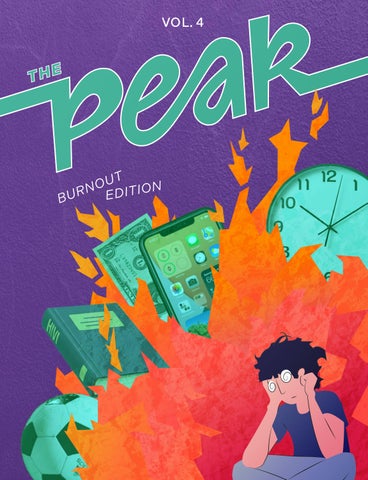
VOL. 4
EDITORS' NOTES
Editors' Note Sydnie Bierma
Jeremy Garza
Marley Logan
Archana Pisupati
Peak Editor—MMG
Managing Editor— Mustang News
Content Director—KCPR
Editor in Chief— Mustang News
W 02
e’re all exhausted. It’s the time of year where Cal Poly’s fast-paced environment pushes students to perform at their peak. Yet, for many, the burnout is real. Whether you’re falling behind in a class, losing time for hobbies, letting go of artistic outlets or even feeling it online across social media, this edition of the Peak explores your experiences. Burnout can happen to anyone. That mental exhaustion creeps up on us when we feel overworked, undervalued or unable to meet constant pressures. With this edition of The Peak, we hope the voices of students from different backgrounds, majors and personalities reflect a shared condition and speak to their experiences.
‑ The Peak Editors
Aviv Kesar Creative Director— Mustang News
Linnaea Marks Art Director—KCPR
Contents
6
#CollegeInfluencer: The burnout behind the camera
8 10
By Bea Rienhoff Designed by Natalia Celebrini
By Ishaani Dhanotra Designed by Ava Cheung
30 Minutes With: Andrea Lawson of Campus Health & Wellbeing By Kaylie Wang Designed by Julia Hazemoto
Examining STEM burnout By Lorenzo Cano Designed by Maya Shinden
5
You are not the impostor, you just don't believe in yourself. By Fiona Hastings Designed by Anika Loganathan
7
Burned out on internship applications? You're not alone.
9
The art of not being able to anymore
11
How to combat Sunday scaries
By Sam Fickett Designed by Ella Erdem
By Everlynn Dionne Designed by Nhi Duong
CONTENTS & STAFF
4
Stress-free scalloped potatoes
By Ella Guiliani Designed by Ava Donaldson 03
12
Running out of words: Writer's block edition By Olivia Nieporte Designed by Elena Vaughan
14
Burnout crossword By Allison Weil Designed by Maggi Benson
Staff Writers Bea Rienhoff Fiona Hastings Ishaani Dhanotra Sam Fickett Kaylie Wang
Designers Everlynne Dionne Lorenzo Cano Ella Giuliani Olivia Nieporte Allison Weil
Natalia Celebrini Anika Loganathan Ava Cheung Ella Erdem Julia Hazemoto
Nhi Duong Maya Shinden Ava Donaldson Elena Vaughan Maggi Benson
Stress-free
scalloped potatoes
FRYING PAN
Story By Bea Rienhoff Design By Natalia Celebrini
04
W
hen burnout fully sets in — with resumes to finish and jobs or internships to apply for — the last thing you want to think about is making dinner, especially something elaborate. When I need a cheap, filling and easy meal, my go-to dish is scalloped potatoes, and my go-to place for ingredients is the Cal Poly Food Pantry. Located next to the Health Center and open Monday through Friday, from 8:30 a.m. to 6 p.m., the Cal Poly Food Pantry is a free resource available to all Cal Poly students. To gain access, you either need your Poly Card or your Cal Poly email. The pantry offers fresh produce, canned goods, frozen food and sometimes items from name-brand stores like Trader Joe’s and Grocery Outlet. If you're playing it simple and just going for basic scalloped potatoes you can often find potatoes, onions, milk and cheese at the pantry. Maybe you picked up a loaf of bread from the food pantry a few days ago and haven’t used it — no problem. Tear the bread into pieces for breadcrumbs. Have extra deli meat? Go ahead and mix some in! Get creative. Anything baked in the oven with an abundance of cream, milk and cheese is going to be delicious. Scalloped potatoes always remind me of home and my family, and the best part of eating my mom’s version was discovering the extra add-ins she would sneak in. Whether we had leftover ham, bacon or even some charred poblano pepper for a Mexican twist, it always enhanced the dish. I hope my version of muffin tin scalloped potatoes brings warmth and comfort to your table.
Recipe: Makes: 12 servings (1 muffin cup each) Prep time: 15 min Cook time: 40–50 min 4 medium russet or Yukon Gold potatoes, thinly sliced (about 1/8 inch) 3/4 cup heavy cream (half-andhalf or milk works for a lighter version) (1 cup of evaporated milk can be used as well, depending on what you have available) 3/4 cup shredded cheese (cheddar, gruyere or mozzarella) 2 tbsp butter, melted 2 cloves garlic, minced or ½ tsp garlic powder (optional) ½ tsp salt ¼ tsp black pepper 1 tsp fresh thyme or ½ tsp dried (optional) ¼ cup grated Parmesan (optional, for topping) Cooking spray or butter (for greasing the tin)
Try any add-in ingredients: Cooked bacon bits or diced ham Sautéed leeks Spinach or kale for a veggie twist Paprika or nutmeg for flavor depth Breadcrumbs on top for a crunchy finish
Instructions: Preheat oven: to 375°F (190°C). Grease a 12-cup muffin tin with butter or nonstick spray. Mix the sauce: In a small pot melt butter on low heat. (Skip steps two and three if using garlic power.) Once slightly bubbling, add in the minced garlic. Sauté for 30 seconds or until the garlic is fragrant (be careful not to burn the garlic). Next add in the cream, salt, pepper and thyme (add garlic powder now if you are using it). Bring sauce to a simmer for 30 seconds, then remove pot from heat, keeping it warm. Cut and assemble potatoes: Wash and peel your potatoes. Slice the potatoes as thinly as possible using a sharp knife or mandoline into little circles, making sure they fit in the muffin tin cups.
Layer the potatoes in the muffin tins until they are halfway full. Drizzle about 1 teaspoon of cream mixture over each stack of potatoes. Add a sprinkle of shredded cheese and any mix-ins. (Not too much, we will add more later.) Repeat with remaining potatoes until the stack is about 1 cm higher than each tin. (The potatoes will shrink in the oven.) Add the rest of the cream mixture and sprinkle the stacks with cheese. (Reserve some cheese for later.) Baking: Cover muffin tin loosely with tin foil and bake for 40 minutes or until a sharp knife can easily go through the stack of potatoes. Remove potatoes from the oven and sprinkle with remaining cheese and Parmesan, if using. Bake in the oven without foil for an additional 10 minutes, or until the cheese is bubbling and golden brown. Cooling and serving: Remove from the oven and let cool for 5 minutes, then gently loosen edges with a knife to remove.
You are not the impostor, you just don't believe in yourself. VULNERABILITY STRIKES CAL POLY STUDENTS AS THEY EXPERIENCE IMPOSTOR SYNDROME
Story By Fiona Hastings Design By Anika Loganathan
S
STUDENTS’ PERSPECTIVES ON IMPOSTOR SYNDROME ASI president Marc Cabeliza is familiar with impostor syndrome, experiencing it throughout his high school and college years. “There are portions where, before I go into a meeting or afterwards, I go like, ‘Am I the right person for this job?” Cabeliza said. “Am I representing the student voice as best as I can?’ And that's something that is always in the back of my head.” Cabeliza ran against three people in his race for ASI president, who he described as “amazingly qualified people,” including a good friend of his. He felt impostor syndrome at its peak during the election season, but it settled down when he started the job. Despite being the leading voice for the student body, Cabeliza recalled the
impostor syndrome he felt upon arriving at Cal Poly. As a successful high school student, Cabeliza fell behind academically for the first time at Cal Poly. He felt like he didn't belong due to cultural differences when he got to Cal Poly's campus. “I remember at SLO Days, I was like, ‘Wow, there's not a lot of people who look like me,’” Cabeliza said. Only 14% of the Cal Poly student body is Asian, and as a Filipino immigrant, Cabeliza felt isolated being surrounded by the reminders of Cal Poly’s historically predominantly white institution status. Computer engineering junior, Alexandra Mull shared similar feelings. She said her confidence in her abilities dipped once she started attending her first classes at Cal Poly her freshman year. “I have just met a ton of really smart and amazing people, which has made me feel like I am less qualified to be here than everybody else, but I'm trying to work through that so far,” Mull said. “Especially in engineering, there have been times where I've been in a classroom of 40 people and I've been like one of maybe two girls,” Mull added.
Bencharit has taught courses such as cross-cultural international psychology, and her research studied how cultural contexts like race, social class, gender and other factors influence emotional values and behavior, especially in the workplace. She said impostor syndrome can be a result of cultural alienation and background. “They [students] don't have a lot of examples from their cultural context for being successful in academic settings,” Bencharit said. “That then interferes with their ability to thrive.” Cabeliza lived in the yakɁitʸutʸu dorms his freshman year, where he was surrounded by different cohorts such as Cal Poly Scholars and the Educational Opportunity Program (EOP), easing his cultural experience with the university. “Everyone in my dorm looked like me or had the same experiences as me,” Cabeliza said. “That helped a lot of knowing that I'm not alone here at Cal Poly.”
THE “SOLUTIONS” Impostor syndrome is a complex internal human issue requires attention to emotional detail, digging into the layers of why you feel you’re not good enough, according to Bencharit.
She referenced the “Stanford duck syndrome,” a term comparing the calm presence of a duck above water with frantically paddling feet under water, to how a student would react under pressure. “Everybody's paddling like crazy, and just nobody sees it,” Bencharit said. “Because we are in an independent culture where students are told that any problem that you might have, that's on you, students see that as a personal flaw.” Katelyn Nightengale, the former president of the Gamma Phi Beta sorority, defines herself as ambitious and a “go-getter,” finding it as a strength when she experienced impostor syndrome. “I felt that the more I learned about everything and became more knowledgeable with how our organization worked, policies, procedures, I became more confident,” Nightengale said. Seeking and keeping community, especially, has been key for these students to feel uplifted when confronted with impostor syndrome — from sorority sisters to faculty. “I feel like knowing they have my back and I have their back is what helps me build confidence in my role,” Nightengale said about her 306 sorority sisters. “Rely on the people around you,” Cabeliza said. “Whether it's your family, your siblings, or maybe even your friends, or honestly, even a professor.” On the academics side, Mull advised connecting with your professors to find an uplifting social connection. “Seeing somebody who's come from industry and or has just been in academia their whole life and really knows their stuff and knows how to apply it, look at you and say, ‘I believe in you, I know that you can do this, let's work through it together,’ that really does also help,” Mull said. Chances are, the people encouraging you are frantically paddling underwater beside you. “There's people out there who, regardless if you think they do or not, believe in who you are as a person,” Cabeliza said. “Sometimes it's just a small encouragement that matters.”
MUST-SEE MUSTANGS
horter days, holiday cheer, seasonal depression — an unconventional and discombobulated mix of things that unironically make up the sociological elements of the colder seasons. For university students, academic stress may start creeping in, slowly deteriorating one’s self-confidence in one of college’s emotionally hardest terms — winter quarter. You may fall subject to impostor syndrome: chronic doubt in one’s abilities despite clear success. The feeling stems from responding negatively to positive feedback, self-producing the image of a fraud and “impostor” to represent yourself in what you’re doing. Dr. Lucy Bencharit, a psychology professor at Cal Poly, describes the phenomenon as a “self-fulfilling prophecy.” “You view all of your interactions according to the lens you already feel coming in,” Bencharit said. “It's easy for us to draw on our evidence around us to get support for any of those ideas.” Cal Poly students said they doubt their abilities in and out of the classroom, extending to leadership roles and finding their unique place on campus.
05
#CollegeInfluencer Story By Ishaani Dhanotra Design By Ava Cheung
INSIDE
I
06
n an increasingly oversaturated era of the internet, a growing number of college students lead double lives as online personalities. Brand ambassador roles and beauty content are especially popular, but like any career, the day-to-day of a college influencer is not always glamorous. Creating content involves navigating trends and marketing tactics while also helping shape them. Liberal studies senior Michelle Hu is a content creator at Cal Poly that posts lifestyle and beauty content. While she still enjoys making daily vlogs and fashion videos — which she first started posting her freshman year of high school — she began working as a brand ambassador in college. Today, she works with brands such as LaCroix and Bearpaw, a footwear company. “I feel like I don’t really have a niche,” Hu said. “My niche is just being a college student.” With a passion for making and editing videos, Hu has strived to remain authentic on camera and grow her audience naturally. As a smaller content creator, Hu has faced challenges that make it difficult to land more opportunities. In the grand scheme of college influencing, Cal Poly is a smaller institution, which can make it harder for student ambassadors to get chosen by brands. Cal Poly is often not listed on applications for brand ambassadorships, according to Hu. At times, she feels the weight of possibly being overlooked for a brand ambassadorship for reasons beyond her control. “Sometimes I’ll apply for a brand collab and see who gets it, and it’s usually not a person of color," Hu said. "Sometimes they’ll choose the blonde girl that goes to ASU, especially over the person of color that goes to Cal Poly.” While Hu makes a variety of videos, she never really knows how they will perform. Trends have gone in and out of vogue throughout her career, and platforms such as Instagram and TikTok have unpredictable algorithms. “Right now, I feel like everyone has such a short attention span, so the trend [of ‘Get Ready With Me’ videos] is like fast-paced, very aesthetic clips,” Hu said. “Trends are changing all the
time, so who knows, maybe vlogs will come back.” Letting trends guide her content but not overtake it is a fragile balancing act, one that Hu tries to keep in mind when working with brands. A frequent collaborator with skincare companies like CeraVe, Dove and smaller Korean businesses, Hu tries to maintain transparency and authenticity in her reviews. Not every company shares the same values. Earlier in her content career, Hu spoke with brands willing to fake results in their ads. “There was one time I had to promote these sheet masks, and the sheet masks made my skin dry," Hu said "I didn’t end up posting the video because they wanted me to put some serum on after I took off the mask. That’s not something I would do.” She prefers working with companies that allow you to to test their product first, to make sure she’s promoting quality products. “Some brands just say, ‘here’s a product, make a video and send it back to us,’” Hu said. “Now I look at people’s ads and I’m like, ‘Did that really happen to your skin?’” Part of the job entails becoming a little cynical, but it has led Hu to be more purposeful in her partnerships. While student influencers have a larger presence online than your average college student, it doesn’t make them any less susceptible to burnout. Because there are so many moving parts, creating content isn’t just a numbers game. According to Hu, there’s a phenomenon that other content creators can relate to: the videos she thinks will “flop” often perform the best, while those she hopes will get the most traction sometimes do the opposite.
The
#GRWM
burnout
behind the
#college
camera #OOTD
Burned out on
Internship applications? You're not alone.
Story By Sam Fickett Design By Ella Erdem
Students and experts share their advice on balancing the hectic cycle
S
Balance “Take a gradual approach. Chip away at it, dedicate time, set aside time, an hour a day or 30 minutes a day. Think of long term goals. You really, really got to stretch it out. It’s not going to be an immediate result.” — Milana Byelick, a business administration senior and business management intern at Northrop Grumman “A lot of people treat applying to internships as a numbers game and try sending out as many applications as possible, but not really taking the time to think about what types of skills they’re looking for.” — Jakob Marrone, biomedical engineering senior and health technologies intern at Apple “Seeing each interview and application as an opportunity to practice, rather than a waste of time, not only helped me feel that I was improving, but also made me feel like I was reaching the light at the end of the tunnel
that I had been chasing for nearly two years.” — Nazareth Franco, business administration senior and incoming finance development program intern at Apple “Treating rest the same way I treat work helped me stay consistent without burning out. Dedicating time to watch a show, cook a nice meal or go to the gym, helps me reset so I can come back to my work and academic obligations with a clear mind.” — Melina Hernandez, journalism and political science senior and lead production intern at ESPN’s The CJ Silas Show Resources “The OCOB advisor [at the Career Readiness Center] was invaluable to me, Matt Parks, as an emotional support person.” — Milana Byelick “I would meet with Travis Raynaud in the Mustang Success Center. He always gave me fantastic advice on how to interview,” — Jakob Marrone “I had a lot of Zoom calls in the Career Center. They have these interview rooms. [...] I can’t tell you how nice that was.” — Jack Jensen, a business administration junior and incoming audit and assurance intern at Ernst & Young Advice “Talk to your professors, classmates, friends, or anyone in your network and let them know what you’re looking for. You’d be surprised by how often someone knows someone who can open a door for you, but you won’t find out unless you ask.” — Melina Hernandez
“It’s all about how you sell yourself and advocate for yourself.” — Maya Rhodes, industrial technology and packing senior and incoming mechanical engineer at Northrop Grumman “I love internships. It is like test driving cars. With an internship, there is an end date, so if you don’t love it, you finish up and you move on. If you do love it, you look for the next one.” — Adrienne Ferrara, an internship coordinator for the Wine and Viticulture department Habits “Remembering why you’re applying to internships and having a structured way to track where your applications are going, are the two things that kept me moving forward, even when I didn’t feel like it” — Nazareth Franco “I live by my planner. I’m really intentional about writing everything down [...] because having it all in one place keeps me structured and accountable.” — Melina Hernandez Insights “[A] myth is that interns are just given work to practice, or whatever. I was given real work that full-time people were doing, which made it really meaningful for me. I was putting my full effort into it.” — Maya Rhodes “I would strongly encourage you to focus your effort on connecting with
as many alumni at [a] company as you can after you receive a first-round interview. Use those conversations to ask thoughtful questions about the interview process, their role and the team, and to genuinely build a new connection,” — Nazareth Franco “Smaller organizations often give you far more hands-on work and individualized attention. Those environments can help you build stronger skills and confidence.” — Melina Hernandez
INSIDE
ecuring an internship in college is a time-consuming hurdle that not everybody is prepared for. At Cal Poly, many students use campus resources and the “Learn by Doing” philosophy to make real-world connections and prepare for the daunting postgraduate job market. However, finding the time, energy and resources to secure a successful internship can be difficult to learn on your own. Here is what students and academic advisors are saying about combatting burnout in the internship application process.
07
30 Minutes With: Andrea Lawson of Campus Health & Wellbeing
30 MINUTES
How mental burnout can easily manifest into illness
08
Story By Kaylie Wang Design By Julia Hazemoto This interview has been edited for length and clarity.
B
urnout may start off as mental exhaustion — but chronic stress and neglecting healthy habits can trigger a domino effect of other medical problems and pains. Campus Health & Wellbeing’s counseling and psychological services director, Andrea Lawson, explained how burnout negatively affects your overall wellbeing. Lawson shared her favorite tips and techniques for managing stress. Kaylie Wang: How would you define mental burnout, its symptoms and its causes? Andrea Lawson: Mental health burnout is a state of emotional, physical and mental exhaustion caused by
prolonged exposure to stress. It can happen when you feel overworked, undervalued or unable to meet constant pressures. Burnout doesn't mean you're broken or can't do something well. It just means you are full at the moment. It means you need to take time to reset, breathe, sleep and move your body.
good sleep, try to make up for it later on with a nap or prioritizing sleep the next night. Fuel your body for what you want it to do. Aim for three meals plus snacks each day from all the food groups. Keep in mind that cognition, your capacity to think, is impacted by your nutrition just as much as your physical body is.
KW: What are your tips for how busy college students can “treat” or “cure” burnout?
KW: What are some tips for how burned-out students can find the energy to take care of their physical wellbeing?
AL: Take just a few minutes a day to do a self-reflection, to acknowledge what and how you're feeling and whether you have control over your stressors. Even if nothing can change, talking with a friend, loved one, RA, faculty member or professional counselor can be helpful in managing burnout. Prioritize those building blocks of wellbeing, sleep, nutrition and movement. Aim for 7 to 9 hours of sleep per night. And if you miss a night of
AL: Acknowledge your feelings. Find space to pause and reconnect with nature, friends and other valued connections. Talk to loved ones about what's going on. Even if you can't change it, talking about it is helpful. Consider your purpose. Reconnect with your why and what long-term goals matter to you to tap back into motivation.
Some campus resources that can support students navigating mental health include PULSE's weekly programs, confidential drop-ins with a counselor with Let's Talk and the website Made for Mustangs filled with resources. Students struggling with burnout-induced illness can schedule a visit with Health Services by calling (805) 756–1211 or scheduling online. KW: What are your favorite strategies that you use for navigating burnout? AL: I love paddling in the ocean, connecting with friends, making good food and occasionally binge watching TV. To learn more about how chronic stress induces physical illnesses, read the full interview at mustangnews.net and kcpr.org.
Photo Story By Everlynn Dionne Design By Nhi Duong
1
“The art of not being able to anymore” is a love letter to Cal Poly's exhausted. This piece explores burnout as a shared experience, one filled with small acts of coping, connection and care. It’s a reminder that even when we can’t do it all, we’re still doing enough.
2
1.MOST LIKELY TO REQUEST AN EXTENSION AND DESERVE IT CASPIAN RYAN | BIOCHEM SENIOR “I have had to request an extension because of work before. I use them pretty sparingly, but some weekends I’ll work like 24 hours. My professors are normally pretty amicable about it though.”
2.BEST DRESSED
ANYA WILSON | ARCHITECTURAL ENGINEERING JUNIOR “When it's starting to get cold out sweatshirts are just really soft and comfortable.”
3
3.MOST LIKELY TO DROP OUT (EMOTIONALLY) “Homework makes me feel not awesome, but beer makes me feel awesome.”
PHOTO DUMP
HENRY PRESTON | MATH SENIOR
4
4.MOST LIKELY TO CRY IN THE LIBRARY BATHROOM
5
FLYNN HANRAHAN | POLITICAL SCIENCE SENIOR “I try to avoid the library on weekends, but find myself in here most Sunday nights.”
5.MOST IMPROVED AT SETTING BOUNDARIES LAURA STROBBE | MECHANICAL ENGINEERING SENIOR “It’s taken me a couple years to figure out how to balance my life, but now that I’m in my fourth year I’ve got it down. I just think it's important to have a balance between school and outside hobbies because it promotes the best version of myself.”
6.MOST LIKELY TO FALL ASLEEP AT THE FUNCTION JESS BLEAKLY | AEROSPACE SENIOR
6
“Sometimes school takes it out of me, so I sleep when I can.”
09
7.MOST LIKELY TO BURNOUT WHILE WRITING ABOUT BURNOUT
EVERLYNN DIONNE | JOURNALISM SENIOR “I hope this project makes you feel less alone in your burnout.”
8.MOST LIKELY TO ROMANTICIZE BURNOUT GRETTA THOMPSON | AEROSPACE SENIOR “It’s important to romanticize burnout because that’s how you get through it. All assignments are little stepping stones, but overall the path looks great.”
7
THE ART OF NOT BEING ABLE TO ANYMORE 8
Examining Story By Lorenzo Cano Design By Maya Shinden
THE EXAM
A
nother late night post-labbing and pre-labbing for the next day. Running on no sleep as a migraine grows steadily. Preparing to leave the house for a Thursday morning lab, only to be stopped by a physical manifestation of burnout: vomit. Anonymous: “I just took off my sweater that I was wearing and sealed it in a plastic bag, and kind of ran my arm under the sink, but I didn’t get to take a shower because I was like, well, I got a lab practical, can’t miss that, time to go,” the student said. “I’m going to smell like vomit. I’m going to hope nobody cares that I smell like vomit in lab. Even though I have this pounding migraine, and I have thrown up, and I smell, and I just feel gross everywhere, it’s time for school — I can’t miss this.”
The switch The workload for science, technology, engineering and math (STEM) students usually isn’t measured by the completion of a project, but more often by performance on exams. Studying for these is a task that can
10
take as much time as a student allows. Turning off academic thinking to relax or spend time with friends can be difficult when studying is such a large part of a student’s life. Civil engineering junior Jeslyn Sun lives through the difficulty that comes in making that switch. “While driving on the freeway a couple days ago, I noticed a weather radar on top of a hill,” Sun said. “I remember how I learned about it from my water resources engineering class, and had fun explaining what it was and how it worked.” “At parties, school will always come up,” biology junior Jack Poole said. “I don’t think I have ever been to a party where research or school has not come up.” His devotion to his study extends beyond the classroom, merging into his everyday outlook on life. “We have a creation story, we have saints and heroes and villains, and it just affects day-to-day life so much,” Poole said. “It is such a broad field that I don’t feel like I’d ever need to be part of a religious organization because biology has filled that role in my life.” For molecular and cell biology junior Harrison White, flipping the switch into academic mode presents a bigger challenge. “For most STEM classes, studying involves a lot of brainpower,” White
burnout said. “You are kind of exhausted at the end of the study session. It’s hard to switch on, but honestly, it's not hard to switch off. As soon as I’m done, I’m done, and I don’t think about it until the next time I get back into my studies.”
Isolation from inside and out Whether it’s competing with classmates for a highly acclaimed summer internship or trying to explain to a friend in a different major why a class is stressful—even though they can’t seem to see how—isolation and a faulty support system from peers can play a major role in burnout. Students’ misconceptions about their peers’ workloads result in some majors being praised for hard work while others are seen as less difficult, leaving students in those fields feeling unseen. Economics junior Alexander Smith has felt isolated because of stereotypes surrounding his major and the belittling of his workload by peers. “I think Econ is a difficult subject, and people do not treat it as such because they’ve taken a high school economics course that focuses on very simple applications of theory, and they think that’s all that the subject is, when in reality, it is a lot more complicated,” Smith said. Sun said she feels like engineering students are often met with sympathy and understanding, since the common perception of engineering as a major paints it as exhausting. Inside the engineering program, however, she feels disconnected from her classmates. “In fact, I feel more isolated when I am in a class with other engineering students and feel like I’m the only one
who doesn’t understand the material,” Sun said.
No time for creativity Amid projects, labs and presentations, the routine nature of STEM can sometimes cause a student’s creative or curious ambitions to slowly fizzle out. “Under workloads, it becomes difficult to involve a good amount of creativity because, oftentimes, being creative takes time and effort,” Sun said. “I think we tend to govern ourselves by the mentality that if we will still get that 100% on that homework assignment even without being creative, then there is no point in taking that extra time.” Layla Wolfe entered Cal Poly as an engineering major and is currently in the process of switching to economics. She has always had a passion for the arts, but she felt that being intensely involved in STEM coursework dwindled her ability to experience that side of herself. “I couldn’t go to fashion shows, I couldn’t go to art galleries when I was focusing on my STEM classes, like I wanted to, which really sucked because I had all these appreciations and these hobbies, and I wanted to focus on them, but I was prioritizing other things, which definitely took a toll on me,” Wolfe said. The onslaught of late-night study sessions and constant focus on equations and formulas can be exhausting for the body. Swirling thoughts, migraines and sore limbs from sitting all day are just a few ways the rigorous course load can take a toll on STEM students. Stories like these are common among students at different universities as they try to balance academic success with their physical and mental well-being.
How to combat Sunday scaries Sometimes, the morning-after debrief feels like a game of Mad Libs. While you piece together a night of whosits and whatsits, play our GAME
version of Mad Libs.
Story By Ella Giuliani Design By Ava Donaldson
I
f you still find yourself feeling fuzzy and are looking for some tricks to scare away the Sunday scaries, look no further. Feeling stressed? Simple breathwork exercises like “Box Breathing” (inhale, hold, exhale and hold for four seconds each) can help regulate the body’s nervous system while combating feelings of stress. Feeling sluggish? Eat something with carbohydrates and protein. Hydrate. Reassess all life problems after electrolytes. The breakfast burritos at Lincoln Deli are a great pick-me-up! Feeling physically strained? Try some easy stretches without even leaving the covers. Stretching helps relieve stress and boost focus by improving blood flow to the brain. A gentle fullbody stretch or hugging knees to chest can work wonders to reinvigorate the physical body. Feeling burned out without explanation? Nature is also considered a great antidote for burnout. The Japanese practice of shinrin yoku or “forest bathing” is a mindfulness exercise focused on stillness and absorbing various senses in nature. Try going for a short walk or spending some quiet time outdoors.
Feeling stuck in a negative spiral? Fight off negative thought spirals by chatting with a friend or roommate. This provides a productive way to reflect on the weekend and receive alternative perspectives, while strengthening bonds that foster connection and belonging. Alternatively, journaling offers a similar method for processing events and feelings, which can remain private and be reflected on again in the future. Pick up the phone or open the Notes app next time you wake up feeling untethered. There is no right or wrong way to reset. While these five steps are my triedand-true cure for hangxiety, you may need to find a remedy unique to you. Here’s to surviving Sundays so you can conquer the week!
11
SECTION CONFESSIONS
WRITER'S BLOCK EDITION Creative Narrative By Olivia Nieporte Design By Elena Vaughan
Are words something possible to run out of?
“Me—run—out—of—words.”
“Words run out of me.”
Hsshdidiidniansdiw,
ommoifhqoiqjijfd
(keyboard strike)
(keyboard strike)
A detached and dismembered voice spews. My arteries had formed a blockage from my brain to my hands, killing any hope of worded life. Built by pressure and bricks of perfectionism, the obstruction had taken my vessel captive. A deficiency in confidence ran my creative shores dry, revealing I simply didn't feel like anything more than what I could create. 12
THE PRETTY WORDS THAT ONCE CAME SO EASILY, DIDN'T. If Joan Didion were wordplay, I was Eve Babitz, tangled in a fraught friendship or a love and hate affair with my own sentences. Mutual jealousy and perpetual longing tailed quietly behind resentment, spurting haphazardly, like magnets that can’t decide whether to meet or repel at each end. In music coverage I felt paralyzed, missing the brazen way I stumbled through content matter just six months prior. An empty page or blinking cursor felt like a landmarker for bad!
NOT QUITE! OR COULD BE BETTER! Burnout is something most creatives tell you to just “get over,” like the flu or a scraped-up knee. Was this burnout, or just an excuse for my dry spell — an internal fountain once spewing infinite words?
WHAT HAPPENS WHEN SOMETHING SEEMINGLY INNATE AND NATURAL GETS TAKEN FROM YOU?
MUSICIAN'S BURNOUT In combination with my own discontentment (and an approaching content deadline) I spoke with a female songwriter about her own experience. Story By Olivia Nieporte Design By Elena Vaughan
ith aviators perched on her nose, Annie Pagel saunters over and poses herself on a patch of grass, 15 minutes late and haphazardly double-parked in the Health Center lot. She is similarly doubleparked in her life. As the winner of Battle of the Bands last spring and opening Shabang on Cuesta Ridge, Pagel, is (was) a busy gal. After an era of creating intently (two quarters) and intermingling personal events and alluringly good mental health inspiring her writing, sh-t hit the fan. Writing became painful… familiar. We sit across from each other, the SLO luminary straining her neck aiming for my inline headphone mic that's not quite long enough to reach her comfortably across the grass. Her inflection drowns out shrieks of Robert Plant from the climbing wall. “Not that I meant to, but I was just enjoying the writing process so much and then I felt like I wrote everything that I needed to say. Mostly maybe because I am doing well, mentally?” she laughed. Her teeth complement her face like jewelry. Like most songwriters, Pagel has the gist or intention of a song in her mind in silhouette, often becoming stuck flushing
is something that people don't do enough.” Artists like myself and Pagel become so encapsulated by the outcomes of writing that we can't even pick up the pen, or when we do it is heavy, making a mess of the page. For Pagel, the process is something that's meant to be repetitive, but too repetitive eventually the ink won't flow. Creating with expectation is a danger zone. A small man in a construction vest waves furiously as others like Pagel and I fly full speed, plummeting off the tracks into immidietism valley. A mentor of sorts told me a while back to stop writing with “my head but with my heart” and when I was worried about the timing of releasing tracks he spewed god-sent tongues: “lyrics don't go out of style, production does.” We transition to the concept of thinking “too hard” vs. simply doing. Laying waste to the disillusionment that thinking harder may spin a better tune. Pagel, sharing her writing time turns overthought and overturned, “If I'm sitting down like, ‘I have to write a new song for my band’” she says robotically. Pagel and I stumble upon the alarming consensus and equally as jarring realization, breaking bread
CONFESSIONS SECTION
W
out exactly how she pictured it. She feels this is mostly a causation from the “same old same old” approach to writing the uniform way she always has, suggesting reason for change. “I feel like sometimes you have to change around your methods, not change around your ideas.” Writing lead and frontman for an all-male rock band can be a tricky maze to navigate. The pressure to create something for the entire group rather than for herself with pressure to spin songs in a new way every time has her constantly wanting to reform and recreate. “I don't want to be the same always.” Pagel fears writing inside the box, willing to sacrifice structure and safety for failure and the potential feat of making something even greater. She advocated for taking a step back and listening to other artists while not being fearful to experiment and potentially fail. “I think that one thing I've gotten comfortable with is failing. I have so many failed attempts at songs.” For Pagel this is brutal. “It's like the last thing you want to do is put yourself in a situation where you're going to fail. But I think that being uncomfortable
over the importance of authenticity. The fragility of authenticity falling when pressure is around, pressure to record, succeed or impress. “It's not going to be as authentic if you're like sitting down with a certain goal you have to do. I think for some artists they like that structure, but I think for a lot of people it just kind of creates stress.” Sacrificing personal writing for band practice, she's willing to be flexible for the music. She'd rather have a successful show than regret not practicing enough. Pagel, spread and scooped into an overcooked batch of college hobbies, responsibilities and social events baking at high heat, sports a double life (without the blonde wig). After Shabang, the songstress left her guitar to the corners of her room for weeks at a time, taking the space she needed to live life. The experience, stressful, but well rewarding. Sometimes space and time (like most) is what heals but hurts like hell. “I think I think I've had a lot more like complexities with—” she stops her thought, “um sorry, I just saw my ex-boyfriend walk by.” Taken aback by her sighting, Pagel slides her sunglasses up her temples and through her Winehouse-adjacent ringlets. (clearly he had been an inspiration for her songwriting). Pagel continues shaking her head: “Now I almost like write songs about how I've changed and that's really cool too. So, there's always something to write about.”
13
burnout crossword
Puzzle By Allison Weil Design By Maggi Benson
across 1. That one mountain with the M you must hike before you graduate from Cal Poly.
CROSSWORD
4. How you show up to class the entire second half of the quarter. 7. What you think to yourself when you submit an assigment at 11:59 p.m. 10. Your week when you are trying to balance a job, being a full-time student, and having a social life. 12. A dorm room distraction that you just had to bring from home. 14. _______ plague.
14
15. Documents you swear you read the first week of the quarter, but are desperately re-reading at the end of the year to find out your attendance grade. 19. A phrase said by someone when you realize you made the wrong choice for your Tinder date. 20. The "small assignment" worth way more than expected, which you did not study hard enough for. 21. The administrative system of a communist party.
d o w n
1. The reason everyone on campus looks drained. 2. What starts as a quick phone break and ends with no studying accomplished. 3. Baby, bye, bye, bye. 5. What every senior says about their last year. 6. Phrase used to describe if you know what's up. 8. People you suddenly think about before going home for Christmas break. 9. The only thing getting you through the end of fall quarter. 11. High Street _____. 13. What happens after one too many iced coffees and discussion posts. 16. Something you check 40 times, hoping for an extension from that one professor. 17. The place you swear you'll only sit for five minutes, then fall asleep and wake up at 3 a.m., wondering where you are. 18. A concept, not a reality, especially during midterm season.
a ns
e r s
CROSSWORD
w
15