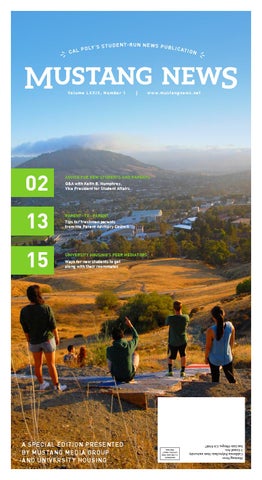
S T U D E N T- R U N N E W S P U B L I C S ’ Y L O AT I O P N CAL
Volume L X X I X , Numb er 1
13 15
ADVICE FOR NEW STUDENTS AND PARENTS Q&A with Keith B. Humphrey, Vice President for Student Affairs
PARENT- TO - PARENT Tips for freshmen parents from the Parent Advisory Council
UNIVERSITY HOUSING’S PEER MEDIATORS Ways for new students to get along with their roommates
A SPECIAL EDITION PRESENTED BY MUSTANG MEDIA GROUP AND UNIVERSIT Y HOUSING
Mustang News California Polytechnic State university 1 Grand Ave. San Luis Obispo, CA 93407
02
w w w. mu s t angnew s . ne t
MN | 2
www.mustangnews.net
Keith’s advice for new student success
Q&A
with Keith B. Humphrey, Vice President for Student Affairs
COURTESY PHOTO
What is the Division of Student Affairs and what does it oversee?
What are your responsibilities as vice president for Student Affairs?
Student Affairs is the area of the university that is responsible for everything that happens outside of the classroom. Our goal is to make sure that the quality of a student’s out-of-class experience matches the quality of their in-class experience. There are dozens of Student Affairs programs and services that help students be successful.
The most important part of my role is to be the students’ primary advocate. I make myself as available as possible to them and try to listen and understand as to what is on their minds. From their ideas and what we know we need to do to help our students become better citizens of society, we implement a variety of programs and services.
How does Student Affairs affect freshmen, their families and the resources specific to freshmen? We put a lot of attention into first-year students because we know that building a strong foundation is key to a student’s overall success. We are very active in orienting freshmen to the Cal Poly community by connecting them with valuable student success programs and services. For example, we will connect freshmen with ca-
reer advisers this fall to give students a jump start on developing a career plan. How can students reach out to you and your division? I love it when students come see me or when I get to talk with them at various campus events. I hold office hours every Monday during the academic year from 4-5 p.m., no appointments necessary. This is where students can share what’s on their mind. Students and parents can also email me or send
a message to my Facebook page (www.facebook.com/ VPSAKeithHumphrey). When you see me around campus, say hi and introduce yourself! As a parent yourself, what advice do you have for parents who are taking their kid to Cal Poly for the first time in order to support their child’s success? Parents have done a great job raising their sons and daughters
for the first 18 years and my hope as a parent is to make sure that things continue to go in the right direction when they leave for college. My advice to parents is to find a way to take a step back and let their student figure things out on their own. Be ready to coach, support and stay connected but not try to do everything for them. If things are not going well, get them in touch with us so that we can help.
see KEITH, pg 3.
MN | 3
www.mustangnews.net
The Mustang Way : More than a campus A message from President Jeffrey Armstrong and Sharon Armstrong Not long after we arrived at Cal Poly in 2011, the campus embarked on a very important project – codifying the values that define the Cal Poly community. Under the leadership of Athletics and Associated Students, Inc., the whole campus came together to define a set of principles we call the Mustang Way. As we live the Mustang Way, we are focused on excellence. We embrace one another. We lead by example. We accept responsibility. And we are one community. These are the principles that form the backbone of the Cal Poly experience.
Keith continued from pg 2.
What advice do you have for students to get the most out of their freshman year? I think they should get involved with Cal Poly as quickly as possible, such as joining a club that matches their interest and attending their favorite sports event. If they came here with friends from high school, branch out and make new ones. Don’t spend all of their time socializing on Instagram – get out and meet new people. Build meaningful relationships and make time to meet professors outside of class.
As proud as we were to hear our students commit to these ideals, we knew that the Mustang Way does not just describe our past – it is a guide for our future. Over the next few years, we will work deliberately to further enhance each of those aspects. By 2022, we plan to have more students living on campus, where they will find a vibrant campus community and an abundance of co-curricular opportunities – from dining and entertainment to collaborative work and study spaces. Students’ social and academic lives will merge and they will find everything they need right here on campus. We will build an even more welcoming and inclusive environment that better re-
Any important things students need to consider in their freshman year? Even though San Luis Obispo is a very safe place to live,
flects the diverse makeup of our state – a campus where the unique qualities and contributions of every person is valued. We will take our distinctive Learn by Doing approach to even greater levels, engaging our students in cuttingedge research and industry partnerships. Our students will not be content to learn just from lectures and textbooks. They will be active participants in innovation and discovery – and that experience will prepare them to face the future’s most pressing challenges. It is an exciting time to be a Mustang, and we are so glad that you are part of Cal Poly. We hope you will discover what we have discovered – a vibrant community that lives the Mustang Way.
bad things can still happen. So be aware of their surroundings and take care of each other. I want people to make smart decisions when it comes to the safety of per-
COURTESY PHOTO
sonal items, going to parties and drinking. Make sure they are making good decisions and looking out for each other. What advice do you have
“So my advice to students is not to worry if it takes longer to find the perfect club or circle of friends. There is a place for everyone to connect, engage and be successful.” KEITH B. HUMPHREY | VICE PRESIDENT FOR STUDENT AFFAIRS
for students who might have a little bit of trouble adjusting their first year? I have this theory called the “Senior Prom Effect.” Throughout high school, everything builds up to the senior prom. We think it’s going to be this magical, perfect evening, but when it doesn’t turn out the way we envisioned it, we feel disappointed. I think that happens a lot with our first year of college. So my advice to students is not to worry if it takes longer to find the perfect club or circle of friends. There is a place for everyone here to connect, engage and be successful. Just remember that everyone is in the same boat, trying to find their way, too.
Any final words of wisdom? We expect to see every freshman at graduation in four years — or five years depending on their academic program. We encourage students to make smart choices that help get them there and gain the most out of their college experience. After being admitted, everything is about getting to graduation. Student affairs is here to help students succeed, so get connected and make these the best four (or five) years of their lives.
MN | 4
www.mustangnews.net
JOI-FUL | Joi Sullivan took advantage of the instant runoff round and racked up 2,716 total votes to win the election. She’ll assume the role of ASI president for the 2014-2015 school year.
Letter from ASI President Joi Sullivan Welcome to the family of Mustangs! My name is Joi Sullivan, and I will be serving as your Associated Students, Inc. (ASI) president this year. I'm absolutely thrilled that you chose to make Cal Poly your home for the next four years; it will be the journey of a lifetime! You have taken the first step of leaving home and are now on a new adventure with endless possibilities. Some may find that exhila-
rating, others a bit scary. Regardless of how you’re feeling at the moment, you’ve picked the right place to begin your adventure. The Cal Poly community is one you’d be hard-pressed to find elsewhere. The people here are always fun, friendly and willing to invest in each other so that everyone may succeed. There is also a wide range of opportunities for you to get involved on campus, some-
thing I would highly encourage you to pursue during your first year. Between every possible club you could think of, intramural sports, greek life, campus jobs and a number of other opportunities on campus, there is something for everyone. When you pour yourself into this community through campus involvement, you will reap huge benefits. Take advantage of all of the opportunities you have before
you; step out of your comfort zone and be a part of something that’s bigger than yourself and your college experience will be all that you ever hoped for. My role in ASI this year is to represent you, the student, to both the university administration and California State University system. ASI is an organization on campus whose goal is to provide the ultimate college experience for all students.
It oversees areas of the campus, including the Recreation Center and the Julian A. McPhee University Union (UU), which holds events such as concerts and even has a craft center where you can learn to shape your own surfboard. My goals for this year primarily revolve around guaranteeing all of your needs are met. I plan to make progress towards alleviating financial con-
cerns, continuously growing a strong sense of community and ensuring every student’s safety while here at Cal Poly. My job is to represent you, so if you find yourself with concerns about anything on campus, please reach out to me at my office in the UU, room 202. Get involved and you will find a community that will last you a lifetime! Go Mustangs!
MN | 5
www.mustangnews.net
Meet mustang mascot Moonstar Animal science seniors Hannah Haeussler and Natalie Harnett, both enrolled in ASCI 345-Equine Behavior Modification, can now add “mascot trainer” to their résumés. When alumnus Robin Baggett (B.S., Business Ad-
ministration, 1973) and his wife Michelle donated a mustang to Cal Poly, Haeussler and Harnett were tasked with training the horse to boost school spirit on campus. The mustang will do this by leading fans into the stadium and
the Mustangs teams onto the field on game days, and by encouraging interactions with students and alumni. Some 45 years ago, the U.S. Congress recognized mustangs as “living symbols of the historic and pioneer spirit
of the West.” How fitting that Cal Poly now has a living mustang as its mascot and the first horse to be included in a mustang-in-training program. Haeussler and Harnett are now in the process of training two additional wild mus-
tangs the animal science department adopted from the Bureau of Land Management. The university intends to select a team of outstanding students to train and care for the animals in the mustang-in-training program.
COURTESY PHOTO
“This program will give students another opportunity to Learn By Doing as they care for and train our new mascot,” said Animal Science Interim Department Head Jaymie Noland, who is leading the new program.
MN | 6
www.mustangnews.net
MN | 7
www.mustangnews.net
Warren J. Baker Center for all students The Warren J. Baker Center for Science and Mathematics opened its doors to Cal Poly students in the fall of 2013. And while it is an addition meant for science and math majors, every Cal Poly student will have at least one class in the new center, which is the second largest building on campus.
study areas and white boards located right outside faculty offices. This offers a distinct advantage for students who are studying, since they will be near professors if they have a question regarding the material. Henry said this is giving students a collaborative learning experience with faculty members.
said. "With the combined lecture and lab, a student would have three sessions a week for two hours. Both ways work, but with the studio classrooms, the students are actually discovering things for themselves. We’re teaching them how to learn science instead of just teaching them science.”
“It’s very convenient,” said Rachel Henry, public affairs and communications director for the College of Science and Mathematics. “It’s located right in the center of campus. It’s a great place for students to study during hot and cold weather because it’s temperature controlled and there’s room for 400 students to study in the building at any one time.”
In addition to the study areas, the Baker Center has new classrooms that work to integrate lecture and laboratory sessions. Instead of meeting for lecture three times a week with a professor and having a one-hour lab, students will have three sessions for two hours that have both a lecture and a lab component.
Bailey said the new Baker Center is rivaling the Robert E. Kennedy Library in terms of being a favorite place for students to study, even though it doesn’t serve any food. In between the study areas are comfortable chairs and couches for students to lounge and relax, which Bailey calls the "living room areas. "Decorating the walls are pictures of electron microscope images and portraits of famous scientists and mathematicians.
Henry also said the Baker Center is transforming faculty office hours. From the 3rd floor up, there are group
“With a regular lecture and lab format there’s sometimes a disconnect for students," College of Science and Mathematics Dean Phil Bailey
Starting fall quarter, the
COURTESY PHOTO
building will get new terrace furniture so students will be able to study outside.
“This is a university building for all the students at Cal Poly to use and enjoy,” Bailey said. “It’s like an intellec-
tual version of the University Union where students can study and learn and relax.”
Mustang Success Center aims to empower students At Cal Poly, student advising has evolved into its simplest form: Walk in and get started. The Mustang Success Center, which opened in fall 2013, provides students with a place to start asking any questions they may have regarding university advising. In addition, appointments aren't necessary. According to Assistant Vice Provost for University Advising Beth Merritt Miller, the center serves to help students who may be overwhelmed when entering a large university such as Cal Poly. “Often (incoming) students are not sure how to navigate
the university,” Merritt Miller said in an email to Mustang News. “The Mustang Success Center provides a one-stop for students to talk with advisers about how to get the support they need to be successful at Cal Poly.” The advising center doesn’t only aid freshmen, Merritt Miller said. It’s an outlet for all students — regardless of major or year — to access answers to general academic questions. “The advisers in the Mustang Success Center are generalists,” Merritt Miller said. “We help students with general academic advising questions and connect students to
their college adviser for questions specific to their major.”
that’s the value that we add to it.”
The center, funded by the Student Success Fee — a fee students agreed to pay in order to enhance their success — is known for its timeliness in advising responses, Mustang Success Center director Shannon Stephens said.
The center also works closely with other student service areas, such as University Housing and Career Services, to provide comprehensive advising specifically focused on freshmen, sophomores and new transfer students.
“What’s unique about us is that we help students take the leg work out of things that are usually quite simple, but can become problematic because their questions don’t get answered in a timely fashion,” Stephens said. “It’s quick — students will never have to wait more than 10 minutes to see someone;
“We’ve probably seen, oneon-one, 1,300-1,400 students this year,” Stephens said. “But that doesn’t include all the workshops we’ve done at the residence halls and things like that. We’ve done probably over 60 of those.” In addition to catering to the residence halls, the center will also play a role in
THE MUSTANG SUCCESS CENTER PROVIDES STUDENTS WITH ANSWERS ABOUT UNIVERSITY ADVISING | COURTESY PHOTO
Soar and Week of Welcome (WOW) this year.
see SUCCESS, pg 17.
MN | 8
www.mustangnews.net
Student Academic Services help students succeed in studies Phillip Azar Biomedical engineering alumnus Becoming a workshop facilitator for Supplemental Workshops in Science (SWS) has brought great satisfaction over the last two years. During this time,
the program has grown considerably and, without a doubt, the students I have worked with during the course of my leadership have grown as well.
in courses that might have otherwise seemed overwhelming. My hope is that we will help create future SWS facilitators who will be equally interested and committed in sharing their knowledge and skills with others. As my time with
SWS comes to a close, I look back with pride to those I have taught and encouraged, and my only regret is not having spent more time with SWS.
struggled a single day. College was a wake-up call. I was not used to all the pressures and high performance standards that accompany attending a top university. Because I wanted to succeed academically in my beginning calculus and physics courses, I soon decided to enroll in a few study sessions taught by upperclassmen. I thought they could
really help out with my studies. Little did I know that it would open my eyes to everything Cal Poly had to offer. Not only did I find a mini-community amongst the thousands of students, but I soon learned that the anxiety and trepidation I was feeling was normal. My favorite analogy is of a duck. Above water, to everyone else it appears to be gliding on top and enjoying the view. However, underneath the water it is kicking ferociously, trying to stay afloat. As students, we may put on a
façade that nothing fazes us, but in reality many of us are trying our best to uphold the excellence expected of us at Cal Poly. This is something I wanted to pass on to others. I applied to be a study session leader so I could have potential influence on underclassmen both academically and otherwise, no matter how great or small. I wanted to put some perspective on everything and let students know that worse comes to worst, they will remain standing. I think that my time both as a study session
of SWS, I felt empowered to really understand the material; it made such a positive impact that I decided to become a leader. My involvement in SWS as a facilitator for organic chemistry and biological form and function refined my study skills and confirmed my goal to become a health care provider. Workshops not only develop your understanding of material, it also helps you master concepts as a facilita-
tor. Students just like you are asking important questions for which you may not know the answer. This is where the power of instructor collaboration comes into play. Leaders work directly with different instructors and provide us with fresh insight and new instructional ideas to bring to the workshop. This handson approach to learning is exactly what I had hoped to find at Cal Poly, and is a component of the curriculum
that exemplifies the Learn By Doing attitude. Overall, my experience as a workshop facilitator has allowed me to grow both as a student and as a facilitator. The program completely revamped my study habits and my desire to learn and help others. I would do it again in a heartbeat!
For facilitators, SWS is not about making money or acquiring status. It is about making a genuine commitment to higher education, and sharing the knowledge we have gained with other students. We strive to enhance their interest
Jenn Haskett Business administration senior Study session leader
COURTESY PHOTO
Honestly, coming into Cal Poly, I was intimidated and a bit terrified. I mean, who isn’t? I was scared about not finding my home away from home with a good group of friends who also had similar academic goals in mind. All the students here, especially in many of the engineering courses, seemed to have everything together and looked like they had never
Chris Tremonti Biological sciences alumnus Supplemental Workshops in Sciences In my freshman year, I decided to enroll in Supplemental Workshops in Science (SWS) to see how much it helped with the courses. I was having trouble grasping application concepts. Sure, I could memorize material, but that’s not what’s important in the long run, especially as a sci-
ence major. Supplemental Workshops met and exceeded my hope to gain a better understanding of studying and knowledge retention. My BIO 162 workshop facilitator became both a mentor and a friend and fostered my understanding of developing an application mindset. Because
COURTESY PHOTO
COURTESY PHOTO
student and a leader showed me that I could learn from anyone: my professors, my supervisors, but most of all from my peers. We all experience similar things and overcome similar obstacles so that we truly know what it means when you are told that Cal Poly expects excellence. It’s not something to shy away from, but rather to be tackled head-on, and along the way, you’ll realize how much you truly have learned.
MN | 9
www.mustangnews.net
Competitive edge leads to CAED student successes Based on exceptional results, the Learn By Doing approach has provided students of Cal Poly’s College of Architecture and Environmental Design (CAED) valuable skills and stellar success on a national stage. The acclaimed college has a unique mix of five disciplines that influence and shape the built environment. “Best in the West” was bestowed upon two of those, according to a DesignIntelligence survey in the 2014 edition of “America’s Best Architecture & Design Schools.” This year, the bachelor of landscape architecture (LA) program remained in first place in the western regional rankings, and climbed nationally from seventh place to fourth in best preparing students for success in the profession. In a skills assessment, among all schools it placed nationally in four of six categories. Preeminent in national rankings, Cal Poly’s bachelor of architecture (ARCH) program ascended from No. 5 to the top spot nationwide, followed by Cornell University,
Rice University and others. In assessing eight specific architecture skills, Cal Poly’s program ranked first in construction methods and materials and sustainable design practices and principles; second in cross-disciplinary teamwork; and fourth in analysis and planning, and computer applications. “Our outstanding placements in national rankings recognize the hard work and dedication of our faculty and staff, the passion of our students and Cal Poly’s extraordinary polytechnic environment where creativity flourishes in a Learn By Doing culture,” CAED Dean Christine Theodoropoulos said. Academic advisers partner up with students to plan their individual success. “I frequent the CAED Advising Center and feel more comfortable and confident that I’m making the right decisions,” construction management sophomore Joe Aimar said. “The tools they’ve given me have prepared me well. I feel like ev-
erything is balanced and I’m on track toward graduation.” Construction management student teams excel in competitions through their applied curriculum, winning in an impressive six of 12 categories at the Associated Schools of Construction Competition in Reno, Nev. The mixed-use and designbuild teams won first; the concrete solutions, commercial and heavy civil teams won second; and the marine team garnered third. Interdisciplinary teams provide real-world experience. The architectural engineering (ARCE) program is one of a kind in the west. Students from ARCE, ARCH, LA and city and regional planning (CRP) collaborated to attain first place in the Living Building Challenge Competition. Their project near Dodger Stadium was selected as a leading sustainable design example for future development, and was among 20 others from public and private universities in Southern California. The CRP program also as-
With a concentrated focus, architecture student Christian Frederiksen gains insights about his project from Architecture Department Head Margot McDonald and CAED Dean Christine Theodoropoulous. sembled an inter-collegiate team of mostly undergraduate students to compete in the regional Bank of America Low-Income Housing Challenge. They earned second place recently, preceded
COURTESY PHOTO
on the excellence achieved by students. “Across our disciplines, hands-on learning experience prepares our students for successful professional practice.”
by three first-place finishes competing against mostly graduate teams from powerhouses such as University of California, Los Angeles and Stanford University. Theodoropoulos reflects
Robert E. Kennedy Library saves time, money, stress so students can focus on success I speak from experience when I say you can literally fill your backpack with free resources from Robert E. Kennedy Library. As a Cal Poly alumna and avid Robert E. Kennedy
Library user, I know lots of ways to save money on courseware, tech and other stuff. If only the people who work there could fit in your backpack too.
Tip No. 1: People are here to help you. College librarians are awesome. They can help you with research, papers and projects from the beginning of your Cal Poly career
through your senior project. There’s also a friendly bunch of peer assistants called library research assistance technicians (LibRATs), who can guide you through online databases and answer
“how-to” questions. Look for them at the reference desk. They’re the ones smiling. Tip No. 2: You’ve got textbook options.
Open access textbooks (OATS): Use 150+ new textbooks, workbooks and study
see LIBRARY, pg 10.
College of Architecture & Environmental Design Advising Center
Professional advisors provide effective academic advising in an encouraging and welcoming atmosphere to students in the CAED’s five majors. We support students as they navigate their undergraduate experience toward individual student success.
Come see us for help with... • Academic advising and progress to degree planning • Academic success strategies • Change of major advising • Understanding your major curriculum sheet, flowchart, graduation requirements, on-line advising tools and much more! • Much more! Building 05 - Room 210 caedadvising@calpoly.edu 805.756.1325
MN | 10
www.mustangnews.net
CLA puts the ‘comprehensive’ in comprehensive polytechnic
ing majors — CLA is one of the most selective liberal arts colleges in the CSU system — but for all Cal Poly majors. The CLA educates approximately one-third of all Cal Poly students through general education courses. Being a comprehensive polytechnic university means offering students opportunities beyond their technical focus to extend themselves and develop, both academically
and personally. CLA provides these opportunities through its rigorous academic programs and its vibrant clubs and organizations. “There are so many great things to get involved in through college,” said Katie VanMeter, the CLA’s public affairs and communications specialist. “Pursue a passion or a hobby. Explore a new skill. Add a major or a minor. Forge your own path. CLA is the place to do all these things.”
For non-CLA majors, getting involved with CLA clubs and organizations can help them connect with a passion and add dimension to their major. For example, Ryan Curtin, a recent earth sciences graduate, was a part of the debate team for five years. Curtin debated in high school, and was excited to learn that Cal Poly had a strong debate team. “Debate was the single greatest boost to my academic career that I had at Cal Poly,” Curtin said. “It offered constant mental stimulation. We stayed on top of current events, research, philosophy, argumentation theory and politics at all times, and this work ethic translated over into my academic career as well. It kept me motivated and gave me new insight into the work I was doing.” Curtin now works as the lead environmental interpreter for Southern California Edison at Camp Edison, and said his experience with the debate team gave him a distinct advantage in his job search. “The communicative and written aspect of the earth
them in room 111. Course reserves: You can check out textbooks professors have selected for you to use, rather than buy them. Get them at access services.
Tip No. 3: The library is a tech lover’s dream! There are 300 computers (Mac and PC) scattered around each of the library's five floors.
Many include software like the Adobe Creative Suite and ArcGIS. The PolyConnect Lab has awesome tech devices you can check out for free! iPads are available,
The cast of “Black Cat Cabaret” served up a spectacle of song, dance poetry and art. Cal Poly’s traditional strengths are well known. In agriculture, engineering and architecture, Cal Poly routinely ranks among the best in the country. But an increasingly globalized world and a competitive job market demands more on college graduates than ever before. The College of Liberal Arts (CLA) programs add depth and dimension, not only for its high-achiev-
Library continued from pg 9. guides while you’re at the library. Mustangs love the OATS collection, and it’s now expanding to include electronic textbooks. Find
TOM DUGAN
sciences field is something that students often complain about,” said Curtin. “As a technical major, debate gave me a leg up applying for jobs against similarly experienced applicants.” Michael DeWitt, a biomedical engineering senior, was introduced to the debate team when he took public speaking with Christopher Skiles, the interim director of forensics. “Debate has introduced me to an arena of ideas that I would not have been exposed to otherwise,” said DeWitt. “I have really enjoyed the opportunity to learn outside of my major while at Cal Poly.” The debate team isn’t the only opportunity that nonCLA majors can take part in. The Al Landwehr Creative Writing Contest is open to all students and has been won by non-CLA majors in the past. In addition, all the theater productions are open to non-CLA majors. And approximately 80 percent of the students in Cal Poly’s music ensembles are nonmusic majors. Katie Wormer, a former construction management
major who is now a graduate student, has played in the Cal Poly symphony every quarter for the past six years. Wormer has played the violin since she was in the fourth grade, and wanted to find a way to continue her passion for music in college. “I decided to audition when I found out an old friend was also going to Cal Poly,” Wormer said. “We made a pact to both audition together and it was one of the best decisions of my college career.” Wormer said one of the greatest things about the symphony is its diverse mix of majors. “Although I have a lot of friends who are music majors,” Wormer said, “it was nice to interact with people who are in different colleges as well. We were all there for the common love of music, and although all of our schedules are busy, twice a week, we come together and make music for credit.”
along with laptops, Kindles, video cameras and more! It’s on the first floor. Remember, Robert E. Library has got your back(pack)!
Get to know us now on Twitter, Vimeo, Facebook, SoundCloud, Wordpress, Flickr, Goodreads and at lib.calpoly.edu.
MN | 11
www.mustangnews.net
Health Center: Family doctor away from home
Q&A
with Dr. David Harris, executive director of Health and Counseling Services
COURTESY PHOTO
What is the Health Center? The Cal Poly Health Center is your family doctor away from home, plus a walk-in clinic. We handle the same range of problems that your family doctor or urgent care clinic would (injuries, sore throats, ear aches, etc.). We provide care for over 200 students every day. As a result of paying your student fees, all Cal Poly students are entitled to basic outpatient medical
services for free. Services beyond the basics are available at a charge. What services does the Health Center provide? All care is provided by licensed professionals. We have four board-certified physicians, four nurse practitioners and five physician assistants. We have a laboratory which does a wide range of testing. Other tests are
sent to a reference lab. We also offer regular X-rays. We use a computer radiographic system and send images to a board-certified radiologist off-campus who provides an official reading very quickly. We have a full-time pharmacy which dispenses about 200-250 prescriptions every day and has 174 different medications on its formulary. If students need a special medication, we can order
it. We have a very limited supply of controlled medicines, like sleeping medicines or pain medicines. We do not carry any heavy narcotic medications or medicines for ADD/ADHD, but can write prescriptions for these medications that can be filled at an off-campus pharmacy. We also provide orthopedic supplies like crutches or arm slings. We have a travel clinic and can provide students with just about all immunizations, medicines and information needed for safe travel. Our health education department (PULSE) has certified peer health educators who offer confidential consultations on topics like nutrition, alcohol and drug awareness, sexuality, lifestyle choices and mental health. How can students schedule an appointment? Appointments can be made three ways: online, by phone or in person. If a student has health questions or needs after business hours, what should they do? We have a free after-hours
nurse advice line that is available whenever we are closed. Students can talk to a licensed nurse who will give them advice. We get a report the next day and follow up with the student to make sure everything is OK. In regards to health records, what should students bring from home? We ask students to fill out online forms, which are accessible via their Cal Poly portal. There is a health questionnaire that is very detailed about their past medical history. We don’t mind if parents help with it to make sure all of the details are correct. The student will have to fill this out only once and it can be finished before coming to campus. Every subsequent year, students are given an abbreviated form that has some general questions, including sexual health. How does personal health insurance work? We don’t accept health insurance, mainly because you’re already paying for our services through your student health fee. Everything we of-
fer is either free or at minimal cost at the time of your visit. Any charges are automatically forwarded to your student account. Your personal health insurance comes into play when health issues go beyond our capacity/capability. Emergency room visits, hospitalizations or referrals to specialists are where your private health insurance will be important. Any helpful tips for students? Bring your own simple first aid kit: Band-Aids, double antibiotic ointment, Advil and Tylenol, any medications that you normally take. Bring a thermometer. If you wear contact lenses, bring a pair of glasses. If you get an eye infection, you will not be able to wear your contacts. Also list your food and drug allergies and the reaction they cause. It is helpful to always carry your health insurance card and make sure you understand your insurance plan. Last but not least, please check out our website www. hcs.calpoly.edu so you are familiar with our resources.
5 FAQs about Counseling Services How much does it cost? Nothing! It’s absolutely free to you when you come in for a crisis, individual or group therapy session. Counseling Services is funded by your mandatory health fee, which means there are no additional charges whenever you come in for a visit.
What kinds of therapy do you offer? Counseling Services offers the following services to all registered Cal Poly students: short-term individual and couples psychotherapy, group psychotherapy along many different themes, RIO (recognition/insight/openness), crisis sessions and referrals. All services be-
gin with an intake appointment, during which time you share some information about what you need and we determine how we can best help you with your situation. Our group therapy offerings change each quarter, so check our website often for group days and times. You can also read our website for additional information
about our exciting threeweek program called RIO. How do I make an appointment? You can call us at (805) 756-2511, come in the Health Center (building 27) or check out our website at counseling.calpoly.edu.
I don’t need therapy but am concerned that one of my friends does. What should I do? Feel free to make an appointment with a therapist to talk about your concerns. You can also call us at (805) 756-2511 and share your concerns over the phone.
What happens if I need help when you are closed? Counseling Services has an after-hours service that allows you to speak with a licensed therapist at any time of the day. If you call our main number 805-756-2511 and then dial 2, it will transfer you to the therapist. This is available all year, so you always have access to a therapist.
MN | 12
www.mustangnews.net
New Student Programs still memorable to alumni New Student Programs has served as a “home” for Cal Poly students for years. But those students graduate, move on and tackle the mythical “real world.” Lucky for them, their time working with orientation added a little boost to their résumés, and these notable alumni have some stories for us.
Eric James, class of 2003 What are you doing now? Engineered sales and design for a mechanical and energy solutions contractor. Where are you? Roseville, Calif. How has your orientation experience impacted your career? The orientation programs at Cal Poly gave me group collaboration and leadership experience that I wouldn't have received anywhere else in college. From WOWie to executive board member, the Cal Poly Orientation Programs played a major role in my growth and experience throughout my college years.
Advice for new students? Make sure you're always part of something that you have a passion for; be it a community organization, intramural sports, a job you enjoy or simply a group of friends you love. While your major, your classes and your homework are what brought you to Cal Poly, most of your collegiate experience, education and growth will happen outside of the classroom. Something you miss the most about Cal Poly? I miss so many of the campus staff, as well as the times spent with friends and classmates (not to mention living in the most gorgeous part of California and eating all the delicious food.
Ryan Taggart, class of 1999 What are you doing now? I've been teaching for 14 years now. I'm the head football coach at Simi Valley High School and an economics teacher. On occasion, I still DJ weddings for friends and family members who remember me DJing at Tortilla Flats (now an oyster bar) in SLO! Where are you? Living in Simi Valley with my wife Erin (Janke) who I met in WOW in 1998. We have three children: Caden, Ainsley and 10-weekold Asher. How has your orientation experience impacted your career? Being involved in Week of Welcome (WOW) helped me to develop my leadership style that I have continued to mold and use on a daily
basis in my current career. Some of the tools and exercises done in WOW I still use today with my football team, students in the classroom and even my fellow teachers! Advice for new students? Get involved in something, anything, at Cal Poly! There are so many ways to develop ownership at Cal Poly, and it will really make your college experience that much more rewarding. Embrace the town, the people and do more than "just go to school." Something you miss the most about Cal Poly? I miss SLO ... but with regards to Cal Poly, I miss the daily walks around campus and the truly nice and genuine people who go to school there. It's no wonder it's one of the best places to go to school in the country.
Laura Worsham, class of 2011 What are you doing now? I work as a senior assurance associate at Ernst & Young. I've been with my company for about three years and work on a number of different clients, both public and private. I'm also planning to apply for grad school to get my MBA in the near future. Where are you? I live in the Bay Area (specifically Campbell). My office is in San Jose, but I work out of my clients' in Palo Alto, Menlo Park, Mountain View and San Jose. How has your orientation experience impacted your career? My experience in Orientation Programs has provided me with a multitude of skills and strengthened existing skills. From communication to leadership to respect for different viewpoints, the
skills I gained from orientation programs are directly applicable to my day-today job. Furthermore, my experience in orientation provided me with the confidence I need to share my (sometimes differing) opinions and to work well under stress/pressure. Advice for new students? Find something to do during college that can be "your thing." I found my home in Orientation Programs, but there are countless other clubs and organizations you can get involved in. College is more than just academics; it's also about getting to know yourself and learning what your true passions are! Something you miss the most about Cal Poly? The people!
Start your Learn By Doing experience with a job on campus If you’re looking for a way to get a jump start on your college experience, consider looking for a job on campus. Cal Poly offers hundreds of diverse jobs in all different areas of campus. Learn hands-on skills such
as computer programming, accounting and retail merchandising. Cal Poly Corporation, for example, hired more than 1,600 students last year to do a variety of essential functions such as web and
graphic design, merchandising, producing fresh baked goods and taking inventory of hundreds of products for the University Store. These jobs are great Learn by Doing opportunities and come with flexible
work schedules. Art and design senior Tara McDonald comments about her experiences as a student graphic designer for Cal Poly Corporation: “Working as a graphic designer gave me a real-life
experience to refine my graphic design skills to better prepare me for when I graduate. I recommend getting a job that relates to your studies or try something new just because it seems fun to do.”
The best place to find campus jobs for students is at MustangJOBS. Log in to MustangJOBS through your portal (my. calpoly.edu) to search available jobs.
www.mustangnews.net
Parent-to-parent: Tips from the Parent Advisory Council “Don’t freak out when first quar- “Don’t be too alarmed if they reter grades come out.” turn home with a tattoo.” Laura Casuga, parent of Ron and Teresa Jue, parAdam, CENG ents of Kaitlin, CLA and Tommy, CAFES “Communicate the way they prefer, at a time that fits their “Letting go is hard, but it’s schedule.” worth the energy. Use the FaceSusan Dininni, parent of book group often, but do take it Nate, CENG with a grain of salt.” JoAn Kenmotsu, parent of “Teach your students to ask Jocelyn, CAED questions, and then follow through if they don’t feel they “Allow them to spread their received the answer they ex- wings and put into action your pected.” ‘lessons’ as they embark on this Gail Ginell, parent of Bri- next phase of life’s journey.” an, CENG Linda Kuroda, parent of Scott, CENG “Learn to text your student. Sometimes a quick text — “Send gift cards to your stuchecking in, is easier for stu- dent’s grocery store or favorite dents to respond to.” restaurant frequently. Do it old Michelle Hafford, parent school and send it snail mail. It of Josh, CENG is always fun to get something other than bills and junk mail!” “Freshmen don’t need cars. An Cassandra Ornelas, parent older bike is a good alternative.” of Jenna Larson, CAFES Pamela Herrington, parent of Scott, CENG “Talk to your child about their goals, not just grades, and lis“If you have a question or is- ten to everything they tell you sue, keep reaching out until it at all times, and with all your is resolved. Your first point of attention.” contact may not have the an- Lynne Preisser, parent of swer but odds are someone will. Paul, CENG Don’t give up!” Tawny James, parent of “Send a timer with your stuBrayden, CENG and Lucas, dents for their laundry so it CENG doesn’t end up on the floor, and don’t overfill the washers.” “A little extra love goes a long Ellen Solum, parent of way around finals. There is James, CAFES and Erica, nothing better than something CENG from home during a stressful time.” Didi Johnson, parent of Peter, CENG “They’re never too old for care packages. Send a little extra to share — a great way to meet new friends.” Lori Johnson, parent of Sydney, COSAM
“New parents: Talk to your students about things such as alcohol, priorities, time management and goals. Continuing parents: Finalize your second year housing arrangements by spring break!” Bob Stephens, parents of Ashley, CLA and Matthew, CAED “Help your son or daughter with their financial planning. Make sure that they are aware of what ATM/banking services are available for them to use on campus and discuss their budget with them.” Jeanne Stone, parent of Michael, CAED and Daniel, CAED “Get on the Cal Poly Parents Facebook page right away to get information and learn about everything from housing issues to learning the registration process to what are the best restaurants and places to stay in SLO.” Lori Sullivan, parent of Sean, COSAM “Text to keep in touch.” Pat Thompson, parent of Conner, OCOB “Discuss financial expectations with your student in advance. Agree on a tentative budget that clearly identifies who will pay for what.” Jackie Caplan Wiggins, parent of Frankie, CENG and Rachel, CLA
MN | 14
www.mustangnews.net
Interview with “Cal Poly Proud” dad Bob Stephens job as parents is not done. However, now we can only advise from the sidelines, kind of like being a coach. We support, encourage, LISTEN, but cannot solve the problems. Pick up the phone or Skype. Sometimes all they need is a sympathetic ear. What is something you said or shared with your student that was helpful for them and you?
“NO MATTER WHAT ELSE WE DO AS A FAMILY, WE WILL ALWAYS HAVE A VERY SPECIAL SHARED EXPERIENCE BECAUSE OF CAL POLY,” CAL POLY DAD BOB STEPHENS SAID.
Based on what you have experienced and learned as a Cal Poly parent, what are some strategies for success that you'd like to share with other CP parents?
Most important is to be honest and send your kids off to school with realistic expectations both academically and socially. If your student was top of the class in high school, well, everyone was
COURTESY PHOTO
like that who goes to Cal Poly. Students must be mature and disciplined enough to know when to study and when to play. This is the first time “off the leash” for many, and some will have problems; our
Most helpful has been insisting that we Skype once a week. We explained to them that we just want to be able to see and talk to them to be sure they’re OK. These conversations have been great and we look forward to them every week. Transitioning to “empty nesters” is much easier with being able to see and talk to our kids.
Each time, the conversation yields some new insight into their lives that we know less and less about. If anything, it probably helps us as much or more than them and it does give us a chance to discuss classes, finances, deadlines, etc. Again, we can only coach from the sidelines.
and how your money is being spent. Go to the open houses. Come to Parent and Family Weekend. Explore the area around Cal Poly when you visit so you learn the places the kids are talking about. This is the best school in the state, in the best part of the state.
How have you been involved as a Cal Poly proud parent?
What is the best part of being a Cal Poly dad?
Being a member of the Parent Advisory Council is one way to stay involved. Participating in the WOW activities and Soar with each of our kids has been great. PARTICIPATE! Sign up for the newsletters. Just being involved in the University in some way gives you insight into some of the inner workings, what is going on around campus
For me, it is watching my children develop the pride and sense of accomplishment as they progress through their studies and realize how much they have grown as individuals, and how much they enjoy and appreciate this place, just as I did 30 years ago. No matter what else we do as a family, we will always have a very special shared experience because of Cal Poly.
Overview of Parent and Family Programs As part of the Cal Poly Student Affairs Division, Parent and Family Programs provides support, resources and exciting programming for the proud parents and family members of Cal Poly students. Our purpose is three-fold: 1) to facilitate communication between and among parents and the university; 2) to support students’ ability to solve problems by increasing their parents’ awareness of university resources; and 3) to help parents develop strategies to meet the unique challenges of parenting students through the college years. Whether dialoguing with experienced or alumni par-
ents, attending special events, or signing up to be a “proud parent” volunteer, we look forward to your involvement and partnership during your student’s journey at Cal Poly. Mark your calendars for these events sponsored by Parent and Family Programs in the coming months: Sept. 14, 2014 Out-of-State Parent Reception | A welcome event and reception for parents of out-of-state students. Sept. 16, 2014 Evening with the President | An opportunity for parents to connect with uni-
versity leaders as their students begin the Cal Poly journey. Sept. 17-21, 2014 Poly Parent Adventures Special packages and local deals exclusively for Cal Poly Parents visiting San Luis Obispo County during movein and Week of Welcome. Oct. 24-25, 2014 Parent and Family Weekend | An exciting and educational opportunity to explore your student’s academic college, engage with university leaders and enjoy the Cal Poly festivities.
PARENT AND FAMILY PROGRAMS PROVIDES SUPPORT, RESOURCES AND PROGRAMMING FOR THE FAMILIES OF CAL POLY STUDENTS.
COURTESY PHOTO
MN | 15
www.mustangnews.net
In case of emergency: University Housing’s peer mediators Four ways to get along with your roommate 1. Understand where they’re coming from
3. Filling out your roommate agreement
With thousands of new students moving into campus housing, each one manages to have backgrounds, goals and needs that are different from each other.
When you arrive on campus, you’ll receive a “jumping off point” for conversations with your roommate. Your roommate agreement form will ask questions about things you might not have considered: Are you OK sharing things like a TV, or do you want to keep them separate? What about food? Are you alright with their friends spending the night? Can they sleep in your bed if you’re gone for the weekend?
Think, for example, of a history major living with an engineering student. While the history major might have dense reading in the middle of the quarter required for a midterm, the engineering student could have several large projects due during finals week. During those times, their study habits, moods and even sleep schedules will change — all things that affect someone you’re living with in close quarters. COMMUNICATION IS A KEY FACTOR WHEN IT COMES TO KEEPING THE PEACE WITH ROOMMATES.
For the first time in many of their lives, incoming freshmen will be sideby-side, desk-by-desk, bed-by-bed with a total stranger. In addition to transitioning to being a college student, they’ll have to deal with who’s turn it is to take out the trash or why a roommate won’t turn off their music at 2 a.m. When problems come up, students should take the opportunity to talk to their roommate about what needs to change. Good communication makes for a smooth year and boosts the level of respect between roommates. But what happens when students can’t — or won’t — work out their own issues? That’s where a team of University Housing’s peer mediators come in. The team is a group of highly trained students specializing in conflict
COURTESY PHOTO
resolution, and its leader is looking for volunteers to come on board and gain valuable experience during the school year. “It’s a great opportunity to build conflict resolution skills and your ability to confront conflict,” said Valla Hardy, University’s Housing community standards coordinator and the peer mediation team’s supervisor. “People who are great at mediation are good listeners. They’ll gain coaching skills. They’re people who are supportive and want to support their peers.” After completing training, mediators will have one task each week as part of their role, such as me diations or meetings with University Hous ing officials. In mediations, the volunteers will be paired together as they talk with
Understand your roommate might forget to take out the trash during one of their more stressful periods in the quarter or if something major happens at home, but remember that you should…
2. Keep lines of communication open all year In lots of ways, it can feel easier to not address a problem with your roommate. But just like leaving water on the stove to boil for too long, the lid will eventually blow , and the problem gets so big you can’t ignore it anymore. “At all points in the year, there’s something circumstantial going on,” said Valla Hardy, University’s Housing community standards coordinator. “If you keep those lines of communication going on at various points in the academic year, it’ll be easier to have those conversations.” Having regular talks with your roommate about how things are going will help cut some problems off before they erupt. You can base those talks on one of the most important things you’ll do during the first few days of college, which is….
students who live on campus. One team member does the mediation while the other takes notes, and the two are able to switch as needed. “We wouldn’t give them an extreme roommate conflict,” Hardy said. “It
would be reasonable.” While mediators will be prepared to deal with issues as they come up, they will also help consult University Housing officials on big decisions. In the past, they’ve helped interview candi-
The roommate agreement will help you talk about what your expectations are for each other, as well as document what you agreed on so you can revisit it later. “Throughout the year, you’ll be reminded of what people’s preferences were,” Hardy said. “And it will give you an opportunity to change your mind if you keep the communication open knowing the conversation can be revisited.” Even with the agreement, know that...
4. Your roommate won’t be perfect You don’t need to read Mustang News’ breaking news alerts to know this: Your roommate won’t be perfect, and neither will you. But with appropriate communication, you can have a successful year. “Just like you, your roommate will make mistakes,” Hardy said. “Find your roommate’s strengths and how you can work together as a team.” By the time the year starts, all freshmen will go through StrengthsQuest, an interactive tool that determines what your strengths are. By focusing on you and your roommate’s strengths, and not your weaknesses, you can have productive conversations that end with each of you contributing something to the relationship you’re already good at.
dates for administrative jobs and given advice to staff as they prepare to deal with students. Mediators will also learn how to put on programs and events, as well as making staff contacts with potential employers
on campus. “Employers love this kind of thing, because it’s someone who’s not afraid of conflict and knows how to navigate it productively and tactfully,” Hardy said.
MN | 16
www.mustangnews.net
Ombuds: A key resource students should know about Learning to live with a roommate, figuring out how dining credits work and deciding whether to rush greek life — there’s a lot to learn when you get to college. So when conflicts come up between students and the bureaucracy that Cal Poly can be, things might become a little overwhelming. That’s where Student Ombuds Services comes in. Located in the Robert E. Kennedy Library, Ombuds is designed to “cut through the red tape,” Student Ombuds Patricia Ponce said. She finds answers for students who need help. “We try to intercede early on and identify options at the lowest level possible before the issue becomes a bigger issue later on, or before the
student tries to engage in formal channels, which is always a choice,” she said. While Ponce isn’t there to fight for students, she does work on their behalf to collect information and present them with options. Students leaving her office are often able to resolve conflicts on their own, or at least understand why something might be happening at the university. Ombuds Services also enjoys the support of Cal Poly President Jeffrey Armstrong, who instructed campus offices to work with Ponce during her research into student concerns. Because of this, she’s able to get through directly to Cal Poly officials with student concerns — something that can be difficult for students
to do on their own. “The students oftentimes like that,” she said. “I can do all the background research for them so they don’t have to run around from office to office.” When a student approaches Ponce, she explains to them the four principles that guide her work: confidentiality, informality, impartiality and independence. What kinds of issues do students bring to the Ombuds Office? It bills itself as an office you should go to when: • You don’t know where to go or who to ask. • You feel you are getting the run-around. • You feel that you have been treated unfairly. • You want to discuss a sensitive question or issue.
• You are unsure what policies or procedures apply. Beyond this, Ponce said students come in with problems ranging from student employment issues to disciplinary matters. Most, though, come with questions about academics or because of issues with professors. Students commonly want to dispute a grade they received, which is something Ponce will help them explore. She tries to help the student address it as informally as possible. Just changing a question’s phrasing can bring better results than going through a lengthy administrative review process, she said. Ponce will even mediate between a professor and stu-
dent if needed, though she said strong communication between the two is often a good starting point. “The goal is to really try and peel apart the issue and try to come up with as many options as possible to empower the student to self-advocate and decide what’s best for themselves,” she said. Student Ombuds Services is free to use and open to any student. It does not keep records, so all conversations are confidential. In addition to helping to solve individual students’ problems, Ponce also makes official recommendations to Cal Poly based on issues she sees frequently or ones that would affect a large number of people. Recently, the Ombuds’ rec-
ommendations based on student experiences resulted in a new policy requiring professors to work with students to reschedule final exams when they have more than two in one day. The campuswide Academic Senate is also reviewing finals week office hour policies, an issue that Ponce first brought up with administration. The Ombuds office is on the first floor of the Robert E. Kennedy Library in room 113. Students can walk in daily from 10 a.m. to noon and Ponce will also see students by appointment. Students may call the office at any time at 805-756-1380 or visit their website at www. ombuds.calpoly.edu.
Welcome to the city of San Luis Obispo A message from the city of San Luis Obispo Police Department The city of San Luis Obispo welcomes you to the community! The next couple of months will be a whirlwind of activity ... moving into campus housing, figuring out how to find classrooms, learning who has the best tacos in town, exploring the Central Coast and making new friends. We also hope you start to love this community just as much as people who have lived here for 30 years. But wait! We know you already love San Luis Obispo because you and Cal Poly picked each other to spend some good quality time together. Four (or five) years is a commitment we know isn’t taken lightly. Supporting your academic success is incredibly important to the city of San Luis Obispo and we endorse the Mustang Way principles of pride, responsibility and character. We hope those principles will help guide each student through their time at Cal Poly and as a resident of San Luis Obispo. What does that mean then for the city to support student success? First and foremost is safety. The San Luis Obispo Police Department (SLOPD) responds to all offcampus emergency needs, from bike crashes to vandalism to your iPod getting stolen. SLOPD also works in close collaboration with university police to deal with noise and party behaviors in the neighborhoods immediately adjacent to campus. Sometimes keeping people safe means issuing citations or even taking them to jail. If you are a minor and make the choice to obtain and consume alcohol, you are putting yourself at risk of receiving a minor in possession. If you over-indulge and can’t take care of yourself and SLOPD scoops you off a city street, you will be going to county jail for drunk in public. That scenario is EASY to avoid (seriously, it is), but you have to be the one to make the choice that results in you being able to have a clean record. We want you to be able to skip the section on a job application that asks: “Have you ever been arrested?” If, after several years of on-campus living, you find yourself living in one of our awesome neighborhoods, the city of San Luis Obispo is a resource for you, supporting student success. The city’s property maintenance standards ensure that residential properties are clean, up to code and a safe place to reside. The city’s noise ordinance ensures that neighborhoods are reasonably quiet, allowing you to study and your neighbors to get good sleep. If the noise and property maintenance standards are violated, SLOPD and code enforcement will be on your doorstep to help get you back on track. Sometimes neighbors have conflict, and our free conflict resolution service, SLO Solutions, is available to all residents to help resolve the issue. Check out www.respectslo.com for more information on all resources available. As you begin your Cal Poly career, we wish you the very best in your academic endeavors and expect you will be a valued member of the community that is based on pride, responsibility and character.
MN | 17
www.mustangnews.net
Embracing the Disability Resource Center, one student’s experience A message from the Disability Resource Center
We interviewed Natalie Belton, an anthropology and geography junior and a member of the Disability Resource Center (DRC) peer mentor and autism spectrum programs, to find out what her experience has been like at Cal Poly. As a freshman at Cal Poly, Belton said it felt as if she was “thrown into a new environment that lacked many of the
support systems that she was used to.” Like many freshmen, Belton struggled with socialization and organization, but said she has greatly improved these skills through the assistance and acceptance of the DRC and the Cal Poly community in general. Belton said the DRC was one of the most useful resources for her, offering guidance and support during her transition from high school to college. Belton connected with the DRC during the summer be-
fore her freshman year, and her parents helped ensure supports were put in place in advance. “I feel comforted knowing there are people who wanted to help me be successful, and this proved beneficial to my academic success,” Belton said. Belton said she also appreciates how the DRC stresses the Cal Poly's Learn By Doing motto — an example of “selfdetermination,” one of the DRC’s learning outcomes fo-
cused on promoting independence and autonomy. She said the “autonomous push” has allowed her the chance to get involved with the community, helped strengthen her self-advocacy skills and has provided her with some great opportunities on campus. Many of these opportunities come in the form of clubs and organizations that Belton participates in. As an anthropology and geography major, she admits she is quite different from her friends, who are
mostly male engineers. Belton said she believes “these differences make (her male engineering friends') interactions (with her) more enriching.” Belton has also felt accepted by professors who are willing and available to help when they are aware of her DRC services and accommodations. During her time at Cal Poly, Belton has gained experience through museum internships, ocean advocacy groups and extensive activism for stu-
dents with disabilities. She is fascinated with film and animation and has a job lined up with California State Parks after graduation. Belton welcomes new students with disabilities to reach out to the DRC, the DRC peer mentor program and the DRC autism spectrum program, Connections, to join her and other students with varying disabilities for transitional support, to foster social relationships and to ensure academic success in college.
UPD chief shares safety tips for incoming students With the freedom of living on campus comes the responsibility of taking care of yourself. Cal Poly’s University Police Department (UPD) is on call 24/7. But safety on campus is everyone’s responsibility. UPD Chief George Hughes shared a few tips to be safe and responsible. “It is important for everyone to know that police officers are on campus every day, all day which contributes to the low crime rate we enjoy,” Hughes said. “How-
Success continued from pg 7. “We actually have an academic part of Soar now, where we’re doing an overall presentation of what advising is at Cal Poly,” Stephens said. “In WOW, we’re doing some
ever, despite all our efforts, crime may — and sometimes still does — occur.” The most common crimes on campus are crimes of opportunity and property theft, and most incidents involve the victim leaving their valuable items unsecured. To keep personal belongings safe, they should be properly secured or locked. Students should check to make sure their rooms, cars and other items are locked before leaving them unattended. The most important aspect
of safety is personal security. Though UPD is always available, students should still take responsibility for their own safety, Hughes said. While traveling, you should be aware of your surroundings, travel in pairs or groups and stay in well-lit areas. If you leave campus, you should do so in a group, stay in a group, watch out for each other and make sure you come home as a group. “Students should make sure to look after each other and use the buddy system,”
Hughes said. “If you see one of your friends that is not making a healthy choice, make sure they get home safe or call for assistance.” Students should also arrange a way to get home ahead of time to ensure they have safe transportation. San Luis Obispo has many options for safe transportation including taxi services, the free bus service and SLO Safe Ride. If there is an emergency, 911 is still the number to call. If the call is placed on campus,
it will transfer directly to UPD. There are also blue phones throughout campus that can be used in emergencies. If the red button is pressed, the system will call UPD. A communications officer will be on the other end for assistance, and even if nobody at the emergency site answers, someone will be sent immediately to assess the situation. For any non-emergency situation, including reporting crimes or suspicious ac-
change of major workshops — focusing on the process of how to begin to change your major, if that’s what students want to do.” Academic adviser Brittany Henry, who works primarily with the second-year population, emphasized the im-
portance of students taking the leap to reach out to the center. “It’s different when students get to college — students need to know that it’s now their responsibility,” she said. “Once you’re here, we’re going to help you along
the way, it’s just getting that courage to do so … We want to empower students.” Merritt Miller said parents should encourage their students to visit the center. “We provide advising, but also help students get to the services they need without
having to figure it out themselves,” she said. “There are so many resources and services available to students, but sometimes students don’t know how to access them or know they exist … We can help them with that process.”
UNIVERSIT Y POLICE CHIEF, GEORGE HUGHES
tivity, UPD is available 24/7 at (805) 756-2281.
The Mustang Success Center is located in Science (building 52). It is available to students on a drop-in basis Monday through Thursday from 9 a.m. to 7 p.m. and Friday 9 a.m. to 4 p.m.
MN | 18
www.mustangnews.net
Summer Term gives students a headstart With just 40 percent of Cal Poly freshmen graduating in four years, incoming students might be anxious to figure out how to speed up the path to graduation. Summer Term could be their answer. In college, attending summer school generally isn’t a consequence of poor performance and failed classes. Instead, it’s a way for students to enroll in hard-to-get courses or get ahead on their path to graduation. Elaine Sullivan, the director of marketing for extended education, says there’s been a steady increase in the number of students taking summer classes as people have realized this. Taking just one class each summer could mean graduating a quarter ahead of schedule. “One of the key reasons for summer, which I wouldn’t
have thought of, is to balance out the load during the year so they have more time for activities and more time to balance other things,” Sullivan said. This year, the first summer session began approximately one week after spring quarter finals ended, giving students at least five days off between terms. There are five different sessions students can choose from during summer: five weeks in the beginning of summer; five weeks at the end of summer; eight weeks at the beginning of summer; a full 10-week session; and the brand-new Quarter Plus program at the end of the summer. Cal Poly offered the Quarter Plus program for the first time this year, testing it as a hyper-condensed pre-fall session for incoming business
administration and construction management freshmen (though it will likely be open to returning students next summer). There is high demand for additional colleges to be included in the three-week Quarter Plus program, and more majors are expected to be added for next year. “We’re thinking this will be a very popular and active segment of summer term,” Sullivan said. “Going forward, this will allow students to have a summer job, do an internship and basically just come back to school at the end of August.” Taking four or eight units in the summer also costs less than taking them during the academic year, and the classes that are offered during summer are often ones that students need to graduate but fill up quickly during normal
registration cycles. Some students choose to enroll in summer classes to earn a minor without taking longer to graduate, or to spend more time on a particularly difficult class. “Usually people do better in summer because they’re concentrating on one class and there’s not all the other activities and things to distract them,” Sullivan said. But this doesn’t mean San Luis Obispo is boring during summer. Extended Education is working with Associated Students, Inc. (ASI) and other on-campus entities to increase summer events. Currently, ASI offers regular classes in the Recreation Center during summer such as breakaway, zumba, yoga and body combat, as well as classes in the ASI Craft Center. "ASI is committed to students all year long and that
SUMMER TERM IS A WAY FOR STUDENTS TO ENROLL IN HARD-TOGET COURSES OR GET AHEAD ON THEIR PATH TO GRADUATION.
is evident by the amount of summer programs that are offered," ASI President Joi Sullivan said. "There is definitely not a lack of things to do for students who stay in San Luis Obispo over the summer!" Plenty of recreational opportunities in the community, like Friday concerts at the San Luis Obispo Mission plaza, also open up during summer.
And of course, the beach is a short drive away. Registration for summer classes generally takes place at the same time as registration for fall quarter, which is near the end of spring quarter. Some classes can also be taken online. The list of classes available each summer is updated regularly at summer.calpoly.edu.
Learn by going abroad Coming to Cal Poly may seem like a new world all on its own, but studying toward your degree doesn’t have to be limited to Cal Poly’s campus. Cal Poly offers the opportunity to study around the world in more than 150 programs and in more than 50 countries — and the numbers are growing, study abroad adviser Nayree Barnett said. Every year, the university sends more than 900 students to study abroad — students of all ages, majors and interests. The Cal Poly International Center (CPIC) is there for students every step of the way,
offering numerous resources available at students’ fingertips. If a student is curious about studying abroad, the No. 1 resource they can utilize is the Cal Poly International Center study abroad website (studyabroad.calpoly.edu), which serves as the “one-stop shop” for all information about studying abroad, Barnett said. On the website, students can find listings of upcoming information meetings, a list of the programs offered through Cal Poly, what classes are offered for each program, program costs and eligibility requirements.
CPIC also hosts general study abroad workshops throughout the year. In these meetings, students get information on all of the planning stages from a study abroad adviser, who will walk them through the processes and how far in advance students should plan. For more personalized questions and concerns, CPIC study abroad advisors host walk-in, open office hours where students can drop in and answer any questions they may have.
see ABROAD, pg 19.
ANTHROPOLOGY AND GEOGRAPHY JUNIOR LILLIAN STUDIED ABROAD THROUGH THE CAL POLY FACULTY-LED SUMMER PROGRAM IN THAILAND. | COURTESY PHOTO
MN | 19
www.mustangnews.net
Ernie and Lorie Chapa: Supporting Cal Poly parent philanthropy When Cal Poly parents Ernie and Lorie Chapa think back on their own college years, they still get excited about their experience as Cal Poly students. Really excited. “Our son Blake started college there this year, and I keep telling him, ‘We’re letting you go to Disneyland for four years,’” Ernie said. “We had the best time at Cal Poly.” It wasn’t all about fun for Ernie, a graphic communication major, and Lorie, who studied speech communication. When they arrived on campus, they found a learning environment that challenged them to apply their studies from day one. It was a perfect setting for these two energetic, engaged learners. With the student experience so strong in their memories, Ernie and Lorie were eager to give back once they began their careers. By giving incrementally, the Chapas were able to launch two scholarship endowments at Cal Poly — one to support outstanding
students in their own departments, and one to provide funds to any student who shows initiative and a financial need. Gifts from parents play an important role at Cal Poly. “Parents understand the value of our distinctive Learn By Doing philosophy,” said Deborah Read, Cal Poly’s vice president for university advancement. “Their support demonstrates an incredible commitment to their students and enhances the quality of a Cal Poly education.” The Chapas’ scholarships are modest — each paying out approximately $500 per year — but they know that for a student on a budget, any financial support helps. “We hope that the extra support provides students with encouragement to know that, ‘I can do this,’” Lorie said. The Chapas are quick to note that they’re just regular alumni excited to help pass the Cal Poly experience on to a new generation.
Abroad continued from pg 18.
that is right for an individual is vital for the study abroad experience. CPIC hosts study abroad fairs in the fall and spring that showcase the variety of programs offered through Cal Poly, and students have the opportunity to speak with representatives, students and faculty who have participated in the programs. Anthropology and geography junior Lily Krosse knew she wanted to study abroad while at Cal Poly. During her
“Some students come in and say ‘I want to go abroad, help me get started,’” Barnett said. “Some students need help with credit transfer substitution, financial aid, general advice of where to go, what to do.” Similar to the importance of choosing a university that is a good fit for a student, choosing a study abroad program
BY GIVING INCREMENTALLY, ERNIE AND LORIE CHAPA WERE ABLE TO L AUNCH T WO SCHOL ARSHIP ENDOWMENTS AT CAL POLY
“People took care of us when we were there, and now it’s our turn to take care of others,” Ernie said.
Lorie adds, “If we can help students receive the same great education and have a bright future, we’re ex-
cited to be a part of that.” Visit giving.calpoly.edu/ parents.html to learn more about how parent philan-
thropy supports student opportunities at Cal Poly.
freshman year, Krosse was enrolled in biological anthropology and throughout the quarter, Krosse learned about the Cal Poly faculty-led summer program in Thailand from her professor, Stacy Rucas, who was one of the faculty leaders involved in coordinating the program. It wasn’t until she attended a study abroad fair, however, that she made the decision to apply. “I had heard Dr. Rucas mention it in class before, but
actually talking to her and speaking to students who had gone previously was nice,” Krosse said. “It was nice to put a face to the program.” While the length of the programs are definite, the benefits of studying abroad are lasting. “A lot of personal growth happens for students who study abroad in ways that I don’t think a student could really plan for,” Barnett said. “There’s a lot of even future
career-type qualities you may gain that can doing study abroad. That could be just being adaptable to different environments. Of course, learning a different language — those type of hard skills. But really it’s the soft skills of being willing to go with the flow, being adaptable to new cultures, new environments.” The benefits can even go beyond personal growth, and toward a more global focus, Krosse said.
“Learning to respectfully communicate and operate with another culture that is completely different than your own in this globalized day and age, I think it is very important that we learn how to appreciate different cultures,” Krosse said. “To become part of it for a little bit, to experience it, but still maintaining your true roots — it’s nice to put on a different pair of shoes.”
From Freshman Year to Career:
A Senior Shares Advice on Making Dreams a Reality Meet Rae Danell, a campus leader and a true example of Mustang success. Rae is a graduating Cal Poly Agribusiness student who is excited to have just landed a full-time job with a major produce company. We asked her to share advice with incoming students on how to maximize their Cal Poly experiences in order make their dreams a reality, just as she has. Aside from beautiful surroundings, unbeatable weather, and outstanding academics, what other opportunities does Cal Poly offer?
“If you’re feeling confused about where your major is taking you, or about what kinds of careers might fit with your major, definitely visit Career Services.”
Cal Poly provides so many ways for students to get involved. I wanted to take advantage of my time here to develop skills I needed for my future dream job. My first step was to join a club related to my career interests. I volunteered to help with various club activities, and was later elected into my first leadership position ever. I started out as Activities Officer and worked up to Vice President my senior year. Through
my club, I was selected to attend multiple industry trade shows where I was able to network and get advice from professionals in my field. Did you ever attend a career fair? What was it like? I went to the Career Fair all four years – they’re fun! My first year, my roommate told me that you get free stuff from the companies there. I felt like I was too young to be considered for an internship, but I went anyways and asked employers about how I could improve my resume (before I snagged the cool water bottle). They were pleased that I asked, and explained that although my high school involvement was great, I needed internships and more involvement. Going to the Career Fair not only got me a bag full of goodies, but it opened my eyes. I saw that in order to compete with other students and get hired, I needed to get involved and gain relevant experience. Have you used Cal Poly’s MustangJOBS website? Yes, I started using it when I was looking for internships. I searched for the word “Marketing” in hopes of finding something applicable. That’s actually how I found an on-campus student assistant position in marketing, which really helped me improve my resume and my professional skills. When you met with your career counselor, what topics did you discuss?
Photo www.catebethphoto.com
The first time I met with my career counselor, I was nervous for her to see my resume, because I felt I didn’t even know how to make one. I really didn’t have to worry, because that’s what she was there for. She went over my resume and taught me how to format it and add experience. We also discussed jobs applicable to my major and how I could pursue them. I’ve also had discussions about career goals, as well as a mock interview.
Looking back on your freshman year, what’s the most important piece of advice you’d give to incoming students? If you’re feeling confused about where your major is taking you, or about what kinds of careers might fit with your major, definitely visit Career Services. They are really helpful and friendly, and can definitely help you prepare for your dream job!
For more about Career Services, visit www.careerservices.calpoly.edu