
IN THIS ISSUE
The Dynamics of Potential: Inspiration, Imagination and the Iterative Path to Musical Creativity - Dr Debra Andreacchio
Part 2/2 - The Blues (Continuation); Blues Now in Classical Circles - Amanda Handel
Enith Clarke - A career destroyed by social moresLeon Le Leu
Concert Performance Day #1 Review - Wendy Heiligenberg
MTASA
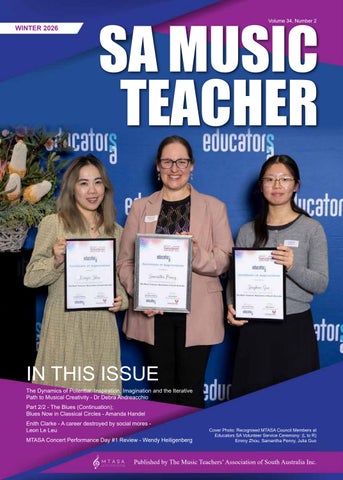
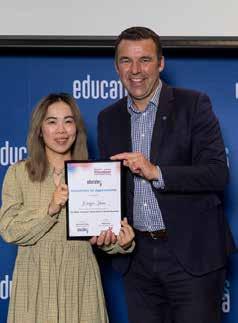
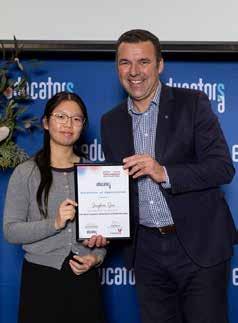
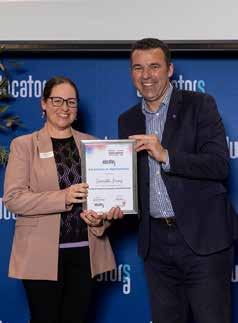
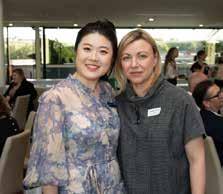
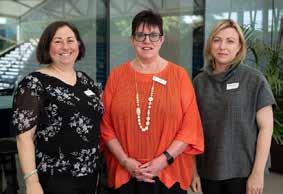
Cover Photo: Recognised MTASA Council Members at Educators SA Volunteer Service Ceremony: (L to R) Emmy Zhou, Samantha Penny, Julia Guo

WELCOME FROM THE PRESIDENT
Welcome to the Autumn edition of SA Music Teacher magazine, sharing and celebrating the recent activities of our vibrant MTASA community.
As the winter months arrive, our community has much to look forward to. In July, Adelaide will play host to a world-class pedagogical event: the Australasian Piano Pedagogy Conference. With leading experts, performers, and educators from around the world gathering on our own doorstep, this promises to be a precious opportunity and a feast of inspiration, learning, and professional connection not to be missed. We warmly congratulate our members Cathy M, Annie C, and Daniel A, who each received full or partial bursaries from MTASA in support of their attendance at this significant event.
In August, MTASA will be excited to present our members with a special webinar featuring renowned educator, researcher, advocate, and author Dr Anita Collins. Anita is well known for her research and advocacy in music education, including her highly influential TED-Ed talk, the founding of Bigger Better Brains - an organisation dedicated to advancing music education through research, advocacy, and professional learning - and her work as consultant on ABC Television’s Don’t Stop the Music series, to name just a few of her many contributions. At this MTASA event, Anita will discuss the vital role music education plays in human development and why it is now more important than ever in our increasingly digitised and technologically framed lives. We encourage all our members to keep an eye out for further details about this exciting Winter professional learning event, scheduled for Sunday, 9 August.
Alongside these exciting opportunities, MTASA Council has continued to engage with some significant conversations about the future of our profession and our Association.
Since our initial communication to members earlier this year, discussions regarding a potential national merger of Music Teachers Associations have progressed with a positive, collegial, and constructive spirit. The process has provided a valuable opportunity to consider how a more unified structure might strengthen support for music teachers, enhance advocacy for our profession at both local and national levels, and support the longterm sustainability and impact of our organisations. As this conversation continues and any feasible model becomes more clearly defined, our members and friends will be kept informed and welcomed, with genuine opportunities for feedback and engagement for all.
On behalf of your MTASA Council, I would like to wish everyone a wonderfully productive, healthy, and inspired winter season of musicmaking and professional connection over the coming months. Further into the MTASA calendar, we look forward to bringing you the second Concert Performance Day (September), as well as our Competitions Day (October), both of which continue as valued highlights within our wider program of musical activity.
With warm regards,
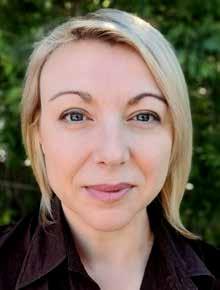
Rosanne Hammer President, MTASA
PATRONS : Her Excellency the Honourable Frances Adamson AC, Governor of South Australia, Mr Rod Bunten, and Emeritus Professor Dr David Lockett A.M.
PRESIDENT : Rosanne Hammer
VICE-PRESIDENT : Rodney Smith, Wendy Heiligenberg
SECRETARY : Julie Guo
TREASURER : Samantha Penny
AUDITOR : Australian Independent Audit Services
CURRENT COUNCIL : Rosanne Hammer (President), Wendy Heiligenberg (Vice President), Rodney Smith (Vice President), Julie Guo (Secretary - New 2026), Samantha Penny (Treasurer), Pete Barter, Ada-Maria Wycinka, Elaine Feng, Selena Yang, Yong Cheong Lye, Melody Men, Jessica Liu, Emmy Zhou, Lishan Xiao, James Yip
EDITOR : Ada-Maria Wycinka
LAYOUT: : SECTRIX (www.sectrix.com)
MEMBERSHIP ENQUIRIES to the Secretary – secretary@mtasa.com.au
PO Box 4, RUNDLE MALL, SA 5000
Mobile: 0402 575 219 • E-mail: info@mtasa.com.au
ADVERTISING – Please contact the Secretary
Please see the MEMBER information page for the Advertising Price List.
Contributions to SA Music Teacher are most welcome. All items to be included must reach the Editor (info@mtasa.com.au) no later than September 15th.
WELCOME FROM THE PRESIDENT
COMING MTASA EVENTS
VOLUNTEER SERVICE AWARDS
MTASA CONCERT PERFORMANCE DAY #1 REVIEW
THE DYNAMICS OF POTENTIAL: INSPIRATION, IMAGINATION AND THE ITERATIVE PATH TO MUSICAL CREATIVITY
Dr Debra Andreacchio
THE BLUES PART 2 BLUES NOW: IN CLASSICAL CIRCLES
PEDAGOGY MATTERS; PROFESSIONAL LEARNING AND RESEARCH
COMING MTASA EVENTS
Sunday, 9 August 2026
Winter Professional Learning Event
September 2026
Concert Performance Day #2
October 2026
Competitions Day
Miriam Hyde Competition (featuring Australian Repertoire)
November 2026
MTASA AGM
MEMBER INFORMATION
MTASA MEMBERSHIP FEES
RECOMMENDED
TEACHING FEES
The following teaching rates are recommended to members by the MTASA Council for
POST-NOMINALS
Full members of the Music Teachers’ Association of South Australia may use the letters MMTA (member of Music Teachers’ Association) as a post-nominal while they are financial members.
Interstate Music Teachers Associations are also encouraging their members to use this or a similar post-nominal.
WELCOME TO NEW MEMBERS
Cassandra Boath (2026)
Lina Elgameh (2026)
Mary Ashenden (2026)
Alexandra Rose (2026)
Ewa Nowak (2026)

VOLUNTEER SERVICE AWARDS
MTASA Council Members Recognised at Educators SA
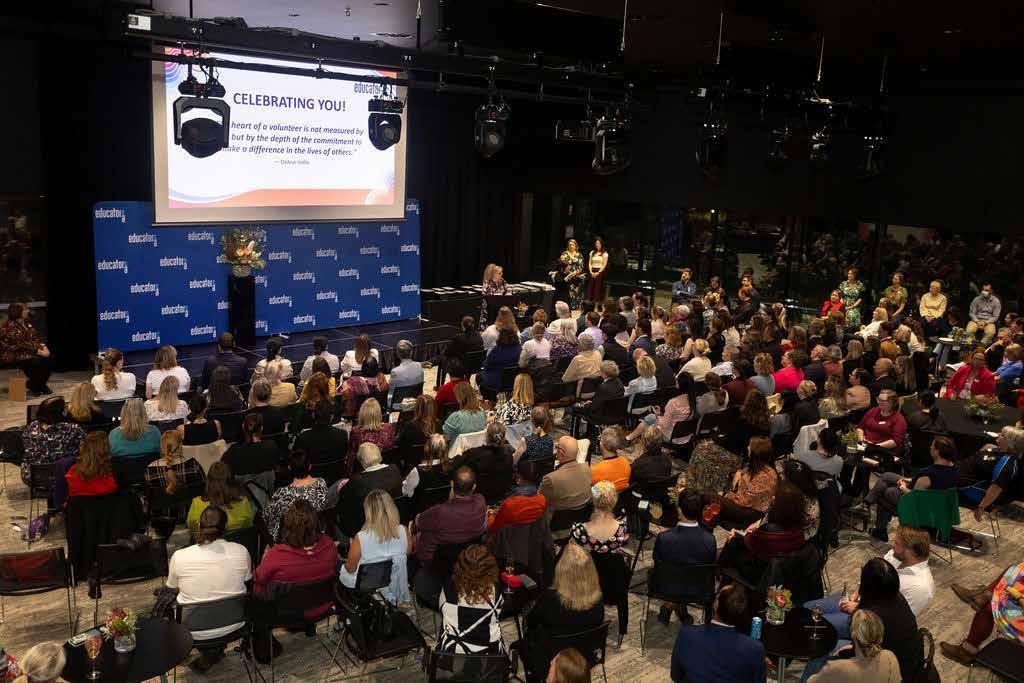
Three valued members of the MTASA Council were distinguished at the Celebration of Volunteer Service hosted by Educators SA - the peak body representing more than 60 professional education associations across South Australia. The event was held at the Yitpi Yartapuultiku Aboriginal Cultural Centre on Wednesday 21 May 2026.
The ceremony was a, powerful reminder of the generosity of spirit, time, and passion that educators contribute in pursuit of excellence and the ongoing betterment of their profession.
From within our Association, Julie Guo was honoured as an Outstanding First Year Volunteer, recognising her dedication and professional
approach to the demanding responsibilities of MTASA Secretary. Emmy Zhou received recognition for three years of committed service on Council, during which she has also fulfilled the role of International Correspondence Officer. Sam Penny was recognised for ten years of service as MTASA Treasurer, reflecting dedicated commitment to the association in this significant role.
We extend our deep thanks and appreciation to these three members, whose committed service and vision continue to enrich and strengthen our association.

MTASA CONCERT PERFORMANCE DAY #1 REVIEW
By Wendy Heiligenberg
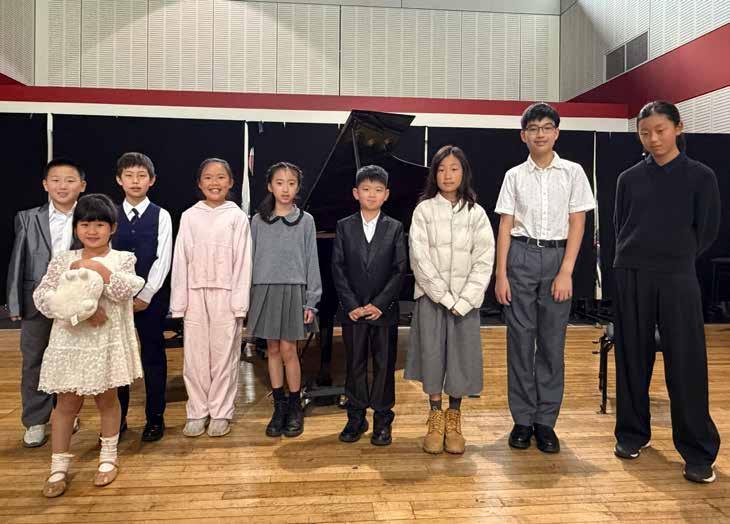
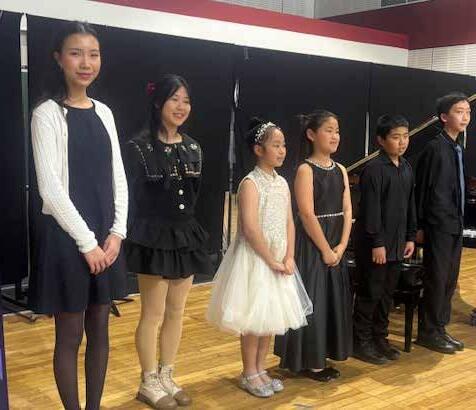
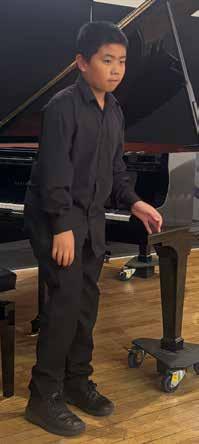
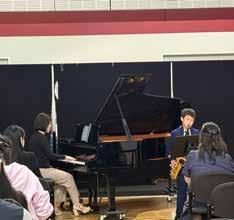
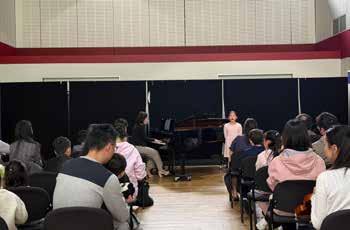
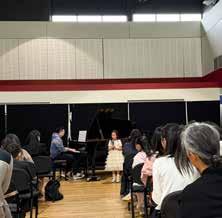
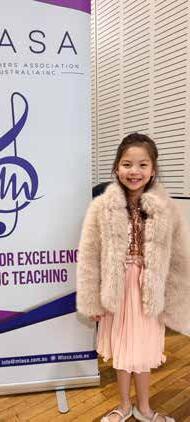
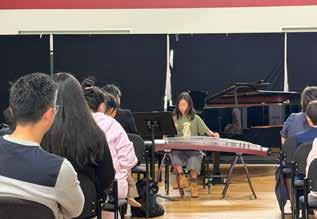
On May 3rd, 2026, the MTASA, in collaboration with the AMEB, held the first Concert Performance Day at the Madley Rehearsal Studio in the Adelaide University. There were 3 Sessions throughout the day. Review writers (2 each Session) included our President, Rosanne Hammer, Vice Presidents, Rodney Smith OAM and myself, and Committee Members, Jessica Liu and Emmy Zhou.
We had an excellent turnout, with more performers than ever before. Instruments such as Piano, Violin, Saxophone, Flute, Guzheng, and 3 Vocalists made for a varied programme. The new offer that instrumentalists Grade 4 and under are eligible for a complimentary accompanist - if they submit full scores on a prescribed date and are available for a rehearsal during the 10:00 am Sessionwas enthusiastically received. Our thanks go to Committee Members, Elaine Feng and Lishan Xiao for being prepared to accompany the young performers.
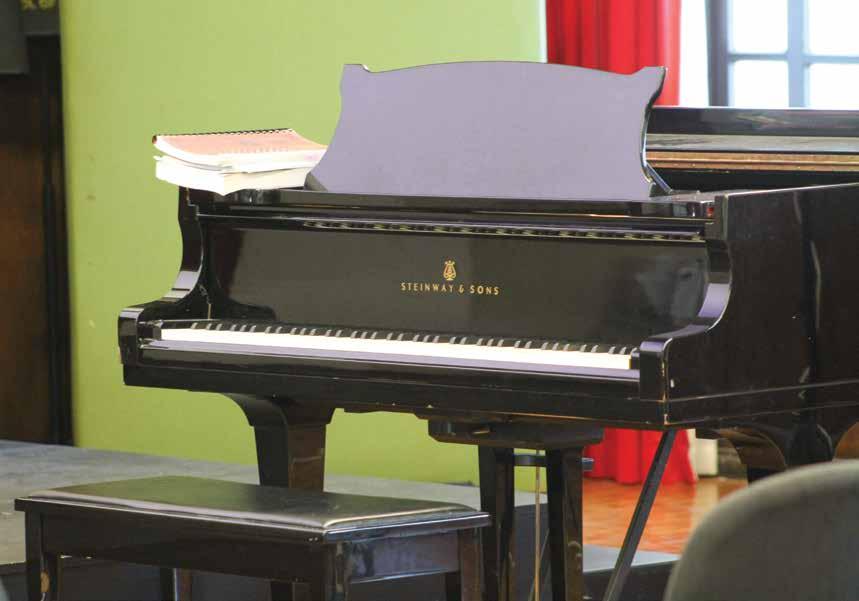
Our thanks also go to Melisande Thompson - State Manager of AMEB, and Adelaide University for making the Madley Rehearsal Space available to us. Some of our young performers were playing in front of a large audience and in a very large space for the very first time. The pianists have the added disadvantage of having to play on a strange and very large instrument that they have never played before. They all did wonderfully well. Other more experienced performers took advantage of the opportunity to test their memory skills, their performance etiquette, and their ability to project and engage the audience. Our audiences are particularly enthusiastic listeners, as this is not a competition, and all present, parents, teachers, family members and fellow performers are there to encourage, motivate and instill confidence in the young musicians.
The Dynamics of Potential: Inspiration, Imagination and the Iterative Path to Musical Creativity
By Dr Debra Andreacchio
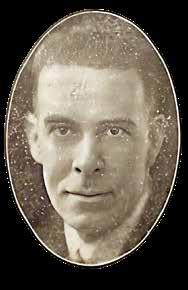
This article is adapted from the 2026 George Pearce Oration I delivered in January for the Music Teachers’ Association of South Australia. George Pearce served on the staff of the Elder Conservatorium for many years. After his passing in 1975, former students and colleagues established the George Pearce Memorial Award to support emerging pianists, and in time this annual oration was created to honour the influence of his teaching.
In this oration, I explored how inspiration, imagination, and an iterative approach to practice can unlock the musical potential of our students and ourselves as teachers. In every studio and classroom, we sit at the intersection of potential and possibility. Our students arrive with varying levels of skill and confidence, yet each carries an inner world waiting to be awakened through communicative musical sounds and personal connection. As music teachers, we are uniquely placed to guide our students along a path where inspiration ignites imagination, and imagination is refined through a lifelong journey of learning via an iterative process of listening and creative trial.
Inspiration: More Than a “Nice Feeling”
Inspiration can follow an experience or a significant moment. However, it can also emerge as we contemplate, as we dare to dream of possibilities. This is most likely to occur when we take time out from external distractions, especially screens – phones, computers, and TV.
During my student years, one such catalytic moment came for me at the Adelaide Festival Theatre, hearing Maxim Shostakovich conduct his father’s music – an evening where sound, story, and history converged in a single, overwhelming experience. It took years of further study and my PhD research to put a name to what I felt that night. I had experienced the power of Aesopian language. Historically rooted in Russian literature, it is a way of speaking in code, using seemingly innocent messages to convey subversive, hidden truths to those who can recognise it when they listen. In the 20th-century Soviet Union, Shostakovich mastered this coding, embedding what was known as “double-speak” within his music to bypass the censors and speak directly to the hearts of the people.
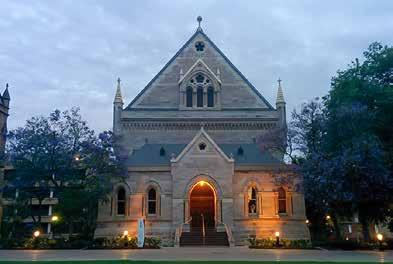
George Pearce Elder Hall
While those undergraduate years gave me the “what” of music, meeting Eleonora Sivan in 1981 gave me the “why,” and little by little, the “how”. Eleonora had recently migrated from Leningrad in the USSR to Adelaide, bringing with her the rich, storied traditions of the Russian conservatory system. My lessons with Eleonora were always a great source of inspiration. They were extended sessions, never less than two hours, where her early limitations of English were bypassed by the unlimited power of her piano sounds. Increasingly, I came to understand music as a language with transformative powers, and how this can be passed on to students.

As teachers, we need to remember that inspiration is not just a feeling; it is the moment a student realises that playing music can be a way to communicate their own feelings and inner dialogue. Our job is to help them find those first electric sounds that will fuel their expression for a lifetime.
Imagination: Reading Behind the Notes
Imagination and emotional communication are hallmarks of Eleonora Sivan’s musical approach. These elements were explored extensively when I began preparing conference presentations based on Shostakovich’s Twenty-Four Preludes, Op. 34. At first, these enigmatic miniatures appear to be simple sketches, but as I worked closely on them with Eleonora, and researched the surrounding literature, their emotional breadth became clearer.
Drawing on Aesopian Language, Shostakovich employed dynamic, rhythmic and harmonic incongruities to communicate hidden meanings to musicians and audiences. A musical genius, he did not abandon the traditional foundations of music; instead, he used them as his vehicle. Beneath the surface of his Preludes lie the most recognisable and traditional genres of Western music: the march, the waltz, and songs, even a barcarolle. Yet through his musical communication, Shostakovich subjects these familiar forms to the humoristic twists of parody, irony, satire and the grotesque. In his hands, a waltz is never ‘just’ a waltz: Prelude No. 15, is not especially graceful – it is a satiric joke, propelled by a driving, relentless momentum.
In my lessons with Eleonora, we explored the hidden emotions and satire within these short narratives. Later, in my PhD research, I shared this exploration with a student cohort, guiding them through the objective and subjective elements of the musical stories: the difference between a simple dance and a parody (Prelude No. 15); the satiric indicators within a march (Prelude No. 16); and the transformation of a gavotte into a grotesque, clownlike dance (Prelude No. 24). My goal was to lead the students through an iterative process of listening and creative trial, using our lessons as a laboratory for their practice. By using imaginative analogies, the students began to translate abstract ideas into vivid sounds, moving beyond the mechanical to find the human truth within the score.
A teacher can save a student time; rather than a student being limited to self-discovery, a teacher can inspire curiosity, foster deep knowledge, guide imagination, and encourage them to express their ideas constructively.
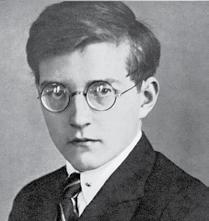
Dmitri Shostakovich
Eleonora Sivan and Debra Andreacchio
The Iterative Path of Musical Creativity
Inspiration and imagination are only the beginning. To develop engagement and artistry, students need to enter what might be called an iterative path: a cycle of trying, listening, refining, and trying again. This process is where musical understanding is consolidated, and a personal voice emerges.
A teacher’s role here is twofold. First, we offer the stylistic and technical guidance that allows students to avoid unnecessary detours. Second, we model a mindset in which repetition is not drudgery but a form of mindful and enjoyable enquiry.
In practical terms, it follows that playing fewer pieces more deeply can be more transformative than racing through large quantities of repertoire
where the focus is inevitably on note-learning. We can encourage students to keep asking “why this dynamic, why this articulation, why this tempo?” and “How will I achieve this dynamic, this articulation and this tempo?” By treating lessons and practice as an exploration where imaginative ideas are tested, adjusted, and sometimes abandoned in favour of new insights, we invite genuine musical growth.
Through this iterative work, students learn that mastery is not a final destination but a way of being – a mindset of continual refinement that can support them well beyond their musical lives.
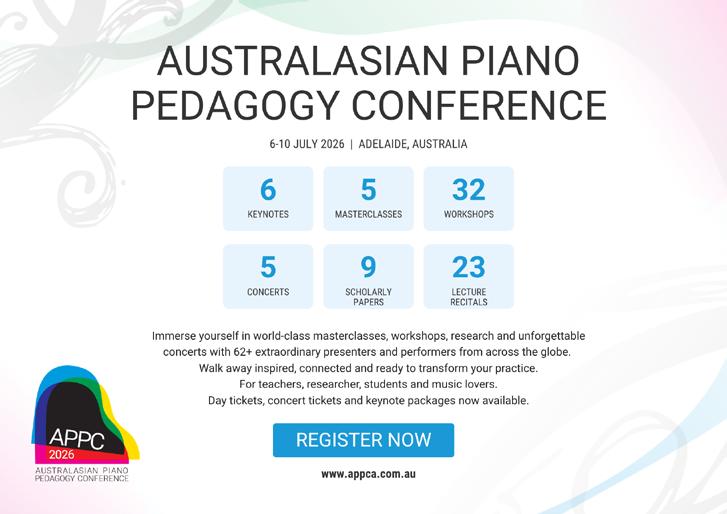
APPC 2026: The Art of Imagination
While so much of our work happens in the privacy of the lesson room, it is strengthened when we connect with a wider community of practice. Conferences and professional gatherings offer a rare chance to step back from daily routines, to reflect on our own inspiration and imagination, and to renew the iterative path of our teaching.
The forthcoming Australasian Piano Pedagogy Conference (APPC 2026) in Adelaide in July will provide such an opportunity. Although “Piano” appears in the title, the conference speaks to teachers of every instrument and voice bringing into focus the pedagogical questions that unite us. It will also present extensive sessions in instrumental collaboration with the piano. With international and local presenters whose work bridges performance, research, and education, the program is designed to stretch our thinking about practice, creativity, and the role of tradition in contemporary teaching.
The conference offers high-quality professional learning (recognised by the Teachers Registration Board of South Australia), alongside the intangible benefits of collegial conversation and artistic refreshment. Most importantly, it embodies the kind of openness and generosity that many of us have experienced from our own mentors and role models: a willingness to share insights, repertoire, and hard-won experience so that others may flourish.
Music as a Creative Antidote
Our students live in a world saturated with screens, constant digital distraction, and now the alluring possibilities of AI. The kind of focused, contemplative attention that musical practice requires is increasingly rare, yet increasingly valuable. When we ask students to sit at an instrument, silence their phones, and attend to a single line of music with all their senses alert, we are offering them more than a skill. We are inviting them into a form of mindfulness that anchors them in the present moment and reconnects them with their own inner world.
In this sense, music can act as a creative antidote to some of the stresses of contemporary life. It invites deep listening, sustained concentration, empathy with other minds, and resilience in the face of difficulty. Our studios become places where students learn not only to play accurately, but to live attentively.
Passing on the Flame
Ultimately, the dynamics of potential in music education rest on a simple but profound task: passing on the flame of artistic integrity to the next generation. We kindle inspiration through meaningful experiences, nurture imagination by reading beyond the notes, and sustain growth through an iterative, reflective approach to practice.
In doing so, we help our students discover that music is not merely something they do, but a way they can think, feel, and communicate throughout their lives. As we continue to develop our own artistry, individually and together, we ensure that the legacy entrusted to us remains a living, vibrant language, capable of communicating with the next generation.


The Blues Part 2
Blues Now: in Classical Circles
By Amanda Handel
This article was originally published in The Studio, the journal of the MTA of NSW, in May 2021, and is reprinted with permission of the author and the publisher.
Now, more than a century has passed since the Blues was born. Classical students and teachers who haven’t encountered the Blues through their general listening experience, will probably have noticed its appearance in examination syllabi. It may surprise some to remember that important composers of Western art music were interested in, and had begun making their own sophisticated expressions of the Blues early in the twentieth century. Aside from flying machines, architecture and novel inventions, the 1900 Paris World Exposition was probably responsible for expanding the consciousness of Europeans to other worlds of music, art and dance. It presented fascinating marvels of African-American and Asian cultural expression. An explosion of creativity followed; composers and artists were excited and inspired by the exotic and foreign factors. Extraordinarily vibrant new music sprang forth and was received into the Western Art music repertoire. Examples of European composers who dipped into the blues - or one of its close cousins such as jazz - are Debussy, Dvorak, Milhaud, Stravinsky and Shostakovich, while in North America, Gershwin and Bernstein plumbed the blues and jazz on its home ground. Listen to Ravel’s suave ‘Blues” in his Violin Sonata on Link No. 1.
Part Two in this Blues article leaps a long way ahead from where we left off exploring its roots and historical background in Part One. Rather than tracking all of the mutations, transformations and sub-divisions of the blues which have occurred throughout its evolution, the second part brings blues to where we are now. Incidentally, I remember being quite surprised to see the introduction of blues pieces on the AMEB piano, saxophone and trumpet syllabi as a young teacher. Christopher Norton’s Microjazz publications were introduced in the early 1980s and since then a huge range of pieces by other composers from beginner to advanced levels described as, derived from, or titled “Blues”, have been written for educational and professional performance purposes.
For a crash-course summary of blues evolution from its roots till now, watch Link No. 2. Classical pianist Nahre Sol (and her co-presenter) track the blues’ influence on all types of modern music. She also gives an introduction to the scales and chord progressions.
Ultimately style is perceived through hearing rather than conforming to a set of musical rules. And yet as classical musicians, we are always interested to know how and why sound combinations carry distinctive flavours, emotions and energies which lend themselves to identification and classification into genres. To satisfy this curiosity, the analytical aspects of Blues harmony and structure will be explored through short contemporary piano pieces which demonstrate the prevailing characterises of the Blues, as an ongoing genre.
Regardless of the instrumentation and performance context, the most obvious feature distinguishing the Blues’ sound is the frequent flattening of the 3rd, 5th and 7th scale degrees, and the use of “dominant” seventh chords for all chords. In other words these flattened 7th chords operate without the dominant function (unless in a cycle of fifths passage). The other notable characteristic prevalent in most music identifying as the “blues”, is its harmonic progression. As explained in Part One, the oldest blues originated out of the African calland-response vocal tradition where three melodic phrases of 4 bars each, flowed over three primary chords (with flattened 7ths) as follows:
Bars 1 -4: Tonic | Bars 5 -6: Subdominant | Bars 7 -8: Tonic | Bar 9: Dominant | Bar 10: Subdominant| Bar 11 - 12: Tonic | (Bar 12: Dominant when continuing to next chorus)
Blues purists might argue that the Blues cannot be truly called “the Blues” unless they are performed with genuine heart-felt sorrow, and with some element of improvisation. While respected, that viewpoint will be held aside for our investigative purposes. In the decades soon after this very simple progression had become standard practice, many younger generation musicians who grew up with the Blues – like Charlie Parker – migrated north, attracted to the urban life where jazz was in its inception. Using the twelve-bar blues format the experimental jazz players eked out the infinite possibilities for variation with chord substitutions and harmonic complexification - and yet without dismantling the essential Blues progression. To learn how this was - and still is being done- by professional blues and jazz musicians, listen to the informative tutorial by Rick Beato on Link No. 3.
In Part 2 of this article, the author discusses the Blues genre of today, including analysis of two works and Youtube links to various statements made in the text.
Now, looking into the composition of two short blues pieces you will see how the flavours of chords, the harmonic progressions and sectional structures bear the stamp of blues style. Essentially as a classical musician and composer, I also enjoy the blues. When writing in the blues idiom, I create from a feeling for the blues, rather than following an academic plan. In fact during my writing process I don’t consider what I’m doing technically, and on completion I’m pleased if I’ve conveyed the blues spirit with integrity.
The two works for analysis feature lyricism and rhythmic aspects respectively, show sixteen-bar and twelve-bar harmonic progressions respectively, and their textures are homophonic and two-part respectively. For greater enjoyment and benefit, please listen to the music on each link before reading the analyses. Links No.4 and No. 5.
Dreamboat Blues is a bluesy-jazz waltz written on a popular song AABA format in triple time. While the phrase structure differs from the twelve-bar format, it follows standard blues harmony. The texture is clearly homophonic with a singing melody. After a two-bar introduction, there is a 16 bar section carrying the main theme in C minor that finds its way to the bridge. A linking chordal motif from the dominant moves down chromatically through Gb7 to F, where the modulatory bridge section begins. The new 8 bar theme moves over a cycle of fifths progression: F7 – Bb7 – Ebm7 – Ab7, then cuts the pattern by a tritone interval to Dm7. From here there is a “turnaround” perfect cadence (Dm7 - G7 – Cm). Then the bridge theme is repeated slightly modified and concludes with a 2-bar hemiola in dominant harmony (bars 26 – 27). Finally the original theme in C minor returns with melodic embellishments, and there’s a short coda to conclude.
Note that quavers are played in swing time in a triplet ratio 2:1, and the sprinkling of semiquaver pairs (like ornaments) are to be played “straight” for contrast. Every chord is rich and lush, being loaded with harmonic extensions to the b7th, 9th, 11th and 13th scale degrees. Where the bass chords are clustered, inversions provide smooth inner voice opportunities. Also note the relief from the melodic role in the RH by the presence of quartal chords. These stacked 4ths are derived from the inversion of “sus2” chords.
Remembering that a waltz is a dance, and that the Blues are “cool”, playing should be laid-back, comfortable and easy-going. To enjoy the music, please listen to my recording of Dreamboat Blues on Link No. 4 which includes the story about, and dedication to John Hishon – my first mentor!
Bootleg Blues describes the 1920’s when the sale of alcohol was illegal during the United States’ prohibition era, and “bootlegging” was rife. Typically, Blues haunts attracted lots of bootleg activity and non-stop music!
This swing time blues in C major has two blocks of standard twelve-bar blues material which is encased by an introduction and a coda. The main material conforms to the standard twelve-bar blues harmony, however it is written in a sparse twopart texture. The treble and bass parts interlock in rhythmic and motivic dialogue. The simplicity of the progression carries its unusual and rather “un”melodic motif convincingly.
The piece features two short chromatic “bridge passages’ placed after each of the twelve-bar sections. They are not standard features in blues; instead, they offer diversion and contrast of mood and harmony. With simple rhythmic regularity and tightly voiced intervals, they oscillate chromatically over the bass progression: Bb7 – F7 – Eb7 – G7b5. The harmonic tension in these linking passages serves as a welcome return of the main motif in C.
Note how the quirky, slightly tipsy character of the music is highlighted by jagged syncopations and tussles between major and minor 7ths, and between perfect and flatted 5ths. Theoretically, F# is the enharmonic equivalent of a flattened 5th. However for reasons of consistency in intervallic design, and for using diatonic spelling, I have notated that “blue” note Gb as F#. Interestingly the main treble motif outlines an ascending major 7th interval (F# to F – bar 5), while the bass response is the same interval descending from B to C (bar 6), and again E down to F (bars 9 and 10). Despite these motivic major 7ths, the “blues” minor 7th flavour prevails in the harmony – which is grounded in the twelvebar idiom. The simplicity of this little blues piece is deceptive. Ironically it demands very quick reflexes and a great deal of rhythmic zeal to convey a loose, care-free swinging Blues feel. The score and audio can be sourced on Link No. 52.
The Blues keep moving through time, showing up in many shapes and forms. When I was recently asked to write a bigger blues piece for renowned pianist John Martin, I was both challenged and excited! Please listen to this newly released piano solo Blue Laze on the link given in this month’s newsletter. You’ll notice and enjoy the deeper levels of harmonic exploration and structural development moving through Blue Laze.
1The score is available as a single pdf downloaded through Wirripang Publications, or can sourced in the AMEB grade 6 series 18 publication.
²With thanks to Wirripang for permission.
LINKS
Link No.1: https://www.youtube.com/watch?v=KdyUiiaQee0
Link No. 2: https://www.youtube.com/watch?v=HYy-6ltraVQ
Link No. 3: https://www.youtube.com/watch?v=HaYeDvutkb4
Link No. 4: https://www.youtube.com/watch?v=BjNHwZ4NMdk
Link No. 5: https://www.youtube.com/watch?v=qnLyTiADz9E
READING
Carr, Roy. A Century of Jazz: from Blues to Bop, Swing to Hip-Hop. London: Hamlyn, 1997 Gioia,Ted. Delta Blues: The Life and Times of the Mississippi Masters. New York: Norton, 2009 Wald, Elijah. The Blues: A very Short Introduction. New York: OUP, 2010
SUGGESTED VIEWING
Georgia Blues: Blind Willie McTell
https://www.youtube.com/watch?v=MPn_DyDd-KY History of Jazz music documentary by Ken Burns https://www.youtube.com/watch?v=NJcLl0ey1wo&t=2562s
PEDAGOGY MATTERS
Professional Learning and Research: Professor Pamela Pike
By Rodney Smith OAM
Here in MTASA, our members are well versed in Professional Learning (PL). Confirmation that PL has taken place, when members renew their membership, has been a requirement for years. There has also been regular explanatory advice in the front pages of SA Music Teacher on PL and what it constitutes. MTASA is not alone in asking for PL, as teachers across the country have to undertake PL to maintain their registration.
Professional Learning makes sense. We owe it to our students to ensure our teaching approaches, skills and knowledge keep pace with evolving music education developments. Better teachers generally make better students, and both parties benefit in the success of their musical endeavours.
While some teachers might not agree, the borderline between PL and Research is blurred and a number of teachers are actually researching when they undertake PL. This type of “blended” research is probably undertaken by teachers who are keen to move ahead professionally and are enthusiastic about teaching. As well as just confirming their PL with their local Teachers’ Registration Board or Music Teachers’ Association, some take the next step and make presentations at meetings and conferences about what they have been doing and discovering. Some take a further step and present papers about their activities that are published.
Sharing experiences in this way benefits the teaching profession as a whole and gives added meaning to the work these teachers do. Presenting their research completes the circle of endeavour and justifies their work more powerfully than if they restrict their influence only to their own students.
Professor Pamela Pike is Co-Editor-In-Chief of the The Journal of Piano Research. She has presented research papers at international conferences throughout Asia, Europe, Scandinavia, North and South America. In the United States, she is regularly invited to present papers and workshops at the Music Teachers National Association, College Music Society, Association for Technology in Music Instruction, and the National Conference on Keyboard Pedagogy. She is a regular webinar presenter for MusicEdConnect and The Frances Clark Center.
She will be presenting sessions at the upcoming Australasian Piano Pedagogy Conference, Adelaide University, July 6th - 10th this year. As a significant leader in the Frances Clarke Center she understands the challenges and rewards teachers encounter as they move into research as part of their careers. Her sessions will give very helpful advice to those considering such a move and are likely to be popular. MTASA members are strongly encouraged to attend all or part of this conference on their doorstep and, if possible, to join Pamela Pike’s sessions. It will be worth their while.
BAGATELLE
By Pat H. Wilson
This regular column is a light-hearted way to get to know MTASA Council members, those hard-working people who help to run the Music Teachers’ Association of SA.
Bagatelle
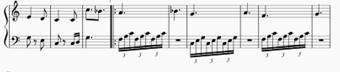
BAGATELLE (Fr. ‘a trifle’). A short piece of music in a light style. Probably first used by Beethoven in his ‘Seven Bagatelles,’ op. 33. The form of the bagatelle is entirely at the discretion of the composer. It is short and not too serious in character.
Autumn Spotlight is on Elaine Feng – a casual observer might think that this cheerful and energetic woman is just a piano teacher. But there’s so much more to Elaine’s story. I found this out when I chatted with her recently.
Once upon a time…

Where were you born? I was born in Shanghai, China. And how do I feel about the city of my birth? Mixed feelings… Shanghai is often seen as a very modern, progressive city. People will often say, “The lights never go out… it’s always awake, 24/7.” But I think its weather is very dreary… it is often rainy and muggy, a bit like Melbourne weather.
Fifty-seven days after I was born, my mother, Chen Yanhuang, was sent to prison, just because she was the daughter of a landlord. The Communist regime of that time had a very punitive attitude towards capitalist property owners. For the one year and eleven months of my mother’s imprisonment, I was looked after by my grandma and my father.
Any pictures of you as a little child? This picture, taken when I was around three years old, commemorates the time when the government sent my father to Tibet.
My father, Feng Zhonghan, was a professor of mathematics and physics. At that time (1966+) the Cultural Revolution was in full swing. China had wide-reaching plans to take over Tibet, and this included the re-education of its indigenous peoples to steer them from historic Tibetan cultural values and make them good PRC citizens. To achieve this, China sent many teachers to Tibet, including my father. His forced posting to Tibet was the price of my mother being released from prison. This picture
of me at five years of age was taken at the time my father returned from Tibet. Another huge milestone in my early life.

Was your family musical? No, not at all. Nobody in my immediate family had any inclination towards music. However, because of a government policy which forced children of undesirable people (such as my mother and her father) to be sent to outlying regions of China for around 10 years for “re-education”my family spotted a little loophole in the system, which could prevent me from being sent far away. Students of music were excepted from this policy, so at the age of four, I was sent off to a piano teacher.
Who was your first music teacher? A very interesting man called Jin Zhongmin. He was a singer, a pianist, and a former pilot in the Kuomintang (KMT). Because of family safety issues, I actually moved into his home at the age of four, living with his family, which included his daughter Jane. I still remember meeting a piano for the first time. Pianos were rarities in my experience; few households had them.
My new teacher introduced me to this big black object, and, instead of being frightened or timid, I recall vividly how confidently my little four-year-old self walked right up to that big machine, opened the lid, and played a note. I can still see this scene in my mind, as if it were a movie. I somehow felt immediately at ease with the piano.
Did you always feel great about being a musician? Yes; until I was around thirteen years old. I was very good at piano, and enjoyed playing, but I didn’t know anyone else who did. At that age, I felt as if I was the “odd one out” – I guess that’s a very common adolescent feeling. My family was academically focussed, and I could see how doing well academically was seen as worthwhile. Because no-one else in my friendship circle at school did what I did, I felt quite alone and rather weird and odd. At this time, my wonderful teacher, Ding Shande, took me to one side and explained how truly unique and special I was, because of my ability to play piano. He told me I should be proud of myself.
What was your favourite book as a child? When I was young, I read a translated version of “Jane Eyre”. One of my piano teacher’s daughters had the same name. I was only ten at the time and didn’t recognize many of the characters, so I had to rely on a dictionary to read the book. But I have always remembered one line from it:
“It is my spirit that addresses your spirit; just as if both had passed through the grave, and we stood at God’s feet, equal - as we are!”
Although I read it in Chinese, this sentence had a profound impact on me. I didn’t really understand God, nor did I understand what “the grave” meant. But those words suddenly made me feel the vastness of the world and of human existence, even as I was growing up in a family environment marked by violence. Being hit was not something I deserved-no one has the right to harm me. I am the same as any other person; we are all equal. (My mother suffered abuse during China’s Cultural Revolution, which left her physically and emotionally wounded. Consequently, she became someone who inflicted violence within the family, and I was the one who experienced it).
What is your first language? Mandarin Chinese.
Any others? English, and German as well. I began German when I had to translate that language in one of my piano books. Later in my studies, I was offered scholarships in Austria (at both Salzburg and Austrian Conservatories). Unfortunately, this was around 1989, and Tiananmen Square happened. So, no Austrian scholarship.
What was your first paid job? I was sixteen years old, and I was asked to teach piano to a friend of my parents. At the same time, I was also working as a professional piano soloist at the Star Hotel, Shanghai, as well as being part of small chamber music groups who were paid for performance.
Growing up
What’s your primary instrument? Piano.
Do you play any other instruments? No. Once I was studying at tertiary level in the Shanghai Music Conservatory,- promising students were not encouraged to pick up second or third instruments, but purely to focus on their instrument of choice.
Where did you do your tertiary training? I graduated from the Shanghai Music Conservatory. Once my undergraduate degree was finished, I also undertook extra training in more musical areas including Harmony and Composition. This qualified me to be a teacher of music teachers.
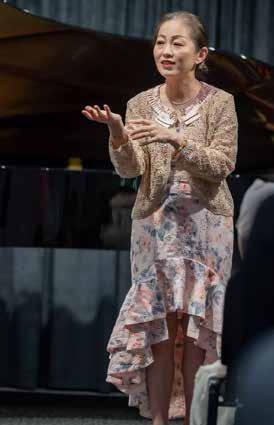
Name a formative teacher of yours. First President of the Shanghai Music Conservatory (and also my great-uncle), Ding Shande. Here’s a photo of me with him, taken in 1995, the year he passed away. The occasion was the opening of the new Shanghai Centre, at which I gave a solo recital.

Piano teachers may recognise his name, because one of his works, “Catching butterflies”, is included in the 2016 AMEB Series 19 Grade 5 syllabus.
Composers whose works you love to play and teach. J.S. Bach. That’s it! He’s my favourite. Can you tell me about your scariest performance? That’s an interesting question. I am very seldom scared before or during performance. For me, it just doesn’t happen.
And today
So what do you look like now?
When did you leave China and come to Australia? There are dates I remember always. The day I got my visa for Australia was 1st June. And on 19th June, I bought a one-way ticket to Adelaide, South Australia. I love Australia and I have been here very happily for almost twenty years now.
Are you a dog person or a cat person? I love all animals, but I’m definitely a cat lady! My childhood was spent in the company of animals. As one of the very few only children in China in the 1970s, I had no siblings, and my mother (who was adopted) didn’t have any siblings either. My childhood was quite lonely, so my mother adopted cats. In this photo, I was at university and had come home, holding my own cat.


One of my cats was given to me by my piano teacher when she moved to Canada. At the time, the cat was already 17 years old and couldn’t obtain an animal visa because of its age. It then lived with me for more than another ten years.
Not just cats-I’ve also kept dogs, guinea pigs, birds, snakes, spiders, and more. I love all animals. I’ve even used the same online nickname for 25 years: “Loving Animals Is Loving the Earth.” This photo shows me after I got married, with my husband, holding one of our adopted cats, together with our big dog, Lanbo.
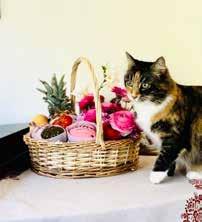
And here’s me and my beloved adopted cat Coco, the third cat I adopted in Australia.
How about sharing your favourite recipe? The way we like to do things in our family is “Shanghai-style”! The men do the cooking, not me. My husband and son are the chefs.

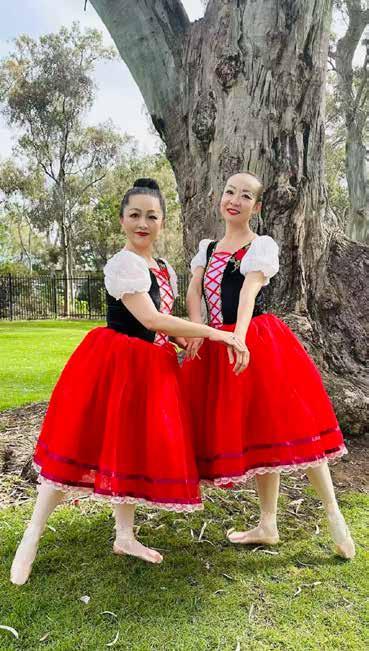
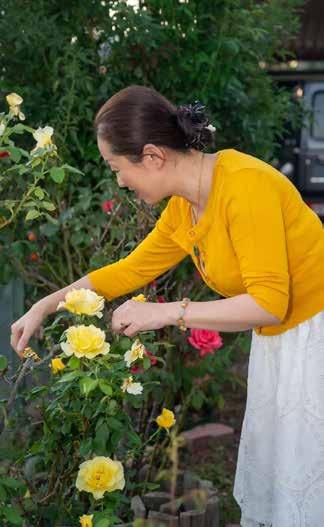
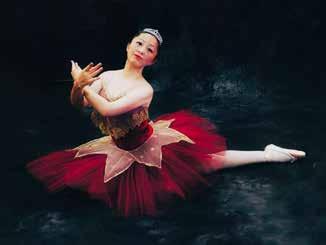
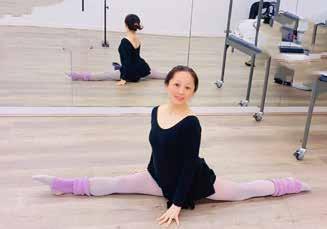
Any hobbies? I really enjoy travelling, and driving on my own. Remember how you asked me about ‘scary performances’, and I said that I very rarely felt any fear when it comes to a performance? I often wondered why my students experienced performance anxiety, so I decided not long ago to try learning a skill that I simply didn’t have a clue about. I began learning ballet at the age of 45. I am so glad I did. I spent ten years going from zero dance experience to achieving Grade 8 in the Royal Academy of Dance ballet exams. (My Grade 5, Grade 7 and Grade 8 exams were all awarded credits.) Through ballet, I improved my physical fitness and went through menopause smoothly. It also helped me better understand the use of physical movement in piano playing, especially in terms of touch and emotional expression. Apart from dance, I have many other hobbies. I love my garden.
Lead Sheet Interpretation #8Self Accompanying - ‘Comping’ JAZZIN’ AROUND
By Kerin Bailey
Readers/students need to have good facility with my previous styles and 7th chord system, voicings and inversions, to get the most out of this style. Essentially the style is step #2 - RH melody/chords and LH bass line, and where space in the melodic line permits, we insert the comping pattern - whole or in part.
First a recap of step #2 - see Winter 2022. Ex.1 is the little exercise from Lead Sheet #6 - Chords (Ex.6 Autumn/Winter 2025). There is no need initially to harmonise every melody note - beats 1 and 3 will suffice until some facility is acquired (most chord changes occur on beat 1 and/or 3). I have added some syncopation by anticipation in bars 2/3 - note the chord placement here. When this is secure add LH bass line - minims only at first (crotchets for the II V I cadence):
Chord system from Lead Sheet #6:

For easy reference as we proceed, here are the basic comping patterns from last edition. Good facility with these is vital for self-accompanying. Practice these in stride style with the LH only too, as in 1a - root/chord/R or 5th/chord:

Blue Moon (Ex.2) is an ideal tune to begin with this system. With any new piece I get students to commence with step #1 (Autumn 2022) – melody only (stems up) and LH 7th chords in minims. This enables familiarity with the tune and harmony. RH needs to be 8va to prevent overlapping. LH chords may be all root position –Fmaj7 root position cued in bar 1 – ideal voicing with 2nd finger on middle C. Or for better voice leading use I-R, VI-1st, II-R, V-2nd.
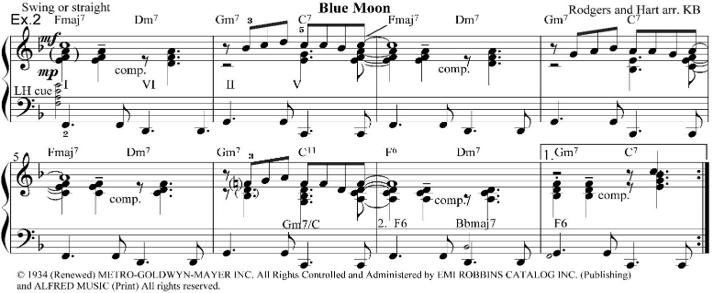
When confident, you will be ready for using step #2 only - no accompaniment. RH plays the melody (stems up) and 2 or 3 chord tones underneath - 3 chord tones plus melody is the full 4 note 7th (or 6th) chord. The comping phrases in Blue Moon are marked - beats 2-4 in bars 1, 3, 5 and 7, and beats 1-4 in 8. Omit these and you have Lead Sheet #2 style. So, play chords with stems down in bars 2, 4 and 6, and on beat 1 of bar 1, 3, 5 and 7. Fmaj7 works with Dm7!
When this step #2 style is fluent, add the comping patterns; only bars 7/8 allow the full pattern. Note my dynamic markings in bar 1 - the melody should of course sing through above the accompaniment and the harmonised melody notes. After repeat, play the plagal cadence in bars 7/8: 2. F6 / BbMaj7 / | F6 ||. Use minim chords here - the Dm7 beat 3+ with Bb bass is Bbmaj9. This is a common ending and completes the AA section arrangement.
Note: Also play Blue Moon using step #2 RH (8va), and LH stride, Ex.1a pattern with 1b voicings. I touched on this briefly in Lead Sheet #3, Spring 2023 - Stride Piano. The RH comping doesn’t work so well so omit that for now. For pianists with some experience, easy fills can be created using the comping notes already under the fingers.
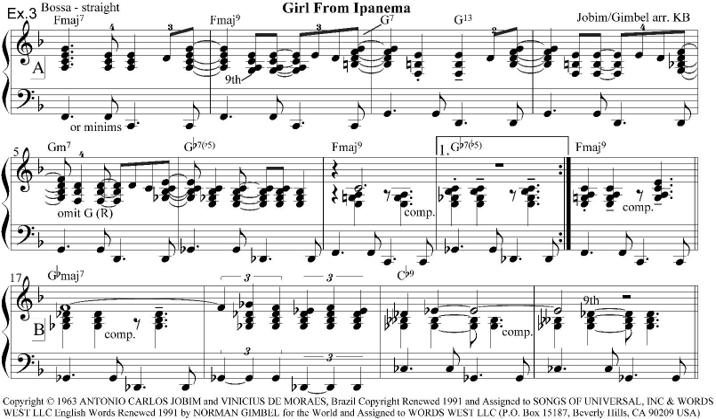
Ex.3 is the Girl from Ipanema, a classic bossa nova standard. The AA sections of this have comping space only in bars 7/8 (turnaround) and 15/16 (transition to B). So, bars 1-6 are ideal practice for step #2 style. Note: the melody often allows the same chord tones under the one hand position for Lead Sheet 2 style – ignore my beats 1 and 3 suggestion here; more opportunity in B for comping:
We now have semi-professional arrangements in 8 steps – albeit a lot of info packed in and careful study required! Practise these steps on good standard sheet music or lead sheet tunes – after a few songs it becomes easier! And listen to good recordings and study good arrangements for additional ideas. (My Jazzin’ Around series 1-6 has a wealth of styles, techniques, rhythmic ideas – and chord symbols for analysis and understanding of voicings and progressions. I may even publish this method later in a text booklet.)
The series: Lead Sheet #1, Autumn 22; #2 Winter 22; #3 Spring 23; #4 Spring 24; #5 Summer 25; #6 Autumn/ Winter 25; #7 Summer 26. Ideally, reference to previous articles necessary throughout. This article © 2026 Kerin Bailey
Bossa Nova Piano [The Girl from Ipanema] Basic version with transcription.
https://www.youtube.com/watch?v=N-TKOh0zsvU&list=RDN-TKOh0zsvU&start_radio=1 The international hit version of Ipanema. Listen to Jobim’s guitar comping for expanding rhythmic ideas.
https://www.youtube.com/watch?v=0hha36GDc38&list=RD0hha36GDc38&start_radio=1 David Hazeltine trio – rare swing version; spare, tasteful solo.
https://www.youtube.com/watch?v=SQk_Hg6LS6M&list=RDSQk_Hg6LS6M&start_radio=1 Blue Moon with transcription, Art Tatum. Considered the greatest jazz pianist and revered by Rachmaninov and Horowitz!
https://www.youtube.com/watch?v=F-8YmkrtaIM&list=RDF-8YmkrtaIM&start_radio=1 Blue Moon. Smooth vocal and great accompaniment from Kenny Barron piano; with bass, so his chord voicings are more 2-handed, open style – Lead Sheet #5.
On the Voices
I hear you
By Pat H. Wilson
Although this regular column is dedicated to the world of singers and their teachers, this time, it’s filled with information for anyone who sings or plays music, as well as music teachers of all instruments and genres. And it’s all about those things on the sides of your head. (They’re not just for putting your sunnies on.)
Without your hearing, you will have an uphill battle to perform music, let alone teach it. Of course, there are exceptions… Dame Evelyn Glennie, the world-class Scottish percussionist who has been profoundly deaf since the age of eight. Then there’s jazz singer Mandy Harvey (featured on America’s Got Talent), Finnish rap artist Signmark, and hip-hop artist Sean Forbes from America. Each of these brave musicians has made a huge musical impact despite deafness. But let’s talk about you and your students right now.
According to the Hearing Health Foundation, we musicians are particularly at risk. Constant exposure to orchestral sound, loud speakers, amps or headphones means that we are four times more likely to develop noise-induced hearing loss than the general public, and 57 percent more likely to develop tinnitus. And the figures are similar for fans who listen regularly at high volumes. (Hake, Kreutz, et al., 2024) So all this information I’ve gathered is pertinent to us and all our students too. And for those of you classicists adopting a “holier than thou” stance relative to your rock and pop pals, don’t forget that musicians who play classical music are more susceptible to hearing issues than rock musicians.
Noise levels
Let’s start with that scary decibel chart that often pops up articles like this. It’s easy to find detailed charts listing average decibel levels for everyday sounds. Here’s one from ASHA.
Dangerous and Safe Noise Levels
Painful impulse noise—Not safe for any period of time
150 dBP = fireworks at 3 feet, firecracker, shotgun
140 dBP = firearms
Painful steady noise—Not safe for any period of time
130 dBA = jackhammer, ambulance
120 dBA = jet plane takeoff, siren, pneumatic drill, rock concerts
Extremely loud—Dangerous to hearing; wear earplugs or earmuffs
112 dBA = maximum output of some MP3 players, rock nightclubs, chainsaw
106 dBA = petrol leaf blower
100 dBA = tractor, listening with earphones
94 dBA = hair dryer, kitchen blender, food processor, power tools
Very loud—Dangerous to hearing; wear earplugs or earmuffs
91 dBA = subway, passing motorcycle, petrol mower
Moderate—Safe listening for any time period
80 dBA = police siren, noisy restaurant
70 dBA = group conversation, vacuum cleaner, alarm clock
60 dBA = typical conversation, dishwasher, clothes dryer
40 dBA = quiet room
Table from: www.asha.org (American Speech-Language-Hearing Association)
But I think that the next table is much more practical. It tells you how long you can be exposed to these noises without wearing ear protection before you begin to damage your hearing:
Noise Source
Jet take off
Ambulance siren
Personal music player at maximum volume
Pop/Rock Concert
Riding a Motorcycle
Using an Electric drill
Decibel Level How long can you listen without protection?
Table from: knowyournoise.nal.gov.au/hearing-health (National Acoustic Laboratories, Macquarie University, NSW)
How can you tell that a noise is likely to endanger your hearing?
Few of us carry a sound level meter around… although there are very good phone apps available now (see below). Here is how you can judge whether that sound might be doing you harm:
• You must raise your voice to be heard.
• You can’t hear or understand someone a metre away from you.
• Speech around you sounds muffled or dull after you leave the noisy area.
• You have pain or ringing in your ears after you hear the noise, called tinnitus. It can last for a few minutes or a few days.
Any one of these is a red flag to a professional ear user.
Phone apps to measure decibel levels
For an added awareness of the noise in your neighbourhood, and how to keep your hearing safe, the Hearing Health Foundation advises:
“Both Apple and Android phones support sound level meter apps that measure decibels. In fact, on the Apple iPhone and Apple Watch, the embedded Health app measures decibels and can send alerts when it is too loud. Here are other sound level meter apps:
NIOSH Sound Level Meter App (iOS)
NoiSee (iOS)
SLPnFFT Noise Meter (iOS)
Sound Meter X (iOS)
Sound Meter (Android)
SoundPrint (iOS & Android)
While these guidelines and comparison are helpful, a basic rule of thumb is common sense: If it sounds too loud, it IS too loud.”
The sixty/sixty rule
Just as we are aware of how much sun we are getting, or how many steps we’ve walked today, it’s equally sensible to be aware of our daily sound dose. An approximate understanding of how much volume our ears are exposed to can help us take steps to protect them - by always carrying and wearing earplugs, turning the volume down when we can, and taking quiet breaks to rest our ears.
Recent American data says:
5 in 10 young people listen to music or other audio at too high a level.
4 in 10 young people are around dangerously loud noises during events like concerts and sports games.
I’m willing to bet that Australian figures wouldn’t be far off these.
And so, for all earbud and headphone users – here’s the Mayo Clinic’s 60/60 rule: Listen to your device at no more than 60 percent of its maximum volume for no more than 60 minutes… and then rest your ears. Headphones and earbuds can reach as loud as 100 dB or more. This rule helps protect hearing while allowing users to hear their favourite music for longer. When using Bluetooth-enabled earbuds, limit the volume using the phone’s settings.
What to do to keep your ears happy
1. Get your hearing checked annually to monitor your hearing health. If you experience a sudden change in hearing or ear pain, see your doctor immediately. Tinnitus (ringing in your ears) is an indication that damage is being done.
2. Use customized earplugs designed for musicians. These allow you to hear your music without needing it to be at the highest volume.
3. Turn down the volume and limit your exposure. Sound intensity over 70 decibels will start to damage hearing. When performing, try to position yourself behind the amp. If you are at a concert don’t stand in front of the speakers. If you use personal listening devices like headphones, observe the Mayo Clinic’s 60/60 rule.
4. Keep track of the volume by using a sound level meter app which gives a decibel reading on your phone.
5. Give your ears sound breaks. Just like your muscles need to rest after a workout, so do your ears. In an ideal world, aim for 5 to 10 minutes every hour. If you are at a loud concert, step away from the stage or outside the venue every once in a while to give your ears a rest.
6. Use in-ear monitors onstage and during rehearsal. These allow you to hear the music directly in your ears. Work with an audiologist to select the best ones for your needs and learn to use them properly for maximum protection.
And finally, this is for anyone who asks “Why bother?”
“In the ‘60s nobody warned us that listening to loud music for too long would cause damage. I was in the studio for 14 hours at a stretch and never let my ears repair. There’s no question that listening to loud music was a major contribution to my hearing loss.” Sir George Martin. (Beatles producer)
“I have unwittingly helped to invent and refine a type of music that makes its principal proponents deaf.” Pete Townshend (The Who)
“I suffer from permanent tinnitus because of all the headbanging I’ve done. This means that I’ve got this constant ringing in my ears which has also made me somewhat deaf. It’s like this wheee noise in my head all the time.” The late Ozzy Osbourne (1948 – 2025) Singer, songwriter and media personality
“It was only my art that held me back [from suicide].” Ludwig van Beethoven (1770 - 1827) Composer and pianist
“Doctors told [me] I faced total hearing loss if I continued touring.” Brian Johnson (AC/DC)
“I know there are a lot of people, musicians, who have hearing loss, who are in denial and don’t want to get hearing aids for the exact same reason I had. The main reason that I came out of the closet about it is because people need to accept it if they are losing their hearing,” Stephen Schultz (Baroque flautist who suffers from otosclerosis)
Pat H. Wilson
REFERENCE
Hake, R., Kreutz, G., Frischen, U., Schlender, M., Rois-Merz, E., Meis, M., ... & Siedenburg, K. (2024). A survey on hearing health of musicians in professional and amateur orchestras. Trends in hearing, 28, 23312165241293762.
USEFUL WEBSITES
American Speech-Language-Hearing Association <www.asha.org> Audiology Australia. <https://audiology.asn.au> Hearing Health Foundation. <https://hearinghealthfoundation.org> National Acoustic Laboratories. <knowyournoise.nal.gov.au/hearing-health> RACGP – Royal Australian College of General Practitioners. <racgp.org.au> Safe Work Australia. <https://safeworkaustralia.gov.au>
ENITH CLARKE - A CAREER DESTROYED BY SOCIAL MORES
By Leon Le Leu
In Australia, we have destroyed a few musical careers on moral grounds. We especially remember the terrible treatment of Eugene Aynsley Goosens after he was detained by Customs Officers at Sydney Airport on 9 March 1956. His reputation was destroyed by petty officialdom and antique mores. Noel Mewton-Wood, the remarkable pianist, was revealed as being homosexual by a friend, John Amis, after he committed suicide in 1953 following the death of his lover, William Fredrick from appendicitis (Mewton-Wood blamed himself
¹ Morning Bulletin (Rockhampton) Saturday 29 July 1950 – Page 8
² Morning Bulletin (Rockhampton) Monday 7 May 1928 - Page 7
³ The Evening News (Rockhampton), Monday 17 July 1933, page 1
for missing the symptoms). It is very likely his longterm reputation suffered from this revelation. Then there was Claudio Arrau, arrested in the Lang Park, Sydney toilet in a typical NSW Police entrapment operation. Fortunately, the judge in that case regarded his offence as being of a trivial nature, and he was not convicted. His reputation survived intact.
Speaking of antediluvian attitudes, I remember the huge non-musical scandal that erupted in my home city of Adelaide in 1966 when David Jones had the temerity to display a full-scale replica of Michelangelo’s David for the Italian Festival. I felt so ashamed of the backwater view of nudity, which pervaded the local media. Fortunately, Adelaide more than compensated for that episode later.
However, what ultimately destroyed the career of one of Australia’s most gifted female pianists lay in another area of public attitudes and the law.
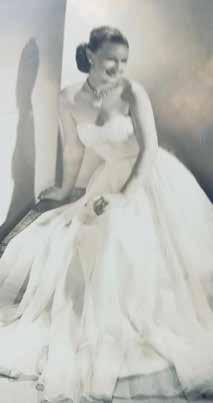
I have done some extensive reading for this article, but I cannot guarantee that I have captured every published mention of Ms Enith Clarke (sometimes her name was misspelled as Edith). She was born in Rockhampton in 1911 and studied the piano with Florence Sandberg - a well-known local music teacher and soprano. Sandberg herself was the pupil of the Czech violinist, Louis D’Hage, who was “instrumental” in forming the Rockhampton Orpheus Club Orchestra (see photograph¹). According to Ms Clarke’s daughter, “Enith had studied and passed all the Royal Academy of Music examinations by the time she was about 13.” The first newspaper mention of her I could find (other than being merely listed as a performer) was reporting of the fifth Eisteddfod in Rockhampton in May 1928.² She won the piano champion solo. I cannot determine what she played.
She did not confine her activities to playing the piano. In 1933, she entered for the Paramount Quest for Beauty competition in Rockhampton.³ One remarkably enlightened aspect of this competition for the time, amid a century of rampant sexism, was that it was open to both males and females - but “the male section did not fill”. Not only did it “not fill” but another article indicates no male applied.
“Somewhat surprisingly there was no entry for the male section, the young men of the town being more backward that the girls in these matters.”⁴ Enith won three guineas and became eligible for the state contest. Unfortunately, she failed to win at that state level, the winners being Miss N.Y, Harvey of Toowong, and Mr J.H Wright or Holland Park. It seems they did manage to get some male entrants⁵.
She started playing a lot on the ABC, and on 2 January, 1935, she played some solos in association with the Sydney String Quartette (sic)⁶. Her solo program on that occasion is listed in that reference. Almost all the recordings of those performances were lost or thrown out. The only one still available is her playing Goyescas on YouTube.
In late 1935 more detail about her other interests was provided in the Australian Women’s Weekly. “She has done a great deal of flying in Brisbane, and has only to do four more hours’ flying before gaining her A pilot licence. Dancing is another of her accomplishments — adagio and ballroom — while she also writes verse and composes a little. Motoring, pig-shooting, and fencing are some of her hobbies.” Her daughter told me, “she definitely had a shotgun (of some sort) and helped her father hunt crocodiles in Fitzroy River, Rockhampton. She used makeup on herself and others like an art canvas, especially after her training at Arden and Helen Rubenstein. And she had a good eye for home furnishings, colour and art.” Clearly, she was a well-rounded woman.
That same article also mentions that she was now living in Sydney and “will continue her studies with Alexander Sverjensky”. No doubt some Klavier members also studied with Alexander Sverjensky; I have pianist friends in Adelaide who studied with him such as Geoffrey Kong. Sverjensky taught a range of fine pianists, including “Roger Woodward, Malcolm Williamson, Richard Farrell, Romola Costantino”.⁸ This was a fateful turning point in her life.
By July 1936, she had been studying for 12 months under Sverjensky. She had been experiencing a lot of success in Sydney and an article notes that the interest in her expressed by Paderewski and Bachaus had been justified⁹ (her NSW State Library papers mention that both those gentlemen
⁴ The Evening News (Rockhampton) Friday 14 July 1933, page 1
⁵ The Evening News (Rockhampton) Thu 20 Jul 1933
⁶ Morning Bulletin (Rockhampton) Wednesday 2 January 1935 - Page 6
⁷ The Australian Women’s Weekly Saturday 12 October 1935 - Page 21
gave her lessons while they were in Australia). That article also mentions that on 21 July, she was going to play the Liszt Concerto in A major at the Alfred Hill Academy (which was largely destroyed by fire and closed in 1937) and Alfred Hill had asked her to play with Ernest Llewellyn (A.B.C. Sydney String Quartet), Hill’s latest sonata for violin and piano.
In November 1936, she gave a concert in Rockhampton where she played an ambitious program:
• Chromatic Fantasie and Fugue (Bach—Busoni),
• “Litany” (Schubert—Godowsky),
• Capriccio in C Sharp Minor (Brahms).
• Variations Serieuses Op 54 (Mendelssohn),
• “La Danse d’Olaf” (Pick—Nangiagalli)
• “Les Adieux” and “The Swan” (Palmgren),
• “The Little Shepherd,” “Golliwog’s Cakewalk,” and “ The Girl With the Flaxen Hair” (Debussy), and
• Etude in A Minor (Paganini—Liszt).¹⁰
The same article helpfully states: “The provision of a grand piano by Grice’s will enable Miss Clarke to make the most of these numbers.”
By June 1937, she had made arrangements with AWA to make 3-4 recordings a week over a period of 3 months.¹¹ It is unclear whether any of these recordings still exist.
In July 1939, she was photographed at Artur Schnabel’s concert in the Sydney Town Hall. Alexander Sverjensky was present with her at that concert and they chatted with Mr and Mrs Roy Agnew during the interval.¹² By then, she had been appointed music mistress at Fairfield Private School Bellevue Hill.
She had success after success over the years. Detailed information about her large repertoire is set out in a myriad of articles. She often played in the Phyllis McDonald Sextette (except perhaps during the hiatus in 1940-41 when Ms McDonald fractured her wrist, temporarily curtailing her violin playing). By December 1941, she is recorded as having given 36 broadcasts ‘both as soloist and in ensembles”¹³ plus innumerable live performances.
⁸ NSW State Library Enith Clarke papers (with additional information from Susan Compton)
⁹ Morning Bulletin (Rockhampton) Saturday 18 July 1936 - Page 6
¹⁰ Morning Bulletin (Rockhampton) Saturday 21 November 1936 – Page 12
¹¹ Morning Bulletin (Rockhampton) Tuesday 1 June 1937 - Page 5
¹² Morning Bulletin (Rockhampton) Mon 17 Jul 1939 – Page 4
¹³ Morning Bulletin (Rockhampton) Tuesday 9 December 1941 - Page 6 27
On 24 June 1943, she and her music teacher, Alexander Sverjensky, were married in Sydney. By then, she was 32 and Sverjensky was 41.
Neville Cardus, the distinguished English music critic, gave her a good but mildly patronising report in September 1944.¹⁴ He comments, “She proved herself a player who has that rare quality of touch and not merely so many fingers that could just as well perform their dexterous work on the typewriter… With more experience, Miss Clarke will get the best out of her unmistakable gifts by taking a less deliberate approach to her music. Character was brought to Roy Agnew’s Sonata Ballade, a fine but not thoroughly realised work, and the playing in Arnold Bax’s lovely Berceuse was poetic and entirely of the piano, which now was given shades of colour and a romantic rise and fall of melody and cadence rather rare in the range of young pianists here.”
In early 1948 she did a “farewell” tour in preparation for a trip to Europe to further her career. Notably, in Brisbane, she played the Liszt A major Concerto under the previously mentioned Eugene Goosens.¹⁵ When Goosens heard her, he commented: “Magnificent. It is a pity that you are leaving the country.” She had played for the also previously mentioned Claudio Arrau the previous year. He told her: “What you really want is not study but to play and play and play.” Despite his saying that, he recommended that she have special study with Lazare-Levy (he of the unusual performance anxiety reduction technique), who taught Solomon Cutner.
She departed Australia on 28 April 1948. While in Europe she studied in Switzerland with Alfred Corto for a month, performed background music for a French film, and did a broadcast for the BBC. Cortot had told her he could really not teach her anything she didn’t know already, but agreed to give her a few lessons. She dined with Leopold Stokowski and his wife – at that time the virtually unknown, but not quite penniless, Gloria Morgan Vanderbilt.
While in Paris she practised almost every day at the home of Dr Herbert Vere Evatt (working at that time for the United Nations). She was taken
to concerts by King Leopold’s mother-in-law (this was presumably King Leopold II of Belgium, or perhaps she was referring to Stokowski in which case it would be another Vanderbilt). She also gave a recital at the Mailett-Steven’s Salon, Paris, and added “(I) propose to include in the programme the Australian Roy Agnew’s Sonata Ballade. It is high time Australian music was played abroad.” I understand she also studied pedalling under Walter Gieseking, but I cannot find a record of that taking place.
It was in the two years after this that things went definitely south. Her husband, Alexander Sverjensky, petitioned for divorce on the grounds of adultery and there was extensive and highly damaging publicity about this in the newspapers. I do not propose to rake over this material in this article so I leave it to you to look up these references. They are essentially the product of archaic divorce laws and, under current circumstances, the divorce would have proceeded unnoticed except for those involved.
It is interesting to note that her dinner companion in Paris in 1948, Leopold Stokowki, had three wives and was noted for his adultery. This did absolutely no harm to his reputation. Perhaps this is emblematic of the unfathomable sexist hypocrisy of the time.
Perhaps another 30 years of potential recital activity were erased by this unnecessary public disgrace. She taught at further schools in Sydney, such as Abbotsleigh and Meriden, and I understand her last job was as music mistress at Girton College in Adelaide. There is a suggestion she did private performances with a small group in Adelaide. Possible members of the group are Ena Wooderson, violinist, and Tony Sorgato, cellist - friends from her student days who were in Adelaide at the time. No recordings of any of these performances, if they occurred, seem to exist. Her Wikipedia article mentions “(she) did travel overseas in 1952 to play background music in three films released by a French film company, and to appear on BBC Television.”
She died in 1995.
¹⁴ The Sydney Morning Herald, Friday 1 September 1944 - Page 4
¹⁵ Morning Bulletin (Rockhampton) Friday 9 April 1948 - Page 3
¹⁶ Morning Bulletin (Rockhampton) Saturday 11 December 1948 - Page 3
¹⁷ Brisbane Telegraph, Thursday 30 November 1950 - Page 6
¹⁸ Maryborough Chronicle, Friday 8 December 1950 - Page 5
¹⁹ Morning Bulletin (Rockhampton) Friday 8 December 1950 - Page 6
MTASA and Educators SA: Supporting a Connected Professional Community
MTASA continues to value its strong connection with Educators SA (formerly CEASA), the peak body representing more than 60 professional education associations across South Australia.
Educators SA provides invaluable, practical support to MTASA and other member associations through governance guidance, leadership development opportunities, facilitation of regular forums, support for professional learning initiatives, and the setting of shared goals for growth and improvement across associations within the sector.
We are particularly pleased to acknowledge that MTASA is represented at board level within Educators SA by MTASA Council member Zuoyu Liu (Jessica), who currently serves as a Director on the Educators SA Board. Her role ensures that music education is represented within wider sector leadership and governance across the association community.
In March this year, MTASA President Rosanne Hammer and Board Director Zuoyu Liu (Jessica) attended a Presidents’ leadership gathering hosted by Educators SA at The Drive in North Adelaide.
The gathering provided space for discussion of practical approaches to association leadership, including how organisations set strategic direction, support their members, share knowledge, and maintain sustainable governance structures. It also enabled informal networking and strengthened professional relationships across the education community.


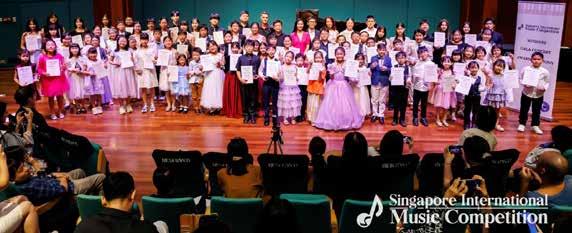
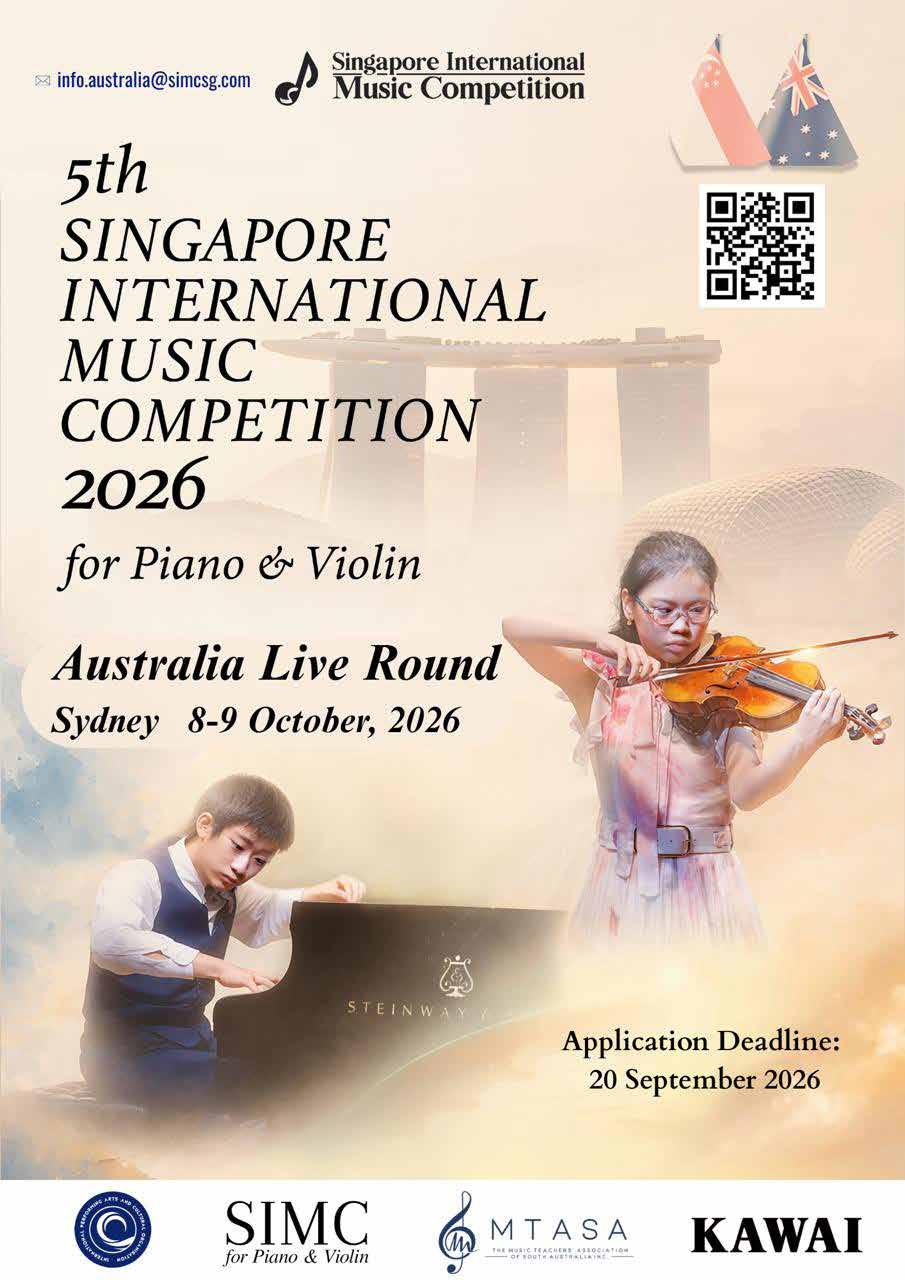
The 5th Singapore International Music Competition (SIMC) - Sydney Live Round 2026
Application Is Open Now!
https://simcsg.com/australia/
Sydney Live Round: 8-9 October 2026 (for Piano Solo and Violin Solo)
The Singapore International Music Competition (SIMC) is an annual international competition for piano and violin, attracting young musicians from over 25 countries around the world. A celebration of musical excellence, the SIMC is considered as one of the most highly regarded youth music competitions in the Asia Pacific region and the Sydney live round aims to make this global stage accessible to young musicians residing in Australia. Now open for application, the Sydney live round is scheduled to take place between the 8th to 9th October. Open to pianists and violinists under the age of 30, the competition offers young musicians and artists the chance to showcase their talent on a global stage.
More than a competition, SIMC’s mission is to uncover and nurture the next generation of musical talents, offering prize winners unique opportunities and scholarships to perform at international music festivals and participate in masterclasses with esteemed musicians. It offers a holistic and enriching artistic experience, with participants evaluated by a panel of esteemed local and international adjudicators.
Selected top performers will also be invited to perform at the highly anticipated Gala Concert Ceremony in Singapore in December 2026. Previous winners of SIMC have gone on to perform internationally and gain admission to leading conservatories around the world.
For more information and to register for the Sydney Live Round, please visit: https://simcsg.com/australia/ or contact us at: info.australia@simcsg.com.
See you there!

MTASA ADVISORY SERVICE
You’ve hit a problem in your professional life as a music educator.
Feeling isolated in your role as a music educator? You’re not alone.
The Music Teachers’ Advisory Service (MTAS) is here to offer the support and guidance you need. Whether you’re concerned about a student’s progress, your studio’s business model, or navigating institutional regulations, we’re here to help. When you encounter a professional challenge as a music educator, your first step is to reach out to the Secretary of MTASA. Based on your query, you will be referred to the most suitable MTASA Council member who will then contact you to provide the necessary advice and support.
FIND OUT MORE at MTASA.com.au

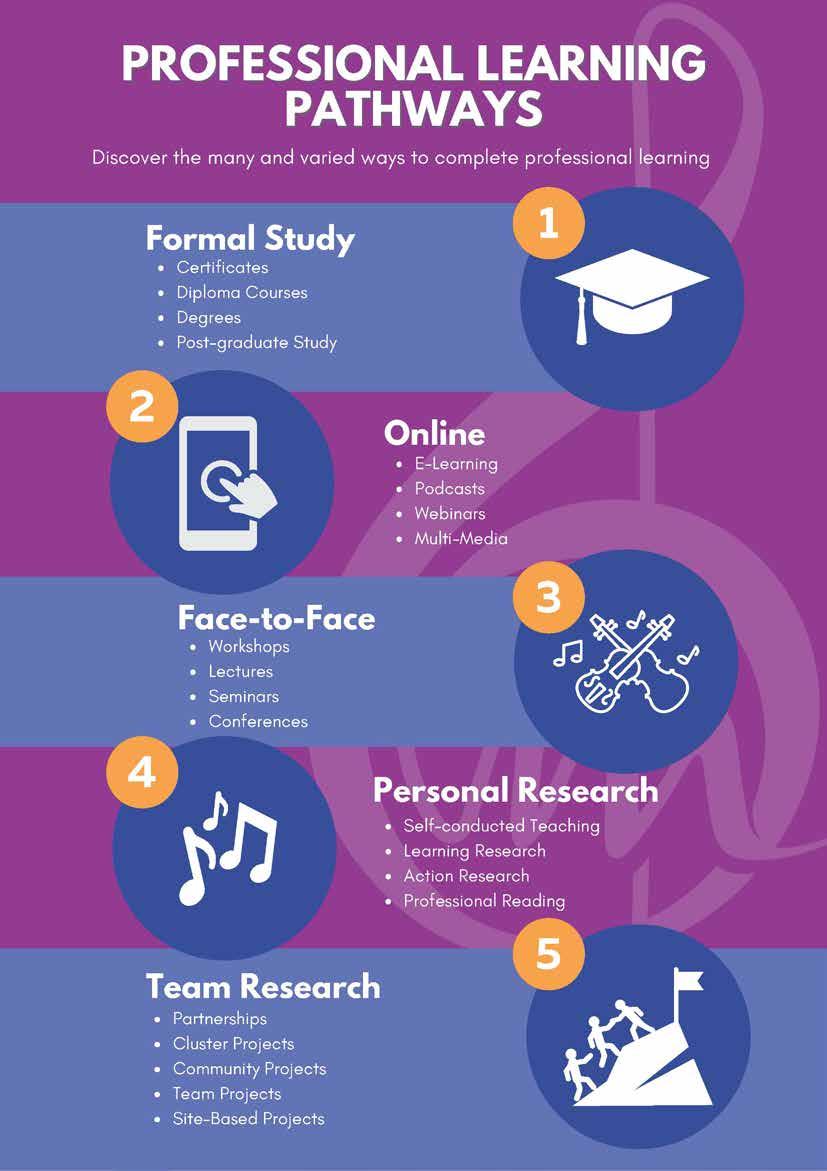
REQUIRED PROFESSIONAL LEARNING FOR FULL MEMBERS OF MTASA
MTASA has introduced a Professional Learning scheme for Full members. This commenced on July 1, 2019 when Full members began accumulating their seven hours of Professional Development. The scheme is designed to underpin and enhance MTASA’s established reputation for the professional excellence of its members, ensuring its standards are fully compliant with current educational expectations. These are clearly outlined in the Australian Professional Standards for Teachers (visit www.aitsl.edu.au/teach/standards) and similar documents.
From July 1, 2020 onwards Full members, when renewing their membership, will be asked to tick a box declaring that they have undertaken at least seven hours of Professional Learning during the previous twelve months.
The following examples are provided to give general guidance for Full members about Professional Learning that would be acceptable to MTASA. These examples represent only a small sample of all the possibilities available to Full members. Generally Full members should feel comfortable about their own choices but in case of doubt you are welcome to contact the Secretary for further advice (info@mtasa.com.au).
Improved music teaching should be a major factor in all activities that Full members wish to count towards their MTASA Professional Learning.
MTASA will undertake random checks from time to time to ensure the system is working properly. So, on very rare occasions a Full member may receive a request from the Secretary for information about their Professional Learning. In such instances you may submit evidence such as certificates, programs, diary notes, recordings and so forth.

Examples of Professional Learning that would be acceptable to MTASA:
1. Online.
Attending a webinar or similar event; undertaking an online e-learning course.
2. Face-to-Face.
Attending a conference, workshop, masterclass or lecture.
3. Formal Study.
Undertaking a qualification or part-qualification delivered by a recognised institution.
4. Personal Research.
Studying books, journals, articles, musical scores, musical theory, analysis, etc., which lead to an example of improved music pedagogy and/or pupil performance.
Self-conducted research leading to a presentation, masterclass or workshop at a conference.
Composing an educational piece of music that motivates a group of pupils.
5. Team Research.
A joint project with others that achieves particular improvements in a training ensemble.
Joint creation of music teaching materials that improve learning in a group of pupils.
Remember! These are only a few amongst many possibilities. MTASA is a community of creatives. You are encouraged to be creative in your Professional Development!
EDUCATORS SA

As a member of Educators SA, MTASA has access to some fantastic offers of benefits to its members.
Credit Union SA has a range of incredible education only banking benefits. Visit their website for more information: https://www.creditunionsa. com.au/community/educationcommunity-banking-benefits
You also have access to the Member Advantage benefits program offering discounts on your everyday purchases. Think of it as your VIP pass to huge savings and epic deals on everything from your favourite retail stores to tech gadgets, whitegoods, sporting gear, health insurance, motor vehicles, and so much more! You can see more on the Educators SA website here: https:// educators-sa.sa.edu.au/memberadvantage/


NOTICE TO STUDENT MEMBERS
Have you fulfilled the requirements for Full Membership? Student members are reminded that Student membership is restricted to four years after which time it is expected that they would be eligible for another membership category, either Full Membership by Tertiary Study or Full Membership by RPL (Recognition of Prior Learning and Experience). Student members who are ready to upgrade their membership are invited to submit an application form to the Secretary together with the required supporting documents. Criteria can be downloaded from the MTASA website (www.mtasa.com.au) or obtained from the Secretary (info@mtasa.com.au).
WORKING WITH CHILDREN CHECK (WWCC)
New Legislation regarding Child Protection was introduced with effect from September 1, 2019. A ‘Police Check’ is now known as a ‘Working With Children Check’ (WWCC). The Working With Children Check is the most comprehensive check that exists. Anyone found guilty of breaching this legislation can be fined up to $120,000.
People working or volunteering with children in South Australia must, by law, have a Working With Children Check. A DHS/DCSI child-related check will be recognised as a Working With Children Check until it expires.
People need a Working With Children Check if they are in a ‘prescribed position’. This means people who are in paid or volunteering roles where it is reasonably foreseeable that they will work with children; run or manage a business where the employees or volunteers work with children; are employed to provide preschool, primary or secondary education to a child.
A Working With Children Check is needed for all schools (Government, Catholic and Independent).
For further information go to www.screening. sa.gov.au/types-of-check/new-working-withchildren-checks.

EVENT VOLUNTEERS NEEDED
Enthusiastic volunteers are needed to help with various jobs at MTASA events. Tasks include setting up the venue, helping with registration at the check in table, ushering, assisting performers, helping with meals, and packing up afterwards.
It is a great way to network and a volunteering certificate will be provided, which will enhance your CV!
For more information, please e-mail the Secretary at info@mtasa.com.au.
TEACHING IN REGIONAL SA
In recent years each issue of SA Music Teacher has included an article about music teaching in a country region of South Australia. There are some regions that haven’t been visited yet. If you haven’t done so please write something – it doesn’t need to be very long – and also include a photo. If you have written something before you are welcome to send an update. E-mail the Secretary at info@mtasa.com.au.
ADD
MTASA MEMBERSHIP NOTES
Visit mtasa.com.au/index.php/members/becomea-member/ to join MTASA.
Current Full, Student or Associate Members are not required to submit any supporting documentation to continue their MTASA membership, however an up-to-date WWCC must be supplied in order to remain on the Teachers’ Directory. Anyone applying for Full Membership (either Tertiary Level Qualification and Study or Recognition of Prior Learning and Experience) or Student Membership for the first time must fulfil all of the requirements listed and submit the appropriate supporting documentation. Associate Membership is no longer being offered but those who were Associate Members on September 24, 2017, can continue their membership provided they remain as financial members. Full Membership (Recognition of Prior Learning and Experience) has replaced General Membership.
MTASA Members are always encouraged to write to the Secretary about any concerns that they may have. The MTASA Council will consider your request.
TEACHERS OF THEORY/ MUSICIANSHIP
To be listed in the ‘The Directory of Teachers of Music’ on the MTASA website as a teacher of theory/musicianship applicants for Full or Student membership must supply evidence of having completed studies in this field to at least AMEB 5th Grade theory/musicianship standard or equivalent. Full, Student or Associate MTASA members wishing to have theory and/or musicianship included in their Directory listing should send copies of the relevant certificates to the Secretary (info@mtasa.com.au).
CONTRIBUTIONS TO ‘SA MUSIC TEACHER’
The Editor is always looking for things to include in SA Music Teacher. Articles can be about any music related topic. If you would like to write an article this is your invitation! A helpful hint, a comment, a joke, a poem, a cartoon, etc. … please e-mail them to the Secretary at info@mtasa.com.au.
CONTACTS
Some music-related organisations useful for South Australian music teachers
5MBS
RADIO 5MBS: MUSIC BROADCASTING SOCIETY OF SA www.5mbs.com
+61 8 8346 2324 manager@5mbs.com
4A River Street, Hindmarsh SA 5007
ABODA
Australian Band and Orchestra Directors’ Association (South Australia) ABODA SA www.abodasa.com.au info@abodasa.com.au
PO Box 327, Walkerville SA 5081
President: Michael Degenhart
ABRSM EXAMINATIONS
The Associated Board of the Royal Schools of Music (ABRSM) www.abrsm.org
+44 20 7636 5400 (UK)
4 London Wall Place, London EC2Y 5AU
SA Rep.: Anastasia Chan +61 423 282 589 abrsmsa@hotmail.com
ACCOMPANISTS’ GUILD Accompanists’ Guild of SA Inc. www.accompanists.org.au
President: Gina Macri +61 407 394 714 ginamacri88@hotmail.com
ADELAIDE BAROQUE www.adelaidebaroque.com.au +61 414 875 227 generalmanager@adelaidebaroque.com.au
General Manager: Rob Nairn 11 Boronia Street, Klemzig SA 5087
ADELAIDE EISTEDDFOD
Adelaide Eisteddfod Society Inc. www.adelaideeisteddfod.com.au
Secretary: Jane Burgess secretary@adelaideeisteddfod.com.au info@adelaideeisteddfod.com.au
ADELAIDE HARMONY CHOIR www.adelaideharmonychoir.com.au +61 404 448 194 adelaideharmonychoir.info@gmail.com PO Box 937, Kent Town SA 5067
Secretary: Margaret Hosking
ADELAIDE PHILHARMONIA CHORUS www.philharmonia.net apcchoir@gmail.com PO Box 6008, Halifax Street, Adelaide SA 5000 www.facebook.com/adelaidephilharmoniachorus/
ADELAIDE YOUTH ORCHESTRAS www.adyo.com.au/ +61 8 8361 8896
PO Box 13064, University of Adelaide SA 5005 adyo@adyo.com.au
AIR
Australian Independent Record Labels Association (AIR) air.org.au
+61 3 9329 7105
187 Peel Stret, North Melbourne VIC 3051 CEO/CFO: Maria Amato maria@air.org.au
AMEB
Australian Music Examinations Board (AMEB) SA & NT www.adelaide.edu.au/ameb/ +61 8 8313 8088 ameb@adelaide.edu.au
Lvl. 1 Hartley South, University of Adelaide, Kintore Avenue Adelaide SA 5000
ANATS
Australian National Association of Teachers of Singing (ANATS) anats.org.au/sant-chapter +61 435 300 070 admin@anats.org.au
ANZCA
ANZCA Examinations www.anzca.com.au +61 3 9434 7640 admin@anzca.com.au PO Box 3277, Nunawading Business Hub VIC. 3131
APRA AMCOS
The Australasian Performing Right Association (APRA AMCOS) apraamcos.com.au +61 8 8331 5800 writer@apra.com.au Suite 29/8 O’Connell Street, North Adelaide SA 5006
ASME
Australian Society for Music Education, SA Chapter Inc. https://asme.edu.au contact@asme.edu.au C/- Educators SA, Education Development Centre, Milner Street, Hindmarsh SA 5007 Chairperson: Kate Goodes +61 481 188 587
AUSTRALIAN STRINGS ASSOCIATION
Australian Strings Association (AUSTA): SA Chapter https://www.austa.asn.au/chapters/sa/ President: Anna Piland sa@austa.asn.au 0432 846 008
AUSTRALASIAN DOUBLE REED SOCIETY www.adrs.org.au
Contact: Caryl Lambourn caryl.lambourn@gmail.com +61 450 163 487
BALAKLAVA EISTEDDFOD
Balaklava Eisteddfod Society www.balaklavaeisteddfod.org.au info@balaklavaeisteddfod.org.au PO Box 253, Balaklava. SA 5461 Administration: Trish Goodgame +61 417 891 834
ELDER CONSERVATORIUM
Elder Conservatorium of Music +61 8 8313 5925
https://adelaideuni.edu.au/about/school/elderconservatorium-of-music-and-school-of-performingarts/ music@adelaide.edu.au
Level 9, Schulz Building, University of Adelaide, SA 5005
ELDER HALL, ELDER CONSERVATORIUM OF MUSIC +61 8 8313 5925
adelaideuni.edu.au/about/school/elder-conservatoriumof-music-and-school-of-performing-arts/ concertmanager@adelaide.edu.au
FLUTE SOCIETY
The Flute Society of South Australia, Inc. flutesocietyofsa.org admin@flutesocietyofsa.org flutesocietyofsa@gmail.com PO Box 3208, Norwood SA 5067
KODALY
Kodaly Music Education Association of SA www.kodalysa.com +61 405 066 469 sa@kodaly.org.au 6 Baroota Avenue, Rostrevor SA 5073
LIVE MUSIC OFFICE livemusicoffice.com.au info@livemusicoffice.com.au
Lucy Joseph lucy@livemusicoffice.com.au
MT GAMBIER EISTEDDFOD www.backstageinc.org.au
Secretary: Maxine Chalinor +61 417 081 101 maxinechalinor48@outlook.com
MUSICIANS’ UNION
Musicians’ Union of Australia https://musiciansunion.com.au musosa@bigpond.net.au
Adelaide Branch Secretary/Treasurer and Federal Branch Treasurer: John Callisto 270-272 Payneham Road Payneham 5070 0447 999 822 (mobile) 08 816 67519 (landline)
MUSIC SA musicsa.com.au +61 8 8104 1101 info@musicsa.com.au PO Box 3004, Rundle Mall SA 5000
ORFF SCHULWERK
Orff Schulwerk Association of SA www.osasa.net info@osasa.net
RECITALS AUSTRALIA www.recitalsustralia.org.au info@recitalsaustralia.org.au
Administrator: Maria Tynan +61 8 8236 7488 admin@recitalsaustralia.org.au
PO Box 6454, Halifax Street SA 5000
ST CECILIA
St Cecilia Examinations Intl. Pty. Ltd. www.st-cecilia.com.au 1800 675 292 info@st-cecilia.com.au
PO Box 938, Launceston Tasmania 7250
Director: Matthews Tyson +61 438 628 822 mstyson@st-cecilia.com.au
S.A. BAND ASSOCIATION
South Australian Band Association Inc. www.sabandassociation.org +61 417 804 001 secretary@sabandassociation.org
PO Box 309, North Adelaide SA 5006
President: Bruce Raymond bruceraymond46@gmail.com
SA MUSIC CAMP ASSOCIATION www.samusiccamp.com.au admin@samusiccamp.com.au
SOCIETY OF RECORDER PLAYERS
The Society of Recorder Players SA Inc. www.facebook.com/recorderplayerssa/ srpsainc@gmail.com
President: Neville Pope +61 417 823 537 npope@bigpond.net.au
26 Clarence Street, Blackwood SA 5051
UKARIA www.ukaria.com
+61 8 8227 1277
info@ukaria.com
Suite 911, Lvl. 9, 147 Pirie Street, Adelaide SA 5000
Venue: 119 Williams Road, Mount Barker Summit. SA 5251