Q1 2021
GREAT MUSIC IS PRICELESS. BRINGING TOGETHER THE WORLD’S MOST ARTIST-FRIENDLY MUSIC COMPANY AND ONE OF THE GLOBE’S LEADING INVESTMENT FIRMS. TRUSTED PARTNERS TO REALIZE AND GROW THE VALUE OF YOUR SONGS AND RECORDINGS. BMG+KKR: VALUING GREAT MUSIC, RESPECTING MUSICIANS.
@warnermusic @warnermusic @warnermusicgroup
In this issue... 12
Tony Harlow
24
Rebecca Allen
34
David Ventura & Tim Major
Sony Music Publishing
38
Sarah Lockhart
Sony Music Publishing
46
Kilo Jalloh & Moe Bah
50
5 Numbers You Need To Know
54
Raye Cosbert
61
Tom Gray
67
Geoff Taylor
70
Jo Hart
6
Warner Music UK
EMI Records
2K Management
Analysis
Metropolis Music
#BrokenRecord
BPI
Hart Media
BEN HOWARD
COLLECTIONS FROM THE WHITEOUT
O U T
O U T N O W
2 6
TH
M A R C H
Contributors ADRIAN SYKES
ALEX ROBBINS
CLIFF FLUET
Adrian Sykes is a widely-respected UK music industry veteran, having made key contributions to the history of Island and MCA over the past four decades. He is also a successful entrepreneur and manager, having founded Decisive Management – which looked after Emeli Sandé before, and throughout, her multiplatinum debut album campaign.
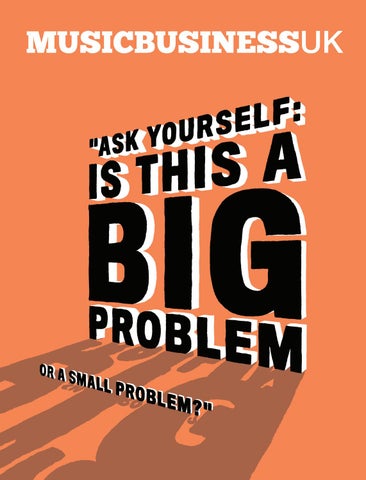
Alex Robbins is an illustrator whose work has previously appeared on the likes of the New Yorker, Time Out, Wired, TIME and i-D. Oh, and Music Business UK. He has once again created our cover image based on a quote from our lead feature. This time, those words come from the Chief Executive of Warner Music UK, Tony Harlow.
Cliff Fluet is a partner within Lewis Silkin’s Creators, Makers and Innovators Division and founded its media practice. He previously worked at Warner Music and Capital Radio PLC. He is also Managing Director at Eleven, an advisory firm working with incumbents and insurgents in digital media and leading companies in the AI space.
EAMONN FORDE
PETER ROBINSON
RHIAN JONES
Eamonn Forde has been writing about all areas of the music business since 2001. He is Reports Editor at Music Ally and regularly writes for IQ, The Guardian, The Big Issue, Q and The Quietus among other titles. He completed his PhD at University of Westminster in 2001. His book, The Final Days of EMI: Selling The Pig, is out now via Omnibus Press.
Peter Robinson has been a music journalist for over 20 years, and keeps a keen eye on the global entertainment industry. Robinson has written for the likes of The Guardian, The Times, TIME, Noisey, i-D, Smash Hits, Q Magazine, Time Out, Attitude, Notion and The Telegraph, and runs his own must-read online publication over on Popjustice.
Rhian Jones is a respected freelance journalist who often focuses on the music industry. In addition to writing regularly for MBUK and Hits Daily Double, she is a Contributing Editor for Music Business Worldwide. In this issue, Jones interviews the brothers behind 2K Management, Kilo Jalloh and Moe Bah, plus Sarah Lockhart and three rising artist managers.
8
WELCOME
EDITOR’S LETTER I’ve been thinking of you in PVC. Call it the mania of pandemic lockdown, but recently I’ve taken to staring at my favourite artists on streaming services and contemplating the above phrase with an unbecoming smirk on my face. It’s a dumb joke, of course – Polyvinyl Chloride (PVC) aka, in music biz lingo, vinyl. You’ve got to pass the time. At least I have a good business reason for such woeful wordplay. As you’ll learn on page 50 of this issue of Music Business UK, vinyl sales on a retail revenue basis overtook CD sales in the United States last year. This was a historic milestone – the first time vinyl had outranked CD in monetary terms in the world’s largest music market for over three decades. Despite this transference of power, the longrunning music biz temptation to rank CD and vinyl side-by-side is fast becoming outmoded. That’s because the CD now appears to have hit a terminal spiral, with UK retail sales of compact discs (in value terms) plummeting 28% YoY in 2020, according to the Entertainment Retailers Association. Meanwhile, according to new BPI statistics – which monitor the trade money paid to record labels/distributors by retailers – CD sales on a wholesale basis fell by £26.2 million in Blighty last year. Blame the pandemic all you want; that was actually a smaller YoY fall in trade CD sales than UK record labels saw in 2019 (-£35.0m). Those same BPI stats reveal that, right now, vinyl still brings in slightly less money for UK labels on an annual basis than CD (£115.6m vs. £86.5m in 2020). However, if the same increase/ decrease we saw in 2020 carries in 2021, then UK labels will earn more from vinyl than they will CD over the course of this year. Yes, I did just say it’s time for us to get out of the habit of comparing vinyl to CD sales... then immediately compare vinyl to CD sales.
© Music Business Worldwide Ltd 27 Old Gloucester Street, London, WC1N 3AX ISSN 2632-5357
Tim Ingham
“If the same trend carries in 2021, UK labels will earn more from vinyl this year than CD.”
But my point is about the future: it’s time to unshackle the industry view of vinyl from other physical formats, and instead consider its potential amongst a league of options to service big-spending ‘superfans’, alongside other D2C weapons such as merchandise, live-streaming, online ‘tipping’, VIP experiences and more. Vinyl is no longer a quirky industry story – it’s a fast-growing and seriously meaningful commercial category for the business. Case in point: at the rate the format is growing in the United States, I’d anticipate it will become a billion-dollar-a-year product in that market alone within the next half-decade. Back in the UK, the amount of wholesale revenue vinyl is banking industry-wide (£86.5m in 2020) is more than double the money labels are earning from ad-supported audio streaming, and nearly double the amount labels are earning from video streaming (aka: YouTube). Sadly, leaders in the independent music community tell me that there may be a dampening factor sitting in the way of vinyl’s potential growth: a lack of manufacturing options both in the US and Europe, which is causing long waiting times and unhealthy jostling for position across all sectors of the record business. In this context, it’s interesting to think about the masses of investment now flowing through to music catalog rights, a gold-rush in which there will be big winners, but also big losers amongst those who make bad bets with their money. That gold-rush is almost entirely being driven by predicted bounces in streaming revenues in the decade ahead. It appears to me that – despite the overhead and upfront risk it entails – an entirely different but no less impressive growth story in the world of vinyl is playing out. If the numbers keep rising, smart investor money (and a ramp-up in production) surely won’t be far behind.
Contact: Enquiries@musicbizworldwide.com Advertise: Rebecca@musicbizworldwide.com Subscribe: MusicBizStore.com
‘OUR PURPOSE IS TO MAKE CREATIVE GENIUSES GLOBAL SUPERSTARS’ Via Australia and New York, Tony Harlow now finds himself top of the tree at Warner Music UK. Here he tells of his journey so far and his leadership philosophy...
L
ondon-born Tony Harlow had no idea what would greet him on the other side of a one-way trip to Australia in 1997. But he knew he had to go, despite his slight apprehension, because of an abiding life philosophy: “When you’re sitting in a chair aged 60, what will you honestly think about this? Will you think: I was a bit of a dumb s**t not to take this opportunity?” This sentence tells us a lot about Tony Harlow. It tells us that he’s a straight-talker (as anyone in the industry who witnessed his performance being grilled by MPs in a DCMS Select Committee in January could attest). It tells us that he has an enduring sense of adventure, and a thirst for new challenges – one that’s taken him to living in Oz and New York City, as well as meeting one of his lifelong heroes, Miles Davis, at the apex of a Swiss mountain. And it tells us that he’s serious about living his life, especially his professional life, with conviction. Another of Harlow’s enduring philosophical principles, he tells Music Business UK, has held him in particularly good stead since he took over as CEO of Warner Music UK in February 2020: “Always ask yourself: Is this a big problem or a small problem?” It’s a simple enough query. But time and time again, it’s proven invaluable in helping Harlow successfully steer an array of businesses – from Richard Branson’s V2 label to Warner Music Australia, to Universal’s European merchandising unit, to WMG’s worldwide artist services division, WEA. Over the past 12 months, throughout the turbulence of a global pandemic and an ongoing racial reckoning, it’s been nothing short of a credo to live by. For Harlow, addressing the issue of diversity within Warner Music UK’s ranks was classified early on in the “big” category. He has set about tackling it with trademark straightforwardness, making a spate of important hires, and launching a Diversity, Equity & Inclusion program that puts tangible targets on, among other things, efforts to hire people of different backgrounds, gender and sexuality across all levels of the company. “We’ve made a lot of progress this year but there’s always more to do,” says Harlow. The exec’s experience of living and working in New York from 2016 to 2019 opened his eyes wider to societal injustices of which we would all do well to remain cognizant.
He says. “I remember a very senior executive on Julie [Greenwald’s] team at Atlantic [in the US], who I respect greatly, explaining to me why she dreaded her son going out in the car each night. She would say to him, ‘Don’t play your music too loud because they might pull you over, and if they do pull you over, make sure they can see your hands at all times.’ “I grew up in London in the [1970s]. It could be a rough town in those days, but when we were out as kids we never once thought that we wouldn’t be coming back the next day. That’s such an appalling reality for parents to send their child out into.” He adds: “All of this ultimately comes down to fairness. Terrible events over this past year have reminded us all that fairness is not a given, and we all need to work hard to make sure that it prevails.” Tony Harlow was brought up in 1970s West London. He doesn’t remember much recorded music playing in his childhood home until a lodger, who also happened to be an intern at Sony/ CBS, joined the fray. Harlow recalls, “[He] would bring records back and I would play them and tell him: ‘This one’s amazing. I don’t like this one.’ I remember Sly & The Family Stone, If You Want Me To Stay being in there. Then we started watching Top Of The Pops. That was it; the magic happened.” That magic would carry Harlow to become a regular amid London’s bustling live music scene in the late ‘70s and early ‘80s, witnessing performances from the Cramps to the Cure, Aztec Camera, Gregory Isaacs, Tito Puente and Grandmaster Flash – not to mention the Smiths’ first ever gig in London, and Bob Marley at Crystal Palace Bowl. Harlow went to school in Hammersmith before going on to study Politics, Philosophy and Economics at Oxford University. He admits he wasted too many student hours playing pool and listening to records, but ultimately walked away with a degree and that enduring piece of wisdom – “Is this a big problem or a small problem?” – in his back pocket. Returning to London, Harlow took a job as a counter-dweller at two Beggars Banquet stores owned by Martin Mills, in Putney and Kingston. “Beggars Banquet was brilliant because it was obviously an indie store – that’s what 4AD and Martin’s labels did – but they also brought in a lot of imports and sold tickets for lots of the important clubs,” he says.
“Ask yourself: Is this a big problem or a small problem?”
12
XX
Photo: Ashley Verse
Dua Lipa performs live at the 2021 Grammys
LEAD FEATURE
“We were getting in the first house records, all of that mid-’80s hip-hop; I remember when they brought in Public Enemy No.1 when no one [in the UK] had ever heard it. It was a brilliant way to find out about music.” During one shift, he noticed an ad in UK trade paper Music Week for a Jazz Buyer at HMV’s Oxford Circus store. Having fed a love for jazz during his first stint working in record retail – while regularly hitting clubs run by Gilles Peterson and Paul Murphy in London – this was a dream opportunity for Harlow, who got the gig. His next move, in 1988, was into Record Label Land, where he’s stayed ever since. Harlow took a job in marketing with jazz specialist Blue Note Records at EMI – then the world’s fourth biggest major record company – working under legendary Beatles expert Mike Heatley. After the cosy world of retail jazz buying, was Harlow’s entry into a major label, we ask, a baptism of fire? “It was more like the baptism of the back cupboard!” he jokes. “We were in the bit of the company no-one cared about, but because of CDs, we’d suddenly become interesting. I got to work with unbelievably brilliant people in America like [then Blue Note President] Bruce Lundvall, rest in peace, Michael Cuscuna, who was the expert on the reissue front, and Jim Fifield, who showed me what a real business brain was like. “I also got to meet a lot of jazz musicians, who to my mind are often the maddest but also the most incredible talents; guys who are really in it for the right reasons. Ultimately for them it’s all about stretching the boundaries of music.” It was during this period that Harlow lucked into an introduction to Miles Davis, at the mountaintop Montreux chalet of Claude Nobs, founder of the city’s famous Jazz Festival. “I met so many amazing, funny people with incredible stories during that time,” says Harlow. “It was a wild, unbelievable route into the music business, made all the more so because no one at EMI gave a shit what we were up to!” Still, Harlow’s own talent was spotted: he began handling international marketing for bigger catalogue hits – including Wilson Phillips and Roxette – before Jean-Francois Cecillon (aka JF), then boss of EMI Records UK, hired him as Marketing Director, working under Clive Black. Harlow’s tenure in this role coincided with the merger of Virgin Records into EMI via a $1 billion acquisition in the early nineties, which saw a flurry of staff changes happening around Harlow’s ears. After the merger, senior Virgin figure Charlie Dimont asked Harlow if he fancied becoming Managing Director of EMI in Australia. Harlow admits today: “It was a place I’d never been to, and never gave too much of a shit about unless we beat them at cricket.” But he took Dimont up on his offer, despite “not really knowing what he saw in me to do that job”. (Harlow says today,
having in lived in Oz for a total of 13 years, “Australia has become a place I love dearly – almost a second home.”) Having visualised himself as a glum, regretful 60-year-old should he refuse to make the leap to the Southern Hemisphere, Harlow landed in Australia in 1997 knowing nobody. His first mission at EMI was to bring a bit of Aussie pride back to the company’s domestic A&R strategy – even if that meant using crude tools to achieve it. His first masterstroke was pushing his uncertain staff to release The Best Beer Drinking Songs In The World... Ever!, packaged in jingoistic Aussie Green and Gold, featuring homegrown Oz/NZ talents like Divinyls, Aussie Crawl, Johnny Diesel and The Angels, alongside international talent. It sold over 400,000 copies. Next, Harlow formed a joint venture between EMI and Stephen ‘Pav’ Pavlovic’s Modular Records. It signed much-loved rockabilly punk band The Living End, and then The Avalanches for their breakthrough album Since I Left You (2000), which became a worldwide smash. “Everyone told me that [joint label] with Pav wouldn’t work, but I just knew he had good ears,” says Harlow. “Success in this business is so often about people, and Australians are the greatest people on earth to work with.” Direct signings at EMI Australia followed, including local country singer Kasey Chambers, who Harlow describes as “the most impactful singer I’ve ever encountered – we were so proud to get her totally authentic music to No.1 in pop. That changed how the company was seen.” Harlow left Australia in 2002, having agreed in principle to take a role heading international for EMI out of London. And yet, on the plane home, he saw that vision of himself aged 60 again. Something within him – a nagging philosophical inner-voice – told him it wasn’t the right move. “I informed [then EMI UK boss] David Munns that I didn’t want the job, and he was gracious about it,” says Harlow. “But essentially when I walked out of his office, I walked out of the music business.” Fate was about to intervene. Two days later, Harlow’s phone rang; it was Richard Branson, on the recommendation of exVirgin boss Ken Berry, asking if Harlow would come and run his flailing V2 label. “I didn’t realise what I was getting into, but I was grasping at straws, so I said yes,” says Harlow. Once again, trusting his gut proved to be a smart move. “Richard’s other shareholders at V2 were Morgan Stanley, and it was all a very interesting experience,” says Harlow, whose team enjoyed success at the label with artists such as Stereophonics (via David Steele) and The White Stripes (via Andy Gershon and Ian Montone). One of Harlow’s most impactful moves as V2 boss was to establish Co-Operative Music. In the UK, Co-Op pioneered the model of
“I didn’t realise what I was getting into, but I was grasping at straws, so I said yes.”
15
Photo: Jordan_Rossi
2021 Brit Award Rising Star winner (and Warner Records signing) Griff
in-house services at a ‘major’ partnering with independent record labels – and trusting those indie labels with transformationally handsome advances. Under Harlow and Vincent Clery-Melin, Co-Op helped labels such as Wichita, Transgressive and Moshi Moshi attain chart success that arguably would have been out of their reach without the firm’s backing. Harlow modestly says he nicked the idea for Co-Op from Emmanuel de Buretel’s DeLabel model: “I even pinched his guy, Vincent, to run Co-Op! EDB is one of the greats and I was lucky to work alongside him.” But others put Harlow’s launch of Co-Op in more trailblazing terms. Mark Bowen, the co-founder of Wichita, has said that Harlow and Co-Op “saved” his label’s business. Bowen has also called Harlow “the smartest brain in music”, adding: “I think he’s a genius – he understands the businesses stuff as much as the music stuff.” Co-Op is now owned by independent label group [PIAS], which acquired it from Universal Music Group around the time of UMG’s own acquisition of EMI Music in 2012. Harlow is proud to see Co-Op’s continued existence, run by “a really good mate of mine” in Jason Rackham, the MD of [PIAS] UK. After leaving V2, Harlow joined Universal Music Group in international marketing working for Max Hole. “Max is one of the greatest, an inspirational and brilliant person to learn from. But after a year I said: ‘I really don’t want to do this – I’ve been running businesses and I’d like to run a business again.’” 16
Lucian Grainge, Chairman & CEO of Universal, stepped in and offered Harlow the chance to join Tom Bennett at the helm of UMG’s fast-growing merchandise unit, Bravado. “I suppose I’m one of the few record people who has properly dipped into that merch world,” says Harlow. “Bravado was a great learning curve, especially as [merch] has only got more important to the record industry since then, but I wouldn’t say I was any good at it! I’m full of admiration for people like Barry Drinkwater and Tom Bennett – they’re street-smart, nimble and really clever. But [merch] requires a totally different mindset to copyrights.” In 2010, Lachie Rutherford at Warner Music came knocking. This time, Harlow was offered the opportunity to return to Australia as MD of Warner’s recorded music operation across Australasia. Harlow spent six more years in Oz, reporting to Warner Music Group’s theninternational boss, Stu Bergen, who has since credited the British exec with transforming WMG’s business in the region. Harlow’s successes during his reign as Warner Australasia boss included the breaking of Ed Sheeran, who has now sold more than 2 million records in the region. Says Harlow: “We knew Ed had what it takes to be big in Australia – a bit of larrikin spirit, a sense of humour and a proper ability to deliver live.” Through Sheeran, Harlow also cemented a friendship with legendary Aussie entrepreneur – and founder of Mushroom Group and Frontier Touring – Michael Gudinski. Gudinski sadly died earlier this year, aged 68, and was granted a state memorial in March. Harlow remembers him fondly.
LEAD FEATURE
Photo: Rosie Matheson
Pa Salieu
17
Ashnikko
“Michael was a link to the real record business, when it was music-first,” says Harlow. “He was a force, an energy and he brought excitement. I realised after he passed that he [was in the habit of ] never saying goodbye – he’d just put the phone down or pass it to someone else. ‘Goodbye’ would have suggested he’d finished – but he never had. The next idea was always coming.” Adds Harlow: “Another legendary character was Denis Handlin, who I got to know through ARIA. He’s a world-class executive, who maybe doesn’t get the global recognition he deserves. Denis is a fierce competitor who doesn’t know how to be second. Fighting him was a real learning experience.” Harlow’s next challenge was a move to New York City in 2016 to become President of WEA, which offers Warner artists services such as streaming account management, direct-to-fan and merchandising operations, content creation, and financial management. “Running WEA wasn’t the obvious next choice, and I initially struggled with it as a next move, but the chance to work in New York outweighed the prospect of sitting on my arse doing a few more years of what I was already doing,” says Harlow. “It offered the prospect of an enriching learning experience.” Harlow admits moving to NYC full-time was something of a
culture shock – not only because of the switch from the vast open beaches of Australia, but also because his experiences of the Big Apple to this point had been rather more hedonistic. “I’d been going to New York since the early ‘80s, clubbing and partying; it had always been a place where you go to have a couple of meetings and a great time. But I soon learnt that New York does actually have a Sunday, Monday, Tuesday, and Wednesday. “It’s an intense, full-on place, and you’re right near all the big decisions. Yes, it can be hard, and definitely expensive, but I wouldn’t trade that experience for anything.” As part of his duties at WEA, Harlow had to respond to issues with Direct Shot – a physical distribution company who also worked with Universal and Sony. Due to a backlog at Direct Shot, physical items, including vinyl, didn’t make it to stores in good time, costing indie labels and artists key sales around Record Store Day. Tegan & Sara, amongst other artists, publicly spoke out about Direct Shot’s failings. Says Harlow of the experience: “It was an extremely difficult situation that has affected many people across the industry, but what matters is how you handle it, and I’m proud of how the brilliant WEA team dealt with [the fallout]. “The essence in those situations is to be courteous and polite at
“I learnt that New York actually has a Sunday, Monday, Tuesday and Wednesday.”
18
Maisie Peters
all times, to accept it’s caused people problems, and do your best to respond to that and help.” Harlow had set WEA on a route towards transformation, playing a key part in the integration of new assets in Songkick, UPROXX and EMP. Then, in 2019 Max Lousada – global head of WMG’s recorded music operation – offered his fellow Brit the chance to run Warner Music UK, starting in February 2020. Speaking about the moment he got the call, Harlow said: “When Max asked if I’d be interested in the UK job, I jumped at the opportunity. It really is my dream job. WMUK has always had a unique energy and spirit; on one hand it’s home to global superstars like Dua, Ed and Coldplay, and then on the other, it’s known for nurturing new and original talent. And we’re starting to see the world take notice of the next generation – artists like Ashnikko, Griff, Joel Corry, Pa Salieu and Maisie Peters. It also had a spiritual link to my old EMI days through the Parlophone label – which bought back old friends like Iron Maiden. We have so many special artists and brilliant young executives and, as a bonus, London is home and I’d been away a long time.” Harlow took the reins of WMUK from Lousada himself, and quickly made key hires including Austin Daboh as EVP, Atlantic Records, Rich Castillo as A&R Director, Atlantic Records, and Trenton Harrison-Lewis as SVP Artist and Label Development, ADA and WMUK. Notes Harlow of his switch from the US to the UK: “Partly by benefit of being closer to the [HQs] of the various digital
Photo: Mark Surridge
LEAD FEATURE
Ed Sheeran
services, the American industry is also closer to what’s happening in technology developments – and that’s such a critical part of the changes that are coming. It’s not just what the new tech enables, it’s what it means to music. I think of the way we’ve responded to the growth of UGC [user-generated content] and how important that’s become in breaking acts, and about the change in experience from ‘music plus’ to ‘plus music’ – by which I mean the shift from music as the primary focus of each experience, to those where it plays a supportive role to other activities. Those are examples where the US was moving way faster than the rest of the globe.” Harlow praises Lousada’s leadership of Warner on a global level. “One of the very few upsides of the current [lockdown] has been that I’ve probably got some extra hours with Max between 9am and 11am, before his phone starts exploding from the US,” says Harlow. “He’s a brilliant motivator, guider and ideator! “There is a new generation of executives coming through now, and I really believe that generation will be led forward by Max. He yearns for, and is really excited by, tomorrow’s music business. He’s building a place that proves why big record companies, whatever you want to call them, have a big future.” That future, of course, is regularly being called into question by those keen to erode the market share of major record companies – particularly those operating in a space that services independent artists. What makes Harlow confident that the majors will be able to hold their own in this shifting environment? “We have a very strong place in this business, so long as artists 19
still want to be really big,” he says. “In order to be big, whether in your own country or worldwide, you need a reach and global infrastructure that allows creative talent to succeed everywhere. We offer that infrastructure and we add to that a wish to take risks and invest in growing acts to their full potential.” He adds: “There are more options for artists than ever now, which is great, and those options will lead to more change. But I don’t think we’ll lose our purpose, which is to make creative geniuses global superstars.” Another key topic for the UK business to tackle right now is the idea that it’s harder than ever for British artists to become globestraddling icons. The UK, in this regard, is slightly hamstrung by its size: every time streaming grows in another part of the world, the UK inevitably becomes a smaller contributor to the global record industry on the consumer side. Meanwhile, the US continues to dominate: in the IFPI’s ten biggest artists of 2020, picked on the basis of revenue generation, there were zero British artists. Nine were North American (including Canadians Justin Bieber, Drake and The Weeknd) and one was South Korean (BTS). Warner Music has its own crop of modern British superstars, of course – including Dua Lipa, whose Future Nostalgia was the tenth biggest-selling album globally last year. Harlow acknowledges that it’s “trickier for the UK to have the [global] impact it did before”, but he argues that the British market has “been able to survive those conditions brilliantly”. He adds: “The UK still has an advantage, because we operate in a language that many people speak as either their first or second tongue, and popular music tends to be based on Anglo/ American tradition. “The thing to focus on is making your artist proposition really robust and interesting to people around the world. It’s an attention economy and you need to give people a real reason to care.” We ask Harlow what he thinks Warner’s standout difference is as a major record company in 2021. He replies, without hesitation: “Thoughtfulness, compassion and focus.” “We really think about how and where we do business,” he continues. “We’re thoughtful and compassionate about the stresses artists face, and the stresses our own staff face. And we focus on picking the artists we believe will win, and on supporting them. We try to bring them approaches, ideas and opportunities they don’t get elsewhere – and to be as thoughtful and strategic as we can.” He adds: “I remember breaking my recorder when I was a child, and I had to hide in music lessons because it was never in tune. Then you start listening to Coltrane and stuff, and you realize the difference between what being talented, and being talentless, really means. “The artists and musicians we work with are awe-inspiring in what they do. It’s like, when you’re in my position, you’ve got to remember what real talent is, as opposed to being quite good at running a business.” n 20
‘Adding more bureaucracy won’t work out well.’ There is currently a healthy debate raging across the industry about whether streaming services should switch to a ‘user-centric’ payout model, and away from the current ‘pro rata’ model adopted by the likes of Spotify. In Warner’s submission to the DCMS Select Committee’s inquiry into streaming economics, Tony Harlow noted that Warner had conducted internal exploration of what the user-centric model would mean for the real-world payouts of streaming services. He wrote: “[The] user-centric model would not change the overall royalty pool and our analysis suggests that any changes in the allocation of payments to artists would not be significant.” Speaking to Music Business UK, Harlow said he has doubts not only over user-centric, but also over other suggested changes to the current streaming royalties model. He’s certainly no fan of the idea of a system that mirrors the “social and cultural deductions” taken by some European PROs when collecting money for publishers – deductions designed to support less popular areas of music such as classical and opera. “Both of those changes involved increasing administration,” says Harlow. “Personally, I’m a believer that bureaucracies spawn bureaucracies – and that bureaucracies eat a lot of nice lunches!” He adds: “I’m not a devotee of markets remaining completely unregulated, but I also know that if the opposite proposition means more bureaucracy it probably won’t work out very well. “This whole debate is mired in not moving the music industry forward. The figure to look at is how the total amounts paid out in royalties are growing every year thanks to the [streaming-led] revitalization. We should be focusing on getting the amount of total [streaming royalties] that you can distribute as high as possible.” Harlow says he hopes the DCMS committee will “clarify the difference between the record industry and the entire musical infrastructure”. He specifically wants to see positive moves around restricting safe harbour and secondary insurance for events post-lockdown and making it easier for UK musicians to travel after Brexit. “I understand it’s quite convenient to only look at one piece of the music industry [i.e. the record business] and say it should support everything else. But it’s not logical. And besides, to some extent we do it already; we are the principle investors and the principle risk takers – the engine in the car.”
SONYMUSICPUB.COM
THERE’S TOO MUCH MUSIC. LET’S DEAL WITH IT. Peter Robinson, like all of us, is overwhelmed with the amount of new artists and tracks hitting streaming services. Somehow, he says, we have to slow the avalanche... Whichever way you look at it sixty thousand is a big number. It’s a good number, too, when you learn that 60,000 different acts now have over 100,000 monthly Spotify listeners. But not so good when you also consider that 60,000 is the number of songs being added to Spotify every 24 hours. Let’s stick with that last statistic. It’s a stat that means that every day, over 133 days’ worth of music appears. To put it another way, you could spend tomorrow listening to music from midnight to midnight, and you’d end the day with a 132-day backlog. Do the same from birth to the age of 80, and you’ll pop your clogs with an unheard playlist spanning ten millennia — about the same amount of time that’s passed since the extinction of ice age megafauna. I could continue, but I won’t because in the time you’ve been reading all this eighteen new songs have appeared. When did you first feel like music — something we can all agree is ‘quite good’ — was ever so slightly over-abundant? For me, the sheer amount of recorded music first became clear in the 1990s when I did work experience at a youth show called Vibe on BBC Radio 5 at a point when Radio 5 was still offering programming for teens and the BBC hadn’t yet decided, not for the last time, that the most sensible way forward for the corporation was definitely to offer less youth programming. I remember showing Richie Manic how to work a vending machine, hearing a strange rumour relating to one DJ’s toilet habits, and being dispatched to the Phoenix Festival (now vaguely remembered only as ‘the one with the riot’) with a reel-to-reel recorder to interview Frank Sidebottom. But largely I remember the cardboard box on the floor of the office, overflowing with hundreds of CDs. The fact that I was free to take any I liked? Music to my 15-year-old ears. Most of it was not very 22
“It’s never been easier to release music; it’s never been harder to get heard.”
good. Thinking about it now, this box probably contained the stuff that wasn’t even worth taking to flog on Berwick Street. Even so, even then, it seemed like a lot of music. Later when I started writing for Melody Maker I was occasionally given the prestigious job of ‘doing the singles’. This meant sifting through a filing cabinet stuffed with the week’s releases and accompanying press releases, and picking out the singles important, good or bad enough to write about. There’s nothing quite like seeing what ‘all’ music looks like, or hearing what it actually sounds like, to ruin the magic of pop. And that was in the days when barriers to entry meant that a lot of people making music had no option but to keep it to themselves. F Scott Fitzgerald once noted that with first rate intelligence it’s possible to hold two opposing ideas in mind while still being able to function, but I’m fairly thick and even I can accept that what’s great for artists is also terrible
COMMENT
for artists. It’s never been easier to release music; it’s never been harder to get heard. But getting heard is so tantalisingly close, isn’t it? You’re in exactly the same place as Bad Bunny and Dua Lipa, in a way you’d never have been on the same Woolworths CD rack as the biggest hitters of years gone by. All it would take is one decent add on just one of hundreds of important playlists, or for precisely the right kind of user interaction to set off an opaque algorithm’s sirens and alarms. The fans you deserve are so close. But when there are 59,999 other songs swilling around in that day’s pop silo, those fans have never been further away. They say it’s the hope that kills you, but the bait and switch of the streaming era (‘get yourself heard, but don’t expect to get heard’) most reminds me of a former boss who once pulled me aside and sagely confided that his approach to dealing with upper management was this: “Promise them the moon on a stick, and when they ask you to deliver, reply: ‘What do you want from me, THE MOON ON A STICK???’” Anyway, we are where we are, and the longterm solution to this is as obvious as it is inevitable: the human race will simply have to evolve until infants emerge with a second set of ears plus a separate temporal lobe dedicated solely to listening to music. Until then, for decent artists to stand a chance of breaking through in a meaningful way, there need to be fewer decent artists. Making the job of being a musician seem less attractive will be hard work. As we know, all the usual red flags — terrible working conditions, zero job security, execrable pay for new starters, recognition rarely being linked to performance, mental health implications at every stage of the job regardless of whether you succeed or fail — haven’t dissuaded people from getting involved. Even the support of the Government, whose recent actions have made impressive headway in decimating huge swathes of the music industry, and whose commitment to having no commitment to arts education has already dampened the artistic ambitions of a generation, isn’t doing the trick. Somehow, musicians continue to emerge, as if making music is some sort of calling. This just won’t do. Step one, then, should be a round of voluntary redundancies with generous retraining packages for artists who’ve hit the point where they
Bad Bunny was Spotify’s most-streamed artist in 2020... pipping over 7 million other acts to the crown
“I’m not sure where nationalising Lewis Capaldi fits with all of this, but I like the sound of it, so let’s do that too.”
feel trapped in their careers. Roster quotas for managers and record labels will also be important here — no more ‘it’s not much good but let’s sign it and see what happens on TikTok’. I’m not sure where nationalising Lewis Capaldi fits in with all this but I like the sound of it so let’s do that too. Depending on the effectiveness of the above we will then move to the next step. I’m sure you’ve noticed that you can’t move right now for highbrow articles in places like the New York Times wanging on about songs getting shorter, or songs not having choruses any more, or songs only becoming popular through socials. Accelerating and combining each of these and taking it all to its logical conclusion, you’ll have songs that exist as blips of sound. It’s worth exploring. You might be worried about songs being reduced to mere jingles but I ask you this: is there not more art and nuance in ‘whoaaaHHHH Bodyform’ than in the entire BBC 6 Music playlist? Is the Netflix ‘ba-baaaaam’ not a better song than anything on the new Lana Del Rey album? If we can reduce the number of artists releasing a song each day to about 500, and if those artists each agree to trim their songs down to one minute, you or I could listen to every new release in a normal working day, as long as we work through lunch. None of this will ever happen because none of my incredible ideas ever happen, apart from when I suggested at the start of 2019 that a Billie Eilish Bond theme would be worth a listen. But what do you want from me, the moon on a stick? 23
KEY SONGS IN THE LIFE OF…
Rebecca Allen The President of the UK’s biggest label, EMI, talks us through the musical journey of her life and career, track by track...
I
t is extremely unlikely that Rebecca Allen has ever ‘chomped’ a cigar. Or thumped a table. It seems just as far-fetched that she might, on occasion, be a telephone screamer (behind the popular song). What she is, however, is the President of the biggest record label in the UK, EMI. And that says something not only about Allen’s skillset and track record but also, hopefully, about the industry – where it is, and where it wants to be. She is part of a new generation of supersenior execs who will bury the hoary old cliché of the hard-bitten, friend-killing label bosses of yesteryear, popular fiction and the public imagination. She is, make no mistake, ambitious and determined, and part of her agenda will be to retain EMI’s longstanding No. 1 market share. But, when asked about the pressure that comes with that, she says: “I’m aware of it, and being number one is obviously great, and obviously important. But I want the conversation to be about EMI as the number one company in terms of innovation, number one as a place to work, number one when it comes to being artistfriendly. I think the market share will flow from that.” Prior to EMI, Allen was President of Decca, a label at which she was destined to work, perhaps literally from day one, having been, as she speculates, “probably born listening to classical music”. Her mother sang in a choir, which her father conducted, she studied at a conservatoire and her first job was with the BBC Symphony Orchestra. Actually, maybe not ‘with’, definitely not ‘in’, but certainly ‘at’.
Having specialised in the baroque recorder (“everyone pisses themselves laughing when I tell them that”), a career as a performer was perhaps never an option, and initially she assumed that the only alternative career in music was as a teacher. Then someone put her forward for a work experience role at the Royal Philharmonic Orchestra. It involved nothing more than collating press clippings, but it was revelatory in that it opened up a world of opportunities away from the stage and classroom. “I started looking round, thinking I could make music my life, and my way in was as marketing and publicity assistant at the BBC Symphony Orchestra. I absolutely
it, but, crucially, it was where Allen met two mentors who changed her life. “Bill Holland is a wonderful, wonderful man. He was the boss at Universal Classics & Jazz, and he took me under his wing. He taught me about culture, not just in terms of artists, but of labels themselves having their own culture and identity. “He also taught me a lot about relationships, and that we’re nothing without the relationships that we build in this business, be that with artists or managers or lawyers or staff or your contemporaries. Everything that we do is about relationships and trust. “And then the other guy, who I thank everything for, is Dickon Stainer. He saw something in me that I would never have seen in myself. “It’s quite interesting when people talk about my ‘career path’, and the steps that led to being [a major label] President, because I never saw any of that coming, never plotted it, never planned it. “I just had Dickon almost sort of orchestrating it, spotting things in me that I didn’t spot and going, ‘Hey, Becks, what about you trying this?’ I’d try it, rise to it, and then he’d go, ‘Hey, Becks, what about this?’ I’d try it, rise to it, and so on, step by step. “We had amazing chemistry and formed this incredible team for 20 years. Dickon was always about empowerment, about empowering young people. I’ve seen him do it so many times, not just with myself. “He was also very liberal-minded. Both him and David Joseph, I have a lot to thank for, because they allowed me to be the best version of myself, which was a mother
“I never thought I’d do anything this huge – but here I am, and I’m loving it.”
24
loved it, from the minute I started. And I’ll tell you why: because I was amongst musicians. “The orchestra would be rehearsing in one room, and we would be sat in the other room, basically doing admin work – I stuffed a lot of envelopes – but there was still a ‘wow factor’. I was part of the musicmaking process, I was just doing another piece of the jigsaw puzzle.” Her next big break was as press assistant at what was then called Universal Classics & Jazz. As big breaks go, this one did initially have a slight whiff of ‘Stuffing Envelopes In A Different Building’ about
PLAYLIST
25
with a career. When I was really starting to climb the ladder, I had two very young girls at home and I would’ve walked away from this career had I not had the flexibility that Dickon and David provided.” Allen was made President of Decca in 2017, becoming the first female label head within the Universal UK group. She says: “I’m obviously proud of that, but I didn’t think about it until it happened. It felt like a very natural progression for me, maybe because I’ve never faced sexism in the workplace. I’ve never felt discriminated against; I’ve just been very fortunate in that way. “But, when I did reach that point, that was when other women started coming forward and asking me about it, and that was pretty eye-opening, because it became clear that so many other women had not had the positive experiences I’d had “I started mentoring a lot at that point. I vowed to help young women on their journeys, along with Jo Charrington, who was made co-President of Capitol not long after me. We both wanted to play our part in getting the next generation of female leaders up and running.” That next generation could not help but be inspired by Allen’s achievements in running probably the two most famous labels in the history of recorded music in the UK. It’s an achievement she has trouble coming to terms with herself. “Decca is a label that celebrated its 90th birthday in 2019, and now here I am running an equally prestigious label… Honestly, to be able to say I ran both Decca and EMI, it blows my mind. “Of course it was hard to leave Decca, but actually, because of the pandemic, it felt like a good opportunity to try something new and to embrace change. It came at a good time and I think it sort of lifted last year for me. “I was quite nervous about taking on a company of this size, especially during a pandemic, not being able to meet people properly, but, honestly, it’s been the most phenomenal experience. “The last year or so has just been so exciting and thrilling and liberating. Lots of what I learned at Decca, I’ve been 26
1. Stevie Wonder, Stay Gold (1983)
1.
2. putting into place here and doing it on a scale that I never thought imaginable.” She was especially delighted to discover that the two labels have more in common than she suspected. “Decca was family, we were in it together. I valued that so much and didn’t want to lose it by going to a much bigger company. But from day one, the thing that surprised me most was just how ‘family’ the team at EMI are. “They are all so close, they’re all so warm, and it was just the greatest feeling for me, leaving somewhere like Decca where I’d been most of my life, and still finding this feeling of familiarity and warmth and togetherness. There’s such a unity there and such a great spirit that Ted [Cockle, previous President] had built. “And thank goodness, because I never thought I’d do anything this huge, or run a label this big – but here I am, and I’m loving it.”
Stevie Wonder came into my life quite early. I must’ve been 10 or 11, and around that time there was an amazing film called The Outsiders [directed by Francis Ford Coppola]. I became obsessed with that film; I still cry at the end. There’s a piece of music that plays over that ending called Stay Gold, which I just could never get out of my head. It was written by Stevie Wonder and a guy called Carmine Coppola, who was Francis Ford Coppola’s father. It’s just such an incredible piece of music, and the lyrics are some of the best... I love lyrics; I’m obsessive about lyrics. So, this song, Stay Gold, which I discovered in the eighties, is to this day one of my favourite pieces of music. But the other great thing about it is that it got me into Stevie Wonder at a young age, because then you go on a journey, don’t you? Like, ‘Who wrote this? Let’s see what else he’s done...’ You start realising what an amazing arranger Stevie Wonder is, then you get into the way he produces music, and then there’s the sheer quality of his writing, the way he puts his songs together. The journey from classical music to Stevie really wasn’t too big a leap. I became fascinated by him; I still am. I also came so close to working with him. David Foster [famed producer and the former head of UMG’s Verve label] was doing a project where he was going to try and orchestrate [Wonder’s] work. And they’d both gone to Abbey Road to [begin that process]. I knew David, because we were working together, and so I went along, and I sat behind Stevie Wonder while this re-imagining of his greatest hits with a huge orchestra was happening. I didn’t speak to him, just kept staring at his back and telling myself not to reach out and touch him! Then, for some reason, the project never came to life; it just never happened. But nonetheless, I just had this love affair with him probably since I was 10, 11, 12 right through to now.
PLAYLIST
2. Leftfield, Song of Life (1992) I came from a village, a mining village. And in 1992, at the age of 18, I left that village and came to live in London. And I have to say, moving to London in 1992 and grabbing everything that London had to throw at a student at that time, added up to some of the most hedonistic times and most euphoric moments of my life. And in that year, Song of Life by Leftfield came out. I met my husband when I was at college, and a new group of friends. During the day, we were studying Bach or Beethoven, and then at night we would go out to the clubs of London and listen to incredible DJs, incredible music and just have this, probably, 10 years of sheer fun. We’d go to Ministry of Sound and some of the bigger clubs like that, but we also loved lots of little clubs. It was definitely a lot of house music, and there was a lot of trance music going on – I was really into Sasha & Digweed and that whole sound. And I loved this guy called Brian Transeau, BT, as he was known. I loved him because, again, it was that word, euphoric. In fact, if you went to see him at a festival, he would have live strings playing; his music was almost cinematic. And I’m still kind of involved, because my husband manages DJs. He used to DJ himself when we were in our early twenties. We would go out and follow him wherever he was playing... which could be anywhere. It could be any little club – or it could be house parties or festivals. I mean, we did it all during those years. Couldn’t do it now, that’s for sure! For the majority of this year the most euphoric I’ve felt was when my daughter got a maths question right during our home-schooling sessions. Song of Life, that whole album, we probably listened to every night for five years while we were studying. I got to see Leftfield first in 1996, I think, at the Brixton Academy, although we perhaps saw them at some Tribal Gathering before then. Then I was lucky, in
2017, to go and see them again at Brixton. This song has stuck with me. It reminds me of my early years in London; it reminds of my friendship group that I still have to this day; it reminds me of meeting my husband, 25-plus years ago, at college. It was just an incredible time to be a student living in London. 3. The Chemical Brothers, Hey Boy Hey Girl (1999) It was very hard deciding which track of theirs to pick, because I’ve had a 20-plusyears long term relationship with The Chemical Brothers. I went back and forth between a few tracks, but I landed on Hey Boy Hey Girl. In 1999, when I first came across them, I’d actually just started at Universal – I was an 11-year-old intern, obviously! – and I was soaking up more music than ever before.
they tell stories visually. They provide a feast for the eyes as well as the ears. If you think about how kids consume music now, they were leaders in that world; they’ve been great at bringing their music to life for decades. In 2016 Aurora, who was signed to Decca, was performing at Glastonbury. Tom [Rowlands] went to see her and she was so amazing he became obsessed with her, like most people do when they see her, like I am in fact, and she ended up appearing on Eve Of Destruction on their No Geography album. All of a sudden, oh my God, I’m inching closer to their orbit! And then in 2020 I land the job at EMI, where the Chems are signed. One of my first calls was with their managers, I’ve been really engaged with them, I’m looking forward to putting new music out, and I just feel like there’s been a 20 year build up to this. It’s like you’ve had your eye on someone for so long and now you’re finally going on a date – no pressure! I haven’t met Tom and Ed [Simons] yet, and I’m worried I’ll be such a fangirl I won’t be able to speak to them [laughs]. I keep thinking about the bit in the Billie Eilish documentary where she meets Justin Bieber and she can’t actually go anywhere near him because she’s so overawed. In the end, she manages to hug him, but she can’t stop crying on him. And I can’t help thinking... [really laughs]. Can you imagine? ‘I’ve loved you for 20 years! I can’t believe I get to work with you!’. One thing’s for sure, if I’d told my 25-year-old self I’d be running their record label one day, I wouldn’t have believed it for a second.
“The Hey Boy Hey Girl moment was at Glastonbury, 2007, when my husband proposed.” At the same time, we were going to bars, clubs and festivals all the time, and I think I probably first saw [the Chemical Brothers] at the Homelands Festival. But really it was the Surrender album that entered the lives of me and my friends. I played that record non-stop and just soaked it up. The Hey Boy Hey Girl moment was at Glastonbury in 2007 when my husbandto-be proposed to me. He got down on one knee and we were suddenly engaged! I was in shock, and off we went to see the Chems perform. And then I remember them playing Hey Boy Hey Girl, I was jumping around and life felt pretty good! One of the things I’ve always loved about them, and something that I take into what I’m doing now, is the way
4. Kacey Musgraves, Silver Lining (2013) Choosing these tracks was so hard, because I love so much music and listen to so much music and have worked with so many incredible artists. But the reason I’ve included this track really goes back to 27
3.
4.
wanting to represent what my old bosses Bill Holland and Dickon Stainer used to say: work with artists who lead, not artists who follow. They were talking about artists with a strong proposition, artists with a strong narrative, who stand for something and have something to say. That started me thinking about all the women I’ve worked with over the years and all the women that had inspired me growing up, whether that be Whitney, Madonna, Joni Mitchell or Taylor Swift, who I’m working with now, or Lady Gaga or Billie Eilish, who I’m a massive fan of. I started to think about all these women who had done that very thing, that had paved the way and been very strong; who had led, not followed. And in the end I decided to go with Kacey Musgraves. Kacey entered my life in 2012, when she signed to Universal Nashville and we were fortunate enough to work with the Nashville office. The minute the music landed with me, the minute she landed with me, the minute the manager, Jason Owen, who I’m a massive fan of, came to me, I’ve been obsessed with her. The track that I decided to go with is called Silver Lining, because it’s a track that I’ve kept coming back to in this last 12 months. If I’m out running, if I’m out for a walk, if I’m listening to music in the house, this track just keeps coming back to me. Again, it goes back to my love of lyrics.
There’s a line about, ‘If you’re ever going to find a silver lining, it’s got to be a cloudy day’ and, ‘If you want to fill your bottle up with lightning, you’re going to have to stand in the rain.’ And I just thought, being a mum to two girls, going to them and saying, ‘Whatever’s happened this year, you’ve got to find the positives; there’ll be so many positives we look back on, they’re the things we’ll remember.’
5. I decided to pick the Elgar Cello Concerto, mainly to acknowledge the influence my dad has had on my life and my career. He loves Elgar and when I was growing up he played me everything, from Nimrod, to Pomp and Circumstance, right through to the Cello Concerto. Even to the day I got married, I said he could pick the music we walked in together to, and he chose Elgar. My dad conducted a choir for 20-plus years, and he would book me, as a young kid, to come along and do a solo to kind of help me get my confidence up. My mum sang in the choir. She was always singing and still sings to this day. She’s in one of those pop choirs now, singing Lewis Capaldi songs with all her friends! I started off playing the trumpet. I come from a village in the Midlands and there were a lot of brass bands. Me and my dad would play a lot together. But when I came to London, and I studied at a conservatoire there, I played Baroque recorder. I did Baroque and Renaissance studies, very nerdy, and I did it on the recorder, which everyone just pisses themselves about – especially when I tell them the recorder I played cost a thousand pounds! The Cello Concerto in particular would make me weep any time I listen to it. And the version that I’ve picked is by Sheku and the London Symphony Orchestra, with Simon Rattle. It is an extraordinary version and it was recorded during my time at Decca. I think if you made me pick just one piece of music, it would be this. n
“I started to think about all these women who had paved the way; who had led, not followed.”
28
Kacey’s an amazing lyricist. She’s an amazing leader. She stands for something. She has a voice. She’s never been frightened to stand up for the people’s rights and for equality. She’s fearless. 5. Sheku Kanneh-Mason and the London Symphony Orchestra, conducted by Simon Rattle, Elgar’s Cello Concerto (1919/2020) I had to include some classical music, and trying to pick one piece was impossible. It goes back to how I discovered music – I don’t remember a time it wasn’t filling the house. Classical music has been the love of my life.
TILEYARD NORTH
The New Creative Destination In The North Of England HITMAKERS | GAME CHANGERS TASTEMAKERS | INNOVATORS JOIN THE COMMUNITY Offices + Flexible Work Space + Production Space + Studios Live Spaces + Higher Education + Restaurants + Bars
ENQUIRE AT INFO@TILEYARDNORTH.CO.UK WAKEFIELD | WEST YORKSHIRE
A&R IS FACING AN EXISTENTIAL CRISIS IN 2021 Eamonn Forde asks: How can the UK’s leading artist and repertoire execs possibly hope to tame – or get ahead of – viral hits in the modern era? Knock, knock. Who’s there? Sea Shanty TikTok. Sea Shanty TikTok who? That’s show business! Before we start, this is not intended as a coup de grâce on Nathan Evans, or a scuttling of his music ambitions. It’s an attack on the false wind of public interest filling his sails but which instead turn out to be sirens luring him at speed towards the sharp rocks of public indifference. This is about the stinging spindrift of social (media) chatter and how everything is made instantly disposable, even A&R. Evans became the poster boy for what quickly and crassly became known as Sea Shanty TikTok. He began uploading sea shanties to TikTok in July 2020 (sitting cheek by jowl with covers of Hanson, George Ezra and Ellie Goulding hits). These, it is important to remember, were sincere recordings, not the work of some bewhiskered and be-bobblehatted hipster in Dalston or Peckham temporarily swapping their ironic penny-farthing for an equally ironic schooner. Then Evans’s version of The Wellerman on TikTok – which had been on a low simmer since it was posted in late December – went viral in early January. In the space of a few weeks he got a deal with Polydor Records, he quit his job as a postman in Airdrie in Scotland and his recording of The Wellerman roared into the UK charts. It bobbed around the top three for several weeks. He seems an agreeable sort of chap and it is all a heartwarming tale of how a hit can come from nowhere. Who wouldn’t want a record deal if one magically appeared in front of you and then, mere days later, you’re in the top five? It’s the kind of thing that many musicians dream of and hope could someday happen to them. But, as with everything, it’s the hope that really kills you. 30
“It was at this precise moment that it started to curdle into novelty single terrain.”
The warning signs against any chance of a lengthy career here were not good. Evans and sea shanties were suddenly everywhere as newspapers and websites fattened up their coverage of this new ‘craze’ – like it was the next hula-hoop, Cabbage Patch Kid or fidget spinner. They were full of click-thirsty explainer stories on: (a) what sea shanties are; and (b) what TikTok is. A galumphing EDM remix was quickly created to amplify the lead track. It was at this precise moment that it started to curdle into novelty single terrain, revealing how sincerity is the first casualty in the desperate lurch towards meme-ification. Brian May (a man who does not know when to stop flogging a dead horse) has joined in. Evans has been on Ant & Dec’s Saturday Night Takeaway. The song has gone to No. 1 in Germany. But, like all memes, what seems like a springboard into the future is actually jailing everything in the past. It’s almost impossible
XXXXXXXX COMMENT
Nathan Evans
to go beyond this. A short UK tour has been quixotically booked for December yet one is left with a bleak vision of Limmy, standing bewildered in the spotlight at his Glasgow Scala session, performing all four seconds of Wrong Way Down A One-Way Street. (Watch it on YouTube.) Frantically slipstreaming this one-song success came dead-eyed A&R-on-autopilot interest in this mysterious new genre. A&Rs quickly threw off the ennui of lockdown that had kept them away from the back walls of clubs or propping up the bars of filthy venues where they normally conducted their prospecting. They were suddenly really into sea shanties. They’ve always loved them, actually. They’re the future. It’s what music has been crying out for. We smell hits. Sign here. Like Jordan ‘Bick’ Benedict Jr in Giant, they all gazed on jealously after Jett Rink (Polydor playing James Dean playing Jett Rink) lucked
“The problem here, of course, is that success with a viral hit hit is inherently ephemeral.”
into a patch of seemingly worthless land that suddenly started pumping out great bursts of oil. ‘We want some of that oil,’ they all thought to themselves. ‘We should get some of that sugar and tea and rum.’ Watching next door pull up oil for a few weeks, the others start drilling with abandon, oblivious to the fact they were pulling up dust and defeat. The problem here, of course, is that success with a viral hit is inherently ephemeral and is untameable as it twists and contorts online, putting you at its mercy. You cannot tell a meme what to do or how to behave. A meme is the antithesis of A&R. What seems like a tremendous wheeze at the outset soon runs out of puff as sincerity is put to the sword by irony, which is then steamrollered by meta-irony. On and on it tumbles until the point of the original song is lost in a tempest of arched eyebrows, smirks and quote marks as people forget (or just stop caring) if they are 31
Nathan Evans performed covers of artists such as George Ezra (pictured) before his sea shanty fame began on TikTok. But how many more enduring UK A&R success stories like Ezra will emerge in the age of social media / meme fixation?
listening to something that connects us back to whaling communities in the late 1800s or if this is something they can cosplay at to perk up a few spiritless afternoons from the safety and dryness of their home offices and sofas. All too soon, the tonguin’-in-cheek is done. This all exposes the existential crisis at the heart of A&R in a TikTok-ified 2021. How do you A&R in a meme-driven world when even being a day behind the curve shows how out of touch you are? How do you build actual careers when something bursts forth from the great UGC omniverse and is already running out of road by the time you’ve put it in the studio, squeezed out a single and started to plan your assault on the charts? How do you catch a shadow in a glass? As Andy Warhol almost said, ‘In the future, everyone will be world-famous for 1.5 memes.’ The entire system – the whole damn shooting match – is one that runs entirely on an accelerated interest that does a lot of heavy lifting in an incredibly short time period and then, buckling under the weight of it all, 32
“How do you A&R in a meme-driven world when being even a day behind the curve shows how out of touch you are?”
collapses in on itself amid a cloud of disinterest. Today’s hottest thing becomes tomorrow’s stale digital anachronism. Karl Marx proposed that an entire social system carries within it the seeds of its own destruction – setting off bombs among its own foundations. The problem – and the transient beauty – of a meme is that it is destroying its own relevance in real time. It can return, of course, in the shape of a sardonic revival of itself, but it now comes drenched in so much multi-directional irony that it looks like its blueprints were drawn by MC Escher. It takes the founding principle of the X Factor – where a new winner is found every 12 months to replace the champion of the previous series, a bit like Logan’s Run in a karaoke bar – and compresses an entire year down to a matter of seconds. You can strike lucky once here. And lucky you if you do. But, unlike Ahab and his monomaniacal but doomed pursuit of the white whale, you have to know when to take your leave and go.
XXXXXXXX
THE MOST EFFECTIVE MUSIC INDUSTRY JOBS BOARD IN THE WORLD
WWW.MUSICBUSINESSJOBS.COM
David Ventura and Tim Major
‘WE ALWAYS PUT THE SONGWRITER AT THE CENTRE OF EVERYTHING WE DO – GLOBALLY’ It’s a new era for Sony Music Publishing, with a global rebrand from the historic Sony/ATV name. Here, in a special feature, the leaders of Sony Music Publishing UK – followed by the firm’s Head of A&R – explain why the name change is symptomatic of a wider transformation...
S
ony’s music and entertainment companies have never looked more united. You can see examples of this ‘One Sony’ philosophy increasingly cropping up in various projects – not least those in which Sony Music Publishing plays an instrumental role. It’s something of which Sony Music Publishing’s UK Co-Managing Directors, David Ventura and Tim Major, are understandably proud, and something they see as a strong USP when trying to sign songwriters. Evidence of ‘One Sony’ at work in 34
the past 18 months has included the soundtrack to the video game HyperBrawl Tournament. Written and created by celebrated British producer, Steve Levine, the OST is published by Sony Music Publishing and commercially released by Sony Music's Masterworks. Indeed, Sony Music Publishing’s recent rebrand (from former name Sony/ ATV) is in itself an indication of a more integrated entertainment network at Sony – a family which now includes Sony Music Entertainment, Sony Music Publishing, Sony PlayStation and other creative
divisions of the company. For Sony’s songwriters, there’s plenty of good stuff being cooked up by a new-look Sony Music Publishing UK, where Ventura (President & Co-MD) and Major (Co-MD) took up the reins in May 2019, shortly after Jon Platt was named Chairman & CEO of Sony Music Publishing worldwide. Over the past 18 months, Ventura and Major have re-sculpted Sony Music Publishing UK’s key divisions, including A&R, where Sarah Lockhart now runs a team of 12 overseeing domestic talent signing and development.
FEATURE
This refresh of UK A&R has had a clear impact at Sony Music Publishing, where recent new signings include Emmy winner (and Grammy nominee) Labrinth, plus KOLIDESCOPES, the co-writers and coproducers of one of the hits of 2020 – Joel Corry x MNEK’s Head & Heart. Other recent signings with big futures include BBC Sound Of... 2021 winner Pa Salieu, plus Arlo Parks (with Young Turks) and Beabadoobee. These writers join a stellar existing lineup of British talent including everyone from Ed Sheeran to Skepta, Sade, TMS, and Gorillaz, who recently re-upped with Sony Music Publishing UK for a new term. Elsewhere, Ventura and Major have re-jigged Sony’s successful Sync team, promoting Sarah Pickering, aka Pixie, to VP of Creative, and Chris Jones to VP of Licensing, with the duo acting as co-heads of the division. And they’ve hired ex-Wixen specialist Naomi Asher to head a new UK neighbouring rights division. There’s also been something of an admin transformation for Sony-signed writers, led by Jon Platt and his team out of the US, including the launch of real-time inter-company processing for all foreign earnings, plus ‘Cash Out’ – which enables Sony songwriters to request some or all of their current royalty balance to be paid immediately. Here, Ventura and Major reflect on their first full year in charge at Sony Music Publishing UK – and the (hopefully) oncein-a-lifetime lockdown circumstances they’ve had to navigate...
This is the affirmation of the legacy of Sony. You look at the history with the Walkman, the Discman; this is a creative entertainment company, with a solid foundation of technology. Today, we have Sony Music, Sony Music Publishing, Sony Pictures, Sony Entertainment, Sony PlayStation... any writers or artists signed to Sony will feel that, and will be able to benefit from the wider Sony ecosystem. You’re talking about ‘One Sony’. How much does that affect you in reality running the publishing company? Tim Major: We are very intentional about [One Sony] and making the most of this unique ecosystem. The name change brings us more in line with the other Sony brands; that becomes more recognisable.
Pickering and Chris Jones to run creative and licensing [respectively]: Pixie is about ideas, meeting songwriters and pitching, and Chris leads the deal-making process. Our sync numbers have been on target [in the past year] even though we’ve been hit by COVID, so that's a pretty incredible achievement. And Tim hired Naomi Asher, which has been a real game-changer. Tim: Since Naomi came in we’ve already seen real growth in our neighbouring rights business, and an improvement to the service that we’re providing. She’s super knowledgeable; she set up IAFAR, she's very dynamic and she’s been a real asset. Where else has your focus been concentrated? David: We have really undertaken a revolution on the admin side, introducing Cash Out and live accounting. Previously, a writer would have waited 12 months or even more to see royalties from another territory due to delays. Now, the second a penny hits an account in Bulgaria or Australia, a Sony Music Publishing songwriter will be [notified of ] that money. It’s been an absolute game-changer, especially with the pandemic. We’re also extremely involved with diversity; what happened in the US last year was a trigger for change and as leaders, not doing anything is unacceptable. Sony raised a fund of $100 million, and [in the UK] we have been investing in and supporting a few associations, as well as launching our Diversity Committee. It’s a constant, ongoing process because we all have to be better and strive to reflect the world around us.
“We want an A&R team that reflects every single genre, every single taste.”
What does the rebrand to Sony Music Publishing UK reflect? David Ventura: It’s the evolution of the company, and a new chapter. With 25 years since Sony ATV [was born], this marks the ongoing transformation of the business. Since Jon [Platt] has joined, we’ve taken an approach of a modern and energised music publisher with things like Cash Out, with live accounting, and [new] deals with DSPs. It is a perfect time for us to do this relaunch.
The Hyperbrawl Tournament project is a good example of Sony Music and Sony Music Publishing coming together and really leveraging what we have for the benefit of our writers and for the benefit of the creators within the company. In The UK specifically, you’ve both been running things for over a year and a half. What are the headline changes you've been making? David: As soon as Jon told us he wanted us to take over in the UK, we decided to assess every single department. We employed Sarah Lockhart to run A&R for the UK company and she’s been doing an incredible job. She’s a natural leader and I love her background of running Rinse FM, because I also have a media/radio background; I used to work for NRJ in France for seven years. That hire [of Lockhart] was part of re-energising the company with the right culture and energy. Then we changed the sync team as well, promoting Sarah
David mentions the disruption of the pandemic lockdown. How has Sony Music Publishing’s team responded to that? Tim: Amazingly. The day that the pandemic became a reality, like everyone, we all got a bit of a shock – I was definitely hoping that [lockdown] wasn't going to be as long as it has been. We were suddenly working from home, and the teams adapted so 35
Beabadoobee
quickly. We didn’t have any hiccups in our accounting; we didn’t have any hiccups in our administration. The A&R team have been busier than ever. Business hasn’t dropped and it hasn’t stopped. We’re really proud of the team. What changes did you want to make in A&R and how does that fit into the UK’s role in the wider world as an exporter of talent? David: Do you want the French person to answer that [laughs]? When I first joined [EMI Music Publishing in London from NRJ in France], I was intrigued by how the 36
UK looked so much at the UK. I was this French guy who was used to being in France and surrounded by Spain, Italy or Germany. Today, I think the UK has opened up so much more to the world, and that fits with us at Sony Music Publishing because we look at A&R through a global lens. Also, we want an A&R team which reflects every single genre, every single taste. We don't just focus on what’s in front of us or just on one country. We have a lot of ambition for songwriters. For example, we signed KOLIDESCOPES at the end of last year, who co-wrote Head & Heart by Joel Corry & MNEK, and that song has
reached Top 40 [radio] in the US, when originally some might not have believed that was possible. How does Sony Music Publishing differentiate itself in the UK market from any other publisher? Tim: We always put the songwriter at the centre of everything we do – globally. We have what we feel is an incredible creative team in the UK, but we also have a global approach to A&R, with access to our creative teams around the world. We’re ahead of the game on administration, and we have simply incredible sync teams
FEATURE
Arlo Parks
Photo: Alex Kurunis
Queen
around the world, who are really joined up with our A&R teams, meaning we’re very joined up on what we’re signing. And then you look at what we can bring as Sony, and the access that brings to these incredible entertainment brands. David: [Running a music publisher] is like a gigantic puzzle that you have to do every day. When you go to bed, it’s more or less made, and then when you wake up the next morning, the pieces are everywhere! That is music publishing in a nutshell, and it means every day you’ve got so much to do. We have the energy that this job demands, and we always adapt and evolve with a focus of delivering the best opportunities to our songwriters and catalogues. We are also grateful to work with a dedicated team who cares deeply about songwriters and makes them the priority. How has Jon Platt changed the company in your eyes? Tim: Jon’s brought a new energy and momentum. He’s got a real passion for a change in the culture of the company, which I think we’re achieving, but it’s a process that continues. I know we’ve talked about Cash Out and live accounting a lot, but that’s a
great example of Jon’s ‘songwriters first’ philosophy – it was a big, big undertaking for a company this size. A different leader to Jon might say, ‘Actually, let’s not do that; it’s going to cost too much money. It’s going to be a major administrative burden,’ but we did it, simply because it’s better for our songwriters. David: Jon’s been here 18 months and he’s changed this company inside out, all for the better. He’s an A&R person; that’s what he comes from, and you can see it in how he values songwriters, and how he values his relationships with songwriters. Jon knows that experience of not sleeping at night because of a deal you’re trying to renew, or a songwriter you love you’re trying to sign. That's really refreshing to see. One of the big headlines in music publishing this year has been the acquisition of catalogs by newer entrants in the market. What’s your observation of what’s going on as a major publisher? David: I’d be lying if I said it was something we didn’t talk about a lot. We see those headlines every day, just like everyone. It’s an extremely interesting time in the publishing business, where
something that works for one songwriter might not work for someone else. That’s probably why some people decide to sell, while some people decide not to. I remember saying this to someone who’s actually about to sell – I won’t say who – and he asked me, ‘What do you think?’ I told him, it’s really hard for me to advise you because it’s a very personal decision. Your songs are part of you, an extension of you – so maybe it’s more a conversation to have with your kids and your wife or partner than anyone else. We can just reinforce what we do as a publisher: protecting our songwriters and championing their songs. I point to the work our sync team has been doing with catalogues such as Queen: Stop any mum or dad with a six year-old kid in the street today and ask them if they know a [Queen] song, most of the time the kid would say yes – not necessarily because they heard the song on the radio, but because that song has been ingrained in our popular culture, whether it’s in a streaming playlist, an advert, or a movie. It is the duty of publishers to make sure that evergreen songs remain part of culture; we have a duty to make sure people are hearing those songs forever. n 37
1
INTERVIEW
‘I’VE ALWAYS BEEN INTERESTED IN WHAT’S NEXT’ As Head of A&R at Sony Music Publishing UK, Sarah Lockhart has learned to trust her instincts. She believes in the power of ripping up the rules and starting again...
L
ate last year, Sarah Lockhart was named Head of A&R for what is now Sony Music Publishing in the UK. The promotion arrived amidst a raft of changes at the company – including the beginning of Jon Platt’s tenure as global Chairman and CEO, a re-brand from Sony/ATV, and other promotions and shifts in the UK team, including David Ventura and Tim Major being named coManaging Directors in 2019. This new era at the company holds a wealth of promise, says Lockhart – and she’s determined to make her mark. “I like the idea that this is going to be a famed tenure, not because of me, but because of the work that comes out of this time,” she explains. “I’d like to be able to look back and determine that what went down during this period paved the way for X, Y and Z. I like the idea of making change, not just using this time to continue what’s been happening – to look under the bonnet, question things and figure out why are we doing things a certain way, which might be part of a bygone era of working.” Prior to joining Sony, Lockhart spent significant time in the underground music scene, working at radio station Rinse FM, (where she successfully campaigned for its radio licence), running independent record labels, and in vinyl distribution and record shops. She also spent a five-year stint at EMI Music Publishing in the early ‘00s, which was her first venture into publishing. After leaving school at 15 (she wasn’t great at following the rules, she says), and raving her way through the rest of her teens, Lockhart eventually recognised that she might be able to turn her passion for music into a job. “When I was about 20, I realised that I’m more knowledgeable about the music that I’m consuming and experiencing than anyone else I know. I
recognised that maybe that was telling me that this is an area that I would be good at for a career.” After getting some advice from a contact who worked in music, Lockhart started distributing vinyl to record shops, while also running her own parties as a promoter. She eventually caught the attention of Guy Moot, who offered her a job at EMI. “He recognised that I was the person that was deciding the vinyl to buy to sell to the shops and those choices were becoming chart successes, like a year and a half later,” Lockhart remembers. Under Lockhart’s watch, the Sony Music Publishing UK team has signed Young T and Bugsey, Beabadoobee, BBC Music’s
that I’ve been at the forefront of lots of movements, and cultural and music changes. With underground, if you can call it that anymore, or subculture, it’s more innovative, more risk gets taken because the stakes are not so high. As you go into the corporate or commercial mainstream structures, the commerce and business side of it can create fear of change and less risk taking. But the biggest learning for me is the [importance of ] risk taking and the innovation that comes out of that. The underground movement is always moving, it’s led by the creatives and that burning desire to create, and you can't control that, the current is always moving. The mainstream tries to almost capitalise when there’s a big wave or a big peak and then it tends to want to stay there and try to maintain it for as long as possible, but the underground just keeps on going. I like to be connected to both. When I worked for EMI Publishing in the late ‘90s as an A&R Manager, I had one foot in the underground. I realised there’s this lack of understanding between underground music businesses and mainstream music businesses. They spend so much time talking about why they are each the best; there is not enough collaboration, and they’re ignorant of each other. Because I’ve run my own independent businesses, worked in underground culture and worked with subcultures and small communities, and I’ve worked in the corporate mainstream, I can see both sides. So I feel a bit like a bridge. And when you can blend both, with each side helping each other, it’s amazing. With the DIY movement and people wanting to retain their rights, it isn’t the norm that you would automatically, at a certain level of success, need to engage with a corporate
“I'm always looking for someone who, until they come along, you didn't realise was missing.” Sound of 2021 winner Pa Salieu, London rapper Digga D, Aitch, and many more. Here, we chat to her about what she looks for in new signings, biggest lessons learned across her career, what Sony’s new era under Jon Platt might look like, and the advice she’d offer to a younger version of herself. What are the biggest lessons that you’ve learned across your career, and how does your diverse experience have an impact on how you operate today? Broadly speaking, I think that creativity and talent doesn’t discriminate where it’s coming from and that makes me very open-minded. I’ve always been very interested in what’s next. That’s part of what A&R is, to make sure you’re on trends, but I’ve realised as I’ve got older
39
company like a major label or publisher, so that relationship needs to really be harmonious and beneficial. Where does the role of a publisher sit in this new world of DIY artists? If anything, now is a time where the expertise of a publisher is needed more than ever. I’ve got lots of writers who own their masters and are managed by people they came up with, and to plug in with our expertise is creating lots and lots of value and empowering them with knowledge that they didn’t have otherwise. When I decided to get back into music publishing, the most exciting thing was to be able to really empower songwriters, on any level, from any community, and know that if they plug in, we will be able to add value. That gives me purpose and is why I’m enjoying this role. You joined Sony Music Publishing around the same time as Jon Platt took the helm as CEO. What impact is his leadership having on the UK division? He’s an A&R. The fact that a global CEO of a music company like Sony is being led by somebody that’s worked first-hand with creatives creates this leadership that is authentic to what’s happening on the ground. There isn’t this disconnect that I have often seen with corporate leadership. The fact that he’s a music person means it’s all about the songwriter and the power of songwriting for connection – that’s his message and it’s solidified what we do as individuals. It feels really authentic. You’ve signed some really interesting and successful writers so far. What is it that you’re looking for when you're making those signing decisions? There’s an energy around it – you can tell when somebody is creating something that is unique. I’m always looking for someone who, until they came along, you didn’t realise that’s what was missing in the market. I tend to really like people that are setting trends, spearheading movements or sounds. On an instinctive level, it’s crucial to just trust your gut. You don’t always get 40
it right, we’re in the biggest risk-taking business I’ve ever come across and it’s just not possible that we’re going to get it right every time. But we try our best, we use our instincts and our experience. There’s more visibility in data, charts, streaming and TikTok but what I’ve learned – and what I try and instil in A&Rs – is that you can’t take away the fact that I love this thing. You can tell me why it might not work commercially, but you have to be unwavering in what you love and what you don’t love. I’ve got enough experience now to recognise the feeling that I get when my instinct is telling me something even though the data may tell me something different, or I might be getting a lot of pushback. Following my instinct has served me well. The more you rely on your instinct, the more you learn to understand it. That’s what sets aside a really good A&R – they’ve got an instinct and they’ll take a risk on that instinct. What about your approach to writer development? Once you’ve signed someone, have you learned anything about that process in particular over the years that you always remember today? Try to figure out what you could do that would be game-changing. Don’t spend your time being really busy trying to understand everything that they and their team are doing, and [answering] all your emails. I’m not going to be remembered for Digga D
being really great at managing my inbox. It’s about connecting to the creative vision of the writer but also trying to see where they are in their strategy, and figuring out what is the thing that you could do to actually make a difference to their career, and trying to put your energy into those things. The other thing is recognising when a writer is staying within their comfort zone and working very carefully to push their boundaries a little bit. Over the course of an artist’s career, their comfort zone becomes wider and wider. It’s important to be supportive and recognise that – don’t just be a yes person. What I’ve observed is that when artists have gone a little bit outside their comfort zone, that’s when the audience broadens, success is bigger, or it creates their biggest hit.
INTERVIEW
One of the things that you’re tasked with now is to find innovative opportunities for songwriters globally. Where do you see those sorts of opportunities, now and in the future? Well, working globally is an amazing facility. Through that, we’re finding new processes and ways of working so that we can tap into global audiences, networks and communities. Streaming is a global platform, and there are clearly global audiences today, even if that’s a niche audience that might be insignificant with regards to chart position, or radio airplay. But all of these pockets around the world add up and create movements and audiences for artists who are collectively picking up audiences, fans and streams, globally. I’m really interested in how to work out what those audiences are doing and being able to read that using data and analytics is really interesting. People internationally in our company will reach out to me and say, ‘I really love Digga D,’ whereas traditionally it would have been quite siloed and they may not be aware of that rapper without it being pitched and explained to them. There wasn’t such cross-collaboration and communication between the various departments. That’s happening all the time now and the pandemic has pushed us even more into communicating globally. I think that there’s going to be a lot that comes from that.
Pa Salieu
Does that pertain to any particular areas of the business? No, I think it’s quite a British thing as well – this bureaucracy and red tape around things. I don’t know if this is a fact, but if you look at technology and other creative industries, when I’ve dabbled in those areas, it seems like there’s a lot more focus on the
change. It’s action-orientated, it’s solutiondriven and it’s forward-thinking. It’s like we know all this shit, we know what we’re going to do, so let’s do it. I think that’s really refreshing and unusual. What advice would you offer to a younger version of yourself starting your career today? To think big. I think that we create our own limitations, but I realised that the person who judged me the most was me. Maybe it’s an age thing, maybe it’s a reputation thing, but now I don’t have any expectation of myself, I just do my best. There’s definitely a thing with social media and A&R people kind of being famous, and not in a good way. People working around music can get a bit caught up in the idea that they might have some sort of status and that isn’t a good thing. You should put the songwriter or the artists that you’re working with first and take risks – the quicker you can take lots of risks, the quicker you’ll get the winning one; you can’t win without betting. n
“I'm not going to be remembered at being really great at managing my inbox.”
What would you change about the music industry and why? The fixed views – a lot of the opinions and views are so fixed. It feels very rigid to me but maybe that’s just me being a rebel! I would like the industry to be more open to change. The industry’s got huge lineage and important wisdom and knowledge in it, but I feel like there’s more potential if things are just ripped up and started again, with all of the knowledge that we have, just rewriting the processes and habitual kind of thinking.
future. The music industry has obviously gone through lots of changes but I think there’s room for more exponential change if the thinking was open to it. Change is difficult – someone said to me once that at least 80% of everybody involved has to be up for it. You can’t get everybody to want to change all at once and that’s the problem. What really inspires me about Sony, this role and where Sony’s at, is it is the
41
WTF ARE NFTS? AND WHY SHOULD THE MUSIC INDUSTRY CARE? Non-Fungible Tokens (aka NFTs) have recently sparked a frenzy amongst music business future-gazers. Is this another passing fad – or the beginning of something much more meaningful for the industry? Cliff Fluet walks us through things... Until about 18 months ago, you could not go to an industry conference without there being yet another session on Blockchain and how it would revolutionise the music business. If you were really unlucky, it was a session given or chaired by me. Interest soon waned, as everyone in the music industry began to see blockchain as a passing fad. Fast forward to 2021, however, and you can’t enter a room on Clubhouse without someone banging on about NFTs and music based upon the decadelong, overnight sensation that is the ‘chain. I believe there to be essentially three key use cases for blockchain in music: (i) providing proof/verification of ownership of digital assets; (ii) using smart contracts to enable the re-sale or reuse of digital goods in order to capture ongoing value (e.g. providing a secure secondary market for digital merch or tickets); (iii) bringing scarcity to digital music after two decades of ubiquitous access. Fun, fun, fungible In terms of economics, a fungible item is something that can be replicated and exchanged for items or services of equivalent value. For example, if I were foolish enough to lend my friend Tim £10, he can pay me back £10 by way of a £10 note, or two £5 notes (plus hefty interest, of course). Therefore currencies, such as cash – or cryptocurrencies like Bitcoin and Ether – are fungible and interchangeable based on their market value. However, a non-fungible item is something that has unique or irreplaceable value, based upon factors like the buyer’s sentiment and/ or market dynamics. Examples include the original Mona Lisa or Paul McCartney’s original handwritten lyrics to Yesterday; these can be bought and sold, but not easily swapped for items of equivalent value. They are unique. 42
New Kitties on the Block NFTs are powered by the blockchain protocol. Its distributed ledger creates robustness and security so that the cryptographic token itself can be viewed and verified by all – and cannot be tampered with unilaterally. NFTs have been around since 2015, but first came to public notoriety with the CryptoKitties game in 2017 which allowed users to choose and ‘breed’ digital cats with specific attributes (ahem, ‘Cattributes’) creating a whole new world of digital collectibles. It’s important to appreciate that the owner of a given NFT does not own the intellectual property in the Kitty, but rather owns the digital certificate of authenticity; the value in an NFT is typically the rarity of the ‘certificate’, rather than the digital artwork itself. Whilst, at first blush this might seem odd, think of the value of a ‘blue tick’ on Twitter or ownership of a rare pair of sneakers that you never unbox – something akin to social currency.
XXXXXXXX COMMENT
3LAU sold a collection of NFTs for more than $11m in February
Another element of the NFT phenomenon is that the underlying rights in a digital work aren’t part of the NFT. Think of the pencil-scrawled ‘1/100’ on a physical art print; you can buy the artwork, you can display it, you can trade it (subject to the artist’s resale right) but the rights in the IP of the artwork remain with the copyright holder. You don’t own or control the IP in the underlying work. Just like when you buy an ultra-rare, limited edition, vinyl box set, the value is in the scarcity, not the IP. Everybody’s token Since those virtual cats, NFTs have exploded. The predominant use cases have related to art, virtualised land, sport and, particularly, the world of collectibles. One of the most successful NFTs from a corporate rights-owner is the National Basketball Association (NBA)’s ‘Top Shot’. This platform allows fans to buy the NFTs attached to their favourite teams, players and ‘moments’. Essentially, this means clips of their favourite dunks, wrapped up into packs of digital trading cards that superfans can swap and collect via the NBA’s marketplace. It’s digital merchandise that superfans crave, with a scarcity factor previously unknown in the digital age. ‘Top Shot’ opened to the general public in October 2020; as at
“Nearly all the hallmarks of a speculator boom are present.”
the end of February 2021, it had reported over $230m of sales on its platform. The digital artist Mike Winkelmann (aka Beeple) is well known in music as a provider of visuals to live concerts for the likes of Ariana Grande, Childish Gambino and Justin Bieber. Beeple started selling NFTs at the end of 2020. His animated work around the US election was initially sold for $66,666.66 and subsequently resold for $6.6m, with Beeple automatically receiving his resale royalties as part of the NFT trade. Beeple’s most recent collage was sold by Christie’s, which not only elected to accept cryptocurrencies for the first time, but achieved a price of over $69m for the NFT. After the Gold Rush Of course, there are concerns regarding the world of NFTs. Nearly all the hallmarks of a speculator boom are present. Many rightsholders such as football teams, comic book publishers and movie studios are firing warning shots over NFTs related to the IP of their talent. As with anything in the information age, there is a risk of inadequate verification at the point that an NFT is ‘minted’ (i.e. created). Also, buried in the terms and conditions of many NFT platforms, it is stated that whilst the ownership of the token resides with the 43
purchaser, the continuing ownership and control of the underlying asset remains with the platforms and, technically, could be revoked at any time. There are further fundamental environmental concerns over the amount of energy required to generate these tokens. It’s also quite difficult to buy NFTs if one doesn’t already hold cryptocurrencies, though businesses such as Crypto.com will enable consumers to buy tokens using just a credit card, and their NFT team will now be headed by music industry leader, Joe Conyers III (formerly of Downtown). Radio-Friendly Token Shifter I remain of the view that NFTs represent a great opportunity for the music industry to monetise their assets regarding the verification of digital ownership, creating scarcity and the provision of ongoing and residual income and/or control. Grimes made around $6m selling NFTs of her digital art on the platform Nifty Gateway, one of many trading platforms for NFTs. Justin Blau (aka 3LAU) recently made $11.6m as part of his tokenised album sale, on the third anniversary of his LP, when he minted 33 NFTs as part of a coloured vinyl collectible. Kings of Leon have made NFTs the gateway to attractive extras for super collectors – adding value via things like exclusive digital artwork, limited edition collectibles and selling six ‘Golden Tickets’ by way of auction, providing front-row access to future shows. It’s when creative utility is built into NFTs that things promise to get really exciting for the music industry. For example, as part of 3LAU’s NFT sale, the top bidder would be afforded the right to collaborate with him on a track going forward. Mike Shinoda of Linkin Park gave his top NFT bidder a real life version of the digital artwork being acquired, signed by Shinoda and his collaborator. Grammy-award winning producer Illmind sold NFTs representing 30 second samples and loops of his music, raising several thousands of pounds. Not only were the loops and medleys accompanied by unique NFTs, but the purchaser was granted a royaltyfree usage of those works as part of the utility programmed into each track. Going forward, the opportunities for the music industry here are legion, particularly in the world of digital merchandise – but that’s 44
Taylor Bennett, brother of Chance The Rapper, recently sold a split copyright via NFTs using Ditto’s Bluebox platform
“It is when creative utility is built into NFTs that things promise to get really exciting.”
only the start. NFTs can also play an important role in fans being able to ‘tip’ their favourite artist. An NFT can feel much more of a pledge of allegiance than handing over a wad of cash. One could also see NFTs working well in the world of live music, not only in relation to so-called ‘NFTickets’ but also in the ability to create digital ‘NFT/VIP’ experiences, or NFTs verifying the veracity of ‘meet and greets’ – create the kind of guaranteed bragging rights that fans will pay top dollar for. A number of parties are even looking at technologies to enable fractional ownership of copyright works via NFTs. Virtual Insanity Irrespective of the frothiness of the current rush of NFTs, they do illustrate an example of the new era for all kinds of art in the digital world, including music. Technologists speak of Web 2.0 being the mobile/social/cloud era, with its currency based upon attention and virality – but not necessarily value – digital creators can command. We are now entering Web 3.0, the age of intelligent and connected services. Underpinned by technologies such as blockchain, authenticity and veracity can be coded into transactions to generate trust – something which, in a digital world, has become the rarest commodity of all.
SAVE THE DATE: TUESDAY, NOVEMBER 9 AT THE DE VERE GRAND CONNAUGHT ROOMS, LONDON WC2
Clockwise L-R: J Hus, Moe Bah, JAE5 and Kilo Jalloh
‘I’D LOVE FOR 2K TO HAVE PLAYED A PART IN CHANGING THE GAME IN OUR ERA’ As co-founders of one of new generation of management companies, brothers Kilo Jalloh and Moe Bah explain how 2K is breaking acts and preparing to become a household brand...
O
ver the last six years, 2K Management has grown into one of the most exciting new companies in the UK music business, with a host of buzzing acts on its roster, including J Hus, Young T & Bugsey, JAE5 and Lotto Boyzz. Last year, the company secured a JV label deal with Sony Music for 5K Records, run by 2K founders and brothers Kilo 46
Jalloh and Moe Bah, and producer JAE5. Today, their UK team has grown to seven, and the company has worked on two Top 10 albums from J Hus – including Big Conspiracy, which hit No.1 last year – plus Top 10 singles from Hus and Young T & Bugsey, while JAE5 has worked with a host of successful releases for artists including Hus, NSG, Jess Glynne, Rudimental, Dave, Sam Smith, Mark Ronson and Burna Boy.
All of this is made even more impressive by the fact that Jalloh and Bah entered the music industry with little more than a passion to help out their talented friends. It all started when Bah, who studied business management at university, encouraged Hus, who he went to primary school with, to try and make money from his music and agreed to help him. Jalloh joined in, helping to make videos and get
INTERVIEW
in touch with contacts, including sending out cold emails to whoever was listed on Capital XTRA’s Contact Us page, which, unsurprisingly, didn’t get them anywhere. What did work, though, was slowly growing Hus’ fanbase and social media, which led to freestyles on SBTV, GRM Daily and Link Up TV. Dumi Oburota at Disturbing London, Colin Batsa (from EGA Music Group) and Joe Gossa at Black Butter were the first execs they met, and Gossa remains a mentor-like “big brother” to them today. “Even if it might not be in his best interest to let us know something, he will,” says Jalloh. “He’ll do it because he’s seen where we came from and our growth.” Alongside the names mentioned above, other acts on the 2K roster include Henri Gaston, DJ collective YBE, and producers Levi Lennox and iO. This year, look out for JAE5 to emerge as an artist in his own right; his debut single Dimension f/Skepta and Rema was released on Black Butter in March. Hus is back in album mode, Young T & Bugsey are doing a mixtape, and Ash from Lotto Boyzz is working on some solo material. With the management company in a strong position, Bah says the focus is to build out the 5K label as well as 2K’s sports division, which reps footballers Will Sanders and Corie Andrews. Here, we chat to the brothers about the principles that shape their company, the ongoing debate on the economics of streaming, and why they think it’s essential that labels fund therapy for artists. What are your management principles? Kilo: Before management, I’m always a fan first, because then I know how to navigate and be like, I like this about you, I like the music, I like certain things and certain things I don’t like, and I feel like I’m talking for your whole fanbase, because I’m a fan myself. The past year and a half was a big learning curve because we got into this space where you tend to always want to please the major label. So the artist will be like, ‘I want to shoot a video to this song’ and the label will be like, ‘Nah, why don’t
JAE5
you shoot this one’ and I’ll go back to the artist [with that message]. In the past year, I had to switch on and be like, no, at the end of the day, I need to make sure you are happy and just convince the label what works. They signed you off the back of your music and your talent, and they have a track record of putting out amazing hits – but so do you, and we just need to find a balance for both parties to be happy. Moe: The relationship that you hold with artists is very important because, as Kilo mentioned, we’re actually fans of their music before we took them, and we built relationships with them too, even before we started managing them. The little things, like going into the studio whenever they’re around, even going to their house, aside from music, just literally popping over and chilling, just being friends, I feel like that helps a lot. As I’m sure you’ll know, there’s an ongoing discussion about the economics
of streaming right now. Where do you stand on that debate? Kilo: I feel songwriters and producers do deserve a lot more than they get. Working with producers directly, I see how much effort is put into certain songs, like JAE5, Levi and iO, when they’re putting music together, they’re going above and beyond. JAE5 will pay £1,000 to have someone come in and play the flute, and he might not even use it, and now he’s out of pocket. But he’ll do it just because of the love of the music and trying to make this an amazing song for himself and the artist, but the majority of the time, the producers and the songwriters benefit the least. I feel like, on that front, whatever can be done to represent the work being put in would make it a lot more fair. There’s a lot of talk these days about how much artists can do on their own but you’ve got quite a few in major label deals. Do you feel like the label’s share of streaming is justified? 47
Henri Gaston
J Hus
Kilo: They do a lot of work behind the scenes, from commissioning the artwork, getting a PR on board, getting a radio plugger, commissioning videos, scheduling, pitching. These are all the things that people forget or look beyond when an artist is successful — the whole team and machine behind it. People tend to remember, ‘Oh, they just give you money’. Well, no, on top of that there’s a whole bunch of people, I’d say a minimum of 10, working projects behind the scenes to make it become successful. I’m also for artists staying independent as long as you’ve got a good team around you. There’s a lot of work that needs to be done that no one person can do by themselves.
are some artists that are independent and it works for them, and that’s their route. They wouldn’t need to give a label that [percentage] because they can do it by themselves, with their team. Something that works for someone might not work for someone else and vice versa, and every label deal is different for all artists
always good to ask yourself, ‘What moves do I need to make that are going to make me a big artist and can I stay true to myself throughout the process?’ What’s the most exciting development or change happening in the music industry right now? Kilo: It’s a lot more youthful, there are a lot more young A&Rs, a lot more young managers, a lot more independence. When we came in, the only managers that we knew that had a similar background, like a friend looking after a friend who’s a musician, was Tobe for Merky, Zeon for Wretch 32 and Dumi and Tinie Tempah. Now, there’s a lot more. I’ve got friends that will tell me, ‘I’m looking at this artist and I’m thinking about managing him,’ and that’s cool, that’s exactly how our story came about.
“I feel like there’s no longer this mystery about the music industry.”
Moe: I think every artist and situation is different. So there could be one artist who, at that time in their life, a label taking that percentage is good for them in terms of what the benefits are. Whereas there 48
depending on what you want and need. I strongly believe that things take time and long-term investment is pivotal for an artist to become successful. Some things happen quickly, but then the hardest part is to maintain it and keep upping the levels. I think, as an artist, it’s
Moe: I feel like there’s no longer this mystery about the music industry. A lot more people
INTERVIEW
now look at the music industry like, ‘Yeah, I could do that’, which is exciting to see. Aside from that, I feel like music has travelled into different markets that were never accessible before. When we started in the industry, it was a struggle to get [J Hus’ first Top 10] Did You See onto radio. When it got onto Radio 1, I remember that day – everyone was excited, clapping, we were so happy. Now, a lot more music is coming through Radio 1 from our world and I think it’s only going to get bigger and better.
Young T and Bugsey
What would you change about the music industry and why? Moe: Financial literacy, guidance and a better support system. For example, you could make a hit song, become very popular in no time and receive a big advance. However, due to no financial literacy and support, this would be very new to some people and could be handled very poorly. Kilo: I think every label should offer therapy services to their artists that is non-recoupable and that they cover at full cost. We’re planning do that now on the management side after seeing a few situations happen, or having someone confide in me saying, ‘This is going on’ or ‘I’m stressed out’. If anyone is going through something, they know they can come to us. A lot of these artists are very young, a lot of them are getting signed at 18,19 for hundreds of thousands of pounds. For artists who weren’t always the most popular person in school, for example, to now be on a stage in front of thousands, everyone’s singing your song back to you, girls are telling you that they love you, it must trigger something within you to unstable you a bit. It might feel a bit too powerful, untouchable, or it might be the other way around, where it’s like, ‘Oh, no-one’s ever really loved me, this is all fake’. That’s where a therapist is needed 100%. Why do you think it’s the label’s responsibility in particular to cover the cost for that? Moe: I feel like as a label, if you’re investing
into somebody, you’d want to care about their mental health. Even as a friend, if you’d met someone and had meetings with them, that’s someone you should care about. If that artist is going through an episode, the label should support them and make sure that whoever they’re working with and have a relationship with, is in a good state. I feel like the whole music industry would take it seriously if a label was to commit to doing that for their artists. Kilo: They’ve got the funds to do it. An artist spending money on therapy might be the reason why they don’t want to go anymore, they’re like, ‘I actually don’t have enough to be paying for the amount of sessions I have,’ and that might cause them to fall deeper into whatever they’re going through. I feel like the labels tend to fund stuff that’s for their benefit, like a music video that’s going to push a song a lot more, but now it’s time to be like, ‘Okay, we want this to go on further, or we actually care about this person’s wellbeing, let’s sort out therapy
for them so that they know that we actually care and just see that they are all right’. Where would you like 2K to be in five to 10 years? What are your ambitions? Moe: On a beach on an island that we own… just joking! In the next 10 years, I want 2K to become a household brand and keep strong. I’d also love for 2K to have played a part in changing the game in our era. Looking back at projects/songs that have come out and being able to say ‘That was a classic out of the UK and we were a part of it’. Kilo: When I watched Jimmy Iovine and Dr. Dre in The Defiant Ones, it was really inspirational to see how much they did. They had hands in a lot of people’s careers. We’ve now got a small sports segment within 2K and we’re trying to grow on that side, so we want to build a powerhouse around that and our music stuff. When you think about 2K Management, it’s not about Kilo and Moe – we want the brand in itself to be heavyweight. n 49
5
Numbers
you need to know Let’s say it how it is: the first three months of 2021 were, by and large, fairly bleak. Having kissed goodbye to 2020 (well, waved goodbye at sufficient distance to avoid any spittle), many of us had a hollow hope that, by ripping off the cellophane on a new annual calendar, everything would rush back to normal. It didn’t (which is why you’re likely reading this in your home office / toilet / inside the wardrobe, hiding from the kids). Still, Q1 did deliver some important statistical updates about the music business – concerning both the beautiful UK market as well as wider global entertainment business trends. Here are five of the most important...
50
ANALYSIS
£1.5 billion:
UK recorded music streams and sales cross major milestone
Photo: Ben Houdijk / Shutterstock
According to the new ERA Yearbook, total UK streams and sales of recorded music generated GBP £1.552 billion in retail revenues during 2020. Some 78% of this figure (£1.208 billion) came from streaming subscriptions. However, according to Music Business UK’s analysis of the below figures, the annual growth in streaming subscription revenues in 2020 (+£162.4 million) was smaller than the equivalent year-on-year increase in 2019 (+£233.8 million). (ERA’s numbers reflect retail revenues, rather than trade/wholesale revenues. Its £1.552 billion number also doesn’t include ad-funded streaming revenue.) Lewis Capaldi (pictured) had the UK’s best-selling album in 2020 across all formats.
Music's annual retail value in the UK market (£m) n Streaming subscription n Total
1,552
1,453.7
1,317.8 1,208.2 1,045.8 812
2018
2019
2020
Source: ERA Yearbook 51
$619.6 million: The number that saw vinyl outgrow CDs in the US
Sales of vinyl records outperformed sales of CDs on a monetary basis in the United States last year. According to RIAA stats, across the course of 2020, some USD $619.6 million was spent on vinyl in the US – compared to $483.3 million spent on CD albums. This was the first time in 34 years (since 1986) that vinyl outstripped the compact disc at US retail. Obviously, the pandemic year took its toll, but will the CD ever recover? Don’t bet on it: Annual US vinyl sales grew by $140 million in 2020, says the RIAA; CD sales, meanwhile, fell by 23.4%, down $147.4 million on 2019. The same trend is being seen in the UK, but to a less dramatic magnitude. According to ERA’s Yearbook, vinyl album retail sales in Blighty last year amounted to £110.1 million, up 13.3% year-on-year; CD album sales were bigger, at £156.2 million, but that number slid 28.0% on the prior year. Harry Styles (pictured) claimed the USA’s bestselling vinyl album of 2020.
US recorded music: Annual CD sales vs vinyl LP/EP ($m) 695.8
n Vinyl n CD
630.7
619.6
479.5
483.3
419.2
2018
2019
Source: RIAA 52
2020
ANALYSIS
$31.6 billion:
The music industry’s biggest ever revenue This past quarter, we saw the IFPI publish the official trade/wholesale revenue figure for the global recorded music industry in 2020. Once again, the industry saw an annual rise (+7.4% to $21.6 billion) – but, once again, it didn’t take this number above the peak of the record industry’s yearly turnover ($23.6bn in 2001). However, that doesn’t mean music rights aren’t making more money than ever before. In March, Will Page, former Chief Economist at Spotify, pulled together multiple data strands to estimate how much music copyright (that’s recorded music plus music publishing) generated in 2019 (the last year for which all required information is available). Page calculated that music copyright generated $31.6 billion worldwide in 2019, with recorded music claiming 62.1% of the figure and music publishing contributing 37.9%. This $31.6 billion figure, he noted, shows that “copyright has never been worth so much” – as even in the CD heyday of the record industry, the music publishing business wasn’t earning close to what it is generating today.
0.2%:
The percentage of Spotify artists generating over $50k a year In March, Spotify launched its ‘Loud & Clear’ website, offering the world new details of how much money artists are generating on its platform, across both recorded music and publishing royalties. That’s generating rather than earning, because those royalties are paid out to industry partners (PROs, labels, publishers, distributors), who take their cut before the cash lands with performers themselves. Spotify revealed that in 2020, some 13,400 artists generated over USD $50,000 in payouts on the platform. Considering that Daniel Ek revealed in February that there are now eight million ‘creators’ on Spotify (including podcasters), it seems a reasonable certainty that there are somewhere around seven million artists on his service, meaning that around 0.2% of all artists are hitting the magic $50,000 annual number. Putting things in perspective, Music Business Worldwide estimates that, based on FIFA statistics, the number of Association-level footballers earning a professional wage worldwide is approximately 0.04%.
9%:
The growth in German market – while Japan falters Across the globe, there are two major territories people still point to as being ‘CD markets’ – Germany and Japan. According to new statistics, this is becoming much less true for one of these countries. Fresh data from German trade body BVMI tells us that the market’s recorded music revenues grew 9% on a retail basis in 2020. Audio streaming drove that growth, with revenues from the format rising 24.6% year-on-year to €1.13 billion. As a result, audio streaming claimed a 63.4% revenue share of Germany’s total recorded music money in 2020 (which was worth €1.79 billion). In contrast, CD sales fell 18% year-on-year and made up just 21.6% of Germany’s total recorded music revenues. Japan, however, remains a CD-heavy region. New stats from local trade body RIAJ show that annual CD sales on a monetary basis slid 15.1% YoY in Japan in 2020, to 126.93 billion Yen (around USD $1.1 billion). Subscription audio streaming revenues grew 25.4% year-on-year to 50.70 billion Yen (around $466 billion) – but were still less than half the size of Japan’s compact disc market.
53
‘You’re going to reinvent the wheel? The wheel’s round for a reason’
In MBUK’s latest feature as part of a partnership with the fantastic Did Ya Know? podcast, Decisive Management co-founder Adrian Sykes talks to Raye Cosbert, a legend of the UK live sector, and a truly pioneering Black British executive…
INTERVIEW
R
aye Cosbert has promoted gigs by Coldplay in pubs, Eminem in clubs and Massive Attack in Irish dancehalls. The MD of Metropolis Music also promoted Robbie Williams’ recordbreaking three consecutive shows at Knebworth (to a total of nearly 400,000 people) in 2003. He is, quite rightly, proud of them all, and counts Robbie’s run as a career highlight. But, he admits, there’s something about being in at the start of a journey that begins in a basement in London, and ends in a stadium in South America… He says: “If you work with a band, start from the bottom like that, there’s just nothing like it, it’s a great feeling.” It’s a feeling that informs his answer when asked about the legacy he’d like to leave: “I want to be remembered as a promoter that helped talent develop, that added value. I want to have brought along something that helped bands grow and aspire to a better level.” As his conversation with MBUK shows, that goal, and much else, has already been achieved…
making a career from something that you like... the two things just didn’t connect. When did you start promoting? Like most promoters I started as an event organizer for my student union. So, I would put on shows, hire venues – I remember doing a show at [legendary Soho venue] the Wag club. That was my first foray into promoting – and where I started to learn what a hard business it is. When I left college, I was helping friends’ bands out, getting them gigs. But I was also working for a fashion company. I was doing the odd bit of promotion, but once again, I didn’t see the path into how I could make a living out of it; that wasn’t clear to me at that point. So, what was the point that you actually thought, I can make this my life? It was one of those chance meetings, to be honest with you. I was doing a club at the Borderline, called Backstage,
the bottom, because we had a basement in the Holloway Road, that was our office. There were three of us, we did everything: we did the booking, we did the ticketing, we did the production – so the booking of crews, the booking of PAs, etc. – and then driving around the country and repping the shows ourselves as well. It was a real DIY time. You talk about Bob as someone who was an early influence in your career. Were there any other people that played a big part in driving you forward in those formative years? I could see people like Lincoln [Elias] on the inside, who was working his way up the ladder. And Darcus [Beese], obviously. But I can’t think of anybody specifically where I was saying, ‘I want to be that guy.’ Because, I’ve got to be honest with you, there were no real role models as a young black man coming into it. I just wanted to learn my profession, learn from Bob, learn as I went along and develop as best I could. Once again, this is coming from a point of thinking, there’s no way I could do this for a living, but now I actually have got the chance to do it for a living. So I’ve got to learn how to do it properly. That’s the ethos I went with.
“It’s quite nice to be in the room, to get invited to record company planning meetings.”
I want to start off by asking you a very simple question: why music? For many African and Caribbean folk, you grow up with a lot of music around you. It’s part of your family, your social gatherings. I always had music in my life. But I never thought I could make a career of it. Most of my family are Guyanese and my mother just couldn’t understand why you would want a career in music, because you should be a lawyer, you should be a doctor. You go to work properly dressed, not in trainers and jeans. I don’t think it was a calling. I just came into it and it evolved, because I think like a lot of kids growing up at that time, in the late seventies and early eighties, it was hard to see how you could make a career in music. Especially because the music I liked was a lot of soul, a lot of reggae, it was very much fringe music; it wasn’t as much a part of the mainstream as it is now. So, the idea of
which was a fortnightly jam session for musicians. [Metropolis founder] Bob Angus came down there one night and we just got talking. He told me what he did and said, ‘Have you ever thought about doing this professionally?’ I thought, well if I can get my foot in the door… So I said, ‘Yeah, let’s give it a go,’ and that’s kind of how my whole journey within Metropolis started. What was the reaction of the Cosbert elders when their son came in and told them he was going to venture to the music business? My mom kissed her the teeth and walked back into the kitchen to carry on cooking roti, but my brothers and sisters were all very supportive And it was literally a case of starting at
Did you get any kind of words of advice that you found useful as you started your career walking into it? Yeah, it’s funny, the one I’ll always remember very early in my career was when I met a booking agent called John Giddings. I don’t remember what I was complaining about, but his words summed up the promoting business for me: ‘If you want loyalty, get a dog.’ And, ridiculous as that sounds, it’s very true, because it’s one part of the music business where loyalty doesn’t count for much at the end of the day. It’s 1990, you’ve started working for Metropolis. Now you’re working for a company, even though it’s a small company, what were the differences that you found 55
Robbie Williams’ record-breaking Knebworth show in 2003
from being a lone wolf to working with a team? Did it come as a shock? It did come as shock. I realised there were certain things that I wasn’t doing, there was a lot that I needed to learn very quickly. A lot of people attach glamour to the music business, but it’s worth remembering, it’s the music business. I had to tighten up on the business side of it and understand what service we were providing. It’s not all glam parties, there’s a lot of nitty gritty, a lot of homework you need to do. And you need to get the basics right. That’s one thing I learned. When you’re looking at the live acts that you want to promote through Metropolis, what rules your thinking, art or business? It’s a mixture of both. You’ve got to have good songs, that’s the building block of the whole thing. Then you think, How can I add value to that amazing talent that I’m watching? How can I make it grow? And, like all these things, you see an 56
artist and you’ll just think, You know what, I like that, I can get behind it. And I’ve got a plan on how I can make the numbers grow and get them more fans. But, yeah, it all starts with their talent. Has there ever been a time when the heart, the love of the music, has overtaken the business sense of what you’re doing? Sometimes you do get a passion for a band that you truly believe in, and you really think that they should be successful. And sometimes it just doesn’t happen. But if you don’t try, you don’t know. There’s no point in thinking that it won’t work. You’ve got to believe. Any time I’m booking a show, I’m presuming it’s going to sell out. I don’t think they’re only going to do 60 or 70%; that’s no good for anybody. You started out at the bottom, you’re now MD, can you tell us about some of the roles you had along the way, what it’s like in the world of a promoter? There’s a number of different hats you
have to wear within all of this. Primarily, when you book a band from a live agent, that requires your judgment in terms of, what business do you think a band is going to do? How many tickets are they going to sell? And you work out the numbers according to that. And then you make an offer for the band in terms of what you think you could pay them based on those numbers. Thereafter, you have to get into, how am I going to market this show? Now I’ve paid for it, now I’ve booked the artist, how am I going to market the show? And that’s where the skills of your sales and promotion come in, how you link with the record company, what the band are doing and what music is coming out. There are a lot of timings that go with it basically. It’s all about trying to operate at the top of the curve all the time, to make sure that all the bits meld. I then have to work on the production of the show and what the show’s going to look like. That means working with the tour manager and production manager –
INTERVIEW
Photo: Michael Walter/Alamy
Eminem live at the Astoria in 1999
and making sure that the costs of building the show fit within the cost you imagined, trying not to go over budget. And, all things being well, you sell enough tickets, all the marketing works, all production looks great, and then you open the doors and you have a great show. That’s the easiest way of describing it without putting too much nuance on it.
would refuse to talk to their promoter, let’s put it that way. How do you see that relationship and your influence as having changed
But as record sales declined and ticket sales got going, live moved up the agenda. Nowadays, it’s right at the top, basically, in terms of how we are going to fit the live program into the marketing of a record and the marketing of an artist. Before, we were left to our own devices. Now, it’s quite nice to be in the room, to get invited to record company planning meetings, which in the old days didn’t really happen. I think it was the late nineties/early noughties when I started to notice that change in record companies, taking a bit more interest in live and the revenue it could bring in. And, to be fair, to a degree, obviously the record companies have invested in that artist, and they’re thinking, well it’s another income stream which we didn’t really want a part of, but now we do. It’s a way of getting some of their investment back, and it encroached on our area, but in some ways we were thankful for it, because it means that everybody’s
“I was always mistaken for security, which annoyed me a great deal.”
And what is the relationship between the promoter and the act in terms of career development? Well, there’s this key person in the middle here, and that’s the band’s booking agent. The agent very much acts as the bridge between the promoter and the management/artists. But I find that good managers and good artists always have a good working relationship with you, because at the end of the day, I hate to say it, but we are paying for their services, and we’re providing an income stream. I’ve never worked with a band that
since you started in the business? How important is the live promoter and agent in the current model of the artist? From when I started to now, things have flipped completely on their head. You remember this from back in the day: when you put in a record out, you’d have radio, you’d have TV, you’d have any other business. Oh, and P.S. live – right at the bottom.
57
Photo: Tom Sheehan
Coldplay pictured in Barcelona in 2000
working together for the same goal rather than dropping the ball halfway through. We all see the journey right to the end now.
that’s when it all kind of just went, Right, okay, now you’re the boss. Thank you very much.
We should talk a bit more about your career and your path to the big job, Raye. Tell us about your journey to get there. I think the journey hasn’t really been a difficult one. It’s just been a progression of things happening over years; it’s about sticking in there and being part of the plan going forward. As the company expanded, obviously, because it started with three, me, Bob and Paul [Hutton], I just stuck with it, because I enjoyed what I was doing so much. There are so many ups and downs, but as I learned more about the business and my experience got better, you want to be a bit more entrepreneurial, you learn more about what you’re doing. It came to point a few years ago when the big boys came knocking on the door, Live Nation saying that they wanted to purchase the company [in 2017], and
What you’ve achieved, which is incredible, has been wonderful to view from the outside, for a lot of people. Did you ever believe when you started that the top chair was going to be possible for you? Was it something that you wanted? I wouldn’t say it was something I wanted. Was it achievable? I’d say all things are achievable if you put your mind to it. But, no, I never thought I’d be in a position I’m in now. There weren’t many people of colour in my position, which kind of made me feel there’s got to be a point where I’m just going to fall off the radar. But I think my perseverance, to keep working with bands, building bands, having successful acts, working with acts from [the] bottom, like Massive Attack, like Eminem, watching their careers grow, you grow with it; it rubs off on you. The lesson which comes from that is
58
that if you truly believe in something, stick with it. Even though you’re going to be at the bottom of the trough sometimes. And believe me, I’ve been at the bottom of the trough sometimes, after a gig where you’ve lost money, and you’ve just thought, Why am I getting up in the morning and doing this? [laughs]. Starting out as a young black man in this business, did you find that there were any challenges that you faced that were brand new to you? As a six foot four, rather large chap, I was always mistaken for security, which annoyed me a great deal. You find that people don’t look you in a balanced way, they make judgements, and that’s when the microaggressions come in. But, after a little while you realise it’s not going to stop you doing what you do. Many times when I was touring around the country, I’d get a lot of microaggressions from people, but I was just like, well, if you’ve got issues with me on that level,
INTERVIEW
then that’s your problem not mine, I’m here to promote a show and do a job. And that’s what I did. How important do you think it is for young, aspiring people of colour in the business to see a reflection of themselves? Because that was something that clearly you didn’t have, to give you that belief that it was possible to make a long career in the business. There definitely wasn’t anybody in the live field that was doing what I was doing, in the role that I was in. There were other Black promoters, don’t get me wrong, but they were very niche. I worked in very much a mainstream market. So, seeing people like Darcus and Lincoln, and Trenton [Harrison-Lewis], making that connection, it just made me think, you can do this, there is a way through. Did I feel like a bit of a pioneer? Yes, maybe, but, having people around who you can think, right, they’re possibly having a very similar struggle to me, gives you a little bit of hope and a bit of confidence to go out there and do your thing. It’s quite funny, because people will say, ‘Oh you guys must have spoken all the time.’ And the truth is, we didn’t really chat that much, but we all knew each other, and we all knew what we were going through. It’s a bit like the nod, y’know, when you walk down the road and you give a brother the nod, that’s what the situation was.
In one of the early conversations we had with one of our guests, they said that as they took their journey they felt they lost part of themselves in trying to maintain a foothold in the business and be the person that people expected them to be. Do you think that you still have the ethics and values of Raye Cosbert in 1990, in terms of what you stood for then? You definitely change, you age, you mature, and you realise that you don’t have to walk into the room with a hammer so much; you can walk in with a rapier; you cut and thrust rather than bludgeon your way through. You learn subtleties. What advice would you give to Raye Cosbert in 1990? Try and go to bed the same day you wake up [laughs]. As MD of Metropolis Music and someone who has influence, and access to people in power, what kind of changes
years ago. From where I stand right now, there’s a lot of good positivity for people of colour within this business. If you were to talk to a young person thinking about what area of the business to go into, how would you persuade him to be a promoter like you? I would just explain to them that it’s one side of the industry where you can see every facet of the business. And it’s exciting, you get to travel obviously, and if you have a passion for live music, this is the way you can get into it and make a living. Being around bands, going to gigs, it’s a great life. And you actually are helping somebody establish their career; you can be part of their story. When I think of the first Eminem show I did, that was at Subterania. The first Coldplay show, they were a support act at The Barfly in Camden, now they’re a global stadium act. Massive Attack, I mean, the first gig I did with them was at the Galtymore Ballroom in Kilburn, now they’re an arena act. Seeing all those things come to fruition through your work, it gives you great pleasure.
“You are helping somebody establish their career, you can be part of their story.”
Did you ever do more than that, though, did you sit with rest of the guys and talk about those shared experiences? Yeah, we would do, like, ‘Oh, I remember when I was in a meeting and so-and-so said this, or so-and-so said that. How did you react to this? How did you react to that?’ And through those conversations, you gather a picture about how you deal with the little things that pop up. You just gather all the mental notes together as you go along, it’s part of the learning journey of being in this industry.
are you hoping to see within the music industry for people of colour as we go into the third decade of the 21st century? I have to say there’s been a lot of change in recent years. I see a lot more people of colour in the business, and in places that matter, in terms of decision-making. I think that’s all down to education and knowing that there’s a chance that you can do something in this industry. Within the Metropolis/Live Nation sphere, we have a thing called Embrace Nation, which is about helping people of colour to understand how their role fits within the company and the industry, and mentoring people from minorities, showing that you can get ahead in this business, which is what I didn’t have 30
What have been your biggest successes? Biggest success is actually in the Guinness Book of Records – Robbie Williams, three nights at Knebworth. No one’s ever done that before; 130,000 people a day. Robbie’s the only one. Do you have any regrets? Yeah, there’s always some band you’ve seen over the years, an act that you thought, No, that’s not going to work is it? And before you know it... But actually, no I don’t have any regrets. I think sometimes it wasn’t meant to be. Rather than think of it as a failure, I think maybe it just wasn’t supposed to happen for me and some acts. Who are the people who provided you with inspiration, both personally and professionally? 59
Having to prove her wrong? Yeah, having to prove her wrong all the time, that for me was always very inspiring. But from an industry viewpoint, I think of people like Chris York at SJM, a fantastic promoter whom I’ve known for many years. The legend that is John Curd. I think of people like Darcus and Lincoln, they’ve always inspired me with their work. Trenton, who is a very good friend of mine, his work within hip-hop and his passion for the game, still, is inspiring. And yourself obviously, Adrian, because you’ve been around as long as I have and it’s good to know that we’re still here and we’re still doing our thing. My big fear was always just dropping off the radar and being a… failure is not the right word, but not achieving my goals. And I think we’ve all done very well to get to where we are today; we should be proud of that. And do you think you have you achieved your goals? I think I’ve done most of the things I wanted to do in this business. I’ve gone from rooms above pubs to stadiums. Is there more to do? I don’t know, what’s around the corner, I’ll just keep going as long as I can really. But what I do want to do, which I’m trying to do, is I have associate promoters and junior bookers in the company, and it’s all about getting them up to speed now, building them up. Because the world of promoting has changed, obviously, with social media and
Photo: Kevin Westenberg
My mother, rest her soul, always provided a lot of inspiration, because of her antagonism to what I was doing [laughs].
Massive Attack
everything, and I’m a digital immigrant, I’m not a digital native. But they have to know the basics of the game as well. You can’t walk into this thing and decide you’re going to reinvent the wheel; the wheel’s round for a reason. What do you hope you might see for people of colour in the music business in 10 years’ time? I think it’s all about understanding your worth within it. You bring value. You have to understand that you are not there because you’re given it, you’re there on your merit. And I think a lot more of that is happening now with companies, a lot
more companies are expanding their networks into areas to find more people of colour, to get them more involved in this business going forward. A lot companies have had to have a look at themselves and look at their diversity and ask themselves, Why do we not have more women in these positions? Why do we not have people of colour? All these things are being looked at, and they’re be looked at in the right way. It’s about giving people the opportunity first and foremost, if you can’t give them that, there’s no way you can unearth that brilliant talent that we all know is out there. Give people opportunities, let them aspire. n
This interview is taken from a new podcast, Did Ya Know?, which tells the often unheard stories of key figures in the British music industry, and is focusing initially on pioneering executives of colour. The team behind the new pod includes Stellar Songs co-founder Danny D and Decisive Management co-founder Adrian Sykes. MBUK and our sister brand, Music Business Worldwide, are proud to be partners and supporters of Did Ya Know?. You can listen to it wherever you find your favourite podcasts.
60
XXXXXXXX
EIGHT ANGRY MEN (AND THE HONOURABLE MEMBER FOR PONTYPRIDD)
On January 19, the heads of the UK’s major record companies were grilled by a group of sitting MPs as part of a DCMS Select Committee inquiry into the economics of streaming. The execs faced a barrage of interrogation and, in certain cases, fury from the politicians – who’ve since interviewed industry figures from digital services, music publishing, artist management and beyond. The results of the inquiry are due to be published later this year. Here, two rather oppositional sides in this debate have their say: First, Tom Gray, founder of the #BrokenRecord campaign, which was partly responsible for triggering the inquiry; and then Geoff Taylor, CEO of the BPI, representing Britain’s major (and some indie) record labels... 61
XX
COMMENT
‘I LOVE STREAMING, I JUST HATE THE REMUNERATION SYSTEM SITTING INSIDE IT’ The following op/ed comes from Tom Gray, a UK-based professional musician and the founder of #BrokenRecord. A social media-driven campaign, #BrokenRecord calls for more of the streaming revenue ‘pie’ to make its way to artists and songwriters – whether that revenue comes from services like Spotify themselves, or from record labels. #BrokenRecord has been a key agitator in the launch of the ongoing UK Parliamentary inquiry into streaming economics...
I
hope you’re aware of the #BrokenRecord Campaign. It was instrumental in gaining a UK Parliamentary inquiry into the economics of streaming. If #BrokenRecord has crossed your path, you’re likely to know we want to reform the music streaming market, but you’re also likely to have heard or read some misrepresentation along the way. The #BrokenRecord hashtag seeks to be a rallying call for anyone who wants change for artists, performers and songwriters. I cannot hope to speak for everyone – nor would I dare. But, if I may, I’d like to at least clarify my position as the campaign’s founder and, for want of a better term, spokesperson. Let me pragmatically set out what I think might be achievable and practical through compromise, but also place our industry on more sustainable and ethical ground. I love streaming, I just hate the remuneration system sitting inside it. It’s a gorgeous house with lovely furniture, but with dangerously bad wiring and the estate agent seems to have set the price a bit low in search of a quick sale. My campaigning position is not solely about what is fair, although I can’t deny a sense of injustice drives me. It’s about solving a basically un-useful system. It’s about what we want music and the recorded music industry to be. It’s about reconnecting artists with the audiences they build and, in turn, rebuilding an industry as interested in artist development as market-share. It’s about having a model that doesn’t require the discrete touring business to underwrite it. The pandemic music industry: a bar owner knows he can poorly pay his bartender because she also holds down a job as a barista. Then, suddenly, the coffee shop closes. The bar owner is like, “Hey bartender, you’re only angry ‘cos the coffee shop is closed!” The unemployed barista looks at all the beers she must serve and howls. The existing system financially disincentivises a broader scope of
music and music taste. It is leading us towards a cultural vanishing point and, for individual artists faced with the haywire economics of a revenue pool divided by total streams, towards a financial vanishing point too. According to The Trichordist, the calculable average per-stream rate paid by Spotify has more or less halved in a decade before inflation (although Spotify is an extreme case because of their free offering). The descent of the global Average Rate Per User (ARPU) has accelerated this effect. Each new user ought to add real value to the artists they listen to instead of playing a significant part in the dilution of all revenue. Too often I’ve seen the argument that the problem is ‘we simply have too many artists now’. However, even though listeners might be listening to a wider range of artists, the number of artists each user can listen to will ultimately always be limited by the time they have. The blame for descending payments cannot singularly lie in the growth in the number of artists out there, but in a revenue pool that isn’t growing at the same rate as the number of users. I don’t believe that every single (no doubt talented) individual who has figured out a synthesiser, configured Garageband and opened an account with DistroKid should necessarily be entitled to pay their rent from recorded music. Though I’m no survival-ofthe-fittest capitalist, a meritocracy in music seems to be its natural state – there will always be concert pianists and those of us who will only buy popcorn at Carnegie Hall. What I want is the restoration of a larger, secure, professional class of artist, songwriter and performer. I want kids to be able to aspire to make a living from original music, not simply huge fame or bust. I want them to be able to make music with their peers and there be enough money to go around. For this to be possible we need a remuneration graph that doesn’t flatline until it leaps sharply up for a rarefied few. Over the past decade or so, a huge infrastructure of music-based education
“The existing system is leading us towards a cultural vanishing point.”
63
has grown in the UK. Many thousands of British young adults in higher education pay £9k per annum to learn how to be artists, songwriters and performers. This machine is powered by kids believing they can have a career in our industry. Not to be at the top of the charts, but to have a career: longevity and reasonable earnings from their commitment to the creation of music: a decent living. No one denies that there are some out there who are making close to a decent living from streaming. I know a few and I applaud them, but I don’t believe I’ve met a band yet whose income is largely derived from streaming. I haven’t met a solo artist who isn’t on less than a 50/50 split with their label who has close to that decent living. These people exist, but any argument that they do seems to be like one for UFOs, the Sasquatch or, at best, a rare bird that draws the world’s eyes when spotted in the wild. So, what does exist? A few extraordinarily successful artists and then a small class of solo independent artists who have thankfully cracked the code of streaming success. However, even those doing well report to me that the cheques are getting smaller. If you have an audience of a fixed size and the value of streams is descending, you’ve got a problem. A National Endowment for the Arts 2019 report showed that, of all people working in the arts, musicians are the most likely to have a second job. More than actors. More than twice as likely as photographers. But we now have a generation of artists who think of recorded music income as purely additive, and highly unlikely to form the better part of their income. So, hearing anyone is ‘doing well’ from streaming always comes with a pinch of salt. What is ‘doing well’? In February, we learnt from Spotify that the work of 57k artists globally earn 90% of that platform’s revenues. But this is a messy and misleading statistic. Industry analyst Mark Mulligan estimates that 98% of this top tier are in label deals and will earn around 30% of whatever Spotify states is coming their way. However, most major deals, which ought to account for a high percentage of higher-earning works, are closer to 20% (we’ve seen weeks where close to 90% of the global top 50 is major label tracks). We’ve also learnt from Spotify that only the work of around 7,500 artists is earning over $100k (£70k) per year. How many of them are unrecouped, and how many are legacy artists with work in Standard Deals earning significantly below 15%? How many are in 50/50 deals earning £35k before management charges and tax? If Mark’s 98% is anything like correct, that gives us the remarkable figure of 150 artists globally who are fully independent and earning close to £70k per annum (although distributors and management need their cuts).
How many are completely non-existent (aka ‘fake’) artists invented by the likes of Epidemic Sound to landfill the playlist system? Perhaps worse, this figure tells us nothing about the costs facing artists. You’d think from the way these earnings are discussed that making music is free. The need for ready money is what drives most artists into inequitable label deals. Also - no surprise here - it’s why the type of artist who can succeed in streaming tends to be independent, solo and, most probably records in a home studio. So, when people say those complaining about streaming are a ‘type of artist’ I believe they have the whole problem inverted. It seems to me there is pretty much only one type of artist who is ‘doing well’. Of course, some artists will fail, and some will succeed, but - guess what - so do labels. Sometimes an artist can deliver something amazing, but their label might be going through a management shake-up, a budgetary issue, a scandal or some other calamity and they miss the boat. Sometimes they’re lazy or God awful at their jobs. So, if you’re sitting there comforting yourself that failing artists are simply victims of the meritocracy, please think again. An artist will rarely have their rights returned on such an occasion. The labels don’t admit their failure and hand back the masters with a mea culpa. In a Standard Record Deal, that failed label typically gets to exploit those rights unchallenged for seventy years… an awful punishment for not being great at your job. We know there will be winners and losers in the music business, but maybe there should be more winners. Since I first coined it, I can state categorically that the #BrokenRecord hashtag has been used by every kind of artist you can imagine. A very real unhappiness is found amongst electronic producers and DJs; the difficulty weighs heavy on singer-songwriters; it is discussed by MCs and pop writers; it lurks in every single corner of our industry. All because a combination of inequitable record deals and the ‘revenue share’ streaming model is snatching failure from the jaws of success. We have actively defunded the majority of musical taste and, without it, a much broader swathe of artistry struggles to succeed. There may be a few reasons for this but there’s one I keep coming back to: somewhere between 1 in 5 and 1 in 3 listeners (different DSPs have different data regarding this) are distributing the vast majority of total streaming revenues through ‘hyper-listening’ habits. Imagine for a second that you, at random, let one person in every five you meet choose what TV you watch, what books you read or who you spend your time with. That tyranny is what we’re
“It seems to me there is pretty much only one type of artist who is ‘doing well’.”
64
COMMENT
Daniel Ek‘s Spotify says around 7,500 artists generated over $100k on its service in 2020
doing to music. There’s every reason to suspect this ‘1 in 5’ individual might be a bot, but setting that aside, let’s imagine them… They get out of bed, turn on algorithmic playlisting and let it run all day long. They hear 18 hours of music every day and extract over £40 of streams from £5 of their subscription. With your subscription, you essentially pay for this person’s music listening. Whatever is in their listening gets paid the most, receives the most marketing spend and the wheel turns. It’s dampening wider culture for no sensible reason beyond our inability to change streaming payments. As you might have guessed, I’m an advocate for user-centric payment. Seeking a way to remunerate artists and genres that have managed to build smaller but committed audiences is not an act of charity, it is better for our whole ecosystem. This is the talent pool from which stars are born and those jobbing artists I hope we can help to thrive. Do you think that having fewer break-through global stars and festival headliners in the streaming era is a mere coincidence? The successful, professional tier of artists needs to be promoted and funded. Even if the gains are marginal from user-centric, with its associated cultural diversification and reconnection of artist and fan, it’s a – and I hate this word – no-brainer from my perspective. The truth is the system should almost certainly have
been user-centric all along. It’s rarely noted that in a user-centric system, each and every new listener can only add value with their subscription, they can’t dilute the pool (as a new hyper-listener might if they live in a lower paying region and are on a family plan). And, as a result of making a direct financial connection between listeners and the artists they like, we can identify real fans and market to them. We can sell t-shirts, vinyl or tickets to those fans. The current revenue-share model largely prevents this: it spits out wild, vast data about total streams with a bit of geography attached and, with its accompanying NDA-culture; even if the DSPs know who our fans are, we’re prevented from expanding the offering. User-centric is a huge commercial opportunity waiting to happen - not just a rebalancing of remuneration and culture. Amazon Music could theoretically rival Ticketmaster. It also means if any of those 1 of 5 hyper-listeners are bots, any fraud is near eliminated. That at least some hyper-listening might also be business premises cheekily using personal streaming accounts seems to be rarely, if ever, discussed. But shouldn’t we still have one-hit-wonders? What about pop music having its glorious transient moments? To preserve that, it would make sense to have a hybrid system. I believe a percentage of our subscription should be distributed through CMOs via good old revenue-share. For those critics of 65
user-centric who decry the way it might slightly redistribute to catalogue artists, here is your simple solution. This allows for more break-through music and will still give us our pop sensations. Streaming can still be about singles but also, for the first time, equate to the album era too. And, if streaming is going to cannibalise radio listening – and the listening habits of the young suggests it will - we need to have dealt with how artists and songwriters enjoy the same rights and remuneration they’ve had. Songwriters, in particular, are starting to breathe very thin air indeed. The song is deeply undervalued and the present determination of streaming as sales is, in many ways, the root cause. But the UK distribution of publishing, if not its size, does show us an interesting path: half performing right, halfmechanical. We could come to a similar ‘half-way house’ for the whole thing. Some believe streaming is communication and/or rental, some insist it is sales. Okay, let’s split it in two. In UK publishing, it can be observed that the negotiating issues of a blanket license (typically troubled by competition law) can be partly corrected by its value following the more unfettered publishers’ mechanical rights. If we did the same for recordings, the associated exclusive rights could be distributed via user-centric accounting for 50% of remuneration. A blanket license for public performance would mirror and follow those exclusive rights but be distributed via ‘Equitable Remuneration’. In the UK this would mean an even split between performers and labels, and, for the first time, artists earning something from their streams irrespective of label debt. Backing musicians would sigh with relief on receiving a royalty for the first time too. Under this hybrid ‘half-way house’ system 75% would be paid to rights-holders and 25% to performers: a true rebalancing still reflecting the risk taken by labels – even if I personally find the terms of most recoupment deals dismal and regressive. You see, the major music groups have been unreliable narrators in this tale. Those who work for them are not bad people – far from it. Just a bit… self-deceiving. Streaming is not simply a ‘sales system’ no matter how much you stubbornly stay on message. A child can see it is part-rental, part-communication and maybe someone can convince me it is part-sales too. Labels may have to lose some share of the streaming pie, but in recognition of what streaming is, not what we’ve tried to force it to be. If streaming is going to grow to nearly three times its present value over the next decade, why wouldn’t we rebalance? Isn’t having slightly less of a much bigger pie an acceptable trade-off especially when these new opportunities appear? The major rights-holders are making extraordinary profits while the platforms appear not to be. Warner Music’s stock bonus following its IPO - paid to just
six executives - could have paid all 50,000 musicians in the UK around £12k each. Imagine if Warner had used such a windfall to settle their roster’s unrecouped debts. The executive pay is eyewatering, ill-judged and out of touch with reality. Something deeply wrong is happening and it’s been easily employed to get the attention of UK legislators. The majors should immediately sign up to the Fair Digital Deals initiative that was laudably adopted by much of the independent sector a few years ago. So clear a child can see it: there is more than enough money to go around and a broader, economically secure, professional class of creator is easily achievable were there a willingness to change. Finally, there’s the issue of price; streaming is a bit cheap. The family packs and other bundle deals are too generous with the number of accounts they discount - driving down that ARPU again. User-centric does some of the work of stopping the downward spiral in the value of each stream, and thereby the returns to each individual artist, but we can’t get stuck on a pricing which means music is deflating year-on-year. I’m sorry Spotify, Apple, Amazon, Deezer etc but you have a responsibility to music as well as your commercial expansion. The few £ you’ll lose from going to £10.99 (from £9.99) will likely be covered by the price hike. The relationship of the modern human and their direct banking is more complex than the consumer making a choice at a counter. Have a little faith in your offering, the algorithms you love so much, the value we all put on music and that economic truth you’ve been ignoring like an angry email: price elasticity. The question I’m asked most often is “do you expect anything to change?” to which I usually reply, “I don’t have reason to be hopeful, but I’m a happy soldier.” The reason I say this is because what I, and so many others are asking for, though painfully reasonable, seems wildly optimistic. I’m sad to say we have learnt to hold low expectations in many parts of our industry. But this is why I turned my campaign to regulation and legislation. I, like many of my peers, are tired of being listened to but ignored. We’re tired of testing the vagaries of contract law in the courts. Regulation is what we’ve been left with and I suspect it is what the industry fears the most. If I was in charge of one of the major music groups, a big indie, a distributor or a streaming platform, I’d look at what #BrokenRecord has managed to achieve in less than a year and wonder if I can navigate what happens when creators successfully seize the political space and inform industrial policy. I would not wait for a national government to decide to reclassify the whole of streaming - that’s where my employer would stand to lose the most. Instead, I’d start making calls... my phone is on. n
“Songwriters, in particular, are starting to breathe very thin air indeed.”
66
OPINION
‘POPULARITY IS BY FAR THE BIGGEST DETERMINANT OF SUCCESS IN STREAMING, JUST AS IT HAS BEEN FOR EVERY RECORDED FORMAT BEFORE IT’ As Chief Executive of the BPI, Geoff Taylor argues that streaming gives artists more control, more power and more choice – and that it should be seen as part of a much bigger picture…
I
t doesn’t take a huge dose of selfawareness to realise that, running the BPI, I work at the nerdier end of the music business. So it may not be a huge surprise to learn that in my free time I sometimes like to geek out about space. I have a great time reading about the first NASA helicopter on Mars, or Elon Musk’s Starship blowing up, then I flick to an article about the size of a galaxy or the number of stars in the universe, and …. my brain seizes up. I think that’s because it’s tricky, for most of us non-scientists, to take in really big numbers that are largely outside our human experience. There’s been a similar problem in the DCMS Select Committee’s Economics of Music Streaming Inquiry. It’s easier to relate to the personal experience of an individual artist than it is to comprehend how the whole streaming business works, when that means grappling with data about a business with trillions of streams per year, streamed by billions of people, listening to millions of different artists. Our focus in the Inquiry has been to try to encourage the Committee to look beyond the experience of a group of artists, emotive though they are, and to put them into context, considering the impact on the music business and artist community as a whole. Not just looking at the moon through the lens of one person’s telescope, but looking wider and deeper (let’s say through the Hubble Space Telescope!) to appreciate the whole expanse that is the universe of streaming. When you do that, there are some fundamental observations you can make. The first and most important point is that popularity is by far the biggest determinant
of success in streaming, just as it has been for every recorded format before it. While most people assume that achieving millions of streams means an artist is successful and should be making a good living, the data tells us that, in fact, a million UK streams a year puts you at around 8,000th place in the UK streaming rankings. That’s the financial and chart
equivalent of only selling 1,000 CDs, which at no time would have generated enough on its own for an artist to live on. To make waves in streaming, you really need to be hitting tens or hundreds of millions of streams a year. And the exciting news is that thousands of artists are already doing just that, in the UK alone – with more artists than ever reaching those heights 67
Rina Sawayama
KSI
compared with the pre-streaming era. Over 1,700 artists achieved 10 million streams in the UK last year, 70% more than achieved the equivalent 10,000 record sales in the physical and downloads business of 2007. What’s more, streaming – just like the universe – is expanding fast. It’s developing into a global marketplace, with UK artists on average generating four times as many streams outside the UK as they do at home. There are already 300 British artists who achieve 100 million+ streams globally, and they may not even be artists who you would instinctively count as global superstars (yet!). This list includes a whole new wave of diverse talent such as Rina Sawayama, Beabadoobee, Mura Masa, Freya Ridings, KSI, AJ Tracey, Yungblud and Ella Mai, to name just a few. Some, like Rex Orange County and Alan Walker, are achieving more than a billion streams a year. Remarkable stuff. Data published recently by Spotify shows
that over 13,000 artists are generating more than US$50k a year from their service alone – almost double the number in 2017. Overwhelmingly, it is not contract terms or remuneration systems that are the biggest factor in what artists earn – it’s how many people choose to listen to them. The second fundamental observation about streaming is that the business is now
We calculate that in the UK 300,000 artists are getting more than 100,000 streams a year, six times as many as achieved the equivalent CD sales in 2007. And, according to Spotify, 1.2 million artists have over 1,000 monthly listeners. A consequence of this is that it is becoming harder than ever to reach the top of the business. As we have seen, there are more artists now who succeed but, because there are so many more artists in total, there are also more artists who cannot rely on streaming alone and so need additional income from other sources. Of course, that’s not new: musicians have always earned from multiple sources. Thankfully, physical music sales have been remarkably resilient during the pandemic, with sales of LPs growing by more than a tenth in 2020 to nearly five million units. Broadcasting has also outperformed all expectations over the last few years, and performer income from radio/TV and public performance is up 18% since 2015.
“Each stream should be worth more to everyone. A lot more.”
68
more democratic and competitive than it ever was before. The barriers to entry have largely disappeared, anyone can upload their music on Spotify (it’s reportedly adding 60,000 tracks per day) and, as a result, the number of artists available has gone supernova.
OPINION
In normal times, many artists make a lot of their income from touring and performing live, and we are fully behind industry efforts to get live music back at scale as soon as possible. We are also working with Government to address new touring challenges arising from Brexit. We need to fix the problems with live by fixing the problems with live, not by upending streaming. The third fundamental observation about streaming is that, as gatekeepers have been reduced, artist power has increased. All the witnesses before the Inquiry have recognised that artists now have greater choice in terms of the type of deal they sign and how much control (and revenue) they wish to retain. Royalty rates have gone up significantly, and there is fierce competition to sign talent. That competition helps to spur the investment and innovation that is the rocket fuel powering artist careers: UK labels are pumping £250 million a year into new music (A&R) and another £150 million a year into global marketing – vital investment that helps artists cut through in a hyper-competitive global market. Label investment is nurturing more new talent too, with major label rosters growing: 153 new UK signings in 2019, a further rise in 2020, and overall roster sizes up 68% since 2010. Our dynamic independent members also report increasing signings and investment. So, if streaming is allowing more artists of all backgrounds to reach their fans, and more artists to earn a living from recorded music than before, taking a bigger slice of overall recorded music revenues, and with rising competition and investment by labels, it begs the question: is there anything that actually needs to be fixed? Of course there is. We’re not pretending this is a perfect universe. More artists should be able to earn a living or earn more from streaming; because each stream should be worth more to everyone. A lot more. The value of a stream is currently suppressed by two interrelated factors. The first is the safe harbours that allow services
which permit user uploads to pay much lower rates for those streams than other platforms. A user-uploaded stream on YouTube’s free service currently pays about a tenth as much as a premium audio stream and, as BPI has pointed out before, all video streaming generates only half as much for labels and artists as selling vinyl. (Here’s hoping that YouTube’s subscription service will accelerate further and quickly increase their pay out rates.) The second factor is the continuing problem of illegal apps and sites, including sites that rip from streaming services – estimated to cost our artists and their labels around £200 million a year. Not only do such sites and apps allow people to get music without paying for it, they also hold down the pricing of legitimate services, which has not increased in ten years.
carefully its impact on different genres and artists, and to make sure that the complex administration required under such a system does not outweigh its benefits. However, one solution proposed by artists groups, equitable remuneration (ER) would, quite frankly, be a recipe for disaster – a black hole that would suck value away from music sector and towards the platforms. Everywhere around the world that we see ER systems, they deliver tiny shares of revenue to labels and artists, because they take away the ability to say ‘no’ to users of music. That’s why all UK broadcasting generates only £85 million per year for labels and artists combined, compared to more than £600 million a year from streaming. (There’s a separate point here that, because of ER, commercial radio has for years been underpaying for the music that drives its business. But that’s a different op-ed!) ER would dramatically shrink the total pool of royalties available to labels and artists, meaning that UK artists would receive less money in total, even if their share was (in some cases) higher than under their recording contract. Moreover, it would relegate the UK to becoming one of the least competitive streaming markets in the world, at a time when global competition to our labels and artists has never been fiercer. And since ER royalties would still be allocated by popularity, and spread across an even wider cohort of artists, it wouldn’t help those at the lower end of the streaming scale. Most damaging of all, even if applied to only part of the streaming market, it would still undermine the opportunities of the stars of tomorrow, by reducing the ability of British labels to maintain their exceptionally high levels of investment into new talent. Recently we announced the wonderful Griff as this year’s new BRITs Rising Star. It’s not always obvious to the naked eye, but streaming is allowing more and more brightly burning stars like Griff to shine, and to illuminate our daily lives. After such dark times, that’s something to celebrate. n
“All video streaming generates only half as much for labels and artists as selling vinyl.” Robust action to tackle these problems would add hundreds of millions of pounds to the streaming economy, benefitting all artists and songwriters. In addition, as the business continues to globalise, support from Government to boost British music overseas can add another half a billion pounds per year to UK industry revenues by 2030. These are policies that will increase the number and value of streams of British music and benefit the entire UK music community, including artists. Few of the other proposals being put forward to the Inquiry are about growth – they’re about redistributing a pie that already generates too little value for every stream. We have listened to the arguments for User Centric payments and, if the artist community feel that it is fairer, then it’s certainly worth further exploration. The first stage would be to study more
69
‘RADIO STATIONS HAVE HELPED MORE PEOPLE THROUGH THIS THAN THEY OR WE WILL EVER KNOW’ Jo Hart joined the music industry at EMI Records in 1990. In 1997 she formed her own company, Hart Media, which has gone on to become one of the most successful independent plugging and promotions companies in the UK. Here she talks through five of the biggest changes in the sector in recent years... Streaming Of course streaming has been such big change in this industry, and at first, in some quarters, panic set in. But it’s like anything, you just have to adapt, run towards it and embrace it. There is no point worrying about it, you have to work with it and see where you can make it work for you; you have to adapt and move with the times. Streaming has its good points and bad points. If a track doesn’t have many streams, it can make it more challenging when plugging a record, but what can you do? You just have to be part of the artist’s team to come up with ideas to help them gain more streams. It also works the other way round, of course: if an artist has big streaming numbers, that’s great for you when you take them to radio. I think radio and streaming can bounce off each other – there can be a competitive element, but they can also help each other, and they should both have the same goal, which is to break new artists. Streaming can be especially helpful for new artists. If they can arrive with decent numbers, and building, that’s a good 70
place from which to start a conversation with radio. A good example is someone like Kara Marni. We have been part of the team from the beginning and seeing her streams keep going up and up, it helps to give the various Heads of Music and DJs confidence to support. Working With Unsigned Artists Fewer and fewer companies are taking risks when it comes to signings, and so artist development isn’t happening in the way it
used to, which is a shame. Again though, as far as I’m concerned, it’s just the reality of where we are, and so we adapt to that. What that means is that we are now being asked to come on board at the early stages, to help build the awareness for more and more of those types of artists at radio and for us, that’s great, because I find that an exciting part of the process, especially seeing an artist grow due to you being part of the team. I love working with brand new acts and I’m also always very honest, because sometimes they’re not even ready for radio, they need to
COMMENT
Clockwise from bottom right: With Engelbert Humperdinck, The Darkness, and George Benson
build a little bit more. Or they’ll send demos, and I’ll have to say, ‘As it’s just a demo, you’re not quite there yet; send the track to me when you’re ready and I would be happy to help put a plan together.’ The bigger stations are always harder when it comes to unsigned artists, but you can try and get at least the name out there, get them to listen to the track as it might sew a seed. You have to build each time a single release is released, keep building, and hope that you can eventually get onto those big stations; you have to chip away. There are always little pockets you can find where unsigned artists are welcome. BBC Introducing is great for that, it’s an amazing platform and just so fantastic to have as part of our industry.
It means companies like mine are being used more and more and it gives us independent promotion companies more of a chance to work with various artists including some of the bigger ones, as well as getting results for the smaller artists. It was very difficult for me when I first started out as an independent as there were
Deconstruction roster, which meant I had big artists like Kylie Minogue, Republica, Usher, NSYNC and M People to work with, and then went onto work with the Jive label, with Justin Timberlake and Britney Spears, but I had to work harder. Record companies have certainly got smaller, and there are fewer majors in total, and so perhaps there’s more room for entrepreneurs, people and companies who want to fill the gaps left by record companies, whether that’s in artist development, distribution, digital marketing, production or, in our case, plugging and promotion. In many cases, including mine, there is a background in the majors, so we know our stuff. But we’ve also got that hunger that you have to have as an independent. You’re only as good as your last job and you can’t be just taking the money, sending a track out and not doing anything. Your
“There’s more room for entrepreneurs who want to fill the gaps left by record companies.”
The Rise Of Independents It has been great seeing more artists sign to independent companies, or go out on their own and start their own labels.
not that many of us. We were seen as the devil, so we had to battle against the bigger companies who had the bigger artists signed to their labels. It was tough, although I have to say I was lucky in that I did work the Arista and
71
With Passenger
reputation is out there, people talk. It’s a big business but it’s a small industry, and as an independent your reputation is so important. What you can’t do, though, is guarantee anything. One of the most common first questions is, Can you get this on the radio? And the answer has to be: we don’t know. But what we do know is that we will give it everything we’ve got, because that’s what we have to do. We’re not on salaries or retainers, so our performance is everything, we will be part of your team and we will want it for you as much as you do and as much as anyone on your team does.
I’m lucky in that my mum’s a mentor of mine, and she actually still works for me, on the accounts side. She has been a massive influence in my life. There’s also [former Charisma exec and manager] Gail Colson, who is incredible. We meet up and discuss so many things. She gives me fantastic advice, and I admire that woman to pieces. Another woman I admire is Dee Ford [Group MD] at Bauer, who is just amazing. She works so hard, has been so successful and is someone I look up to enormously.
hope I can help women grow in this industry and have a voice. Radio Radio has changed so much, and in the past couple of years the main trend has seen smaller stations being bought out by bigger groups, which has been a shame. However, new stations, new shows, some internet shows grew from that, and DJs who were part of those stations which got bought out, went off to set up new stations, which is so exciting to see. In general, though, it is a smaller and more consolidated world. It used to take me about four weeks to take an artist out on the road, to get around the country, to see people, to set up interviews, sessions and dinners. Now, it could probably take a week, a week and a half. I did love it though – I still do. That side of this business is great. There’s nothing better than an artist meeting the DJ, or the Head of Music, and then showing them their talents, building a relationship. Going around the country and doing showcases, doing it the old fashioned way, it’s still a really, really good way to get profile. The most recent change in radio is an extremely positive one. Over the past year, during lockdown, radio has become such an important part of life, really central to people’s day, which you can see by the fact that Radio/Community Radio grew by 30%. It shows that radio is still very much alive and is one of the areas that people will always turn to, especially in a crisis situation. It has become people’s friend, it keeps them company when they’re working at home, or maybe home alone for long periods. I think radio stations and DJs have helped more people through this than they or we will ever know.
“It’s a big business but a small industry, as an independent reputation is so important.”
Women In Music We’re definitely seeing more women progressing through to the top and starting to be heard and seen more. It’s no exaggeration to say that in my early days I would be in a meeting with 20 people and the other 19 would be men. That wasn’t easy, you had to be tough and you had to know your stuff. There is still more work to do; we need more women in the industry and more women in senior positions, but we are getting there, slowly. 72
It’s also nice to see some big changes in terms of gender splits in on-air presenting and behind the scenes, with more women coming through. I’ve given a few talks, and I’ve done some mentoring. I’ve done events at Tileyard, where we’re based, and they’re great as I feel I can give something back and
n Hart Media is based at Tileyard London, located in Kings Cross, Europe’s largest community of artists, studios and businesses, all revolving around music, ideas, collaboration and creativity.
VISIT
MUSICBIZSTORE.COM
On the up A host of managers have been supported again this year via the Music Managers Forum’s Accelerator Programme with YouTube Music. We talk to three of them to discover what they’ve been up to over the last year and ask a few big picture questions. Read on to hear how up and coming managers Ella-Bonai Gordon, Rob Harrison and Taisha Johnson approach music management and artist development and what they think are the most exciting and challenging elements of working in the music business today...
‘IT WAS ABOUT HAVING THAT RESILIENCE, JUST PUSHING HER’ Ella-Bonai Gordon manages buzzing London R&B/soul artist Hamzaa, who is signed to Parlophone, and presenter and DJ Henrie. She started her career in music in events before shifting to management and A&R, working with Zeon Richards at Renowned. Now operating solo, Gordon is gearing up to release new singles and an EP with Hamzaa this year while Henrie has recently scored a morning show with Kiss FM. What lessons have you learned across your career so far that have helped shape your approach to artist management? Keeping my integrity and trusting the decisions that I make. When you find talent, and you can see their vision or hear their potential, sometimes we go to others for opinions and that can deter us from actually pursuing the artist. When I first discovered Hamzaa, there were a few people who were like, ‘Yeah, she’s amazing, but she’s not ready yet’. I was like, ‘What? This is the greatest artist I’ve ever come across!’ So it was about having that resilience, just pursuing her and not listening to others, and look where we are now. 74
What’s your approach to managing artists and artist development? My first approach is getting to know them on a human level — you’ve got to know if you can work with this person. Some clients just need a business relationship, but others need a personal and a business relationship, and you have to be honest with yourself to see if you can offer either or. Then it’s about, What’s your vision? What do you want to achieve in life, not just in music? That’s when I make my decision to see if I can work tirelessly for
“We need diversity training at all levels across the industry.” them, lose sleep over them. I have to be 120% passionate about my artists and how good their music is, because that’s what makes you wake up in the morning. How do you see the role of an artist manager evolving? I feel like it’s evolved already from when
I first entered the game four years ago. You’re becoming like an A&R and you’re becoming the marketing person in terms of creating TikTok, Triller or Instagram strategies. Management is kind of production as well — I feel that most management companies are doing more grassroots stuff and then building artists up. More and more management companies will start helping artists distribute records. How have you and your artists adapted to the crisis that we’ve all been experiencing over the last year? It’s been tough — the first lockdown was really tough because some clients, like Henrie, for example, excelled. We did Spotify’s Who We Be and loads of sick campaigns. Whereas Hamzaa, all she could do was write, which is amazing, but
FEATURE
Is there anything on the horizon in the music industry that you find really exciting? TikTok is probably the most exciting thing right now. Olivia Rodrigo was No.1 everywhere because of TikTok. Overnight, you can become a star — it’s changing the game of music. Also, I think because of lockdown, the quality of music has increased and that’s a really good thing. How about the biggest challenges in the music industry right now? Diversity and equality — that’s something the music industry definitely needs to tackle. Steps are being made but everyone needs to push in the same direction and everyone needs to engage.
Photo: @Zeroshub
sometimes it’s hard to write when there’s so much going on and so much information. For this lockdown, I feel like everyone’s well-adjusted and now more than ever, it’s about content creation, how you connect with your fans on a more personal level, and how you show your personality. Now, fans want to know who you are, what you stand for and what you believe in.
Hamzaa (L) and DJ Henrie (R)
The Black Lives Matter movement was really taken in but I don’t want that just to be a moment, I feel like change should be implemented across the board and everyone was reactive in a sense. We need diversity training on all levels within the industry so it’s more diverse and equal, also in the disparity between men and women, and especially with black women being treated as equals.
We need more [diversity] at senior level, it can’t just be like ‘hire everyone but start them at ground level’, there are so many people that deserve their flowers. People need to educate themselves on those disparities, how socially we’ve been misinformed and what we can do to change things. It’s simple things, like when we see something that’s not right we speak up. Not a lot of people do that.
‘PROJECTS ONLY WORK IF THE ARTIST IS EMPOWERED TO LEAD’ Rob Harrison manages pop and R&B singer/songwriter Erin Bloomer, artist and producer TS Graye and a new girl group he’s keeping under wraps for now. As a pop fan, Harrison spent his teenage years scouring MySpace for unsigned artists, one of whom was Pixie Lott. He struck up a friendship with Lott and her mum (who ran the account), and they included Harrison in their campaign planning while he did work experience and ran a blog. That led to him doing scouting for what was then the James Grant Group (now YMU) and other companies while at university, during which time he met Graye and partnered with Modest! to
manage her. This year, Harrison is working on launching his new group and both Bloomer and Graye have EPs that are set to drop imminently. He’s also working on his own record label, Listen Generously. What are the biggest lessons that you’ve learned across your career in management so far? The biggest thing I’ve learned is how important it is to keep learning. There are so many different aspects to the music business and to music management and they’re constantly changing and that means that everything’s kind of up for interrogation and that nothing needs to be the way that it is.
I’ve also learned that projects can only work if the artist is able to lead and is empowered to lead. For me, the only projects that I want to work on and the only teams that I want to be in are those in which it’s very clear that the artist is ultimately responsible for the decisions 75
that are made and understands that responsibility and is supported with that. I work particularly with young female artists and a lot of young women coming into the music industry think of their team and their manager as setting the tone and almost being the guiding light, when actually there’s a bit of unlearning to do there because it’s on the artist and their team is there to support them in their mission and with their vision. Aside from empowering your artists, what’s your approach to management and artist development? My main guiding principles is listening a lot — listening openly, generously and deeply to all of the different people involved with any decision, strategy or opportunity. And then synthesising all of that information, relaying it to artists and helping them make sense of it. It’s also about advising artists and challenging them where I feel that’s necessary because I don’t think artists get a manager just to appease them — there has to be some kind of discussion and development. Then it’s about trying to make sure that they’re surrounded by the right people and they feel like they can communicate with those they are working with and that person can represent them.
Xxxxxx
Erin Bloomer (L) and TS Graye (R)
The most exciting thing is live music coming back, the appetite for that is going to be through the roof. Also, it’s so exciting how artists can build fans and communities in ways that they’ve never been able to before. Whoever you are as an artist, whatever you want to say with your music, there’s a marketing strategy that is going to align with that. For a younger act, it might be having a WhatsApp group or a close friends story on Instagram. For another act, it might be starting a podcast. An extension
What about the music industry’s biggest challenges going forward? Artists’ wellness and mental health. We haven’t quite worked out who’s responsible for that and I think the answer is that obviously we all share that responsibility. So it’s about getting to a place where that’s a bit more natural and recognised in everyone’s day-to-day. While all of the things I’ve talked about are amazing, it’s also relentless for artists to constantly be serving and feeding their audience. When live music comes back, touring combined with that, is going to be a big adjustment for a lot of people and there isn’t enough support in place for artists or anyone who works with them. Another huge and obvious challenge is the lack of diversity and the lack of executives who are able to best represent artists. I think that operates on so many different levels, but clearly, race, gender, sexuality, sexual identity, age, class, where people are from. There’s an awful lot of similar people from the South East who are tasked with representing a great range of diverse, interesting and eclectic artists. I don’t think that serves anyone. Artists need to lead, as I’ve banged on about, but in doing that, they need to be supported by people who are really sensitive to what they care about and how they see the world and can empathise with them.
“The biggest thing I’ve learned is how important it is to keep learning.”
How do you see the role of a manager evolving? I think the role of the manager is quite amorphous. There are just so many ways for an artist to structure their business so the role of the manager feels boundless — in the same way that there are a million ways for an artist to run their business or work, there are a million ways for managers to exist and work alongside them. I feel as though the role of the manager just needs to be appraised in each different situation, I don’t think there should be a standard rule book for it. What about the most exciting developments that you see either happening in the music industry right now or on the horizon? 76
of that is these paid membership models like Patreon and having fans pay monthly to be to be part of something and to get content directly from the artist. Building groups of loyal fans and serving them really well is so exciting because I think we’ll look back on time gone by it and think that so many of our marketing instruments and ways that artists would connect with fans were really quite blunt instruments. Now it feels like everyone can win and be enriched by the whole experience of that artist producing things and existing in space.
FEATURE
‘YOU HAVE TO MAKE ARTISTS FEEL AS SUPPORTED AS YOU CAN’ Taisha Johnson manages Island-signed artist Miraa May who is set to release her muchanticipated debut album later this year. Johnson started her career in music in venue management before deciding to manage May, who she went to school with, helping her to secure a deal with Universal in 2018. Over the last year, May played the virtual Wireless Connect festival and has been releasing music and spending lots of time in the studio perfecting her album, which Johnson promises will be “incredible” and features lots of artist collaborations that the duo secured themselves. In future, Johnson has ambitions to move into publishing and sound engineering.
What does prioritising mental health mean? She has days off, days on, she’s just had a baby as well, so I have to make sure that we’ve got time for that. Although she loves music, it can become overwhelming at times. I signed her up to all sorts of therapy and counselling to deal with childhood traumas and things like that. I always praise her and tell her how good she’s doing. You have to make artists feel as supported as you can because music can sometimes be a lonely journey.
had to battle that a little bit. It was also a challenge to get taken seriously as a manager — at first they are just thinking I’m Miraa’s bredrin, which is true, but obviously, I bring more than that to the table.
“Labels are stuck in a system that was put in place years back, and it’s outdated.”
What are the biggest lessons that you’ve learned so far in your career? The biggest lesson I’ve learned is to have patience. In the beginning, when we signed to the label, they had their own formula of the way they worked and when we were in discussions about signing, we had the plan of doing everything unconventional. Miraa, although she’s put forward as an R&B/soul singer, she pretty much can do anything so we didn’t want it to be so aligned to ‘the formula’. But I had to learn to wait and I had to learn that things don’t happen overnight. What’s your approach to music management and working with artists? For me with Miraa, we are like family, so at first, we were blurring the lines between certain things. We were so close that we might have a disagreement in the business and it would affect our personal relationship. We had to learn to separate the two. That’s one thing, creating boundaries, and a second thing would be looking after her wellbeing, her mental health, because when that’s not straight, everything goes left.
How do you see the role of a manager evolving and changing? We’ve definitely come a long way — there’s a load of young managers now, including myself, which wasn’t there before. There are pros and cons to that. Obviously, as a young manager, you have no experience, but I genuinely feel that as long as you’ve got a passion for it, you can learn on the job. What are the biggest challenges in the music industry right now? When I first started managing Miraa (pictured inset), taking meetings, I’m a black girl from Tottenham, so we’d go into this meeting with majority men, I’d turn up in a tracksuit and they’d be looking at me like, What the hell? But we wanted to do everything the non-conventional way, so I’m not going to put on the suit and trousers. The challenges I’ve faced is falling out with a lot of older men — at the time, they were trying to tell me what to do and it just wasn’t what we had planned, so I
Is there anything that you would like to change about the music industry? I’d like to change the way labels run their formula. Labels are very much stuck in a system that was put in place years back and it’s outdated. It just needs to be adapted and become current and right now it’s not. That’s why a lot of artists are so against their labels, because they don’t feel they’ve got the support they thought a label would give them. Number two would be the access that you have to the industry. For the new generation or up and coming people trying to get into the field, it’s easier for them than I guess it was for me, or anyone before me, but they don’t have direct access or help to be told and shown, ‘This is how you can do it.’ XX
Every Picture Tells A Story
Date: Early eighties Location: London It was the early eighties and I had fallen in love with a beautiful girl from Texas called Barbara. As I was a senior executive at Warner Chappell Music Publishing at the time (I went on to become Managing Director shortly afterwards), I thought I would try and charm her by inviting her to my swanky music industry office. So along she came to meet me, and we were chatting away when there was a knock on the door. I shouted, ‘Come in!’, and in walked Robert Plant. I’ve always liked to have the best hi-fi equipment to listen to music on and at the time my office had all the latest kit with amazing speakers – JBL studio monitors, Tannoy Golds, all being driven at the same time. Robert stood in the doorway brandishing a vinyl test pressing of his new solo album The Principle of Moments and asked if he could listen to it on my sound system. I was so besotted with Barbara and 78
desperate to impress her that I said rather dismissively, ‘Sure, if you could just wait outside for 10 minutes, I’ll come and grab you.’ Looking slightly bemused, Robert, because he is so polite, said ‘sure’ and took a seat outside the door. Barbara, who was a massive Led Zeppelin fan, sat there speechless, amazed that I’d brushed off a proper rock god to continue talking to her. It worked though – we’ve been married for over 30 years now. And Robert eventually came in, we listened to the album, which was brilliant, and he forgave me! Robin Godfrey-Cass is Managing Director of Round Hill Carlin UK. He became the youngest ever appointed MD of a major publisher in 1985 when, at age 30, he was named Managing Director of Warner Chappell Music UK. He was responsible for the worldwide signings of Eric Clapton and Radiohead, amongst many others.
Helpline: 0800 030 6789
You Are Not Alone
We’re a registered charity run by music industry persons for music industry people who are suffering from mental health issues, addiction or emotional and behavioural health disorders.
WE PROVIDE: Helpline Festival Safe Tents Crisis Support Workshops/Training
www.musicsupport.org
SONGWRITER OF THE YEAR AWARD
CONGRATULATIONS TO ALL THE BRIT AWARD NOMINEES FOR 2021. WE HOPE THERE IS ONE NEW CATEGORY IN 2022.