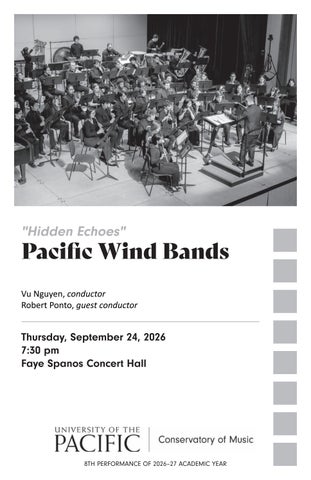
"Hidden Echoes"
Pacific Wind Bands Vu Nguyen, conductor Robert Ponto, guest conductor
Thursday, September 24, 2026 7:30 pm Faye Spanos Concert Hall
8TH PERFORMANCE OF 2026–27 ACADEMIC YEAR
SEPTEMBER 24, 2026, 7:30 PM Luminescence (2009)
David Biedenbender (b. 1984)
7′
Tarot (2021/2022) The King of Cups
Lindsay Bronnenkant (b. 1988)
7′
First Suite in E-flat (1909) Chaconne Intermezzo March
Gustav Holst (1874–1934)
11′
Aurora Awakes (2009)
John Mackey (b. 1973)
11′
Charles Ives (1874–1954) arr. James Sinclair
4′
Robert Ponto, conductor
Country Band March (1903/1974)
Robert Ponto's residency at University of the Pacific is made possible in part by the Robert and Helen Gross Band Program Endowment.
PROGRAM NOTES Biedenbender: Luminescence Composer David Biedenbender has collaborated with many renowned performers and ensembles, and his works have been performed, recorded, and broadcast around the world. He has written music for the concert stage as well as for dance and multimedia collaborations, and his creative interests include working with classically trained musicians and improvisers, chamber and large ensembles, interactive electronic interfaces and live brain data. He is Professor and Chair of Composition in the College of Music at Michigan State University, and he holds degrees in composition from the University of Michigan and Central Michigan University. Biedenbender provides the following about Luminescence: “Luminescence is based on fragments from the melody Break Forth O Beauteous Heavenly Light, which was written by Johann Schop (ca. 1590–1664) and subsequently harmonized in several settings by Johann Sebastian Bach. Break Forth O Beauteous Heavenly Light was first known as “Ermuntre dich, mein schwacher Geist” (Rouse thyself, my weak spirit), and was published in Lepzig in 1641 in Johann Rist’s Himmlische Lieder (Heavenly or Celestial Songs), where the tune appeared in triple meter along with text by Rist. Johann Sebastian Bach probably found an altered version of the tune in Johann Cruger’s Praxis Pietatis Melica (1647) and subsequently harmonized it in various settings. This particular setting is from the second cantata of his Christmas Oratorio from 1737. The original melody had a different character in its original form, as it was more closely related to Renaissance musical style. By the time Bach harmonized the tune in the 18th century, musical preferences had shifted: the rhythm of the melody was made more consistent, the tempo became slower, and the harmony and counterpoint was more complex. This setting is still sung in modern churches at Christmas and is commonly known as Break Forth O Beauteous Heavenly Light.” —Vu Nguyen/ David Biedenbender Bronnenkant: The King of Cups Lindsay Bronnenkant is on faculty at the University of Massachusetts Amherst where she directs the Symphony Band, teaches conducting classes, and leads a graduate conducting seminar. She has conducted premier ensembles such as the Eastman Wind Ensemble, the University of Michigan Symphony Band, and the United States Army Band “Pershing’s Own.” Bronnenkant holds degrees from the Eastman School of Music (DMA, wind conducting, 2022), the University of Michigan (MM, wind conducting, 2019), Nazareth College
PROGRAM NOTES (BM, music education, 2014), and the University of Rochester (BS, brain and cognitive sciences, 2010). As a composer, Bronnenkant wrote her first work for wind ensemble, Symphony for Singer, self-taught, at 18 years old. Her first published work, Tarot (2021), was designated the runner-up to the 2021 National Band Association/William D. Revelli Memorial Band Composition Contest. The piece is based on original research on Gustav Holst and was presented as part of Bronnenkant’s doctoral conducting recital and lecture presentation. Bronnenkant provides the following about Tarot: “Gustav Holst was incredibly interested in Indian culture, going so far as to teach himself Sanskrit. Some evidence suggests that he tried to incorporate Indian rāgas into his works, and after investigating Holst’s resources and analyzing his Planets, I believe that Holst tried to reference rāgas that evoked similar characters to those of the planets in his suite. Holst’s access to authentic performance of Indian music was limited, however, and like many composers—especially as a British composer entrenched in modal composition during the English folk song revival of the early twentieth century —he took what he understood of rāgas and filled in the gaps with Western theoretical knowledge, resulting in the treatment of what were once rāgas as scales or modes. I decided to compose a suite that traces Holst’s footsteps but applies his musical experimentation to a new topic: Tarot. Like astrology, Tarot cards have been used for divination, and as each planet in modern astrology represents specific characteristics and personality traits, so too does each Tarot card. Some elements of the Hindustani thāts, Karnātak mēlakarta rāgas, and pitch sets Holst references in his Planets are referenced in Tarot using a similarly western approach to portray Tarot card analogs. In Tarot, the suit of cups corresponds with emotional energy and the element of water. A deeply empathic soul, the King of Cups tempers his emotions by balancing his heart with his head. The King leads diplomatically through compassion. The second movement, "The King of Cups," references the pitches of mēlakarta rāga Dhavalāmbari from Neptune as a nod to a fellow intuitive and ruler of the sea, and additionally employs the pitches of the Bhairavī that are found in Venus to allude to the King’s kind and gentle countenance.” —Vu Nguyen/ Lindsay Bronnenkant
PROGRAM NOTES Holst: First Suite in E-flat Gustav Holst contributed several cornerstone works for wind bands such as the First Suite in E-flat, the Second Suite in F, and Hammersmith, yet he is best remembered by many as composer of the 1917 orchestral suite, The Planets. Holst began his concentrated study of composition at the Royal Conservatory of Music in London in 1893. He gave up a career as an orchestral trombonist in 1903 to teach at James Allen’s Girls’ School, following his close friend Ralph Vaughan Williams in the post. In 1905 he moved to St. Paul’s Girls’ School in Hammersmith, where he taught for the remainder of his life. Composed in 1909, the First Suite in E-flat did not receive its official premiere until 1920 and was published the following year. The three movements are connected by the three-note motive heard at the opening of the “Chaconne.” The first movement is based on an eight-measure theme introduced by euphonium, tuba, and string bass. This melody becomes the basis for the entirety of the movement, presented sixteen times with changes to orchestration, harmony, rhythm, and character before building to its conclusion. The “Intermezzo” transforms the opening motive into a lighter and more rhythmically active idea, which Holst reinforces for the listener through the use of accents and tambourine reinforcement. Rapid eighth notes and short articulations give the movement much of its energy, while a lyrical melody provides contrast in the middle section. Near the end, Holst brilliantly combines the lyrical melody with motivic interjections from the opening. The final movement, “March,” begins with the same three-note motive but here in inversion. The trio section features an expressive second theme and countermelody. The movement, and the suite, concludes with the two themes heard simultaneously. —Vu Nguyen Mackey: Aurora Awakes Aurora—the Roman goddess of the dawn—is a mythological figure frequently associated with beauty and light. Also known as Eos (her Greek analogue), Aurora would rise each morning and stream across the sky, heralding the coming of her brother Sol, the sun. Though she is herself among the lesser deities of Roman and Greek mythologies, her cultural influence has persevered, most notably in the naming of the vibrant flashes of light that occur in Arctic and Antarctic regions – the Aurora Borealis and Aurora Australis. John Mackey’s Aurora Awakes is, thus, a piece about the heralding of the coming of light. Built in two substantial sections, the piece moves over the course of eleven minutes from a place of remarkable stillness to an unbridled explosion of energy—from darkness to light, placid gray to startling rainbows
PROGRAM NOTES of color. The work is almost entirely in the key of E-flat major (a choice made to create a unique effect at the work’s conclusion, as mentioned below), although it journeys through G-flat and F as the work progresses. Despite the harmonic shifts, however, the piece always maintains a—pun intended— bright optimism. Though Mackey is known to use stylistic imitation, it is less common for him to utilize outright quotation. As such, the presence of two more-or-less direct quotations of other musical compositions is particularly noteworthy in Aurora Awakes. The first, which appears at the beginning of the second section, is an ostinato based on the familiar guitar introduction to U2’s “Where The Streets Have No Name.” Though the strains of The Edge’s guitar have been metamorphosed into the insistent repetitions of keyboard percussion, the aesthetic is similar – a distant proclamation that grows steadily in fervor. The difference between U2’s presentation and Mackey’s, however, is that the guitar riff disappears for the majority of the song, while in Aurora Awakes, the motive persists for nearly the entirety of the remainder of the piece: “When I heard that song on the radio last winter, I thought it was kind of a shame that he only uses that little motive almost as a throwaway bookend. That’s my favorite part of the song, so why not try to write an entire piece that uses that little hint of minimalism as its basis?” The other quotation is a sly reference to Gustav Holst’s First Suite in E-flat for Military Band. The brilliant E-flat chord that closes the Chaconne of that work is orchestrated (nearly) identically as the final sonority of Aurora Awakes— producing an unmistakably vibrant timbre that won’t be missed by aficionados of the repertoire. This same effect was, somewhat ironically, suggested by Mackey for the ending of composer Jonathan Newman’s My Hands Are a City. Mackey adds an even brighter element, however, by including instruments not in Holst’s original: “That has always been one of my favorite chords because it’s just so damn bright. In a piece that’s about the awaking of the goddess of dawn, you need a damn bright ending—and there was no topping Holst. Well . . . except to add crotales.” —Jake Wallace Ives: Country Band March Charles Ives, born in Danbury, Connecticut, is recognized as one of the greatest American composers of the twentieth century. Ives attended Yale University, studying organ and composition, but he did not receive many
PROGRAM NOTES accolades during most of his lifetime. In fact, he made his living as a successful insurance salesman, founding an agency that would become one of the most lucrative in the nation. It was not until late in his life that many of the larger works he composed decades earlier were performed for the first time. When his unique and progressive music finally saw the light of day, however, he earned a Pulitzer Prize in 1947 for his Third Symphony. Country Band March was composed around 1903, four years after Ives's graduation from Yale and five years prior to his lucrative insurance partnership with Julian Myrick. Ives had just resigned as organist at Central Presbyterian Church, New York, thus ending thirteen and one-half years as organist of various churches. He was, according to Henry Cowell, "exasperated ... by the routine harmony for hymns." During this period Ives finished his Second Symphony (1902), composed three organ pieces that were later incorporated into his Third Symphony (1904), composed the Overture and March "1776" and various songs and chamber pieces. Apparently, the Country Band March received no performances, and only a pencil score-sketch is in evidence today. Later, Ives seemed very interested in this music, since he incorporated nearly all of it, in one form or another, into the "Hawthorne" movement of Sonata No. 2 (Concord), “The Celestial Railroad,’’ the Fourth Symphony (second movement) and especially "Putnam's Camp" from Three Places in New England. From the "out of tune" introduction to the pandemonium which reigns at the close, the Country Band March is a marvelous parody of the realities of performance by a country band. While the main march theme is probably Ives' own, the march features an impressive list of quotations that includes “Arkansas Traveler,” “Battle Cry of Freedom,” “British Grenadiers,” “The Girl I Left Behind Me,” “London Bridge,” “Marching Through Georgia,” “Massa's in de Cold, Cold Ground,” “My Old Kentucky Home,” “Violets,” “Yankee Doodle,” “May Day Waltz,” and “Semper Fidelis.” There is rarely anything straightforward about the use of this material; the tunes are subjected to Ives's famous techniques of “poly-everything.” Of particular interest is Ives's use of “ragtime” elements to enliven this already spirited march. —James Sinclair
ARTIST BIOGRAPHIES Robert Ponto retired from the University of Oregon School of Music and Dance in 2021 where he served as Director of Bands and Assistant Dean for 29 years. Before coming to Oregon, he held similar teaching positions at the Oberlin Conservatory, East Carolina University, Pacific Lutheran University and in the public schools of West St. Paul, Minnesota. Ponto has conducted ensembles throughout the United States, Canada, and the United Kingdom and has had performances featured at the Bang on a Can contemporary music festival, on National and Oregon Public Radio, and at various state, regional and national music conferences. Some of the artists with whom he has collaborated include John Adams, Julian Bliss, Steven Stucky, Lucy Shelton, Justine Chen, Michael Daugherty, Allen Vizzutti, Eugene Rousseau, David Maslanka, and many others. More recent projects include conducting the West Point Band in a performance of Stravinsky’s Concerto for Piano, a new recording of (and score for) Roy Harris’s 1952 West Point Symphony, and performance of Mozart’s Gran Partita with the Oregon Mozart Players. As an electronic music and sound design hobbyist, he has contributed to unique projects including Postmark Sirius: In Memoriam Karlheinz Stockhausen (for trumpet and live electronics), Beta Bacher (for the Oregon Bach Festival), a digital realization of Stockhausen’s Solo, and contributions to British singer/songwriter Imogen Heap’s album Sparks and her incidental music for the play, “Harry Potter and the Cursed Child.”
ARTIST BIOGRAPHIES Vu Nguyen is a professor of music and director of bands at University of the Pacific. He conducts the Pacific Wind Bands, and he teaches courses in conducting and music education. A Conn-Selmer Educational Clinician, Nguyen maintains an active schedule as a clinician and has served as guest conductor with military bands as well as honor bands across the country at state, regional and local levels. Ensembles under his direction have performed at state music educator conferences, at the Midwest Clinic, and at the College Band Directors National Association Conference. Among his recent projects is the Pacific Wind Bands’ commercial recording From a Deep Blue Sky, featuring music by Viet Cuong, Kevin Day, Alex Shapiro, and Brian Bùi. A native of the San Francisco Bay Area, Nguyen holds degrees in conducting from the University of Washington and the University of Oregon, and he earned a Bachelor of Music degree in music education from University of the Pacific. Prior to his appointment at Pacific, he served in similar roles at the University of Connecticut, University of Indianapolis, and Washington University in St. Louis. He began his teaching career in the San Ramon Valley Unified School District. In addition to his academic career, Nguyen is a retired officer in the Air National Guard where he was the commander and conductor of the ANG Band of the West Coast.
PACIFIC WIND BANDS The Pacific Wind Bands include students who represent music majors, minors, and non-majors from across Pacific. The ensemble performs at least four concerts each academic year. It provides students the opportunity to play a broad range of music for winds, brass, percussion, and keyboards drawn from a repertoire that honors the rich history of the past and looks to the future, ranging from chamber to full wind band instrumentation. Recent premieres and collaborations with composers and guest artists include Kevin Bobo, Viet Cuong, Kevin Day, Shuying Li, Catherine Likhuta, Giovanni Santos, and Alex Shapiro. Flutes Eve Haymore Ash Morris Henrie Notley Anshini Parikh William Rey Ben Saetern Nicholas Talcott Paulina Vallejo Anahi Vazquez-Reyes Oboes Walker Austin Gabriel Jarata Ernesto Pena Emily Sayavong Clarinets Mitchell Amos Edmund Bascon Audrey Ewing Tommy Galvin Zahara Herd Eligh Mann Kari Marshall Adrian RodriguezMandujano
Bassoons Nadege Tenorio Jess Vreeland Saxophones Cedric Castro Antrell Gulley Mekiyah Robinson Marcus Rudes Horns Ciera Alkhoury Drew Bellinger Linda Brantley Madison Ma Lily Walter Trumpets Jack Alorro Nathan Carolan Selvin Curin Parker Deems Samara King Hayden Lee Amalia Silva Ethan Truong
Trombones Bronson Burfield Radley Rutledge Kiyo Sato Matt Young Euphonium William Giancaterino Tubas Logan Campbell Alejandro Villalobos Bass Elijah Atchley Percussion Julianna Fraser Casey Kim Daegan Luster Peter Norman Michael Perez David Peters Alanna-Joi Sheard Snowden Snyder Bry Vera Rei Vindiola Piano Grace Francois-Rosa
PACIFIC WIND BANDS Pacific Faculty Coaches Brittany Trotter, flute Kyle Bruckmann, oboe Brooke Miller, clarinet Nicolasa Kuster, bassoon Ricardo Martinez, saxophone Sadie Glass, horn Alia Kuhnert, trumpet Bruce Chrisp, trombone Brian Kemble, tuba/euphonium Andrew Mell, bass Jonathan Latta, percussion Shichao Zhang, piano Jonathan Latta, ensemble program director Inga Piterbarka, ensemble librarian
SUPPORT OUR STUDENTS AND PROGRAMS Every gift to the Conservatory from an alum, parent, or friend makes an impact on our students. Our students rely on your generosity to enable them to experience a superior education. To make a gift today, please contact the Assistant Dean for Development at 209.932.2978 or scan this QR code. You may also send a check payable to University of the Pacific: Conservatory of Music, University of the Pacific Attn: Assistant Dean for Development 3601 Pacific Avenue Stockton, CA 95211
To view our upcoming events, scan the QR code or visit Pacific.edu/MusicEvents
Pacific.edu/Conservatory