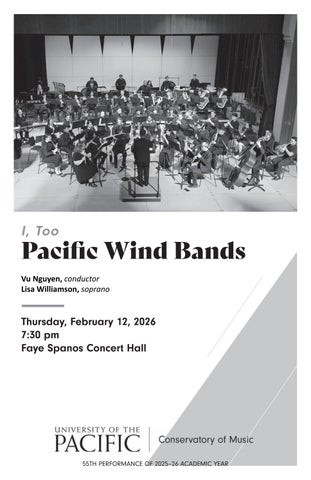
Pacific Wind Bands
Vu Nguyen, conductor
Lisa Williamson, soprano
Thursday, February 12, 2026
7:30 pm
Faye Spanos Concert Hall



FEBRUARY 12, 2026, 7:30 PM
Liberty Fanfare (1986/2002)
I, Too, Am America (2024)
I, Too, Sing America
Mother to Son Afraid
Summer Night We Have Tomorrow
Sweet Chariot (2019)
Pause
John Williams (b. 1932) arr. James Curnow
Henry Dorn (b. 1988)
Carlos Simon (b. 1986)
The Adventures of Jesse Owens (2023) Cotton Berlin (1936 Olympics) Gold
Michael Daugherty (b. 1954)
Lisa Williamson's residency at Pacific is made possible in part by the Robert and Helen Gross Band Program Endowment.
View a digital version of this program at issuu.com/MusicatPacific
Lisa Williamson, soprano
PROGRAM NOTES
Williams/Curnow: Liberty Fanfare
In a career spanning more than six decades, John Williams has become one of America’s most accomplished and successful composers for film and the concert stage, and he remains one of our nation’s most distinguished and contributive musical voices. He has composed the music and served as music director for more than one hundred films, and his fifty-year artistic partnership with director Steven Spielberg has resulted in many of Hollywood’s most acclaimed and successful films. His five Academy Awards and fifty-four Oscar nominations make him the Academy’s most-nominated living person and the second-most nominated person in the history of the Oscars. In 2009, he was inducted into the American Academy of Arts and Sciences, and he received the National Medal of Arts, the highest award given to artists by the U.S. Government.
Williams has composed music for many important cultural and commemorative events. He composed themes for the 1984, 1988, and 1996 Summer Olympic Games, and for the 2002 Winter Olympic Games. For the festivities accompanying the centennial of the Statue of Liberty in 1986, the Statue of Liberty-Ellis Island Foundation commissioned Williams to write a fanfare to be performed at the televised ceremonies on July 4, 1986, resulting in LibertyFanfare. Williams conducted the Boston Pops in the first public performance of the fanfare on June 4, 1986, and one month later, he led the Boston Pops Esplanade Orchestra in the work as part of the July live national telecast.
—adapted from Gorfaine/Schwartz Agency
Dorn: I, Too, Am America
Henry Dorn, composer/conductor born in Little Rock, Arkansas, builds distinct narratives in each of his compositions based on lived experiences at the intersection of being a musician and African American, taking ideas and putting them in places where they do not seem to belong. Dorn has enjoyed performances by noteworthy ensembles across the country, including the Atlanta Symphony Orchestra, Detroit Symphony Orchestra, American Composers Orchestra, Minnesota Orchestra, JACK Quartet, the Grammywinning Harlem Quartet, Aizuri Quartet, and the Dallas Wind Symphony.
Dorn is assistant professor of music and conductor of the St. Olaf Band at St. Olaf College in Northfield, Minnesota. He was formerly assistant director to the Memphis Area Youth Wind Ensemble, and former director to the Memphis-based Nu Chamber Collective. He is proud to have received multiple awards for his unique style, including Minnesota Orchestra
PROGRAM NOTES
Composer Institute, Inaugural Future of Music Faculty Fellowship recipient from the Cleveland Institute of Music, and an ASCAP Foundation’s Morton Gould Young Composer Award. Dorn holds a Doctor of Musical Arts in wind conducting and a Doctor of Musical Arts in composition from Michigan State University. He has completed studies at The University of Memphis and at Peabody Institute of The Johns Hopkins University.
I, Too, Am America was premiered by the United States Coast Guard Band at the 2024 Midwest Clinic in Chicago, Illinois on December 18, 2024, featuring Captain Adam Williamson (conductor) and Lisa Williamson (soprano).
Dorn writes:
“I have long held an appreciation and respect for the work of American poet Langston Hughes. His ability to illustrate striking scenes with his lyrical words while also subtly (and often directly) highlighting the plight of African Americans are hallmarks of his poetry. His first book, The Weary Blues, was published in 1926, and yet his words read freshly now, as if the ink has yet to dry. The poems set in this song cycle— ‘I, Too, Sing America,’ ‘Mother to Son,’ ‘Afraid,’ ‘Summer Night,’ and ‘We Have Tomorrow’—are taken from the last segment of Hughes’s book entitled Our Land. Hughes speaks (often in first person) to the day-to-day life of African Americans in the 1920s United States, underpinning themes of looking backward to the struggles of past generations, working through current oppression, pressing towards survival, and finding joy and self-awareness within the African American community. But Hughes, as he talked about yesterday and today, often made near prophetic statements regarding tomorrow and hope for better in the future.”
—Henry Dorn
Simon: Sweet Chariot
Carlos Simon is a native of Atlanta, Georgia, whose music ranges from concert music for large and small ensembles to film scores with influences of jazz, gospel, and neo-romanticism. Simon is the Composer-in-Residence for the John F. Kennedy Center for the Performing Arts, and he holds the inaugural Boston Symphony Orchestra Composer Chair. In 2023 Simon released the live premiere recording of brea(d)th, a landmark work commissioned by Minnesota Orchestra and written in collaboration with Marc Bamuthi Joseph, conducted by Jonathan Taylor Rush. “Arguably the most important commission of Simon’s career so far” (New York Times), brea(d)th was written following George Floyd’s murder as a direct response to America’s unfulfilled promises and history of systemic oppression against Black Americans.
PROGRAM NOTES
Simon was nominated for a 2023 Grammy Award for Best Contemporary Classical Composition for his previous album, Requiem for the Enslaved. The requiem is a multi-genre musical tribute to commemorate the stories of the 272 enslaved men, women, and children sold in 1838 by Georgetown University, released by Decca in June 2022. This work sees Simon infuse his original compositions with African American spirituals and familiar Catholic liturgical melodies, performed by Hub New Music Ensemble, Marco Pavé, and MK Zulu.
Simon earned his doctorate degree at the University of Michigan, where he studied with Michael Daugherty and Evan Chambers. He has also received degrees from Georgia State University and Morehouse College. He is an honorary member of Phi Mu Alpha Music Sinfonia Fraternity and a member of the National Association of Negro Musicians, Society of Composers International, and Pi Kappa Lambda Music Honor Society. He has served as a member of the music faculty at Spelman College and Morehouse College in Atlanta, Georgia and now serves as Associate Professor at Georgetown University.
Simon writes:
“Swing Low, Sweet Chariot is perhaps one of the most well-known African American spirituals. As beautiful and rapturing as its melody is, it should be. However, its beauty and popularity is often overlooked by the song’s true meaning about death. I have taken fragments of the melody and combined it with the Gregorian chant from the Latin mass for the dead, In Paradisum. Its text is as follows: ‘May the angels lead you into paradise; may the martyrs receive you at your arrival and lead you to the holy city Jerusalem. May choirs of angels receive you and with Lazarus, once (a) poor (man), may you have eternal rest.’”
—Carlos Simon
Daugherty: The Adventures of Jesse Owens
Multiple Grammy Award-winning composer Michael Daugherty has achieved international recognition as one of the ten most performed American composers of concert music, according to the League of American Orchestras. His orchestral music, recorded by Naxos over the last two decades, has received six Grammy Awards. He was born in Cedar Rapids, Iowa, and is the son of a dance-band drummer and the oldest of five brothers, all professional musicians. As a young man, Daugherty studied composition with many of the preeminent composers of the 20th century including Pierre Boulez at IRCAM in Paris (1979), Jacob Druckman, Earle
PROGRAM NOTES
Brown, Bernard Rands and Roger Reynolds at Yale (1980–82), and György Ligeti in Hamburg (1982–84). Daugherty was also an assistant to jazz arranger Gil Evans in New York from 1980 to 1982. In 1991, Daugherty joined the University of Michigan School of Music, Theatre and Dance as professor of composition.
The Adventures of Jesse Owens for symphonic band was commissioned by Kappa Kappa Psi, National Band Fraternity, and Tau Beta Sigma, National Band Sorority for the National Intercollegiate Band. The world premiere was given by the National Intercollegiate Band, conducted by Rodney Dorsey, in Orlando, Florida, on July 11, 2023.
1. Cotton: Jesse Owens (1913–1980) was the youngest of ten children, the son of a sharecropper, and the grandson of enslaved people. The family lived in a small shack in rural Oakville, Alabama, and everyone picked cotton for a living, including Jesse beginning at age seven. The first movement is a “work song” composed of pulsating, multi-layered ostinatos accompanied by a rhythmically relentless anvil.
2. Berlin (1936 Olympics): As a student athlete on the track and field team at Ohio State University, Jesse Owens set five world records in 1935. He was subsequently invited to join the United States Olympic team for the 1936 Olympic Games in Berlin, Germany. The German Nazi Party hoped that hosting the 1936 Olympic Games in Berlin would provide an international showcase for the Third Reich and give legitimacy to its racist policies of Aryan supremacy. The participation of American Jewish and Black athletes subsequently caused great controversy. In the second movement, I allude to three different musical works associated with the opening ceremonies of the 1936 Berlin Olympics: Richard Strauss: Olympische Hymne (1936); My Country, ‘Tis of Thee (also known as America, 1831); Deutschlandlied (German national anthem, 1922). As these melodies are interrupted by rolling drums, the ominous mood of the music anticipates World War II, started by Germany in 1939.
3. Gold: By winning four gold medals and setting world records in the 100-meter, 200-meter, 400-meter relay and long-jump, Jesse Owens became the most successful athlete of the 1936 Berlin Olympic Games. His victories made international headlines as “the fastest man in the world,” challenging the German Nazi doctrine of Aryan supremacy. Inspired by the superhuman feats of Jesse Owens at the Olympics, the brightly orchestrated final movement, marked “Presto,” moves at breakneck speed to a triumphant finish line.
I, Too, Sing America I, too, sing America.
Dorn: I, Too, Am America
I am the darker brother. They send me to eat in the kitchen When company comes, But I laugh, And eat well, And grow strong. Tomorrow, I’ll be at the table When company comes. Nobody’ll dare Say to me, “Eat in the kitchen,” Then.
Besides, They’ll see how beautiful I am And be ashamed—
I, too, am America.
Mother to Son
Well, son, I’ll tell you: Life for me ain’t been no crystal stair. It’s had tacks in it, And splinters, And boards torn up, And places with no carpet on the floor— Bare.
But all the time I’se been a-climbin’ on, And reachin’ landin’s, And turnin’ corners, And sometimes goin’ in the dark Where there ain’t been no light. So boy, don’t you turn back. Don’t you set down on the steps
’Cause you finds it’s kinder hard. Don’t you fall now—
TEXTS
For I’se still goin’, honey, I’se still climbin’, And life for me ain’t been no crystal stair.
Afraid
We cry among the skyscrapers
As our ancestors
Cried among the palms in Africa
Because we are alone, It is night, And we’re afraid.
Summer Night
The sounds
Of the Harlem night
Drop one by one into stillness. The last player-piano is closed. The last victrola ceases with the “Jazz Boy Blues.”
The last crying baby sleeps And the night becomes Still as a whispering heartbeat. I toss
Without rest in the darkness, Weary as the tired night, My soul
Empty as the silence, Empty with a vague, Aching emptiness, Desiring, Needing someone, Something.
I toss without rest
In the darkness
Until the new dawn, Wan and pale, Descends like a white mist Into the court-yard.
We Have Tomorrow
We have tomorrow
Bright before us
Like a flame
Yesterday a night-gone thing, A sun-down name.
And dawn to-day
Broad arch above the road we came.
—Langston Hughes
Vu Nguyen is an associate professor of music and director of bands at University of the Pacific. He conducts the Pacific Wind Bands, and he teaches courses in conducting and music education. Nguyen maintains an active schedule as a clinician and has served as guest conductor with military bands as well as honor bands across the country. Ensembles under his direction have performed at state music educator conferences, at the Midwest Clinic, and at the College Band Directors National Association Conference.
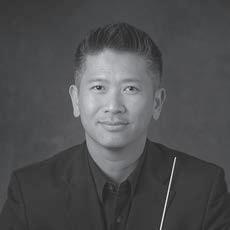
A native of the San Francisco Bay Area, Nguyen holds degrees in conducting from the University of Washington and the University of Oregon, and he earned a Bachelor of Music degree in music education from University of the Pacific. Prior to his appointment at Pacific, he served in similar roles at the University of Connecticut, University of Indianapolis, and Washington University in St. Louis. He began his teaching career in the San Ramon Valley Unified School District. In addition to his academic career, Nguyen is a retired officer in the Air National Guard (ANG) where he was the commander and conductor of the ANG Band of the West Coast.
Praised by The Washington Post as “silvery of voice” and “a showstopper,” soprano Lisa Williamson has performed worldwide, from Muscat, Oman, to Carnegie Hall. Last season, she debuted with Opera Ithaca as Despina in Così fan tutte, joined the Connecticut Symphony Orchestra for H. Leslie Adams’s Nightsongs, and returned to the New Haven Symphony Orchestra for Beethoven’s Symphony No. 9. She has appeared with the Hartford, Southwest Michigan, Connecticut, and Missoula Symphony Orchestras, performing works from Gershwin to Carmina Burana. On the opera stage, she premiered the role of Bessie Coleman in Bessie and Ma, and has performed with Washington National Opera, Portland Opera, and the Glimmerglass Festival. From 2005–2010, she was the vocal soloist with The United States Coast Guard Band, performing across the U.S. and Japan and twice at the Indianapolis 500.
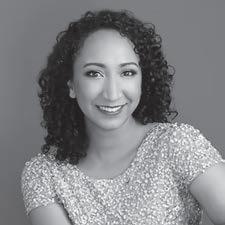
She is a frequent guest artist with wind ensembles including twice with the United States Coast Guard Band at the Midwest Clinic first in 2009 performing transcriptions of William Bolcom’s Cabaret Songs and in 2025,
Henry Dorn’s I, Too. She has also soloed with the West Virginia University Wind Ensemble with John Mackey’s Songs from the End of the World, the Hartt School Wind Ensemble with Frank Ticheli’s Songs of Love and Life, and the University of Connecticut Wind Ensemble with James Syler’s Silent Shadows to the Last. She will perform Symphony No. 2 “Voices,” with the Ithaca College Wind Ensemble at the Maryland Music Educators Association 2026 Annual State Conference.
Williamson is an Assistant Professor of Voice at Ithaca College. In 2020, she was a Cleveland Institute of Music Future of Music Faculty Fellow and a 2024 NATS Intern. She holds degrees from the Peabody Conservatory, Yale School of Music, and the University of Connecticut. Her academic research focuses on the songs of the early Broadway songwriting team Cole and Johnson Brothers and art songs of Florence Price and Margaret Bonds. A Northern Virginia native, she now divides her time between the Finger Lakes and Eastern Connecticut. A Northern Virgina native, she now divides her time between the Finger Lakes and Eastern Connecticut.
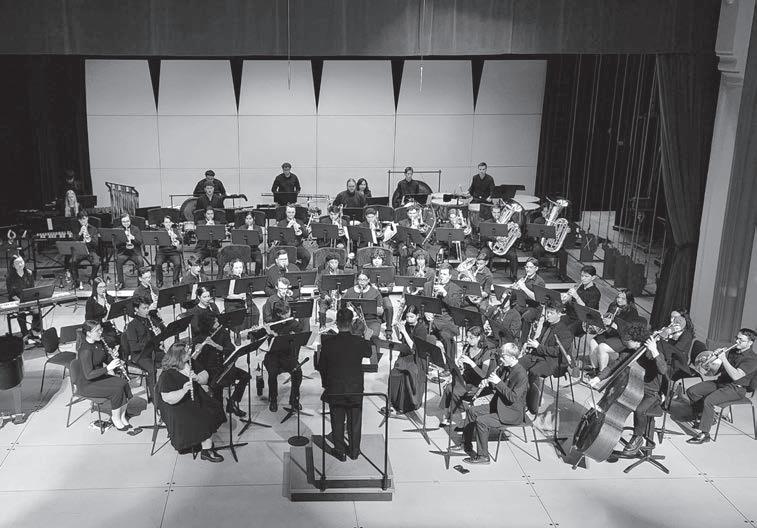
The Pacific Wind Bands at University of the Pacific include students who represent music majors, minors, and non-majors from across Pacific. The ensemble performs at least four concerts each academic year. It provides students the opportunity to play a broad range of music for winds, brass, percussion, and keyboards drawn from a repertoire that honors the rich history of the past and looks to the future, ranging from chamber to full wind band instrumentation. Recent premieres and collaborations with composers include Kevin Bobo, Viet Cuong, Kevin Day, Shuying Li, Catherine Likhuta, Giovanni Santos, and Alex Shapiro.
Flutes
Emily Aires
Riko Hirata
Henrie Notley
Anshini Parikh
Arianna Pereyra
Ethan Williams
Oboes
Walker Austin
Gabriel Jarata
Elizabeth Ledesma
Clarinets
Mitchell Amos
Edmund Bascon
Audrey Ewing
Kaitlyn Ferreira
Tommy Galvin
Zahara Herd
Eligh Mann
Adrian Rodriguez
Mandujano
Noah Sapol
Andrew Seaver
Bassoons
Nadege Tenorio
Jess Vreeland
Saxophones
Ray Cruz
Danielle Densmore
Antrell Gulley
Marcus Rudes
Horns
Ciera Alkhoury
Marcelo Contreras
Jas Lopez
Madison Ma
Don Parker
Lily Walter
Trumpets
Jack Alorro
Parker Deems
Alayna Ontai
Kamron Qasimi
Trombones
Bronson Burfield
Radley Rutledge
Kiyo Sato
Matt Young
Euphonium
Jayden Laumeister
Tubas
Seth Morris
Alejandro Villalobos
Bass
Elijah Atchley
Percussion
Hunter Campbell
Ryan Eads
Casey Kim
Janae Jones
Daegan Luster
Robert McCarl
Peter Norman
Snowden Snyder
Rei Vindiola
Piano
Sonja Hwang
Harp
Ellie Choate*
*community member
Faculty Coaches
Brittany Trotter, flute
Kyle Bruckmann, oboe
Patricia Shands, clarinet
Nicolasa Kuster, bassoon
Ricardo Martinez, saxophone
Sadie Glass, horn
Alia Kuhnert, trumpet
Bruce Chrisp, trombone, euphonium
Brian Kemble, tuba
Kathryn Schulmeister, double bass
Jonathan Latta, percussion
Sonia Leong, piano
Jonathan Latta, ensembles program director
Breanna Daley, ensemble librarian




To view our upcoming events, scan the QR code or visit Pacific.edu/MusicEvents.