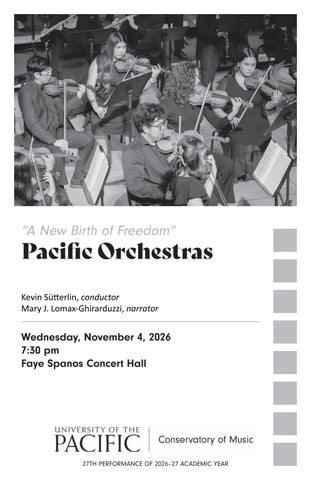
“A New Birth of Freedom”
Pacific Orchestras Kevin Sütterlin, conductor Mary J. Lomax-Ghirarduzzi, narrator
Wednesday, November 4, 2026 7:30 pm Faye Spanos Concert Hall
27TH PERFORMANCE OF 2026–27 ACADEMIC YEAR
NOVEMBER 4, 2026, 7:30 PM The Moirai (2024) (California Premiere)
Lincoln Portrait (1942)
Lawren Brianna Ware (b. 1994)
5ʹ
Aaron Copland (1900–1990)
16ʹ
Mary J. Lomax-Ghirarduzzi, narrator
The Montgomery Variations (1964) Decision Prayer Meeting March Dawn in Dixie One Sunday in the South Lament Benediction
Margaret Bonds (1913–1972)
View digital programs at issuu.com/MusicAtPacific
30ʹ
PROGRAM NOTES Program notes compiled by Kevin Sütterlin As the United States marks 250 years, Pacific Orchestras reflect on the nation’s ideals, dreams, struggles, and continuing pursuit of freedom. Featuring the California premiere of Lawren Brianna Ware’s The Moirai, Aaron Copland’s Lincoln Portrait, and Margaret Bonds’ The Montgomery Variations, the program explores memory, resilience, justice, and renewal. Ware: The Moirai Commissioned by April Ann and Kevin Sütterlin as a gift to the Fox Valley Symphony Orchestra, in honor of our dear friend and mother figure Danna Sue Browder Brown, who passed away on August 3, 2024, from a difficult cancer journey. “Momma Danna’s” bright, inimitable smile and laugh, her warm and love-filled hugs, her generous and kind spirit, and her sassy, witty sense of humor will always live on in our hearts. Lawren Brianna Ware, a Gadsden, Alabama native, is a recent graduate of The University of Wisconsin-Madison where she earned her DMA in music composition with a minor in musicology. Compositionally, Dr. Ware’s goal is to “write music that makes one feel.” Dr. Ware’s compositions have been featured on various professionally recorded albums. Her most recent projects include being the inaugural composer and co-founder of the Black Composer Revival Consortium, composing for the Minnesota Consortium for Black American Composers (2020), and composing and releasing an electronic music album in conjunction with comic book writer Jaromir François on the comic My Brother Teddy (2021). In July of 2022, Brianna became the first African-American composer selected to be the composer in residence for the Seal Bay Music Festival in Vinalhaven, Maine. Additionally, she is presently working with Access Contemporary Music (ACM) on their Songs About Buildings and Moods video series which explores the connection between architecture and music. The Moirai is a programmatic work based on the ancient Greek myth of the “Moirai,” more commonly known as “the Fates.” These weaving goddesses were named Clotho (“The Spinner”), Lachesis (“The Alloter”), and Atropos (“The Inflexible”). The three daughters of Zeus and Themis were tasked with assigning destinies to mortals at birth. “Clotho spun the thread of life, Lachesis measured its allotted length, and Atropos cut it off with her shears. Sometimes, each of the Fates was assigned to a specific period of time: Atropos – the past, Clotho – the present, and Lachesis – the future.” The piece as a whole acts as an homage to the first movement of Ludwig van Beethoven’s renowned
PROGRAM NOTES Symphony No. 5. As a musical joke/quote, I modified Beethoven’s famous “knocking on fate’s door” theme (“bum bum bum bum”) and incorporated this new motive throughout the work. This motive acts as a nod to the past while simultaneously pushing forward toward the future. The work opens triumphantly, sonically setting the location of this work on Mt. Olympus. The time has come for the Moirai to assign a destiny to a new human who is soon to be born into the world. Soon after the opening, the listener can hear Lachesis measure out the life thread of the individual, represented by running sixteenth notes in the upper woodwinds and strings. Following this, three solos can be heard: the first from the bassoon, second from the clarinet, and the final from the violin. Each of these solos is symbolic of a wail escaping the mouth of the mortal’s mother as she is giving birth to her son. Each wail becomes more intense and with the final, extended exclamation in the violin, the human man is born. Following his birth, Clotho can be heard spinning the human’s life thread on her spinning wheel. This motive can be heard in the harp’s (or piano/celeste) undulating pattern and is emphasized in the first sixteenth note of each grouping of four. Soft harmonic glissandi in the strings can be heard as the harp continues to play. These glissandi symbolize Lachesis measuring out the gossamer life threads of the man prior to handing them over to Clotho to spin. As Clotho spins and the music continues, the human moves through life, aging from an infant to a toddler; toddler to a boy; boy to a man. The music gradually gains speed as a musical representation of the man continuing to age, drawing closer and closer to that ill-fated time when his life thread will be cut by Atropos. The work, along with the man’s life, reaches a sudden end, climaxing with violent rhythmic “cuts” in the winds and first violins that symbolize Atropos' fateful scissors attempting to slice through the life thread. Furious glissandi in the remaining strings and harp act as the man’s life thread fighting against the sharp blades of Atropos’ scissors, trying to resist the shredding of its fibers. The work ends with the snapping of the man’s life thread, signaled by a ferocious Bartók pizzicato in the strings paired with a loud crack of the slapstick. Copland: Lincoln Portrait Aaron Copland is so revered as the quintessential voice of American classical music—the heartland and prairie translated into those wide-spaced, open harmonies, and infectiously folky-yet-spiky rhythms—that it’s easy to forget how unlikely a figure he was to assume that role. A star pupil of the legendary Parisian teacher of composition Nadia Boulanger in the 1920s, Copland was the son of Jewish immigrants, a gay man, and, after returning to the United States in the 1930s and witnessing the plight of his fellow Americans during
PROGRAM NOTES the Great Depression, a person of considerable socialist political leanings (he supported the American Communist Party’s presidential candidate in 1936). Copland’s political sympathies, in fact, informed his change of musical language to one that included the harmonies, rhythms, and melodic style of the Americas. Copland is so ensconced in our national cultural firmament that it is easy to forget his worldview ran him afoul of Senator Joseph McCarthy. The work featured on tonight’s program was to be performed at the 1953 inauguration of Dwight Eisenhower, until a congressman from Illinois recalled Copland’s political leanings. The performance was canceled, and Copland found himself hauled not once, but twice in front of McCarthy’s Senate Permanent Subcommittee on Investigations in May of that year. Copland skillfully parried the questioning but continued to be hounded for another two years by J. Edgar Hoover’s FBI, until it was finally decided there was insufficient evidence with which to charge him. This anecdote sheds light on the origin of Lincoln Portrait. In 1942, conductor Andre Kostelanetz commissioned Copland, Virgil Thomson, and Jerome Kern to all write patriotic works as America plunged into World War II. Copland originally wanted to set his work to the words of that great chronicler and poet of the Civil War, Walt Whitman, but when Kostelanetz suggested a political figure, he settled on the other great wordsmith of the era, the sixteenth president of the United States. Viewed in the light of Copland’s beliefs in a society that focused on the well-being of “the common man,” Lincoln Portrait is not only a clarion call against the fascism that engulfed Europe in the 1930s and 1940s, but a summons for this nation to live up to its highest ideals. As to the piece itself, Copland’s own admirably direct and succinct notes for a performance by the Boston Symphony are perhaps the most appropriate. One of the melodies he identifies, Stephen Foster’s “Camptown Races,” was written for the nineteenth-century blackface minstrel stage. Its origins in a tradition of racial caricature add a more complicated historical context to a tune that later became deeply familiar in American popular culture. "The first sketches were made in February, and the portrait finished on 16 April 1942. I worked with musical materials of my own with the exception of two songs of the period: the famous 'Camptown Races' which, when used by Lincoln supporters during his Presidential campaign of 1860, was sung to the words, 'We're bound to work all night, bound to work all day. I'll bet my money on the Lincoln hoss . . . ,' and a ballad that was first published in 1840 under the title 'The Pesky Serpent,' but it is better known today as
PROGRAM NOTES 'Springfield Mountain.' In neither case is the treatment a literal one. The tunes are used freely in the manner of my use of cowboy songs in Billy the Kid. The composition is roughly divided into three main sections. In the opening section I wanted to suggest something of the mysterious sense of fatality that surrounds Lincoln's personality. Also, near the end of that section, something of his gentleness and simplicity of spirit. The quick middle section briefly sketches in the background of the times he lived. This merges into the concluding section where my sole purpose was to draw a simple but impressive frame about the words of Lincoln himself." Bonds: The Montgomery Variations The composition you are about to hear was nearly consigned to the ash-heap of history—literally. Chicago-born African-American composer and pianist Margaret Bonds was, at the height of her career, famous enough that mayor Richard Daley declared January 31, 1967 “Margaret Bonds Day.” She was born into an accomplished, intellectual family—her father Monroe Alphus Majors was a physician, scholar, poet, and activist for both Civil Rights and medical reform, and her mother Estella Bonds was a pianist, organist, choir director, and the founder of the National Association of Black Musicians. While her parents divorced when she was very young, Bonds’ talents were nurtured throughout her childhood and in addition to piano lessons with her mother, she also thrived under the support and tutelage of fellow Chicago pianistcomposer (and Pulitzer Prize winner) Florence Price. Bonds went on to earn a Bachelor and Master of Music in piano and composition at Northwestern University, but the daily onslaught of racism this young black woman received made her time there a harrowing experience. She was not allowed to live in campus housing, forcing her to take the train daily to and from Chicago to Evanston, and she was even denied the right to eat in the student dining hall or use the swimming pool. Bonds found solace and inspiration in the library, where she encountered the poetry of Harlem Renaissance luminary Langston Hughes. Despite this experience of exclusion and alienation, Bonds excelled— she was the first black woman to perform with the Chicago Symphony in 1933 (a concert that also featured the premiere of Florence Price’s Symphony No. 1), and in the following year she premiered Price’s own Piano Concerto in One Movement with the Women’s Symphony Orchestra of Chicago. Bonds met Hughes in the mid 1930s, and she moved to New York City, where she worked steadily, playing the piano in luxe hotels, composing, arranging, and continued her education through the Juilliard School of Music’s extension program. She and Langston Hughes became artistic soulmates and collaborators, including settings of his poems for voice and piano, and an ambitious cantata dedicated to Martin Luther King, Jr., “The Ballad of the Brown King.”
PROGRAM NOTES In 1963, Bonds joined a tour of the South with baritone Eugene Brice and the Manhattan Melodaires; the burgeoning Civil Rights movement made a considerable impression upon her, and both the inspiration of the previous decade’s Montgomery bus boycott and the present cataclysm of the KKK bombing of the Sixteenth Street Baptist Church in Birmingham inspired Bonds to compose her most significant work for orchestra, a seven-movement set of variations on the spiritual “I Want Jesus To Walk With Me,” dedicated, like her cantata, to the Reverend King. Bonds completed her orchestration in 1964, and the work was premiered in 1967. Langston Hughes passed away in 1967 as well, and a distraught Bonds moved abruptly to Los Angeles, at first leaving her husband and daughter behind. She continued to work until her untimely death in 1972, when her manuscripts were inherited by her daughter. After her daughter Djane Richardson’s death in 2011, Richardson’s landlord passed the manuscripts, including The Montgomery Variations, to a Washington, DC bookseller. After the manuscripts failed to be sold, they were set next to a dumpster, and were it not for a last-minute intervention that transferred Bonds’ compositions to the Georgetown University library, this work and many others would have been utterly lost. The Montgomery Variations were published in 2020 by Hildegard Publishing Company, which is dedicated to the works of women composers, and it is gradually joining the symphonic repertoire with performances by the Los Angeles Philharmonic and the Minnesota Orchestra. Bonds composed her own notes for her Montgomery Variations, and it is always a privilege to be able to share a composer’s thoughts about their own works: The Montgomery Variations is a group of freestyle variations based on the Negro Spiritual theme, “I want Jesus to Walk with Me.” The treatment suggests the manner in which Bach constructed his partitas – a bold statement of the theme, followed by variations of the theme in the same key–major and minor. The words are as follows: I want Jesus to walk with me. I want Jesus to walk with me. All along my pilgrim journey, Lord, I want Jesus to walk with me. In my trials, Lord, walk with me. In my trials, Lord, walk with me. When my heart is almost breaking, Lord, I want Jesus to walk with me.
PROGRAM NOTES When I’m in trouble, Lord, walk with me. When I’m in trouble, Lord, walk with me. When my head is bowed in sorrow, Lord, I want Jesus to walk with me. Because of the personal meanings of the Negro spiritual themes, Margaret Bonds always avoids over-development of the melodies. The Montgomery Variations were written after the composer’s visit to Montgomery, Alabama, and the surrounding area in 1963 (on tour with Eugene Brice and the Manhattan Melodaires). In December 1960, “The Ballad of the Brown King” was dedicated to Martin Luther King, Jr., and presented at Clark Center, YWCA in New York, by the Church of the Master and Clark Center as a benefit to Southern Christian Leadership Conference. Langston Hughes, the author of the text, was present on this occasion. "Decision" Under the leadership of Martin Luther King Jr. and SCLC, Negroes in Montgomery decided to boycott the bus company and to fight for their rights as citizens. "Prayer Meeting" True to custom, prayer meetings precede their action. Prayer meetings start quietly with humble petitions to God. During the course of the meeting, members seized with religious fervor shout and dance. Oblivious to their fellow worshipers they exhibit their love of God and their Faith in Deliverance by gesticulation, clapping and beating their feet. "March" The Spirit of the Nazarene marching with them, the Negroes of Montgomery walked to their work rather than be segregated on the buses. The entire world, symbolically with them, marches. "Dawn in Dixie" Dixie, the home of the Camellias known as “pink perfection,” magnolias, jasmine and Spanish moss, awakened to the fact that something new was happening in the South. "One Sunday in the South" Children were in Sunday School learning about Jesus, the Prince of Peace. Southern “die-hards” planted a bomb and several children were killed.
PROGRAM NOTES "Lament" The world was shaken by the cruelty of the Sunday School bombing. Negroes, as usual, leaned on their Jesus to carry them through this crisis of grief and humiliation. "Benediction" A benign God, Father and Mother to all people, pours forth Love to His children – the good and the bad alike.”
ARTIST BIOGRAPHIES Mary J. Lomax-Ghirarduzzi serves as vice president for Diversity, Equity, and Inclusion and executive officer at University of the Pacific, where she is also a tenured professor of communication. Lomax-Ghirarduzzi, EdD, is a higher education executive, tenured professor, author, and civic leader whose work sits at the intersection of leadership, learning, mission, and social impact. Her career spans senior leadership in higher education, public governance, student affairs, community engagement, institutional strategy, and academic life. Before joining Pacific, she spent more than a decade in senior leadership at the University of San Francisco, including serving as vice provost for Diversity and Community Engagement. She has also served as president of the San Francisco Public Library Commission, chair of the Urban Libraries Council, and as a director or trustee for civic, educational, interfaith, and social-justice organizations. A scholar-practitioner, Lomax-Ghirarduzzi is the author of Twice as Good: Leadership and Power for Women of Color and has published and presented on organizational leadership, intersectionality, equity, governance, Ignatian spirituality, communication, and higher education. Her work has earned recognition from organizations including the National Association of Diversity Officers in Higher Education and the San Joaquin County Commission on the Status of Women.
ARTIST BIOGRAPHY Kevin Sütterlin is associate professor of conducting and director of Pacific Orchestras at University of the Pacific. An internationally sought-after conductor and pedagogue, he is also a distinguished guest professor at Ocean University of China. Prior to his appointment at Pacific, Sütterlin was director of orchestral activities and opera at Concordia College. Under his leadership, the program grew into one of the Midwest’s premier destinations for 21st-century orchestral training, winning two Emmy Awards and the prestigious American Prize. He is music director of the Fox Valley Symphony Orchestra, one of Wisconsin’s finest professional orchestras, and winner of the American Prize. He is music co-director of Sinfonietta Memphis and The Sinfonietta Academy for Historically Informed Performance Practice. Sütterlin serves as principal guest conductor of the Qingdao Concert Hall Orchestra. In November 2026, he returns to Shanghai Conservatory, and in December 2026, he will teach a conducting masterclass in Guangzhou, China. With a great love and passion for teaching, he directs the orchestral program at Lutheran Summer Music Academy and Festival. Regarded as one of the country’s leading conducting pedagogues, he is praised for his keen analytical eye and deep understanding of conducting technique and physique, paired with a kind and caring approach that has empowered over 150 conductors and conducting students across the globe.
PACIFIC ORCHESTRAS The Pacific Orchestras perform an inclusive range of contemporary and historically significant works. The ensemble provides performers with a variety of sizes and settings to explore an exciting range of repertoire. Pacific faculty, students, and guest artists perform with the ensemble as concerto and aria soloists and as guest conductors. Participation in the ensemble is open to all Pacific students by audition. Violins 1 Doeun Lee Alizon Lopez Yaretzi C. Castro Rios Erick Sariles Christopher Thant Alyssa Yen Aiden Yoon Violins 2 Nina Cassandra Gonzales Kiersten Hogue Carissa Lee Rafael Marinas Aidan O'Shea Julianna Ramirez Aviva Hakanoglu* Violas Ángela Arroyo Lindsey Liaw Ian Nguyen Tom Pham Cellos Tyler Chang Vivian Chen Hope Lee
Double Basses Elijah Atchley Emiko Hernandez Madalyne Kommavong Amaris Martinez Medina Flutes Riko Hirata Ben Saetern Ethan Williams Oboes Gabriel Jarata Aaron Meraz Emily Zamudio Clarinets Edmund Bascon Tommy Galvin Adrian Rodriguez Mandujano Bassoons Cash Davies Nadege Tenorio Jess Vreeland Horns Ciera Alkhoury Marcelo Contreras Jas Lopez Lily Walter
Trumpets Nathan Carolan Parker Deems Hayden Lee Trombones William Giancaterino Radley Rutledge Matt Young Tuba Logan Campbell Timpani Ryan Eads Casey Kim Percussion Ryan Eads Casey Kim Robert McCarl Daegan Luster Snowden Snyder Piano/Celesta/Harp Angel Camacho-Ibarra *assisting musician
PACIFIC ORCHESTRAS Pacific Faculty Coaches Aviva Hakanoglu and Ann Miller, violin, viola Brady Anderson, cello Andrew Mell, double bass Brittany Trotter, flute Kyle Bruckmann, oboe Brooke Miller, clarinet Nicolasa Kuster, bassoon Sadie Glass, horn Alia Kuhnert, trumpet Bruce Chrisp, trombone Brian Kemble, tuba Jonathan Latta, percussion, timpani Shichao Zhang, piano Jonathan Latta, ensemble program director Inga Piterbarka, ensemble librarian
SUPPORT OUR STUDENTS AND PROGRAMS Every gift to the Conservatory from an alum, parent, or friend makes an impact on our students. Our students rely on your generosity to enable them to experience a superior education. To make a gift today, please contact the Assistant Dean for Development at 209.932.2978 or scan this QR code. You may also send a check payable to University of the Pacific: Conservatory of Music, University of the Pacific Attn: Assistant Dean for Development 3601 Pacific Avenue Stockton, CA 95211
Pacific.edu/Conservatory