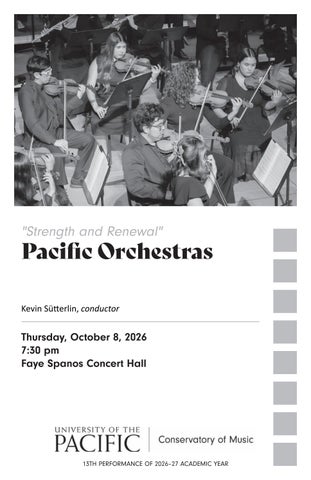
"Strength and Renewal"
Pacific Orchestras Kevin Sütterlin, conductor
Thursday, October 8, 2026 7:30 pm Faye Spanos Concert Hall
13TH PERFORMANCE OF 2026–27 ACADEMIC YEAR
OCTOBER 8, 2026, 7:30 PM Christopher Ducasse (b. 1993)
5ʹ
Andante Festivo (1938)
Jean Sibelius (1865–1957)
10ʹ
The Phoenix Rising (2008)
Stella Sung (b. 1959)
10ʹ
William Grant Still (1895–1978)
10ʹ
Sibelius
9ʹ
Fòs nou (Our strength) (2022) (California premiere)
Serenade for Orchestra (1957)
Finlandia, op. 26 (1899)
View digital programs at issuu.com/MusicAtPacific
PROGRAM NOTES Program notes by Kevin Sütterlin Ducasse: Fòs nou Christopher Ducasse, a highly accomplished musician and conductor from Port-au-Prince, Haiti, is currently the artistic director of Hypatia’s Voice and one of the conductors at the Ottawa Children’s Choir. He began his musical journey at the Holy Trinity Music School, studying voice, violin, and piano. In 2007, Ducasse joined the Philharmonic Orchestra of Holy Trinity, and in 2011, became the conductor of its main choir, Les Petits Chanteurs, for four years. He furthered his musical expertise through the BLUME HAITI Scholar program at Lawrence University in 2015 and pursued advanced education, obtaining a master’s degree in choral conducting from McGill University in 2023. He has collaborated with various choirs, showcasing his versatility and proficiency, and earned accolades, winning the WCDA Conducting Competition. Ducasse is also a talented composer and multi-instrumentalist with notable performances by renowned ensembles. His passion for photography complements his diverse range of interests. Christopher’s artistic endeavors have earned recognition and praise, and his commitment to musical excellence and the transformative power of music continue to drive his remarkable career. Commissioned by Kevin Sütterlin for the Fox Valley Symphony’s 2021–22 season, Fòs nou is a Haitian Creole title that translates to "our strength" in English. This composition is based on a Haitian rhythm and dance called "Yanvalou," which gets its name from its associated movements. It is one of the most important rhythms in Haitian folklore, and is sometimes linked to knowledge, patience, strength, and healing. It is usually played on three different congas named Manman (mother), Segon (second) and Kata, the latter being always played with sticks on the body of a conga. "I used one conga to play a combination of the Manman and Segon rhythm and two bongos with sticks for a variation of the Kata," Ducasse said. "The beat of the rhythm of 'Yanvalou' is a combination of triple-duple time (1-2-3 | 1, 2) in this composition with three quarter-notes forming the triple and two dotted quarter-notes for the duple. Haitian rhythms are mostly passed by oral tradition from mentors to apprentice drummers. I had to create a notation sheet for the conga with a classical notation that will express the sound and soul of the rhythm." Sibelius: Andante Festivo Originally scored for string quartet in 1922, Andante Festivo was later rescored for string orchestra and optional timpani in 1938. The piece was premiered on New Year’s Day in 1939 as part of a live worldwide broadcast for the New York
PROGRAM NOTES World Exhibition. Sibelius, often recognized as Finland’s greatest composer, conducted that premiere performance with the Finnish Radio Symphony Orchestra as a greeting to the world from Finland. The recording now serves as the only existing record of the composer interpreting his own work. Andante Festivo was clearly an important work to Sibelius, and it was in stark contrast to his larger form orchestral works that had dominated most of his career. The 1939 premiere was his last performance as a conductor, but the music stayed with him until the end. The piece was played at his funeral. Sung: The Phoenix Rising Stella Sung has won both national and international recognition as a composer. Her works have been performed at Carnegie Hall, Symphony Hall in Boston, and the Sydney Opera House, among many other venues. She utilizes digital and multimedia applications in her symphonic music, as well as compositions for dance, ballet, and film. She is the director of the Center for Research for Education, Arts and Technology and professor of music at the University of Central Florida. Sung writes: "The Phoenix Rising was commissioned by conductor Jonathan May and the Florida Young Artists Orchestra for the orchestra’s 10th anniversary season (2008). The composition reflects the tale of the mythical phoenix, which is considered a powerful symbol in many cultures throughout the world. The story tells of the phoenix which, when nearing its death, builds a funeral pyre for itself. From the ashes of the fire is then born the new phoenix that lives on for another 500 years in complete and total peacefulness, drinking only dewdrops for its sustenance. Compositionally, I later found that I had made a subconscious reference to a thematic phrase in the music from Richard Strauss’s Death and Transfiguration, a work that I have long admired. The Phoenix Rising is dedicated to my dear friend, Mr. Jonathan May (deceased). May the spirit of his love of music live on forever." Still: Serenade for Orchestra William Grant Still, who became known as "the Dean of African American composers," was born in Mississippi and raised by his mother and grandmother in Little Rock, Arkansas. He entered Wilberforce University intending to pursue medicine, but his growing commitment to music soon led him in another direction. He later studied at the Oberlin Conservatory and built an eclectic early career as a performer, arranger, and composer. In New York, he worked with blues pioneer W. C. Handy and bandleader Paul Whiteman and played oboe in Broadway pit orchestras. His compositional studies were equally wide-ranging, including work with George Whitefield Chadwick and
PROGRAM NOTES Edgard Varèse. These varied influences—European concert music, blues, jazz, popular song, and modernism—helped shape a musical language unmistakably his own. Still went on to a career distinguished by a remarkable series of firsts. His Afro-American Symphony became the first symphony by an African American composer performed by a major American orchestra; in 1936, he became the first African American to conduct a major American symphony orchestra when he led the Los Angeles Philharmonic; and his Troubled Island became the first opera by an African American composer presented by a major American opera company. Still composed his Serenade for Orchestra in 1957 on a commission from the orchestra of Great Falls High School in Montana. Though modest in scale, the work distills many of the qualities that make Still’s orchestral voice so distinctive. It opens with warm, gently chromatic harmonies and a broad, expressive melody in the lower strings, which gradually passes through the orchestra in intimate exchanges colored by touches of blues and American folk idioms. A more animated central passage briefly interrupts the prevailing calm before the opening material returns in new colors. Throughout, Still favors warmth and directness over grand gesture: supple melodic lines unfold over lush harmonies, while winds, brass, harp, percussion, and strings create subtle shifts of color. The result is music at once tender and quietly radiant—a compact work that reveals Still’s remarkable gift for melding concert tradition with a distinctly American musical voice. Sibelius: Finlandia By the end of the nineteenth century, Finland was still a Grand Duchy of the Russian Empire, and tensions were rising as the Russian government tightened its political and cultural control. Jean Sibelius became closely associated with Finland’s growing national consciousness, though his music rarely functions as simple political propaganda. Instead, works such as Finlandia gave musical expression to a broader sense of identity, resilience, and hope. The piece originated in 1899 as the final tableau of music Sibelius composed for a series of public celebrations supporting freedom of the Finnish press. Because of Russian censorship, the work was sometimes performed under deliberately vague titles, but its meaning was unmistakable to Finnish audiences. Sibelius revised the music the following year as an independent concert work, giving it the title Finlandia.
PROGRAM NOTES The score begins with dark, imposing brass chords and a sense of gathering tension. Turbulent music follows, driven by urgent rhythms and sharply contrasting orchestral colors, before the atmosphere gradually changes. Out of the conflict emerges the broad, hymn-like melody for which the work is best known: first heard quietly in the winds and then expanded with increasing warmth and nobility. Sibelius did not originally conceive this melody as a song, but it later became known as the "Finlandia Hymn" and acquired several texts, most famously one by Finnish poet V. A. Koskenniemi. What gives Finlandia its enduring power is the directness of its dramatic arc. Darkness gives way to struggle, and struggle to a hard-won sense of dignity and affirmation. In only a few minutes, Sibelius creates music that feels both deeply tied to Finland’s history and universal in its expression of perseverance, identity, and hope.
ARTIST BIOGRAPHY Kevin Sütterlin is associate professor of conducting and director of Pacific Orchestras at University of the Pacific. An internationally sought-after conductor and pedagogue, he is also a distinguished guest professor at Ocean University of China. Prior to his appointment at Pacific, Sütterlin was director of orchestral activities and opera at Concordia College. Under his leadership, the program grew into one of the Midwest’s premier destinations for 21st century orchestral training, winning two Emmy Awards and the prestigious American Prize. He is music director of the Fox Valley Symphony Orchestra, one of Wisconsin’s finest professional orchestras, and winner of the American Prize. He is music co-director of Sinfonietta Memphis and The Sinfonietta Academy for Historically Informed Performance Practice. Sütterlin serves as principal guest conductor of the Qingdao Concert Hall Orchestra. In November 2026, he returns to Shanghai Conservatory, and in December 2026, he will teach a conducting masterclass in Guangzhou, China. With a great love and passion for teaching, he directs the orchestral program at Lutheran Summer Music Academy and Festival. Regarded as one of the country’s leading conducting pedagogues, he is praised for his keen analytical eye and deep understanding of conducting technique and physique, paired with a kind and caring approach that has empowered over 150 conductors and conducting students across the globe.
PACIFIC ORCHESTRAS The Pacific Orchestras perform an inclusive range of contemporary and historically significant works. The ensemble provides performers with a variety of sizes and settings to explore an exciting range of repertoire. Pacific faculty, students, and guest artists perform with the ensemble as concerto and aria soloists and as guest conductors. Participation in the ensemble is open to all Pacific students by audition. Violins 1 Erick Sariles, concertmaster Alyssa Yen, concertmaster Carissa Lee, assistant concertmaster Doeun Lee Yaretzi Clarissa Rios Christopher Thant Aiden Yoon Violins 2 Alizon Lopez, principal Rafael Marinas, assistant principal Nina Cassandra Gonzales Aviva Hakanoglu* Kiersten Hogue Aidan O'Shea Julianna Ramirez Violas Tom Pham, principal Ángela Arroyo, assistant principal Marvin Aurelio Lindsey Liaw Ian Nguyen Cellos Hope Lee, principal Tyler Chang, assistant principal Vivian Chen
Double Basses Amaris Martinez Medina, principal Elijah Atchley, assistant principal Emiko Hernandez Madalyne Kommavong Flutes Riko Hirata Henrie Notley Ethan Williams Oboes Walker Austin Elizabeth Ledesma Ernesto Pena Clarinets Edmund Bascon Audrey Ewing Tommy Galvin Adrian Rodriguez Mandujano Bassoons Cash Davies Nadege Tenorio Jess Vreeland
Horns Ciera Alkhoury Drew Bellinger Jas Lopez Lily Walter Trumpets Jack Alorro Selvin Curin Arreguin Amalia Silva Trombones Bronson Burfield Radley Rutledge Matt Young Tuba Logan Campbell Timpani Robert McCarl Percussion Hunter Campbell Ryan Eads Casey Kim Pete Norman Rei Vindiola Piano/Celesta Angel Camacho-Ibarra *assisting musician
PACIFIC ORCHESTRAS Pacific Faculty Coaches Aviva Hakanoglu and Ann Miller, violin, viola Brady Anderson, cello Andrew Mell, double bass Brittany Trotter, flute Kyle Bruckmann, oboe Brooke Miller, clarinet Nicolasa Kuster, bassoon Sadie Glass, horn Alia Kuhnert, trumpet Bruce Chrisp, trombone Brian Kemble, tuba Jonathan Latta, percussion, timpani Shichao Zhang, piano Jonathan Latta, ensemble program director Inga Piterbarka, ensemble librarian
SUPPORT OUR STUDENTS AND PROGRAMS Every gift to the Conservatory from an alum, parent, or friend makes an impact on our students. Our students rely on your generosity to enable them to experience a superior education. To make a gift today, please contact the Assistant Dean for Development at 209.932.2978 or scan this QR code. You may also send a check payable to University of the Pacific: Conservatory of Music, University of the Pacific Attn: Assistant Dean for Development 3601 Pacific Avenue Stockton, CA 95211
Pacific.edu/Conservatory