PROGRAM NOTES
von Kampen: I Am Possibility
Written for the Lincoln (Nebraska) Boys Choir by Nebraskan composer David von Kampen, I Am Possibility is a musical reflection rooted in optimism. Von Kampen musically paints Nebraskan poet Becky Boesen’s text, with musical lines rising as they are “ . . . ascending towards the clouds” and a pervasive triplet figure in the piano throughout relentlessly reinforcing the great hope of possibility—what we might become.
Bernstein/Freed:
Take Care of This House
"Take Care of This House" comes from the 1976 musical 1600 Pennsylvania Avenue with music by Leonard Bernstein and book and lyrics by Alan Jay Lerner. The show was a historic flop, with only seven performances before closing. Despite the Broadway production’s abysmal reception, excerpts from the show have had a continued performance life. After Bernstein’s death, a concert version of the score was reworked and retitled A White House Cantata. While still living, Bernstein conducted Frederica von Stade as she sang "Take Care of this House" at the inauguration of Jimmy Carter. Sung from the perspective of First Lady Abigail Adams while her husband and members of the serving staff are within earshot, the words might be received as practical guidance for cleaning and home security . . . or a call to honorably serve the institution one has been entrusted to protect and care for.
Johnson/Carter:
Lift Every Voice and Sing
While James Weldon Johnson originally intended to write a text for an event to commemorate President Abraham Lincoln’s birthday at Stanton High School in Jacksonville, Florida, Johnson was moved to write a text that spoke to the ongoing fight for civil liberties in America. 500 students recited the text in a school program in 1900, and J.W. Johnson’s brother, J. Rosamond Johnson, later set the text to music. In the decades to follow, Lift Every Voice and Sing spread across the south and the rest of the country, soon being dubbed America’s “Black National Anthem.” Composer and conductor Roland Carter’s arrangement of Lift Every Voice and Sing provides great expressive variety within a short time frame, showcasing quick piano flourishes contrasted with moments of rich unaccompanied chorale-like textures before an epic “Amen” finish.
Moore: We Shall Walk Through the Valley in Peace
America’s most noteworthy contribution to the history of choral musicmaking in the world is in our arrangements of concert spirituals. Songs of unattributable origin that speak to hope amidst oppression and profound struggle, no choral concert reflecting on American music would be complete without inclusion of a concert spiritual. Dubbed “The Dean of African-American Women Composers,” much of Undine Smith Moore’s compositional output is virtuosic and complex. Moore’s setting of We Shall Walk Through the Valley is immediately impactful via its straightforward simplicity, providing opportunity for rich detail of expression.
Guthrie/Gallina: This Land Is Your Land
Irving Berlin’s God Bless America was written during World War I but revised, recorded and made popular in 1938. Tired of hearing it frequently on the radio and critical of the overly sunny character of the lyrics amidst the crushing hardships of the Great Depression, Woody Guthrie wrote This Land Is Your Land as a critical response (Guthrie originally quipped the title of his song was God Blessed America for Me.). While the verses we associate with This Land Is Your Land today primarily speak to the natural beauty of our country, Guthrie did originally record two more verses which were more critical, before preparing another version of the song in 1944 which omitted these verses to be supportive of the US’s efforts in World War II.
Garrett: My Heart Be Brave
My Heart Be Brave is a setting of a poem by James Weldon Johnson, the same author of Lift Every Voice and Sing. Margues L.A. Garrett’s musical treatment is reflective of a text that journeys from self-doubt to a call-toaction, affirming the good: “There is power in making for the right.”
Wilberg:
My Shepherd Will Supply My Need
Southern Harmony is one of the most influential collections of shape note hymn tunes in 19th Century America, with multiple editions and reprintings from 1835 to 1867, contributing to the proliferation of harmonized congregational singing across the United States. While some of the over 300 songs within Southern Harmony are attributable to particular composers, others are anonymous. A paraphrase of the 23rd Psalm, "My Shepherd Will Supply My Need" and its hymn tune RESIGNATION communicate a sense of peace and comfort, tinged with a hint of melancholy. Mack
Wilberg’s arrangement is structured as a giant mesa di voce, starting simply, crescendoing to a rich textural and dynamic peak before tapering and finishing gently.
Pederson: Beat! Drums!/ All of Me
"Beat! Drums!" and "All of Me" are both movements from Minnesotan composer Kyle Pederson’s multimovement choral work A Vision Unfolding. While originally titled . . . And Justice For All as an elongated reflection on the last words of the Pledge of Allegiance, Pederson changed the name to reflect the current state of “The Great Experiment” – how the vision of America’s democracy continues to unfold. Beat! Drums! is a setting of the Walt Whitman poem, written just months after the start of the American Civil War. Pederson’s rhythmic and harmonically disjunct setting musically communicates the omnipresent relentlessness of war presented in the text. All of Me is a text written by the composer – a reflection on how we might see one another more fully, more completely, if we are able to experience and acknowledge the complete complexity of our neighbors.
At this quarter-millennium of American independence, may our music-making provide a time for reflection to consider this continued “Vision Unfolding,” and ponder what varied carols we might sing in the coming 250 years.
Billings: Chester “Let Tyrants Shake Their Iron Rod”
Let tyrants shake their iron rod, And slav’ry clank her galling chains, We fear them not, we trust in God, New England’s God forever reigns. Howe and Burgoyne and Clinton too, With Prescot and Cornwallis join’d, Together plot our overthrow, In one infernal league combin’d. When God inspir’d us for the fight, Their ranks were broke, their lines were forc’d, Their ships were shatter’d in our sight, Or swiftly driven from our coast. The foe comes on with haughty stride; Our troops advance with martial noise, Their vet’rans flee before our youth, And gen’rals yield to beardless boys. What grateful off’ring shall we bring? What shall we render to the Lord? Loud Halleluiahs let us sing, And praise His name on ev’ry chord.
—William Billings
Christiansen: Prayers of Steel
Lay me on an anvil, O God. Beat me and hammer me into a crowbar. Let me pry loose old walls. Let me lift and loosen old foundations. Lay me on an anvil, O God. Beat me and hammer me into a steel spike. Drive me into the girders that hold a skyscraper together. Take red-hot rivets and fasten me into the central girders. Let me be the great nail holding a skyscraper through blue nights into white stars.
—Carl Sandburg
von Kampen: I Am Possibility
I am possibility
Taken under wing
Growing roots
I raise my voice
Lifted up, I sing.
I am hope unlimited
Purple morning sky
Youthful sparrow
Learns to soar
Gliding now, I fly.
I am faithful promise
Winter into spring
Tended seeds
Yield summer gifts
Planted here, I sing.
Ascending toward the clouds, Ascending toward the clouds, Ascending toward the clouds, Then back to the ground.
I am possibility I am faithful sound
A joyful noise
Forevermore
Echoing abound.
—Becky Boesen
Bernstein: Take Care of This House
Take care of this house
Keep it from harm
If bandits break in
Sound the alarm
Care for this house
Shine it by hand
And keep it so clean
The glow can be seen
All over the land
Be careful at night
Check all the doors
If someone makes off with a dream
The dream will be yours
Take care of this house
Be always on call
For this house
Is the hope of us all
Care for this house
Shine it by hand
And keep it so clean
The glow can be seen
All over the land
Be careful at night
Check all the doors
If someone makes off with a dream
The dream will be yours
Take care of this house
Be always on call
Care for this house
It's the hope of us all
—Alan Jay Lerner
Johnson/Carter: Lift Every Voice and Sing
Lift every voice and sing, Till earth and heaven ring, Ring with the harmonies of liberty;
Let our rejoicing rise
High as the list’ning skies, Let it resound loud as the rolling sea.
Sing a song full of the faith that the dark past has taught us, Sing a song full of the hope that the present has brought us; Facing the rising sun of our new day begun, Let us march on till victory is won.
Stony the road we trod,
Bitter the chast’ning rod, Felt in the days when hope unborn had died;
Yet with a steady beat, Have not our weary feet
Come to the place for which our fathers sighed?
We have come over a way that with tears has been watered. We have come, treading our path through the blood of the slaughtered, Out from the gloomy past, Till now we stand at last Where the white gleam of our bright star is cast.
God of our weary years, God of our silent tears, Thou who hast brought us thus far on the way; Thou who hast by Thy might, Led us into the light, Keep us forever in the path, we pray.
Lest our feet stray from the places, our God, where we met Thee, Lest our hearts, drunk with the wine of the world, we forget Thee; Shadowed beneath Thy hand, May we forever stand, True to our God, True to our native land.
—James Weldon Johnson
Moore: We Shall Walk Through the Valley in Peace
We shall walk through the valley in peace; we shall walk through the valley in peace. If Jesus himself shall be our leader, we shall walk through the valley in peace.
There will be no trials there; there will be no trials there. If Jesus himself shall be our leader, we shall walk through the valley in peace.
—Negro Spiritual
Guthrie/Gallina: This Land Is Your Land
This land is your land, this land is my land From California to the New York island, From the redwood forest to the Gulf Stream waters; This land was made for you and me. As I was walking that ribbon of highway I saw above me that endless skyway; I saw below me that golden valley; This land was made for you and me. I've roamed and rambled and I followed my footsteps To the sparkling sands of her diamond deserts; And all around me a voice was sounding; This land was made for you and me. When the sun came shining, and I was strolling, And the wheat fields waving and the dust clouds rolling, As the fog was lifting a voice was chanting: This land was made for you and me.
—Woody Guthrie
Garrett: My Heart Be Brave
My heart be brave, and do not falter so, Nor utter more that deep, despairing wail. Thy way is very dark and drear I know, But do not let thy strength and courage fail; For certain as the raven-winged night
Is followed by the bright and blushing morn, Thy coming morrow will be clear and bright; ’Tis darkest when the night is furthest worn. Look up, and out, beyond, surrounding clouds, And do not in thine own gross darkness grope, Rise up, and casting off thy hind’ring shrouds, Cling thou to this, and ever inspiring hope: Tho’ thick the battle and tho’ fierce the fight, There is [a] power [in] making for the right.
—James Weldon Johnson
Wilberg: My Shepherd Will Supply My Need
My Shepherd will supply my need; Jehovah is his name.
In pastures fresh he makes me feed Beside the living stream. He brings my wand’ring spirit back When I forsake his ways And leads me for his mercy’s sake In paths of truth and grace. When I walk through the shades of death, Thy presence is my stay; One word of thy supporting breath Drives all my fears away. Thy hand, in sight of all my foes, Doth still my table spread. My cup with blessings overflows; Thine oil anoints my head.
The sure provisions of my God Attend me all my days.
O may thy house be mine abode
And all my work be praise! There would I find a settled rest While others go and come— No more a stranger nor a guest, But like a child at home.
—Isaac Waats, paraphrase of Psalm 23
Pederson: Beat! Drums!
Beat! beat! drums!—blow! bugles! blow!
Through the windows—through doors—burst like a ruthless force, Into the solemn church, and scatter the congregation, Into the school where the scholar is studying, Leave not the bridegroom quiet—no happiness must he have now with his bride, Nor the peaceful farmer any peace, ploughing his field or gathering his grain, So fierce you whirr and pound you drums—so shrill you bugles blow.
Beat! beat! drums!—blow! bugles! blow!
Over the traffic of cities—over the rumble of wheels in the streets; Are beds prepared for sleepers at night in the houses? no sleepers must sleep in those beds, No bargainers’ bargains by day—no brokers or speculators—would they continue? Would the talkers be talking? would the singer attempt to sing? Would the lawyer rise in the court to state his case before the judge? Then rattle quicker, heavier drums—you bugles wilder blow.
Beat! beat! drums!—blow! bugles! blow!
Make no parley—stop for no expostulation, Mind not the timid—mind not the weeper or prayer, Mind not the old man beseeching the young man, Let not the child’s voice be heard, nor the mother’s entreaties, Make even the trestles to shake the dead where they lie awaiting the hearses, So strong you thump O terrible drums—so loud you bugles blow.
—Walt Whitman
Pederson: All of Me
Look at my skin.
Do you see only skin, or the soul within... do you see what’s true? Look who I love.
Do you view me as less, like none of the rest of me matters to you?
Turn off the talk on the air, and the voices who seem to just care about dividing and hiding us where you won’t see.
Look at my faith.
Do you see my creed, and choose to believe that’s all of me?
Look at my vote.
On that alone are you likely to show contempt for me?
You don’t have to see.
But if you take the time to look at me, you’ll see the same fears and a good heart, and the same tears that tear you apart.
See the same love, the same hope, the same need, the same joy.
So look at my skin.
See the skin and the soul within. See what’s true. Look who I love.
And see my faith and my vote, but not those alone, seek to know me, too.
Turn up the voices of truth. Learn to let mercy through. Love will guide us to a world where we see.
All of me.
Turn and see. Will you see? All of me.
—Kyle Pederson
Brett D. Epperson is assistant professor of music–choral conducting at University of the Pacific where he teaches courses in conducting, music education, and functional voice, in addition to guiding Pacific’s two concert choral ensembles, University Chorus and Pacific Singers.
Previously, Epperson was assistant professor of music and director of choral activities at Hastings College as well as the Chancel Choir director and director of the Langenberg Music Series at First Presbyterian Church of Hastings, Nebraska. As of January, Epperson is artistic director-designate of the Sacramento Master Singers. He will begin his role as artistic director of the ensemble in July 2026.
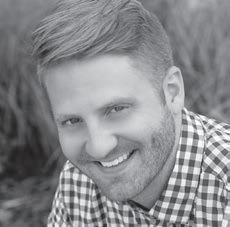
Prior to academia, Epperson was a public school music educator and church musician, leading large high school and sacred choral programs in the Midwest for nearly a decade. He composes new music for choirs and performs professionally as a vocalist, including with Grammy-nominated choral ensembles such as the South Dakota Chorale and Seraphic Fire (Miami). Choral music has led him to traveling, singing, and conducting throughout Europe, the Caribbean, Kenya, Mexico, and Japan. Outside of teaching and music-making, Epperson enjoys cooking, reading, biking, and connecting with friends and family.
Epperson earned a Bachelor of Arts in music from Luther College (Decorah, IA), a Master of Music in choral conducting from Michigan State University, and the Doctor of Philosophy degree in music education–choral conducting from Florida State University.
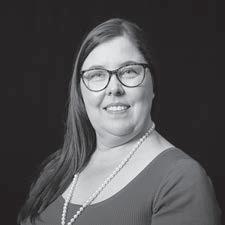
Monica Adams has worked at University of the Pacific as a collaborative pianist and professor of practice since 1995. From 2005 to 2024 Adams taught the voice class for music therapy and music education majors. In 2024–25, she conducted the University Chorus. Currently, she is a collaborative pianist for voice majors and the Pacific Choirs.
Adams holds a Bachelor of Music in music performance, voice, from University of the Pacific, where she studied piano with Frank Wiens, voice with William Whitesides, George Buckbee and John DeHaan, and conducting with William Dehning and Robert Halseth.
Adams has performed as a pianist with the Stockton Symphony Orchestra and sang the roles of Eliza Doolittle in My Fair Lady, Cherubino in Le Nozze di Figaro and Old Maid in Old Maid and the Thief. She has served as musical director and conductor at Pacific for Pajama Game (Fallon House), Paint Your Wagon (Fallon House), You're a Good Man Charlie Brown, Apple Tree, Falsettoland, Assassins and 1940's Radio Hour. She has also music-directed Oliver, La Cage aux Folles, Babes in Arms, Footloose (conducted, too), Beauty and the Beast, The Full Monty and Godspell for various theaters.
In 2004 Adams participated in the summer SongFest program, which included coaching with Martin Katz, Graham Johnson, D'Anna Fortunato, John Hall, Judith Kellock and John Harbison, as well as performing in multiple recitals.
University Chorus
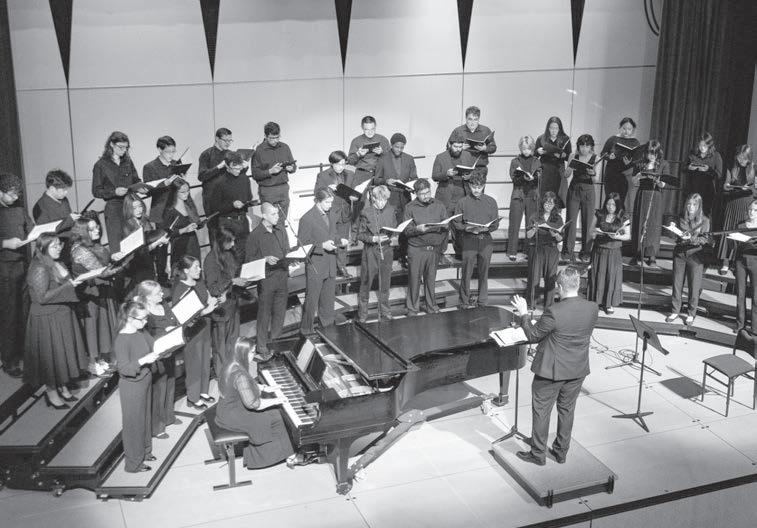
University Chorus is a large, mixed chorus that performs both a cappella and choral- orchestral works in a wide variety of genres, often collaborating with other ensembles at Pacific.
Sopranos
Bella Andino
Rachael Cross
Kiersten Hogue
Anna Kazimi
Elizabeth Ledesma
Siry Smith
Courtney Wieland
Altos
Evelyn Aburto
Jade Anderson
Angela Arroyo
Yaretzi Clarissa Castro Rios
Maggie Chen
Mackenzie Deems
Nathalie Garibay
Zahara Herd
Emiko Hernandez
Rain Jia
Shengrui Li
Arianna Pereyra
Kaitlyn Tamondong
Snowy Tan
Nadege Tenorio
Sylvia Valverde
Xi Zhang
Tenors
Marcelo Contreras
Davis Robinson
Kyle Saelee
Snowden Snyder
Ves Turk
Matthew Young
Basses
Mitchell Amos
Walker Austin
Edwin Contreras
Jake Frye
Tommy Galvin
Michael Gibson
Connor Hsu
Severyn Kurach
Celestino Mederos
Michael Shove
Jason Wu
Pacific Singers
Pacific Singers is a select, mixed-voice chamber choir who collaborates with the University Chorus for two choral concerts each semester and perform at major university events and ceremonies. They also work with the University Symphony Orchestra and the Stockton Symphony to perform major choral and orchestral pieces.
Sopranos
Magdalena Bowen
Rose Krueger
Amara Lin
Margaret Lomova
Katie Pelletier
Olivhea Ross
Shannon Shepherd
Altos
Elleanor Cooper
Jennifer Lopez
Zoie Macapanpan
Elizabeth Neumeyer
Caroline Poso
Sara Wolfe
Tenors
Miranda Duarte
Danny Guerrero
Kwaeku Harris
Leo Hogan
Ian Orejana
Phu Phan
Basses
Daniel Campbell
Michael Gibson
Jordan Reece Guitang
Landon Horstman
Ernesto Pena
Pacific
Voice and Choral Faculty
Daniel Ebbers, program director
Brett Epperson
Eric Dudley
James Haffner
Heidi Moss Erickson
Jonathan Latta, ensembles program director
Breanna Daley, ensembles librarian
Every gift to the Conservatory from an alum, parent, or friend makes an impact on our students. Our students rely on your generosity to enable them to experience a superior education.
Please contact the Assistant Dean for Development at 209.932.2978 to make a gift today. You may also send a check payable to University of the Pacific: Conservatory of Music, University of the Pacific Attn: Assistant Dean for Development 3601 Pacific Avenue Stockton, CA 95211
To view our upcoming events, scan the QR code or visit Pacific.edu/MusicEvents.