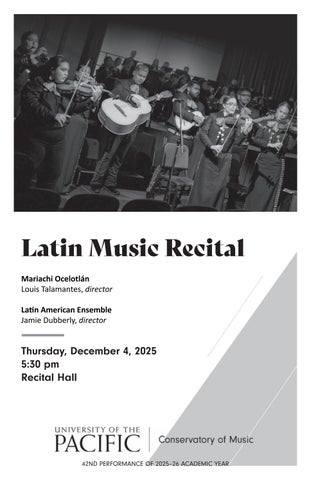
Latin Music Recital
Mariachi Ocelotlán
Louis Talamantes, director
Latin American Ensemble
Jamie Dubberly, director
Thursday, December 4, 2025
5:30 pm
Recital Hall



El Zopilote Mojado
DECEMBER 4, 2025, 5:30 PM
Mariachi Ocelotlán
Zenon H. Flores
Se Te Olvida
Jack Alorro, voice
Ella Volvio
Viva Veracruz
Damian Paniagua, voice
Alvaro Carrillo Alarcon (1919–1969)
Jose Alfredo Jimenez (1926–1973)
Picadillo
Jose “Pepe” Martinez (1941–2016)
Damian Paniagua, Emmanuel Tapia, and Irina Hernandez, voice
Lágrimas Negras
Sabor a Mi
Latin American Ensemble
Tito Puente (1923–2000)
Miguel Matamoros (1894–1971)
Álvaro Carillo (1919–1969)
El Cuarto de Tula
Oye Cómo Va
Sergio González Siaba (1915–1989) Puente
Program notes by
Puente: Picadillo
PROGRAM NOTES
Sonia Gaind-Krishnan and James Dubberly
Picadillo is a classic Latin jazz tune composed by Tito Puente, one of the pioneers of the big band mambo sound coming out of New York City in the 1940s. It is a driving mambo, with layers of horn lines and solos over a modal harmonic foundation. It represents the multiple cultural identities of Puente, which include his Puerto Rican heritage, his Cuban musical influences, and lifelong residence in Spanish Harlem (NYC).
Matamoros: Lágrimas Negras
A classic bolero-song by Cuban composer Miguel Matamoros, this is one of the most widely known compositions within the genre. It has been covered by most of the luminaries across genres in the Latin music world. Our arrangement begins as a danzón, and finishes as an upbeat song, with a coro alternating with instrumental solos.
Carillo: Sabor a Mi
Among the most famous compositions by Mexican composer and singer Álvaro Carillo, it is also one of the most well-known songs under the umbrella of Latin music. This song has been interpreted in multiple styles but is most recognizable as a bolero. Here, our arrangement begins as a bolero before moving into a cha-cha-cha groove.
González Siaba: El Cuarto de Tula
This song achieved global popularity through the release of Buena Vista Social Club, a 1997 collaboration between guitarist Ry Cooder and a range of exceptional Cuban musicians, including Ibrahim Ferrer, Rubén González, and Eliades Ochoa. The song was most likely composed around 1930 by Sergio González Siaba. It has become one of the standards played by salsa bands all over the world. Our arrangement features violins on the verses, and soloists alternating with the repeated coro.
Puente: Oye Cómo Va
A song that first came to the attention of the masses through Carlos Santana’s arrangement on the album Abraxas (1971), it was originally composed by Tito Puente as a cha-cha-cha. Santana kept the most essential elements of Puente’s original including the horn mónas (played on guitar), the iconic coro, the cha-cha groove, and the two chord modal vamp, while infusing it with a blues and rock feel. Here, we pay tribute to the original big band mambo version.
Luis “Tito” Talamantes is a lecturer and director of University of the Pacific’s mariachi ensemble. He has been a mariachi educator for Stockton Unified School District for nearly 10 years. His ensembles have been invited to The White House (2016), performed at the Kennedy Center for the Performing Arts (2018), and have placed in many national competitions. In 2017, a video Talamantes released of his high school mariachi ensemble garnered the attention of Gerald Slavet, CEO of NPR’s From the Top.
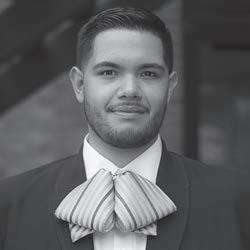
Prior to teaching, Talamantes was a professional studio musician performing and recording with El Regimen Sinaloense under the Sinacal Label where some of his tracks made placements on to FX Network’s The Bridge. While a member of El Regimen Sinaloense, he toured with top Regional Mexicano acts such as Banda MS and Chuy Lizarraga. It was while working as a studio musician in Montebello, California, that he arranged music for Alfredo Olivas’s sold out Dos Mundos una Historia tour.
In an effort to share, promote and make accessible culturally-responsive educational material, Talamantes created titosmusic.com where he shares all of his arrangements and transcriptions for music educators at no cost. Since the launch, his arrangements have been played by numerous ensembles in the Midwest, Colorado, and even Cornell University’s Big Red Marching Band.
James Dubberly is assistant professor of practice at University of the Pacific. He holds a bachelor's degree in music from the University of Georgia, and a master's degree in music from The Hartt School of Music (University of Hartford), where he also participated in a doctoral program. He is also on the faculty of California State University (Stanislaus).
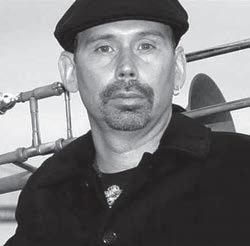
Dubberly is a multi talented trombonist, composer, and bandleader originally from Georgia. He has been a part of the burgeoning Bay Area Latin and jazz scenes since he arrived in 2003. He has been a member of such prominent ensembles as Avance, Pacific Mambo Orchestra, Realistic Orchestra, Jazz Mafia Symphony, Montuno Swing, Brian Andres' Afro Cuban Jazz Cartel, and Orquesta Dharma (leader). He also works frequently with noted Bay Area bands La Fuerza Gigante, Mazacote (Louie Romero) and others.
Dubberly has performed with local Bay Area and Central Valley orchestras such as the Townsend Opera Orchestra and the Oakland Opera Orchestra as well as with many internationally known acts such as The Manhattans, Joan Rivers, Bloodstone, and Gene Chandler. Additionally he has shared the stage with jazz artists Bobby Shew, Ernie Watts, Steve Davis, Arturo O'farrill, Kenny Rampton, Doug Beavers, Alan Ferber, Marc Gross, Jimmy Greene, Paul Contos, and Mic Gillett. He has also performed with bands backing top salsa music names including Frankie Vazquez, Tony Vega, Eddie Santiago, Willy Torres, Marco Bermudez, Tito Rojas, Willie Gonzales and Cali Aleman.
Dubberly is a founder of Orquesta Dharma, a Grammy Award-winning Latin jazz and salsa ensemble based in the San Francisco Bay Area. They have released critically acclaimed albums such as Road Warrior (2011) and La Clave del Gumbo (2014).
ENSEMBLES
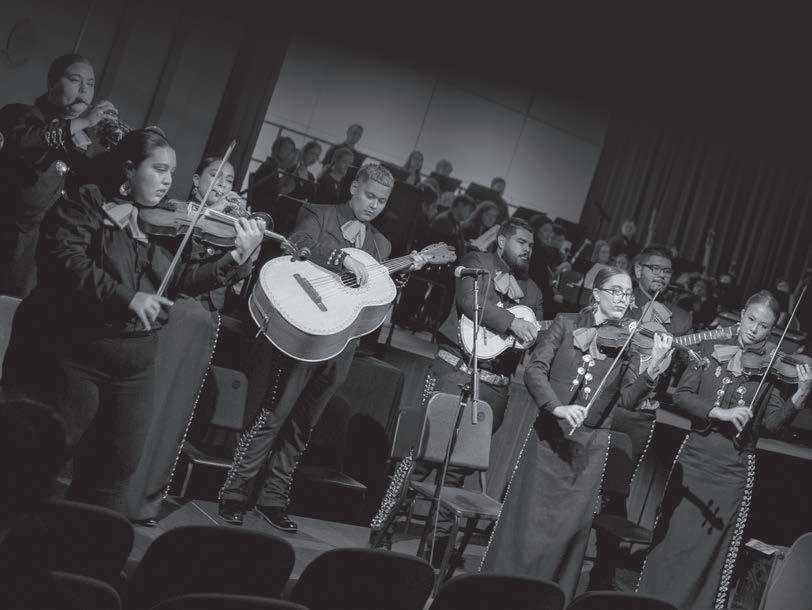
Mariachi Ocelotlán
The ensemble performs traditional music of the mariachi as it developed in post revolutionary urban Mexico. Genres include the: Són Jalisciense, canción ranchera, corrido, huapango, bolero, polka, joropo, pasodoble, vals Mexicano, and some contemporary Mariachi song-styles. It is open to all Pacific students but instrumental experience on any of the traditional mariachi instruments is required.
Violins
Yartetzi Castro Rios
Mia Gonzalez*
Irina Hernandez
Isabelle Knittle
Alizon Lopez
Aliyah Martinez Medina*
Julianna Ramirez
Emmanuel Tapia*
Trumpets
Jack Aloro
Edmund Bascon
Jayden Laumeister
Alejandro Villalobos
Guitarron
Amaris Martinez Medina*
Vihuela
Celestino Mederos Padilla
Guitar
Juan “Danny” Guerrero
Damian Paniagua*
*San Joaquin Delta College students
Latin American Ensemble
This ensemble is the performance arm of the upper division music history course, "Musics of Latin America” (MHIS193/293), co-taught by Professor Sonia Gaind-Krishnan and Professor James Dubberly at University of the Pacific. The course examines the histories and global impact of music genres from across Latin America and the Caribbean. We study a range of music repertoires with a focus on Cuban and Nuyorican dance music forms of the 20th century.
Violins
Isabelle Knittle
Jamie Lue
Bass
William Giancaterino
Bassoon
Justin Silva
Trumpet
Kamron Qasimi
Piano
James Dubberly*
Percussion
Danielle Densmore
Sonia Gaind-Krishnan*
Irina Hernandez
Vocals
Sonia Gaind-Krishnan*
Irina Hernandez
*faculty member
Every gift to the Conservatory from an alum, parent, or friend makes an impact on our students. Our students rely on your generosity to enable them to experience a superior education.
Please contact the Assistant Dean for Development at 209.932.2978 to make a gift today. You may also send a check payable to University of the Pacific: Conservatory of Music, University of the Pacific Attn: Assistant Dean for Development 3601 Pacific Avenue Stockton, CA 95211




To view our upcoming events, scan the QR code or visit Pacific.edu/MusicEvents.