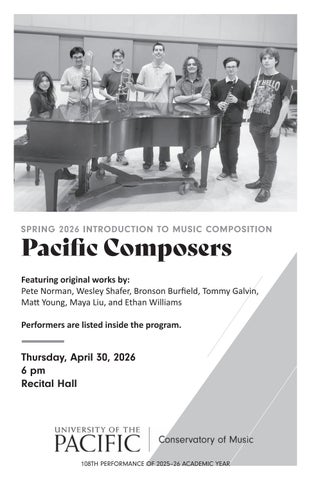
Introduction to Music Composition Recital, Spring 2026
Mission Bay
Pete Norman, marimba
ōʻō: Concept Sketch
Ethan Williams, flute
Tommy Galvin, clarinet
Peter Norman and Daegan Luster, marimbas
Rei Vindiola, piano
Wesley Shafer, double bass
Pete Norman, glockenspiel
Maya Liu, harpsichord
Raffaella Wong, piano
Amalia Silva, trumpet
Lily Walter, horn
Bronson Burfield, tenor trombone
Matthew Young, bass trombone
Pete Norman (b. 2005)
Bronson Burfield (b. 2005)
Brass Quartet No. 1
Wesley Shafer (b. 2006) He mele o Kauai
Maya Liu (b. 2003)
Scenes at Death Valley 3′
2 Minutes 46 Seconds
Tommy Galvin, clarinet
Maya Liu, piano
Tommy Galvin (b. 2007)
Matt Young (b. 2006)
William Giancaterino and Bronson Burfield, trombones
Matt Young, bass trombone
Seth Morris, tuba
Geometric Entanglement (Short Ver.)
Ethan Williams, flute
Tommy Galvin, clarinet
Jade Anderson, piano
Ethan Williams (b. 2007)
PROGRAM NOTES
Burfield: Brass Quartet No. 1
Bronson Burfield is a third-year music education major studying bass trombone with Professor Bruce Chrisp at University of the Pacific. He looks forward to teaching music after graduating from Pacific.
Engaging in Introduction to Music Composition, a faster-paced course that requires quick turnaround with numerous assignments, was challenging. Now I recognize how enjoyable and extremely rewarding the process was as I increased my confidence in composition and creating in general. This brass quartet is a product of my desire to create a short and digestible piece with idiomatic writing which would be simple to perform and enjoyable to play among friends.
— Bronson Burfield
Galvin: Time’s Flow
Tommy Galvin is currently a second-year music education major at University of the Pacific, studying clarinet with Dr. Patricia Shands. He is always looking for opportunities to broaden his horizons and will take any chance to learn something new. He enjoys finding new ways to think about and approach the music he plays and creates.
When writing, I tend to make the mistake of trying to create a finished product as soon as possible. With Time’s Flow, I made an effort to take a step back and allow it to unfold over time. The title is reminiscent of the fact that while time is always moving at the same speed for us, it doesn’t always feel like it. The piece goes between faster and slower tempos, with the ebb and flow of the river of time.
— Tommy Galvin
Young: 2 Minutes 46 Seconds
Matthew Young is a second-year music performance major at University of the Pacific where he studies bass trombone under Professor Bruce Chrisp. He regularly performs with large ensembles, including the Pacific Orchestras, the Pacific Wind Bands, and the Pacific Jazz Ensemble; as well as with brass chamber ensembles, including Pacific’s low brass quartet, the Burning Brass Quartet, the BBQ Brass Quartet; and in a duo with a college tenor trombone player. His public appearances also include the recital for the National Association of Schools of Music (2025), Conservatory Honors Recital (2025), the Conservatory Concerto Competition and the Southeast Trombone
PROGRAM NOTES
Symposium’s Orchestral Excerpts competition. Young also performs frequently with Pacific’s Alphorn Ensemble under Professor Sadie Glass, most recently at the Southwest Horn Workshop at Utah Valley University. Young took Introduction to Music Composition to broaden his skills and find another way to expand his musical mind.
2 Minutes and 46 Seconds is the second project I wrote for my Introduction to Composition class. It brings the sensation of an extreme time crunch to life; notice how the title matches the length of this piece—that is no accident. The title of the piece reflects the time allotted to give you the direct experience of what goes through one’s mind during a time crunch. Each movement tells the story of how the perception of time changes as it runs out. One way this story is told is through the progressive degradation from tonal order to the eventual atonal mess at the end. The atonal mess in the third movement of the piece is so frantic that, in the last two measures of the piece, the musicians do whatever they desire, with one person still sustaining a sense of time within the chaos. Another way this story is told is through the direct tempo changes in each movement. Each movement is faster than the last, making it feel more frantic as the time runs out. This pattern is broken in the third movement, telling a story of how the illusion of more time is given near the end of the time crunch, and then the scramble begins before you know it, as the realization that time is running out comes.
— Matthew Young
Liu: Scenes at Death Valley
Maya Liu is a pianist, composer, and music educator dedicated to raising the next generation of musicians. At University of the Pacific, she is currently pursuing a degree in music performance with a concentration in piano performance. She has collaborated with orchestras, choirs, wind ensembles, bands, and chamber groups at University of the Pacific, Georgia State University, Glory Church of Jesus Christ, and Atlanta Promise Church. As an educator, she mentors students in music theory and analysis and in effective learning strategies. Her versatile musical style includes classical and gospel style improvisation. With seven years of teaching experience, Liu is committed to inspiring young musicians.
This imitative piece was inspired by my trip to Death Valley, specifically during its coldest winter month of the year, December. Because the scenery was so breathtakingly beautiful, I wanted to give a similar experience to listeners and convey the overwhelming beauty of nature. I was awestruck by the never-ending landscape, filled with endless mountains and ridges
PROGRAM NOTES
that seemed to imitate on top of each other, against the cold sparkling sun, with its rays bouncing off the salt crystals on the ground. The glockenspiel represents the crisp sparkling atmosphere created by the Sun. The harpsichord represents the dry weather and brown landscape seen up close, and the piano represents the blue-colored flowing mountains and valleys seen from afar.
— Maya Liu
Williams: Geometric Entanglement (Short Ver.)
Ethan Williams is a composer and classical flutist based in Stockton. He is currently pursuing a Bachelor of Music in music performance at University of the Pacific, where he studies flute under Dr. Brittany Trotter. At Pacific, he serves as co-principal flute in the Pacific Wind Bands and the Pacific Orchestras. He has also performed with the Pacific Opera Theatre’s pit orchestra and the Stockton Concert Band.
An active performer, Williams frequently presents solo and chamber repertoire. He collaborates regularly with pianist Patricia Grimm, performs with the Pacific Wind Quintet, and is a member of a flute duo/trio alongside flutists Riko Hirata and Jasmine Valentine.
As a composer, Ethan has been writing music since 2018 gaining recognition through multiple online composition competitions. His recent works include kenopsia for solo flute (2026).
Geometric Entanglement began as an exercise in writing music inspired by visual artwork. I took inspiration from a geometric pendant that my girlfriend gifted me from her trip to Japan in the summer of 2025. The necklace is constructed of a silver triangle and square strung across a chain. The work assigns each instrument of the flute clarinet and piano trio to a different part of the necklace, and the music brings each shape to life in the form of a love story between the triangle and square. The narrative of each shape follows a separate sonata form which joins together in the B section, with a significant amount of harmonic, melodic, and formal decisions being derived from appearance of the shapes themselves.
— Ethan Williams
Every gift to the Conservatory from an alum, parent, or friend makes an impact on our students. Our students rely on your generosity to enable them to experience a superior education.
Please contact the Assistant Dean for Development at 209.932.2978 to make a gift today. You may also send a check payable to University of the Pacific: Conservatory of Music, University of the Pacific Attn: Assistant Dean for Development 3601 Pacific Avenue Stockton, CA 95211
To view our upcoming events, scan the QR code or visit Pacific.edu/MusicEvents.