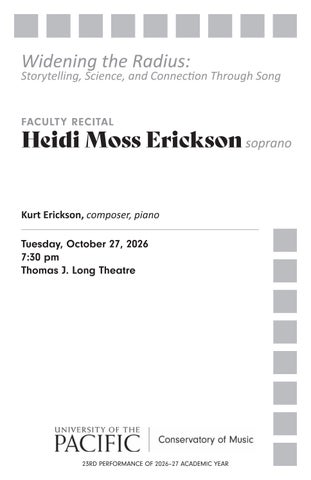
Widening the Radius:
Storytelling, Science, and Connection Through Song
FACULTY RECITAL
Heidi Moss Erickson soprano Kurt Erickson, composer, piano Tuesday, October 27, 2026 7:30 pm Thomas J. Long Theatre
23RD PERFORMANCE OF 2026–27 ACADEMIC YEAR
OCTOBER 27, 2026, 7:30 PM "What is most personal is most universal.” —Carl Rogers, psychologist Two selected songs from a moment in time Song of Regret Split My Heart
Kurt Erickson (b. 1970)
9′
Erickson
6′
Erickson
8′
Erickson
10′
Selections from Ich Und Du Ich Und Du Mondnacht
Selections from Here, Bullet Here, Bullet Curfew from
Selections from Each Moment Radiant The Petals Unfurling (After the Explosion) Ca' the yowes
Pause
OCTOBER 27, 2026, 7:30 PM Two songs Die Nacht An die Nacht
Richard Strauss (1864–1949)
7′
Giuseppe Verdi (1813–1901) André Previn (1929–2019)
14′
Two arias about face Addio del Passato from La Traviata I Want Magic from Streetcar Named Desire
View digital programs at issuu.com/MusicAtPacific
PROGRAM NOTES Program notes by Heidi Moss Erickson Before there was language, there was song. Members of our species— and even Neanderthals before us— used their voices to express emotion, connect with one another, and shape sounds into what would eventually become music and speech. We make music to tell stories—to give sound to experiences that words alone cannot hold. And when those stories reach another person, something remarkable happens: they become part of that person’s story, shaped by their own memories, losses, joys, and loves. “Widening the Radius” grew from our desire to return to the essential “why” of music-making. We love the artistry and tradition of the classical song recital, but we found ourselves craving a more immediate connection—with the music, with each other, and with the audience. We wanted to widen the frame: to create something more direct and open, where our own music, words, stories, and ideas could live alongside tradition. This program is deeply personal, weaving together stories and connections whose meaning and impact we did not always recognize as they were unfolding. It asks us to share some of the more vulnerable parts of our lives alongside the joyful ones. Over time, those experiences have changed the way we understand both our art and ourselves. For us, returning to the “why” has transformed the way we make music. It has enriched our lives as artists and reminded us that music is not simply something we perform—it is one of the ways we connect. Whether we are wandering through our own music and stories or inhabiting the work of someone else, returning to these essential elements brings greater meaning to what we do. It has not only made us better musicians; it has made us better humans. Tonight, we invite you into that widening circle. Erickson: Song of Regret “Song of Regret” is the piece that introduced me to Kurt Erickson. Written for CMASH, a new music consortium of which I was a member, it closed a program that began with Kurt’s “Song of Solace.” Remarkably, the two pieces use identical words, transformed by completely different musical settings—a beautiful reminder that meaning depends on perspective. Kurt and I soon discovered that our lives had unexpected parallels: both emerging from difficult marriages and raising young children of the same age. At the first performance, on San Francisco’s Old First Concerts series, I
PROGRAM NOTES sang “Song of Regret” while walking up the choir risers, disappearing on the final words. The spatial effect—sound approaching, moving, and receding— created an atmospheric, meditative quality that I have incorporated through movement, wandering, or offstage singing in every performance since. Erickson: Split My Heart “Split My Heart” was written for and premiered by the late countertenor Brian Asawa, the first countertenor to win the Metropolitan Opera National Council Auditions. The text comes from Arab-Andalusian poetry dating to around AD 900—poetry I discovered while Kurt and I were exploring used bookstores for texts that might inspire future settings. The poetry is startlingly passionate, obsessive, and at times homoerotic, reminding us that the emotional extremes we sometimes think of as uniquely modern are anything but. In Brian’s performance, the song took on an almost dangerous intensity—a quality of obsession and barely contained madness that has stayed with us. His interpretation is inseparable from the way I hear this music. Erickson: Ich und Du "Ich und Du“ (I and you) was written as part of a project for Lieder Alive, in which eight living composers were commissioned to respond to texts from the traditional German Lied repertoire. Rather than simply reproducing the musical language of the past, each composer was invited to bring these poems into a contemporary perspective. Kurt’s setting captures the beautiful tension between separateness and connection. Two identities exist independently, yet ultimately come together: in the poem, two drops form on a lily, meet, and fall together as one. Kurt mirrors this idea musically through contrasting meters—6/8 and 4/4—which eventually converge into a single pulse. Erickson: Mondnacht Setting “Mondnacht“ is a daring undertaking, given the iconic Schumann setting of this poem. Kurt’s version, however, reveals the text from a very different perspective. The opening piano figure moves in gently rising and falling seconds, evoking the poem’s image of the earth and moon kissing. This is one of the things I love most about Kurt’s music: the music often says something about the text that isn't explicitly stated. His background in comparative literature gives him an extraordinary sensitivity to the relationship between poetry and musical structure. The piano is not simply accompanying the words—it is inhabiting them.
PROGRAM NOTES Erickson: Here, Bullet and Curfew This story began on a long commute to San Francisco, when I heard Iraq veteran and poet Brian Turner read “Here, Bullet” on NPR’s Fresh Air. I was so moved that I came home and told Kurt, “You have to set this.” I bought him Turner’s collection, and Kurt ultimately chose four poems for a song cycle that went on to win the NATS National Art Song Competition and has since been performed around the world. But the music also began an unexpected chain of connections. Brian became a dear friend and later wrote the libretto for another of Kurt’s works, Each Moment Radiant. I sent Here, Bullet to an old college friend, imagining the piece in his voice; the next day, he returned with a treatment for a short film inspired by the poem and song. Today, the three are close friends and collaborators, working with veterans to create films, music, and poetry. The two songs heard tonight reveal opposite faces of war. “Here, Bullet” confronts its violence with startling directness. “Curfew” is almost its antithesis: a rare moment of stillness in which white birds and the Tigris River capture a soldier’s attention with unexpected beauty—even as the presence of war remains just beneath the surface. What began with hearing a single poem became something none of us could have anticipated: art moving from one person to another, creating new art, friendships, and connection. Erickson: The Petals Unfurling and Ca’ the Yowes “The Petals Unfurling” grew from a Syracuse University commission commemorating the 35 students who died in the 1988 Lockerbie bombing, with poetry by Brian Turner. While teaching in Scotland, we traveled to Lockerbie and spent three days with Colin, who had been an 18-year-old first responder. Through him, we discovered something easily forgotten: history does not simply end. Its stories continue through memory, grief, relationships, and sometimes remarkable serendipity. One such story inspired “The Petals Unfurling.” An ambulance driver who discovered the body of a Syracuse student planted a rose bush in her memory. Over the decades, he and his wife became close to the student’s parents. Years later, after both had lost their spouses, the student’s mother and the ambulance driver married. From unimaginable loss had emerged an equally unimaginable connection—a reminder that even within grief, moments can become radiant.
PROGRAM NOTES “Ca’ the Yowes” continues that world through a beloved Scottish song. But the project had also become deeply personal. As Kurt wrote Each Moment Radiant—telling the stories of parents who had lost their 18-year-old children—he was suddenly confronted with an unimaginable parallel in his own life. His 18-year-old daughter, Mia—my stepdaughter and my daughters’ dear sister—died by suicide. In “Ca’ the Yowes,” he quietly embedded overlapping musical ciphers spelling Heidi and Kurt—a private gesture reflecting how our own lives had become woven into the story of Lockerbie. These pieces remind us that tragedy does not erase connection. Sometimes, impossibly, new forms of love and connection grow from within it. Strauss: Die Nacht and An die Nacht The second half of the program turns inward, reflecting on my own experience with facial paralysis. At the height of my singing career, I suffered a severe injury to the seventh cranial nerve. Years earlier, I had sung “Die Nacht“ in a master class with Marilyn Horne, who told me that Strauss fit my voice perfectly. At that time, I understood the song quite literally: night moves across the landscape, stealing its colors and silver, until finally, “Night also steals you from me.” After my paralysis, those words acquired an entirely different meaning. Night had become something that had taken my own face—and with it, parts of the identity I associated with being a singer and a woman. I returned to “Die Nacht“ many times after my injury. The song had not changed. I had. This is what I love about music: it is never performed the same way twice, evolving with our lives, instruments, and selves. “An die Nacht“ offers an almost perfect counterpoint. Here, night is not the thief, but the setting for passion, beauty, new love, and a new beginning. After loss, I found that new beginnings could carry a particular radiance of their own. Together, these songs became mirror images: in one, night takes something precious away; in the other, night becomes the place where something precious begins. What is interesting is that they also reflect the temporal bookends in Strauss’s compositional journey as well: “Die Nacht” was composed in 1885 whereas “An die Nacht” was composer in 1918. They remind me that the meaning of a song—and perhaps of a life—can change completely when we encounter it from the other side of experience. Verdi: Addio del passato After my facial paralysis, I did not perform publicly for nearly two years. Slowly, I began finding my way back, helped by companies willing to take a chance on
PROGRAM NOTES me. One was San Francisco’s Pocket Opera, which cast me as Violetta in Verdi’s La Traviata. The role carried an unexpected resonance. Violetta’s illness transforms her physically as well as emotionally, and in the final scene, as she sings “Addio del paso” (Farewell to the past), the director had me walk toward a mirror and place my hand against my face. The gesture belonged to Violetta, but the reflection was unmistakably my own. At one performance, I fully cried onstage for the first time. That moment remains inseparable from this music. “Addio del passato” became more than a farewell: it was an acknowledgment that loss changes us, that art gives us a place to inhabit that change, and that returning to what we love can itself be an act of hope. Previn: I Want Magic I was fortunate to perform Blanche DuBois in a remount of the Los Angeles Opera production of André Previn’s A Streetcar Named Desire, originally created for Renée Fleming. Much of the original production returned— including the director, staging, sets, costumes, and several artists—and I even had an extraordinary experience of wearing Renée’s costume. Blanche’s complicated relationship with beauty, appearance, and identity resonated deeply with me after facial paralysis. In “I Want Magic,” Mitch wants to see her as she really is—to turn on the light. Blanche resists: “Real? Who wants real? I want magic!” She asks instead for candlelight, moonlight, starlight. I knew what it was to look in a mirror and recognize myself while feeling that something essential had changed. But over time, I came to hear something else in Blanche’s plea. Magic need not mean denying reality. It can mean imagination, the meaning we create from what happens to us. Candlelight does not make reality disappear; it simply offers another way to illuminate it. We cannot choose every loss, illness, disappointment, or heartbreak that enters our lives. But we can choose connection, art, curiosity, love, and the people with whom we share them. We can make something radiant from what happens to us. We all want magic. And perhaps the greatest magic is discovering that, together, we have some power to create it.
TEXTS AND TRANSLATIONS Translations by Heidi Moss Erickson Erickson: Song of Regret Oh, Lord I have imagined things I’ve never seen. I have forgotten the things I needed. I am now waking from a dream. Oh Lord, consider this when you judge me. —M. Pound Erickson: Split My Heart How I wish I could split my heart with a knife put you inside then close up my chest so that you would be in my heart and not in another’s until the resurrection and the day of judgement. There you would stay while I lived and after my death you would remain buried deep in my heart in the darkness of the tomb. —Ibn Hazm (994–1064, Córdoba) Erickson: Ich und Du
Erickson: I and you
Wir träumten voneinander Und sind davon erwacht, Wir leben, um uns zu lieben, Und sinken zurück in die Nacht. Du tratst aus meinem Traume, Aus deinem trat ich hervor, Wir sterben, wenn sich eines Im andern ganz verlor. Auf einer Lilie zittern Zwei Tropfen, rein und rund, Zerfließen in eines und rollen Hinab in des Kelches Grund. —Friedrich Hebbel
We dreamed of each other And awoke from that dream; We live to love each other And we sink back into the night. You stepped out of my dream, I stepped out of yours; We shall die when one of us Has become completely lost in the other. On a lily there tremble Two drops, pure and round, They join into one and roll Down to the bottom of the cup.
TEXTS AND TRANSLATIONS Erickson: Mondnacht
Erickson: Moon-lit night
Es war, als hätt’ der Himmel Die Erde still geküsst Dass sie im Blütenschimmer Von ihm nun träumen müsst Die Luft ging durch die Felder Die Ähren wogten sacht Es rauschten leis die Wälder So sternklar war die Nacht Und meine Seele spannte Weit ihre Flügel aus Flog durch die stillen Lande Als flöge sie nach Haus —Joseph von Eichendorff
It was as if the Sky Had silently kissed the Earth, So that she, in the glimmer of blossoms, Now had to dream of him. the breeze passed through the fields, The ears of grain waved gently, The forests rustled softly, So starry-clear was the night. And my soul spread Its wings out wide, And flew through the silent regions As if it were flying home.
Erickson: Here, Bullet If a body is what you want then here is bone and gristle and flesh. Here is the clavicle-snapped wish, the aorta’s opened valves, the leap thought makes at the synaptic gap. Here is the adrenaline rush you crave, that inexorable flight, that insane puncture into heat and blood. And I dare you to finish what you’ve started. Because here, Bullet, here is where I complete the word you bring hissing through the air, here is where I moan the barrel’s cold esophagus, triggering my tongue’s explosives for the rifling I have inside of me, each twist of the round spun deeper, because here, Bullet, here is where the world ends, every time. —Brian Turner
TEXTS AND TRANSLATIONS Erickson: Curfew At dusk, bats fly out by the hundreds. Water snakes glide in the ponding basins behind the rubbled palaces. The mosques call their faithful in, welcoming the moonlight as prayer. Today, policemen sunbathed on traffic islands and children helped their mothers string clothes to the line, a slight breeze filling them with heat. There were no bombs, no panic in the streets. Sgt. Gutierrez didn’t comfort an injured man who cupped pieces of his friend’s brain in his hands; instead, today, white birds rose from the Tigris. —Brian Turner Erickson: The Petals Unfurling (After the Explosion) After the explosion, after the ambulance driver opened the door to step into a changed world, he discovered the body of a fallen girl, from Syracuse, a young woman he lifted in his arms from that hallowed ground, where roses now climb on green stems to petal open in color, soft and fragrant as her hair curling in long, shining strands, unspooling from his arms forever now, the way roses unfurl after bloom, their petals raining down year after year after year after year after year— and after years and decades spent mourning, after life brought the loss of a husband and then a wife, the widows who shared in the tragedy— impossible, impossible but true— impossible they too fell in love— the man who lifted a daughter in his arms to carry her home, and the woman who echoed roses in her hairpetal by petal unfurling. —Brian Turner
TEXTS AND TRANSLATIONS Erickson: Ca’ the Yowes Ca’ the yowes to the knowes, Ca’ them where the heather grows Ca’ them where the burnie rows, My bonie dearie. Hark! the mavis’ evening sang Sounding Cluden’s woods amang, Then a-fauldin let us gang, My bonie dearie. We’ll gae down by Cluden side, Thro’ the hazels spreading wide, O’er the waves that sweetly glide Te the moon sae clearly. Fair and lovely as thou art, Thou hast stown my very heart; I can die—but canna part, My bonie dearie. Ca’ the yowes to the knowes, Ca’ them where the heather grows Ca’ them where the burnie rows, My bonie dearie. Drive the ewes to the knolls, Drive them where the heather grows, Drive them where the little stream flows, My lovely darling. Listen! The song thrush’s evening song Sounds among Cluden’s woods, Then let us go to the sheepfold, My lovely darling. We’ll go down beside Cluden, Through the hazels spreading wide, Over the waves that glide so sweetly Beneath the moon so clearly. Fair and lovely as you are, You have stolen my very heart; I can die, but cannot part, My lovely darling. Drive the ewes to the knolls, Drive them where the heather grows, Drive them where the little stream flows, My lovely darling. —Robert Burns
TEXTS AND TRANSLATIONS Strauss: Die Nacht
Strauss: The Night
Aus dem Walde tritt die Nacht, Aus den Bäumen schleicht sie leise, Schaut sich um in weitem Kreise, Nun gib acht. Alle Lichter dieser Welt, Alle Blumen, alle Farben Löscht sie aus und stiehlt die Garben Weg vom Feld. Alles nimmt sie, was nur hold, Nimmt das Silber weg des Stroms, Nimmt vom Küpferdach das Doms Weg das Gold. Ausgeplündert steht der Strauch, Rücke näher, Seel and Seele; O die Nacht, mir bangt, sie stehle Dich mir auch. —Hermann von Gilm
Out of the forest steps the night, Out of the trees she steals softly, She peers around herself in a wide circle, Fully attentive. All the light of this world, All the flowers, all the colors She puts out and steals the sheaves Away from the field. She takes all that is dear, Takes the silver from the stream Takes from the dome’s copper roof Away (she takes) the gold. Plundered are the bushes, Lift nearer, soul to soul; Oh Night, to me it appears that she steals You from me.
Strauss: An die Nacht
Strauss: To the night
Heilige Nacht, heilige Nacht! Sterngeschloss’ner Himmelsfriede! Alles, was das Licht geschieden, Ist verbunden, Alle Wunden Bluten süß im Abendrot! Bjelbog’s Speer, Bjelbog’s Speer Sinkt in’s Herz der trunknen Erde, Die mit seliger Geberde Eine Rose In dem Schoße Dunkler Lüste niedertaucht! Heilige Nacht! züchtige Braut, züchtige Braut! Deine süße Schmach verhülle, Wenn des Hochzeitbechers Fülle Sich ergießet. Also fließet In die brünstige Nacht der Tag! —Clemens Brentano
Holy night! Holy night! Star-encircled peaceful heavens! All that is divided by light Is bound back together, All wounds Bleed sweetly in the evening’s glow! Bjelbog’s spear Sinks into the heart of the drunken earth, Who, with blessed gestures Dives down to place A rose In the womb Of dark desire! Holy night! Chaste bride! Chaste bride! Veil your sweet shyness When the full wedding cup Overflows. Thus the day flows Into the hot night!
TEXTS AND TRANSLATIONS Verdi: Addio del passato
Verdi: Farewell to the past
Addio, del passato bei sogni ridenti, Le rose del volto già son pallenti; L’amore d’Alfredo pur esso mi manca, Conforto, sostegno dell’anima stanca. Ah, della traviata sorridi al desio; A lei, deh, perdona; tu accoglila, o Dio, Or tutto finì. Le gioie, i dolori tra poco avran fine, La tomba ai mortali di tutto è confine! Non lagrima o fiore avrà la mia fossa, Non croce col nome che copra quest’ossa! Ah, della traviata sorridi al desio; A lei, deh, perdona; tu accoglila, o Dio, Or tutto finì. —Francesco Maria Piave
Goodbye, past lovely dreams The rose in my cheek has already paled; The love of Alfredo I’m missing, (he is) Comfort, sustenance or my tired soul. Ah, smile on the desire of this forsaken one; To her grant pardon, accept her, oh God, Now it’s all finished. The joys, the sorrows will soon cease. The tomb is the confinement of all mortals! Don’t cry or put flowers at my grave, No cross with a name to cover these bones! Ah, smile on the deisre of this forsaken one; To her grant pardon; you accept her, oh God. Now it’s all finished.
Previn: I Want Magic Real! Who wants real? I know I don’t want it. I want magic! Magic! Yes! That’s what I want! That’s what I try to give to people. I do misrepresent things. I don’t tell the truth. But I tell what ought to be the truth. What it ought to be. Yes, magic. Magic’s what I try to give to people. If that’s a sin, If that is such a sin, then let me be... damned for it! Don’t turn on that light! It’ll all look so ugly in that light. Why not see by candlelight... or moonlight, or by starlight? They are bright enough to see by. Sometimes too bright. —Philip Littell
ARTIST BIOGRAPHIES Heidi Moss Erickson is assistant professor of voice at University of the Pacific. She is a performer, educator, and scientist whose fascination with the human voice has taken her from the concert stage to the research laboratory and back again. Hailed for her “rich and radiant soprano,” she has enjoyed a career spanning more than two decades across opera, concert, and chamber repertoire, with a particular commitment to contemporary music and collaborations with living composers. Moss Erickson earned dual degrees in biology and voice from Oberlin College and Conservatory, where she also worked in the laboratory of renowned voice pedagogue Richard Miller. She pursued graduate studies in molecular biology and neuroscience. Her subsequent research at Rockefeller University contributed to a landmark publication in Cell demonstrating that telomeres form protective loops, reshaping our understanding of chromosomal stability. In 2007, a rare cranial nerve injury abruptly ended Moss Erickson’s ability to sing. When told recovery was unlikely, she turned to neuroscience to understand how the brain coordinates vocal function and adapts to neurological challenges. Through scientific inquiry and persistence, she regained her voice and returned to the stage. This experience transformed her approach to singing and teaching, inspiring a novel evidence-based pedagogy. Internationally recognized for translating neuroscience into practical strategies for singers, teachers, and vocal health professionals, Moss Erickson is a frequent clinician, lecturer, and keynote speaker. She has participated in Renée Fleming's Music and Mind initiatives and contributed a forthcoming chapter on neurodiversity and singing to the Oxford Handbook for Voice Pedagogy. Her work emphasizes play, variability, and exploration to foster vocal efficiency, adaptability, and artistic freedom. Moss Erickson is writing a book exploring vocal pedagogy through the lens of neuroscience and evolution. She shares music and many cats with her husband, composer Kurt Erickson. Kurt Erickson is an American composer whose collaborative artistic projects have been supported by the National Endowment for the Arts and the California Arts Council. Erickson is co-founder of Finding Voice and Vision, a nonprofit initiative created with acclaimed poet and Iraq War veteran Brian Turner and Tony
ARTIST BIOGRAPHIES Award-nominated actor/director Will Chase, bringing music, poetry, and storytelling to veterans and military communities. The organization received a 2025 California Arts Council grant supporting a partnership with the San Francisco VA Medical Center, followed by a 2026 National Endowment for the Arts award. His award-winning song cycle Here, Bullet, based on Turner's poetry, received First Prize in the 2020 National Association of Teachers of Singing (NATS) Art Song Composition Competition. Commissioned by an international consortium of thirty singers, the work continues to gain recognition through commercial recordings, international performances, and an expanded version for Sybarite5 being adapted into a short film directed by Will Chase. Recent projects include Each Moment Radiant, a multimedia work honoring the thirty-five Syracuse University students lost in the Pan Am Flight 103 tragedy, and Seventeen Minutes and Twenty-Two Seconds for solo piano, commissioned through an international consortium. Erickson serves as composer-in-residence with San Francisco's LIEDER ALIVE!, directing its Neue Lieder Commissioning Program. His music has been performed by the Minnesota Orchestra, Grammy Award-winning San Francisco Girls Chorus, and members of the Alexander String Quartet. His Composer Showcases have been presented nationally and internationally, including at Northwestern University and in Melbourne, Australia. A frequent speaker on the arts, mental health, and veteran storytelling, Erickson regularly collaborates with his wife, soprano and voice scientist Heidi Moss Erickson, on performances and educational programs exploring contemporary vocal music and composer-singer collaborations.
Pacific.edu/Conservatory