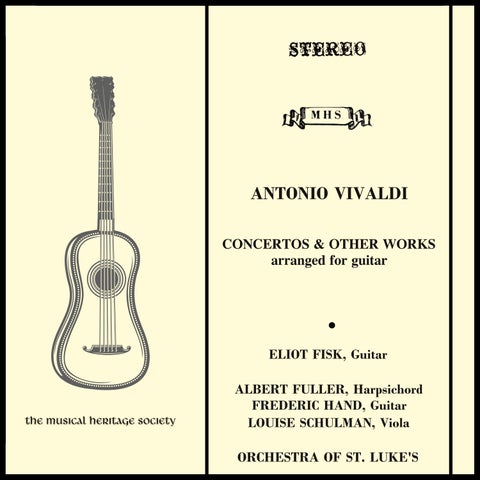
ANTONIO VIVALDI CONCERTOS & OTHER WORKS arranged for guitar
ELIOT FISK, Guitar ALBERT FULLER, Harpsichord FREDERIC HAND, Guitar LOUISE SCHULMAN, Viola
ORCHESTRA OF ST. LUKE'S
ANTONIO VIVALDI Concerto In C Major For Mandolin And Strings, RV. 425 1 I. Allegro 02:47 2 II. Largo 03:29 3 III. Allegro 02:10 Eliot Fisk, guitar Orchestra of St. Luke's Cello Sonata In G Minor, RV. 42 (arr. for guitar and harpsichord by Eliot Fisk) 4 I. Andante molto 04:33 5 II. Larghetto 03:20 6 III. Allegro 02:06 Eliot Fisk, guitar Arthur Fuller, harpsichord Concerto In D Major For Lute, RV. 93 7 I. Allegro 03:36 8 II. Largo 04:57 9 III. Allegro 02:13 Eliot Fisk, guitar Orchestra of St. Luke's
Concerto In D Major For Keyboard arr. by J.S. Bach, BWV 922 (arr. for solo guitar by Eliot Fisk) 10 I. Allegro 02:22 11 II. Larghetto 04:00 12 III. Allegro 02:31 Eliot Fisk, guitar Orchestra of St. Luke's Concerto In G Major For Two Mandolins And Strings, RV 532 13 I. Allegro 04:03 14 II. Andante 04:26 15 III. Allegro 03:32 Eliot Fisk, guitar Orchestra of St. Luke's with Frederic Hand, guitar
Concerto In D Minor For Viola D'Amore And Lute, RV. 540 16 I. Allegro 05:11 17 II. Largo 03:32 18 III. Allegro 03:07 Eliot Fisk, guitar Orchestra of St. Luke's with Louise Schulman, viola Trio Sonata In C Major, RV. 82 19 I. Allegro non molto 03:58 20 II. Larghetto 03:51 21 III. Allegro 02:11 Eliot Fisk, guitar Louise Schulman, viola Arthur Fuller, harpsichord Recorded at the American Academy and Institute of Arts and Letters, NYC on July 27 & August 4, 1992 Produced and Engineered by Max Wilcox Digital Engineer: Nelson Wong New York Digital Recording, Inc.
Antonio Vivaldi (1678-1 741) was one of the greatest composers of the Baroque. He was ordained to the priesthood which, in combination with extraordinary red hair, earned him the nickname “The Red Priest.” Vivaldi put aside his priestly duties and despite his asthma, traveled throughout Italy and even as t away as Prague to present his music. His skill as a violinist was acknowledged during his lifetime; his acclaim as a composer would come much later.
which he wrote were played with a plectrum, or pick. The guitar as I play it is hand-plucked by the fingernails in combination with the fingertips, which changes the timbre but also gives you a wider palette of sounds.
A lot of Bach’s music is for keyboard (more or less any keyboard), and The Art of Fugue does not specify an instrument at alI. Is there a parallel in The Italian Vivaldi’s style of orchestration was Vivaldi’s music for lutes and mandolins? unique. He used many special effects in hie writing for strings, giving color with pizzicato or muted passages. It is Vivaldi's concertos for which he is most revered and best known. He elevated the concerto to new heights of expressivity, and his use of three movements (fast-slow-fast) became standard in later music for solo instruments and orchestra. Among composers influenced by Vivaldi was J.S. Bach, who transcribed several of his works. Also, a leader in the development of “programme” music, Vivaldi is best remembered today for his colorful violin concertos The Four Seasons. A CONVERSATION WITH ELIOT FISK by Matthew Gurewitsch
With one exception, the pieces on this program were written for lute or mandolin. What changes technically when you play them on the guitar? The mandolins in Vivaldi’s time had wire strings. The lutes for which he wrote these pieces probably didn’t. The mandolins and possibly the lutes for
Yes. A baroque performer had so many plucked instruments to choose from: there were guitars and lutes in all shapes and sizes, some with gut strings, some with metal, Some plucked, some strummed. Musicians played music on anything that came to hand. That’s the truly baroque thing to do: to adapt to the circumstances.
What sort of adjustments do you have to make moving from lute or mandolin to guitar? In most of these pieces, Vivaldi composed the solo part in a single line, which suggests the use of a plectrum. I added a lot of basses, as a lutenist would do. The basses also fill out the sound of the guitar. In other words, I used techniques that were prevalent in Vivaldi’s time. This is the process Bach adopted when he arranged his Violin Concertos in A Minor and E Major for harpsichord and orchestra: he left the solo violin line more or less intact but grafted
onto it the bass line from the basso continuo. In baroque chamber music, it’s also common for the lute to double the bass line. You can double more or less as is idiomatic for your instrument. That’s what they did back then, and that’s what I did. I tried to keep the guitar singing and to maintain consistent voice leading in any added parts. I also ornamented freely, especially during repeats, as was common in Baroque times.
movement is again very joyous and allows for some lovely dialogue between tutti and solo.
Did Vivaldi write any concertos for guitar?
The character of the Concerto in D Minor for Lute and Viola are magical, too. I seem to remember seeing a movie of Romeo and Juliet when I was ten or eleven years old -- not Franco Zeffireli’s version -that used music from this concerto on the soundtrack. Maybe I’m imagining the whole thing. But whether it was or not, I think of that kind of romantic atmosphere. It’s a delicious idyll, perched between the two serious outer movements in D Minor.
Not that I know of.
How would you characterize Vivaldi’s music for lute and mandolin? Vivaldi had a great ear for instrumental color. It’s been said that he wrote one concerto four hundred times, but in fact each of the works heard here is unique. The largo movement is often the piece’s raison d’être. Typically, it’s in sharp expressive contrast to the two outer movements and in a different key (often the relative minor or major). The start of the Concerto in C Major for Mandolin has an extremely unusual sound due to the combination of the solo instrument’s (customary) plucked sound and the pizzicato of the otherwise bowed strings. In the slow movement the solo part rises and falls in dotted rhythm like a recitative. The strings (now arco) respond chorus-like with sobs on the first and third beats of each measure. The last
The famous Concerto in D Major for Lute has one of the most beautiful of all of Vivaldi’s largo movements. It reminds me of the outdoors after a snowfall, before anything has been touched. The world is transfigured. You step out of time and commune with the sublime.
The Concerto in G Major for Two Mandolins is, to my mind, one of the finest pieces Vivaldi ever wrote. The first movement is bouncy, with the solo parts running in parallel thirds a lot of the time. The famous slow movement is again an eloquent lament set between two bright panels.
How much literature did you review before choosing this program? I had the idea off the top of my head of bringing together as much Vivaldi as I could. It occurred to
With plucked strings, sound starts to decay as soon as it begins. So it’s not possible to sustain or swell an individual note. Does that mean that the guitar and The Vivaldi-Bach Concerto in D Major, though, does the mandolin and the lute are at a disadvantage in derive from a violin concerto. slow music? me to add a violin concerto, too. But with this group I already had plenty.
That’s right. In this case, Bach took a Vivaldi violin concerto and arranged it for solo harpsichord. My version for two guitars is very close to Bach’s. As it has come down to us. Bach’s transcription jazzes up Vivaldi at certain points. In a live performance he might have gone still further! Still, this arrangement has a wonderful sense of freshness and immediacy and comes about as close as we are likely to get to the experience of hearing a great 18th-century musician in action.
What is the background of the two sonatas? It’s mysterious. They’re dedicated to an obscure count no one has yet been able to identify. The manuscripts call these pieces “Trios” and show parts for violin, lute and basso continuo. However, the violin and lute parts are almost identical. It’s as if the lutenist couldn’t play and needed the violin to help out. Or maybe the real intention was to give the option of using either the lute or the violin but not both. Some people have tried to play the sonatas as they’re shown in the manuscript, which sounds silly to me. Julian Bream has recorded them as lute sonatas with George Malcolm realzing tie basso continuo on the harpsichord, which makes wonderfully good sense.
That depends. It’s the same for piano, after alI. People get around this problem by tting figuration under the long notes to give the illusion that the long note is ebbing and swelling. With plucked instruments, it’s typical to use repeated notes or other ontation to create the illusion of a sustained line. Vivaldi also used dotted rhvthms t keep the line singing or make it declamatory. These techniques are also common in our own time. Joaquin Rodrigo’s famous Concierto de Aranjuez uses them in the slow movement. When the English horn first presents the melody, it’s simpler than the guitar’s highly filigreed response.
Many people still consider Vivaldi “wallpaper music.” Evidently you wouldn’t agree. Vivaldi is looked down upon by the snobs, but he had incredible musical instincts. Who ever used the circle of fifths better? It’s easy to imitate Vivaldi in a superficial way. But no one can create music in his style that comes out as beautifully as what he did. Vivaldi invariably finds some harmonic subtlety, some unexpected rhythmic gesture that lifts the work above the pedestrian. His use of major and minor, of chiaroscuro dynamics of tutti and soli… That’s “genius”!
ELIOT FISK
Eliot Fisk's many recordings for the Musical Heritage Society, DGG, Arabesque and EMI have A creative innovator linked to the great romantic elicited unqualified praise and even entered the tradition of the past, guitarist Eliot Fisk is one of the Billboard charts as bestsellers. Most of these most exciting and unique artists before the public recordings include repertoire never before today. Known woridwide for his adventurous performed on the guitar such as his legendary repertoire and willingness to take art music into reading of the 24 solo violin Capricci, Op. 1 of unusual venues (including schools, senior centers Paganíni ("Has to be heard to be believed!" and even prisons!) he belongs, as his great mentor Ruggiero Ricci), his recordings of contemporary Andrés Segovia once wrote, “at the top line of our works by Berio and Rochberg or his recording with artistic world.” Paula Robison of Robert Beaser's Mountain Songs, which was nominated for a Grammy. Guitar Review Eliot Fisk has performed to dazzling critical and wrote that his versions of the complete Bach public acclaim in recital, as soloist With major unaccompanied violin Sonatas and Partitas, BWV orchestras and in a wide variety of chamber music 1001 1006, "place him alongside Casals and Gould combinations in most of the great concert halls of as one of this century's greatest interpreters of the world and in 1996 in a command performance Bach." On a lighter note, Gramophon Magazine in the Palacio de los Cordova in Granada, Spain, for described his transcriptions for violin, cello and President Bill Clinton and King Juan Caios of Spain guitar of Bach's Violin Sonatas BWV 1014-1019: f and their families. exploring the instrumental potential of the continuo is Baroque music's equivalent of exploring Star He has expanded the repertoire for the guitar Treks final frontier, then guitarist Eliot Fisk may be enormously through cnsuesl groundbreaking its Captain Kirk and his transcription of Bach's six transcriptions of works by Bach, Scarlati, Haydn, violin Sonatas its Starship Enterprise." Mozart, Paganini and others, as well as through commissions from leading cormposers as varied as Eliot Fisk's forays into unconventional musical Luciano Berio, Leonardo Balada, Robert Beaser, territory have included collaborations with William Bolcom, Xavier Montsalvatge, Nicholas chanteuse, Ute Lemper; Turkish music expert, Maw. George Rochberg and Kurt Schwertsik. Eliot Burhan Ocal; jazz legend, Joe Pass; and master of Fisk's numerous transcríotions and editions are castanets, Lucero Tena. Upcoming projects include published by Universal, Presser, Ricordi and Guitar the premiere of a new Quintet for guitar and strings Solo Publications. by Leonardo Balada with the Miro Sting Quartet;
the premiere of a new guitar concerto by Robert Beaser; and a coast-to-coast tour of the U.S. and a duo CD with flamenco guitar great, Paco Peña. Eliot Fisk was the last direct pupil of Andrés Segovia and also studied pebarmrelation under the legendary harpsichordist, Ralph Kirkpatrick, at Yale University hich he graduated summa cum laude in 1976. Called by one New York Times eadline “A Fiery Missionary to the Unconverted,” Eliot Fisk devotes considerable eneroy to teaching. He is Professor at the Mozarteum in Satzburg, Austria, where he teaches In five different languages, and in Boston at the New England Conservatory. His students have come from all corners of the earth, and many have gone on to become important performers and teachers in their own right. Eliot Fisk lives in Boston, Salzburg and (whenever possible) in his beloved Granada, Soain. With his wife, Zaira, and their daughter, Raquel. More information is available at his website: www.eliotfisk.com.
i t r a e g H e M 3 2 u 0 s i 2 c R © o & y a 2 l t 9 i e 9 1 s . ℗
H S M
www.themusicalheritagesociety.com