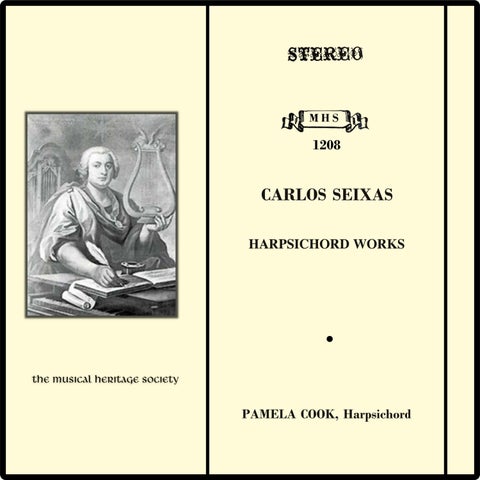
CARLOS SEIXAS (1704-1742) PAMELA COOK, Harpsichord Sonata in A Minor Sonata in C Minor Toccata in F Minor Toccata in B Minor Toccata in C Major Allegro in E Minor Toccata in C Minor FREI JACINTO (18th Century) Sonata in D Minor Allegretto in A Major Sonata in F Minor Minuet in F Major Sonata in A Minor Sonata in G Minor Sonata in E Minor Toccata in D Minor Harpsichord: Frank Hubbard, 1963 2 Manuals, 2 x 8, 1 x 4
It remains a mystery to me that so little biographical information is available about Carlos Seixas. He was born in Coimbra, June 11, 1704, and died in Lisbon, August 25, 1742. He studied with his father, Francisco Vaz, who was the organist of Coimbra cathedral. Carlos inherited his father’s post, but kept it only from 1718 until 1720, leaving to become organist of the Royal Chapel in Lisbon when he was only sixteen years of age. In 1721, Domenico Scarlatti was appointed director of the Royal Chapel, having been summoned to the Portuguese Court to teach Princess Maria Barbara the harpsichord. For the next eight years, the two great musicians worked together in the same chapel. Then, in 1729, when Maria Barbara married the Prince of Asturias, Scarlatti went with her to the court at Madrid. It is at this point in Seixas life that biographical information trickles away. He was twenty-five and had only thirteen more years to live. No doubt, his keyboard playing was enormously influenced by the great Scarlatti, but his compositions remained surprisingly personal.
Although Carlos Seixas was one of Scarlatti’s prize apprentices, he by no means followed blindly in the foot steps of the great master. Seixas’ writings remained quite faithful to the folk songs and dances of Portugal and they are often an attempt toward a more developed sonata form than the AABB Scarlatti sonata. Many of the Portuguese’s pieces are in three movements including an Allegro, Adagio, and Minuet. These sonatas are usually a charming combination of simple Portuguese melodies and the begin nings of the Style Gallant. One is almost reminded by them of very early Mozart. Another sort of piece written often by Seixas is the ferocious, bloody, virtuoso sonata. These are severe, driving, and technically most exacting. (Scarlati confessed that he could teach the brilliant Portuguese nothing more at the keyboard.) I should also include in this category the dramatic, slow sonatas, recalling the singer-guitarist form so prevalent in Portugal and in Spain. On
side two of this recording, the E minor that one sometimes wonders about sonata, next to last, illustrates this style. certain passages being a copyists mistake. I don't think they are. We should Frei Jacinto was a Portuguese remember that Seixas died at the age of contemporary of Scarlatti and Seixas. His thirty-eight. He was mainly interested in D minor Sonata on this recording and one changing the accepted forms of other sonata in the same key are the only composition, rather than in perfecting the pieces yet discovered by this gifted past. composer. These pieces should be savoured as \After reading through all of the miniatures. They are not so much Portuguese keyboard music many times, I transcendent as translucid, morsels to came to the conclusion that the pieces of charm and dazzle. the Style Gallant sound best played on an early Mozart fortepiano, while the Iberian --Pamela Cook brilliant and brooding works sound best on the harpsichord. For this reason, I have included none from the former category on this recording. In all of these compositions the keyboardist is presented with only the barest of skeletons for a score. A great deal of realization and ornamentation must be added by the player. This adds further to the characteristic spontaneity of Seixas’ writings. As a matter of fact, these writings were so casually put down
e g M a t i u r s e i c H R 0 o 7 y 9 1 a l t © i e s & . ℗