[1] In The Kitchen (Cedar Walton)
Vernita Music BMI

[1] In The Kitchen (Cedar Walton)
Vernita Music BMI
[7] All The Things You Are (Hammerstein-Kern)
T.B. Harms Inc. ASCAP
[2] Roni's Decision
Cedar Walton)
Vernita Music BMI
[3] Dear Ruth
Cedar Walton)
Vernita Music BMI
[4] Simple Pleasure
Cedar Walton)
Vernita Music BMI
[5] Sixth Avenue
Cedar Walton)
Vernita Music BMI
[6] My Ideal (Robins-Whiting-Chase)
Famous Music ASCAP
[8] My Man's Gone Now (George & Ira Gershwin)
Chappell Music Co. ASCAP
[9] Theme for Ernie (Fred Lacy)
Prestige Music BMI
CEDAR WALTON piano
RALPH MOORE saxophones
DAVID WILLIAMS bass
BILLY HIGGINS drums
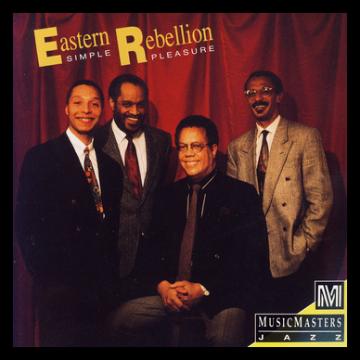
With their second release, this creative cauldron of musical activity known as Eastern Rebellion offers a snapshot of their momentum. This group, and the emphasis is on group, is indeed in motion. Not just the physical, on the road brand of motion but that active process of inventive fluctuation that is a result of energetic musical growth. The selflessness that is a part of every exchange within the quartet allows for a fully matured interdependence that, aside from being succinctly "democratic" in its principles, is FUN to listen to.
I have no trouble seeing (hearing) them as an aural equivalent of a wellhoned basketball team, coming up court, twisting, turning, faking, passing off with a precision that appears as mere intuition, but is in fact a result of very hard work. Their work means our pleasure, plain and simple.
Cedar Walton, the group's founder and main tunesmith, has crafted a varied set of originals and arranged the standards to display his and his cohorts' strengths. Their sensitivity to each other is on the first tier of this tower of strengths. Each member eschews the kamikaze-styled, playeverything-you-know improvising approach
to, instead, play with and respond to the contours of these pieces.
And each piece has distinctive characteristics. The in the pocket In The Kitchen places the blues impulse front and center, where it belongs. Ralph Moore belongs in the pantheon of "young veterans", (his peers include pianist Mulgrew Miller, and drummer Kenny Washington among others) who consistently aspire to and most often achieve creative excellence. His measured shouts on this piece recall the legacy of tenor playing honkers and shouters who infused the blues with their passionate signatures of direct communications.
Judging from the attractive melody and rhythmic gait Roni made the right Decision. Bassist David Williams delivers the first sermon here, revealing a songful quality to his improvisations. Billy Higgins gently tapdances his way throughout, subtly shifting his approach behind the solos of his teammates. With the stately elegance of Dear Ruth, written for his mother, Cedar provides himself with the harmonic backdrop for a particularly insightful solo. The ensemble envelopes Cedar with a sensuous reading of this dignified tribute. The title
tune lives up to, well, its title. It gets my vote as the most infectiously swinging cut on the release.
This Sixth Avenue is in the same neighborhood as the legion of latintinged vehicles that make up jazz's compositional inventory. The bossa-tango-4/4-ish theme is deftly handled by these eight hands, with the two belonging to Billy Higgins (in addition to his two other limbs) intrepidly juggling the juxtaposed rhythms.
The challenge of infusing material written in what is commonly referred to as the American Song Form, with a measure of attractive alteration if not outright innovation, stares at the soul of every creative improviser. Eastern Rebellion stares back and doesn't blink. My Man's Gone Now, All The Things You Are, and My Ideal are all imbued with a vitality that is the distinctive property of this collective.
The recording ends tenderly with a duet performance of Fred Lacy's Theme for Ernie. John Coltrane, of course, recorded this tune during his Prestige days with his "other" great quartet. Cedar and Ralph respectfully caress the touching melody, bringing the proceedings to a quiet close.
But remember, the momentum continues. Every time these four gentlemen take the stage, the momentum continues. Their consistency is hard won, the sum of countless hours of thought, practice, and performance. The music of Eastern Rebellion is successful because their momentum dictates it. Aristotle has stated, "We are what we repeatedly do. Excellence, then, is not an act, but a habit." Fitting words for a group in the habit of being excellent.
-James Browne