DRESS REGULATIONS
Nursing
Dress Regulations NURSING
REVISED 1970 First Impression 7, 500- 1970 © Copyright and Published in Great Britain by THE ORDER OF ST. JOHN
Headquarters: 1 GROSVENOR CRESCENT, LONDON S.W.1
Contents
Foreword
Uniform Supplies
Schedules of Uniform authorised for:
Officers of Headquarters, District/County and Area
Officers of Corps and Divisions
N.C.O.'s and Nursing Members
I nstructions on Uniform
Optional Uniform and Accessories
Uniform for Special Purposes
Uniform and Distinguishing Marks authorised for Senior Officers and Special Categories
Badges of Rank
Gorget Patches
Head-dress
Badges and their Positioning:
Jacket front view
Nursing Dress front view
Apron
Shoulder straps
Officer's Black Lightweight Dress front view
Official badges
County Emblems ..
and
Foreword
THESE DRESS REGULATIONS must be strictly observed by all officers and members on whom, individually and collectively, responsibility for the smartness of the Brigade rests. The wearing of Brigade uniform is governed by General Regulation 92.
No deviation from the sealed patterns of uniform , clothing , equipment and badges is allowed. Badges of the Order of St. John , including those worn on Brigade uniform, are protected under the Chartered Associations (Venerable Order of st. John of Jerusalem) Protection Order, 1927, and the badges to which this Protection Order applies are badges made of any material whatsoever , bearing or consisting of, the device of a white eight-pointed cross embellished on the four principal angles alternatively with a lion guardant and a unicorn passant, whether or not the device is surrounded or accompanied by concentric circles or other decoration or by lettering.
Uniform supplies
ALL ADVICE AND SUPPLIES in respect of uniform requirements and equipment should be made to the Uniform Section, Stores Department of the Order of st. John, Priory House , St. John's Gate , Clerkenwell, London , E.C.I. Telephone number 01 - 253 - 6644.
1. Orders for uniform should be kept separate from any other items ordered from the Stores Department.
2. Uniforms may be ordered in the following way:
a) by a Corps or Division on the written order of the Officer or Member-in-Charge.
b) by a member on production of an authority signed by the Officer or Member-in-Charge of the Division.
c) by firms authorised to supply the regulation uniforms on production of an authority signed by the Officer or Member-in-Charge of the unit ordering the uniforms.
d) in every instance the authority must be written on Brigade regulation stationery giving a list of the articles to be supplied, and have the Stores Department price list coded reference thereon. 3
UNIFORM AUTHORISED FOR OFFICERS OF HEADQUARTERS, DISTRICT/COUNTY AND AREA
Instructions Public Review Church and Duty Order Parade
Specifica- Order Order tions to be worn
Pages for all Public to be worn 7-11 Duties and for when pro- inspections
Paragraph ceeding to and number in and from investitures brackets such Duties
Uniform Suit with shirt, collar and tie
Hat
Gloves
Stockings
Shoes
Overcoat
Waterproof Medal Ribbons
Medals
Gorget Patches
Badges
First Aid Pack
Handbag
Emergency Order:
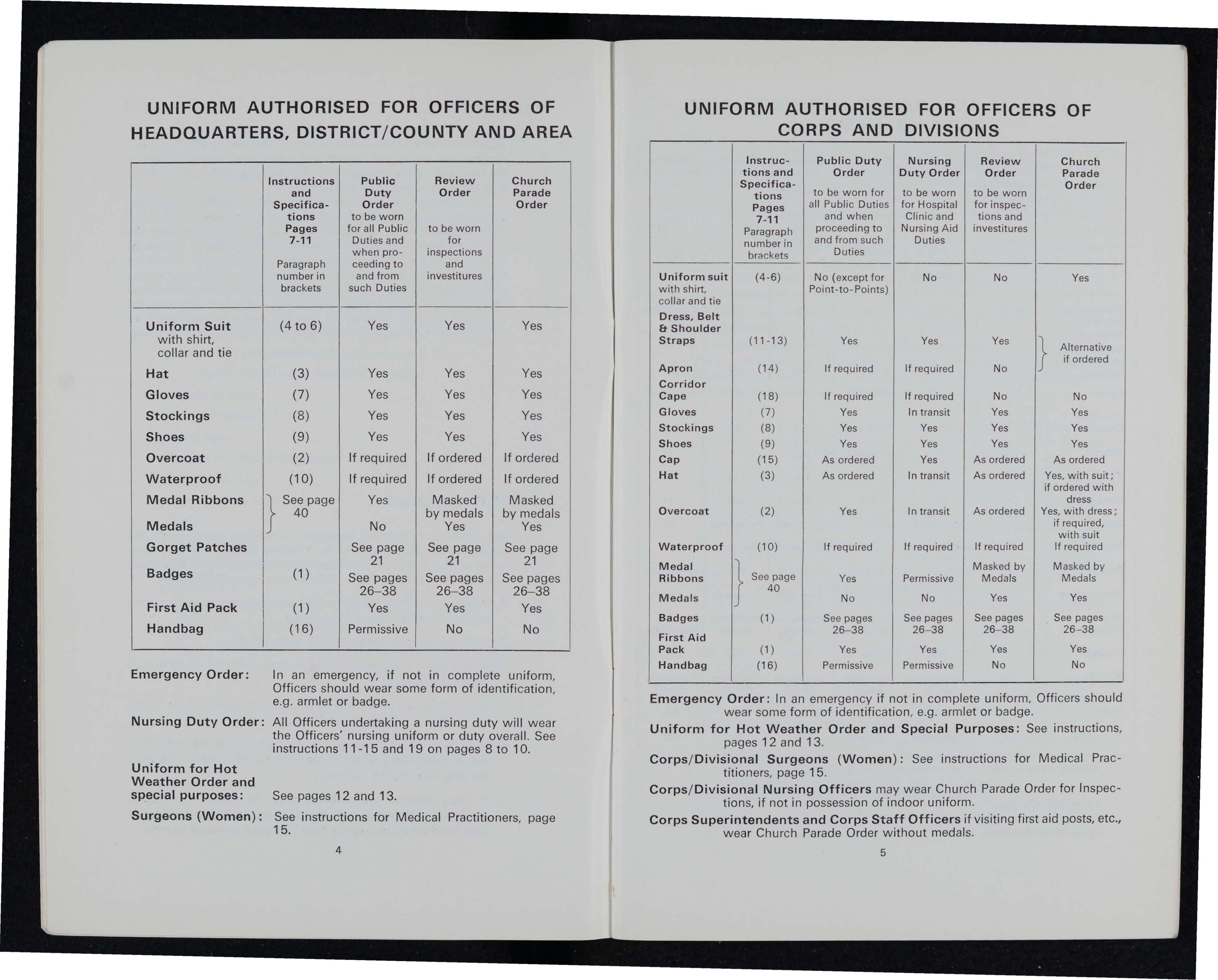
(4 to 6) Yes Yes Yes
(3) Yes Yes Yes
(7) Yes Yes Yes
(8) Yes Yes Yes
(9) Yes Yes Yes
(2) If required If ordered If ordered
UNIFORM AUTHORISED FOR OFFICERS OF CORPS AND DIVISIONS
Instruc- Public Duty Nursing Review Church tions and Order Duty Order Order Parade Specificato be worn for to be worn to be worn Order tions Pages all Public Duties for Hospital for inspec7-11 and when Clinic and tions and Paragraph proceeding to Nursing Aid investitures number in and from such Duties brackets Duties
Uniform suit (4 - 6) No (except for No No Yes with shirt, Point-to- Points) collar and tie
Dress, Belt & Shoulder
Straps (11-13) Yes Yes Yes } Alternative if ordered
Apron (14) If required If required No
Corridor
Cape (18) If required If required No No
Gloves (7) Yes In
Stockings (8)
Shoes (9)
Cap (15)
See page Yes Masked Masked 40 by medals by medals No Yes Yes
(10) If required If ordered If ordered }
See page See page See page 21 21 21
(1 ) See pages See pages See pages 26-38 26-38 26- 38
(1 ) Yes Yes Yes
(16) Permissive No No
In an emergency, if not in complete uniform, Officers should wear some form of identification, e.g. armlet or badge.
Nursing Duty Order: All Officers undertaking a nursing duty will wear the Officers' nursing uniform or duty overall See instructions 11-15 and 19 on pages 8 to 10.
Uniform for Hot Weather Order and special purposes: See pages 12 and 13.
Surgeons (Women): See instructions for Medical Practitioners, page 15.
Hat (3) As ordered In transit As ordered Yes, with suit; if ordered with dress
Overcoat (2) Yes In transit As ordered Yes, with dress; if required, with suit
Waterproof (10) If required If required If required If required
Medal } Masked by Masked by Ribbons See page Yes Permissive Medals Medals 40 Medals No No Yes Yes
Badges (1 )
Handbag (16) Permissive
Emergency Order: In an emergency if not in complete uniform, Officers should wear some form of identification, e.g. armlet or badge.
Uniform for Hot Weather Order and Special Purposes: See instructions, pages 12 and 13
Corps/Divisional Surgeons (Women): See instructions for Medical Practitioners, page 15.
Corps/Divisional Nursing Officers may wear Church Parade Order for Inspections, if not in possession of indoor uniform.
Corps Superintendents and Corps Staff Officers if visiting first aid posts, etc., wear Church Parade Order without medals. 5
UNIFORM AUTHORISED FOR NCO's AND NURSING MEMBERS
Instruc- Public Duty Nursing Review Church tions and Order Duty Order Order Parade Specifica- to be worn to be worn Order tions to be worn
Pages for all for for 7-11 Public Hospital Inspections Duties and Clinic and and Paragraph when pro- Nursing Investinumbers in ceeding to Aid Duties tures brackets and from such Duties
Uniform Suit (4-6) No No No No with shirt, (except for collar and tie Point-toDress, Belt Points) and Shoulder
Straps (11-13) Yes Yes Yes Yes
Apron (14) If required If required No No
Corridor
Cape (18) If required If required No No
Gloves (7) Yes In transit Yes Yes
Stockings (8) Yes Yes Yes Yes
Shoes (9) Yes Yes Yes Yes
Cap (15) As ordered Yes As ordered As ordered
Hat (3) As ordered In transit As ordered As ordered
Overcoat (2) Yes In transit Yes Yes
Waterproof (10) If required If required If required If required
Welfare and Escort Duties
Pages 12-13
Instructions on Uniform
1 THESE REGULATIONS describe current uniform. Old style uniform may continue to be worn as laid down in previous Dress Regulations until replacement is required, but those possessing old style uniform will conform to current regulations in the prescribed lengths and positioning of badges with the exception that Badge No. 3654 will not be worn on the old style nursing dress.
Uniform must be worn smartly and correctly, and particular attention should be given to correctness of lengths. Mixed dress, partly uniform and partly plain clothes, may not be worn except in emergency. Jewellery must not be worn.
Badges and insignia must be correctly placed on uniform as described and illustrated on pages 26 to 38.
On all occasions in uniform officers and members will carry a First Aid Pack containing: one triangular bandage, 3 sterile dressings, adhesive dressings and safety pins. If additional first aid equipment is required it will be carried in a case or black regulation haversack.
2 Overcoat. Will be worn, buttoned up to lapel over suit, to neck over dress. If carried the coat will be buttoned up and carded over the left forearm with the buttons uppermost, and sleeves folded underneath.
Specification: MATERIAL: black showerproof 67 % terylene, 33% cotton. STYLE: single-breasted with step collar and lapels, fastening at neck with small button and loop. Two bust darts. Four buttons No. 13 down front and one button No. 14 under collar. One-piece whole back with two darts from shoulder. Two vertical welted pockets either side. Two-piece inset sleeves with plain cuffs. Detachable shoulder straps 2t in. (6.35 cm.) base, It in. (3 .81 cm.) top , with pointed ends, fastened with buttonhole and button No. 14. Body of coat lined with self material, skirt and sleeves lined with black nylon. Edges i in. (0.95 cm.) swelled.
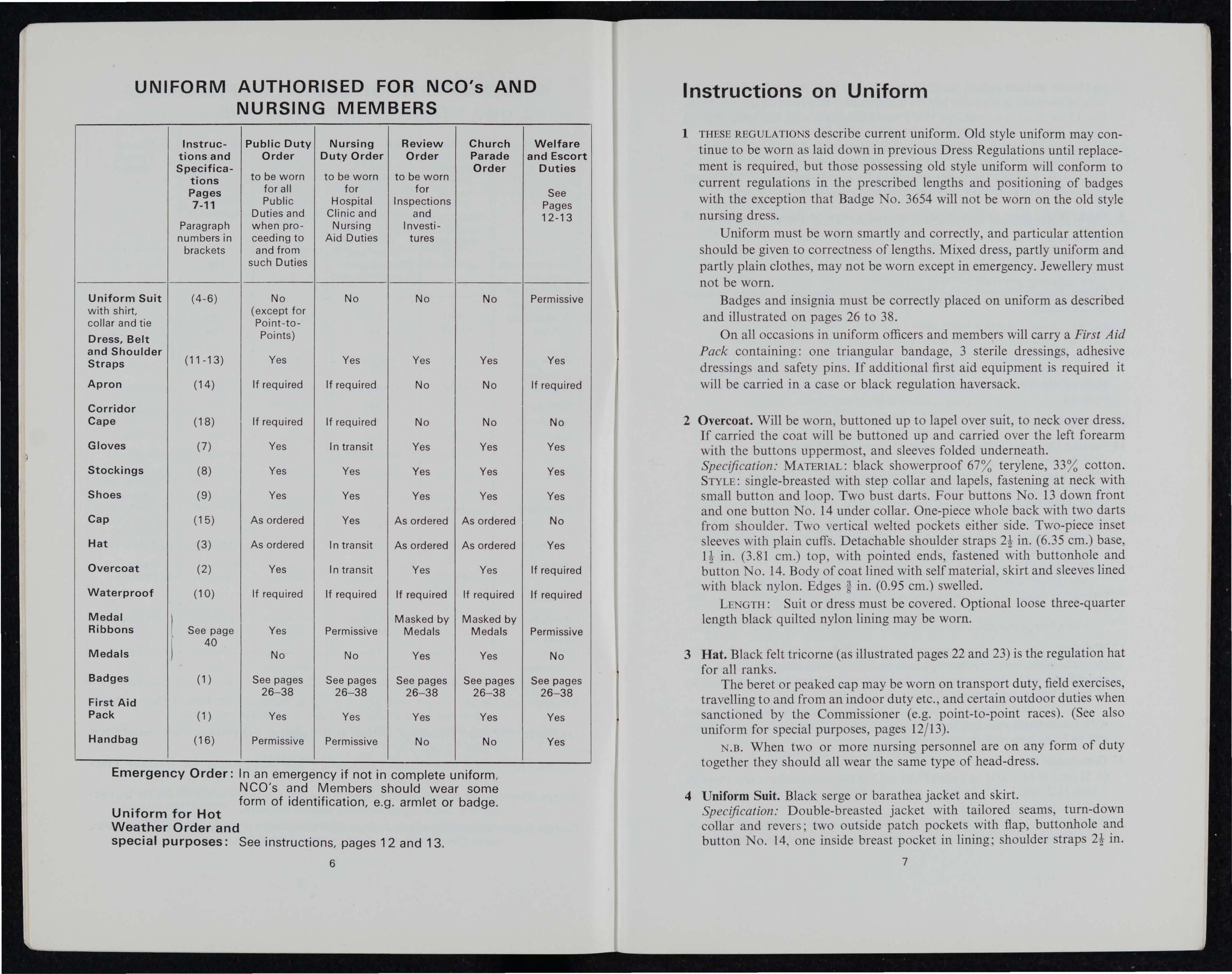
Medals No No Yes Yes
Medal t Masked by Masked by Ribbons See page Yes Permissive Medals Medals j 40
Badges (1 ) See pages See pages See pages See pages 26- 38 26- 38 26-38 26-38 First Aid
Pack (1 ) Yes Yes Yes Yes
Handbag (16) Permissive Permissive No No
Emergency Order: In an emergency if not in complete uniform, NCO's and Members should wear some form of identification, e.g. armlet or badge.
Uniform for Hot Weather Order and special purposes: See instructions, pages 12 and 13. 6
pages 26-38
LENGTH: Suit or dress must be covered. Optional loose three-quarter length black quilted nylon lining may be worn.
3 Hat. Black felt tricorne (as illustrated pages 22 and 23) is the regulation hat for all ranks.
The beret or peaked cap may be worn on transport duty , field exercises, travelling to and from an indoor duty etc., and certain outdoor duties when sanctioned by the Commissioner (e.g. point-to-point races). (See also uniform for special purposes, pages 12/13).
.B. When two or more nursing personnel are on any form of duty together they should all wear the same type of head-dress.
4 Uniform Suit. Black serge or barathea jacket and skirt.
Specification: Double-breasted jacket with tailored seams, turn-down collar and revers; two outside patch pockets with flap, buttonhole and button No. 14 one inside breast pocket in lining; shoulder straps 2t in.
7
(6.35 cm.) at base and It in. (3.81 cm.) at top with pointed ends fastened with buttonhole and button No. 14 under collar; two rows of three buttons No. 15 on front; two buttons No. 14 on each sleeve end, the lower button It in. (3.81 cm.) from edge. Panel back.
Skirt with tailored seams, panelled front with knife pleats approximately 7 to 8 in. (17'8 to 20.3 cm.) long and not less than 3 in. (7.6 cm.) in depth, thus making the panel appear to be a wide box pleat. Side seams and a plain back. Length: not shorter than mid-knee.
5 Shirt. White shirt (men's type) with self collar or detachable semi-stiff collar.
6 Tie. Plain black, tied in a sailor knot and the ends fastened by Badge No. 19.
7 Gloves. Plain white with 3-line stitching on back. Black gloves may be worn for travelling.
8 Stockings. Plain black.
9 Shoes. Black leather laced or plain, the heels not to exceed 2 in. (5.1 cm.) in height, the heel base being not less than 1 in. (2.54 cm.). Plastic or rubber heels will be worn for hospital work. In bad weather black overshoes may be worn.
10 Waterproof. Plain black.
11 Nursing Dress for Officers, Nursing Officers and Members (N). Specification: MATERIAL: regulation grey cotton sateen, approved shade. STYLE: Sheath step-in dress, open-neck shirt collar, I8-inch (45·75 cm) invisible zip fastening in centre front. Full-length sleeves, sleeve opening fastened by 4 press studs with one No. 14 button sewn on over wrist press stud. Back and front waist darts. Whole back, no centre seam. 3-inch (7.6 cm.) hem. Pockets-one slanting-applied patch pocket on each hip, 7 inches (17.8 cm.) wide, 8 inches (20.3 cm.) front depth, 6 inches (15.2 cm.) back depth. Length: not shorter than mid-knee.
Medallion holders will wear the medallion at the head of the zip fastening; those not in possession of the medallion will wear Badge No. 19.
For nursing purposes the sleeves will be rolled up flat above the elbow.
12 Waistbelt. Officers: Dress material with stiffened inter-lining, 2 inches (5.1 cm.) wide, with regulation 2-inch (5.1 cm.) metal clasp buckle. Buckle end affixed with three pairs press studs for adjustment purposes. Buckles to be centred over dress zip fastener.
N.C.O.'s and Members: As officers, but one end mitred, and closed with metal hook and bar fastening. No buckle. Commencement of mitre end to be in line with dress zip fastener.
13 Detachable Shoulder Straps. Black for all officers, measuring 2t inches (6.35 cm.) at base and I t inches (3.81 cm.) at top, attached to dress through t -inch (1.27 cm.) wide loops on the shoulder seams and button No. 14 at neckline under the collar.
Transport, N.C.O.'s and nursing members on Reserve or Retired List will wear detachable stiffened shoulder straps made of the dress material.
14 Apron. The apron will be worn for hygienic and protective working purposes only, e.g. nursing or first aid services that may soil the dress.
Specification: MATERIAL: White cotton.
STYLE: Three-piece shaped skirt on waist band with square darted bib, St. John Cross 41 inches (12.06 cm.) square in black satin stitch i inch (0.32 cm.) in width on centre of bib. Top of Cross 3i inches (8.25 cm.) from top of apron.
Four darts on each side of skirt back. t-inch (1.27 cm.) hem on back edges of skirt.
Front panel joined to side-back panels by flat seaming. Hem at bottom inches (6.35 cm.).
Bib, two darts tapering to nothing from waistband. Hems at sides of bib Ii inches (3.18 cm.). Hem at top of bib 2t inches (6.35 cm.). Two buttonholes in top hem of bib to fit No. 14 buttons, parallel with the side hems and 2 inches to 2t inches (5.1 to 6.35 cm.), according to bust size, from side edges.
Waistband 1£ inches (4.45 cm.) wide, edge-stitched, extending beyond the back edges of skirt and closing with three buttons and buttonhole. Back edges of skirt should meet at belt. Apron length 1 inch (2.54 cm.) shorter than dress.
The apron suspends from a Ii-inch (3.l8 cm.) wide neck halter of apron material, worn under dress collar, fastening to bib buttonholes with buttons No. 14. The halter length adjustment end will be worn on the right. The dress belt will be worn over the apron.
15 Cap. (For illustrations see page 25).
a) Officers: American-type cap, white cambric or organdie. Three-inch (7.6 cm.) turn-up hem with I-inch (2.54 cm.) black Cross embroidered in the centre, and 3-inch (0.95 cm.) black edging at top of hem. Right side buttons over left side.
b) Nursing Officers, Nurses One Star (SRN): Army Nurses pattern, white cambric or organdie, 27 inches (68.58 cm.) square. One-inch (2.54 cm.) black Cross embroidered in angle of tail, centred 2t inches (6.35 cm.) from hemstitching on straight of stuff and 3! inches (8.26 cm.) from hemstitch angle. Nursing Officers and Nurses One Star, S.R.N., may wear American-type officers' cap for working purposes, but the trained nurses' cambric or organdie 27-inch (68.58 cm.) square must continue to be worn for all official occasions.
c) Nurses One Star (SEN): American-type cap, white cambric or organdie. Three-inch turn-up hem with I-inch (2.54 cm.) black Cross embroidered in the centre and 3-inch (0.95 cm.) black edging at top of hem. Right side buttons over left side.
d) Members: American-type cap, white cambric or organdie. Three inch turn-up hem with I-inch (2.54 cm.) black Cross embroidered in the centre. Right side buttons over left side.
Optional Uniform and Accessories
16 Handbags. Must be black. A regulation shoulder-handbag with adjustable sling strap is obtainable from Stores Department. Handbags must not be carried on any ceremonial occasion.
17 Officers' Lightweight Black Dress. (For illustration see page 35). This dress is for the optional use of all officers, Presidents and Vice-Presidents for occasions described under Uniform for Special Purposes (pages 12 / 13) e.g. hot weather order, social functions , committees , conferences and training days.
Specifi cation: MAT ERIAL: Black Moygashel "Springback" linen and terylene or similar type material.
STYL E: Shirt waist-type dress. Bodice with shirt-type centre front fastening with four buttons No. 14 ; one dart each side of bodice back and front from waist, and one dart (optional) each shoulder front. Turn-down measuring 2 t inches (6.35 cm.) from neckband at centre back , tapermg to I i inche s (3.81 cm.) at front. Patch pocket on right side of bodice measuring by 4i inches (12.06 cm.) , bottom corners rounded , (2.22 cm.) bo x pleat down centre , I-inch (2.54 cm.) outside turn-back hem at top. Shoulder straps 2i inches (6.35 cm.) at ba se, I i inches (3.81 cm.) at top with p ointed ends , fastened at point with button No. 14. Short sleeves , with I-inch (2.54 cm. ) turn-back cuff. Panelled skirt , with centre panel approximately 7i inches to 8 inches (19.0 to 20.3 cm.) in width, with two inverted pleats at front and two at back , matching to bodice darts; 3i -inch (8.9 cm.) deep pleats , opening 91 inches (24.8 cm.) above hem edge; the pleated material should continue up to waist and not be cut away as this maintains good shape and hang of skirt. Hem 3 inches (7.6 cm.) deep. Zip fastener opening on left side. Length: not shorter than mid-knee. I-inch (2.54 cm.) wide belt with pointed ends to go through centre ring (self material), fastening back on to buttons No. 14 placed to meet darts and pleat seams.
Brigade flash on each arm (po sitioned 1 inch (2.54 cm.) from shoulder sleeve seam to top of lettering on the flash.) Gorget patches , where applicable, will be of small size. Medical Practitioners will have scarlet piping around shoulder straps; appointed Nursing Officers will wear grey shoulder straps.
18 Corridor Cape. The cape may be worn when on call at public duties and in hospital but may not be worn for travelling to and from duties.
Spec(fi cation: Circular cape , in dark grey approved woollen material 30 inches (76 cm.) in length; lined scarlet flannel ; step and fall collar; straps cross over in front and fasten at back.
19 Duty Overall. If approved by a senior officer the duty overall may be worn with indoor cap, black stockings and shoes, as the alternative to the dress and apron for Brigade Duties other than outdoor public duties. It must not be worn for inspections or other formal occasions.
Specification: MATERIAL: white drill or tropical drill.
STYLE: Coat overall with turn-down collar and revers , centre fastening with nine buttons No. 14. Two waist darts front and back. Full length sleeves finished with 8i -inch (21.6 cm.) opening fastened by three buttons No. 14. A haped patch pocket approximately 7i inches (19.0 cm.) deep on 10
ea ch hip front, and square 4i-inch (11.4 cm.) pocket on left breast bearing 4-mch cm.) black embroidered Cross. Four-line stitching on collar and skIrt pockets. Loose self material belt fastened two buttons No. 14. Brigade flash on each arm. The overall must cover skirt worn beneath. Officers will wear rank markings on appropriate detachable shoulder straps (see page 34).
20 Overall. For the use of auxiliaries working in hospital libraries , meolcal comforts depots, etc. It may also be used by members for similar purposes.
Specification: Grey shadow striped nylon , button-through coat style with half belt at back, grey shank buttons. Long sleeves with one button cuff and 01?ening placket. Two patch pockets on hips , 6 inches (15.2 cm.) wide by 7i Inches (19 cm.) deep. When used by members of the Brigade , No. 14 buttons will be worn.
21 Special Duty Uniform. This protective uniform is for use on occa sions when nursing uniform is unsuitable , e.g. motor-cycle mobile units scramble duties, disaster exercises and in emergencies. Except in cases of major disasters , its use must be authorised by an officer.
Specification: Black proofed drill jacket and trousers . Jacket zip centre f:ont opening with pointed collar; two diagonal zipped pocket s ; adjustable SIde straps; regulation size shoulder straps fastened button No. 14; sleeves eased into cuffs fastened button No. 14 ; collar , cuffs, front opening edges and bottom stitched i inch (0.64 cm.) from edge. Trousers zip fastening on left, pocket on right ; adjustable waistband.
Tnsignia: a) Mobile Divisions: as worn on uniform jacket (see page 33) ; b) For all other purposes: rank markings; County flash; County emblem; Brigade Badge 3655 / 1582.
White shirt and collar with black tie , black shoes and stockings or knee-length socks; overcoat and / or black waterproof and black gumboots if required; crash helmet , beret or peak cap as appropriate.
22 Cardigan. Plain black with V shaped front with no pockets. May not be worn on ceremonial and official occasions.
23 Brigade Armlet. Regulation whitt' 3-inch (7.6 cm.) wide plastic armlet with st. John badge and lettering. Is worn on left upper arm on civilian dress for emergency purposes.
24 Black Armlet. Black 3i -inch (8.9 em.) petersham , fastened with brace fasteners or press studs on which the appropriate badge is affixed. Worn on left upper arm.
PAPER PATTERNS of the Nursing dress and apron for home dressmaking are available from the Stores Department.
SIZE CHARTS, the use of which is advised when ordering uniform garments or the paper patterns, are also obtainable from the Stores Department.
STORES DEPARTMENT do not stock material or paper patterns for Lightweight black dress. For Specification see page 10; illustration see page 35.
Uniform for Special Purposes
Air Attendant Duty
Uniform suit with beret, overcoat, and white duty overall, if necessary. (For badge, see page 30). Nursing duty wit.h beret or peaked cap may be worn as an alternative to the unIform SUIt.
Camps
st. John personnel attending St. John camps must wear correct uniform when travelling to and from camp, and on any full parade at camp. The officer on duty in the camp must wear correct duty order. Brigade personnel attending camps of other orgarusatlOns on first aid duty must wear appropriate Brigade uniform. Nursing duty order may be worn without cap or hat.
Committees, Conferences and Training Days
Personnel attending the above may wear uniform suit or lightweight dress (officers, Presidents or Vice-Presidents) or public duty order without cap.
Disaster Exercises
Special duty uniform (see page 11); hat, beret or peaked cap; overcoat and / or black waterproof and gumboots if required.
Escort and Transport Duty
Public duty order with overcoat or uniform suit as appropriate. White duty overall if necessary. The peaked cap or beret may be worn instead of the hat.
Hospital Library Duty
Uniform suit, or grey nursing dress (without apron, cap or hat), or auxiliaries' overall may be worn. For badge, see page 29. (For auxiliaries, see page 11).
Hot Weather Duty
If hot weather order is authorised on parade, etc. the suit jacket is discarded, and shirt sleeves will be rolled up neatly above the elbow. The officers' lightweight black dress may be worn for general purposes and inspection of public duty first aid posts; but it is not permitted for parades, reviews, inspections or on any formal occasion when decorations are worn.
In exceptionally hot weather, officers and members may travel to public duties in dresses without wearing the overcoat, but this should be carried.
Motorcycle Units
Special duty uniform (see page 11); crash helmet, with beret as alternative when not riding; overcoat and/or black waterproof and black gumboots if required.
Scramble Duty
Special duty uniform (see page 11); hat, beret or peaked cap; overcoat and/or black waterproof and black gumboots if required.
Social Occasions
Officers, Presidents and Vice-Presidents: the uniform suit or the lightweight black dress; on evening occasions when decorations are worn, miniature medal may be worn on the black dress.
Corps and Divisional Officers may wear public duty order on formal occasions. On informal occasions they may wear the black lightweight dress, or the nursing dress, without cap.
N.C.O's and Nursing Members: public duty order on formal occasions. On informal occasions they may wear the nursing dress without cap.
Welfare Duty
Uniform suit or public duty order and overcoat as appropri'ate. The peaked cap or beret may be worn instead of the hat. (Supplementary regulations exist for Service Hospital Welfare officers).
General Mourning
The occasions on which mourning bands may be worn on uniform are prescribed in General Regulation 93a. The bands will be of black crepe 3t inches (8.9 cm.) wide, worn round the left arm above the elbow.
Uniform and Distinguishing Marks authorised for Senior Officers and Special Categories
THE REGULATION UNIFORM (see pages 7 to 11) is worn with the followin g a djustments:
Commandant-in-Chief
The jacket should be double -breasted with Brigade buttons in chromed metal. Black soft felt tricorne hat with 2-inch (5.1 cm.) b rim wi t h b an d of black ribbon edged with narrow white st ripes of equal wi d th, an d on the left side a 4-inch (10 2 cm.) rosette of the same ribbon with free ends; white tuft. Badge 73 in centre of rosette.
Deputy Commandant-in-Chief
As for Commandant-in -Chief, but the hat tuft is black below and white above.
Superintendent - in-Chief
As for Commandant -in-Chief but the hat tuft is white below and black above. With beret or peak cap badge 73 is worn.
Deputy Superintendent - in-Chief
As for Commandant -in -Chief, but with Brigade black horn buttons on jacket; black hat tuft. With beret or peak cap, badge 73 is worn.
Headquarters Officers holding the rank of crossed stretchers
As for Deputy Superintend ent-in-Chief.
Presidents and V i ce - Pres i dents
All Presidents and Vice -Presidents may wear the uniform suit, overcoat and black tricorne hat, as described on pages 22 to 23. The lightweight black dress (see page 35) may be worn on informal occasions. The regulation beret, with the P resident's or Vice -Presi d ent's badge on the left front, may b e worn for informal occasions (see page 36).
Ba d ges an d Insignia for Presidents and Vice- P resi d ents are as follows: G orget patches, white edged bl ack (see page 21). Hat ribbon and trimming (see page 23).
Arm flashes-County (see page 27). Area, Corps and Divisional Presi d ents and Vice-Presidents (see page 27) .
Presidents' and Vice-Presidents' badges 73 and 77, 74 and 78 (see page 36)
Positioning of bad ges (see pages 26-34) . and .vice- P residents hol ding vali d first ai d an d n u rsi n g cerare entItled to wear Badge 36 55 on the jacket an d overcoat. Presldents and Vice -Presidents are entitled to wear their County Emblems (see page 38) . When in civilian dress at St. John or associated occasions the Presi d ent's or Vice-President's bad ge sho u ld a lways b e worn. '
Medical Practitioners
Whatever their Brigade appointment, all registered medical practitioners on the General Medical Registry wear 1/ 16-inch (0.16 cm.) scarlet piping around the edges of their shoulder straps. Pre-registration and probationary Surgeons will wear regulation red plastic discs under their badges of rank.
Brigade Surgeons wear the uniform, etc., overcoat or black lightweight dress as described for other officers. The hat is trimmed with regulation Surgeons' hat ribbon (see page 22). (The Surgeons' hat ribbon is worn only by those holding Surgeons appointments. Medical Practitioners holding other executive appointments wear the hat trimming appropriate to the appointment.)
State Registered Nurses
Whatever their Brigade appointment , all State Registered Nurses on the General Part of the Register wear a red enamel bar t inch (1.27 cm.) above the base of their shoulder straps. All appointed Nursing Officers wear regulation grey shoulder straps on the uniform suit jacket , overcoat and lightweight black dress. On the grey nursing dress the officers' detachable black shoulder straps will be worn , the rank insignia being mounted on regulation grey plastic circular discs.
General Trained State Registered Nurses who are not appointed Nursing Officers but who are "one star" Nurses, wear the Nursing Officers' uniform. They do not wear grey shoulder straps or grey discs under rank insignia.
State Certified Midwives and Nurses on Special Parts of the State Register, who are appointed "one star" Nurses , wear the grey nursing dress with officers' black shoulder straps and with the Army Nurses ' pattern cap as worn by Nursing Officers. The American-type officers' cap may be used for working purposes.
State Certified Midwives and Nurses on Special Parts of the State Register wear a purple enamel bar t inch (1.27 cm.) abo ve the base of their shoulder straps. The purple bar is not worn in addition to the red bar.
State Enrolled Nurses
Whatever their Brigade appointment, State Enrolled Nurses wear a green enamel bar t inch (1.27 cm ) above the base of their shoulder straps.
Corps Superintendents and Officers
All Corps Officers wear a white metal bar t inch (1.27 cm.) above the base of their shoulder straps. If qualified for any other bar , it is worn i inch (0.64 cm.) below the white Corps bar.
Transport Officers
Transport O fficers wear the letter "T" immediately above the base of their shou lder straps.
Secretaries
Officers and members holding the appointment of Secretary up to and including Area Secretary, wear the Secretary's badge. (See page 32).
Storekeepers
Officers and members holding the appointment of Storekeeper up to and including Area Storekeeper, wear the Storekeeper's badge. (See page 32).
Reserve and Retired Lists
Officers and members wear the letter "R" immediately above base of their shoulder straps. (See General Regulation 92 on sanctIOn for wearing uniform.)
Administrative Members
Administrative members wear the uniform suit and overcoat with regulation plain black horn buttons. The tie is fastened with .t'adge 25 (see page 38). The head-dress is the peak cap or beret worn wIth badge 25.
For flashes see page 27.
St. John Auxiliaries
st. John Auxiliaries wear the auxiliaries' brooch badge (see page They may wear the auxiliaries' overall or the white duty overall wIth plain black buttons. (See pages 10-11).
Closed Divisions
Employees of uniformed organisations such as the Police Force, B.ritish Rail or a Public Company , enrolled as a Division , may wear the umform of the body to which they belong with Brigade Badge 1582 (see page 37), providing sanction has been obtained from their employers.
Acting Officers
Acting Officers and Officers Acting on Probation wear Officers' uniform with badges of the acting rank.
Officers and Members holding only one Certificate
Holders of only a first aid certificate wear regulation uniform with Brigade buttons but not badge 3655/1582.
Probationary members holding only a nursing certificate are not qualified to wear Brigade uniform until they obtain a first aid certificate. Exceptions may however be made with indoor uniform if it is necessary for them to wear this for training or for nursing services.
Officers and Members serving in and with other Nursing Services
Officers and members serving in and with certain other uniformed organisations indicate their St. John membership as follows: -
RN VAD Reserve
St. John uniform is worn on VAD training or service in RN Hospitals. Officers serving as VAD members in hospital do not wear their detachable shoulder straps and badges of rank; they may wear either the officers' cap or members' cap. Members of tlus Reserve wear the VAD badge on a black petersham armlet on the left arm midway between 16
shoulder and elbow on indoor uniform; and on the left sleeve of the jacket and overcoat midway between the elbow and bottom of sleeve. VAD badges can be obtained from the Stores Department on applications endorsed by Commissioners; on resignation from the RN VAD Reserve, the badges must be returned to Divisional Superintendents for cancellation by Brigade Headquarters.
National Hospital Service Reserve
Brigade members who are also members of the NHSR may wear their St. John uniform when on NHSR training or service, or alternatively they may wear the NHSR white coatfrock, apron and indoor cap , issued by the hospital authorities.
On the St. John uniform dress or apron the NHSR brooch badge will be worn on the right breast (see illustration page 33). The NHSR cloth badge is worn on a black armlet on the left middle upper arm when on NHSR duty. NHSR badges awarded for hospital training are worn on the armlet to the left of the cloth emblem. On the overcoat and jacket the NHSR brooch badge is worn on the right front immediately above badge 3655 or 1582 (or above County emblem) (see page 33). The NHSR cloth badge is not worn on outdoor uniform.
On the NHSR coatfrock Brigade membership will be denoted by Brigade badge No. 19, worn at the centre of the neck. The NHSR cloth badge is worn on the right breast of the coatfrock.
Industrial and Commercial First Aid Services
(See General Regulation 92- Paid Services). Nursing uniform or white duty overall.
1 7
Code to Illustrations of Badges of Rank
Commandant-in-Chief
Commandant-in-Chief of Ambulance Corps and Divisions
Deputy Commandant-in-Chief of Nursing Corps and Divisions
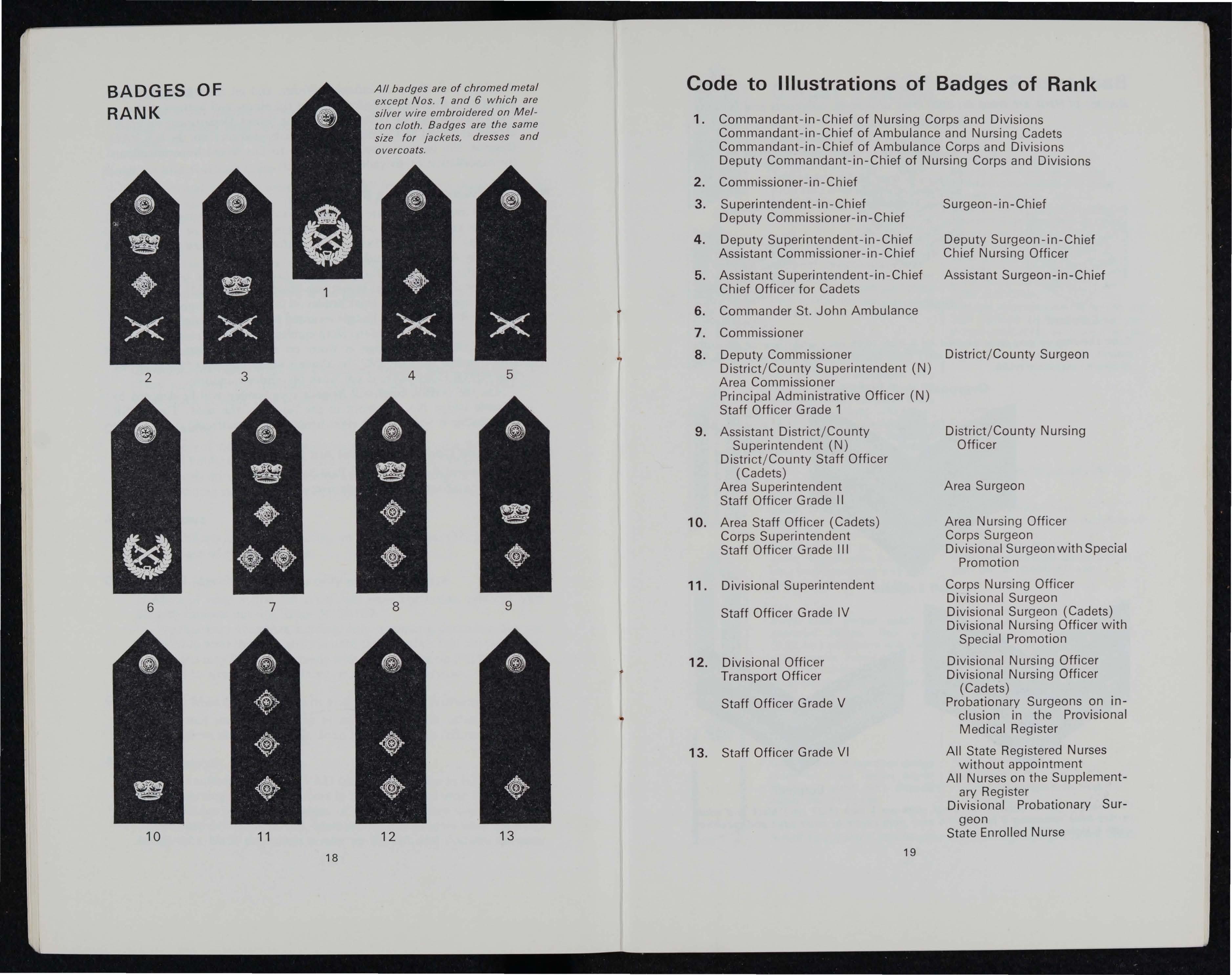
Deputy
Assistant Commissioner-in-Chief
Assistant Superintendent-in-Chief Chief Officer for Cadets
Commander St. John Ambulance
Commissioner
Deputy
District/County Superintendent (N)
District/County Surgeon
Area
Principal
District/County Nursing Officer
Divisional
Corps
Divisional
Divisional Surgeon (Cadets)
Divisional Nursing Officer with Special Promotion
Divisional Nursing Officer
Divisional Nursing Officer (Cadets)
Probationary Surgeons on inclusion in the Provisional Medical Register
State Registered Nurses without appointment
All Nurses on the Supplementary Register
Divisional Probationary Surgeon
State Enrolled Nurse
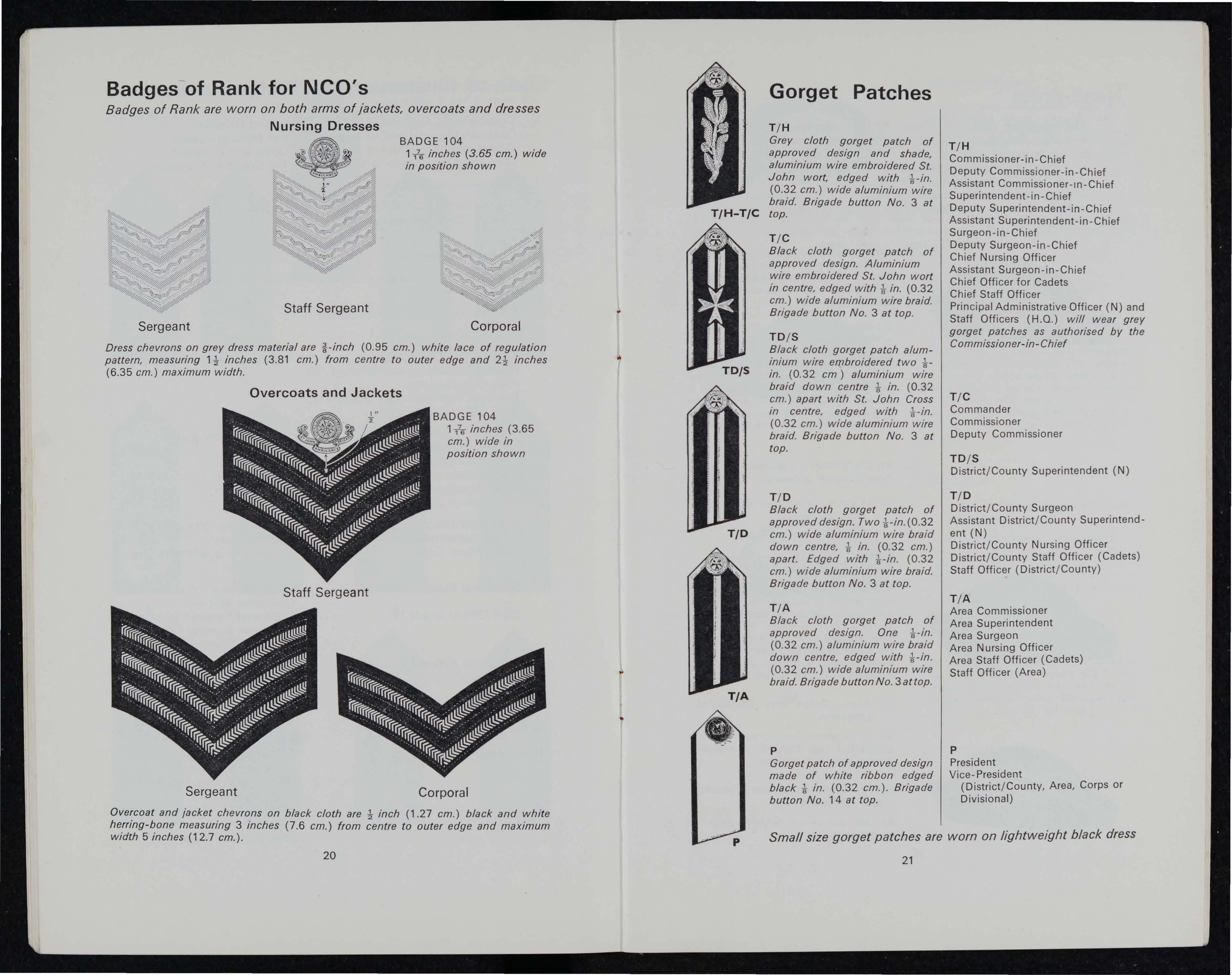
Badges - of Rank for NCO's
Badges of Rank are worn on both arms of jackets, overcoats and dresses
Nursing Dresses
Gorget Patches
T/H
BADGE 104 1 /6 inches (3.65 cm.) wide in position shown
Staff Sergeant Sergeant
Dress chevrons on grey dress material are (0.95 cm ) white lace of regulation pattern, measuring 1 inches (3.81 cm.) from centre to outer edge and inches (6.35 cm.) maximum width.
Overcoats and Jackets
Staff Sergeant
BADGE 104 1,76 inches (3.65 cm.) wide in position shown
Overcoat and jacket chevrons on black cloth are inch (1.27 cm.) black and white herring-bone measuring 3 inches (7.6 cm.) {rom centre to outer edge and maximum width 5 inches (12.7 cm.).
Grey cloth gorget patch of approved design and shade, aluminium wire embroidered St. John wort, edged with 1i-in. (0.32 cm.) wide aluminium wire braid. Brigade button No. 3 at top.
T/C
Black cloth gorget patch of approved design. Aluminium wire embroidered St. John wort in centre, edged with 1i in. (0.32 cm ) wide aluminium wire braid. Brigade button NO.3 at top.
TD/S
Black cloth gorget patch aluminium wire embroidered two 1iin (0.32 cm) aluminium wire braid down centre 1i in. (0.32 cm.) apart with St. John Cross in centre, edged with 1i-in. (0.32 cm.) wide aluminium wire braid. Brigade button No. 3 at top.
T/D
Black cloth gorget patch of approved design. Two 1i-in. (0 32 cm ) wide aluminium wire braid down centre, 1i in. (0.32 cm ) apart. Edged with 1i-in. (0.32 cm.) wide aluminium wire braid. Brigade button No.3 at top.
T/A
Black cloth gorget patch of approved design. One 1i-in. (0 32 cm.) aluminium wire braid down centre, edged with 1i-in. (0 32 cm.) wide aluminium wire braid. Brigade button No.3 at top. p
Gorget patch of approved design made of white ribbon edged black 1i in (0.32 cm.). Brigade button No. 14 at top.
T/H
Commissioner-in-Chief
Deputy Commissioner-in-Chief
Assistant Commissioner-In-Chief
Superintendent-in-Chief
Deputy Superintendent-in-Chief
Assistant Superintendent-in-Chief
Surgeon-in-Chief
Deputy Surgeon-in-Chief
Chief Nursing Officer
Assistant Surgeon-in-Chief
Chief Officer for Cadets
Chief Staff Officer
Principal Administrative Officer (N) and Staff Officers (H.Q ) will wear grey gorget patches as authorised by the C ommissioner-in- Chief
T/C
Commander Commissioner
Deputy Commissioner
TD/S
District/County Superintendent (N)
T/D
District/County Surgeon
Assistant District/County Superintendent (N)
District/County Nursing Officer
District/County Staff Officer (Cadets) Staff Officer (District/County)
T/A
Area Commissioner
Area Superintendent Area Surgeon
Area Nursing Officer
Area Staff Officer (Cadets)
Staff Officer (Area)
p President
Vice- President
(District/County, Area, Corps or Divisional)
Small size gorget patches are worn on lightweight black dress
Head-dress
The regulation hat for all officers, NCO's, members, Presidents and Vice- Presidents is a black fur or wool felt tricorne. The brim is approximately 1 inches (4.45 cm.), bound, turned up and attached to crown at the back and each side. The appropriate cockade, rosette or bow is centred on left upturned brim. The regulation ribbons used for these and the hatbands are described below. Adjustments for Senior Officers are given on page 14).
(a) District/County Superintendents, Assistant Superintendents, District/County Nursing Officers, Area Superintendents and Staff Officers Grades I and II
A band of black corded ribbon with two white stripes of equal width. A cockade of the same ribbon on turned-Up brim. The point of the cockade to be attached to the base of the brim with top corner edges attached lightly to crown. Tuft to extend 1 inches (3.81 cm.) above cockade. Badge 103 (see page 25) in centre of bottom section of cockade.
(b) All Staff Officers Grades III-VI and Area Nursing Officers.
As (a) above but without tuft.
(c) Surgeons
(i) District/County Surgeons
A band of black corded ribbon with two white stripes of equal width, and edged with scarlet stripes of equal width A cockade of same ribbon on turned-Up brim attached to crown, with regulation black tuft extending 1 inch (3.81 cm.) above cockade. Badge 74 (see page 36) in centre of bottom section of cockade.
(ii) Area, Corps and Divisional Surgeons.
As (c) (i) above but without tuft, and Badge 103 (see page 25) in centre of bottom section of cockade.
(iii) Pre-Registration and Probationary Surgeons
As (ii) above but without edge of scarlet stripes.
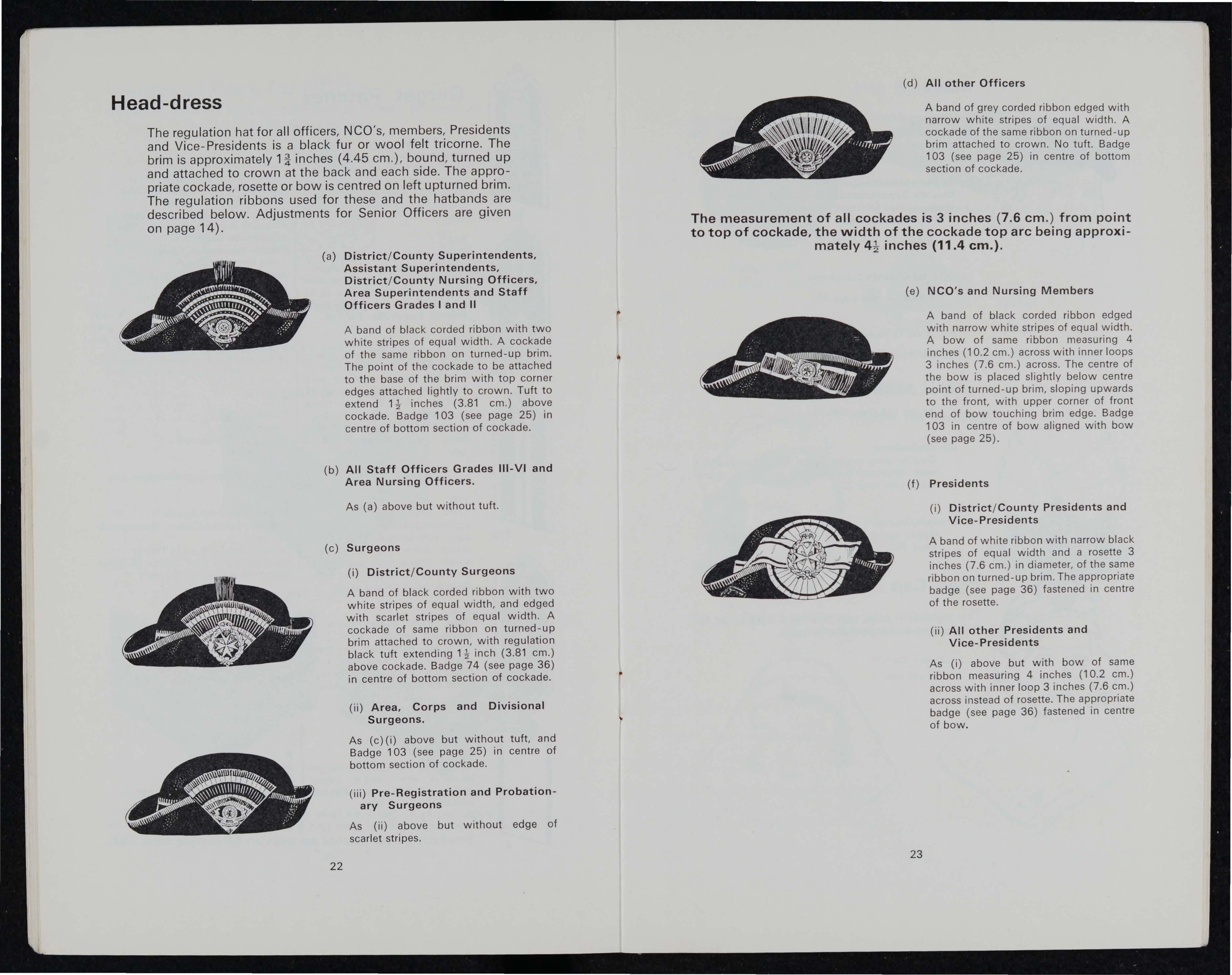
(d) All other Officers
A band of grey corded ribbon edged with narrow white stripes of equal width. A cockade of the same ribbon on turned-up brim attached to crown. No tuft. Badge 103 (see page 25) in centre of bottom section of cockade.
The measurement of all cockades is 3 inches (7.6 cm.) from point to top of cockade, the width of the cockade top arc being approximately inches (11.4 em.).
(e) NCO's and Nursing Members
A band of black corded ribbon edged with narrow white stripes of equal width. A bow of same ribbon measuring 4 inches (10.2 cm.) across with inner loops 3 inches (7.6 cm.) across. The centre of the bow is placed slightly below centre point of turned-up brim, sloping upwards to the front, with upper corner of front end of bow touching brim edge. Badge 103 in centre of bow aligned with bow (see page 25).
(f) Presidents
(i) District/County Presidents and Vice- Presidents
A band of white ribbon with narrow black stripes of equal width and a rosette 3 inches (7.6 cm.) in diameter, of the same ribbon on turned-up brim The appropriate badge (see page 36) fastened in centre of the rosette.
(ii) All other Presidents and Vice-Presidents
As (i) above but w ith bow of same ribbon measuring 4 inches (1 0.2 cm.) across with inner loop 3 inches (7.6 cm.) across instead of rosette. The appropriate badge (see page 36) fastened in centre of bow.
Beret
On the regulation beret, the appropriate badge, as described below, will be worn above the outer corner of the left eye
Superintendent-in-Chief
Deputy Superintendent-in-Chief
Headquarter Officers holding rank of crossed stretchers
Badge 73 (see page 36)
District/County Surgeons
Badge 74 (see page 36).
All other Officers
Badge 3655 (see page 25).
NCO's and Nursing Members
Badge 103 (see page 25).
Air Attendants
Double wing badge when on Air Attendant's duty, otherwise Badge 3655 or 103, as appropriate (see page 25)
Presidents and Vice-Presidents
Badge appropriate to their appointment (see page 36)
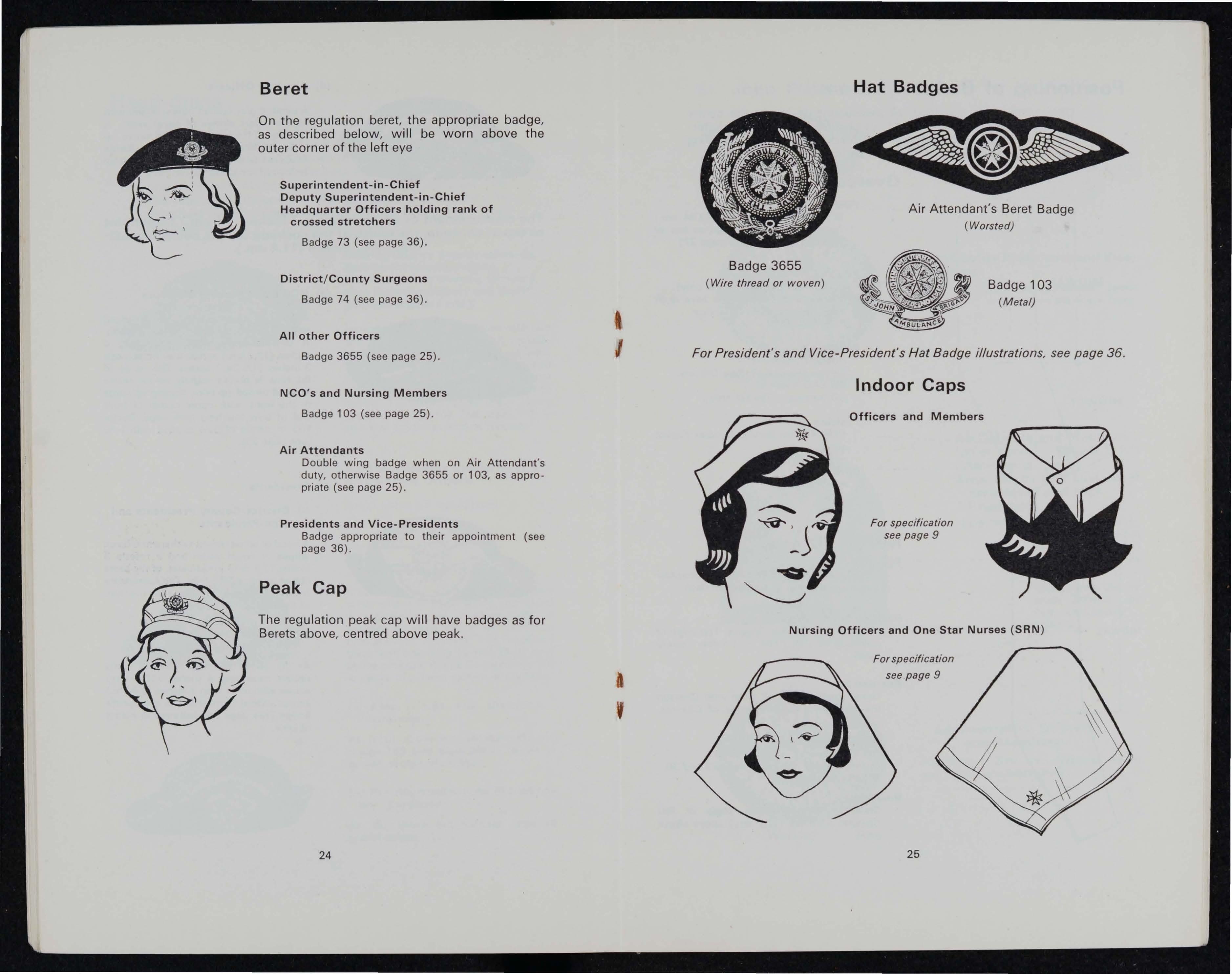
The regulation peak cap will have badges as for Berets above, centred above peak.
For President's and Vice-President's Hat Badge illustrations, see page 36
Indoor Caps
Officers and Members
For specification see page 9
Nursing Officers and One Star Nurses
For specification seepage 9
Peak Cap
Badge 3655 (Wire thread or woven )
Hat Badges
Air Attendant's Beret Badge ( Worsted)
Badge 103 ( Metal)
(SRN)
Positioning of Badges (left arm)
Unless otherwise specified, all measurements are to the centre of each badge, except Position 1 which is from the top of the lettering on the badge. Positioning described against sleeve drawing should be read in conjunction with badge details following.
Overcoat and Jacket
Position 1
St. John Flashes 1 inch (2.54 cm.) from shoulder sleeve seam to top of lettering on flash. (see page 27)
Position 2 MIDWAY
Grand Prior's Badge (jacket only).
If worn with Chevron the base to fit flush in angle of Chevron.
Rank Chevrons
Position 3
Hospital Librarians.
Service Hospital Welfare Officers.
RN VAD Reserve.
CD Instructors (jacket only).
Position 4
1939-45 War Service Crosses (jacket only).
Position 5
Air Attendants.
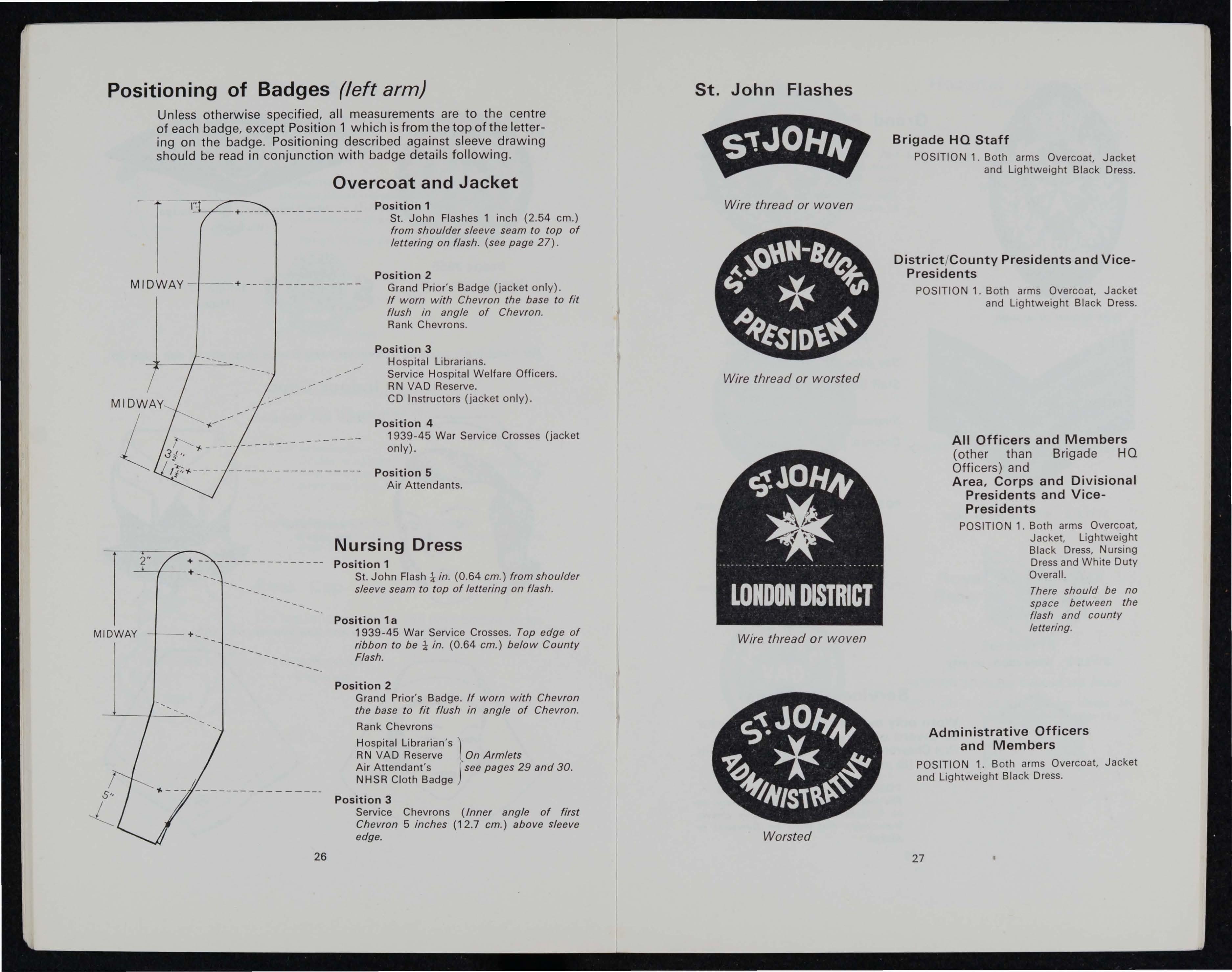
Nursing Dress
Position 1
St. John Flash in. (0.64 cm.) from shoulder sleeve seam to top of lettering on flash.
Position 1a
1939-45 War Service Crosses. Top edge of ribbon to be in. (0.64 cm.) below County Flash.
Position 2
Grand Prior's Badge. If worn with Chevron the base to fit flush in angle of Chevron
Rank Chevrons
Hospital Librarian's}
RN VAD Reserve On Armlets
Air Attendant's see pages 29 and 30.
NHSR Cloth Badge
Position 3
Service Chevrons (Inner angle of first Chevron 5 inches (12.7 cm.) above Sleeve edge.
St. John Flashes
Brigade HQ Staff
POSITION 1 Both arms Overcoat, Jacket and Lightweight Black Dress.
District / County Presidents and VicePresidents
POSITION 1. Both arms Overcoat, Jacket and Lightweight Black Dress
All Officers and Members (other than Brigade H Q Officers) and Area, Corps and Divisional Presidents and VicePresidents
POSITION 1. Both arms Overcoat, Jacket, Lightweight Black Dress, Nursing Dress and White Duty Overall.
There should be no space between the flash and county lettering
Administrative Officers and Members
POSITION 1 Both arms Overcoat, Jacket and Lightweight Black Dress
27
Grand Prior's Badge
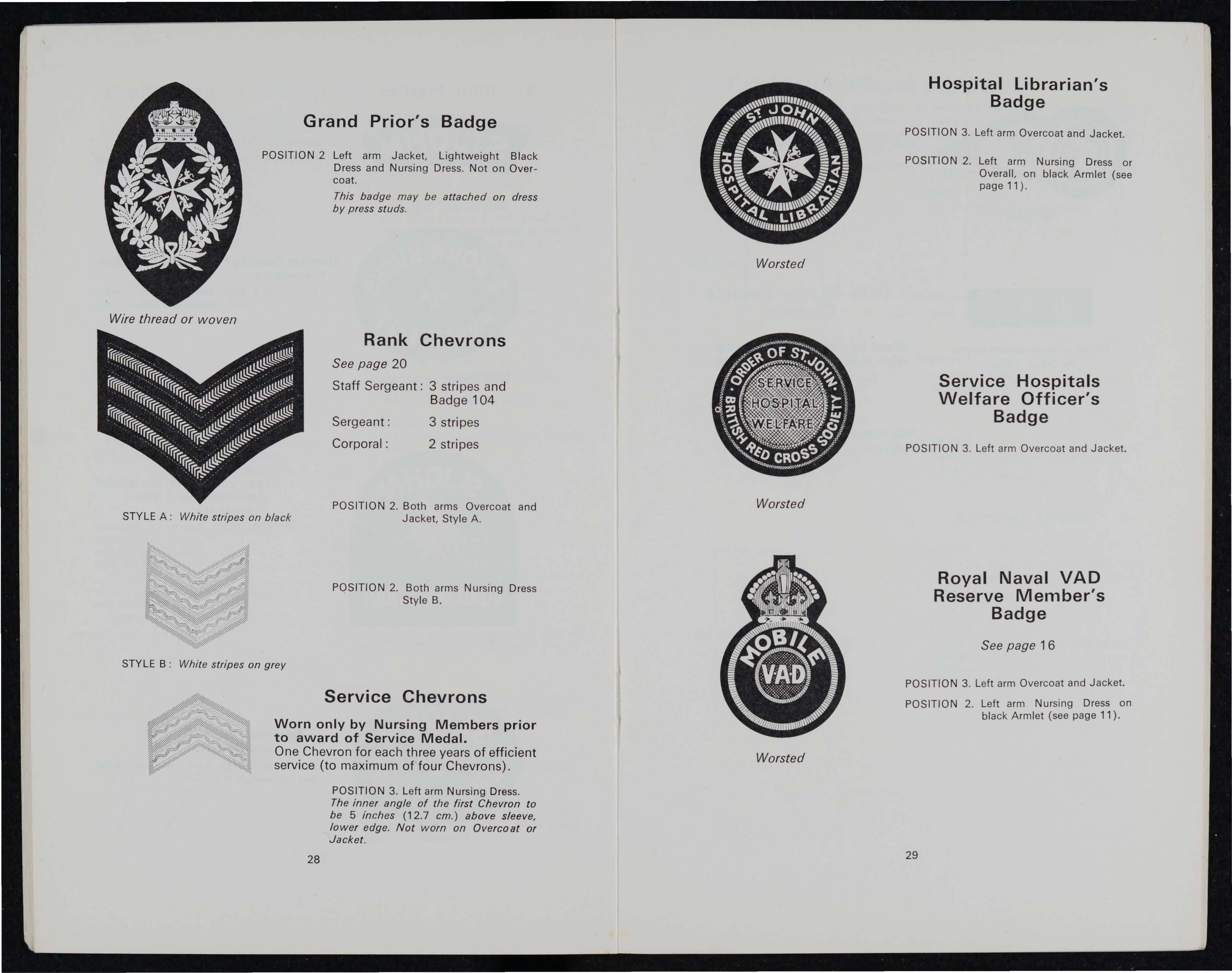
Rank Chevrons
Service Chevrons
STYLE
STYLE
Air Attendant's Badge
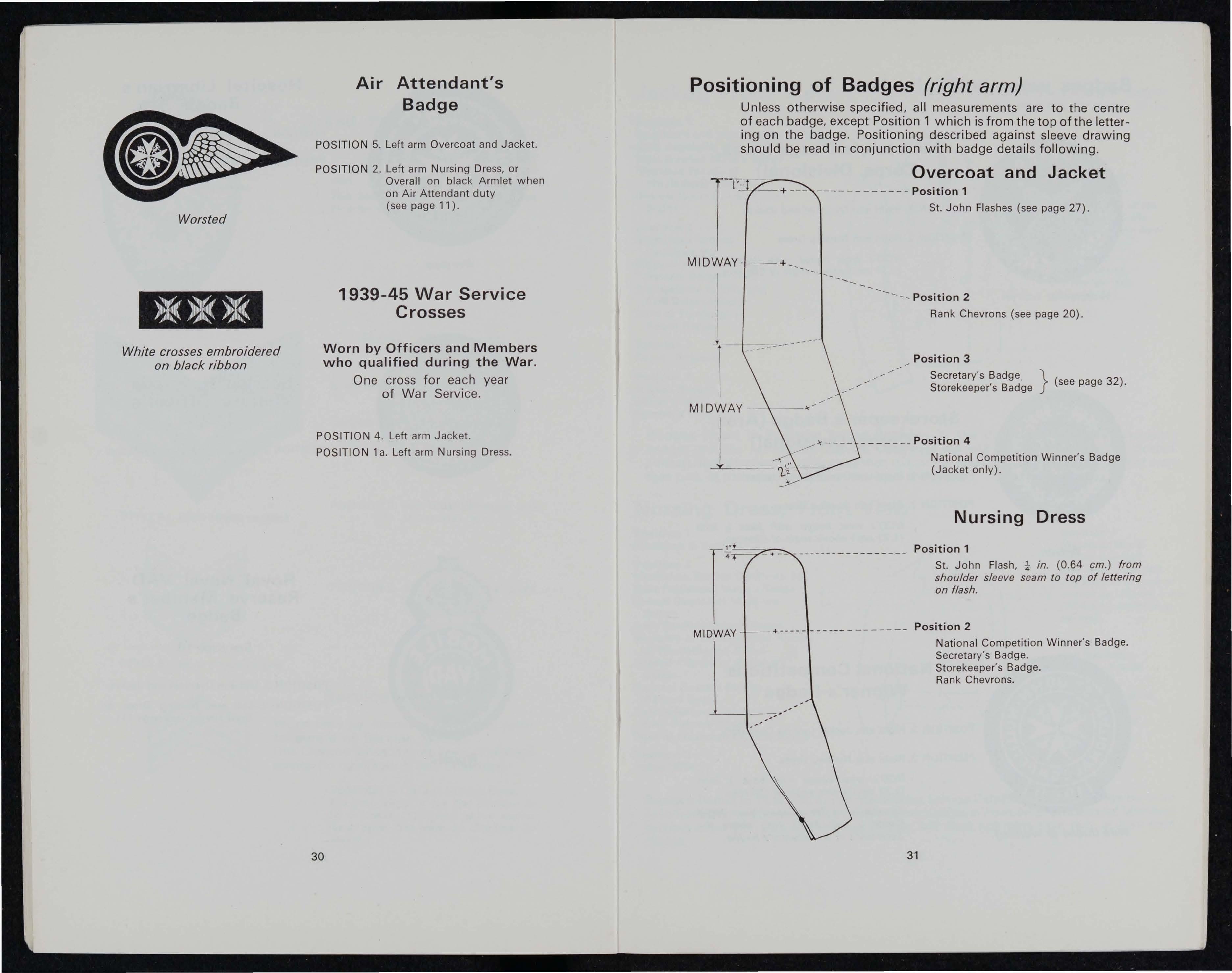
Positioning of Badges (right arm)
Unless otherwise specified, all measurements are to the centre of each badge, except Position 1 which is from the top of the lettering on the badge. Positioning described against sleeve drawing should be read in conjunction with badge details following.
Overcoat and Jacket
1939-45 War Service Crosses
Nursing Dress
Worsted
crosses embroidered on black ribbon
Badges worn on Right Arm
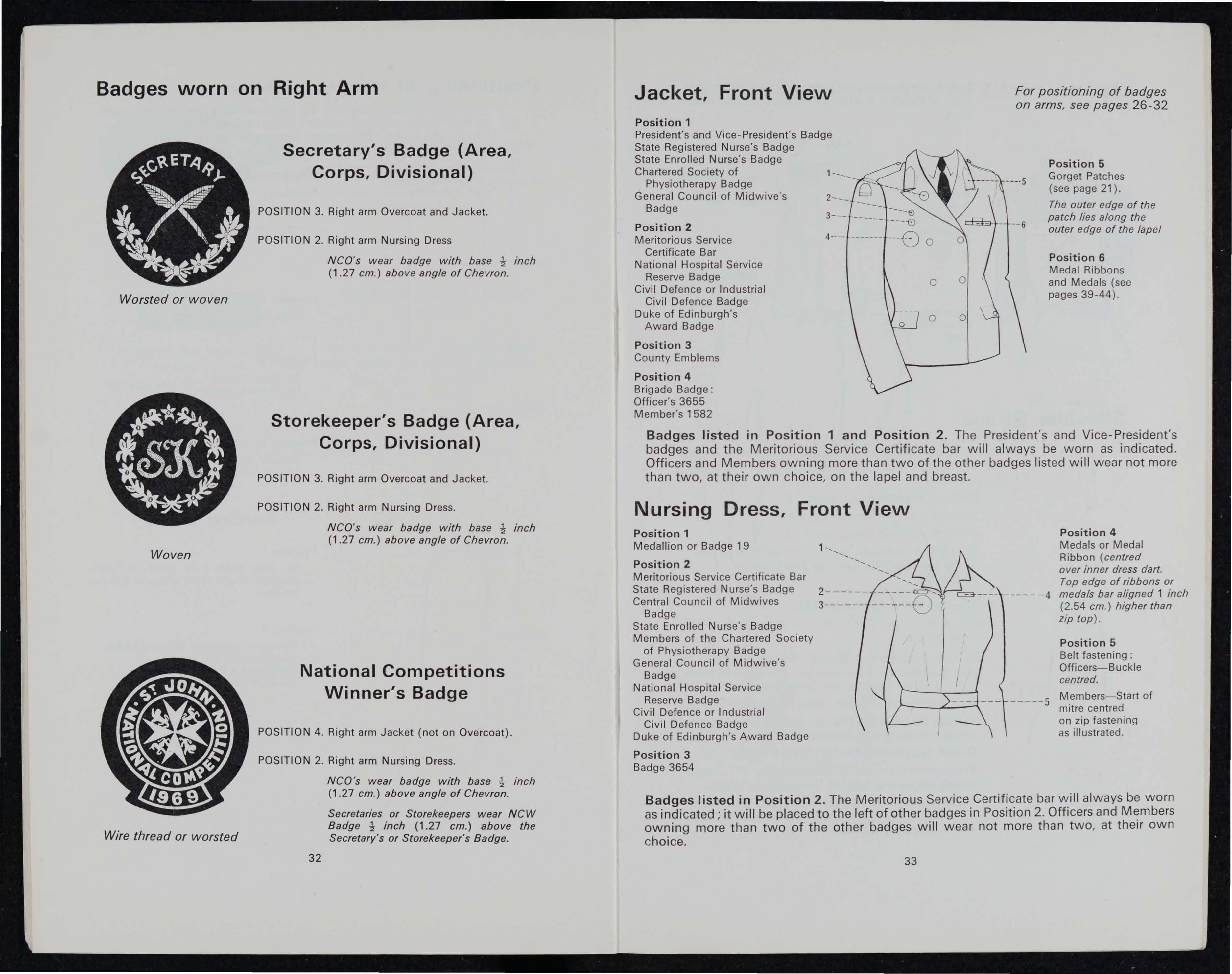
Jacket, Front View
Position
President's
State
Chartered
Position
Meritorious
National
For positioning of badges on arms, see pages 26-32
Position 5
Gorget Patches (see page 21 )
The outer edge of the patch lies along the outer edge of the lapel
Position 6 Medal Ribbons and Medals (see pages 39-44).
Position
Position
Storekeeper's
POSITION
Badges listed in Position 1 and Position 2. The President's and Vice-President's badges and the Meritorious Service Certificate bar will always be worn as indicated. Officers and Members owning more than two of the other badges listed will wear not more than two, at their own choice, on the lapel and breast.
Nursing Dress, Front View
Position 1
Medallion or Badge 19
Position 2
Meritorious Service Certificate Bar
State Registered Nurse's Badge
Central Council of Midwives Badge
State Enrolled Nurse's Badge
Members of the Chartered Society of Physiotherapy Badge
General Council of Midwive's Badge
National Hospital Service Reserve Badge
Civil Defence or Industrial Civil Defence Badge
Duke of Edinburgh's Award Badge
Position 3
Badge 3654
Position 4
Medals or Medal Ribbon ( centred over nner dress dart
Top edg e of ribbons or m eda l s bar al gned 1 nch (2.54 cm. ) higher than zip top )
Position 5
Belt fasten ng : Officers- Buckle centred.
Members- Start of mitre centred on zip fastening as illustrated
Badges listed in Position 2. The Meritorious Service Certificate bar will always be worn as indicated; it will be placed to the left of other badges in Position 2. Officers and owning more than two of the other badges will wear not more than two, at their own choice. 33
Apron
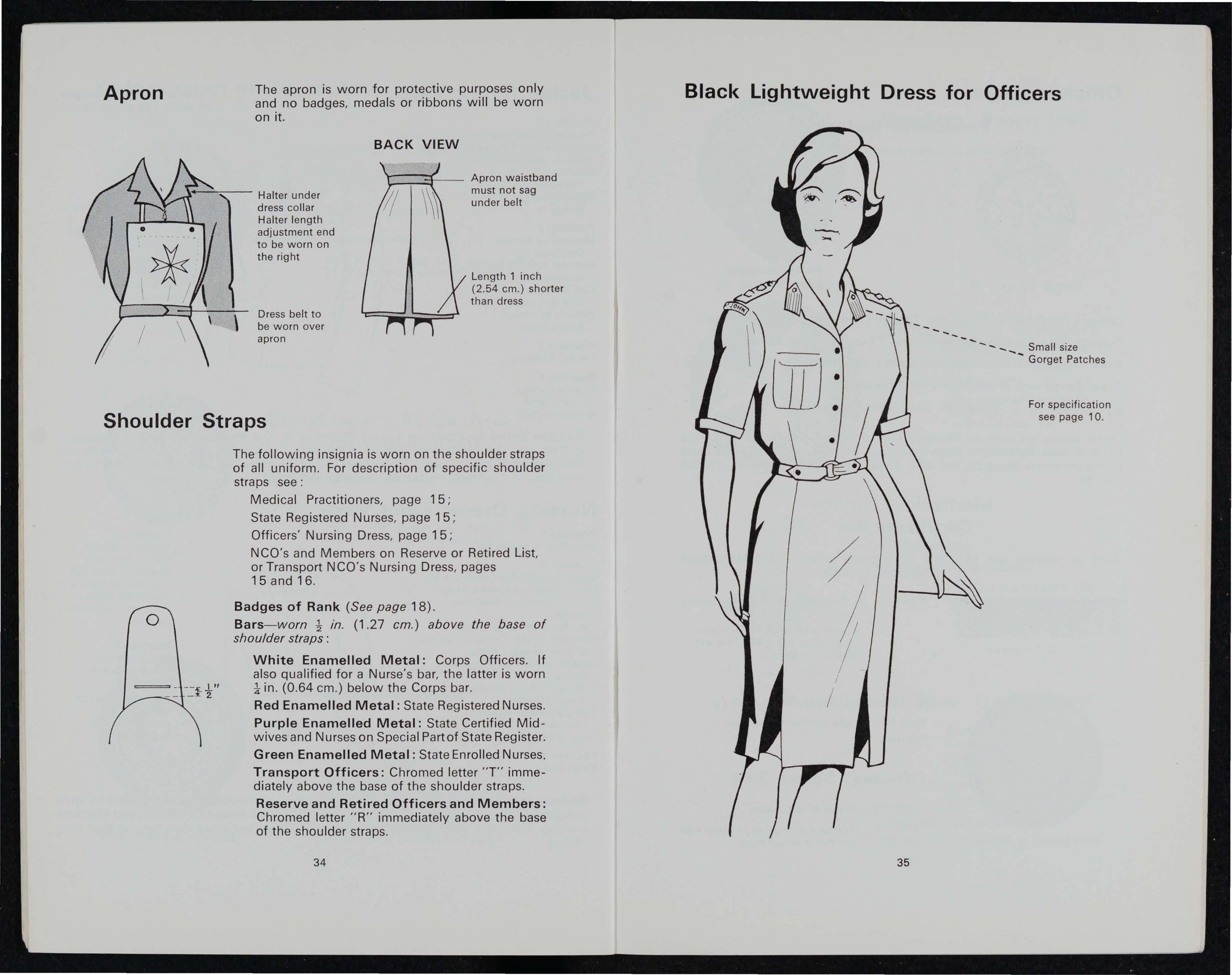
The apron is worn for protective purposes only and no badges, medals or ribbons will be worn on it.
BACK VIEW
Halter under dress collar
Halter length adjustment end to be worn on the right
Dress belt to be worn over apron
Shoulder Straps
The following insignia is worn on the shoulder straps of all uniform. For description of specific shoulder straps see:
Medical Practitioners, page 15; State Registered Nurses, page 15; Officers' Nursing Dress, page 15; NCO's and Members on Reserve or Retired List, or Transport NCO's Nursing Dress, pages 15 and 16.
Badges of Rank (See page 18).
Bars-worn .; in. (1.27 em.) above the base of shoulder straps:
White Enamelled Metal: Corps Officers. If also qualified for a Nurse's bar, the latter is worn in. (0.64 cm.) below the Corps bar.
Red Enamelled Metal: State Registered Nurses.
Purple Enamelled Metal: State Certified Midwives and Nurses on Special Partof State Register.
Green Enamelled Metal: State Enrolled Nurses.
Transport Officers: Chromed letter "T" immediately above the base of the shoulder straps.
Reserve and Retired Officers and Members: Chromed letter "R" immediately above the base of the shoulder straps.
Black Lightweight Dress for Officers
Gorget
Official Badges
Presidents' Badges
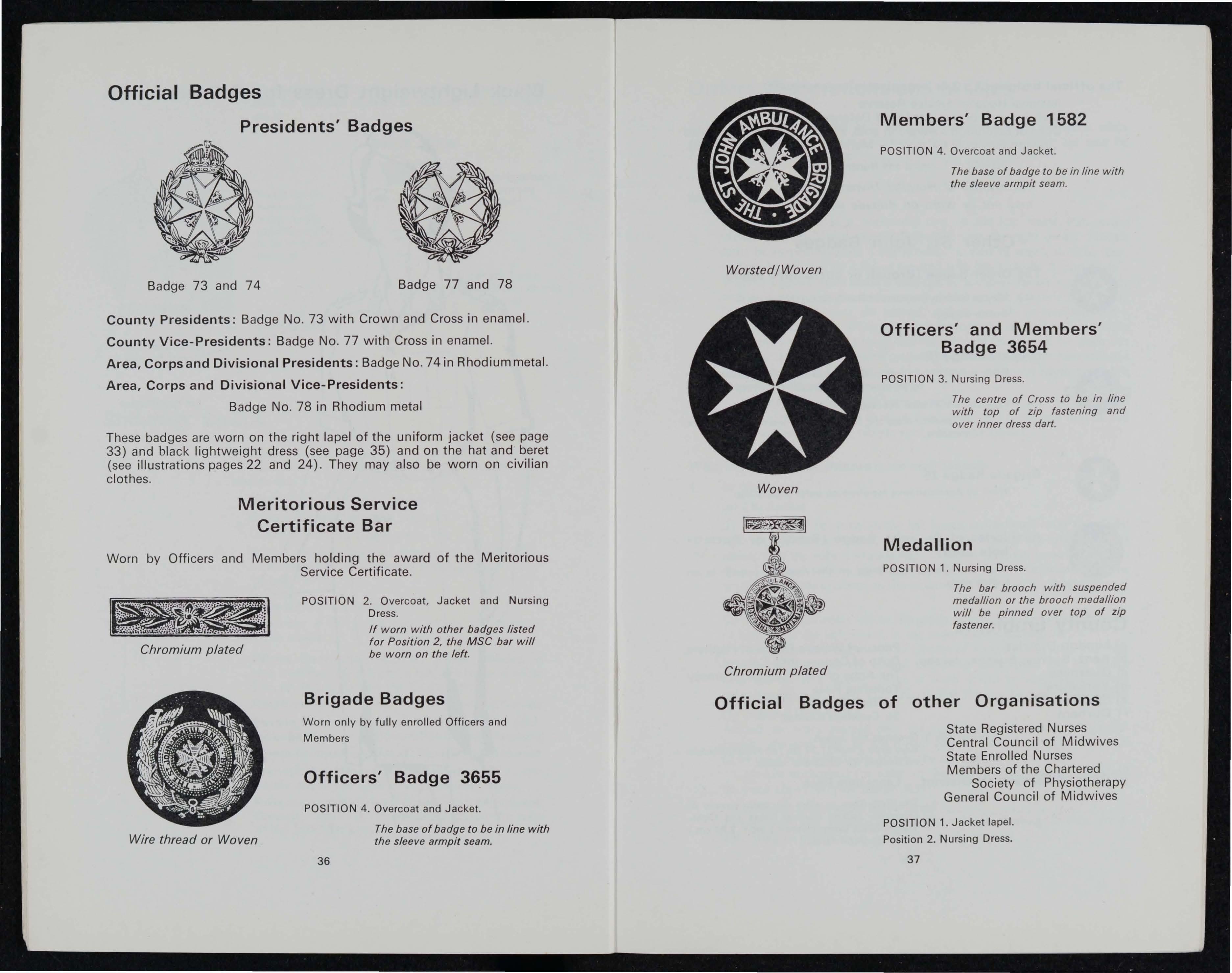
Badge 73 and 74 Badge 77 and 78
County Presidents: Badge No. 73 with Crown and Cross in enamel.
County Vice-Presidents: Badge No. 77 with Cross in enamel.
Area, Corps and Divisional Presidents: Badge No. 74 in Rhodium metal.
Area, Corps and Divisional Vice-Presidents: Badge No. 78 in Rhodium metal
These badges are worn on the right lapel of the uniform jacket (see page 33) and black lightweight dress (see page 35) and on the hat and beret (see illustrations pages 22 and 24). They may also be worn on civilian clothes.
Meritorious Service Certificate Bar
Brigade Badges
Official Badges of other Organisations
The official badges of other organisations (continued)
National Hospital Service Reserve
Civil Defence or Industrial Civil Defence
Duke of Edinburgh's Award in gold, silver or bronze (the bronze Award may only be worn by Members under the age of 18).
POSITION 2. Jacket and Nursing Dress.
The badges of Hospital Training Schools may not be worn on Brigade uniform.
Other St. John Badges
The Order Badge (Brooch or buttonhole stud)
May be worn by members of The Order on civilian dress Not on uniform.
Brigade Badge 19
With uniform : To fasten tie ends to shirt On Nursing Dress by all personnel not qual fied for the Medallion
POSITION 1. Pinned over top of zip fastener
On civilian dress the badge may be worn by all Brigade members
Brigade Badge 25
Worn by Administrative members on beret or peak cap.
Auxiliaries of St. John Badge (Brooch or buttonhole stud)
Worn by enrolled Auxiliaries on the Auxiliary overall or on civilian dress
County Emblems
a) london District
b) Kent, Surrey,
c) Guernsey
d) Yorkshire
e) Staffordshire
f) Durham
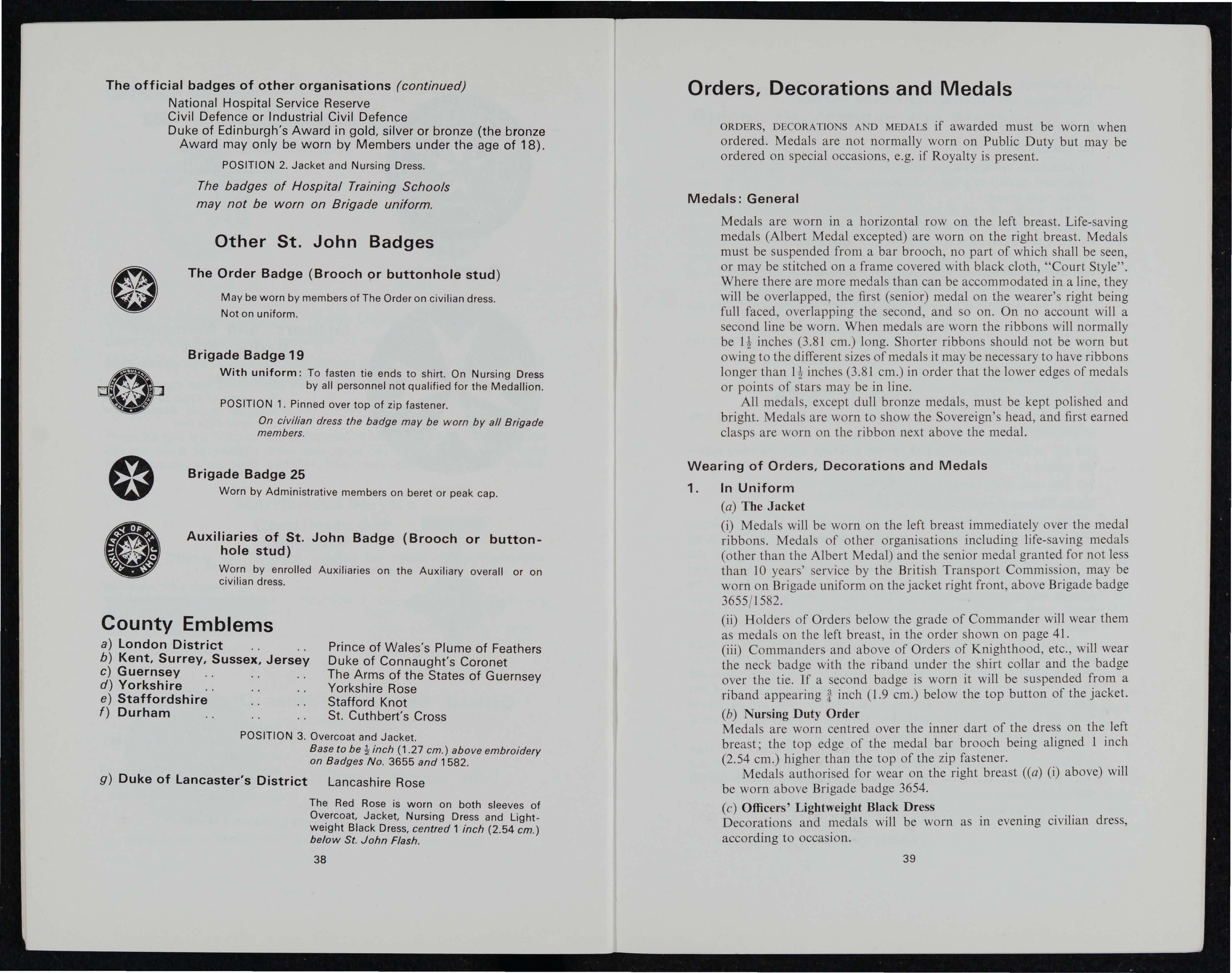
Prince of Wales's Plume of Feathers Duke of Connaught's Coronet
The Arms of the States of Guernsey Yorkshire Rose Stafford Knot St. Cuthbert's Cross
POSITION 3 Overcoat and Jacket
Base to be inch (1 . 27 cm.) above embroidery on Badges No 3655 and 1582.
g) Duke of lancaster's District Lancashire Rose
The Red Rose is worn on both sleeves of Jacket, Nursing Dress and lightweight Black Dress, centred 1 inch (2.54 cm ) below St. John Flash.
38
Orders, Decorations and Medals
ORD ER S, DECORATIONS AND ME D ALS if awar d ed m ust b e worn when o rd e r ed. Med als are not normally worn on Publi c D uty but may b e o rde re d on special occasions, e.g. if R oyalty is present.
Medals
: General
Medals are worn in a horizontal row on the left breast. Life-saving medals (Albert Medal excepted) are worn on the right breast. Medals must be suspended from a bar brooch, no part of which shall be seen, or may be stitched on a frame covered with black cloth, "Court Style". Where there are more medals than can b e accommodated in a line , they will be overlapped , the first (senior) medal on the wearer's right being full faced , overlapping the second , and so on. O n no account will a second line be worn. When medals are worn the ribbons will normally be It inches (3.81 cm.) long. Shorter ribbons should not be worn but owing to the different sizes of medals it may be necessary to have ribbons longer than H inches (3 8 1 cm ) in order that the lower edges of medals or points of stars may be in line.
All medals , except dull bronze medals , must be kept polished and bright. Medals are worn to show the Sovereign's head , and first earned clasps are worn on the ribbon next above the medaL
Wearing of Orders, Decorations and Medals
1. In Uniform
(a) T he Ja ck et
(i) Medals will be worn on the left breast immediately over the meda l ribbons. Medals of other organisations including life-saving medals (other than the Albert Medal) and the senior medal granted for not less than 10 years' service by the B ritish Transport Commission , may be worn on Brigade uniform on the jacket right front , above Brigade badge 365 5/ 1582.
(ii) Holders of O rders below the grade of C ommander will wear them as medals on the left b reast , in the order shown on page 41 .
(iii) Commanders and above of O rders of Knighthood , etc., will wear the neck badge with the ri b and under the shirt collar and the badge over the tie. If a second b adge is worn it will be suspended from a riband appearing ! inch (1. 9 cm.) b elow the top b utton of the jacket.
(b) N ursing Du ty Ord er
Medals are worn centred over the inner dart of the dress on t he left b reast; the top edge of th e medal b ar brooch b eing aligne d 1 inch (2. 54 cm.) higher than t he top of the zip fas t ener.
Me d a ls authorised for wear on the right breast ((a) (i) a b ove) will b e worn a b ove B rigade badge 36 54
(c) Officer s' Light we ight Black Dress
D ecorations and medals will b e worn as III evening civilian d ress, accor di ng to occasion
39
2 .
(d) O ver coa t
Decorations and medals are not worn on overcoats.
In Civilian Clothes
(a) Evening D ress
(i) Miniature medals will be worn on the left breast. Miniatures of the authorised medals of other organisations (para 1 (a) (i) ) will be worn on the right breast.
(ii) The badges of Orders issued with a bow will be worn on the bow immediately below the miniature medals on the left breast. Dames Grand Cross, Dames Commanders and Commanders of the Orders should wear full size Insignia (together with miniatures of other decorations and medals they may have), and officers and members of the Orders and holders of medals should wear these in miniature.
(iii) Up to four Stars of Orders, where awarded, may be worn below the badges.
(iv) Dames Grand Cross will wear the sash of their Order across the right shoulder, with badge.
(
b) Afternoon wear
(i) Full size medals will be worn, according to occasion.
(ii) The badges of Orders issued with a bow will be worn on the bow immediately below the medals.
(iii) Up to four Stars of Orders, where awarded, may be worn below the badges.
(iv) The sash of an Order will not be worn.
Medal Ribbons if awarded must be worn.
Ribbons worn without decorations are i inch (0.95 cm.) in depth
an.d are worn on the left breast of the jacket or indoor uniform. (Existing Inch (1.27 cm.) depth medal ribbons need not be altered). On the Jacket? the bottom of the bottom row of ribbons will be in line with top of Bngade badge (3655 / 1582); on indoor uniform ribbons will be centred over inner dress dart, the top edge of ribbons aligned 1 inch (2.54 cm.) higher than zip top. Ribbons will not be worn on the overcoat.
There is no specific rule about the numbers of ribbons to be worn in one row, the number being governed by the physique of the wearer and the width of the lapel. No ribbon should be fully obscured by the lapel of the jacket. As many ribbons as convenient will be placed in one row before another row is started. An incomplete row will be placed centrally above the top complete row, and will contain the ribbons of the senior orders, decorations or medals.
Ribbons are best stretched over firm canvas stiffeners and then stitched to the uniform without intervals. In Nursing Duty Order and the lightweight black dress, the ribbons are worn on a brooch bar for easy detachment.
Order of Wearing Orders, Decorations and Medals
VICTORIA CROSS. GEORGE CROSS.
British Orders of Knighthood, etc.
Order of the Garter.
Order of the Thistle.
Order of St. Patrick.
Order of the Bath.
Order of Merit (immediately after Knights Grand Cross of the Order of the Bath).
Order of the Star of India.
Order of St. Michael and St. George.
Order of the Indian Empire.
Order of the Crown of India.
Royal Victorian Order (Class I, II and III).
Order of the British Empire (Classes I, II and III).
Order of the Companions of Honour (immediately after Knights and Dames Grand Cross of the Order of the British Empire).
Distinguished Service Order.
Royal Victorian Order (Class IV).
Order of the British Empire (Class IV).
Imperial Service Order.
Royal Victorian Order (Class V).
Order of the British Empire (Class V).
OTE-The above applies to those orders of similar grades. When miniature or riband of a higher grade of a junior order is worn with that of a lower grade of a senior order, the higher grade miniature or riband should come first, e.g., the miniature or riband of a K.B.E. will come before a C.B. , and a G.C.M.G. before a K.C.B. The ribands or orders, when the riband alone is worn, will be of the width of the ribands of the membership of the order. If there is no membership class the riband will be of the width of the riband of the companionship of the order.
Baronet's Ba dge
(The badge is worn suspended round the neck by the riband in the same manner as the neck badge of an order and takes precedence immediately after the Badge of the Order of Merit. It is not worn in miniature and the riband is not worn with undress uniform.)
Knig ht B a ch elor 's Ba dge
(The badge is worn after the Star of a Knight Commander of the Order of the British Empire. It is not worn in miniature and is not worn with undress uniform.)
Indian Order of Merit (Military).
41
Decorations
Royal Red Cross (Class I).
Distinguished Service Cross. Military Cross.
Distinguished Flying Cross. Air Force Cross.
Royal Red Cross (Class II).
Order of British India.
Kaisar-i-Hind Medal. Order of St. John Albert Medal.
Medals for Gallantry and Distinguished Conduct
Union of South Africa Queen's Medal for Bravery, in Gold.
Distinguished Conduct Medal.
Conspicuous Gallantry Medal. George Medal.
Queen's Police Medal, for Gallantry.
Queen's Fire Service Medal, for Gallantry. Edward Medal.
Royal West African Frontier Force Distinguished Conduct Medal.
King's African Rifles Distinguished Conduct Medal.
Indian Distinguished Service Medal.
Union of South Africa Queen's Medal for Bravery, in Silver.
Distinguished Service Medal.
Military Medal.
Distinguished Flying Medal. Air Force Medal.
Constabulary Medal (Ireland).
Medal for Saving Life at Sea.
Indian Order of Merit (Civil).
Indian Police Medal for Gallantry.
Ceylon Police Medal for Gallantry.
Colonial Police Medal for Gallantry.
British Empire Medal. Canada Medal.
Queen's Police Medal, for Distinguished Service.
Queen's Fire Service Medal, for Distinguished Service. Queen's Medal for Chiefs.
WAR MEDALS (in order of date of campaign for which awarded).
POLAR MEDALS (in order of date).
Royal Victorian Medal (Gold, Silver and Bronze).
Imperial Service Medal.
Police Medals for Valuable Services
Indian Police Medal for Meritorious Service.
Ceylon Police Medal for Merit.
Colonial Police Medal for Meritorious Service. Badge of Honour.
42
Jubilee, Coronation and Durbar Medals
Queen Victoria's Jubilee Medal, 1887 (Gold, Silver and Bronze).
Queen Victoria's Police Jubilee Medal, 1887.
Queen Victoria's Jubilee Medal, 1897 (Gold, Silver and Bronze).
Queen Victoria's Police Jubilee Medal, 1897.
Victoria's Commemoration Medal, 1900 (Ireland).
King Edward VII's Coronation Medal, 1902.
King Edward VII's Police Coronation Medal, 1902.
King Edward VII's Durbar Medal, 1903 (Gold, Silver and Bronze).
King Edward VII's Police Medal, 1903 (Scotland).
King's Visit Commemoration Medal, 1903 (Ireland).
King George V's Coronation Medal, 1911.
King George V's Police Coronation Medal, 1911.
King's Visit Police Commemoration Medal, 1911 (Ireland).
George V's Durbar Medal, 1911 (Gold, Silver and Bronze).
Kmg George V's Silver Jubilee Medal, 1935.
King George VI's Coronation Medal, 1937.
Queen Elizabeth II's Coronation Medal, 1953.
King George V's Long and Faithful Service Medal.
King George VI's Long and Faithful Service Medal.
Queen Elizabeth II's Long and Faithful Service Medal.
Efficiency and Long Service Decorations and Medals
Long Service and Good Conduct Medal.
Naval Long Service and Good Conduct Medal. Medal for Meritorious Service.
Indian Long Service and Good Conduct Medal (for Europeans of Indian Army).
Indian Meritorious Service Medal (for Europeans of Indian Army).
Royal Marine Meritorious Service Medal.
Royal Air Force Meritorious Service Medal.
Royal Air Force Long Service and Good Conduct Medal.
Indian Long Service and Good Conduct Medal (for Indian Army).
Royal West African Frontier Force Long Service and Good Conduct Medal.
King's African Rifles Long Service and Good Conduct Medal.
Indian Meritorious Service Medal (for Indian Army).
Police Long Service and Good Conduct Medal.
Fire Brigade Long Service and Good Conduct Medal.
African Police Medal for Meritorious Service.
Royal Canadian Mounted Police Long Service Medal.
Ceylon Police Long Service Medal.
Ceylon Fire Services Long Service Medal.
Colonial Police Long Service Medal.
Colonial Fire Brigades Long Service Medal.
Colonial Prison Service Medal.
Army Emergency Reserve Decoration.
Volunteer Officers' Decoration.
Volunteer Long Service Medal.
Volunteer Officers' Decoration (for India and the Colonies).
43

Volunteer Long Service Medal (for India and the Colonies).
Colonial Auxiliary Forces Officers' Decoration.
Colonial Auxiliary Forces Long Service Medal. Medal for Good Shooting (Naval).
Militia Long Service Medal.
Imperial Yeomanry Long Service Medal. Territorial Decoration. Efficiency Decoration.
Territorial Efficiency Medal. Efficiency Medal.
Special Reserve Long Service and Good Conduct Medal.
Decoration for Officers of the Royal Naval Reserve.
Decoration for Officers of the Royal Naval Volunteer Reserve.
Royal Naval Reserve Long Service and Good Conduct Medal.
Royal Naval Volunteer Reserve Long Service and Good Conduct Medal.
Royal Naval Auxiliary Sick Berth Reserve Long Service and Good Conduct Medal.
Royal Fleet Reserve Long Service and Good Conduct Medal.
Royal Naval Wireless Auxiliary Reserve Long Service and Good Conduct Medal.
Air Efficiency Award.
Queen's Medal (for Champion Shots in the Military Forces). Queen's Medal (for Champion Shots of the Air Forces). Cadet Forces Medal.
Coast Life Saving Corps Long Service Medal. Special Constabulary Long Service Medal. Canadian Forces Decoration.
Royal Observer Corps Medal.
Civil Defence Service Medal.
Union of South Africa Commemoration Medal. Indian Independence Medal. Pakistan Medal.
Ceylon Armed Services Inauguration Medal.
Ceylon Police Independence Medal, 1948.
Service l\1edal of the Order of St. John. Badge of the Order of the League of Mercy.
Voluntary Medical Service Medal. Women's Voluntary Service Medal.
South African Medal for War Services.
Colonial Special Constabulary Medal.
Other Commonwealth Members' Orders, Decorations and Medals (instituted since 1949 otherwise than by the Sovereign), including awards conferred by the Rulers of States of the Federation of Malaya.
FOREIGN ORDERS (in order of date of award).
FOREIGN DECORATIONS (in order of date of award).
FOREJGN MEDALS (in order of date of award). 44